
Education Jobs Fund Passes in the House

The U.S. House of Representatives just passed HR 1586, a shell bill that is being used as a vehicle for a $10 billion Education Jobs Fund – money meant to help states avoid teacher and staff layoffs in the coming school year – and a $16 billion increase in funding for Medicaid reimbursements. The full Senate passed the bill last week after much debate and it will now go to the president for his signature. Congressional leaders have said that the $10 billion for the Education Jobs Fund will save as many as 140,000 K-12 jobs by helping to fill gaps in state education budgets. Recently, however, stakeholders and media outlets have questioned just how many jobs need saving.
For example, an NPR story from yesterday explored whether district efforts to cut costs like implementing salary freezes and eliminating afterschool programs were sufficient enough to avoid the tens of thousands of teacher layoffs previously anticipated. Dr. Marguerite Roza from the Center for Reinventing Public Education estimated that, as a result of these efforts, actual teacher layoffs for the coming school year would have been under 100,000, rather than the 160,000 to 300,000 estimated by some organizations.
But does this mean that the Education Jobs Fund will go unspent? Unlikely.
District cost-cutting measures may have eliminated the need to lay off significant numbers of teachers this year. But the Education Jobs Fund can also be used to rehire teachers that had been previously let go. According to Dr. Roza, this could include as many as 80,000 jobs that were lost in the 2009-10 school year. This includes not just teachers, but staff, administrators, janitors, and other school employees. In this struggling economy, these extra funds could actually create jobs in districts where layoffs are no longer necessary or free up some funds to restart previously eliminated programs.
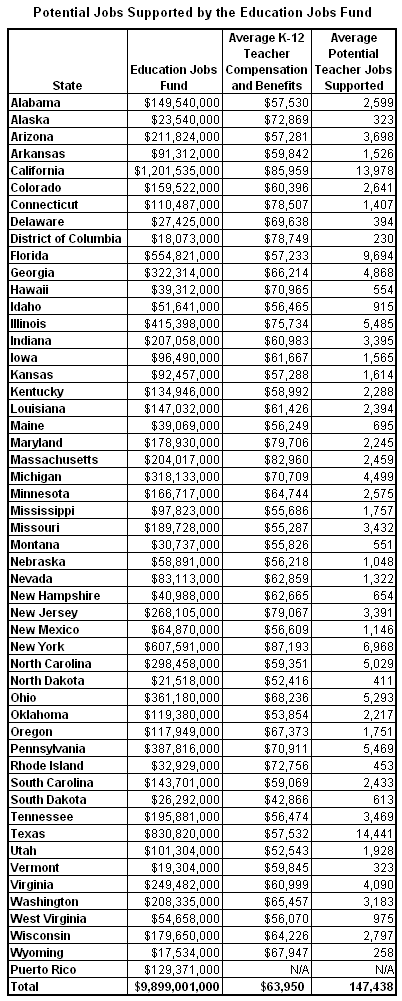
How many jobs could the Education Jobs Fund actually support? To answer this question, we have taken data on each state’s proposed allocation under the most recent version of the Education Jobs Fund and divided it by each state’s average teacher salary plus benefits for the 2009-10 school year. In total, this calculation suggests that if used only to save teacher jobs, the Education Jobs Fund could be used to support more than 147,000 jobs across the country. This number could be even higher if the funds are used to save more low-cost jobs like janitorial and classroom aid jobs.
While it is impossible to know the true impact of the Education Jobs Fund, assuming it passes and is signed by the president, this back-of-the-envelope analysis gives us some sense of what the money could mean for school districts. See the full table of state-by-state data below:
More About the Author
Issues
Related

Multilingual Students with Disabilities Deserve Stronger Support

University of Phoenix to Pay Up to $8.75 Million Over Claims It Shared Student Data With Meta

College Leaders View Economic Development as Central to Their Mission But Face Barriers, New America and ACCT Survey Find