
House Approves 2015 Spending Limit for Education and Other Agencies
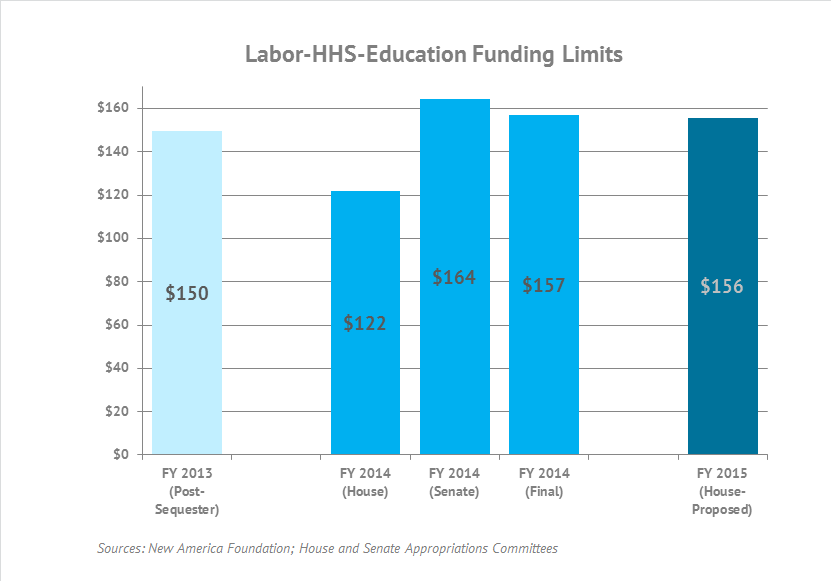
The House Appropriations Committee voted yesterday to approve individual funding levels for what will eventually become 12 separate annual appropriations bills to fund the federal government in fiscal year 2015. Lawmakers set the limit for the Labor-Health and Human Services (HHS)-Education bill at $155.7 billion. That’s about a $1 billion drop from last year’s final figures ($156.8 billion)–but it’s probably a good deal more than some members of the House would prefer. And despite the cut, the figure actually suggests that the high-stakes budget battles of recent years are over, at least for this year’s appropriations process.
To that point, the overall funding level for all of the appropriations bills for fiscal year 2015 is in line with the House budget resolution, last year’s bipartisan budget deal (the Bipartisan Budget Act), and the limit that Senate Budget Committee Chair Patty Murray (D-WA) has said the Senate will use. That should simplify the process of reaching agreement on a fiscal year 2015 appropriations, though neither chamber plans to make much of a real push for it until after the November elections this year. That said, the committees in both chambers may start to release details of their proposed appropriations bills in the coming months, including funding levels for specific education programs.
Compare this to last year. House Republicans on the Appropriations Committee voted to approve a funding level of just $121.8 billion for the Departments of Labor, Health and Human Services, and Education. That would have been a steep, nearly 20 percent decline from the prior year’s figure of $149.6 billion. And the cuts would have come in fiscal year 2014, the year after sequestration took effect, when lawmakers applied across-the-board spending cuts mid-year, leaving many education and other programs in the lurch.
Ultimately, the proposed cuts turned out to be too large even for House Republicans. At the last minute, the Labor-HHS-Education Appropriations Subcommittee postponed indefinitely a hearing to debate those agencies’ appropriations and pulled a scheduled vote on the bill, allegedly in response to a revolt from House Republicans who argued they wouldn’t stomach the huge cuts. The draft legislation was never released and lawmakers negotiated another, higher spending limit for the three agencies (along with most of the rest of the federal government) after the October 1, 2013 shutdown.
By comparison, this year could be a breeze. Although we don’t know yet how House divvy up the $1 billion reduction in spending in the Labor-HHS-Education bill, the HHS budget, which includes Obamacare, seems a likelier target than education programs. Education stakeholders can breathe a sigh of relief. The Senate, when it moves to approve its own version of the appropriations bill, probably won’t be too far off of the House’s targets, leaving more room for a compromise than existed last year.

Still, lawmakers have only five months before the start of fiscal year 2015. And both chambers of Congress are scheduled to be in session at the same time during just 11 weeks over that time. So we’ll be watching any progress on the appropriations process closely. Check back at EdCentral.org for more updates soon.
More About the Author
Issues
Related

Current Head Start Program Performance Standards Protect Children with Disabilities

New Report Offers Bipartisan Solutions to State Child Care Woes

Tracking the AI Economy: Seven Charts Every Presidential Candidate Should Study