
Trump’s Travel Ban Would Not Have Prevented a Single Death From Jihadist Terror
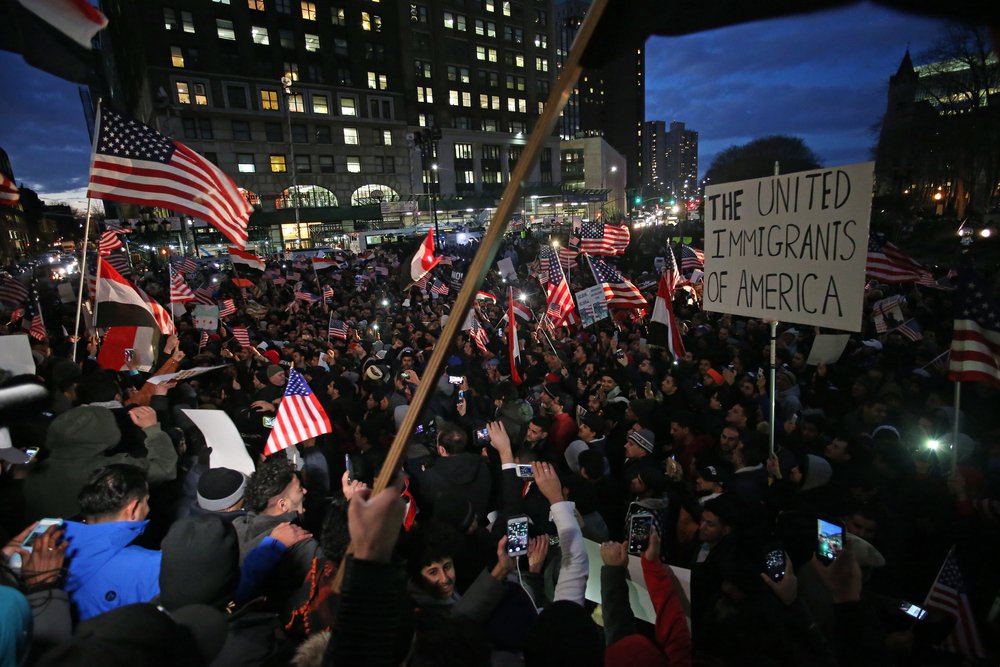
On January 27, a week after being sworn in as president, Donald Trump signed an executive order instituting a travel ban on foreign nationals traveling from seven majority-Muslim countries – Iran, Iraq, Syria, Sudan, Libya, Yemen, and Somalia. New America has collected data on those individuals accused of jihadist terrorism-related crimes since 9/11.
That research
shows that of the 95 people killed by jihadist terrorists inside the United
States since 9/11, not a single death would have been prevented by the travel
ban.
Far from being
foreign infiltrators, the large majority of jihadist terrorists in the United
States have been American citizens or legal residents.
Almost half were
born American citizens.
Error: Data visualization bundle URL missing.
No deadly
attacker since 9/11 emigrated from one of the countries listed under the travel
ban. Nor did any of the 9/11 hijackers come from one of the travel ban
countries.
Nor did any of
the deadly attackers come from a family that emigrated from one of the travel
ban countries. Of the thirteen lethal jihadist terrorists in
the United States since 9/11:
●
Three, Carlos Bledsoe, Alton
Nolen, and Ali Muhammad Brown
are African-Americans born in the United States, and Bledsoe can trace his
family’s military service back to the Civil War.
●
Three, Syed Rizwan Farook, Tashfeen Malik, and Naveed Haq are from families that
hailed originally from Pakistan. Farook and Haq were born in the United States
while Malik entered on a K-1 Spouse Visa later becoming a legal permanent resident.
●
One, Nidal Hasan, is from a family that came
from the Palestinian Territories and was born in the United States. His parents
had immigrated to the United States during the 1960s.
● One, Joshua Cummings was a white convert born in Texas.
●
Two, Dzhokhar Tsarnaev and Tamerlan Tsarnaev, came from Russia as
children. Dzhokhar became a naturalized citizen while Tamerlan was a permanent
resident.
●
One, Hesham Hadayet, emigrated from Egypt
and conducted his attack a decade after coming to the United States. Hadayet
was a permanent resident.
●
One, Mohammed Abdulazeez, was born in Kuwait
to Palestinian-Jordanian parents and became a naturalized citizen.
●
One, Omar Mateen, is from an Afghan family
and was born in the United States.
Of 15 individuals
who have conducted non-lethal attacks inside the United States since 9/11, only
three came from countries covered by the travel ban. However, in two of those
cases, the individual entered the United States as a child.
On March 3, 2006 Mohammed Reza Taheri-Azar, a naturalized citizen from Iran, drove a
car into a group of students at the University of North Carolina, injuring nine
people. However, Taheri-Azar, though born in Iran, came to the United States at the age of two. As a
result his radicalization was homegrown inside the United States.
On September 17, 2016 Dahir Adan, a
20-year-old naturalized citizen from Somalia, injured ten people while wielding
a knife at a mall in Minnesota. However, like Taheri-Azar, Adan had come to the United States as a young child.
On November 28, 2016 Abdul Razak Ali
Artan, an 18-year-old legal permanent resident who came to the United
States as a refugee from Somalia in 2014 — having left Somalia for Pakistan in
2007 — injured eleven people when he rammed a car into a group of his fellow
students on the campus of Ohio State University and then attacked them with a
knife. However, it is not clear that the attack provides support for Trump’s
travel ban. Artan left Somalia as a pre-teen, and if he was radicalized abroad,
it most likely occurred while in Pakistan, which is not included on the travel
ban. Furthermore, it is far from clear that Artan radicalized abroad rather
than inside the United States. In a Facebook posting prior to his attack, he
cited Anwar al-Awlaki, the Yemeni-American cleric born in the United States,
whose work — which draws largely upon American culture and history — has
helped radicalize a wide range of extremists in the United States including
those born in the United States.
Facing the fact that the travel ban would not
have prevented a single deadly jihadist attack, the Trump administration has
cited other cases often including ones that the travel ban would have no effect
upon.
This post was updated on March 6th to reflect the Trump administration’s issuance of a new executive order that excludes Iraq from the list of travel ban countries and to reflect New America’s decision to include the alleged deadly attack by Joshua Cummings.
More About the Authors

Peter Bergen
Vice President, Global Studies & Fellows, New America; Professor of Practice, Arizona State University; Author, All the Presidents’ Wars

David Sterman
Deputy Director, Future Security, New America; Term Member, Council on Foreign Relations

Alyssa Sims
Issues
Programs/Projects/Initiatives
Related
Reflecting on 25 Years After 9/11 and the Future of National Security

Three Months Without a Strike Against the Islamic State in Somalia

How Russia’s Undersea Nuclear Buildup Is Reshaping the Arctic
