David Sterman
Deputy Director, Future Security, New America; Term Member, Council on Foreign Relations
Three and a half months into 2020, the focus of the American public has turned decisively away from jihadist terrorism for the time being. The coronavirus pandemic dominates the news cycle, disease has surged past terrorism as a concern in polling though terrorism remains a top concern, and former officials and others are advocating a reconsideration of the national security bureaucracy’s relative focus on the terrorist threat given that the pandemic has already killed more than eight times the number of people killed by jihadist terrorists inside the United States on 9/11 and in the almost two decades since combined.
As the news cycle and attention properly shifts focus, an important data point on the terrorist threat at home may be missed. In 2020, so far, only two people in the United States have been accused of jihadist terrorism crimes, according to data collected by New America. This is fewer people than have been charged in any full year of the post-9/11 era.
The low number of jihadist terrorism cases does not appear to be only a matter of the year not being up. According to New America’s data, the last time there were two or fewer people charged as of April 15, was 2008, 12 years ago, before the Arab Spring, Bin Laden’s death, or the global rise of ISIS.
Last year, eleven people had been charged by April 15, and there were 26 cases in the year overall. 2019 represented a slight uptick after a prolonged decline in the number of yearly cases from the post-9/11 peak in 2015 – a peak fueled by ISIS’ surge onto the global scene in late 2014.
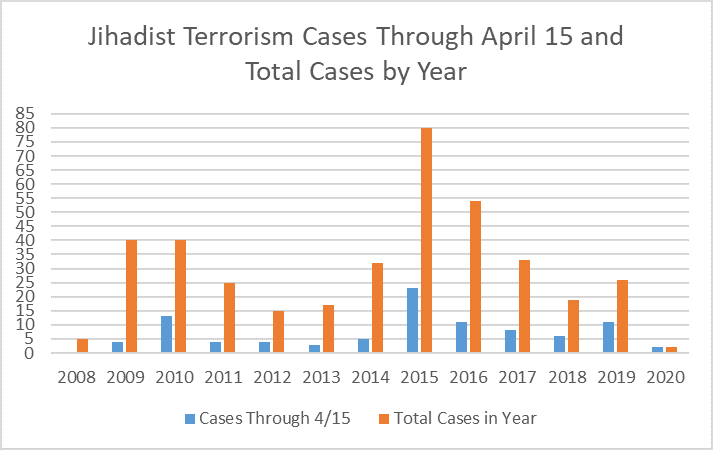
Caution is required in assessing the meaning of counts of terrorism cases, particularly before a year is over. The number of cases can reflect prosecutorial decisions rather than the threat itself, and often cases can become public later in the year adding another caveat to an early assessment – though the number of cases on April 15 in a given year does correlate with the total number of cases that year.
In the age of coronavirus, there may be further caveats. The government may be less focused on prosecuting and reporting terrorism crimes in the short-term. Extremists may also simply be temporarily hunkered down due to the virus but still plotting. It is also, of course possible that there will be a surge of terrorist activity and related arrests later in the year.
The jihadist terrorist threat to the homeland was already relatively limited including at the initiation of the counter-ISIS war. Even with caveats, the low count of cases provides initial evidence that the 2019 uptick in cases did not represent a resurgence of jihadist terrorist activity in the United States after the declines associated with ISIS’ territorial collapse in Iraq and Syria and loss of brand stature.
ISIS in its propaganda has portrayed the virus in part as an opportunity to exploit the opportunity of an already fearful Western public. Luckily while it is not clear that ISIS is wrong in its assessment that a surge in jihadist terrorism during the pandemic would give Western societies a major shock, the current data suggests that they and those they inspire are far from mounting a campaign of terror in America to test the theory.
However, ISIS may be able to exploit the virus elsewhere, including in Syria, to promote prison breaks – a strategy specifically called for by ISIS and potentially made easier by the virus. Such violence abroad could well bring terrorism back to the news cycle. Knowing that – as of now – there is no evidence of a resurgent jihadist threat at home will be important in such a scenario. With terrorism remaining a major concern of the American public, despite the current focus on the pandemic and with the American public supportive of counterterrorism warfare as long as it does not involve large numbers of ground troops, those who seek a more restrained American military counterterrorism posture should keep an eye on variation in the jihadist threat even if it pales in comparison to other threats and not allow the threat to the homeland to be hyped.
Updated April 19, 2020 to correct the number of months into 2020 to three and a half.
Deputy Director, Future Security, New America; Term Member, Council on Foreign Relations