Meegan Dugan Adell
Director, New America Chicago

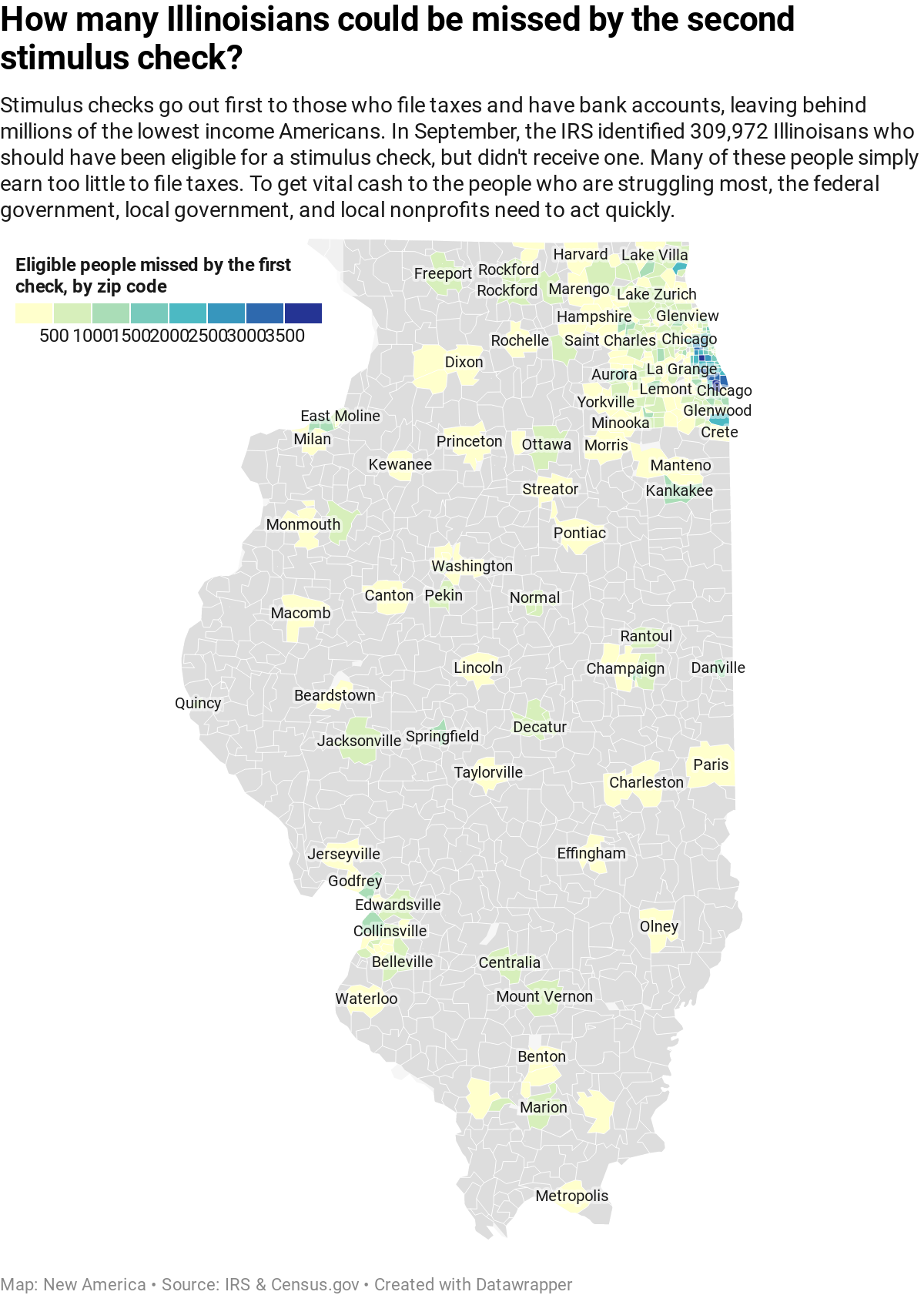
In May, millions of middle-class Americans received stimulus checks directly in their bank accounts or mailboxes. Their much lower income neighbors who were hardly keeping their heads above water before the pandemic weren’t so lucky. In Illinois, the IRS mailed letters to over 300,000 eligible individuals who had still not received their stimulus checks as of September. However, recipients likely didn’t include people whose addresses had changed or those with informal income, such as day laborers, small home daycare providers, and cleaning women.
At the end of 2020, congressional leaders finally reached an agreement on the next stimulus package. Illinoisans with little to no income in 2019 are likely still waiting for their first stimulus checks even as the Treasury Department sends out a second round of checks. The stimulus checks intended to keep struggling Americans afloat simply weren’t easily accessible for the people who needed them most. Fortunately, there are steps policymakers and nonprofits can take to fix that this time around.
In the case of the April 2020 CARES Act, policies that should help shield the hardest-hit Americans did exactly the opposite. One study found that communities where businesses were hit harder during the pandemic were less likely to get funds from the Payment Protection Program (PPP). In particular, Black and Latinx business owners were less likely to receive PPP funds than businesses owned by Whites. In the case of Economic Impact Payments (stimulus checks), the government used tax filing as a way to both identify people eligible for the $1,200 checks and determine how to deliver the money to them. However, most very low-income Americans are not required to file taxes. Furthermore, because of the complications of the pandemic, tracking and requesting a stimulus check was incredibly onerous for the 29 percent of adults with incomes under $30,000 who don’t have a smartphone and the 44 percent who don’t have internet access. As a result, the Americans most at risk of eviction and food insecurity had to work doubly hard to even find out if they were eligible for a check, much less request one. The IRS’s action this Autumn to identify and contact eligible individuals who hadn’t received a check was an important step. But it’s a step that should have been taken much earlier. That step still doesn’t help get checks out to those who have moved multiple times, have no homes, or no formal income.
As the pandemic rages on, these checks are more important than ever. The pandemic has disproportionately affected different populations and industries Illinois relies on heavily for jobs such as Leisure and Hospitality and Transportation. In April alone, Illinois lost more than one million jobs, particularly in Leisure and Hospitality, Professional and Business Services and Trade, Transportation and Utilities sectors. Those affected by unemployment are also likely to have lower educational attainment levels or are communities of color, making it more difficult for them to find alternative employment. Those who lost their jobs early on or were looking for work when the pandemic started have gone through the little resources they had. Over one-third of Chicagoans reported they had gone through whatever savings they had by the summer. As of the first week in December, almost 4 in 10 Illinoisans thought foreclosure or eviction was likely and nearly as many were struggling to pay usual household expenses.
Getting stimulus checks to lower-income individuals helps keep local economies going as well, since they put money back into the economy more quickly. The second stimulus check will help these struggling neighbors pay rent, buy food, and pay for heat and electricity in the cold winter months. In measuring how households have responded to the crisis, a working study finds that lower-income households that receive stimulus checks have higher multiplier effects on the economy, quickly using their stimulus checks on emergency needs, such as rent, food and credit card debt, rather than putting the money away in an account.
Analysis of the letters sent out by the IRS in September to eligible individuals who didn’t receive a stimulus check suggests that specific areas of the state may be less likely to receive the second-round payments. Some ZIP codes have nearly 4,000 individuals who hadn’t received their check as of September. Outreach and assistance claiming stimulus checks by state agencies and nonprofits could be incredibly effective in some south- and west-side Chicago neighborhoods, parts of Aurora, Chicago Heights, Kankakee, Rock Island, Moline, Alton, Decatur, and Marion.
The Get My Payment Illinois Coalition has worked with nonprofits all over Illinois to help thousands access the first stimulus check. While very low income families face a number of challenges, trying to access their checks, lack of access to the internet or a computer and lack of help filing taxes are two of the most pervasive. Because those who didn’t receive the first check need to file taxes and claim the Recovery Rebate Credit to get both stimulus checks, limited access to tax-filing assistance is a major concern. Given how challenging filing taxes can be for those with multiple jobs, complicated custody situations, limited literacy, or no permanent address, this raises yet another barrier to receiving these badly-needed checks.
The IRS and the Department of Treasury need to expand access to relief. Based on our experiences on the ground, new stimulus measures should:
The State of Illinois can take action immediately to ensure hardworking Illinoisans receive stimulus checks.
Whether or not the second stimulus will be enough to provide immediate assistance to low-income households, a more inclusive approach in outreach and design will at least mitigate barriers for those who can benefit from the program the most. With mixed projections on COVID-19’s long-term economic impact, the new stimulus package needs to support people who have been most adversely impacted over the past year.
Director, New America Chicago