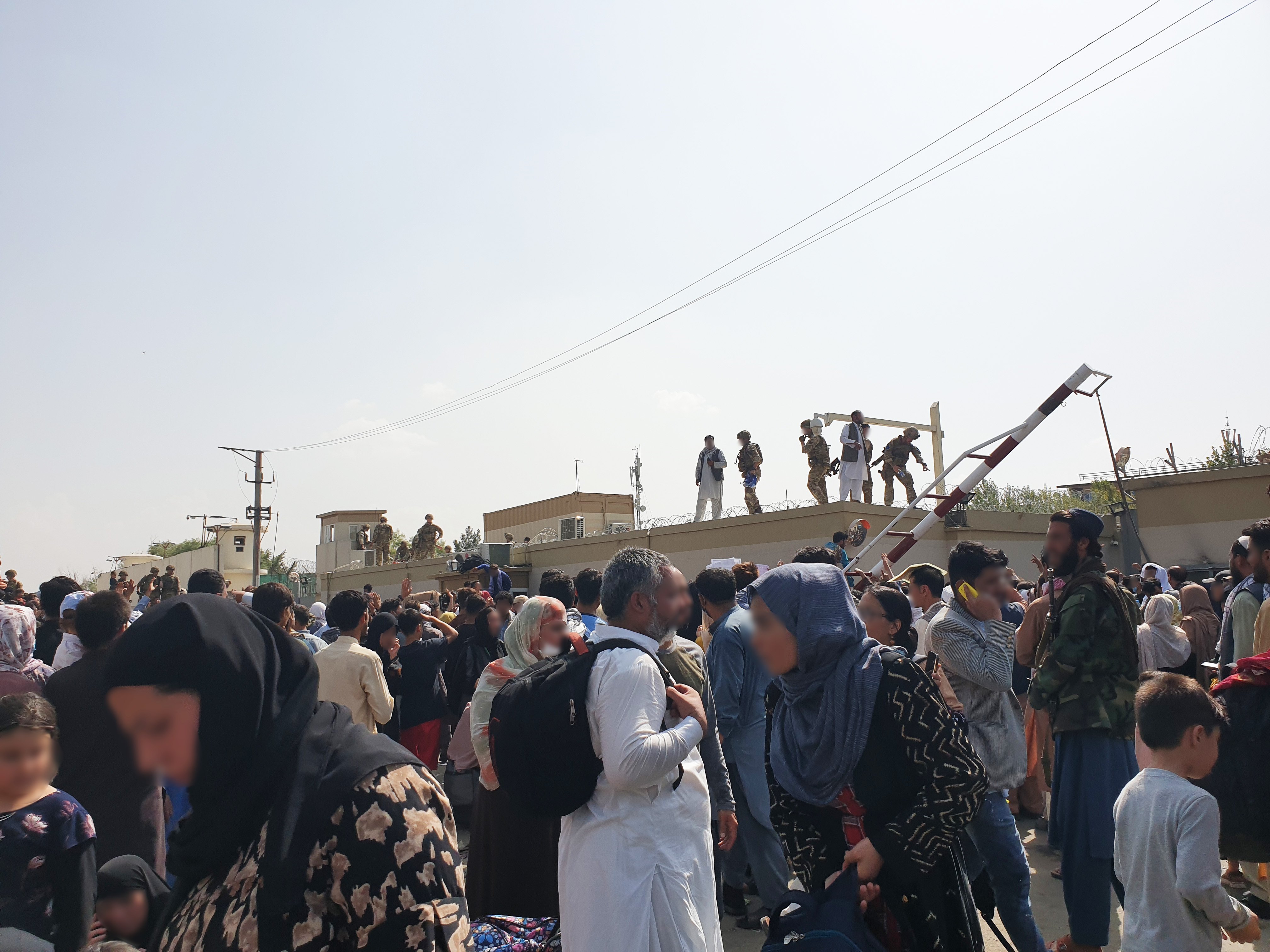
Like millions of Afghans, on the morning of August 15, 2021, I woke up to telltale signs of the looming specter of the country’s fall to the Taliban. At that time, I was the country director of the Afghanistan Analysts Network, a Kabul-based research center. An email from a senior colleague who had just arrived in Kabul a week earlier stirred me. It said that they were accepting an offer from their home country’s government for evacuation later that afternoon and that I could decide whether or not to close down our office.
My wife, who had mostly telecommuted since the pandemic outbreak, joined my daily commute to the office. Just the day before, as threats of the Taliban closing in grew, she and her colleagues — who were desperate to withdraw money — had been told to try the bank branch located within their office building’s parameters. With no luck at the bank, she headed back home only to find herself amid the chaos. At one point, she witnessed a shooting in front of a bank as she passed by. My wife and I both had worked for an organization that promoted democracy and “politics as a war without bloodshed.” It was heartbreaking to see everything unravel so quickly, dashing our hopes for political stability in our country.
The following days were fraught with tension as my family decided whether or not to leave. The options we had did not include a way out for our extended families — many of whom relied on us for financial support. Four days after the fall of Kabul, the U.S. embassy instructed its staff to go to the airport through the Abbey Gate with their immediate families. On that day, I witnessed firsthand how the Taliban treated the people who had thronged to the airport. At one point, I found myself at gunpoint after I confronted a Talib that beat a family member with a cable. We had to return home that day, but the traumatic experience compelled us to stop dithering: We knew then that a dignified life in Afghanistan would no longer be possible under the new regime. Six days later, we were able to get to the airport traveling on buses arranged by the embassy. At 11:30pm, my wife, our five-year-old son, and I boarded a military plane and we became refugees.
Twelve days after the collapse, my family and I arrived in the United States with two backpacks containing our education documents, appreciation letters from former supervisors, and a couple of hard disks that also included our digital wedding photos, which were especially valuable given that we had to shred the physical album. We also had a small suitcase with an extra set of clothes for each of us. We spent 40 days in a military base in Virginia and an additional month in a hotel and AirBnB before we rented an apartment. Without a current job, finding a permanent home was not possible. We felt grateful for the support of American friends who co-signed the lease on our apartment.
“It was heartbreaking to see everything unravel so quickly, dashing our hopes for political stability in our country.”
While grappling to process what had happened, we were being tormented by the guilt of leaving behind our extended families. During that time, we took solace in the response by New America’s Future Frontlines and Fellows Programs, which — through the creation of the Afghanistan Observatory Initiative — offered an opportunity for me and other displaced Afghan journalists, human rights activists, and champions of good governance to continue reporting on Afghanistan from afar. It has since served as both a learning and healing process.