
Youth Apprenticeship Quality Assessment Tool and Protocol
Building from the PAYA principles, PAYA has developed the Youth Apprenticeship Quality Assessment Tool and Protocol to assist education providers, employer and industry partners, intermediary organizations, and other youth apprenticeship leaders in collaboratively identifying ways to improve policies, procedures, and practices in support of learner success.
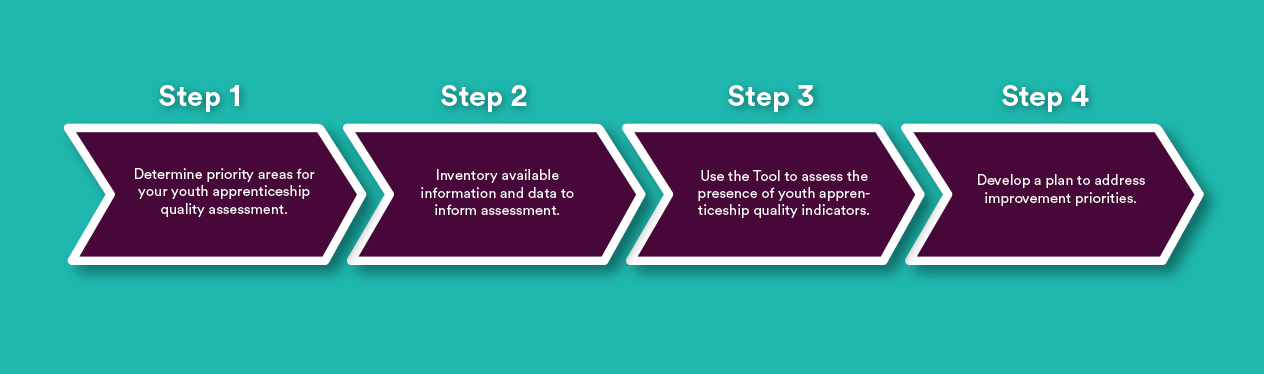
Step 1. Determine Priority Areas for Assessment
The Youth Apprenticeship Quality Assessment Tool is organized around PAYA’s Definition & Principles for Youth Apprenticeship. While each of the five principles are equally important to the development and delivery of high-quality youth apprenticeships, leaders may choose to initially prioritize the principle(s) that will have the most significant impact on learners.
Step 2. Inventory Available Information and Data to Inform Assessment
To determine whether a youth apprenticeship is designed with quality in mind and implemented in a way that leads to positive and equitable outcomes for all learners, program leaders can examine multiple qualitative and quantitative data points. Before engaging the Youth Apprenticeship Quality Assessment Tool (step 3), leaders should identify and compile information and data that can be used to monitor and drive improvement.
Early-stage youth apprenticeship initiatives might rely primarily on information about program operations (recruitment processes, delivery of support services, etc.), curriculum design, and the relevance of target competencies and credentials to help with assessments about a program’s potential to yield positive youth education, training, and employment outcomes. Mature youth apprenticeship initiatives may be better positioned to examine data on the demographic characteristics of learners, their rates of program participation and completion, post-apprenticeship outcomes, and surveys of learner or employer satisfaction. PAYA’s Youth Apprenticeship Data Framework is a helpful starting point for examples of data and information that partnerships can compile. It offers a comprehensive (though non-exhaustive) list of relevant, actionable information and data youth apprenticeship partners can collect to document their processes; monitor apprentice progress; and track outcomes for apprentices, employers, and other key stakeholders.
Step 3. Use the Tool to Assess the Presence of Youth Apprenticeship Quality Indicators
With data and information readily accessible, leaders are well positioned to meaningfully engage with the Youth Apprenticeship Quality Assessment Tool. For each of the PAYA principles, the tool outlines factors that influence the extent to which youth apprenticeships are of high quality and lead to equitable opportunities and outcomes for students. The tool prompts youth apprenticeship leaders to document strengths and areas of improvement related to their partnership structures, the design of their programs, and the specific requirements and components of each occupational pathway offered. Leaders are encouraged to consider the role that each stakeholder plays in advancing quality programming and eliminating barriers to advancement and mobility, particularly for apprentices from historically underserved and marginalized groups.
Step 4. Develop a Plan to Address Improvement Priorities
Once leaders have worked through the Youth Apprenticeship Quality Assessment Tool, the next step is to develop a plan to address improvement opportunities. A plan should, at minimum, address the following:
- Which quality indicators are of highest priority and why?
- What actions need to be taken to address program and/or pathway design or outcome improvement goals?
- Who is responsible for the action items identified?
- When will priority action items occur?
- What measures will the partnership rely on to determine the success of program and/or pathway improvement efforts?
- What additional information or data could/should be collected to monitor and drive improvement?