
Year in Review 2025
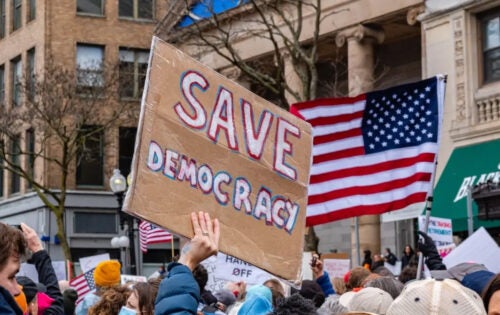
Five years ago, in Breaking the Two-Party Doom Loop, our colleague Lee Drutman foresaw a moment of democratic crisis, in which the structurally unsound U.S. electoral system would fail dramatically and force us to revisit our constitutional structures and institutional assumptions. Rather than reforming around the edges of the process, Lee predicted we might finally rethink winner-take-all elections and single-member legislative districts, and move toward a more fluid, multiparty system that would promote political compromise and sustainable policies that support the aspirations of all.
At the end of 2025, here we are—at that very moment of crisis, though still far from the moment when the gateway to reform opens. The form the crisis has taken, to this point, is a staggering concentration of, and abuse of, power, within a corrupt presidency. Congress has all but abdicated its role as the first branch of government and its power over spending, tariffs and war; the Supreme Court has embraced the dubious theory of the “unitary executive” that grants the president largely unchecked authority, particularly over once-independent agencies. Watergate-era reforms intended to constrain what was then called the “imperial presidency,” such as the principle that the Department of Justice must be independent of political influence, have fallen in a matter of months, along with older civil service and whistleblower protections.
Democratic reform has one priority in both the short and long term: To break the concentration of power and reconstruct the formal, constitutional separation of powers, as well as the pluralism and autonomy of institutions that can make democracy possible. Our country thrives when not only a wide range of viewpoints are represented and heard, but also when an unrestrained chorus of civil society institutions–community organizations, schools, charities, advocacy groups, and even private companies–operate with autonomy and their own sense of purpose, fully within the law but independent of government control. And we should aspire to elections and legislatures that fully reflect the range of viewpoints and experiences in a complex, multiracial continental nation, a challenging ideal even in the best of times.
The democratic crisis is deep, the work is challenging, but we take it up with an optimism based in the belief that this moment of reckoning can bring our nation to a better place. Our 2025 annual report highlights this work and our efforts to build a stronger democratic future.
Programs/Projects/Initiatives
Related

How Taxes Make Citizens

The Cycles of Regenerative Governance in Kenya