Xinyan Yu
National Fellow, 2023
New America 2023 Fellow Xinyan Yu spoke about her film, Made in Ethiopia, for “Three questions” in The Fifth Draft, the Fellows Program’s monthly newsletter. Yu is an Emmy Award–winning video journalist and filmmaker.
Your Fellows project, the film Made in Ethiopia, premiered this summer on PBS’s POV. Congratulations! What was the genesis of the film?
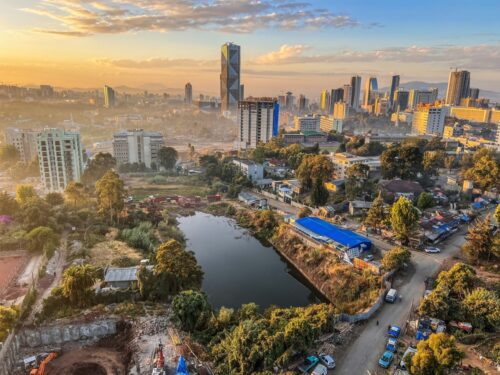
In 2019, I had just finished producing a half-hour BBC documentary on China’s Belt and Road Initiative, which featured Chinese infrastructure projects in Kazakhstan, Poland, and the United Kingdom. At the time, there was intense global interest in this ambitious campaign reshaping the Global South, but few understood what it truly meant for local communities. Ethiopia stood out to me and my co-director, Max Duncan, as a country that had closely followed China’s path, aiming to build a manufacturing powerhouse in Africa. We traveled to Addis Ababa, and were immediately captivated by how permeating China’s economic influence was. The Eastern Industry Zone was the perfect microcosm that allowed us to document the human impact of industrialization and globalization.
Much like our characters in the film, I’ve felt conflicted about industrialization.
Growing up in Wuhan, China, you experienced the impact of industrialization, much like your film’s subjects. How did your background influence the way you told this story?
I grew up in a steel factory worker community called “Red Steel City.” My father was a truck driver and my mother was a welder. Much like our characters in the film, I’ve felt conflicted about industrialization. On one hand, I benefited from my parents’ 30 years of hard work, and witnessed how our Soviet-style neighborhood turned into modern high-rise apartments within years. On the other hand, I’ve also experienced demolition and covered many stories about pollution and land disputes as a journalist. It motivates me to capture the complexity and dilemma industrialization brings to many families.
The film focuses on the relationship between Chinese investors and the Ethiopian government and people, and it has further international ramifications, particularly concerning future Chinese and American economic relations. What might American policymakers take away from the film?
Ethiopia is a country where you won’t see any McDonald’s or Starbucks. However, you do hear people call out “China, China, Money, Money” on the streets. There are Chinese companies like Techno that only cater to African markets thriving in Ethiopia. China sees Africa as a land of opportunity and has made long-term, infrastructure-driven investments. In contrast, U.S. engagement with Africa has historically focused more on aid and security. I hope the film helps American audiences and policymakers better understand these shifting dynamics, not just through policy analysis, but by listening to the people whose lives are directly affected.
Subscribe here to receive next month’s issue of The Fifth Draft.
National Fellow, 2023