
Discussion: How Candidates Framed Work-Family and Gender Workplace Policies
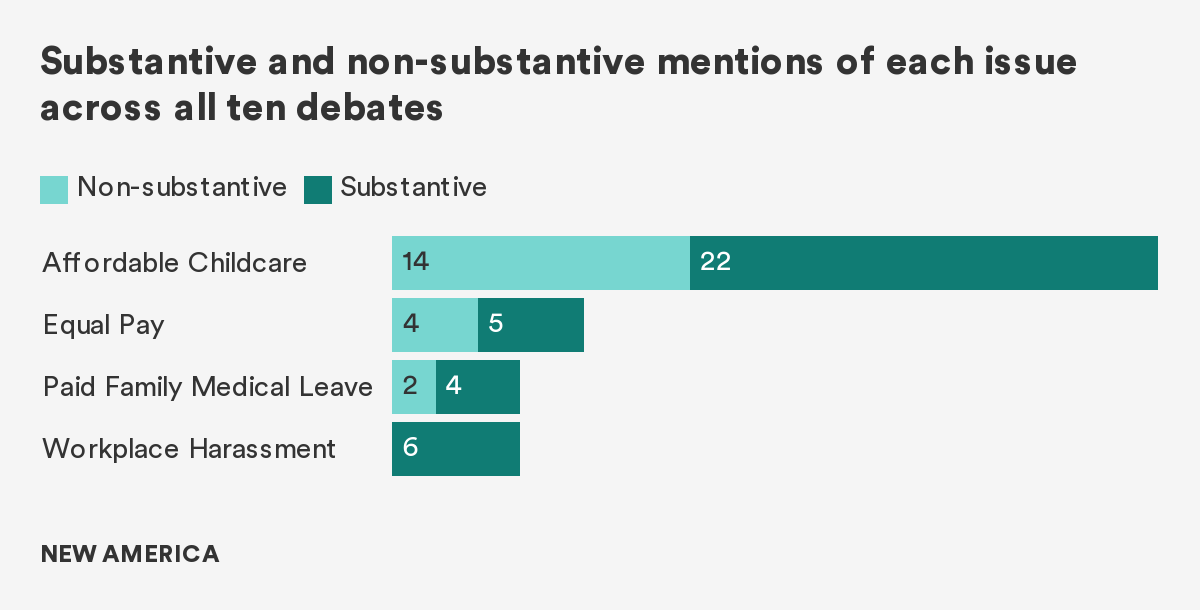
Candidates’ mentions ranged from non-substantive to substantive in nature. On several occasions, candidates couched their plans and discussions of gender-work-family issues within their own personal narratives. And when they sought to challenge their fellow contenders, they focused on the values—not necessarily the policies—related to these issues, harkening back to their colleagues' past actions and seizing upon existing controversies about their backgrounds. Regardless of how they mentioned gender-work-family policy issues, most candidates connected their thoughts on childcare, the gender pay gap, gender-based workplace harassment, and paid family and medical leave to the overarching themes of their campaigns.
Candidates Used Personal Narratives to Discuss Caregiving Needs and Gender Inequality in a Substantive Manner.
Personal narratives played a role in shaping how some candidates framed and discussed the issue of affordable and accessible childcare. By sharing their personal experiences, candidates acknowledged the economic hardships and circumstances of working parents and caregivers.
During the seventh debate in Iowa on January 14, 2020, Warren shared a story about how she would have struggled to advance in her career as a professor if not for the help of her Aunt Bee.
But understand this about the plan. I've been there. You know, I remember when I was a young mom. I had two little kids, and I had my first real university teaching job. It was hard work. I was excited. But it was childcare that nearly brought me down. We went through one childcare after another, and it just didn't work. If I hadn't been saved by my Aunt Bee—I was ready to quit my job. And I think about how many women of my generation just got knocked off the track and never got back on, how many of my daughter's generation get knocked off the track and don't get back on, how many mamas and daddies today are getting knocked off the track and never get back on. (Debate 7, Des Moines)
In the same debate, former Vice President Joe Biden recalled his days as a single father and spoke about his daily commute to and from work by train, and how he struggled to balance his caregiving responsibilities.
You know, I was a single parent too. When my wife and daughter were killed, I had to raise my two boys. I was a senator, a young senator. I just hadn't been sworn in yet. And I was making $42,000 a year. I commuted every single solitary day to Wilmington, Delaware, over…250 miles a day, because I could not afford…childcare. It was beyond my reach to be able to do it. (Debate 7, Des Moines)
With their personal stories, candidates highlighted the nearly universal struggle that working parents face, showing that the issue of unaffordable and inaccessible childcare have persisted for decades and affect not only women, but also men.
A few candidates also deployed personal narratives to connect with voters whose lives are impacted by gender inequality. Their stories and experiences highlighted the pervasiveness of the gender pay gap, sexism, and harassment in the workplace.
In the first debate, which took place in Miami on June 26, 2019, Castro told viewers that he understood the challenges of single mothers who already struggle to make ends meet, even without the additional burden of unequal pay.
You know, I grew up with a mother who raised my brother Joaquin and me as a single parent, and I know what it’s like to struggle. I know what it’s like to rent a home and to worry about whether you’re going to be able to pay the rent on the first of the month and to see a mom work very, very hard and know that moms across this country are getting paid less simply because they’re women. (Debate 1, Miami)
During the next debate in Detroit on July 31, 2019, Andrew Yang recalled the sexism he personally witnessed as an entrepreneur in the business world. Yang also talked about his wife who left the workforce to care for their two sons, one of whom has autism, placing his personal life within the larger conversation about the need to measure the economic impact and overall value of caregiving.
I have seen firsthand the inequities in the business world where women are concerned, particularly in start-ups and entrepreneurship. We have to do more at every step. And if you're a woman entrepreneur, the obstacles start not just at home, but then when you seek a mentor or an investor, often they don't look like you and they might not think your idea is the right one. (Debate 2, Detroit)
And I like to talk about my wife who is at home with our two boys right now, one of whom is autistic. What is her work count in today's economy? Zero. And we know that's the opposite of the truth. We know that her work is amongst the most challenging and vital. The way we win this election is we redefine economic progress to include all the things that matter to the people in Michigan and all of us like our own health, our well-being, our mental health, our clean air and clean water, how our kids are doing. (Debate 2, Detroit)
And in the tenth debate, Warren, who challenged Bloomberg on allegations related to gender-based workplace harassment, shared her experience of pregnancy discrimination which culminated in the loss of her job. This wasn't the first time she talked about pregnancy discrimination; the senator previously discussed her experience during the third debate on September 12, which took place in Houston.
This is personal for me. When I was 21 years old, I got my first job as a special education teacher. I loved that job. And by the end of the first year, I was visibly pregnant. The principal wished me luck and gave my job to someone else. Pregnancy discrimination? You bet. But I was 21 years old, I didn’t have a union to protect me, and I didn’t have any federal law on my side. So I packed up my stuff, and I went home. (Debate 10, Charleston)
Again, the candidates used personal narrative to connect with the electorate–particularly with underrepresented individuals navigating professional barriers, middle and low-income families struggling to make ends meet, and women who confront sexism both inside and outside of the workplace.
Candidates Challenged their Colleagues' Commitments to the Values Central to Gender-Work-Family Policy Issues.
In the absence of questions about childcare and gender-based workplace harassment, a few candidates seized upon existing controversies to press their challengers on their commitment to upholding the values underlying these issues. While the heated exchanges did not pertain to policy, they did force fellow candidates to articulate their beliefs or explain past behaviors.
In the second debate in Detroit, Gillibrand questioned whether Biden valued women and their presence in the workplace, pressing him about his position on the 1980s childcare tax credit and an op-ed he had written on the issue. While Gillibrand did not fully convey the context of Biden's past statements, she created a space to talk about women, caregiving expectations, and the needs of working mothers (and fathers) in the twenty-first century.
I think we have to have a broader conversation about whether we value women and whether we want to make sure women have every opportunity in the workplace. And I want to address Vice President Biden directly. When the Senate was debating middle-class affordability for childcare, he wrote an op-ed. He voted against it, the only vote, but what he wrote in an op-ed was that he believed that women working outside the home would, quote, "create the deterioration of family." … I just want to know what he meant when he said that. (Debate 2, Detroit)
In response to her challenge, the vice president emphasized his commitment to affordable childcare and expressed his passion for promoting gender equality, pointing to his record on equal pay, preventing sexual assault on college campuses, and passing legislation on domestic and intimate partner violence. Moreover, his response included a plan to mitigate the costs of childcare. By challenging Biden, Gillibrand began a discussion about gender-equality, the gender-care gap, the costs associated with caregiving, and possible solutions to support working parents.
Similar to Gillibrand, Warren discussed the issue of gender-based workplace harassment within the context of an intense exchange with Bloomberg. In the ninth debate held in Las Vegas, she confronted the former mayor about the workplace harassment allegations levied against him, testing his willingness to nullify the nondisclosure agreements which prevented the release of information.
I hope you’ve heard what his defense was, “I’ve been nice to some women.” That just doesn’t cut it. The mayor has to stand on his record. And what we need to know is exactly what’s lurking out there. He has gotten some number of women … dozens? Who knows … to sign nondisclosure agreements both for sexual harassment and for gender discrimination in the workplace. (Debate 9, Las Vegas)
Responding to Warren, Bloomberg noted that he had no tolerance for the behaviors exposed by the #MeToo Movement, supported equal pay for equal work and had worked to ensure women had leadership positions throughout his career in business and politics. Rather than avoid the conversation, Bloomberg engaged with Warren, thereby participating in a discourse about gender-based workplace harassment.
Candidates Connected Gender-Work-Family Policy Issues to the Overarching Themes of Their Campaign.
Candidates tied their plans around gender-work-family policy issues to the larger themes surrounding their individual campaigns and utilized the same language they used when discussing other issues. The common thread that ran through all framings was the emphasis on economic opportunity.
Every time Warren raised the issue of childcare, for instance, she included it in her plans for the two percent wealth tax which would be levied on those with a household net worth surpassing 50 million dollars. For her, this issue was about economic inequality, social mobility, supporting workers, and creating opportunity for working families.
The paths to America’s middle class have gotten a lot smaller and a lot narrower. Today, service members are preyed upon by predatory lenders. Students are crushed by debt. And families cannot afford child care. (Debate 3, Houston)
Similarly, Sen. Bernie Sanders (I-Vt.) fit the issue of childcare into a larger discourse about universal rights, economic justice, and the perpetually widening wealth gap that favored corporations and the privileged over the working and middle class.
We need to fundamentally change priorities in America. We should not be one of a few countries that does not have universal high-quality affordable childcare. We should not be one of the only major countries not to guarantee health care to all people as a human right. We should not be spending more than the 10 next countries on the military, hundreds of billions of dollars in subsidies for the fossil fuel industry, tax breaks for billionaires, and then tell the moms and dads in this country we cannot have high-quality affordable childcare. (Debate 7, Des Moines)
Yang discussed paid family leave, the gender pay gap, and gender-based workplace harassment within the context of his plan for a universal basic income. With this resource, families would have the economic freedom to afford their preferred caregiving options, and women in particular would have the security to leave harmful work environments without the fear of facing financial hardships.
So we need to have a freedom dividend in place from day one, $1,000 a month for every American adult, which would put in many cases $2,000 a month into families' pockets, so that they can either pay for childcare or if they want [to], stay home with the child. (Debate 5, Atlanta)
Typically, when Biden responded to questions about gender inequality, he often referenced his past contributions in Congress, namely authoring and leading the fight to pass the Violence Against Women Act (VAWA), which sought to improve legal and community-based responses to domestic violence, and his support for the Lily Ledbetter Fair Pay Act, which extended the time allowed for filing complaints about wage discrimination on the basis of sex. The vice president also discussed his involvement with the "It's On Us" campaign, launched by the Obama administration as a response to the prevalence of sexual assault on college campuses. By referring to his record, Biden sought to portray himself as an experienced leader with a demonstrated record, a common refrain for his campaign throughout the primaries.
I wrote the Violence against Women Act [and supported] Lilly Ledbetter. I was deeply involved [with] the equal pay amendments. I was deeply involved in all these things. I came up with the…proposal to see to it that women were treated more decently on college campuses. (Debate 2, Detroit)