Will Hunt
New America Fellow, 2025
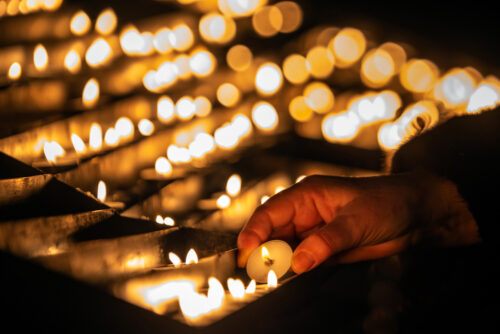
New America 2025 Fellow Will Hunt spoke about his forthcoming book, Bones, for “Three questions” in The Fifth Draft, the Fellows Program’s monthly newsletter. Hunt is a nonfiction writer whose work investigates memory, cultural heritage, and our relationship to the deep past.
Your fellowship project and forthcoming book, Bones, explores the power of the ancestral dead—their bodies, bones, and burial grounds—to shape contemporary culture and politics. What inspired you to explore this subject?
A few years ago, in a Maya village in the Yucatán, I witnessed a ceremony called Choo Ba’ak. Families gathered at ancestral tombs, lifted out the bones of their dead, brushed them clean, refreshed their shrouds, and laid them back to rest. In the modern Western society that shaped me, such intimacy with the dead was unthinkable; here, it was indispensable—just as it had been in countless traditional communities across history. This book is my attempt to reckon with that divide. It follows the power of ancestors from deep prehistory to the present, and traces how that power has been translated to the modern West, where the dead have been recast, suppressed, and sometimes reawakened.
To become aware of our ancestors is to be reminded that, for better or worse, we are each larger than ourselves.
When working with ancestral bones, sacred sites, and culturally sensitive material, what ethical frameworks or personal guidelines do you rely on to navigate your research responsibly?
For part of Bones, I tell the story of a Cherokee man who takes on the duty of reburying the bones of tribal ancestors that have been desecrated by looters and archaeologists. Reporting this story—learning not only the contours of an individual life, but the nuances of Cherokee cosmology and the traditional metaphysics of bone—took six years. Going to traditional communities as a journalist, I’ve learned, requires its own code, especially for a writer such as myself who often gravitates to sacred or sensitive subjects. I’ve learned to consult with elders, to listen more than I speak, and above all, I’ve learned to go slowly. I made multiple visits to the Cherokee, spent hours on the phone, read deeply, double-checked that I hadn’t divulged sacred sites. Had I rushed the story at any point, I doubt it would have held together.
Who are you writing Bones for? Is there a particular reader—or cultural conversation—you’re hoping to reach or influence?
The last story in Bones concerns Charleston, South Carolina, where in 2013 a construction crew unearthed a burial ground containing the bones of 36 enslaved people. The Thirty-Six, as they became known, exerted a peculiar power on the city: white Charlestonians confronted their entanglements with the slave trade; Black Charlestonians became motivated to restore local cemeteries and launch a genealogical project to restore connections with their dead. To become aware of our ancestors is to be reminded that, for better or worse, we are each larger than ourselves. Rather than individuals floating in a vacuum, we are each shaped by the actions of our ancestors, just as our actions will shape our descendants. In the United States—a nation founded by settlers who cut ties with forebears—we would benefit from restoring ancestral bonds. To see the influence of our predecessors is to understand the deep structural forces of our society, the currents of systemic racism and economic inequality, ownership and dispossession, of trauma and erasure.
Subscribe here to receive next month’s issue of The Fifth Draft.
New America Fellow, 2025