Why is Eviction Data so Bad?
Abstract
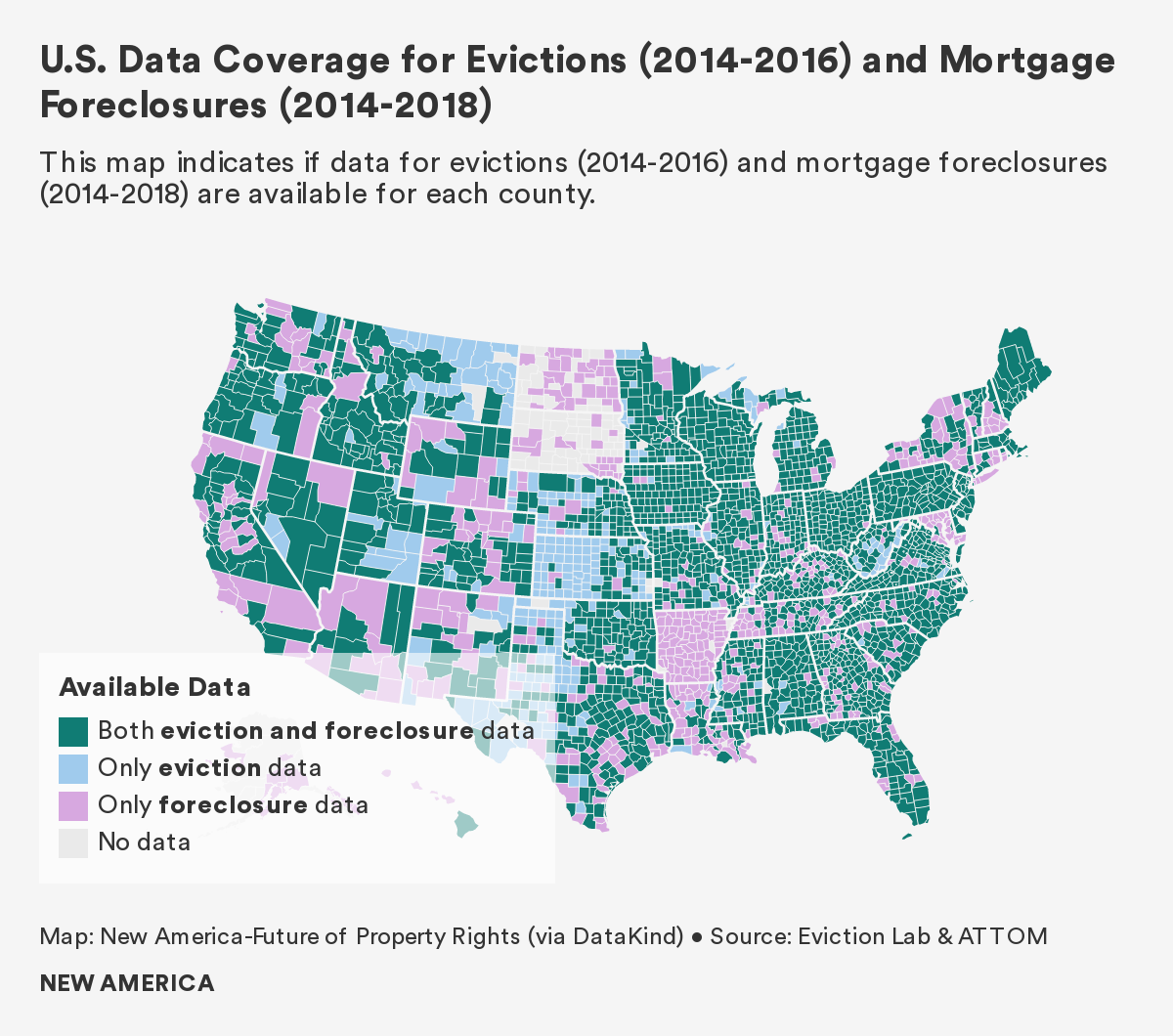
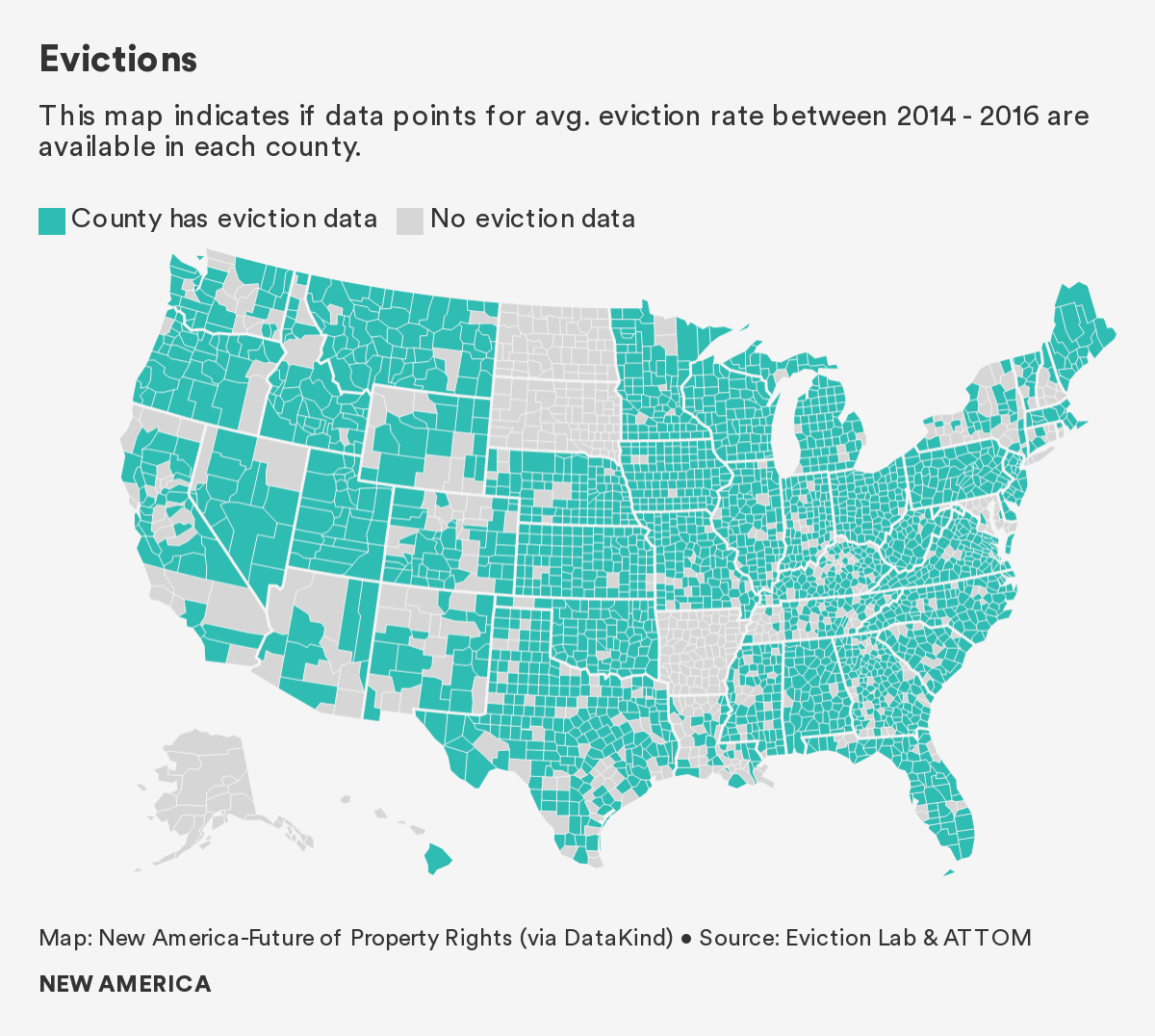
Nearly 3 million Americans are evicted each year, and experts estimate that number may grow tenfold due to the economic fallout of COVID-19. Yet as states, counties and cities rush to deliver emergency rental assistance to desperate renters they are discovering that data about evictions is so poor that we don’t know who is losing their homes where, and how to focus aid and outreach. One third of all U.S. counties lack annual eviction figures, to say nothing of information on where within the county evictions are happening, how rates are changing over time, and who is most at risk. That's because a devastating manifestation of the current and historic housing crisis—evictions—suffers from a paucity of quality, accessible data.
Looking at this landscape, New America’s Future of Land and Housing Program (FLH) brought together housing, data, and innovation experts and municipal leaders from across the country to analyze the current state of eviction data and propose ways to improve it.
This report discusses the current gaps in eviction data and why these inadequacies matter, lays out an 'ideal' eviction data landscape, and ends with 8 recommendations for fixing the county’s eviction data gaps that have been co-developed with and co-signed by several partner organizations. These recommendations, taken together, present a framework for creating local eviction databases that feed into a national database, including the investments that would enable such a system to work. Building an infrastructure that supports local eviction databases that courts, cities and community stakeholders have access to and can update will require dedicated funding, robust technical assistance, and uniform data standards.
Acknowledgments
This report was the result of sustained engagement from over 30 housing, data, and innovation experts and municipal leaders who came together over the course of three months to analyze the current state of America’s eviction data and propose solutions. We would like to thank Amelia Muller, Andi Broffman, Caitlin Augustin, Carl Gershenson, Carlos Manjarrez, Elena Matsui, Eoin Whitney, Garrett Quenneville, Hannah Rudin, Jeff Reichman, Katherine Lucas McKay, Katya Abazajian, Kevin O'Neil, Lauren Lowery, Luci Herman, Mallory Sheff, Marc Dones, Margaret Hagan, Nathan Poland, Nóra Al Haider, Peter Hepburn, Rosanne Haggerty, Ryan Brenner, Scott Davis, Shannon Saul, Sophie House, Stephen J. Sills, Tanina Rostain, Taylor Cain, and Wade Fickler for their insights and commitment.
We would also like to thank the Beeck Center for Social Impact + Innovation, Eviction Lab, Georgetown’s Civil Justice Data Commons, January Advisors, National League of Cities, National Low Income Housing Coalition, Stanford Law School Legal Design Lab and UNC Greensboro Center for Housing and Community Studies for co-developing and co-signing the Eviction Data Recommendations that resulted from these discussions.
Our work was also made possible with funding from Rockefeller Foundation. In particular, we would like to thank Kevin O’Neil and Nathan Poland for their support and collaboration.
Finally, we would like to thank all of our colleagues at New America that assisted with this report: Alison Yost, Maria Elkin, Joanne Zalatoris, Joe Wilkes, Brittany VanPutten, and Samantha Webster.
Why Does it Matter that Eviction Data is Bad?
The U.S. housing and real estate space is increasingly data driven. The Department of Housing and Urban Development (HUD), for example, utilizes its Voucher Management System to fund, monitor, and manage the use of Housing Choice Vouchers by public housing agencies. Real estate companies such as Zillow, CoreLogic, ATTOM, and Black Knight comprise a lucrative industry focused on collecting granular real estate data, bundling it, and selling it to brokerages, rental sites, insurance companies, and even government agencies.
And yet, a core component of the housing space—evictions—suffers from a surprising paucity of quality, accessible data. As tens of millions of Americans face eviction risk due to the economic fallout of COVID-19, states and cities are discovering that little data exists on where evictions are happening, currently and historically, and who is most at risk.
The U.S. government collects almost no eviction data, and research from New America found that one in three U.S. counties have no available annual eviction figures—to say nothing of data showing which neighborhoods experience evictions most acutely, who is affected, or how much rent tenants are being evicted over.
Much like the CDC (Centers for Disease Control and Prevention) abdicated its role in reporting COVID-19 data, leaving nonprofits like the COVID Tracking Project to fill the gaps, the HUD and other government agencies have dropped the ball on collecting, analyzing, and providing eviction statistics. National groups like the Eviction Lab and local researchers and advocates like those at City Life/Vida Urbana, the Anti-Eviction Mapping Project, and JustFix NYC have filled the gaps, but because eviction data is so decentralized and opaque to begin with, their success has been limited.
Experts agree that improving the quality, coverage, and accessibility of eviction data is crucial to solving our nation’s housing loss crisis. Policymakers are starting to pick up on this need as well: in 2019 Colorado Sen. Michael Bennett (D-Colo.) introduced the Eviction Crisis Act, which would have created a comprehensive database of evictions across the country, and Rep. Ayanna Pressley (D-Mass.) introduced a House bill to create a similar database.
And yet, as millions of renters wait in dread for eviction moratoria to expire, there is still no national conversation about how to go about improving eviction data.
Looking over this landscape, New America’s Future of Land and Housing Program (FLH) saw an opportunity: bring together housing, data, and innovation experts and municipal leaders from across the country, and harness their energy and frustration over the paucity of eviction data to table concrete solutions for fixing the county’s eviction data gaps. This report is informed by those conversations, along with New America’s independent research.
What is Eviction Data and How is it Gathered?
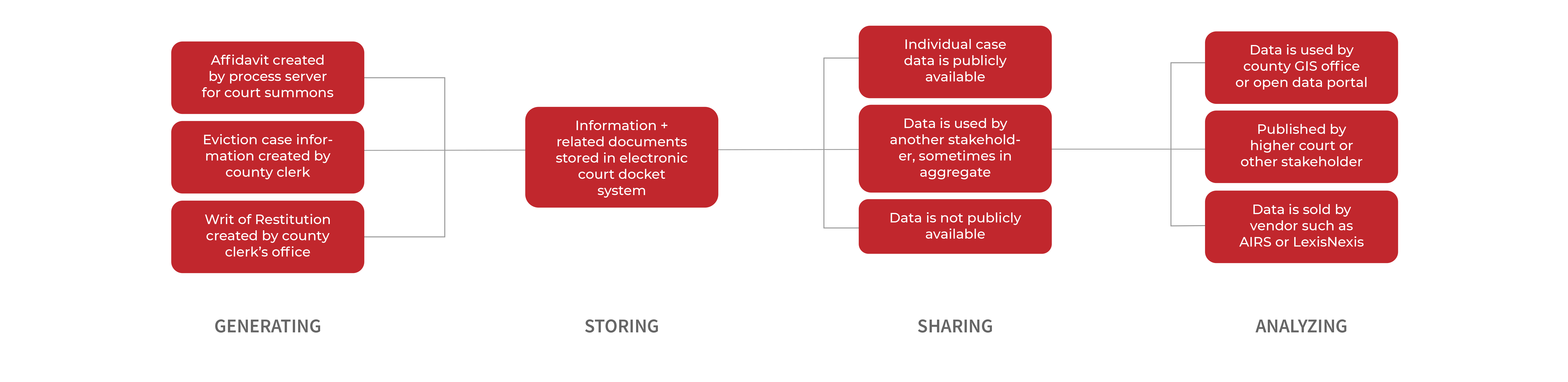
“Eviction data” can refer to any information related to an eviction, however this report focuses on what is known as “formal eviction data” coming from eviction cases that move through county-level civil courts.1 In some cases, we note salient data points that we feel should be part of formal eviction datasets but currently are not.
The data trail for a formal eviction starts when a landlord files an eviction claim in court. In an eviction case, the landlord is usually the plaintiff and the tenant is the defendant. As a case winds its way through the court system, it amasses a dataset that usually includes:
- Case filing number;
- Filing date;
- Address of the rental property related to the case; and
- The names of the plaintiff and defendant.
Once a case is decided, the dataset grows to include the case disposition (or judgment) and the date of disposition.
These data are recorded by court clerks, and are sometimes—but not always—entered into electronic court docket systems. State or local laws may require the individual case data to be publicly available, and this information is sometimes aggregated for administrative or research purposes.
Other relevant data, which is generated outside of case proceedings, includes:
- An affidavit from the process server, summoning a tenant to court. This document is produced at the beginning of the eviction process, and is often scanned into an electronic court docket system.
- A writ of restitution, which authorizes law enforcement to remove an evicted tenant from a rental unit. Landlords usually file this document with a clerk’s office. However, many evicted tenants vacate a property on their own accord, rendering a writ of restitution unnecessary.
Because these other documents are not generated through the centralized court system, they are often either unavailable or extremely difficult to locate.

Hannah Rudin, Making Conversation LLC, for "Why is Eviction Data so Bad?" a 2021 report produced by New America's Future of Land and Housing (Link: https://www.newamerica.org/future-land-housing/reports/why-is-eviction-data-bad/)
In addition to these formal documents, there is a vast array of other data that are related to evictions but not systematically gathered. Examples may include:
- Physical eviction notice posted by a landlord on a tenant’s door;
- Records of correspondence between a landlord and a tenant regarding late payments or other precursors to eviction;
- Correspondence evidencing an ‘informal eviction,’ where a tenant, usually facing the prospect of a formal eviction, decides to move out on their own; and
- Data related to what happens to the tenant after an eviction, including that tenant’s new address, how long the tenant spent unhoused, and how long the tenant stays at the new residence before moving again.
And, there are vast amounts of demographic data and other data that are useful when structuring eviction interventions, but are not captured because they are not required for court filings. These data may include:
- Whether a property is federally assisted or backed;
- Tenant and landlord race;
- Tenant and landlord income;
- Tenant and landlord age;
- Tenant and landlord immigration status;
- Whether a tenant has children living in the home; and
- Whether a tenant had legal representation in court.2
Citations
- We don’t know the rate of ‘informal’ evictions nationally. However, research by Matthew Desmond, author of Evicted and principal investigator at the Eviction Lab, suggests that in Milwaukee two informal evictions happen for everyone one formal eviction.
- Some courts do capture this data, but it is spotty.
The Current State of Eviction Data
We believe the primary challenges with U.S. eviction data can be broken up into the following categories:
Some Data Do Not Exist
Multiple data points at the beginning and the end of the eviction process are never collected and generally do not leave a discoverable trail.
These data include pre-eviction information that could serve as an early warning that a tenant is in trouble: for example, rental assistance requests, alerts that tenants are behind on rent, complaints against the landlord, notices to quit, and so forth. They also include data on what happens after an eviction judgment, including information as to whether a tenant was ultimately evicted (and whether the eviction was conducted by law enforcement, or if the tenant moved out on their own accord), where the tenant moved after the eviction, how long it takes them to find a new home, and how long they stay at that home.
Non-existent data also include pieces of information that courts do not collect, but that would be helpful to service providers, policymakers, and researchers in targeting renter assistance. Examples include the renter’s race or ethnicity, citizenship status, age and gender, as well as the composition of the household (e.g., are there children living at the address).
Finally, data on landlords (i.e., the landlord’s record of evicting tenants, the landlord’s history of code violations, the residency of the landlord) and on the reason for eviction are often not collected.
Data Exist, but is Inaccessible
Some courts never digitize eviction data, and it remains in hand-written form. Other courts do digitize it, but it remains stored on a local computer or in PDF printouts, and never shared to a database. Converting this data into a readily usable format (e.g., Excel, CSV, or API) is extremely time consuming and difficult to do at scale. Sometimes vendors like American Information Research Services and Premonition do collect and aggregate this data, which they then sell to tenant screening services and credit agencies. As a result, accessing these data is generally cost prohibitive for the public, researchers, service providers, or policymakers to access. These data may also not be as comprehensive as those collected by local researchers.
Other courts do share their records with legal services like Westlaw and Lexis-Nexis, which allow licensed users to search dockets by case number, name, and in some instances by case type. A challenge is that this system is geared towards searching for specific cases, one by one, and absent sophisticated web scraping software, it is difficult to analyze aggregate eviction data. Another challenge is that access to these legal databases is expensive, and so these data are effectively unavailable to the public.
As one stakeholder put it: “A court’s job is to adjudicate the cases and move on.” With no mandate and no resources to curate data into usable databases, most courts don’t bother.
According to experts, certain states, including Alabama, Colorado, Kansas, Kentucky, Louisiana, Mississippi, Nebraska, South Dakota, and Utah, do aggregate the data into databases but charge fees for its access. Even where jurisdictions aggregate eviction data into purportedly public databases, these databases are not usually easy to access. Locating them requires a significant allocation of time and resources, and often necessitates connecting with the right government official or office and convincing them to share the data.
Why is there so much variability? Because courts have neither mandate nor funding to curate and store eviction data. As one stakeholder put it: “A court’s job is to adjudicate the cases and move on.” With no mandate and no resources to curate data into usable databases, most courts don’t bother.
Data Quality is Poor and Inconsistent
A combination of human entry error, data stewardship disparities, and quirks in the data themselves results in eviction records that lack fields like addresses and disposition information, contain multiple repeat entries, or miss entire blocks of entries. Cleaning and interpreting these data is a lengthy process and sometimes requires localized knowledge.
Data is Unstandardized and Inconsistent across Jurisdictions
Because there is no national mandate or framework for stewarding eviction data, jurisdictions vary dramatically in types of data they collect and make available, the terms of access to those data, and even the definitions of eviction-related terms. There is no shared taxonomy for eviction data, even within the same state.
As a result, it is difficult to make cross-jurisdictional comparisons or to compile data from the county level to the state or national level.
Eviction Data Cannot be Linked (Or is Not Being Linked) with Other Data
Eviction data is often examined in isolation, not in conjunction with other datasets that could paint a fuller picture of the challenges leading to and arising from eviction. These data could include court data like criminal records, debt records, and guardianship records, social services data like homelessness records, or housing databases.
Data Exists, but Not in Real Time
As discussed in Challenge A above, pre-eviction data largely does not exist, posing major challenges for eviction prevention work. However, even eviction records are not always up-to-date. While some courts upload and populate eviction records weekly, others may only update their systems quarterly. Even if courts do upload records on a consistent basis, for-profit aggregators may not make data available for purchase immediately.
Data Privacy is a Concern
Court data reveal personal information about both the landlord and the tenant, including full name and address. To some parties, for example, service providers who can deliver rental assistance or connect evicted tenants to new housing, this data is extremely useful. However, to many others, including researchers and policymakers looking to understand neighborhood or city-level trends, they are unnecessarily revealing. Particularly when linked with other data, these details can reveal highly personal information that the data subject may be uncomfortable sharing publicly. Currently, very few eviction data systems have permissions and access levels to differentiate the type of information available to different parties.
The Ideal Eviction Data Landscape
Responding to the challenges outlined in the last section, we envision an eviction data landscape governed by the following principles:
- Easy to Access: Data is easy for interested parties to locate, and available for free.
- Easy to Use: Data is easy to search, analyze, and draw insights from; supports a variety of uses; is provided up-to-date; is portable; and is easy to link with other useful data.
- Standardized across Jurisdictions: Data is comparable and uniform, with a shared taxonomy between counties.
- Centralized: Data is aggregated into a state or national database.
- Comprehensive and Reliable Quality: Data is comprehensive from the standpoint of geographic and temporal coverage, and all data points are consistently captured.
- Ethical, Equitable and Privacy Preserving: Data is privacy preserving and are also collected, stewarded, and shared through an equity lens that ensures data is not misrepresenting, under-representing or damaging vulnerable populations.
What Needs to Change
A specific set of changes must occur at both the national and local level to take us from the current eviction data landscape to the ideal eviction data landscape. These changes are broadly outlined below:
- Funding and staffing. Municipalities must dedicate financial and human resources to collecting, analyzing and sharing eviction data, and setting up rules and models for its stewardship. This may involve hiring new staff (for example, database administrators) and/or investing in building a data system, as well as investing in communications to share data insights with relevant audiences.
- Buy-in and political will at the local level. Streamlining data systems will require coordination across several different actors at the state level, including local policymakers, court administrators, data vendors, legal aid providers, housing rights organizations, among others. The federal government will need to use its political will to help shape local action, and local leadership will need to prioritize data collection and standardization. Courts will need to adopt data standards and be willing to put the protections in place to share their data. In many cases, this will require lowering the political cost of cooperation, notably in jurisdictions with high volumes of evictions, changing court culture to prioritize eviction data, and creating incentives for municipalities to prioritize eviction data.
- Legislation and regulation. Congress may need to pass legislation and Federal and State agencies may need to pass corresponding regulations that provide funding and infrastructure for data collection and standardization, as well as the oversight to ensure compliance with data standards.
- Building or improving data capacities and competencies. Local jurisdictions’ eviction data infrastructure exists at differing states of maturity. Municipalities will need to assess their own data infrastructure and determine where there are deficiencies and where there are opportunities to build on analyses. This includes creating data verification processes (e.g., to spot systemic undercounts or overcounts); developing protections against the misuse of data (e.g., code of conduct); collecting demographic data with a racial equity lens with sufficient granularity; simplifying data access procedures; and creating better data management tools to better link data sources.
Our 8 Recommendations for Improving Local and National Eviction Data
To create a robust and informed anti-eviction strategy, we must understand the scope of evictions and their devastating impact on communities over time. We need to know who is most impacted, and where, and understand the range of actors and activities that undergird the system, from the process servers that inform tenants of an eviction filing to the outcome of each court case.
The text below is an expanded version of a set of 8 Recommendations for Creating Local and National Eviction Data Systems that have been co-developed with and co-signed by:
- Beeck Center for Social Impact + Innovation
- Eviction Lab
- Georgetown's Civil Justice Data Commons
- January Advisors
- National League of Cities
- National Low Income Housing Coalition
- New America
- Stanford Law School Legal Design Lab
- UNC Greensboro Center for Housing and Community Studies
New America estimates that roughly 900,000 households lose their homes to eviction each year. Yet, there is no system to track evictions nationwide and locally. Some states, counties, and cities collect and analyze eviction data, but this collection is far from ubiquitous and is not standardized or centralized. To better understand evictions and their effects on communities, governments at both the local and federal levels must develop an eviction data infrastructure that is easy to use; easy to access; standardized; centralized; of comprehensive and reliable quality; and ethical and privacy preserving.
Creating this infrastructure will require significant collaboration from a number of stakeholders, all of whom stand to benefit from the standardization and centralization of data. The ultimate goal of an improved and coordinated data infrastructure is to decrease the number of evictions that occur over time and mitigate the instability experienced by renter households most at risk of housing loss.
Black renters face evictions at much higher rates than white renters, and women, especially Black and Latinx women, are evicted at higher rates than men. It is clear that the communities that are disproportionately impacted by evictions stand to benefit from data collection and analysis that exposes how certain policies worsen inequities for those that are already vulnerable.
However, streamlining data collection and standardization benefits other stakeholders as well.
Uniform standards for collecting and reporting eviction data will help local courts increase their operating efficiencies and allow them to provide insights to their government and non-government partners.
Better eviction data will also help cities and counties save money, by allowing them to better target and cost rent assistance and other measures.
Ultimately, if improving eviction data results in reducing evictions, it will produce system-wide cost savings as the resources spent on homelessness and mitigating the other adverse impacts of evictions are diverted.

As illustrated in the diagram above, these recommendations present a framework for improving the local and national level eviction data landscape, with the goal of creating local eviction databases that feed into a national level database. The framework has three major components:
- Creating a Federal/State Enabling Environment
- Creating a Local Enabling Environment
- Creating Local and National Eviction Databases
Operationalizing this framework at the local and federal level will require work.
We note, but do not dwell, on several outstanding questions around the best way to achieve universal collection and standardization and who should enforce this. Finally, given the variation in municipalities across the country, these recommendations do not suggest which level of local government (e.g., state, county, city) should be at the forefront of advancing eviction data systems. As such, we use “local” and “jurisdiction” to mean states, counties, and/or cities.
Creating a Federal/State Enabling Environment for Eviction Data
A comprehensive effort to standardize, aggregate and analyze eviction data nationally requires a federal-level enabling environment that consists of funding, mandates and/or incentives, data standards, and technical assistance for local jurisdictions. The following four recommendations are directed to the federal government and in some cases state governments, with the goal of creating the most appropriate environment for local jurisdictions to collect and steward eviction data:
1. Provide Federal Funding to Advance Eviction Data Infrastructure in Local Jurisdictions. HUD or another relevant federal agency should provide funding to jurisdictions to bolster their eviction data systems and reduce the harmful effects of evictions. The needs of local jurisdictions will vary, and the administering agency should consider the scope of jurisdictions’ needs when allocating funding, from hiring new staff to building tools to create a more robust data collection system. While funding will expand a jurisdiction’s capacity to undertake specific activities, the availability of federal funding can also increase local political will and buy-in. In addition to the volume of funding (which should be significant enough to invest and transform local data infrastructure), there are a number of other key considerations.
- How to target funding. Some counties might need one-time assistance to standardize their eviction data, while other counties may require ongoing assistance for maintaining staff to collect data from courts. Should funding be provided to every jurisdiction regardless of their eviction data needs? If so, how should the amount of funding differ across jurisdictions (e.g., by the percent of the population that rents)? Alternatively, funding could be targeted to those jurisdictions that provide virtually no eviction data to the public.
- Who should distribute funding? Which Federal entity should be in charge of distributing funding? And who should receive it at the local level? The U.S. Treasury Department currently distributes COVID-19 emergency rental assistance to states, who then allocate funding among counties, who then further distribute it among local housing departments, non-profit organizations or third party contractors. Would this work well for funding for eviction data systems? Or should it be distributed by HUD, which traditionally funds housing, or the Department of Justice, which funds court-related assistance? Should funding be allocated to county governments directly or should it be passed through an association that can also be tasked with monitoring and evaluation?
- Funding time horizon. Clear time horizons for funding are critical for planning infrastructure investments. If local governments are to comply with data standards and invest in their data system infrastructure, they need to be able to plan accordingly and that includes knowing the time horizon for funding. The federal government should take into account the reasonable time frame by which local jurisdictions are able to stand up eviction data systems, and give local jurisdictions clear timelines for when funding will expire so they can make sure to have local funding solutions in place if needed. If local court systems are able to achieve significant cost savings from the outcomes of standardized eviction data (e.g., reduced court proceedings and the reduced burden on homelessness care providers), they may be able to use this as a source of local funding to maintain any remaining technical infrastructure at the end of the funding period.
2. Incentivize Local Collection and Standardization of Eviction Data. To track and analyze evictions nationwide, jurisdictions must collect a minimum set of viable data (e.g., docket number, eviction address, date, case outcome) in a standardized manner. To ensure consistency, the federal government and/or state governments must incentivize the collection of this data, and tie this incentive to a significant amount of funding. Key considerations include whether data collection and standardization criteria is determined and enforced at the federal or state level, and whether the entity responsible for carrying out the activities is a government agency or a third party.
- Federal-level incentives. Incentives at the federal level have the benefit of nationwide uniformity and standardization, but there are also issues posed by the federal government's limited jurisdiction over state courts, the possible conflict between federal agencies for this type of collection, the limits imposed by the Privacy Act, delays in federal data reporting, and political swings in the executive branch. Further, any regulation will need to be preceded by legislation that provides the incentive and funding for a federal agency to act.
- State-level incentives. Standardization could also be achieved through state legislation, which has the benefit of working within existing legal and policy environments. Some states, like Texas, have already introduced bills requiring the creation of a criminal justice sentencing database and specific reporting standards for evictions. State mandates would need support from state supreme courts and their administrative offices. Vendor compliance with these standards could be enforced, such that the ecosystem of existing software providers is adapted to new standards that are set.
3. Create Eviction Data Standards. A federal agency, or state agencies in close coordination with one another should develop data standards that provide clarity on how eviction data is described and documented at the local level. The creation of data standards should take into consideration the variation in local eviction terms, formats, definitions, and structuring of all the jurisdictions included in standardization and draw from the experiences of other areas that have standardized data (e.g., EPA environmental data standards or Fatal Analysis Reporting System).
4. Provide Technical Assistance to Local Jurisdictions to Build a Robust Eviction Data Infrastructure. Building or improving data infrastructure is a complex technical undertaking with multiple components, from assessing eviction data availability through the local court systems to developing aggregation and data verification processes. HUD or a different federal agency, or state agencies, should offer robust technical assistance for jurisdictions to build and/or improve their eviction data infrastructure. Assistance providers should assess jurisdictions based on differing levels of technical need and prescribe a menu of technical assistance options along the spectrum of data capacity, including by helping jurisdictions focus on community outcomes as a result of new data systems. Technical assistance should be available for a range of activities and be tailored for jurisdictions at all stages of eviction data maturity. Assistance should be funded by the federal government, and provided by either a team within a federal agency or through a third party organization. Assistance should be coordinated with Recommendation 1, particularly related to staffing, so that all assistance can be mainstreamed locally and work can continue once Federal or State assistance ends.
Creating a Local Enabling Environment for Eviction Data
Local jurisdictions will need to operationalize increased federal funding and technical assistance to build and/or improve their data capacity and competencies. An open question is which entity at the local level should be held accountable for complying with data standards and using the funding and technical resources to advance the eviction data infrastructure.
The following two recommendations are directed to local jurisdictions, with the goal of creating an enabling environment for them to collect and steward eviction data:
5. Assess Local Capacity to Support a Robust Eviction Data Infrastructure. As a first step, local governments should assess the maturity of their eviction data infrastructure. This assessment should include:
- The current state of eviction data (i.e., data accessibility, availability, type, granularity);
- The capacity to carry out and maintain consistent collection (e.g., personnel, systems);
- Political will for building and/or improving data systems;
- A review of open data laws, regulations and policies to ensure data processes are ethical, and properly account for misuse; and
- The evaluation of data based on who is most impacted (Black, Indigenous, and people of color households, low income communities, women, among others) and evidence-based decision-making in response to these outcomes.
Technical support provided in Recommendation 4 should offer hands-on assistance with this diagnostic assessment, as well as developing detailed plans to advance the collection, stewardship and analysis of data at the local level.
6. Develop a Robust Strategy to Enhance Local Eviction Data and Analytic Capabilities. Based on the assessment, local jurisdictions should collaborate with a broad coalition of stakeholders (e.g., government officials, courts, housing agencies, legal aid, state legislatures, renters, landlords, third-party data vendors, community-based organizations, and technical experts) to develop a strategy for advancing the collection, stewardship, and analysis of eviction data. This strategy would include the collection of a minimum viable dataset currently collected by eviction courts (e.g., docket number, address of rental property, dates, etc.) that comports with the data standards developed through Recommendation 3.
In addition, local jurisdictions should work with communities disproportionately impacted by evictions and with advocates on the ground (e.g., legal aid providers, community leaders, tenant organizers) to collect data that is not currently collected by courts but is critical for minimizing the harmful effects of evictions, including data on race, ethnicity, class, gender and sexuality, whether the property is federally assisted/backed, and also data on informal evictions that are not catalogued by courts.
Creating Local and National Eviction Databases
The following three recommendations are directed to local governments and the federal government, with the goal of creating a network of local eviction databases that feed a national eviction database.
7. Create Local Eviction Databases. Local jurisdictions should use federal funding and technical assistance to build local databases that comply with federally-established eviction data standards and roll up to a national database. Some jurisdictions may wish to build a database at the county level (since most evictions are heard by county courts), while others may prefer to build at the city level or at a multi-county or state level. Regardless of the scope, the goal is for the entirety of the United States to be covered. Each database would contain the minimum number of variables required by the criteria (through a mandate or incentive) and be publicly accessible. The database should be updated regularly, be easy to use and access, of comprehensive and reliable quality, and privacy preserving. The data should be in a format that can be seamlessly aggregated into larger databases, for example statewide databases and a national database.
8. Create a National Eviction Database that Aggregates Local Data. One of the primary goals of standardizing local eviction data is to aggregate and track evictions at the national level. The federal government must establish a national, publicly-accessible database that pulls directly from the local databases and displays data and analytics with at least three levels of granularity: county/city; state; and national. Ideally, this database would link eviction data with demographic, socio-economic, and housing datasets to explore the relationships between evictions and a host of neighborhood characteristics as well as the differences between various geographies.
While there should be an entity responsible for ensuring that all this data is available to the public in one location, whether this is a federal government agency or an independent entity altogether, like the civil justice data commons, remains an open question.
- Data Commons. Data could be collected through a coordinating repository, such as the civil justice data commons, currently underway at Georgetown University’s Institute for Technology Law and Policy. The civil justice data commons will act as a central repository for civil legal data, including evictions data, collected from courts, legal service providers, and other civil law institutions. The benefit of a data commons is that it centralizes data while allowing for differing levels of access through different data use agreements. While this is a national effort, coordinated by an independent agency, the provision of data will be optional for local jurisdictions.
More About the Authors

Sabiha Zainulbhai
Deputy Director, Domestic Housing

Yuliya Panfil
Senior Fellow and Director, Future of Land and Housing

Tim Robustelli
Senior Policy Analyst, Future of Land and Housing