Bringing Politics Back In
The common approaches to misinformation discussed earlier inadequately confront its threat because they overlook the pre-existing social factors that fuel its demand. Attempts to combat misinformation by altering the media landscape without concurrent efforts to address the political culture in which it exists are doomed to be ineffective at worst, or band-aids at best. Such strategies disregard the political system that incentivizes the production, dissemination, and acceptance of misinformation in the first place. By considering the effects of the political system—particularly of the winner-take-all electoral system on affective polarization—a narrative quickly takes shape linking our elections to the drivers of misinformation sharing, namely the need to signal in-party loyalty, denigrate opponents, and win at any cost.
How Our Elections Stoke the Affective Fire
When thinking about the causes of misinformation—and possible solutions to the problem—we need to think about our electoral system and how it shapes demand for misinformation through its effects on affective polarization, a measure of voters’ identification with their own party and dislike for out-party members. Our winner-take-all system creates strong incentives to dislike and fear political opponents and raises the stakes of winning a race, thus setting the stakes, playing field, and social mores in which a large part of our social and political identities develop. Our majoritarian first-past-the-post election method—which generally pits one party against the other in winner-take-all fights where it is easy to cast opponents as evil—contrasts with consensus-based systems of which the most common are proportional representation. The key metric here seems to be the degree to which the electoral system in question creates stronger ties between one's social identity and their politics, as well as the degree these ties become oppositional.
In an oppositional and winner-take-all electoral system, elected officials who cannot compromise on the issues most important to their constituents face increased incentives to obstruct policy changes and put the blame for inaction on their opponents.1 In a coalition government these same actors would likely face a more difficult time blaming other parties as well as less incentive to do so because, as discussed later in this section, partisans at all levels would have less of an us-versus-them mentality.
Elite polarization along cultural lines has occurred in tandem with the sorting of parties along racial, religious, and identity-based divides since the 1970s. Analysis of the American National Election Survey (ANES) from 1972 to 2004 reveals that members of a party who are highly aligned with their party along social identity lines are less equipped to deal with a threat to their party and more likely to feel stronger negative emotions towards the out-party.2 Perceptions of political opponents as a threat—and the associated hostility towards them—will almost certainly be more likely in a winner-take-all system that ensures that one is either part of the winning party or the losing one, as well as ensuring that being in the losing party means one's cultural identity is also losing.3 ANES data also showed that in 2016, despite the historic unpopularity of both candidates among their own party’s supporters, partisans overwhelmingly voted for their party’s candidate due in large part to their outright hatred for the opposing party’s candidate.4
Thus, as social identities have become increasingly wrapped up in party politics, the actions of the opposite party and the possibility that its representatives could win complete control of the government have motivated out-party animus. Without such a great risk that our ‘enemies’ could defeat us, this animus would likely decrease.
Our partisan politics have also created incentives to act based on animosity. Research using data from the 2010 Cooperative Congressional Election Study (CCES) finds that partisans are driven to act based on their perception of inter-party rivalry and anger with the opposition—each of which is driven by the strength of partisan attachment.5 Moreover, negative stereotyping of opposing partisans as lacking moral traits (itself a consequence of affective partisanship and misinformation) is integral to creating this rivalrous relationship and anger.6 All of these effects are exacerbated by close elections, distracting voters from the issues and towards identity-based conflict. As noted by the researchers, a stable two-party system is key to allowing partisans to identify both with their own party and classify the opposite party as an enemy.
Losing in a winner-take-all system is much more costly than in proportional systems and threatens the identity of partisans much more. Indeed, strongly identified partisans will react to the prospect of winning or losing (which acts as a threat to their core identity) with stronger emotions—particularly anger—than nonpartisans.7 Out-party hatred can even result in a positive reaction to objectively harmful events, such as a downturn in the national economy or the deaths of U.S. soldiers abroad, so long as it reflects poorly on the opposition party.8 Other work adds more evidence that strong emotions can cause hostility online, especially moral outrage.9
Experimental tests of the effects of electoral systems on intergroup animosity provide further evidence that the winner-take-all system generates more hostility and distance between partisans. In dictator games played in contexts with more parties, for example, the affective gap was lowered.10 Comparing similar dictator game-based tests of affective polarization confirms that the directly oppositional nature of a two-party system is key to assessing the strength of these experiments. In other research, dictator game participants showed consistent in-group favoritism and out-group penalties.11 However, these and other such sociological tests of affective feeling do not separate in-group favoritism from out-group hatred because they are zero-sum: for one player to profit another must lose out.12 In other experiments that are not zero-sum or that differentiate rewarding one group from actively punishing another, out-group punishment does not appear. Because first-past-the-post is winner-take-all in nature, it mirrors the simpler version of the dictator game used to model both in-group favoritism and out-group punishment in a zero-sum environment. A consensus-based system on the other hand, where multiple groups can share in victory and a win for me is not necessarily a loss for you, is closer to the alternate setup where preferences for one party do not translate to punishment for the other. In essence, first-past-the-post creates stronger and more negative affective polarization because it ensures that the ‘game’ must involve the punishment of one's opponents.
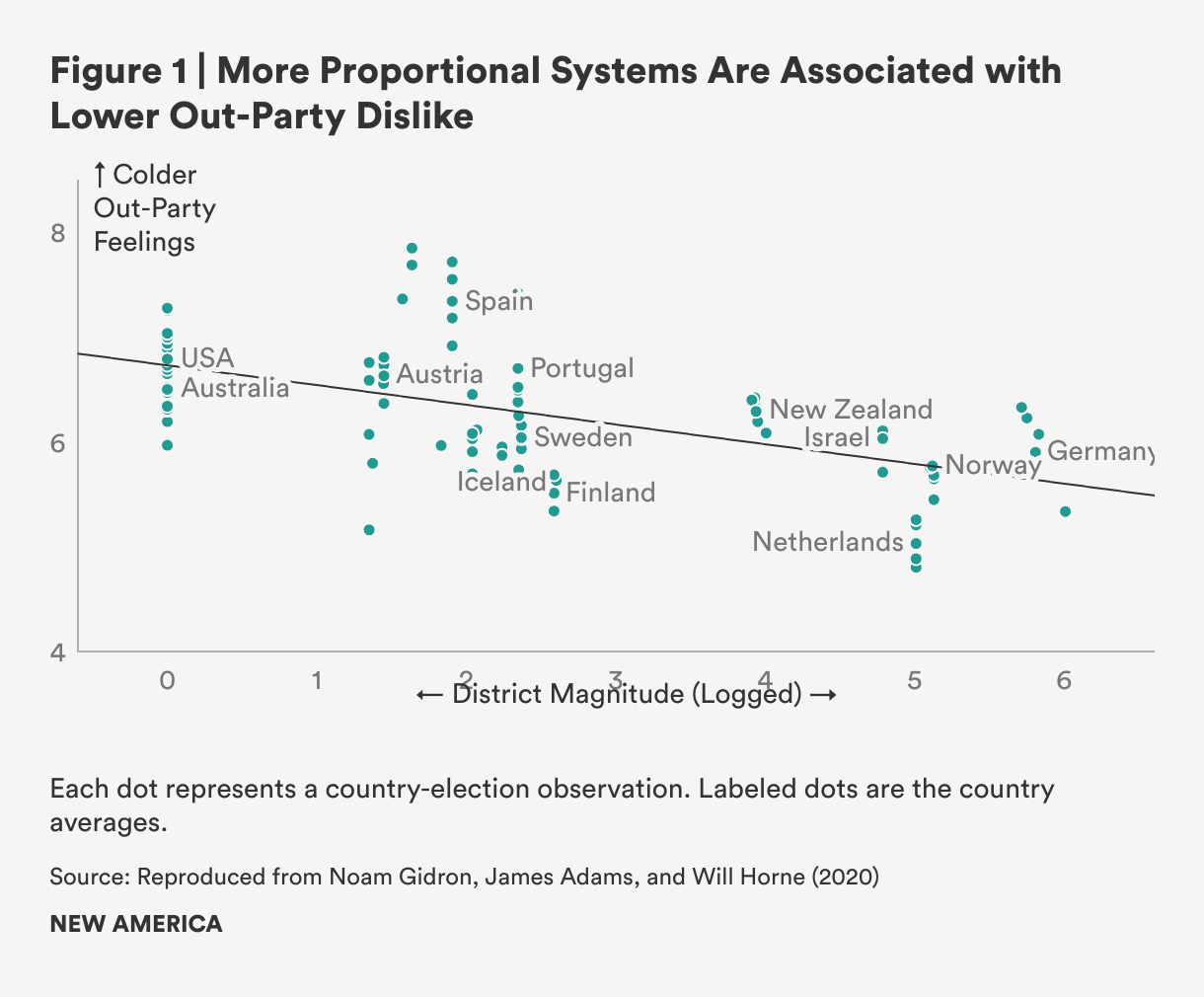
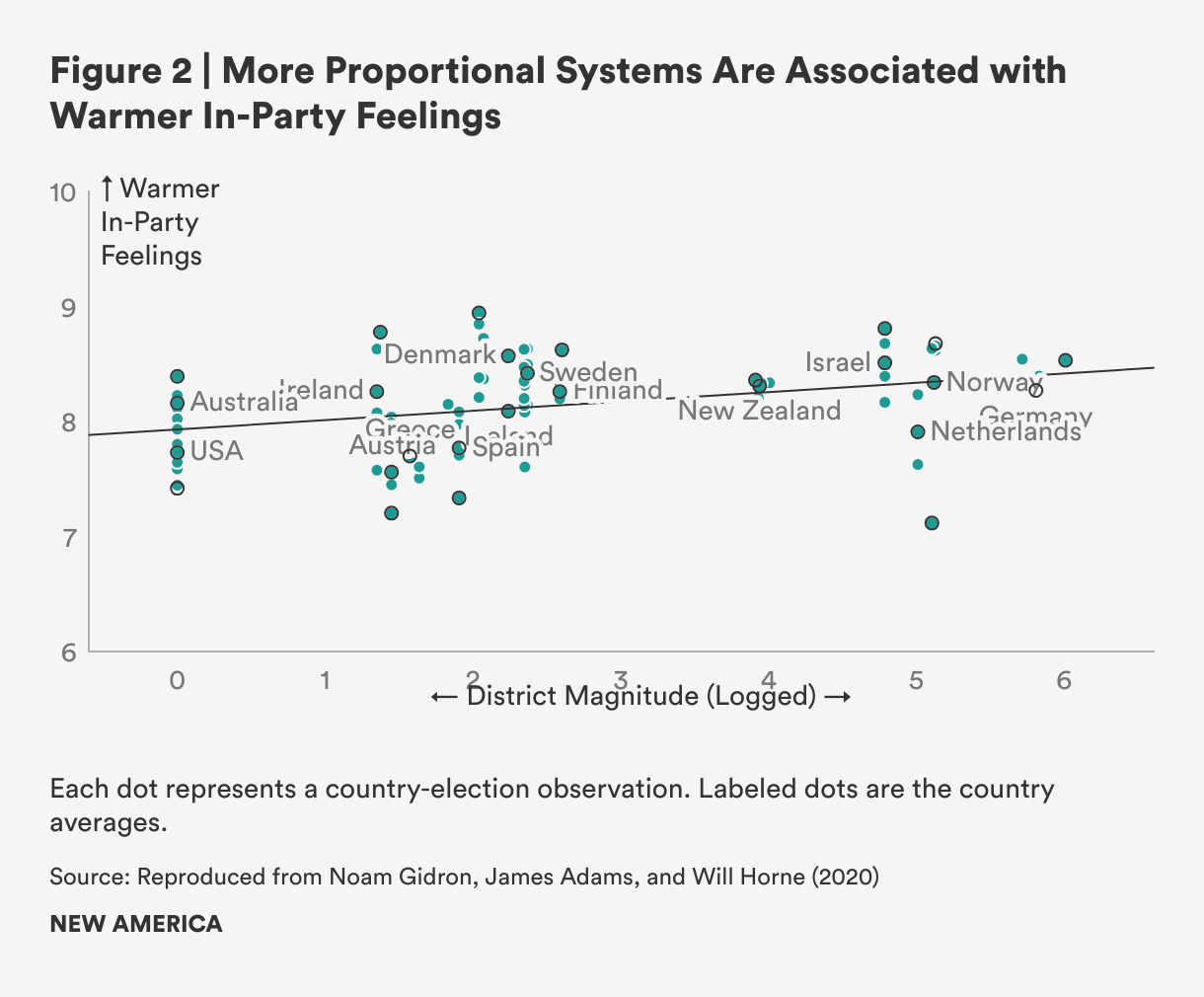
An analysis of 20 Western democracies offers further reason to investigate our elections, finding no significant relationship between electoral system and affective polarization, but rather a strong link between election method and what affective polarization represents.13 Affective polarization—as the following section further elaborates—is usually constructed as the difference between in-group and out-group ratings. As shown in the chart reproduced below, proportional representation increases in-party identification and decreases out-party derogation while winner-take-all decreases in-party identification and increases out-party derogation. While the overall affective polarization score may not significantly differ between systems, in proportional representation systems this number represents a far “gentler and kinder” method of politics than in first-past-the-post.14 These findings correspond strongly to the idea that proportional representation, by being less oppositional than winner-take-all, creates a less rivalrous, angry, and hostile politics.
Affective Polarization and Its Connections to Misinformation
One of the most pernicious consequences of the winner-take-all system is that it intensifies affective polarization. The simplest definition for affective polarization is the degree to which a partisan identifies with their own party and against an opposing party based on their social identity.15 The inclusion of social identity is key here as affective polarization is distinct from, and possibly much more impactful than, ideological polarization—a simpler measure of the distance between partisans on policy.
There is evidence that affective polarization is on the rise using the most common measure: in-group vs. out-group thermometer differentials (the difference between how positively a voter feels about their own party compared to how positively they feel about another party). Data from six different surveys of voters in the United States and the United Kingdom show that while both major parties in the U.S. have a fairly consistent level of in-group support (positive feeling towards their own party) there is a clear downward trend in out-group feelings: While positive own-party ratings for both Democrats and Republicans remained relatively constant at around 70 percent between 1975 and 2010, positive feelings towards the opposing party dropped by almost 20 percent for both parties in the same period.16 This increasing negative feeling does not appear to be related to specific elections or ideological battles. In fact, this divide of partisan identity is growing far stronger than the same cleavage between Black and white or Protestant and Catholic Americans.17 This fits with other findings that show that 70 percent of partisans show a consistent bias in favor of their own party on implicit bias tests and that partisan strength consistently had a stronger positive effect than ideological strength on the bias between parties, political activism, and anger felt towards the opposite party’s candidate.18
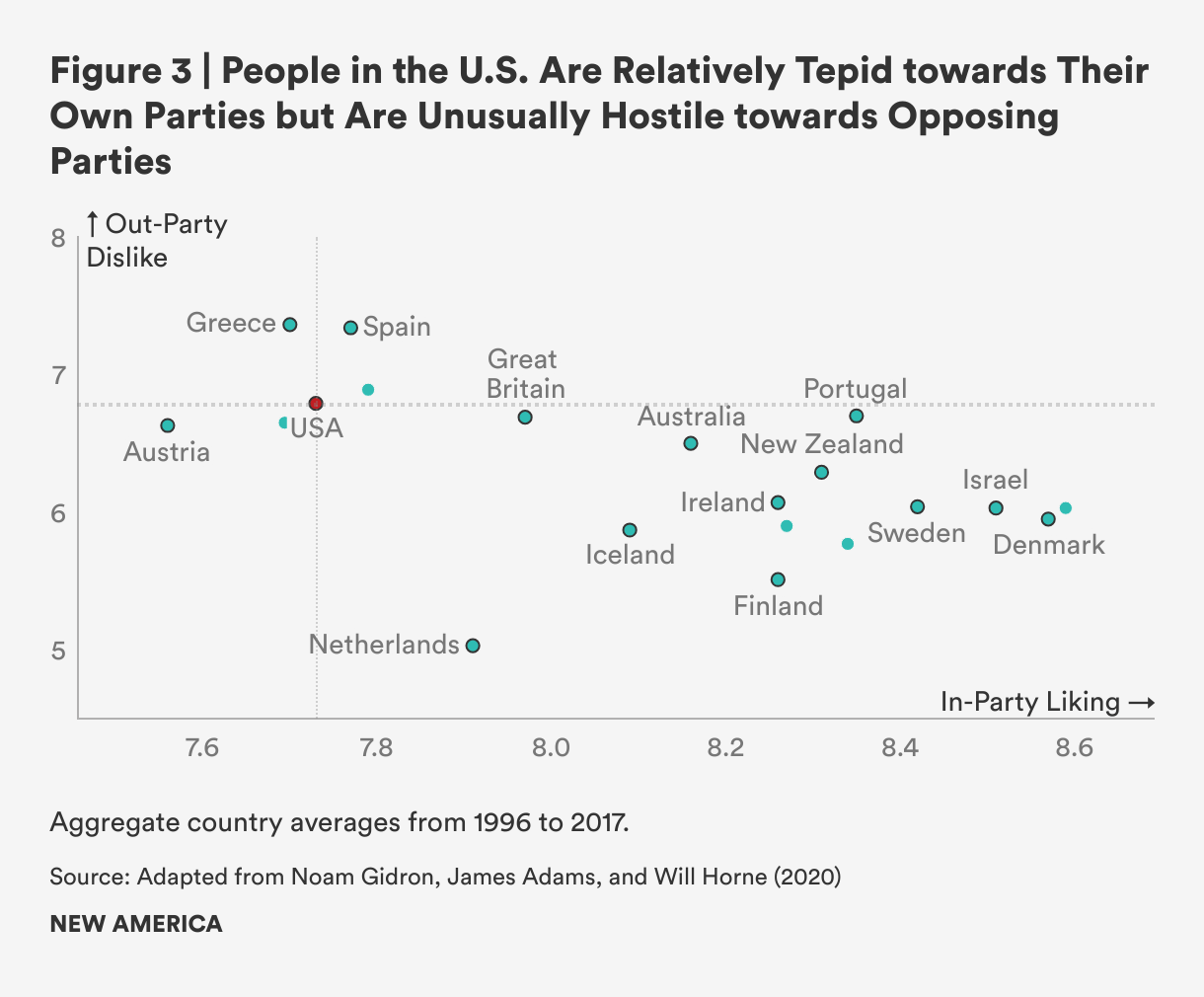
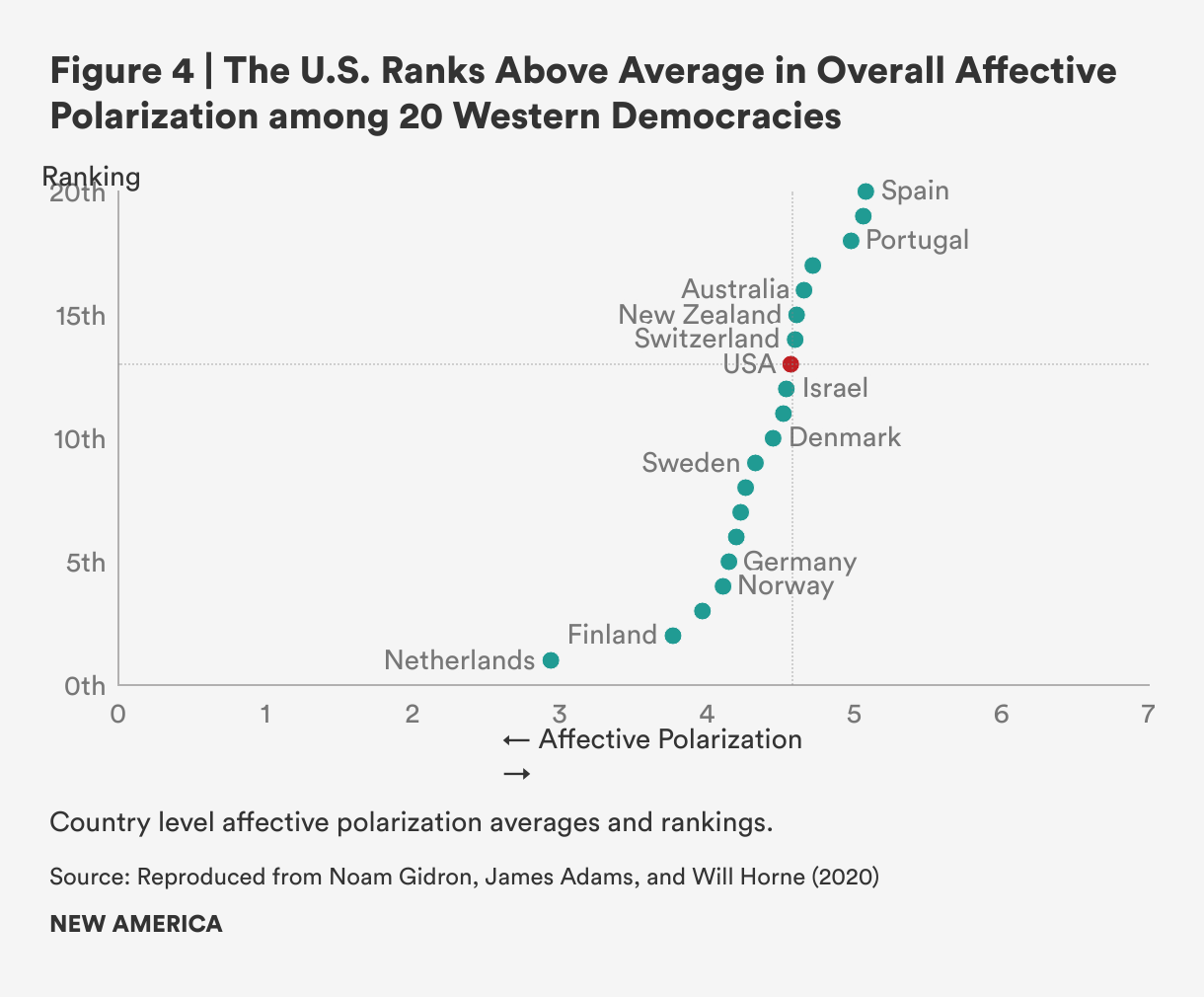
Analysis of the Comparative Study of Electoral Systems (CSES) across multiple elections in 20 Western democracies reveals that Americans between 1996 and 2017 were relatively tepid towards their own parties, unusually hostile towards their opponents, and above average in terms of overall affective polarization, as shown in Figures 3 and 4.19 This data also shows that out-party dislike has risen in the U.S. to a greater extent than in other countries observed.
In behavioral tests, Americans consistently reward co-partisans over members of the opposition in decisions about who to hire, how to award financial compensation, and who to award academic scholarships to.20 Partisans also increasingly assign positive traits to their own party while negatively stereotyping the opposition as ‘selfish’ or ‘close-minded,’ among other such traits.21 Americans have also become increasingly unhappy to see their child marry someone from the opposite party and are unlikely to date, marry, or even befriend someone from the opposite party themselves.22
Thus, affective polarization represents the convergence of a political and social divide that Americans are increasingly unwilling to cross.23 Emerging research shows that this growing affective hostility is a key cause of misinformation—and likely a much stronger one than the traditional explanation that Americans, particularly older Americans, are being fooled.24 Instead, regardless of whether people believe it, misinformation is acted upon and shared due to partisan affiliations, the need to signal loyalty to a group, and, most importantly, dislike for opponents.
“Misinformation is acted upon and shared due to partisan affiliations, the need to signal loyalty to a group, and, most importantly, dislike for opponents.”
Cognitive psychology research tells us that people engage with or share information based on one of two orientations.25 The first is their accuracy-oriented motivation, where they will engage with and accept true and reliable information to assist in the creation of an accurate worldview. The second is their goal-oriented motivation, which causes them to focus on information that is useful to their beliefs or allegiances. By agreeing with and spreading information that may not be true but is accepted by or beneficial to their social group, people are demonstrating their solidarity to the shared reality of that in-group (in this case their party).26
It is tempting to imagine that this sort of goal-oriented behavior might be in service to ideological ends—in other words, that misinformation is a tool to win policy-based debates and ensure one's preferred course of action is taken. However, these actions more likely reveal social motivations to score points against an opposing party.27 Indeed, research finds that affective polarization, particularly negative animus towards political opponents, is central to predicting misinformation sharing.
Affective polarization can motivate misinformation sharing as a way to increase a person’s social status: People are much more likely to share negative or derogatory articles about the opposite party than about their own (64 percent compared to 25 percent).28 Thus, people sharing misinformation may be very able to discern fake from real news, but their need to signal their commitment to or promote the interest of an identity group (such as a political party) will win out over their motivation to be correct. This fits well with findings from a variety of researchers that the sharing of misinformation is not accidental, but an intentional decision to engage with political discussion and, sometimes, offend others both online and offline.29 Libby Jenke further confirms this connection by exposing partisans to negative behavior from a perceived political opponent before testing their adherence to misinformation favoring their own party or the opponents. Participants exposed to negative behavior were significantly more likely to subscribe to misinformation that benefited them and less likely to subscribe to misinformation that benefited the opposition.30
This is all not to say that misinformation is never believed or that that belief is not harmful, just that the main reason for it being shared or acted upon is not that it is erroneously believed due to a lack of knowledge or critical thinking ability.
The Feedback Loop of Misinformation and Its Drivers
The importance of affective polarization to misinformation suggests a worrying connection: If hostility towards our political opponents encourages us to share lies, and those lies then encourage further hostility, we will be trapped in a doom loop.31 More plainly, when confronted with negativity about ourselves or our co-partisans, our negative response becomes even stronger as we circle the wagons. On the flip side, when repeatedly exposed to negativity about our opponents from within our own community, we are incentivized to display loyalty to the partisan beliefs about one’s opponents and in turn spread further distortions of the truth.
This feedback loop may be most apparent when we consider its implications for the behavior of elites. Elite actors, largely meaning here elected officials and other highly influential political figures (notable media pundits, candidates, community leaders, etc.), have a large and obvious effect on misinformation via their own sharing. Elites have the ability to share misinformation to a much wider audience than the average American as well as a much higher chance for that information to be taken seriously (or taken as the required narrative for social signaling purposes). Misinformation has a feedback effect on elected officials because they too must signal their allegiance to the narrative endorsed by their constituency. Thus, if a piece of misinformation is accepted by a given political identity, the elected officials representing that identity will face costs from their constituents if they do not signal their acceptance of that information regardless of its veracity. A feedback loop emerges due to the reach of elites who are incentivized to amplify misinformation by the same social identity goals that trump accuracy goals for normal individuals. The ideological extremity of elites of the opposite party to a voter drives this even more, as partisans respond by holding stronger feelings of partisan animosity.32
Research using data on roll-call votes and the ANES survey from 1978 and 2016 finds that elite ideological polarization has increased and that this, combined with individual interest in politics, correlates with a rise in affective polarization at the popular level, with the ideological polarization of out-party elites having the largest effect.33 Data from the Comparative Manifesto Project on 20 Western democracies, including the U.S., shows that elite ideological polarization around cultural issues (way of life, law and order, multiculturalism, etc.) is a significant driver of affective polarization whereas similar polarization on economic issues is not.34 The difference in effect between the two types of elite polarization is likely due to the difficulty to compromise on principled moral issues compared to more pragmatic economic ones. Intense ideological disagreement in the legislature thus causes not ideological strife, but feeds into negative inter-party feelings that are wholly separate from ideology.
The salience of disagreements over cultural issues will likewise hold more generally for everyday partisans regardless of elites. Because these issues are more wrapped up in our social identities, challenges to them make it easy to make those we disagree with into our enemy or otherize them as irreconcilably different.35 The focus of U.S. media on dramatic political conflict—and omission of examples of compromise—may further this othering, as it makes it easier to caricature the opposition as extreme and unreasonable.36 Indeed, when exposed to negative online hostility towards members of their own in-group, both parties’ partisans registered higher affective partisanship as measured by the bias in their ratings of parties (though this result was stronger for Republicans).37All of this will make it more tempting, believable, or useful to share further misinformation demonizing political opponents. This feedback loop can be counteracted to some extent by correcting characterizations of our opponents and showing that political opponents are much more similar than they are different.38 However, doing so faces the same challenges highlighted earlier regarding fact-checking.
Citations
- Sean Fischer, Amber Lee, and Yphtach Lelkes, “Electoral Systems and Political Attitudes,” Social Science Research Network (May 2021): 1–31; Shanto Iyengar, Yphtach Lelkes, Mathew Levendusky, Neil Malhotra, and Sean J. Westwood, “The Origins and Consequences of Affective Polarization in the United States,” Annual Review of Political Science 22 (2019): 129–46.
- Liliana Mason, “‘I Disrespectfully Disagree’:The Differential Effects of Partisan Sorting on Social and Issue Polarization,” American Journal of Political Science 59, no. 1 (2015): 128–145.
- Leonie Huddy, Lilliana Mason, and Lene Aarøe, “Expressive Partisanship: Campaign Involvement, Political Emotion, and Partisan Identity,” American Political Science Review 109, no. 1 (February 2015): 1–17.
- Alan I. Abramowitz and Steven W. Webster, “Negative Partisanship: Why Americans Dislike Parties But Behave Like Rabid Partisans,” Advances in Political Psychology 39, no. 1 (2018): 119–135.
- Patrick R. Miller and Pamela Johnston Conover, “Red and Blue States of Mind: Partisan Hostility and Voting in the United States,” Political Research Quarterly 68, no. 2 (2015): 225–39.
- Patrick R. Miller and Pamela Johnston Conover, “Red and Blue States of Mind: Partisan Hostility and Voting in the United States,” Political Research Quarterly 68, no. 2 (2015): 225–39; Shanto Iyengar, Gaurav Sood, and Yphtach Lelkes, “Affect, Not Ideology: A Social Identity Perspective on Polarization,” Public Opinion Quarterly 76, no. 3 (2012): 405–431.
- Leonie Huddy, Lilliana Mason, and Lene Aarøe, “Expressive Partisanship: Campaign Involvement, Political Emotion, and Partisan Identity,” American Political Science Review 109, no. 1 (February 2015): 1–17.
- David J.Y. Combs, Caitlin A.J. Powell, David Ryan Schurtz, and Richard H. Smith, “Politics, Schadenfreude, and Ingroup Identification: The Sometimes Happy Thing about a Poor Economy and Death,” Journal of Experimental Social Psychology 45 (2009): 635–46.
- William J. Brady, Killian McLoughlin, Tuan N. Doan, and Molly J. Crockett, “How Social Learning Amplifies Moral Outrage Expression in Online Social Networks,” Science Advances 7, no. 33 (August 2021): 1–15.
- Sean Fischer, Amber Lee, and Yphtach Lelkes, “Electoral Systems and Political Attitudes,” Social Science Research Network (May 2021): 1–31.
- Shanto Iyengar, Yphtach Lelkes, Mathew Levendusky, Neil Malhotra, and Sean J. Westwood, “The Origins and Consequences of Affective Polarization in the United States,” Annual Review of Political Science 22 (2019): 129–46.
- Yphtach Lelkes and Sean J. Westwood, “The Limits of Partisan Prejudice,” Journal of Politics 79, no. 2 (December 2016): 485–501.
- Noam Gidron, James Adams, and Will Horne, American Affective Polarization in Comparative Perspective (Cambridge: Cambridge University Press, 2020).
- Arend Lijphart, Patterns of Democracy (New Haven, CT: Yale University Press, 2012); Noam Gidron, James Adams, and Will Horne, American Affective Polarization in Comparative Perspective (Cambridge: Cambridge University Press, 2020).
- Shanto Iyengar and Sean J. Westwood, “Fear and Loathing across Party Lines: New Evidence on Group Polarization,” American Journal of Political Science 59, no. 3 (2015): 690–707.
- Shanto Iyengar, Gaurav Sood, and Yphtach Lelkes, “Affect, Not Ideology: A Social Identity Perspective on Polarization,” Public Opinion Quarterly 76, no. 3 (September 2012): 405–31.
- Shanto Iyengar, Gaurav Sood, and Yphtach Lelkes, “Affect, Not Ideology: A Social Identity Perspective on Polarization,” Public Opinion Quarterly 76, no. 3 (September 2012): 405–31.
- Shanto Iyengar, Yphtach Lelkes, Mathew Levendusky, Neil Malhotra, and Sean J. Westwood, “The Origins and Consequences of Affective Polarization in the United States,” Annual Review of Political Science (2019): 129–46; Liliana Mason, “‘I Disrespectfully Disagree’:The Differential Effects of Partisan Sorting on Social and Issue Polarization,” American Journal of Political Science 59, no. 1 (2015): 128–145.
- Noam Gidron, James Adams, and Will Horne, American Affective Polarization in Comparative Perspective (Cambridge: Cambridge University Press, 2020).
- Shanto Iyengar, Yphtach Lelkes, Mathew Levendusky, Neil Malhotra, and Sean J. Westwood, “The Origins and Consequences of Affective Polarization in the United States,” Annual Review of Political Science (2019): 129–46.
- Shanto Iyengar, Gaurav Sood, and Yphtach Lelkes, “Affect, Not Ideology: A Social Identity Perspective on Polarization,” Public Opinion Quarterly 76, no. 3 (2012): 405-431.
- Shanto Iyengar, Gaurav Sood, and Yphtach Lelkes, “Affect, Not Ideology: A Social Identity Perspective on Polarization,” Public Opinion Quarterly 76, no. 3 (2012): 405-431; Shanto Iyengar, Yphtach Lelkes, Mathew Levendusky, Neil Malhotra, and Sean J. Westwood, “The Origins and Consequences of Affective Polarization in the United States,” Annual Review of Political Science (2019): 129–46.
- Shanto Iyengar and Sean J. Westwood, “Fear and Loathing across Party Lines: New Evidence on Group Polarization,” American Journal of Political Science 59, no. 3 (July 2015): 690–707.
- Andrew Guess, Jonathan Nagler, and Joshua Tucker, “Less than You Think: Prevalence and Predictors of Fake News Dissemination on Facebook,” Science Advances 5, no. 1 (January 2019); Levi Boxell, Mathew Gentzkow, and Jesse M. Shapiro, “Greater Internet Use Is Not Associated with Faster Growth in Political Polarization among US Demographic Groups,” Proceedings of the National Academy of Sciences of the United States of America 114, no. 40 (October 2017): 10612–17.
- Mathias Osmundsen, Alexander Bor, Peter Bjerregaard Vahlstrup, Anja Bechmann, and Michael Bang Petersen, “Partisan Polarization Is the Primary Psychological Motivation Behind Political Fake News Sharing on Twitter,” American Political Science Review 115, no. 3 (March 2020): 999–1015.
- Namkje Koudenburg, Tom Postmes, and Ernestine H. Gordjin, “Beyond Content of Conversation: The Role of Conversational Form in the Emergence and Regulation of Social Structure,” Personality and Social Psychology Review 21, no. 1 (February 1, 2017): 50–71; Drew B. Margolin, Aniko Hannak, and Ingmar Weber, “Political Fact-Checking on Twitter: When Do Corrections Have an Effect?” Political Communication 35, no. 2 (2018): 196–219; Andrea Pereira, Elizabeth Ann Harris, and Jay J. Van Bavel, “Identity Concerns Drive Belief: The Impact of Partisan Identity on the Belief and Dissemination of True and False News,” (September 2018): 1–56.; R. Kelly Garrett, Brian E. Weeks, and Rachel L. Neo, “Driving a Wedge Between Evidence and Beliefs: How Online Ideological News Exposure Promotes Political Misperceptions,” Journal of Computer-Mediated Communication 21, no. 5 (September 2016): 331–48; Libby Jenke, “Affective Polarization and Misinformation Belief,” Political Behaviour (January 2023): 1–60.
- Mathias Osmundsen, Alexander Bor, Peter Bjerregaard Vahlstrup, Anja Bechmann, and Michael Bang Petersen, “Partisan Polarization Is the Primary Psychological Motivation Behind Political Fake News Sharing on Twitter,” American Political Science Review 115, no. 3 (March 2020): 999–1015; Shanto Iyengar, Gaurav Sood, and Yphtach Lelkes, “Affect, Not Ideology: A Social Identity Perspective on Polarization,” Public Opinion Quarterly 76, no. 3 (2012): 405-431; Yphtach Lelkes and Sean J. Westwood, “The Limits of Partisan Prejudice,” The Journal of Politics 79, no. 2 (December 2016): 485–501.
- Yphtach Lelkes and Sean J. Westwood, “The Limits of Partisan Prejudice,” Journal of Politics 79, no. 2 (December 2016): 485–501.
- Zhiying (Bella) Ren, Eugen Dimant, and Maurice E. Schweitzer, “Social Motives for Sharing Conspiracy Theories,” The Social Science Research Network (September 2021): 2–18; Jay J. Van Bavel, Elizabeth A. Harris, Philip Pärnamets, Steve Rathje, Kimberly C. Doell, and Joshua A. Tucker, “Political Psychology in the Digital (Mis)Information Age: A Model of News Belief and Sharing,” Social Issues and Policy Review 15, no. 1 (2021): 84–113; Alexander Bor and Michael Bang Petersen, “The Psychology of Online Political Hostility: A Comprehensive, Cross-National Test of the Mismatch Hypothesis,” American Political Science Review 116, no. 1 (2022): 1–18.
- Libby Jenke, “Affective Polarization and Misinformation Belief,” Political Behaviour (January 2023).
- Jay J. Van Bavel, Elizabeth A. Harris, Philip Pärnamets, Steve Rathje, Kimberly C. Doell, and Joshua A. Tucker, “Political Psychology in the Digital (Mis)Information Age,” Social Issues and Policy Review 15, no. 1 (January 2021): 84–113; Joshua A. Tucker, Andrew M. Guess, Pablo Barberá, Cristian Vaccari, Alexandra Siegel, Sergey Sanovich, Denis Stukal, and Brendan Nyhan, Social Media, Political Polarization, and Political Disinformation: A Review of the Scientific Literature (Menlo Park, CA: William and Flora Hewlett Foundation, March 2018), 1–95.
- Kevin K. Banda and John Cluverius, “Elite Polarization, Party Extremity, and Affective Polarization,” Electoral Studies 56 (December 2018): 90–101.
- Kevin K. Banda and John Cluverius, “Elite Polarization, Party Extremity, and Affective Polarization,” Electoral Studies 56 (December 2018): 90–101.
- Noam Gidron, James Adams, and Will Horne, American Affective Polarization in Comparative Perspective (Cambridge: Cambridge University Press, 2020).
- Alan I. Abramowitz and Steven W. Webster, “Negative Partisanship: Why Americans Dislike Parties But Behave Like Rabid Partisans,” Advances in Political Psychology 39, no. 1 (2018): 119-135; Shanto Iyengar, Yphtach Lelkes, Mathew Levendusky, Neil Malhotra, and Sean J. Westwood, “The Origins and Consequences of Affective Polarization in the United States,” Annual Review of Political Science (2019): 129–46; Liliana Mason, “‘I Disrespectfully Disagree’: The Differential Effects of Partisan Sorting on Social and Issue Polarization,” American Journal of Political Science 59, no. 1 (2015): 128–145.
- Kevin K. Banda and John Cluverius, “Elite Polarization, Party Extremity, and Affective Polarization,” Electoral Studies 56 (December 2018): 90–101; Mathew Levendusky and Neil Malhotra,“(Mis)Perceptions of Partisan Polarization in the American Public,” The Public Opinion Quarterly 80 (2016): 378–91.
- Elizabeth Suhay, Emily Bello-Pardo, and Brianna Maurer, “The Polarizing Effects of Online Partisan Criticism: Evidence from Two Experiments,” The International Journal of Press/Politics 23, no. 1 (November 2017): 95–115.
- Shanto Iyengar, Yphtach Lelkes, Mathew Levendusky, Neil Malhotra, and Sean J. Westwood, “The Origins and Consequences of Affective Polarization in the United States,” Annual Review of Political Science (2019): 129–46.