Roselyn Miller Champion
Grant Analyst, City of Portland
The United States is one of only two advanced economies that does not guarantee all workers paid time off to recover from an illness. One-quarter of all U.S. workers don’t have a single paid sick day. And the CDC reports that one in five food service workers—the vast majority of whom have no paid sick leave—have come in to work while sick with vomiting or diarrhea, fearing that they’d otherwise lose their jobs.
The current system is inhumane and hazardous—forcing many workers to choose between coming to work and potentially infecting others, or staying home to recover and being unable to pay their bills. On March 26, the United States became the country with the most confirmed cases in the world. It is irresponsible and dangerous now, as even without widespread access to testing, hundreds of thousands of people in the United States are testing positive for the highly infectious and sometimes deadly coronavirus, or COVID-19 disease. The death toll in the United States is in the thousands, and tens of thousands more have died around the globe.
At a time when schools and universities are closed, when restaurants, libraries, theaters and arenas are shuttered, when millions of people around the country are practicing social distancing, or ordered to shelter in place, all workers, regardless of how long they’ve worked for an employer or the number of hours they work, need paid sick days—to protect themselves and their families, and to protect public health.
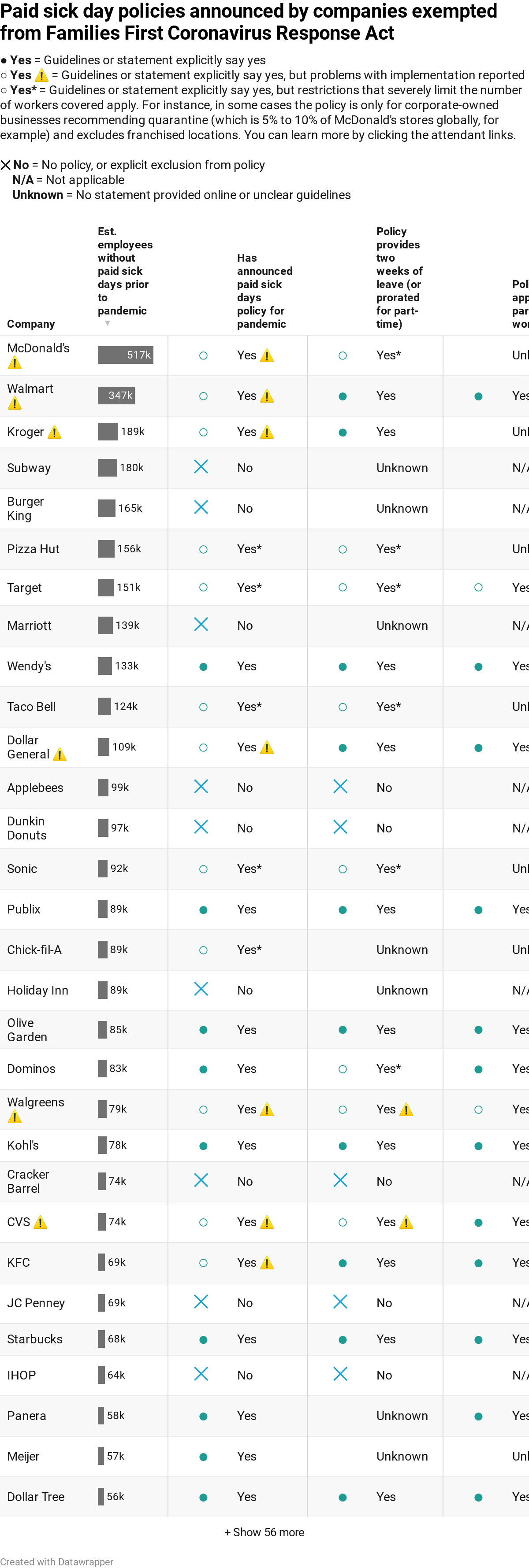
To expand the full table of large employers, click "Show 56 More" at the bottom of the table.
On March 18, President Trump signed into law the Families First Coronavirus Response Act, which includes paid sick days for about half of America’s workers and extended paid leave for some parents whose children are now out of school. But after intervention from the business lobby, the new law exempts companies that employ more than 500 workers from this emergency paid sick days order. Many of these large exempted companies employ the very workers who’ve been deemed “essential” that we are relying on now more than ever to pull through the pandemic—food service, retail and hospitality workers, grocery workers, delivery workers, pharmacy workers. These are the workers who will continue to have regular contact with the general public throughout this crisis.
Consumers have a right to know which companies they may be interacting with are offering paid sick days to their workers as a matter of public health. Some of the large companies currently exempted from the legislation before Congress have begun voluntarily pledging to give their workers paid sick days during this public health crisis. But many, to this point, remain silent.
It's important to note that the emergency legislation also enables small companies to petition to opt out of offering paid sick days. And new Trump Administration Department of Labor guidelines exempt all health workers, from doctors to pharmacy workers to clerks to hospital janitors.
We’re tracking whether the largest employers are offering at least two weeks of paid sick days to their employees. We’re also be tracking whether the policy covers part-time workers as well as full-time workers, and whether it covers franchise or contracted workers. That’s important, because many of the companies on the list employ large numbers of part-time employees or only employ a minority of their staff directly, rather than through a franchise. As in the case of McDonald’s, a newly announced paid sick day policy may only cover corporate stores, which make up only about 5-10 percent of McDonald’s stores globally, and not necessarily extend to thousands of franchise stores.
We’re also tracking whether companies are living up to their promises, linking to stories in the press about whether workers are actually getting access to these emergency paid sick days, if they are pressured to still come in to work, or if the policies are written so narrowly that many workers are still left uncovered. Some companies, for instance, are only offering emergency paid sick days to workers who’ve tested positive for COVID-19. Some will only cover workers who’ve been told by a health professional to self quarantine. But testing and access to health care professionals is still limited. Because of limited resources and labor, even federal officials are discouraging widespread testing. So many workers with compromised immune systems or flu-like symptoms are likely to be left out. If we have seen credible reporting to suggest poor or inadequate implementation of the newly announced sick leave policy, we’ll flag it with a yellow triangle, and link to the reporting we’re citing at the end of the table.
The purpose of this tracker is not only to shine a light on industry leaders responding to a public health crisis, and to hold other large companies to account, but also to give people the information they need to make safer decisions about where to shop, buy, order and eat.
This is a fast-moving disease and the response to it from businesses and governments is developing. We’ll be updating this tracker in real time as we learn new information. We encourage you to help us track updates by sharing them with us via email at betterlifelab@newamerica.org or on Twitter @BetterLifeLab.
The economic, health, and humanitarian case for paid sick days is clear. Now is the time for Congress and the White House, charged with protecting the health and welfare of the nation, to act to cover all workers—not just during this COVID-19 pandemic, but permanently—with a national paid sick days policy.
Correction, April 15, 2020: The above table originally listed Amazon as having an estimated 5,000 employees without paid sick days. The Shift Project has recently corrected this data. Our table has now been updated to show that 51,000 Amazon employees lacked paid sick days prior to the outset of the coronavirus crisis.
Special thanks to the partners and allies who assisted us in compiling this tracker as quickly as possible. We’d like to thank the Center for Popular Democracy and the People's Parity Project for their ongoing efforts to track corporate responses to COVID-19 and their generosity in sharing their resources with us. We’re also grateful to the National Partnership for Women & Families for their advice and guidance on this project. Lastly, many thanks to our communications team at New America for their swift assistance and advice in building this tracker. The estimates for how many employees at each organization have no access to paid sick leave were made possible by the data collection of the Shift Project and reporting by the New York Times.
Photo Credits (clockwise starting in top left): MariaX / Shutterstock.com, Savvapanf Photo / Shutterstock.com, grejak / Shutterstock.com, jejim / Shutterstock.com, Fortgens Photography / Shutterstock.com, Steve Cukrov / Shutterstock.com, Jonathan Weiss / Shutterstock.com, Northfoto / Shutterstock.com
Grant Analyst, City of Portland

Senior Writer and Researcher, Better Life Lab

Director, Better Life Lab