Where They Stand: Hillary Clinton on Higher Ed

With Democratic Senators Hillary Clinton and Barack Obama continuing to battle it out for their party’s Presidential nomination, we thought that it might be helpful to our readers to highlight some of their key policy proposals related to higher education. Sen. John McCain, the presumptive Republican nominee, has not yet offered detailed plans on these issues.
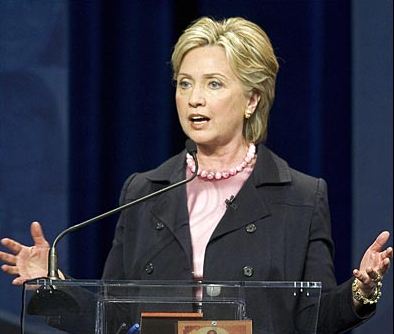 Today, we will take a closer look at the proposals offered by Hillary Clinton, the junior Senator from NY. Overall, her College Aid Plan, which she announced in October 2007, would increase federal student aid spending by $8 billion. She would finance this spending by eliminating the Federal Family Education Loan (FFEL) program and freezing the estate tax at $7 million per couple (instead of allowing it to be repealed).
Her plan would do the following:
Increase Federal Financial Aid Funding and Make it Easier for Students to Apply for Aid
- College Tax Credit: At the heart of her proposal is a plan to more than double the Hope tax credit, raising the maximum amount of benefits that students and their families can receive from $1,650 a year, to $3,500. Students and their parents would be able to claim 100% of the first $1,000 and 50% of the next $5,000. The credit would also become partially refundable, meaning that families who have tax liabilities that are less than the credit is worth can still receive some of it. In addition, the credit would be “advanceable” to allow families to receive the benefit when their tuition bills are due rather than 16 months later, as is currently the case.
- Pell Grants: The plan calls for boosting the maximum Pell Grant, although it doesn’t provide specifics as to how high. Instead, Clinton pledges to “annually adjust” the maximum award to take account of rising college prices.
- Simplification: The Senator’s proposal would eliminate the Free Application for Federal Student Aid (FAFSA), which is so complex, she says, that it “turns students off from applying for financial aid.” Instead, parents and students could simply check a box on their income tax returns. Then the Department of Education would send them a coupon indicating what they can expect in federal grants and loans, and colleges would obtain the funds directly from the Education Department.
- Early Intervention: The proposal would double funding over the next five years for the GEAR UP program, which aims to motivate and prepare low-income middle school and high school students for college.
Overhaul and Improve the Federal and Private Student Loan Programs
- Student Loan Delivery: Clinton’s proposal would eliminate the FFEL program and provide federal loans entirely through the Direct Student Loan Program.
- Protecting Students from Unfair Deceptive Practices: The plan, which was included in her May 2006 legislation entitled the Student Borrower’s Bill of Rights, would require lenders to provide more detailed information about their private loan offerings and forbid them from charging “unreasonable and exploitative” interest rates on these loans.
- Providing Relief to Borrowers with Unmanageable Levels of Debt: Under Clinton’s proposal, also included in Clinton’s 2006 legislation, financially distressed borrowers would have the option of being able to discharge their federal and private loans in bankruptcy seven years after those loans come due. Currently, student loan borrowers mostly can’t discharge their debt in bankruptcy.
Demand Greater Accountability from Colleges and Provide Incentives to Improve Perfomance and Make More Affordable
- Truth in Tuition: The Senator’s plan would require all colleges that participate in the federal student aid programs to have a Truth in Tuition plan, telling students how much they will pay in tuition over the course of their college careers.
- College Graduation and Employment Rate Index: Under the proposal, the Department of Education would be required to create an accountability index for all colleges that would measure their students success in graduating and getting jobs or pursuing graduate studies.
- Graduation Fund: Clinton’s plan would provide $250 million in grants to four year colleges to finance efforts to improve their graduate rates, particularly among low-income and minority students.
- Strengthening Community Colleges: The proposal includes $500 million in incentive grants to encourage two-year colleges to boost the rates at which they graduate students and transfer them to four-year colleges.
- Higher Education Cost Calculator: The proposal would require colleges to submit information to the Department of Education “about a typical range of low to high income students” in their freshman and sophomore years, and the financial aid awards they have received. The Department would then use this information to develop a cost calculator that would enable students to estimate the amount of aid they are likely to receive.
UPDATE — Clinton has also offered proposals that would:
- Provide Incentives to Colleges for Recruiting and Retaining Low-Income Students: In January, Clinton announced a plan to reward colleges that serve large proportions of low-income students. Under her proposal, colleges that enroll more than 1,000 students who are eligible for Pell Grants, or at which Pell-eligible students make up more than 25 percent of the student body, would receive $500 for each additional low-income student that they enroll. Half of the money would be given to the school when that student enrolls to encourage the institution to recruit more financially-needy students. The other half would be disbursed when that student graduates, in order to encourage the college to invest in retention efforts. To benefit from this program, schools would be required to share data on the performance of their students, including six-year graduation rates by Pell Grant recipient status, so that policymakers and colleges can assess what types of retention practices work best.
- Boost Spending on Historically Black Colleges and Minority-Serving Institutions: Clinton pledges that during her first term, she would increase Title III funding for historically black colleges by $50 million a year, bringing the Strengthening Historically Black Colleges and Universities’ budget up to $438 million by 2012. Hispanic-serving colleges would receive a similar boost in funding, bringing federal support for these colleges up to $300 million by the time her first term ends.
- Increase Funding for AmeriCorps Scholarships: Clinton’s plan also would more than double the size of scholarships students receive for partipating in AmeriCorps, the national service program, from $4,725 to $10,000.
More About the Authors
Issues
Programs/Projects/Initiatives
Related

Like Baylor, the University of Alabama Steered Many Low-Income Families to Parent PLUS Loans

State Legislatures Weighing in on Workforce Pell
A Trump Official’s Thin Legal Case Against Accreditors’ DEI Policies