Table of Contents
The Common Thread: Where Lived and Technical Experiences Meet
In Philadelphia, new thinking about civic engagement, trust, and participation has taken the form of a massive investment of philanthropic and public resources into the city’s neglected public spaces and civic infrastructure, including rec centers and parks. Can these investments, if designed to draw in residents and engage them in local decisions, help rebuild the bonds of community and democratic trust? This is a question relevant to cities and towns all across the country. Philadelphia’s experience may provide some answers.
All of the case studies in this paper share one common thread: they look at addressing low levels of civic engagement through recognizing citizens as advocates for their neighborhoods. They recognize that doing so requires investing in civic structures, listening to new voices, and taking chances on new ideas. By combining lived experience with technical knowledge and building with citizens rather than for them, the solutions that focus on social capital investments—be that via investments in physical capital or human-centered design methods—go beyond the voting booth and carry potential for sustainability and scalability. While all the case studies in this paper were of projects currently underway in a specific setting (Philadelphia), we believe that the “expertise meets experience” model can be applied across the board.
By combining lived experience with technical knowledge and building with citizens rather than for them, the solutions that focus on social capital investments… go beyond the voting booth and carry potential for sustainability and scalability.
This paper explores two investments in the Knight Foundation’s civic engagement portfolio in Philadelphia. The first of these is the civic engagement process led by the Fairmount Park Conservancy, as part of Rebuilding Community Infrastructure (Rebuild)—an initiative led by Mayor Jim Kenney that will invest hundreds of millions of dollars to improve neighborhood parks, libraries, and recreation centers.1 The second one is the PHL (Philadelphia) Participatory Design Lab, a 2017 “Knight Cities Challenge” winner, which combines behavioral economics and human-centered service design to inform policymaking enhance the public’s trust in government.
Part of the methodology used for this paper included the assessment of frameworks (see the appendix for full list) about how, why, and when people engage. These frameworks served as guidelines for determining what works and what does not when it comes to new models of civic engagement, and how models can be better tailored to serve residents.
Our theory of change is visualized below: the goals of any practitioner—city official, activist, or organizer—are to simultaneously engage more residents in civic spaces in their neighborhoods and also improve city programs and services based on residents' needs.
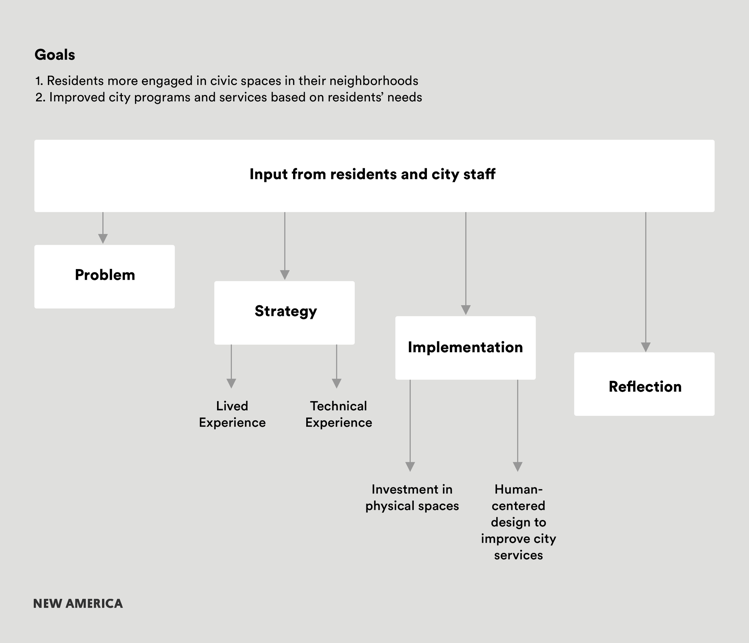
Each case study below has its its own set of particular circumstances that have led to successes and potential obstacles. A common thread lies in the way multiple stakeholders (foundations, city officials, and community members) are coming together and looking for bold, innovative ways to harness lived and technical experience in ways that could be replicated beyond Philadelphia.
Innovative city government and civic engagement must include a municipal framework of multi-party, vertical, and horizontal partnerships that empower different stakeholders, residents, and experts. Philadelphia provides multiple examples of overlapping partners, as well as showcasing the variety of ways in which city employees, policy experts, nonprofits, and researchers can work together to address local problems. These examples speak to the different ways that cities and residents can rethink both their partnership and empowerment potential, and the outcomes that they can produce as a result.
Instead of residents only having incentives to participate in response to a problem, local governments and engagement structures can promote proactive and positive engagement. This requires city officials to recognize residents as experts on their own neighborhoods, and it also means that residents need access to trainings on organizing, community engagement, financial compliance, leadership and conflict resolution, and the municipal structure.
What follows are two case studies. The first explores the relationship between physical spaces and civic life using Rebuild’s experience with the Philadelphia Parks & Recreation system (in partnership with the Fairmount Park Conservancy), which brings together city staff, nonprofits, and multiple levels of resident involvement to maintain sites across the city. The second studies how Philadelphia has incorporated human-centered approaches both in its policy design and in its outreach models to improve interactions between residents and the city, through the work of Design Lab.
To better understand the different stakeholders and organizations involved in these case studies and projects, please refer to this table:
| Organization Name | Classification | Unique Focus | Jurisdiction | Role in Rebuild |
|---|---|---|---|---|
| Philadelphia Parks and Rec Department (PPR) | City | Managing facilities and resources “democratically, equitably, and sustainably,” as well as providing programming, and community-building{{8}} | All public parks and recreation sites in Philadelphia | Partner in site projects |
| Free Library of Philadelphia | City | Advance literacy, guide learning, and inspire curiosity. Its vision is to build an enlightened community devoted to lifelong learning. | All public libraries in Philadelphia | Partner in site projects |
| Rebuild | City program, within the Managing Director’s Office at the City of Philadelphia | Using a mix of public/private capital funding (supported by the “soda tax) to “revitalize community spaces, engage and empower communities, and promote economic opportunities” in neighborhoods with “concentrated poverty, elevated crime rates, and heightened health risks.”{{9}} | Selected project sites, which can be parks, libraries, playgrounds, or recreation centers across Philadelphia. These project sites are selected through a data-informed process in coordination with the administration and City Council. | Guiding program, navigating the political process with City Council, overseeing projects, and communicating with residents. The Rebuild Oversight Board helps manage this process and hosts community meetings. |
| Fairmount Park Conservancy | 501(c)3 nonprofit | Supporting and investing in the Philadelphia parks system through programming, encouraging civic engagement through programs like Friends Groups, and running capital investment and historic preservation projects.{{10}} | Works with the PPR in parks and historic sites, not only in the Fairmount Park (10,200 acres), but also in the city’s neighborhood parks. Unlike the PPA, the Conservancy’s focus is specifically on parks, but it works closely via the Civic Commons with PPA, Free Library, and other public space providers. | Approved project user for some Rebuild project sites. |
| Philadelphia Parks Alliance (PPA){{11}} | 501(c)3 nonprofit and advocacy group | Provides programming in public spaces, leads community outreach and collects feedback for public sites, advocates for policies that would benefit the parks and rec system and against those that would not, and educates the public on such policies. PPA also partners with and supports advisory councils. | Unlike the Conservancy, the PPA’s focus extends past parks to include rec centers, but it works closely via the Civic Commons with the Conservancy, Free Library, and other public space providers. | Original organizing group supporting the soda tax, part of the Conservancy’s project user team on some sites, and guidance for advisory councils who work with rec centers selected for Rebuild |
| Park Friends Groups | Resident volunteer groups | Fundraising, organizing programs, light maintenance, and reflecting community priorities in their local neighborhood park | Individual neighborhood parks | Part of community engagement for selected sites |
| Advisory Councils | Resident volunteer groups | Fundraising, organizing programs, light maintenance, and reflecting community priorities in their local neighborhood recreation center | Individual neighborhood rec centers | Part of community engagement for selected sites |
| Library Friends Groups | Resident volunteer groups | Fundraising, organizing programs, light maintenance, and reflecting community priorities in their local neighborhood library | Individual neighborhood public libraries | Part of community engagement for selected sites |
| Parks and Recreation Advisory Council (PRAC) | Advisory board for resident volunteer groups | Communicate and act as a liaison between advisory councils, residents, the PPA, and the City to share ideas, concerns, and recommendations from both sides.{{12}} | Recreation centers across the City | Advocacy/support for beverage tax |
| The Commission on Parks and Recreation (PaRC) | Advisory board for Parks and Rec | Working with the community as a public-facing board to “preserve and improve” the City’s “historical, cultural, environmental, and recreational resources and programs”{{13}} | Parks and Rec Centers across the City | Has a designated Rebuild Committee. |
Citations
- All information about Rebuild and the initiative’s progress is as of October 12, 2018. The project is an ongoing endeavor.