Table of Contents
Case Study 1: Physical Spaces as Civic Spaces
A Knight-supported Assembly Civic Engagement Study, which came out in 2017, assessed “the ways in which neighborhood design is connected to civic attitudes and behavior.”1In looking at the connection between individuals’ feelings of efficacy and belonging when in public spaces, the study addressed four areas that test the relationship between civic space and engagement.
- Civic trust and appreciation: Do individuals feel they are a part of a collective identity? Do they appreciate the value of public spaces and feel invited to participate? Do individuals recognize local government and other responsible parties that provide and maintain collective civic assets?
- Participation in public life: Do public spaces provide the opportunity for contact and socialization with neighborhoods and strangers which facilitates equitable access and positive interactions among diverse groups?
- Stewardship of the public realm: Do individuals feel responsible for public spaces and express that in a practical way, by advocating for improvements and additional funding and by participating in maintenance, programming, and beautification?
- Informed local voting: Do those who are eligible to vote feel informed about their choices, are registered, and cast a ballot in local elections? Do individuals express their civic engagement in local politics by contacting officials, signaling support for issues, or exhibiting knowledge about the role of local government?
One of the important aspects of civic and communal life, especially in dense cities, is the role of social relationships or “social capital.” University of Chicago sociologist James S. Coleman—one of the earliest thinkers about the role of social capital in promoting healthy societies—argued that “unlike other forms of capital, social capital inheres in the structure of relations between actors and among actors. It is not lodged either in the actors themselves or in physical implements of production.” Coleman added that “social capital…comes about through changes in the relations among persons that facilitate action,” and “just as physical capital and human capital facilitate productive activity, social capital does as well.”2
One aspect of social capital is that people establish relationships with intent and then continue to develop these relationships, which provide benefits. But beyond relationships, structures are also key in fostering and sustaining social capital. Those include, for example, the family, the school, the church, and social organizations that give the individuals who participate in them meaning and purpose. This is an aspect of social capital which is inextricably linked to public spaces and public goods.
Edward L. Glaeser, David Laibson, and Bruce Sacerdote, in writing about economic approaches to social capital, have argued that “while we have theory and evidence on the effects of social capital, we are just beginning to identify the underlying mechanisms that create social capital in the first place.”3 Because of that, further data, research, and analysis are especially important as social capital is declining—a phenomenon pointed out by many observers of American society, such as Harvard professor Robert Putnam’s Bowling Alone.4 Rebuild is a good opportunity to begin to study and understand the interplay between physical spaces and social capital.
Rebuild was conceived of three years ago. David Gould, deputy director for Community Engagement and Communications, says that the question that inspired the project was, “if we could borrow money to invest into the system, what would it look like and how would we go about it?” Rebuild’s goal was to determine where those investments would be made, who they would serve, and what goals they would seek to accomplish, by prioritizing high-need neighborhoods to promote equity. The project has also sought to select sites where investment could help to stabilize or revitalize a community.5 The William Penn Foundation—a Philadelphia-based foundation—pledged $100 million to neighborhoods for Rebuild.6 The Knight Foundation is supporting Rebuild’s public-private partnership model through investments throughout the city.
"Just as physical capital and human capital facilitate productive activity, social capital does as well.”
Rebuild’s goals are hefty. Over the next few years, its three-pronged approach will seek to 1) Revitalize parks, recreation centers, playgrounds, and libraries; 2) Empower and engage with communities; and 3) Promote Economic Opportunity for all Philadelphians. Goals 1 and 2 were the main focus of our study when looking at the work that the Fairmount Conservancy is seeking to do.7
The project’s funding model—a seven-year, $500 million investment—involves city government capital funds ($48 million); state, federal, and philanthropic grants ($152 million); and Rebuild bonds. These bonds were issued by the Philadelphia Authority for Industrial Development and will be funded through revenue from the Philadelphia Beverage Tax, which taxes sweetened drinks at 1.5 cents per ounce. The “Philly Bev Tax” or “soda tax,” as it has become known, was approved in 2016. The soda tax was challenged by a lawsuit from the American Beverage Association, but in July 2018, the Pennsylvania Supreme Court ruled in favor of the soda tax, which helps secure the funding for Rebuild and its future projects.8 The plan is for the bonds to be issued in three tranches of $100 million. Philadelphia is the first major U.S. city to pass a soda tax. 9
The project was informed by neighborhoods that displayed high need (using indicators such as poverty, drug crimes, health indexes) and that could benefit from stabilization and revitalization (through market value analysis, household growth, and residential building permits).10 Having all of that data available to the public promoted transparency and helped decision-makers avoid any questions about which sites were chosen for investment.
Deciding which sites will get Rebuild investments has been a challenge, however, since even a $500 million investment will not be enough to meet the needs of Philadelphia’s entire parks and rec system. Thus, it becomes a matter of priorities. So far, the city council has approved 64 sites. Vare and Olney Recreation Centers are expected to be the first to start work, as well as Parkside Fields, Glavin Playground, and Heitzman Recreation Center.11 The first step will be processing and approving project user applications, and then holding community engagement meetings in the winter. Smaller projects, like fixing broken sidewalks, should begin sooner.
Elena Souris
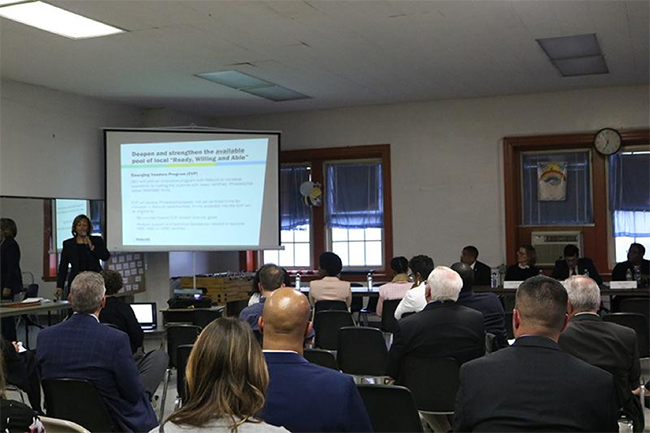
Once sites are chosen, Rebuild’s civic engagement process gives residents the opportunity to “provide input and a seat at the table,” Gould told us. Rebuild will also look for ways to invest in the people that make the parks, rec centers, and libraries the valuable resource that they are despite their condition. That will mean implementing capacity-building programs for city staff (including librarians and rec leaders), and investing in community members who have dedicated time and energy to those spaces.
With their compatible institutional structures and organization, governments and nonprofits are natural partners that can come together to help build up a consistent structure for citywide progress. Because they can play different roles and operate within separate spheres, public-private partnerships can complement and supplement one another.
For Rebuild’s Deputy Director for Community Engagement and Communications, David Gould, that includes making “sure that improvements are reflective of the community’s priorities and needs.” In practice, that involves using the physical improvements process as a gateway to civic engagement and the beginning of civic trust. The communities Rebuild was designed for, Gould told us, are “marginalized and under-resourced communities that are distrustful of government, and have had bad experiences with government.” Rebuild gives people an opportunity to have a positive experience with government, which could potentially leave them more inclined to participate in their communities in the future. Rebuild’s civic engagement component aims to be customized to the communities that the spaces will serve. The process of engagement, Gould believes, is as important as the physical space renovations themselves.
Through participating in discussions focused on “what kinds of improvements their parks and rec centers need,” Gould told us, Philadelphia residents have an opportunity to have a real hand in improving those spaces. This, in turn, can heighten their feelings of personal efficacy. But engagement incentives need to be structured in a sustainable way that extend beyond moments of crisis or political challenges.
Rebuild has its limitations when it comes to engagement. Meetings are announced via email and social media and are held in the evenings during the week, normally around 6 p.m. While meetings are moved around to different rec centers throughout the city so as not to prioritize one neighborhood over another, this approach can make it difficult for some residents to participate consistently, if at all.
Ambitious projects like Rebuild can have a tangible impact on changing the civic engagement landscape of American cities. But with big goals come the challenge of implementation. Over the next few years, Rebuild’s three-pronged approach will continue to face the capacity and authority challenges that it is facing now. Philadelphia Business Journal/WHYY reporter Malcolm Burnley pointed to how Mayor Kenney’s words, when he announced the first rec center that would be receiving Rebuild funding, “reflected the strain of a budget season riddled with conflict over Rebuild’s union diversity goals, his proposed property tax increase and spiking home assessments that will further hike tax bills in many parts of the city.”12
Because of its size, slower-than-predicted execution, and large number of actors involved, Rebuild has moved at a slower pace than initially planned, frustrating some of the residents it aims to include. Part of the challenge has been getting city council to approve the sites proposed in a timely manner. Another issue has been ensuring a revenue stream that will fund all of these investments, as the soda tax was delayed for months by legal challenges.
Ambitious projects like Rebuild can have a tangible impact on changing the civic engagement landscape of American cities.
The Role of Civic Intermediaries: The Fairmount Park Conservancy
In late 2017, the Knight Foundation awarded $3.28 million in new funding to the Fairmount Park Conservancy to support a citywide civic engagement strategy that will allow residents to shape activities in Philadelphia’s public spaces. One part of the Conservancy’s work is to implement some citywide engagement processes in advance of Rebuild, to ensure that investments tied to Rebuild are reflective of residents’ needs.
In implementing Rebuild, civic intermediaries and existing environment infrastructure play a critical support role in the civic engagement strategy, programming for residents, and public space resources. The Conservancy is one of these intermediaries, a nonprofit that supports Philadelphia’s city-owned and operated parks, playgrounds, and programs. According to its mission statement, the Conservancy works in a collaborative fashion to assist a variety of organizations and to “lead capital projects and historic preservation efforts, foster neighborhood park stewardship, attract and leverage investments, and develop innovative programs throughout the 10,200 acres that include Fairmount Park and more than 200 neighborhood parks around the city.”13
The Knight grant helps the Conservancy support a network of public and nonprofit partners—including Philadelphia Parks & Recreation, Philadelphia Parks Alliance, and Free Library of Philadelphia—so it is better equipped to play its part in Rebuild. These groups help Rebuild foster community participation around public spaces, mobilizing residents as co-creators in shaping their neighborhoods.14 The Conservancy and its partners’ initial work included a scan of the current environment of volunteer groups across the city, in order to determine which parks have established groups, which do not, and the current capacities of those groups. These groups represent over 200 volunteer organizations integral to engagement and programming in public spaces—whether parks, rec centers, or libraries—that the Rebuild initiative will invest in.
In addition to acting as gatekeepers of engagement for residents in these public spaces, these volunteer groups also have long-term stewardship over public assets, a role that will be important before, during, and after Rebuild implementation. As a result, the Conservancy’s work has involved conversations with these groups to identify their current capacity and to learn about community needs. As Jamie Gauthier, the Conservancy’s executive director, told us, “the goal is to make them stronger, have better governance structures, financial controls, learn to fundraise, and to develop programming. Our work will seek to help them make the best possible use of the public spaces that Rebuild is about to invest in.” To further these efforts, the Conservancy also offers some small grants to these grassroots organizations, as well as learning opportunities, workshops, and trips. Future opportunities may include small pilot interventions or pop-ups to give community groups ideas for permanent improvements.
Within the Rebuild process, the Conservancy has been designated a “project user.” As a project user, the Conservancy is one of 21 neighborhood-based and city-wide organizations that are approved to work on Rebuild projects and can bid on individual sites. Project users will manage site contracts and progress on construction and diversity goals.15 At the same time, project users will work with other community groups to foster civic engagement around each library, park, or rec center. This includes supporting community outreach, interaction, and engagement to guide and inform the capital project development. While the Conservancy will be limited to the specific sites it is approved for in the Rebuild context, its community engagement work includes city-wide efforts to continue investing in the greater volunteer group network, which is something the organization has done for the past six years.
It is important to “make stewardship fun and engaging, not only by connecting stewards with resources and a larger network but by celebrating and recognizing them,” Jennifer Mahar, senior director of civic initiatives at the Conservancy, told us. “These groups,” she said, “represent the diversity of the City” and therefore efforts to strengthen them must “build authentic, two-way relationships with these individuals and their communities.”
The work that the Conservancy does as a civic intermediary is crucial to the overall civic engagement ecosystem in Philadelphia. The Conservancy bridges the public and government in ways that help them work together and takes on a role that residents may be unequipped for or the government legally may not. According to sociologist Xavier de Souza Briggs, civic intermediaries can bring together multi-stakeholder actors and “compensate for a lack of civic capacity because of what government, business, or civil society organizations are not able, or not trusted to do, and also—along a more temporal dimension—for process breakdowns, such as impasse, polarization, and avoidance, that thwart collective problem solving.”16 In this way, intermediaries like the Conservancy can work as complementary partners for the City and other nonprofits to support their work in the long and short terms, offer funds, and facilitate active and inclusive participation.
Bringing the City and Residents Together Around Parks & Rec
Elena Souris
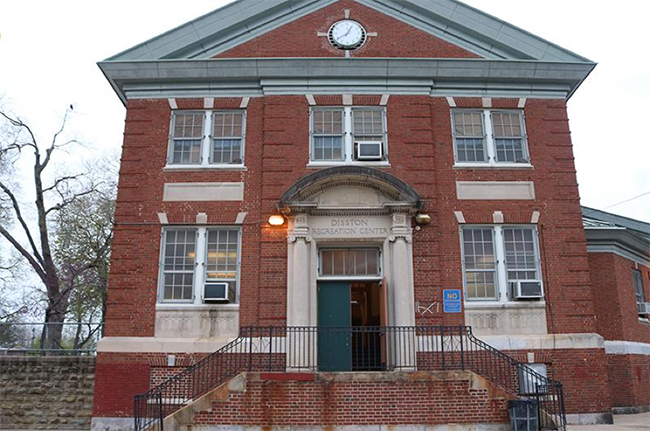
Philadelphia is a city built around its parks, starting with William Penn’s original 1682 city design that featured five parks as main elements of a grid system.17 While the Parks and Recreation departments were originally separate, the two merged in 2008. The now joint Philadelphia Parks & Recreation (PPR) department oversees 9 historic and cultural sites, 157 recreation centers, 157 parks, and 74 swimming pools.18
The Philadelphia Parks & Rec system features many different stakeholders: the Philadelphia Parks Alliance (PPA), the Fairmount Park Conservancy, the Commission on Parks & Recreation, and the Philadelphia Recreation Advisory Council (PRAC). PPR manages the entire system and its municipal budget, which is set by the mayor and approved by the city council.
Two generations ago, the City of Philadelphia estimated that it was seeing the beginning of a population increase that would peak in the 1970s, level out in the 1980s, and hold steady until 2000. The City made infrastructure investments, including in the parks and rec system, to anticipate this projection. Those numbers never came. Instead of growing, the City’s population decreased between 1960 and 2000, as more people moved into the suburbs. As the population decreased, so did tax revenue, so the City had new municipal infrastructure without the expected funds to maintain it properly.
Courtesy of the Philadelphia Parks and Recreation Department
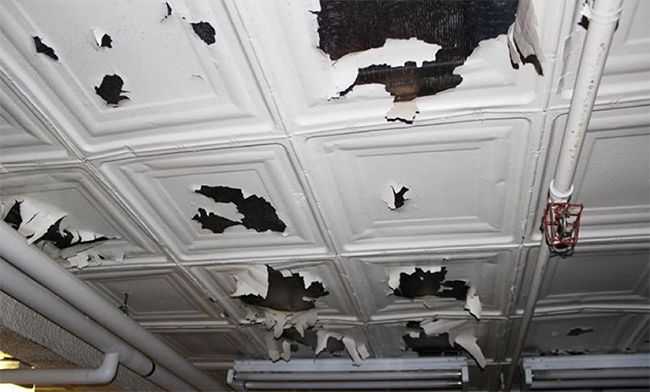
Even though the population started increasing again between 2006–2014, that growth came at a much lower rate than the city originally expected, never reaching the estimated peak. PPR Chief of Staff Tiffany Thurman explains that over the same period, the operating season has also increased; because the weather is warmer for longer than previously, the parks must be operable and maintained for more time out of the year than before. The parks and rec system is now facing more demand, without the matching tax revenue that the City assumed would accompany it. As a result, PPR has had neither the operational budget to hire necessary maintenance staff nor the capital budget to fix infrastructure. Today, these sites are often dilapidated after decades of what Thurman calls “deferred maintenance.”
Courtesy of the Philadelphia Parks and Recreation Department
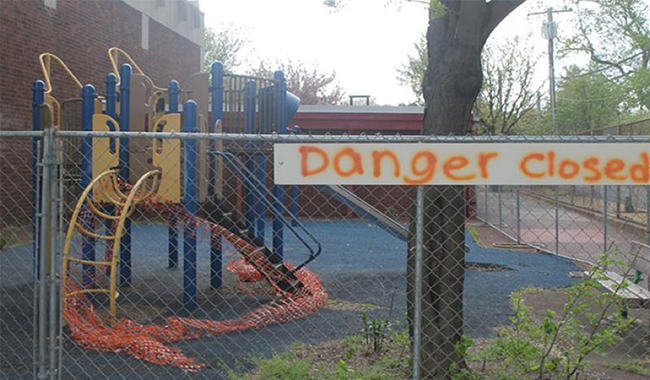
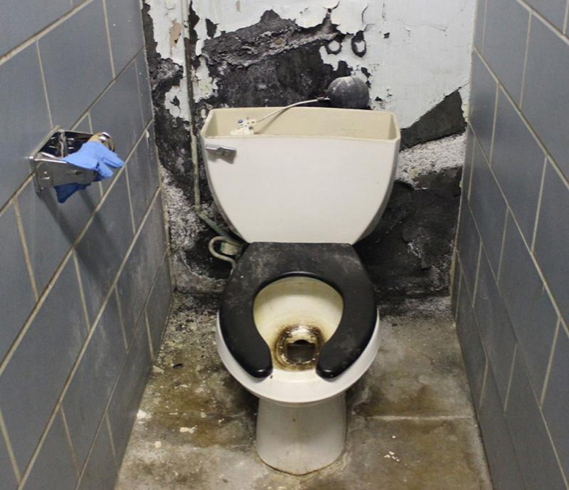
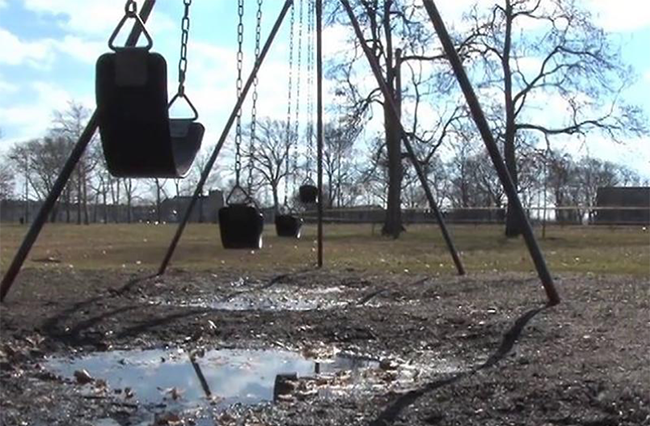
This “deferred maintenance” has impacted these public spaces in various ways. Some parks have broken sidewalks that affect walkability. When playgrounds or safety matting fall into disrepair and out of compliance, the City must take the chains off the swings and hang up “DANGER” signs. Some rec centers have leaking roofs, broken boilers, or lack air conditioning systems. As is often the case in city government, PPR must prioritize and make difficult decisions. While Thurman explains that there are resources to provide items like tables and chairs to the rec centers, big issues sometimes do not get fixed because there simply is not enough money.
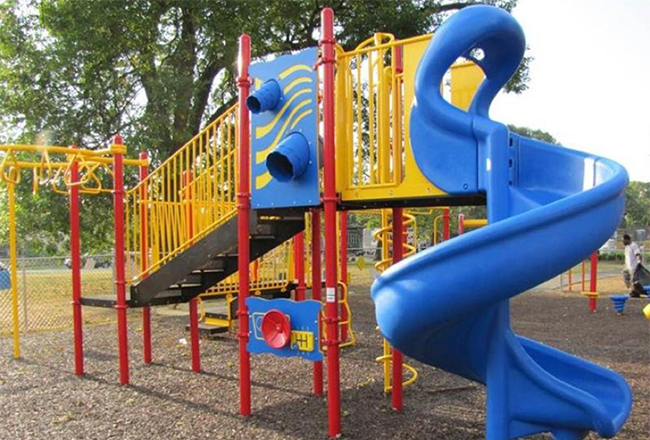
To understand why an investment as large as Rebuild is necessary, it’s important to convey the scope of the problem. These are photos of a limited sample of damaged parks, rec centers, and playgrounds to show the need in some neighborhoods, as well as before and after pictures to showcase the transformational power that such investments can bring to a community. The Philadelphia Parks and Recreation Department kindly granted their permission for us to use these photos in this paper.
Courtesy of the Philadelphia Parks and Recreation Department
However, this is not to say that all public sites in Philadelphia are at this level of disrepair; these photos only show two sites, Cecil B. Moore and Vare recreation centers. Each community has their own unique needs, and our scope of research didn’t include visiting each site or each of the 64 Rebuild sites.
When the city has the capacity, however, they can turn rundown sites into beautiful and welcoming community spaces.
Courtesy of the Philadelphia Parks and Recreation Department
Courtesy of the Philadelphia Parks and Recreation Department
Resident Volunteer Groups: The Pros and Cons of the Model
The Rebuild program will help address the biggest challenges and act as an emergency fund transfusion for the deferred maintenance problems. But on a normal, day-to-day basis, local resident volunteers play a crucial role in helping the sites function by working on smaller projects, light maintenance, and programming. Bringing in volunteer community members as neighborhood activists and experts through advisory councils (ACs) and friends groups (FGs) is one way that Philadelphia is addressing the structural budget challenges and capacity problems outlined above.
At recreation centers, ACs partner with the Philadelphia Parks Alliance; Philadelphia Parks & Recreation; and Philadelphia Recreation Advisory Council to raise money for resources, give input on programming, perform light cleaning and maintenance, organize special events, and promote the center within the neighborhood.19
Recently, PPR created a liaison position for a city employee—the civic engagement manager—to work with ACs and rec leaders and facilitate that relationship. Previously, this responsibility bounced around between different officials without having full-time support. The civic engagement manager’s role in overseeing over 90 advisory councils is to help make both the residents and the rec centers better and stronger in the future, though that is a long-term goal that could take several years.
The Rebuild program will help address the biggest challenges and act as an emergency fund transfusion for deferred maintenance problems… but local resident volunteers play a crucial role in helping the sites function by working on smaller projects, light maintenance, and programming.
Part of the PPR’s new attention on ACs has involved looking for ways to strengthen civic infrastructure through Rebuild. To do so, PPR Chief of Staff Tiffany Thurman says that the department is making sure they are investing in the neighborhood, not just the facility; establishing programming that fits community needs; and “being intentional about the relationship between rec leaders and the neighborhoods they serve.” As PPA Executive Director George Matysik explains, the vision is to think outside of standard rec programming like basketball, and to adapt, grow, and stay relevant in the community over time.
For the parks system, FGs work closely with the city, the Conservancy, and their own neighbors. These groups oversee fundraising for investment projects, manage and offer programming, and regularly take care of small maintenance issues, like weeding or trash pick-up.20
The FG program volunteer group format allows for a range of personalization for different neighborhoods. Eileen Gargano, resident of the Friends of Dickinson Square Park, plans movie nights, children’s workshops for Mother’s Day and Father’s Day, and workdays where volunteers pull weeds and do light maintenance. John “Stash” DiSciascio, executive director of the Friends of Sedgley Woods, a disc golf course in Fairmount Park, organizes a Family and Friends Day; social gatherings for members; and tournaments to raise money for their disc golf course, other friends groups, and various charities. Gargano says that she feels that the city recognizes these groups’ position as dedicated volunteers and local experts, and Antonio Hunter, PRAC VP says that the relationship feels like a respected give and take. Hunter told us that he and the PRAC board can collaborate with the city to solve problems, but that there is still responsibility and autonomy given to the groups. For DiSciascio, this model works well because “the best caretakers are the stakeholders.”
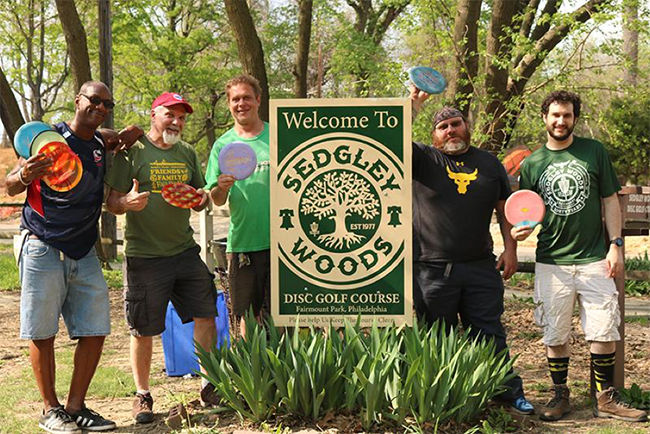
Elena Souris
Including residents in governing through models like the volunteer group is effective, but this model still has its challenges. We heard three themes in our research and interviews in our small sample of volunteers and senior officials in the City, Conservancy, and PPA. They may reflect broader structural limitations and lend insight for other localities looking to build a community-based civic infrastructure to support public spaces. These include complicated internal and external relationships, unrealistic pressure on volunteers, and potentially exclusive engagement.
First, there can be ambiguity in maintaining clear relationships, boundaries, and divisions of responsibility between groups. For example, the division of tasks between ACs and rec leaders became somewhat complicated for the period that PRAC was not as actively managed and those roles were not clearly defined. Because there is a natural overlap between those two positions, the formal system has built in a range of checks and balances. The ACs manage the funds for the rec center. But, while two AC members must sign off on any checks, the rec leader physically holds those checks and keeps them at the center. The rec leader also provides and reports on monthly financial statements. However, because both the rec leader and AC members share power and responsibility in the rec centers, there is the potential for personality clashes or misunderstandings based on viewing the arrangement as a hierarchy rather than a collaboration.
In well-established groups and councils, especially, there may also be a disconnect between volunteers who have been part of the group for a decade or more and residents who reflect recent neighborhood demographic changes. One of the biggest challenges for FGs and ACs is getting to a consensus and mediating between contrasting neighborhood priorities.
Second, while a friends system gives residents active management roles and provides civic opportunities, it also puts pressure on them to deliver results. As tends to be the case with any kind of sustained civic engagement, only a certain subset of the population tends to participate. Actively participating in FGs and ACs at a sustained, consistent level—not to mention running them—can favor those who have the extra time, expertise, financial connections, and political and municipal familiarity. Gargano, Hunter, and DiSciascio noted that their positions all started with getting involved with the community on a smaller scale first; in other words, they were self-selected as engaged volunteers, rather than a product of recruitment or outreach. DiSciascio said that his duties as executive director of the Sedgley Woods friends group usually take around 5–10 hours a week. Gargano said that the amount of time her role as president of Dickinson Square friends group takes will vary by season but can range from 5 hours to 40. As a retiree, this time demand is feasible for her, but she sometimes wants a break, too, joking that she occasionally “prays for snow.”
In times of constrained budgets, the model of devolving roles and responsibilities to volunteers demonstrates both the opportunity provided to residents as well as the consequences of responsibility. For example, while the city hires maintenance staff, they are seasonal employees with limited hours. For parks, many FGs are expected to fill this gap themselves with weekly or monthly clean-up days. At rec centers, this can mean that ACs have to coordinate and fund buying new program materials.
The engagement opportunities provided to residents also assume that FGs and ACs will provide a level of maintenance and quality oversight that’s unrealistic to expect for volunteers’ time and other commitments. Perhaps this contributes to the original problem of minimal maintenance compounding into absent or overwhelmed maintenance, building into disrepair. After time, these sites then require major investments like Rebuild. This also means that after such investments, volunteers are responsible for maintaining the improved sites, even if they may not have the capacity to adequately manage the buildings as they currently stand.
As one example, the model of fee-based classes as a method of generating revenue for the rec center does not work for every AC. While some ACs are in neighborhoods where residents can pay for aftercare programming or summer camps, others cannot. One impact of the restricted parks and rec budget is that small capital investments or maintenance are sometimes funded by the friends groups, in addition to other agency sources. Most FGs and ACs have treasury positions for this purpose. This requires understanding the necessary legal, and at times complex, bureaucratic logistics and requirements for fundraising.
Third, there can be limits on inclusion within the volunteer groups. Within neighborhoods that have changed over time, this model can reflect and amplify only a subset of the community’s concerns and interests. That is because the financial capabilities of volunteer groups can also vary based on factors like the socioeconomics of a neighborhood or a group’s skill in fundraising and available time to take advantage of the city’s trainings.
While the system is trying to ensure inclusive, equitable civic engagement, these skill sets can be barriers to entry. One obstacle stemmed from the legal challenges to the soda tax, which, though now resolved, led to delays. Given the nuances surrounding the process itself, and the legal formalities surrounding financial compliance, volunteers can find it challenging to navigate both city government bureaucracy and nonprofit management.
One impact of the restricted parks and rec budget is that small capital investments or maintenance are sometimes funded by the friends groups, in addition to other agency sources.
The PPR is working towards more balanced support for the volunteer groups. While Philadelphia’s goal is to have a volunteer group for each park and rec center, Thurman says city hall is aware that pushing for group development too quickly can create a system that does not reflect the community well, or one that will quickly die out. To ensure inclusion, PPR provides trainings for groups that cover a range of topics, from financial regulations to leadership and conflict management. The Conservancy is groups’ go-to for finding extra support and help applying for grants.
Especially in view of the Rebuild process and the new infrastructure it will bring, both the Conservancy and PPA are working to build up the volunteer groups’ long-term capacity. The Conservancy is helping with scans of the individual groups, acting as a resource, and helping guide thinking around civic engagement. PPA is starting neighborhood outreach around rec centers that do not have established ACs to help bring in new volunteers and start new discussions around what the community wants. While Rebuild marks a concrete, financial investment in infrastructure, the PPR, Conservancy, and PPA are doing parallel work to simultaneously invest in the volunteer infrastructure that will be just as crucial.
The system has potential. Currently, though, it runs a risk of being viewed as transactional in what it expects from resident volunteers, and potentially too dependent on their help.
"Libraries are more than just books, and rec centers are more than just basketballs."
Making Civic Engagement About Community Engagement
In 1960, political scientist E. E. Schattschneider famously observed that “the flaw in the pluralist heaven is that the heavenly chorus sings with an upper-class accent.”21 Inclusive models of civic engagement take into account who does or does not participate, how they do or do not engage, and the type of engagement. In America, economic inequalities tend to mirror political inequalities, so those who with higher levels of education, more time and resources, and greater feelings of efficacy may be more likely to participate.
One way to think about who participates is to think about how individuals identify in their communities. Do people think of themselves as those who always are engaged (usual suspects); as those for whom civic life is a small component of life (active participants); or as those who have previously not been civically engaged (new participants)?22
Types of Participants
- Usual suspects: These are people already engaged in civic life through established outlets such as community boards, block associations, or tenant associations. Their engagement is often the means by which they self-identify within their community.
- Active participants: These are people who are somewhat engaged in civic life, but they are open to more outlets for engagement if they are presented. Their engagement is not a defining feature of their identities within the community.
- New participants: These people were not previously engaged. Participation is a marked new step for them. Many are largely unfamiliar with the current civic infrastructure or opportunities to participate in civic life.
Going beyond the usual suspects also entails using language that is equitable and inclusive. For example, the term “citizen,” which is often used in the context of civic engagement, tends to leave out everyone else without that particular identity. Especially when communities are distrustful of government—when there is heightened political tension, for example—language is more important than ever. Civic engagement needs to be viewed as a safe space in which people can work together, meet new people, and improve their communities. FGs and ACs, for example, act as channels for civic participation and government interaction. They allow residents, including those without legal status, to play a role in advocating for their community.
Another example is the Philadelphia Parks Alliance. While the name implies a focus on parks, today the PPA mostly works on Philadelphia’s 150 rec centers in response to their outsized need. For Executive Director George Matysik, PPA’s two main goals are to re-imagine what rec centers can do for their communities and to act as a support network for ACs. As he puts it, “libraries are more than just books, and rec centers are more than just basketballs.” Instead, he wants to see rec centers respond to more general community needs by boosting advisory councils and helping guide programming.
Before starting investment into a recreation center, PPA hosts community dinners to discuss how it can best serve the neighborhood’s needs. Matysik or members of his staff begin outreach by going door to door, starting across the street from the rec center and working outward. When residents open their doors, the PPA team lets them know about the upcoming event, which often leads to a conversation about the rec center, the current challenges it faces, and what the community would like to see. With this model, several organizations, including PPA, the Conservancy, and Philadelphia Free Library, meet the community where it is, rather than expecting all interested parties to be able to come to them. Community members who cannot attend the meeting have a chance to voice their opinions when PPA staff members knock on their door. Matysik mentions often running into kids playing outside and soliciting their input, whether or not they can attend the meeting with an adult later—though he says many of them do.
During the community dinners—where free pizza is provided, and turnout varies from 30–40 to as many as 200 people—Matysik starts by asking what the community needs, rather than what the rec center needs. He has found that by asking the first question, he gets answers like “ESL classes” or “job training programs.” Asking only about what the rec center needs yields answers usually limited to sports equipment, or what people think rec centers are “supposed” to have. From there, the PPA sets up more community meetings and later holds elections for advisory council positions, creating an effective outreach pipeline for community members to build up sustained engagement with their rec center and put their ideas into practice. With or without a Rebuild investment in a rec center site, the general goal is to “have the community inform the built environment, not the other way around,” he says.
In assisting with the building of advisory council capacity, the PPA helps recruit volunteers and strengthen existing councils’ institutional structure. Today, there are approximately 550 AC volunteer members who are, in effect, running mini nonprofit boards for their rec centers. Their tasks involve raising money, overseeing programming, and advocating for their center with the city.
In addition to helping build up the ACs’ structure, the PPA also helps them implement the ideas that came up during the dinners. If community members ask for a specific program, the PPA helps them get started by assisting with grant writing or even providing some seed money. Part of building up AC structure is investing in long-term sustainability, especially because Rebuild is a short-term project. This effort also helps ensure that neighborhood wealth disparities do not also translate into AC disparities.
Citations
- The Assembly Civic Engagement Survey (Center for Active Design, 2018), source.
- James S. Coleman, “Social Capital in the Creation of Human Capital,” American Journal of Sociology, 94 (1988) S95-S120.source
- Edward L. Glaeser, David Laibson and Bruce Sacerdote, “An Economic Approach to Social Capital,” The Economic Journal 112 (November 2002): F437–F458, source.
- Robert Putnam, Bowling Alone: The Collapse and Revival of American Community (New York: Simon & Schuster; 2000).
- Rebuild Philadelphia [Philadelphia: The City of Philadelphia, 2018], source.
- “William Penn Foundation Commits $100 million to Philadelphia Neighborhoods through Rebuild,” William Penn Foundation, November 21, 2016, source.
- “Rebuild Goals,” Rebuild Philadelphia (Philadelphia: The City of Philadelphia, 2018), source.
- The Inquirer Editorial Board, “Court gives Philly — and its kids — some sugar in soda tax victory,” Philadelphia Inquirer, July 19, 2018, source.
- Tricia L. Nadolny, “Soda tax passes; Philadelphia is first big city in nation to enact one,” Philadelphia Inquirer, June 16, 2016, source.
- Shawn D. McCaney, “Rebuilding Community Infrastructure: Philadelphia’s $500 Million Bet on Equity,” The City Club of Cleveland, 2018, source.
- Anna Merriman, “Rebuild moves forward with rec center project following court ruling,” Curbed Philadelphia, Aug. 9, 2018, source. Josh Kruger, “City Council approves first 64 Rebuild sites: Here’s what’s coming!” City of Philadelphia, June 12, 2018, source. List of sites is available here: Rebuild Philadelphia (Philadelphia: The City of Philadelphia, 2018), source.
- Malcolm Burnley, “Mayor Kenney announces first rec 'rebuild' as clash over union diversity heats up,” Philadelphia Business Journal, May 17, 2018, source.
- “Fairmount Park Conservancy leads and supports efforts to improve Philadelphia’s parks,” Fairmount Park Conservancy, 2018, source.
- “Philadelphia’s Fairmount Park Conservancy to advance resident participation in shaping public spaces with $3.28 million from Knight Foundation,” Knight Foundation, November 3, 2017, source.
- Malcolm Burnley, “City selects first 21 nonprofit 'project users' to put the 'build' in Rebuild,” Plan Philly, November 17, 2017, source
- Xavier de Souza Briggs, Democracy as Problem Solving: Civic Capacity in Communities Across the Globe (Cambridge: MIT Press, 2008), 302.
- “William Penn’s Philadelphia Plan,” The Culutural Landscape Foundation, 2018, source.
- “Places to Go,” Philadelphia Parks & Recreation, source.
- “Recreation Advisory Councils,” City of Philadelphia, February 2018, source.
- “Park Friends groups,” City of Philadelphia, June 2018, source.
- E.E. Schattschneider, Semi-Sovereign People (New York: Holt, 1960), 35.
- Schema is adapted from: Hollie Russon Gilman, The Participatory Turn: Participatory Budgeting and Civic Innovation in America (Washington, DC: Brookings Institution Press, 2016).See also: Ariel Schwartz, “The Interested Bystander Effect: Why Even People Who Care about the World Don’t Vote,” Fast Company, April 10, 2015.