
Table of Contents
- Executive Summary
- Introduction
- State Policy Scan Methodology
- Overall Findings
- Detailed Policy Category Findings
- Comparison to 2020 Findings
- Discussion
- Conclusions and Recommendations
- Appendix A: Understanding the High-Quality Micro-Credentialing Process and Ecosystem
- Appendix B: Interviews Conducted by Authors, Chronologically
- Appendix C: Definitions and Examples for Six Educator Policy Areas
- Appendix D: Policy Categorization Methodology Differences from 2020 to 2025
- Appendix E: Summary of State Educator Micro-Credential Policies, by Category
- Appendix F: Additional Insights on Individual State Educator Micro-Credential Policies
Executive Summary
States have been working to address increasing challenges in recruiting and retaining a sufficiently robust, diverse, and talented teacher workforce, particularly in the schools and subjects in which shortages have been long-standing. This report examines how states are attempting to leverage micro-credentials to improve the stability and capability of their elementary and secondary educator workforces and to promote better student outcomes.
This research builds upon the informal 2020 scan of state educator micro-credential policies in New America’s comprehensive Harnessing Micro-Credentials for Teacher Growth: A National Review of Early Best Practices research report1 by highlighting the explicit inclusion of micro-credentials in state educator policies in six areas—preparation, first-time certification, curated professional training, license renewal, additional endorsements, and licensure advancement.
Key findings include:
- Over 60 percent of states (32, including the District of Columbia) now explicitly allow or encourage the use of micro-credentials in at least one type of state educator policy,2 a 23 percent increase from 2020.
- Just under half of these 32 states (14) incorporate educator micro-credentials in more than one of the six policy areas examined. Arkansas and Utah integrate educator micro-credentials in the greatest number of policy areas, with four each.
- As was the case in 2020, states are concentrating their micro-credential efforts on the average current teacher, rather than on preparing and credentialing new teachers or vetting the most expert educators for advancement opportunities.
- The policy areas with the greatest inclusion of educator micro-credentials are satisfying license renewal requirements (15 states) and providing professional learning on curated topics (13 states).
- Ten states are using micro-credentials in policies governing the earning of additional license endorsements, typically in chronic teacher shortage areas.
- The policy area with the greatest percentage increase relative to 2020 was initial and first-time professional certification (10 states, up from zero). Most of these policies are for individuals teaching on a temporary certificate who must meet additional requirements to make the mandatory shift to a professional credential.
- The number of states allowing educators to use micro-credentials to meet licensure advancement requirements showed little change (six states, up from five in 2020), likely because few states offer advanced licenses and endorsement options in general.
- Utah is the first and only state to incorporate micro-credentials in educator preparation program approval policies.
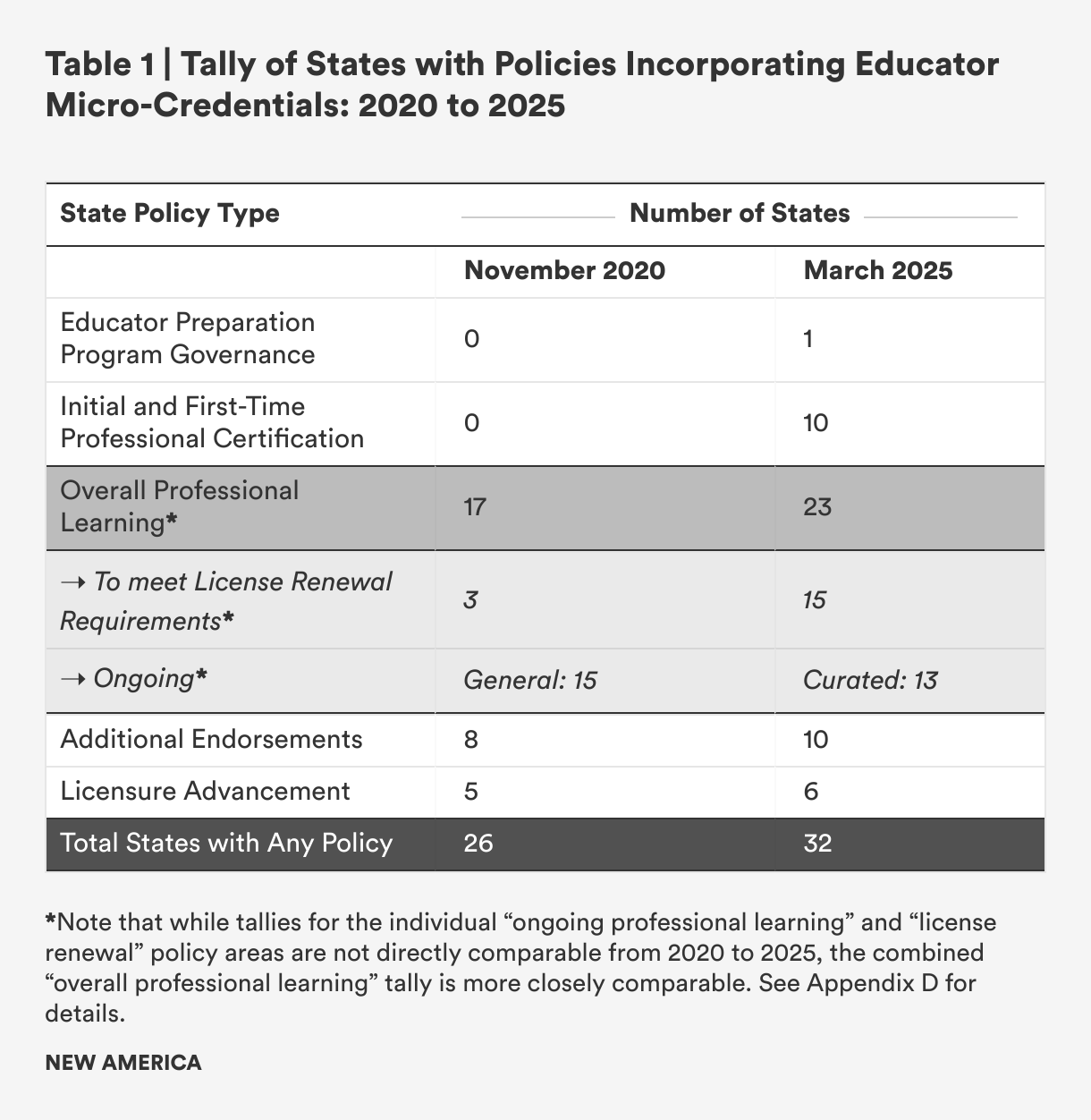
The table below offers a side-by-side comparison of state policy tallies, overall and by category, from 2020 to the present.
The expanded adoption of micro-credentials in state education policy represents a positive shift in the commitment of states to seek out innovative, high-potential approaches for developing, credentialing, and retaining educators with the skills to meet students’ needs.
But for states to harness the full potential of micro-credentials as a tool for productive educator professional learning and for determining educator readiness for specific instructional or administrative roles, they must do two things: (1) Put systems and processes in place to ensure the quality of micro-credential offerings, and (2) ensure that policies are designed to incentivize educator engagement with micro-credentials. For the first, states must ensure that their policies only support high-quality micro-credential offerings that incorporate a rigorous, evidence-driven process for educators to apply research-backed competencies in a real-world setting. For the second, states must consider the role of micro-credentials within the context of broader necessary reforms to their educator policy systems. For example, micro-credentials could provide teachers with more opportunities for career advancement and increased compensation that do not require moving into administration, and thus aid in teacher retention.
More details on how states can execute on these recommendations can be found in the full report, as well as in New America’s Harnessing Micro-Credentials for Teacher Growth: Model State Policy Guide.3
Citations
- Melissa Tooley and Joseph Hood, Harnessing Micro-Credentials for Teacher Growth: A National Review of Early Best Practices (New America, January 2021), source.
- Implicit state policies and related state efforts are noted under the “Miscellaneous” heading in Appendix F, but are not included in overall tallies.
- Melissa Tooley and Joseph Hood, Harnessing Micro-Credentials for Teacher Growth: A Model State Policy Guide (New America, January 2021), source.