A Nationwide Review of States Educator Micro-Credential Policies
Table of Contents
- Executive Summary
- Introduction
- State Policy Scan Methodology
- Overall Findings
- Detailed Policy Category Findings
- Comparison to 2020 Findings
- Discussion
- Conclusions and Recommendations
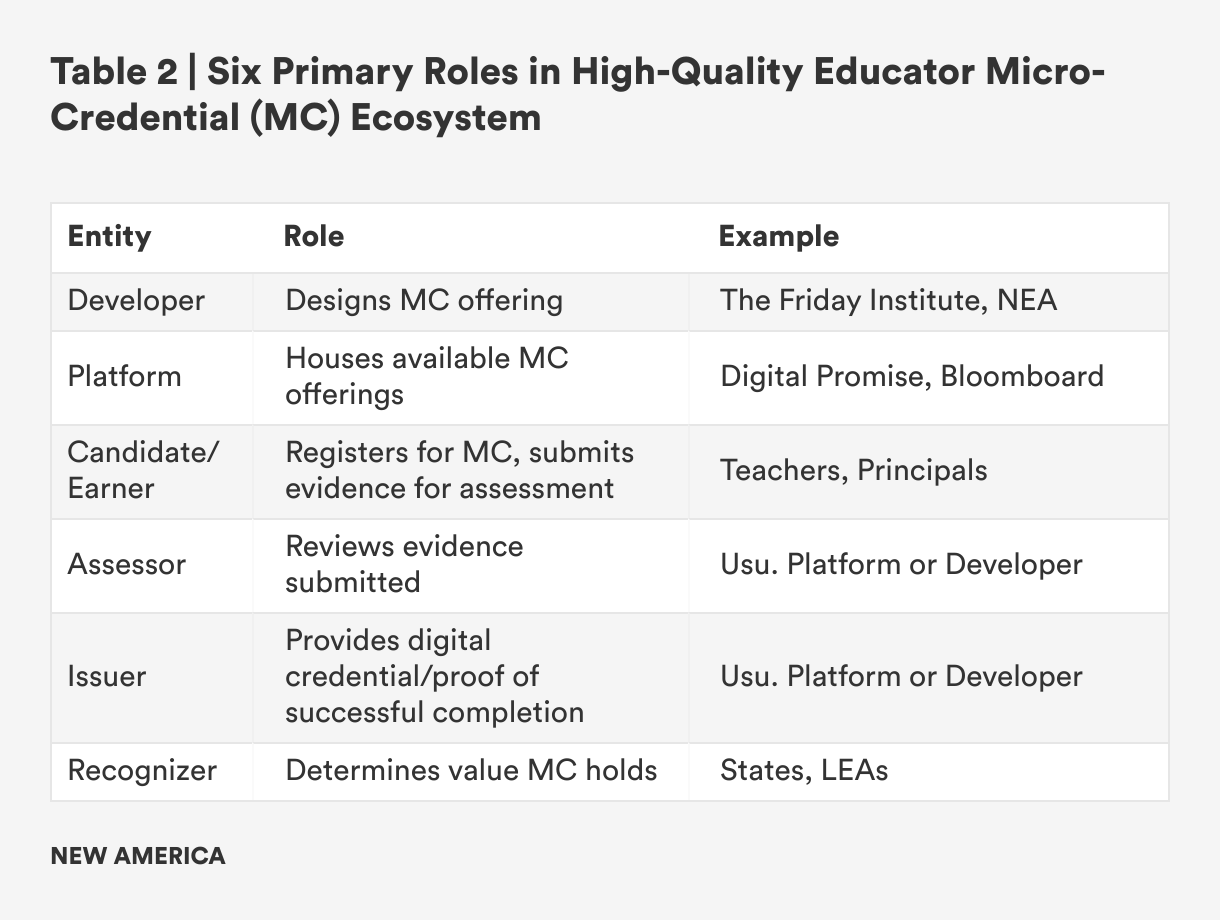
- Appendix A: Understanding the High-Quality Micro-Credentialing Process and Ecosystem
- Appendix B: Interviews Conducted by Authors, Chronologically
- Appendix C: Definitions and Examples for Six Educator Policy Areas
- Appendix D: Policy Categorization Methodology Differences from 2020 to 2025
- Appendix E: Summary of State Educator Micro-Credential Policies, by Category
- Appendix F: Additional Insights on Individual State Educator Micro-Credential Policies
Abstract
In 2021, New America released a report, Harnessing Micro-Credentials for Teacher Growth: A National Review of Early Best Practices, exploring the benefits and challenges of leveraging micro-credentials for educators, including an informal scan of how states were integrating micro-credentials into educator policy. This publication builds on that research by providing an updated and more detailed analysis of how micro-credentials are being explicitly incorporated into state educator policies across six key areas: educator preparation, initial credential attainment, curated professional development, license renewal, acquisition of additional endorsements, and license advancement.
High-quality micro-credentials offer states a tool to address teacher shortages by attracting and retaining a skilled and diverse educator workforce capable of helping students meet their full potential. This report discusses best practices in educator micro-credential policy design and implementation and recommends six actions for state education leaders to harness this promising tool.
Editorial Disclosure: This report was updated on June 6, 2025. It has been updated to make the "Overall Professional Learning" state policy subtotal more comparable to the other tallies in Table 1.
Acknowledgments
We are deeply grateful to the state agency staff members who reviewed drafts and responded to our questions to ensure we accurately represented their states’ educator policies. The authors would also like to thank others who generously shared their expertise on educator micro-credential policies: Laureen Avery, The ExcEL Leadership Academy; Myra Best, digiLEARN; Ann Coffman and Barbara Hicks, National Education Association; Marilys Galindo and Christina Luke, Digital Promise; Jennifer Kabaker, Aurora Institute; and Jason Lange, BloomBoard. Appreciation also goes to Natalya Brill for her data visualization support. This work was made possible thanks to the generous support of the Walton Family Foundation and the Gates Foundation. The views expressed in this report are solely those of the authors and are not intended to reflect the views of New America, its entire staff, its funders, or its board of directors.
Downloads
Executive Summary
States have been working to address increasing challenges in recruiting and retaining a sufficiently robust, diverse, and talented teacher workforce, particularly in the schools and subjects in which shortages have been long-standing. This report examines how states are attempting to leverage micro-credentials to improve the stability and capability of their elementary and secondary educator workforces and to promote better student outcomes.
This research builds upon the informal 2020 scan of state educator micro-credential policies in New America’s comprehensive Harnessing Micro-Credentials for Teacher Growth: A National Review of Early Best Practices research report1 by highlighting the explicit inclusion of micro-credentials in state educator policies in six areas—preparation, first-time certification, curated professional training, license renewal, additional endorsements, and licensure advancement.
Key findings include:
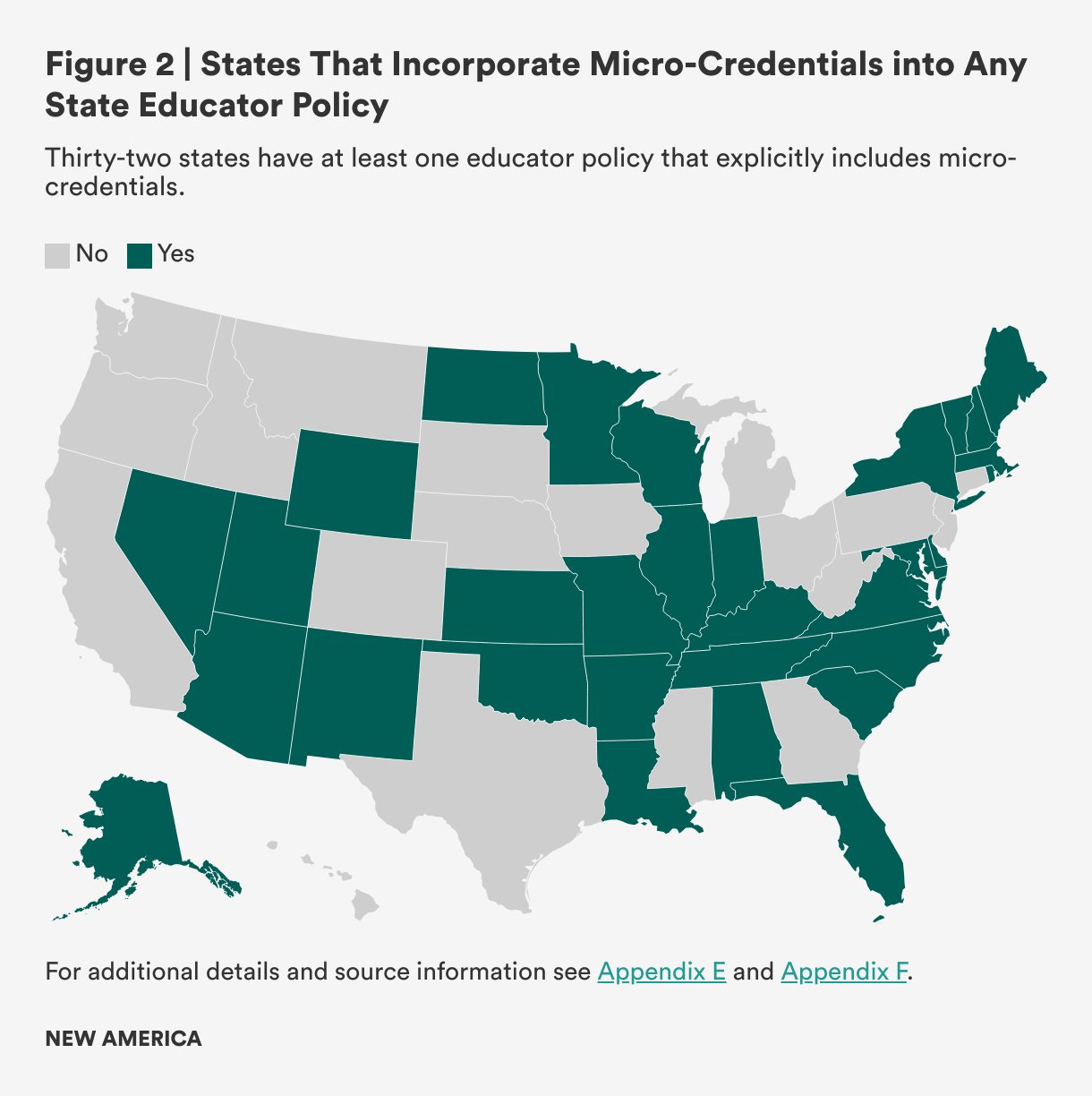
- Over 60 percent of states (32, including the District of Columbia) now explicitly allow or encourage the use of micro-credentials in at least one type of state educator policy,2 a 23 percent increase from 2020.
- Just under half of these 32 states (14) incorporate educator micro-credentials in more than one of the six policy areas examined. Arkansas and Utah integrate educator micro-credentials in the greatest number of policy areas, with four each.
- As was the case in 2020, states are concentrating their micro-credential efforts on the average current teacher, rather than on preparing and credentialing new teachers or vetting the most expert educators for advancement opportunities.
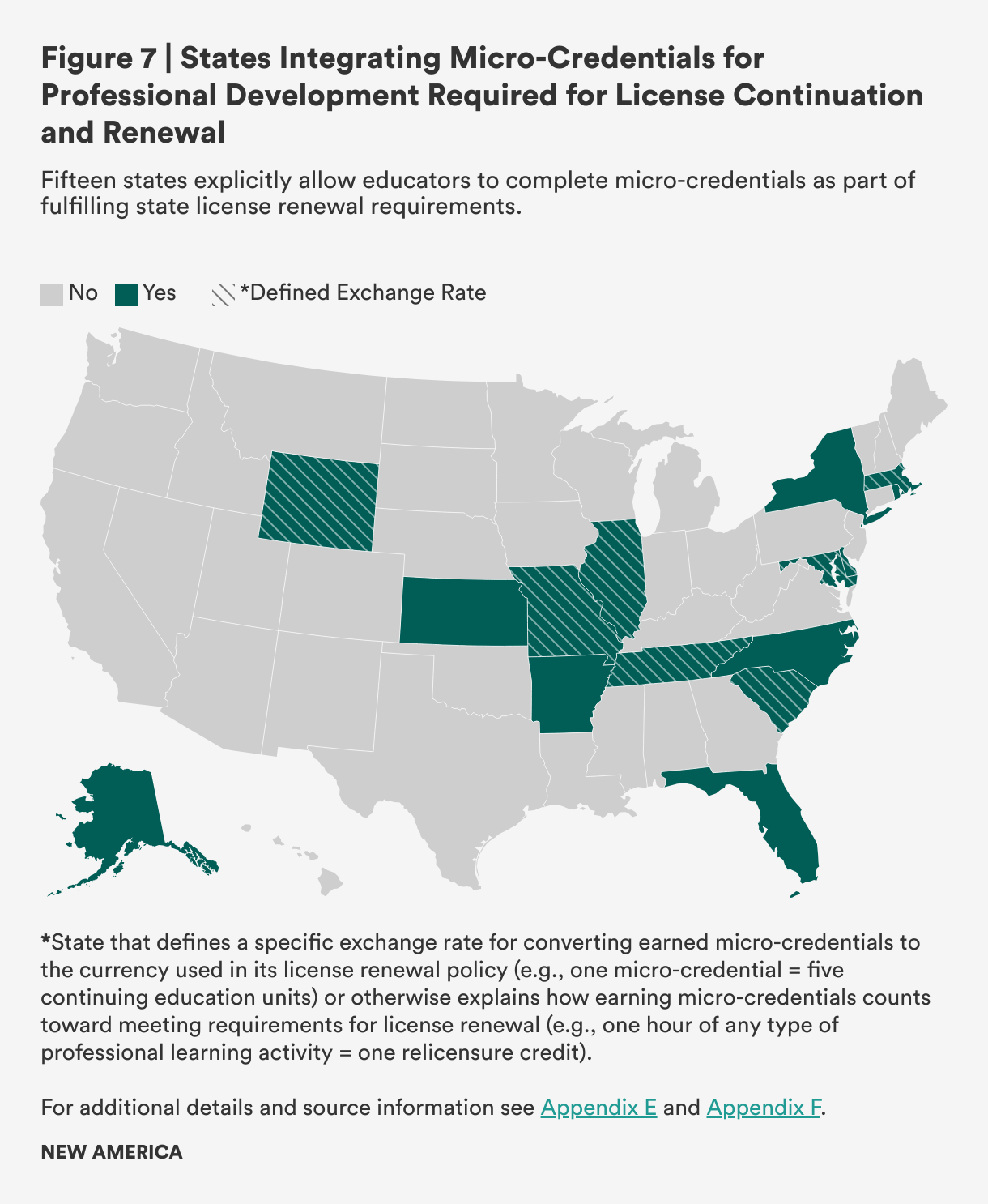
- The policy areas with the greatest inclusion of educator micro-credentials are satisfying license renewal requirements (15 states) and providing professional learning on curated topics (13 states).
- Ten states are using micro-credentials in policies governing the earning of additional license endorsements, typically in chronic teacher shortage areas.
- The policy area with the greatest percentage increase relative to 2020 was initial and first-time professional certification (10 states, up from zero). Most of these policies are for individuals teaching on a temporary certificate who must meet additional requirements to make the mandatory shift to a professional credential.
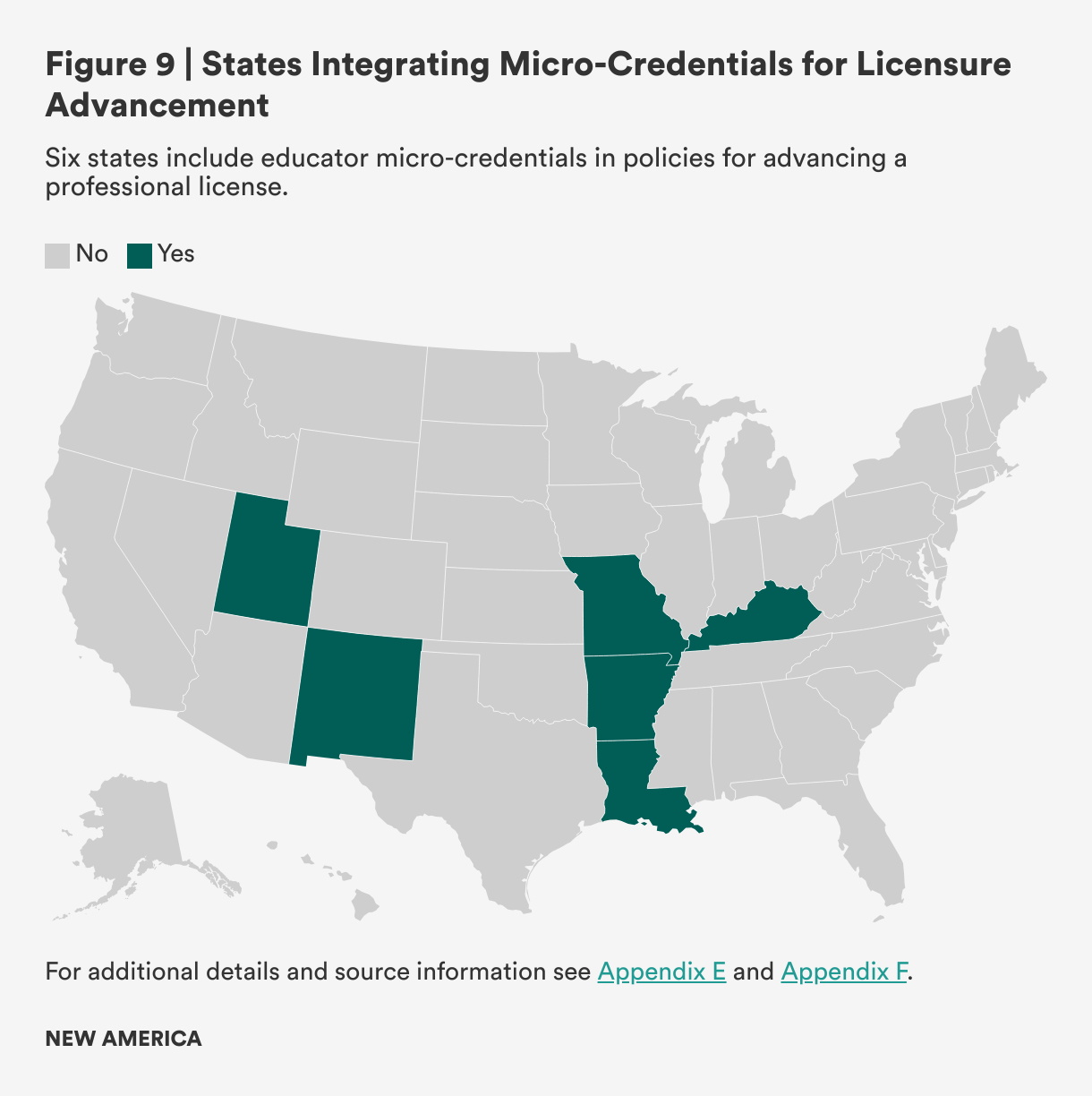
- The number of states allowing educators to use micro-credentials to meet licensure advancement requirements showed little change (six states, up from five in 2020), likely because few states offer advanced licenses and endorsement options in general.
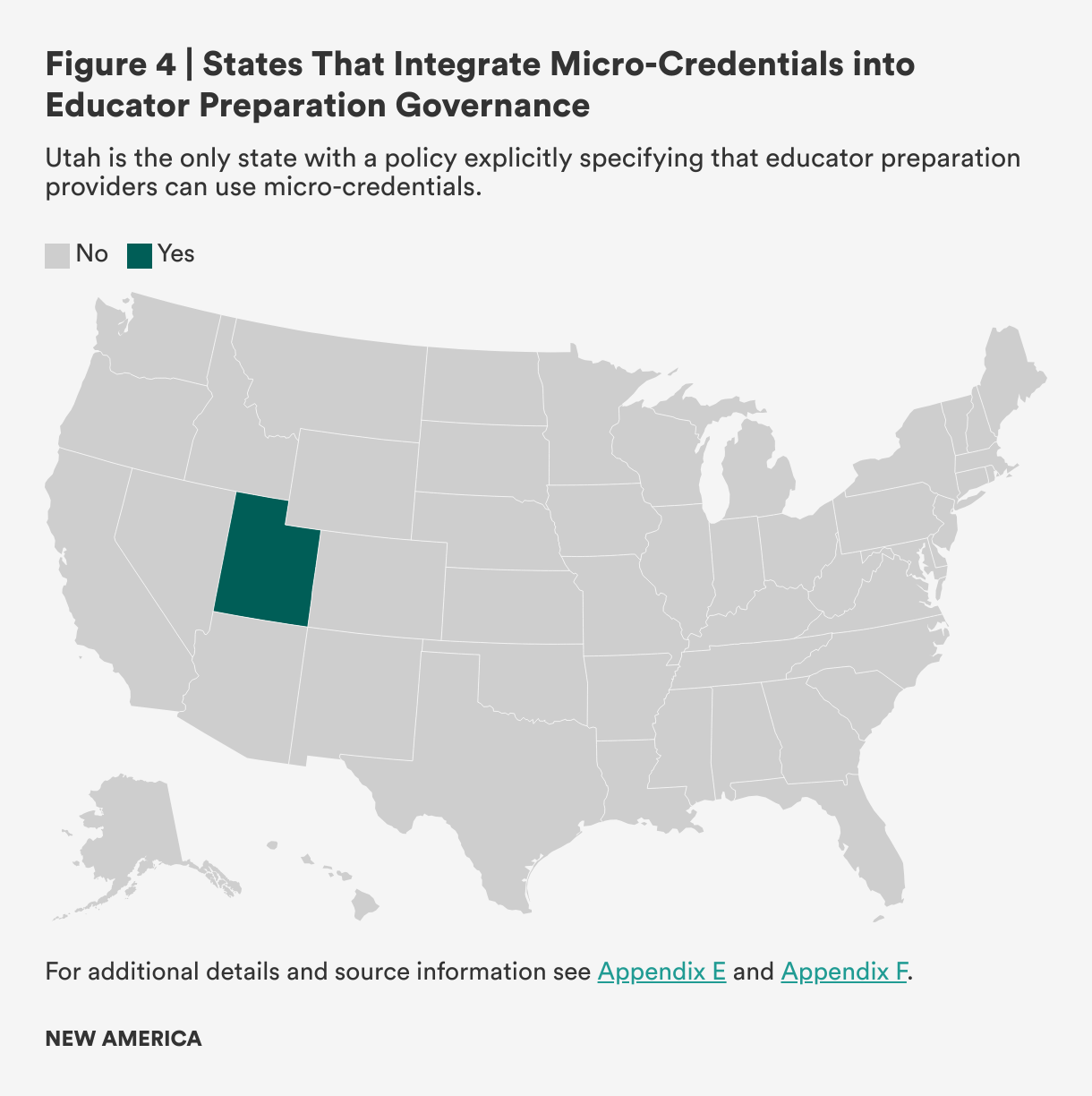
- Utah is the first and only state to incorporate micro-credentials in educator preparation program approval policies.
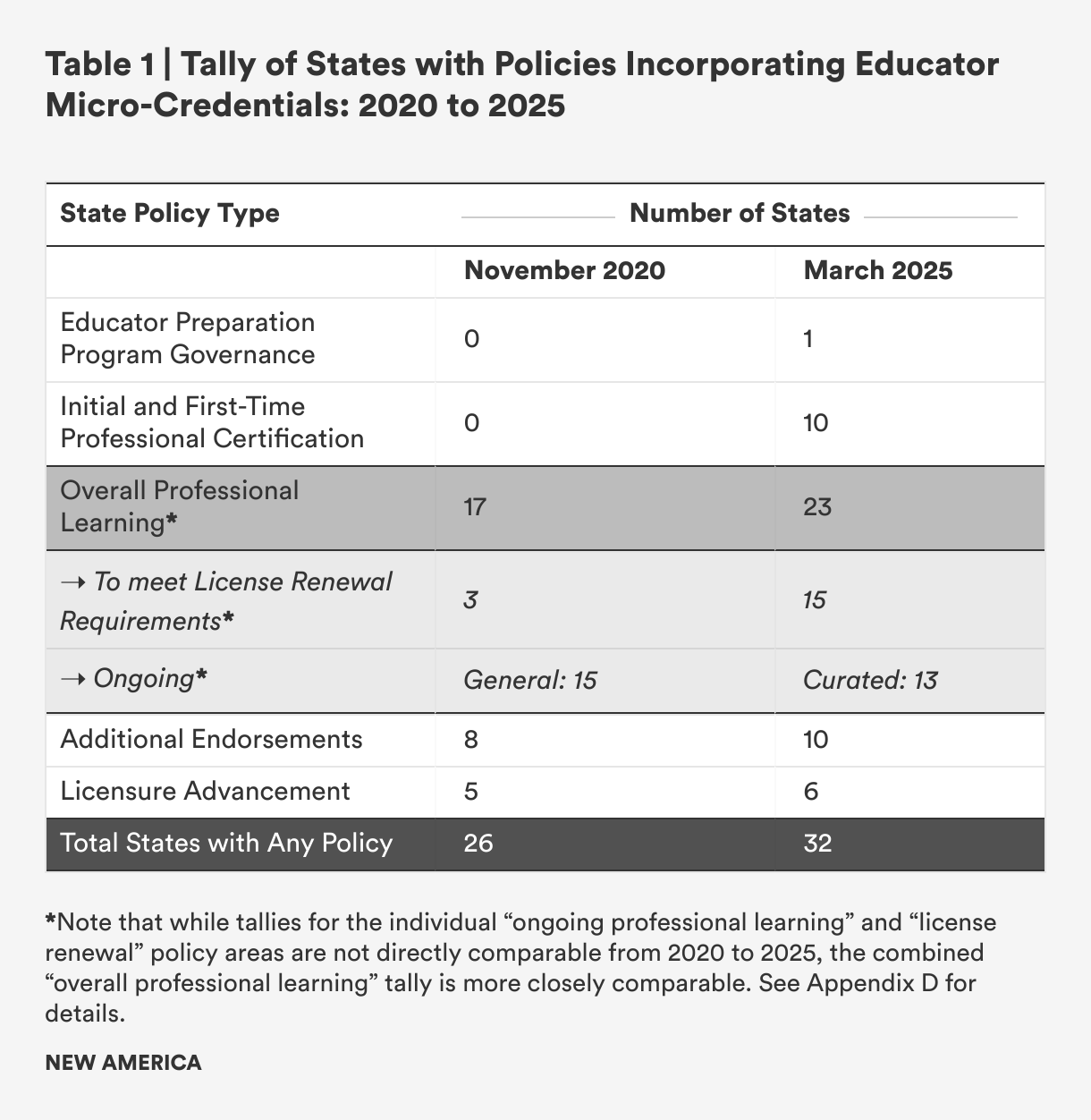
The table below offers a side-by-side comparison of state policy tallies, overall and by category, from 2020 to the present.
The expanded adoption of micro-credentials in state education policy represents a positive shift in the commitment of states to seek out innovative, high-potential approaches for developing, credentialing, and retaining educators with the skills to meet students’ needs.
But for states to harness the full potential of micro-credentials as a tool for productive educator professional learning and for determining educator readiness for specific instructional or administrative roles, they must do two things: (1) Put systems and processes in place to ensure the quality of micro-credential offerings, and (2) ensure that policies are designed to incentivize educator engagement with micro-credentials. For the first, states must ensure that their policies only support high-quality micro-credential offerings that incorporate a rigorous, evidence-driven process for educators to apply research-backed competencies in a real-world setting. For the second, states must consider the role of micro-credentials within the context of broader necessary reforms to their educator policy systems. For example, micro-credentials could provide teachers with more opportunities for career advancement and increased compensation that do not require moving into administration, and thus aid in teacher retention.
More details on how states can execute on these recommendations can be found in the full report, as well as in New America’s Harnessing Micro-Credentials for Teacher Growth: Model State Policy Guide.3
Citations
- Melissa Tooley and Joseph Hood, Harnessing Micro-Credentials for Teacher Growth: A National Review of Early Best Practices (New America, January 2021), source.
- Implicit state policies and related state efforts are noted under the “Miscellaneous” heading in Appendix F, but are not included in overall tallies.
- Melissa Tooley and Joseph Hood, Harnessing Micro-Credentials for Teacher Growth: A Model State Policy Guide (New America, January 2021), source.
Introduction
In the 2022–2023 school year, one in eight of all vacant teaching positions in U.S. public schools went unfilled or were filled by individuals who were not fully certified to teach the grade(s) and/or subject(s) they were assigned to.4 Without talented educators—the most important in-school factor in students’ academic and long-term success5—our students will continue to struggle to reach their full potential.6
One way states are attempting to address school workforce issues and improve students’ educational experiences and outcomes is by integrating micro-credential offerings into their policies to attract, credential, develop, and retain educators.
Why micro-credentials? First, many of the tools traditionally used to vet educators’ qualifications to enter, remain, or advance in the profession (e.g., tests of general knowledge7 and credits/degrees earned,8 etc.) can be expensive and burdensome despite weak evidence that they benefit educators’ daily work. This approach ultimately restricts the quantity, quality, and diversity of the educator workforce. High-quality micro-credentials, on the other hand, offer a low-cost way for educators to concretely demonstrate that they possess the competencies required to enter the profession, and to retain or enhance their professional credentials and roles.9 For example, high-quality micro-credentials offer educators a more accessible and evidence-driven option for obtaining professional recognition and rewards, such as higher-paid teacher leader roles, than doling out money for master’s degrees.
Additionally, the process required to earn a high-quality micro-credential can simultaneously improve educators’ job effectiveness as well as their satisfaction with their professional development opportunities, further boosting the quantity and quality of the workforce. In a national survey, nearly two-thirds of teachers reported being only somewhat satisfied or not satisfied with the professional development (PD) opportunities they were offered,10 which—despite federal efforts to get schools to shift to more evidence-based approaches—still often come as one-size-fits-all, short-term passive trainings, without opportunities to test drive the new information or skill, follow-up to see if or how they are applying the new concept in their classrooms, or assistance to help them do so successfully. These traditional types of PD opportunities often reward time spent rather than demonstrated professional learning and growth.11
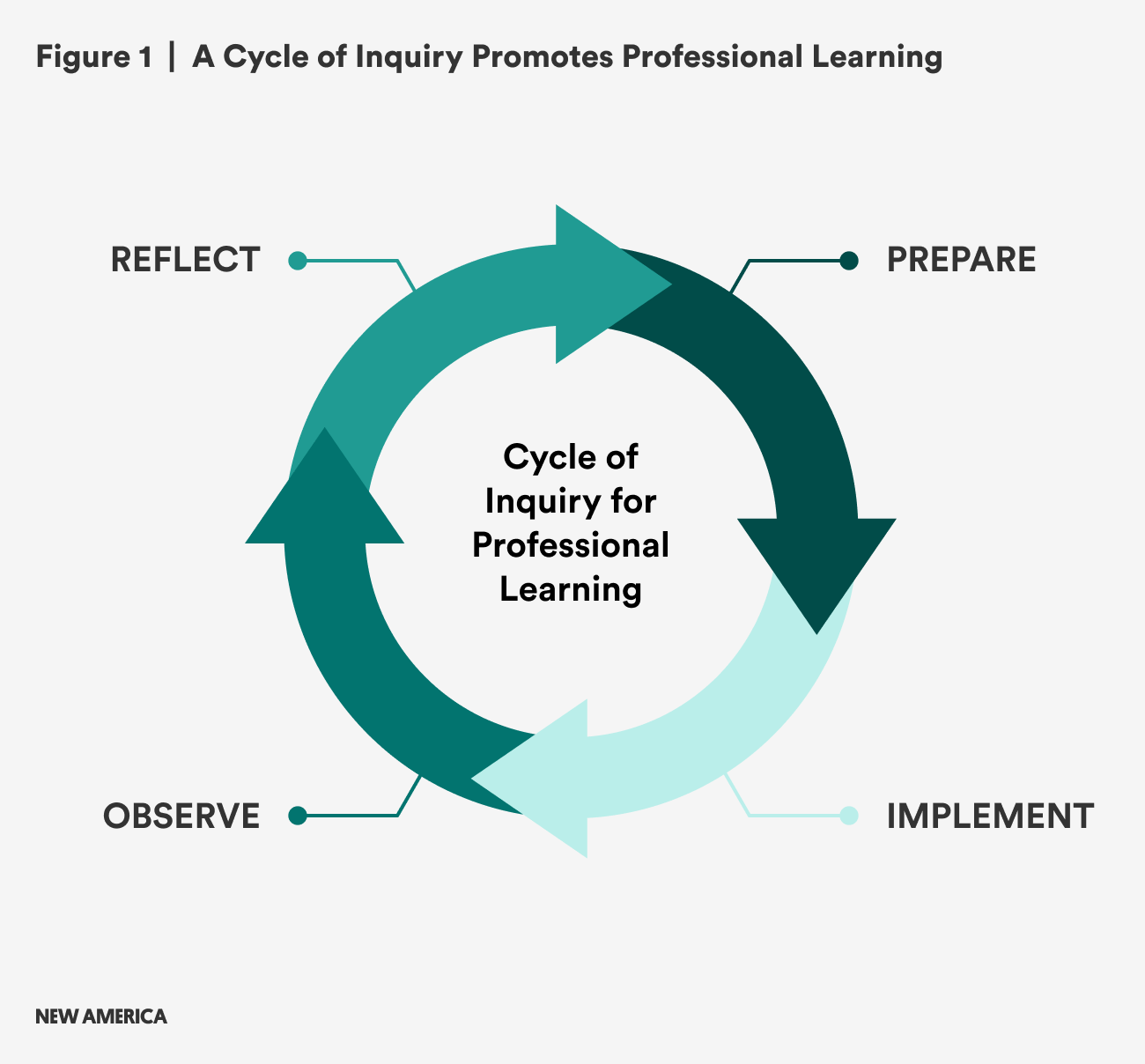
Conversely, the cycle of inquiry process baked into earning a high-quality micro-credential requires and rewards actively applying knowledge and skills in the educator’s specific school context and reflecting on the implementation and outcomes. Simplistically, such a cycle of inquiry includes four basic steps12:
- Reflect on instructional practice, including by reviewing student data, and identify the intended goal of changes to practice.
- Prepare ideas for how to modify practice, informed by research and evidence of what is most likely to achieve the goal.
- Implement and test out changes in practice in the classroom.
- Observe what resulted from the change in practice, including by reviewing data.
Then the process starts over, with educators reflecting on what they learned from implementing the change in practice, why it did or did not meet the intended goal, and how they might modify their practice further to improve outcomes (see Figure 1). For more details on the process for earning a high-quality micro-credential, and the entities playing roles within the micro-credentialing ecosystem, see Appendix A.
Allison Ball, a teacher in Kingsport City Schools who completed a micro-credential through the Digital Promise platform and responded to its 2018 survey about the experience, said: “I would do a micro-credential again because it has helped me to not only reflect better and be more intentional and thoughtful, but it's actually given me practical choice in what I get to do and pursue.”13
Not only do educators experience this type of learning-by-doing as more relevant, but research shows this active learning approach to be most likely to translate into improvements in instructional practice and advance student learning.14 And because of their “micro” nature, micro-credentials can help educators break down ambitious goals into manageable chunks, and provide a sense of accomplishment when each milestone is reached. For example, Rachel Heaton, a teacher in Kingsport City Schools who completed Digital Promise’s educator micro-credential survey, said: “While we were working on this micro-credential in my classroom, I was learning and my students were learning as well. We had multiple opportunities to achieve the skill in the micro-credential together. Then, as I worked through that, I was able to see evidence of their growth and then use that as the evidence [toward earning] my micro-credential.”15
For a definition of the characteristics of a high-quality micro-credential, see the box below.
What Is a Micro-Credential, and What Makes a Micro-Credential High-Quality?
A micro-credential is a relatively new term in education, and it has been used to label a wide array of online activities and tools. Micro-credentials are like other types of credentials—such as degrees or diplomas—in that they are a way for individuals to signal to current or potential employers that they possess relevant competencies, and individuals often engage in learning activities in order to earn them. Like other credentials, micro-credentials can be designed to reflect differing levels of expertise on a specific topic, but individuals must demonstrate relevant knowledge in order to earn them.
However, micro-credentials differ from credentials like degrees and diplomas in a few ways:16
- They recognize a small, discrete competency rather than a broad set of skills.
- They may not offer candidates instruction on how to develop the stated competency.17
- They may be agnostic as to when or how the candidate developed the competency.
- They are typically awarded in the form of a digital badge.18
A high-quality micro-credential offering encourages an inquiry-based learning process19 (see Figure 1) and meets five conditions:
- The measured competency is right-sized, precisely named, demonstrable, and evidence-driven.
- All accompanying resources are relevant, research-backed, and practicable.
- Candidates are required to submit robust evidence of applying the competency to a set of required practical tasks.
- Well-trained assessors review candidates’ submitted evidence of the competency via a transparent, reliable, and valid process.
- The final earning decision and associated feedback is communicated in a clear, timely manner.
While educator micro-credentials have been available for a decade, very little research has been done on how to maximize their potential. In 2021, New America published the most comprehensive report available on the topic, Harnessing Micro-Credentials for Teacher Growth: A National Review of Early Best Practices,20 and the companion Model State Policy Guide21 to inform education leaders’ understanding of this emerging tool. In addition to potential benefits of this new tool, we found there to be significant challenges to developing and implementing high-quality educator micro-credential offerings. For example, while the number of offerings labeled as “micro-credentials” was growing rapidly, no common mechanism existed for vetting quality, and many did not reflect the characteristics of high-quality educator micro-credentials outlined above.
The report highlighted how state and local policies influence educators’ willingness to attempt to earn micro-credentials, as well as their level of earning success. The report also provided a tally of states that included micro-credentials within different categories of educator policies. We found that 26 states explicitly referenced or encouraged the use of micro-credentials in at least one category of educator policy.
This report builds upon our earlier research and policy recommendations by examining how state policy on educator micro-credentials has changed over the past four years and providing recommendations for further state action.
Citations
- Melissa Tooley and Joseph Hood, Harnessing Micro-Credentials for Teacher Growth: A National Review of Early Best Practices (New America, January 2021), source">source.
- Implicit state policies and related state efforts are noted under the “Miscellaneous” heading in Appendix F, but are not included in overall tallies.
- Melissa Tooley and Joseph Hood, Harnessing Micro-Credentials for Teacher Growth: A Model State Policy Guide (New America, January 2021), source">source.
- According to an analysis from the Learning Policy Institute, approximately 360,000 employed teachers across the nation are not fully certified for their teaching assignments. Further, when including vacancies, the authors estimated that over 400,000 teaching positions were either unfilled or filled by teachers not fully certified for their assignments, a total that represents approximately 1 in 8 teaching positions nationally. For more details see: Tiffany S. Tan, Ivett Arellano, and Susan Kemper Patrick, State Teacher Shortages 2024 Update: Teaching Positions Left Vacant or Filled by Teachers Without Full Certification (Learning Policy Institute, August 2024), source. Interest in becoming, and remaining, an educator has been declining for multiple reasons, including lack of on-the-job support, dissatisfaction with pay, and a dearth of career advancement opportunities. More than 200,000 teachers exit the profession each year, with one in four saying they did so to pursue other career opportunities. For more details see: Anne Podolsky, Tara Kini, Joseph Bishop, and Linda Darling-Hammond, Solving the Teacher Shortage: How to Attract and Retain Excellent Educators (Learning Policy Institute, September 2016), source.
- See results from Raj Chetty, John N. Friedman, and Jonah E. Rockoff, “Measuring the Impacts of Teachers II: Teacher Value-Added and Student Outcomes in Adulthood,” American Economic Review 104, no. 9, (May 2014): 2633–2679, source.
- Student achievement on the annual National Assessment of Educational Progress (NAEP) has declined post-COVID-19. For more details, see National Assessment Governing Board, “10 Takeaways from the Newly Released 2024 NAEP Results,” source.
- Lisa Bardach and Robert M. Klassen, “Smart Teachers, Successful Students? A Systematic Review of the Literature on Teachers’ Cognitive Abilities and Teacher Effectiveness,” Educational Research Review 30 (June 2020), source.
- With the exception of in-area graduate degrees (for example, a master’s degree in mathematics) for middle and high school math teachers, master’s degrees have little to no effect on teacher effectiveness. In fact, some research finds that “out-of-area” graduate degrees (school administration, counseling, curriculum specialist, etc.) are actually correlated with lower teacher effectiveness. See Kevin C. Bastian, “A Degree Above? The Value-Added Estimates and Evaluation Ratings of Teachers with a Graduate Degree,” Education Finance and Policy 14 (2019): 652–678, source; and Matthew M. Chingos and Paul E. Peterson, “It's Easier to Pick a Good Teacher than to Train One: Familiar and New Results on the Correlates of Teacher Effectiveness,” Economics of Education Review 30, no. 3 (2011): 449–465.
- For more details, see the Findings section in Melissa Tooley and Joseph Hood, Harnessing Micro-Credentials for Teacher Growth: A National Review of Early Best Practices (New America, January 2021), source.
- See question “JOBSATIS2 h” on p. 4 in Pew Research Center’s 2023 Survey of Teachers, April 2024, source.
- Melissa Tooley and Kaylan Connally, No Panacea: Diagnosing What Ails Teacher Professional Development Before Reaching for Remedies (New America, June 2016), source.
- An example of a more detailed cycle of inquiry process can be found in the Regional Educational Laboratory West’s infographic, Using Inquiry Cycles in PLCs to Improve Instruction, February 2019, source.
- Digital Promise, “Micro-Credentials for Me: Personal Stories from Real Teachers,” source.
- Melissa Tooley, “What Does High-Quality Research Say about Developing Teacher Practice?” EdCentral (blog), New America, March 16, 2017, source.
- Digital Promise, “Micro-Credentials for Me,” source; Stephen Sawchuk, “Can ‘Micro-Credentialing’ Salvage Teacher PD?” Ed Week, March 29, 2016, source; and Micro-credentials: Spurring Educator Engagement (Digital Promise, 2016), source.
- For more details, see Q4 of Melissa Tooley, “Everything You Wanted to Know About Educator Micro-Credentials: Fundamentals,” EdCentral (blog), New America, January 20, 2022, source.
- A common misconception about educator micro-credentials is that they are a type of direct teacher training rather than a credential. However, micro-credential offerings may be paired with resources for developing the specific competency they intend to measure, and high-quality micro-credential offerings always include relevant and evidence-based resources.
- Earners of micro-credentials are awarded a digital badge as proof of their accomplishment, but not all digital badges are obtained by earning micro-credentials. Digital badges can be awarded for something as simple as attending a conference training or completing a multiple-choice assessment, while earning high-quality micro-credentials requires successful application of the given competency. A 2015 survey of teachers by Digital Promise found that, of 19 distinct micro-credential benefits highlighted, teachers were least interested in displaying digital badges or sharing them on social media. See “Findings,” Tooley and Hood, Harnessing Micro-credentials for Teacher Growth: A National Review of Early Best Practices, source. For more details on digital badges, see Brittany Gooding, “Microcredentials vs. Open Badges: Navigating the Landscape of Digital Learning Recognition,” The Instructure Study Hall (blog), Instructure.com, August 16, 2023, source.
- Melissa Tooley and Joseph Hood, “The Process to Earn a Micro-Credential” (figure), Harnessing Micro-Credentials for Teacher Growth (New America, 2021), source.
- Tooley and Hood, Harnessing Micro-Credentials for Teacher Growth: A National Review of Early Best Practices, source.
- Melissa Tooley and Joseph Hood, Harnessing Micro-Credentials for Teacher Growth: A Model State Policy Guide, (New America, January 2021), source.
State Policy Scan Methodology
We performed five actions for this state policy scan:
- Reviewed statutes, regulations, and websites of state education agencies governing educator preparation, credentialing, and professional learning in all 50 states plus Washington, DC,22 for references to educator micro-credentials.
- Performed online searches to identify educator micro-credentials offered or financially supported by state education agencies.
- Interviewed the three major providers of educator micro-credentials and other policy experts for insights on how states are using educator micro-credentials. see Appendix B for full list of interviews
- Categorized each state policy that included a reference to micro-credentials for educators in one of six ways: educator preparation program governance, initial credentialing, curated professional development, license renewal, endorsements, or license advancement.
- Contacted each state education agency via email to request verification of our search results.
A state was deemed to have a statewide policy for educator micro-credentials in one or more of the six educator policy categories listed above if we could locate evidence that a state entity explicitly allows, encourages, or requires the use of micro-credentials for that specific policy purpose. Examples of encouraging micro-credentials include creating, funding creation of, and/or publishing micro-credentials for educators, promoting micro-credentials in state-developed or funded materials, or offering financial incentives to educators engaging with micro-credentials. States that tacitly allow the use of educator micro-credentials (e.g., by accepting micro-credentials as a form of professional learning that satisfies relicensure requirements, but not explicitly stating this in any public documentation) were not deemed to have a statewide policy.23 Although states sometimes distinguish between the terms certification and license (or only use one of these terms), these terms are used interchangeably for the purpose of this analysis. More detailed information about how the authors assessed the existence of state policy in each of the six identified categories, as well as example scenarios, can be found in Appendix C.
We did not attempt to assess whether states’ use of the micro-credentials label aligned with the definition of high-quality micro-credentials offered here. If states labeled something a micro-credential, we accepted it as such, despite the fact that states sometimes appeared to use the term to refer to professional development offered in a didactic format and/or with a focus on assessing knowledge rather than demonstrating real-world skills.24 Conversely, some state education agency staff shared that they have license renewal policies that explicitly encourage or require the kind of cycle of inquiry at the heart of high-quality micro-credentials, even though the state does not explicitly use the term micro-credentials or offer any type of recognition for completing the cycle of inquiry process.
Citations
- Melissa Tooley and Joseph Hood, Harnessing Micro-Credentials for Teacher Growth: A National Review of Early Best Practices (New America, January 2021), <a href="source">source">source.
- Implicit state policies and related state efforts are noted under the “Miscellaneous” heading in Appendix F, but are not included in overall tallies.
- Melissa Tooley and Joseph Hood, Harnessing Micro-Credentials for Teacher Growth: A Model State Policy Guide (New America, January 2021), <a href="source">source">source.
- According to an analysis from the Learning Policy Institute, approximately 360,000 employed teachers across the nation are not fully certified for their teaching assignments. Further, when including vacancies, the authors estimated that over 400,000 teaching positions were either unfilled or filled by teachers not fully certified for their assignments, a total that represents approximately 1 in 8 teaching positions nationally. For more details see: Tiffany S. Tan, Ivett Arellano, and Susan Kemper Patrick, State Teacher Shortages 2024 Update: Teaching Positions Left Vacant or Filled by Teachers Without Full Certification (Learning Policy Institute, August 2024), source">source. Interest in becoming, and remaining, an educator has been declining for multiple reasons, including lack of on-the-job support, dissatisfaction with pay, and a dearth of career advancement opportunities. More than 200,000 teachers exit the profession each year, with one in four saying they did so to pursue other career opportunities. For more details see: Anne Podolsky, Tara Kini, Joseph Bishop, and Linda Darling-Hammond, Solving the Teacher Shortage: How to Attract and Retain Excellent Educators (Learning Policy Institute, September 2016), source">source.
- See results from Raj Chetty, John N. Friedman, and Jonah E. Rockoff, “Measuring the Impacts of Teachers II: Teacher Value-Added and Student Outcomes in Adulthood,” American Economic Review 104, no. 9, (May 2014): 2633–2679, source">source.
- Student achievement on the annual National Assessment of Educational Progress (NAEP) has declined post-COVID-19. For more details, see National Assessment Governing Board, “10 Takeaways from the Newly Released 2024 NAEP Results,” source">source.
- Lisa Bardach and Robert M. Klassen, “Smart Teachers, Successful Students? A Systematic Review of the Literature on Teachers’ Cognitive Abilities and Teacher Effectiveness,” Educational Research Review 30 (June 2020), source">source.
- With the exception of in-area graduate degrees (for example, a master’s degree in mathematics) for middle and high school math teachers, master’s degrees have little to no effect on teacher effectiveness. In fact, some research finds that “out-of-area” graduate degrees (school administration, counseling, curriculum specialist, etc.) are actually correlated with lower teacher effectiveness. See Kevin C. Bastian, “A Degree Above? The Value-Added Estimates and Evaluation Ratings of Teachers with a Graduate Degree,” Education Finance and Policy 14 (2019): 652–678, source">source; and Matthew M. Chingos and Paul E. Peterson, “It's Easier to Pick a Good Teacher than to Train One: Familiar and New Results on the Correlates of Teacher Effectiveness,” Economics of Education Review 30, no. 3 (2011): 449–465.
- For more details, see the Findings section in Melissa Tooley and Joseph Hood, Harnessing Micro-Credentials for Teacher Growth: A National Review of Early Best Practices (New America, January 2021), source">source.
- See question “JOBSATIS2 h” on p. 4 in Pew Research Center’s 2023 Survey of Teachers, April 2024, source">source.
- Melissa Tooley and Kaylan Connally, No Panacea: Diagnosing What Ails Teacher Professional Development Before Reaching for Remedies (New America, June 2016), source">source.
- An example of a more detailed cycle of inquiry process can be found in the Regional Educational Laboratory West’s infographic, Using Inquiry Cycles in PLCs to Improve Instruction, February 2019, source">source.
- Digital Promise, “Micro-Credentials for Me: Personal Stories from Real Teachers,” source">source.
- Melissa Tooley, “What Does High-Quality Research Say about Developing Teacher Practice?” EdCentral (blog), New America, March 16, 2017, source">source.
- Digital Promise, “Micro-Credentials for Me,” source">source; Stephen Sawchuk, “Can ‘Micro-Credentialing’ Salvage Teacher PD?” Ed Week, March 29, 2016, source">source; and Micro-credentials: Spurring Educator Engagement (Digital Promise, 2016), source">source.
- For more details, see Q4 of Melissa Tooley, “Everything You Wanted to Know About Educator Micro-Credentials: Fundamentals,” EdCentral (blog), New America, January 20, 2022, source">source.
- A common misconception about educator micro-credentials is that they are a type of direct teacher training rather than a credential. However, micro-credential offerings may be paired with resources for developing the specific competency they intend to measure, and high-quality micro-credential offerings always include relevant and evidence-based resources.
- Earners of micro-credentials are awarded a digital badge as proof of their accomplishment, but not all digital badges are obtained by earning micro-credentials. Digital badges can be awarded for something as simple as attending a conference training or completing a multiple-choice assessment, while earning high-quality micro-credentials requires successful application of the given competency. A 2015 survey of teachers by Digital Promise found that, of 19 distinct micro-credential benefits highlighted, teachers were least interested in displaying digital badges or sharing them on social media. See “Findings,” Tooley and Hood, Harnessing Micro-credentials for Teacher Growth: A National Review of Early Best Practices, source">source. For more details on digital badges, see Brittany Gooding, “Microcredentials vs. Open Badges: Navigating the Landscape of Digital Learning Recognition,” The Instructure Study Hall (blog), Instructure.com, August 16, 2023, source">source.
- Melissa Tooley and Joseph Hood, “The Process to Earn a Micro-Credential” (figure), Harnessing Micro-Credentials for Teacher Growth (New America, 2021), source">source.
- Tooley and Hood, Harnessing Micro-Credentials for Teacher Growth: A National Review of Early Best Practices, source">source.
- Melissa Tooley and Joseph Hood, Harnessing Micro-Credentials for Teacher Growth: A Model State Policy Guide, (New America, January 2021), source">source.
- For the purposes of this analysis, DC is counted as a state.
- Implicit state policies and related state efforts are noted under the “Miscellaneous” heading in Appendix F, but are not included in overall tallies.
- While some states, such as Delaware, define the term micro-credential in administrative code and offer clear criteria for micro-credentials on the state’s department of education website, many states do not. See Delaware Regulations, Administrative Code Title 14:1500, “1511 Continuing License,” source; and “What Are Micro-Credentials,” Delaware Department of Education, source.
Overall Findings
As the map in Figure 2 shows, the majority of states (32, including the District of Columbia) now explicitly allow or encourage the use of micro-credentials in at least one of the six types of educator policy examined—up from 26 in 2020, a 23 percent increase.25
A little less than half (14) of the 32 states with any type of educator micro-credential policy are incorporating micro-credentials in two or more policy areas. Figure 3 shows how many of the following six categories of educator policies each state incorporates micro-credentials within:
- Complying with state pre-service educator preparation program approval guidelines.
- Fulfilling requirements for initial or first-time professional educator credentials.
- Providing curated professional development.
- Fulfilling professional learning requirements for educator license renewal.
- Fulfilling requirements for additional endorsements for current educators.
- Fulfilling requirements for an advanced license or endorsement for current educators.
See Appendix C for a glossary and examples for each of these six policy categories, Appendix E for a state-by-state summary of results, and Appendix F for more details on each state’s policies.
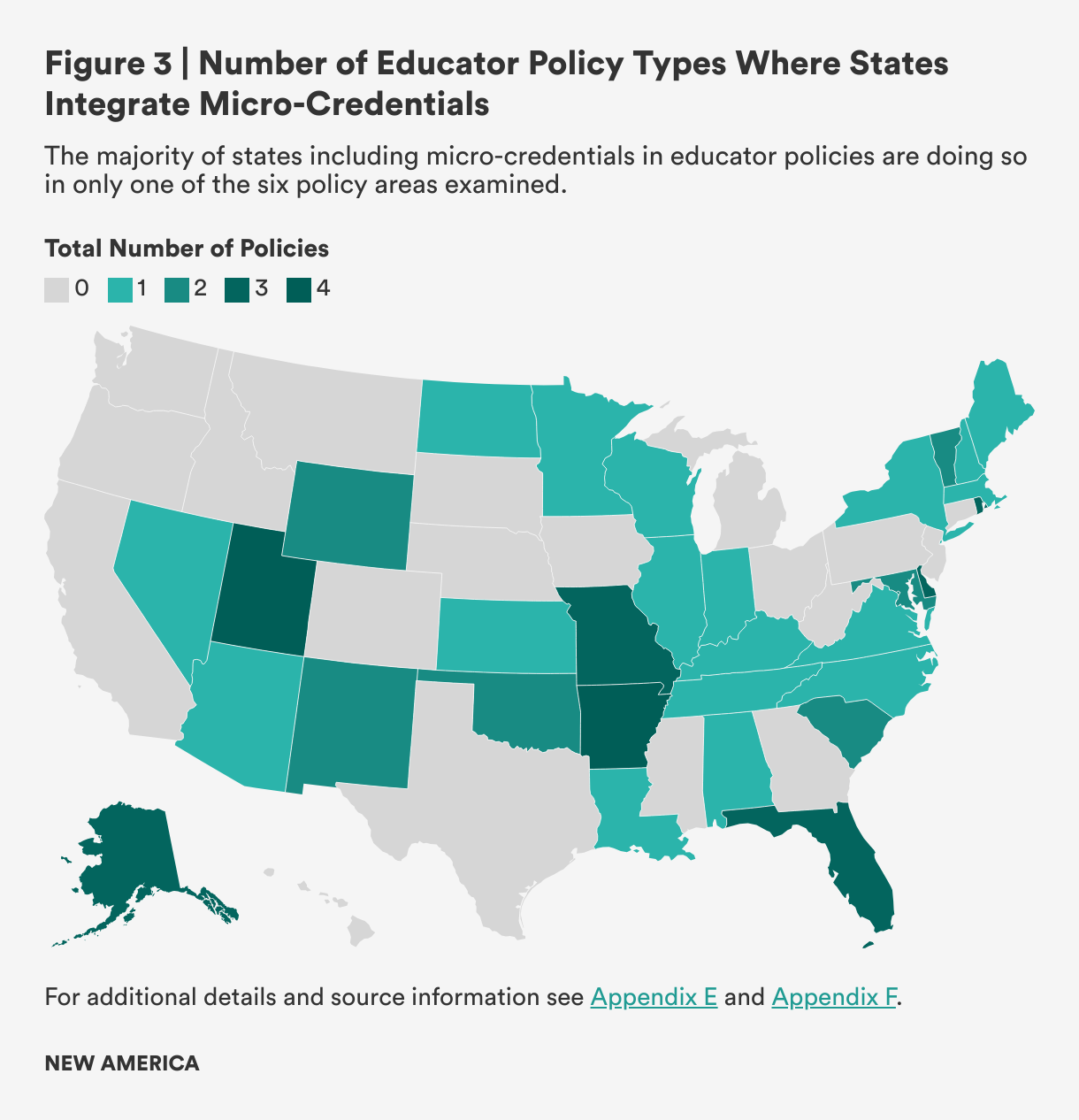
Most states that are incorporating educator micro-credentials are doing so in one (18 states) or two (7 states) of the six policy areas examined. Five states—Delaware, Alaska, Florida, Missouri, and Rhode Island—are each leveraging micro-credentials in three policy areas, while Arkansas and Utah explicitly allow them to be used in four.
While a greater number of policies indicates how widespread state adoption of educator micro-credentials is, it does not imply that a state is making better decisions about using educator micro-credentials. How policies are designed, how many educators are being reached with the policies, and how educator micro-credentials are vetted and implemented are more important than the number of ways they are integrated into the educator pipeline. See the final section of this report for more discussion of educator micro-credential quality and implementation.
Citations
- Melissa Tooley and Joseph Hood, Harnessing Micro-Credentials for Teacher Growth: A National Review of Early Best Practices (New America, January 2021), <a href="<a href="source">source">source">source.
- Implicit state policies and related state efforts are noted under the “Miscellaneous” heading in Appendix F, but are not included in overall tallies.
- Melissa Tooley and Joseph Hood, Harnessing Micro-Credentials for Teacher Growth: A Model State Policy Guide (New America, January 2021), <a href="<a href="source">source">source">source.
- According to an analysis from the Learning Policy Institute, approximately 360,000 employed teachers across the nation are not fully certified for their teaching assignments. Further, when including vacancies, the authors estimated that over 400,000 teaching positions were either unfilled or filled by teachers not fully certified for their assignments, a total that represents approximately 1 in 8 teaching positions nationally. For more details see: Tiffany S. Tan, Ivett Arellano, and Susan Kemper Patrick, State Teacher Shortages 2024 Update: Teaching Positions Left Vacant or Filled by Teachers Without Full Certification (Learning Policy Institute, August 2024), <a href="source">source">source. Interest in becoming, and remaining, an educator has been declining for multiple reasons, including lack of on-the-job support, dissatisfaction with pay, and a dearth of career advancement opportunities. More than 200,000 teachers exit the profession each year, with one in four saying they did so to pursue other career opportunities. For more details see: Anne Podolsky, Tara Kini, Joseph Bishop, and Linda Darling-Hammond, Solving the Teacher Shortage: How to Attract and Retain Excellent Educators (Learning Policy Institute, September 2016), <a href="source">source">source.
- See results from Raj Chetty, John N. Friedman, and Jonah E. Rockoff, “Measuring the Impacts of Teachers II: Teacher Value-Added and Student Outcomes in Adulthood,” American Economic Review 104, no. 9, (May 2014): 2633–2679, <a href="source">source">source.
- Student achievement on the annual National Assessment of Educational Progress (NAEP) has declined post-COVID-19. For more details, see National Assessment Governing Board, “10 Takeaways from the Newly Released 2024 NAEP Results,” <a href="source">source">source.
- Lisa Bardach and Robert M. Klassen, “Smart Teachers, Successful Students? A Systematic Review of the Literature on Teachers’ Cognitive Abilities and Teacher Effectiveness,” Educational Research Review 30 (June 2020), <a href="source">source">source.
- With the exception of in-area graduate degrees (for example, a master’s degree in mathematics) for middle and high school math teachers, master’s degrees have little to no effect on teacher effectiveness. In fact, some research finds that “out-of-area” graduate degrees (school administration, counseling, curriculum specialist, etc.) are actually correlated with lower teacher effectiveness. See Kevin C. Bastian, “A Degree Above? The Value-Added Estimates and Evaluation Ratings of Teachers with a Graduate Degree,” Education Finance and Policy 14 (2019): 652–678, <a href="source">source">source; and Matthew M. Chingos and Paul E. Peterson, “It's Easier to Pick a Good Teacher than to Train One: Familiar and New Results on the Correlates of Teacher Effectiveness,” Economics of Education Review 30, no. 3 (2011): 449–465.
- For more details, see the Findings section in Melissa Tooley and Joseph Hood, Harnessing Micro-Credentials for Teacher Growth: A National Review of Early Best Practices (New America, January 2021), <a href="source">source">source.
- See question “JOBSATIS2 h” on p. 4 in Pew Research Center’s 2023 Survey of Teachers, April 2024, <a href="source">source">source.
- Melissa Tooley and Kaylan Connally, No Panacea: Diagnosing What Ails Teacher Professional Development Before Reaching for Remedies (New America, June 2016), <a href="source">source">source.
- An example of a more detailed cycle of inquiry process can be found in the Regional Educational Laboratory West’s infographic, Using Inquiry Cycles in PLCs to Improve Instruction, February 2019, <a href="source">source">source.
- Digital Promise, “Micro-Credentials for Me: Personal Stories from Real Teachers,” <a href="source">source">source.
- Melissa Tooley, “What Does High-Quality Research Say about Developing Teacher Practice?” EdCentral (blog), New America, March 16, 2017, <a href="source">source">source.
- Digital Promise, “Micro-Credentials for Me,” <a href="source">source">source; Stephen Sawchuk, “Can ‘Micro-Credentialing’ Salvage Teacher PD?” Ed Week, March 29, 2016, <a href="source">source">source; and Micro-credentials: Spurring Educator Engagement (Digital Promise, 2016), <a href="source">source">source.
- For more details, see Q4 of Melissa Tooley, “Everything You Wanted to Know About Educator Micro-Credentials: Fundamentals,” EdCentral (blog), New America, January 20, 2022, <a href="source">source">source.
- A common misconception about educator micro-credentials is that they are a type of direct teacher training rather than a credential. However, micro-credential offerings may be paired with resources for developing the specific competency they intend to measure, and high-quality micro-credential offerings always include relevant and evidence-based resources.
- Earners of micro-credentials are awarded a digital badge as proof of their accomplishment, but not all digital badges are obtained by earning micro-credentials. Digital badges can be awarded for something as simple as attending a conference training or completing a multiple-choice assessment, while earning high-quality micro-credentials requires successful application of the given competency. A 2015 survey of teachers by Digital Promise found that, of 19 distinct micro-credential benefits highlighted, teachers were least interested in displaying digital badges or sharing them on social media. See “Findings,” Tooley and Hood, Harnessing Micro-credentials for Teacher Growth: A National Review of Early Best Practices, <a href="source">source">source. For more details on digital badges, see Brittany Gooding, “Microcredentials vs. Open Badges: Navigating the Landscape of Digital Learning Recognition,” The Instructure Study Hall (blog), Instructure.com, August 16, 2023, <a href="source">source">source.
- Melissa Tooley and Joseph Hood, “The Process to Earn a Micro-Credential” (figure), Harnessing Micro-Credentials for Teacher Growth (New America, 2021), <a href="source">source">source.
- Tooley and Hood, Harnessing Micro-Credentials for Teacher Growth: A National Review of Early Best Practices, <a href="source">source">source.
- Melissa Tooley and Joseph Hood, Harnessing Micro-Credentials for Teacher Growth: A Model State Policy Guide, (New America, January 2021), <a href="source">source">source.
- For the purposes of this analysis, DC is counted as a state.
- Implicit state policies and related state efforts are noted under the “Miscellaneous” heading in Appendix F, but are not included in overall tallies.
- While some states, such as Delaware, define the term micro-credential in administrative code and offer clear criteria for micro-credentials on the state’s department of education website, many states do not. See Delaware Regulations, Administrative Code Title 14:1500, “1511 Continuing License,” source">source; and “What Are Micro-Credentials,” Delaware Department of Education, source">source.
- Even in states with no explicit policy, some local education agencies are opting to incorporate micro-credentials for educators in their approaches to professional learning and advancement.
Detailed Policy Category Findings
This section provides a more detailed look at the findings from our most current state scan for each of the six educator policy areas reviewed. See Appendix C for a glossary and examples for how policies were categorized in each of the six policy areas, Appendix E for a summary of policy results by state, and Appendix F for additional details on each state’s policies.
Educator Preparation Program Governance
As Figure 4 indicates, Utah is the only state with an explicit policy encouraging the use of micro-credentials within educator preparation programs (EPPs).26 As part of the process of obtaining state approval to operate, Utah requires all EPPs—including those based within and outside institutions of higher education—to submit forms explaining how they are measuring each required competency in their candidates, with micro-credentials explicitly listed as an example method for competency demonstration.27 Additionally, the form that Utah’s university-based EPPs must submit to the state board of education to be approved to offer specific endorsements lists micro-credentials as one example of how candidates can demonstrate the required competencies.28
Initial and First-Time Professional Certification
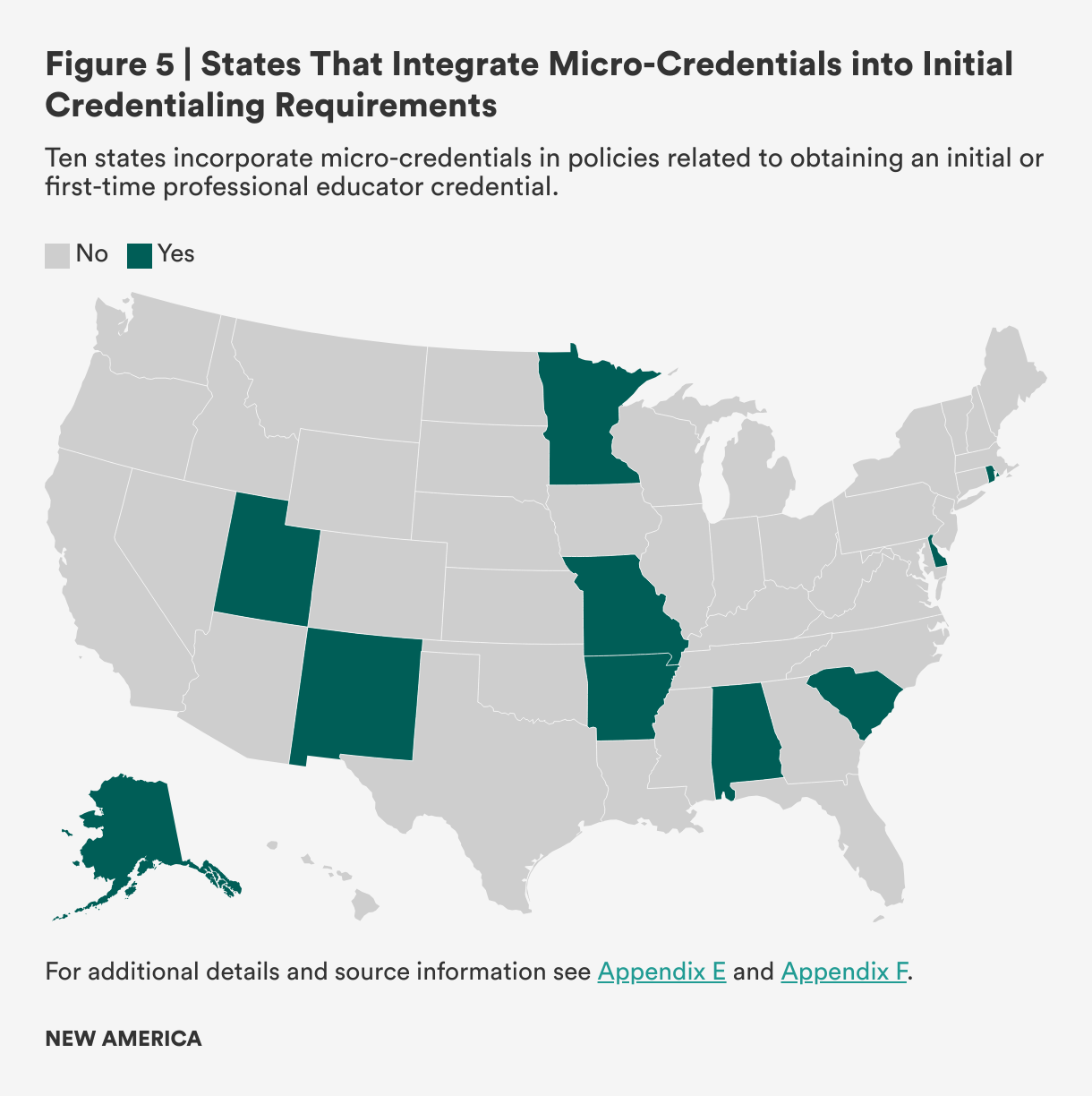
Ten states have policies explicitly allowing, encouraging, or requiring the use of micro-credentials for obtaining an initial or first-time professional educator credential: Alabama, Alaska, Arkansas, Delaware, Minnesota, Missouri, New Mexico, Rhode Island, South Carolina, and Utah (see Figure 5). Missouri is the only state with a statewide policy for initial credentialing of local administrators using micro-credentials.
States vary significantly in how explicitly and deeply micro-credentials are incorporated in their policies. South Carolina requires individuals who receive initial certification to teach through the Carolina Collaborative for Alternative Preparation pathway to complete micro-credentials to progress to the professional certificate, and the only avenue to earning an Initial Administrator Certificate for Special Education Director, Kindergarten-Grade 12 in Missouri is by completing approved micro-credentials. Alabama, Arkansas, and Delaware allow teachers with temporary certification to earn micro-credentials in lieu of passing a multiple-choice exam, although in limited circumstances; Vermont is expecting to implement a similar policy soon (see Appendix F for details). Minnesota embeds “stacks”29 of related micro-credentials into a pathway to earn a career and technical education teaching credential.
Rhode Island and Utah’s policies are more light touch, where micro-credentials are explicitly mentioned as an option but not encouraged. In Rhode Island, teachers with an initial credential must engage in professional learning to earn a professional credential, and state policy indicates that micro-credentials can count as professional learning. Utah mentions micro-credentials as one way that universities can have prospective educators demonstrate the competencies necessary to earn their credential, as well as any specific endorsement(s).
Curated Professional Development in State Priority Areas
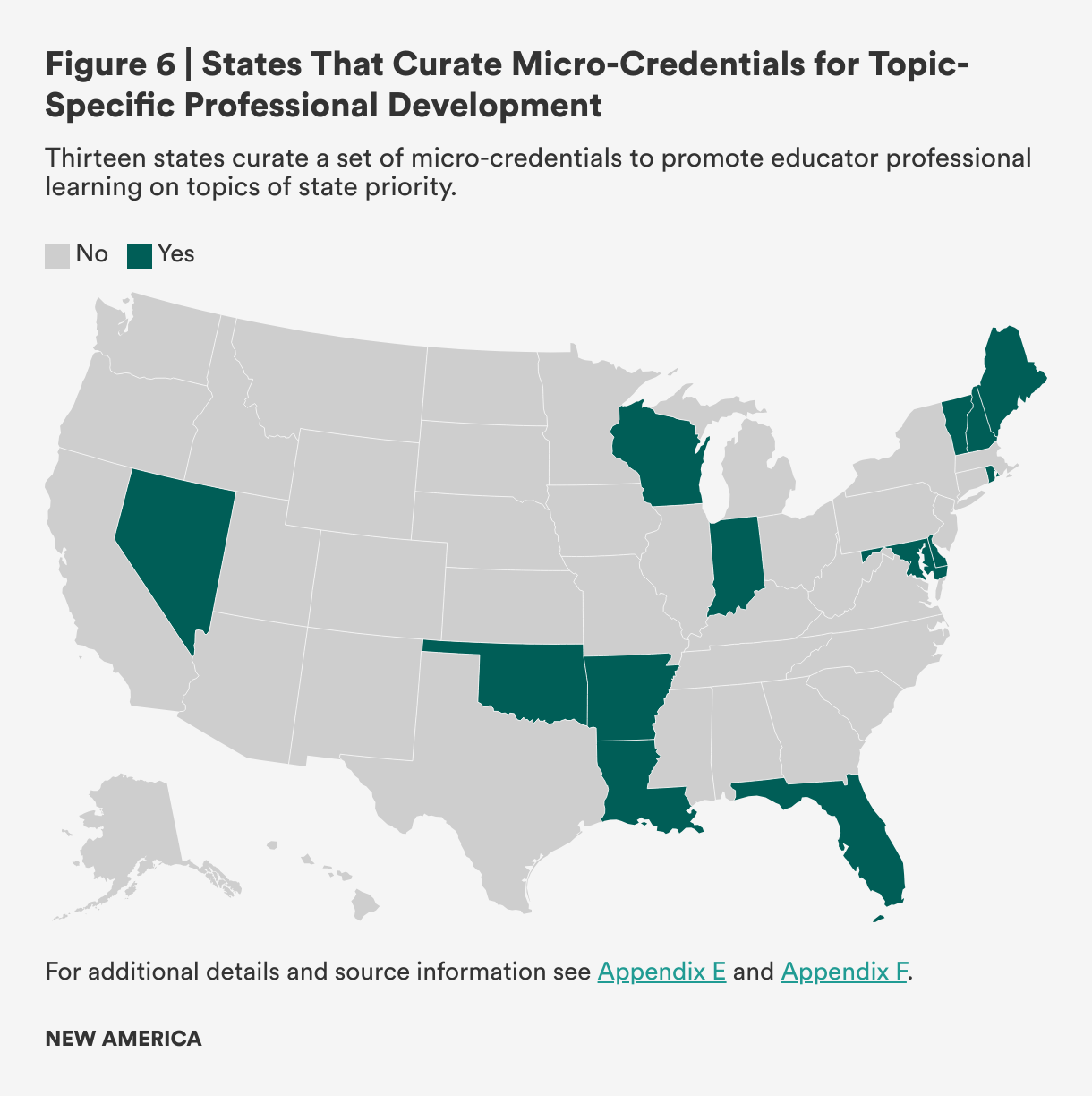
As shown in Figure 6, 13 states have curated educator micro-credentials to deliver training and promote professional learning on specific topics.30 Within the states offering this type of targeted professional development, the most prevalent focus areas are literacy (five states), educating students with disabilities (three states), computer science (two states), and educating English learners (two states). Because these professional learning opportunities are typically optional for educators but are priority areas for the states, most states are offering these at no cost to participants. Some states offer a stipend to educators completing these micro-credentials (Delaware, Florida, Maine, and Oklahoma) and/or explicitly offer credits toward relicensure (Delaware and Florida).
License Renewal
The most common way that states currently include micro-credentials in policy is by explicitly allowing educators to count them toward professional development requirements for license renewal. Among the 15 states with this type of policy (see Figure 7), there is wide variation, both in terms of which educator micro-credentials count toward relicensure credit and in how much credit educators receive for earning a micro-credential.
In many states, any micro-credential offered by a state-approved provider of professional development is eligible for relicensure credits, but Alaska provides a list of three specific entities whose micro-credentials are approved for this purpose, while Illinois vets each individual micro-credential offered by state-approved providers to determine which can count toward license renewal.
State license renewal requirement policies typically require educators to accrue a certain number of professional development credits (which hold various names and are measured in various ways) over a specified period of time. Some state policies say that micro-credentials are allowed but are silent about what value they hold in the state’s license renewal currency. Some states, such as Illinois, indicate that the same policy holds for all types of professional learning activities, typically where one clock hour of attendance is the equivalent of one professional development hour.
But a growing number of states assign a specific value in the state’s relicensure credit currency for each micro-credential as part of this process. Seven states—Delaware, Illinois, Maryland, Massachusetts, Missouri, Tennessee, and Wyoming—take this step to ensure that educators understand a micro-credential’s worth within state license renewal policy. In South Carolina, local education agencies (LEAs) have authority to determine how much value to give micro-credentials earned by their educators in the state’s relicensure currency, but the state department of education offers LEAs a recommendation. Massachusetts staff members acknowledge that individual micro-credentials are not all created equal, but they provide educators with a rough sense of what value to expect for earning them while differentiating their value in the state’s license renewal currency.
It is worth noting that in addition to the states with an explicit micro-credential policy for the purpose of license renewal, there are several additional states that implicitly allow their use by including entities that offer micro-credentials on their list of approved professional development providers. As a result, in many states educators can obtain license renewal credit by completing micro-credentials through the National Education Association’s Certification Bank, which the NEA offers to members and affiliate members at no cost.31
Additional Endorsements
Another way that states integrate micro-credentials into policy is by allowing educators to obtain endorsements in additional instructional areas via micro-credentials. Sometimes this solely entails a requirement to earn one or more stacks of complementary micro-credentials in a given subject area, as is the case with North Dakota’s computer science endorsement.32 Other times, in addition to earning one or more micro-credentials, educators must engage in additional activities, such as passing college-level courses and/or passing a state licensing exam, as is the case in the District of Columbia.33
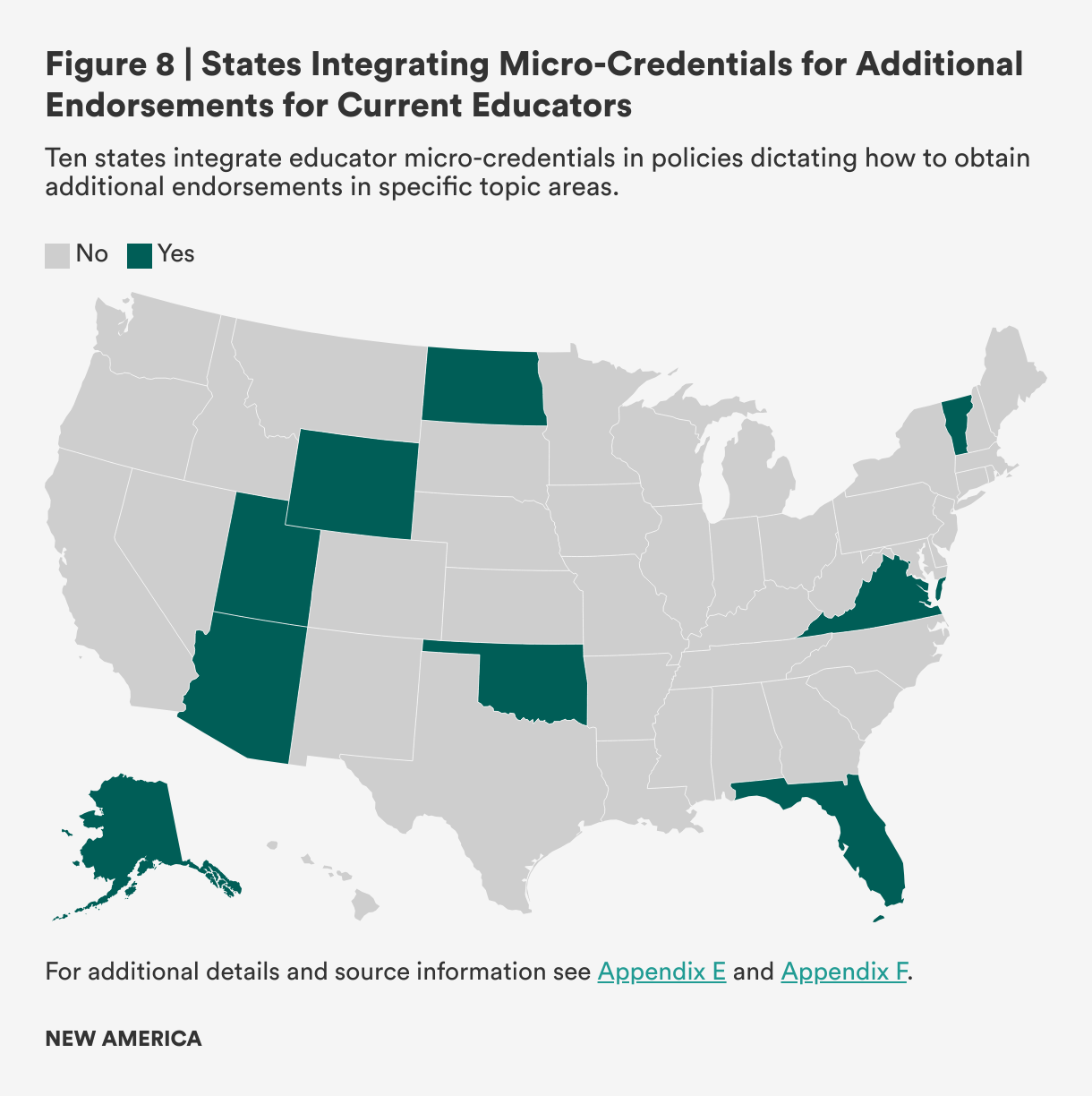
As shown in Figure 8, 10 states now allow at least some endorsements to be earned through micro-credentials. In three states—Alaska, Utah, and Wyoming—any additional endorsement can be earned through micro-credentials. In Arizona, micro-credentials are an option for earning a handful of different endorsements. In the remaining six—District of Columbia, Florida, North Dakota, Oklahoma, Vermont, and Virginia—micro-credentials are designated for use toward one or two specific endorsements, typically in shortage areas such as reading specialists, computer science, special education, and English for non-native speakers.
License Advancement
As Figure 9 shows, six states incorporate micro-credentials as part of policies governing the earning of an advanced license: Arkansas, Kentucky, Louisiana, Missouri, New Mexico, and Utah. The small number of states with this type of policy is likely because many states do not have clearly delineated licensure advancement pathways for educators, such as a separate license or endorsement to move from being a classroom teacher to a teacher leader.34
Citations
- Melissa Tooley and Joseph Hood, Harnessing Micro-Credentials for Teacher Growth: A National Review of Early Best Practices (New America, January 2021), <a href="<a href="<a href="source">source">source">source">source.
- Implicit state policies and related state efforts are noted under the “Miscellaneous” heading in Appendix F, but are not included in overall tallies.
- Melissa Tooley and Joseph Hood, Harnessing Micro-Credentials for Teacher Growth: A Model State Policy Guide (New America, January 2021), <a href="<a href="<a href="source">source">source">source">source.
- According to an analysis from the Learning Policy Institute, approximately 360,000 employed teachers across the nation are not fully certified for their teaching assignments. Further, when including vacancies, the authors estimated that over 400,000 teaching positions were either unfilled or filled by teachers not fully certified for their assignments, a total that represents approximately 1 in 8 teaching positions nationally. For more details see: Tiffany S. Tan, Ivett Arellano, and Susan Kemper Patrick, State Teacher Shortages 2024 Update: Teaching Positions Left Vacant or Filled by Teachers Without Full Certification (Learning Policy Institute, August 2024), <a href="<a href="source">source">source">source. Interest in becoming, and remaining, an educator has been declining for multiple reasons, including lack of on-the-job support, dissatisfaction with pay, and a dearth of career advancement opportunities. More than 200,000 teachers exit the profession each year, with one in four saying they did so to pursue other career opportunities. For more details see: Anne Podolsky, Tara Kini, Joseph Bishop, and Linda Darling-Hammond, Solving the Teacher Shortage: How to Attract and Retain Excellent Educators (Learning Policy Institute, September 2016), <a href="<a href="source">source">source">source.
- See results from Raj Chetty, John N. Friedman, and Jonah E. Rockoff, “Measuring the Impacts of Teachers II: Teacher Value-Added and Student Outcomes in Adulthood,” American Economic Review 104, no. 9, (May 2014): 2633–2679, <a href="<a href="source">source">source">source.
- Student achievement on the annual National Assessment of Educational Progress (NAEP) has declined post-COVID-19. For more details, see National Assessment Governing Board, “10 Takeaways from the Newly Released 2024 NAEP Results,” <a href="<a href="source">source">source">source.
- Lisa Bardach and Robert M. Klassen, “Smart Teachers, Successful Students? A Systematic Review of the Literature on Teachers’ Cognitive Abilities and Teacher Effectiveness,” Educational Research Review 30 (June 2020), <a href="<a href="source">source">source">source.
- With the exception of in-area graduate degrees (for example, a master’s degree in mathematics) for middle and high school math teachers, master’s degrees have little to no effect on teacher effectiveness. In fact, some research finds that “out-of-area” graduate degrees (school administration, counseling, curriculum specialist, etc.) are actually correlated with lower teacher effectiveness. See Kevin C. Bastian, “A Degree Above? The Value-Added Estimates and Evaluation Ratings of Teachers with a Graduate Degree,” Education Finance and Policy 14 (2019): 652–678, <a href="<a href="source">source">source">source; and Matthew M. Chingos and Paul E. Peterson, “It's Easier to Pick a Good Teacher than to Train One: Familiar and New Results on the Correlates of Teacher Effectiveness,” Economics of Education Review 30, no. 3 (2011): 449–465.
- For more details, see the Findings section in Melissa Tooley and Joseph Hood, Harnessing Micro-Credentials for Teacher Growth: A National Review of Early Best Practices (New America, January 2021), <a href="<a href="source">source">source">source.
- See question “JOBSATIS2 h” on p. 4 in Pew Research Center’s 2023 Survey of Teachers, April 2024, <a href="<a href="source">source">source">source.
- Melissa Tooley and Kaylan Connally, No Panacea: Diagnosing What Ails Teacher Professional Development Before Reaching for Remedies (New America, June 2016), <a href="<a href="source">source">source">source.
- An example of a more detailed cycle of inquiry process can be found in the Regional Educational Laboratory West’s infographic, Using Inquiry Cycles in PLCs to Improve Instruction, February 2019, <a href="<a href="source">source">source">source.
- Digital Promise, “Micro-Credentials for Me: Personal Stories from Real Teachers,” <a href="<a href="source">source">source">source.
- Melissa Tooley, “What Does High-Quality Research Say about Developing Teacher Practice?” EdCentral (blog), New America, March 16, 2017, <a href="<a href="source">source">source">source.
- Digital Promise, “Micro-Credentials for Me,” <a href="<a href="source">source">source">source; Stephen Sawchuk, “Can ‘Micro-Credentialing’ Salvage Teacher PD?” Ed Week, March 29, 2016, <a href="<a href="source">source">source">source; and Micro-credentials: Spurring Educator Engagement (Digital Promise, 2016), <a href="<a href="source">source">source">source.
- For more details, see Q4 of Melissa Tooley, “Everything You Wanted to Know About Educator Micro-Credentials: Fundamentals,” EdCentral (blog), New America, January 20, 2022, <a href="<a href="source">source">source">source.
- A common misconception about educator micro-credentials is that they are a type of direct teacher training rather than a credential. However, micro-credential offerings may be paired with resources for developing the specific competency they intend to measure, and high-quality micro-credential offerings always include relevant and evidence-based resources.
- Earners of micro-credentials are awarded a digital badge as proof of their accomplishment, but not all digital badges are obtained by earning micro-credentials. Digital badges can be awarded for something as simple as attending a conference training or completing a multiple-choice assessment, while earning high-quality micro-credentials requires successful application of the given competency. A 2015 survey of teachers by Digital Promise found that, of 19 distinct micro-credential benefits highlighted, teachers were least interested in displaying digital badges or sharing them on social media. See “Findings,” Tooley and Hood, Harnessing Micro-credentials for Teacher Growth: A National Review of Early Best Practices, <a href="<a href="source">source">source">source. For more details on digital badges, see Brittany Gooding, “Microcredentials vs. Open Badges: Navigating the Landscape of Digital Learning Recognition,” The Instructure Study Hall (blog), Instructure.com, August 16, 2023, <a href="<a href="source">source">source">source.
- Melissa Tooley and Joseph Hood, “The Process to Earn a Micro-Credential” (figure), Harnessing Micro-Credentials for Teacher Growth (New America, 2021), <a href="<a href="source">source">source">source.
- Tooley and Hood, Harnessing Micro-Credentials for Teacher Growth: A National Review of Early Best Practices, <a href="<a href="source">source">source">source.
- Melissa Tooley and Joseph Hood, Harnessing Micro-Credentials for Teacher Growth: A Model State Policy Guide, (New America, January 2021), <a href="<a href="source">source">source">source.
- For the purposes of this analysis, DC is counted as a state.
- Implicit state policies and related state efforts are noted under the “Miscellaneous” heading in Appendix F, but are not included in overall tallies.
- While some states, such as Delaware, define the term micro-credential in administrative code and offer clear criteria for micro-credentials on the state’s department of education website, many states do not. See Delaware Regulations, Administrative Code Title 14:1500, “1511 Continuing License,” <a href="source">source">source; and “What Are Micro-Credentials,” Delaware Department of Education, <a href="source">source">source.
- Even in states with no explicit policy, some local education agencies are opting to incorporate micro-credentials for educators in their approaches to professional learning and advancement.
- Because this research is focused on state policies—and because determining how many of the thousands of EPPs across the country are leveraging micro-credentials would be very difficult—a tally of individual EPPs using micro-credentials is not offered in this report. However, in a September 11, 2024, Zoom interview with the authors, Jason Lange, founder of BloomBoard, indicated that there are EPPs in nearly every state opting to use micro-credentials as part of their coursework. For example, Relay Graduate School of Education is approved in several states and relies heavily on micro-credentials in its curriculum. For more information, see Digital Promise, “Micro-Credentials: A Promising Way to Put Educators’ Skills Front and Center,” source.
- See Utah State Board of Education, “R277-304. Teacher Preparation Programs,” source. The Utah educator preparation program approval forms for both elementary and secondary programs can be found here: “Elementary 2025 El Ed and ECE EPP Competency Approval Template,” source; and “Secondary 2025 Secondary EPP Competency Approval Template,” source.
- Utah State Board of Education, Program Endorsement Review Approval Template for Universities, Utah State Board of Education Endorsement Review, source.
- A micro-credential stack is a collection of related micro-credentials organized around a theme. Completing a stack can provide the earner with a way to demonstrate a full skill set in a certain area or field and may lead to a broader credential. Examples of educator micro-credential stacks can be found at CarolinaCrED, Micro-credential Stacks, source.
- Curated professional development is typically offered for a subject the state perceives to add significant value to instruction (e.g., the science of reading, financial literacy, etc.). This training can be required or optional and it sometimes, but not always, leads to an endorsement (in which case it is also counted in the endorsement category) or credit for relicensure. It is different from state policy for license renewal credits because of its specificity: Whereas a state-created micro-credential about the science of reading may also be counted toward licensure credit, its development by a state does not necessarily indicate that the state has approved micro-credentials as a form of professional development that counts toward license renewal.
- In some states, a customized version of the NEA’s micro-credentials bank is provided by the relevant state affiliate, likely in order to meet the requirement that relicensure opportunities be offered by an approved provider. National Education Association, NEA Certification Bank (website), source.
- North Dakota Department of Public Instruction, “Computer Science and Cybersecurity Credentials,” source.
- District of Columbia, Office of the State Superintendent of Education, “Special Education Endorsement Recovery Initiative,” source.
- For examples, see Colleen McCann, Sasha Zuflacht, and Tierra Gilbert, The Decade-Plus Teaching Career: How to Retain Effective Teachers Through Teacher Leadership (Teach Plus, 2021), source; and Questions 12 and 13 in Adrienne Fischer, Ben Erwin, Damion Pechota, and Eric Syverson, 50-State Comparison: Teacher Recruitment and Retention (Education Commission of the States, December 1, 2022), source.
Comparison to 2020 Findings
As the number of states with educator policies or other initiatives that explicitly mention micro-credentials has increased from 26 to 32 over the past four years, the biggest upticks in adoption of educator micro-credentials have been in initial and first-time professional certification and overall professional learning, whether for curated professional development or license renewal.
Similar to our findings in 2020, states are concentrating their educator micro-credential policy efforts on the average current educator, rather than on preparing and credentialing new educators or vetting the most expert educators for advancement opportunities. Due to changes in our methodology (see Appendix D), exact comparisons of the individual ongoing professional learning and license renewal categories are not possible, but looking at ongoing professional learning and license renewal in combination shows a 35 percent increase in 2025 policies incorporating educator micro-credentials relative to 2020 (23 versus 17). Conducting an apples-to-apples comparison of license renewal policies using the 2020 methodology—where only states with policies specifying exactly what value micro-credentials have in the state’s relicensure currency were counted—the 2025 state policy tally would be eight,35 still more than double that of 2020.
However, the most growth in the use of micro-credential policies was in initial and first-time professional credentialing—from zero to 10 states—due to intensified state efforts to ensure that teachers with temporary credentials have a path to demonstrating their value and continuing in the profession. It will be important to follow these efforts, as prior New America research found that most novice teachers had difficulty successfully completing high-quality educator micro-credentials without additional support.36
While the state policy tally in categories such as additional endorsements have stayed relatively static, subtle shifts have been occurring that are not apparent from the totals alone. For example, while most states that incorporate micro-credentials for additional endorsements still only do so in one or two targeted shortage areas (similar to 2020 findings), three states—Alaska, Utah, and Wyoming—now have policies authorizing the use of micro-credentials within any state-approved pathway to earning additional endorsements, which no states did in 2020. That being said, none of these states have developed state-approved pathways for all endorsement areas that include micro-credentials.
Table 1 offers a side-by-side comparison of state educator micro-credential policies relative to 2020 for each of the six policy categories examined, as well as the total number of states with any policy.
Citations
- Melissa Tooley and Joseph Hood, Harnessing Micro-Credentials for Teacher Growth: A National Review of Early Best Practices (New America, January 2021), <a href="<a href="<a href="<a href="source">source">source">source">source">source.
- Implicit state policies and related state efforts are noted under the “Miscellaneous” heading in Appendix F, but are not included in overall tallies.
- Melissa Tooley and Joseph Hood, Harnessing Micro-Credentials for Teacher Growth: A Model State Policy Guide (New America, January 2021), <a href="<a href="<a href="<a href="source">source">source">source">source">source.
- According to an analysis from the Learning Policy Institute, approximately 360,000 employed teachers across the nation are not fully certified for their teaching assignments. Further, when including vacancies, the authors estimated that over 400,000 teaching positions were either unfilled or filled by teachers not fully certified for their assignments, a total that represents approximately 1 in 8 teaching positions nationally. For more details see: Tiffany S. Tan, Ivett Arellano, and Susan Kemper Patrick, State Teacher Shortages 2024 Update: Teaching Positions Left Vacant or Filled by Teachers Without Full Certification (Learning Policy Institute, August 2024), <a href="<a href="<a href="source">source">source">source">source. Interest in becoming, and remaining, an educator has been declining for multiple reasons, including lack of on-the-job support, dissatisfaction with pay, and a dearth of career advancement opportunities. More than 200,000 teachers exit the profession each year, with one in four saying they did so to pursue other career opportunities. For more details see: Anne Podolsky, Tara Kini, Joseph Bishop, and Linda Darling-Hammond, Solving the Teacher Shortage: How to Attract and Retain Excellent Educators (Learning Policy Institute, September 2016), <a href="<a href="<a href="source">source">source">source">source.
- See results from Raj Chetty, John N. Friedman, and Jonah E. Rockoff, “Measuring the Impacts of Teachers II: Teacher Value-Added and Student Outcomes in Adulthood,” American Economic Review 104, no. 9, (May 2014): 2633–2679, <a href="<a href="<a href="source">source">source">source">source.
- Student achievement on the annual National Assessment of Educational Progress (NAEP) has declined post-COVID-19. For more details, see National Assessment Governing Board, “10 Takeaways from the Newly Released 2024 NAEP Results,” <a href="<a href="<a href="source">source">source">source">source.
- Lisa Bardach and Robert M. Klassen, “Smart Teachers, Successful Students? A Systematic Review of the Literature on Teachers’ Cognitive Abilities and Teacher Effectiveness,” Educational Research Review 30 (June 2020), <a href="<a href="<a href="source">source">source">source">source.
- With the exception of in-area graduate degrees (for example, a master’s degree in mathematics) for middle and high school math teachers, master’s degrees have little to no effect on teacher effectiveness. In fact, some research finds that “out-of-area” graduate degrees (school administration, counseling, curriculum specialist, etc.) are actually correlated with lower teacher effectiveness. See Kevin C. Bastian, “A Degree Above? The Value-Added Estimates and Evaluation Ratings of Teachers with a Graduate Degree,” Education Finance and Policy 14 (2019): 652–678, <a href="<a href="<a href="source">source">source">source">source; and Matthew M. Chingos and Paul E. Peterson, “It's Easier to Pick a Good Teacher than to Train One: Familiar and New Results on the Correlates of Teacher Effectiveness,” Economics of Education Review 30, no. 3 (2011): 449–465.
- For more details, see the Findings section in Melissa Tooley and Joseph Hood, Harnessing Micro-Credentials for Teacher Growth: A National Review of Early Best Practices (New America, January 2021), <a href="<a href="<a href="source">source">source">source">source.
- See question “JOBSATIS2 h” on p. 4 in Pew Research Center’s 2023 Survey of Teachers, April 2024, <a href="<a href="<a href="source">source">source">source">source.
- Melissa Tooley and Kaylan Connally, No Panacea: Diagnosing What Ails Teacher Professional Development Before Reaching for Remedies (New America, June 2016), <a href="<a href="<a href="source">source">source">source">source.
- An example of a more detailed cycle of inquiry process can be found in the Regional Educational Laboratory West’s infographic, Using Inquiry Cycles in PLCs to Improve Instruction, February 2019, <a href="<a href="<a href="source">source">source">source">source.
- Digital Promise, “Micro-Credentials for Me: Personal Stories from Real Teachers,” <a href="<a href="<a href="source">source">source">source">source.
- Melissa Tooley, “What Does High-Quality Research Say about Developing Teacher Practice?” EdCentral (blog), New America, March 16, 2017, <a href="<a href="<a href="source">source">source">source">source.
- Digital Promise, “Micro-Credentials for Me,” <a href="<a href="<a href="source">source">source">source">source; Stephen Sawchuk, “Can ‘Micro-Credentialing’ Salvage Teacher PD?” Ed Week, March 29, 2016, <a href="<a href="<a href="source">source">source">source">source; and Micro-credentials: Spurring Educator Engagement (Digital Promise, 2016), <a href="<a href="<a href="source">source">source">source">source.
- For more details, see Q4 of Melissa Tooley, “Everything You Wanted to Know About Educator Micro-Credentials: Fundamentals,” EdCentral (blog), New America, January 20, 2022, <a href="<a href="<a href="source">source">source">source">source.
- A common misconception about educator micro-credentials is that they are a type of direct teacher training rather than a credential. However, micro-credential offerings may be paired with resources for developing the specific competency they intend to measure, and high-quality micro-credential offerings always include relevant and evidence-based resources.
- Earners of micro-credentials are awarded a digital badge as proof of their accomplishment, but not all digital badges are obtained by earning micro-credentials. Digital badges can be awarded for something as simple as attending a conference training or completing a multiple-choice assessment, while earning high-quality micro-credentials requires successful application of the given competency. A 2015 survey of teachers by Digital Promise found that, of 19 distinct micro-credential benefits highlighted, teachers were least interested in displaying digital badges or sharing them on social media. See “Findings,” Tooley and Hood, Harnessing Micro-credentials for Teacher Growth: A National Review of Early Best Practices, <a href="<a href="<a href="source">source">source">source">source. For more details on digital badges, see Brittany Gooding, “Microcredentials vs. Open Badges: Navigating the Landscape of Digital Learning Recognition,” The Instructure Study Hall (blog), Instructure.com, August 16, 2023, <a href="<a href="<a href="source">source">source">source">source.
- Melissa Tooley and Joseph Hood, “The Process to Earn a Micro-Credential” (figure), Harnessing Micro-Credentials for Teacher Growth (New America, 2021), <a href="<a href="<a href="source">source">source">source">source.
- Tooley and Hood, Harnessing Micro-Credentials for Teacher Growth: A National Review of Early Best Practices, <a href="<a href="<a href="source">source">source">source">source.
- Melissa Tooley and Joseph Hood, Harnessing Micro-Credentials for Teacher Growth: A Model State Policy Guide, (New America, January 2021), <a href="<a href="<a href="source">source">source">source">source.
- For the purposes of this analysis, DC is counted as a state.
- Implicit state policies and related state efforts are noted under the “Miscellaneous” heading in Appendix F, but are not included in overall tallies.
- While some states, such as Delaware, define the term micro-credential in administrative code and offer clear criteria for micro-credentials on the state’s department of education website, many states do not. See Delaware Regulations, Administrative Code Title 14:1500, “1511 Continuing License,” <a href="<a href="source">source">source">source; and “What Are Micro-Credentials,” Delaware Department of Education, <a href="<a href="source">source">source">source.
- Even in states with no explicit policy, some local education agencies are opting to incorporate micro-credentials for educators in their approaches to professional learning and advancement.
- Because this research is focused on state policies—and because determining how many of the thousands of EPPs across the country are leveraging micro-credentials would be very difficult—a tally of individual EPPs using micro-credentials is not offered in this report. However, in a September 11, 2024, Zoom interview with the authors, Jason Lange, founder of BloomBoard, indicated that there are EPPs in nearly every state opting to use micro-credentials as part of their coursework. For example, Relay Graduate School of Education is approved in several states and relies heavily on micro-credentials in its curriculum. For more information, see Digital Promise, “Micro-Credentials: A Promising Way to Put Educators’ Skills Front and Center,” source">source.
- See Utah State Board of Education, “R277-304. Teacher Preparation Programs,” source">source. The Utah educator preparation program approval forms for both elementary and secondary programs can be found here: “Elementary 2025 El Ed and ECE EPP Competency Approval Template,” source">source; and “Secondary 2025 Secondary EPP Competency Approval Template,” source">source.
- Utah State Board of Education, Program Endorsement Review Approval Template for Universities, Utah State Board of Education Endorsement Review, source">source.
- A micro-credential stack is a collection of related micro-credentials organized around a theme. Completing a stack can provide the earner with a way to demonstrate a full skill set in a certain area or field and may lead to a broader credential. Examples of educator micro-credential stacks can be found at CarolinaCrED, Micro-credential Stacks, source">source.
- Curated professional development is typically offered for a subject the state perceives to add significant value to instruction (e.g., the science of reading, financial literacy, etc.). This training can be required or optional and it sometimes, but not always, leads to an endorsement (in which case it is also counted in the endorsement category) or credit for relicensure. It is different from state policy for license renewal credits because of its specificity: Whereas a state-created micro-credential about the science of reading may also be counted toward licensure credit, its development by a state does not necessarily indicate that the state has approved micro-credentials as a form of professional development that counts toward license renewal.
- In some states, a customized version of the NEA’s micro-credentials bank is provided by the relevant state affiliate, likely in order to meet the requirement that relicensure opportunities be offered by an approved provider. National Education Association, NEA Certification Bank (website), source">source.
- North Dakota Department of Public Instruction, “Computer Science and Cybersecurity Credentials,” source">source.
- District of Columbia, Office of the State Superintendent of Education, “Special Education Endorsement Recovery Initiative,” source">source.
- For examples, see Colleen McCann, Sasha Zuflacht, and Tierra Gilbert, The Decade-Plus Teaching Career: How to Retain Effective Teachers Through Teacher Leadership (Teach Plus, 2021), source">source; and Questions 12 and 13 in Adrienne Fischer, Ben Erwin, Damion Pechota, and Eric Syverson, 50-State Comparison: Teacher Recruitment and Retention (Education Commission of the States, December 1, 2022), source">source.
- We are counting South Carolina’s suggested currency for micro-credentials in guidance to LEAs, which ultimately have authority to determine the value of professional learning experiences for license renewal, in this total.
- See Arkansas teacher induction example in “Importance of Iterative Implementation” section of Tooley and Hood, Harnessing Micro-Credentials for Teacher Growth: A National Review of Early Best Practices, source.
Discussion
New America’s national scan of state educator policies shows a moderate upswing in the number of states encouraging or allowing the use of something labeled as micro-credentials in at least one policy area. This tally rose despite our exclusion of states that have not provided funding for implementation of their laws authorizing educator micro-credential initiatives (such as Virginia and Texas), and of states which tacitly allow educators to use micro-credentials to satisfy license renewal requirements but have no policy explicitly stating this (such as in the District of Columbia and Pennsylvania) (see Appendix F for more details) Within the 32 states incorporating micro-credentials, just under half (14) are leveraging them across two or more educator policy areas, indicating that the depth of micro-credentials’ inclusion within states is increasing as well.
Furthermore, the number of states with these policies will likely soon increase further, as a handful of states are in the process of revisiting policies to incorporate micro-credentials or similar tools to encourage demonstration of teacher competency. For example, staff at the Idaho Department of Education shared plans to embed micro-credentials in the process for career and technical education teachers to make the mandatory progression from a temporary certificate to a professional certificate, and staff at the Vermont Agency of Education shared that the state’s Professional Standards Board has developed a draft policy which would allow teacher candidates who come close to passing the content area licensure exam to demonstrate competency in the content area through alternative means, including micro-credentials. Additionally, Alabama passed a law in 2024 requiring the State Superintendent of Education to establish a system for approving professional learning for teacher license renewal that incorporates micro-credentials, and Mississippi is adopting a professional learning approach that does not use the term micro-credential but nonetheless reflects many of the characteristics of high-quality micro-credential offerings.37
However, the educator policy landscape is still evolving with regards to micro-credentials, and most states are only dipping a toe in the water, rather than diving in. Many states initiate their policies as pilots and/or in a specific area of need, such as with Indiana’s pilot program to provide a small number of current educators with computer science training.38 And most states are not mandating the use of educator micro-credentials but offering them as one of several available options to meet a given policy’s requirements. This type of flexibility is nearly always the case for states’ initial certification and license renewal policies, which tend to provide educators with multiple options for fulfilling requirements, but is less likely for curated, topic-specific professional development opportunities, such as with Maryland’s science of reading micro-credential. This means that most educators engaging with micro-credentials are doing so voluntarily, and it is unclear how many are choosing to do so. To encourage uptake, a handful of states are offering micro-credentials at no cost to educators as an incentive, with a few even offering a stipend for completing micro-credentials on a topic deemed of importance to the state.
Additionally, even though more states have explicit policies for educator micro-credentials in every category analyzed than in 2020, a few states that had integrated micro-credentials at the time of our 2020 scan have since walked them back. For example, in Tennessee, pilot programs were not continued or scaled up, as priorities shifted with new state leadership and the onset of COVID-19. However, the state continues to use educator micro-credentials in other policy areas. And Washington state’s legislature passed a law prohibiting the state education agency from adopting or implementing educator micro-credential policies beyond its initial pilot before the pilot had concluded.39
That said, states’ increased interest in leveraging micro-credentials to reach their educator policy goals is generally a positive one, as it reflects a commitment to seek out innovative, high-potential approaches for developing, credentialing, and retaining talented educators who have the skills to meet students’ needs.
Yet it is not the micro-credential label that is critical for addressing the core challenges states face in strengthening their educator workforces. Instead what is most important is providing opportunities for educators to engage in a rigorous cycle of inquiry and to develop and apply competencies in a real-world setting. While not the focus of our research, there is little evidence that most states are putting sufficient guardrails in place to ensure the consistently high level of micro-credential quality necessary to improve teachers’ skills.
In fact, a closer look at some states’ micro-credential offerings indicates that they are more akin to completing a handful of online courses than they are a way to learn and practice relevant competencies within a specific school or classroom context. Online modules might be an appropriate way for states to ensure that every educator is exposed to and retains baseline information on a certain topic. But even if these modules require a multiple-choice assessment for completion, the results provide no insight into whether educators know how to apply any information learned in their work with students, whether they are attempting to do so, or how effectively they are doing so.
Without a vetted, trusted process for determining which micro-credential offerings are high quality, policymakers, schools, and educators alike remain in the dark about which ones are likely to add value to educators’ professional practice, and states will fail to harness the potential of micro-credentials for improving teaching and learning.40 The Micro-Credentials Partnership of States—convened by digiLEARN and RTI, and consisting of Arkansas, North Carolina, South Carolina, and Wyoming41—attempted to address this by developing quality assurance standards (QAS) for educator micro-credentials and an accompanying rubric for assessing micro-credentials against those standards in 2023.42 North Carolina has officially adopted the QAS rubric as its tool for determining which micro-credentials hold currency within state educator policies, and the other three states are also beginning to incorporate it as a micro-credential vetting tool.43 While the QAS tool holds promise, further validation and research of the rubric, and training for those using it, are needed to know whether it can reliably and fairly vet the quality of educator micro-credentials.
Additionally, without shifts in the design of state and local policies—for example, providing teachers with clear incentives for engaging with micro-credentials, such as more opportunities for career advancement and increased compensation that do not require moving into administration—states cannot harness some of the most powerful aspects of high-quality micro-credentials. For states to reap the positive potential impacts of micro-credentials on their educator workforces, they must first put systems and processes in place to ensure the quality of micro-credential offerings, and then ensure that policies are designed to incentivize educator engagement with them.
Citations
- Melissa Tooley and Joseph Hood, Harnessing Micro-Credentials for Teacher Growth: A National Review of Early Best Practices (New America, January 2021), <a href="<a href="<a href="<a href="<a href="source">source">source">source">source">source">source.
- Implicit state policies and related state efforts are noted under the “Miscellaneous” heading in Appendix F, but are not included in overall tallies.
- Melissa Tooley and Joseph Hood, Harnessing Micro-Credentials for Teacher Growth: A Model State Policy Guide (New America, January 2021), <a href="<a href="<a href="<a href="<a href="source">source">source">source">source">source">source.
- According to an analysis from the Learning Policy Institute, approximately 360,000 employed teachers across the nation are not fully certified for their teaching assignments. Further, when including vacancies, the authors estimated that over 400,000 teaching positions were either unfilled or filled by teachers not fully certified for their assignments, a total that represents approximately 1 in 8 teaching positions nationally. For more details see: Tiffany S. Tan, Ivett Arellano, and Susan Kemper Patrick, State Teacher Shortages 2024 Update: Teaching Positions Left Vacant or Filled by Teachers Without Full Certification (Learning Policy Institute, August 2024), <a href="<a href="<a href="<a href="source">source">source">source">source">source. Interest in becoming, and remaining, an educator has been declining for multiple reasons, including lack of on-the-job support, dissatisfaction with pay, and a dearth of career advancement opportunities. More than 200,000 teachers exit the profession each year, with one in four saying they did so to pursue other career opportunities. For more details see: Anne Podolsky, Tara Kini, Joseph Bishop, and Linda Darling-Hammond, Solving the Teacher Shortage: How to Attract and Retain Excellent Educators (Learning Policy Institute, September 2016), <a href="<a href="<a href="<a href="source">source">source">source">source">source.
- See results from Raj Chetty, John N. Friedman, and Jonah E. Rockoff, “Measuring the Impacts of Teachers II: Teacher Value-Added and Student Outcomes in Adulthood,” American Economic Review 104, no. 9, (May 2014): 2633–2679, <a href="<a href="<a href="<a href="source">source">source">source">source">source.
- Student achievement on the annual National Assessment of Educational Progress (NAEP) has declined post-COVID-19. For more details, see National Assessment Governing Board, “10 Takeaways from the Newly Released 2024 NAEP Results,” <a href="<a href="<a href="<a href="source">source">source">source">source">source.
- Lisa Bardach and Robert M. Klassen, “Smart Teachers, Successful Students? A Systematic Review of the Literature on Teachers’ Cognitive Abilities and Teacher Effectiveness,” Educational Research Review 30 (June 2020), <a href="<a href="<a href="<a href="source">source">source">source">source">source.
- With the exception of in-area graduate degrees (for example, a master’s degree in mathematics) for middle and high school math teachers, master’s degrees have little to no effect on teacher effectiveness. In fact, some research finds that “out-of-area” graduate degrees (school administration, counseling, curriculum specialist, etc.) are actually correlated with lower teacher effectiveness. See Kevin C. Bastian, “A Degree Above? The Value-Added Estimates and Evaluation Ratings of Teachers with a Graduate Degree,” Education Finance and Policy 14 (2019): 652–678, <a href="<a href="<a href="<a href="source">source">source">source">source">source; and Matthew M. Chingos and Paul E. Peterson, “It's Easier to Pick a Good Teacher than to Train One: Familiar and New Results on the Correlates of Teacher Effectiveness,” Economics of Education Review 30, no. 3 (2011): 449–465.
- For more details, see the Findings section in Melissa Tooley and Joseph Hood, Harnessing Micro-Credentials for Teacher Growth: A National Review of Early Best Practices (New America, January 2021), <a href="<a href="<a href="<a href="source">source">source">source">source">source.
- See question “JOBSATIS2 h” on p. 4 in Pew Research Center’s 2023 Survey of Teachers, April 2024, <a href="<a href="<a href="<a href="source">source">source">source">source">source.
- Melissa Tooley and Kaylan Connally, No Panacea: Diagnosing What Ails Teacher Professional Development Before Reaching for Remedies (New America, June 2016), <a href="<a href="<a href="<a href="source">source">source">source">source">source.
- An example of a more detailed cycle of inquiry process can be found in the Regional Educational Laboratory West’s infographic, Using Inquiry Cycles in PLCs to Improve Instruction, February 2019, <a href="<a href="<a href="<a href="source">source">source">source">source">source.
- Digital Promise, “Micro-Credentials for Me: Personal Stories from Real Teachers,” <a href="<a href="<a href="<a href="source">source">source">source">source">source.
- Melissa Tooley, “What Does High-Quality Research Say about Developing Teacher Practice?” EdCentral (blog), New America, March 16, 2017, <a href="<a href="<a href="<a href="source">source">source">source">source">source.
- Digital Promise, “Micro-Credentials for Me,” <a href="<a href="<a href="<a href="source">source">source">source">source">source; Stephen Sawchuk, “Can ‘Micro-Credentialing’ Salvage Teacher PD?” Ed Week, March 29, 2016, <a href="<a href="<a href="<a href="source">source">source">source">source">source; and Micro-credentials: Spurring Educator Engagement (Digital Promise, 2016), <a href="<a href="<a href="<a href="source">source">source">source">source">source.
- For more details, see Q4 of Melissa Tooley, “Everything You Wanted to Know About Educator Micro-Credentials: Fundamentals,” EdCentral (blog), New America, January 20, 2022, <a href="<a href="<a href="<a href="source">source">source">source">source">source.
- A common misconception about educator micro-credentials is that they are a type of direct teacher training rather than a credential. However, micro-credential offerings may be paired with resources for developing the specific competency they intend to measure, and high-quality micro-credential offerings always include relevant and evidence-based resources.
- Earners of micro-credentials are awarded a digital badge as proof of their accomplishment, but not all digital badges are obtained by earning micro-credentials. Digital badges can be awarded for something as simple as attending a conference training or completing a multiple-choice assessment, while earning high-quality micro-credentials requires successful application of the given competency. A 2015 survey of teachers by Digital Promise found that, of 19 distinct micro-credential benefits highlighted, teachers were least interested in displaying digital badges or sharing them on social media. See “Findings,” Tooley and Hood, Harnessing Micro-credentials for Teacher Growth: A National Review of Early Best Practices, <a href="<a href="<a href="<a href="source">source">source">source">source">source. For more details on digital badges, see Brittany Gooding, “Microcredentials vs. Open Badges: Navigating the Landscape of Digital Learning Recognition,” The Instructure Study Hall (blog), Instructure.com, August 16, 2023, <a href="<a href="<a href="<a href="source">source">source">source">source">source.
- Melissa Tooley and Joseph Hood, “The Process to Earn a Micro-Credential” (figure), Harnessing Micro-Credentials for Teacher Growth (New America, 2021), <a href="<a href="<a href="<a href="source">source">source">source">source">source.
- Tooley and Hood, Harnessing Micro-Credentials for Teacher Growth: A National Review of Early Best Practices, <a href="<a href="<a href="<a href="source">source">source">source">source">source.
- Melissa Tooley and Joseph Hood, Harnessing Micro-Credentials for Teacher Growth: A Model State Policy Guide, (New America, January 2021), <a href="<a href="<a href="<a href="source">source">source">source">source">source.
- For the purposes of this analysis, DC is counted as a state.
- Implicit state policies and related state efforts are noted under the “Miscellaneous” heading in Appendix F, but are not included in overall tallies.
- While some states, such as Delaware, define the term micro-credential in administrative code and offer clear criteria for micro-credentials on the state’s department of education website, many states do not. See Delaware Regulations, Administrative Code Title 14:1500, “1511 Continuing License,” <a href="<a href="<a href="source">source">source">source">source; and “What Are Micro-Credentials,” Delaware Department of Education, <a href="<a href="<a href="source">source">source">source">source.
- Even in states with no explicit policy, some local education agencies are opting to incorporate micro-credentials for educators in their approaches to professional learning and advancement.
- Because this research is focused on state policies—and because determining how many of the thousands of EPPs across the country are leveraging micro-credentials would be very difficult—a tally of individual EPPs using micro-credentials is not offered in this report. However, in a September 11, 2024, Zoom interview with the authors, Jason Lange, founder of BloomBoard, indicated that there are EPPs in nearly every state opting to use micro-credentials as part of their coursework. For example, Relay Graduate School of Education is approved in several states and relies heavily on micro-credentials in its curriculum. For more information, see Digital Promise, “Micro-Credentials: A Promising Way to Put Educators’ Skills Front and Center,” <a href="source">source">source.
- See Utah State Board of Education, “R277-304. Teacher Preparation Programs,” <a href="source">source">source. The Utah educator preparation program approval forms for both elementary and secondary programs can be found here: “Elementary 2025 El Ed and ECE EPP Competency Approval Template,” <a href="source">source">source; and “Secondary 2025 Secondary EPP Competency Approval Template,” <a href="source">source">source.
- Utah State Board of Education, Program Endorsement Review Approval Template for Universities, Utah State Board of Education Endorsement Review, <a href="source">source">source.
- A micro-credential stack is a collection of related micro-credentials organized around a theme. Completing a stack can provide the earner with a way to demonstrate a full skill set in a certain area or field and may lead to a broader credential. Examples of educator micro-credential stacks can be found at CarolinaCrED, Micro-credential Stacks, <a href="source">source">source.
- Curated professional development is typically offered for a subject the state perceives to add significant value to instruction (e.g., the science of reading, financial literacy, etc.). This training can be required or optional and it sometimes, but not always, leads to an endorsement (in which case it is also counted in the endorsement category) or credit for relicensure. It is different from state policy for license renewal credits because of its specificity: Whereas a state-created micro-credential about the science of reading may also be counted toward licensure credit, its development by a state does not necessarily indicate that the state has approved micro-credentials as a form of professional development that counts toward license renewal.
- In some states, a customized version of the NEA’s micro-credentials bank is provided by the relevant state affiliate, likely in order to meet the requirement that relicensure opportunities be offered by an approved provider. National Education Association, NEA Certification Bank (website), <a href="source">source">source.
- North Dakota Department of Public Instruction, “Computer Science and Cybersecurity Credentials,” <a href="source">source">source.
- District of Columbia, Office of the State Superintendent of Education, “Special Education Endorsement Recovery Initiative,” <a href="source">source">source.
- For examples, see Colleen McCann, Sasha Zuflacht, and Tierra Gilbert, The Decade-Plus Teaching Career: How to Retain Effective Teachers Through Teacher Leadership (Teach Plus, 2021), <a href="source">source">source; and Questions 12 and 13 in Adrienne Fischer, Ben Erwin, Damion Pechota, and Eric Syverson, 50-State Comparison: Teacher Recruitment and Retention (Education Commission of the States, December 1, 2022), <a href="source">source">source.
- We are counting South Carolina’s suggested currency for micro-credentials in guidance to LEAs, which ultimately have authority to determine the value of professional learning experiences for license renewal, in this total.
- See Arkansas teacher induction example in “Importance of Iterative Implementation” section of Tooley and Hood, Harnessing Micro-Credentials for Teacher Growth: A National Review of Early Best Practices, source">source.
- Corey Murphy (Mississippi associate state superintendent, Office of Teaching and Leading), email with Lisette Partelow and Melissa Tooley, December 9, 2024; and Kristi Enger (Idaho director of educator certification), email with Lisette Partelow and Melissa Tooley on December 16, 2024.
- Indiana’s State Department of Education partnered with BloomBoard to fund 39 educators in completing coursework to earn computer science micro-credentials to expand computer science learning opportunities for PreK–12 students. Educators can count their micro-credentials toward earning a master’s degree in Technology and Computer Science Education from a partnering higher education institution. See: Indiana Department of Education, “Computer Science,” source for additional detail.
- Washington State, “Certification of Enrollment, Engrossed Second Substitute House Bill 1139” (2019: p. 57), source.
- For more on the qualities of a high-quality micro-credential, see “Designing and Assessing Micro-credential Offerings” in Tooley and Hood, Harnessing Micro-Credentials for Teacher Growth: A National Review of Early Best Practices, source.
- Note that one of this report’s authors, Melissa Tooley, was an unpaid advisor on this work, along with several other experts. For more details on the partnership, see digiLEARN, “The Micro-Credentials Partnership of States,” source.
- H. Frank McKay, Teresa Webber, and W. Kyle Canuette, Operationalizing Micro-Credential Quality Assurance Standards (RTI International, June 2024), source; and Advancing Educator Effectiveness through Micro-Credential Quality Assurance Standards and Rubric: Tools for Assessing Micro-Credential Quality (digiLEARN, May 2024), source.
- Myra Best (executive director of digiLEARN), email correspondence with authors, April 9, 2025, and Brendan O’Connor (executive director of Wyoming Professional Teaching Standards Board), email correspondence with authors, April 10, 2025.
Conclusions and Recommendations
With smart policy design and implementation, high-quality micro-credentials offer states an innovative tool for improving the stability and capability of their educator workforces that models the type of personalized, competency-based learning they increasingly strive for with students.
For prospective and novice educators, high-quality micro-credentials offer a way to demonstrate skill-based readiness for the classroom to preparation and credentialing entities, as well as future employers, so states can remove unnecessary barriers to entering and remaining in the profession while maintaining high standards for student learning. For current educators, high-quality micro-credentials offer the ability to engage in relevant, active professional learning that helps them help their students, instead of one-size-fits-all workshops, as well as straightforward opportunities to showcase their skills to advance in their careers. For schools, they offer the prospect of more satisfied, more effective staff members and fewer vacancies. And for students and their families, high-quality micro-credentials help the educators leading their learning better support them in meeting their full potential.
In order for micro-credentials to produce these positive outcomes, states should consider six actions, which draw upon New America’s extensive prior research on educator micro-credentials.44
1. Develop a formal, rigorous, and transparent process for ensuring the quality of educator micro-credentials. Educators, LEAs, and policymakers must be confident that engaging in a given micro-credential is a valuable use of educators’ time, and that the attainment of a given micro-credential is an accurate indicator of an educator’s competency in that area. At the heart of quality lies a focus on learning and applying desired competencies in educators’ daily practice, rather than on coursework or seat time. Without this crucial foundation, the potential of micro-credentials to positively influence these aspects of the educator pipeline will be lost.
State spotlight: Illinois,45 North Carolina,46 and Wyoming47 are examples of states trying to explicitly define micro-credential quality and review potential micro-credential offerings relative to those standards before they can satisfy state policy.
2. Ensure that the design of educator policies involving micro-credentials, including any associated incentives, is clearly driven by the intended goal of the specific policy, and revisit policies that are not achieving their goals. For example, the primary objective of using micro-credentials for ongoing professional learning is to develop educators’ skill in their current roles, while the primary objective of using them for advancement is validating educators’ skills for entry into a new role. As a result, two different but complementary approaches to incentives and currency will be needed to effectively shift behavior, and support educator success.
State spotlight: As an early adopter of educator micro-credentials, Arkansas currently incorporates them in four different policy areas and has designed each policy to reflect its specific goals (e.g., for professional learning vs. advancement).
3. Communicate with educators clearly—and repeatedly—about what high-quality micro-credentials are and how they can help them and the students they serve. The existence of a policy does not necessarily translate into uptake of a policy. To be motivated to earn micro-credentials, educators need to understand the distinction between the micro-credential itself (which, like any other credential, is what is earned upon completion of the required activity) and the process they will engage in to earn it (which should reflect the best evidence and practices on adult learning), as well as the benefits they and their students stand to reap from each of these. It is also important to clarify the difference between micro-credentials and digital badges, which some educators perceive as meaningless, or even faddish.48
State spotlight: Arkansas,49 Delaware,50 and Utah51 each host websites explaining to educators what micro-credentials are and reasons to explore them.
4. Curate high-quality micro-credential offerings to align with educators’ and students’ learning needs. Educators should have some discretion in choosing what professional learning and/or advancement opportunities to pursue based on their own interests and goals. However, states should help guide these choices by providing educators with a set of high-quality options likely to help them, and in turn their students. Rather than putting the onus on educators and their LEAs to locate a relevant micro-credential and submit it to the state for vetting, states should consider proactively curating a discrete set of vetted high-quality micro-credentials for educators to choose from, at least in the initial rollout. In addition to promoting more consistent micro-credential quality, this focused approach will allow schools, LEAs, and regional educational service agencies to better support educators throughout the micro-credentialing process and enable educators to collaborate on micro-credentials to meet common individual and school goals.
State spotlight: Illinois52 and Nevada53 provide curated lists of the micro-credentials that educators can engage with to satisfy state license renewal policy requirements.
5. Provide local education leaders the training necessary to support educators in successfully earning high-quality micro-credentials. Most educators do not have experience with the type of applied learning that high-quality micro-credentials call for, including local education leaders. Without professional learning supports, educators who attempt to earn high-quality micro-credentials might not succeed in doing so, leaving the full potential of this tool untapped and making educators hesitant to engage with them in the future. Local leaders will need assistance with thinking through how to make shifts in their schools that can support educators in earning micro-credentials that ultimately benefit students. For example, leaders can help ensure that instructional coaching and curricular materials reinforce the evidence-based practices and applied learning that educators are being asked to demonstrate to earn high-quality micro-credentials.
State spotlight: While this research did not attempt to assess this aspect of policy implementation, states such as Wyoming54 have produced materials that reflect the need for incentives and support for educators to choose to engage with micro-credentials.
6. Deploy data to better understand and harness educator micro-credential potential. Data are key, whether they are being used to assess stakeholders’ experience with micro-credentials or evaluate the relationship between earned micro-credentials and changes in instructional practice or student achievement. Without data, policymakers will have difficulty assessing whether their micro-credential policies are on track to meet their goals or how to adjust policy design and/or implementation if not on track.
State spotlight: Arkansas and Tennessee are two early adopter states that relied on data from pilots to make revisions to their educator micro-credential policy efforts.55
For more insights on designing effective state policy with educator micro-credentials, see New America’s Harnessing Micro-Credentials for Teacher Growth: Model State Policy Guide.56
Citations
- Melissa Tooley and Joseph Hood, Harnessing Micro-Credentials for Teacher Growth: A National Review of Early Best Practices (New America, January 2021), <a href="<a href="<a href="<a href="<a href="<a href="source">source">source">source">source">source">source">source.
- Implicit state policies and related state efforts are noted under the “Miscellaneous” heading in Appendix F, but are not included in overall tallies.
- Melissa Tooley and Joseph Hood, Harnessing Micro-Credentials for Teacher Growth: A Model State Policy Guide (New America, January 2021), <a href="<a href="<a href="<a href="<a href="<a href="source">source">source">source">source">source">source">source.
- According to an analysis from the Learning Policy Institute, approximately 360,000 employed teachers across the nation are not fully certified for their teaching assignments. Further, when including vacancies, the authors estimated that over 400,000 teaching positions were either unfilled or filled by teachers not fully certified for their assignments, a total that represents approximately 1 in 8 teaching positions nationally. For more details see: Tiffany S. Tan, Ivett Arellano, and Susan Kemper Patrick, State Teacher Shortages 2024 Update: Teaching Positions Left Vacant or Filled by Teachers Without Full Certification (Learning Policy Institute, August 2024), <a href="<a href="<a href="<a href="<a href="source">source">source">source">source">source">source. Interest in becoming, and remaining, an educator has been declining for multiple reasons, including lack of on-the-job support, dissatisfaction with pay, and a dearth of career advancement opportunities. More than 200,000 teachers exit the profession each year, with one in four saying they did so to pursue other career opportunities. For more details see: Anne Podolsky, Tara Kini, Joseph Bishop, and Linda Darling-Hammond, Solving the Teacher Shortage: How to Attract and Retain Excellent Educators (Learning Policy Institute, September 2016), <a href="<a href="<a href="<a href="<a href="source">source">source">source">source">source">source.
- See results from Raj Chetty, John N. Friedman, and Jonah E. Rockoff, “Measuring the Impacts of Teachers II: Teacher Value-Added and Student Outcomes in Adulthood,” American Economic Review 104, no. 9, (May 2014): 2633–2679, <a href="<a href="<a href="<a href="<a href="source">source">source">source">source">source">source.
- Student achievement on the annual National Assessment of Educational Progress (NAEP) has declined post-COVID-19. For more details, see National Assessment Governing Board, “10 Takeaways from the Newly Released 2024 NAEP Results,” <a href="<a href="<a href="<a href="<a href="source">source">source">source">source">source">source.
- Lisa Bardach and Robert M. Klassen, “Smart Teachers, Successful Students? A Systematic Review of the Literature on Teachers’ Cognitive Abilities and Teacher Effectiveness,” Educational Research Review 30 (June 2020), <a href="<a href="<a href="<a href="<a href="source">source">source">source">source">source">source.
- With the exception of in-area graduate degrees (for example, a master’s degree in mathematics) for middle and high school math teachers, master’s degrees have little to no effect on teacher effectiveness. In fact, some research finds that “out-of-area” graduate degrees (school administration, counseling, curriculum specialist, etc.) are actually correlated with lower teacher effectiveness. See Kevin C. Bastian, “A Degree Above? The Value-Added Estimates and Evaluation Ratings of Teachers with a Graduate Degree,” Education Finance and Policy 14 (2019): 652–678, <a href="<a href="<a href="<a href="<a href="source">source">source">source">source">source">source; and Matthew M. Chingos and Paul E. Peterson, “It's Easier to Pick a Good Teacher than to Train One: Familiar and New Results on the Correlates of Teacher Effectiveness,” Economics of Education Review 30, no. 3 (2011): 449–465.
- For more details, see the Findings section in Melissa Tooley and Joseph Hood, Harnessing Micro-Credentials for Teacher Growth: A National Review of Early Best Practices (New America, January 2021), <a href="<a href="<a href="<a href="<a href="source">source">source">source">source">source">source.
- See question “JOBSATIS2 h” on p. 4 in Pew Research Center’s 2023 Survey of Teachers, April 2024, <a href="<a href="<a href="<a href="<a href="source">source">source">source">source">source">source.
- Melissa Tooley and Kaylan Connally, No Panacea: Diagnosing What Ails Teacher Professional Development Before Reaching for Remedies (New America, June 2016), <a href="<a href="<a href="<a href="<a href="source">source">source">source">source">source">source.
- An example of a more detailed cycle of inquiry process can be found in the Regional Educational Laboratory West’s infographic, Using Inquiry Cycles in PLCs to Improve Instruction, February 2019, <a href="<a href="<a href="<a href="<a href="source">source">source">source">source">source">source.
- Digital Promise, “Micro-Credentials for Me: Personal Stories from Real Teachers,” <a href="<a href="<a href="<a href="<a href="source">source">source">source">source">source">source.
- Melissa Tooley, “What Does High-Quality Research Say about Developing Teacher Practice?” EdCentral (blog), New America, March 16, 2017, <a href="<a href="<a href="<a href="<a href="source">source">source">source">source">source">source.
- Digital Promise, “Micro-Credentials for Me,” <a href="<a href="<a href="<a href="<a href="source">source">source">source">source">source">source; Stephen Sawchuk, “Can ‘Micro-Credentialing’ Salvage Teacher PD?” Ed Week, March 29, 2016, <a href="<a href="<a href="<a href="<a href="source">source">source">source">source">source">source; and Micro-credentials: Spurring Educator Engagement (Digital Promise, 2016), <a href="<a href="<a href="<a href="<a href="source">source">source">source">source">source">source.
- For more details, see Q4 of Melissa Tooley, “Everything You Wanted to Know About Educator Micro-Credentials: Fundamentals,” EdCentral (blog), New America, January 20, 2022, <a href="<a href="<a href="<a href="<a href="source">source">source">source">source">source">source.
- A common misconception about educator micro-credentials is that they are a type of direct teacher training rather than a credential. However, micro-credential offerings may be paired with resources for developing the specific competency they intend to measure, and high-quality micro-credential offerings always include relevant and evidence-based resources.
- Earners of micro-credentials are awarded a digital badge as proof of their accomplishment, but not all digital badges are obtained by earning micro-credentials. Digital badges can be awarded for something as simple as attending a conference training or completing a multiple-choice assessment, while earning high-quality micro-credentials requires successful application of the given competency. A 2015 survey of teachers by Digital Promise found that, of 19 distinct micro-credential benefits highlighted, teachers were least interested in displaying digital badges or sharing them on social media. See “Findings,” Tooley and Hood, Harnessing Micro-credentials for Teacher Growth: A National Review of Early Best Practices, <a href="<a href="<a href="<a href="<a href="source">source">source">source">source">source">source. For more details on digital badges, see Brittany Gooding, “Microcredentials vs. Open Badges: Navigating the Landscape of Digital Learning Recognition,” The Instructure Study Hall (blog), Instructure.com, August 16, 2023, <a href="<a href="<a href="<a href="<a href="source">source">source">source">source">source">source.
- Melissa Tooley and Joseph Hood, “The Process to Earn a Micro-Credential” (figure), Harnessing Micro-Credentials for Teacher Growth (New America, 2021), <a href="<a href="<a href="<a href="<a href="source">source">source">source">source">source">source.
- Tooley and Hood, Harnessing Micro-Credentials for Teacher Growth: A National Review of Early Best Practices, <a href="<a href="<a href="<a href="<a href="source">source">source">source">source">source">source.
- Melissa Tooley and Joseph Hood, Harnessing Micro-Credentials for Teacher Growth: A Model State Policy Guide, (New America, January 2021), <a href="<a href="<a href="<a href="<a href="source">source">source">source">source">source">source.
- For the purposes of this analysis, DC is counted as a state.
- Implicit state policies and related state efforts are noted under the “Miscellaneous” heading in Appendix F, but are not included in overall tallies.
- While some states, such as Delaware, define the term micro-credential in administrative code and offer clear criteria for micro-credentials on the state’s department of education website, many states do not. See Delaware Regulations, Administrative Code Title 14:1500, “1511 Continuing License,” <a href="<a href="<a href="<a href="source">source">source">source">source">source; and “What Are Micro-Credentials,” Delaware Department of Education, <a href="<a href="<a href="<a href="source">source">source">source">source">source.
- Even in states with no explicit policy, some local education agencies are opting to incorporate micro-credentials for educators in their approaches to professional learning and advancement.
- Because this research is focused on state policies—and because determining how many of the thousands of EPPs across the country are leveraging micro-credentials would be very difficult—a tally of individual EPPs using micro-credentials is not offered in this report. However, in a September 11, 2024, Zoom interview with the authors, Jason Lange, founder of BloomBoard, indicated that there are EPPs in nearly every state opting to use micro-credentials as part of their coursework. For example, Relay Graduate School of Education is approved in several states and relies heavily on micro-credentials in its curriculum. For more information, see Digital Promise, “Micro-Credentials: A Promising Way to Put Educators’ Skills Front and Center,” <a href="<a href="source">source">source">source.
- See Utah State Board of Education, “R277-304. Teacher Preparation Programs,” <a href="<a href="source">source">source">source. The Utah educator preparation program approval forms for both elementary and secondary programs can be found here: “Elementary 2025 El Ed and ECE EPP Competency Approval Template,” <a href="<a href="source">source">source">source; and “Secondary 2025 Secondary EPP Competency Approval Template,” <a href="<a href="source">source">source">source.
- Utah State Board of Education, Program Endorsement Review Approval Template for Universities, Utah State Board of Education Endorsement Review, <a href="<a href="source">source">source">source.
- A micro-credential stack is a collection of related micro-credentials organized around a theme. Completing a stack can provide the earner with a way to demonstrate a full skill set in a certain area or field and may lead to a broader credential. Examples of educator micro-credential stacks can be found at CarolinaCrED, Micro-credential Stacks, <a href="<a href="source">source">source">source.
- Curated professional development is typically offered for a subject the state perceives to add significant value to instruction (e.g., the science of reading, financial literacy, etc.). This training can be required or optional and it sometimes, but not always, leads to an endorsement (in which case it is also counted in the endorsement category) or credit for relicensure. It is different from state policy for license renewal credits because of its specificity: Whereas a state-created micro-credential about the science of reading may also be counted toward licensure credit, its development by a state does not necessarily indicate that the state has approved micro-credentials as a form of professional development that counts toward license renewal.
- In some states, a customized version of the NEA’s micro-credentials bank is provided by the relevant state affiliate, likely in order to meet the requirement that relicensure opportunities be offered by an approved provider. National Education Association, NEA Certification Bank (website), <a href="<a href="source">source">source">source.
- North Dakota Department of Public Instruction, “Computer Science and Cybersecurity Credentials,” <a href="<a href="source">source">source">source.
- District of Columbia, Office of the State Superintendent of Education, “Special Education Endorsement Recovery Initiative,” <a href="<a href="source">source">source">source.
- For examples, see Colleen McCann, Sasha Zuflacht, and Tierra Gilbert, The Decade-Plus Teaching Career: How to Retain Effective Teachers Through Teacher Leadership (Teach Plus, 2021), <a href="<a href="source">source">source">source; and Questions 12 and 13 in Adrienne Fischer, Ben Erwin, Damion Pechota, and Eric Syverson, 50-State Comparison: Teacher Recruitment and Retention (Education Commission of the States, December 1, 2022), <a href="<a href="source">source">source">source.
- We are counting South Carolina’s suggested currency for micro-credentials in guidance to LEAs, which ultimately have authority to determine the value of professional learning experiences for license renewal, in this total.
- See Arkansas teacher induction example in “Importance of Iterative Implementation” section of Tooley and Hood, Harnessing Micro-Credentials for Teacher Growth: A National Review of Early Best Practices, <a href="source">source">source.
- Corey Murphy (Mississippi associate state superintendent, Office of Teaching and Leading), email with Lisette Partelow and Melissa Tooley, December 9, 2024; and Kristi Enger (Idaho director of educator certification), email with Lisette Partelow and Melissa Tooley on December 16, 2024.
- Indiana’s State Department of Education partnered with BloomBoard to fund 39 educators in completing coursework to earn computer science micro-credentials to expand computer science learning opportunities for PreK–12 students. Educators can count their micro-credentials toward earning a master’s degree in Technology and Computer Science Education from a partnering higher education institution. See: Indiana Department of Education, “Computer Science,” source">source for additional detail.
- Washington State, “Certification of Enrollment, Engrossed Second Substitute House Bill 1139” (2019: p. 57), source">source.
- For more on the qualities of a high-quality micro-credential, see “Designing and Assessing Micro-credential Offerings” in Tooley and Hood, Harnessing Micro-Credentials for Teacher Growth: A National Review of Early Best Practices, source">source.
- Note that one of this report’s authors, Melissa Tooley, was an unpaid advisor on this work, along with several other experts. For more details on the partnership, see digiLEARN, “The Micro-Credentials Partnership of States,” source">source.
- H. Frank McKay, Teresa Webber, and W. Kyle Canuette, Operationalizing Micro-Credential Quality Assurance Standards (RTI International, June 2024), source">source; and Advancing Educator Effectiveness through Micro-Credential Quality Assurance Standards and Rubric: Tools for Assessing Micro-Credential Quality (digiLEARN, May 2024), source">source.
- Myra Best (executive director of digiLEARN), email correspondence with authors, April 9, 2025, and Brendan O’Connor (executive director of Wyoming Professional Teaching Standards Board), email correspondence with authors, April 10, 2025.
- These recommendations are adapted and updated from Tooley and Hood, Harnessing Micro-Credentials for Teacher Growth: A National Review of Early Best Practices, source; and Tooley and Hood, Harnessing Micro-Credentials for Teacher Growth: A Model State Policy Guide, source.
- In Illinois, professional development providers seeking to offer micro-credentials must submit documentation that their course is aligned with the state’s rubric, which includes evaluation of the micro-credential’s design, alignment to the state teaching and learning standards, and the process for evaluation and evidence submission, according to the Illinois State Board of Education, “Illinois Educator Microcredential Framework,” source.
- In fall 2024, North Carolina’s State Board of Education officially authorized the use of the Quality Assurance Standards (QAS) for LEAs to vet which micro-credentials educators can count toward relicensure requirements, and the Department of Public Instruction is currently working to use the QAS and associated rubric to develop educator micro-credentials for AI, digital data privacy, and integration of digital learning standards into curriculum (per email correspondence with Myra Best, digiLEARN’s executive director, on April 8, 2025).
- Wyoming’s administrative rules specify aspects of quality control for educator micro-credentials; see Program Approval Standards for Endorsement Areas, Wyoming Professional Teaching Standards Board, source.
- Earners of micro-credentials are awarded a digital badge as proof of their accomplishment, but not all digital badges are obtained by earning micro-credentials. Digital badges can be awarded for something as simple as attending a conference training or completing a multiple-choice assessment, while earning high-quality micro-credentials requires successful application of the given competency. A 2015 survey of teachers by Digital Promise found that, of 19 distinct micro-credential benefits highlighted, teachers were least interested in displaying digital badges or sharing them on social media. See “Findings,” Tooley and Hood, source. Additional educator perspective on digital badges was gleaned from RTI’s NC Feasibility Study Report to the North Carolina Partnership for Micro-Credentials and “Micro-Credential Focus Group: Emerging Framing Ideas” (prepared for digiLEARN, unpublished, November 2020).
- Arkansas Department of Education, Division of Elementary & Secondary Education, “Professional Learning Through Micro-Credentials,” source.
- Delaware Department of Education, “About DDOE Micro-Credential Programs,” source.
- Utah State Board of Education and The Utah Education Network, “Move Your Professional Learning Forward,” source.
- See Illinois State Board of Education list of approved micro-credentials on its “Professional Learning” page, by expanding the second accordion menu at the bottom of the page, “List of ISBE-Approved Microcredentials,” source.
- The Nevada Department of Education offers 50 micro-credentials on its “Nevada Professional Learning” page, source.
- The Wyoming Department of Education has published the Wyoming Digital Learning Plan, which discusses how districts and schools can “provide incentives and/or support for educators to receive licensure, certifications, and micro-credentials for digital learning." See Wyoming Department of Education, Wyoming Digital Learning Plan: 2023–2028, source.
- Arkansas initially used micro-credentials as part of its teacher induction program for beginning teachers and Tennessee had a pilot that used micro-credentials for relicensure. See Jenny DeMonte, Micro-Credentials for Teachers: What Three Early Adopter States Have Learned So Far (American Institutes for Research, 2017), source; and Tooley and Hood, Harnessing Micro-Credentials for Teacher Growth: A National Review of Early Best Practices, source.
- Tooley and Hood, source.
Appendix A: Understanding the High-Quality Micro-Credentialing Process and Ecosystem
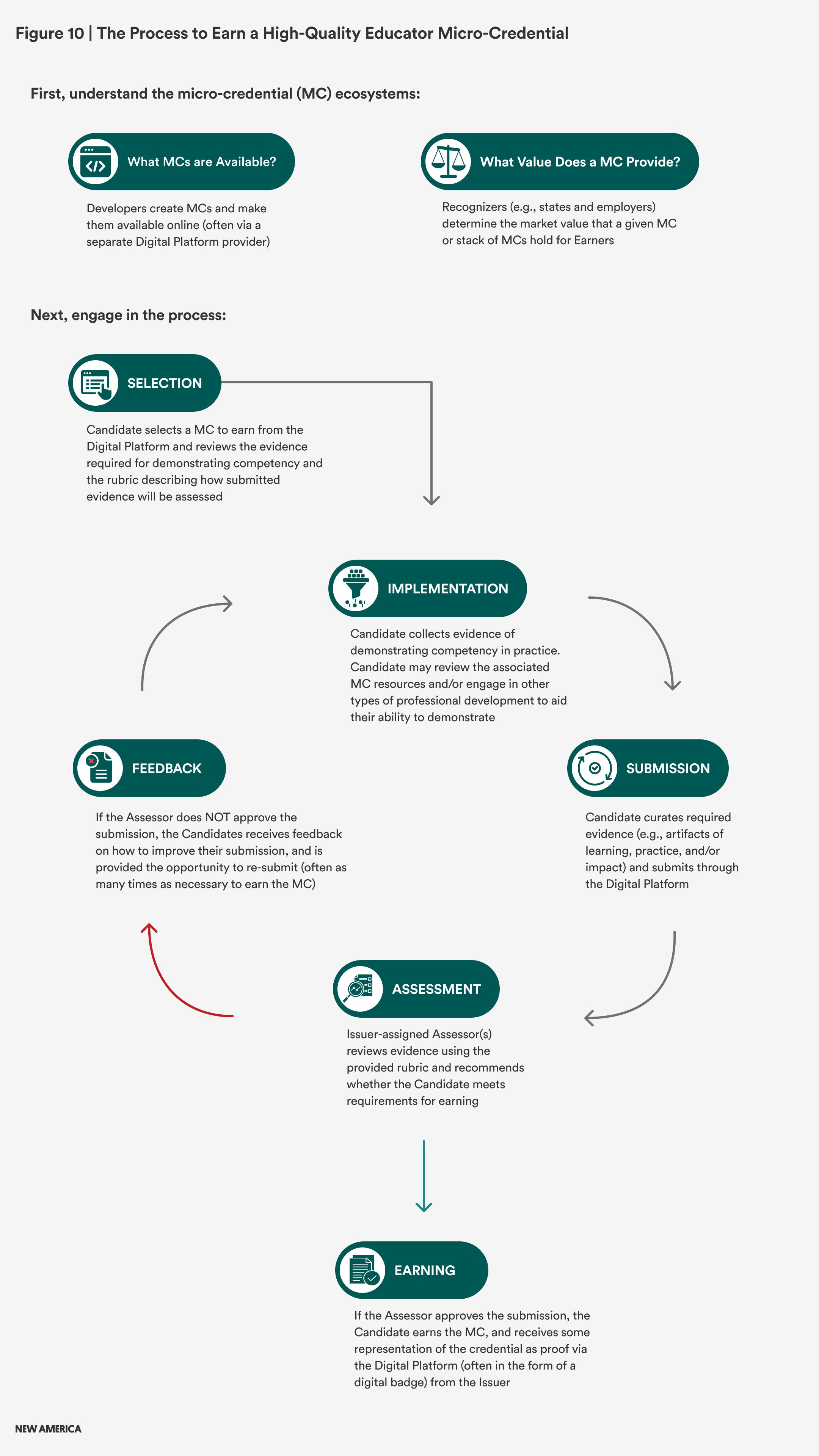
Citations
- Melissa Tooley and Joseph Hood, Harnessing Micro-Credentials for Teacher Growth: A National Review of Early Best Practices (New America, January 2021), <a href="<a href="<a href="<a href="<a href="<a href="<a href="source">source">source">source">source">source">source">source">source.
- Implicit state policies and related state efforts are noted under the “Miscellaneous” heading in Appendix F, but are not included in overall tallies.
- Melissa Tooley and Joseph Hood, Harnessing Micro-Credentials for Teacher Growth: A Model State Policy Guide (New America, January 2021), <a href="<a href="<a href="<a href="<a href="<a href="<a href="source">source">source">source">source">source">source">source">source.
- According to an analysis from the Learning Policy Institute, approximately 360,000 employed teachers across the nation are not fully certified for their teaching assignments. Further, when including vacancies, the authors estimated that over 400,000 teaching positions were either unfilled or filled by teachers not fully certified for their assignments, a total that represents approximately 1 in 8 teaching positions nationally. For more details see: Tiffany S. Tan, Ivett Arellano, and Susan Kemper Patrick, State Teacher Shortages 2024 Update: Teaching Positions Left Vacant or Filled by Teachers Without Full Certification (Learning Policy Institute, August 2024), <a href="<a href="<a href="<a href="<a href="<a href="source">source">source">source">source">source">source">source. Interest in becoming, and remaining, an educator has been declining for multiple reasons, including lack of on-the-job support, dissatisfaction with pay, and a dearth of career advancement opportunities. More than 200,000 teachers exit the profession each year, with one in four saying they did so to pursue other career opportunities. For more details see: Anne Podolsky, Tara Kini, Joseph Bishop, and Linda Darling-Hammond, Solving the Teacher Shortage: How to Attract and Retain Excellent Educators (Learning Policy Institute, September 2016), <a href="<a href="<a href="<a href="<a href="<a href="source">source">source">source">source">source">source">source.
- See results from Raj Chetty, John N. Friedman, and Jonah E. Rockoff, “Measuring the Impacts of Teachers II: Teacher Value-Added and Student Outcomes in Adulthood,” American Economic Review 104, no. 9, (May 2014): 2633–2679, <a href="<a href="<a href="<a href="<a href="<a href="source">source">source">source">source">source">source">source.
- Student achievement on the annual National Assessment of Educational Progress (NAEP) has declined post-COVID-19. For more details, see National Assessment Governing Board, “10 Takeaways from the Newly Released 2024 NAEP Results,” <a href="<a href="<a href="<a href="<a href="<a href="source">source">source">source">source">source">source">source.
- Lisa Bardach and Robert M. Klassen, “Smart Teachers, Successful Students? A Systematic Review of the Literature on Teachers’ Cognitive Abilities and Teacher Effectiveness,” Educational Research Review 30 (June 2020), <a href="<a href="<a href="<a href="<a href="<a href="source">source">source">source">source">source">source">source.
- With the exception of in-area graduate degrees (for example, a master’s degree in mathematics) for middle and high school math teachers, master’s degrees have little to no effect on teacher effectiveness. In fact, some research finds that “out-of-area” graduate degrees (school administration, counseling, curriculum specialist, etc.) are actually correlated with lower teacher effectiveness. See Kevin C. Bastian, “A Degree Above? The Value-Added Estimates and Evaluation Ratings of Teachers with a Graduate Degree,” Education Finance and Policy 14 (2019): 652–678, <a href="<a href="<a href="<a href="<a href="<a href="source">source">source">source">source">source">source">source; and Matthew M. Chingos and Paul E. Peterson, “It's Easier to Pick a Good Teacher than to Train One: Familiar and New Results on the Correlates of Teacher Effectiveness,” Economics of Education Review 30, no. 3 (2011): 449–465.
- For more details, see the Findings section in Melissa Tooley and Joseph Hood, Harnessing Micro-Credentials for Teacher Growth: A National Review of Early Best Practices (New America, January 2021), <a href="<a href="<a href="<a href="<a href="<a href="source">source">source">source">source">source">source">source.
- See question “JOBSATIS2 h” on p. 4 in Pew Research Center’s 2023 Survey of Teachers, April 2024, <a href="<a href="<a href="<a href="<a href="<a href="source">source">source">source">source">source">source">source.
- Melissa Tooley and Kaylan Connally, No Panacea: Diagnosing What Ails Teacher Professional Development Before Reaching for Remedies (New America, June 2016), <a href="<a href="<a href="<a href="<a href="<a href="source">source">source">source">source">source">source">source.
- An example of a more detailed cycle of inquiry process can be found in the Regional Educational Laboratory West’s infographic, Using Inquiry Cycles in PLCs to Improve Instruction, February 2019, <a href="<a href="<a href="<a href="<a href="<a href="source">source">source">source">source">source">source">source.
- Digital Promise, “Micro-Credentials for Me: Personal Stories from Real Teachers,” <a href="<a href="<a href="<a href="<a href="<a href="source">source">source">source">source">source">source">source.
- Melissa Tooley, “What Does High-Quality Research Say about Developing Teacher Practice?” EdCentral (blog), New America, March 16, 2017, <a href="<a href="<a href="<a href="<a href="<a href="source">source">source">source">source">source">source">source.
- Digital Promise, “Micro-Credentials for Me,” <a href="<a href="<a href="<a href="<a href="<a href="source">source">source">source">source">source">source">source; Stephen Sawchuk, “Can ‘Micro-Credentialing’ Salvage Teacher PD?” Ed Week, March 29, 2016, <a href="<a href="<a href="<a href="<a href="<a href="source">source">source">source">source">source">source">source; and Micro-credentials: Spurring Educator Engagement (Digital Promise, 2016), <a href="<a href="<a href="<a href="<a href="<a href="source">source">source">source">source">source">source">source.
- For more details, see Q4 of Melissa Tooley, “Everything You Wanted to Know About Educator Micro-Credentials: Fundamentals,” EdCentral (blog), New America, January 20, 2022, <a href="<a href="<a href="<a href="<a href="<a href="source">source">source">source">source">source">source">source.
- A common misconception about educator micro-credentials is that they are a type of direct teacher training rather than a credential. However, micro-credential offerings may be paired with resources for developing the specific competency they intend to measure, and high-quality micro-credential offerings always include relevant and evidence-based resources.
- Earners of micro-credentials are awarded a digital badge as proof of their accomplishment, but not all digital badges are obtained by earning micro-credentials. Digital badges can be awarded for something as simple as attending a conference training or completing a multiple-choice assessment, while earning high-quality micro-credentials requires successful application of the given competency. A 2015 survey of teachers by Digital Promise found that, of 19 distinct micro-credential benefits highlighted, teachers were least interested in displaying digital badges or sharing them on social media. See “Findings,” Tooley and Hood, Harnessing Micro-credentials for Teacher Growth: A National Review of Early Best Practices, <a href="<a href="<a href="<a href="<a href="<a href="source">source">source">source">source">source">source">source. For more details on digital badges, see Brittany Gooding, “Microcredentials vs. Open Badges: Navigating the Landscape of Digital Learning Recognition,” The Instructure Study Hall (blog), Instructure.com, August 16, 2023, <a href="<a href="<a href="<a href="<a href="<a href="source">source">source">source">source">source">source">source.
- Melissa Tooley and Joseph Hood, “The Process to Earn a Micro-Credential” (figure), Harnessing Micro-Credentials for Teacher Growth (New America, 2021), <a href="<a href="<a href="<a href="<a href="<a href="source">source">source">source">source">source">source">source.
- Tooley and Hood, Harnessing Micro-Credentials for Teacher Growth: A National Review of Early Best Practices, <a href="<a href="<a href="<a href="<a href="<a href="source">source">source">source">source">source">source">source.
- Melissa Tooley and Joseph Hood, Harnessing Micro-Credentials for Teacher Growth: A Model State Policy Guide, (New America, January 2021), <a href="<a href="<a href="<a href="<a href="<a href="source">source">source">source">source">source">source">source.
- For the purposes of this analysis, DC is counted as a state.
- Implicit state policies and related state efforts are noted under the “Miscellaneous” heading in Appendix F, but are not included in overall tallies.
- While some states, such as Delaware, define the term micro-credential in administrative code and offer clear criteria for micro-credentials on the state’s department of education website, many states do not. See Delaware Regulations, Administrative Code Title 14:1500, “1511 Continuing License,” <a href="<a href="<a href="<a href="<a href="source">source">source">source">source">source">source; and “What Are Micro-Credentials,” Delaware Department of Education, <a href="<a href="<a href="<a href="<a href="source">source">source">source">source">source">source.
- Even in states with no explicit policy, some local education agencies are opting to incorporate micro-credentials for educators in their approaches to professional learning and advancement.
- Because this research is focused on state policies—and because determining how many of the thousands of EPPs across the country are leveraging micro-credentials would be very difficult—a tally of individual EPPs using micro-credentials is not offered in this report. However, in a September 11, 2024, Zoom interview with the authors, Jason Lange, founder of BloomBoard, indicated that there are EPPs in nearly every state opting to use micro-credentials as part of their coursework. For example, Relay Graduate School of Education is approved in several states and relies heavily on micro-credentials in its curriculum. For more information, see Digital Promise, “Micro-Credentials: A Promising Way to Put Educators’ Skills Front and Center,” <a href="<a href="<a href="source">source">source">source">source.
- See Utah State Board of Education, “R277-304. Teacher Preparation Programs,” <a href="<a href="<a href="source">source">source">source">source. The Utah educator preparation program approval forms for both elementary and secondary programs can be found here: “Elementary 2025 El Ed and ECE EPP Competency Approval Template,” <a href="<a href="<a href="source">source">source">source">source; and “Secondary 2025 Secondary EPP Competency Approval Template,” <a href="<a href="<a href="source">source">source">source">source.
- Utah State Board of Education, Program Endorsement Review Approval Template for Universities, Utah State Board of Education Endorsement Review, <a href="<a href="<a href="source">source">source">source">source.
- A micro-credential stack is a collection of related micro-credentials organized around a theme. Completing a stack can provide the earner with a way to demonstrate a full skill set in a certain area or field and may lead to a broader credential. Examples of educator micro-credential stacks can be found at CarolinaCrED, Micro-credential Stacks, <a href="<a href="<a href="source">source">source">source">source.
- Curated professional development is typically offered for a subject the state perceives to add significant value to instruction (e.g., the science of reading, financial literacy, etc.). This training can be required or optional and it sometimes, but not always, leads to an endorsement (in which case it is also counted in the endorsement category) or credit for relicensure. It is different from state policy for license renewal credits because of its specificity: Whereas a state-created micro-credential about the science of reading may also be counted toward licensure credit, its development by a state does not necessarily indicate that the state has approved micro-credentials as a form of professional development that counts toward license renewal.
- In some states, a customized version of the NEA’s micro-credentials bank is provided by the relevant state affiliate, likely in order to meet the requirement that relicensure opportunities be offered by an approved provider. National Education Association, NEA Certification Bank (website), <a href="<a href="<a href="source">source">source">source">source.
- North Dakota Department of Public Instruction, “Computer Science and Cybersecurity Credentials,” <a href="<a href="<a href="source">source">source">source">source.
- District of Columbia, Office of the State Superintendent of Education, “Special Education Endorsement Recovery Initiative,” <a href="<a href="<a href="source">source">source">source">source.
- For examples, see Colleen McCann, Sasha Zuflacht, and Tierra Gilbert, The Decade-Plus Teaching Career: How to Retain Effective Teachers Through Teacher Leadership (Teach Plus, 2021), <a href="<a href="<a href="source">source">source">source">source; and Questions 12 and 13 in Adrienne Fischer, Ben Erwin, Damion Pechota, and Eric Syverson, 50-State Comparison: Teacher Recruitment and Retention (Education Commission of the States, December 1, 2022), <a href="<a href="<a href="source">source">source">source">source.
- We are counting South Carolina’s suggested currency for micro-credentials in guidance to LEAs, which ultimately have authority to determine the value of professional learning experiences for license renewal, in this total.
- See Arkansas teacher induction example in “Importance of Iterative Implementation” section of Tooley and Hood, Harnessing Micro-Credentials for Teacher Growth: A National Review of Early Best Practices, <a href="<a href="source">source">source">source.
- Corey Murphy (Mississippi associate state superintendent, Office of Teaching and Leading), email with Lisette Partelow and Melissa Tooley, December 9, 2024; and Kristi Enger (Idaho director of educator certification), email with Lisette Partelow and Melissa Tooley on December 16, 2024.
- Indiana’s State Department of Education partnered with BloomBoard to fund 39 educators in completing coursework to earn computer science micro-credentials to expand computer science learning opportunities for PreK–12 students. Educators can count their micro-credentials toward earning a master’s degree in Technology and Computer Science Education from a partnering higher education institution. See: Indiana Department of Education, “Computer Science,” <a href="source">source">source for additional detail.
- Washington State, “Certification of Enrollment, Engrossed Second Substitute House Bill 1139” (2019: p. 57), <a href="source">source">source.
- For more on the qualities of a high-quality micro-credential, see “Designing and Assessing Micro-credential Offerings” in Tooley and Hood, Harnessing Micro-Credentials for Teacher Growth: A National Review of Early Best Practices, <a href="source">source">source.
- Note that one of this report’s authors, Melissa Tooley, was an unpaid advisor on this work, along with several other experts. For more details on the partnership, see digiLEARN, “The Micro-Credentials Partnership of States,” <a href="source">source">source.
- H. Frank McKay, Teresa Webber, and W. Kyle Canuette, Operationalizing Micro-Credential Quality Assurance Standards (RTI International, June 2024), <a href="source">source">source; and Advancing Educator Effectiveness through Micro-Credential Quality Assurance Standards and Rubric: Tools for Assessing Micro-Credential Quality (digiLEARN, May 2024), <a href="source">source">source.
- Myra Best (executive director of digiLEARN), email correspondence with authors, April 9, 2025, and Brendan O’Connor (executive director of Wyoming Professional Teaching Standards Board), email correspondence with authors, April 10, 2025.
- These recommendations are adapted and updated from Tooley and Hood, Harnessing Micro-Credentials for Teacher Growth: A National Review of Early Best Practices, source">source; and Tooley and Hood, Harnessing Micro-Credentials for Teacher Growth: A Model State Policy Guide, source">source.
- In Illinois, professional development providers seeking to offer micro-credentials must submit documentation that their course is aligned with the state’s rubric, which includes evaluation of the micro-credential’s design, alignment to the state teaching and learning standards, and the process for evaluation and evidence submission, according to the Illinois State Board of Education, “Illinois Educator Microcredential Framework,” source">source.
- In fall 2024, North Carolina’s State Board of Education officially authorized the use of the Quality Assurance Standards (QAS) for LEAs to vet which micro-credentials educators can count toward relicensure requirements, and the Department of Public Instruction is currently working to use the QAS and associated rubric to develop educator micro-credentials for AI, digital data privacy, and integration of digital learning standards into curriculum (per email correspondence with Myra Best, digiLEARN’s executive director, on April 8, 2025).
- Wyoming’s administrative rules specify aspects of quality control for educator micro-credentials; see Program Approval Standards for Endorsement Areas, Wyoming Professional Teaching Standards Board, source">source.
- Earners of micro-credentials are awarded a digital badge as proof of their accomplishment, but not all digital badges are obtained by earning micro-credentials. Digital badges can be awarded for something as simple as attending a conference training or completing a multiple-choice assessment, while earning high-quality micro-credentials requires successful application of the given competency. A 2015 survey of teachers by Digital Promise found that, of 19 distinct micro-credential benefits highlighted, teachers were least interested in displaying digital badges or sharing them on social media. See “Findings,” Tooley and Hood, source">source. Additional educator perspective on digital badges was gleaned from RTI’s NC Feasibility Study Report to the North Carolina Partnership for Micro-Credentials and “Micro-Credential Focus Group: Emerging Framing Ideas” (prepared for digiLEARN, unpublished, November 2020).
- Arkansas Department of Education, Division of Elementary & Secondary Education, “Professional Learning Through Micro-Credentials,” source">source.
- Delaware Department of Education, “About DDOE Micro-Credential Programs,” source">source.
- Utah State Board of Education and The Utah Education Network, “Move Your Professional Learning Forward,” source">source.
- See Illinois State Board of Education list of approved micro-credentials on its “Professional Learning” page, by expanding the second accordion menu at the bottom of the page, “List of ISBE-Approved Microcredentials,” source">source.
- The Nevada Department of Education offers 50 micro-credentials on its “Nevada Professional Learning” page, source">source.
- The Wyoming Department of Education has published the Wyoming Digital Learning Plan, which discusses how districts and schools can “provide incentives and/or support for educators to receive licensure, certifications, and micro-credentials for digital learning." See Wyoming Department of Education, Wyoming Digital Learning Plan: 2023–2028, source">source.
- Arkansas initially used micro-credentials as part of its teacher induction program for beginning teachers and Tennessee had a pilot that used micro-credentials for relicensure. See Jenny DeMonte, Micro-Credentials for Teachers: What Three Early Adopter States Have Learned So Far (American Institutes for Research, 2017), source">source; and Tooley and Hood, Harnessing Micro-Credentials for Teacher Growth: A National Review of Early Best Practices, source">source.
- Tooley and Hood, source">source.
Appendix B: Interviews Conducted by Authors, Chronologically
- Jason Lange, BloomBoard, September 11, 2024
- Jennifer Kabaker, Aurora Institute, September 13, 2024
- Christina Luke, Digital Promise, September 13, 2024
- Ann Coffman and Barbara Hicks, National Education Association, September 20, 2024
- Laureen Avery, The ExcEL Leadership Academy, September 25, 2024
- Marilys Galindo, Digital Promise, October 1, 2024 (Lisette Partelow only)
- Myra Best, digiLEARN, November 4, 2024, and February 24, 2025 (Melissa Tooley only)
- Malia Hite, Utah State Board of Education, January 27, 2025
Note: Unless otherwise indicated, all interviews were conducted by both authors via a Zoom video call.
Citations
- Melissa Tooley and Joseph Hood, Harnessing Micro-Credentials for Teacher Growth: A National Review of Early Best Practices (New America, January 2021), <a href="<a href="<a href="<a href="<a href="<a href="<a href="<a href="source">source">source">source">source">source">source">source">source">source.
- Implicit state policies and related state efforts are noted under the “Miscellaneous” heading in Appendix F, but are not included in overall tallies.
- Melissa Tooley and Joseph Hood, Harnessing Micro-Credentials for Teacher Growth: A Model State Policy Guide (New America, January 2021), <a href="<a href="<a href="<a href="<a href="<a href="<a href="<a href="source">source">source">source">source">source">source">source">source">source.
- According to an analysis from the Learning Policy Institute, approximately 360,000 employed teachers across the nation are not fully certified for their teaching assignments. Further, when including vacancies, the authors estimated that over 400,000 teaching positions were either unfilled or filled by teachers not fully certified for their assignments, a total that represents approximately 1 in 8 teaching positions nationally. For more details see: Tiffany S. Tan, Ivett Arellano, and Susan Kemper Patrick, State Teacher Shortages 2024 Update: Teaching Positions Left Vacant or Filled by Teachers Without Full Certification (Learning Policy Institute, August 2024), <a href="<a href="<a href="<a href="<a href="<a href="<a href="source">source">source">source">source">source">source">source">source. Interest in becoming, and remaining, an educator has been declining for multiple reasons, including lack of on-the-job support, dissatisfaction with pay, and a dearth of career advancement opportunities. More than 200,000 teachers exit the profession each year, with one in four saying they did so to pursue other career opportunities. For more details see: Anne Podolsky, Tara Kini, Joseph Bishop, and Linda Darling-Hammond, Solving the Teacher Shortage: How to Attract and Retain Excellent Educators (Learning Policy Institute, September 2016), <a href="<a href="<a href="<a href="<a href="<a href="<a href="source">source">source">source">source">source">source">source">source.
- See results from Raj Chetty, John N. Friedman, and Jonah E. Rockoff, “Measuring the Impacts of Teachers II: Teacher Value-Added and Student Outcomes in Adulthood,” American Economic Review 104, no. 9, (May 2014): 2633–2679, <a href="<a href="<a href="<a href="<a href="<a href="<a href="source">source">source">source">source">source">source">source">source.
- Student achievement on the annual National Assessment of Educational Progress (NAEP) has declined post-COVID-19. For more details, see National Assessment Governing Board, “10 Takeaways from the Newly Released 2024 NAEP Results,” <a href="<a href="<a href="<a href="<a href="<a href="<a href="source">source">source">source">source">source">source">source">source.
- Lisa Bardach and Robert M. Klassen, “Smart Teachers, Successful Students? A Systematic Review of the Literature on Teachers’ Cognitive Abilities and Teacher Effectiveness,” Educational Research Review 30 (June 2020), <a href="<a href="<a href="<a href="<a href="<a href="<a href="source">source">source">source">source">source">source">source">source.
- With the exception of in-area graduate degrees (for example, a master’s degree in mathematics) for middle and high school math teachers, master’s degrees have little to no effect on teacher effectiveness. In fact, some research finds that “out-of-area” graduate degrees (school administration, counseling, curriculum specialist, etc.) are actually correlated with lower teacher effectiveness. See Kevin C. Bastian, “A Degree Above? The Value-Added Estimates and Evaluation Ratings of Teachers with a Graduate Degree,” Education Finance and Policy 14 (2019): 652–678, <a href="<a href="<a href="<a href="<a href="<a href="<a href="source">source">source">source">source">source">source">source">source; and Matthew M. Chingos and Paul E. Peterson, “It's Easier to Pick a Good Teacher than to Train One: Familiar and New Results on the Correlates of Teacher Effectiveness,” Economics of Education Review 30, no. 3 (2011): 449–465.
- For more details, see the Findings section in Melissa Tooley and Joseph Hood, Harnessing Micro-Credentials for Teacher Growth: A National Review of Early Best Practices (New America, January 2021), <a href="<a href="<a href="<a href="<a href="<a href="<a href="source">source">source">source">source">source">source">source">source.
- See question “JOBSATIS2 h” on p. 4 in Pew Research Center’s 2023 Survey of Teachers, April 2024, <a href="<a href="<a href="<a href="<a href="<a href="<a href="source">source">source">source">source">source">source">source">source.
- Melissa Tooley and Kaylan Connally, No Panacea: Diagnosing What Ails Teacher Professional Development Before Reaching for Remedies (New America, June 2016), <a href="<a href="<a href="<a href="<a href="<a href="<a href="source">source">source">source">source">source">source">source">source.
- An example of a more detailed cycle of inquiry process can be found in the Regional Educational Laboratory West’s infographic, Using Inquiry Cycles in PLCs to Improve Instruction, February 2019, <a href="<a href="<a href="<a href="<a href="<a href="<a href="source">source">source">source">source">source">source">source">source.
- Digital Promise, “Micro-Credentials for Me: Personal Stories from Real Teachers,” <a href="<a href="<a href="<a href="<a href="<a href="<a href="source">source">source">source">source">source">source">source">source.
- Melissa Tooley, “What Does High-Quality Research Say about Developing Teacher Practice?” EdCentral (blog), New America, March 16, 2017, <a href="<a href="<a href="<a href="<a href="<a href="<a href="source">source">source">source">source">source">source">source">source.
- Digital Promise, “Micro-Credentials for Me,” <a href="<a href="<a href="<a href="<a href="<a href="<a href="source">source">source">source">source">source">source">source">source; Stephen Sawchuk, “Can ‘Micro-Credentialing’ Salvage Teacher PD?” Ed Week, March 29, 2016, <a href="<a href="<a href="<a href="<a href="<a href="<a href="source">source">source">source">source">source">source">source">source; and Micro-credentials: Spurring Educator Engagement (Digital Promise, 2016), <a href="<a href="<a href="<a href="<a href="<a href="<a href="source">source">source">source">source">source">source">source">source.
- For more details, see Q4 of Melissa Tooley, “Everything You Wanted to Know About Educator Micro-Credentials: Fundamentals,” EdCentral (blog), New America, January 20, 2022, <a href="<a href="<a href="<a href="<a href="<a href="<a href="source">source">source">source">source">source">source">source">source.
- A common misconception about educator micro-credentials is that they are a type of direct teacher training rather than a credential. However, micro-credential offerings may be paired with resources for developing the specific competency they intend to measure, and high-quality micro-credential offerings always include relevant and evidence-based resources.
- Earners of micro-credentials are awarded a digital badge as proof of their accomplishment, but not all digital badges are obtained by earning micro-credentials. Digital badges can be awarded for something as simple as attending a conference training or completing a multiple-choice assessment, while earning high-quality micro-credentials requires successful application of the given competency. A 2015 survey of teachers by Digital Promise found that, of 19 distinct micro-credential benefits highlighted, teachers were least interested in displaying digital badges or sharing them on social media. See “Findings,” Tooley and Hood, Harnessing Micro-credentials for Teacher Growth: A National Review of Early Best Practices, <a href="<a href="<a href="<a href="<a href="<a href="<a href="source">source">source">source">source">source">source">source">source. For more details on digital badges, see Brittany Gooding, “Microcredentials vs. Open Badges: Navigating the Landscape of Digital Learning Recognition,” The Instructure Study Hall (blog), Instructure.com, August 16, 2023, <a href="<a href="<a href="<a href="<a href="<a href="<a href="source">source">source">source">source">source">source">source">source.
- Melissa Tooley and Joseph Hood, “The Process to Earn a Micro-Credential” (figure), Harnessing Micro-Credentials for Teacher Growth (New America, 2021), <a href="<a href="<a href="<a href="<a href="<a href="<a href="source">source">source">source">source">source">source">source">source.
- Tooley and Hood, Harnessing Micro-Credentials for Teacher Growth: A National Review of Early Best Practices, <a href="<a href="<a href="<a href="<a href="<a href="<a href="source">source">source">source">source">source">source">source">source.
- Melissa Tooley and Joseph Hood, Harnessing Micro-Credentials for Teacher Growth: A Model State Policy Guide, (New America, January 2021), <a href="<a href="<a href="<a href="<a href="<a href="<a href="source">source">source">source">source">source">source">source">source.
- For the purposes of this analysis, DC is counted as a state.
- Implicit state policies and related state efforts are noted under the “Miscellaneous” heading in Appendix F, but are not included in overall tallies.
- While some states, such as Delaware, define the term micro-credential in administrative code and offer clear criteria for micro-credentials on the state’s department of education website, many states do not. See Delaware Regulations, Administrative Code Title 14:1500, “1511 Continuing License,” <a href="<a href="<a href="<a href="<a href="<a href="source">source">source">source">source">source">source">source; and “What Are Micro-Credentials,” Delaware Department of Education, <a href="<a href="<a href="<a href="<a href="<a href="source">source">source">source">source">source">source">source.
- Even in states with no explicit policy, some local education agencies are opting to incorporate micro-credentials for educators in their approaches to professional learning and advancement.
- Because this research is focused on state policies—and because determining how many of the thousands of EPPs across the country are leveraging micro-credentials would be very difficult—a tally of individual EPPs using micro-credentials is not offered in this report. However, in a September 11, 2024, Zoom interview with the authors, Jason Lange, founder of BloomBoard, indicated that there are EPPs in nearly every state opting to use micro-credentials as part of their coursework. For example, Relay Graduate School of Education is approved in several states and relies heavily on micro-credentials in its curriculum. For more information, see Digital Promise, “Micro-Credentials: A Promising Way to Put Educators’ Skills Front and Center,” <a href="<a href="<a href="<a href="source">source">source">source">source">source.
- See Utah State Board of Education, “R277-304. Teacher Preparation Programs,” <a href="<a href="<a href="<a href="source">source">source">source">source">source. The Utah educator preparation program approval forms for both elementary and secondary programs can be found here: “Elementary 2025 El Ed and ECE EPP Competency Approval Template,” <a href="<a href="<a href="<a href="source">source">source">source">source">source; and “Secondary 2025 Secondary EPP Competency Approval Template,” <a href="<a href="<a href="<a href="source">source">source">source">source">source.
- Utah State Board of Education, Program Endorsement Review Approval Template for Universities, Utah State Board of Education Endorsement Review, <a href="<a href="<a href="<a href="source">source">source">source">source">source.
- A micro-credential stack is a collection of related micro-credentials organized around a theme. Completing a stack can provide the earner with a way to demonstrate a full skill set in a certain area or field and may lead to a broader credential. Examples of educator micro-credential stacks can be found at CarolinaCrED, Micro-credential Stacks, <a href="<a href="<a href="<a href="source">source">source">source">source">source.
- Curated professional development is typically offered for a subject the state perceives to add significant value to instruction (e.g., the science of reading, financial literacy, etc.). This training can be required or optional and it sometimes, but not always, leads to an endorsement (in which case it is also counted in the endorsement category) or credit for relicensure. It is different from state policy for license renewal credits because of its specificity: Whereas a state-created micro-credential about the science of reading may also be counted toward licensure credit, its development by a state does not necessarily indicate that the state has approved micro-credentials as a form of professional development that counts toward license renewal.
- In some states, a customized version of the NEA’s micro-credentials bank is provided by the relevant state affiliate, likely in order to meet the requirement that relicensure opportunities be offered by an approved provider. National Education Association, NEA Certification Bank (website), <a href="<a href="<a href="<a href="source">source">source">source">source">source.
- North Dakota Department of Public Instruction, “Computer Science and Cybersecurity Credentials,” <a href="<a href="<a href="<a href="source">source">source">source">source">source.
- District of Columbia, Office of the State Superintendent of Education, “Special Education Endorsement Recovery Initiative,” <a href="<a href="<a href="<a href="source">source">source">source">source">source.
- For examples, see Colleen McCann, Sasha Zuflacht, and Tierra Gilbert, The Decade-Plus Teaching Career: How to Retain Effective Teachers Through Teacher Leadership (Teach Plus, 2021), <a href="<a href="<a href="<a href="source">source">source">source">source">source; and Questions 12 and 13 in Adrienne Fischer, Ben Erwin, Damion Pechota, and Eric Syverson, 50-State Comparison: Teacher Recruitment and Retention (Education Commission of the States, December 1, 2022), <a href="<a href="<a href="<a href="source">source">source">source">source">source.
- We are counting South Carolina’s suggested currency for micro-credentials in guidance to LEAs, which ultimately have authority to determine the value of professional learning experiences for license renewal, in this total.
- See Arkansas teacher induction example in “Importance of Iterative Implementation” section of Tooley and Hood, Harnessing Micro-Credentials for Teacher Growth: A National Review of Early Best Practices, <a href="<a href="<a href="source">source">source">source">source.
- Corey Murphy (Mississippi associate state superintendent, Office of Teaching and Leading), email with Lisette Partelow and Melissa Tooley, December 9, 2024; and Kristi Enger (Idaho director of educator certification), email with Lisette Partelow and Melissa Tooley on December 16, 2024.
- Indiana’s State Department of Education partnered with BloomBoard to fund 39 educators in completing coursework to earn computer science micro-credentials to expand computer science learning opportunities for PreK–12 students. Educators can count their micro-credentials toward earning a master’s degree in Technology and Computer Science Education from a partnering higher education institution. See: Indiana Department of Education, “Computer Science,” <a href="<a href="source">source">source">source for additional detail.
- Washington State, “Certification of Enrollment, Engrossed Second Substitute House Bill 1139” (2019: p. 57), <a href="<a href="source">source">source">source.
- For more on the qualities of a high-quality micro-credential, see “Designing and Assessing Micro-credential Offerings” in Tooley and Hood, Harnessing Micro-Credentials for Teacher Growth: A National Review of Early Best Practices, <a href="<a href="source">source">source">source.
- Note that one of this report’s authors, Melissa Tooley, was an unpaid advisor on this work, along with several other experts. For more details on the partnership, see digiLEARN, “The Micro-Credentials Partnership of States,” <a href="<a href="source">source">source">source.
- H. Frank McKay, Teresa Webber, and W. Kyle Canuette, Operationalizing Micro-Credential Quality Assurance Standards (RTI International, June 2024), <a href="<a href="source">source">source">source; and Advancing Educator Effectiveness through Micro-Credential Quality Assurance Standards and Rubric: Tools for Assessing Micro-Credential Quality (digiLEARN, May 2024), <a href="<a href="source">source">source">source.
- Myra Best (executive director of digiLEARN), email correspondence with authors, April 9, 2025, and Brendan O’Connor (executive director of Wyoming Professional Teaching Standards Board), email correspondence with authors, April 10, 2025.
- These recommendations are adapted and updated from Tooley and Hood, Harnessing Micro-Credentials for Teacher Growth: A National Review of Early Best Practices, <a href="source">source">source; and Tooley and Hood, Harnessing Micro-Credentials for Teacher Growth: A Model State Policy Guide, <a href="source">source">source.
- In Illinois, professional development providers seeking to offer micro-credentials must submit documentation that their course is aligned with the state’s rubric, which includes evaluation of the micro-credential’s design, alignment to the state teaching and learning standards, and the process for evaluation and evidence submission, according to the Illinois State Board of Education, “Illinois Educator Microcredential Framework,” <a href="source">source">source.
- In fall 2024, North Carolina’s State Board of Education officially authorized the use of the Quality Assurance Standards (QAS) for LEAs to vet which micro-credentials educators can count toward relicensure requirements, and the Department of Public Instruction is currently working to use the QAS and associated rubric to develop educator micro-credentials for AI, digital data privacy, and integration of digital learning standards into curriculum (per email correspondence with Myra Best, digiLEARN’s executive director, on April 8, 2025).
- Wyoming’s administrative rules specify aspects of quality control for educator micro-credentials; see Program Approval Standards for Endorsement Areas, Wyoming Professional Teaching Standards Board, <a href="source">source">source.
- Earners of micro-credentials are awarded a digital badge as proof of their accomplishment, but not all digital badges are obtained by earning micro-credentials. Digital badges can be awarded for something as simple as attending a conference training or completing a multiple-choice assessment, while earning high-quality micro-credentials requires successful application of the given competency. A 2015 survey of teachers by Digital Promise found that, of 19 distinct micro-credential benefits highlighted, teachers were least interested in displaying digital badges or sharing them on social media. See “Findings,” Tooley and Hood, <a href="source">source">source. Additional educator perspective on digital badges was gleaned from RTI’s NC Feasibility Study Report to the North Carolina Partnership for Micro-Credentials and “Micro-Credential Focus Group: Emerging Framing Ideas” (prepared for digiLEARN, unpublished, November 2020).
- Arkansas Department of Education, Division of Elementary & Secondary Education, “Professional Learning Through Micro-Credentials,” <a href="source">source">source.
- Delaware Department of Education, “About DDOE Micro-Credential Programs,” <a href="source">source">source.
- Utah State Board of Education and The Utah Education Network, “Move Your Professional Learning Forward,” <a href="source">source">source.
- See Illinois State Board of Education list of approved micro-credentials on its “Professional Learning” page, by expanding the second accordion menu at the bottom of the page, “List of ISBE-Approved Microcredentials,” <a href="source">source">source.
- The Nevada Department of Education offers 50 micro-credentials on its “Nevada Professional Learning” page, <a href="source">source">source.
- The Wyoming Department of Education has published the Wyoming Digital Learning Plan, which discusses how districts and schools can “provide incentives and/or support for educators to receive licensure, certifications, and micro-credentials for digital learning." See Wyoming Department of Education, Wyoming Digital Learning Plan: 2023–2028, <a href="source">source">source.
- Arkansas initially used micro-credentials as part of its teacher induction program for beginning teachers and Tennessee had a pilot that used micro-credentials for relicensure. See Jenny DeMonte, Micro-Credentials for Teachers: What Three Early Adopter States Have Learned So Far (American Institutes for Research, 2017), <a href="source">source">source; and Tooley and Hood, Harnessing Micro-Credentials for Teacher Growth: A National Review of Early Best Practices, <a href="source">source">source.
- Tooley and Hood, <a href="source">source">source.
Appendix C: Definitions and Examples for Six Educator Policy Areas
Detailed information about how the authors defined each of the six identified educator policy areas, and determined whether state micro-credential policy existed in those areas, are offered below along with examples of policy scenarios that would or would not meet these criteria. Note that for the purpose of this analysis, the terms certification and license are used interchangeably, although some states only use one term or the other, or use these two terms to refer to distinct offerings.
- Complying with state pre-service educator preparation program approval guidelines: State policy explicitly allows, encourages, or requires the use of micro-credentials in state-approved pre-service educator preparation programs (EPPs) offered by institutions of higher education and/or other accepted providers. An approved EPP choosing to offer micro-credentials on its own would not meet this criterion, nor would individual EPPs choosing to provide undergraduate or graduate level credit for earned micro-credentials.57
- Fulfilling requirements for initial or first-time professional educator certification: State policy explicitly allows, encourages, or requires the use of micro-credentials as part of the state requirements for obtaining initial or first-time professional certification that authorizes an individual to work as an educator in the state’s public schools. For example, a state may require an experienced educator to obtain an initial principal credential through a stack of state-approved micro-credentials that assesses required competencies, or allow individuals authorized to teach on a temporary certificate to earn micro-credentials to demonstrate the competencies necessary to move to a permanent professional license.
- Providing curated professional development for current educators: State policy explicitly allows, encourages, or requires the use of micro-credentials that were curated, and often directly offered, by the state to promote professional learning on high-priority topics. Educator engagement with micro-credentials on curated topics may be required or optional, and states sometimes encourage engagement by offering these professional development opportunities free of charge or even offering financial stipends for successful completion. This type of professional development is not the same as the professional development requirements for license renewal (see next policy area) because the learning opportunities have been curated by the state to focus on a specific topic or narrow range of topics, and do not necessarily count toward relicensure. A state-required micro-credential stack on the science of reading, for example, or developing and promoting a curated list of micro-credentials focused on the top five LEA-identified areas for educator growth would be included in this category. An extensive repository of micro-credentials on varied topics would not meet this criterion. (Note that the focus of and methodology used for this policy area differ from those used in the 2020 policy scan. See Appendix D for details.)
- Fulfilling professional learning requirements for educator license renewal: State policy explicitly allows, encourages, or requires the use of micro-credentials that count toward the state’s professional learning requirements for license renewal (i.e., retaining the ability to practice in the same role, and with the same license type for a specified number of years determined by each state).58 An example would be a state that specifies that all micro-credentials offered by the state provide a specific value in the state’s license renewal currency (which holds various names and is measured in various ways across the states, such as continuing education units, clock hours, professional development credits, or professional learning points). For states where LEAs have broad discretion over what professional development counts toward educator license renewal, ones that explicitly allow or encourage LEAs to provide credit for earning micro-credentials would meet this criterion, but states that are silent on this topic would not, even if some LEAs are allowing micro-credentials for this purpose. (Note that the focus of and methodology used for this policy area differ from those used in the 2020 policy scan. See Appendix D for details.)
- Fulfilling requirements for additional endorsements for current educators: State policy explicitly allows, encourages, or requires the use of micro-credentials for additional endorsements, which are typically ways for an educator to signal on their state license that they have expertise in a specific area. An example of an additional endorsement micro-credential policy would be allowing teachers to earn a computer science or teaching English learners endorsement by successfully completing a stack of micro-credentials on those topics. Some states offer endorsements that lead to the potential for a role change (e.g., teacher to instructional coach); in these cases, the policy would be tallied under the “advanced licensure” policy area.
- Fulfilling requirements for an advanced license or endorsement for current educators: State policy explicitly allows, encourages, or requires the use of micro-credentials to earn the type of new license or endorsement that provides the potential for career advancement, such as moving to a master teacher, reading specialist, or instructional coach role. Policies for a teacher earning a first-time school administrator license were not included here but in the initial credential tally, as this move represents a new career field rather than advancement within the same career field. Allowing LEAs to provide salary bumps for micro-credential completion would not meet this criterion.
Citations
- Melissa Tooley and Joseph Hood, Harnessing Micro-Credentials for Teacher Growth: A National Review of Early Best Practices (New America, January 2021), <a href="<a href="<a href="<a href="<a href="<a href="<a href="<a href="<a href="source">source">source">source">source">source">source">source">source">source">source.
- Implicit state policies and related state efforts are noted under the “Miscellaneous” heading in Appendix F, but are not included in overall tallies.
- Melissa Tooley and Joseph Hood, Harnessing Micro-Credentials for Teacher Growth: A Model State Policy Guide (New America, January 2021), <a href="<a href="<a href="<a href="<a href="<a href="<a href="<a href="<a href="source">source">source">source">source">source">source">source">source">source">source.
- According to an analysis from the Learning Policy Institute, approximately 360,000 employed teachers across the nation are not fully certified for their teaching assignments. Further, when including vacancies, the authors estimated that over 400,000 teaching positions were either unfilled or filled by teachers not fully certified for their assignments, a total that represents approximately 1 in 8 teaching positions nationally. For more details see: Tiffany S. Tan, Ivett Arellano, and Susan Kemper Patrick, State Teacher Shortages 2024 Update: Teaching Positions Left Vacant or Filled by Teachers Without Full Certification (Learning Policy Institute, August 2024), <a href="<a href="<a href="<a href="<a href="<a href="<a href="<a href="source">source">source">source">source">source">source">source">source">source. Interest in becoming, and remaining, an educator has been declining for multiple reasons, including lack of on-the-job support, dissatisfaction with pay, and a dearth of career advancement opportunities. More than 200,000 teachers exit the profession each year, with one in four saying they did so to pursue other career opportunities. For more details see: Anne Podolsky, Tara Kini, Joseph Bishop, and Linda Darling-Hammond, Solving the Teacher Shortage: How to Attract and Retain Excellent Educators (Learning Policy Institute, September 2016), <a href="<a href="<a href="<a href="<a href="<a href="<a href="<a href="source">source">source">source">source">source">source">source">source">source.
- See results from Raj Chetty, John N. Friedman, and Jonah E. Rockoff, “Measuring the Impacts of Teachers II: Teacher Value-Added and Student Outcomes in Adulthood,” American Economic Review 104, no. 9, (May 2014): 2633–2679, <a href="<a href="<a href="<a href="<a href="<a href="<a href="<a href="source">source">source">source">source">source">source">source">source">source.
- Student achievement on the annual National Assessment of Educational Progress (NAEP) has declined post-COVID-19. For more details, see National Assessment Governing Board, “10 Takeaways from the Newly Released 2024 NAEP Results,” <a href="<a href="<a href="<a href="<a href="<a href="<a href="<a href="source">source">source">source">source">source">source">source">source">source.
- Lisa Bardach and Robert M. Klassen, “Smart Teachers, Successful Students? A Systematic Review of the Literature on Teachers’ Cognitive Abilities and Teacher Effectiveness,” Educational Research Review 30 (June 2020), <a href="<a href="<a href="<a href="<a href="<a href="<a href="<a href="source">source">source">source">source">source">source">source">source">source.
- With the exception of in-area graduate degrees (for example, a master’s degree in mathematics) for middle and high school math teachers, master’s degrees have little to no effect on teacher effectiveness. In fact, some research finds that “out-of-area” graduate degrees (school administration, counseling, curriculum specialist, etc.) are actually correlated with lower teacher effectiveness. See Kevin C. Bastian, “A Degree Above? The Value-Added Estimates and Evaluation Ratings of Teachers with a Graduate Degree,” Education Finance and Policy 14 (2019): 652–678, <a href="<a href="<a href="<a href="<a href="<a href="<a href="<a href="source">source">source">source">source">source">source">source">source">source; and Matthew M. Chingos and Paul E. Peterson, “It's Easier to Pick a Good Teacher than to Train One: Familiar and New Results on the Correlates of Teacher Effectiveness,” Economics of Education Review 30, no. 3 (2011): 449–465.
- For more details, see the Findings section in Melissa Tooley and Joseph Hood, Harnessing Micro-Credentials for Teacher Growth: A National Review of Early Best Practices (New America, January 2021), <a href="<a href="<a href="<a href="<a href="<a href="<a href="<a href="source">source">source">source">source">source">source">source">source">source.
- See question “JOBSATIS2 h” on p. 4 in Pew Research Center’s 2023 Survey of Teachers, April 2024, <a href="<a href="<a href="<a href="<a href="<a href="<a href="<a href="source">source">source">source">source">source">source">source">source">source.
- Melissa Tooley and Kaylan Connally, No Panacea: Diagnosing What Ails Teacher Professional Development Before Reaching for Remedies (New America, June 2016), <a href="<a href="<a href="<a href="<a href="<a href="<a href="<a href="source">source">source">source">source">source">source">source">source">source.
- An example of a more detailed cycle of inquiry process can be found in the Regional Educational Laboratory West’s infographic, Using Inquiry Cycles in PLCs to Improve Instruction, February 2019, <a href="<a href="<a href="<a href="<a href="<a href="<a href="<a href="source">source">source">source">source">source">source">source">source">source.
- Digital Promise, “Micro-Credentials for Me: Personal Stories from Real Teachers,” <a href="<a href="<a href="<a href="<a href="<a href="<a href="<a href="source">source">source">source">source">source">source">source">source">source.
- Melissa Tooley, “What Does High-Quality Research Say about Developing Teacher Practice?” EdCentral (blog), New America, March 16, 2017, <a href="<a href="<a href="<a href="<a href="<a href="<a href="<a href="source">source">source">source">source">source">source">source">source">source.
- Digital Promise, “Micro-Credentials for Me,” <a href="<a href="<a href="<a href="<a href="<a href="<a href="<a href="source">source">source">source">source">source">source">source">source">source; Stephen Sawchuk, “Can ‘Micro-Credentialing’ Salvage Teacher PD?” Ed Week, March 29, 2016, <a href="<a href="<a href="<a href="<a href="<a href="<a href="<a href="source">source">source">source">source">source">source">source">source">source; and Micro-credentials: Spurring Educator Engagement (Digital Promise, 2016), <a href="<a href="<a href="<a href="<a href="<a href="<a href="<a href="source">source">source">source">source">source">source">source">source">source.
- For more details, see Q4 of Melissa Tooley, “Everything You Wanted to Know About Educator Micro-Credentials: Fundamentals,” EdCentral (blog), New America, January 20, 2022, <a href="<a href="<a href="<a href="<a href="<a href="<a href="<a href="source">source">source">source">source">source">source">source">source">source.
- A common misconception about educator micro-credentials is that they are a type of direct teacher training rather than a credential. However, micro-credential offerings may be paired with resources for developing the specific competency they intend to measure, and high-quality micro-credential offerings always include relevant and evidence-based resources.
- Earners of micro-credentials are awarded a digital badge as proof of their accomplishment, but not all digital badges are obtained by earning micro-credentials. Digital badges can be awarded for something as simple as attending a conference training or completing a multiple-choice assessment, while earning high-quality micro-credentials requires successful application of the given competency. A 2015 survey of teachers by Digital Promise found that, of 19 distinct micro-credential benefits highlighted, teachers were least interested in displaying digital badges or sharing them on social media. See “Findings,” Tooley and Hood, Harnessing Micro-credentials for Teacher Growth: A National Review of Early Best Practices, <a href="<a href="<a href="<a href="<a href="<a href="<a href="<a href="source">source">source">source">source">source">source">source">source">source. For more details on digital badges, see Brittany Gooding, “Microcredentials vs. Open Badges: Navigating the Landscape of Digital Learning Recognition,” The Instructure Study Hall (blog), Instructure.com, August 16, 2023, <a href="<a href="<a href="<a href="<a href="<a href="<a href="<a href="source">source">source">source">source">source">source">source">source">source.
- Melissa Tooley and Joseph Hood, “The Process to Earn a Micro-Credential” (figure), Harnessing Micro-Credentials for Teacher Growth (New America, 2021), <a href="<a href="<a href="<a href="<a href="<a href="<a href="<a href="source">source">source">source">source">source">source">source">source">source.
- Tooley and Hood, Harnessing Micro-Credentials for Teacher Growth: A National Review of Early Best Practices, <a href="<a href="<a href="<a href="<a href="<a href="<a href="<a href="source">source">source">source">source">source">source">source">source">source.
- Melissa Tooley and Joseph Hood, Harnessing Micro-Credentials for Teacher Growth: A Model State Policy Guide, (New America, January 2021), <a href="<a href="<a href="<a href="<a href="<a href="<a href="<a href="source">source">source">source">source">source">source">source">source">source.
- For the purposes of this analysis, DC is counted as a state.
- Implicit state policies and related state efforts are noted under the “Miscellaneous” heading in Appendix F, but are not included in overall tallies.
- While some states, such as Delaware, define the term micro-credential in administrative code and offer clear criteria for micro-credentials on the state’s department of education website, many states do not. See Delaware Regulations, Administrative Code Title 14:1500, “1511 Continuing License,” <a href="<a href="<a href="<a href="<a href="<a href="<a href="source">source">source">source">source">source">source">source">source; and “What Are Micro-Credentials,” Delaware Department of Education, <a href="<a href="<a href="<a href="<a href="<a href="<a href="source">source">source">source">source">source">source">source">source.
- Even in states with no explicit policy, some local education agencies are opting to incorporate micro-credentials for educators in their approaches to professional learning and advancement.
- Because this research is focused on state policies—and because determining how many of the thousands of EPPs across the country are leveraging micro-credentials would be very difficult—a tally of individual EPPs using micro-credentials is not offered in this report. However, in a September 11, 2024, Zoom interview with the authors, Jason Lange, founder of BloomBoard, indicated that there are EPPs in nearly every state opting to use micro-credentials as part of their coursework. For example, Relay Graduate School of Education is approved in several states and relies heavily on micro-credentials in its curriculum. For more information, see Digital Promise, “Micro-Credentials: A Promising Way to Put Educators’ Skills Front and Center,” <a href="<a href="<a href="<a href="<a href="source">source">source">source">source">source">source.
- See Utah State Board of Education, “R277-304. Teacher Preparation Programs,” <a href="<a href="<a href="<a href="<a href="source">source">source">source">source">source">source. The Utah educator preparation program approval forms for both elementary and secondary programs can be found here: “Elementary 2025 El Ed and ECE EPP Competency Approval Template,” <a href="<a href="<a href="<a href="<a href="source">source">source">source">source">source">source; and “Secondary 2025 Secondary EPP Competency Approval Template,” <a href="<a href="<a href="<a href="<a href="source">source">source">source">source">source">source.
- Utah State Board of Education, Program Endorsement Review Approval Template for Universities, Utah State Board of Education Endorsement Review, <a href="<a href="<a href="<a href="<a href="source">source">source">source">source">source">source.
- A micro-credential stack is a collection of related micro-credentials organized around a theme. Completing a stack can provide the earner with a way to demonstrate a full skill set in a certain area or field and may lead to a broader credential. Examples of educator micro-credential stacks can be found at CarolinaCrED, Micro-credential Stacks, <a href="<a href="<a href="<a href="<a href="source">source">source">source">source">source">source.
- Curated professional development is typically offered for a subject the state perceives to add significant value to instruction (e.g., the science of reading, financial literacy, etc.). This training can be required or optional and it sometimes, but not always, leads to an endorsement (in which case it is also counted in the endorsement category) or credit for relicensure. It is different from state policy for license renewal credits because of its specificity: Whereas a state-created micro-credential about the science of reading may also be counted toward licensure credit, its development by a state does not necessarily indicate that the state has approved micro-credentials as a form of professional development that counts toward license renewal.
- In some states, a customized version of the NEA’s micro-credentials bank is provided by the relevant state affiliate, likely in order to meet the requirement that relicensure opportunities be offered by an approved provider. National Education Association, NEA Certification Bank (website), <a href="<a href="<a href="<a href="<a href="source">source">source">source">source">source">source.
- North Dakota Department of Public Instruction, “Computer Science and Cybersecurity Credentials,” <a href="<a href="<a href="<a href="<a href="source">source">source">source">source">source">source.
- District of Columbia, Office of the State Superintendent of Education, “Special Education Endorsement Recovery Initiative,” <a href="<a href="<a href="<a href="<a href="source">source">source">source">source">source">source.
- For examples, see Colleen McCann, Sasha Zuflacht, and Tierra Gilbert, The Decade-Plus Teaching Career: How to Retain Effective Teachers Through Teacher Leadership (Teach Plus, 2021), <a href="<a href="<a href="<a href="<a href="source">source">source">source">source">source">source; and Questions 12 and 13 in Adrienne Fischer, Ben Erwin, Damion Pechota, and Eric Syverson, 50-State Comparison: Teacher Recruitment and Retention (Education Commission of the States, December 1, 2022), <a href="<a href="<a href="<a href="<a href="source">source">source">source">source">source">source.
- We are counting South Carolina’s suggested currency for micro-credentials in guidance to LEAs, which ultimately have authority to determine the value of professional learning experiences for license renewal, in this total.
- See Arkansas teacher induction example in “Importance of Iterative Implementation” section of Tooley and Hood, Harnessing Micro-Credentials for Teacher Growth: A National Review of Early Best Practices, <a href="<a href="<a href="<a href="source">source">source">source">source">source.
- Corey Murphy (Mississippi associate state superintendent, Office of Teaching and Leading), email with Lisette Partelow and Melissa Tooley, December 9, 2024; and Kristi Enger (Idaho director of educator certification), email with Lisette Partelow and Melissa Tooley on December 16, 2024.
- Indiana’s State Department of Education partnered with BloomBoard to fund 39 educators in completing coursework to earn computer science micro-credentials to expand computer science learning opportunities for PreK–12 students. Educators can count their micro-credentials toward earning a master’s degree in Technology and Computer Science Education from a partnering higher education institution. See: Indiana Department of Education, “Computer Science,” <a href="<a href="<a href="source">source">source">source">source for additional detail.
- Washington State, “Certification of Enrollment, Engrossed Second Substitute House Bill 1139” (2019: p. 57), <a href="<a href="<a href="source">source">source">source">source.
- For more on the qualities of a high-quality micro-credential, see “Designing and Assessing Micro-credential Offerings” in Tooley and Hood, Harnessing Micro-Credentials for Teacher Growth: A National Review of Early Best Practices, <a href="<a href="<a href="source">source">source">source">source.
- Note that one of this report’s authors, Melissa Tooley, was an unpaid advisor on this work, along with several other experts. For more details on the partnership, see digiLEARN, “The Micro-Credentials Partnership of States,” <a href="<a href="<a href="source">source">source">source">source.
- H. Frank McKay, Teresa Webber, and W. Kyle Canuette, Operationalizing Micro-Credential Quality Assurance Standards (RTI International, June 2024), <a href="<a href="<a href="source">source">source">source">source; and Advancing Educator Effectiveness through Micro-Credential Quality Assurance Standards and Rubric: Tools for Assessing Micro-Credential Quality (digiLEARN, May 2024), <a href="<a href="<a href="source">source">source">source">source.
- Myra Best (executive director of digiLEARN), email correspondence with authors, April 9, 2025, and Brendan O’Connor (executive director of Wyoming Professional Teaching Standards Board), email correspondence with authors, April 10, 2025.
- These recommendations are adapted and updated from Tooley and Hood, Harnessing Micro-Credentials for Teacher Growth: A National Review of Early Best Practices, <a href="<a href="source">source">source">source; and Tooley and Hood, Harnessing Micro-Credentials for Teacher Growth: A Model State Policy Guide, <a href="<a href="source">source">source">source.
- In Illinois, professional development providers seeking to offer micro-credentials must submit documentation that their course is aligned with the state’s rubric, which includes evaluation of the micro-credential’s design, alignment to the state teaching and learning standards, and the process for evaluation and evidence submission, according to the Illinois State Board of Education, “Illinois Educator Microcredential Framework,” <a href="<a href="source">source">source">source.
- In fall 2024, North Carolina’s State Board of Education officially authorized the use of the Quality Assurance Standards (QAS) for LEAs to vet which micro-credentials educators can count toward relicensure requirements, and the Department of Public Instruction is currently working to use the QAS and associated rubric to develop educator micro-credentials for AI, digital data privacy, and integration of digital learning standards into curriculum (per email correspondence with Myra Best, digiLEARN’s executive director, on April 8, 2025).
- Wyoming’s administrative rules specify aspects of quality control for educator micro-credentials; see Program Approval Standards for Endorsement Areas, Wyoming Professional Teaching Standards Board, <a href="<a href="source">source">source">source.
- Earners of micro-credentials are awarded a digital badge as proof of their accomplishment, but not all digital badges are obtained by earning micro-credentials. Digital badges can be awarded for something as simple as attending a conference training or completing a multiple-choice assessment, while earning high-quality micro-credentials requires successful application of the given competency. A 2015 survey of teachers by Digital Promise found that, of 19 distinct micro-credential benefits highlighted, teachers were least interested in displaying digital badges or sharing them on social media. See “Findings,” Tooley and Hood, <a href="<a href="source">source">source">source. Additional educator perspective on digital badges was gleaned from RTI’s NC Feasibility Study Report to the North Carolina Partnership for Micro-Credentials and “Micro-Credential Focus Group: Emerging Framing Ideas” (prepared for digiLEARN, unpublished, November 2020).
- Arkansas Department of Education, Division of Elementary & Secondary Education, “Professional Learning Through Micro-Credentials,” <a href="<a href="source">source">source">source.
- Delaware Department of Education, “About DDOE Micro-Credential Programs,” <a href="<a href="source">source">source">source.
- Utah State Board of Education and The Utah Education Network, “Move Your Professional Learning Forward,” <a href="<a href="source">source">source">source.
- See Illinois State Board of Education list of approved micro-credentials on its “Professional Learning” page, by expanding the second accordion menu at the bottom of the page, “List of ISBE-Approved Microcredentials,” <a href="<a href="source">source">source">source.
- The Nevada Department of Education offers 50 micro-credentials on its “Nevada Professional Learning” page, <a href="<a href="source">source">source">source.
- The Wyoming Department of Education has published the Wyoming Digital Learning Plan, which discusses how districts and schools can “provide incentives and/or support for educators to receive licensure, certifications, and micro-credentials for digital learning." See Wyoming Department of Education, Wyoming Digital Learning Plan: 2023–2028, <a href="<a href="source">source">source">source.
- Arkansas initially used micro-credentials as part of its teacher induction program for beginning teachers and Tennessee had a pilot that used micro-credentials for relicensure. See Jenny DeMonte, Micro-Credentials for Teachers: What Three Early Adopter States Have Learned So Far (American Institutes for Research, 2017), <a href="<a href="source">source">source">source; and Tooley and Hood, Harnessing Micro-Credentials for Teacher Growth: A National Review of Early Best Practices, <a href="<a href="source">source">source">source.
- Tooley and Hood, <a href="<a href="source">source">source">source.
- In some states, high school students can earn college credit for micro-credentials offered by the pre-educator preparation program Educators Rising, but these micro-credentials are not formally part of an educator preparation program or credentialing pathway and thus were not included in our tally of state educator preparation policies. See Educators Rising, “Microcredentials,” source.
- State license renewal policies typically require educators to accrue a certain number of professional development credits over a specified period of time in order to maintain their license and practice in their current role.
Appendix D: Policy Categorization Methodology Differences from 2020 to 2025
The approach we used to categorize ongoing professional development and license renewal policies in this report shifted from our approach 2020 in several ways, and for several reasons.
First, in the 2020 tally, we counted policies that incorporated micro-credentials for any general professional learning in the ongoing professional learning category, because nearly all were for a non-specified topic. Even though much of the ongoing professional learning that micro-credentials were used for could also likely be used to satisfy license renewal requirements, states’ intentionality about their use for license renewal was murky, so we only counted policies in the license renewal category if the state specified the "exchange rate" for earned micro-credentials in its license renewal currency (e.g., one micro-credential = 10 professional learning points).
However, in the 2025 tally, we only counted policies that incorporated micro-credentials for professional learning on curated topics (e.g., the science of reading) in the ongoing professional learning category, because (a) many states are now leveraging micro-credentials for very specific professional learning goals in a way they were not in 2020; and (b) most states are now explicit about the ability to use micro-credentials to meet professional learning requirements for license renewal, even if they do not specify the license renewal currency equivalence, so these instances are counted in the license renewal category. The license renewal category now also includes states that explicitly allow LEAs to count micro-credentials for this purpose (since, in some states, LEAs determine what types of professional development their educators submit for license renewal). Appendix B provides a full definition of the curated professional development and license renewal policy categories, as well as examples of the types of policies that would be categorized in each in the 2025 tally.
Combining these two categories of state policies related to ongoing educator professional learning (whether general or specific, for license renewal credit or not) provides a more comparable state tally from 2020 to 2025. The “overall professional learning” subtotal is not equal to the sum of the “license renewal requirements” and “ongoing” categories because several states have policies in both categories—one in 2020 (Tennessee), and five in 2025 (Arkansas, Delaware, Florida, Maryland, and Rhode Island).
For a more apples-to-apples comparison to the 2020 license renewal tally, the eight states that define a specific exchange rate for converting earned micro-credentials to the currency used in their license renewal policies (e.g., one micro-credential = five continuing education units) or otherwise explain how earning micro-credentials counts toward meeting relicensure requirements (e.g., one hour of professional learning = one professional learning credit) in the 2025 analysis are indicated with an asterisk (*) in the table in Appendix E.
Citations
- Melissa Tooley and Joseph Hood, Harnessing Micro-Credentials for Teacher Growth: A National Review of Early Best Practices (New America, January 2021), <a href="<a href="<a href="<a href="<a href="<a href="<a href="<a href="<a href="<a href="source">source">source">source">source">source">source">source">source">source">source">source.
- Implicit state policies and related state efforts are noted under the “Miscellaneous” heading in Appendix F, but are not included in overall tallies.
- Melissa Tooley and Joseph Hood, Harnessing Micro-Credentials for Teacher Growth: A Model State Policy Guide (New America, January 2021), <a href="<a href="<a href="<a href="<a href="<a href="<a href="<a href="<a href="<a href="source">source">source">source">source">source">source">source">source">source">source">source.
- According to an analysis from the Learning Policy Institute, approximately 360,000 employed teachers across the nation are not fully certified for their teaching assignments. Further, when including vacancies, the authors estimated that over 400,000 teaching positions were either unfilled or filled by teachers not fully certified for their assignments, a total that represents approximately 1 in 8 teaching positions nationally. For more details see: Tiffany S. Tan, Ivett Arellano, and Susan Kemper Patrick, State Teacher Shortages 2024 Update: Teaching Positions Left Vacant or Filled by Teachers Without Full Certification (Learning Policy Institute, August 2024), <a href="<a href="<a href="<a href="<a href="<a href="<a href="<a href="<a href="source">source">source">source">source">source">source">source">source">source">source. Interest in becoming, and remaining, an educator has been declining for multiple reasons, including lack of on-the-job support, dissatisfaction with pay, and a dearth of career advancement opportunities. More than 200,000 teachers exit the profession each year, with one in four saying they did so to pursue other career opportunities. For more details see: Anne Podolsky, Tara Kini, Joseph Bishop, and Linda Darling-Hammond, Solving the Teacher Shortage: How to Attract and Retain Excellent Educators (Learning Policy Institute, September 2016), <a href="<a href="<a href="<a href="<a href="<a href="<a href="<a href="<a href="source">source">source">source">source">source">source">source">source">source">source.
- See results from Raj Chetty, John N. Friedman, and Jonah E. Rockoff, “Measuring the Impacts of Teachers II: Teacher Value-Added and Student Outcomes in Adulthood,” American Economic Review 104, no. 9, (May 2014): 2633–2679, <a href="<a href="<a href="<a href="<a href="<a href="<a href="<a href="<a href="source">source">source">source">source">source">source">source">source">source">source.
- Student achievement on the annual National Assessment of Educational Progress (NAEP) has declined post-COVID-19. For more details, see National Assessment Governing Board, “10 Takeaways from the Newly Released 2024 NAEP Results,” <a href="<a href="<a href="<a href="<a href="<a href="<a href="<a href="<a href="source">source">source">source">source">source">source">source">source">source">source.
- Lisa Bardach and Robert M. Klassen, “Smart Teachers, Successful Students? A Systematic Review of the Literature on Teachers’ Cognitive Abilities and Teacher Effectiveness,” Educational Research Review 30 (June 2020), <a href="<a href="<a href="<a href="<a href="<a href="<a href="<a href="<a href="source">source">source">source">source">source">source">source">source">source">source.
- With the exception of in-area graduate degrees (for example, a master’s degree in mathematics) for middle and high school math teachers, master’s degrees have little to no effect on teacher effectiveness. In fact, some research finds that “out-of-area” graduate degrees (school administration, counseling, curriculum specialist, etc.) are actually correlated with lower teacher effectiveness. See Kevin C. Bastian, “A Degree Above? The Value-Added Estimates and Evaluation Ratings of Teachers with a Graduate Degree,” Education Finance and Policy 14 (2019): 652–678, <a href="<a href="<a href="<a href="<a href="<a href="<a href="<a href="<a href="source">source">source">source">source">source">source">source">source">source">source; and Matthew M. Chingos and Paul E. Peterson, “It's Easier to Pick a Good Teacher than to Train One: Familiar and New Results on the Correlates of Teacher Effectiveness,” Economics of Education Review 30, no. 3 (2011): 449–465.
- For more details, see the Findings section in Melissa Tooley and Joseph Hood, Harnessing Micro-Credentials for Teacher Growth: A National Review of Early Best Practices (New America, January 2021), <a href="<a href="<a href="<a href="<a href="<a href="<a href="<a href="<a href="source">source">source">source">source">source">source">source">source">source">source.
- See question “JOBSATIS2 h” on p. 4 in Pew Research Center’s 2023 Survey of Teachers, April 2024, <a href="<a href="<a href="<a href="<a href="<a href="<a href="<a href="<a href="source">source">source">source">source">source">source">source">source">source">source.
- Melissa Tooley and Kaylan Connally, No Panacea: Diagnosing What Ails Teacher Professional Development Before Reaching for Remedies (New America, June 2016), <a href="<a href="<a href="<a href="<a href="<a href="<a href="<a href="<a href="source">source">source">source">source">source">source">source">source">source">source.
- An example of a more detailed cycle of inquiry process can be found in the Regional Educational Laboratory West’s infographic, Using Inquiry Cycles in PLCs to Improve Instruction, February 2019, <a href="<a href="<a href="<a href="<a href="<a href="<a href="<a href="<a href="source">source">source">source">source">source">source">source">source">source">source.
- Digital Promise, “Micro-Credentials for Me: Personal Stories from Real Teachers,” <a href="<a href="<a href="<a href="<a href="<a href="<a href="<a href="<a href="source">source">source">source">source">source">source">source">source">source">source.
- Melissa Tooley, “What Does High-Quality Research Say about Developing Teacher Practice?” EdCentral (blog), New America, March 16, 2017, <a href="<a href="<a href="<a href="<a href="<a href="<a href="<a href="<a href="source">source">source">source">source">source">source">source">source">source">source.
- Digital Promise, “Micro-Credentials for Me,” <a href="<a href="<a href="<a href="<a href="<a href="<a href="<a href="<a href="source">source">source">source">source">source">source">source">source">source">source; Stephen Sawchuk, “Can ‘Micro-Credentialing’ Salvage Teacher PD?” Ed Week, March 29, 2016, <a href="<a href="<a href="<a href="<a href="<a href="<a href="<a href="<a href="source">source">source">source">source">source">source">source">source">source">source; and Micro-credentials: Spurring Educator Engagement (Digital Promise, 2016), <a href="<a href="<a href="<a href="<a href="<a href="<a href="<a href="<a href="source">source">source">source">source">source">source">source">source">source">source.
- For more details, see Q4 of Melissa Tooley, “Everything You Wanted to Know About Educator Micro-Credentials: Fundamentals,” EdCentral (blog), New America, January 20, 2022, <a href="<a href="<a href="<a href="<a href="<a href="<a href="<a href="<a href="source">source">source">source">source">source">source">source">source">source">source.
- A common misconception about educator micro-credentials is that they are a type of direct teacher training rather than a credential. However, micro-credential offerings may be paired with resources for developing the specific competency they intend to measure, and high-quality micro-credential offerings always include relevant and evidence-based resources.
- Earners of micro-credentials are awarded a digital badge as proof of their accomplishment, but not all digital badges are obtained by earning micro-credentials. Digital badges can be awarded for something as simple as attending a conference training or completing a multiple-choice assessment, while earning high-quality micro-credentials requires successful application of the given competency. A 2015 survey of teachers by Digital Promise found that, of 19 distinct micro-credential benefits highlighted, teachers were least interested in displaying digital badges or sharing them on social media. See “Findings,” Tooley and Hood, Harnessing Micro-credentials for Teacher Growth: A National Review of Early Best Practices, <a href="<a href="<a href="<a href="<a href="<a href="<a href="<a href="<a href="source">source">source">source">source">source">source">source">source">source">source. For more details on digital badges, see Brittany Gooding, “Microcredentials vs. Open Badges: Navigating the Landscape of Digital Learning Recognition,” The Instructure Study Hall (blog), Instructure.com, August 16, 2023, <a href="<a href="<a href="<a href="<a href="<a href="<a href="<a href="<a href="source">source">source">source">source">source">source">source">source">source">source.
- Melissa Tooley and Joseph Hood, “The Process to Earn a Micro-Credential” (figure), Harnessing Micro-Credentials for Teacher Growth (New America, 2021), <a href="<a href="<a href="<a href="<a href="<a href="<a href="<a href="<a href="source">source">source">source">source">source">source">source">source">source">source.
- Tooley and Hood, Harnessing Micro-Credentials for Teacher Growth: A National Review of Early Best Practices, <a href="<a href="<a href="<a href="<a href="<a href="<a href="<a href="<a href="source">source">source">source">source">source">source">source">source">source">source.
- Melissa Tooley and Joseph Hood, Harnessing Micro-Credentials for Teacher Growth: A Model State Policy Guide, (New America, January 2021), <a href="<a href="<a href="<a href="<a href="<a href="<a href="<a href="<a href="source">source">source">source">source">source">source">source">source">source">source.
- For the purposes of this analysis, DC is counted as a state.
- Implicit state policies and related state efforts are noted under the “Miscellaneous” heading in Appendix F, but are not included in overall tallies.
- While some states, such as Delaware, define the term micro-credential in administrative code and offer clear criteria for micro-credentials on the state’s department of education website, many states do not. See Delaware Regulations, Administrative Code Title 14:1500, “1511 Continuing License,” <a href="<a href="<a href="<a href="<a href="<a href="<a href="<a href="source">source">source">source">source">source">source">source">source">source; and “What Are Micro-Credentials,” Delaware Department of Education, <a href="<a href="<a href="<a href="<a href="<a href="<a href="<a href="source">source">source">source">source">source">source">source">source">source.
- Even in states with no explicit policy, some local education agencies are opting to incorporate micro-credentials for educators in their approaches to professional learning and advancement.
- Because this research is focused on state policies—and because determining how many of the thousands of EPPs across the country are leveraging micro-credentials would be very difficult—a tally of individual EPPs using micro-credentials is not offered in this report. However, in a September 11, 2024, Zoom interview with the authors, Jason Lange, founder of BloomBoard, indicated that there are EPPs in nearly every state opting to use micro-credentials as part of their coursework. For example, Relay Graduate School of Education is approved in several states and relies heavily on micro-credentials in its curriculum. For more information, see Digital Promise, “Micro-Credentials: A Promising Way to Put Educators’ Skills Front and Center,” <a href="<a href="<a href="<a href="<a href="<a href="source">source">source">source">source">source">source">source.
- See Utah State Board of Education, “R277-304. Teacher Preparation Programs,” <a href="<a href="<a href="<a href="<a href="<a href="source">source">source">source">source">source">source">source. The Utah educator preparation program approval forms for both elementary and secondary programs can be found here: “Elementary 2025 El Ed and ECE EPP Competency Approval Template,” <a href="<a href="<a href="<a href="<a href="<a href="source">source">source">source">source">source">source">source; and “Secondary 2025 Secondary EPP Competency Approval Template,” <a href="<a href="<a href="<a href="<a href="<a href="source">source">source">source">source">source">source">source.
- Utah State Board of Education, Program Endorsement Review Approval Template for Universities, Utah State Board of Education Endorsement Review, <a href="<a href="<a href="<a href="<a href="<a href="source">source">source">source">source">source">source">source.
- A micro-credential stack is a collection of related micro-credentials organized around a theme. Completing a stack can provide the earner with a way to demonstrate a full skill set in a certain area or field and may lead to a broader credential. Examples of educator micro-credential stacks can be found at CarolinaCrED, Micro-credential Stacks, <a href="<a href="<a href="<a href="<a href="<a href="source">source">source">source">source">source">source">source.
- Curated professional development is typically offered for a subject the state perceives to add significant value to instruction (e.g., the science of reading, financial literacy, etc.). This training can be required or optional and it sometimes, but not always, leads to an endorsement (in which case it is also counted in the endorsement category) or credit for relicensure. It is different from state policy for license renewal credits because of its specificity: Whereas a state-created micro-credential about the science of reading may also be counted toward licensure credit, its development by a state does not necessarily indicate that the state has approved micro-credentials as a form of professional development that counts toward license renewal.
- In some states, a customized version of the NEA’s micro-credentials bank is provided by the relevant state affiliate, likely in order to meet the requirement that relicensure opportunities be offered by an approved provider. National Education Association, NEA Certification Bank (website), <a href="<a href="<a href="<a href="<a href="<a href="source">source">source">source">source">source">source">source.
- North Dakota Department of Public Instruction, “Computer Science and Cybersecurity Credentials,” <a href="<a href="<a href="<a href="<a href="<a href="source">source">source">source">source">source">source">source.
- District of Columbia, Office of the State Superintendent of Education, “Special Education Endorsement Recovery Initiative,” <a href="<a href="<a href="<a href="<a href="<a href="source">source">source">source">source">source">source">source.
- For examples, see Colleen McCann, Sasha Zuflacht, and Tierra Gilbert, The Decade-Plus Teaching Career: How to Retain Effective Teachers Through Teacher Leadership (Teach Plus, 2021), <a href="<a href="<a href="<a href="<a href="<a href="source">source">source">source">source">source">source">source; and Questions 12 and 13 in Adrienne Fischer, Ben Erwin, Damion Pechota, and Eric Syverson, 50-State Comparison: Teacher Recruitment and Retention (Education Commission of the States, December 1, 2022), <a href="<a href="<a href="<a href="<a href="<a href="source">source">source">source">source">source">source">source.
- We are counting South Carolina’s suggested currency for micro-credentials in guidance to LEAs, which ultimately have authority to determine the value of professional learning experiences for license renewal, in this total.
- See Arkansas teacher induction example in “Importance of Iterative Implementation” section of Tooley and Hood, Harnessing Micro-Credentials for Teacher Growth: A National Review of Early Best Practices, <a href="<a href="<a href="<a href="<a href="source">source">source">source">source">source">source.
- Corey Murphy (Mississippi associate state superintendent, Office of Teaching and Leading), email with Lisette Partelow and Melissa Tooley, December 9, 2024; and Kristi Enger (Idaho director of educator certification), email with Lisette Partelow and Melissa Tooley on December 16, 2024.
- Indiana’s State Department of Education partnered with BloomBoard to fund 39 educators in completing coursework to earn computer science micro-credentials to expand computer science learning opportunities for PreK–12 students. Educators can count their micro-credentials toward earning a master’s degree in Technology and Computer Science Education from a partnering higher education institution. See: Indiana Department of Education, “Computer Science,” <a href="<a href="<a href="<a href="source">source">source">source">source">source for additional detail.
- Washington State, “Certification of Enrollment, Engrossed Second Substitute House Bill 1139” (2019: p. 57), <a href="<a href="<a href="<a href="source">source">source">source">source">source.
- For more on the qualities of a high-quality micro-credential, see “Designing and Assessing Micro-credential Offerings” in Tooley and Hood, Harnessing Micro-Credentials for Teacher Growth: A National Review of Early Best Practices, <a href="<a href="<a href="<a href="source">source">source">source">source">source.
- Note that one of this report’s authors, Melissa Tooley, was an unpaid advisor on this work, along with several other experts. For more details on the partnership, see digiLEARN, “The Micro-Credentials Partnership of States,” <a href="<a href="<a href="<a href="source">source">source">source">source">source.
- H. Frank McKay, Teresa Webber, and W. Kyle Canuette, Operationalizing Micro-Credential Quality Assurance Standards (RTI International, June 2024), <a href="<a href="<a href="<a href="source">source">source">source">source">source; and Advancing Educator Effectiveness through Micro-Credential Quality Assurance Standards and Rubric: Tools for Assessing Micro-Credential Quality (digiLEARN, May 2024), <a href="<a href="<a href="<a href="source">source">source">source">source">source.
- Myra Best (executive director of digiLEARN), email correspondence with authors, April 9, 2025, and Brendan O’Connor (executive director of Wyoming Professional Teaching Standards Board), email correspondence with authors, April 10, 2025.
- These recommendations are adapted and updated from Tooley and Hood, Harnessing Micro-Credentials for Teacher Growth: A National Review of Early Best Practices, <a href="<a href="<a href="source">source">source">source">source; and Tooley and Hood, Harnessing Micro-Credentials for Teacher Growth: A Model State Policy Guide, <a href="<a href="<a href="source">source">source">source">source.
- In Illinois, professional development providers seeking to offer micro-credentials must submit documentation that their course is aligned with the state’s rubric, which includes evaluation of the micro-credential’s design, alignment to the state teaching and learning standards, and the process for evaluation and evidence submission, according to the Illinois State Board of Education, “Illinois Educator Microcredential Framework,” <a href="<a href="<a href="source">source">source">source">source.
- In fall 2024, North Carolina’s State Board of Education officially authorized the use of the Quality Assurance Standards (QAS) for LEAs to vet which micro-credentials educators can count toward relicensure requirements, and the Department of Public Instruction is currently working to use the QAS and associated rubric to develop educator micro-credentials for AI, digital data privacy, and integration of digital learning standards into curriculum (per email correspondence with Myra Best, digiLEARN’s executive director, on April 8, 2025).
- Wyoming’s administrative rules specify aspects of quality control for educator micro-credentials; see Program Approval Standards for Endorsement Areas, Wyoming Professional Teaching Standards Board, <a href="<a href="<a href="source">source">source">source">source.
- Earners of micro-credentials are awarded a digital badge as proof of their accomplishment, but not all digital badges are obtained by earning micro-credentials. Digital badges can be awarded for something as simple as attending a conference training or completing a multiple-choice assessment, while earning high-quality micro-credentials requires successful application of the given competency. A 2015 survey of teachers by Digital Promise found that, of 19 distinct micro-credential benefits highlighted, teachers were least interested in displaying digital badges or sharing them on social media. See “Findings,” Tooley and Hood, <a href="<a href="<a href="source">source">source">source">source. Additional educator perspective on digital badges was gleaned from RTI’s NC Feasibility Study Report to the North Carolina Partnership for Micro-Credentials and “Micro-Credential Focus Group: Emerging Framing Ideas” (prepared for digiLEARN, unpublished, November 2020).
- Arkansas Department of Education, Division of Elementary & Secondary Education, “Professional Learning Through Micro-Credentials,” <a href="<a href="<a href="source">source">source">source">source.
- Delaware Department of Education, “About DDOE Micro-Credential Programs,” <a href="<a href="<a href="source">source">source">source">source.
- Utah State Board of Education and The Utah Education Network, “Move Your Professional Learning Forward,” <a href="<a href="<a href="source">source">source">source">source.
- See Illinois State Board of Education list of approved micro-credentials on its “Professional Learning” page, by expanding the second accordion menu at the bottom of the page, “List of ISBE-Approved Microcredentials,” <a href="<a href="<a href="source">source">source">source">source.
- The Nevada Department of Education offers 50 micro-credentials on its “Nevada Professional Learning” page, <a href="<a href="<a href="source">source">source">source">source.
- The Wyoming Department of Education has published the Wyoming Digital Learning Plan, which discusses how districts and schools can “provide incentives and/or support for educators to receive licensure, certifications, and micro-credentials for digital learning." See Wyoming Department of Education, Wyoming Digital Learning Plan: 2023–2028, <a href="<a href="<a href="source">source">source">source">source.
- Arkansas initially used micro-credentials as part of its teacher induction program for beginning teachers and Tennessee had a pilot that used micro-credentials for relicensure. See Jenny DeMonte, Micro-Credentials for Teachers: What Three Early Adopter States Have Learned So Far (American Institutes for Research, 2017), <a href="<a href="<a href="source">source">source">source">source; and Tooley and Hood, Harnessing Micro-Credentials for Teacher Growth: A National Review of Early Best Practices, <a href="<a href="<a href="source">source">source">source">source.
- Tooley and Hood, <a href="<a href="<a href="source">source">source">source">source.
- In some states, high school students can earn college credit for micro-credentials offered by the pre-educator preparation program Educators Rising, but these micro-credentials are not formally part of an educator preparation program or credentialing pathway and thus were not included in our tally of state educator preparation policies. See Educators Rising, “Microcredentials,” source">source.
- State license renewal policies typically require educators to accrue a certain number of professional development credits over a specified period of time in order to maintain their license and practice in their current role.
Appendix E: Summary of State Educator Micro-Credential Policies, by Category
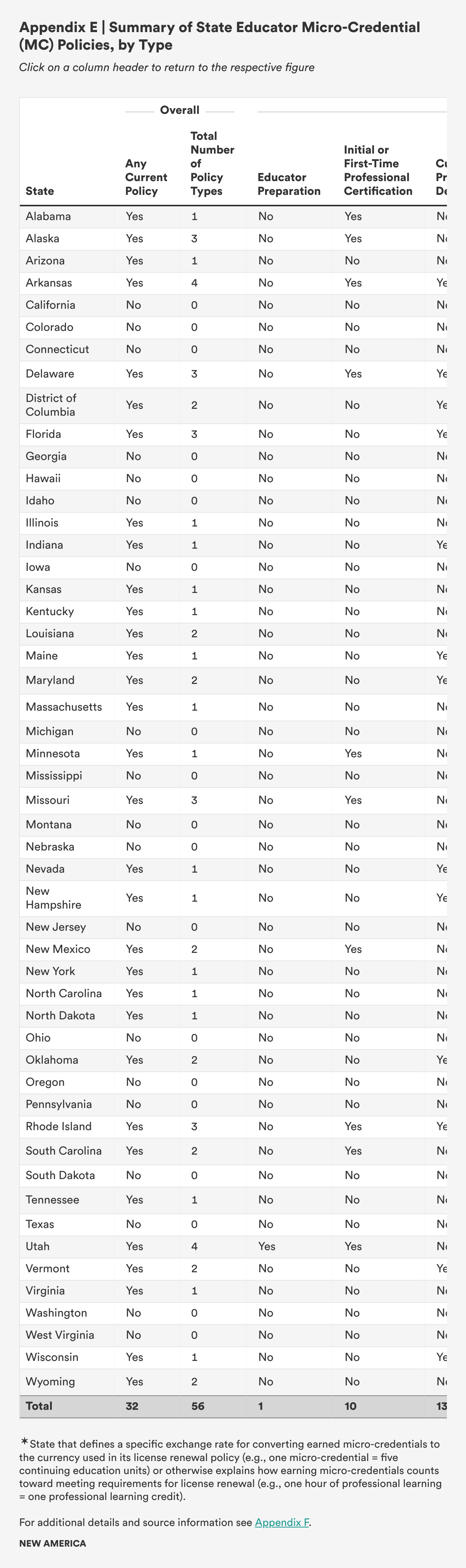
Citations
- Melissa Tooley and Joseph Hood, Harnessing Micro-Credentials for Teacher Growth: A National Review of Early Best Practices (New America, January 2021), <a href="<a href="<a href="<a href="<a href="<a href="<a href="<a href="<a href="<a href="<a href="source">source">source">source">source">source">source">source">source">source">source">source">source.
- Implicit state policies and related state efforts are noted under the “Miscellaneous” heading in Appendix F, but are not included in overall tallies.
- Melissa Tooley and Joseph Hood, Harnessing Micro-Credentials for Teacher Growth: A Model State Policy Guide (New America, January 2021), <a href="<a href="<a href="<a href="<a href="<a href="<a href="<a href="<a href="<a href="<a href="source">source">source">source">source">source">source">source">source">source">source">source">source.
- According to an analysis from the Learning Policy Institute, approximately 360,000 employed teachers across the nation are not fully certified for their teaching assignments. Further, when including vacancies, the authors estimated that over 400,000 teaching positions were either unfilled or filled by teachers not fully certified for their assignments, a total that represents approximately 1 in 8 teaching positions nationally. For more details see: Tiffany S. Tan, Ivett Arellano, and Susan Kemper Patrick, State Teacher Shortages 2024 Update: Teaching Positions Left Vacant or Filled by Teachers Without Full Certification (Learning Policy Institute, August 2024), <a href="<a href="<a href="<a href="<a href="<a href="<a href="<a href="<a href="<a href="source">source">source">source">source">source">source">source">source">source">source">source. Interest in becoming, and remaining, an educator has been declining for multiple reasons, including lack of on-the-job support, dissatisfaction with pay, and a dearth of career advancement opportunities. More than 200,000 teachers exit the profession each year, with one in four saying they did so to pursue other career opportunities. For more details see: Anne Podolsky, Tara Kini, Joseph Bishop, and Linda Darling-Hammond, Solving the Teacher Shortage: How to Attract and Retain Excellent Educators (Learning Policy Institute, September 2016), <a href="<a href="<a href="<a href="<a href="<a href="<a href="<a href="<a href="<a href="source">source">source">source">source">source">source">source">source">source">source">source.
- See results from Raj Chetty, John N. Friedman, and Jonah E. Rockoff, “Measuring the Impacts of Teachers II: Teacher Value-Added and Student Outcomes in Adulthood,” American Economic Review 104, no. 9, (May 2014): 2633–2679, <a href="<a href="<a href="<a href="<a href="<a href="<a href="<a href="<a href="<a href="source">source">source">source">source">source">source">source">source">source">source">source.
- Student achievement on the annual National Assessment of Educational Progress (NAEP) has declined post-COVID-19. For more details, see National Assessment Governing Board, “10 Takeaways from the Newly Released 2024 NAEP Results,” <a href="<a href="<a href="<a href="<a href="<a href="<a href="<a href="<a href="<a href="source">source">source">source">source">source">source">source">source">source">source">source.
- Lisa Bardach and Robert M. Klassen, “Smart Teachers, Successful Students? A Systematic Review of the Literature on Teachers’ Cognitive Abilities and Teacher Effectiveness,” Educational Research Review 30 (June 2020), <a href="<a href="<a href="<a href="<a href="<a href="<a href="<a href="<a href="<a href="source">source">source">source">source">source">source">source">source">source">source">source.
- With the exception of in-area graduate degrees (for example, a master’s degree in mathematics) for middle and high school math teachers, master’s degrees have little to no effect on teacher effectiveness. In fact, some research finds that “out-of-area” graduate degrees (school administration, counseling, curriculum specialist, etc.) are actually correlated with lower teacher effectiveness. See Kevin C. Bastian, “A Degree Above? The Value-Added Estimates and Evaluation Ratings of Teachers with a Graduate Degree,” Education Finance and Policy 14 (2019): 652–678, <a href="<a href="<a href="<a href="<a href="<a href="<a href="<a href="<a href="<a href="source">source">source">source">source">source">source">source">source">source">source">source; and Matthew M. Chingos and Paul E. Peterson, “It's Easier to Pick a Good Teacher than to Train One: Familiar and New Results on the Correlates of Teacher Effectiveness,” Economics of Education Review 30, no. 3 (2011): 449–465.
- For more details, see the Findings section in Melissa Tooley and Joseph Hood, Harnessing Micro-Credentials for Teacher Growth: A National Review of Early Best Practices (New America, January 2021), <a href="<a href="<a href="<a href="<a href="<a href="<a href="<a href="<a href="<a href="source">source">source">source">source">source">source">source">source">source">source">source.
- See question “JOBSATIS2 h” on p. 4 in Pew Research Center’s 2023 Survey of Teachers, April 2024, <a href="<a href="<a href="<a href="<a href="<a href="<a href="<a href="<a href="<a href="source">source">source">source">source">source">source">source">source">source">source">source.
- Melissa Tooley and Kaylan Connally, No Panacea: Diagnosing What Ails Teacher Professional Development Before Reaching for Remedies (New America, June 2016), <a href="<a href="<a href="<a href="<a href="<a href="<a href="<a href="<a href="<a href="source">source">source">source">source">source">source">source">source">source">source">source.
- An example of a more detailed cycle of inquiry process can be found in the Regional Educational Laboratory West’s infographic, Using Inquiry Cycles in PLCs to Improve Instruction, February 2019, <a href="<a href="<a href="<a href="<a href="<a href="<a href="<a href="<a href="<a href="source">source">source">source">source">source">source">source">source">source">source">source.
- Digital Promise, “Micro-Credentials for Me: Personal Stories from Real Teachers,” <a href="<a href="<a href="<a href="<a href="<a href="<a href="<a href="<a href="<a href="source">source">source">source">source">source">source">source">source">source">source">source.
- Melissa Tooley, “What Does High-Quality Research Say about Developing Teacher Practice?” EdCentral (blog), New America, March 16, 2017, <a href="<a href="<a href="<a href="<a href="<a href="<a href="<a href="<a href="<a href="source">source">source">source">source">source">source">source">source">source">source">source.
- Digital Promise, “Micro-Credentials for Me,” <a href="<a href="<a href="<a href="<a href="<a href="<a href="<a href="<a href="<a href="source">source">source">source">source">source">source">source">source">source">source">source; Stephen Sawchuk, “Can ‘Micro-Credentialing’ Salvage Teacher PD?” Ed Week, March 29, 2016, <a href="<a href="<a href="<a href="<a href="<a href="<a href="<a href="<a href="<a href="source">source">source">source">source">source">source">source">source">source">source">source; and Micro-credentials: Spurring Educator Engagement (Digital Promise, 2016), <a href="<a href="<a href="<a href="<a href="<a href="<a href="<a href="<a href="<a href="source">source">source">source">source">source">source">source">source">source">source">source.
- For more details, see Q4 of Melissa Tooley, “Everything You Wanted to Know About Educator Micro-Credentials: Fundamentals,” EdCentral (blog), New America, January 20, 2022, <a href="<a href="<a href="<a href="<a href="<a href="<a href="<a href="<a href="<a href="source">source">source">source">source">source">source">source">source">source">source">source.
- A common misconception about educator micro-credentials is that they are a type of direct teacher training rather than a credential. However, micro-credential offerings may be paired with resources for developing the specific competency they intend to measure, and high-quality micro-credential offerings always include relevant and evidence-based resources.
- Earners of micro-credentials are awarded a digital badge as proof of their accomplishment, but not all digital badges are obtained by earning micro-credentials. Digital badges can be awarded for something as simple as attending a conference training or completing a multiple-choice assessment, while earning high-quality micro-credentials requires successful application of the given competency. A 2015 survey of teachers by Digital Promise found that, of 19 distinct micro-credential benefits highlighted, teachers were least interested in displaying digital badges or sharing them on social media. See “Findings,” Tooley and Hood, Harnessing Micro-credentials for Teacher Growth: A National Review of Early Best Practices, <a href="<a href="<a href="<a href="<a href="<a href="<a href="<a href="<a href="<a href="source">source">source">source">source">source">source">source">source">source">source">source. For more details on digital badges, see Brittany Gooding, “Microcredentials vs. Open Badges: Navigating the Landscape of Digital Learning Recognition,” The Instructure Study Hall (blog), Instructure.com, August 16, 2023, <a href="<a href="<a href="<a href="<a href="<a href="<a href="<a href="<a href="<a href="source">source">source">source">source">source">source">source">source">source">source">source.
- Melissa Tooley and Joseph Hood, “The Process to Earn a Micro-Credential” (figure), Harnessing Micro-Credentials for Teacher Growth (New America, 2021), <a href="<a href="<a href="<a href="<a href="<a href="<a href="<a href="<a href="<a href="source">source">source">source">source">source">source">source">source">source">source">source.
- Tooley and Hood, Harnessing Micro-Credentials for Teacher Growth: A National Review of Early Best Practices, <a href="<a href="<a href="<a href="<a href="<a href="<a href="<a href="<a href="<a href="source">source">source">source">source">source">source">source">source">source">source">source.
- Melissa Tooley and Joseph Hood, Harnessing Micro-Credentials for Teacher Growth: A Model State Policy Guide, (New America, January 2021), <a href="<a href="<a href="<a href="<a href="<a href="<a href="<a href="<a href="<a href="source">source">source">source">source">source">source">source">source">source">source">source.
- For the purposes of this analysis, DC is counted as a state.
- Implicit state policies and related state efforts are noted under the “Miscellaneous” heading in Appendix F, but are not included in overall tallies.
- While some states, such as Delaware, define the term micro-credential in administrative code and offer clear criteria for micro-credentials on the state’s department of education website, many states do not. See Delaware Regulations, Administrative Code Title 14:1500, “1511 Continuing License,” <a href="<a href="<a href="<a href="<a href="<a href="<a href="<a href="<a href="source">source">source">source">source">source">source">source">source">source">source; and “What Are Micro-Credentials,” Delaware Department of Education, <a href="<a href="<a href="<a href="<a href="<a href="<a href="<a href="<a href="source">source">source">source">source">source">source">source">source">source">source.
- Even in states with no explicit policy, some local education agencies are opting to incorporate micro-credentials for educators in their approaches to professional learning and advancement.
- Because this research is focused on state policies—and because determining how many of the thousands of EPPs across the country are leveraging micro-credentials would be very difficult—a tally of individual EPPs using micro-credentials is not offered in this report. However, in a September 11, 2024, Zoom interview with the authors, Jason Lange, founder of BloomBoard, indicated that there are EPPs in nearly every state opting to use micro-credentials as part of their coursework. For example, Relay Graduate School of Education is approved in several states and relies heavily on micro-credentials in its curriculum. For more information, see Digital Promise, “Micro-Credentials: A Promising Way to Put Educators’ Skills Front and Center,” <a href="<a href="<a href="<a href="<a href="<a href="<a href="source">source">source">source">source">source">source">source">source.
- See Utah State Board of Education, “R277-304. Teacher Preparation Programs,” <a href="<a href="<a href="<a href="<a href="<a href="<a href="source">source">source">source">source">source">source">source">source. The Utah educator preparation program approval forms for both elementary and secondary programs can be found here: “Elementary 2025 El Ed and ECE EPP Competency Approval Template,” <a href="<a href="<a href="<a href="<a href="<a href="<a href="source">source">source">source">source">source">source">source">source; and “Secondary 2025 Secondary EPP Competency Approval Template,” <a href="<a href="<a href="<a href="<a href="<a href="<a href="source">source">source">source">source">source">source">source">source.
- Utah State Board of Education, Program Endorsement Review Approval Template for Universities, Utah State Board of Education Endorsement Review, <a href="<a href="<a href="<a href="<a href="<a href="<a href="source">source">source">source">source">source">source">source">source.
- A micro-credential stack is a collection of related micro-credentials organized around a theme. Completing a stack can provide the earner with a way to demonstrate a full skill set in a certain area or field and may lead to a broader credential. Examples of educator micro-credential stacks can be found at CarolinaCrED, Micro-credential Stacks, <a href="<a href="<a href="<a href="<a href="<a href="<a href="source">source">source">source">source">source">source">source">source.
- Curated professional development is typically offered for a subject the state perceives to add significant value to instruction (e.g., the science of reading, financial literacy, etc.). This training can be required or optional and it sometimes, but not always, leads to an endorsement (in which case it is also counted in the endorsement category) or credit for relicensure. It is different from state policy for license renewal credits because of its specificity: Whereas a state-created micro-credential about the science of reading may also be counted toward licensure credit, its development by a state does not necessarily indicate that the state has approved micro-credentials as a form of professional development that counts toward license renewal.
- In some states, a customized version of the NEA’s micro-credentials bank is provided by the relevant state affiliate, likely in order to meet the requirement that relicensure opportunities be offered by an approved provider. National Education Association, NEA Certification Bank (website), <a href="<a href="<a href="<a href="<a href="<a href="<a href="source">source">source">source">source">source">source">source">source.
- North Dakota Department of Public Instruction, “Computer Science and Cybersecurity Credentials,” <a href="<a href="<a href="<a href="<a href="<a href="<a href="source">source">source">source">source">source">source">source">source.
- District of Columbia, Office of the State Superintendent of Education, “Special Education Endorsement Recovery Initiative,” <a href="<a href="<a href="<a href="<a href="<a href="<a href="source">source">source">source">source">source">source">source">source.
- For examples, see Colleen McCann, Sasha Zuflacht, and Tierra Gilbert, The Decade-Plus Teaching Career: How to Retain Effective Teachers Through Teacher Leadership (Teach Plus, 2021), <a href="<a href="<a href="<a href="<a href="<a href="<a href="source">source">source">source">source">source">source">source">source; and Questions 12 and 13 in Adrienne Fischer, Ben Erwin, Damion Pechota, and Eric Syverson, 50-State Comparison: Teacher Recruitment and Retention (Education Commission of the States, December 1, 2022), <a href="<a href="<a href="<a href="<a href="<a href="<a href="source">source">source">source">source">source">source">source">source.
- We are counting South Carolina’s suggested currency for micro-credentials in guidance to LEAs, which ultimately have authority to determine the value of professional learning experiences for license renewal, in this total.
- See Arkansas teacher induction example in “Importance of Iterative Implementation” section of Tooley and Hood, Harnessing Micro-Credentials for Teacher Growth: A National Review of Early Best Practices, <a href="<a href="<a href="<a href="<a href="<a href="source">source">source">source">source">source">source">source.
- Corey Murphy (Mississippi associate state superintendent, Office of Teaching and Leading), email with Lisette Partelow and Melissa Tooley, December 9, 2024; and Kristi Enger (Idaho director of educator certification), email with Lisette Partelow and Melissa Tooley on December 16, 2024.
- Indiana’s State Department of Education partnered with BloomBoard to fund 39 educators in completing coursework to earn computer science micro-credentials to expand computer science learning opportunities for PreK–12 students. Educators can count their micro-credentials toward earning a master’s degree in Technology and Computer Science Education from a partnering higher education institution. See: Indiana Department of Education, “Computer Science,” <a href="<a href="<a href="<a href="<a href="source">source">source">source">source">source">source for additional detail.
- Washington State, “Certification of Enrollment, Engrossed Second Substitute House Bill 1139” (2019: p. 57), <a href="<a href="<a href="<a href="<a href="source">source">source">source">source">source">source.
- For more on the qualities of a high-quality micro-credential, see “Designing and Assessing Micro-credential Offerings” in Tooley and Hood, Harnessing Micro-Credentials for Teacher Growth: A National Review of Early Best Practices, <a href="<a href="<a href="<a href="<a href="source">source">source">source">source">source">source.
- Note that one of this report’s authors, Melissa Tooley, was an unpaid advisor on this work, along with several other experts. For more details on the partnership, see digiLEARN, “The Micro-Credentials Partnership of States,” <a href="<a href="<a href="<a href="<a href="source">source">source">source">source">source">source.
- H. Frank McKay, Teresa Webber, and W. Kyle Canuette, Operationalizing Micro-Credential Quality Assurance Standards (RTI International, June 2024), <a href="<a href="<a href="<a href="<a href="source">source">source">source">source">source">source; and Advancing Educator Effectiveness through Micro-Credential Quality Assurance Standards and Rubric: Tools for Assessing Micro-Credential Quality (digiLEARN, May 2024), <a href="<a href="<a href="<a href="<a href="source">source">source">source">source">source">source.
- Myra Best (executive director of digiLEARN), email correspondence with authors, April 9, 2025, and Brendan O’Connor (executive director of Wyoming Professional Teaching Standards Board), email correspondence with authors, April 10, 2025.
- These recommendations are adapted and updated from Tooley and Hood, Harnessing Micro-Credentials for Teacher Growth: A National Review of Early Best Practices, <a href="<a href="<a href="<a href="source">source">source">source">source">source; and Tooley and Hood, Harnessing Micro-Credentials for Teacher Growth: A Model State Policy Guide, <a href="<a href="<a href="<a href="source">source">source">source">source">source.
- In Illinois, professional development providers seeking to offer micro-credentials must submit documentation that their course is aligned with the state’s rubric, which includes evaluation of the micro-credential’s design, alignment to the state teaching and learning standards, and the process for evaluation and evidence submission, according to the Illinois State Board of Education, “Illinois Educator Microcredential Framework,” <a href="<a href="<a href="<a href="source">source">source">source">source">source.
- In fall 2024, North Carolina’s State Board of Education officially authorized the use of the Quality Assurance Standards (QAS) for LEAs to vet which micro-credentials educators can count toward relicensure requirements, and the Department of Public Instruction is currently working to use the QAS and associated rubric to develop educator micro-credentials for AI, digital data privacy, and integration of digital learning standards into curriculum (per email correspondence with Myra Best, digiLEARN’s executive director, on April 8, 2025).
- Wyoming’s administrative rules specify aspects of quality control for educator micro-credentials; see Program Approval Standards for Endorsement Areas, Wyoming Professional Teaching Standards Board, <a href="<a href="<a href="<a href="source">source">source">source">source">source.
- Earners of micro-credentials are awarded a digital badge as proof of their accomplishment, but not all digital badges are obtained by earning micro-credentials. Digital badges can be awarded for something as simple as attending a conference training or completing a multiple-choice assessment, while earning high-quality micro-credentials requires successful application of the given competency. A 2015 survey of teachers by Digital Promise found that, of 19 distinct micro-credential benefits highlighted, teachers were least interested in displaying digital badges or sharing them on social media. See “Findings,” Tooley and Hood, <a href="<a href="<a href="<a href="source">source">source">source">source">source. Additional educator perspective on digital badges was gleaned from RTI’s NC Feasibility Study Report to the North Carolina Partnership for Micro-Credentials and “Micro-Credential Focus Group: Emerging Framing Ideas” (prepared for digiLEARN, unpublished, November 2020).
- Arkansas Department of Education, Division of Elementary & Secondary Education, “Professional Learning Through Micro-Credentials,” <a href="<a href="<a href="<a href="source">source">source">source">source">source.
- Delaware Department of Education, “About DDOE Micro-Credential Programs,” <a href="<a href="<a href="<a href="source">source">source">source">source">source.
- Utah State Board of Education and The Utah Education Network, “Move Your Professional Learning Forward,” <a href="<a href="<a href="<a href="source">source">source">source">source">source.
- See Illinois State Board of Education list of approved micro-credentials on its “Professional Learning” page, by expanding the second accordion menu at the bottom of the page, “List of ISBE-Approved Microcredentials,” <a href="<a href="<a href="<a href="source">source">source">source">source">source.
- The Nevada Department of Education offers 50 micro-credentials on its “Nevada Professional Learning” page, <a href="<a href="<a href="<a href="source">source">source">source">source">source.
- The Wyoming Department of Education has published the Wyoming Digital Learning Plan, which discusses how districts and schools can “provide incentives and/or support for educators to receive licensure, certifications, and micro-credentials for digital learning." See Wyoming Department of Education, Wyoming Digital Learning Plan: 2023–2028, <a href="<a href="<a href="<a href="source">source">source">source">source">source.
- Arkansas initially used micro-credentials as part of its teacher induction program for beginning teachers and Tennessee had a pilot that used micro-credentials for relicensure. See Jenny DeMonte, Micro-Credentials for Teachers: What Three Early Adopter States Have Learned So Far (American Institutes for Research, 2017), <a href="<a href="<a href="<a href="source">source">source">source">source">source; and Tooley and Hood, Harnessing Micro-Credentials for Teacher Growth: A National Review of Early Best Practices, <a href="<a href="<a href="<a href="source">source">source">source">source">source.
- Tooley and Hood, <a href="<a href="<a href="<a href="source">source">source">source">source">source.
- In some states, high school students can earn college credit for micro-credentials offered by the pre-educator preparation program Educators Rising, but these micro-credentials are not formally part of an educator preparation program or credentialing pathway and thus were not included in our tally of state educator preparation policies. See Educators Rising, “Microcredentials,” <a href="source">source">source.
- State license renewal policies typically require educators to accrue a certain number of professional development credits over a specified period of time in order to maintain their license and practice in their current role.
Appendix F: Additional Insights on Individual State Educator Micro-Credential Policies

Citations
- Melissa Tooley and Joseph Hood, Harnessing Micro-Credentials for Teacher Growth: A National Review of Early Best Practices (New America, January 2021), <a href="<a href="<a href="<a href="<a href="<a href="<a href="<a href="<a href="<a href="<a href="<a href="source">source">source">source">source">source">source">source">source">source">source">source">source">source.
- Implicit state policies and related state efforts are noted under the “Miscellaneous” heading in Appendix F, but are not included in overall tallies.
- Melissa Tooley and Joseph Hood, Harnessing Micro-Credentials for Teacher Growth: A Model State Policy Guide (New America, January 2021), <a href="<a href="<a href="<a href="<a href="<a href="<a href="<a href="<a href="<a href="<a href="<a href="source">source">source">source">source">source">source">source">source">source">source">source">source">source.
- According to an analysis from the Learning Policy Institute, approximately 360,000 employed teachers across the nation are not fully certified for their teaching assignments. Further, when including vacancies, the authors estimated that over 400,000 teaching positions were either unfilled or filled by teachers not fully certified for their assignments, a total that represents approximately 1 in 8 teaching positions nationally. For more details see: Tiffany S. Tan, Ivett Arellano, and Susan Kemper Patrick, State Teacher Shortages 2024 Update: Teaching Positions Left Vacant or Filled by Teachers Without Full Certification (Learning Policy Institute, August 2024), <a href="<a href="<a href="<a href="<a href="<a href="<a href="<a href="<a href="<a href="<a href="source">source">source">source">source">source">source">source">source">source">source">source">source. Interest in becoming, and remaining, an educator has been declining for multiple reasons, including lack of on-the-job support, dissatisfaction with pay, and a dearth of career advancement opportunities. More than 200,000 teachers exit the profession each year, with one in four saying they did so to pursue other career opportunities. For more details see: Anne Podolsky, Tara Kini, Joseph Bishop, and Linda Darling-Hammond, Solving the Teacher Shortage: How to Attract and Retain Excellent Educators (Learning Policy Institute, September 2016), <a href="<a href="<a href="<a href="<a href="<a href="<a href="<a href="<a href="<a href="<a href="source">source">source">source">source">source">source">source">source">source">source">source">source.
- See results from Raj Chetty, John N. Friedman, and Jonah E. Rockoff, “Measuring the Impacts of Teachers II: Teacher Value-Added and Student Outcomes in Adulthood,” American Economic Review 104, no. 9, (May 2014): 2633–2679, <a href="<a href="<a href="<a href="<a href="<a href="<a href="<a href="<a href="<a href="<a href="source">source">source">source">source">source">source">source">source">source">source">source">source.
- Student achievement on the annual National Assessment of Educational Progress (NAEP) has declined post-COVID-19. For more details, see National Assessment Governing Board, “10 Takeaways from the Newly Released 2024 NAEP Results,” <a href="<a href="<a href="<a href="<a href="<a href="<a href="<a href="<a href="<a href="<a href="source">source">source">source">source">source">source">source">source">source">source">source">source.
- Lisa Bardach and Robert M. Klassen, “Smart Teachers, Successful Students? A Systematic Review of the Literature on Teachers’ Cognitive Abilities and Teacher Effectiveness,” Educational Research Review 30 (June 2020), <a href="<a href="<a href="<a href="<a href="<a href="<a href="<a href="<a href="<a href="<a href="source">source">source">source">source">source">source">source">source">source">source">source">source.
- With the exception of in-area graduate degrees (for example, a master’s degree in mathematics) for middle and high school math teachers, master’s degrees have little to no effect on teacher effectiveness. In fact, some research finds that “out-of-area” graduate degrees (school administration, counseling, curriculum specialist, etc.) are actually correlated with lower teacher effectiveness. See Kevin C. Bastian, “A Degree Above? The Value-Added Estimates and Evaluation Ratings of Teachers with a Graduate Degree,” Education Finance and Policy 14 (2019): 652–678, <a href="<a href="<a href="<a href="<a href="<a href="<a href="<a href="<a href="<a href="<a href="source">source">source">source">source">source">source">source">source">source">source">source">source; and Matthew M. Chingos and Paul E. Peterson, “It's Easier to Pick a Good Teacher than to Train One: Familiar and New Results on the Correlates of Teacher Effectiveness,” Economics of Education Review 30, no. 3 (2011): 449–465.
- For more details, see the Findings section in Melissa Tooley and Joseph Hood, Harnessing Micro-Credentials for Teacher Growth: A National Review of Early Best Practices (New America, January 2021), <a href="<a href="<a href="<a href="<a href="<a href="<a href="<a href="<a href="<a href="<a href="source">source">source">source">source">source">source">source">source">source">source">source">source.
- See question “JOBSATIS2 h” on p. 4 in Pew Research Center’s 2023 Survey of Teachers, April 2024, <a href="<a href="<a href="<a href="<a href="<a href="<a href="<a href="<a href="<a href="<a href="source">source">source">source">source">source">source">source">source">source">source">source">source.
- Melissa Tooley and Kaylan Connally, No Panacea: Diagnosing What Ails Teacher Professional Development Before Reaching for Remedies (New America, June 2016), <a href="<a href="<a href="<a href="<a href="<a href="<a href="<a href="<a href="<a href="<a href="source">source">source">source">source">source">source">source">source">source">source">source">source.
- An example of a more detailed cycle of inquiry process can be found in the Regional Educational Laboratory West’s infographic, Using Inquiry Cycles in PLCs to Improve Instruction, February 2019, <a href="<a href="<a href="<a href="<a href="<a href="<a href="<a href="<a href="<a href="<a href="source">source">source">source">source">source">source">source">source">source">source">source">source.
- Digital Promise, “Micro-Credentials for Me: Personal Stories from Real Teachers,” <a href="<a href="<a href="<a href="<a href="<a href="<a href="<a href="<a href="<a href="<a href="source">source">source">source">source">source">source">source">source">source">source">source">source.
- Melissa Tooley, “What Does High-Quality Research Say about Developing Teacher Practice?” EdCentral (blog), New America, March 16, 2017, <a href="<a href="<a href="<a href="<a href="<a href="<a href="<a href="<a href="<a href="<a href="source">source">source">source">source">source">source">source">source">source">source">source">source.
- Digital Promise, “Micro-Credentials for Me,” <a href="<a href="<a href="<a href="<a href="<a href="<a href="<a href="<a href="<a href="<a href="source">source">source">source">source">source">source">source">source">source">source">source">source; Stephen Sawchuk, “Can ‘Micro-Credentialing’ Salvage Teacher PD?” Ed Week, March 29, 2016, <a href="<a href="<a href="<a href="<a href="<a href="<a href="<a href="<a href="<a href="<a href="source">source">source">source">source">source">source">source">source">source">source">source">source; and Micro-credentials: Spurring Educator Engagement (Digital Promise, 2016), <a href="<a href="<a href="<a href="<a href="<a href="<a href="<a href="<a href="<a href="<a href="source">source">source">source">source">source">source">source">source">source">source">source">source.
- For more details, see Q4 of Melissa Tooley, “Everything You Wanted to Know About Educator Micro-Credentials: Fundamentals,” EdCentral (blog), New America, January 20, 2022, <a href="<a href="<a href="<a href="<a href="<a href="<a href="<a href="<a href="<a href="<a href="source">source">source">source">source">source">source">source">source">source">source">source">source.
- A common misconception about educator micro-credentials is that they are a type of direct teacher training rather than a credential. However, micro-credential offerings may be paired with resources for developing the specific competency they intend to measure, and high-quality micro-credential offerings always include relevant and evidence-based resources.
- Earners of micro-credentials are awarded a digital badge as proof of their accomplishment, but not all digital badges are obtained by earning micro-credentials. Digital badges can be awarded for something as simple as attending a conference training or completing a multiple-choice assessment, while earning high-quality micro-credentials requires successful application of the given competency. A 2015 survey of teachers by Digital Promise found that, of 19 distinct micro-credential benefits highlighted, teachers were least interested in displaying digital badges or sharing them on social media. See “Findings,” Tooley and Hood, Harnessing Micro-credentials for Teacher Growth: A National Review of Early Best Practices, <a href="<a href="<a href="<a href="<a href="<a href="<a href="<a href="<a href="<a href="<a href="source">source">source">source">source">source">source">source">source">source">source">source">source. For more details on digital badges, see Brittany Gooding, “Microcredentials vs. Open Badges: Navigating the Landscape of Digital Learning Recognition,” The Instructure Study Hall (blog), Instructure.com, August 16, 2023, <a href="<a href="<a href="<a href="<a href="<a href="<a href="<a href="<a href="<a href="<a href="source">source">source">source">source">source">source">source">source">source">source">source">source.
- Melissa Tooley and Joseph Hood, “The Process to Earn a Micro-Credential” (figure), Harnessing Micro-Credentials for Teacher Growth (New America, 2021), <a href="<a href="<a href="<a href="<a href="<a href="<a href="<a href="<a href="<a href="<a href="source">source">source">source">source">source">source">source">source">source">source">source">source.
- Tooley and Hood, Harnessing Micro-Credentials for Teacher Growth: A National Review of Early Best Practices, <a href="<a href="<a href="<a href="<a href="<a href="<a href="<a href="<a href="<a href="<a href="source">source">source">source">source">source">source">source">source">source">source">source">source.
- Melissa Tooley and Joseph Hood, Harnessing Micro-Credentials for Teacher Growth: A Model State Policy Guide, (New America, January 2021), <a href="<a href="<a href="<a href="<a href="<a href="<a href="<a href="<a href="<a href="<a href="source">source">source">source">source">source">source">source">source">source">source">source">source.
- For the purposes of this analysis, DC is counted as a state.
- Implicit state policies and related state efforts are noted under the “Miscellaneous” heading in Appendix F, but are not included in overall tallies.
- While some states, such as Delaware, define the term micro-credential in administrative code and offer clear criteria for micro-credentials on the state’s department of education website, many states do not. See Delaware Regulations, Administrative Code Title 14:1500, “1511 Continuing License,” <a href="<a href="<a href="<a href="<a href="<a href="<a href="<a href="<a href="<a href="source">source">source">source">source">source">source">source">source">source">source">source; and “What Are Micro-Credentials,” Delaware Department of Education, <a href="<a href="<a href="<a href="<a href="<a href="<a href="<a href="<a href="<a href="source">source">source">source">source">source">source">source">source">source">source">source.
- Even in states with no explicit policy, some local education agencies are opting to incorporate micro-credentials for educators in their approaches to professional learning and advancement.
- Because this research is focused on state policies—and because determining how many of the thousands of EPPs across the country are leveraging micro-credentials would be very difficult—a tally of individual EPPs using micro-credentials is not offered in this report. However, in a September 11, 2024, Zoom interview with the authors, Jason Lange, founder of BloomBoard, indicated that there are EPPs in nearly every state opting to use micro-credentials as part of their coursework. For example, Relay Graduate School of Education is approved in several states and relies heavily on micro-credentials in its curriculum. For more information, see Digital Promise, “Micro-Credentials: A Promising Way to Put Educators’ Skills Front and Center,” <a href="<a href="<a href="<a href="<a href="<a href="<a href="<a href="source">source">source">source">source">source">source">source">source">source.
- See Utah State Board of Education, “R277-304. Teacher Preparation Programs,” <a href="<a href="<a href="<a href="<a href="<a href="<a href="<a href="source">source">source">source">source">source">source">source">source">source. The Utah educator preparation program approval forms for both elementary and secondary programs can be found here: “Elementary 2025 El Ed and ECE EPP Competency Approval Template,” <a href="<a href="<a href="<a href="<a href="<a href="<a href="<a href="source">source">source">source">source">source">source">source">source">source; and “Secondary 2025 Secondary EPP Competency Approval Template,” <a href="<a href="<a href="<a href="<a href="<a href="<a href="<a href="source">source">source">source">source">source">source">source">source">source.
- Utah State Board of Education, Program Endorsement Review Approval Template for Universities, Utah State Board of Education Endorsement Review, <a href="<a href="<a href="<a href="<a href="<a href="<a href="<a href="source">source">source">source">source">source">source">source">source">source.
- A micro-credential stack is a collection of related micro-credentials organized around a theme. Completing a stack can provide the earner with a way to demonstrate a full skill set in a certain area or field and may lead to a broader credential. Examples of educator micro-credential stacks can be found at CarolinaCrED, Micro-credential Stacks, <a href="<a href="<a href="<a href="<a href="<a href="<a href="<a href="source">source">source">source">source">source">source">source">source">source.
- Curated professional development is typically offered for a subject the state perceives to add significant value to instruction (e.g., the science of reading, financial literacy, etc.). This training can be required or optional and it sometimes, but not always, leads to an endorsement (in which case it is also counted in the endorsement category) or credit for relicensure. It is different from state policy for license renewal credits because of its specificity: Whereas a state-created micro-credential about the science of reading may also be counted toward licensure credit, its development by a state does not necessarily indicate that the state has approved micro-credentials as a form of professional development that counts toward license renewal.
- In some states, a customized version of the NEA’s micro-credentials bank is provided by the relevant state affiliate, likely in order to meet the requirement that relicensure opportunities be offered by an approved provider. National Education Association, NEA Certification Bank (website), <a href="<a href="<a href="<a href="<a href="<a href="<a href="<a href="source">source">source">source">source">source">source">source">source">source.
- North Dakota Department of Public Instruction, “Computer Science and Cybersecurity Credentials,” <a href="<a href="<a href="<a href="<a href="<a href="<a href="<a href="source">source">source">source">source">source">source">source">source">source.
- District of Columbia, Office of the State Superintendent of Education, “Special Education Endorsement Recovery Initiative,” <a href="<a href="<a href="<a href="<a href="<a href="<a href="<a href="source">source">source">source">source">source">source">source">source">source.
- For examples, see Colleen McCann, Sasha Zuflacht, and Tierra Gilbert, The Decade-Plus Teaching Career: How to Retain Effective Teachers Through Teacher Leadership (Teach Plus, 2021), <a href="<a href="<a href="<a href="<a href="<a href="<a href="<a href="source">source">source">source">source">source">source">source">source">source; and Questions 12 and 13 in Adrienne Fischer, Ben Erwin, Damion Pechota, and Eric Syverson, 50-State Comparison: Teacher Recruitment and Retention (Education Commission of the States, December 1, 2022), <a href="<a href="<a href="<a href="<a href="<a href="<a href="<a href="source">source">source">source">source">source">source">source">source">source.
- We are counting South Carolina’s suggested currency for micro-credentials in guidance to LEAs, which ultimately have authority to determine the value of professional learning experiences for license renewal, in this total.
- See Arkansas teacher induction example in “Importance of Iterative Implementation” section of Tooley and Hood, Harnessing Micro-Credentials for Teacher Growth: A National Review of Early Best Practices, <a href="<a href="<a href="<a href="<a href="<a href="<a href="source">source">source">source">source">source">source">source">source.
- Corey Murphy (Mississippi associate state superintendent, Office of Teaching and Leading), email with Lisette Partelow and Melissa Tooley, December 9, 2024; and Kristi Enger (Idaho director of educator certification), email with Lisette Partelow and Melissa Tooley on December 16, 2024.
- Indiana’s State Department of Education partnered with BloomBoard to fund 39 educators in completing coursework to earn computer science micro-credentials to expand computer science learning opportunities for PreK–12 students. Educators can count their micro-credentials toward earning a master’s degree in Technology and Computer Science Education from a partnering higher education institution. See: Indiana Department of Education, “Computer Science,” <a href="<a href="<a href="<a href="<a href="<a href="source">source">source">source">source">source">source">source for additional detail.
- Washington State, “Certification of Enrollment, Engrossed Second Substitute House Bill 1139” (2019: p. 57), <a href="<a href="<a href="<a href="<a href="<a href="source">source">source">source">source">source">source">source.
- For more on the qualities of a high-quality micro-credential, see “Designing and Assessing Micro-credential Offerings” in Tooley and Hood, Harnessing Micro-Credentials for Teacher Growth: A National Review of Early Best Practices, <a href="<a href="<a href="<a href="<a href="<a href="source">source">source">source">source">source">source">source.
- Note that one of this report’s authors, Melissa Tooley, was an unpaid advisor on this work, along with several other experts. For more details on the partnership, see digiLEARN, “The Micro-Credentials Partnership of States,” <a href="<a href="<a href="<a href="<a href="<a href="source">source">source">source">source">source">source">source.
- H. Frank McKay, Teresa Webber, and W. Kyle Canuette, Operationalizing Micro-Credential Quality Assurance Standards (RTI International, June 2024), <a href="<a href="<a href="<a href="<a href="<a href="source">source">source">source">source">source">source">source; and Advancing Educator Effectiveness through Micro-Credential Quality Assurance Standards and Rubric: Tools for Assessing Micro-Credential Quality (digiLEARN, May 2024), <a href="<a href="<a href="<a href="<a href="<a href="source">source">source">source">source">source">source">source.
- Myra Best (executive director of digiLEARN), email correspondence with authors, April 9, 2025, and Brendan O’Connor (executive director of Wyoming Professional Teaching Standards Board), email correspondence with authors, April 10, 2025.
- These recommendations are adapted and updated from Tooley and Hood, Harnessing Micro-Credentials for Teacher Growth: A National Review of Early Best Practices, <a href="<a href="<a href="<a href="<a href="source">source">source">source">source">source">source; and Tooley and Hood, Harnessing Micro-Credentials for Teacher Growth: A Model State Policy Guide, <a href="<a href="<a href="<a href="<a href="source">source">source">source">source">source">source.
- In Illinois, professional development providers seeking to offer micro-credentials must submit documentation that their course is aligned with the state’s rubric, which includes evaluation of the micro-credential’s design, alignment to the state teaching and learning standards, and the process for evaluation and evidence submission, according to the Illinois State Board of Education, “Illinois Educator Microcredential Framework,” <a href="<a href="<a href="<a href="<a href="source">source">source">source">source">source">source.
- In fall 2024, North Carolina’s State Board of Education officially authorized the use of the Quality Assurance Standards (QAS) for LEAs to vet which micro-credentials educators can count toward relicensure requirements, and the Department of Public Instruction is currently working to use the QAS and associated rubric to develop educator micro-credentials for AI, digital data privacy, and integration of digital learning standards into curriculum (per email correspondence with Myra Best, digiLEARN’s executive director, on April 8, 2025).
- Wyoming’s administrative rules specify aspects of quality control for educator micro-credentials; see Program Approval Standards for Endorsement Areas, Wyoming Professional Teaching Standards Board, <a href="<a href="<a href="<a href="<a href="source">source">source">source">source">source">source.
- Earners of micro-credentials are awarded a digital badge as proof of their accomplishment, but not all digital badges are obtained by earning micro-credentials. Digital badges can be awarded for something as simple as attending a conference training or completing a multiple-choice assessment, while earning high-quality micro-credentials requires successful application of the given competency. A 2015 survey of teachers by Digital Promise found that, of 19 distinct micro-credential benefits highlighted, teachers were least interested in displaying digital badges or sharing them on social media. See “Findings,” Tooley and Hood, <a href="<a href="<a href="<a href="<a href="source">source">source">source">source">source">source. Additional educator perspective on digital badges was gleaned from RTI’s NC Feasibility Study Report to the North Carolina Partnership for Micro-Credentials and “Micro-Credential Focus Group: Emerging Framing Ideas” (prepared for digiLEARN, unpublished, November 2020).
- Arkansas Department of Education, Division of Elementary & Secondary Education, “Professional Learning Through Micro-Credentials,” <a href="<a href="<a href="<a href="<a href="source">source">source">source">source">source">source.
- Delaware Department of Education, “About DDOE Micro-Credential Programs,” <a href="<a href="<a href="<a href="<a href="source">source">source">source">source">source">source.
- Utah State Board of Education and The Utah Education Network, “Move Your Professional Learning Forward,” <a href="<a href="<a href="<a href="<a href="source">source">source">source">source">source">source.
- See Illinois State Board of Education list of approved micro-credentials on its “Professional Learning” page, by expanding the second accordion menu at the bottom of the page, “List of ISBE-Approved Microcredentials,” <a href="<a href="<a href="<a href="<a href="source">source">source">source">source">source">source.
- The Nevada Department of Education offers 50 micro-credentials on its “Nevada Professional Learning” page, <a href="<a href="<a href="<a href="<a href="source">source">source">source">source">source">source.
- The Wyoming Department of Education has published the Wyoming Digital Learning Plan, which discusses how districts and schools can “provide incentives and/or support for educators to receive licensure, certifications, and micro-credentials for digital learning." See Wyoming Department of Education, Wyoming Digital Learning Plan: 2023–2028, <a href="<a href="<a href="<a href="<a href="source">source">source">source">source">source">source.
- Arkansas initially used micro-credentials as part of its teacher induction program for beginning teachers and Tennessee had a pilot that used micro-credentials for relicensure. See Jenny DeMonte, Micro-Credentials for Teachers: What Three Early Adopter States Have Learned So Far (American Institutes for Research, 2017), <a href="<a href="<a href="<a href="<a href="source">source">source">source">source">source">source; and Tooley and Hood, Harnessing Micro-Credentials for Teacher Growth: A National Review of Early Best Practices, <a href="<a href="<a href="<a href="<a href="source">source">source">source">source">source">source.
- Tooley and Hood, <a href="<a href="<a href="<a href="<a href="source">source">source">source">source">source">source.
- In some states, high school students can earn college credit for micro-credentials offered by the pre-educator preparation program Educators Rising, but these micro-credentials are not formally part of an educator preparation program or credentialing pathway and thus were not included in our tally of state educator preparation policies. See Educators Rising, “Microcredentials,” <a href="<a href="source">source">source">source.
- State license renewal policies typically require educators to accrue a certain number of professional development credits over a specified period of time in order to maintain their license and practice in their current role.