Sarah Gilliland
Senior Policy Manager, New Practice Lab
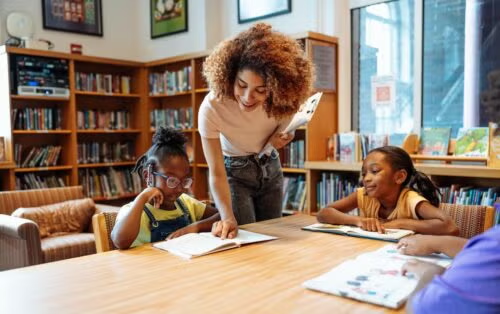
September is National Library Card Sign-Up Month, a great time to leverage public libraries as a way to spend more time with our families without spending a lot of money. As a former librarian who now works on family policy at New America’s New Practice Lab, I believe a library card is as essential as a credit card or Social Security number. Here’s why—and how we can make library access more standard and universal.
We heard it over and over in responses to our national parent survey: Families want more meaningful time with their kids, but expenses get in the way. Low-cost, high-quality family experiences are scarce, partly because of chronic underfunding of public services. Many neighborhoods have limited access to parks, playgrounds, and public pools; youth sports are pricey; and many museums and zoos require tickets.
Reading together is an often-overlooked, richly rewarding possibility with very low barriers to entry. Here are two complementary pathways to help make it happen: public libraries offering a wide variety of services and materials to families, and book donation programs such as Dolly Parton’s Imagination Library.
Dealing with government services often comes with a heavy “time tax,” but libraries are an exception. During my time as a public librarian, I distributed benefits worth anywhere from hundreds to thousands of dollars, depending on usage, to anyone who could write their first name.
For many children, getting a library card is their first interaction with local government and the first official document they’re trusted to carry themselves. It’s an experience that resonates across political lines: Michelle Obama called getting a library card a key memory of “mattering,” and Laura Bush said her library card was the most valuable thing in her wallet.
Given this, you might think everyone would have one. But a recent YouGov poll found that only 51 percent of Americans have a library card, down from 63 percent in 2013. More families—especially those with young kids—should be signing up, particularly in the current economy.
It’s hard to imagine another government benefit that offers so much, so quickly and easily. Signing up for a library card is simple and fast for most, and it opens up access to a world of physical and electronic content—plus Wi-Fi, public computers, classes, and meeting rooms. Users do not need to clear any asset test or “deservingness” threshold. Immigration, housing, or employment status rarely matter. Many libraries have even dropped late fees, especially for children’s books.
That’s a boon at a time when consumers are beset by tiered pricing and hidden fees for too many goods and services, and the savings add up. One calculator estimated that the library saved my family $350 this year on materials and facilities alone. The value isn’t only financial: The convenience of downloading free ebooks from your home is a step above what we expect from public services. And for families with little to do on a rainy day, an outing to the library is less expensive than alternatives like a trampoline park.
Reading with kids is a low-cost activity that cuts down on screen time and provides an array of benefits. So why not encourage more families to get and use a library card?
While using the library is easy, there are a few ways to make it even easier.
The Imagination Library has distributed over 300 million books, saving families across five participating countries almost a billion dollars in book costs alone, according to our estimate. More importantly, if each book is read just five times for five minutes—a lowball estimate—that’s 7.5 billion minutes of families reading together over the life of the program. Beyond the dollar value of books and services provided by the Imagination Library or traditional libraries, new research highlights the well-being benefits, and we’ve written in the past about libraries as a vehicle for family and civic engagement.
Children need books they can keep and places like libraries where they can explore their interests. And yet some states are cutting funding for such services. That seems especially off-key as we mourn Parton and celebrate her legacy, including the Imagination Library.
Supporting the next generation of readers is easy, economical, and invaluable. Early childhood advocates, families, and libraries alike should push to fully fund and expand programs that are cheap, easy to use, and designed for children. We can start by modeling the behavior we want to see. You can check here to see if you or a family you care about is eligible to receive books through the Imagination Library—and find your nearest public library to apply for a card.
Senior Policy Manager, New Practice Lab