
Table of Contents
- Introduction
- Where We Have Been: The History of Gerrymandering in America
- How Gerrymandering Got So Nasty: Means, Motive, and Opportunity
- Redistricting Reform
- Can Commissions Make Districting Fairer?
- 2021–2022 Reapportionment and Commissions
- Alternatives to American-Style Districting
- Areas for Future Research
- Conclusion
- Appendix
How Gerrymandering Got So Nasty: Means, Motive, and Opportunity
Why have the gerrymandering wars escalated over the last few cycles of redistricting? One way to answer that question is through the lens of the three themes lawyers consider in a criminal case: means, motive, and opportunity.
The means:
- Partisan voting has become more predictable.
- Technological advancements have made districting more precise.
The motive(s):
- Nationalized elections and partisan polarization make the stakes high in every election.
- Both parties believe that one-party dominance of Washington is always one or two elections away.
The opportunity:
- More states are solidly controlled by one party.
- The Supreme Court has given a clear green light.
The Means
Partisan Voting Has Become More Predictable
The first factor that has made gerrymandering worse is predictable partisan voting. The overwhelming majority of voters (between 90 and 95 percent, depending on the estimate) are reliably partisan, and can be identified by their address, race, or other publicly available information. This predictability takes some of the guesswork out of mapmaking. If a mapmaker knows which voters are reliably Democratic, and which are reliably Republican, this makes the partisan consequences of districting clearer to mapmakers.
One clear way to see this is to observe the declining percentage of “floating” voters who might go back and forth between supporting Democrats and Republicans depending on the candidate or the year. From 1952 to 1980, on average about one-in-eight voters went back and forth between the parties, considering either party. More recently, that has fallen to about just one-in-twenty.1 Similarly, the share of voters who would “split their tickets”—voting for different parties for different elected offices—has also declined considerably over the last several decades. Even if many voters say they are independent, they are voting like partisans.2
For the purposes of districting, fewer potential “swing” voters simply means fewer potential competitive districts. If 20 percent of voters are willing to consider either party, a district that went 65-35 for one party in the last election could easily go the other way if those 20 percent of voters swing as a whole. But if only 5 percent of voters are willing to consider either party, it takes a 54-46 district to make the election potentially competitive.
The predictability of partisan voting also makes it easier to draw maps with strong expectations about both partisan neutrality and competitiveness. This makes gerrymandering more precise.
Predictable partisan voting is largely a consequence of increasing partisan polarization. As the national parties have pulled further apart, fewer voters are left uncertain as to which party they should support.
Voters are also thinking much more about control of Congress when they vote than they did decades ago. They are voting for the party, not the candidate, because they care more about which side has power in Washington than in the past. The increased nationalization of even local voting is a trend that has been well-documented.3 Voters are even keeping Washington in their heads when voting in state elections, which has undermined the possibilities for states to serve as meaningful laboratories of democracy anymore—particularly when it comes to issues of voting and elections.4
Technological Advancements Have Made Districting More Precise
Gerrymandering has also become more precise thanks to advances in computer technology that allow map-drawers to generate and choose between thousands upon thousands of potential maps. But this technology-enabled precision is a double-edged sword.
On the one hand, technological precision makes it easier for partisan legislatures to maximize their own party’s seat share with more certainty and precision.5
On the other hand, the improved technological precision can also help independent map-drawers and courts to optimize the many trade-offs between partisan fairness, competitiveness, and keeping communities together, and empower journalists and non-profits to quantify and spotlight deviations from more neutral districting.6
However, because most of the maps are still drawn by partisan state legislatures, the technological firepower of advanced computer programs is predominantly used in the service of more aggressive gerrymandering. It is therefore one of the factors making gerrymandering worse.
The Motives
Nationalized Elections are High Stakes for Both Parties
The obvious reason for partisan state legislatures to aggressively gerrymander on behalf of their party is to help their party win national and state legislative elections. As partisan polarization has increased, the stakes of elections have increased—both for statehouses and for control of Congress.
When elections are existential high-stakes affairs, partisans in state legislatures feel more urgency to maximize their chances of winning, whatever it takes. The more Republicans feel Democrats cheat anyway, the less compunction they feel about bending the rules. The feeling is mutual—an escalating tit-for-tat that shows no signs of stopping. This justifies more aggressive gerrymandering.7
In the 2021–2022 gerrymandering wars, both parties pushed harder to maximize their seat share. They watched how the other party was pushing its advantage in the states it controlled, and pushed harder in response. But when the battle is for control of the country, restraint feels like self-sabotage.
Closely Contested National Elections: One-Party Dominance of Washington is Always One or Two Elections Away
The other significant development is the steady closeness of national House elections. From 1954 to 1994, the Democrats controlled a majority in the United States House. By the 1980s, analysts were viewing this as potentially permanent.8
As long as control for the House appeared to be locked in, there was little advantage to be gained by re-drawing the congressional maps for Republicans, and little need to do so for Democrats. But with Republicans winning the House in 1994, America entered a new era in which the House was potentially up for grabs in most elections, and gerrymandering could be extremely consequential for who would control the majority of seats.
These closely contested elections have also driven the dizzying partisan conflicts around who can vote, where, when, and how. If a few thousand votes can potentially decide control over Washington, two parties will likely do everything they can to tip the odds in their favor by changing the rules of the game. The fight over the rules of democracy has become a central and dangerous fight in our democracy, and shows no signs of ceasing.9
The Opportunity
More States are Solidly Controlled by One Party
Until somewhat recently, the opportunity to aggressively gerrymander in favor of one party or the other was limited. That is because many states had divided state legislatures, which meant that parties had to work together to pass state laws. Divided government is a check on one side rigging the rules to its advantage, though divided legislatures often agreed to maps that protected each side’s incumbents. Additionally, even though many Southern states were solidly Democratic up through the 1990s, they were still dominated by conservative Democrats, who had little interest in maximizing the power of the Democratic Party in Congress, where liberals were more dominant.
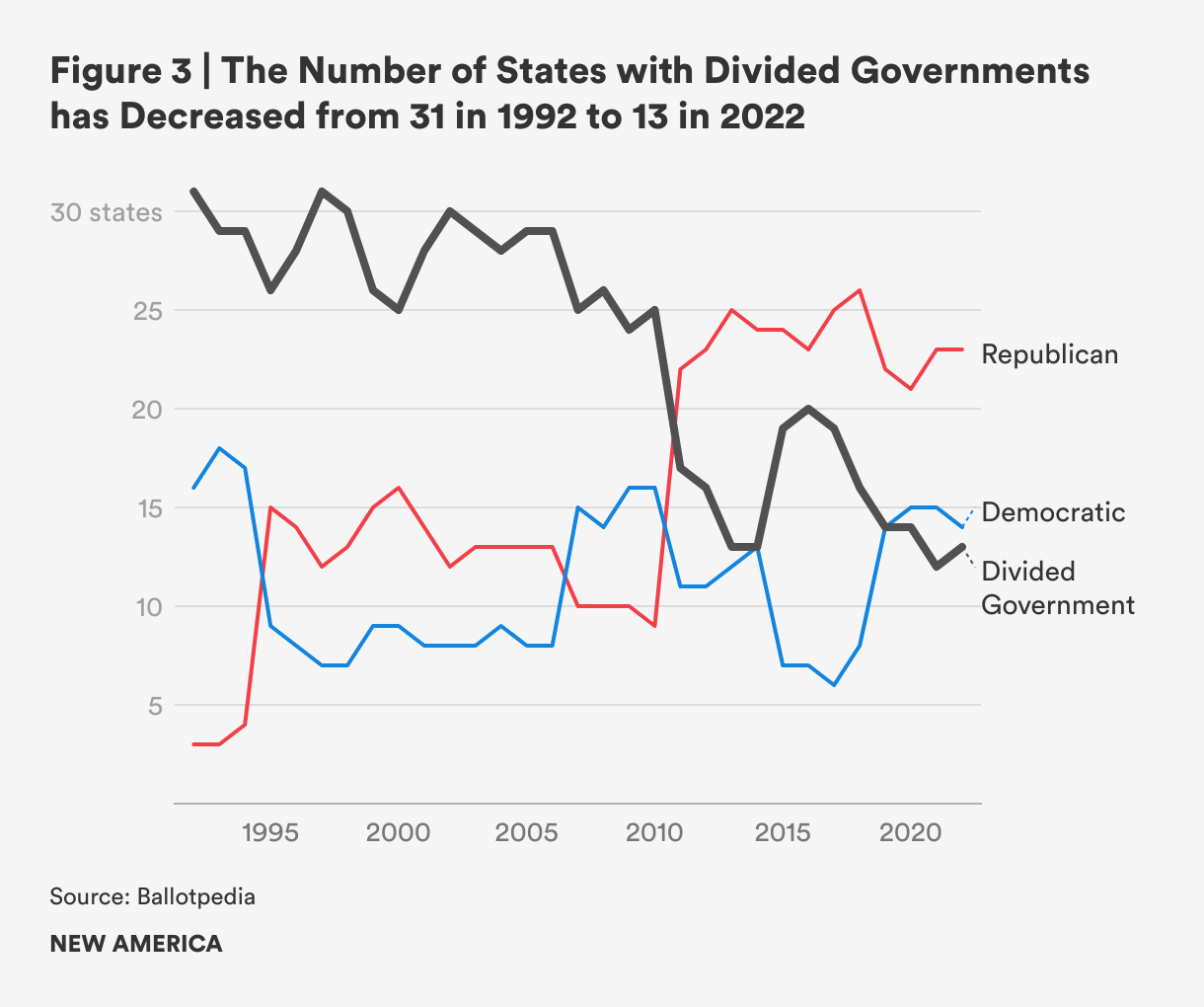
In 1992, 31 states had a divided government. In 2022 that was down to just 13. Under unified government, it is much easier to push through an aggressive partisan gerrymander. Notably, the number of Republican trifecta states more than doubled, from nine in 2010 to 23 states at the time of this writing.10
The Supreme Court Has Given a Clear Green Light to Gerrymandering
A final and significant change in the redistricting landscape is the extent to which partisan mapmakers can get away with distorted districting. The law of democracy is ever-changing in the United States. Over the last three decades, the case law around both partisan gerrymandering and racial gerrymandering has been unsteady, but moving in a clear direction: toward giving state legislatures more autonomy in drawing districts as they like.
When it comes to partisan gerrymandering, reformers had hoped that the Supreme Court would eventually offer a standard that would make extreme partisan gerrymandering illegal. They gamely sought such a ruling through a series of court cases, culminating with Rucho v. Common Cause.11 In Rucho, a conservative majority decided the federal courts had no role in refereeing congressional maps. Unless Congress wanted to offer a standard, the states had the green light to do as they pleased, as long as it complied with their own state constitutions. State litigation, however, does continue, and in the 2021–2022 redistricting cycle, several state courts played a role in redistricting.
Whether the current Supreme Court will uphold independent redistricting commissions enacted by ballot initiative remains an open question. In 2015, a 5-4 majority said a state could delegate its authority. However, the court has moved in a much more state legislature-friendly direction since, and it may revisit the constitutionality.12
As restraints and limits have withered away, partisan state legislatures have found they can do more without fear of penalty. And even if they get dinged, many partisans seem to believe that is still worth trying. The worst that can happen is the courts say no.
Conclusion: How Gerrymandering Got So Nasty
Today, it is easier than ever to gerrymander precisely. Voters are more predictably partisan, which reduces the uncertainty of outcomes in drawing districts. And redistricting technology is more advanced, which makes it easier to maximize partisan advantage.
The partisan payoff to gerrymandering is also greater. In a high-stakes, existential partisan war for control of Washington, partisans on both sides believe they would be foolish not to do everything they can to maximize their chances of controlling congressional majorities. They devote overwhelming sums of money to do so—probably at least several hundred million dollars.13
Finally, with most states under unified partisan control and the Supreme Court having given the green light to states to do whatever they want, partisan legislatures have the opportunity to go full speed ahead on maximizing their districting advantages.
None of these conditions is likely to change anytime soon, suggesting that gerrymandering will remain a problem for the foreseeable future. However, as the 2021-2022 redistricting cycle also showed, many partisan legislatures have now maximized their advantages, suggesting that there is not much room left to make the results even more disproportionate.
So, gerrymandering is clearly getting worse. Why should we care?
Here, it is crucial once more to distinguish the problems of gerrymandering from the problems of single-member districting. Redistricting commissions can only solve the problems of gerrymandering. They cannot solve the problems of single-member districting.
Most broadly, gerrymandering is blamed for three big problems: 1) hyper-partisan polarization; 2) dis-proportional representation; and 3) lack of trust in government.
The evidence that gerrymandering is to blame for hyper-partisan polarization is weak. Gerrymandering does contribute to disproportionate representation. Whether or not gerrymandering undermines trust in government is debatable, since there is no hard evidence. However, given the ugliness of the process, it does not inspire confidence.
Is Gerrymandering Responsible for Hyper-Partisan Polarization? No
The argument that gerrymandering is responsible for partisan polarization presumes that 1) gerrymandering is responsible for the decline in competitive districts; and 2) the decline in competitive districts has made partisan polarization worse.
The first premise is more clearly false. Geographical sorting of the parties is almost entirely responsible for the decline in competitive districts. Gerrymandering has played a marginal role at best. That roughly 90 percent of districts are uncompetitive is almost entirely a consequence of Democrats and Republicans living in different places.
The second premise (that the decline of competitive districts is responsible for hyper-partisan polarization) is slightly more complicated, because the decline of competitive districts is a consequence of the geographical sorting of the parties and the general decline of swing voters, and the geographical sorting of the parties is a primary cause of hyper-partisan polarization. However, as districts become more lopsidedly Democratic or Republican, the primary election becomes the most important election. This becomes a further accelerant of polarization, since incumbent members come to fear the threat of a primary challenger to their extreme.14
However, since gerrymandering is not a cause of partisan polarization, the polarizing effect of lopsided districts should be treated as a problem of single-member districting, not gerrymandering.15
Does Gerrymandering Cause Disproportionate Representation? Yes, But So Do Single-Member Districts
A second alleged consequence of gerrymandering is that it generates disproportionate representation. That is, it lets parties win a share of legislative seats that is greater than the share of the vote they received.
This is a slightly complicated allegation, because some of the disproportionality (particularly at the state level) is indeed a consequence of gerrymandering, and some of the disproportionality is consequence of inherent properties of the single-member district, which is highly sensitive to the geographic distribution of voters (the property that makes gerrymandering possible in the first place). As we will see in the later discussions of partisan neutrality, it is difficult to statistically dis-entangle the natural biases and distortions of the single-member district from the intentional biases and distortions.
For example, in 2012, when Republicans won a majority of seats in the House despite losing the national popular vote for the House, it seems almost certain that this was a product of intentional gerrymandering, rather than natural gerrymandering, since Republicans actively set out to redistrict themselves into a congressional majority following their gains in 2010, and 2012 reflected the first election under the new maps. However, in any given state in any given year, it may also be the case that Democrats naturally waste too many of their votes in lopsided districts because Democrats over-concentrate in cities.16
Still, gerrymandering creates the distinctly anti-democratic possibility that, once it gains a majority, a party can continue to use that majority to preserve that majority by continually redrawing district boundaries in ways that maximize its chances of winning. This is the most consequential danger of continued gerrymandering.
Does Gerrymandering Undermine Trust in Government? Probably
A third alleged danger of gerrymandering is that it undermines trust in government, because it creates a system in which “politicians pick their voters.” This is a hard allegation to prove or disprove, because so many other factors contribute to distrust in government. However, to the extent that voters widely oppose gerrymandering and view it as a corrupting force, the fact that it continues to exist probably is one of many factors contributing to distrust in government.17
Citations
- Corwin D. Smidt, “Polarization and the Decline of the American Floating Voter,” American Journal of Political Science 61, no. 2 (2017): 365–81, source; Jon Green, “Floating Policy Voters in the 2016 U.S. Presidential Election,” Electoral Studies 67 (October 1, 2020): 1020–1028, source.
- Samara Klar and Yanna Krupnikov, Independent Politics: How American Disdain for Parties Leads to Political Inaction (New York: Cambridge University Press, 2016).
- Daniel J. Hopkins, The Increasingly United States: How and Why American Political Behavior Nationalized (Chicago: University of Chicago Press, 2018); Jamie L. Carson, Joel Sievert, and Ryan D. Williamson, “Nationalization and the Incumbency Advantage,” Political Research Quarterly 73, no. 1 (March 2020): 156–68, source; Benjamin Melusky and Jesse Richman, “When the Local Is National – A New High-Water Mark for Nationalization in the 2018 United States State Legislative Elections,” Regional & Federal Studies 30, no. 3 (May 26, 2020): 441–60, source; Joel Sievert and Seth C. McKee, “Nationalization in U.S. Senate and Gubernatorial Elections,” American Politics Research 47, no. 5 (September 1, 2019): 1055–80, source.
- Jacob M Grumbach, Laboratories against Democracy (Princeton, N.J: Princeton University Press, 2022).
- Vann R. Newkirk II, “How Redistricting Became a Technological Arms Race,” The Atlantic, October 28, 2017, source.
- Amariah Becker et al., “Computational Redistricting and the Voting Rights Act,” Election Law Journal: Rules, Politics, and Policy 20, no. 4 (December 2021): 407–41, source E. Cain et al., “A Reasonable Bias Approach to Gerrymandering: Using Automated Plan Generation to Evaluate Redistricting Proposals 2020 Redistricting: Mapping a New Political Decade Symposium,” William & Mary Law Review 59, no. 5 (2018): 1521–58; Wendy K. Tam Cho, “Technology-Enabled Coin Flips for Judging Partisan Gerrymandering,” Southern California Law Review Postscript 93 (2019): 11; Carl Smith, “Can New Technology Tools Keep Redistricting Honest and Fair?” Governing, September 16, 2021, source.
- Jeff Gou, “Gerrymandering didn’t make politics this vicious. But vicious politics will soon make gerrymandering so much worse,” Washington Post, July 2, 2015, source.
- William F. Connelly and John J. Pitney, Congress’ Permanent Minority?: Republicans in the US House (Rowman & Littlefield, 1994).
- Lee Drutman, “How Much Longer Can This Era Of Political Gridlock Last?,” FiveThirtyEight, March 4, 2021, source.
- Ballotpedia, “State government trifectas,” accessed July 26, 2022, source.
- For useful analysis, see Guy-Uriel E. Charles and Luis E. Fuentes-Rohwer, “Dirty Thinking about Law & Democracy in Rucho v. Common Cause,” Duke Law School Public Law & Legal Theory Series (October 2019): 1–13.
- Oyez.org, “Arizona State Legislature v. Arizona Independent Redistricting Commission,” accessed July 31, 2022, source.
- Alyce McFadden, “How ‘dark money’ is shaping redistricting in 2021,” Open Secrets, May 20, 2021 source.
- Lee Drutman, What We Know about Congressional Primaries and Congressional Primary Reform (Washington, DC: New America, 2021), source.
- For strong evidence that gerrymandering did not cause polarization, see: Nolan McCarty, Keith T. Poole, and Howard Rosenthal, “Does Gerrymandering Cause Polarization?,” American Journal of Political Science 53, no. 3 (July 1, 2009): 666–80.
- Daryl R. DeFord, Nicholas Eubank, and Jonathan Rodden, “Partisan Dislocation: A Precinct-Level Measure of Representation and Gerrymandering,” Political Analysis 30, no. 3 (June 2021): 1–23, source; Jonathan A. Rodden, Why Cities Lose: The Deep Roots of the Urban-Rural Political Divide (New York, NY: Basic Books, 2019); Jowei Chen and Jonathan Rodden, “Unintentional Gerrymandering: Political Geography and Electoral Bias in Legislatures,” Quarterly Journal of Political Science 8, no. 3 (January 1, 2013): 239.
- Mackenzie Wilkes, “Americans Don’t Trust Their Congressional Maps To Be Drawn Fairly. Can Anything Change That?,” FiveThirtyEight, October 26, 2021, source; Sheila Suess Kennedy, "Electoral Integrity: How Gerrymandering Matters," Public Integrity 19, no. 3 (2017): 265–273; Brennan Center for Justice, “Expert Brief: Americans Are United Against Partisan Gerrymandering,” March 15, 2019, source; RepresentUS, “National Polling: Voters See Gerrymandering as a Major Problem, Want Reform,” August 4, 2021, source.