
Table of Contents
- Introduction
- Where We Have Been: The History of Gerrymandering in America
- How Gerrymandering Got So Nasty: Means, Motive, and Opportunity
- Redistricting Reform
- Can Commissions Make Districting Fairer?
- 2021–2022 Reapportionment and Commissions
- Alternatives to American-Style Districting
- Areas for Future Research
- Conclusion
- Appendix
Alternatives to American-Style Districting
Given the pathologies of the American approach to districting, it is natural to ask: what alternatives exist? This section will briefly put the American system in context.
America’s approach to districting is both unique and by the standards of modern democracy, uniquely awful. While only a handful of advanced industrial democracies use single-member districts like the United States, those that do use single-member districts have independent national agencies that draw boundaries.1
In Canada, for example, Elections Canada—a national elections agency led by a Chief Electoral Officer—draws the boundaries after each census. Canada has been doing this since 1966, when new maps went into place following a 1964 law that transferred boundary drawing authority to the national commission, following a period of egregious gerrymandering. Canada modeled its system on the Australian commission model.2 The system has widely been considered successful, and proof that reform is indeed possible. As one scholar of Canadian politics has observed:
The success stories of Canada’s redistricting reforms over the past half century are manifold. The periodic gerrymanders by elected officials have been brought to an end. With the transformation, redistricting has now evolved into a regular, institutionalized exercise that is widely seen as legitimate. The public cynicism and disenchantment with politics, about which there is understandable concern, has not been directed at redistricting. If anything, the path that redistricting has taken since the mid-1950s has demonstrated that politicians can, when the conditions are right, relinquish control of a much-criticized power in the public interest. Based on the Canadian experience, the critical conditions that combine to produce changes in the redistricting process are reform-minded politicians and political leaders, a disaffected press and general public, and (at least in the federal changes of 1964) a “minority parliament” in which the governing party reached a satisfactory compromise with important Opposition parties.3
The United Kingdom, which also uses single-member districts, also uses a national Independent Boundary Commission, guided by The House of Commons (Redistribution of Seats) Act of 1944, which required constituencies to have electorates that were within 25 percent (plus or minus) of the national average, with regular readjustments as population changed. However, the process of redistricting has remained political, both through subsequent adjustments to the national laws, and the actual drawings of boundaries, which have had political consequences for the major parties.4
Given that British politics is highly nationalized and is dominated by two parties, no change to districting boundaries is ever truly neutral. This makes the British districting process somewhat controversial, though not as contested and ugly as that of the United States. Canadian politics tends to be more consensual at the national level, both because its party system is less polarized (it has more of a three-party system than a two-party system) and because more politics takes place at the provincial level.5
Additionally, even with independent national commissions, the use of single-member districts in Canada and the United Kingdom still leads to occasional “plurality reversals” (the party with a smaller share of the national popular vote getting a majority of seats in the national legislature because its voters are more efficiently distributed). And consistently, the bias in single-member districts is to over-represent the conservative rural party and under-represent the liberal urban party, even under national redistricting rules. This is because under single-member districts, the urban party almost always tends to waste more of its votes in lopsided urban districts, while the conservative rural party is more efficiently distributed.6
The other major advanced democracy with single-member districts is France. France is like the United States in that redistricting is a political process, with politicians in charge. But France is unlike the United States in two important respects. First, because of its two-round system, France is a multiparty system, so the effects of redistricting on parties are less certain and predictable than they are under a two-party system. Second, because there are no decennial mandates to redraw boundaries to equalize population, the decision to redistrict is up to the current government, which has often declined to take advantage of it both for fear of backlash and of harming incumbents. As a result, French politics has a long history of significant malapportionment.7
Beyond the United States and France, the list of countries that allow politicians to draw district boundaries is small: Bulgaria, Czech Republic, Italy, Kyrgyzstan, and Panama.8 In Hungary, when Orban’s Fidesz party came to power in 2010, one of its first acts was to increase the share of the Hungarian parliament elected by single-member districts, and to eliminate the previous two-round runoff election for the remaining single-member districts. Both of these changes made Hungarian elections considerably more disproportional, and boosted Fidesz’s ability to retain power in future elections.9
Most advanced democracies, however, use various forms of proportional representation, which render districting boundaries far less consequential—both because geographical dispersion of partisan support is less consequential, and because with multiple parties in multimember districts, the effects of line drawing is less clear. Additionally, in proportional representation systems, districts tend to coincide with other existing government units. In proportional representation systems, districts often coincide with well-known local government units or groups of these.10
The smaller the district magnitude (the number of seats per district) and fewer viable parties, and the more majoritarian the party system, the more gerrymandering threatens electoral fairness.11 Among advanced democracies, experts agree that gerrymandering is most egregious and distorting in the United States.12 As Handley and Grofman note: “if countries were to be placed on a spectrum of how ‘political’ the delimitation process is, the United States would sit firmly at the ‘political’ end of the continuum.”13
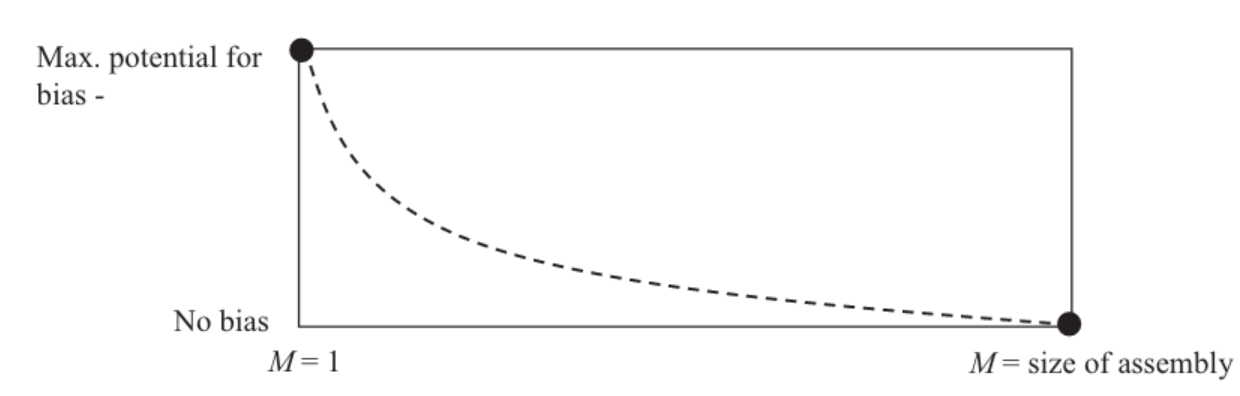
As a general rule, the single-member district is most vulnerable to partisan manipulation. Just as low district magnitude is associated with more partisan bias, as district magnitude increases, the potential for partisan bias decreases, as this figure by Keena et al. nicely demonstrates:14
The simple reality is that by using single-member districts and allowing politicians to draw district lines, the United States has saddled itself with a districting process that is maximally vulnerable to partisan and political shenanigans. The only system that could possibly be more unfair is the at-large bloc voting system that was widely used in the first half of the 19th century. But among contemporary democracies, experts rate gerrymandering in the United States at the absolute bottom of the list, just behind Malaysia.15
Citations
- Lisa Handley and Bernard Grofman, Redistricting in Comparative Perspective (Oxford, UK: Oxford University Press, 2008).
- C. P. Hoffman, “The Gerrymander and the Commission: Drawing Electoral Districts in the United States and Canada,” Manitoba Law Journal 31, no. 331 (2006): 1–30.
- John C. Courtney, “Redistricting: What the United States Can Learn from Canada,” Election Law Journal: Rules, Politics, and Policy 3, no. 3 (September 2004): 488–500, source.
- Iain McLean and Roger Mortimore, “Apportionment and the Boundary Commission for England,” Electoral Studies 11, no. 4 (December 1, 1992): 293–309, source; Ron Johnston, Charles Pattie, and David Rossiter, “‘Somewhat More Disruptive than We Had in Mind’: The Boundary Commission for England’s 2011 Proposed Redistribution of Parliamentary Constituencies,” Political Quarterly 83, no. 1 (2012): 44–59, source; D. J. Rossiter, R. J. Johnston, and C. J. Pattie, “Redistricting and Electoral Bias in Great Britain,” British Journal of Political Science 27, no. 3 (July 1997): 453–72, source; D. J. Rossiter, R. J. Johnston, and C. J. Pattie, “Estimating the Partisan Impact of Redistricting in Great Britain,” British Journal of Political Science 27, no. 2 (April 1997): 299–331, source.
- Richard Johnston and Fred Cutler, “Canada: The Puzzle of Local Three-Party Competition,” in Duverger’s Law of Plurality Voting, vol. 13 (New York, NY: Springer New York, 2009), 83–96, source; Richard Johnston, The Canadian Party System: An Analytic History (University of British Columbia Press, 2017).
- Rodden, “Why Cities Lose.”
- Nicolas Sauger and Bernard Grofman, “Partisan Bias and Redistricting in France,” Electoral Studies 44 (December 2016): 388–96, source.
- Handley and Grofman, Redistricting in Comparative Perspective, 20–35.
- Kim Lane Schepelle, “Hungary, An Election in Question, Part 2,” New York Times (Paul Krugman blog), February 26, 2014, source; Andrea Fumarola, “Fidesz and Electoral Reform: How to Safeguard Hungarian Democracy,” London School of Economics blog, March 21, 2016, source.
- Lisa Handley and Bernard Grofman, Redistricting in Comparative Perspective (Oxford, UK: Oxford University Press, 2008); Ferran Martínez i Coma and Ignacio Lago, “Gerrymandering in Comparative Perspective,” Party Politics 24, no. 2 (March 1, 2018): 99–104, source.
- David Samuels and Richard Snyder, “The Value of a Vote: Malapportionment in Comparative Perspective,” British Journal of Political Science 31, no. 4 (October 2001): 651–71, source.
- Martínez i Coma and Lago, “Gerrymandering in Comparative Perspective.”
- Handley and Grofman, Redistricting in Comparative Perspective, 35.
- Keena et al., Gerrymandering the States.
- Ferran Martínez i Coma and Ignacio Lago, “Gerrymandering in Comparative Perspective,” 99–104.