What We Know About Redistricting and Redistricting Reform
Table of Contents
- Introduction
- Where We Have Been: The History of Gerrymandering in America
- How Gerrymandering Got So Nasty: Means, Motive, and Opportunity
- Redistricting Reform
- Can Commissions Make Districting Fairer?
- 2021–2022 Reapportionment and Commissions
- Alternatives to American-Style Districting
- Areas for Future Research
- Conclusion
- Appendix
Abstract
This report offers a systematic analysis of redistricting and redistricting commissions, and finds that truly independent redistricting commissions are superior to partisan legislatures across any number of measures. However, there are significant limits to “fair” maps, even with independent commissions. While gerrymandering is undoubtedly a major concern, many of the problems attributed to gerrymandering are actually problems with districting, and more specifically with the use of the single-member district. Therefore, while independent redistricting commissions do perform better than partisan state legislatures, the improvements are typically more marginal than the conventional wisdom would suggest. They fall short of ideal conditions—especially when it comes to the share of districts that are competitive in a general election.
Acknowledgments
I would like to thank Tyler Fisher, Lizbeth Lucero, Maresa Strano, and Mark Schmitt for their incredibly helpful comments and editing support. This would not have been possible without them.
Thanks also to Jodi Narde, Joe Wilkes, and Naomi Morduch Toubman for their graphics and communications support. Funding for this work was provided by the Unite America Institute. All positions are those solely of the authors.
Downloads
Introduction
Every decade, following the U.S. Census, states redraw the boundaries of their congressional and state legislative districts. This redistricting process can have tremendous consequences for how communities, voters, and parties are represented in both Congress and state legislatures. It can create competitive races, or insulate incumbents from competition. It can divide communities and cities or keep communities and cities together. Redistricting can also give one party disproportionate representation, far beyond the share of the votes it receives. These contortions and distortions collectively go under a single epithet: “gerrymandering.”
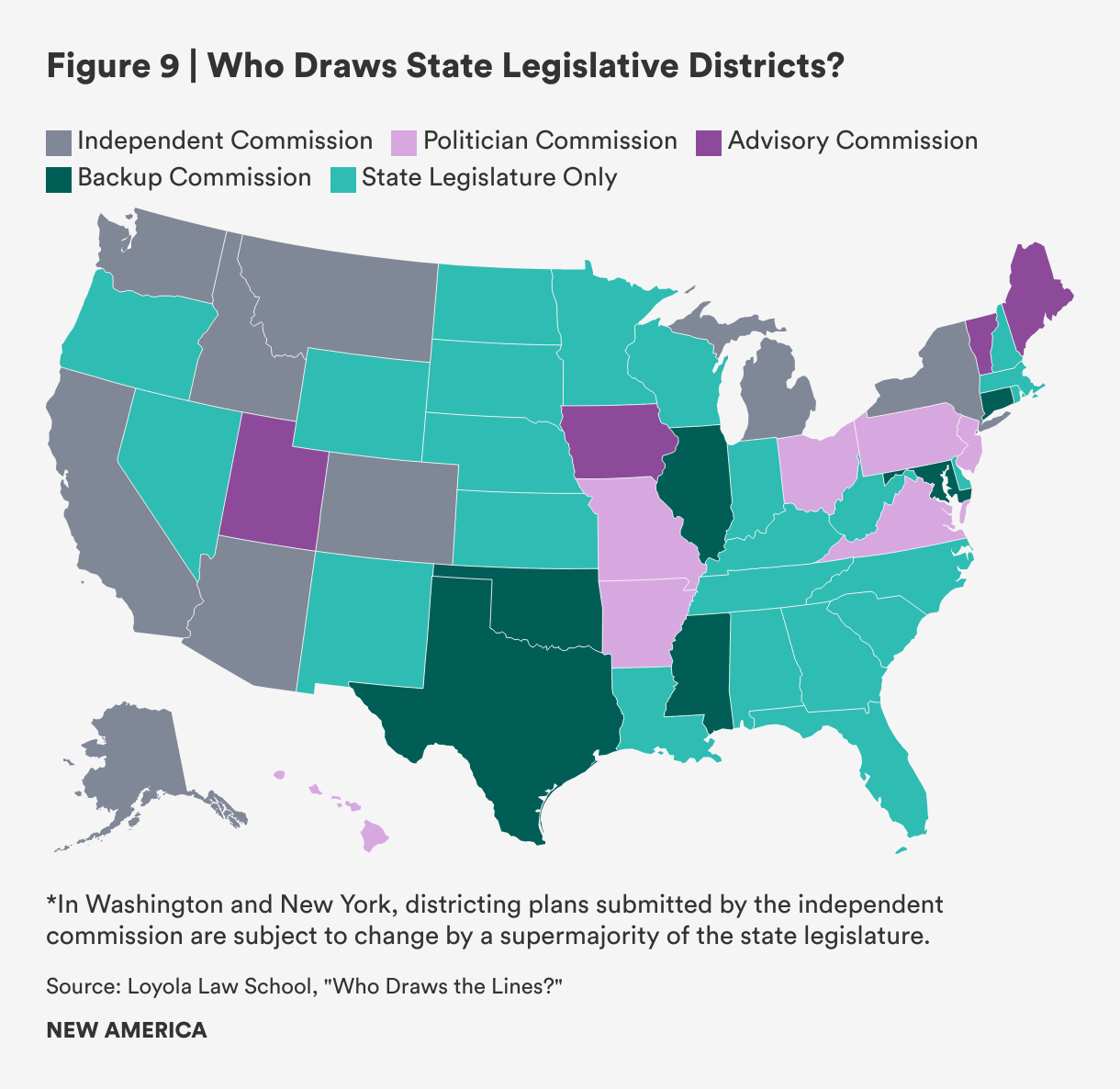
Because many view gerrymandering as both out of control and destructive to American democracy, eight states have now taken redistricting authority away from state legislatures and handed it over to independent citizens commissions.1 In widespread commentary, analysts who bemoan the evils of gerrymandering typically recommend commissions as the obvious alternative. The conventional wisdom is that commissions are better able to make districting “fair.”
This report offers a systematic analysis of the claim that redistricting commissions can improve the fairness of redistricting.
The simple takeaway is that redistricting commissions are superior to partisan legislatures across any number of measures. However, many of the problems attributed to gerrymandering are actually problems with districting, and more specifically with the use of the single-member district. Thus, while redistricting commissions do perform better than partisan state legislatures, the improvements are typically more marginal than the conventional wisdom would suggest, and they fall short of ideal conditions—especially when it comes to the share of districts that are competitive in a general election. Even in states that use independent commissions, barely one-in-ten districts are two-party competitive.
This report aims first to provide a detailed framework for evaluating redistricting plans; and second, to then evaluate the performance of commissions within this framework. In so doing, we are forced to confront the severe limits of districting within the single-member district framework.
Gerrymandering is an obvious bad, primarily because it allows a party in power to entrench and distort its majority by changing district lines to most efficiently distribute its voters, sometimes creating an imbalance in which a party that gets a minority of votes can win a majority of seats in a legislature, in obvious violation of a basic democratic principle that the party that gets more votes should win the election. Independent redistricting commissions, particularly those fully insulated from partisan politics, are a logical, appropriate, and effective solution.
However, many of the other problems ascribed to gerrymandering, particularly the decline of competitive districts, are in fact problems of single-member districting under geographically polarized parties, and therefore are not areas where independent commissions can make more than marginal progress.
Evaluating the work of commissions is further complicated by the simple reality that not all commissions have the same structure or authority. Some redistricting commissions have more independence from partisan politics and elected officials than others. How commissions are selected matters. So does their power.
Additionally, state laws direct commissions to prioritize among competing goals in districting. All districting plans force trade-offs between five main goals: partisan neutrality, competitiveness, compactness, keeping communities of interest together, and fair minority representation.
Furthermore, all five goals of redistricting lack agreed-upon metrics. At least 18 different measures of partisan fairness have been proposed, as have almost 100 measures of compactness, and countless measures of competitiveness and community integrity. Because fair minority representation has been the most litigated area, it has historically had more agreed-upon metrics. But even here, the standards are changing and eroding.2
Finally, as partisanship and demographics continue to shift, the possibilities of districting continue to change. Particularly, as the urban-rural divide continues to deepen in American politics,3 as cities and inner suburbs become more multiracial and cosmopolitan, and as the hyper-partisan intensity of narrowly contested elections continues to deepen, commissions must navigate the difficulties of drawing fair districts under such conditions. When Democrats and Republicans live in different places, competition and partisan neutrality are extremely difficult to negotiate. Competition is extremely difficult to achieve generally, and partisan neutrality becomes deeply contested.
Moreover, districts change over the course of a 10-year districting cycle. Districts that appear safe at the beginning of the decade may become competitive by the end. Districts that appear competitive may become safe for one party or the other.
This report shows the limits of what is possible under a framework of single-member districts and provides reasonable expectations for what redistricting commissions can actually accomplish within this framework. Many of the problems that we think independent commissions could solve are not caused by gerrymandering per se but are unavoidable within the context of single-member districts. But independent commissions can lead to modest improvements.
Citations
- In the current redistricting cycle, independent commissions in eight states will have final say in approving congressional and/or state legislative district lines: Alaska, Ariz., Cali., Colo., Idaho, Mich., Mont., and Wash. New York also has an independent commission, but the state legislature still has final approval. All About Redistricting, “National Summary,” accessed July 27, 2022, source.
- Lynn Adelman, “The Roberts Court’s Assault on Democracy,” Harvard Law & Policy Review 14, no. 1 (2020): 131–58.
- Suzanne Mettler and Trevor Brown, “The Growing Rural-Urban Political Divide and Democratic Vulnerability,” The ANNALS of the American Academy of Political and Social Science 699, no. 1 (January 1, 2022): 130–42, source; Dante J. Scala and Kenneth M. Johnson, “Political Polarization along the Rural-Urban Continuum? The Geography of the Presidential Vote, 2000–2016,” The ANNALS of the American Academy of Political and Social Science 672, no. 1 (July 1, 2017), 162–84, source; Mettler and Brown, “The Growing Rural-Urban Political Divide and Democratic Vulnerability”; James G. Gimpel et al., “The Urban–Rural Gulf in American Political Behavior,” Political Behavior 42, no. 4 (December 1, 2020): 1343–68, source.
Where We Have Been: The History of Gerrymandering in America
In some ways, the redistricting fights of today are the latest fusillade in an ongoing partisan tug-of-war for partisan power stretching back more than two centuries.
But in other ways, the redistricting fights of today are something new—higher stakes, nastier, and more precise, and taking place in an era in which our expectations for fairness are much higher.
History helps us to better grasp how districting interacts with national political conditions and the geographic bases of partisan coalitions. Since 1842, when the single-member district entered into dominant use, the geography of partisan coalitions has gone through many permutations. These permutations have interacted with districting in various ways, some more malign than others.
At no moment in American history has redistricting worked particularly well and at no moment has it escaped controversy. But, unsurprisingly, it has been least controversial during periods of low partisan polarization, and when both parties enjoyed broader geographic appeal. Knowing that our system of districting has always been a problem, but that the problem has varied in intensity, is key in understanding how to “solve” it.
1787–1840: Problematic from the Creation
Gerrymandering, or the practice of manipulating district boundaries to achieve a certain result, often to advantage one party or protect incumbents, is as old as America.4 In drawing the first congressional maps in 1788, Anti-Federalists in Virginia forced Federalist candidate James Madison into the same seat as Anti-Federalist James Monroe, in hopes of keeping Madison out of Congress.5 (Madison won the election anyway.)
The term “gerry-mander” itself was coined in 1812, a portmanteau of Massachusetts Governor Elbridge Gerry (an active participant in the 1787 Constitutional Convention and James Madison’s first vice president) and salamander. It described a snaking state Senate district designed especially to help Gerry’s party, the Democratic-Republicans, gain seats in the chamber.
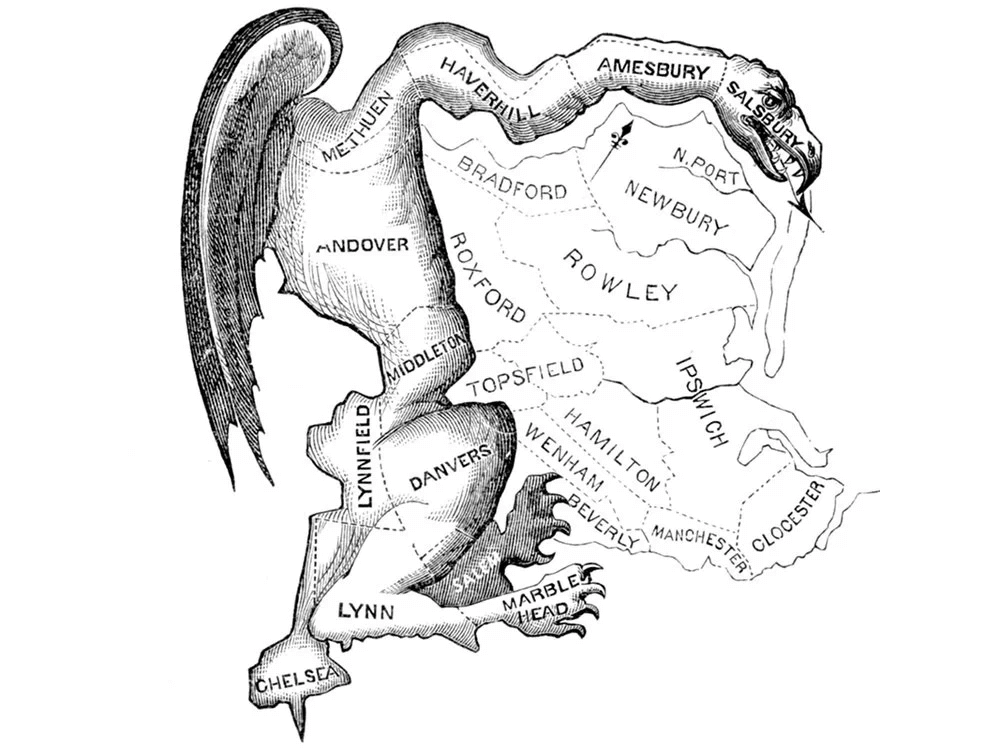
This iconic drawing appeared in the Boston Gazette, under the headline “The Gerry-mander.” The accompanying essay blamed partisan pugilism—the “many fiery ebullitions of party spirit, many explosions of democratic wrath and fulminations of gubernatorial vengeance within the year past.”6 The practice was nothing new. But now it had a memorable name and a symbol. District maps with funny shapes that resemble animals (not just salamanders) have since symbolized the excesses of gerrymandering. However, as this report explains, focusing on the shape alone often misses the big picture: Any shape can be designed to entrench partisan advantage or protect incumbents.
If gerrymandering was a problem from the start of the republic, one might wonder why the Framers of the Constitution did not prevent it. In particular, how did James Madison not anticipate that his opponents in the Virginia state legislature would pack him into a district where he was less likely to win? One answer is that the idea of districting itself was something new.
State-level colonial politics was largely consensual into the mid-18th century, or at least dissent was effectively suppressed. Under the Articles of Confederation, all states appointed delegates, and could choose between two and seven delegates. But each state only got one vote, regardless of how many delegates it chose.
But at the Constitutional Convention of 1787, the Framers came up with their new representation scheme: A House of Representatives, in which states would get representatives in proportion to their population, and each representative (instead of each state) would have a single vote. The original formula was set at one representative per 30,000 residents, so Virginia had 10 representatives. Massachusetts and Pennsylvania each had eight. Two states wound up with a single representative: Delaware and Rhode Island.
The Constitution said nothing about how states should select their representatives. Article I, Section 4 (the elections clause) says: “The Times, Places and Manner of holding Elections for Senators and Representatives, shall be prescribed in each State by the Legislature thereof; but the Congress may at any time by Law make or alter such Regulations, except as to the Place of Chusing Senators.”
That is, state legislatures were free to do what they wanted; Congress was free to overrule them. But without any congressional guidance (that would come later), states experimented.
Some states (Connecticut, New Hampshire, New Jersey, and Pennsylvania) choose to elect all their representatives statewide on a “general ticket.” That meant that in Pennsylvania, for example, voters got eight votes, to allot to the eight candidates they preferred. Two states (Georgia and Maryland) used a mixed district/at-large system, in which candidates were elected at large, but had to be residents of a specific district that they would represent.
The remaining states (including Virginia) allocated representatives to districts. However, this required a process for drawing district lines. But there was no obvious way to do this. Towns or counties made logical jurisdictions for representation, but they did not neatly naturally align into equally sized groups of 30,000 residents, which was the prescribed size for districts at the time. Instead, state governments that chose to use districts were left to combine or split up towns and counties in order to create districts of roughly equal size.7 And, as the Madison-Monroe contest of 1789 revealed, the political consequences of districting became immediately apparent. From the very beginning, boundaries were never neutral.
The early years of the American republic were marked by intense partisan fighting between the Federalists and the Democratic-Republicans (the two parties that the Framers-turned-politicians quickly organized once in government, despite their frequent fulminations against partisan politics). In an era in which the informal rules of American democracy were still under intense negotiation, partisan state governments were quick to change districting plans to benefit their party in national and state elections. Indeed, as long as state legislatures have been responsible for drawing legislative districts—that is, since the beginning of the republic—partisans have boldly bent boundaries as best they could.
The classic gerrymandering technique of “cracking and packing”—essentially, distributing your supporters more efficiently than your opponents’ supporters—was certainly one trick. But an even neater gambit was to shift back and forth between statewide at-large general ticket elections and districted elections. Here’s the basic logic: Say your party is popular statewide. If your party garners 55 percent of the vote statewide, moving all House races to general ticket at-large elections means your party can win the entire slate. With districting, by contrast, your party is still likely to lose a few seats, unless your party is equally popular in every district.
In Pennsylvania for example, the Federalist-controlled state legislature imposed statewide general ticket districting. Federalists were strongest in Philadelphia, thus the at-large system gave Eastern Pennsylvania statewide supremacy. Western Pennsylvania fought back and the state switched to districts for the 1790 elections. Federalists switched back to statewide elections in 1792, then the state settled back on districts in 1794.8 This kind of back-and-forth was common in the early years of the Republic, as the original two parties jockeyed for supremacy. Many states also shifted back and forth between allocating their Electoral College votes by congressional district and statewide, with similar partisan opportunism.9 At any time between 1789 to 1840, roughly one-quarter of all congressional seats were allocated statewide, but which quarter was in constant flux.10
This whiplash of districting schemes generated high turnover among congressional delegations. But at the time, few representatives were making a career in the U.S. House. Typically, members would not serve more than a few terms. Political life in the states was robust and often more attractive.
1842–1896: The Single-Member District Becomes Dominant
This widespread practice of shifting back and forth from statewide at-large districts to single-member districts was permitted until the Apportionment Act of 1842, when Congress mandated the usage of single-member districts, using their power under Article I, Section 4.11
In the decade leading up to the passage of the Apportionment Act, Democrats had moved aggressively towards statewide districts, attempting to entrench their power in states where they had a majority. However, in 1840, this backfired. Seeking a fourth Democratic term in a row, Martin Van Buren’s popularity was hobbled by a bad economy and Whigs figured out a winning formula with the popular war hero, William Henry Harrison. So, in states where Democrats had engineered congressional districting to give them a statewide sweep, Whigs benefited and swept into the House with a wide majority.
However, with the quick demise of William Henry Harrison (he caught a cold at his inauguration, and died a month later), John Tyler assumed the presidency. Tyler, a Democrat at heart who was never on board with the Whigs’ economic program, went to war with his party, and the infighting was terrible for Whigs. With a midterm shellacking all but inevitable, the Whigs realized that their best hope lay in at least preserving some safe districts in the urban areas of the states they had swept in 1840. And the best way to accomplish this was a single-member mandate, which they put into the 1842 Apportionment Act, largely along partisan lines.
The midterm results came as expected. Even with the single-member mandate, Whigs still lost the House, decisively. But they might have lost even more seats without it. Whigs were also harmed by the fact that some Democratic-controlled states refused to comply with the mandate.
But in 1846, with Democrats facing their own midterm shellacking, the remaining Democratic states that had been holdouts on at-large districts complied with the mandate hoping to preserve a few Democratic safe seats. Since then, Congress has mostly been elected through single-member districts. This mandate for single-member districts was later re-codified with the passage of the Uniform Congressional Districting Act of 1967.
No longer able to shift back and forth between statewide and single-member district House elections, partisan state legislatures turned their attention to maximizing their advantages within the confines of the single-member districts. In the 1840s and 1850s, partisan state legislatures regularly re-drew district boundaries in an era of tightly contested national elections.
But the most aggressive era of gerrymandering took place after Reconstruction, from 1878 through 1896. This was a period in which Democrats and Republicans were in close competition for national power, partisan loyalties were firm, and voter turnout was high. Under such conditions, gerrymandering became both more effective and more essential to winning elections. More effective, because with voting loyalties largely fixed, it was easier for mapmakers to draw districts to maximize their side’s representation. More essential, because, with so few undecided or swing voters, the only way for parties to win national elections was to maximize the impact of their side’s votes, by shifting boundaries to distribute them efficiently.12
In many ways, this late 19th-century era resembles today’s politics—closely fought national elections, intense partisan loyalties, and aggressive constitutional hardball tactics. But there are three important differences between then and now.13 The first difference is that, back then, the Supreme Court had not yet established the one-person, one-vote standard that required districts to be of equal size. That gave late 19th-century partisan legislatures much more flexibility in their ability to draw districts to maximize their side’s advantage. So what they may have lacked in computer algorithms, they more than made up for with the flexibility of district sizes.
The second difference is that many more states were two-party competitive, which meant that control of state legislatures frequently shifted back and forth between the two parties. And the first thing Democrats or Republicans did when they took over was to redistrict the congressional map to benefit their side. Today, most states are solidly Democratic or Republican.
The third important difference is that the federal government was still very small. States and cities had more autonomy, and therefore more power. National partisan politics was mostly a fight over patronage and tariff schemes. There were virtually no culture war issues or federal programs dividing the parties.14
1896–1964: Relative Stability and Deepening Malapportionment
With the Election of 1896, American politics entered into a new era of regional polarization and largely Republican dominance, and a sharp decline in competitive states. Southern Democrats embraced Jim Crow segregation, sealing their party’s dominance across the region. Republicans were dominant in the North, as the establishment wing of the Democratic Party had collapsed after the 1896 populist takeover by William Jennings Bryan.
With the majority of states now solidly Democratic or solidly Republican, district boundaries tended to be more stable. Democrats maximized their advantages in the states they controlled; Republicans maximized their advantages in the states they controlled. Additionally, the House stopped expanding after 1911. In previous decades, the House would expand its membership every decade following the Census (with a few exceptions), which required a certain amount of redistricting in many states. But with the size of the House set, and only small decennial reallocations in House seats (as some states grew faster than others), most states could keep the same district boundaries from election to election.15
With districting largely stable, and most states locked in one-party dominance, congressional maps changed very little from decade to decade. Many states went decades without redrawing boundary lines. Solidly Republican Connecticut, for example, drew a map in 1912 that lasted until 1962. Solidly Democratic Louisiana kept its 1912 map until 1966.16 The realigning election of 1932 caused some states to shift from Republican to Democrat, and the maps were updated accordingly. For the most part, however, districts tended to stay the same, even as populations shifted.
However, population imbalances crept in as citizens migrated into the cities but district boundaries did not change. As a result, by the early 1960s many states districting schemes had grown terribly malapportioned, with densely populated urban districts having the same representation as sparsely populated rural districts. Rural representatives obviously wanted to preserve their disproportionate power, while urban representatives (many of whom represented new and expanding Black populations who were moving to cities) wanted to change it. However, because the districting system gave rural interests clear majorities in many states, the legislative path for reform was closed off.17
It took a series of Supreme Court decisions to change that. First, in 1962, the Supreme Court established that federal courts could weigh in on redistricting; then, in 1964 it established the principle of one-person, one-vote, which Congress subsequently codified, and which forced states to redraw their district boundaries to ensure equal population.18
1964–1992: The “Reapportionment Revolution” and Partisan Dealignment
Following these Supreme Court decisions, states were forced to redraw their districts. This was called the “Reapportionment Revolution.” The most significant effect was to help Democrats in non-Southern states, since Democrats were dominant in cities, and to create more districts that could be won by a Black candidate.19
At the same time, the passage of major civil rights legislation shook up the existing party coalitions, and American politics went through an unusual transition of partisan dealignment, in which many voters found themselves unsure of which party they should belong to, and so were open to considering either.20
As a result, an unusually high percentage of states and districts were two-party competitive, and many voters split their tickets. Most of the splitting was between a Democrat for Congress and a Republican for president. This created the popular impression that Democrats had a lock on Congress (especially the House, which they had controlled entirely since 1954, and mostly since 1932), and that Republicans had a lock on the presidency (Jimmy Carter being the only Democrat elected since 1968, and probably only as a backlash to Watergate). It appeared that Americans had rendered a permanent split decision on the two parties and it made sense the two sides should work together. In addition, there was genuine overlap in the two party coalitions, with plenty of liberal Republicans and conservative Democrats still going to Congress.
These factors had two consequences for gerrymandering. First, because more voters were willing to consider both parties, the partisan predictability essential for effective partisan gerrymandering simply did not exist. If parties wanted to maximize their vote shares, it was not always clear how to do it. Elections were more candidate-centric and less party-centric.
Second, because this was an era of relative bipartisan bonhomie, incumbents of both parties were generally happy to work together to support maps that were pro-incumbent, ensuring safe seats for incumbents of both parties. Besides, with the House seemingly in permanent Democratic hands, there was less sense that majority control could depend on a particular districting plan. Therefore, gerrymandering in the 1970s and 1980s and even into the 1990s was primarily an incumbent-protection racket, with both parties complicit.21
1994–Present: The Gerrymandering Wars Escalate as Partisan Polarization Spirals Out of Control
In 1994, Republicans took back control of the House of Representatives for the first time in 40 years. The watershed election brought a new influx of conservative representatives to Congress, and made the Republican Party more solidly conservative—and combative. Academic debate brewed over whether the creation of the additional majority-minority districts contributed to Democrats’ losses, since it forced some incumbent retirements and over-concentrated Democratic votes into fewer, safer districts to ensure minority representation.22
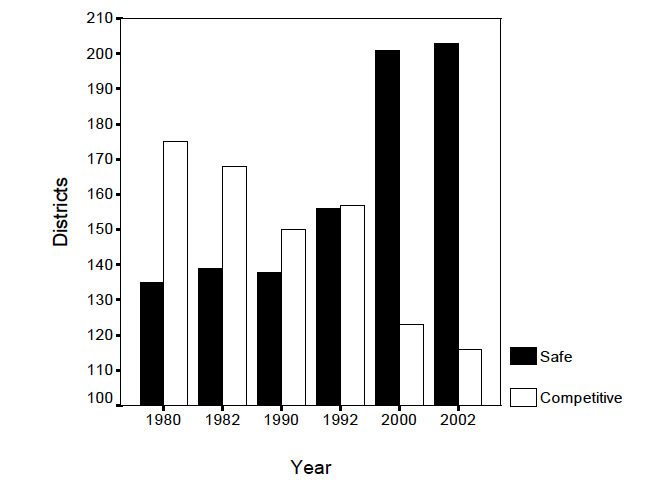
As the century waned, the two parties became more culturally and geographically sorted, congressional elections were increasingly nationalized, and the share of naturally competitive congressional districts declined steadily. Much of this was not because of gerrymandering, but rather due to Democrats abandoning rural America, and Republicans abandoning urban America.
One way to see this is to observe the steady decline of both competitive districts and split-ticket districts, as shown in the chart below.23 Split-ticket districts vote for one party for Congress, but a different party for president. Notably, these declines are steady, and do not appear to be exacerbated in years ending in “2” (that is, years after districts are redrawn).
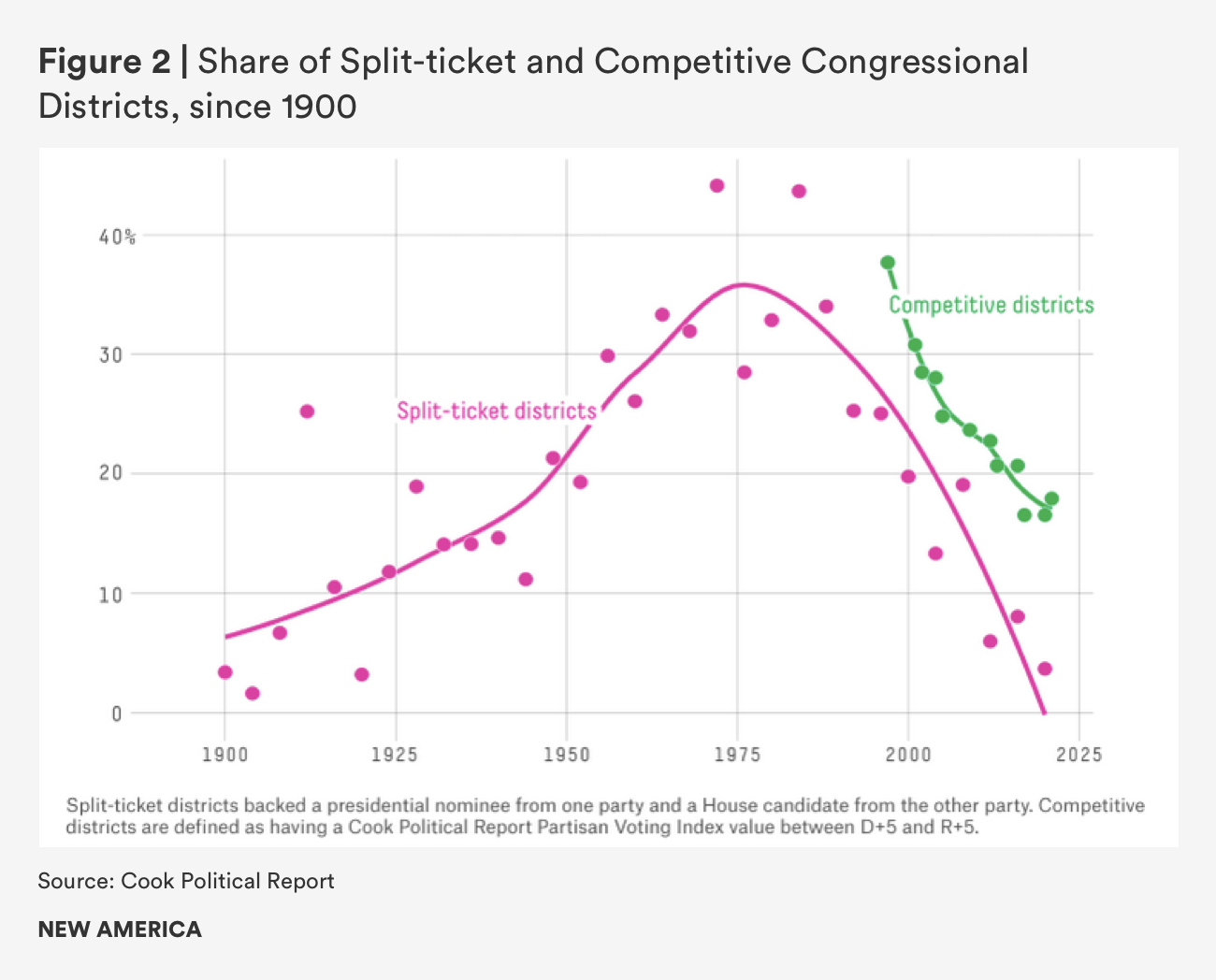
But it is not just districts that have become less competitive. Counties (which are not redrawn every decade) have also become much more lopsidedly partisan. For example, “In 2004, when George W. Bush was the most recent Republican presidential candidate to win with a majority of the popular vote, less than 200 of the nation’s 3,100 or so counties were carried by one party or the other with at least 80% of the 2-party vote. By 2020, the number of such super landslides had risen to nearly 700 counties.”24 States have also become more lopsidedly partisan. The share of states with split delegations (one Republican senator, one Democratic senator) has fallen from almost 50 percent in 1980 to 12 percent as of 2022.25
At the same time, gerrymandering has become much more aggressive in states across the country. The following section will explain the reasons why it has become more aggressive. For now, we can just point out that partisans have pushed the limits of what they can get away with.
The most blatant piece of this story is project REDMAP (Redistricting Majority Project), a Republican project that was developed in response to the Democrats’ successes in the 2008 election.26
REDMAP’s goal was for Republicans to gain control of the majority state legislatures in time for the next round of redistricting. Recognizing Democrats’ relative weakness in state legislatures, the GOP invested substantially in flipping state legislative chambers from blue to red in the 2010 midterms. The project was successful: the party gained nearly 700 state legislative seats and 22 state trifectas (control over both chambers of the legislature and the governor’s office), compared to just 11 for Democrats.27
In 2011, Republicans leveraged their new state-level dominance and recent advances in districting technology to enact a very aggressive and sophisticated redistricting plan, which allowed them to win a majority in the 2012 House midterms, despite losing the popular vote for the House and losing the presidential election. This was a qualitative escalation in the gerrymandering wars, widely documented, and widely excoriated—especially by Democrats.28
This escalation prompted six states to pass redistricting reforms in the 2010s. Colorado and Michigan enacted the strongest of the bunch, becoming the third and fourth states to establish fully independent commissions. Utah and New York created advisory commissions to propose draft maps, but left ultimate responsibility to lawmakers. Subsequent aggressive partisan gerrymanders in both states have shown the clear limits to that approach. Ohio also passed an advisory commission, and Ohio’s maps have gone through heavy litigation. Virginia voters passed a reform establishing a joint commission of citizens and state legislators to draw a single map for each set of offices, proposed to the state legislature for up or down approval.
This built on efforts in previous years to set up commissions to take districting out of the hands of lawmakers, including Hawaii in 1992, Idaho in 1994, New Jersey in 1995 (congressional maps only), Alaska in 1998, Arizona in 2006, and California in 2008.
Is this a new era of reform? It certainly seems that way. For the first time, states are systematically removing power of line drawing from state legislatures. This marks a new and significant development in the history of districting.
At the same time, even as more states move toward independent commissions, the overall picture is getting bleaker. At the end of the 2021–2022 districting cycle, the proportion of competitive districts had hit a new low. Both Republicans and Democrats tried to push their advantage in states they controlled, but going into the 2022 midterms the maps still have a pro-Republican bias.29
Some of this bias is because Republicans control more states where legislatures, not independent commissions, draw maps. Some of this bias is also because single-member districts tend to favor Republicans.
Conclusion: The Lessons of History
The patterns of history can demarcate the possibilities of the present. In the case of districting in America, history has a simple lesson: districting has always been a problem in American politics. Gerrymandering got its name in 1812, but it was present at the country’s creation.
Initially, states experimented with many approaches to districting, including large multimember districts, and some mixed formats. Though single-member districts were always the dominant form, they only became mandated with the Apportionment Act of 1842.
The aggressiveness and volatility of gerrymandering have varied throughout American history. Periods of close partisan competition for national power and high levels of partisan polarization (1878 to 1896; 1992 to present) have generated the most vigorous periods of gerrymandering. Other periods, notably 1896 to 1964, have been relatively stable, but largely because of widespread one-party control throughout most of the country from 1896 to 1932, in which partisans had already maximized their advantages. Additionally, declining partisan polarization from 1932 through 1978 reduced the stakes of elections, making districting less consequential. And steady Democratic dominance in the U.S. House from 1932 to 1992 also made districting less consequential. If Democrats were likely to remain in the majority, why bother? To the extent gerrymandering took place, it was mostly a bipartisan affair, with incumbents drawing lines to protect their reelection chances.
But starting in 1994, the stakes began to change, and so did the game. A new era of gerrymandering battles arose as partisan politics polarized and parties sorted geographically. But this new era also spurred new reforms. For the first time, states began transferring districting authority to commissions. This new reform era forces us to ask the fundamental question at the core of this report: How much fairer can districting be in the United States if it is done through commissions? How many of the problems that we ascribe to gerrymandering are really just problems inherent in the single-member district, especially when Democrats and Republicans live in such different places?
Citations
- In the current redistricting cycle, independent commissions in eight states will have final say in approving congressional and/or state legislative district lines: Alaska, Ariz., Cali., Colo., Idaho, Mich., Mont., and Wash. New York also has an independent commission, but the state legislature still has final approval. All About Redistricting, “National Summary,” accessed July 27, 2022, source">source.
- Lynn Adelman, “The Roberts Court’s Assault on Democracy,” Harvard Law & Policy Review 14, no. 1 (2020): 131–58.
- Suzanne Mettler and Trevor Brown, “The Growing Rural-Urban Political Divide and Democratic Vulnerability,” The ANNALS of the American Academy of Political and Social Science 699, no. 1 (January 1, 2022): 130–42, source">source; Dante J. Scala and Kenneth M. Johnson, “Political Polarization along the Rural-Urban Continuum? The Geography of the Presidential Vote, 2000–2016,” The ANNALS of the American Academy of Political and Social Science 672, no. 1 (July 1, 2017), 162–84, source">source; Mettler and Brown, “The Growing Rural-Urban Political Divide and Democratic Vulnerability”; James G. Gimpel et al., “The Urban–Rural Gulf in American Political Behavior,” Political Behavior 42, no. 4 (December 1, 2020): 1343–68, source">source.
- For those seeking a more detailed history, see Erik J. Engstrom, Partisan Gerrymandering and the Construction of American Democracy (Ann Arbor, MI: University of Michigan Press, 2013). Much of this history is drawn from Engstrom’s book.
- Engstrom, 21.
- Erick Trickey, “Where Did the Term ‘Gerrymander’ Come From?,” Smithsonian Magazine, July 20, 2017, source.
- Andrew Rehfeld, The Concept of Constituency: Political Representation, Democratic Legitimacy, and Institutional Design (Cambridge, UK: Cambridge University Press, 2005), 69–80.
- Harry Marlin Tinkcom, The Republicans and Federalists in Pennsylvania, 1790-1801 (Harrisburg, PA: Pennsylvania Historical and Museum Commission, 1950), 51; Engstrom, Partisan Gerrymandering and the Construction of American Democracy, 27.
- Alexander Keyssar, Why Do We Still Have the Electoral College? (Cambridge, MA: Harvard University Press, 2020), 61–116.
- Stephen Calabrese, “Multimember District Congressional Elections,” Legislative Studies Quarterly 25, no. 4 (2000): 611–43. Susan E. Scarrow, “Parties and the Expansion of Direct Democracy: Who Benefits?,” Sage Publication 5, no. 3 (1999): 341–362; Engstrom, Partisan Gerrymandering and the Construction of American Democracy, 43–59.
- For a slightly more detailed history, Lee Drutman, Breaking the Two-Party Doom Loop: The Case for Multiparty Democracy in America (New York: Oxford University Press, 2020), 239–264. For those wishing to take an even deeper dive into the history, see Bernard Ivan Tamas, “A Divided Political Elite: Why Congress Banned Multimember Districts in 1842,” New Political Science 28, no. 1 (March 1, 2006): 23–44; Michele Rosa-Clot, “The Apportionment Act of 1842: ‘An Odious Use of Authority,’” Parliaments, Estates and Representation 31, no. 1 (April 1, 2011): 33–52; Johanna Nicol Shields, “Whigs Reform the ‘Bear Garden’: Representation and the Apportionment Act of 1842,” Journal of the Early Republic 5, no. 3 (1985): 355; Robert E. Ross, “Recreating the House: The 1842 Apportionment Act and the Whig Party’s Reconstruction of Representation,” Polity 49, no. 3 (June 6, 2017): 408–33, source; David Canon and William Egar, “The Apportionment Act of 1842: Principle or Interest?,” APW Papers (2014): 37.
- Engstrom, Partisan Gerrymandering and the Construction of American Democracy, 80–100.
- For some history, see Lee Drutman, “How Much Longer Can This Era Of Political Gridlock Last?,” FiveThirtyEight, March 4, 2021, source.
- Frances E. Lee, “Patronage, Logrolls, and ‘Polarization’: Congressional Parties of the Gilded Age, 1876–1896,” Studies in American Political Development 30, no. 2 (October 2016): 116–27.
- Lee Drutman, Jonathan D. Cohen, Yuval Levin, and Norman J. Ornstein, The Case for Enlarging the House of Representatives (Cambridge, MA: American Academy of Arts and Sciences, 2021), source.
- Engstrom, Partisan Gerrymandering and the Construction of American Democracy, 171–172.
- J. Douglas Smith, On Democracy’s Doorstep: The Inside Story of How the Supreme Court Brought “One Person, One Vote” to the United States (New York: Hill and Wang, 2014).
- Specifically, Baker v. Carr (1962) established the principle that redistricting cases could be brought before the courts. Wesberry v. Sanders (1964) established that congressional districts must have equal population size (within a state), and Reynolds v. Sims (1964) applied the equal population size criteria to state legislative districts; J. Douglas Smith, On Democracy’s Doorstep: The Inside Story of How the Supreme Court Brought “One Person, One Vote” to the United States (New York: Hill and Wang, 2014). To codify the one person, one vote principle, Congress passed the Uniform Congressional Districting Act of 1967, which reaffirmed the congressional mandate that states use single-member districts, and that those districts be of equal size. This was the civil rights era, and the threat of southern states moving to at-large districts with block voting was real. This would have had disastrous consequences for voting rights, since it would have made it all but impossible for Black voters to elect their candidates of choice.
- Gary W. Cox and Jonathan N. Katz, “The Reapportionment Revolution and Bias in U. S. Congressional Elections,” American Journal of Political Science 43, no. 3 (July 1999): 812–841, source.
- Helmut Norpoth and Jerrold G. Rusk, “Partisan Dealignment in the American Electorate: Itemizing the Deductions since 1964,” American Political Science Review 76, no. 3 (September 1982): 522–37, source.
- Michael Lyons and Peter F. Galderisi, “Incumbency, Reapportionment, and US House Redistricting,” Political Research Quarterly 48, no. 4 (1995): 857–71.
- The passage of the 1982 Voting Rights Act, which made it easier for plaintiffs to gain majority-minority districts based on even unintentional dilution. With the help of the Justice Department, the number of majority-minority districts grew from 29 to 52 after the 1991–1992 redistricting round. The result was a significant increase in Black and Latino representatives in Congress following the 1992 election—from 37 to 56.
- Lee Drutman, “What We Lose When We Lose Competitive Congressional Districts,” FiveThirtyEight, June 23, 2022, source.
- Rhodes Cook, “The ‘Big Sort’ Continues, with Trump as a Driving Force – Sabato’s Crystal Ball,” University of Virginia Center for Politics, February 17, 2022, source.
- Lee Drutman, “Why Bipartisanship In The Senate Is Dying,” FiveThirtyEight, September 27, 2021, source.
- David Daley, Ratf**ked: The True Story Behind the Secret Plan to Steal America’s Democracy, 1st edition (New York: Liveright, 2016).
- Ballotpedia, “Historical and Potential Changes in Trifectas,” accessed May 20, 2022, source.
- Michael Li and Laura Royden, Extreme Maps (New York, NY: Brennan Center, 2017), source; Daley, Ratf**ked.
- Nathaniel Rakich, “The New National Congressional Map is Biased Toward Republicans,” FiveThirtyEight, June 15, 2022, source.
How Gerrymandering Got So Nasty: Means, Motive, and Opportunity
Why have the gerrymandering wars escalated over the last few cycles of redistricting? One way to answer that question is through the lens of the three themes lawyers consider in a criminal case: means, motive, and opportunity.
The means:
- Partisan voting has become more predictable.
- Technological advancements have made districting more precise.
The motive(s):
- Nationalized elections and partisan polarization make the stakes high in every election.
- Both parties believe that one-party dominance of Washington is always one or two elections away.
The opportunity:
- More states are solidly controlled by one party.
- The Supreme Court has given a clear green light.
The Means
Partisan Voting Has Become More Predictable
The first factor that has made gerrymandering worse is predictable partisan voting. The overwhelming majority of voters (between 90 and 95 percent, depending on the estimate) are reliably partisan, and can be identified by their address, race, or other publicly available information. This predictability takes some of the guesswork out of mapmaking. If a mapmaker knows which voters are reliably Democratic, and which are reliably Republican, this makes the partisan consequences of districting clearer to mapmakers.
One clear way to see this is to observe the declining percentage of “floating” voters who might go back and forth between supporting Democrats and Republicans depending on the candidate or the year. From 1952 to 1980, on average about one-in-eight voters went back and forth between the parties, considering either party. More recently, that has fallen to about just one-in-twenty.30 Similarly, the share of voters who would “split their tickets”—voting for different parties for different elected offices—has also declined considerably over the last several decades. Even if many voters say they are independent, they are voting like partisans.31
For the purposes of districting, fewer potential “swing” voters simply means fewer potential competitive districts. If 20 percent of voters are willing to consider either party, a district that went 65-35 for one party in the last election could easily go the other way if those 20 percent of voters swing as a whole. But if only 5 percent of voters are willing to consider either party, it takes a 54-46 district to make the election potentially competitive.
The predictability of partisan voting also makes it easier to draw maps with strong expectations about both partisan neutrality and competitiveness. This makes gerrymandering more precise.
Predictable partisan voting is largely a consequence of increasing partisan polarization. As the national parties have pulled further apart, fewer voters are left uncertain as to which party they should support.
Voters are also thinking much more about control of Congress when they vote than they did decades ago. They are voting for the party, not the candidate, because they care more about which side has power in Washington than in the past. The increased nationalization of even local voting is a trend that has been well-documented.32 Voters are even keeping Washington in their heads when voting in state elections, which has undermined the possibilities for states to serve as meaningful laboratories of democracy anymore—particularly when it comes to issues of voting and elections.33
Technological Advancements Have Made Districting More Precise
Gerrymandering has also become more precise thanks to advances in computer technology that allow map-drawers to generate and choose between thousands upon thousands of potential maps. But this technology-enabled precision is a double-edged sword.
On the one hand, technological precision makes it easier for partisan legislatures to maximize their own party’s seat share with more certainty and precision.34
On the other hand, the improved technological precision can also help independent map-drawers and courts to optimize the many trade-offs between partisan fairness, competitiveness, and keeping communities together, and empower journalists and non-profits to quantify and spotlight deviations from more neutral districting.35
However, because most of the maps are still drawn by partisan state legislatures, the technological firepower of advanced computer programs is predominantly used in the service of more aggressive gerrymandering. It is therefore one of the factors making gerrymandering worse.
The Motives
Nationalized Elections are High Stakes for Both Parties
The obvious reason for partisan state legislatures to aggressively gerrymander on behalf of their party is to help their party win national and state legislative elections. As partisan polarization has increased, the stakes of elections have increased—both for statehouses and for control of Congress.
When elections are existential high-stakes affairs, partisans in state legislatures feel more urgency to maximize their chances of winning, whatever it takes. The more Republicans feel Democrats cheat anyway, the less compunction they feel about bending the rules. The feeling is mutual—an escalating tit-for-tat that shows no signs of stopping. This justifies more aggressive gerrymandering.36
In the 2021–2022 gerrymandering wars, both parties pushed harder to maximize their seat share. They watched how the other party was pushing its advantage in the states it controlled, and pushed harder in response. But when the battle is for control of the country, restraint feels like self-sabotage.
Closely Contested National Elections: One-Party Dominance of Washington is Always One or Two Elections Away
The other significant development is the steady closeness of national House elections. From 1954 to 1994, the Democrats controlled a majority in the United States House. By the 1980s, analysts were viewing this as potentially permanent.37
As long as control for the House appeared to be locked in, there was little advantage to be gained by re-drawing the congressional maps for Republicans, and little need to do so for Democrats. But with Republicans winning the House in 1994, America entered a new era in which the House was potentially up for grabs in most elections, and gerrymandering could be extremely consequential for who would control the majority of seats.
These closely contested elections have also driven the dizzying partisan conflicts around who can vote, where, when, and how. If a few thousand votes can potentially decide control over Washington, two parties will likely do everything they can to tip the odds in their favor by changing the rules of the game. The fight over the rules of democracy has become a central and dangerous fight in our democracy, and shows no signs of ceasing.38
The Opportunity
More States are Solidly Controlled by One Party
Until somewhat recently, the opportunity to aggressively gerrymander in favor of one party or the other was limited. That is because many states had divided state legislatures, which meant that parties had to work together to pass state laws. Divided government is a check on one side rigging the rules to its advantage, though divided legislatures often agreed to maps that protected each side’s incumbents. Additionally, even though many Southern states were solidly Democratic up through the 1990s, they were still dominated by conservative Democrats, who had little interest in maximizing the power of the Democratic Party in Congress, where liberals were more dominant.
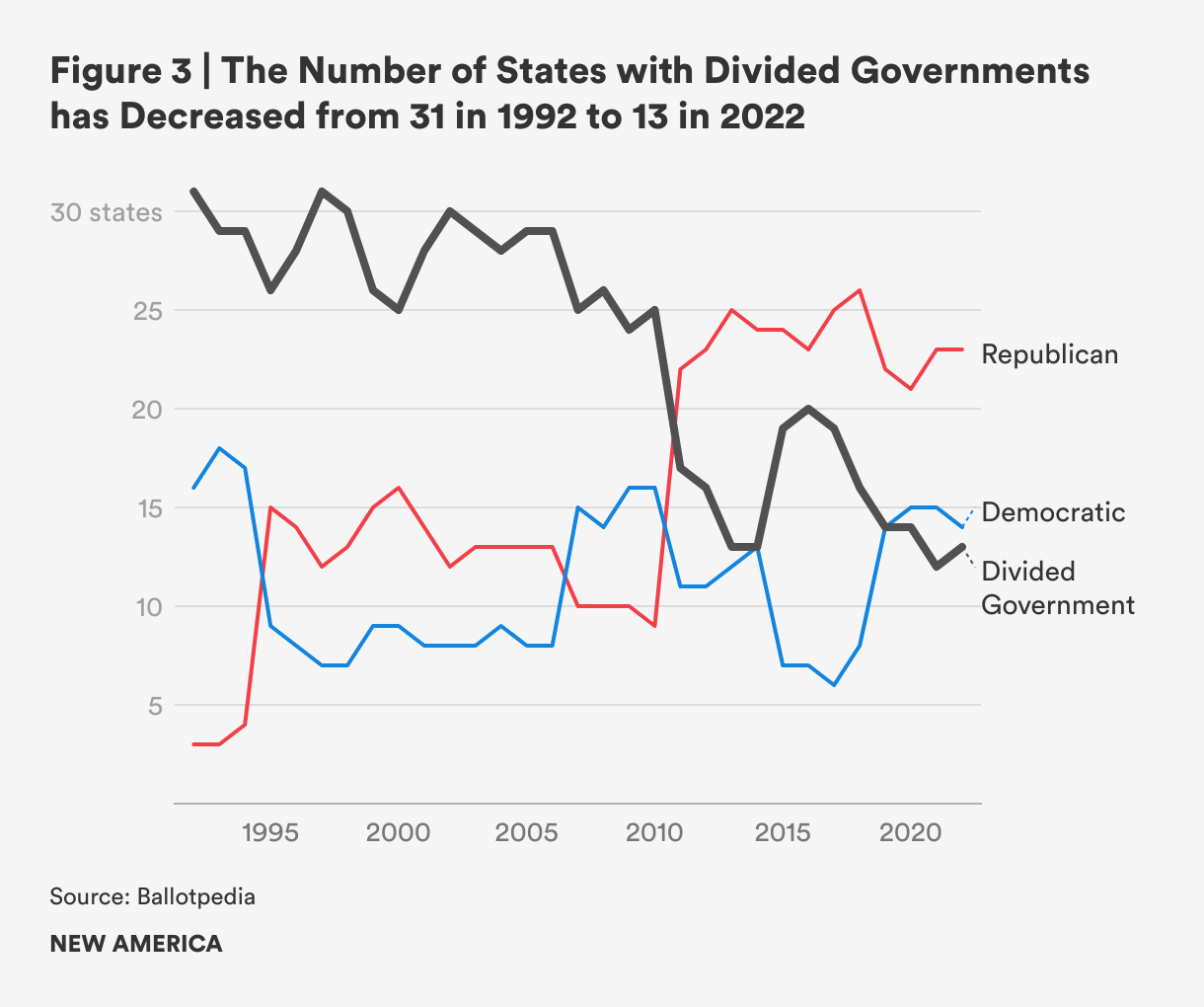
In 1992, 31 states had a divided government. In 2022 that was down to just 13. Under unified government, it is much easier to push through an aggressive partisan gerrymander. Notably, the number of Republican trifecta states more than doubled, from nine in 2010 to 23 states at the time of this writing.39
The Supreme Court Has Given a Clear Green Light to Gerrymandering
A final and significant change in the redistricting landscape is the extent to which partisan mapmakers can get away with distorted districting. The law of democracy is ever-changing in the United States. Over the last three decades, the case law around both partisan gerrymandering and racial gerrymandering has been unsteady, but moving in a clear direction: toward giving state legislatures more autonomy in drawing districts as they like.
When it comes to partisan gerrymandering, reformers had hoped that the Supreme Court would eventually offer a standard that would make extreme partisan gerrymandering illegal. They gamely sought such a ruling through a series of court cases, culminating with Rucho v. Common Cause.40 In Rucho, a conservative majority decided the federal courts had no role in refereeing congressional maps. Unless Congress wanted to offer a standard, the states had the green light to do as they pleased, as long as it complied with their own state constitutions. State litigation, however, does continue, and in the 2021–2022 redistricting cycle, several state courts played a role in redistricting.
Whether the current Supreme Court will uphold independent redistricting commissions enacted by ballot initiative remains an open question. In 2015, a 5-4 majority said a state could delegate its authority. However, the court has moved in a much more state legislature-friendly direction since, and it may revisit the constitutionality.41
As restraints and limits have withered away, partisan state legislatures have found they can do more without fear of penalty. And even if they get dinged, many partisans seem to believe that is still worth trying. The worst that can happen is the courts say no.
Conclusion: How Gerrymandering Got So Nasty
Today, it is easier than ever to gerrymander precisely. Voters are more predictably partisan, which reduces the uncertainty of outcomes in drawing districts. And redistricting technology is more advanced, which makes it easier to maximize partisan advantage.
The partisan payoff to gerrymandering is also greater. In a high-stakes, existential partisan war for control of Washington, partisans on both sides believe they would be foolish not to do everything they can to maximize their chances of controlling congressional majorities. They devote overwhelming sums of money to do so—probably at least several hundred million dollars.42
Finally, with most states under unified partisan control and the Supreme Court having given the green light to states to do whatever they want, partisan legislatures have the opportunity to go full speed ahead on maximizing their districting advantages.
None of these conditions is likely to change anytime soon, suggesting that gerrymandering will remain a problem for the foreseeable future. However, as the 2021-2022 redistricting cycle also showed, many partisan legislatures have now maximized their advantages, suggesting that there is not much room left to make the results even more disproportionate.
So, gerrymandering is clearly getting worse. Why should we care?
Here, it is crucial once more to distinguish the problems of gerrymandering from the problems of single-member districting. Redistricting commissions can only solve the problems of gerrymandering. They cannot solve the problems of single-member districting.
Most broadly, gerrymandering is blamed for three big problems: 1) hyper-partisan polarization; 2) dis-proportional representation; and 3) lack of trust in government.
The evidence that gerrymandering is to blame for hyper-partisan polarization is weak. Gerrymandering does contribute to disproportionate representation. Whether or not gerrymandering undermines trust in government is debatable, since there is no hard evidence. However, given the ugliness of the process, it does not inspire confidence.
Is Gerrymandering Responsible for Hyper-Partisan Polarization? No
The argument that gerrymandering is responsible for partisan polarization presumes that 1) gerrymandering is responsible for the decline in competitive districts; and 2) the decline in competitive districts has made partisan polarization worse.
The first premise is more clearly false. Geographical sorting of the parties is almost entirely responsible for the decline in competitive districts. Gerrymandering has played a marginal role at best. That roughly 90 percent of districts are uncompetitive is almost entirely a consequence of Democrats and Republicans living in different places.
The second premise (that the decline of competitive districts is responsible for hyper-partisan polarization) is slightly more complicated, because the decline of competitive districts is a consequence of the geographical sorting of the parties and the general decline of swing voters, and the geographical sorting of the parties is a primary cause of hyper-partisan polarization. However, as districts become more lopsidedly Democratic or Republican, the primary election becomes the most important election. This becomes a further accelerant of polarization, since incumbent members come to fear the threat of a primary challenger to their extreme.43
However, since gerrymandering is not a cause of partisan polarization, the polarizing effect of lopsided districts should be treated as a problem of single-member districting, not gerrymandering.44
Does Gerrymandering Cause Disproportionate Representation? Yes, But So Do Single-Member Districts
A second alleged consequence of gerrymandering is that it generates disproportionate representation. That is, it lets parties win a share of legislative seats that is greater than the share of the vote they received.
This is a slightly complicated allegation, because some of the disproportionality (particularly at the state level) is indeed a consequence of gerrymandering, and some of the disproportionality is consequence of inherent properties of the single-member district, which is highly sensitive to the geographic distribution of voters (the property that makes gerrymandering possible in the first place). As we will see in the later discussions of partisan neutrality, it is difficult to statistically dis-entangle the natural biases and distortions of the single-member district from the intentional biases and distortions.
For example, in 2012, when Republicans won a majority of seats in the House despite losing the national popular vote for the House, it seems almost certain that this was a product of intentional gerrymandering, rather than natural gerrymandering, since Republicans actively set out to redistrict themselves into a congressional majority following their gains in 2010, and 2012 reflected the first election under the new maps. However, in any given state in any given year, it may also be the case that Democrats naturally waste too many of their votes in lopsided districts because Democrats over-concentrate in cities.45
Still, gerrymandering creates the distinctly anti-democratic possibility that, once it gains a majority, a party can continue to use that majority to preserve that majority by continually redrawing district boundaries in ways that maximize its chances of winning. This is the most consequential danger of continued gerrymandering.
Does Gerrymandering Undermine Trust in Government? Probably
A third alleged danger of gerrymandering is that it undermines trust in government, because it creates a system in which “politicians pick their voters.” This is a hard allegation to prove or disprove, because so many other factors contribute to distrust in government. However, to the extent that voters widely oppose gerrymandering and view it as a corrupting force, the fact that it continues to exist probably is one of many factors contributing to distrust in government.46
Citations
- In the current redistricting cycle, independent commissions in eight states will have final say in approving congressional and/or state legislative district lines: Alaska, Ariz., Cali., Colo., Idaho, Mich., Mont., and Wash. New York also has an independent commission, but the state legislature still has final approval. All About Redistricting, “National Summary,” accessed July 27, 2022, <a href="source">source">source.
- Lynn Adelman, “The Roberts Court’s Assault on Democracy,” Harvard Law & Policy Review 14, no. 1 (2020): 131–58.
- Suzanne Mettler and Trevor Brown, “The Growing Rural-Urban Political Divide and Democratic Vulnerability,” The ANNALS of the American Academy of Political and Social Science 699, no. 1 (January 1, 2022): 130–42, <a href="source">source">source; Dante J. Scala and Kenneth M. Johnson, “Political Polarization along the Rural-Urban Continuum? The Geography of the Presidential Vote, 2000–2016,” The ANNALS of the American Academy of Political and Social Science 672, no. 1 (July 1, 2017), 162–84, <a href="source">source">source; Mettler and Brown, “The Growing Rural-Urban Political Divide and Democratic Vulnerability”; James G. Gimpel et al., “The Urban–Rural Gulf in American Political Behavior,” Political Behavior 42, no. 4 (December 1, 2020): 1343–68, <a href="source">source">source.
- For those seeking a more detailed history, see Erik J. Engstrom, Partisan Gerrymandering and the Construction of American Democracy (Ann Arbor, MI: University of Michigan Press, 2013). Much of this history is drawn from Engstrom’s book.
- Engstrom, 21.
- Erick Trickey, “Where Did the Term ‘Gerrymander’ Come From?,” Smithsonian Magazine, July 20, 2017, source">source.
- Andrew Rehfeld, The Concept of Constituency: Political Representation, Democratic Legitimacy, and Institutional Design (Cambridge, UK: Cambridge University Press, 2005), 69–80.
- Harry Marlin Tinkcom, The Republicans and Federalists in Pennsylvania, 1790-1801 (Harrisburg, PA: Pennsylvania Historical and Museum Commission, 1950), 51; Engstrom, Partisan Gerrymandering and the Construction of American Democracy, 27.
- Alexander Keyssar, Why Do We Still Have the Electoral College? (Cambridge, MA: Harvard University Press, 2020), 61–116.
- Stephen Calabrese, “Multimember District Congressional Elections,” Legislative Studies Quarterly 25, no. 4 (2000): 611–43. Susan E. Scarrow, “Parties and the Expansion of Direct Democracy: Who Benefits?,” Sage Publication 5, no. 3 (1999): 341–362; Engstrom, Partisan Gerrymandering and the Construction of American Democracy, 43–59.
- For a slightly more detailed history, Lee Drutman, Breaking the Two-Party Doom Loop: The Case for Multiparty Democracy in America (New York: Oxford University Press, 2020), 239–264. For those wishing to take an even deeper dive into the history, see Bernard Ivan Tamas, “A Divided Political Elite: Why Congress Banned Multimember Districts in 1842,” New Political Science 28, no. 1 (March 1, 2006): 23–44; Michele Rosa-Clot, “The Apportionment Act of 1842: ‘An Odious Use of Authority,’” Parliaments, Estates and Representation 31, no. 1 (April 1, 2011): 33–52; Johanna Nicol Shields, “Whigs Reform the ‘Bear Garden’: Representation and the Apportionment Act of 1842,” Journal of the Early Republic 5, no. 3 (1985): 355; Robert E. Ross, “Recreating the House: The 1842 Apportionment Act and the Whig Party’s Reconstruction of Representation,” Polity 49, no. 3 (June 6, 2017): 408–33, source">source; David Canon and William Egar, “The Apportionment Act of 1842: Principle or Interest?,” APW Papers (2014): 37.
- Engstrom, Partisan Gerrymandering and the Construction of American Democracy, 80–100.
- For some history, see Lee Drutman, “How Much Longer Can This Era Of Political Gridlock Last?,” FiveThirtyEight, March 4, 2021, source">source.
- Frances E. Lee, “Patronage, Logrolls, and ‘Polarization’: Congressional Parties of the Gilded Age, 1876–1896,” Studies in American Political Development 30, no. 2 (October 2016): 116–27.
- Lee Drutman, Jonathan D. Cohen, Yuval Levin, and Norman J. Ornstein, The Case for Enlarging the House of Representatives (Cambridge, MA: American Academy of Arts and Sciences, 2021), source">source.
- Engstrom, Partisan Gerrymandering and the Construction of American Democracy, 171–172.
- J. Douglas Smith, On Democracy’s Doorstep: The Inside Story of How the Supreme Court Brought “One Person, One Vote” to the United States (New York: Hill and Wang, 2014).
- Specifically, Baker v. Carr (1962) established the principle that redistricting cases could be brought before the courts. Wesberry v. Sanders (1964) established that congressional districts must have equal population size (within a state), and Reynolds v. Sims (1964) applied the equal population size criteria to state legislative districts; J. Douglas Smith, On Democracy’s Doorstep: The Inside Story of How the Supreme Court Brought “One Person, One Vote” to the United States (New York: Hill and Wang, 2014). To codify the one person, one vote principle, Congress passed the Uniform Congressional Districting Act of 1967, which reaffirmed the congressional mandate that states use single-member districts, and that those districts be of equal size. This was the civil rights era, and the threat of southern states moving to at-large districts with block voting was real. This would have had disastrous consequences for voting rights, since it would have made it all but impossible for Black voters to elect their candidates of choice.
- Gary W. Cox and Jonathan N. Katz, “The Reapportionment Revolution and Bias in U. S. Congressional Elections,” American Journal of Political Science 43, no. 3 (July 1999): 812–841, source">source.
- Helmut Norpoth and Jerrold G. Rusk, “Partisan Dealignment in the American Electorate: Itemizing the Deductions since 1964,” American Political Science Review 76, no. 3 (September 1982): 522–37, source">source.
- Michael Lyons and Peter F. Galderisi, “Incumbency, Reapportionment, and US House Redistricting,” Political Research Quarterly 48, no. 4 (1995): 857–71.
- The passage of the 1982 Voting Rights Act, which made it easier for plaintiffs to gain majority-minority districts based on even unintentional dilution. With the help of the Justice Department, the number of majority-minority districts grew from 29 to 52 after the 1991–1992 redistricting round. The result was a significant increase in Black and Latino representatives in Congress following the 1992 election—from 37 to 56.
- Lee Drutman, “What We Lose When We Lose Competitive Congressional Districts,” FiveThirtyEight, June 23, 2022, source">source.
- Rhodes Cook, “The ‘Big Sort’ Continues, with Trump as a Driving Force – Sabato’s Crystal Ball,” University of Virginia Center for Politics, February 17, 2022, source">source.
- Lee Drutman, “Why Bipartisanship In The Senate Is Dying,” FiveThirtyEight, September 27, 2021, source">source.
- David Daley, Ratf**ked: The True Story Behind the Secret Plan to Steal America’s Democracy, 1st edition (New York: Liveright, 2016).
- Ballotpedia, “Historical and Potential Changes in Trifectas,” accessed May 20, 2022, source">source.
- Michael Li and Laura Royden, Extreme Maps (New York, NY: Brennan Center, 2017), source">source; Daley, Ratf**ked.
- Nathaniel Rakich, “The New National Congressional Map is Biased Toward Republicans,” FiveThirtyEight, June 15, 2022, source">source.
- Corwin D. Smidt, “Polarization and the Decline of the American Floating Voter,” American Journal of Political Science 61, no. 2 (2017): 365–81, source; Jon Green, “Floating Policy Voters in the 2016 U.S. Presidential Election,” Electoral Studies 67 (October 1, 2020): 1020–1028, source.
- Samara Klar and Yanna Krupnikov, Independent Politics: How American Disdain for Parties Leads to Political Inaction (New York: Cambridge University Press, 2016).
- Daniel J. Hopkins, The Increasingly United States: How and Why American Political Behavior Nationalized (Chicago: University of Chicago Press, 2018); Jamie L. Carson, Joel Sievert, and Ryan D. Williamson, “Nationalization and the Incumbency Advantage,” Political Research Quarterly 73, no. 1 (March 2020): 156–68, source; Benjamin Melusky and Jesse Richman, “When the Local Is National – A New High-Water Mark for Nationalization in the 2018 United States State Legislative Elections,” Regional & Federal Studies 30, no. 3 (May 26, 2020): 441–60, source; Joel Sievert and Seth C. McKee, “Nationalization in U.S. Senate and Gubernatorial Elections,” American Politics Research 47, no. 5 (September 1, 2019): 1055–80, source.
- Jacob M Grumbach, Laboratories against Democracy (Princeton, N.J: Princeton University Press, 2022).
- Vann R. Newkirk II, “How Redistricting Became a Technological Arms Race,” The Atlantic, October 28, 2017, source.
- Amariah Becker et al., “Computational Redistricting and the Voting Rights Act,” Election Law Journal: Rules, Politics, and Policy 20, no. 4 (December 2021): 407–41, source E. Cain et al., “A Reasonable Bias Approach to Gerrymandering: Using Automated Plan Generation to Evaluate Redistricting Proposals 2020 Redistricting: Mapping a New Political Decade Symposium,” William & Mary Law Review 59, no. 5 (2018): 1521–58; Wendy K. Tam Cho, “Technology-Enabled Coin Flips for Judging Partisan Gerrymandering,” Southern California Law Review Postscript 93 (2019): 11; Carl Smith, “Can New Technology Tools Keep Redistricting Honest and Fair?” Governing, September 16, 2021, source.
- Jeff Gou, “Gerrymandering didn’t make politics this vicious. But vicious politics will soon make gerrymandering so much worse,” Washington Post, July 2, 2015, source.
- William F. Connelly and John J. Pitney, Congress’ Permanent Minority?: Republicans in the US House (Rowman & Littlefield, 1994).
- Lee Drutman, “How Much Longer Can This Era Of Political Gridlock Last?,” FiveThirtyEight, March 4, 2021, source.
- Ballotpedia, “State government trifectas,” accessed July 26, 2022, source.
- For useful analysis, see Guy-Uriel E. Charles and Luis E. Fuentes-Rohwer, “Dirty Thinking about Law & Democracy in Rucho v. Common Cause,” Duke Law School Public Law & Legal Theory Series (October 2019): 1–13.
- Oyez.org, “Arizona State Legislature v. Arizona Independent Redistricting Commission,” accessed July 31, 2022, source.
- Alyce McFadden, “How ‘dark money’ is shaping redistricting in 2021,” Open Secrets, May 20, 2021 source.
- Lee Drutman, What We Know about Congressional Primaries and Congressional Primary Reform (Washington, DC: New America, 2021), source.
- For strong evidence that gerrymandering did not cause polarization, see: Nolan McCarty, Keith T. Poole, and Howard Rosenthal, “Does Gerrymandering Cause Polarization?,” American Journal of Political Science 53, no. 3 (July 1, 2009): 666–80.
- Daryl R. DeFord, Nicholas Eubank, and Jonathan Rodden, “Partisan Dislocation: A Precinct-Level Measure of Representation and Gerrymandering,” Political Analysis 30, no. 3 (June 2021): 1–23, source; Jonathan A. Rodden, Why Cities Lose: The Deep Roots of the Urban-Rural Political Divide (New York, NY: Basic Books, 2019); Jowei Chen and Jonathan Rodden, “Unintentional Gerrymandering: Political Geography and Electoral Bias in Legislatures,” Quarterly Journal of Political Science 8, no. 3 (January 1, 2013): 239.
- Mackenzie Wilkes, “Americans Don’t Trust Their Congressional Maps To Be Drawn Fairly. Can Anything Change That?,” FiveThirtyEight, October 26, 2021, source; Sheila Suess Kennedy, "Electoral Integrity: How Gerrymandering Matters," Public Integrity 19, no. 3 (2017): 265–273; Brennan Center for Justice, “Expert Brief: Americans Are United Against Partisan Gerrymandering,” March 15, 2019, source; RepresentUS, “National Polling: Voters See Gerrymandering as a Major Problem, Want Reform,” August 4, 2021, source.
Redistricting Reform
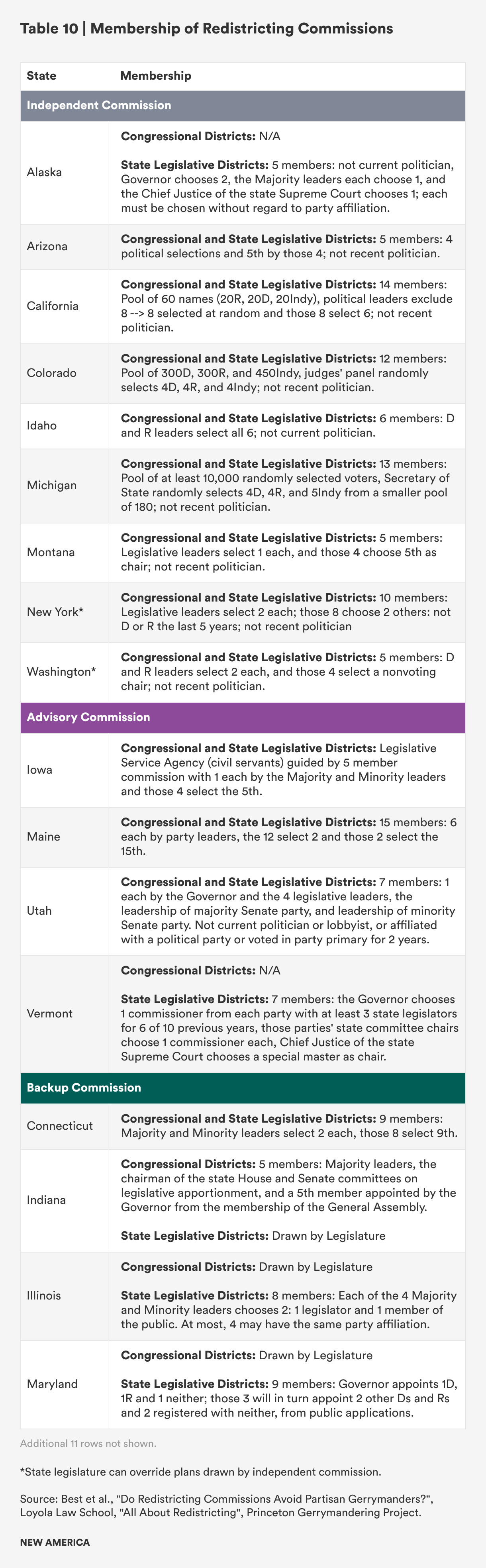
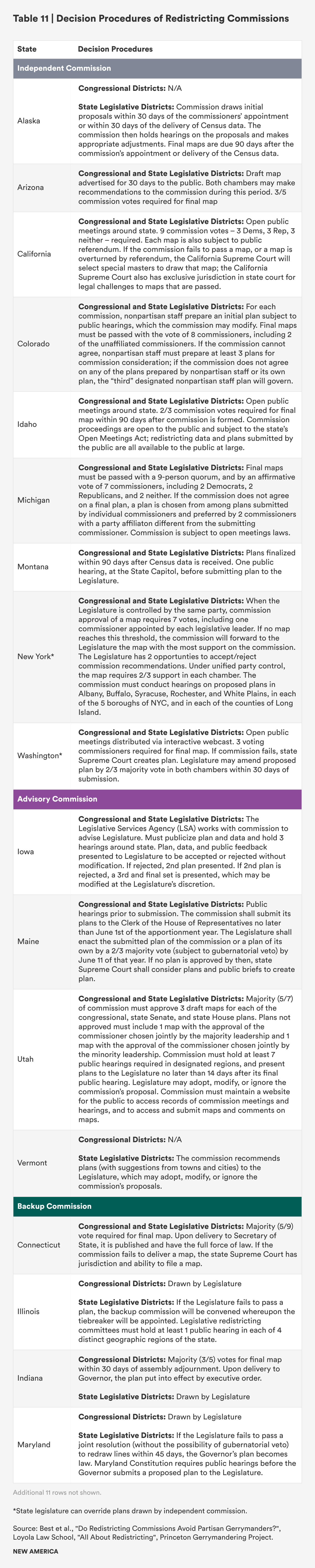
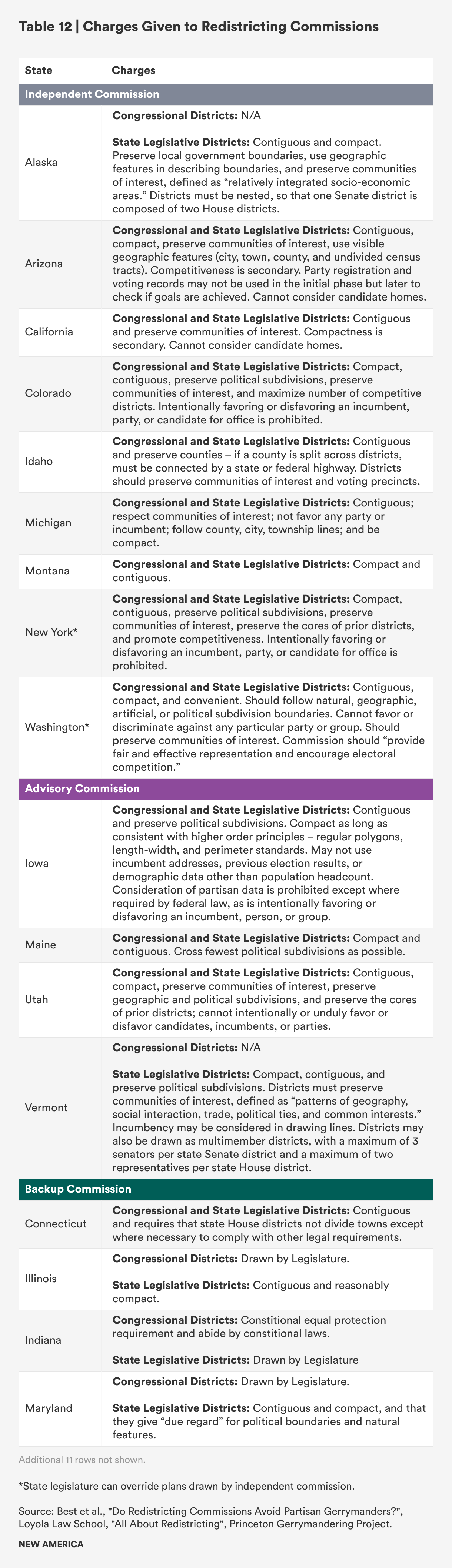
Now that we have assessed gerrymandering’s growing threat, let us move on to the business of solving it, or at least mitigating its worst effects. This section provides an overview of the current redistricting reform landscape, including a taxonomy of redistricting commissions based on composition, authority, and charges. It also frames three central questions for thinking about redistricting (or anti-gerrymandering) reform:
- What makes a district map “fair”?
- Can redistricting commissions make maps fairer?
- Are there meaningful differences in types of redistricting commissions?
What makes a district map “fair”?
Fairness is a contested concept. Much of contemporary political theory is devoted to questions of fairness. Though primarily these debates involve the fair distribution of resources, they show how difficult it is to agree on a baseline. Moreover, fairness typically requires trading off among competing values, none of which can be maximized.
Nonetheless, if perfect fairness is impossible to define, there are degrees of fairness. It may be a continuum in which the ends are fuzzy and uncertain, but it is also possible to make comparisons between more or less fair.
Can redistricting commissions make maps fairer?
If we view fairness not as an absolute, but as a continuum, it becomes possible to assess the performance of redistricting commissions along a scale. However, because the ends of the fairness continuum are fuzzy and contested, there are limits to how fair maps can be. Still, in general, across a range of dimensions, redistricting commissions can make maps fairer.
Are there meaningful differences in types of redistricting commissions?
There are variations in types of commissions. In general, the more independent commissions are from state legislatures, the better they perform on a range of fairness metrics.
To dive more deeply into these questions, this report will now address in more detail the particular ways in which we evaluate districts, the challenges of measuring each of the five main standards—partisan neutrality, competitiveness, compactness, keeping communities of interest together, and fair minority representation—and the ways in which these standards are often at odds with each other.
Partisan Neutrality
We all think we know what partisan gerrymandering is. It is the process by which partisans draw legislative districts to ensure that their party wins as many districts as possible, given the underlying distribution and partisan proclivities of voters.
So, for example, numerous studies have found that the 2011 redistricting gave Republicans a disproportionate advantage in Congress. Notably, in the 2012 elections, Republicans won more seats (53.8 percent) than Democrats (46.2 percent) in the House, despite earning a smaller share of the popular vote (46.9 percent) than Democrats (48.3 percent).47 This appears to be a clear bias in favor of Republicans. At the state level, biases in favor of one party over the other are even more extreme.48
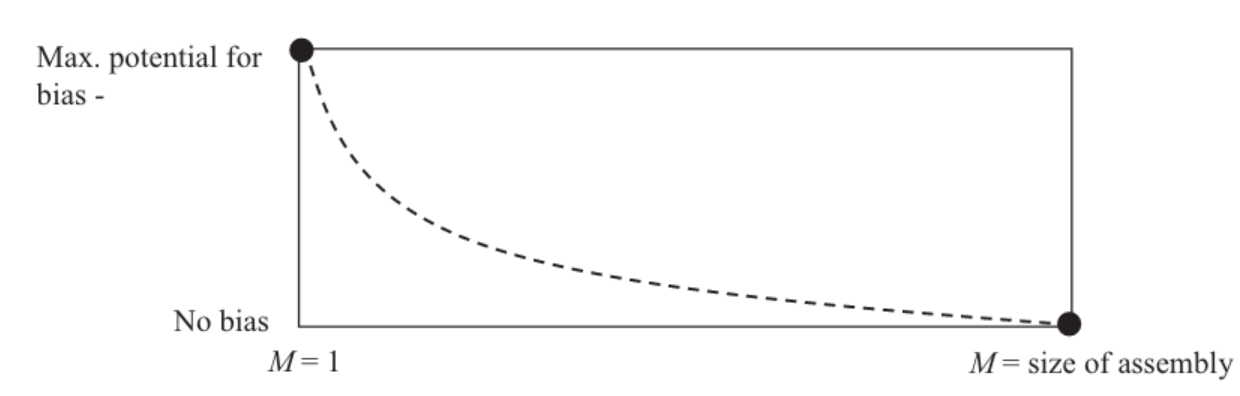
But what is the alternative—partisan neutrality? Intuitively, it is a simple principle: parties should win seats in proportion to how many votes they get. So, if a party gets 60 percent of the votes statewide, it should get no more or less than 60 percent of the seats statewide. However, this intuitive understanding of partisan neutrality is at odds with the way in which the current system of districting operates. Understanding how the number of seats per district (which political scientists call “district magnitude”), and the distribution of partisan support impact the possibilities for partisan neutrality is crucial for understanding the challenges that both independent redistricting commissions and courts face in deciding what is fair within the single-member district context.
Measuring Partisan Neutrality
How should we measure partisan neutrality in districting?
Unfortunately, there is no clear answer. As one recent review of 18 different measures observes, “Unfortunately, there is no consensus as to which of these measures works the best.”49 This lack of a consensus standard helped provide an excuse for the Supreme Court to say that this issue was not justiciable in Rucho v. Common Cause.
Here we will conduct a brief review of several measures, including proportionality, symmetry, efficiency, and improbability and intent. There are a few reasons to spend some time on the complications of these measures. The first, and most important reason, is to appreciate that there is no perfect standard of partisan neutrality, though there are plenty of decent measures.
It is not hard to determine when a districting map is blatantly unfair. Under those cases, any measure, or an aggregate of measures will work. But in an era in which elections are often decided narrowly, “fairness” can depend on which measure one prefers. And if some measures point one way, and some measures point the other way, both sides can find reasons to feel like they were cheated. To a large extent, fairness will always be in the eye of the (partisan) beholder.
Again, we will get into the weeds on measuring fairness here. Though this may seem like an academic discussion (it partly is), the details matter. They help us to understand how difficult it is to draw truly “fair” maps. The difficulties in declaring true partisan neutrality follow from two well-known peculiarities of single-member districts:50
- The “winner’s bonus” (a.k.a. “loser’s penalty”). Under single-member districts, a party that gets a majority of votes typically gets a bonus share of seats in excess of pure proportionality.
- The importance of geography. Under single-member districts, where voters live is more important than how many voters support each party. This peculiar property is what makes gerrymandering such a dangerous weapon. But it also accounts for a fair degree of “natural gerrymandering” that can undermine partisan neutrality as well. In short, Democrats waste a lot of votes in lopsided urban districts, begging the question of whether or not a fair map should correct for this.
Attempts to make maps fair are also complicated by other normative values of districting: compactness, keeping communities of interest together, competitiveness, and adequate minority representation through majority-minority districts.
Different measures of fairness attempt to account for these complications differently, based on different conceptions of what would be perfectly fair.
To be sure, all of these measures are highly correlated, though some are more closely correlated than others.51 However, different measures applied to the same maps can consider the same maps to be tilted in favor of Republicans or in favor of Democrats.
Proportionality
The most simple standard, of course, is proportionality. That is, the share of a party’s seats should match its share of votes. However, it is a well-known and long-described property of single-member districts that they do not produce proportional results at a national level.52
One way to see this is to look at the modern history of U.S. House elections.
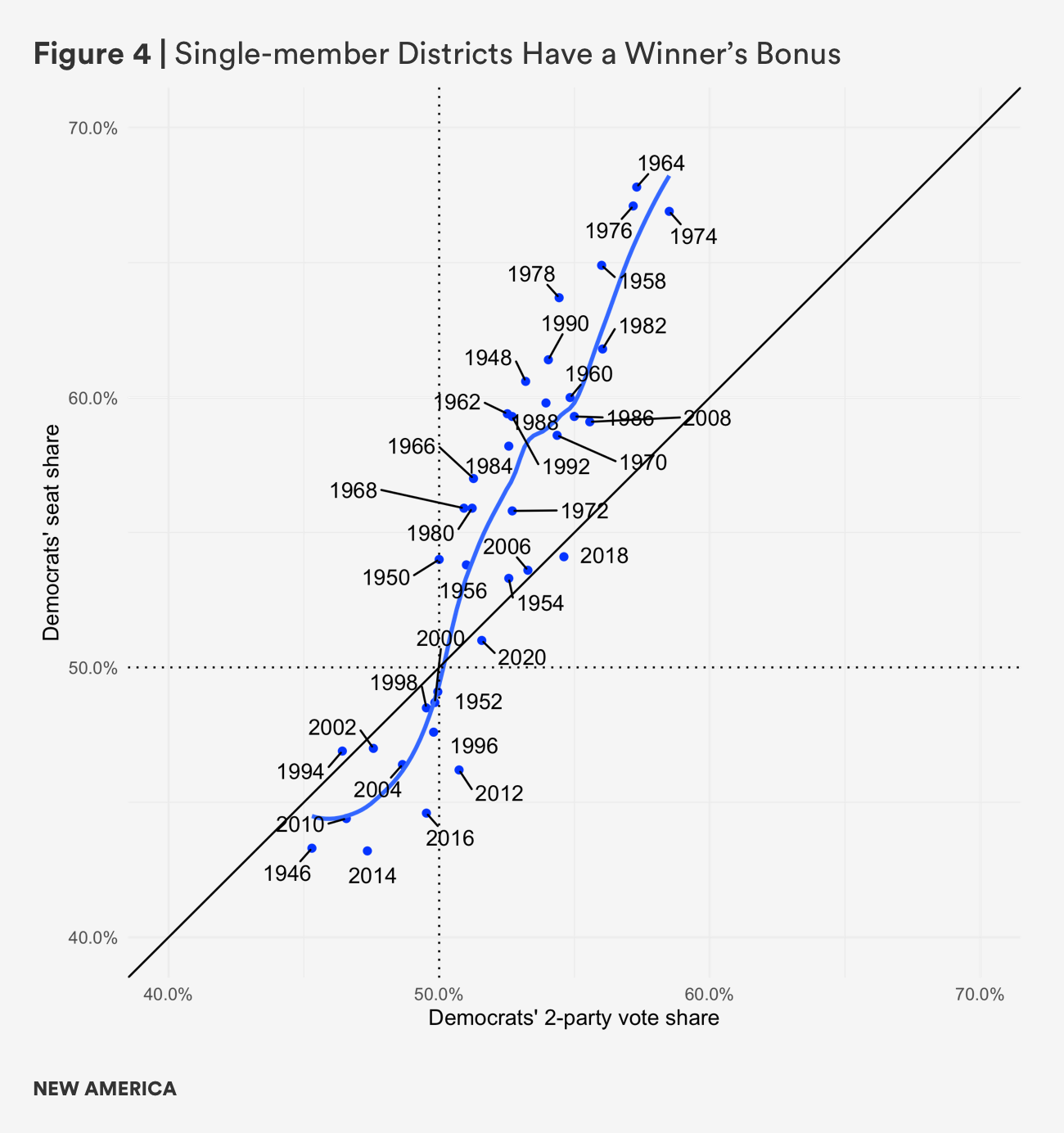
As we can see, the seats-to-vote ratio has a winner’s bonus. In the years in which Democrats captured the majority of votes, they tended to get even a larger percentage of the seats. The blue line is a smoothed curve tracing the relationship between seats and votes across all elections. The black line is perfect proportionality.
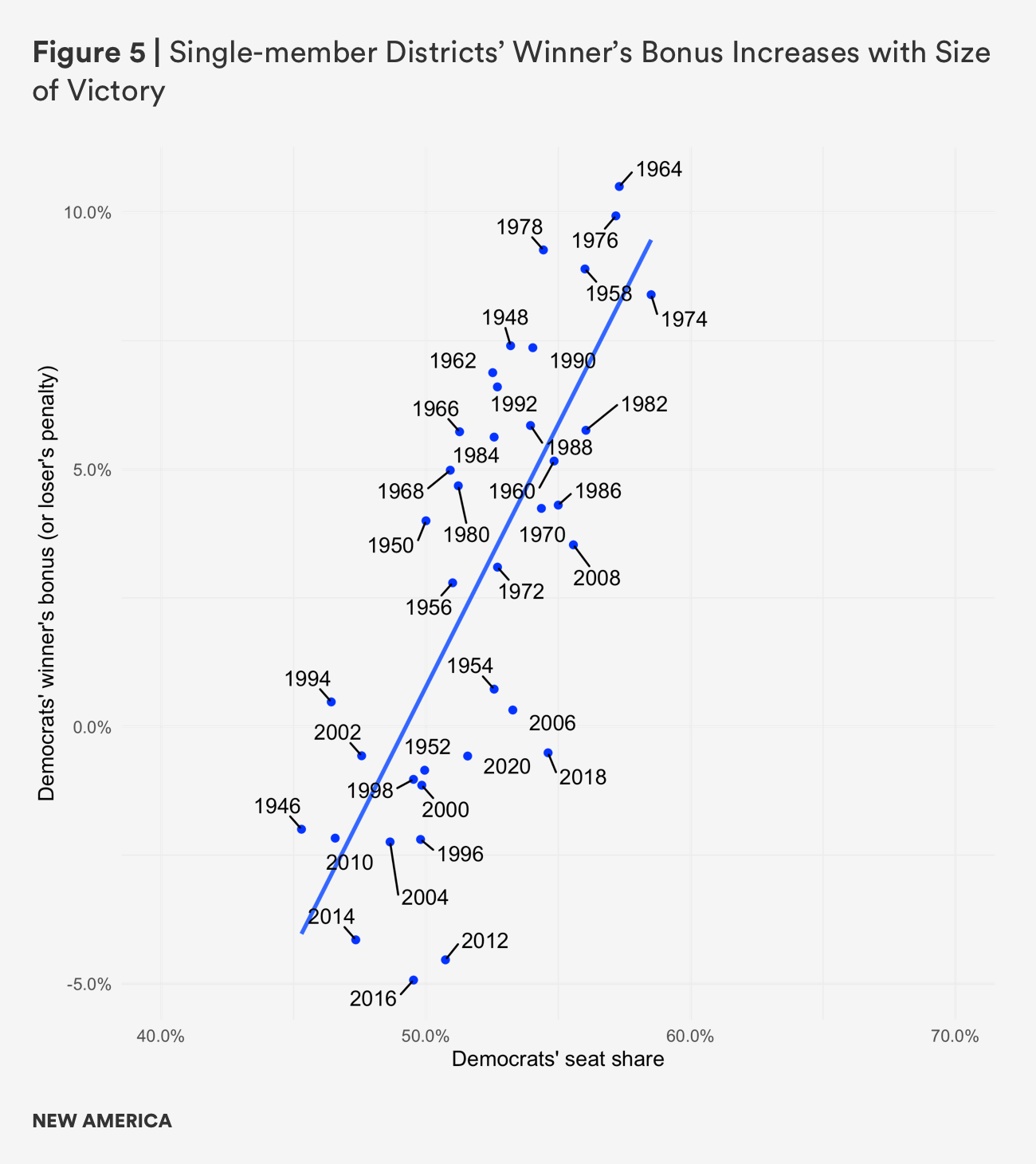
Another way to see this is to look at the relationship between Democrats’ seat share and the size of the winner’s bonus, which increases pretty much linearly as Democrats win a larger share of the popular vote. Deviations to the left of the blue line indicate deviations more in Democrats’ favor, while deviations to the right indicate deviations in Republicans’ favor. Notably, with one exception (2002), all of the elections since 1994 have been deviations in the Republicans favor, with the biggest deviations coming in the 2010s.
This same relationship is replicated across the states. Consider the results across states. As a general pattern, the relationship of seats to votes follows a standard S-curve. Where there is near-even partisan neutrality (a 50-50 state), a slight majority tends to lead to a big boost in the seat share.
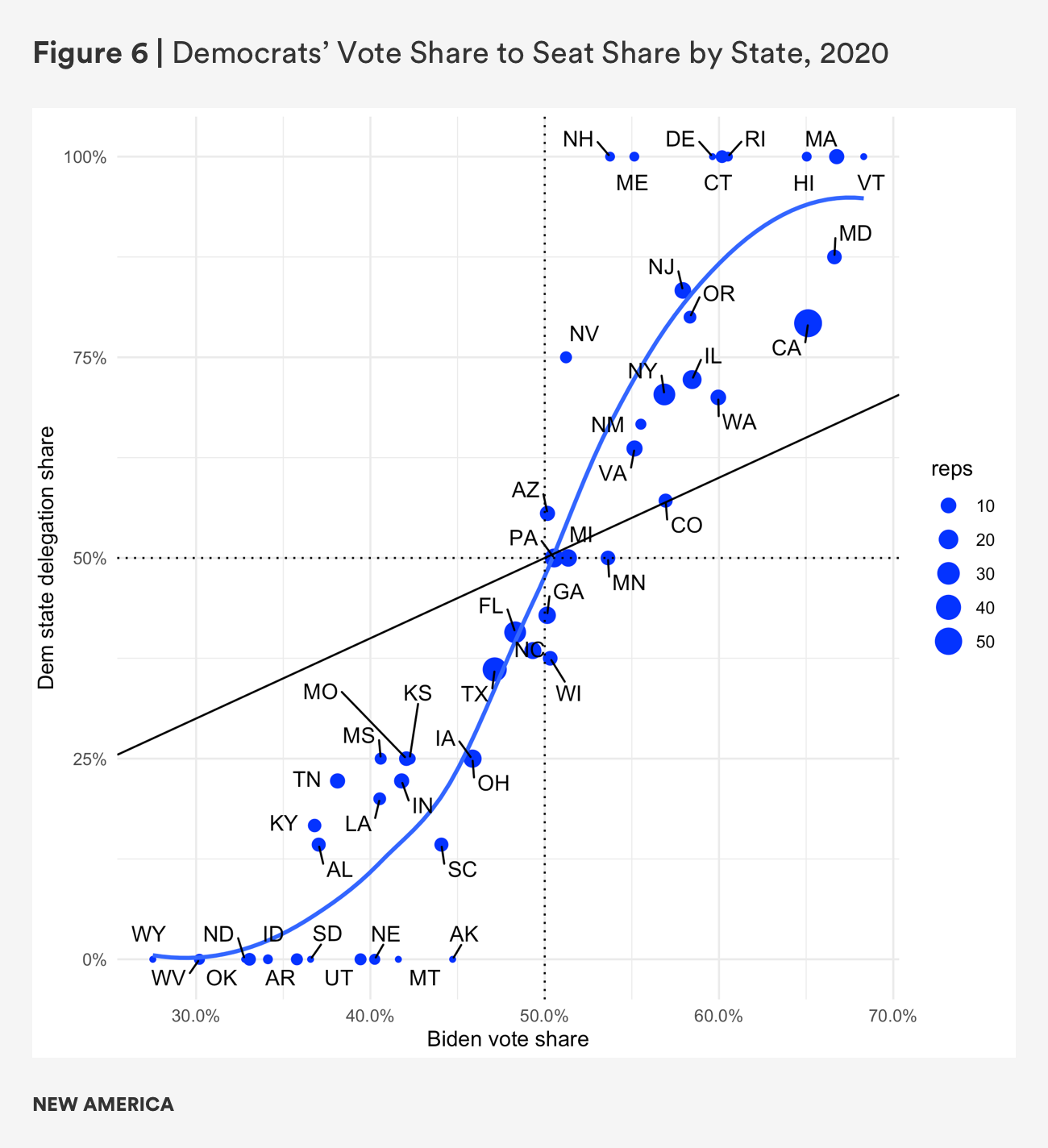
The diagonal line above represents perfect proportionality. Very few states achieve anywhere close to proportionality.
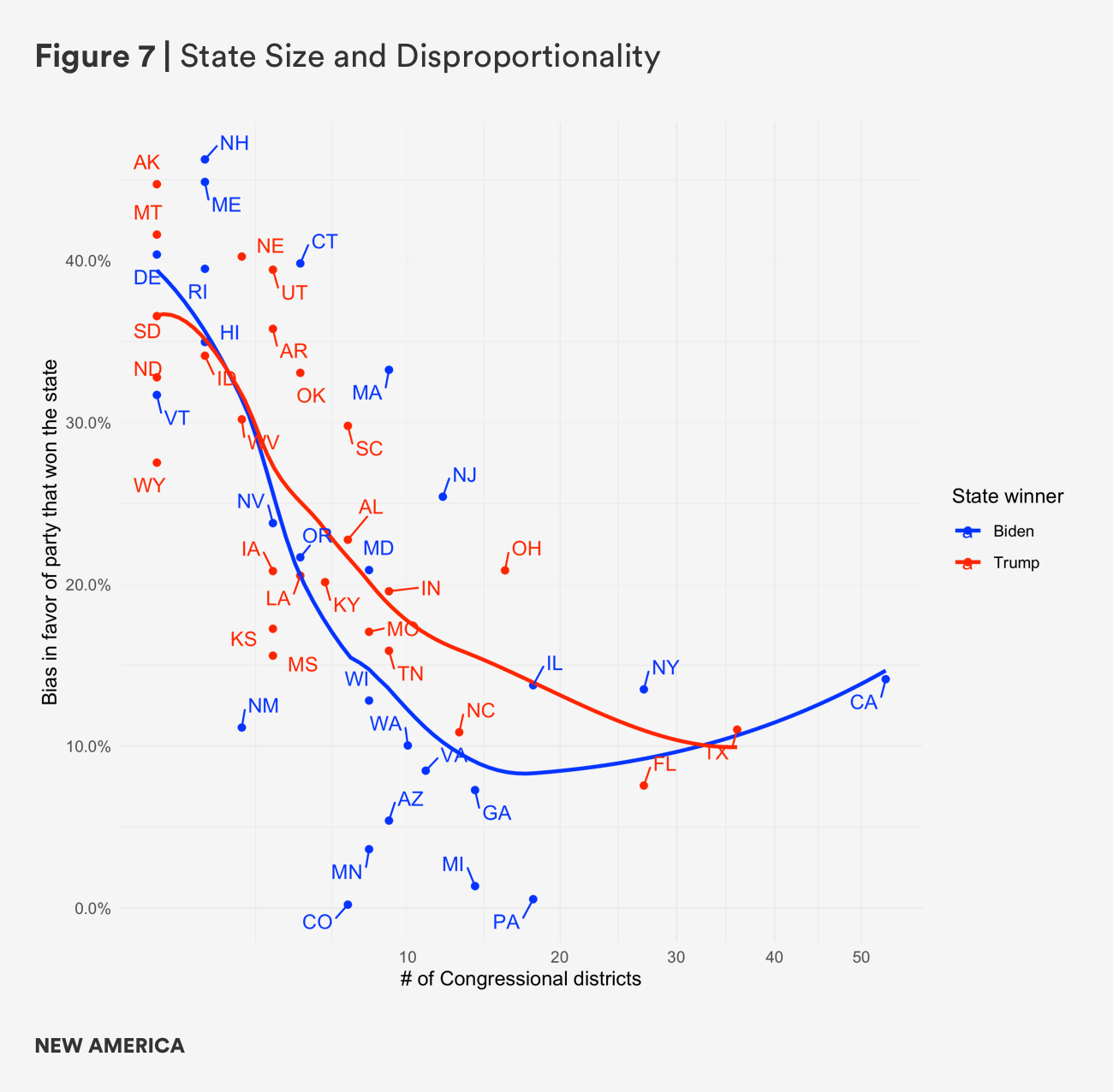
Certainly, as states increase in size, they tend to approach proportionality (zero bias in favor of the party that won the state), but they never achieve it. Notably, Biden states come closer to proportionality on balance than Trump states in the 2020 election.
Symmetry
Acknowledging that perfect proportionality is a chimera in single-member districting, a generation of scholars instead began analyzing districting schemes under the standard of “symmetry.”53 That is, if we accept that single-member districts inherently generate a winner’s bonus, then proportionality is not a fair standard. Rather, a fair standard would be that if the vote breaks 52-48 in favor of Democrats, Democrats wind up with the same winner’s bonus that Republicans would wind up with if the vote broke 52-48 towards Republicans.54 (And the same if it broke 51-49, or 53-47, etc.)
An even simpler measure, with similar properties, is the mean-median difference. This compares the party’s median vote share minus its mean vote share across all of a plan’s districts. The lower the difference, the more symmetrical (and therefore balanced) the plan. The greater the difference, the higher the level of bias. 55
Wasted Votes and “Efficiency” Measures
Another class of partisan fairness measures is built around the concept of “wasted” votes and “efficiency.” Under single-member districts any vote cast in excess of that needed for a majority in a single district, or any vote cast for a losing candidate, is effectively “wasted” or “inefficient.”
Probably the most widely used metric, developed by Eric McGhee and Nick Stephanopolous, is the “efficiency gap” measure.56 The efficiency gap is the partisan difference between these inefficient votes. If Democrats waste more votes than Republicans, then we can say that the map is biased against Democrats. If Republicans waste more votes, then we can say that the map is biased against Republicans.
The efficiency gap measure gained prominence when plaintiffs utilized it in the Supreme Court partisan gerrymandering cases Whitford v. Gill (2018) and Rucho v. Common Cause (2020). Plaintiffs had hoped that they had finally hit upon a formula to answer Justice Anthony Kennedy’s call in the 2004 Vieth v. Jubelirer decision for a justiciable standard. But in Rucho, the conservative majority declared that partisan gerrymandering was not justiciable; state legislatures could do what they want. Critics of the decision have speculated that perhaps no measure would have been good enough for the conservatives on the Supreme Court. But perhaps it did not help that scholars failed to agree amongst themselves on the proper standard, thus validating the conservatives’ point that any measure would be arbitrary.
A few other measures have built upon the efficiency gap, emphasizing slightly different conceptual baselines of fairness. Rather than taking the absolute difference between wasted votes, some propose taking the difference between the fraction of votes wasted by the party.57
The mathematician Gregory S. Warrington proposes something he calls the “declination,” which measures the “angle associated with the vote distribution.” It is essentially a way of measuring differential responsiveness to vote shifts.58
Improbability and Intent
Yet another category of analysis avoids any specific mathematical formula or particular conception of “fairness,” but instead uses computer simulations to demonstrate how unlikely it would be for a given district plan to emerge if line-drawers were acting neutrally. The basic idea here is that intent matters most. Because Democrats naturally over-concentrate their votes in urban areas, it is possible to “unintentionally” draw districts that disadvantage the party.59 To differentiate between unintentional/natural partisan gerrymandering and intentional/unnatural partisan gerrymandering, you can ask a computer algorithm to tell you how likely it would be for a given partisan balance to emerge on its own. For example, if a state’s 12 member delegation is eight Republicans and four Democrats, we can ask a computer to draw 10,000 potential maps. Then we can ask how many of those maps generated an 8-4 Republican bias. If the percentage is very low, we can say it is highly improbable that a more neutral process would have generated such a map, and reasonably conclude that the legislature’s intent was.60
Of course, this approach raises the obvious question: How unlikely should such a map be to declare it as intentionally partisan? And again, there is no perfect standard.
Balance Over the Decade
A final consideration in map-drawing is that maps are drawn with the intention of lasting for a decade—until the next Census. But over the course of a decade, demographics within and across districts may change. And because a portion of the electorate tends to go back and forth between the two parties, or between voting and not voting at all, some years are better years nationwide for Republicans, while other years are better years for Democrats.
The first consideration, the “demographic drift” of a district, means that over the course of a decade, a district drawn to be safe for one party could become competitive. This is referred to as a “dummymander,” and it typically happens when a partisan legislature gets aggressive in drawing an excessive number of seats for its party. 61 Having a bunch of 55-45 districts can generate an immense partisan advantage in the first election in a decade-long cycle. But if demographics change against your party, those districts will wind up very competitive, erasing the advantage. Similarly (the second consideration), those seats could be vulnerable in a wave election for the opposing party.
Broadly, think of it as a risk-reward tradeoff. A more aggressive partisan gerrymander can leave your party vulnerable in a bad year for your party, because you’ve spread your voters out too diffusely to claim more narrow victories in a good year. A less aggressive partisan gerrymander can preserve seats even as demographics may change, or there may be a wave election against the party. 62 Broadly, in the latest round of redistricting, Democrats employed the first strategy in the states where they drew the maps, spreading out their voters more efficiently at the risk of losing more seats in an off year. Republicans, by contrast, did more “ring-fencing” in the states where they drew the lines. This means that even in a Democratic year, Democratic gains will be somewhat limited in Republican-controlled states, though Republican gains will also be limited in a Republican year. Or, in terms that we might recognize more clearly, in 2021, Republicans moved more lean Republican seats into solid Republican seats, Democrats moved more solid Democratic seats into lean Democratic seats. We will see how this plays out over the decade.
The Urban-Rural Problem and Single-Member Districts
Obviously, it is highly unlikely that in a two-party system (or really any party system), voters would be equally distributed throughout a state, or throughout a country. Different regions have different cultures. Country life and city life have always had different values and different economies.
Rather, parties are likely to cluster geographically. To some extent, the Republicans and Democrats have always had separate geographical footprints. What is distinct about recent decades, however, is that the sorting of the parties has become much more clearly urban versus rural.
The basic problem for partisan neutrality is that cities are dense population clusters. Since Democrats are the party of the cities, this means that they are likely to live in congressional districts that are extremely Democratic. By contrast, because exurbs and rural areas are much more diffuse, Republican voters wind up being distributed more “efficiently.” That is, they are more likely to live in districts that combine smaller (Democratic) cities and/or suburbs. Many of these districts may be solidly Republican. But they are more likely to be 60 or 65 percent Republican, whereas urban districts are more likely to be 80+ percent Democratic, and the urban-suburban districts are on average 70+ percent Democratic.
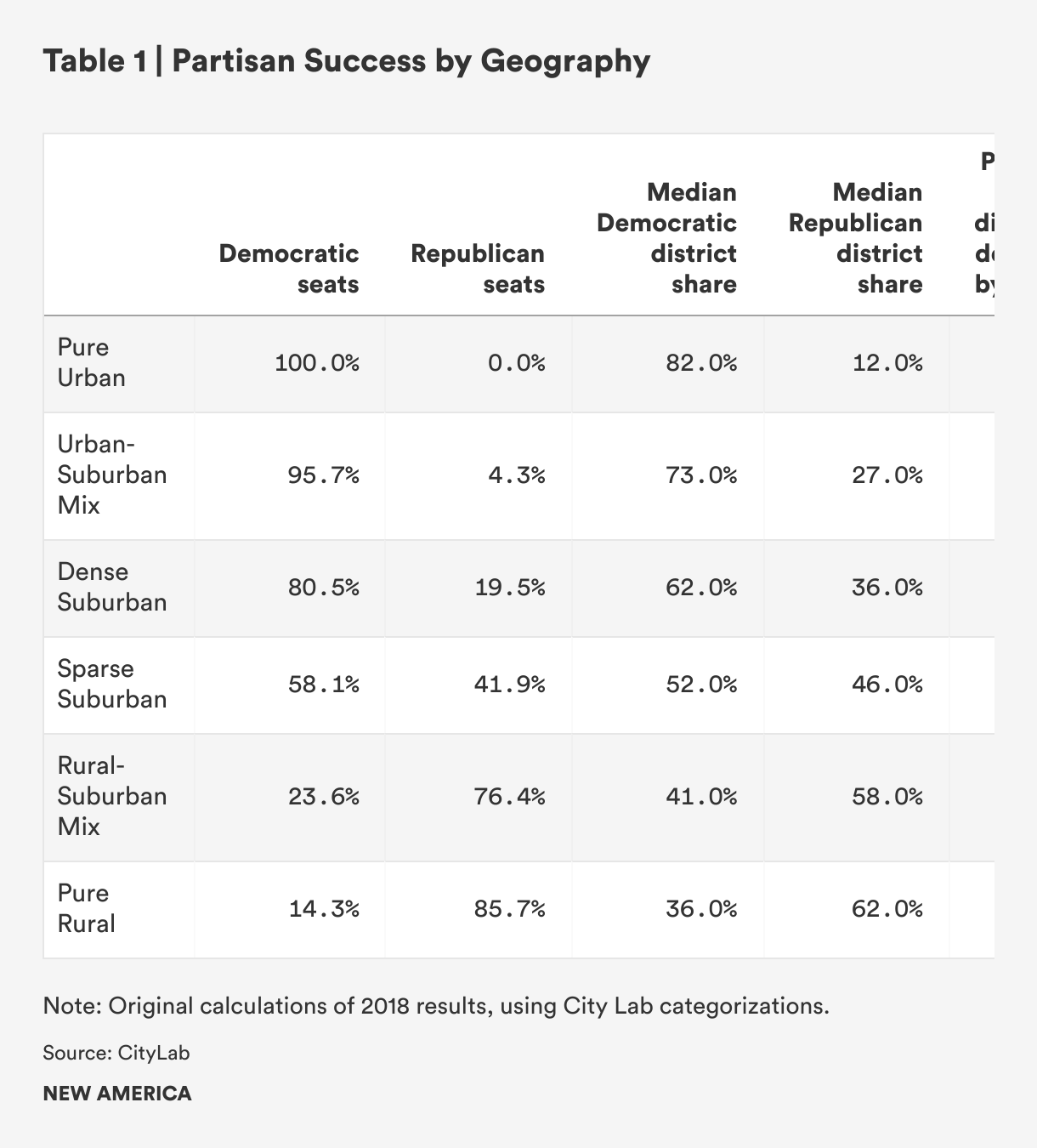
This partisan geographic distribution is not unique to the United States. It is a problem for all political systems that use single-member districts. As Jonathan Rodden explains in Why Cities Lose, “Underrepresentation of the urban left in national legislatures and governments has been a basic feature of all industrialized countries that use winner-take-all districts.”63 This has long been true in the U.K. and Canada, even though both countries use national districting commissions to establish boundaries independently of partisan politics.
Any single-member districting system is going to work against the party that clusters geographically in an “inefficient” manner.64 This property of single-member districts makes partisan fairness inherently contested. Political scientists sometimes refer to this as “natural gerrymandering”—without any intervention, naturally Democrats “pack” themselves into a smaller number of districts, in effect wasting their votes. Republicans, by contrast, naturally distribute their voters more efficiently by being the exurban party.65
Partisan Neutrality: The Bottom Line
So what exactly is fair to both parties when it comes to districting? We think we know an extreme gerrymander when we see it. But would we know an extreme map if we saw one? Because single-member districts have several naturally distortive properties, including their high sensitivity to the geographical distribution of voters and the profuse possibilities they afford in drawing boundaries, a unified measure of partisan fairness remains elusive.
It should not be controversial to declare certain partisan maps as extreme partisan gerrymandering. However, as mapmakers approach balance, fairness becomes more sensitive to the metric. Moreover, because some gerrymandering is unintentional (because Democrats concentrate in cities, which creates natural inefficiencies in their distribution) and some is intentional, it is even harder to determine what is fair. Should mapmaking correct for these natural imbalances? Or is that just the fault of Democrats, for doing a poor job of appealing beyond their urban core when they know the consequences of single-member districting?
All of this might not be a problem if American politics were not locked in a high-stakes hyper-partisan doom loop, in which narrow House majorities are up for grabs with each election and the losing side can almost credibly claim that something was unfair about the districting plan if they lost, no matter whether the lines were drawn by a commission or by politicians. This perception of illegitimacy is, of course, a serious problem for our democracy. Commissions may help mitigate the problem slightly, but they certainly cannot eliminate it, given the underlying conditions.
Competitiveness
In many respects, competitiveness is the essential quality of electoral democracy. A minimal definition of democracy involves elections with at least two viable parties.66
One well-documented consequence of single-member districts is that even under optimal levels of competitiveness, the majority of districts in any given election are likely to be uncompetitive. Again, this is true in comparable democracies with single-member districts, such as the United Kingdom and Canada. This follows from the realities of partisan geographic clustering. It is almost inevitable that certain parties will be very strong in certain regions of the country, where single-member districts will all but guarantee them a seat.67
However, for national elections to be considered competitive, there must be enough competitive districts to hold the balance of national power. But how many?
The potential for competitive districts in a system of single-member elections is really a function of two factors. The first is the share of the electorate that would consider voting for either party in a given election, (i.e., the share of “swing voters”). The second is the geographic dispersion of reliable partisans (i.e., the extent to which partisans are clustered in places with like-minded partisans).
In an electorate in which every voter was a reliable partisan who voted in every election, there would be no competitive elections. But if some share of voters are open to persuasion and if some share of voters may or may not vote based on mobilization, then we can say a district is competitive if these two groups of voters could realistically determine the winner. This combined share, of course, depends on the starting distribution of partisan support. So in a district where the share of Democratic voters outnumber Republicans 65 percent to 35 percent, it would take some rather remarkable persuasion and tremendous mobilization gap to overcome this differential. By contrast, in a 50-50 district, persuasion and mobilization are everything.
The decline of competitive districts in U.S. House elections is a well-described and well-documented story that boils down to two related but distinct trends: the decline in the share of persuadable voters, and the geographical sorting of the parties. The consequence is districts where the balance of persuadable voters is greater than the gap between reliable partisans. This shift has made mobilization even more important, which is one of many factors contributing to increasing levels of hyper-partisan polarization.
Put simply, it is just more difficult today for mapmakers to draw reliably competitive districts, given both the geographical sorting and decline of swing voters.
The Incumbency Factor
In the 1970s, political scientists began to observe a decline in narrowly decided congressional district elections.68 At the time, predictable partisan voting was extremely low, and the share of the electorate willing to consider either party was at a high. However, incumbency reelection rates remained high, because incumbents could use their existing positions to advertise themselves widely in their communities, and bring money back home to the district, bolstering their popularity. They also could use their incumbency to fundraise, and scare off challengers. Voters supported the candidate, not the party.69
Gerrymandering played a small but sometimes significant role here. In this era of greater bipartisanship, incumbents worked across party lines to keep their districts safe (hence the gerrymandering epithet about politicians picking their voters). At the time, partisan control of Congress was seen as less important to voters. Partially, this was because it was then taken as a given that Democrats had something like a permanent majority in the House (Democrats controlled the House from 1932-1994, with only a few exceptions in the 1950s). Partially, this was because Congress operated in a more bottom-up, committee-oriented way, and so there were many opportunities for Republicans to participate in lawmaking, even if Democrats controlled the majority. Both parties had liberal and conservative wings, and plenty of cross-partisan dealmaking took place. Split-ticket voting was common.
But over the course of a few decades, and especially after a handful of important wave elections (1994, 2006, 2008, 2010), a generation of once-popular incumbents now out of sync with their districts’ partisanship lost their seats (or retired in anticipation of loss.) The number of competitive districts declined over this period. More importantly, the nature of competitive elections changed.
In the past, incumbency offered a significant advantage. Today, the incumbency advantage is marginal, a few points at best, down from about 10 points in the 1970s and 1980s. The nationalization of partisanship has destroyed the incumbent advantage.70 With control of Congress more contested now than ever, and more voters choosing the party (not the candidate), incumbent protection is no longer the driving force motivating gerrymandering.
Keeping Communities of Interest Together
Congressional and state legislative districts are by nature arbitrary jurisdictions, up for re-evaluation every decade. This is because they are defined not by fixed boundaries, but by population size. Compare them to counties, cities, or towns, whose jurisdictions remain consistent over long periods of time as administrative entities, and often meaningful community identities, even as populations grow (or sometimes shrink). To some extent, neighborhoods or regions also take on distinct identities and are thus meaningful political subdivisions as well.
Districts, by contrast, are defined by population size, which means that the boundaries must change to reflect changing patterns of population. And as population changes within the political subdivisions, mapmakers inevitably have to make tough choices in order to maintain districts of equal size.71
In theory, districts should be meaningful. Various state constitutions and statutes direct mapmakers to keep communities together:72
- Colorado: “Communities of interest, including ethnic, cultural, economic, trade area, geographic, and demographic factors, shall be preserved within a single district wherever possible.”
- Hawaii: “Where practicable, submergence of an area in a larger district wherein substantially different socio- economic interests predominate shall be avoided.”
- Montana: “The commission will consider keeping communities of interest intact. Communities of interest can be Commission based on trade areas, geographic location, communication and transportation networks, media markets, guidelines, Indian reservations, urban and rural interests, social, cultural and economic interests, or occupations and lifestyles.”
Though the sentiment is similar, each state defines the goal of “communities of interest” slightly differently. The basic idea is that districts should represent something meaningful, but with many possible things to represent, there’s often neither a clear prioritization, nor a clear standard of how to measure any of this.73
As the history section discussed, the concept of a “constituency” has always been fraught and complicated in America. Though there is certainly some overlap of geography with the various interests states’ constitutions elevate, not all interests, particularly demographic, economic, and cultural ones, are concentrated enough to form a geographic community of interest. As a geographical unit, the single-member district puts geography as the central property to represent.
Moreover, as districts grow bigger and bigger, it becomes even harder to conceptualize a diverse group of 750,000 (and growing) citizens as a single “constituency.”
Keeping communities of interest together, particularly across redistricting cycles, has a value in ensuring stability of representation. Voters who build a relationship with one member of Congress may find themselves with a new representative after a districting cycle. This can undermine the constituent-representative connection.74
But the trade-off is that sometimes communities need to be split to ensure more competitive districts, since so many communities today are lopsidedly Democratic or lopsidedly Republican.
In a 2011 study, “The Paradox of Redistricting: How Partisan Mapmakers Foster Competition but Disrupt Representation,” Antoine Yoshinaka and Chad Murphy explore the tradeoffs. They conclude: “taken together, our findings lead to an interesting paradox: redistricting can foster electoral competition (which many may find desirable), but it can also sever representational ties between constituents and their representatives (which many may find undesirable).”75
Similarly, in a 2020 study, “Conflicting Goals of Redistricting: Do Districts That Maximize Competition Reckon with Communities of Interest?,” James Gimpel and Lauren Harbridge-Yong tackle this trade-off.76 Their conclusion is simple. It is hard to keep communities of interest together and draw competitive districts. As they write: “the mandates to respect communities of interest while drawing competitive districts are frequently irreconcilable….Because communities of interest often express an enduring and one-sided partisan loyalty, it is difficult to hold them together and also achieve the goal of drawing an evenly balanced district.” (The even partisan division, of course, is necessary to draw competitive districts.)
At one level, this is a mechanical puzzle of assembling equally balanced districts, like tangrams. If political subdivisions (towns, cities, counties, and neighborhoods) represent the building blocks, and these building blocks are overwhelmingly either blue or red, then given the equal population constraints of districting, and the varied sizes of these building blocks, and the requirements that districts at least be somewhat compact, or at the very least contiguous, slotting the variously sized shapes into equal combinations of red and blue is simply impossible in most cases.
But at an even broader level, assembling the blue triangles and the red squares in equal amounts into a single district challenges the idea of the district as a meaningful jurisdiction. If the idea of a district is that it should represent something, then a district that is half red and half blue is more like two separate districts fused together where only half the district can be represented at any given time.
As a result, competitive districts are typically a Republican outer suburb appended to a lopsidedly Democratic inner suburb or college town. As one recent paper describing the failure of competitive districts to lead to moderation explained, “Reformers often idealize such moderate districts because it is believed that they are most conducive to the political competition that is supposed to produce moderate representation. [However], the fact that such districts are more likely to be heterogeneous mitigates their ability to elect moderate legislators.”77 In short, purple districts are really split districts, where focusing on base mobilization is a guarantee while trying to court unpredictable and not necessarily moderate swing voters is a gamble.78
Compactness
A fourth value in districting is compactness. A more compact district forms a more coherent unit of representation.
But as with the other values, there are competing measures of compactness. Though compactness may appear intuitive at first glance, upon deeper study, scholars have shown that in fact compactness is a complicated multidimensional concept and have offered almost 100 measures of different features of it.” 79
In general, three main metrics have predominated over the past three decades:
- Roeck scores (which divide the area of the district by the smallest circle that would be able to fully contain the district); 80
- Convex Hull ratios (which divide the area of the district by the smallest convex polygon that would be able to fully contain the district); and
- Polsby-Popper scores (which divide the area of the district by the area of a circle whose perimeter is equal in length to the perimeter of the district).81
As with other criteria, there is no agreement on how to perfectly measure compactness. Neither federal nor state courts have ever struck down a map for not being compact enough, nor have they ever agreed upon a standard. As Keena et al. argue: “identifying violations of compactness often relies upon subjective judgment. It is unlikely that a court will ever endorse a uniform, objective standard for unlawful noncompactness given that the language of compactness laws is often vague.”82
Ultimately, compactness may simply be a “you know it when you see it” kind of thing. It may be in the eye of the beholder. But it also may vary depending on the beholder. Of course, compactness is probably the least important of the criteria. At some level, it may just be a matter of aesthetics. Strange-looking districts are easy fodder for critics of gerrymandering. But sometimes, appearances do matter, and serpentine zig-zags can stand in for wider shenanigans in the drawing of district lines.
Fair Representation for Racial Minorities
A final consideration in fair districting is racial representation. In theory, racial minorities should be represented in the legislature in close proportion to their share in the population. Accurate descriptive representation has significant documented benefits for both minority communities and for the quality of deliberation and ultimately legislation. 83
But how can mapmakers best achieve accurate and diverse representation? For decades, the standard approach has been to draw majority-minority districts (where national racial minorities constitute the majority of voters in the district, increasing the likelihood they will elect a candidate who represents them well). In such districts, Black voters or Hispanic voters form a majority, and therefore are able to elect Black or Hispanic candidates to represent them. These districts have been successful in both elevating minority representatives to Congress and better representing the concerns of minority voters.84
But exactly how to draw such districts today presents some practical questions. One question is what percent of the district needs to be Black or Hispanic in order to elect a Black or Hispanic representative? Or put another way, how likely is it for white voters to support a Black candidate, or a Hispanic candidate? Mapmakers wishing to marginalize minority influence have had the same “cracking or packing” strategies as partisan gerrymandering. They have done so by lowballing the extent to which voting is racially polarized or overstating the extent of racially polarized voting, thus effectively packing minority voters into a few districts.
Indeed, the balance between partisan concerns and minority representation has been a central question in racial redistricting for decades. The key tension is that because minority voters, especially Black voters, are overwhelmingly Democratic, clustering them in safe districts to ensure that they can elect their candidates of choice has added to the “packing” of Democrats into fewer, more lopsided districts, which in turn has helped Republicans. The evidence on this claim was probably stronger in the 1990s, when many of today’s majority-minority districts were first drawn. However, it remains a contested question in the scholarly literature.85
These questions and tensions have been at the center of a key series of Supreme Court cases that have defined questions around racial gerrymandering under Section 2 of the Voting Rights Laws—Thornburg v. Gingles, Shaw v. Reno, Cooper v. Harris, and most recently, Brnovich vs. Democratic National Committee. 86
Racial gerrymandering is a highly litigated area, in which the Supreme Court has established tests and criteria for what is and what is not a racial gerrymander. This makes fair minority representation the only area in which the Courts have laid down standards that offer guidance and limitations to mapmakers.
However, most legal experts expect that the Supreme Court is poised to effectively eviscerate the longstanding protections against racial gerrymandering, based on its 2022 decisions to allow maps in Alabama and Louisiana to stand despite challenges that they were racially gerrymandered, and its potentially more radical decision to leave districting entirely up to the state legislatures, a move it has signaled in taking up a North Carolina case, Moore v. Harper.87
Although there has long been clearer legal criteria around the goal of minority representation than there are for other redistricting goals, these protections have been steadily weakening. Indeed, in the current redistricting cycle, adequate minority representation appears to be stalling in some places, and backsliding in others.88
Indeed as a January 2022 report by the Brennan Center points out, the latest round of Republican maps, especially in the South, have had particularly dire consequences for communities of color.89 As the report explains:
"Predictably, many of this round’s biased maps achieve their skew at the expense of communities of color. Over the past decade, communities of color accounted for nearly all of the country’s population growth. But in redrawing boundaries, Republican map drawers, especially in the South, haven’t just declined to create any new electoral opportunities for these fast-growing communities; in many instances they have dismantled existing districts where communities of color won power or were on the verge of doing so. This brazen attack is unprecedented in scale. In state after state, Republicans are claiming that they are drawing maps on a “race-blind” basis and then defending the resulting racially discriminatory maps on the basis of partisanship, cynically exploiting the loophole left when the Supreme Court declared that federal courts were off-limits to constitutional challenges to partisan gerrymandering. If courts are not willing to carefully probe the intersection of race and politics, the ruse may just succeed.”
Based on where the Supreme Court appears headed, the importance of independent redistricting commissions as protectors of majority-minority districts will become more important, since partisan state legislatures will likely have the freedom to engage in racial gerrymandering, should they so desire.
A second challenge in fair minority representation is the extent to which minority voters live in dense enough clusters to hold influence in a district, without doing injustice to the values of compactness or keeping communities together. Or put another way, the more racial minorities are self-segregated, the easier it is to draw districts where they will wield majority influence. Of course, as segregation has declined in many urban areas over the last several decades (with more people of color moving into the suburbs, and more white people moving into urban cores), the racial self-segregation necessary for majority-minority districts has dissipated.90
This dispersion of minority voters makes it more difficult to draw majority-minority districts while maintaining geographic compactness and keeping communities together. It also makes it easier for mapmakers who are not interested in fair representation for minorities to redraw district lines in ways that under-represent minority groups.
Citations
- In the current redistricting cycle, independent commissions in eight states will have final say in approving congressional and/or state legislative district lines: Alaska, Ariz., Cali., Colo., Idaho, Mich., Mont., and Wash. New York also has an independent commission, but the state legislature still has final approval. All About Redistricting, “National Summary,” accessed July 27, 2022, <a href="<a href="source">source">source">source.
- Lynn Adelman, “The Roberts Court’s Assault on Democracy,” Harvard Law & Policy Review 14, no. 1 (2020): 131–58.
- Suzanne Mettler and Trevor Brown, “The Growing Rural-Urban Political Divide and Democratic Vulnerability,” The ANNALS of the American Academy of Political and Social Science 699, no. 1 (January 1, 2022): 130–42, <a href="<a href="source">source">source">source; Dante J. Scala and Kenneth M. Johnson, “Political Polarization along the Rural-Urban Continuum? The Geography of the Presidential Vote, 2000–2016,” The ANNALS of the American Academy of Political and Social Science 672, no. 1 (July 1, 2017), 162–84, <a href="<a href="source">source">source">source; Mettler and Brown, “The Growing Rural-Urban Political Divide and Democratic Vulnerability”; James G. Gimpel et al., “The Urban–Rural Gulf in American Political Behavior,” Political Behavior 42, no. 4 (December 1, 2020): 1343–68, <a href="<a href="source">source">source">source.
- For those seeking a more detailed history, see Erik J. Engstrom, Partisan Gerrymandering and the Construction of American Democracy (Ann Arbor, MI: University of Michigan Press, 2013). Much of this history is drawn from Engstrom’s book.
- Engstrom, 21.
- Erick Trickey, “Where Did the Term ‘Gerrymander’ Come From?,” Smithsonian Magazine, July 20, 2017, <a href="source">source">source.
- Andrew Rehfeld, The Concept of Constituency: Political Representation, Democratic Legitimacy, and Institutional Design (Cambridge, UK: Cambridge University Press, 2005), 69–80.
- Harry Marlin Tinkcom, The Republicans and Federalists in Pennsylvania, 1790-1801 (Harrisburg, PA: Pennsylvania Historical and Museum Commission, 1950), 51; Engstrom, Partisan Gerrymandering and the Construction of American Democracy, 27.
- Alexander Keyssar, Why Do We Still Have the Electoral College? (Cambridge, MA: Harvard University Press, 2020), 61–116.
- Stephen Calabrese, “Multimember District Congressional Elections,” Legislative Studies Quarterly 25, no. 4 (2000): 611–43. Susan E. Scarrow, “Parties and the Expansion of Direct Democracy: Who Benefits?,” Sage Publication 5, no. 3 (1999): 341–362; Engstrom, Partisan Gerrymandering and the Construction of American Democracy, 43–59.
- For a slightly more detailed history, Lee Drutman, Breaking the Two-Party Doom Loop: The Case for Multiparty Democracy in America (New York: Oxford University Press, 2020), 239–264. For those wishing to take an even deeper dive into the history, see Bernard Ivan Tamas, “A Divided Political Elite: Why Congress Banned Multimember Districts in 1842,” New Political Science 28, no. 1 (March 1, 2006): 23–44; Michele Rosa-Clot, “The Apportionment Act of 1842: ‘An Odious Use of Authority,’” Parliaments, Estates and Representation 31, no. 1 (April 1, 2011): 33–52; Johanna Nicol Shields, “Whigs Reform the ‘Bear Garden’: Representation and the Apportionment Act of 1842,” Journal of the Early Republic 5, no. 3 (1985): 355; Robert E. Ross, “Recreating the House: The 1842 Apportionment Act and the Whig Party’s Reconstruction of Representation,” Polity 49, no. 3 (June 6, 2017): 408–33, <a href="source">source">source; David Canon and William Egar, “The Apportionment Act of 1842: Principle or Interest?,” APW Papers (2014): 37.
- Engstrom, Partisan Gerrymandering and the Construction of American Democracy, 80–100.
- For some history, see Lee Drutman, “How Much Longer Can This Era Of Political Gridlock Last?,” FiveThirtyEight, March 4, 2021, <a href="source">source">source.
- Frances E. Lee, “Patronage, Logrolls, and ‘Polarization’: Congressional Parties of the Gilded Age, 1876–1896,” Studies in American Political Development 30, no. 2 (October 2016): 116–27.
- Lee Drutman, Jonathan D. Cohen, Yuval Levin, and Norman J. Ornstein, The Case for Enlarging the House of Representatives (Cambridge, MA: American Academy of Arts and Sciences, 2021), <a href="source">source">source.
- Engstrom, Partisan Gerrymandering and the Construction of American Democracy, 171–172.
- J. Douglas Smith, On Democracy’s Doorstep: The Inside Story of How the Supreme Court Brought “One Person, One Vote” to the United States (New York: Hill and Wang, 2014).
- Specifically, Baker v. Carr (1962) established the principle that redistricting cases could be brought before the courts. Wesberry v. Sanders (1964) established that congressional districts must have equal population size (within a state), and Reynolds v. Sims (1964) applied the equal population size criteria to state legislative districts; J. Douglas Smith, On Democracy’s Doorstep: The Inside Story of How the Supreme Court Brought “One Person, One Vote” to the United States (New York: Hill and Wang, 2014). To codify the one person, one vote principle, Congress passed the Uniform Congressional Districting Act of 1967, which reaffirmed the congressional mandate that states use single-member districts, and that those districts be of equal size. This was the civil rights era, and the threat of southern states moving to at-large districts with block voting was real. This would have had disastrous consequences for voting rights, since it would have made it all but impossible for Black voters to elect their candidates of choice.
- Gary W. Cox and Jonathan N. Katz, “The Reapportionment Revolution and Bias in U. S. Congressional Elections,” American Journal of Political Science 43, no. 3 (July 1999): 812–841, <a href="source">source">source.
- Helmut Norpoth and Jerrold G. Rusk, “Partisan Dealignment in the American Electorate: Itemizing the Deductions since 1964,” American Political Science Review 76, no. 3 (September 1982): 522–37, <a href="source">source">source.
- Michael Lyons and Peter F. Galderisi, “Incumbency, Reapportionment, and US House Redistricting,” Political Research Quarterly 48, no. 4 (1995): 857–71.
- The passage of the 1982 Voting Rights Act, which made it easier for plaintiffs to gain majority-minority districts based on even unintentional dilution. With the help of the Justice Department, the number of majority-minority districts grew from 29 to 52 after the 1991–1992 redistricting round. The result was a significant increase in Black and Latino representatives in Congress following the 1992 election—from 37 to 56.
- Lee Drutman, “What We Lose When We Lose Competitive Congressional Districts,” FiveThirtyEight, June 23, 2022, <a href="source">source">source.
- Rhodes Cook, “The ‘Big Sort’ Continues, with Trump as a Driving Force – Sabato’s Crystal Ball,” University of Virginia Center for Politics, February 17, 2022, <a href="source">source">source.
- Lee Drutman, “Why Bipartisanship In The Senate Is Dying,” FiveThirtyEight, September 27, 2021, <a href="source">source">source.
- David Daley, Ratf**ked: The True Story Behind the Secret Plan to Steal America’s Democracy, 1st edition (New York: Liveright, 2016).
- Ballotpedia, “Historical and Potential Changes in Trifectas,” accessed May 20, 2022, <a href="source">source">source.
- Michael Li and Laura Royden, Extreme Maps (New York, NY: Brennan Center, 2017), <a href="source">source">source; Daley, Ratf**ked.
- Nathaniel Rakich, “The New National Congressional Map is Biased Toward Republicans,” FiveThirtyEight, June 15, 2022, <a href="source">source">source.
- Corwin D. Smidt, “Polarization and the Decline of the American Floating Voter,” American Journal of Political Science 61, no. 2 (2017): 365–81, source">source; Jon Green, “Floating Policy Voters in the 2016 U.S. Presidential Election,” Electoral Studies 67 (October 1, 2020): 1020–1028, source">source.
- Samara Klar and Yanna Krupnikov, Independent Politics: How American Disdain for Parties Leads to Political Inaction (New York: Cambridge University Press, 2016).
- Daniel J. Hopkins, The Increasingly United States: How and Why American Political Behavior Nationalized (Chicago: University of Chicago Press, 2018); Jamie L. Carson, Joel Sievert, and Ryan D. Williamson, “Nationalization and the Incumbency Advantage,” Political Research Quarterly 73, no. 1 (March 2020): 156–68, source">source; Benjamin Melusky and Jesse Richman, “When the Local Is National – A New High-Water Mark for Nationalization in the 2018 United States State Legislative Elections,” Regional & Federal Studies 30, no. 3 (May 26, 2020): 441–60, source">source; Joel Sievert and Seth C. McKee, “Nationalization in U.S. Senate and Gubernatorial Elections,” American Politics Research 47, no. 5 (September 1, 2019): 1055–80, source">source.
- Jacob M Grumbach, Laboratories against Democracy (Princeton, N.J: Princeton University Press, 2022).
- Vann R. Newkirk II, “How Redistricting Became a Technological Arms Race,” The Atlantic, October 28, 2017, source">source.
- Amariah Becker et al., “Computational Redistricting and the Voting Rights Act,” Election Law Journal: Rules, Politics, and Policy 20, no. 4 (December 2021): 407–41, source">source E. Cain et al., “A Reasonable Bias Approach to Gerrymandering: Using Automated Plan Generation to Evaluate Redistricting Proposals 2020 Redistricting: Mapping a New Political Decade Symposium,” William & Mary Law Review 59, no. 5 (2018): 1521–58; Wendy K. Tam Cho, “Technology-Enabled Coin Flips for Judging Partisan Gerrymandering,” Southern California Law Review Postscript 93 (2019): 11; Carl Smith, “Can New Technology Tools Keep Redistricting Honest and Fair?” Governing, September 16, 2021, source">source.
- Jeff Gou, “Gerrymandering didn’t make politics this vicious. But vicious politics will soon make gerrymandering so much worse,” Washington Post, July 2, 2015, source">source.
- William F. Connelly and John J. Pitney, Congress’ Permanent Minority?: Republicans in the US House (Rowman & Littlefield, 1994).
- Lee Drutman, “How Much Longer Can This Era Of Political Gridlock Last?,” FiveThirtyEight, March 4, 2021, source">source.
- Ballotpedia, “State government trifectas,” accessed July 26, 2022, source">source.
- For useful analysis, see Guy-Uriel E. Charles and Luis E. Fuentes-Rohwer, “Dirty Thinking about Law & Democracy in Rucho v. Common Cause,” Duke Law School Public Law & Legal Theory Series (October 2019): 1–13.
- Oyez.org, “Arizona State Legislature v. Arizona Independent Redistricting Commission,” accessed July 31, 2022, source">source.
- Alyce McFadden, “How ‘dark money’ is shaping redistricting in 2021,” Open Secrets, May 20, 2021 source">source.
- Lee Drutman, What We Know about Congressional Primaries and Congressional Primary Reform (Washington, DC: New America, 2021), source">source.
- For strong evidence that gerrymandering did not cause polarization, see: Nolan McCarty, Keith T. Poole, and Howard Rosenthal, “Does Gerrymandering Cause Polarization?,” American Journal of Political Science 53, no. 3 (July 1, 2009): 666–80.
- Daryl R. DeFord, Nicholas Eubank, and Jonathan Rodden, “Partisan Dislocation: A Precinct-Level Measure of Representation and Gerrymandering,” Political Analysis 30, no. 3 (June 2021): 1–23, source">source; Jonathan A. Rodden, Why Cities Lose: The Deep Roots of the Urban-Rural Political Divide (New York, NY: Basic Books, 2019); Jowei Chen and Jonathan Rodden, “Unintentional Gerrymandering: Political Geography and Electoral Bias in Legislatures,” Quarterly Journal of Political Science 8, no. 3 (January 1, 2013): 239.
- Mackenzie Wilkes, “Americans Don’t Trust Their Congressional Maps To Be Drawn Fairly. Can Anything Change That?,” FiveThirtyEight, October 26, 2021, source">source; Sheila Suess Kennedy, "Electoral Integrity: How Gerrymandering Matters," Public Integrity 19, no. 3 (2017): 265–273; Brennan Center for Justice, “Expert Brief: Americans Are United Against Partisan Gerrymandering,” March 15, 2019, source">source; RepresentUS, “National Polling: Voters See Gerrymandering as a Major Problem, Want Reform,” August 4, 2021, source">source.
- Anthony J. McGann, Charles Anthony Smith, Michael Latner, Alex Keena, Gerrymandering in America: The House of Representatives, the Supreme Court, and the Future of Popular Sovereignty (Cambridge: UK, Cambridge University Press, 2016) shows that, in many states, the maps were politically gerrymandered to give Republicans an edge in the US House. As well, several other studies have found similar results (John A. Curiel and Tyler Steelman, “Redistricting Out Representation: Democratic Harms in Splitting Zip Codes,” Election Law Journal: Rules, Politics, and Policy 17, no. 4 (2018): 328–353; Erik J. Engstrom and Robert Huckfeldt, Race, Class, and Social Welfare American Populism Since the New Deal (Cambridge, UK: Cambridge University Press, 2020); M. V. Hood III and Seth C. McKee, “Gerrymandering on Georgia's Mind: The Effects of Redistricting on Vote Choice in the 2006 Midterm Election,” Social Science Quarterly 89, no. 1 (2008): 60–77; Seth C. McKee,Jeremy M. Teigen, and Mathieu Turgeon, “The Partisan Impact of Congressional Redistricting,” Social Science Quarterly 87, no. 2 (2006): 308–317; Nicholas O. Stephanopoulos and Christopher Warshaw, “The Impact of Partisan Gerrymandering on Political Parties,” Legislative Studies Quarterly 45, no. 4 (2020): 609–643; Alex Keena, Michael Latner, Anthony J. McGann, and Charles Anthony Smith, Gerrymandering the States: Partisanship, Race, and the Transformation of American Federalism (Cambridge, UK: Cambridge University Press, 2021), 171.
- Alex Tausanovitch, Voter Determined Districts (Washington, DC: Center for American Progress, May 2019).
- Gregory S. Warrington, “A Comparison of Partisan-Gerrymandering Measures,” Election Law Journal 18, no. 3 (September 2019): 262–281, source.
- William Bunge, “Gerrymandering, Geography, and Grouping,” Geographical Review 56, no. 2 (April 1966): 256, source; R. H. Brookes, “The Analysis of Distorted Representation in Two-Party Single-Member Elections,” Political Science 12, no. 2 (September 1, 1960): 158–67, source; Edward R. Tufte, “The Relationship between Seats and Votes in Two-Party Systems*,” American Political Science Review 67, no. 2 (June 1973): 540–54, source; Ernesto Calvo and Jonathan Rodden, “The Achilles Heel of Plurality Systems: Geography and Representation in Multiparty Democracies,” American Journal of Political Science 59, no. 4 (2015): 789–805, source.
- Gregory S. Warrington, “A Comparison of Partisan-Gerrymandering Measures,” Election Law Journal 18, no. 3 (2019): 262–281. Warrington examines 18 measures, and shows the correlations between all of them.
- R. H. Brookes, “The Analysis of Distorted Representation in Two-Party Single-Member Elections,” Political Science 12, no. 2 (September 1, 1960): 158–67, source; Edward R. Tufte, “The Relationship between Seats and Votes in Two-Party Systems*,” American Political Science Review 67, no. 2 (June 1973): 540–54, source.
- For decades, symmetry was the most common measure of partisan advantage in the political science literature, and the focus of several groundbreaking studies: Richard G. Niemi and John Deegan Jr., “A Theory of Political Districting," American Political Science Review 72, no. 4 (1978): 1304–1323; Gary King and Robert X Browning, "Democratic Representation and Partisan Bias in Congressional Elections," American Political Science Review 81, no. 4 (1987): 1251–1273; Andrew Gelman and Gary King, "Enhancing Democracy through Legislative Redistricting," American Political Science Review 88, no. 3 (1994): 541–559; Bernard Grofman and Gary King, “The Future of Partisan Symmetry as a Judicial Test for Partisan Gerrymandering after Lulac v. Perry,” Election Law Journal 6, no. 1 (2007): 6, , source; Grofman and King, “The Future of Partisan Symmetry,” 2–35; Richard G. Niemi and John Deegan Jr., “A Theory of Political Districting,” 1251–1273; Gary King and Robert X. Browning, "Democratic Representation and Partisan Bias in Congressional Elections," 1251–73; Grofman and King, "The Future of Partisan Symmetry,” 2–35;Andrew Gelman and Gary King, “A Unified Method of Evaluating Electoral Systems and Redistricting Plans,” American Journal of Political Science 38, no. 2: 514–54; Andrew Gelman and Gary King, “Enhancing Democracy through Legislative Redistricting,” 541–59.
- Christpher Warshaw, Eric McGhee, Michal Migurski, “Districts for a New Decade–Partisan Outcomes and Racial Representation in the 2021-22 Redistricting Cycle,” Journal of Federalism, (May 24, 2022): 1–25.
- Michael D. McDonald, Robin E. Best, and Jonathan Krasno, “An Objective and Simple Measure of Gerrymandering: A Demonstration from New York State,” National conference of the Midwest Political Science Association, (2011).
- Eric McGhee, “Measuring Partisan Bias in Single-Member District Electoral Systems,” Legislative Studies Quarterly 39, no 1 (2014): 55–85; Nicholas Stephanopoulos and Eric McGhee, “Partisan Gerrymandering and the Efficiency Gap,” University of Chicago Law Review 82, no. 2 (2014): 831–900; Jeffrey T. Barton, “Improving the Efficiency Gap,” Math Horizons 26, no. 1 (2018): 18–21; John F. Nagle, “Measures of Partisan Bias for Legislating Fair Elections,” Election Law Journal 14 no. 4 (December 2015): 346–60; Gregory S. Warrington, “Quantifying Gerrymandering Using the Vote Distribution,” Election Law Journal 17 no. 1 (2019): 346–360; Gregory S. Warrington, “A Comparison of Partisan-Gerrymandering Measures,” Election Law Journal: Rules, Politics, and Policy 18, no. 3 (2019): 262–81.
- John F. Nagle, “How Competitive Should a Fair Single Member Districting Plan Be?,” Election Law Journal 16, no. 1 (2017): 196–209; Benjamin Plener Cover, “Quantifying Partisan Gerrymandering: An Evaluation of the Efficiency Gap Proposal,” Stanford Law Review 70 (2018): 1131.
- Gregory S. Warrington, “Introduction to the Declination Function for Gerrymanders” (arXiv, March 13, 2018), source; Gregory S. Warrington, “Quantifying Gerrymandering Using the Vote Distribution,” Election Law Journal: Rules, Politics, and Policy 17, no. 1 (March 2018): 39–57, source; Gregory S. Warrington, “A Comparison of Partisan-Gerrymandering Measures,” Election Law Journal 18, no. 3 (September 2019): 262–81, source.
- Jonathan Rodden and Jowei Chen, “Unintentional Gerrymandering: Political Geography and Electoral Bias in Legislatures,” Quarterly Journal of Political Science 8, no. 3 (2013): 239–269.
- Warshaw, McGhee, Migurski, “Districts for a New Decade,” 1–25. This approach started with Chen and Rodden (2013, 239–269) but has been refined further by multiple contributors, many of them coming from mathematics or computer science (Maria Chikina, Alan Frieze, Wesley Pegden, “An Analysis of the Act 43 Wisconsin Assembly District Map using the ε√ test,” arXiv preprint arXiv:1708.09852 (2017); Yan Y. Liu, Wendy K. Tam Cho, and Shaowen Wang, “PEAR: A Massively Parallel Evolutionary Computation Approach for Political Redistricting Optimization and Analysis,” Swarm and Evolutionary Computation 30 (2016): 78–92; Benjamin Fifield, Michael Higgins, Kosuke Imai, and Alexander Tarr, “Automated Redistricting Simulation Using Markov Chain Monte Carlo,” Journal of Computational and Graphical Statistics 29, no. 4 (2020): 715–728; Daryl DeFord, Moon Duchin, and Justin Solomon, “A Computational Approach to Measuring Vote Elasticity and Competitiveness,” Statistics and Public Policy 7, no. 1 (2020): 69–86.
- Bernard Grofman and Thomas L. Brunell, “The Art of the Dummymander: The Impact of Recent Redistricting on the Partisan Makeup of Southern House Seats,” in Redistricting in the New Millennium (Lanham, MD: Lexington Books, 2005), 183–99.
- Nicholas Goedert, “The Pseudoparadox of Partisan Mapmaking and Congressional Competition,” State Politics & Policy Quarterly 17, no. 1 (March 1, 2017): 47–75, source.
- Jonathan A. Rodden, Why Cities Lose: The Deep Roots of the Urban-Rural Political Divide (New York, NY: Basic Books, 2019), 7.
- For classics on the extent to which electoral bias results from inefficient geographic clustering, see Ralph H. Brookes, “The Analysis of Distorted Representation in Two-Party Single-Member Elections,” Political Science 12, no. 2 (1960): 158–167; R.J. Johnson, “The Electoral Geography of an Election Campaign: Scotland in October 1974,” Scottish Geographical Magazine 93, no. 2 (1977): 98–108; Graham Gudgin and Peter J. Taylor, “The Decomposition of Electoral Bias in a Plurality Election,” British Journal of Political Science 10, no. 4 (1980): 515–521; Nicholas Eubank and Jonathan Rodden, “Who Is My Neighbor? The Spatial Efficiency of Partisanship,” Statistics and Public Policy 7, no. 1 (2020): 87–100.
- Chen and Rodden, “Unintentional Gerrymandering,” 239–269.
- Robert Dahl, Polyarchy: Participation and Opposition (New Haven, CT: Yale University Press, 1971).
- Rodden, Why Cities Lose.
- David R. Mayhew, “Congressional Elections: The Case of the Vanishing Marginals,” Polity 6, no. 3 (1974): 295–317, source.
- Bruce E. Cain, John A. Ferejohn, and Morris P. Fiorina, The Personal Vote: Constituency Service and Electoral Independence (Cambridge, MA: Harvard University Press, 1987).
- Carson, Sievert, and Williamson, “Nationalization and the Incumbency Advantage,” 156–68; Gary C. Jacobson, “It’s Nothing Personal: The Decline of the Incumbency Advantage in US House Elections,” Journal of Politics 77, no. 3 (July 2015): 861–73, source.
- For example, Mississippi’s 2011 plan reduced the total deviation in size between districts to 1.98 percent, but increased the number of split counties from 49 to 53 and split precincts from 17 to 44. Gerald R. Webster, “Reflections on Current Criteria to Evaluate Redistricting Plans,” Political Geography 32 (January 1, 2013): 3–14, source.
- Justin Levitt, “‘Communities of Interest’ in State Redistricting Law,” Presentation to National Conference of State Legislatures, Apr. 25, 2008.
- Gerald R.Webster, “Reflections on Current Criteria to Evaluate Redistricting Plans,” Political Geography 32 (2013): 3–14; Daniel W. Phillips and Daniel R. Montello, “Defining the Community of Interest as Thematic and Cognitive Regions,” Political Geography 61 (2017): 31–45; Webster, “Reflections on Current Criteria,” 3–14; Micah Altman and Michael P. McDonald, “A Half-Century of Virginia Redistricting Battles: Shifting from Rural Malapportionment to Voting Rights to Public Participation,” University of Richmond Law Review 47 (2012): 771; Richard Forgette and Glenn, “Redistricting Principles and Incumbency Protection in the U.S. Congress,” Political Geography 24, no. 8 (2005): 934–951; Jason Barabas and Jennifer Jerit, “Redistricting Principles and Racial Representation,” State Politics & Policy Quarterly 4, no. 4 (2004): 415–435; David Butler and Bruce Cain, Congressional Redistricting: Comparative and Theoretical Perspectives (New York, NY: Macmillan Publishers, 1992); James G. Gimpel and Laurel Harbridge-Yong, “Conflicting Goals of Redistricting: Do Districts That Maximize Competition Reckon with Communities of Interest?,” Election Law Journal: Rules, Politics, and Policy 19, no. 4 (2020): 451–471.
- Antoine Yoshinaka and Chad Murphy, “The Paradox of Redistricting: How Partisan Mapmakers Foster Competition but Disrupt Representation,” Political Research Quarterly 64, no. 2 (June 2011): 435–47, source; Tyler S. Steelman and John A. Curiel, “Redistricting Out Descriptive Representation: The Harmful Effect of Splitting ZIP Codes on the Constituent–Representative Link,” Journal of Race, Ethnicity, and Politics (2022): 1–19, source.
- Yoshinaka and Murphy, “The Paradox of Redistricting: How Partisan Mapmakers Foster Competition but Disrupt Representation,” Political Research Quarterly 64, no. 2 (2011): 435–447.
- James G. Gimpel and Laurel Harbridge-Yong, “Conflicting Goals of Redistricting: Do Districts That Maximize Competition Reckon with Communities of Interest?,” Election Law Journal: Rules, Politics, and Policy 19, no. 4 (2020), source.
- Nolan McCarty, Jonathan Rodden, Boris Shor, Chris Tausan, and Christopher Warshaw, “Geography, Uncertainty, and Polarization,” Political Science Research and Methods 7, no. 4 (2019): 775–794.
- Lee Drutman, “The Moderate Middle Is A Myth,” FiveThirtyEight, September 24, 2019, source.
- Aaron R. Kaufman, Gary King, and Mayya Komisarchik, “How to Measure Legislative District Compactness If You Only Know It When You See It,” American Journal of Political Science 65, no. 3 (2021): 533–50, source; Richard G. Niemi, Stephen C. Craig, and Franco Mattei, “Measuring Internal Political Efficacy in the 1988 National Election Study,” American Political Science Review 85, no. 4 (1991): 1407–1413; Kaufman et al., “How to Measure,” 534.
- Ernest C. Reock, Jr., “A Note: Measuring Compactness as a Requirement of Legislative Apportionment,” Midwest Journal of Political Science (1961): 70–74.
- Daniel D. Polsby and Robert D. Popper, “The Third Criterion: Compactness as a Procedural Safeguard against Partisan Gerrymandering,” Yale Law and Policy Review 9, no. 2 (1991): 301–53.
- Alex Keena, Michael Latner, Anthony J. McGann, and Charles Anthony Smith, Gerrymandering the States, 171.
- Claudine Gay, “Spirals of Trust? The Effect of Descriptive Representation on the Relationship between Citizens and Their Government,” American Journal of Political Science (2002): 717–32.
- David Lublin, The Paradox of Representation: Racial Gerrymandering and Minority Interests in Congress by David Lublin (Princeton University Press, 1997); Kenny J. Whitby, The Color of Representation: Congressional Behavior and Black Interests, (Ann Arbor: University of Michigan Press, 1997); Kerry L. Haynie, African American Legislators in the American States, (New York, NY: Columbia University Press, 2001); Katherine Tate, Black Faces in the Mirror: African Americans and Their Representatives in the US Congress (Princeton, NJ: Princeton University Press, 2018); Richard F. Fenno, Going Home: Black Representatives and Their Constituents (University of Chicago Press, 2003); Christian R. Grose, “Disentangling Constituency and Legislator Effects in Legislative Representation: Black Legislators or Black Districts?*,” Social Science Quarterly 86, no. 2 (2005): 427–43, source.
- David Lublin, The Paradox of Representation (Princeton: Princeton University Press, 1999); Christian R. Grose, “Disentangling Constituency and Legislator Effects in Legislative Representation: Black Legislators or Black Districts?*,” Social Science Quarterly 86, no. 2 (2005): 427–43, source; Kevin A. Hill, “Does the Creation of Majority Black Districts Aid Republicans? An Analysis of the 1992 Congressional Elections in Eight Southern States,” The Journal of Politics 57, no. 2 (1995): 384–401; Kenneth W. Shotts, “The Effect of Majority-Minority Mandates on Partisan Gerrymandering,” American Journal of Political Science 45, no. 1 (2001): 120–35; David Epstein and Sharyn O’Halloran, “Trends in Substantive and Descriptive Minority Representation, 1974–2004,” The Future of the Voting Rights Act, 2006, 61–80; David Epstein and Sharyn O’Halloran, “A Social Science Approach to Race, Redistricting, and Representation,” American Political Science Review, 1999, 187–91; Charles Cameron, David Epstein, and Sharyn O’Halloran, “Do Majority-Minority Districts Maximize Substantive Black Representation in Congress?,” The American Political Science Review 90, no. 4 (1996): 794–812; William D. Hicks, Carl E. Klarner, Seth C. McKee, and Daniel A. Smith, “Revisiting Majority-Minority Districts and Black Representation,” Political Research Quarterly 71, no. 2 (June 1, 2018): 408–23, source.
- For helpful overviews see David T. Canon, “Race and Redistricting: The Unintended Consequences of Black Majority Districts” Annual Review of Political Science 25 (2022): 50–528; Michael C. Li, “The Surprise Return and Transformation of Racial Gerrymandering,” NYU Law Review 94 (2019): 136.
- Adam Liptak and Nick Corasaniti, “Supreme Court to Hear Case on State Legislatures’ Power Over Elections,” New York Times, June 30, 2022, source.
- Nathaniel Rakich, “How This Redistricting Cycle Failed To Increase Representation For People Of Color — And Could Even Set It Back,” FiveThirtyEight, March 17, 2022, source.
- Michael C. Li, Harry Isaiah Black, Peter Miller, and Chris Leaverton, “Redistricting: A Mid-Cycle Assessment” (The Brennan Center, January 19, 2022).
- Glenn Firebaugh and Chad R. Farrell, “Still Large, but Narrowing: The Sizable Decline in Racial Neighborhood Inequality in Metropolitan America, 1980–2010,” Demography 53, no. 1 (February 2016): 139–64, source; Alan Ehrenhalt, The Great Inversion and the Future of the American City (New York, NY: Knopf Doubleday, 2012); Kimberly Johnson, “‘Black’Suburbanization: American Dream or the New Banlieue?” The Cities Papers (2014).
Can Commissions Make Districting Fairer?
In the previous section, we discussed the criteria typically used to evaluate redistricting. To review, analysts rely on five broad criteria for evaluating district boundaries.
- Partisan neutrality
- Competitiveness
- Minority representation
- Keeping existing communities together
- Compactness
Partisan Neutrality
The basic idea of partisan neutrality is simple on the surface: districting plans should not favor either party. But in practice, no plan is truly neutral. Despite decades of scholarship, academics cannot agree on a measure of partisan neutrality (though all competing measures are correlated). The disagreements stem from the difficulties in establishing a baseline of fairness, given the peculiarities of districting.
Additionally, partisan neutrality is frequently in conflict with the other criteria for districting, as we will see below.
Competitiveness
Competitiveness is a similarly intuitive concept on the surface. Districts should be competitive between the two major parties. Voters should have a say in who represents them. But, like partisan neutrality, competitiveness is also more complicated a concept than it first appears. Some of this is a matter of measurement—at what point does a district cross over from being competitive to safe is more of a judgment call than a precise analysis. Is it 5 percent? More? Less?
Ensuring districts are fair to both parties typically means making sure that both Democrats and Republicans have a rough balance of districts, which typically means giving them both more safe districts. More profoundly, in an era in which Democrats and Republicans simply live in different places, drawing competitive districts is especially in tension with keeping communities together and ensuring compact districts.
Fair Minority Representation
In theory, the diversity of representation in Congress should look like the diversity in the country at large. In practice, this is difficult to achieve. Under the Voting Rights Act of 1982, states were directed to draw majority-minority districts to increase the number of minority representatives, on the thinking that minority candidates would be unable to win in majority white districts, and minority voters should be able to elect representatives who look like them. While majority-minority districts have indeed increased the share of minority representatives as intended, they have also worked against competitiveness and to some extent partisan fairness. Because minority voters in America overwhelmingly support Democrats, majority-minority districts are rarely, if ever two-party competitive. And because these districts tend to be lopsidedly Democratic, Democratic voters can be “inefficiently” concentrated in majority-minority districts, working against overall partisan neutrality.
Keeping Communities Together
Communities should be kept together in the drawing of districts. Again, sounds simple in principle: Cities and towns and neighborhoods should not be split. On the converse, natural borders should be respected. But again, this simple principle is more complicated in practice. First, since statewide districts must be of roughly equal size, larger cities and towns will inevitably need to split in the line-drawing process. But more challengingly, keeping communities together can work against both competitiveness and partisan balance. Democrats and Republicans live separately. And under single-member districts, both partisan fairness and district competitiveness are extremely sensitive to where voters live.
Compactness
A final criteria is district compactness. This is generally the least important criteria, but as a general rule, it is probably better for districts to cover something resembling a geographically compact space. Some of this is aesthetics. When you look at funny-looking, salamander-shaped districts that wind narrowly and seemingly arbitrarily across states, you cannot help but assume they were drawn for partisan gain, and therefore you question the map’s legitimacy. Moreover, to the extent that the theory of representation under single-member districts envisions the district as some kind of coherent unit of representation, such serpentine stretches strike at the theory. However, achieving the four other criteria above (especially partisan neutrality and competitiveness) frequently means that districts will inevitably contain odd and unexpected juts.
In theory, a “fair” map is one that meets all five of these criteria. In practice, however, these criteria are often in tension with one another, especially partisan neutrality and competitiveness, which makes it virtually impossible to satisfy them all at once.
Moreover, though all five of these standards may appear intuitive at first, they become much more complex when one attempts to measure them. Indeed, analysts have not settled on a single measure of any of these five standards.
Additionally, since these five standards are often in tension with each other, there is no agreed-upon way in which states should prioritize among them. In states with redistricting commissions, each state’s enacting legislation offers a different framework for evaluating between the five standards, as well as different guidance on how to measure them (see maps below or Tables 10-12 in the appendix for details by state).
Bottom line: Districting involves many trade-offs and fairness is difficult to measure precisely.
Districting should be done in such a way that maximizes fairness. But this is much harder said than done: when you break down the concept of fair districting into its five key components, you find they are all in tension with one another—maximizing any one comes at a cost to others. “In some instances, pursuing one objective clearly undermines another. In others, relationships between principles become operationally inconsistent. In other words, unavoidable conflicts of principle occur both in theory and in practice.”91 More challengingly, there is neither agreement on how to measure the core criteria here, nor agreement on how much is enough, nor how to prioritize. And the more that elections become games of inches, the more consequential these trade-offs become.
Types of Commissions
To further complicate the matter, not only do different states direct their commissions to make different trade-offs and prioritizations. Different states also set up their commissions differently.
Commissions vary in their composition, their authority, and their priorities. Broadly, there are four models of redistricting commission: advisory, backup, politician, and independent. The redistricting control maps below show where these different types of commissions have been adopted and where state legislatures have maintained control over the redistricting process. See appendix for tables with information on each commissions’ composition, decision-making protocols, and specific charges.
Advisory Commissions
Advisory commissions draw maps, but their maps are mere recommendations. In theory, they serve as a baseline. However, being advisory, partisan legislators can choose to ignore the maps. In an earlier era of more consensual politics, advisory commissions had more influence. Today, they are largely ignored.
Backup Commissions
Backup commissions exist as a default if a state legislature is gridlocked and unable to come up with a districting plan. These are typically bipartisan commissions, sometimes made up of elected officials, sometimes appointed by elected officials. The value of a backup commission is that it can provide a kind of ultimatum to a stuck legislature, forcing lawmakers to get something done or lose the power to draw the lines.
Politician Commissions
Politician commissions are autonomous commissions, separate from the legislature, but composed of elected officials (or their designees). Some have partisan neutrality, others require balance among different offices. New Jersey has sometimes been cited as a model, because it requires partisan neutrality. As Bruce Cain has written, “The advantage of the New Jersey bargaining model is that it incentivizes both parties to compete for the tiebreaking member’s vote much in the manner that electoral incentives often lead to a median voter result. In theory, the adopted plan should exhibit more moderation and consensus. In practice, the New Jersey system depends heavily on the perceived impartiality of the tiebreaking member, a feature that can be problematic.”92
Independent Citizens Commissions
The most recent innovation is the independent citizens commission. Under this model, the redistricting process is done entirely independently of elected officials. The state legislature has no say in the process, and the commission itself does not have a single elected official. Hence the citizen name. Arizona’s independent redistricting commission is a five-member commission, with two Democrats, two Republicans and one “Independent.” California takes things a step further, randomly selecting 15 commissioners from a pool of citizen applicants.
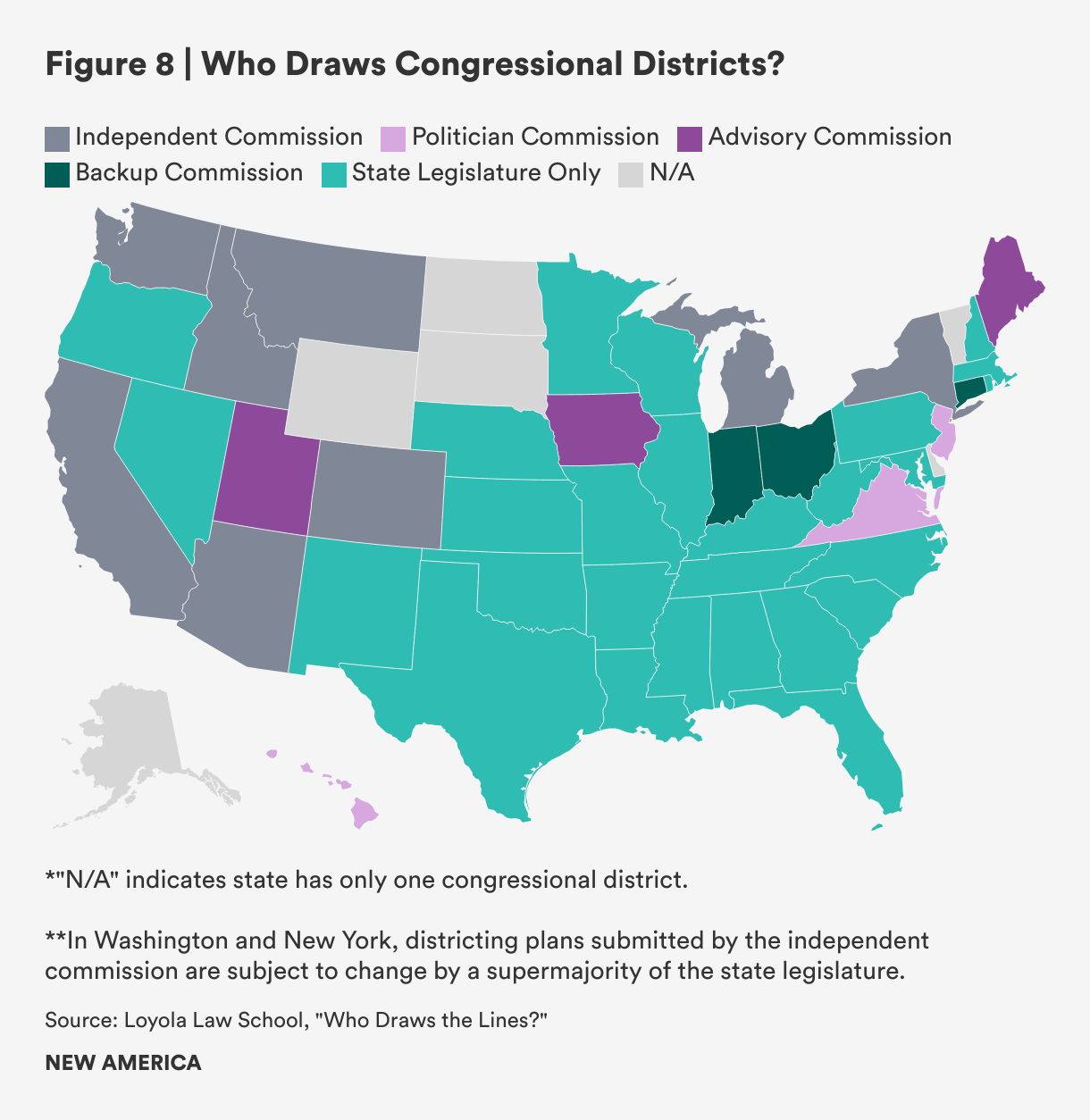
Finally, each cycle, several states wind up having state courts ultimately draw their maps because litigants challenge maps as violating state constitutions. No state sets out to have courts draw their maps, of course. But several studies compare court-drawn maps to other approaches nonetheless. In general, courts tend to draw the maps that are overall most fair.
With these differences in mind, let us now turn to the studies. Numerous studies have evaluated the performance of redistricting commissions. Most of the studies focus either on how commissions impact partisan neutrality and competitiveness. Because almost all the studies focus on a single criteria, we will here group the studies by the outcome that they evaluate.
Commissions and Partisan Neutrality
Partisan legislatures engage in partisan gerrymandering. This is perhaps the most widely documented fact of modern congressional districting. No matter which measure of partisan neutrality is used, unified partisan control of state legislatures produces maps biased heavily in favor of the party in power.93
The topline answer is that redistricting commissions modestly improve partisan fairness as compared to partisan legislatures. However, there is considerable variation and complexity beneath this topline finding. So let us turn to the studies.
In “Do Redistricting Commissions Avoid Partisan Gerrymanders?,” a comprehensive 2021 study on the effects of redistricting in the 2010s, Robin E. Best, Steve B. Lem, Daniel B. Magleby, and Michael D. McDonald find that: yes, “commissions tend to do a relatively good job at avoiding partisan gerrymandering, where the baseline for relative comparisons is states not using commissions. Still, it is too much to say that commissions do a uniformly good job. Three of seven commission states—Arizona, New Jersey, and Virginia (then an advisory commission)—enacted plans that packed voters in some districts in ways that both reduced the seat-to-vote responsiveness compared to expectations from residential patterns and introduced bias.”
Overall, Best and colleagues draw two big conclusions. First, even when commissions, not politicians, are drawing the district lines, districting is still a political process because partisan outcomes are at stake. As they write: “commissions are decidedly bipartisan, and the maps they create are influenced by politics and their partisan skew. In some instances (e.g., California, Washington), bipartisan collaboration produces plans endorsed by both parties; these maps reduce partisan bias to little more than what one would expect from underlying residential patterns. On the other hand, when bipartisanship fails to materialize (e.g., Arizona, New Jersey), commissions create maps that add partisan bias in favor of the voting majority.”
Second, because there are many different ways to measure partisan fairness and commissions and no agreed-upon standard, commissions struggle—especially when they are not given direct instructions to prioritize partisan fairness above other competing values in districting. As Best et al. write: “a fundamental problem for any and all commissions is their adoption focuses on form and not substance. Commissions are given no charge, or at most a vague charge, to avoid partisan gerrymanders. The missing, meaningful charge likely reflects the same problem the Supreme Court sees for itself, a fatalist resignation that no discernable and manageable standard exists.”
In their 2021 book, Gerrymandering the States: Partisanship, Race, and the Transformation of American Federalism, Alex Keena, Michael Latner, Anthony J. McGann, and Charles Anthony Smith, find that only truly independent commissions reduce partisan bias in districting. As they explain, “we see much promise in comprehensive procedural reforms… extreme partisan bias in districting occurs almost exclusively when one party monopolizes the redistricting process. … [M]aps drawn by nonpolitical actors have on average less bias than maps drawn by political actors. Accordingly, reforms that transfer redistricting authority from a political body (e.g., a legislature or politician commission) to nonpolitical actors, such as citizen commissions or courts, are likely to lead to substantial reductions in partisan bias.”94
Like many other analyses, Keena et al. note how the use of the single-member district limits the options for map-drawers. They explore alternative options, such as proportional, multimember districts, which they see as far more promising for partisan fairness: “given our analysis of the transition to single-member districting, it follows that the adoption of proportional, multimember districting plans would limit partisan bias in the translation of votes into seats.
In a 2015 law review article, “Arizona and Anti-Reform,” Nicholas Stephanopolous also finds a modest gain in partisan fairness from nonpartisan commissions. Stephanopolous analyzes the effect of commissions on the efficiency gap for all elections from 1972 to 2012. He finds that commissions modestly improve the fairness of districting, but the results are somewhat limited. Commissions reduce the efficiency gap by 6 percent, or about half of the 12 percent efficiency gap of the median congressional plan. The effects, however, are smaller for state legislative maps. As Stephanopolous notes, “These results provide strong, though not overwhelming, support for the predictions of process theory… Courts produce a statistically significant drop in the absolute efficiency gap at the state legislative level, while commissions do the same (but more dramatically) using presidential data at the congressional level. The coefficients for court usage and commission usage are negative in every model as well. However, they fail to rise to statistical significance in several cases, thus rendering the overall picture less than perfectly clear.”95
The study that documents most improvement, but specific to California’s independent citizens commission, is a 2012 paper by Vladimir Kogan and Eric McGhee, “Redistricting California: An Evaluation of the Citizens Commission Final Plans,” that examined California’s move to an independent commission. They found a modest improvement in partisan fairness, mostly stemming from the fact that the new maps were more favorable to Democrats than the previous maps, which were biased towards Republicans, across a few different measures.96
As Kogan and McGhee conclude, “The partisan change we predict for the new plans is generally modest, and where it is larger, the new lines are not necessarily responsible. … The implications of these results depend greatly on one’s primary concern. If the question is whether the new maps are better for the Democrats, the answer is clearly yes. But the gains for Democrats are either uncertain, because they depend on competitive seats, or conditional, because they depend on the esoterica of Senate seat numbering. Moreover, there is nothing about the new lines that guarantees a good Democratic performance.”
But as they note, “Perhaps most importantly, the experience of the CRC has shown that a nonpartisan, participatory, and transparent process does not eliminate the zero sum nature of electoral competition. The commission’s maps have both winners and losers and may result in lasting impacts on the balance of political power.”
Conclusion
Compared to partisan state legislatures, redistricting commissions, especially independent redistricting commissions, draw districts that are fairer to both major parties. This is a consistent conclusion across all four studies. But this is hardly surprising, since partisan state legislatures are drawing maps to benefit their party.
The more important question is how much improvement commissions make over partisan legislatures. And here the findings are more limited across all four studies. The impacts of commissions are generally more marginal than transformative, and depend very much on how the commissions are structured. To maximize partisan fairness, a commission should be maximally independent of politics, and have its top goal as maximizing partisan fairness. But again, maximizing partisan fairness can come at the expense of other values, especially competitive elections. California, for example, puts partisan fairness lower on its list of priorities than many other values.
At first glance, it may appear puzzling that nonpartisan commissions do not offer a more transformative solution to concerns about partisan fairness. After all, the harms of partisan gerrymandering are very real, and widely documented.
But the limited observed impacts for redistricting commissions presumably reflects a few factors.
First, there are limits to what commissions can achieve, given the inherent properties of single-member districts, and trade-offs among competing values, and the geographic coalitions of the parties.
Second, because only a handful of states have yet to enact commissions that are truly independent and not subject to political meddling, the limited number of cases makes it harder to quantify the effects of commissions. As the number of states enacting commissions increases, the effects may become clearer. Similarly, since partisan gerrymandering has undoubtedly grown worse over the last several cycles, the potentially positive effects of independent commissions may be growing as well, since they now may have greater distortions to correct.
Third, while it is straightforward to show a distortion, it may be more difficult to establish a baseline. This is the challenge of partisan fairness metrics more broadly. Nobody agrees on what fair partisan districting looks like.
To be sure, in a closely contested politics in which a handful of districts can determine control of the House of Representatives, even a small benefit can be transformative. But this is precisely the problem: when elections are so closely contested, and control of the House depends on a few seats here and a few seats there, even small distortions are consequential. And yet, with no agreed-upon standard on separating the small distortions from the larger distortions, we may simply be asking independent commissions to do too much.
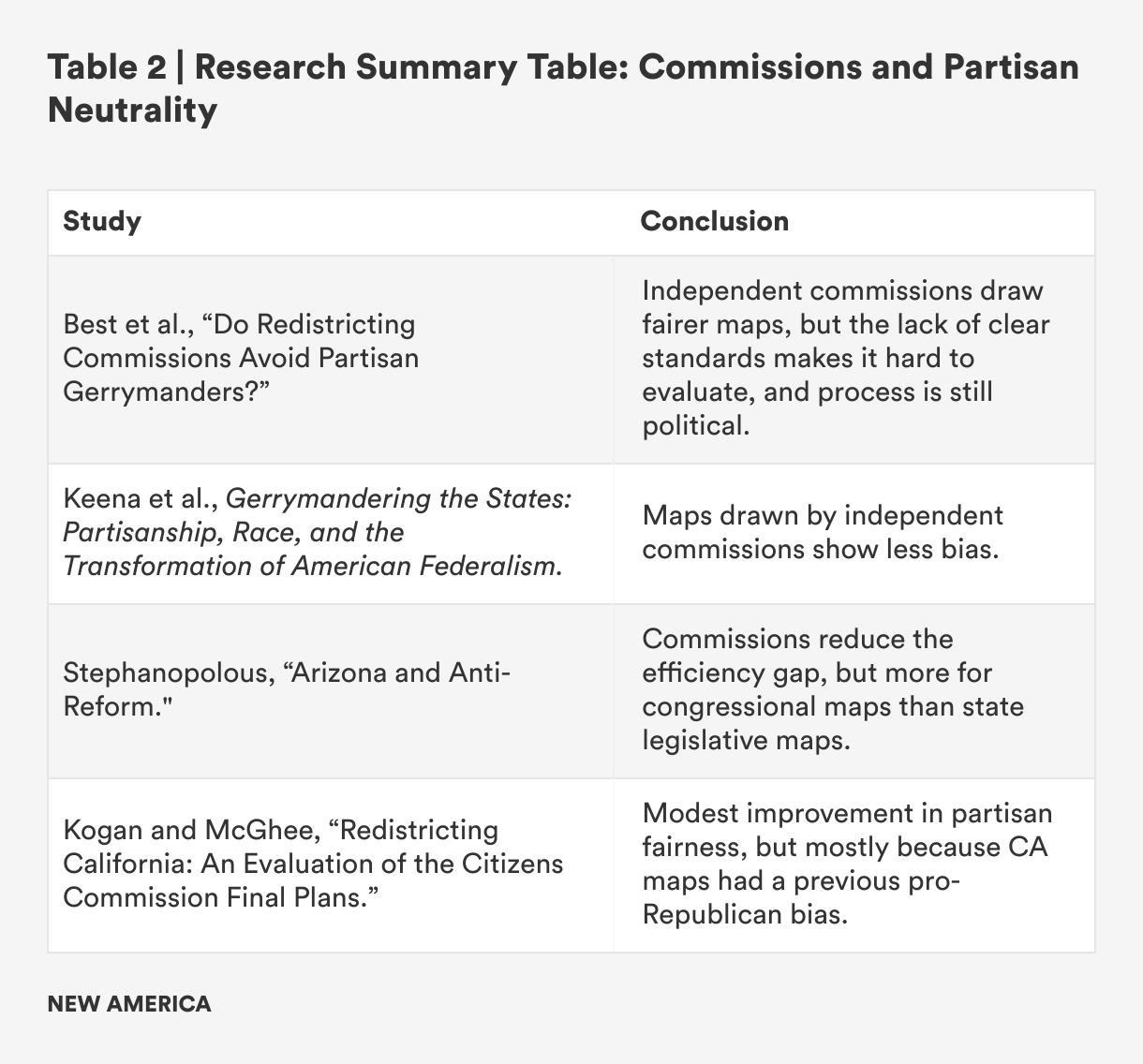
Commissions and Competitiveness
Now we turn to competitiveness. As discussed in the previous section on competitiveness, districts have become less competitive over the last several decades largely due to factors unrelated to gerrymandering. As the parties have sorted geographically, and the share of undecided or swing voters has declined, it has become harder and harder for mapmakers to draw competitive districts while preserving other criteria, even if their explicit goal were to maximize competition.
Nonetheless, partisan state legislatures are often motivated to draw as many safe districts as possible to ensure their members are re-elected, and there is at least some evidence that gerrymandering has reduced the share of competitive districts above and beyond more natural declines stemming from the geographical sorting of the two parties.
Accordingly, there is some modest evidence that redistricting commissions can improve the share of competitive districts above what state legislatures typically produce, though the increases tend to be quite limited.
In their 2004 article, “The Effect of State Redistricting Methods on Electoral Competition in United States House of Representatives Races,” Jamie Carson and Michael Crespin find that courts and commissions drew a higher percentage of competitive districts than legislatures. Their findings are described in the table below.
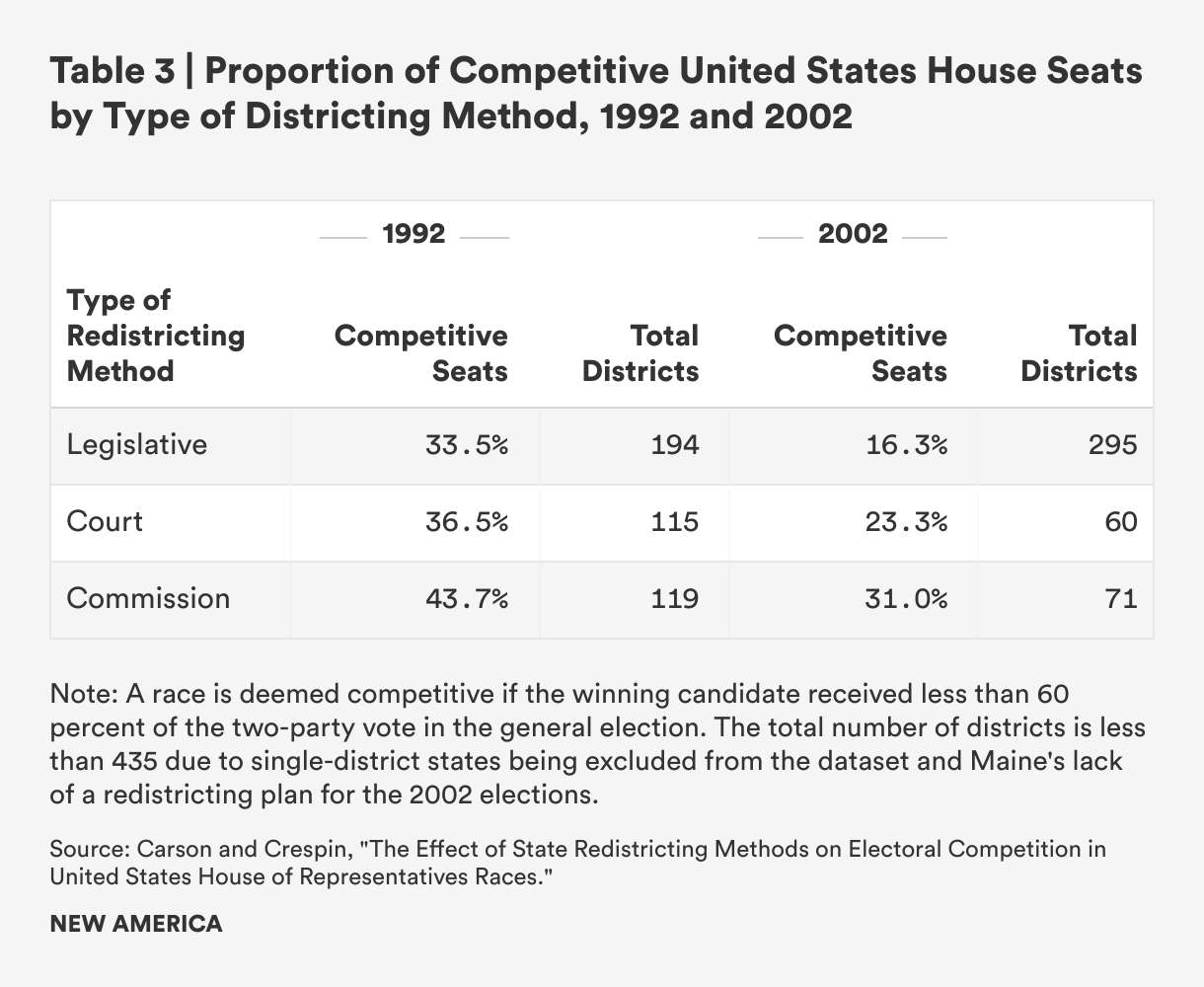
By comparing these different approaches to districting over two cycles, it is clear that there is a secular trend in the decline of competition regardless of the approach to districting. In fact, it is noteworthy that by 2002, only 31 percent of commission-drawn districts were competitive. That is a smaller percentage than the 33.5 percent of legislative-drawn districts that were drawn in 1992!
Similarly, Eric Lindgren and Priscilla Southwell looked at the post-2002 redistricting in their 2013 article, “The Effect of Redistricting Commissions on Electoral Competitiveness in U.S. House Elections, 2002–2010” and also found that commissions, especially backup commissions, produced more competitive elections on average. However, they used a different metric of competitiveness than the Carson and Crespin study above, focusing on the margin of victory. They also used more finely grained distinctions among different types of commissions.97
Below is the key summary table describing their findings.
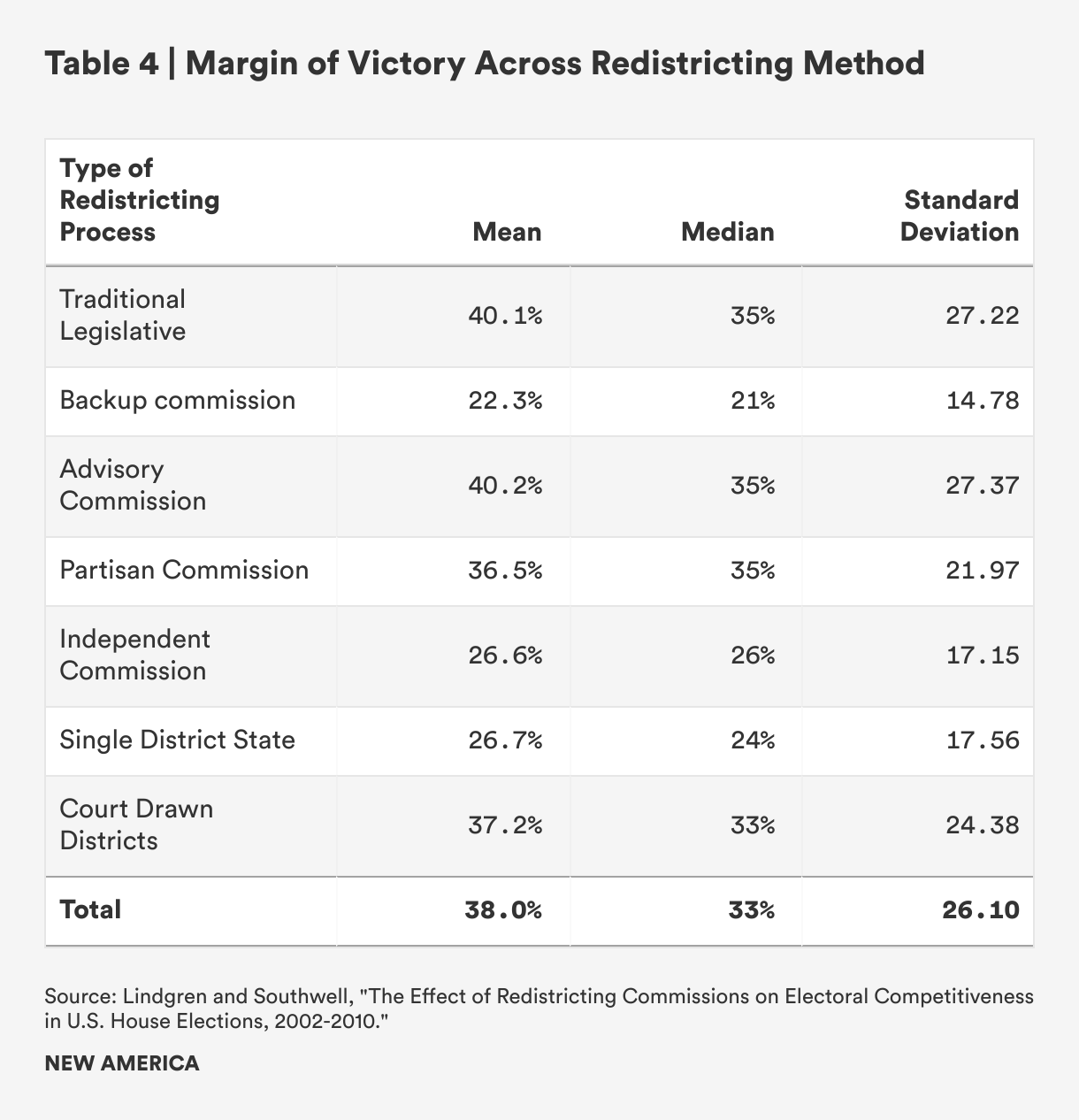
Other studies find no effect on competition. In a 2006 article, Alan Abramowitz, Brad Alexander, and Matthew Gunning found that nonpartisan commissions do not improve competition: “There is no evidence that redistricting by nonpartisan redistricting commissions or courts resulted in more competitive districts than redistricting by partisan state legislature.”98
Their metric is the proportion of safe districts and the proportion of marginal districts. As they write: “in states in which redistricting was done by nonpartisan commissions or courts, the proportion of marginal districts decreased from 25% in 2000 to 24% in 2002 while the proportion of safe districts increased from 44% in 2000 to 51% in 2002; in states in which redistricting was done by partisan state legislatures, the proportion of marginal districts decreased from 29% in 2000 to 28% in 2002 while the proportion of safe districts decreased from 46% in 2000 to 45% in 2002.”
So why do Abramowitz et al. find no effect as compared to the previous two studies discussed above? The core disagreement appears to be over where one draws the lines between competitive and non-competitive districts. By their definitions: “Marginal districts are those in which the two-party division of the presidential vote was within plus or minus 5 percentage points of the two-party division of the national presidential vote; safe districts are those in which the presidential vote was at least 10 percentage points more Democratic or Republican than the national presidential vote.” Abramowitz et al. also do not distinguish among types of commissions, as the other studies do.
In a related 2006 article, Abramowitz et al. focus more on the broad trend of declining district competitiveness that goes beyond a single redistricting cycle—a constant theme in these studies. See Figure 10 below, reproduced from their article.99
However, Michael McDonald argued in his 2006 article, “Drawing the Line on District Competition,” that Abramowitz et al. used a flawed measure of presidential two-party vote share by relying too much on the 1992 election, in which Perot’s entry may have disrupted the normal partisanship. McDonald recommends using the 1988 vote share instead.100 He argues that under a different metric, redistricting commissions do improve the share of competitive districts.
Abramowitz et al responded to McDonald’s charges in a follow-up article, defending their choice of competitiveness metric.101 However, McDonald does acknowledge that no matter which metric is used, the number of competitive districts is declining for reasons unrelated to gerrymandering, and that these reasons (mostly geographic partisan sorting) account for much more of the decline in competitive districts.
Yet another approach involves using simulated and alternative maps. This is similar to the “Ensemble analysis” in measuring partisan fairness, which eschews any particular standard of competitiveness and instead compares the enacted plans to all possible plans. Using this analysis, John A. Henderson, Brian T. Hamel, and Aaron Goldzimer examine the post-2010 census redistricting cycle in their 2018 article, “Gerrymandering Incumbency: Does Nonpartisan Redistricting Increase Electoral Competition?.”102 They find that independent redistricting commissions do no better than legislatures when it comes to the competitiveness of district maps.103
As they conclude, “Independent redistrictors produce virtually the same degree of insulation as (bi)partisan plans devised in legislatures or by political appointees. Our findings suggest that replacing parties with independent redistrictors is unlikely to increase competition in legislative elections, offering little remedy to contemporary concerns about representation.” However, they do found that when courts intervene, maps are more competitive.
Focusing only on California, Kogan and McGhee examine the share of congressional and state legislative seats in which neither party has more of a 10-point advantage.104 Based on their analysis, “The new maps will produce a modest increase in the number of competitive elections—though perhaps fewer than many reformers hoped for.” The below table is from their analysis:
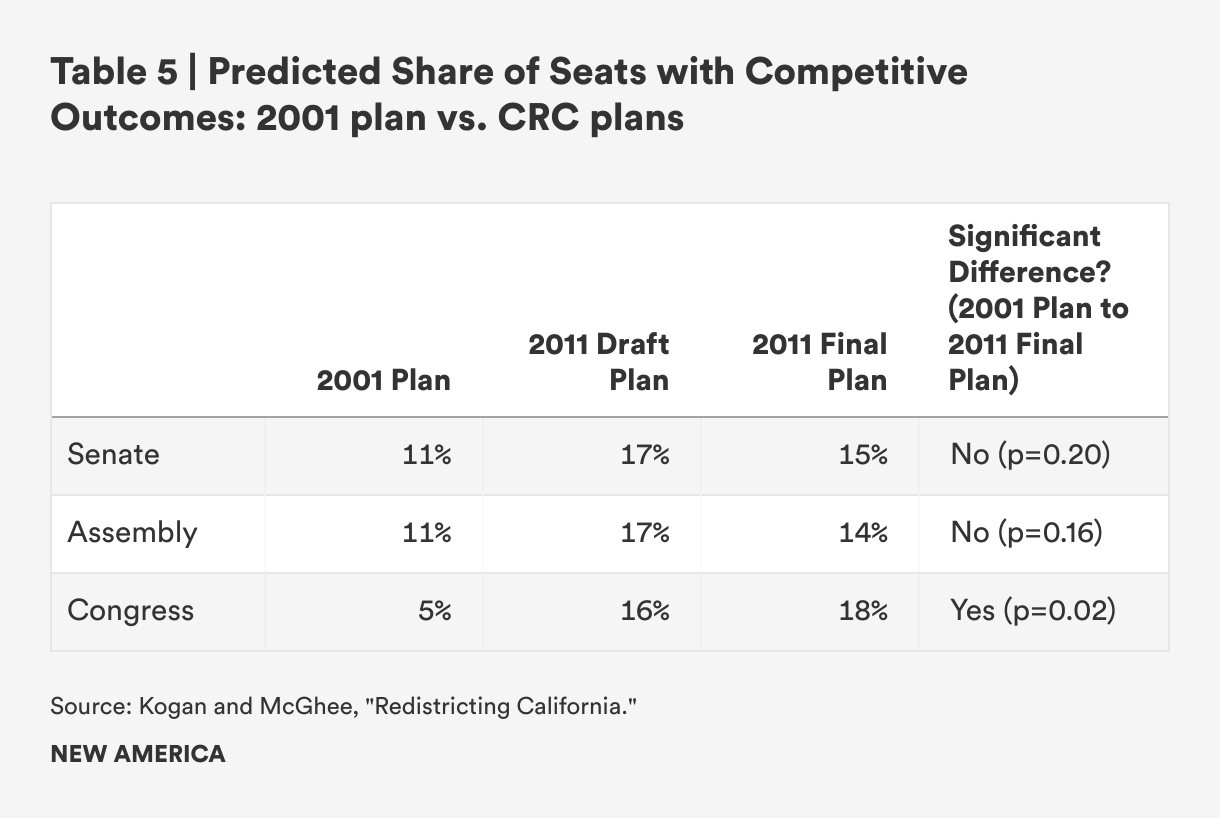
However, Kogan and McGhee note that there are clear limits to how many competitive districts states can draw, without doing damage to other values. As they explain, “Maximizing certain criteria, such as keeping communities intact and protecting the voting rights of historically underrepresented groups, makes achieving other goals, such as increasing competitiveness, more difficult.”
In a 2009 study, Richard Forgette, Andrew Garner, and John Winkle examine redistricting from the 1990s and early 2000s and find that “independent redistricting commissions did not appear to affect state legislative competition.”105
However, Forgette and co-authors do find that where states pass particular redistricting principles into law, these principles can increase the share of competitive districts. As they explain, "We argue that state redistricting principles lessen the range of possible redistricting plans available to elected partisans for drawing new lines. That is, state legislative mapmakers are limited by the political and legal context unique to their state. Proposed maps must achieve acceptance by diverse advocacy groups and survive judicial scrutiny.”
Forgette and colleagues also observe the same trend that many others have observed—that electoral competition is declining broadly, and that even other reforms designed to increase competition, such as term limits, have not stemmed the tide. As they write, "We find that electoral competitiveness in state legislative races declined throughout the 1990s, even after term limit reforms were implemented. The proportion of uncontested state legislative seats has doubled since the 1970s, and there has also been a slight increase in average margin of election district victory.”
Once again, the decline of competition appears mostly driven by the geographical sorting and polarization of the two parties, above and beyond any redistricting shenanigans by state legislatures.
Similarly, a 2012 article by Seth Masket, Jonathan Winburn, and Gerald C. Wright examines competition in state legislatures in the 2000s and finds, as the article title makes clear, that there is no detectable relationship between who draws the maps and the share of competitive seats in state legislative elections. As they write, “Competitive rates look similar across redistricting methods, with no plan producing more than 30% competitive seats during the decade. Before redistricting, the 2000 elections showed almost identical rates of competition across the five redistricting categories.”106
Moreover, they find that, “when legislators under unified partisan control draw the maps, their results often actually increase competition, at least initially. Furthermore, the bipartisan ‘neutral’ commissions that some states have appointed to redraw their districts have seen less-competitive elections immediately following redistricting. However, these trends do not appear to hold with subsequent elections; we do not find evidence of clear long-term trends in levels of competition.”
The figures below describe their main findings.
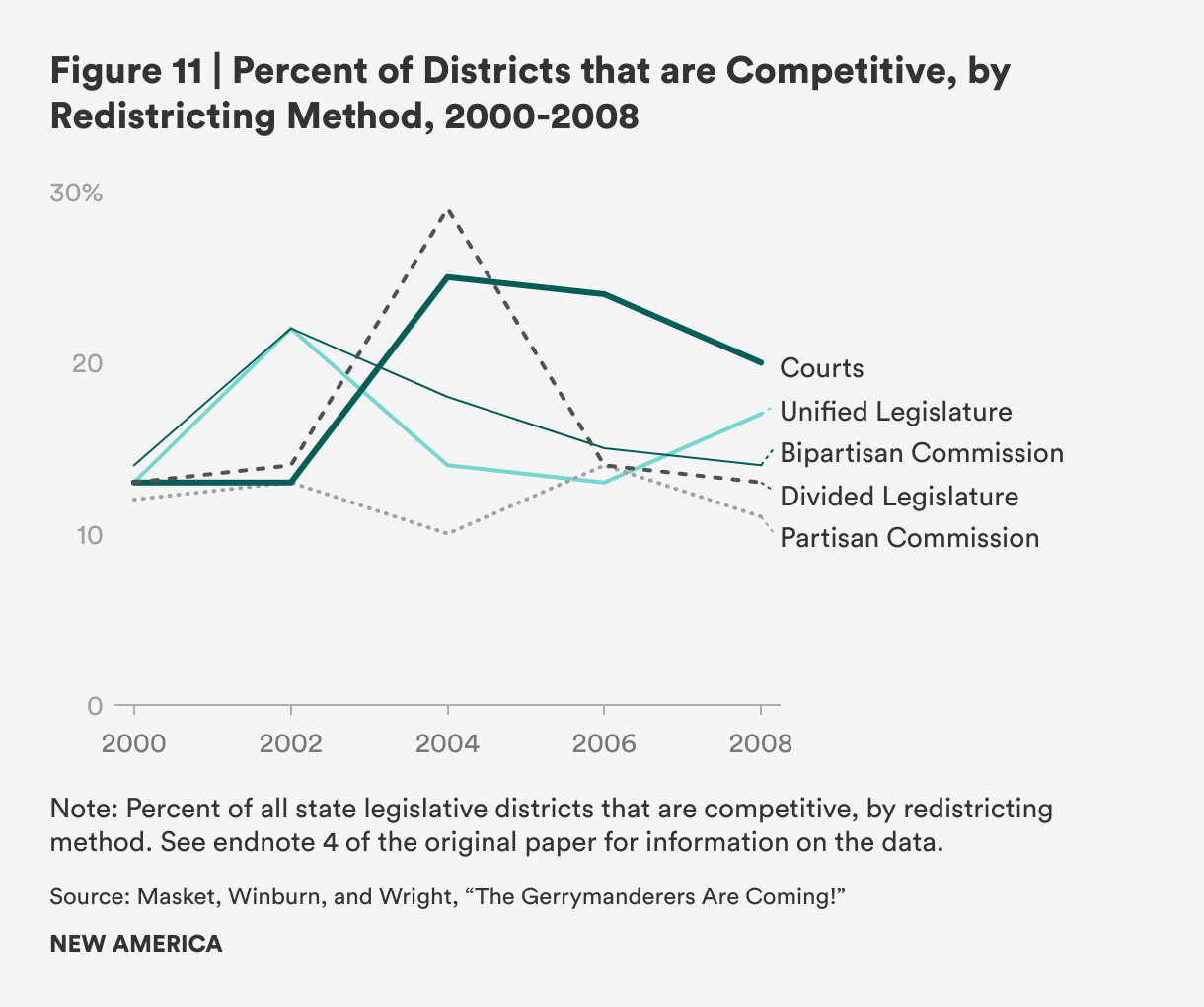
Again, we see the familiar trade-off between partisan fairness and competition. When partisan legislatures maximize their share of seats, they typically do so by spreading their voters out more efficiently, which makes for more districts that are competitive, especially over the course of a decade during which demographics change and partisan waves come and go.
Interestingly, Masket et al. also find that “states with nonpartisan redistricting methods saw their legislatures become more polarized, while those states with partisan methods saw slight de-polarization, on average.” It is unclear whether or not this relationship is causal, or if so, in which way the causality runs. But if independent redistricting methods ensure partisan fairness at the expense of more competitive seats (as they sometimes do), more safe seats for both parties may lead them to further embrace their extremes.
The Bottom Line on Commissions and Competitiveness
Taking the several studies as a whole, we can conclude that under certain conditions, nonpartisan redistricting commissions can improve the share of competitive districts. But the effects are limited. And as with partisan neutrality, the benefits of redistricting commissions seem clearer for congressional elections than for state legislative elections.
So why do some conclude that commissions draw more competitive districts while others do not? The studies vary in their measurements of competitiveness, their methodological approaches for assessing the impact, and the time frame and states that they choose to study. These debates will likely continue in future studies. Rather than referee these disputes, a more reasonable conclusion is that if redistricting commissions are able to improve the share of competitive districts, the effects are small. Indeed, all of the studies acknowledge the considerable obstacles in drawing competitive districts imposed by the geographic sorting of the two parties, suggesting that there are real limits to what commissions can accomplish in increasing competitiveness, regardless of their political independence.
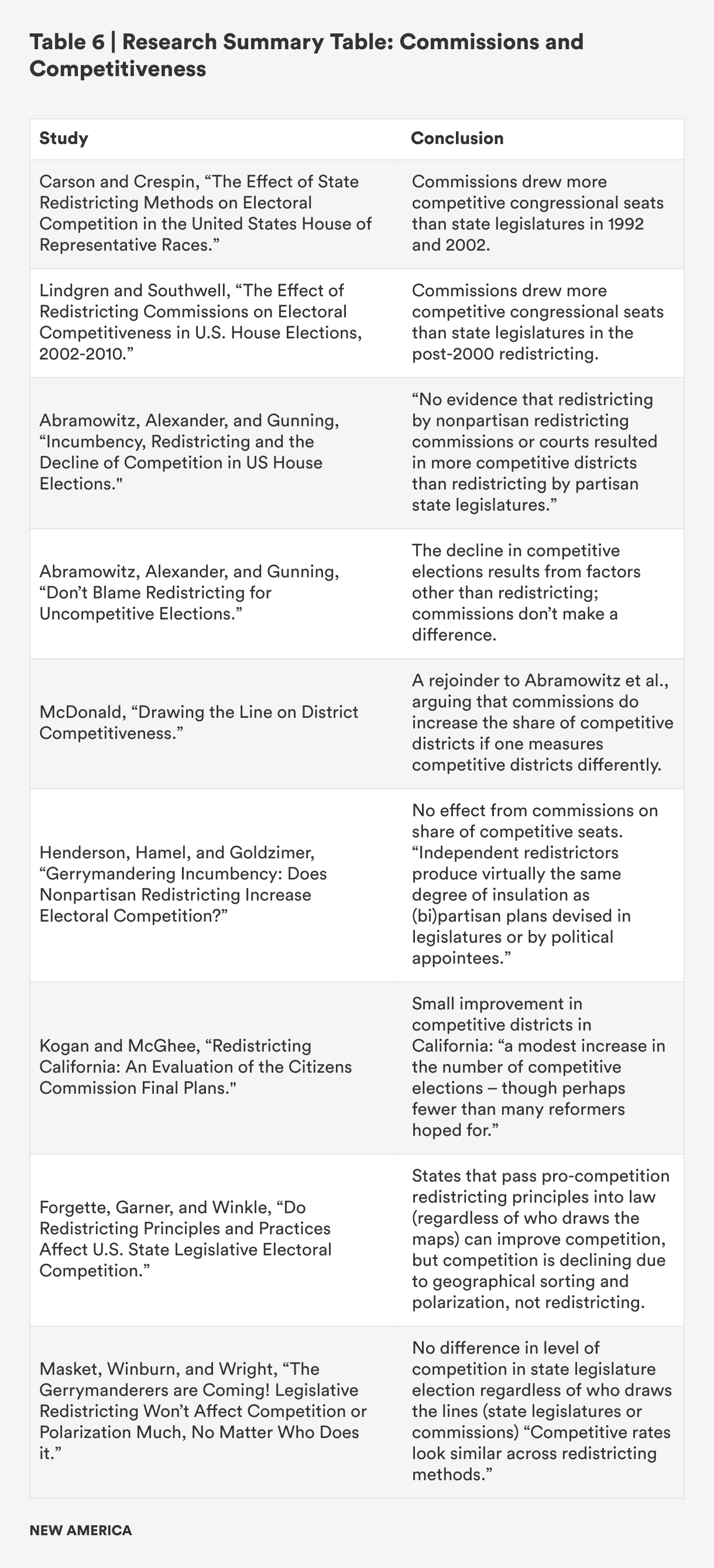
Commissions and Compactness, Keeping Communities Together
While the effects of commissions on both partisan neutrality and competition have been somewhat well-studied, only one peer-reviewed study evaluating how well commissions perform on the compactness criteria or the keeping communities together criteria has been published. This is a 2017 study, “Institutional Control of Redistricting and the Geography of Representation,” by Barry Edwards, Michael Crespin, Ryan D. Williamson, and Maxwell Palmer.107
Their conclusion is simple and straightforward: “We examine a large sample of congressional and state legislative districts and find that, relative to legislatures, IRCs [Independent Redistricting Commissions] tend to draw more compact districts, split fewer political subdivisions, and may also do a better job of preserving the population cores of prior districts.”
Edwards et al. find that IRC-drawn congressional districts split 0.68 fewer counties and 2.44 fewer cities than those produced by state legislatures. State legislative districts drawn by IRCs and state legislatures are indistinguishable in terms of counties split, but IRC-drawn districts divide 1.22 fewer cities.
However, “The amount of respect shown to political subdivisions varies considerably.” They “do not find significant differences among redistricting institutions with respect to preserving the cores of prior congressional districts. At the state level, however, we find that IRCs do a better job of preserving the cores of prior districts than state legislatures do.”108
Given that there has only been one peer-reviewed study on both of these criteria, additional studies might be valuable. However, given that keeping communities together and drawing more compact districts is relatively uncontroversial and easier than ever to do with modern mapping software, the conclusion is hardly surprising.
Commissions and Fair Minority Representation
As of this writing, the only significant data-rich study assessing the role of commissions on minority-influence districts (districts where racial minorities make up a majority of voters in the districts) is a preliminary one assessing the initial results of the 2021 districting process.109 As shown in the charts below, this study does not detect a meaningful relationship between the type of district process used and the extent to which statewide Black and Hispanic voting age populations correspond to the percent of Black and Hispanic-influence districts.
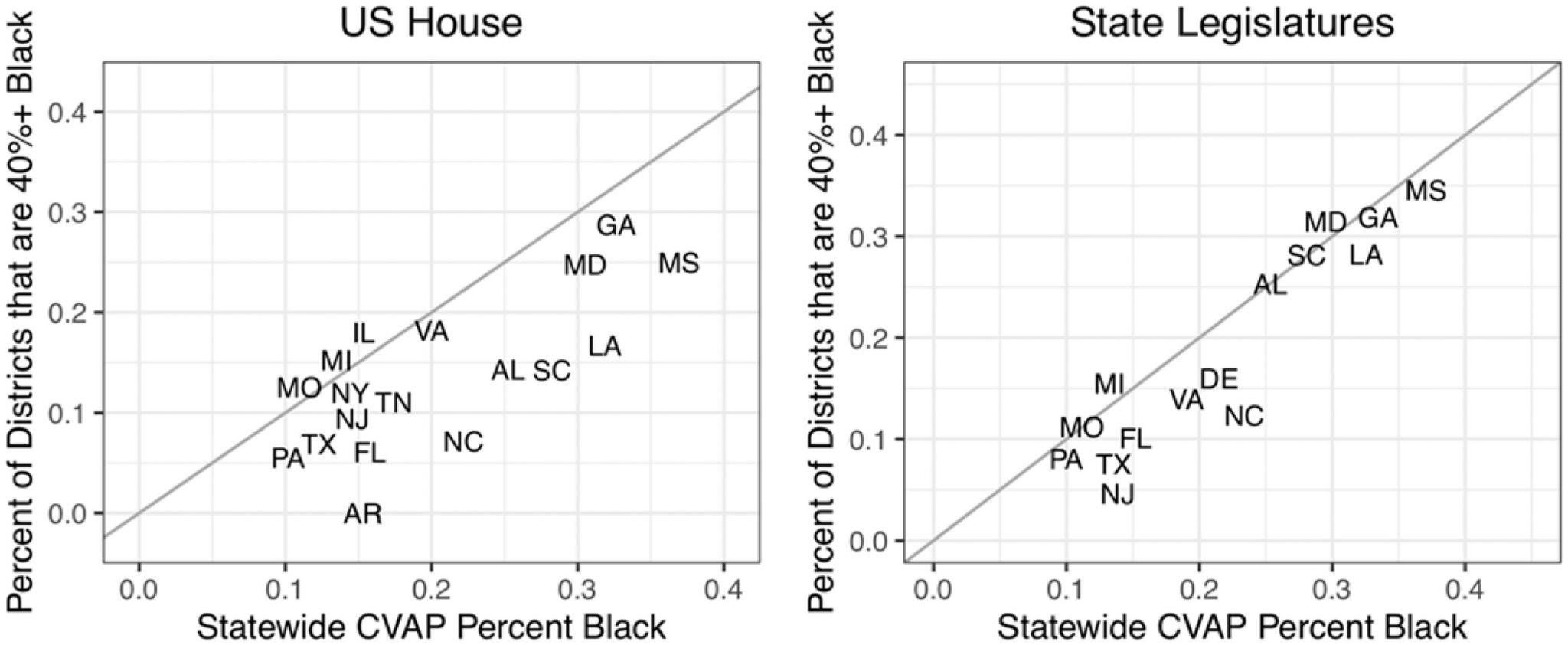
Warshaw, McGhee, and Migurski, “Districts for a New Decade.”
Interestingly, while Arizona and California’s independent redistricting commissions fairly drew minority influence districts for Hispanic voters, Colorado’s independent redistricting commissions did not.
The California Redistricting Commission is required by state law to draw districts for underrepresented racial and ethnic groups. By contrast, competitiveness and partisan fairness are downgraded as priorities. In evaluating the new maps, Eric McGhee and Jennifer Paluch observe improvements for Latino representation, stasis for Black and Asian representation.110
With the final California maps, the number of majority Latino districts in the state increased significantly, adding six districts for Congress, three for state senate, and five for state assembly. As a share of all districts, these numbers nearly match the share of the Latino voting-eligible population (30 percent). By contrast, “influence” districts—where Latinos are a significant minority, which we define as 30 percent or more—decreased by eight for the U.S. Congress, seven for the state senate, and five for the state assembly.
For Asian Americans and African Americans, the final maps show less change. The state assembly map now has two Asian majority districts—up one from the current assembly map—but none in the congressional or state senate maps. In fact, the number of Asian influence districts is unchanged or lower in every case. There are no majority Black districts in any map nor additional assembly or senate influence districts, but the congressional plan now has two new Black influence districts.
Citations
- In the current redistricting cycle, independent commissions in eight states will have final say in approving congressional and/or state legislative district lines: Alaska, Ariz., Cali., Colo., Idaho, Mich., Mont., and Wash. New York also has an independent commission, but the state legislature still has final approval. All About Redistricting, “National Summary,” accessed July 27, 2022, <a href="<a href="<a href="source">source">source">source">source.
- Lynn Adelman, “The Roberts Court’s Assault on Democracy,” Harvard Law & Policy Review 14, no. 1 (2020): 131–58.
- Suzanne Mettler and Trevor Brown, “The Growing Rural-Urban Political Divide and Democratic Vulnerability,” The ANNALS of the American Academy of Political and Social Science 699, no. 1 (January 1, 2022): 130–42, <a href="<a href="<a href="source">source">source">source">source; Dante J. Scala and Kenneth M. Johnson, “Political Polarization along the Rural-Urban Continuum? The Geography of the Presidential Vote, 2000–2016,” The ANNALS of the American Academy of Political and Social Science 672, no. 1 (July 1, 2017), 162–84, <a href="<a href="<a href="source">source">source">source">source; Mettler and Brown, “The Growing Rural-Urban Political Divide and Democratic Vulnerability”; James G. Gimpel et al., “The Urban–Rural Gulf in American Political Behavior,” Political Behavior 42, no. 4 (December 1, 2020): 1343–68, <a href="<a href="<a href="source">source">source">source">source.
- For those seeking a more detailed history, see Erik J. Engstrom, Partisan Gerrymandering and the Construction of American Democracy (Ann Arbor, MI: University of Michigan Press, 2013). Much of this history is drawn from Engstrom’s book.
- Engstrom, 21.
- Erick Trickey, “Where Did the Term ‘Gerrymander’ Come From?,” Smithsonian Magazine, July 20, 2017, <a href="<a href="source">source">source">source.
- Andrew Rehfeld, The Concept of Constituency: Political Representation, Democratic Legitimacy, and Institutional Design (Cambridge, UK: Cambridge University Press, 2005), 69–80.
- Harry Marlin Tinkcom, The Republicans and Federalists in Pennsylvania, 1790-1801 (Harrisburg, PA: Pennsylvania Historical and Museum Commission, 1950), 51; Engstrom, Partisan Gerrymandering and the Construction of American Democracy, 27.
- Alexander Keyssar, Why Do We Still Have the Electoral College? (Cambridge, MA: Harvard University Press, 2020), 61–116.
- Stephen Calabrese, “Multimember District Congressional Elections,” Legislative Studies Quarterly 25, no. 4 (2000): 611–43. Susan E. Scarrow, “Parties and the Expansion of Direct Democracy: Who Benefits?,” Sage Publication 5, no. 3 (1999): 341–362; Engstrom, Partisan Gerrymandering and the Construction of American Democracy, 43–59.
- For a slightly more detailed history, Lee Drutman, Breaking the Two-Party Doom Loop: The Case for Multiparty Democracy in America (New York: Oxford University Press, 2020), 239–264. For those wishing to take an even deeper dive into the history, see Bernard Ivan Tamas, “A Divided Political Elite: Why Congress Banned Multimember Districts in 1842,” New Political Science 28, no. 1 (March 1, 2006): 23–44; Michele Rosa-Clot, “The Apportionment Act of 1842: ‘An Odious Use of Authority,’” Parliaments, Estates and Representation 31, no. 1 (April 1, 2011): 33–52; Johanna Nicol Shields, “Whigs Reform the ‘Bear Garden’: Representation and the Apportionment Act of 1842,” Journal of the Early Republic 5, no. 3 (1985): 355; Robert E. Ross, “Recreating the House: The 1842 Apportionment Act and the Whig Party’s Reconstruction of Representation,” Polity 49, no. 3 (June 6, 2017): 408–33, <a href="<a href="source">source">source">source; David Canon and William Egar, “The Apportionment Act of 1842: Principle or Interest?,” APW Papers (2014): 37.
- Engstrom, Partisan Gerrymandering and the Construction of American Democracy, 80–100.
- For some history, see Lee Drutman, “How Much Longer Can This Era Of Political Gridlock Last?,” FiveThirtyEight, March 4, 2021, <a href="<a href="source">source">source">source.
- Frances E. Lee, “Patronage, Logrolls, and ‘Polarization’: Congressional Parties of the Gilded Age, 1876–1896,” Studies in American Political Development 30, no. 2 (October 2016): 116–27.
- Lee Drutman, Jonathan D. Cohen, Yuval Levin, and Norman J. Ornstein, The Case for Enlarging the House of Representatives (Cambridge, MA: American Academy of Arts and Sciences, 2021), <a href="<a href="source">source">source">source.
- Engstrom, Partisan Gerrymandering and the Construction of American Democracy, 171–172.
- J. Douglas Smith, On Democracy’s Doorstep: The Inside Story of How the Supreme Court Brought “One Person, One Vote” to the United States (New York: Hill and Wang, 2014).
- Specifically, Baker v. Carr (1962) established the principle that redistricting cases could be brought before the courts. Wesberry v. Sanders (1964) established that congressional districts must have equal population size (within a state), and Reynolds v. Sims (1964) applied the equal population size criteria to state legislative districts; J. Douglas Smith, On Democracy’s Doorstep: The Inside Story of How the Supreme Court Brought “One Person, One Vote” to the United States (New York: Hill and Wang, 2014). To codify the one person, one vote principle, Congress passed the Uniform Congressional Districting Act of 1967, which reaffirmed the congressional mandate that states use single-member districts, and that those districts be of equal size. This was the civil rights era, and the threat of southern states moving to at-large districts with block voting was real. This would have had disastrous consequences for voting rights, since it would have made it all but impossible for Black voters to elect their candidates of choice.
- Gary W. Cox and Jonathan N. Katz, “The Reapportionment Revolution and Bias in U. S. Congressional Elections,” American Journal of Political Science 43, no. 3 (July 1999): 812–841, <a href="<a href="source">source">source">source.
- Helmut Norpoth and Jerrold G. Rusk, “Partisan Dealignment in the American Electorate: Itemizing the Deductions since 1964,” American Political Science Review 76, no. 3 (September 1982): 522–37, <a href="<a href="source">source">source">source.
- Michael Lyons and Peter F. Galderisi, “Incumbency, Reapportionment, and US House Redistricting,” Political Research Quarterly 48, no. 4 (1995): 857–71.
- The passage of the 1982 Voting Rights Act, which made it easier for plaintiffs to gain majority-minority districts based on even unintentional dilution. With the help of the Justice Department, the number of majority-minority districts grew from 29 to 52 after the 1991–1992 redistricting round. The result was a significant increase in Black and Latino representatives in Congress following the 1992 election—from 37 to 56.
- Lee Drutman, “What We Lose When We Lose Competitive Congressional Districts,” FiveThirtyEight, June 23, 2022, <a href="<a href="source">source">source">source.
- Rhodes Cook, “The ‘Big Sort’ Continues, with Trump as a Driving Force – Sabato’s Crystal Ball,” University of Virginia Center for Politics, February 17, 2022, <a href="<a href="source">source">source">source.
- Lee Drutman, “Why Bipartisanship In The Senate Is Dying,” FiveThirtyEight, September 27, 2021, <a href="<a href="source">source">source">source.
- David Daley, Ratf**ked: The True Story Behind the Secret Plan to Steal America’s Democracy, 1st edition (New York: Liveright, 2016).
- Ballotpedia, “Historical and Potential Changes in Trifectas,” accessed May 20, 2022, <a href="<a href="source">source">source">source.
- Michael Li and Laura Royden, Extreme Maps (New York, NY: Brennan Center, 2017), <a href="<a href="source">source">source">source; Daley, Ratf**ked.
- Nathaniel Rakich, “The New National Congressional Map is Biased Toward Republicans,” FiveThirtyEight, June 15, 2022, <a href="<a href="source">source">source">source.
- Corwin D. Smidt, “Polarization and the Decline of the American Floating Voter,” American Journal of Political Science 61, no. 2 (2017): 365–81, <a href="source">source">source; Jon Green, “Floating Policy Voters in the 2016 U.S. Presidential Election,” Electoral Studies 67 (October 1, 2020): 1020–1028, <a href="source">source">source.
- Samara Klar and Yanna Krupnikov, Independent Politics: How American Disdain for Parties Leads to Political Inaction (New York: Cambridge University Press, 2016).
- Daniel J. Hopkins, The Increasingly United States: How and Why American Political Behavior Nationalized (Chicago: University of Chicago Press, 2018); Jamie L. Carson, Joel Sievert, and Ryan D. Williamson, “Nationalization and the Incumbency Advantage,” Political Research Quarterly 73, no. 1 (March 2020): 156–68, <a href="source">source">source; Benjamin Melusky and Jesse Richman, “When the Local Is National – A New High-Water Mark for Nationalization in the 2018 United States State Legislative Elections,” Regional & Federal Studies 30, no. 3 (May 26, 2020): 441–60, <a href="source">source">source; Joel Sievert and Seth C. McKee, “Nationalization in U.S. Senate and Gubernatorial Elections,” American Politics Research 47, no. 5 (September 1, 2019): 1055–80, <a href="source">source">source.
- Jacob M Grumbach, Laboratories against Democracy (Princeton, N.J: Princeton University Press, 2022).
- Vann R. Newkirk II, “How Redistricting Became a Technological Arms Race,” The Atlantic, October 28, 2017, <a href="source">source">source.
- Amariah Becker et al., “Computational Redistricting and the Voting Rights Act,” Election Law Journal: Rules, Politics, and Policy 20, no. 4 (December 2021): 407–41, <a href="source">source">source E. Cain et al., “A Reasonable Bias Approach to Gerrymandering: Using Automated Plan Generation to Evaluate Redistricting Proposals 2020 Redistricting: Mapping a New Political Decade Symposium,” William & Mary Law Review 59, no. 5 (2018): 1521–58; Wendy K. Tam Cho, “Technology-Enabled Coin Flips for Judging Partisan Gerrymandering,” Southern California Law Review Postscript 93 (2019): 11; Carl Smith, “Can New Technology Tools Keep Redistricting Honest and Fair?” Governing, September 16, 2021, <a href="source">source">source.
- Jeff Gou, “Gerrymandering didn’t make politics this vicious. But vicious politics will soon make gerrymandering so much worse,” Washington Post, July 2, 2015, <a href="source">source">source.
- William F. Connelly and John J. Pitney, Congress’ Permanent Minority?: Republicans in the US House (Rowman & Littlefield, 1994).
- Lee Drutman, “How Much Longer Can This Era Of Political Gridlock Last?,” FiveThirtyEight, March 4, 2021, <a href="source">source">source.
- Ballotpedia, “State government trifectas,” accessed July 26, 2022, <a href="source">source">source.
- For useful analysis, see Guy-Uriel E. Charles and Luis E. Fuentes-Rohwer, “Dirty Thinking about Law & Democracy in Rucho v. Common Cause,” Duke Law School Public Law & Legal Theory Series (October 2019): 1–13.
- Oyez.org, “Arizona State Legislature v. Arizona Independent Redistricting Commission,” accessed July 31, 2022, <a href="source">source">source.
- Alyce McFadden, “How ‘dark money’ is shaping redistricting in 2021,” Open Secrets, May 20, 2021 <a href="source">source">source.
- Lee Drutman, What We Know about Congressional Primaries and Congressional Primary Reform (Washington, DC: New America, 2021), <a href="source">source">source.
- For strong evidence that gerrymandering did not cause polarization, see: Nolan McCarty, Keith T. Poole, and Howard Rosenthal, “Does Gerrymandering Cause Polarization?,” American Journal of Political Science 53, no. 3 (July 1, 2009): 666–80.
- Daryl R. DeFord, Nicholas Eubank, and Jonathan Rodden, “Partisan Dislocation: A Precinct-Level Measure of Representation and Gerrymandering,” Political Analysis 30, no. 3 (June 2021): 1–23, <a href="source">source">source; Jonathan A. Rodden, Why Cities Lose: The Deep Roots of the Urban-Rural Political Divide (New York, NY: Basic Books, 2019); Jowei Chen and Jonathan Rodden, “Unintentional Gerrymandering: Political Geography and Electoral Bias in Legislatures,” Quarterly Journal of Political Science 8, no. 3 (January 1, 2013): 239.
- Mackenzie Wilkes, “Americans Don’t Trust Their Congressional Maps To Be Drawn Fairly. Can Anything Change That?,” FiveThirtyEight, October 26, 2021, <a href="source">source">source; Sheila Suess Kennedy, "Electoral Integrity: How Gerrymandering Matters," Public Integrity 19, no. 3 (2017): 265–273; Brennan Center for Justice, “Expert Brief: Americans Are United Against Partisan Gerrymandering,” March 15, 2019, <a href="source">source">source; RepresentUS, “National Polling: Voters See Gerrymandering as a Major Problem, Want Reform,” August 4, 2021, <a href="source">source">source.
- Anthony J. McGann, Charles Anthony Smith, Michael Latner, Alex Keena, Gerrymandering in America: The House of Representatives, the Supreme Court, and the Future of Popular Sovereignty (Cambridge: UK, Cambridge University Press, 2016) shows that, in many states, the maps were politically gerrymandered to give Republicans an edge in the US House. As well, several other studies have found similar results (John A. Curiel and Tyler Steelman, “Redistricting Out Representation: Democratic Harms in Splitting Zip Codes,” Election Law Journal: Rules, Politics, and Policy 17, no. 4 (2018): 328–353; Erik J. Engstrom and Robert Huckfeldt, Race, Class, and Social Welfare American Populism Since the New Deal (Cambridge, UK: Cambridge University Press, 2020); M. V. Hood III and Seth C. McKee, “Gerrymandering on Georgia's Mind: The Effects of Redistricting on Vote Choice in the 2006 Midterm Election,” Social Science Quarterly 89, no. 1 (2008): 60–77; Seth C. McKee,Jeremy M. Teigen, and Mathieu Turgeon, “The Partisan Impact of Congressional Redistricting,” Social Science Quarterly 87, no. 2 (2006): 308–317; Nicholas O. Stephanopoulos and Christopher Warshaw, “The Impact of Partisan Gerrymandering on Political Parties,” Legislative Studies Quarterly 45, no. 4 (2020): 609–643; Alex Keena, Michael Latner, Anthony J. McGann, and Charles Anthony Smith, Gerrymandering the States: Partisanship, Race, and the Transformation of American Federalism (Cambridge, UK: Cambridge University Press, 2021), 171.
- Alex Tausanovitch, Voter Determined Districts (Washington, DC: Center for American Progress, May 2019).
- Gregory S. Warrington, “A Comparison of Partisan-Gerrymandering Measures,” Election Law Journal 18, no. 3 (September 2019): 262–281, source">source.
- William Bunge, “Gerrymandering, Geography, and Grouping,” Geographical Review 56, no. 2 (April 1966): 256, source">source; R. H. Brookes, “The Analysis of Distorted Representation in Two-Party Single-Member Elections,” Political Science 12, no. 2 (September 1, 1960): 158–67, source">source; Edward R. Tufte, “The Relationship between Seats and Votes in Two-Party Systems*,” American Political Science Review 67, no. 2 (June 1973): 540–54, source">source; Ernesto Calvo and Jonathan Rodden, “The Achilles Heel of Plurality Systems: Geography and Representation in Multiparty Democracies,” American Journal of Political Science 59, no. 4 (2015): 789–805, source">source.
- Gregory S. Warrington, “A Comparison of Partisan-Gerrymandering Measures,” Election Law Journal 18, no. 3 (2019): 262–281. Warrington examines 18 measures, and shows the correlations between all of them.
- R. H. Brookes, “The Analysis of Distorted Representation in Two-Party Single-Member Elections,” Political Science 12, no. 2 (September 1, 1960): 158–67, source">source; Edward R. Tufte, “The Relationship between Seats and Votes in Two-Party Systems*,” American Political Science Review 67, no. 2 (June 1973): 540–54, source">source.
- For decades, symmetry was the most common measure of partisan advantage in the political science literature, and the focus of several groundbreaking studies: Richard G. Niemi and John Deegan Jr., “A Theory of Political Districting," American Political Science Review 72, no. 4 (1978): 1304–1323; Gary King and Robert X Browning, "Democratic Representation and Partisan Bias in Congressional Elections," American Political Science Review 81, no. 4 (1987): 1251–1273; Andrew Gelman and Gary King, "Enhancing Democracy through Legislative Redistricting," American Political Science Review 88, no. 3 (1994): 541–559; Bernard Grofman and Gary King, “The Future of Partisan Symmetry as a Judicial Test for Partisan Gerrymandering after Lulac v. Perry,” Election Law Journal 6, no. 1 (2007): 6, , source">source; Grofman and King, “The Future of Partisan Symmetry,” 2–35; Richard G. Niemi and John Deegan Jr., “A Theory of Political Districting,” 1251–1273; Gary King and Robert X. Browning, "Democratic Representation and Partisan Bias in Congressional Elections," 1251–73; Grofman and King, "The Future of Partisan Symmetry,” 2–35;Andrew Gelman and Gary King, “A Unified Method of Evaluating Electoral Systems and Redistricting Plans,” American Journal of Political Science 38, no. 2: 514–54; Andrew Gelman and Gary King, “Enhancing Democracy through Legislative Redistricting,” 541–59.
- Christpher Warshaw, Eric McGhee, Michal Migurski, “Districts for a New Decade–Partisan Outcomes and Racial Representation in the 2021-22 Redistricting Cycle,” Journal of Federalism, (May 24, 2022): 1–25.
- Michael D. McDonald, Robin E. Best, and Jonathan Krasno, “An Objective and Simple Measure of Gerrymandering: A Demonstration from New York State,” National conference of the Midwest Political Science Association, (2011).
- Eric McGhee, “Measuring Partisan Bias in Single-Member District Electoral Systems,” Legislative Studies Quarterly 39, no 1 (2014): 55–85; Nicholas Stephanopoulos and Eric McGhee, “Partisan Gerrymandering and the Efficiency Gap,” University of Chicago Law Review 82, no. 2 (2014): 831–900; Jeffrey T. Barton, “Improving the Efficiency Gap,” Math Horizons 26, no. 1 (2018): 18–21; John F. Nagle, “Measures of Partisan Bias for Legislating Fair Elections,” Election Law Journal 14 no. 4 (December 2015): 346–60; Gregory S. Warrington, “Quantifying Gerrymandering Using the Vote Distribution,” Election Law Journal 17 no. 1 (2019): 346–360; Gregory S. Warrington, “A Comparison of Partisan-Gerrymandering Measures,” Election Law Journal: Rules, Politics, and Policy 18, no. 3 (2019): 262–81.
- John F. Nagle, “How Competitive Should a Fair Single Member Districting Plan Be?,” Election Law Journal 16, no. 1 (2017): 196–209; Benjamin Plener Cover, “Quantifying Partisan Gerrymandering: An Evaluation of the Efficiency Gap Proposal,” Stanford Law Review 70 (2018): 1131.
- Gregory S. Warrington, “Introduction to the Declination Function for Gerrymanders” (arXiv, March 13, 2018), source">source; Gregory S. Warrington, “Quantifying Gerrymandering Using the Vote Distribution,” Election Law Journal: Rules, Politics, and Policy 17, no. 1 (March 2018): 39–57, source">source; Gregory S. Warrington, “A Comparison of Partisan-Gerrymandering Measures,” Election Law Journal 18, no. 3 (September 2019): 262–81, source">source.
- Jonathan Rodden and Jowei Chen, “Unintentional Gerrymandering: Political Geography and Electoral Bias in Legislatures,” Quarterly Journal of Political Science 8, no. 3 (2013): 239–269.
- Warshaw, McGhee, Migurski, “Districts for a New Decade,” 1–25. This approach started with Chen and Rodden (2013, 239–269) but has been refined further by multiple contributors, many of them coming from mathematics or computer science (Maria Chikina, Alan Frieze, Wesley Pegden, “An Analysis of the Act 43 Wisconsin Assembly District Map using the ε√ test,” arXiv preprint arXiv:1708.09852 (2017); Yan Y. Liu, Wendy K. Tam Cho, and Shaowen Wang, “PEAR: A Massively Parallel Evolutionary Computation Approach for Political Redistricting Optimization and Analysis,” Swarm and Evolutionary Computation 30 (2016): 78–92; Benjamin Fifield, Michael Higgins, Kosuke Imai, and Alexander Tarr, “Automated Redistricting Simulation Using Markov Chain Monte Carlo,” Journal of Computational and Graphical Statistics 29, no. 4 (2020): 715–728; Daryl DeFord, Moon Duchin, and Justin Solomon, “A Computational Approach to Measuring Vote Elasticity and Competitiveness,” Statistics and Public Policy 7, no. 1 (2020): 69–86.
- Bernard Grofman and Thomas L. Brunell, “The Art of the Dummymander: The Impact of Recent Redistricting on the Partisan Makeup of Southern House Seats,” in Redistricting in the New Millennium (Lanham, MD: Lexington Books, 2005), 183–99.
- Nicholas Goedert, “The Pseudoparadox of Partisan Mapmaking and Congressional Competition,” State Politics & Policy Quarterly 17, no. 1 (March 1, 2017): 47–75, source">source.
- Jonathan A. Rodden, Why Cities Lose: The Deep Roots of the Urban-Rural Political Divide (New York, NY: Basic Books, 2019), 7.
- For classics on the extent to which electoral bias results from inefficient geographic clustering, see Ralph H. Brookes, “The Analysis of Distorted Representation in Two-Party Single-Member Elections,” Political Science 12, no. 2 (1960): 158–167; R.J. Johnson, “The Electoral Geography of an Election Campaign: Scotland in October 1974,” Scottish Geographical Magazine 93, no. 2 (1977): 98–108; Graham Gudgin and Peter J. Taylor, “The Decomposition of Electoral Bias in a Plurality Election,” British Journal of Political Science 10, no. 4 (1980): 515–521; Nicholas Eubank and Jonathan Rodden, “Who Is My Neighbor? The Spatial Efficiency of Partisanship,” Statistics and Public Policy 7, no. 1 (2020): 87–100.
- Chen and Rodden, “Unintentional Gerrymandering,” 239–269.
- Robert Dahl, Polyarchy: Participation and Opposition (New Haven, CT: Yale University Press, 1971).
- Rodden, Why Cities Lose.
- David R. Mayhew, “Congressional Elections: The Case of the Vanishing Marginals,” Polity 6, no. 3 (1974): 295–317, source">source.
- Bruce E. Cain, John A. Ferejohn, and Morris P. Fiorina, The Personal Vote: Constituency Service and Electoral Independence (Cambridge, MA: Harvard University Press, 1987).
- Carson, Sievert, and Williamson, “Nationalization and the Incumbency Advantage,” 156–68; Gary C. Jacobson, “It’s Nothing Personal: The Decline of the Incumbency Advantage in US House Elections,” Journal of Politics 77, no. 3 (July 2015): 861–73, source">source.
- For example, Mississippi’s 2011 plan reduced the total deviation in size between districts to 1.98 percent, but increased the number of split counties from 49 to 53 and split precincts from 17 to 44. Gerald R. Webster, “Reflections on Current Criteria to Evaluate Redistricting Plans,” Political Geography 32 (January 1, 2013): 3–14, source">source.
- Justin Levitt, “‘Communities of Interest’ in State Redistricting Law,” Presentation to National Conference of State Legislatures, Apr. 25, 2008.
- Gerald R.Webster, “Reflections on Current Criteria to Evaluate Redistricting Plans,” Political Geography 32 (2013): 3–14; Daniel W. Phillips and Daniel R. Montello, “Defining the Community of Interest as Thematic and Cognitive Regions,” Political Geography 61 (2017): 31–45; Webster, “Reflections on Current Criteria,” 3–14; Micah Altman and Michael P. McDonald, “A Half-Century of Virginia Redistricting Battles: Shifting from Rural Malapportionment to Voting Rights to Public Participation,” University of Richmond Law Review 47 (2012): 771; Richard Forgette and Glenn, “Redistricting Principles and Incumbency Protection in the U.S. Congress,” Political Geography 24, no. 8 (2005): 934–951; Jason Barabas and Jennifer Jerit, “Redistricting Principles and Racial Representation,” State Politics & Policy Quarterly 4, no. 4 (2004): 415–435; David Butler and Bruce Cain, Congressional Redistricting: Comparative and Theoretical Perspectives (New York, NY: Macmillan Publishers, 1992); James G. Gimpel and Laurel Harbridge-Yong, “Conflicting Goals of Redistricting: Do Districts That Maximize Competition Reckon with Communities of Interest?,” Election Law Journal: Rules, Politics, and Policy 19, no. 4 (2020): 451–471.
- Antoine Yoshinaka and Chad Murphy, “The Paradox of Redistricting: How Partisan Mapmakers Foster Competition but Disrupt Representation,” Political Research Quarterly 64, no. 2 (June 2011): 435–47, source">source; Tyler S. Steelman and John A. Curiel, “Redistricting Out Descriptive Representation: The Harmful Effect of Splitting ZIP Codes on the Constituent–Representative Link,” Journal of Race, Ethnicity, and Politics (2022): 1–19, source">source.
- Yoshinaka and Murphy, “The Paradox of Redistricting: How Partisan Mapmakers Foster Competition but Disrupt Representation,” Political Research Quarterly 64, no. 2 (2011): 435–447.
- James G. Gimpel and Laurel Harbridge-Yong, “Conflicting Goals of Redistricting: Do Districts That Maximize Competition Reckon with Communities of Interest?,” Election Law Journal: Rules, Politics, and Policy 19, no. 4 (2020), source">source.
- Nolan McCarty, Jonathan Rodden, Boris Shor, Chris Tausan, and Christopher Warshaw, “Geography, Uncertainty, and Polarization,” Political Science Research and Methods 7, no. 4 (2019): 775–794.
- Lee Drutman, “The Moderate Middle Is A Myth,” FiveThirtyEight, September 24, 2019, source">source.
- Aaron R. Kaufman, Gary King, and Mayya Komisarchik, “How to Measure Legislative District Compactness If You Only Know It When You See It,” American Journal of Political Science 65, no. 3 (2021): 533–50, source">source; Richard G. Niemi, Stephen C. Craig, and Franco Mattei, “Measuring Internal Political Efficacy in the 1988 National Election Study,” American Political Science Review 85, no. 4 (1991): 1407–1413; Kaufman et al., “How to Measure,” 534.
- Ernest C. Reock, Jr., “A Note: Measuring Compactness as a Requirement of Legislative Apportionment,” Midwest Journal of Political Science (1961): 70–74.
- Daniel D. Polsby and Robert D. Popper, “The Third Criterion: Compactness as a Procedural Safeguard against Partisan Gerrymandering,” Yale Law and Policy Review 9, no. 2 (1991): 301–53.
- Alex Keena, Michael Latner, Anthony J. McGann, and Charles Anthony Smith, Gerrymandering the States, 171.
- Claudine Gay, “Spirals of Trust? The Effect of Descriptive Representation on the Relationship between Citizens and Their Government,” American Journal of Political Science (2002): 717–32.
- David Lublin, The Paradox of Representation: Racial Gerrymandering and Minority Interests in Congress by David Lublin (Princeton University Press, 1997); Kenny J. Whitby, The Color of Representation: Congressional Behavior and Black Interests, (Ann Arbor: University of Michigan Press, 1997); Kerry L. Haynie, African American Legislators in the American States, (New York, NY: Columbia University Press, 2001); Katherine Tate, Black Faces in the Mirror: African Americans and Their Representatives in the US Congress (Princeton, NJ: Princeton University Press, 2018); Richard F. Fenno, Going Home: Black Representatives and Their Constituents (University of Chicago Press, 2003); Christian R. Grose, “Disentangling Constituency and Legislator Effects in Legislative Representation: Black Legislators or Black Districts?*,” Social Science Quarterly 86, no. 2 (2005): 427–43, source">source.
- David Lublin, The Paradox of Representation (Princeton: Princeton University Press, 1999); Christian R. Grose, “Disentangling Constituency and Legislator Effects in Legislative Representation: Black Legislators or Black Districts?*,” Social Science Quarterly 86, no. 2 (2005): 427–43, source">source; Kevin A. Hill, “Does the Creation of Majority Black Districts Aid Republicans? An Analysis of the 1992 Congressional Elections in Eight Southern States,” The Journal of Politics 57, no. 2 (1995): 384–401; Kenneth W. Shotts, “The Effect of Majority-Minority Mandates on Partisan Gerrymandering,” American Journal of Political Science 45, no. 1 (2001): 120–35; David Epstein and Sharyn O’Halloran, “Trends in Substantive and Descriptive Minority Representation, 1974–2004,” The Future of the Voting Rights Act, 2006, 61–80; David Epstein and Sharyn O’Halloran, “A Social Science Approach to Race, Redistricting, and Representation,” American Political Science Review, 1999, 187–91; Charles Cameron, David Epstein, and Sharyn O’Halloran, “Do Majority-Minority Districts Maximize Substantive Black Representation in Congress?,” The American Political Science Review 90, no. 4 (1996): 794–812; William D. Hicks, Carl E. Klarner, Seth C. McKee, and Daniel A. Smith, “Revisiting Majority-Minority Districts and Black Representation,” Political Research Quarterly 71, no. 2 (June 1, 2018): 408–23, source">source.
- For helpful overviews see David T. Canon, “Race and Redistricting: The Unintended Consequences of Black Majority Districts” Annual Review of Political Science 25 (2022): 50–528; Michael C. Li, “The Surprise Return and Transformation of Racial Gerrymandering,” NYU Law Review 94 (2019): 136.
- Adam Liptak and Nick Corasaniti, “Supreme Court to Hear Case on State Legislatures’ Power Over Elections,” New York Times, June 30, 2022, source">source.
- Nathaniel Rakich, “How This Redistricting Cycle Failed To Increase Representation For People Of Color — And Could Even Set It Back,” FiveThirtyEight, March 17, 2022, source">source.
- Michael C. Li, Harry Isaiah Black, Peter Miller, and Chris Leaverton, “Redistricting: A Mid-Cycle Assessment” (The Brennan Center, January 19, 2022).
- Glenn Firebaugh and Chad R. Farrell, “Still Large, but Narrowing: The Sizable Decline in Racial Neighborhood Inequality in Metropolitan America, 1980–2010,” Demography 53, no. 1 (February 2016): 139–64, source">source; Alan Ehrenhalt, The Great Inversion and the Future of the American City (New York, NY: Knopf Doubleday, 2012); Kimberly Johnson, “‘Black’Suburbanization: American Dream or the New Banlieue?” The Cities Papers (2014).
- Richard Forgette, Andrew Garner, and John Winkle, “Do Redistricting Principles and Practices Affect State Legislative Electoral Competition?,” State Politics & Policy Quarterly 9, no. 2 (2009): 151–175. See also David Butler and Bruce E. Cain, Congressional Redistricting: Comparative and Theoretical Perspectives (New York, NY: Macmillan Publishing Company, 1992); Jan E. Leighley, The Oxford Handbook of American Elections and Political Behavior (Oxford, UK: Oxford University Press, 2010).
- On the case for politician commissions see Bruce E. Cain, “Redistricting Commissions: A Better Political Buffer?,” Yale Law Journal 121 (2012): 1817; Sam Hirsch, “Unpacking Page v. Bartels: A Fresh Redistricting Paradigm Emerges in New Jersey,” Election Law Journal 1, no. 1 (2002): 7–23.
- See Nicholas O. Stephanopoulos and Christopher Warshaw, “The Impact of Partisan Gerrymandering on Political Parties,” Legislative Studies Quarterly 45, no. 4 (2020): 609–643.
- Keena et al., Gerrymandering the States, 184.
- Nicholas O Stephanopoulos, “Arizona and Anti-Reform,” University of Chicago Legal Forum (2015): 34, 499.
- Vladimir Kogan and Eric McGhee, “Redistricting California: An Evaluation of the Citizens Commission Final Plans,” California Journal of Politics and Policy 4, no. 1 (February 2012): 1–22. First, they simulate how Democrats and Republicans would perform in a “Good Democratic Year” and a “Good Republican Year.” They also examine how well Democrats and Republicans perform using an expected seats-to-votes curve.
- The authors note that: “ In the post-2000 round of redistricting, 28 states used the traditional legislative process to draw their congressional districts (261 districts); three used an independent backup committee when the legislature failed to draw suitable districts (CT, IA, IN [19 districts]), three used an advisory committee (NY, OH, RI [49 districts]), two used a partisan commission (NJ, HI [15 districts]), three states had independent commissions (AZ, ID, WA [19 districts]), seven states only have one district (AK, DE, MT, ND, SD, VT, WY), and seven states had districts drawn by state or federal courts (ME, MN, NM, OK, OR, SC, TX (Note 1) [65 districts]). As shown in Table 1, a majority of House districts were drawn using the traditional legislative process. Another 15% were court-drawn districts, which Cox and Katz (2002) point out, often ultimately rely on partisan maps). After the 1.6% for single district states, the remaining 23.4% were drawn by some form of commission.”
- Alan I. Abramowitz, Brad Alexander, and Matthew Gunning, “Incumbency, Redistricting, and the Decline of Competition in U.S. House Elections,” Journal of Politics 68, no. 1 (February 2006): 75–88.
- Alan Abramowitz, Brad Alexander, and Matthew Gunning, “Don’t Blame Redistricting for Uncompetitive Elections,” PS: Political Science and Politics 39, no. 1 (2006): 87–90.
- McDonald writes: “One simple method to avoid the confounding influence of Per ot's presence is to analyze other election results within the same districts, such as the 1988 presidential vote within the 1992 districts. If Perot presents no confounding effect, then the measurement of competitive districts in 1992 by either measure should be the same.
- Alan Abramowitz, Brad Alexander, and Matthew Gunning, “Drawing the Line on District Competition: A Rejoinder,” PS: Political Science & Politics 39, no. 01 (January 2006): 95–97, source.
- John A. Henderson, Brian T. Hamel, and Aaron M. Goldzimer, “Gerrymandering Incumbency: Does Nonpartisan Redistricting Increase Electoral Competition?,” Journal of Politics 80, no. 3 (May 2018): 1011–16, source.
- Or more specifically, “we find that politicians produce maps that are safer than 77.1% of the simulated alternatives for their states, in terms of average win margins. Yet this insulation is virtually identical to that uncovered for states with indepen- dent commissions, with 74.9% of simulations (p p :935) being more competitive than adopted plans. An analysis of the publicized alternative maps indicates again that inde- pendent commissions choose maps that are as uncompetitive as those enacted by politicians.” To be sure, however, their analysis is limited to “15 states that meet equal population and contiguity constraints from the full set of data made publicly available by state legislatures or re- districting commissions.”
- Vladimir Kogan and Eric McGhee, “Redistricting California: An Evaluation of the Citizens Commission Final Plans.” They write: “his definition of “marginal” districts is commonly used by scholars of legislative elections, and a 10-point advantage is certainly close enough to keep a representative or legislator concerned about reelection without forcing us to adopt an overly restrictive definition. We use party registration and incumbency to produce our estimates, first by fitting a statistical model that used these two variables to predict the results of previous elections with data from those elections, and then by combining the model coefficients with the relevant data from the new maps to generate predictions under the new lines.”
- Richard Forgette, Andrew Garner, and John Winkle, “Do Redistricting Principles and Practices Affect U.S. State Legislative Electoral Competition?,” State Politics & Policy Quarterly 9, no. 2 (June 2009): 151–75, source.
- Seth Masket, Jonathan Winburn, and Gerald C. Wright, “The Gerrymanderers Are Coming! Legislative Redistricting Won't Affect Competition or Polarization Much, No Matter Who Does It,” PS: Political Science and Politics 45, no. 1 (2012): 39–43.
- Barry Edwards, Michael Crespin, Ryan D. Williamson, and Maxwell Palmer, “Institutional Control of Redistricting and the Geography of Representation,” Journal of Politics 79, no. 2 (2017): 722-726, source.
- Barry Edwards et al., “Institutional Control of Redistricting,” 722–26.
- Christopher Warshaw, Eric McGhee, and Michal Migurski, “Districts for a New Decade.”
- Eric McGhee and Jennifer Paluch, “Racial Representation and Partisan Leanings in California’s Final Redistricting Maps,” Public Policy Institute of California, January 12, 2022, source.
2021–2022 Reapportionment and Commissions
In general, states with truly independent commissions produced reasonably fair maps through reasonably fair procedures. California, Colorado, and Michigan should all be considered success stories.
However, Arizona, which also used an independent citizens redistricting commission, was more complicated. The commission has two Democrats, two Republicans, and one “Independent.” However, since this one “Independent” effectively has all the power, state Republicans worked very hard to ensure that the “Independent” was really a Republican. Their behind-the-scenes machinations paid off with a map that was more favorable to Republicans.111 This difference highlights the importance of how citizens are appointed to independent commissions. In California, Colorado, and Michigan, citizens may apply to be on redistricting commissions and a panel of retired judges make final decisions. In Arizona's case, partisan elected officials select the first four citizen commissioners, and these four select one Independent as the fifth and final member.
Other states that passed redistricting commissions ahead of the 2021-2022 redistricting cycle that were not truly independent struggled.112 In New York, Ohio, Utah, and Missouri, voters had approved statewide initiatives during the previous decade that established commissions to draw maps. However, since none of these commissions had final authority to enact the maps, partisan state legislatures all wound up tossing out the work of the commissions and drawing their own maps. In all four states, the process was extremely ugly, with partisan state legislatures drawing extreme gerrymanders. In New York, the state supreme court ultimately drew the maps. In Missouri, the process adopted by voters was never used. The legislature repealed it before it could go into effect.
In Virginia, the state replaced an advisory commission named by the governor with a bipartisan commission equally balanced between Democrats and Republicans. Democrats and Republicans failed to agree to a compromise, leaving the state supreme court to draw the maps.
Overall, maps in eight states had to be drawn by the courts.
The below tables and graphs compare results by redistricting protocol across several measures.
Partisan Balance
On balance, independent commissions and courts drew 2022 maps that are most neutral. Independent commissions have the lowest average efficiency gap, and courts have the lowest average partisan skew.
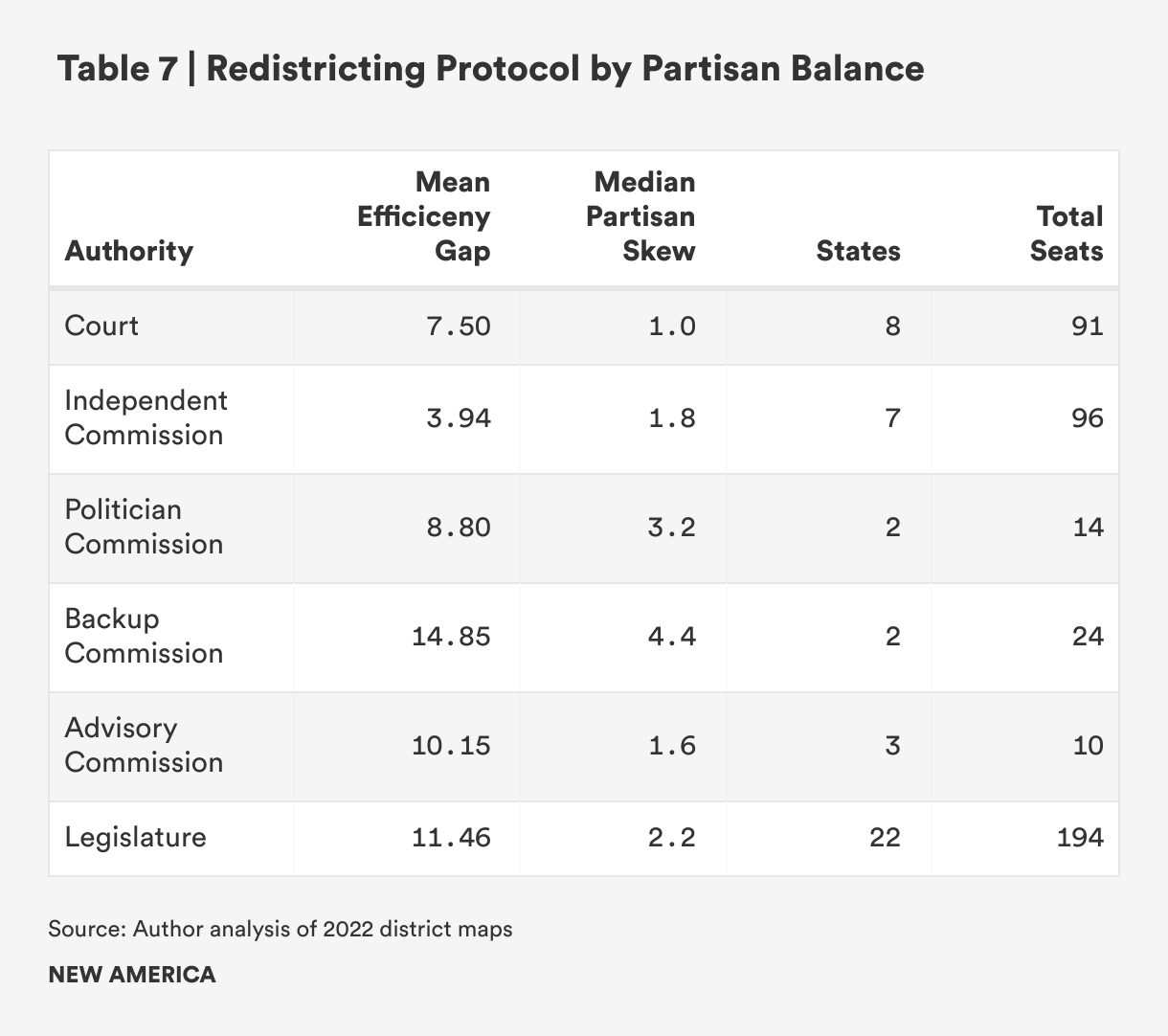
Competitiveness
Turning to competitiveness, again, courts perform the best. Legislatures clearly perform the worst.
But even in states where the boundaries are drawn by courts, only one-in-seven districts are swing districts, and only one-in-five are either swing or lean districts. No redistricting authority has been able to do any better than this, meaning that regardless of districting authority, lopsided districts predominate.
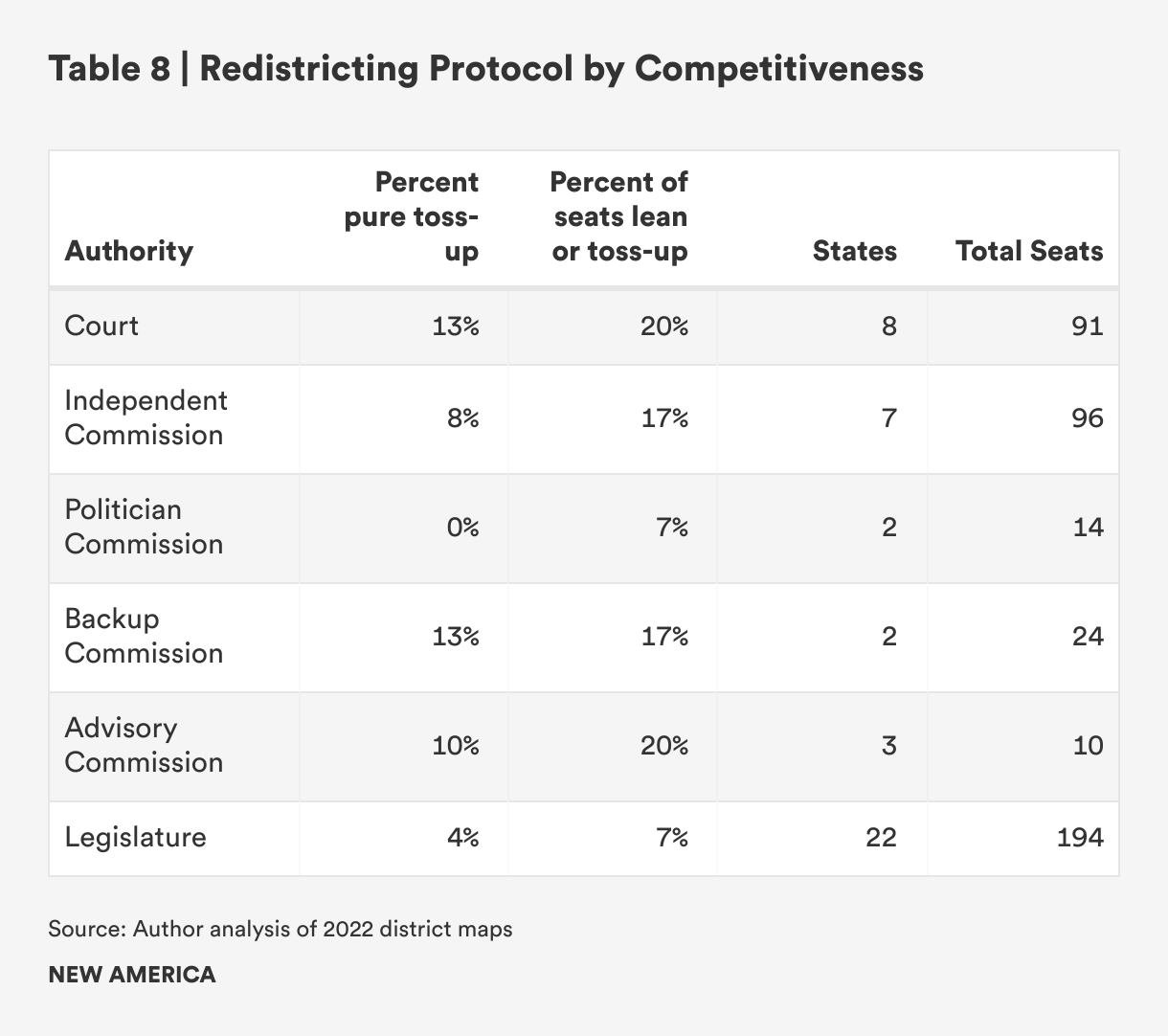
Compactness and Community Integrity
On compactness and keeping communities together (measured by county splits), the story is less clear for 2021-2022. Interestingly, independent commissions split the highest percentage of counties. The differences on Roeck and Polsby-Popper scores (measures of compactness) do not appear to vary significantly based on redistricting authority.
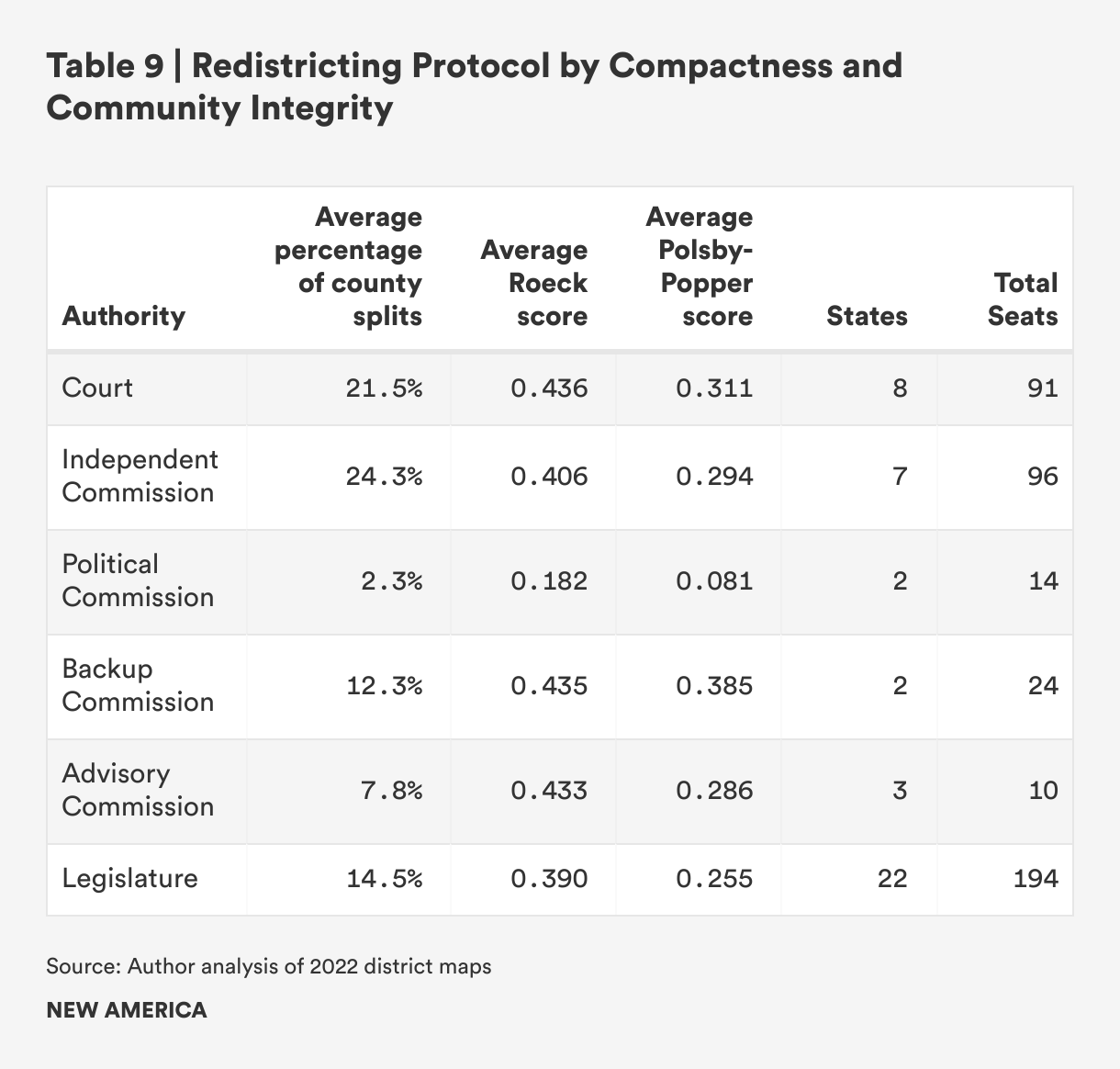
Citations
- In the current redistricting cycle, independent commissions in eight states will have final say in approving congressional and/or state legislative district lines: Alaska, Ariz., Cali., Colo., Idaho, Mich., Mont., and Wash. New York also has an independent commission, but the state legislature still has final approval. All About Redistricting, “National Summary,” accessed July 27, 2022, <a href="<a href="<a href="<a href="source">source">source">source">source">source.
- Lynn Adelman, “The Roberts Court’s Assault on Democracy,” Harvard Law & Policy Review 14, no. 1 (2020): 131–58.
- Suzanne Mettler and Trevor Brown, “The Growing Rural-Urban Political Divide and Democratic Vulnerability,” The ANNALS of the American Academy of Political and Social Science 699, no. 1 (January 1, 2022): 130–42, <a href="<a href="<a href="<a href="source">source">source">source">source">source; Dante J. Scala and Kenneth M. Johnson, “Political Polarization along the Rural-Urban Continuum? The Geography of the Presidential Vote, 2000–2016,” The ANNALS of the American Academy of Political and Social Science 672, no. 1 (July 1, 2017), 162–84, <a href="<a href="<a href="<a href="source">source">source">source">source">source; Mettler and Brown, “The Growing Rural-Urban Political Divide and Democratic Vulnerability”; James G. Gimpel et al., “The Urban–Rural Gulf in American Political Behavior,” Political Behavior 42, no. 4 (December 1, 2020): 1343–68, <a href="<a href="<a href="<a href="source">source">source">source">source">source.
- For those seeking a more detailed history, see Erik J. Engstrom, Partisan Gerrymandering and the Construction of American Democracy (Ann Arbor, MI: University of Michigan Press, 2013). Much of this history is drawn from Engstrom’s book.
- Engstrom, 21.
- Erick Trickey, “Where Did the Term ‘Gerrymander’ Come From?,” Smithsonian Magazine, July 20, 2017, <a href="<a href="<a href="source">source">source">source">source.
- Andrew Rehfeld, The Concept of Constituency: Political Representation, Democratic Legitimacy, and Institutional Design (Cambridge, UK: Cambridge University Press, 2005), 69–80.
- Harry Marlin Tinkcom, The Republicans and Federalists in Pennsylvania, 1790-1801 (Harrisburg, PA: Pennsylvania Historical and Museum Commission, 1950), 51; Engstrom, Partisan Gerrymandering and the Construction of American Democracy, 27.
- Alexander Keyssar, Why Do We Still Have the Electoral College? (Cambridge, MA: Harvard University Press, 2020), 61–116.
- Stephen Calabrese, “Multimember District Congressional Elections,” Legislative Studies Quarterly 25, no. 4 (2000): 611–43. Susan E. Scarrow, “Parties and the Expansion of Direct Democracy: Who Benefits?,” Sage Publication 5, no. 3 (1999): 341–362; Engstrom, Partisan Gerrymandering and the Construction of American Democracy, 43–59.
- For a slightly more detailed history, Lee Drutman, Breaking the Two-Party Doom Loop: The Case for Multiparty Democracy in America (New York: Oxford University Press, 2020), 239–264. For those wishing to take an even deeper dive into the history, see Bernard Ivan Tamas, “A Divided Political Elite: Why Congress Banned Multimember Districts in 1842,” New Political Science 28, no. 1 (March 1, 2006): 23–44; Michele Rosa-Clot, “The Apportionment Act of 1842: ‘An Odious Use of Authority,’” Parliaments, Estates and Representation 31, no. 1 (April 1, 2011): 33–52; Johanna Nicol Shields, “Whigs Reform the ‘Bear Garden’: Representation and the Apportionment Act of 1842,” Journal of the Early Republic 5, no. 3 (1985): 355; Robert E. Ross, “Recreating the House: The 1842 Apportionment Act and the Whig Party’s Reconstruction of Representation,” Polity 49, no. 3 (June 6, 2017): 408–33, <a href="<a href="<a href="source">source">source">source">source; David Canon and William Egar, “The Apportionment Act of 1842: Principle or Interest?,” APW Papers (2014): 37.
- Engstrom, Partisan Gerrymandering and the Construction of American Democracy, 80–100.
- For some history, see Lee Drutman, “How Much Longer Can This Era Of Political Gridlock Last?,” FiveThirtyEight, March 4, 2021, <a href="<a href="<a href="source">source">source">source">source.
- Frances E. Lee, “Patronage, Logrolls, and ‘Polarization’: Congressional Parties of the Gilded Age, 1876–1896,” Studies in American Political Development 30, no. 2 (October 2016): 116–27.
- Lee Drutman, Jonathan D. Cohen, Yuval Levin, and Norman J. Ornstein, The Case for Enlarging the House of Representatives (Cambridge, MA: American Academy of Arts and Sciences, 2021), <a href="<a href="<a href="source">source">source">source">source.
- Engstrom, Partisan Gerrymandering and the Construction of American Democracy, 171–172.
- J. Douglas Smith, On Democracy’s Doorstep: The Inside Story of How the Supreme Court Brought “One Person, One Vote” to the United States (New York: Hill and Wang, 2014).
- Specifically, Baker v. Carr (1962) established the principle that redistricting cases could be brought before the courts. Wesberry v. Sanders (1964) established that congressional districts must have equal population size (within a state), and Reynolds v. Sims (1964) applied the equal population size criteria to state legislative districts; J. Douglas Smith, On Democracy’s Doorstep: The Inside Story of How the Supreme Court Brought “One Person, One Vote” to the United States (New York: Hill and Wang, 2014). To codify the one person, one vote principle, Congress passed the Uniform Congressional Districting Act of 1967, which reaffirmed the congressional mandate that states use single-member districts, and that those districts be of equal size. This was the civil rights era, and the threat of southern states moving to at-large districts with block voting was real. This would have had disastrous consequences for voting rights, since it would have made it all but impossible for Black voters to elect their candidates of choice.
- Gary W. Cox and Jonathan N. Katz, “The Reapportionment Revolution and Bias in U. S. Congressional Elections,” American Journal of Political Science 43, no. 3 (July 1999): 812–841, <a href="<a href="<a href="source">source">source">source">source.
- Helmut Norpoth and Jerrold G. Rusk, “Partisan Dealignment in the American Electorate: Itemizing the Deductions since 1964,” American Political Science Review 76, no. 3 (September 1982): 522–37, <a href="<a href="<a href="source">source">source">source">source.
- Michael Lyons and Peter F. Galderisi, “Incumbency, Reapportionment, and US House Redistricting,” Political Research Quarterly 48, no. 4 (1995): 857–71.
- The passage of the 1982 Voting Rights Act, which made it easier for plaintiffs to gain majority-minority districts based on even unintentional dilution. With the help of the Justice Department, the number of majority-minority districts grew from 29 to 52 after the 1991–1992 redistricting round. The result was a significant increase in Black and Latino representatives in Congress following the 1992 election—from 37 to 56.
- Lee Drutman, “What We Lose When We Lose Competitive Congressional Districts,” FiveThirtyEight, June 23, 2022, <a href="<a href="<a href="source">source">source">source">source.
- Rhodes Cook, “The ‘Big Sort’ Continues, with Trump as a Driving Force – Sabato’s Crystal Ball,” University of Virginia Center for Politics, February 17, 2022, <a href="<a href="<a href="source">source">source">source">source.
- Lee Drutman, “Why Bipartisanship In The Senate Is Dying,” FiveThirtyEight, September 27, 2021, <a href="<a href="<a href="source">source">source">source">source.
- David Daley, Ratf**ked: The True Story Behind the Secret Plan to Steal America’s Democracy, 1st edition (New York: Liveright, 2016).
- Ballotpedia, “Historical and Potential Changes in Trifectas,” accessed May 20, 2022, <a href="<a href="<a href="source">source">source">source">source.
- Michael Li and Laura Royden, Extreme Maps (New York, NY: Brennan Center, 2017), <a href="<a href="<a href="source">source">source">source">source; Daley, Ratf**ked.
- Nathaniel Rakich, “The New National Congressional Map is Biased Toward Republicans,” FiveThirtyEight, June 15, 2022, <a href="<a href="<a href="source">source">source">source">source.
- Corwin D. Smidt, “Polarization and the Decline of the American Floating Voter,” American Journal of Political Science 61, no. 2 (2017): 365–81, <a href="<a href="source">source">source">source; Jon Green, “Floating Policy Voters in the 2016 U.S. Presidential Election,” Electoral Studies 67 (October 1, 2020): 1020–1028, <a href="<a href="source">source">source">source.
- Samara Klar and Yanna Krupnikov, Independent Politics: How American Disdain for Parties Leads to Political Inaction (New York: Cambridge University Press, 2016).
- Daniel J. Hopkins, The Increasingly United States: How and Why American Political Behavior Nationalized (Chicago: University of Chicago Press, 2018); Jamie L. Carson, Joel Sievert, and Ryan D. Williamson, “Nationalization and the Incumbency Advantage,” Political Research Quarterly 73, no. 1 (March 2020): 156–68, <a href="<a href="source">source">source">source; Benjamin Melusky and Jesse Richman, “When the Local Is National – A New High-Water Mark for Nationalization in the 2018 United States State Legislative Elections,” Regional & Federal Studies 30, no. 3 (May 26, 2020): 441–60, <a href="<a href="source">source">source">source; Joel Sievert and Seth C. McKee, “Nationalization in U.S. Senate and Gubernatorial Elections,” American Politics Research 47, no. 5 (September 1, 2019): 1055–80, <a href="<a href="source">source">source">source.
- Jacob M Grumbach, Laboratories against Democracy (Princeton, N.J: Princeton University Press, 2022).
- Vann R. Newkirk II, “How Redistricting Became a Technological Arms Race,” The Atlantic, October 28, 2017, <a href="<a href="source">source">source">source.
- Amariah Becker et al., “Computational Redistricting and the Voting Rights Act,” Election Law Journal: Rules, Politics, and Policy 20, no. 4 (December 2021): 407–41, <a href="<a href="source">source">source">source E. Cain et al., “A Reasonable Bias Approach to Gerrymandering: Using Automated Plan Generation to Evaluate Redistricting Proposals 2020 Redistricting: Mapping a New Political Decade Symposium,” William & Mary Law Review 59, no. 5 (2018): 1521–58; Wendy K. Tam Cho, “Technology-Enabled Coin Flips for Judging Partisan Gerrymandering,” Southern California Law Review Postscript 93 (2019): 11; Carl Smith, “Can New Technology Tools Keep Redistricting Honest and Fair?” Governing, September 16, 2021, <a href="<a href="source">source">source">source.
- Jeff Gou, “Gerrymandering didn’t make politics this vicious. But vicious politics will soon make gerrymandering so much worse,” Washington Post, July 2, 2015, <a href="<a href="source">source">source">source.
- William F. Connelly and John J. Pitney, Congress’ Permanent Minority?: Republicans in the US House (Rowman & Littlefield, 1994).
- Lee Drutman, “How Much Longer Can This Era Of Political Gridlock Last?,” FiveThirtyEight, March 4, 2021, <a href="<a href="source">source">source">source.
- Ballotpedia, “State government trifectas,” accessed July 26, 2022, <a href="<a href="source">source">source">source.
- For useful analysis, see Guy-Uriel E. Charles and Luis E. Fuentes-Rohwer, “Dirty Thinking about Law & Democracy in Rucho v. Common Cause,” Duke Law School Public Law & Legal Theory Series (October 2019): 1–13.
- Oyez.org, “Arizona State Legislature v. Arizona Independent Redistricting Commission,” accessed July 31, 2022, <a href="<a href="source">source">source">source.
- Alyce McFadden, “How ‘dark money’ is shaping redistricting in 2021,” Open Secrets, May 20, 2021 <a href="<a href="source">source">source">source.
- Lee Drutman, What We Know about Congressional Primaries and Congressional Primary Reform (Washington, DC: New America, 2021), <a href="<a href="source">source">source">source.
- For strong evidence that gerrymandering did not cause polarization, see: Nolan McCarty, Keith T. Poole, and Howard Rosenthal, “Does Gerrymandering Cause Polarization?,” American Journal of Political Science 53, no. 3 (July 1, 2009): 666–80.
- Daryl R. DeFord, Nicholas Eubank, and Jonathan Rodden, “Partisan Dislocation: A Precinct-Level Measure of Representation and Gerrymandering,” Political Analysis 30, no. 3 (June 2021): 1–23, <a href="<a href="source">source">source">source; Jonathan A. Rodden, Why Cities Lose: The Deep Roots of the Urban-Rural Political Divide (New York, NY: Basic Books, 2019); Jowei Chen and Jonathan Rodden, “Unintentional Gerrymandering: Political Geography and Electoral Bias in Legislatures,” Quarterly Journal of Political Science 8, no. 3 (January 1, 2013): 239.
- Mackenzie Wilkes, “Americans Don’t Trust Their Congressional Maps To Be Drawn Fairly. Can Anything Change That?,” FiveThirtyEight, October 26, 2021, <a href="<a href="source">source">source">source; Sheila Suess Kennedy, "Electoral Integrity: How Gerrymandering Matters," Public Integrity 19, no. 3 (2017): 265–273; Brennan Center for Justice, “Expert Brief: Americans Are United Against Partisan Gerrymandering,” March 15, 2019, <a href="<a href="source">source">source">source; RepresentUS, “National Polling: Voters See Gerrymandering as a Major Problem, Want Reform,” August 4, 2021, <a href="<a href="source">source">source">source.
- Anthony J. McGann, Charles Anthony Smith, Michael Latner, Alex Keena, Gerrymandering in America: The House of Representatives, the Supreme Court, and the Future of Popular Sovereignty (Cambridge: UK, Cambridge University Press, 2016) shows that, in many states, the maps were politically gerrymandered to give Republicans an edge in the US House. As well, several other studies have found similar results (John A. Curiel and Tyler Steelman, “Redistricting Out Representation: Democratic Harms in Splitting Zip Codes,” Election Law Journal: Rules, Politics, and Policy 17, no. 4 (2018): 328–353; Erik J. Engstrom and Robert Huckfeldt, Race, Class, and Social Welfare American Populism Since the New Deal (Cambridge, UK: Cambridge University Press, 2020); M. V. Hood III and Seth C. McKee, “Gerrymandering on Georgia's Mind: The Effects of Redistricting on Vote Choice in the 2006 Midterm Election,” Social Science Quarterly 89, no. 1 (2008): 60–77; Seth C. McKee,Jeremy M. Teigen, and Mathieu Turgeon, “The Partisan Impact of Congressional Redistricting,” Social Science Quarterly 87, no. 2 (2006): 308–317; Nicholas O. Stephanopoulos and Christopher Warshaw, “The Impact of Partisan Gerrymandering on Political Parties,” Legislative Studies Quarterly 45, no. 4 (2020): 609–643; Alex Keena, Michael Latner, Anthony J. McGann, and Charles Anthony Smith, Gerrymandering the States: Partisanship, Race, and the Transformation of American Federalism (Cambridge, UK: Cambridge University Press, 2021), 171.
- Alex Tausanovitch, Voter Determined Districts (Washington, DC: Center for American Progress, May 2019).
- Gregory S. Warrington, “A Comparison of Partisan-Gerrymandering Measures,” Election Law Journal 18, no. 3 (September 2019): 262–281, <a href="source">source">source.
- William Bunge, “Gerrymandering, Geography, and Grouping,” Geographical Review 56, no. 2 (April 1966): 256, <a href="source">source">source; R. H. Brookes, “The Analysis of Distorted Representation in Two-Party Single-Member Elections,” Political Science 12, no. 2 (September 1, 1960): 158–67, <a href="source">source">source; Edward R. Tufte, “The Relationship between Seats and Votes in Two-Party Systems*,” American Political Science Review 67, no. 2 (June 1973): 540–54, <a href="source">source">source; Ernesto Calvo and Jonathan Rodden, “The Achilles Heel of Plurality Systems: Geography and Representation in Multiparty Democracies,” American Journal of Political Science 59, no. 4 (2015): 789–805, <a href="source">source">source.
- Gregory S. Warrington, “A Comparison of Partisan-Gerrymandering Measures,” Election Law Journal 18, no. 3 (2019): 262–281. Warrington examines 18 measures, and shows the correlations between all of them.
- R. H. Brookes, “The Analysis of Distorted Representation in Two-Party Single-Member Elections,” Political Science 12, no. 2 (September 1, 1960): 158–67, <a href="source">source">source; Edward R. Tufte, “The Relationship between Seats and Votes in Two-Party Systems*,” American Political Science Review 67, no. 2 (June 1973): 540–54, <a href="source">source">source.
- For decades, symmetry was the most common measure of partisan advantage in the political science literature, and the focus of several groundbreaking studies: Richard G. Niemi and John Deegan Jr., “A Theory of Political Districting," American Political Science Review 72, no. 4 (1978): 1304–1323; Gary King and Robert X Browning, "Democratic Representation and Partisan Bias in Congressional Elections," American Political Science Review 81, no. 4 (1987): 1251–1273; Andrew Gelman and Gary King, "Enhancing Democracy through Legislative Redistricting," American Political Science Review 88, no. 3 (1994): 541–559; Bernard Grofman and Gary King, “The Future of Partisan Symmetry as a Judicial Test for Partisan Gerrymandering after Lulac v. Perry,” Election Law Journal 6, no. 1 (2007): 6, , <a href="source">source">source; Grofman and King, “The Future of Partisan Symmetry,” 2–35; Richard G. Niemi and John Deegan Jr., “A Theory of Political Districting,” 1251–1273; Gary King and Robert X. Browning, "Democratic Representation and Partisan Bias in Congressional Elections," 1251–73; Grofman and King, "The Future of Partisan Symmetry,” 2–35;Andrew Gelman and Gary King, “A Unified Method of Evaluating Electoral Systems and Redistricting Plans,” American Journal of Political Science 38, no. 2: 514–54; Andrew Gelman and Gary King, “Enhancing Democracy through Legislative Redistricting,” 541–59.
- Christpher Warshaw, Eric McGhee, Michal Migurski, “Districts for a New Decade–Partisan Outcomes and Racial Representation in the 2021-22 Redistricting Cycle,” Journal of Federalism, (May 24, 2022): 1–25.
- Michael D. McDonald, Robin E. Best, and Jonathan Krasno, “An Objective and Simple Measure of Gerrymandering: A Demonstration from New York State,” National conference of the Midwest Political Science Association, (2011).
- Eric McGhee, “Measuring Partisan Bias in Single-Member District Electoral Systems,” Legislative Studies Quarterly 39, no 1 (2014): 55–85; Nicholas Stephanopoulos and Eric McGhee, “Partisan Gerrymandering and the Efficiency Gap,” University of Chicago Law Review 82, no. 2 (2014): 831–900; Jeffrey T. Barton, “Improving the Efficiency Gap,” Math Horizons 26, no. 1 (2018): 18–21; John F. Nagle, “Measures of Partisan Bias for Legislating Fair Elections,” Election Law Journal 14 no. 4 (December 2015): 346–60; Gregory S. Warrington, “Quantifying Gerrymandering Using the Vote Distribution,” Election Law Journal 17 no. 1 (2019): 346–360; Gregory S. Warrington, “A Comparison of Partisan-Gerrymandering Measures,” Election Law Journal: Rules, Politics, and Policy 18, no. 3 (2019): 262–81.
- John F. Nagle, “How Competitive Should a Fair Single Member Districting Plan Be?,” Election Law Journal 16, no. 1 (2017): 196–209; Benjamin Plener Cover, “Quantifying Partisan Gerrymandering: An Evaluation of the Efficiency Gap Proposal,” Stanford Law Review 70 (2018): 1131.
- Gregory S. Warrington, “Introduction to the Declination Function for Gerrymanders” (arXiv, March 13, 2018), <a href="source">source">source; Gregory S. Warrington, “Quantifying Gerrymandering Using the Vote Distribution,” Election Law Journal: Rules, Politics, and Policy 17, no. 1 (March 2018): 39–57, <a href="source">source">source; Gregory S. Warrington, “A Comparison of Partisan-Gerrymandering Measures,” Election Law Journal 18, no. 3 (September 2019): 262–81, <a href="source">source">source.
- Jonathan Rodden and Jowei Chen, “Unintentional Gerrymandering: Political Geography and Electoral Bias in Legislatures,” Quarterly Journal of Political Science 8, no. 3 (2013): 239–269.
- Warshaw, McGhee, Migurski, “Districts for a New Decade,” 1–25. This approach started with Chen and Rodden (2013, 239–269) but has been refined further by multiple contributors, many of them coming from mathematics or computer science (Maria Chikina, Alan Frieze, Wesley Pegden, “An Analysis of the Act 43 Wisconsin Assembly District Map using the ε√ test,” arXiv preprint arXiv:1708.09852 (2017); Yan Y. Liu, Wendy K. Tam Cho, and Shaowen Wang, “PEAR: A Massively Parallel Evolutionary Computation Approach for Political Redistricting Optimization and Analysis,” Swarm and Evolutionary Computation 30 (2016): 78–92; Benjamin Fifield, Michael Higgins, Kosuke Imai, and Alexander Tarr, “Automated Redistricting Simulation Using Markov Chain Monte Carlo,” Journal of Computational and Graphical Statistics 29, no. 4 (2020): 715–728; Daryl DeFord, Moon Duchin, and Justin Solomon, “A Computational Approach to Measuring Vote Elasticity and Competitiveness,” Statistics and Public Policy 7, no. 1 (2020): 69–86.
- Bernard Grofman and Thomas L. Brunell, “The Art of the Dummymander: The Impact of Recent Redistricting on the Partisan Makeup of Southern House Seats,” in Redistricting in the New Millennium (Lanham, MD: Lexington Books, 2005), 183–99.
- Nicholas Goedert, “The Pseudoparadox of Partisan Mapmaking and Congressional Competition,” State Politics & Policy Quarterly 17, no. 1 (March 1, 2017): 47–75, <a href="source">source">source.
- Jonathan A. Rodden, Why Cities Lose: The Deep Roots of the Urban-Rural Political Divide (New York, NY: Basic Books, 2019), 7.
- For classics on the extent to which electoral bias results from inefficient geographic clustering, see Ralph H. Brookes, “The Analysis of Distorted Representation in Two-Party Single-Member Elections,” Political Science 12, no. 2 (1960): 158–167; R.J. Johnson, “The Electoral Geography of an Election Campaign: Scotland in October 1974,” Scottish Geographical Magazine 93, no. 2 (1977): 98–108; Graham Gudgin and Peter J. Taylor, “The Decomposition of Electoral Bias in a Plurality Election,” British Journal of Political Science 10, no. 4 (1980): 515–521; Nicholas Eubank and Jonathan Rodden, “Who Is My Neighbor? The Spatial Efficiency of Partisanship,” Statistics and Public Policy 7, no. 1 (2020): 87–100.
- Chen and Rodden, “Unintentional Gerrymandering,” 239–269.
- Robert Dahl, Polyarchy: Participation and Opposition (New Haven, CT: Yale University Press, 1971).
- Rodden, Why Cities Lose.
- David R. Mayhew, “Congressional Elections: The Case of the Vanishing Marginals,” Polity 6, no. 3 (1974): 295–317, <a href="source">source">source.
- Bruce E. Cain, John A. Ferejohn, and Morris P. Fiorina, The Personal Vote: Constituency Service and Electoral Independence (Cambridge, MA: Harvard University Press, 1987).
- Carson, Sievert, and Williamson, “Nationalization and the Incumbency Advantage,” 156–68; Gary C. Jacobson, “It’s Nothing Personal: The Decline of the Incumbency Advantage in US House Elections,” Journal of Politics 77, no. 3 (July 2015): 861–73, <a href="source">source">source.
- For example, Mississippi’s 2011 plan reduced the total deviation in size between districts to 1.98 percent, but increased the number of split counties from 49 to 53 and split precincts from 17 to 44. Gerald R. Webster, “Reflections on Current Criteria to Evaluate Redistricting Plans,” Political Geography 32 (January 1, 2013): 3–14, <a href="source">source">source.
- Justin Levitt, “‘Communities of Interest’ in State Redistricting Law,” Presentation to National Conference of State Legislatures, Apr. 25, 2008.
- Gerald R.Webster, “Reflections on Current Criteria to Evaluate Redistricting Plans,” Political Geography 32 (2013): 3–14; Daniel W. Phillips and Daniel R. Montello, “Defining the Community of Interest as Thematic and Cognitive Regions,” Political Geography 61 (2017): 31–45; Webster, “Reflections on Current Criteria,” 3–14; Micah Altman and Michael P. McDonald, “A Half-Century of Virginia Redistricting Battles: Shifting from Rural Malapportionment to Voting Rights to Public Participation,” University of Richmond Law Review 47 (2012): 771; Richard Forgette and Glenn, “Redistricting Principles and Incumbency Protection in the U.S. Congress,” Political Geography 24, no. 8 (2005): 934–951; Jason Barabas and Jennifer Jerit, “Redistricting Principles and Racial Representation,” State Politics & Policy Quarterly 4, no. 4 (2004): 415–435; David Butler and Bruce Cain, Congressional Redistricting: Comparative and Theoretical Perspectives (New York, NY: Macmillan Publishers, 1992); James G. Gimpel and Laurel Harbridge-Yong, “Conflicting Goals of Redistricting: Do Districts That Maximize Competition Reckon with Communities of Interest?,” Election Law Journal: Rules, Politics, and Policy 19, no. 4 (2020): 451–471.
- Antoine Yoshinaka and Chad Murphy, “The Paradox of Redistricting: How Partisan Mapmakers Foster Competition but Disrupt Representation,” Political Research Quarterly 64, no. 2 (June 2011): 435–47, <a href="source">source">source; Tyler S. Steelman and John A. Curiel, “Redistricting Out Descriptive Representation: The Harmful Effect of Splitting ZIP Codes on the Constituent–Representative Link,” Journal of Race, Ethnicity, and Politics (2022): 1–19, <a href="source">source">source.
- Yoshinaka and Murphy, “The Paradox of Redistricting: How Partisan Mapmakers Foster Competition but Disrupt Representation,” Political Research Quarterly 64, no. 2 (2011): 435–447.
- James G. Gimpel and Laurel Harbridge-Yong, “Conflicting Goals of Redistricting: Do Districts That Maximize Competition Reckon with Communities of Interest?,” Election Law Journal: Rules, Politics, and Policy 19, no. 4 (2020), <a href="source">source">source.
- Nolan McCarty, Jonathan Rodden, Boris Shor, Chris Tausan, and Christopher Warshaw, “Geography, Uncertainty, and Polarization,” Political Science Research and Methods 7, no. 4 (2019): 775–794.
- Lee Drutman, “The Moderate Middle Is A Myth,” FiveThirtyEight, September 24, 2019, <a href="source">source">source.
- Aaron R. Kaufman, Gary King, and Mayya Komisarchik, “How to Measure Legislative District Compactness If You Only Know It When You See It,” American Journal of Political Science 65, no. 3 (2021): 533–50, <a href="source">source">source; Richard G. Niemi, Stephen C. Craig, and Franco Mattei, “Measuring Internal Political Efficacy in the 1988 National Election Study,” American Political Science Review 85, no. 4 (1991): 1407–1413; Kaufman et al., “How to Measure,” 534.
- Ernest C. Reock, Jr., “A Note: Measuring Compactness as a Requirement of Legislative Apportionment,” Midwest Journal of Political Science (1961): 70–74.
- Daniel D. Polsby and Robert D. Popper, “The Third Criterion: Compactness as a Procedural Safeguard against Partisan Gerrymandering,” Yale Law and Policy Review 9, no. 2 (1991): 301–53.
- Alex Keena, Michael Latner, Anthony J. McGann, and Charles Anthony Smith, Gerrymandering the States, 171.
- Claudine Gay, “Spirals of Trust? The Effect of Descriptive Representation on the Relationship between Citizens and Their Government,” American Journal of Political Science (2002): 717–32.
- David Lublin, The Paradox of Representation: Racial Gerrymandering and Minority Interests in Congress by David Lublin (Princeton University Press, 1997); Kenny J. Whitby, The Color of Representation: Congressional Behavior and Black Interests, (Ann Arbor: University of Michigan Press, 1997); Kerry L. Haynie, African American Legislators in the American States, (New York, NY: Columbia University Press, 2001); Katherine Tate, Black Faces in the Mirror: African Americans and Their Representatives in the US Congress (Princeton, NJ: Princeton University Press, 2018); Richard F. Fenno, Going Home: Black Representatives and Their Constituents (University of Chicago Press, 2003); Christian R. Grose, “Disentangling Constituency and Legislator Effects in Legislative Representation: Black Legislators or Black Districts?*,” Social Science Quarterly 86, no. 2 (2005): 427–43, <a href="source">source">source.
- David Lublin, The Paradox of Representation (Princeton: Princeton University Press, 1999); Christian R. Grose, “Disentangling Constituency and Legislator Effects in Legislative Representation: Black Legislators or Black Districts?*,” Social Science Quarterly 86, no. 2 (2005): 427–43, <a href="source">source">source; Kevin A. Hill, “Does the Creation of Majority Black Districts Aid Republicans? An Analysis of the 1992 Congressional Elections in Eight Southern States,” The Journal of Politics 57, no. 2 (1995): 384–401; Kenneth W. Shotts, “The Effect of Majority-Minority Mandates on Partisan Gerrymandering,” American Journal of Political Science 45, no. 1 (2001): 120–35; David Epstein and Sharyn O’Halloran, “Trends in Substantive and Descriptive Minority Representation, 1974–2004,” The Future of the Voting Rights Act, 2006, 61–80; David Epstein and Sharyn O’Halloran, “A Social Science Approach to Race, Redistricting, and Representation,” American Political Science Review, 1999, 187–91; Charles Cameron, David Epstein, and Sharyn O’Halloran, “Do Majority-Minority Districts Maximize Substantive Black Representation in Congress?,” The American Political Science Review 90, no. 4 (1996): 794–812; William D. Hicks, Carl E. Klarner, Seth C. McKee, and Daniel A. Smith, “Revisiting Majority-Minority Districts and Black Representation,” Political Research Quarterly 71, no. 2 (June 1, 2018): 408–23, <a href="source">source">source.
- For helpful overviews see David T. Canon, “Race and Redistricting: The Unintended Consequences of Black Majority Districts” Annual Review of Political Science 25 (2022): 50–528; Michael C. Li, “The Surprise Return and Transformation of Racial Gerrymandering,” NYU Law Review 94 (2019): 136.
- Adam Liptak and Nick Corasaniti, “Supreme Court to Hear Case on State Legislatures’ Power Over Elections,” New York Times, June 30, 2022, <a href="source">source">source.
- Nathaniel Rakich, “How This Redistricting Cycle Failed To Increase Representation For People Of Color — And Could Even Set It Back,” FiveThirtyEight, March 17, 2022, <a href="source">source">source.
- Michael C. Li, Harry Isaiah Black, Peter Miller, and Chris Leaverton, “Redistricting: A Mid-Cycle Assessment” (The Brennan Center, January 19, 2022).
- Glenn Firebaugh and Chad R. Farrell, “Still Large, but Narrowing: The Sizable Decline in Racial Neighborhood Inequality in Metropolitan America, 1980–2010,” Demography 53, no. 1 (February 2016): 139–64, <a href="source">source">source; Alan Ehrenhalt, The Great Inversion and the Future of the American City (New York, NY: Knopf Doubleday, 2012); Kimberly Johnson, “‘Black’Suburbanization: American Dream or the New Banlieue?” The Cities Papers (2014).
- Richard Forgette, Andrew Garner, and John Winkle, “Do Redistricting Principles and Practices Affect State Legislative Electoral Competition?,” State Politics & Policy Quarterly 9, no. 2 (2009): 151–175. See also David Butler and Bruce E. Cain, Congressional Redistricting: Comparative and Theoretical Perspectives (New York, NY: Macmillan Publishing Company, 1992); Jan E. Leighley, The Oxford Handbook of American Elections and Political Behavior (Oxford, UK: Oxford University Press, 2010).
- On the case for politician commissions see Bruce E. Cain, “Redistricting Commissions: A Better Political Buffer?,” Yale Law Journal 121 (2012): 1817; Sam Hirsch, “Unpacking Page v. Bartels: A Fresh Redistricting Paradigm Emerges in New Jersey,” Election Law Journal 1, no. 1 (2002): 7–23.
- See Nicholas O. Stephanopoulos and Christopher Warshaw, “The Impact of Partisan Gerrymandering on Political Parties,” Legislative Studies Quarterly 45, no. 4 (2020): 609–643.
- Keena et al., Gerrymandering the States, 184.
- Nicholas O Stephanopoulos, “Arizona and Anti-Reform,” University of Chicago Legal Forum (2015): 34, 499.
- Vladimir Kogan and Eric McGhee, “Redistricting California: An Evaluation of the Citizens Commission Final Plans,” California Journal of Politics and Policy 4, no. 1 (February 2012): 1–22. First, they simulate how Democrats and Republicans would perform in a “Good Democratic Year” and a “Good Republican Year.” They also examine how well Democrats and Republicans perform using an expected seats-to-votes curve.
- The authors note that: “ In the post-2000 round of redistricting, 28 states used the traditional legislative process to draw their congressional districts (261 districts); three used an independent backup committee when the legislature failed to draw suitable districts (CT, IA, IN [19 districts]), three used an advisory committee (NY, OH, RI [49 districts]), two used a partisan commission (NJ, HI [15 districts]), three states had independent commissions (AZ, ID, WA [19 districts]), seven states only have one district (AK, DE, MT, ND, SD, VT, WY), and seven states had districts drawn by state or federal courts (ME, MN, NM, OK, OR, SC, TX (Note 1) [65 districts]). As shown in Table 1, a majority of House districts were drawn using the traditional legislative process. Another 15% were court-drawn districts, which Cox and Katz (2002) point out, often ultimately rely on partisan maps). After the 1.6% for single district states, the remaining 23.4% were drawn by some form of commission.”
- Alan I. Abramowitz, Brad Alexander, and Matthew Gunning, “Incumbency, Redistricting, and the Decline of Competition in U.S. House Elections,” Journal of Politics 68, no. 1 (February 2006): 75–88.
- Alan Abramowitz, Brad Alexander, and Matthew Gunning, “Don’t Blame Redistricting for Uncompetitive Elections,” PS: Political Science and Politics 39, no. 1 (2006): 87–90.
- McDonald writes: “One simple method to avoid the confounding influence of Per ot's presence is to analyze other election results within the same districts, such as the 1988 presidential vote within the 1992 districts. If Perot presents no confounding effect, then the measurement of competitive districts in 1992 by either measure should be the same.
- Alan Abramowitz, Brad Alexander, and Matthew Gunning, “Drawing the Line on District Competition: A Rejoinder,” PS: Political Science & Politics 39, no. 01 (January 2006): 95–97, source">source.
- John A. Henderson, Brian T. Hamel, and Aaron M. Goldzimer, “Gerrymandering Incumbency: Does Nonpartisan Redistricting Increase Electoral Competition?,” Journal of Politics 80, no. 3 (May 2018): 1011–16, source">source.
- Or more specifically, “we find that politicians produce maps that are safer than 77.1% of the simulated alternatives for their states, in terms of average win margins. Yet this insulation is virtually identical to that uncovered for states with indepen- dent commissions, with 74.9% of simulations (p p :935) being more competitive than adopted plans. An analysis of the publicized alternative maps indicates again that inde- pendent commissions choose maps that are as uncompetitive as those enacted by politicians.” To be sure, however, their analysis is limited to “15 states that meet equal population and contiguity constraints from the full set of data made publicly available by state legislatures or re- districting commissions.”
- Vladimir Kogan and Eric McGhee, “Redistricting California: An Evaluation of the Citizens Commission Final Plans.” They write: “his definition of “marginal” districts is commonly used by scholars of legislative elections, and a 10-point advantage is certainly close enough to keep a representative or legislator concerned about reelection without forcing us to adopt an overly restrictive definition. We use party registration and incumbency to produce our estimates, first by fitting a statistical model that used these two variables to predict the results of previous elections with data from those elections, and then by combining the model coefficients with the relevant data from the new maps to generate predictions under the new lines.”
- Richard Forgette, Andrew Garner, and John Winkle, “Do Redistricting Principles and Practices Affect U.S. State Legislative Electoral Competition?,” State Politics & Policy Quarterly 9, no. 2 (June 2009): 151–75, source">source.
- Seth Masket, Jonathan Winburn, and Gerald C. Wright, “The Gerrymanderers Are Coming! Legislative Redistricting Won't Affect Competition or Polarization Much, No Matter Who Does It,” PS: Political Science and Politics 45, no. 1 (2012): 39–43.
- Barry Edwards, Michael Crespin, Ryan D. Williamson, and Maxwell Palmer, “Institutional Control of Redistricting and the Geography of Representation,” Journal of Politics 79, no. 2 (2017): 722-726, source">source.
- Barry Edwards et al., “Institutional Control of Redistricting,” 722–26.
- Christopher Warshaw, Eric McGhee, and Michal Migurski, “Districts for a New Decade.”
- Eric McGhee and Jennifer Paluch, “Racial Representation and Partisan Leanings in California’s Final Redistricting Maps,” Public Policy Institute of California, January 12, 2022, source">source.
- David Daley, “Will Arizona's relentless Republican gerrymander decide the 2024 presidential election?,” Salon, December 4, 2021, source.
- For useful overviews, see Tierney Sneed, “A Fair Maps Success Story or ‘Multi-layered Stages of Dante’s Hell’?,” CNN, June 18, 2022, source; David Daley, “The Sood, the Bad and the Ugly of Redistricting Reform,” DemocacySOS, July 6, 2022, source.
Alternatives to American-Style Districting
Given the pathologies of the American approach to districting, it is natural to ask: what alternatives exist? This section will briefly put the American system in context.
America’s approach to districting is both unique and by the standards of modern democracy, uniquely awful. While only a handful of advanced industrial democracies use single-member districts like the United States, those that do use single-member districts have independent national agencies that draw boundaries.113
In Canada, for example, Elections Canada—a national elections agency led by a Chief Electoral Officer—draws the boundaries after each census. Canada has been doing this since 1966, when new maps went into place following a 1964 law that transferred boundary drawing authority to the national commission, following a period of egregious gerrymandering. Canada modeled its system on the Australian commission model.114 The system has widely been considered successful, and proof that reform is indeed possible. As one scholar of Canadian politics has observed:
The success stories of Canada’s redistricting reforms over the past half century are manifold. The periodic gerrymanders by elected officials have been brought to an end. With the transformation, redistricting has now evolved into a regular, institutionalized exercise that is widely seen as legitimate. The public cynicism and disenchantment with politics, about which there is understandable concern, has not been directed at redistricting. If anything, the path that redistricting has taken since the mid-1950s has demonstrated that politicians can, when the conditions are right, relinquish control of a much-criticized power in the public interest. Based on the Canadian experience, the critical conditions that combine to produce changes in the redistricting process are reform-minded politicians and political leaders, a disaffected press and general public, and (at least in the federal changes of 1964) a “minority parliament” in which the governing party reached a satisfactory compromise with important Opposition parties.115
The United Kingdom, which also uses single-member districts, also uses a national Independent Boundary Commission, guided by The House of Commons (Redistribution of Seats) Act of 1944, which required constituencies to have electorates that were within 25 percent (plus or minus) of the national average, with regular readjustments as population changed. However, the process of redistricting has remained political, both through subsequent adjustments to the national laws, and the actual drawings of boundaries, which have had political consequences for the major parties.116
Given that British politics is highly nationalized and is dominated by two parties, no change to districting boundaries is ever truly neutral. This makes the British districting process somewhat controversial, though not as contested and ugly as that of the United States. Canadian politics tends to be more consensual at the national level, both because its party system is less polarized (it has more of a three-party system than a two-party system) and because more politics takes place at the provincial level.117
Additionally, even with independent national commissions, the use of single-member districts in Canada and the United Kingdom still leads to occasional “plurality reversals” (the party with a smaller share of the national popular vote getting a majority of seats in the national legislature because its voters are more efficiently distributed). And consistently, the bias in single-member districts is to over-represent the conservative rural party and under-represent the liberal urban party, even under national redistricting rules. This is because under single-member districts, the urban party almost always tends to waste more of its votes in lopsided urban districts, while the conservative rural party is more efficiently distributed.118
The other major advanced democracy with single-member districts is France. France is like the United States in that redistricting is a political process, with politicians in charge. But France is unlike the United States in two important respects. First, because of its two-round system, France is a multiparty system, so the effects of redistricting on parties are less certain and predictable than they are under a two-party system. Second, because there are no decennial mandates to redraw boundaries to equalize population, the decision to redistrict is up to the current government, which has often declined to take advantage of it both for fear of backlash and of harming incumbents. As a result, French politics has a long history of significant malapportionment.119
Beyond the United States and France, the list of countries that allow politicians to draw district boundaries is small: Bulgaria, Czech Republic, Italy, Kyrgyzstan, and Panama.120 In Hungary, when Orban’s Fidesz party came to power in 2010, one of its first acts was to increase the share of the Hungarian parliament elected by single-member districts, and to eliminate the previous two-round runoff election for the remaining single-member districts. Both of these changes made Hungarian elections considerably more disproportional, and boosted Fidesz’s ability to retain power in future elections.121
Most advanced democracies, however, use various forms of proportional representation, which render districting boundaries far less consequential—both because geographical dispersion of partisan support is less consequential, and because with multiple parties in multimember districts, the effects of line drawing is less clear. Additionally, in proportional representation systems, districts tend to coincide with other existing government units. In proportional representation systems, districts often coincide with well-known local government units or groups of these.122
The smaller the district magnitude (the number of seats per district) and fewer viable parties, and the more majoritarian the party system, the more gerrymandering threatens electoral fairness.123 Among advanced democracies, experts agree that gerrymandering is most egregious and distorting in the United States.124 As Handley and Grofman note: “if countries were to be placed on a spectrum of how ‘political’ the delimitation process is, the United States would sit firmly at the ‘political’ end of the continuum.”125
As a general rule, the single-member district is most vulnerable to partisan manipulation. Just as low district magnitude is associated with more partisan bias, as district magnitude increases, the potential for partisan bias decreases, as this figure by Keena et al. nicely demonstrates:126
The simple reality is that by using single-member districts and allowing politicians to draw district lines, the United States has saddled itself with a districting process that is maximally vulnerable to partisan and political shenanigans. The only system that could possibly be more unfair is the at-large bloc voting system that was widely used in the first half of the 19th century. But among contemporary democracies, experts rate gerrymandering in the United States at the absolute bottom of the list, just behind Malaysia.127
Citations
- In the current redistricting cycle, independent commissions in eight states will have final say in approving congressional and/or state legislative district lines: Alaska, Ariz., Cali., Colo., Idaho, Mich., Mont., and Wash. New York also has an independent commission, but the state legislature still has final approval. All About Redistricting, “National Summary,” accessed July 27, 2022, <a href="<a href="<a href="<a href="<a href="source">source">source">source">source">source">source.
- Lynn Adelman, “The Roberts Court’s Assault on Democracy,” Harvard Law & Policy Review 14, no. 1 (2020): 131–58.
- Suzanne Mettler and Trevor Brown, “The Growing Rural-Urban Political Divide and Democratic Vulnerability,” The ANNALS of the American Academy of Political and Social Science 699, no. 1 (January 1, 2022): 130–42, <a href="<a href="<a href="<a href="<a href="source">source">source">source">source">source">source; Dante J. Scala and Kenneth M. Johnson, “Political Polarization along the Rural-Urban Continuum? The Geography of the Presidential Vote, 2000–2016,” The ANNALS of the American Academy of Political and Social Science 672, no. 1 (July 1, 2017), 162–84, <a href="<a href="<a href="<a href="<a href="source">source">source">source">source">source">source; Mettler and Brown, “The Growing Rural-Urban Political Divide and Democratic Vulnerability”; James G. Gimpel et al., “The Urban–Rural Gulf in American Political Behavior,” Political Behavior 42, no. 4 (December 1, 2020): 1343–68, <a href="<a href="<a href="<a href="<a href="source">source">source">source">source">source">source.
- For those seeking a more detailed history, see Erik J. Engstrom, Partisan Gerrymandering and the Construction of American Democracy (Ann Arbor, MI: University of Michigan Press, 2013). Much of this history is drawn from Engstrom’s book.
- Engstrom, 21.
- Erick Trickey, “Where Did the Term ‘Gerrymander’ Come From?,” Smithsonian Magazine, July 20, 2017, <a href="<a href="<a href="<a href="source">source">source">source">source">source.
- Andrew Rehfeld, The Concept of Constituency: Political Representation, Democratic Legitimacy, and Institutional Design (Cambridge, UK: Cambridge University Press, 2005), 69–80.
- Harry Marlin Tinkcom, The Republicans and Federalists in Pennsylvania, 1790-1801 (Harrisburg, PA: Pennsylvania Historical and Museum Commission, 1950), 51; Engstrom, Partisan Gerrymandering and the Construction of American Democracy, 27.
- Alexander Keyssar, Why Do We Still Have the Electoral College? (Cambridge, MA: Harvard University Press, 2020), 61–116.
- Stephen Calabrese, “Multimember District Congressional Elections,” Legislative Studies Quarterly 25, no. 4 (2000): 611–43. Susan E. Scarrow, “Parties and the Expansion of Direct Democracy: Who Benefits?,” Sage Publication 5, no. 3 (1999): 341–362; Engstrom, Partisan Gerrymandering and the Construction of American Democracy, 43–59.
- For a slightly more detailed history, Lee Drutman, Breaking the Two-Party Doom Loop: The Case for Multiparty Democracy in America (New York: Oxford University Press, 2020), 239–264. For those wishing to take an even deeper dive into the history, see Bernard Ivan Tamas, “A Divided Political Elite: Why Congress Banned Multimember Districts in 1842,” New Political Science 28, no. 1 (March 1, 2006): 23–44; Michele Rosa-Clot, “The Apportionment Act of 1842: ‘An Odious Use of Authority,’” Parliaments, Estates and Representation 31, no. 1 (April 1, 2011): 33–52; Johanna Nicol Shields, “Whigs Reform the ‘Bear Garden’: Representation and the Apportionment Act of 1842,” Journal of the Early Republic 5, no. 3 (1985): 355; Robert E. Ross, “Recreating the House: The 1842 Apportionment Act and the Whig Party’s Reconstruction of Representation,” Polity 49, no. 3 (June 6, 2017): 408–33, <a href="<a href="<a href="<a href="source">source">source">source">source">source; David Canon and William Egar, “The Apportionment Act of 1842: Principle or Interest?,” APW Papers (2014): 37.
- Engstrom, Partisan Gerrymandering and the Construction of American Democracy, 80–100.
- For some history, see Lee Drutman, “How Much Longer Can This Era Of Political Gridlock Last?,” FiveThirtyEight, March 4, 2021, <a href="<a href="<a href="<a href="source">source">source">source">source">source.
- Frances E. Lee, “Patronage, Logrolls, and ‘Polarization’: Congressional Parties of the Gilded Age, 1876–1896,” Studies in American Political Development 30, no. 2 (October 2016): 116–27.
- Lee Drutman, Jonathan D. Cohen, Yuval Levin, and Norman J. Ornstein, The Case for Enlarging the House of Representatives (Cambridge, MA: American Academy of Arts and Sciences, 2021), <a href="<a href="<a href="<a href="source">source">source">source">source">source.
- Engstrom, Partisan Gerrymandering and the Construction of American Democracy, 171–172.
- J. Douglas Smith, On Democracy’s Doorstep: The Inside Story of How the Supreme Court Brought “One Person, One Vote” to the United States (New York: Hill and Wang, 2014).
- Specifically, Baker v. Carr (1962) established the principle that redistricting cases could be brought before the courts. Wesberry v. Sanders (1964) established that congressional districts must have equal population size (within a state), and Reynolds v. Sims (1964) applied the equal population size criteria to state legislative districts; J. Douglas Smith, On Democracy’s Doorstep: The Inside Story of How the Supreme Court Brought “One Person, One Vote” to the United States (New York: Hill and Wang, 2014). To codify the one person, one vote principle, Congress passed the Uniform Congressional Districting Act of 1967, which reaffirmed the congressional mandate that states use single-member districts, and that those districts be of equal size. This was the civil rights era, and the threat of southern states moving to at-large districts with block voting was real. This would have had disastrous consequences for voting rights, since it would have made it all but impossible for Black voters to elect their candidates of choice.
- Gary W. Cox and Jonathan N. Katz, “The Reapportionment Revolution and Bias in U. S. Congressional Elections,” American Journal of Political Science 43, no. 3 (July 1999): 812–841, <a href="<a href="<a href="<a href="source">source">source">source">source">source.
- Helmut Norpoth and Jerrold G. Rusk, “Partisan Dealignment in the American Electorate: Itemizing the Deductions since 1964,” American Political Science Review 76, no. 3 (September 1982): 522–37, <a href="<a href="<a href="<a href="source">source">source">source">source">source.
- Michael Lyons and Peter F. Galderisi, “Incumbency, Reapportionment, and US House Redistricting,” Political Research Quarterly 48, no. 4 (1995): 857–71.
- The passage of the 1982 Voting Rights Act, which made it easier for plaintiffs to gain majority-minority districts based on even unintentional dilution. With the help of the Justice Department, the number of majority-minority districts grew from 29 to 52 after the 1991–1992 redistricting round. The result was a significant increase in Black and Latino representatives in Congress following the 1992 election—from 37 to 56.
- Lee Drutman, “What We Lose When We Lose Competitive Congressional Districts,” FiveThirtyEight, June 23, 2022, <a href="<a href="<a href="<a href="source">source">source">source">source">source.
- Rhodes Cook, “The ‘Big Sort’ Continues, with Trump as a Driving Force – Sabato’s Crystal Ball,” University of Virginia Center for Politics, February 17, 2022, <a href="<a href="<a href="<a href="source">source">source">source">source">source.
- Lee Drutman, “Why Bipartisanship In The Senate Is Dying,” FiveThirtyEight, September 27, 2021, <a href="<a href="<a href="<a href="source">source">source">source">source">source.
- David Daley, Ratf**ked: The True Story Behind the Secret Plan to Steal America’s Democracy, 1st edition (New York: Liveright, 2016).
- Ballotpedia, “Historical and Potential Changes in Trifectas,” accessed May 20, 2022, <a href="<a href="<a href="<a href="source">source">source">source">source">source.
- Michael Li and Laura Royden, Extreme Maps (New York, NY: Brennan Center, 2017), <a href="<a href="<a href="<a href="source">source">source">source">source">source; Daley, Ratf**ked.
- Nathaniel Rakich, “The New National Congressional Map is Biased Toward Republicans,” FiveThirtyEight, June 15, 2022, <a href="<a href="<a href="<a href="source">source">source">source">source">source.
- Corwin D. Smidt, “Polarization and the Decline of the American Floating Voter,” American Journal of Political Science 61, no. 2 (2017): 365–81, <a href="<a href="<a href="source">source">source">source">source; Jon Green, “Floating Policy Voters in the 2016 U.S. Presidential Election,” Electoral Studies 67 (October 1, 2020): 1020–1028, <a href="<a href="<a href="source">source">source">source">source.
- Samara Klar and Yanna Krupnikov, Independent Politics: How American Disdain for Parties Leads to Political Inaction (New York: Cambridge University Press, 2016).
- Daniel J. Hopkins, The Increasingly United States: How and Why American Political Behavior Nationalized (Chicago: University of Chicago Press, 2018); Jamie L. Carson, Joel Sievert, and Ryan D. Williamson, “Nationalization and the Incumbency Advantage,” Political Research Quarterly 73, no. 1 (March 2020): 156–68, <a href="<a href="<a href="source">source">source">source">source; Benjamin Melusky and Jesse Richman, “When the Local Is National – A New High-Water Mark for Nationalization in the 2018 United States State Legislative Elections,” Regional & Federal Studies 30, no. 3 (May 26, 2020): 441–60, <a href="<a href="<a href="source">source">source">source">source; Joel Sievert and Seth C. McKee, “Nationalization in U.S. Senate and Gubernatorial Elections,” American Politics Research 47, no. 5 (September 1, 2019): 1055–80, <a href="<a href="<a href="source">source">source">source">source.
- Jacob M Grumbach, Laboratories against Democracy (Princeton, N.J: Princeton University Press, 2022).
- Vann R. Newkirk II, “How Redistricting Became a Technological Arms Race,” The Atlantic, October 28, 2017, <a href="<a href="<a href="source">source">source">source">source.
- Amariah Becker et al., “Computational Redistricting and the Voting Rights Act,” Election Law Journal: Rules, Politics, and Policy 20, no. 4 (December 2021): 407–41, <a href="<a href="<a href="source">source">source">source">source E. Cain et al., “A Reasonable Bias Approach to Gerrymandering: Using Automated Plan Generation to Evaluate Redistricting Proposals 2020 Redistricting: Mapping a New Political Decade Symposium,” William & Mary Law Review 59, no. 5 (2018): 1521–58; Wendy K. Tam Cho, “Technology-Enabled Coin Flips for Judging Partisan Gerrymandering,” Southern California Law Review Postscript 93 (2019): 11; Carl Smith, “Can New Technology Tools Keep Redistricting Honest and Fair?” Governing, September 16, 2021, <a href="<a href="<a href="source">source">source">source">source.
- Jeff Gou, “Gerrymandering didn’t make politics this vicious. But vicious politics will soon make gerrymandering so much worse,” Washington Post, July 2, 2015, <a href="<a href="<a href="source">source">source">source">source.
- William F. Connelly and John J. Pitney, Congress’ Permanent Minority?: Republicans in the US House (Rowman & Littlefield, 1994).
- Lee Drutman, “How Much Longer Can This Era Of Political Gridlock Last?,” FiveThirtyEight, March 4, 2021, <a href="<a href="<a href="source">source">source">source">source.
- Ballotpedia, “State government trifectas,” accessed July 26, 2022, <a href="<a href="<a href="source">source">source">source">source.
- For useful analysis, see Guy-Uriel E. Charles and Luis E. Fuentes-Rohwer, “Dirty Thinking about Law & Democracy in Rucho v. Common Cause,” Duke Law School Public Law & Legal Theory Series (October 2019): 1–13.
- Oyez.org, “Arizona State Legislature v. Arizona Independent Redistricting Commission,” accessed July 31, 2022, <a href="<a href="<a href="source">source">source">source">source.
- Alyce McFadden, “How ‘dark money’ is shaping redistricting in 2021,” Open Secrets, May 20, 2021 <a href="<a href="<a href="source">source">source">source">source.
- Lee Drutman, What We Know about Congressional Primaries and Congressional Primary Reform (Washington, DC: New America, 2021), <a href="<a href="<a href="source">source">source">source">source.
- For strong evidence that gerrymandering did not cause polarization, see: Nolan McCarty, Keith T. Poole, and Howard Rosenthal, “Does Gerrymandering Cause Polarization?,” American Journal of Political Science 53, no. 3 (July 1, 2009): 666–80.
- Daryl R. DeFord, Nicholas Eubank, and Jonathan Rodden, “Partisan Dislocation: A Precinct-Level Measure of Representation and Gerrymandering,” Political Analysis 30, no. 3 (June 2021): 1–23, <a href="<a href="<a href="source">source">source">source">source; Jonathan A. Rodden, Why Cities Lose: The Deep Roots of the Urban-Rural Political Divide (New York, NY: Basic Books, 2019); Jowei Chen and Jonathan Rodden, “Unintentional Gerrymandering: Political Geography and Electoral Bias in Legislatures,” Quarterly Journal of Political Science 8, no. 3 (January 1, 2013): 239.
- Mackenzie Wilkes, “Americans Don’t Trust Their Congressional Maps To Be Drawn Fairly. Can Anything Change That?,” FiveThirtyEight, October 26, 2021, <a href="<a href="<a href="source">source">source">source">source; Sheila Suess Kennedy, "Electoral Integrity: How Gerrymandering Matters," Public Integrity 19, no. 3 (2017): 265–273; Brennan Center for Justice, “Expert Brief: Americans Are United Against Partisan Gerrymandering,” March 15, 2019, <a href="<a href="<a href="source">source">source">source">source; RepresentUS, “National Polling: Voters See Gerrymandering as a Major Problem, Want Reform,” August 4, 2021, <a href="<a href="<a href="source">source">source">source">source.
- Anthony J. McGann, Charles Anthony Smith, Michael Latner, Alex Keena, Gerrymandering in America: The House of Representatives, the Supreme Court, and the Future of Popular Sovereignty (Cambridge: UK, Cambridge University Press, 2016) shows that, in many states, the maps were politically gerrymandered to give Republicans an edge in the US House. As well, several other studies have found similar results (John A. Curiel and Tyler Steelman, “Redistricting Out Representation: Democratic Harms in Splitting Zip Codes,” Election Law Journal: Rules, Politics, and Policy 17, no. 4 (2018): 328–353; Erik J. Engstrom and Robert Huckfeldt, Race, Class, and Social Welfare American Populism Since the New Deal (Cambridge, UK: Cambridge University Press, 2020); M. V. Hood III and Seth C. McKee, “Gerrymandering on Georgia's Mind: The Effects of Redistricting on Vote Choice in the 2006 Midterm Election,” Social Science Quarterly 89, no. 1 (2008): 60–77; Seth C. McKee,Jeremy M. Teigen, and Mathieu Turgeon, “The Partisan Impact of Congressional Redistricting,” Social Science Quarterly 87, no. 2 (2006): 308–317; Nicholas O. Stephanopoulos and Christopher Warshaw, “The Impact of Partisan Gerrymandering on Political Parties,” Legislative Studies Quarterly 45, no. 4 (2020): 609–643; Alex Keena, Michael Latner, Anthony J. McGann, and Charles Anthony Smith, Gerrymandering the States: Partisanship, Race, and the Transformation of American Federalism (Cambridge, UK: Cambridge University Press, 2021), 171.
- Alex Tausanovitch, Voter Determined Districts (Washington, DC: Center for American Progress, May 2019).
- Gregory S. Warrington, “A Comparison of Partisan-Gerrymandering Measures,” Election Law Journal 18, no. 3 (September 2019): 262–281, <a href="<a href="source">source">source">source.
- William Bunge, “Gerrymandering, Geography, and Grouping,” Geographical Review 56, no. 2 (April 1966): 256, <a href="<a href="source">source">source">source; R. H. Brookes, “The Analysis of Distorted Representation in Two-Party Single-Member Elections,” Political Science 12, no. 2 (September 1, 1960): 158–67, <a href="<a href="source">source">source">source; Edward R. Tufte, “The Relationship between Seats and Votes in Two-Party Systems*,” American Political Science Review 67, no. 2 (June 1973): 540–54, <a href="<a href="source">source">source">source; Ernesto Calvo and Jonathan Rodden, “The Achilles Heel of Plurality Systems: Geography and Representation in Multiparty Democracies,” American Journal of Political Science 59, no. 4 (2015): 789–805, <a href="<a href="source">source">source">source.
- Gregory S. Warrington, “A Comparison of Partisan-Gerrymandering Measures,” Election Law Journal 18, no. 3 (2019): 262–281. Warrington examines 18 measures, and shows the correlations between all of them.
- R. H. Brookes, “The Analysis of Distorted Representation in Two-Party Single-Member Elections,” Political Science 12, no. 2 (September 1, 1960): 158–67, <a href="<a href="source">source">source">source; Edward R. Tufte, “The Relationship between Seats and Votes in Two-Party Systems*,” American Political Science Review 67, no. 2 (June 1973): 540–54, <a href="<a href="source">source">source">source.
- For decades, symmetry was the most common measure of partisan advantage in the political science literature, and the focus of several groundbreaking studies: Richard G. Niemi and John Deegan Jr., “A Theory of Political Districting," American Political Science Review 72, no. 4 (1978): 1304–1323; Gary King and Robert X Browning, "Democratic Representation and Partisan Bias in Congressional Elections," American Political Science Review 81, no. 4 (1987): 1251–1273; Andrew Gelman and Gary King, "Enhancing Democracy through Legislative Redistricting," American Political Science Review 88, no. 3 (1994): 541–559; Bernard Grofman and Gary King, “The Future of Partisan Symmetry as a Judicial Test for Partisan Gerrymandering after Lulac v. Perry,” Election Law Journal 6, no. 1 (2007): 6, , <a href="<a href="source">source">source">source; Grofman and King, “The Future of Partisan Symmetry,” 2–35; Richard G. Niemi and John Deegan Jr., “A Theory of Political Districting,” 1251–1273; Gary King and Robert X. Browning, "Democratic Representation and Partisan Bias in Congressional Elections," 1251–73; Grofman and King, "The Future of Partisan Symmetry,” 2–35;Andrew Gelman and Gary King, “A Unified Method of Evaluating Electoral Systems and Redistricting Plans,” American Journal of Political Science 38, no. 2: 514–54; Andrew Gelman and Gary King, “Enhancing Democracy through Legislative Redistricting,” 541–59.
- Christpher Warshaw, Eric McGhee, Michal Migurski, “Districts for a New Decade–Partisan Outcomes and Racial Representation in the 2021-22 Redistricting Cycle,” Journal of Federalism, (May 24, 2022): 1–25.
- Michael D. McDonald, Robin E. Best, and Jonathan Krasno, “An Objective and Simple Measure of Gerrymandering: A Demonstration from New York State,” National conference of the Midwest Political Science Association, (2011).
- Eric McGhee, “Measuring Partisan Bias in Single-Member District Electoral Systems,” Legislative Studies Quarterly 39, no 1 (2014): 55–85; Nicholas Stephanopoulos and Eric McGhee, “Partisan Gerrymandering and the Efficiency Gap,” University of Chicago Law Review 82, no. 2 (2014): 831–900; Jeffrey T. Barton, “Improving the Efficiency Gap,” Math Horizons 26, no. 1 (2018): 18–21; John F. Nagle, “Measures of Partisan Bias for Legislating Fair Elections,” Election Law Journal 14 no. 4 (December 2015): 346–60; Gregory S. Warrington, “Quantifying Gerrymandering Using the Vote Distribution,” Election Law Journal 17 no. 1 (2019): 346–360; Gregory S. Warrington, “A Comparison of Partisan-Gerrymandering Measures,” Election Law Journal: Rules, Politics, and Policy 18, no. 3 (2019): 262–81.
- John F. Nagle, “How Competitive Should a Fair Single Member Districting Plan Be?,” Election Law Journal 16, no. 1 (2017): 196–209; Benjamin Plener Cover, “Quantifying Partisan Gerrymandering: An Evaluation of the Efficiency Gap Proposal,” Stanford Law Review 70 (2018): 1131.
- Gregory S. Warrington, “Introduction to the Declination Function for Gerrymanders” (arXiv, March 13, 2018), <a href="<a href="source">source">source">source; Gregory S. Warrington, “Quantifying Gerrymandering Using the Vote Distribution,” Election Law Journal: Rules, Politics, and Policy 17, no. 1 (March 2018): 39–57, <a href="<a href="source">source">source">source; Gregory S. Warrington, “A Comparison of Partisan-Gerrymandering Measures,” Election Law Journal 18, no. 3 (September 2019): 262–81, <a href="<a href="source">source">source">source.
- Jonathan Rodden and Jowei Chen, “Unintentional Gerrymandering: Political Geography and Electoral Bias in Legislatures,” Quarterly Journal of Political Science 8, no. 3 (2013): 239–269.
- Warshaw, McGhee, Migurski, “Districts for a New Decade,” 1–25. This approach started with Chen and Rodden (2013, 239–269) but has been refined further by multiple contributors, many of them coming from mathematics or computer science (Maria Chikina, Alan Frieze, Wesley Pegden, “An Analysis of the Act 43 Wisconsin Assembly District Map using the ε√ test,” arXiv preprint arXiv:1708.09852 (2017); Yan Y. Liu, Wendy K. Tam Cho, and Shaowen Wang, “PEAR: A Massively Parallel Evolutionary Computation Approach for Political Redistricting Optimization and Analysis,” Swarm and Evolutionary Computation 30 (2016): 78–92; Benjamin Fifield, Michael Higgins, Kosuke Imai, and Alexander Tarr, “Automated Redistricting Simulation Using Markov Chain Monte Carlo,” Journal of Computational and Graphical Statistics 29, no. 4 (2020): 715–728; Daryl DeFord, Moon Duchin, and Justin Solomon, “A Computational Approach to Measuring Vote Elasticity and Competitiveness,” Statistics and Public Policy 7, no. 1 (2020): 69–86.
- Bernard Grofman and Thomas L. Brunell, “The Art of the Dummymander: The Impact of Recent Redistricting on the Partisan Makeup of Southern House Seats,” in Redistricting in the New Millennium (Lanham, MD: Lexington Books, 2005), 183–99.
- Nicholas Goedert, “The Pseudoparadox of Partisan Mapmaking and Congressional Competition,” State Politics & Policy Quarterly 17, no. 1 (March 1, 2017): 47–75, <a href="<a href="source">source">source">source.
- Jonathan A. Rodden, Why Cities Lose: The Deep Roots of the Urban-Rural Political Divide (New York, NY: Basic Books, 2019), 7.
- For classics on the extent to which electoral bias results from inefficient geographic clustering, see Ralph H. Brookes, “The Analysis of Distorted Representation in Two-Party Single-Member Elections,” Political Science 12, no. 2 (1960): 158–167; R.J. Johnson, “The Electoral Geography of an Election Campaign: Scotland in October 1974,” Scottish Geographical Magazine 93, no. 2 (1977): 98–108; Graham Gudgin and Peter J. Taylor, “The Decomposition of Electoral Bias in a Plurality Election,” British Journal of Political Science 10, no. 4 (1980): 515–521; Nicholas Eubank and Jonathan Rodden, “Who Is My Neighbor? The Spatial Efficiency of Partisanship,” Statistics and Public Policy 7, no. 1 (2020): 87–100.
- Chen and Rodden, “Unintentional Gerrymandering,” 239–269.
- Robert Dahl, Polyarchy: Participation and Opposition (New Haven, CT: Yale University Press, 1971).
- Rodden, Why Cities Lose.
- David R. Mayhew, “Congressional Elections: The Case of the Vanishing Marginals,” Polity 6, no. 3 (1974): 295–317, <a href="<a href="source">source">source">source.
- Bruce E. Cain, John A. Ferejohn, and Morris P. Fiorina, The Personal Vote: Constituency Service and Electoral Independence (Cambridge, MA: Harvard University Press, 1987).
- Carson, Sievert, and Williamson, “Nationalization and the Incumbency Advantage,” 156–68; Gary C. Jacobson, “It’s Nothing Personal: The Decline of the Incumbency Advantage in US House Elections,” Journal of Politics 77, no. 3 (July 2015): 861–73, <a href="<a href="source">source">source">source.
- For example, Mississippi’s 2011 plan reduced the total deviation in size between districts to 1.98 percent, but increased the number of split counties from 49 to 53 and split precincts from 17 to 44. Gerald R. Webster, “Reflections on Current Criteria to Evaluate Redistricting Plans,” Political Geography 32 (January 1, 2013): 3–14, <a href="<a href="source">source">source">source.
- Justin Levitt, “‘Communities of Interest’ in State Redistricting Law,” Presentation to National Conference of State Legislatures, Apr. 25, 2008.
- Gerald R.Webster, “Reflections on Current Criteria to Evaluate Redistricting Plans,” Political Geography 32 (2013): 3–14; Daniel W. Phillips and Daniel R. Montello, “Defining the Community of Interest as Thematic and Cognitive Regions,” Political Geography 61 (2017): 31–45; Webster, “Reflections on Current Criteria,” 3–14; Micah Altman and Michael P. McDonald, “A Half-Century of Virginia Redistricting Battles: Shifting from Rural Malapportionment to Voting Rights to Public Participation,” University of Richmond Law Review 47 (2012): 771; Richard Forgette and Glenn, “Redistricting Principles and Incumbency Protection in the U.S. Congress,” Political Geography 24, no. 8 (2005): 934–951; Jason Barabas and Jennifer Jerit, “Redistricting Principles and Racial Representation,” State Politics & Policy Quarterly 4, no. 4 (2004): 415–435; David Butler and Bruce Cain, Congressional Redistricting: Comparative and Theoretical Perspectives (New York, NY: Macmillan Publishers, 1992); James G. Gimpel and Laurel Harbridge-Yong, “Conflicting Goals of Redistricting: Do Districts That Maximize Competition Reckon with Communities of Interest?,” Election Law Journal: Rules, Politics, and Policy 19, no. 4 (2020): 451–471.
- Antoine Yoshinaka and Chad Murphy, “The Paradox of Redistricting: How Partisan Mapmakers Foster Competition but Disrupt Representation,” Political Research Quarterly 64, no. 2 (June 2011): 435–47, <a href="<a href="source">source">source">source; Tyler S. Steelman and John A. Curiel, “Redistricting Out Descriptive Representation: The Harmful Effect of Splitting ZIP Codes on the Constituent–Representative Link,” Journal of Race, Ethnicity, and Politics (2022): 1–19, <a href="<a href="source">source">source">source.
- Yoshinaka and Murphy, “The Paradox of Redistricting: How Partisan Mapmakers Foster Competition but Disrupt Representation,” Political Research Quarterly 64, no. 2 (2011): 435–447.
- James G. Gimpel and Laurel Harbridge-Yong, “Conflicting Goals of Redistricting: Do Districts That Maximize Competition Reckon with Communities of Interest?,” Election Law Journal: Rules, Politics, and Policy 19, no. 4 (2020), <a href="<a href="source">source">source">source.
- Nolan McCarty, Jonathan Rodden, Boris Shor, Chris Tausan, and Christopher Warshaw, “Geography, Uncertainty, and Polarization,” Political Science Research and Methods 7, no. 4 (2019): 775–794.
- Lee Drutman, “The Moderate Middle Is A Myth,” FiveThirtyEight, September 24, 2019, <a href="<a href="source">source">source">source.
- Aaron R. Kaufman, Gary King, and Mayya Komisarchik, “How to Measure Legislative District Compactness If You Only Know It When You See It,” American Journal of Political Science 65, no. 3 (2021): 533–50, <a href="<a href="source">source">source">source; Richard G. Niemi, Stephen C. Craig, and Franco Mattei, “Measuring Internal Political Efficacy in the 1988 National Election Study,” American Political Science Review 85, no. 4 (1991): 1407–1413; Kaufman et al., “How to Measure,” 534.
- Ernest C. Reock, Jr., “A Note: Measuring Compactness as a Requirement of Legislative Apportionment,” Midwest Journal of Political Science (1961): 70–74.
- Daniel D. Polsby and Robert D. Popper, “The Third Criterion: Compactness as a Procedural Safeguard against Partisan Gerrymandering,” Yale Law and Policy Review 9, no. 2 (1991): 301–53.
- Alex Keena, Michael Latner, Anthony J. McGann, and Charles Anthony Smith, Gerrymandering the States, 171.
- Claudine Gay, “Spirals of Trust? The Effect of Descriptive Representation on the Relationship between Citizens and Their Government,” American Journal of Political Science (2002): 717–32.
- David Lublin, The Paradox of Representation: Racial Gerrymandering and Minority Interests in Congress by David Lublin (Princeton University Press, 1997); Kenny J. Whitby, The Color of Representation: Congressional Behavior and Black Interests, (Ann Arbor: University of Michigan Press, 1997); Kerry L. Haynie, African American Legislators in the American States, (New York, NY: Columbia University Press, 2001); Katherine Tate, Black Faces in the Mirror: African Americans and Their Representatives in the US Congress (Princeton, NJ: Princeton University Press, 2018); Richard F. Fenno, Going Home: Black Representatives and Their Constituents (University of Chicago Press, 2003); Christian R. Grose, “Disentangling Constituency and Legislator Effects in Legislative Representation: Black Legislators or Black Districts?*,” Social Science Quarterly 86, no. 2 (2005): 427–43, <a href="<a href="source">source">source">source.
- David Lublin, The Paradox of Representation (Princeton: Princeton University Press, 1999); Christian R. Grose, “Disentangling Constituency and Legislator Effects in Legislative Representation: Black Legislators or Black Districts?*,” Social Science Quarterly 86, no. 2 (2005): 427–43, <a href="<a href="source">source">source">source; Kevin A. Hill, “Does the Creation of Majority Black Districts Aid Republicans? An Analysis of the 1992 Congressional Elections in Eight Southern States,” The Journal of Politics 57, no. 2 (1995): 384–401; Kenneth W. Shotts, “The Effect of Majority-Minority Mandates on Partisan Gerrymandering,” American Journal of Political Science 45, no. 1 (2001): 120–35; David Epstein and Sharyn O’Halloran, “Trends in Substantive and Descriptive Minority Representation, 1974–2004,” The Future of the Voting Rights Act, 2006, 61–80; David Epstein and Sharyn O’Halloran, “A Social Science Approach to Race, Redistricting, and Representation,” American Political Science Review, 1999, 187–91; Charles Cameron, David Epstein, and Sharyn O’Halloran, “Do Majority-Minority Districts Maximize Substantive Black Representation in Congress?,” The American Political Science Review 90, no. 4 (1996): 794–812; William D. Hicks, Carl E. Klarner, Seth C. McKee, and Daniel A. Smith, “Revisiting Majority-Minority Districts and Black Representation,” Political Research Quarterly 71, no. 2 (June 1, 2018): 408–23, <a href="<a href="source">source">source">source.
- For helpful overviews see David T. Canon, “Race and Redistricting: The Unintended Consequences of Black Majority Districts” Annual Review of Political Science 25 (2022): 50–528; Michael C. Li, “The Surprise Return and Transformation of Racial Gerrymandering,” NYU Law Review 94 (2019): 136.
- Adam Liptak and Nick Corasaniti, “Supreme Court to Hear Case on State Legislatures’ Power Over Elections,” New York Times, June 30, 2022, <a href="<a href="source">source">source">source.
- Nathaniel Rakich, “How This Redistricting Cycle Failed To Increase Representation For People Of Color — And Could Even Set It Back,” FiveThirtyEight, March 17, 2022, <a href="<a href="source">source">source">source.
- Michael C. Li, Harry Isaiah Black, Peter Miller, and Chris Leaverton, “Redistricting: A Mid-Cycle Assessment” (The Brennan Center, January 19, 2022).
- Glenn Firebaugh and Chad R. Farrell, “Still Large, but Narrowing: The Sizable Decline in Racial Neighborhood Inequality in Metropolitan America, 1980–2010,” Demography 53, no. 1 (February 2016): 139–64, <a href="<a href="source">source">source">source; Alan Ehrenhalt, The Great Inversion and the Future of the American City (New York, NY: Knopf Doubleday, 2012); Kimberly Johnson, “‘Black’Suburbanization: American Dream or the New Banlieue?” The Cities Papers (2014).
- Richard Forgette, Andrew Garner, and John Winkle, “Do Redistricting Principles and Practices Affect State Legislative Electoral Competition?,” State Politics & Policy Quarterly 9, no. 2 (2009): 151–175. See also David Butler and Bruce E. Cain, Congressional Redistricting: Comparative and Theoretical Perspectives (New York, NY: Macmillan Publishing Company, 1992); Jan E. Leighley, The Oxford Handbook of American Elections and Political Behavior (Oxford, UK: Oxford University Press, 2010).
- On the case for politician commissions see Bruce E. Cain, “Redistricting Commissions: A Better Political Buffer?,” Yale Law Journal 121 (2012): 1817; Sam Hirsch, “Unpacking Page v. Bartels: A Fresh Redistricting Paradigm Emerges in New Jersey,” Election Law Journal 1, no. 1 (2002): 7–23.
- See Nicholas O. Stephanopoulos and Christopher Warshaw, “The Impact of Partisan Gerrymandering on Political Parties,” Legislative Studies Quarterly 45, no. 4 (2020): 609–643.
- Keena et al., Gerrymandering the States, 184.
- Nicholas O Stephanopoulos, “Arizona and Anti-Reform,” University of Chicago Legal Forum (2015): 34, 499.
- Vladimir Kogan and Eric McGhee, “Redistricting California: An Evaluation of the Citizens Commission Final Plans,” California Journal of Politics and Policy 4, no. 1 (February 2012): 1–22. First, they simulate how Democrats and Republicans would perform in a “Good Democratic Year” and a “Good Republican Year.” They also examine how well Democrats and Republicans perform using an expected seats-to-votes curve.
- The authors note that: “ In the post-2000 round of redistricting, 28 states used the traditional legislative process to draw their congressional districts (261 districts); three used an independent backup committee when the legislature failed to draw suitable districts (CT, IA, IN [19 districts]), three used an advisory committee (NY, OH, RI [49 districts]), two used a partisan commission (NJ, HI [15 districts]), three states had independent commissions (AZ, ID, WA [19 districts]), seven states only have one district (AK, DE, MT, ND, SD, VT, WY), and seven states had districts drawn by state or federal courts (ME, MN, NM, OK, OR, SC, TX (Note 1) [65 districts]). As shown in Table 1, a majority of House districts were drawn using the traditional legislative process. Another 15% were court-drawn districts, which Cox and Katz (2002) point out, often ultimately rely on partisan maps). After the 1.6% for single district states, the remaining 23.4% were drawn by some form of commission.”
- Alan I. Abramowitz, Brad Alexander, and Matthew Gunning, “Incumbency, Redistricting, and the Decline of Competition in U.S. House Elections,” Journal of Politics 68, no. 1 (February 2006): 75–88.
- Alan Abramowitz, Brad Alexander, and Matthew Gunning, “Don’t Blame Redistricting for Uncompetitive Elections,” PS: Political Science and Politics 39, no. 1 (2006): 87–90.
- McDonald writes: “One simple method to avoid the confounding influence of Per ot's presence is to analyze other election results within the same districts, such as the 1988 presidential vote within the 1992 districts. If Perot presents no confounding effect, then the measurement of competitive districts in 1992 by either measure should be the same.
- Alan Abramowitz, Brad Alexander, and Matthew Gunning, “Drawing the Line on District Competition: A Rejoinder,” PS: Political Science & Politics 39, no. 01 (January 2006): 95–97, <a href="source">source">source.
- John A. Henderson, Brian T. Hamel, and Aaron M. Goldzimer, “Gerrymandering Incumbency: Does Nonpartisan Redistricting Increase Electoral Competition?,” Journal of Politics 80, no. 3 (May 2018): 1011–16, <a href="source">source">source.
- Or more specifically, “we find that politicians produce maps that are safer than 77.1% of the simulated alternatives for their states, in terms of average win margins. Yet this insulation is virtually identical to that uncovered for states with indepen- dent commissions, with 74.9% of simulations (p p :935) being more competitive than adopted plans. An analysis of the publicized alternative maps indicates again that inde- pendent commissions choose maps that are as uncompetitive as those enacted by politicians.” To be sure, however, their analysis is limited to “15 states that meet equal population and contiguity constraints from the full set of data made publicly available by state legislatures or re- districting commissions.”
- Vladimir Kogan and Eric McGhee, “Redistricting California: An Evaluation of the Citizens Commission Final Plans.” They write: “his definition of “marginal” districts is commonly used by scholars of legislative elections, and a 10-point advantage is certainly close enough to keep a representative or legislator concerned about reelection without forcing us to adopt an overly restrictive definition. We use party registration and incumbency to produce our estimates, first by fitting a statistical model that used these two variables to predict the results of previous elections with data from those elections, and then by combining the model coefficients with the relevant data from the new maps to generate predictions under the new lines.”
- Richard Forgette, Andrew Garner, and John Winkle, “Do Redistricting Principles and Practices Affect U.S. State Legislative Electoral Competition?,” State Politics & Policy Quarterly 9, no. 2 (June 2009): 151–75, <a href="source">source">source.
- Seth Masket, Jonathan Winburn, and Gerald C. Wright, “The Gerrymanderers Are Coming! Legislative Redistricting Won't Affect Competition or Polarization Much, No Matter Who Does It,” PS: Political Science and Politics 45, no. 1 (2012): 39–43.
- Barry Edwards, Michael Crespin, Ryan D. Williamson, and Maxwell Palmer, “Institutional Control of Redistricting and the Geography of Representation,” Journal of Politics 79, no. 2 (2017): 722-726, <a href="source">source">source.
- Barry Edwards et al., “Institutional Control of Redistricting,” 722–26.
- Christopher Warshaw, Eric McGhee, and Michal Migurski, “Districts for a New Decade.”
- Eric McGhee and Jennifer Paluch, “Racial Representation and Partisan Leanings in California’s Final Redistricting Maps,” Public Policy Institute of California, January 12, 2022, <a href="source">source">source.
- David Daley, “Will Arizona's relentless Republican gerrymander decide the 2024 presidential election?,” Salon, December 4, 2021, source">source.
- For useful overviews, see Tierney Sneed, “A Fair Maps Success Story or ‘Multi-layered Stages of Dante’s Hell’?,” CNN, June 18, 2022, source">source; David Daley, “The Sood, the Bad and the Ugly of Redistricting Reform,” DemocacySOS, July 6, 2022, source">source.
- Lisa Handley and Bernard Grofman, Redistricting in Comparative Perspective (Oxford, UK: Oxford University Press, 2008).
- C. P. Hoffman, “The Gerrymander and the Commission: Drawing Electoral Districts in the United States and Canada,” Manitoba Law Journal 31, no. 331 (2006): 1–30.
- John C. Courtney, “Redistricting: What the United States Can Learn from Canada,” Election Law Journal: Rules, Politics, and Policy 3, no. 3 (September 2004): 488–500, source.
- Iain McLean and Roger Mortimore, “Apportionment and the Boundary Commission for England,” Electoral Studies 11, no. 4 (December 1, 1992): 293–309, source; Ron Johnston, Charles Pattie, and David Rossiter, “‘Somewhat More Disruptive than We Had in Mind’: The Boundary Commission for England’s 2011 Proposed Redistribution of Parliamentary Constituencies,” Political Quarterly 83, no. 1 (2012): 44–59, source; D. J. Rossiter, R. J. Johnston, and C. J. Pattie, “Redistricting and Electoral Bias in Great Britain,” British Journal of Political Science 27, no. 3 (July 1997): 453–72, source; D. J. Rossiter, R. J. Johnston, and C. J. Pattie, “Estimating the Partisan Impact of Redistricting in Great Britain,” British Journal of Political Science 27, no. 2 (April 1997): 299–331, source.
- Richard Johnston and Fred Cutler, “Canada: The Puzzle of Local Three-Party Competition,” in Duverger’s Law of Plurality Voting, vol. 13 (New York, NY: Springer New York, 2009), 83–96, source; Richard Johnston, The Canadian Party System: An Analytic History (University of British Columbia Press, 2017).
- Rodden, “Why Cities Lose.”
- Nicolas Sauger and Bernard Grofman, “Partisan Bias and Redistricting in France,” Electoral Studies 44 (December 2016): 388–96, source.
- Handley and Grofman, Redistricting in Comparative Perspective, 20–35.
- Kim Lane Schepelle, “Hungary, An Election in Question, Part 2,” New York Times (Paul Krugman blog), February 26, 2014, source; Andrea Fumarola, “Fidesz and Electoral Reform: How to Safeguard Hungarian Democracy,” London School of Economics blog, March 21, 2016, source.
- Lisa Handley and Bernard Grofman, Redistricting in Comparative Perspective (Oxford, UK: Oxford University Press, 2008); Ferran Martínez i Coma and Ignacio Lago, “Gerrymandering in Comparative Perspective,” Party Politics 24, no. 2 (March 1, 2018): 99–104, source.
- David Samuels and Richard Snyder, “The Value of a Vote: Malapportionment in Comparative Perspective,” British Journal of Political Science 31, no. 4 (October 2001): 651–71, source.
- Martínez i Coma and Lago, “Gerrymandering in Comparative Perspective.”
- Handley and Grofman, Redistricting in Comparative Perspective, 35.
- Keena et al., Gerrymandering the States.
- Ferran Martínez i Coma and Ignacio Lago, “Gerrymandering in Comparative Perspective,” 99–104.
Areas for Future Research
With a growing number of states using redistricting commissions, and another districting cycle on the books, there are obvious opportunities to add more data to many of the existing lines of research described above. This work should obviously continue.
A few suggested areas for further research:
How Redistricting Commissions Handle Trade-offs
Different states direct commissions to prioritize across different criteria. Thus far, the studies have focused on evaluating the individual criteria on their own (primarily partisan neutrality and competition) rather than evaluating them as an ensemble with trade-offs.
Some of this analysis could be data-oriented. But real value would come from more descriptive qualitative work that takes an interview- and process-oriented case study approach to the ways in which different redistricting commissions have gone about their work, and how they have handled the competing pressures.
Redistricting Best Practices
To the extent that different states have explored different approaches to redistricting, both in terms of how commissions are structured and how criteria are prioritized, this variation can generate lessons. Particularly if the above qualitative case study approach is undertaken, a complementary compendium of best practices could be developed as well.
The Downstream Consequences of Redistricting Commissions on Trust, Engagement, and Polarization
While studies have measured the effects of commissions on particular outcomes, no study at the time of this writing has assessed whether independent commissions increase citizens’ trust in the political process, their likelihood of voting, or their broader engagement with the political system. Part of the criticism of gerrymandering is that it erodes trust and faith in the democratic process. But this is a testable hypothesis: if it is correct, states with independent commissions should see improvements in trust and faith and the process, and increases in political participation.
Moreover, to the extent that gerrymandering might be responsible for polarization, this suggests that states with independent redistricting commissions should see a reduction in polarization of their state legislatures, compared to states that do not.
Citations
- In the current redistricting cycle, independent commissions in eight states will have final say in approving congressional and/or state legislative district lines: Alaska, Ariz., Cali., Colo., Idaho, Mich., Mont., and Wash. New York also has an independent commission, but the state legislature still has final approval. All About Redistricting, “National Summary,” accessed July 27, 2022, <a href="<a href="<a href="<a href="<a href="<a href="source">source">source">source">source">source">source">source.
- Lynn Adelman, “The Roberts Court’s Assault on Democracy,” Harvard Law & Policy Review 14, no. 1 (2020): 131–58.
- Suzanne Mettler and Trevor Brown, “The Growing Rural-Urban Political Divide and Democratic Vulnerability,” The ANNALS of the American Academy of Political and Social Science 699, no. 1 (January 1, 2022): 130–42, <a href="<a href="<a href="<a href="<a href="<a href="source">source">source">source">source">source">source">source; Dante J. Scala and Kenneth M. Johnson, “Political Polarization along the Rural-Urban Continuum? The Geography of the Presidential Vote, 2000–2016,” The ANNALS of the American Academy of Political and Social Science 672, no. 1 (July 1, 2017), 162–84, <a href="<a href="<a href="<a href="<a href="<a href="source">source">source">source">source">source">source">source; Mettler and Brown, “The Growing Rural-Urban Political Divide and Democratic Vulnerability”; James G. Gimpel et al., “The Urban–Rural Gulf in American Political Behavior,” Political Behavior 42, no. 4 (December 1, 2020): 1343–68, <a href="<a href="<a href="<a href="<a href="<a href="source">source">source">source">source">source">source">source.
- For those seeking a more detailed history, see Erik J. Engstrom, Partisan Gerrymandering and the Construction of American Democracy (Ann Arbor, MI: University of Michigan Press, 2013). Much of this history is drawn from Engstrom’s book.
- Engstrom, 21.
- Erick Trickey, “Where Did the Term ‘Gerrymander’ Come From?,” Smithsonian Magazine, July 20, 2017, <a href="<a href="<a href="<a href="<a href="source">source">source">source">source">source">source.
- Andrew Rehfeld, The Concept of Constituency: Political Representation, Democratic Legitimacy, and Institutional Design (Cambridge, UK: Cambridge University Press, 2005), 69–80.
- Harry Marlin Tinkcom, The Republicans and Federalists in Pennsylvania, 1790-1801 (Harrisburg, PA: Pennsylvania Historical and Museum Commission, 1950), 51; Engstrom, Partisan Gerrymandering and the Construction of American Democracy, 27.
- Alexander Keyssar, Why Do We Still Have the Electoral College? (Cambridge, MA: Harvard University Press, 2020), 61–116.
- Stephen Calabrese, “Multimember District Congressional Elections,” Legislative Studies Quarterly 25, no. 4 (2000): 611–43. Susan E. Scarrow, “Parties and the Expansion of Direct Democracy: Who Benefits?,” Sage Publication 5, no. 3 (1999): 341–362; Engstrom, Partisan Gerrymandering and the Construction of American Democracy, 43–59.
- For a slightly more detailed history, Lee Drutman, Breaking the Two-Party Doom Loop: The Case for Multiparty Democracy in America (New York: Oxford University Press, 2020), 239–264. For those wishing to take an even deeper dive into the history, see Bernard Ivan Tamas, “A Divided Political Elite: Why Congress Banned Multimember Districts in 1842,” New Political Science 28, no. 1 (March 1, 2006): 23–44; Michele Rosa-Clot, “The Apportionment Act of 1842: ‘An Odious Use of Authority,’” Parliaments, Estates and Representation 31, no. 1 (April 1, 2011): 33–52; Johanna Nicol Shields, “Whigs Reform the ‘Bear Garden’: Representation and the Apportionment Act of 1842,” Journal of the Early Republic 5, no. 3 (1985): 355; Robert E. Ross, “Recreating the House: The 1842 Apportionment Act and the Whig Party’s Reconstruction of Representation,” Polity 49, no. 3 (June 6, 2017): 408–33, <a href="<a href="<a href="<a href="<a href="source">source">source">source">source">source">source; David Canon and William Egar, “The Apportionment Act of 1842: Principle or Interest?,” APW Papers (2014): 37.
- Engstrom, Partisan Gerrymandering and the Construction of American Democracy, 80–100.
- For some history, see Lee Drutman, “How Much Longer Can This Era Of Political Gridlock Last?,” FiveThirtyEight, March 4, 2021, <a href="<a href="<a href="<a href="<a href="source">source">source">source">source">source">source.
- Frances E. Lee, “Patronage, Logrolls, and ‘Polarization’: Congressional Parties of the Gilded Age, 1876–1896,” Studies in American Political Development 30, no. 2 (October 2016): 116–27.
- Lee Drutman, Jonathan D. Cohen, Yuval Levin, and Norman J. Ornstein, The Case for Enlarging the House of Representatives (Cambridge, MA: American Academy of Arts and Sciences, 2021), <a href="<a href="<a href="<a href="<a href="source">source">source">source">source">source">source.
- Engstrom, Partisan Gerrymandering and the Construction of American Democracy, 171–172.
- J. Douglas Smith, On Democracy’s Doorstep: The Inside Story of How the Supreme Court Brought “One Person, One Vote” to the United States (New York: Hill and Wang, 2014).
- Specifically, Baker v. Carr (1962) established the principle that redistricting cases could be brought before the courts. Wesberry v. Sanders (1964) established that congressional districts must have equal population size (within a state), and Reynolds v. Sims (1964) applied the equal population size criteria to state legislative districts; J. Douglas Smith, On Democracy’s Doorstep: The Inside Story of How the Supreme Court Brought “One Person, One Vote” to the United States (New York: Hill and Wang, 2014). To codify the one person, one vote principle, Congress passed the Uniform Congressional Districting Act of 1967, which reaffirmed the congressional mandate that states use single-member districts, and that those districts be of equal size. This was the civil rights era, and the threat of southern states moving to at-large districts with block voting was real. This would have had disastrous consequences for voting rights, since it would have made it all but impossible for Black voters to elect their candidates of choice.
- Gary W. Cox and Jonathan N. Katz, “The Reapportionment Revolution and Bias in U. S. Congressional Elections,” American Journal of Political Science 43, no. 3 (July 1999): 812–841, <a href="<a href="<a href="<a href="<a href="source">source">source">source">source">source">source.
- Helmut Norpoth and Jerrold G. Rusk, “Partisan Dealignment in the American Electorate: Itemizing the Deductions since 1964,” American Political Science Review 76, no. 3 (September 1982): 522–37, <a href="<a href="<a href="<a href="<a href="source">source">source">source">source">source">source.
- Michael Lyons and Peter F. Galderisi, “Incumbency, Reapportionment, and US House Redistricting,” Political Research Quarterly 48, no. 4 (1995): 857–71.
- The passage of the 1982 Voting Rights Act, which made it easier for plaintiffs to gain majority-minority districts based on even unintentional dilution. With the help of the Justice Department, the number of majority-minority districts grew from 29 to 52 after the 1991–1992 redistricting round. The result was a significant increase in Black and Latino representatives in Congress following the 1992 election—from 37 to 56.
- Lee Drutman, “What We Lose When We Lose Competitive Congressional Districts,” FiveThirtyEight, June 23, 2022, <a href="<a href="<a href="<a href="<a href="source">source">source">source">source">source">source.
- Rhodes Cook, “The ‘Big Sort’ Continues, with Trump as a Driving Force – Sabato’s Crystal Ball,” University of Virginia Center for Politics, February 17, 2022, <a href="<a href="<a href="<a href="<a href="source">source">source">source">source">source">source.
- Lee Drutman, “Why Bipartisanship In The Senate Is Dying,” FiveThirtyEight, September 27, 2021, <a href="<a href="<a href="<a href="<a href="source">source">source">source">source">source">source.
- David Daley, Ratf**ked: The True Story Behind the Secret Plan to Steal America’s Democracy, 1st edition (New York: Liveright, 2016).
- Ballotpedia, “Historical and Potential Changes in Trifectas,” accessed May 20, 2022, <a href="<a href="<a href="<a href="<a href="source">source">source">source">source">source">source.
- Michael Li and Laura Royden, Extreme Maps (New York, NY: Brennan Center, 2017), <a href="<a href="<a href="<a href="<a href="source">source">source">source">source">source">source; Daley, Ratf**ked.
- Nathaniel Rakich, “The New National Congressional Map is Biased Toward Republicans,” FiveThirtyEight, June 15, 2022, <a href="<a href="<a href="<a href="<a href="source">source">source">source">source">source">source.
- Corwin D. Smidt, “Polarization and the Decline of the American Floating Voter,” American Journal of Political Science 61, no. 2 (2017): 365–81, <a href="<a href="<a href="<a href="source">source">source">source">source">source; Jon Green, “Floating Policy Voters in the 2016 U.S. Presidential Election,” Electoral Studies 67 (October 1, 2020): 1020–1028, <a href="<a href="<a href="<a href="source">source">source">source">source">source.
- Samara Klar and Yanna Krupnikov, Independent Politics: How American Disdain for Parties Leads to Political Inaction (New York: Cambridge University Press, 2016).
- Daniel J. Hopkins, The Increasingly United States: How and Why American Political Behavior Nationalized (Chicago: University of Chicago Press, 2018); Jamie L. Carson, Joel Sievert, and Ryan D. Williamson, “Nationalization and the Incumbency Advantage,” Political Research Quarterly 73, no. 1 (March 2020): 156–68, <a href="<a href="<a href="<a href="source">source">source">source">source">source; Benjamin Melusky and Jesse Richman, “When the Local Is National – A New High-Water Mark for Nationalization in the 2018 United States State Legislative Elections,” Regional & Federal Studies 30, no. 3 (May 26, 2020): 441–60, <a href="<a href="<a href="<a href="source">source">source">source">source">source; Joel Sievert and Seth C. McKee, “Nationalization in U.S. Senate and Gubernatorial Elections,” American Politics Research 47, no. 5 (September 1, 2019): 1055–80, <a href="<a href="<a href="<a href="source">source">source">source">source">source.
- Jacob M Grumbach, Laboratories against Democracy (Princeton, N.J: Princeton University Press, 2022).
- Vann R. Newkirk II, “How Redistricting Became a Technological Arms Race,” The Atlantic, October 28, 2017, <a href="<a href="<a href="<a href="source">source">source">source">source">source.
- Amariah Becker et al., “Computational Redistricting and the Voting Rights Act,” Election Law Journal: Rules, Politics, and Policy 20, no. 4 (December 2021): 407–41, <a href="<a href="<a href="<a href="source">source">source">source">source">source E. Cain et al., “A Reasonable Bias Approach to Gerrymandering: Using Automated Plan Generation to Evaluate Redistricting Proposals 2020 Redistricting: Mapping a New Political Decade Symposium,” William & Mary Law Review 59, no. 5 (2018): 1521–58; Wendy K. Tam Cho, “Technology-Enabled Coin Flips for Judging Partisan Gerrymandering,” Southern California Law Review Postscript 93 (2019): 11; Carl Smith, “Can New Technology Tools Keep Redistricting Honest and Fair?” Governing, September 16, 2021, <a href="<a href="<a href="<a href="source">source">source">source">source">source.
- Jeff Gou, “Gerrymandering didn’t make politics this vicious. But vicious politics will soon make gerrymandering so much worse,” Washington Post, July 2, 2015, <a href="<a href="<a href="<a href="source">source">source">source">source">source.
- William F. Connelly and John J. Pitney, Congress’ Permanent Minority?: Republicans in the US House (Rowman & Littlefield, 1994).
- Lee Drutman, “How Much Longer Can This Era Of Political Gridlock Last?,” FiveThirtyEight, March 4, 2021, <a href="<a href="<a href="<a href="source">source">source">source">source">source.
- Ballotpedia, “State government trifectas,” accessed July 26, 2022, <a href="<a href="<a href="<a href="source">source">source">source">source">source.
- For useful analysis, see Guy-Uriel E. Charles and Luis E. Fuentes-Rohwer, “Dirty Thinking about Law & Democracy in Rucho v. Common Cause,” Duke Law School Public Law & Legal Theory Series (October 2019): 1–13.
- Oyez.org, “Arizona State Legislature v. Arizona Independent Redistricting Commission,” accessed July 31, 2022, <a href="<a href="<a href="<a href="source">source">source">source">source">source.
- Alyce McFadden, “How ‘dark money’ is shaping redistricting in 2021,” Open Secrets, May 20, 2021 <a href="<a href="<a href="<a href="source">source">source">source">source">source.
- Lee Drutman, What We Know about Congressional Primaries and Congressional Primary Reform (Washington, DC: New America, 2021), <a href="<a href="<a href="<a href="source">source">source">source">source">source.
- For strong evidence that gerrymandering did not cause polarization, see: Nolan McCarty, Keith T. Poole, and Howard Rosenthal, “Does Gerrymandering Cause Polarization?,” American Journal of Political Science 53, no. 3 (July 1, 2009): 666–80.
- Daryl R. DeFord, Nicholas Eubank, and Jonathan Rodden, “Partisan Dislocation: A Precinct-Level Measure of Representation and Gerrymandering,” Political Analysis 30, no. 3 (June 2021): 1–23, <a href="<a href="<a href="<a href="source">source">source">source">source">source; Jonathan A. Rodden, Why Cities Lose: The Deep Roots of the Urban-Rural Political Divide (New York, NY: Basic Books, 2019); Jowei Chen and Jonathan Rodden, “Unintentional Gerrymandering: Political Geography and Electoral Bias in Legislatures,” Quarterly Journal of Political Science 8, no. 3 (January 1, 2013): 239.
- Mackenzie Wilkes, “Americans Don’t Trust Their Congressional Maps To Be Drawn Fairly. Can Anything Change That?,” FiveThirtyEight, October 26, 2021, <a href="<a href="<a href="<a href="source">source">source">source">source">source; Sheila Suess Kennedy, "Electoral Integrity: How Gerrymandering Matters," Public Integrity 19, no. 3 (2017): 265–273; Brennan Center for Justice, “Expert Brief: Americans Are United Against Partisan Gerrymandering,” March 15, 2019, <a href="<a href="<a href="<a href="source">source">source">source">source">source; RepresentUS, “National Polling: Voters See Gerrymandering as a Major Problem, Want Reform,” August 4, 2021, <a href="<a href="<a href="<a href="source">source">source">source">source">source.
- Anthony J. McGann, Charles Anthony Smith, Michael Latner, Alex Keena, Gerrymandering in America: The House of Representatives, the Supreme Court, and the Future of Popular Sovereignty (Cambridge: UK, Cambridge University Press, 2016) shows that, in many states, the maps were politically gerrymandered to give Republicans an edge in the US House. As well, several other studies have found similar results (John A. Curiel and Tyler Steelman, “Redistricting Out Representation: Democratic Harms in Splitting Zip Codes,” Election Law Journal: Rules, Politics, and Policy 17, no. 4 (2018): 328–353; Erik J. Engstrom and Robert Huckfeldt, Race, Class, and Social Welfare American Populism Since the New Deal (Cambridge, UK: Cambridge University Press, 2020); M. V. Hood III and Seth C. McKee, “Gerrymandering on Georgia's Mind: The Effects of Redistricting on Vote Choice in the 2006 Midterm Election,” Social Science Quarterly 89, no. 1 (2008): 60–77; Seth C. McKee,Jeremy M. Teigen, and Mathieu Turgeon, “The Partisan Impact of Congressional Redistricting,” Social Science Quarterly 87, no. 2 (2006): 308–317; Nicholas O. Stephanopoulos and Christopher Warshaw, “The Impact of Partisan Gerrymandering on Political Parties,” Legislative Studies Quarterly 45, no. 4 (2020): 609–643; Alex Keena, Michael Latner, Anthony J. McGann, and Charles Anthony Smith, Gerrymandering the States: Partisanship, Race, and the Transformation of American Federalism (Cambridge, UK: Cambridge University Press, 2021), 171.
- Alex Tausanovitch, Voter Determined Districts (Washington, DC: Center for American Progress, May 2019).
- Gregory S. Warrington, “A Comparison of Partisan-Gerrymandering Measures,” Election Law Journal 18, no. 3 (September 2019): 262–281, <a href="<a href="<a href="source">source">source">source">source.
- William Bunge, “Gerrymandering, Geography, and Grouping,” Geographical Review 56, no. 2 (April 1966): 256, <a href="<a href="<a href="source">source">source">source">source; R. H. Brookes, “The Analysis of Distorted Representation in Two-Party Single-Member Elections,” Political Science 12, no. 2 (September 1, 1960): 158–67, <a href="<a href="<a href="source">source">source">source">source; Edward R. Tufte, “The Relationship between Seats and Votes in Two-Party Systems*,” American Political Science Review 67, no. 2 (June 1973): 540–54, <a href="<a href="<a href="source">source">source">source">source; Ernesto Calvo and Jonathan Rodden, “The Achilles Heel of Plurality Systems: Geography and Representation in Multiparty Democracies,” American Journal of Political Science 59, no. 4 (2015): 789–805, <a href="<a href="<a href="source">source">source">source">source.
- Gregory S. Warrington, “A Comparison of Partisan-Gerrymandering Measures,” Election Law Journal 18, no. 3 (2019): 262–281. Warrington examines 18 measures, and shows the correlations between all of them.
- R. H. Brookes, “The Analysis of Distorted Representation in Two-Party Single-Member Elections,” Political Science 12, no. 2 (September 1, 1960): 158–67, <a href="<a href="<a href="source">source">source">source">source; Edward R. Tufte, “The Relationship between Seats and Votes in Two-Party Systems*,” American Political Science Review 67, no. 2 (June 1973): 540–54, <a href="<a href="<a href="source">source">source">source">source.
- For decades, symmetry was the most common measure of partisan advantage in the political science literature, and the focus of several groundbreaking studies: Richard G. Niemi and John Deegan Jr., “A Theory of Political Districting," American Political Science Review 72, no. 4 (1978): 1304–1323; Gary King and Robert X Browning, "Democratic Representation and Partisan Bias in Congressional Elections," American Political Science Review 81, no. 4 (1987): 1251–1273; Andrew Gelman and Gary King, "Enhancing Democracy through Legislative Redistricting," American Political Science Review 88, no. 3 (1994): 541–559; Bernard Grofman and Gary King, “The Future of Partisan Symmetry as a Judicial Test for Partisan Gerrymandering after Lulac v. Perry,” Election Law Journal 6, no. 1 (2007): 6, , <a href="<a href="<a href="source">source">source">source">source; Grofman and King, “The Future of Partisan Symmetry,” 2–35; Richard G. Niemi and John Deegan Jr., “A Theory of Political Districting,” 1251–1273; Gary King and Robert X. Browning, "Democratic Representation and Partisan Bias in Congressional Elections," 1251–73; Grofman and King, "The Future of Partisan Symmetry,” 2–35;Andrew Gelman and Gary King, “A Unified Method of Evaluating Electoral Systems and Redistricting Plans,” American Journal of Political Science 38, no. 2: 514–54; Andrew Gelman and Gary King, “Enhancing Democracy through Legislative Redistricting,” 541–59.
- Christpher Warshaw, Eric McGhee, Michal Migurski, “Districts for a New Decade–Partisan Outcomes and Racial Representation in the 2021-22 Redistricting Cycle,” Journal of Federalism, (May 24, 2022): 1–25.
- Michael D. McDonald, Robin E. Best, and Jonathan Krasno, “An Objective and Simple Measure of Gerrymandering: A Demonstration from New York State,” National conference of the Midwest Political Science Association, (2011).
- Eric McGhee, “Measuring Partisan Bias in Single-Member District Electoral Systems,” Legislative Studies Quarterly 39, no 1 (2014): 55–85; Nicholas Stephanopoulos and Eric McGhee, “Partisan Gerrymandering and the Efficiency Gap,” University of Chicago Law Review 82, no. 2 (2014): 831–900; Jeffrey T. Barton, “Improving the Efficiency Gap,” Math Horizons 26, no. 1 (2018): 18–21; John F. Nagle, “Measures of Partisan Bias for Legislating Fair Elections,” Election Law Journal 14 no. 4 (December 2015): 346–60; Gregory S. Warrington, “Quantifying Gerrymandering Using the Vote Distribution,” Election Law Journal 17 no. 1 (2019): 346–360; Gregory S. Warrington, “A Comparison of Partisan-Gerrymandering Measures,” Election Law Journal: Rules, Politics, and Policy 18, no. 3 (2019): 262–81.
- John F. Nagle, “How Competitive Should a Fair Single Member Districting Plan Be?,” Election Law Journal 16, no. 1 (2017): 196–209; Benjamin Plener Cover, “Quantifying Partisan Gerrymandering: An Evaluation of the Efficiency Gap Proposal,” Stanford Law Review 70 (2018): 1131.
- Gregory S. Warrington, “Introduction to the Declination Function for Gerrymanders” (arXiv, March 13, 2018), <a href="<a href="<a href="source">source">source">source">source; Gregory S. Warrington, “Quantifying Gerrymandering Using the Vote Distribution,” Election Law Journal: Rules, Politics, and Policy 17, no. 1 (March 2018): 39–57, <a href="<a href="<a href="source">source">source">source">source; Gregory S. Warrington, “A Comparison of Partisan-Gerrymandering Measures,” Election Law Journal 18, no. 3 (September 2019): 262–81, <a href="<a href="<a href="source">source">source">source">source.
- Jonathan Rodden and Jowei Chen, “Unintentional Gerrymandering: Political Geography and Electoral Bias in Legislatures,” Quarterly Journal of Political Science 8, no. 3 (2013): 239–269.
- Warshaw, McGhee, Migurski, “Districts for a New Decade,” 1–25. This approach started with Chen and Rodden (2013, 239–269) but has been refined further by multiple contributors, many of them coming from mathematics or computer science (Maria Chikina, Alan Frieze, Wesley Pegden, “An Analysis of the Act 43 Wisconsin Assembly District Map using the ε√ test,” arXiv preprint arXiv:1708.09852 (2017); Yan Y. Liu, Wendy K. Tam Cho, and Shaowen Wang, “PEAR: A Massively Parallel Evolutionary Computation Approach for Political Redistricting Optimization and Analysis,” Swarm and Evolutionary Computation 30 (2016): 78–92; Benjamin Fifield, Michael Higgins, Kosuke Imai, and Alexander Tarr, “Automated Redistricting Simulation Using Markov Chain Monte Carlo,” Journal of Computational and Graphical Statistics 29, no. 4 (2020): 715–728; Daryl DeFord, Moon Duchin, and Justin Solomon, “A Computational Approach to Measuring Vote Elasticity and Competitiveness,” Statistics and Public Policy 7, no. 1 (2020): 69–86.
- Bernard Grofman and Thomas L. Brunell, “The Art of the Dummymander: The Impact of Recent Redistricting on the Partisan Makeup of Southern House Seats,” in Redistricting in the New Millennium (Lanham, MD: Lexington Books, 2005), 183–99.
- Nicholas Goedert, “The Pseudoparadox of Partisan Mapmaking and Congressional Competition,” State Politics & Policy Quarterly 17, no. 1 (March 1, 2017): 47–75, <a href="<a href="<a href="source">source">source">source">source.
- Jonathan A. Rodden, Why Cities Lose: The Deep Roots of the Urban-Rural Political Divide (New York, NY: Basic Books, 2019), 7.
- For classics on the extent to which electoral bias results from inefficient geographic clustering, see Ralph H. Brookes, “The Analysis of Distorted Representation in Two-Party Single-Member Elections,” Political Science 12, no. 2 (1960): 158–167; R.J. Johnson, “The Electoral Geography of an Election Campaign: Scotland in October 1974,” Scottish Geographical Magazine 93, no. 2 (1977): 98–108; Graham Gudgin and Peter J. Taylor, “The Decomposition of Electoral Bias in a Plurality Election,” British Journal of Political Science 10, no. 4 (1980): 515–521; Nicholas Eubank and Jonathan Rodden, “Who Is My Neighbor? The Spatial Efficiency of Partisanship,” Statistics and Public Policy 7, no. 1 (2020): 87–100.
- Chen and Rodden, “Unintentional Gerrymandering,” 239–269.
- Robert Dahl, Polyarchy: Participation and Opposition (New Haven, CT: Yale University Press, 1971).
- Rodden, Why Cities Lose.
- David R. Mayhew, “Congressional Elections: The Case of the Vanishing Marginals,” Polity 6, no. 3 (1974): 295–317, <a href="<a href="<a href="source">source">source">source">source.
- Bruce E. Cain, John A. Ferejohn, and Morris P. Fiorina, The Personal Vote: Constituency Service and Electoral Independence (Cambridge, MA: Harvard University Press, 1987).
- Carson, Sievert, and Williamson, “Nationalization and the Incumbency Advantage,” 156–68; Gary C. Jacobson, “It’s Nothing Personal: The Decline of the Incumbency Advantage in US House Elections,” Journal of Politics 77, no. 3 (July 2015): 861–73, <a href="<a href="<a href="source">source">source">source">source.
- For example, Mississippi’s 2011 plan reduced the total deviation in size between districts to 1.98 percent, but increased the number of split counties from 49 to 53 and split precincts from 17 to 44. Gerald R. Webster, “Reflections on Current Criteria to Evaluate Redistricting Plans,” Political Geography 32 (January 1, 2013): 3–14, <a href="<a href="<a href="source">source">source">source">source.
- Justin Levitt, “‘Communities of Interest’ in State Redistricting Law,” Presentation to National Conference of State Legislatures, Apr. 25, 2008.
- Gerald R.Webster, “Reflections on Current Criteria to Evaluate Redistricting Plans,” Political Geography 32 (2013): 3–14; Daniel W. Phillips and Daniel R. Montello, “Defining the Community of Interest as Thematic and Cognitive Regions,” Political Geography 61 (2017): 31–45; Webster, “Reflections on Current Criteria,” 3–14; Micah Altman and Michael P. McDonald, “A Half-Century of Virginia Redistricting Battles: Shifting from Rural Malapportionment to Voting Rights to Public Participation,” University of Richmond Law Review 47 (2012): 771; Richard Forgette and Glenn, “Redistricting Principles and Incumbency Protection in the U.S. Congress,” Political Geography 24, no. 8 (2005): 934–951; Jason Barabas and Jennifer Jerit, “Redistricting Principles and Racial Representation,” State Politics & Policy Quarterly 4, no. 4 (2004): 415–435; David Butler and Bruce Cain, Congressional Redistricting: Comparative and Theoretical Perspectives (New York, NY: Macmillan Publishers, 1992); James G. Gimpel and Laurel Harbridge-Yong, “Conflicting Goals of Redistricting: Do Districts That Maximize Competition Reckon with Communities of Interest?,” Election Law Journal: Rules, Politics, and Policy 19, no. 4 (2020): 451–471.
- Antoine Yoshinaka and Chad Murphy, “The Paradox of Redistricting: How Partisan Mapmakers Foster Competition but Disrupt Representation,” Political Research Quarterly 64, no. 2 (June 2011): 435–47, <a href="<a href="<a href="source">source">source">source">source; Tyler S. Steelman and John A. Curiel, “Redistricting Out Descriptive Representation: The Harmful Effect of Splitting ZIP Codes on the Constituent–Representative Link,” Journal of Race, Ethnicity, and Politics (2022): 1–19, <a href="<a href="<a href="source">source">source">source">source.
- Yoshinaka and Murphy, “The Paradox of Redistricting: How Partisan Mapmakers Foster Competition but Disrupt Representation,” Political Research Quarterly 64, no. 2 (2011): 435–447.
- James G. Gimpel and Laurel Harbridge-Yong, “Conflicting Goals of Redistricting: Do Districts That Maximize Competition Reckon with Communities of Interest?,” Election Law Journal: Rules, Politics, and Policy 19, no. 4 (2020), <a href="<a href="<a href="source">source">source">source">source.
- Nolan McCarty, Jonathan Rodden, Boris Shor, Chris Tausan, and Christopher Warshaw, “Geography, Uncertainty, and Polarization,” Political Science Research and Methods 7, no. 4 (2019): 775–794.
- Lee Drutman, “The Moderate Middle Is A Myth,” FiveThirtyEight, September 24, 2019, <a href="<a href="<a href="source">source">source">source">source.
- Aaron R. Kaufman, Gary King, and Mayya Komisarchik, “How to Measure Legislative District Compactness If You Only Know It When You See It,” American Journal of Political Science 65, no. 3 (2021): 533–50, <a href="<a href="<a href="source">source">source">source">source; Richard G. Niemi, Stephen C. Craig, and Franco Mattei, “Measuring Internal Political Efficacy in the 1988 National Election Study,” American Political Science Review 85, no. 4 (1991): 1407–1413; Kaufman et al., “How to Measure,” 534.
- Ernest C. Reock, Jr., “A Note: Measuring Compactness as a Requirement of Legislative Apportionment,” Midwest Journal of Political Science (1961): 70–74.
- Daniel D. Polsby and Robert D. Popper, “The Third Criterion: Compactness as a Procedural Safeguard against Partisan Gerrymandering,” Yale Law and Policy Review 9, no. 2 (1991): 301–53.
- Alex Keena, Michael Latner, Anthony J. McGann, and Charles Anthony Smith, Gerrymandering the States, 171.
- Claudine Gay, “Spirals of Trust? The Effect of Descriptive Representation on the Relationship between Citizens and Their Government,” American Journal of Political Science (2002): 717–32.
- David Lublin, The Paradox of Representation: Racial Gerrymandering and Minority Interests in Congress by David Lublin (Princeton University Press, 1997); Kenny J. Whitby, The Color of Representation: Congressional Behavior and Black Interests, (Ann Arbor: University of Michigan Press, 1997); Kerry L. Haynie, African American Legislators in the American States, (New York, NY: Columbia University Press, 2001); Katherine Tate, Black Faces in the Mirror: African Americans and Their Representatives in the US Congress (Princeton, NJ: Princeton University Press, 2018); Richard F. Fenno, Going Home: Black Representatives and Their Constituents (University of Chicago Press, 2003); Christian R. Grose, “Disentangling Constituency and Legislator Effects in Legislative Representation: Black Legislators or Black Districts?*,” Social Science Quarterly 86, no. 2 (2005): 427–43, <a href="<a href="<a href="source">source">source">source">source.
- David Lublin, The Paradox of Representation (Princeton: Princeton University Press, 1999); Christian R. Grose, “Disentangling Constituency and Legislator Effects in Legislative Representation: Black Legislators or Black Districts?*,” Social Science Quarterly 86, no. 2 (2005): 427–43, <a href="<a href="<a href="source">source">source">source">source; Kevin A. Hill, “Does the Creation of Majority Black Districts Aid Republicans? An Analysis of the 1992 Congressional Elections in Eight Southern States,” The Journal of Politics 57, no. 2 (1995): 384–401; Kenneth W. Shotts, “The Effect of Majority-Minority Mandates on Partisan Gerrymandering,” American Journal of Political Science 45, no. 1 (2001): 120–35; David Epstein and Sharyn O’Halloran, “Trends in Substantive and Descriptive Minority Representation, 1974–2004,” The Future of the Voting Rights Act, 2006, 61–80; David Epstein and Sharyn O’Halloran, “A Social Science Approach to Race, Redistricting, and Representation,” American Political Science Review, 1999, 187–91; Charles Cameron, David Epstein, and Sharyn O’Halloran, “Do Majority-Minority Districts Maximize Substantive Black Representation in Congress?,” The American Political Science Review 90, no. 4 (1996): 794–812; William D. Hicks, Carl E. Klarner, Seth C. McKee, and Daniel A. Smith, “Revisiting Majority-Minority Districts and Black Representation,” Political Research Quarterly 71, no. 2 (June 1, 2018): 408–23, <a href="<a href="<a href="source">source">source">source">source.
- For helpful overviews see David T. Canon, “Race and Redistricting: The Unintended Consequences of Black Majority Districts” Annual Review of Political Science 25 (2022): 50–528; Michael C. Li, “The Surprise Return and Transformation of Racial Gerrymandering,” NYU Law Review 94 (2019): 136.
- Adam Liptak and Nick Corasaniti, “Supreme Court to Hear Case on State Legislatures’ Power Over Elections,” New York Times, June 30, 2022, <a href="<a href="<a href="source">source">source">source">source.
- Nathaniel Rakich, “How This Redistricting Cycle Failed To Increase Representation For People Of Color — And Could Even Set It Back,” FiveThirtyEight, March 17, 2022, <a href="<a href="<a href="source">source">source">source">source.
- Michael C. Li, Harry Isaiah Black, Peter Miller, and Chris Leaverton, “Redistricting: A Mid-Cycle Assessment” (The Brennan Center, January 19, 2022).
- Glenn Firebaugh and Chad R. Farrell, “Still Large, but Narrowing: The Sizable Decline in Racial Neighborhood Inequality in Metropolitan America, 1980–2010,” Demography 53, no. 1 (February 2016): 139–64, <a href="<a href="<a href="source">source">source">source">source; Alan Ehrenhalt, The Great Inversion and the Future of the American City (New York, NY: Knopf Doubleday, 2012); Kimberly Johnson, “‘Black’Suburbanization: American Dream or the New Banlieue?” The Cities Papers (2014).
- Richard Forgette, Andrew Garner, and John Winkle, “Do Redistricting Principles and Practices Affect State Legislative Electoral Competition?,” State Politics & Policy Quarterly 9, no. 2 (2009): 151–175. See also David Butler and Bruce E. Cain, Congressional Redistricting: Comparative and Theoretical Perspectives (New York, NY: Macmillan Publishing Company, 1992); Jan E. Leighley, The Oxford Handbook of American Elections and Political Behavior (Oxford, UK: Oxford University Press, 2010).
- On the case for politician commissions see Bruce E. Cain, “Redistricting Commissions: A Better Political Buffer?,” Yale Law Journal 121 (2012): 1817; Sam Hirsch, “Unpacking Page v. Bartels: A Fresh Redistricting Paradigm Emerges in New Jersey,” Election Law Journal 1, no. 1 (2002): 7–23.
- See Nicholas O. Stephanopoulos and Christopher Warshaw, “The Impact of Partisan Gerrymandering on Political Parties,” Legislative Studies Quarterly 45, no. 4 (2020): 609–643.
- Keena et al., Gerrymandering the States, 184.
- Nicholas O Stephanopoulos, “Arizona and Anti-Reform,” University of Chicago Legal Forum (2015): 34, 499.
- Vladimir Kogan and Eric McGhee, “Redistricting California: An Evaluation of the Citizens Commission Final Plans,” California Journal of Politics and Policy 4, no. 1 (February 2012): 1–22. First, they simulate how Democrats and Republicans would perform in a “Good Democratic Year” and a “Good Republican Year.” They also examine how well Democrats and Republicans perform using an expected seats-to-votes curve.
- The authors note that: “ In the post-2000 round of redistricting, 28 states used the traditional legislative process to draw their congressional districts (261 districts); three used an independent backup committee when the legislature failed to draw suitable districts (CT, IA, IN [19 districts]), three used an advisory committee (NY, OH, RI [49 districts]), two used a partisan commission (NJ, HI [15 districts]), three states had independent commissions (AZ, ID, WA [19 districts]), seven states only have one district (AK, DE, MT, ND, SD, VT, WY), and seven states had districts drawn by state or federal courts (ME, MN, NM, OK, OR, SC, TX (Note 1) [65 districts]). As shown in Table 1, a majority of House districts were drawn using the traditional legislative process. Another 15% were court-drawn districts, which Cox and Katz (2002) point out, often ultimately rely on partisan maps). After the 1.6% for single district states, the remaining 23.4% were drawn by some form of commission.”
- Alan I. Abramowitz, Brad Alexander, and Matthew Gunning, “Incumbency, Redistricting, and the Decline of Competition in U.S. House Elections,” Journal of Politics 68, no. 1 (February 2006): 75–88.
- Alan Abramowitz, Brad Alexander, and Matthew Gunning, “Don’t Blame Redistricting for Uncompetitive Elections,” PS: Political Science and Politics 39, no. 1 (2006): 87–90.
- McDonald writes: “One simple method to avoid the confounding influence of Per ot's presence is to analyze other election results within the same districts, such as the 1988 presidential vote within the 1992 districts. If Perot presents no confounding effect, then the measurement of competitive districts in 1992 by either measure should be the same.
- Alan Abramowitz, Brad Alexander, and Matthew Gunning, “Drawing the Line on District Competition: A Rejoinder,” PS: Political Science & Politics 39, no. 01 (January 2006): 95–97, <a href="<a href="source">source">source">source.
- John A. Henderson, Brian T. Hamel, and Aaron M. Goldzimer, “Gerrymandering Incumbency: Does Nonpartisan Redistricting Increase Electoral Competition?,” Journal of Politics 80, no. 3 (May 2018): 1011–16, <a href="<a href="source">source">source">source.
- Or more specifically, “we find that politicians produce maps that are safer than 77.1% of the simulated alternatives for their states, in terms of average win margins. Yet this insulation is virtually identical to that uncovered for states with indepen- dent commissions, with 74.9% of simulations (p p :935) being more competitive than adopted plans. An analysis of the publicized alternative maps indicates again that inde- pendent commissions choose maps that are as uncompetitive as those enacted by politicians.” To be sure, however, their analysis is limited to “15 states that meet equal population and contiguity constraints from the full set of data made publicly available by state legislatures or re- districting commissions.”
- Vladimir Kogan and Eric McGhee, “Redistricting California: An Evaluation of the Citizens Commission Final Plans.” They write: “his definition of “marginal” districts is commonly used by scholars of legislative elections, and a 10-point advantage is certainly close enough to keep a representative or legislator concerned about reelection without forcing us to adopt an overly restrictive definition. We use party registration and incumbency to produce our estimates, first by fitting a statistical model that used these two variables to predict the results of previous elections with data from those elections, and then by combining the model coefficients with the relevant data from the new maps to generate predictions under the new lines.”
- Richard Forgette, Andrew Garner, and John Winkle, “Do Redistricting Principles and Practices Affect U.S. State Legislative Electoral Competition?,” State Politics & Policy Quarterly 9, no. 2 (June 2009): 151–75, <a href="<a href="source">source">source">source.
- Seth Masket, Jonathan Winburn, and Gerald C. Wright, “The Gerrymanderers Are Coming! Legislative Redistricting Won't Affect Competition or Polarization Much, No Matter Who Does It,” PS: Political Science and Politics 45, no. 1 (2012): 39–43.
- Barry Edwards, Michael Crespin, Ryan D. Williamson, and Maxwell Palmer, “Institutional Control of Redistricting and the Geography of Representation,” Journal of Politics 79, no. 2 (2017): 722-726, <a href="<a href="source">source">source">source.
- Barry Edwards et al., “Institutional Control of Redistricting,” 722–26.
- Christopher Warshaw, Eric McGhee, and Michal Migurski, “Districts for a New Decade.”
- Eric McGhee and Jennifer Paluch, “Racial Representation and Partisan Leanings in California’s Final Redistricting Maps,” Public Policy Institute of California, January 12, 2022, <a href="<a href="source">source">source">source.
- David Daley, “Will Arizona's relentless Republican gerrymander decide the 2024 presidential election?,” Salon, December 4, 2021, <a href="source">source">source.
- For useful overviews, see Tierney Sneed, “A Fair Maps Success Story or ‘Multi-layered Stages of Dante’s Hell’?,” CNN, June 18, 2022, <a href="source">source">source; David Daley, “The Sood, the Bad and the Ugly of Redistricting Reform,” DemocacySOS, July 6, 2022, <a href="source">source">source.
- Lisa Handley and Bernard Grofman, Redistricting in Comparative Perspective (Oxford, UK: Oxford University Press, 2008).
- C. P. Hoffman, “The Gerrymander and the Commission: Drawing Electoral Districts in the United States and Canada,” Manitoba Law Journal 31, no. 331 (2006): 1–30.
- John C. Courtney, “Redistricting: What the United States Can Learn from Canada,” Election Law Journal: Rules, Politics, and Policy 3, no. 3 (September 2004): 488–500, source">source.
- Iain McLean and Roger Mortimore, “Apportionment and the Boundary Commission for England,” Electoral Studies 11, no. 4 (December 1, 1992): 293–309, source">source; Ron Johnston, Charles Pattie, and David Rossiter, “‘Somewhat More Disruptive than We Had in Mind’: The Boundary Commission for England’s 2011 Proposed Redistribution of Parliamentary Constituencies,” Political Quarterly 83, no. 1 (2012): 44–59, source">source; D. J. Rossiter, R. J. Johnston, and C. J. Pattie, “Redistricting and Electoral Bias in Great Britain,” British Journal of Political Science 27, no. 3 (July 1997): 453–72, source">source; D. J. Rossiter, R. J. Johnston, and C. J. Pattie, “Estimating the Partisan Impact of Redistricting in Great Britain,” British Journal of Political Science 27, no. 2 (April 1997): 299–331, source">source.
- Richard Johnston and Fred Cutler, “Canada: The Puzzle of Local Three-Party Competition,” in Duverger’s Law of Plurality Voting, vol. 13 (New York, NY: Springer New York, 2009), 83–96, source">source; Richard Johnston, The Canadian Party System: An Analytic History (University of British Columbia Press, 2017).
- Rodden, “Why Cities Lose.”
- Nicolas Sauger and Bernard Grofman, “Partisan Bias and Redistricting in France,” Electoral Studies 44 (December 2016): 388–96, source">source.
- Handley and Grofman, Redistricting in Comparative Perspective, 20–35.
- Kim Lane Schepelle, “Hungary, An Election in Question, Part 2,” New York Times (Paul Krugman blog), February 26, 2014, source">source; Andrea Fumarola, “Fidesz and Electoral Reform: How to Safeguard Hungarian Democracy,” London School of Economics blog, March 21, 2016, source">source.
- Lisa Handley and Bernard Grofman, Redistricting in Comparative Perspective (Oxford, UK: Oxford University Press, 2008); Ferran Martínez i Coma and Ignacio Lago, “Gerrymandering in Comparative Perspective,” Party Politics 24, no. 2 (March 1, 2018): 99–104, source">source.
- David Samuels and Richard Snyder, “The Value of a Vote: Malapportionment in Comparative Perspective,” British Journal of Political Science 31, no. 4 (October 2001): 651–71, source">source.
- Martínez i Coma and Lago, “Gerrymandering in Comparative Perspective.”
- Handley and Grofman, Redistricting in Comparative Perspective, 35.
- Keena et al., Gerrymandering the States.
- Ferran Martínez i Coma and Ignacio Lago, “Gerrymandering in Comparative Perspective,” 99–104.
Conclusion
Gerrymandering is an obvious problem in American politics. In recent decades, more and more states have developed various approaches to taking districting powers away from state legislatures.
While redistricting commissions, particularly independent commissions, have demonstrated their value in drawing fairer maps than state legislatures, how much fairer is a matter of debate.
According to existing studies, the improvements in partisan fairness are modest, and sometimes debated. The effects on competitive elections are even less certain. Commissions also tend to draw districts that are more compact, and do a better job of keeping communities together and ensuring that minority groups can elect their preferred candidates to achieve fair representation.
To be sure, as partisan and racial gerrymandering grow more aggressive, and the Supreme Court continues to remove legal restraints, it is quite possible that commissions will become more important, and demonstrate greater impacts on fairness compared to partisan state legislatures. Likewise, as more states embrace truly independent models of redistricting commissions that take all power away from politicians, the impacts may become more pronounced.
However, it is also possible that the Supreme Court could embrace a radical view that state legislatures have complete power over districting. If this were to happen, commissions would be rendered unconstitutional unless specifically mandated by Congress under Article I, Section 4.
But as this analysis has hopefully clarified, there are significant limits to achieving fairness given the geographical distributions of Democrats and Republicans and the widespread usage of the single-member district, regardless of who draws the lines and under what authority. As long as the single-member district remains the operational technology, mapmakers will face many difficult tradeoffs that fail to live up to the collective ideals of fair districting, regardless of whether they are independent and nonpartisan, or political and partisan.
Citations
- In the current redistricting cycle, independent commissions in eight states will have final say in approving congressional and/or state legislative district lines: Alaska, Ariz., Cali., Colo., Idaho, Mich., Mont., and Wash. New York also has an independent commission, but the state legislature still has final approval. All About Redistricting, “National Summary,” accessed July 27, 2022, <a href="<a href="<a href="<a href="<a href="<a href="<a href="source">source">source">source">source">source">source">source">source.
- Lynn Adelman, “The Roberts Court’s Assault on Democracy,” Harvard Law & Policy Review 14, no. 1 (2020): 131–58.
- Suzanne Mettler and Trevor Brown, “The Growing Rural-Urban Political Divide and Democratic Vulnerability,” The ANNALS of the American Academy of Political and Social Science 699, no. 1 (January 1, 2022): 130–42, <a href="<a href="<a href="<a href="<a href="<a href="<a href="source">source">source">source">source">source">source">source">source; Dante J. Scala and Kenneth M. Johnson, “Political Polarization along the Rural-Urban Continuum? The Geography of the Presidential Vote, 2000–2016,” The ANNALS of the American Academy of Political and Social Science 672, no. 1 (July 1, 2017), 162–84, <a href="<a href="<a href="<a href="<a href="<a href="<a href="source">source">source">source">source">source">source">source">source; Mettler and Brown, “The Growing Rural-Urban Political Divide and Democratic Vulnerability”; James G. Gimpel et al., “The Urban–Rural Gulf in American Political Behavior,” Political Behavior 42, no. 4 (December 1, 2020): 1343–68, <a href="<a href="<a href="<a href="<a href="<a href="<a href="source">source">source">source">source">source">source">source">source.
- For those seeking a more detailed history, see Erik J. Engstrom, Partisan Gerrymandering and the Construction of American Democracy (Ann Arbor, MI: University of Michigan Press, 2013). Much of this history is drawn from Engstrom’s book.
- Engstrom, 21.
- Erick Trickey, “Where Did the Term ‘Gerrymander’ Come From?,” Smithsonian Magazine, July 20, 2017, <a href="<a href="<a href="<a href="<a href="<a href="source">source">source">source">source">source">source">source.
- Andrew Rehfeld, The Concept of Constituency: Political Representation, Democratic Legitimacy, and Institutional Design (Cambridge, UK: Cambridge University Press, 2005), 69–80.
- Harry Marlin Tinkcom, The Republicans and Federalists in Pennsylvania, 1790-1801 (Harrisburg, PA: Pennsylvania Historical and Museum Commission, 1950), 51; Engstrom, Partisan Gerrymandering and the Construction of American Democracy, 27.
- Alexander Keyssar, Why Do We Still Have the Electoral College? (Cambridge, MA: Harvard University Press, 2020), 61–116.
- Stephen Calabrese, “Multimember District Congressional Elections,” Legislative Studies Quarterly 25, no. 4 (2000): 611–43. Susan E. Scarrow, “Parties and the Expansion of Direct Democracy: Who Benefits?,” Sage Publication 5, no. 3 (1999): 341–362; Engstrom, Partisan Gerrymandering and the Construction of American Democracy, 43–59.
- For a slightly more detailed history, Lee Drutman, Breaking the Two-Party Doom Loop: The Case for Multiparty Democracy in America (New York: Oxford University Press, 2020), 239–264. For those wishing to take an even deeper dive into the history, see Bernard Ivan Tamas, “A Divided Political Elite: Why Congress Banned Multimember Districts in 1842,” New Political Science 28, no. 1 (March 1, 2006): 23–44; Michele Rosa-Clot, “The Apportionment Act of 1842: ‘An Odious Use of Authority,’” Parliaments, Estates and Representation 31, no. 1 (April 1, 2011): 33–52; Johanna Nicol Shields, “Whigs Reform the ‘Bear Garden’: Representation and the Apportionment Act of 1842,” Journal of the Early Republic 5, no. 3 (1985): 355; Robert E. Ross, “Recreating the House: The 1842 Apportionment Act and the Whig Party’s Reconstruction of Representation,” Polity 49, no. 3 (June 6, 2017): 408–33, <a href="<a href="<a href="<a href="<a href="<a href="source">source">source">source">source">source">source">source; David Canon and William Egar, “The Apportionment Act of 1842: Principle or Interest?,” APW Papers (2014): 37.
- Engstrom, Partisan Gerrymandering and the Construction of American Democracy, 80–100.
- For some history, see Lee Drutman, “How Much Longer Can This Era Of Political Gridlock Last?,” FiveThirtyEight, March 4, 2021, <a href="<a href="<a href="<a href="<a href="<a href="source">source">source">source">source">source">source">source.
- Frances E. Lee, “Patronage, Logrolls, and ‘Polarization’: Congressional Parties of the Gilded Age, 1876–1896,” Studies in American Political Development 30, no. 2 (October 2016): 116–27.
- Lee Drutman, Jonathan D. Cohen, Yuval Levin, and Norman J. Ornstein, The Case for Enlarging the House of Representatives (Cambridge, MA: American Academy of Arts and Sciences, 2021), <a href="<a href="<a href="<a href="<a href="<a href="source">source">source">source">source">source">source">source.
- Engstrom, Partisan Gerrymandering and the Construction of American Democracy, 171–172.
- J. Douglas Smith, On Democracy’s Doorstep: The Inside Story of How the Supreme Court Brought “One Person, One Vote” to the United States (New York: Hill and Wang, 2014).
- Specifically, Baker v. Carr (1962) established the principle that redistricting cases could be brought before the courts. Wesberry v. Sanders (1964) established that congressional districts must have equal population size (within a state), and Reynolds v. Sims (1964) applied the equal population size criteria to state legislative districts; J. Douglas Smith, On Democracy’s Doorstep: The Inside Story of How the Supreme Court Brought “One Person, One Vote” to the United States (New York: Hill and Wang, 2014). To codify the one person, one vote principle, Congress passed the Uniform Congressional Districting Act of 1967, which reaffirmed the congressional mandate that states use single-member districts, and that those districts be of equal size. This was the civil rights era, and the threat of southern states moving to at-large districts with block voting was real. This would have had disastrous consequences for voting rights, since it would have made it all but impossible for Black voters to elect their candidates of choice.
- Gary W. Cox and Jonathan N. Katz, “The Reapportionment Revolution and Bias in U. S. Congressional Elections,” American Journal of Political Science 43, no. 3 (July 1999): 812–841, <a href="<a href="<a href="<a href="<a href="<a href="source">source">source">source">source">source">source">source.
- Helmut Norpoth and Jerrold G. Rusk, “Partisan Dealignment in the American Electorate: Itemizing the Deductions since 1964,” American Political Science Review 76, no. 3 (September 1982): 522–37, <a href="<a href="<a href="<a href="<a href="<a href="source">source">source">source">source">source">source">source.
- Michael Lyons and Peter F. Galderisi, “Incumbency, Reapportionment, and US House Redistricting,” Political Research Quarterly 48, no. 4 (1995): 857–71.
- The passage of the 1982 Voting Rights Act, which made it easier for plaintiffs to gain majority-minority districts based on even unintentional dilution. With the help of the Justice Department, the number of majority-minority districts grew from 29 to 52 after the 1991–1992 redistricting round. The result was a significant increase in Black and Latino representatives in Congress following the 1992 election—from 37 to 56.
- Lee Drutman, “What We Lose When We Lose Competitive Congressional Districts,” FiveThirtyEight, June 23, 2022, <a href="<a href="<a href="<a href="<a href="<a href="source">source">source">source">source">source">source">source.
- Rhodes Cook, “The ‘Big Sort’ Continues, with Trump as a Driving Force – Sabato’s Crystal Ball,” University of Virginia Center for Politics, February 17, 2022, <a href="<a href="<a href="<a href="<a href="<a href="source">source">source">source">source">source">source">source.
- Lee Drutman, “Why Bipartisanship In The Senate Is Dying,” FiveThirtyEight, September 27, 2021, <a href="<a href="<a href="<a href="<a href="<a href="source">source">source">source">source">source">source">source.
- David Daley, Ratf**ked: The True Story Behind the Secret Plan to Steal America’s Democracy, 1st edition (New York: Liveright, 2016).
- Ballotpedia, “Historical and Potential Changes in Trifectas,” accessed May 20, 2022, <a href="<a href="<a href="<a href="<a href="<a href="source">source">source">source">source">source">source">source.
- Michael Li and Laura Royden, Extreme Maps (New York, NY: Brennan Center, 2017), <a href="<a href="<a href="<a href="<a href="<a href="source">source">source">source">source">source">source">source; Daley, Ratf**ked.
- Nathaniel Rakich, “The New National Congressional Map is Biased Toward Republicans,” FiveThirtyEight, June 15, 2022, <a href="<a href="<a href="<a href="<a href="<a href="source">source">source">source">source">source">source">source.
- Corwin D. Smidt, “Polarization and the Decline of the American Floating Voter,” American Journal of Political Science 61, no. 2 (2017): 365–81, <a href="<a href="<a href="<a href="<a href="source">source">source">source">source">source">source; Jon Green, “Floating Policy Voters in the 2016 U.S. Presidential Election,” Electoral Studies 67 (October 1, 2020): 1020–1028, <a href="<a href="<a href="<a href="<a href="source">source">source">source">source">source">source.
- Samara Klar and Yanna Krupnikov, Independent Politics: How American Disdain for Parties Leads to Political Inaction (New York: Cambridge University Press, 2016).
- Daniel J. Hopkins, The Increasingly United States: How and Why American Political Behavior Nationalized (Chicago: University of Chicago Press, 2018); Jamie L. Carson, Joel Sievert, and Ryan D. Williamson, “Nationalization and the Incumbency Advantage,” Political Research Quarterly 73, no. 1 (March 2020): 156–68, <a href="<a href="<a href="<a href="<a href="source">source">source">source">source">source">source; Benjamin Melusky and Jesse Richman, “When the Local Is National – A New High-Water Mark for Nationalization in the 2018 United States State Legislative Elections,” Regional & Federal Studies 30, no. 3 (May 26, 2020): 441–60, <a href="<a href="<a href="<a href="<a href="source">source">source">source">source">source">source; Joel Sievert and Seth C. McKee, “Nationalization in U.S. Senate and Gubernatorial Elections,” American Politics Research 47, no. 5 (September 1, 2019): 1055–80, <a href="<a href="<a href="<a href="<a href="source">source">source">source">source">source">source.
- Jacob M Grumbach, Laboratories against Democracy (Princeton, N.J: Princeton University Press, 2022).
- Vann R. Newkirk II, “How Redistricting Became a Technological Arms Race,” The Atlantic, October 28, 2017, <a href="<a href="<a href="<a href="<a href="source">source">source">source">source">source">source.
- Amariah Becker et al., “Computational Redistricting and the Voting Rights Act,” Election Law Journal: Rules, Politics, and Policy 20, no. 4 (December 2021): 407–41, <a href="<a href="<a href="<a href="<a href="source">source">source">source">source">source">source E. Cain et al., “A Reasonable Bias Approach to Gerrymandering: Using Automated Plan Generation to Evaluate Redistricting Proposals 2020 Redistricting: Mapping a New Political Decade Symposium,” William & Mary Law Review 59, no. 5 (2018): 1521–58; Wendy K. Tam Cho, “Technology-Enabled Coin Flips for Judging Partisan Gerrymandering,” Southern California Law Review Postscript 93 (2019): 11; Carl Smith, “Can New Technology Tools Keep Redistricting Honest and Fair?” Governing, September 16, 2021, <a href="<a href="<a href="<a href="<a href="source">source">source">source">source">source">source.
- Jeff Gou, “Gerrymandering didn’t make politics this vicious. But vicious politics will soon make gerrymandering so much worse,” Washington Post, July 2, 2015, <a href="<a href="<a href="<a href="<a href="source">source">source">source">source">source">source.
- William F. Connelly and John J. Pitney, Congress’ Permanent Minority?: Republicans in the US House (Rowman & Littlefield, 1994).
- Lee Drutman, “How Much Longer Can This Era Of Political Gridlock Last?,” FiveThirtyEight, March 4, 2021, <a href="<a href="<a href="<a href="<a href="source">source">source">source">source">source">source.
- Ballotpedia, “State government trifectas,” accessed July 26, 2022, <a href="<a href="<a href="<a href="<a href="source">source">source">source">source">source">source.
- For useful analysis, see Guy-Uriel E. Charles and Luis E. Fuentes-Rohwer, “Dirty Thinking about Law & Democracy in Rucho v. Common Cause,” Duke Law School Public Law & Legal Theory Series (October 2019): 1–13.
- Oyez.org, “Arizona State Legislature v. Arizona Independent Redistricting Commission,” accessed July 31, 2022, <a href="<a href="<a href="<a href="<a href="source">source">source">source">source">source">source.
- Alyce McFadden, “How ‘dark money’ is shaping redistricting in 2021,” Open Secrets, May 20, 2021 <a href="<a href="<a href="<a href="<a href="source">source">source">source">source">source">source.
- Lee Drutman, What We Know about Congressional Primaries and Congressional Primary Reform (Washington, DC: New America, 2021), <a href="<a href="<a href="<a href="<a href="source">source">source">source">source">source">source.
- For strong evidence that gerrymandering did not cause polarization, see: Nolan McCarty, Keith T. Poole, and Howard Rosenthal, “Does Gerrymandering Cause Polarization?,” American Journal of Political Science 53, no. 3 (July 1, 2009): 666–80.
- Daryl R. DeFord, Nicholas Eubank, and Jonathan Rodden, “Partisan Dislocation: A Precinct-Level Measure of Representation and Gerrymandering,” Political Analysis 30, no. 3 (June 2021): 1–23, <a href="<a href="<a href="<a href="<a href="source">source">source">source">source">source">source; Jonathan A. Rodden, Why Cities Lose: The Deep Roots of the Urban-Rural Political Divide (New York, NY: Basic Books, 2019); Jowei Chen and Jonathan Rodden, “Unintentional Gerrymandering: Political Geography and Electoral Bias in Legislatures,” Quarterly Journal of Political Science 8, no. 3 (January 1, 2013): 239.
- Mackenzie Wilkes, “Americans Don’t Trust Their Congressional Maps To Be Drawn Fairly. Can Anything Change That?,” FiveThirtyEight, October 26, 2021, <a href="<a href="<a href="<a href="<a href="source">source">source">source">source">source">source; Sheila Suess Kennedy, "Electoral Integrity: How Gerrymandering Matters," Public Integrity 19, no. 3 (2017): 265–273; Brennan Center for Justice, “Expert Brief: Americans Are United Against Partisan Gerrymandering,” March 15, 2019, <a href="<a href="<a href="<a href="<a href="source">source">source">source">source">source">source; RepresentUS, “National Polling: Voters See Gerrymandering as a Major Problem, Want Reform,” August 4, 2021, <a href="<a href="<a href="<a href="<a href="source">source">source">source">source">source">source.
- Anthony J. McGann, Charles Anthony Smith, Michael Latner, Alex Keena, Gerrymandering in America: The House of Representatives, the Supreme Court, and the Future of Popular Sovereignty (Cambridge: UK, Cambridge University Press, 2016) shows that, in many states, the maps were politically gerrymandered to give Republicans an edge in the US House. As well, several other studies have found similar results (John A. Curiel and Tyler Steelman, “Redistricting Out Representation: Democratic Harms in Splitting Zip Codes,” Election Law Journal: Rules, Politics, and Policy 17, no. 4 (2018): 328–353; Erik J. Engstrom and Robert Huckfeldt, Race, Class, and Social Welfare American Populism Since the New Deal (Cambridge, UK: Cambridge University Press, 2020); M. V. Hood III and Seth C. McKee, “Gerrymandering on Georgia's Mind: The Effects of Redistricting on Vote Choice in the 2006 Midterm Election,” Social Science Quarterly 89, no. 1 (2008): 60–77; Seth C. McKee,Jeremy M. Teigen, and Mathieu Turgeon, “The Partisan Impact of Congressional Redistricting,” Social Science Quarterly 87, no. 2 (2006): 308–317; Nicholas O. Stephanopoulos and Christopher Warshaw, “The Impact of Partisan Gerrymandering on Political Parties,” Legislative Studies Quarterly 45, no. 4 (2020): 609–643; Alex Keena, Michael Latner, Anthony J. McGann, and Charles Anthony Smith, Gerrymandering the States: Partisanship, Race, and the Transformation of American Federalism (Cambridge, UK: Cambridge University Press, 2021), 171.
- Alex Tausanovitch, Voter Determined Districts (Washington, DC: Center for American Progress, May 2019).
- Gregory S. Warrington, “A Comparison of Partisan-Gerrymandering Measures,” Election Law Journal 18, no. 3 (September 2019): 262–281, <a href="<a href="<a href="<a href="source">source">source">source">source">source.
- William Bunge, “Gerrymandering, Geography, and Grouping,” Geographical Review 56, no. 2 (April 1966): 256, <a href="<a href="<a href="<a href="source">source">source">source">source">source; R. H. Brookes, “The Analysis of Distorted Representation in Two-Party Single-Member Elections,” Political Science 12, no. 2 (September 1, 1960): 158–67, <a href="<a href="<a href="<a href="source">source">source">source">source">source; Edward R. Tufte, “The Relationship between Seats and Votes in Two-Party Systems*,” American Political Science Review 67, no. 2 (June 1973): 540–54, <a href="<a href="<a href="<a href="source">source">source">source">source">source; Ernesto Calvo and Jonathan Rodden, “The Achilles Heel of Plurality Systems: Geography and Representation in Multiparty Democracies,” American Journal of Political Science 59, no. 4 (2015): 789–805, <a href="<a href="<a href="<a href="source">source">source">source">source">source.
- Gregory S. Warrington, “A Comparison of Partisan-Gerrymandering Measures,” Election Law Journal 18, no. 3 (2019): 262–281. Warrington examines 18 measures, and shows the correlations between all of them.
- R. H. Brookes, “The Analysis of Distorted Representation in Two-Party Single-Member Elections,” Political Science 12, no. 2 (September 1, 1960): 158–67, <a href="<a href="<a href="<a href="source">source">source">source">source">source; Edward R. Tufte, “The Relationship between Seats and Votes in Two-Party Systems*,” American Political Science Review 67, no. 2 (June 1973): 540–54, <a href="<a href="<a href="<a href="source">source">source">source">source">source.
- For decades, symmetry was the most common measure of partisan advantage in the political science literature, and the focus of several groundbreaking studies: Richard G. Niemi and John Deegan Jr., “A Theory of Political Districting," American Political Science Review 72, no. 4 (1978): 1304–1323; Gary King and Robert X Browning, "Democratic Representation and Partisan Bias in Congressional Elections," American Political Science Review 81, no. 4 (1987): 1251–1273; Andrew Gelman and Gary King, "Enhancing Democracy through Legislative Redistricting," American Political Science Review 88, no. 3 (1994): 541–559; Bernard Grofman and Gary King, “The Future of Partisan Symmetry as a Judicial Test for Partisan Gerrymandering after Lulac v. Perry,” Election Law Journal 6, no. 1 (2007): 6, , <a href="<a href="<a href="<a href="source">source">source">source">source">source; Grofman and King, “The Future of Partisan Symmetry,” 2–35; Richard G. Niemi and John Deegan Jr., “A Theory of Political Districting,” 1251–1273; Gary King and Robert X. Browning, "Democratic Representation and Partisan Bias in Congressional Elections," 1251–73; Grofman and King, "The Future of Partisan Symmetry,” 2–35;Andrew Gelman and Gary King, “A Unified Method of Evaluating Electoral Systems and Redistricting Plans,” American Journal of Political Science 38, no. 2: 514–54; Andrew Gelman and Gary King, “Enhancing Democracy through Legislative Redistricting,” 541–59.
- Christpher Warshaw, Eric McGhee, Michal Migurski, “Districts for a New Decade–Partisan Outcomes and Racial Representation in the 2021-22 Redistricting Cycle,” Journal of Federalism, (May 24, 2022): 1–25.
- Michael D. McDonald, Robin E. Best, and Jonathan Krasno, “An Objective and Simple Measure of Gerrymandering: A Demonstration from New York State,” National conference of the Midwest Political Science Association, (2011).
- Eric McGhee, “Measuring Partisan Bias in Single-Member District Electoral Systems,” Legislative Studies Quarterly 39, no 1 (2014): 55–85; Nicholas Stephanopoulos and Eric McGhee, “Partisan Gerrymandering and the Efficiency Gap,” University of Chicago Law Review 82, no. 2 (2014): 831–900; Jeffrey T. Barton, “Improving the Efficiency Gap,” Math Horizons 26, no. 1 (2018): 18–21; John F. Nagle, “Measures of Partisan Bias for Legislating Fair Elections,” Election Law Journal 14 no. 4 (December 2015): 346–60; Gregory S. Warrington, “Quantifying Gerrymandering Using the Vote Distribution,” Election Law Journal 17 no. 1 (2019): 346–360; Gregory S. Warrington, “A Comparison of Partisan-Gerrymandering Measures,” Election Law Journal: Rules, Politics, and Policy 18, no. 3 (2019): 262–81.
- John F. Nagle, “How Competitive Should a Fair Single Member Districting Plan Be?,” Election Law Journal 16, no. 1 (2017): 196–209; Benjamin Plener Cover, “Quantifying Partisan Gerrymandering: An Evaluation of the Efficiency Gap Proposal,” Stanford Law Review 70 (2018): 1131.
- Gregory S. Warrington, “Introduction to the Declination Function for Gerrymanders” (arXiv, March 13, 2018), <a href="<a href="<a href="<a href="source">source">source">source">source">source; Gregory S. Warrington, “Quantifying Gerrymandering Using the Vote Distribution,” Election Law Journal: Rules, Politics, and Policy 17, no. 1 (March 2018): 39–57, <a href="<a href="<a href="<a href="source">source">source">source">source">source; Gregory S. Warrington, “A Comparison of Partisan-Gerrymandering Measures,” Election Law Journal 18, no. 3 (September 2019): 262–81, <a href="<a href="<a href="<a href="source">source">source">source">source">source.
- Jonathan Rodden and Jowei Chen, “Unintentional Gerrymandering: Political Geography and Electoral Bias in Legislatures,” Quarterly Journal of Political Science 8, no. 3 (2013): 239–269.
- Warshaw, McGhee, Migurski, “Districts for a New Decade,” 1–25. This approach started with Chen and Rodden (2013, 239–269) but has been refined further by multiple contributors, many of them coming from mathematics or computer science (Maria Chikina, Alan Frieze, Wesley Pegden, “An Analysis of the Act 43 Wisconsin Assembly District Map using the ε√ test,” arXiv preprint arXiv:1708.09852 (2017); Yan Y. Liu, Wendy K. Tam Cho, and Shaowen Wang, “PEAR: A Massively Parallel Evolutionary Computation Approach for Political Redistricting Optimization and Analysis,” Swarm and Evolutionary Computation 30 (2016): 78–92; Benjamin Fifield, Michael Higgins, Kosuke Imai, and Alexander Tarr, “Automated Redistricting Simulation Using Markov Chain Monte Carlo,” Journal of Computational and Graphical Statistics 29, no. 4 (2020): 715–728; Daryl DeFord, Moon Duchin, and Justin Solomon, “A Computational Approach to Measuring Vote Elasticity and Competitiveness,” Statistics and Public Policy 7, no. 1 (2020): 69–86.
- Bernard Grofman and Thomas L. Brunell, “The Art of the Dummymander: The Impact of Recent Redistricting on the Partisan Makeup of Southern House Seats,” in Redistricting in the New Millennium (Lanham, MD: Lexington Books, 2005), 183–99.
- Nicholas Goedert, “The Pseudoparadox of Partisan Mapmaking and Congressional Competition,” State Politics & Policy Quarterly 17, no. 1 (March 1, 2017): 47–75, <a href="<a href="<a href="<a href="source">source">source">source">source">source.
- Jonathan A. Rodden, Why Cities Lose: The Deep Roots of the Urban-Rural Political Divide (New York, NY: Basic Books, 2019), 7.
- For classics on the extent to which electoral bias results from inefficient geographic clustering, see Ralph H. Brookes, “The Analysis of Distorted Representation in Two-Party Single-Member Elections,” Political Science 12, no. 2 (1960): 158–167; R.J. Johnson, “The Electoral Geography of an Election Campaign: Scotland in October 1974,” Scottish Geographical Magazine 93, no. 2 (1977): 98–108; Graham Gudgin and Peter J. Taylor, “The Decomposition of Electoral Bias in a Plurality Election,” British Journal of Political Science 10, no. 4 (1980): 515–521; Nicholas Eubank and Jonathan Rodden, “Who Is My Neighbor? The Spatial Efficiency of Partisanship,” Statistics and Public Policy 7, no. 1 (2020): 87–100.
- Chen and Rodden, “Unintentional Gerrymandering,” 239–269.
- Robert Dahl, Polyarchy: Participation and Opposition (New Haven, CT: Yale University Press, 1971).
- Rodden, Why Cities Lose.
- David R. Mayhew, “Congressional Elections: The Case of the Vanishing Marginals,” Polity 6, no. 3 (1974): 295–317, <a href="<a href="<a href="<a href="source">source">source">source">source">source.
- Bruce E. Cain, John A. Ferejohn, and Morris P. Fiorina, The Personal Vote: Constituency Service and Electoral Independence (Cambridge, MA: Harvard University Press, 1987).
- Carson, Sievert, and Williamson, “Nationalization and the Incumbency Advantage,” 156–68; Gary C. Jacobson, “It’s Nothing Personal: The Decline of the Incumbency Advantage in US House Elections,” Journal of Politics 77, no. 3 (July 2015): 861–73, <a href="<a href="<a href="<a href="source">source">source">source">source">source.
- For example, Mississippi’s 2011 plan reduced the total deviation in size between districts to 1.98 percent, but increased the number of split counties from 49 to 53 and split precincts from 17 to 44. Gerald R. Webster, “Reflections on Current Criteria to Evaluate Redistricting Plans,” Political Geography 32 (January 1, 2013): 3–14, <a href="<a href="<a href="<a href="source">source">source">source">source">source.
- Justin Levitt, “‘Communities of Interest’ in State Redistricting Law,” Presentation to National Conference of State Legislatures, Apr. 25, 2008.
- Gerald R.Webster, “Reflections on Current Criteria to Evaluate Redistricting Plans,” Political Geography 32 (2013): 3–14; Daniel W. Phillips and Daniel R. Montello, “Defining the Community of Interest as Thematic and Cognitive Regions,” Political Geography 61 (2017): 31–45; Webster, “Reflections on Current Criteria,” 3–14; Micah Altman and Michael P. McDonald, “A Half-Century of Virginia Redistricting Battles: Shifting from Rural Malapportionment to Voting Rights to Public Participation,” University of Richmond Law Review 47 (2012): 771; Richard Forgette and Glenn, “Redistricting Principles and Incumbency Protection in the U.S. Congress,” Political Geography 24, no. 8 (2005): 934–951; Jason Barabas and Jennifer Jerit, “Redistricting Principles and Racial Representation,” State Politics & Policy Quarterly 4, no. 4 (2004): 415–435; David Butler and Bruce Cain, Congressional Redistricting: Comparative and Theoretical Perspectives (New York, NY: Macmillan Publishers, 1992); James G. Gimpel and Laurel Harbridge-Yong, “Conflicting Goals of Redistricting: Do Districts That Maximize Competition Reckon with Communities of Interest?,” Election Law Journal: Rules, Politics, and Policy 19, no. 4 (2020): 451–471.
- Antoine Yoshinaka and Chad Murphy, “The Paradox of Redistricting: How Partisan Mapmakers Foster Competition but Disrupt Representation,” Political Research Quarterly 64, no. 2 (June 2011): 435–47, <a href="<a href="<a href="<a href="source">source">source">source">source">source; Tyler S. Steelman and John A. Curiel, “Redistricting Out Descriptive Representation: The Harmful Effect of Splitting ZIP Codes on the Constituent–Representative Link,” Journal of Race, Ethnicity, and Politics (2022): 1–19, <a href="<a href="<a href="<a href="source">source">source">source">source">source.
- Yoshinaka and Murphy, “The Paradox of Redistricting: How Partisan Mapmakers Foster Competition but Disrupt Representation,” Political Research Quarterly 64, no. 2 (2011): 435–447.
- James G. Gimpel and Laurel Harbridge-Yong, “Conflicting Goals of Redistricting: Do Districts That Maximize Competition Reckon with Communities of Interest?,” Election Law Journal: Rules, Politics, and Policy 19, no. 4 (2020), <a href="<a href="<a href="<a href="source">source">source">source">source">source.
- Nolan McCarty, Jonathan Rodden, Boris Shor, Chris Tausan, and Christopher Warshaw, “Geography, Uncertainty, and Polarization,” Political Science Research and Methods 7, no. 4 (2019): 775–794.
- Lee Drutman, “The Moderate Middle Is A Myth,” FiveThirtyEight, September 24, 2019, <a href="<a href="<a href="<a href="source">source">source">source">source">source.
- Aaron R. Kaufman, Gary King, and Mayya Komisarchik, “How to Measure Legislative District Compactness If You Only Know It When You See It,” American Journal of Political Science 65, no. 3 (2021): 533–50, <a href="<a href="<a href="<a href="source">source">source">source">source">source; Richard G. Niemi, Stephen C. Craig, and Franco Mattei, “Measuring Internal Political Efficacy in the 1988 National Election Study,” American Political Science Review 85, no. 4 (1991): 1407–1413; Kaufman et al., “How to Measure,” 534.
- Ernest C. Reock, Jr., “A Note: Measuring Compactness as a Requirement of Legislative Apportionment,” Midwest Journal of Political Science (1961): 70–74.
- Daniel D. Polsby and Robert D. Popper, “The Third Criterion: Compactness as a Procedural Safeguard against Partisan Gerrymandering,” Yale Law and Policy Review 9, no. 2 (1991): 301–53.
- Alex Keena, Michael Latner, Anthony J. McGann, and Charles Anthony Smith, Gerrymandering the States, 171.
- Claudine Gay, “Spirals of Trust? The Effect of Descriptive Representation on the Relationship between Citizens and Their Government,” American Journal of Political Science (2002): 717–32.
- David Lublin, The Paradox of Representation: Racial Gerrymandering and Minority Interests in Congress by David Lublin (Princeton University Press, 1997); Kenny J. Whitby, The Color of Representation: Congressional Behavior and Black Interests, (Ann Arbor: University of Michigan Press, 1997); Kerry L. Haynie, African American Legislators in the American States, (New York, NY: Columbia University Press, 2001); Katherine Tate, Black Faces in the Mirror: African Americans and Their Representatives in the US Congress (Princeton, NJ: Princeton University Press, 2018); Richard F. Fenno, Going Home: Black Representatives and Their Constituents (University of Chicago Press, 2003); Christian R. Grose, “Disentangling Constituency and Legislator Effects in Legislative Representation: Black Legislators or Black Districts?*,” Social Science Quarterly 86, no. 2 (2005): 427–43, <a href="<a href="<a href="<a href="source">source">source">source">source">source.
- David Lublin, The Paradox of Representation (Princeton: Princeton University Press, 1999); Christian R. Grose, “Disentangling Constituency and Legislator Effects in Legislative Representation: Black Legislators or Black Districts?*,” Social Science Quarterly 86, no. 2 (2005): 427–43, <a href="<a href="<a href="<a href="source">source">source">source">source">source; Kevin A. Hill, “Does the Creation of Majority Black Districts Aid Republicans? An Analysis of the 1992 Congressional Elections in Eight Southern States,” The Journal of Politics 57, no. 2 (1995): 384–401; Kenneth W. Shotts, “The Effect of Majority-Minority Mandates on Partisan Gerrymandering,” American Journal of Political Science 45, no. 1 (2001): 120–35; David Epstein and Sharyn O’Halloran, “Trends in Substantive and Descriptive Minority Representation, 1974–2004,” The Future of the Voting Rights Act, 2006, 61–80; David Epstein and Sharyn O’Halloran, “A Social Science Approach to Race, Redistricting, and Representation,” American Political Science Review, 1999, 187–91; Charles Cameron, David Epstein, and Sharyn O’Halloran, “Do Majority-Minority Districts Maximize Substantive Black Representation in Congress?,” The American Political Science Review 90, no. 4 (1996): 794–812; William D. Hicks, Carl E. Klarner, Seth C. McKee, and Daniel A. Smith, “Revisiting Majority-Minority Districts and Black Representation,” Political Research Quarterly 71, no. 2 (June 1, 2018): 408–23, <a href="<a href="<a href="<a href="source">source">source">source">source">source.
- For helpful overviews see David T. Canon, “Race and Redistricting: The Unintended Consequences of Black Majority Districts” Annual Review of Political Science 25 (2022): 50–528; Michael C. Li, “The Surprise Return and Transformation of Racial Gerrymandering,” NYU Law Review 94 (2019): 136.
- Adam Liptak and Nick Corasaniti, “Supreme Court to Hear Case on State Legislatures’ Power Over Elections,” New York Times, June 30, 2022, <a href="<a href="<a href="<a href="source">source">source">source">source">source.
- Nathaniel Rakich, “How This Redistricting Cycle Failed To Increase Representation For People Of Color — And Could Even Set It Back,” FiveThirtyEight, March 17, 2022, <a href="<a href="<a href="<a href="source">source">source">source">source">source.
- Michael C. Li, Harry Isaiah Black, Peter Miller, and Chris Leaverton, “Redistricting: A Mid-Cycle Assessment” (The Brennan Center, January 19, 2022).
- Glenn Firebaugh and Chad R. Farrell, “Still Large, but Narrowing: The Sizable Decline in Racial Neighborhood Inequality in Metropolitan America, 1980–2010,” Demography 53, no. 1 (February 2016): 139–64, <a href="<a href="<a href="<a href="source">source">source">source">source">source; Alan Ehrenhalt, The Great Inversion and the Future of the American City (New York, NY: Knopf Doubleday, 2012); Kimberly Johnson, “‘Black’Suburbanization: American Dream or the New Banlieue?” The Cities Papers (2014).
- Richard Forgette, Andrew Garner, and John Winkle, “Do Redistricting Principles and Practices Affect State Legislative Electoral Competition?,” State Politics & Policy Quarterly 9, no. 2 (2009): 151–175. See also David Butler and Bruce E. Cain, Congressional Redistricting: Comparative and Theoretical Perspectives (New York, NY: Macmillan Publishing Company, 1992); Jan E. Leighley, The Oxford Handbook of American Elections and Political Behavior (Oxford, UK: Oxford University Press, 2010).
- On the case for politician commissions see Bruce E. Cain, “Redistricting Commissions: A Better Political Buffer?,” Yale Law Journal 121 (2012): 1817; Sam Hirsch, “Unpacking Page v. Bartels: A Fresh Redistricting Paradigm Emerges in New Jersey,” Election Law Journal 1, no. 1 (2002): 7–23.
- See Nicholas O. Stephanopoulos and Christopher Warshaw, “The Impact of Partisan Gerrymandering on Political Parties,” Legislative Studies Quarterly 45, no. 4 (2020): 609–643.
- Keena et al., Gerrymandering the States, 184.
- Nicholas O Stephanopoulos, “Arizona and Anti-Reform,” University of Chicago Legal Forum (2015): 34, 499.
- Vladimir Kogan and Eric McGhee, “Redistricting California: An Evaluation of the Citizens Commission Final Plans,” California Journal of Politics and Policy 4, no. 1 (February 2012): 1–22. First, they simulate how Democrats and Republicans would perform in a “Good Democratic Year” and a “Good Republican Year.” They also examine how well Democrats and Republicans perform using an expected seats-to-votes curve.
- The authors note that: “ In the post-2000 round of redistricting, 28 states used the traditional legislative process to draw their congressional districts (261 districts); three used an independent backup committee when the legislature failed to draw suitable districts (CT, IA, IN [19 districts]), three used an advisory committee (NY, OH, RI [49 districts]), two used a partisan commission (NJ, HI [15 districts]), three states had independent commissions (AZ, ID, WA [19 districts]), seven states only have one district (AK, DE, MT, ND, SD, VT, WY), and seven states had districts drawn by state or federal courts (ME, MN, NM, OK, OR, SC, TX (Note 1) [65 districts]). As shown in Table 1, a majority of House districts were drawn using the traditional legislative process. Another 15% were court-drawn districts, which Cox and Katz (2002) point out, often ultimately rely on partisan maps). After the 1.6% for single district states, the remaining 23.4% were drawn by some form of commission.”
- Alan I. Abramowitz, Brad Alexander, and Matthew Gunning, “Incumbency, Redistricting, and the Decline of Competition in U.S. House Elections,” Journal of Politics 68, no. 1 (February 2006): 75–88.
- Alan Abramowitz, Brad Alexander, and Matthew Gunning, “Don’t Blame Redistricting for Uncompetitive Elections,” PS: Political Science and Politics 39, no. 1 (2006): 87–90.
- McDonald writes: “One simple method to avoid the confounding influence of Per ot's presence is to analyze other election results within the same districts, such as the 1988 presidential vote within the 1992 districts. If Perot presents no confounding effect, then the measurement of competitive districts in 1992 by either measure should be the same.
- Alan Abramowitz, Brad Alexander, and Matthew Gunning, “Drawing the Line on District Competition: A Rejoinder,” PS: Political Science & Politics 39, no. 01 (January 2006): 95–97, <a href="<a href="<a href="source">source">source">source">source.
- John A. Henderson, Brian T. Hamel, and Aaron M. Goldzimer, “Gerrymandering Incumbency: Does Nonpartisan Redistricting Increase Electoral Competition?,” Journal of Politics 80, no. 3 (May 2018): 1011–16, <a href="<a href="<a href="source">source">source">source">source.
- Or more specifically, “we find that politicians produce maps that are safer than 77.1% of the simulated alternatives for their states, in terms of average win margins. Yet this insulation is virtually identical to that uncovered for states with indepen- dent commissions, with 74.9% of simulations (p p :935) being more competitive than adopted plans. An analysis of the publicized alternative maps indicates again that inde- pendent commissions choose maps that are as uncompetitive as those enacted by politicians.” To be sure, however, their analysis is limited to “15 states that meet equal population and contiguity constraints from the full set of data made publicly available by state legislatures or re- districting commissions.”
- Vladimir Kogan and Eric McGhee, “Redistricting California: An Evaluation of the Citizens Commission Final Plans.” They write: “his definition of “marginal” districts is commonly used by scholars of legislative elections, and a 10-point advantage is certainly close enough to keep a representative or legislator concerned about reelection without forcing us to adopt an overly restrictive definition. We use party registration and incumbency to produce our estimates, first by fitting a statistical model that used these two variables to predict the results of previous elections with data from those elections, and then by combining the model coefficients with the relevant data from the new maps to generate predictions under the new lines.”
- Richard Forgette, Andrew Garner, and John Winkle, “Do Redistricting Principles and Practices Affect U.S. State Legislative Electoral Competition?,” State Politics & Policy Quarterly 9, no. 2 (June 2009): 151–75, <a href="<a href="<a href="source">source">source">source">source.
- Seth Masket, Jonathan Winburn, and Gerald C. Wright, “The Gerrymanderers Are Coming! Legislative Redistricting Won't Affect Competition or Polarization Much, No Matter Who Does It,” PS: Political Science and Politics 45, no. 1 (2012): 39–43.
- Barry Edwards, Michael Crespin, Ryan D. Williamson, and Maxwell Palmer, “Institutional Control of Redistricting and the Geography of Representation,” Journal of Politics 79, no. 2 (2017): 722-726, <a href="<a href="<a href="source">source">source">source">source.
- Barry Edwards et al., “Institutional Control of Redistricting,” 722–26.
- Christopher Warshaw, Eric McGhee, and Michal Migurski, “Districts for a New Decade.”
- Eric McGhee and Jennifer Paluch, “Racial Representation and Partisan Leanings in California’s Final Redistricting Maps,” Public Policy Institute of California, January 12, 2022, <a href="<a href="<a href="source">source">source">source">source.
- David Daley, “Will Arizona's relentless Republican gerrymander decide the 2024 presidential election?,” Salon, December 4, 2021, <a href="<a href="source">source">source">source.
- For useful overviews, see Tierney Sneed, “A Fair Maps Success Story or ‘Multi-layered Stages of Dante’s Hell’?,” CNN, June 18, 2022, <a href="<a href="source">source">source">source; David Daley, “The Sood, the Bad and the Ugly of Redistricting Reform,” DemocacySOS, July 6, 2022, <a href="<a href="source">source">source">source.
- Lisa Handley and Bernard Grofman, Redistricting in Comparative Perspective (Oxford, UK: Oxford University Press, 2008).
- C. P. Hoffman, “The Gerrymander and the Commission: Drawing Electoral Districts in the United States and Canada,” Manitoba Law Journal 31, no. 331 (2006): 1–30.
- John C. Courtney, “Redistricting: What the United States Can Learn from Canada,” Election Law Journal: Rules, Politics, and Policy 3, no. 3 (September 2004): 488–500, <a href="source">source">source.
- Iain McLean and Roger Mortimore, “Apportionment and the Boundary Commission for England,” Electoral Studies 11, no. 4 (December 1, 1992): 293–309, <a href="source">source">source; Ron Johnston, Charles Pattie, and David Rossiter, “‘Somewhat More Disruptive than We Had in Mind’: The Boundary Commission for England’s 2011 Proposed Redistribution of Parliamentary Constituencies,” Political Quarterly 83, no. 1 (2012): 44–59, <a href="source">source">source; D. J. Rossiter, R. J. Johnston, and C. J. Pattie, “Redistricting and Electoral Bias in Great Britain,” British Journal of Political Science 27, no. 3 (July 1997): 453–72, <a href="source">source">source; D. J. Rossiter, R. J. Johnston, and C. J. Pattie, “Estimating the Partisan Impact of Redistricting in Great Britain,” British Journal of Political Science 27, no. 2 (April 1997): 299–331, <a href="source">source">source.
- Richard Johnston and Fred Cutler, “Canada: The Puzzle of Local Three-Party Competition,” in Duverger’s Law of Plurality Voting, vol. 13 (New York, NY: Springer New York, 2009), 83–96, <a href="source">source">source; Richard Johnston, The Canadian Party System: An Analytic History (University of British Columbia Press, 2017).
- Rodden, “Why Cities Lose.”
- Nicolas Sauger and Bernard Grofman, “Partisan Bias and Redistricting in France,” Electoral Studies 44 (December 2016): 388–96, <a href="source">source">source.
- Handley and Grofman, Redistricting in Comparative Perspective, 20–35.
- Kim Lane Schepelle, “Hungary, An Election in Question, Part 2,” New York Times (Paul Krugman blog), February 26, 2014, <a href="source">source">source; Andrea Fumarola, “Fidesz and Electoral Reform: How to Safeguard Hungarian Democracy,” London School of Economics blog, March 21, 2016, <a href="source">source">source.
- Lisa Handley and Bernard Grofman, Redistricting in Comparative Perspective (Oxford, UK: Oxford University Press, 2008); Ferran Martínez i Coma and Ignacio Lago, “Gerrymandering in Comparative Perspective,” Party Politics 24, no. 2 (March 1, 2018): 99–104, <a href="source">source">source.
- David Samuels and Richard Snyder, “The Value of a Vote: Malapportionment in Comparative Perspective,” British Journal of Political Science 31, no. 4 (October 2001): 651–71, <a href="source">source">source.
- Martínez i Coma and Lago, “Gerrymandering in Comparative Perspective.”
- Handley and Grofman, Redistricting in Comparative Perspective, 35.
- Keena et al., Gerrymandering the States.
- Ferran Martínez i Coma and Ignacio Lago, “Gerrymandering in Comparative Perspective,” 99–104.
Appendix
Citations
- In the current redistricting cycle, independent commissions in eight states will have final say in approving congressional and/or state legislative district lines: Alaska, Ariz., Cali., Colo., Idaho, Mich., Mont., and Wash. New York also has an independent commission, but the state legislature still has final approval. All About Redistricting, “National Summary,” accessed July 27, 2022, <a href="<a href="<a href="<a href="<a href="<a href="<a href="<a href="source">source">source">source">source">source">source">source">source">source.
- Lynn Adelman, “The Roberts Court’s Assault on Democracy,” Harvard Law & Policy Review 14, no. 1 (2020): 131–58.
- Suzanne Mettler and Trevor Brown, “The Growing Rural-Urban Political Divide and Democratic Vulnerability,” The ANNALS of the American Academy of Political and Social Science 699, no. 1 (January 1, 2022): 130–42, <a href="<a href="<a href="<a href="<a href="<a href="<a href="<a href="source">source">source">source">source">source">source">source">source">source; Dante J. Scala and Kenneth M. Johnson, “Political Polarization along the Rural-Urban Continuum? The Geography of the Presidential Vote, 2000–2016,” The ANNALS of the American Academy of Political and Social Science 672, no. 1 (July 1, 2017), 162–84, <a href="<a href="<a href="<a href="<a href="<a href="<a href="<a href="source">source">source">source">source">source">source">source">source">source; Mettler and Brown, “The Growing Rural-Urban Political Divide and Democratic Vulnerability”; James G. Gimpel et al., “The Urban–Rural Gulf in American Political Behavior,” Political Behavior 42, no. 4 (December 1, 2020): 1343–68, <a href="<a href="<a href="<a href="<a href="<a href="<a href="<a href="source">source">source">source">source">source">source">source">source">source.
- For those seeking a more detailed history, see Erik J. Engstrom, Partisan Gerrymandering and the Construction of American Democracy (Ann Arbor, MI: University of Michigan Press, 2013). Much of this history is drawn from Engstrom’s book.
- Engstrom, 21.
- Erick Trickey, “Where Did the Term ‘Gerrymander’ Come From?,” Smithsonian Magazine, July 20, 2017, <a href="<a href="<a href="<a href="<a href="<a href="<a href="source">source">source">source">source">source">source">source">source.
- Andrew Rehfeld, The Concept of Constituency: Political Representation, Democratic Legitimacy, and Institutional Design (Cambridge, UK: Cambridge University Press, 2005), 69–80.
- Harry Marlin Tinkcom, The Republicans and Federalists in Pennsylvania, 1790-1801 (Harrisburg, PA: Pennsylvania Historical and Museum Commission, 1950), 51; Engstrom, Partisan Gerrymandering and the Construction of American Democracy, 27.
- Alexander Keyssar, Why Do We Still Have the Electoral College? (Cambridge, MA: Harvard University Press, 2020), 61–116.
- Stephen Calabrese, “Multimember District Congressional Elections,” Legislative Studies Quarterly 25, no. 4 (2000): 611–43. Susan E. Scarrow, “Parties and the Expansion of Direct Democracy: Who Benefits?,” Sage Publication 5, no. 3 (1999): 341–362; Engstrom, Partisan Gerrymandering and the Construction of American Democracy, 43–59.
- For a slightly more detailed history, Lee Drutman, Breaking the Two-Party Doom Loop: The Case for Multiparty Democracy in America (New York: Oxford University Press, 2020), 239–264. For those wishing to take an even deeper dive into the history, see Bernard Ivan Tamas, “A Divided Political Elite: Why Congress Banned Multimember Districts in 1842,” New Political Science 28, no. 1 (March 1, 2006): 23–44; Michele Rosa-Clot, “The Apportionment Act of 1842: ‘An Odious Use of Authority,’” Parliaments, Estates and Representation 31, no. 1 (April 1, 2011): 33–52; Johanna Nicol Shields, “Whigs Reform the ‘Bear Garden’: Representation and the Apportionment Act of 1842,” Journal of the Early Republic 5, no. 3 (1985): 355; Robert E. Ross, “Recreating the House: The 1842 Apportionment Act and the Whig Party’s Reconstruction of Representation,” Polity 49, no. 3 (June 6, 2017): 408–33, <a href="<a href="<a href="<a href="<a href="<a href="<a href="source">source">source">source">source">source">source">source">source; David Canon and William Egar, “The Apportionment Act of 1842: Principle or Interest?,” APW Papers (2014): 37.
- Engstrom, Partisan Gerrymandering and the Construction of American Democracy, 80–100.
- For some history, see Lee Drutman, “How Much Longer Can This Era Of Political Gridlock Last?,” FiveThirtyEight, March 4, 2021, <a href="<a href="<a href="<a href="<a href="<a href="<a href="source">source">source">source">source">source">source">source">source.
- Frances E. Lee, “Patronage, Logrolls, and ‘Polarization’: Congressional Parties of the Gilded Age, 1876–1896,” Studies in American Political Development 30, no. 2 (October 2016): 116–27.
- Lee Drutman, Jonathan D. Cohen, Yuval Levin, and Norman J. Ornstein, The Case for Enlarging the House of Representatives (Cambridge, MA: American Academy of Arts and Sciences, 2021), <a href="<a href="<a href="<a href="<a href="<a href="<a href="source">source">source">source">source">source">source">source">source.
- Engstrom, Partisan Gerrymandering and the Construction of American Democracy, 171–172.
- J. Douglas Smith, On Democracy’s Doorstep: The Inside Story of How the Supreme Court Brought “One Person, One Vote” to the United States (New York: Hill and Wang, 2014).
- Specifically, Baker v. Carr (1962) established the principle that redistricting cases could be brought before the courts. Wesberry v. Sanders (1964) established that congressional districts must have equal population size (within a state), and Reynolds v. Sims (1964) applied the equal population size criteria to state legislative districts; J. Douglas Smith, On Democracy’s Doorstep: The Inside Story of How the Supreme Court Brought “One Person, One Vote” to the United States (New York: Hill and Wang, 2014). To codify the one person, one vote principle, Congress passed the Uniform Congressional Districting Act of 1967, which reaffirmed the congressional mandate that states use single-member districts, and that those districts be of equal size. This was the civil rights era, and the threat of southern states moving to at-large districts with block voting was real. This would have had disastrous consequences for voting rights, since it would have made it all but impossible for Black voters to elect their candidates of choice.
- Gary W. Cox and Jonathan N. Katz, “The Reapportionment Revolution and Bias in U. S. Congressional Elections,” American Journal of Political Science 43, no. 3 (July 1999): 812–841, <a href="<a href="<a href="<a href="<a href="<a href="<a href="source">source">source">source">source">source">source">source">source.
- Helmut Norpoth and Jerrold G. Rusk, “Partisan Dealignment in the American Electorate: Itemizing the Deductions since 1964,” American Political Science Review 76, no. 3 (September 1982): 522–37, <a href="<a href="<a href="<a href="<a href="<a href="<a href="source">source">source">source">source">source">source">source">source.
- Michael Lyons and Peter F. Galderisi, “Incumbency, Reapportionment, and US House Redistricting,” Political Research Quarterly 48, no. 4 (1995): 857–71.
- The passage of the 1982 Voting Rights Act, which made it easier for plaintiffs to gain majority-minority districts based on even unintentional dilution. With the help of the Justice Department, the number of majority-minority districts grew from 29 to 52 after the 1991–1992 redistricting round. The result was a significant increase in Black and Latino representatives in Congress following the 1992 election—from 37 to 56.
- Lee Drutman, “What We Lose When We Lose Competitive Congressional Districts,” FiveThirtyEight, June 23, 2022, <a href="<a href="<a href="<a href="<a href="<a href="<a href="source">source">source">source">source">source">source">source">source.
- Rhodes Cook, “The ‘Big Sort’ Continues, with Trump as a Driving Force – Sabato’s Crystal Ball,” University of Virginia Center for Politics, February 17, 2022, <a href="<a href="<a href="<a href="<a href="<a href="<a href="source">source">source">source">source">source">source">source">source.
- Lee Drutman, “Why Bipartisanship In The Senate Is Dying,” FiveThirtyEight, September 27, 2021, <a href="<a href="<a href="<a href="<a href="<a href="<a href="source">source">source">source">source">source">source">source">source.
- David Daley, Ratf**ked: The True Story Behind the Secret Plan to Steal America’s Democracy, 1st edition (New York: Liveright, 2016).
- Ballotpedia, “Historical and Potential Changes in Trifectas,” accessed May 20, 2022, <a href="<a href="<a href="<a href="<a href="<a href="<a href="source">source">source">source">source">source">source">source">source.
- Michael Li and Laura Royden, Extreme Maps (New York, NY: Brennan Center, 2017), <a href="<a href="<a href="<a href="<a href="<a href="<a href="source">source">source">source">source">source">source">source">source; Daley, Ratf**ked.
- Nathaniel Rakich, “The New National Congressional Map is Biased Toward Republicans,” FiveThirtyEight, June 15, 2022, <a href="<a href="<a href="<a href="<a href="<a href="<a href="source">source">source">source">source">source">source">source">source.
- Corwin D. Smidt, “Polarization and the Decline of the American Floating Voter,” American Journal of Political Science 61, no. 2 (2017): 365–81, <a href="<a href="<a href="<a href="<a href="<a href="source">source">source">source">source">source">source">source; Jon Green, “Floating Policy Voters in the 2016 U.S. Presidential Election,” Electoral Studies 67 (October 1, 2020): 1020–1028, <a href="<a href="<a href="<a href="<a href="<a href="source">source">source">source">source">source">source">source.
- Samara Klar and Yanna Krupnikov, Independent Politics: How American Disdain for Parties Leads to Political Inaction (New York: Cambridge University Press, 2016).
- Daniel J. Hopkins, The Increasingly United States: How and Why American Political Behavior Nationalized (Chicago: University of Chicago Press, 2018); Jamie L. Carson, Joel Sievert, and Ryan D. Williamson, “Nationalization and the Incumbency Advantage,” Political Research Quarterly 73, no. 1 (March 2020): 156–68, <a href="<a href="<a href="<a href="<a href="<a href="source">source">source">source">source">source">source">source; Benjamin Melusky and Jesse Richman, “When the Local Is National – A New High-Water Mark for Nationalization in the 2018 United States State Legislative Elections,” Regional & Federal Studies 30, no. 3 (May 26, 2020): 441–60, <a href="<a href="<a href="<a href="<a href="<a href="source">source">source">source">source">source">source">source; Joel Sievert and Seth C. McKee, “Nationalization in U.S. Senate and Gubernatorial Elections,” American Politics Research 47, no. 5 (September 1, 2019): 1055–80, <a href="<a href="<a href="<a href="<a href="<a href="source">source">source">source">source">source">source">source.
- Jacob M Grumbach, Laboratories against Democracy (Princeton, N.J: Princeton University Press, 2022).
- Vann R. Newkirk II, “How Redistricting Became a Technological Arms Race,” The Atlantic, October 28, 2017, <a href="<a href="<a href="<a href="<a href="<a href="source">source">source">source">source">source">source">source.
- Amariah Becker et al., “Computational Redistricting and the Voting Rights Act,” Election Law Journal: Rules, Politics, and Policy 20, no. 4 (December 2021): 407–41, <a href="<a href="<a href="<a href="<a href="<a href="source">source">source">source">source">source">source">source E. Cain et al., “A Reasonable Bias Approach to Gerrymandering: Using Automated Plan Generation to Evaluate Redistricting Proposals 2020 Redistricting: Mapping a New Political Decade Symposium,” William & Mary Law Review 59, no. 5 (2018): 1521–58; Wendy K. Tam Cho, “Technology-Enabled Coin Flips for Judging Partisan Gerrymandering,” Southern California Law Review Postscript 93 (2019): 11; Carl Smith, “Can New Technology Tools Keep Redistricting Honest and Fair?” Governing, September 16, 2021, <a href="<a href="<a href="<a href="<a href="<a href="source">source">source">source">source">source">source">source.
- Jeff Gou, “Gerrymandering didn’t make politics this vicious. But vicious politics will soon make gerrymandering so much worse,” Washington Post, July 2, 2015, <a href="<a href="<a href="<a href="<a href="<a href="source">source">source">source">source">source">source">source.
- William F. Connelly and John J. Pitney, Congress’ Permanent Minority?: Republicans in the US House (Rowman & Littlefield, 1994).
- Lee Drutman, “How Much Longer Can This Era Of Political Gridlock Last?,” FiveThirtyEight, March 4, 2021, <a href="<a href="<a href="<a href="<a href="<a href="source">source">source">source">source">source">source">source.
- Ballotpedia, “State government trifectas,” accessed July 26, 2022, <a href="<a href="<a href="<a href="<a href="<a href="source">source">source">source">source">source">source">source.
- For useful analysis, see Guy-Uriel E. Charles and Luis E. Fuentes-Rohwer, “Dirty Thinking about Law & Democracy in Rucho v. Common Cause,” Duke Law School Public Law & Legal Theory Series (October 2019): 1–13.
- Oyez.org, “Arizona State Legislature v. Arizona Independent Redistricting Commission,” accessed July 31, 2022, <a href="<a href="<a href="<a href="<a href="<a href="source">source">source">source">source">source">source">source.
- Alyce McFadden, “How ‘dark money’ is shaping redistricting in 2021,” Open Secrets, May 20, 2021 <a href="<a href="<a href="<a href="<a href="<a href="source">source">source">source">source">source">source">source.
- Lee Drutman, What We Know about Congressional Primaries and Congressional Primary Reform (Washington, DC: New America, 2021), <a href="<a href="<a href="<a href="<a href="<a href="source">source">source">source">source">source">source">source.
- For strong evidence that gerrymandering did not cause polarization, see: Nolan McCarty, Keith T. Poole, and Howard Rosenthal, “Does Gerrymandering Cause Polarization?,” American Journal of Political Science 53, no. 3 (July 1, 2009): 666–80.
- Daryl R. DeFord, Nicholas Eubank, and Jonathan Rodden, “Partisan Dislocation: A Precinct-Level Measure of Representation and Gerrymandering,” Political Analysis 30, no. 3 (June 2021): 1–23, <a href="<a href="<a href="<a href="<a href="<a href="source">source">source">source">source">source">source">source; Jonathan A. Rodden, Why Cities Lose: The Deep Roots of the Urban-Rural Political Divide (New York, NY: Basic Books, 2019); Jowei Chen and Jonathan Rodden, “Unintentional Gerrymandering: Political Geography and Electoral Bias in Legislatures,” Quarterly Journal of Political Science 8, no. 3 (January 1, 2013): 239.
- Mackenzie Wilkes, “Americans Don’t Trust Their Congressional Maps To Be Drawn Fairly. Can Anything Change That?,” FiveThirtyEight, October 26, 2021, <a href="<a href="<a href="<a href="<a href="<a href="source">source">source">source">source">source">source">source; Sheila Suess Kennedy, "Electoral Integrity: How Gerrymandering Matters," Public Integrity 19, no. 3 (2017): 265–273; Brennan Center for Justice, “Expert Brief: Americans Are United Against Partisan Gerrymandering,” March 15, 2019, <a href="<a href="<a href="<a href="<a href="<a href="source">source">source">source">source">source">source">source; RepresentUS, “National Polling: Voters See Gerrymandering as a Major Problem, Want Reform,” August 4, 2021, <a href="<a href="<a href="<a href="<a href="<a href="source">source">source">source">source">source">source">source.
- Anthony J. McGann, Charles Anthony Smith, Michael Latner, Alex Keena, Gerrymandering in America: The House of Representatives, the Supreme Court, and the Future of Popular Sovereignty (Cambridge: UK, Cambridge University Press, 2016) shows that, in many states, the maps were politically gerrymandered to give Republicans an edge in the US House. As well, several other studies have found similar results (John A. Curiel and Tyler Steelman, “Redistricting Out Representation: Democratic Harms in Splitting Zip Codes,” Election Law Journal: Rules, Politics, and Policy 17, no. 4 (2018): 328–353; Erik J. Engstrom and Robert Huckfeldt, Race, Class, and Social Welfare American Populism Since the New Deal (Cambridge, UK: Cambridge University Press, 2020); M. V. Hood III and Seth C. McKee, “Gerrymandering on Georgia's Mind: The Effects of Redistricting on Vote Choice in the 2006 Midterm Election,” Social Science Quarterly 89, no. 1 (2008): 60–77; Seth C. McKee,Jeremy M. Teigen, and Mathieu Turgeon, “The Partisan Impact of Congressional Redistricting,” Social Science Quarterly 87, no. 2 (2006): 308–317; Nicholas O. Stephanopoulos and Christopher Warshaw, “The Impact of Partisan Gerrymandering on Political Parties,” Legislative Studies Quarterly 45, no. 4 (2020): 609–643; Alex Keena, Michael Latner, Anthony J. McGann, and Charles Anthony Smith, Gerrymandering the States: Partisanship, Race, and the Transformation of American Federalism (Cambridge, UK: Cambridge University Press, 2021), 171.
- Alex Tausanovitch, Voter Determined Districts (Washington, DC: Center for American Progress, May 2019).
- Gregory S. Warrington, “A Comparison of Partisan-Gerrymandering Measures,” Election Law Journal 18, no. 3 (September 2019): 262–281, <a href="<a href="<a href="<a href="<a href="source">source">source">source">source">source">source.
- William Bunge, “Gerrymandering, Geography, and Grouping,” Geographical Review 56, no. 2 (April 1966): 256, <a href="<a href="<a href="<a href="<a href="source">source">source">source">source">source">source; R. H. Brookes, “The Analysis of Distorted Representation in Two-Party Single-Member Elections,” Political Science 12, no. 2 (September 1, 1960): 158–67, <a href="<a href="<a href="<a href="<a href="source">source">source">source">source">source">source; Edward R. Tufte, “The Relationship between Seats and Votes in Two-Party Systems*,” American Political Science Review 67, no. 2 (June 1973): 540–54, <a href="<a href="<a href="<a href="<a href="source">source">source">source">source">source">source; Ernesto Calvo and Jonathan Rodden, “The Achilles Heel of Plurality Systems: Geography and Representation in Multiparty Democracies,” American Journal of Political Science 59, no. 4 (2015): 789–805, <a href="<a href="<a href="<a href="<a href="source">source">source">source">source">source">source.
- Gregory S. Warrington, “A Comparison of Partisan-Gerrymandering Measures,” Election Law Journal 18, no. 3 (2019): 262–281. Warrington examines 18 measures, and shows the correlations between all of them.
- R. H. Brookes, “The Analysis of Distorted Representation in Two-Party Single-Member Elections,” Political Science 12, no. 2 (September 1, 1960): 158–67, <a href="<a href="<a href="<a href="<a href="source">source">source">source">source">source">source; Edward R. Tufte, “The Relationship between Seats and Votes in Two-Party Systems*,” American Political Science Review 67, no. 2 (June 1973): 540–54, <a href="<a href="<a href="<a href="<a href="source">source">source">source">source">source">source.
- For decades, symmetry was the most common measure of partisan advantage in the political science literature, and the focus of several groundbreaking studies: Richard G. Niemi and John Deegan Jr., “A Theory of Political Districting," American Political Science Review 72, no. 4 (1978): 1304–1323; Gary King and Robert X Browning, "Democratic Representation and Partisan Bias in Congressional Elections," American Political Science Review 81, no. 4 (1987): 1251–1273; Andrew Gelman and Gary King, "Enhancing Democracy through Legislative Redistricting," American Political Science Review 88, no. 3 (1994): 541–559; Bernard Grofman and Gary King, “The Future of Partisan Symmetry as a Judicial Test for Partisan Gerrymandering after Lulac v. Perry,” Election Law Journal 6, no. 1 (2007): 6, , <a href="<a href="<a href="<a href="<a href="source">source">source">source">source">source">source; Grofman and King, “The Future of Partisan Symmetry,” 2–35; Richard G. Niemi and John Deegan Jr., “A Theory of Political Districting,” 1251–1273; Gary King and Robert X. Browning, "Democratic Representation and Partisan Bias in Congressional Elections," 1251–73; Grofman and King, "The Future of Partisan Symmetry,” 2–35;Andrew Gelman and Gary King, “A Unified Method of Evaluating Electoral Systems and Redistricting Plans,” American Journal of Political Science 38, no. 2: 514–54; Andrew Gelman and Gary King, “Enhancing Democracy through Legislative Redistricting,” 541–59.
- Christpher Warshaw, Eric McGhee, Michal Migurski, “Districts for a New Decade–Partisan Outcomes and Racial Representation in the 2021-22 Redistricting Cycle,” Journal of Federalism, (May 24, 2022): 1–25.
- Michael D. McDonald, Robin E. Best, and Jonathan Krasno, “An Objective and Simple Measure of Gerrymandering: A Demonstration from New York State,” National conference of the Midwest Political Science Association, (2011).
- Eric McGhee, “Measuring Partisan Bias in Single-Member District Electoral Systems,” Legislative Studies Quarterly 39, no 1 (2014): 55–85; Nicholas Stephanopoulos and Eric McGhee, “Partisan Gerrymandering and the Efficiency Gap,” University of Chicago Law Review 82, no. 2 (2014): 831–900; Jeffrey T. Barton, “Improving the Efficiency Gap,” Math Horizons 26, no. 1 (2018): 18–21; John F. Nagle, “Measures of Partisan Bias for Legislating Fair Elections,” Election Law Journal 14 no. 4 (December 2015): 346–60; Gregory S. Warrington, “Quantifying Gerrymandering Using the Vote Distribution,” Election Law Journal 17 no. 1 (2019): 346–360; Gregory S. Warrington, “A Comparison of Partisan-Gerrymandering Measures,” Election Law Journal: Rules, Politics, and Policy 18, no. 3 (2019): 262–81.
- John F. Nagle, “How Competitive Should a Fair Single Member Districting Plan Be?,” Election Law Journal 16, no. 1 (2017): 196–209; Benjamin Plener Cover, “Quantifying Partisan Gerrymandering: An Evaluation of the Efficiency Gap Proposal,” Stanford Law Review 70 (2018): 1131.
- Gregory S. Warrington, “Introduction to the Declination Function for Gerrymanders” (arXiv, March 13, 2018), <a href="<a href="<a href="<a href="<a href="source">source">source">source">source">source">source; Gregory S. Warrington, “Quantifying Gerrymandering Using the Vote Distribution,” Election Law Journal: Rules, Politics, and Policy 17, no. 1 (March 2018): 39–57, <a href="<a href="<a href="<a href="<a href="source">source">source">source">source">source">source; Gregory S. Warrington, “A Comparison of Partisan-Gerrymandering Measures,” Election Law Journal 18, no. 3 (September 2019): 262–81, <a href="<a href="<a href="<a href="<a href="source">source">source">source">source">source">source.
- Jonathan Rodden and Jowei Chen, “Unintentional Gerrymandering: Political Geography and Electoral Bias in Legislatures,” Quarterly Journal of Political Science 8, no. 3 (2013): 239–269.
- Warshaw, McGhee, Migurski, “Districts for a New Decade,” 1–25. This approach started with Chen and Rodden (2013, 239–269) but has been refined further by multiple contributors, many of them coming from mathematics or computer science (Maria Chikina, Alan Frieze, Wesley Pegden, “An Analysis of the Act 43 Wisconsin Assembly District Map using the ε√ test,” arXiv preprint arXiv:1708.09852 (2017); Yan Y. Liu, Wendy K. Tam Cho, and Shaowen Wang, “PEAR: A Massively Parallel Evolutionary Computation Approach for Political Redistricting Optimization and Analysis,” Swarm and Evolutionary Computation 30 (2016): 78–92; Benjamin Fifield, Michael Higgins, Kosuke Imai, and Alexander Tarr, “Automated Redistricting Simulation Using Markov Chain Monte Carlo,” Journal of Computational and Graphical Statistics 29, no. 4 (2020): 715–728; Daryl DeFord, Moon Duchin, and Justin Solomon, “A Computational Approach to Measuring Vote Elasticity and Competitiveness,” Statistics and Public Policy 7, no. 1 (2020): 69–86.
- Bernard Grofman and Thomas L. Brunell, “The Art of the Dummymander: The Impact of Recent Redistricting on the Partisan Makeup of Southern House Seats,” in Redistricting in the New Millennium (Lanham, MD: Lexington Books, 2005), 183–99.
- Nicholas Goedert, “The Pseudoparadox of Partisan Mapmaking and Congressional Competition,” State Politics & Policy Quarterly 17, no. 1 (March 1, 2017): 47–75, <a href="<a href="<a href="<a href="<a href="source">source">source">source">source">source">source.
- Jonathan A. Rodden, Why Cities Lose: The Deep Roots of the Urban-Rural Political Divide (New York, NY: Basic Books, 2019), 7.
- For classics on the extent to which electoral bias results from inefficient geographic clustering, see Ralph H. Brookes, “The Analysis of Distorted Representation in Two-Party Single-Member Elections,” Political Science 12, no. 2 (1960): 158–167; R.J. Johnson, “The Electoral Geography of an Election Campaign: Scotland in October 1974,” Scottish Geographical Magazine 93, no. 2 (1977): 98–108; Graham Gudgin and Peter J. Taylor, “The Decomposition of Electoral Bias in a Plurality Election,” British Journal of Political Science 10, no. 4 (1980): 515–521; Nicholas Eubank and Jonathan Rodden, “Who Is My Neighbor? The Spatial Efficiency of Partisanship,” Statistics and Public Policy 7, no. 1 (2020): 87–100.
- Chen and Rodden, “Unintentional Gerrymandering,” 239–269.
- Robert Dahl, Polyarchy: Participation and Opposition (New Haven, CT: Yale University Press, 1971).
- Rodden, Why Cities Lose.
- David R. Mayhew, “Congressional Elections: The Case of the Vanishing Marginals,” Polity 6, no. 3 (1974): 295–317, <a href="<a href="<a href="<a href="<a href="source">source">source">source">source">source">source.
- Bruce E. Cain, John A. Ferejohn, and Morris P. Fiorina, The Personal Vote: Constituency Service and Electoral Independence (Cambridge, MA: Harvard University Press, 1987).
- Carson, Sievert, and Williamson, “Nationalization and the Incumbency Advantage,” 156–68; Gary C. Jacobson, “It’s Nothing Personal: The Decline of the Incumbency Advantage in US House Elections,” Journal of Politics 77, no. 3 (July 2015): 861–73, <a href="<a href="<a href="<a href="<a href="source">source">source">source">source">source">source.
- For example, Mississippi’s 2011 plan reduced the total deviation in size between districts to 1.98 percent, but increased the number of split counties from 49 to 53 and split precincts from 17 to 44. Gerald R. Webster, “Reflections on Current Criteria to Evaluate Redistricting Plans,” Political Geography 32 (January 1, 2013): 3–14, <a href="<a href="<a href="<a href="<a href="source">source">source">source">source">source">source.
- Justin Levitt, “‘Communities of Interest’ in State Redistricting Law,” Presentation to National Conference of State Legislatures, Apr. 25, 2008.
- Gerald R.Webster, “Reflections on Current Criteria to Evaluate Redistricting Plans,” Political Geography 32 (2013): 3–14; Daniel W. Phillips and Daniel R. Montello, “Defining the Community of Interest as Thematic and Cognitive Regions,” Political Geography 61 (2017): 31–45; Webster, “Reflections on Current Criteria,” 3–14; Micah Altman and Michael P. McDonald, “A Half-Century of Virginia Redistricting Battles: Shifting from Rural Malapportionment to Voting Rights to Public Participation,” University of Richmond Law Review 47 (2012): 771; Richard Forgette and Glenn, “Redistricting Principles and Incumbency Protection in the U.S. Congress,” Political Geography 24, no. 8 (2005): 934–951; Jason Barabas and Jennifer Jerit, “Redistricting Principles and Racial Representation,” State Politics & Policy Quarterly 4, no. 4 (2004): 415–435; David Butler and Bruce Cain, Congressional Redistricting: Comparative and Theoretical Perspectives (New York, NY: Macmillan Publishers, 1992); James G. Gimpel and Laurel Harbridge-Yong, “Conflicting Goals of Redistricting: Do Districts That Maximize Competition Reckon with Communities of Interest?,” Election Law Journal: Rules, Politics, and Policy 19, no. 4 (2020): 451–471.
- Antoine Yoshinaka and Chad Murphy, “The Paradox of Redistricting: How Partisan Mapmakers Foster Competition but Disrupt Representation,” Political Research Quarterly 64, no. 2 (June 2011): 435–47, <a href="<a href="<a href="<a href="<a href="source">source">source">source">source">source">source; Tyler S. Steelman and John A. Curiel, “Redistricting Out Descriptive Representation: The Harmful Effect of Splitting ZIP Codes on the Constituent–Representative Link,” Journal of Race, Ethnicity, and Politics (2022): 1–19, <a href="<a href="<a href="<a href="<a href="source">source">source">source">source">source">source.
- Yoshinaka and Murphy, “The Paradox of Redistricting: How Partisan Mapmakers Foster Competition but Disrupt Representation,” Political Research Quarterly 64, no. 2 (2011): 435–447.
- James G. Gimpel and Laurel Harbridge-Yong, “Conflicting Goals of Redistricting: Do Districts That Maximize Competition Reckon with Communities of Interest?,” Election Law Journal: Rules, Politics, and Policy 19, no. 4 (2020), <a href="<a href="<a href="<a href="<a href="source">source">source">source">source">source">source.
- Nolan McCarty, Jonathan Rodden, Boris Shor, Chris Tausan, and Christopher Warshaw, “Geography, Uncertainty, and Polarization,” Political Science Research and Methods 7, no. 4 (2019): 775–794.
- Lee Drutman, “The Moderate Middle Is A Myth,” FiveThirtyEight, September 24, 2019, <a href="<a href="<a href="<a href="<a href="source">source">source">source">source">source">source.
- Aaron R. Kaufman, Gary King, and Mayya Komisarchik, “How to Measure Legislative District Compactness If You Only Know It When You See It,” American Journal of Political Science 65, no. 3 (2021): 533–50, <a href="<a href="<a href="<a href="<a href="source">source">source">source">source">source">source; Richard G. Niemi, Stephen C. Craig, and Franco Mattei, “Measuring Internal Political Efficacy in the 1988 National Election Study,” American Political Science Review 85, no. 4 (1991): 1407–1413; Kaufman et al., “How to Measure,” 534.
- Ernest C. Reock, Jr., “A Note: Measuring Compactness as a Requirement of Legislative Apportionment,” Midwest Journal of Political Science (1961): 70–74.
- Daniel D. Polsby and Robert D. Popper, “The Third Criterion: Compactness as a Procedural Safeguard against Partisan Gerrymandering,” Yale Law and Policy Review 9, no. 2 (1991): 301–53.
- Alex Keena, Michael Latner, Anthony J. McGann, and Charles Anthony Smith, Gerrymandering the States, 171.
- Claudine Gay, “Spirals of Trust? The Effect of Descriptive Representation on the Relationship between Citizens and Their Government,” American Journal of Political Science (2002): 717–32.
- David Lublin, The Paradox of Representation: Racial Gerrymandering and Minority Interests in Congress by David Lublin (Princeton University Press, 1997); Kenny J. Whitby, The Color of Representation: Congressional Behavior and Black Interests, (Ann Arbor: University of Michigan Press, 1997); Kerry L. Haynie, African American Legislators in the American States, (New York, NY: Columbia University Press, 2001); Katherine Tate, Black Faces in the Mirror: African Americans and Their Representatives in the US Congress (Princeton, NJ: Princeton University Press, 2018); Richard F. Fenno, Going Home: Black Representatives and Their Constituents (University of Chicago Press, 2003); Christian R. Grose, “Disentangling Constituency and Legislator Effects in Legislative Representation: Black Legislators or Black Districts?*,” Social Science Quarterly 86, no. 2 (2005): 427–43, <a href="<a href="<a href="<a href="<a href="source">source">source">source">source">source">source.
- David Lublin, The Paradox of Representation (Princeton: Princeton University Press, 1999); Christian R. Grose, “Disentangling Constituency and Legislator Effects in Legislative Representation: Black Legislators or Black Districts?*,” Social Science Quarterly 86, no. 2 (2005): 427–43, <a href="<a href="<a href="<a href="<a href="source">source">source">source">source">source">source; Kevin A. Hill, “Does the Creation of Majority Black Districts Aid Republicans? An Analysis of the 1992 Congressional Elections in Eight Southern States,” The Journal of Politics 57, no. 2 (1995): 384–401; Kenneth W. Shotts, “The Effect of Majority-Minority Mandates on Partisan Gerrymandering,” American Journal of Political Science 45, no. 1 (2001): 120–35; David Epstein and Sharyn O’Halloran, “Trends in Substantive and Descriptive Minority Representation, 1974–2004,” The Future of the Voting Rights Act, 2006, 61–80; David Epstein and Sharyn O’Halloran, “A Social Science Approach to Race, Redistricting, and Representation,” American Political Science Review, 1999, 187–91; Charles Cameron, David Epstein, and Sharyn O’Halloran, “Do Majority-Minority Districts Maximize Substantive Black Representation in Congress?,” The American Political Science Review 90, no. 4 (1996): 794–812; William D. Hicks, Carl E. Klarner, Seth C. McKee, and Daniel A. Smith, “Revisiting Majority-Minority Districts and Black Representation,” Political Research Quarterly 71, no. 2 (June 1, 2018): 408–23, <a href="<a href="<a href="<a href="<a href="source">source">source">source">source">source">source.
- For helpful overviews see David T. Canon, “Race and Redistricting: The Unintended Consequences of Black Majority Districts” Annual Review of Political Science 25 (2022): 50–528; Michael C. Li, “The Surprise Return and Transformation of Racial Gerrymandering,” NYU Law Review 94 (2019): 136.
- Adam Liptak and Nick Corasaniti, “Supreme Court to Hear Case on State Legislatures’ Power Over Elections,” New York Times, June 30, 2022, <a href="<a href="<a href="<a href="<a href="source">source">source">source">source">source">source.
- Nathaniel Rakich, “How This Redistricting Cycle Failed To Increase Representation For People Of Color — And Could Even Set It Back,” FiveThirtyEight, March 17, 2022, <a href="<a href="<a href="<a href="<a href="source">source">source">source">source">source">source.
- Michael C. Li, Harry Isaiah Black, Peter Miller, and Chris Leaverton, “Redistricting: A Mid-Cycle Assessment” (The Brennan Center, January 19, 2022).
- Glenn Firebaugh and Chad R. Farrell, “Still Large, but Narrowing: The Sizable Decline in Racial Neighborhood Inequality in Metropolitan America, 1980–2010,” Demography 53, no. 1 (February 2016): 139–64, <a href="<a href="<a href="<a href="<a href="source">source">source">source">source">source">source; Alan Ehrenhalt, The Great Inversion and the Future of the American City (New York, NY: Knopf Doubleday, 2012); Kimberly Johnson, “‘Black’Suburbanization: American Dream or the New Banlieue?” The Cities Papers (2014).
- Richard Forgette, Andrew Garner, and John Winkle, “Do Redistricting Principles and Practices Affect State Legislative Electoral Competition?,” State Politics & Policy Quarterly 9, no. 2 (2009): 151–175. See also David Butler and Bruce E. Cain, Congressional Redistricting: Comparative and Theoretical Perspectives (New York, NY: Macmillan Publishing Company, 1992); Jan E. Leighley, The Oxford Handbook of American Elections and Political Behavior (Oxford, UK: Oxford University Press, 2010).
- On the case for politician commissions see Bruce E. Cain, “Redistricting Commissions: A Better Political Buffer?,” Yale Law Journal 121 (2012): 1817; Sam Hirsch, “Unpacking Page v. Bartels: A Fresh Redistricting Paradigm Emerges in New Jersey,” Election Law Journal 1, no. 1 (2002): 7–23.
- See Nicholas O. Stephanopoulos and Christopher Warshaw, “The Impact of Partisan Gerrymandering on Political Parties,” Legislative Studies Quarterly 45, no. 4 (2020): 609–643.
- Keena et al., Gerrymandering the States, 184.
- Nicholas O Stephanopoulos, “Arizona and Anti-Reform,” University of Chicago Legal Forum (2015): 34, 499.
- Vladimir Kogan and Eric McGhee, “Redistricting California: An Evaluation of the Citizens Commission Final Plans,” California Journal of Politics and Policy 4, no. 1 (February 2012): 1–22. First, they simulate how Democrats and Republicans would perform in a “Good Democratic Year” and a “Good Republican Year.” They also examine how well Democrats and Republicans perform using an expected seats-to-votes curve.
- The authors note that: “ In the post-2000 round of redistricting, 28 states used the traditional legislative process to draw their congressional districts (261 districts); three used an independent backup committee when the legislature failed to draw suitable districts (CT, IA, IN [19 districts]), three used an advisory committee (NY, OH, RI [49 districts]), two used a partisan commission (NJ, HI [15 districts]), three states had independent commissions (AZ, ID, WA [19 districts]), seven states only have one district (AK, DE, MT, ND, SD, VT, WY), and seven states had districts drawn by state or federal courts (ME, MN, NM, OK, OR, SC, TX (Note 1) [65 districts]). As shown in Table 1, a majority of House districts were drawn using the traditional legislative process. Another 15% were court-drawn districts, which Cox and Katz (2002) point out, often ultimately rely on partisan maps). After the 1.6% for single district states, the remaining 23.4% were drawn by some form of commission.”
- Alan I. Abramowitz, Brad Alexander, and Matthew Gunning, “Incumbency, Redistricting, and the Decline of Competition in U.S. House Elections,” Journal of Politics 68, no. 1 (February 2006): 75–88.
- Alan Abramowitz, Brad Alexander, and Matthew Gunning, “Don’t Blame Redistricting for Uncompetitive Elections,” PS: Political Science and Politics 39, no. 1 (2006): 87–90.
- McDonald writes: “One simple method to avoid the confounding influence of Per ot's presence is to analyze other election results within the same districts, such as the 1988 presidential vote within the 1992 districts. If Perot presents no confounding effect, then the measurement of competitive districts in 1992 by either measure should be the same.
- Alan Abramowitz, Brad Alexander, and Matthew Gunning, “Drawing the Line on District Competition: A Rejoinder,” PS: Political Science & Politics 39, no. 01 (January 2006): 95–97, <a href="<a href="<a href="<a href="source">source">source">source">source">source.
- John A. Henderson, Brian T. Hamel, and Aaron M. Goldzimer, “Gerrymandering Incumbency: Does Nonpartisan Redistricting Increase Electoral Competition?,” Journal of Politics 80, no. 3 (May 2018): 1011–16, <a href="<a href="<a href="<a href="source">source">source">source">source">source.
- Or more specifically, “we find that politicians produce maps that are safer than 77.1% of the simulated alternatives for their states, in terms of average win margins. Yet this insulation is virtually identical to that uncovered for states with indepen- dent commissions, with 74.9% of simulations (p p :935) being more competitive than adopted plans. An analysis of the publicized alternative maps indicates again that inde- pendent commissions choose maps that are as uncompetitive as those enacted by politicians.” To be sure, however, their analysis is limited to “15 states that meet equal population and contiguity constraints from the full set of data made publicly available by state legislatures or re- districting commissions.”
- Vladimir Kogan and Eric McGhee, “Redistricting California: An Evaluation of the Citizens Commission Final Plans.” They write: “his definition of “marginal” districts is commonly used by scholars of legislative elections, and a 10-point advantage is certainly close enough to keep a representative or legislator concerned about reelection without forcing us to adopt an overly restrictive definition. We use party registration and incumbency to produce our estimates, first by fitting a statistical model that used these two variables to predict the results of previous elections with data from those elections, and then by combining the model coefficients with the relevant data from the new maps to generate predictions under the new lines.”
- Richard Forgette, Andrew Garner, and John Winkle, “Do Redistricting Principles and Practices Affect U.S. State Legislative Electoral Competition?,” State Politics & Policy Quarterly 9, no. 2 (June 2009): 151–75, <a href="<a href="<a href="<a href="source">source">source">source">source">source.
- Seth Masket, Jonathan Winburn, and Gerald C. Wright, “The Gerrymanderers Are Coming! Legislative Redistricting Won't Affect Competition or Polarization Much, No Matter Who Does It,” PS: Political Science and Politics 45, no. 1 (2012): 39–43.
- Barry Edwards, Michael Crespin, Ryan D. Williamson, and Maxwell Palmer, “Institutional Control of Redistricting and the Geography of Representation,” Journal of Politics 79, no. 2 (2017): 722-726, <a href="<a href="<a href="<a href="source">source">source">source">source">source.
- Barry Edwards et al., “Institutional Control of Redistricting,” 722–26.
- Christopher Warshaw, Eric McGhee, and Michal Migurski, “Districts for a New Decade.”
- Eric McGhee and Jennifer Paluch, “Racial Representation and Partisan Leanings in California’s Final Redistricting Maps,” Public Policy Institute of California, January 12, 2022, <a href="<a href="<a href="<a href="source">source">source">source">source">source.
- David Daley, “Will Arizona's relentless Republican gerrymander decide the 2024 presidential election?,” Salon, December 4, 2021, <a href="<a href="<a href="source">source">source">source">source.
- For useful overviews, see Tierney Sneed, “A Fair Maps Success Story or ‘Multi-layered Stages of Dante’s Hell’?,” CNN, June 18, 2022, <a href="<a href="<a href="source">source">source">source">source; David Daley, “The Sood, the Bad and the Ugly of Redistricting Reform,” DemocacySOS, July 6, 2022, <a href="<a href="<a href="source">source">source">source">source.
- Lisa Handley and Bernard Grofman, Redistricting in Comparative Perspective (Oxford, UK: Oxford University Press, 2008).
- C. P. Hoffman, “The Gerrymander and the Commission: Drawing Electoral Districts in the United States and Canada,” Manitoba Law Journal 31, no. 331 (2006): 1–30.
- John C. Courtney, “Redistricting: What the United States Can Learn from Canada,” Election Law Journal: Rules, Politics, and Policy 3, no. 3 (September 2004): 488–500, <a href="<a href="source">source">source">source.
- Iain McLean and Roger Mortimore, “Apportionment and the Boundary Commission for England,” Electoral Studies 11, no. 4 (December 1, 1992): 293–309, <a href="<a href="source">source">source">source; Ron Johnston, Charles Pattie, and David Rossiter, “‘Somewhat More Disruptive than We Had in Mind’: The Boundary Commission for England’s 2011 Proposed Redistribution of Parliamentary Constituencies,” Political Quarterly 83, no. 1 (2012): 44–59, <a href="<a href="source">source">source">source; D. J. Rossiter, R. J. Johnston, and C. J. Pattie, “Redistricting and Electoral Bias in Great Britain,” British Journal of Political Science 27, no. 3 (July 1997): 453–72, <a href="<a href="source">source">source">source; D. J. Rossiter, R. J. Johnston, and C. J. Pattie, “Estimating the Partisan Impact of Redistricting in Great Britain,” British Journal of Political Science 27, no. 2 (April 1997): 299–331, <a href="<a href="source">source">source">source.
- Richard Johnston and Fred Cutler, “Canada: The Puzzle of Local Three-Party Competition,” in Duverger’s Law of Plurality Voting, vol. 13 (New York, NY: Springer New York, 2009), 83–96, <a href="<a href="source">source">source">source; Richard Johnston, The Canadian Party System: An Analytic History (University of British Columbia Press, 2017).
- Rodden, “Why Cities Lose.”
- Nicolas Sauger and Bernard Grofman, “Partisan Bias and Redistricting in France,” Electoral Studies 44 (December 2016): 388–96, <a href="<a href="source">source">source">source.
- Handley and Grofman, Redistricting in Comparative Perspective, 20–35.
- Kim Lane Schepelle, “Hungary, An Election in Question, Part 2,” New York Times (Paul Krugman blog), February 26, 2014, <a href="<a href="source">source">source">source; Andrea Fumarola, “Fidesz and Electoral Reform: How to Safeguard Hungarian Democracy,” London School of Economics blog, March 21, 2016, <a href="<a href="source">source">source">source.
- Lisa Handley and Bernard Grofman, Redistricting in Comparative Perspective (Oxford, UK: Oxford University Press, 2008); Ferran Martínez i Coma and Ignacio Lago, “Gerrymandering in Comparative Perspective,” Party Politics 24, no. 2 (March 1, 2018): 99–104, <a href="<a href="source">source">source">source.
- David Samuels and Richard Snyder, “The Value of a Vote: Malapportionment in Comparative Perspective,” British Journal of Political Science 31, no. 4 (October 2001): 651–71, <a href="<a href="source">source">source">source.
- Martínez i Coma and Lago, “Gerrymandering in Comparative Perspective.”
- Handley and Grofman, Redistricting in Comparative Perspective, 35.
- Keena et al., Gerrymandering the States.
- Ferran Martínez i Coma and Ignacio Lago, “Gerrymandering in Comparative Perspective,” 99–104.