Candidates and Campaigns
Claim 6: RCV Changes Who Runs
Conclusion: Possibly, more study needed
Ranked-choice voting has a few features that should, theoretically, enable a more diverse range of candidates to run for office than our traditional single-mark plurality method. One is that RCV allows newcomers and less traditionally electable candidates to run for second and third place rankings from opponents, including co-partisans, without being dismissed as “spoilers.”1 As discussed later in this section, RCV changes campaign incentives in ways that can reduce the negativity and incivility. This kind of nasty campaigning can deter many qualified and talented people, especially women and women of color, from entering politics.2
The data we have from local elections is thin and analyses are mostly correlational—but evidence that exists indicates that RCV does lower the barriers to running, and may even encourage more, and more diverse, candidate entry, as theory suggests.
For instance, in an analysis of RCV’s effects in city elections, David Kimball and Joseph Anthony observed that the number of council candidates almost doubled in Minneapolis from 2005 and 2013 after the implementation of RCV.3 Since then, there have only been a handful of studies on RCV and candidate entry. All of them were focused on the question of whether RCV increased the number of candidates from underrepresented groups.
Women and People of Color
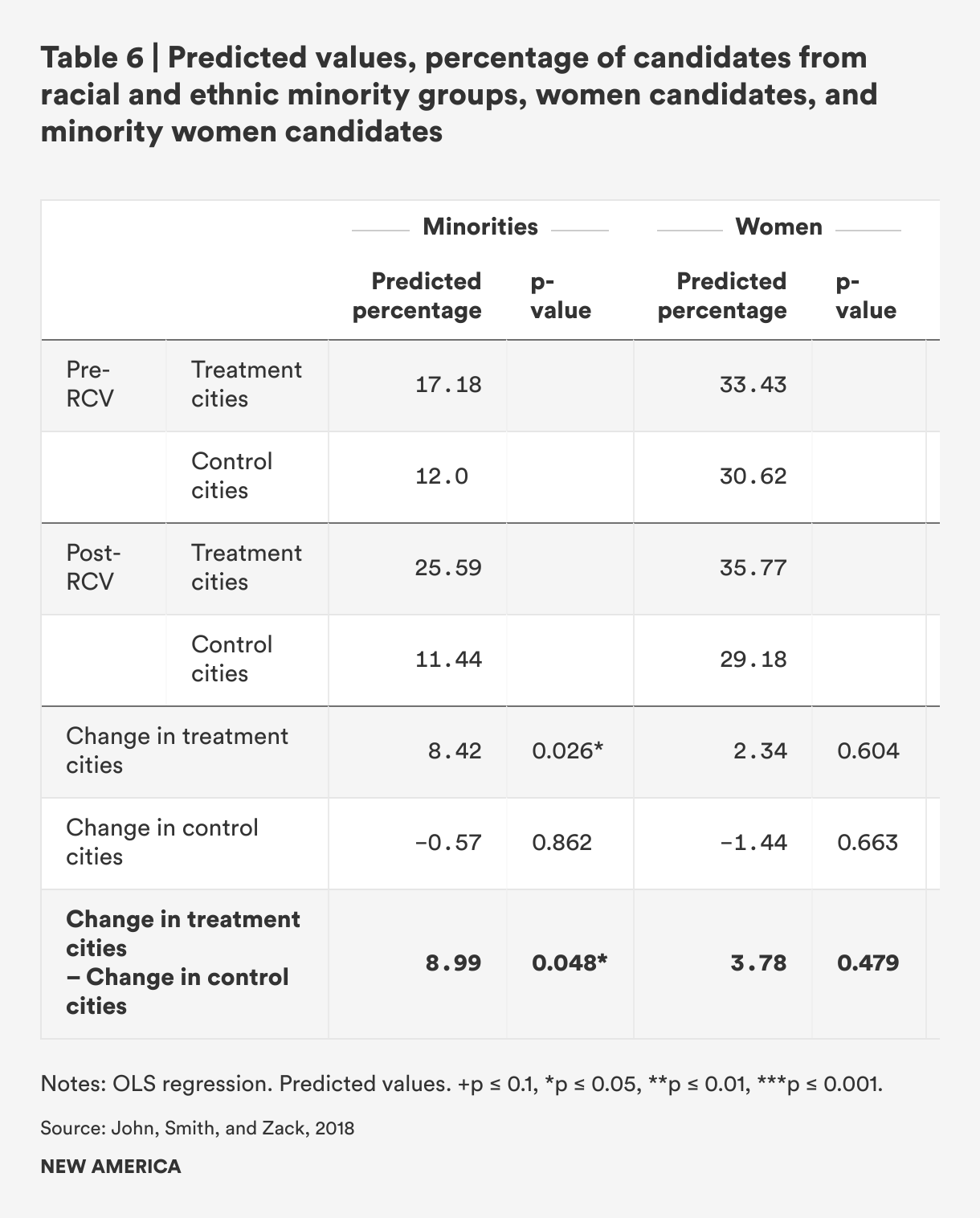
A 2018 study by Sarah John, Haley Smith, and Elizabeth Zack found that adopting RCV was associated with an estimated nine point increase in the percentage of candidates from racial or ethnic minority groups. When the treatment cities adopted RCV, the predicted percentage of racial or ethnic minority candidates increased from 17.2 to 25.6; meanwhile, during that same time period, the predicted percentage of racial or ethnic minority candidates in control (non-RCV) cities decreased slightly, from 12.0 to 11.4 (see Table 6 below, reproduced from the original paper). The authors found no statistically significant increase in female candidacy as a result of RCV implementation, irrespective of race or ethnicity. Their sample was city council and executive office elections in 11 California cities (four RCV and eight control cities) between 1995 and 2014.4
In an accompanying LSE blog post, John speculated the reason minority candidates benefitted from RCV was that “multiple candidates from similar backgrounds or political views can run for the same seat without necessarily splitting the vote or playing spoiler… There are fewer incentives for gatekeepers and community groups to limit candidacy, and fewer reasons for would-be candidates to be discouraged from running because they feel their candidacy could harm their community’s interests (by splitting the vote).”5
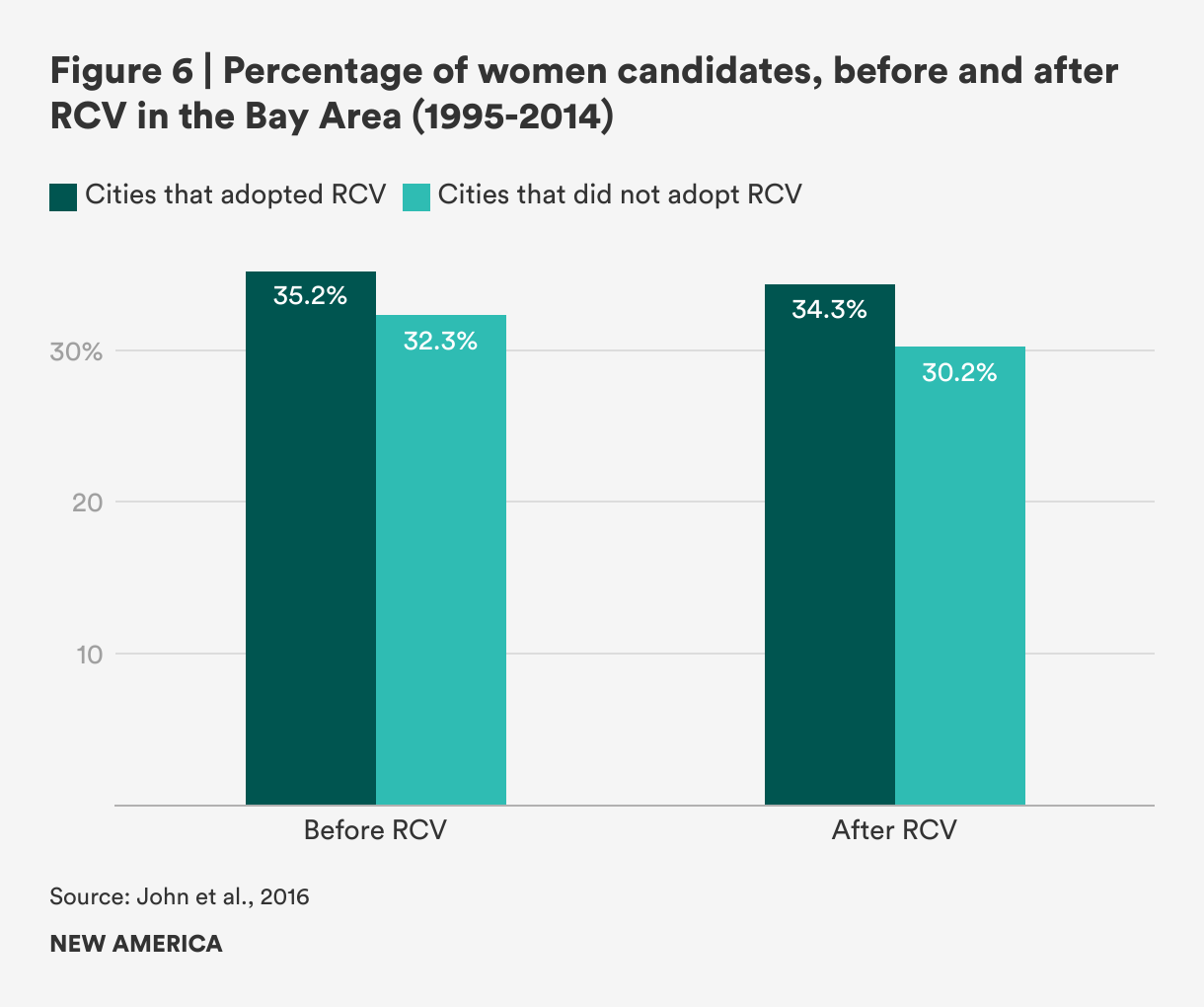
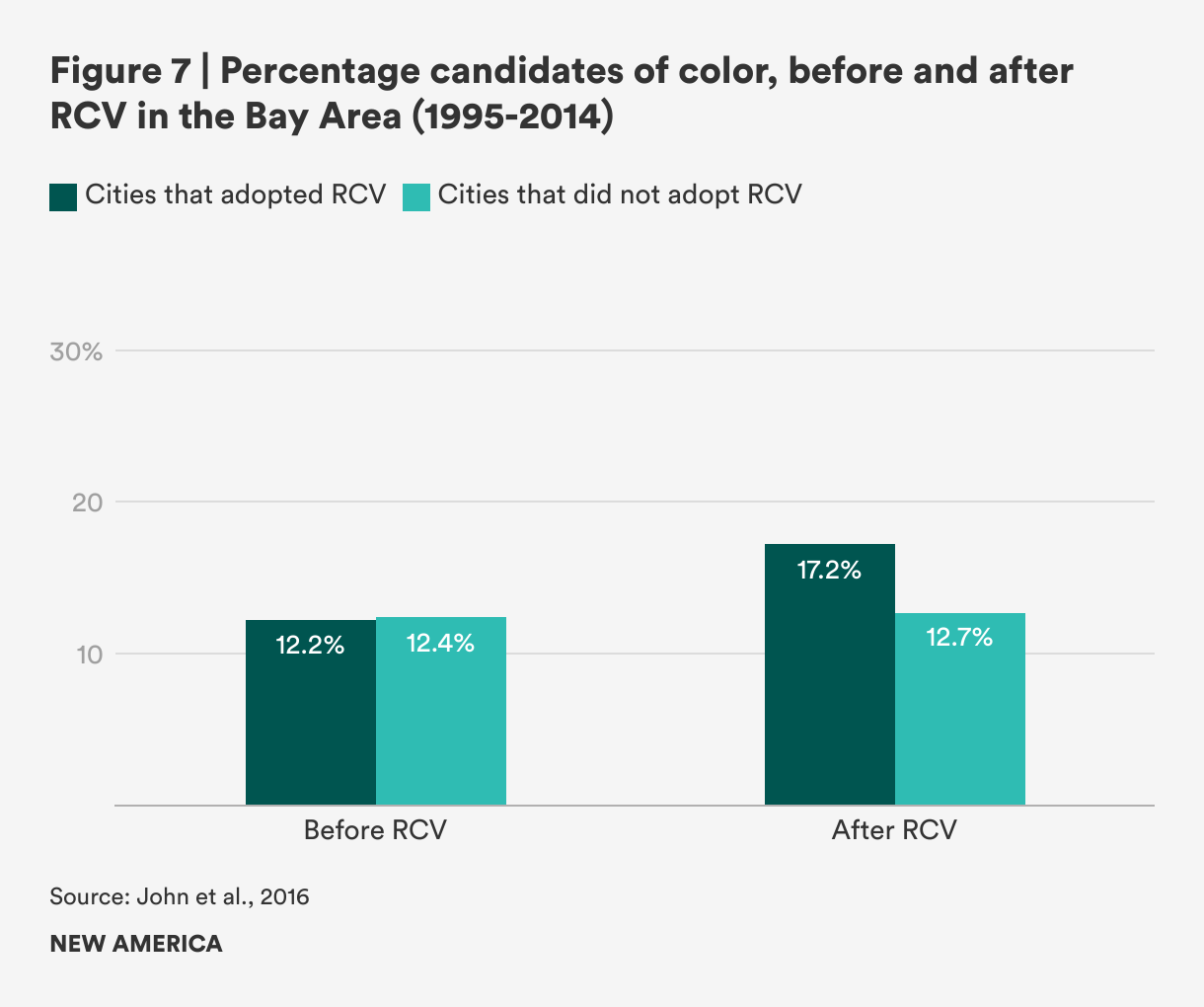
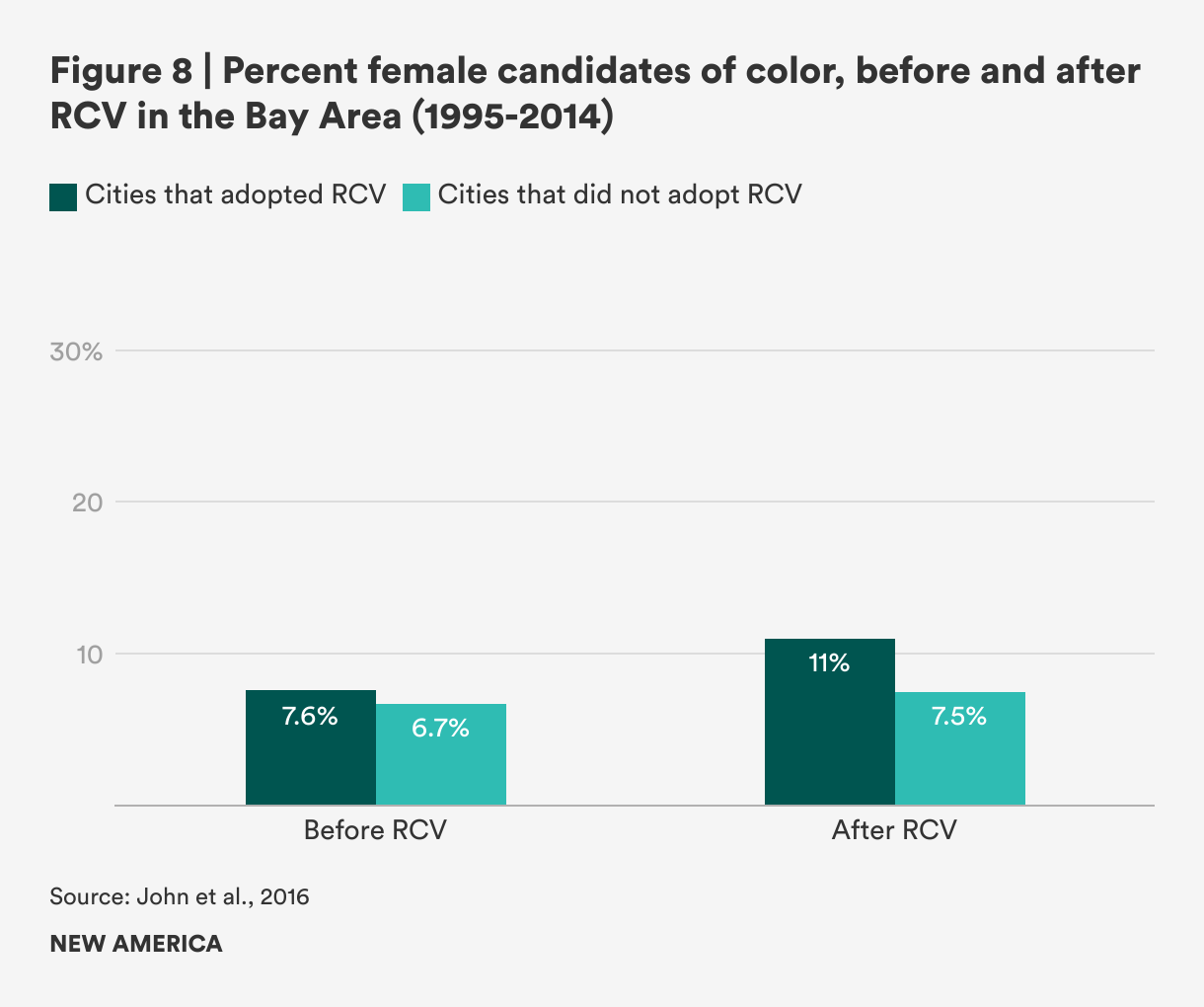
A 2016 report published by Represent2020, a project of FairVote (and based on the same sample as the 2018 John et al. study) found that, although the percentage of women running for office in the Bay Area went down in both the RCV and control cities, the decrease in women candidates was smaller in RCV cities (Figure 6 below).6 The same report found larger increases in the amount of minority candidates and minority women candidates in cities that adopted RCV than those that did not (see Figures 7 and 8). With such a small sample size, however, it is difficult to say definitively how much of this variation can be attributed to RCV, as opposed to other factors, such as the fact that cities that adopt RCV tend to be more progressive on balance than cities that don’t. They also did not control for city or election characteristics of the cities (e.g., racial and income demographics, incumbency, competitiveness, etc).
Again, generalizability is a concern. The Bay Area, being extremely wealthy, progressive, and diverse, is generally a welcoming political environment for female candidates and candidates of color. It is not necessarily representative of the country. Moreover, as Jamil Scott and Jack Santucci note in their recent working paper on candidate emergence, “two decades’ exposure to pro-RCV messaging may have made the underlying population more likely to generate candidates.”7
Recently, Cynthia Richie Terrell and Courtney Lamendola published a report on descriptive representation under RCV between 2010 and 2019. Across 19 RCV jurisdictions and 156 RCV-qualifying elections, they found that 34 percent of all candidates were women.8 Picking back up on the four Bay Area cities—Berkeley, Oakland, San Francisco, and San Leandro—from John et al.’s 2018 research, women made up 38 percent of the candidates in contested RCV elections in those four cities between 2010 and 2019, a roughly three point increase over the peak percentage observed between 1995 and 2014.9
In "Do Ranked Ballots Stimulate Candidate Entry?," Scott and Santucci conducted three survey experiments (two nationwide, one in Philadelphia) to evaluate how RCV affects attitudes toward running for office. Respondents were presented with different information about RCV. Some respondents were given a simple explanation of RCV; some were given an explanation of RCV and how it is different from our single-mark electoral system; and some were given an explanation of RCV, how it is different from single-mark, and told RCV systems have been shown to benefit women and people of color. Most effects are null, but their Philadelphia experiment found Black respondents who received the second message (explanation of RCV and how it is different from our current system) are more positively oriented toward running for office than their Black counterparts who receive the first message (simple explanation of RCV). Only among white respondents did they observe that the third message (RCV benefits women and people of color) significantly increased interest in running for office. Meanwhile in the nationwide CMPS sample, the third message (emphasizing whom RCV impacts) decreased interest in running for office among Latinos.10 Again, survey experiments cannot capture the ways in which candidate recruitment messaging and strategies may change, and the ways in which potential candidates may become familiar with ranked-choice voting over time. But they can show the extent to which different benefits might resonate (or not) with different populations.
Although there is very limited evidence that RCV leads more women to run for office, we can infer from past studies on the candidate gender gap that the prospect of a negative campaign may discourage a lot of would-be women candidates from running in the first place. Thus, RCV may indirectly improve women’s representation in the United States by way of its effects on campaigns—most significantly increasing civility, which may encourage more women to run.11 Presumably, though, if RCV does create a more civil and cooperative campaign environment, it will take time and experience for women’s attitudes and perceptions about running to change. As with many reforms, desired effects may take time to develop.
Independents, Minor Parties, and Moderates
Diversity comes in other forms, however, including ideological and partisan diversity. In American politics, our single-winner plurality system and restrictive ballot access rules help the two major parties maintain a tight grip on power. Theoretically, RCV, by eliminating the spoiler effect, should create space for more non-major party candidates to win. Of course, before such candidates can win, they'll need to run first.
RCV should make it easier for third party and independent candidates to run. They can now run without being spoilers, and are more likely to attract voters who no longer will fear that a vote for a third party is “wasted,” since they will now have a back-up choice so that their vote can count. However, for independent and third party candidates to actually have a chance of winning in an RCV election, they must be able to win a majority. In theory this is certainly possible. In practice, it is difficult for four reasons.
The first obstacle is that running for a major party has a lot of advantages. Since the Democratic and Republican parties are longstanding, recognizable brands with considerable resources, most talented and ambitious politicians prefer to run as Democrats or Republicans. This gives a candidate automatic party loyalty among a significant share of the electorate. It also guarantees ballot access. Running as an independent or a third party candidate immediately puts one at a disadvantage, even with RCV. It takes considerable resources to finance a campaign that voters and media will see as viable. And some of those resources will need to be spent simply getting on the ballot.
The second obstacle is that because the two major parties have powerfully shaped public opinion on the important issues of the day, the public is divided on most major issues. In practice, a pragmatic centrist candidate is unlikely to be the first choice of many voters, simply because the share of voters with genuinely centrist political opinions is very limited.12 In a single-winner RCV election, the best a pragmatic centrist can hope for generally is for her transfer votes to matter. This can certainly create a moderating dynamic. But it may be difficult to recruit high-quality candidates without a legitimate prospect of winning.
A third obstacle is that most districts are heavily lopsided for one party or the other. This means that the election is almost certain to be decided on first-preference votes for the dominant party’s candidate. Second-preference votes are only likely to come into play in closely competitive elections. And with single-member districts, most elections will remain lopsided. Certainly, in some districts, where the partisan margin is within 10 points, it is possible a third party or independent candidate could force a run-off. But even here, a potential centrist candidate would face the “center-squeeze” problem: In a race with a Republican and a Democrat, a centrist candidate would almost certainly finish third in the first round of balloting, and thus likely be eliminated before the Republican or Democrat. The centrist candidate could potentially play a role as kingmaker, but would be unlikely to win. It is hard to attract quality candidates to races that they are ultimately going to lose.
A fourth obstacle is that in a highly polarized political system with just two parties, and control of Congress (or a state legislature) up for grabs, most voters will likely still prefer to support one of the two major parties. Or, at the very least, the powerful party messaging machinery will focus on scaring them with the threat of the other party controlling Congress.
Cynthia McClintock and Joseph Cerrone’s 2021 paper analyzed the effects of the RCV, plurality, and runoff rules on openness of the electoral arena to new parties and to moderation in the context of the 2020 elections.13 They conducted interviews with key stakeholders in Maine, including current and former political candidates (like 2020 U.S. Senate independent candidate Lisa Savage). They also identified and compared a set of 12 competitive federal election cases.14 Across those 12 elections in 2020, they found, in line with expectations, that Maine under RCV was more open to new parties and candidates than anywhere else under runoff or plurality. The biggest combined vote-share for third party and independent Senate candidates in the 2020 elections they examined (6.6 percent) was in Maine. Further, independent Lisa Savage was the only non-Democratic/non-Republican Senate candidate to achieve 5 percent in the election result. Though Maine has a strong tradition of independent candidates, among the Maine interviewees in the 2020 study, there was consensus that RCV has enhanced Maine’s openness.
Of course, Maine also used RCV in its 2018 congressional elections. Sen. Angus King (I-Maine), one of two Senate Independents, was re-elected under RCV, in 2018. However, King is an incumbent (who caucuses with the Democrats), and the former governor—hardly a political upstart given a new opportunity by a voting system change. In 2018, Marty Grohman ran as an independent in the 1st Congressional District, garnering 8.7 percent of the vote. But because Rep. Chellie Pingree (D-Maine) won 58.8 in the first round of voting in a safe Democratic district, there was no run-off. In 2020, no third party or independent candidates ran in Maine’s 1st Congressional District.
In 2018, Maine’s 2nd Congressional District did require a run-off. Independent candidates Tiffany Bond and Will Hoar earned 5.7 percent and 2.4 percent of first preference votes, respectively. After both were eliminated, Rep. Jared Golden (D-Maine) won on transfer votes, despite trailing Republican Bruce Poliquin 46.3 percent to 45.6 percent in the first round. Polinquin then sued to challenge the legality of the RCV law, but his case was dismissed, thus upholding the Maine law.15
But, as with Maine’s 1st Congressional District, in 2020, the 2nd Congressional District also failed to attract any independent or third party challengers.
RCV is probably most likely to encourage third party and independent candidacies at the level of statewide single-winner elections, such as for senate and especially governor, where the prestige of the office is high enough to encourage ambitious candidates and the statewide media attention is highest. For gubernatorial elections in particular, voters tend to be most willing to consider candidates of the opposing party because there are no implications for national partisan control and states issues independent of national partisanship are most likely to be salient. Accordingly, RCV may be most likely to encourage third party and independent candidates for governor.
However, the story of Maine’s two congressional districts casts some doubt on the claim that RCV will encourage more independent and third-party candidates over time. After drawing a few independent candidacies in 2018, no independents or non-major party candidates entered into either of the two congressional seat elections. Granted, it was a pandemic year and a highly polarizing presidential election year, both of which may have discouraged independent candidates. But there is also a hard political reality: In single-winner elections, it is very hard to dislodge an incumbent Democrat or Republican. And without support from a national party, the chance of an independent winning is too remote to attract serious campaigns.
Here, it might be particularly useful for researchers to spend more time doing qualitative work, such as in-depth interviews with candidates (and if possible, almost-candidates who explored running but did not) that investigate the factors that encouraged these candidates to run for office, and the ways in which ranked-choice voting affected these decisions. Such a study should interview all candidates, in order to test whether certain factors were more important for female candidates and candidates of color, as compared to male candidates and white candidates. To understand how electoral rules affect candidate diversity (both descriptive and ideological) it would be extremely helpful to do in-depth interviews.
Claim 7: RCV Changes how Candidates Campaign
Conclusion: Mostly supported at the local level
Among the biggest selling points of RCV is that it alters incentives and campaign dynamics in ways that appear to decrease negative campaigning and increase campaign civility. This is because candidates are encouraged to appeal more broadly—including reaching out to those they might have ignored under plurality rules, and to even cooperate with competitors. Additionally, the lesser-of-two-evils demonization strategy is most effective with only two candidates, and to the extent that RCV encourages more candidates, such a strategy has more potential to backfire.
And here, there is a general consensus that RCV probably does lower the temperature of candidate campaigns, at least at the local level. Surveys, interviews, and content analyses have shown that RCV elections tend to be (or perceived to be) more civil.16 However, all of the studies showing civility improvements were based on local elections. It is quite possible this benefit does not translate to national elections, which tend to be much more fiercely contested between Democrats and Republicans.
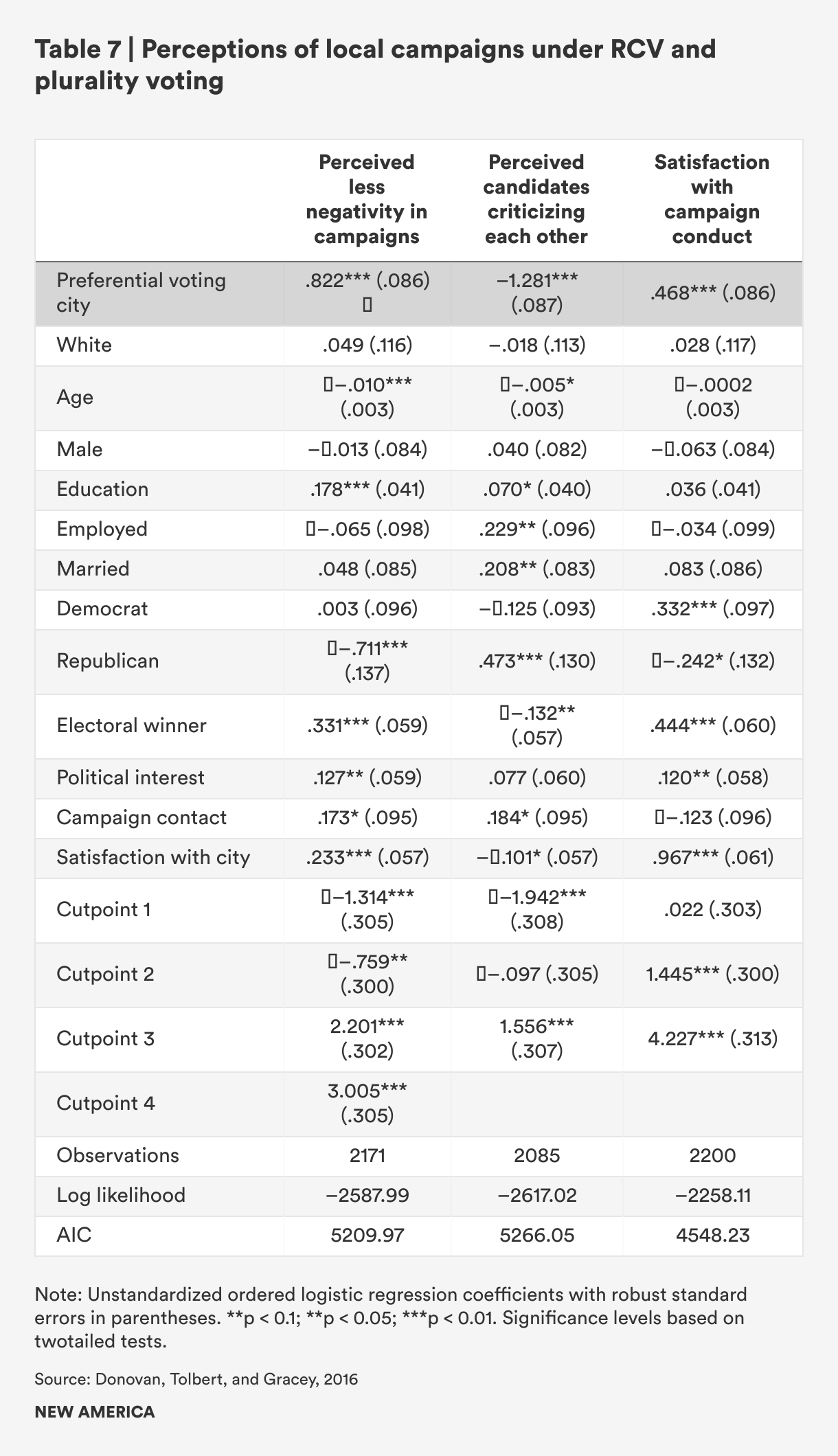
In "Campaign civility under preferential and plurality voting," Todd Donovan, Caroline Tolbert, and Kellen Gracey, found that voters surveyed in RCV cities were nearly twice as likely to say local campaigns were “a lot less negative” than other recent contests, while people in plurality cities were twice as likely to say candidates criticized each other some or most of the time. Citizens in RCV cities were also much more likely to report being satisfied with how local campaigns were conducted. See regression results in the table below, reproduced from the original article.17
Findings from that 2013 survey were re-examined and the survey itself expanded in a 2014 version that pivoted to 11 cities in the Bay Area. Sarah John and Andrew Douglas reported the results of this survey as well as those of a survey by Tolbert and Donovan of 200 candidates who ran in RCV elections between 2011 and 2013 and control cities. In the 2014 survey, the gaps between resident perceptions of three indicators of campaign negativity in RCV and non-RCV cities were narrower than they were in the 2013 version, but RCV cities still saw a civility edge. In addition, the candidate survey revealed similar opinions about the effects of RCV, with only 29 percent of candidates in RCV cities reporting being portrayed negatively by opponents, compared to 40 percent in non-RCV jurisdictions.18
Again, we need to consider whether these findings from local elections are generalizable to the state and national level, to which the biggest political conflicts tend to gravitate. While the 2013 study found higher satisfaction levels under RCV, large majorities in the plurality cities surveyed also reported being satisfied “with the way most candidates have conducted their campaigns in the recent local election,” and 71 percent were happy with the information they received. As Donovan et al. posit, there might be greater room for effects at the state level or federal level. “Or, given the polarized nature of federal contests in the US, it may be that incivility and negativity are so deeply entrenched in federal elections that adoption of preferential voting may have no effect on such elections.”19
Multiple scholars have explored the relationship between electoral systems and negativity/positivity in campaigns through campaign materials and media content. Denise Munro Robb conducted a content analysis of mass mailers distributed by candidates in RCV races for her doctoral dissertation. (She also interviewed candidates, party officials, and campaign strategists.) Robb’s results suggested that campaigning under RCV was much less negative, and significantly more positive. But she also found that candidates used team ads, which led to a (limited number) of coordinated attacks.20
Eamon McGinn’s article "Rating Rankings: Effect of Instant Run-off Voting on Participation and Civility," approached the question using a novel text-based approach. McGinn took advantage of modern natural language processing techniques and a huge trove of transcribed debates that are now available from data sources like YouTube to conduct a sentiment analysis of mayoral debates in a broader set of U.S. cities. His findings suggest that RCV debates are more civil, and positive.21A similar methodology, he notes, could be leveraged for analyses of RCV’s effects on other outcomes, including whether officials who were elected in an RCV election speak differently than winners of plurality elections.
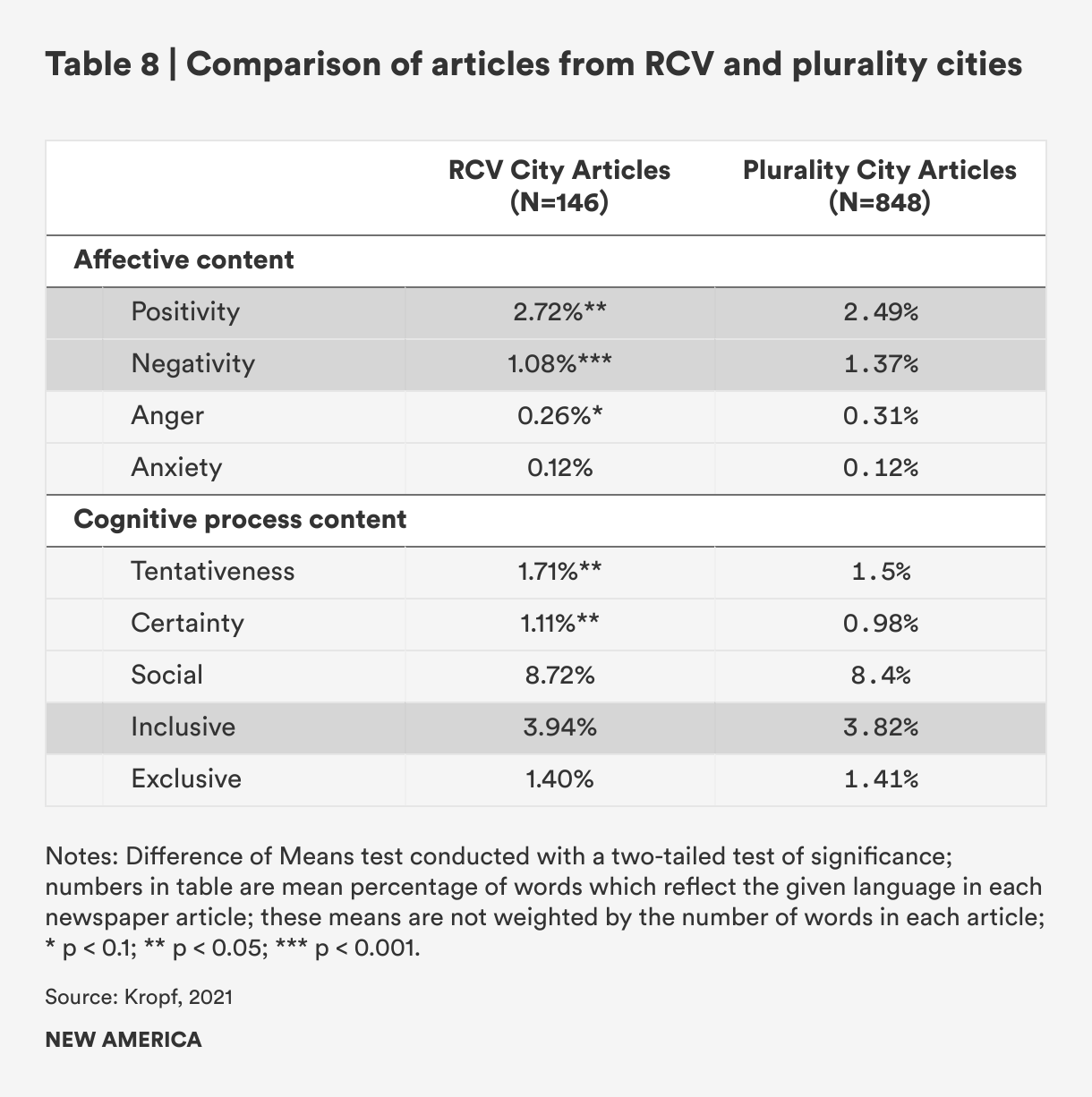
Political scientist Martha Kropf applied a text-as-data approach for her 2021 study on RCV’s effect on campaign behavior, using direct campaign communication data—candidate tweets and newspaper articles—in RCV and matched plurality cities, rather than mayoral debate transcripts.22 Kropf found that RCV city newspaper articles have significantly more positive than negative words. The results from Twitter, however, showed that tweets on mayoral elections using RCV had, on average, more inclusive and more exclusive words and fewer social words, while plurality city tweets had more positive words, fewer negative words, and more social words. A qualitative examination revealed a more nuanced picture. Candidates in plurality cities appeared less likely to engage one another in tweets than candidates in RCV cities, a pattern which, as Kropf noted, could signify a lack of bargaining or accommodation among rivals,23 or “perhaps the candidates asked some other group to do ‘heavy lifting’ where negativity was concerned or an interested party/interest group did the heavy lifting without the candidate asking.”24 The table below (reproduced from the original article) displays results from the analysis of newspaper articles. In RCV cities used significantly more positive words and significantly fewer negative words. They also used more inclusive words compared to plurality, but the difference isn’t statistically significant.
For his 2020 working paper "Rank Deficiency? Analyzing the Costs and Benefits of Single-Winner Ranked-Choice Voting," Jesse Clark conducted a sentiment analysis of campaign advertisements for the Maine 2018 congressional elections, when RCV was first implemented for state and federal contests.25 He assessed the negativity/positivity of Facebook advertisements that mentioned the congressional candidates and found the 2018 campaign was even more negative than in similar districts around the country.
To reach this result, Clark tested the impact of RCV on the total amount of money spent on independent expenditures in a race, the amount of negative independent expenditure money in a race (or the amount of money spent on independent expenditures that was against a candidate), the amount of positive independent spending (in favor of candidates), and the net positive spending on the race overall. He found RCV correlated strongly with an increase in independent expenditures in the congressional races overall, and furthermore with a measurable decrease in positive expenditures, “accompanied by a sharp increase in expenditures that were targeted against candidates.” His robust checks yielded mixed results, however: Based on genetic matching, the percentages of positive and negative expenditures were in line with those found in the nearest 10 districts studied.
This raises two possibilities. One is that RCV’s impact on positive campaigning may be more powerful in local elections than national elections, since national elections are oriented around hyper-partisan, Democrat versus Republican fights. Another is that Maine, as the home of a highly competitive Senate election, attracted a lot of money, and most money goes to negative campaigning. This suggests that as long as a hyper-partisan nationalized and roughly competitively balanced two-party system remains in place, state-level shifts to single-winner ranked-choice voting are likely to have limited impacts. Of course, the Maine Senate election did not have a strong third candidate (it was clearly a contest between Democrat Sara Gideon and Sen. Susan Collins [R-Maine]), and two-candidate campaigns are far more prone to the “lesser of two evils” dynamic that encourages negative campaigning. But the lack of a serious third party entrant in the RCV election does raise questions of whether single-winner RCV is a big enough reform to meaningfully encourage serious, well-funded new parties and candidates to challenge the duopoly.
The above works prompt a number of questions and opportunities for future research. For example, how does RCV impact the substantive content of campaigns (not just negativity versus positivity)? Do candidates spend more time focusing affirmatively on policy to distinguish themselves? Here, researchers might consider a more qualitative analysis of campaigns, including candidate interviews, rather than simple algorithmic text-based analysis like the ones covered above. The Tolbert-Donovan candidate survey from 2011–2013 mentioned above is long overdue for an update, and questions regarding emphasis on policy could be incorporated.
In addition, how does RCV-style campaigning affect candidate emergence among women and minority women? Does it reward women and women of color candidates at the polls? One could also repeat the surveys conducted by Donovan et. al. in 2013 and 2014, to test how perceptions have changed as RCV has become more normalized in cities like Minneapolis and St. Paul.
Additionally, now that several cities have gone through several cycles of ranked-choice voting elections, some more detailed case histories would contribute to our understanding of the extent to which candidates learn over time and adjust their strategies. Again, reforms typically take time to demonstrate impacts, so tracing case histories could help us better understand the processes by which political actors learn and change, and certain actors enter the stage while others exit. Doing this may also uncover other processes and dynamics that we do not yet appreciate because almost all the work on RCV has involved snapshots instead of process-tracing.
Citations
- Relatedly, it provides more opportunities for people with platforms or identities outside the traditional mainstream to send a clear message to the likely winner or party establishment. If a person is not confident they can win (yet) but that they can secure a meaningful proportion of second or third preferences, RCV is effective at revealing emerging issues and identities that may be ignored in a plurality setting.
- Sarah John, Haley Smith, and Elizabeth Zack, “The Alternative Vote: Do Changes in Single‐Member District Voting Systems Affect Descriptive Representation of Women and Minorities?,” Electoral Studies 54 (May 2018): 90‐102; Courtney Lamendola and Cynthia Richie Terrell, In Ranked Choice Elections, Women WIN (Takoma Park, MD, Represent‐Women, 2020), source.
- Kimball and Anthony, “Voter Participation with Ranked Choice Voting in the United States.”
- The RCV cities included in the study are Berkeley, Oakland, San Francisco, and San Leandro; the control cities are Alameda, Anaheim, Richmond, San Jose, Santa Ana, Santa Clara, and Stockton. John, Haley, and Zack, “The Alternative Vote.”
- Sarah John, “The Alternative Vote can increase representation of women and people of color in US elections,” LSE Phelan US Centre, July 24, 2018, source.
- Sarah John, Haley Smith, Elizabeth Zack, Cynthia Terrell, Michelle Whittaker, Jennifer Pae, and Rob Richie, The impact of ranked choice voting on representation: How ranked choice voting affects women and people of color candidates in California (Takoma Park, MD: RepresentWomen, 2016), source; Cynthia Richie Terrell, Courtney Lamendola, and Maura Reilly, “Election Reform and Women’s Representation: Ranked Choice Voting in the U.S.,” Politics and Governance 9, (June 2021): 332–343, source.
- Jack Santucci and Jamil Scott, “Do Ranked Ballots Stimulate Candidate Entry?,” November 4, 2021, available at SSRN: source">source. For more on the origins of the San Francisco RCV movement, Santucci and Scott cite Richard DeLeon, Steven Hill, and Lisel Blash, “The Campaign for Proposition H and Preference Voting in San Francisco, 1996,” Representation 35, no. 4 (1998): 265–274.
- Terrell and Lamendola, In Ranked Choice Elections, Women WIN and Cynthia Richie Terrell, Courtney Lamendola, and Maura Reilly, “Election Reform and Women’s Representation: Ranked Choice Voting in the U.S.” Data available here. A major challenge in assessing the impact of RCV on candidate entry is that cities do not randomly choose to adopt RCV. Rather, more progressive cities tend to adopt RCV, and more progressive cities are more likely to support female candidates. Of course, since there is only one Berkeley, and only one San Francisco, for example, it’s difficult to estimate female candidate entry in a hypothetical Berkeley or San Francisco without RCV. As Terrell, Lamendola and Reilly acknowledge: “Due to the multiple factors affecting local election outcomes, this analysis does not infer causality between ranked choice voting and improvements in the descriptive representation, but instead illustrates the correlation.”
- John, Smith, and Zack, “The Alternative Vote: Do Changes in Single‐Member District Voting Systems Affect Descriptive Representation of Women and Minorities?”; Terrell, Lamendola, and Reilly, “Election Reform and Women’s Representation: Ranked Choice Voting in the U.S.”
- Santucci and Scott, “Do Ranked Ballots Stimulate Candidate Entry?”
- E.g. a 2008 Brookings study attributes the underrepresentation of women on the ballot to factors such as: “Women are less likely than men to be willing to endure the rigors of a political campaign. They are less likely than men to be recruited to run for office. They are less likely than men to have the freedom to reconcile work and family obligations with a political career. They are less likely than men to think they are “qualified” to run for office. And they are less likely than men to perceive a fair political environment.” Jennifer L. Lawless and Richard L. Fox, Why Are Women Still Not Running for Public Office?, (Washington, DC: Brookings Institution, 2008), source; Kristin Kanthak and Jonathan Woon, “Women Don't Run? Election aversion and candidate entry,” American Journal of Political Science 59 (July 2015): 595–612; John, Smith, and Zack, “The Alternative Vote.”
- Drutman, Galston, and Lindberg, Spoiler Alert; Lee Drutman, “The Moderate Middle Is A Myth,” FiveThirtyEight (blog), September 24, 2019, source.
- Cerrone and McClintock, “Ranked-Choice Voting, Runoff, and Democracy Insights from Maine and Other U.S. States.”
- The sample included two RCV elections (Maine’s Senate and 2nd Congressional District), five elections under runoff (Georgia’s regular Senate election, Georgia’s special Senate election, Georgia’s 6th Congressional District, and California’s 21st and 25th Congressional Districts), and for plurality cases they included the two competitive elections in Iowa (its Senate and 1st Congressional District) and in North Carolina (its Senate and 8th Congressional District) because Iowa and North Carolina are deemed similar to Maine and Georgia respectively by FiveThirtyEight. For an additional plurality case, they included the Senate race in Colorado on the basis of the competitiveness criterion.
- Steve Mistler, “Federal Judge Strikes Down Poliquin's Challenge To Maine's Ranked-Choice Voting Law,” WBUR News, December 13, 2018, source.
- Denise Munro Robb, The Effect of Instant Runoff Voting on Democracy (unpublished doctoral dissertation) (Irvine, CA: University of California, 2011). Eamon McGinn, Rating Rankings: Effect of Instant Run-off Voting on Participation and Civility; Todd Donovan, “Candidate Perceptions of Campaigns under Preferential and Plurality Voting,” (paper prepared for the workshop on Electoral Systems, Electoral Reform, and Implications for Democratic Performance, Stanford University, March 14‐15, 2014), source; Todd Donovan, Caroline Tolbert, and Kellen Gracey, “Campaign Civility Under Preferential and Plurality Voting,” Electoral Studies 42 (June 2016): 157‐163, source; Martha Kropf, “Using Campaign Communications to Analyze Civility in Ranked Choice Voting Elections,” Politics and Governance 9 (June 2021): 280–292, source; McGinn, Rating Rankings: Effect of Instant Run-off Voting on Participation and Civility.
- Donovan, Tolbert, and Gracey, “Campaign Civility Under Preferential and Plurality Voting.” Their sample included approximately 1200 likely voters from three RCV and STV jurisdictions (Cambridge, Minneapolis, and St. Paul) and about 1200 likely voters from seven similar jurisdictions that had just experienced plurality elections (Boston, Seattle, Des Moines, Cedar Rapids, Tulsa, Lowell MA and Worcester, MA). Respondents were contacted by the Eagleton Poll (Rutgers University) immediately after the November 2013 elections. The authors isolated the effects of voting system on public attitudes about local campaigns with a multiple case matching method, which they argued is an improvement upon the “standard” cross-national, cross-sectional analyses because it allows them to minimize non-electoral system differences across the matched cases. Still, they acknowledge a potential endogeneity problem in their design, and suggest that researchers seeking to test for the causal effect of RCV on campaign behavior might conduct a time series measure of voter and candidate perceptions taken before and after the implementation of RCV. Now that more jurisdictions are preparing to implement the reform, there are more opportunities to run such tests.
- John and Douglas, “Candidate Civility and Voter Engagement in Seven Cities with Ranked Choice Voting.”
- Donovan, Tolbert, and Gracey, “Campaign Civility Under Preferential and Plurality Voting.”
- Robb, The Effect of Instant Runoff Voting on Democracy.
- McGinn, Rating Rankings: Effect of Instant Run-off Voting on Participation and Civility.
- Kropf, “Using Campaign Communications to Analyze Civility in Ranked Choice Voting Elections.”
- Benjamin Reilly, “Electoral systems for divided societies,”Journal of Democracy 13 (April 2002): 156–170, source. org/10.1353/jod.2002.0029.
- Kropf.
- Jesse Clark, “Rank Deficiency? Analyzing the Costs and Benefits of Single-Winner Ranked-Choice Voting,” MIT Political Science Department Research Paper No. 2020-8, October 1, 2020, available at SSRN: source.