What We Know About Ranked-Choice Voting
Abstract
As ranked-choice voting (RCV) gains momentum in American politics, a new body of research has emerged to examine the reform’s effects on voters, candidates, campaigns, and policy. This report offers a systematic overview of the literature on RCV in the United States. Broadly, the research shows that RCV is an improvement over the more traditional single-vote plurality voting system, with clear benefits in some areas—especially campaign quality and descriptive representation—and more marginal or no apparent benefits in other areas. The research should also allay fears that RCV is too confusing or discriminatory: voters understand RCV, and learn to like it, too, particularly with experience.
However, many promised benefits of RCV appear to be more modest than many had initially hoped and/or difficult to quantify based on limited usage thus far in the United States. It is possible that these benefits will take time to become apparent as candidates and voters learn and attitudes change. It is also possible that the adoption of RCV nationwide would be more transformative than city-by-city and even state-by-state adoption. But given the broader structural forces at play in our deteriorating national politics, stronger medicine may be needed.
Acknowledgments
We would like to thank Tyler Fisher, Deb Otis, Nick Troiano, and Beth Hladick for their valuable feedback and comments on this report. We are also grateful to Mark Schmitt for his guidance, and to Joe Wilkes, Maria Elkin, Naomi Morduch Toubman, Tara Moulson, and Olivia Cordero for their communications and editorial support.
Funding for this work was provided by the Unite America Institute. All positions are those solely of the authors.
Downloads
Executive Summary
Over the last decade, ranked-choice voting has gone from the fringes to the mainstream of political reform. Generally, ranked-choice voting (RCV) is seen as a way to encourage more compromise and moderation in politics; to reduce negative campaigning; to introduce more competition within the two major parties; to end the spoiler effect of third party candidates; and to ensure majority winners without costly and low-turnout runoff elections. With largely successful use-cases in the 2021 New York City mayoral primary, in several Democratic Party presidential primaries in 2020, and in Maine elections in 2018 and 2020, RCV has entered the national conversation as a sensible and popular reform with momentum. In its single-winner form, it is also a relatively modest change to the current voting system, and thus, appears to be a relatively achievable victory for reformers.
With a growing number of RCV elections to draw on, considerable research has followed. The goal of this report is to provide a systematic overview of this research.
The broad conclusion of this report is that, while single-winner ranked-choice voting does have many positive effects both in theory and in overseas usage, in practice these benefits have been somewhat limited and/or difficult to quantify based on limited usage thus far in the United States. On balance, the benefits of RCV outweigh the downsides, and RCV has many appealing qualities that make it a strong improvement over more traditional single-mark plurality voting. However, the benefits appear to be more marginal than many had initially hoped. Certainly, it is possible that the research has failed to adequately capture the benefits, and that the benefits take time to become apparent as candidates and voters learn and attitudes change. It is also possible that nationwide adoption of RCV would be more transformative than city-by-city and even state-by-state adoption. But given the broader structural forces at play in our deteriorating national politics, stronger medicine may be needed.
The most notable benefits of ranked-choice voting so far concern campaign tone and descriptive representation. Research suggests elections with RCV are more civil, and less nasty, as proponents have argued; and what limited evidence we have on RCV and electoral outcomes suggests that the system does, as promised, increase the odds of candidates of color and women candidates being elected. Additionally, there is strong evidence that most citizens like using ranked-choice voting, and they find it easy and straightforward to use—especially once they experience the system in a real election. Though critics and skeptics have raised concerns about the ways in which RCV voting could confuse and potentially demobilize certain voters, those concerns appear unfounded at this point.
Still, both ease of use and enthusiasm for RCV vary among the population. Not surprisingly, age is a significant correlate of support, with young people more likely to embrace change, and older people more likely to want to continue voting under the rules they have known for their entire lives, rather than having to learn something new. Also, Democrats tend to be more favorable toward RCV than Republicans. This may reflect the fact that conservatives are more averse to change, or that RCV is currently seen more like a Democratic reform than a Republican reform. However, since most voters do not have strong opinions either way, there is certainly room for this to change with appropriate grassroots movement building and elite signaling.
Additionally, RCV seems to work well in primaries, the elections where vote-splitting is most likely to be a problem and where extreme candidates are most likely to win with a small plurality. Another advantage of using RCV in primaries is that it combines well with voting by mail. Since candidates may drop out suddenly, mailed votes are not wasted if voters can indicate their back-up preferences. Certainly, the New York City Democratic primary of 2021 offers a success story of ranked-choice voting, despite some administrative blunders by the Board of Elections that had nothing to do with the reform itself.
Other impacts of ranked-choice voting are harder to observe. At this point, it is unclear whether the system has any consistent impacts on who votes, who runs, or how governing works. The lack of clear findings here may exist for a few reasons. First, a limited number of cities have implemented RCV, and these cities tend to be unique in various respects, which makes the kinds of comparisons needed to draw meaningful conclusions about broader implementation hard. Second, it may take time for these downstream effects to show up, as voters, candidates, and public officials learn and adjust to different rules. Third, and most likely, it may simply be the case that the single-winner form of RCV that most cities have implemented has only marginal impacts.
Again, the existing literature has its limits, and even this overview does not encompass the totality of studies on the effects of ranked-choice voting. Notably, this report’s deliberate focus on RCV in the United States leaves less room for discussion of RCV usage overseas, even as the international scholarship laid the groundwork for many of the domestic studies examined here. The report also does not account for the results of research currently underway to understand the effects of RCV in New York City’s 2021 primaries, nor the 2022 implementation of Alaska’s final-four open primaries with RCV in the general election. These limitations notwithstanding, many of the bolder claims about the transformative nature of ranked-choice voting are still hypothetical.
This review of the RCV literature is structured around four key aspects of electoral reform—how the reform affects the voting experience (“who votes, and how do voters experience the process?”), candidates and campaigns (“who runs, and how?”), electoral outcomes (“who wins?”), and policy and governance (“what happens then?”). Within these main sections we test 12 specific claims that RCV advocates have made against the available research, and offer summary conclusions and future research recommendations for each one. The claims, and our conclusions, are previewed below.
Key Findings
I. The Voting Experience
- Claim 1: Voters can understand RCV | Conclusion: Supported
- Claim 2: Voters utilize their rankings | Conclusion: Mostly supported
- Claim 3: RCV increases voter participation | Conclusion: Mixed evidence, hard to assess
- Claim 4: Voters like RCV, and consider it an improvement over the status quo | Conclusion: Generally supported, with caveats
- Claim 5: RCV makes voters think elections are fairer | Conclusion: Not well-supported
II. Candidates and Campaigns
- Claim 6: RCV changes who runs | Conclusion: Possibly, more study needed
- Claim 7: RCV changes how candidates campaign | Conclusion: Mostly supported at the local level
III. Electoral Outcomes
- Claim 8: RCV changes who wins | Conclusion: Limited evidence is mainly promising for minorities and women, less so for independents and moderates; more data is needed
- Claim 9: RCV leads to more Condorcet winners | Conclusion: Mainly supported
- Claim 10: RCV makes primaries work better in avoiding polarizing candidates | Conclusion: Early evidence is promising, more study needed
IV. Consequences for Policy and Politics
- Claim 11: RCV reduces polarization | Conclusion: Unclear, hard to assess
- Claim 12: RCV changes policy outcomes | Conclusion: Not supported, very hard to assess
Introduction
Over the last decade, ranked-choice voting has gone from the fringes to the mainstream of political reform. Generally, ranked-choice voting (RCV) is seen as a way to encourage more compromise and moderation in politics; to reduce negative campaigning; to introduce more competition within the two major parties; to end the spoiler effect of third party candidates; and to ensure majority winners without costly and low-turnout runoff elections. With largely successful use-cases in the 2021 New York City mayoral primary, in several Democratic Party presidential primaries in 2020, and in Maine elections in 2018 and 2020, RCV has entered the national conversation as a sensible and popular reform with momentum. In its single-winner form, it is also a relatively modest change to the current voting system, and thus, appears to be a relatively achievable victory for reformers.
With a growing number of RCV elections to draw on, considerable research has followed. The goal of this report is to provide a systematic overview of this research.
The broad conclusion of this report is that, while single-winner ranked-choice voting does have many positive effects both in theory and in overseas usage, in practice these benefits have been somewhat limited and/or difficult to quantify based on limited usage thus far in the United States. On balance, the benefits of RCV outweigh the downsides, and RCV has many appealing qualities that make it a strong improvement over more traditional single-mark plurality voting. However, the benefits appear to be more marginal than many had initially hoped. Certainly, it is possible that the research has failed to adequately capture the benefits, and that the benefits take time to become apparent as candidates and voters learn and attitudes change. It is also possible that nationwide adoption of RCV would be more transformative than city-by-city and even state-by-state adoption. But given the broader structural forces at play in our deteriorating national politics, stronger medicine may be needed.
The most notable benefits of ranked-choice voting so far concern campaign tone and descriptive representation. Research suggests elections with RCV are more civil, and less nasty, as proponents have argued; and what limited evidence we have on RCV and electoral outcomes suggests that the system does, as promised, increase the odds of candidates of color and women candidates being elected. Additionally, there is strong evidence that most citizens like using ranked-choice voting, and they find it easy and straightforward to use—especially once they experience the system in a real election. Though critics and skeptics have raised concerns about the ways in which RCV could confuse and potentially demobilize certain voters, those concerns appear unfounded at this point.
Still, both ease of use and enthusiasm for RCV vary among the population. Not surprisingly, age is a significant correlate of support, with young people more likely to embrace change and older people more likely to want to continue voting under the rules they have known for their entire lives, rather than having to learn something new. Also, Democrats tend to be more favorable toward RCV than Republicans. This may reflect the fact that conservatives are more averse to change, or that RCV is currently seen more like a Democratic reform than a Republican reform. However, since most voters do not have strong opinions either way, there is certainly room for this to change with appropriate grassroots movement building and elite signaling.
Additionally, RCV seems to work well in primaries, the elections where vote-splitting is most likely to be a problem and where extreme candidates are most likely to win with a small plurality. Another advantage of using RCV in primaries is that it combines well with voting by mail. Since candidates may drop out suddenly, mailed votes are not wasted if voters can indicate their back-up preferences. Certainly, the New York City Democratic primary of 2021 offers a success story of ranked-choice voting, despite some administrative blunders by the Board of Elections that had nothing to do with the reform itself.
Other impacts of ranked-choice voting are harder to observe. At this point, it is unclear whether the system has any consistent impacts on who votes, who runs, or how governing works. The lack of clear findings here may exist for a few reasons. First, a limited number of cities have implemented RCV, and these cities tend to be unique in various respects, which makes the kinds of comparisons needed to draw meaningful conclusions about broader implementation difficult. Second, it may take time for these downstream effects to show up as voters, candidates, and public officials learn and adjust to different rules. Third, and most likely, it may simply be the case that the single-winner form of RCV that most cities have implemented has only marginal impacts.
Again, the existing literature has its limits, and even this overview does not encompass the totality of studies on the effects of ranked-choice voting. Notably, this report’s deliberate focus on RCV in the United States leaves less room for discussion of RCV usage overseas, even as the international scholarship laid the groundwork for many of the domestic studies examined here. The report also does not account for the results of research currently underway to understand the effects of RCV in New York City’s 2021 primaries, nor the 2022 implementation of Alaska’s final-four open primaries with RCV in the general election. These limitations notwithstanding, many of the bolder claims about the transformative nature of ranked-choice voting are still purely hypothetical at this point.
How RCV Works
Also known as preferential voting, instant runoff voting, the single transferable vote, and the alternative vote, ranked-choice voting describes a family of election methods in which voters use a ranked ballot to select multiple candidates in order of preference. The RCV family encompasses at least five distinct approaches to allocating votes capable of producing significantly different outcomes.1 For the purposes of this report, however, we will focus mainly on the most used and studied versions of RCV: single-winner RCV (which we will call simply RCV), and a form of multi-winner RCV called the single-transferable vote, or STV.
RCV works as follows: voters rank candidates on the ballot in order of preference (first choice, second choice, third choice, etc.). If no candidate wins a majority of first-preference votes in the first round, the second choices from the candidate with the fewest first choices are counted. This process repeats until one candidate wins a majority. RCV is used to elect one person per contest, whether it is for a seat in a single-member legislative district or a singular office such as mayor or governor.
STV is a form of proportional representation used for electing representative bodies like city councils, legislatures, and school boards. Under STV, candidates are again ranked in order of preference, and those who receive a predetermined share of votes (also known as the “quota” or “threshold”) win seats. While the quota in a single-seat RCV race is always a simple majority (50 percent + 1), STV quotas depend on the number of seats up for election. The standard formula for calculating the quota is: (votes/(seats +1)) +1. Any candidates that meet the quota in the first round of voting are elected, and surplus votes (votes beyond the amount they needed to win) are reallocated to voters’ next choice. If more candidates than seats remain after the first round, the lowest-ranked candidate is eliminated, and voters who ranked that candidate first have their votes transferred to their next choice. This process continues until all seats are filled. Though RCV and STV are not identical, they both use a ranked ballot, as opposed to the single-mark ballots to which Americans are accustomed.
Because single-winner RCV is the dominant form of RCV used in the United States, the vast majority of empirical studies focus on that form. However, a few studies examine multi-winner RCV, or STV, as well.
A Brief History of RCV
RCV was invented in the mid-nineteenth century, first as a form of proportional representation and later adapted to single-winner elections. Australia became the first country to adopt single-winner RCV for local and federal elections in the early 1900s and implemented STV for Senate elections in 1948. Other countries followed their lead. Today, in addition to Australia, RCV and/or STV are used today in national elections in Ireland, Malta, Papua New Guinea, and, increasingly, the United States, where both Maine and Alaska have now adopted RCV for use in federal elections. (Maine has used RCV twice, in 2018 and 2020; Alaska voted to adopt it in a 2020 referendum, and will use it for the first time in 2022.)
According to a recent count by FairVote, the country’s longest-running and most prominent RCV advocacy organization, 43 jurisdictions used some form of RCV in their most recent election. This includes 20 cities in Utah, which are using various forms of RCV as part of a temporary pilot program created by the state legislature. Even more places, including the state of Alaska, plan to use RCV in their next election.2
While different forms of RCV have been spreading quickly across the United States in recent years—inspiring hope among reformers and a wave of fresh research into the effects of electoral reform—this isn’t actually America’s first experience with RCV. As scholars such as Douglas J. Amy and Jack Santucci have chronicled in their research, America’s experience with RCV dates back to the late Progressive Era. Between 1912 and 1947, 11 states used RCV for statewide party primaries, and at least 24 cities adopted STV for municipal elections.3 Most of them repealed RCV and STV after the reforms resulted in more representation for political and racial minorities, spurring aggressive backlash from dominant party organizations in particular.4 Only two cities resisted repeal. To this day, Arden, Delaware, and Cambridge, Massachusetts, use STV for certain municipal elections.
Scholarship We Cover (In Brief)
Even though the promises of RCV often center on its potential moderating effects, most of the research has thus far focused on voter experiences and attitudes. Largely, this is because it is much easier to study voter attitudes and experiences than it is to study outcomes.
Ascribing policy outcomes to RCV (and voting systems in general) is difficult. Policy outcomes have many diffuse causes, and the choice to switch to RCV is not a random event—it happens in a specific political context that makes certain policy outcomes more or less likely regardless of what voting rules are in effect. Single-winner ranked-choice voting is also a relatively small voting system change. All this makes it difficult to conclude anything definitive about the reform's downstream effects.
By contrast, surveys and even lab experiments are relatively straightforward to conduct, and likely to yield publishable findings; voting data is relatively straightforward to obtain and analyze. This does not mean such findings are any less valuable, of course. No matter how good RCV might seem in theory, if it proves overly confusing, discriminatory, unfair, or otherwise problematic in usage, it is not a very good voting system. As a baseline, any voting system must not place unreasonable burdens on voters, or lead them to make perverse choices because they do not understand the implications of their votes.
The good news is that, on balance, citizens find RCV easy to use, enjoy using it, and use it successfully. Attitudes and behavior vary among voters, with some groups using it and liking it more than others. Younger people like it more than older people, for example.5 But the overarching conclusion is that once people get used to ranking (typically after a single election), it becomes normal and preferable to voters. And indeed, polling from cities that implement RCV consistently shows that voters in those cities support the continued use of RCV.
After the voting experience, the second aspect of any electoral reform is whether it changes the types of candidates who run and how they campaign. RCV advocates argue that ranked-choice voting elections reduce negative campaigning because of the way that ranking alters incentives, making the “lesser-of-two-evils” strategy less useful and therefore less likely. As a result, a kindler, gentler form of campaigning may attract the kinds of bridge-building candidates who might otherwise think running for office is not for them. Several studies have explored the effects of RCV on who runs and how they campaign, with some modest support for the claim that RCV elections attract more diverse candidates (from different parties, demographic backgrounds, and social groups) and induce less negative campaigning. Still, more scholarship on this is needed.
A third measure of interest for any electoral reform is whether it changes the types of candidates who win. In theory, ranked-choice voting should lead not only to more diversity among candidates, but among winners as well. Under RCV, we should expect to see more moderate or consensus-oriented winners. This should reduce polarization as candidates are encouraged to appeal more broadly and build coalitions. RCV should also lead to winners from third parties, independents, and historically underrepresented demographic groups. Currently, we lack sufficient data to confirm these theories as they relate to moderates, independents, and third parties, though the growing usage of RCV in primaries may provide some better evidence. On the other hand, available data supports the claim that RCV leads to more BIPOC and female winners.
A fourth aspect of any electoral reform is whether it changes policy and governing outcomes. Again, this is an especially tricky area to study, given the wide variety of factors that affect how policy is made and government functions, and the extent to which ranked-choice voting in the United States has been implemented at the municipal level.
These four aspects of electoral reform—how the reform affects the voting experience (“who votes, and how do voters experience the process?”), candidates and campaigns (“who runs, and how?”), electoral outcomes (“who wins?”), and policy and governance (“what happens then?”)—provide the structure for the following review of the ranked-choice voting scholarship. Within these four main sections we test 12 specific claims that RCV advocates have made against the available research, and offer summary conclusions and future research recommendations for each one. Toward the end of the report, we also briefly address questions regarding the costs of administering and running in a ranked-choice voting election. Finally, we consider how RCV works or could work in combination with other political reforms, such as nonpartisan primaries and multi-member districts, and suggest some avenues of future study.
Citations
- In addition to single-winner RCV and STV, there is block-preferential voting, “bottoms‐up,” and RCV numbered posts. Jack Santucci, “Variants of Ranked‐Choice Voting from a Strategic Perspective,” Politics and Governance 9 (June 2021): 344–353, source.
- FairVote, “Where Ranked Choice Voting is Used,” accessed September 5, 2021, source.
- Santucci, “Variants of Ranked‐Choice Voting from a Strategic Perspective.”
- Amy J. Douglas, “The forgotten history of the single transferable vote in the United States,” Representation, 34 (July 1996): 13-20, source.
- Devin McCarthy and Jack Santucci, “Ranked Choice Voting as a Generational Issue in Modern America Politics,” Politics & Policy 49 (February 2021): 33–60, source.
The Voting Experience
Considerable research has tried to measure the burden of RCV on voters—specifically, the difficulty involved in switching from a single-mark to a multi-vote, preferential ballot. Many studies also aim to tease out who is most likely to struggle with that adjustment. Others focus on comparative error rates, common RCV error types and groups most likely to commit errors, and/or what types of interventions are most effective at reducing error and ballot spoilage.
These studies can illuminate pain points in ballot design and inform voter education efforts in jurisdictions that use RCV or plan to in the future. They can also be exploited by people who oppose reform implicitly, who will cherry-pick findings to lend academic authority to their preconceived claims that RCV is overly confusing and bound to exacerbate historical inequities in ballot access. By and large, these claims are not supported by existing research.
Claim 1: Voters Can Understand RCV
Conclusion: Supported
There are two main ways to approach the question of whether voters understand RCV. First, we can ask voters directly. Second, we can let the results speak for themselves: post-election ballot analyses and election experiments can tell us a lot about how voters use (or don’t use, or misuse) their rankings. Neither approach is sufficient alone. Measuring understanding among specific groups is limited by the secret ballot rule, that is, the inability to link ballots to actual voters. There is always the risk that some survey respondents cast incomplete or invalid ballots and then report having had a good understanding of RCV. An experimental setting can overcome that challenge, but laboratory conditions may miss important real-world factors, such as media and peer effects.
Survey data consistently show that voters are perfectly capable of ranking. The overwhelming majority of voters experiencing a ranked-choice voting election, even for the first time, say they understand how it works.
For example, in 2004, San Francisco implemented single-winner RCV for the first time, marking the beginning of the modern U.S. wave of RCV. That election, San Francisco voters reported high levels of understanding of RCV. Researchers Francis Neely, Lisel Blash, and Corey Cook found 86 percent of polling place voters surveyed said they understood RCV "fairly well" or "perfectly well."6 By the next cycle, they found, that figure grew to 87 percent.7 Similarly, when Minneapolis introduced RCV in 2009, 90 percent of survey respondents reported that they understood RCV rules "perfectly well" or "fairly well."8 And according to exit polls from New York City’s first RCV elections in 2021, 96.5 percent of participants expressed understanding RCV at least somewhat well, if not very or extremely well, and 79 percent expressed understanding RCV extremely or very well.9
Looking beyond single-city surveys, a 2017 article by Sarah John and Andrew Douglas reported results of 2013 and 2014 surveys comparing voter experiences in RCV and non-RCV cities. In the 2013 survey, 90 percent of respondents in RCV cities found the RCV ballot easy to understand. Interestingly, in the 2014 survey, more respondents in California (49 percent) in RCV cities reported understanding RCV extremely or very well than reported understanding the top-two primary extremely or very well (40 percent).10 A 2020 survey of likely Democratic primary voters also found a large majority of respondents found ranking to be easy.11
Multiple surveys on cumulative voting (which, like RCV, is a preferential method that asks voters to mark multiple candidates) since the early 1990s likewise found that voters of all backgrounds report high levels of understanding of that voting system.12
However, RCV tends to lag single-mark plurality in self-reported understanding and ease-of-use. Researchers Donovan, Tolbert, and Gracey found that voters in plurality cities (73 percent) are somewhat more likely to report that the voting instructions are “very easy” to understand compared to voters in RCV cities (61 percent). When asked to describe their level of understanding of RCV, 12.9 percent of respondents answered “not at all well,” compared to just 9.8 for plurality. Some of this, no doubt, is due to familiarity. Thus, we expect that with repeated usage, understanding of ranked-choice voting will increase.
In their recent experimental study of public perceptions of RCV and plurality, David Kimball and Joseph Anthony found that large majorities of participants considered both methods very easy or somewhat easy to follow, and more than 70 percent gave the same rating to both voting rules.13 However, the single vote rule had a significantly higher mean rating on ease-of-use compared to RCV. Longer descriptions of the rule did not significantly alter ease-of-use ratings for RCV. This finding, when combined with results of recent experiments by Melody Crowder-Meyer, Shana Kushner Gadarian, and Jessica Trounstine indicate that experience, rather than written instructions, may be the key to improving voter understanding. Crowder-Meyer et al. found that relatively brief practice with RCV led respondents to be significantly more likely to understand how RCV elections work.14 When cities or states transition to ranked-choice voting, then, they may wish to offer training opportunities at polling stations for voters to practice before they vote.
Still, questions persist about whether RCV places excessive information costs on voters, particularly on low‐income, low-education voters as well as historically underserved communities. Resource and information-based disparities exist under plurality rules, of course, but it is important to understand whether and to what extent disparities might be exacerbated with RCV.15
As discussed above, Neely et al.’s 2004 San Francisco election survey found high levels of self-reported understanding of RCV in the 2004 election. However, they also observed that voters with a high school education or less, African Americans, and Latinos were all less likely to say they understood RCV compared to other voters.16 By the 2005 cycle, however, that racial disparity (in San Francisco) was no longer observable.17 This is further evidence that experience is the best teacher, with voting rules as with much else in life.
Donovan et al. found that white voters and voters of color understood voting instructions equally well in RCV cities. However, they observed that understanding varies widely by age: Older voters in RCV cities were significantly less likely to report understanding voting instructions very well (19 percent for RCV versus 28 percent for plurality). Furthermore, they found RCV was the only election type that older voters were significantly less likely to report understanding very well.18
Joseph Coll found similar age-related differences in self-reported understanding in a survey of likely 2020 Democratic presidential primary voters. More older voters said they experienced increased difficulty, but then were actually more likely to complete their ballots correctly, utilizing all of their rankings. This is consistent with scholarship showing older voters have the strongest status quo bias, and relatedly, the greatest resistance to voting rule changes (as discussed in a later section). However, it hints that self-reported understanding measures have their limits. Like Donovan et al., Coll’s findings challenge the argument that certain racial, ethnic, or socioeconomic groups are more likely to have difficulty understanding RCV than others.19
Exit polling out of New York City, which introduced RCV to their primary elections in 2021, found minimal variability in expressed understanding of RCV between racial and ethnic groups. Again, expressed difficulty did increase with age. Among those in the youngest age group (18-29 year olds), only 1 percent acknowledged not understanding RCV well at all, compared to almost 5 percent in the oldest age group (65 and older).20 Still, the high levels of understanding of RCV among voters in New York City across demographic groups is likely a credit to the massive voter education campaign that preceded the rollout of the new system. Efforts included over 600 online and in-person trainings, held in partnership with over 750 organizations citywide, and direct canvassing to priority communities. Education materials were printed in 13 languages.
At this point, we have a good grasp of how well voters understand ranked-choice voting: Generally, pretty well. We also have a good understanding of who struggles the most to understand ranked-choice voting: Generally, older voters. We also have a good understanding of what helps voters to better understand ranked-choice voting: Resources, training, and experience. This suggests that jurisdictions implementing ranked-choice voting for the first time should invest in opportunities for voters to practice the new voting system, and invest extra resources in polling places with higher percentages of older voters.
Claim 2: Voters Utilize Their Rankings
Conclusion: Mostly supported
As the discrepancy in Joseph Coll's study between ratings of RCV difficulty and ballot completion rates among older respondents illustrates, the demands of a given voting type may be more accurately measured in terms of ballot completion and error rate rather than self-reported understanding. So, we turn now to the questions of whether and how voters use their rankings.
One of the key advantages of RCV is that it provides voters with a greater opportunity for political expression. But for voters to reap the benefits, they first need to follow the instructions by ranking the right number of candidates.
Individual ballot records and survey data both indicate that most people do utilize at least some of their rankings. For instance, FairVote’s 2018 report on San Francisco elections found approximately 75 percent of voters ranked multiple candidates and 60 percent ranked the maximum allowable number.21 In a national survey from 2014, more than 65 percent of respondents participating in RCV elections ranked three candidates or less, but otherwise followed instructions well.22 About 60 percent of the voters in Minneapolis’s first ranked-choice elections in 2009 reported that they ranked some candidates.23 Exit poll results from the June 2021 New York City mayoral primary found that 88.5 percent of voters ranked at least two candidates; 48 percent ranked five (the maximum allowable number for the contest); and 11 percent ranked only one candidate. In the city council races, 69 percent ranked more than one candidate and 28 percent ranked only one candidate.24
Similar to these observational studies, a recent experimental survey from Cheryl Boudreau, Jonathan Colner, and Scott MacKenzie found high rates of ranking utilization. Eight in 10 survey respondents ranked at least one candidate, 76 percent ranked multiple candidates, and approximately 74 percent used all allotted rankings in these elections.25
Yet some voters appear to be more likely to use their rankings than others. The same study observed significant disparities among voters, which corresponded to different levels of political knowledge. Only 70.1 percent of uninformed respondents who were not given a voter guide (the no-information group, as marked in the figure reproduced below) ranked at least one candidate (beyond their first choice), compared to 85.8 percent of informed respondents in the same group; the same disparities tracked for the groups’ uses of multiple and full rankings. These gaps were significantly narrowed by providing a voter guide (Figure 1).26
One of this study’s more counterintuitive findings is that a lack of political knowledge and/or information about the election was less of a barrier to marking the ballot under RCV than single-choice plurality. As shown in Figure 1, respondents within the uninformed and informed groups respectively were more likely to pick (rank) at least one candidate in the RCV setting than they were likely to pick a candidate in the single-choice setting—with or without a voter guide. Among uninformed respondents without a voter guide, the most disadvantaged set of survey participants, the difference between the RCV and single-choice settings was especially stark: 70.1 percent picked (ranked) a single candidate in the RCV setting, while only 45.2 percent picked a candidate in the single-choice setting (Figure 1A). Moreover, among uninformed and informed respondents, a greater percentage of respondents in the respective no information groups utilized all of their rankings than those who selected just one candidate in the single-choice plurality setting.
Figure 1 | Political expression in the 2020 supervisorial elections in San Francisco by political knowledge
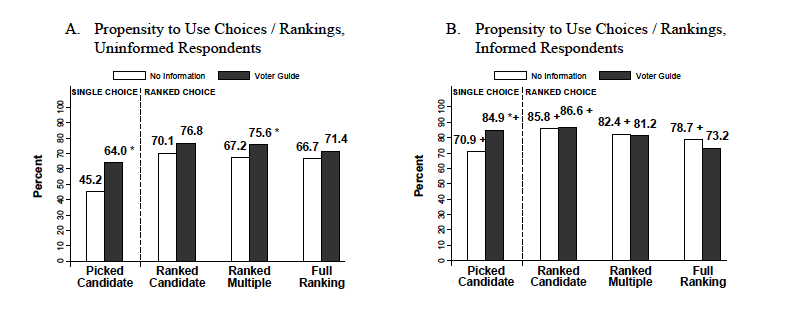
Notes: *denotes the difference between voter guide and no information groups is statistically significant (p < .05, one-tailed). +(-)denotes within-group difference between uninformed and informed respondents is positive (negative) and statistically significant (p < .05, one-tailed).
Ranking truncation—that is, not utilizing all allotted rankings—is always challenging to evaluate, given that one voter’s indifference or ignorance is another's conscious protest. But regardless of why a voter doesn’t use their allotted rankings, the implications for RCV are enormous. One of the central selling points of RCV is that it produces majority winners. When voters don’t rank multiple candidates, their ballots are much more likely to be exhausted (i.e., not counted in the final tally). For example, a frequently cited 2015 article by Craig M. Burnett and Vladimir Kogan analyzed ranked-ballot data (some 600,000 votes) in four local elections in California and Washington and found that due to high ballot exhaustion none of the winners received the promised majority of the total votes cast.27 However, the study’s peculiarly small sample of elections and consideration only of races with a three-rank limit (a limit which has since been identified as a problem and is now less common) undercuts its generalizability. Further, when one considers all RCV elections in the United States, most of them do result in a final-round winner with a majority of total votes cast.
Another concern is voter error—when voters fills out the ballot incorrectly, invalidating their vote. This is different from truncation, since truncation can be deliberate. Error is by definition not deliberate.
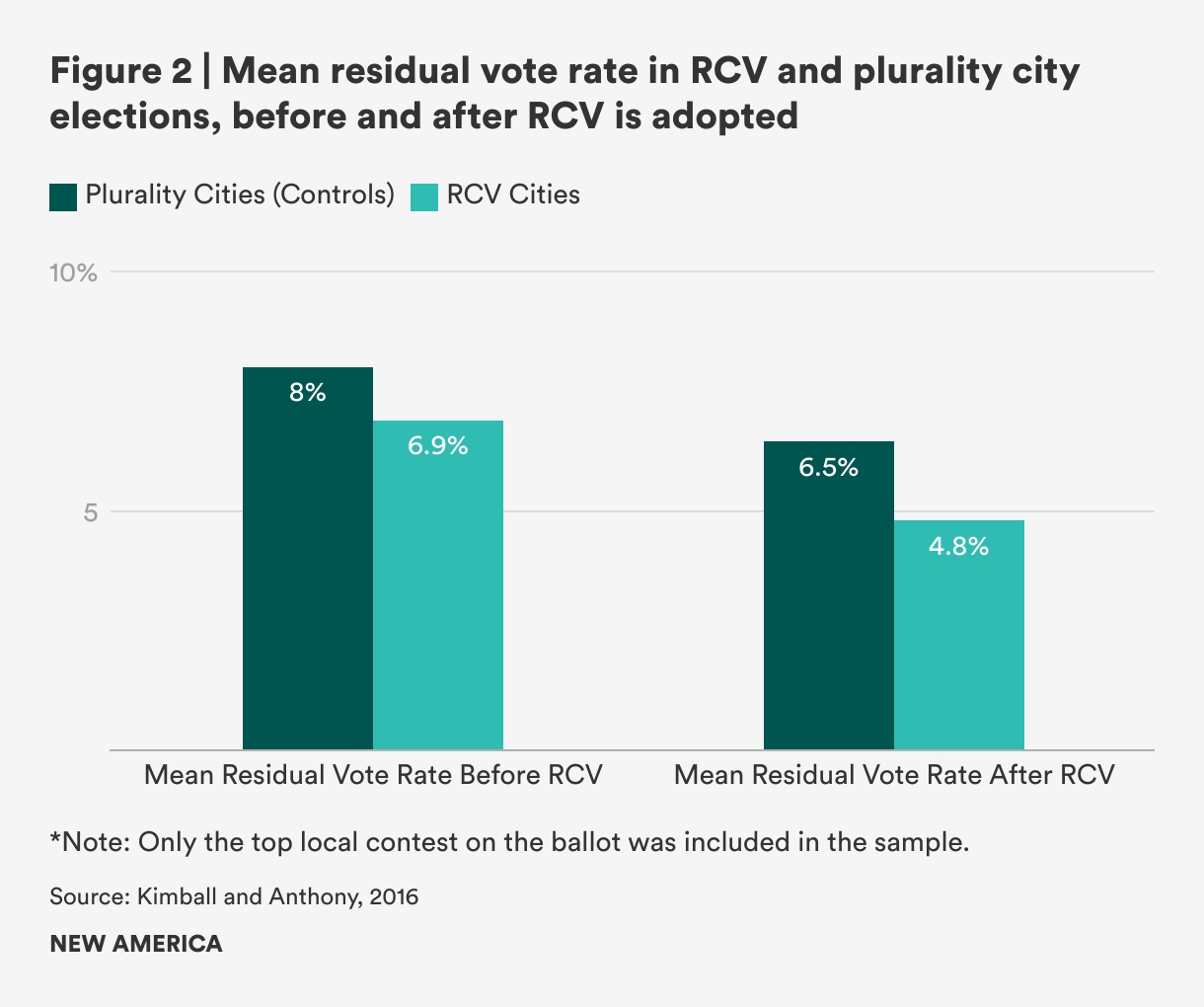
Many studies have addressed the “is RCV too confusing?” question by comparing the rate of residual, or invalid votes, recorded in plurality and RCV elections. In most cases, the residual vote rate—the difference between the total ballots cast and the number of valid votes recorded for the contest in question—has been found to be about the same, or lower, after adopting RCV, or in RCV cities versus plurality cities. Residual votes (or uncounted or voided votes) include undervotes (votes left blank), overvotes, and other mismarkings that cause the ballot to be disqualified.
For instance, a 2008 article by Francis Neely and Corey Cook found that the first local elections with RCV in San Francisco produced slightly lower residual vote rates than before RCV was implemented.28 In a 2016 paper, David Kimball and Joseph Anthony likewise observed a decline in residual vote rate after the adoption of RCV (see Figure 2). However, their regression results indicate the change in the difference between the groups is not statistically significant.29 From the same paper, a case study comparison of Minneapolis in 2005 and 2013 also revealed no significant change in residual vote rate after adopting RCV. They also found no significant changes in income-related disparities in ballot completion.
The rate of spoiled ballots is another helpful marker of voter confusion. When a voter (sometimes with the help of the voting equipment) notices an error in their ballot, the voter can return that “spoiled” ballot and exchange it for a new one. The original, spoiled ballot does not count, but tracking the number of spoiled ballots can help expose challenges voters face with specific types of ballots. Researchers Lawrence Jacobs and Joanne Miller found Minneapolis’s citywide spoiled ballot rate increased from 1 percent in 2005, when the city was still using plurality rules, to 4 percent in 2013, after switching to RCV. 30
Data separating undervotes and overvotes is more limited, but Neely and Cook’s analysis of voter behavior during the first three RCV elections in San Francisco showed that the reform decreased voters’ tendency to undervote compared to plurality.31 In the Minneapolis 2013 election, undervoting and other error rates did go up in comparison to pre-RCV elections, however the error and ranking truncation rates were still substantially lower than those reported for RCV elections in San Francisco.32 Additionally, a 2015 nationwide survey experiment found only 3.5 percent failed to rank any candidates at all.33
There is mixed evidence on whether (or to what extent) RCV increases overvoting overall and/or among certain demographic groups. Neely and McDaniel’s examination of San Francisco elections between 2004 and 2011 concluded the pattern of overvoting is similar in both RCV and non-RCV contests, and that overvotes occur disproportionately in precincts with more residents aged 65 or older. The probability of a disqualifying overvote at the precinct level also appeared to increase with the share of the population that is Black, Latino, foreign-born, and lower-income.34 Neely and Cook found racial differences in aggregate overvote patterns, but no disadvantage for elderly voters.35 Finally, comparing Minneapolis’s 2005 and 2013 elections (pre- and post-RCV implementation), Kimball and Anthony reported in their 2016 report that the undervote and overvote data do not reveal substantial income disparities in the 2013 Minneapolis mayoral election. Yet, Jacobs and Miller (previous cited) observed a higher rate of spoiled ballots in low income wards and majority-minority wards compared to high income and majority white wards in 2013.
Recent election simulations conducted by Jason Maloy at the height of the 2020 U.S. presidential primary season suggest that RCV and other more complex ballot types do not increase the chance that a voter’s ballot will be voided, despite raising the probability of at least one violation of voting instructions.36 In fact, results from the experiments show that, on this “most basic and widespread measure of voting error,” the rate of void votes (also known as invalid, residual, or rejected), RCV outperformed the traditional, single-mark ballot. Results further suggest that group-based inequalities in voting error—measured by the discrepancies in void rates across age, gender, and race cohorts—are smaller with reform ballots than single-mark, plurality ballots.
The conventional wisdom on more complex ballot types is that they increase information costs for voters. “All-or-nothing is crude but accessible, whereas giving different degrees of support to different candidates is more expressive but also more error-prone,” as Maloy put it in a brief reporting his findings. But this tradeoff is not as evident, or as big a problem, as one might expect. Switching from a standard plurality ballot to preferential ballot appears to increase the likelihood of a voter choosing at least one candidate and thus the likelihood of having their vote count.
Therefore, if there is a trade-off, it may simply be this: With single-winner plurality voting, voters are slightly less likely to make mistakes, but also less likely to choose any candidates. With more choice, more voters express their political preferences, but some of that increase in expression is canceled out by errors. 37 Of course, over time, as voters learn, the errors are likely to decline, thus reducing the potential of a trade-off.
Instead of major errors, ranking truncation remains a much greater concern to RCV advocates and administrators. Rampant truncation can jeopardize RCV’s promise of delivering a widely-agreed upon majority winner. Worse, there is evidence that less educated and minority voters are more likely to truncate their rankings, and therefore less likely to have their ballots count toward the final tally. But wasted votes and demographic disparities in ballot completion also exist in plurality elections. Indeed, as Maloy found in his study, RCV was actually associated with smaller discrepancies in error-proneness according to race and gender, while the plurality ballot was associated with larger discrepancies.
For RCV jurisdictions or those considering the reform, the most important takeaway from the research thus far is that it is possible to encourage more complete rankings among voters, thus improving the quality of RCV elections.38
As we saw before with reported understanding of RCV, experience is the best teacher. As voters become more familiar with ranking, they make better use of rankings and make fewer errors. Neely and Cook found that the share of ballots on which three candidates were ranked was 7 to 9 percent higher in precincts where voters used it for the second time compared to those using it for the first time.39 The literature suggests other remedies, too: voter guides40 (and aggressive voter education in general) can increase voters’ propensity to use their rankings, in addition to lively competition (especially races to fill open seats),41 and more campaign spending.42 The same factors can moderate disparities in ballot completion and error among historically disenfranchised groups. 43
Finally, limiting the number of candidates on the ballot can help offset the added cognitive and informational burdens that RCV places on voters. Ranking truncation appears to rise in tandem with the number of candidates listed on the ballot. Boudreau et al. saw a substantial drop in the share of uninformed respondents who used their rankings when the number of candidates increased from three to seven. No such erosion was evident in the single-choice plurality setting. Neely and Cook’s 2008 study of error in San Francisco’s RCV elections observed a similar decrease in rankings as the number of candidates increased. Beyond truncation, as the number of candidates increases, more “catastrophic” voting errors (those that void your vote) may creep up as well. The article estimated that an increase from 10 to 16 candidates on the ballot would increase the average undervote rate from 0.9 percent to 1.2 percent. Moreover, the number of candidates listed on the ballot was the strongest predictor of overvotes.44
At this point, we understand the challenges that voters in both voting correctly under RCV and the importance of fully using their rankings. Where more research could be useful would be in understanding the ways in which election administrators can more effectively help voters to be most effective in casting their ballots. Might certain interventions be more effective than others? Could certain ballot designs improve voters’ ability to cast their ballots effectively? Additionally, might election administrators find ways to limit ballot overcrowding, or offer mechanisms that allow parties or interest groups to more easily provide voters with suggested rankings for those voters who would prefer to delegate candidate evaluation to a trusted intermediary? Could offering practice ballots before the election help reduce errors? Such interventions could be tested first through experiments.
Claim 3: RCV Increases Voter Participation
Conclusion: Mixed evidence, hard to assess
For good government reformers, persistently low voter turnout in the United States has long been a source of frustration and hand-wringing. One consistent finding in the voting reform literature is that interventions meant to boost participation tend to have marginal impact on turnout, and can even increase demographic disparities in turnout, as long as elections remain mostly uncompetitive and voters have limited and generally uninspiring choices. In theory, then, the potential for ranked-choice voting to increase voter turnout and mitigate participatory biases by expanding voter choice is promising.
However, this mechanism is indirect. In order for ranked-choice voting to increase participation, it must first increase competition and candidate entry. After all, in a recent Knight Foundation report on non-voters, the most common reason cited for not voting was “Don’t Like the Candidates” (17 percent), followed by “Vote Doesn’t Matter” (12 percent).45 To the extent that RCV can encourage more candidates running, and make more voters feel like their votes matter, it has the potential to improve voter turnout. Nonetheless, several studies have analyzed the correlation between ranked-choice voting and turnout more directly.
Scholarly research on RCV and turnout in the United States has been fairly limited, and findings have been mixed. Unlike early voting and other convenience reforms, about which there is substantial data spanning many years and locations and electoral contexts, there is still very little data to understand how RCV has impacted turnout where it is used and even less to guide predictions on how it might affect participation under different conditions. Not only is RCV still a novelty, with the earliest relevant cases going back less than two decades, but it’s used predominantly in low-turnout municipal elections, many of them nonpartisan and held in odd years or apart from the state and federal election schedule. These peculiar characteristics, coupled with insufficient data, create a challenge for researchers who wish to isolate RCV’s impact from other factors that we know to cause swings in turnout from one election to the next: who is on the ballot, when the election takes place, and whether elections are competitive.
During the Progressive Era, reformers who wanted to free local politics and elections from the grip of corrupt national party organizations enacted reforms like odd-year elections and nonpartisan municipal elections. In most cases, these reforms caused voter turnout in city elections to plummet and exacerbated existing disparities in participation.46 While timing is crucial for turnout, nonpartisan elections have proven at least as problematic. Voters—especially lower-information voters who already feel disconnected from politics—depend on partisan cues and party mobilization and education efforts not just to go to the polls but also to make informed choices.47
Still, if RCV does boost turnout even marginally, small increases in participation can be decisive in low-turnout races. And if RCV boosts participation among historically underrepresented groups relative to high-propensity voting populations, there’s a chance it can help disrupt a vicious cycle of nonvoting and disaffection for many citizens.48 Moreover, studying turnout effects can also facilitate future inquiry about how RCV might affect participation in statewide or federal elections.
In their 2016 analysis of participation in cities that use RCV compared to plurality cities, David Kimball and Joseph Anthony found that RCV was not associated with a statistically significant change in voter turnout in general elections.49 Instead of voting rules, their findings suggest general election turnout is influenced much more by the number of contests on the ballot (turnout spikes when there are three or more), timing (even-numbered years), and whether there’s a competitive mayoral race in play. Their case study of Minneapolis showed only a slightly higher rate of participation in RCV elections compared to general elections under plurality rules.50
However, in cases where ranked-choice voting elections combine what was formerly a low-turnout primary and an uncompetitive general election into one single contest, or a two-round election into a single election, RCV can boost turnout. Kimball and Anthony found that turnout in RCV elections far surpass that in primary and runoff elections in plurality cities. Many cities hold two elections for local offices: a primary election and, if nobody reaches a majority, a runoff election to decide between the top vote-getters from the primary. Sometimes one of these elections coincides with the general election, but not always. The way RCV is typically implemented is that the primary and runoff are combined into one “instant runoff” election, and that election is held in November, where it can share the ballot with higher-profile state and federal elections likely to attract more voters, thus boosting turnout overall. Notably, this is what all 23 Utah cities opting into RCV decided to do, effectively eliminating primaries.
Kimball and Anthony’s comparison of turnout in primary and runoff elections in RCV and plurality cities observed that in the elections prior to RCV adoption, mean turnout in the (future) RCV cities was 22.3 percent, compared to 14.8 percent in plurality cities; after cities adopted RCV (and converted all their elections to general elections), mean voter turnout in RCV cities was 31.7 percent and 16.9 percent in plurality cities—a larger difference that suggests RCV increases turnout compared to a baseline of a primary election followed by a general election. The authors suggest that turnout boosts may be more attributable to changes in timing and competitiveness than the voting method itself. Thus, to the extent that ranked-choice voting can make general elections both more competitive and more important by eliminating primary elections, this will likely increase turnout.
Jason McDaniel’s 2019 paper on turnout in mayoral elections using RCV found a slight decrease in turnout (about 3 to 5 percentage points) among cities that implemented the reform, compared to similar cities that did not. Despite using national data, it was still heavily focused in California, making it similar to previous analyses.51
As with concerns about some voters finding ranked-choice voting more difficult than others, some researchers have examined concerns that the impacts of ranked-choice voting on election turnout may also be disparate.
In their previously discussed analysis of the 2013 Minneapolis election, Jacobs and Miller reported higher rates of participation in white and high‐income wards, but did not show how that gap compared to turnout patterns found in pre-RCV elections. Kimball and Anthony addressed this gap in the research by comparing the same demographic turnout patterns from 2013 with those in Minneapolis’s 2005 elections, right before the city adopted RCV. They observed virtually no increase or decrease in turnout disparities between high-income and predominantly white wards and low-income wards with higher concentrations of people of color between 2005 and 2013.
Two studies suggest that RCV may reduce the income gap in turnout. A 2016 study of San Francisco’s mayoral elections between 1995 and 2011 by Jason McDaniel (the forerunner to his previously cited 2019 paper) found that, contrary to his expectations, higher levels of income, across racial groups, were not associated with higher levels of voter turnout in RCV elections, even though they were positively associated in plurality elections. This narrowing of the income-turnout gap would appear to be a sign that lower-income voters were mobilized by the opportunity for greater political expression afforded by RCV.52 These results have been supported in a recent working paper from Eamon McGinn, which concluded that the introduction of RCV to the Minneapolis-St. Paul Metro Area caused a 9.6 percentage point increase in turnout for mayoral elections, on average, and that the increased turnout effect is larger for precincts that have higher poverty rates.53
Let's examine McDaniel's 2016 study more closely now, with regard to other demographic turnout effects. Broken down by race, age, and education, the article suggested RCV was associated with a significant decline in Black turnout (about 18 points) and white voter turnout (about 16 points) compared to pre-RCV elections.54 He found no meaningful difference in Asian or Latino participation as a result of RCV adoption, and attributed any increases in their participation after RCV to the presence of in-group candidates on the ballot. Notably, Willie Brown was an African-American mayor of San Francisco before RCV was implemented. It is quite likely that with Brown no longer running, Black turnout declined, a change merely coincidental (and therefore causally unrelated) to RCV. Again, this highlights a more general point: If RCV increases turnout, it does so indirectly. If RCV encourages more diverse candidates to run, it may also encourage more people to participate because of an opportunity to vote for a candidate they feel represents them well.
McDaniel’s main takeaway on racial turnout disparities was that any negative racial turnout effects of RCV “can be offset when there are clear racial group interests at stake, especially among newly mobilizing portions of the electorate.” Translation: the more candidates on the ballot from your racial or ethnic group, the more likely you are to vote. The missing piece of the puzzle here, then, may be whether RCV can increase candidate entry among underrepresented groups enough to outweigh potential negative turnout effects imposed by the extra information costs involved. However, the jury is still out on these potential negative turnout effects, with different studies finding differing effects.
Finally, McDaniel concluded that younger and poorly-educated voters were most likely not to vote under RCV elections. On the other end, there was a positive relationship between graduate education and turnout in RCV elections—and here, again, the strongest marginal effect was among white voters. The results suggest that the information demands of RCV may widen the gap between voter participation among the most and least highly educated members of the population.
McDaniel’s findings concerning youth voter turnout have since been challenged in an article by Courtney L. Juelich and Joseph A. Coll. Juelich and Coll used a matched study of individual level voter turnout for seven RCV and 14 non-RCV local elections from 2013 and 2014, and found no statistical difference in voting rates between RCV and plurality cities for the general public. But, in contrast to McDaniel, they estimate that younger voters are 9 percentage points more likely to vote in RCV cities than plurality cities. From the article: “increased contact in RCV elections accounts for a larger portion of the increased voter turnout compared to perceptions of campaign civility. Findings suggest RCV acts as a positive mobilizing force for youth voting through increasing campaign contact.”55
Another measure of participation is called voter drop-off, or the difference between ballots cast in the first and last rounds of voting, such as between primaries and general elections or primaries and runoffs. By replacing primaries and runoffs with a single RCV election held in November, again, we should see more continuity in voting, and therefore less drop-off. Ballot exhaustion—when an RCV ballot doesn’t make it to the final tally—complicates this argument, but less so if most people utilize their rankings. Taking ballot exhaustion into account, the 2016 Kimball and Anthony paper cited above compared the drop in voter participation from the first to the last rounds of voting in RCV and plurality cities. For RCV cities, they measured drop-off as the difference between the total ballots cast in the election and the number of valid votes counted in the final round of vote tabulation; in plurality cities, they measured drop-off as the difference between the total ballots cast in the general election and the valid votes for the top local contest in the primary or runoff. Based on a sample of 62 elections (including 43 plurality cities that held a separate primary or runoff in addition to the November general election), they calculated that RCV adoption is associated with a 24 percentage point reduction in drop-off.56 This sizable improvement indicates that RCV dramatically reduces the voter participation gap seen in plurality elections, where about half of voters participate in the general but not primary election, or one round only of the runoff.57 Furthermore, the change illuminates how RCV can address the problem of low primary turnout.58
Over the last several years, primary elections and primary electorates have become an important focus of political reformers, and primary reforms have taken up a correspondingly large share of reform thought and resources. A recent New America report summarizing the literature on primary reform found that changing the rules of primaries from closed to open, as many reformers propose, shows little evidence of reducing polarization, or significantly boosting turnout.59 As the report notes, drawing on existing studies: “At best, open primaries increase participation by only 2 or 3 percentage points, and top-two primaries by about 6 percentage points.60 Given already abysmally low turnout in primaries, and thus plenty of room to expand, these are hardly transformative numbers—especially since they do not appear to change the ideological content of the voters who participate.”61
However, by merging the primary election into the general election, RCV offers a chance to improve primary turnout in ways that conventional primary reforms seemingly cannot.
As of 2021, nearly all RCV elections in the United States are held at the local level, where nationwide turnout is dismal, and getting steadily more so over time, regardless of voting system. A 2007 study of mayoral elections of the largest cities in the United States over the previous 25 years found that average voter turnout was only 27 percent, and was decreasing every year.62 A 2016 study of local election turnout in 50 U.S. cities found that turnout in 10 of America’s 30 largest cities was less than 15 percent.63 Turnout skyrockets when the local election coincides with a national election, or if there is a hotly contested mayoral election.64 This has substantial implications for research on RCV’s turnout effects. With our sample of cases largely limited to municipal and often nonpartisan elections (in relatively engaged localities), the best we can say for RCV, independent of timing considerations, is that it may increase local turnout from a pathetic baseline to a slightly less pathetic level by attracting more, and more diverse, candidates. However, if RCV is able to combine the primary and the general election into a single election, held in November alongside other national elections, it is likely to have a more powerful effect in boosting turnout.
But, with a very limited sample, and many other factors that determine voter turnout, it is very difficult to say with much confidence whether RCV in itself is responsible for increases in participation where it has been implemented, let alone whether it would impact turnout if it were implemented in more statewide and federal elections. This presents a serious challenge for researchers trying to study the turnout effects of RCV apart from the impacts of timing and competitiveness, as well as advocates selling RCV on the grounds it can mobilize voters. However, if RCV combines what was previously two elections, a primary and a general (or primary and runoff), it can potentially solve the problem of low-turnout primaries more effectively than open primaries or other primary reform.
Claim 4: Voters like RCV, and Consider it an Improvement Over the Status Quo
Conclusion: Generally supported, with caveats
In order for RCV to catch on, voters have to like it. After all, either voters in states that use plurality voting will have to affirmatively choose to switch through a binding referendum, or politicians will have to vote to switch because they believe such a change will be popular. So, public opinion matters.
While limited, the literature on voters’ response to RCV is growing, and we now have a much better understanding of how voters feel about the reform in general, in comparison with the plurality method, as well as what demographic factors predict support for or opposition to RCV.
Briefly, findings consistently show that younger voters, Democrats, and those with past experience using RCV tend to be more supportive of the reform than older voters, Republicans, and those who are new to RCV. Meanwhile, surveys conducted in and around RCV cities and/or in tandem with real RCV elections generate more supportive attitudes, whereas experimental surveys conducted nationwide tend to generate lower opinions of RCV. This difference is likely due to the fact that most voters nationally aren’t familiar, let alone have had any direct experience, with RCV. In the case of RCV, familiarity generally breeds comfort and warmth.
When Americans who don’t know RCV are exposed to it in an experimental setting and asked to rate the system, the majority tend to prefer the status quo plurality method—at least at first. Conversely, in places where RCV has already been implemented, voters tend to prefer RCV to traditional voting systems. For example, when researchers Sarah John and Andrew Douglas surveyed voters in RCV cities and non-RCV cities in 2013 and 2014, they found support for the reform was greatest in cities already using RCV (though the gap was far narrower in California cities).65 After RCV was implemented in their cities, 65 percent of Minneapolis respondents said they preferred RCV to what they had before; in San Francisco, 61 percent of polling place voters preferred RCV and 77 percent of absentee voters preferred RCV.66
Unsurprisingly, exit polls from Santa Fe’s 2018 and New York City’s 2021 inaugural RCV elections showed large majorities of residents wanting to use RCV in future municipal elections (71 percent and 79 percent, respectively). In both polls, however, support for using RCV dropped 16 percentage points when the question turned to whether RCV should be used in elections beyond the local level.67 While this still leaves a majority of respondents in each city who support expanded use of RCV, the discrepancy is worth exploring further, particularly in light of what has taken place in Maine.
Indeed, Maine, the only U.S. state as of 2021 to have implemented RCV for statewide and federal elections, seems to be the exception in terms of public opinion toward the reform. In a pre-primary election statewide survey taken in 2018, Maine voters were asked how much they would like the experience of using RCV. Fifty percent of respondents answered that they expected using RCV to be either “excellent” or “good,” compared to 42 percent who expected it to be “just fair” or “poor.” The question is not a perfect proxy for “do you support RCV, or prefer it to the old way?,” but it gives us a sense of what happens to public opinion when the reform is introduced into partisan contexts, beyond the municipal level. To be sure, cities that adopt RCV are likely to be cities where there is already support for RCV and one party is dominant.
Meanwhile, Lindsay Nielson’s online survey of 622 American adults showed RCV was rated far below plurality and majority (runoff) methods on overall preference. The analysis also found that voting in a mock RCV election as part of a survey did not make respondents more likely to support RCV voting systems.68 These findings have since been validated at least partially by a suite of studies commissioned by the Electoral Reform Research Group.69 This suggests that it may not be the RCV election itself that engenders familiarity, but rather the social learning that comes with the experience of voting in an RCV election.
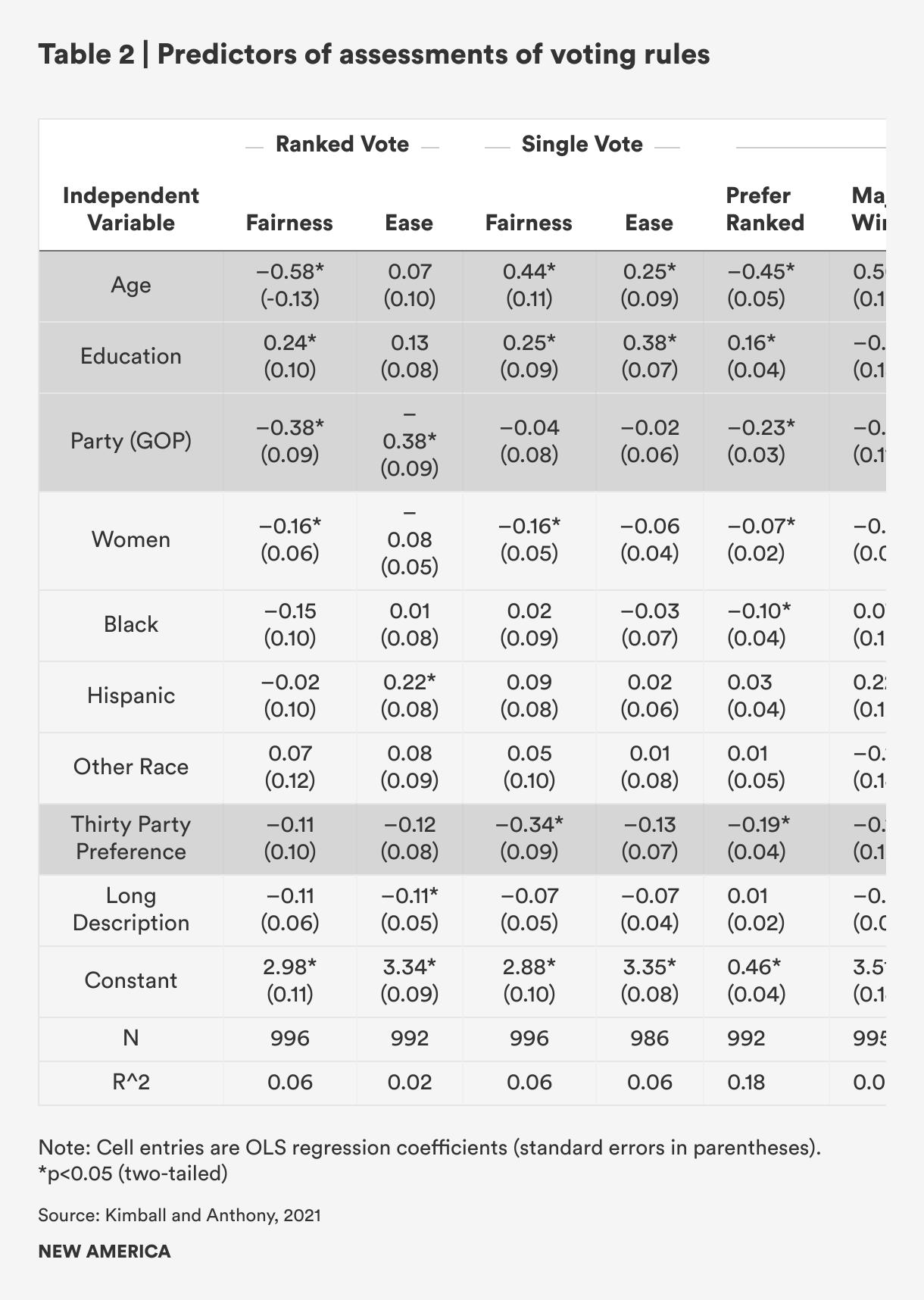
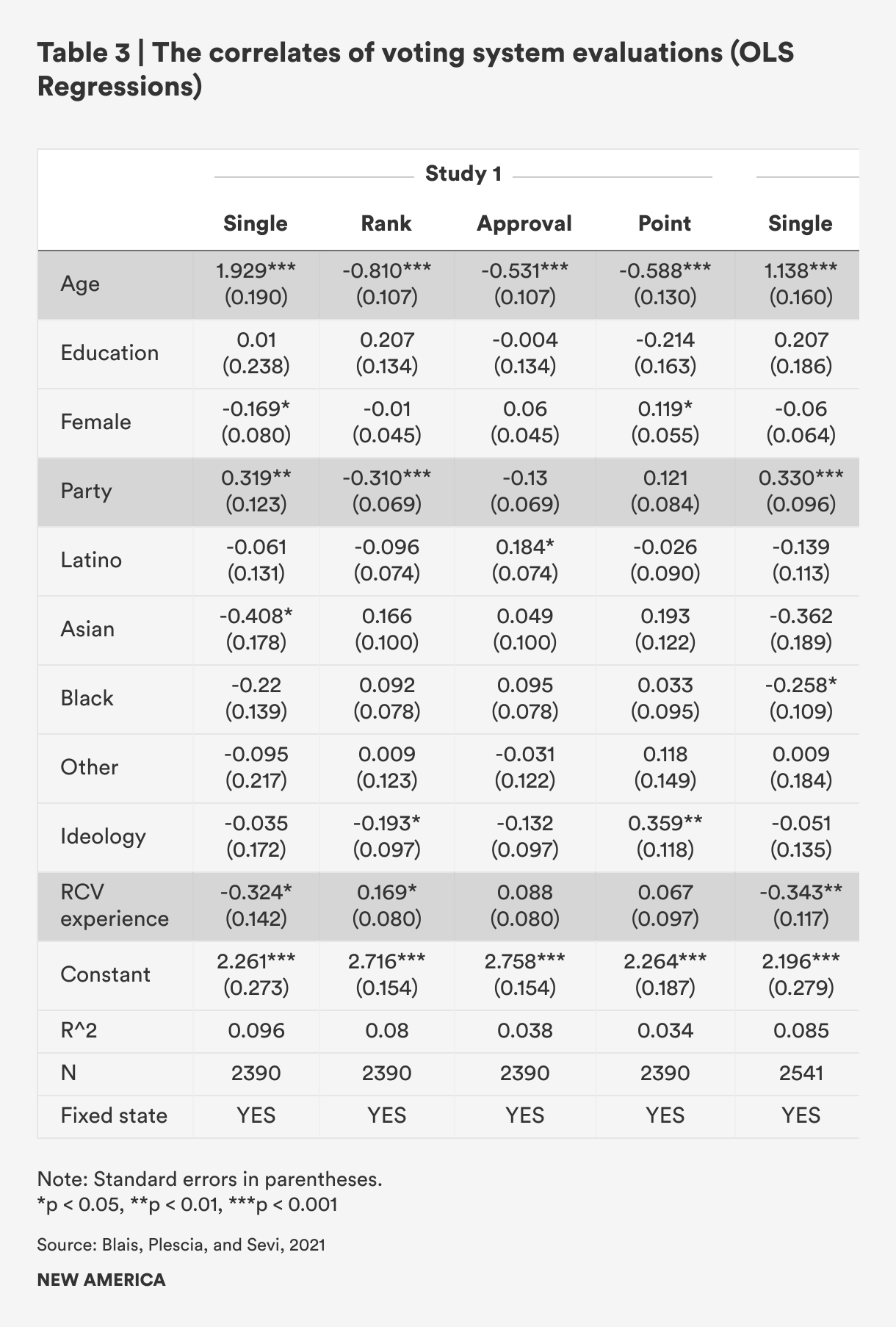
For example, a study by Andre Blais, Carolina Plescia, and Semra Sevi, reported similar results from their 2020 survey experiments conducted in Super Tuesday states and nationally. The authors found that the single vote (plurality) remains the most preferred voting method.70 Additionally, the 2021 David Kimball and Joseph Anthony paper discussed above found a strong majority of respondents in a national survey experiment preferred the single vote plurality method to RCV.71 Again, it is important to understand that for most voters, RCV is still something different and strange, and a single survey experiment can only capture this initial reaction.
Because of this frequent attitudinal disconnect between residents of RCV cities and nationally representative samples of American voters, there is good reason to be skeptical of national survey experiments that measure respondents’ preferences for RCV versus other voting systems, since these respondents are likely to be ignorant of RCV. For reform practitioners working on the ground in communities that have adopted or are campaigning to adopt RCV, it’s common sense that people don’t like change—but once something new comes along, people get used to it, and even learn to like it. Thus, voting experiments divorced from real-life election settings can appear to be academic exercises at best, and may have a chilling effect on reform, at worst.
While these critiques have merit, the surveys offer important insights into how different types of voters might initially respond to ranking, and how advocates can both better respond to initial hesitation and design educational resources. Anyone embarking on a new campaign to implement RCV needs to understand that at this point, most voters are likely unaware and skeptical, and thus will need convincing that there is a better way to vote. Such research can also serve as benchmarks for future studies. If national efforts to improve the popularity of RCV are successful, we should observe changes in receptivity to ranked-choice voting in these kinds of surveys and experiments.
These surveys can also help advocates better understand which demographic groups will be most receptive and most resistant, and thus can help shape advocacy efforts. Here is a breakdown of findings regarding who is most likely to “like” RCV, and who is more likely to need additional experience or convincing, based on a selection of recent studies.
- "Ranked-Choice Voting, Runoff, and Democracy: Insights from Maine and Other U.S. States," by Joseph Cerrone and Cynthia McClintock:
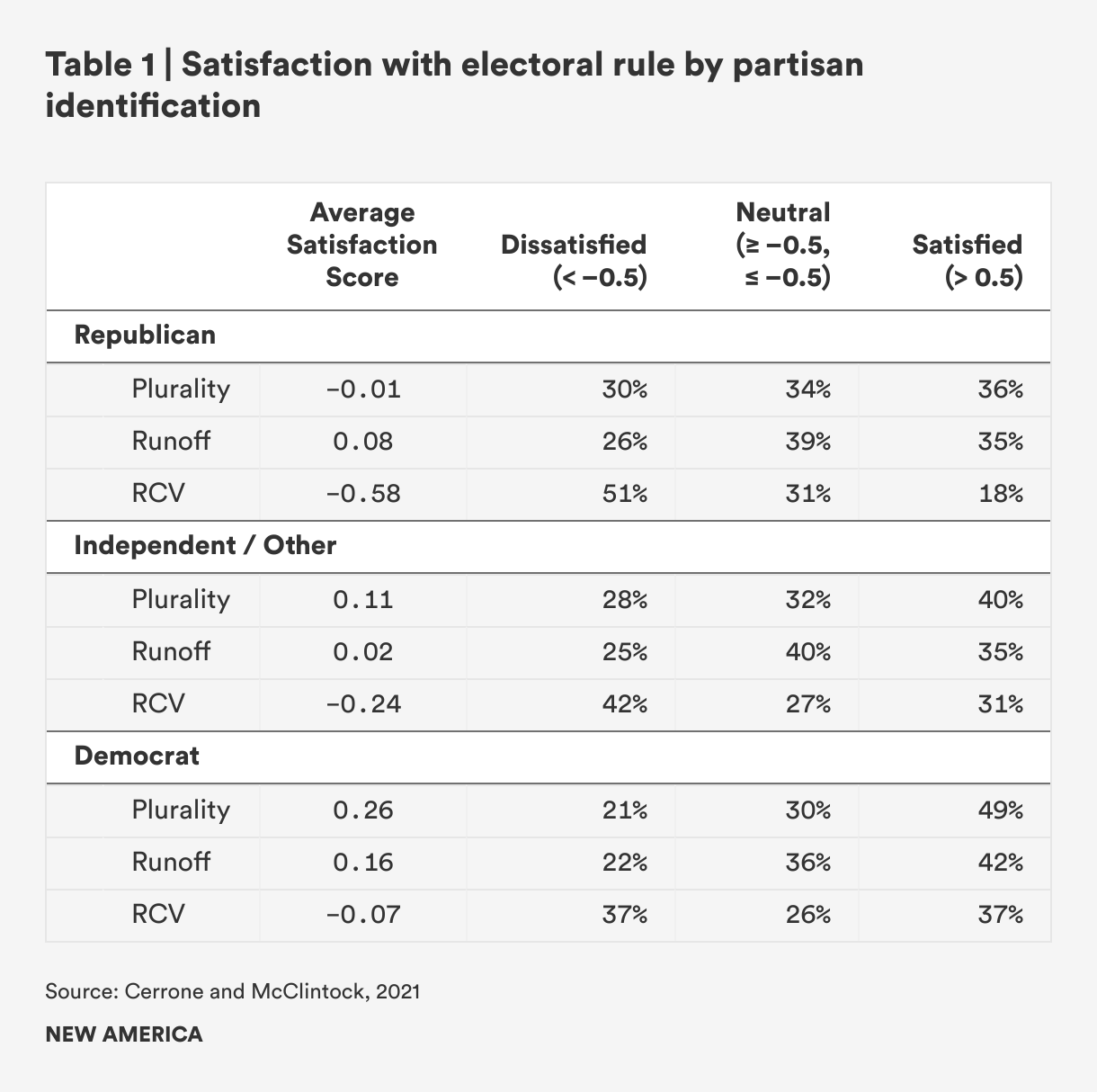
- Overall, 65 percent of Republicans in the national survey indicated opposition to changing electoral rules; only 12 percent of Democrats and 36 percent of Independents said the same. RCV also had a negative effect on Republican voters’ satisfaction with elections, while there was virtually no effect for Democrats and Independents.72
- "Public Perceptions of Alternative Voting Systems," by David Kimball and Joseph Anthony:
- Younger voters, Democrats, more educated respondents, and third party supporters tend to evaluate RCV more positively than older voters, Republicans, less educated respondents, and major party supporters.73
- "Choosing to Vote As Usual," by Andre Blais, Carolina Plescia, and Semra Sevi:
- Older voters are most supportive of the single vote versus the reform options. Results also show that those who identify as Republican overwhelmingly prefer the single vote and dislike the other systems, especially RCV. Finally, those who have personal experience with the RCV ballot tend to give higher ratings to that system, and lower ratings to the single vote. In a notable departure from other studies, the authors find that older voters’ strong preference for the single vote holds regardless of educational attainment.74
- "Ranked Choice Voting as a Generational Issue in Modern America Politics," by Devin McCarthy and Jack Santucci:
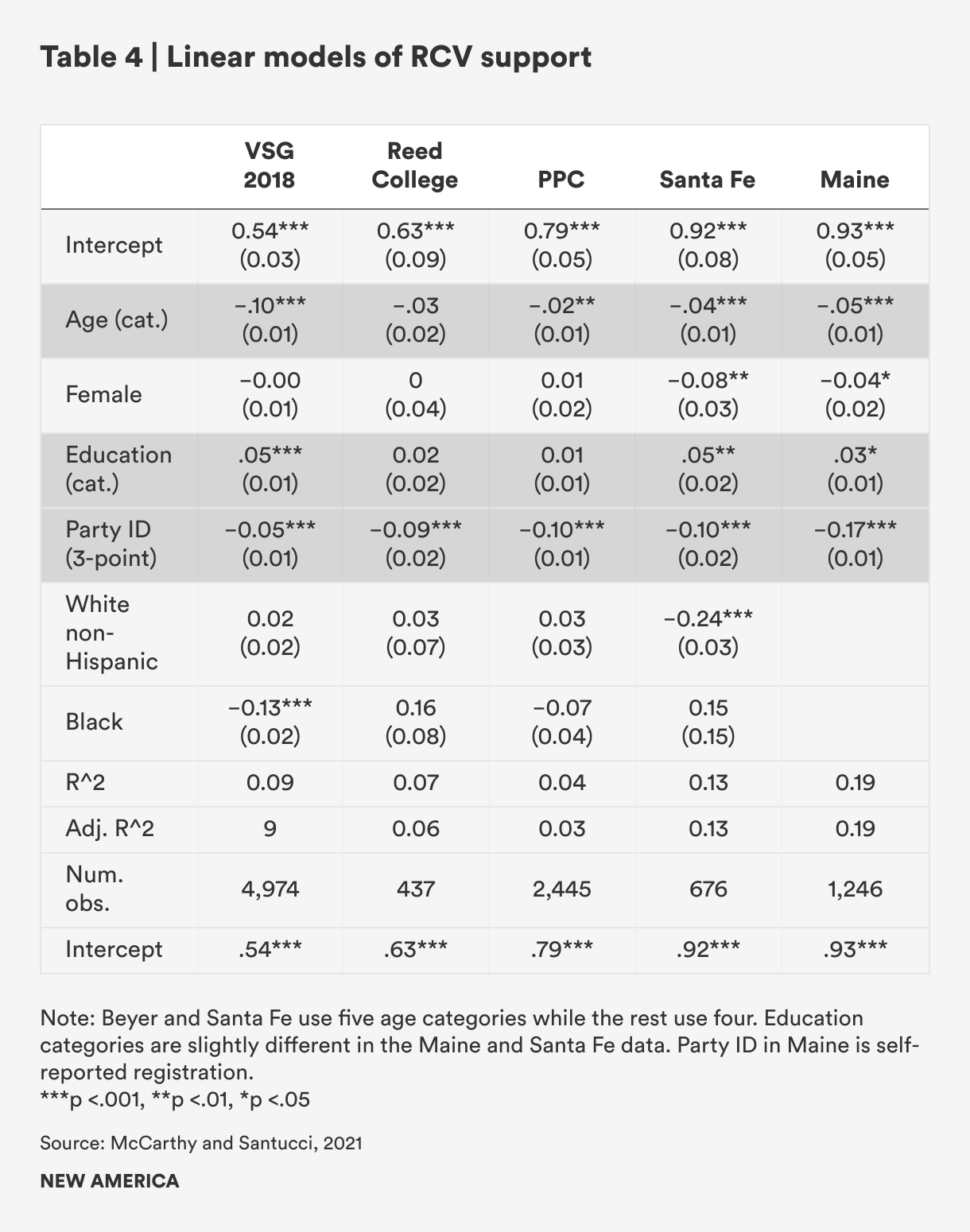
- Their analysis of five different surveys (three nationwide and two from places that have adopted RCV, Sante Fe, New Mexico and Maine) found that self-identified Democrats and people with more education are more likely to support RCV. Black respondents are less supportive of RCV in two of the nationwide samples when controlling for other variables, although Black respondents are still more likely to support RCV than the average American—just less likely than white Democrats. Across partisan and racial groups, RCV support is highest among young people.75
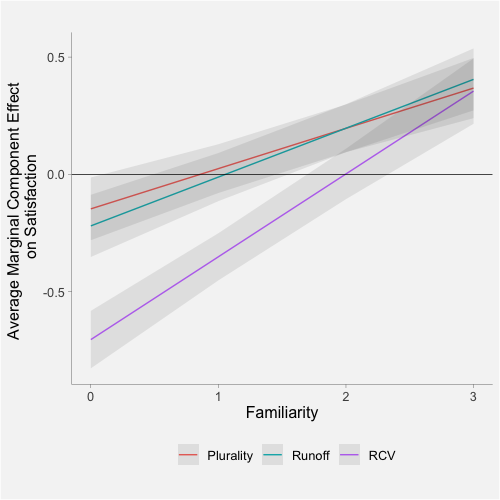
Furthermore, the experimental surveys discussed above suggest that through greater familiarity and experience, most people learn to like RCV, provided partisanship doesn’t get in the way.76 Illustrating this, McClintock and Cerrone’s survey found that unfamiliarity with RCV had a much stronger negative impact on satisfaction for RCV compared to plurality or runoff. Yet, they observed no difference in effect among those “very familiar” with the rule. “This suggests that voters do indeed ‘learn to like’ RCV and become more satisfied with it over time.”
Figure 3 | Familiarity increases satisfaction, especially with RCV
It is evident that experience makes people more comfortable with RCV generally, and certain demographic groups are more inclined to support RCV than others. What is less clear is how voters (both with and without RCV knowledge or experience) feel about certain features of RCV, what goes into those evaluations, or even what aspects of the system people find most appealing. Here, survey messaging and question wording matter considerably.
For instance, one of RCV’s central advantages is that voters can express themselves sincerely and not have to worry about their vote being wasted. However, as Kimball and Anthony noted, there is not much direct evidence indicating whether American voters really like this feature. Using a module from the 2020 CCES, Kimball and Anthony conducted a set of national experiments in which respondents were asked to complete voting tasks and answer questions afterward. They found that a short explanation of the vote transfer properties of RCV did not increase public support for the voting rule, but that this was in conflict with older respondents' expressed preference for majority winners. The disconnect here suggests that, in the absence of direct experience with RCV, reading about its advantages of RCV and disadvantages of plurality may be too abstract and/or superficial to register meaningful opinion change.77
In a similar vein, McClintock and Cerrone’s survey experiment indicates that most voters don’t understand the threat of a spoiler throwing an election to the least-preferred candidate. “Further, under RCV, many voters find the remedy for the ‘spoiler’ problem—the allocation of additional-preference votes leading to a come-from-behind victory—unsatisfying.”
Devin McCarthy and Jack Santucci’s summary analysis of public opinion polling on RCV considered the extent to which wording may affect observed support for RCV.78 Depending on question wording, they observed, support for RCV ranged from 23 percent to 55 percent in national surveys by Democracy Fund’s Voter Study Group (VSG) and the Program for Public Consultation National Survey (PPC), respectively.79 The VSG survey presented respondents with a choice between a system in which the winner is the candidate with the most votes and a system in which the winner has majority support. The PPC survey took a different approach. First, it provided an extensive description of RCV (including how it works, what issues it addresses, where it is used), and identified the reform as part of a current bill in Congress. Then, it presented four arguments, two in favor of RCV and two against, and asked respondents whether they would recommend that their members of Congress would support the [hypothetical] bill to introduce RCV to federal elections. (See Table 5 for the full VSG question wording and the question and four arguments from the PPC survey). The latter, more information-heavy approach led to much higher levels of support for RCV.
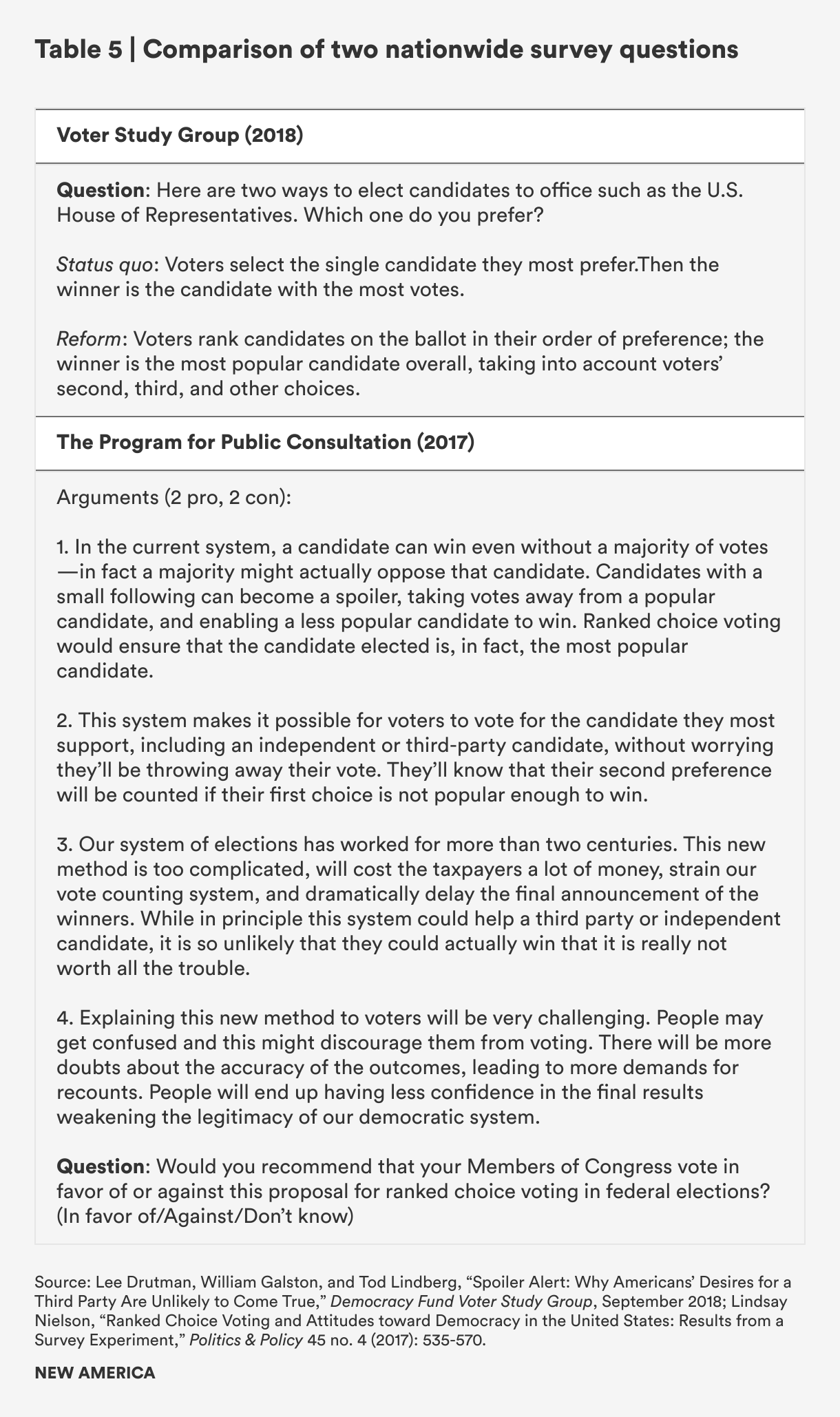
From the same analysis, a Santa Fe poll showed 71 percent said “yes,” they supported using RCV in future local elections. However, only 66 percent indicated support when the question was framed as a choice between one between a candidate who gets the majority of votes or a candidate with the most votes, similar to the VSG question. Support was even lower, 55 percent, when asked about using RCV in state elections (using this same framing)—another warning sign about the difficulties of adopting RCV beyond the local level.80
In terms of persuasive power, if we dig into the original PPC 2017 survey report, it’s evident that positive arguments (especially the second) about RCV were more convincing to respondents than negative ones, on average. And even though the majority of Republican respondents were against the hypothetical RCV bill, 62 percent of them said they would find an RCV federal elections proposal acceptable or tolerable, and 68 percent of respondents in very red districts would find it acceptable or tolerable.81
It is admittedly difficult to capture the important elements of ranked-choice voting in a singular question as part of a larger survey, and expect respondents to get ranked-choice voting if they are unfamiliar with it. All of this suggests that campaigners and advocates should not get too lost in the specific mechanics of how ranked-choice voting works, since experience here is clearly the best teacher. Instead, they should focus on the benefits of ranked-choice voting and work hard to make the new voting system feel more familiar. Lacking this direct experience, voters are likely to rely on partisan and elite cues.
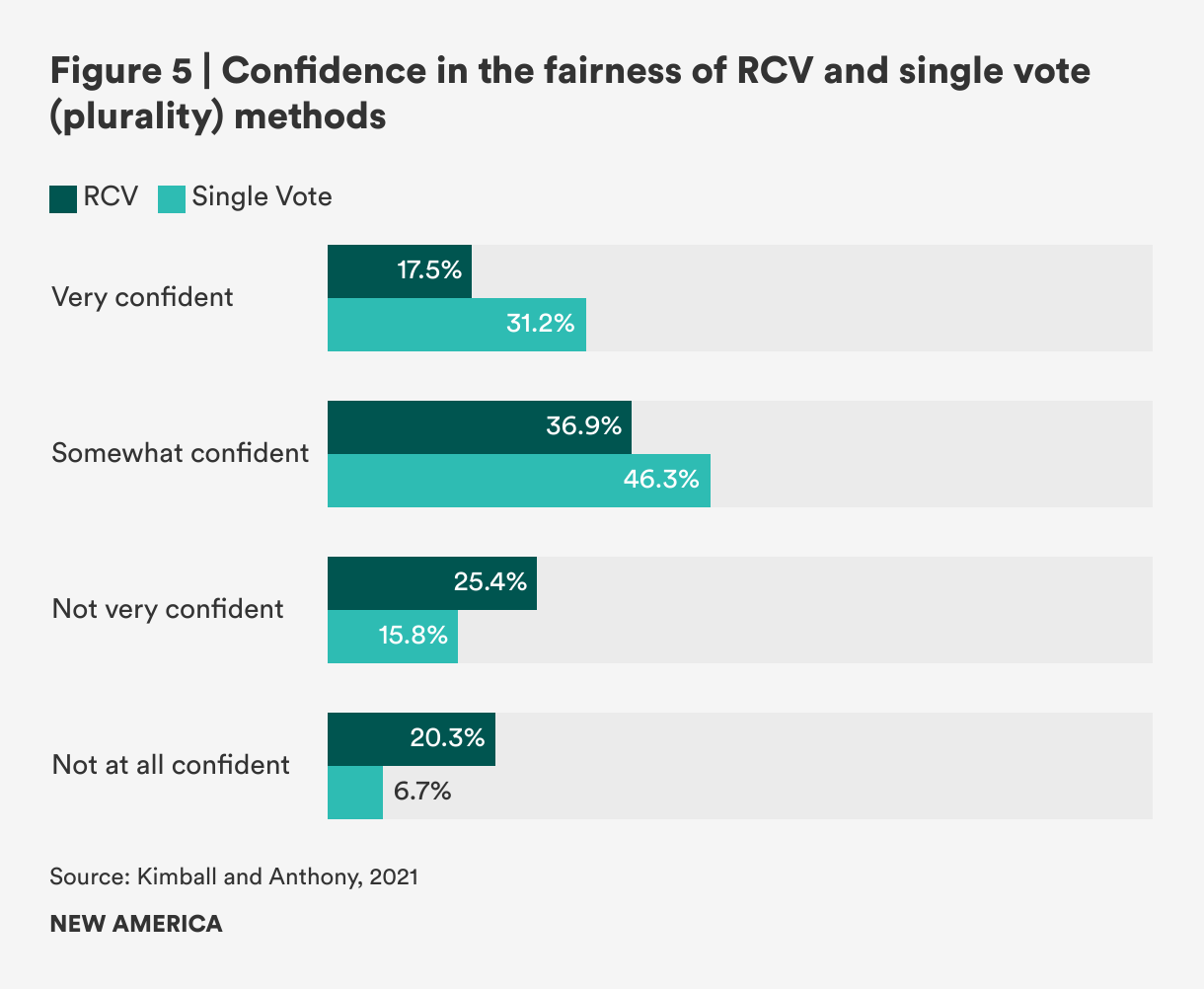
Claim 5: RCV Makes Voters Think Elections are Fairer
Conclusion: Not well-supported
A stable democracy depends on people believing the electoral process is legitimate and fair. The insurrection of January 6, which was caused by electoral losers’ refusal to accept the results of the 2020 presidential election, is case in point. So far, only a few U.S.-based empirical studies have examined the relationship between RCV and attitudes toward the democratic process.82 But early indications show that RCV does not do much to improve voters’ faith in the system. Experimental work even suggests that it may reduce voters’ perceptions of fairness, since the process by which votes are transferred can appear mysterious to voters, especially those who see their preferred candidate ahead in the initial tally only to have them lose after all the preferences are transferred.
Let’s revisit some of the studies from the previous section, many of which contain relevant findings on this topic.
In their 2020 survey experiment Cynthia McClintock and Joseph Cerrone explored voters’ satisfaction with RCV, runoff, and plurality, through a nationwide survey experiment.83 Their satisfaction score was composed of seven post-treatment indicators, including perceived fairness (of results) and perceived legitimacy (of the winner).84 As the figure below shows, voters were less satisfied with RCV than with runoff or plurality, and especially less satisfied when the ultimate winner of the RCV contest did not receive the most first-preference votes (compared to no real dissatisfaction with non-majority winners in a plurality context and much less dissatisfaction than when the ultimate winner in a runoff was not the top vote-getter in the first round).
Figure 4 | Under RCV, voters much less satisfied with a likely/actual “come-from-behind victory”
Two recent papers, from Jesse Clark and Crowder-Meyer et al., found RCV decreased voter satisfaction and confidence, at least at first. Following a set of election experiments, Crowder-Meyer et al. reported “initial experience with RCV produces dissatisfaction, including lower levels of trust in how votes are being counted and in the officials overseeing elections. However, after voting in a second series of ranked-choice contests (in a later experiment), these negative perceptions dissipate.”85
In Kimball and Anthony’s 2021 survey experiment, majorities of respondents reported being somewhat or very confident in the fairness of each voting method, but respondents rated the single vote method higher than RCV. They also found that varying the description of each voting rule did not significantly affect fairness ratings of either voting system, nor did providing a more thorough explanation of voting rules, including how RCV’s vote transfer system works. Figure 5 compares the distribution of ratings of both voting rules in terms of voter confidence that the method produces a fair outcome.86
One recent article does suggest a link between RCV and higher fairness ratings. "Electoral Systems and Political Attitudes: Experimental Evidence," by Sean Fischer, Amber Hye-Yon Lee, Yphtach Lelkes, found in their election game experiment that moving from a plurality to an RCV system had no impact on perceived fairness or satisfaction with the outcomes, but the gap between how winners and losers perceived the fairness of the election was smaller under RCV than plurality. The gap was especially narrow when RCV was combined with five political parties. The article also suggests that increasing the number of parties increases overall satisfaction and decreases the winner-loser gap in satisfaction with results (though RCV and proportional systems with three and four parties are no better on winner-loser gap than plurality systems).87
Fischer et al. validate previous findings that winning, more than which voting system is used, affects citizen attitudes toward the electoral process—winners are more likely to be satisfied with results and perceive the election as fair, while losers feel the opposite, especially in majoritarian winner-take-all elections.88 But their laboratory setting was detached from real-world U.S. partisan politics. There were no Democrats or Republicans; generic teams stood in for political parties. Furthermore, the finding that winning has a stronger impact on democratic legitimacy, rather than steer us away from prioritizing voting reform (as the discussion of turnout effects may have done, for example), points us back toward reforms like RCV and STV, which are designed to make more people feel like winners—or at least, to soften the blow of losing.
Unfortunately, such reforms are already deeply partisan, thanks in large part to Maine. The Maine Republican Party’s opposition to RCV has been internalized by co-partisans nationwide. Americans who identify as Republican have a clear aversion to RCV. In their 2021 paper discussed earlier, Cerrone and McClintock concluded that this is an expression of general wariness of reform. When they asked about the likelihood that the voter would support changing U.S. electoral rules, 65 percent of Republicans overall indicated opposition to changing electoral rules, compared to 12 percent of Democrats and 36 percent of Independents.
From a philosophical point of view, Republicans’ opposition makes sense; Republicans are conservative, conservatives don’t want to change institutions. And yet, as previously shown in Table 1, “Satisfaction with electoral rule by partisan ID,” Republicans indicated lower satisfaction and higher dissatisfaction with the status quo plurality-system than their Democratic counterparts. Moreover, as a recent paper from the Independence Institute, The Conservative Case for Ranked Choice Voting points out: “Conservatism is not a monolithic creed; the Republican Party should not be a monolithic entity… RCV provides a greater opportunity for other conservative and Republican voices to be heard, beyond those currently dominating the Republican party (and who have been less than successful at building a competitive Republican coalition, let alone a Republican majority).”89
Once again, the city-based data (which constitutes the majority of U.S. RCV literature) indicates voters tend to grow more satisfied with RCV with time and practice, while early Maine data and nationwide surveys suggest that such an evolution might be slowed or precluded by national political forces, particularly partisanship. Outside of Alaska, a state with a strong tradition of independent politics, and Utah, where Republicans face minimal electoral challenge from Democrats in a single-winner arrangement irrespective of voting method, Republican-led jurisdictions are not rushing to adopt RCV.90
This partisan polarization around RCV suggests a significant challenge for nationwide implementation. However, widespread voter ignorance of ranked-choice voting still provides an opportunity.
The research suggests that RCV advocates should actively engage GOP voters, elites, and decision-makers more explicitly, and place more emphasis on the problems of plurality and why “come-from-behind victories” are no less fair than non-majority plurality victories.
To maximize the effect of these outreach and messaging efforts, researchers will have to supply more and better evidence. During a June 2021 conference of the Electoral Reform Research Group, scholars and practitioners offered a number of suggestions along these lines, including the following:
- Describe a case where Republicans would have won with RCV in order to tease out the effect of partisanship versus ideological beliefs about RCV and electoral reform overall.
- Run counterfactual simulations on other electoral contexts, e.g., what if the recent U.S. Senate elections in Georgia had used RCV?
- Analyze the Republican Party of Virginia's use of RCV in their 2021 gubernatorial primary. What worked? Did it produce a candidate with appeal beyond GOP voters?
- Message test to figure out why RCV is such a hard sell on the right, in particular, where maintaining the status quo offers no clear political benefit to Republicans? Specifically, what are the best ways to move a conservative voter today to see reform not as a progressive hijacking?
- Poll Republicans on reforms that they believe would benefit them. If the Maine experience is turning Republicans off RCV more than their conservative stance toward institutional reform, polling them on reforms that would benefit them electorally should show that. And if it does, that suggests that perhaps the best way for Republicans to warm up to RCV is for it to help them win a few times.
Additionally, we suggest looking more closely at variation in attitudes toward RCV and reform among Republican voters. Some Republicans are more supportive of reform than others.
Citations
- In addition to single-winner RCV and STV, there is block-preferential voting, “bottoms‐up,” and RCV numbered posts. Jack Santucci, “Variants of Ranked‐Choice Voting from a Strategic Perspective,” Politics and Governance 9 (June 2021): 344–353, source">source.
- FairVote, “Where Ranked Choice Voting is Used,” accessed September 5, 2021, source">source.
- Santucci, “Variants of Ranked‐Choice Voting from a Strategic Perspective.”
- Amy J. Douglas, “The forgotten history of the single transferable vote in the United States,” Representation, 34 (July 1996): 13-20, source">source.
- Devin McCarthy and Jack Santucci, “Ranked Choice Voting as a Generational Issue in Modern America Politics,” Politics & Policy 49 (February 2021): 33–60, source">source.
- Francis Neely, Lisel Blash, and Corey Cook, An Assessment of Ranked-Choice Voting in the San Francisco 2004 Election (Daly City, CA: Public Research Institute, San Francisco State University, 2005); Richard E. DeLeon, San Francisco and instant runoff voting: An analysis of the SFSU/PRI exit poll data assessing voter opinions about ranked choice voting in the November 2004 Board of Supervisors elections (San Francisco, CA, September 2005), source.
- Francis Neely, Lisel Blash, and Corey Cook, An Assessment of Ranked-Choice Voting in the San Francisco 2005 Election (Daly City, CA: Public Research Institute, San Francisco State University, 2006).
- Ranked Choice Voting: 2009 City Of Minneapolis Municipal Elections (St. Cloud State University Survey, 2009), available at source; Michael Lewyn, “Two Cheers for Instant Runoff Voting,” Phoenix Law Review 6 (2012): 117-136, available at SSRN: source.
- The poll was conducted by Edison Research, with a sample size of 4,020 voters. Jay Wendland and Erin Carman, Ranking Works? An Examination Of Ranked Choice Voting In New York City (Amherst, New York: Daemen College, 2021), source.
- Sarah John and Andrew Douglas, “Candidate Civility and Voter Engagement in Seven Cities with Ranked Choice Voting,” National Civic Review 106 (Spring 2017): 25-29, source.
- Joseph A. Coll, “Demographic Disparities Using Ranked-Choice Voting? Ranking Difficulty, Under-Voting, and the 2020 Democratic Primary,” Politics and Governance 9 (June 2021): 293–305, source.
- Richard L. Cole, Delbert A. Taebel, and Richard L. Engstrom, “Cumulative Voting in a Municipal Election: a Note on Voter Reactions and Electoral Consequences,” Political Research Quarterly 43 (1990): 191-199, source; Richard Engstrom and Charles Barrilleaux, "Native Americans and Cumulative Voting: The Sisseton-Wahpeton Sioux," Social Science Quarterly 72 (June 1991): 388-393, source; Robert R. Brischetto and Richard L. Engstrom, “Cumulative Voting and Latino Representation: Exit Surveys in Fifteen Texas Communities,” Social Science Quarterly 78 no. 4 (1997): 973-991, source; David Kimball and Martha Kropf, “Voter Competence with Cumulative Voting,” Social Science Quarterly 97 (September 2016): 619–35, source.
- David Kimball and Joseph P. Anthony, “Public Perceptions of Alternative Voting Systems: Results from a National Survey Experiment,” April 16, 2021, source.
- Melody Crowder-Meyer, Shana Kushner Gadarian, and Jessica Trounstine, “Ranking Candidates in Local Elections: Neither Panacea nor Catastrophe,” January 21, 2021, available at SSRN: source.
- Martha Kropf and David C. Kimball, Helping America Vote: The Limits of Election Reform (New York, NY: Routledge, 2012).
- Neely, Blash, and Cook, An Assessment of Ranked-Choice Voting in the San Francisco 2004 Election.
- Francis Neely, Corey Cook, and Lisel Blash, An Assessment of Ranked-Choice Voting in the San Francisco 2005 Election (Daly City, CA: Public Research Institute, San Francisco State University, 2006).
- Todd Donovan, “Self-Reported Understanding of Ranked-Choice Voting,” Social Science Quarterly 100 (August 2019): 1768–76, source.
- Joseph A. Coll, “Demographic Disparities Using Ranked‐Choice Voting? Ranking Difficulty, Under‐Voting, and the 2020 Democratic Primary,” Politics and Governance 9 (June 2021), source.
- Wendland and Carman, Ranking Works? An Examination Of Ranked Choice Voting In New York City.
- Pedro Hernandez, Jennifer Pae, Madeline Brown, and Theodore Landsman, Voter Experience with Ranked Choice Voting in San Francisco (Takoma Park, MD: FairVote, 2018).
- Lindsay Nielson, “Ranked Choice Voting and Attitudes toward Democracy in the United States: Results from a Survey Experiment,” Politics and Policy 45 (August 2017): 535-570, source.
- David Schultz and Kristi Rendahl, Evaluating Ranked Choice Voting in the 2009Minneapolis Elections: A Report for the Minneapolis Elections Department (St. Paul, Minnesota: Hamline University, 2010).
- Wendland and Carman, Ranking Works? An Examination Of Ranked Choice Voting In New York City.
- Cheryl Boudreau, Jonathan Colner, and Scott A. MacKenzie, “Ranked-Choice Voting and Political Expression: How Voting Aids Narrow the Gap between Informed and Uninformed Citizens,” March 24, 2021, available at SSRN: source.
- Boudreau, Colner, and MacKenzie.
- Craig M. Burnett and Vladimir Kogan, “Ballot (and Voter) ‘Exhaustion’ Under InstantRunoff Voting: An Examination of Four Ranked‐Choice Elections,” Electoral Studies 37 (March 2015): 41‐49, source.
- Francis Neely and Corey Cook, “Whose Votes Count? Undervotes, Overvotes, and Ranking in San Francisco’s Instant‐Runoff Elections,” American Politics Research 36 (July 2008): 530‐554, source.
- David Kimball and Joseph Anthony, “Voter Participation with Ranked Choice Voting in the United States,” (working paper, presented at the 2016 American Political Science Association Annual Meeting, Philadelphia, PA, October 2016), source.
- Lawrence R. Jacobs and Joanne M. Miller, Rank Choice Voting and the 2013 Minneapolis Elections (Minneapolis, MN: University of Minnesota, February 2014).
- Francis Neely and Corey Cook, “Whose Votes Count? Undervotes, Overvotes, and Ranking in San Francisco's Instant-Runoff Elections.”
- Neely and Cook; Jacobs and Miller; Francis Neely and Jason A. McDaniel, “Overvoting and the Equality of Voice under Instant-Runoff Voting in San Francisco,” California Journal of Politics and Policy 7, no. 4 (2015): 1-27, source.
- Lindsay Nielson, “Ranked Choice Voting and Attitudes toward Democracy in the United States: Results from a Survey Experiment.”
- Neely and McDaniel, “Overvoting and the Equality of Voice under Instant-Runoff Voting in San Francisco.”
- Note that the elections sampled used optical scan voting machines which detect overvote errors and give the voters the opportunity to start over. Neely and Cook, “Whose Votes Count? Undervotes, Overvotes, and Ranking in San Francisco's Instant-Runoff Elections.”
- Jason Maloy, “Voting Error across Multiple Ballot Types: Results from Super Tuesday (2020) Experiments in Four American States,” September 24, 2020, available at SSRN: source; See also, J. S. Maloy and Matthew Ward, “The Impact of Input Rules and Ballot Options on Voting Error: An Experimental Analysis,” Politics and Governance 9 (June 2021): 306–318, source;
- For example, if a voter ranks two candidates as their second choice, that second choice vote doesn’t count but their first-preference vote will stand.
- See, for example, Benjamin Reilly, “Ranked Choice Voting in Australia and America: Do Voters Follow Party Cues?,” Politics and Governance 9 (June 2021): 271–279, source.
- Neely and Cook, “Whose Votes Count? Undervotes, Overvotes, and Ranking in San Francisco's Instant-Runoff Elections.”
- Boudreau, Colner, and MacKenzie, “Ranked-Choice Voting and Political Expression: How Voting Aids Narrow the Gap between Informed and Uninformed Citizens.”
- Neely and McDaniel, “Overvoting and the Equality of Voice under Instant-Runoff Voting in San Francisco”; Kimball and Anthony, "Voter Participation with Ranked Choice Voting in the United States.”
- Neely and Cook, “Whose Votes Count?”
- See, for example, Jason Maloy, “Voting Error across Multiple Ballot Types: Results from Super Tuesday (2020) Experiments in Four American States,” and Neely and Cook, “Whose Votes Count?”
- Neely and Cook, “Whose Votes Count?”; Boudreau, Colner, and MacKenzie, “Ranked-Choice Voting and Political Expression: How Voting Aids Narrow the Gap between Informed and Uninformed Citizens.”
- The 100 Million Project: The Untold Story of American Non-Voters (Knight Foundation, 2020), source
- Curtis Wood, “Voter turnout in city elections,” Urban Affairs Review 38 (November 2002): 209–231, source.
- Without partisan cues, voters are also more likely to rely on cognitive biases that disproportionately penalize candidates of color. See, for example, Crowder-Meyer, Kushner Gadarian, and Trounstine, “Ranking Candidates in Local Elections: Neither Panacea nor Catastrophe.”
- The 100 Million Project: The Untold Story of American Non-Voters; Robert P. Jones, Daniel Cox, Betsy Cooper, and Rachel Lienesch, The Divide Over America’s Future: 1950 or 2050: Findings from the 2016 American Values Survey? (Washington, DC: Public Religion Research Institute, 2016), source.
- Kimball and Anthony, "Voter Participation with Ranked Choice Voting in the United States.”
- Kimball and Anthony.
- Jason A. McDaniel, “Electoral Rules and Voter Turnout in Mayoral Elections: An Analysis of Ranked-Choice Voting," (paper prepared for the Election Systems, Reform, and Administration Conference in Philadelphia, PA, July 11–12, 2019), source.
- Jason McDaniel, “Writing the Rules to Rank the Candidates: Examining the Impact of Instant‐Runoff Voting on Racial Group Turnout in San Francisco Mayoral Elections,” Journal of Urban Affairs 38 (November 2016): 387–408, source.
- Eamon McGinn, Rating rankings: Effect of instant run‐off voting on participation and civility (Unpublished manuscript, October 2020), source.
- In “Writing the Rules to Rank the Candidates,” McDaniel used mutilevel linear regression models that controlled for incumbency, candidate race, precinct socioeconomic status, education, population age, and racial diversity.
- Courtney L. Juelich and Joseph A. Coll, “Ranked Choice Voting and Youth Voter Turnout: The Roles of Campaign Civility and Candidate Contact,” Politics and Governance 9 (June 2021): 319–331, source. Jeulich and Coll’s findings, it should be noted, were based on self-reported turnout levels that significantly surpassed actual turnout from the election years in question. In addition, though they used a sophisticated approach to matching—usually within‐state, if not within county, and with controls on population size, racial and ethnic composition, political characteristics, US region, and socio‐economic conditions—they didn’t compare the differences in turnout between the matched cities prior to RCV adoption, which means we can’t judge if or the extent to which higher levels of engagement were already present in the places that adopted RCV, and even may have predisposed those cities to reform.
- Kimball and Anthony, “Voter Participation with Ranked Choice Voting in the United States.” The authors estimated that a competitive mayoral contest also reduces vote drop‐off, but by about 11 points, a much smaller effect compared to RCV consolidated election schedule RCV.
- Kimball and Anthony.
- For more voter drop-off between elections, see Declan Alvidrez, Primary Runoff Elections and Decline in Voter Turnout (Takoma Park, MD: FairVote, December 2020), source.
- Lee Drutman, What We Know about Congressional Primaries and Congressional Primary Reform (Washington, DC: New America, 2021), source.
- Seth J. Hill, “Sidestepping Primary Reform: Political Action in Response to Institutional Change,” Political Science Research and Methods (2020): 1–17, source: “Point estimates suggest an increase in turnout of 1.5 percentage points in open primaries and 6.1 percentage points in nonpartisan primaries.” See also Matthew J. Geras and Michael H. Crespin, “The Effect of Open and Closed Primaries on Voter Turnout,” in Routledge Handbook of Primary Elections, ed. Robert G. Boatright, 1st ed. (New York: Routledge, 2018), 133–46, source: “For both the Republicans and the Democrats, voter turnout was highest during open primaries and lowest during hybrid primaries. The predicted difference in turnout between these two types of primaries appears to amount to about 2 to 3 percent.”
- Drutman, What We Know about Congressional Primaries and Congressional Primary Reform.
- Neal Caren, “Big City, Big Turnout? Electoral Participation in American Cities,” Journal of Urban Affairs 29 (February 2007): 31-46, source.
- Jason Jurjevich, Phil Keisling, Kevin Rancik, Carson Gorecki, and Stephanie Hawke, Who Votes for Mayor? (Portland, OR: Portland State University, 2016), source.
- For example, when Baltimore shifted to even-year elections in 2016, voter turnout in local races jumped from just 13 percent to 60 percent, and research indicates that participation in local elections in cities doubles in on-cycle November elections: Zoltan Hajnal, Vladimir Kogan, and G. Agustin Markarian, “Who Votes: City Election Timing and Voter Composition,” American Political Science Review (2021): 1–10, doi:10.1017/S0003055421000915; Caren, “Big City, Big Turnout?”; Jan Brennan, “Increasing Voter Turnout in Local Elections,” National Civic Review 109 (Spring 2020), source.
- Sarah John and Andrew Douglas, “Candidate Civility and Voter Engagement in Seven Cities with Ranked Choice Voting," National Civic Review 106 (Spring 2017): 25-29, source. The November 2013 survey included 2,400 voters in three RCV cities (Minneapolis, St.Paul, Cambridge), and seven non-RCV cities (Boston, Seattle, Des Moines, Cedar Rapids, Tulsa, Lowell, MA and Worcester, MA); the November 2014 survey was of 2,400 voters in eleven Californian cities: the four Bay Area cities that use RCV (Berkeley, Oakland, San Francisco, and San Leandro) and seven control cities.
- Ranked Choice Voting: 2009 City of Minneapolis Municipal Elections (St. Cloud State University Survey, December 2009); Neely, Blash, and Cook, An Assessment Of Ranked-choice Voting In The San Francisco 2004 Election.
- The Santa Fe survey was conducted by Lonna Atkeson and FairVote New Mexico, who covered eight voting centers in Santa Fe for the full polling day and two additional centers for a half day each. Santa Fe Voters Support Ranked Choice Voting and Have High Confidence in City Elections (FairVote New Mexico, 2018), source; Wendland and Carman, Ranking Works? An Examination Of Ranked Choice Voting In New York City.
- Nielson, “Ranked Choice Voting and Attitudes toward Democracy in the United States: Results from a Survey Experiment.”
- The Electoral Reform Research Group is a collaboration between New America’s Political Reform program, the Unite America Institute, Stanford’s CDDRL, the American Enterprise Institute, formed in 2019, source.
- Andre Blais, Carolina Plescia, Semra Sevi, “Choosing to Vote As Usual,” February 12, 2021, available at SSRN: source.
- Kimball and Anthony, “Public Perceptions of Alternative Voting Systems.”
- Joseph Cerrone and Cynthia McClintock, “Ranked-Choice Voting, Runoff, and Democracy: Insights from Maine and Other U.S. States,” January 19, 2021, available at SSRN: source.
- Kimball and Anthony, “Public Perceptions of Alternative Voting Systems.”
- Blais, Plescia, Sevi, “Choosing to Vote As Usual.”
- McCarthy and Santucci, “Ranked Choice Voting as a Generational Issue in Modern America Politics.” They also found young people express greater dissatisfaction with “the way democracy works in the United States,” and that dissatisfaction is significantly associated with RCV support.
- Again, while only the exception here seems to be Maine, its status as the only state to have already implemented RCV for federal elections gives it added weight, and signals to those promoting RCV beyond the local level that more work will be necessary to overcome partisan identity-based resistance. Bitter partisan battles leading up to implementation, followed by Republicans’ disappointment with their candidate losing the 2018 House race in a “come-from-behind victory.” Cerrone and McClintock, “Ranked-Choice Voting, Runoff, and Democracy: Insights from Maine and Other U.S. States”; Blais, Plescia, and Sevi, “Choosing to Vote As Usual”; Crowder-Meyer, Kushner Gadarian, and Trounstine, “Ranking Candidates in Local Elections: Neither Panacea nor Catastrophe”; Kimball and Anthony, “Public Perceptions of Alternative Voting Systems.”
- On the other hand, experience may not be enough to reconcile reported values with preference: a Maine study found a large majority of voters prefer a system that produces a majority winner, but an exit poll of Maine voters conducted during the first election to use RCV rules found only 47 percent of voters approved of the electoral reform. Katherine Gillespie, Carrie Levan, and L. Sandy Maisel, “Ranked Choice Voting in Maine: Were the Critics' Fears Justified?” Unpublished manuscript, Colby College, 2019.
- McCarthy and Santucci, “Ranked-Choice Voting as a Generational Issue in Modern American Politics.”
- Lee Drutman, William Galston, and Tod Lindberg, Spoiler Alert: Why Americans’ Desires for a Third Party Are Unlikely to Come True (Washington, DC: Democracy Fund Voter Study Group and New America, 2018), source; Nielsen, “Ranked Choice Voting and Attitudes toward Democracy in the United States: Results from a Survey Experiment.”
- FairVote New Mexico, Santa Fe Voters Support Ranked Choice Voting and Have High Confidence in City Elections.
- “Government Reform: Ranked Choice Voting, Redistricting by Citizen Commission and Multi-Member Districts: A Survey of American Voters,” Program for Public Consultation, School of Public Policy, University of Maryland, 2017, source.
- A cross-national study of public opinion by David Farrell and Ian McAllister concluded that, other things being equal, voters were more satisfied with how democracy worked in nations where people voted for candidates with preferential voting: “Voter satisfaction and electoral systems: Does preferential voting in candidate-centred systems make a difference?,” European Journal of Political Research 45 (August 2006): 723-749, source.
- While much of the article focused on Maine, the authors decided to survey U.S. voters nationwide on satisfaction with different systems, given the likelihood that Maine results would reflect the strongpartisan divisions over RCV in the state. To explain the choice, they cite Joseph Anthony, Amy Fried, Robert Glover, and David C. Kimball, “Ranked Choice Voting in Maine from the Perspective of Election Authorities,” (paper prepared for delivery at the annual meeting of the American Political Science Association, Washington, D.C., August 29-September 1, 2019).
- Other indicators used to measure voters’ satisfaction were usability, comprehensibility, transparency, representativeness, and support for adoption in the respondent's own state. Cerrone and McClintock, “Ranked-Choice Voting, Runoff, and Democracy Insights from Maine and Other U.S. States.”
- Crowder-Meyer, Kushner Gadarian, and Trounstine, “Ranking Candidates in Local Elections: Neither Panacea nor Catastrophe.” See also Jesse Clark, “Rank Deficiency? Analyzing the Costs and Benefits of Single-Winner Ranked-Choice Voting,” MIT Political Science Department Research Paper No. 2020-8, October 1, 2020, available at SSRN: source. Clark found the interaction between RCV and the ballot size had a significant impact on voter satisfaction as well.
- Kimball and Anthony, “Public Perceptions of Alternative Voting Systems.”
- Sean Fischer, Amber Hye-Yon Lee, and Yphtach Lelkes, “Electoral Systems and Political Attitudes: Experimental Evidence,” May 12, 2021, available at SSRN: source.
- Christopher J. Anderson and Christine A. Guillory, “Political Institutions and Satisfaction with Democracy: A Cross-National Analysis of Consensus and Majoritarian Systems,” The American Political Science Review 91, no. 1 (1997): 66–81; Shaun Bowler, Todd Donovan, Ola Listhaug, Christopher J. Anderson, and André Blais, Losers’ Consent: Elections and Democratic Legitimacy (Oxford: Oxford University Press, 2007).
- Barry Fagin, The Conservative Case for Ranked Choice Voting (Denver, CO: Independence Institute, 2021), source. Utah’s more cautious and decentralized approach to introducing RCV provides an interesting case study for conservatives. The state’s Republican-led local options legislation is a time-limited pilot program with the goal of collecting data before pushing for statewide use.
- Other (more limited) exceptions include the Republican Party of Virginia’s decision to use RCV for its 2021 nominating convention, and the Indiana GOP decision to use RCV for party primary elections in 2020. Deb Otis and Nora Dell, “Ranked Choice Results and Analysis from Virginia Republican Convention,” FairVote, May 10, 2021, source; Adam Ginsberg, “Indiana GOP to Use Ranked Choice Voting in Virtual Convention,” FairVote, May 14, 2020, source.
Candidates and Campaigns
Claim 6: RCV Changes Who Runs
Conclusion: Possibly, more study needed
Ranked-choice voting has a few features that should, theoretically, enable a more diverse range of candidates to run for office than our traditional single-mark plurality method. One is that RCV allows newcomers and less traditionally electable candidates to run for second and third place rankings from opponents, including co-partisans, without being dismissed as “spoilers.”91 As discussed later in this section, RCV changes campaign incentives in ways that can reduce the negativity and incivility. This kind of nasty campaigning can deter many qualified and talented people, especially women and women of color, from entering politics.92
The data we have from local elections is thin and analyses are mostly correlational—but evidence that exists indicates that RCV does lower the barriers to running, and may even encourage more, and more diverse, candidate entry, as theory suggests.
For instance, in an analysis of RCV’s effects in city elections, David Kimball and Joseph Anthony observed that the number of council candidates almost doubled in Minneapolis from 2005 and 2013 after the implementation of RCV.93 Since then, there have only been a handful of studies on RCV and candidate entry. All of them were focused on the question of whether RCV increased the number of candidates from underrepresented groups.
Women and People of Color
A 2018 study by Sarah John, Haley Smith, and Elizabeth Zack found that adopting RCV was associated with an estimated nine point increase in the percentage of candidates from racial or ethnic minority groups. When the treatment cities adopted RCV, the predicted percentage of racial or ethnic minority candidates increased from 17.2 to 25.6; meanwhile, during that same time period, the predicted percentage of racial or ethnic minority candidates in control (non-RCV) cities decreased slightly, from 12.0 to 11.4 (see Table 6 below, reproduced from the original paper). The authors found no statistically significant increase in female candidacy as a result of RCV implementation, irrespective of race or ethnicity. Their sample was city council and executive office elections in 11 California cities (four RCV and eight control cities) between 1995 and 2014.94
In an accompanying LSE blog post, John speculated the reason minority candidates benefitted from RCV was that “multiple candidates from similar backgrounds or political views can run for the same seat without necessarily splitting the vote or playing spoiler… There are fewer incentives for gatekeepers and community groups to limit candidacy, and fewer reasons for would-be candidates to be discouraged from running because they feel their candidacy could harm their community’s interests (by splitting the vote).”95
A 2016 report published by Represent2020, a project of FairVote (and based on the same sample as the 2018 John et al. study) found that, although the percentage of women running for office in the Bay Area went down in both the RCV and control cities, the decrease in women candidates was smaller in RCV cities (Figure 6 below).96 The same report found larger increases in the amount of minority candidates and minority women candidates in cities that adopted RCV than those that did not (see Figures 7 and 8). With such a small sample size, however, it is difficult to say definitively how much of this variation can be attributed to RCV, as opposed to other factors, such as the fact that cities that adopt RCV tend to be more progressive on balance than cities that don’t. They also did not control for city or election characteristics of the cities (e.g., racial and income demographics, incumbency, competitiveness, etc).
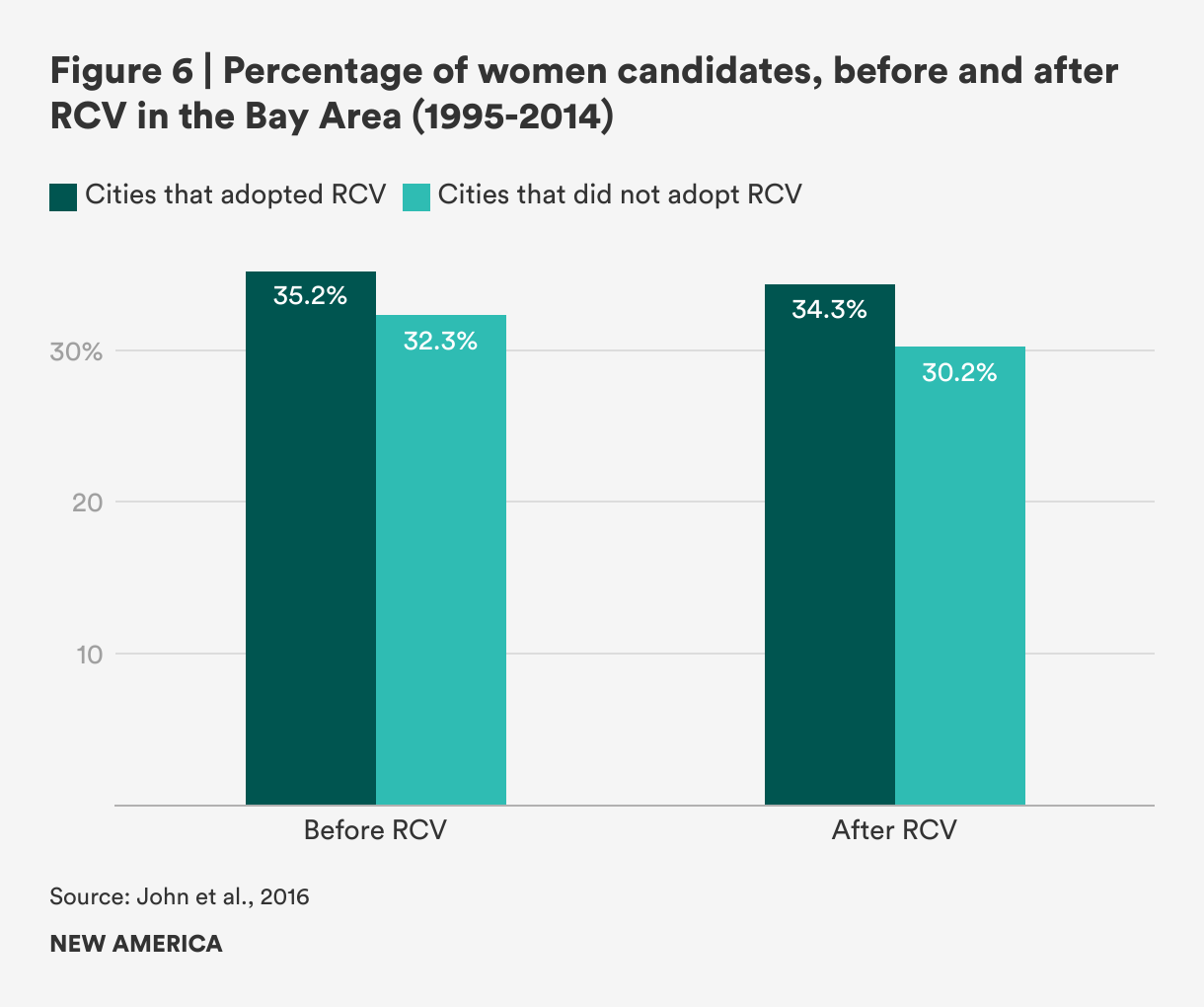
Again, generalizability is a concern. The Bay Area, being extremely wealthy, progressive, and diverse, is generally a welcoming political environment for female candidates and candidates of color. It is not necessarily representative of the country. Moreover, as Jamil Scott and Jack Santucci note in their recent working paper on candidate emergence, “two decades’ exposure to pro-RCV messaging may have made the underlying population more likely to generate candidates.”97
Recently, Cynthia Richie Terrell and Courtney Lamendola published a report on descriptive representation under RCV between 2010 and 2019. Across 19 RCV jurisdictions and 156 RCV-qualifying elections, they found that 34 percent of all candidates were women.98 Picking back up on the four Bay Area cities—Berkeley, Oakland, San Francisco, and San Leandro—from John et al.’s 2018 research, women made up 38 percent of the candidates in contested RCV elections in those four cities between 2010 and 2019, a roughly three point increase over the peak percentage observed between 1995 and 2014.99
In "Do Ranked Ballots Stimulate Candidate Entry?," Scott and Santucci conducted three survey experiments (two nationwide, one in Philadelphia) to evaluate how RCV affects attitudes toward running for office. Respondents were presented with different information about RCV. Some respondents were given a simple explanation of RCV; some were given an explanation of RCV and how it is different from our single-mark electoral system; and some were given an explanation of RCV, how it is different from single-mark, and told RCV systems have been shown to benefit women and people of color. Most effects are null, but their Philadelphia experiment found Black respondents who received the second message (explanation of RCV and how it is different from our current system) are more positively oriented toward running for office than their Black counterparts who receive the first message (simple explanation of RCV). Only among white respondents did they observe that the third message (RCV benefits women and people of color) significantly increased interest in running for office. Meanwhile in the nationwide CMPS sample, the third message (emphasizing whom RCV impacts) decreased interest in running for office among Latinos.100 Again, survey experiments cannot capture the ways in which candidate recruitment messaging and strategies may change, and the ways in which potential candidates may become familiar with ranked-choice voting over time. But they can show the extent to which different benefits might resonate (or not) with different populations.
Although there is very limited evidence that RCV leads more women to run for office, we can infer from past studies on the candidate gender gap that the prospect of a negative campaign may discourage a lot of would-be women candidates from running in the first place. Thus, RCV may indirectly improve women’s representation in the United States by way of its effects on campaigns—most significantly increasing civility, which may encourage more women to run.101 Presumably, though, if RCV does create a more civil and cooperative campaign environment, it will take time and experience for women’s attitudes and perceptions about running to change. As with many reforms, desired effects may take time to develop.
Independents, Minor Parties, and Moderates
Diversity comes in other forms, however, including ideological and partisan diversity. In American politics, our single-winner plurality system and restrictive ballot access rules help the two major parties maintain a tight grip on power. Theoretically, RCV, by eliminating the spoiler effect, should create space for more non-major party candidates to win. Of course, before such candidates can win, they'll need to run first.
RCV should make it easier for third party and independent candidates to run. They can now run without being spoilers, and are more likely to attract voters who no longer will fear that a vote for a third party is “wasted,” since they will now have a back-up choice so that their vote can count. However, for independent and third party candidates to actually have a chance of winning in an RCV election, they must be able to win a majority. In theory this is certainly possible. In practice, it is difficult for four reasons.
The first obstacle is that running for a major party has a lot of advantages. Since the Democratic and Republican parties are longstanding, recognizable brands with considerable resources, most talented and ambitious politicians prefer to run as Democrats or Republicans. This gives a candidate automatic party loyalty among a significant share of the electorate. It also guarantees ballot access. Running as an independent or a third party candidate immediately puts one at a disadvantage, even with RCV. It takes considerable resources to finance a campaign that voters and media will see as viable. And some of those resources will need to be spent simply getting on the ballot.
The second obstacle is that because the two major parties have powerfully shaped public opinion on the important issues of the day, the public is divided on most major issues. In practice, a pragmatic centrist candidate is unlikely to be the first choice of many voters, simply because the share of voters with genuinely centrist political opinions is very limited.102 In a single-winner RCV election, the best a pragmatic centrist can hope for generally is for her transfer votes to matter. This can certainly create a moderating dynamic. But it may be difficult to recruit high-quality candidates without a legitimate prospect of winning.
A third obstacle is that most districts are heavily lopsided for one party or the other. This means that the election is almost certain to be decided on first-preference votes for the dominant party’s candidate. Second-preference votes are only likely to come into play in closely competitive elections. And with single-member districts, most elections will remain lopsided. Certainly, in some districts, where the partisan margin is within 10 points, it is possible a third party or independent candidate could force a run-off. But even here, a potential centrist candidate would face the “center-squeeze” problem: In a race with a Republican and a Democrat, a centrist candidate would almost certainly finish third in the first round of balloting, and thus likely be eliminated before the Republican or Democrat. The centrist candidate could potentially play a role as kingmaker, but would be unlikely to win. It is hard to attract quality candidates to races that they are ultimately going to lose.
A fourth obstacle is that in a highly polarized political system with just two parties, and control of Congress (or a state legislature) up for grabs, most voters will likely still prefer to support one of the two major parties. Or, at the very least, the powerful party messaging machinery will focus on scaring them with the threat of the other party controlling Congress.
Cynthia McClintock and Joseph Cerrone’s 2021 paper analyzed the effects of the RCV, plurality, and runoff rules on openness of the electoral arena to new parties and to moderation in the context of the 2020 elections.103 They conducted interviews with key stakeholders in Maine, including current and former political candidates (like 2020 U.S. Senate independent candidate Lisa Savage). They also identified and compared a set of 12 competitive federal election cases.104 Across those 12 elections in 2020, they found, in line with expectations, that Maine under RCV was more open to new parties and candidates than anywhere else under runoff or plurality. The biggest combined vote-share for third party and independent Senate candidates in the 2020 elections they examined (6.6 percent) was in Maine. Further, independent Lisa Savage was the only non-Democratic/non-Republican Senate candidate to achieve 5 percent in the election result. Though Maine has a strong tradition of independent candidates, among the Maine interviewees in the 2020 study, there was consensus that RCV has enhanced Maine’s openness.
Of course, Maine also used RCV in its 2018 congressional elections. Sen. Angus King (I-Maine), one of two Senate Independents, was re-elected under RCV, in 2018. However, King is an incumbent (who caucuses with the Democrats), and the former governor—hardly a political upstart given a new opportunity by a voting system change. In 2018, Marty Grohman ran as an independent in the 1st Congressional District, garnering 8.7 percent of the vote. But because Rep. Chellie Pingree (D-Maine) won 58.8 in the first round of voting in a safe Democratic district, there was no run-off. In 2020, no third party or independent candidates ran in Maine’s 1st Congressional District.
In 2018, Maine’s 2nd Congressional District did require a run-off. Independent candidates Tiffany Bond and Will Hoar earned 5.7 percent and 2.4 percent of first preference votes, respectively. After both were eliminated, Rep. Jared Golden (D-Maine) won on transfer votes, despite trailing Republican Bruce Poliquin 46.3 percent to 45.6 percent in the first round. Polinquin then sued to challenge the legality of the RCV law, but his case was dismissed, thus upholding the Maine law.105
But, as with Maine’s 1st Congressional District, in 2020, the 2nd Congressional District also failed to attract any independent or third party challengers.
RCV is probably most likely to encourage third party and independent candidacies at the level of statewide single-winner elections, such as for senate and especially governor, where the prestige of the office is high enough to encourage ambitious candidates and the statewide media attention is highest. For gubernatorial elections in particular, voters tend to be most willing to consider candidates of the opposing party because there are no implications for national partisan control and states issues independent of national partisanship are most likely to be salient. Accordingly, RCV may be most likely to encourage third party and independent candidates for governor.
However, the story of Maine’s two congressional districts casts some doubt on the claim that RCV will encourage more independent and third-party candidates over time. After drawing a few independent candidacies in 2018, no independents or non-major party candidates entered into either of the two congressional seat elections. Granted, it was a pandemic year and a highly polarizing presidential election year, both of which may have discouraged independent candidates. But there is also a hard political reality: In single-winner elections, it is very hard to dislodge an incumbent Democrat or Republican. And without support from a national party, the chance of an independent winning is too remote to attract serious campaigns.
Here, it might be particularly useful for researchers to spend more time doing qualitative work, such as in-depth interviews with candidates (and if possible, almost-candidates who explored running but did not) that investigate the factors that encouraged these candidates to run for office, and the ways in which ranked-choice voting affected these decisions. Such a study should interview all candidates, in order to test whether certain factors were more important for female candidates and candidates of color, as compared to male candidates and white candidates. To understand how electoral rules affect candidate diversity (both descriptive and ideological) it would be extremely helpful to do in-depth interviews.
Claim 7: RCV Changes how Candidates Campaign
Conclusion: Mostly supported at the local level
Among the biggest selling points of RCV is that it alters incentives and campaign dynamics in ways that appear to decrease negative campaigning and increase campaign civility. This is because candidates are encouraged to appeal more broadly—including reaching out to those they might have ignored under plurality rules, and to even cooperate with competitors. Additionally, the lesser-of-two-evils demonization strategy is most effective with only two candidates, and to the extent that RCV encourages more candidates, such a strategy has more potential to backfire.
And here, there is a general consensus that RCV probably does lower the temperature of candidate campaigns, at least at the local level. Surveys, interviews, and content analyses have shown that RCV elections tend to be (or perceived to be) more civil.106 However, all of the studies showing civility improvements were based on local elections. It is quite possible this benefit does not translate to national elections, which tend to be much more fiercely contested between Democrats and Republicans.
In "Campaign civility under preferential and plurality voting," Todd Donovan, Caroline Tolbert, and Kellen Gracey, found that voters surveyed in RCV cities were nearly twice as likely to say local campaigns were “a lot less negative” than other recent contests, while people in plurality cities were twice as likely to say candidates criticized each other some or most of the time. Citizens in RCV cities were also much more likely to report being satisfied with how local campaigns were conducted. See regression results in the table below, reproduced from the original article.107
Findings from that 2013 survey were re-examined and the survey itself expanded in a 2014 version that pivoted to 11 cities in the Bay Area. Sarah John and Andrew Douglas reported the results of this survey as well as those of a survey by Tolbert and Donovan of 200 candidates who ran in RCV elections between 2011 and 2013 and control cities. In the 2014 survey, the gaps between resident perceptions of three indicators of campaign negativity in RCV and non-RCV cities were narrower than they were in the 2013 version, but RCV cities still saw a civility edge. In addition, the candidate survey revealed similar opinions about the effects of RCV, with only 29 percent of candidates in RCV cities reporting being portrayed negatively by opponents, compared to 40 percent in non-RCV jurisdictions.108
Again, we need to consider whether these findings from local elections are generalizable to the state and national level, to which the biggest political conflicts tend to gravitate. While the 2013 study found higher satisfaction levels under RCV, large majorities in the plurality cities surveyed also reported being satisfied “with the way most candidates have conducted their campaigns in the recent local election,” and 71 percent were happy with the information they received. As Donovan et al. posit, there might be greater room for effects at the state level or federal level. “Or, given the polarized nature of federal contests in the US, it may be that incivility and negativity are so deeply entrenched in federal elections that adoption of preferential voting may have no effect on such elections.”109
Multiple scholars have explored the relationship between electoral systems and negativity/positivity in campaigns through campaign materials and media content. Denise Munro Robb conducted a content analysis of mass mailers distributed by candidates in RCV races for her doctoral dissertation. (She also interviewed candidates, party officials, and campaign strategists.) Robb’s results suggested that campaigning under RCV was much less negative, and significantly more positive. But she also found that candidates used team ads, which led to a (limited number) of coordinated attacks.110
Eamon McGinn’s article "Rating Rankings: Effect of Instant Run-off Voting on Participation and Civility," approached the question using a novel text-based approach. McGinn took advantage of modern natural language processing techniques and a huge trove of transcribed debates that are now available from data sources like YouTube to conduct a sentiment analysis of mayoral debates in a broader set of U.S. cities. His findings suggest that RCV debates are more civil, and positive.111A similar methodology, he notes, could be leveraged for analyses of RCV’s effects on other outcomes, including whether officials who were elected in an RCV election speak differently than winners of plurality elections.
Political scientist Martha Kropf applied a text-as-data approach for her 2021 study on RCV’s effect on campaign behavior, using direct campaign communication data—candidate tweets and newspaper articles—in RCV and matched plurality cities, rather than mayoral debate transcripts.112 Kropf found that RCV city newspaper articles have significantly more positive than negative words. The results from Twitter, however, showed that tweets on mayoral elections using RCV had, on average, more inclusive and more exclusive words and fewer social words, while plurality city tweets had more positive words, fewer negative words, and more social words. A qualitative examination revealed a more nuanced picture. Candidates in plurality cities appeared less likely to engage one another in tweets than candidates in RCV cities, a pattern which, as Kropf noted, could signify a lack of bargaining or accommodation among rivals,113 or “perhaps the candidates asked some other group to do ‘heavy lifting’ where negativity was concerned or an interested party/interest group did the heavy lifting without the candidate asking.”114 The table below (reproduced from the original article) displays results from the analysis of newspaper articles. In RCV cities used significantly more positive words and significantly fewer negative words. They also used more inclusive words compared to plurality, but the difference isn’t statistically significant.
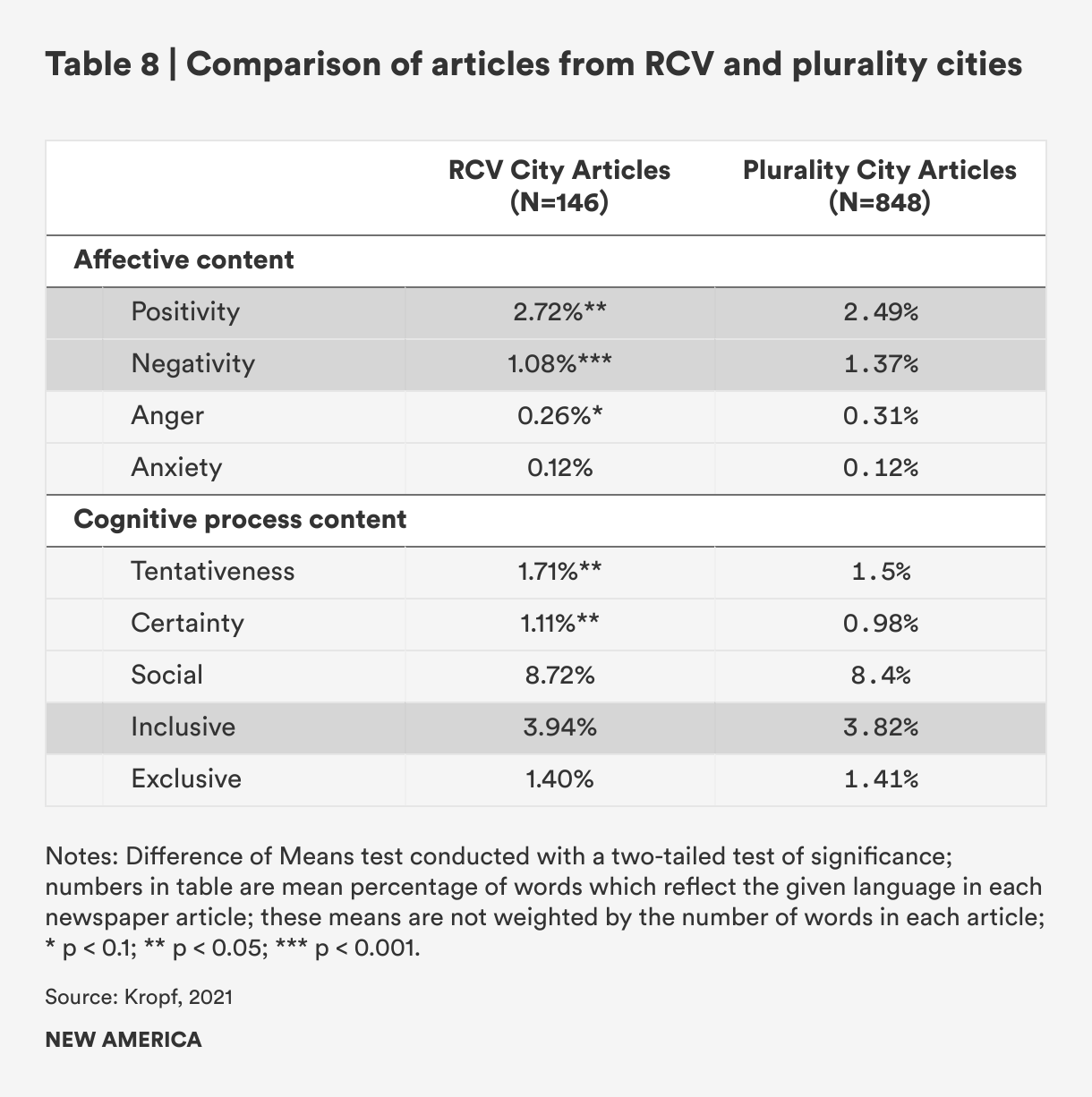
For his 2020 working paper "Rank Deficiency? Analyzing the Costs and Benefits of Single-Winner Ranked-Choice Voting," Jesse Clark conducted a sentiment analysis of campaign advertisements for the Maine 2018 congressional elections, when RCV was first implemented for state and federal contests.115 He assessed the negativity/positivity of Facebook advertisements that mentioned the congressional candidates and found the 2018 campaign was even more negative than in similar districts around the country.
To reach this result, Clark tested the impact of RCV on the total amount of money spent on independent expenditures in a race, the amount of negative independent expenditure money in a race (or the amount of money spent on independent expenditures that was against a candidate), the amount of positive independent spending (in favor of candidates), and the net positive spending on the race overall. He found RCV correlated strongly with an increase in independent expenditures in the congressional races overall, and furthermore with a measurable decrease in positive expenditures, “accompanied by a sharp increase in expenditures that were targeted against candidates.” His robust checks yielded mixed results, however: Based on genetic matching, the percentages of positive and negative expenditures were in line with those found in the nearest 10 districts studied.
This raises two possibilities. One is that RCV’s impact on positive campaigning may be more powerful in local elections than national elections, since national elections are oriented around hyper-partisan, Democrat versus Republican fights. Another is that Maine, as the home of a highly competitive Senate election, attracted a lot of money, and most money goes to negative campaigning. This suggests that as long as a hyper-partisan nationalized and roughly competitively balanced two-party system remains in place, state-level shifts to single-winner ranked-choice voting are likely to have limited impacts. Of course, the Maine Senate election did not have a strong third candidate (it was clearly a contest between Democrat Sara Gideon and Sen. Susan Collins [R-Maine]), and two-candidate campaigns are far more prone to the “lesser of two evils” dynamic that encourages negative campaigning. But the lack of a serious third party entrant in the RCV election does raise questions of whether single-winner RCV is a big enough reform to meaningfully encourage serious, well-funded new parties and candidates to challenge the duopoly.
The above works prompt a number of questions and opportunities for future research. For example, how does RCV impact the substantive content of campaigns (not just negativity versus positivity)? Do candidates spend more time focusing affirmatively on policy to distinguish themselves? Here, researchers might consider a more qualitative analysis of campaigns, including candidate interviews, rather than simple algorithmic text-based analysis like the ones covered above. The Tolbert-Donovan candidate survey from 2011–2013 mentioned above is long overdue for an update, and questions regarding emphasis on policy could be incorporated.
In addition, how does RCV-style campaigning affect candidate emergence among women and minority women? Does it reward women and women of color candidates at the polls? One could also repeat the surveys conducted by Donovan et. al. in 2013 and 2014, to test how perceptions have changed as RCV has become more normalized in cities like Minneapolis and St. Paul.
Additionally, now that several cities have gone through several cycles of ranked-choice voting elections, some more detailed case histories would contribute to our understanding of the extent to which candidates learn over time and adjust their strategies. Again, reforms typically take time to demonstrate impacts, so tracing case histories could help us better understand the processes by which political actors learn and change, and certain actors enter the stage while others exit. Doing this may also uncover other processes and dynamics that we do not yet appreciate because almost all the work on RCV has involved snapshots instead of process-tracing.
Citations
- In addition to single-winner RCV and STV, there is block-preferential voting, “bottoms‐up,” and RCV numbered posts. Jack Santucci, “Variants of Ranked‐Choice Voting from a Strategic Perspective,” Politics and Governance 9 (June 2021): 344–353, <a href="source">source">source.
- FairVote, “Where Ranked Choice Voting is Used,” accessed September 5, 2021, <a href="source">source">source.
- Santucci, “Variants of Ranked‐Choice Voting from a Strategic Perspective.”
- Amy J. Douglas, “The forgotten history of the single transferable vote in the United States,” Representation, 34 (July 1996): 13-20, <a href="source">source">source.
- Devin McCarthy and Jack Santucci, “Ranked Choice Voting as a Generational Issue in Modern America Politics,” Politics & Policy 49 (February 2021): 33–60, <a href="source">source">source.
- Francis Neely, Lisel Blash, and Corey Cook, An Assessment of Ranked-Choice Voting in the San Francisco 2004 Election (Daly City, CA: Public Research Institute, San Francisco State University, 2005); Richard E. DeLeon, San Francisco and instant runoff voting: An analysis of the SFSU/PRI exit poll data assessing voter opinions about ranked choice voting in the November 2004 Board of Supervisors elections (San Francisco, CA, September 2005), source">source.
- Francis Neely, Lisel Blash, and Corey Cook, An Assessment of Ranked-Choice Voting in the San Francisco 2005 Election (Daly City, CA: Public Research Institute, San Francisco State University, 2006).
- Ranked Choice Voting: 2009 City Of Minneapolis Municipal Elections (St. Cloud State University Survey, 2009), available at source">source; Michael Lewyn, “Two Cheers for Instant Runoff Voting,” Phoenix Law Review 6 (2012): 117-136, available at SSRN: source">source.
- The poll was conducted by Edison Research, with a sample size of 4,020 voters. Jay Wendland and Erin Carman, Ranking Works? An Examination Of Ranked Choice Voting In New York City (Amherst, New York: Daemen College, 2021), source">source.
- Sarah John and Andrew Douglas, “Candidate Civility and Voter Engagement in Seven Cities with Ranked Choice Voting,” National Civic Review 106 (Spring 2017): 25-29, source">source.
- Joseph A. Coll, “Demographic Disparities Using Ranked-Choice Voting? Ranking Difficulty, Under-Voting, and the 2020 Democratic Primary,” Politics and Governance 9 (June 2021): 293–305, source">source.
- Richard L. Cole, Delbert A. Taebel, and Richard L. Engstrom, “Cumulative Voting in a Municipal Election: a Note on Voter Reactions and Electoral Consequences,” Political Research Quarterly 43 (1990): 191-199, source">source; Richard Engstrom and Charles Barrilleaux, "Native Americans and Cumulative Voting: The Sisseton-Wahpeton Sioux," Social Science Quarterly 72 (June 1991): 388-393, source">source; Robert R. Brischetto and Richard L. Engstrom, “Cumulative Voting and Latino Representation: Exit Surveys in Fifteen Texas Communities,” Social Science Quarterly 78 no. 4 (1997): 973-991, source">source; David Kimball and Martha Kropf, “Voter Competence with Cumulative Voting,” Social Science Quarterly 97 (September 2016): 619–35, source">source.
- David Kimball and Joseph P. Anthony, “Public Perceptions of Alternative Voting Systems: Results from a National Survey Experiment,” April 16, 2021, source">source.
- Melody Crowder-Meyer, Shana Kushner Gadarian, and Jessica Trounstine, “Ranking Candidates in Local Elections: Neither Panacea nor Catastrophe,” January 21, 2021, available at SSRN: source">source.
- Martha Kropf and David C. Kimball, Helping America Vote: The Limits of Election Reform (New York, NY: Routledge, 2012).
- Neely, Blash, and Cook, An Assessment of Ranked-Choice Voting in the San Francisco 2004 Election.
- Francis Neely, Corey Cook, and Lisel Blash, An Assessment of Ranked-Choice Voting in the San Francisco 2005 Election (Daly City, CA: Public Research Institute, San Francisco State University, 2006).
- Todd Donovan, “Self-Reported Understanding of Ranked-Choice Voting,” Social Science Quarterly 100 (August 2019): 1768–76, source">source.
- Joseph A. Coll, “Demographic Disparities Using Ranked‐Choice Voting? Ranking Difficulty, Under‐Voting, and the 2020 Democratic Primary,” Politics and Governance 9 (June 2021), source">source.
- Wendland and Carman, Ranking Works? An Examination Of Ranked Choice Voting In New York City.
- Pedro Hernandez, Jennifer Pae, Madeline Brown, and Theodore Landsman, Voter Experience with Ranked Choice Voting in San Francisco (Takoma Park, MD: FairVote, 2018).
- Lindsay Nielson, “Ranked Choice Voting and Attitudes toward Democracy in the United States: Results from a Survey Experiment,” Politics and Policy 45 (August 2017): 535-570, source">source.
- David Schultz and Kristi Rendahl, Evaluating Ranked Choice Voting in the 2009Minneapolis Elections: A Report for the Minneapolis Elections Department (St. Paul, Minnesota: Hamline University, 2010).
- Wendland and Carman, Ranking Works? An Examination Of Ranked Choice Voting In New York City.
- Cheryl Boudreau, Jonathan Colner, and Scott A. MacKenzie, “Ranked-Choice Voting and Political Expression: How Voting Aids Narrow the Gap between Informed and Uninformed Citizens,” March 24, 2021, available at SSRN: source">source.
- Boudreau, Colner, and MacKenzie.
- Craig M. Burnett and Vladimir Kogan, “Ballot (and Voter) ‘Exhaustion’ Under InstantRunoff Voting: An Examination of Four Ranked‐Choice Elections,” Electoral Studies 37 (March 2015): 41‐49, source">source.
- Francis Neely and Corey Cook, “Whose Votes Count? Undervotes, Overvotes, and Ranking in San Francisco’s Instant‐Runoff Elections,” American Politics Research 36 (July 2008): 530‐554, source">source.
- David Kimball and Joseph Anthony, “Voter Participation with Ranked Choice Voting in the United States,” (working paper, presented at the 2016 American Political Science Association Annual Meeting, Philadelphia, PA, October 2016), source">source.
- Lawrence R. Jacobs and Joanne M. Miller, Rank Choice Voting and the 2013 Minneapolis Elections (Minneapolis, MN: University of Minnesota, February 2014).
- Francis Neely and Corey Cook, “Whose Votes Count? Undervotes, Overvotes, and Ranking in San Francisco's Instant-Runoff Elections.”
- Neely and Cook; Jacobs and Miller; Francis Neely and Jason A. McDaniel, “Overvoting and the Equality of Voice under Instant-Runoff Voting in San Francisco,” California Journal of Politics and Policy 7, no. 4 (2015): 1-27, source">source.
- Lindsay Nielson, “Ranked Choice Voting and Attitudes toward Democracy in the United States: Results from a Survey Experiment.”
- Neely and McDaniel, “Overvoting and the Equality of Voice under Instant-Runoff Voting in San Francisco.”
- Note that the elections sampled used optical scan voting machines which detect overvote errors and give the voters the opportunity to start over. Neely and Cook, “Whose Votes Count? Undervotes, Overvotes, and Ranking in San Francisco's Instant-Runoff Elections.”
- Jason Maloy, “Voting Error across Multiple Ballot Types: Results from Super Tuesday (2020) Experiments in Four American States,” September 24, 2020, available at SSRN: source">source; See also, J. S. Maloy and Matthew Ward, “The Impact of Input Rules and Ballot Options on Voting Error: An Experimental Analysis,” Politics and Governance 9 (June 2021): 306–318, source">source;
- For example, if a voter ranks two candidates as their second choice, that second choice vote doesn’t count but their first-preference vote will stand.
- See, for example, Benjamin Reilly, “Ranked Choice Voting in Australia and America: Do Voters Follow Party Cues?,” Politics and Governance 9 (June 2021): 271–279, source">source.
- Neely and Cook, “Whose Votes Count? Undervotes, Overvotes, and Ranking in San Francisco's Instant-Runoff Elections.”
- Boudreau, Colner, and MacKenzie, “Ranked-Choice Voting and Political Expression: How Voting Aids Narrow the Gap between Informed and Uninformed Citizens.”
- Neely and McDaniel, “Overvoting and the Equality of Voice under Instant-Runoff Voting in San Francisco”; Kimball and Anthony, "Voter Participation with Ranked Choice Voting in the United States.”
- Neely and Cook, “Whose Votes Count?”
- See, for example, Jason Maloy, “Voting Error across Multiple Ballot Types: Results from Super Tuesday (2020) Experiments in Four American States,” and Neely and Cook, “Whose Votes Count?”
- Neely and Cook, “Whose Votes Count?”; Boudreau, Colner, and MacKenzie, “Ranked-Choice Voting and Political Expression: How Voting Aids Narrow the Gap between Informed and Uninformed Citizens.”
- The 100 Million Project: The Untold Story of American Non-Voters (Knight Foundation, 2020), source">source
- Curtis Wood, “Voter turnout in city elections,” Urban Affairs Review 38 (November 2002): 209–231, source">source.
- Without partisan cues, voters are also more likely to rely on cognitive biases that disproportionately penalize candidates of color. See, for example, Crowder-Meyer, Kushner Gadarian, and Trounstine, “Ranking Candidates in Local Elections: Neither Panacea nor Catastrophe.”
- The 100 Million Project: The Untold Story of American Non-Voters; Robert P. Jones, Daniel Cox, Betsy Cooper, and Rachel Lienesch, The Divide Over America’s Future: 1950 or 2050: Findings from the 2016 American Values Survey? (Washington, DC: Public Religion Research Institute, 2016), source">source.
- Kimball and Anthony, "Voter Participation with Ranked Choice Voting in the United States.”
- Kimball and Anthony.
- Jason A. McDaniel, “Electoral Rules and Voter Turnout in Mayoral Elections: An Analysis of Ranked-Choice Voting," (paper prepared for the Election Systems, Reform, and Administration Conference in Philadelphia, PA, July 11–12, 2019), source">source.
- Jason McDaniel, “Writing the Rules to Rank the Candidates: Examining the Impact of Instant‐Runoff Voting on Racial Group Turnout in San Francisco Mayoral Elections,” Journal of Urban Affairs 38 (November 2016): 387–408, source">source.
- Eamon McGinn, Rating rankings: Effect of instant run‐off voting on participation and civility (Unpublished manuscript, October 2020), source">source.
- In “Writing the Rules to Rank the Candidates,” McDaniel used mutilevel linear regression models that controlled for incumbency, candidate race, precinct socioeconomic status, education, population age, and racial diversity.
- Courtney L. Juelich and Joseph A. Coll, “Ranked Choice Voting and Youth Voter Turnout: The Roles of Campaign Civility and Candidate Contact,” Politics and Governance 9 (June 2021): 319–331, source">source. Jeulich and Coll’s findings, it should be noted, were based on self-reported turnout levels that significantly surpassed actual turnout from the election years in question. In addition, though they used a sophisticated approach to matching—usually within‐state, if not within county, and with controls on population size, racial and ethnic composition, political characteristics, US region, and socio‐economic conditions—they didn’t compare the differences in turnout between the matched cities prior to RCV adoption, which means we can’t judge if or the extent to which higher levels of engagement were already present in the places that adopted RCV, and even may have predisposed those cities to reform.
- Kimball and Anthony, “Voter Participation with Ranked Choice Voting in the United States.” The authors estimated that a competitive mayoral contest also reduces vote drop‐off, but by about 11 points, a much smaller effect compared to RCV consolidated election schedule RCV.
- Kimball and Anthony.
- For more voter drop-off between elections, see Declan Alvidrez, Primary Runoff Elections and Decline in Voter Turnout (Takoma Park, MD: FairVote, December 2020), source">source.
- Lee Drutman, What We Know about Congressional Primaries and Congressional Primary Reform (Washington, DC: New America, 2021), source">source.
- Seth J. Hill, “Sidestepping Primary Reform: Political Action in Response to Institutional Change,” Political Science Research and Methods (2020): 1–17, source: “Point estimates suggest an increase in turnout of 1.5 percentage points in open primaries and 6.1 percentage points in nonpartisan primaries.” See also Matthew J. Geras and Michael H. Crespin, “The Effect of Open and Closed Primaries on Voter Turnout,” in Routledge Handbook of Primary Elections, ed. Robert G. Boatright, 1st ed. (New York: Routledge, 2018), 133–46, source: “For both the Republicans and the Democrats, voter turnout was highest during open primaries and lowest during hybrid primaries. The predicted difference in turnout between these two types of primaries appears to amount to about 2 to 3 percent.”
- Drutman, What We Know about Congressional Primaries and Congressional Primary Reform.
- Neal Caren, “Big City, Big Turnout? Electoral Participation in American Cities,” Journal of Urban Affairs 29 (February 2007): 31-46, source">source.
- Jason Jurjevich, Phil Keisling, Kevin Rancik, Carson Gorecki, and Stephanie Hawke, Who Votes for Mayor? (Portland, OR: Portland State University, 2016), source">source.
- For example, when Baltimore shifted to even-year elections in 2016, voter turnout in local races jumped from just 13 percent to 60 percent, and research indicates that participation in local elections in cities doubles in on-cycle November elections: Zoltan Hajnal, Vladimir Kogan, and G. Agustin Markarian, “Who Votes: City Election Timing and Voter Composition,” American Political Science Review (2021): 1–10, doi:10.1017/S0003055421000915; Caren, “Big City, Big Turnout?”; Jan Brennan, “Increasing Voter Turnout in Local Elections,” National Civic Review 109 (Spring 2020), source">source.
- Sarah John and Andrew Douglas, “Candidate Civility and Voter Engagement in Seven Cities with Ranked Choice Voting," National Civic Review 106 (Spring 2017): 25-29, source">source. The November 2013 survey included 2,400 voters in three RCV cities (Minneapolis, St.Paul, Cambridge), and seven non-RCV cities (Boston, Seattle, Des Moines, Cedar Rapids, Tulsa, Lowell, MA and Worcester, MA); the November 2014 survey was of 2,400 voters in eleven Californian cities: the four Bay Area cities that use RCV (Berkeley, Oakland, San Francisco, and San Leandro) and seven control cities.
- Ranked Choice Voting: 2009 City of Minneapolis Municipal Elections (St. Cloud State University Survey, December 2009); Neely, Blash, and Cook, An Assessment Of Ranked-choice Voting In The San Francisco 2004 Election.
- The Santa Fe survey was conducted by Lonna Atkeson and FairVote New Mexico, who covered eight voting centers in Santa Fe for the full polling day and two additional centers for a half day each. Santa Fe Voters Support Ranked Choice Voting and Have High Confidence in City Elections (FairVote New Mexico, 2018), source">source; Wendland and Carman, Ranking Works? An Examination Of Ranked Choice Voting In New York City.
- Nielson, “Ranked Choice Voting and Attitudes toward Democracy in the United States: Results from a Survey Experiment.”
- The Electoral Reform Research Group is a collaboration between New America’s Political Reform program, the Unite America Institute, Stanford’s CDDRL, the American Enterprise Institute, formed in 2019, source">source.
- Andre Blais, Carolina Plescia, Semra Sevi, “Choosing to Vote As Usual,” February 12, 2021, available at SSRN: source">source.
- Kimball and Anthony, “Public Perceptions of Alternative Voting Systems.”
- Joseph Cerrone and Cynthia McClintock, “Ranked-Choice Voting, Runoff, and Democracy: Insights from Maine and Other U.S. States,” January 19, 2021, available at SSRN: source">source.
- Kimball and Anthony, “Public Perceptions of Alternative Voting Systems.”
- Blais, Plescia, Sevi, “Choosing to Vote As Usual.”
- McCarthy and Santucci, “Ranked Choice Voting as a Generational Issue in Modern America Politics.” They also found young people express greater dissatisfaction with “the way democracy works in the United States,” and that dissatisfaction is significantly associated with RCV support.
- Again, while only the exception here seems to be Maine, its status as the only state to have already implemented RCV for federal elections gives it added weight, and signals to those promoting RCV beyond the local level that more work will be necessary to overcome partisan identity-based resistance. Bitter partisan battles leading up to implementation, followed by Republicans’ disappointment with their candidate losing the 2018 House race in a “come-from-behind victory.” Cerrone and McClintock, “Ranked-Choice Voting, Runoff, and Democracy: Insights from Maine and Other U.S. States”; Blais, Plescia, and Sevi, “Choosing to Vote As Usual”; Crowder-Meyer, Kushner Gadarian, and Trounstine, “Ranking Candidates in Local Elections: Neither Panacea nor Catastrophe”; Kimball and Anthony, “Public Perceptions of Alternative Voting Systems.”
- On the other hand, experience may not be enough to reconcile reported values with preference: a Maine study found a large majority of voters prefer a system that produces a majority winner, but an exit poll of Maine voters conducted during the first election to use RCV rules found only 47 percent of voters approved of the electoral reform. Katherine Gillespie, Carrie Levan, and L. Sandy Maisel, “Ranked Choice Voting in Maine: Were the Critics' Fears Justified?” Unpublished manuscript, Colby College, 2019.
- McCarthy and Santucci, “Ranked-Choice Voting as a Generational Issue in Modern American Politics.”
- Lee Drutman, William Galston, and Tod Lindberg, Spoiler Alert: Why Americans’ Desires for a Third Party Are Unlikely to Come True (Washington, DC: Democracy Fund Voter Study Group and New America, 2018), source">source; Nielsen, “Ranked Choice Voting and Attitudes toward Democracy in the United States: Results from a Survey Experiment.”
- FairVote New Mexico, Santa Fe Voters Support Ranked Choice Voting and Have High Confidence in City Elections.
- “Government Reform: Ranked Choice Voting, Redistricting by Citizen Commission and Multi-Member Districts: A Survey of American Voters,” Program for Public Consultation, School of Public Policy, University of Maryland, 2017, source">source.
- A cross-national study of public opinion by David Farrell and Ian McAllister concluded that, other things being equal, voters were more satisfied with how democracy worked in nations where people voted for candidates with preferential voting: “Voter satisfaction and electoral systems: Does preferential voting in candidate-centred systems make a difference?,” European Journal of Political Research 45 (August 2006): 723-749, source">source.
- While much of the article focused on Maine, the authors decided to survey U.S. voters nationwide on satisfaction with different systems, given the likelihood that Maine results would reflect the strongpartisan divisions over RCV in the state. To explain the choice, they cite Joseph Anthony, Amy Fried, Robert Glover, and David C. Kimball, “Ranked Choice Voting in Maine from the Perspective of Election Authorities,” (paper prepared for delivery at the annual meeting of the American Political Science Association, Washington, D.C., August 29-September 1, 2019).
- Other indicators used to measure voters’ satisfaction were usability, comprehensibility, transparency, representativeness, and support for adoption in the respondent's own state. Cerrone and McClintock, “Ranked-Choice Voting, Runoff, and Democracy Insights from Maine and Other U.S. States.”
- Crowder-Meyer, Kushner Gadarian, and Trounstine, “Ranking Candidates in Local Elections: Neither Panacea nor Catastrophe.” See also Jesse Clark, “Rank Deficiency? Analyzing the Costs and Benefits of Single-Winner Ranked-Choice Voting,” MIT Political Science Department Research Paper No. 2020-8, October 1, 2020, available at SSRN: source">source. Clark found the interaction between RCV and the ballot size had a significant impact on voter satisfaction as well.
- Kimball and Anthony, “Public Perceptions of Alternative Voting Systems.”
- Sean Fischer, Amber Hye-Yon Lee, and Yphtach Lelkes, “Electoral Systems and Political Attitudes: Experimental Evidence,” May 12, 2021, available at SSRN: source">source.
- Christopher J. Anderson and Christine A. Guillory, “Political Institutions and Satisfaction with Democracy: A Cross-National Analysis of Consensus and Majoritarian Systems,” The American Political Science Review 91, no. 1 (1997): 66–81; Shaun Bowler, Todd Donovan, Ola Listhaug, Christopher J. Anderson, and André Blais, Losers’ Consent: Elections and Democratic Legitimacy (Oxford: Oxford University Press, 2007).
- Barry Fagin, The Conservative Case for Ranked Choice Voting (Denver, CO: Independence Institute, 2021), source">source. Utah’s more cautious and decentralized approach to introducing RCV provides an interesting case study for conservatives. The state’s Republican-led local options legislation is a time-limited pilot program with the goal of collecting data before pushing for statewide use.
- Other (more limited) exceptions include the Republican Party of Virginia’s decision to use RCV for its 2021 nominating convention, and the Indiana GOP decision to use RCV for party primary elections in 2020. Deb Otis and Nora Dell, “Ranked Choice Results and Analysis from Virginia Republican Convention,” FairVote, May 10, 2021, source">source; Adam Ginsberg, “Indiana GOP to Use Ranked Choice Voting in Virtual Convention,” FairVote, May 14, 2020, source">source.
- Relatedly, it provides more opportunities for people with platforms or identities outside the traditional mainstream to send a clear message to the likely winner or party establishment. If a person is not confident they can win (yet) but that they can secure a meaningful proportion of second or third preferences, RCV is effective at revealing emerging issues and identities that may be ignored in a plurality setting.
- Sarah John, Haley Smith, and Elizabeth Zack, “The Alternative Vote: Do Changes in Single‐Member District Voting Systems Affect Descriptive Representation of Women and Minorities?,” Electoral Studies 54 (May 2018): 90‐102; Courtney Lamendola and Cynthia Richie Terrell, In Ranked Choice Elections, Women WIN (Takoma Park, MD, Represent‐Women, 2020), source.
- Kimball and Anthony, “Voter Participation with Ranked Choice Voting in the United States.”
- The RCV cities included in the study are Berkeley, Oakland, San Francisco, and San Leandro; the control cities are Alameda, Anaheim, Richmond, San Jose, Santa Ana, Santa Clara, and Stockton. John, Haley, and Zack, “The Alternative Vote.”
- Sarah John, “The Alternative Vote can increase representation of women and people of color in US elections,” LSE Phelan US Centre, July 24, 2018, source.
- Sarah John, Haley Smith, Elizabeth Zack, Cynthia Terrell, Michelle Whittaker, Jennifer Pae, and Rob Richie, The impact of ranked choice voting on representation: How ranked choice voting affects women and people of color candidates in California (Takoma Park, MD: RepresentWomen, 2016), source; Cynthia Richie Terrell, Courtney Lamendola, and Maura Reilly, “Election Reform and Women’s Representation: Ranked Choice Voting in the U.S.,” Politics and Governance 9, (June 2021): 332–343, source.
- Jack Santucci and Jamil Scott, “Do Ranked Ballots Stimulate Candidate Entry?,” November 4, 2021, available at SSRN: source">source. For more on the origins of the San Francisco RCV movement, Santucci and Scott cite Richard DeLeon, Steven Hill, and Lisel Blash, “The Campaign for Proposition H and Preference Voting in San Francisco, 1996,” Representation 35, no. 4 (1998): 265–274.
- Terrell and Lamendola, In Ranked Choice Elections, Women WIN and Cynthia Richie Terrell, Courtney Lamendola, and Maura Reilly, “Election Reform and Women’s Representation: Ranked Choice Voting in the U.S.” Data available here. A major challenge in assessing the impact of RCV on candidate entry is that cities do not randomly choose to adopt RCV. Rather, more progressive cities tend to adopt RCV, and more progressive cities are more likely to support female candidates. Of course, since there is only one Berkeley, and only one San Francisco, for example, it’s difficult to estimate female candidate entry in a hypothetical Berkeley or San Francisco without RCV. As Terrell, Lamendola and Reilly acknowledge: “Due to the multiple factors affecting local election outcomes, this analysis does not infer causality between ranked choice voting and improvements in the descriptive representation, but instead illustrates the correlation.”
- John, Smith, and Zack, “The Alternative Vote: Do Changes in Single‐Member District Voting Systems Affect Descriptive Representation of Women and Minorities?”; Terrell, Lamendola, and Reilly, “Election Reform and Women’s Representation: Ranked Choice Voting in the U.S.”
- Santucci and Scott, “Do Ranked Ballots Stimulate Candidate Entry?”
- E.g. a 2008 Brookings study attributes the underrepresentation of women on the ballot to factors such as: “Women are less likely than men to be willing to endure the rigors of a political campaign. They are less likely than men to be recruited to run for office. They are less likely than men to have the freedom to reconcile work and family obligations with a political career. They are less likely than men to think they are “qualified” to run for office. And they are less likely than men to perceive a fair political environment.” Jennifer L. Lawless and Richard L. Fox, Why Are Women Still Not Running for Public Office?, (Washington, DC: Brookings Institution, 2008), source; Kristin Kanthak and Jonathan Woon, “Women Don't Run? Election aversion and candidate entry,” American Journal of Political Science 59 (July 2015): 595–612; John, Smith, and Zack, “The Alternative Vote.”
- Drutman, Galston, and Lindberg, Spoiler Alert; Lee Drutman, “The Moderate Middle Is A Myth,” FiveThirtyEight (blog), September 24, 2019, source.
- Cerrone and McClintock, “Ranked-Choice Voting, Runoff, and Democracy Insights from Maine and Other U.S. States.”
- The sample included two RCV elections (Maine’s Senate and 2nd Congressional District), five elections under runoff (Georgia’s regular Senate election, Georgia’s special Senate election, Georgia’s 6th Congressional District, and California’s 21st and 25th Congressional Districts), and for plurality cases they included the two competitive elections in Iowa (its Senate and 1st Congressional District) and in North Carolina (its Senate and 8th Congressional District) because Iowa and North Carolina are deemed similar to Maine and Georgia respectively by FiveThirtyEight. For an additional plurality case, they included the Senate race in Colorado on the basis of the competitiveness criterion.
- Steve Mistler, “Federal Judge Strikes Down Poliquin's Challenge To Maine's Ranked-Choice Voting Law,” WBUR News, December 13, 2018, source.
- Denise Munro Robb, The Effect of Instant Runoff Voting on Democracy (unpublished doctoral dissertation) (Irvine, CA: University of California, 2011). Eamon McGinn, Rating Rankings: Effect of Instant Run-off Voting on Participation and Civility; Todd Donovan, “Candidate Perceptions of Campaigns under Preferential and Plurality Voting,” (paper prepared for the workshop on Electoral Systems, Electoral Reform, and Implications for Democratic Performance, Stanford University, March 14‐15, 2014), source; Todd Donovan, Caroline Tolbert, and Kellen Gracey, “Campaign Civility Under Preferential and Plurality Voting,” Electoral Studies 42 (June 2016): 157‐163, source; Martha Kropf, “Using Campaign Communications to Analyze Civility in Ranked Choice Voting Elections,” Politics and Governance 9 (June 2021): 280–292, source; McGinn, Rating Rankings: Effect of Instant Run-off Voting on Participation and Civility.
- Donovan, Tolbert, and Gracey, “Campaign Civility Under Preferential and Plurality Voting.” Their sample included approximately 1200 likely voters from three RCV and STV jurisdictions (Cambridge, Minneapolis, and St. Paul) and about 1200 likely voters from seven similar jurisdictions that had just experienced plurality elections (Boston, Seattle, Des Moines, Cedar Rapids, Tulsa, Lowell MA and Worcester, MA). Respondents were contacted by the Eagleton Poll (Rutgers University) immediately after the November 2013 elections. The authors isolated the effects of voting system on public attitudes about local campaigns with a multiple case matching method, which they argued is an improvement upon the “standard” cross-national, cross-sectional analyses because it allows them to minimize non-electoral system differences across the matched cases. Still, they acknowledge a potential endogeneity problem in their design, and suggest that researchers seeking to test for the causal effect of RCV on campaign behavior might conduct a time series measure of voter and candidate perceptions taken before and after the implementation of RCV. Now that more jurisdictions are preparing to implement the reform, there are more opportunities to run such tests.
- John and Douglas, “Candidate Civility and Voter Engagement in Seven Cities with Ranked Choice Voting.”
- Donovan, Tolbert, and Gracey, “Campaign Civility Under Preferential and Plurality Voting.”
- Robb, The Effect of Instant Runoff Voting on Democracy.
- McGinn, Rating Rankings: Effect of Instant Run-off Voting on Participation and Civility.
- Kropf, “Using Campaign Communications to Analyze Civility in Ranked Choice Voting Elections.”
- Benjamin Reilly, “Electoral systems for divided societies,”Journal of Democracy 13 (April 2002): 156–170, source. org/10.1353/jod.2002.0029.
- Kropf.
- Jesse Clark, “Rank Deficiency? Analyzing the Costs and Benefits of Single-Winner Ranked-Choice Voting,” MIT Political Science Department Research Paper No. 2020-8, October 1, 2020, available at SSRN: source.
Electoral Outcomes
Claim 8: RCV Changes Who Wins
Conclusion: Evidence is limited, but mainly promising for people of color women, less so for independents and moderates; more data is needed
Above we reviewed the scholarship on RCV and candidate emergence, and concluded that more data and investigation is needed to understand whether and to what degree the introduction of RCV encourages more women, people of color, moderates, and independents to run for office.
But to the extent RCV encourages inclusivity, diversity, and moderation in politics, RCV elections must actually reward these traits with electoral victories to demonstrate their value to both winners and potential future candidates. Governing depends on the election winners. And if inclusive, diverse, and moderate candidates do not win, fewer of them will run in the future.
Women and People of Color
In theory, ranked-choice voting should expand the diversity of candidates because RCV removes the discouraging “spoiler” label lobbed at candidates who lack the overt backing of a major party. Furthermore, a more diverse set of candidates, including women and people of color who might have previously been discouraged from running for office, might be drawn to running for office.
In practice, the results are mainly promising. Some studies show a significant increase in women and people of color running under RCV; others show modest or no impact. As with many of the real-world implication questions examined here, the data is still limited and it may take time to observe meaningful impacts.
We can start with the article from John, Smith, and Zack, which we discussed above.116 They found that RCV increased the proportion of minority candidates, but not women candidates. They also found that the introduction of RCV was associated with a 0.16 increase in the predicted probability that a woman will be elected, and a 0.19 increase in the predicted odds of minority women being elected, relative to the non-RCV control cities (see Table 9 below). However, RCV did not appear to affect the probability of racial and ethnic minorities winning elections.
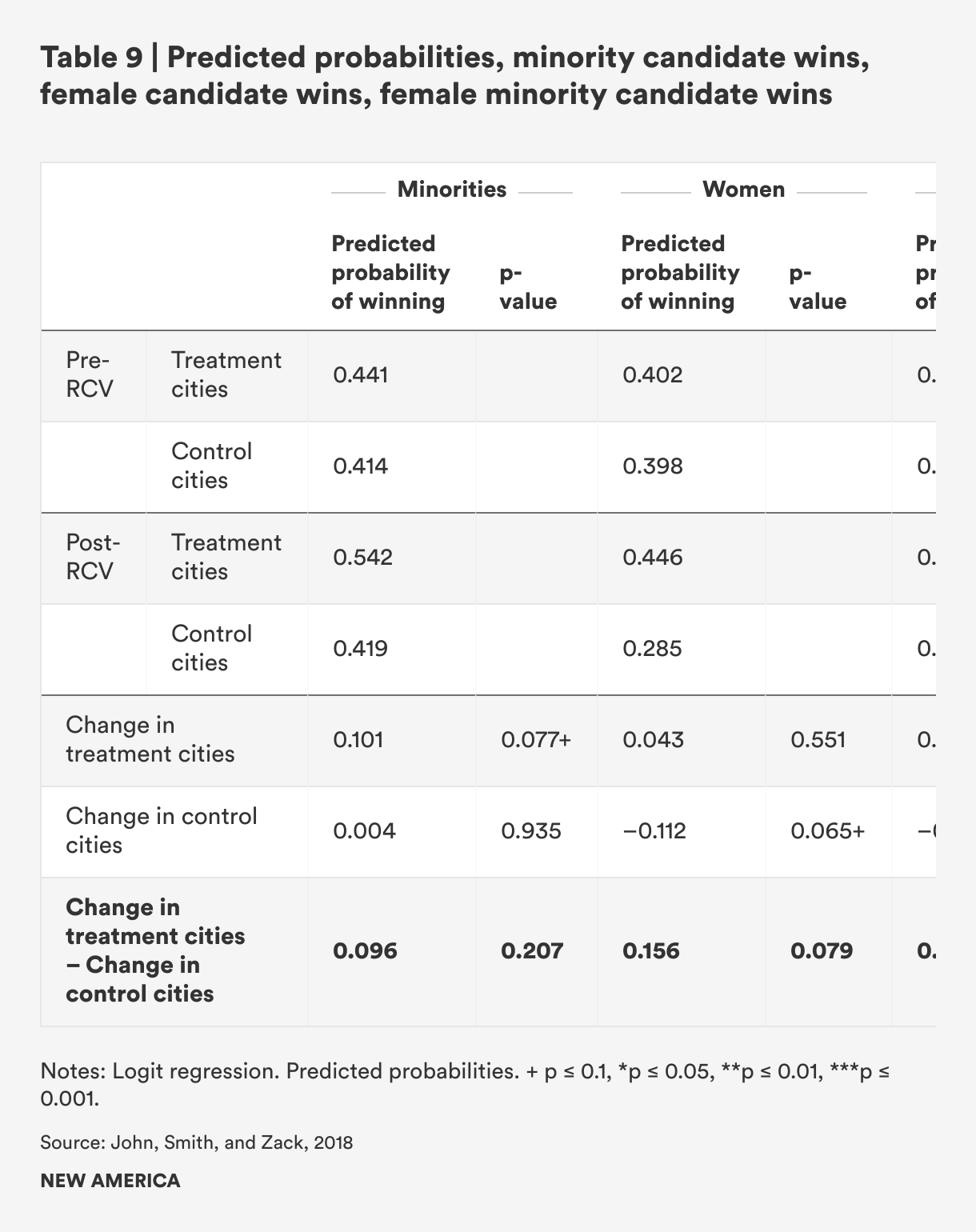
In addition, John et al. found that all three sets of variables, city characteristics, the structure of the race, and characteristics of the contest, were relevant across the three candidate groups. For minority candidates, the non-white citizen voting age population (CVAP), high incomes, a minority incumbent contesting the race, and an open seat, were associated with an increase in the odds of winning election. Critically, they estimate that term limits were associated with an 82 percent decrease in the predicted probability of a minority candidate winning election after RCV implementation (p < 0.01). While this could be a fluke (and indeed, it does not chime with past findings of a subtler, and even positive relationship between state legislative terms limits and minority representation),117 it asks us to consider how different reforms might clash in the real world, and should be investigated further. The authors suggest that the reason women of color win more under RCV might be that they go above and beyond with their outreach to their rivals’ supporters, including those from different ethnic and racial groups, seeking those vital second- and third-choice rankings.
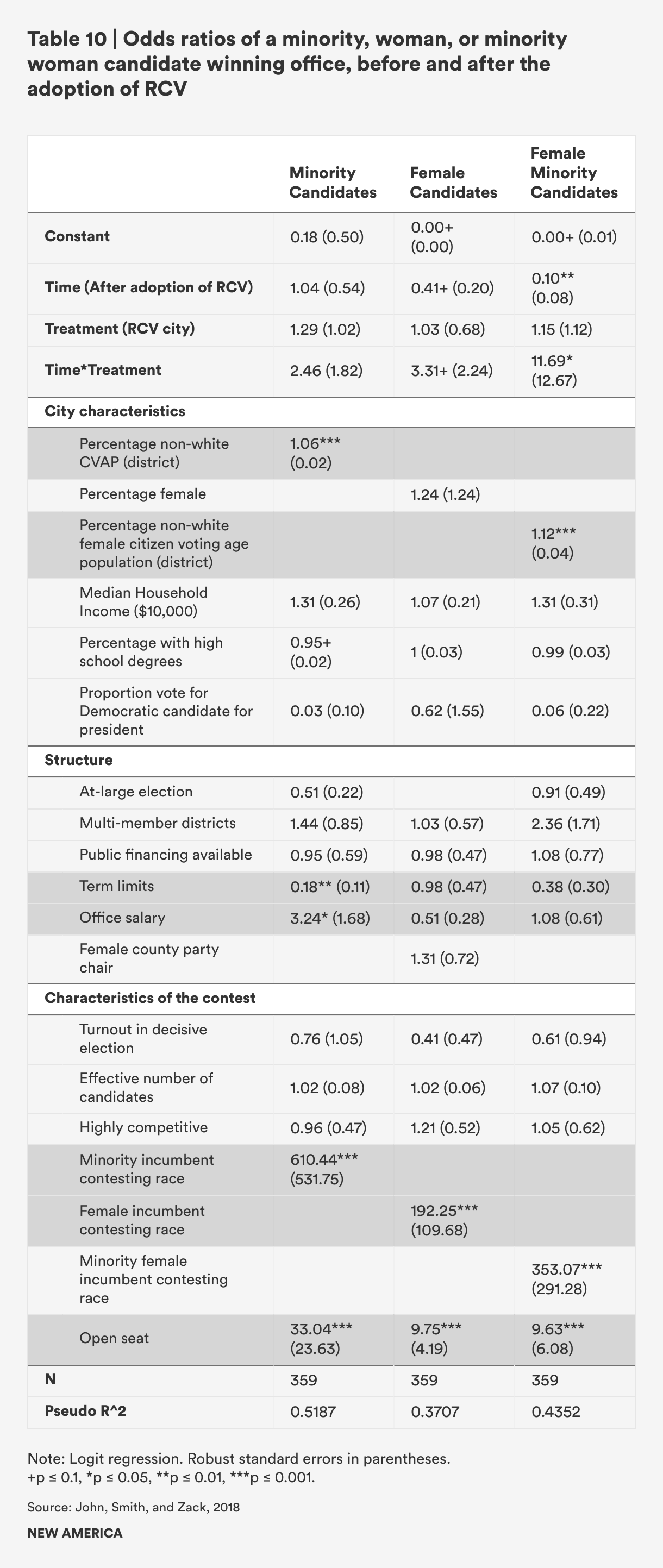
Terrell and Lamendola’s 2020 article on RCV's impacts on women's representation concluded that the number of women winning elected office is higher in cities that use RCV. Following up on the four Bay Area cities examined in John et al.,118 they report that women have won an average of 56 percent of RCV elections between 2010 and 2019, despite representing only 38 percent of candidates. Furthermore, across all 19 U.S. cities and counties using RCV in that time period, women won 48 percent of all contested seats, while making up only 34 percent of candidates (Table 11). And according to the article, as of July 2020, 47 percent of city council seats in the Bay Area cities using RCV were held by women compared to only 36 percent in control cities (California cities with at least 30,000 residents), and 37 percent in Bay Area control cities.119
Similarly, Steven Hill’s investigation of how racial minorities in San Francisco, Minneapolis, and Oakland fared under RCV concluded that around 60 percent of the 53 seats elected by preferential rules were won by ethnic minorities. Denise Munro Robb’s study of RCV’s impact on representation in San Francisco’s Board of Supervisors elections (2002, 2004, 2006, and 2008) also found greater minority representation after RCV was implemented, although there were still very few female supervisors holding office.120 Consistent with these findings, New York City’s inaugural RCV primaries in 2021 resulted not only in the city’s second Black mayor but also the most diverse and gender-balanced city council in the city’s history.121
One explanation for the increase in victors from racial and ethnic minority groups under RCV is that the system reduces the type of vote-splitting among candidates from the same background often experienced in plurality elections. FairVote’s recent analysis of RCV’s effects on communities of color found that each racial and ethnic group included in their sample “increased its win rate in elections featuring multiple members of that group; none experienced vote-splitting.” Black candidates in particular benefited. According to the report, a “Black candidate won in 67 percent of elections that featured two or more Black candidates, compared to only 32 percent of elections with only one Black candidate.”122
Another possible explanation for why RCV may lead to more racial and ethnic minority winners is that candidates from these groups are doing a better job of appealing to voters outside their traditional base, in order to secure those crucial back-up rankings. The same FairVote study cited above examined all single-winner RCV races in the United States that advanced past the first round of counting (that is, no candidate received a majority of first-preference votes) to ascertain which groups were more effective at accumulating support from the first to last round of counting. They found that candidates of color increased their vote totals between rounds by a greater percentage than white candidates.123
Still, one major concern related to RCV is that racial prejudices are more likely to influence vote choice when the election system is more cognitively complex.124 In "Ranking Candidates in Local Elections: Neither Panacea nor Catastrophe," Melody Crowder-Meyer, Shana Kushner Gadarian, and Jessica Trounstine found that, despite the extra effort involved in completing an RCV ballot compared to a plurality ballot, voters in an RCV election are not significantly less likely to support candidates of color relative to white candidates (see Figure 10). Importantly, adding partisan labels significantly reduced the bias against candidates of color among voters in both RCV and plurality elections. Similar to the earlier note on term limits, this finding should give proponents of nonpartisan elections some pause. Finally, their results also show that the penalties against candidates of color were "driven nearly completely by ideological moderates and conservatives as well as by white respondents." These penalties persist with experience. However, the bias toward white candidates is low among respondents with high levels of knowledge of RCV.
Figure 10 | Candidates of Color Face Similar Penalty in Nonpartisan Plurality and RCV Elections
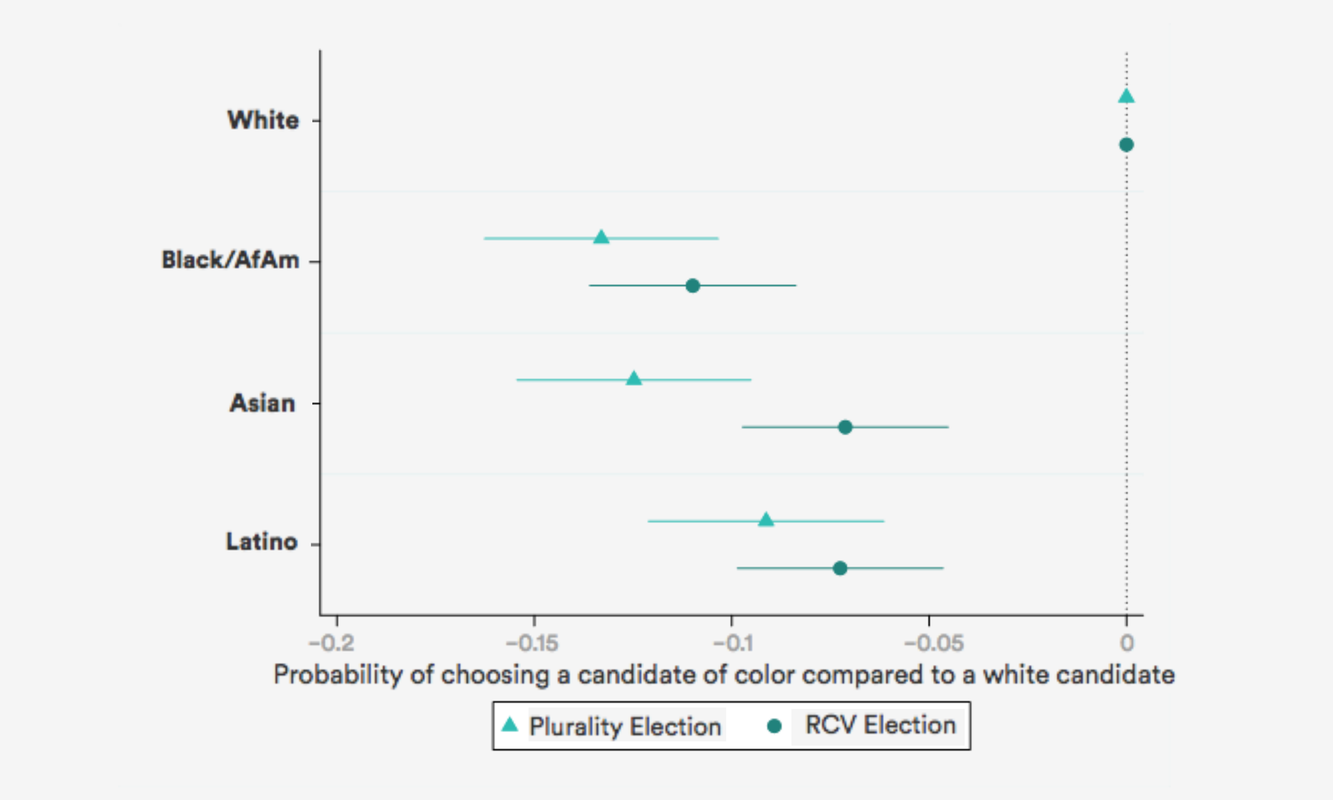
Independents
To be sure, when non-major party candidates run, voters are more likely to support them under RCV. Jesse Clark’s 2020 study on the costs and benefits of RCV found that RCV does appear to increase the odds of a voter casting a sincere vote for a non-major party candidate. He found RCV in Maine led to a 6 percent increase in non-major party vote-share in the two 2018 congressional elections.125 Reinforcing this finding, his experimental survey (online, nationwide sample N~1500) demonstrated that RCV is associated with a 5 percent increase in the propensity to vote for (i.e., give top ranking to) a non-major party candidate.126
As discussed in the RCV Changes Who Runs section above, "Ranked-Choice Voting, Runoff, and Democracy: Insights from Maine and Other U.S. States," by Cynthia McClintock and Joseph Cerrone, assessed the openness of the electoral arena to independents and third parties and ideological moderation in the context of the 2020 federal elections, with a special focus on Maine, which implemented RCV for congressional elections in 2018. They conducted interviews with key stakeholders in Maine, including current and former political candidates (like 2020 U.S. Senate independent candidate Lisa Savage). They also identified and compared a set of 12 competitive federal election cases.127 Across those 12 elections in 2020, they found, in line with expectations, that the biggest combined vote-share for third party and independent Senate candidates (6.6 percent) was in Maine. Further, independent Lisa Savage was the only non-Democratic/non-Republican Senate candidate to achieve 5 percent in the election result.
Though not included in the McClintock Cerrone study, the substantial vote-shares earned by independents candidates Marty Grohman, Tiffany Bond and Will Hoar in Maine’s 2018 congressional elections, detailed in the “who runs” section on independents, lend further support to the claim that RCV gives a boost to independent candidates, even if that boost may not be sufficient to get them elected.
Moderates and Moderation
To assess the openness of the 2020 electoral arena to ideological moderation, McClintock and Cerrone identified and compared a set of 12 competitive federal election cases (based on Cook Political Report ratings as of summer 2020) and evaluated the 33 candidates running in those elections.128
Maine’s candidates’ scores were consistent with RCV’s promise of greater ideological moderation. Among the sample, Sen. Collins was by far the most moderate. She also won re-election; among the four Democrat and Republican candidates in Maine, only one was over .25 points more extreme than the candidate’s party’s average. However, as the authors note, based on roll call votes, Collins was rated more ideologically moderate prior to RCV’s adoption in Maine than after. In sum, they found the gains for independents and ideological moderation in Maine under RCV were modest in 2020, and the effects of both RCV and runoff were constrained by the intense political polarization in play during the study, among other factors.
Maine’s other Senator, Angus King, is also one of the more moderate Senators. However, ascribing the moderation of both King and Collins to RCV confuses correlation with causation. Both Collins and King had long careers as political moderates before RCV, and both won their RCV elections outright (without transfers). Maine is a rare closely-contested “purple” state in which moderation tends to pay. Did RCV keep them more moderate? It’s possible. Here, it might be valuable for future research to qualitatively compare Maine with New Hampshire, another purple state with a similar political culture and a similar premium on moderation in elected officials, but which didn’t enact RCV.
In general, the observed effects of RCV on candidate diversity seems to be dependent on methodology and context. Studies that find RCV elevates diverse candidates tend to be based on progressive cities. Findings based on laboratory experiments suggest RCV produces similar outcomes to plurality and runoff systems. While the difference could boil down to the fact that lab experiments don’t account for significant real-world factors that are in play in cities, the Maine example—the only real national test case we have—hints at the possibility that national political forces might be even more influential than local-level forces, but we need more data. We recommend an experiment in which the conditions of an election are manipulated to be local versus national, and participants are exposed to different kinds of messaging (i.e., some messaging that involves more attacks; other messaging that involves more willingness to compromise). Under these conditions, how do people use their rankings? This could also be used to answer some remaining questions about voter satisfaction with the ranking system.
Claim 9: RCV Leads to More Condorcet Winners
Conclusion: Mainly supported
According to FairVote, as of September 2021, there have been 289 single-winner ranked choice elections in the United States which included at least three candidates, 120 of which (or 42 percent) were decided in the first round. In the remaining 169 races, the count advanced to the instant runoff stage. Out of these, 103, or about 60 percent, resulted in winners who did not receive a majority of all votes cast because of ballot exhaustion (where voters did not rank enough candidates for their votes to ultimately count in the final round, after transfers). However, of these 103 elections, over half occurred in elections where voters were limited to only three rankings.129 When one compares non-majority RCV outcomes to a traditional top-two runoff, the turnout drop-off in second round elections is typically much higher than any ballot exhaustion.
Critics of RCV often cite the 2009 mayoral election in Burlington, Vermont as evidence that the system produces perverse outcomes. Burlington was an early adopter of RCV in 2005, but it was repealed by voters after the 2009 mayoral race, in which the winner, incumbent Bob Kiss, was neither the first-round leader nor the Condorcet winner (that is, the votes failed to show that Kiss would have won in head-to-head matchups against each of the other candidates on the ballot). Many voters who supported the subsequent repeal campaign had originally voted in favor of adopting RCV, and turned against the system because they did not like Kiss. Other voters, meanwhile, felt that they were essentially punished in the RCV election for ranking their favorite candidate first, something critics have called the “favorite betrayal criterion.”130 Still, to put Burlington in perspective, "Condorcet loser" elections are exceedingly rare under ranked-choice voting. Burlington, moreover, recently voted to bring back RCV, effective March 2022.131
Claim 10: RCV Makes Primaries Work Better in Avoiding Polarizing Candidates?
Conclusion: Early evidence is promising, more study needed
Standard RCV eliminates the need for primaries. By condensing a normally multi-stage cycle to one election held in November, RCV can significantly reduce voter dropoff and other turnout disparities between primary and general elections. In addition, as early and mail voting become more prevalent, RCV could help reduce the incidence of wasted votes cast for candidates who withdraw shortly before Election Day. In a plurality election, if your chosen candidate withdraws after you cast your vote, you’re out of luck. With RCV, if your first-choice candidate drops out, your vote will simply go to your next-ranked candidate. And though this is less studied in the United States, replacing multiple elections with a one-off RCV election should also save taxpayer money in the long term.
Despite these advantages of a one-off RCV election, recent experiments with RCV in New York City, the Virginia Republican Party, and five state Democratic parties in 2020 have opted to bring RCV to their party nomination contests while leaving the normal election calendar intact.132 The most persuasive rationale for this approach is that RCV is much more compatible with modern primaries than first-past-the-post rules, given their often large, unwieldy fields of often polarizing candidates, where candidates can often win with a small fraction of the total vote. Moreover, in many one-party jurisdictions (such as New York City) the primary election is the only election that matters. It is also easier politically to change the rules of primary elections than general elections. Regarding the introduction of RCV ballots to presidential nominating contests, FairVote’s Rob Richie and colleagues suggested that “RCV may combine the consensus‐building of pre‐1968 conventions with the modern practice of empowering voters to choose their party’s nominees.”133 It also combines well with vote-by-mail. By one estimate, almost four million ballots were “wasted” in the 2020 presidential primaries because candidates dropped out between the time a voter mailed their ballot and the day of the election. With RCV, such votes would instead transfer to voters’ back-up preference.134
Thus far, primaries that use RCV have generally produced “consensus” candidates, affirming expectations that RCV can have a moderating effect on primaries, or at least have the effect of blocking the path of more polarizing candidates who might have enough base support to win under plurality rules.
Another apparent advantage to using RCV in the primary process is that because RCV encourages sincere (as opposed to strategic) voting, ranked ballots in party primaries can more clearly demonstrate factions’ relative priorities and voting power than traditional single-mark ballots, thereby giving party leaders, who will need to unify those factions around the party nominee (and in the long term keep their big tents together and safe from a hostile takeover), a better sense of how and with whom to bargain for future cooperation.
A recent study on the 2020 Democratic presidential nomination contests in the five states that used RCV ballots concluded that voters used their rankings not only to nominate the strongest candidate to represent the party in the general election but also to ensure representation of the party's diverse electorate at the national convention.135 RCV not only allowed voters to express support for Joe Biden as the nominee but also let the progressive wing of the party select Sanders as the alternative to Biden. RCV furthermore allowed the clear third-favorite candidate, Warren, to display her unique strength among a powerful segment of the electorate. Indeed, by combining the vote transfer data with the exhausted ballots in each round one can observe that Warren received the greatest representational boost from the RCV rules. As the paper’s authors, Baodong Liu, Nadia Mahallati, Charles M. Turner note, the fact that Sen. Elizabeth Warren (D-Mass.) voters were at once numerous and unlikely to rank either Joe Biden or Sen. Bernie Sanders (I-Vt.)—a clear warning signal to party elites that accommodation is needed—would have been hidden inside the traditional balloting process.
For scholars who are interested in running more counterfactual analyses, Jason Maloy’s 2019 book Smarter Ballots: Electoral Realism and Reform includes a chapter on retrospective simulations with alternative ballot types that discusses methods, limitations, and sources of data.136
In 2021, New York City (re)introduced RCV for local primary and special elections and left the general election rules unchanged. The reform seems to have worked as intended: Besides marking the highest turnout in a New York City primary in decades, the mayoral campaign—the top contest on the ballot—elevated three candidates, two of whom are Black and two women, representing different wings of the party, and they each held on through multiple rounds of vote tabulation. Brooklyn Borough President and former police captain Eric Adams, a moderate, ultimately won the nomination thanks to the breadth, if not depth, of support for him across the five boroughs. He was the most-preferred candidate for 30 to 40 percent of voters in four boroughs; more importantly, though, more than 50 percent of city voters gave him one of their five rankings.137
Citations
- In addition to single-winner RCV and STV, there is block-preferential voting, “bottoms‐up,” and RCV numbered posts. Jack Santucci, “Variants of Ranked‐Choice Voting from a Strategic Perspective,” Politics and Governance 9 (June 2021): 344–353, <a href="<a href="source">source">source">source.
- FairVote, “Where Ranked Choice Voting is Used,” accessed September 5, 2021, <a href="<a href="source">source">source">source.
- Santucci, “Variants of Ranked‐Choice Voting from a Strategic Perspective.”
- Amy J. Douglas, “The forgotten history of the single transferable vote in the United States,” Representation, 34 (July 1996): 13-20, <a href="<a href="source">source">source">source.
- Devin McCarthy and Jack Santucci, “Ranked Choice Voting as a Generational Issue in Modern America Politics,” Politics & Policy 49 (February 2021): 33–60, <a href="<a href="source">source">source">source.
- Francis Neely, Lisel Blash, and Corey Cook, An Assessment of Ranked-Choice Voting in the San Francisco 2004 Election (Daly City, CA: Public Research Institute, San Francisco State University, 2005); Richard E. DeLeon, San Francisco and instant runoff voting: An analysis of the SFSU/PRI exit poll data assessing voter opinions about ranked choice voting in the November 2004 Board of Supervisors elections (San Francisco, CA, September 2005), <a href="source">source">source.
- Francis Neely, Lisel Blash, and Corey Cook, An Assessment of Ranked-Choice Voting in the San Francisco 2005 Election (Daly City, CA: Public Research Institute, San Francisco State University, 2006).
- Ranked Choice Voting: 2009 City Of Minneapolis Municipal Elections (St. Cloud State University Survey, 2009), available at <a href="source">source">source; Michael Lewyn, “Two Cheers for Instant Runoff Voting,” Phoenix Law Review 6 (2012): 117-136, available at SSRN: <a href="source">source">source.
- The poll was conducted by Edison Research, with a sample size of 4,020 voters. Jay Wendland and Erin Carman, Ranking Works? An Examination Of Ranked Choice Voting In New York City (Amherst, New York: Daemen College, 2021), <a href="source">source">source.
- Sarah John and Andrew Douglas, “Candidate Civility and Voter Engagement in Seven Cities with Ranked Choice Voting,” National Civic Review 106 (Spring 2017): 25-29, <a href="source">source">source.
- Joseph A. Coll, “Demographic Disparities Using Ranked-Choice Voting? Ranking Difficulty, Under-Voting, and the 2020 Democratic Primary,” Politics and Governance 9 (June 2021): 293–305, <a href="source">source">source.
- Richard L. Cole, Delbert A. Taebel, and Richard L. Engstrom, “Cumulative Voting in a Municipal Election: a Note on Voter Reactions and Electoral Consequences,” Political Research Quarterly 43 (1990): 191-199, <a href="source">source">source; Richard Engstrom and Charles Barrilleaux, "Native Americans and Cumulative Voting: The Sisseton-Wahpeton Sioux," Social Science Quarterly 72 (June 1991): 388-393, <a href="source">source">source; Robert R. Brischetto and Richard L. Engstrom, “Cumulative Voting and Latino Representation: Exit Surveys in Fifteen Texas Communities,” Social Science Quarterly 78 no. 4 (1997): 973-991, <a href="source">source">source; David Kimball and Martha Kropf, “Voter Competence with Cumulative Voting,” Social Science Quarterly 97 (September 2016): 619–35, <a href="source">source">source.
- David Kimball and Joseph P. Anthony, “Public Perceptions of Alternative Voting Systems: Results from a National Survey Experiment,” April 16, 2021, <a href="source">source">source.
- Melody Crowder-Meyer, Shana Kushner Gadarian, and Jessica Trounstine, “Ranking Candidates in Local Elections: Neither Panacea nor Catastrophe,” January 21, 2021, available at SSRN: <a href="source">source">source.
- Martha Kropf and David C. Kimball, Helping America Vote: The Limits of Election Reform (New York, NY: Routledge, 2012).
- Neely, Blash, and Cook, An Assessment of Ranked-Choice Voting in the San Francisco 2004 Election.
- Francis Neely, Corey Cook, and Lisel Blash, An Assessment of Ranked-Choice Voting in the San Francisco 2005 Election (Daly City, CA: Public Research Institute, San Francisco State University, 2006).
- Todd Donovan, “Self-Reported Understanding of Ranked-Choice Voting,” Social Science Quarterly 100 (August 2019): 1768–76, <a href="source">source">source.
- Joseph A. Coll, “Demographic Disparities Using Ranked‐Choice Voting? Ranking Difficulty, Under‐Voting, and the 2020 Democratic Primary,” Politics and Governance 9 (June 2021), <a href="source">source">source.
- Wendland and Carman, Ranking Works? An Examination Of Ranked Choice Voting In New York City.
- Pedro Hernandez, Jennifer Pae, Madeline Brown, and Theodore Landsman, Voter Experience with Ranked Choice Voting in San Francisco (Takoma Park, MD: FairVote, 2018).
- Lindsay Nielson, “Ranked Choice Voting and Attitudes toward Democracy in the United States: Results from a Survey Experiment,” Politics and Policy 45 (August 2017): 535-570, <a href="source">source">source.
- David Schultz and Kristi Rendahl, Evaluating Ranked Choice Voting in the 2009Minneapolis Elections: A Report for the Minneapolis Elections Department (St. Paul, Minnesota: Hamline University, 2010).
- Wendland and Carman, Ranking Works? An Examination Of Ranked Choice Voting In New York City.
- Cheryl Boudreau, Jonathan Colner, and Scott A. MacKenzie, “Ranked-Choice Voting and Political Expression: How Voting Aids Narrow the Gap between Informed and Uninformed Citizens,” March 24, 2021, available at SSRN: <a href="source">source">source.
- Boudreau, Colner, and MacKenzie.
- Craig M. Burnett and Vladimir Kogan, “Ballot (and Voter) ‘Exhaustion’ Under InstantRunoff Voting: An Examination of Four Ranked‐Choice Elections,” Electoral Studies 37 (March 2015): 41‐49, <a href="source">source">source.
- Francis Neely and Corey Cook, “Whose Votes Count? Undervotes, Overvotes, and Ranking in San Francisco’s Instant‐Runoff Elections,” American Politics Research 36 (July 2008): 530‐554, <a href="source">source">source.
- David Kimball and Joseph Anthony, “Voter Participation with Ranked Choice Voting in the United States,” (working paper, presented at the 2016 American Political Science Association Annual Meeting, Philadelphia, PA, October 2016), <a href="source">source">source.
- Lawrence R. Jacobs and Joanne M. Miller, Rank Choice Voting and the 2013 Minneapolis Elections (Minneapolis, MN: University of Minnesota, February 2014).
- Francis Neely and Corey Cook, “Whose Votes Count? Undervotes, Overvotes, and Ranking in San Francisco's Instant-Runoff Elections.”
- Neely and Cook; Jacobs and Miller; Francis Neely and Jason A. McDaniel, “Overvoting and the Equality of Voice under Instant-Runoff Voting in San Francisco,” California Journal of Politics and Policy 7, no. 4 (2015): 1-27, <a href="source">source">source.
- Lindsay Nielson, “Ranked Choice Voting and Attitudes toward Democracy in the United States: Results from a Survey Experiment.”
- Neely and McDaniel, “Overvoting and the Equality of Voice under Instant-Runoff Voting in San Francisco.”
- Note that the elections sampled used optical scan voting machines which detect overvote errors and give the voters the opportunity to start over. Neely and Cook, “Whose Votes Count? Undervotes, Overvotes, and Ranking in San Francisco's Instant-Runoff Elections.”
- Jason Maloy, “Voting Error across Multiple Ballot Types: Results from Super Tuesday (2020) Experiments in Four American States,” September 24, 2020, available at SSRN: <a href="source">source">source; See also, J. S. Maloy and Matthew Ward, “The Impact of Input Rules and Ballot Options on Voting Error: An Experimental Analysis,” Politics and Governance 9 (June 2021): 306–318, <a href="source">source">source;
- For example, if a voter ranks two candidates as their second choice, that second choice vote doesn’t count but their first-preference vote will stand.
- See, for example, Benjamin Reilly, “Ranked Choice Voting in Australia and America: Do Voters Follow Party Cues?,” Politics and Governance 9 (June 2021): 271–279, <a href="source">source">source.
- Neely and Cook, “Whose Votes Count? Undervotes, Overvotes, and Ranking in San Francisco's Instant-Runoff Elections.”
- Boudreau, Colner, and MacKenzie, “Ranked-Choice Voting and Political Expression: How Voting Aids Narrow the Gap between Informed and Uninformed Citizens.”
- Neely and McDaniel, “Overvoting and the Equality of Voice under Instant-Runoff Voting in San Francisco”; Kimball and Anthony, "Voter Participation with Ranked Choice Voting in the United States.”
- Neely and Cook, “Whose Votes Count?”
- See, for example, Jason Maloy, “Voting Error across Multiple Ballot Types: Results from Super Tuesday (2020) Experiments in Four American States,” and Neely and Cook, “Whose Votes Count?”
- Neely and Cook, “Whose Votes Count?”; Boudreau, Colner, and MacKenzie, “Ranked-Choice Voting and Political Expression: How Voting Aids Narrow the Gap between Informed and Uninformed Citizens.”
- The 100 Million Project: The Untold Story of American Non-Voters (Knight Foundation, 2020), <a href="source">source">source
- Curtis Wood, “Voter turnout in city elections,” Urban Affairs Review 38 (November 2002): 209–231, <a href="source">source">source.
- Without partisan cues, voters are also more likely to rely on cognitive biases that disproportionately penalize candidates of color. See, for example, Crowder-Meyer, Kushner Gadarian, and Trounstine, “Ranking Candidates in Local Elections: Neither Panacea nor Catastrophe.”
- The 100 Million Project: The Untold Story of American Non-Voters; Robert P. Jones, Daniel Cox, Betsy Cooper, and Rachel Lienesch, The Divide Over America’s Future: 1950 or 2050: Findings from the 2016 American Values Survey? (Washington, DC: Public Religion Research Institute, 2016), <a href="source">source">source.
- Kimball and Anthony, "Voter Participation with Ranked Choice Voting in the United States.”
- Kimball and Anthony.
- Jason A. McDaniel, “Electoral Rules and Voter Turnout in Mayoral Elections: An Analysis of Ranked-Choice Voting," (paper prepared for the Election Systems, Reform, and Administration Conference in Philadelphia, PA, July 11–12, 2019), <a href="source">source">source.
- Jason McDaniel, “Writing the Rules to Rank the Candidates: Examining the Impact of Instant‐Runoff Voting on Racial Group Turnout in San Francisco Mayoral Elections,” Journal of Urban Affairs 38 (November 2016): 387–408, <a href="source">source">source.
- Eamon McGinn, Rating rankings: Effect of instant run‐off voting on participation and civility (Unpublished manuscript, October 2020), <a href="source">source">source.
- In “Writing the Rules to Rank the Candidates,” McDaniel used mutilevel linear regression models that controlled for incumbency, candidate race, precinct socioeconomic status, education, population age, and racial diversity.
- Courtney L. Juelich and Joseph A. Coll, “Ranked Choice Voting and Youth Voter Turnout: The Roles of Campaign Civility and Candidate Contact,” Politics and Governance 9 (June 2021): 319–331, <a href="source">source">source. Jeulich and Coll’s findings, it should be noted, were based on self-reported turnout levels that significantly surpassed actual turnout from the election years in question. In addition, though they used a sophisticated approach to matching—usually within‐state, if not within county, and with controls on population size, racial and ethnic composition, political characteristics, US region, and socio‐economic conditions—they didn’t compare the differences in turnout between the matched cities prior to RCV adoption, which means we can’t judge if or the extent to which higher levels of engagement were already present in the places that adopted RCV, and even may have predisposed those cities to reform.
- Kimball and Anthony, “Voter Participation with Ranked Choice Voting in the United States.” The authors estimated that a competitive mayoral contest also reduces vote drop‐off, but by about 11 points, a much smaller effect compared to RCV consolidated election schedule RCV.
- Kimball and Anthony.
- For more voter drop-off between elections, see Declan Alvidrez, Primary Runoff Elections and Decline in Voter Turnout (Takoma Park, MD: FairVote, December 2020), <a href="source">source">source.
- Lee Drutman, What We Know about Congressional Primaries and Congressional Primary Reform (Washington, DC: New America, 2021), <a href="source">source">source.
- Seth J. Hill, “Sidestepping Primary Reform: Political Action in Response to Institutional Change,” Political Science Research and Methods (2020): 1–17, source: “Point estimates suggest an increase in turnout of 1.5 percentage points in open primaries and 6.1 percentage points in nonpartisan primaries.” See also Matthew J. Geras and Michael H. Crespin, “The Effect of Open and Closed Primaries on Voter Turnout,” in Routledge Handbook of Primary Elections, ed. Robert G. Boatright, 1st ed. (New York: Routledge, 2018), 133–46, source: “For both the Republicans and the Democrats, voter turnout was highest during open primaries and lowest during hybrid primaries. The predicted difference in turnout between these two types of primaries appears to amount to about 2 to 3 percent.”
- Drutman, What We Know about Congressional Primaries and Congressional Primary Reform.
- Neal Caren, “Big City, Big Turnout? Electoral Participation in American Cities,” Journal of Urban Affairs 29 (February 2007): 31-46, <a href="source">source">source.
- Jason Jurjevich, Phil Keisling, Kevin Rancik, Carson Gorecki, and Stephanie Hawke, Who Votes for Mayor? (Portland, OR: Portland State University, 2016), <a href="source">source">source.
- For example, when Baltimore shifted to even-year elections in 2016, voter turnout in local races jumped from just 13 percent to 60 percent, and research indicates that participation in local elections in cities doubles in on-cycle November elections: Zoltan Hajnal, Vladimir Kogan, and G. Agustin Markarian, “Who Votes: City Election Timing and Voter Composition,” American Political Science Review (2021): 1–10, doi:10.1017/S0003055421000915; Caren, “Big City, Big Turnout?”; Jan Brennan, “Increasing Voter Turnout in Local Elections,” National Civic Review 109 (Spring 2020), <a href="source">source">source.
- Sarah John and Andrew Douglas, “Candidate Civility and Voter Engagement in Seven Cities with Ranked Choice Voting," National Civic Review 106 (Spring 2017): 25-29, <a href="source">source">source. The November 2013 survey included 2,400 voters in three RCV cities (Minneapolis, St.Paul, Cambridge), and seven non-RCV cities (Boston, Seattle, Des Moines, Cedar Rapids, Tulsa, Lowell, MA and Worcester, MA); the November 2014 survey was of 2,400 voters in eleven Californian cities: the four Bay Area cities that use RCV (Berkeley, Oakland, San Francisco, and San Leandro) and seven control cities.
- Ranked Choice Voting: 2009 City of Minneapolis Municipal Elections (St. Cloud State University Survey, December 2009); Neely, Blash, and Cook, An Assessment Of Ranked-choice Voting In The San Francisco 2004 Election.
- The Santa Fe survey was conducted by Lonna Atkeson and FairVote New Mexico, who covered eight voting centers in Santa Fe for the full polling day and two additional centers for a half day each. Santa Fe Voters Support Ranked Choice Voting and Have High Confidence in City Elections (FairVote New Mexico, 2018), <a href="source">source">source; Wendland and Carman, Ranking Works? An Examination Of Ranked Choice Voting In New York City.
- Nielson, “Ranked Choice Voting and Attitudes toward Democracy in the United States: Results from a Survey Experiment.”
- The Electoral Reform Research Group is a collaboration between New America’s Political Reform program, the Unite America Institute, Stanford’s CDDRL, the American Enterprise Institute, formed in 2019, <a href="source">source">source.
- Andre Blais, Carolina Plescia, Semra Sevi, “Choosing to Vote As Usual,” February 12, 2021, available at SSRN: <a href="source">source">source.
- Kimball and Anthony, “Public Perceptions of Alternative Voting Systems.”
- Joseph Cerrone and Cynthia McClintock, “Ranked-Choice Voting, Runoff, and Democracy: Insights from Maine and Other U.S. States,” January 19, 2021, available at SSRN: <a href="source">source">source.
- Kimball and Anthony, “Public Perceptions of Alternative Voting Systems.”
- Blais, Plescia, Sevi, “Choosing to Vote As Usual.”
- McCarthy and Santucci, “Ranked Choice Voting as a Generational Issue in Modern America Politics.” They also found young people express greater dissatisfaction with “the way democracy works in the United States,” and that dissatisfaction is significantly associated with RCV support.
- Again, while only the exception here seems to be Maine, its status as the only state to have already implemented RCV for federal elections gives it added weight, and signals to those promoting RCV beyond the local level that more work will be necessary to overcome partisan identity-based resistance. Bitter partisan battles leading up to implementation, followed by Republicans’ disappointment with their candidate losing the 2018 House race in a “come-from-behind victory.” Cerrone and McClintock, “Ranked-Choice Voting, Runoff, and Democracy: Insights from Maine and Other U.S. States”; Blais, Plescia, and Sevi, “Choosing to Vote As Usual”; Crowder-Meyer, Kushner Gadarian, and Trounstine, “Ranking Candidates in Local Elections: Neither Panacea nor Catastrophe”; Kimball and Anthony, “Public Perceptions of Alternative Voting Systems.”
- On the other hand, experience may not be enough to reconcile reported values with preference: a Maine study found a large majority of voters prefer a system that produces a majority winner, but an exit poll of Maine voters conducted during the first election to use RCV rules found only 47 percent of voters approved of the electoral reform. Katherine Gillespie, Carrie Levan, and L. Sandy Maisel, “Ranked Choice Voting in Maine: Were the Critics' Fears Justified?” Unpublished manuscript, Colby College, 2019.
- McCarthy and Santucci, “Ranked-Choice Voting as a Generational Issue in Modern American Politics.”
- Lee Drutman, William Galston, and Tod Lindberg, Spoiler Alert: Why Americans’ Desires for a Third Party Are Unlikely to Come True (Washington, DC: Democracy Fund Voter Study Group and New America, 2018), <a href="source">source">source; Nielsen, “Ranked Choice Voting and Attitudes toward Democracy in the United States: Results from a Survey Experiment.”
- FairVote New Mexico, Santa Fe Voters Support Ranked Choice Voting and Have High Confidence in City Elections.
- “Government Reform: Ranked Choice Voting, Redistricting by Citizen Commission and Multi-Member Districts: A Survey of American Voters,” Program for Public Consultation, School of Public Policy, University of Maryland, 2017, <a href="source">source">source.
- A cross-national study of public opinion by David Farrell and Ian McAllister concluded that, other things being equal, voters were more satisfied with how democracy worked in nations where people voted for candidates with preferential voting: “Voter satisfaction and electoral systems: Does preferential voting in candidate-centred systems make a difference?,” European Journal of Political Research 45 (August 2006): 723-749, <a href="source">source">source.
- While much of the article focused on Maine, the authors decided to survey U.S. voters nationwide on satisfaction with different systems, given the likelihood that Maine results would reflect the strongpartisan divisions over RCV in the state. To explain the choice, they cite Joseph Anthony, Amy Fried, Robert Glover, and David C. Kimball, “Ranked Choice Voting in Maine from the Perspective of Election Authorities,” (paper prepared for delivery at the annual meeting of the American Political Science Association, Washington, D.C., August 29-September 1, 2019).
- Other indicators used to measure voters’ satisfaction were usability, comprehensibility, transparency, representativeness, and support for adoption in the respondent's own state. Cerrone and McClintock, “Ranked-Choice Voting, Runoff, and Democracy Insights from Maine and Other U.S. States.”
- Crowder-Meyer, Kushner Gadarian, and Trounstine, “Ranking Candidates in Local Elections: Neither Panacea nor Catastrophe.” See also Jesse Clark, “Rank Deficiency? Analyzing the Costs and Benefits of Single-Winner Ranked-Choice Voting,” MIT Political Science Department Research Paper No. 2020-8, October 1, 2020, available at SSRN: <a href="source">source">source. Clark found the interaction between RCV and the ballot size had a significant impact on voter satisfaction as well.
- Kimball and Anthony, “Public Perceptions of Alternative Voting Systems.”
- Sean Fischer, Amber Hye-Yon Lee, and Yphtach Lelkes, “Electoral Systems and Political Attitudes: Experimental Evidence,” May 12, 2021, available at SSRN: <a href="source">source">source.
- Christopher J. Anderson and Christine A. Guillory, “Political Institutions and Satisfaction with Democracy: A Cross-National Analysis of Consensus and Majoritarian Systems,” The American Political Science Review 91, no. 1 (1997): 66–81; Shaun Bowler, Todd Donovan, Ola Listhaug, Christopher J. Anderson, and André Blais, Losers’ Consent: Elections and Democratic Legitimacy (Oxford: Oxford University Press, 2007).
- Barry Fagin, The Conservative Case for Ranked Choice Voting (Denver, CO: Independence Institute, 2021), <a href="source">source">source. Utah’s more cautious and decentralized approach to introducing RCV provides an interesting case study for conservatives. The state’s Republican-led local options legislation is a time-limited pilot program with the goal of collecting data before pushing for statewide use.
- Other (more limited) exceptions include the Republican Party of Virginia’s decision to use RCV for its 2021 nominating convention, and the Indiana GOP decision to use RCV for party primary elections in 2020. Deb Otis and Nora Dell, “Ranked Choice Results and Analysis from Virginia Republican Convention,” FairVote, May 10, 2021, <a href="source">source">source; Adam Ginsberg, “Indiana GOP to Use Ranked Choice Voting in Virtual Convention,” FairVote, May 14, 2020, <a href="source">source">source.
- Relatedly, it provides more opportunities for people with platforms or identities outside the traditional mainstream to send a clear message to the likely winner or party establishment. If a person is not confident they can win (yet) but that they can secure a meaningful proportion of second or third preferences, RCV is effective at revealing emerging issues and identities that may be ignored in a plurality setting.
- Sarah John, Haley Smith, and Elizabeth Zack, “The Alternative Vote: Do Changes in Single‐Member District Voting Systems Affect Descriptive Representation of Women and Minorities?,” Electoral Studies 54 (May 2018): 90‐102; Courtney Lamendola and Cynthia Richie Terrell, In Ranked Choice Elections, Women WIN (Takoma Park, MD, Represent‐Women, 2020), source">source.
- Kimball and Anthony, “Voter Participation with Ranked Choice Voting in the United States.”
- The RCV cities included in the study are Berkeley, Oakland, San Francisco, and San Leandro; the control cities are Alameda, Anaheim, Richmond, San Jose, Santa Ana, Santa Clara, and Stockton. John, Haley, and Zack, “The Alternative Vote.”
- Sarah John, “The Alternative Vote can increase representation of women and people of color in US elections,” LSE Phelan US Centre, July 24, 2018, source">source.
- Sarah John, Haley Smith, Elizabeth Zack, Cynthia Terrell, Michelle Whittaker, Jennifer Pae, and Rob Richie, The impact of ranked choice voting on representation: How ranked choice voting affects women and people of color candidates in California (Takoma Park, MD: RepresentWomen, 2016), source">source; Cynthia Richie Terrell, Courtney Lamendola, and Maura Reilly, “Election Reform and Women’s Representation: Ranked Choice Voting in the U.S.,” Politics and Governance 9, (June 2021): 332–343, source">source.
- Jack Santucci and Jamil Scott, “Do Ranked Ballots Stimulate Candidate Entry?,” November 4, 2021, available at SSRN: <a href="source">source">source">source. For more on the origins of the San Francisco RCV movement, Santucci and Scott cite Richard DeLeon, Steven Hill, and Lisel Blash, “The Campaign for Proposition H and Preference Voting in San Francisco, 1996,” Representation 35, no. 4 (1998): 265–274.
- Terrell and Lamendola, In Ranked Choice Elections, Women WIN and Cynthia Richie Terrell, Courtney Lamendola, and Maura Reilly, “Election Reform and Women’s Representation: Ranked Choice Voting in the U.S.” Data available here. A major challenge in assessing the impact of RCV on candidate entry is that cities do not randomly choose to adopt RCV. Rather, more progressive cities tend to adopt RCV, and more progressive cities are more likely to support female candidates. Of course, since there is only one Berkeley, and only one San Francisco, for example, it’s difficult to estimate female candidate entry in a hypothetical Berkeley or San Francisco without RCV. As Terrell, Lamendola and Reilly acknowledge: “Due to the multiple factors affecting local election outcomes, this analysis does not infer causality between ranked choice voting and improvements in the descriptive representation, but instead illustrates the correlation.”
- John, Smith, and Zack, “The Alternative Vote: Do Changes in Single‐Member District Voting Systems Affect Descriptive Representation of Women and Minorities?”; Terrell, Lamendola, and Reilly, “Election Reform and Women’s Representation: Ranked Choice Voting in the U.S.”
- Santucci and Scott, “Do Ranked Ballots Stimulate Candidate Entry?”
- E.g. a 2008 Brookings study attributes the underrepresentation of women on the ballot to factors such as: “Women are less likely than men to be willing to endure the rigors of a political campaign. They are less likely than men to be recruited to run for office. They are less likely than men to have the freedom to reconcile work and family obligations with a political career. They are less likely than men to think they are “qualified” to run for office. And they are less likely than men to perceive a fair political environment.” Jennifer L. Lawless and Richard L. Fox, Why Are Women Still Not Running for Public Office?, (Washington, DC: Brookings Institution, 2008), source">source; Kristin Kanthak and Jonathan Woon, “Women Don't Run? Election aversion and candidate entry,” American Journal of Political Science 59 (July 2015): 595–612; John, Smith, and Zack, “The Alternative Vote.”
- Drutman, Galston, and Lindberg, Spoiler Alert; Lee Drutman, “The Moderate Middle Is A Myth,” FiveThirtyEight (blog), September 24, 2019, source">source.
- Cerrone and McClintock, “Ranked-Choice Voting, Runoff, and Democracy Insights from Maine and Other U.S. States.”
- The sample included two RCV elections (Maine’s Senate and 2nd Congressional District), five elections under runoff (Georgia’s regular Senate election, Georgia’s special Senate election, Georgia’s 6th Congressional District, and California’s 21st and 25th Congressional Districts), and for plurality cases they included the two competitive elections in Iowa (its Senate and 1st Congressional District) and in North Carolina (its Senate and 8th Congressional District) because Iowa and North Carolina are deemed similar to Maine and Georgia respectively by FiveThirtyEight. For an additional plurality case, they included the Senate race in Colorado on the basis of the competitiveness criterion.
- Steve Mistler, “Federal Judge Strikes Down Poliquin's Challenge To Maine's Ranked-Choice Voting Law,” WBUR News, December 13, 2018, source">source.
- Denise Munro Robb, The Effect of Instant Runoff Voting on Democracy (unpublished doctoral dissertation) (Irvine, CA: University of California, 2011). Eamon McGinn, Rating Rankings: Effect of Instant Run-off Voting on Participation and Civility; Todd Donovan, “Candidate Perceptions of Campaigns under Preferential and Plurality Voting,” (paper prepared for the workshop on Electoral Systems, Electoral Reform, and Implications for Democratic Performance, Stanford University, March 14‐15, 2014), source">source; Todd Donovan, Caroline Tolbert, and Kellen Gracey, “Campaign Civility Under Preferential and Plurality Voting,” Electoral Studies 42 (June 2016): 157‐163, source">source; Martha Kropf, “Using Campaign Communications to Analyze Civility in Ranked Choice Voting Elections,” Politics and Governance 9 (June 2021): 280–292, source">source; McGinn, Rating Rankings: Effect of Instant Run-off Voting on Participation and Civility.
- Donovan, Tolbert, and Gracey, “Campaign Civility Under Preferential and Plurality Voting.” Their sample included approximately 1200 likely voters from three RCV and STV jurisdictions (Cambridge, Minneapolis, and St. Paul) and about 1200 likely voters from seven similar jurisdictions that had just experienced plurality elections (Boston, Seattle, Des Moines, Cedar Rapids, Tulsa, Lowell MA and Worcester, MA). Respondents were contacted by the Eagleton Poll (Rutgers University) immediately after the November 2013 elections. The authors isolated the effects of voting system on public attitudes about local campaigns with a multiple case matching method, which they argued is an improvement upon the “standard” cross-national, cross-sectional analyses because it allows them to minimize non-electoral system differences across the matched cases. Still, they acknowledge a potential endogeneity problem in their design, and suggest that researchers seeking to test for the causal effect of RCV on campaign behavior might conduct a time series measure of voter and candidate perceptions taken before and after the implementation of RCV. Now that more jurisdictions are preparing to implement the reform, there are more opportunities to run such tests.
- John and Douglas, “Candidate Civility and Voter Engagement in Seven Cities with Ranked Choice Voting.”
- Donovan, Tolbert, and Gracey, “Campaign Civility Under Preferential and Plurality Voting.”
- Robb, The Effect of Instant Runoff Voting on Democracy.
- McGinn, Rating Rankings: Effect of Instant Run-off Voting on Participation and Civility.
- Kropf, “Using Campaign Communications to Analyze Civility in Ranked Choice Voting Elections.”
- Benjamin Reilly, “Electoral systems for divided societies,”Journal of Democracy 13 (April 2002): 156–170, source">source. org/10.1353/jod.2002.0029.
- Kropf.
- Jesse Clark, “Rank Deficiency? Analyzing the Costs and Benefits of Single-Winner Ranked-Choice Voting,” MIT Political Science Department Research Paper No. 2020-8, October 1, 2020, available at SSRN: source">source.
- John, Smith, and Zack, “The Alternative vote.”
- See, for example, Susan J. Carroll and Krista Jenkins, “Increasing Diversity or More of the Same? Term Limits and the Representation of Women, Minorities, and Minority Women in State Legislatures,”(prepared for the annual meeting of the American Political Science Association, San Francisco, CA, August, 2001), source.
- John, Smith, and Zack, “The Alternative Vote”; John et al., The Impact of Ranked Choice Voting on Representation: How Ranked Choice Voting Affects Women and People of Color Candidates in California.
- Lamendola and Terrell, In Ranked Choice Elections, Women WIN. Additional data available here.
- Robb.
- Including 30 women, 86 percent of them women of color; six openly LGBTQ+ members; and at least six foreign-born members. “Major Takeaways from New York City's First Ranked Choice Election,” readMedia, July 14, 2021, source.
- Deb Otis and Nora Dell, “Ranked Choice Voting Elections Benefit Candidates and Voters of Color.”
- Otis and Dell.
- Melody Crowder-Meyer, Shana Gadarian, Jessica L. Trounstine and Kau Vue, “A Different Kind of Disadvantage: Candidate Race, Cognitive Complexity, and Voter Choice,” Political Behavior 42 (2020): 509-530.
- He conducted a DID analysis of non-major party vote shares in congressional elections between 2012, 2014, 2016, and 2018.
- Clark, “Rank Deficiency.”
- The sample included two RCV elections (Maine’s Senate and 2nd Congressional District), five elections under runoff (Georgia’s regular Senate election, Georgia’s special Senate election, Georgia’s 6th Congressional District, and California’s 21st and 25th Congressional Districts), and for plurality cases they included the two competitive elections in Iowa (its Senate and 1st Congressional District) and in North Carolina (its Senate and 8th Congressional District) because Iowa and North Carolina are deemed similar to Maine and Georgia respectively by FiveThirtyEight. For an additional plurality case, they included the Senate race in Colorado on the basis of the competitiveness criterion.
- Cerrone and McClintock, “Ranked-Choice Voting, Runoff, and Democracy Insights from Maine and Other U.S. States.”
- “Data on Ranked Choice Voting,” FairVote, source; Craig M. Burnett, Vladimir Kogan, “Ballot (and voter) ‘exhaustion’ under Instant Runoff Voting: An examination of four ranked-choice elections,” Electoral Studies 37 (2015): 41-49, source.
- How our voting system (and IRV) betrays your favourite candidate, source
- Notably, RCV was repealed in Burlington by a margin of 52 to 48 percent in a low-turnout election (7,641 votes cast); it was reinstated in Burlington by a margin of 64 to 36 percent, with 13,826 votes cast.
- Alternatively, Alaska voters approved a ballot measure in 2020 to establish ranked-choice voting for general elections, including the presidential election, in which voters would rank the four candidates that advanced from a nonpartisan “top-four” primary.
- Rob Richie, Benjamin Oestericher, Deb Otis and Jeremy Seitz‐Brown, “Lessons from the Use of Ranked Choice Voting in American Presidential Primaries,” Politics and Governance 9 (June 2021): 354–364, source.
- Richie et al.
- Baodong Liu, Nadia Mahallati, and Charles Turner, “Ranked-Choice Voting Delivers Representation and Consensus in Presidential Primaries,” April 9, 2021, available at SSRN: source
- J.S. Maloy, Smarter Ballots: Electoral Realism and Reform, (Germany: Springer International Publishing, 2019), Chapter 6.
- Wendland and Carman, Ranking Works? An Examination Of Ranked Choice Voting In New York City.
Consequences for Policy and Politics
The boldest claim that RCV advocates make is that it can reduce partisan polarization and help to make American democracy more compromise-oriented. This is the most downstream consequence, and thus the hardest to measure in the United States, given the extremely limited use of RCV as of this writing. Certainly, there are good theoretical reasons to expect RCV should have a moderating effect, and the experiences of other democracies that use RCV (most notably Australia) offers strong support for the moderating, compromise-inducing influence of RCV.138
But so far, in the United States, we have very little data to back up any claims that RCV makes government work better, but also none that indicates it makes matters worse.
Claim 11: RCV Reduces Polarization
Conclusion: Unclear, hard to assess
Here, we review the small but growing U.S.-based literature examining the impacts of RCV on different types of polarization: interparty and affective polarization and racially polarized voting. In some ways, the research hints at RCV’s potential for mitigating interparty divides, but otherwise are more suggestive of the limitations of voting reform inside a two-party system.
Cross-partisan and third party voting has become increasingly rare in America due to high levels of partisan polarization. Lindsay Nielson sought to test (among other things) whether RCV might elicit more cross-party voting or reveal a more nuanced set of preferences which voters are not prompted to access or express under plurality rules. In the RCV treatment group, 20-25 percent of partisans ranked at least one candidate from the opposite political party among their top preferences, and 5 percent of partisan respondents exclusively ranked candidates of other parties. In plurality elections, Nielsen notes, about 90 percent of Democrats and Republicans vote for a candidate within their own party. Results indicate that people will take advantage of the opportunity to express more complex preferences and even their ambivalence toward the two parties.139
Relatedly, as cited earlier, the article "Ranked-Choice Voting, Runoff, and Democracy: Insights from Maine and Other U.S. States" reported that in competitive congressional races in 2020, the most ideologically moderate candidate was a Republican, Susan Collins, from Maine, who happened to have run under RCV but most likely would have run as moderate regardless. The report also found third party and independent candidates fared better (but still poorly) under RCV than under runoff or plurality. Again, these findings only gesture at RCV’s potential to break us out of the binary, us-versus-them thinking that single-mark voting tends to encourage.
Regarding affective polarization, or interparty animosity, there are good reasons to suspect that RCV and other preferential voting systems would lead to less hostility between the parties compared to plurality systems. While winner-take-all encourages a zero-sum, obstructionist approach to politics, RCV and other preferential systems should create a “positive-sum” electoral environment that incentivizes cooperation and bargaining among rivals—behaviors which theoretically carry over from campaigning into governing.
Observational data from the international literature provides modest evidence of a causal link between electoral systems and affective polarization, but typically those links are mediated by effects, such as RCV’s civility effect, which has inspired many scholars to recommend RCV for divided societies.140 The only U.S.-based study to date that looks at the direct relationship of electoral rules and affective polarization is "Electoral Systems and Political Attitudes: Experimental Evidence." Researchers Sean Fischer, Amber Hye-Yon Lee, and Yphtach Lelkes ran a modified dictator game designed to measure the level of interparty animosity under plurality, RCV, and proportional representation, as well as with different numbers of parties. They found, surprisingly, there was more in-group bias (their proxy for interparty animosity) in RCV and proportional systems than plurality systems. In other words, plurality systems yielded the lowest level of interparty animosity. However, critically, increasing the number of parties (especially to four parties) decreased in-group bias for RCV and proportional but not plurality. They concluded, accordingly, that “electoral reform that does not lead to a change in the number of parties in a system may make interparty animosity worse.”141
Racially polarized voting is a different type of polarization that has been studied primarily in the Bay Area. In theory, RCV should reduce voting strictly along racial and ethnic lines, because a candidate in a multi-racial, multi-ethnic jurisdiction must appeal not only to voters from her own racial or ethnic group but also campaign for the backup preferences of other groups. Benjamin Reilly’s 2018 article "Centripetalism and Electoral Moderation in Established Democracies," lends empirical support to this racial moderation hypothesis. Reilly’s historical examination of Australian elections under RCV found that as the country has become more socially diverse and preference voting more widely used, ethnic voting has declined.142 In contrast, the same candidate running under the traditional plurality, single-mark system is more likely to be able to win on the support of members of her own group alone.
But the evidence from the United States is less clear. Several articles, including "Does More Choice Lead to Reduced Racially Polarized Voting? Assessing the Impact of Ranked-Choice Voting in Mayoral Elections," by Jason McDaniel, have advanced a competing theory, the racial competition hypothesis, which posits that RCV voters will not only continue to be guided by racial group identity cues when choosing to express expanded preferences, but that based on the increased complexity of RCV ballots, people will default to racial group identity cues to inform their vote choice.143 McDaniel’s analysis compared racial group candidate vote-share in mayoral elections in Oakland and San Francisco before and after those cities adopted RCV.144 The former analysis suggested that racially polarized voting in San Francisco declined significantly after the implementation of RCV. But his analysis also revealed that the level of racially polarized voting decreased by even more in the non-RCV cities in the same time period. Ultimately, he concluded that racially polarized voting did not decrease significantly as a result of the implementation of RCV, and actually led to statistically significant increases in the racial vote division between whites and Asians. However, it is unclear how much of this was driven by candidate entry, as opposed to RCV.
A recent study by Yuki Atsusaka and Theodore Landsman attempted to extend the literature by using all available information on individual ranked ballots, rather than rely on aggregated election data or voters’ first choices alone, as previous research had done.145 Ultimately they concluded that switching from first-past-the-post to ranked-choice voting neither mitigated nor increased the degree of racial polarization among Bay Area voters. They also found circumstantial evidence of “plumping” (when voters only rank one or two candidates in an attempt to concentrate their voting power to their preferred candidates), something future researchers may want to investigate.
As usual, the fact that the data available is limited to nonpartisan, low-information local elections strains generalizability. Racially polarized voting might look completely different in the context of a statewide or national election where voters are more likely to be informed about the candidates and use partisan or policy cues. It might also look different if we combine RCV ballots with increases in district magnitude or the size of the legislature or council.146
Finally, while the themes of moderation and sincere voting run through much of the RCV literature, there’s little examination of the ways in which the reform may alter our relationship to ideologically extreme candidates—do we see them as more or less electable, for instance? Our highly polarized political climate has for some time rewarded candidates who are more extreme than their own voter bases, and it’s not unreasonable to assume that extreme candidates would continue to emerge even if we ditched plurality for RCV. In a 2021 experimental study based on social comparison theory, Melissa Baker conducted an experimental study of voters’ responses to ideologically extreme candidates under RCV and plurality rules.147 Baker observed that candidates, regardless of ideology or ideological extremity, were seen as more representative of the electorate in RCV elections compared to plurality. However, extreme conservative candidates were seen as slightly more electable in elections that used plurality voting compared to RCV. Liberal respondents viewed extreme liberal candidates as less electable in both voting systems, but especially in plurality elections. This result suggests that extreme liberal candidates may be slightly less likely to be punished for ideological extremity by liberals in RCV elections. Future research on this topic could extend this kind of analysis to real-world elections to see if these electability perceptions, and ideological asymmetries, still apply. If future work reinforces the finding that voters perceive candidates as more representative (or electable) in elections that use RCV, scholars might consider how that might impact the odds of women and minority women candidates winning election, in addition to or perhaps instead of changes in campaign environment.
Claim 12: RCV Changes Policy Outcomes
Conclusion: Not supported, very hard to assess
Could RCV ultimately change policy outcomes? Evidence from other countries using preferential systems suggest some positive effects on governing, but overall the effects are still difficult to measure, given the wide range of factors that determine policy.148 In the United States, the limited literature on electoral systems and policy representation contains no real evidence that different electoral rules change responsiveness to public opinion in local government.149
A recent study by Arjun Vishwanath was the first direct analysis of whether RCV affects substantive representation in the United States.150 With a sample of nine RCV cities, he evaluated changes in key fiscal and ideological variables following the switch to RCV.151 His empirical findings suggest that there is no significant effect of the reform. Of course, there are other variables to examine, and this study, like so many, was limited to a set of fairly progressive cities. As additional jurisdictions, including states, adopt RCV, more research could help evaluate the reform’s impacts on policy and governance outcomes.
For example, one could collect and analyze interest group endorsements for RCV winners and compare them against the winners’ voting records. One could also conduct surveys and interviews of officials who were elected under both plurality and RCV to understand if/how their approaches to governing or incentives to prioritize (or avoid) certain policies may have changed. Did they feel they could be more productive, or more policy-oriented? Did a councilor or mayor elected under RCV consult more with interest groups that weren’t previously part of their coalition, but perhaps gave her their second- or third-choice votes, or pledged them for the next election? Another possibility is to extend the Vishwanath study to matched plurality cities over the same period of time, for comparison. As polarization has deepened in the United States and politics has become more nationalized, it’s not unreasonable to expect that substantive representation in non-RCV jurisdictions may have worsened. Reflecting on the 2016 study of women candidature in the Bay Area discussed earlier, Terrell et al. noted that RCV cities were less affected than their non-RCV counterparts by a regional downward trend in women running for local office, suggesting that RCV may, in certain respects, be less a force for good than a buffer against broader undesirable trends in the political culture.152
Additionally, a recent survey experiment conducted in San Francisco may shed some light on the lack of observed effect in Vishwanath’s study. In "Ranked-Choice Voting and Political Expression: How Voting Aids Narrow the Gap between Informed and Uninformed Citizens," Cheryl Boudreau, Jonathan Colner, and Scott MacKenzie evaluated whether citizens’ rankings of candidates in low-profile local elections faithfully reflect their own policy views.153 They found that overall, respondent rankings are modestly related to their policy views (weaker for respondents with low political knowledge), but that there were no clear differences in agreement between candidates ranked first and those ranked second and third. The results suggest, among other things, that uninformed citizens in particular struggle to distinguish between the candidates’ policy views in local RCV elections (where most RCV elections now take place). This lowers their propensity to use their rankings, but also, to the point of policy representation, deprives those who are elected under this system of the insight into what average citizens care about, a benefit that RCV should theoretically provide.
Certainly, meaningful policy changes are somewhat downstream from electoral changes, and are always hard to prove, given the long causal chain. The theory is that changing electoral rules will lead to different types of candidates running, with different political incentives, and different bargaining structures, which ultimately translate into policy changes. At this point, it is almost certainly more productive to examine these micro-level changes in the causal chain, since there are fewer confounding variables in doing so, and the limited use of RCV thus far makes inferences about policy impacts difficult.
Citations
- In addition to single-winner RCV and STV, there is block-preferential voting, “bottoms‐up,” and RCV numbered posts. Jack Santucci, “Variants of Ranked‐Choice Voting from a Strategic Perspective,” Politics and Governance 9 (June 2021): 344–353, <a href="<a href="<a href="source">source">source">source">source.
- FairVote, “Where Ranked Choice Voting is Used,” accessed September 5, 2021, <a href="<a href="<a href="source">source">source">source">source.
- Santucci, “Variants of Ranked‐Choice Voting from a Strategic Perspective.”
- Amy J. Douglas, “The forgotten history of the single transferable vote in the United States,” Representation, 34 (July 1996): 13-20, <a href="<a href="<a href="source">source">source">source">source.
- Devin McCarthy and Jack Santucci, “Ranked Choice Voting as a Generational Issue in Modern America Politics,” Politics & Policy 49 (February 2021): 33–60, <a href="<a href="<a href="source">source">source">source">source.
- Francis Neely, Lisel Blash, and Corey Cook, An Assessment of Ranked-Choice Voting in the San Francisco 2004 Election (Daly City, CA: Public Research Institute, San Francisco State University, 2005); Richard E. DeLeon, San Francisco and instant runoff voting: An analysis of the SFSU/PRI exit poll data assessing voter opinions about ranked choice voting in the November 2004 Board of Supervisors elections (San Francisco, CA, September 2005), <a href="<a href="source">source">source">source.
- Francis Neely, Lisel Blash, and Corey Cook, An Assessment of Ranked-Choice Voting in the San Francisco 2005 Election (Daly City, CA: Public Research Institute, San Francisco State University, 2006).
- Ranked Choice Voting: 2009 City Of Minneapolis Municipal Elections (St. Cloud State University Survey, 2009), available at <a href="<a href="source">source">source">source; Michael Lewyn, “Two Cheers for Instant Runoff Voting,” Phoenix Law Review 6 (2012): 117-136, available at SSRN: <a href="<a href="source">source">source">source.
- The poll was conducted by Edison Research, with a sample size of 4,020 voters. Jay Wendland and Erin Carman, Ranking Works? An Examination Of Ranked Choice Voting In New York City (Amherst, New York: Daemen College, 2021), <a href="<a href="source">source">source">source.
- Sarah John and Andrew Douglas, “Candidate Civility and Voter Engagement in Seven Cities with Ranked Choice Voting,” National Civic Review 106 (Spring 2017): 25-29, <a href="<a href="source">source">source">source.
- Joseph A. Coll, “Demographic Disparities Using Ranked-Choice Voting? Ranking Difficulty, Under-Voting, and the 2020 Democratic Primary,” Politics and Governance 9 (June 2021): 293–305, <a href="<a href="source">source">source">source.
- Richard L. Cole, Delbert A. Taebel, and Richard L. Engstrom, “Cumulative Voting in a Municipal Election: a Note on Voter Reactions and Electoral Consequences,” Political Research Quarterly 43 (1990): 191-199, <a href="<a href="source">source">source">source; Richard Engstrom and Charles Barrilleaux, "Native Americans and Cumulative Voting: The Sisseton-Wahpeton Sioux," Social Science Quarterly 72 (June 1991): 388-393, <a href="<a href="source">source">source">source; Robert R. Brischetto and Richard L. Engstrom, “Cumulative Voting and Latino Representation: Exit Surveys in Fifteen Texas Communities,” Social Science Quarterly 78 no. 4 (1997): 973-991, <a href="<a href="source">source">source">source; David Kimball and Martha Kropf, “Voter Competence with Cumulative Voting,” Social Science Quarterly 97 (September 2016): 619–35, <a href="<a href="source">source">source">source.
- David Kimball and Joseph P. Anthony, “Public Perceptions of Alternative Voting Systems: Results from a National Survey Experiment,” April 16, 2021, <a href="<a href="source">source">source">source.
- Melody Crowder-Meyer, Shana Kushner Gadarian, and Jessica Trounstine, “Ranking Candidates in Local Elections: Neither Panacea nor Catastrophe,” January 21, 2021, available at SSRN: <a href="<a href="source">source">source">source.
- Martha Kropf and David C. Kimball, Helping America Vote: The Limits of Election Reform (New York, NY: Routledge, 2012).
- Neely, Blash, and Cook, An Assessment of Ranked-Choice Voting in the San Francisco 2004 Election.
- Francis Neely, Corey Cook, and Lisel Blash, An Assessment of Ranked-Choice Voting in the San Francisco 2005 Election (Daly City, CA: Public Research Institute, San Francisco State University, 2006).
- Todd Donovan, “Self-Reported Understanding of Ranked-Choice Voting,” Social Science Quarterly 100 (August 2019): 1768–76, <a href="<a href="source">source">source">source.
- Joseph A. Coll, “Demographic Disparities Using Ranked‐Choice Voting? Ranking Difficulty, Under‐Voting, and the 2020 Democratic Primary,” Politics and Governance 9 (June 2021), <a href="<a href="source">source">source">source.
- Wendland and Carman, Ranking Works? An Examination Of Ranked Choice Voting In New York City.
- Pedro Hernandez, Jennifer Pae, Madeline Brown, and Theodore Landsman, Voter Experience with Ranked Choice Voting in San Francisco (Takoma Park, MD: FairVote, 2018).
- Lindsay Nielson, “Ranked Choice Voting and Attitudes toward Democracy in the United States: Results from a Survey Experiment,” Politics and Policy 45 (August 2017): 535-570, <a href="<a href="source">source">source">source.
- David Schultz and Kristi Rendahl, Evaluating Ranked Choice Voting in the 2009Minneapolis Elections: A Report for the Minneapolis Elections Department (St. Paul, Minnesota: Hamline University, 2010).
- Wendland and Carman, Ranking Works? An Examination Of Ranked Choice Voting In New York City.
- Cheryl Boudreau, Jonathan Colner, and Scott A. MacKenzie, “Ranked-Choice Voting and Political Expression: How Voting Aids Narrow the Gap between Informed and Uninformed Citizens,” March 24, 2021, available at SSRN: <a href="<a href="source">source">source">source.
- Boudreau, Colner, and MacKenzie.
- Craig M. Burnett and Vladimir Kogan, “Ballot (and Voter) ‘Exhaustion’ Under InstantRunoff Voting: An Examination of Four Ranked‐Choice Elections,” Electoral Studies 37 (March 2015): 41‐49, <a href="<a href="source">source">source">source.
- Francis Neely and Corey Cook, “Whose Votes Count? Undervotes, Overvotes, and Ranking in San Francisco’s Instant‐Runoff Elections,” American Politics Research 36 (July 2008): 530‐554, <a href="<a href="source">source">source">source.
- David Kimball and Joseph Anthony, “Voter Participation with Ranked Choice Voting in the United States,” (working paper, presented at the 2016 American Political Science Association Annual Meeting, Philadelphia, PA, October 2016), <a href="<a href="source">source">source">source.
- Lawrence R. Jacobs and Joanne M. Miller, Rank Choice Voting and the 2013 Minneapolis Elections (Minneapolis, MN: University of Minnesota, February 2014).
- Francis Neely and Corey Cook, “Whose Votes Count? Undervotes, Overvotes, and Ranking in San Francisco's Instant-Runoff Elections.”
- Neely and Cook; Jacobs and Miller; Francis Neely and Jason A. McDaniel, “Overvoting and the Equality of Voice under Instant-Runoff Voting in San Francisco,” California Journal of Politics and Policy 7, no. 4 (2015): 1-27, <a href="<a href="source">source">source">source.
- Lindsay Nielson, “Ranked Choice Voting and Attitudes toward Democracy in the United States: Results from a Survey Experiment.”
- Neely and McDaniel, “Overvoting and the Equality of Voice under Instant-Runoff Voting in San Francisco.”
- Note that the elections sampled used optical scan voting machines which detect overvote errors and give the voters the opportunity to start over. Neely and Cook, “Whose Votes Count? Undervotes, Overvotes, and Ranking in San Francisco's Instant-Runoff Elections.”
- Jason Maloy, “Voting Error across Multiple Ballot Types: Results from Super Tuesday (2020) Experiments in Four American States,” September 24, 2020, available at SSRN: <a href="<a href="source">source">source">source; See also, J. S. Maloy and Matthew Ward, “The Impact of Input Rules and Ballot Options on Voting Error: An Experimental Analysis,” Politics and Governance 9 (June 2021): 306–318, <a href="<a href="source">source">source">source;
- For example, if a voter ranks two candidates as their second choice, that second choice vote doesn’t count but their first-preference vote will stand.
- See, for example, Benjamin Reilly, “Ranked Choice Voting in Australia and America: Do Voters Follow Party Cues?,” Politics and Governance 9 (June 2021): 271–279, <a href="<a href="source">source">source">source.
- Neely and Cook, “Whose Votes Count? Undervotes, Overvotes, and Ranking in San Francisco's Instant-Runoff Elections.”
- Boudreau, Colner, and MacKenzie, “Ranked-Choice Voting and Political Expression: How Voting Aids Narrow the Gap between Informed and Uninformed Citizens.”
- Neely and McDaniel, “Overvoting and the Equality of Voice under Instant-Runoff Voting in San Francisco”; Kimball and Anthony, "Voter Participation with Ranked Choice Voting in the United States.”
- Neely and Cook, “Whose Votes Count?”
- See, for example, Jason Maloy, “Voting Error across Multiple Ballot Types: Results from Super Tuesday (2020) Experiments in Four American States,” and Neely and Cook, “Whose Votes Count?”
- Neely and Cook, “Whose Votes Count?”; Boudreau, Colner, and MacKenzie, “Ranked-Choice Voting and Political Expression: How Voting Aids Narrow the Gap between Informed and Uninformed Citizens.”
- The 100 Million Project: The Untold Story of American Non-Voters (Knight Foundation, 2020), <a href="<a href="source">source">source">source
- Curtis Wood, “Voter turnout in city elections,” Urban Affairs Review 38 (November 2002): 209–231, <a href="<a href="source">source">source">source.
- Without partisan cues, voters are also more likely to rely on cognitive biases that disproportionately penalize candidates of color. See, for example, Crowder-Meyer, Kushner Gadarian, and Trounstine, “Ranking Candidates in Local Elections: Neither Panacea nor Catastrophe.”
- The 100 Million Project: The Untold Story of American Non-Voters; Robert P. Jones, Daniel Cox, Betsy Cooper, and Rachel Lienesch, The Divide Over America’s Future: 1950 or 2050: Findings from the 2016 American Values Survey? (Washington, DC: Public Religion Research Institute, 2016), <a href="<a href="source">source">source">source.
- Kimball and Anthony, "Voter Participation with Ranked Choice Voting in the United States.”
- Kimball and Anthony.
- Jason A. McDaniel, “Electoral Rules and Voter Turnout in Mayoral Elections: An Analysis of Ranked-Choice Voting," (paper prepared for the Election Systems, Reform, and Administration Conference in Philadelphia, PA, July 11–12, 2019), <a href="<a href="source">source">source">source.
- Jason McDaniel, “Writing the Rules to Rank the Candidates: Examining the Impact of Instant‐Runoff Voting on Racial Group Turnout in San Francisco Mayoral Elections,” Journal of Urban Affairs 38 (November 2016): 387–408, <a href="<a href="source">source">source">source.
- Eamon McGinn, Rating rankings: Effect of instant run‐off voting on participation and civility (Unpublished manuscript, October 2020), <a href="<a href="source">source">source">source.
- In “Writing the Rules to Rank the Candidates,” McDaniel used mutilevel linear regression models that controlled for incumbency, candidate race, precinct socioeconomic status, education, population age, and racial diversity.
- Courtney L. Juelich and Joseph A. Coll, “Ranked Choice Voting and Youth Voter Turnout: The Roles of Campaign Civility and Candidate Contact,” Politics and Governance 9 (June 2021): 319–331, <a href="<a href="source">source">source">source. Jeulich and Coll’s findings, it should be noted, were based on self-reported turnout levels that significantly surpassed actual turnout from the election years in question. In addition, though they used a sophisticated approach to matching—usually within‐state, if not within county, and with controls on population size, racial and ethnic composition, political characteristics, US region, and socio‐economic conditions—they didn’t compare the differences in turnout between the matched cities prior to RCV adoption, which means we can’t judge if or the extent to which higher levels of engagement were already present in the places that adopted RCV, and even may have predisposed those cities to reform.
- Kimball and Anthony, “Voter Participation with Ranked Choice Voting in the United States.” The authors estimated that a competitive mayoral contest also reduces vote drop‐off, but by about 11 points, a much smaller effect compared to RCV consolidated election schedule RCV.
- Kimball and Anthony.
- For more voter drop-off between elections, see Declan Alvidrez, Primary Runoff Elections and Decline in Voter Turnout (Takoma Park, MD: FairVote, December 2020), <a href="<a href="source">source">source">source.
- Lee Drutman, What We Know about Congressional Primaries and Congressional Primary Reform (Washington, DC: New America, 2021), <a href="<a href="source">source">source">source.
- Seth J. Hill, “Sidestepping Primary Reform: Political Action in Response to Institutional Change,” Political Science Research and Methods (2020): 1–17, source: “Point estimates suggest an increase in turnout of 1.5 percentage points in open primaries and 6.1 percentage points in nonpartisan primaries.” See also Matthew J. Geras and Michael H. Crespin, “The Effect of Open and Closed Primaries on Voter Turnout,” in Routledge Handbook of Primary Elections, ed. Robert G. Boatright, 1st ed. (New York: Routledge, 2018), 133–46, source: “For both the Republicans and the Democrats, voter turnout was highest during open primaries and lowest during hybrid primaries. The predicted difference in turnout between these two types of primaries appears to amount to about 2 to 3 percent.”
- Drutman, What We Know about Congressional Primaries and Congressional Primary Reform.
- Neal Caren, “Big City, Big Turnout? Electoral Participation in American Cities,” Journal of Urban Affairs 29 (February 2007): 31-46, <a href="<a href="source">source">source">source.
- Jason Jurjevich, Phil Keisling, Kevin Rancik, Carson Gorecki, and Stephanie Hawke, Who Votes for Mayor? (Portland, OR: Portland State University, 2016), <a href="<a href="source">source">source">source.
- For example, when Baltimore shifted to even-year elections in 2016, voter turnout in local races jumped from just 13 percent to 60 percent, and research indicates that participation in local elections in cities doubles in on-cycle November elections: Zoltan Hajnal, Vladimir Kogan, and G. Agustin Markarian, “Who Votes: City Election Timing and Voter Composition,” American Political Science Review (2021): 1–10, doi:10.1017/S0003055421000915; Caren, “Big City, Big Turnout?”; Jan Brennan, “Increasing Voter Turnout in Local Elections,” National Civic Review 109 (Spring 2020), <a href="<a href="source">source">source">source.
- Sarah John and Andrew Douglas, “Candidate Civility and Voter Engagement in Seven Cities with Ranked Choice Voting," National Civic Review 106 (Spring 2017): 25-29, <a href="<a href="source">source">source">source. The November 2013 survey included 2,400 voters in three RCV cities (Minneapolis, St.Paul, Cambridge), and seven non-RCV cities (Boston, Seattle, Des Moines, Cedar Rapids, Tulsa, Lowell, MA and Worcester, MA); the November 2014 survey was of 2,400 voters in eleven Californian cities: the four Bay Area cities that use RCV (Berkeley, Oakland, San Francisco, and San Leandro) and seven control cities.
- Ranked Choice Voting: 2009 City of Minneapolis Municipal Elections (St. Cloud State University Survey, December 2009); Neely, Blash, and Cook, An Assessment Of Ranked-choice Voting In The San Francisco 2004 Election.
- The Santa Fe survey was conducted by Lonna Atkeson and FairVote New Mexico, who covered eight voting centers in Santa Fe for the full polling day and two additional centers for a half day each. Santa Fe Voters Support Ranked Choice Voting and Have High Confidence in City Elections (FairVote New Mexico, 2018), <a href="<a href="source">source">source">source; Wendland and Carman, Ranking Works? An Examination Of Ranked Choice Voting In New York City.
- Nielson, “Ranked Choice Voting and Attitudes toward Democracy in the United States: Results from a Survey Experiment.”
- The Electoral Reform Research Group is a collaboration between New America’s Political Reform program, the Unite America Institute, Stanford’s CDDRL, the American Enterprise Institute, formed in 2019, <a href="<a href="source">source">source">source.
- Andre Blais, Carolina Plescia, Semra Sevi, “Choosing to Vote As Usual,” February 12, 2021, available at SSRN: <a href="<a href="source">source">source">source.
- Kimball and Anthony, “Public Perceptions of Alternative Voting Systems.”
- Joseph Cerrone and Cynthia McClintock, “Ranked-Choice Voting, Runoff, and Democracy: Insights from Maine and Other U.S. States,” January 19, 2021, available at SSRN: <a href="<a href="source">source">source">source.
- Kimball and Anthony, “Public Perceptions of Alternative Voting Systems.”
- Blais, Plescia, Sevi, “Choosing to Vote As Usual.”
- McCarthy and Santucci, “Ranked Choice Voting as a Generational Issue in Modern America Politics.” They also found young people express greater dissatisfaction with “the way democracy works in the United States,” and that dissatisfaction is significantly associated with RCV support.
- Again, while only the exception here seems to be Maine, its status as the only state to have already implemented RCV for federal elections gives it added weight, and signals to those promoting RCV beyond the local level that more work will be necessary to overcome partisan identity-based resistance. Bitter partisan battles leading up to implementation, followed by Republicans’ disappointment with their candidate losing the 2018 House race in a “come-from-behind victory.” Cerrone and McClintock, “Ranked-Choice Voting, Runoff, and Democracy: Insights from Maine and Other U.S. States”; Blais, Plescia, and Sevi, “Choosing to Vote As Usual”; Crowder-Meyer, Kushner Gadarian, and Trounstine, “Ranking Candidates in Local Elections: Neither Panacea nor Catastrophe”; Kimball and Anthony, “Public Perceptions of Alternative Voting Systems.”
- On the other hand, experience may not be enough to reconcile reported values with preference: a Maine study found a large majority of voters prefer a system that produces a majority winner, but an exit poll of Maine voters conducted during the first election to use RCV rules found only 47 percent of voters approved of the electoral reform. Katherine Gillespie, Carrie Levan, and L. Sandy Maisel, “Ranked Choice Voting in Maine: Were the Critics' Fears Justified?” Unpublished manuscript, Colby College, 2019.
- McCarthy and Santucci, “Ranked-Choice Voting as a Generational Issue in Modern American Politics.”
- Lee Drutman, William Galston, and Tod Lindberg, Spoiler Alert: Why Americans’ Desires for a Third Party Are Unlikely to Come True (Washington, DC: Democracy Fund Voter Study Group and New America, 2018), <a href="<a href="source">source">source">source; Nielsen, “Ranked Choice Voting and Attitudes toward Democracy in the United States: Results from a Survey Experiment.”
- FairVote New Mexico, Santa Fe Voters Support Ranked Choice Voting and Have High Confidence in City Elections.
- “Government Reform: Ranked Choice Voting, Redistricting by Citizen Commission and Multi-Member Districts: A Survey of American Voters,” Program for Public Consultation, School of Public Policy, University of Maryland, 2017, <a href="<a href="source">source">source">source.
- A cross-national study of public opinion by David Farrell and Ian McAllister concluded that, other things being equal, voters were more satisfied with how democracy worked in nations where people voted for candidates with preferential voting: “Voter satisfaction and electoral systems: Does preferential voting in candidate-centred systems make a difference?,” European Journal of Political Research 45 (August 2006): 723-749, <a href="<a href="source">source">source">source.
- While much of the article focused on Maine, the authors decided to survey U.S. voters nationwide on satisfaction with different systems, given the likelihood that Maine results would reflect the strongpartisan divisions over RCV in the state. To explain the choice, they cite Joseph Anthony, Amy Fried, Robert Glover, and David C. Kimball, “Ranked Choice Voting in Maine from the Perspective of Election Authorities,” (paper prepared for delivery at the annual meeting of the American Political Science Association, Washington, D.C., August 29-September 1, 2019).
- Other indicators used to measure voters’ satisfaction were usability, comprehensibility, transparency, representativeness, and support for adoption in the respondent's own state. Cerrone and McClintock, “Ranked-Choice Voting, Runoff, and Democracy Insights from Maine and Other U.S. States.”
- Crowder-Meyer, Kushner Gadarian, and Trounstine, “Ranking Candidates in Local Elections: Neither Panacea nor Catastrophe.” See also Jesse Clark, “Rank Deficiency? Analyzing the Costs and Benefits of Single-Winner Ranked-Choice Voting,” MIT Political Science Department Research Paper No. 2020-8, October 1, 2020, available at SSRN: <a href="<a href="source">source">source">source. Clark found the interaction between RCV and the ballot size had a significant impact on voter satisfaction as well.
- Kimball and Anthony, “Public Perceptions of Alternative Voting Systems.”
- Sean Fischer, Amber Hye-Yon Lee, and Yphtach Lelkes, “Electoral Systems and Political Attitudes: Experimental Evidence,” May 12, 2021, available at SSRN: <a href="<a href="source">source">source">source.
- Christopher J. Anderson and Christine A. Guillory, “Political Institutions and Satisfaction with Democracy: A Cross-National Analysis of Consensus and Majoritarian Systems,” The American Political Science Review 91, no. 1 (1997): 66–81; Shaun Bowler, Todd Donovan, Ola Listhaug, Christopher J. Anderson, and André Blais, Losers’ Consent: Elections and Democratic Legitimacy (Oxford: Oxford University Press, 2007).
- Barry Fagin, The Conservative Case for Ranked Choice Voting (Denver, CO: Independence Institute, 2021), <a href="<a href="source">source">source">source. Utah’s more cautious and decentralized approach to introducing RCV provides an interesting case study for conservatives. The state’s Republican-led local options legislation is a time-limited pilot program with the goal of collecting data before pushing for statewide use.
- Other (more limited) exceptions include the Republican Party of Virginia’s decision to use RCV for its 2021 nominating convention, and the Indiana GOP decision to use RCV for party primary elections in 2020. Deb Otis and Nora Dell, “Ranked Choice Results and Analysis from Virginia Republican Convention,” FairVote, May 10, 2021, <a href="<a href="source">source">source">source; Adam Ginsberg, “Indiana GOP to Use Ranked Choice Voting in Virtual Convention,” FairVote, May 14, 2020, <a href="<a href="source">source">source">source.
- Relatedly, it provides more opportunities for people with platforms or identities outside the traditional mainstream to send a clear message to the likely winner or party establishment. If a person is not confident they can win (yet) but that they can secure a meaningful proportion of second or third preferences, RCV is effective at revealing emerging issues and identities that may be ignored in a plurality setting.
- Sarah John, Haley Smith, and Elizabeth Zack, “The Alternative Vote: Do Changes in Single‐Member District Voting Systems Affect Descriptive Representation of Women and Minorities?,” Electoral Studies 54 (May 2018): 90‐102; Courtney Lamendola and Cynthia Richie Terrell, In Ranked Choice Elections, Women WIN (Takoma Park, MD, Represent‐Women, 2020), <a href="source">source">source.
- Kimball and Anthony, “Voter Participation with Ranked Choice Voting in the United States.”
- The RCV cities included in the study are Berkeley, Oakland, San Francisco, and San Leandro; the control cities are Alameda, Anaheim, Richmond, San Jose, Santa Ana, Santa Clara, and Stockton. John, Haley, and Zack, “The Alternative Vote.”
- Sarah John, “The Alternative Vote can increase representation of women and people of color in US elections,” LSE Phelan US Centre, July 24, 2018, <a href="source">source">source.
- Sarah John, Haley Smith, Elizabeth Zack, Cynthia Terrell, Michelle Whittaker, Jennifer Pae, and Rob Richie, The impact of ranked choice voting on representation: How ranked choice voting affects women and people of color candidates in California (Takoma Park, MD: RepresentWomen, 2016), <a href="source">source">source; Cynthia Richie Terrell, Courtney Lamendola, and Maura Reilly, “Election Reform and Women’s Representation: Ranked Choice Voting in the U.S.,” Politics and Governance 9, (June 2021): 332–343, <a href="source">source">source.
- Jack Santucci and Jamil Scott, “Do Ranked Ballots Stimulate Candidate Entry?,” November 4, 2021, available at SSRN: <a href="<a href="source">source">source"><a href="source">source">source. For more on the origins of the San Francisco RCV movement, Santucci and Scott cite Richard DeLeon, Steven Hill, and Lisel Blash, “The Campaign for Proposition H and Preference Voting in San Francisco, 1996,” Representation 35, no. 4 (1998): 265–274.
- Terrell and Lamendola, In Ranked Choice Elections, Women WIN and Cynthia Richie Terrell, Courtney Lamendola, and Maura Reilly, “Election Reform and Women’s Representation: Ranked Choice Voting in the U.S.” Data available here. A major challenge in assessing the impact of RCV on candidate entry is that cities do not randomly choose to adopt RCV. Rather, more progressive cities tend to adopt RCV, and more progressive cities are more likely to support female candidates. Of course, since there is only one Berkeley, and only one San Francisco, for example, it’s difficult to estimate female candidate entry in a hypothetical Berkeley or San Francisco without RCV. As Terrell, Lamendola and Reilly acknowledge: “Due to the multiple factors affecting local election outcomes, this analysis does not infer causality between ranked choice voting and improvements in the descriptive representation, but instead illustrates the correlation.”
- John, Smith, and Zack, “The Alternative Vote: Do Changes in Single‐Member District Voting Systems Affect Descriptive Representation of Women and Minorities?”; Terrell, Lamendola, and Reilly, “Election Reform and Women’s Representation: Ranked Choice Voting in the U.S.”
- Santucci and Scott, “Do Ranked Ballots Stimulate Candidate Entry?”
- E.g. a 2008 Brookings study attributes the underrepresentation of women on the ballot to factors such as: “Women are less likely than men to be willing to endure the rigors of a political campaign. They are less likely than men to be recruited to run for office. They are less likely than men to have the freedom to reconcile work and family obligations with a political career. They are less likely than men to think they are “qualified” to run for office. And they are less likely than men to perceive a fair political environment.” Jennifer L. Lawless and Richard L. Fox, Why Are Women Still Not Running for Public Office?, (Washington, DC: Brookings Institution, 2008), <a href="source">source">source; Kristin Kanthak and Jonathan Woon, “Women Don't Run? Election aversion and candidate entry,” American Journal of Political Science 59 (July 2015): 595–612; John, Smith, and Zack, “The Alternative Vote.”
- Drutman, Galston, and Lindberg, Spoiler Alert; Lee Drutman, “The Moderate Middle Is A Myth,” FiveThirtyEight (blog), September 24, 2019, <a href="source">source">source.
- Cerrone and McClintock, “Ranked-Choice Voting, Runoff, and Democracy Insights from Maine and Other U.S. States.”
- The sample included two RCV elections (Maine’s Senate and 2nd Congressional District), five elections under runoff (Georgia’s regular Senate election, Georgia’s special Senate election, Georgia’s 6th Congressional District, and California’s 21st and 25th Congressional Districts), and for plurality cases they included the two competitive elections in Iowa (its Senate and 1st Congressional District) and in North Carolina (its Senate and 8th Congressional District) because Iowa and North Carolina are deemed similar to Maine and Georgia respectively by FiveThirtyEight. For an additional plurality case, they included the Senate race in Colorado on the basis of the competitiveness criterion.
- Steve Mistler, “Federal Judge Strikes Down Poliquin's Challenge To Maine's Ranked-Choice Voting Law,” WBUR News, December 13, 2018, <a href="source">source">source.
- Denise Munro Robb, The Effect of Instant Runoff Voting on Democracy (unpublished doctoral dissertation) (Irvine, CA: University of California, 2011). Eamon McGinn, Rating Rankings: Effect of Instant Run-off Voting on Participation and Civility; Todd Donovan, “Candidate Perceptions of Campaigns under Preferential and Plurality Voting,” (paper prepared for the workshop on Electoral Systems, Electoral Reform, and Implications for Democratic Performance, Stanford University, March 14‐15, 2014), <a href="source">source">source; Todd Donovan, Caroline Tolbert, and Kellen Gracey, “Campaign Civility Under Preferential and Plurality Voting,” Electoral Studies 42 (June 2016): 157‐163, <a href="source">source">source; Martha Kropf, “Using Campaign Communications to Analyze Civility in Ranked Choice Voting Elections,” Politics and Governance 9 (June 2021): 280–292, <a href="source">source">source; McGinn, Rating Rankings: Effect of Instant Run-off Voting on Participation and Civility.
- Donovan, Tolbert, and Gracey, “Campaign Civility Under Preferential and Plurality Voting.” Their sample included approximately 1200 likely voters from three RCV and STV jurisdictions (Cambridge, Minneapolis, and St. Paul) and about 1200 likely voters from seven similar jurisdictions that had just experienced plurality elections (Boston, Seattle, Des Moines, Cedar Rapids, Tulsa, Lowell MA and Worcester, MA). Respondents were contacted by the Eagleton Poll (Rutgers University) immediately after the November 2013 elections. The authors isolated the effects of voting system on public attitudes about local campaigns with a multiple case matching method, which they argued is an improvement upon the “standard” cross-national, cross-sectional analyses because it allows them to minimize non-electoral system differences across the matched cases. Still, they acknowledge a potential endogeneity problem in their design, and suggest that researchers seeking to test for the causal effect of RCV on campaign behavior might conduct a time series measure of voter and candidate perceptions taken before and after the implementation of RCV. Now that more jurisdictions are preparing to implement the reform, there are more opportunities to run such tests.
- John and Douglas, “Candidate Civility and Voter Engagement in Seven Cities with Ranked Choice Voting.”
- Donovan, Tolbert, and Gracey, “Campaign Civility Under Preferential and Plurality Voting.”
- Robb, The Effect of Instant Runoff Voting on Democracy.
- McGinn, Rating Rankings: Effect of Instant Run-off Voting on Participation and Civility.
- Kropf, “Using Campaign Communications to Analyze Civility in Ranked Choice Voting Elections.”
- Benjamin Reilly, “Electoral systems for divided societies,”Journal of Democracy 13 (April 2002): 156–170, <a href="source">source">source. org/10.1353/jod.2002.0029.
- Kropf.
- Jesse Clark, “Rank Deficiency? Analyzing the Costs and Benefits of Single-Winner Ranked-Choice Voting,” MIT Political Science Department Research Paper No. 2020-8, October 1, 2020, available at SSRN: <a href="source">source">source.
- John, Smith, and Zack, “The Alternative vote.”
- See, for example, Susan J. Carroll and Krista Jenkins, “Increasing Diversity or More of the Same? Term Limits and the Representation of Women, Minorities, and Minority Women in State Legislatures,”(prepared for the annual meeting of the American Political Science Association, San Francisco, CA, August, 2001), source">source.
- John, Smith, and Zack, “The Alternative Vote”; John et al., The Impact of Ranked Choice Voting on Representation: How Ranked Choice Voting Affects Women and People of Color Candidates in California.
- Lamendola and Terrell, In Ranked Choice Elections, Women WIN. Additional data available here.
- Robb.
- Including 30 women, 86 percent of them women of color; six openly LGBTQ+ members; and at least six foreign-born members. “Major Takeaways from New York City's First Ranked Choice Election,” readMedia, July 14, 2021, source">source.
- Deb Otis and Nora Dell, “Ranked Choice Voting Elections Benefit Candidates and Voters of Color.”
- Otis and Dell.
- Melody Crowder-Meyer, Shana Gadarian, Jessica L. Trounstine and Kau Vue, “A Different Kind of Disadvantage: Candidate Race, Cognitive Complexity, and Voter Choice,” Political Behavior 42 (2020): 509-530.
- He conducted a DID analysis of non-major party vote shares in congressional elections between 2012, 2014, 2016, and 2018.
- Clark, “Rank Deficiency.”
- The sample included two RCV elections (Maine’s Senate and 2nd Congressional District), five elections under runoff (Georgia’s regular Senate election, Georgia’s special Senate election, Georgia’s 6th Congressional District, and California’s 21st and 25th Congressional Districts), and for plurality cases they included the two competitive elections in Iowa (its Senate and 1st Congressional District) and in North Carolina (its Senate and 8th Congressional District) because Iowa and North Carolina are deemed similar to Maine and Georgia respectively by FiveThirtyEight. For an additional plurality case, they included the Senate race in Colorado on the basis of the competitiveness criterion.
- Cerrone and McClintock, “Ranked-Choice Voting, Runoff, and Democracy Insights from Maine and Other U.S. States.”
- “Data on Ranked Choice Voting,” FairVote, source">source; Craig M. Burnett, Vladimir Kogan, “Ballot (and voter) ‘exhaustion’ under Instant Runoff Voting: An examination of four ranked-choice elections,” Electoral Studies 37 (2015): 41-49, source">source.
- How our voting system (and IRV) betrays your favourite candidate, source">source
- Notably, RCV was repealed in Burlington by a margin of 52 to 48 percent in a low-turnout election (7,641 votes cast); it was reinstated in Burlington by a margin of 64 to 36 percent, with 13,826 votes cast.
- Alternatively, Alaska voters approved a ballot measure in 2020 to establish ranked-choice voting for general elections, including the presidential election, in which voters would rank the four candidates that advanced from a nonpartisan “top-four” primary.
- Rob Richie, Benjamin Oestericher, Deb Otis and Jeremy Seitz‐Brown, “Lessons from the Use of Ranked Choice Voting in American Presidential Primaries,” Politics and Governance 9 (June 2021): 354–364, source">source.
- Richie et al.
- Baodong Liu, Nadia Mahallati, and Charles Turner, “Ranked-Choice Voting Delivers Representation and Consensus in Presidential Primaries,” April 9, 2021, available at SSRN: source">source
- J.S. Maloy, Smarter Ballots: Electoral Realism and Reform, (Germany: Springer International Publishing, 2019), Chapter 6.
- Wendland and Carman, Ranking Works? An Examination Of Ranked Choice Voting In New York City.
- Benjamin Reilly, “Democratic Design and Democratic Reform: The Case of Australia,” Taiwan Journal of Democracy 12, no. 2 (2016): 1–16, source; Benjamin Reilly, “Centripetalism and Electoral Moderation in Established Democracies.” Nationalism and Ethnic Politics 24 (April 2018): 201–21.
- Lindsay Nielson, “Ranked Choice Voting and Attitudes toward Democracy in the United States: Results from a Survey Experiment.”
- See for example, Benjamin Reilly, “Political Engineering and Party Politics in Conflict-Prone Societies,” Democratization 13 (December 2006): 811–27, source L. Horowitz, “Making Moderation Pay: The Comparative Politics of Ethnic Conflict Management,” Conflict and Peacemaking in Multiethnic Societies 451 (1990): 451–75.
- Sean Fischer, Amber Hye-Yon Lee, and Yphtach Lelkes, “Electoral Systems and Political Attitudes: Experimental Evidence,” May 12, 2021, available at SSRN: source.
- Benjamin Reilly, Electoral systems for divided societies, Journal of Democracy 13, no. 2 (2002): 156–170, source. org/10.1353/jod.2002.0029; Reilly, “Centripetalism and Electoral Moderation in Established Democracies.” One key data point from this analysis is that the proportion of lower-house seat races [which are elected with single-winner RCV] that are decided by transfer votes has tripled over the past 50 years.
- Jason McDaniel, “Does More Choice Lead to Reduced Racially Polarized Voting? Assessing theImpact of Ranked-Choice Voting in Mayoral Elections,” California Journal of Politics and Policy 10, no. 2 (2018), source.
- He also conducted a DID analysis to compare racially polarized voting in RCV cities from 1995-2015 against 29 cities from 1989 to 2017.
- Yuki Atsusaka and Theodore Landsman, “Does Ranked-Choice Voting Reduce Racial Polarization? A Clustering Approach to Ranked Ballot Data,” March 9, 2021, available at SSRN: source.
- Michael Latner, Jack Santucci, and Matthew Shugart, “Multi-seat Districts and Larger Assemblies Produce More Diverse Racial Representation,” August 25, 2021, available at SSRN: source.
- Melissa Baker, “Voters Evaluate Ideologically Extreme Candidates as Similarly Electable under Ranked Choice Voting and Plurality Voting,” April 30, 2021, available at SSRN: source.
- David M. Farrell and Roger Scully, “Electoral reform and the British MEP,” The Journal of Legislative Studies 9 (March 2003): 14-36; Sarah L. Childs, “‘Attitudinally Feminist’? The New Labour Women MPs and the Substantive Representation of Women,” Politics 21 (September 2001): 178-185, source.
- Chris Tausanovitch and Christopher Warshaw, “Representation in Municipal Government,” The American Political Science Review 108 (August 2014): 605–41; Justin de Benedictis-Kessner and Christopher Warshaw, “Mayoral Partisanship and Municipal Fiscal Policy,” The Journal of Politics 78 (October 2016): 1124–38, source.
- Arjun Vishwanath, “Electoral Institutions and Substantive Representation in Local Politics: The Effects of Ranked Choice Voting,” July 1, 2021, available at SSRN: source.
- This study used generalized synthetic controls to construct hypothetical versions of each of the cities had they not adopted the reform, and then compared the hypothetical policy and representational outcomes to the actual outcomes to determine RCV's impact.
- Terrell, Lamendola and Reilly, “Election Reform and Women’s Representation: Ranked Choice Voting in the U.S.”
- Boudreau, Colner, and MacKenzie, “Ranked-Choice Voting and Political Expression: How Voting Aids Narrow the Gap between Informed and Uninformed Citizens,” source.
Administration and Campaign Costs
Ranked-choice voting (usually) eliminates the need for local runoffs and statewide primaries. That means lower net costs for localities, taxpayers, and candidates. However, jurisdictions that want to implement RCV should be prepared for significant upfront costs to cover things like voting equipment and voter education programs.
In 2018, a cost analysis by the Fiscal Policy Institute concluded that future savings resulting from RCV implementation more than justify the short-term costs of updating voting equipment.”154 In 2019, the New York Independent Budget Office estimated that RCV implementation would cost between $100,000 to $500,000 up front, but would ultimately save the city up to $20 million per election cycle.155
Though it’s still a long shot, federal legislation could also reduce the cost of implementation. For example, the Voter Choice Act, sponsored by Sen. Michael Bennet (D-Colo.), would cover half of all implementation costs incurred by states and municipalities.
An MIT Election Lab report by Christopher Rhode found that switching from a traditional voting method to RCV was not the money saver for municipalities that advocates had hoped, but that the change didn’t cost them more either. Rhode collected election cost data from seven municipal governments that implemented RCV between 2004 and 2011 and from seven control municipalities. Election costs during or following RCV implementation were not found to be statistically significant. Interestingly, the local governments that adopted RCV were spending significantly more on elections than matched cities even before they made the switch, and continued to do so during and after the transition. This could be indicative of RCV cities having more political will to invest in their election administration, regardless of voting system. Unusually high election costs prior to RCV adoption could also help explain why those cities supported reform, in which case the lack of significant cost savings that Rhode observed is something residents should be aware of and worth investigating further. Specifically, researchers should update the Rhode study to cover the decade of RCV elections that have occurred since 2011. Future research could also control for the proportion of actual RCV elections in RCV cities (in some places, RCV is used for only one or two of the total elections being run in a given cycle), or whether the RCV election was single- or multi-winner.
Another research priority would be to establish a solid baseline for cost comparison: before we can credibly estimate potential cost savings for municipal governments considering RCV, we need to have a better grasp of how much cities are already spending on local elections. One immediate step researchers might take is to survey America’s 100 largest cities to determine if they have runoffs, their runoff threshold (if any), how frequent runoff elections are, and how much runoff elections cost.
Regarding campaign costs, we need more research into the impacts of RCV on campaign finance and the flows of money in RCV elections. Because early RCV elections attracted on average more candidates than the plurality elections that preceded them, total spending should be higher as well. Also, recent electoral reforms have been associated with more money in campaigns. Seth J. Hill found that implementing nonpartisan primaries and reforming partisan primaries lead to estimated 9 and 21 percent increases in individual campaign contributions per cycle. California’s switch to nonpartisan top-two primaries generated an increase in about $18 million in contributions compared to states that did not reform.156
But do individual candidates, both incumbents and challengers, experience campaign fundraising differently with RCV? Does it take more or less money to run a competitive RCV campaign than a standard first-past-the-post campaign? Jesse Clark’s working paper used campaign spending and independent expenditure data from Maine to explore questions about how RCV affects the tone of campaigns, but the data could be reused to analyze whether RCV was associated with changes in direct campaign and independent expenditures per candidate. Campaign finance data from local races, while often more challenging to obtain, can also be harnessed to estimate individual campaign costs.
This measurement has important implications for candidate emergence. The high cost of running for office, especially as a challenger or for an open seat, is a greater deterrent to would-be female candidates than male candidates.157 Gender disparities are reduced when women candidates are recruited and financially supported by a major party. Modest evidence that women and minority women perform better in an RCV campaign environment compared to that of a plurality campaign could induce parties to not just recruit more women and minority women but assure adequate financial support to offset concerns about cost.
Similarly, would-be moderates are less inclined to run as challengers in primary races knowing that extreme challengers are often backed by individual donors and private interests. Unless would-be moderates possess great personal wealth, they are more likely to depend on major party financing. It would be helpful to know whether RCV and/or STV changes how major parties allocate campaign funds, and to whom.
Research should also explore the question of whether RCV inflates the power of money in campaigns, particularly for challengers running in nonpartisan elections or in jurisdictions that are heavily lopsided in favor of a single party. A 2018 study by Steven Sparks found that: "In the absence of differentiating party cues to guide vote choice, the information provided by campaign expenditures has a much larger effect for increasing challenger vote share and overcoming the advantages inherent to incumbency. Put simply, challengers in one-party contests are able to get a bigger bang for their buck, which better equips them to overcome the inherent advantage.”158 Though these findings were not based on RCV election data, they provide a methodological and empirical basis for studying how campaign finance affects electoral fortunes among candidates in an RCV setting.
Citations
- In addition to single-winner RCV and STV, there is block-preferential voting, “bottoms‐up,” and RCV numbered posts. Jack Santucci, “Variants of Ranked‐Choice Voting from a Strategic Perspective,” Politics and Governance 9 (June 2021): 344–353, <a href="<a href="<a href="<a href="source">source">source">source">source">source.
- FairVote, “Where Ranked Choice Voting is Used,” accessed September 5, 2021, <a href="<a href="<a href="<a href="source">source">source">source">source">source.
- Santucci, “Variants of Ranked‐Choice Voting from a Strategic Perspective.”
- Amy J. Douglas, “The forgotten history of the single transferable vote in the United States,” Representation, 34 (July 1996): 13-20, <a href="<a href="<a href="<a href="source">source">source">source">source">source.
- Devin McCarthy and Jack Santucci, “Ranked Choice Voting as a Generational Issue in Modern America Politics,” Politics & Policy 49 (February 2021): 33–60, <a href="<a href="<a href="<a href="source">source">source">source">source">source.
- Francis Neely, Lisel Blash, and Corey Cook, An Assessment of Ranked-Choice Voting in the San Francisco 2004 Election (Daly City, CA: Public Research Institute, San Francisco State University, 2005); Richard E. DeLeon, San Francisco and instant runoff voting: An analysis of the SFSU/PRI exit poll data assessing voter opinions about ranked choice voting in the November 2004 Board of Supervisors elections (San Francisco, CA, September 2005), <a href="<a href="<a href="source">source">source">source">source.
- Francis Neely, Lisel Blash, and Corey Cook, An Assessment of Ranked-Choice Voting in the San Francisco 2005 Election (Daly City, CA: Public Research Institute, San Francisco State University, 2006).
- Ranked Choice Voting: 2009 City Of Minneapolis Municipal Elections (St. Cloud State University Survey, 2009), available at <a href="<a href="<a href="source">source">source">source">source; Michael Lewyn, “Two Cheers for Instant Runoff Voting,” Phoenix Law Review 6 (2012): 117-136, available at SSRN: <a href="<a href="<a href="source">source">source">source">source.
- The poll was conducted by Edison Research, with a sample size of 4,020 voters. Jay Wendland and Erin Carman, Ranking Works? An Examination Of Ranked Choice Voting In New York City (Amherst, New York: Daemen College, 2021), <a href="<a href="<a href="source">source">source">source">source.
- Sarah John and Andrew Douglas, “Candidate Civility and Voter Engagement in Seven Cities with Ranked Choice Voting,” National Civic Review 106 (Spring 2017): 25-29, <a href="<a href="<a href="source">source">source">source">source.
- Joseph A. Coll, “Demographic Disparities Using Ranked-Choice Voting? Ranking Difficulty, Under-Voting, and the 2020 Democratic Primary,” Politics and Governance 9 (June 2021): 293–305, <a href="<a href="<a href="source">source">source">source">source.
- Richard L. Cole, Delbert A. Taebel, and Richard L. Engstrom, “Cumulative Voting in a Municipal Election: a Note on Voter Reactions and Electoral Consequences,” Political Research Quarterly 43 (1990): 191-199, <a href="<a href="<a href="source">source">source">source">source; Richard Engstrom and Charles Barrilleaux, "Native Americans and Cumulative Voting: The Sisseton-Wahpeton Sioux," Social Science Quarterly 72 (June 1991): 388-393, <a href="<a href="<a href="source">source">source">source">source; Robert R. Brischetto and Richard L. Engstrom, “Cumulative Voting and Latino Representation: Exit Surveys in Fifteen Texas Communities,” Social Science Quarterly 78 no. 4 (1997): 973-991, <a href="<a href="<a href="source">source">source">source">source; David Kimball and Martha Kropf, “Voter Competence with Cumulative Voting,” Social Science Quarterly 97 (September 2016): 619–35, <a href="<a href="<a href="source">source">source">source">source.
- David Kimball and Joseph P. Anthony, “Public Perceptions of Alternative Voting Systems: Results from a National Survey Experiment,” April 16, 2021, <a href="<a href="<a href="source">source">source">source">source.
- Melody Crowder-Meyer, Shana Kushner Gadarian, and Jessica Trounstine, “Ranking Candidates in Local Elections: Neither Panacea nor Catastrophe,” January 21, 2021, available at SSRN: <a href="<a href="<a href="source">source">source">source">source.
- Martha Kropf and David C. Kimball, Helping America Vote: The Limits of Election Reform (New York, NY: Routledge, 2012).
- Neely, Blash, and Cook, An Assessment of Ranked-Choice Voting in the San Francisco 2004 Election.
- Francis Neely, Corey Cook, and Lisel Blash, An Assessment of Ranked-Choice Voting in the San Francisco 2005 Election (Daly City, CA: Public Research Institute, San Francisco State University, 2006).
- Todd Donovan, “Self-Reported Understanding of Ranked-Choice Voting,” Social Science Quarterly 100 (August 2019): 1768–76, <a href="<a href="<a href="source">source">source">source">source.
- Joseph A. Coll, “Demographic Disparities Using Ranked‐Choice Voting? Ranking Difficulty, Under‐Voting, and the 2020 Democratic Primary,” Politics and Governance 9 (June 2021), <a href="<a href="<a href="source">source">source">source">source.
- Wendland and Carman, Ranking Works? An Examination Of Ranked Choice Voting In New York City.
- Pedro Hernandez, Jennifer Pae, Madeline Brown, and Theodore Landsman, Voter Experience with Ranked Choice Voting in San Francisco (Takoma Park, MD: FairVote, 2018).
- Lindsay Nielson, “Ranked Choice Voting and Attitudes toward Democracy in the United States: Results from a Survey Experiment,” Politics and Policy 45 (August 2017): 535-570, <a href="<a href="<a href="source">source">source">source">source.
- David Schultz and Kristi Rendahl, Evaluating Ranked Choice Voting in the 2009Minneapolis Elections: A Report for the Minneapolis Elections Department (St. Paul, Minnesota: Hamline University, 2010).
- Wendland and Carman, Ranking Works? An Examination Of Ranked Choice Voting In New York City.
- Cheryl Boudreau, Jonathan Colner, and Scott A. MacKenzie, “Ranked-Choice Voting and Political Expression: How Voting Aids Narrow the Gap between Informed and Uninformed Citizens,” March 24, 2021, available at SSRN: <a href="<a href="<a href="source">source">source">source">source.
- Boudreau, Colner, and MacKenzie.
- Craig M. Burnett and Vladimir Kogan, “Ballot (and Voter) ‘Exhaustion’ Under InstantRunoff Voting: An Examination of Four Ranked‐Choice Elections,” Electoral Studies 37 (March 2015): 41‐49, <a href="<a href="<a href="source">source">source">source">source.
- Francis Neely and Corey Cook, “Whose Votes Count? Undervotes, Overvotes, and Ranking in San Francisco’s Instant‐Runoff Elections,” American Politics Research 36 (July 2008): 530‐554, <a href="<a href="<a href="source">source">source">source">source.
- David Kimball and Joseph Anthony, “Voter Participation with Ranked Choice Voting in the United States,” (working paper, presented at the 2016 American Political Science Association Annual Meeting, Philadelphia, PA, October 2016), <a href="<a href="<a href="source">source">source">source">source.
- Lawrence R. Jacobs and Joanne M. Miller, Rank Choice Voting and the 2013 Minneapolis Elections (Minneapolis, MN: University of Minnesota, February 2014).
- Francis Neely and Corey Cook, “Whose Votes Count? Undervotes, Overvotes, and Ranking in San Francisco's Instant-Runoff Elections.”
- Neely and Cook; Jacobs and Miller; Francis Neely and Jason A. McDaniel, “Overvoting and the Equality of Voice under Instant-Runoff Voting in San Francisco,” California Journal of Politics and Policy 7, no. 4 (2015): 1-27, <a href="<a href="<a href="source">source">source">source">source.
- Lindsay Nielson, “Ranked Choice Voting and Attitudes toward Democracy in the United States: Results from a Survey Experiment.”
- Neely and McDaniel, “Overvoting and the Equality of Voice under Instant-Runoff Voting in San Francisco.”
- Note that the elections sampled used optical scan voting machines which detect overvote errors and give the voters the opportunity to start over. Neely and Cook, “Whose Votes Count? Undervotes, Overvotes, and Ranking in San Francisco's Instant-Runoff Elections.”
- Jason Maloy, “Voting Error across Multiple Ballot Types: Results from Super Tuesday (2020) Experiments in Four American States,” September 24, 2020, available at SSRN: <a href="<a href="<a href="source">source">source">source">source; See also, J. S. Maloy and Matthew Ward, “The Impact of Input Rules and Ballot Options on Voting Error: An Experimental Analysis,” Politics and Governance 9 (June 2021): 306–318, <a href="<a href="<a href="source">source">source">source">source;
- For example, if a voter ranks two candidates as their second choice, that second choice vote doesn’t count but their first-preference vote will stand.
- See, for example, Benjamin Reilly, “Ranked Choice Voting in Australia and America: Do Voters Follow Party Cues?,” Politics and Governance 9 (June 2021): 271–279, <a href="<a href="<a href="source">source">source">source">source.
- Neely and Cook, “Whose Votes Count? Undervotes, Overvotes, and Ranking in San Francisco's Instant-Runoff Elections.”
- Boudreau, Colner, and MacKenzie, “Ranked-Choice Voting and Political Expression: How Voting Aids Narrow the Gap between Informed and Uninformed Citizens.”
- Neely and McDaniel, “Overvoting and the Equality of Voice under Instant-Runoff Voting in San Francisco”; Kimball and Anthony, "Voter Participation with Ranked Choice Voting in the United States.”
- Neely and Cook, “Whose Votes Count?”
- See, for example, Jason Maloy, “Voting Error across Multiple Ballot Types: Results from Super Tuesday (2020) Experiments in Four American States,” and Neely and Cook, “Whose Votes Count?”
- Neely and Cook, “Whose Votes Count?”; Boudreau, Colner, and MacKenzie, “Ranked-Choice Voting and Political Expression: How Voting Aids Narrow the Gap between Informed and Uninformed Citizens.”
- The 100 Million Project: The Untold Story of American Non-Voters (Knight Foundation, 2020), <a href="<a href="<a href="source">source">source">source">source
- Curtis Wood, “Voter turnout in city elections,” Urban Affairs Review 38 (November 2002): 209–231, <a href="<a href="<a href="source">source">source">source">source.
- Without partisan cues, voters are also more likely to rely on cognitive biases that disproportionately penalize candidates of color. See, for example, Crowder-Meyer, Kushner Gadarian, and Trounstine, “Ranking Candidates in Local Elections: Neither Panacea nor Catastrophe.”
- The 100 Million Project: The Untold Story of American Non-Voters; Robert P. Jones, Daniel Cox, Betsy Cooper, and Rachel Lienesch, The Divide Over America’s Future: 1950 or 2050: Findings from the 2016 American Values Survey? (Washington, DC: Public Religion Research Institute, 2016), <a href="<a href="<a href="source">source">source">source">source.
- Kimball and Anthony, "Voter Participation with Ranked Choice Voting in the United States.”
- Kimball and Anthony.
- Jason A. McDaniel, “Electoral Rules and Voter Turnout in Mayoral Elections: An Analysis of Ranked-Choice Voting," (paper prepared for the Election Systems, Reform, and Administration Conference in Philadelphia, PA, July 11–12, 2019), <a href="<a href="<a href="source">source">source">source">source.
- Jason McDaniel, “Writing the Rules to Rank the Candidates: Examining the Impact of Instant‐Runoff Voting on Racial Group Turnout in San Francisco Mayoral Elections,” Journal of Urban Affairs 38 (November 2016): 387–408, <a href="<a href="<a href="source">source">source">source">source.
- Eamon McGinn, Rating rankings: Effect of instant run‐off voting on participation and civility (Unpublished manuscript, October 2020), <a href="<a href="<a href="source">source">source">source">source.
- In “Writing the Rules to Rank the Candidates,” McDaniel used mutilevel linear regression models that controlled for incumbency, candidate race, precinct socioeconomic status, education, population age, and racial diversity.
- Courtney L. Juelich and Joseph A. Coll, “Ranked Choice Voting and Youth Voter Turnout: The Roles of Campaign Civility and Candidate Contact,” Politics and Governance 9 (June 2021): 319–331, <a href="<a href="<a href="source">source">source">source">source. Jeulich and Coll’s findings, it should be noted, were based on self-reported turnout levels that significantly surpassed actual turnout from the election years in question. In addition, though they used a sophisticated approach to matching—usually within‐state, if not within county, and with controls on population size, racial and ethnic composition, political characteristics, US region, and socio‐economic conditions—they didn’t compare the differences in turnout between the matched cities prior to RCV adoption, which means we can’t judge if or the extent to which higher levels of engagement were already present in the places that adopted RCV, and even may have predisposed those cities to reform.
- Kimball and Anthony, “Voter Participation with Ranked Choice Voting in the United States.” The authors estimated that a competitive mayoral contest also reduces vote drop‐off, but by about 11 points, a much smaller effect compared to RCV consolidated election schedule RCV.
- Kimball and Anthony.
- For more voter drop-off between elections, see Declan Alvidrez, Primary Runoff Elections and Decline in Voter Turnout (Takoma Park, MD: FairVote, December 2020), <a href="<a href="<a href="source">source">source">source">source.
- Lee Drutman, What We Know about Congressional Primaries and Congressional Primary Reform (Washington, DC: New America, 2021), <a href="<a href="<a href="source">source">source">source">source.
- Seth J. Hill, “Sidestepping Primary Reform: Political Action in Response to Institutional Change,” Political Science Research and Methods (2020): 1–17, source: “Point estimates suggest an increase in turnout of 1.5 percentage points in open primaries and 6.1 percentage points in nonpartisan primaries.” See also Matthew J. Geras and Michael H. Crespin, “The Effect of Open and Closed Primaries on Voter Turnout,” in Routledge Handbook of Primary Elections, ed. Robert G. Boatright, 1st ed. (New York: Routledge, 2018), 133–46, source: “For both the Republicans and the Democrats, voter turnout was highest during open primaries and lowest during hybrid primaries. The predicted difference in turnout between these two types of primaries appears to amount to about 2 to 3 percent.”
- Drutman, What We Know about Congressional Primaries and Congressional Primary Reform.
- Neal Caren, “Big City, Big Turnout? Electoral Participation in American Cities,” Journal of Urban Affairs 29 (February 2007): 31-46, <a href="<a href="<a href="source">source">source">source">source.
- Jason Jurjevich, Phil Keisling, Kevin Rancik, Carson Gorecki, and Stephanie Hawke, Who Votes for Mayor? (Portland, OR: Portland State University, 2016), <a href="<a href="<a href="source">source">source">source">source.
- For example, when Baltimore shifted to even-year elections in 2016, voter turnout in local races jumped from just 13 percent to 60 percent, and research indicates that participation in local elections in cities doubles in on-cycle November elections: Zoltan Hajnal, Vladimir Kogan, and G. Agustin Markarian, “Who Votes: City Election Timing and Voter Composition,” American Political Science Review (2021): 1–10, doi:10.1017/S0003055421000915; Caren, “Big City, Big Turnout?”; Jan Brennan, “Increasing Voter Turnout in Local Elections,” National Civic Review 109 (Spring 2020), <a href="<a href="<a href="source">source">source">source">source.
- Sarah John and Andrew Douglas, “Candidate Civility and Voter Engagement in Seven Cities with Ranked Choice Voting," National Civic Review 106 (Spring 2017): 25-29, <a href="<a href="<a href="source">source">source">source">source. The November 2013 survey included 2,400 voters in three RCV cities (Minneapolis, St.Paul, Cambridge), and seven non-RCV cities (Boston, Seattle, Des Moines, Cedar Rapids, Tulsa, Lowell, MA and Worcester, MA); the November 2014 survey was of 2,400 voters in eleven Californian cities: the four Bay Area cities that use RCV (Berkeley, Oakland, San Francisco, and San Leandro) and seven control cities.
- Ranked Choice Voting: 2009 City of Minneapolis Municipal Elections (St. Cloud State University Survey, December 2009); Neely, Blash, and Cook, An Assessment Of Ranked-choice Voting In The San Francisco 2004 Election.
- The Santa Fe survey was conducted by Lonna Atkeson and FairVote New Mexico, who covered eight voting centers in Santa Fe for the full polling day and two additional centers for a half day each. Santa Fe Voters Support Ranked Choice Voting and Have High Confidence in City Elections (FairVote New Mexico, 2018), <a href="<a href="<a href="source">source">source">source">source; Wendland and Carman, Ranking Works? An Examination Of Ranked Choice Voting In New York City.
- Nielson, “Ranked Choice Voting and Attitudes toward Democracy in the United States: Results from a Survey Experiment.”
- The Electoral Reform Research Group is a collaboration between New America’s Political Reform program, the Unite America Institute, Stanford’s CDDRL, the American Enterprise Institute, formed in 2019, <a href="<a href="<a href="source">source">source">source">source.
- Andre Blais, Carolina Plescia, Semra Sevi, “Choosing to Vote As Usual,” February 12, 2021, available at SSRN: <a href="<a href="<a href="source">source">source">source">source.
- Kimball and Anthony, “Public Perceptions of Alternative Voting Systems.”
- Joseph Cerrone and Cynthia McClintock, “Ranked-Choice Voting, Runoff, and Democracy: Insights from Maine and Other U.S. States,” January 19, 2021, available at SSRN: <a href="<a href="<a href="source">source">source">source">source.
- Kimball and Anthony, “Public Perceptions of Alternative Voting Systems.”
- Blais, Plescia, Sevi, “Choosing to Vote As Usual.”
- McCarthy and Santucci, “Ranked Choice Voting as a Generational Issue in Modern America Politics.” They also found young people express greater dissatisfaction with “the way democracy works in the United States,” and that dissatisfaction is significantly associated with RCV support.
- Again, while only the exception here seems to be Maine, its status as the only state to have already implemented RCV for federal elections gives it added weight, and signals to those promoting RCV beyond the local level that more work will be necessary to overcome partisan identity-based resistance. Bitter partisan battles leading up to implementation, followed by Republicans’ disappointment with their candidate losing the 2018 House race in a “come-from-behind victory.” Cerrone and McClintock, “Ranked-Choice Voting, Runoff, and Democracy: Insights from Maine and Other U.S. States”; Blais, Plescia, and Sevi, “Choosing to Vote As Usual”; Crowder-Meyer, Kushner Gadarian, and Trounstine, “Ranking Candidates in Local Elections: Neither Panacea nor Catastrophe”; Kimball and Anthony, “Public Perceptions of Alternative Voting Systems.”
- On the other hand, experience may not be enough to reconcile reported values with preference: a Maine study found a large majority of voters prefer a system that produces a majority winner, but an exit poll of Maine voters conducted during the first election to use RCV rules found only 47 percent of voters approved of the electoral reform. Katherine Gillespie, Carrie Levan, and L. Sandy Maisel, “Ranked Choice Voting in Maine: Were the Critics' Fears Justified?” Unpublished manuscript, Colby College, 2019.
- McCarthy and Santucci, “Ranked-Choice Voting as a Generational Issue in Modern American Politics.”
- Lee Drutman, William Galston, and Tod Lindberg, Spoiler Alert: Why Americans’ Desires for a Third Party Are Unlikely to Come True (Washington, DC: Democracy Fund Voter Study Group and New America, 2018), <a href="<a href="<a href="source">source">source">source">source; Nielsen, “Ranked Choice Voting and Attitudes toward Democracy in the United States: Results from a Survey Experiment.”
- FairVote New Mexico, Santa Fe Voters Support Ranked Choice Voting and Have High Confidence in City Elections.
- “Government Reform: Ranked Choice Voting, Redistricting by Citizen Commission and Multi-Member Districts: A Survey of American Voters,” Program for Public Consultation, School of Public Policy, University of Maryland, 2017, <a href="<a href="<a href="source">source">source">source">source.
- A cross-national study of public opinion by David Farrell and Ian McAllister concluded that, other things being equal, voters were more satisfied with how democracy worked in nations where people voted for candidates with preferential voting: “Voter satisfaction and electoral systems: Does preferential voting in candidate-centred systems make a difference?,” European Journal of Political Research 45 (August 2006): 723-749, <a href="<a href="<a href="source">source">source">source">source.
- While much of the article focused on Maine, the authors decided to survey U.S. voters nationwide on satisfaction with different systems, given the likelihood that Maine results would reflect the strongpartisan divisions over RCV in the state. To explain the choice, they cite Joseph Anthony, Amy Fried, Robert Glover, and David C. Kimball, “Ranked Choice Voting in Maine from the Perspective of Election Authorities,” (paper prepared for delivery at the annual meeting of the American Political Science Association, Washington, D.C., August 29-September 1, 2019).
- Other indicators used to measure voters’ satisfaction were usability, comprehensibility, transparency, representativeness, and support for adoption in the respondent's own state. Cerrone and McClintock, “Ranked-Choice Voting, Runoff, and Democracy Insights from Maine and Other U.S. States.”
- Crowder-Meyer, Kushner Gadarian, and Trounstine, “Ranking Candidates in Local Elections: Neither Panacea nor Catastrophe.” See also Jesse Clark, “Rank Deficiency? Analyzing the Costs and Benefits of Single-Winner Ranked-Choice Voting,” MIT Political Science Department Research Paper No. 2020-8, October 1, 2020, available at SSRN: <a href="<a href="<a href="source">source">source">source">source. Clark found the interaction between RCV and the ballot size had a significant impact on voter satisfaction as well.
- Kimball and Anthony, “Public Perceptions of Alternative Voting Systems.”
- Sean Fischer, Amber Hye-Yon Lee, and Yphtach Lelkes, “Electoral Systems and Political Attitudes: Experimental Evidence,” May 12, 2021, available at SSRN: <a href="<a href="<a href="source">source">source">source">source.
- Christopher J. Anderson and Christine A. Guillory, “Political Institutions and Satisfaction with Democracy: A Cross-National Analysis of Consensus and Majoritarian Systems,” The American Political Science Review 91, no. 1 (1997): 66–81; Shaun Bowler, Todd Donovan, Ola Listhaug, Christopher J. Anderson, and André Blais, Losers’ Consent: Elections and Democratic Legitimacy (Oxford: Oxford University Press, 2007).
- Barry Fagin, The Conservative Case for Ranked Choice Voting (Denver, CO: Independence Institute, 2021), <a href="<a href="<a href="source">source">source">source">source. Utah’s more cautious and decentralized approach to introducing RCV provides an interesting case study for conservatives. The state’s Republican-led local options legislation is a time-limited pilot program with the goal of collecting data before pushing for statewide use.
- Other (more limited) exceptions include the Republican Party of Virginia’s decision to use RCV for its 2021 nominating convention, and the Indiana GOP decision to use RCV for party primary elections in 2020. Deb Otis and Nora Dell, “Ranked Choice Results and Analysis from Virginia Republican Convention,” FairVote, May 10, 2021, <a href="<a href="<a href="source">source">source">source">source; Adam Ginsberg, “Indiana GOP to Use Ranked Choice Voting in Virtual Convention,” FairVote, May 14, 2020, <a href="<a href="<a href="source">source">source">source">source.
- Relatedly, it provides more opportunities for people with platforms or identities outside the traditional mainstream to send a clear message to the likely winner or party establishment. If a person is not confident they can win (yet) but that they can secure a meaningful proportion of second or third preferences, RCV is effective at revealing emerging issues and identities that may be ignored in a plurality setting.
- Sarah John, Haley Smith, and Elizabeth Zack, “The Alternative Vote: Do Changes in Single‐Member District Voting Systems Affect Descriptive Representation of Women and Minorities?,” Electoral Studies 54 (May 2018): 90‐102; Courtney Lamendola and Cynthia Richie Terrell, In Ranked Choice Elections, Women WIN (Takoma Park, MD, Represent‐Women, 2020), <a href="<a href="source">source">source">source.
- Kimball and Anthony, “Voter Participation with Ranked Choice Voting in the United States.”
- The RCV cities included in the study are Berkeley, Oakland, San Francisco, and San Leandro; the control cities are Alameda, Anaheim, Richmond, San Jose, Santa Ana, Santa Clara, and Stockton. John, Haley, and Zack, “The Alternative Vote.”
- Sarah John, “The Alternative Vote can increase representation of women and people of color in US elections,” LSE Phelan US Centre, July 24, 2018, <a href="<a href="source">source">source">source.
- Sarah John, Haley Smith, Elizabeth Zack, Cynthia Terrell, Michelle Whittaker, Jennifer Pae, and Rob Richie, The impact of ranked choice voting on representation: How ranked choice voting affects women and people of color candidates in California (Takoma Park, MD: RepresentWomen, 2016), <a href="<a href="source">source">source">source; Cynthia Richie Terrell, Courtney Lamendola, and Maura Reilly, “Election Reform and Women’s Representation: Ranked Choice Voting in the U.S.,” Politics and Governance 9, (June 2021): 332–343, <a href="<a href="source">source">source">source.
- Jack Santucci and Jamil Scott, “Do Ranked Ballots Stimulate Candidate Entry?,” November 4, 2021, available at SSRN: <a href="<a href="<a href="source">source">source">source"><a href="<a href="source">source">source">source. For more on the origins of the San Francisco RCV movement, Santucci and Scott cite Richard DeLeon, Steven Hill, and Lisel Blash, “The Campaign for Proposition H and Preference Voting in San Francisco, 1996,” Representation 35, no. 4 (1998): 265–274.
- Terrell and Lamendola, In Ranked Choice Elections, Women WIN and Cynthia Richie Terrell, Courtney Lamendola, and Maura Reilly, “Election Reform and Women’s Representation: Ranked Choice Voting in the U.S.” Data available here. A major challenge in assessing the impact of RCV on candidate entry is that cities do not randomly choose to adopt RCV. Rather, more progressive cities tend to adopt RCV, and more progressive cities are more likely to support female candidates. Of course, since there is only one Berkeley, and only one San Francisco, for example, it’s difficult to estimate female candidate entry in a hypothetical Berkeley or San Francisco without RCV. As Terrell, Lamendola and Reilly acknowledge: “Due to the multiple factors affecting local election outcomes, this analysis does not infer causality between ranked choice voting and improvements in the descriptive representation, but instead illustrates the correlation.”
- John, Smith, and Zack, “The Alternative Vote: Do Changes in Single‐Member District Voting Systems Affect Descriptive Representation of Women and Minorities?”; Terrell, Lamendola, and Reilly, “Election Reform and Women’s Representation: Ranked Choice Voting in the U.S.”
- Santucci and Scott, “Do Ranked Ballots Stimulate Candidate Entry?”
- E.g. a 2008 Brookings study attributes the underrepresentation of women on the ballot to factors such as: “Women are less likely than men to be willing to endure the rigors of a political campaign. They are less likely than men to be recruited to run for office. They are less likely than men to have the freedom to reconcile work and family obligations with a political career. They are less likely than men to think they are “qualified” to run for office. And they are less likely than men to perceive a fair political environment.” Jennifer L. Lawless and Richard L. Fox, Why Are Women Still Not Running for Public Office?, (Washington, DC: Brookings Institution, 2008), <a href="<a href="source">source">source">source; Kristin Kanthak and Jonathan Woon, “Women Don't Run? Election aversion and candidate entry,” American Journal of Political Science 59 (July 2015): 595–612; John, Smith, and Zack, “The Alternative Vote.”
- Drutman, Galston, and Lindberg, Spoiler Alert; Lee Drutman, “The Moderate Middle Is A Myth,” FiveThirtyEight (blog), September 24, 2019, <a href="<a href="source">source">source">source.
- Cerrone and McClintock, “Ranked-Choice Voting, Runoff, and Democracy Insights from Maine and Other U.S. States.”
- The sample included two RCV elections (Maine’s Senate and 2nd Congressional District), five elections under runoff (Georgia’s regular Senate election, Georgia’s special Senate election, Georgia’s 6th Congressional District, and California’s 21st and 25th Congressional Districts), and for plurality cases they included the two competitive elections in Iowa (its Senate and 1st Congressional District) and in North Carolina (its Senate and 8th Congressional District) because Iowa and North Carolina are deemed similar to Maine and Georgia respectively by FiveThirtyEight. For an additional plurality case, they included the Senate race in Colorado on the basis of the competitiveness criterion.
- Steve Mistler, “Federal Judge Strikes Down Poliquin's Challenge To Maine's Ranked-Choice Voting Law,” WBUR News, December 13, 2018, <a href="<a href="source">source">source">source.
- Denise Munro Robb, The Effect of Instant Runoff Voting on Democracy (unpublished doctoral dissertation) (Irvine, CA: University of California, 2011). Eamon McGinn, Rating Rankings: Effect of Instant Run-off Voting on Participation and Civility; Todd Donovan, “Candidate Perceptions of Campaigns under Preferential and Plurality Voting,” (paper prepared for the workshop on Electoral Systems, Electoral Reform, and Implications for Democratic Performance, Stanford University, March 14‐15, 2014), <a href="<a href="source">source">source">source; Todd Donovan, Caroline Tolbert, and Kellen Gracey, “Campaign Civility Under Preferential and Plurality Voting,” Electoral Studies 42 (June 2016): 157‐163, <a href="<a href="source">source">source">source; Martha Kropf, “Using Campaign Communications to Analyze Civility in Ranked Choice Voting Elections,” Politics and Governance 9 (June 2021): 280–292, <a href="<a href="source">source">source">source; McGinn, Rating Rankings: Effect of Instant Run-off Voting on Participation and Civility.
- Donovan, Tolbert, and Gracey, “Campaign Civility Under Preferential and Plurality Voting.” Their sample included approximately 1200 likely voters from three RCV and STV jurisdictions (Cambridge, Minneapolis, and St. Paul) and about 1200 likely voters from seven similar jurisdictions that had just experienced plurality elections (Boston, Seattle, Des Moines, Cedar Rapids, Tulsa, Lowell MA and Worcester, MA). Respondents were contacted by the Eagleton Poll (Rutgers University) immediately after the November 2013 elections. The authors isolated the effects of voting system on public attitudes about local campaigns with a multiple case matching method, which they argued is an improvement upon the “standard” cross-national, cross-sectional analyses because it allows them to minimize non-electoral system differences across the matched cases. Still, they acknowledge a potential endogeneity problem in their design, and suggest that researchers seeking to test for the causal effect of RCV on campaign behavior might conduct a time series measure of voter and candidate perceptions taken before and after the implementation of RCV. Now that more jurisdictions are preparing to implement the reform, there are more opportunities to run such tests.
- John and Douglas, “Candidate Civility and Voter Engagement in Seven Cities with Ranked Choice Voting.”
- Donovan, Tolbert, and Gracey, “Campaign Civility Under Preferential and Plurality Voting.”
- Robb, The Effect of Instant Runoff Voting on Democracy.
- McGinn, Rating Rankings: Effect of Instant Run-off Voting on Participation and Civility.
- Kropf, “Using Campaign Communications to Analyze Civility in Ranked Choice Voting Elections.”
- Benjamin Reilly, “Electoral systems for divided societies,”Journal of Democracy 13 (April 2002): 156–170, <a href="<a href="source">source">source">source. org/10.1353/jod.2002.0029.
- Kropf.
- Jesse Clark, “Rank Deficiency? Analyzing the Costs and Benefits of Single-Winner Ranked-Choice Voting,” MIT Political Science Department Research Paper No. 2020-8, October 1, 2020, available at SSRN: <a href="<a href="source">source">source">source.
- John, Smith, and Zack, “The Alternative vote.”
- See, for example, Susan J. Carroll and Krista Jenkins, “Increasing Diversity or More of the Same? Term Limits and the Representation of Women, Minorities, and Minority Women in State Legislatures,”(prepared for the annual meeting of the American Political Science Association, San Francisco, CA, August, 2001), <a href="source">source">source.
- John, Smith, and Zack, “The Alternative Vote”; John et al., The Impact of Ranked Choice Voting on Representation: How Ranked Choice Voting Affects Women and People of Color Candidates in California.
- Lamendola and Terrell, In Ranked Choice Elections, Women WIN. Additional data available here.
- Robb.
- Including 30 women, 86 percent of them women of color; six openly LGBTQ+ members; and at least six foreign-born members. “Major Takeaways from New York City's First Ranked Choice Election,” readMedia, July 14, 2021, <a href="source">source">source.
- Deb Otis and Nora Dell, “Ranked Choice Voting Elections Benefit Candidates and Voters of Color.”
- Otis and Dell.
- Melody Crowder-Meyer, Shana Gadarian, Jessica L. Trounstine and Kau Vue, “A Different Kind of Disadvantage: Candidate Race, Cognitive Complexity, and Voter Choice,” Political Behavior 42 (2020): 509-530.
- He conducted a DID analysis of non-major party vote shares in congressional elections between 2012, 2014, 2016, and 2018.
- Clark, “Rank Deficiency.”
- The sample included two RCV elections (Maine’s Senate and 2nd Congressional District), five elections under runoff (Georgia’s regular Senate election, Georgia’s special Senate election, Georgia’s 6th Congressional District, and California’s 21st and 25th Congressional Districts), and for plurality cases they included the two competitive elections in Iowa (its Senate and 1st Congressional District) and in North Carolina (its Senate and 8th Congressional District) because Iowa and North Carolina are deemed similar to Maine and Georgia respectively by FiveThirtyEight. For an additional plurality case, they included the Senate race in Colorado on the basis of the competitiveness criterion.
- Cerrone and McClintock, “Ranked-Choice Voting, Runoff, and Democracy Insights from Maine and Other U.S. States.”
- “Data on Ranked Choice Voting,” FairVote, <a href="source">source">source; Craig M. Burnett, Vladimir Kogan, “Ballot (and voter) ‘exhaustion’ under Instant Runoff Voting: An examination of four ranked-choice elections,” Electoral Studies 37 (2015): 41-49, <a href="source">source">source.
- How our voting system (and IRV) betrays your favourite candidate, <a href="source">source">source
- Notably, RCV was repealed in Burlington by a margin of 52 to 48 percent in a low-turnout election (7,641 votes cast); it was reinstated in Burlington by a margin of 64 to 36 percent, with 13,826 votes cast.
- Alternatively, Alaska voters approved a ballot measure in 2020 to establish ranked-choice voting for general elections, including the presidential election, in which voters would rank the four candidates that advanced from a nonpartisan “top-four” primary.
- Rob Richie, Benjamin Oestericher, Deb Otis and Jeremy Seitz‐Brown, “Lessons from the Use of Ranked Choice Voting in American Presidential Primaries,” Politics and Governance 9 (June 2021): 354–364, <a href="source">source">source.
- Richie et al.
- Baodong Liu, Nadia Mahallati, and Charles Turner, “Ranked-Choice Voting Delivers Representation and Consensus in Presidential Primaries,” April 9, 2021, available at SSRN: <a href="source">source">source
- J.S. Maloy, Smarter Ballots: Electoral Realism and Reform, (Germany: Springer International Publishing, 2019), Chapter 6.
- Wendland and Carman, Ranking Works? An Examination Of Ranked Choice Voting In New York City.
- Benjamin Reilly, “Democratic Design and Democratic Reform: The Case of Australia,” Taiwan Journal of Democracy 12, no. 2 (2016): 1–16, source">source; Benjamin Reilly, “Centripetalism and Electoral Moderation in Established Democracies.” Nationalism and Ethnic Politics 24 (April 2018): 201–21.
- Lindsay Nielson, “Ranked Choice Voting and Attitudes toward Democracy in the United States: Results from a Survey Experiment.”
- See for example, Benjamin Reilly, “Political Engineering and Party Politics in Conflict-Prone Societies,” Democratization 13 (December 2006): 811–27, source">source L. Horowitz, “Making Moderation Pay: The Comparative Politics of Ethnic Conflict Management,” Conflict and Peacemaking in Multiethnic Societies 451 (1990): 451–75.
- Sean Fischer, Amber Hye-Yon Lee, and Yphtach Lelkes, “Electoral Systems and Political Attitudes: Experimental Evidence,” May 12, 2021, available at SSRN: source">source.
- Benjamin Reilly, Electoral systems for divided societies, Journal of Democracy 13, no. 2 (2002): 156–170, source">source. org/10.1353/jod.2002.0029; Reilly, “Centripetalism and Electoral Moderation in Established Democracies.” One key data point from this analysis is that the proportion of lower-house seat races [which are elected with single-winner RCV] that are decided by transfer votes has tripled over the past 50 years.
- Jason McDaniel, “Does More Choice Lead to Reduced Racially Polarized Voting? Assessing theImpact of Ranked-Choice Voting in Mayoral Elections,” California Journal of Politics and Policy 10, no. 2 (2018), source">source.
- He also conducted a DID analysis to compare racially polarized voting in RCV cities from 1995-2015 against 29 cities from 1989 to 2017.
- Yuki Atsusaka and Theodore Landsman, “Does Ranked-Choice Voting Reduce Racial Polarization? A Clustering Approach to Ranked Ballot Data,” March 9, 2021, available at SSRN: source">source.
- Michael Latner, Jack Santucci, and Matthew Shugart, “Multi-seat Districts and Larger Assemblies Produce More Diverse Racial Representation,” August 25, 2021, available at SSRN: source">source.
- Melissa Baker, “Voters Evaluate Ideologically Extreme Candidates as Similarly Electable under Ranked Choice Voting and Plurality Voting,” April 30, 2021, available at SSRN: source">source.
- David M. Farrell and Roger Scully, “Electoral reform and the British MEP,” The Journal of Legislative Studies 9 (March 2003): 14-36; Sarah L. Childs, “‘Attitudinally Feminist’? The New Labour Women MPs and the Substantive Representation of Women,” Politics 21 (September 2001): 178-185, source">source.
- Chris Tausanovitch and Christopher Warshaw, “Representation in Municipal Government,” The American Political Science Review 108 (August 2014): 605–41; Justin de Benedictis-Kessner and Christopher Warshaw, “Mayoral Partisanship and Municipal Fiscal Policy,” The Journal of Politics 78 (October 2016): 1124–38, source">source.
- Arjun Vishwanath, “Electoral Institutions and Substantive Representation in Local Politics: The Effects of Ranked Choice Voting,” July 1, 2021, available at SSRN: source">source.
- This study used generalized synthetic controls to construct hypothetical versions of each of the cities had they not adopted the reform, and then compared the hypothetical policy and representational outcomes to the actual outcomes to determine RCV's impact.
- Terrell, Lamendola and Reilly, “Election Reform and Women’s Representation: Ranked Choice Voting in the U.S.”
- Boudreau, Colner, and MacKenzie, “Ranked-Choice Voting and Political Expression: How Voting Aids Narrow the Gap between Informed and Uninformed Citizens,” source">source.
- David Dyssegaard Kallick and Jonas Shaende, Ranked Choice Voting: Saving Money While Improving Elections (Latham, NY: Fiscal Policy Institute, 2018), source.
- Eliminate the Need for Citywide Run-Off Elections (New York, NY: New York City Independent Budget Office, October 2019), source.
- Seth J. Hill, “Sidestepping Primary Reform: Political Action in Response to Institutional Change,” Political Science Research and Methods (October 2020): 1–17, source.
- Lawless and Fox, Why Are Women Still Not Running for Public Office?
- Steven Sparks, “Campaign Spending and the Top-Two Primary: How Challengers Earn More Votes per Dollar in One-Party Contests,” Electoral Studies 54 (August 2018): 61.
Interactions with Other Reforms
Nonpartisan Elections
Nonpartisan elections have become more popular as fears of hyper-partisan polarization increase and more elections are decided in the primary. Since RCV elections in the United States are predominantly local, nonpartisan contests, the literature on RCV provides an opening to examine some of the often understudied and underreported downsides to nonpartisan elections. Nonpartisan elections deprive voters of important information cues to help guide their choices, increasing the information costs of voting, and privileging wealthy candidates with name recognition. Nonpartisan elections, as one would expect, weaken the role of political parties in the electoral process, including their preeminent function as gatekeepers to candidacy. Nonpartisan plurality and top-two elections are known for a high incidence of vote splitting among minority candidates, which RCV appears to help alleviate.159 But there are other ways in which adding RCV to nonpartisan elections does not help minorities. In "Ranking Candidates in Local Elections: Neither Panacea nor Catastrophe," Melody Crowder-Meyer, Shana Kushner Gadarian, and Jessica Trounstine found that minority candidates faced similar penalties in RCV and plurality nonpartisan elections. That is, absent partisan cues, many voters choose candidates based on race. In contrast, they found that adding partisan labels to the ballot significantly reduced the penalty candidates of color face among voters in both RCV and plurality elections.
Term Limits
Term limits have traditionally been associated with expanded opportunities for minorities to win office. This is predicated on the idea that historically underrepresented groups, including women and racial and ethnic minorities, are more likely to run and win in open seats than when challenging (presumably white) incumbents. In other words, open seats are viewed as opportunities to replace white men with people of other identities. However, the article "The Alternative Vote: Do Changes in Single‐Member District Voting Systems Affect Descriptive Representation of Women and Minorities?" by Sarah John, Haley Smith, and Elizabeth Zack, challenges this theory, finding that term limits were associated with an 82 percent decrease in the odds of a minority candidate winning election after the implementation of RCV (p < 0.01).160 The effect of term limits on the odds of women and minority women winning was not statistically significant. Taken together, one possible explanation is that minority men are the incumbents most likely to be ousted by term limits in the RCV cities studied, while women and minority women have been able to take advantage of the open seats created by term limits to leverage their superior RCV campaigning skills. As we can expect more progressive, racially diverse cities to adopt RCV, this interaction between term limits and RCV should be studied more closely to ensure that the representational benefits accrued to other groups, especially minority women, are not outweighing electoral losses among minorities overall.
Small-donor Financing
As we have seen in presidential primary races (pre-Trump) for decades—when parties consistently elevate (by any electoral formula) a middle-of-the-road candidate, parties can stagnate, until they erupt. As Mark Schmitt wrote in a recent brief on the interaction between different reforms in New York City’s primaries, there are opportunities to study how other reforms can work together with RCV to help ensure parties continue to evolve even as they champion the broadly acceptable candidates. For instance, the combination of RCV and small-donor matching in the New York City mayoral campaign produced a consensus nominee in the amply-financed Adams while also allowing a less ideologically mainstream candidate like progressive Maya Wiley to build support for her platform and gain traction as a potential back-up preference. “While more data is needed…a good hypothesis is that while the matching system gave several candidates enough to get their message out and begin to compete for votes, ranked-choice voting then made them relevant, quickly.”161
Mail Voting
As early and mail voting become more prevalent, RCV could help reduce the incidence of wasted votes cast for candidates who withdraw shortly before Election Day. (In a plurality election, if your chosen candidate withdraws after you cast your vote, you’re out of luck. With RCV, if your first-choice candidate drops out, your vote will simply go to your next-ranked candidate.) Replacing multiple elections with a one-off RCV election should also save taxpayer money in the long term, on top of cost savings experienced by states that use universal mail voting.
Ballot Access and Fusion
So far, we haven’t seen consistent evidence that RCV in the United States helps or hurts independent or third party candidates, in large part due to the fact that most of the country’s RCV elections are local, nonpartisan races, in safe Democratic jurisdictions. Still, RCV certainly has the potential to bolster candidates who do not fit the hyper-partisan mold as we know it, but the system might be more effective in combination with other reforms to create opportunities for new party labels and organizations that can mobilize voters independently of the two major parties. Loosening ballot access laws is one option. Fusion balloting is another. By making it easier for additional parties to have ballot lines on a general election ballot, and to enjoy the benefits of being a recognized political party, more non-traditional parties can organize to mobilize voters to participate, even if they do not nominate candidates in a given election.
While lowering thresholds for minor parties to qualify for a ballot line is fairly intuitive, fusion is not. Fusion, in a nutshell, enables parties to cross-endorse candidates from another party. It was standard practice in the nineteenth century, but now it’s only used in six states, including New York. As Mark Schmitt wrote, “Fusion allows parties to thrive in the interstices between the major parties, often giving their ballot line to the candidates of one of the other parties, but sometimes not. In the past, the Liberal and Conservative Parties thrived under fusion: John V. Lindsay won reelection as mayor in 1969 on the Liberal Party line alone. But more recently, New York’s Working Families Party, a coalition of labor and community organizations, has used the system to thrive.”162 From the same article: “The Working Families Party rarely denies its ballot line to the Democratic candidate, but the possibility makes its endorsement uniquely valuable in a Democratic primary. This year, the WFP at first backed three candidates — an option that makes sense in a ranked-choice system — but ultimately put all its energy behind Wiley, boosting her into a close third.”
New York City’s arrangement with respect to both reforms is unique (RCV was used only in the primary; fusion is only in the general election), but it leads us to think more about how RCV and fusion, which both encourage bargaining and cross-endorsement between candidates, could work together in a general election context to encourage more minor party candidacies and provide more opportunities for parties that were given moderate influence under fusion voting a chance to actually win. At the same time, major parties in states that currently use fusion might be more wary of RCV.
Many would-be candidates who do not fit the mold of strong partisan Democrat or strong partisan Republican have been discouraged from seeking office after considering the large personal cost of seeking office and the reality that they will not fit well with either party. Most people who seek public office are social creatures. Adrift from both major parties is a lonely place to be. Again, this is an important reason to encourage the formation of new party organizations which can give candidates a campaign support network and a sense of belonging that they would not get from either of the two major parties. In addition to RCV, ballot access and fusion balloting would help facilitate this development.
Though these combinations haven’t been tested meaningfully yet in the real world, experimental surveys could prove the concept of such a blend, and lay the foundation for future study. Of course, there are trade-offs to consider. Recalling a previous section’s discussion on the causes of voter error, one unintended consequence of expanding ballot access in tandem with RCV could be that in adding new ballot lines and increasing the number of candidates on the ballot, ranking truncation and overvoting may increase as well.163
House Expansion
As discussed in the section on whether RCV increases voters’ sense that elections are fair, surveys suggest that Republicans both oppose voting reform and dislike our current voting system more than Democrats and independents. This presents a lose-lose proposition for electoral reformers who want to increase overall satisfaction with democracy. It also raises the possibility that satisfaction will not be found in voting rule changes. In a study of 30 countries between 1996-2002 (years vary by country), David Farrell and Ian McAllister tested the effect of electoral system characteristics on people’s satisfaction with democracy (i.e., sense of fairness).164 They found that proportionality, centrality of parties, and candidate-centeredness were only indirectly related to democratic satisfaction, whereas the ratio of residents to representatives was directly related: that is, the fewer voters per representative, the more satisfied the respondent with the system. This might seem out of step with what is happening with the American GOP, as Republicans are simultaneously overrepresented in the system, less satisfied with the system, and less inclined toward reform. But this points to an opportunity to explore how expanding assembly size (or even just district magnitude) might affect Republican attitudes, alone or alongside RCV.
Multimember Districts
Throughout this report, we’ve been confronted with the limits of RCV interventions to demonstrate much of an effect in certain areas. To be sure, some of these limits are due to the fact that it takes time for reforms to have much of an impact. Voters, politicians, and parties must all learn and adjust. Additionally, the effects of reforms at state and especially local levels may be hard to generalize from, given both that states and cities have their own unique dynamics, and that in an era in which so much politics is national, state-by-state reforms that attempt to encourage more compromise and civility and moderation are swimming against the tide of national hyper-partisan polarization. More profoundly, by maintaining single-member districts that allow for only one winner, RCV largely preserves the two-party system.. Though it is still possible it could encourage more diverse parties and independents over time, the evidence thus far is not encouraging. The tendency of single-winner elections to generate just two parties is well-known, studied and reaffirmed by many political scientists.165 As a standard rule, the larger the district size, the more parties. Larger district sizes increase the potential for more proportional electoral results, in which vote shares translate more clearly to seat shares in a legislature. As district size shrinks to one, the translation of votes to seats becomes more dis-proportional, which punishes smaller parties and discourages their formation.
There are many forms of proportional representation around the world. Most do not involve ranked ballots. However, the one form of proportional representation that does use ranked ballots is STV, which combines modestly sized multimember districts (typically around 5 seats) and ranked-choice voting. This system is currently used in the Irish parliament, the Australian Senate, and the Maltese parliament. Generally, election experts give the system high marks.166 Both the Irish and Australian experience with the voting system have been well studied.167
However, because STV is currently rare in the United States, there is limited U.S. data on its potential impacts. But researchers at the MGGG Redistricting Lab at Tufts University have pioneered a data‐driven approach for estimating the impact of STV on minority representation. This is particularly useful for litigators pursuing Voting Rights Act challenges, as it allows us to compare what might happen if a city were to replace an at-large plurality system with an STV system as opposed to the standard court-ordered cure of a single-member district plurality system with majority-minority districts.
For their 2020 paper, "Ranked Choice Voting and Minority Representation," MGGG Lab researchers Gerdus Benade, Ruth Buck, Moon Duchin, Dara Gold, and Thomas Weighill demonstrated a new methodology to project minority representation under multi-winner RCV (STV) and SMD plurality systems in four cases—judicial elections in Terrebonne Parish, Louisiana; the county commission of Jones County, North Carolina; and the city councils of Cincinnati, Ohio and Pasadena, Texas—where at-large systems have been challenged by the courts for diluting minority votes and other violations of equal protection.168 The results were clear: “if given the choice between STV and single-member district plurality, STV is able to generate stable, proportional outcomes. The range of representational outcomes in a SMD plurality system, by contrast, is highly sensitive to the size and residential distribution of the minority group, and especially questionable in the case of low voter turnout.”
Multi-winner RCV, or STV, may also improve the diversity of racial representation in combination with other reforms. Political scientists Michael Latner, Jack Santucci, and Matthew Shugart tested how well district magnitude, assembly/council size, and electoral formula could account for racial representation by examining the election results from 159 ethno-racially diverse cities in 13 U.S. states and three more countries (Australia, Ireland, and the Netherlands) between 2010 and 2019. They found that larger assembly size and more contested seats per district are associated with more parties representing communities of color. The results suggest that electoral reforms that focus on, say, formula alone, but ignore the other features, might not be as effective at increasing racial and ethnic diversity among our representatives.169
Regarding women’s representation (regardless of race or ethnicity), the literature suggests that STV would lead to more women being elected to office. Studies consistently show that more women are elected to legislative office in multi-winner systems, and particularly those with proportional representation. Most of this evidence comes from overseas, as only a couple U.S. jurisdictions use multi-winner proportional representation systems.
As we await new data from single- and multi-winner RCV cities and states in the United States, models and early studies like these, while far from ideal, should provoke more scholarly interest in STV and help create a foundation of credibility in a U.S. context.
Top Four/Five Primaries
Ranked-choice voting will be paired with a top-four open primary in Alaska in 2022. This will be an important test of a new reform approach that is gaining adherents in the political reform community, though now with a top-five open primary instead of a top-four open primary, and called “Final Five Voting.”170 This potential combination is discussed more deeply in New America’s report on congressional primaries, which argues that it could be a worthwhile experiment under certain conditions. However, given that the research on both open primaries and ranked-choice voting both suggest minimal impacts to such changes, we should also expect somewhat minimal impacts from Final Five Voting (FFV). Nonetheless, Alaska will be an important test of the hypothesis that such a system can help moderates. If Lisa Murkowski (R-Alaska) is able to win re-election despite a challenger from the far-right, this will be an important proof of concept. However, because Murkowski also won in 2010 as an independent write-in candidate after losing the Republican primary, it will be difficult to prove how much a potential 2022 victory was due to the new system, since she also won under the old system.
We will need to see a few more states using FFV to be able to evaluate it meaningfully. Ideally, these would be very Republican states, since FFV would be most likely to generate moderate candidates in states where conservative Democrats could combine with moderate Republicans to elect more centrist candidates.
Citations
- In addition to single-winner RCV and STV, there is block-preferential voting, “bottoms‐up,” and RCV numbered posts. Jack Santucci, “Variants of Ranked‐Choice Voting from a Strategic Perspective,” Politics and Governance 9 (June 2021): 344–353, <a href="<a href="<a href="<a href="<a href="source">source">source">source">source">source">source.
- FairVote, “Where Ranked Choice Voting is Used,” accessed September 5, 2021, <a href="<a href="<a href="<a href="<a href="source">source">source">source">source">source">source.
- Santucci, “Variants of Ranked‐Choice Voting from a Strategic Perspective.”
- Amy J. Douglas, “The forgotten history of the single transferable vote in the United States,” Representation, 34 (July 1996): 13-20, <a href="<a href="<a href="<a href="<a href="source">source">source">source">source">source">source.
- Devin McCarthy and Jack Santucci, “Ranked Choice Voting as a Generational Issue in Modern America Politics,” Politics & Policy 49 (February 2021): 33–60, <a href="<a href="<a href="<a href="<a href="source">source">source">source">source">source">source.
- Francis Neely, Lisel Blash, and Corey Cook, An Assessment of Ranked-Choice Voting in the San Francisco 2004 Election (Daly City, CA: Public Research Institute, San Francisco State University, 2005); Richard E. DeLeon, San Francisco and instant runoff voting: An analysis of the SFSU/PRI exit poll data assessing voter opinions about ranked choice voting in the November 2004 Board of Supervisors elections (San Francisco, CA, September 2005), <a href="<a href="<a href="<a href="source">source">source">source">source">source.
- Francis Neely, Lisel Blash, and Corey Cook, An Assessment of Ranked-Choice Voting in the San Francisco 2005 Election (Daly City, CA: Public Research Institute, San Francisco State University, 2006).
- Ranked Choice Voting: 2009 City Of Minneapolis Municipal Elections (St. Cloud State University Survey, 2009), available at <a href="<a href="<a href="<a href="source">source">source">source">source">source; Michael Lewyn, “Two Cheers for Instant Runoff Voting,” Phoenix Law Review 6 (2012): 117-136, available at SSRN: <a href="<a href="<a href="<a href="source">source">source">source">source">source.
- The poll was conducted by Edison Research, with a sample size of 4,020 voters. Jay Wendland and Erin Carman, Ranking Works? An Examination Of Ranked Choice Voting In New York City (Amherst, New York: Daemen College, 2021), <a href="<a href="<a href="<a href="source">source">source">source">source">source.
- Sarah John and Andrew Douglas, “Candidate Civility and Voter Engagement in Seven Cities with Ranked Choice Voting,” National Civic Review 106 (Spring 2017): 25-29, <a href="<a href="<a href="<a href="source">source">source">source">source">source.
- Joseph A. Coll, “Demographic Disparities Using Ranked-Choice Voting? Ranking Difficulty, Under-Voting, and the 2020 Democratic Primary,” Politics and Governance 9 (June 2021): 293–305, <a href="<a href="<a href="<a href="source">source">source">source">source">source.
- Richard L. Cole, Delbert A. Taebel, and Richard L. Engstrom, “Cumulative Voting in a Municipal Election: a Note on Voter Reactions and Electoral Consequences,” Political Research Quarterly 43 (1990): 191-199, <a href="<a href="<a href="<a href="source">source">source">source">source">source; Richard Engstrom and Charles Barrilleaux, "Native Americans and Cumulative Voting: The Sisseton-Wahpeton Sioux," Social Science Quarterly 72 (June 1991): 388-393, <a href="<a href="<a href="<a href="source">source">source">source">source">source; Robert R. Brischetto and Richard L. Engstrom, “Cumulative Voting and Latino Representation: Exit Surveys in Fifteen Texas Communities,” Social Science Quarterly 78 no. 4 (1997): 973-991, <a href="<a href="<a href="<a href="source">source">source">source">source">source; David Kimball and Martha Kropf, “Voter Competence with Cumulative Voting,” Social Science Quarterly 97 (September 2016): 619–35, <a href="<a href="<a href="<a href="source">source">source">source">source">source.
- David Kimball and Joseph P. Anthony, “Public Perceptions of Alternative Voting Systems: Results from a National Survey Experiment,” April 16, 2021, <a href="<a href="<a href="<a href="source">source">source">source">source">source.
- Melody Crowder-Meyer, Shana Kushner Gadarian, and Jessica Trounstine, “Ranking Candidates in Local Elections: Neither Panacea nor Catastrophe,” January 21, 2021, available at SSRN: <a href="<a href="<a href="<a href="source">source">source">source">source">source.
- Martha Kropf and David C. Kimball, Helping America Vote: The Limits of Election Reform (New York, NY: Routledge, 2012).
- Neely, Blash, and Cook, An Assessment of Ranked-Choice Voting in the San Francisco 2004 Election.
- Francis Neely, Corey Cook, and Lisel Blash, An Assessment of Ranked-Choice Voting in the San Francisco 2005 Election (Daly City, CA: Public Research Institute, San Francisco State University, 2006).
- Todd Donovan, “Self-Reported Understanding of Ranked-Choice Voting,” Social Science Quarterly 100 (August 2019): 1768–76, <a href="<a href="<a href="<a href="source">source">source">source">source">source.
- Joseph A. Coll, “Demographic Disparities Using Ranked‐Choice Voting? Ranking Difficulty, Under‐Voting, and the 2020 Democratic Primary,” Politics and Governance 9 (June 2021), <a href="<a href="<a href="<a href="source">source">source">source">source">source.
- Wendland and Carman, Ranking Works? An Examination Of Ranked Choice Voting In New York City.
- Pedro Hernandez, Jennifer Pae, Madeline Brown, and Theodore Landsman, Voter Experience with Ranked Choice Voting in San Francisco (Takoma Park, MD: FairVote, 2018).
- Lindsay Nielson, “Ranked Choice Voting and Attitudes toward Democracy in the United States: Results from a Survey Experiment,” Politics and Policy 45 (August 2017): 535-570, <a href="<a href="<a href="<a href="source">source">source">source">source">source.
- David Schultz and Kristi Rendahl, Evaluating Ranked Choice Voting in the 2009Minneapolis Elections: A Report for the Minneapolis Elections Department (St. Paul, Minnesota: Hamline University, 2010).
- Wendland and Carman, Ranking Works? An Examination Of Ranked Choice Voting In New York City.
- Cheryl Boudreau, Jonathan Colner, and Scott A. MacKenzie, “Ranked-Choice Voting and Political Expression: How Voting Aids Narrow the Gap between Informed and Uninformed Citizens,” March 24, 2021, available at SSRN: <a href="<a href="<a href="<a href="source">source">source">source">source">source.
- Boudreau, Colner, and MacKenzie.
- Craig M. Burnett and Vladimir Kogan, “Ballot (and Voter) ‘Exhaustion’ Under InstantRunoff Voting: An Examination of Four Ranked‐Choice Elections,” Electoral Studies 37 (March 2015): 41‐49, <a href="<a href="<a href="<a href="source">source">source">source">source">source.
- Francis Neely and Corey Cook, “Whose Votes Count? Undervotes, Overvotes, and Ranking in San Francisco’s Instant‐Runoff Elections,” American Politics Research 36 (July 2008): 530‐554, <a href="<a href="<a href="<a href="source">source">source">source">source">source.
- David Kimball and Joseph Anthony, “Voter Participation with Ranked Choice Voting in the United States,” (working paper, presented at the 2016 American Political Science Association Annual Meeting, Philadelphia, PA, October 2016), <a href="<a href="<a href="<a href="source">source">source">source">source">source.
- Lawrence R. Jacobs and Joanne M. Miller, Rank Choice Voting and the 2013 Minneapolis Elections (Minneapolis, MN: University of Minnesota, February 2014).
- Francis Neely and Corey Cook, “Whose Votes Count? Undervotes, Overvotes, and Ranking in San Francisco's Instant-Runoff Elections.”
- Neely and Cook; Jacobs and Miller; Francis Neely and Jason A. McDaniel, “Overvoting and the Equality of Voice under Instant-Runoff Voting in San Francisco,” California Journal of Politics and Policy 7, no. 4 (2015): 1-27, <a href="<a href="<a href="<a href="source">source">source">source">source">source.
- Lindsay Nielson, “Ranked Choice Voting and Attitudes toward Democracy in the United States: Results from a Survey Experiment.”
- Neely and McDaniel, “Overvoting and the Equality of Voice under Instant-Runoff Voting in San Francisco.”
- Note that the elections sampled used optical scan voting machines which detect overvote errors and give the voters the opportunity to start over. Neely and Cook, “Whose Votes Count? Undervotes, Overvotes, and Ranking in San Francisco's Instant-Runoff Elections.”
- Jason Maloy, “Voting Error across Multiple Ballot Types: Results from Super Tuesday (2020) Experiments in Four American States,” September 24, 2020, available at SSRN: <a href="<a href="<a href="<a href="source">source">source">source">source">source; See also, J. S. Maloy and Matthew Ward, “The Impact of Input Rules and Ballot Options on Voting Error: An Experimental Analysis,” Politics and Governance 9 (June 2021): 306–318, <a href="<a href="<a href="<a href="source">source">source">source">source">source;
- For example, if a voter ranks two candidates as their second choice, that second choice vote doesn’t count but their first-preference vote will stand.
- See, for example, Benjamin Reilly, “Ranked Choice Voting in Australia and America: Do Voters Follow Party Cues?,” Politics and Governance 9 (June 2021): 271–279, <a href="<a href="<a href="<a href="source">source">source">source">source">source.
- Neely and Cook, “Whose Votes Count? Undervotes, Overvotes, and Ranking in San Francisco's Instant-Runoff Elections.”
- Boudreau, Colner, and MacKenzie, “Ranked-Choice Voting and Political Expression: How Voting Aids Narrow the Gap between Informed and Uninformed Citizens.”
- Neely and McDaniel, “Overvoting and the Equality of Voice under Instant-Runoff Voting in San Francisco”; Kimball and Anthony, "Voter Participation with Ranked Choice Voting in the United States.”
- Neely and Cook, “Whose Votes Count?”
- See, for example, Jason Maloy, “Voting Error across Multiple Ballot Types: Results from Super Tuesday (2020) Experiments in Four American States,” and Neely and Cook, “Whose Votes Count?”
- Neely and Cook, “Whose Votes Count?”; Boudreau, Colner, and MacKenzie, “Ranked-Choice Voting and Political Expression: How Voting Aids Narrow the Gap between Informed and Uninformed Citizens.”
- The 100 Million Project: The Untold Story of American Non-Voters (Knight Foundation, 2020), <a href="<a href="<a href="<a href="source">source">source">source">source">source
- Curtis Wood, “Voter turnout in city elections,” Urban Affairs Review 38 (November 2002): 209–231, <a href="<a href="<a href="<a href="source">source">source">source">source">source.
- Without partisan cues, voters are also more likely to rely on cognitive biases that disproportionately penalize candidates of color. See, for example, Crowder-Meyer, Kushner Gadarian, and Trounstine, “Ranking Candidates in Local Elections: Neither Panacea nor Catastrophe.”
- The 100 Million Project: The Untold Story of American Non-Voters; Robert P. Jones, Daniel Cox, Betsy Cooper, and Rachel Lienesch, The Divide Over America’s Future: 1950 or 2050: Findings from the 2016 American Values Survey? (Washington, DC: Public Religion Research Institute, 2016), <a href="<a href="<a href="<a href="source">source">source">source">source">source.
- Kimball and Anthony, "Voter Participation with Ranked Choice Voting in the United States.”
- Kimball and Anthony.
- Jason A. McDaniel, “Electoral Rules and Voter Turnout in Mayoral Elections: An Analysis of Ranked-Choice Voting," (paper prepared for the Election Systems, Reform, and Administration Conference in Philadelphia, PA, July 11–12, 2019), <a href="<a href="<a href="<a href="source">source">source">source">source">source.
- Jason McDaniel, “Writing the Rules to Rank the Candidates: Examining the Impact of Instant‐Runoff Voting on Racial Group Turnout in San Francisco Mayoral Elections,” Journal of Urban Affairs 38 (November 2016): 387–408, <a href="<a href="<a href="<a href="source">source">source">source">source">source.
- Eamon McGinn, Rating rankings: Effect of instant run‐off voting on participation and civility (Unpublished manuscript, October 2020), <a href="<a href="<a href="<a href="source">source">source">source">source">source.
- In “Writing the Rules to Rank the Candidates,” McDaniel used mutilevel linear regression models that controlled for incumbency, candidate race, precinct socioeconomic status, education, population age, and racial diversity.
- Courtney L. Juelich and Joseph A. Coll, “Ranked Choice Voting and Youth Voter Turnout: The Roles of Campaign Civility and Candidate Contact,” Politics and Governance 9 (June 2021): 319–331, <a href="<a href="<a href="<a href="source">source">source">source">source">source. Jeulich and Coll’s findings, it should be noted, were based on self-reported turnout levels that significantly surpassed actual turnout from the election years in question. In addition, though they used a sophisticated approach to matching—usually within‐state, if not within county, and with controls on population size, racial and ethnic composition, political characteristics, US region, and socio‐economic conditions—they didn’t compare the differences in turnout between the matched cities prior to RCV adoption, which means we can’t judge if or the extent to which higher levels of engagement were already present in the places that adopted RCV, and even may have predisposed those cities to reform.
- Kimball and Anthony, “Voter Participation with Ranked Choice Voting in the United States.” The authors estimated that a competitive mayoral contest also reduces vote drop‐off, but by about 11 points, a much smaller effect compared to RCV consolidated election schedule RCV.
- Kimball and Anthony.
- For more voter drop-off between elections, see Declan Alvidrez, Primary Runoff Elections and Decline in Voter Turnout (Takoma Park, MD: FairVote, December 2020), <a href="<a href="<a href="<a href="source">source">source">source">source">source.
- Lee Drutman, What We Know about Congressional Primaries and Congressional Primary Reform (Washington, DC: New America, 2021), <a href="<a href="<a href="<a href="source">source">source">source">source">source.
- Seth J. Hill, “Sidestepping Primary Reform: Political Action in Response to Institutional Change,” Political Science Research and Methods (2020): 1–17, source: “Point estimates suggest an increase in turnout of 1.5 percentage points in open primaries and 6.1 percentage points in nonpartisan primaries.” See also Matthew J. Geras and Michael H. Crespin, “The Effect of Open and Closed Primaries on Voter Turnout,” in Routledge Handbook of Primary Elections, ed. Robert G. Boatright, 1st ed. (New York: Routledge, 2018), 133–46, source: “For both the Republicans and the Democrats, voter turnout was highest during open primaries and lowest during hybrid primaries. The predicted difference in turnout between these two types of primaries appears to amount to about 2 to 3 percent.”
- Drutman, What We Know about Congressional Primaries and Congressional Primary Reform.
- Neal Caren, “Big City, Big Turnout? Electoral Participation in American Cities,” Journal of Urban Affairs 29 (February 2007): 31-46, <a href="<a href="<a href="<a href="source">source">source">source">source">source.
- Jason Jurjevich, Phil Keisling, Kevin Rancik, Carson Gorecki, and Stephanie Hawke, Who Votes for Mayor? (Portland, OR: Portland State University, 2016), <a href="<a href="<a href="<a href="source">source">source">source">source">source.
- For example, when Baltimore shifted to even-year elections in 2016, voter turnout in local races jumped from just 13 percent to 60 percent, and research indicates that participation in local elections in cities doubles in on-cycle November elections: Zoltan Hajnal, Vladimir Kogan, and G. Agustin Markarian, “Who Votes: City Election Timing and Voter Composition,” American Political Science Review (2021): 1–10, doi:10.1017/S0003055421000915; Caren, “Big City, Big Turnout?”; Jan Brennan, “Increasing Voter Turnout in Local Elections,” National Civic Review 109 (Spring 2020), <a href="<a href="<a href="<a href="source">source">source">source">source">source.
- Sarah John and Andrew Douglas, “Candidate Civility and Voter Engagement in Seven Cities with Ranked Choice Voting," National Civic Review 106 (Spring 2017): 25-29, <a href="<a href="<a href="<a href="source">source">source">source">source">source. The November 2013 survey included 2,400 voters in three RCV cities (Minneapolis, St.Paul, Cambridge), and seven non-RCV cities (Boston, Seattle, Des Moines, Cedar Rapids, Tulsa, Lowell, MA and Worcester, MA); the November 2014 survey was of 2,400 voters in eleven Californian cities: the four Bay Area cities that use RCV (Berkeley, Oakland, San Francisco, and San Leandro) and seven control cities.
- Ranked Choice Voting: 2009 City of Minneapolis Municipal Elections (St. Cloud State University Survey, December 2009); Neely, Blash, and Cook, An Assessment Of Ranked-choice Voting In The San Francisco 2004 Election.
- The Santa Fe survey was conducted by Lonna Atkeson and FairVote New Mexico, who covered eight voting centers in Santa Fe for the full polling day and two additional centers for a half day each. Santa Fe Voters Support Ranked Choice Voting and Have High Confidence in City Elections (FairVote New Mexico, 2018), <a href="<a href="<a href="<a href="source">source">source">source">source">source; Wendland and Carman, Ranking Works? An Examination Of Ranked Choice Voting In New York City.
- Nielson, “Ranked Choice Voting and Attitudes toward Democracy in the United States: Results from a Survey Experiment.”
- The Electoral Reform Research Group is a collaboration between New America’s Political Reform program, the Unite America Institute, Stanford’s CDDRL, the American Enterprise Institute, formed in 2019, <a href="<a href="<a href="<a href="source">source">source">source">source">source.
- Andre Blais, Carolina Plescia, Semra Sevi, “Choosing to Vote As Usual,” February 12, 2021, available at SSRN: <a href="<a href="<a href="<a href="source">source">source">source">source">source.
- Kimball and Anthony, “Public Perceptions of Alternative Voting Systems.”
- Joseph Cerrone and Cynthia McClintock, “Ranked-Choice Voting, Runoff, and Democracy: Insights from Maine and Other U.S. States,” January 19, 2021, available at SSRN: <a href="<a href="<a href="<a href="source">source">source">source">source">source.
- Kimball and Anthony, “Public Perceptions of Alternative Voting Systems.”
- Blais, Plescia, Sevi, “Choosing to Vote As Usual.”
- McCarthy and Santucci, “Ranked Choice Voting as a Generational Issue in Modern America Politics.” They also found young people express greater dissatisfaction with “the way democracy works in the United States,” and that dissatisfaction is significantly associated with RCV support.
- Again, while only the exception here seems to be Maine, its status as the only state to have already implemented RCV for federal elections gives it added weight, and signals to those promoting RCV beyond the local level that more work will be necessary to overcome partisan identity-based resistance. Bitter partisan battles leading up to implementation, followed by Republicans’ disappointment with their candidate losing the 2018 House race in a “come-from-behind victory.” Cerrone and McClintock, “Ranked-Choice Voting, Runoff, and Democracy: Insights from Maine and Other U.S. States”; Blais, Plescia, and Sevi, “Choosing to Vote As Usual”; Crowder-Meyer, Kushner Gadarian, and Trounstine, “Ranking Candidates in Local Elections: Neither Panacea nor Catastrophe”; Kimball and Anthony, “Public Perceptions of Alternative Voting Systems.”
- On the other hand, experience may not be enough to reconcile reported values with preference: a Maine study found a large majority of voters prefer a system that produces a majority winner, but an exit poll of Maine voters conducted during the first election to use RCV rules found only 47 percent of voters approved of the electoral reform. Katherine Gillespie, Carrie Levan, and L. Sandy Maisel, “Ranked Choice Voting in Maine: Were the Critics' Fears Justified?” Unpublished manuscript, Colby College, 2019.
- McCarthy and Santucci, “Ranked-Choice Voting as a Generational Issue in Modern American Politics.”
- Lee Drutman, William Galston, and Tod Lindberg, Spoiler Alert: Why Americans’ Desires for a Third Party Are Unlikely to Come True (Washington, DC: Democracy Fund Voter Study Group and New America, 2018), <a href="<a href="<a href="<a href="source">source">source">source">source">source; Nielsen, “Ranked Choice Voting and Attitudes toward Democracy in the United States: Results from a Survey Experiment.”
- FairVote New Mexico, Santa Fe Voters Support Ranked Choice Voting and Have High Confidence in City Elections.
- “Government Reform: Ranked Choice Voting, Redistricting by Citizen Commission and Multi-Member Districts: A Survey of American Voters,” Program for Public Consultation, School of Public Policy, University of Maryland, 2017, <a href="<a href="<a href="<a href="source">source">source">source">source">source.
- A cross-national study of public opinion by David Farrell and Ian McAllister concluded that, other things being equal, voters were more satisfied with how democracy worked in nations where people voted for candidates with preferential voting: “Voter satisfaction and electoral systems: Does preferential voting in candidate-centred systems make a difference?,” European Journal of Political Research 45 (August 2006): 723-749, <a href="<a href="<a href="<a href="source">source">source">source">source">source.
- While much of the article focused on Maine, the authors decided to survey U.S. voters nationwide on satisfaction with different systems, given the likelihood that Maine results would reflect the strongpartisan divisions over RCV in the state. To explain the choice, they cite Joseph Anthony, Amy Fried, Robert Glover, and David C. Kimball, “Ranked Choice Voting in Maine from the Perspective of Election Authorities,” (paper prepared for delivery at the annual meeting of the American Political Science Association, Washington, D.C., August 29-September 1, 2019).
- Other indicators used to measure voters’ satisfaction were usability, comprehensibility, transparency, representativeness, and support for adoption in the respondent's own state. Cerrone and McClintock, “Ranked-Choice Voting, Runoff, and Democracy Insights from Maine and Other U.S. States.”
- Crowder-Meyer, Kushner Gadarian, and Trounstine, “Ranking Candidates in Local Elections: Neither Panacea nor Catastrophe.” See also Jesse Clark, “Rank Deficiency? Analyzing the Costs and Benefits of Single-Winner Ranked-Choice Voting,” MIT Political Science Department Research Paper No. 2020-8, October 1, 2020, available at SSRN: <a href="<a href="<a href="<a href="source">source">source">source">source">source. Clark found the interaction between RCV and the ballot size had a significant impact on voter satisfaction as well.
- Kimball and Anthony, “Public Perceptions of Alternative Voting Systems.”
- Sean Fischer, Amber Hye-Yon Lee, and Yphtach Lelkes, “Electoral Systems and Political Attitudes: Experimental Evidence,” May 12, 2021, available at SSRN: <a href="<a href="<a href="<a href="source">source">source">source">source">source.
- Christopher J. Anderson and Christine A. Guillory, “Political Institutions and Satisfaction with Democracy: A Cross-National Analysis of Consensus and Majoritarian Systems,” The American Political Science Review 91, no. 1 (1997): 66–81; Shaun Bowler, Todd Donovan, Ola Listhaug, Christopher J. Anderson, and André Blais, Losers’ Consent: Elections and Democratic Legitimacy (Oxford: Oxford University Press, 2007).
- Barry Fagin, The Conservative Case for Ranked Choice Voting (Denver, CO: Independence Institute, 2021), <a href="<a href="<a href="<a href="source">source">source">source">source">source. Utah’s more cautious and decentralized approach to introducing RCV provides an interesting case study for conservatives. The state’s Republican-led local options legislation is a time-limited pilot program with the goal of collecting data before pushing for statewide use.
- Other (more limited) exceptions include the Republican Party of Virginia’s decision to use RCV for its 2021 nominating convention, and the Indiana GOP decision to use RCV for party primary elections in 2020. Deb Otis and Nora Dell, “Ranked Choice Results and Analysis from Virginia Republican Convention,” FairVote, May 10, 2021, <a href="<a href="<a href="<a href="source">source">source">source">source">source; Adam Ginsberg, “Indiana GOP to Use Ranked Choice Voting in Virtual Convention,” FairVote, May 14, 2020, <a href="<a href="<a href="<a href="source">source">source">source">source">source.
- Relatedly, it provides more opportunities for people with platforms or identities outside the traditional mainstream to send a clear message to the likely winner or party establishment. If a person is not confident they can win (yet) but that they can secure a meaningful proportion of second or third preferences, RCV is effective at revealing emerging issues and identities that may be ignored in a plurality setting.
- Sarah John, Haley Smith, and Elizabeth Zack, “The Alternative Vote: Do Changes in Single‐Member District Voting Systems Affect Descriptive Representation of Women and Minorities?,” Electoral Studies 54 (May 2018): 90‐102; Courtney Lamendola and Cynthia Richie Terrell, In Ranked Choice Elections, Women WIN (Takoma Park, MD, Represent‐Women, 2020), <a href="<a href="<a href="source">source">source">source">source.
- Kimball and Anthony, “Voter Participation with Ranked Choice Voting in the United States.”
- The RCV cities included in the study are Berkeley, Oakland, San Francisco, and San Leandro; the control cities are Alameda, Anaheim, Richmond, San Jose, Santa Ana, Santa Clara, and Stockton. John, Haley, and Zack, “The Alternative Vote.”
- Sarah John, “The Alternative Vote can increase representation of women and people of color in US elections,” LSE Phelan US Centre, July 24, 2018, <a href="<a href="<a href="source">source">source">source">source.
- Sarah John, Haley Smith, Elizabeth Zack, Cynthia Terrell, Michelle Whittaker, Jennifer Pae, and Rob Richie, The impact of ranked choice voting on representation: How ranked choice voting affects women and people of color candidates in California (Takoma Park, MD: RepresentWomen, 2016), <a href="<a href="<a href="source">source">source">source">source; Cynthia Richie Terrell, Courtney Lamendola, and Maura Reilly, “Election Reform and Women’s Representation: Ranked Choice Voting in the U.S.,” Politics and Governance 9, (June 2021): 332–343, <a href="<a href="<a href="source">source">source">source">source.
- Jack Santucci and Jamil Scott, “Do Ranked Ballots Stimulate Candidate Entry?,” November 4, 2021, available at SSRN: <a href="<a href="<a href="<a href="source">source">source">source">source"><a href="<a href="<a href="source">source">source">source">source. For more on the origins of the San Francisco RCV movement, Santucci and Scott cite Richard DeLeon, Steven Hill, and Lisel Blash, “The Campaign for Proposition H and Preference Voting in San Francisco, 1996,” Representation 35, no. 4 (1998): 265–274.
- Terrell and Lamendola, In Ranked Choice Elections, Women WIN and Cynthia Richie Terrell, Courtney Lamendola, and Maura Reilly, “Election Reform and Women’s Representation: Ranked Choice Voting in the U.S.” Data available here. A major challenge in assessing the impact of RCV on candidate entry is that cities do not randomly choose to adopt RCV. Rather, more progressive cities tend to adopt RCV, and more progressive cities are more likely to support female candidates. Of course, since there is only one Berkeley, and only one San Francisco, for example, it’s difficult to estimate female candidate entry in a hypothetical Berkeley or San Francisco without RCV. As Terrell, Lamendola and Reilly acknowledge: “Due to the multiple factors affecting local election outcomes, this analysis does not infer causality between ranked choice voting and improvements in the descriptive representation, but instead illustrates the correlation.”
- John, Smith, and Zack, “The Alternative Vote: Do Changes in Single‐Member District Voting Systems Affect Descriptive Representation of Women and Minorities?”; Terrell, Lamendola, and Reilly, “Election Reform and Women’s Representation: Ranked Choice Voting in the U.S.”
- Santucci and Scott, “Do Ranked Ballots Stimulate Candidate Entry?”
- E.g. a 2008 Brookings study attributes the underrepresentation of women on the ballot to factors such as: “Women are less likely than men to be willing to endure the rigors of a political campaign. They are less likely than men to be recruited to run for office. They are less likely than men to have the freedom to reconcile work and family obligations with a political career. They are less likely than men to think they are “qualified” to run for office. And they are less likely than men to perceive a fair political environment.” Jennifer L. Lawless and Richard L. Fox, Why Are Women Still Not Running for Public Office?, (Washington, DC: Brookings Institution, 2008), <a href="<a href="<a href="source">source">source">source">source; Kristin Kanthak and Jonathan Woon, “Women Don't Run? Election aversion and candidate entry,” American Journal of Political Science 59 (July 2015): 595–612; John, Smith, and Zack, “The Alternative Vote.”
- Drutman, Galston, and Lindberg, Spoiler Alert; Lee Drutman, “The Moderate Middle Is A Myth,” FiveThirtyEight (blog), September 24, 2019, <a href="<a href="<a href="source">source">source">source">source.
- Cerrone and McClintock, “Ranked-Choice Voting, Runoff, and Democracy Insights from Maine and Other U.S. States.”
- The sample included two RCV elections (Maine’s Senate and 2nd Congressional District), five elections under runoff (Georgia’s regular Senate election, Georgia’s special Senate election, Georgia’s 6th Congressional District, and California’s 21st and 25th Congressional Districts), and for plurality cases they included the two competitive elections in Iowa (its Senate and 1st Congressional District) and in North Carolina (its Senate and 8th Congressional District) because Iowa and North Carolina are deemed similar to Maine and Georgia respectively by FiveThirtyEight. For an additional plurality case, they included the Senate race in Colorado on the basis of the competitiveness criterion.
- Steve Mistler, “Federal Judge Strikes Down Poliquin's Challenge To Maine's Ranked-Choice Voting Law,” WBUR News, December 13, 2018, <a href="<a href="<a href="source">source">source">source">source.
- Denise Munro Robb, The Effect of Instant Runoff Voting on Democracy (unpublished doctoral dissertation) (Irvine, CA: University of California, 2011). Eamon McGinn, Rating Rankings: Effect of Instant Run-off Voting on Participation and Civility; Todd Donovan, “Candidate Perceptions of Campaigns under Preferential and Plurality Voting,” (paper prepared for the workshop on Electoral Systems, Electoral Reform, and Implications for Democratic Performance, Stanford University, March 14‐15, 2014), <a href="<a href="<a href="source">source">source">source">source; Todd Donovan, Caroline Tolbert, and Kellen Gracey, “Campaign Civility Under Preferential and Plurality Voting,” Electoral Studies 42 (June 2016): 157‐163, <a href="<a href="<a href="source">source">source">source">source; Martha Kropf, “Using Campaign Communications to Analyze Civility in Ranked Choice Voting Elections,” Politics and Governance 9 (June 2021): 280–292, <a href="<a href="<a href="source">source">source">source">source; McGinn, Rating Rankings: Effect of Instant Run-off Voting on Participation and Civility.
- Donovan, Tolbert, and Gracey, “Campaign Civility Under Preferential and Plurality Voting.” Their sample included approximately 1200 likely voters from three RCV and STV jurisdictions (Cambridge, Minneapolis, and St. Paul) and about 1200 likely voters from seven similar jurisdictions that had just experienced plurality elections (Boston, Seattle, Des Moines, Cedar Rapids, Tulsa, Lowell MA and Worcester, MA). Respondents were contacted by the Eagleton Poll (Rutgers University) immediately after the November 2013 elections. The authors isolated the effects of voting system on public attitudes about local campaigns with a multiple case matching method, which they argued is an improvement upon the “standard” cross-national, cross-sectional analyses because it allows them to minimize non-electoral system differences across the matched cases. Still, they acknowledge a potential endogeneity problem in their design, and suggest that researchers seeking to test for the causal effect of RCV on campaign behavior might conduct a time series measure of voter and candidate perceptions taken before and after the implementation of RCV. Now that more jurisdictions are preparing to implement the reform, there are more opportunities to run such tests.
- John and Douglas, “Candidate Civility and Voter Engagement in Seven Cities with Ranked Choice Voting.”
- Donovan, Tolbert, and Gracey, “Campaign Civility Under Preferential and Plurality Voting.”
- Robb, The Effect of Instant Runoff Voting on Democracy.
- McGinn, Rating Rankings: Effect of Instant Run-off Voting on Participation and Civility.
- Kropf, “Using Campaign Communications to Analyze Civility in Ranked Choice Voting Elections.”
- Benjamin Reilly, “Electoral systems for divided societies,”Journal of Democracy 13 (April 2002): 156–170, <a href="<a href="<a href="source">source">source">source">source. org/10.1353/jod.2002.0029.
- Kropf.
- Jesse Clark, “Rank Deficiency? Analyzing the Costs and Benefits of Single-Winner Ranked-Choice Voting,” MIT Political Science Department Research Paper No. 2020-8, October 1, 2020, available at SSRN: <a href="<a href="<a href="source">source">source">source">source.
- John, Smith, and Zack, “The Alternative vote.”
- See, for example, Susan J. Carroll and Krista Jenkins, “Increasing Diversity or More of the Same? Term Limits and the Representation of Women, Minorities, and Minority Women in State Legislatures,”(prepared for the annual meeting of the American Political Science Association, San Francisco, CA, August, 2001), <a href="<a href="source">source">source">source.
- John, Smith, and Zack, “The Alternative Vote”; John et al., The Impact of Ranked Choice Voting on Representation: How Ranked Choice Voting Affects Women and People of Color Candidates in California.
- Lamendola and Terrell, In Ranked Choice Elections, Women WIN. Additional data available here.
- Robb.
- Including 30 women, 86 percent of them women of color; six openly LGBTQ+ members; and at least six foreign-born members. “Major Takeaways from New York City's First Ranked Choice Election,” readMedia, July 14, 2021, <a href="<a href="source">source">source">source.
- Deb Otis and Nora Dell, “Ranked Choice Voting Elections Benefit Candidates and Voters of Color.”
- Otis and Dell.
- Melody Crowder-Meyer, Shana Gadarian, Jessica L. Trounstine and Kau Vue, “A Different Kind of Disadvantage: Candidate Race, Cognitive Complexity, and Voter Choice,” Political Behavior 42 (2020): 509-530.
- He conducted a DID analysis of non-major party vote shares in congressional elections between 2012, 2014, 2016, and 2018.
- Clark, “Rank Deficiency.”
- The sample included two RCV elections (Maine’s Senate and 2nd Congressional District), five elections under runoff (Georgia’s regular Senate election, Georgia’s special Senate election, Georgia’s 6th Congressional District, and California’s 21st and 25th Congressional Districts), and for plurality cases they included the two competitive elections in Iowa (its Senate and 1st Congressional District) and in North Carolina (its Senate and 8th Congressional District) because Iowa and North Carolina are deemed similar to Maine and Georgia respectively by FiveThirtyEight. For an additional plurality case, they included the Senate race in Colorado on the basis of the competitiveness criterion.
- Cerrone and McClintock, “Ranked-Choice Voting, Runoff, and Democracy Insights from Maine and Other U.S. States.”
- “Data on Ranked Choice Voting,” FairVote, <a href="<a href="source">source">source">source; Craig M. Burnett, Vladimir Kogan, “Ballot (and voter) ‘exhaustion’ under Instant Runoff Voting: An examination of four ranked-choice elections,” Electoral Studies 37 (2015): 41-49, <a href="<a href="source">source">source">source.
- How our voting system (and IRV) betrays your favourite candidate, <a href="<a href="source">source">source">source
- Notably, RCV was repealed in Burlington by a margin of 52 to 48 percent in a low-turnout election (7,641 votes cast); it was reinstated in Burlington by a margin of 64 to 36 percent, with 13,826 votes cast.
- Alternatively, Alaska voters approved a ballot measure in 2020 to establish ranked-choice voting for general elections, including the presidential election, in which voters would rank the four candidates that advanced from a nonpartisan “top-four” primary.
- Rob Richie, Benjamin Oestericher, Deb Otis and Jeremy Seitz‐Brown, “Lessons from the Use of Ranked Choice Voting in American Presidential Primaries,” Politics and Governance 9 (June 2021): 354–364, <a href="<a href="source">source">source">source.
- Richie et al.
- Baodong Liu, Nadia Mahallati, and Charles Turner, “Ranked-Choice Voting Delivers Representation and Consensus in Presidential Primaries,” April 9, 2021, available at SSRN: <a href="<a href="source">source">source">source
- J.S. Maloy, Smarter Ballots: Electoral Realism and Reform, (Germany: Springer International Publishing, 2019), Chapter 6.
- Wendland and Carman, Ranking Works? An Examination Of Ranked Choice Voting In New York City.
- Benjamin Reilly, “Democratic Design and Democratic Reform: The Case of Australia,” Taiwan Journal of Democracy 12, no. 2 (2016): 1–16, <a href="source">source">source; Benjamin Reilly, “Centripetalism and Electoral Moderation in Established Democracies.” Nationalism and Ethnic Politics 24 (April 2018): 201–21.
- Lindsay Nielson, “Ranked Choice Voting and Attitudes toward Democracy in the United States: Results from a Survey Experiment.”
- See for example, Benjamin Reilly, “Political Engineering and Party Politics in Conflict-Prone Societies,” Democratization 13 (December 2006): 811–27, <a href="source">source">source L. Horowitz, “Making Moderation Pay: The Comparative Politics of Ethnic Conflict Management,” Conflict and Peacemaking in Multiethnic Societies 451 (1990): 451–75.
- Sean Fischer, Amber Hye-Yon Lee, and Yphtach Lelkes, “Electoral Systems and Political Attitudes: Experimental Evidence,” May 12, 2021, available at SSRN: <a href="source">source">source.
- Benjamin Reilly, Electoral systems for divided societies, Journal of Democracy 13, no. 2 (2002): 156–170, <a href="source">source">source. org/10.1353/jod.2002.0029; Reilly, “Centripetalism and Electoral Moderation in Established Democracies.” One key data point from this analysis is that the proportion of lower-house seat races [which are elected with single-winner RCV] that are decided by transfer votes has tripled over the past 50 years.
- Jason McDaniel, “Does More Choice Lead to Reduced Racially Polarized Voting? Assessing theImpact of Ranked-Choice Voting in Mayoral Elections,” California Journal of Politics and Policy 10, no. 2 (2018), <a href="source">source">source.
- He also conducted a DID analysis to compare racially polarized voting in RCV cities from 1995-2015 against 29 cities from 1989 to 2017.
- Yuki Atsusaka and Theodore Landsman, “Does Ranked-Choice Voting Reduce Racial Polarization? A Clustering Approach to Ranked Ballot Data,” March 9, 2021, available at SSRN: <a href="source">source">source.
- Michael Latner, Jack Santucci, and Matthew Shugart, “Multi-seat Districts and Larger Assemblies Produce More Diverse Racial Representation,” August 25, 2021, available at SSRN: <a href="source">source">source.
- Melissa Baker, “Voters Evaluate Ideologically Extreme Candidates as Similarly Electable under Ranked Choice Voting and Plurality Voting,” April 30, 2021, available at SSRN: <a href="source">source">source.
- David M. Farrell and Roger Scully, “Electoral reform and the British MEP,” The Journal of Legislative Studies 9 (March 2003): 14-36; Sarah L. Childs, “‘Attitudinally Feminist’? The New Labour Women MPs and the Substantive Representation of Women,” Politics 21 (September 2001): 178-185, <a href="source">source">source.
- Chris Tausanovitch and Christopher Warshaw, “Representation in Municipal Government,” The American Political Science Review 108 (August 2014): 605–41; Justin de Benedictis-Kessner and Christopher Warshaw, “Mayoral Partisanship and Municipal Fiscal Policy,” The Journal of Politics 78 (October 2016): 1124–38, <a href="source">source">source.
- Arjun Vishwanath, “Electoral Institutions and Substantive Representation in Local Politics: The Effects of Ranked Choice Voting,” July 1, 2021, available at SSRN: <a href="source">source">source.
- This study used generalized synthetic controls to construct hypothetical versions of each of the cities had they not adopted the reform, and then compared the hypothetical policy and representational outcomes to the actual outcomes to determine RCV's impact.
- Terrell, Lamendola and Reilly, “Election Reform and Women’s Representation: Ranked Choice Voting in the U.S.”
- Boudreau, Colner, and MacKenzie, “Ranked-Choice Voting and Political Expression: How Voting Aids Narrow the Gap between Informed and Uninformed Citizens,” <a href="source">source">source.
- David Dyssegaard Kallick and Jonas Shaende, Ranked Choice Voting: Saving Money While Improving Elections (Latham, NY: Fiscal Policy Institute, 2018), source">source.
- Eliminate the Need for Citywide Run-Off Elections (New York, NY: New York City Independent Budget Office, October 2019), source">source.
- Seth J. Hill, “Sidestepping Primary Reform: Political Action in Response to Institutional Change,” Political Science Research and Methods (October 2020): 1–17, source">source.
- Lawless and Fox, Why Are Women Still Not Running for Public Office?
- Steven Sparks, “Campaign Spending and the Top-Two Primary: How Challengers Earn More Votes per Dollar in One-Party Contests,” Electoral Studies 54 (August 2018): 61.
- John, Smith, and Zack, “The Alternative Vote.”
- John, Smith, and Zack.
- Mark Schmitt, “Democracy Reforms Go Better Together,” New America, July 15, 2021, source.
- Schmitt.
- Cheryl Boudreau, Jonathan Colner, and Scott A. MacKenzie, “Ranked-Choice Voting and Political Expression: How Voting Aids Narrow the Gap between Informed and Uninformed Citizens”; Neely and Cook, “Whose Votes Count? Undervotes, Overvotes, and Ranking in San Francisco's Instant-Runoff Elections.”
- David Farrell and Ian McAllister, “Voter satisfaction and electoral systems: Does preferential voting in candidate‐centred systems make a difference?”
- Maurice Duverger, Political Parties, Their Organization and Activity in the Modern State (London; New York: Methuen; Wiley, 1954); Douglas W. Rae, The Political Consequences of Electoral Laws (Yale University Press, 1967); Matthew S. Shugart and Rein Taagepera, Votes from Seats: Logical Models of Electoral Systems (Cambridge, United Kingdom; New York, NY, USA: Cambridge University Press, 2017);Rein Taagepera and Matthew Soberg Shugart, Seats and Votes: The Effects and Determinants of Electoral Systems (Yale University Press, 1989).
- Shaun Bowler, David M. Farrell, and Robin T. Pettitt, “Expert Opinion on Electoral Systems: So Which Electoral System Is ‘Best’?” Journal of Elections, Public Opinion and Parties 15 (April 2005): 3–19.
- Shaun Bowler, Bernard Grofman, and Bernard Grofman, eds. Elections in Australia, Ireland, and Malta Under the Single Transferable Vote: Reflections on an Embedded Institution (University of Michigan Press, 2000); David M. Farrell and Richard S. Katz, “Assessing the Proportionality of the Single Transferable Vote,” Representation 50 (January 2014): 13–26, source; David M. Farrell and Ian McAllister, “Australia: The Alternative Vote in a Compliant Political Culture,” In The Politics of Electoral Systems, ed. Michael Gallagher and Paul Mitchell (Oxford University Press, 2005), source; Farrell and McAllister, “Voter Satisfaction and Electoral Systems: Does Preferential Voting in Candidate-Centred Systems Make a Difference?”; David M. Farrell and Richard Sinnott, “The Electoral System,” in Politics in the Republic of Ireland, 6th ed. (Routledge, 2017).David M. Farrell, Jane Suiter, and Clodagh Harris, “The Challenge of Reforming a ‘Voter-Friendly’ Electoral System: The Debates Over Ireland’s Single Transferable Vote,” Irish Political Studies 32 (April 2017): 293–310, source.
- Gerdus Benade, Ruth Buck, Moon Duchin, Dara Gold, and Thomas Weighill, “Ranked Choice Voting and Minority Representation,” February 2, 2021, available at SSRN: source; They used four models of voter ranking behavior that account for racial polarization, and for districts they used random district-generation algorithms developed at the MGGG Redistricting Lab. Their method, which others can replicate, incorporates both election data and demographics, and can apply variable assumptions on candidate availability and voter turnout.
- Latner, Santucci, and Shugart, “Multi-seat Districts and Larger Assemblies Produce More Diverse Racial Representation.”
- The leading proponent of this reform is Katherine Gehl, who leads the Institute for Political Innovation (IPI), and developed Final Five voting in her recent book, The Politics Industry: How Political Innovation Can Break Partisan Gridlock and Save Our Democracy (Harvard Business Press, 2020).
Conclusion
With ranked-choice voting expanding in popularity across U.S. cities and states, research has followed. However, the research has yielded few clear conclusions. For the most part, the effects of RCV appear to be generally positive, but marginal in many areas and absent in others.
At this point, we can point to a few widely supported conclusions. First, voters tend to like ranked-choice voting once they experience it, and most report finding it easy to use. Support tends to correspond to age, with younger voters most enthusiastically embracing change while older voters are more resistant. This is hardly surprising, since age corresponds with support for the status quo in many aspects of life. Campaigns also appear to be more civil and positive under RCV. And to the extent that RCV combines the primary and the general election into one, it increases turnout.
However, many of the other hoped-for benefits, such as more diverse candidates (by gender, race, and ideology), higher turnout, and more viable parties are harder to detect. Nor is there any evidence that RCV changes policy outcomes.
At the same time, the research should also allay fears that RCV is too confusing or discriminatory. Voters get RCV, and they like RCV. To the extent there are gaps in understanding, these gaps can be overcome through education and training. Familiarity builds comfort and support. And information and training can overcome obstacles.
Research on RCV’s impacts is limited by several factors. First, and most obviously, reforms take several election cycles to impact candidate and politician behaviors, as political actors and voters learn and adapt over time, and norms change. Political change is a complex process. And it is still possible that as RCV spreads and comes into wider usage, its benefits may come into clearer focus. After all, the experiences of other countries using RCV are mostly positive, and there are good theoretical reasons to believe RCV will have meliorating effects on our politics, especially as voters and candidates adjust to the system.
Second, the fact that cities do not choose to adopt RCV randomly challenges researchers’ ability to draw clear conclusions about how much before and after changes were due to the implementation of RCV as opposed to other trends and factors. Several researchers have attempted to work around this by using matched cities or synthetic controls, but given the small sample sizes and the idiosyncrasies of cities like Berkeley, Oakland, San Francisco, and Minneapolis, such techniques still make clear conclusions elusive.
Third, local politics is very different from national politics. Since most ranked-choice voting implementations have occurred at a local level, we are largely limited in observing the effects in cities that are heavily Democratic, often nonpartisan, and in elections that tend to have very low turnout and citizen engagement. It is possible that effects generalize to a national level. But it is just as possible that the interaction of local politics and ranked-choice voting creates effects that are unique to local politics.
Fourth, ranked-choice voting within the single-winner election contest, one city or state at a time, is a relatively small change. In most elections, the candidate who would have won under plurality voting is also the candidate who won under ranked-choice voting.
Certainly, as more cities and states utilize ranked-choice voting, and over longer periods of time, more research opportunities will emerge, and benefits of RCV as well as any major drawbacks may be easier to observe and measure.
Citations
- In addition to single-winner RCV and STV, there is block-preferential voting, “bottoms‐up,” and RCV numbered posts. Jack Santucci, “Variants of Ranked‐Choice Voting from a Strategic Perspective,” Politics and Governance 9 (June 2021): 344–353, <a href="<a href="<a href="<a href="<a href="<a href="source">source">source">source">source">source">source">source.
- FairVote, “Where Ranked Choice Voting is Used,” accessed September 5, 2021, <a href="<a href="<a href="<a href="<a href="<a href="source">source">source">source">source">source">source">source.
- Santucci, “Variants of Ranked‐Choice Voting from a Strategic Perspective.”
- Amy J. Douglas, “The forgotten history of the single transferable vote in the United States,” Representation, 34 (July 1996): 13-20, <a href="<a href="<a href="<a href="<a href="<a href="source">source">source">source">source">source">source">source.
- Devin McCarthy and Jack Santucci, “Ranked Choice Voting as a Generational Issue in Modern America Politics,” Politics & Policy 49 (February 2021): 33–60, <a href="<a href="<a href="<a href="<a href="<a href="source">source">source">source">source">source">source">source.
- Francis Neely, Lisel Blash, and Corey Cook, An Assessment of Ranked-Choice Voting in the San Francisco 2004 Election (Daly City, CA: Public Research Institute, San Francisco State University, 2005); Richard E. DeLeon, San Francisco and instant runoff voting: An analysis of the SFSU/PRI exit poll data assessing voter opinions about ranked choice voting in the November 2004 Board of Supervisors elections (San Francisco, CA, September 2005), <a href="<a href="<a href="<a href="<a href="source">source">source">source">source">source">source.
- Francis Neely, Lisel Blash, and Corey Cook, An Assessment of Ranked-Choice Voting in the San Francisco 2005 Election (Daly City, CA: Public Research Institute, San Francisco State University, 2006).
- Ranked Choice Voting: 2009 City Of Minneapolis Municipal Elections (St. Cloud State University Survey, 2009), available at <a href="<a href="<a href="<a href="<a href="source">source">source">source">source">source">source; Michael Lewyn, “Two Cheers for Instant Runoff Voting,” Phoenix Law Review 6 (2012): 117-136, available at SSRN: <a href="<a href="<a href="<a href="<a href="source">source">source">source">source">source">source.
- The poll was conducted by Edison Research, with a sample size of 4,020 voters. Jay Wendland and Erin Carman, Ranking Works? An Examination Of Ranked Choice Voting In New York City (Amherst, New York: Daemen College, 2021), <a href="<a href="<a href="<a href="<a href="source">source">source">source">source">source">source.
- Sarah John and Andrew Douglas, “Candidate Civility and Voter Engagement in Seven Cities with Ranked Choice Voting,” National Civic Review 106 (Spring 2017): 25-29, <a href="<a href="<a href="<a href="<a href="source">source">source">source">source">source">source.
- Joseph A. Coll, “Demographic Disparities Using Ranked-Choice Voting? Ranking Difficulty, Under-Voting, and the 2020 Democratic Primary,” Politics and Governance 9 (June 2021): 293–305, <a href="<a href="<a href="<a href="<a href="source">source">source">source">source">source">source.
- Richard L. Cole, Delbert A. Taebel, and Richard L. Engstrom, “Cumulative Voting in a Municipal Election: a Note on Voter Reactions and Electoral Consequences,” Political Research Quarterly 43 (1990): 191-199, <a href="<a href="<a href="<a href="<a href="source">source">source">source">source">source">source; Richard Engstrom and Charles Barrilleaux, "Native Americans and Cumulative Voting: The Sisseton-Wahpeton Sioux," Social Science Quarterly 72 (June 1991): 388-393, <a href="<a href="<a href="<a href="<a href="source">source">source">source">source">source">source; Robert R. Brischetto and Richard L. Engstrom, “Cumulative Voting and Latino Representation: Exit Surveys in Fifteen Texas Communities,” Social Science Quarterly 78 no. 4 (1997): 973-991, <a href="<a href="<a href="<a href="<a href="source">source">source">source">source">source">source; David Kimball and Martha Kropf, “Voter Competence with Cumulative Voting,” Social Science Quarterly 97 (September 2016): 619–35, <a href="<a href="<a href="<a href="<a href="source">source">source">source">source">source">source.
- David Kimball and Joseph P. Anthony, “Public Perceptions of Alternative Voting Systems: Results from a National Survey Experiment,” April 16, 2021, <a href="<a href="<a href="<a href="<a href="source">source">source">source">source">source">source.
- Melody Crowder-Meyer, Shana Kushner Gadarian, and Jessica Trounstine, “Ranking Candidates in Local Elections: Neither Panacea nor Catastrophe,” January 21, 2021, available at SSRN: <a href="<a href="<a href="<a href="<a href="source">source">source">source">source">source">source.
- Martha Kropf and David C. Kimball, Helping America Vote: The Limits of Election Reform (New York, NY: Routledge, 2012).
- Neely, Blash, and Cook, An Assessment of Ranked-Choice Voting in the San Francisco 2004 Election.
- Francis Neely, Corey Cook, and Lisel Blash, An Assessment of Ranked-Choice Voting in the San Francisco 2005 Election (Daly City, CA: Public Research Institute, San Francisco State University, 2006).
- Todd Donovan, “Self-Reported Understanding of Ranked-Choice Voting,” Social Science Quarterly 100 (August 2019): 1768–76, <a href="<a href="<a href="<a href="<a href="source">source">source">source">source">source">source.
- Joseph A. Coll, “Demographic Disparities Using Ranked‐Choice Voting? Ranking Difficulty, Under‐Voting, and the 2020 Democratic Primary,” Politics and Governance 9 (June 2021), <a href="<a href="<a href="<a href="<a href="source">source">source">source">source">source">source.
- Wendland and Carman, Ranking Works? An Examination Of Ranked Choice Voting In New York City.
- Pedro Hernandez, Jennifer Pae, Madeline Brown, and Theodore Landsman, Voter Experience with Ranked Choice Voting in San Francisco (Takoma Park, MD: FairVote, 2018).
- Lindsay Nielson, “Ranked Choice Voting and Attitudes toward Democracy in the United States: Results from a Survey Experiment,” Politics and Policy 45 (August 2017): 535-570, <a href="<a href="<a href="<a href="<a href="source">source">source">source">source">source">source.
- David Schultz and Kristi Rendahl, Evaluating Ranked Choice Voting in the 2009Minneapolis Elections: A Report for the Minneapolis Elections Department (St. Paul, Minnesota: Hamline University, 2010).
- Wendland and Carman, Ranking Works? An Examination Of Ranked Choice Voting In New York City.
- Cheryl Boudreau, Jonathan Colner, and Scott A. MacKenzie, “Ranked-Choice Voting and Political Expression: How Voting Aids Narrow the Gap between Informed and Uninformed Citizens,” March 24, 2021, available at SSRN: <a href="<a href="<a href="<a href="<a href="source">source">source">source">source">source">source.
- Boudreau, Colner, and MacKenzie.
- Craig M. Burnett and Vladimir Kogan, “Ballot (and Voter) ‘Exhaustion’ Under InstantRunoff Voting: An Examination of Four Ranked‐Choice Elections,” Electoral Studies 37 (March 2015): 41‐49, <a href="<a href="<a href="<a href="<a href="source">source">source">source">source">source">source.
- Francis Neely and Corey Cook, “Whose Votes Count? Undervotes, Overvotes, and Ranking in San Francisco’s Instant‐Runoff Elections,” American Politics Research 36 (July 2008): 530‐554, <a href="<a href="<a href="<a href="<a href="source">source">source">source">source">source">source.
- David Kimball and Joseph Anthony, “Voter Participation with Ranked Choice Voting in the United States,” (working paper, presented at the 2016 American Political Science Association Annual Meeting, Philadelphia, PA, October 2016), <a href="<a href="<a href="<a href="<a href="source">source">source">source">source">source">source.
- Lawrence R. Jacobs and Joanne M. Miller, Rank Choice Voting and the 2013 Minneapolis Elections (Minneapolis, MN: University of Minnesota, February 2014).
- Francis Neely and Corey Cook, “Whose Votes Count? Undervotes, Overvotes, and Ranking in San Francisco's Instant-Runoff Elections.”
- Neely and Cook; Jacobs and Miller; Francis Neely and Jason A. McDaniel, “Overvoting and the Equality of Voice under Instant-Runoff Voting in San Francisco,” California Journal of Politics and Policy 7, no. 4 (2015): 1-27, <a href="<a href="<a href="<a href="<a href="source">source">source">source">source">source">source.
- Lindsay Nielson, “Ranked Choice Voting and Attitudes toward Democracy in the United States: Results from a Survey Experiment.”
- Neely and McDaniel, “Overvoting and the Equality of Voice under Instant-Runoff Voting in San Francisco.”
- Note that the elections sampled used optical scan voting machines which detect overvote errors and give the voters the opportunity to start over. Neely and Cook, “Whose Votes Count? Undervotes, Overvotes, and Ranking in San Francisco's Instant-Runoff Elections.”
- Jason Maloy, “Voting Error across Multiple Ballot Types: Results from Super Tuesday (2020) Experiments in Four American States,” September 24, 2020, available at SSRN: <a href="<a href="<a href="<a href="<a href="source">source">source">source">source">source">source; See also, J. S. Maloy and Matthew Ward, “The Impact of Input Rules and Ballot Options on Voting Error: An Experimental Analysis,” Politics and Governance 9 (June 2021): 306–318, <a href="<a href="<a href="<a href="<a href="source">source">source">source">source">source">source;
- For example, if a voter ranks two candidates as their second choice, that second choice vote doesn’t count but their first-preference vote will stand.
- See, for example, Benjamin Reilly, “Ranked Choice Voting in Australia and America: Do Voters Follow Party Cues?,” Politics and Governance 9 (June 2021): 271–279, <a href="<a href="<a href="<a href="<a href="source">source">source">source">source">source">source.
- Neely and Cook, “Whose Votes Count? Undervotes, Overvotes, and Ranking in San Francisco's Instant-Runoff Elections.”
- Boudreau, Colner, and MacKenzie, “Ranked-Choice Voting and Political Expression: How Voting Aids Narrow the Gap between Informed and Uninformed Citizens.”
- Neely and McDaniel, “Overvoting and the Equality of Voice under Instant-Runoff Voting in San Francisco”; Kimball and Anthony, "Voter Participation with Ranked Choice Voting in the United States.”
- Neely and Cook, “Whose Votes Count?”
- See, for example, Jason Maloy, “Voting Error across Multiple Ballot Types: Results from Super Tuesday (2020) Experiments in Four American States,” and Neely and Cook, “Whose Votes Count?”
- Neely and Cook, “Whose Votes Count?”; Boudreau, Colner, and MacKenzie, “Ranked-Choice Voting and Political Expression: How Voting Aids Narrow the Gap between Informed and Uninformed Citizens.”
- The 100 Million Project: The Untold Story of American Non-Voters (Knight Foundation, 2020), <a href="<a href="<a href="<a href="<a href="source">source">source">source">source">source">source
- Curtis Wood, “Voter turnout in city elections,” Urban Affairs Review 38 (November 2002): 209–231, <a href="<a href="<a href="<a href="<a href="source">source">source">source">source">source">source.
- Without partisan cues, voters are also more likely to rely on cognitive biases that disproportionately penalize candidates of color. See, for example, Crowder-Meyer, Kushner Gadarian, and Trounstine, “Ranking Candidates in Local Elections: Neither Panacea nor Catastrophe.”
- The 100 Million Project: The Untold Story of American Non-Voters; Robert P. Jones, Daniel Cox, Betsy Cooper, and Rachel Lienesch, The Divide Over America’s Future: 1950 or 2050: Findings from the 2016 American Values Survey? (Washington, DC: Public Religion Research Institute, 2016), <a href="<a href="<a href="<a href="<a href="source">source">source">source">source">source">source.
- Kimball and Anthony, "Voter Participation with Ranked Choice Voting in the United States.”
- Kimball and Anthony.
- Jason A. McDaniel, “Electoral Rules and Voter Turnout in Mayoral Elections: An Analysis of Ranked-Choice Voting," (paper prepared for the Election Systems, Reform, and Administration Conference in Philadelphia, PA, July 11–12, 2019), <a href="<a href="<a href="<a href="<a href="source">source">source">source">source">source">source.
- Jason McDaniel, “Writing the Rules to Rank the Candidates: Examining the Impact of Instant‐Runoff Voting on Racial Group Turnout in San Francisco Mayoral Elections,” Journal of Urban Affairs 38 (November 2016): 387–408, <a href="<a href="<a href="<a href="<a href="source">source">source">source">source">source">source.
- Eamon McGinn, Rating rankings: Effect of instant run‐off voting on participation and civility (Unpublished manuscript, October 2020), <a href="<a href="<a href="<a href="<a href="source">source">source">source">source">source">source.
- In “Writing the Rules to Rank the Candidates,” McDaniel used mutilevel linear regression models that controlled for incumbency, candidate race, precinct socioeconomic status, education, population age, and racial diversity.
- Courtney L. Juelich and Joseph A. Coll, “Ranked Choice Voting and Youth Voter Turnout: The Roles of Campaign Civility and Candidate Contact,” Politics and Governance 9 (June 2021): 319–331, <a href="<a href="<a href="<a href="<a href="source">source">source">source">source">source">source. Jeulich and Coll’s findings, it should be noted, were based on self-reported turnout levels that significantly surpassed actual turnout from the election years in question. In addition, though they used a sophisticated approach to matching—usually within‐state, if not within county, and with controls on population size, racial and ethnic composition, political characteristics, US region, and socio‐economic conditions—they didn’t compare the differences in turnout between the matched cities prior to RCV adoption, which means we can’t judge if or the extent to which higher levels of engagement were already present in the places that adopted RCV, and even may have predisposed those cities to reform.
- Kimball and Anthony, “Voter Participation with Ranked Choice Voting in the United States.” The authors estimated that a competitive mayoral contest also reduces vote drop‐off, but by about 11 points, a much smaller effect compared to RCV consolidated election schedule RCV.
- Kimball and Anthony.
- For more voter drop-off between elections, see Declan Alvidrez, Primary Runoff Elections and Decline in Voter Turnout (Takoma Park, MD: FairVote, December 2020), <a href="<a href="<a href="<a href="<a href="source">source">source">source">source">source">source.
- Lee Drutman, What We Know about Congressional Primaries and Congressional Primary Reform (Washington, DC: New America, 2021), <a href="<a href="<a href="<a href="<a href="source">source">source">source">source">source">source.
- Seth J. Hill, “Sidestepping Primary Reform: Political Action in Response to Institutional Change,” Political Science Research and Methods (2020): 1–17, source: “Point estimates suggest an increase in turnout of 1.5 percentage points in open primaries and 6.1 percentage points in nonpartisan primaries.” See also Matthew J. Geras and Michael H. Crespin, “The Effect of Open and Closed Primaries on Voter Turnout,” in Routledge Handbook of Primary Elections, ed. Robert G. Boatright, 1st ed. (New York: Routledge, 2018), 133–46, source: “For both the Republicans and the Democrats, voter turnout was highest during open primaries and lowest during hybrid primaries. The predicted difference in turnout between these two types of primaries appears to amount to about 2 to 3 percent.”
- Drutman, What We Know about Congressional Primaries and Congressional Primary Reform.
- Neal Caren, “Big City, Big Turnout? Electoral Participation in American Cities,” Journal of Urban Affairs 29 (February 2007): 31-46, <a href="<a href="<a href="<a href="<a href="source">source">source">source">source">source">source.
- Jason Jurjevich, Phil Keisling, Kevin Rancik, Carson Gorecki, and Stephanie Hawke, Who Votes for Mayor? (Portland, OR: Portland State University, 2016), <a href="<a href="<a href="<a href="<a href="source">source">source">source">source">source">source.
- For example, when Baltimore shifted to even-year elections in 2016, voter turnout in local races jumped from just 13 percent to 60 percent, and research indicates that participation in local elections in cities doubles in on-cycle November elections: Zoltan Hajnal, Vladimir Kogan, and G. Agustin Markarian, “Who Votes: City Election Timing and Voter Composition,” American Political Science Review (2021): 1–10, doi:10.1017/S0003055421000915; Caren, “Big City, Big Turnout?”; Jan Brennan, “Increasing Voter Turnout in Local Elections,” National Civic Review 109 (Spring 2020), <a href="<a href="<a href="<a href="<a href="source">source">source">source">source">source">source.
- Sarah John and Andrew Douglas, “Candidate Civility and Voter Engagement in Seven Cities with Ranked Choice Voting," National Civic Review 106 (Spring 2017): 25-29, <a href="<a href="<a href="<a href="<a href="source">source">source">source">source">source">source. The November 2013 survey included 2,400 voters in three RCV cities (Minneapolis, St.Paul, Cambridge), and seven non-RCV cities (Boston, Seattle, Des Moines, Cedar Rapids, Tulsa, Lowell, MA and Worcester, MA); the November 2014 survey was of 2,400 voters in eleven Californian cities: the four Bay Area cities that use RCV (Berkeley, Oakland, San Francisco, and San Leandro) and seven control cities.
- Ranked Choice Voting: 2009 City of Minneapolis Municipal Elections (St. Cloud State University Survey, December 2009); Neely, Blash, and Cook, An Assessment Of Ranked-choice Voting In The San Francisco 2004 Election.
- The Santa Fe survey was conducted by Lonna Atkeson and FairVote New Mexico, who covered eight voting centers in Santa Fe for the full polling day and two additional centers for a half day each. Santa Fe Voters Support Ranked Choice Voting and Have High Confidence in City Elections (FairVote New Mexico, 2018), <a href="<a href="<a href="<a href="<a href="source">source">source">source">source">source">source; Wendland and Carman, Ranking Works? An Examination Of Ranked Choice Voting In New York City.
- Nielson, “Ranked Choice Voting and Attitudes toward Democracy in the United States: Results from a Survey Experiment.”
- The Electoral Reform Research Group is a collaboration between New America’s Political Reform program, the Unite America Institute, Stanford’s CDDRL, the American Enterprise Institute, formed in 2019, <a href="<a href="<a href="<a href="<a href="source">source">source">source">source">source">source.
- Andre Blais, Carolina Plescia, Semra Sevi, “Choosing to Vote As Usual,” February 12, 2021, available at SSRN: <a href="<a href="<a href="<a href="<a href="source">source">source">source">source">source">source.
- Kimball and Anthony, “Public Perceptions of Alternative Voting Systems.”
- Joseph Cerrone and Cynthia McClintock, “Ranked-Choice Voting, Runoff, and Democracy: Insights from Maine and Other U.S. States,” January 19, 2021, available at SSRN: <a href="<a href="<a href="<a href="<a href="source">source">source">source">source">source">source.
- Kimball and Anthony, “Public Perceptions of Alternative Voting Systems.”
- Blais, Plescia, Sevi, “Choosing to Vote As Usual.”
- McCarthy and Santucci, “Ranked Choice Voting as a Generational Issue in Modern America Politics.” They also found young people express greater dissatisfaction with “the way democracy works in the United States,” and that dissatisfaction is significantly associated with RCV support.
- Again, while only the exception here seems to be Maine, its status as the only state to have already implemented RCV for federal elections gives it added weight, and signals to those promoting RCV beyond the local level that more work will be necessary to overcome partisan identity-based resistance. Bitter partisan battles leading up to implementation, followed by Republicans’ disappointment with their candidate losing the 2018 House race in a “come-from-behind victory.” Cerrone and McClintock, “Ranked-Choice Voting, Runoff, and Democracy: Insights from Maine and Other U.S. States”; Blais, Plescia, and Sevi, “Choosing to Vote As Usual”; Crowder-Meyer, Kushner Gadarian, and Trounstine, “Ranking Candidates in Local Elections: Neither Panacea nor Catastrophe”; Kimball and Anthony, “Public Perceptions of Alternative Voting Systems.”
- On the other hand, experience may not be enough to reconcile reported values with preference: a Maine study found a large majority of voters prefer a system that produces a majority winner, but an exit poll of Maine voters conducted during the first election to use RCV rules found only 47 percent of voters approved of the electoral reform. Katherine Gillespie, Carrie Levan, and L. Sandy Maisel, “Ranked Choice Voting in Maine: Were the Critics' Fears Justified?” Unpublished manuscript, Colby College, 2019.
- McCarthy and Santucci, “Ranked-Choice Voting as a Generational Issue in Modern American Politics.”
- Lee Drutman, William Galston, and Tod Lindberg, Spoiler Alert: Why Americans’ Desires for a Third Party Are Unlikely to Come True (Washington, DC: Democracy Fund Voter Study Group and New America, 2018), <a href="<a href="<a href="<a href="<a href="source">source">source">source">source">source">source; Nielsen, “Ranked Choice Voting and Attitudes toward Democracy in the United States: Results from a Survey Experiment.”
- FairVote New Mexico, Santa Fe Voters Support Ranked Choice Voting and Have High Confidence in City Elections.
- “Government Reform: Ranked Choice Voting, Redistricting by Citizen Commission and Multi-Member Districts: A Survey of American Voters,” Program for Public Consultation, School of Public Policy, University of Maryland, 2017, <a href="<a href="<a href="<a href="<a href="source">source">source">source">source">source">source.
- A cross-national study of public opinion by David Farrell and Ian McAllister concluded that, other things being equal, voters were more satisfied with how democracy worked in nations where people voted for candidates with preferential voting: “Voter satisfaction and electoral systems: Does preferential voting in candidate-centred systems make a difference?,” European Journal of Political Research 45 (August 2006): 723-749, <a href="<a href="<a href="<a href="<a href="source">source">source">source">source">source">source.
- While much of the article focused on Maine, the authors decided to survey U.S. voters nationwide on satisfaction with different systems, given the likelihood that Maine results would reflect the strongpartisan divisions over RCV in the state. To explain the choice, they cite Joseph Anthony, Amy Fried, Robert Glover, and David C. Kimball, “Ranked Choice Voting in Maine from the Perspective of Election Authorities,” (paper prepared for delivery at the annual meeting of the American Political Science Association, Washington, D.C., August 29-September 1, 2019).
- Other indicators used to measure voters’ satisfaction were usability, comprehensibility, transparency, representativeness, and support for adoption in the respondent's own state. Cerrone and McClintock, “Ranked-Choice Voting, Runoff, and Democracy Insights from Maine and Other U.S. States.”
- Crowder-Meyer, Kushner Gadarian, and Trounstine, “Ranking Candidates in Local Elections: Neither Panacea nor Catastrophe.” See also Jesse Clark, “Rank Deficiency? Analyzing the Costs and Benefits of Single-Winner Ranked-Choice Voting,” MIT Political Science Department Research Paper No. 2020-8, October 1, 2020, available at SSRN: <a href="<a href="<a href="<a href="<a href="source">source">source">source">source">source">source. Clark found the interaction between RCV and the ballot size had a significant impact on voter satisfaction as well.
- Kimball and Anthony, “Public Perceptions of Alternative Voting Systems.”
- Sean Fischer, Amber Hye-Yon Lee, and Yphtach Lelkes, “Electoral Systems and Political Attitudes: Experimental Evidence,” May 12, 2021, available at SSRN: <a href="<a href="<a href="<a href="<a href="source">source">source">source">source">source">source.
- Christopher J. Anderson and Christine A. Guillory, “Political Institutions and Satisfaction with Democracy: A Cross-National Analysis of Consensus and Majoritarian Systems,” The American Political Science Review 91, no. 1 (1997): 66–81; Shaun Bowler, Todd Donovan, Ola Listhaug, Christopher J. Anderson, and André Blais, Losers’ Consent: Elections and Democratic Legitimacy (Oxford: Oxford University Press, 2007).
- Barry Fagin, The Conservative Case for Ranked Choice Voting (Denver, CO: Independence Institute, 2021), <a href="<a href="<a href="<a href="<a href="source">source">source">source">source">source">source. Utah’s more cautious and decentralized approach to introducing RCV provides an interesting case study for conservatives. The state’s Republican-led local options legislation is a time-limited pilot program with the goal of collecting data before pushing for statewide use.
- Other (more limited) exceptions include the Republican Party of Virginia’s decision to use RCV for its 2021 nominating convention, and the Indiana GOP decision to use RCV for party primary elections in 2020. Deb Otis and Nora Dell, “Ranked Choice Results and Analysis from Virginia Republican Convention,” FairVote, May 10, 2021, <a href="<a href="<a href="<a href="<a href="source">source">source">source">source">source">source; Adam Ginsberg, “Indiana GOP to Use Ranked Choice Voting in Virtual Convention,” FairVote, May 14, 2020, <a href="<a href="<a href="<a href="<a href="source">source">source">source">source">source">source.
- Relatedly, it provides more opportunities for people with platforms or identities outside the traditional mainstream to send a clear message to the likely winner or party establishment. If a person is not confident they can win (yet) but that they can secure a meaningful proportion of second or third preferences, RCV is effective at revealing emerging issues and identities that may be ignored in a plurality setting.
- Sarah John, Haley Smith, and Elizabeth Zack, “The Alternative Vote: Do Changes in Single‐Member District Voting Systems Affect Descriptive Representation of Women and Minorities?,” Electoral Studies 54 (May 2018): 90‐102; Courtney Lamendola and Cynthia Richie Terrell, In Ranked Choice Elections, Women WIN (Takoma Park, MD, Represent‐Women, 2020), <a href="<a href="<a href="<a href="source">source">source">source">source">source.
- Kimball and Anthony, “Voter Participation with Ranked Choice Voting in the United States.”
- The RCV cities included in the study are Berkeley, Oakland, San Francisco, and San Leandro; the control cities are Alameda, Anaheim, Richmond, San Jose, Santa Ana, Santa Clara, and Stockton. John, Haley, and Zack, “The Alternative Vote.”
- Sarah John, “The Alternative Vote can increase representation of women and people of color in US elections,” LSE Phelan US Centre, July 24, 2018, <a href="<a href="<a href="<a href="source">source">source">source">source">source.
- Sarah John, Haley Smith, Elizabeth Zack, Cynthia Terrell, Michelle Whittaker, Jennifer Pae, and Rob Richie, The impact of ranked choice voting on representation: How ranked choice voting affects women and people of color candidates in California (Takoma Park, MD: RepresentWomen, 2016), <a href="<a href="<a href="<a href="source">source">source">source">source">source; Cynthia Richie Terrell, Courtney Lamendola, and Maura Reilly, “Election Reform and Women’s Representation: Ranked Choice Voting in the U.S.,” Politics and Governance 9, (June 2021): 332–343, <a href="<a href="<a href="<a href="source">source">source">source">source">source.
- Jack Santucci and Jamil Scott, “Do Ranked Ballots Stimulate Candidate Entry?,” November 4, 2021, available at SSRN: <a href="<a href="<a href="<a href="<a href="source">source">source">source">source">source"><a href="<a href="<a href="<a href="source">source">source">source">source">source. For more on the origins of the San Francisco RCV movement, Santucci and Scott cite Richard DeLeon, Steven Hill, and Lisel Blash, “The Campaign for Proposition H and Preference Voting in San Francisco, 1996,” Representation 35, no. 4 (1998): 265–274.
- Terrell and Lamendola, In Ranked Choice Elections, Women WIN and Cynthia Richie Terrell, Courtney Lamendola, and Maura Reilly, “Election Reform and Women’s Representation: Ranked Choice Voting in the U.S.” Data available here. A major challenge in assessing the impact of RCV on candidate entry is that cities do not randomly choose to adopt RCV. Rather, more progressive cities tend to adopt RCV, and more progressive cities are more likely to support female candidates. Of course, since there is only one Berkeley, and only one San Francisco, for example, it’s difficult to estimate female candidate entry in a hypothetical Berkeley or San Francisco without RCV. As Terrell, Lamendola and Reilly acknowledge: “Due to the multiple factors affecting local election outcomes, this analysis does not infer causality between ranked choice voting and improvements in the descriptive representation, but instead illustrates the correlation.”
- John, Smith, and Zack, “The Alternative Vote: Do Changes in Single‐Member District Voting Systems Affect Descriptive Representation of Women and Minorities?”; Terrell, Lamendola, and Reilly, “Election Reform and Women’s Representation: Ranked Choice Voting in the U.S.”
- Santucci and Scott, “Do Ranked Ballots Stimulate Candidate Entry?”
- E.g. a 2008 Brookings study attributes the underrepresentation of women on the ballot to factors such as: “Women are less likely than men to be willing to endure the rigors of a political campaign. They are less likely than men to be recruited to run for office. They are less likely than men to have the freedom to reconcile work and family obligations with a political career. They are less likely than men to think they are “qualified” to run for office. And they are less likely than men to perceive a fair political environment.” Jennifer L. Lawless and Richard L. Fox, Why Are Women Still Not Running for Public Office?, (Washington, DC: Brookings Institution, 2008), <a href="<a href="<a href="<a href="source">source">source">source">source">source; Kristin Kanthak and Jonathan Woon, “Women Don't Run? Election aversion and candidate entry,” American Journal of Political Science 59 (July 2015): 595–612; John, Smith, and Zack, “The Alternative Vote.”
- Drutman, Galston, and Lindberg, Spoiler Alert; Lee Drutman, “The Moderate Middle Is A Myth,” FiveThirtyEight (blog), September 24, 2019, <a href="<a href="<a href="<a href="source">source">source">source">source">source.
- Cerrone and McClintock, “Ranked-Choice Voting, Runoff, and Democracy Insights from Maine and Other U.S. States.”
- The sample included two RCV elections (Maine’s Senate and 2nd Congressional District), five elections under runoff (Georgia’s regular Senate election, Georgia’s special Senate election, Georgia’s 6th Congressional District, and California’s 21st and 25th Congressional Districts), and for plurality cases they included the two competitive elections in Iowa (its Senate and 1st Congressional District) and in North Carolina (its Senate and 8th Congressional District) because Iowa and North Carolina are deemed similar to Maine and Georgia respectively by FiveThirtyEight. For an additional plurality case, they included the Senate race in Colorado on the basis of the competitiveness criterion.
- Steve Mistler, “Federal Judge Strikes Down Poliquin's Challenge To Maine's Ranked-Choice Voting Law,” WBUR News, December 13, 2018, <a href="<a href="<a href="<a href="source">source">source">source">source">source.
- Denise Munro Robb, The Effect of Instant Runoff Voting on Democracy (unpublished doctoral dissertation) (Irvine, CA: University of California, 2011). Eamon McGinn, Rating Rankings: Effect of Instant Run-off Voting on Participation and Civility; Todd Donovan, “Candidate Perceptions of Campaigns under Preferential and Plurality Voting,” (paper prepared for the workshop on Electoral Systems, Electoral Reform, and Implications for Democratic Performance, Stanford University, March 14‐15, 2014), <a href="<a href="<a href="<a href="source">source">source">source">source">source; Todd Donovan, Caroline Tolbert, and Kellen Gracey, “Campaign Civility Under Preferential and Plurality Voting,” Electoral Studies 42 (June 2016): 157‐163, <a href="<a href="<a href="<a href="source">source">source">source">source">source; Martha Kropf, “Using Campaign Communications to Analyze Civility in Ranked Choice Voting Elections,” Politics and Governance 9 (June 2021): 280–292, <a href="<a href="<a href="<a href="source">source">source">source">source">source; McGinn, Rating Rankings: Effect of Instant Run-off Voting on Participation and Civility.
- Donovan, Tolbert, and Gracey, “Campaign Civility Under Preferential and Plurality Voting.” Their sample included approximately 1200 likely voters from three RCV and STV jurisdictions (Cambridge, Minneapolis, and St. Paul) and about 1200 likely voters from seven similar jurisdictions that had just experienced plurality elections (Boston, Seattle, Des Moines, Cedar Rapids, Tulsa, Lowell MA and Worcester, MA). Respondents were contacted by the Eagleton Poll (Rutgers University) immediately after the November 2013 elections. The authors isolated the effects of voting system on public attitudes about local campaigns with a multiple case matching method, which they argued is an improvement upon the “standard” cross-national, cross-sectional analyses because it allows them to minimize non-electoral system differences across the matched cases. Still, they acknowledge a potential endogeneity problem in their design, and suggest that researchers seeking to test for the causal effect of RCV on campaign behavior might conduct a time series measure of voter and candidate perceptions taken before and after the implementation of RCV. Now that more jurisdictions are preparing to implement the reform, there are more opportunities to run such tests.
- John and Douglas, “Candidate Civility and Voter Engagement in Seven Cities with Ranked Choice Voting.”
- Donovan, Tolbert, and Gracey, “Campaign Civility Under Preferential and Plurality Voting.”
- Robb, The Effect of Instant Runoff Voting on Democracy.
- McGinn, Rating Rankings: Effect of Instant Run-off Voting on Participation and Civility.
- Kropf, “Using Campaign Communications to Analyze Civility in Ranked Choice Voting Elections.”
- Benjamin Reilly, “Electoral systems for divided societies,”Journal of Democracy 13 (April 2002): 156–170, <a href="<a href="<a href="<a href="source">source">source">source">source">source. org/10.1353/jod.2002.0029.
- Kropf.
- Jesse Clark, “Rank Deficiency? Analyzing the Costs and Benefits of Single-Winner Ranked-Choice Voting,” MIT Political Science Department Research Paper No. 2020-8, October 1, 2020, available at SSRN: <a href="<a href="<a href="<a href="source">source">source">source">source">source.
- John, Smith, and Zack, “The Alternative vote.”
- See, for example, Susan J. Carroll and Krista Jenkins, “Increasing Diversity or More of the Same? Term Limits and the Representation of Women, Minorities, and Minority Women in State Legislatures,”(prepared for the annual meeting of the American Political Science Association, San Francisco, CA, August, 2001), <a href="<a href="<a href="source">source">source">source">source.
- John, Smith, and Zack, “The Alternative Vote”; John et al., The Impact of Ranked Choice Voting on Representation: How Ranked Choice Voting Affects Women and People of Color Candidates in California.
- Lamendola and Terrell, In Ranked Choice Elections, Women WIN. Additional data available here.
- Robb.
- Including 30 women, 86 percent of them women of color; six openly LGBTQ+ members; and at least six foreign-born members. “Major Takeaways from New York City's First Ranked Choice Election,” readMedia, July 14, 2021, <a href="<a href="<a href="source">source">source">source">source.
- Deb Otis and Nora Dell, “Ranked Choice Voting Elections Benefit Candidates and Voters of Color.”
- Otis and Dell.
- Melody Crowder-Meyer, Shana Gadarian, Jessica L. Trounstine and Kau Vue, “A Different Kind of Disadvantage: Candidate Race, Cognitive Complexity, and Voter Choice,” Political Behavior 42 (2020): 509-530.
- He conducted a DID analysis of non-major party vote shares in congressional elections between 2012, 2014, 2016, and 2018.
- Clark, “Rank Deficiency.”
- The sample included two RCV elections (Maine’s Senate and 2nd Congressional District), five elections under runoff (Georgia’s regular Senate election, Georgia’s special Senate election, Georgia’s 6th Congressional District, and California’s 21st and 25th Congressional Districts), and for plurality cases they included the two competitive elections in Iowa (its Senate and 1st Congressional District) and in North Carolina (its Senate and 8th Congressional District) because Iowa and North Carolina are deemed similar to Maine and Georgia respectively by FiveThirtyEight. For an additional plurality case, they included the Senate race in Colorado on the basis of the competitiveness criterion.
- Cerrone and McClintock, “Ranked-Choice Voting, Runoff, and Democracy Insights from Maine and Other U.S. States.”
- “Data on Ranked Choice Voting,” FairVote, <a href="<a href="<a href="source">source">source">source">source; Craig M. Burnett, Vladimir Kogan, “Ballot (and voter) ‘exhaustion’ under Instant Runoff Voting: An examination of four ranked-choice elections,” Electoral Studies 37 (2015): 41-49, <a href="<a href="<a href="source">source">source">source">source.
- How our voting system (and IRV) betrays your favourite candidate, <a href="<a href="<a href="source">source">source">source">source
- Notably, RCV was repealed in Burlington by a margin of 52 to 48 percent in a low-turnout election (7,641 votes cast); it was reinstated in Burlington by a margin of 64 to 36 percent, with 13,826 votes cast.
- Alternatively, Alaska voters approved a ballot measure in 2020 to establish ranked-choice voting for general elections, including the presidential election, in which voters would rank the four candidates that advanced from a nonpartisan “top-four” primary.
- Rob Richie, Benjamin Oestericher, Deb Otis and Jeremy Seitz‐Brown, “Lessons from the Use of Ranked Choice Voting in American Presidential Primaries,” Politics and Governance 9 (June 2021): 354–364, <a href="<a href="<a href="source">source">source">source">source.
- Richie et al.
- Baodong Liu, Nadia Mahallati, and Charles Turner, “Ranked-Choice Voting Delivers Representation and Consensus in Presidential Primaries,” April 9, 2021, available at SSRN: <a href="<a href="<a href="source">source">source">source">source
- J.S. Maloy, Smarter Ballots: Electoral Realism and Reform, (Germany: Springer International Publishing, 2019), Chapter 6.
- Wendland and Carman, Ranking Works? An Examination Of Ranked Choice Voting In New York City.
- Benjamin Reilly, “Democratic Design and Democratic Reform: The Case of Australia,” Taiwan Journal of Democracy 12, no. 2 (2016): 1–16, <a href="<a href="source">source">source">source; Benjamin Reilly, “Centripetalism and Electoral Moderation in Established Democracies.” Nationalism and Ethnic Politics 24 (April 2018): 201–21.
- Lindsay Nielson, “Ranked Choice Voting and Attitudes toward Democracy in the United States: Results from a Survey Experiment.”
- See for example, Benjamin Reilly, “Political Engineering and Party Politics in Conflict-Prone Societies,” Democratization 13 (December 2006): 811–27, <a href="<a href="source">source">source">source L. Horowitz, “Making Moderation Pay: The Comparative Politics of Ethnic Conflict Management,” Conflict and Peacemaking in Multiethnic Societies 451 (1990): 451–75.
- Sean Fischer, Amber Hye-Yon Lee, and Yphtach Lelkes, “Electoral Systems and Political Attitudes: Experimental Evidence,” May 12, 2021, available at SSRN: <a href="<a href="source">source">source">source.
- Benjamin Reilly, Electoral systems for divided societies, Journal of Democracy 13, no. 2 (2002): 156–170, <a href="<a href="source">source">source">source. org/10.1353/jod.2002.0029; Reilly, “Centripetalism and Electoral Moderation in Established Democracies.” One key data point from this analysis is that the proportion of lower-house seat races [which are elected with single-winner RCV] that are decided by transfer votes has tripled over the past 50 years.
- Jason McDaniel, “Does More Choice Lead to Reduced Racially Polarized Voting? Assessing theImpact of Ranked-Choice Voting in Mayoral Elections,” California Journal of Politics and Policy 10, no. 2 (2018), <a href="<a href="source">source">source">source.
- He also conducted a DID analysis to compare racially polarized voting in RCV cities from 1995-2015 against 29 cities from 1989 to 2017.
- Yuki Atsusaka and Theodore Landsman, “Does Ranked-Choice Voting Reduce Racial Polarization? A Clustering Approach to Ranked Ballot Data,” March 9, 2021, available at SSRN: <a href="<a href="source">source">source">source.
- Michael Latner, Jack Santucci, and Matthew Shugart, “Multi-seat Districts and Larger Assemblies Produce More Diverse Racial Representation,” August 25, 2021, available at SSRN: <a href="<a href="source">source">source">source.
- Melissa Baker, “Voters Evaluate Ideologically Extreme Candidates as Similarly Electable under Ranked Choice Voting and Plurality Voting,” April 30, 2021, available at SSRN: <a href="<a href="source">source">source">source.
- David M. Farrell and Roger Scully, “Electoral reform and the British MEP,” The Journal of Legislative Studies 9 (March 2003): 14-36; Sarah L. Childs, “‘Attitudinally Feminist’? The New Labour Women MPs and the Substantive Representation of Women,” Politics 21 (September 2001): 178-185, <a href="<a href="source">source">source">source.
- Chris Tausanovitch and Christopher Warshaw, “Representation in Municipal Government,” The American Political Science Review 108 (August 2014): 605–41; Justin de Benedictis-Kessner and Christopher Warshaw, “Mayoral Partisanship and Municipal Fiscal Policy,” The Journal of Politics 78 (October 2016): 1124–38, <a href="<a href="source">source">source">source.
- Arjun Vishwanath, “Electoral Institutions and Substantive Representation in Local Politics: The Effects of Ranked Choice Voting,” July 1, 2021, available at SSRN: <a href="<a href="source">source">source">source.
- This study used generalized synthetic controls to construct hypothetical versions of each of the cities had they not adopted the reform, and then compared the hypothetical policy and representational outcomes to the actual outcomes to determine RCV's impact.
- Terrell, Lamendola and Reilly, “Election Reform and Women’s Representation: Ranked Choice Voting in the U.S.”
- Boudreau, Colner, and MacKenzie, “Ranked-Choice Voting and Political Expression: How Voting Aids Narrow the Gap between Informed and Uninformed Citizens,” <a href="<a href="source">source">source">source.
- David Dyssegaard Kallick and Jonas Shaende, Ranked Choice Voting: Saving Money While Improving Elections (Latham, NY: Fiscal Policy Institute, 2018), <a href="source">source">source.
- Eliminate the Need for Citywide Run-Off Elections (New York, NY: New York City Independent Budget Office, October 2019), <a href="source">source">source.
- Seth J. Hill, “Sidestepping Primary Reform: Political Action in Response to Institutional Change,” Political Science Research and Methods (October 2020): 1–17, <a href="source">source">source.
- Lawless and Fox, Why Are Women Still Not Running for Public Office?
- Steven Sparks, “Campaign Spending and the Top-Two Primary: How Challengers Earn More Votes per Dollar in One-Party Contests,” Electoral Studies 54 (August 2018): 61.
- John, Smith, and Zack, “The Alternative Vote.”
- John, Smith, and Zack.
- Mark Schmitt, “Democracy Reforms Go Better Together,” New America, July 15, 2021, source">source.
- Schmitt.
- Cheryl Boudreau, Jonathan Colner, and Scott A. MacKenzie, “Ranked-Choice Voting and Political Expression: How Voting Aids Narrow the Gap between Informed and Uninformed Citizens”; Neely and Cook, “Whose Votes Count? Undervotes, Overvotes, and Ranking in San Francisco's Instant-Runoff Elections.”
- David Farrell and Ian McAllister, “Voter satisfaction and electoral systems: Does preferential voting in candidate‐centred systems make a difference?”
- Maurice Duverger, Political Parties, Their Organization and Activity in the Modern State (London; New York: Methuen; Wiley, 1954); Douglas W. Rae, The Political Consequences of Electoral Laws (Yale University Press, 1967); Matthew S. Shugart and Rein Taagepera, Votes from Seats: Logical Models of Electoral Systems (Cambridge, United Kingdom; New York, NY, USA: Cambridge University Press, 2017);Rein Taagepera and Matthew Soberg Shugart, Seats and Votes: The Effects and Determinants of Electoral Systems (Yale University Press, 1989).
- Shaun Bowler, David M. Farrell, and Robin T. Pettitt, “Expert Opinion on Electoral Systems: So Which Electoral System Is ‘Best’?” Journal of Elections, Public Opinion and Parties 15 (April 2005): 3–19.
- Shaun Bowler, Bernard Grofman, and Bernard Grofman, eds. Elections in Australia, Ireland, and Malta Under the Single Transferable Vote: Reflections on an Embedded Institution (University of Michigan Press, 2000); David M. Farrell and Richard S. Katz, “Assessing the Proportionality of the Single Transferable Vote,” Representation 50 (January 2014): 13–26, source">source; David M. Farrell and Ian McAllister, “Australia: The Alternative Vote in a Compliant Political Culture,” In The Politics of Electoral Systems, ed. Michael Gallagher and Paul Mitchell (Oxford University Press, 2005), source">source; Farrell and McAllister, “Voter Satisfaction and Electoral Systems: Does Preferential Voting in Candidate-Centred Systems Make a Difference?”; David M. Farrell and Richard Sinnott, “The Electoral System,” in Politics in the Republic of Ireland, 6th ed. (Routledge, 2017).David M. Farrell, Jane Suiter, and Clodagh Harris, “The Challenge of Reforming a ‘Voter-Friendly’ Electoral System: The Debates Over Ireland’s Single Transferable Vote,” Irish Political Studies 32 (April 2017): 293–310, source">source.
- Gerdus Benade, Ruth Buck, Moon Duchin, Dara Gold, and Thomas Weighill, “Ranked Choice Voting and Minority Representation,” February 2, 2021, available at SSRN: source">source; They used four models of voter ranking behavior that account for racial polarization, and for districts they used random district-generation algorithms developed at the MGGG Redistricting Lab. Their method, which others can replicate, incorporates both election data and demographics, and can apply variable assumptions on candidate availability and voter turnout.
- Latner, Santucci, and Shugart, “Multi-seat Districts and Larger Assemblies Produce More Diverse Racial Representation.”
- The leading proponent of this reform is Katherine Gehl, who leads the Institute for Political Innovation (IPI), and developed Final Five voting in her recent book, The Politics Industry: How Political Innovation Can Break Partisan Gridlock and Save Our Democracy (Harvard Business Press, 2020).