Party-Level Dynamics
We now turn to party-level dynamics. Besides—and because of—its effects on voters and politicians, fusion voting can also affect the party system by increasing electoral competition, encouraging the creation of new minor parties and giving them a meaningful way to influence politics, and facilitating the creation of coalitions. Alongside identifying relevant but limited research, we provide original analysis of elections in New York and Connecticut, as well as perspectives from minor party members, to illustrate how fusion voting helps minor parties achieve their goals. Much of the research on how fusion affects parties comes from historical work, so we try to contextualize it to contemporary political dynamics.
“Fusion voting can also affect the party system by increasing electoral competition, encouraging the creation of new minor parties and giving them a meaningful way to influence politics, and facilitating the creation of coalitions.”
We find evidence that fusion voting brings more votes to major parties. The added vote shares make some elections more competitive but can also accentuate the lead of dominant parties. In contemporary politics, where fusion voting has the greatest impact is in very tight races where minor parties can provide the margin of victory. These decisive votes give minor parties policy influence and relevance. We bring in various cases where minor parties played important roles in passing legislation by strategically endorsing candidates to form coalitions and leverage their influence over elected officials during the policymaking process. While these cases are illustrative, more systematic and rigorous research is needed to understand if and how fusion voting affects the policy influence of minor parties. By giving minor parties a meaningful way to participate in politics, fusion voting encourages their creation and their strengthening. However, we identify various challenges to party building, particularly co-optation by major parties and not running their own candidates. We also show that both Democrats and Republicans in New York have benefited from fusion voting.
Fusion Voting Increases Votes for Major Parties, Making Some Elections More Competitive
Many of the salutary effects of electoral democracy—the ability to hold politicians accountable, responsiveness of politicians to public opinion, and high levels of public participation—rely on healthy levels of competition. If the outcome of an election is decided in primary elections, parties have limited incentives to mobilize and engage voters or to improve their performance in office. Can fusion voting help enhance accountability, responsiveness, and participation by making elections more competitive?
Fusion voting is believed to increase electoral competition through two main mechanisms: by (1) increasing turnout (discussed previously in more detail) and (2) expanding the voter base of the less popular major party in a given district. Because fusion voting allows for the creation of coalitions between major parties and smaller parties, it can broaden the voter base of a major party by helping it reach constituencies that feel better represented by the policy views of the minor parties with which it fuses. It is also possible that minor parties are more likely to endorse candidates in races that are already highly competitive because that is where the additional votes they bring could have the greatest impact, giving them more leverage after elections.
Julie Kushner, the State Senator for Connecticut’s 24th District who ran as a Democrat endorsed by the WFP, explained that “the most important reason [for why a fusion line is helpful] is that when a candidate like me seeks election or reelection, we are looking to include as many people as possible to bring into our program.… We seek to bring in people who don’t want to identify with either major party, people who see themselves as independent of either the Democrats or the Republicans and want a place where they can vote that demonstrates that they’re not pledging to support all Democrats or all Republicans. And so that brings people in that might otherwise not have a place to vote.” A similar dynamic can take place within primaries if the minor party unofficially helps promote a candidate of the major party against another major party candidate, making primaries more competitive.
To the extent that the activation of these segments of the electorate translates to broader support or greater turnout for the less popular of the two major parties in a district, there would be greater electoral competition, as it would decrease the difference in the vote shares of the winning candidate and the runner-up. For instance, in a district that has historically leaned Republican, a Democratic candidate may increase their vote share by fusing with a moderate party, making the election more competitive if they are able to garner a non-trivial number of votes through the moderate party line.
Fusion voting, however, also allows for the more popular party in the district to create coalitions with third parties. In this case, fusion would enable the dominant party to solidify its position in a district, and we would see either no change or reductions in electoral competition. In a deep red district, for example, the Republican candidate may fuse with another party and obtain more votes, which would make the election less competitive.
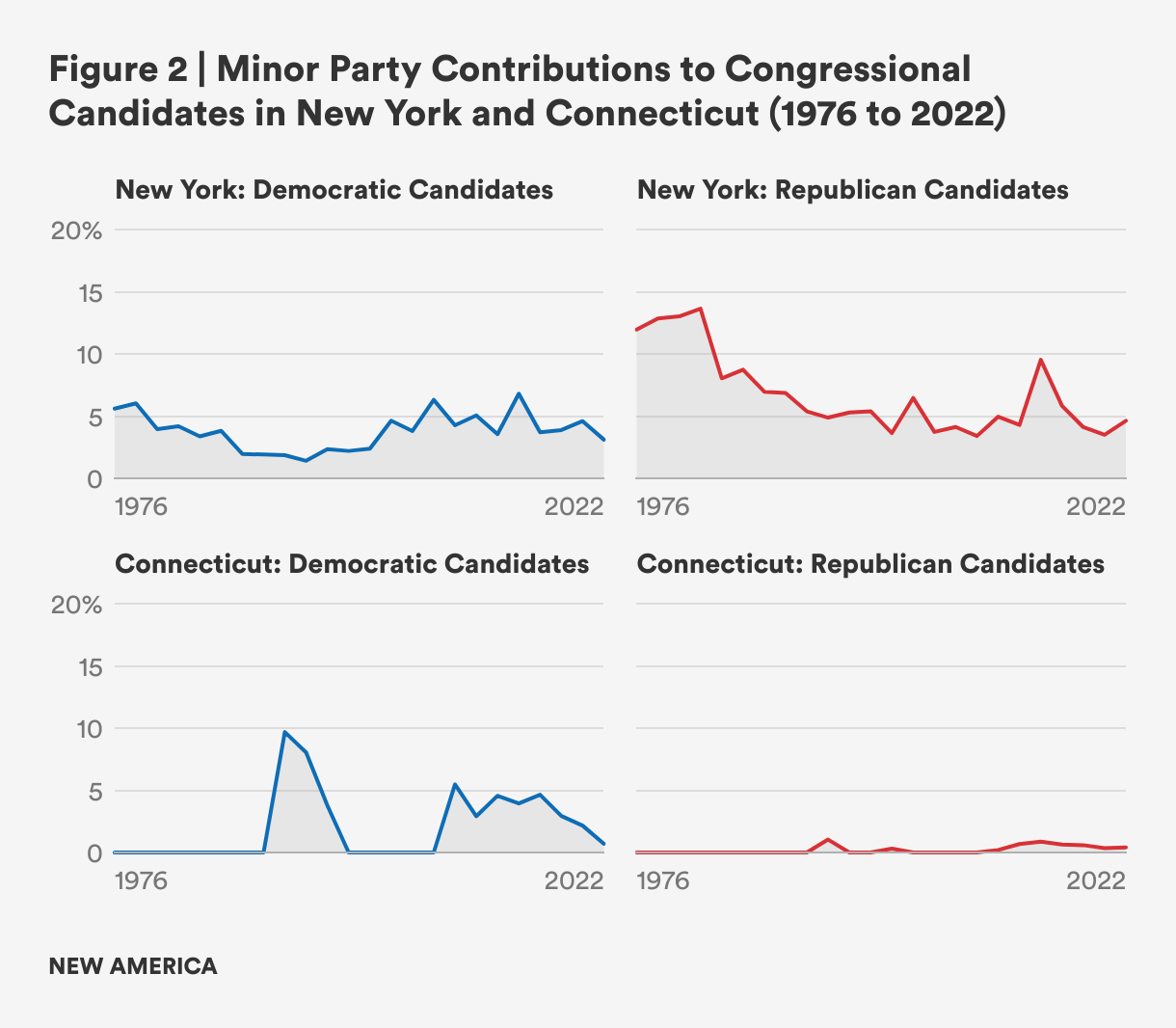
Benjamin Kantack uses data from New York congressional elections from 1952 to 2014 and various control variables like the incumbency status of candidates, whether an election coincides with a presidential election, and whether the cross-endorsing minor party is a qualified minor party or a party created by signature drives. He finds that major party vote shares are significantly higher when they fuse with a qualified minor party but not when they fuse with unqualified minor parties (those created by signature drives).1 Figure 2 shows our own analysis of congressional races in New York and Connecticut from 1976 to 2022. We find that over this time period, minor parties contributed an average of 3.8 percent of the total Democratic vote share in New York and 6.7 percent of the total Republican vote share in New York. In Connecticut, from 1976 to 2022, minor parties contributed an average of 2 percent and 0.2 percent of the total vote share of Democrats and Republicans, respectively.
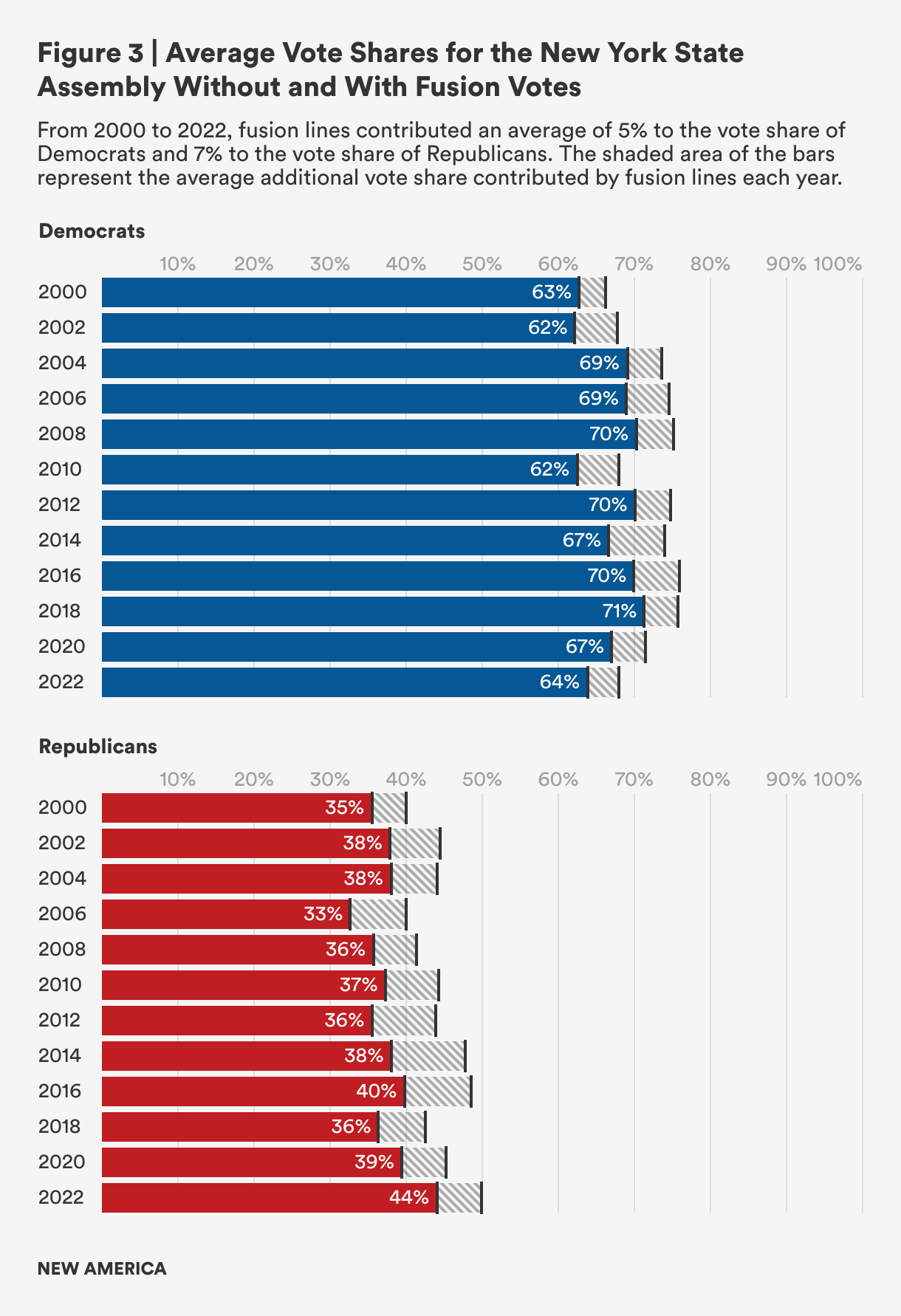
For races for the New York State Assembly from 2000 to 2022, we found that minor parties contributed an average of 5 percent of the total vote share of Democratic candidates and an average of 7 percent of the total vote share of Republican candidates, as shown in Figure 3.
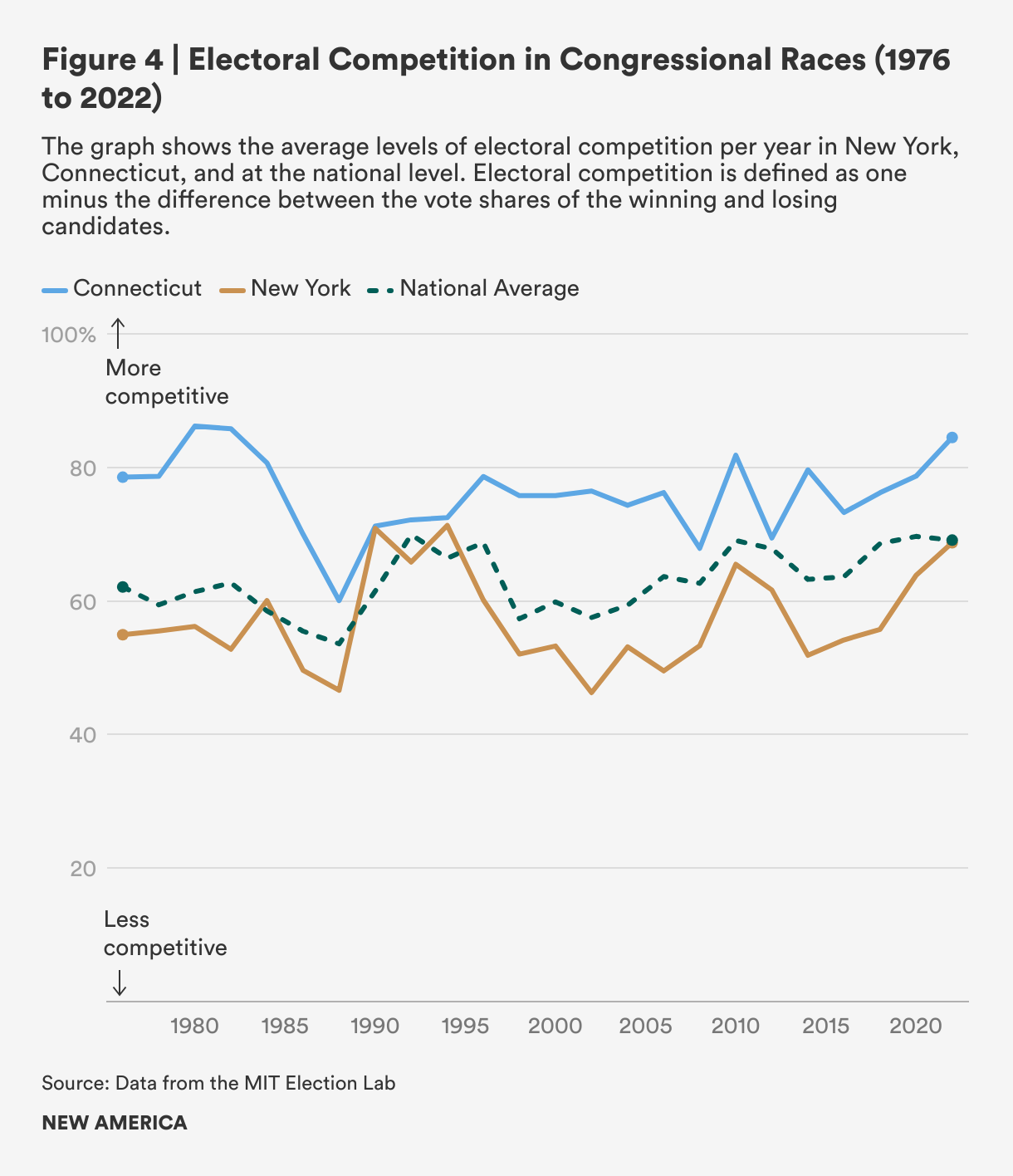
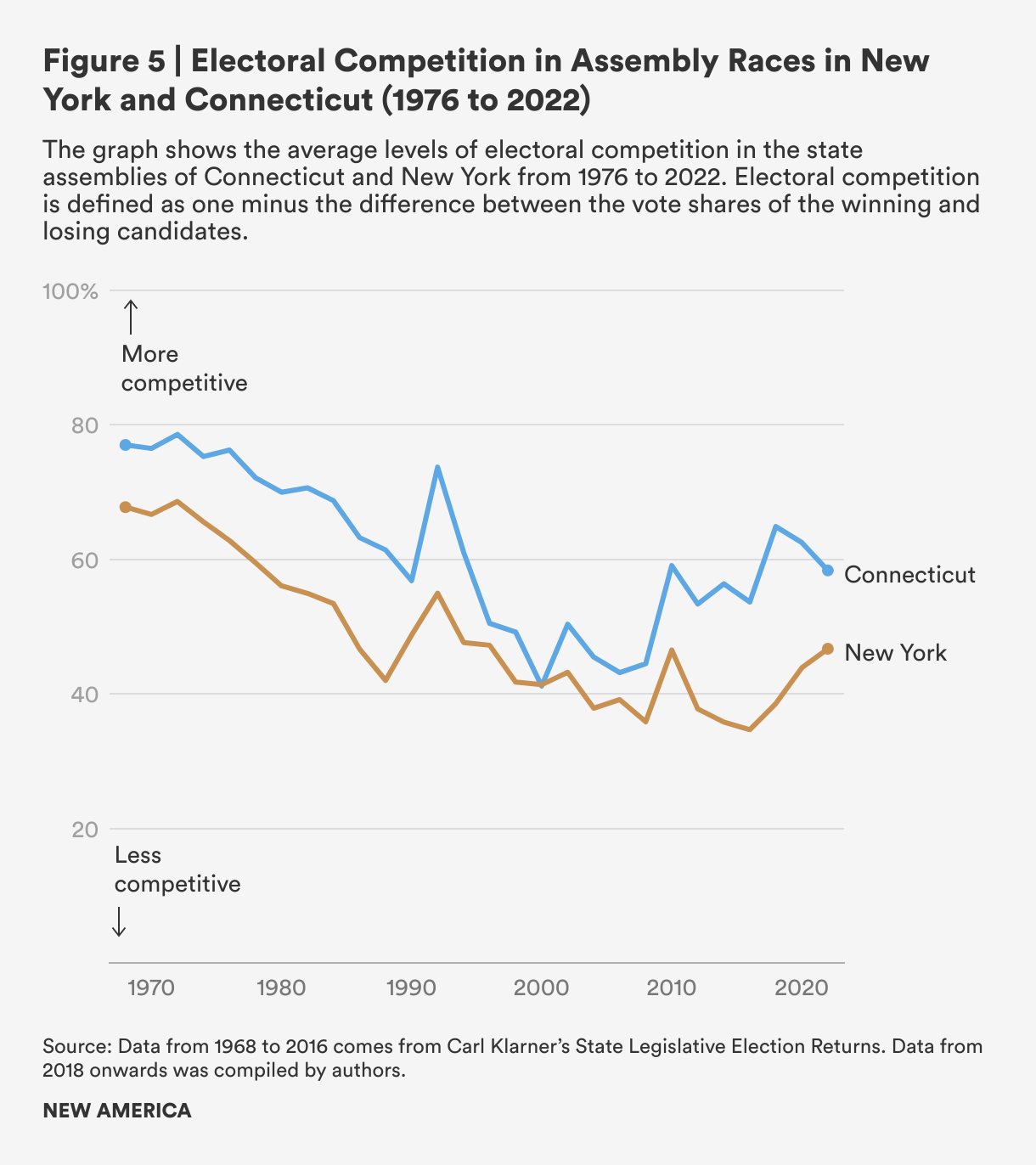
Measuring electoral competition as one minus the difference between the winner and the runner-up candidate in a district, we show that elections for congressional seats in New York are, on average, less competitive than the national average, while those in Connecticut tend to be more competitive. In races for the state assemblies of New York and Connecticut, with 150 and 151 districts, respectively, electoral competition is lower. In both Connecticut and New York, races for the state assemblies have gotten less competitive over time, although there has been an increase in electoral competition in the last couple of years. Throughout this time period, New York has had lower levels of electoral competition compared to Connecticut. From this data, it is not possible to determine what role fusion plays in electoral competition. The data simply shows that New York, a state that happens to have fusion voting, generally has lower levels of electoral competition than the national average in the case of congressional races and than Connecticut, both at the congressional and state assembly level. Whether this is because of fusion voting is not possible to say. It’s possible that without fusion voting, races in New York would be even less competitive than they are now or that fusion voting is not enough to reduce the impact of partisan sorting, polarization, and other factors on electoral competition.
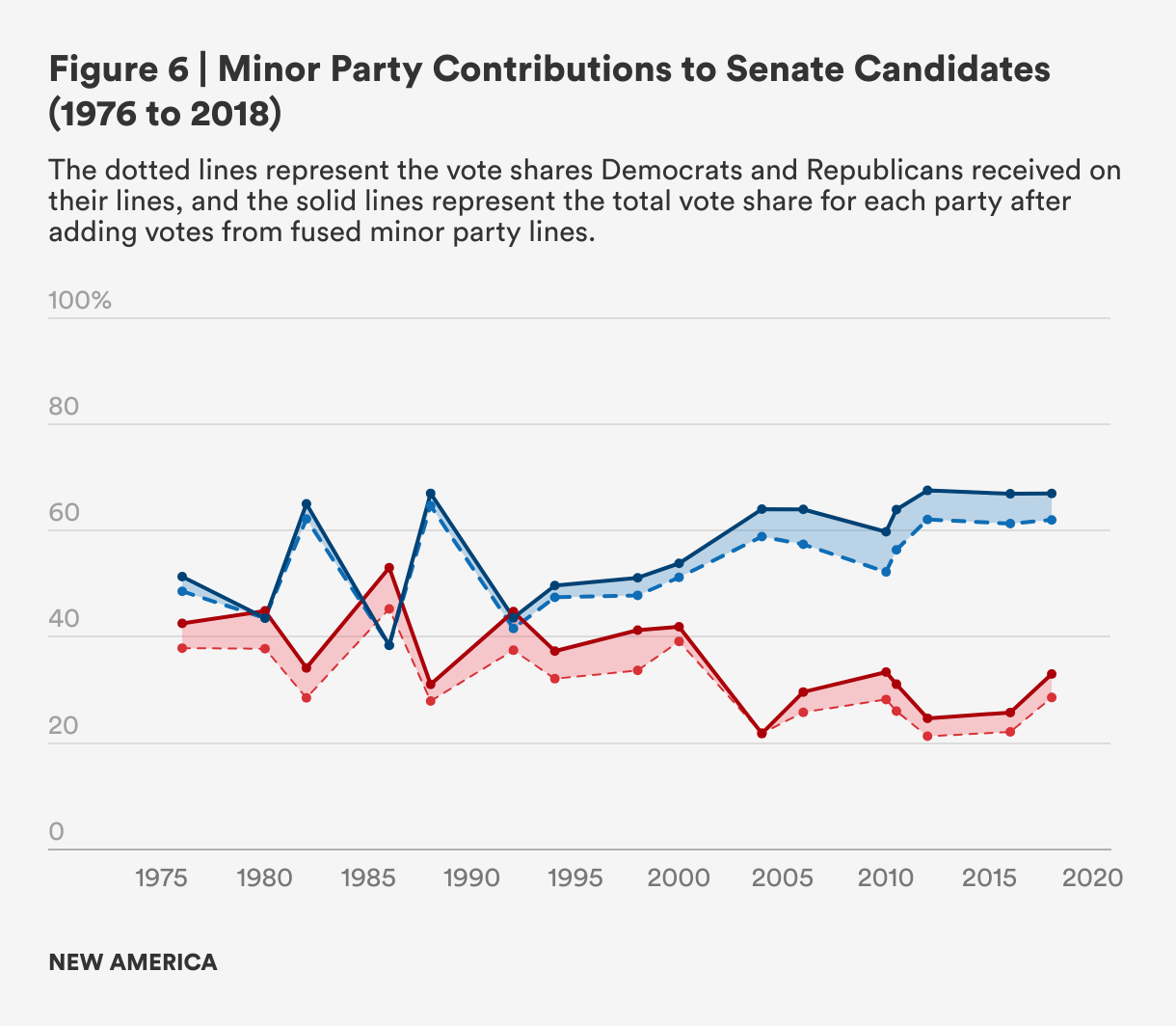
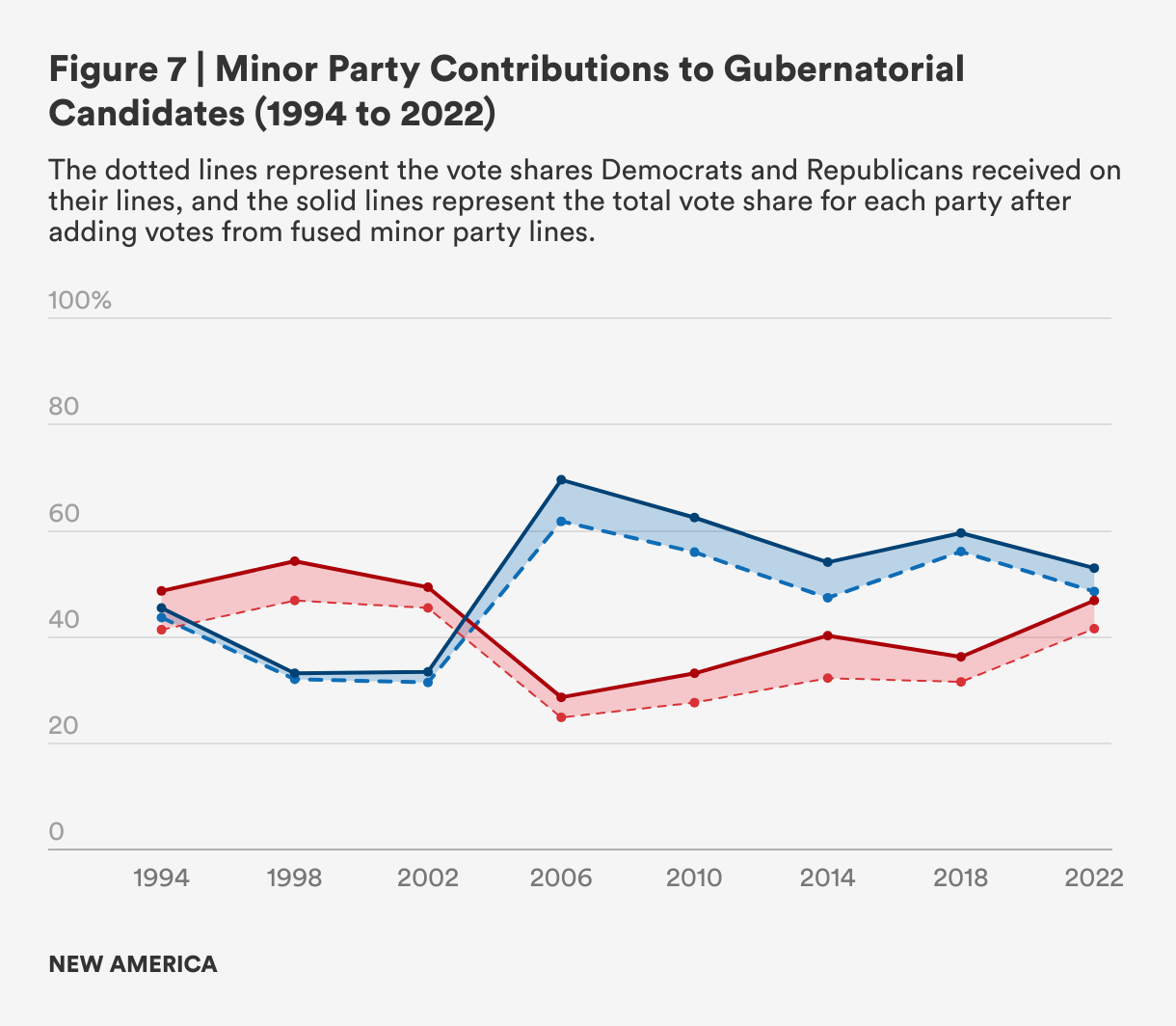
The contributions of minor parties to major party candidates are similar when looking at senate and gubernatorial races, and both major parties have benefited from fusing with minor parties. From 1976 to 2018, minor parties contributed an average of 3.8 percent of the total vote share of Democratic candidates for the Senate and 4.8 percent of the total vote share of Republican candidates. In races for governor, these figures are 4.2 and 5.7 percent, respectively. In Connecticut, fusion ballots have been used less frequently in senate and gubernatorial races. Only six candidates for Senate from 1976 to 2018 have used fusion ballots, and in 1992 and 1994, minor parties contributed an impressive 20 percent and 26 percent, respectively, to the total vote share of the candidates. For governor races from 1962 onwards, there were no fused candidacies until 2010.
As Figures 6 and 7 show, there have been instances when these additional minor party votes have been pivotal for the final electoral results. In close races, votes from fusion ballots are sure to galvanize the election and have the greatest effect on electoral competition. But because both major parties are actively endorsed by minor parties, minor party contributions to major party candidates mostly result in an upward shift in the final vote share at the state level. It remains unclear whether and how fusion ballots currently affect electoral competition in a state like New York, where the dominant party benefits from minor party votes. However, fusion voting could play a bigger role—and with more far-reaching effects nationwide—in swing states where the margins between the two major parties are smaller.
Fusion Voting Encourages Minor Party Building and Growth—to an Extent
In a two-party system where only one candidate can win in each district, it is difficult for additional parties to emerge and play a meaningful role in electoral politics. Minor parties that do manage to form struggle to win votes, as voters tend to vote strategically for one of the two main parties. When they do garner significant electoral support, minor parties run the risk of spoiling an election. This is usually a concern because the winning candidate does not reflect the majority’s will, but in times of extreme polarization, the concern is also that a third party would spoil the race, resulting in the election of an extreme candidate who would not have won otherwise.
Fusion voting is supposed to give minor parties a way to participate meaningfully in politics while maintaining their independence and developing their own brand and policy agenda. Fusion voting does not entirely solve the spoiler problem since minor parties can still decide not to fuse (and, in fact, threatening to spoil a race is an important source of power for minor parties). However, it does allow minor parties to influence politics even if they do not win elections, especially if they are able to deliver decisive vote shares or if their brand helps major party candidates communicate certain positions or commitments. As Daniel Soyer puts it, fusion “allows third parties to have their political cake and eat it too—retaining independence while exerting real influence on elections and policy.”2
“Fusion ‘allows third parties to have their political cake and eat it too—retaining independence while exerting real influence on elections and policy.’”
According to Bob Master, fusion provides a way of “establishing independent political capacity and power that enables [minor parties] to exert significant influence on one or the other of the major parties without succumbing to the spoiler problem.” Similarly, Lindsay Farrell stated that fusion “seemed like a good alternative and a good solution to what I had seen as the initial problem with third parties, which was being a spoiler, but it also kind of created a space for us to put economic issues front and center.” For Lieutenant Governor David Zuckerman, one of the highest third party elected officials in the country, the American electoral systems are “a spoiling system,” and “our system needs to change so people have more choices, but everybody has a right to run and has a right to get their voice out. And we need a system that allows that.”
By facilitating a more active role in politics for minor parties, fusion voting encourages the creation of minor parties and creates some incentives for party growth. Party formation is affected by (1) the permissiveness of the electoral system and (2) the interaction between political entrepreneurs willing to start a party and societal demands for representation. Party building and growth are affected by a variety of factors, including electoral thresholds, access to office, media attention, and demographic changes, among others.
Fusion voting may incentivize party building through at least two mechanisms. First, to survive as a party and maintain ballot access, minor parties have to meet a certain electoral threshold. To garner enough votes on their ballot lines and meet this threshold, minor parties have to invest in their mobilizing infrastructure and brand. A minor party must make sure that enough voters know it exists, what it stands for, and its positions and be willing to turn out to vote on its ballot line. Second, fusion voting can also encourage party building because minor parties obtain more power by winning more votes on their ballot lines. If minor parties want to be able to have leverage and influence policy, they need to show their electoral strength. All this requires a certain degree of organization and party infrastructure as well as a clear program that voters can recognize as distinct enough from the major parties.
Minor parties, however, face tough constraints because fusion voting gives them a larger role when they endorse major party candidates instead of running their own candidates. As pointed out by Matthew Shugart, a political scientist and expert on electoral systems, fusion voting can stunt the candidate recruitment and development process of parties since third parties rarely nominate their own candidates.3 Candidate recruitment is an integral aspect of party building, and parties without their own candidates who can win office may have a harder time surviving and, importantly, growing over time. The literature on party building emphasizes winning elected office as a crucial ingredient for the growth and development of parties.4 Winning office provides access to a variety of resources that can help parties organize and mobilize, including media coverage, opportunities for constituency services, and legislative staff.5 As a result, it may prove quite challenging for third parties that do not often run their own candidates in fusion systems to grow in size and influence.
There are also concerns that fusion voting may not be entirely conducive to minor party growth. Bernard Tamas argues that fusion may actually weaken third parties because they get co-opted by the major parties.6 Instead of challenging the main parties independently and posing a more credible threat to major parties, fusion voting encourages minor parties to work within major parties. This sentiment was echoed by Brad Lander, comptroller of New York City, who said that “fusion actually can strengthen the major parties and prevent fragmentation.”7 Tamas also points out a tension in how fusion is supposed to strengthen third parties: “On the one hand, fusion is seen as a way for voters to avoid wasting their votes on third-party candidates, and on the other, fusion is believed to promote third parties.”
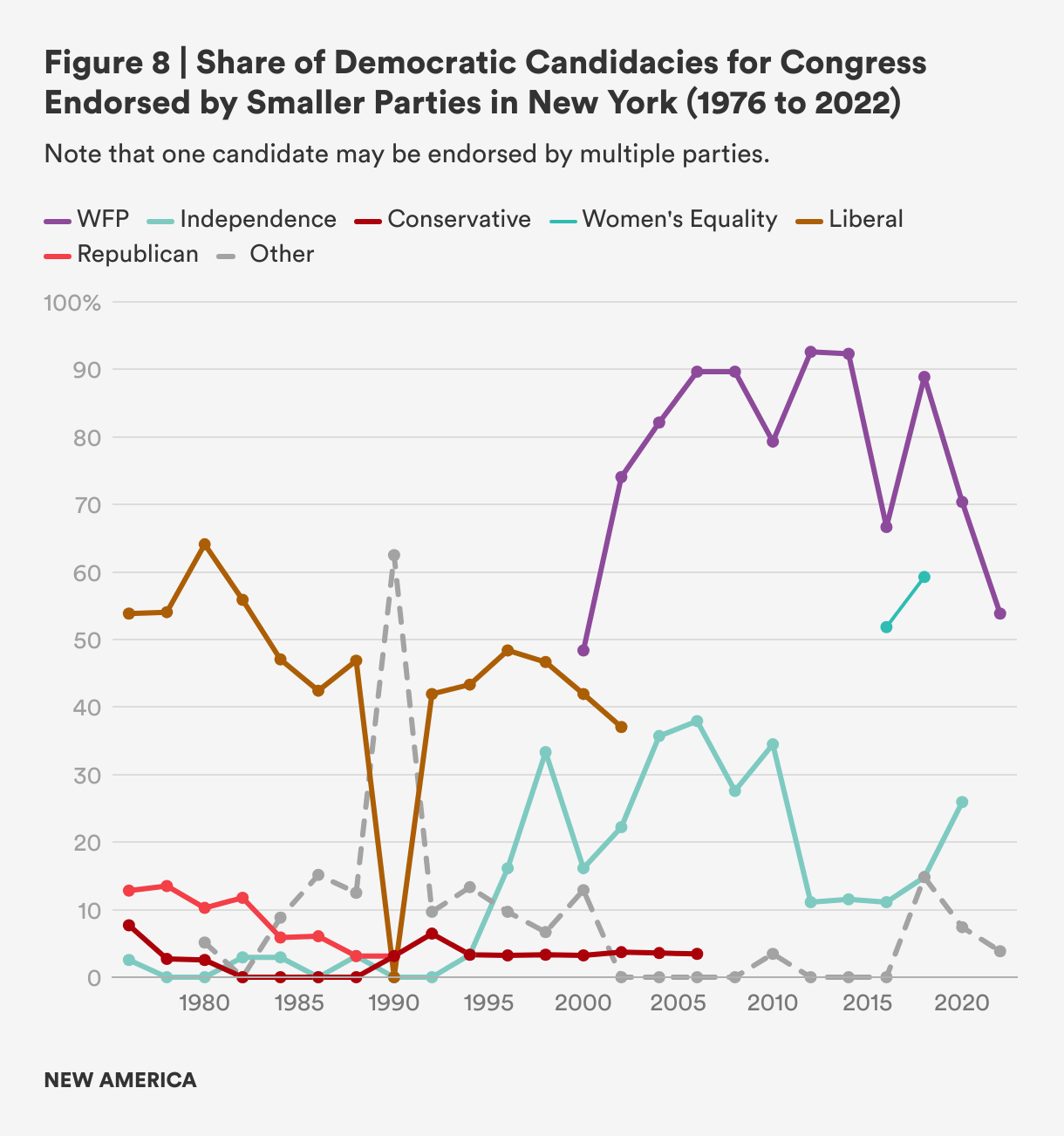
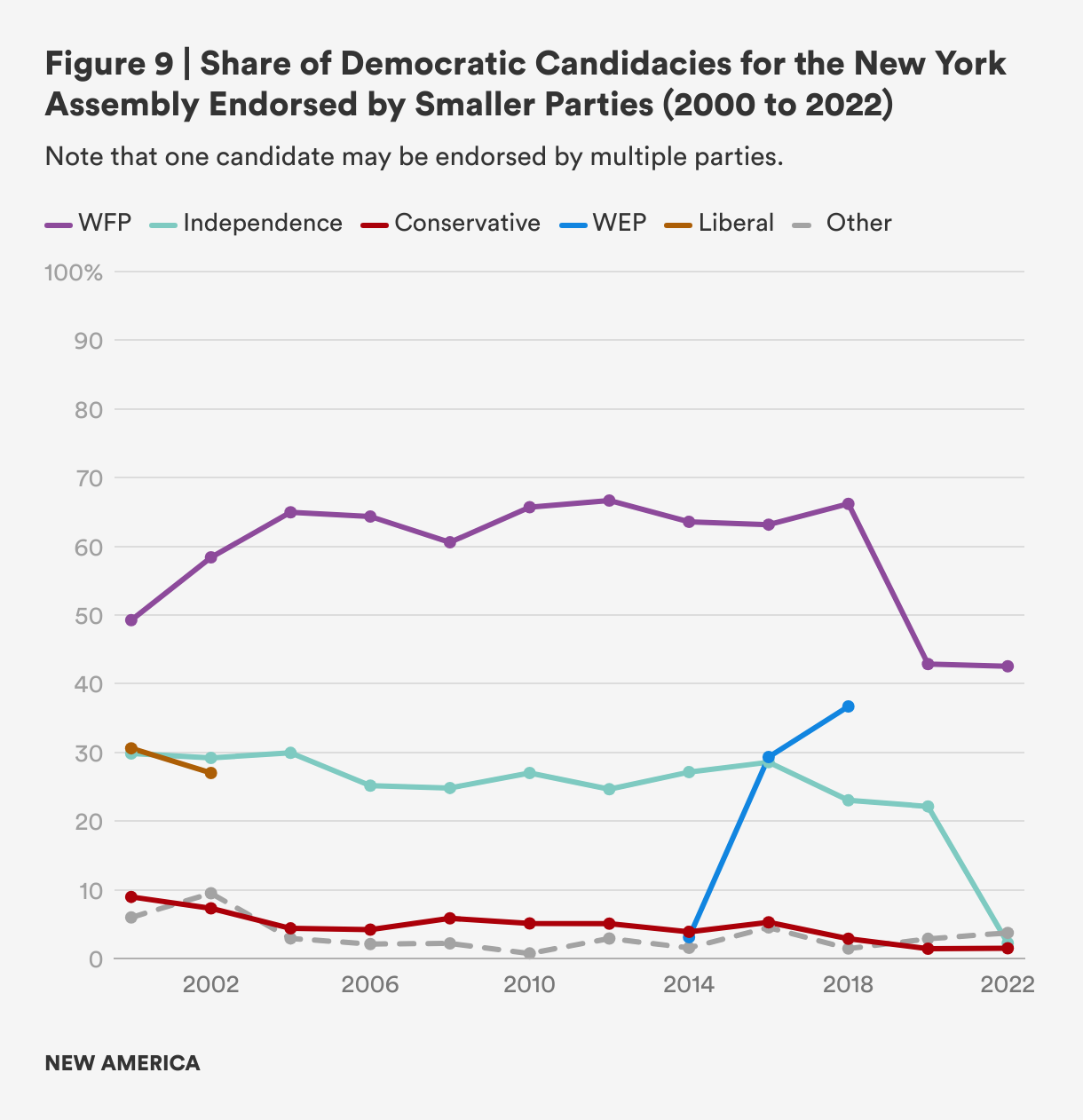
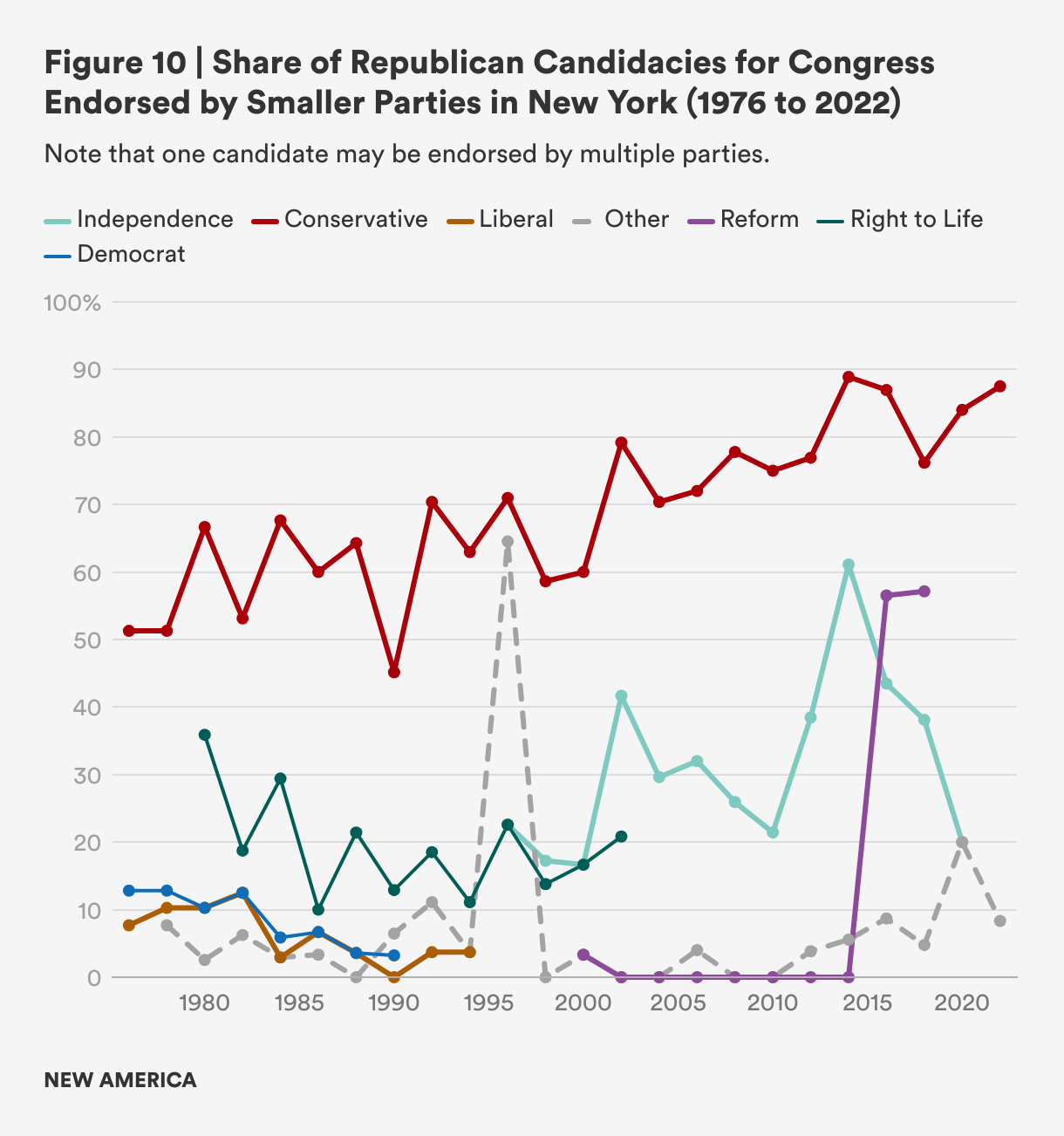
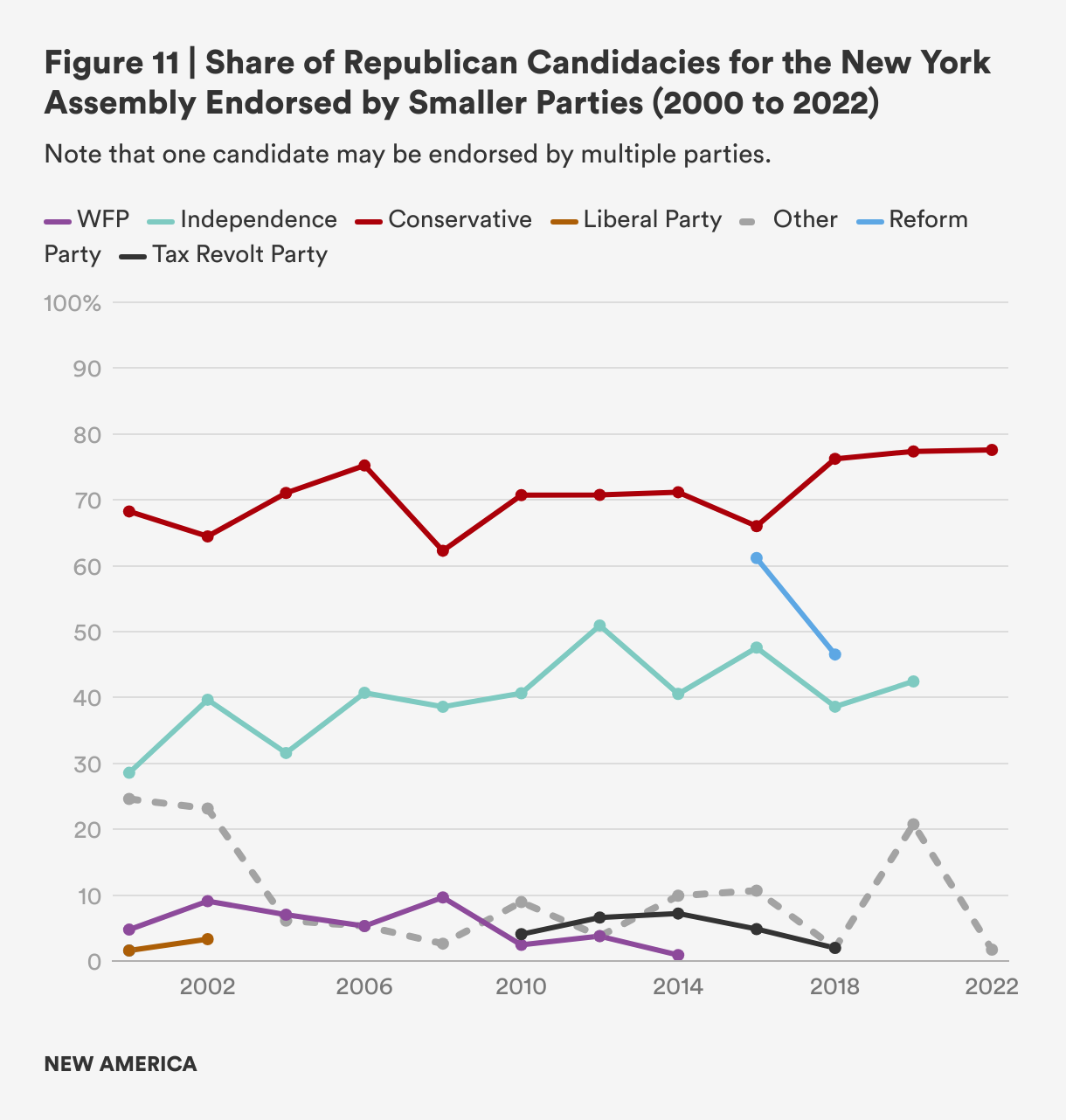
Perhaps this tension is resolved by considering that fusion voting fosters the creation of a different type of party. Fusion voting may not create strong parties that run their own candidates, more akin to a multiparty democracy. Instead, it incentivizes the development of minor parties that rarely run their own candidates but serve at least four other valuable functions that are facilitated by having a ballot line: (1) mobilizing voters, (2) providing more information to voters and about voters, (3) advocating for particular policies, and (4) building and sustaining coalitions. These minor parties can be flank parties, pulling the major parties to the extremes; center or hinge parties supporting moderate politicians; or issue-based parties promoting particular issues that are not being raised by the main parties. Currently, as Figures 8 to 11 in this section show, the minor parties that most participate in elections through fusion ballots in New York are flank parties: the Conservative Party on the right and the Working Families Party (WFP) on the left. This reflects the current political dynamics of New York. The landscape could look different in other states with different partisan distributions or different histories of political organizing.
Rarely, minor parties are created to burnish the credentials of politicians with descriptive names or to deceive voters, but these parties tend to disappear over a couple of electoral cycles. The Women’s Equality Party, for example, was created by former New York Governor Andrew Cuomo in 2014 to ostensibly promote the Women’s Equality Act. But many observers believe it was created to confuse voters since its acronym, WEP, was so similar to the WFP, which Cuomo had been at odds with. The party lost ballot access in 2018.
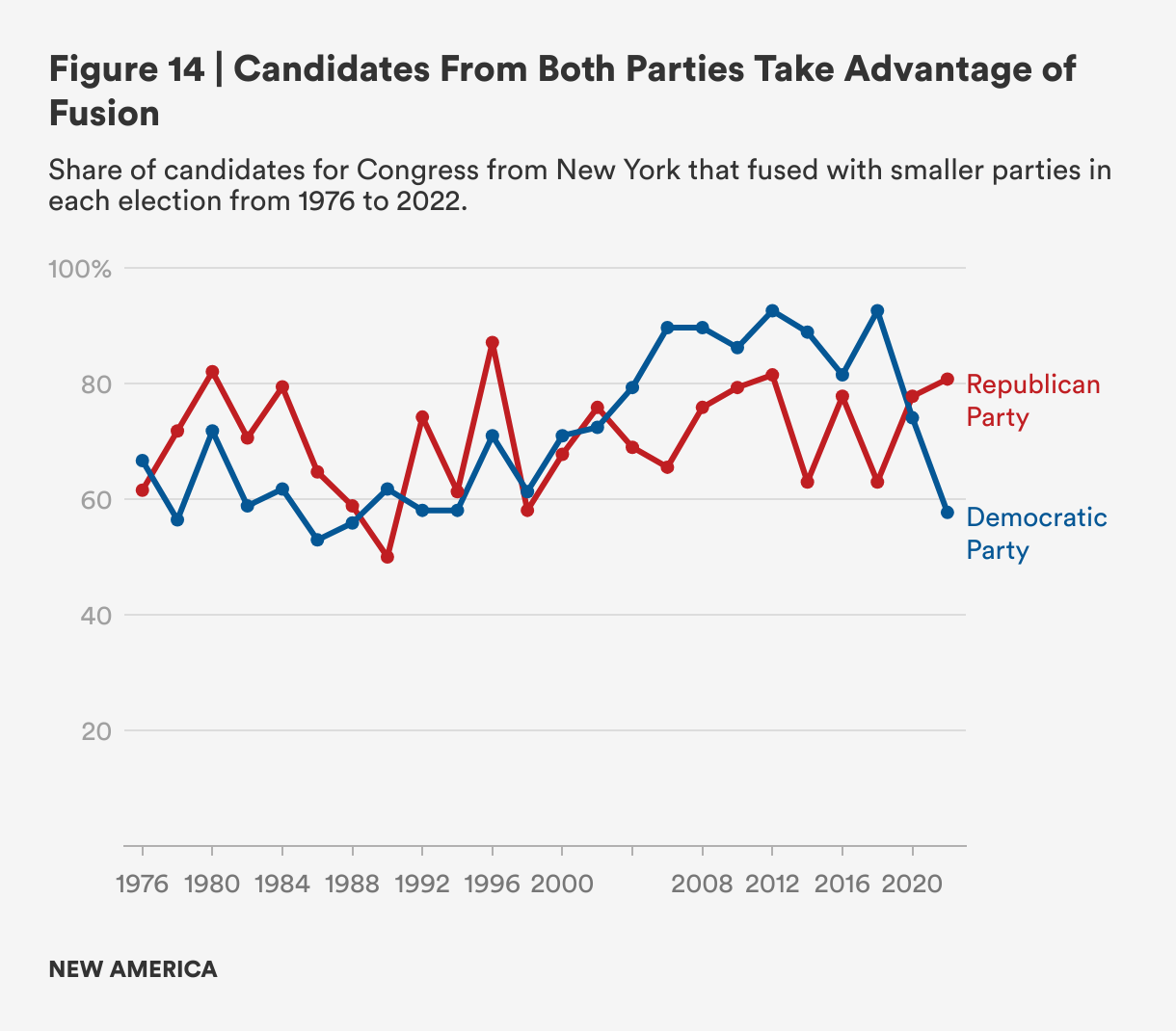
Various political parties from across the political spectrum have emerged in New York and participated in elections both by fusing their lines and as standalone parties. The Liberal Party used to be the minor party that most endorsed Democratic candidates up until the turn of the century. Since then, the WFP has emerged as the minor party that most often endorses Democratic candidates. The share of Democratic candidates for Congress endorsed by the WFP was at its highest in 2012, 2014, and 2018, reaching almost 90 percent of Democratic candidates, but that share dropped to 54 percent in the latest congressional election in 2022. In races for the State Assembly, the WFP also stands out as the most frequent endorser of Democratic candidates, with about 60 percent of Democratic candidacies endorsed by the WFP in most elections from 2000 to 2022. The Independence Party of New York also endorsed many Democratic candidates at both the congressional and state levels until it lost its ballot access after not getting enough votes on its line in 2020, and the use of the words ‘independent’ or ‘independence’ was banned in New York in 2022 to prevent voters mistakenly registering for a party as opposed to declaring themselves independent.8
On the Republican side, the Conservative Party of New York has been the most common endorser of Republican candidates. In recent elections, the share of Republican candidates endorsed by the Conservative Party has increased to a high of almost 90 percent for Congress and the State Assembly. The Independence Party also endorsed about half of Republican candidates for the State Assembly. In certain elections, single-issue parties have emerged and tend to endorse Republican candidates. These include parties like the Right to Life Party, the Tax Revolt Party, and, more recently, the Medical Freedom Party, which arose in opposition to vaccine mandates.
Fusion Voting Gives Minor Parties Policy Influence
Fusion voting can give minor parties opportunities to influence the policymaking process.9 Melissa Michelson and Scott Susin identify the mechanisms through which minor parties can exert their influence thanks to fusion: “a) acting as a spoiler by nominating their own candidate instead of making a cross-endorsement, b) making or withholding cross-endorsements in order to influence the major parties, and c) giving a line (and possible victory) to a candidate denied a major party line.”10 In addition to these influence channels, minor parties can also use their platforms to make issues salient and can strategically endorse candidates who favor certain issues to create a coalition in support of an issue they care about.
The greater the mobilizing power and electoral strength of a minor party, the more it will be able to flex its muscles and influence the policymaking process by withholding endorsements, credibly threatening to spoil a race, or providing the winning votes for a candidate. Various episodes in the history of the Liberal Party of New York illustrate how fusion voting helps minor parties influence major parties, particularly when minor party votes provide the margin of victory for a candidate. For instance, in 1964, the Liberal Party withheld endorsements from four Democratic state legislators who opposed the party’s position on state relief rules. The legislators, who had relied on the party in the previous election, reversed their positions to regain the Liberal Party’s endorsement.11 In 1954, the Liberal Party’s votes were pivotal in the governor race, resulting in the election of Averell Harriman. This gave the party leverage to demand positions in the administration and promote progressive policies. Similarly, the party’s votes were decisive for the elections of Republicans John Lindsay and Rudolph Giuliani as mayors of New York City in 1965 and 1993, respectively, enabling the party to secure appointments in city hall and influence policies like keeping city colleges tuition-free, limiting transit fare hikes, and preventing the elimination of the Division of AIDS services.12
“The greater the mobilizing power and electoral strength of a minor party, the more it will be able to flex its muscles and influence the policymaking process.”
The Liberal Party was able to exert such influence thanks to its mobilizing capacity and ability to deliver the margin of victory in important races, especially in New York City. Minor parties delivering the margin of victory does not happen often, but providing the margin for even one important race or swing district can be consequential. As seen in Figure 7 above, in gubernatorial elections since 1994, minor party votes were only decisive in the election of George Pataki when the Conservative Party and the Tax Cut Now Party pushed the Republican over the victory line. In Senate races, as Figure 6 above shows, the minor party votes have only been pivotal twice since 1976, both times for the election of Al D’Amato in 1980 and 1992 with the help of the Conservative Party and the Right to Life Party.
In elections for the House of Representatives in New York and Connecticut since 1976, minor parties have contributed vote shares in excess of the margin of victory in 54 races, about 6 percent of the total number of races in both states combined. In 23 of these races, or 2.6 percent, the votes delivered by minor parties proved to be decisive in determining the winner of the election. At the state level in New York, we see a similar pattern in Assembly races from 2000 to 2022, with only 57 instances where the vote share contributed by minor parties on fusion lines was greater than the margin of victory.
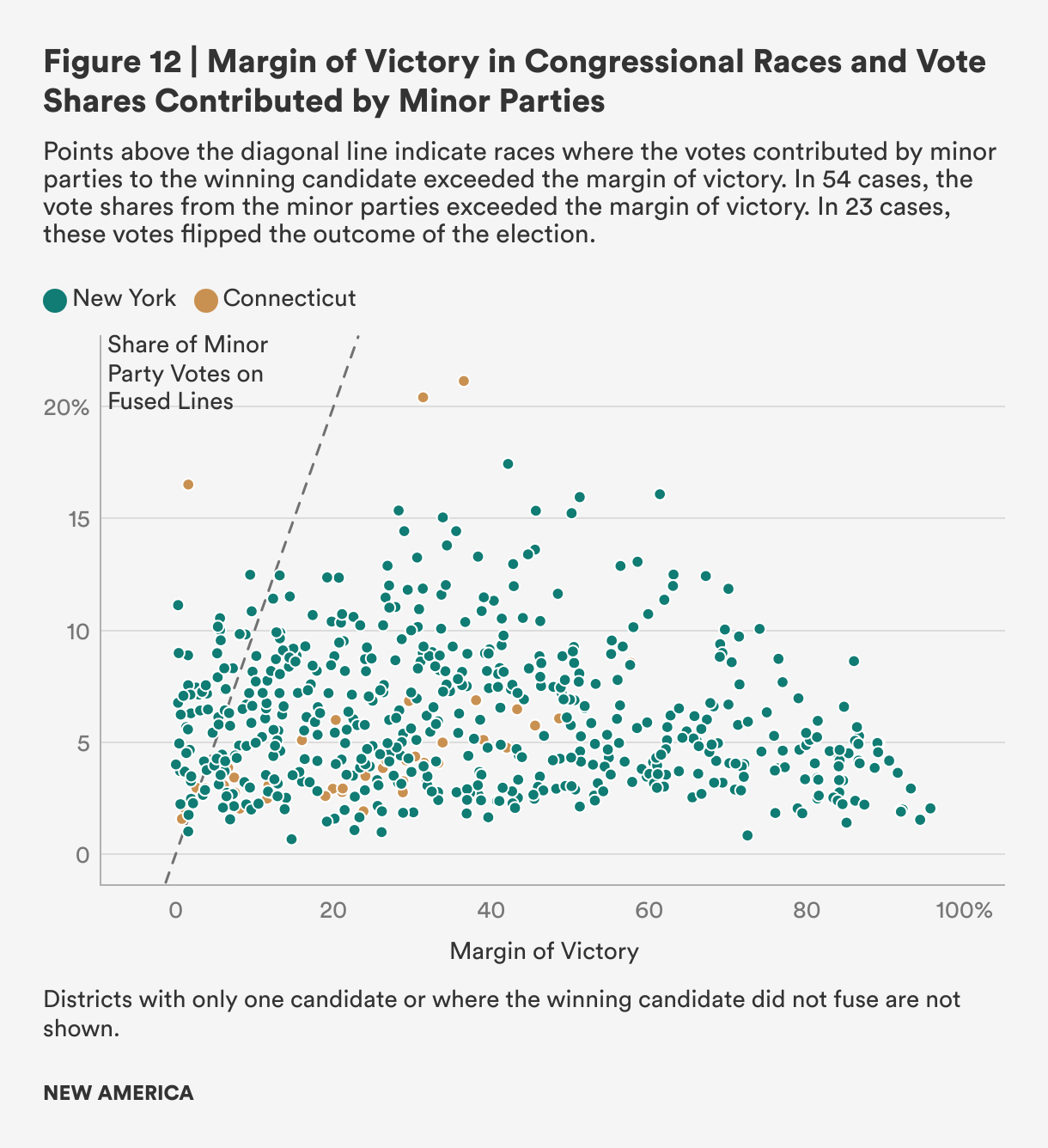
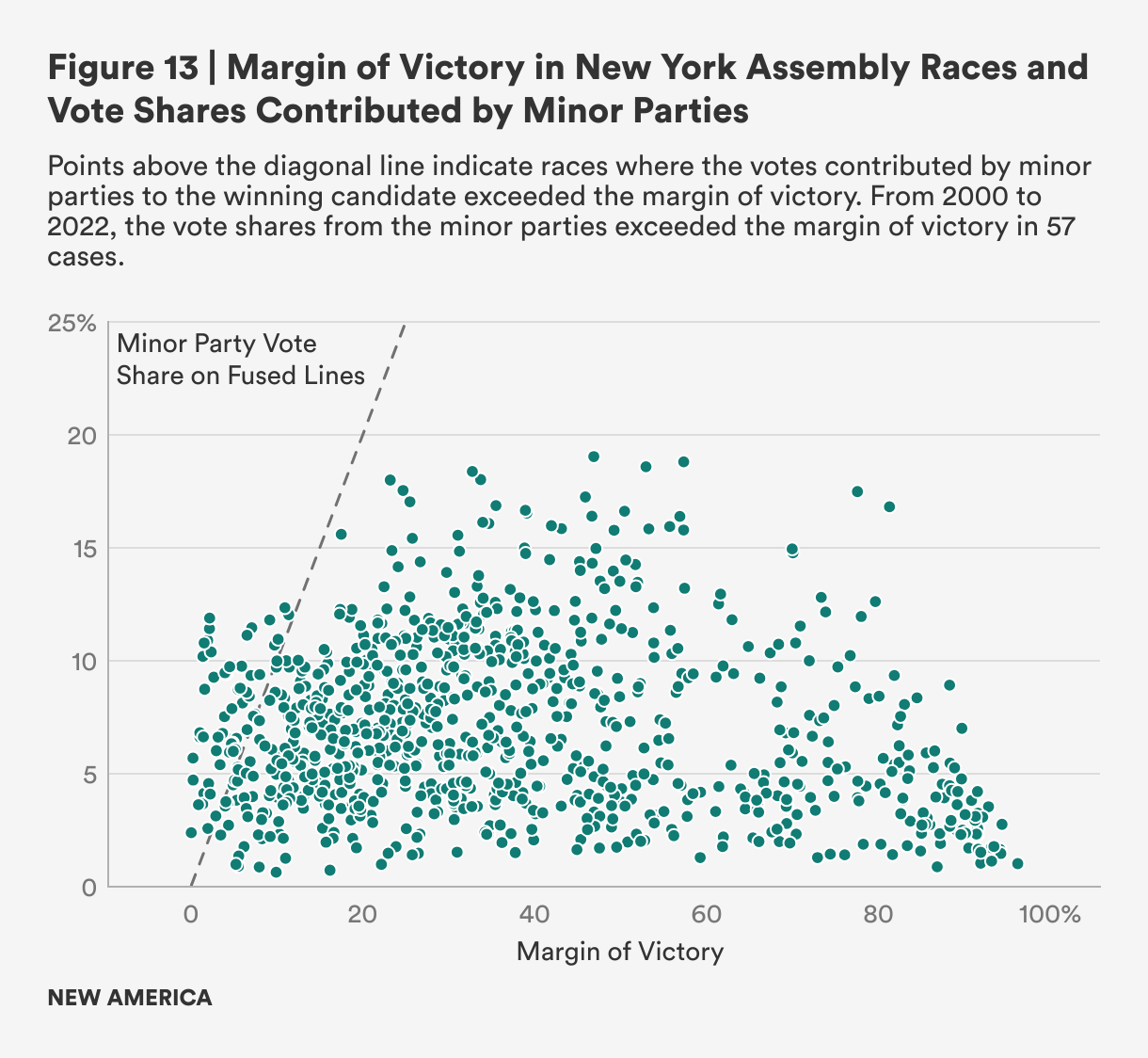
These numbers on congressional, assembly, senate, and governor races indicate that votes from minor parties have rarely been decisive in New York. But the power of fusion voting in these contexts does not come from how often minor parties deliver pivotal votes, but rather from when and where they do. In a state like New York, where the Democratic Party has greater dominance than the Republican Party, Democrats will win most of the time, so we should not expect fusion votes to be decisive frequently.
But fusion voting can be important in swing districts, which can then have repercussions for control of the legislative chambers. Providing strong electoral support for even one senate or governor race can provide a minor party with enough leverage to push its policy agenda, as the history of the Liberal Party shows. In the 2022 midterm election, when control of the House of Representatives initially came down to a difference of nine seats, minor parties in New York provided votes in excess of the margin of victory in five races (the Conservative Party in four districts and the WFP in one); in Connecticut’s fifth congressional district, the WFP’s vote share exceeded the margin of victory in a very close race. In states like New York and Connecticut, where one party has come to dominate most races for office, minor parties rarely achieve power by spoiling or threatening to spoil an election but rather by mobilizing voters for their endorsed candidates—particularly for endorsed candidates in highly competitive races where they can provide the winning votes. In states where there are more competitive districts, it is likely that fusion voting would give minor parties even greater leverage by allowing them to provide more decisive vote shares in more races.
In contemporary times, minor parties in New York and Connecticut have used their influence to help advance their policy agendas. One example that repeatedly came up in interviews with WFP members was the increase of the minimum wage in New York in the early 2000s. As a party representing workers and the middle class, advocating and passing an increase to the minimum wage was—and continues to be—a top priority for the WFP. To win support for the increase, the WFP made strategic endorsements. Karen Scharff said the WFP is “willing to endorse people who are not the perfect candidate when they can advance our platform and values.… It is a practical approach to getting people in office who can move our agenda.”
Joe Dinkin, the Campaigns Director for the WFP, explained the strategy for building a coalition in support of the minimum wage. He said that there were a “number of pro-labor Republicans in New York and some purple district Republicans who received the WFP endorsement over their vote to raise the minimum wage. And that was understood as part of a political transaction: You have a better chance to hold onto your seat because you’re getting the minimum wage done.” The strategy paid off. According to Dinkin, by having some influence over Republican legislators, the “WFP succeeded in not only getting the Republicans in the state senate to pass a minimum wage raise but [they also] got them to override the veto of the Republican governor: A Republican state legislative body overriding their own party’s governor to raise the minimum wage.”
Dinkin argued that the pragmatic approach to securing policy victories—including endorsing Republican legislators when it could help the cause—is, in part, encouraged by being a fusion party. Dinkin said that because a fusion party has to play an active role in coalitions, it has to “wrestle as part of that coalition and [has to have] a perspective and be able to make compromises to be part of a winning coalition.” Dinkin said that minor parties that fuse “tend to believe it matters if you win or lose,” whereas for minor parties that do not fuse, politics is more about “protest, not a politics of governance.”
Members of the WFP also cite the 2011 adoption of paid sick days in Connecticut as another example of the party’s influence in the policymaking process. In this case, the strategy revolved around making the issue salient, forcing politicians to take a position on the issue, and prioritizing paid sick days as a factor in the candidate endorsement process. Dinkin said that the WFP “effectively put [the issue] on the ballot”: “[Paid sick days] went from not being an issue in political discourse, to being something the Democrats had to make their mind up on, to being something that was a winning issue in Democratic primaries, [then] a way for Democrats to win the general election, a way to win the WFP endorsement, to being a statewide law in Connecticut by 2011.” By making paid sick days a “deciding factor in the WFP endorsement process,” the party was able to make paid sick days “an issue that Democrats had to consider and be for or against,” Dinkin elaborated.
Another way of influencing policy, according to WFP members, is to endorse their own candidates in primaries. For Bob Master, “the key to making the party effective is being able to intervene in primaries and make a difference.” Barbara Dudley, the senior advisor to the WFP in Oregon, agreed, adding that “primary challenges get [the major parties’] attention.” The 2004 election of David Soares as district attorney in Albany County illustrates this strategy. In that race, the incumbent district attorney—Democrat Paul Clyne—was predicted to win, but as part of a push to reform the Rockefeller Drug Laws, the WFP endorsed David Soares in the Democratic primary. Soares unexpectedly won the primary, went on to win the general election, and eventually contributed to reforms to the Drug Laws.
Master said that “this was another example where it was not just an endorsement process, but an intervention in a primary that was made possible by the fact that [the WFP] had an existing coalition, a process to endorse a candidate, and the resources [and] the staff to make an intervention that allowed [the WFP] to unblock the logjam” around reforming the Drug Laws. Bill Lipton, co-founder of the WFP and a former director of the party in New York, added that this example of beating an incumbent Democrat in a Democratic stronghold in the primary “showed the complexity of the leverage you have when you have a party that is validated by fusion.”
Quantitatively assessing the impact of fusion voting on influencing policies is challenging because of the complex nature of policymaking and the many variables that affect the process. We are aware of one research project that establishes an association between minor party vote shares a legislator receives and their legislative behavior in the New York State Assembly. Arguing that more votes from minor parties empower major party candidates to deviate from the party line, Cassidy Reller finds that increases in the vote shares from minor parties are associated with minor party endorsed legislators shifting their ideology based on their roll call votes in the opposite direction of their primary party.13 While this association may be indicative of the effects of fusion voting, another mechanism at play could be that minor parties may be more likely to endorse candidates who already deviate from the party line. Moreover, often the power of fusion voting comes from providing the margin of victory in close races and not necessarily from greater vote shares: A minor party is likely more influential in a swing district where it was pivotal than in a safe district, even if it obtains more votes in the safe district where candidates have more leeway to deviate from their party anyways. Systematically connecting minor party votes from fusion ballots with legislative behavior remains an important research task that deserves more attention.
Fusion Voting Helps Create and Sustain Coalitions
In the nineteenth century, when fusion voting was legal across the United States, American politics was characterized by the active and influential participation of various minor regional parties organized around particular issues: the Workingmen’s Party in Philadelphia, the Granger Movement in the Midwest, the Greenback Party, the Populist Party, and the Free Soil Party, among others.14 These parties often fused with the existing major parties of the time and were pivotal in the creation of coalitions to advance particular policy issues and agendas.
Minor parties were key, for example, in sustaining and bolstering the political coalitions formed against slavery.15 With their electoral participation facilitated by fusion ballots, minor parties were able to provide support to anti-slavery factions within the Whigs and the Democrats.16 In North Carolina following the Civil War, poor white tenant farmers and African Americans found common ground in the coalition of the Populist Party and the Republican Party, which emerged in opposition to the rich voters that constituted the Democratic Party. The alliance between the Populists and the Republicans led to short-lived electoral victories of Black Republicans and white populists who wanted to protect voting rights and expand education, among other policies.17
Fusion voting is believed to have enabled these “improbable coalitions.”18 With minor parties with electoral backing in constituencies other than their own, factions of major parties had serious and useful partners to pursue joint policy goals. By creating coalitions, the fusion of minor and main parties was able to bring certain issues to the forefront that would not have had the opportunity to emerge otherwise.
“By creating coalitions, the fusion of minor and main parties was able to bring certain issues to the forefront that would not have had the opportunity to emerge otherwise.”
The ability of fusion voting to create more fluid coalitions remains one of the most promising aspects of bringing back fusion ballots across the United States. In several of the interviews we carried out with members of the WFP, the role that fusion ballots play in helping create and sustain coalitions was cited as a central benefit of fusion. Karen Scharff, founding member of the WFP, said that because of the two-party system, it’s nearly impossible to break into electoral politics as a third party, but “by being able to cross-endorse with the major parties, it allowed [the WFP] to be a part of a governing coalition and part of the electoral winning strategy.” She added that these coalitions are “essentially a multiparty governing coalition that is dominated by the two parties,” which echoes arguments in favor of fusion that it formalizes factions within parties. Having a line on the ballot is key for sustaining a coalition since it creates incentives for staying and working within the party to keep the party active. Scharff said that “the ballot line is a real glue because people don’t want to leave because they want to continue to have a say over how the ballot line gets used.” Bob Master, also a WFP co-founder, agreed, saying that “a ballot line makes it more possible to build a sustainable, vibrant coalition because people come into the coalition recognizing that they are going to have influence over who appears on the ballot.”
Particularly in a time when politics are so nationalized and polarized along a left–right dimension, fusion alliances between major party factions and minor parties could focus attention on issues that don’t fit well on this one dimension of politics. Recent work has identified various dimensions of American congressional politics beyond the traditional left–right that could be uncovered by the active participation of minor parties at the federal level and the creation of new—and maybe surprising—coalitions along these dimensions.19
Fusion Ballots Are Used by Parties across the Ideological Spectrum
One of the most prominent contemporary examples of minor parties that avail themselves of fusion ballots is the WFP. In both New York and Connecticut, the WFP has achieved significant influence by endorsing mostly Democratic candidates. Their success and visibility have led to the association of fusion voting with the progressive agenda of the WFP. Many WFP members, both current and former, are also at the forefront of efforts to revitalize fusion voting across the country—that so many of our interview subjects are WFP members is a reflection of this.
Despite the prominence of the WFP in fusion voting efforts, the use of fusion ballots is not a partisan strategy. In fact, it is used by parties across the political spectrum. In New York, for example, both Democratic and Republican candidates receive the endorsements of minor parties. Up until the twenty-first century, more Republican candidates were endorsed by minor parties. With the emergence of the WFP in New York, the period from the early 2000s to 2018 saw more Democratic candidates being endorsed by minor parties than Republican candidates. This pattern reversed in more recent elections. In both the 2020 and 2022 congressional elections, more Republican candidates were endorsed by minor parties, mostly by the Conservative Party, than Democratic candidates.
Moreover, current efforts to revitalize fusion voting are meant to restore the center-right as a way to provide a political home to Republicans who no longer feel aligned with the current Republican Party. In Michigan, former Republicans are the ones leading efforts to start a center party that could take advantage of fusion voting if it were re-legalized.20 In New Jersey, the push is coming from the center as well, as a way to give disaffected Republicans a way to vote for moderate Democrats.21 In Kansas, the United Kansas Party is hoping to gain recognition and provide a center “common-sense” ballot line for voters.22 Fusion voting is not a tool of the left or the right; it’s simply a tool that any party can use to express its preference and endorsement for a candidate.
Citations
- Benjamin R Kantack, “Fusion and Electoral Performance in New York Congressional Elections,” Political Research Quarterly 70, no. 2 (2017): 291–300, source.
- Soyer, Left in the Center.
- See Matthew Shugart, “What role for ‘fusion voting’? Limitations and a potential ‘open’ improvement,” Fruits and Votes (blog), December 27, 2023, source.
- John H. Aldrich, Why Parties?: The Origin and Transformation of Political Parties in America (Chicago: University of Chicago Press, 1995); Elmer Eric Schattschneider, Party Government: American Government in Action (New York: Farrar and Rinehart, Inc, 1942).
- Mathias Poertner, “Building the Party on the Ground: The Role of Access to Public Office for Party Growth,” Journal of Politics 85, no. 4 (2023), source.
- Tamas, “Does Fusion Undermine American Third Parties?” source.
- As quoted in Brief of Appellants in Re Tom Malinowski, Petition for Nomination for General Election, at Superior Court of New Jersey Appellate Division, Docket No. A-3542-21T2.
- See Nick Reisman, “New York Moves to Ban ‘Independence’ from Party Ballot Lines to Reduce Confusion,” Spectrum News, December 16, 2022, source.
- Daniel Cantor and J. W. Mason, “Inside, Outside, or Somewhere In-Between: Fusion Voting and the Working Families Party,” Social Policy 34, no. 2/3 (2003): 53–57.
- Michelson and Susin, “What’s in a Name,” source.
- Soyer, Left in the Center.
- Soyer, Left in the Center.
- Cassidy Reller, “Learning From Fusing Party Independence, Informative Electoral Signals, and Legislative Adaptation,” April 19, 2023, source.
- Argersiner, “‘A Place on the Ballot,’” source.
- For a more detailed explanation see “Fusion in American History,” Center for Ballot Freedom, source.
- “Fusion in American History,” Center for Ballot Freedom, source.
- Steven Levitsky and Daniel Ziblatt, Tyranny of the Minority: How to Reverse an Authoritarian Turn, and Forge a Democracy for All (New York: Random House, 2023).
- Levitsky and Ziblatt, Tyranny of the Minority.
- Jesse M. Crosson, Alexander C. Furnas, Geoffrey M. Lorenz, and Kevin McAlister, The Multiplicity of Factions: Uncovering Hidden Multidimensionality within Congress and among Organized Interests (Washington, DC: New America, 2023), source.
- Ben Orner, “Michigan conservatives against extremism trying to start new political party,” MLive.com, May 19, 2023, source.
- Nikita Biryukov, “Moderate Party asks Supreme Court to hear fusion voting case,” New Jersey Monitor, July 20, 2023, source.
- Tim Carpenter, “Fledgling newcomer to Kansas party politics working to create powerful kind of fusion,” Kansas Reflector, April 29, 2024, source.