
Table of Contents
- Executive Summary
- Introduction
- Why Do We Have Primaries?
- How Should We Think about Primary Reform?
- Are Primaries a Problem?
- Can Primary Reform Change Who Votes, Runs, and Wins?
- Why Hasn't the Top-Two Primary Been More Transformative?
- Additional Original Analysis
- Implications for Top-Four/Five Voting
- Recommendations for Future Research
- Conclusions
How Should We Think about Primary Reform?
This section provides an overview of congressional primary types and primary reform theory. It also establishes a framework for thinking about and evaluating primary elections and primary reform based on two core questions and six testable premises.
To begin, broadly, the existing scholarship on primaries tries to answer two questions:
- Are primary elections important contributors to hyper-partisan polarization?
- Can changing the rules of the primary incentivize more compromise-oriented and moderate lawmaking, and if so, which rule changes?
The answer to the first question appears to be that, yes, primary elections probably do make hyper-partisan polarization more intractable.
The answer to the second question, however, seems to be that no, primary reform is unlikely to do much to reduce polarization.
Many scholars have looked at the effect of open primaries and top-two primaries. Most have concluded that they have no effect on the types of representatives who are elected. A few scholars have found some marginal effects, but nothing on the order that would suggest primary reforms are anything close to transformative.
However, a few caveats: First, in evaluating whether primaries worsen polarization, we need to keep in mind the alternatives to primaries as mechanisms for nominating general election candidates. That is, we need to ask: “primaries compared to what?” One alternative is a return to the caucus or convention system that preceded the introduction of the direct primary, or, more likely, a modern equivalent of internal party nominating procedures, such as those found in most advanced democracies. Another alternative would be to allow all candidates who wish to win a seat to compete in a single election, without having to pass through a lower-turnout primary first.
Both of these alternatives have obvious problems. The first solution (letting parties decide internally) makes nominating too exclusive and potentially susceptible to corruption, given that most nominees will face no other general election challenge in a two-party system that is highly sorted by geography. The second solution (let anybody compete in a general election) creates a problem of cognitive overload, in which voters will be asked to consider way too many candidates, without clear party endorsements. Under such nonpartisan conditions, voters are more likely to choose based on name recognition (benefiting well-financed candidates and/or celebrities), or more discouragingly, ethnic in-group favoritism.1 That is, we need to recognize that even in a world without primary elections, parties still need to have some mechanism by which to elevate certain candidates over others. And there are no neutral decision rules. All decision rules privilege some actors over others. But some do it more clearly, while other decision rules do more to structure choices behind the scenes.2 For example, primary rules that ostensibly leave power to the voters by removing parties may actually wind up further empowering private donors, whose financing becomes more important in the absence of party labels. In this case, we are simply trading one set of gatekeepers for another. This is largely the story of primary reform in the early twentieth century.
In response to the question, “primaries compared to what?,” we must also consider that every American election makes use of some type of primary. So whatever conjectures we make about the problems of primary elections generally, we have nothing else to compare them to in contemporary U.S. politics. Of course, we can compare our nomination processes to how other parties in other democracies select candidates. But other countries have different political systems. The closest comparison might be to the United Kingdom, which uses a similar first-past-the-post system and also has many lopsided districts, but where parties choose their candidates instead of voters. However, the United Kingdom is suffering from similar polarization and dysfunction, and a growing number of scholars attribute these problems to its similar first-past-the-post elections system.3
It is not the primary itself, then, but the variation in types of primaries that has given scholars the most leverage on the question of primary reform. With considerable variation in primary type across states and some changes over time, scholars have gained better insights into how primary elections operate; the extent to which changing the rules of primaries can change the types of candidates who get elected; and how candidates behave once elected.
The Types of Congressional Primaries
Across the 50 states there are now seven types of congressional primary:4
- Closed: voters must be registered members of the party;
- Partially Closed: like closed, but parties may allow unaffiliated voters (those who have not registered with a party) to participate;
- Partially Open: voters can choose which primary to vote in, but their choice is a matter of public record;
- Open to Unaffiliated Voters: unaffiliated voters can choose which primary to vote in, but registered partisans must vote their party;
- Fully Open: voters are free to vote in either primary without any public disclosure;
- Nonpartisan Top Two: all candidates compete in a single primary, the top two advance to the general election regardless of party;
- Nonpartisan Top Four: all candidates compete in a single primary, the top four advance to the general election regardless of party.
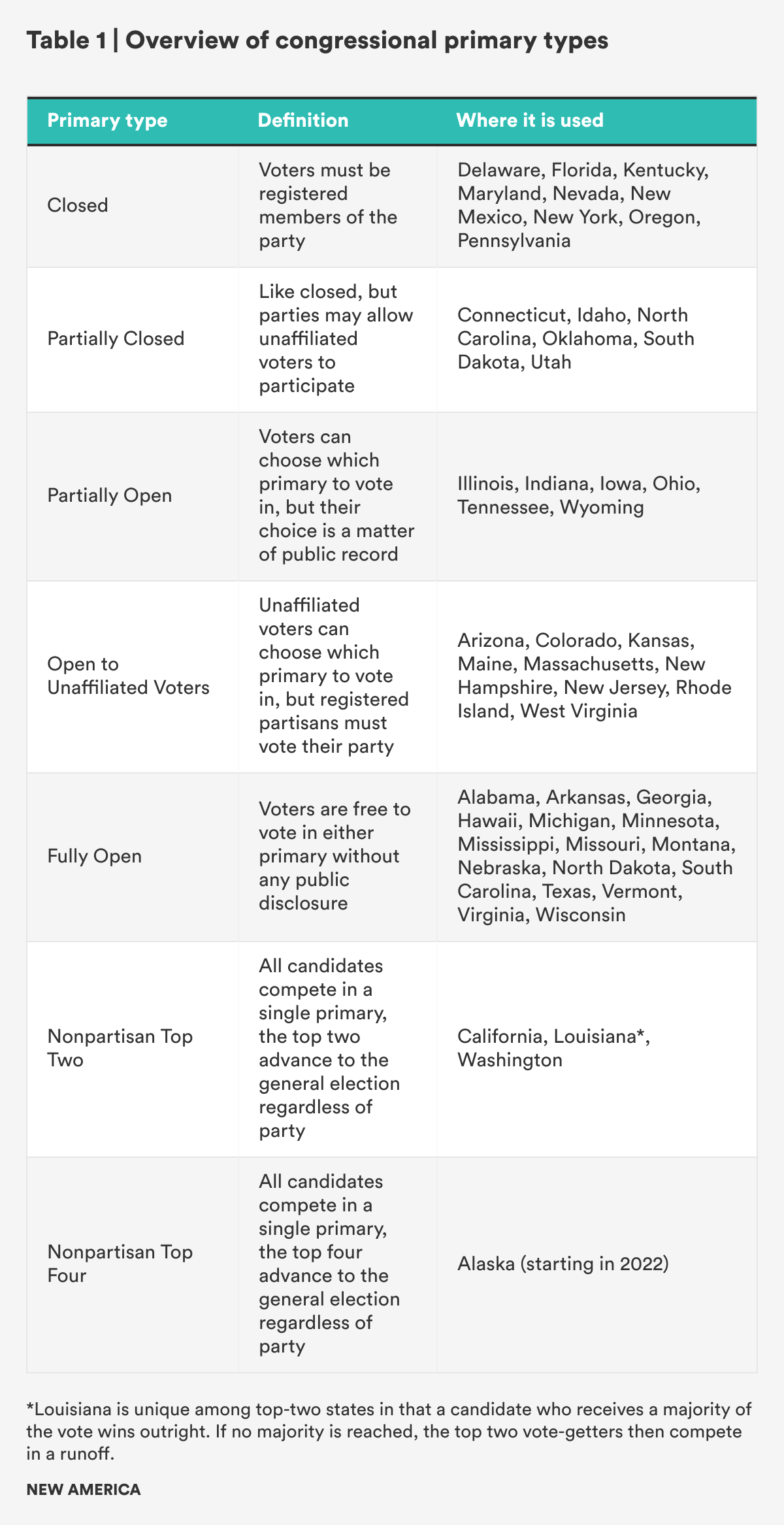
Generally, the primary reform conversation takes off from the baseline that closed primaries are the problem. That is because in closed primaries, only partisans get to participate. The argument against closed primaries, as the advocacy group Open Primaries models on their website, is that “Closed primaries are a fetter. They produce elected officials more accountable to their party than to their constituents. They restrict participation and reinforce division. They exclude independent voters, the largest and fastest growing sector of the electorate. And closed primaries make it more difficult for the American people—voters and elected officials alike—to come together across ideological lines.”5
Currently, only nine states have fully closed primaries, and in an additional five states, one of the two major parties uses closed primaries.6 The vast majority of state primary elections are held under a partially or fully open system, in which independent voters are allowed to participate. At first glance, then, the claim that closed primaries are responsible for the division and the divisiveness in our democracy seems unlikely. After all, this is a nationwide problem, and fewer than one in five states use fully closed primaries.
But if the closed primary system is not the main culprit, what is? Increasingly, reformers believe it could be the partisan nature of many primary elections. As such, the primary reforms generating the most interest today are two variations on the open primary: the top-two nonpartisan open primary and the top-four nonpartisan open primary.
The top-two open primary is effectively a two-round system, in which the top two finishers in the primary election advance to the general election, regardless of party. The intuition is that in districts that are lopsided in favor of one party or the other, more moderate candidates can run and win under the top-two primary by attracting support from the minority party’s voters who would settle for a moderate if they cannot have a candidate of their own party. For example, in a district that is 75 percent Democratic, two Democrats would be likely to emerge from the primary and then face off in the general election. Presumably the more moderate Democrat would win the general election, since the more moderate Democrat could win some Republican support. By contrast, under the closed primary system, there is no potential check on a Democratic primary selecting a more extreme candidate, who will win the general election no matter what. As such, the theory is that the top-two primary can encourage intra-partisan contests that encourage moderation.
Finally, there is the top-four open primary with ranked-choice voting (RCV) in the general election. In some ways, the top-four open primary works similarly to top-two, but it allows the top four finishers in the primary to move onto the general election. Then, so theory goes, by using RCV in the general election, the more moderate of the four candidates can win by being the second or third choice of opposing partisans. In theory, this system should encourage more moderate candidates to run for office and win. Because the top-four primary is still untested as of this writing we do not know whether it will work as advertised.7 But there is good reason to think that it should.
Also worth noting is the two-round primary system used in 10 states, eight of which are located in the South. Under this system, if no candidate wins a majority of the vote, the top two vote-getters advance to a primary runoff election. This system was created and widely adopted in the Jim Crow South, where the most significant and cohesive minority bloc was Black voters.8 A majority vote requirement can effectively marginalize any political minority, but the requirement's impact and intent was in most cases to marginalize the Black political minority.9 The Democratic Party’s dominance in the South under Jim Crow meant that most elections were decided in the primary, and the runoff served as a means to encourage intra-party competition (which in turn deterred defections); to unify the party around a candidate after a fractious primary campaign; and even to marginalize fringe or extreme (white) factions. In many ways, the original purpose of the primary runoff was to perpetuate the Democratic Party’s rule of the South.
The Theory of Reform
Let us now turn to the theory motivating primary reform. Above I described the two basic questions of the research: 1) Are primary elections important contributors to hyper-partisan polarization, and 2) Can changing the rules of the primary incentivize more compromise-oriented and moderate lawmaking—if so, which rule changes? There are two basic principles that correspond to these questions. The first is that primaries make hyper-partisan polarization worse. The second is that we can do something about that problem through primary reform. Both have testable sub-premises, listed below.
I. Primaries are a Problem
Premise 1: In most districts, the primary is the only election that matters. Most districts are solidly Democratic or solidly Republican, making the general election a foregone conclusion: only the primary matters. Thus, the primary should be open to everyone. For example, Republicans and Independents in a heavily Democratic district should be able to vote in the Democratic primary, since that is the election that matters. Not to allow everyone to participate in the same primary is disenfranchising to supporters of the district’s clear minority party.
Premise 2: Partisan primary electorates are disproportionately more extreme and more hyper-partisan than the electorate as a whole. If this is the case, expanding the primary to all voters would create a more moderate electorate that would elect more compromise-oriented candidates
Premise 3: Incumbent members of Congress fear a primary challenge, and adjust to avoid one. Because the threat of a primary challenge looms large, members tack to the extremes.
II. Changing the Primary Would Fix the Primary Problem
Premise 4: Changing the primary process would change who votes in the primaries. Specifically, allowing all voters (not just partisan) to participate would expand participation, especially to more moderate and compromise-oriented voters.
Premise 5: Changing the primary process would change the strategic entry and positioning of candidates, generating more moderate candidates. Specifically, moderate candidates are deterred from running in primaries because of the rules of primary elections, and more moderate candidates would run if rules were changed. Candidates may also change how they campaign, relying less on extreme partisan rhetoric and out-party demonization in order to appeal to a broader electorate.
Premise 6: Changing the primary process would change the types of candidates who get elected, generating more moderate winners and less polarization. Finally, altering the primary rules should create winners who may be incentivized to work more productively across party lines and, perhaps, ultimately less legislative polarization.
Premise 6 presumably rests on Premises 2-5, since it seems unlikely that primary reform would change outcomes if Premises 2-5 did not hold, but it is possible that there is another mechanism at work. Likewise, it is possible for some or all of the other premises to be true without Premise 6 (primary reforms actually generate moderation) also being true. If so, we would also need to think about whether there is some other mechanism.
Let us preview the main findings here before moving onto them in more detail.
Premise 1: In most districts, the primary is the only election that matters. This is absolutely the case. In roughly five out of six districts, the general election is a foregone conclusion. It is solidly safe for one of the two parties.
Premise 2: Partisan primary electorates are disproportionately more extreme and partisan than the electorate as a whole. There is mixed evidence for this premise. Primary voters are more politically engaged and stronger partisans, but not significantly more ideologically extreme. Whatever difference exists between general and primary election voters within each party is very small compared to the differences in ideology between voters of the two major parties.
Premise 3: Incumbent members of Congress fear a primary challenge, and adjust to avoid one. This is absolutely the case. Many incumbent members are very worried about a primary challenge and strategically ward off such challengers by making sure they are hardcore partisan fighters, closely connected with active primary constituencies who might otherwise promote a challenger.
Premise 4: Changing the primary process would change who votes in the primaries. There is little evidence to support this premise. Regardless of the rules (open, closed, top two), primary electorates look similar along key characteristics, and primary turnout is consistently very low.
Premise 5: Changing the primary process would change the strategic entry and positioning of candidates, generating more moderate candidates. There is also little evidence to support this claim. None of the existing primary regimes has induced more moderate candidate entry than any other. Rather, broader factors, such as the overall extremism of both parties and the high cost of running, are doing far more to discourage would-be moderate candidates from running. And of course, more moderate candidates running is a prerequisite for more moderate candidates winning.
Premise 6: Changing the primary process would lead to more moderate winners and reduce polarization. Thus far, primary reform has had little impact on mitigating polarization.
In short, there is plenty of evidence to suggest that members of Congress fear primary challenges and this threat tugs them to more confrontational extremes. It is demonstrably true that in the vast majority of House seats, the primary is the most important election. There is much less support for the other premises commonly believed among primary reformers.
Citations
- Melody Crowder-Meyer et al., “A Different Kind of Disadvantage: Candidate Race, Cognitive Complexity, and Voter Choice,” Political Behavior, October 9, 2018, source.
- On the power to structure decision rules as the supreme power, see, e.g. E. E. Schattschneider, The Semi-Sovereign People: A Realist’s View of Democracy in America (Holt, Rinehart and Winston, 1960). William H Riker, The Art of Political Manipulation (New Haven: Yale University Press, 1986). Peter Bachrach and Morton S. Baratz, “Two Faces of Power,” The American Political Science Review 56, no. 4 (December 1, 1962): 947–52.
- See, e.g. Jason S Spicer, “Electoral Systems, Regional Resentment and the Surprising Success of Anglo-American Populism,” Cambridge Journal of Regions, Economy and Society 11, no. 1 (March 10, 2018): 115–41, source. Jonathan A. Rodden, Why Cities Lose: The Deep Roots of the Urban-Rural Political Divide (Basic Books, 2019). Noam Gidron, James Adams, and Will Horne, American Affective Polarization in Comparative Perspective (Cambridge University Press, 2020), source.
- Some states use different rules for presidential primaries. Since this report is oriented around congressional primaries, I ignore presidential primary rules.
- Open Primaries website, “Our Mission,” source, accessed March 22, 2021). For more discussion of the rise of independent voters and the case for primary reform, see John Opdycke and Jeremy Gruber, The Next Great Migration: The Rise of Independent Voters (Open Primaries, 2020).
- Ballotpedia, “Closed Primary,” source.
- Alaska will run its first top-four primary in 2022. Fair Vote has simulated top-four outcomes in WA and CA source and source ; The simulations projected broad intra- and inter-party general election competition, with more minor party presence. However, simulations are based on candidate entry patterns under Top Two rules. Different rules may encourage different candidates and different types of candidates to run.
- National Conference of State Legislatures, “Primary Runoffs,” source, accessed May 17, 2021. The exception to the majority-requirement is North Carolina, where a candidate who secures 30 percent in the primary can advance straight to the general election. North Carolina also allows the second-highest finisher to waive the runoff. The two non-Southern states that use some form of primary runoff are South Dakota and Vermont.
- A 2007 report from the Department of the Interior showed how Georgia’s statewide mandatory primary runoff law, enacted in 1963, was conceived and sold explicitly as a means to undercut Black candidates. see: U.S. Department of the Interior National Historic Landmarks Program, Civil Rights in America:Racial Voting Rights, 2007, revised 2009, source