
Table of Contents
- Executive Summary
- Introduction
- Why Do We Have Primaries?
- How Should We Think about Primary Reform?
- Are Primaries a Problem?
- Can Primary Reform Change Who Votes, Runs, and Wins?
- Why Hasn't the Top-Two Primary Been More Transformative?
- Additional Original Analysis
- Implications for Top-Four/Five Voting
- Recommendations for Future Research
- Conclusions
Can Primary Reform Change Who Votes, Runs, and Wins?
Now we turn to the possibility that changing the primary would have a positive effect on the primary problem. Here, the most promising avenue for reform is in the top-two/four/five approach to primaries, because it simply makes the primary less important, particularly the top-four/five approach.
The theory of primary reform suggests that changing primary rules could produce more moderate winners. The expected intermediary effects involve who votes in primaries, which types of candidates enter primaries, and the extent to which incumbents fear “being primaried.” That is, under more open and nonpartisan primary rules, the expectation is that a more diverse and less extreme group of voters would participate, thus giving more moderate candidates a path forward. It would be unlikely for primary reform to yield more moderate winners without more moderate challengers. And it would be unlikely for more moderate candidates to enter if they did not see a path to victory.
More simply, the questions about the effect of primary reform can be broken down into three related questions: who votes (premise 4), who runs (premise 5), and who wins (premise 6).
Premise 4: Changing the primary process would change who votes in the primaries.
Conclusion: Not Supported for Open and Top-Two Primaries
Do different types of primary systems attract different mixes of voters? Do more open primaries bring in more moderate voters? The answer to these questions appears to be simple: No.
The most comprehensive study is Seth Hill’s “Institution of Nomination and the Policy Ideology of Primary Electorates.” Hill found that changing the nominating process had no effect on the ideological composition of primary election voters. “I find no evidence that … closed and semi-closed primary states had more ideological primary voters than states with more open primary systems…To the extent that there is a relationship between primary ideology and closed primary institution, it is in the direction opposite that hypothesized.”1
In Hill’s analysis, primary voters are more extreme than general election voters. But that is true, he found, regardless of the rules. Or put another way, going from closed to open or top two does not make the primary electorate more moderate. If anything, it seems to make the primary electorate a little more extreme. Hill speculates: “This result is very interesting. It either means that the citizens who want to participate in primary elections do so regardless of institutions in place, that institution of nomination is seriously confounded with ideological features of the states, or that different regulations on the franchise influence the composition of voters who participate but not their preferences.”2
Though Hill found primary voters to be more extreme compared to Sides and colleague’s analysis (discussed above), their analysis also found that the institution of primary election had no effect on the ideological composition of voters. A third recent study, looking only at presidential primary electorates, reached the same conclusion: "The overall ideological composition of primary electorates does not vary much by participation rules.”3
Briefly, the ideological profile of partisan voters is the same, regardless of the rules. One potential reason why electorates in open and closed primaries may look similar is that in states where primaries are more open, more voters decline to state their party. Therefore, the effect of primary rules may have more to do with the choices of engaged citizens whether or not to register as partisans than it does with the choice of citizens to get engaged enough in politics to pay attention to primaries.4
However, there may be a very modest effect of primary institutions on turnout, and as expected, the easier it is to vote in a primary, the higher the share of voters who participate. However, the effect is minimal. At best, open primaries increase participation by only 2 or 3 percentage points at best, and top-two primaries by about 6 percentage points.5 Given already abysmally low turnout in primaries, and thus plenty of room to expand, these are hardly transformative numbers—especially since they do not appear to change the ideological content of the voters who participate.
Premise 5: Changing the primary process would change the strategic entry and positioning of candidates, generating more moderate candidates.
Conclusion: Not Supported for Open and Top-Two Primaries
The second question is whether or not different primary systems encourage more moderate candidates to run for office. After all, it is hard for more moderate candidates to win if they do not even run.
And here, again, the evidence is largely on the side of primary type does not really matter. More open primary rules do not attract more moderate candidates to run.
In a 2015 study, “Primary Systems and Candidate Ideology: Evidence From Federal and State Legislative Elections,” Jon C. Rogowski and Stephanie Langella find no evidence that primary reforms have induced moderate candidates to enter politics: “The inconsistent results across parties, subsets of candidates, and legislative institutions do not allow us to reject the null hypothesis that nonpartisan primaries have no effect on candidate ideological extremity.”6
Rather, their findings suggest that the more open and nonpartisan primaries generate fewer moderate winners, “insofar as candidates in nonpartisan primaries are more extreme than candidates in closed primary systems. This leads us to conclude that, to amend a common aphorism, while you may be able to take the primaries away from the party, you can’t take the party out of the primaries.”7
In a 2018 study, Thad Kousser, Justin Phillips, and Boris Shor looked specifically at the effect of California’s top-two primary reform, comparing the ideological distribution of candidates pre-reform (2010) to post-reform (2012).8 They found that “lawmakers shifted marginally to the extremes, particularly in the Republican Party (where many of the party’s remaining moderates lost in 2012). At least judged by candidate positions in campaigns, the new rules did not bring the return to moderation that many of their backers had expected."9
The reforms, in other words, had no impact: “What we observe, then, is maintenance of the status quo. The lawmakers whom Californians send to Congress are nearly always located away from their district’s average voter and toward their party’s side of the ideological divide, a trend that the reforms of 2012 did nothing to halt.”10
Another 2018 study, by Kristin Kanthak and Eric Loep, took a more targeted look at strategic candidate entry. Kanthak and Loepp found no effect. “Primary types do not appear to singularly affect the likelihood that different types of candidates choose to run for office,” they write. “Nor do ideological disparities between general election candidates appear to result from the primary system a state chooses for its nomination contests. While many popular accounts of legislative polarization blame primaries for encouraging the emergence of extreme candidates, the evidence does not bear this out.”11
Despite the prevailing conventional wisdom, moderates actually do better than expected when they run in primaries,12 particularly when they have the backing of the party leadership, as they often do in swing districts.13 So the fact that few moderates run reflects a deeper problem: Most would-be moderates, particularly on the right, do not see running for office as an attractive career path. And because moderates do not see their parties as good fits for them14—either because they are discouraged from running by local party leaders15 or because they simply are not motivated enough by the partisan fights to bear the tremendous personal and financial costs of running for office16—the candidate field tends to be increasingly dominated by more extreme individuals, regardless, again, of the primary system.
Thus, as Danielle Thomsen concludes in “When Might Moderates Win the Primary?” (a chapter in a 2018 edited volume on primaries), “Primary voters may be more likely to select moderates or ideologues depending on the choices that are presented to them. Perhaps instead of focusing on changing primary laws, the first step for reformers who wish to diminish the ideological gulf between the two parties should be to encourage more moderates to run for office. Regardless of the configuration of choices on the ballot, in order for a moderate candidate to get elected, there must be a moderate for voters to choose.”17
But even if different primary rules do not change who runs, they may change how candidates campaign. One study finds at least rhetorical moderation in one-party contests under the California top-two primary system. The 2019 article, “Polarization and the Top-Two Primary: Moderating Candidate Rhetoric in One-Party Contests,” by Steven Sparks, finds that in same-party contests, candidates make more bipartisan statements, and fewer ideological statements. Though not a direct test of moderation, Sparks does show that the same party contests that the top-two primary sometimes generate do at least result in more moderate rhetoric. As Sparks notes, “If the top-two primary invokes moderation and bipartisanship into candidate rhetoric, it may likewise ease symptoms of affective polarization among the citizenry, at least at the margins."18
Premise 6: Changing the primary process would change the types of candidates who get elected, generating more moderate winners and less polarization.
Conclusion: Not Supported for Open and Top-Two Primaries
Finally, we come to the big question: Do different primary systems affect the types of candidates who win? The answer appears to be: No, not really.
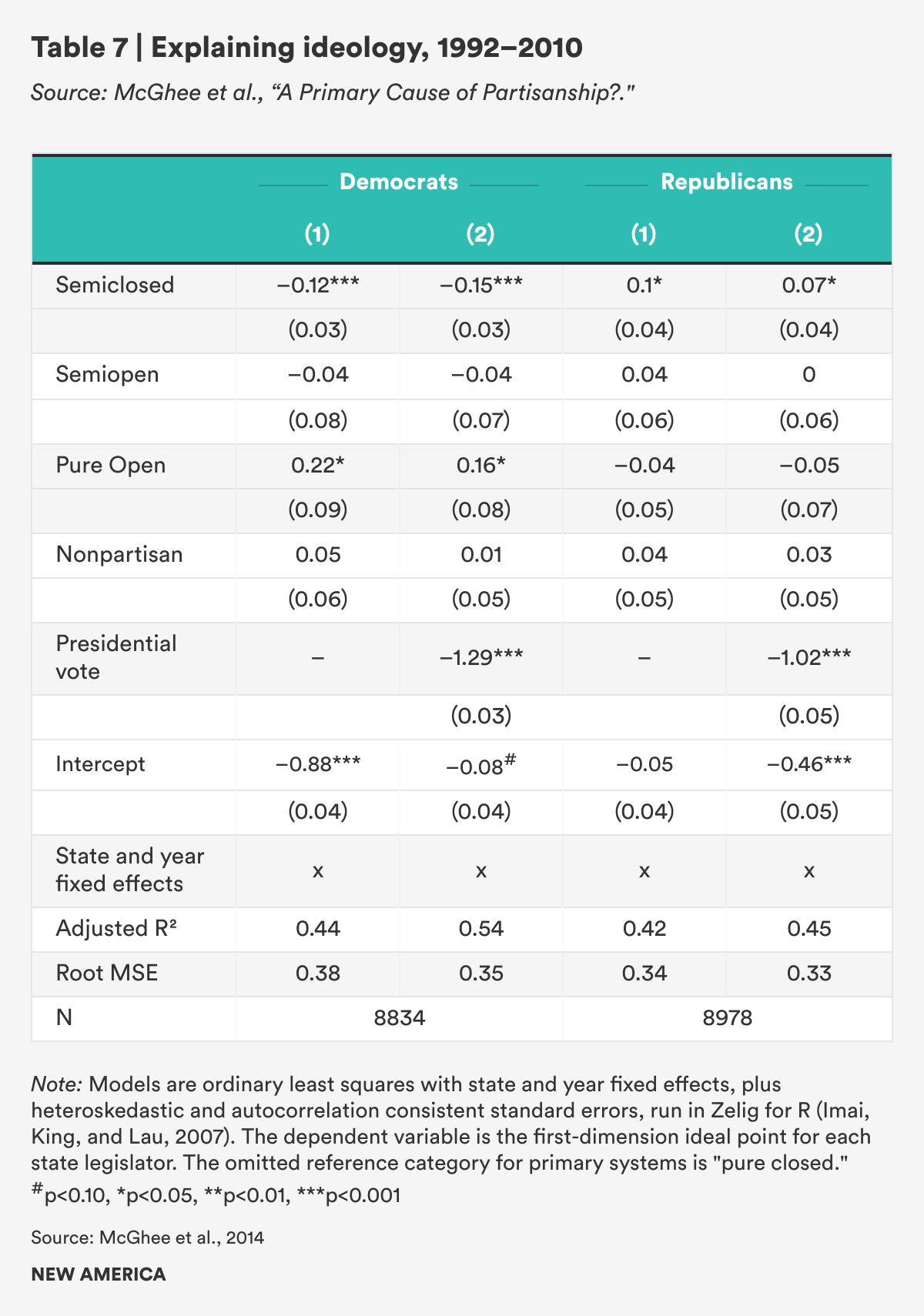
The first major comprehensive study to look at this came out in 2014, following the first election cycle of California using the top-two primary. In “A Primary Cause of Partisanship? Nomination Systems and Legislator Ideology,” a team of five political scientists (Eric McGhee, Seth Masket, Boris Shor, Steven Rogers, and Nolan McCarty) looked at the effects of different primary systems on candidate selection. They found no effect: “These systems have little consistent effect on legislator ideology. In fact, most of the effects we have found tend to be the opposite of those that are typically expected: the more open the primary system, the more liberal the Democrat and the more conservative the Republican.”19
The data in this paper cover 1992-2010, so they come before the introduction of the top-two primary in California. Below I reproduce two key graphics from the paper. The first, Table 7 below,20 shows the regression results, producing different effects by party, and using “fixed effects” (controls) for state and year. (The larger the coefficient, the more the type of primary is associated with extreme winners; negative coefficients reflect that the primary type is associated with less extreme winners. All of these are compared to pure closed, so that operates as the baseline for comparisons.)
The second graph from their articles shows the time trends in state legislator partisan polarization by primary type based on the regression results, charting mean ideal points of Democrats and Republicans by their state-level ideology scores. If you are having a hard time telling the difference between the five types, that is because the differences are not that significant. State legislative polarization has increased about the same in all the states that use this type of primary.
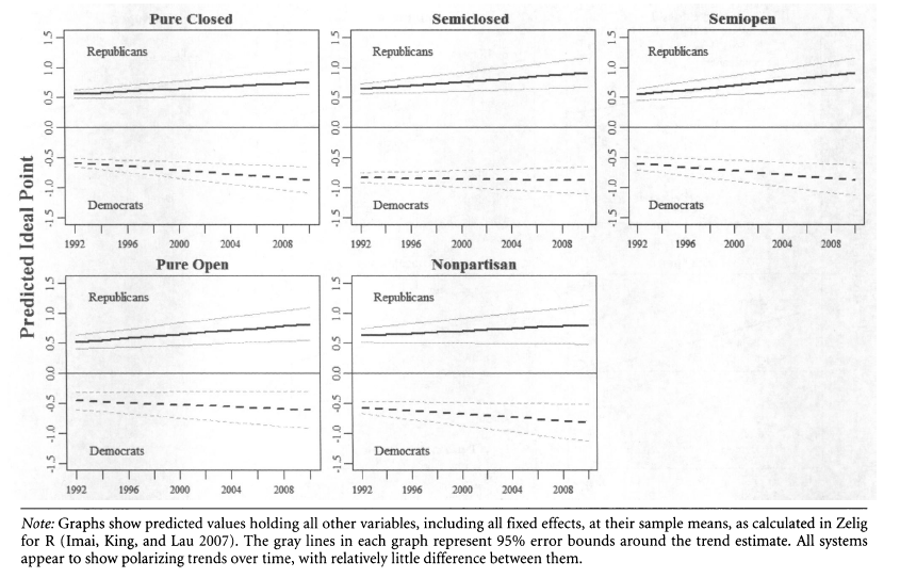
McGhee and colleagues argue: “Regardless of the mechanism, our analysis suggests we should expect little from open primary reform in the modern political age. The effect is inconsistent and weak, and where it is stronger and more robust, it is the opposite of the one that is generally intended."21
In 2017, with a few election cycles on the books following Washington’s and California’s implementation of top-two in 2008 and 2011, respectively, scholars began looking specifically at the effects of the top-two primary. The first study “Has the Top Two Primary Elected More Moderates?” by Eric McGhee and Boris Shor, found that Democrats in the California State Legislature had on the whole become slightly more moderate. However, they found no effect for California Republicans, and no effect for either Washington State Democrats or Republicans.22 Below I reproduce their key figure, which shows the state legislator ideology over time.
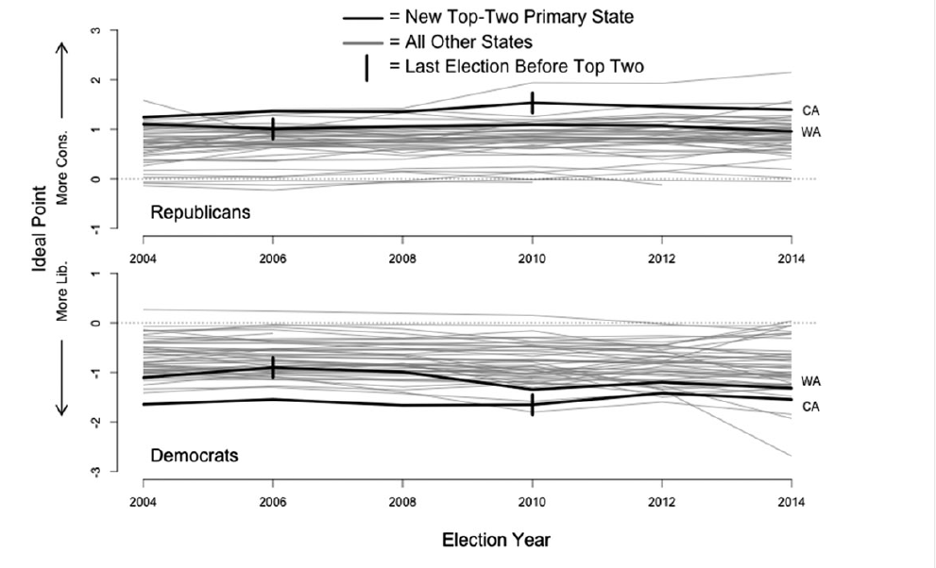
The changes here are certainly not dramatic. The authors also caution that whatever effect they are picking up in California may be because of the redistricting reform that also passed in 2010 (more on redistricting in a separate section).23 Notably, prior to their adoption of top-two primaries, California Democrats were the most consistently liberal in the country, so from a basic reversion-to-the-mean perspective, it might not be surprising to see some shifts. Yet, as with almost every study in this literature review, whatever differences exist between primary types are one order of magnitude smaller than the differences that exist between the two parties.
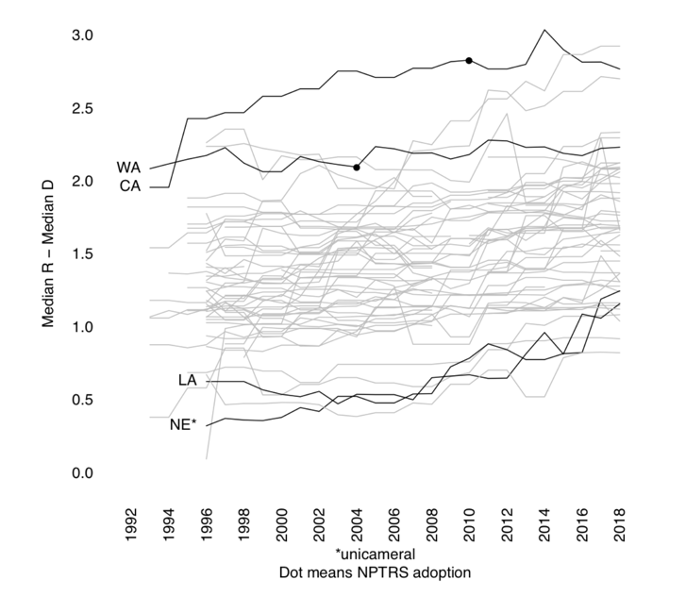
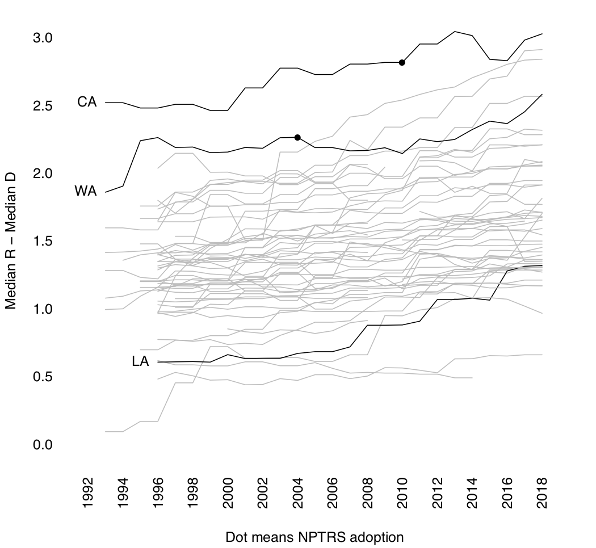
A more recent analysis by Jack Santucci extended this pattern forward. Again, the conclusion remained the same: “Nonpartisan elections don’t reduce polarization.”24 Santucci’s graphics show polarization trends in the upper chambers and lower chambers. In short, California and Washington, the two states that adopted top-two nonpartisan primaries (denoted as NPTRS for “nonpartisan two-round electoral system” in the graphics below) were very polarized both before and after primary reform.
In a more modest 2015 study, Eric McGhee focused more narrowly on economic policy, and found that though Democrats had moderated somewhat on economic issues, “signs that electoral pressures produced this moderation are difficult to find.”25 Rather, it appeared that Democrats were becoming more business friendly prior to 2010.
In 2020, a decade into the reform, two studies came out that looked at the effect of the top-two primaries on congressional delegations.
In one, Christian Grose discovered some modest effects. In “Reducing Legislative Polarization: Top-Two and Open Primaries Are Associated with More Moderate Legislators,” he found that holding the partisanship and ideology of the district constant, the top-two primary is associated with between 0.07 and .10 points more moderate ideology scores for representatives. The effect of open primaries is about half that. These are orders of magnitude smaller than the difference between the two parties, but still potentially important.26 I reproduce his regression results below.
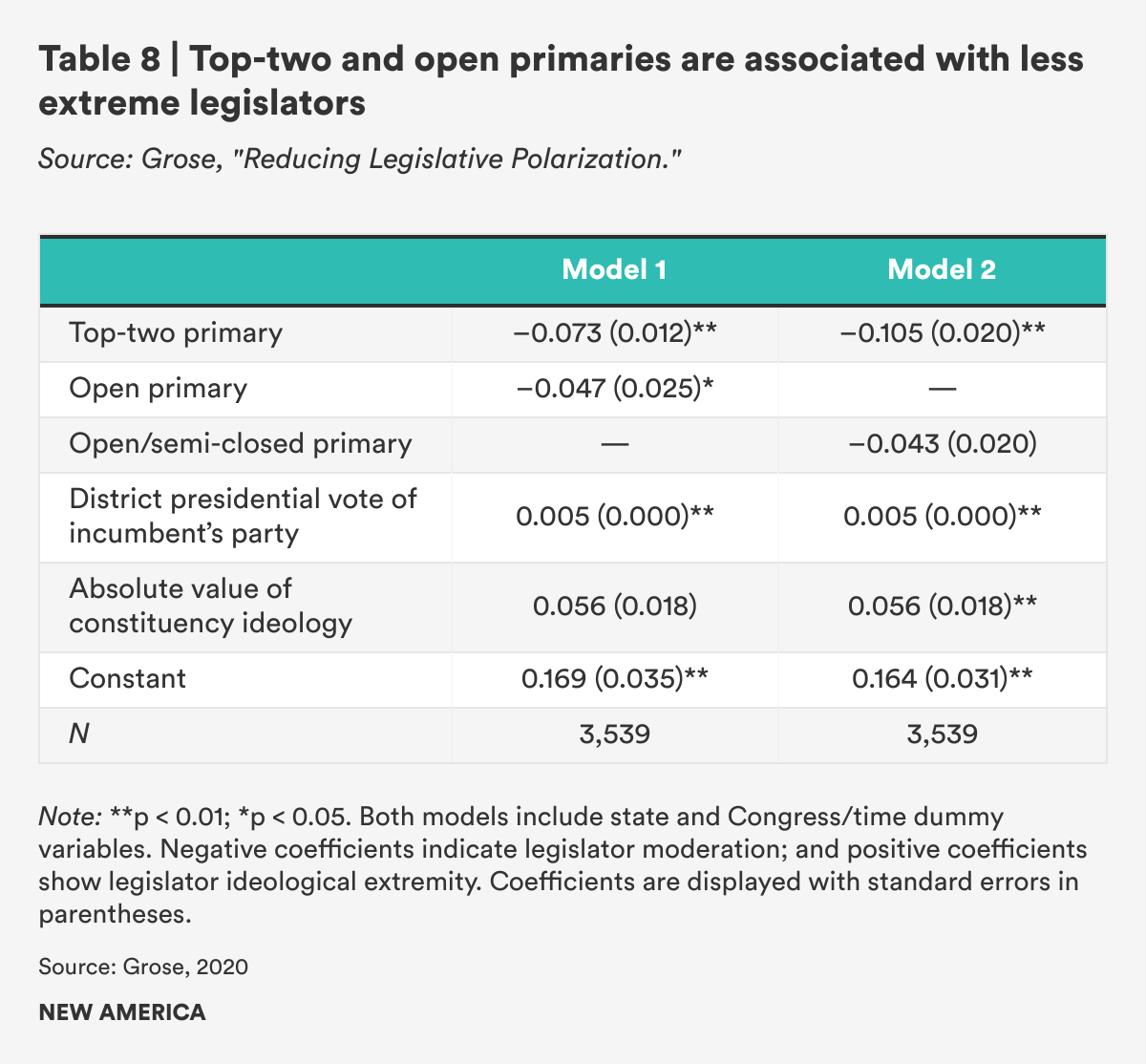
Since Grose’s study is the outlier in the bunch, it raises the obvious question: What is he doing differently? Grose’s study has the advantage of covering a large period of time, 2003-2018, which gives him over 3,500 observations, including 564 under top-two systems. However, it is important to compare his regression analysis to the one that McGhee, Masket, Shor, Rogers, and McCarty use in their 2014 paper. McGhee et al. include fixed effects (controls) for year and state, and they run separate regressions for Democrats and Republicans.
My personal analysis is that McGhee et al.’s methodological choices are all more sound. First, in conducting this kind of analysis over many years, controlling for the year is a good way to account for any secular time trends. In this case, it controls for the fact that polarization has been increasing throughout this period, so you want the estimate to account for that fact. Second, controlling for the state takes into account that different states and different state parties have different political cultures. This seems less important given the nationalization of politics, but still a good check. Running separate analyses for Democrats and Republicans, however, does seem very important, given that much of the literature has found that different primary types seem to have different impacts on Democrats and Republicans, though even these results are inconsistent across analyses, an inconsistency that suggests that these results are not entirely solid.
However, one intriguing data point from Grose’s study is that “among new members of Congress, those elected in top-two primaries are more than 18 percentage points less extreme than closed primary legislators.” (my italics) It is possible that reforms will produce more of a moderating effect through member replacement, in which case they will take time. As always, reform is part of a dynamic process.
The other 2020 study looks more closely at the same-party general contests and also finds that the top-two primary has not delivered on its promise. The paper, “Extreme districts, moderate winners: Same-party challenges, and deterrence in top-two primaries,” by Jesse Crosson concludes that, “Post-reform winners on the whole are not more moderate than similar races pre-reform.”27 In other words, the top-two system has not really worked as intended.
But it is a little more complicated and interesting than the top line finding. When Crosson digs deeper he does find that the same-party challenges are more likely to produce moderate winners, as the reform intended. However, the ability of the reform to have a large-scale impact is muted by the incumbents' ability to avoid same-party challenges. To the extent moderation emerges under the top-two system, then, it emerges in open seats that are solid enough for one party to induce same-party general election challenges. This is a relatively small share of seats. As Crosson notes, “When incumbent legislators are not running, same-party general elections are more likely to occur… This may indicate that incumbents are better able to insulate themselves from co-partisan challenges than are candidates in open seats.” Crosson suggests that party leaders also may be influencing candidate entry in order to avoid same-party competition.”28
Citations
- Hill, “Institution of Nomination and the Policy Ideology of Primary Electorates,” Quarterly Journal of Political Science, 10, no. 4 (2015): 461-487. source.
- Hill.
- Barbara Norrander and Jay Wendland, “Open versus Closed Primaries and the Ideological Composition of Presidential Primary Electorates,” Electoral Studies 42 (June 1, 2016): 229–36, source.
- Norrander and Wendland.
- “Point estimates suggest an increase in turnout of 1.5 percentage points in open primaries and 6.1 percentage points in nonpartisan primaries.” Seth J. Hill, “Sidestepping Primary Reform: Political Action in Response to Institutional Change,” Political Science Research and Methods, 2020, 1–17, source. See also Matthew J. Geras and Michael H. Crespin’s “The Effect of Open and Closed Primaries on Voter Turnout:” “For both the Republicans and the Democrats, voter turnout was highest during open primaries and lowest during hybrid primaries. The predicted difference in turnout between these two types of primaries appears to amount to about 2 to 3 percent.” Matthew J. Geras and Michael H. Crespin, “The Effect of Open and Closed Primaries on Voter Turnout,” in Routledge Handbook of Primary Elections, ed. Robert G. Boatright, 1st ed. (New York: Routledge, 2018), 133–46, source.
- Jon C. Rogowski and Stephanie Langella, “Primary Systems and Candidate Ideology: Evidence From Federal and State Legislative Elections,” American Politics Research 43, no. 5 (September 1, 2015): 865, source.
- Rogowski and Langella, 865
- Thad Kousser, Justin Phillips, and Boris Shor, “Reform and Representation: A New Method Applied to Recent Electoral Changes,” Political Science Research and Methods 6, no. 4 (October 2018): 809–27, source.
- Kousser, Phillips, and Shor, 820.
- Kousser, Phillips, and Shor, 22.
- Kristin Kanthak and Eric Loepp, “Strategic Candidate Entry,” in Routledge Handbook of Primary Elections, ed. Robert G. Boatright, 1st ed. (New York: Routledge, 2018), 147–57, source.
- Danielle M. Thomsen, “When Might Moderates Win the Primary?,” in Routledge Handbook of Primary Elections, ed. Robert G. Boatright, 1st ed. (New York: Routledge, 2018), 226–35, source.
- Hans J. G. Hassell, “Party Control of Party Primaries: Party Influence in Nominations for the US Senate,” The Journal of Politics 78, no. 1 (2016): 75–87.
- Thomsen, Opting Out of Congress.
- David E Broockman et al., “Having Their Cake and Eating It, Too: (Why) Local Party Leaders Prefer Nominating Extreme Candidates,” Working Paper, Stanford University, 2017, 53.
- Hall, Who Wants to Run?
- Thomsen, “When Might Moderates Win the Primary?”.
- Steven Sparks, “Polarization and the Top-Two Primary: Moderating Candidate Rhetoric in One-Party Contests,” Political Communication 36, no. 4 (October 2, 2019): 565–85, source.
- Eric McGhee, Seth Masket, Boris Shor, Steven Rogers, and Nolan McCarty, “A Primary Cause of Partisanship? Nomination Systems and Legislator Ideology,” American Journal of Political Science 58, no. 2 (2014): 337–51, source.
- McGhee et al., Table 2.
- McGhee, Masket, Shor, Rogers, and McCarty.
- Eric McGhee and Boris Shor, “Has the Top Two Primary Elected More Moderates?,” Perspectives on Politics, September 2017, 1–14, source.
- McGhee and Shor. As they note: “a portion of this effect appears to stem from the redistricting that occurred coincident with the Top Two. Our analysis also considers possible effects from other sources. Relaxed term limits went into effect at the same time as both the Top Two and the redistricting, but this change does not appear to account for all of the change in Democrats. That said, the residual pre/post change after accounting for the other potential causes leaves only a small shift to explain. Any effects we do find are limited to Democrats in California alone.” They also add a second caveat: “It is worth noting the limits of our analysis. We feel relatively more confident about the role of redistricting, since we have measured the source of those effects more directly. We can also be reasonably confident about the role of term limits, since we have comparison groups for whom the term limits change did not apply: continuing legislators and members of Congress. These groups show far smaller pre/post effects, suggesting that term limits may explain still more of the difference.”
- Jack Santucci, “Nonpartisan elections don’t reduce polarization,” Medium, February 11, 2021, source.
- “Moderation on Chamber issues came in advance of the first election under the reforms, and those who were termed out or decided not to run for reelection were just as likely to moderate as legislators who were continuing in the same body. Moreover, there is no evidence that greater moderation in the Democratic caucus has led to greater success for the Chamber’s policy agenda. Thus, there is a real possibility that this moderation is simply position-taking by elected officials who know that no concrete change in policy will come from it.” Eric McGhee, “California’s Top Two Primary and the Business Agenda,” California Journal of Politics and Policy 7, no. 1 (February 5, 2015), source.
- Christian R. Grose, “Reducing Legislative Polarization: Top-Two and Open Primaries Are Associated with More Moderate Legislators,” Journal of Political Institutions and Political Economy 1, no. 2 (June 30, 2020), source.
- Jesse Crosson, “Extreme Districts, Moderate Winners: Same-Party Challenges, and Deterrence in Top-Two Primaries,” Political Science Research and Methods, March 17, 2020, 1–17, source.
- Crosson.