
Table of Contents
- Executive Summary
- Introduction
- Why Do We Have Primaries?
- How Should We Think about Primary Reform?
- Are Primaries a Problem?
- Can Primary Reform Change Who Votes, Runs, and Wins?
- Why Hasn't the Top-Two Primary Been More Transformative?
- Additional Original Analysis
- Implications for Top-Four/Five Voting
- Recommendations for Future Research
- Conclusions
Are Primaries a Problem?
The first premise of primary reform is that primaries are indeed a problem. This section evaluates reasons why that might be the case.
Premise 1: In most districts, the primary is the only election that matters.
Conclusion: Supported
This is such a basic premise that it is perhaps obvious to anyone who follows U.S. politics. Over the past several decades, the share of both congressional districts and states that are two-party competitive has declined steadily. The below chart comes from my book, Breaking the Two-Party Doom Loop.1

Though this decline in competitiveness is often erroneously attributed to gerrymandering, it is largely a function of the broader geographic sorting of the two parties. As Democrats have become much more a party of big cities (while Republicans have stopped competing for the votes of urban, cosmopolitan America), Democrats have wound up concentrated in a large number of safe seats in and around major cities. Likewise, as Republicans have increasingly become the party of exurban America (while Democrats have ceased competing in small-town and rural areas), Republicans now occupy a large number of safe seats in the less populated parts of the country. The remaining swing districts tend to be in the suburbs, straddling more densely populated Democratic precincts, and more sparsely populated Republican precincts. Importantly, this means that just because a district is a swing district, it does not necessarily contain a large number of moderate swing voters. In fact, most swing districts are only swing because they are split between an equal number of partisans on both sides.2
With most general elections essentially uncontested (with only nominal challengers, and sometimes none at all), primary elections have become more focal,3 and the number of challengers has risen, though not as much as many popular accounts would have us believe.4
Premise 2: Partisan primary electorates are disproportionately more extreme and more hyper-partisan than the electorate as a whole.
Conclusion: Mixed Evidence, Not Well Supported
Conventional wisdom is that primary elections are polarizing, and that the primary “base”—the voters who turn out in primary elections—represents the more extreme wing of both parties. Over the years, many scholars have attempted to evaluate this premise, but the results have been more mixed than the conventional wisdom would suggest.
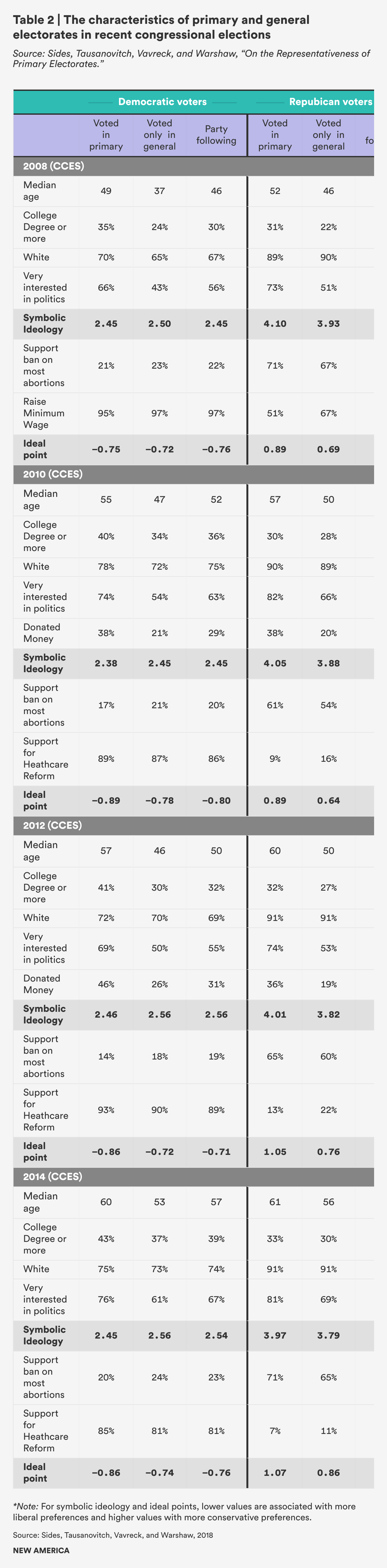
The most comprehensive and methodologically rigorous recent study is the 2018 article “On the Representativeness of Primary Electorates,”5 which combines data from five large surveys covering four election cycles (2008, 2010, 2012, and 2014).6 As authors John Sides, Chris Tausanovitch, Lynn Vavreck, and Christopher Warshaw conclude, “Primary voters are not demographically distinct or ideologically extreme compared to those who identify with the party or who voted for its presidential candidate in the general election, or than those who identify with the party and voted in the general election but not in the primary. The only substantial difference is that primary voters report more interest in politics.”
Certainly, there are some small differences between primary and general election voters. Republican primary voters score slightly higher/more conservative (~0.2 points) on the “symbolic ideology” score, a scale that goes from -2 (most liberal) to 2 (most conservative). Democratic voters score slightly lower/more liberal (~0.1) points. But the important point is that these differences are tiny compared to the large differences between Democratic and Republican voters. Below, Table 2 is reproduced from the article.
Sides and colleagues also distinguish between primary voters and what they call the “party following.” This distinction allows them to include voters who supported a party’s candidate in the general election, thus covering independent voters. Using these distinctions, they compare differences in symbolic ideology across three types of primaries: closed, semi-closed, and open. The results are reproduced below (Table 3).
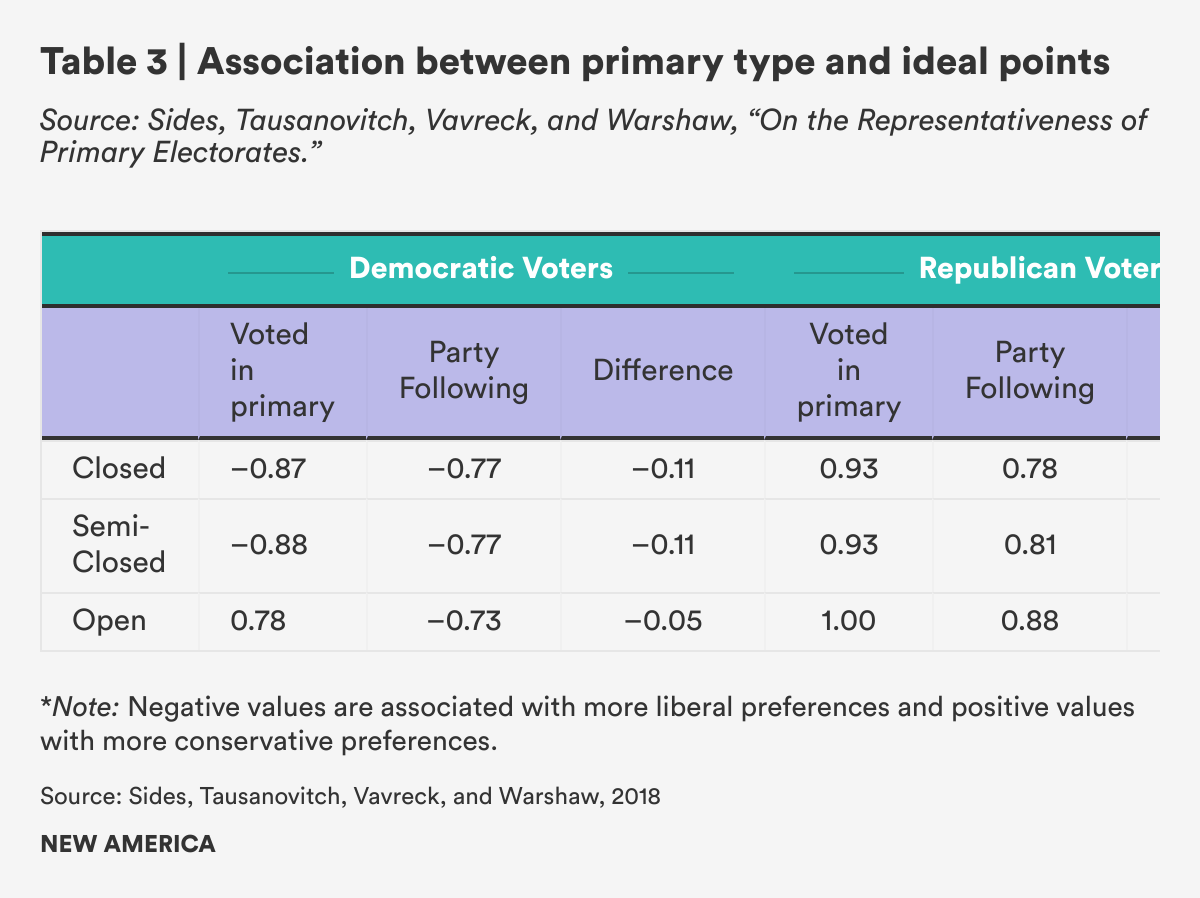
Again, the overwhelming distinction is between Democratic and Republican “party following” voters—a difference of between 1.55 and 1.61 units on the scale (depending on primary type). That is more than 10 times the difference between primary and general election supporters of both parties! Likewise, the difference in voters by primary type is tiny. Similarly, the 2008 article “Don’t Blame Primary Voters for Polarization” by Alan Abramowitz finds “very little difference between the ideologies of each party’s primary voters and the ideologies of its general election voters.”7 Intriguingly, the most ideologically extreme sub-group in the Sides et al. analysis (Table 3) is Republican candidate supporters who voted in open primaries.
Other studies, however, find the primary voters are more ideologically extreme. Gary Jacobson’s 2012 article, “The Electoral Origins of Polarized Politics: Evidence From the 2010 Cooperative Congressional Election Study,” argues: “Primary electoral constituencies tend to be even more extreme, particularly on the Republican side, deterring departures from party orthodoxy and thus movement toward the median voter.”8 Jacobson’s approach is to look at nine key questions on salient issues with clear partisan-ideological differences and look for consistency across those questions. Jacobson finds that primary voters are more consistently Democratic-liberal or Republican-conservative. Below are Jacobson’s charts. Note that Jacobson defines activists as “those who engaged in one or more political activities in addition to voting.”9
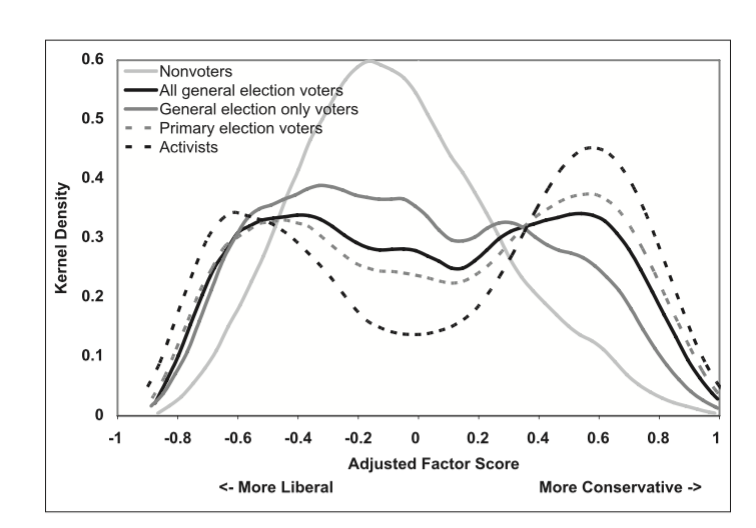
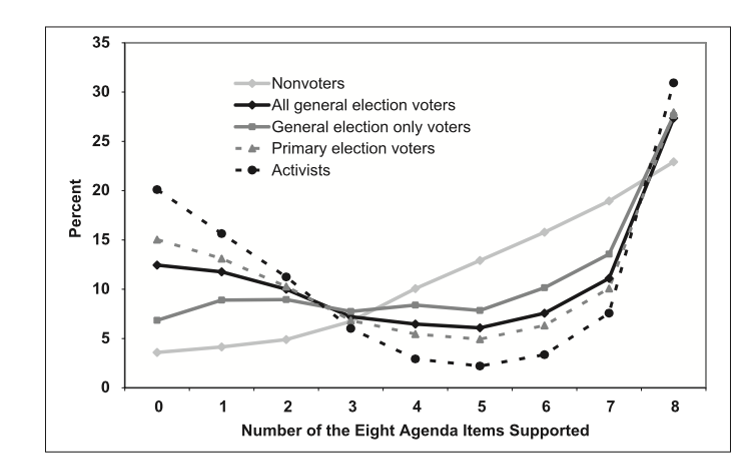
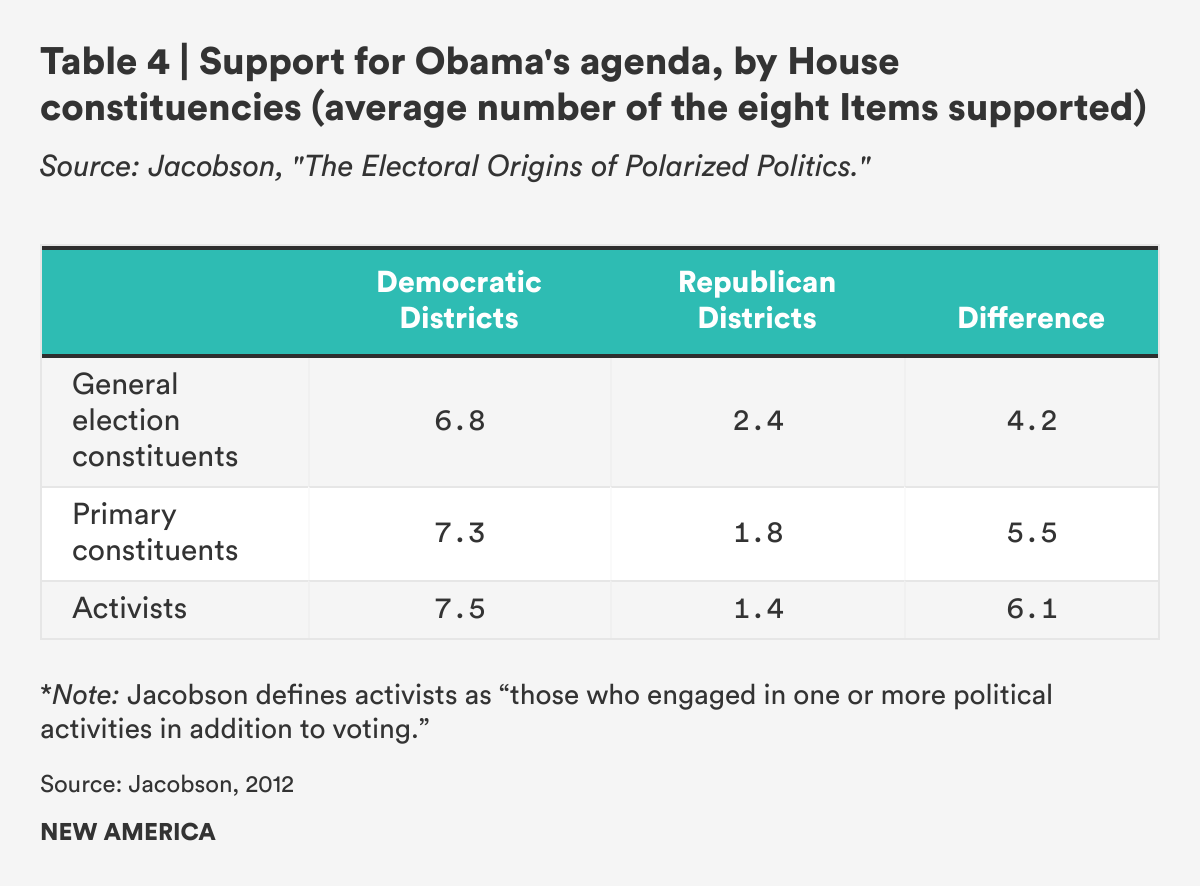
Jacobson finds support/opposition to Obama’s agenda is more consistent for primary voters than among general election voters, who are more mixed. However, the difference between Democrats and Republicans (4.2 points) is much greater than the difference between general election and primary constituents (0.5 points for Democrats, and 0.6 points for Republicans). By contrast, the difference between partisan primary and partisan general elections is about half a point.
The other recent article to look systematically at the differences in electorates is Seth J. Hill’s 2015, “Institution of Nomination and the Policy Ideology of Primary Electorates.” Though the article is primarily focused on measuring the differences of primary ideology by type of election (he finds no relationship), the article concludes that, “Primary voters are more divergent from even the party’s supporters at the general election” than other recent studies have found.10
Certainly, one reason for conflicting conclusions is that methodologies differ.11 Until recently, it has been difficult to verify who actually voted in primary elections, and relying on surveys alone can be misleading as voters tend to over-represent the extent to which they vote in primaries. Also, ideological extremism and hyper-partisanship are not easily defined; results vary depending on measures used to capture key concepts and what survey questions researchers draw upon.
A quick detour into ideology and extremism, then: When many analysts think about ideology, they assume a one-dimensional spectrum from very liberal to very conservative. But this is not really how ideology works for most people. Most people do not have so much of a clear ideology, and certainly not a one-dimensional ideology. More people have partisan attachments than clear ideologies. It is only among the roughly 25 percent of voters (typically the most highly engaged) that survey researchers typically find something resembling a consistent ideology. But even this can be flexible. To the extent ideology exists, it is mostly just consistent support for a list of party positions.12
Consider support for former President Donald Trump. Trump, a Republican, is not classically conservative, and it would be hard to describe him as an ideologue. Accordingly, it is hard to describe the current fight within the Republican Party as one between ideologically pure Republican base voters and moderates. Instead, the hard-core Republican partisans are probably better characterized by a particular set of beliefs around national identity and race and culture, and an opposition to compromise with Democrats. This is different from the typical one-dimensional view of ideology that frequently holds. It is more a matter of identity than ideology, which makes it trickier to measure. To the extent Trump’s strongest supporters are the most conservative Republicans, they are not conservative in a conventional ideological sense, but rather in a confrontational identity sense.13 So, is ideological extremism the same thing as hyper-partisanship? And if not, which do we care more about?
This indicates that the most consequential difference between primary and general election voters might be partisan affect, or out-party hatred—something that none of the existing studies have measured, and an opportunity for future research. Given that the most consistent and persistent differences between primary and general election voters involve their level of political engagement, and political engagement tends to correspond to strength of partisanship, as well as exposure to confrontational media, the most significant difference between primary and general electorates will probably be along this dimension.
However, given the depth to which out-party hatred has soaked into the mindset of partisans of all levels of engagement, the deeper problem with polarization almost certainly comes down to the differences between voters of the two parties. This is consistent throughout the studies. Primary electorates may be a little more polarized than general election electorates. But general election electorates are also extremely polarized. As Abramowitz argued in his 2008 paper, “The polarized state of American politics today reflects the polarized state of the overall American electorate rather than any peculiar characteristics of primary voters.” He went on to note that, “Even after they secure their party’s nomination, it may be risky for candidates to adopt more moderate policy positions in order to appeal to swing voters, because any such move toward the center would risk alienating a large proportion of their party’s electoral base.”14 This is certainly even truer today, 13 years later, after the polarizing politics of the Obama and Trump presidencies. There just are not very many voters today in an idealized moderate middle.15
In an earlier era, of course, in which there were both liberal and conservative Republican voters, there were both liberal and conservative Republican primary voters, which tended to elect more moderate Republicans. Similarly, there were liberal and conservative Democratic primary voters. But as the parties sorted on a national level, the voters selecting Republicans became more conservative, and the voters selecting Democrats became more liberal. This created a reinforcing cycle. In a study of changing primary electorates, Seth Hill and Chris Tausanovitch conclude that: “More extreme primary electorates encourage the election of more extreme legislators, and that more extreme legislators in turn cause primary sorting, which narrows the primary electorate and makes it even more extreme. This is a continuing cycle that was initiated by the fall of the Solid South.”16
One implication of this partisan sorting, as Hill and Tausanovitch note, is that if sorting is driving the polarization of primary electorates, then it is not the rules of primaries that matter, but the shape of the primary electorate that matters. Thus, they write, “Our evidence suggests that more open participation rules are not very important to the composition of primary electorates relative to the effect of the sorting of party identification."
The bottom line, then, seems to be that primary voters are more politically engaged, and probably more politically extreme than general election voters, though it is not entirely clear what extreme actually means; and whatever differences exist between primary and general election voters are tiny compared to the differences between Democratic and Republican voters. There is not some latent hidden force of moderate, compromise-oriented voters who would move politics to the middle if only primary election rules were changed, or primary elections were even eliminated. The root problem is the sorting of the parties and the polarization that has followed.
There is not some latent hidden force of moderate, compromise-oriented voters who would move politics to the middle if only primary election rules were changed, or primary elections were even eliminated.
Certainly, none of these studies are the final word, especially given the data analyzed in these studies only goes up through 2014, and there is no agreement on measurement. Polarization and partisan resentment have, of course, continued to evolve and we should continue to investigate possible changes in the electorate, and perhaps explore other measurement strategies, too. And yet we can see that even as politics has polarized in recent decades, the finding that the primary electorate and the general election electorate are not critically distinct (and certainly not as distinct as incumbents fear, as discussed below) has remained remarkably robust.17 This creates a strong expectation that the last six years will not demonstrate a major change in these trends, and different metrics will not yield notably different results.
Premise 3: Incumbent members of Congress fear a primary challenge, and adjust to avoid one.
Conclusion: Supported
Assuming that the primary is the most important election in the vast majority of congressional districts (and many solidly one-party states), most incumbent members of Congress can safely win re-election as long as they hold off a primary challenger. As a result, fear of “being primaried” is always looming in the minds of members of Congress, and is frequently volunteered as an explanation for why particular lawmakers engage in more confrontational and extreme position-taking: they are afraid of losing.
One obvious rejoinder is that very few incumbents actually lose their primaries, as shown in Table 5, which was reproduced from the 2018 Brookings Primary Project.18
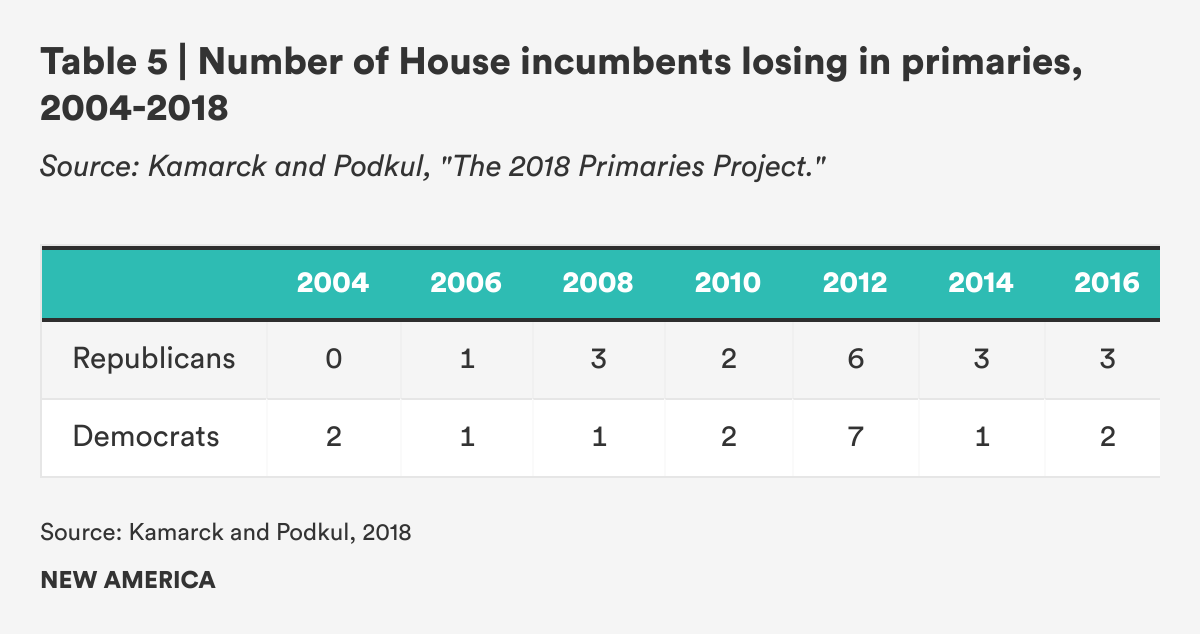
Nonetheless, the few examples take on outsized importance in the minds of many incumbents. In many respects, it is the threat, rather than the reality, that looms largest. The lack of successful primary challenges may only be evidence of the ability of incumbents to deter such challenges by keeping close to their primary voters, the same ones who previously elected them. Additionally, if primary electorates are more extreme than general electorates, more would-be moderate challengers may be deterred from running, believing that they could not possibly win a primary.
Now let us go into more detail into the nature of the primary threat and how incumbents adjust their behavior in response to it.
Extreme Challengers are More Likely than Moderate Challengers
One reason why extreme challengers are more feared is because incumbents are far more likely to face extreme challengers than moderate challengers. The first explanation for this is that would-be moderate challengers have less desire to run in the current political environment. Fundraising and campaigning are hard and time consuming. Challenging an incumbent is difficult. In our current political environment, those willing to bear the high personal costs of campaigning are those with the most passionate beliefs about politics, and passion and extremism go together.19 Would-be moderate challengers tend to lack the commitment of the true partisan believer that drives so many into office these days. And often, these potential challengers have more established careers they would rather not give up.
Additionally, as the parties have polarized, would-be moderate candidates simply do not see themselves as "fitting" with either of the two major parties, but especially the Republican Party.20 Consider this: If you are a moderate, where would you fit in either of the two parties? Do you want to be a lone voice with few friends in the legislature? For most, the answer is no, not really.
Fundraising also shapes types of challengers who emerge. Since it is very difficult for candidates to gain traction without the ability to raise large sums of money, candidates who are good at fundraising have an advantage. Donors who fund moderate incumbents tend to be access-oriented donors—that is, donors who contribute in order to build relationships with legislators, which in turn makes it easier for them to ask for favors. Access-oriented donors tend to be business interests and other perennial political players. Donors who fund challengers tend to be less interested in access since challengers often lose, and individual donors, both small and large, tend to be on the extremes.21 Extreme challengers will therefore tend to have access to a greater number of fundraising networks than moderate challengers, who have nothing to offer more moderate access-oriented donors other than a long-shot. In their 2017 book Crisis Point, for example, former U.S. Sens. Tom Daschle (D-S.D.) and Trent Lott (R-Miss.) write, “There are lots of responsible, conservative senators looking over their shoulders, worried about getting attacked from the Club for Growth or the Senate Conservatives Fund and their deep war chests.”22
Finally, because primary electorates are so small in number, a challenger candidate with dedicated support can defeat an incumbent by turning out a different constituency than voted in prior elections. This means that a challenger could always be lurking, with plenty of so far un-mobilized constituencies waiting in the shadows.
Note that all of these reasons have very little to do with the attitudes of actual primary voters. Instead, they stem from: 1) the fact that extreme challengers are more motivated to bear the high personal and fundraising costs of campaigning; and 2) generally, more resources are available for more extreme primary challengers than for more moderate primary challengers.
Incumbents Manage Primary Threats by Staying Close to their Primary Constituencies and Avoiding Compromises
In a comprehensive Brookings study published in 2018, Elaine Kamarck and James Wallner concluded that, “The fear of being primaried prompts members of Congress to change their behavior in ways that reduce the likelihood of it occurring and that increase the likelihood of prevailing in a contested primary, if a challenger actually emerges."23(emphasis mine) Even if successful primary challenges are rare, the threat of them looms large.
Kamarck and Wallner identify four primary ways in which members ward off primary threats. First, they “stay close to their primary constituency to help identify potential threats early.” Second, because “they believe that outside advocacy groups are important especially in primary races,” incumbents stay close to the outside advocacy groups that might otherwise mount a primary challenge. So, the first two ways incumbents avoid primary challengers is to give disproportionate say to the voters and groups most active in their primaries—and most likely to mount and support a challenge.
The third and fourth ways to avoid challengers involve party leadership. They observe that, “Leaders structure the legislative agenda to avoid issues that will upset their primary constituencies. When that is not possible, members try to consider must-pass issues in the least damaging way possible.” And because, “members believe that party unity—both back home and in D.C.—is an important element to prevail in a contested primary,” they work to avoid cracks in their party, which typically involves acts that strengthen partisanship and elevate partisan divides.
In short, both incumbent members and partisan leaders avoid primary challenges by becoming more confrontationally partisan.
Avoiding compromise is another strategically adaptive behavior. In a comprehensive survey of state legislators and city officials, Sarah Anderson, Daniel Butler, and Laurel Harbridge-Young found that elected lawmakers refused to compromise because they were afraid of primary voters. Their 2020 book is informatively titled Rejecting Compromise: Legislators’ Fear of Primary Voters.
Among some of the book’s key findings:
- “Seventy-two percent of state legislators and 68 percent of elected city officials thought they would receive some or a lot of retribution if they compromised.” (The compromise described was a meeting-in-the-middle, “half-loaf” compromise.)
- Among state legislators, “43 percent of respondents said that they could name a time when a legislator had lost their seat because they voted for a compromise.”
- “Increased Tea Party attachment among constituents is associated with a reduced likelihood of legislators voting for the compromise.”24
Surprisingly, a majority of primary voters do support compromise. By the authors’ estimates, only a third of primary voters are opposed to compromise.
Unsurprisingly, opposition to compromise correlates with extreme ideology. Anti-compromise attitudes are especially strong among those who call themselves extremely conservative or extremely liberal. Those who identified as Tea Party members are also more likely to oppose compromise.25 But not only do they oppose compromise, they also actively punish incumbents for compromise.26 In short, it is not primary voters writ large that incumbent members worry about, but rather a specific subset of the primary electorate that opposes specific compromises.
But even so, losses always loom larger than gains. The specific threat of even a subset of primary voters supporting a challenger, and of a challenger emerging in response to a particular vote, is easy to visualize, and could cost a lawmaker their seat. The political upside of a compromise is harder to visualize, especially in an era in which cross-partisan voting is low among the public and no amount of compromising may be able to sway supporters of the opposing party.
According to Anderson, Butler, and Harbridge-Yong, “The difficulty is that legislators do not always know ex-ante which compromise votes will mobilize primary voters or even challengers against them. As a result, cautious legislators have incentives to reject many compromises, even if these proposals have the support of the majority of their voters.”
They go on: “Even if the voters who are willing to punish for a given compromise are small in number, they may be consequential for electoral prospects if there are several groups who all care about their own, different issue… If a legislator alienates enough primary voters by supporting compromise proposals it could lead to electoral defeat.”
Powering this dynamic is primary voters’ tendency to track representatives' voting records. This makes sense, as those voting records are more likely to be important in primary elections given the absence of party cues. However, it also increases the salience of compromise votes in a way that undermines opportunities for compromise. As Anderson, Butler, and Harbridge-Young explain, “Primary voters are more likely to pay attention to their legislator’s voting record, especially on issues about which they care deeply, giving them the knowledge necessary to punish the legislator for compromising. This can make votes for compromise more consequential in contested primaries.”27
Moreover, since lawmakers are most likely to hear from dissatisfied constituents when they do compromise (as opposed to not hearing complaints when they do not compromise), the volume of constituent opposition may mislead lawmakers as to the extent of the threat they potentially face in a primary. Numerous studies have shown that incumbent lawmakers tend to have inaccurate perceptions of district opinion. They do not have access to high-quality district polling, and have very limited information from commercial voter files. Absent accurate information, especially about that small subset of active primary voters, it can be very difficult to tell the noise from the signal.28
The following table from Rejecting Compromise emphasizes the key point: Lawmakers fear that primary voters and donors will punish them for compromise, far more than general election voters. Being risk averse, most incumbents will avoid compromises that could provoke a serious primary challenge.
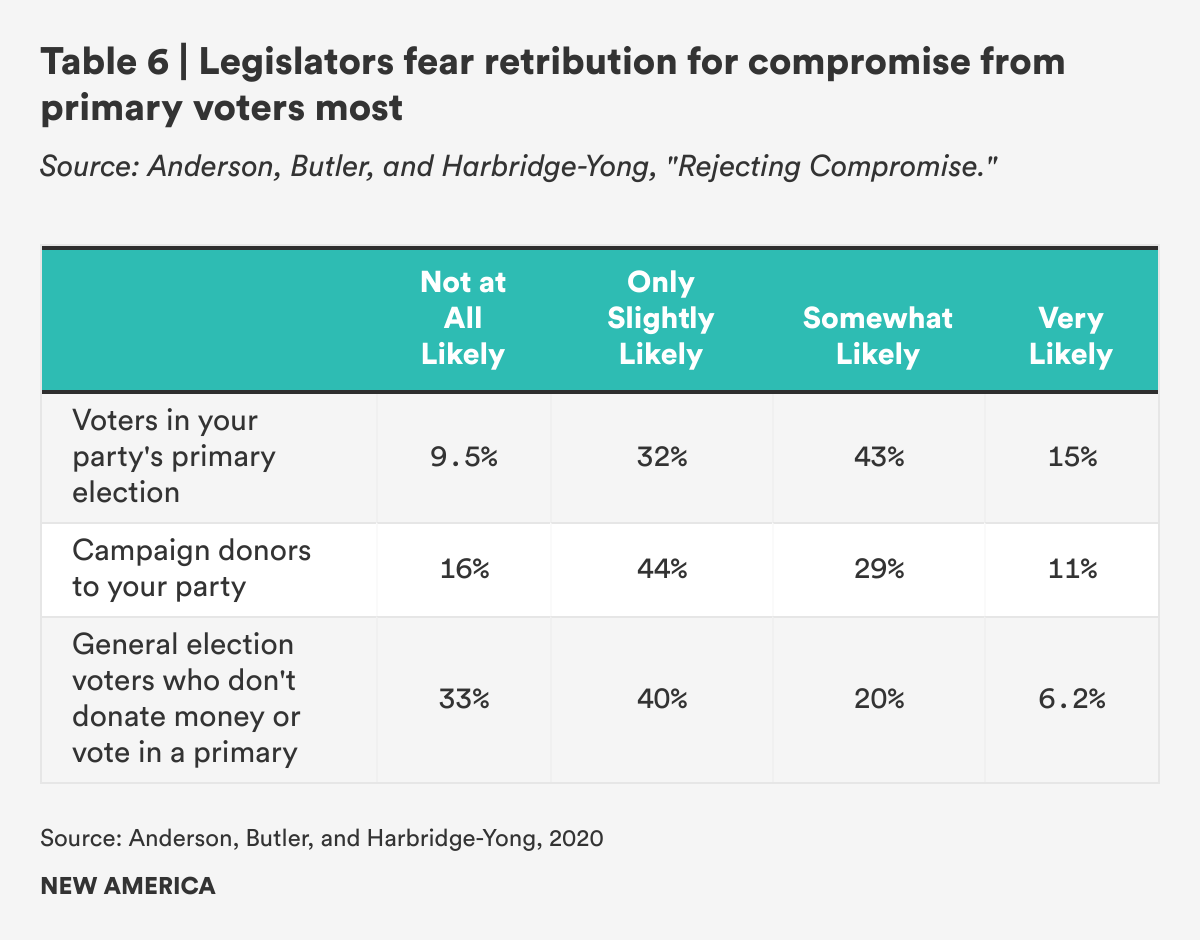
As with most aspects of contemporary American politics, there is some asymmetry to the phenomenon of incumbents fearing punishment by extreme primary voters. In a survey of state legislators who faced primary challenges, 45 percent of Republicans thought that their primary challenger was “more conservative than me” whereas 33 percent of Democrats believed that their 2016 challenger was “more liberal than me.” Based on that, similar percentages of Republicans and Democrats anticipated the same challenger in the future. Perhaps even more significantly, when asked which they feared losing more, a general election or a primary, almost half of Democrats (49 percent) anticipated losing in the general election, while just 12 percent anticipated losing the primary. Among Republicans, meanwhile, less than a quarter (24 percent) anticipated losing in a general election, while 15 percent feared losing in a primary.29
Finally, even those who defeat extreme primary challenges are not secure. If they drew an extreme primary challenge once, chances are they will draw another one again. Thus, members who face extreme challengers vote in such a way that they believe will ward off such challengers. In short, they adapt by becoming more extreme.30 This steady shift has been taking place for decades.31
Going further back, however, the polarizing threat of primary challenges does not seem to be as significant, likely because the parties were not so clearly sorted. Taking a more historical approach that focuses on the Senate and goes all the way back to 1948, Shigeo Hirano, James Snyder, and John Mark Hanson report “little evidence that the introduction of primary elections, the level of primary election turnout, or the threat of primary competition are associated with partisan polarization in congressional roll call voting.” Their paper, “Primary Elections and Partisan Polarization of the U.S. Congress,” shows that whether or not senators face primary challengers has historically had little to do with the extremism of their voting records, and likewise, whether incumbents survive challenges also has very little to do with the extremism of their voting methods.32 That said, their study only goes through 2006. Recent years have made primary elections more polarizing, as both the threat of extreme primary challengers has become more salient and the parties have become much better sorted into clearly distinct ideological coalitions.33 It would thus be worthwhile to update this analysis to see whether the past 15 years have altered the pattern.
To summarize, incumbent members of Congress most certainly fear primary challenges to their extremes, and they actively work to avoid these challenges by heading them off in ways that exacerbate partisan conflict.
Note again that this fear is entirely based around the threat, and that the threat does not depend on primary voters being more extreme than general election voters. It depends instead on primary challengers being able to activate a set of donors, groups, and voters who might not otherwise participate. Note also that this does not have much to do with the type of primary institution; challenges are possible under any set of primary rules. For example, when Rep. Dave Brat (R-Va.) famously primaried Rep. Eric Cantor (R-Va.), he did so in a state that uses open primary rules, Virginia. Losing a primary is a possibility under any system. However, in a nonpartisan primary in which multiple candidates advance to a general election, the likelihood of an incumbent advancing increases with the number of candidates who advance. In a top-five election, it would be extremely unlikely for an incumbent not to advance. Thus, a top-five system would have one clear benefit: effectively removing the threat of primary challenge, and all that such a threat entails.
Summary: Are Primaries a Problem?
To summarize, the question of whether primaries are the problem had three premises.
Premise 1: In most districts, the primary is the only election that matters.
Premise 2: Partisan primary electorates are disproportionately more extreme and more hyper-partisan than the electorate as a whole.
Premise 3: Incumbent members of Congress fear a primary challenge, and adjust to avoid one.
Premise 1 is undisputed. Clearly, most districts are solidly Democrat or Republican, and have become more so in recent years. Premise 3 finds strong support as well. Incumbent members fear a primary challenge, and act to avoid one by moving to their extremes and trying to make peace with groups and donors who might support such a challenger.
However, the evidence for Premise 2 is limited and mixed. Primary voters may be a little more extreme than general election voters. But whatever differences exist between the primary and general election voters of each party (including independent leaners), it is tiny compared to the differences between supporters (including leaners) of both parties. The two parties are very far apart. Primaries probably make compromise harder, and exert a more extreme pull, but it is a small additional tug on the deeper pulls that come from two parties representing two very different geographical and cultural coalitions.
Citations
- Drutman, 100.
- Nolan McCarty et al., “Geography, Uncertainty, and Polarization,” Political Science Research and Methods 7, no. 4 (October 2019): 775–94, source.
- Jamie L. Carson et al., “Constituency Congruency and Candidate Competition in U.S. House Elections,” Legislative Studies Quarterly 36, no. 3 (2011): 461–82, source.
- For detailed analysis of changes over time, see Robert G. Boatright, Getting Primaried: The Changing Politics of Congressional Primary Challenges (Ann Arbor, MI: University of Michigan Press, 2013).
- John Sides, Chris Tausanovitch, Lynn Vavreck, and Christopher Warshaw, “On the Representativeness of Primary Electorates,” British Journal of Political Science, March 2018, 1–9.
- As the authors note: “These data offer four main advantages. First, they encompass two presidential and two midterm elections and allow us to separate presidential and congressional primary voters in states that hold presidential and congressional primaries on different dates in presidential election years. Secondly, they contain large enough samples to estimate the impact of primary rules, which vary across states. Thirdly, they feature many measures of political attitudes. Finally, these data allow us to rely on validated turnout rather than potentially biased self- reports. The validated turnout data reveal substantial overlap in the primary and general electorates. In the 2008 CCAP, 68 percent of validated general election voters also voted in their state’s primary. The overlap between the two electorates means that roughly a third of 2008 general election voters voted ‘only’ in the general election and not in the primary. Any differences between the primary and general electorates must therefore manifest themselves in this relatively small group of voters.”
- Alan Abramowitz, “Don’t Blame Primary Voters for Polarization,” The Forum 5, no. 4 (2008): 1–11.
- Gary C. Jacobson, “The Electoral Origins of Polarized Politics: Evidence From the 2010 Cooperative Congressional Election Study,” American Behavioral Scientist 56, no. 12 (December 1, 2012): 1612–30, source.
- Jacobson, 1620-1621.
- Seth J. Hill, “Institution of Nomination and the Policy Ideology of Primary Electorates,” Quarterly Journal of Political Science 10, no. 4 (December 17, 2015): 461–87, source.
- Hill 2015 explains: “ Three features of my analysis are distinct from most previous comparisons. First, I examine congressional primary voters in each district, rather than presidential or congressional voters nationwide. Second, I use validated as opposed to self-reported primary turnout. And third, I use a scaled measure of ideology across multiple items, which may be a more accurate measure of preferences subject to less measurement error than individual survey responses. Future work could more carefully consider the most accurate way to measure the distinctiveness of primary voters.”In “On the Representativeness of Primary Electorates,” Sides, Tausanovitch, Vavreck, and Warshaw explain why their results differ from those of Jacobson and Hill despite their drawing from the same surveys: “In contrast to Jacobson, we use validated turnout data. As we describe in the online appendix, self-reported turnout produces larger differences between primary voters and the party following. And unlike Hill, we rely on simple disaggregated means and very large sample sizes, rather than a hierarchical model.”25
- Donald R. Kinder and Nathan P. Kalmoe, Neither Liberal nor Conservative: Ideological Innocence in the American Public (Chicago ; London: University Of Chicago Press, 2017). Lilliana Mason, “Ideologues without Issues: The Polarizing Consequences of Ideological Identities,” Public Opinion Quarterly 82, no. S1 (April 11, 2018): 280–301, source.
- See, e.g. Daniel J Hopkins, Hans Noel, and Hans Noel, “Trump and the Shifting Meaning of ‘Conservative’: Using Activists’ Pairwise Comparisons to Measure Senators’ Perceived Ideologies” (Working paper, 2021).
- Abramowitz, “Don’t Blame Primary Voters for Polarization.”
- Lee Drutman, “Myth of the Moderate Middle,” FiveThirtyEight, Sep. 24, 2019, source.
- Seth J. Hill and Chris Tausanovitch, “Southern Realignment, Party Sorting, and the Polarization of American Primary Electorates, 1958–2012,” Public Choice 176, no. 1 (July 1, 2018): 107–32, source.
- For older studies, see, e.g. Barbara Norrander, “Ideological Representativeness of Presidential Primary Voters,” American Journal of Political Science 33, no. 3 (1989): 570–87, source; John G. Geer, “Assessing the Representativeness of Electorates in Presidential Primaries,” American Journal of Political Science 32, no. 4 (1988): 929–45, source.
- Elaine Kamarck and Alexander R. Podkul, The 2018 Primaries Project: Introduction to the candidates (Washington, DC: Brookings Institution, 2018), source.
- Andrew B. Hall, Who Wants to Run?: How the Devaluing of Political Office Drives Polarization, First edition (Chicago ; London: University of Chicago Press, 2019).
- Danielle M. Thomsen, “Ideological Moderates Won’t Run: How Party Fit Matters for Partisan Polarization in Congress,” Journal of Politics 76, no. 3 (July 2014): 786–97, source; Danielle M. Thomsen, Opting Out of Congress: Partisan Polarization and the Decline of Moderate Candidates (Cambridge, United Kingdom: Cambridge University Press, 2017); John H. Aldrich and Danielle M. Thomsen, “Party, Policy, and the Ambition to Run for Higher Office,” Legislative Studies Quarterly 42, no. 2 (2017): 321–43, source writes: "The more liberal the Republican state legislator, the less likely she is to run for Congress; the more conservative the Democratic state legislator, the less likely she is to do so."
- Michael J. Barber, “Ideological Donors, Contribution Limits, and the Polarization of American Legislatures,” The Journal of Politics 78, no. 1 (2016): 296–310. Raymond J. LaRaja and Brian F. Schaffner, Campaign Finance and Political Polarization: When Purists Prevail (Ann Arbor: University of Michigan Press, 2015).
- Trent Lott, Tom Daschle, and Jon Sternfeld, Crisis Point: Why We Must – and How We Can – Overcome Our Broken Politics in Washington and Across America (New York: Bloomsbury Press, 2016) p.42.
- James Wallner and Elaine C Kamarck, Primaries and Incumbent Behavior (Brookings Institution: October 2018), source.
- Sarah E. Anderson, Daniel M. Butler, and Laurel Harbridge-Young, Rejecting Compromise: Legislators' Fear of Primary Voters, (Cambridge, MA: Cambridge University Press, 2020), 80 .“Substantively, a one standard deviation increase in Tea Party attachment (a 6.4% increase in people who say they have a very strong attachment to the Tea Party) is associated with a 4.6–5.3 percentage point decrease in the likelihood that a legislator will vote in favor of the compromise legislation (p = 0.005, two-sided). The more Tea Party voters there were in the district, the more likely the member of Congress was to vote against compromise legislation.” (79)
- Anderson, Butler, and Harbridge-Young, 87-88: “Among all respondents, just over half (52%) said that the two sides should meet in the middle at 50. As with compromise in the generic form, support for this more concrete partisan compromise is lower among subgroups of the electorate. Among ideologues, only a third (32%) favor an even compromise. Majorities of strong partisans, campaign donors, and Tea Party supporters also oppose compromise with the other party, suggesting that legislators may be right that these electorally important subgroups of primary voters oppose compromises made with the opposing party.” Drawing on a Pew study, they write: “the data from Pew (column 1) show that generic support for legislators who compromise drops from 61% overall to less than a majority for the very liberal or very conservative (46%) and Tea Party supporters (37%). Majorities of strong partisans and donors continue to express support for legislators who compromise.3”
- Anderson, Butler, and Harbridge-Young, Figure 5.5 shows that these co-partisan primary voters who oppose the specific compromise punish legislators for compromising.
- Anderson, Butler, and Harbridge-Yong, 60. The authors also note: “Media coverage that paints compromise in a negative light may magnify the perceived risks of compromising and the likelihood of facing a primary challenger from the far left or far right. In the 2017 survey at the NCSL Summit, we asked the legislators how various media outlets covered compromise. The majority of legislators (60%) thought that cable news outlets like MSNBC and Fox News portrayed legislative compromises in a negative light, while only 12% of legislators thought that these outlets portrayed it in a positive light. While legislators thought that national net- work news, major newspapers, and the local media were more neutral in their presentation, enough likely primary voters watch news like MSNBC and Fox to give legislators pause when considering compromise.” (81)
- Christopher Skovron, “What Politicians Believe About Electoral Accountability,” SSRN Electronic Journal, 2018, source. “At the state level, they especially have limited access to district-level polling, leading to inaccurate perceptions of public opinion among their constituents (Broockman and Skovron 2018). Congressional staffers have similarly inaccurate perceptions of public opinion (Hertel-Fernandez, Mildenberger and Stokes 2018). Although campaigns now have access to more data on voters than ever before, many of the records in commercial voter files remain imprecise (Hersh 2015; Fraga, Holbein and Skovron 2018) and often provide only limited information about constituents.”
- Skovron.
- Caitlin E. Jewitt and Sarah A. Treul, “Ideological Primaries and Their Influence in Congress,” in Routledge Handbook of Primary Elections, ed. Robert G. Boatright, 1st ed. (New York: Routledge, 2018), 213–25, source; Caitlin E. Jewitt and Sarah A. Treul, “Ideological Primary Competition and Congressional Behavior,” Congress & the Presidency 46, no. 3 (September 2, 2019): 471–94, source. Jewitt and Treul report: “ The results of our analysis, examining the 2000–2012 elections in which incumbent members of the House faced primary challenges, support our the- ory. We show that among incumbents who return to the House as members of the minority party, no significant relationship exists between experiencing an ideological primary and a non-ideological primary challenge on the per-cent of the time that they vote with their party leader on all roll calls. We do, however, find that on key votes, members of the minority party significantly increase the percent of the time they vote with their party leader. Although we did not necessarily expect this finding for key votes, we believe that it makes sense for two reasons. First, given the nature of key votes, these are the votes most likely to generate attention back home in the district and give a potential primary challenger ammunition for another run at the incumbent. Second, the party leadership is the most likely to whip members on key votes. Taken together, we believe these two reasons explain the sig-nificant increase in the partisan behavior of minority members on key votes following an ideological primary challenge.For majority party members, however, we show that an ideological primary challenge results in a 3.4% increase in voting against their own party on all roll calls, on average, when compared to majority party members who face a non-ideological primary challenge.2 Similarly, majority party members who faced an ideological primary challenge are 5.4% more likely to vote against their own party on key votes than are members of the majority party who faced a non-ideological primary challenge. Upon returning to Washington, majority party members who faced an ideological primary are voting against their party—both on all roll calls and on key votes—to a greater extent than their majority party colleagues who defeated a primary challenge that was not ideological in nature. Members of the majority party need a way to demon-strate their extremism and their best way to do this via votes is to vote against the party, proclaiming the party is simply not extreme enough.”
- David W. Brady, Hahrie Han, and Jeremy C. Pope, “Primary Elections and Candidate Ideology: Out of Step with the Primary Electorate?,” Legislative Studies Quarterly 32, no. 1 (February 2007): 79–105.
- Shigeo Hirano et al., “Primary Elections and Partisan Polarization in the U.S. Congress,” Quarterly Journal of Political Science, 2010, source.
- Hill and Tausanovitch, “Southern Realignment, Party Sorting, and the Polarization of American Primary Electorates, 1958–2012.”