
Table of Contents
WBL Opportunities at Community Colleges
With around 3.5 million college students completing an internship in college and a growing number of academic programs requiring them, the significance of WBL experiences in the higher education landscape—whether in the form of an internship, practicum, or apprenticeship—should not be underestimated. Internships and similar forms of WBL have become the “gold standard for college students wishing to explore the world of work,” according to Bunker Hill Community College President Pam Eddinger and colleague.1 Still, evidence suggests community college students are less likely to find avenues for paid WBL.
In their report titled Uncovering Hidden Talent, Kazis and Snyder found that internship opportunities targeting community college students remain scant compared to those for students at four-year institutions.2 For example, from their investigation of Massachusetts state policy efforts to increase access to WBL among undergraduates, they found that community college or state community college systems fail short in developing equitable, student- and employer-centered programs. Moreover, they found that even when Massachusetts state policy allocated funding to promote broader access to paid internships, the $1 million budget was restricted to state universities, which excluded students enrolled at two-year colleges. This specific case study begins to shed light on the inequities faced by community college leaders seeking to launch new paid WBL programs on their campuses and also illustrates some of the hurdles faced by programs already in operation.
What We Know about Paid WBL Programs
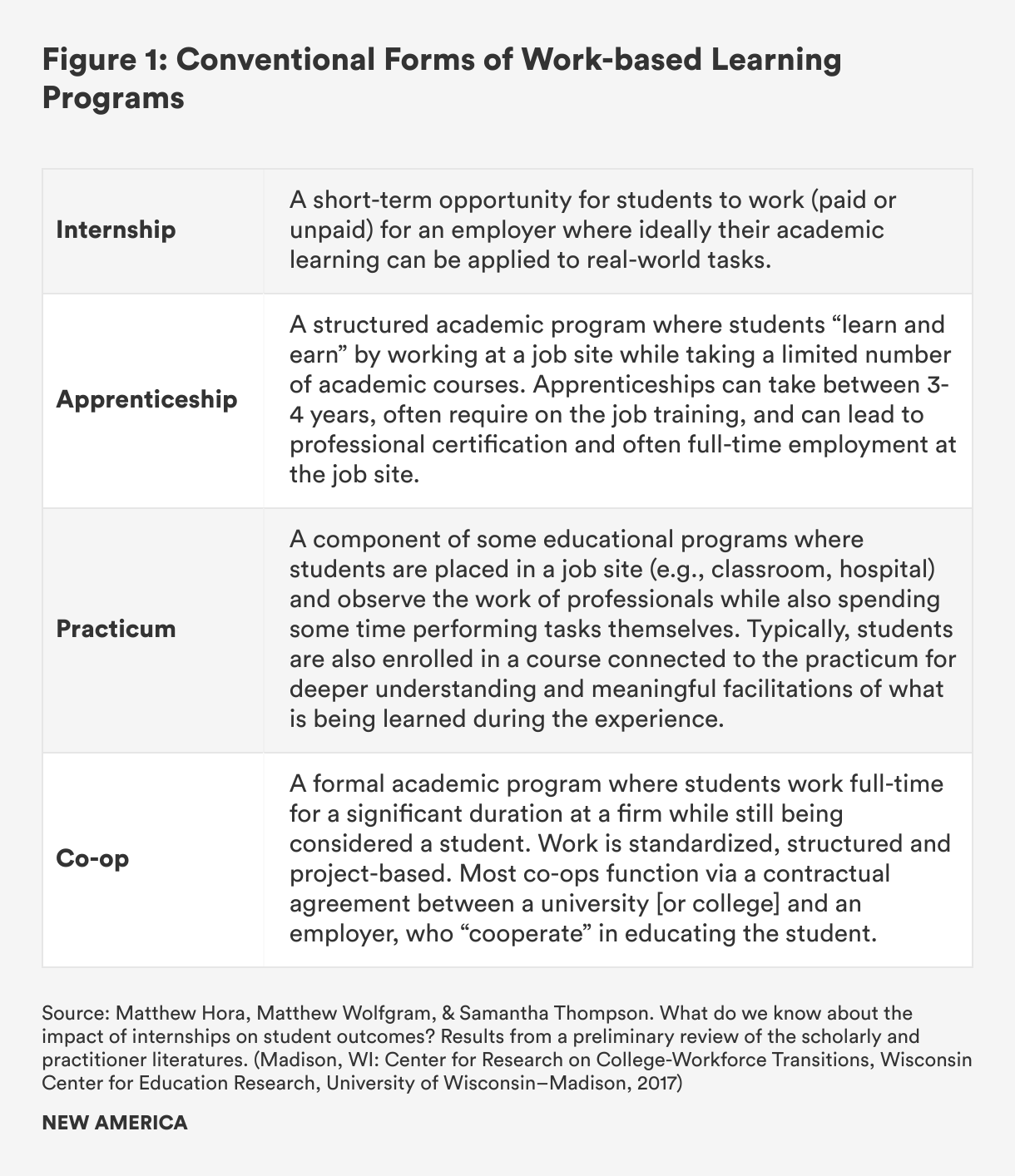
Although WBL programs come in various forms (e.g., internships, apprenticeships, practicums, and cooperative (co-op) education models), there is no definitive definition of what an internship entails compared to an apprenticeship or co-op placement. In a research brief investigating the impact of internships on students, researchers noted how the inconsistency and variation in how WBL is defined (or not defined) has consequences for various stakeholders including employers, educators, students, researchers, and policymakers.3 Figure 1 provides a brief overview of the most common forms of experiential learning.
Key WBL Program Design and Characteristics
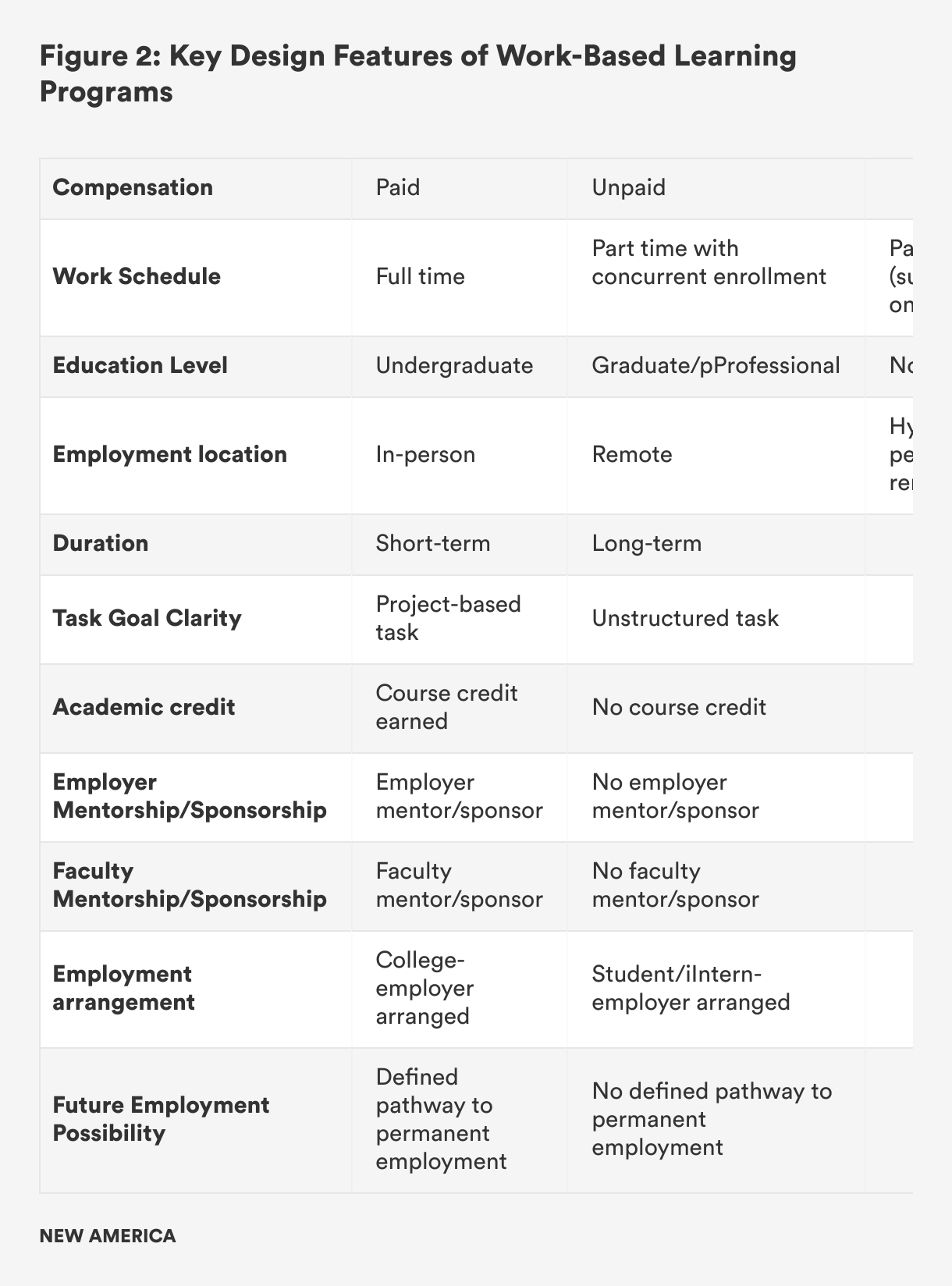
WBL programs for community college students may vary in design and format. One critical factor in the creation of WBL opportunities relates to whether to include compensation or not. Empirical evidence suggests that students who complete an internship accrue benefits compared to their peers who do not complete one, such as higher starting wages and greater job offers.4 Nevertheless, internships have received significant media attention in recent years, stemming from economic justice concerns surrounding the expansion of unpaid work in specific fields such as the public sector and requirements in academic programs like teacher education.5 For example, after years of advocacy, college students participating in the prestigious White House internship program will now receive compensation for the first time starting in fall 2022.
Other key characteristics of building appealing and successful WBL experiences relate to scheduling, employment location, and work duration.6 Co-ops and apprenticeship programs typically provide full-time roles for one year or longer. In contrast, internships and practicums usually are part-time roles that last for a shorter duration (e.g., three to four months). Because of disruptions caused by the COVID-19 pandemic, many WBL programs shifted online. While some programs have returned to in-person, a growing number of employers are offering the flexibility of remote placement. WBL programs may also focus on a specific educational level, such as undergraduate studies or graduate and professional studies. In other cases, the programs may be situated within a nonacademic context, such as apprenticeships.7
Some paid WBL programs may be integrated into programs of study, requiring the completion of academic assignments as part of a credit-bearing course. Another feature of WBL relates to the nature of work assignments completed. For example, some practicums may be arranged around completing a defined project or task, while other internships may be unstructured and lack clarity in the day-to-day work. Evidence suggests that integrating academic coursework with WBL can enhance students’ overall perception of the experience.8 Drawing on a survey of 118 business students at a large, southwestern university in the United States, researchers found students perceived internships as most valuable when they had a clear structure, were strategically integrated into their program of study, and aligned with their career interests.9 Furthermore, students perceived the most value from internships that facilitated their ability to find employment. Researchers also found a correlation between age and the perceived value of experiential learning, suggesting that older students may be more mature and better able to handle ambiguity on the job.
Identifying paid WBL opportunities may be challenging for community college students who lack access to professional networks in their fields of interest. Thus, to help bridge the gap between students’ professional networks and employers, many community colleges appoint dedicated staff to serve as advocates or formal career coaches. Some internship programs at community colleges have an integrated career readiness component that supports students. Career readiness refers to skills required to enter one’s field, including but not limited to mock interview preparation, resume and cover letter reviews, and setting career goals.10 While some community colleges place the responsibility on the student for identifying an appropriate internship program, college staff increasingly play a leading role in facilitating entry into WBL opportunities where they can find them, like at local small businesses, corporations, and nonprofit organizations.
Another significant way college leaders and employers can help prepare community college students for entry into the workforce is through mentorship and sponsorship. Some internships provide students with a designated professional mentor or sponsor to help guide and support the transition into the new work environment. WBL experiences that are well connected to programs of study may assign a faculty mentor. Having an internship with an assigned faculty or professional mentor enhances students' social capital, which can help them land a job upon completion of their postsecondary degree or credential.
The possibility of future employment is an additional critical dimension of WBL programs. Some apprenticeships, internships, and co-ops have clearly articulated and defined pathways to permanent employment. Because many community college students are entering new fields with limited professional networks, WBL programs with clearly defined expectations for reappointment or promotion can help demystify the process for motivated, career-driven students.
Crafting a high-impact WBL program requires staff to weigh various design factors and characteristics, as illustrated in Figure 2. It is crucial to recognize that there is no one-size-fits-all approach to developing an effective WBL program, so leaders interested in creating a new one can acquire significant insights from exploring the case studies highlighted in this report.
Citations
- Hora et al., “A Multilevel, Agent-centered Analysis of Intersectionality”; Eddinger and Kazis, “Reimagining Experiential Learning.”
- Kazis and Synder, Uncovering Hidden Talent.
- M. Hora, M. Wolfram, M., and S. Thompson, What do we know about the impact of internships on student outcomes? Results from a preliminary review of the scholarly and practitioner literatures (Madison, WI: Center for Research on College-Workforce Transitions, University of Wisconsin–Madison, 2017).
- P. McHugh, “The impact of compensation, supervision and work design on internship efficacy: Implications for educators, employers and prospective interns,” Journal of Education and Work 30, no. 4 (2017), 367–382.
- Amechi and Palmer, “Unpaid Internships”; R. Lieber, “Why we still haven’t solved the unpaid internship problem,” New York Times, June 11, 2022, source; C. Vera, “Unpaid Internships Often Exclude Students of Color,” USA Today, November 16, 2020, source.
- C. Maertz, P. Stoeberl, and J. Marks, “Building successful internships: Lessons from the research for interns, schools, and employers,” Career Development International 19, no. 1 (2013), 123–142.
- Ibid.
- Hora, Wolfram, and Thompson, “What do we know about the impact of internships on student outcomes?”
- Michael Hergert, “Student Perceptions of the Value of Internships in Business Education,” American Journal of Business Education 2, no. 1 (2009), 9–14, source.
- National Association of Colleges and Employers, Career readiness: Development validation of the NACE career readiness competencies, 2022, source.