
Table of Contents
Key Findings from Case Studies of Paid WBL Programs
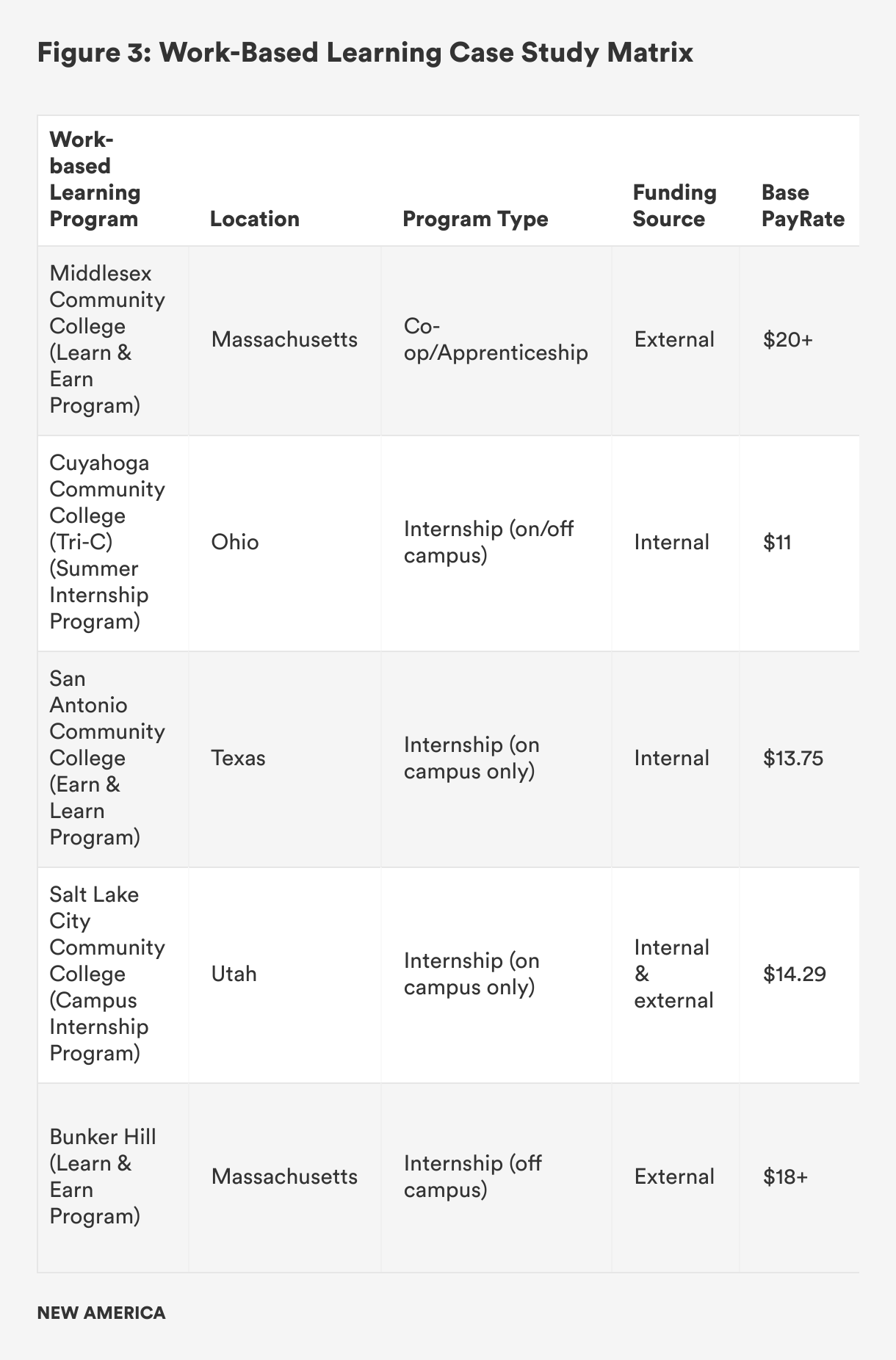
In this multicase study of paid WBL programs, New America sought to uncover the compelling factors that inspired each program’s development. Three major themes emerged: (a) paid WBL programs enhance a college’s student retention strategy; (b) students value paid WBL opportunities on campus or in the local community; (c) integrated, flexible, wraparound services address student needs; (d) paid WBL learning programs are funded in multiple ways; and (e) comprehensive program evaluations are elusive or non-existent. We provide an overview of the particular features found across each program, as illustrated in Figure 3.
Paid WBL Programs Enhance a College’s Student Retention Strategy
Most WBL staff mentioned student retention as the primary or secondary motivating factor. In describing the institutional context that led to the development of Cuyahoga Community College’s Summer Internship Program, McKnight asserted that career placement was not a primary goal. “When we launched” the Summer Internship Program,” she said, “it was focused on retention strategy. It wasn't a graduation strategy. It wasn't a career placement strategy. It really was a retention strategy.” As part of an institutional plan to combat student dropout or temporary stop-out during the summer months, McKnight explained that the program has worked; campus data indicate a 20 percent increase in retention from year to year (e.g., fall to fall) for students who participate.
Salt Lake City Community College’s Campus Internship Program was also part of an institutional effort to promote student retention while providing schedule flexibility, according to Career Services Director Ella Aho. The premise that engaging college students in paid experiential learning opportunities can result in higher retention rates is rooted in the scholarly evidence on student engagement. Higher education experts contend that when college students engage in educationally purposeful activities, inside or outside the classroom, they are more likely to persist to degree completion.1
Students Value Paid WBL Opportunities on Campus or in the Local Community
Equipping community college students with valuable real-world experience in their chosen professions was a second motivating factor behind each WBL program’s creation. Recognizing the obstacles community college students face managing the demands of school, work, and family, staff members cited how campus internship programs sought to alleviate some of the stressors by providing employment opportunities on campus or in the local community. For example, San Antonio College’s Student Enrichment Center provides internships on campus because many students do not have personal transportation, according to assistant director Sabrina Macal-Polasek. “Many don’t have transportation, and they’re taking two or three buses to get to campus. So the program relieves the burden of them traveling back and forth to different areas” she said.
Integrated, Flexible, Wraparound Services Address Student Needs
WBL staff across multiple community colleges cited various wraparound services to facilitate the career readiness and inclusion of all students. For example, to help Tri-C students fulfill the Summer Internship Program’s guideline of enrollment in at least one academic course, they receive assistance with book expenses and course costs. Because of the high cost of living in the Boston metropolitan area and the recognition that many students come from economically disadvantaged backgrounds, Bunker Hill’s Learn and Earn program covers internship travel expenses up to $500. Off-campus child care center vouchers are distributed to those seeking to participate in WBL opportunities at Salt Lake City Community College (SLCC), since students with children make up a sizable participant demographic there, around 30 percent. In two other cases—San Antonio and SLCC—students received guidance from knowledgeable career advisors and formally assigned mentors. Across all campuses, students received some degree of support with career readiness, including mock interviews, resume and cover letter reviews, and job searches.
Paid WBL Programs are Funded in Multiple Ways
How are paid WBL programs funded? We found that the sources varied. For example, San Antonio College staff leveraged federal funding from Higher Education Emergency Relief Fund (HEERF) and Pell grants to supplement student employment. Other program personnel, particularly at Cuyahoga and Salt Lake City, cited internal funding sources through the colleges' general operating budget.
Other paid WBL programs leverage support from private donors and philanthropic foundations. Staff reported receiving contributions from external sources at Salt Lake City, Bunker Hill, and Middlesex. Bunker Hill's Learn and Earn Program uses a cost-sharing method with four foundations local to the Boston metropolitan area. Salt Lake City receives support from local state appropriations and private donors in addition to institutional dollars. Career Services Director Aho emphasized the fact that international students are generally excluded from Earn and Learn programs sourced by federal aid, such as work-study. However, they can participate in the program through support from private donors, which makes this particular case different from others.
Corporate sponsorship of interns appeared to be on the horizon at Cuyahoga Community College. McKnight said, “this year alone, we have about six different grants” for the Summer Internship Program. “Because everybody’s in a different space now and their employers are being smart,” she said, “given the [workforce] shortages, companies are beginning to imagine how to build stronger pipelines of talent. So they’re like, ‘Okay, I’m going to write a check.’" However, she added, "our [SIP] program is funded using general funds.”
Earn and Learn staff members at Middlesex work with companies in the biotechnology industry to help identify and place diverse, talented community college students into paid, yearlong internships. The program aims to give students in the biotechnology degree program immersive, hands-on training in the industry by matching them with local employers. Middlesex generates funding for the program by charging partnered companies a placement fee for every intern and permanent hire.
Comprehensive Program Evaluations are Elusive or Non-Existent
One troubling trend across these cases was the lack of longitudinal data on student outcomes. Apart from Middlesex and San Antonio Community College, each WBL program has been operating for five years or longer, which is adequate time to evaluate the program’s long-term impacts. Nevertheless, staff could only generally share baseline demographic data on student participation trends, particularly for racial identity, gender, and age group. Insufficient capacity seems to be the problem. Some staff members noted the possibility of retrieving specific student outcomes data through campus institutional research departments but were unclear about the type and quality of data collected.
Citations
- S.R. Harper and S. Quaye, “Making engagement equitable for students in U.S. higher education,” in Student engagement in higher education: Theoretical perspectives and practice approaches for diverse populations, edited by S. Quaye & S. R. Harper (New York, NY: Routledge, 2019), 1–14.