
Introduction: Convergence and What 6G Should Be
In discussions about broadband and connectivity services, convergence has frequently referred to two concepts that fall short of the sort of ubiquitous and seamless connectivity that would most benefit consumers. One concept of convergence refers primarily to substitutability. That is, the increasing ability of different communication platforms and providers (e.g., fixed wireline, fixed wireless, mobile cellular, and satellite) to deliver internet access capable of supporting the full range of services (calling, streaming video, high-speed fixed, and/or mobile internet access).1
A second and related concept of convergence refers to the market strategy of bundling: the familiar and growing inclination of large wireline and mobile ISPs to integrate multiple communication services—typically high-speed internet, mobile, and video—into a single offering. This strategy aims to reduce customer churn, lower customer acquisition costs, enhance cross-selling, and create competitive advantages against pure-play services.
While this limited form of marketplace convergence has been largely achieved, a broader and more ambitious convergence should move to the forefront. Convergence of connectivity can also refer, as it does here, to the integration of varied wireless communication technologies and networks (mobile, fixed, satellite) to create ubiquitous, seamless, and interoperable networks that allow users to access and transition among the best available connections anywhere and everywhere. Convergent connectivity aims to bridge the gaps between diverse networks and platforms, enabling real-time communication and data sharing across multiple devices, networks, and locations. Convergent connectivity should ensure information and services are accessible to everyone, everywhere, fostering inclusivity.
Today’s networks fall far short of this goal, subjecting users to rural coverage gaps, urban “not-spots,” weak (or nonexistent) indoor mobile signals, and enormous friction and frustration when smartphones and other devices must manually authenticate to Wi-Fi and other location-based networks as they move around throughout the day. Unfortunately, instead of embracing this challenge, most regulatory agencies, mobile industry groups, device and equipment manufacturers, and at least large mobile internet service providers are pushing ahead with visions for mobile “6G” that remain siloed and misaligned with some of the most important benefits that truly converged connectivity could yield for consumers and the economy.
Visions for 6G: Just Another “G”?
Many of the first visions for 6G that emerged from industry associations and equipment manufacturers emphasized mobile networks that would double down on 5G, delivering far faster throughput and lower latency to support very high-capacity new applications such as virtual reality, telepresence, robotics, holographic displays, immersive gaming, and digital twins. In The 6G Manifesto, William Webb—an independent analyst and former U.K. Office of Communications (Ofcom) official—gave a lengthy recap of these visions, concluding that most of them could be summarized as “5G, but better and faster.”2 Ironically, the emerging echo chamber of hype around these visions ignores the reality that these promised applications will operate almost entirely indoors, where mobile signals operating on higher-frequency spectrum will be unreliable or secondary to Wi-Fi, as Preston Marshall similarly observed in his 2024 book, Evolving to 6G.3 In addition, Webb emphasized, there is very little, if anything, in these visions that relates to ubiquitous coverage and lower costs, let alone seamless connectivity or closing digital divides.
An exception, to a degree, is the mobile industry’s recent interest in incorporating non-terrestrial (satellite) connectivity, particularly where it is operating as secondary, back-up connectivity on mobile carrier spectrum and under mobile carrier control—what the Federal Communications Commission (FCC) has categorized as Supplemental Coverage from Space.4 For example, in its 6G Position Statement, the Next Generation Mobile Network (NGMN) association, a voice of primarily European mobile network operators (MNOs), asserts in general terms that a major innovation and goal of 6G should be to “facilitate seamless integration and interoperability with fixed and satellite networks.”5
Regulators, particularly at the International Telecommunication Union (ITU) and the European Union, have mostly mirrored industry visions in their policy pronouncements, but have also increasingly expressed a preference for broadening the connectivity and sustainability goals for 6G. The most authoritative source for regulators is the ITU and the framework for international mobile telecommunications (IMT) adopted in 2023, IMT-2030 (see Figure 1).6 The ITU specifically adds “ubiquitous connectivity” as one of six “usage scenarios” and specifies that rural and “deep indoor coverage” are imperatives. The ITU framework also supports the seamless interworking between IMT systems (5G and future 6G networks) and non-IMT systems (including satellite, Wi-Fi, and fixed networks). The FCC’s recent Technological Advisory Council report on 6G states that the ITU’s IMT-2030 “vision promotes the integration of diverse network types to form heterogeneous networks,” enabling “devices and users to maintain continuous connectivity regardless of the access technology being used.”7
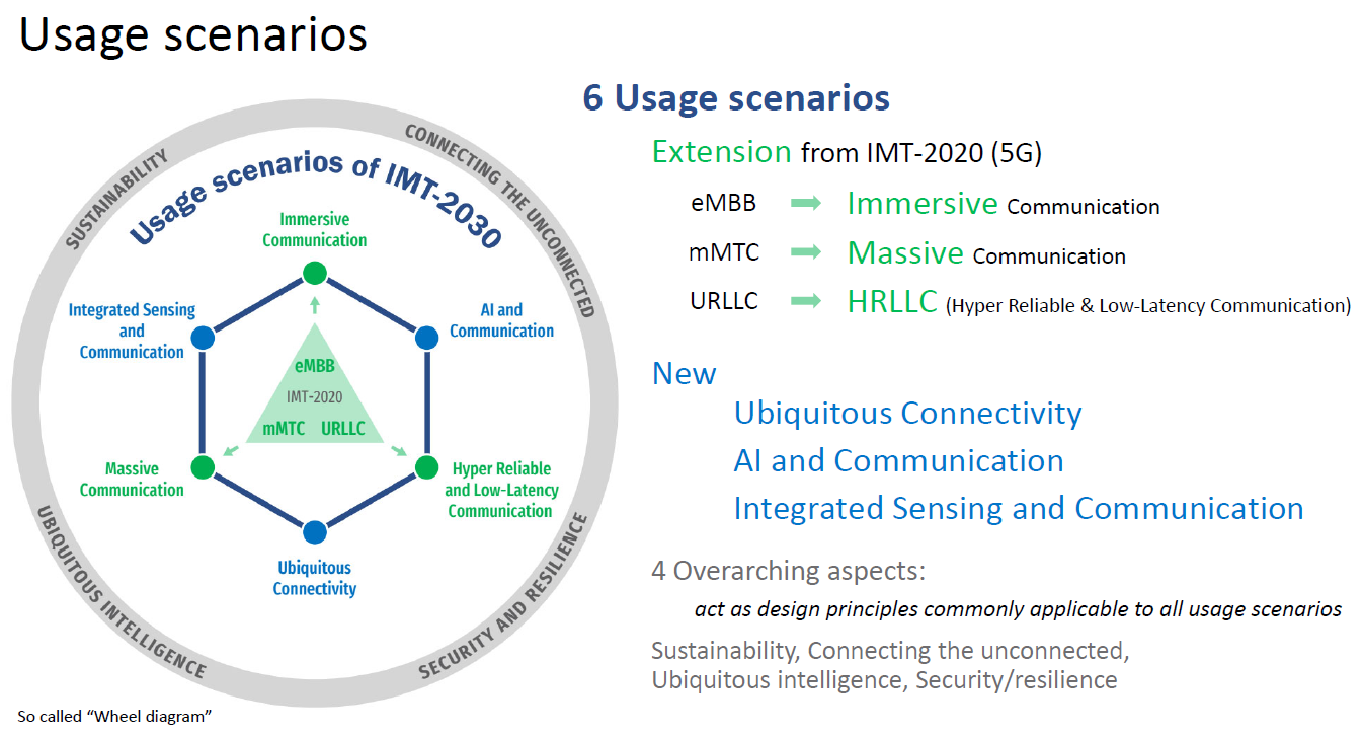
Screenshot from International Telecommunication Union, IMT-2030 framework (2023), www.itu.int/en/ITU-R/study-groups/rsg5/rwp5d/imt-2030/pages/default.aspx.
Last year, the EU’s Radio Spectrum Policy Group (RSPG) built on IMT-2030 with its own 6G Strategic Vision report. The RSPG similarly supports what it calls “network integration,” stating its belief that wireless local area networks (Wi-Fi) “and mobile networks, including 6G, will converge to deliver seamless, high-performance connectivity in diverse environments.” Although the RSPG is silent on when or how this will be achieved, it asserts there is great value in pursuing it, since “emerging use cases like AR/VR, automated transport and IoT, and emerging IT technologies like AI and cloud computing rely on both local connectivity [e.g., Wi-Fi] and wide-area [e.g., 6G] connectivity for scalability and flexibility.”8
What Do Consumers Want—and Need?
A McKinsey survey of MNO executives and consumers concluded that “telcos should ensure that 6G does not become a more-of-the-same technology that only provides higher peak speeds, lower latency, and higher device density,” attributes consumers do not view as “critical success factors.”9 Finding that consumers do not perceive a difference between 4G and 5G, McKinsey recommends that operators develop standards and upgrade toward 6G with goals in mind that enhance customer experience. The report’s authors wrote:
“What will excite consumers? The response is twofold. First, MNOs need to be able to build networks with robust coverage and capacity, which 5G has largely yet to achieve. Second, indoor-coverage issues must be resolved; about 70 to 80 percent of all data traffic is generated indoors, but indoor wireless usage is still relatively low because of weak signals. If consumers are ever going to see real value in the next-generation standard, 6G must tackle this challenge head-on.”10
McKinsey’s findings seem broadly consistent with other surveys concluding that what consumers want most is reliable connectivity everywhere at an affordable price. In its 2023 U.S. Household Survey, Opensignal found that among 55,000 respondents, consumers say coverage and reliability are (together) more than six times as important as speed.11 Speed is a distant sixth in priority for consumers among the attributes of mobile networks, according to Opensignal. Not surprisingly, cost is first, but not far behind are reliability, coverage, and network quality, all of which relate directly to consumer experience and implicate ubiquitous and seamless connectivity more than they do peak speed or latency.
More broadly, at least one mobile industry study revealed that signal quality and not-spots are rising as a concern, particularly as higher-capacity applications are used more frequently outside of Wi-Fi coverage. According to Virgin Media’s chief technology officer, a study it commissioned by mobile network benchmarking specialist GWS “found that speed is not a key driver for people to move networks, with poor signal and not-spots ranking much higher than speed as a reason to change.”12
Mobile Data Growth Is Flattening, Yet Wireless Gaps Remain
Another reason to shift 6G-related policy priorities from more and more mobile capacity to nurturing a 6G ecosystem anchored on ubiquitous and seamless connectivity is that the growth rate of mobile data consumption is falling steadily. Ericsson’s annual mobility report shows that year-over-year mobile data growth declined globally from 80 percent in 2019 to 20 percent in 2025, with “video traffic expected to account for 76 percent of all mobile data traffic.”13 For advanced markets, growth is—or soon could be—in the single digits. The United Kingdom’s Ofcom—among the few regulators that collects and reports this data—reported a drop from 15 percent in 2023 to just 7.2 percent in 2024.14
William Webb predicted this trend years ago—and now believes that mobile data growth may effectively flatline by 2028 or 2029. In The End of Telecoms History, written with Dennis Roberson (a former mobile industry executive and longtime chair of the FCC’s Technological Advisory Council), they observe that over the period since 2013 “there has been a very clear and inexorable downtrend in [mobile] data growth…around 5–6 percent per year,” with no discernable “5G effect.”15 This is consistent with “a very significant reduction in almost every country,” they report, with a particularly steep drop off in mobile data growth from 2023 through 2024 in the United Kingdom, Germany, France, China, and South Korea. Overall mobile data growth has declined more slowly in the United States, to a reported 15–20 percent range for 2024, which Webb and others attribute to the surge in fixed wireless access (FWA) provisioned using surplus low mid-band spectrum capacity on the existing cellular networks. An analysis by Cisco, which strips FWA data consumption from Ericsson’s overall tally, concludes that the growth rate for mobile data in North America is closer to 11 percent.16 Webb and Roberson calculate a similar estimate using CTIA mobile growth data through 2024 (see Figure 2) from which they extrapolate that the growth in mobile data consumption will touch down close to zero by 2029.17
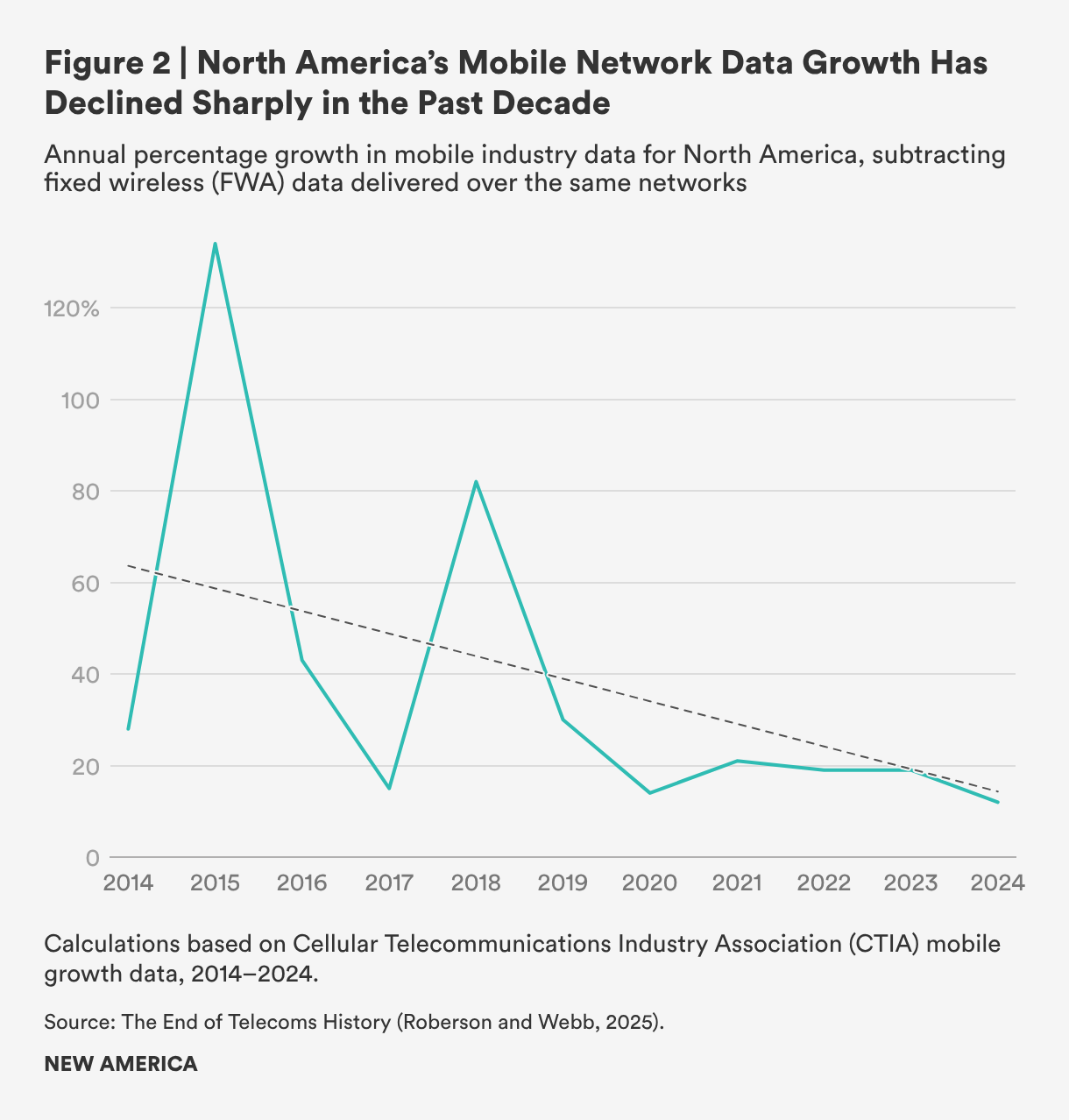
Webb and Roberson explain this flattening growth primarily in reference to the immense flood of mobile video traffic unleashed after 4G was introduced and widely adopted after 2013. While 3G enabled low-bandwidth web browsing, video drove the 4G-era surge in mobile data traffic. But “there is only so much video we can realistically watch,” particularly when users are on the go and need to rely on the mobile network (rather than Wi-Fi).18 An industry executive recently voiced a similar view as part of a warning that 6G needed to be based on customer-focused goals and not just faster and better connections outdoors. Mobile broadband is a “mature market with complete penetration,” he wrote, and flattening mobile traffic growth is simply “a function of humanity being at peak video and video being the 80% traffic generator of any network. The new Gs do not generate more hours in the day where people can watch more video. No realistic use cases have been identified that would come close to video in terms of capacity requirements.”19
Citations
- See, e.g., International Telecommunication Union, Competition and Regulation in a Converged Broadband World (2012), source; Ellis Scherer and Joe Kane, Broadband Convergence Is Creating More Competition (Information Technology & Innovation Foundation, 2025), source.
- William Webb, The 6G Manifesto (2024), 47–84. The FCC’s Technological Advisory Committee recently released a report on 6G that similarly surveys the visions and status of standardization efforts globally. See FCC Technology Advisory Council, 6G Working Group Report (Federal Communications Commission, 2025), source.
- Preston Marshall, Evolving to 6G: The Case for a New Approach to 6G and Beyond (Amazon Publishing, 2024), 95 (“Cellular technology dominates outdoors, but wireless is dominated by indoor usage. The proposed needs for 5G and 6G technology are mostly indoor applications”).
- Federal Communications Commission, Single Network Future: Supplemental Coverage from Space, Report and Order and Further Notice of Proposed Rulemaking, GN Docket No. 23–65 (rel. March 15, 2024), source.
- 6G Position Statement (NGMN Alliance, 2023), source; see also 6G Drivers and Vision (NGMN Alliance, 2021) (“6G will involve enabling a seamless and ubiquitous experience, and service continuity, considering efficiency and affordability”), source.
- Framework and Overall Objectives of the Future Development of IMT for 2030 and Beyond (International Telecommunication Union, 2023), source.
- FCC Technology Advisory Council, 6G Working Group Report, at 31–32.
- Radio Spectrum Policy Group, 6G Strategic Vision: RSPG Report (European Commission, 2025), 12, source.
- Zina Cole et al., Shaping the Future of 6G (McKinsey & Company, 2024), at 2, 10, source.
- Cole et al., Shaping the future of 6G, at 14.
- Rupert Bapty, “Quantifying Reliability Experience in the U.S.,” Opensignal, March 20, 2024, source.
- Jeannie York, “Leaving the Vanity Metrics Behind and Focusing on what Matters: Customer Experience,” Virgin Media/O2, May 21, 2024, source.
- Ericsson Mobility Report (Ericsson, November 2025), 12, source. See also William Webb, The End of Telecoms History (2024), at 39–49.
- Dennis Roberson and William Webb, The End of Telecoms History (2nd edition, 2025), 64, notes 49 and 50.
- Roberson and Webb, The End of Telecoms History (2025), at 60.
- Mark Grayson, “Wi-Fi and Open Roaming,” Cisco presentation to Wireless Broadband Alliance, Wireless Global Congress, January 2025, source.
- Roberson and Webb, The End of Telecoms History (2025); and data provided to the authors of this report.
- Roberson and Webb, The End of Telecoms History (2025), at 56.
- Geoff Hollingworth, “The Cost of Delusion, the Promise of Reality,” Rakuten Blog, September 8, 2024, source.