
Table of Contents
- Introduction and Overview
- Methodology and Overview of State Aid and Public Benefits Programs
- Where These Students Enroll, How They Enroll, and How Much Financial Aid They Need
- State Higher Education Funding and Financial Aid Program Design
- Financial Aid: Program Implementation
- Public Benefits: Program Design and Funding
- How Each State Uses Safety Net Programs to Supports Students
- Recommendations
- Appendix A: Methodology
- Appendix B: State Grant Program Budgets and Expenditures
Where These Students Enroll, How They Enroll, and How Much Financial Aid They Need
Our analysis shows where older students and student parents tend to enroll and their enrollment intensity. We also examine students’ expected family contributions, or EFCs. When students fill out the Free Application for Federal Student Aid (FAFSA), the resulting EFC calculation determines their eligibility for federal student financial aid.1 The EFC formula considers a family’s income, assets, and benefits. The lower the EFC, the fewer resources an individual or family has and the less they are expected to contribute toward the cost of higher education. Our findings confirm previous research on older students and student parents showing that they are more likely to enroll in community colleges, attend part time, and need more financial support.
Older students and student parents usually attend two-year institutions
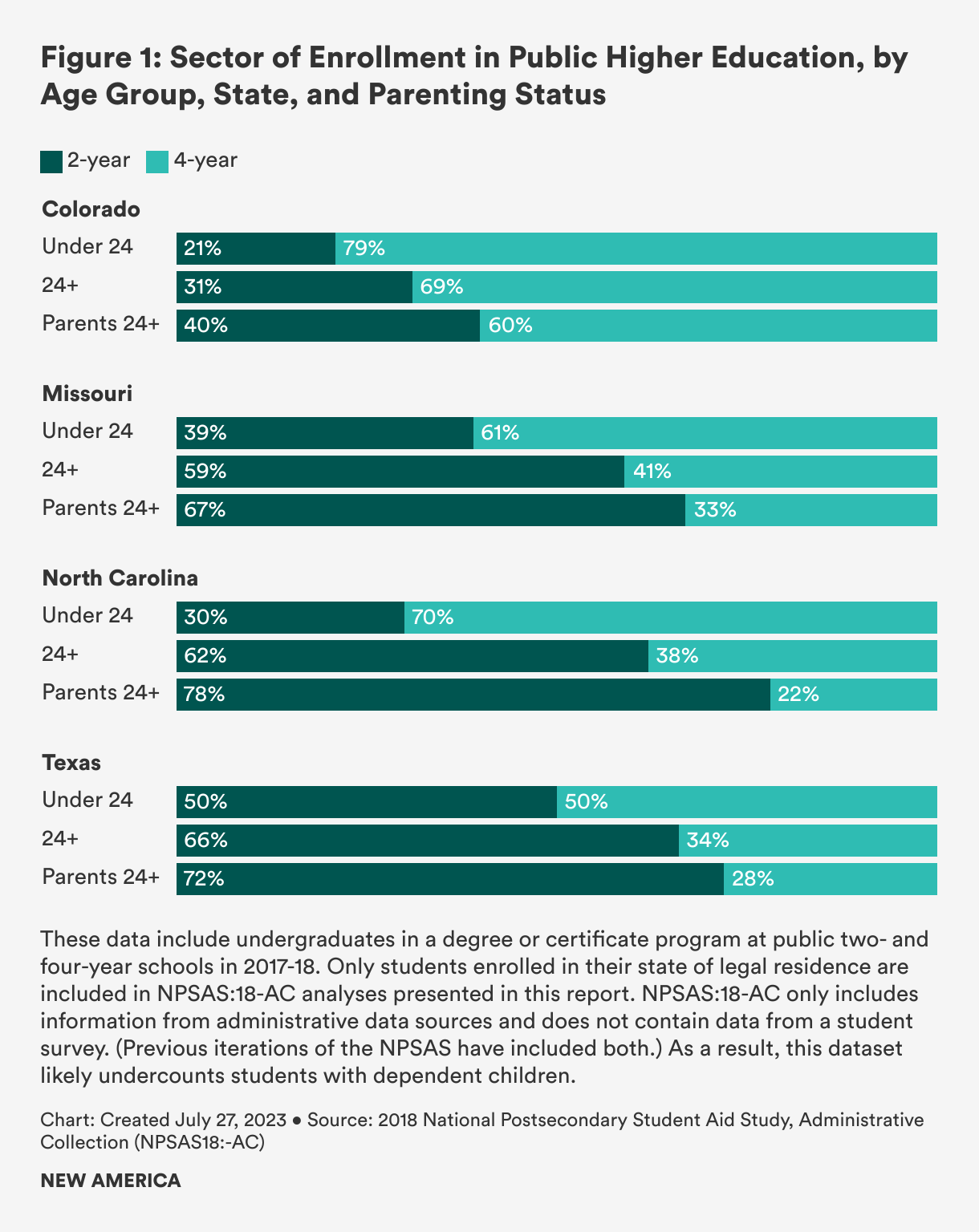
Using the 2018 NPSAS data, we found that the majority of older students and student parents attend two-year colleges in three of the four states—Missouri, North Carolina, and Texas—although the proportions differed at the state level, as shown in Figure 1.2 In all four states, student parents who are 24 and over are more likely to attend community colleges than the general population of students who are 24 and over.
Older Black students and student parents are the most likely to attend community college
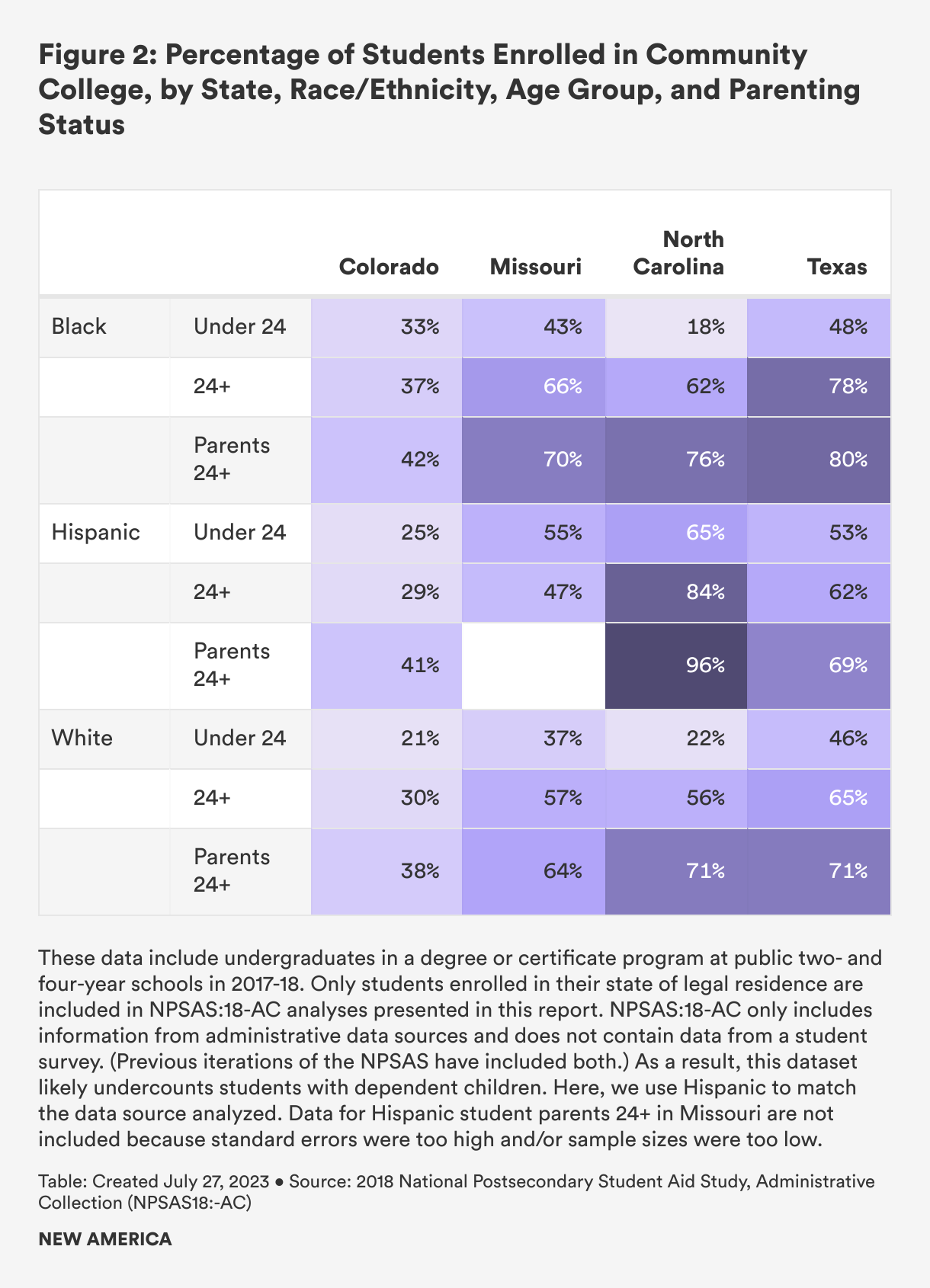
We found, as shown in Figure 2, that in all three racial and ethnic groups large enough for analysis, a higher share of student parents than students overall enroll in two-year institutions.3 Older Black students in all four states chose community colleges at higher rates than their white counterparts. Unlike other states in our research, in North Carolina, older Hispanic students enrolled in community colleges at a considerably higher rate than both white and Black peers, and almost all student parents enrolled in community colleges.
Older students and student parents 24+ tend to enroll in college part time
In all four states, the clear majority of older students and student parents in our sample enroll in college part time for at least part of the academic year. Older students and student parents who enroll full time are far more likely to go to four-year colleges than community colleges in all the states.
Older students and student parents have fewer resources than younger students
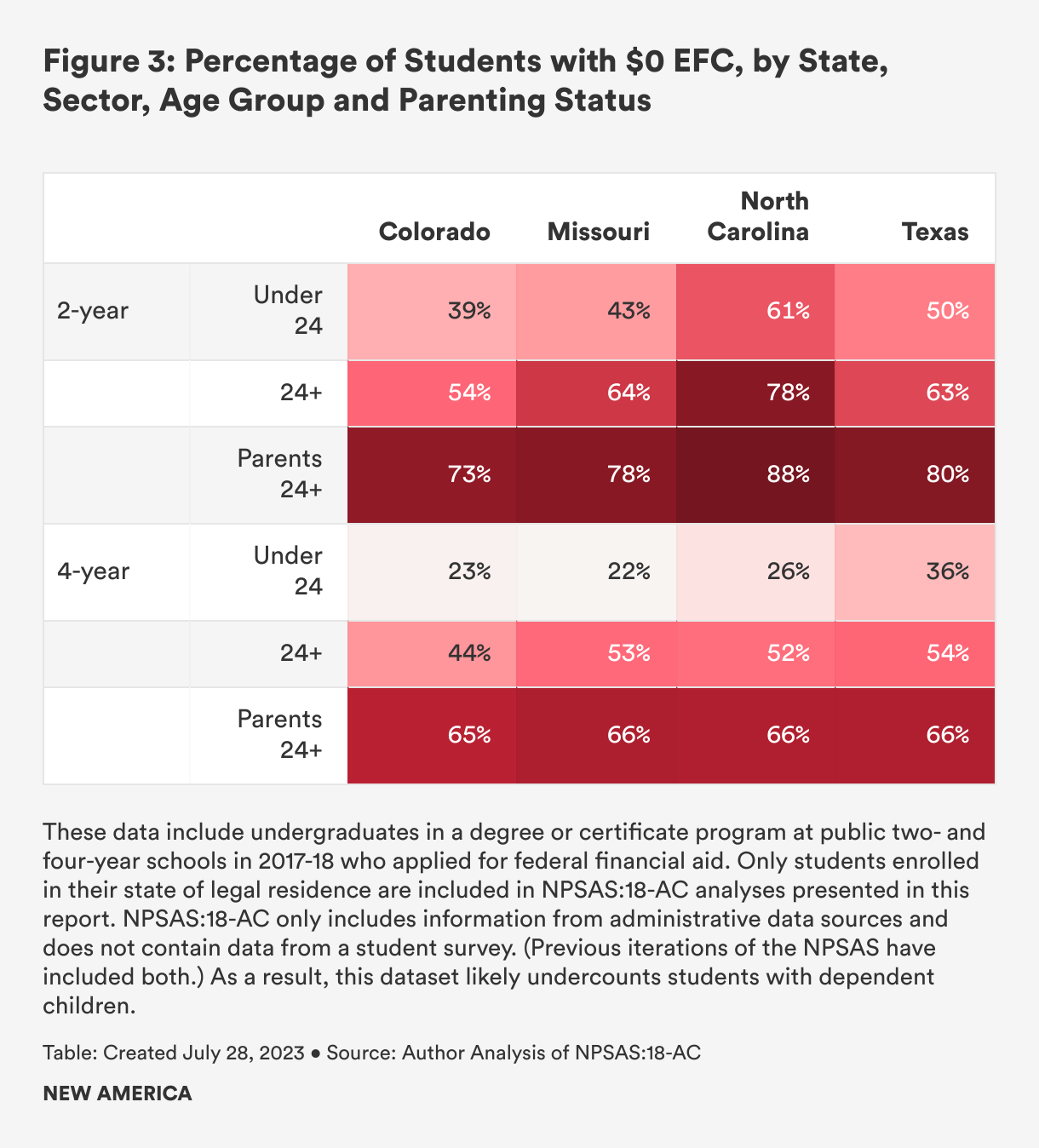
Older students and student parents who completed a FAFSA had a lower EFC compared to younger students across all four states. EFC for younger students is, in most cases, related to their parents’ income, rather than their own. Also, in all four states—in both community colleges and public universities—a considerable share of students has a $0 EFC, meaning they have no resources to pay for their college education, as shown in Figure 3.4
Citations
- Office of Federal Student Aid, “What is my Expected Family Contribution (EFC)?,” U.S. Department of Education, source; and Office of Federal Student Aid, “(GENERAL-22-91) Publication of the 2024-25 Draft Student Aid Index (SAI) and Pell Grant Eligibility Guide,” U.S. Department of Education, source. FAFSA is the federal form that students have to complete to be considered for federal financial aid. The information students provide on FAFSA is used to determine a student’s EFC. States, as well as colleges and universities use the information from the form to determine eligibility for their own financial aid dollars. In the coming years, the student aid index (SAI) will replace the EFC.
- Fewer than 8 percent of students under 24 are parents in each state. And more than 85 percent of student parents are over the age of 24 across all states and sectors. Throughout the analysis, patterns did not change when we added in the younger student parents.
- Here and throughout this report, we use Hispanic instead of Latino/a/x to match the data source analyzed.
- The difference between older and younger students are likely due, at least in part, because all students over 24 are counted as independent, which means their EFCs are based upon their own resources, not those of parents or guardians. In addition, having dependents generally lowers your EFC to reflect the additional resources required to raise children or support others. Many students under age 24, on the other hand, are considered dependent, and as a result, their EFCs reflect a combination of their own and their parents’ resources. Older students without dependents may also have slightly higher median EFCs because they are not eligible to receive an automatic $0 EFC. Automatic $0 EFC is available to specific groups of students who have an income of $27,000 or less. Eligibility also depends on factors like receiving benefits from certain federal programs, specific tax filing conditions, and the student's dependency status. For more detail and a definition of independent and dependent students, see Office of Federal Student Aid, “The EFC Formula, 2022–2023,” U.S. Department of Education, August 2021, source.