
Table of Contents
- Introduction and Overview
- Methodology and Overview of State Aid and Public Benefits Programs
- Where These Students Enroll, How They Enroll, and How Much Financial Aid They Need
- State Higher Education Funding and Financial Aid Program Design
- Financial Aid: Program Implementation
- Public Benefits: Program Design and Funding
- How Each State Uses Safety Net Programs to Supports Students
- Recommendations
- Appendix A: Methodology
- Appendix B: State Grant Program Budgets and Expenditures
State Higher Education Funding and Financial Aid Program Design
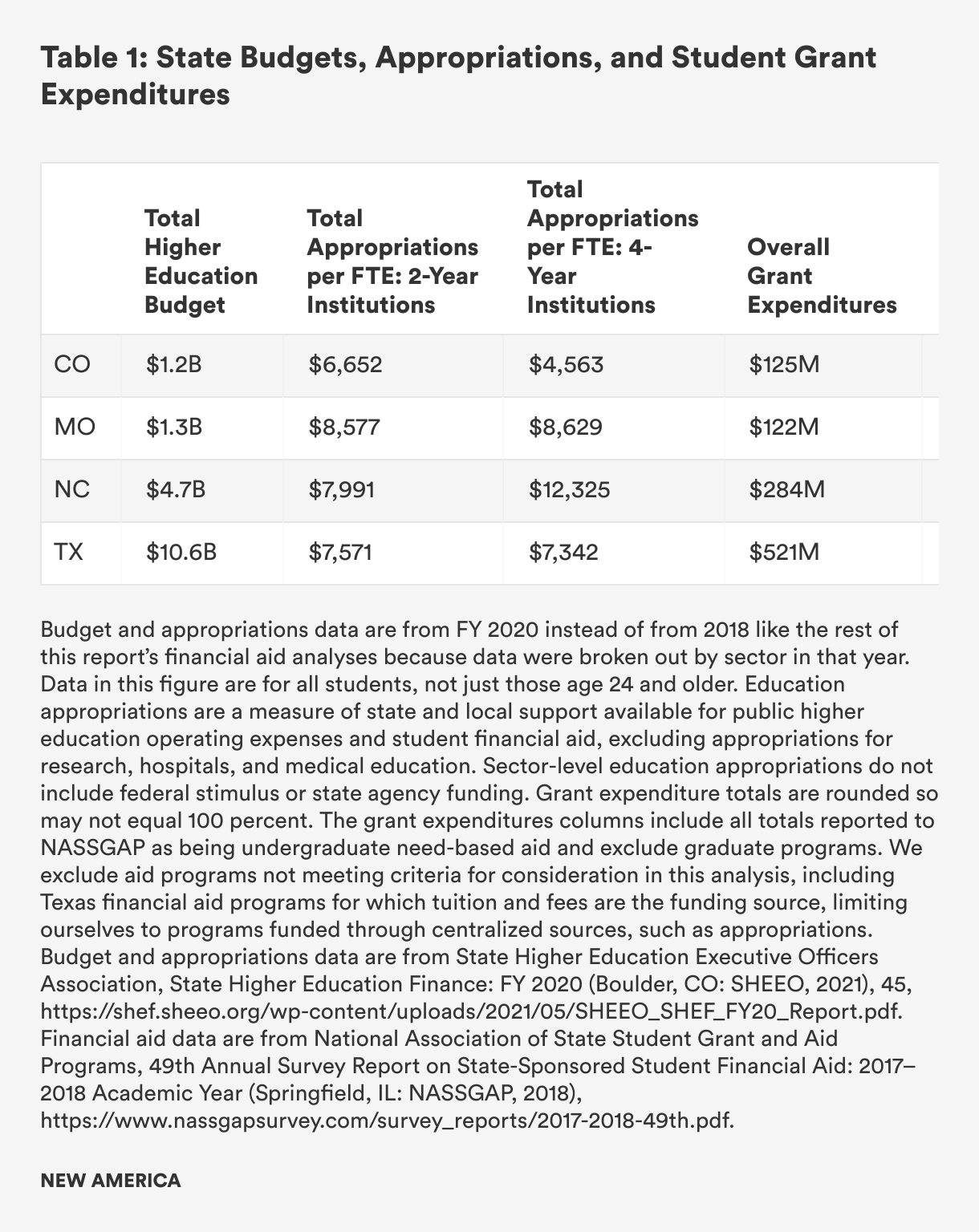
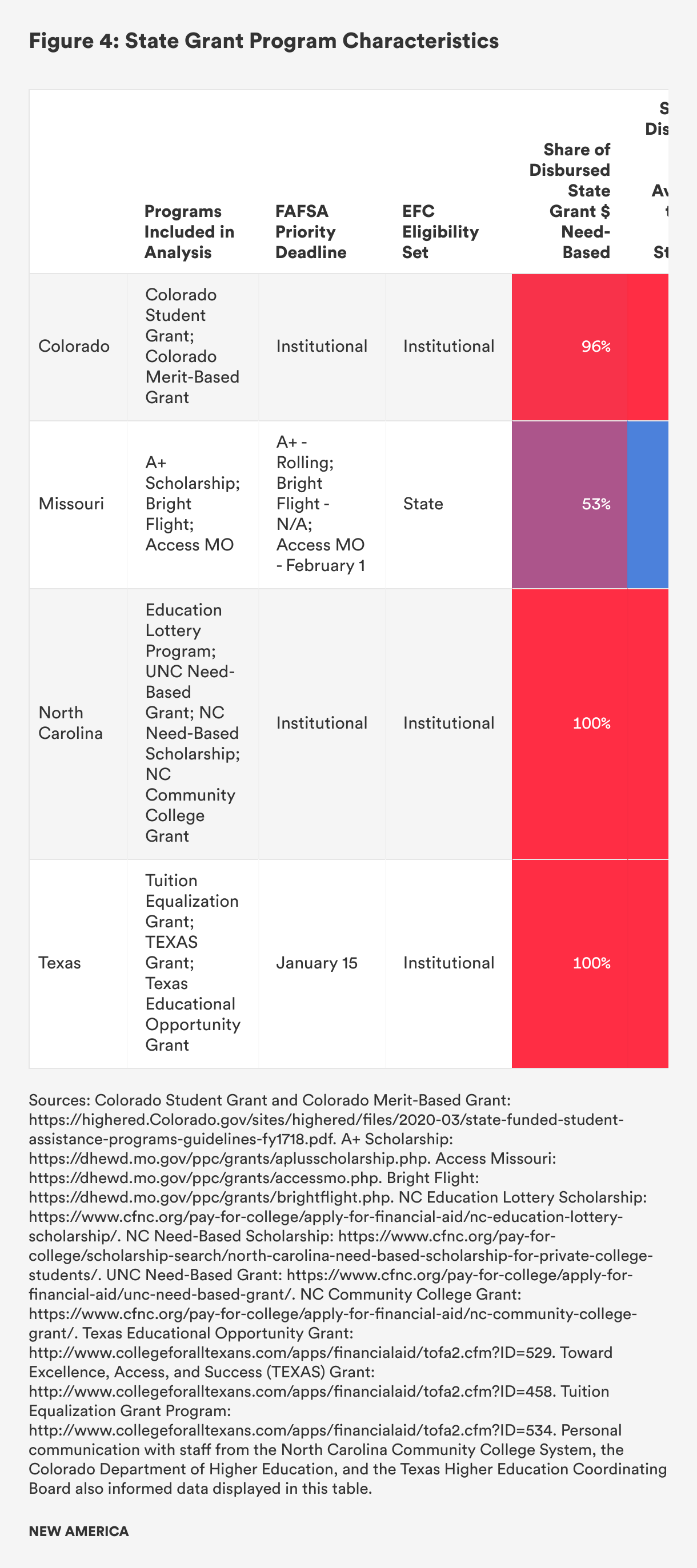
In all four states we examined in Table 1, spending on financial aid programs–both overall and per full time equivalent (FTE) enrollment–represents only a fraction of the direct support they provide for colleges, but the share of spending that each state devotes to financial aid differs. Each of the four states has a different mix of need-based and merit-based aid programs. Students who meet the criteria for merit aid, scholarships to those who have a high grade point average or perform well on standardized college entrance tests, tend to have more financial resources than those who do not qualify.1 Texas and North Carolina awarded all of their state aid based on need. Colorado awarded the majority of its aid based on need but had a small pot of merit aid. Missouri offered almost as much merit aid as it does need-based aid.
Design of major state financial aid programs
For each of our four focus states, we looked at the design, eligibility, and funding for the major state financial aid programs operating in 2017–18.2 (See Appendix B for more information on how these programs are funded.) Those programs are:
- Colorado:
- Colorado Merit-Based Grant3
- Colorado Student Grant
- Missouri: A+ Scholarship
- Access Missouri
- Bright Flight
- North Carolina: Education Lottery Scholarship
- NC Community College Grant
- NC Need-Based Scholarship
- UNC Need-Based Grant
- Texas: Texas Educational Opportunity Grant
- Toward Excellence, Access, and Success (TEXAS) Grant
- Tuition Equalization Grant
Our analysis shows that in these four states, fewer older students received state financial aid than their younger peers. Previous research also highlights the fact that older students are much less likely to receive state financial aid than younger students.4 There are a number of reasons why that may be so.
Our focus group conversations suggest that people considering going to or back to college later in life are less likely to know what support is available to them. “When you're in high school, you learned right there” about what kind of student aid was available, an older Colorado student said. “But as for adult learning, there's not very many resources where you can go and talk to counselors or anything about continuing your education.” Without guidance, older students may not apply for state aid or do so too late, as many state aid programs allocate their limited resources on a first-come, first-served basis.5 Older students also may not realize that they have to fill out the FAFSA, as the federal student aid application often serves as the application for state financial aid as well.
While lack of knowledge about the availability of state aid programs or how to apply for the funding hampers many older students, state aid programs often have confusing design or eligibility requirements that make it more difficult for older students and student parents to obtain funding. These students tend to enroll part time, attend community colleges, and have high financial need, and many state financial aid programs are simply not designed with these students in mind.
For example, state merit aid programs tend to reward top high school graduates who are going to a traditional four-year college.6 And some state need-based aid programs exclude part-time students and community college students. State aid programs also disadvantage older students and student parents when they require applicants to submit their standardized test scores or their high school GPA. For students who have been out of high school for an extended period of time, as is often the case for older students and student parents, such requirements impose a significant burden that may discourage them from applying, such as making in-person inquiries to their former schools.
Our focus groups suggest that older students and student parents are more likely to benefit from state grant and scholarship programs that determine eligibility automatically through the FAFSA, rather than requiring students to file a separate application or provide additional documentation. In addition, grants and scholarships that are first-dollar—meaning that college financial aid administrators are required to use the aid to cover tuition and fees first, leaving other resources like the Pell Grant to cover living expenses—are particularly likely to benefit older students and student parents, because eligible students tend to get more aid overall.
We found that older students and student parents had more success accessing state aid in some of the states we examined than others, and that program design likely played a significant part in those differences. But despite these differences, we found that many older students and student parents who are low-income are not accessing state aid for which they may be eligible in all four states.
To start, we will look at the differences between the states.
Colorado
Of the states we reviewed, the one that is doing the best by its older students is Colorado. The state provides aid to a high percentage of older students, even at community colleges. While 44 percent of older students and 54 percent of student parents are eligible for Pell, 34 percent of older students and 40 percent of student parents receive state grant aid, which is a small difference compared to the other states in this analysis.
Much of Colorado’s success has to do with the design of its large need-based aid program, the Colorado Student Grant, which works well for older, caregiving students. Students can access it if they go part time. They can use it at community colleges, and it is first-dollar. As far as state eligibility guidelines go, students only have to fill out the FAFSA. There are no additional requirements for test scores or other documentation of academic achievement. Colleges have some latitude to determine grant eligibility requirements within state parameters. For example, Colorado State University—for the upcoming academic year—requires students to be enrolled for at least 12 credits to get a grant. Pueblo Community College requires students to be enrolled for at least 6 credit hours, and from there, it pro-rates based on enrollment intensity.
North Carolina
The picture is a little more complex in North Carolina. While the design of its need-based financial aid programs was not optimal, the programs have proven to be mostly accessible to older students attending four-year colleges. This could be due to enrollment intensity of the students attending four-year colleges or the generous funding levels. Due to an anomaly in the NPSAS18:AC data, we were not able to analyze state grant receipt among community college students. In North Carolina public universities, 58 percent of older students and 53 percent of student parents received Pell, and 55 percent and 40 percent, respectively, received state grants. This is the highest share of older students receiving state grants among the states we analyzed. While this is a strong finding for university students, it should be noted that nearly two-thirds of older students and more than three-fourths of student parents in public higher education attended community colleges rather than universities.
Still, North Carolina’s strategy of offering aid through four programs with different eligibility criteria, three of which corresponded to different sectors of higher education, may have confused students. However, it recently revamped its financial aid strategy to correct some of these issues. Starting in the 2023–24 academic year, North Carolina discontinued the three need-based aid programs for students in public higher education which were operating when data for this report were collected. Instead, the state now administers the NC Need-Based Scholarship for Public Colleges and Universities, which combined and replaced the Education Lottery Scholarship, NC Community College Need-Based Grant, and the UNC Need-Based Grant.7 The simplicity of communicating about one grant program versus three may benefit older students,8 given that our focus group participants in North Carolina had little to no familiarity with state grant programs in place at the time. Furthermore, the priority FAFSA date for this new grant programs is June 1 for students attending public universities and August 15 for students attending community colleges,9 much more realistic dates for adult students making college-going decisions in the spring and summer. Priority dates in Missouri and Texas are set in February and January, respectively.
Texas
Texas makes it difficult for older and parenting students to access public benefits and financial aid to complete their education. And although Texas’s state aid programs had many of the same design flaws as North Carolina’s, financially needy older students fare worse in the Lone Star State. The state has a particularly stark difference in its four-year colleges for older and parenting students who receive Pell and the percentage who receive state grant aid. The community college state aid program seems woefully underfunded with only 14 percent of older students receiving aid, when 45 percent receive Pell. In Texas, a significantly higher share of older students and student parents in our sample with a $0 EFC at public universities received both state and federal grants than their peers at community colleges.
Texas has three financial aid programs, only one of which can be used at community colleges. Recent analysis from the Urban Institute found that fewer than one in ten students otherwise eligible for a Texas Educational Opportunity Grant (TEOG) at community colleges received such a grant.10 Program funding is meager, and even so, only 24 percent of TEOG awards went to students classified as independent on the FAFSA.11 Without adequate funding for the state’s community college financial aid program, adult students who enroll in this sector are likely to continue to be excluded from these resources. Students must carry at least a three-quarters course load to be eligible for a TEXAS grant at a public university, but students at community colleges may enroll only half time and be eligible for TEOG. Eligibility for part-time students makes state grant programs more likely to reach older students, yet differing eligibility requirements among programs may prove confusing and make financial planning for college difficult.12 All of these factors serve as impediments to older students and student parents.
Missouri
Financially needy older students also find it difficult to obtain state aid in Missouri. In general, students 24 and older tend to be excluded from merit-based state grant aid. Alone among our sample states, Missouri’s merit aid comprises half of its financial aid expenditures. The two merit aid programs in the state represent a significant investment in higher education that older students and student parents do not often access, leaving particularly large gaps between Pell eligibility and access to state aid in Missouri. While 58 percent of older students and 68 percent of student parents receive Pell, only 18 percent and 19 percent, respectively, receive state grant aid.
In Missouri, a significantly higher share of older students and student parents in our sample with a $0 EFC at public universities received both state and federal grants than their peers at community colleges. On the one hand, this difference makes sense, given the higher tuition at universities (typically resulting in a higher cost of attendance). However, as we have shown, a higher share of students 24 and over—especially students with dependent children and Black students—opt for community colleges over universities. The fact that community college students are less likely to get state grants may have equity implications for these groups.
The primary reason that older students have trouble accessing state financial aid in Missouri is that a significant share of it is devoted to merit-based aid, which primarily goes to top high school students going straight to college. Of the three programs in this analysis, two are merit-based and all require full-time enrollment. The two merit-based programs require some measure of academic performance in high school, and the A+ program requires service hours, high attendance, and more. Students going to community colleges are eligible for funding through all three programs, and two of the programs offer last-dollar aid. Furthermore, setting eligibility criteria at the state level provides a level of clarity to students. For example, the EFC eligibility level for Access Missouri has been held steady in state statute since the program’s inception in 2007. Students across institutions, sectors of higher education, and years may therefore have been able to more reliably predict whether or not they could receive aid from this program, given the stability and state-level eligibility criteria, than students in states where EFC eligibility thresholds fluctuate from institution to institution and year to year.
Citations
- See Naomi Harris, “How Popular Merit College Scholarships have Perpetuated Racial Inequities,” Washington Post, May 7, 2022, source and Stephen Burd, Crisis Point: How Enrollment Management and the Merit-Aid Arms Race Are Derailing Public Higher Education (Washington, DC: New America, February 13, 2020), source.
- We defined a major program as one in which the funding was at least $1 million and that was not limited by one area of study, like STEM or teaching, or to a highly specific population, like children of service members or law enforcement officers. Using these criteria we examined the requirements for the following programs, including the source of the funding, how much is spent, and the number of recipients.
- The Colorado Merit-Based Grant has not been funded since 2020.
- For example, see Iris Palmer, “Degrees Denied: Adults Left out of State Financial Aid Programs,” EdCentral (blog), New America, August 4, 2015, source.
- See Taliaferro and Duke-Benfield, Redesigning State Financial Aid; and CampusLogic, Timing is Everything: FAFSA Filing Trends, 2019.
- Pingel, Sponsler, and Holly, Redesigning State Financial Aid.
- For complete program rules, see North Carolina State Education Assistance Authority, “Rules Governing the North Carolina Need-Based Scholarship for Public Colleges and Universities,” 2023, source.
- Sandy Baum, Improving the Targeting, Predictability, and Simplicity of North Carolina’s State Grant Programs, NC Community Colleges and the University of North Carolina System, December 2018, source.
- College Foundation of North Carolina, “NC Scholarship,” 2023, source.
- Sandy Baum and Kristin Blagg, Strengthening Student Aid in Texas: Funding Students atDifferent Types of Institutions, Urban Institute, September 2021, source.
- Independent students are most often classified as such due to being married, having dependent children, or being 24 or older. For analysis of TEOG recipients, see Texas Higher Education Coordinating Board, Report on Student Financial Aid in Texas Higher Education: Fiscal Year 2018, 2019, source.
- For a discussion of program eligibility requirements and implications for the adult learner, see Sandy Baum and Kristin Blagg, A Review of State Grant Aid in Texas, Urban Institute, 2021 source.