
Table of Contents
- Introduction and Overview
- Methodology and Overview of State Aid and Public Benefits Programs
- Where These Students Enroll, How They Enroll, and How Much Financial Aid They Need
- State Higher Education Funding and Financial Aid Program Design
- Financial Aid: Program Implementation
- Public Benefits: Program Design and Funding
- How Each State Uses Safety Net Programs to Supports Students
- Recommendations
- Appendix A: Methodology
- Appendix B: State Grant Program Budgets and Expenditures
Public Benefits: Program Design and Funding
Financial aid alone—whether from state or federal sources—is often not enough for older students and student parents to live on while enrolled in college. Even with existing aid, we know that there are high rates of food and housing insecurity among students.1 When financial aid is insufficient, college students may seek support from the social safety net. And those using public benefits may seek a higher education credential as a route toward economic security.
We considered five public benefit programs and their support of adult students and student parents: SNAP, TANF, Medicaid and CHIP, and child care subsidies provided through CCDBG. We reviewed current eligibility for these programs based on federal standards for students and student parents, as well as any eligibility differences in the four states in our sample.2
However, eligibility requirements are only part of the story of why these public benefit programs can be difficult to access. Prior research, including from the U.S. Government Accountability Office, has shown that students may be unaware of their eligibility for public benefits that could help them make ends meet, just as they are often unaware of state aid programs.3 In our focus groups of older students and student parents, not only were most participants unaware of benefits for which they were eligible, but they also were less willing to discuss benefits-related issues than financial aid. The students’ reticence suggests that there is still stigma around these programs and this makes it even more challenging to understand who is using these programs.
A student parent at the focus group we held in Missouri acknowledged feeling this stigma when using food stamps at the grocery store. He noted that, in order to use these benefits, “you had to have specific things on each check.” He “would try to organize it, so that [my transaction] would go quickly, but there was always going to be somebody behind you that complained."
Some focus group participants said that they did not seek help from public benefit programs even if they might have qualified for them. These participants were clear that they preferred to rely on themselves rather than asking for help. One Texas student said that she would “rather just deal with it on my own than asking for somebody to help me.” She added, “I don't need to be going to somebody to beg for something.”
Only a small number of participants mentioned getting information about public benefits from their college or university. Multiple participants thought it would be useful to have colleges provide information about these programs and how to apply for these benefits. Research indicates that one-stop and wraparound support approaches to student services on college campuses provide significant benefits, including increased persistence and retention.4 These services can include financial aid, academic advising, and basic needs support. These comprehensive programs use counselors who provide a single point of contact for access to benefits.
In addition, both federal and state governments require students who would qualify for public benefits to repeatedly prove that they have very limited resources by submitting new applications for every public benefit they attempt to access. A possible solution, which the Biden administration recently encouraged in guidance, is for colleges to use FAFSA data to give students information about their eligibility for public benefits programs; over time, this information will hopefully increase awareness of benefits for eligible students.5 However, this guidance does not address other administrative burdens that limit the uptake of benefits.
Supplemental Nutrition Assistance Program (SNAP)
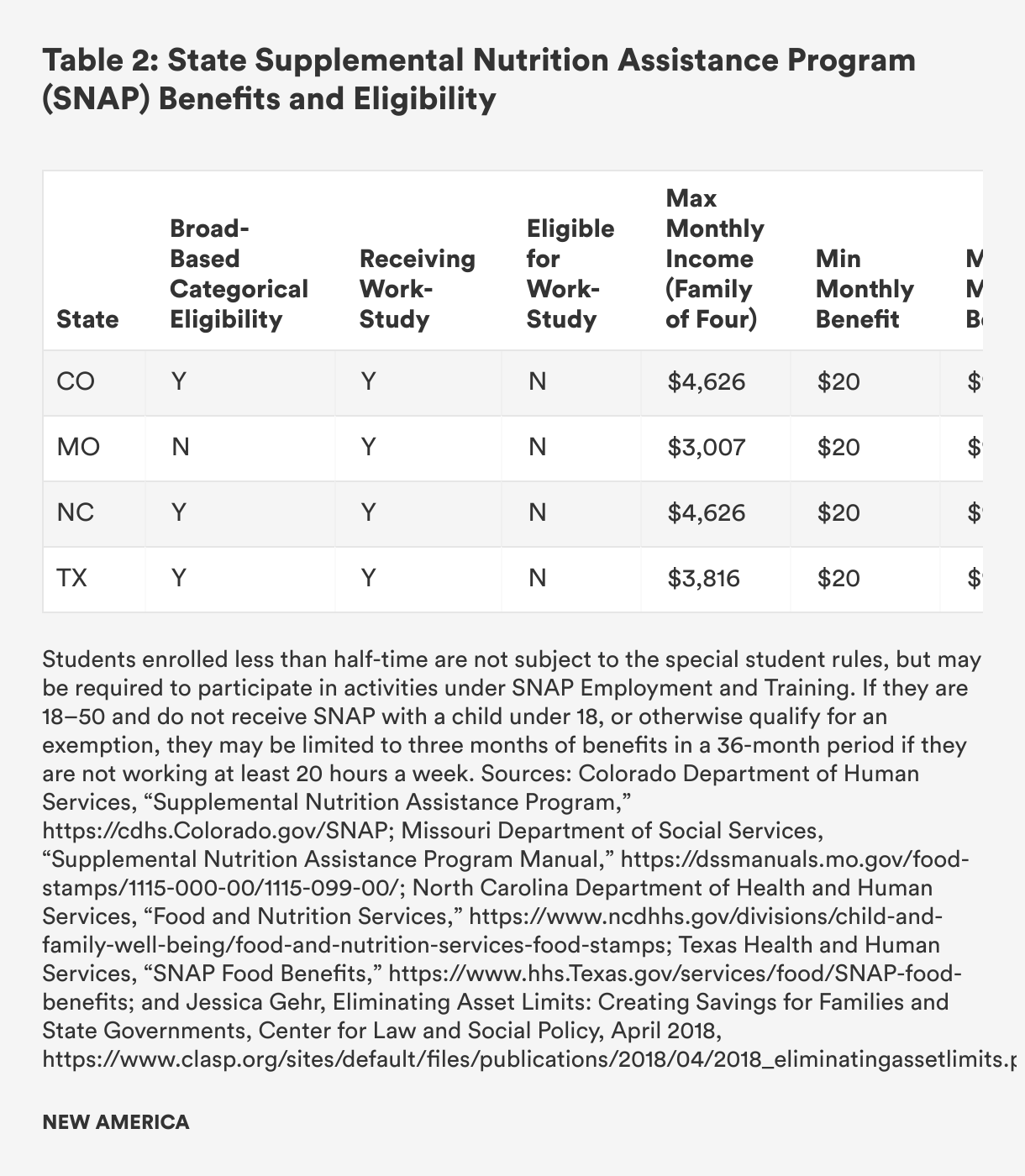
SNAP is designed to supplement households’ food budgets and has been shown to reduce food insecurity.6 The primary requirement for SNAP eligibility is gross income at or below 130 percent of the federal poverty guidelines, which is currently approximately $25,600 for a family of two and $32,300 for a family of three.7 A state can raise this threshold to a maximum of 200 percent of the federal poverty guidelines using a policy known as broad-based categorical eligibility to make the qualification process slightly simpler, as shown in Table 2.8 Two of our four focus states—Colorado and North Carolina—have raised their eligibility criteria to this level.
SNAP is an entitlement program, so costs rise as the number of people enrolled in it grows. In FY 2021, SNAP cost around $111 billion.9 This was a sharp increase from prior years, mostly due to a spike in enrollment numbers and an increase in benefit amounts as a result of the COVID-19 pandemic and related program adjustments. But even with the spike in enrollment, research from the Center on Budget and Policy Priorities suggests that there are many families that need additional assistance.10
The pandemic exacerbated many of the existing challenges that students face when trying to access public benefits. Students in our focus groups who relied on public benefits found an already challenging application and renewal process to be even more burdensome during the pandemic—a time when they most needed the support these programs provided. A Missouri student recounted that “some people, myself included, were up for renewals during [the early pandemic] and because you couldn't get ahold of an actual person to process your case, your case got denied. And then you had to start over from the beginning and you lost out on a couple months’ worth of aid.”
SNAP enrollment criteria for students
SNAP is one of the easiest federal benefit programs for students to access.11
Students enrolled in higher education half time or more can qualify for SNAP if they meet one of several criteria:12
- Are under age 18 or age 50 or older;
- Have a physical or mental disability;
- Work at least 20 hours a week in paid employment;
- Participate in a state- or federally-financed work-study program;
- Participate in an on-the-job training program;
- Care for a child under the age of 6;
- Care for a child aged 6 to 11 and lack the necessary child care to enable attending school and working 20 hours a week or participating in work-study;
- Are a single parent enrolled full time in college and taking care of a child under 12;
- Receive TANF assistance; or
- Are assigned to, placed in, or self-placed in a college or other institution of higher education through:
- A SNAP Employment and Training (SNAP E&T) program.
- Certain other E&T programs for low-income households, which are operated by a state or local government and have an equivalent component to SNAP E&T.
- A program under the Workforce Innovation and Opportunity Act of 2014 (WIOA).
- A Trade Adjustment Assistance Program under Section 236 of the Trade Act of 1974.
Students enrolled less than half time are not subject to the special student rules, but they may be required to participate in activities under SNAP E&T. If they are 18–52 and do not receive SNAP with a child under 18, or otherwise qualify for an exemption, they may be limited to three months of benefits in a 36-month period if they are not working at least 20 hours a week.13
Early in the pandemic, the government temporarily expanded SNAP benefits by making students who were eligible to participate in a state or federal work-study program or had an EFC of $0 qualified for benefits.14 Congress also authorized emergency allotments to boost SNAP benefits by at least $95 per month. These exemptions and additional benefits generally ended by early 2023.15
Some states are more generous with the rules around SNAP benefits than others. A key issue is that most states include asset limits in determining eligibility. However, some have chosen to raise or remove asset tests for eligibility. (See the “TANF” section below for more information about the potential interactions between asset limits and financial aid.) Another crucial issue is how states count work hours. Students can obtain SNAP if they work at least 20 hours in paid employment, but states count work hours differently. States can choose to average work hours over the course of a month, a semester, or a quarter. All of the states we considered use monthly averaging, which leaves them with an opportunity to improve flexibility for students by averaging over the course of a semester or quarter instead.
Caregiving responsibilities, variable work schedules, and changing class schedules mean that having to average work hours on a monthly basis can potentially push students out of eligibility. Semester-based averaging allows students to have more flexible work schedules as needed to accommodate other responsibilities without the risk of losing eligibility for food assistance.
Temporary Assistance for Needy Families (TANF)
TANF cash assistance provides a monthly stipend to very low-income families with minor children, and to pregnant people. The federal government provides the funds as a block grant to states, which determine eligibility criteria and use of the money.16 Federal funding for TANF has remained static since 1996, leading to a drop in the real value of the program by 40 percent, severely limiting how many people can receive support.17 States have flexibility in how they use TANF funds, as long as the money is used for one of the following purposes:
- Assisting families in need so children can be cared for in their own homes or the homes of relatives.
- Reducing dependency on public benefits by promoting job preparation, work, and marriage for parents in need.
- Preventing pregnancies among unmarried persons.
- Encouraging the formation and maintenance of two-parent families.
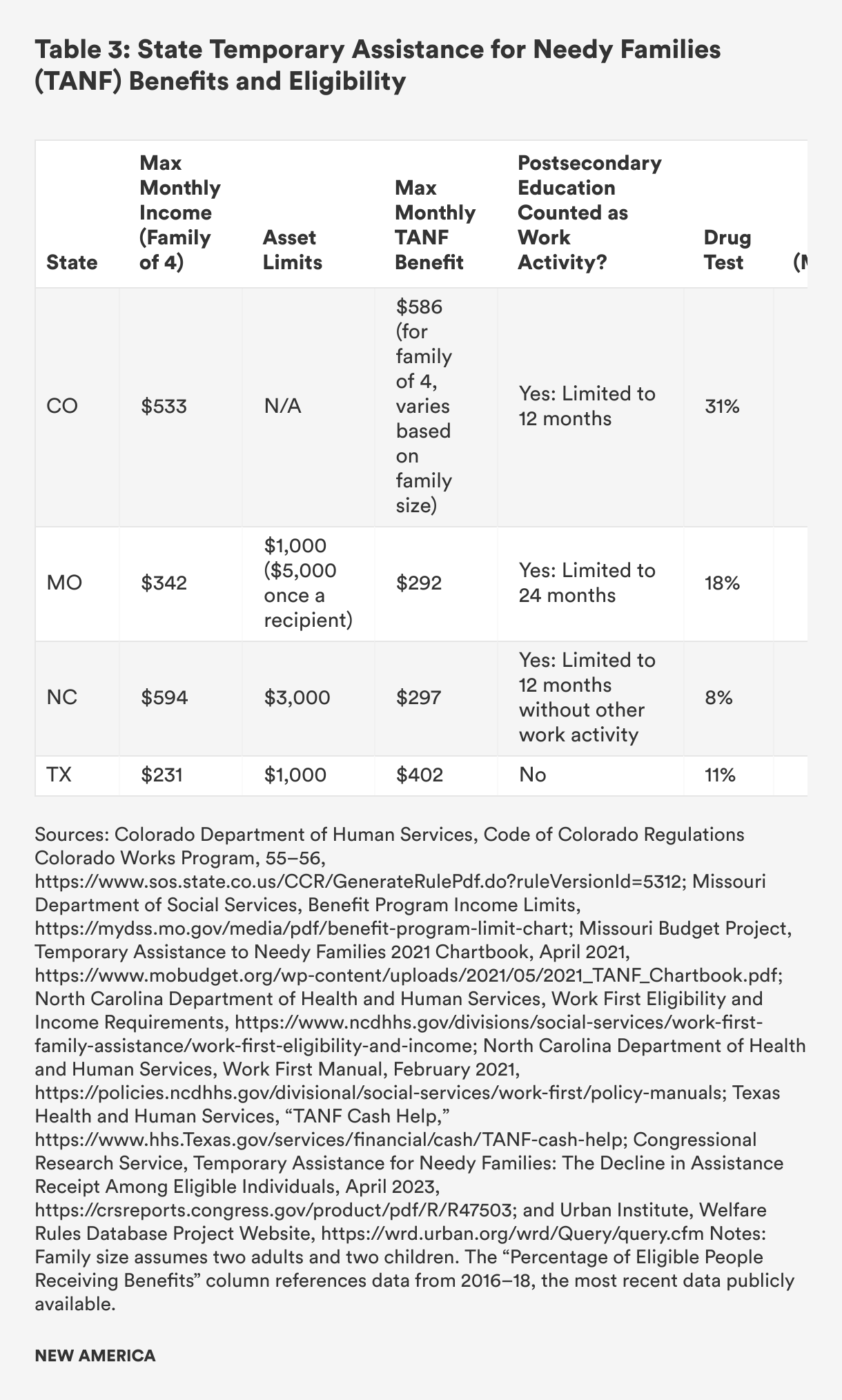
Allowable uses of TANF funds are broadly defined, and as a result, states have used them for a variety of purposes, including funding financial aid programs.18 Federal law requires only that TANF cash assistance funds are provided to “needy” families, but does not define what needy means. As a result, states are free to set their own eligibility rules. States tend to set income thresholds well below the federal poverty guidelines. For example, Texas’s threshold is set so low that working 32 hours a month at the federal minimum wage would disqualify someone with a family of four from support, as shown in Table 3. Texas spends only a tiny fraction of its total TANF dollars on basic assistance—just 4 percent in 2021, for example.19
There are various activities that TANF recipients must engage in to remain eligible for the benefits. The greatest barrier to TANF access for students is that education and training rarely count as a full-time activity, often needing to be combined with another 20 or more hours of a “core activity” such as employment.20 The Center for Law and Social Policy has shown that many states will not permit work requirements to be met with anything other than short-term education and training programs and frequently assign participants to job search classes even if they are enrolled in college.21
Frustrations about work requirements were evident in our focus groups, during which multiple participants noted not being able to get help while trying to complete programs lasting longer than one year. Many participants also felt there was constant tension between going to college and accessing public benefits. It was not that the two were mutually exclusive, but going to college made it harder to access certain benefits. And several noted that they would start working and immediately see their benefits cut. “They make you look for a job while you apply for [benefits] and as soon as you get a job, they cut [them],” a Missouri student parent said.22
Asset limits also present challenges for students accessing support from TANF, as well as other benefits programs like SNAP. Missouri and Texas both have asset limits of $1,000 for TANF cash assistance eligibility, and North Carolina’s asset limit is $3,000. Colorado has no asset limit. Low asset limits make it hard for people to build a financial cushion to help with emergency expenses and could discourage students from applying for public benefits.
Financial aid is generally paid out in lump sums at the start of every semester. If students receive more aid than their tuition and fees, that money is refunded to them to help pay for housing, food, books, and other expenses. Students can therefore have several thousand dollars in their bank accounts at the start of the semester, a time when they may also be seeking support from public benefits. State manuals generally require benefits administrators to disregard funds from financial aid or loans when calculating an applicant's assets, but what is broadly advertised is the top-line asset limit. Knowing what is and is not counted requires a level of technical knowledge that most students do not possess.
Medicaid and CHIP
Whether or not one is a student does not have an impact on Medicaid eligibility, making this the most straightforward program for students to access.23 In FY 2021, the Medicaid program received $728 billion, with 69 percent of those funds coming from the federal government and the rest from states.24
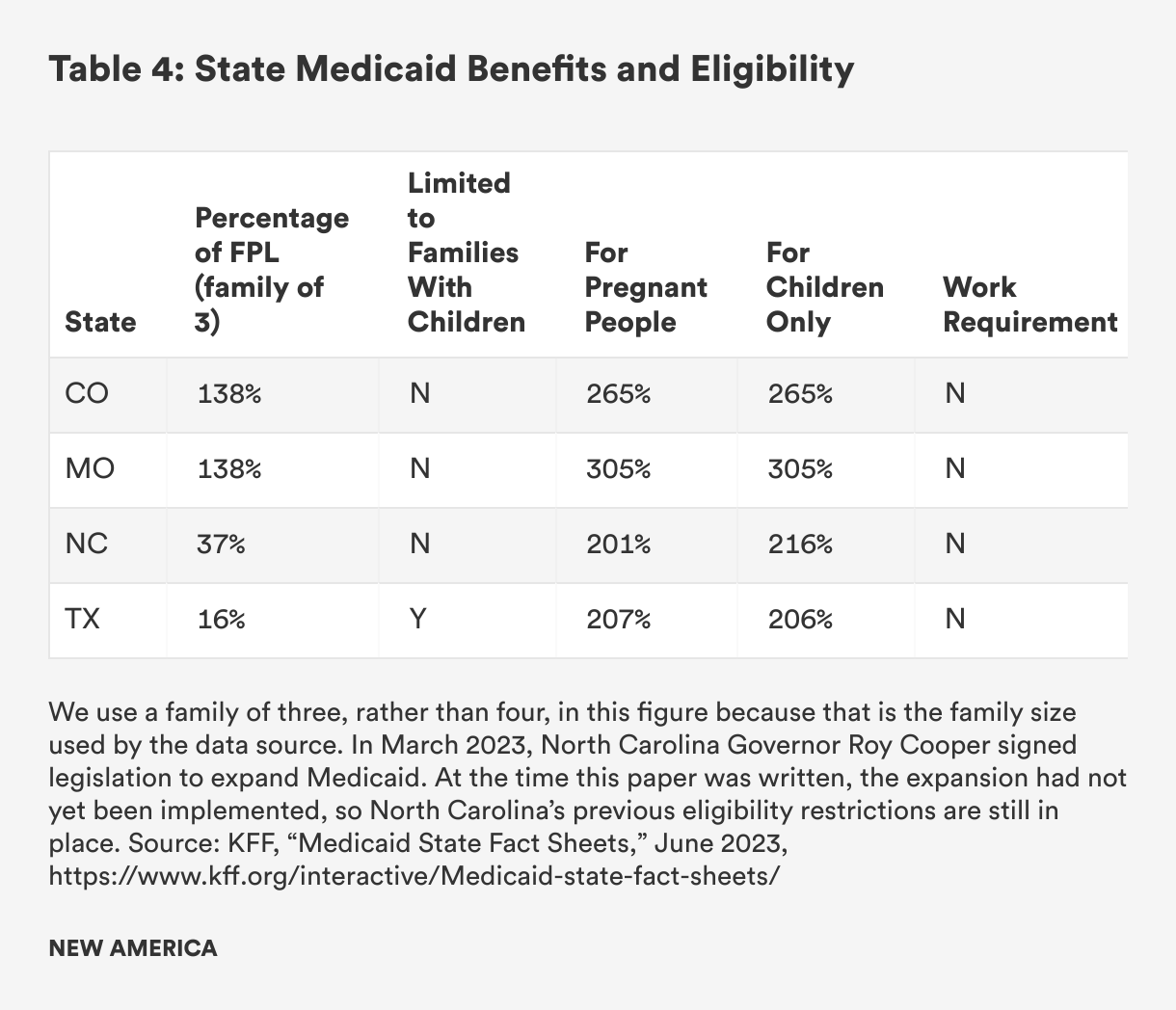
Three of our states (Colorado, Missouri, and North Carolina) expanded Medicaid access as part of the Affordable Care Act (ACA), although Missouri only did so in 2021, and North Carolina Governor Roy Cooper signed legislation in 2023 to begin the expansion process.25 As shown in Table 4, Texas currently has no plans to do so. In states that have expanded Medicaid, citizens and some immigrants are eligible for Medicaid coverage as long as their income is at or below 138 percent of the federal poverty guidelines. People with incomes above 100 percent of the guidelines are eligible to purchase subsidized coverage under the exchanges.26 Children, pregnant people, and parents may be eligible for coverage under Medicaid or CHIP at higher income levels, depending on state policies.
Health insurance coverage for students and their children can help mitigate the risk of high medical bills derailing a student’s education, and Medicaid expansion has increased the share of students enrolled in Medicaid by five percentage points.27 Eligibility in states that have not expanded Medicaid is complicated. For example, pregnant people in Texas are Medicaid-eligible at income levels up to 207 percent of the federal poverty guidelines.28 However, once they have given birth, the eligibility threshold drops to 16 percent. In 2023, this means that a family of three must have an income below $4,000 a year to qualify for Medicaid. Parents also lose coverage at incomes well below the threshold for receiving ACA subsidies, and childless adults are generally not eligible for Medicaid at all. These people fall into the coverage gap and are frequently uninsured. Different limits for pregnant people, parents, and children likely only add to the confusion around an already complex program.
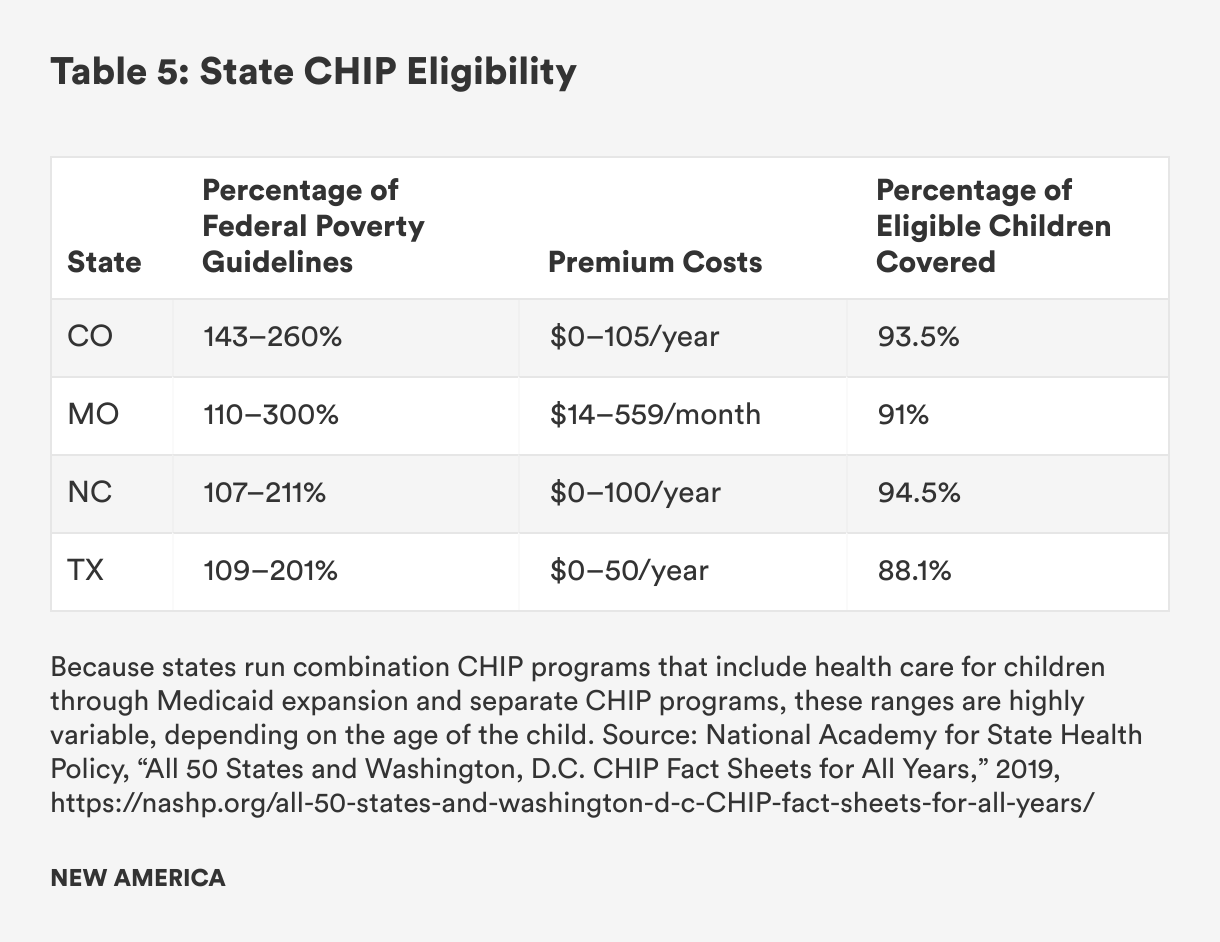
CHIP provides health insurance for families with low and moderate incomes and can act as a vital source of support for student parents who are either not working or do not have affordable health insurance provided by their employer. CHIP uses the federal poverty guidelines to determine eligibility, but some states use different eligibility thresholds, depending on the age of the children. Additionally, states have the option to cover children through their Medicaid program, through a separate CHIP program, or by using a combined approach. All four of the states we analyzed use a combined approach, as shown in Table 5. Premiums are determined using a sliding scale that increases with family income but cannot exceed 5 percent of family income.
Child care subsidies through the Child Care and Development Block Grant (CCDBG)
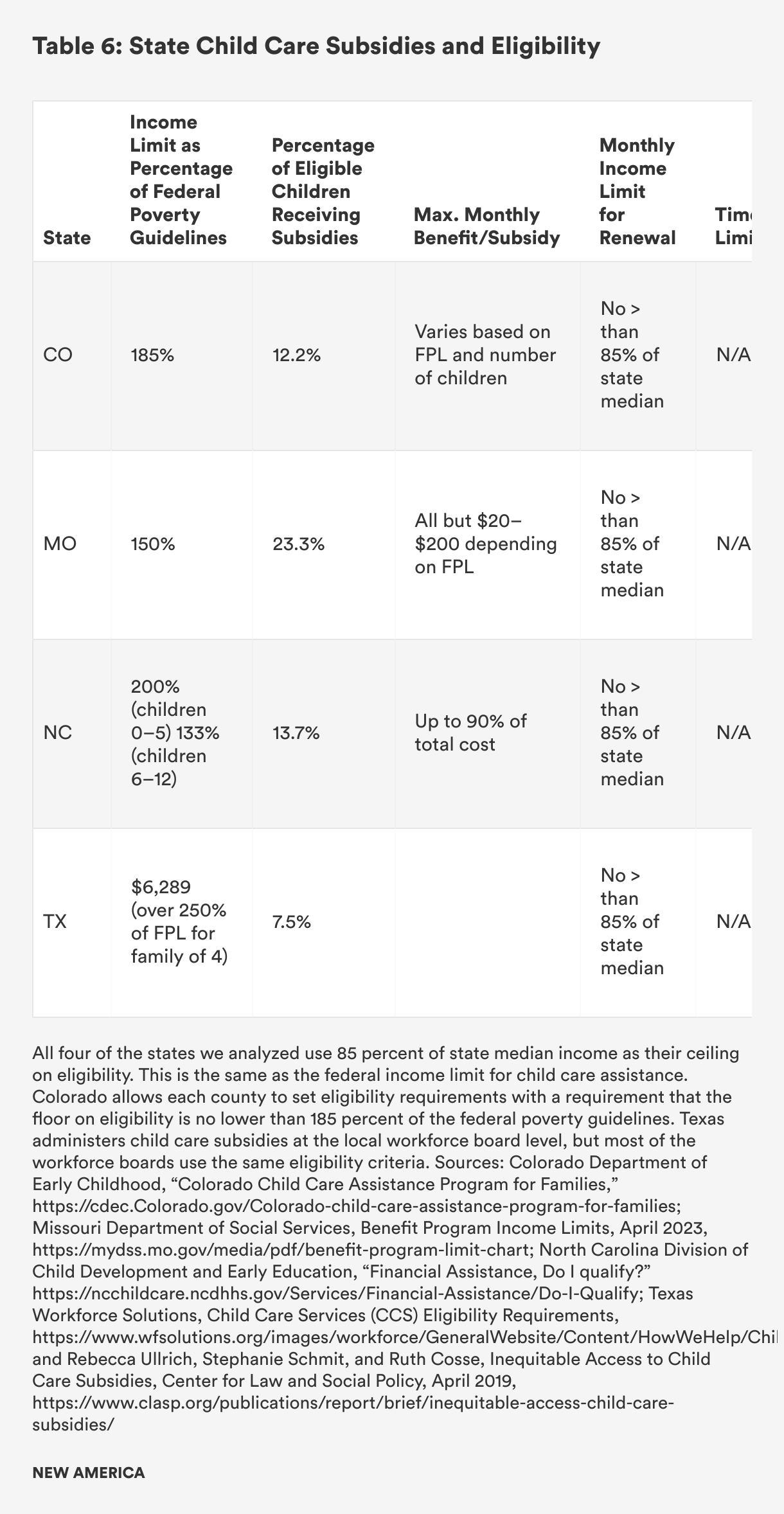
The CCDBG provides funding to states that is used to subsidize child care for families with low incomes. States can also use TANF dollars to support CCDBG. States have a great deal of flexibility in how they prioritize who to support with CCDBG funds, with different rules for students depending on the state in which they reside, as shown in Table 6. Most of the assistance tends to be focused on working families.
Because states have so much flexibility, eligibility for child care subsidies varies widely by state. For example, in Texas, families with annual incomes that do not exceed 250 percent of the federal poverty guidelines—or approximately $75,000 for a family of four in 2023—are eligible.29 However, even high-income limits do not translate into broad access to child care subsidies in states and nationwide, primarily because of a lack of funding. In fact, nationally, there are almost nine million children eligible for subsidies under state rules (which tend to be more restrictive than federal rules), but in 2017 only 1.9 million children actually received subsidized child care.30 The percentage of eligible children receiving subsidies varies across our four states. But as of 2016, even in Missouri, which has the highest percentage of eligible children receiving benefits among the states we examined, fewer than 24 percent are receiving subsidies. In Texas, fewer than 8 percent are receiving subsidies.
During the pandemic, it became increasingly clear that our child care system is broken, and access to affordable and high-quality child care is limited for many people.31 This disconnect between demand and funding makes it challenging for student parents to access the reliable, subsidized care that is vital for them to successfully enroll in and complete a higher education credential.
Citations
- See U.S. Government Accountability Office December, Food Insecurity: Better Information Could Help Eligible College Students Access Federal Food Assistance Benefits, December 2018, source; and Bryce McKibben, Jiayao Wu, and Sara Abelson, New Federal Data Confirm that College Students Face Significant—and Unacceptable—Basic Needs Insecurity, The Hope Center For College, Community, and Justice, August 2023, source.
- Program criteria are from 2022–23 unless otherwise noted.
- U.S. Government Accountability Office December, Food Insecurity.
- Lindsay Daugherty, William R. Johnston, and Tiffany Berglund, Connecting College Students to Alternative Sources of Support: The Single Stop Community College Initiative and Postsecondary Outcomes (Santa Monica, CA: RAND Corporation, 2020), source.
- Office of Federal Student Aid, “Use of FAFSA Data to Administer Federal Programs,” U.S. Department of Education, January 20, 2022, source.
- Center on Budget and Policy Priorities, Policy Basics: The Supplemental Nutrition Assistance Program, June 2022, source.
- Office of the Assistant Secretary for Planning and Evaluation, HHS Poverty Guidelines for 2023, U.S. Department of Health and Human Services, source.
- Food and Nutrition Service, Broad-Based Categorical Eligibility, U.S. Department of Agriculture, July 2023, source and Center for Law and Social Policy, Broad-Based Categorical Eligibility (BBCE) is Not a SNAP Loophole, 2019, source. Broad-based categorical eligibility is a policy where households can be considered eligible for SNAP because they qualify for some form of non-cash-based assistance from the TANF program.
- Center on Budget and Policy Priorities, Policy Basics: The Supplemental Nutrition Assistance Program.
- Center on Budget and Policy Priorities, Tracking the COVID-19 Economy’s Effects on Food, Housing, and Employment Hardships, October 2021, source.
- In states that have expanded Medicaid coverage as part of the ACA, Medicaid may be easier to access, but not all of the states we consider here have done so.
- Carrie Welton and Darrel Thompson, SNAP and Students: Food Assistance Can Support College Success, Center for Law and Social Policy, December 2019, source and Food and Nutrition Service (website), FAQ: “What are the Student Exemptions for SNAP?” U.S. Department of Agriculture, source.
- As a result of the 2023 Debt Ceiling Agreement the upper age limit is incrementally increasing to 54. Katie Bergh and Dottie Rosenbaum, Debt Ceiling Agreement’s SNAP Changes Would Increase Hunger and Poverty for Many Older Low-Income People; New Exemptions Would Help Some Others, Center on Budget and Policy Priorities, May 2023, source.
- Center on Budget and Policy Priorities, States Are Using Much-Needed Temporary Flexibility in SNAP to Respond to COVID-19 Challenges, January 25, 2023, source and Food and Nutrition Service; “SNAP Student Provisions in the CAA 2021-Questions and Answers,” U.S. Department of Agriculture, February 2021, source.
- Dorothy Rosenbaum, Katie Bergh, and Lauren Hall, Temporary Pandemic SNAP Benefits Will End in Remaining 35 States in March 2023, Center on Budget and Policy Priorities, February 6, 2023, source.
- Center on Budget and Policy Priorities, Policy Basics: Temporary Assistance for Needy Families, March 2022, source.
- Center on Budget and Policy Priorities, Policy Basics: Temporary Assistance for Needy Families.
- Jenni Bergal, “States Raid Fund Meant for Needy Families to Pay for Other Programs,” Stateline, July 24, 2020, source.
- Center on Budget and Policy Priorities, Texas TANF Spending, March 2023, source.
- Center on Budget and Policy Priorities, Policy Basics: Temporary Assistance for Needy Families, March 2022.
- Randi Hall, Expanding Education and Training Opportunities Under TANF: A Path to Stable Employment in Today’s Economy, Center for Law and Social Policy, July 2016, source.
- SNAP benefits can be provided on an electronic benefits transfer (EBT) card.
- Amy Ellen Duke-Benfield, Exploring How Public Benefits Can Help Support Postsecondary Students From Low-income Backgrounds, National Skills Coalition, Postsecondary Value Commission, 2021, source.
- Elizabeth Williams, Robin Rudowitz, and Alice Burns, Medicaid Financing: The Basics, KFF, April 2023, source.
- KFF, Status of State Medicaid Expansion Decisions: Interactive Map, July 2023, source.
- Congressional Research Service, Overview of Health insurance Exchanges, March 2023, source. Under the ACA, subsidized coverage can be purchased through state or federally run health insurance exchanges that operate as a marketplace for individuals and small businesses.
- Jen Mishory, Olivia Chan, and Peter Granville, The ACA’s Impact on College Students, The Century Foundation, July 2020, source.
- KFF, Medicaid in Texas, June 2023 source; KFF, Medicaid in Missouri, June 2023, source; KFF, Medicaid in North Carolina, June 2023, source; and KFF, Medicaid in Colorado, June 2023, source.
- Office of the Assistant Secretary for Planning and Evaluation, HHS Poverty Guidelines for 2023.
- Government Accountability Office, Child Care: Subsidy Eligibility and Receipt, and Wait Lists, February 2021, source.
- See Roselyn Miller and Jahdziah St. Julien, A Bold Policy Agenda for Work-Family Justice and Gender Equity During COVID-19 and Beyond (Washington, DC: New America, December 2020), source.