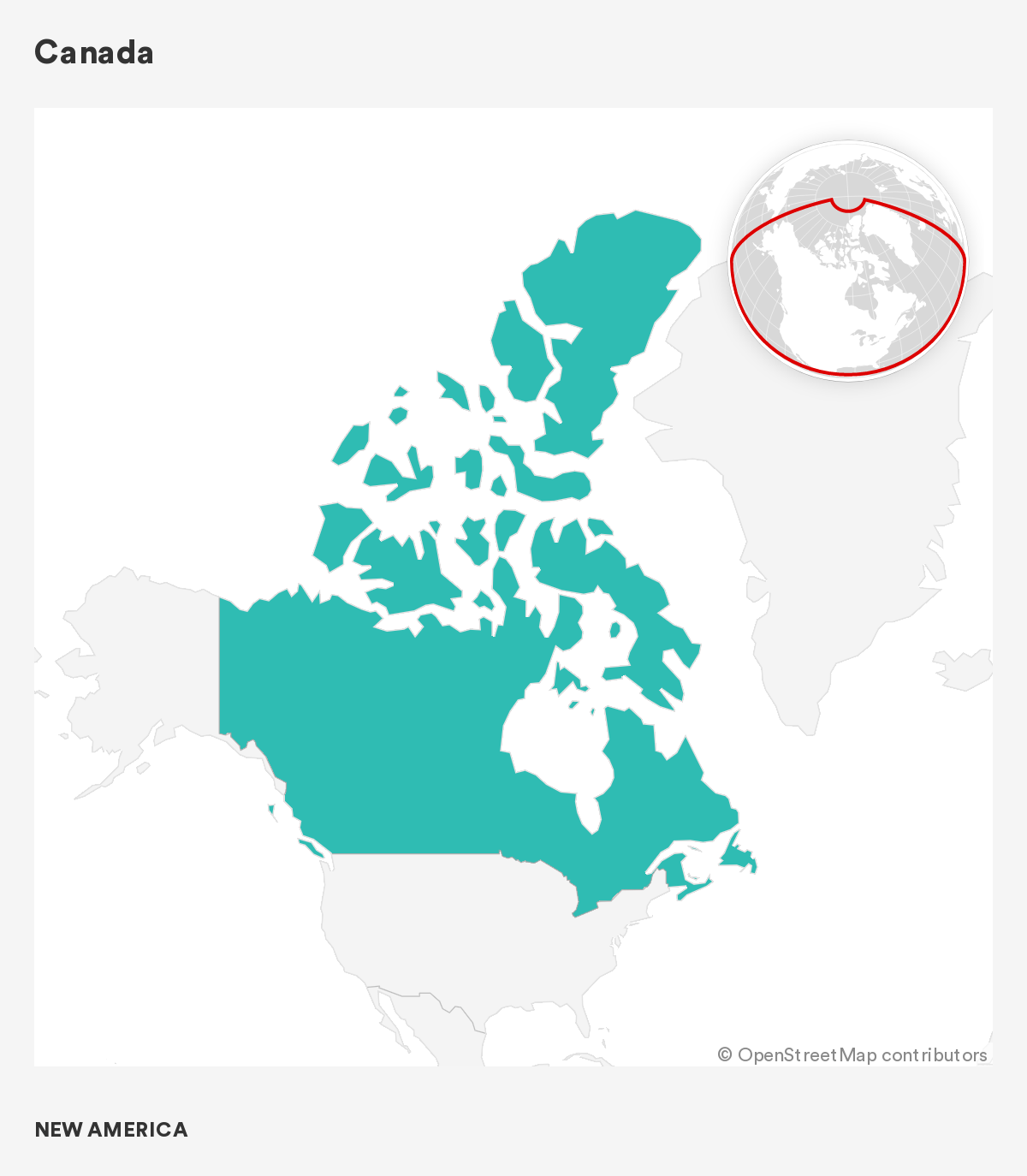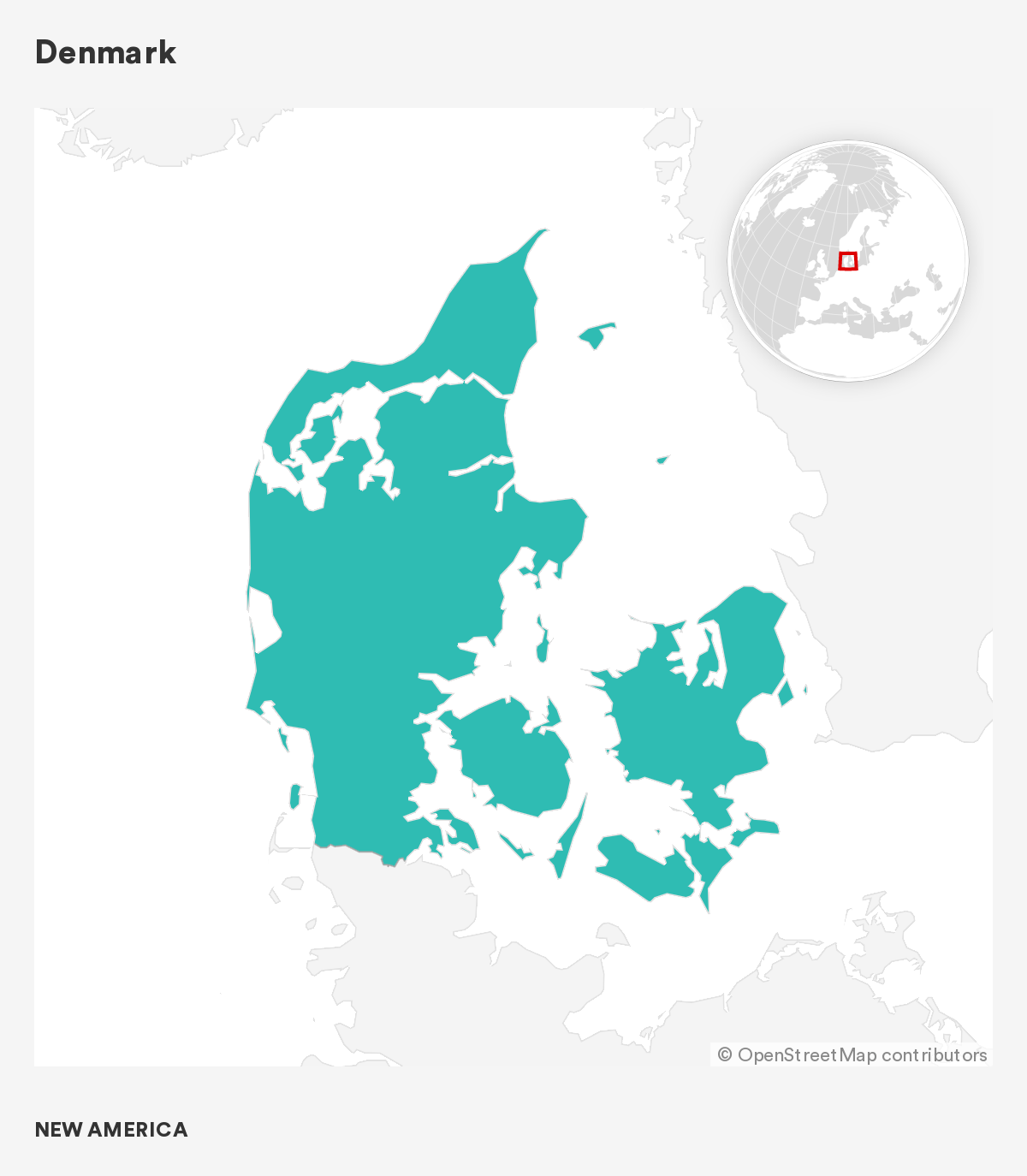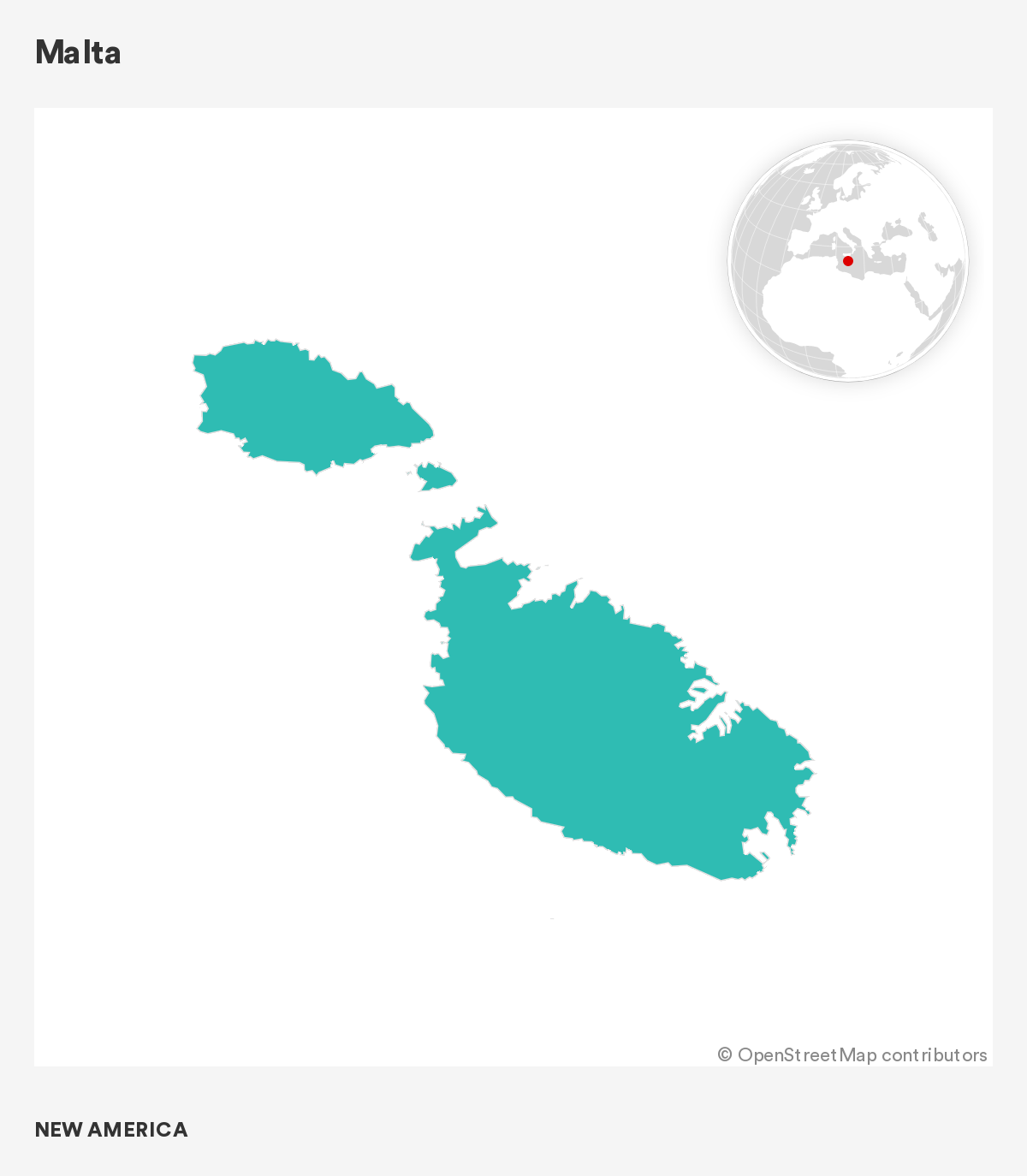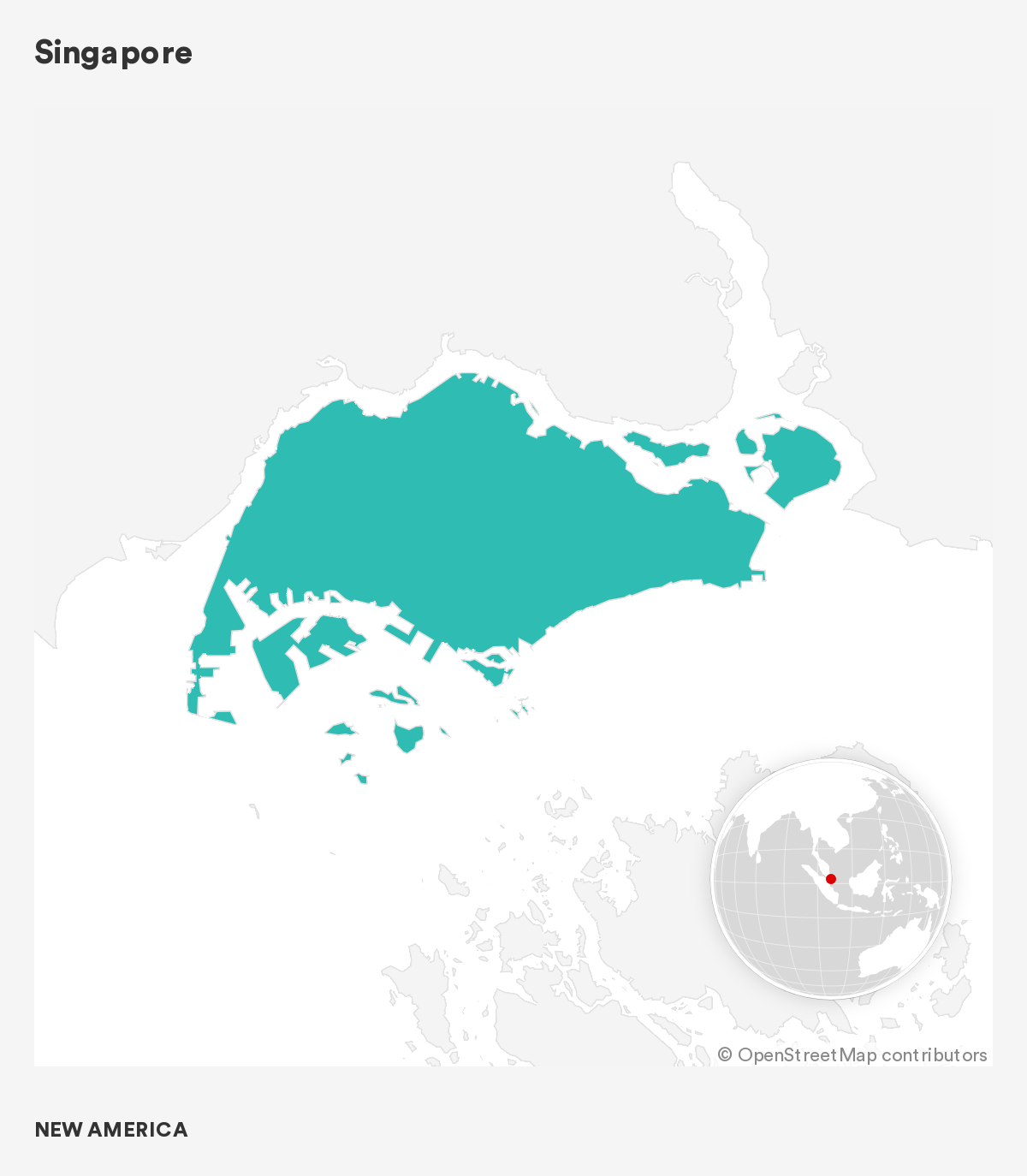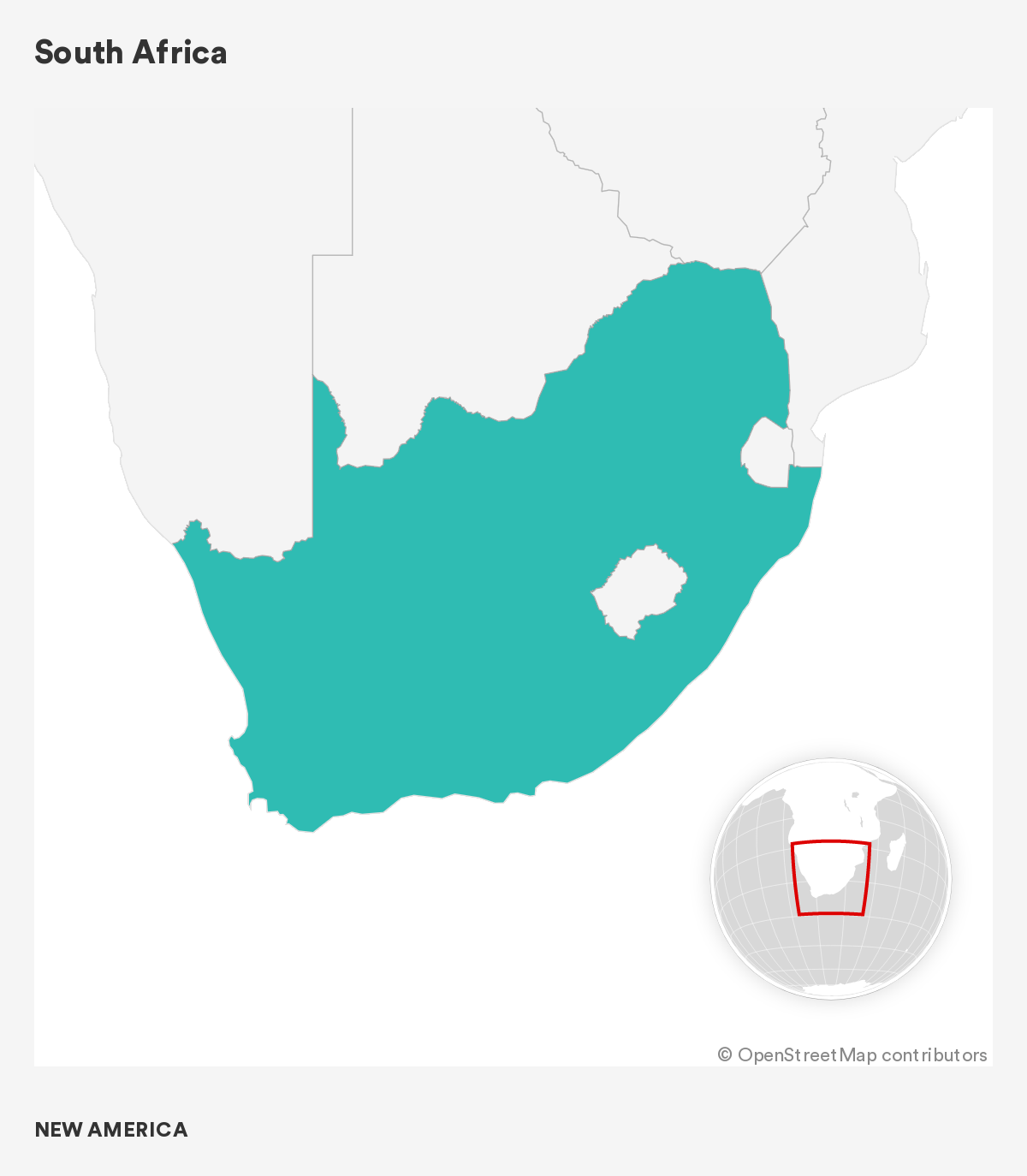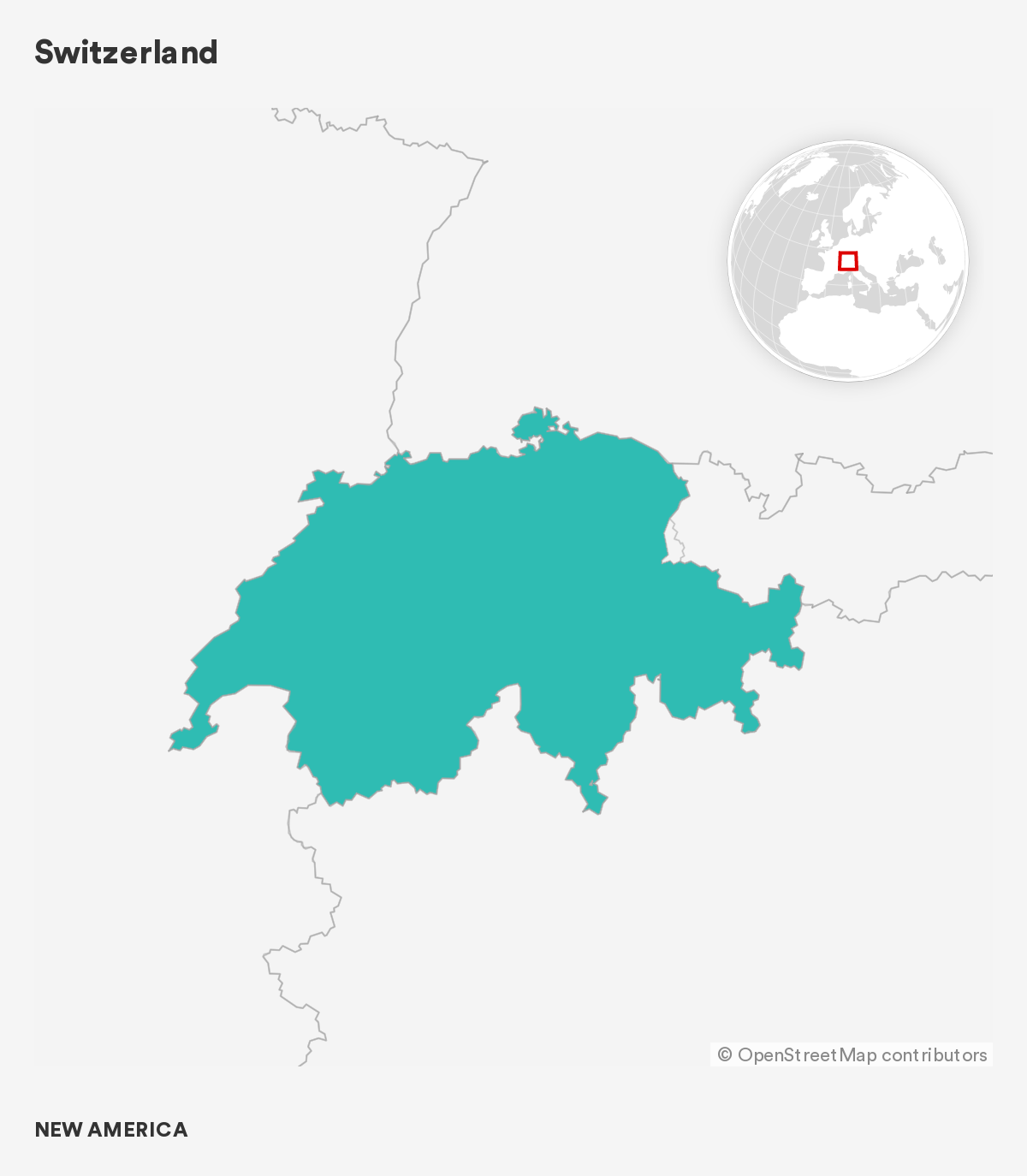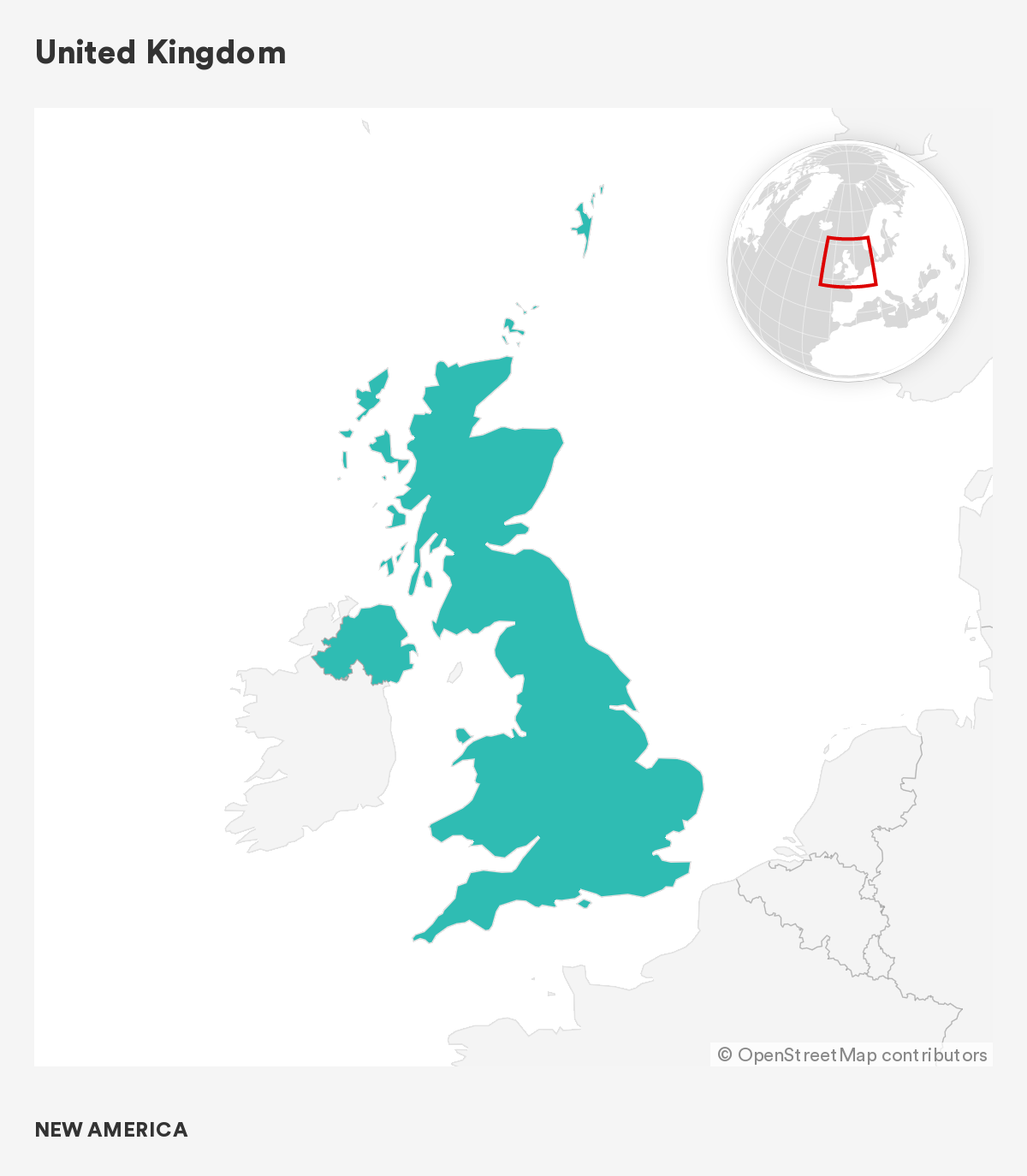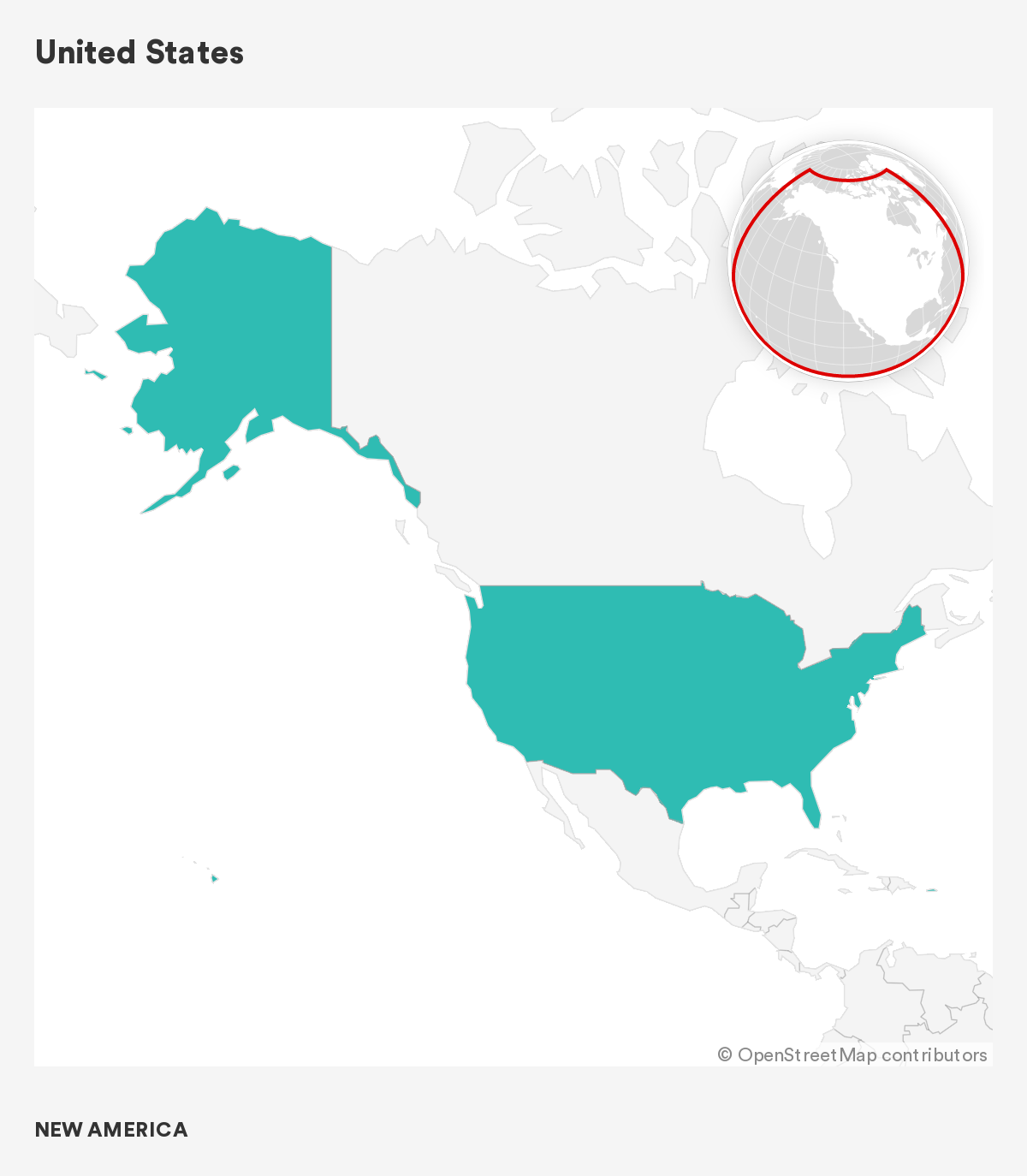
Virtual Currency Donations
Table of Contents
- Executive Summary
- Introduction
- About Our Organizations
- Methodology and Terminology
- First Principles of Civil Society
- Blockchain and Digital Currency
- Use Cases
- Key Findings
- Other Findings
- Conclusion
- Appendix 1: Virtual Currency Terminology
- Appendix 2: International Highlights
- Appendix 3: Australia
- Appendix 4: Bermuda
- Appendix 5: Canada
- Appendix 6: Denmark
- Appendix 7: Malta
- Appendix 8: Singapore
- Appendix 9: South Africa
- Appendix 10: Switzerland
- Appendix 11: United Kingdom
- Appendix 12: United States
Abstract
This report, assembled by the Blockchain Trust Accelerator at New America with the support of the International Center for Not-for-Profit Law, assesses opportunities and obstacles in charitable donations of virtual currencies, and aims to bring civil society organizations, would-be virtual currency donors, and policymakers up to speed on the emerging trends across a number of different countries. In approaching this topic, we sought to answer a fundamental question: Can a civil society organization accept donations in virtual currencies—and, if so, how? We brought together an interdisciplinary team of public policy scholars, nonprofit experts, and attorneys to create an international survey of how different jurisdictions are regulating virtual currency donations. The results span 10 countries across five different continents: Australia, Bermuda, Canada, Denmark, Malta, Singapore, South Africa, Switzerland, United Kingdom, and the United States.
Acknowledgments
Contributors
Allison Price, Senior Advisor, Digital Impact and Governance Initiative and Blockchain Trust Accelerator

Ben Gregori, Policy Analyst, Digital Impact and Governance Initiative and Blockchain Trust Accelerator
John Miller, Legal Researcher, Blockchain Trust Accelerator
Jordan Sandman, Program Assistant, Digital Impact and Governance Initiative and Blockchain Trust Accelerator
Technical Support
Joe Wilkes, Media Relations Assistant, New America
Naomi Morduch Toubman, Data Visualization Developer/Designer, New America
This report is made possible by the generous support of the International Center for Not-for-Profit Law (ICNL). We are grateful for their support, and for the opportunity to work with Doug Rutzen, Julie Hunter, and the ICNL team.
The contents are the responsibility of the authors and do not necessarily reflect the views of ICNL.
Downloads
Executive Summary
In the wake of the 2020 Coronavirus outbreak, the Italian Red Cross (IRC) launched a virtual-currency fundraising campaign with a goal of raising at least €10,000 to purchase and set up an advanced medical post for pre-triage of COVID-19 cases.1 Virtual currency donations poured in. In three days, the IRC met its fundraising goal; in a week the organization nearly doubled it, receiving 50 different bitcoin donations—nearly all from anonymous or pseudonymous sources.2 Ten days later, the IRC launched a second fundraising initiative.3 This and other examples of virtual-currency charitable giving are emblematic of how donations in virtual currencies like bitcoin can impact civil society organizations (CSOs).4
On the other hand, virtual currency donations create new legal challenges around how charities, donors, and regulators should receive, solicit, report, and appraise these donations. Not all of these questions have clear answers; multiple bodies of law often overlap, and the novelty and complexity of some of these technologies has led lawmakers and regulators to take a wait-and-see approach, which has further accentuated existing gray areas.
This report, assembled by the Blockchain Trust Accelerator at New America with the support of the International Center for Not-For-Profit Law, assesses opportunities and obstacles in charitable donations of virtual currencies, and aims to bring CSOs, would-be virtual currency donors, and policymakers up to speed on the emerging trends across a number of different countries. In approaching this topic, we sought to answer a fundamental question: Can a civil society organization accept donations in virtual currencies—and, if so, how? We brought together an interdisciplinary team of public policy scholars, nonprofit experts, and attorneys to create an international survey of how different jurisdictions are regulating virtual currency donations. The results span 10 countries across five different continents: Australia, Bermuda, Canada, Denmark, Malta, Singapore, South Africa, Switzerland, United Kingdom, and the United States.
In approaching this topic, we sought to answer a fundamental question: Can a civil society organization accept donations in virtual currencies—and, if so, how?
Key Findings
As of May 2020, regulators worldwide are still relatively early on in their efforts to develop frameworks around virtual currencies. In the specific context of charities, the legal implications and practical applications are even more nascent. But even at this juncture, we see charities accepting virtual currencies in ways that advance their missions, adhere to best practices, and comply with the law. In many instances, virtual currency donations can be squared with existing laws—be they tax, charitable regulations, anti-money laundering measures, or complex combinations thereof. In some areas, charities and donors would benefit from further adaptation or clarification of the law. But under all circumstances, regulators should continue to allow for the reasonable application of law to virtual currency donations and consider the potential benefits they may have on civil society expansion, innovation, and the advancement of the public interest.
More broadly, while there has not been a concerted effort to catalog those donations—in part because they are frequently pseudonymous and challenging to track—our research found over USD $200 million in publicly-recorded donations of virtual currency. This $200 million is both a significant figure on its own and yet still a relatively small figure compared to total annual charitable donations, which are estimated to reach over $400 billion in the United States alone.5
In our research across ten countries, we also observed several broad regulatory trends:
- A wait-and-see approach has led to few or no regulations specific to virtual currency charitable donations, and little momentum towards banning them.
- Overlapping and sometimes conflicting bodies of virtual currency regulation or guidance, which complicates matters for charities and donors alike.
- The bulk of regulators’ attention in the virtual currency space has been focused on protecting consumers, investigating the issuance, sale, and promotion of digital tokens via “initial coin offerings” (ICOs), and prosecuting related scams.
- Some jurisdictions, such as Malta and Singapore, have attempted to position themselves as especially friendly to virtual currency activities and innovation; other bodies, such as the EU, have increasingly tightened regulations for virtual currency companies in a manner that could impede entrepreneurship and drive innovation elsewhere.
- To the extent charitable organizations can accept anonymous donations consistent with existing “know your customer” (KYC) or anti-money laundering (AML) guidelines, we found they should generally be able to continue to accept anonymous donations made using virtual currencies. In some countries, such as South Africa, is it not clear that AML/KYC rules apply to virtual currencies at all.
- A number of countries are exploring the issuance of their own sovereign virtual currency, often known as a Central Bank Digital Currency (CBDC). Depending on how they are designed and where they are launched, CBDCs could be given to a charity (anonymously or not), much like cash or a check today, and may eventually become as attractive a medium of donation as alternative virtual currencies.
Best Practices
Charities and CSOs interested in collecting virtual currency donations should generally adhere to guidelines for the acceptance of other non-cash donations. When in doubt, document (the value and means of donation), disclose (to tax authorities and regulators in compliance with appropriate laws, erring on the side of more disclosure rather than less), or decline the contribution (if there are serious concerns about a conflict of interest or donor motives). Charities starting to accept virtual currencies may also consider partnering with domestic, regulated virtual currency exchanges and/or custodians, in order to streamline processes around asset acceptance, custody, and liquidation.
For donors of virtual currency, best practices are similar to those applicable to donations of equity or property. If donors wish their donations to be tax-benefited, that usually requires giving to a tax-exempt domestic civil society organization (located in the same country as the donor), documenting the donation with a receipt from the charity, and claiming a tax benefit for the donor that year (often in the form of a deduction or a tax credit). As a rule of thumb, donors of higher amounts of virtual currencies hoping to receive tax benefits should obtain at least one independent, written appraisal of the value of their virtual currency donations and retain receipts of the donations.
For policymakers and regulators, putting forth consistent virtual-currency-specific tax and donation-compliance guidance could ease uncertainty and encourage more virtual currency donations. Direct engagement among regulators, industry, civil society, and consumers is often fruitful as well. In addition to less formal regulatory tools—like issuing non-binding guidance, conferring with virtual currency businesses, civil society, and consumers, and improving policy coordination—policymakers should continue to advance black letter law, like regulations, statutes, and case law, that would help both donors and recipient organizations alike in facilitating donations that are compliant with existing law and appropriately tax-benefited, where applicable.
Looking Forward
Charities, policymakers, and the citizenry they serve should continue to proactively engage one another and assess where and how the adoption or acceptance of virtual currency can, in fact, advance the public interest. We believe there is ample opportunity for additional research and public consultation on these topics. Among the questions for further inquiry: How should charities accept and custody virtual currency donations—and more generally, should policymakers develop regulations for virtual currency custodians and exchanges that more closely adhere to requirements placed on traditional banks, such as asset reserve requirements, deposit assurances, and regular audits of their holdings? Could regulators, policymakers, and/or researchers play a role in advising charities on these questions, including through the circulation of more detailed best practices, demonstrations, and explanations of security measurements and trade-offs?
We look forward to continuing engagement on these issues by key stakeholders. We hope this research can bring us closer to a world in which virtual currencies best help charities promote the public good.
Citations
- See COVID-19 Advanced Medical Post for Pre-Triage in Italy, Helperbit (started Mar. 12, 2020), source; See also, Felipe Erazo, Italian Red Cross Launches Bitcoin Fundraiser to Combat Coronavirus, CoinTelegraph (Mar. 14, 2020), source
- A Bitcoin transaction “is ‘pseudonymous’ (or partially anonymous) in that an individual is identified by an alpha-numeric public key/address[.]” Commodity Futures Trading Commission, A CFTC Primer on Virtual Currencies, LabCFTC (Oct 17, 2017) source at 5; See also generally, Assistant Professor Abhishek Jain, Lecture 9: Anonymity in Cryptocurrencies, John Hopkins University Computer Science Department CS 601.641/441: Blockchains and Cryptocurrencies (Spring 2018) source
- Samuel Haig, Italian Red Cross Coronavirus Bitcoin Fundraiser Smashes Goal, Issues New Initiative, Cointelegraph (Mar. 22, 2020), source
- While we use the umbrella term “CSOs,” we are referring mainly to organizations commonly called “charities,” encompassing organizations that are typically eligible for tax-benefited donations, although we recognize that in many countries the term “charity” has a specific legal meaning. Charities are often considered a subset of CSOs, but not all CSOs are charities. See, e.g., Marion R. Fremont-Smith, The Legal Meaning of Charity, Urban Institute Center on Nonprofits and Philanthropy (Apr. 2013) source (describing the legal meaning of “charity” in the United States); Charity Commission for England and Wales, What makes a charity (CC4) (Sept. 2013) source (outlining “what the law in England and Wales says a charity is”).
- Giving USA, Giving USA 2019: Americans gave $427.71 billion to charity in 2018 amid complex year fro charitable giving (June 18, 2019) source
Introduction
The report is conveyed as an analysis of public policy and international trends and does not offer or constitute legal advice. Do not rely solely upon this report for making or receiving donations or for any other purpose. Please confer with a local attorney, tax specialist, financial advisor, and/or other licensed professionals before making an individualized decision about virtual currencies, donations, or other matters.
In December 2017, the New York Times reported on an unusual act of generosity: A single pseudonymous donor going by the name “Pine” announced that they were an early adopter of Bitcoin, now looking to contribute millions of dollars' worth of Bitcoin to charities. Pine received almost 10,000 applications appealing to various charitable causes and listed the recipients and amounts of their donations in a transparent and timely fashion. By the time they were done, Pine had given over $55 million worth of Bitcoin to approximately 60 different charities.6
The example of Pine’s charitable Bitcoin giving is emblematic of how Bitcoin and other virtual currencies will impact civil society organizations. On one hand, there is a great opportunity: Charities could attract more resources through tax-benefited donations, they may be able to more easily receive donations with high speed, low transaction costs, easy auditability, and from pseudonymous or anonymous donors. Virtual currencies could allow civil society organizations to develop new models for distributing resources directly and quickly to beneficiaries. At a higher level, the meteoric rise of virtual currencies is also intertwined with matters of public interest such as financial inclusion, censorship resistance, privacy, and decentralization of power. Simultaneously, central banks are increasingly exploring state-created, and potentially more value-stable, forms of virtual currency.
Virtual currencies could allow civil society organizations to develop new models for distributing resources directly and quickly to beneficiaries.
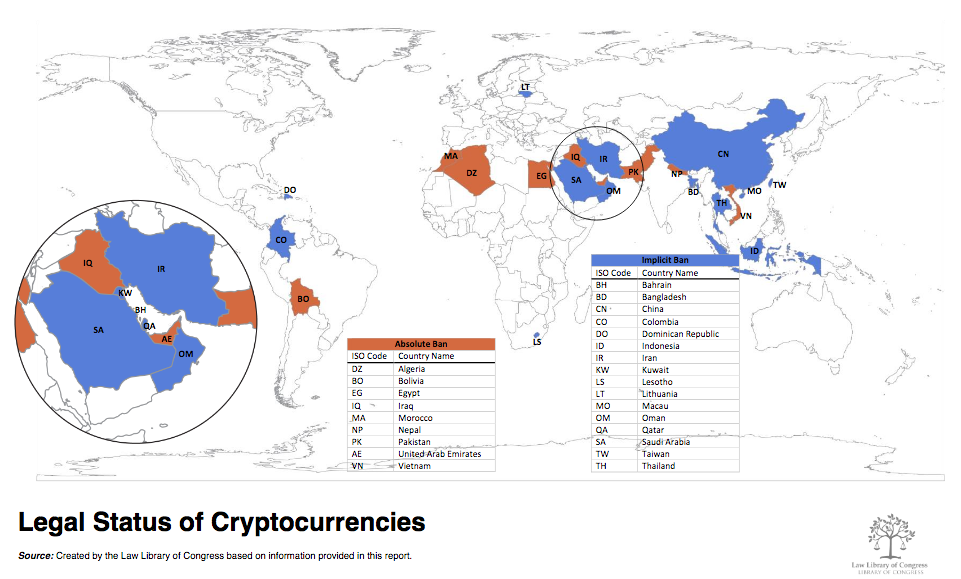
On the other hand, charitable donations of virtual currencies also present challenges: Legally speaking, there are questions about how and whether charities and donors should make, receive, solicit, report, and appraise virtual currency donations. Not all of these questions have clear answers. Multiple bodies of law apply in oft-overlapping ways in each country (and in some instances, within states or provinces). The novelty and complexity of these technologies have led many lawmakers and regulators to take a wait-and-see approach to rulemaking, which further accentuates existing gray areas. More generally, virtual currencies can also raise public policy questions around consumer protection, money laundering, tax evasion, and terrorist financing. In the absence of clear guidance, some jurisdictions—such as Algeria, Egypt, Nepal, and Pakistan—have explicitly banned the use of virtual currencies by private citizens and civil society organizations.7 Another challenge virtual currency donations have faced is steep declines in value among swaths of the virtual currency market since 2017, and, in some cases, extreme price volatility and allegations of market manipulation.8
As an overarching approach, we sought to answer a fundamental question: can a civil society organization accept donations in virtual currencies—and, if so, how?
This report assesses core opportunities and obstacles in charitable donations of virtual currencies, and aims to bring charities, would-be virtual currency donors, and policymakers alike up to speed on the emerging trends across a number of different countries surveyed. Just as the laws in many countries surrounding virtual currencies are still evolving, this report and accompanying appendices are offered as a living document. At the same time, we hope this research provides some clarity on accepting virtual currency donations and balancing various regulatory priorities. We view comparative analysis as a first and necessary step in helping regulators revisit, revise, and develop legal and regulatory frameworks that will leverage the strengths of virtual currencies and distributed ledger technology.
As of early 2020, countries worldwide are still in a relatively early phase for virtual currencies—whether it is Bitcoin, alternative forms of tokens, or central bank digital currencies. In the specific context of charities, the legal implications and practical applications are even more nascent. But even at this juncture, we see charities accepting virtual currencies in ways that advance their missions, adhere to best practices, and comply with the law. In many instances, virtual currency donations can be squared with existing laws—be it tax, charitable regulation, or anti-money laundering, or complex combinations thereof. In some areas, charities and donors would benefit from further adaptation or clarification of the law. But under all circumstances, regulators should continue to allow for the reasonable application of law to virtual currency donations and consider the potential benefits they may have on civil society expansion, innovation, and the advancement of the public interest.
Citations
- See COVID-19 Advanced Medical Post for Pre-Triage in Italy, Helperbit (started Mar. 12, 2020), source">source; See also, Felipe Erazo, Italian Red Cross Launches Bitcoin Fundraiser to Combat Coronavirus, CoinTelegraph (Mar. 14, 2020), source">source
- A Bitcoin transaction “is ‘pseudonymous’ (or partially anonymous) in that an individual is identified by an alpha-numeric public key/address[.]” Commodity Futures Trading Commission, A CFTC Primer on Virtual Currencies, LabCFTC (Oct 17, 2017) source">source at 5; See also generally, Assistant Professor Abhishek Jain, Lecture 9: Anonymity in Cryptocurrencies, John Hopkins University Computer Science Department CS 601.641/441: Blockchains and Cryptocurrencies (Spring 2018) source">source
- Samuel Haig, Italian Red Cross Coronavirus Bitcoin Fundraiser Smashes Goal, Issues New Initiative, Cointelegraph (Mar. 22, 2020), source">source
- While we use the umbrella term “CSOs,” we are referring mainly to organizations commonly called “charities,” encompassing organizations that are typically eligible for tax-benefited donations, although we recognize that in many countries the term “charity” has a specific legal meaning. Charities are often considered a subset of CSOs, but not all CSOs are charities. See, e.g., Marion R. Fremont-Smith, The Legal Meaning of Charity, Urban Institute Center on Nonprofits and Philanthropy (Apr. 2013) source">source (describing the legal meaning of “charity” in the United States); Charity Commission for England and Wales, What makes a charity (CC4) (Sept. 2013) source">source (outlining “what the law in England and Wales says a charity is”).
- Giving USA, Giving USA 2019: Americans gave $427.71 billion to charity in 2018 amid complex year fro charitable giving (June 18, 2019) source">source
- See Kevin Roose, Some Things About Tech Were Good in 2017. No, Really, The New York Times (Dec. 27, 2017), source ; Pineapple Fund, source (last accessed Jan. 23, 2020).
- See The Law Library of Congress, Global Legal Research Center, Regulation of Cryptocurrency Around the World (June 2018), source (listing the following nine countries as having an “Absolute Ban” on cryptocurrencies: Algeria, Bolivia, Egypt, Iraq, Morocco, Nepal, Pakistan, United Arab Emirates, Vietnam; another sixteen countries are listed as having an “Implicit Ban” on cryptocurrencies: Bahrain, Bangladesh, China, Colombia, Dominican Republican, Indonesia, Iran, Kuwait, Lesotho, Lithuania, Macau, Oman, Qatar, Saudi Arabia, Taiwan, Thailand.).
- See, e.g., Colin Wilhelm, New York AG raises flags over cryptocurrency manipulation, Politico (Sept. 18, 2018) source.
About Our Organizations
New America is committed to renewing American politics, prosperity, and purpose in the Digital Age. We generate big ideas, bridge the gap between technology and policy, and curate broad public conversation. We combine the best of a policy research institute, technology laboratory, public forum, media platform, and a venture capital fund for ideas. We are a distinctive community of thinkers, writers, researchers, technologists, and community activists who believe deeply in the possibility of American renewal.
The Blockchain Trust Accelerator (BTA) at New America is the world’s leading platform for harnessing blockchain technology to solve social impact and governance challenges. Established in 2016, BTA brings together governments, technologists, civil society organizations, and philanthropists to develop blockchain solutions that benefit society. BTA projects and research help organizations and institutions increase accountability, ensure transparency, create opportunity, and build trust in core institutions.
This report was made possible by a grant from the International Center for Not-for-Profit Law (ICNL). The International Center for Not-for-Profit Law works to improve the legal environment for civil society, philanthropy, and public participation in over 100 countries. ICNL works with partners from civil society, government, and the international community, developing long-term relationships to advance reforms. As the only global organization focused on the laws affecting civil society, philanthropy, and public participation, ICNL provides unique expertise.
Citations
- See COVID-19 Advanced Medical Post for Pre-Triage in Italy, Helperbit (started Mar. 12, 2020), <a href="source">source">source; See also, Felipe Erazo, Italian Red Cross Launches Bitcoin Fundraiser to Combat Coronavirus, CoinTelegraph (Mar. 14, 2020), <a href="source">source">source
- A Bitcoin transaction “is ‘pseudonymous’ (or partially anonymous) in that an individual is identified by an alpha-numeric public key/address[.]” Commodity Futures Trading Commission, A CFTC Primer on Virtual Currencies, LabCFTC (Oct 17, 2017) <a href="source">source">source at 5; See also generally, Assistant Professor Abhishek Jain, Lecture 9: Anonymity in Cryptocurrencies, John Hopkins University Computer Science Department CS 601.641/441: Blockchains and Cryptocurrencies (Spring 2018) <a href="source">source">source
- Samuel Haig, Italian Red Cross Coronavirus Bitcoin Fundraiser Smashes Goal, Issues New Initiative, Cointelegraph (Mar. 22, 2020), <a href="source">source">source
- While we use the umbrella term “CSOs,” we are referring mainly to organizations commonly called “charities,” encompassing organizations that are typically eligible for tax-benefited donations, although we recognize that in many countries the term “charity” has a specific legal meaning. Charities are often considered a subset of CSOs, but not all CSOs are charities. See, e.g., Marion R. Fremont-Smith, The Legal Meaning of Charity, Urban Institute Center on Nonprofits and Philanthropy (Apr. 2013) <a href="source">source">source (describing the legal meaning of “charity” in the United States); Charity Commission for England and Wales, What makes a charity (CC4) (Sept. 2013) <a href="source">source">source (outlining “what the law in England and Wales says a charity is”).
- Giving USA, Giving USA 2019: Americans gave $427.71 billion to charity in 2018 amid complex year fro charitable giving (June 18, 2019) <a href="source">source">source
- See Kevin Roose, Some Things About Tech Were Good in 2017. No, Really, The New York Times (Dec. 27, 2017), source">source ; Pineapple Fund, source">source (last accessed Jan. 23, 2020).
- See The Law Library of Congress, Global Legal Research Center, Regulation of Cryptocurrency Around the World (June 2018), source">source (listing the following nine countries as having an “Absolute Ban” on cryptocurrencies: Algeria, Bolivia, Egypt, Iraq, Morocco, Nepal, Pakistan, United Arab Emirates, Vietnam; another sixteen countries are listed as having an “Implicit Ban” on cryptocurrencies: Bahrain, Bangladesh, China, Colombia, Dominican Republican, Indonesia, Iran, Kuwait, Lesotho, Lithuania, Macau, Oman, Qatar, Saudi Arabia, Taiwan, Thailand.).
- See, e.g., Colin Wilhelm, New York AG raises flags over cryptocurrency manipulation, Politico (Sept. 18, 2018) source">source.
Methodology and Terminology
The creation of this report involved a variety of methods. We brought together an interdisciplinary team of public policy scholars, nonprofit experts, and attorneys to create an international survey on how 10 countries across five different continents regulate virtual currency donations: Australia, Bermuda, Canada, Denmark, Malta, Singapore, South Africa, Switzerland, United Kingdom, and the United States.9 We engaged outside legal counsel and examined a wide range of primary and secondary sources, including regulation, scholarship, and legal commentary. Specifically, we consistently examined a series of detailed research questions across seven categories:
- Use cases
- Acceptance of donations of virtual currency
- Asset class, valuation, and tax issues
- Anti-money laundering (AML) and combating the financing of terrorism (CFT) measures
- Holding/liquidation
- Risks
- Other relevant (or emerging) legal issues, questions, or regulatory measures
Additionally, we researched and quantified existing use cases of virtual currency donations, namely through public sources of reporting and financial documents. New America drew upon its existing expertise, staff, and resources in areas such as blockchain, nonprofit regulation, tax law, and civil society, including past interactions with policymakers in foreign ministries, tax authorities, and securities agencies across a number of countries. We also conferred with select outside experts and showed them earlier drafts of our findings.10
This report assumes a fair degree of familiarity with terminology around taxation and virtual currencies. We generally use the term "tax-benefited" to mean the organization, and/or donations to it, offers some advantage to tax liability, such as tax exemption or an allowable donation deduction or credit on a tax return for the donor.11 Consistent with the European Union’s Fifth Anti-Money Laundering Directive (AMLD5), we use the term “virtual currency” (e.g. in lieu of “digital currency,” “cryptocurrency,” or “token”), broadly defined as “a digital representation of value that is not issued or guaranteed by a central bank or a public authority, is not necessarily attached to a legally established currency but is accepted by natural or legal persons as a means of exchange, and which can be transferred, stored or traded electronically.”12 Appendix 1 contains a list of key terminology pertaining to virtual currency technology. Throughout, we use the term civil society organizations (CSOs) expansively, consistent with the U.N. Development Program as including “all non-market and non-state organizations outside of the family in which people organize themselves to pursue shared interests in the public domain,"13 but our primary research focus is on organizations that are tax-exempt and offer some tax benefit to donors. While we refer to "CSOs" and "charities" often interchangeably in this report, we recognize that the term "CSOs" also includes some organizations for which donations might not normally be tax benefited, such as labor unions and professional or trade associations. The precise definition, regulation, and tax benefits of CSOs differ among nations.14
Citations
- See COVID-19 Advanced Medical Post for Pre-Triage in Italy, Helperbit (started Mar. 12, 2020), <a href="<a href="source">source">source">source; See also, Felipe Erazo, Italian Red Cross Launches Bitcoin Fundraiser to Combat Coronavirus, CoinTelegraph (Mar. 14, 2020), <a href="<a href="source">source">source">source
- A Bitcoin transaction “is ‘pseudonymous’ (or partially anonymous) in that an individual is identified by an alpha-numeric public key/address[.]” Commodity Futures Trading Commission, A CFTC Primer on Virtual Currencies, LabCFTC (Oct 17, 2017) <a href="<a href="source">source">source">source at 5; See also generally, Assistant Professor Abhishek Jain, Lecture 9: Anonymity in Cryptocurrencies, John Hopkins University Computer Science Department CS 601.641/441: Blockchains and Cryptocurrencies (Spring 2018) <a href="<a href="source">source">source">source
- Samuel Haig, Italian Red Cross Coronavirus Bitcoin Fundraiser Smashes Goal, Issues New Initiative, Cointelegraph (Mar. 22, 2020), <a href="<a href="source">source">source">source
- While we use the umbrella term “CSOs,” we are referring mainly to organizations commonly called “charities,” encompassing organizations that are typically eligible for tax-benefited donations, although we recognize that in many countries the term “charity” has a specific legal meaning. Charities are often considered a subset of CSOs, but not all CSOs are charities. See, e.g., Marion R. Fremont-Smith, The Legal Meaning of Charity, Urban Institute Center on Nonprofits and Philanthropy (Apr. 2013) <a href="<a href="source">source">source">source (describing the legal meaning of “charity” in the United States); Charity Commission for England and Wales, What makes a charity (CC4) (Sept. 2013) <a href="<a href="source">source">source">source (outlining “what the law in England and Wales says a charity is”).
- Giving USA, Giving USA 2019: Americans gave $427.71 billion to charity in 2018 amid complex year fro charitable giving (June 18, 2019) <a href="<a href="source">source">source">source
- See Kevin Roose, Some Things About Tech Were Good in 2017. No, Really, The New York Times (Dec. 27, 2017), <a href="source">source">source ; Pineapple Fund, <a href="source">source">source (last accessed Jan. 23, 2020).
- See The Law Library of Congress, Global Legal Research Center, Regulation of Cryptocurrency Around the World (June 2018), <a href="source">source">source (listing the following nine countries as having an “Absolute Ban” on cryptocurrencies: Algeria, Bolivia, Egypt, Iraq, Morocco, Nepal, Pakistan, United Arab Emirates, Vietnam; another sixteen countries are listed as having an “Implicit Ban” on cryptocurrencies: Bahrain, Bangladesh, China, Colombia, Dominican Republican, Indonesia, Iran, Kuwait, Lesotho, Lithuania, Macau, Oman, Qatar, Saudi Arabia, Taiwan, Thailand.).
- See, e.g., Colin Wilhelm, New York AG raises flags over cryptocurrency manipulation, Politico (Sept. 18, 2018) <a href="source">source">source.
- These nations were selected to encompass various geographies, sizes of countries, and involvement with charitable giving, while still having a fairly developed set of laws that is generally translated and freely published.
- Special thanks to Joe Waltman, who reviewed earlier drafts of this document and provided critical expertise on local regulations and developments.
- See, e.g., Julia Kagan, What is a Tax Benefit?, Investopedia (May 8, 2018)
- Directive (EU) 2018/843 of the European Parliament and of the Council of 30 May 2018 amending Directive (EU) 2015/849 on the prevention of the use of the financial system for the purposes of money laundering or terrorist financing, and amending Directives 2009/138/EC and 2013/36/EU, Article I(d), source
- See, e.g., United Nations Development Programme, Annex 1: NGOs and CSOs: A Note on Terminology, 123 source (quoting the definition put forward by the 2007-2008 Advisory Group on CSOs and Aid Effectiveness, now adopted by OECD DAC).
- See infra at n.__[4].
First Principles of Civil Society
To achieve the right balance between encouraging private support for public problem-solving and ensuring that organizations—and the funds they raise and spend—are indeed serving the public interest, vibrant democracies regulate civil society organizations through tax exemption and beyond. Civil society is also subject to a variety of generally applicable regulations and specific laws, for example, about the registration of new corporate entities or the strictures of employment law. Across the world, many legislatures have gone beyond simply encouraging charitable donations: most effectively subsidize them, for example by allowing donors to receive a tax benefit and exempting CSOs from taxation. In return, lawmakers typically require CSOs to follow certain practices of transparency, accountability, AML compliance, and reporting. We conclude that policymakers can develop regulatory frameworks that maintain each of these principles without halting the growth of virtual currencies and associated donations.
In modern charitable giving, the vast majority of private capital that has been donated in support of public interest issues has been in the form of cash donations (fiat donations via checks, wire transfers, online donations, etc.). In addition, donations of non-cash assets—stocks, land, art, etc.—also can be a source of funding for some CSOs. In addition, new philanthropic models have developed, such as fiscal sponsorship arrangements, that permit support of a broader array of charitable projects, including those housed in non-charities or in foreign entities, in a tax advantageous way.
Against that backdrop, this project is designed to help regulators and donors better understand how best to apply existing rules governing charitable giving amid the new wealth and opportunities presented by virtual currencies and emerging technologies.15
Citations
- See COVID-19 Advanced Medical Post for Pre-Triage in Italy, Helperbit (started Mar. 12, 2020), <a href="<a href="<a href="source">source">source">source">source; See also, Felipe Erazo, Italian Red Cross Launches Bitcoin Fundraiser to Combat Coronavirus, CoinTelegraph (Mar. 14, 2020), <a href="<a href="<a href="source">source">source">source">source
- A Bitcoin transaction “is ‘pseudonymous’ (or partially anonymous) in that an individual is identified by an alpha-numeric public key/address[.]” Commodity Futures Trading Commission, A CFTC Primer on Virtual Currencies, LabCFTC (Oct 17, 2017) <a href="<a href="<a href="source">source">source">source">source at 5; See also generally, Assistant Professor Abhishek Jain, Lecture 9: Anonymity in Cryptocurrencies, John Hopkins University Computer Science Department CS 601.641/441: Blockchains and Cryptocurrencies (Spring 2018) <a href="<a href="<a href="source">source">source">source">source
- Samuel Haig, Italian Red Cross Coronavirus Bitcoin Fundraiser Smashes Goal, Issues New Initiative, Cointelegraph (Mar. 22, 2020), <a href="<a href="<a href="source">source">source">source">source
- While we use the umbrella term “CSOs,” we are referring mainly to organizations commonly called “charities,” encompassing organizations that are typically eligible for tax-benefited donations, although we recognize that in many countries the term “charity” has a specific legal meaning. Charities are often considered a subset of CSOs, but not all CSOs are charities. See, e.g., Marion R. Fremont-Smith, The Legal Meaning of Charity, Urban Institute Center on Nonprofits and Philanthropy (Apr. 2013) <a href="<a href="<a href="source">source">source">source">source (describing the legal meaning of “charity” in the United States); Charity Commission for England and Wales, What makes a charity (CC4) (Sept. 2013) <a href="<a href="<a href="source">source">source">source">source (outlining “what the law in England and Wales says a charity is”).
- Giving USA, Giving USA 2019: Americans gave $427.71 billion to charity in 2018 amid complex year fro charitable giving (June 18, 2019) <a href="<a href="<a href="source">source">source">source">source
- See Kevin Roose, Some Things About Tech Were Good in 2017. No, Really, The New York Times (Dec. 27, 2017), <a href="<a href="source">source">source">source ; Pineapple Fund, <a href="<a href="source">source">source">source (last accessed Jan. 23, 2020).
- See The Law Library of Congress, Global Legal Research Center, Regulation of Cryptocurrency Around the World (June 2018), <a href="<a href="source">source">source">source (listing the following nine countries as having an “Absolute Ban” on cryptocurrencies: Algeria, Bolivia, Egypt, Iraq, Morocco, Nepal, Pakistan, United Arab Emirates, Vietnam; another sixteen countries are listed as having an “Implicit Ban” on cryptocurrencies: Bahrain, Bangladesh, China, Colombia, Dominican Republican, Indonesia, Iran, Kuwait, Lesotho, Lithuania, Macau, Oman, Qatar, Saudi Arabia, Taiwan, Thailand.).
- See, e.g., Colin Wilhelm, New York AG raises flags over cryptocurrency manipulation, Politico (Sept. 18, 2018) <a href="<a href="source">source">source">source.
- These nations were selected to encompass various geographies, sizes of countries, and involvement with charitable giving, while still having a fairly developed set of laws that is generally translated and freely published.
- Special thanks to Joe Waltman, who reviewed earlier drafts of this document and provided critical expertise on local regulations and developments.
- See, e.g., Julia Kagan, What is a Tax Benefit?, Investopedia (May 8, 2018)
- Directive (EU) 2018/843 of the European Parliament and of the Council of 30 May 2018 amending Directive (EU) 2015/849 on the prevention of the use of the financial system for the purposes of money laundering or terrorist financing, and amending Directives 2009/138/EC and 2013/36/EU, Article I(d), source">source
- See, e.g., United Nations Development Programme, Annex 1: NGOs and CSOs: A Note on Terminology, 123 source">source (quoting the definition put forward by the 2007-2008 Advisory Group on CSOs and Aid Effectiveness, now adopted by OECD DAC).
- See infra at n.__[4].
- See, e.g., David Lehr & Paul Lamb, Digital Currencies and Blockchain in the Social Sector, Stanford Social Innovation Review (Jan. 18, 2018), source ; Stanford Graduate School of Business Center for Social Innovation and Rippleworks et al., Blockchain For Social Impact: Moving Beyond The Hype, source
Blockchain and Digital Currency
Digital assets and digital currency are based on blockchain technology. Blockchain is a record-keeping system with two important attributes: First, information stored via blockchain is distributed, with copies spread across multiple computers. This redundancy helps safeguard the accuracy and authenticity of the record and makes it extremely difficult to manipulate information stored in the system. Second, blockchain-based records are designed to be permanent. They are easy to update, but exceptionally hard to erase. Beginning with the advent of Bitcoin in 2008, technologists have been using blockchain to create highly secure digital ledgers as a mechanism for tracking and verifying ownership of digital assets such as virtual currency.
Blockchain and digital assets remain frontier technologies, but they provide the foundation for a rapidly growing number of applications related to philanthropy and social impact. Readers looking for additional background on the use of blockchain in public interest applications may want to consult the Blueprint for Blockchain and Social Innovation and the Blockchain Impact Ledger. These resources address a broad range of questions surrounding the technology and its current use in the social and public sectors.
Citations
- See COVID-19 Advanced Medical Post for Pre-Triage in Italy, Helperbit (started Mar. 12, 2020), <a href="<a href="<a href="<a href="source">source">source">source">source">source; See also, Felipe Erazo, Italian Red Cross Launches Bitcoin Fundraiser to Combat Coronavirus, CoinTelegraph (Mar. 14, 2020), <a href="<a href="<a href="<a href="source">source">source">source">source">source
- A Bitcoin transaction “is ‘pseudonymous’ (or partially anonymous) in that an individual is identified by an alpha-numeric public key/address[.]” Commodity Futures Trading Commission, A CFTC Primer on Virtual Currencies, LabCFTC (Oct 17, 2017) <a href="<a href="<a href="<a href="source">source">source">source">source">source at 5; See also generally, Assistant Professor Abhishek Jain, Lecture 9: Anonymity in Cryptocurrencies, John Hopkins University Computer Science Department CS 601.641/441: Blockchains and Cryptocurrencies (Spring 2018) <a href="<a href="<a href="<a href="source">source">source">source">source">source
- Samuel Haig, Italian Red Cross Coronavirus Bitcoin Fundraiser Smashes Goal, Issues New Initiative, Cointelegraph (Mar. 22, 2020), <a href="<a href="<a href="<a href="source">source">source">source">source">source
- While we use the umbrella term “CSOs,” we are referring mainly to organizations commonly called “charities,” encompassing organizations that are typically eligible for tax-benefited donations, although we recognize that in many countries the term “charity” has a specific legal meaning. Charities are often considered a subset of CSOs, but not all CSOs are charities. See, e.g., Marion R. Fremont-Smith, The Legal Meaning of Charity, Urban Institute Center on Nonprofits and Philanthropy (Apr. 2013) <a href="<a href="<a href="<a href="source">source">source">source">source">source (describing the legal meaning of “charity” in the United States); Charity Commission for England and Wales, What makes a charity (CC4) (Sept. 2013) <a href="<a href="<a href="<a href="source">source">source">source">source">source (outlining “what the law in England and Wales says a charity is”).
- Giving USA, Giving USA 2019: Americans gave $427.71 billion to charity in 2018 amid complex year fro charitable giving (June 18, 2019) <a href="<a href="<a href="<a href="source">source">source">source">source">source
- See Kevin Roose, Some Things About Tech Were Good in 2017. No, Really, The New York Times (Dec. 27, 2017), <a href="<a href="<a href="source">source">source">source">source ; Pineapple Fund, <a href="<a href="<a href="source">source">source">source">source (last accessed Jan. 23, 2020).
- See The Law Library of Congress, Global Legal Research Center, Regulation of Cryptocurrency Around the World (June 2018), <a href="<a href="<a href="source">source">source">source">source (listing the following nine countries as having an “Absolute Ban” on cryptocurrencies: Algeria, Bolivia, Egypt, Iraq, Morocco, Nepal, Pakistan, United Arab Emirates, Vietnam; another sixteen countries are listed as having an “Implicit Ban” on cryptocurrencies: Bahrain, Bangladesh, China, Colombia, Dominican Republican, Indonesia, Iran, Kuwait, Lesotho, Lithuania, Macau, Oman, Qatar, Saudi Arabia, Taiwan, Thailand.).
- See, e.g., Colin Wilhelm, New York AG raises flags over cryptocurrency manipulation, Politico (Sept. 18, 2018) <a href="<a href="<a href="source">source">source">source">source.
- These nations were selected to encompass various geographies, sizes of countries, and involvement with charitable giving, while still having a fairly developed set of laws that is generally translated and freely published.
- Special thanks to Joe Waltman, who reviewed earlier drafts of this document and provided critical expertise on local regulations and developments.
- See, e.g., Julia Kagan, What is a Tax Benefit?, Investopedia (May 8, 2018)
- Directive (EU) 2018/843 of the European Parliament and of the Council of 30 May 2018 amending Directive (EU) 2015/849 on the prevention of the use of the financial system for the purposes of money laundering or terrorist financing, and amending Directives 2009/138/EC and 2013/36/EU, Article I(d), <a href="source">source">source
- See, e.g., United Nations Development Programme, Annex 1: NGOs and CSOs: A Note on Terminology, 123 <a href="source">source">source (quoting the definition put forward by the 2007-2008 Advisory Group on CSOs and Aid Effectiveness, now adopted by OECD DAC).
- See infra at n.__[4].
- See, e.g., David Lehr & Paul Lamb, Digital Currencies and Blockchain in the Social Sector, Stanford Social Innovation Review (Jan. 18, 2018), source">source ; Stanford Graduate School of Business Center for Social Innovation and Rippleworks et al., Blockchain For Social Impact: Moving Beyond The Hype, source">source
Use Cases
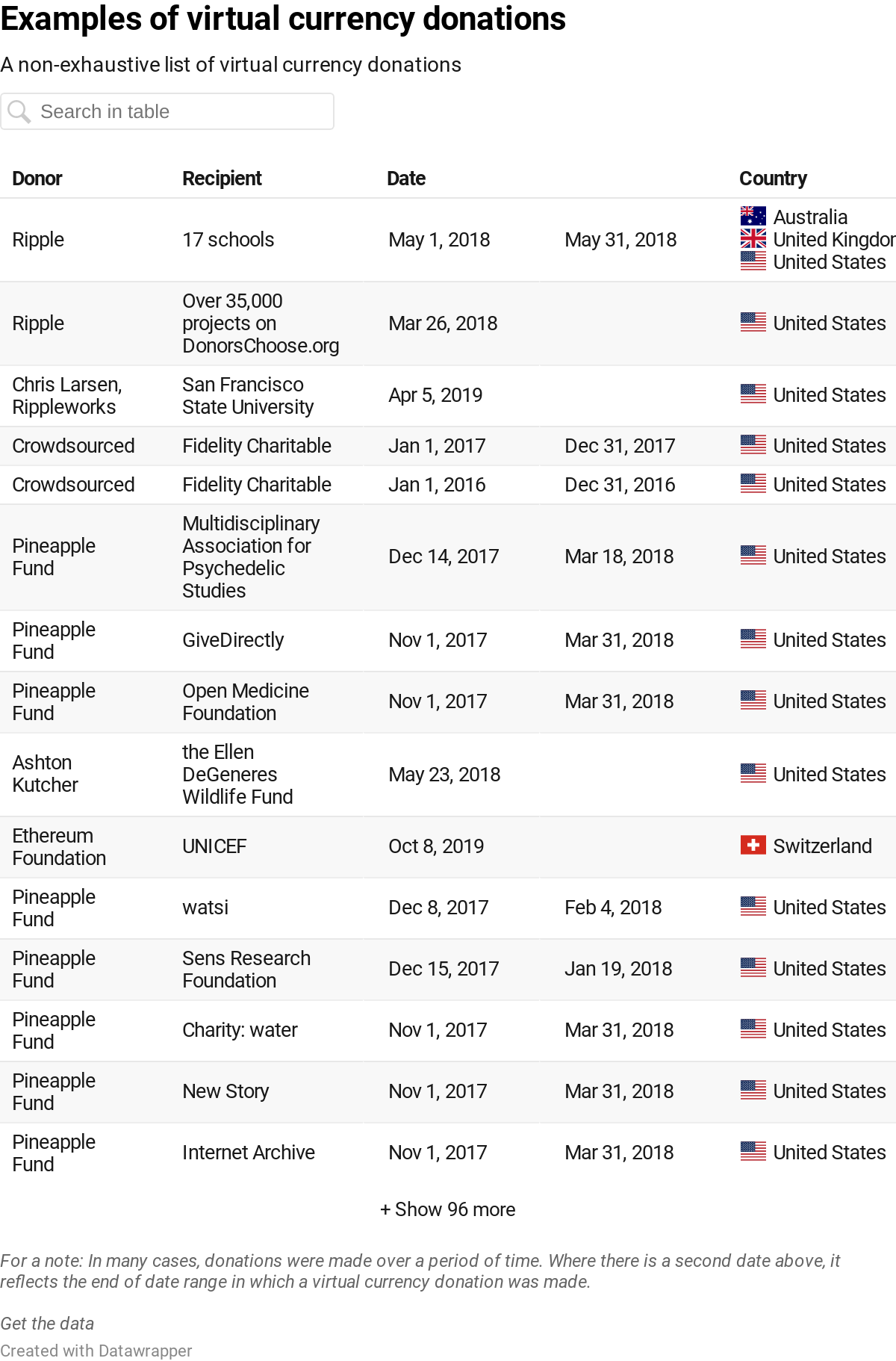
Individuals and companies that have profited from new asset classes can often make donations of these assets to CSOs. In the case of virtual currency, donors are occasionally embracing novel approaches in their gifts. In addition to the previously mentioned gifts to 60 charities from Pine, whose “Pineapple Fund” donated over $50 million worth of bitcoins,16 a virtual currency company donated the equivalent of $29 million to fund classroom projects listed on the education crowdfunding platform, DonorsChoose.17 These strategies are both intriguing and unconventional.
Smaller virtual currency donations from either individuals or organizations to their charities of choice are more common. For example, Fidelity Charitable reported $106 million in virtual currency donations since it started accepting these donations in 2015, including $30 million in 2018.18 All told, Fidelity Charitable estimates that in 2018 the United States saw over $1.3 billion in charitable donations of non-publicly traded assets, including virtual currencies, nearly three times more value than similar donations in 2014.19 Overall, however, virtual currency donations remain quite low relative to other forms of donation. One report estimates that only 2 percent of U.S. and Canadian charities accept Bitcoin.20 And the $30 million in virtual currency donations to Fidelity Charitable accounted for less than 1 percent of the over $9 billion donated to Fidelity Charitable in 2017.21
All told, Fidelity Charitable estimates that in 2018 the United States saw over $1.3 billion in charitable donations of non-publicly traded assets, including virtual currencies, nearly three times more value than similar donations in 2014
More broadly, while there has not been a concerted effort to catalog those donations—in part because they are frequently pseudonymous and challenging to track—our research has found over $200 million in publicly-recorded donations of virtual currency to charities across the world. This $200 million is both a significant figure on its own and yet still a relatively small figure compared to total annual charitable donations, which are estimated to reach over $400 billion in the United States alone.22
Virtual currency donations to charities could be transacted in a number of ways. But the most common mode we observe at the moment is a simple donation to an existing nonprofit through a website where the method of payment is from and to a virtual currency wallet—as opposed to a credit card or wire transfer.
For instance, during the recent wave of fires in Australia, the Australian Rural Fire Service raised over USD $1,500 in Bitcoin donations.23 In addition, we found a wide variety of organizations that have received donations made in virtual currencies: online knowledge communities such as the Wikimedia Foundation,24 journalistic organizations like the Freedom of the Press Foundation,25 houses of worship like a mosque in the United Kingdom26 and several churches in the United States,27 the Seattle Children’s Hospital,28 and the United Nations Children’s Fund (UNICEF).29
New America created and maintains the Blockchain Impact Ledger, a database of projects that harness virtual currencies and blockchains for social impact, and which demonstrate ways in which these technologies are being used around the world to address the United Nations Sustainable Development Goals.30 While virtual currencies currently play a small role in the overall work of civil society, the extant use cases and growth of virtual currencies in both civil society and other sectors suggests that increased future activity is likely.
The trajectory of virtual currency donations will be affected by the evolution of laws and regulations—including potential tax benefits—applied to those donations. Emerging laws or regulations that restrict movements of virtual currency, donations, or treat virtual currencies differently from fiat for donation purposes could have a chilling effect on donations.
Citations
- See COVID-19 Advanced Medical Post for Pre-Triage in Italy, Helperbit (started Mar. 12, 2020), <a href="<a href="<a href="<a href="<a href="source">source">source">source">source">source">source; See also, Felipe Erazo, Italian Red Cross Launches Bitcoin Fundraiser to Combat Coronavirus, CoinTelegraph (Mar. 14, 2020), <a href="<a href="<a href="<a href="<a href="source">source">source">source">source">source">source
- A Bitcoin transaction “is ‘pseudonymous’ (or partially anonymous) in that an individual is identified by an alpha-numeric public key/address[.]” Commodity Futures Trading Commission, A CFTC Primer on Virtual Currencies, LabCFTC (Oct 17, 2017) <a href="<a href="<a href="<a href="<a href="source">source">source">source">source">source">source at 5; See also generally, Assistant Professor Abhishek Jain, Lecture 9: Anonymity in Cryptocurrencies, John Hopkins University Computer Science Department CS 601.641/441: Blockchains and Cryptocurrencies (Spring 2018) <a href="<a href="<a href="<a href="<a href="source">source">source">source">source">source">source
- Samuel Haig, Italian Red Cross Coronavirus Bitcoin Fundraiser Smashes Goal, Issues New Initiative, Cointelegraph (Mar. 22, 2020), <a href="<a href="<a href="<a href="<a href="source">source">source">source">source">source">source
- While we use the umbrella term “CSOs,” we are referring mainly to organizations commonly called “charities,” encompassing organizations that are typically eligible for tax-benefited donations, although we recognize that in many countries the term “charity” has a specific legal meaning. Charities are often considered a subset of CSOs, but not all CSOs are charities. See, e.g., Marion R. Fremont-Smith, The Legal Meaning of Charity, Urban Institute Center on Nonprofits and Philanthropy (Apr. 2013) <a href="<a href="<a href="<a href="<a href="source">source">source">source">source">source">source (describing the legal meaning of “charity” in the United States); Charity Commission for England and Wales, What makes a charity (CC4) (Sept. 2013) <a href="<a href="<a href="<a href="<a href="source">source">source">source">source">source">source (outlining “what the law in England and Wales says a charity is”).
- Giving USA, Giving USA 2019: Americans gave $427.71 billion to charity in 2018 amid complex year fro charitable giving (June 18, 2019) <a href="<a href="<a href="<a href="<a href="source">source">source">source">source">source">source
- See Kevin Roose, Some Things About Tech Were Good in 2017. No, Really, The New York Times (Dec. 27, 2017), <a href="<a href="<a href="<a href="source">source">source">source">source">source ; Pineapple Fund, <a href="<a href="<a href="<a href="source">source">source">source">source">source (last accessed Jan. 23, 2020).
- See The Law Library of Congress, Global Legal Research Center, Regulation of Cryptocurrency Around the World (June 2018), <a href="<a href="<a href="<a href="source">source">source">source">source">source (listing the following nine countries as having an “Absolute Ban” on cryptocurrencies: Algeria, Bolivia, Egypt, Iraq, Morocco, Nepal, Pakistan, United Arab Emirates, Vietnam; another sixteen countries are listed as having an “Implicit Ban” on cryptocurrencies: Bahrain, Bangladesh, China, Colombia, Dominican Republican, Indonesia, Iran, Kuwait, Lesotho, Lithuania, Macau, Oman, Qatar, Saudi Arabia, Taiwan, Thailand.).
- See, e.g., Colin Wilhelm, New York AG raises flags over cryptocurrency manipulation, Politico (Sept. 18, 2018) <a href="<a href="<a href="<a href="source">source">source">source">source">source.
- These nations were selected to encompass various geographies, sizes of countries, and involvement with charitable giving, while still having a fairly developed set of laws that is generally translated and freely published.
- Special thanks to Joe Waltman, who reviewed earlier drafts of this document and provided critical expertise on local regulations and developments.
- See, e.g., Julia Kagan, What is a Tax Benefit?, Investopedia (May 8, 2018)
- Directive (EU) 2018/843 of the European Parliament and of the Council of 30 May 2018 amending Directive (EU) 2015/849 on the prevention of the use of the financial system for the purposes of money laundering or terrorist financing, and amending Directives 2009/138/EC and 2013/36/EU, Article I(d), <a href="<a href="source">source">source">source
- See, e.g., United Nations Development Programme, Annex 1: NGOs and CSOs: A Note on Terminology, 123 <a href="<a href="source">source">source">source (quoting the definition put forward by the 2007-2008 Advisory Group on CSOs and Aid Effectiveness, now adopted by OECD DAC).
- See infra at n.__[4].
- See, e.g., David Lehr & Paul Lamb, Digital Currencies and Blockchain in the Social Sector, Stanford Social Innovation Review (Jan. 18, 2018), <a href="source">source">source ; Stanford Graduate School of Business Center for Social Innovation and Rippleworks et al., Blockchain For Social Impact: Moving Beyond The Hype, <a href="source">source">source
- Helen Partz, Pineapple Fund Writes Farewell Post, Reports That All Funds Have Been Donated, Cointelegraph (May 11, 2018) (source
- Niraj Chokshi, How to Get $29 Million for Classroom Projects? Just Ask, The New York Times (Mar. 30, 2018), source
- Fidelity Charitable, 2019 Giving Report, source at 15.
- Id.
- The Giving Block, Cryptocurrency Fundraising: Key Findings from the Global NGO Technology Report 2019 (Oct. 14, 2019), source ; see also, Nonprofit Tech for Good, Global NGO Technology Report 2019 source
- Michael Theis, 10 Largest Donor-Advised Funds Grew Sharply in 2018, The Chronicle of Philanthropy (Dec. 10, 2019), source
- National Philanthropic Trust, Charitable Giving Statistics (accessed Feb. 14, 2020), source
- Christine Vasileva, Bitcoin for Charity: BTC Donations are on for Australian Bush Fires, Bitcoinist (Jan. 4, 2020), source
- Lisa Gruell, Wikimedia Foundation Now Accepts Bitcoin, Wikimedia Blog (July 30, 2014), source ; see also Sydney Ember, Wikipedia Begins Taking Donations in Bitcoin, The New York Times (July 30, 2014), source
- Freedom of the Press Foundation, You can now support Freedom of the Press Foundation Using Cryptocurrency (June 18, 2018), source
- Reuters, Looking for new way to Donate During Ramadan? London mosque now Accepts Bitcoin (May 28, 2018), source
- See, e.g., Daniel Cawrey, St. John’s is ‘world’s first Catholic church to accept bitcoin’, CoinDesk (Apr. 15, 2014), source ; Fern Creek United Methodist Church, Bitcoin Donations (last accessed Apr. 8, 2020), source
- Nikhilesh De, CryptoKitties Charity Auction Raises $15K for Children’s Hospital, CoinDesk (May 25, 2018), source
- United Nations Children’s Fund, UNICEF launches Cryptocurrency Fund (Oct. 8, 2019), source
- New America, Blockchain Impact Ledger, source (last accessed Jan. 22, 2020).
Key Findings
In approaching this topic, we sought to answer a fundamental question: Can a civil society organization accept donations in virtual currency—and, if so, how?
Overall, we found that the regulatory frameworks within the scope of our study were generally amenable toward virtual currency donations. In every country surveyed, the answer to whether charities could receive tax-benefited contributions of virtual currencies is at least a qualified “yes.” As we explain in further detail, CSOs interested in collecting virtual currency donations are usually advised to adhere to existing guidelines for the acceptance of other non-cash donations: when in doubt, document the value and means of donation; disclose to tax authorities and regulators in compliance with appropriate laws, erring on the side of more disclosure, rather than less; or decline the contribution if there are serious concerns about conflicts of interest, regulatory considerations, asset management expertise, donation valuation, or any other reason a charity might typically decline a donation.
In every country surveyed, the answer to whether charities could receive tax-benefited contributions of virtual currencies is at least a qualified “yes.”
The policy landscape is still unfolding, and details, including regulatory development and risk management, are uncertain. For example, in the United States, the Internal Revenue Service (IRS) added a new clarification in December 2019 to its informal guidance on virtual currency, requiring virtual currency donors to receive appraisal for donations worth $5,000 or more—presumably after a majority of 2019 virtual currency donations were already made and accepted.31 Just a few weeks later, without public notice or explanation, the IRS deleted significant examples from that informal guidance.32
We also find that frameworks to regulate virtual currency donations can be guided by previous efforts to regulate other forms of in-kind donations. Sometimes virtual currency donations are seen as a novel undertaking due to unique technical features (such as wallets, digital custody, encryption, and key management), forms of traceability (via public blockchains or other shared database designs), and methods of valuation (i.e. assessing the worth of virtual currencies traded on just a few, highly volatile, markets). But in reality, this phenomenon may not be unique: Charities have long been able to accept donations in the form of cash, securities/commodities, real property, and art. The various rules that govern those scenarios apply with equal measure here. Though art and diamonds can be hard to value or are sometimes subject to theft or money laundering concerns, countries have not banned charities from accepting them.
Moreover, many of the policy values underlying virtual currency donations are timeless: balancing recordkeeping requirements with donor privacy, fostering technological innovation while still ensuring consumer protection, allowing for efficient and quick donations while also guarding against money laundering, and protecting the public interest in promoting CSOs. Officials in different countries may have found different ways to balance these numerous values, but they have each struck a balance nonetheless.
Regulatory Trends
In many countries surveyed, there were few or no regulations that apply specifically or in much detail to charitable organizations with regards to virtual currencies. Nations we examined tended to take a hesitant approach to regulatory action in the space, typically extending and applying existing charity and tax laws to the donation and receipt of virtual currency donations. Six other trends are worth highlighting up front:
- We did not observe regulatory momentum towards banning virtual currency donations or treating them as categorically exceptional. The nations that have expressly or implicitly banned virtual currencies (pictured below, as of June 2018) are outside of the set of countries examined for this report.33 In fact, some large countries that banned virtual currency trading, such as India, have recently overturned those prohibitions.34 Worldwide, however, there is little public data to illuminate whether or how often individuals or entities are actually reporting virtual currency donations to local tax authorities. Nor is there comprehensive and publicly-available information about the incidence of tax authorities or other regulators using other enforcement mechanisms, such as investigations, audits, fines, warning letters, or rejected tax applications in response to virtual currency donations. While Denmark does not ban virtual currencies, their practical use is somewhat limited by law: In 2014 the Danish Tax Authority issued a binding opinion stating that invoices cannot be denominated in virtual currency but must instead be issued in the official Danish currency (Kroner) or another recognized currency.35
2. We found overlapping and sometimes conflicting bodies of regulation or guidance regarding virtual currencies, which complicates matters for charities and donors alike. Such examples speak to the need, both within and across governments, to engage in greater inter-agency coordination and public-facing clarification.36 Despite some proposals that certain countries form a new agency to coordinate virtual currency regulation within each jurisdiction,37 countries have not yet created these bodies and we expect that a number of existing agencies will continue to concurrently engage in regulation and oversight absent clearer guidance. Moreover, international harmonization of virtual currency regulations at this early stage could carry both benefits and costs, and there may be advantages from a comparative policy perspective to, at this stage, letting different international regulatory approaches continue to evolve.38
3. The bulk of regulators’ attention in the virtual currency space has been focused on protecting consumers and investigating the issuance, sale, and promotion of digital tokens, sometimes referred to as initial coin offerings (ICOs), and prosecuting virtual-currency-related scams.39 For example, we found ICO-specific statements and guidance across nearly all countries surveyed, including Australia, Bermuda, Denmark, Malta, Singapore, Switzerland, and the United States. The overarching concern here is the use of misleading or downright fraudulent ICOs to entice retail investors, skirt securities law, and engage in capital formation by another name.40 Regulators’ focus on ICOs suggests comparatively less attention and, at this point, scrutiny, have been focused on donations of virtual currency.
4. Some jurisdictions, such as Malta and Singapore, have attempted to position themselves as especially friendly to virtual currency activities and innovation as a means of attracting investment and commerce. Malta uses a hybrid regulatory regime, the Virtual Financial Assets Framework, that is still technically operating under the European Union (EU) umbrella.41 Singapore has created a regulatory sandbox (and a “sandbox express”), that invites firms to apply to experiment with innovative financial services under a relaxed legal and regulatory regime.42 Singapore’s aim is to encourage financial technology experimentation, innovation, market testing, and wide adoption.43 The Monetary Authority of Singapore also announced in January 2020 that it had received 21 applications for new digital bank licenses.44 By contrast, the EU’s recent passage of the Fifth Anti-Money Laundering Directive (AMLD5) created stringent new requirements for providers of virtual currency transfers.45 It also led several companies, including one that had recently received a multimillion-dollar round of venture capital funding, to shut down entirely, while others announced plans to relocate out of the EU in favor of more virtual-currency-friendly jurisdictions.46 We did not observe similar relocation efforts by international charities to avoid or avail themselves of such regulations.
5. We did not observe additional requirements for civil society organizations receiving donations of virtual currencies beyond existing best practices regarding anti-money laundering (AML) and countering the financing of terrorism (CFT) guidelines. To the extent charitable organizations accept anonymous donations and follow existing AML/CFT guidelines, they should continue to do so with regard to virtual currencies.47 In some countries, such as South Africa, is it not clear that AML/CFT rules apply to virtual currencies at all.48
6. A number of countries are exploring the issuance of their own sovereign virtual currency, often known as a Central Bank Digital Currency (CBDC). This fast-moving space has recently garnered serious attention from a wide range of monetary policymakers. In January 2020, several major central banks—the Bank of Canada, the Bank of England, the Bank of Japan, Sveriges Riksbank (in Sweden), and the Swiss National Bank, along with the Bank for International Settlements—announced they had formed a group to assess potential use cases for CBDCs.49 While the legal status of CBDCs is beyond the scope of this report, it is reasonable to assume that they would be treated as legal tender in a given country, could be given to a charity, much like cash or a check today, and may become just as attractive a medium of donation as alternative virtual currencies.
Best Practices
For Civil Society
CSOs interested in collecting virtual currency donations should generally adhere to guidelines for the acceptance of other non-cash donations: When in doubt, document (the value and means of donation), disclose (to tax authorities and regulators in compliance with appropriate laws, erring on the side of more disclosure, rather than less), or decline the contribution (if there are serious concerns about a conflict of interest or donor motives). Charities just beginning to accept virtual currencies may also consider partnering with domestic, regulated virtual currency exchanges and/or custodians, in order to streamline processes around asset acceptance, custody, and liquidation.
For Donors
For donors of virtual currency, best practices are similar to those applicable to donations of equity or property. If donors wish their donations to be tax-benefited, that usually requires giving to a tax-exempt domestic CSO (located in the same country as the donor) and documenting the donation with a receipt from the charity. As a rule of thumb, donors of higher amounts of virtual currencies hoping to receive tax benefits should obtain at least one independent, written appraisal of the value of their virtual currency donations and retain receipts of the donations.
For donors of virtual currency, best practices are similar to those applicable to donations of equity or property.
For Charities
Virtual currency donations also raise considerations for charities receiving them. Like a receipt of equity, a crucial initial question for the CSO will be determining what portion, if any, to immediately liquidate, and what portion to hold on for short-, medium-, or long-term appreciation. Moreover, like a receipt of equity, CSOs should take care to avoid the appearance of conflicts of interest—e.g., where a board member has substantial existing interest in a virtual currency or affiliated entity. Regulatory risk is greater in cases where the classification of the virtual currency donated is unclear (we found this to be the case for many virtual currencies, with the exception of Bitcoin and in some cases Ether), and CSOs should take care to establish with a reasonable basis that the virtual currencies are legal to possess and sell within their jurisdiction. CSOs that may not feel technologically savvy enough to self-custody (see Appendix 1: Virtual Currency Terminology) may also consider accepting virtual currency donations through a third-party custodian with expertise in securing and handling these assets. As a matter of board governance, it may also be prudent to adopt policies or pass resolutions documenting why and how the board is accepting virtual currency donations and how its investment strategy would apply to them.50
For Policymakers
For policymakers and regulators, putting forth consistent virtual-currency-specific tax and donation-compliance guidance, such as FAQs and other communications from the IRS in the United States,51 could ease uncertainty and encourage more virtual currency donations. Direct engagement among regulators, industry, and consumers, whether in public hearings or private consultations, is often fruitful. In addition to less formal regulatory tools—like issuing non-binding guidance, conferring with virtual currency businesses and consumers, and improving policy coordination—policymakers should continue to advance black letter law, like regulations, statutes, and case law, that would help both donors and recipient organizations alike in facilitating charitable contributions that are fully compliant with existing law and appropriately tax-benefited.
Open Questions
In light of the widespread lack of virtual-currency-specific charity guidance, it may be necessary in some cases for CSOs and donors to engage the democratic process, asking regulators to provide a no-action letter or encouraging lawmakers to draft new legislation that clearly establishes these rules and ameliorates these inter-agency disagreements. Despite the rise in virtual currency value and interest, most countries have passed little new virtual-currency-specific black letter law. The U.S. Congress’s quiescence on new virtual-currency-specific legislation, in particular, may contribute to the consistent reluctance of other countries to take first steps.
Achieving greater regulatory clarity may be especially important for CSOs interested in holding onto virtual currency donations rather than converting the donations immediately to a fiat currency. This may occur in cases where the CSO believes the donations might appreciate in value. For example, CSOs that several years ago received numerous donations in Bitcoin and immediately converted them into fiat currency likely lost out on millions of dollars in potential gains due to Bitcoin’s subsequent appreciation. Although immediate liquidation is simpler from a tax, technology, and investment standpoint, we should expect interest in saving particular virtual currencies to persist so long as these virtual currencies continue to hold and/or appreciate in value. In these and similar cases of saving virtual currency donations, regulatory considerations tend to follow similar considerations as charities accepting and saving donations of securities, including guarding against possible conflicts of interest with regard to the board of directors and ensuring the equities are properly registered with authorities.
For regulators and policymakers, tools like questionnaires and account auditing may be more effective than outright bans or hard to meet licensure requirements that could curb the total number of donations or move more donation transactions off the books. In some contexts, the public and private sectors could benefit from the creation of regulatory sandboxes that facilitate transparent experimentation at relatively modest scale. The insights derived from these efforts can help shape adaptation of future regulatory regimes as the space continues to evolve.
…the public and private sectors could benefit from the creation of regulatory sandboxes that facilitate transparent experimentation at relatively modest scale.
Tax evasion, money laundering, and terrorist financing are all legitimate areas of government concern regarding for-profit and tax-exempt organizations alike. For example, the recent growth in tax-exempt donor advised funds (DAFs) in the United States may create both useful new tax savings for individual donors and also, in some circumstances, the potential for misuse.52 Concerns about DAFs may also extend to donations of virtual currencies, insofar as they could conceivably allow a donor to receive a multi-year tax deduction for an illiquid virtual currency donation at a high valuation (even momentarily), without requiring or ensuring those funds are ultimately distributed or put towards charitable causes.53 Other potential public interest concerns may arise in evaluating tax-exempt status for virtual-currency-specific foundations—philanthropic organizations directly affiliated with the companies or organizations that created or manage a given virtual currency—both in the United States and abroad, including monitoring for conflicts of interest, for-profit motives, and distributions to affiliated entities. There are a number of virtual currency entities abroad, often styled as scientific foundations, that contribute to the development, distribution, and/or marketing of a given virtual currency, and hold large sums of it. Separately, there have also been several high-profile instances of individuals pledging sizable virtual currency donations—garnering significant attention (to their companies and currencies) in so doing—but never following through with a donation. While the problem of unfulfilled pledges may or may not be a legal problem, per se, it dovetails with concerns about potential profit-oriented motives, ICO issuances, and evaluating how much CSOs are benefiting from certain virtual currencies.54
Technical familiarity is another key question for charities considering accepting and custodying virtual currencies. How equipped are charities to securely custody these assets, manage their price volatility and regulatory risk, and properly account for them on all tax documents? Charities and regulators alike may benefit from more hands-on training and question and answer opportunities with industry professionals. Lawmakers may consider taking Canada’s lead and require asset managers and virtual currency custodians to meet particular expertise or certification requirements before allowing them to custody virtual currencies on behalf of charity clients.55
Charities and regulators alike may benefit from more hands-on training and question and answer opportunities with industry professionals.
Citations
- See COVID-19 Advanced Medical Post for Pre-Triage in Italy, Helperbit (started Mar. 12, 2020), <a href="<a href="<a href="<a href="<a href="<a href="source">source">source">source">source">source">source">source; See also, Felipe Erazo, Italian Red Cross Launches Bitcoin Fundraiser to Combat Coronavirus, CoinTelegraph (Mar. 14, 2020), <a href="<a href="<a href="<a href="<a href="<a href="source">source">source">source">source">source">source">source
- A Bitcoin transaction “is ‘pseudonymous’ (or partially anonymous) in that an individual is identified by an alpha-numeric public key/address[.]” Commodity Futures Trading Commission, A CFTC Primer on Virtual Currencies, LabCFTC (Oct 17, 2017) <a href="<a href="<a href="<a href="<a href="<a href="source">source">source">source">source">source">source">source at 5; See also generally, Assistant Professor Abhishek Jain, Lecture 9: Anonymity in Cryptocurrencies, John Hopkins University Computer Science Department CS 601.641/441: Blockchains and Cryptocurrencies (Spring 2018) <a href="<a href="<a href="<a href="<a href="<a href="source">source">source">source">source">source">source">source
- Samuel Haig, Italian Red Cross Coronavirus Bitcoin Fundraiser Smashes Goal, Issues New Initiative, Cointelegraph (Mar. 22, 2020), <a href="<a href="<a href="<a href="<a href="<a href="source">source">source">source">source">source">source">source
- While we use the umbrella term “CSOs,” we are referring mainly to organizations commonly called “charities,” encompassing organizations that are typically eligible for tax-benefited donations, although we recognize that in many countries the term “charity” has a specific legal meaning. Charities are often considered a subset of CSOs, but not all CSOs are charities. See, e.g., Marion R. Fremont-Smith, The Legal Meaning of Charity, Urban Institute Center on Nonprofits and Philanthropy (Apr. 2013) <a href="<a href="<a href="<a href="<a href="<a href="source">source">source">source">source">source">source">source (describing the legal meaning of “charity” in the United States); Charity Commission for England and Wales, What makes a charity (CC4) (Sept. 2013) <a href="<a href="<a href="<a href="<a href="<a href="source">source">source">source">source">source">source">source (outlining “what the law in England and Wales says a charity is”).
- Giving USA, Giving USA 2019: Americans gave $427.71 billion to charity in 2018 amid complex year fro charitable giving (June 18, 2019) <a href="<a href="<a href="<a href="<a href="<a href="source">source">source">source">source">source">source">source
- See Kevin Roose, Some Things About Tech Were Good in 2017. No, Really, The New York Times (Dec. 27, 2017), <a href="<a href="<a href="<a href="<a href="source">source">source">source">source">source">source ; Pineapple Fund, <a href="<a href="<a href="<a href="<a href="source">source">source">source">source">source">source (last accessed Jan. 23, 2020).
- See The Law Library of Congress, Global Legal Research Center, Regulation of Cryptocurrency Around the World (June 2018), <a href="<a href="<a href="<a href="<a href="source">source">source">source">source">source">source (listing the following nine countries as having an “Absolute Ban” on cryptocurrencies: Algeria, Bolivia, Egypt, Iraq, Morocco, Nepal, Pakistan, United Arab Emirates, Vietnam; another sixteen countries are listed as having an “Implicit Ban” on cryptocurrencies: Bahrain, Bangladesh, China, Colombia, Dominican Republican, Indonesia, Iran, Kuwait, Lesotho, Lithuania, Macau, Oman, Qatar, Saudi Arabia, Taiwan, Thailand.).
- See, e.g., Colin Wilhelm, New York AG raises flags over cryptocurrency manipulation, Politico (Sept. 18, 2018) <a href="<a href="<a href="<a href="<a href="source">source">source">source">source">source">source.
- These nations were selected to encompass various geographies, sizes of countries, and involvement with charitable giving, while still having a fairly developed set of laws that is generally translated and freely published.
- Special thanks to Joe Waltman, who reviewed earlier drafts of this document and provided critical expertise on local regulations and developments.
- See, e.g., Julia Kagan, What is a Tax Benefit?, Investopedia (May 8, 2018)
- Directive (EU) 2018/843 of the European Parliament and of the Council of 30 May 2018 amending Directive (EU) 2015/849 on the prevention of the use of the financial system for the purposes of money laundering or terrorist financing, and amending Directives 2009/138/EC and 2013/36/EU, Article I(d), <a href="<a href="<a href="source">source">source">source">source
- See, e.g., United Nations Development Programme, Annex 1: NGOs and CSOs: A Note on Terminology, 123 <a href="<a href="<a href="source">source">source">source">source (quoting the definition put forward by the 2007-2008 Advisory Group on CSOs and Aid Effectiveness, now adopted by OECD DAC).
- See infra at n.__[4].
- See, e.g., David Lehr & Paul Lamb, Digital Currencies and Blockchain in the Social Sector, Stanford Social Innovation Review (Jan. 18, 2018), <a href="<a href="source">source">source">source ; Stanford Graduate School of Business Center for Social Innovation and Rippleworks et al., Blockchain For Social Impact: Moving Beyond The Hype, <a href="<a href="source">source">source">source
- Helen Partz, Pineapple Fund Writes Farewell Post, Reports That All Funds Have Been Donated, Cointelegraph (May 11, 2018) (source">source
- Niraj Chokshi, How to Get $29 Million for Classroom Projects? Just Ask, The New York Times (Mar. 30, 2018), source">source
- Fidelity Charitable, 2019 Giving Report, source">source at 15.
- Id.
- The Giving Block, Cryptocurrency Fundraising: Key Findings from the Global NGO Technology Report 2019 (Oct. 14, 2019), source">source ; see also, Nonprofit Tech for Good, Global NGO Technology Report 2019 source">source
- Michael Theis, 10 Largest Donor-Advised Funds Grew Sharply in 2018, The Chronicle of Philanthropy (Dec. 10, 2019), source">source
- National Philanthropic Trust, Charitable Giving Statistics (accessed Feb. 14, 2020), source">source
- Christine Vasileva, Bitcoin for Charity: BTC Donations are on for Australian Bush Fires, Bitcoinist (Jan. 4, 2020), source">source
- Lisa Gruell, Wikimedia Foundation Now Accepts Bitcoin, Wikimedia Blog (July 30, 2014), source">source ; see also Sydney Ember, Wikipedia Begins Taking Donations in Bitcoin, The New York Times (July 30, 2014), source">source
- Freedom of the Press Foundation, You can now support Freedom of the Press Foundation Using Cryptocurrency (June 18, 2018), source">source
- Reuters, Looking for new way to Donate During Ramadan? London mosque now Accepts Bitcoin (May 28, 2018), source">source
- See, e.g., Daniel Cawrey, St. John’s is ‘world’s first Catholic church to accept bitcoin’, CoinDesk (Apr. 15, 2014), source">source ; Fern Creek United Methodist Church, Bitcoin Donations (last accessed Apr. 8, 2020), source">source
- Nikhilesh De, CryptoKitties Charity Auction Raises $15K for Children’s Hospital, CoinDesk (May 25, 2018), source">source
- United Nations Children’s Fund, UNICEF launches Cryptocurrency Fund (Oct. 8, 2019), source">source
- New America, Blockchain Impact Ledger, source">source (last accessed Jan. 22, 2020).
- Internal Revenue Service, Frequently Asked Questions on Virtual Currency Transactions (Dec. 2019), source ; see also United States Government Accountability Office, Virtual Currencies: Additional Information Reporting and Clarified Guidance Could Improve Tax Compliance (Feb. 2020), source at 2 (“However, part of the 2019 guidance is not authoritative because it was not published in the Internal Revenue Bulletin (IRB). IRS has stated that only guidance published in the IRB is IRS’s authoritative interpretation of the law. IRS did not make clear to taxpayers that this part of the guidance is not authoritative and is subject to change. Information reporting by third parties, such as financial institutions, on virtual currency is limited, making it difficult for taxpayers to comply and for IRS to address tax compliance risks. Many virtual currency transactions likely go unreported to IRS on information returns, due in part to unclear requirements and reporting thresholds that limit the number of virtual currency users subject to third-party reporting. Taking steps to increase reporting could help IRS provide taxpayers useful information for completing tax returns and give IRS an additional tool to address noncompliance.”).
- The IRS scrubbed its website of a reference to “Fortnite V-Bucks” as an example of a virtual currency. See, e.g., BrianFung, IRS quietly deletes guideline that Fortnite virtual currency must be reported on tax returns, CNN Business (Feb. 13, 2020), source
- See, e.g., Selva Ozelli, Qatar bans cryptocurrencies after updating its AML Laws, The FCPA Blog (Feb. 12, 2020), source
- Campbell Kwan, India’s highest court overturns cryptocurrency trading ban, ZDNet (March 5, 2020), source
- The Law Library of Congress, Regulatory Approaches to Cryptoassets in Selected Jurisdictions: Denmark (Apr. 2019), source at 74 (referring to Bitcoins, ikke erhvervsmæssig begrundet, anset for særkilt virksomhed [Bitcoins, Not CommerciallyJustified, Considered Special Activity], SKAT (Apr. 1, 2014), source at source).
- We discuss further some examples of overlapping and sometimes conflicting virtual currency regulations, infra at § “Asset Class, Valuation, and Tax Issues.”
- See, e.g., Peter J. Henning, Should Congress Create a Crypto-Cop?, The New York Times (Feb. 14, 2018), source
- See, e.g. Statement of Rebecca M. Nelson (Specialist in International Trade and Finance) before the U.S. Senate Committee on Banking, Housing, and Urban Affairs, Examining Regulatory Frameworks for Digital Currencies and Blockchain (July 30, 2019) at 9 source (“The Need for International Regulatory Harmonization? . . . Then-Managing Director of the International Monetary Fund (IMF) Christine Lagarde argued that international regulation and supervision of cryptocurrencies is “inevitable.” Additionally, the editorial board of the Financial Times argues that a coordinated international regulatory framework for the “wild west” of cryptocurrencies is long overdue. Some initial international efforts at harmonization of cryptocurrency regulations are proceeding [], although more systematic coordination remains elusive. A more aggressive adoption of a one-size-fits all international regulatory structure for cryptocurrencies could have costs, however. It could create distortions, have unintended consequences, and impede innovation, a particular concern in the fast-changing cryptocurrency market.”).
- Initial Coin Offering (ICO): A process by which a portion of a particular protocol’s cryptocurrency or tokens are sold publicly (in many cases following earlier distribution or reservation to venture capitalists, founders or other supporters) in exchange for either fiat currency or other virtual currencies. These funds can be used for a variety of purposes. ICOs have come under heavy regulatory scrutiny, especially where they can be said to resemble unregistered IPOs that fail to deliver buyers equity or other shareholder rights typical of registered securities. Some regulators view ICOs as rough equivalents of Initial Public Offerings (IPOs), and tokens issued in conjunction with an ICO may be governed under securities law.
- See, e.g., SEC Chairman Jay Clayton, Statement on Cryptocurrencies and Initial Coin Offerings (Dec. 11, 2017) source (“By and large, the structures of initial coin offerings that I have seen promoted involve the offer and sale of securities and directly implicate the securities registration requirements and other investor protection provisions of our federal securities laws.”).
- See, e.g., Malta Financial Services Authority, Virtual Financial Assets Framework Frequently Asked Questions (Jan 25, 2019), source
- See Monetary Authority of Singapore, Fintech Regulatory Sandbox Guidelines (Nov. 16, 2016), source at 2.4 (“[Applicants] can apply to enter a regulatory sandbox (the ‘sandbox’) to experiment with innovative financial services in the production environment but within a well-defined space and duration. The sandbox shall include[] appropriate safeguards to contain the consequences of failure and maintain the overall safety and soundness of the financial system. . . . Upon approval, the applicant becomes the entity responsible for deploying and operating the sandbox (the ‘sandbox entity’), with MAS providing the appropriate regulatory support by relaxing specific legal and regulatory requirements prescribed by MAS, which the sandbox entity will otherwise be subject to, for the duration of the sandbox.”).
- Monetary Authority of Singapore, Sandbox Express, Consultation Paper P015-2018 (Nov. 14, 2018), source
- Monetary Authority of Singapore, MAS Receives 21 Applications for Digital Bank Licences (Jan. 7, 2020), source
- See, e.g., Jenny Gesley, European Union: 5th Anti-Money Laundering Directive Enters into Force, The Law Library of Congress (July 16, 2018), source
- See, e.g., Yogita Khatri, Two more crypto firms shutting down over impending EU money-laundering rules, The Block (Dec. 16, 2019), source ; Deribit, Deribit Moving to Panama + KYC Feb. 2020 (Jan. 9, 2020), source (“Currently, Deribit is operating in the Netherlands. However, the Netherlands will most likely adopt a very strict implementation of new EU regulations that also apply to crypto companies (5AMLD). . . . Therefore, we have decided to operate the Platform from Panama.”).
- We reiterate that this report is conveyed as an analysis of public policy and international trends and does not offer or constitute legal advice. Do not rely upon this report for making or receiving donations or for any other purpose. Please confer with a local attorney, tax specialist, financial advisor, and/or other licensed professionals before making an individualized decision about virtual currencies, donations, or other matters. See supra, n1.
- The Law Library of Congress, Regulatory Approaches to Cryptoassets in Selected Jurisdictions: South Africa (April 2019), source at 221 (“It does not appear that South Africa’s anti-money laundering laws are currently applicable to cryptoassets.”); South Africa Intergovernmental FinTech Working Group (Crypto Assets Regulatory Working Group), Consultation Paper on Policy Proposals for Crypto Assets (Jan. 2019) at 22.
- Bank of England, Central Bank group to assess potential cases for central bank digital currencies (Jan. 21, 2020), source?
- See, e.g., Lawrence J. Trautman & Janet Ford, Nonprofit Governance: The Basics, 52 Akron L. Rev. 971, 1035–36 (2018), available at source (“Serving competently on a board requires understanding of a considerable body of enterprise (corporate) governance knowledge. Novel and disruptive technological innovations create a constant challenge to those seeking to govern any enterprise.”); id. at n.164 (referencing bitcoin and virtual currency).
- Internal Revenue Service, Frequently Asked Questions on Virtual Currency Transactions (Dec. 2019), source
- See, e.g., David Gelles, How Tech Billionaires Hack Their Taxes With a Philanthropic Loophole, The New York Times (Aug. 3, 2018), source (“D.A.F.s have become one of the most controversial issues in the charitable world. . . . Unlike family foundations, which are required to distribute 5 percent of their assets each year and have historically been the way wealthy donors disbursed their philanthropic firepower, D.A.F.s have no distribution requirements, meaning that billions of dollars earmarked for charity can sit idle for decades. And because organizations that manage D.A.F.s are not required to report which funds give money to which causes, it is impossible to know how much money individual donors are giving away to nonprofit organizations.”); Theodore Schleifer, How a lawsuit could reveal secrets about Silicon Valley’s favorite philanthropic loophole, Vox Recode (July 2, 2019), source
- See, e.g., Laura Mahoney, California Looks Into Billions Held in Funds Intended for Charities, Bloomberg Tax (Jan. 14, 2020), source ; See also, Theodore Schleifer, Why Jack Dorsey (and you) should pay attention to this proposed charity law in California, Vox (Jan. 14, 2020), source (noting that “[t]he amount of money stored in DAFs has tripled over the last decade.”). In some cases, particularly with regard to highly illiquid virtual currencies where donation valuation would be difficult to ascertain, regulators and charities may consider asking donors to first liquidate the assets to conventional currencies.
- Compare Laura Shin, Former Child Actor Brock Pierce Vows To Give Away $1B From His Crypto Fortune, Forbes (Feb. 28, 2018), source , with Neil Strauss, Brock Pierce: The Hippie King of Cryptocurrency, Rolling Stone (July 26, 2018), source (“As of this writing, it has been nine months since Pierce first mentioned giving away $1 billion, and there still hasn’t been a white paper released or a penny given.”).
- Canada Securities Administrators, CSA Staff Notice 46-307 (Aug. 24, 2017), source (“Custody: Securities legislation of the jurisdictions of Canada generally require that all portfolio assets of an investment fund be held by one custodian that meets certain prescribed requirements. We expect a custodian to have expertise that is relevant to holding cryptocurrencies. For example, it should have experience with hot and cold storage, security measures to keep cryptocurrencies protected from theft and the ability to segregate the cryptocurrencies from other holdings as needed.”).
Other Findings
Acceptance of Donations of Virtual Currency
Given the technical complexities that can be involved in accepting virtual currency donations—including setting up a wallet, self-custodying the funds with proper distribution of “private keys,” transferring and converting donations into fiat currencies, and so on—charities accepting virtual currencies have typically opted to partner with exchanges or payment processors in their local jurisdictions to manage many of these issues on their behalf. For example, when the Wikimedia Foundation, which curates Wikipedia, started accepting Bitcoin donations in 2014, the organization partnered with a U.S.-based Bitcoin exchange that accepted donations on Wikimedia’s behalf and immediately converted them into U.S. dollars.56 The Tor Project, which started accepting Bitcoin donations in 2013, partnered with a U.S.-based payment processor that similarly converted all donations into dollars.57 Nonetheless, charities are not required to utilize a third-party virtual currency processor, and when the Tor Project hosted a Bitcoin fundraiser again in 2019, they directly accepted payments via BTCPayServer—a self-hosted payment technology.58
As charities consider accepting virtual currency donations, it is reasonable for regulators to expect that charities’ chosen means of acceptance will mirror their own familiarity with the underlying assets. Those charities for whom virtual currencies are new and unfamiliar will likely lean heavily on third-party solutions. As they grow in familiarity, the charities may choose to self-host and self-custody donations instead (in some cases, saving money on processing fees or improving donor privacy as a result). Perhaps in recognition of the emerging innovation in this area, and perhaps also because so little virtual-currency-specific legislation has been enacted, no jurisdictions surveyed required charities to use a particular technology for accepting virtual currency donations, though Canada did require virtual currency custodians to meet certain expertise requirements.59
As over one thousand virtual currencies have been issued, the laws governing charitable donations have tended to treat them in broad strokes and do not facially distinguish between specific currencies. But beyond the milieu of CSOs, there are some de facto differences in how virtual currencies are treated. In general, virtual currencies with larger market capitalization and daily circulation, like Bitcoin and Ether, tend to have somewhat clearer regulatory treatment than alternative tokens or newer currencies. For example, in the United States, the Securities and Exchange Commission (SEC) and Commodities and Futures Trading Commission (CFTC) have essentially signalled through public speeches and media interviews that Bitcoin and Ether will not be treated as securities—notwithstanding unresolved questions about Ether’s original issuance and the lack of formal enforcement orders or case law—while leaving open the regulatory classification of other virtual currencies, such as XRP.60 Likewise, larger jurisdictions such as the United States and the EU can serve as bellwethers for how smaller countries are likely to regulate a given virtual currency.61 In a number of countries, there are ongoing debates about when a virtual currency should be classified as a security and whether it is prudent to essentially assume any given tokens are securities, given their common issuance as capital formation devices and often low utility value other than as a means of investment. Even under the securities rubric, charities are generally able to accept donations of stock and other non-cash financial instruments, although in the United States, for example, there may be some residual risk associated with anyone, including a charity, reselling (liquidating) an instrument that may constitute an unregistered security.
In general, virtual currencies with larger market capitalization and daily circulation, like Bitcoin and Ether, tend to have somewhat clearer regulatory treatment than alternative tokens or newer currencies.
Anonymous virtual currency donations fall more squarely under the regulation of AML and CFT for charities generally. But many countries, such as Australia, the U.K., the United States, and Switzerland, to name a few, do have a history of allowing anonymous and pseudonymous cash donations and non-cash donations alike. For example, the Australian Charities and Not-for-profits Commission (ACNC) both acknowledges that anonymous donations may create potential vulnerabilities for charities, but also offer and recommend mitigation strategies (record keeping, reporting suspicious activity, independent audits, and so on) that can help charities protect themselves without sacrificing the ability to accept these donations.62 In annual tax filings, some U.S. entities must disclose contributions above a certain monetary threshold, although “[a] tax-exempt organization is generally not required to disclose publicly the names or addresses of its contributors,”63 and some organizations simply list anonymous donations as “anonymous.” As of 2019, proposed IRS and Treasury rules would change disclosure requirements for tax-exempt organizations (other than 501(c)(3) entities).64 Moreover, the question of donor anonymity is also the subject of active litigation in the United States, where appeals are pending about when a state can compel a nonprofit to disclose the names of its major donors in annual filings.65
When charities accept virtual currency, they are not normally required to undertake a virtual-currency-specific registration for that particular donation. However, charities broadly do have to submit a variety of information upon their creation and for annual taxes, and the acceptance of virtual currencies in some countries surveyed creates additional reporting obligations for the receiving charities. For example, the IRS requires charities to file a Form 990-series annual return,66 but the acceptance of virtual currency (a “non-cash contribution”) may create additional reporting obligations in the form of Schedule M, which lists all non-cash contributions received during the year.67 Moreover, if a U.S.-based charity sells, exchanges, or otherwise disposes of non-cash charitable deduction property (including virtual currency) within three years after receiving the donation, IRS guidance also directs them to file Form 8282 and gives the original donor a copy of that form.68 These sorts of annual charity reporting of non-cash donations are typical across countries surveyed. For example, in Bermuda, charities are required to submit an annual financial and organizational report to the Registry General, and the “Know Your Donors” section contains questions that encompass reporting virtual currency donations received.69 In Canada, charities file Form T3010, which includes a schedule for documentation of all “non-cash gifts,” presumably including virtual currencies.70
Asset Class, Valuation, and Tax Issues
As a general rule of thumb, charitable contributions of virtual currency are classified as non-cash donations and valued for tax purposes like donations of property or equity. But, outside the tax context, exceptions and incongruity abound in the legal classification of digital assets.
Across a number of countries, we found overlapping and sometimes conflicting bodies of regulation or guidance regarding virtual currencies, which complicates matters for charities and donors alike. In the United States, a virtual currency can be many things at once: a security in the eyes of the SEC, a commodity for purposes of the CFTC, property as defined by the IRS, a transfer of value under the auspices of the U.S. Treasury’s Financial Crimes Enforcement Network (FinCEN), and money under state regulation of money services businesses (MSBs). By contrast, the U.K. identifies three different types of virtual currencies—exchange tokens, utility tokens, and security tokens—while clarifying that “the tax treatment of all types of tokens is dependent on the nature and use of the token and not the definition of the token,” which further complicates the provision of straightforward tax treatment guidance.71 Not to be outdone, Malta’s Virtual Financial Assets Act uses four possible categories for any given virtual currency (referred to in the bill as a “DLT asset”): a virtual token; a virtual financial asset; electronic money; or a financial instrument that is intrinsically dependent on, or utilizes, distributed ledger technology. Under the same Act, for a given asset to qualify as a “virtual financial asset,” it must not be electronic money, a financial instrument, or a virtual token, which complicates categorizations given the wide-ranging and overlapping uses of many virtual currencies.72
It is noteworthy that this considerable regulatory overlap—and associated inconsistencies—persists in the United States, a country with a comparatively well-developed regulatory regime. Such examples speak to the need, both within and across governments, to engage in greater inter-agency coordination and public messaging of regulatory intent. In many countries surveyed, including Bermuda, Singapore, South Africa, and the United States, regulatory guidance expressly states that virtual currencies are not equivalent to legal tender—but that, of course, does not affirmatively indicate their legal status.
Regarding appraisals, we identified few jurisdictions that promulgated binding rules specific to virtual currency donations. As of December 2019 in the United States, the IRS added a new clarification to its informal guidance on virtual currency that clarified that virtual currency donors, just as donors of most other types of property, are required to receive an appraisal for donations worth $5,000 or more. Under IRS guidance, this is already true for non-cash donations such as donations of art, property, land, or stocks.73 More broadly, countries such as Singapore and Canada normally require the donor to obtain a written, independent appraisal of significant non-cash donations like donations of art, land, and buildings.74 For donations of stock or other publicly-traded financial instruments, contemporaneous price quotes from relevant markets are usually sufficient in lieu of independent appraisal.75 In the case of virtual currencies that are regularly traded on public markets, it is unclear whether an appraisal is strictly required or whether a price quote will suffice for tax purposes. In most circumstances, appraisals are conducted by private parties, produced by the parties submitting tax forms, and subject to audit.
Once a virtual currency has been donated, donors can typically avail themselves of tax advantages. Namely, the amount donated can generate a tax benefit (usually in the form of a deduction or credit), although maximum allowable donation, applicable tax brackets, and the duration of the benefit vary considerably by country and individual circumstances.76 For recipient CSOs, the tax incentives are less pronounced, since many charitable organizations are already tax exempt. Fundamentally, the most basic requirement for receiving these tax incentives is that the donor (and donee) must submit appropriate annual tax paperwork. While documentation may sound obvious, under-reporting of virtual currency dispositions in tax filings is reportedly still common.77
Anti-Money Laundering and Measures to Combat the Financing of Terrorism
In many charitable donations, donors freely identify themselves to the charity as part of the giving process or paperwork. In some cases, however, donors may wish to give anonymously, without identifying themselves or to avoid publicizing their support to the general public. Both as a matter of practice and legally speaking, in our research we found that charities are able to accept such donations even where they do not know the identity of the donors—and we saw no indication that this principle would apply differently in cases where the anonymous donations are made in virtual currencies. As a general rule, charities should take care to follow the existing rules of their local jurisdictions regarding all AML/CFT compliance, including in donations of virtual currencies.
In the aftermath of the September 11, 2001 attacks, a number of governments worldwide expanded measures regarding AML and CFT, which generally increased surveillance over money flows and placed new KYC obligations on banks and other money-handling businesses.78 Additionally, in 2018, the U.S. Office of Foreign Asset Control (OFAC) designated specific virtual currency “addresses” as belonging to sanctioned individuals for the first time, prohibiting U.S. individuals and businesses from sending and receiving funds associated with these addresses.79 While recognizing the importance of combating money laundering and terrorist financing, organizations like ICNL have also pointed out these measures are sometimes enacted without proper consideration of their impact on human rights and civil society.80 For charities, these obligations raise important questions about preserving and protecting the privacy rights of donors who wish to remain anonymous, questions made even more pertinent amid the potential for accepting anonymous donations of virtual currencies.
Anonymous donations allow charities to facilitate donations from a wide swath of donors who might not otherwise wish to identify themselves or seek to support potentially controversial causes. For early adopters and generous donors of virtual currency like Pine, de-anonymizing themselves alongside their donations could put themselves at risk of harm, in terms of revealing the causes they support, the extent of their wealth, or other personal information.81 Virtual currencies generally better facilitate anonymous and pseudonymous donations than other forms of digital payment. As an example of distributed anonymous charitable giving in the virtual currency context, in July 2019, the Tor Project held a crowdfunding effort that raised nearly $20,000 worth in Bitcoin donations from over 500 donors.82 Because the donations were sent in Bitcoin and accepted directly by the Tor Foundation without going through a AML/CFT-compliant payment processor, the Tor Project did not have any means to certify the identity of their donors—and yet could still convert the funds to fiat currencies and use them to fund their efforts.
Virtual currencies generally better facilitate anonymous and pseudonymous donations than other forms of digital payment.
To be sure, local authorities typically recommend that charities conduct some due diligence on large donations as a best practice. For example, Swiss authorities allow anonymous donations but suggest that as a matter of good governance—but, crucially, not as a matter of law—Swiss foundations should generally clarify the origin of “large contributions,” including investigating connections to terrorism and money laundering.83 The U.K. similarly allows charities to accept anonymous donations but suggests that they should take “reasonable and appropriate steps” to know, “at least in broad terms,” where donations are coming from.84 Nonetheless, in the U.K. charities are only required to accept donor details in cases where the charity aims to claim “gift aid,” which is an additional government-provided subsidy atop the private donation.85 The EU’s AMLD5, which went into effect in January 2020, places limits and requirements on companies facilitating online transfer of virtual currencies, but these requirements appear geared towards providers of prepaid anonymous payment cards, virtual currency custodial wallets, and exchange platforms (who buy, sell, and convert virtual currencies into conventional fiat currencies), rather than towards charities and other entities accepting these virtual currencies or prepaid cards as donations.86
Similarly, a common theme we saw with regard to enacting AML/CFT compliance is that these requirements are typically (and most often quite stringently) applied to virtual currency exchanges rather than charities (or businesses) accepting transfers of virtual currencies. Virtual currency exchanges in nearly every country surveyed required extensive AML/CFT compliance, including, but not limited to: customer KYC and screening, identifying and filing suspicious activity reports (SARs), preservation of client records and account activity, and account monitoring and reporting obligations. Intuitively, the regulatory approach focusing on exchanges rather than businesses and charities for AML/CFT makes sense: Just as a typical shopkeeper is not required to conduct due diligence KYC on each customer paying cash or credit for a bag of chips, so too do EU and other directives not require charities or businesses accepting virtual currencies to conduct KYC on every payment, perhaps in part recognizing the negative impact such requirements would have on cost, privacy, and economic efficiency.
As a matter of due diligence and in light of the extensive AML/CFT requirements placed on exchanges, charities considering accepting donations of virtual currencies may consider relying more extensively on exchanges (or other payment service providers) as part of the donation process. Exchanges are typically required to conduct AML/CFT compliance and due diligence on virtual currency transfers. Thus, even in cases where the charity’s donations were accepted anonymously (such as in the case of the Tor Project’s Bitcoin fundraiser), a charity that later transfers those funds to an AML/CFT-compliant local exchange can ensure that none of the funds are sanctioned or could otherwise impugn the charity’s reputation and work. For example, if an OFAC-sanctioned address had donated to Tor’s fundraiser without Tor’s knowledge, the subsequent transfer of all accepted donations to an exchange would presumably identify, segregate, and transfer those particular sanctioned virtual currencies to the control of legal authorities while leaving the charity in control of the rest.
Absent further virtual-currency-specific legislation, charities accepting virtual currency donations should follow similar AML/CFT best practices consistent with accepting donations made with conventional currencies. Practically speaking, charities operating in countries that are perceived to be at a higher risk for counter-terrorism issues may implement different internal controls or seek further counsel from regulators or attorneys. Charities are not prohibited from accepting anonymous donations of virtual currencies but nor are they free from requirements to conduct due diligence or other required actions when accepting a cash donation of similar value. Thus, charities aiming to accept virtual currency donations while staying compliant with local and international AML/CFT regulations may consider leaning on heavily-AML/CFT regulated entities, like virtual currency exchanges, to conduct due diligence on donations received.
Holding and Liquidation
To the extent local laws allow charities to receive tax-benefited donations of equity or property and not immediately liquidate them into conventional currency, so too can charities choose to “hold” or “save” virtual currency donations received rather than immediately convert them into fiat. No countries we surveyed required charities to immediately liquidate virtual currency donations. At the same time, the decision to hold virtual currency donations should be made with careful consideration similar to a decision to hold a given donation of equity or property. We explain some of these considerations below.
No countries we surveyed required charities to immediately liquidate virtual currency donations.
First, charities should ensure that a given donation held in virtual currency would not present the appearance of a conflict of interest, such as if a board member has a large interest in the virtual currency received. Many virtual currencies are illiquid assets relative to publicly-traded equities, and this means a decision to sell or hold can have significant effects on the exchange price of the underlying assets. As a result, charities should take care to ensure that their decision to hold or even receive and offer receipt for a virtual currency donation would not give the appearance of benefitting the virtual currency portfolios or tax positions of board members or their affiliates. In some cases the potential for a conflict of interest may be difficult to avoid—the board members of the nonprofit Ethereum Foundation in Zug, Switzerland, for example, have a clear interest in promoting the value and use of the underlying Ethereum Network.87 Charities facing potential conflicts of interest in regard to virtual currency donations may choose to utilize an arms-length third-party asset manager with clearly defined goals to make a decision on whether to hold or liquidate a donation.
Second, and relatedly, CSOs should ensure that a decision to add virtual currency assets to an investment portfolio is made consistent with the same best practices the charity would take with other investment assets such as equity or property. Such a decision typically entails examining the charity’s financial status, present and future financial needs, and other fiduciary commitments related to its stated mission and programmatic goals. For example, the Swiss Foundation Code recommends that foundation boards put forward and follow a clearly-defined investment strategy, which includes evaluating the charity’s willingness and capacity to bear risk, ensuring all investments are consistent with the foundation’s purpose and present finances, and “clarifying the investment strategy, the long-term asset allocation, and the monitoring of its implementation.”88
In addition, charities considering holding virtual currency funds should ensure that their asset custodians have sufficient expertise to manage them. In Canada, regulators have said they expect custodians of virtual currencies “to have expertise that is relevant to holding [virtual currencies]. For example, it [a custodian] should have experience with hot and cold storage, security measures to keep [virtual currencies] protected from theft and the ability to segregate the [virtual currencies] from other holdings as needed.”89 At the same time, most other jurisdictions’ requirements on virtual currency custodians are far less specific or nonexistent. As an example, Australia, Denmark, and South Africa, among others, do not have any laws or specific guidance regulating custodianship of virtual currencies; charities in those jurisdictions should exercise good judgment with regard to custodian selection and continue to monitor the evolving state of regulation.
…charities considering holding virtual currency funds should ensure that their asset custodians have sufficient expertise to manage them.
As an additional note of caution even promulgated guidance from official agencies may not in all cases be legally binding. For example, the Government Accountability Office has cautioned that the IRS’s 2019 Virtual Currency FAQs “are not binding on IRS, are subject to change, and cannot be relied upon by taxpayers as authoritative or as precedent for their individual facts and circumstances,”90 which further complicates legal guidance and speaks to the need for more formal lawmaking and rulemaking in this area. Nonetheless, in the absence of formal guidance, this report treats the IRS guidance as the best available source of tax information regarding virtual currencies, including in reporting charitable donations.
Another consideration for virtual currency donations is determining the value of the donation, both at the time of donation and as it changes over time. The IRS’s latest virtual-currency taxation guidance, its 2019 FAQs, instructs charities that receive virtual currencies to treat the donations as non-cash contributions.91 Typically, donors of equities or property can deduct up to the fair market value of the donation at the time the donation is made, up to some certain percent of the donor’s AGI.92 For relatively widely-traded virtual currencies like Bitcoin, determining the valuation can typically be done by determining the local exchange rate from a high-volume exchange at the time of donation;93 for harder to value or more illiquid virtual currencies, objective appraisal may be more difficult.94 The IRS requires substantiation of non-cash charitable contributions, including donations of virtual currency, if the claimed value of the deductible donation is greater than $5,000. Substantiation requires a donor to obtain contemporaneous written acknowledgement, a qualified appraisal prepared by a qualified appraiser, and a completed Form 8283, Section B, that is filed with the return claiming the deduction.95 Although the IRS states that the receiving charity’s signature on a donor’s tax form “does not represent concurrence in the appraised value of the contributed property,”96 charities should take care that the value of any claimed virtual currency donation is at least reasonable. The IRS’s latest guidance also states that charities who sell, exchange, or otherwise dispose of virtual currency donations within three years after the date received should follow the same filing guidelines as other dispositions of donated property, including filing Form 8282 (Donee Information Return) with the IRS and giving the donor a copy. However, providing a donor a copy of this form may be difficult or impossible for charities who accept anonymous donations of virtual currencies. Charities in these positions should endeavor to keep good records and follow tax authorities’ guidance to the extent reasonably possible. Absent further virtual-currency-specific guidance, charities and donors should follow similar practices regarding virtual-currency donation valuations that they would follow for donations of equity or property.
Even while recognizing the incredible potential for virtual currencies to enable efficient money transfers without intermediaries, charities should consider the distribution of virtual currencies to be governed by similar AML/CFT regimes as the distribution of other funds, such that they typically follow for making grants or even direct-money transfers. In scenarios when charities can accept virtual currency donations from anonymous sources, they are not necessarily entitled to freely distribute donations to anonymous sources. Charities are typically obligated to ensure donations are being put to use in ways that promote a bona fide charitable purpose or otherwise qualify the organization for its tax-exempt status, and regulators worldwide have indicated they are keeping a close watch on risks that virtual currencies could facilitate money laundering. As a result, charities should continue their due diligence practices in regard to distribution of virtual currency funds—both funds raised from virtual currencies and, when applicable, grants or disbursements made in virtual currencies—to ensure that the funds are put to ends consistent with the charities’ civil society goals and obligations.
Charities are typically obligated to ensure donations are being put to use in ways that promote a bona fide charitable purpose or otherwise qualify the organization for its tax-exempt status…
Other Considerations
One important issue that arises periodically for charitable donations is what happens if the items donated turn out to be stolen or otherwise ill-gotten. These issues surfaced repeatedly in the context of rare artwork seized by the Nazis and donated to private museums after WWII, which prompted numerous pieces of litigation and settlements.97 Legal remedies for stolen or ill-gotten donated items can range from an out-of-court settlement, denial of an attempted recovery of assets, or a forced or voluntary return of the donation.98 For example, in 2018, the University of Mississippi agreed to return approximately three-quarters of $400,000 in donations its athletic department had received from a businessman who pleaded guilty to running a ponzi scheme.99 In 2010, a Bernie Madoff-linked philanthropist agreed to forfeit $625 million, including assets from his family foundation.100 In cases where charities are asked to voluntarily forfeit a donation (“voluntary rescission”), charity actions vary. For example, the University of Oregon in 2001 voluntarily returned an $850,000 donation after the donor pleaded guilty to mail fraud.101 On the other hand, Harvard said it had “no plans” to return at least $6.5 million in donations it received from a high-profile donor who was convicted of sex offenses involving minors.102 More generally, laws prohibiting the knowing purchase or acceptance of stolen goods generally apply, even if the recipient is a CSO, and it is reasonable to expect similar standards to apply to knowing acceptance of stolen virtual currency.
In the virtual currency context too, there are concerns about money laundering and stolen property—either in the form of exchanging stolen physical property for virtual currency or virtual currency that itself has been stolen from another’s digital wallet or an exchange platform.103 Law enforcement agencies and exchanges have turned to a variety of software services and blockchain analysis tools to investigate stolen virtual currency and attempt to trace the flow of funds. Absent further developments in black-letter virtual currency law, charities should expect that any obligations to return virtual currency donations may be treated similarly to other non-cash donations.
Across the jurisdictions surveyed, we have not identified an example of a charitable donation of virtual currency that later was found to be stolen and later clawed back by its rightful owner. However, the lack of such examples may also reflect the nascent state and low volumes of virtual currency donations. Indeed, attempts to recover stolen or lost virtual currency—even outside the civil society context—are often challenging, at best.104 The fundamental uncertainties around the legal classifications of virtual currencies makes it difficult to know whether any particular clawback would treat the donations in question as analogous to art, non-cash property, commodities, or as traditional currencies.
Citations
- See COVID-19 Advanced Medical Post for Pre-Triage in Italy, Helperbit (started Mar. 12, 2020), <a href="<a href="<a href="<a href="<a href="<a href="<a href="source">source">source">source">source">source">source">source">source; See also, Felipe Erazo, Italian Red Cross Launches Bitcoin Fundraiser to Combat Coronavirus, CoinTelegraph (Mar. 14, 2020), <a href="<a href="<a href="<a href="<a href="<a href="<a href="source">source">source">source">source">source">source">source">source
- A Bitcoin transaction “is ‘pseudonymous’ (or partially anonymous) in that an individual is identified by an alpha-numeric public key/address[.]” Commodity Futures Trading Commission, A CFTC Primer on Virtual Currencies, LabCFTC (Oct 17, 2017) <a href="<a href="<a href="<a href="<a href="<a href="<a href="source">source">source">source">source">source">source">source">source at 5; See also generally, Assistant Professor Abhishek Jain, Lecture 9: Anonymity in Cryptocurrencies, John Hopkins University Computer Science Department CS 601.641/441: Blockchains and Cryptocurrencies (Spring 2018) <a href="<a href="<a href="<a href="<a href="<a href="<a href="source">source">source">source">source">source">source">source">source
- Samuel Haig, Italian Red Cross Coronavirus Bitcoin Fundraiser Smashes Goal, Issues New Initiative, Cointelegraph (Mar. 22, 2020), <a href="<a href="<a href="<a href="<a href="<a href="<a href="source">source">source">source">source">source">source">source">source
- While we use the umbrella term “CSOs,” we are referring mainly to organizations commonly called “charities,” encompassing organizations that are typically eligible for tax-benefited donations, although we recognize that in many countries the term “charity” has a specific legal meaning. Charities are often considered a subset of CSOs, but not all CSOs are charities. See, e.g., Marion R. Fremont-Smith, The Legal Meaning of Charity, Urban Institute Center on Nonprofits and Philanthropy (Apr. 2013) <a href="<a href="<a href="<a href="<a href="<a href="<a href="source">source">source">source">source">source">source">source">source (describing the legal meaning of “charity” in the United States); Charity Commission for England and Wales, What makes a charity (CC4) (Sept. 2013) <a href="<a href="<a href="<a href="<a href="<a href="<a href="source">source">source">source">source">source">source">source">source (outlining “what the law in England and Wales says a charity is”).
- Giving USA, Giving USA 2019: Americans gave $427.71 billion to charity in 2018 amid complex year fro charitable giving (June 18, 2019) <a href="<a href="<a href="<a href="<a href="<a href="<a href="source">source">source">source">source">source">source">source">source
- See Kevin Roose, Some Things About Tech Were Good in 2017. No, Really, The New York Times (Dec. 27, 2017), <a href="<a href="<a href="<a href="<a href="<a href="source">source">source">source">source">source">source">source ; Pineapple Fund, <a href="<a href="<a href="<a href="<a href="<a href="source">source">source">source">source">source">source">source (last accessed Jan. 23, 2020).
- See The Law Library of Congress, Global Legal Research Center, Regulation of Cryptocurrency Around the World (June 2018), <a href="<a href="<a href="<a href="<a href="<a href="source">source">source">source">source">source">source">source (listing the following nine countries as having an “Absolute Ban” on cryptocurrencies: Algeria, Bolivia, Egypt, Iraq, Morocco, Nepal, Pakistan, United Arab Emirates, Vietnam; another sixteen countries are listed as having an “Implicit Ban” on cryptocurrencies: Bahrain, Bangladesh, China, Colombia, Dominican Republican, Indonesia, Iran, Kuwait, Lesotho, Lithuania, Macau, Oman, Qatar, Saudi Arabia, Taiwan, Thailand.).
- See, e.g., Colin Wilhelm, New York AG raises flags over cryptocurrency manipulation, Politico (Sept. 18, 2018) <a href="<a href="<a href="<a href="<a href="<a href="source">source">source">source">source">source">source">source.
- These nations were selected to encompass various geographies, sizes of countries, and involvement with charitable giving, while still having a fairly developed set of laws that is generally translated and freely published.
- Special thanks to Joe Waltman, who reviewed earlier drafts of this document and provided critical expertise on local regulations and developments.
- See, e.g., Julia Kagan, What is a Tax Benefit?, Investopedia (May 8, 2018)
- Directive (EU) 2018/843 of the European Parliament and of the Council of 30 May 2018 amending Directive (EU) 2015/849 on the prevention of the use of the financial system for the purposes of money laundering or terrorist financing, and amending Directives 2009/138/EC and 2013/36/EU, Article I(d), <a href="<a href="<a href="<a href="source">source">source">source">source">source
- See, e.g., United Nations Development Programme, Annex 1: NGOs and CSOs: A Note on Terminology, 123 <a href="<a href="<a href="<a href="source">source">source">source">source">source (quoting the definition put forward by the 2007-2008 Advisory Group on CSOs and Aid Effectiveness, now adopted by OECD DAC).
- See infra at n.__[4].
- See, e.g., David Lehr & Paul Lamb, Digital Currencies and Blockchain in the Social Sector, Stanford Social Innovation Review (Jan. 18, 2018), <a href="<a href="<a href="source">source">source">source">source ; Stanford Graduate School of Business Center for Social Innovation and Rippleworks et al., Blockchain For Social Impact: Moving Beyond The Hype, <a href="<a href="<a href="source">source">source">source">source
- Helen Partz, Pineapple Fund Writes Farewell Post, Reports That All Funds Have Been Donated, Cointelegraph (May 11, 2018) (<a href="source">source">source
- Niraj Chokshi, How to Get $29 Million for Classroom Projects? Just Ask, The New York Times (Mar. 30, 2018), <a href="source">source">source
- Fidelity Charitable, 2019 Giving Report, <a href="source">source">source at 15.
- Id.
- The Giving Block, Cryptocurrency Fundraising: Key Findings from the Global NGO Technology Report 2019 (Oct. 14, 2019), <a href="source">source">source ; see also, Nonprofit Tech for Good, Global NGO Technology Report 2019 <a href="source">source">source
- Michael Theis, 10 Largest Donor-Advised Funds Grew Sharply in 2018, The Chronicle of Philanthropy (Dec. 10, 2019), <a href="source">source">source
- National Philanthropic Trust, Charitable Giving Statistics (accessed Feb. 14, 2020), <a href="source">source">source
- Christine Vasileva, Bitcoin for Charity: BTC Donations are on for Australian Bush Fires, Bitcoinist (Jan. 4, 2020), <a href="source">source">source
- Lisa Gruell, Wikimedia Foundation Now Accepts Bitcoin, Wikimedia Blog (July 30, 2014), <a href="source">source">source ; see also Sydney Ember, Wikipedia Begins Taking Donations in Bitcoin, The New York Times (July 30, 2014), <a href="source">source">source
- Freedom of the Press Foundation, You can now support Freedom of the Press Foundation Using Cryptocurrency (June 18, 2018), <a href="source">source">source
- Reuters, Looking for new way to Donate During Ramadan? London mosque now Accepts Bitcoin (May 28, 2018), <a href="source">source">source
- See, e.g., Daniel Cawrey, St. John’s is ‘world’s first Catholic church to accept bitcoin’, CoinDesk (Apr. 15, 2014), <a href="source">source">source ; Fern Creek United Methodist Church, Bitcoin Donations (last accessed Apr. 8, 2020), <a href="source">source">source
- Nikhilesh De, CryptoKitties Charity Auction Raises $15K for Children’s Hospital, CoinDesk (May 25, 2018), <a href="source">source">source
- United Nations Children’s Fund, UNICEF launches Cryptocurrency Fund (Oct. 8, 2019), <a href="source">source">source
- New America, Blockchain Impact Ledger, <a href="source">source">source (last accessed Jan. 22, 2020).
- Internal Revenue Service, Frequently Asked Questions on Virtual Currency Transactions (Dec. 2019), source">source ; see also United States Government Accountability Office, Virtual Currencies: Additional Information Reporting and Clarified Guidance Could Improve Tax Compliance (Feb. 2020), source">source at 2 (“However, part of the 2019 guidance is not authoritative because it was not published in the Internal Revenue Bulletin (IRB). IRS has stated that only guidance published in the IRB is IRS’s authoritative interpretation of the law. IRS did not make clear to taxpayers that this part of the guidance is not authoritative and is subject to change. Information reporting by third parties, such as financial institutions, on virtual currency is limited, making it difficult for taxpayers to comply and for IRS to address tax compliance risks. Many virtual currency transactions likely go unreported to IRS on information returns, due in part to unclear requirements and reporting thresholds that limit the number of virtual currency users subject to third-party reporting. Taking steps to increase reporting could help IRS provide taxpayers useful information for completing tax returns and give IRS an additional tool to address noncompliance.”).
- The IRS scrubbed its website of a reference to “Fortnite V-Bucks” as an example of a virtual currency. See, e.g., BrianFung, IRS quietly deletes guideline that Fortnite virtual currency must be reported on tax returns, CNN Business (Feb. 13, 2020), source">source
- See, e.g., Selva Ozelli, Qatar bans cryptocurrencies after updating its AML Laws, The FCPA Blog (Feb. 12, 2020), source">source
- Campbell Kwan, India’s highest court overturns cryptocurrency trading ban, ZDNet (March 5, 2020), source">source
- The Law Library of Congress, Regulatory Approaches to Cryptoassets in Selected Jurisdictions: Denmark (Apr. 2019), source">source at 74 (referring to Bitcoins, ikke erhvervsmæssig begrundet, anset for særkilt virksomhed [Bitcoins, Not CommerciallyJustified, Considered Special Activity], SKAT (Apr. 1, 2014), source">source at source">source).
- We discuss further some examples of overlapping and sometimes conflicting virtual currency regulations, infra at § “Asset Class, Valuation, and Tax Issues.”
- See, e.g., Peter J. Henning, Should Congress Create a Crypto-Cop?, The New York Times (Feb. 14, 2018), source">source
- See, e.g. Statement of Rebecca M. Nelson (Specialist in International Trade and Finance) before the U.S. Senate Committee on Banking, Housing, and Urban Affairs, Examining Regulatory Frameworks for Digital Currencies and Blockchain (July 30, 2019) at 9 source">source (“The Need for International Regulatory Harmonization? . . . Then-Managing Director of the International Monetary Fund (IMF) Christine Lagarde argued that international regulation and supervision of cryptocurrencies is “inevitable.” Additionally, the editorial board of the Financial Times argues that a coordinated international regulatory framework for the “wild west” of cryptocurrencies is long overdue. Some initial international efforts at harmonization of cryptocurrency regulations are proceeding [], although more systematic coordination remains elusive. A more aggressive adoption of a one-size-fits all international regulatory structure for cryptocurrencies could have costs, however. It could create distortions, have unintended consequences, and impede innovation, a particular concern in the fast-changing cryptocurrency market.”).
- Initial Coin Offering (ICO): A process by which a portion of a particular protocol’s cryptocurrency or tokens are sold publicly (in many cases following earlier distribution or reservation to venture capitalists, founders or other supporters) in exchange for either fiat currency or other virtual currencies. These funds can be used for a variety of purposes. ICOs have come under heavy regulatory scrutiny, especially where they can be said to resemble unregistered IPOs that fail to deliver buyers equity or other shareholder rights typical of registered securities. Some regulators view ICOs as rough equivalents of Initial Public Offerings (IPOs), and tokens issued in conjunction with an ICO may be governed under securities law.
- See, e.g., SEC Chairman Jay Clayton, Statement on Cryptocurrencies and Initial Coin Offerings (Dec. 11, 2017) source">source (“By and large, the structures of initial coin offerings that I have seen promoted involve the offer and sale of securities and directly implicate the securities registration requirements and other investor protection provisions of our federal securities laws.”).
- See, e.g., Malta Financial Services Authority, Virtual Financial Assets Framework Frequently Asked Questions (Jan 25, 2019), source">source
- See Monetary Authority of Singapore, Fintech Regulatory Sandbox Guidelines (Nov. 16, 2016), source">source at 2.4 (“[Applicants] can apply to enter a regulatory sandbox (the ‘sandbox’) to experiment with innovative financial services in the production environment but within a well-defined space and duration. The sandbox shall include[] appropriate safeguards to contain the consequences of failure and maintain the overall safety and soundness of the financial system. . . . Upon approval, the applicant becomes the entity responsible for deploying and operating the sandbox (the ‘sandbox entity’), with MAS providing the appropriate regulatory support by relaxing specific legal and regulatory requirements prescribed by MAS, which the sandbox entity will otherwise be subject to, for the duration of the sandbox.”).
- Monetary Authority of Singapore, Sandbox Express, Consultation Paper P015-2018 (Nov. 14, 2018), source">source
- Monetary Authority of Singapore, MAS Receives 21 Applications for Digital Bank Licences (Jan. 7, 2020), source">source
- See, e.g., Jenny Gesley, European Union: 5th Anti-Money Laundering Directive Enters into Force, The Law Library of Congress (July 16, 2018), source">source
- See, e.g., Yogita Khatri, Two more crypto firms shutting down over impending EU money-laundering rules, The Block (Dec. 16, 2019), source">source ; Deribit, Deribit Moving to Panama + KYC Feb. 2020 (Jan. 9, 2020), source">source (“Currently, Deribit is operating in the Netherlands. However, the Netherlands will most likely adopt a very strict implementation of new EU regulations that also apply to crypto companies (5AMLD). . . . Therefore, we have decided to operate the Platform from Panama.”).
- We reiterate that this report is conveyed as an analysis of public policy and international trends and does not offer or constitute legal advice. Do not rely upon this report for making or receiving donations or for any other purpose. Please confer with a local attorney, tax specialist, financial advisor, and/or other licensed professionals before making an individualized decision about virtual currencies, donations, or other matters. See supra, n1.
- The Law Library of Congress, Regulatory Approaches to Cryptoassets in Selected Jurisdictions: South Africa (April 2019), source">source at 221 (“It does not appear that South Africa’s anti-money laundering laws are currently applicable to cryptoassets.”); South Africa Intergovernmental FinTech Working Group (Crypto Assets Regulatory Working Group), Consultation Paper on Policy Proposals for Crypto Assets (Jan. 2019) at 22.
- Bank of England, Central Bank group to assess potential cases for central bank digital currencies (Jan. 21, 2020), source">source?
- See, e.g., Lawrence J. Trautman & Janet Ford, Nonprofit Governance: The Basics, 52 Akron L. Rev. 971, 1035–36 (2018), available at source">source (“Serving competently on a board requires understanding of a considerable body of enterprise (corporate) governance knowledge. Novel and disruptive technological innovations create a constant challenge to those seeking to govern any enterprise.”); id. at n.164 (referencing bitcoin and virtual currency).
- Internal Revenue Service, Frequently Asked Questions on Virtual Currency Transactions (Dec. 2019), source">source
- See, e.g., David Gelles, How Tech Billionaires Hack Their Taxes With a Philanthropic Loophole, The New York Times (Aug. 3, 2018), source">source (“D.A.F.s have become one of the most controversial issues in the charitable world. . . . Unlike family foundations, which are required to distribute 5 percent of their assets each year and have historically been the way wealthy donors disbursed their philanthropic firepower, D.A.F.s have no distribution requirements, meaning that billions of dollars earmarked for charity can sit idle for decades. And because organizations that manage D.A.F.s are not required to report which funds give money to which causes, it is impossible to know how much money individual donors are giving away to nonprofit organizations.”); Theodore Schleifer, How a lawsuit could reveal secrets about Silicon Valley’s favorite philanthropic loophole, Vox Recode (July 2, 2019), source">source
- See, e.g., Laura Mahoney, California Looks Into Billions Held in Funds Intended for Charities, Bloomberg Tax (Jan. 14, 2020), source">source ; See also, Theodore Schleifer, Why Jack Dorsey (and you) should pay attention to this proposed charity law in California, Vox (Jan. 14, 2020), source">source (noting that “[t]he amount of money stored in DAFs has tripled over the last decade.”). In some cases, particularly with regard to highly illiquid virtual currencies where donation valuation would be difficult to ascertain, regulators and charities may consider asking donors to first liquidate the assets to conventional currencies.
- Compare Laura Shin, Former Child Actor Brock Pierce Vows To Give Away $1B From His Crypto Fortune, Forbes (Feb. 28, 2018), source">source , with Neil Strauss, Brock Pierce: The Hippie King of Cryptocurrency, Rolling Stone (July 26, 2018), source">source (“As of this writing, it has been nine months since Pierce first mentioned giving away $1 billion, and there still hasn’t been a white paper released or a penny given.”).
- Canada Securities Administrators, CSA Staff Notice 46-307 (Aug. 24, 2017), source">source (“Custody: Securities legislation of the jurisdictions of Canada generally require that all portfolio assets of an investment fund be held by one custodian that meets certain prescribed requirements. We expect a custodian to have expertise that is relevant to holding cryptocurrencies. For example, it should have experience with hot and cold storage, security measures to keep cryptocurrencies protected from theft and the ability to segregate the cryptocurrencies from other holdings as needed.”).
- Wikimedia Foundation, Wikimedia Foundation Now Accepts Bitcoin (July 30, 2014), source
- The Tor Project, Announcement: The Tor Project is now accepting Bitcoin Donations (Dec. 17, 2013), source
- The Tor Project, Donate using BTCPayServer (accessed Mar. 6, 2020), source
- See Canada Securities Administrators, CSA Staff Notice 46-307 (Aug. 24, 2017), source
- See, e.g., Yogita Khatri, It’s ‘unclear’ whether XRP is a security or a commodity, says CFTC Chairman, The Block (Jan. 14, 2020), source
- See, e.g., Dante Disparte, When It Comes To Cryptocurrencies And The SEC, Decentralization Is Key, Forbes (June 19, 2018), source (SEC as a bellwether for institutional reaction and adoption); Elizabeth Rosenberg, Testimony before the House Financial Services Committee Subcommittee on Terrorism and Illicit Finance, Countering the Financial Networks of Weapons Proliferation (July 12, 2018), source (“Global regulators and banks already look to the United States as the regulatory standard-setter for numerous aspects of the international financial system.”).
- Australian Charities and Not-for-profits Commission, Australia’s Non-Profit Organisation Sector: National Risk Assessment 2017 source (last accessed Jan. 22, 2020).
- Internal Revenue Service, Public Disclosure and Availability of Exempt Organizations Returns and Applications: Contributors' Identities Not Subject to Disclosure (2020), source See also Internal Revenue Service, Schedule B (Form 990, 990-EZ, or 990-PF) Schedule of Contributors at 6 (2019), source (“Identify a donor as ‘anonymous’ only if the organization doesn’t know the donor’s identity.”)
- Internal Revenue Service, Treasury and IRS issue proposed regulations and provide relief for certain tax-exempt organizations (Sept. 6, 2019), .source
- Americans for Prosperity Foundation v. Becerra, 919 F.3d 1177 (9th Cir. 2019), cert. petition docketed (Aug. 26, 2019, No. 16-55727); See also Electronic Privacy Information Center, Americans for Prosperity Foundation v. Becerra (Harris), source (accessed Mar. 6, 2020)
- See generally Internal Revenue Service, About Form 990, Return of Organization Exempt from Income Tax (Nov. 05, 2019), source
- See generally Internal Revenue Service, “Frequently Asked Questions on Virtual Currency Transactions” (Dec. 2019), source at Q36 (explaining the IRS reporting requirements for charitable organizations that accept virtual currency donations, including filing Schedule M and Form 8282, where applicable); see also Internal Revenue Service, About Schedule M (Form 990), Noncash Contributions (Nov. 5, 2019), source
- Internal Revenue Service, Frequently Asked Questions on Virtual Currency Transactions (Dec. 2019), source at Q36 (“Charities must file Form 8282, Donee Information Return, if they sell, exchange or otherwise dispose of charitable deduction property (or any portion thereof) – such as the sale of virtual currency for real currency as described in FAQ #4 – within three years after the date they originally received the property and give the original donor a copy of the form.”).
- See Government of Bermuda, Charities Act 2014: Annual Report for Charities source (asking, inter alia “[i]n what form is the money being received (cash, cheque, bank transfer)?” and “[h]ave any donors given more than $5,000 during the year?”) (accessed Jan. 22, 2020); see also Government of Bermuda, Register a charity, source (accessed Jan. 22, 2020).
- See, e.g., Canada Revenue Agency, Completing Form T3010: Registered Charity Information Return (accessed Jan. 23, 2020), source
- As an example of the sort of complications this dependent approach creates, consider the UK tax authority’s definition of an “Exchange Token”: “Exchange tokens are intended to be used as a method of payment and encompasses ‘cryptocurrencies’ like bitcoin. They utilise DLT [Distributed Ledger Technology] and typically there is no person, group or asset underpinning these, instead the value exists based on its use as a means of exchange or investment. Unlike utility or security tokens, [exchange tokens] do not provide any rights or access to goods or services.” While true that bitcoins have no inherent value or rights outside of the bitcoin ledger, it does not immediately follow that bitcoins do not provide access to services: bitcoins are the only means of access for the service of appending data on the bitcoin ledger, a process facilitated in part by miners (i.e., the ordering of such ledger changes and the maintenance of network consensus). See HM Revenue & Customs, Cryptoassets: tax for individuals (updated Dec. 20, 2019), source
- Government of Malta, Virtual Financial Assets Act (Chapter 590) (Nov. 1, 2018), source
- Internal Revenue Service, Determining the Value of Donated Property (Publication 561) (Apr. 2007), source
- See Inland Revenue Authority of Singapore, Endorsement of Market Value for Donation of Real Property (Apr. 1, 2003), source ; Inland Revenue Authority of Singapore, Donations and Tax Deductions (Feb. 7, 2019), source ; see also, Canada Revenue Agency, P113 – Gifts and Income Tax 2019 (“Gifts in kind”), source
- See, e.g., Canada Revenue Agency, Donation of Shares (Nov. 2, 2018), source (“Value of shares. A charity must review each situation to figure out the fair market value. As a general rule, for shares listed on a designated stock exchange (one that is publicly traded), the Canada Revenue Agency accepts the closing bid price of the share on the date it is received as the fair market value of the shares. It can also accept the midpoint between the high and the low trading prices for the day if that is a better indicator of fair market value on normal and active market trading. A charity may wish to get professional advice to determine the value of shares that are not publicly traded.”).
- See, e.g., Gabrielle Fack and Camille Landais, Charitable Giving and Tax Policy: A Historical and Comparative Perspective, Paris School of Economics CEPR Conference (May 2012), source at 3 (“Today, countries still differ significantly with respect to the nature, the rates and ceiling of their tax incentives for charitable donations. The US system for instance is a deduction from taxable income which is by essence regressive, and the ceiling is very high (50% of income). The French system to the contrary is a non-refundable tax credit, with a very high subsidy rate (66%) and relatively high ceiling. Countries such as the UK have also introduced more sophisticated schemes such as Gift Aid or payroll giving (see chapter 5). Countries, and this is an important theme of this volume, also widely differ in the level of controls and enforcement of their charitable tax incentives: registration of eligible charities, requirements to qualify as an eligible charity, filing requirements. Tax enforcement of private contributions is for instance still considerably laxer in the United States than in many other countries, such as France, that switched to a system very close to third-party reporting of contributions.”); see also generally, Id.
- See, e.g., Internal Revenue Service, IRS has begun sending letters to virtual currency owners advising them to pay back taxes, file amended returns; part of agency's larger efforts, IRS Press Release IR-2019-132 (July 26, 2019) (“The Internal Revenue Service has begun sending letters to taxpayers with virtual currency transactions that potentially failed to report income and pay the resulting tax from virtual currency transactions or did not report their transactions properly. . . . more than 10,000 taxpayer will receive these letters.”)
- See generally Nicole M. Healy, The Impact of September 11th on Anti-Money Laundering Efforts, and the European Union and Commonwealth Gatekeeper Initiatives, The International Lawyer Vol. 36 (2002), source
- U.S. Department of the Treasury, Treasury Designates Iran-Based Financial Facilitators of Malicious Cyber Activity and for the First Time Identifies Associated Digital Currency Addresses (Nov. 28, 2018), source
- ICNL, Counterterrorism and Security, source (“Unfortunately, these [counterterrorism] measures have sometimes been affected without proper consideration of their impact on human rights and civil society. The result can be an environment in which security concerns are both the pretext and the instrument for restricting civic space, philanthropy, and public participation.”).
- See, e.g., Nathaniel Popper, Bitcoin Thieves Threaten Real Violence for Virtual Currencies (Feb. 18, 2018), source
- Tor Project, The Tor Project Crowdfunding (updated Jan. 23, 2020), source
- Thomas Sprecher et al., Swiss Foundation Code 2015: Recommendation 23 (2016) source
- Charity Commission for England and Wales, Compliance Toolkit: Protecting Charities from Harm, source at 18.
- Gov.UK, Claiming Gift Aid as a charity or CASC (accessed Mar. 6, 2020), source
- See The Law Library of Congress, European Union: 5th Anti-Money Laundering Directive Enters into Force (July 16, 2018), source (“The AMLD obligates certain entities to fulfill customer due diligence requirements when they conduct business transactions and have in place policies and procedures to detect, prevent, and report money laundering and terrorist financing. . . . the new rules extend the customer due diligence requirements to custodian wallet providers and virtual-currency exchange platforms.”); European Union, Directive (EU) 2018/843 of the European Parliament and of the Council of 30 May 2018 amending Directive (EU) 2015/849 on the prevention of the use of the financial system for the purposes of money laundering or terrorist financing, and amending Directives 2009/138/EC and 2013/36/EU (Text with EEA relevance) (May 30, 2018), source
- See, e.g., The Ethereum Foundation, Introduction (archived Jan. 13, 2017), source (“The Ethereum Foundation is a non-profit organization registered in Switzerland, and has the purpose of managing the funds that were raised from the ether Sale in order to best serve the Ethereum and decentralized technology ecosystem.”); Victoria van Eyk, Ethereum Launches Own ‘Ether’ Coin, With Millions Already Sold, CoinDesk (July 23, 2014), source
- Thomas Sprecher et al., Swiss Foundation Code 2015: Recommendation 25 (2016) source
- Canada Securities Administrators, CSA Staff Notice 46-307 (Aug. 24, 2017), source
- United States Government Accountability Office, GAO-20-188: Virtual Currencies: Additional Information Reporting and Clarified Guidance Could Improve Tax Compliance (Feb. 2020), source at 20; see also, id. (““Unlike with the virtual currency FAQs IRS issued in 2014 in the form of a notice, the 2019 FAQs were not published in the IRB. Therefore, the 2019 FAQs are not binding on IRS, are subject to change, and cannot be relied upon by taxpayers as authoritative or as precedent for their individual facts and circumstances…sometimes IRS has included a disclaimer noting that the FAQs do not constitute legal authority and may not be relied upon. The new virtual currency FAQs do not include such a disclaimer. According to IRS officials, they did not include a disclaimer along with the new FAQs because the FAQs do not contain any substantial new interpretation of the law. IRS officials did not feel that a disclaimer about the limitations of the FAQs was necessary or that it would be helpful to taxpayers. However, the FAQs provide new information, such as a definition of the term “cryptocurrency” and an explanation of how taxpayers can track cost basis for virtual currency. . . . Failing to note any limitations associated with particular guidance could lead to misinterpretation of non-authoritative information from the IRS. If taxpayers make decisions based on guidance that is non-authoritative, including FAQs, those taxpayers’ confidence in IRS and the tax system could be undermined if the content is later updated and IRS challenges taxpayers’ positions. As we have noted in prior reports, taxpayers’ perception that IRS is fairly and uniformly administering the tax system helps further overall voluntary compliance and lowers IRS’s administrative costs”) (footnotes omitted).
- See Internal Revenue Service, Frequently Asked Questions on Virtual Currency Transactions (Dec. 2019), source (“Q35. When my charitable organization accepts virtual currency donations, what are my IRS reporting requirements? A36. A charitable organization that receives virtual currency should treat the donation as a noncash contribution.”).
- Internal Revenue Service, Charitable Contribution Deductions (last updated Dec. 21, 2019), source (“You may deduct charitable contributions of money or property made to qualified organizations if you itemize your deductions. Generally, you may deduct up to 50 percent of your adjusted gross income, but 20 percent and 30 percent limitations apply in some cases.”).
- See Internal Revenue Service, Frequently Asked Questions on Virtual Currency Transactions (Dec. 2019), source (“Q34. How do I calculate my charitable contribution deduction when I donate virtual currency? A34. Your charitable contribution deduction is generally equal to the fair market value of the virtual currency at the time of the donation if you have held the virtual currency for more than one year. If you have held the virtual currency for one year or less at the time of the donation, your deduction is the lesser of your basis in the virtual currency or the virtual currency’s fair market value at the time of the contribution. For more information on charitable contribution deductions, see Publication 526, Charitable Contributions.”).
- The IRS defines “fair market value” as “the price at which property would change hands between a willing buyer and a willing seller, neither having to buy or sell, and both having reasonable knowledge of all the relevant facts.” Thus, liquidity is one consideration for determining the fair market value of a substantial donation of any given virtual currency, since an illiquid market would affect the price at which a virtual currency donation would actually trade hands. See Internal Revenue Service, Publication 526: Charitable Contributions (Mar. 20, 2020) at 11.
- Internal Revenue Service, Publication 526: Charitable Contributions (Mar. 20, 2020) at 1 (“Substantiation of noncash charitable contributions of more than $5,000. Noncash contributions over $5,000 must be substantiated with a contemporaneous written acknowledgement, with a qualified appraisal prepared by a qualified appraiser, and a completed Form 8283, Section B, that is filed with the return claiming the deduction.”).
- Internal Revenue Service, Charitable Organizations – Substantiating Noncash Contributions (Feb. 13, 2020), source
- These cases led to a considerable and variegated body of case law and, in some instances, statutory amendments or binding resolutions, that are beyond the scope of this report. See generally Holocaust Expropriated Art Recovery Act of 2016, H.R. 6130 (114th Congress), source ; Washington Conference Principles on Nazi-Confiscated Art, (Dec. 3, 1998) (treaty signed by 44 countries); Center for Art Law, Books: Art theft and Nazi-era Looted Art, source (last accessed Jan. 23, 2020); John Henry Merryman et al., Law, Ethics and the Visual Arts (5th ed., 2007).
- See e.g., Paul Dunn, When a Donor Becomes Tainted, Nonprofit Quarterly (Mar. 21, 2010), source
- Associated Press, Ole Miss to return most of $400,000 given by Ponzi convict (Dec. 31, 2018), source
- See Federal Bureau of Investigation, Carl J. Shapiro and Others Agree to $625 Million Civil Forfeiture for Victims of Bernard L. Madoff’s Ponzi Scheme (Dec. 7, 2010), source See also Ruth McCambridge, Another Charitable Donation Clawback: A Heads-Up to Nonprofit Fundraisers, Nonprofit Quarterly (Jan. 2, 2019), source
- See, e.g., The Chronicle of Higher Education, U. of Oregon Foundation Will Repay $850,000 Donation From Embattled Financier (Dec. 21, 2001), source
- See, e.g., Nichalas M. Ciarelli, Harvard to Keep Epstein Gift, The Harvard Crimson (Sept. 13, 2006), source ; Joey Garrison, Harvard has 'no plans' to return Jeffrey Epstein's $6.5M gift, USA Today (July 11, 2019), source
- See, e.g., Bob Van Voris, Lawyer Laundered $400 Million in Crypto Scam, U.S. Says, Bloomberg (Nov. 20, 2019) source ; Andrei Zakharov, Hunting the missing millions from collapsed cryptocurrency, BBC Russian (Dec. 30, 2019) source
- Compare Alex Gern, Recovering stolen bitcoin: a digital wild goose chase, The Guardian (Dec. 9, 2013), source , with Shawn Carter, Man accidentally threw away $127 million in bitcoin and officials won’t allow a search, CNBC (Dec. 20, 2017), source , with Adrianne Jeffries, Inside the bizarre upside-down bankruptcy of Mt. Gox, The Verge (Mar. 22, 2018), source ; Robert Stevens, What to do when your crypto’s been stolen, Yahoo/Decrypt (Oct. 5, 2019), source
Conclusion
Across the 10 countries and various experts surveyed, several common themes and trends emerged: As a general rule of thumb, existing laws can and often do apply reasonably to virtual currency donations, even if they did not originally envision some of the unique technical and economic features of virtual currency. Best practices for donors and recipients alike—namely, “document, disclose, or decline”—are useful in the context of most non-cash contributions, whether that be artwork or Bitcoin. In many countries, there is some measure of unspecificity and outright uncertainty about how specific legal requirements overlap with or apply to virtual currencies. The broader policy landscape reflects that we are still in a relatively early phase for virtual currencies and regulators often prefer to monitor closely and take enforcement action selectively. Quantitatively, the volume of virtual currency donations is quite small relative to traditional cash donations.
As a general rule of thumb, existing laws can and often do apply reasonably to virtual currency donations, even if they did not originally envision some of the unique technical and economic features of virtual currency
There are significant benefits on the horizon for accepting or encouraging virtual currency donations: Not only the prospect of more donations, greater speed, or considerable appreciation for those organizations that hold donated virtual currency rather than immediately liquidating—but also the advantage of censorship-resistant donations. For CSOs that operate exclusively in stable, open, and democratically elected countries—or are not as concerned with donor privacy—the difference between accepting Mastercard or Bitcoin, may not appear hugely consequential. However, for CSOs that work in more closed or repressive countries, or who support sometimes controversial causes, like human rights105 and reproductive freedoms,106 being able to accept anonymous or pseudonymous donations and quickly utilize them without being stymied by any given local official can make a world of difference in terms of advocacy, safety, and security for charities and donors alike.
To be sure, there can be downsides to virtual currency donations; particularly, a high compliance burden to track and adhere to multiple legal regimes in any given jurisdiction. Practically speaking, price volatility and technical capacity to safely custody virtual currency loom large. At the moment, some civil society organization leaders may simply feel that the risks and perceived risks of virtual currencies—a donation going awry, coming from an ill-gotten source, being frozen or investigated by a governmental entity, or creating a conflict of interest—outweigh the benefits.
Stepping back, part of what is so remarkable about virtual currencies is how quickly they emerged and catalyzed great interest. Some aspects of these technologies may prove too risky; some may become widely adopted by the private and/or public sectors; a great many may fail as the market coalesces. But the proliferation of virtual currencies, in some form, seems all but inevitable. While securities regulators have stepped up enforcement against the issuance of new ICOs, there is no discernible momentum towards—or reason to start—categorically banning virtual currency at this time, especially in the charitable context. And there is good reason to believe that such bans would be ineffective in stopping this trend over the long- and medium-term.
Instead, charities, policymakers, and the citizenry they serve would be better served by continuing to proactively engage one another and assess where and how the adoption or acceptance of virtual currency can, in fact, advance the public interest. We think there is ample opportunity for additional research and public consultation on these questions. For example:
- Do virtual currencies serve a public need (anonymous payments, quite typical with paper cash) that is otherwise unavailable with traditional currencies, where electronic payments are almost always tied to individual identities?
- Should issuers of traditional currencies, such as governments and central banks, start adopting privacy features into their own digital payment infrastructures?107
- Should policymakers develop regulations for virtual currency custodians and exchanges that more closely adhere to requirements placed on traditional banks, such as asset reserve requirements, deposit assurances, and regular audits of their holdings?108
- When law enforcement authorities seize virtual currency assets, should these assets be treated as property and publicly auctioned like boats or houses—or donated to the national treasury like equivalent seizures of cash?109
- How should charities evaluate virtual currency custodians—including the risk of an exchange or custodian becoming hacked or otherwise losing the charity’s donations—against other risks that may emerge when charities choose to self-custody funds instead?
- Could regulators, policymakers, and/or researchers play an important role in advising charities on these questions, including through the circulation of more detailed “virtual currency best practices” that include instructions, walkthroughs, and thorough explanations of security measurements and tradeoffs?
- What risks and opportunities do privately-created virtual currencies, like Facebook’s proposed Libra currency, present for local charities or local monetary authorities?
These are just a few examples of novel questions and possibilities presented by modern monetary technologies.
We look forward to key stakeholders continuing to engage one another on these emerging issues and work towards a world in which virtual currencies help charities promote the public good.
Citations
- See COVID-19 Advanced Medical Post for Pre-Triage in Italy, Helperbit (started Mar. 12, 2020), <a href="<a href="<a href="<a href="<a href="<a href="<a href="<a href="source">source">source">source">source">source">source">source">source">source; See also, Felipe Erazo, Italian Red Cross Launches Bitcoin Fundraiser to Combat Coronavirus, CoinTelegraph (Mar. 14, 2020), <a href="<a href="<a href="<a href="<a href="<a href="<a href="<a href="source">source">source">source">source">source">source">source">source">source
- A Bitcoin transaction “is ‘pseudonymous’ (or partially anonymous) in that an individual is identified by an alpha-numeric public key/address[.]” Commodity Futures Trading Commission, A CFTC Primer on Virtual Currencies, LabCFTC (Oct 17, 2017) <a href="<a href="<a href="<a href="<a href="<a href="<a href="<a href="source">source">source">source">source">source">source">source">source">source at 5; See also generally, Assistant Professor Abhishek Jain, Lecture 9: Anonymity in Cryptocurrencies, John Hopkins University Computer Science Department CS 601.641/441: Blockchains and Cryptocurrencies (Spring 2018) <a href="<a href="<a href="<a href="<a href="<a href="<a href="<a href="source">source">source">source">source">source">source">source">source">source
- Samuel Haig, Italian Red Cross Coronavirus Bitcoin Fundraiser Smashes Goal, Issues New Initiative, Cointelegraph (Mar. 22, 2020), <a href="<a href="<a href="<a href="<a href="<a href="<a href="<a href="source">source">source">source">source">source">source">source">source">source
- While we use the umbrella term “CSOs,” we are referring mainly to organizations commonly called “charities,” encompassing organizations that are typically eligible for tax-benefited donations, although we recognize that in many countries the term “charity” has a specific legal meaning. Charities are often considered a subset of CSOs, but not all CSOs are charities. See, e.g., Marion R. Fremont-Smith, The Legal Meaning of Charity, Urban Institute Center on Nonprofits and Philanthropy (Apr. 2013) <a href="<a href="<a href="<a href="<a href="<a href="<a href="<a href="source">source">source">source">source">source">source">source">source">source (describing the legal meaning of “charity” in the United States); Charity Commission for England and Wales, What makes a charity (CC4) (Sept. 2013) <a href="<a href="<a href="<a href="<a href="<a href="<a href="<a href="source">source">source">source">source">source">source">source">source">source (outlining “what the law in England and Wales says a charity is”).
- Giving USA, Giving USA 2019: Americans gave $427.71 billion to charity in 2018 amid complex year fro charitable giving (June 18, 2019) <a href="<a href="<a href="<a href="<a href="<a href="<a href="<a href="source">source">source">source">source">source">source">source">source">source
- See Kevin Roose, Some Things About Tech Were Good in 2017. No, Really, The New York Times (Dec. 27, 2017), <a href="<a href="<a href="<a href="<a href="<a href="<a href="source">source">source">source">source">source">source">source">source ; Pineapple Fund, <a href="<a href="<a href="<a href="<a href="<a href="<a href="source">source">source">source">source">source">source">source">source (last accessed Jan. 23, 2020).
- See The Law Library of Congress, Global Legal Research Center, Regulation of Cryptocurrency Around the World (June 2018), <a href="<a href="<a href="<a href="<a href="<a href="<a href="source">source">source">source">source">source">source">source">source (listing the following nine countries as having an “Absolute Ban” on cryptocurrencies: Algeria, Bolivia, Egypt, Iraq, Morocco, Nepal, Pakistan, United Arab Emirates, Vietnam; another sixteen countries are listed as having an “Implicit Ban” on cryptocurrencies: Bahrain, Bangladesh, China, Colombia, Dominican Republican, Indonesia, Iran, Kuwait, Lesotho, Lithuania, Macau, Oman, Qatar, Saudi Arabia, Taiwan, Thailand.).
- See, e.g., Colin Wilhelm, New York AG raises flags over cryptocurrency manipulation, Politico (Sept. 18, 2018) <a href="<a href="<a href="<a href="<a href="<a href="<a href="source">source">source">source">source">source">source">source">source.
- These nations were selected to encompass various geographies, sizes of countries, and involvement with charitable giving, while still having a fairly developed set of laws that is generally translated and freely published.
- Special thanks to Joe Waltman, who reviewed earlier drafts of this document and provided critical expertise on local regulations and developments.
- See, e.g., Julia Kagan, What is a Tax Benefit?, Investopedia (May 8, 2018)
- Directive (EU) 2018/843 of the European Parliament and of the Council of 30 May 2018 amending Directive (EU) 2015/849 on the prevention of the use of the financial system for the purposes of money laundering or terrorist financing, and amending Directives 2009/138/EC and 2013/36/EU, Article I(d), <a href="<a href="<a href="<a href="<a href="source">source">source">source">source">source">source
- See, e.g., United Nations Development Programme, Annex 1: NGOs and CSOs: A Note on Terminology, 123 <a href="<a href="<a href="<a href="<a href="source">source">source">source">source">source">source (quoting the definition put forward by the 2007-2008 Advisory Group on CSOs and Aid Effectiveness, now adopted by OECD DAC).
- See infra at n.__[4].
- See, e.g., David Lehr & Paul Lamb, Digital Currencies and Blockchain in the Social Sector, Stanford Social Innovation Review (Jan. 18, 2018), <a href="<a href="<a href="<a href="source">source">source">source">source">source ; Stanford Graduate School of Business Center for Social Innovation and Rippleworks et al., Blockchain For Social Impact: Moving Beyond The Hype, <a href="<a href="<a href="<a href="source">source">source">source">source">source
- Helen Partz, Pineapple Fund Writes Farewell Post, Reports That All Funds Have Been Donated, Cointelegraph (May 11, 2018) (<a href="<a href="source">source">source">source
- Niraj Chokshi, How to Get $29 Million for Classroom Projects? Just Ask, The New York Times (Mar. 30, 2018), <a href="<a href="source">source">source">source
- Fidelity Charitable, 2019 Giving Report, <a href="<a href="source">source">source">source at 15.
- Id.
- The Giving Block, Cryptocurrency Fundraising: Key Findings from the Global NGO Technology Report 2019 (Oct. 14, 2019), <a href="<a href="source">source">source">source ; see also, Nonprofit Tech for Good, Global NGO Technology Report 2019 <a href="<a href="source">source">source">source
- Michael Theis, 10 Largest Donor-Advised Funds Grew Sharply in 2018, The Chronicle of Philanthropy (Dec. 10, 2019), <a href="<a href="source">source">source">source
- National Philanthropic Trust, Charitable Giving Statistics (accessed Feb. 14, 2020), <a href="<a href="source">source">source">source
- Christine Vasileva, Bitcoin for Charity: BTC Donations are on for Australian Bush Fires, Bitcoinist (Jan. 4, 2020), <a href="<a href="source">source">source">source
- Lisa Gruell, Wikimedia Foundation Now Accepts Bitcoin, Wikimedia Blog (July 30, 2014), <a href="<a href="source">source">source">source ; see also Sydney Ember, Wikipedia Begins Taking Donations in Bitcoin, The New York Times (July 30, 2014), <a href="<a href="source">source">source">source
- Freedom of the Press Foundation, You can now support Freedom of the Press Foundation Using Cryptocurrency (June 18, 2018), <a href="<a href="source">source">source">source
- Reuters, Looking for new way to Donate During Ramadan? London mosque now Accepts Bitcoin (May 28, 2018), <a href="<a href="source">source">source">source
- See, e.g., Daniel Cawrey, St. John’s is ‘world’s first Catholic church to accept bitcoin’, CoinDesk (Apr. 15, 2014), <a href="<a href="source">source">source">source ; Fern Creek United Methodist Church, Bitcoin Donations (last accessed Apr. 8, 2020), <a href="<a href="source">source">source">source
- Nikhilesh De, CryptoKitties Charity Auction Raises $15K for Children’s Hospital, CoinDesk (May 25, 2018), <a href="<a href="source">source">source">source
- United Nations Children’s Fund, UNICEF launches Cryptocurrency Fund (Oct. 8, 2019), <a href="<a href="source">source">source">source
- New America, Blockchain Impact Ledger, <a href="<a href="source">source">source">source (last accessed Jan. 22, 2020).
- Internal Revenue Service, Frequently Asked Questions on Virtual Currency Transactions (Dec. 2019), <a href="source">source">source ; see also United States Government Accountability Office, Virtual Currencies: Additional Information Reporting and Clarified Guidance Could Improve Tax Compliance (Feb. 2020), <a href="source">source">source at 2 (“However, part of the 2019 guidance is not authoritative because it was not published in the Internal Revenue Bulletin (IRB). IRS has stated that only guidance published in the IRB is IRS’s authoritative interpretation of the law. IRS did not make clear to taxpayers that this part of the guidance is not authoritative and is subject to change. Information reporting by third parties, such as financial institutions, on virtual currency is limited, making it difficult for taxpayers to comply and for IRS to address tax compliance risks. Many virtual currency transactions likely go unreported to IRS on information returns, due in part to unclear requirements and reporting thresholds that limit the number of virtual currency users subject to third-party reporting. Taking steps to increase reporting could help IRS provide taxpayers useful information for completing tax returns and give IRS an additional tool to address noncompliance.”).
- The IRS scrubbed its website of a reference to “Fortnite V-Bucks” as an example of a virtual currency. See, e.g., BrianFung, IRS quietly deletes guideline that Fortnite virtual currency must be reported on tax returns, CNN Business (Feb. 13, 2020), <a href="source">source">source
- See, e.g., Selva Ozelli, Qatar bans cryptocurrencies after updating its AML Laws, The FCPA Blog (Feb. 12, 2020), <a href="source">source">source
- Campbell Kwan, India’s highest court overturns cryptocurrency trading ban, ZDNet (March 5, 2020), <a href="source">source">source
- The Law Library of Congress, Regulatory Approaches to Cryptoassets in Selected Jurisdictions: Denmark (Apr. 2019), <a href="source">source">source at 74 (referring to Bitcoins, ikke erhvervsmæssig begrundet, anset for særkilt virksomhed [Bitcoins, Not CommerciallyJustified, Considered Special Activity], SKAT (Apr. 1, 2014), <a href="source">source">source at <a href="source">source">source).
- We discuss further some examples of overlapping and sometimes conflicting virtual currency regulations, infra at § “Asset Class, Valuation, and Tax Issues.”
- See, e.g., Peter J. Henning, Should Congress Create a Crypto-Cop?, The New York Times (Feb. 14, 2018), <a href="source">source">source
- See, e.g. Statement of Rebecca M. Nelson (Specialist in International Trade and Finance) before the U.S. Senate Committee on Banking, Housing, and Urban Affairs, Examining Regulatory Frameworks for Digital Currencies and Blockchain (July 30, 2019) at 9 <a href="source">source">source (“The Need for International Regulatory Harmonization? . . . Then-Managing Director of the International Monetary Fund (IMF) Christine Lagarde argued that international regulation and supervision of cryptocurrencies is “inevitable.” Additionally, the editorial board of the Financial Times argues that a coordinated international regulatory framework for the “wild west” of cryptocurrencies is long overdue. Some initial international efforts at harmonization of cryptocurrency regulations are proceeding [], although more systematic coordination remains elusive. A more aggressive adoption of a one-size-fits all international regulatory structure for cryptocurrencies could have costs, however. It could create distortions, have unintended consequences, and impede innovation, a particular concern in the fast-changing cryptocurrency market.”).
- Initial Coin Offering (ICO): A process by which a portion of a particular protocol’s cryptocurrency or tokens are sold publicly (in many cases following earlier distribution or reservation to venture capitalists, founders or other supporters) in exchange for either fiat currency or other virtual currencies. These funds can be used for a variety of purposes. ICOs have come under heavy regulatory scrutiny, especially where they can be said to resemble unregistered IPOs that fail to deliver buyers equity or other shareholder rights typical of registered securities. Some regulators view ICOs as rough equivalents of Initial Public Offerings (IPOs), and tokens issued in conjunction with an ICO may be governed under securities law.
- See, e.g., SEC Chairman Jay Clayton, Statement on Cryptocurrencies and Initial Coin Offerings (Dec. 11, 2017) <a href="source">source">source (“By and large, the structures of initial coin offerings that I have seen promoted involve the offer and sale of securities and directly implicate the securities registration requirements and other investor protection provisions of our federal securities laws.”).
- See, e.g., Malta Financial Services Authority, Virtual Financial Assets Framework Frequently Asked Questions (Jan 25, 2019), <a href="source">source">source
- See Monetary Authority of Singapore, Fintech Regulatory Sandbox Guidelines (Nov. 16, 2016), <a href="source">source">source at 2.4 (“[Applicants] can apply to enter a regulatory sandbox (the ‘sandbox’) to experiment with innovative financial services in the production environment but within a well-defined space and duration. The sandbox shall include[] appropriate safeguards to contain the consequences of failure and maintain the overall safety and soundness of the financial system. . . . Upon approval, the applicant becomes the entity responsible for deploying and operating the sandbox (the ‘sandbox entity’), with MAS providing the appropriate regulatory support by relaxing specific legal and regulatory requirements prescribed by MAS, which the sandbox entity will otherwise be subject to, for the duration of the sandbox.”).
- Monetary Authority of Singapore, Sandbox Express, Consultation Paper P015-2018 (Nov. 14, 2018), <a href="source">source">source
- Monetary Authority of Singapore, MAS Receives 21 Applications for Digital Bank Licences (Jan. 7, 2020), <a href="source">source">source
- See, e.g., Jenny Gesley, European Union: 5th Anti-Money Laundering Directive Enters into Force, The Law Library of Congress (July 16, 2018), <a href="source">source">source
- See, e.g., Yogita Khatri, Two more crypto firms shutting down over impending EU money-laundering rules, The Block (Dec. 16, 2019), <a href="source">source">source ; Deribit, Deribit Moving to Panama + KYC Feb. 2020 (Jan. 9, 2020), <a href="source">source">source (“Currently, Deribit is operating in the Netherlands. However, the Netherlands will most likely adopt a very strict implementation of new EU regulations that also apply to crypto companies (5AMLD). . . . Therefore, we have decided to operate the Platform from Panama.”).
- We reiterate that this report is conveyed as an analysis of public policy and international trends and does not offer or constitute legal advice. Do not rely upon this report for making or receiving donations or for any other purpose. Please confer with a local attorney, tax specialist, financial advisor, and/or other licensed professionals before making an individualized decision about virtual currencies, donations, or other matters. See supra, n1.
- The Law Library of Congress, Regulatory Approaches to Cryptoassets in Selected Jurisdictions: South Africa (April 2019), <a href="source">source">source at 221 (“It does not appear that South Africa’s anti-money laundering laws are currently applicable to cryptoassets.”); South Africa Intergovernmental FinTech Working Group (Crypto Assets Regulatory Working Group), Consultation Paper on Policy Proposals for Crypto Assets (Jan. 2019) at 22.
- Bank of England, Central Bank group to assess potential cases for central bank digital currencies (Jan. 21, 2020), <a href="source">source">source?
- See, e.g., Lawrence J. Trautman & Janet Ford, Nonprofit Governance: The Basics, 52 Akron L. Rev. 971, 1035–36 (2018), available at <a href="source">source">source (“Serving competently on a board requires understanding of a considerable body of enterprise (corporate) governance knowledge. Novel and disruptive technological innovations create a constant challenge to those seeking to govern any enterprise.”); id. at n.164 (referencing bitcoin and virtual currency).
- Internal Revenue Service, Frequently Asked Questions on Virtual Currency Transactions (Dec. 2019), <a href="source">source">source
- See, e.g., David Gelles, How Tech Billionaires Hack Their Taxes With a Philanthropic Loophole, The New York Times (Aug. 3, 2018), <a href="source">source">source (“D.A.F.s have become one of the most controversial issues in the charitable world. . . . Unlike family foundations, which are required to distribute 5 percent of their assets each year and have historically been the way wealthy donors disbursed their philanthropic firepower, D.A.F.s have no distribution requirements, meaning that billions of dollars earmarked for charity can sit idle for decades. And because organizations that manage D.A.F.s are not required to report which funds give money to which causes, it is impossible to know how much money individual donors are giving away to nonprofit organizations.”); Theodore Schleifer, How a lawsuit could reveal secrets about Silicon Valley’s favorite philanthropic loophole, Vox Recode (July 2, 2019), <a href="source">source">source
- See, e.g., Laura Mahoney, California Looks Into Billions Held in Funds Intended for Charities, Bloomberg Tax (Jan. 14, 2020), <a href="source">source">source ; See also, Theodore Schleifer, Why Jack Dorsey (and you) should pay attention to this proposed charity law in California, Vox (Jan. 14, 2020), <a href="source">source">source (noting that “[t]he amount of money stored in DAFs has tripled over the last decade.”). In some cases, particularly with regard to highly illiquid virtual currencies where donation valuation would be difficult to ascertain, regulators and charities may consider asking donors to first liquidate the assets to conventional currencies.
- Compare Laura Shin, Former Child Actor Brock Pierce Vows To Give Away $1B From His Crypto Fortune, Forbes (Feb. 28, 2018), <a href="source">source">source , with Neil Strauss, Brock Pierce: The Hippie King of Cryptocurrency, Rolling Stone (July 26, 2018), <a href="source">source">source (“As of this writing, it has been nine months since Pierce first mentioned giving away $1 billion, and there still hasn’t been a white paper released or a penny given.”).
- Canada Securities Administrators, CSA Staff Notice 46-307 (Aug. 24, 2017), <a href="source">source">source (“Custody: Securities legislation of the jurisdictions of Canada generally require that all portfolio assets of an investment fund be held by one custodian that meets certain prescribed requirements. We expect a custodian to have expertise that is relevant to holding cryptocurrencies. For example, it should have experience with hot and cold storage, security measures to keep cryptocurrencies protected from theft and the ability to segregate the cryptocurrencies from other holdings as needed.”).
- Wikimedia Foundation, Wikimedia Foundation Now Accepts Bitcoin (July 30, 2014), source">source
- The Tor Project, Announcement: The Tor Project is now accepting Bitcoin Donations (Dec. 17, 2013), source">source
- The Tor Project, Donate using BTCPayServer (accessed Mar. 6, 2020), source">source
- See Canada Securities Administrators, CSA Staff Notice 46-307 (Aug. 24, 2017), source">source
- See, e.g., Yogita Khatri, It’s ‘unclear’ whether XRP is a security or a commodity, says CFTC Chairman, The Block (Jan. 14, 2020), source">source
- See, e.g., Dante Disparte, When It Comes To Cryptocurrencies And The SEC, Decentralization Is Key, Forbes (June 19, 2018), source">source (SEC as a bellwether for institutional reaction and adoption); Elizabeth Rosenberg, Testimony before the House Financial Services Committee Subcommittee on Terrorism and Illicit Finance, Countering the Financial Networks of Weapons Proliferation (July 12, 2018), source">source (“Global regulators and banks already look to the United States as the regulatory standard-setter for numerous aspects of the international financial system.”).
- Australian Charities and Not-for-profits Commission, Australia’s Non-Profit Organisation Sector: National Risk Assessment 2017 source">source (last accessed Jan. 22, 2020).
- Internal Revenue Service, Public Disclosure and Availability of Exempt Organizations Returns and Applications: Contributors' Identities Not Subject to Disclosure (2020), source">source See also Internal Revenue Service, Schedule B (Form 990, 990-EZ, or 990-PF) Schedule of Contributors at 6 (2019), source">source (“Identify a donor as ‘anonymous’ only if the organization doesn’t know the donor’s identity.”)
- Internal Revenue Service, Treasury and IRS issue proposed regulations and provide relief for certain tax-exempt organizations (Sept. 6, 2019), .source">source
- Americans for Prosperity Foundation v. Becerra, 919 F.3d 1177 (9th Cir. 2019), cert. petition docketed (Aug. 26, 2019, No. 16-55727); See also Electronic Privacy Information Center, Americans for Prosperity Foundation v. Becerra (Harris), source">source (accessed Mar. 6, 2020)
- See generally Internal Revenue Service, About Form 990, Return of Organization Exempt from Income Tax (Nov. 05, 2019), source">source
- See generally Internal Revenue Service, “Frequently Asked Questions on Virtual Currency Transactions” (Dec. 2019), source">source at Q36 (explaining the IRS reporting requirements for charitable organizations that accept virtual currency donations, including filing Schedule M and Form 8282, where applicable); see also Internal Revenue Service, About Schedule M (Form 990), Noncash Contributions (Nov. 5, 2019), source">source
- Internal Revenue Service, Frequently Asked Questions on Virtual Currency Transactions (Dec. 2019), source">source at Q36 (“Charities must file Form 8282, Donee Information Return, if they sell, exchange or otherwise dispose of charitable deduction property (or any portion thereof) – such as the sale of virtual currency for real currency as described in FAQ #4 – within three years after the date they originally received the property and give the original donor a copy of the form.”).
- See Government of Bermuda, Charities Act 2014: Annual Report for Charities source">source (asking, inter alia “[i]n what form is the money being received (cash, cheque, bank transfer)?” and “[h]ave any donors given more than $5,000 during the year?”) (accessed Jan. 22, 2020); see also Government of Bermuda, Register a charity, source">source (accessed Jan. 22, 2020).
- See, e.g., Canada Revenue Agency, Completing Form T3010: Registered Charity Information Return (accessed Jan. 23, 2020), source">source
- As an example of the sort of complications this dependent approach creates, consider the UK tax authority’s definition of an “Exchange Token”: “Exchange tokens are intended to be used as a method of payment and encompasses ‘cryptocurrencies’ like bitcoin. They utilise DLT [Distributed Ledger Technology] and typically there is no person, group or asset underpinning these, instead the value exists based on its use as a means of exchange or investment. Unlike utility or security tokens, [exchange tokens] do not provide any rights or access to goods or services.” While true that bitcoins have no inherent value or rights outside of the bitcoin ledger, it does not immediately follow that bitcoins do not provide access to services: bitcoins are the only means of access for the service of appending data on the bitcoin ledger, a process facilitated in part by miners (i.e., the ordering of such ledger changes and the maintenance of network consensus). See HM Revenue & Customs, Cryptoassets: tax for individuals (updated Dec. 20, 2019), source">source
- Government of Malta, Virtual Financial Assets Act (Chapter 590) (Nov. 1, 2018), source">source
- Internal Revenue Service, Determining the Value of Donated Property (Publication 561) (Apr. 2007), source">source
- See Inland Revenue Authority of Singapore, Endorsement of Market Value for Donation of Real Property (Apr. 1, 2003), source">source ; Inland Revenue Authority of Singapore, Donations and Tax Deductions (Feb. 7, 2019), source">source ; see also, Canada Revenue Agency, P113 – Gifts and Income Tax 2019 (“Gifts in kind”), source">source
- See, e.g., Canada Revenue Agency, Donation of Shares (Nov. 2, 2018), source">source (“Value of shares. A charity must review each situation to figure out the fair market value. As a general rule, for shares listed on a designated stock exchange (one that is publicly traded), the Canada Revenue Agency accepts the closing bid price of the share on the date it is received as the fair market value of the shares. It can also accept the midpoint between the high and the low trading prices for the day if that is a better indicator of fair market value on normal and active market trading. A charity may wish to get professional advice to determine the value of shares that are not publicly traded.”).
- See, e.g., Gabrielle Fack and Camille Landais, Charitable Giving and Tax Policy: A Historical and Comparative Perspective, Paris School of Economics CEPR Conference (May 2012), source">source at 3 (“Today, countries still differ significantly with respect to the nature, the rates and ceiling of their tax incentives for charitable donations. The US system for instance is a deduction from taxable income which is by essence regressive, and the ceiling is very high (50% of income). The French system to the contrary is a non-refundable tax credit, with a very high subsidy rate (66%) and relatively high ceiling. Countries such as the UK have also introduced more sophisticated schemes such as Gift Aid or payroll giving (see chapter 5). Countries, and this is an important theme of this volume, also widely differ in the level of controls and enforcement of their charitable tax incentives: registration of eligible charities, requirements to qualify as an eligible charity, filing requirements. Tax enforcement of private contributions is for instance still considerably laxer in the United States than in many other countries, such as France, that switched to a system very close to third-party reporting of contributions.”); see also generally, Id.
- See, e.g., Internal Revenue Service, IRS has begun sending letters to virtual currency owners advising them to pay back taxes, file amended returns; part of agency's larger efforts, IRS Press Release IR-2019-132 (July 26, 2019) (“The Internal Revenue Service has begun sending letters to taxpayers with virtual currency transactions that potentially failed to report income and pay the resulting tax from virtual currency transactions or did not report their transactions properly. . . . more than 10,000 taxpayer will receive these letters.”)
- See generally Nicole M. Healy, The Impact of September 11th on Anti-Money Laundering Efforts, and the European Union and Commonwealth Gatekeeper Initiatives, The International Lawyer Vol. 36 (2002), source">source
- U.S. Department of the Treasury, Treasury Designates Iran-Based Financial Facilitators of Malicious Cyber Activity and for the First Time Identifies Associated Digital Currency Addresses (Nov. 28, 2018), source">source
- ICNL, Counterterrorism and Security, source">source (“Unfortunately, these [counterterrorism] measures have sometimes been affected without proper consideration of their impact on human rights and civil society. The result can be an environment in which security concerns are both the pretext and the instrument for restricting civic space, philanthropy, and public participation.”).
- See, e.g., Nathaniel Popper, Bitcoin Thieves Threaten Real Violence for Virtual Currencies (Feb. 18, 2018), source">source
- Tor Project, The Tor Project Crowdfunding (updated Jan. 23, 2020), source">source
- Thomas Sprecher et al., Swiss Foundation Code 2015: Recommendation 23 (2016) source">source
- Charity Commission for England and Wales, Compliance Toolkit: Protecting Charities from Harm, source">source at 18.
- Gov.UK, Claiming Gift Aid as a charity or CASC (accessed Mar. 6, 2020), source">source
- See The Law Library of Congress, European Union: 5th Anti-Money Laundering Directive Enters into Force (July 16, 2018), source">source (“The AMLD obligates certain entities to fulfill customer due diligence requirements when they conduct business transactions and have in place policies and procedures to detect, prevent, and report money laundering and terrorist financing. . . . the new rules extend the customer due diligence requirements to custodian wallet providers and virtual-currency exchange platforms.”); European Union, Directive (EU) 2018/843 of the European Parliament and of the Council of 30 May 2018 amending Directive (EU) 2015/849 on the prevention of the use of the financial system for the purposes of money laundering or terrorist financing, and amending Directives 2009/138/EC and 2013/36/EU (Text with EEA relevance) (May 30, 2018), source">source
- See, e.g., The Ethereum Foundation, Introduction (archived Jan. 13, 2017), source">source (“The Ethereum Foundation is a non-profit organization registered in Switzerland, and has the purpose of managing the funds that were raised from the ether Sale in order to best serve the Ethereum and decentralized technology ecosystem.”); Victoria van Eyk, Ethereum Launches Own ‘Ether’ Coin, With Millions Already Sold, CoinDesk (July 23, 2014), source">source
- Thomas Sprecher et al., Swiss Foundation Code 2015: Recommendation 25 (2016) source">source
- Canada Securities Administrators, CSA Staff Notice 46-307 (Aug. 24, 2017), source">source
- United States Government Accountability Office, GAO-20-188: Virtual Currencies: Additional Information Reporting and Clarified Guidance Could Improve Tax Compliance (Feb. 2020), source">source at 20; see also, id. (““Unlike with the virtual currency FAQs IRS issued in 2014 in the form of a notice, the 2019 FAQs were not published in the IRB. Therefore, the 2019 FAQs are not binding on IRS, are subject to change, and cannot be relied upon by taxpayers as authoritative or as precedent for their individual facts and circumstances…sometimes IRS has included a disclaimer noting that the FAQs do not constitute legal authority and may not be relied upon. The new virtual currency FAQs do not include such a disclaimer. According to IRS officials, they did not include a disclaimer along with the new FAQs because the FAQs do not contain any substantial new interpretation of the law. IRS officials did not feel that a disclaimer about the limitations of the FAQs was necessary or that it would be helpful to taxpayers. However, the FAQs provide new information, such as a definition of the term “cryptocurrency” and an explanation of how taxpayers can track cost basis for virtual currency. . . . Failing to note any limitations associated with particular guidance could lead to misinterpretation of non-authoritative information from the IRS. If taxpayers make decisions based on guidance that is non-authoritative, including FAQs, those taxpayers’ confidence in IRS and the tax system could be undermined if the content is later updated and IRS challenges taxpayers’ positions. As we have noted in prior reports, taxpayers’ perception that IRS is fairly and uniformly administering the tax system helps further overall voluntary compliance and lowers IRS’s administrative costs”) (footnotes omitted).
- See Internal Revenue Service, Frequently Asked Questions on Virtual Currency Transactions (Dec. 2019), source">source (“Q35. When my charitable organization accepts virtual currency donations, what are my IRS reporting requirements? A36. A charitable organization that receives virtual currency should treat the donation as a noncash contribution.”).
- Internal Revenue Service, Charitable Contribution Deductions (last updated Dec. 21, 2019), source">source (“You may deduct charitable contributions of money or property made to qualified organizations if you itemize your deductions. Generally, you may deduct up to 50 percent of your adjusted gross income, but 20 percent and 30 percent limitations apply in some cases.”).
- See Internal Revenue Service, Frequently Asked Questions on Virtual Currency Transactions (Dec. 2019), source">source (“Q34. How do I calculate my charitable contribution deduction when I donate virtual currency? A34. Your charitable contribution deduction is generally equal to the fair market value of the virtual currency at the time of the donation if you have held the virtual currency for more than one year. If you have held the virtual currency for one year or less at the time of the donation, your deduction is the lesser of your basis in the virtual currency or the virtual currency’s fair market value at the time of the contribution. For more information on charitable contribution deductions, see Publication 526, Charitable Contributions.”).
- The IRS defines “fair market value” as “the price at which property would change hands between a willing buyer and a willing seller, neither having to buy or sell, and both having reasonable knowledge of all the relevant facts.” Thus, liquidity is one consideration for determining the fair market value of a substantial donation of any given virtual currency, since an illiquid market would affect the price at which a virtual currency donation would actually trade hands. See Internal Revenue Service, Publication 526: Charitable Contributions (Mar. 20, 2020) at 11.
- Internal Revenue Service, Publication 526: Charitable Contributions (Mar. 20, 2020) at 1 (“Substantiation of noncash charitable contributions of more than $5,000. Noncash contributions over $5,000 must be substantiated with a contemporaneous written acknowledgement, with a qualified appraisal prepared by a qualified appraiser, and a completed Form 8283, Section B, that is filed with the return claiming the deduction.”).
- Internal Revenue Service, Charitable Organizations – Substantiating Noncash Contributions (Feb. 13, 2020), source">source
- These cases led to a considerable and variegated body of case law and, in some instances, statutory amendments or binding resolutions, that are beyond the scope of this report. See generally Holocaust Expropriated Art Recovery Act of 2016, H.R. 6130 (114th Congress), source">source ; Washington Conference Principles on Nazi-Confiscated Art, (Dec. 3, 1998) (treaty signed by 44 countries); Center for Art Law, Books: Art theft and Nazi-era Looted Art, source">source (last accessed Jan. 23, 2020); John Henry Merryman et al., Law, Ethics and the Visual Arts (5th ed., 2007).
- See e.g., Paul Dunn, When a Donor Becomes Tainted, Nonprofit Quarterly (Mar. 21, 2010), source">source
- Associated Press, Ole Miss to return most of $400,000 given by Ponzi convict (Dec. 31, 2018), source">source
- See Federal Bureau of Investigation, Carl J. Shapiro and Others Agree to $625 Million Civil Forfeiture for Victims of Bernard L. Madoff’s Ponzi Scheme (Dec. 7, 2010), source">source See also Ruth McCambridge, Another Charitable Donation Clawback: A Heads-Up to Nonprofit Fundraisers, Nonprofit Quarterly (Jan. 2, 2019), source">source
- See, e.g., The Chronicle of Higher Education, U. of Oregon Foundation Will Repay $850,000 Donation From Embattled Financier (Dec. 21, 2001), source">source
- See, e.g., Nichalas M. Ciarelli, Harvard to Keep Epstein Gift, The Harvard Crimson (Sept. 13, 2006), source">source ; Joey Garrison, Harvard has 'no plans' to return Jeffrey Epstein's $6.5M gift, USA Today (July 11, 2019), source">source
- See, e.g., Bob Van Voris, Lawyer Laundered $400 Million in Crypto Scam, U.S. Says, Bloomberg (Nov. 20, 2019) source">source ; Andrei Zakharov, Hunting the missing millions from collapsed cryptocurrency, BBC Russian (Dec. 30, 2019) source">source
- Compare Alex Gern, Recovering stolen bitcoin: a digital wild goose chase, The Guardian (Dec. 9, 2013), source">source , with Shawn Carter, Man accidentally threw away $127 million in bitcoin and officials won’t allow a search, CNBC (Dec. 20, 2017), source">source , with Adrianne Jeffries, Inside the bizarre upside-down bankruptcy of Mt. Gox, The Verge (Mar. 22, 2018), source">source ; Robert Stevens, What to do when your crypto’s been stolen, Yahoo/Decrypt (Oct. 5, 2019), source">source
- In 1958, the United States Supreme Court unanimously ruled that the Due Process Clause of the Fourteenth Amendment prevented the State of Alabama from compelling the NAACP to reveal the names of its members, noting that to do so could expose NAACP supporters to “economic reprisal, loss of employment, threat of physical coercion, and other manifestations of public hostility.” Furthermore, the Court noted that compelled disclosure of NAACP members could adversely affect those members' ability to “pursue their collective efforts to foster belief which they admittedly have the right to advocate.” NAACP v. Patterson, 357 U.S. 449 (1958).
- See e.g., Morgan Gstatler, Anonymous donor gifts millions to build Planned Parenthood clinics in Texas, The Hill (Mar. 29, 2018), source
- For example, Bank of Canada Deputy Governor Timothy Lane recently explained that if private virtual currencies make “serious inroads,” then Canadians and their government could decide they need a central bank digital currency (CBDC), and the Bank “would design it to provide the benefits of cash—safe, easy to access, private and a good store of value—but in a digital version[.]” See Timothy Lane, Exploring New Ways to Pay, Bank of Canada (Feb. 25, 2020), source
- See, e.g., Nic Carter, How to Stop the Next Quadriga: Make Exchanges Prove Their Reserves CoinDesk (Mar. 3, 2020), source
- See, e.g., Polly Mosendz, One Bidder Walks Away with All of the Bitcoins from the Feds' Silk Road Auction, The Atlantic (July 1, 2014), source
Appendix 1: Virtual Currency Terminology
The following is an edited version of Blockchain Trust Accelerator’s glossary of key blockchain terminology:110
Bitcoin: The word “Bitcoin” refers to:
- A peer-to-peer virtual currency network, launched in 2009, following the publication of a white paper outlining the key parameters of the system. The paper was authored pseudonymously by Satoshi Nakamoto in 2008, and
- A virtual currency native to the Bitcoin network, commonly traded on exchanges by the identifier “BTC” or “XBT.” The Bitcoin consensus code suggests that there will ultimately be approximately 21 million total bitcoins ever issued (via block subsidies to miners), but bitcoins themselves are divisible and are commonly transacted in smaller units called “satoshis” (1 bitcoin = 100,000,000 satoshis).
Block: The foundational element of blockchain data structure. Transactions are grouped together into blocks and then cryptographically linked in a chain to the preceding block. By linking blocks together into a blockchain secured by a consensus algorithm like proof-of-work, appended blockchain data can become very difficult to change or delete.
Custody: The protective care or guardianship of a virtual currency. In financial services, “custody” services refer to services where a brokerage or financial institution holds assets on a client’s behalf, and there exist a number of virtual currency custody services that hold funds on behalf of users or institutions. Most major virtual currencies can also be brought into “self-custody”—whereby the virtual currency owner takes full control of ownership of the assets without relying on any third-party custodians, such as an exchange. This can be compared to a purchaser of gold taking “physical delivery” of the gold rather than leaving the gold in a third party’s vault—n other words, the purchaser receives actual gold rather than a gold certificate. In the virtual currency context, virtual currencies purchased and held on an exchange may be compared to virtual currency certificates; withdrawing virtual currency to an asset under user sole control can be compared to taking “physical delivery” of the virtual currency. The 2014 collapse of the Mt. Gox bitcoin exchange, which for many users resulted in massive losses of funds held on the exchange, demonstrated some potential risks of third-party custody, and spurred innovation into products and services to help users more easily take self-custody of virtual currencies.
Cryptocurrency: A type of digital currency, created using cryptographic techniques, which is used within a particular blockchain ecosystem or other networks. Often referred to as “virtual currency.”
Cryptography: A term used to describe the creation and use of protocols, algorithms, techniques, and codes to securely hide, communicate, store, and reveal information.
Digital Wallet: A software designed to hold credentials for processing online transactions, such as public and private keys. Digital wallet addresses are cryptographically related to public and private keys, enabling users to direct payments or validate identity using their digital wallet addresses.
Ether: The native virtual currency on the Ethereum blockchain.
Ethereum: A public blockchain platform designed by the Ethereum Foundation and released in 2015.
Encryption: The process of using cryptographic techniques to encode information for purposes of securely hiding, communicating, storing, and revealing information to authorized parties.
Exchange: A digital marketplace where traders can buy, trade, or sell virtual currencies. Some virtual currency exchanges also offer additional services, such as digital wallets, asset custody, payment processing, and venture capital.
Financial Inclusion: The provision of useful and affordable financial products and services that meet the needs of individuals and businesses.
Initial Coin Offering (ICO): A process by which a portion of a particular protocol’s cryptocurrency or tokens are sold publicly (in many cases following earlier distribution or reservation to venture capitalists, founders, or other supporters) in exchange for either fiat currency or other virtual currencies. These funds can be used for a variety of purposes. ICOs have come under heavy regulatory scrutiny, especially where they can be said to resemble unregistered IPOs that fail to deliver buyers equity or other shareholder rights typical of registered securities.
Intermediary: A third party that serves to coordinate or facilitate exchange between two or more entities.
Network: An interconnected system of two or more digital devices that can exchange data.
Open Source: A classification of software for which the source code is freely available.
Peer-to-Peer Network: A network that allows participating parties to exchange information without relying on a central node or actor as a relay.
Permission: The access required to perform a task, such as reading or writing data.
Private Key: A long string of randomly generated alphanumeric characters that is cryptographically linked to a public key and functions as a secret password to generate a signature that can be used to authorize transactions and authenticate data.
Pseudonymity: The means of identifying a party on a blockchain using a false name. While blockchains are frequently referred to as providing anonymity, pseudonymity is more precise, since parties do have identifiers.
Public blockchain: A blockchain in which read, write, and validate permissions are theoretically open to anyone with access to the Internet and the appropriate hardware. Data is typically visible to anyone who joins the network.
Public Key: A long string of randomly generated alphanumeric characters that is cryptographically linked to a private key and functions as a form of address or alias. This is also known as an “address.”
Scalability: The capability of a system, organization, or process to sustain or increase its performance and accommodate growth.
Security: The ability to ensure continued access and integrity of data despite threats. Blockchain networks typically safeguard data by distributing points of failure and leveraging cryptography to ensure unauthorized additions to the ledger are noticed and rejected by the network.
Token: A virtual representation of an asset, sometimes used for different applications on blockchains (it may or may not have monetary value). These can either be used as an endemic currency within the platform or represent assets in the real world such as electricity, financial credit, or physical space in a shipping container.
Transaction: An exchange of value or data in a blockchain network.
Transaction Fees: The fees that network members pay to incentivize miners to include particular data or transactions in their block.
Virtual Currency: An electronic representation of monetary value.
Citations
- See COVID-19 Advanced Medical Post for Pre-Triage in Italy, Helperbit (started Mar. 12, 2020), <a href="<a href="<a href="<a href="<a href="<a href="<a href="<a href="<a href="source">source">source">source">source">source">source">source">source">source">source; See also, Felipe Erazo, Italian Red Cross Launches Bitcoin Fundraiser to Combat Coronavirus, CoinTelegraph (Mar. 14, 2020), <a href="<a href="<a href="<a href="<a href="<a href="<a href="<a href="<a href="source">source">source">source">source">source">source">source">source">source">source
- A Bitcoin transaction “is ‘pseudonymous’ (or partially anonymous) in that an individual is identified by an alpha-numeric public key/address[.]” Commodity Futures Trading Commission, A CFTC Primer on Virtual Currencies, LabCFTC (Oct 17, 2017) <a href="<a href="<a href="<a href="<a href="<a href="<a href="<a href="<a href="source">source">source">source">source">source">source">source">source">source">source at 5; See also generally, Assistant Professor Abhishek Jain, Lecture 9: Anonymity in Cryptocurrencies, John Hopkins University Computer Science Department CS 601.641/441: Blockchains and Cryptocurrencies (Spring 2018) <a href="<a href="<a href="<a href="<a href="<a href="<a href="<a href="<a href="source">source">source">source">source">source">source">source">source">source">source
- Samuel Haig, Italian Red Cross Coronavirus Bitcoin Fundraiser Smashes Goal, Issues New Initiative, Cointelegraph (Mar. 22, 2020), <a href="<a href="<a href="<a href="<a href="<a href="<a href="<a href="<a href="source">source">source">source">source">source">source">source">source">source">source
- While we use the umbrella term “CSOs,” we are referring mainly to organizations commonly called “charities,” encompassing organizations that are typically eligible for tax-benefited donations, although we recognize that in many countries the term “charity” has a specific legal meaning. Charities are often considered a subset of CSOs, but not all CSOs are charities. See, e.g., Marion R. Fremont-Smith, The Legal Meaning of Charity, Urban Institute Center on Nonprofits and Philanthropy (Apr. 2013) <a href="<a href="<a href="<a href="<a href="<a href="<a href="<a href="<a href="source">source">source">source">source">source">source">source">source">source">source (describing the legal meaning of “charity” in the United States); Charity Commission for England and Wales, What makes a charity (CC4) (Sept. 2013) <a href="<a href="<a href="<a href="<a href="<a href="<a href="<a href="<a href="source">source">source">source">source">source">source">source">source">source">source (outlining “what the law in England and Wales says a charity is”).
- Giving USA, Giving USA 2019: Americans gave $427.71 billion to charity in 2018 amid complex year fro charitable giving (June 18, 2019) <a href="<a href="<a href="<a href="<a href="<a href="<a href="<a href="<a href="source">source">source">source">source">source">source">source">source">source">source
- See Kevin Roose, Some Things About Tech Were Good in 2017. No, Really, The New York Times (Dec. 27, 2017), <a href="<a href="<a href="<a href="<a href="<a href="<a href="<a href="source">source">source">source">source">source">source">source">source">source ; Pineapple Fund, <a href="<a href="<a href="<a href="<a href="<a href="<a href="<a href="source">source">source">source">source">source">source">source">source">source (last accessed Jan. 23, 2020).
- See The Law Library of Congress, Global Legal Research Center, Regulation of Cryptocurrency Around the World (June 2018), <a href="<a href="<a href="<a href="<a href="<a href="<a href="<a href="source">source">source">source">source">source">source">source">source">source (listing the following nine countries as having an “Absolute Ban” on cryptocurrencies: Algeria, Bolivia, Egypt, Iraq, Morocco, Nepal, Pakistan, United Arab Emirates, Vietnam; another sixteen countries are listed as having an “Implicit Ban” on cryptocurrencies: Bahrain, Bangladesh, China, Colombia, Dominican Republican, Indonesia, Iran, Kuwait, Lesotho, Lithuania, Macau, Oman, Qatar, Saudi Arabia, Taiwan, Thailand.).
- See, e.g., Colin Wilhelm, New York AG raises flags over cryptocurrency manipulation, Politico (Sept. 18, 2018) <a href="<a href="<a href="<a href="<a href="<a href="<a href="<a href="source">source">source">source">source">source">source">source">source">source.
- These nations were selected to encompass various geographies, sizes of countries, and involvement with charitable giving, while still having a fairly developed set of laws that is generally translated and freely published.
- Special thanks to Joe Waltman, who reviewed earlier drafts of this document and provided critical expertise on local regulations and developments.
- See, e.g., Julia Kagan, What is a Tax Benefit?, Investopedia (May 8, 2018)
- Directive (EU) 2018/843 of the European Parliament and of the Council of 30 May 2018 amending Directive (EU) 2015/849 on the prevention of the use of the financial system for the purposes of money laundering or terrorist financing, and amending Directives 2009/138/EC and 2013/36/EU, Article I(d), <a href="<a href="<a href="<a href="<a href="<a href="source">source">source">source">source">source">source">source
- See, e.g., United Nations Development Programme, Annex 1: NGOs and CSOs: A Note on Terminology, 123 <a href="<a href="<a href="<a href="<a href="<a href="source">source">source">source">source">source">source">source (quoting the definition put forward by the 2007-2008 Advisory Group on CSOs and Aid Effectiveness, now adopted by OECD DAC).
- See infra at n.__[4].
- See, e.g., David Lehr & Paul Lamb, Digital Currencies and Blockchain in the Social Sector, Stanford Social Innovation Review (Jan. 18, 2018), <a href="<a href="<a href="<a href="<a href="source">source">source">source">source">source">source ; Stanford Graduate School of Business Center for Social Innovation and Rippleworks et al., Blockchain For Social Impact: Moving Beyond The Hype, <a href="<a href="<a href="<a href="<a href="source">source">source">source">source">source">source
- Helen Partz, Pineapple Fund Writes Farewell Post, Reports That All Funds Have Been Donated, Cointelegraph (May 11, 2018) (<a href="<a href="<a href="source">source">source">source">source
- Niraj Chokshi, How to Get $29 Million for Classroom Projects? Just Ask, The New York Times (Mar. 30, 2018), <a href="<a href="<a href="source">source">source">source">source
- Fidelity Charitable, 2019 Giving Report, <a href="<a href="<a href="source">source">source">source">source at 15.
- Id.
- The Giving Block, Cryptocurrency Fundraising: Key Findings from the Global NGO Technology Report 2019 (Oct. 14, 2019), <a href="<a href="<a href="source">source">source">source">source ; see also, Nonprofit Tech for Good, Global NGO Technology Report 2019 <a href="<a href="<a href="source">source">source">source">source
- Michael Theis, 10 Largest Donor-Advised Funds Grew Sharply in 2018, The Chronicle of Philanthropy (Dec. 10, 2019), <a href="<a href="<a href="source">source">source">source">source
- National Philanthropic Trust, Charitable Giving Statistics (accessed Feb. 14, 2020), <a href="<a href="<a href="source">source">source">source">source
- Christine Vasileva, Bitcoin for Charity: BTC Donations are on for Australian Bush Fires, Bitcoinist (Jan. 4, 2020), <a href="<a href="<a href="source">source">source">source">source
- Lisa Gruell, Wikimedia Foundation Now Accepts Bitcoin, Wikimedia Blog (July 30, 2014), <a href="<a href="<a href="source">source">source">source">source ; see also Sydney Ember, Wikipedia Begins Taking Donations in Bitcoin, The New York Times (July 30, 2014), <a href="<a href="<a href="source">source">source">source">source
- Freedom of the Press Foundation, You can now support Freedom of the Press Foundation Using Cryptocurrency (June 18, 2018), <a href="<a href="<a href="source">source">source">source">source
- Reuters, Looking for new way to Donate During Ramadan? London mosque now Accepts Bitcoin (May 28, 2018), <a href="<a href="<a href="source">source">source">source">source
- See, e.g., Daniel Cawrey, St. John’s is ‘world’s first Catholic church to accept bitcoin’, CoinDesk (Apr. 15, 2014), <a href="<a href="<a href="source">source">source">source">source ; Fern Creek United Methodist Church, Bitcoin Donations (last accessed Apr. 8, 2020), <a href="<a href="<a href="source">source">source">source">source
- Nikhilesh De, CryptoKitties Charity Auction Raises $15K for Children’s Hospital, CoinDesk (May 25, 2018), <a href="<a href="<a href="source">source">source">source">source
- United Nations Children’s Fund, UNICEF launches Cryptocurrency Fund (Oct. 8, 2019), <a href="<a href="<a href="source">source">source">source">source
- New America, Blockchain Impact Ledger, <a href="<a href="<a href="source">source">source">source">source (last accessed Jan. 22, 2020).
- Internal Revenue Service, Frequently Asked Questions on Virtual Currency Transactions (Dec. 2019), <a href="<a href="source">source">source">source ; see also United States Government Accountability Office, Virtual Currencies: Additional Information Reporting and Clarified Guidance Could Improve Tax Compliance (Feb. 2020), <a href="<a href="source">source">source">source at 2 (“However, part of the 2019 guidance is not authoritative because it was not published in the Internal Revenue Bulletin (IRB). IRS has stated that only guidance published in the IRB is IRS’s authoritative interpretation of the law. IRS did not make clear to taxpayers that this part of the guidance is not authoritative and is subject to change. Information reporting by third parties, such as financial institutions, on virtual currency is limited, making it difficult for taxpayers to comply and for IRS to address tax compliance risks. Many virtual currency transactions likely go unreported to IRS on information returns, due in part to unclear requirements and reporting thresholds that limit the number of virtual currency users subject to third-party reporting. Taking steps to increase reporting could help IRS provide taxpayers useful information for completing tax returns and give IRS an additional tool to address noncompliance.”).
- The IRS scrubbed its website of a reference to “Fortnite V-Bucks” as an example of a virtual currency. See, e.g., BrianFung, IRS quietly deletes guideline that Fortnite virtual currency must be reported on tax returns, CNN Business (Feb. 13, 2020), <a href="<a href="source">source">source">source
- See, e.g., Selva Ozelli, Qatar bans cryptocurrencies after updating its AML Laws, The FCPA Blog (Feb. 12, 2020), <a href="<a href="source">source">source">source
- Campbell Kwan, India’s highest court overturns cryptocurrency trading ban, ZDNet (March 5, 2020), <a href="<a href="source">source">source">source
- The Law Library of Congress, Regulatory Approaches to Cryptoassets in Selected Jurisdictions: Denmark (Apr. 2019), <a href="<a href="source">source">source">source at 74 (referring to Bitcoins, ikke erhvervsmæssig begrundet, anset for særkilt virksomhed [Bitcoins, Not CommerciallyJustified, Considered Special Activity], SKAT (Apr. 1, 2014), <a href="<a href="source">source">source">source at <a href="<a href="source">source">source">source).
- We discuss further some examples of overlapping and sometimes conflicting virtual currency regulations, infra at § “Asset Class, Valuation, and Tax Issues.”
- See, e.g., Peter J. Henning, Should Congress Create a Crypto-Cop?, The New York Times (Feb. 14, 2018), <a href="<a href="source">source">source">source
- See, e.g. Statement of Rebecca M. Nelson (Specialist in International Trade and Finance) before the U.S. Senate Committee on Banking, Housing, and Urban Affairs, Examining Regulatory Frameworks for Digital Currencies and Blockchain (July 30, 2019) at 9 <a href="<a href="source">source">source">source (“The Need for International Regulatory Harmonization? . . . Then-Managing Director of the International Monetary Fund (IMF) Christine Lagarde argued that international regulation and supervision of cryptocurrencies is “inevitable.” Additionally, the editorial board of the Financial Times argues that a coordinated international regulatory framework for the “wild west” of cryptocurrencies is long overdue. Some initial international efforts at harmonization of cryptocurrency regulations are proceeding [], although more systematic coordination remains elusive. A more aggressive adoption of a one-size-fits all international regulatory structure for cryptocurrencies could have costs, however. It could create distortions, have unintended consequences, and impede innovation, a particular concern in the fast-changing cryptocurrency market.”).
- Initial Coin Offering (ICO): A process by which a portion of a particular protocol’s cryptocurrency or tokens are sold publicly (in many cases following earlier distribution or reservation to venture capitalists, founders or other supporters) in exchange for either fiat currency or other virtual currencies. These funds can be used for a variety of purposes. ICOs have come under heavy regulatory scrutiny, especially where they can be said to resemble unregistered IPOs that fail to deliver buyers equity or other shareholder rights typical of registered securities. Some regulators view ICOs as rough equivalents of Initial Public Offerings (IPOs), and tokens issued in conjunction with an ICO may be governed under securities law.
- See, e.g., SEC Chairman Jay Clayton, Statement on Cryptocurrencies and Initial Coin Offerings (Dec. 11, 2017) <a href="<a href="source">source">source">source (“By and large, the structures of initial coin offerings that I have seen promoted involve the offer and sale of securities and directly implicate the securities registration requirements and other investor protection provisions of our federal securities laws.”).
- See, e.g., Malta Financial Services Authority, Virtual Financial Assets Framework Frequently Asked Questions (Jan 25, 2019), <a href="<a href="source">source">source">source
- See Monetary Authority of Singapore, Fintech Regulatory Sandbox Guidelines (Nov. 16, 2016), <a href="<a href="source">source">source">source at 2.4 (“[Applicants] can apply to enter a regulatory sandbox (the ‘sandbox’) to experiment with innovative financial services in the production environment but within a well-defined space and duration. The sandbox shall include[] appropriate safeguards to contain the consequences of failure and maintain the overall safety and soundness of the financial system. . . . Upon approval, the applicant becomes the entity responsible for deploying and operating the sandbox (the ‘sandbox entity’), with MAS providing the appropriate regulatory support by relaxing specific legal and regulatory requirements prescribed by MAS, which the sandbox entity will otherwise be subject to, for the duration of the sandbox.”).
- Monetary Authority of Singapore, Sandbox Express, Consultation Paper P015-2018 (Nov. 14, 2018), <a href="<a href="source">source">source">source
- Monetary Authority of Singapore, MAS Receives 21 Applications for Digital Bank Licences (Jan. 7, 2020), <a href="<a href="source">source">source">source
- See, e.g., Jenny Gesley, European Union: 5th Anti-Money Laundering Directive Enters into Force, The Law Library of Congress (July 16, 2018), <a href="<a href="source">source">source">source
- See, e.g., Yogita Khatri, Two more crypto firms shutting down over impending EU money-laundering rules, The Block (Dec. 16, 2019), <a href="<a href="source">source">source">source ; Deribit, Deribit Moving to Panama + KYC Feb. 2020 (Jan. 9, 2020), <a href="<a href="source">source">source">source (“Currently, Deribit is operating in the Netherlands. However, the Netherlands will most likely adopt a very strict implementation of new EU regulations that also apply to crypto companies (5AMLD). . . . Therefore, we have decided to operate the Platform from Panama.”).
- We reiterate that this report is conveyed as an analysis of public policy and international trends and does not offer or constitute legal advice. Do not rely upon this report for making or receiving donations or for any other purpose. Please confer with a local attorney, tax specialist, financial advisor, and/or other licensed professionals before making an individualized decision about virtual currencies, donations, or other matters. See supra, n1.
- The Law Library of Congress, Regulatory Approaches to Cryptoassets in Selected Jurisdictions: South Africa (April 2019), <a href="<a href="source">source">source">source at 221 (“It does not appear that South Africa’s anti-money laundering laws are currently applicable to cryptoassets.”); South Africa Intergovernmental FinTech Working Group (Crypto Assets Regulatory Working Group), Consultation Paper on Policy Proposals for Crypto Assets (Jan. 2019) at 22.
- Bank of England, Central Bank group to assess potential cases for central bank digital currencies (Jan. 21, 2020), <a href="<a href="source">source">source">source?
- See, e.g., Lawrence J. Trautman & Janet Ford, Nonprofit Governance: The Basics, 52 Akron L. Rev. 971, 1035–36 (2018), available at <a href="<a href="source">source">source">source (“Serving competently on a board requires understanding of a considerable body of enterprise (corporate) governance knowledge. Novel and disruptive technological innovations create a constant challenge to those seeking to govern any enterprise.”); id. at n.164 (referencing bitcoin and virtual currency).
- Internal Revenue Service, Frequently Asked Questions on Virtual Currency Transactions (Dec. 2019), <a href="<a href="source">source">source">source
- See, e.g., David Gelles, How Tech Billionaires Hack Their Taxes With a Philanthropic Loophole, The New York Times (Aug. 3, 2018), <a href="<a href="source">source">source">source (“D.A.F.s have become one of the most controversial issues in the charitable world. . . . Unlike family foundations, which are required to distribute 5 percent of their assets each year and have historically been the way wealthy donors disbursed their philanthropic firepower, D.A.F.s have no distribution requirements, meaning that billions of dollars earmarked for charity can sit idle for decades. And because organizations that manage D.A.F.s are not required to report which funds give money to which causes, it is impossible to know how much money individual donors are giving away to nonprofit organizations.”); Theodore Schleifer, How a lawsuit could reveal secrets about Silicon Valley’s favorite philanthropic loophole, Vox Recode (July 2, 2019), <a href="<a href="source">source">source">source
- See, e.g., Laura Mahoney, California Looks Into Billions Held in Funds Intended for Charities, Bloomberg Tax (Jan. 14, 2020), <a href="<a href="source">source">source">source ; See also, Theodore Schleifer, Why Jack Dorsey (and you) should pay attention to this proposed charity law in California, Vox (Jan. 14, 2020), <a href="<a href="source">source">source">source (noting that “[t]he amount of money stored in DAFs has tripled over the last decade.”). In some cases, particularly with regard to highly illiquid virtual currencies where donation valuation would be difficult to ascertain, regulators and charities may consider asking donors to first liquidate the assets to conventional currencies.
- Compare Laura Shin, Former Child Actor Brock Pierce Vows To Give Away $1B From His Crypto Fortune, Forbes (Feb. 28, 2018), <a href="<a href="source">source">source">source , with Neil Strauss, Brock Pierce: The Hippie King of Cryptocurrency, Rolling Stone (July 26, 2018), <a href="<a href="source">source">source">source (“As of this writing, it has been nine months since Pierce first mentioned giving away $1 billion, and there still hasn’t been a white paper released or a penny given.”).
- Canada Securities Administrators, CSA Staff Notice 46-307 (Aug. 24, 2017), <a href="<a href="source">source">source">source (“Custody: Securities legislation of the jurisdictions of Canada generally require that all portfolio assets of an investment fund be held by one custodian that meets certain prescribed requirements. We expect a custodian to have expertise that is relevant to holding cryptocurrencies. For example, it should have experience with hot and cold storage, security measures to keep cryptocurrencies protected from theft and the ability to segregate the cryptocurrencies from other holdings as needed.”).
- Wikimedia Foundation, Wikimedia Foundation Now Accepts Bitcoin (July 30, 2014), <a href="source">source">source
- The Tor Project, Announcement: The Tor Project is now accepting Bitcoin Donations (Dec. 17, 2013), <a href="source">source">source
- The Tor Project, Donate using BTCPayServer (accessed Mar. 6, 2020), <a href="source">source">source
- See Canada Securities Administrators, CSA Staff Notice 46-307 (Aug. 24, 2017), <a href="source">source">source
- See, e.g., Yogita Khatri, It’s ‘unclear’ whether XRP is a security or a commodity, says CFTC Chairman, The Block (Jan. 14, 2020), <a href="source">source">source
- See, e.g., Dante Disparte, When It Comes To Cryptocurrencies And The SEC, Decentralization Is Key, Forbes (June 19, 2018), <a href="source">source">source (SEC as a bellwether for institutional reaction and adoption); Elizabeth Rosenberg, Testimony before the House Financial Services Committee Subcommittee on Terrorism and Illicit Finance, Countering the Financial Networks of Weapons Proliferation (July 12, 2018), <a href="source">source">source (“Global regulators and banks already look to the United States as the regulatory standard-setter for numerous aspects of the international financial system.”).
- Australian Charities and Not-for-profits Commission, Australia’s Non-Profit Organisation Sector: National Risk Assessment 2017 <a href="source">source">source (last accessed Jan. 22, 2020).
- Internal Revenue Service, Public Disclosure and Availability of Exempt Organizations Returns and Applications: Contributors' Identities Not Subject to Disclosure (2020), <a href="source">source">source See also Internal Revenue Service, Schedule B (Form 990, 990-EZ, or 990-PF) Schedule of Contributors at 6 (2019), <a href="source">source">source (“Identify a donor as ‘anonymous’ only if the organization doesn’t know the donor’s identity.”)
- Internal Revenue Service, Treasury and IRS issue proposed regulations and provide relief for certain tax-exempt organizations (Sept. 6, 2019), .<a href="source">source">source
- Americans for Prosperity Foundation v. Becerra, 919 F.3d 1177 (9th Cir. 2019), cert. petition docketed (Aug. 26, 2019, No. 16-55727); See also Electronic Privacy Information Center, Americans for Prosperity Foundation v. Becerra (Harris), <a href="source">source">source (accessed Mar. 6, 2020)
- See generally Internal Revenue Service, About Form 990, Return of Organization Exempt from Income Tax (Nov. 05, 2019), <a href="source">source">source
- See generally Internal Revenue Service, “Frequently Asked Questions on Virtual Currency Transactions” (Dec. 2019), <a href="source">source">source at Q36 (explaining the IRS reporting requirements for charitable organizations that accept virtual currency donations, including filing Schedule M and Form 8282, where applicable); see also Internal Revenue Service, About Schedule M (Form 990), Noncash Contributions (Nov. 5, 2019), <a href="source">source">source
- Internal Revenue Service, Frequently Asked Questions on Virtual Currency Transactions (Dec. 2019), <a href="source">source">source at Q36 (“Charities must file Form 8282, Donee Information Return, if they sell, exchange or otherwise dispose of charitable deduction property (or any portion thereof) – such as the sale of virtual currency for real currency as described in FAQ #4 – within three years after the date they originally received the property and give the original donor a copy of the form.”).
- See Government of Bermuda, Charities Act 2014: Annual Report for Charities <a href="source">source">source (asking, inter alia “[i]n what form is the money being received (cash, cheque, bank transfer)?” and “[h]ave any donors given more than $5,000 during the year?”) (accessed Jan. 22, 2020); see also Government of Bermuda, Register a charity, <a href="source">source">source (accessed Jan. 22, 2020).
- See, e.g., Canada Revenue Agency, Completing Form T3010: Registered Charity Information Return (accessed Jan. 23, 2020), <a href="source">source">source
- As an example of the sort of complications this dependent approach creates, consider the UK tax authority’s definition of an “Exchange Token”: “Exchange tokens are intended to be used as a method of payment and encompasses ‘cryptocurrencies’ like bitcoin. They utilise DLT [Distributed Ledger Technology] and typically there is no person, group or asset underpinning these, instead the value exists based on its use as a means of exchange or investment. Unlike utility or security tokens, [exchange tokens] do not provide any rights or access to goods or services.” While true that bitcoins have no inherent value or rights outside of the bitcoin ledger, it does not immediately follow that bitcoins do not provide access to services: bitcoins are the only means of access for the service of appending data on the bitcoin ledger, a process facilitated in part by miners (i.e., the ordering of such ledger changes and the maintenance of network consensus). See HM Revenue & Customs, Cryptoassets: tax for individuals (updated Dec. 20, 2019), <a href="source">source">source
- Government of Malta, Virtual Financial Assets Act (Chapter 590) (Nov. 1, 2018), <a href="source">source">source
- Internal Revenue Service, Determining the Value of Donated Property (Publication 561) (Apr. 2007), <a href="source">source">source
- See Inland Revenue Authority of Singapore, Endorsement of Market Value for Donation of Real Property (Apr. 1, 2003), <a href="source">source">source ; Inland Revenue Authority of Singapore, Donations and Tax Deductions (Feb. 7, 2019), <a href="source">source">source ; see also, Canada Revenue Agency, P113 – Gifts and Income Tax 2019 (“Gifts in kind”), <a href="source">source">source
- See, e.g., Canada Revenue Agency, Donation of Shares (Nov. 2, 2018), <a href="source">source">source (“Value of shares. A charity must review each situation to figure out the fair market value. As a general rule, for shares listed on a designated stock exchange (one that is publicly traded), the Canada Revenue Agency accepts the closing bid price of the share on the date it is received as the fair market value of the shares. It can also accept the midpoint between the high and the low trading prices for the day if that is a better indicator of fair market value on normal and active market trading. A charity may wish to get professional advice to determine the value of shares that are not publicly traded.”).
- See, e.g., Gabrielle Fack and Camille Landais, Charitable Giving and Tax Policy: A Historical and Comparative Perspective, Paris School of Economics CEPR Conference (May 2012), <a href="source">source">source at 3 (“Today, countries still differ significantly with respect to the nature, the rates and ceiling of their tax incentives for charitable donations. The US system for instance is a deduction from taxable income which is by essence regressive, and the ceiling is very high (50% of income). The French system to the contrary is a non-refundable tax credit, with a very high subsidy rate (66%) and relatively high ceiling. Countries such as the UK have also introduced more sophisticated schemes such as Gift Aid or payroll giving (see chapter 5). Countries, and this is an important theme of this volume, also widely differ in the level of controls and enforcement of their charitable tax incentives: registration of eligible charities, requirements to qualify as an eligible charity, filing requirements. Tax enforcement of private contributions is for instance still considerably laxer in the United States than in many other countries, such as France, that switched to a system very close to third-party reporting of contributions.”); see also generally, Id.
- See, e.g., Internal Revenue Service, IRS has begun sending letters to virtual currency owners advising them to pay back taxes, file amended returns; part of agency's larger efforts, IRS Press Release IR-2019-132 (July 26, 2019) (“The Internal Revenue Service has begun sending letters to taxpayers with virtual currency transactions that potentially failed to report income and pay the resulting tax from virtual currency transactions or did not report their transactions properly. . . . more than 10,000 taxpayer will receive these letters.”)
- See generally Nicole M. Healy, The Impact of September 11th on Anti-Money Laundering Efforts, and the European Union and Commonwealth Gatekeeper Initiatives, The International Lawyer Vol. 36 (2002), <a href="source">source">source
- U.S. Department of the Treasury, Treasury Designates Iran-Based Financial Facilitators of Malicious Cyber Activity and for the First Time Identifies Associated Digital Currency Addresses (Nov. 28, 2018), <a href="source">source">source
- ICNL, Counterterrorism and Security, <a href="source">source">source (“Unfortunately, these [counterterrorism] measures have sometimes been affected without proper consideration of their impact on human rights and civil society. The result can be an environment in which security concerns are both the pretext and the instrument for restricting civic space, philanthropy, and public participation.”).
- See, e.g., Nathaniel Popper, Bitcoin Thieves Threaten Real Violence for Virtual Currencies (Feb. 18, 2018), <a href="source">source">source
- Tor Project, The Tor Project Crowdfunding (updated Jan. 23, 2020), <a href="source">source">source
- Thomas Sprecher et al., Swiss Foundation Code 2015: Recommendation 23 (2016) <a href="source">source">source
- Charity Commission for England and Wales, Compliance Toolkit: Protecting Charities from Harm, <a href="source">source">source at 18.
- Gov.UK, Claiming Gift Aid as a charity or CASC (accessed Mar. 6, 2020), <a href="source">source">source
- See The Law Library of Congress, European Union: 5th Anti-Money Laundering Directive Enters into Force (July 16, 2018), <a href="source">source">source (“The AMLD obligates certain entities to fulfill customer due diligence requirements when they conduct business transactions and have in place policies and procedures to detect, prevent, and report money laundering and terrorist financing. . . . the new rules extend the customer due diligence requirements to custodian wallet providers and virtual-currency exchange platforms.”); European Union, Directive (EU) 2018/843 of the European Parliament and of the Council of 30 May 2018 amending Directive (EU) 2015/849 on the prevention of the use of the financial system for the purposes of money laundering or terrorist financing, and amending Directives 2009/138/EC and 2013/36/EU (Text with EEA relevance) (May 30, 2018), <a href="source">source">source
- See, e.g., The Ethereum Foundation, Introduction (archived Jan. 13, 2017), <a href="source">source">source (“The Ethereum Foundation is a non-profit organization registered in Switzerland, and has the purpose of managing the funds that were raised from the ether Sale in order to best serve the Ethereum and decentralized technology ecosystem.”); Victoria van Eyk, Ethereum Launches Own ‘Ether’ Coin, With Millions Already Sold, CoinDesk (July 23, 2014), <a href="source">source">source
- Thomas Sprecher et al., Swiss Foundation Code 2015: Recommendation 25 (2016) <a href="source">source">source
- Canada Securities Administrators, CSA Staff Notice 46-307 (Aug. 24, 2017), <a href="source">source">source
- United States Government Accountability Office, GAO-20-188: Virtual Currencies: Additional Information Reporting and Clarified Guidance Could Improve Tax Compliance (Feb. 2020), <a href="source">source">source at 20; see also, id. (““Unlike with the virtual currency FAQs IRS issued in 2014 in the form of a notice, the 2019 FAQs were not published in the IRB. Therefore, the 2019 FAQs are not binding on IRS, are subject to change, and cannot be relied upon by taxpayers as authoritative or as precedent for their individual facts and circumstances…sometimes IRS has included a disclaimer noting that the FAQs do not constitute legal authority and may not be relied upon. The new virtual currency FAQs do not include such a disclaimer. According to IRS officials, they did not include a disclaimer along with the new FAQs because the FAQs do not contain any substantial new interpretation of the law. IRS officials did not feel that a disclaimer about the limitations of the FAQs was necessary or that it would be helpful to taxpayers. However, the FAQs provide new information, such as a definition of the term “cryptocurrency” and an explanation of how taxpayers can track cost basis for virtual currency. . . . Failing to note any limitations associated with particular guidance could lead to misinterpretation of non-authoritative information from the IRS. If taxpayers make decisions based on guidance that is non-authoritative, including FAQs, those taxpayers’ confidence in IRS and the tax system could be undermined if the content is later updated and IRS challenges taxpayers’ positions. As we have noted in prior reports, taxpayers’ perception that IRS is fairly and uniformly administering the tax system helps further overall voluntary compliance and lowers IRS’s administrative costs”) (footnotes omitted).
- See Internal Revenue Service, Frequently Asked Questions on Virtual Currency Transactions (Dec. 2019), <a href="source">source">source (“Q35. When my charitable organization accepts virtual currency donations, what are my IRS reporting requirements? A36. A charitable organization that receives virtual currency should treat the donation as a noncash contribution.”).
- Internal Revenue Service, Charitable Contribution Deductions (last updated Dec. 21, 2019), <a href="source">source">source (“You may deduct charitable contributions of money or property made to qualified organizations if you itemize your deductions. Generally, you may deduct up to 50 percent of your adjusted gross income, but 20 percent and 30 percent limitations apply in some cases.”).
- See Internal Revenue Service, Frequently Asked Questions on Virtual Currency Transactions (Dec. 2019), <a href="source">source">source (“Q34. How do I calculate my charitable contribution deduction when I donate virtual currency? A34. Your charitable contribution deduction is generally equal to the fair market value of the virtual currency at the time of the donation if you have held the virtual currency for more than one year. If you have held the virtual currency for one year or less at the time of the donation, your deduction is the lesser of your basis in the virtual currency or the virtual currency’s fair market value at the time of the contribution. For more information on charitable contribution deductions, see Publication 526, Charitable Contributions.”).
- The IRS defines “fair market value” as “the price at which property would change hands between a willing buyer and a willing seller, neither having to buy or sell, and both having reasonable knowledge of all the relevant facts.” Thus, liquidity is one consideration for determining the fair market value of a substantial donation of any given virtual currency, since an illiquid market would affect the price at which a virtual currency donation would actually trade hands. See Internal Revenue Service, Publication 526: Charitable Contributions (Mar. 20, 2020) at 11.
- Internal Revenue Service, Publication 526: Charitable Contributions (Mar. 20, 2020) at 1 (“Substantiation of noncash charitable contributions of more than $5,000. Noncash contributions over $5,000 must be substantiated with a contemporaneous written acknowledgement, with a qualified appraisal prepared by a qualified appraiser, and a completed Form 8283, Section B, that is filed with the return claiming the deduction.”).
- Internal Revenue Service, Charitable Organizations – Substantiating Noncash Contributions (Feb. 13, 2020), <a href="source">source">source
- These cases led to a considerable and variegated body of case law and, in some instances, statutory amendments or binding resolutions, that are beyond the scope of this report. See generally Holocaust Expropriated Art Recovery Act of 2016, H.R. 6130 (114th Congress), <a href="source">source">source ; Washington Conference Principles on Nazi-Confiscated Art, (Dec. 3, 1998) (treaty signed by 44 countries); Center for Art Law, Books: Art theft and Nazi-era Looted Art, <a href="source">source">source (last accessed Jan. 23, 2020); John Henry Merryman et al., Law, Ethics and the Visual Arts (5th ed., 2007).
- See e.g., Paul Dunn, When a Donor Becomes Tainted, Nonprofit Quarterly (Mar. 21, 2010), <a href="source">source">source
- Associated Press, Ole Miss to return most of $400,000 given by Ponzi convict (Dec. 31, 2018), <a href="source">source">source
- See Federal Bureau of Investigation, Carl J. Shapiro and Others Agree to $625 Million Civil Forfeiture for Victims of Bernard L. Madoff’s Ponzi Scheme (Dec. 7, 2010), <a href="source">source">source See also Ruth McCambridge, Another Charitable Donation Clawback: A Heads-Up to Nonprofit Fundraisers, Nonprofit Quarterly (Jan. 2, 2019), <a href="source">source">source
- See, e.g., The Chronicle of Higher Education, U. of Oregon Foundation Will Repay $850,000 Donation From Embattled Financier (Dec. 21, 2001), <a href="source">source">source
- See, e.g., Nichalas M. Ciarelli, Harvard to Keep Epstein Gift, The Harvard Crimson (Sept. 13, 2006), <a href="source">source">source ; Joey Garrison, Harvard has 'no plans' to return Jeffrey Epstein's $6.5M gift, USA Today (July 11, 2019), <a href="source">source">source
- See, e.g., Bob Van Voris, Lawyer Laundered $400 Million in Crypto Scam, U.S. Says, Bloomberg (Nov. 20, 2019) <a href="source">source">source ; Andrei Zakharov, Hunting the missing millions from collapsed cryptocurrency, BBC Russian (Dec. 30, 2019) <a href="source">source">source
- Compare Alex Gern, Recovering stolen bitcoin: a digital wild goose chase, The Guardian (Dec. 9, 2013), <a href="source">source">source , with Shawn Carter, Man accidentally threw away $127 million in bitcoin and officials won’t allow a search, CNBC (Dec. 20, 2017), <a href="source">source">source , with Adrianne Jeffries, Inside the bizarre upside-down bankruptcy of Mt. Gox, The Verge (Mar. 22, 2018), <a href="source">source">source ; Robert Stevens, What to do when your crypto’s been stolen, Yahoo/Decrypt (Oct. 5, 2019), <a href="source">source">source
- In 1958, the United States Supreme Court unanimously ruled that the Due Process Clause of the Fourteenth Amendment prevented the State of Alabama from compelling the NAACP to reveal the names of its members, noting that to do so could expose NAACP supporters to “economic reprisal, loss of employment, threat of physical coercion, and other manifestations of public hostility.” Furthermore, the Court noted that compelled disclosure of NAACP members could adversely affect those members' ability to “pursue their collective efforts to foster belief which they admittedly have the right to advocate.” NAACP v. Patterson, 357 U.S. 449 (1958).
- See e.g., Morgan Gstatler, Anonymous donor gifts millions to build Planned Parenthood clinics in Texas, The Hill (Mar. 29, 2018), source">source
- For example, Bank of Canada Deputy Governor Timothy Lane recently explained that if private virtual currencies make “serious inroads,” then Canadians and their government could decide they need a central bank digital currency (CBDC), and the Bank “would design it to provide the benefits of cash—safe, easy to access, private and a good store of value—but in a digital version[.]” See Timothy Lane, Exploring New Ways to Pay, Bank of Canada (Feb. 25, 2020), source">source
- See, e.g., Nic Carter, How to Stop the Next Quadriga: Make Exchanges Prove Their Reserves CoinDesk (Mar. 3, 2020), source">source
- See, e.g., Polly Mosendz, One Bidder Walks Away with All of the Bitcoins from the Feds' Silk Road Auction, The Atlantic (July 1, 2014), source">source
- See New America, 100 Key Terms for Understanding Blockchain for Social Impact, source (last accessed Jan. 22, 2020). See also Alex Pruden and Sonal Chokshi, Crypto Glossary: Cryptocurrencies and Blockchain, Andreessen Horowitz (Nov. 8, 2019), source
Appendix 2: International Highlights
Note: These highlights are compiled for informational purposes only, based on information contemporary with this report’s publication. They are not meant to substitute for, and should not be used to substitute for, any comprehensive or particular legal analysis in the particular countries surveyed. Virtual currency legal considerations are likely to continue to evolve via new legislation, judicial rulings, and so on. If you would like to suggest new or additional information to add to this appendix, please contact BTA@newamerica.org
Australia, Bermuda, Canada, Denmark, Malta
| Australia | Bermuda | Canada | Denmark | Malta | |
|---|---|---|---|---|---|
| Use Cases: Are there notable examples of charities accepting donations of virtual currency? |
Australian [Bushfire Donation project](https://www.binance.charity/Australian-Bushfire-Donations) raised over $1,000,000. | Omega One, a virtual currency brokerage, pledged to donate 1 percent of cash raised via token sale to Bermuda charities. | Covenant House in Toronto [raised over $70,000](https://www.cbc.ca/news/canada/toronto/cryptocurrency-charity-event-1.4464304) in virtual currency donations for helping at-risk, homeless and trafficked youth. | The Dutch Red Cross accepts bitcoin donations. | The Malta Community Chest Foundation reportedly raised nearly $500 million in virtual currency donations during a 2018 fundraising campaign. |
| Acceptance: Are there additional requirements for charities accepting virtual currencies? |
Charities should [keep accounts with all records relating to virtual currency](https://www.ato.gov.au/general/gen/tax-treatment-of-crypto-currencies-in-australia---specifically-bitcoin/?anchor=Recordkeeping) donations received, including the value of the virtual currency in Australian Dollars at the time of the transaction. | The Bermuda Monetary Authority has released a [draft Digital Asset Custody Code of Practice](https://www.bma.bm/viewPDF/documents/2018-12-29-05-19-21-Digital-Asset-Custody-Code-of-Practice.pdf) containing guidelines for safeguarding digital assets. | Absent additional guidance, Canadian charities should follow the same acceptance and reporting requirements typical of other [Canadian charitable donations](https://www.canada.ca/en/revenue-agency/services/charities-giving/charities/operating-a-registered-charity/issuing-receipts.html). | In 2014, the Danish Tax Authority published a [binding interpretation](https://www.loc.gov/law/help/cryptoassets/cryptoasset-regulation.pdf) of law (in reply to a public question from taxpayer) declaring that invoices cannot be denominated in virtual currency but must instead be issued in the official Danish currency (Kroner) or another recognized currency. | Malta’s Virtual Financial Assets Act (VFAA) regulates virtual currency service providers. |
| Asset class, valuation, and tax issues: Are there any additional steps charities and/or donors must take to receive tax benefits from donations of virtual currencies? |
Gifts exceeding $5,000 [require valuation](https://www.ato.gov.au/non-profit/gifts-and-fundraising/claiming-tax-deductions/how-donors-get-valuations/) from the Australian Tax Office (ATO). Donors [must keep](https://www.ato.gov.au/General/Gen/Tax-treatment-of-crypto-currencies-in-Australia---specifically-bitcoin/?page=4) records of: date of transaction, value of virtual currency at time of transaction, what the transaction was for and who the other party was (even if it’s just a virtual currency address). |
There are no specific taxes on income, capital gains, or other taxes on virtual currency in Bermuda. | Currently, Canada’s Income Tax Act does not allow charitable virtual currency donations to be tax-benefited like donations of shares, mutual funds, and other non-cash contributions. A Canadian Parliamentarian has [introduced a bill](https://www.parl.ca/DocumentViewer/en/42-1/bill/C-452/first-reading) to expand the Income Tax Act to include virtual currency donations as an approved tax-deductible category, but the Bill has yet to pass into law. | N/A | There do not appear to be tax incentives for charitable giving of virtual currencies in Malta. |
| AML/CFT: Do heightened anti-money laundering (AML) and countering the financing of terrorism (CFT) measures apply to donations of virtual currencies? |
The Anti-Money Laundering and Counter-Terrorism Financing Amendment Act (2017) brings providers of digital currency exchanges within the AML/CFT legal framework, requiring such entities to be registered with the Australian Transaction Reports and Analysis Centre (AUSTRAC), maintain an AML/CFT program, and meet certain recording and reporting obligations. | Digital asset businesses in Bermuda are required to establish AML/CFT policies, including ongoing monitoring, record-keeping, risk assessment and risk management. | Companies dealing in virtual currencies are required to register with the Financial Transactions and Reports Analysis Centre of Canada (FINTRAC), keep records, and follow AML/CFT compliance and reporting guidelines. | Denmark follows AMLD5, including its provisions on virtual currencies. Denmark does not appear to have enacted additional requirements beyond those imposed by the EU. | Because Malta is a member of the EU, the EU’s AMLD5 provisions related to virtual currency AML/CFT presumably apply. |
| Holding/Liquidation: Are there specific rules governing the ability of charitable organizations to hold or liquidate virtual currencies received as donations? |
Australian charity board members are obligated to disclose any actual or perceived conflicts of interest, and ensure that the financial affairs of the charity are managed responsibly (per Australian Charities and Nonprofit Commission Governance Standards), which may in some cases affect a charity’s ability to hold or liquidate virtual currency donations. | If a person or business is holding assets on behalf of another, that person will be regarded as a digital asset services vendor subject to the Digital Asset Business Act (DABA). If a charity is instead holding assets on its own behalf, the DABA licensing requirements should not be imposed. | Virtual currency custodians in Canada [are required](https://www.osc.gov.on.ca/en/SecuritiesLaw_csa_20170824_cryptocurrency-offerings.htm) to have expertise relative to holding virtual currencies. | No specific legislative provisions governing custodianship of virtual currencies or cryptocurrencies exist under Danish law. In a 2013 statement, the Financial Supervisory Authority emphasized that it had evaluated the use of the cryptocurrency system and found that cryptocurrencies such as bitcoin do not fall under any of the financial services categories, including the issuing of electronic money, payment for services, currency exchanges, or the issuing of mortgages; thus, the Authority concluded, such virtual currency activity was not covered under current financial regulations. | There is currently no official position on the [time period required for income from a disposition of virtual currency](https://www.acc.com/sites/default/files/resources/vl/membersonly/Article/1489775_1.pdf) to be treated as “capital gain” subject to lower taxation. |
Singapore, South Africa, Switzerland, U.K., U.S.
| Singapore | South Africa | Switzerland | U.K. | U.S. | |
|---|---|---|---|---|---|
| Use Cases: Are there notable examples of charities accepting donations of virtual currency? |
The Monetary Authority of Singapore (MAS) has [prototyped a blockchain-based payments network that would be interoperable with a number of different virtual currencies](https://www.mas.gov.sg/news/media-releases/2019/mas-helps-develop-blockchain-based-prototype-for-multi-currency-payments), although the project has yet to advance to testing among the wider public, including CSOs. | At South Africa’s first “Blockchain Hackathon” in 2018, a [student team designed a token-based direct monetary aid platform that bypassed traditional banking systems](http://www.gsbbusinessreview.gsb.uct.ac.za/using-blockchain-to-stamp-out-development-aid-fraud/), but it is unclear if the project ever proceeded beyond this initial proposal. | There are a number of relatively new foundations that issue, accept, and/or hold virtual currency, often on behalf of a software project or group of software developers. While these are not civil society groups or humanitarian non-profits in the traditional sense, they are structured under Swiss law as not-for-profit, largely tax-exempt organizations and possess large amounts of virtual currency. Swiss-based non-profit foundations [have raised the equivalent of over $1 billion](https://www.bitcoinsuisse.com/company/) in virtual currencies. | Shackwell Lane mosque in Hackney [became](https://www.independent.co.uk/life-style/gadgets-and-tech/news/bitcoin-halal-london-mosque-donations-cryptocurrency-islam-sharia-law-muslim-ramadan-zakat-a8364846.html) the first known mosque in the world to accept virtual currency donations in 2018. | The Wikimedia Foundation, which curates Wikipedia, [started accepting virtual currency donations](https://blog.wikimedia.org/2014/07/30/wikimedia-foundation-now-accepts-bitcoin/) in 2014. |
| Acceptance: Are there additional requirements for charities accepting virtual currencies? |
N/A | Charities hoping to accept virtual currency donations via exchanges should ensure those exchanges still have working banking relationships so it can convert those holdings into fiat -- for example, in November 2019 [a major South African bank closed the accounts of all its virtual currency exchange customers, citing regulatory uncertainty](https://mybroadband.co.za/news/cryptocurrency/328355-fnb-shuts-down-south-african-cryptocurrency-linked-bank-accounts.html). | Charitable organizations are not required to themselves set up a “wallet” to receive virtual currency in the form of sales or donations, and may enlist a bank to receive donations on their behalf. | U.K. charities are legally required to diversify investments, so (depending on the balance of a charity’s portfolio following a virtual currency donation) it may have to liquidate at least some portion of accepted virtual currency. | No virtual-currency-specific guidelines; charities in the United States often choose to partner with a regulated exchange to process payments, though some also self-custody and invite donations to an address in the charity’s control. |
| Asset class, valuation, and tax issues: Are there any additional steps charities and/or donors must take to receive tax benefits from donations of virtual currencies? |
There are no capital gains taxes in Singapore; tax authorities have stated that virtual currency exchange rate at the point of transaction [can be used](https://www.iras.gov.sg/irashome/Businesses/Companies/Working-out-Corporate-Income-Taxes/Specific-topics/Income-Tax-Treatment-of-Virtual-Currencies/) for tax accounting purposes. | Virtual currencies are generally unregulated in South Africa. At the time of this writing, several bills have been introduced to regulate virtual currencies, but none have been enacted. Consequently, South Africa does not tax gains or losses related to cryptocurrencies. However, proposed amendments seek to provide clarification. For example, the Income Tax Act, as currently drafted, seeks to define cryptocurrencies as financial instruments for purposes of calculating gains and losses. | The classification of a given virtual currency can vary by Swiss agency and by statutory scheme, but is primarily regulated by FINMA and its existing guidance. FINMA differentiates between payment tokens (cryptocurrencies), utility tokens, and asset tokens, while noting that these classifications are not mutually exclusive, and tokens with multiple characteristics can be deemed to be both securities and means of payment. Valuation is typically determined by exchange rate at time of donation. | Charitable donations of virtual currencies [exempt the donor from any capital gains taxes](https://perma.cc/KJ8N-T26S) on those donated virtual currencies. | Typically, donors can deduct charitable contributions made to qualified organizations up to a certain percent of the donor’s adjusted gross income. The IRS requires substantiation of non-cash charitable contributions, including donations of virtual currency, if the claimed value of the deductible donation is greater than $5,000. Substantiation requires a donor to obtain contemporaneous written acknowledgement, a qualified appraisal prepared by a qualified appraiser, and a completed Form 8283, Section B, that is filed with the return claiming the deduction. |
| AML/CFT: Do heightened anti-money laundering (AML) and combating the financing of terrorism (CFT) measures apply to donations of virtual currencies? |
All persons in Singapore (presumably including charities) are required to report suspicious virtual currency transactions with the Suspicious Transaction Reporting Office, Commercial Affairs Department of the Singapore Police Force pursuant to [section 39](https://www.mas.gov.sg/~/media/MAS/News%20and%20Publications/Monographs%20and%20Information%20Papers/Guide%20to%20Digital%20Token%20Offerings%20last%20updated%20on%2030%20Nov.pdf) of the Corruption, Drug Trafficking and Other Serious Crimes (Confiscation of Benefits) Act. | South Africa's AML/CFT laws are not currently applicable to virtual currencies. That said, the Financial Intelligence Centre Act 38 of 2001 (FICA) requires persons who receive or about to receive funds related to terrorism financing to report it to the FIC. | In Switzerland, there do not appear to be virtual-currency-specific guidelines regarding application of AML and/or CFT laws. Charities would generally follow the same guidelines they follow for ordinary donations, which, as explained in more detail below, include a responsibility to clarify the origin of large contributions. | U.K. charities [are allowed to accept anonymous donations](https://assets.publishing.service.gov.uk/government/uploads/system/uploads/attachment_data/file/677252/Chapter2new.pdf), so long as they look out for suspicious circumstances and put adequate safeguards in place. This guidance would presumably apply also to anonymous donations of virtual currencies.
The U.K. Parliament [transposed](https://www.gov.uk/government/consultations/transposition-of-the-fifth-money-laundering-directive) the EU’s Fifth Money Laundering Directive in January 2020, which subjects U.K. virtual currency users to the EU’s more robust virtual currency restrictions and regulatory framework. |
While U.S. charities do not appear required to conduct AML on their donors, virtual currency exchanges (with whom charities often partner to accept virtual currency donations, and custody these donations on the charities’ behalfs) are required to follow AML/CFT policies, as well as state-by-state registration as a money services business (MSB). |
| Holding/Liquidation: Are there specific rules governing the ability of charitable organizations to hold or liquidate virtual currencies received as donations? |
N/A | N/A | Swiss law has no explicit regulations on asset management, and does not appear to restrict the ability of charitable organizations to hold virtual currencies received as donations, nor impose liquidation requirements on charities. | N/A | If a U.S.-based charity sells, exchanges, or otherwise disposes of non-cash charitable deduction property (including virtual currency) within three years after receiving the donation, IRS guidance also directs them to file Form 8282 and gives the original donor a copy of that form. |
Citations
- See COVID-19 Advanced Medical Post for Pre-Triage in Italy, Helperbit (started Mar. 12, 2020), <a href="<a href="<a href="<a href="<a href="<a href="<a href="<a href="<a href="<a href="source">source">source">source">source">source">source">source">source">source">source">source; See also, Felipe Erazo, Italian Red Cross Launches Bitcoin Fundraiser to Combat Coronavirus, CoinTelegraph (Mar. 14, 2020), <a href="<a href="<a href="<a href="<a href="<a href="<a href="<a href="<a href="<a href="source">source">source">source">source">source">source">source">source">source">source">source
- A Bitcoin transaction “is ‘pseudonymous’ (or partially anonymous) in that an individual is identified by an alpha-numeric public key/address[.]” Commodity Futures Trading Commission, A CFTC Primer on Virtual Currencies, LabCFTC (Oct 17, 2017) <a href="<a href="<a href="<a href="<a href="<a href="<a href="<a href="<a href="<a href="source">source">source">source">source">source">source">source">source">source">source">source at 5; See also generally, Assistant Professor Abhishek Jain, Lecture 9: Anonymity in Cryptocurrencies, John Hopkins University Computer Science Department CS 601.641/441: Blockchains and Cryptocurrencies (Spring 2018) <a href="<a href="<a href="<a href="<a href="<a href="<a href="<a href="<a href="<a href="source">source">source">source">source">source">source">source">source">source">source">source
- Samuel Haig, Italian Red Cross Coronavirus Bitcoin Fundraiser Smashes Goal, Issues New Initiative, Cointelegraph (Mar. 22, 2020), <a href="<a href="<a href="<a href="<a href="<a href="<a href="<a href="<a href="<a href="source">source">source">source">source">source">source">source">source">source">source">source
- While we use the umbrella term “CSOs,” we are referring mainly to organizations commonly called “charities,” encompassing organizations that are typically eligible for tax-benefited donations, although we recognize that in many countries the term “charity” has a specific legal meaning. Charities are often considered a subset of CSOs, but not all CSOs are charities. See, e.g., Marion R. Fremont-Smith, The Legal Meaning of Charity, Urban Institute Center on Nonprofits and Philanthropy (Apr. 2013) <a href="<a href="<a href="<a href="<a href="<a href="<a href="<a href="<a href="<a href="source">source">source">source">source">source">source">source">source">source">source">source (describing the legal meaning of “charity” in the United States); Charity Commission for England and Wales, What makes a charity (CC4) (Sept. 2013) <a href="<a href="<a href="<a href="<a href="<a href="<a href="<a href="<a href="<a href="source">source">source">source">source">source">source">source">source">source">source">source (outlining “what the law in England and Wales says a charity is”).
- Giving USA, Giving USA 2019: Americans gave $427.71 billion to charity in 2018 amid complex year fro charitable giving (June 18, 2019) <a href="<a href="<a href="<a href="<a href="<a href="<a href="<a href="<a href="<a href="source">source">source">source">source">source">source">source">source">source">source">source
- See Kevin Roose, Some Things About Tech Were Good in 2017. No, Really, The New York Times (Dec. 27, 2017), <a href="<a href="<a href="<a href="<a href="<a href="<a href="<a href="<a href="source">source">source">source">source">source">source">source">source">source">source ; Pineapple Fund, <a href="<a href="<a href="<a href="<a href="<a href="<a href="<a href="<a href="source">source">source">source">source">source">source">source">source">source">source (last accessed Jan. 23, 2020).
- See The Law Library of Congress, Global Legal Research Center, Regulation of Cryptocurrency Around the World (June 2018), <a href="<a href="<a href="<a href="<a href="<a href="<a href="<a href="<a href="source">source">source">source">source">source">source">source">source">source">source (listing the following nine countries as having an “Absolute Ban” on cryptocurrencies: Algeria, Bolivia, Egypt, Iraq, Morocco, Nepal, Pakistan, United Arab Emirates, Vietnam; another sixteen countries are listed as having an “Implicit Ban” on cryptocurrencies: Bahrain, Bangladesh, China, Colombia, Dominican Republican, Indonesia, Iran, Kuwait, Lesotho, Lithuania, Macau, Oman, Qatar, Saudi Arabia, Taiwan, Thailand.).
- See, e.g., Colin Wilhelm, New York AG raises flags over cryptocurrency manipulation, Politico (Sept. 18, 2018) <a href="<a href="<a href="<a href="<a href="<a href="<a href="<a href="<a href="source">source">source">source">source">source">source">source">source">source">source.
- These nations were selected to encompass various geographies, sizes of countries, and involvement with charitable giving, while still having a fairly developed set of laws that is generally translated and freely published.
- Special thanks to Joe Waltman, who reviewed earlier drafts of this document and provided critical expertise on local regulations and developments.
- See, e.g., Julia Kagan, What is a Tax Benefit?, Investopedia (May 8, 2018)
- Directive (EU) 2018/843 of the European Parliament and of the Council of 30 May 2018 amending Directive (EU) 2015/849 on the prevention of the use of the financial system for the purposes of money laundering or terrorist financing, and amending Directives 2009/138/EC and 2013/36/EU, Article I(d), <a href="<a href="<a href="<a href="<a href="<a href="<a href="source">source">source">source">source">source">source">source">source
- See, e.g., United Nations Development Programme, Annex 1: NGOs and CSOs: A Note on Terminology, 123 <a href="<a href="<a href="<a href="<a href="<a href="<a href="source">source">source">source">source">source">source">source">source (quoting the definition put forward by the 2007-2008 Advisory Group on CSOs and Aid Effectiveness, now adopted by OECD DAC).
- See infra at n.__[4].
- See, e.g., David Lehr & Paul Lamb, Digital Currencies and Blockchain in the Social Sector, Stanford Social Innovation Review (Jan. 18, 2018), <a href="<a href="<a href="<a href="<a href="<a href="source">source">source">source">source">source">source">source ; Stanford Graduate School of Business Center for Social Innovation and Rippleworks et al., Blockchain For Social Impact: Moving Beyond The Hype, <a href="<a href="<a href="<a href="<a href="<a href="source">source">source">source">source">source">source">source
- Helen Partz, Pineapple Fund Writes Farewell Post, Reports That All Funds Have Been Donated, Cointelegraph (May 11, 2018) (<a href="<a href="<a href="<a href="source">source">source">source">source">source
- Niraj Chokshi, How to Get $29 Million for Classroom Projects? Just Ask, The New York Times (Mar. 30, 2018), <a href="<a href="<a href="<a href="source">source">source">source">source">source
- Fidelity Charitable, 2019 Giving Report, <a href="<a href="<a href="<a href="source">source">source">source">source">source at 15.
- Id.
- The Giving Block, Cryptocurrency Fundraising: Key Findings from the Global NGO Technology Report 2019 (Oct. 14, 2019), <a href="<a href="<a href="<a href="source">source">source">source">source">source ; see also, Nonprofit Tech for Good, Global NGO Technology Report 2019 <a href="<a href="<a href="<a href="source">source">source">source">source">source
- Michael Theis, 10 Largest Donor-Advised Funds Grew Sharply in 2018, The Chronicle of Philanthropy (Dec. 10, 2019), <a href="<a href="<a href="<a href="source">source">source">source">source">source
- National Philanthropic Trust, Charitable Giving Statistics (accessed Feb. 14, 2020), <a href="<a href="<a href="<a href="source">source">source">source">source">source
- Christine Vasileva, Bitcoin for Charity: BTC Donations are on for Australian Bush Fires, Bitcoinist (Jan. 4, 2020), <a href="<a href="<a href="<a href="source">source">source">source">source">source
- Lisa Gruell, Wikimedia Foundation Now Accepts Bitcoin, Wikimedia Blog (July 30, 2014), <a href="<a href="<a href="<a href="source">source">source">source">source">source ; see also Sydney Ember, Wikipedia Begins Taking Donations in Bitcoin, The New York Times (July 30, 2014), <a href="<a href="<a href="<a href="source">source">source">source">source">source
- Freedom of the Press Foundation, You can now support Freedom of the Press Foundation Using Cryptocurrency (June 18, 2018), <a href="<a href="<a href="<a href="source">source">source">source">source">source
- Reuters, Looking for new way to Donate During Ramadan? London mosque now Accepts Bitcoin (May 28, 2018), <a href="<a href="<a href="<a href="source">source">source">source">source">source
- See, e.g., Daniel Cawrey, St. John’s is ‘world’s first Catholic church to accept bitcoin’, CoinDesk (Apr. 15, 2014), <a href="<a href="<a href="<a href="source">source">source">source">source">source ; Fern Creek United Methodist Church, Bitcoin Donations (last accessed Apr. 8, 2020), <a href="<a href="<a href="<a href="source">source">source">source">source">source
- Nikhilesh De, CryptoKitties Charity Auction Raises $15K for Children’s Hospital, CoinDesk (May 25, 2018), <a href="<a href="<a href="<a href="source">source">source">source">source">source
- United Nations Children’s Fund, UNICEF launches Cryptocurrency Fund (Oct. 8, 2019), <a href="<a href="<a href="<a href="source">source">source">source">source">source
- New America, Blockchain Impact Ledger, <a href="<a href="<a href="<a href="source">source">source">source">source">source (last accessed Jan. 22, 2020).
- Internal Revenue Service, Frequently Asked Questions on Virtual Currency Transactions (Dec. 2019), <a href="<a href="<a href="source">source">source">source">source ; see also United States Government Accountability Office, Virtual Currencies: Additional Information Reporting and Clarified Guidance Could Improve Tax Compliance (Feb. 2020), <a href="<a href="<a href="source">source">source">source">source at 2 (“However, part of the 2019 guidance is not authoritative because it was not published in the Internal Revenue Bulletin (IRB). IRS has stated that only guidance published in the IRB is IRS’s authoritative interpretation of the law. IRS did not make clear to taxpayers that this part of the guidance is not authoritative and is subject to change. Information reporting by third parties, such as financial institutions, on virtual currency is limited, making it difficult for taxpayers to comply and for IRS to address tax compliance risks. Many virtual currency transactions likely go unreported to IRS on information returns, due in part to unclear requirements and reporting thresholds that limit the number of virtual currency users subject to third-party reporting. Taking steps to increase reporting could help IRS provide taxpayers useful information for completing tax returns and give IRS an additional tool to address noncompliance.”).
- The IRS scrubbed its website of a reference to “Fortnite V-Bucks” as an example of a virtual currency. See, e.g., BrianFung, IRS quietly deletes guideline that Fortnite virtual currency must be reported on tax returns, CNN Business (Feb. 13, 2020), <a href="<a href="<a href="source">source">source">source">source
- See, e.g., Selva Ozelli, Qatar bans cryptocurrencies after updating its AML Laws, The FCPA Blog (Feb. 12, 2020), <a href="<a href="<a href="source">source">source">source">source
- Campbell Kwan, India’s highest court overturns cryptocurrency trading ban, ZDNet (March 5, 2020), <a href="<a href="<a href="source">source">source">source">source
- The Law Library of Congress, Regulatory Approaches to Cryptoassets in Selected Jurisdictions: Denmark (Apr. 2019), <a href="<a href="<a href="source">source">source">source">source at 74 (referring to Bitcoins, ikke erhvervsmæssig begrundet, anset for særkilt virksomhed [Bitcoins, Not CommerciallyJustified, Considered Special Activity], SKAT (Apr. 1, 2014), <a href="<a href="<a href="source">source">source">source">source at <a href="<a href="<a href="source">source">source">source">source).
- We discuss further some examples of overlapping and sometimes conflicting virtual currency regulations, infra at § “Asset Class, Valuation, and Tax Issues.”
- See, e.g., Peter J. Henning, Should Congress Create a Crypto-Cop?, The New York Times (Feb. 14, 2018), <a href="<a href="<a href="source">source">source">source">source
- See, e.g. Statement of Rebecca M. Nelson (Specialist in International Trade and Finance) before the U.S. Senate Committee on Banking, Housing, and Urban Affairs, Examining Regulatory Frameworks for Digital Currencies and Blockchain (July 30, 2019) at 9 <a href="<a href="<a href="source">source">source">source">source (“The Need for International Regulatory Harmonization? . . . Then-Managing Director of the International Monetary Fund (IMF) Christine Lagarde argued that international regulation and supervision of cryptocurrencies is “inevitable.” Additionally, the editorial board of the Financial Times argues that a coordinated international regulatory framework for the “wild west” of cryptocurrencies is long overdue. Some initial international efforts at harmonization of cryptocurrency regulations are proceeding [], although more systematic coordination remains elusive. A more aggressive adoption of a one-size-fits all international regulatory structure for cryptocurrencies could have costs, however. It could create distortions, have unintended consequences, and impede innovation, a particular concern in the fast-changing cryptocurrency market.”).
- Initial Coin Offering (ICO): A process by which a portion of a particular protocol’s cryptocurrency or tokens are sold publicly (in many cases following earlier distribution or reservation to venture capitalists, founders or other supporters) in exchange for either fiat currency or other virtual currencies. These funds can be used for a variety of purposes. ICOs have come under heavy regulatory scrutiny, especially where they can be said to resemble unregistered IPOs that fail to deliver buyers equity or other shareholder rights typical of registered securities. Some regulators view ICOs as rough equivalents of Initial Public Offerings (IPOs), and tokens issued in conjunction with an ICO may be governed under securities law.
- See, e.g., SEC Chairman Jay Clayton, Statement on Cryptocurrencies and Initial Coin Offerings (Dec. 11, 2017) <a href="<a href="<a href="source">source">source">source">source (“By and large, the structures of initial coin offerings that I have seen promoted involve the offer and sale of securities and directly implicate the securities registration requirements and other investor protection provisions of our federal securities laws.”).
- See, e.g., Malta Financial Services Authority, Virtual Financial Assets Framework Frequently Asked Questions (Jan 25, 2019), <a href="<a href="<a href="source">source">source">source">source
- See Monetary Authority of Singapore, Fintech Regulatory Sandbox Guidelines (Nov. 16, 2016), <a href="<a href="<a href="source">source">source">source">source at 2.4 (“[Applicants] can apply to enter a regulatory sandbox (the ‘sandbox’) to experiment with innovative financial services in the production environment but within a well-defined space and duration. The sandbox shall include[] appropriate safeguards to contain the consequences of failure and maintain the overall safety and soundness of the financial system. . . . Upon approval, the applicant becomes the entity responsible for deploying and operating the sandbox (the ‘sandbox entity’), with MAS providing the appropriate regulatory support by relaxing specific legal and regulatory requirements prescribed by MAS, which the sandbox entity will otherwise be subject to, for the duration of the sandbox.”).
- Monetary Authority of Singapore, Sandbox Express, Consultation Paper P015-2018 (Nov. 14, 2018), <a href="<a href="<a href="source">source">source">source">source
- Monetary Authority of Singapore, MAS Receives 21 Applications for Digital Bank Licences (Jan. 7, 2020), <a href="<a href="<a href="source">source">source">source">source
- See, e.g., Jenny Gesley, European Union: 5th Anti-Money Laundering Directive Enters into Force, The Law Library of Congress (July 16, 2018), <a href="<a href="<a href="source">source">source">source">source
- See, e.g., Yogita Khatri, Two more crypto firms shutting down over impending EU money-laundering rules, The Block (Dec. 16, 2019), <a href="<a href="<a href="source">source">source">source">source ; Deribit, Deribit Moving to Panama + KYC Feb. 2020 (Jan. 9, 2020), <a href="<a href="<a href="source">source">source">source">source (“Currently, Deribit is operating in the Netherlands. However, the Netherlands will most likely adopt a very strict implementation of new EU regulations that also apply to crypto companies (5AMLD). . . . Therefore, we have decided to operate the Platform from Panama.”).
- We reiterate that this report is conveyed as an analysis of public policy and international trends and does not offer or constitute legal advice. Do not rely upon this report for making or receiving donations or for any other purpose. Please confer with a local attorney, tax specialist, financial advisor, and/or other licensed professionals before making an individualized decision about virtual currencies, donations, or other matters. See supra, n1.
- The Law Library of Congress, Regulatory Approaches to Cryptoassets in Selected Jurisdictions: South Africa (April 2019), <a href="<a href="<a href="source">source">source">source">source at 221 (“It does not appear that South Africa’s anti-money laundering laws are currently applicable to cryptoassets.”); South Africa Intergovernmental FinTech Working Group (Crypto Assets Regulatory Working Group), Consultation Paper on Policy Proposals for Crypto Assets (Jan. 2019) at 22.
- Bank of England, Central Bank group to assess potential cases for central bank digital currencies (Jan. 21, 2020), <a href="<a href="<a href="source">source">source">source">source?
- See, e.g., Lawrence J. Trautman & Janet Ford, Nonprofit Governance: The Basics, 52 Akron L. Rev. 971, 1035–36 (2018), available at <a href="<a href="<a href="source">source">source">source">source (“Serving competently on a board requires understanding of a considerable body of enterprise (corporate) governance knowledge. Novel and disruptive technological innovations create a constant challenge to those seeking to govern any enterprise.”); id. at n.164 (referencing bitcoin and virtual currency).
- Internal Revenue Service, Frequently Asked Questions on Virtual Currency Transactions (Dec. 2019), <a href="<a href="<a href="source">source">source">source">source
- See, e.g., David Gelles, How Tech Billionaires Hack Their Taxes With a Philanthropic Loophole, The New York Times (Aug. 3, 2018), <a href="<a href="<a href="source">source">source">source">source (“D.A.F.s have become one of the most controversial issues in the charitable world. . . . Unlike family foundations, which are required to distribute 5 percent of their assets each year and have historically been the way wealthy donors disbursed their philanthropic firepower, D.A.F.s have no distribution requirements, meaning that billions of dollars earmarked for charity can sit idle for decades. And because organizations that manage D.A.F.s are not required to report which funds give money to which causes, it is impossible to know how much money individual donors are giving away to nonprofit organizations.”); Theodore Schleifer, How a lawsuit could reveal secrets about Silicon Valley’s favorite philanthropic loophole, Vox Recode (July 2, 2019), <a href="<a href="<a href="source">source">source">source">source
- See, e.g., Laura Mahoney, California Looks Into Billions Held in Funds Intended for Charities, Bloomberg Tax (Jan. 14, 2020), <a href="<a href="<a href="source">source">source">source">source ; See also, Theodore Schleifer, Why Jack Dorsey (and you) should pay attention to this proposed charity law in California, Vox (Jan. 14, 2020), <a href="<a href="<a href="source">source">source">source">source (noting that “[t]he amount of money stored in DAFs has tripled over the last decade.”). In some cases, particularly with regard to highly illiquid virtual currencies where donation valuation would be difficult to ascertain, regulators and charities may consider asking donors to first liquidate the assets to conventional currencies.
- Compare Laura Shin, Former Child Actor Brock Pierce Vows To Give Away $1B From His Crypto Fortune, Forbes (Feb. 28, 2018), <a href="<a href="<a href="source">source">source">source">source , with Neil Strauss, Brock Pierce: The Hippie King of Cryptocurrency, Rolling Stone (July 26, 2018), <a href="<a href="<a href="source">source">source">source">source (“As of this writing, it has been nine months since Pierce first mentioned giving away $1 billion, and there still hasn’t been a white paper released or a penny given.”).
- Canada Securities Administrators, CSA Staff Notice 46-307 (Aug. 24, 2017), <a href="<a href="<a href="source">source">source">source">source (“Custody: Securities legislation of the jurisdictions of Canada generally require that all portfolio assets of an investment fund be held by one custodian that meets certain prescribed requirements. We expect a custodian to have expertise that is relevant to holding cryptocurrencies. For example, it should have experience with hot and cold storage, security measures to keep cryptocurrencies protected from theft and the ability to segregate the cryptocurrencies from other holdings as needed.”).
- Wikimedia Foundation, Wikimedia Foundation Now Accepts Bitcoin (July 30, 2014), <a href="<a href="source">source">source">source
- The Tor Project, Announcement: The Tor Project is now accepting Bitcoin Donations (Dec. 17, 2013), <a href="<a href="source">source">source">source
- The Tor Project, Donate using BTCPayServer (accessed Mar. 6, 2020), <a href="<a href="source">source">source">source
- See Canada Securities Administrators, CSA Staff Notice 46-307 (Aug. 24, 2017), <a href="<a href="source">source">source">source
- See, e.g., Yogita Khatri, It’s ‘unclear’ whether XRP is a security or a commodity, says CFTC Chairman, The Block (Jan. 14, 2020), <a href="<a href="source">source">source">source
- See, e.g., Dante Disparte, When It Comes To Cryptocurrencies And The SEC, Decentralization Is Key, Forbes (June 19, 2018), <a href="<a href="source">source">source">source (SEC as a bellwether for institutional reaction and adoption); Elizabeth Rosenberg, Testimony before the House Financial Services Committee Subcommittee on Terrorism and Illicit Finance, Countering the Financial Networks of Weapons Proliferation (July 12, 2018), <a href="<a href="source">source">source">source (“Global regulators and banks already look to the United States as the regulatory standard-setter for numerous aspects of the international financial system.”).
- Australian Charities and Not-for-profits Commission, Australia’s Non-Profit Organisation Sector: National Risk Assessment 2017 <a href="<a href="source">source">source">source (last accessed Jan. 22, 2020).
- Internal Revenue Service, Public Disclosure and Availability of Exempt Organizations Returns and Applications: Contributors' Identities Not Subject to Disclosure (2020), <a href="<a href="source">source">source">source See also Internal Revenue Service, Schedule B (Form 990, 990-EZ, or 990-PF) Schedule of Contributors at 6 (2019), <a href="<a href="source">source">source">source (“Identify a donor as ‘anonymous’ only if the organization doesn’t know the donor’s identity.”)
- Internal Revenue Service, Treasury and IRS issue proposed regulations and provide relief for certain tax-exempt organizations (Sept. 6, 2019), .<a href="<a href="source">source">source">source
- Americans for Prosperity Foundation v. Becerra, 919 F.3d 1177 (9th Cir. 2019), cert. petition docketed (Aug. 26, 2019, No. 16-55727); See also Electronic Privacy Information Center, Americans for Prosperity Foundation v. Becerra (Harris), <a href="<a href="source">source">source">source (accessed Mar. 6, 2020)
- See generally Internal Revenue Service, About Form 990, Return of Organization Exempt from Income Tax (Nov. 05, 2019), <a href="<a href="source">source">source">source
- See generally Internal Revenue Service, “Frequently Asked Questions on Virtual Currency Transactions” (Dec. 2019), <a href="<a href="source">source">source">source at Q36 (explaining the IRS reporting requirements for charitable organizations that accept virtual currency donations, including filing Schedule M and Form 8282, where applicable); see also Internal Revenue Service, About Schedule M (Form 990), Noncash Contributions (Nov. 5, 2019), <a href="<a href="source">source">source">source
- Internal Revenue Service, Frequently Asked Questions on Virtual Currency Transactions (Dec. 2019), <a href="<a href="source">source">source">source at Q36 (“Charities must file Form 8282, Donee Information Return, if they sell, exchange or otherwise dispose of charitable deduction property (or any portion thereof) – such as the sale of virtual currency for real currency as described in FAQ #4 – within three years after the date they originally received the property and give the original donor a copy of the form.”).
- See Government of Bermuda, Charities Act 2014: Annual Report for Charities <a href="<a href="source">source">source">source (asking, inter alia “[i]n what form is the money being received (cash, cheque, bank transfer)?” and “[h]ave any donors given more than $5,000 during the year?”) (accessed Jan. 22, 2020); see also Government of Bermuda, Register a charity, <a href="<a href="source">source">source">source (accessed Jan. 22, 2020).
- See, e.g., Canada Revenue Agency, Completing Form T3010: Registered Charity Information Return (accessed Jan. 23, 2020), <a href="<a href="source">source">source">source
- As an example of the sort of complications this dependent approach creates, consider the UK tax authority’s definition of an “Exchange Token”: “Exchange tokens are intended to be used as a method of payment and encompasses ‘cryptocurrencies’ like bitcoin. They utilise DLT [Distributed Ledger Technology] and typically there is no person, group or asset underpinning these, instead the value exists based on its use as a means of exchange or investment. Unlike utility or security tokens, [exchange tokens] do not provide any rights or access to goods or services.” While true that bitcoins have no inherent value or rights outside of the bitcoin ledger, it does not immediately follow that bitcoins do not provide access to services: bitcoins are the only means of access for the service of appending data on the bitcoin ledger, a process facilitated in part by miners (i.e., the ordering of such ledger changes and the maintenance of network consensus). See HM Revenue & Customs, Cryptoassets: tax for individuals (updated Dec. 20, 2019), <a href="<a href="source">source">source">source
- Government of Malta, Virtual Financial Assets Act (Chapter 590) (Nov. 1, 2018), <a href="<a href="source">source">source">source
- Internal Revenue Service, Determining the Value of Donated Property (Publication 561) (Apr. 2007), <a href="<a href="source">source">source">source
- See Inland Revenue Authority of Singapore, Endorsement of Market Value for Donation of Real Property (Apr. 1, 2003), <a href="<a href="source">source">source">source ; Inland Revenue Authority of Singapore, Donations and Tax Deductions (Feb. 7, 2019), <a href="<a href="source">source">source">source ; see also, Canada Revenue Agency, P113 – Gifts and Income Tax 2019 (“Gifts in kind”), <a href="<a href="source">source">source">source
- See, e.g., Canada Revenue Agency, Donation of Shares (Nov. 2, 2018), <a href="<a href="source">source">source">source (“Value of shares. A charity must review each situation to figure out the fair market value. As a general rule, for shares listed on a designated stock exchange (one that is publicly traded), the Canada Revenue Agency accepts the closing bid price of the share on the date it is received as the fair market value of the shares. It can also accept the midpoint between the high and the low trading prices for the day if that is a better indicator of fair market value on normal and active market trading. A charity may wish to get professional advice to determine the value of shares that are not publicly traded.”).
- See, e.g., Gabrielle Fack and Camille Landais, Charitable Giving and Tax Policy: A Historical and Comparative Perspective, Paris School of Economics CEPR Conference (May 2012), <a href="<a href="source">source">source">source at 3 (“Today, countries still differ significantly with respect to the nature, the rates and ceiling of their tax incentives for charitable donations. The US system for instance is a deduction from taxable income which is by essence regressive, and the ceiling is very high (50% of income). The French system to the contrary is a non-refundable tax credit, with a very high subsidy rate (66%) and relatively high ceiling. Countries such as the UK have also introduced more sophisticated schemes such as Gift Aid or payroll giving (see chapter 5). Countries, and this is an important theme of this volume, also widely differ in the level of controls and enforcement of their charitable tax incentives: registration of eligible charities, requirements to qualify as an eligible charity, filing requirements. Tax enforcement of private contributions is for instance still considerably laxer in the United States than in many other countries, such as France, that switched to a system very close to third-party reporting of contributions.”); see also generally, Id.
- See, e.g., Internal Revenue Service, IRS has begun sending letters to virtual currency owners advising them to pay back taxes, file amended returns; part of agency's larger efforts, IRS Press Release IR-2019-132 (July 26, 2019) (“The Internal Revenue Service has begun sending letters to taxpayers with virtual currency transactions that potentially failed to report income and pay the resulting tax from virtual currency transactions or did not report their transactions properly. . . . more than 10,000 taxpayer will receive these letters.”)
- See generally Nicole M. Healy, The Impact of September 11th on Anti-Money Laundering Efforts, and the European Union and Commonwealth Gatekeeper Initiatives, The International Lawyer Vol. 36 (2002), <a href="<a href="source">source">source">source
- U.S. Department of the Treasury, Treasury Designates Iran-Based Financial Facilitators of Malicious Cyber Activity and for the First Time Identifies Associated Digital Currency Addresses (Nov. 28, 2018), <a href="<a href="source">source">source">source
- ICNL, Counterterrorism and Security, <a href="<a href="source">source">source">source (“Unfortunately, these [counterterrorism] measures have sometimes been affected without proper consideration of their impact on human rights and civil society. The result can be an environment in which security concerns are both the pretext and the instrument for restricting civic space, philanthropy, and public participation.”).
- See, e.g., Nathaniel Popper, Bitcoin Thieves Threaten Real Violence for Virtual Currencies (Feb. 18, 2018), <a href="<a href="source">source">source">source
- Tor Project, The Tor Project Crowdfunding (updated Jan. 23, 2020), <a href="<a href="source">source">source">source
- Thomas Sprecher et al., Swiss Foundation Code 2015: Recommendation 23 (2016) <a href="<a href="source">source">source">source
- Charity Commission for England and Wales, Compliance Toolkit: Protecting Charities from Harm, <a href="<a href="source">source">source">source at 18.
- Gov.UK, Claiming Gift Aid as a charity or CASC (accessed Mar. 6, 2020), <a href="<a href="source">source">source">source
- See The Law Library of Congress, European Union: 5th Anti-Money Laundering Directive Enters into Force (July 16, 2018), <a href="<a href="source">source">source">source (“The AMLD obligates certain entities to fulfill customer due diligence requirements when they conduct business transactions and have in place policies and procedures to detect, prevent, and report money laundering and terrorist financing. . . . the new rules extend the customer due diligence requirements to custodian wallet providers and virtual-currency exchange platforms.”); European Union, Directive (EU) 2018/843 of the European Parliament and of the Council of 30 May 2018 amending Directive (EU) 2015/849 on the prevention of the use of the financial system for the purposes of money laundering or terrorist financing, and amending Directives 2009/138/EC and 2013/36/EU (Text with EEA relevance) (May 30, 2018), <a href="<a href="source">source">source">source
- See, e.g., The Ethereum Foundation, Introduction (archived Jan. 13, 2017), <a href="<a href="source">source">source">source (“The Ethereum Foundation is a non-profit organization registered in Switzerland, and has the purpose of managing the funds that were raised from the ether Sale in order to best serve the Ethereum and decentralized technology ecosystem.”); Victoria van Eyk, Ethereum Launches Own ‘Ether’ Coin, With Millions Already Sold, CoinDesk (July 23, 2014), <a href="<a href="source">source">source">source
- Thomas Sprecher et al., Swiss Foundation Code 2015: Recommendation 25 (2016) <a href="<a href="source">source">source">source
- Canada Securities Administrators, CSA Staff Notice 46-307 (Aug. 24, 2017), <a href="<a href="source">source">source">source
- United States Government Accountability Office, GAO-20-188: Virtual Currencies: Additional Information Reporting and Clarified Guidance Could Improve Tax Compliance (Feb. 2020), <a href="<a href="source">source">source">source at 20; see also, id. (““Unlike with the virtual currency FAQs IRS issued in 2014 in the form of a notice, the 2019 FAQs were not published in the IRB. Therefore, the 2019 FAQs are not binding on IRS, are subject to change, and cannot be relied upon by taxpayers as authoritative or as precedent for their individual facts and circumstances…sometimes IRS has included a disclaimer noting that the FAQs do not constitute legal authority and may not be relied upon. The new virtual currency FAQs do not include such a disclaimer. According to IRS officials, they did not include a disclaimer along with the new FAQs because the FAQs do not contain any substantial new interpretation of the law. IRS officials did not feel that a disclaimer about the limitations of the FAQs was necessary or that it would be helpful to taxpayers. However, the FAQs provide new information, such as a definition of the term “cryptocurrency” and an explanation of how taxpayers can track cost basis for virtual currency. . . . Failing to note any limitations associated with particular guidance could lead to misinterpretation of non-authoritative information from the IRS. If taxpayers make decisions based on guidance that is non-authoritative, including FAQs, those taxpayers’ confidence in IRS and the tax system could be undermined if the content is later updated and IRS challenges taxpayers’ positions. As we have noted in prior reports, taxpayers’ perception that IRS is fairly and uniformly administering the tax system helps further overall voluntary compliance and lowers IRS’s administrative costs”) (footnotes omitted).
- See Internal Revenue Service, Frequently Asked Questions on Virtual Currency Transactions (Dec. 2019), <a href="<a href="source">source">source">source (“Q35. When my charitable organization accepts virtual currency donations, what are my IRS reporting requirements? A36. A charitable organization that receives virtual currency should treat the donation as a noncash contribution.”).
- Internal Revenue Service, Charitable Contribution Deductions (last updated Dec. 21, 2019), <a href="<a href="source">source">source">source (“You may deduct charitable contributions of money or property made to qualified organizations if you itemize your deductions. Generally, you may deduct up to 50 percent of your adjusted gross income, but 20 percent and 30 percent limitations apply in some cases.”).
- See Internal Revenue Service, Frequently Asked Questions on Virtual Currency Transactions (Dec. 2019), <a href="<a href="source">source">source">source (“Q34. How do I calculate my charitable contribution deduction when I donate virtual currency? A34. Your charitable contribution deduction is generally equal to the fair market value of the virtual currency at the time of the donation if you have held the virtual currency for more than one year. If you have held the virtual currency for one year or less at the time of the donation, your deduction is the lesser of your basis in the virtual currency or the virtual currency’s fair market value at the time of the contribution. For more information on charitable contribution deductions, see Publication 526, Charitable Contributions.”).
- The IRS defines “fair market value” as “the price at which property would change hands between a willing buyer and a willing seller, neither having to buy or sell, and both having reasonable knowledge of all the relevant facts.” Thus, liquidity is one consideration for determining the fair market value of a substantial donation of any given virtual currency, since an illiquid market would affect the price at which a virtual currency donation would actually trade hands. See Internal Revenue Service, Publication 526: Charitable Contributions (Mar. 20, 2020) at 11.
- Internal Revenue Service, Publication 526: Charitable Contributions (Mar. 20, 2020) at 1 (“Substantiation of noncash charitable contributions of more than $5,000. Noncash contributions over $5,000 must be substantiated with a contemporaneous written acknowledgement, with a qualified appraisal prepared by a qualified appraiser, and a completed Form 8283, Section B, that is filed with the return claiming the deduction.”).
- Internal Revenue Service, Charitable Organizations – Substantiating Noncash Contributions (Feb. 13, 2020), <a href="<a href="source">source">source">source
- These cases led to a considerable and variegated body of case law and, in some instances, statutory amendments or binding resolutions, that are beyond the scope of this report. See generally Holocaust Expropriated Art Recovery Act of 2016, H.R. 6130 (114th Congress), <a href="<a href="source">source">source">source ; Washington Conference Principles on Nazi-Confiscated Art, (Dec. 3, 1998) (treaty signed by 44 countries); Center for Art Law, Books: Art theft and Nazi-era Looted Art, <a href="<a href="source">source">source">source (last accessed Jan. 23, 2020); John Henry Merryman et al., Law, Ethics and the Visual Arts (5th ed., 2007).
- See e.g., Paul Dunn, When a Donor Becomes Tainted, Nonprofit Quarterly (Mar. 21, 2010), <a href="<a href="source">source">source">source
- Associated Press, Ole Miss to return most of $400,000 given by Ponzi convict (Dec. 31, 2018), <a href="<a href="source">source">source">source
- See Federal Bureau of Investigation, Carl J. Shapiro and Others Agree to $625 Million Civil Forfeiture for Victims of Bernard L. Madoff’s Ponzi Scheme (Dec. 7, 2010), <a href="<a href="source">source">source">source See also Ruth McCambridge, Another Charitable Donation Clawback: A Heads-Up to Nonprofit Fundraisers, Nonprofit Quarterly (Jan. 2, 2019), <a href="<a href="source">source">source">source
- See, e.g., The Chronicle of Higher Education, U. of Oregon Foundation Will Repay $850,000 Donation From Embattled Financier (Dec. 21, 2001), <a href="<a href="source">source">source">source
- See, e.g., Nichalas M. Ciarelli, Harvard to Keep Epstein Gift, The Harvard Crimson (Sept. 13, 2006), <a href="<a href="source">source">source">source ; Joey Garrison, Harvard has 'no plans' to return Jeffrey Epstein's $6.5M gift, USA Today (July 11, 2019), <a href="<a href="source">source">source">source
- See, e.g., Bob Van Voris, Lawyer Laundered $400 Million in Crypto Scam, U.S. Says, Bloomberg (Nov. 20, 2019) <a href="<a href="source">source">source">source ; Andrei Zakharov, Hunting the missing millions from collapsed cryptocurrency, BBC Russian (Dec. 30, 2019) <a href="<a href="source">source">source">source
- Compare Alex Gern, Recovering stolen bitcoin: a digital wild goose chase, The Guardian (Dec. 9, 2013), <a href="<a href="source">source">source">source , with Shawn Carter, Man accidentally threw away $127 million in bitcoin and officials won’t allow a search, CNBC (Dec. 20, 2017), <a href="<a href="source">source">source">source , with Adrianne Jeffries, Inside the bizarre upside-down bankruptcy of Mt. Gox, The Verge (Mar. 22, 2018), <a href="<a href="source">source">source">source ; Robert Stevens, What to do when your crypto’s been stolen, Yahoo/Decrypt (Oct. 5, 2019), <a href="<a href="source">source">source">source
- In 1958, the United States Supreme Court unanimously ruled that the Due Process Clause of the Fourteenth Amendment prevented the State of Alabama from compelling the NAACP to reveal the names of its members, noting that to do so could expose NAACP supporters to “economic reprisal, loss of employment, threat of physical coercion, and other manifestations of public hostility.” Furthermore, the Court noted that compelled disclosure of NAACP members could adversely affect those members' ability to “pursue their collective efforts to foster belief which they admittedly have the right to advocate.” NAACP v. Patterson, 357 U.S. 449 (1958).
- See e.g., Morgan Gstatler, Anonymous donor gifts millions to build Planned Parenthood clinics in Texas, The Hill (Mar. 29, 2018), <a href="source">source">source
- For example, Bank of Canada Deputy Governor Timothy Lane recently explained that if private virtual currencies make “serious inroads,” then Canadians and their government could decide they need a central bank digital currency (CBDC), and the Bank “would design it to provide the benefits of cash—safe, easy to access, private and a good store of value—but in a digital version[.]” See Timothy Lane, Exploring New Ways to Pay, Bank of Canada (Feb. 25, 2020), <a href="source">source">source
- See, e.g., Nic Carter, How to Stop the Next Quadriga: Make Exchanges Prove Their Reserves CoinDesk (Mar. 3, 2020), <a href="source">source">source
- See, e.g., Polly Mosendz, One Bidder Walks Away with All of the Bitcoins from the Feds' Silk Road Auction, The Atlantic (July 1, 2014), <a href="source">source">source
- See New America, 100 Key Terms for Understanding Blockchain for Social Impact, source">source (last accessed Jan. 22, 2020). See also Alex Pruden and Sonal Chokshi, Crypto Glossary: Cryptocurrencies and Blockchain, Andreessen Horowitz (Nov. 8, 2019), source">source
Appendix 3: Australia
Highlights
- In February 2020, Australia's Department of Industry, Science, Energy and Resources launched a new national blockchain roadmap. It does not specifically mention charities, nonprofits, or donations but does indicate that the Australian Government has invested in a wide range of blockchain related activities, including through research grants, trade missions, funding for standards organizations, and innovation initiative pilots.
- The Anti-Money Laundering and Counter-Terrorism Financing Amendment Act of 2017 brings virtual currency exchanges under the AML/CFT legal framework, requiring such entities to be registered with the Australian Transaction Reports and Analysis Centre (AUSTRAC), maintain an AML/CFT program, and meet certain recording and reporting obligations.
- The Australian Securities and Investment Commission has said it does not consider bitcoin to be a financial product under the Corporations Act or the Australian Securities and Investments Commission Act. As a result, activities relating to bitcoin and similar virtual currencies are subject to Australian Consumer Law rather than to the licensing and disclosure requirements in the Corporations Act.
Virtual Currency-Specific Regulations
- Australian Senate Economic References Committee Report, Digital Currency – Game Change or Bit Player (Aug. 2015) (archived)
- Australian Tax Office, Tax Treatment of Cryptocurrencies (Accessed Oct. 2019)
- ATO finalized public rulings:
- GSTR 2014/3—Goods and services tax: the GST implications of transactions involving Bitcoin
- TD 2014/25—Income tax: is Bitcoin a 'foreign currency' for the purposes of Division 775 of the Income Tax Assessment Act 1997?
- TD 2014/26—Income tax: is Bitcoin a CGT asset for the purposes of subsection 108-5(1) of the Income Tax Assessment Act 1997?
- TD 2014/27—Income tax: is Bitcoin trading stock for the purposes of subsection 70-10(1) of the Income Tax Assessment Act 1997?
- TD 2014/28—Fringe benefits tax: is the provision of Bitcoin by an employer to an employee in respect of their employment a fringe benefit for the purposes of subsection 136(1) of the Fringe Benefits Tax Assessment Act 1986?
- ATO finalized public rulings:
Nonprofit Regulations
- Australian Tax Office, Non-Profit (accessed Oct. 2019)
- Australian Tax Office, Receiving Tax-Deductible Gifts (accessed Oct. 2019)
- Australian Tax Office, Claiming Tax Deductions (accessed Oct. 2019)
- Australian Tax Office, How Donors Get Valuations (accessed Oct. 2019)
- Gifts $5,000+ require valuation from ATO
- Australian Tax Office, Valuing Contributions and Minor Benefits (accessed Oct. 2019)
- Australian Tax Office, Keeping a Record of Your Donation (accessed Oct. 2019)
- Australian Tax Office, How Donors Get Valuations (accessed Oct. 2019)
- Australian Tax Office, Tax and Fundraising (accessed Oct. 2019)
- Australian Tax Office, Income Tax Exempt Organizations (accessed Oct. 2019)
- Australian Tax Office, Other income tax consequences (accessed Oct. 2019)
- Australian Tax Office, Record Keeping (accessed Oct. 2019)
- Council on Foundations, Nonprofit Law in Australia (Nov. 2018)
Tax Regulations
- Australian Tax Office, Tax Treatment of Cryptocurrencies (Accessed Oct. 2019)
- Australian Charities and Not-for-profits Commission (ACNC), Charity Tax Concessions (accessed Oct. 2019)
- Australian Tax Office, Summary of Tax (Accessed Oct. 2019)
Anti-Money Laundering Regulations
- AUSTRAC and ACNC, Australia’s Non-Profit Organization Sector: Money Laundering and Terrorism Financing Risk Management (Aug. 2017)
- AUSTRAC, Checklist: protecting your charity against the risk of terrorism financing (accessed Oct. 2019)
- Australian Government, Anti-Money Laundering and Counter-Terrorism Financing Amendment Act 2017 (brings cryptocurrencies within the scope of Australia’s AML)
- Australian Government, Submission of the Attorney-General’s Department, Senate Economics References Committee Inquiry into Digital Currencies (Dec. 2014)
- Australian Transaction Reports and Analysis Centre (AUSTRAC), Digital Currency Exchange Providers (accessed Oct. 2019)
Other Relevant Regulations, Sources, Notes
- Library of Congress, Regulation of Cryptocurrency: Australia (accessed Oct. 2019)
- Law Library of Congress, Regulatory Approaches to Cryptoassets in Selected Jurisdictions: Australia (April 2019)
- Global Legal Insights, Blockchain & Cryptocurrency Regulation (2019), “Australia”
Citations
- See COVID-19 Advanced Medical Post for Pre-Triage in Italy, Helperbit (started Mar. 12, 2020), <a href="<a href="<a href="<a href="<a href="<a href="<a href="<a href="<a href="<a href="<a href="source">source">source">source">source">source">source">source">source">source">source">source">source; See also, Felipe Erazo, Italian Red Cross Launches Bitcoin Fundraiser to Combat Coronavirus, CoinTelegraph (Mar. 14, 2020), <a href="<a href="<a href="<a href="<a href="<a href="<a href="<a href="<a href="<a href="<a href="source">source">source">source">source">source">source">source">source">source">source">source">source
- A Bitcoin transaction “is ‘pseudonymous’ (or partially anonymous) in that an individual is identified by an alpha-numeric public key/address[.]” Commodity Futures Trading Commission, A CFTC Primer on Virtual Currencies, LabCFTC (Oct 17, 2017) <a href="<a href="<a href="<a href="<a href="<a href="<a href="<a href="<a href="<a href="<a href="source">source">source">source">source">source">source">source">source">source">source">source">source at 5; See also generally, Assistant Professor Abhishek Jain, Lecture 9: Anonymity in Cryptocurrencies, John Hopkins University Computer Science Department CS 601.641/441: Blockchains and Cryptocurrencies (Spring 2018) <a href="<a href="<a href="<a href="<a href="<a href="<a href="<a href="<a href="<a href="<a href="source">source">source">source">source">source">source">source">source">source">source">source">source
- Samuel Haig, Italian Red Cross Coronavirus Bitcoin Fundraiser Smashes Goal, Issues New Initiative, Cointelegraph (Mar. 22, 2020), <a href="<a href="<a href="<a href="<a href="<a href="<a href="<a href="<a href="<a href="<a href="source">source">source">source">source">source">source">source">source">source">source">source">source
- While we use the umbrella term “CSOs,” we are referring mainly to organizations commonly called “charities,” encompassing organizations that are typically eligible for tax-benefited donations, although we recognize that in many countries the term “charity” has a specific legal meaning. Charities are often considered a subset of CSOs, but not all CSOs are charities. See, e.g., Marion R. Fremont-Smith, The Legal Meaning of Charity, Urban Institute Center on Nonprofits and Philanthropy (Apr. 2013) <a href="<a href="<a href="<a href="<a href="<a href="<a href="<a href="<a href="<a href="<a href="source">source">source">source">source">source">source">source">source">source">source">source">source (describing the legal meaning of “charity” in the United States); Charity Commission for England and Wales, What makes a charity (CC4) (Sept. 2013) <a href="<a href="<a href="<a href="<a href="<a href="<a href="<a href="<a href="<a href="<a href="source">source">source">source">source">source">source">source">source">source">source">source">source (outlining “what the law in England and Wales says a charity is”).
- Giving USA, Giving USA 2019: Americans gave $427.71 billion to charity in 2018 amid complex year fro charitable giving (June 18, 2019) <a href="<a href="<a href="<a href="<a href="<a href="<a href="<a href="<a href="<a href="<a href="source">source">source">source">source">source">source">source">source">source">source">source">source
- See Kevin Roose, Some Things About Tech Were Good in 2017. No, Really, The New York Times (Dec. 27, 2017), <a href="<a href="<a href="<a href="<a href="<a href="<a href="<a href="<a href="<a href="source">source">source">source">source">source">source">source">source">source">source">source ; Pineapple Fund, <a href="<a href="<a href="<a href="<a href="<a href="<a href="<a href="<a href="<a href="source">source">source">source">source">source">source">source">source">source">source">source (last accessed Jan. 23, 2020).
- See The Law Library of Congress, Global Legal Research Center, Regulation of Cryptocurrency Around the World (June 2018), <a href="<a href="<a href="<a href="<a href="<a href="<a href="<a href="<a href="<a href="source">source">source">source">source">source">source">source">source">source">source">source (listing the following nine countries as having an “Absolute Ban” on cryptocurrencies: Algeria, Bolivia, Egypt, Iraq, Morocco, Nepal, Pakistan, United Arab Emirates, Vietnam; another sixteen countries are listed as having an “Implicit Ban” on cryptocurrencies: Bahrain, Bangladesh, China, Colombia, Dominican Republican, Indonesia, Iran, Kuwait, Lesotho, Lithuania, Macau, Oman, Qatar, Saudi Arabia, Taiwan, Thailand.).
- See, e.g., Colin Wilhelm, New York AG raises flags over cryptocurrency manipulation, Politico (Sept. 18, 2018) <a href="<a href="<a href="<a href="<a href="<a href="<a href="<a href="<a href="<a href="source">source">source">source">source">source">source">source">source">source">source">source.
- These nations were selected to encompass various geographies, sizes of countries, and involvement with charitable giving, while still having a fairly developed set of laws that is generally translated and freely published.
- Special thanks to Joe Waltman, who reviewed earlier drafts of this document and provided critical expertise on local regulations and developments.
- See, e.g., Julia Kagan, What is a Tax Benefit?, Investopedia (May 8, 2018)
- Directive (EU) 2018/843 of the European Parliament and of the Council of 30 May 2018 amending Directive (EU) 2015/849 on the prevention of the use of the financial system for the purposes of money laundering or terrorist financing, and amending Directives 2009/138/EC and 2013/36/EU, Article I(d), <a href="<a href="<a href="<a href="<a href="<a href="<a href="<a href="source">source">source">source">source">source">source">source">source">source
- See, e.g., United Nations Development Programme, Annex 1: NGOs and CSOs: A Note on Terminology, 123 <a href="<a href="<a href="<a href="<a href="<a href="<a href="<a href="source">source">source">source">source">source">source">source">source">source (quoting the definition put forward by the 2007-2008 Advisory Group on CSOs and Aid Effectiveness, now adopted by OECD DAC).
- See infra at n.__[4].
- See, e.g., David Lehr & Paul Lamb, Digital Currencies and Blockchain in the Social Sector, Stanford Social Innovation Review (Jan. 18, 2018), <a href="<a href="<a href="<a href="<a href="<a href="<a href="source">source">source">source">source">source">source">source">source ; Stanford Graduate School of Business Center for Social Innovation and Rippleworks et al., Blockchain For Social Impact: Moving Beyond The Hype, <a href="<a href="<a href="<a href="<a href="<a href="<a href="source">source">source">source">source">source">source">source">source
- Helen Partz, Pineapple Fund Writes Farewell Post, Reports That All Funds Have Been Donated, Cointelegraph (May 11, 2018) (<a href="<a href="<a href="<a href="<a href="source">source">source">source">source">source">source
- Niraj Chokshi, How to Get $29 Million for Classroom Projects? Just Ask, The New York Times (Mar. 30, 2018), <a href="<a href="<a href="<a href="<a href="source">source">source">source">source">source">source
- Fidelity Charitable, 2019 Giving Report, <a href="<a href="<a href="<a href="<a href="source">source">source">source">source">source">source at 15.
- Id.
- The Giving Block, Cryptocurrency Fundraising: Key Findings from the Global NGO Technology Report 2019 (Oct. 14, 2019), <a href="<a href="<a href="<a href="<a href="source">source">source">source">source">source">source ; see also, Nonprofit Tech for Good, Global NGO Technology Report 2019 <a href="<a href="<a href="<a href="<a href="source">source">source">source">source">source">source
- Michael Theis, 10 Largest Donor-Advised Funds Grew Sharply in 2018, The Chronicle of Philanthropy (Dec. 10, 2019), <a href="<a href="<a href="<a href="<a href="source">source">source">source">source">source">source
- National Philanthropic Trust, Charitable Giving Statistics (accessed Feb. 14, 2020), <a href="<a href="<a href="<a href="<a href="source">source">source">source">source">source">source
- Christine Vasileva, Bitcoin for Charity: BTC Donations are on for Australian Bush Fires, Bitcoinist (Jan. 4, 2020), <a href="<a href="<a href="<a href="<a href="source">source">source">source">source">source">source
- Lisa Gruell, Wikimedia Foundation Now Accepts Bitcoin, Wikimedia Blog (July 30, 2014), <a href="<a href="<a href="<a href="<a href="source">source">source">source">source">source">source ; see also Sydney Ember, Wikipedia Begins Taking Donations in Bitcoin, The New York Times (July 30, 2014), <a href="<a href="<a href="<a href="<a href="source">source">source">source">source">source">source
- Freedom of the Press Foundation, You can now support Freedom of the Press Foundation Using Cryptocurrency (June 18, 2018), <a href="<a href="<a href="<a href="<a href="source">source">source">source">source">source">source
- Reuters, Looking for new way to Donate During Ramadan? London mosque now Accepts Bitcoin (May 28, 2018), <a href="<a href="<a href="<a href="<a href="source">source">source">source">source">source">source
- See, e.g., Daniel Cawrey, St. John’s is ‘world’s first Catholic church to accept bitcoin’, CoinDesk (Apr. 15, 2014), <a href="<a href="<a href="<a href="<a href="source">source">source">source">source">source">source ; Fern Creek United Methodist Church, Bitcoin Donations (last accessed Apr. 8, 2020), <a href="<a href="<a href="<a href="<a href="source">source">source">source">source">source">source
- Nikhilesh De, CryptoKitties Charity Auction Raises $15K for Children’s Hospital, CoinDesk (May 25, 2018), <a href="<a href="<a href="<a href="<a href="source">source">source">source">source">source">source
- United Nations Children’s Fund, UNICEF launches Cryptocurrency Fund (Oct. 8, 2019), <a href="<a href="<a href="<a href="<a href="source">source">source">source">source">source">source
- New America, Blockchain Impact Ledger, <a href="<a href="<a href="<a href="<a href="source">source">source">source">source">source">source (last accessed Jan. 22, 2020).
- Internal Revenue Service, Frequently Asked Questions on Virtual Currency Transactions (Dec. 2019), <a href="<a href="<a href="<a href="source">source">source">source">source">source ; see also United States Government Accountability Office, Virtual Currencies: Additional Information Reporting and Clarified Guidance Could Improve Tax Compliance (Feb. 2020), <a href="<a href="<a href="<a href="source">source">source">source">source">source at 2 (“However, part of the 2019 guidance is not authoritative because it was not published in the Internal Revenue Bulletin (IRB). IRS has stated that only guidance published in the IRB is IRS’s authoritative interpretation of the law. IRS did not make clear to taxpayers that this part of the guidance is not authoritative and is subject to change. Information reporting by third parties, such as financial institutions, on virtual currency is limited, making it difficult for taxpayers to comply and for IRS to address tax compliance risks. Many virtual currency transactions likely go unreported to IRS on information returns, due in part to unclear requirements and reporting thresholds that limit the number of virtual currency users subject to third-party reporting. Taking steps to increase reporting could help IRS provide taxpayers useful information for completing tax returns and give IRS an additional tool to address noncompliance.”).
- The IRS scrubbed its website of a reference to “Fortnite V-Bucks” as an example of a virtual currency. See, e.g., BrianFung, IRS quietly deletes guideline that Fortnite virtual currency must be reported on tax returns, CNN Business (Feb. 13, 2020), <a href="<a href="<a href="<a href="source">source">source">source">source">source
- See, e.g., Selva Ozelli, Qatar bans cryptocurrencies after updating its AML Laws, The FCPA Blog (Feb. 12, 2020), <a href="<a href="<a href="<a href="source">source">source">source">source">source
- Campbell Kwan, India’s highest court overturns cryptocurrency trading ban, ZDNet (March 5, 2020), <a href="<a href="<a href="<a href="source">source">source">source">source">source
- The Law Library of Congress, Regulatory Approaches to Cryptoassets in Selected Jurisdictions: Denmark (Apr. 2019), <a href="<a href="<a href="<a href="source">source">source">source">source">source at 74 (referring to Bitcoins, ikke erhvervsmæssig begrundet, anset for særkilt virksomhed [Bitcoins, Not CommerciallyJustified, Considered Special Activity], SKAT (Apr. 1, 2014), <a href="<a href="<a href="<a href="source">source">source">source">source">source at <a href="<a href="<a href="<a href="source">source">source">source">source">source).
- We discuss further some examples of overlapping and sometimes conflicting virtual currency regulations, infra at § “Asset Class, Valuation, and Tax Issues.”
- See, e.g., Peter J. Henning, Should Congress Create a Crypto-Cop?, The New York Times (Feb. 14, 2018), <a href="<a href="<a href="<a href="source">source">source">source">source">source
- See, e.g. Statement of Rebecca M. Nelson (Specialist in International Trade and Finance) before the U.S. Senate Committee on Banking, Housing, and Urban Affairs, Examining Regulatory Frameworks for Digital Currencies and Blockchain (July 30, 2019) at 9 <a href="<a href="<a href="<a href="source">source">source">source">source">source (“The Need for International Regulatory Harmonization? . . . Then-Managing Director of the International Monetary Fund (IMF) Christine Lagarde argued that international regulation and supervision of cryptocurrencies is “inevitable.” Additionally, the editorial board of the Financial Times argues that a coordinated international regulatory framework for the “wild west” of cryptocurrencies is long overdue. Some initial international efforts at harmonization of cryptocurrency regulations are proceeding [], although more systematic coordination remains elusive. A more aggressive adoption of a one-size-fits all international regulatory structure for cryptocurrencies could have costs, however. It could create distortions, have unintended consequences, and impede innovation, a particular concern in the fast-changing cryptocurrency market.”).
- Initial Coin Offering (ICO): A process by which a portion of a particular protocol’s cryptocurrency or tokens are sold publicly (in many cases following earlier distribution or reservation to venture capitalists, founders or other supporters) in exchange for either fiat currency or other virtual currencies. These funds can be used for a variety of purposes. ICOs have come under heavy regulatory scrutiny, especially where they can be said to resemble unregistered IPOs that fail to deliver buyers equity or other shareholder rights typical of registered securities. Some regulators view ICOs as rough equivalents of Initial Public Offerings (IPOs), and tokens issued in conjunction with an ICO may be governed under securities law.
- See, e.g., SEC Chairman Jay Clayton, Statement on Cryptocurrencies and Initial Coin Offerings (Dec. 11, 2017) <a href="<a href="<a href="<a href="source">source">source">source">source">source (“By and large, the structures of initial coin offerings that I have seen promoted involve the offer and sale of securities and directly implicate the securities registration requirements and other investor protection provisions of our federal securities laws.”).
- See, e.g., Malta Financial Services Authority, Virtual Financial Assets Framework Frequently Asked Questions (Jan 25, 2019), <a href="<a href="<a href="<a href="source">source">source">source">source">source
- See Monetary Authority of Singapore, Fintech Regulatory Sandbox Guidelines (Nov. 16, 2016), <a href="<a href="<a href="<a href="source">source">source">source">source">source at 2.4 (“[Applicants] can apply to enter a regulatory sandbox (the ‘sandbox’) to experiment with innovative financial services in the production environment but within a well-defined space and duration. The sandbox shall include[] appropriate safeguards to contain the consequences of failure and maintain the overall safety and soundness of the financial system. . . . Upon approval, the applicant becomes the entity responsible for deploying and operating the sandbox (the ‘sandbox entity’), with MAS providing the appropriate regulatory support by relaxing specific legal and regulatory requirements prescribed by MAS, which the sandbox entity will otherwise be subject to, for the duration of the sandbox.”).
- Monetary Authority of Singapore, Sandbox Express, Consultation Paper P015-2018 (Nov. 14, 2018), <a href="<a href="<a href="<a href="source">source">source">source">source">source
- Monetary Authority of Singapore, MAS Receives 21 Applications for Digital Bank Licences (Jan. 7, 2020), <a href="<a href="<a href="<a href="source">source">source">source">source">source
- See, e.g., Jenny Gesley, European Union: 5th Anti-Money Laundering Directive Enters into Force, The Law Library of Congress (July 16, 2018), <a href="<a href="<a href="<a href="source">source">source">source">source">source
- See, e.g., Yogita Khatri, Two more crypto firms shutting down over impending EU money-laundering rules, The Block (Dec. 16, 2019), <a href="<a href="<a href="<a href="source">source">source">source">source">source ; Deribit, Deribit Moving to Panama + KYC Feb. 2020 (Jan. 9, 2020), <a href="<a href="<a href="<a href="source">source">source">source">source">source (“Currently, Deribit is operating in the Netherlands. However, the Netherlands will most likely adopt a very strict implementation of new EU regulations that also apply to crypto companies (5AMLD). . . . Therefore, we have decided to operate the Platform from Panama.”).
- We reiterate that this report is conveyed as an analysis of public policy and international trends and does not offer or constitute legal advice. Do not rely upon this report for making or receiving donations or for any other purpose. Please confer with a local attorney, tax specialist, financial advisor, and/or other licensed professionals before making an individualized decision about virtual currencies, donations, or other matters. See supra, n1.
- The Law Library of Congress, Regulatory Approaches to Cryptoassets in Selected Jurisdictions: South Africa (April 2019), <a href="<a href="<a href="<a href="source">source">source">source">source">source at 221 (“It does not appear that South Africa’s anti-money laundering laws are currently applicable to cryptoassets.”); South Africa Intergovernmental FinTech Working Group (Crypto Assets Regulatory Working Group), Consultation Paper on Policy Proposals for Crypto Assets (Jan. 2019) at 22.
- Bank of England, Central Bank group to assess potential cases for central bank digital currencies (Jan. 21, 2020), <a href="<a href="<a href="<a href="source">source">source">source">source">source?
- See, e.g., Lawrence J. Trautman & Janet Ford, Nonprofit Governance: The Basics, 52 Akron L. Rev. 971, 1035–36 (2018), available at <a href="<a href="<a href="<a href="source">source">source">source">source">source (“Serving competently on a board requires understanding of a considerable body of enterprise (corporate) governance knowledge. Novel and disruptive technological innovations create a constant challenge to those seeking to govern any enterprise.”); id. at n.164 (referencing bitcoin and virtual currency).
- Internal Revenue Service, Frequently Asked Questions on Virtual Currency Transactions (Dec. 2019), <a href="<a href="<a href="<a href="source">source">source">source">source">source
- See, e.g., David Gelles, How Tech Billionaires Hack Their Taxes With a Philanthropic Loophole, The New York Times (Aug. 3, 2018), <a href="<a href="<a href="<a href="source">source">source">source">source">source (“D.A.F.s have become one of the most controversial issues in the charitable world. . . . Unlike family foundations, which are required to distribute 5 percent of their assets each year and have historically been the way wealthy donors disbursed their philanthropic firepower, D.A.F.s have no distribution requirements, meaning that billions of dollars earmarked for charity can sit idle for decades. And because organizations that manage D.A.F.s are not required to report which funds give money to which causes, it is impossible to know how much money individual donors are giving away to nonprofit organizations.”); Theodore Schleifer, How a lawsuit could reveal secrets about Silicon Valley’s favorite philanthropic loophole, Vox Recode (July 2, 2019), <a href="<a href="<a href="<a href="source">source">source">source">source">source
- See, e.g., Laura Mahoney, California Looks Into Billions Held in Funds Intended for Charities, Bloomberg Tax (Jan. 14, 2020), <a href="<a href="<a href="<a href="source">source">source">source">source">source ; See also, Theodore Schleifer, Why Jack Dorsey (and you) should pay attention to this proposed charity law in California, Vox (Jan. 14, 2020), <a href="<a href="<a href="<a href="source">source">source">source">source">source (noting that “[t]he amount of money stored in DAFs has tripled over the last decade.”). In some cases, particularly with regard to highly illiquid virtual currencies where donation valuation would be difficult to ascertain, regulators and charities may consider asking donors to first liquidate the assets to conventional currencies.
- Compare Laura Shin, Former Child Actor Brock Pierce Vows To Give Away $1B From His Crypto Fortune, Forbes (Feb. 28, 2018), <a href="<a href="<a href="<a href="source">source">source">source">source">source , with Neil Strauss, Brock Pierce: The Hippie King of Cryptocurrency, Rolling Stone (July 26, 2018), <a href="<a href="<a href="<a href="source">source">source">source">source">source (“As of this writing, it has been nine months since Pierce first mentioned giving away $1 billion, and there still hasn’t been a white paper released or a penny given.”).
- Canada Securities Administrators, CSA Staff Notice 46-307 (Aug. 24, 2017), <a href="<a href="<a href="<a href="source">source">source">source">source">source (“Custody: Securities legislation of the jurisdictions of Canada generally require that all portfolio assets of an investment fund be held by one custodian that meets certain prescribed requirements. We expect a custodian to have expertise that is relevant to holding cryptocurrencies. For example, it should have experience with hot and cold storage, security measures to keep cryptocurrencies protected from theft and the ability to segregate the cryptocurrencies from other holdings as needed.”).
- Wikimedia Foundation, Wikimedia Foundation Now Accepts Bitcoin (July 30, 2014), <a href="<a href="<a href="source">source">source">source">source
- The Tor Project, Announcement: The Tor Project is now accepting Bitcoin Donations (Dec. 17, 2013), <a href="<a href="<a href="source">source">source">source">source
- The Tor Project, Donate using BTCPayServer (accessed Mar. 6, 2020), <a href="<a href="<a href="source">source">source">source">source
- See Canada Securities Administrators, CSA Staff Notice 46-307 (Aug. 24, 2017), <a href="<a href="<a href="source">source">source">source">source
- See, e.g., Yogita Khatri, It’s ‘unclear’ whether XRP is a security or a commodity, says CFTC Chairman, The Block (Jan. 14, 2020), <a href="<a href="<a href="source">source">source">source">source
- See, e.g., Dante Disparte, When It Comes To Cryptocurrencies And The SEC, Decentralization Is Key, Forbes (June 19, 2018), <a href="<a href="<a href="source">source">source">source">source (SEC as a bellwether for institutional reaction and adoption); Elizabeth Rosenberg, Testimony before the House Financial Services Committee Subcommittee on Terrorism and Illicit Finance, Countering the Financial Networks of Weapons Proliferation (July 12, 2018), <a href="<a href="<a href="source">source">source">source">source (“Global regulators and banks already look to the United States as the regulatory standard-setter for numerous aspects of the international financial system.”).
- Australian Charities and Not-for-profits Commission, Australia’s Non-Profit Organisation Sector: National Risk Assessment 2017 <a href="<a href="<a href="source">source">source">source">source (last accessed Jan. 22, 2020).
- Internal Revenue Service, Public Disclosure and Availability of Exempt Organizations Returns and Applications: Contributors' Identities Not Subject to Disclosure (2020), <a href="<a href="<a href="source">source">source">source">source See also Internal Revenue Service, Schedule B (Form 990, 990-EZ, or 990-PF) Schedule of Contributors at 6 (2019), <a href="<a href="<a href="source">source">source">source">source (“Identify a donor as ‘anonymous’ only if the organization doesn’t know the donor’s identity.”)
- Internal Revenue Service, Treasury and IRS issue proposed regulations and provide relief for certain tax-exempt organizations (Sept. 6, 2019), .<a href="<a href="<a href="source">source">source">source">source
- Americans for Prosperity Foundation v. Becerra, 919 F.3d 1177 (9th Cir. 2019), cert. petition docketed (Aug. 26, 2019, No. 16-55727); See also Electronic Privacy Information Center, Americans for Prosperity Foundation v. Becerra (Harris), <a href="<a href="<a href="source">source">source">source">source (accessed Mar. 6, 2020)
- See generally Internal Revenue Service, About Form 990, Return of Organization Exempt from Income Tax (Nov. 05, 2019), <a href="<a href="<a href="source">source">source">source">source
- See generally Internal Revenue Service, “Frequently Asked Questions on Virtual Currency Transactions” (Dec. 2019), <a href="<a href="<a href="source">source">source">source">source at Q36 (explaining the IRS reporting requirements for charitable organizations that accept virtual currency donations, including filing Schedule M and Form 8282, where applicable); see also Internal Revenue Service, About Schedule M (Form 990), Noncash Contributions (Nov. 5, 2019), <a href="<a href="<a href="source">source">source">source">source
- Internal Revenue Service, Frequently Asked Questions on Virtual Currency Transactions (Dec. 2019), <a href="<a href="<a href="source">source">source">source">source at Q36 (“Charities must file Form 8282, Donee Information Return, if they sell, exchange or otherwise dispose of charitable deduction property (or any portion thereof) – such as the sale of virtual currency for real currency as described in FAQ #4 – within three years after the date they originally received the property and give the original donor a copy of the form.”).
- See Government of Bermuda, Charities Act 2014: Annual Report for Charities <a href="<a href="<a href="source">source">source">source">source (asking, inter alia “[i]n what form is the money being received (cash, cheque, bank transfer)?” and “[h]ave any donors given more than $5,000 during the year?”) (accessed Jan. 22, 2020); see also Government of Bermuda, Register a charity, <a href="<a href="<a href="source">source">source">source">source (accessed Jan. 22, 2020).
- See, e.g., Canada Revenue Agency, Completing Form T3010: Registered Charity Information Return (accessed Jan. 23, 2020), <a href="<a href="<a href="source">source">source">source">source
- As an example of the sort of complications this dependent approach creates, consider the UK tax authority’s definition of an “Exchange Token”: “Exchange tokens are intended to be used as a method of payment and encompasses ‘cryptocurrencies’ like bitcoin. They utilise DLT [Distributed Ledger Technology] and typically there is no person, group or asset underpinning these, instead the value exists based on its use as a means of exchange or investment. Unlike utility or security tokens, [exchange tokens] do not provide any rights or access to goods or services.” While true that bitcoins have no inherent value or rights outside of the bitcoin ledger, it does not immediately follow that bitcoins do not provide access to services: bitcoins are the only means of access for the service of appending data on the bitcoin ledger, a process facilitated in part by miners (i.e., the ordering of such ledger changes and the maintenance of network consensus). See HM Revenue & Customs, Cryptoassets: tax for individuals (updated Dec. 20, 2019), <a href="<a href="<a href="source">source">source">source">source
- Government of Malta, Virtual Financial Assets Act (Chapter 590) (Nov. 1, 2018), <a href="<a href="<a href="source">source">source">source">source
- Internal Revenue Service, Determining the Value of Donated Property (Publication 561) (Apr. 2007), <a href="<a href="<a href="source">source">source">source">source
- See Inland Revenue Authority of Singapore, Endorsement of Market Value for Donation of Real Property (Apr. 1, 2003), <a href="<a href="<a href="source">source">source">source">source ; Inland Revenue Authority of Singapore, Donations and Tax Deductions (Feb. 7, 2019), <a href="<a href="<a href="source">source">source">source">source ; see also, Canada Revenue Agency, P113 – Gifts and Income Tax 2019 (“Gifts in kind”), <a href="<a href="<a href="source">source">source">source">source
- See, e.g., Canada Revenue Agency, Donation of Shares (Nov. 2, 2018), <a href="<a href="<a href="source">source">source">source">source (“Value of shares. A charity must review each situation to figure out the fair market value. As a general rule, for shares listed on a designated stock exchange (one that is publicly traded), the Canada Revenue Agency accepts the closing bid price of the share on the date it is received as the fair market value of the shares. It can also accept the midpoint between the high and the low trading prices for the day if that is a better indicator of fair market value on normal and active market trading. A charity may wish to get professional advice to determine the value of shares that are not publicly traded.”).
- See, e.g., Gabrielle Fack and Camille Landais, Charitable Giving and Tax Policy: A Historical and Comparative Perspective, Paris School of Economics CEPR Conference (May 2012), <a href="<a href="<a href="source">source">source">source">source at 3 (“Today, countries still differ significantly with respect to the nature, the rates and ceiling of their tax incentives for charitable donations. The US system for instance is a deduction from taxable income which is by essence regressive, and the ceiling is very high (50% of income). The French system to the contrary is a non-refundable tax credit, with a very high subsidy rate (66%) and relatively high ceiling. Countries such as the UK have also introduced more sophisticated schemes such as Gift Aid or payroll giving (see chapter 5). Countries, and this is an important theme of this volume, also widely differ in the level of controls and enforcement of their charitable tax incentives: registration of eligible charities, requirements to qualify as an eligible charity, filing requirements. Tax enforcement of private contributions is for instance still considerably laxer in the United States than in many other countries, such as France, that switched to a system very close to third-party reporting of contributions.”); see also generally, Id.
- See, e.g., Internal Revenue Service, IRS has begun sending letters to virtual currency owners advising them to pay back taxes, file amended returns; part of agency's larger efforts, IRS Press Release IR-2019-132 (July 26, 2019) (“The Internal Revenue Service has begun sending letters to taxpayers with virtual currency transactions that potentially failed to report income and pay the resulting tax from virtual currency transactions or did not report their transactions properly. . . . more than 10,000 taxpayer will receive these letters.”)
- See generally Nicole M. Healy, The Impact of September 11th on Anti-Money Laundering Efforts, and the European Union and Commonwealth Gatekeeper Initiatives, The International Lawyer Vol. 36 (2002), <a href="<a href="<a href="source">source">source">source">source
- U.S. Department of the Treasury, Treasury Designates Iran-Based Financial Facilitators of Malicious Cyber Activity and for the First Time Identifies Associated Digital Currency Addresses (Nov. 28, 2018), <a href="<a href="<a href="source">source">source">source">source
- ICNL, Counterterrorism and Security, <a href="<a href="<a href="source">source">source">source">source (“Unfortunately, these [counterterrorism] measures have sometimes been affected without proper consideration of their impact on human rights and civil society. The result can be an environment in which security concerns are both the pretext and the instrument for restricting civic space, philanthropy, and public participation.”).
- See, e.g., Nathaniel Popper, Bitcoin Thieves Threaten Real Violence for Virtual Currencies (Feb. 18, 2018), <a href="<a href="<a href="source">source">source">source">source
- Tor Project, The Tor Project Crowdfunding (updated Jan. 23, 2020), <a href="<a href="<a href="source">source">source">source">source
- Thomas Sprecher et al., Swiss Foundation Code 2015: Recommendation 23 (2016) <a href="<a href="<a href="source">source">source">source">source
- Charity Commission for England and Wales, Compliance Toolkit: Protecting Charities from Harm, <a href="<a href="<a href="source">source">source">source">source at 18.
- Gov.UK, Claiming Gift Aid as a charity or CASC (accessed Mar. 6, 2020), <a href="<a href="<a href="source">source">source">source">source
- See The Law Library of Congress, European Union: 5th Anti-Money Laundering Directive Enters into Force (July 16, 2018), <a href="<a href="<a href="source">source">source">source">source (“The AMLD obligates certain entities to fulfill customer due diligence requirements when they conduct business transactions and have in place policies and procedures to detect, prevent, and report money laundering and terrorist financing. . . . the new rules extend the customer due diligence requirements to custodian wallet providers and virtual-currency exchange platforms.”); European Union, Directive (EU) 2018/843 of the European Parliament and of the Council of 30 May 2018 amending Directive (EU) 2015/849 on the prevention of the use of the financial system for the purposes of money laundering or terrorist financing, and amending Directives 2009/138/EC and 2013/36/EU (Text with EEA relevance) (May 30, 2018), <a href="<a href="<a href="source">source">source">source">source
- See, e.g., The Ethereum Foundation, Introduction (archived Jan. 13, 2017), <a href="<a href="<a href="source">source">source">source">source (“The Ethereum Foundation is a non-profit organization registered in Switzerland, and has the purpose of managing the funds that were raised from the ether Sale in order to best serve the Ethereum and decentralized technology ecosystem.”); Victoria van Eyk, Ethereum Launches Own ‘Ether’ Coin, With Millions Already Sold, CoinDesk (July 23, 2014), <a href="<a href="<a href="source">source">source">source">source
- Thomas Sprecher et al., Swiss Foundation Code 2015: Recommendation 25 (2016) <a href="<a href="<a href="source">source">source">source">source
- Canada Securities Administrators, CSA Staff Notice 46-307 (Aug. 24, 2017), <a href="<a href="<a href="source">source">source">source">source
- United States Government Accountability Office, GAO-20-188: Virtual Currencies: Additional Information Reporting and Clarified Guidance Could Improve Tax Compliance (Feb. 2020), <a href="<a href="<a href="source">source">source">source">source at 20; see also, id. (““Unlike with the virtual currency FAQs IRS issued in 2014 in the form of a notice, the 2019 FAQs were not published in the IRB. Therefore, the 2019 FAQs are not binding on IRS, are subject to change, and cannot be relied upon by taxpayers as authoritative or as precedent for their individual facts and circumstances…sometimes IRS has included a disclaimer noting that the FAQs do not constitute legal authority and may not be relied upon. The new virtual currency FAQs do not include such a disclaimer. According to IRS officials, they did not include a disclaimer along with the new FAQs because the FAQs do not contain any substantial new interpretation of the law. IRS officials did not feel that a disclaimer about the limitations of the FAQs was necessary or that it would be helpful to taxpayers. However, the FAQs provide new information, such as a definition of the term “cryptocurrency” and an explanation of how taxpayers can track cost basis for virtual currency. . . . Failing to note any limitations associated with particular guidance could lead to misinterpretation of non-authoritative information from the IRS. If taxpayers make decisions based on guidance that is non-authoritative, including FAQs, those taxpayers’ confidence in IRS and the tax system could be undermined if the content is later updated and IRS challenges taxpayers’ positions. As we have noted in prior reports, taxpayers’ perception that IRS is fairly and uniformly administering the tax system helps further overall voluntary compliance and lowers IRS’s administrative costs”) (footnotes omitted).
- See Internal Revenue Service, Frequently Asked Questions on Virtual Currency Transactions (Dec. 2019), <a href="<a href="<a href="source">source">source">source">source (“Q35. When my charitable organization accepts virtual currency donations, what are my IRS reporting requirements? A36. A charitable organization that receives virtual currency should treat the donation as a noncash contribution.”).
- Internal Revenue Service, Charitable Contribution Deductions (last updated Dec. 21, 2019), <a href="<a href="<a href="source">source">source">source">source (“You may deduct charitable contributions of money or property made to qualified organizations if you itemize your deductions. Generally, you may deduct up to 50 percent of your adjusted gross income, but 20 percent and 30 percent limitations apply in some cases.”).
- See Internal Revenue Service, Frequently Asked Questions on Virtual Currency Transactions (Dec. 2019), <a href="<a href="<a href="source">source">source">source">source (“Q34. How do I calculate my charitable contribution deduction when I donate virtual currency? A34. Your charitable contribution deduction is generally equal to the fair market value of the virtual currency at the time of the donation if you have held the virtual currency for more than one year. If you have held the virtual currency for one year or less at the time of the donation, your deduction is the lesser of your basis in the virtual currency or the virtual currency’s fair market value at the time of the contribution. For more information on charitable contribution deductions, see Publication 526, Charitable Contributions.”).
- The IRS defines “fair market value” as “the price at which property would change hands between a willing buyer and a willing seller, neither having to buy or sell, and both having reasonable knowledge of all the relevant facts.” Thus, liquidity is one consideration for determining the fair market value of a substantial donation of any given virtual currency, since an illiquid market would affect the price at which a virtual currency donation would actually trade hands. See Internal Revenue Service, Publication 526: Charitable Contributions (Mar. 20, 2020) at 11.
- Internal Revenue Service, Publication 526: Charitable Contributions (Mar. 20, 2020) at 1 (“Substantiation of noncash charitable contributions of more than $5,000. Noncash contributions over $5,000 must be substantiated with a contemporaneous written acknowledgement, with a qualified appraisal prepared by a qualified appraiser, and a completed Form 8283, Section B, that is filed with the return claiming the deduction.”).
- Internal Revenue Service, Charitable Organizations – Substantiating Noncash Contributions (Feb. 13, 2020), <a href="<a href="<a href="source">source">source">source">source
- These cases led to a considerable and variegated body of case law and, in some instances, statutory amendments or binding resolutions, that are beyond the scope of this report. See generally Holocaust Expropriated Art Recovery Act of 2016, H.R. 6130 (114th Congress), <a href="<a href="<a href="source">source">source">source">source ; Washington Conference Principles on Nazi-Confiscated Art, (Dec. 3, 1998) (treaty signed by 44 countries); Center for Art Law, Books: Art theft and Nazi-era Looted Art, <a href="<a href="<a href="source">source">source">source">source (last accessed Jan. 23, 2020); John Henry Merryman et al., Law, Ethics and the Visual Arts (5th ed., 2007).
- See e.g., Paul Dunn, When a Donor Becomes Tainted, Nonprofit Quarterly (Mar. 21, 2010), <a href="<a href="<a href="source">source">source">source">source
- Associated Press, Ole Miss to return most of $400,000 given by Ponzi convict (Dec. 31, 2018), <a href="<a href="<a href="source">source">source">source">source
- See Federal Bureau of Investigation, Carl J. Shapiro and Others Agree to $625 Million Civil Forfeiture for Victims of Bernard L. Madoff’s Ponzi Scheme (Dec. 7, 2010), <a href="<a href="<a href="source">source">source">source">source See also Ruth McCambridge, Another Charitable Donation Clawback: A Heads-Up to Nonprofit Fundraisers, Nonprofit Quarterly (Jan. 2, 2019), <a href="<a href="<a href="source">source">source">source">source
- See, e.g., The Chronicle of Higher Education, U. of Oregon Foundation Will Repay $850,000 Donation From Embattled Financier (Dec. 21, 2001), <a href="<a href="<a href="source">source">source">source">source
- See, e.g., Nichalas M. Ciarelli, Harvard to Keep Epstein Gift, The Harvard Crimson (Sept. 13, 2006), <a href="<a href="<a href="source">source">source">source">source ; Joey Garrison, Harvard has 'no plans' to return Jeffrey Epstein's $6.5M gift, USA Today (July 11, 2019), <a href="<a href="<a href="source">source">source">source">source
- See, e.g., Bob Van Voris, Lawyer Laundered $400 Million in Crypto Scam, U.S. Says, Bloomberg (Nov. 20, 2019) <a href="<a href="<a href="source">source">source">source">source ; Andrei Zakharov, Hunting the missing millions from collapsed cryptocurrency, BBC Russian (Dec. 30, 2019) <a href="<a href="<a href="source">source">source">source">source
- Compare Alex Gern, Recovering stolen bitcoin: a digital wild goose chase, The Guardian (Dec. 9, 2013), <a href="<a href="<a href="source">source">source">source">source , with Shawn Carter, Man accidentally threw away $127 million in bitcoin and officials won’t allow a search, CNBC (Dec. 20, 2017), <a href="<a href="<a href="source">source">source">source">source , with Adrianne Jeffries, Inside the bizarre upside-down bankruptcy of Mt. Gox, The Verge (Mar. 22, 2018), <a href="<a href="<a href="source">source">source">source">source ; Robert Stevens, What to do when your crypto’s been stolen, Yahoo/Decrypt (Oct. 5, 2019), <a href="<a href="<a href="source">source">source">source">source
- In 1958, the United States Supreme Court unanimously ruled that the Due Process Clause of the Fourteenth Amendment prevented the State of Alabama from compelling the NAACP to reveal the names of its members, noting that to do so could expose NAACP supporters to “economic reprisal, loss of employment, threat of physical coercion, and other manifestations of public hostility.” Furthermore, the Court noted that compelled disclosure of NAACP members could adversely affect those members' ability to “pursue their collective efforts to foster belief which they admittedly have the right to advocate.” NAACP v. Patterson, 357 U.S. 449 (1958).
- See e.g., Morgan Gstatler, Anonymous donor gifts millions to build Planned Parenthood clinics in Texas, The Hill (Mar. 29, 2018), <a href="<a href="source">source">source">source
- For example, Bank of Canada Deputy Governor Timothy Lane recently explained that if private virtual currencies make “serious inroads,” then Canadians and their government could decide they need a central bank digital currency (CBDC), and the Bank “would design it to provide the benefits of cash—safe, easy to access, private and a good store of value—but in a digital version[.]” See Timothy Lane, Exploring New Ways to Pay, Bank of Canada (Feb. 25, 2020), <a href="<a href="source">source">source">source
- See, e.g., Nic Carter, How to Stop the Next Quadriga: Make Exchanges Prove Their Reserves CoinDesk (Mar. 3, 2020), <a href="<a href="source">source">source">source
- See, e.g., Polly Mosendz, One Bidder Walks Away with All of the Bitcoins from the Feds' Silk Road Auction, The Atlantic (July 1, 2014), <a href="<a href="source">source">source">source
- See New America, 100 Key Terms for Understanding Blockchain for Social Impact, <a href="source">source">source (last accessed Jan. 22, 2020). See also Alex Pruden and Sonal Chokshi, Crypto Glossary: Cryptocurrencies and Blockchain, Andreessen Horowitz (Nov. 8, 2019), <a href="source">source">source
Appendix 4: Bermuda
Highlights
- Bermuda is a low-tax jurisdiction, and does not levy specific taxes on income, capital gains, or other taxes related to digital assets or transactions involving them.
- In 2018, Bermuda introduced two pieces of legislation that regulate licensing and other requirements for businesses handling digital assets and ICOs: the Digital Asset Business Act (DAB Act) and the Companies and Limited Liability Company (Initial Coin Offering) Amendment Act 2018 (ICO Act).
- Under the DAB Act, licensed businesses holding custody of client digital assets must segregate those client assets from the business’s own accounts, as well as maintain either a surety bond, a trust account maintained by a qualified custodian, or sufficient insurance approved by the Bermuda Monetary Authority.
Virtual Currency-Specific Regulations
- Government of Bermuda, Digital Asset Business Act 2018
- Bermuda Monetary Authority, Digital Asset Custody Code of Practice (May 2019)
- Bermuda Monetary Authority, Digital Asset Business Statement of Principles (Sept. 2018)
- Bermuda Monetary Authority, Annex VIII- AML-ATF Sector Specific Guidance Notes for Digital Assets (Sept. 2018)
- Bermuda Monetary Authority, Digital Asset Business Code of Practice (Sept. 2018)
- Bermuda Monetary Authority, Assessment and Licensing Committee (ALC) Digital Asset Business Application Process (Sept. 2018)
Nonprofit Regulations
- Government of Bermuda, Charities Act 2014
- Government of Bermuda, Charities Amendment Act 2018
Tax Regulations
- Government of Bermuda, Office of the Tax Commissioner
- Government of Bermuda, Types of Taxes in Bermuda
Anti-Money Laundering Regulations
- Government of Bermuda Ministry of Home Affairs, Guidance on the Charities (Anti-Money Laundering, Anti-Terrorist Financing and Reporting) Regulations 2014 (March 2018)
- Government of Bermuda, Charities (Anti-Money Laundering, Anti-Terrorist Financing and Reporting) Regulations 2014
- Bermuda Monetary Authority, Annex VIII- AML-ATF Sector Specific Guidance Notes for Digital Assets (Sept. 2018)
Other Relevant Regulations, Sources, Notes
- Bermuda Laws Online (amended up to Oct. 2 2019)
- Law Library of Congress, Regulatory Approaches to Cryptoassets in Selected Jurisdictions: Bermuda (April 2019)
Citations
- See COVID-19 Advanced Medical Post for Pre-Triage in Italy, Helperbit (started Mar. 12, 2020), <a href="<a href="<a href="<a href="<a href="<a href="<a href="<a href="<a href="<a href="<a href="<a href="source">source">source">source">source">source">source">source">source">source">source">source">source">source; See also, Felipe Erazo, Italian Red Cross Launches Bitcoin Fundraiser to Combat Coronavirus, CoinTelegraph (Mar. 14, 2020), <a href="<a href="<a href="<a href="<a href="<a href="<a href="<a href="<a href="<a href="<a href="<a href="source">source">source">source">source">source">source">source">source">source">source">source">source">source
- A Bitcoin transaction “is ‘pseudonymous’ (or partially anonymous) in that an individual is identified by an alpha-numeric public key/address[.]” Commodity Futures Trading Commission, A CFTC Primer on Virtual Currencies, LabCFTC (Oct 17, 2017) <a href="<a href="<a href="<a href="<a href="<a href="<a href="<a href="<a href="<a href="<a href="<a href="source">source">source">source">source">source">source">source">source">source">source">source">source">source at 5; See also generally, Assistant Professor Abhishek Jain, Lecture 9: Anonymity in Cryptocurrencies, John Hopkins University Computer Science Department CS 601.641/441: Blockchains and Cryptocurrencies (Spring 2018) <a href="<a href="<a href="<a href="<a href="<a href="<a href="<a href="<a href="<a href="<a href="<a href="source">source">source">source">source">source">source">source">source">source">source">source">source">source
- Samuel Haig, Italian Red Cross Coronavirus Bitcoin Fundraiser Smashes Goal, Issues New Initiative, Cointelegraph (Mar. 22, 2020), <a href="<a href="<a href="<a href="<a href="<a href="<a href="<a href="<a href="<a href="<a href="<a href="source">source">source">source">source">source">source">source">source">source">source">source">source">source
- While we use the umbrella term “CSOs,” we are referring mainly to organizations commonly called “charities,” encompassing organizations that are typically eligible for tax-benefited donations, although we recognize that in many countries the term “charity” has a specific legal meaning. Charities are often considered a subset of CSOs, but not all CSOs are charities. See, e.g., Marion R. Fremont-Smith, The Legal Meaning of Charity, Urban Institute Center on Nonprofits and Philanthropy (Apr. 2013) <a href="<a href="<a href="<a href="<a href="<a href="<a href="<a href="<a href="<a href="<a href="<a href="source">source">source">source">source">source">source">source">source">source">source">source">source">source (describing the legal meaning of “charity” in the United States); Charity Commission for England and Wales, What makes a charity (CC4) (Sept. 2013) <a href="<a href="<a href="<a href="<a href="<a href="<a href="<a href="<a href="<a href="<a href="<a href="source">source">source">source">source">source">source">source">source">source">source">source">source">source (outlining “what the law in England and Wales says a charity is”).
- Giving USA, Giving USA 2019: Americans gave $427.71 billion to charity in 2018 amid complex year fro charitable giving (June 18, 2019) <a href="<a href="<a href="<a href="<a href="<a href="<a href="<a href="<a href="<a href="<a href="<a href="source">source">source">source">source">source">source">source">source">source">source">source">source">source
- See Kevin Roose, Some Things About Tech Were Good in 2017. No, Really, The New York Times (Dec. 27, 2017), <a href="<a href="<a href="<a href="<a href="<a href="<a href="<a href="<a href="<a href="<a href="source">source">source">source">source">source">source">source">source">source">source">source">source ; Pineapple Fund, <a href="<a href="<a href="<a href="<a href="<a href="<a href="<a href="<a href="<a href="<a href="source">source">source">source">source">source">source">source">source">source">source">source">source (last accessed Jan. 23, 2020).
- See The Law Library of Congress, Global Legal Research Center, Regulation of Cryptocurrency Around the World (June 2018), <a href="<a href="<a href="<a href="<a href="<a href="<a href="<a href="<a href="<a href="<a href="source">source">source">source">source">source">source">source">source">source">source">source">source (listing the following nine countries as having an “Absolute Ban” on cryptocurrencies: Algeria, Bolivia, Egypt, Iraq, Morocco, Nepal, Pakistan, United Arab Emirates, Vietnam; another sixteen countries are listed as having an “Implicit Ban” on cryptocurrencies: Bahrain, Bangladesh, China, Colombia, Dominican Republican, Indonesia, Iran, Kuwait, Lesotho, Lithuania, Macau, Oman, Qatar, Saudi Arabia, Taiwan, Thailand.).
- See, e.g., Colin Wilhelm, New York AG raises flags over cryptocurrency manipulation, Politico (Sept. 18, 2018) <a href="<a href="<a href="<a href="<a href="<a href="<a href="<a href="<a href="<a href="<a href="source">source">source">source">source">source">source">source">source">source">source">source">source.
- These nations were selected to encompass various geographies, sizes of countries, and involvement with charitable giving, while still having a fairly developed set of laws that is generally translated and freely published.
- Special thanks to Joe Waltman, who reviewed earlier drafts of this document and provided critical expertise on local regulations and developments.
- See, e.g., Julia Kagan, What is a Tax Benefit?, Investopedia (May 8, 2018)
- Directive (EU) 2018/843 of the European Parliament and of the Council of 30 May 2018 amending Directive (EU) 2015/849 on the prevention of the use of the financial system for the purposes of money laundering or terrorist financing, and amending Directives 2009/138/EC and 2013/36/EU, Article I(d), <a href="<a href="<a href="<a href="<a href="<a href="<a href="<a href="<a href="source">source">source">source">source">source">source">source">source">source">source
- See, e.g., United Nations Development Programme, Annex 1: NGOs and CSOs: A Note on Terminology, 123 <a href="<a href="<a href="<a href="<a href="<a href="<a href="<a href="<a href="source">source">source">source">source">source">source">source">source">source">source (quoting the definition put forward by the 2007-2008 Advisory Group on CSOs and Aid Effectiveness, now adopted by OECD DAC).
- See infra at n.__[4].
- See, e.g., David Lehr & Paul Lamb, Digital Currencies and Blockchain in the Social Sector, Stanford Social Innovation Review (Jan. 18, 2018), <a href="<a href="<a href="<a href="<a href="<a href="<a href="<a href="source">source">source">source">source">source">source">source">source">source ; Stanford Graduate School of Business Center for Social Innovation and Rippleworks et al., Blockchain For Social Impact: Moving Beyond The Hype, <a href="<a href="<a href="<a href="<a href="<a href="<a href="<a href="source">source">source">source">source">source">source">source">source">source
- Helen Partz, Pineapple Fund Writes Farewell Post, Reports That All Funds Have Been Donated, Cointelegraph (May 11, 2018) (<a href="<a href="<a href="<a href="<a href="<a href="source">source">source">source">source">source">source">source
- Niraj Chokshi, How to Get $29 Million for Classroom Projects? Just Ask, The New York Times (Mar. 30, 2018), <a href="<a href="<a href="<a href="<a href="<a href="source">source">source">source">source">source">source">source
- Fidelity Charitable, 2019 Giving Report, <a href="<a href="<a href="<a href="<a href="<a href="source">source">source">source">source">source">source">source at 15.
- Id.
- The Giving Block, Cryptocurrency Fundraising: Key Findings from the Global NGO Technology Report 2019 (Oct. 14, 2019), <a href="<a href="<a href="<a href="<a href="<a href="source">source">source">source">source">source">source">source ; see also, Nonprofit Tech for Good, Global NGO Technology Report 2019 <a href="<a href="<a href="<a href="<a href="<a href="source">source">source">source">source">source">source">source
- Michael Theis, 10 Largest Donor-Advised Funds Grew Sharply in 2018, The Chronicle of Philanthropy (Dec. 10, 2019), <a href="<a href="<a href="<a href="<a href="<a href="source">source">source">source">source">source">source">source
- National Philanthropic Trust, Charitable Giving Statistics (accessed Feb. 14, 2020), <a href="<a href="<a href="<a href="<a href="<a href="source">source">source">source">source">source">source">source
- Christine Vasileva, Bitcoin for Charity: BTC Donations are on for Australian Bush Fires, Bitcoinist (Jan. 4, 2020), <a href="<a href="<a href="<a href="<a href="<a href="source">source">source">source">source">source">source">source
- Lisa Gruell, Wikimedia Foundation Now Accepts Bitcoin, Wikimedia Blog (July 30, 2014), <a href="<a href="<a href="<a href="<a href="<a href="source">source">source">source">source">source">source">source ; see also Sydney Ember, Wikipedia Begins Taking Donations in Bitcoin, The New York Times (July 30, 2014), <a href="<a href="<a href="<a href="<a href="<a href="source">source">source">source">source">source">source">source
- Freedom of the Press Foundation, You can now support Freedom of the Press Foundation Using Cryptocurrency (June 18, 2018), <a href="<a href="<a href="<a href="<a href="<a href="source">source">source">source">source">source">source">source
- Reuters, Looking for new way to Donate During Ramadan? London mosque now Accepts Bitcoin (May 28, 2018), <a href="<a href="<a href="<a href="<a href="<a href="source">source">source">source">source">source">source">source
- See, e.g., Daniel Cawrey, St. John’s is ‘world’s first Catholic church to accept bitcoin’, CoinDesk (Apr. 15, 2014), <a href="<a href="<a href="<a href="<a href="<a href="source">source">source">source">source">source">source">source ; Fern Creek United Methodist Church, Bitcoin Donations (last accessed Apr. 8, 2020), <a href="<a href="<a href="<a href="<a href="<a href="source">source">source">source">source">source">source">source
- Nikhilesh De, CryptoKitties Charity Auction Raises $15K for Children’s Hospital, CoinDesk (May 25, 2018), <a href="<a href="<a href="<a href="<a href="<a href="source">source">source">source">source">source">source">source
- United Nations Children’s Fund, UNICEF launches Cryptocurrency Fund (Oct. 8, 2019), <a href="<a href="<a href="<a href="<a href="<a href="source">source">source">source">source">source">source">source
- New America, Blockchain Impact Ledger, <a href="<a href="<a href="<a href="<a href="<a href="source">source">source">source">source">source">source">source (last accessed Jan. 22, 2020).
- Internal Revenue Service, Frequently Asked Questions on Virtual Currency Transactions (Dec. 2019), <a href="<a href="<a href="<a href="<a href="source">source">source">source">source">source">source ; see also United States Government Accountability Office, Virtual Currencies: Additional Information Reporting and Clarified Guidance Could Improve Tax Compliance (Feb. 2020), <a href="<a href="<a href="<a href="<a href="source">source">source">source">source">source">source at 2 (“However, part of the 2019 guidance is not authoritative because it was not published in the Internal Revenue Bulletin (IRB). IRS has stated that only guidance published in the IRB is IRS’s authoritative interpretation of the law. IRS did not make clear to taxpayers that this part of the guidance is not authoritative and is subject to change. Information reporting by third parties, such as financial institutions, on virtual currency is limited, making it difficult for taxpayers to comply and for IRS to address tax compliance risks. Many virtual currency transactions likely go unreported to IRS on information returns, due in part to unclear requirements and reporting thresholds that limit the number of virtual currency users subject to third-party reporting. Taking steps to increase reporting could help IRS provide taxpayers useful information for completing tax returns and give IRS an additional tool to address noncompliance.”).
- The IRS scrubbed its website of a reference to “Fortnite V-Bucks” as an example of a virtual currency. See, e.g., BrianFung, IRS quietly deletes guideline that Fortnite virtual currency must be reported on tax returns, CNN Business (Feb. 13, 2020), <a href="<a href="<a href="<a href="<a href="source">source">source">source">source">source">source
- See, e.g., Selva Ozelli, Qatar bans cryptocurrencies after updating its AML Laws, The FCPA Blog (Feb. 12, 2020), <a href="<a href="<a href="<a href="<a href="source">source">source">source">source">source">source
- Campbell Kwan, India’s highest court overturns cryptocurrency trading ban, ZDNet (March 5, 2020), <a href="<a href="<a href="<a href="<a href="source">source">source">source">source">source">source
- The Law Library of Congress, Regulatory Approaches to Cryptoassets in Selected Jurisdictions: Denmark (Apr. 2019), <a href="<a href="<a href="<a href="<a href="source">source">source">source">source">source">source at 74 (referring to Bitcoins, ikke erhvervsmæssig begrundet, anset for særkilt virksomhed [Bitcoins, Not CommerciallyJustified, Considered Special Activity], SKAT (Apr. 1, 2014), <a href="<a href="<a href="<a href="<a href="source">source">source">source">source">source">source at <a href="<a href="<a href="<a href="<a href="source">source">source">source">source">source">source).
- We discuss further some examples of overlapping and sometimes conflicting virtual currency regulations, infra at § “Asset Class, Valuation, and Tax Issues.”
- See, e.g., Peter J. Henning, Should Congress Create a Crypto-Cop?, The New York Times (Feb. 14, 2018), <a href="<a href="<a href="<a href="<a href="source">source">source">source">source">source">source
- See, e.g. Statement of Rebecca M. Nelson (Specialist in International Trade and Finance) before the U.S. Senate Committee on Banking, Housing, and Urban Affairs, Examining Regulatory Frameworks for Digital Currencies and Blockchain (July 30, 2019) at 9 <a href="<a href="<a href="<a href="<a href="source">source">source">source">source">source">source (“The Need for International Regulatory Harmonization? . . . Then-Managing Director of the International Monetary Fund (IMF) Christine Lagarde argued that international regulation and supervision of cryptocurrencies is “inevitable.” Additionally, the editorial board of the Financial Times argues that a coordinated international regulatory framework for the “wild west” of cryptocurrencies is long overdue. Some initial international efforts at harmonization of cryptocurrency regulations are proceeding [], although more systematic coordination remains elusive. A more aggressive adoption of a one-size-fits all international regulatory structure for cryptocurrencies could have costs, however. It could create distortions, have unintended consequences, and impede innovation, a particular concern in the fast-changing cryptocurrency market.”).
- Initial Coin Offering (ICO): A process by which a portion of a particular protocol’s cryptocurrency or tokens are sold publicly (in many cases following earlier distribution or reservation to venture capitalists, founders or other supporters) in exchange for either fiat currency or other virtual currencies. These funds can be used for a variety of purposes. ICOs have come under heavy regulatory scrutiny, especially where they can be said to resemble unregistered IPOs that fail to deliver buyers equity or other shareholder rights typical of registered securities. Some regulators view ICOs as rough equivalents of Initial Public Offerings (IPOs), and tokens issued in conjunction with an ICO may be governed under securities law.
- See, e.g., SEC Chairman Jay Clayton, Statement on Cryptocurrencies and Initial Coin Offerings (Dec. 11, 2017) <a href="<a href="<a href="<a href="<a href="source">source">source">source">source">source">source (“By and large, the structures of initial coin offerings that I have seen promoted involve the offer and sale of securities and directly implicate the securities registration requirements and other investor protection provisions of our federal securities laws.”).
- See, e.g., Malta Financial Services Authority, Virtual Financial Assets Framework Frequently Asked Questions (Jan 25, 2019), <a href="<a href="<a href="<a href="<a href="source">source">source">source">source">source">source
- See Monetary Authority of Singapore, Fintech Regulatory Sandbox Guidelines (Nov. 16, 2016), <a href="<a href="<a href="<a href="<a href="source">source">source">source">source">source">source at 2.4 (“[Applicants] can apply to enter a regulatory sandbox (the ‘sandbox’) to experiment with innovative financial services in the production environment but within a well-defined space and duration. The sandbox shall include[] appropriate safeguards to contain the consequences of failure and maintain the overall safety and soundness of the financial system. . . . Upon approval, the applicant becomes the entity responsible for deploying and operating the sandbox (the ‘sandbox entity’), with MAS providing the appropriate regulatory support by relaxing specific legal and regulatory requirements prescribed by MAS, which the sandbox entity will otherwise be subject to, for the duration of the sandbox.”).
- Monetary Authority of Singapore, Sandbox Express, Consultation Paper P015-2018 (Nov. 14, 2018), <a href="<a href="<a href="<a href="<a href="source">source">source">source">source">source">source
- Monetary Authority of Singapore, MAS Receives 21 Applications for Digital Bank Licences (Jan. 7, 2020), <a href="<a href="<a href="<a href="<a href="source">source">source">source">source">source">source
- See, e.g., Jenny Gesley, European Union: 5th Anti-Money Laundering Directive Enters into Force, The Law Library of Congress (July 16, 2018), <a href="<a href="<a href="<a href="<a href="source">source">source">source">source">source">source
- See, e.g., Yogita Khatri, Two more crypto firms shutting down over impending EU money-laundering rules, The Block (Dec. 16, 2019), <a href="<a href="<a href="<a href="<a href="source">source">source">source">source">source">source ; Deribit, Deribit Moving to Panama + KYC Feb. 2020 (Jan. 9, 2020), <a href="<a href="<a href="<a href="<a href="source">source">source">source">source">source">source (“Currently, Deribit is operating in the Netherlands. However, the Netherlands will most likely adopt a very strict implementation of new EU regulations that also apply to crypto companies (5AMLD). . . . Therefore, we have decided to operate the Platform from Panama.”).
- We reiterate that this report is conveyed as an analysis of public policy and international trends and does not offer or constitute legal advice. Do not rely upon this report for making or receiving donations or for any other purpose. Please confer with a local attorney, tax specialist, financial advisor, and/or other licensed professionals before making an individualized decision about virtual currencies, donations, or other matters. See supra, n1.
- The Law Library of Congress, Regulatory Approaches to Cryptoassets in Selected Jurisdictions: South Africa (April 2019), <a href="<a href="<a href="<a href="<a href="source">source">source">source">source">source">source at 221 (“It does not appear that South Africa’s anti-money laundering laws are currently applicable to cryptoassets.”); South Africa Intergovernmental FinTech Working Group (Crypto Assets Regulatory Working Group), Consultation Paper on Policy Proposals for Crypto Assets (Jan. 2019) at 22.
- Bank of England, Central Bank group to assess potential cases for central bank digital currencies (Jan. 21, 2020), <a href="<a href="<a href="<a href="<a href="source">source">source">source">source">source">source?
- See, e.g., Lawrence J. Trautman & Janet Ford, Nonprofit Governance: The Basics, 52 Akron L. Rev. 971, 1035–36 (2018), available at <a href="<a href="<a href="<a href="<a href="source">source">source">source">source">source">source (“Serving competently on a board requires understanding of a considerable body of enterprise (corporate) governance knowledge. Novel and disruptive technological innovations create a constant challenge to those seeking to govern any enterprise.”); id. at n.164 (referencing bitcoin and virtual currency).
- Internal Revenue Service, Frequently Asked Questions on Virtual Currency Transactions (Dec. 2019), <a href="<a href="<a href="<a href="<a href="source">source">source">source">source">source">source
- See, e.g., David Gelles, How Tech Billionaires Hack Their Taxes With a Philanthropic Loophole, The New York Times (Aug. 3, 2018), <a href="<a href="<a href="<a href="<a href="source">source">source">source">source">source">source (“D.A.F.s have become one of the most controversial issues in the charitable world. . . . Unlike family foundations, which are required to distribute 5 percent of their assets each year and have historically been the way wealthy donors disbursed their philanthropic firepower, D.A.F.s have no distribution requirements, meaning that billions of dollars earmarked for charity can sit idle for decades. And because organizations that manage D.A.F.s are not required to report which funds give money to which causes, it is impossible to know how much money individual donors are giving away to nonprofit organizations.”); Theodore Schleifer, How a lawsuit could reveal secrets about Silicon Valley’s favorite philanthropic loophole, Vox Recode (July 2, 2019), <a href="<a href="<a href="<a href="<a href="source">source">source">source">source">source">source
- See, e.g., Laura Mahoney, California Looks Into Billions Held in Funds Intended for Charities, Bloomberg Tax (Jan. 14, 2020), <a href="<a href="<a href="<a href="<a href="source">source">source">source">source">source">source ; See also, Theodore Schleifer, Why Jack Dorsey (and you) should pay attention to this proposed charity law in California, Vox (Jan. 14, 2020), <a href="<a href="<a href="<a href="<a href="source">source">source">source">source">source">source (noting that “[t]he amount of money stored in DAFs has tripled over the last decade.”). In some cases, particularly with regard to highly illiquid virtual currencies where donation valuation would be difficult to ascertain, regulators and charities may consider asking donors to first liquidate the assets to conventional currencies.
- Compare Laura Shin, Former Child Actor Brock Pierce Vows To Give Away $1B From His Crypto Fortune, Forbes (Feb. 28, 2018), <a href="<a href="<a href="<a href="<a href="source">source">source">source">source">source">source , with Neil Strauss, Brock Pierce: The Hippie King of Cryptocurrency, Rolling Stone (July 26, 2018), <a href="<a href="<a href="<a href="<a href="source">source">source">source">source">source">source (“As of this writing, it has been nine months since Pierce first mentioned giving away $1 billion, and there still hasn’t been a white paper released or a penny given.”).
- Canada Securities Administrators, CSA Staff Notice 46-307 (Aug. 24, 2017), <a href="<a href="<a href="<a href="<a href="source">source">source">source">source">source">source (“Custody: Securities legislation of the jurisdictions of Canada generally require that all portfolio assets of an investment fund be held by one custodian that meets certain prescribed requirements. We expect a custodian to have expertise that is relevant to holding cryptocurrencies. For example, it should have experience with hot and cold storage, security measures to keep cryptocurrencies protected from theft and the ability to segregate the cryptocurrencies from other holdings as needed.”).
- Wikimedia Foundation, Wikimedia Foundation Now Accepts Bitcoin (July 30, 2014), <a href="<a href="<a href="<a href="source">source">source">source">source">source
- The Tor Project, Announcement: The Tor Project is now accepting Bitcoin Donations (Dec. 17, 2013), <a href="<a href="<a href="<a href="source">source">source">source">source">source
- The Tor Project, Donate using BTCPayServer (accessed Mar. 6, 2020), <a href="<a href="<a href="<a href="source">source">source">source">source">source
- See Canada Securities Administrators, CSA Staff Notice 46-307 (Aug. 24, 2017), <a href="<a href="<a href="<a href="source">source">source">source">source">source
- See, e.g., Yogita Khatri, It’s ‘unclear’ whether XRP is a security or a commodity, says CFTC Chairman, The Block (Jan. 14, 2020), <a href="<a href="<a href="<a href="source">source">source">source">source">source
- See, e.g., Dante Disparte, When It Comes To Cryptocurrencies And The SEC, Decentralization Is Key, Forbes (June 19, 2018), <a href="<a href="<a href="<a href="source">source">source">source">source">source (SEC as a bellwether for institutional reaction and adoption); Elizabeth Rosenberg, Testimony before the House Financial Services Committee Subcommittee on Terrorism and Illicit Finance, Countering the Financial Networks of Weapons Proliferation (July 12, 2018), <a href="<a href="<a href="<a href="source">source">source">source">source">source (“Global regulators and banks already look to the United States as the regulatory standard-setter for numerous aspects of the international financial system.”).
- Australian Charities and Not-for-profits Commission, Australia’s Non-Profit Organisation Sector: National Risk Assessment 2017 <a href="<a href="<a href="<a href="source">source">source">source">source">source (last accessed Jan. 22, 2020).
- Internal Revenue Service, Public Disclosure and Availability of Exempt Organizations Returns and Applications: Contributors' Identities Not Subject to Disclosure (2020), <a href="<a href="<a href="<a href="source">source">source">source">source">source See also Internal Revenue Service, Schedule B (Form 990, 990-EZ, or 990-PF) Schedule of Contributors at 6 (2019), <a href="<a href="<a href="<a href="source">source">source">source">source">source (“Identify a donor as ‘anonymous’ only if the organization doesn’t know the donor’s identity.”)
- Internal Revenue Service, Treasury and IRS issue proposed regulations and provide relief for certain tax-exempt organizations (Sept. 6, 2019), .<a href="<a href="<a href="<a href="source">source">source">source">source">source
- Americans for Prosperity Foundation v. Becerra, 919 F.3d 1177 (9th Cir. 2019), cert. petition docketed (Aug. 26, 2019, No. 16-55727); See also Electronic Privacy Information Center, Americans for Prosperity Foundation v. Becerra (Harris), <a href="<a href="<a href="<a href="source">source">source">source">source">source (accessed Mar. 6, 2020)
- See generally Internal Revenue Service, About Form 990, Return of Organization Exempt from Income Tax (Nov. 05, 2019), <a href="<a href="<a href="<a href="source">source">source">source">source">source
- See generally Internal Revenue Service, “Frequently Asked Questions on Virtual Currency Transactions” (Dec. 2019), <a href="<a href="<a href="<a href="source">source">source">source">source">source at Q36 (explaining the IRS reporting requirements for charitable organizations that accept virtual currency donations, including filing Schedule M and Form 8282, where applicable); see also Internal Revenue Service, About Schedule M (Form 990), Noncash Contributions (Nov. 5, 2019), <a href="<a href="<a href="<a href="source">source">source">source">source">source
- Internal Revenue Service, Frequently Asked Questions on Virtual Currency Transactions (Dec. 2019), <a href="<a href="<a href="<a href="source">source">source">source">source">source at Q36 (“Charities must file Form 8282, Donee Information Return, if they sell, exchange or otherwise dispose of charitable deduction property (or any portion thereof) – such as the sale of virtual currency for real currency as described in FAQ #4 – within three years after the date they originally received the property and give the original donor a copy of the form.”).
- See Government of Bermuda, Charities Act 2014: Annual Report for Charities <a href="<a href="<a href="<a href="source">source">source">source">source">source (asking, inter alia “[i]n what form is the money being received (cash, cheque, bank transfer)?” and “[h]ave any donors given more than $5,000 during the year?”) (accessed Jan. 22, 2020); see also Government of Bermuda, Register a charity, <a href="<a href="<a href="<a href="source">source">source">source">source">source (accessed Jan. 22, 2020).
- See, e.g., Canada Revenue Agency, Completing Form T3010: Registered Charity Information Return (accessed Jan. 23, 2020), <a href="<a href="<a href="<a href="source">source">source">source">source">source
- As an example of the sort of complications this dependent approach creates, consider the UK tax authority’s definition of an “Exchange Token”: “Exchange tokens are intended to be used as a method of payment and encompasses ‘cryptocurrencies’ like bitcoin. They utilise DLT [Distributed Ledger Technology] and typically there is no person, group or asset underpinning these, instead the value exists based on its use as a means of exchange or investment. Unlike utility or security tokens, [exchange tokens] do not provide any rights or access to goods or services.” While true that bitcoins have no inherent value or rights outside of the bitcoin ledger, it does not immediately follow that bitcoins do not provide access to services: bitcoins are the only means of access for the service of appending data on the bitcoin ledger, a process facilitated in part by miners (i.e., the ordering of such ledger changes and the maintenance of network consensus). See HM Revenue & Customs, Cryptoassets: tax for individuals (updated Dec. 20, 2019), <a href="<a href="<a href="<a href="source">source">source">source">source">source
- Government of Malta, Virtual Financial Assets Act (Chapter 590) (Nov. 1, 2018), <a href="<a href="<a href="<a href="source">source">source">source">source">source
- Internal Revenue Service, Determining the Value of Donated Property (Publication 561) (Apr. 2007), <a href="<a href="<a href="<a href="source">source">source">source">source">source
- See Inland Revenue Authority of Singapore, Endorsement of Market Value for Donation of Real Property (Apr. 1, 2003), <a href="<a href="<a href="<a href="source">source">source">source">source">source ; Inland Revenue Authority of Singapore, Donations and Tax Deductions (Feb. 7, 2019), <a href="<a href="<a href="<a href="source">source">source">source">source">source ; see also, Canada Revenue Agency, P113 – Gifts and Income Tax 2019 (“Gifts in kind”), <a href="<a href="<a href="<a href="source">source">source">source">source">source
- See, e.g., Canada Revenue Agency, Donation of Shares (Nov. 2, 2018), <a href="<a href="<a href="<a href="source">source">source">source">source">source (“Value of shares. A charity must review each situation to figure out the fair market value. As a general rule, for shares listed on a designated stock exchange (one that is publicly traded), the Canada Revenue Agency accepts the closing bid price of the share on the date it is received as the fair market value of the shares. It can also accept the midpoint between the high and the low trading prices for the day if that is a better indicator of fair market value on normal and active market trading. A charity may wish to get professional advice to determine the value of shares that are not publicly traded.”).
- See, e.g., Gabrielle Fack and Camille Landais, Charitable Giving and Tax Policy: A Historical and Comparative Perspective, Paris School of Economics CEPR Conference (May 2012), <a href="<a href="<a href="<a href="source">source">source">source">source">source at 3 (“Today, countries still differ significantly with respect to the nature, the rates and ceiling of their tax incentives for charitable donations. The US system for instance is a deduction from taxable income which is by essence regressive, and the ceiling is very high (50% of income). The French system to the contrary is a non-refundable tax credit, with a very high subsidy rate (66%) and relatively high ceiling. Countries such as the UK have also introduced more sophisticated schemes such as Gift Aid or payroll giving (see chapter 5). Countries, and this is an important theme of this volume, also widely differ in the level of controls and enforcement of their charitable tax incentives: registration of eligible charities, requirements to qualify as an eligible charity, filing requirements. Tax enforcement of private contributions is for instance still considerably laxer in the United States than in many other countries, such as France, that switched to a system very close to third-party reporting of contributions.”); see also generally, Id.
- See, e.g., Internal Revenue Service, IRS has begun sending letters to virtual currency owners advising them to pay back taxes, file amended returns; part of agency's larger efforts, IRS Press Release IR-2019-132 (July 26, 2019) (“The Internal Revenue Service has begun sending letters to taxpayers with virtual currency transactions that potentially failed to report income and pay the resulting tax from virtual currency transactions or did not report their transactions properly. . . . more than 10,000 taxpayer will receive these letters.”)
- See generally Nicole M. Healy, The Impact of September 11th on Anti-Money Laundering Efforts, and the European Union and Commonwealth Gatekeeper Initiatives, The International Lawyer Vol. 36 (2002), <a href="<a href="<a href="<a href="source">source">source">source">source">source
- U.S. Department of the Treasury, Treasury Designates Iran-Based Financial Facilitators of Malicious Cyber Activity and for the First Time Identifies Associated Digital Currency Addresses (Nov. 28, 2018), <a href="<a href="<a href="<a href="source">source">source">source">source">source
- ICNL, Counterterrorism and Security, <a href="<a href="<a href="<a href="source">source">source">source">source">source (“Unfortunately, these [counterterrorism] measures have sometimes been affected without proper consideration of their impact on human rights and civil society. The result can be an environment in which security concerns are both the pretext and the instrument for restricting civic space, philanthropy, and public participation.”).
- See, e.g., Nathaniel Popper, Bitcoin Thieves Threaten Real Violence for Virtual Currencies (Feb. 18, 2018), <a href="<a href="<a href="<a href="source">source">source">source">source">source
- Tor Project, The Tor Project Crowdfunding (updated Jan. 23, 2020), <a href="<a href="<a href="<a href="source">source">source">source">source">source
- Thomas Sprecher et al., Swiss Foundation Code 2015: Recommendation 23 (2016) <a href="<a href="<a href="<a href="source">source">source">source">source">source
- Charity Commission for England and Wales, Compliance Toolkit: Protecting Charities from Harm, <a href="<a href="<a href="<a href="source">source">source">source">source">source at 18.
- Gov.UK, Claiming Gift Aid as a charity or CASC (accessed Mar. 6, 2020), <a href="<a href="<a href="<a href="source">source">source">source">source">source
- See The Law Library of Congress, European Union: 5th Anti-Money Laundering Directive Enters into Force (July 16, 2018), <a href="<a href="<a href="<a href="source">source">source">source">source">source (“The AMLD obligates certain entities to fulfill customer due diligence requirements when they conduct business transactions and have in place policies and procedures to detect, prevent, and report money laundering and terrorist financing. . . . the new rules extend the customer due diligence requirements to custodian wallet providers and virtual-currency exchange platforms.”); European Union, Directive (EU) 2018/843 of the European Parliament and of the Council of 30 May 2018 amending Directive (EU) 2015/849 on the prevention of the use of the financial system for the purposes of money laundering or terrorist financing, and amending Directives 2009/138/EC and 2013/36/EU (Text with EEA relevance) (May 30, 2018), <a href="<a href="<a href="<a href="source">source">source">source">source">source
- See, e.g., The Ethereum Foundation, Introduction (archived Jan. 13, 2017), <a href="<a href="<a href="<a href="source">source">source">source">source">source (“The Ethereum Foundation is a non-profit organization registered in Switzerland, and has the purpose of managing the funds that were raised from the ether Sale in order to best serve the Ethereum and decentralized technology ecosystem.”); Victoria van Eyk, Ethereum Launches Own ‘Ether’ Coin, With Millions Already Sold, CoinDesk (July 23, 2014), <a href="<a href="<a href="<a href="source">source">source">source">source">source
- Thomas Sprecher et al., Swiss Foundation Code 2015: Recommendation 25 (2016) <a href="<a href="<a href="<a href="source">source">source">source">source">source
- Canada Securities Administrators, CSA Staff Notice 46-307 (Aug. 24, 2017), <a href="<a href="<a href="<a href="source">source">source">source">source">source
- United States Government Accountability Office, GAO-20-188: Virtual Currencies: Additional Information Reporting and Clarified Guidance Could Improve Tax Compliance (Feb. 2020), <a href="<a href="<a href="<a href="source">source">source">source">source">source at 20; see also, id. (““Unlike with the virtual currency FAQs IRS issued in 2014 in the form of a notice, the 2019 FAQs were not published in the IRB. Therefore, the 2019 FAQs are not binding on IRS, are subject to change, and cannot be relied upon by taxpayers as authoritative or as precedent for their individual facts and circumstances…sometimes IRS has included a disclaimer noting that the FAQs do not constitute legal authority and may not be relied upon. The new virtual currency FAQs do not include such a disclaimer. According to IRS officials, they did not include a disclaimer along with the new FAQs because the FAQs do not contain any substantial new interpretation of the law. IRS officials did not feel that a disclaimer about the limitations of the FAQs was necessary or that it would be helpful to taxpayers. However, the FAQs provide new information, such as a definition of the term “cryptocurrency” and an explanation of how taxpayers can track cost basis for virtual currency. . . . Failing to note any limitations associated with particular guidance could lead to misinterpretation of non-authoritative information from the IRS. If taxpayers make decisions based on guidance that is non-authoritative, including FAQs, those taxpayers’ confidence in IRS and the tax system could be undermined if the content is later updated and IRS challenges taxpayers’ positions. As we have noted in prior reports, taxpayers’ perception that IRS is fairly and uniformly administering the tax system helps further overall voluntary compliance and lowers IRS’s administrative costs”) (footnotes omitted).
- See Internal Revenue Service, Frequently Asked Questions on Virtual Currency Transactions (Dec. 2019), <a href="<a href="<a href="<a href="source">source">source">source">source">source (“Q35. When my charitable organization accepts virtual currency donations, what are my IRS reporting requirements? A36. A charitable organization that receives virtual currency should treat the donation as a noncash contribution.”).
- Internal Revenue Service, Charitable Contribution Deductions (last updated Dec. 21, 2019), <a href="<a href="<a href="<a href="source">source">source">source">source">source (“You may deduct charitable contributions of money or property made to qualified organizations if you itemize your deductions. Generally, you may deduct up to 50 percent of your adjusted gross income, but 20 percent and 30 percent limitations apply in some cases.”).
- See Internal Revenue Service, Frequently Asked Questions on Virtual Currency Transactions (Dec. 2019), <a href="<a href="<a href="<a href="source">source">source">source">source">source (“Q34. How do I calculate my charitable contribution deduction when I donate virtual currency? A34. Your charitable contribution deduction is generally equal to the fair market value of the virtual currency at the time of the donation if you have held the virtual currency for more than one year. If you have held the virtual currency for one year or less at the time of the donation, your deduction is the lesser of your basis in the virtual currency or the virtual currency’s fair market value at the time of the contribution. For more information on charitable contribution deductions, see Publication 526, Charitable Contributions.”).
- The IRS defines “fair market value” as “the price at which property would change hands between a willing buyer and a willing seller, neither having to buy or sell, and both having reasonable knowledge of all the relevant facts.” Thus, liquidity is one consideration for determining the fair market value of a substantial donation of any given virtual currency, since an illiquid market would affect the price at which a virtual currency donation would actually trade hands. See Internal Revenue Service, Publication 526: Charitable Contributions (Mar. 20, 2020) at 11.
- Internal Revenue Service, Publication 526: Charitable Contributions (Mar. 20, 2020) at 1 (“Substantiation of noncash charitable contributions of more than $5,000. Noncash contributions over $5,000 must be substantiated with a contemporaneous written acknowledgement, with a qualified appraisal prepared by a qualified appraiser, and a completed Form 8283, Section B, that is filed with the return claiming the deduction.”).
- Internal Revenue Service, Charitable Organizations – Substantiating Noncash Contributions (Feb. 13, 2020), <a href="<a href="<a href="<a href="source">source">source">source">source">source
- These cases led to a considerable and variegated body of case law and, in some instances, statutory amendments or binding resolutions, that are beyond the scope of this report. See generally Holocaust Expropriated Art Recovery Act of 2016, H.R. 6130 (114th Congress), <a href="<a href="<a href="<a href="source">source">source">source">source">source ; Washington Conference Principles on Nazi-Confiscated Art, (Dec. 3, 1998) (treaty signed by 44 countries); Center for Art Law, Books: Art theft and Nazi-era Looted Art, <a href="<a href="<a href="<a href="source">source">source">source">source">source (last accessed Jan. 23, 2020); John Henry Merryman et al., Law, Ethics and the Visual Arts (5th ed., 2007).
- See e.g., Paul Dunn, When a Donor Becomes Tainted, Nonprofit Quarterly (Mar. 21, 2010), <a href="<a href="<a href="<a href="source">source">source">source">source">source
- Associated Press, Ole Miss to return most of $400,000 given by Ponzi convict (Dec. 31, 2018), <a href="<a href="<a href="<a href="source">source">source">source">source">source
- See Federal Bureau of Investigation, Carl J. Shapiro and Others Agree to $625 Million Civil Forfeiture for Victims of Bernard L. Madoff’s Ponzi Scheme (Dec. 7, 2010), <a href="<a href="<a href="<a href="source">source">source">source">source">source See also Ruth McCambridge, Another Charitable Donation Clawback: A Heads-Up to Nonprofit Fundraisers, Nonprofit Quarterly (Jan. 2, 2019), <a href="<a href="<a href="<a href="source">source">source">source">source">source
- See, e.g., The Chronicle of Higher Education, U. of Oregon Foundation Will Repay $850,000 Donation From Embattled Financier (Dec. 21, 2001), <a href="<a href="<a href="<a href="source">source">source">source">source">source
- See, e.g., Nichalas M. Ciarelli, Harvard to Keep Epstein Gift, The Harvard Crimson (Sept. 13, 2006), <a href="<a href="<a href="<a href="source">source">source">source">source">source ; Joey Garrison, Harvard has 'no plans' to return Jeffrey Epstein's $6.5M gift, USA Today (July 11, 2019), <a href="<a href="<a href="<a href="source">source">source">source">source">source
- See, e.g., Bob Van Voris, Lawyer Laundered $400 Million in Crypto Scam, U.S. Says, Bloomberg (Nov. 20, 2019) <a href="<a href="<a href="<a href="source">source">source">source">source">source ; Andrei Zakharov, Hunting the missing millions from collapsed cryptocurrency, BBC Russian (Dec. 30, 2019) <a href="<a href="<a href="<a href="source">source">source">source">source">source
- Compare Alex Gern, Recovering stolen bitcoin: a digital wild goose chase, The Guardian (Dec. 9, 2013), <a href="<a href="<a href="<a href="source">source">source">source">source">source , with Shawn Carter, Man accidentally threw away $127 million in bitcoin and officials won’t allow a search, CNBC (Dec. 20, 2017), <a href="<a href="<a href="<a href="source">source">source">source">source">source , with Adrianne Jeffries, Inside the bizarre upside-down bankruptcy of Mt. Gox, The Verge (Mar. 22, 2018), <a href="<a href="<a href="<a href="source">source">source">source">source">source ; Robert Stevens, What to do when your crypto’s been stolen, Yahoo/Decrypt (Oct. 5, 2019), <a href="<a href="<a href="<a href="source">source">source">source">source">source
- In 1958, the United States Supreme Court unanimously ruled that the Due Process Clause of the Fourteenth Amendment prevented the State of Alabama from compelling the NAACP to reveal the names of its members, noting that to do so could expose NAACP supporters to “economic reprisal, loss of employment, threat of physical coercion, and other manifestations of public hostility.” Furthermore, the Court noted that compelled disclosure of NAACP members could adversely affect those members' ability to “pursue their collective efforts to foster belief which they admittedly have the right to advocate.” NAACP v. Patterson, 357 U.S. 449 (1958).
- See e.g., Morgan Gstatler, Anonymous donor gifts millions to build Planned Parenthood clinics in Texas, The Hill (Mar. 29, 2018), <a href="<a href="<a href="source">source">source">source">source
- For example, Bank of Canada Deputy Governor Timothy Lane recently explained that if private virtual currencies make “serious inroads,” then Canadians and their government could decide they need a central bank digital currency (CBDC), and the Bank “would design it to provide the benefits of cash—safe, easy to access, private and a good store of value—but in a digital version[.]” See Timothy Lane, Exploring New Ways to Pay, Bank of Canada (Feb. 25, 2020), <a href="<a href="<a href="source">source">source">source">source
- See, e.g., Nic Carter, How to Stop the Next Quadriga: Make Exchanges Prove Their Reserves CoinDesk (Mar. 3, 2020), <a href="<a href="<a href="source">source">source">source">source
- See, e.g., Polly Mosendz, One Bidder Walks Away with All of the Bitcoins from the Feds' Silk Road Auction, The Atlantic (July 1, 2014), <a href="<a href="<a href="source">source">source">source">source
- See New America, 100 Key Terms for Understanding Blockchain for Social Impact, <a href="<a href="source">source">source">source (last accessed Jan. 22, 2020). See also Alex Pruden and Sonal Chokshi, Crypto Glossary: Cryptocurrencies and Blockchain, Andreessen Horowitz (Nov. 8, 2019), <a href="<a href="source">source">source">source
Appendix 5: Canada
Highlights
- Currently, Canada’s Income Tax Act does not allow charitable virtual currency donations to be tax-benefited like donations of shares, mutual funds, and other non-cash contributions. A Canadian Parliamentarian has introduced a bill to expand the Income Tax Act to include virtual currency donations as an approved tax-benefited category, but the Bill has yet to pass into law.
- Canadian Securities Administrators (CSA) generally require custodians of virtual currencies to have expertise relevant to holding cryptocurrencies. For example, CSA explains, custodians should have experience with hot and cold storage, security measures to keep cryptocurrencies protected from theft and the ability to segregate the cryptocurrencies from other holdings as needed.
- Virtual currencies can be accepted as payment for taxable goods or services in Canada, but doing so entails rigorous record-keeping requirements. If an entity accepts virtual currency as payment for taxable property or services, the value of the virtual currency for tax purposes is calculated based on its fair market value at the time of the transaction, and the receiving and giving entity are both required to keep detailed records of the transaction for cost basis calculation purposes.
Virtual Currency-Specific Regulations
- Canada Revenue Agency, Virtual Currency
- Canada Revenue Agency, Guide for Cryptocurrency Users and Tax Professionals
- Financial Consumer Agency of Canada, Digital Currency
- Canada Revenue Agency, What You Should Know About Digital Currency
- Canadian Securities Agency, CSA Staff Notice 46-307: Cryptocurrency Offerings (Aug. 24, 2017) (also includes custody requirements)
- Canadian Securities Agency, CSA Staff Notice 46-308: Securities Law Implications for Offerings of Tokens (June 11, 2018)
Nonprofit Regulations
- Government of Canada, Advantages and obligations of becoming a registered charity
- Government of Canada, Charities and Giving
- Government of Canada, Guidance CG-002: Canadian registered charities carrying out activities outside Canada (July 8, 2010)
- Government of Canada, Anonymous Gifts
- Government of Canada, Anti-avoidance rules and designated gifts
- Government of Canada, Disbursement Quota Calculation
Tax Regulations
- Government of Canada, Income Tax Act
- Canada Revenue Agency, Acts and Regulations
- Canada Revenue Agency, Interpretation Bulletin IT-490, Barter Transactions
- Canada Revenue Agency, Interpretation Bulletin IT-479R, Transactions in Securities
Anti-Money Laundering Regulations
- Two Canadian virtual-currency AML Bills have been introduced and the first even approved, but neither has come into force:
- Parliament of Canada, Bill C-31: [Amending the] Proceeds of Crime (Money Laundering) and Terrorist Financing Act (NB: although this bill received Royal Assent in 2014, the rules have not come into force awaiting further regulation, and do not appear to be coming into force soon).
- Department of Finance Canada, Regulatory Initiative: Regulations Amending Certain Regulations Made Under the Proceeds of Crime (Money Laundering) and Terrorist Financing Act – Forward Regulatory Plan 2018-2020
- Office of the Privacy Commissioner of Canada, Section 37 of the Privacy Act; Section 72(2) of the Proceeds of Crime (Money Laundering) and Terrorist Financing Act Final Report 2017
- Department of Finance Canada, Reviewing Canada's Anti-Money Laundering and Anti-Terrorist Financing Regime (Feb. 2018)
- Government of Canada, Checklist for charities on avoiding terrorist abuse
Other Relevant Regulations, Sources, Notes
- Law Library of Congress, Regulatory Approaches to Cryptoassets in Selected Jurisdictions: Canada (April 2019)
- Global Legal Insights, Blockchain & Cryptocurrency Regulation (2019), “Canada”
- Library of Congress, Regulation of Cryptocurrency: Canada (accessed Oct. 2019)
Citations
- See COVID-19 Advanced Medical Post for Pre-Triage in Italy, Helperbit (started Mar. 12, 2020), <a href="<a href="<a href="<a href="<a href="<a href="<a href="<a href="<a href="<a href="<a href="<a href="<a href="source">source">source">source">source">source">source">source">source">source">source">source">source">source">source; See also, Felipe Erazo, Italian Red Cross Launches Bitcoin Fundraiser to Combat Coronavirus, CoinTelegraph (Mar. 14, 2020), <a href="<a href="<a href="<a href="<a href="<a href="<a href="<a href="<a href="<a href="<a href="<a href="<a href="source">source">source">source">source">source">source">source">source">source">source">source">source">source">source
- A Bitcoin transaction “is ‘pseudonymous’ (or partially anonymous) in that an individual is identified by an alpha-numeric public key/address[.]” Commodity Futures Trading Commission, A CFTC Primer on Virtual Currencies, LabCFTC (Oct 17, 2017) <a href="<a href="<a href="<a href="<a href="<a href="<a href="<a href="<a href="<a href="<a href="<a href="<a href="source">source">source">source">source">source">source">source">source">source">source">source">source">source">source at 5; See also generally, Assistant Professor Abhishek Jain, Lecture 9: Anonymity in Cryptocurrencies, John Hopkins University Computer Science Department CS 601.641/441: Blockchains and Cryptocurrencies (Spring 2018) <a href="<a href="<a href="<a href="<a href="<a href="<a href="<a href="<a href="<a href="<a href="<a href="<a href="source">source">source">source">source">source">source">source">source">source">source">source">source">source">source
- Samuel Haig, Italian Red Cross Coronavirus Bitcoin Fundraiser Smashes Goal, Issues New Initiative, Cointelegraph (Mar. 22, 2020), <a href="<a href="<a href="<a href="<a href="<a href="<a href="<a href="<a href="<a href="<a href="<a href="<a href="source">source">source">source">source">source">source">source">source">source">source">source">source">source">source
- While we use the umbrella term “CSOs,” we are referring mainly to organizations commonly called “charities,” encompassing organizations that are typically eligible for tax-benefited donations, although we recognize that in many countries the term “charity” has a specific legal meaning. Charities are often considered a subset of CSOs, but not all CSOs are charities. See, e.g., Marion R. Fremont-Smith, The Legal Meaning of Charity, Urban Institute Center on Nonprofits and Philanthropy (Apr. 2013) <a href="<a href="<a href="<a href="<a href="<a href="<a href="<a href="<a href="<a href="<a href="<a href="<a href="source">source">source">source">source">source">source">source">source">source">source">source">source">source">source (describing the legal meaning of “charity” in the United States); Charity Commission for England and Wales, What makes a charity (CC4) (Sept. 2013) <a href="<a href="<a href="<a href="<a href="<a href="<a href="<a href="<a href="<a href="<a href="<a href="<a href="source">source">source">source">source">source">source">source">source">source">source">source">source">source">source (outlining “what the law in England and Wales says a charity is”).
- Giving USA, Giving USA 2019: Americans gave $427.71 billion to charity in 2018 amid complex year fro charitable giving (June 18, 2019) <a href="<a href="<a href="<a href="<a href="<a href="<a href="<a href="<a href="<a href="<a href="<a href="<a href="source">source">source">source">source">source">source">source">source">source">source">source">source">source">source
- See Kevin Roose, Some Things About Tech Were Good in 2017. No, Really, The New York Times (Dec. 27, 2017), <a href="<a href="<a href="<a href="<a href="<a href="<a href="<a href="<a href="<a href="<a href="<a href="source">source">source">source">source">source">source">source">source">source">source">source">source">source ; Pineapple Fund, <a href="<a href="<a href="<a href="<a href="<a href="<a href="<a href="<a href="<a href="<a href="<a href="source">source">source">source">source">source">source">source">source">source">source">source">source">source (last accessed Jan. 23, 2020).
- See The Law Library of Congress, Global Legal Research Center, Regulation of Cryptocurrency Around the World (June 2018), <a href="<a href="<a href="<a href="<a href="<a href="<a href="<a href="<a href="<a href="<a href="<a href="source">source">source">source">source">source">source">source">source">source">source">source">source">source (listing the following nine countries as having an “Absolute Ban” on cryptocurrencies: Algeria, Bolivia, Egypt, Iraq, Morocco, Nepal, Pakistan, United Arab Emirates, Vietnam; another sixteen countries are listed as having an “Implicit Ban” on cryptocurrencies: Bahrain, Bangladesh, China, Colombia, Dominican Republican, Indonesia, Iran, Kuwait, Lesotho, Lithuania, Macau, Oman, Qatar, Saudi Arabia, Taiwan, Thailand.).
- See, e.g., Colin Wilhelm, New York AG raises flags over cryptocurrency manipulation, Politico (Sept. 18, 2018) <a href="<a href="<a href="<a href="<a href="<a href="<a href="<a href="<a href="<a href="<a href="<a href="source">source">source">source">source">source">source">source">source">source">source">source">source">source.
- These nations were selected to encompass various geographies, sizes of countries, and involvement with charitable giving, while still having a fairly developed set of laws that is generally translated and freely published.
- Special thanks to Joe Waltman, who reviewed earlier drafts of this document and provided critical expertise on local regulations and developments.
- See, e.g., Julia Kagan, What is a Tax Benefit?, Investopedia (May 8, 2018)
- Directive (EU) 2018/843 of the European Parliament and of the Council of 30 May 2018 amending Directive (EU) 2015/849 on the prevention of the use of the financial system for the purposes of money laundering or terrorist financing, and amending Directives 2009/138/EC and 2013/36/EU, Article I(d), <a href="<a href="<a href="<a href="<a href="<a href="<a href="<a href="<a href="<a href="source">source">source">source">source">source">source">source">source">source">source">source
- See, e.g., United Nations Development Programme, Annex 1: NGOs and CSOs: A Note on Terminology, 123 <a href="<a href="<a href="<a href="<a href="<a href="<a href="<a href="<a href="<a href="source">source">source">source">source">source">source">source">source">source">source">source (quoting the definition put forward by the 2007-2008 Advisory Group on CSOs and Aid Effectiveness, now adopted by OECD DAC).
- See infra at n.__[4].
- See, e.g., David Lehr & Paul Lamb, Digital Currencies and Blockchain in the Social Sector, Stanford Social Innovation Review (Jan. 18, 2018), <a href="<a href="<a href="<a href="<a href="<a href="<a href="<a href="<a href="source">source">source">source">source">source">source">source">source">source">source ; Stanford Graduate School of Business Center for Social Innovation and Rippleworks et al., Blockchain For Social Impact: Moving Beyond The Hype, <a href="<a href="<a href="<a href="<a href="<a href="<a href="<a href="<a href="source">source">source">source">source">source">source">source">source">source">source
- Helen Partz, Pineapple Fund Writes Farewell Post, Reports That All Funds Have Been Donated, Cointelegraph (May 11, 2018) (<a href="<a href="<a href="<a href="<a href="<a href="<a href="source">source">source">source">source">source">source">source">source
- Niraj Chokshi, How to Get $29 Million for Classroom Projects? Just Ask, The New York Times (Mar. 30, 2018), <a href="<a href="<a href="<a href="<a href="<a href="<a href="source">source">source">source">source">source">source">source">source
- Fidelity Charitable, 2019 Giving Report, <a href="<a href="<a href="<a href="<a href="<a href="<a href="source">source">source">source">source">source">source">source">source at 15.
- Id.
- The Giving Block, Cryptocurrency Fundraising: Key Findings from the Global NGO Technology Report 2019 (Oct. 14, 2019), <a href="<a href="<a href="<a href="<a href="<a href="<a href="source">source">source">source">source">source">source">source">source ; see also, Nonprofit Tech for Good, Global NGO Technology Report 2019 <a href="<a href="<a href="<a href="<a href="<a href="<a href="source">source">source">source">source">source">source">source">source
- Michael Theis, 10 Largest Donor-Advised Funds Grew Sharply in 2018, The Chronicle of Philanthropy (Dec. 10, 2019), <a href="<a href="<a href="<a href="<a href="<a href="<a href="source">source">source">source">source">source">source">source">source
- National Philanthropic Trust, Charitable Giving Statistics (accessed Feb. 14, 2020), <a href="<a href="<a href="<a href="<a href="<a href="<a href="source">source">source">source">source">source">source">source">source
- Christine Vasileva, Bitcoin for Charity: BTC Donations are on for Australian Bush Fires, Bitcoinist (Jan. 4, 2020), <a href="<a href="<a href="<a href="<a href="<a href="<a href="source">source">source">source">source">source">source">source">source
- Lisa Gruell, Wikimedia Foundation Now Accepts Bitcoin, Wikimedia Blog (July 30, 2014), <a href="<a href="<a href="<a href="<a href="<a href="<a href="source">source">source">source">source">source">source">source">source ; see also Sydney Ember, Wikipedia Begins Taking Donations in Bitcoin, The New York Times (July 30, 2014), <a href="<a href="<a href="<a href="<a href="<a href="<a href="source">source">source">source">source">source">source">source">source
- Freedom of the Press Foundation, You can now support Freedom of the Press Foundation Using Cryptocurrency (June 18, 2018), <a href="<a href="<a href="<a href="<a href="<a href="<a href="source">source">source">source">source">source">source">source">source
- Reuters, Looking for new way to Donate During Ramadan? London mosque now Accepts Bitcoin (May 28, 2018), <a href="<a href="<a href="<a href="<a href="<a href="<a href="source">source">source">source">source">source">source">source">source
- See, e.g., Daniel Cawrey, St. John’s is ‘world’s first Catholic church to accept bitcoin’, CoinDesk (Apr. 15, 2014), <a href="<a href="<a href="<a href="<a href="<a href="<a href="source">source">source">source">source">source">source">source">source ; Fern Creek United Methodist Church, Bitcoin Donations (last accessed Apr. 8, 2020), <a href="<a href="<a href="<a href="<a href="<a href="<a href="source">source">source">source">source">source">source">source">source
- Nikhilesh De, CryptoKitties Charity Auction Raises $15K for Children’s Hospital, CoinDesk (May 25, 2018), <a href="<a href="<a href="<a href="<a href="<a href="<a href="source">source">source">source">source">source">source">source">source
- United Nations Children’s Fund, UNICEF launches Cryptocurrency Fund (Oct. 8, 2019), <a href="<a href="<a href="<a href="<a href="<a href="<a href="source">source">source">source">source">source">source">source">source
- New America, Blockchain Impact Ledger, <a href="<a href="<a href="<a href="<a href="<a href="<a href="source">source">source">source">source">source">source">source">source (last accessed Jan. 22, 2020).
- Internal Revenue Service, Frequently Asked Questions on Virtual Currency Transactions (Dec. 2019), <a href="<a href="<a href="<a href="<a href="<a href="source">source">source">source">source">source">source">source ; see also United States Government Accountability Office, Virtual Currencies: Additional Information Reporting and Clarified Guidance Could Improve Tax Compliance (Feb. 2020), <a href="<a href="<a href="<a href="<a href="<a href="source">source">source">source">source">source">source">source at 2 (“However, part of the 2019 guidance is not authoritative because it was not published in the Internal Revenue Bulletin (IRB). IRS has stated that only guidance published in the IRB is IRS’s authoritative interpretation of the law. IRS did not make clear to taxpayers that this part of the guidance is not authoritative and is subject to change. Information reporting by third parties, such as financial institutions, on virtual currency is limited, making it difficult for taxpayers to comply and for IRS to address tax compliance risks. Many virtual currency transactions likely go unreported to IRS on information returns, due in part to unclear requirements and reporting thresholds that limit the number of virtual currency users subject to third-party reporting. Taking steps to increase reporting could help IRS provide taxpayers useful information for completing tax returns and give IRS an additional tool to address noncompliance.”).
- The IRS scrubbed its website of a reference to “Fortnite V-Bucks” as an example of a virtual currency. See, e.g., BrianFung, IRS quietly deletes guideline that Fortnite virtual currency must be reported on tax returns, CNN Business (Feb. 13, 2020), <a href="<a href="<a href="<a href="<a href="<a href="source">source">source">source">source">source">source">source
- See, e.g., Selva Ozelli, Qatar bans cryptocurrencies after updating its AML Laws, The FCPA Blog (Feb. 12, 2020), <a href="<a href="<a href="<a href="<a href="<a href="source">source">source">source">source">source">source">source
- Campbell Kwan, India’s highest court overturns cryptocurrency trading ban, ZDNet (March 5, 2020), <a href="<a href="<a href="<a href="<a href="<a href="source">source">source">source">source">source">source">source
- The Law Library of Congress, Regulatory Approaches to Cryptoassets in Selected Jurisdictions: Denmark (Apr. 2019), <a href="<a href="<a href="<a href="<a href="<a href="source">source">source">source">source">source">source">source at 74 (referring to Bitcoins, ikke erhvervsmæssig begrundet, anset for særkilt virksomhed [Bitcoins, Not CommerciallyJustified, Considered Special Activity], SKAT (Apr. 1, 2014), <a href="<a href="<a href="<a href="<a href="<a href="source">source">source">source">source">source">source">source at <a href="<a href="<a href="<a href="<a href="<a href="source">source">source">source">source">source">source">source).
- We discuss further some examples of overlapping and sometimes conflicting virtual currency regulations, infra at § “Asset Class, Valuation, and Tax Issues.”
- See, e.g., Peter J. Henning, Should Congress Create a Crypto-Cop?, The New York Times (Feb. 14, 2018), <a href="<a href="<a href="<a href="<a href="<a href="source">source">source">source">source">source">source">source
- See, e.g. Statement of Rebecca M. Nelson (Specialist in International Trade and Finance) before the U.S. Senate Committee on Banking, Housing, and Urban Affairs, Examining Regulatory Frameworks for Digital Currencies and Blockchain (July 30, 2019) at 9 <a href="<a href="<a href="<a href="<a href="<a href="source">source">source">source">source">source">source">source (“The Need for International Regulatory Harmonization? . . . Then-Managing Director of the International Monetary Fund (IMF) Christine Lagarde argued that international regulation and supervision of cryptocurrencies is “inevitable.” Additionally, the editorial board of the Financial Times argues that a coordinated international regulatory framework for the “wild west” of cryptocurrencies is long overdue. Some initial international efforts at harmonization of cryptocurrency regulations are proceeding [], although more systematic coordination remains elusive. A more aggressive adoption of a one-size-fits all international regulatory structure for cryptocurrencies could have costs, however. It could create distortions, have unintended consequences, and impede innovation, a particular concern in the fast-changing cryptocurrency market.”).
- Initial Coin Offering (ICO): A process by which a portion of a particular protocol’s cryptocurrency or tokens are sold publicly (in many cases following earlier distribution or reservation to venture capitalists, founders or other supporters) in exchange for either fiat currency or other virtual currencies. These funds can be used for a variety of purposes. ICOs have come under heavy regulatory scrutiny, especially where they can be said to resemble unregistered IPOs that fail to deliver buyers equity or other shareholder rights typical of registered securities. Some regulators view ICOs as rough equivalents of Initial Public Offerings (IPOs), and tokens issued in conjunction with an ICO may be governed under securities law.
- See, e.g., SEC Chairman Jay Clayton, Statement on Cryptocurrencies and Initial Coin Offerings (Dec. 11, 2017) <a href="<a href="<a href="<a href="<a href="<a href="source">source">source">source">source">source">source">source (“By and large, the structures of initial coin offerings that I have seen promoted involve the offer and sale of securities and directly implicate the securities registration requirements and other investor protection provisions of our federal securities laws.”).
- See, e.g., Malta Financial Services Authority, Virtual Financial Assets Framework Frequently Asked Questions (Jan 25, 2019), <a href="<a href="<a href="<a href="<a href="<a href="source">source">source">source">source">source">source">source
- See Monetary Authority of Singapore, Fintech Regulatory Sandbox Guidelines (Nov. 16, 2016), <a href="<a href="<a href="<a href="<a href="<a href="source">source">source">source">source">source">source">source at 2.4 (“[Applicants] can apply to enter a regulatory sandbox (the ‘sandbox’) to experiment with innovative financial services in the production environment but within a well-defined space and duration. The sandbox shall include[] appropriate safeguards to contain the consequences of failure and maintain the overall safety and soundness of the financial system. . . . Upon approval, the applicant becomes the entity responsible for deploying and operating the sandbox (the ‘sandbox entity’), with MAS providing the appropriate regulatory support by relaxing specific legal and regulatory requirements prescribed by MAS, which the sandbox entity will otherwise be subject to, for the duration of the sandbox.”).
- Monetary Authority of Singapore, Sandbox Express, Consultation Paper P015-2018 (Nov. 14, 2018), <a href="<a href="<a href="<a href="<a href="<a href="source">source">source">source">source">source">source">source
- Monetary Authority of Singapore, MAS Receives 21 Applications for Digital Bank Licences (Jan. 7, 2020), <a href="<a href="<a href="<a href="<a href="<a href="source">source">source">source">source">source">source">source
- See, e.g., Jenny Gesley, European Union: 5th Anti-Money Laundering Directive Enters into Force, The Law Library of Congress (July 16, 2018), <a href="<a href="<a href="<a href="<a href="<a href="source">source">source">source">source">source">source">source
- See, e.g., Yogita Khatri, Two more crypto firms shutting down over impending EU money-laundering rules, The Block (Dec. 16, 2019), <a href="<a href="<a href="<a href="<a href="<a href="source">source">source">source">source">source">source">source ; Deribit, Deribit Moving to Panama + KYC Feb. 2020 (Jan. 9, 2020), <a href="<a href="<a href="<a href="<a href="<a href="source">source">source">source">source">source">source">source (“Currently, Deribit is operating in the Netherlands. However, the Netherlands will most likely adopt a very strict implementation of new EU regulations that also apply to crypto companies (5AMLD). . . . Therefore, we have decided to operate the Platform from Panama.”).
- We reiterate that this report is conveyed as an analysis of public policy and international trends and does not offer or constitute legal advice. Do not rely upon this report for making or receiving donations or for any other purpose. Please confer with a local attorney, tax specialist, financial advisor, and/or other licensed professionals before making an individualized decision about virtual currencies, donations, or other matters. See supra, n1.
- The Law Library of Congress, Regulatory Approaches to Cryptoassets in Selected Jurisdictions: South Africa (April 2019), <a href="<a href="<a href="<a href="<a href="<a href="source">source">source">source">source">source">source">source at 221 (“It does not appear that South Africa’s anti-money laundering laws are currently applicable to cryptoassets.”); South Africa Intergovernmental FinTech Working Group (Crypto Assets Regulatory Working Group), Consultation Paper on Policy Proposals for Crypto Assets (Jan. 2019) at 22.
- Bank of England, Central Bank group to assess potential cases for central bank digital currencies (Jan. 21, 2020), <a href="<a href="<a href="<a href="<a href="<a href="source">source">source">source">source">source">source">source?
- See, e.g., Lawrence J. Trautman & Janet Ford, Nonprofit Governance: The Basics, 52 Akron L. Rev. 971, 1035–36 (2018), available at <a href="<a href="<a href="<a href="<a href="<a href="source">source">source">source">source">source">source">source (“Serving competently on a board requires understanding of a considerable body of enterprise (corporate) governance knowledge. Novel and disruptive technological innovations create a constant challenge to those seeking to govern any enterprise.”); id. at n.164 (referencing bitcoin and virtual currency).
- Internal Revenue Service, Frequently Asked Questions on Virtual Currency Transactions (Dec. 2019), <a href="<a href="<a href="<a href="<a href="<a href="source">source">source">source">source">source">source">source
- See, e.g., David Gelles, How Tech Billionaires Hack Their Taxes With a Philanthropic Loophole, The New York Times (Aug. 3, 2018), <a href="<a href="<a href="<a href="<a href="<a href="source">source">source">source">source">source">source">source (“D.A.F.s have become one of the most controversial issues in the charitable world. . . . Unlike family foundations, which are required to distribute 5 percent of their assets each year and have historically been the way wealthy donors disbursed their philanthropic firepower, D.A.F.s have no distribution requirements, meaning that billions of dollars earmarked for charity can sit idle for decades. And because organizations that manage D.A.F.s are not required to report which funds give money to which causes, it is impossible to know how much money individual donors are giving away to nonprofit organizations.”); Theodore Schleifer, How a lawsuit could reveal secrets about Silicon Valley’s favorite philanthropic loophole, Vox Recode (July 2, 2019), <a href="<a href="<a href="<a href="<a href="<a href="source">source">source">source">source">source">source">source
- See, e.g., Laura Mahoney, California Looks Into Billions Held in Funds Intended for Charities, Bloomberg Tax (Jan. 14, 2020), <a href="<a href="<a href="<a href="<a href="<a href="source">source">source">source">source">source">source">source ; See also, Theodore Schleifer, Why Jack Dorsey (and you) should pay attention to this proposed charity law in California, Vox (Jan. 14, 2020), <a href="<a href="<a href="<a href="<a href="<a href="source">source">source">source">source">source">source">source (noting that “[t]he amount of money stored in DAFs has tripled over the last decade.”). In some cases, particularly with regard to highly illiquid virtual currencies where donation valuation would be difficult to ascertain, regulators and charities may consider asking donors to first liquidate the assets to conventional currencies.
- Compare Laura Shin, Former Child Actor Brock Pierce Vows To Give Away $1B From His Crypto Fortune, Forbes (Feb. 28, 2018), <a href="<a href="<a href="<a href="<a href="<a href="source">source">source">source">source">source">source">source , with Neil Strauss, Brock Pierce: The Hippie King of Cryptocurrency, Rolling Stone (July 26, 2018), <a href="<a href="<a href="<a href="<a href="<a href="source">source">source">source">source">source">source">source (“As of this writing, it has been nine months since Pierce first mentioned giving away $1 billion, and there still hasn’t been a white paper released or a penny given.”).
- Canada Securities Administrators, CSA Staff Notice 46-307 (Aug. 24, 2017), <a href="<a href="<a href="<a href="<a href="<a href="source">source">source">source">source">source">source">source (“Custody: Securities legislation of the jurisdictions of Canada generally require that all portfolio assets of an investment fund be held by one custodian that meets certain prescribed requirements. We expect a custodian to have expertise that is relevant to holding cryptocurrencies. For example, it should have experience with hot and cold storage, security measures to keep cryptocurrencies protected from theft and the ability to segregate the cryptocurrencies from other holdings as needed.”).
- Wikimedia Foundation, Wikimedia Foundation Now Accepts Bitcoin (July 30, 2014), <a href="<a href="<a href="<a href="<a href="source">source">source">source">source">source">source
- The Tor Project, Announcement: The Tor Project is now accepting Bitcoin Donations (Dec. 17, 2013), <a href="<a href="<a href="<a href="<a href="source">source">source">source">source">source">source
- The Tor Project, Donate using BTCPayServer (accessed Mar. 6, 2020), <a href="<a href="<a href="<a href="<a href="source">source">source">source">source">source">source
- See Canada Securities Administrators, CSA Staff Notice 46-307 (Aug. 24, 2017), <a href="<a href="<a href="<a href="<a href="source">source">source">source">source">source">source
- See, e.g., Yogita Khatri, It’s ‘unclear’ whether XRP is a security or a commodity, says CFTC Chairman, The Block (Jan. 14, 2020), <a href="<a href="<a href="<a href="<a href="source">source">source">source">source">source">source
- See, e.g., Dante Disparte, When It Comes To Cryptocurrencies And The SEC, Decentralization Is Key, Forbes (June 19, 2018), <a href="<a href="<a href="<a href="<a href="source">source">source">source">source">source">source (SEC as a bellwether for institutional reaction and adoption); Elizabeth Rosenberg, Testimony before the House Financial Services Committee Subcommittee on Terrorism and Illicit Finance, Countering the Financial Networks of Weapons Proliferation (July 12, 2018), <a href="<a href="<a href="<a href="<a href="source">source">source">source">source">source">source (“Global regulators and banks already look to the United States as the regulatory standard-setter for numerous aspects of the international financial system.”).
- Australian Charities and Not-for-profits Commission, Australia’s Non-Profit Organisation Sector: National Risk Assessment 2017 <a href="<a href="<a href="<a href="<a href="source">source">source">source">source">source">source (last accessed Jan. 22, 2020).
- Internal Revenue Service, Public Disclosure and Availability of Exempt Organizations Returns and Applications: Contributors' Identities Not Subject to Disclosure (2020), <a href="<a href="<a href="<a href="<a href="source">source">source">source">source">source">source See also Internal Revenue Service, Schedule B (Form 990, 990-EZ, or 990-PF) Schedule of Contributors at 6 (2019), <a href="<a href="<a href="<a href="<a href="source">source">source">source">source">source">source (“Identify a donor as ‘anonymous’ only if the organization doesn’t know the donor’s identity.”)
- Internal Revenue Service, Treasury and IRS issue proposed regulations and provide relief for certain tax-exempt organizations (Sept. 6, 2019), .<a href="<a href="<a href="<a href="<a href="source">source">source">source">source">source">source
- Americans for Prosperity Foundation v. Becerra, 919 F.3d 1177 (9th Cir. 2019), cert. petition docketed (Aug. 26, 2019, No. 16-55727); See also Electronic Privacy Information Center, Americans for Prosperity Foundation v. Becerra (Harris), <a href="<a href="<a href="<a href="<a href="source">source">source">source">source">source">source (accessed Mar. 6, 2020)
- See generally Internal Revenue Service, About Form 990, Return of Organization Exempt from Income Tax (Nov. 05, 2019), <a href="<a href="<a href="<a href="<a href="source">source">source">source">source">source">source
- See generally Internal Revenue Service, “Frequently Asked Questions on Virtual Currency Transactions” (Dec. 2019), <a href="<a href="<a href="<a href="<a href="source">source">source">source">source">source">source at Q36 (explaining the IRS reporting requirements for charitable organizations that accept virtual currency donations, including filing Schedule M and Form 8282, where applicable); see also Internal Revenue Service, About Schedule M (Form 990), Noncash Contributions (Nov. 5, 2019), <a href="<a href="<a href="<a href="<a href="source">source">source">source">source">source">source
- Internal Revenue Service, Frequently Asked Questions on Virtual Currency Transactions (Dec. 2019), <a href="<a href="<a href="<a href="<a href="source">source">source">source">source">source">source at Q36 (“Charities must file Form 8282, Donee Information Return, if they sell, exchange or otherwise dispose of charitable deduction property (or any portion thereof) – such as the sale of virtual currency for real currency as described in FAQ #4 – within three years after the date they originally received the property and give the original donor a copy of the form.”).
- See Government of Bermuda, Charities Act 2014: Annual Report for Charities <a href="<a href="<a href="<a href="<a href="source">source">source">source">source">source">source (asking, inter alia “[i]n what form is the money being received (cash, cheque, bank transfer)?” and “[h]ave any donors given more than $5,000 during the year?”) (accessed Jan. 22, 2020); see also Government of Bermuda, Register a charity, <a href="<a href="<a href="<a href="<a href="source">source">source">source">source">source">source (accessed Jan. 22, 2020).
- See, e.g., Canada Revenue Agency, Completing Form T3010: Registered Charity Information Return (accessed Jan. 23, 2020), <a href="<a href="<a href="<a href="<a href="source">source">source">source">source">source">source
- As an example of the sort of complications this dependent approach creates, consider the UK tax authority’s definition of an “Exchange Token”: “Exchange tokens are intended to be used as a method of payment and encompasses ‘cryptocurrencies’ like bitcoin. They utilise DLT [Distributed Ledger Technology] and typically there is no person, group or asset underpinning these, instead the value exists based on its use as a means of exchange or investment. Unlike utility or security tokens, [exchange tokens] do not provide any rights or access to goods or services.” While true that bitcoins have no inherent value or rights outside of the bitcoin ledger, it does not immediately follow that bitcoins do not provide access to services: bitcoins are the only means of access for the service of appending data on the bitcoin ledger, a process facilitated in part by miners (i.e., the ordering of such ledger changes and the maintenance of network consensus). See HM Revenue & Customs, Cryptoassets: tax for individuals (updated Dec. 20, 2019), <a href="<a href="<a href="<a href="<a href="source">source">source">source">source">source">source
- Government of Malta, Virtual Financial Assets Act (Chapter 590) (Nov. 1, 2018), <a href="<a href="<a href="<a href="<a href="source">source">source">source">source">source">source
- Internal Revenue Service, Determining the Value of Donated Property (Publication 561) (Apr. 2007), <a href="<a href="<a href="<a href="<a href="source">source">source">source">source">source">source
- See Inland Revenue Authority of Singapore, Endorsement of Market Value for Donation of Real Property (Apr. 1, 2003), <a href="<a href="<a href="<a href="<a href="source">source">source">source">source">source">source ; Inland Revenue Authority of Singapore, Donations and Tax Deductions (Feb. 7, 2019), <a href="<a href="<a href="<a href="<a href="source">source">source">source">source">source">source ; see also, Canada Revenue Agency, P113 – Gifts and Income Tax 2019 (“Gifts in kind”), <a href="<a href="<a href="<a href="<a href="source">source">source">source">source">source">source
- See, e.g., Canada Revenue Agency, Donation of Shares (Nov. 2, 2018), <a href="<a href="<a href="<a href="<a href="source">source">source">source">source">source">source (“Value of shares. A charity must review each situation to figure out the fair market value. As a general rule, for shares listed on a designated stock exchange (one that is publicly traded), the Canada Revenue Agency accepts the closing bid price of the share on the date it is received as the fair market value of the shares. It can also accept the midpoint between the high and the low trading prices for the day if that is a better indicator of fair market value on normal and active market trading. A charity may wish to get professional advice to determine the value of shares that are not publicly traded.”).
- See, e.g., Gabrielle Fack and Camille Landais, Charitable Giving and Tax Policy: A Historical and Comparative Perspective, Paris School of Economics CEPR Conference (May 2012), <a href="<a href="<a href="<a href="<a href="source">source">source">source">source">source">source at 3 (“Today, countries still differ significantly with respect to the nature, the rates and ceiling of their tax incentives for charitable donations. The US system for instance is a deduction from taxable income which is by essence regressive, and the ceiling is very high (50% of income). The French system to the contrary is a non-refundable tax credit, with a very high subsidy rate (66%) and relatively high ceiling. Countries such as the UK have also introduced more sophisticated schemes such as Gift Aid or payroll giving (see chapter 5). Countries, and this is an important theme of this volume, also widely differ in the level of controls and enforcement of their charitable tax incentives: registration of eligible charities, requirements to qualify as an eligible charity, filing requirements. Tax enforcement of private contributions is for instance still considerably laxer in the United States than in many other countries, such as France, that switched to a system very close to third-party reporting of contributions.”); see also generally, Id.
- See, e.g., Internal Revenue Service, IRS has begun sending letters to virtual currency owners advising them to pay back taxes, file amended returns; part of agency's larger efforts, IRS Press Release IR-2019-132 (July 26, 2019) (“The Internal Revenue Service has begun sending letters to taxpayers with virtual currency transactions that potentially failed to report income and pay the resulting tax from virtual currency transactions or did not report their transactions properly. . . . more than 10,000 taxpayer will receive these letters.”)
- See generally Nicole M. Healy, The Impact of September 11th on Anti-Money Laundering Efforts, and the European Union and Commonwealth Gatekeeper Initiatives, The International Lawyer Vol. 36 (2002), <a href="<a href="<a href="<a href="<a href="source">source">source">source">source">source">source
- U.S. Department of the Treasury, Treasury Designates Iran-Based Financial Facilitators of Malicious Cyber Activity and for the First Time Identifies Associated Digital Currency Addresses (Nov. 28, 2018), <a href="<a href="<a href="<a href="<a href="source">source">source">source">source">source">source
- ICNL, Counterterrorism and Security, <a href="<a href="<a href="<a href="<a href="source">source">source">source">source">source">source (“Unfortunately, these [counterterrorism] measures have sometimes been affected without proper consideration of their impact on human rights and civil society. The result can be an environment in which security concerns are both the pretext and the instrument for restricting civic space, philanthropy, and public participation.”).
- See, e.g., Nathaniel Popper, Bitcoin Thieves Threaten Real Violence for Virtual Currencies (Feb. 18, 2018), <a href="<a href="<a href="<a href="<a href="source">source">source">source">source">source">source
- Tor Project, The Tor Project Crowdfunding (updated Jan. 23, 2020), <a href="<a href="<a href="<a href="<a href="source">source">source">source">source">source">source
- Thomas Sprecher et al., Swiss Foundation Code 2015: Recommendation 23 (2016) <a href="<a href="<a href="<a href="<a href="source">source">source">source">source">source">source
- Charity Commission for England and Wales, Compliance Toolkit: Protecting Charities from Harm, <a href="<a href="<a href="<a href="<a href="source">source">source">source">source">source">source at 18.
- Gov.UK, Claiming Gift Aid as a charity or CASC (accessed Mar. 6, 2020), <a href="<a href="<a href="<a href="<a href="source">source">source">source">source">source">source
- See The Law Library of Congress, European Union: 5th Anti-Money Laundering Directive Enters into Force (July 16, 2018), <a href="<a href="<a href="<a href="<a href="source">source">source">source">source">source">source (“The AMLD obligates certain entities to fulfill customer due diligence requirements when they conduct business transactions and have in place policies and procedures to detect, prevent, and report money laundering and terrorist financing. . . . the new rules extend the customer due diligence requirements to custodian wallet providers and virtual-currency exchange platforms.”); European Union, Directive (EU) 2018/843 of the European Parliament and of the Council of 30 May 2018 amending Directive (EU) 2015/849 on the prevention of the use of the financial system for the purposes of money laundering or terrorist financing, and amending Directives 2009/138/EC and 2013/36/EU (Text with EEA relevance) (May 30, 2018), <a href="<a href="<a href="<a href="<a href="source">source">source">source">source">source">source
- See, e.g., The Ethereum Foundation, Introduction (archived Jan. 13, 2017), <a href="<a href="<a href="<a href="<a href="source">source">source">source">source">source">source (“The Ethereum Foundation is a non-profit organization registered in Switzerland, and has the purpose of managing the funds that were raised from the ether Sale in order to best serve the Ethereum and decentralized technology ecosystem.”); Victoria van Eyk, Ethereum Launches Own ‘Ether’ Coin, With Millions Already Sold, CoinDesk (July 23, 2014), <a href="<a href="<a href="<a href="<a href="source">source">source">source">source">source">source
- Thomas Sprecher et al., Swiss Foundation Code 2015: Recommendation 25 (2016) <a href="<a href="<a href="<a href="<a href="source">source">source">source">source">source">source
- Canada Securities Administrators, CSA Staff Notice 46-307 (Aug. 24, 2017), <a href="<a href="<a href="<a href="<a href="source">source">source">source">source">source">source
- United States Government Accountability Office, GAO-20-188: Virtual Currencies: Additional Information Reporting and Clarified Guidance Could Improve Tax Compliance (Feb. 2020), <a href="<a href="<a href="<a href="<a href="source">source">source">source">source">source">source at 20; see also, id. (““Unlike with the virtual currency FAQs IRS issued in 2014 in the form of a notice, the 2019 FAQs were not published in the IRB. Therefore, the 2019 FAQs are not binding on IRS, are subject to change, and cannot be relied upon by taxpayers as authoritative or as precedent for their individual facts and circumstances…sometimes IRS has included a disclaimer noting that the FAQs do not constitute legal authority and may not be relied upon. The new virtual currency FAQs do not include such a disclaimer. According to IRS officials, they did not include a disclaimer along with the new FAQs because the FAQs do not contain any substantial new interpretation of the law. IRS officials did not feel that a disclaimer about the limitations of the FAQs was necessary or that it would be helpful to taxpayers. However, the FAQs provide new information, such as a definition of the term “cryptocurrency” and an explanation of how taxpayers can track cost basis for virtual currency. . . . Failing to note any limitations associated with particular guidance could lead to misinterpretation of non-authoritative information from the IRS. If taxpayers make decisions based on guidance that is non-authoritative, including FAQs, those taxpayers’ confidence in IRS and the tax system could be undermined if the content is later updated and IRS challenges taxpayers’ positions. As we have noted in prior reports, taxpayers’ perception that IRS is fairly and uniformly administering the tax system helps further overall voluntary compliance and lowers IRS’s administrative costs”) (footnotes omitted).
- See Internal Revenue Service, Frequently Asked Questions on Virtual Currency Transactions (Dec. 2019), <a href="<a href="<a href="<a href="<a href="source">source">source">source">source">source">source (“Q35. When my charitable organization accepts virtual currency donations, what are my IRS reporting requirements? A36. A charitable organization that receives virtual currency should treat the donation as a noncash contribution.”).
- Internal Revenue Service, Charitable Contribution Deductions (last updated Dec. 21, 2019), <a href="<a href="<a href="<a href="<a href="source">source">source">source">source">source">source (“You may deduct charitable contributions of money or property made to qualified organizations if you itemize your deductions. Generally, you may deduct up to 50 percent of your adjusted gross income, but 20 percent and 30 percent limitations apply in some cases.”).
- See Internal Revenue Service, Frequently Asked Questions on Virtual Currency Transactions (Dec. 2019), <a href="<a href="<a href="<a href="<a href="source">source">source">source">source">source">source (“Q34. How do I calculate my charitable contribution deduction when I donate virtual currency? A34. Your charitable contribution deduction is generally equal to the fair market value of the virtual currency at the time of the donation if you have held the virtual currency for more than one year. If you have held the virtual currency for one year or less at the time of the donation, your deduction is the lesser of your basis in the virtual currency or the virtual currency’s fair market value at the time of the contribution. For more information on charitable contribution deductions, see Publication 526, Charitable Contributions.”).
- The IRS defines “fair market value” as “the price at which property would change hands between a willing buyer and a willing seller, neither having to buy or sell, and both having reasonable knowledge of all the relevant facts.” Thus, liquidity is one consideration for determining the fair market value of a substantial donation of any given virtual currency, since an illiquid market would affect the price at which a virtual currency donation would actually trade hands. See Internal Revenue Service, Publication 526: Charitable Contributions (Mar. 20, 2020) at 11.
- Internal Revenue Service, Publication 526: Charitable Contributions (Mar. 20, 2020) at 1 (“Substantiation of noncash charitable contributions of more than $5,000. Noncash contributions over $5,000 must be substantiated with a contemporaneous written acknowledgement, with a qualified appraisal prepared by a qualified appraiser, and a completed Form 8283, Section B, that is filed with the return claiming the deduction.”).
- Internal Revenue Service, Charitable Organizations – Substantiating Noncash Contributions (Feb. 13, 2020), <a href="<a href="<a href="<a href="<a href="source">source">source">source">source">source">source
- These cases led to a considerable and variegated body of case law and, in some instances, statutory amendments or binding resolutions, that are beyond the scope of this report. See generally Holocaust Expropriated Art Recovery Act of 2016, H.R. 6130 (114th Congress), <a href="<a href="<a href="<a href="<a href="source">source">source">source">source">source">source ; Washington Conference Principles on Nazi-Confiscated Art, (Dec. 3, 1998) (treaty signed by 44 countries); Center for Art Law, Books: Art theft and Nazi-era Looted Art, <a href="<a href="<a href="<a href="<a href="source">source">source">source">source">source">source (last accessed Jan. 23, 2020); John Henry Merryman et al., Law, Ethics and the Visual Arts (5th ed., 2007).
- See e.g., Paul Dunn, When a Donor Becomes Tainted, Nonprofit Quarterly (Mar. 21, 2010), <a href="<a href="<a href="<a href="<a href="source">source">source">source">source">source">source
- Associated Press, Ole Miss to return most of $400,000 given by Ponzi convict (Dec. 31, 2018), <a href="<a href="<a href="<a href="<a href="source">source">source">source">source">source">source
- See Federal Bureau of Investigation, Carl J. Shapiro and Others Agree to $625 Million Civil Forfeiture for Victims of Bernard L. Madoff’s Ponzi Scheme (Dec. 7, 2010), <a href="<a href="<a href="<a href="<a href="source">source">source">source">source">source">source See also Ruth McCambridge, Another Charitable Donation Clawback: A Heads-Up to Nonprofit Fundraisers, Nonprofit Quarterly (Jan. 2, 2019), <a href="<a href="<a href="<a href="<a href="source">source">source">source">source">source">source
- See, e.g., The Chronicle of Higher Education, U. of Oregon Foundation Will Repay $850,000 Donation From Embattled Financier (Dec. 21, 2001), <a href="<a href="<a href="<a href="<a href="source">source">source">source">source">source">source
- See, e.g., Nichalas M. Ciarelli, Harvard to Keep Epstein Gift, The Harvard Crimson (Sept. 13, 2006), <a href="<a href="<a href="<a href="<a href="source">source">source">source">source">source">source ; Joey Garrison, Harvard has 'no plans' to return Jeffrey Epstein's $6.5M gift, USA Today (July 11, 2019), <a href="<a href="<a href="<a href="<a href="source">source">source">source">source">source">source
- See, e.g., Bob Van Voris, Lawyer Laundered $400 Million in Crypto Scam, U.S. Says, Bloomberg (Nov. 20, 2019) <a href="<a href="<a href="<a href="<a href="source">source">source">source">source">source">source ; Andrei Zakharov, Hunting the missing millions from collapsed cryptocurrency, BBC Russian (Dec. 30, 2019) <a href="<a href="<a href="<a href="<a href="source">source">source">source">source">source">source
- Compare Alex Gern, Recovering stolen bitcoin: a digital wild goose chase, The Guardian (Dec. 9, 2013), <a href="<a href="<a href="<a href="<a href="source">source">source">source">source">source">source , with Shawn Carter, Man accidentally threw away $127 million in bitcoin and officials won’t allow a search, CNBC (Dec. 20, 2017), <a href="<a href="<a href="<a href="<a href="source">source">source">source">source">source">source , with Adrianne Jeffries, Inside the bizarre upside-down bankruptcy of Mt. Gox, The Verge (Mar. 22, 2018), <a href="<a href="<a href="<a href="<a href="source">source">source">source">source">source">source ; Robert Stevens, What to do when your crypto’s been stolen, Yahoo/Decrypt (Oct. 5, 2019), <a href="<a href="<a href="<a href="<a href="source">source">source">source">source">source">source
- In 1958, the United States Supreme Court unanimously ruled that the Due Process Clause of the Fourteenth Amendment prevented the State of Alabama from compelling the NAACP to reveal the names of its members, noting that to do so could expose NAACP supporters to “economic reprisal, loss of employment, threat of physical coercion, and other manifestations of public hostility.” Furthermore, the Court noted that compelled disclosure of NAACP members could adversely affect those members' ability to “pursue their collective efforts to foster belief which they admittedly have the right to advocate.” NAACP v. Patterson, 357 U.S. 449 (1958).
- See e.g., Morgan Gstatler, Anonymous donor gifts millions to build Planned Parenthood clinics in Texas, The Hill (Mar. 29, 2018), <a href="<a href="<a href="<a href="source">source">source">source">source">source
- For example, Bank of Canada Deputy Governor Timothy Lane recently explained that if private virtual currencies make “serious inroads,” then Canadians and their government could decide they need a central bank digital currency (CBDC), and the Bank “would design it to provide the benefits of cash—safe, easy to access, private and a good store of value—but in a digital version[.]” See Timothy Lane, Exploring New Ways to Pay, Bank of Canada (Feb. 25, 2020), <a href="<a href="<a href="<a href="source">source">source">source">source">source
- See, e.g., Nic Carter, How to Stop the Next Quadriga: Make Exchanges Prove Their Reserves CoinDesk (Mar. 3, 2020), <a href="<a href="<a href="<a href="source">source">source">source">source">source
- See, e.g., Polly Mosendz, One Bidder Walks Away with All of the Bitcoins from the Feds' Silk Road Auction, The Atlantic (July 1, 2014), <a href="<a href="<a href="<a href="source">source">source">source">source">source
- See New America, 100 Key Terms for Understanding Blockchain for Social Impact, <a href="<a href="<a href="source">source">source">source">source (last accessed Jan. 22, 2020). See also Alex Pruden and Sonal Chokshi, Crypto Glossary: Cryptocurrencies and Blockchain, Andreessen Horowitz (Nov. 8, 2019), <a href="<a href="<a href="source">source">source">source">source
Appendix 6: Denmark
Highlights
- No specific legislative provisions governing custodianship of virtual currencies or cryptocurrencies exist under Danish law. In a 2013 statement, the Financial Supervisory Authority emphasized that it had evaluated the use of the cryptocurrency system and found that cryptocurrencies such as bitcoin do not fall under any of the financial services categories, including the issuing of electronic money, payment for services, currency exchanges, or the issuing of mortgages; thus, the Authority concluded, such virtual currency activity was not covered under current financial regulations.
- In 2018, the Danish Tax Council declared that losses (and, implicitly, gains) on the sale of certain cryptocurrencies (in this case bitcoins) that were purchased as an investment generate a tax benefit and subject to income taxation.
- In 2014, the Danish Tax Authority published a binding interpretation of law (in reply to a public question from taxpayer) declaring that invoices cannot be denominated in virtual currency but must instead be issued in the official Danish currency (Kroner) or another recognized currency.
Virtual Currency-Specific Regulations
- Danish Financial Supervisory Authority, [Danish Financial Supervisory Authority Considers a Concrete ICO] (Oct. 3, 2018)
- SKAT (Danish Tax Authority), Case number 13-0086594: [Bitcoins, not commercially justified, considered separate business] (Apr. 2014)
- European Securities and Market Authority (ESMA), Advice: initial Coin Offerings and Crypto-Assets (Jan. 2019)
Nonprofit Regulations
- European Foundation Centre, EFC Legal and Fiscal Country Profile: Denmark (2014)
- European Commission, European Foundations for Research and Innovation, Denmark Country Report
Tax Regulations
- SKAT (Danish Tax Authority), Your Danish Tax Affairs
- European Association of Tax Law Professors, Taxation of Charities: Denmark
- Organisation for Economic Co-operation and Development (OECD), Denmark: Information on residency for tax purposes
- European Court of Justice (ECJ), Skatteverket v. David Hedqvist (Case C-264/14) (2015) [holding that buying or selling bitcoin is exempt from VAT in all EU states]
Anti-Money Laundering Regulations
- EU, Anti-Money Laundering Directives (2018)
- EU, Anti-Money Laundering Directive (2015)
- EU, Second Electronic Money Directive (2009)
- EU, Second Payment Services Directive (PSD2) (2015)
- EU, Market in Financial Instruments Directive (MiFID 2) (2014)
Other Relevant Regulations, Sources, Notes
- Law Library of Congress, Regulatory Approaches to Cryptoassets in Selected Jurisdictions: Denmark (April 2019); Id., European Union
- Deloitte, International Tax: Denmark Highlights 2019
- OECD, Report on Abuse of Charities for Money-Laundering and Tax Evasion
Citations
- See COVID-19 Advanced Medical Post for Pre-Triage in Italy, Helperbit (started Mar. 12, 2020), <a href="<a href="<a href="<a href="<a href="<a href="<a href="<a href="<a href="<a href="<a href="<a href="<a href="<a href="source">source">source">source">source">source">source">source">source">source">source">source">source">source">source">source; See also, Felipe Erazo, Italian Red Cross Launches Bitcoin Fundraiser to Combat Coronavirus, CoinTelegraph (Mar. 14, 2020), <a href="<a href="<a href="<a href="<a href="<a href="<a href="<a href="<a href="<a href="<a href="<a href="<a href="<a href="source">source">source">source">source">source">source">source">source">source">source">source">source">source">source">source
- A Bitcoin transaction “is ‘pseudonymous’ (or partially anonymous) in that an individual is identified by an alpha-numeric public key/address[.]” Commodity Futures Trading Commission, A CFTC Primer on Virtual Currencies, LabCFTC (Oct 17, 2017) <a href="<a href="<a href="<a href="<a href="<a href="<a href="<a href="<a href="<a href="<a href="<a href="<a href="<a href="source">source">source">source">source">source">source">source">source">source">source">source">source">source">source">source at 5; See also generally, Assistant Professor Abhishek Jain, Lecture 9: Anonymity in Cryptocurrencies, John Hopkins University Computer Science Department CS 601.641/441: Blockchains and Cryptocurrencies (Spring 2018) <a href="<a href="<a href="<a href="<a href="<a href="<a href="<a href="<a href="<a href="<a href="<a href="<a href="<a href="source">source">source">source">source">source">source">source">source">source">source">source">source">source">source">source
- Samuel Haig, Italian Red Cross Coronavirus Bitcoin Fundraiser Smashes Goal, Issues New Initiative, Cointelegraph (Mar. 22, 2020), <a href="<a href="<a href="<a href="<a href="<a href="<a href="<a href="<a href="<a href="<a href="<a href="<a href="<a href="source">source">source">source">source">source">source">source">source">source">source">source">source">source">source">source
- While we use the umbrella term “CSOs,” we are referring mainly to organizations commonly called “charities,” encompassing organizations that are typically eligible for tax-benefited donations, although we recognize that in many countries the term “charity” has a specific legal meaning. Charities are often considered a subset of CSOs, but not all CSOs are charities. See, e.g., Marion R. Fremont-Smith, The Legal Meaning of Charity, Urban Institute Center on Nonprofits and Philanthropy (Apr. 2013) <a href="<a href="<a href="<a href="<a href="<a href="<a href="<a href="<a href="<a href="<a href="<a href="<a href="<a href="source">source">source">source">source">source">source">source">source">source">source">source">source">source">source">source (describing the legal meaning of “charity” in the United States); Charity Commission for England and Wales, What makes a charity (CC4) (Sept. 2013) <a href="<a href="<a href="<a href="<a href="<a href="<a href="<a href="<a href="<a href="<a href="<a href="<a href="<a href="source">source">source">source">source">source">source">source">source">source">source">source">source">source">source">source (outlining “what the law in England and Wales says a charity is”).
- Giving USA, Giving USA 2019: Americans gave $427.71 billion to charity in 2018 amid complex year fro charitable giving (June 18, 2019) <a href="<a href="<a href="<a href="<a href="<a href="<a href="<a href="<a href="<a href="<a href="<a href="<a href="<a href="source">source">source">source">source">source">source">source">source">source">source">source">source">source">source">source
- See Kevin Roose, Some Things About Tech Were Good in 2017. No, Really, The New York Times (Dec. 27, 2017), <a href="<a href="<a href="<a href="<a href="<a href="<a href="<a href="<a href="<a href="<a href="<a href="<a href="source">source">source">source">source">source">source">source">source">source">source">source">source">source">source ; Pineapple Fund, <a href="<a href="<a href="<a href="<a href="<a href="<a href="<a href="<a href="<a href="<a href="<a href="<a href="source">source">source">source">source">source">source">source">source">source">source">source">source">source">source (last accessed Jan. 23, 2020).
- See The Law Library of Congress, Global Legal Research Center, Regulation of Cryptocurrency Around the World (June 2018), <a href="<a href="<a href="<a href="<a href="<a href="<a href="<a href="<a href="<a href="<a href="<a href="<a href="source">source">source">source">source">source">source">source">source">source">source">source">source">source">source (listing the following nine countries as having an “Absolute Ban” on cryptocurrencies: Algeria, Bolivia, Egypt, Iraq, Morocco, Nepal, Pakistan, United Arab Emirates, Vietnam; another sixteen countries are listed as having an “Implicit Ban” on cryptocurrencies: Bahrain, Bangladesh, China, Colombia, Dominican Republican, Indonesia, Iran, Kuwait, Lesotho, Lithuania, Macau, Oman, Qatar, Saudi Arabia, Taiwan, Thailand.).
- See, e.g., Colin Wilhelm, New York AG raises flags over cryptocurrency manipulation, Politico (Sept. 18, 2018) <a href="<a href="<a href="<a href="<a href="<a href="<a href="<a href="<a href="<a href="<a href="<a href="<a href="source">source">source">source">source">source">source">source">source">source">source">source">source">source">source.
- These nations were selected to encompass various geographies, sizes of countries, and involvement with charitable giving, while still having a fairly developed set of laws that is generally translated and freely published.
- Special thanks to Joe Waltman, who reviewed earlier drafts of this document and provided critical expertise on local regulations and developments.
- See, e.g., Julia Kagan, What is a Tax Benefit?, Investopedia (May 8, 2018)
- Directive (EU) 2018/843 of the European Parliament and of the Council of 30 May 2018 amending Directive (EU) 2015/849 on the prevention of the use of the financial system for the purposes of money laundering or terrorist financing, and amending Directives 2009/138/EC and 2013/36/EU, Article I(d), <a href="<a href="<a href="<a href="<a href="<a href="<a href="<a href="<a href="<a href="<a href="source">source">source">source">source">source">source">source">source">source">source">source">source
- See, e.g., United Nations Development Programme, Annex 1: NGOs and CSOs: A Note on Terminology, 123 <a href="<a href="<a href="<a href="<a href="<a href="<a href="<a href="<a href="<a href="<a href="source">source">source">source">source">source">source">source">source">source">source">source">source (quoting the definition put forward by the 2007-2008 Advisory Group on CSOs and Aid Effectiveness, now adopted by OECD DAC).
- See infra at n.__[4].
- See, e.g., David Lehr & Paul Lamb, Digital Currencies and Blockchain in the Social Sector, Stanford Social Innovation Review (Jan. 18, 2018), <a href="<a href="<a href="<a href="<a href="<a href="<a href="<a href="<a href="<a href="source">source">source">source">source">source">source">source">source">source">source">source ; Stanford Graduate School of Business Center for Social Innovation and Rippleworks et al., Blockchain For Social Impact: Moving Beyond The Hype, <a href="<a href="<a href="<a href="<a href="<a href="<a href="<a href="<a href="<a href="source">source">source">source">source">source">source">source">source">source">source">source
- Helen Partz, Pineapple Fund Writes Farewell Post, Reports That All Funds Have Been Donated, Cointelegraph (May 11, 2018) (<a href="<a href="<a href="<a href="<a href="<a href="<a href="<a href="source">source">source">source">source">source">source">source">source">source
- Niraj Chokshi, How to Get $29 Million for Classroom Projects? Just Ask, The New York Times (Mar. 30, 2018), <a href="<a href="<a href="<a href="<a href="<a href="<a href="<a href="source">source">source">source">source">source">source">source">source">source
- Fidelity Charitable, 2019 Giving Report, <a href="<a href="<a href="<a href="<a href="<a href="<a href="<a href="source">source">source">source">source">source">source">source">source">source at 15.
- Id.
- The Giving Block, Cryptocurrency Fundraising: Key Findings from the Global NGO Technology Report 2019 (Oct. 14, 2019), <a href="<a href="<a href="<a href="<a href="<a href="<a href="<a href="source">source">source">source">source">source">source">source">source">source ; see also, Nonprofit Tech for Good, Global NGO Technology Report 2019 <a href="<a href="<a href="<a href="<a href="<a href="<a href="<a href="source">source">source">source">source">source">source">source">source">source
- Michael Theis, 10 Largest Donor-Advised Funds Grew Sharply in 2018, The Chronicle of Philanthropy (Dec. 10, 2019), <a href="<a href="<a href="<a href="<a href="<a href="<a href="<a href="source">source">source">source">source">source">source">source">source">source
- National Philanthropic Trust, Charitable Giving Statistics (accessed Feb. 14, 2020), <a href="<a href="<a href="<a href="<a href="<a href="<a href="<a href="source">source">source">source">source">source">source">source">source">source
- Christine Vasileva, Bitcoin for Charity: BTC Donations are on for Australian Bush Fires, Bitcoinist (Jan. 4, 2020), <a href="<a href="<a href="<a href="<a href="<a href="<a href="<a href="source">source">source">source">source">source">source">source">source">source
- Lisa Gruell, Wikimedia Foundation Now Accepts Bitcoin, Wikimedia Blog (July 30, 2014), <a href="<a href="<a href="<a href="<a href="<a href="<a href="<a href="source">source">source">source">source">source">source">source">source">source ; see also Sydney Ember, Wikipedia Begins Taking Donations in Bitcoin, The New York Times (July 30, 2014), <a href="<a href="<a href="<a href="<a href="<a href="<a href="<a href="source">source">source">source">source">source">source">source">source">source
- Freedom of the Press Foundation, You can now support Freedom of the Press Foundation Using Cryptocurrency (June 18, 2018), <a href="<a href="<a href="<a href="<a href="<a href="<a href="<a href="source">source">source">source">source">source">source">source">source">source
- Reuters, Looking for new way to Donate During Ramadan? London mosque now Accepts Bitcoin (May 28, 2018), <a href="<a href="<a href="<a href="<a href="<a href="<a href="<a href="source">source">source">source">source">source">source">source">source">source
- See, e.g., Daniel Cawrey, St. John’s is ‘world’s first Catholic church to accept bitcoin’, CoinDesk (Apr. 15, 2014), <a href="<a href="<a href="<a href="<a href="<a href="<a href="<a href="source">source">source">source">source">source">source">source">source">source ; Fern Creek United Methodist Church, Bitcoin Donations (last accessed Apr. 8, 2020), <a href="<a href="<a href="<a href="<a href="<a href="<a href="<a href="source">source">source">source">source">source">source">source">source">source
- Nikhilesh De, CryptoKitties Charity Auction Raises $15K for Children’s Hospital, CoinDesk (May 25, 2018), <a href="<a href="<a href="<a href="<a href="<a href="<a href="<a href="source">source">source">source">source">source">source">source">source">source
- United Nations Children’s Fund, UNICEF launches Cryptocurrency Fund (Oct. 8, 2019), <a href="<a href="<a href="<a href="<a href="<a href="<a href="<a href="source">source">source">source">source">source">source">source">source">source
- New America, Blockchain Impact Ledger, <a href="<a href="<a href="<a href="<a href="<a href="<a href="<a href="source">source">source">source">source">source">source">source">source">source (last accessed Jan. 22, 2020).
- Internal Revenue Service, Frequently Asked Questions on Virtual Currency Transactions (Dec. 2019), <a href="<a href="<a href="<a href="<a href="<a href="<a href="source">source">source">source">source">source">source">source">source ; see also United States Government Accountability Office, Virtual Currencies: Additional Information Reporting and Clarified Guidance Could Improve Tax Compliance (Feb. 2020), <a href="<a href="<a href="<a href="<a href="<a href="<a href="source">source">source">source">source">source">source">source">source at 2 (“However, part of the 2019 guidance is not authoritative because it was not published in the Internal Revenue Bulletin (IRB). IRS has stated that only guidance published in the IRB is IRS’s authoritative interpretation of the law. IRS did not make clear to taxpayers that this part of the guidance is not authoritative and is subject to change. Information reporting by third parties, such as financial institutions, on virtual currency is limited, making it difficult for taxpayers to comply and for IRS to address tax compliance risks. Many virtual currency transactions likely go unreported to IRS on information returns, due in part to unclear requirements and reporting thresholds that limit the number of virtual currency users subject to third-party reporting. Taking steps to increase reporting could help IRS provide taxpayers useful information for completing tax returns and give IRS an additional tool to address noncompliance.”).
- The IRS scrubbed its website of a reference to “Fortnite V-Bucks” as an example of a virtual currency. See, e.g., BrianFung, IRS quietly deletes guideline that Fortnite virtual currency must be reported on tax returns, CNN Business (Feb. 13, 2020), <a href="<a href="<a href="<a href="<a href="<a href="<a href="source">source">source">source">source">source">source">source">source
- See, e.g., Selva Ozelli, Qatar bans cryptocurrencies after updating its AML Laws, The FCPA Blog (Feb. 12, 2020), <a href="<a href="<a href="<a href="<a href="<a href="<a href="source">source">source">source">source">source">source">source">source
- Campbell Kwan, India’s highest court overturns cryptocurrency trading ban, ZDNet (March 5, 2020), <a href="<a href="<a href="<a href="<a href="<a href="<a href="source">source">source">source">source">source">source">source">source
- The Law Library of Congress, Regulatory Approaches to Cryptoassets in Selected Jurisdictions: Denmark (Apr. 2019), <a href="<a href="<a href="<a href="<a href="<a href="<a href="source">source">source">source">source">source">source">source">source at 74 (referring to Bitcoins, ikke erhvervsmæssig begrundet, anset for særkilt virksomhed [Bitcoins, Not CommerciallyJustified, Considered Special Activity], SKAT (Apr. 1, 2014), <a href="<a href="<a href="<a href="<a href="<a href="<a href="source">source">source">source">source">source">source">source">source at <a href="<a href="<a href="<a href="<a href="<a href="<a href="source">source">source">source">source">source">source">source">source).
- We discuss further some examples of overlapping and sometimes conflicting virtual currency regulations, infra at § “Asset Class, Valuation, and Tax Issues.”
- See, e.g., Peter J. Henning, Should Congress Create a Crypto-Cop?, The New York Times (Feb. 14, 2018), <a href="<a href="<a href="<a href="<a href="<a href="<a href="source">source">source">source">source">source">source">source">source
- See, e.g. Statement of Rebecca M. Nelson (Specialist in International Trade and Finance) before the U.S. Senate Committee on Banking, Housing, and Urban Affairs, Examining Regulatory Frameworks for Digital Currencies and Blockchain (July 30, 2019) at 9 <a href="<a href="<a href="<a href="<a href="<a href="<a href="source">source">source">source">source">source">source">source">source (“The Need for International Regulatory Harmonization? . . . Then-Managing Director of the International Monetary Fund (IMF) Christine Lagarde argued that international regulation and supervision of cryptocurrencies is “inevitable.” Additionally, the editorial board of the Financial Times argues that a coordinated international regulatory framework for the “wild west” of cryptocurrencies is long overdue. Some initial international efforts at harmonization of cryptocurrency regulations are proceeding [], although more systematic coordination remains elusive. A more aggressive adoption of a one-size-fits all international regulatory structure for cryptocurrencies could have costs, however. It could create distortions, have unintended consequences, and impede innovation, a particular concern in the fast-changing cryptocurrency market.”).
- Initial Coin Offering (ICO): A process by which a portion of a particular protocol’s cryptocurrency or tokens are sold publicly (in many cases following earlier distribution or reservation to venture capitalists, founders or other supporters) in exchange for either fiat currency or other virtual currencies. These funds can be used for a variety of purposes. ICOs have come under heavy regulatory scrutiny, especially where they can be said to resemble unregistered IPOs that fail to deliver buyers equity or other shareholder rights typical of registered securities. Some regulators view ICOs as rough equivalents of Initial Public Offerings (IPOs), and tokens issued in conjunction with an ICO may be governed under securities law.
- See, e.g., SEC Chairman Jay Clayton, Statement on Cryptocurrencies and Initial Coin Offerings (Dec. 11, 2017) <a href="<a href="<a href="<a href="<a href="<a href="<a href="source">source">source">source">source">source">source">source">source (“By and large, the structures of initial coin offerings that I have seen promoted involve the offer and sale of securities and directly implicate the securities registration requirements and other investor protection provisions of our federal securities laws.”).
- See, e.g., Malta Financial Services Authority, Virtual Financial Assets Framework Frequently Asked Questions (Jan 25, 2019), <a href="<a href="<a href="<a href="<a href="<a href="<a href="source">source">source">source">source">source">source">source">source
- See Monetary Authority of Singapore, Fintech Regulatory Sandbox Guidelines (Nov. 16, 2016), <a href="<a href="<a href="<a href="<a href="<a href="<a href="source">source">source">source">source">source">source">source">source at 2.4 (“[Applicants] can apply to enter a regulatory sandbox (the ‘sandbox’) to experiment with innovative financial services in the production environment but within a well-defined space and duration. The sandbox shall include[] appropriate safeguards to contain the consequences of failure and maintain the overall safety and soundness of the financial system. . . . Upon approval, the applicant becomes the entity responsible for deploying and operating the sandbox (the ‘sandbox entity’), with MAS providing the appropriate regulatory support by relaxing specific legal and regulatory requirements prescribed by MAS, which the sandbox entity will otherwise be subject to, for the duration of the sandbox.”).
- Monetary Authority of Singapore, Sandbox Express, Consultation Paper P015-2018 (Nov. 14, 2018), <a href="<a href="<a href="<a href="<a href="<a href="<a href="source">source">source">source">source">source">source">source">source
- Monetary Authority of Singapore, MAS Receives 21 Applications for Digital Bank Licences (Jan. 7, 2020), <a href="<a href="<a href="<a href="<a href="<a href="<a href="source">source">source">source">source">source">source">source">source
- See, e.g., Jenny Gesley, European Union: 5th Anti-Money Laundering Directive Enters into Force, The Law Library of Congress (July 16, 2018), <a href="<a href="<a href="<a href="<a href="<a href="<a href="source">source">source">source">source">source">source">source">source
- See, e.g., Yogita Khatri, Two more crypto firms shutting down over impending EU money-laundering rules, The Block (Dec. 16, 2019), <a href="<a href="<a href="<a href="<a href="<a href="<a href="source">source">source">source">source">source">source">source">source ; Deribit, Deribit Moving to Panama + KYC Feb. 2020 (Jan. 9, 2020), <a href="<a href="<a href="<a href="<a href="<a href="<a href="source">source">source">source">source">source">source">source">source (“Currently, Deribit is operating in the Netherlands. However, the Netherlands will most likely adopt a very strict implementation of new EU regulations that also apply to crypto companies (5AMLD). . . . Therefore, we have decided to operate the Platform from Panama.”).
- We reiterate that this report is conveyed as an analysis of public policy and international trends and does not offer or constitute legal advice. Do not rely upon this report for making or receiving donations or for any other purpose. Please confer with a local attorney, tax specialist, financial advisor, and/or other licensed professionals before making an individualized decision about virtual currencies, donations, or other matters. See supra, n1.
- The Law Library of Congress, Regulatory Approaches to Cryptoassets in Selected Jurisdictions: South Africa (April 2019), <a href="<a href="<a href="<a href="<a href="<a href="<a href="source">source">source">source">source">source">source">source">source at 221 (“It does not appear that South Africa’s anti-money laundering laws are currently applicable to cryptoassets.”); South Africa Intergovernmental FinTech Working Group (Crypto Assets Regulatory Working Group), Consultation Paper on Policy Proposals for Crypto Assets (Jan. 2019) at 22.
- Bank of England, Central Bank group to assess potential cases for central bank digital currencies (Jan. 21, 2020), <a href="<a href="<a href="<a href="<a href="<a href="<a href="source">source">source">source">source">source">source">source">source?
- See, e.g., Lawrence J. Trautman & Janet Ford, Nonprofit Governance: The Basics, 52 Akron L. Rev. 971, 1035–36 (2018), available at <a href="<a href="<a href="<a href="<a href="<a href="<a href="source">source">source">source">source">source">source">source">source (“Serving competently on a board requires understanding of a considerable body of enterprise (corporate) governance knowledge. Novel and disruptive technological innovations create a constant challenge to those seeking to govern any enterprise.”); id. at n.164 (referencing bitcoin and virtual currency).
- Internal Revenue Service, Frequently Asked Questions on Virtual Currency Transactions (Dec. 2019), <a href="<a href="<a href="<a href="<a href="<a href="<a href="source">source">source">source">source">source">source">source">source
- See, e.g., David Gelles, How Tech Billionaires Hack Their Taxes With a Philanthropic Loophole, The New York Times (Aug. 3, 2018), <a href="<a href="<a href="<a href="<a href="<a href="<a href="source">source">source">source">source">source">source">source">source (“D.A.F.s have become one of the most controversial issues in the charitable world. . . . Unlike family foundations, which are required to distribute 5 percent of their assets each year and have historically been the way wealthy donors disbursed their philanthropic firepower, D.A.F.s have no distribution requirements, meaning that billions of dollars earmarked for charity can sit idle for decades. And because organizations that manage D.A.F.s are not required to report which funds give money to which causes, it is impossible to know how much money individual donors are giving away to nonprofit organizations.”); Theodore Schleifer, How a lawsuit could reveal secrets about Silicon Valley’s favorite philanthropic loophole, Vox Recode (July 2, 2019), <a href="<a href="<a href="<a href="<a href="<a href="<a href="source">source">source">source">source">source">source">source">source
- See, e.g., Laura Mahoney, California Looks Into Billions Held in Funds Intended for Charities, Bloomberg Tax (Jan. 14, 2020), <a href="<a href="<a href="<a href="<a href="<a href="<a href="source">source">source">source">source">source">source">source">source ; See also, Theodore Schleifer, Why Jack Dorsey (and you) should pay attention to this proposed charity law in California, Vox (Jan. 14, 2020), <a href="<a href="<a href="<a href="<a href="<a href="<a href="source">source">source">source">source">source">source">source">source (noting that “[t]he amount of money stored in DAFs has tripled over the last decade.”). In some cases, particularly with regard to highly illiquid virtual currencies where donation valuation would be difficult to ascertain, regulators and charities may consider asking donors to first liquidate the assets to conventional currencies.
- Compare Laura Shin, Former Child Actor Brock Pierce Vows To Give Away $1B From His Crypto Fortune, Forbes (Feb. 28, 2018), <a href="<a href="<a href="<a href="<a href="<a href="<a href="source">source">source">source">source">source">source">source">source , with Neil Strauss, Brock Pierce: The Hippie King of Cryptocurrency, Rolling Stone (July 26, 2018), <a href="<a href="<a href="<a href="<a href="<a href="<a href="source">source">source">source">source">source">source">source">source (“As of this writing, it has been nine months since Pierce first mentioned giving away $1 billion, and there still hasn’t been a white paper released or a penny given.”).
- Canada Securities Administrators, CSA Staff Notice 46-307 (Aug. 24, 2017), <a href="<a href="<a href="<a href="<a href="<a href="<a href="source">source">source">source">source">source">source">source">source (“Custody: Securities legislation of the jurisdictions of Canada generally require that all portfolio assets of an investment fund be held by one custodian that meets certain prescribed requirements. We expect a custodian to have expertise that is relevant to holding cryptocurrencies. For example, it should have experience with hot and cold storage, security measures to keep cryptocurrencies protected from theft and the ability to segregate the cryptocurrencies from other holdings as needed.”).
- Wikimedia Foundation, Wikimedia Foundation Now Accepts Bitcoin (July 30, 2014), <a href="<a href="<a href="<a href="<a href="<a href="source">source">source">source">source">source">source">source
- The Tor Project, Announcement: The Tor Project is now accepting Bitcoin Donations (Dec. 17, 2013), <a href="<a href="<a href="<a href="<a href="<a href="source">source">source">source">source">source">source">source
- The Tor Project, Donate using BTCPayServer (accessed Mar. 6, 2020), <a href="<a href="<a href="<a href="<a href="<a href="source">source">source">source">source">source">source">source
- See Canada Securities Administrators, CSA Staff Notice 46-307 (Aug. 24, 2017), <a href="<a href="<a href="<a href="<a href="<a href="source">source">source">source">source">source">source">source
- See, e.g., Yogita Khatri, It’s ‘unclear’ whether XRP is a security or a commodity, says CFTC Chairman, The Block (Jan. 14, 2020), <a href="<a href="<a href="<a href="<a href="<a href="source">source">source">source">source">source">source">source
- See, e.g., Dante Disparte, When It Comes To Cryptocurrencies And The SEC, Decentralization Is Key, Forbes (June 19, 2018), <a href="<a href="<a href="<a href="<a href="<a href="source">source">source">source">source">source">source">source (SEC as a bellwether for institutional reaction and adoption); Elizabeth Rosenberg, Testimony before the House Financial Services Committee Subcommittee on Terrorism and Illicit Finance, Countering the Financial Networks of Weapons Proliferation (July 12, 2018), <a href="<a href="<a href="<a href="<a href="<a href="source">source">source">source">source">source">source">source (“Global regulators and banks already look to the United States as the regulatory standard-setter for numerous aspects of the international financial system.”).
- Australian Charities and Not-for-profits Commission, Australia’s Non-Profit Organisation Sector: National Risk Assessment 2017 <a href="<a href="<a href="<a href="<a href="<a href="source">source">source">source">source">source">source">source (last accessed Jan. 22, 2020).
- Internal Revenue Service, Public Disclosure and Availability of Exempt Organizations Returns and Applications: Contributors' Identities Not Subject to Disclosure (2020), <a href="<a href="<a href="<a href="<a href="<a href="source">source">source">source">source">source">source">source See also Internal Revenue Service, Schedule B (Form 990, 990-EZ, or 990-PF) Schedule of Contributors at 6 (2019), <a href="<a href="<a href="<a href="<a href="<a href="source">source">source">source">source">source">source">source (“Identify a donor as ‘anonymous’ only if the organization doesn’t know the donor’s identity.”)
- Internal Revenue Service, Treasury and IRS issue proposed regulations and provide relief for certain tax-exempt organizations (Sept. 6, 2019), .<a href="<a href="<a href="<a href="<a href="<a href="source">source">source">source">source">source">source">source
- Americans for Prosperity Foundation v. Becerra, 919 F.3d 1177 (9th Cir. 2019), cert. petition docketed (Aug. 26, 2019, No. 16-55727); See also Electronic Privacy Information Center, Americans for Prosperity Foundation v. Becerra (Harris), <a href="<a href="<a href="<a href="<a href="<a href="source">source">source">source">source">source">source">source (accessed Mar. 6, 2020)
- See generally Internal Revenue Service, About Form 990, Return of Organization Exempt from Income Tax (Nov. 05, 2019), <a href="<a href="<a href="<a href="<a href="<a href="source">source">source">source">source">source">source">source
- See generally Internal Revenue Service, “Frequently Asked Questions on Virtual Currency Transactions” (Dec. 2019), <a href="<a href="<a href="<a href="<a href="<a href="source">source">source">source">source">source">source">source at Q36 (explaining the IRS reporting requirements for charitable organizations that accept virtual currency donations, including filing Schedule M and Form 8282, where applicable); see also Internal Revenue Service, About Schedule M (Form 990), Noncash Contributions (Nov. 5, 2019), <a href="<a href="<a href="<a href="<a href="<a href="source">source">source">source">source">source">source">source
- Internal Revenue Service, Frequently Asked Questions on Virtual Currency Transactions (Dec. 2019), <a href="<a href="<a href="<a href="<a href="<a href="source">source">source">source">source">source">source">source at Q36 (“Charities must file Form 8282, Donee Information Return, if they sell, exchange or otherwise dispose of charitable deduction property (or any portion thereof) – such as the sale of virtual currency for real currency as described in FAQ #4 – within three years after the date they originally received the property and give the original donor a copy of the form.”).
- See Government of Bermuda, Charities Act 2014: Annual Report for Charities <a href="<a href="<a href="<a href="<a href="<a href="source">source">source">source">source">source">source">source (asking, inter alia “[i]n what form is the money being received (cash, cheque, bank transfer)?” and “[h]ave any donors given more than $5,000 during the year?”) (accessed Jan. 22, 2020); see also Government of Bermuda, Register a charity, <a href="<a href="<a href="<a href="<a href="<a href="source">source">source">source">source">source">source">source (accessed Jan. 22, 2020).
- See, e.g., Canada Revenue Agency, Completing Form T3010: Registered Charity Information Return (accessed Jan. 23, 2020), <a href="<a href="<a href="<a href="<a href="<a href="source">source">source">source">source">source">source">source
- As an example of the sort of complications this dependent approach creates, consider the UK tax authority’s definition of an “Exchange Token”: “Exchange tokens are intended to be used as a method of payment and encompasses ‘cryptocurrencies’ like bitcoin. They utilise DLT [Distributed Ledger Technology] and typically there is no person, group or asset underpinning these, instead the value exists based on its use as a means of exchange or investment. Unlike utility or security tokens, [exchange tokens] do not provide any rights or access to goods or services.” While true that bitcoins have no inherent value or rights outside of the bitcoin ledger, it does not immediately follow that bitcoins do not provide access to services: bitcoins are the only means of access for the service of appending data on the bitcoin ledger, a process facilitated in part by miners (i.e., the ordering of such ledger changes and the maintenance of network consensus). See HM Revenue & Customs, Cryptoassets: tax for individuals (updated Dec. 20, 2019), <a href="<a href="<a href="<a href="<a href="<a href="source">source">source">source">source">source">source">source
- Government of Malta, Virtual Financial Assets Act (Chapter 590) (Nov. 1, 2018), <a href="<a href="<a href="<a href="<a href="<a href="source">source">source">source">source">source">source">source
- Internal Revenue Service, Determining the Value of Donated Property (Publication 561) (Apr. 2007), <a href="<a href="<a href="<a href="<a href="<a href="source">source">source">source">source">source">source">source
- See Inland Revenue Authority of Singapore, Endorsement of Market Value for Donation of Real Property (Apr. 1, 2003), <a href="<a href="<a href="<a href="<a href="<a href="source">source">source">source">source">source">source">source ; Inland Revenue Authority of Singapore, Donations and Tax Deductions (Feb. 7, 2019), <a href="<a href="<a href="<a href="<a href="<a href="source">source">source">source">source">source">source">source ; see also, Canada Revenue Agency, P113 – Gifts and Income Tax 2019 (“Gifts in kind”), <a href="<a href="<a href="<a href="<a href="<a href="source">source">source">source">source">source">source">source
- See, e.g., Canada Revenue Agency, Donation of Shares (Nov. 2, 2018), <a href="<a href="<a href="<a href="<a href="<a href="source">source">source">source">source">source">source">source (“Value of shares. A charity must review each situation to figure out the fair market value. As a general rule, for shares listed on a designated stock exchange (one that is publicly traded), the Canada Revenue Agency accepts the closing bid price of the share on the date it is received as the fair market value of the shares. It can also accept the midpoint between the high and the low trading prices for the day if that is a better indicator of fair market value on normal and active market trading. A charity may wish to get professional advice to determine the value of shares that are not publicly traded.”).
- See, e.g., Gabrielle Fack and Camille Landais, Charitable Giving and Tax Policy: A Historical and Comparative Perspective, Paris School of Economics CEPR Conference (May 2012), <a href="<a href="<a href="<a href="<a href="<a href="source">source">source">source">source">source">source">source at 3 (“Today, countries still differ significantly with respect to the nature, the rates and ceiling of their tax incentives for charitable donations. The US system for instance is a deduction from taxable income which is by essence regressive, and the ceiling is very high (50% of income). The French system to the contrary is a non-refundable tax credit, with a very high subsidy rate (66%) and relatively high ceiling. Countries such as the UK have also introduced more sophisticated schemes such as Gift Aid or payroll giving (see chapter 5). Countries, and this is an important theme of this volume, also widely differ in the level of controls and enforcement of their charitable tax incentives: registration of eligible charities, requirements to qualify as an eligible charity, filing requirements. Tax enforcement of private contributions is for instance still considerably laxer in the United States than in many other countries, such as France, that switched to a system very close to third-party reporting of contributions.”); see also generally, Id.
- See, e.g., Internal Revenue Service, IRS has begun sending letters to virtual currency owners advising them to pay back taxes, file amended returns; part of agency's larger efforts, IRS Press Release IR-2019-132 (July 26, 2019) (“The Internal Revenue Service has begun sending letters to taxpayers with virtual currency transactions that potentially failed to report income and pay the resulting tax from virtual currency transactions or did not report their transactions properly. . . . more than 10,000 taxpayer will receive these letters.”)
- See generally Nicole M. Healy, The Impact of September 11th on Anti-Money Laundering Efforts, and the European Union and Commonwealth Gatekeeper Initiatives, The International Lawyer Vol. 36 (2002), <a href="<a href="<a href="<a href="<a href="<a href="source">source">source">source">source">source">source">source
- U.S. Department of the Treasury, Treasury Designates Iran-Based Financial Facilitators of Malicious Cyber Activity and for the First Time Identifies Associated Digital Currency Addresses (Nov. 28, 2018), <a href="<a href="<a href="<a href="<a href="<a href="source">source">source">source">source">source">source">source
- ICNL, Counterterrorism and Security, <a href="<a href="<a href="<a href="<a href="<a href="source">source">source">source">source">source">source">source (“Unfortunately, these [counterterrorism] measures have sometimes been affected without proper consideration of their impact on human rights and civil society. The result can be an environment in which security concerns are both the pretext and the instrument for restricting civic space, philanthropy, and public participation.”).
- See, e.g., Nathaniel Popper, Bitcoin Thieves Threaten Real Violence for Virtual Currencies (Feb. 18, 2018), <a href="<a href="<a href="<a href="<a href="<a href="source">source">source">source">source">source">source">source
- Tor Project, The Tor Project Crowdfunding (updated Jan. 23, 2020), <a href="<a href="<a href="<a href="<a href="<a href="source">source">source">source">source">source">source">source
- Thomas Sprecher et al., Swiss Foundation Code 2015: Recommendation 23 (2016) <a href="<a href="<a href="<a href="<a href="<a href="source">source">source">source">source">source">source">source
- Charity Commission for England and Wales, Compliance Toolkit: Protecting Charities from Harm, <a href="<a href="<a href="<a href="<a href="<a href="source">source">source">source">source">source">source">source at 18.
- Gov.UK, Claiming Gift Aid as a charity or CASC (accessed Mar. 6, 2020), <a href="<a href="<a href="<a href="<a href="<a href="source">source">source">source">source">source">source">source
- See The Law Library of Congress, European Union: 5th Anti-Money Laundering Directive Enters into Force (July 16, 2018), <a href="<a href="<a href="<a href="<a href="<a href="source">source">source">source">source">source">source">source (“The AMLD obligates certain entities to fulfill customer due diligence requirements when they conduct business transactions and have in place policies and procedures to detect, prevent, and report money laundering and terrorist financing. . . . the new rules extend the customer due diligence requirements to custodian wallet providers and virtual-currency exchange platforms.”); European Union, Directive (EU) 2018/843 of the European Parliament and of the Council of 30 May 2018 amending Directive (EU) 2015/849 on the prevention of the use of the financial system for the purposes of money laundering or terrorist financing, and amending Directives 2009/138/EC and 2013/36/EU (Text with EEA relevance) (May 30, 2018), <a href="<a href="<a href="<a href="<a href="<a href="source">source">source">source">source">source">source">source
- See, e.g., The Ethereum Foundation, Introduction (archived Jan. 13, 2017), <a href="<a href="<a href="<a href="<a href="<a href="source">source">source">source">source">source">source">source (“The Ethereum Foundation is a non-profit organization registered in Switzerland, and has the purpose of managing the funds that were raised from the ether Sale in order to best serve the Ethereum and decentralized technology ecosystem.”); Victoria van Eyk, Ethereum Launches Own ‘Ether’ Coin, With Millions Already Sold, CoinDesk (July 23, 2014), <a href="<a href="<a href="<a href="<a href="<a href="source">source">source">source">source">source">source">source
- Thomas Sprecher et al., Swiss Foundation Code 2015: Recommendation 25 (2016) <a href="<a href="<a href="<a href="<a href="<a href="source">source">source">source">source">source">source">source
- Canada Securities Administrators, CSA Staff Notice 46-307 (Aug. 24, 2017), <a href="<a href="<a href="<a href="<a href="<a href="source">source">source">source">source">source">source">source
- United States Government Accountability Office, GAO-20-188: Virtual Currencies: Additional Information Reporting and Clarified Guidance Could Improve Tax Compliance (Feb. 2020), <a href="<a href="<a href="<a href="<a href="<a href="source">source">source">source">source">source">source">source at 20; see also, id. (““Unlike with the virtual currency FAQs IRS issued in 2014 in the form of a notice, the 2019 FAQs were not published in the IRB. Therefore, the 2019 FAQs are not binding on IRS, are subject to change, and cannot be relied upon by taxpayers as authoritative or as precedent for their individual facts and circumstances…sometimes IRS has included a disclaimer noting that the FAQs do not constitute legal authority and may not be relied upon. The new virtual currency FAQs do not include such a disclaimer. According to IRS officials, they did not include a disclaimer along with the new FAQs because the FAQs do not contain any substantial new interpretation of the law. IRS officials did not feel that a disclaimer about the limitations of the FAQs was necessary or that it would be helpful to taxpayers. However, the FAQs provide new information, such as a definition of the term “cryptocurrency” and an explanation of how taxpayers can track cost basis for virtual currency. . . . Failing to note any limitations associated with particular guidance could lead to misinterpretation of non-authoritative information from the IRS. If taxpayers make decisions based on guidance that is non-authoritative, including FAQs, those taxpayers’ confidence in IRS and the tax system could be undermined if the content is later updated and IRS challenges taxpayers’ positions. As we have noted in prior reports, taxpayers’ perception that IRS is fairly and uniformly administering the tax system helps further overall voluntary compliance and lowers IRS’s administrative costs”) (footnotes omitted).
- See Internal Revenue Service, Frequently Asked Questions on Virtual Currency Transactions (Dec. 2019), <a href="<a href="<a href="<a href="<a href="<a href="source">source">source">source">source">source">source">source (“Q35. When my charitable organization accepts virtual currency donations, what are my IRS reporting requirements? A36. A charitable organization that receives virtual currency should treat the donation as a noncash contribution.”).
- Internal Revenue Service, Charitable Contribution Deductions (last updated Dec. 21, 2019), <a href="<a href="<a href="<a href="<a href="<a href="source">source">source">source">source">source">source">source (“You may deduct charitable contributions of money or property made to qualified organizations if you itemize your deductions. Generally, you may deduct up to 50 percent of your adjusted gross income, but 20 percent and 30 percent limitations apply in some cases.”).
- See Internal Revenue Service, Frequently Asked Questions on Virtual Currency Transactions (Dec. 2019), <a href="<a href="<a href="<a href="<a href="<a href="source">source">source">source">source">source">source">source (“Q34. How do I calculate my charitable contribution deduction when I donate virtual currency? A34. Your charitable contribution deduction is generally equal to the fair market value of the virtual currency at the time of the donation if you have held the virtual currency for more than one year. If you have held the virtual currency for one year or less at the time of the donation, your deduction is the lesser of your basis in the virtual currency or the virtual currency’s fair market value at the time of the contribution. For more information on charitable contribution deductions, see Publication 526, Charitable Contributions.”).
- The IRS defines “fair market value” as “the price at which property would change hands between a willing buyer and a willing seller, neither having to buy or sell, and both having reasonable knowledge of all the relevant facts.” Thus, liquidity is one consideration for determining the fair market value of a substantial donation of any given virtual currency, since an illiquid market would affect the price at which a virtual currency donation would actually trade hands. See Internal Revenue Service, Publication 526: Charitable Contributions (Mar. 20, 2020) at 11.
- Internal Revenue Service, Publication 526: Charitable Contributions (Mar. 20, 2020) at 1 (“Substantiation of noncash charitable contributions of more than $5,000. Noncash contributions over $5,000 must be substantiated with a contemporaneous written acknowledgement, with a qualified appraisal prepared by a qualified appraiser, and a completed Form 8283, Section B, that is filed with the return claiming the deduction.”).
- Internal Revenue Service, Charitable Organizations – Substantiating Noncash Contributions (Feb. 13, 2020), <a href="<a href="<a href="<a href="<a href="<a href="source">source">source">source">source">source">source">source
- These cases led to a considerable and variegated body of case law and, in some instances, statutory amendments or binding resolutions, that are beyond the scope of this report. See generally Holocaust Expropriated Art Recovery Act of 2016, H.R. 6130 (114th Congress), <a href="<a href="<a href="<a href="<a href="<a href="source">source">source">source">source">source">source">source ; Washington Conference Principles on Nazi-Confiscated Art, (Dec. 3, 1998) (treaty signed by 44 countries); Center for Art Law, Books: Art theft and Nazi-era Looted Art, <a href="<a href="<a href="<a href="<a href="<a href="source">source">source">source">source">source">source">source (last accessed Jan. 23, 2020); John Henry Merryman et al., Law, Ethics and the Visual Arts (5th ed., 2007).
- See e.g., Paul Dunn, When a Donor Becomes Tainted, Nonprofit Quarterly (Mar. 21, 2010), <a href="<a href="<a href="<a href="<a href="<a href="source">source">source">source">source">source">source">source
- Associated Press, Ole Miss to return most of $400,000 given by Ponzi convict (Dec. 31, 2018), <a href="<a href="<a href="<a href="<a href="<a href="source">source">source">source">source">source">source">source
- See Federal Bureau of Investigation, Carl J. Shapiro and Others Agree to $625 Million Civil Forfeiture for Victims of Bernard L. Madoff’s Ponzi Scheme (Dec. 7, 2010), <a href="<a href="<a href="<a href="<a href="<a href="source">source">source">source">source">source">source">source See also Ruth McCambridge, Another Charitable Donation Clawback: A Heads-Up to Nonprofit Fundraisers, Nonprofit Quarterly (Jan. 2, 2019), <a href="<a href="<a href="<a href="<a href="<a href="source">source">source">source">source">source">source">source
- See, e.g., The Chronicle of Higher Education, U. of Oregon Foundation Will Repay $850,000 Donation From Embattled Financier (Dec. 21, 2001), <a href="<a href="<a href="<a href="<a href="<a href="source">source">source">source">source">source">source">source
- See, e.g., Nichalas M. Ciarelli, Harvard to Keep Epstein Gift, The Harvard Crimson (Sept. 13, 2006), <a href="<a href="<a href="<a href="<a href="<a href="source">source">source">source">source">source">source">source ; Joey Garrison, Harvard has 'no plans' to return Jeffrey Epstein's $6.5M gift, USA Today (July 11, 2019), <a href="<a href="<a href="<a href="<a href="<a href="source">source">source">source">source">source">source">source
- See, e.g., Bob Van Voris, Lawyer Laundered $400 Million in Crypto Scam, U.S. Says, Bloomberg (Nov. 20, 2019) <a href="<a href="<a href="<a href="<a href="<a href="source">source">source">source">source">source">source">source ; Andrei Zakharov, Hunting the missing millions from collapsed cryptocurrency, BBC Russian (Dec. 30, 2019) <a href="<a href="<a href="<a href="<a href="<a href="source">source">source">source">source">source">source">source
- Compare Alex Gern, Recovering stolen bitcoin: a digital wild goose chase, The Guardian (Dec. 9, 2013), <a href="<a href="<a href="<a href="<a href="<a href="source">source">source">source">source">source">source">source , with Shawn Carter, Man accidentally threw away $127 million in bitcoin and officials won’t allow a search, CNBC (Dec. 20, 2017), <a href="<a href="<a href="<a href="<a href="<a href="source">source">source">source">source">source">source">source , with Adrianne Jeffries, Inside the bizarre upside-down bankruptcy of Mt. Gox, The Verge (Mar. 22, 2018), <a href="<a href="<a href="<a href="<a href="<a href="source">source">source">source">source">source">source">source ; Robert Stevens, What to do when your crypto’s been stolen, Yahoo/Decrypt (Oct. 5, 2019), <a href="<a href="<a href="<a href="<a href="<a href="source">source">source">source">source">source">source">source
- In 1958, the United States Supreme Court unanimously ruled that the Due Process Clause of the Fourteenth Amendment prevented the State of Alabama from compelling the NAACP to reveal the names of its members, noting that to do so could expose NAACP supporters to “economic reprisal, loss of employment, threat of physical coercion, and other manifestations of public hostility.” Furthermore, the Court noted that compelled disclosure of NAACP members could adversely affect those members' ability to “pursue their collective efforts to foster belief which they admittedly have the right to advocate.” NAACP v. Patterson, 357 U.S. 449 (1958).
- See e.g., Morgan Gstatler, Anonymous donor gifts millions to build Planned Parenthood clinics in Texas, The Hill (Mar. 29, 2018), <a href="<a href="<a href="<a href="<a href="source">source">source">source">source">source">source
- For example, Bank of Canada Deputy Governor Timothy Lane recently explained that if private virtual currencies make “serious inroads,” then Canadians and their government could decide they need a central bank digital currency (CBDC), and the Bank “would design it to provide the benefits of cash—safe, easy to access, private and a good store of value—but in a digital version[.]” See Timothy Lane, Exploring New Ways to Pay, Bank of Canada (Feb. 25, 2020), <a href="<a href="<a href="<a href="<a href="source">source">source">source">source">source">source
- See, e.g., Nic Carter, How to Stop the Next Quadriga: Make Exchanges Prove Their Reserves CoinDesk (Mar. 3, 2020), <a href="<a href="<a href="<a href="<a href="source">source">source">source">source">source">source
- See, e.g., Polly Mosendz, One Bidder Walks Away with All of the Bitcoins from the Feds' Silk Road Auction, The Atlantic (July 1, 2014), <a href="<a href="<a href="<a href="<a href="source">source">source">source">source">source">source
- See New America, 100 Key Terms for Understanding Blockchain for Social Impact, <a href="<a href="<a href="<a href="source">source">source">source">source">source (last accessed Jan. 22, 2020). See also Alex Pruden and Sonal Chokshi, Crypto Glossary: Cryptocurrencies and Blockchain, Andreessen Horowitz (Nov. 8, 2019), <a href="<a href="<a href="<a href="source">source">source">source">source">source
Appendix 7: Malta
Highlights
- Malta generally styles itself a virtual-currency-friendly jurisdiction. At present, there are no rules or guidance in place that specifically treat the taxation of virtual currency in Malta, whether from an income tax, duty, or VAT perspective.
- Malta’s government has been committed to attracting blockchain-related businesses and entrepreneurship, and in 2018 the Government of Malta passed three complementary legislative acts (the Malta Digital Innovation Authority Act, the Innovative Technology Arrangements and Services Act, and the Virtual Financial Assets Act) in order to provide businesses with clear virtual currency-specific legal rules.
- Malta’s Digital Innovation Framework sets out four possible categories of Distributed Ledger Technology Assets (“DLT Assets”), which may include virtual currencies. These are: (i) Electronic Money; (ii) Financial Instruments (albeit that are intrinsically dependent on, or utilise, Distributed Ledger Technology); (iii) Virtual Tokens (more commonly referred to as Utility Tokens); or (iv) Virtual Financial Assets (“VFAs”). The classification of any given virtual currency into one of the four categories is mutually exclusive.
Virtual Currency-Specific Regulations
- Laws of Malta, Virtual Financial Assets Act (VFA Act), Cap.590 (Nov. 2018)
- Laws of Malta, Innovative Technology Arrangement and Services Act (ITAS Act), Cap.592 (Nov. 2018)
- Laws of Malta, Malta Digital Innovation Authority Act (MDIA Act), Cap.591 (Nov. 2018)
- Malta Financial Services Authority (MFSA), Virtual Financial Assets Framework Frequently Asked Questions (Jan. 2019)
- Malta Financial Services Authority, Financial Instrument Test Guidelines (April 2019)
- Malta Financial Services Authority, Financial Instrument Test
- Malta Financial Services Authority, Virtual Financial Assets Rulebook Chapter 2: Virtual Financial Assets Rules for Issuers of VFAs (Feb. 2019)
- Malta Financial Services Authority, Virtual Financial Assets Rulebook Chapter 3: Virtual Financial Assets Rules for VFA Service Providers (March 2019)
Nonprofit Regulations
- Laws of Malta, Voluntary Organisations Act (Dec. 2007) Cap.492 and Civil Code (Amendment) Act (2007)
- Laws of Malta, Trusts and Trustees Act (June 1989) Cap.331
- Laws of Malta, Civil Code Chapter 16 (Foundations) p.547 (Jan. 1874)
- Laws of Malta, Investment Services Act (July 1995)
Tax Regulations
- Laws of Malta, Foundations (Income Tax) Regulations (May 2010)
- Internal Revenue Services, Malta Income Tax Treaty and Technical Explanation (2008)
- Laws of Malta, Income Tax Act (Jan. 1949) Cap.123
- Laws of Malta, Income Tax Management Act (Sept. 1994) Cap.372
Anti-Money Laundering Regulations
- Laws of Malta, Prevention of Money Laundering Act, Cap.373 (Sept. 1994)
- Laws of Malta, Prevention of Money Laundering and Funding of Terrorism Regulations (Subsidiary Legislation 373.01) (Jan. 2018) [Transposing Requirements of EU Fourth Anti-Money Laundering Directive]
- Malta Financial Services Authority, Virtual Financial Assets Rulebook Chapter 1: Virtual Financial Assets Rules for VFA Agents, R1-1.2.2
Other Relevant Regulations, Sources, Notes
- Ganado Advocates, An Overview of the Malta Digital Innovation Authority Bill (2018)
- DM Europe, Malta Purpose Foundation (Aug. 2010)
- Corrieri Cilia Legal, Private trusts, foundations and charities in Malta (Nov. 2018)
- Global Legal Insights, Blockchain & Cryptocurrency Regulation (2019), “Malta”
- Library of Congress, Regulation of Cryptocurrency: Malta (accessed Oct. 2019) [note: outdated/written before final enactment of digital asset legislation]
- Malta Council for the Voluntary Sector, Financial Support and Tax Exemptions Proposal for Voluntary Organisations (Sept. 2011)
- European Center for Not-for-Profit Law, Study on Recent Public and Self-Regulatory Initiatives Improving Transparency and Accountability of Non-Profit Organisations in the European Union (Apr. 2009)
Citations
- See COVID-19 Advanced Medical Post for Pre-Triage in Italy, Helperbit (started Mar. 12, 2020), <a href="<a href="<a href="<a href="<a href="<a href="<a href="<a href="<a href="<a href="<a href="<a href="<a href="<a href="<a href="source">source">source">source">source">source">source">source">source">source">source">source">source">source">source">source">source; See also, Felipe Erazo, Italian Red Cross Launches Bitcoin Fundraiser to Combat Coronavirus, CoinTelegraph (Mar. 14, 2020), <a href="<a href="<a href="<a href="<a href="<a href="<a href="<a href="<a href="<a href="<a href="<a href="<a href="<a href="<a href="source">source">source">source">source">source">source">source">source">source">source">source">source">source">source">source">source
- A Bitcoin transaction “is ‘pseudonymous’ (or partially anonymous) in that an individual is identified by an alpha-numeric public key/address[.]” Commodity Futures Trading Commission, A CFTC Primer on Virtual Currencies, LabCFTC (Oct 17, 2017) <a href="<a href="<a href="<a href="<a href="<a href="<a href="<a href="<a href="<a href="<a href="<a href="<a href="<a href="<a href="source">source">source">source">source">source">source">source">source">source">source">source">source">source">source">source">source at 5; See also generally, Assistant Professor Abhishek Jain, Lecture 9: Anonymity in Cryptocurrencies, John Hopkins University Computer Science Department CS 601.641/441: Blockchains and Cryptocurrencies (Spring 2018) <a href="<a href="<a href="<a href="<a href="<a href="<a href="<a href="<a href="<a href="<a href="<a href="<a href="<a href="<a href="source">source">source">source">source">source">source">source">source">source">source">source">source">source">source">source">source
- Samuel Haig, Italian Red Cross Coronavirus Bitcoin Fundraiser Smashes Goal, Issues New Initiative, Cointelegraph (Mar. 22, 2020), <a href="<a href="<a href="<a href="<a href="<a href="<a href="<a href="<a href="<a href="<a href="<a href="<a href="<a href="<a href="source">source">source">source">source">source">source">source">source">source">source">source">source">source">source">source">source
- While we use the umbrella term “CSOs,” we are referring mainly to organizations commonly called “charities,” encompassing organizations that are typically eligible for tax-benefited donations, although we recognize that in many countries the term “charity” has a specific legal meaning. Charities are often considered a subset of CSOs, but not all CSOs are charities. See, e.g., Marion R. Fremont-Smith, The Legal Meaning of Charity, Urban Institute Center on Nonprofits and Philanthropy (Apr. 2013) <a href="<a href="<a href="<a href="<a href="<a href="<a href="<a href="<a href="<a href="<a href="<a href="<a href="<a href="<a href="source">source">source">source">source">source">source">source">source">source">source">source">source">source">source">source">source (describing the legal meaning of “charity” in the United States); Charity Commission for England and Wales, What makes a charity (CC4) (Sept. 2013) <a href="<a href="<a href="<a href="<a href="<a href="<a href="<a href="<a href="<a href="<a href="<a href="<a href="<a href="<a href="source">source">source">source">source">source">source">source">source">source">source">source">source">source">source">source">source (outlining “what the law in England and Wales says a charity is”).
- Giving USA, Giving USA 2019: Americans gave $427.71 billion to charity in 2018 amid complex year fro charitable giving (June 18, 2019) <a href="<a href="<a href="<a href="<a href="<a href="<a href="<a href="<a href="<a href="<a href="<a href="<a href="<a href="<a href="source">source">source">source">source">source">source">source">source">source">source">source">source">source">source">source">source
- See Kevin Roose, Some Things About Tech Were Good in 2017. No, Really, The New York Times (Dec. 27, 2017), <a href="<a href="<a href="<a href="<a href="<a href="<a href="<a href="<a href="<a href="<a href="<a href="<a href="<a href="source">source">source">source">source">source">source">source">source">source">source">source">source">source">source">source ; Pineapple Fund, <a href="<a href="<a href="<a href="<a href="<a href="<a href="<a href="<a href="<a href="<a href="<a href="<a href="<a href="source">source">source">source">source">source">source">source">source">source">source">source">source">source">source">source (last accessed Jan. 23, 2020).
- See The Law Library of Congress, Global Legal Research Center, Regulation of Cryptocurrency Around the World (June 2018), <a href="<a href="<a href="<a href="<a href="<a href="<a href="<a href="<a href="<a href="<a href="<a href="<a href="<a href="source">source">source">source">source">source">source">source">source">source">source">source">source">source">source">source (listing the following nine countries as having an “Absolute Ban” on cryptocurrencies: Algeria, Bolivia, Egypt, Iraq, Morocco, Nepal, Pakistan, United Arab Emirates, Vietnam; another sixteen countries are listed as having an “Implicit Ban” on cryptocurrencies: Bahrain, Bangladesh, China, Colombia, Dominican Republican, Indonesia, Iran, Kuwait, Lesotho, Lithuania, Macau, Oman, Qatar, Saudi Arabia, Taiwan, Thailand.).
- See, e.g., Colin Wilhelm, New York AG raises flags over cryptocurrency manipulation, Politico (Sept. 18, 2018) <a href="<a href="<a href="<a href="<a href="<a href="<a href="<a href="<a href="<a href="<a href="<a href="<a href="<a href="source">source">source">source">source">source">source">source">source">source">source">source">source">source">source">source.
- These nations were selected to encompass various geographies, sizes of countries, and involvement with charitable giving, while still having a fairly developed set of laws that is generally translated and freely published.
- Special thanks to Joe Waltman, who reviewed earlier drafts of this document and provided critical expertise on local regulations and developments.
- See, e.g., Julia Kagan, What is a Tax Benefit?, Investopedia (May 8, 2018)
- Directive (EU) 2018/843 of the European Parliament and of the Council of 30 May 2018 amending Directive (EU) 2015/849 on the prevention of the use of the financial system for the purposes of money laundering or terrorist financing, and amending Directives 2009/138/EC and 2013/36/EU, Article I(d), <a href="<a href="<a href="<a href="<a href="<a href="<a href="<a href="<a href="<a href="<a href="<a href="source">source">source">source">source">source">source">source">source">source">source">source">source">source
- See, e.g., United Nations Development Programme, Annex 1: NGOs and CSOs: A Note on Terminology, 123 <a href="<a href="<a href="<a href="<a href="<a href="<a href="<a href="<a href="<a href="<a href="<a href="source">source">source">source">source">source">source">source">source">source">source">source">source">source (quoting the definition put forward by the 2007-2008 Advisory Group on CSOs and Aid Effectiveness, now adopted by OECD DAC).
- See infra at n.__[4].
- See, e.g., David Lehr & Paul Lamb, Digital Currencies and Blockchain in the Social Sector, Stanford Social Innovation Review (Jan. 18, 2018), <a href="<a href="<a href="<a href="<a href="<a href="<a href="<a href="<a href="<a href="<a href="source">source">source">source">source">source">source">source">source">source">source">source">source ; Stanford Graduate School of Business Center for Social Innovation and Rippleworks et al., Blockchain For Social Impact: Moving Beyond The Hype, <a href="<a href="<a href="<a href="<a href="<a href="<a href="<a href="<a href="<a href="<a href="source">source">source">source">source">source">source">source">source">source">source">source">source
- Helen Partz, Pineapple Fund Writes Farewell Post, Reports That All Funds Have Been Donated, Cointelegraph (May 11, 2018) (<a href="<a href="<a href="<a href="<a href="<a href="<a href="<a href="<a href="source">source">source">source">source">source">source">source">source">source">source
- Niraj Chokshi, How to Get $29 Million for Classroom Projects? Just Ask, The New York Times (Mar. 30, 2018), <a href="<a href="<a href="<a href="<a href="<a href="<a href="<a href="<a href="source">source">source">source">source">source">source">source">source">source">source
- Fidelity Charitable, 2019 Giving Report, <a href="<a href="<a href="<a href="<a href="<a href="<a href="<a href="<a href="source">source">source">source">source">source">source">source">source">source">source at 15.
- Id.
- The Giving Block, Cryptocurrency Fundraising: Key Findings from the Global NGO Technology Report 2019 (Oct. 14, 2019), <a href="<a href="<a href="<a href="<a href="<a href="<a href="<a href="<a href="source">source">source">source">source">source">source">source">source">source">source ; see also, Nonprofit Tech for Good, Global NGO Technology Report 2019 <a href="<a href="<a href="<a href="<a href="<a href="<a href="<a href="<a href="source">source">source">source">source">source">source">source">source">source">source
- Michael Theis, 10 Largest Donor-Advised Funds Grew Sharply in 2018, The Chronicle of Philanthropy (Dec. 10, 2019), <a href="<a href="<a href="<a href="<a href="<a href="<a href="<a href="<a href="source">source">source">source">source">source">source">source">source">source">source
- National Philanthropic Trust, Charitable Giving Statistics (accessed Feb. 14, 2020), <a href="<a href="<a href="<a href="<a href="<a href="<a href="<a href="<a href="source">source">source">source">source">source">source">source">source">source">source
- Christine Vasileva, Bitcoin for Charity: BTC Donations are on for Australian Bush Fires, Bitcoinist (Jan. 4, 2020), <a href="<a href="<a href="<a href="<a href="<a href="<a href="<a href="<a href="source">source">source">source">source">source">source">source">source">source">source
- Lisa Gruell, Wikimedia Foundation Now Accepts Bitcoin, Wikimedia Blog (July 30, 2014), <a href="<a href="<a href="<a href="<a href="<a href="<a href="<a href="<a href="source">source">source">source">source">source">source">source">source">source">source ; see also Sydney Ember, Wikipedia Begins Taking Donations in Bitcoin, The New York Times (July 30, 2014), <a href="<a href="<a href="<a href="<a href="<a href="<a href="<a href="<a href="source">source">source">source">source">source">source">source">source">source">source
- Freedom of the Press Foundation, You can now support Freedom of the Press Foundation Using Cryptocurrency (June 18, 2018), <a href="<a href="<a href="<a href="<a href="<a href="<a href="<a href="<a href="source">source">source">source">source">source">source">source">source">source">source
- Reuters, Looking for new way to Donate During Ramadan? London mosque now Accepts Bitcoin (May 28, 2018), <a href="<a href="<a href="<a href="<a href="<a href="<a href="<a href="<a href="source">source">source">source">source">source">source">source">source">source">source
- See, e.g., Daniel Cawrey, St. John’s is ‘world’s first Catholic church to accept bitcoin’, CoinDesk (Apr. 15, 2014), <a href="<a href="<a href="<a href="<a href="<a href="<a href="<a href="<a href="source">source">source">source">source">source">source">source">source">source">source ; Fern Creek United Methodist Church, Bitcoin Donations (last accessed Apr. 8, 2020), <a href="<a href="<a href="<a href="<a href="<a href="<a href="<a href="<a href="source">source">source">source">source">source">source">source">source">source">source
- Nikhilesh De, CryptoKitties Charity Auction Raises $15K for Children’s Hospital, CoinDesk (May 25, 2018), <a href="<a href="<a href="<a href="<a href="<a href="<a href="<a href="<a href="source">source">source">source">source">source">source">source">source">source">source
- United Nations Children’s Fund, UNICEF launches Cryptocurrency Fund (Oct. 8, 2019), <a href="<a href="<a href="<a href="<a href="<a href="<a href="<a href="<a href="source">source">source">source">source">source">source">source">source">source">source
- New America, Blockchain Impact Ledger, <a href="<a href="<a href="<a href="<a href="<a href="<a href="<a href="<a href="source">source">source">source">source">source">source">source">source">source">source (last accessed Jan. 22, 2020).
- Internal Revenue Service, Frequently Asked Questions on Virtual Currency Transactions (Dec. 2019), <a href="<a href="<a href="<a href="<a href="<a href="<a href="<a href="source">source">source">source">source">source">source">source">source">source ; see also United States Government Accountability Office, Virtual Currencies: Additional Information Reporting and Clarified Guidance Could Improve Tax Compliance (Feb. 2020), <a href="<a href="<a href="<a href="<a href="<a href="<a href="<a href="source">source">source">source">source">source">source">source">source">source at 2 (“However, part of the 2019 guidance is not authoritative because it was not published in the Internal Revenue Bulletin (IRB). IRS has stated that only guidance published in the IRB is IRS’s authoritative interpretation of the law. IRS did not make clear to taxpayers that this part of the guidance is not authoritative and is subject to change. Information reporting by third parties, such as financial institutions, on virtual currency is limited, making it difficult for taxpayers to comply and for IRS to address tax compliance risks. Many virtual currency transactions likely go unreported to IRS on information returns, due in part to unclear requirements and reporting thresholds that limit the number of virtual currency users subject to third-party reporting. Taking steps to increase reporting could help IRS provide taxpayers useful information for completing tax returns and give IRS an additional tool to address noncompliance.”).
- The IRS scrubbed its website of a reference to “Fortnite V-Bucks” as an example of a virtual currency. See, e.g., BrianFung, IRS quietly deletes guideline that Fortnite virtual currency must be reported on tax returns, CNN Business (Feb. 13, 2020), <a href="<a href="<a href="<a href="<a href="<a href="<a href="<a href="source">source">source">source">source">source">source">source">source">source
- See, e.g., Selva Ozelli, Qatar bans cryptocurrencies after updating its AML Laws, The FCPA Blog (Feb. 12, 2020), <a href="<a href="<a href="<a href="<a href="<a href="<a href="<a href="source">source">source">source">source">source">source">source">source">source
- Campbell Kwan, India’s highest court overturns cryptocurrency trading ban, ZDNet (March 5, 2020), <a href="<a href="<a href="<a href="<a href="<a href="<a href="<a href="source">source">source">source">source">source">source">source">source">source
- The Law Library of Congress, Regulatory Approaches to Cryptoassets in Selected Jurisdictions: Denmark (Apr. 2019), <a href="<a href="<a href="<a href="<a href="<a href="<a href="<a href="source">source">source">source">source">source">source">source">source">source at 74 (referring to Bitcoins, ikke erhvervsmæssig begrundet, anset for særkilt virksomhed [Bitcoins, Not CommerciallyJustified, Considered Special Activity], SKAT (Apr. 1, 2014), <a href="<a href="<a href="<a href="<a href="<a href="<a href="<a href="source">source">source">source">source">source">source">source">source">source at <a href="<a href="<a href="<a href="<a href="<a href="<a href="<a href="source">source">source">source">source">source">source">source">source">source).
- We discuss further some examples of overlapping and sometimes conflicting virtual currency regulations, infra at § “Asset Class, Valuation, and Tax Issues.”
- See, e.g., Peter J. Henning, Should Congress Create a Crypto-Cop?, The New York Times (Feb. 14, 2018), <a href="<a href="<a href="<a href="<a href="<a href="<a href="<a href="source">source">source">source">source">source">source">source">source">source
- See, e.g. Statement of Rebecca M. Nelson (Specialist in International Trade and Finance) before the U.S. Senate Committee on Banking, Housing, and Urban Affairs, Examining Regulatory Frameworks for Digital Currencies and Blockchain (July 30, 2019) at 9 <a href="<a href="<a href="<a href="<a href="<a href="<a href="<a href="source">source">source">source">source">source">source">source">source">source (“The Need for International Regulatory Harmonization? . . . Then-Managing Director of the International Monetary Fund (IMF) Christine Lagarde argued that international regulation and supervision of cryptocurrencies is “inevitable.” Additionally, the editorial board of the Financial Times argues that a coordinated international regulatory framework for the “wild west” of cryptocurrencies is long overdue. Some initial international efforts at harmonization of cryptocurrency regulations are proceeding [], although more systematic coordination remains elusive. A more aggressive adoption of a one-size-fits all international regulatory structure for cryptocurrencies could have costs, however. It could create distortions, have unintended consequences, and impede innovation, a particular concern in the fast-changing cryptocurrency market.”).
- Initial Coin Offering (ICO): A process by which a portion of a particular protocol’s cryptocurrency or tokens are sold publicly (in many cases following earlier distribution or reservation to venture capitalists, founders or other supporters) in exchange for either fiat currency or other virtual currencies. These funds can be used for a variety of purposes. ICOs have come under heavy regulatory scrutiny, especially where they can be said to resemble unregistered IPOs that fail to deliver buyers equity or other shareholder rights typical of registered securities. Some regulators view ICOs as rough equivalents of Initial Public Offerings (IPOs), and tokens issued in conjunction with an ICO may be governed under securities law.
- See, e.g., SEC Chairman Jay Clayton, Statement on Cryptocurrencies and Initial Coin Offerings (Dec. 11, 2017) <a href="<a href="<a href="<a href="<a href="<a href="<a href="<a href="source">source">source">source">source">source">source">source">source">source (“By and large, the structures of initial coin offerings that I have seen promoted involve the offer and sale of securities and directly implicate the securities registration requirements and other investor protection provisions of our federal securities laws.”).
- See, e.g., Malta Financial Services Authority, Virtual Financial Assets Framework Frequently Asked Questions (Jan 25, 2019), <a href="<a href="<a href="<a href="<a href="<a href="<a href="<a href="source">source">source">source">source">source">source">source">source">source
- See Monetary Authority of Singapore, Fintech Regulatory Sandbox Guidelines (Nov. 16, 2016), <a href="<a href="<a href="<a href="<a href="<a href="<a href="<a href="source">source">source">source">source">source">source">source">source">source at 2.4 (“[Applicants] can apply to enter a regulatory sandbox (the ‘sandbox’) to experiment with innovative financial services in the production environment but within a well-defined space and duration. The sandbox shall include[] appropriate safeguards to contain the consequences of failure and maintain the overall safety and soundness of the financial system. . . . Upon approval, the applicant becomes the entity responsible for deploying and operating the sandbox (the ‘sandbox entity’), with MAS providing the appropriate regulatory support by relaxing specific legal and regulatory requirements prescribed by MAS, which the sandbox entity will otherwise be subject to, for the duration of the sandbox.”).
- Monetary Authority of Singapore, Sandbox Express, Consultation Paper P015-2018 (Nov. 14, 2018), <a href="<a href="<a href="<a href="<a href="<a href="<a href="<a href="source">source">source">source">source">source">source">source">source">source
- Monetary Authority of Singapore, MAS Receives 21 Applications for Digital Bank Licences (Jan. 7, 2020), <a href="<a href="<a href="<a href="<a href="<a href="<a href="<a href="source">source">source">source">source">source">source">source">source">source
- See, e.g., Jenny Gesley, European Union: 5th Anti-Money Laundering Directive Enters into Force, The Law Library of Congress (July 16, 2018), <a href="<a href="<a href="<a href="<a href="<a href="<a href="<a href="source">source">source">source">source">source">source">source">source">source
- See, e.g., Yogita Khatri, Two more crypto firms shutting down over impending EU money-laundering rules, The Block (Dec. 16, 2019), <a href="<a href="<a href="<a href="<a href="<a href="<a href="<a href="source">source">source">source">source">source">source">source">source">source ; Deribit, Deribit Moving to Panama + KYC Feb. 2020 (Jan. 9, 2020), <a href="<a href="<a href="<a href="<a href="<a href="<a href="<a href="source">source">source">source">source">source">source">source">source">source (“Currently, Deribit is operating in the Netherlands. However, the Netherlands will most likely adopt a very strict implementation of new EU regulations that also apply to crypto companies (5AMLD). . . . Therefore, we have decided to operate the Platform from Panama.”).
- We reiterate that this report is conveyed as an analysis of public policy and international trends and does not offer or constitute legal advice. Do not rely upon this report for making or receiving donations or for any other purpose. Please confer with a local attorney, tax specialist, financial advisor, and/or other licensed professionals before making an individualized decision about virtual currencies, donations, or other matters. See supra, n1.
- The Law Library of Congress, Regulatory Approaches to Cryptoassets in Selected Jurisdictions: South Africa (April 2019), <a href="<a href="<a href="<a href="<a href="<a href="<a href="<a href="source">source">source">source">source">source">source">source">source">source at 221 (“It does not appear that South Africa’s anti-money laundering laws are currently applicable to cryptoassets.”); South Africa Intergovernmental FinTech Working Group (Crypto Assets Regulatory Working Group), Consultation Paper on Policy Proposals for Crypto Assets (Jan. 2019) at 22.
- Bank of England, Central Bank group to assess potential cases for central bank digital currencies (Jan. 21, 2020), <a href="<a href="<a href="<a href="<a href="<a href="<a href="<a href="source">source">source">source">source">source">source">source">source">source?
- See, e.g., Lawrence J. Trautman & Janet Ford, Nonprofit Governance: The Basics, 52 Akron L. Rev. 971, 1035–36 (2018), available at <a href="<a href="<a href="<a href="<a href="<a href="<a href="<a href="source">source">source">source">source">source">source">source">source">source (“Serving competently on a board requires understanding of a considerable body of enterprise (corporate) governance knowledge. Novel and disruptive technological innovations create a constant challenge to those seeking to govern any enterprise.”); id. at n.164 (referencing bitcoin and virtual currency).
- Internal Revenue Service, Frequently Asked Questions on Virtual Currency Transactions (Dec. 2019), <a href="<a href="<a href="<a href="<a href="<a href="<a href="<a href="source">source">source">source">source">source">source">source">source">source
- See, e.g., David Gelles, How Tech Billionaires Hack Their Taxes With a Philanthropic Loophole, The New York Times (Aug. 3, 2018), <a href="<a href="<a href="<a href="<a href="<a href="<a href="<a href="source">source">source">source">source">source">source">source">source">source (“D.A.F.s have become one of the most controversial issues in the charitable world. . . . Unlike family foundations, which are required to distribute 5 percent of their assets each year and have historically been the way wealthy donors disbursed their philanthropic firepower, D.A.F.s have no distribution requirements, meaning that billions of dollars earmarked for charity can sit idle for decades. And because organizations that manage D.A.F.s are not required to report which funds give money to which causes, it is impossible to know how much money individual donors are giving away to nonprofit organizations.”); Theodore Schleifer, How a lawsuit could reveal secrets about Silicon Valley’s favorite philanthropic loophole, Vox Recode (July 2, 2019), <a href="<a href="<a href="<a href="<a href="<a href="<a href="<a href="source">source">source">source">source">source">source">source">source">source
- See, e.g., Laura Mahoney, California Looks Into Billions Held in Funds Intended for Charities, Bloomberg Tax (Jan. 14, 2020), <a href="<a href="<a href="<a href="<a href="<a href="<a href="<a href="source">source">source">source">source">source">source">source">source">source ; See also, Theodore Schleifer, Why Jack Dorsey (and you) should pay attention to this proposed charity law in California, Vox (Jan. 14, 2020), <a href="<a href="<a href="<a href="<a href="<a href="<a href="<a href="source">source">source">source">source">source">source">source">source">source (noting that “[t]he amount of money stored in DAFs has tripled over the last decade.”). In some cases, particularly with regard to highly illiquid virtual currencies where donation valuation would be difficult to ascertain, regulators and charities may consider asking donors to first liquidate the assets to conventional currencies.
- Compare Laura Shin, Former Child Actor Brock Pierce Vows To Give Away $1B From His Crypto Fortune, Forbes (Feb. 28, 2018), <a href="<a href="<a href="<a href="<a href="<a href="<a href="<a href="source">source">source">source">source">source">source">source">source">source , with Neil Strauss, Brock Pierce: The Hippie King of Cryptocurrency, Rolling Stone (July 26, 2018), <a href="<a href="<a href="<a href="<a href="<a href="<a href="<a href="source">source">source">source">source">source">source">source">source">source (“As of this writing, it has been nine months since Pierce first mentioned giving away $1 billion, and there still hasn’t been a white paper released or a penny given.”).
- Canada Securities Administrators, CSA Staff Notice 46-307 (Aug. 24, 2017), <a href="<a href="<a href="<a href="<a href="<a href="<a href="<a href="source">source">source">source">source">source">source">source">source">source (“Custody: Securities legislation of the jurisdictions of Canada generally require that all portfolio assets of an investment fund be held by one custodian that meets certain prescribed requirements. We expect a custodian to have expertise that is relevant to holding cryptocurrencies. For example, it should have experience with hot and cold storage, security measures to keep cryptocurrencies protected from theft and the ability to segregate the cryptocurrencies from other holdings as needed.”).
- Wikimedia Foundation, Wikimedia Foundation Now Accepts Bitcoin (July 30, 2014), <a href="<a href="<a href="<a href="<a href="<a href="<a href="source">source">source">source">source">source">source">source">source
- The Tor Project, Announcement: The Tor Project is now accepting Bitcoin Donations (Dec. 17, 2013), <a href="<a href="<a href="<a href="<a href="<a href="<a href="source">source">source">source">source">source">source">source">source
- The Tor Project, Donate using BTCPayServer (accessed Mar. 6, 2020), <a href="<a href="<a href="<a href="<a href="<a href="<a href="source">source">source">source">source">source">source">source">source
- See Canada Securities Administrators, CSA Staff Notice 46-307 (Aug. 24, 2017), <a href="<a href="<a href="<a href="<a href="<a href="<a href="source">source">source">source">source">source">source">source">source
- See, e.g., Yogita Khatri, It’s ‘unclear’ whether XRP is a security or a commodity, says CFTC Chairman, The Block (Jan. 14, 2020), <a href="<a href="<a href="<a href="<a href="<a href="<a href="source">source">source">source">source">source">source">source">source
- See, e.g., Dante Disparte, When It Comes To Cryptocurrencies And The SEC, Decentralization Is Key, Forbes (June 19, 2018), <a href="<a href="<a href="<a href="<a href="<a href="<a href="source">source">source">source">source">source">source">source">source (SEC as a bellwether for institutional reaction and adoption); Elizabeth Rosenberg, Testimony before the House Financial Services Committee Subcommittee on Terrorism and Illicit Finance, Countering the Financial Networks of Weapons Proliferation (July 12, 2018), <a href="<a href="<a href="<a href="<a href="<a href="<a href="source">source">source">source">source">source">source">source">source (“Global regulators and banks already look to the United States as the regulatory standard-setter for numerous aspects of the international financial system.”).
- Australian Charities and Not-for-profits Commission, Australia’s Non-Profit Organisation Sector: National Risk Assessment 2017 <a href="<a href="<a href="<a href="<a href="<a href="<a href="source">source">source">source">source">source">source">source">source (last accessed Jan. 22, 2020).
- Internal Revenue Service, Public Disclosure and Availability of Exempt Organizations Returns and Applications: Contributors' Identities Not Subject to Disclosure (2020), <a href="<a href="<a href="<a href="<a href="<a href="<a href="source">source">source">source">source">source">source">source">source See also Internal Revenue Service, Schedule B (Form 990, 990-EZ, or 990-PF) Schedule of Contributors at 6 (2019), <a href="<a href="<a href="<a href="<a href="<a href="<a href="source">source">source">source">source">source">source">source">source (“Identify a donor as ‘anonymous’ only if the organization doesn’t know the donor’s identity.”)
- Internal Revenue Service, Treasury and IRS issue proposed regulations and provide relief for certain tax-exempt organizations (Sept. 6, 2019), .<a href="<a href="<a href="<a href="<a href="<a href="<a href="source">source">source">source">source">source">source">source">source
- Americans for Prosperity Foundation v. Becerra, 919 F.3d 1177 (9th Cir. 2019), cert. petition docketed (Aug. 26, 2019, No. 16-55727); See also Electronic Privacy Information Center, Americans for Prosperity Foundation v. Becerra (Harris), <a href="<a href="<a href="<a href="<a href="<a href="<a href="source">source">source">source">source">source">source">source">source (accessed Mar. 6, 2020)
- See generally Internal Revenue Service, About Form 990, Return of Organization Exempt from Income Tax (Nov. 05, 2019), <a href="<a href="<a href="<a href="<a href="<a href="<a href="source">source">source">source">source">source">source">source">source
- See generally Internal Revenue Service, “Frequently Asked Questions on Virtual Currency Transactions” (Dec. 2019), <a href="<a href="<a href="<a href="<a href="<a href="<a href="source">source">source">source">source">source">source">source">source at Q36 (explaining the IRS reporting requirements for charitable organizations that accept virtual currency donations, including filing Schedule M and Form 8282, where applicable); see also Internal Revenue Service, About Schedule M (Form 990), Noncash Contributions (Nov. 5, 2019), <a href="<a href="<a href="<a href="<a href="<a href="<a href="source">source">source">source">source">source">source">source">source
- Internal Revenue Service, Frequently Asked Questions on Virtual Currency Transactions (Dec. 2019), <a href="<a href="<a href="<a href="<a href="<a href="<a href="source">source">source">source">source">source">source">source">source at Q36 (“Charities must file Form 8282, Donee Information Return, if they sell, exchange or otherwise dispose of charitable deduction property (or any portion thereof) – such as the sale of virtual currency for real currency as described in FAQ #4 – within three years after the date they originally received the property and give the original donor a copy of the form.”).
- See Government of Bermuda, Charities Act 2014: Annual Report for Charities <a href="<a href="<a href="<a href="<a href="<a href="<a href="source">source">source">source">source">source">source">source">source (asking, inter alia “[i]n what form is the money being received (cash, cheque, bank transfer)?” and “[h]ave any donors given more than $5,000 during the year?”) (accessed Jan. 22, 2020); see also Government of Bermuda, Register a charity, <a href="<a href="<a href="<a href="<a href="<a href="<a href="source">source">source">source">source">source">source">source">source (accessed Jan. 22, 2020).
- See, e.g., Canada Revenue Agency, Completing Form T3010: Registered Charity Information Return (accessed Jan. 23, 2020), <a href="<a href="<a href="<a href="<a href="<a href="<a href="source">source">source">source">source">source">source">source">source
- As an example of the sort of complications this dependent approach creates, consider the UK tax authority’s definition of an “Exchange Token”: “Exchange tokens are intended to be used as a method of payment and encompasses ‘cryptocurrencies’ like bitcoin. They utilise DLT [Distributed Ledger Technology] and typically there is no person, group or asset underpinning these, instead the value exists based on its use as a means of exchange or investment. Unlike utility or security tokens, [exchange tokens] do not provide any rights or access to goods or services.” While true that bitcoins have no inherent value or rights outside of the bitcoin ledger, it does not immediately follow that bitcoins do not provide access to services: bitcoins are the only means of access for the service of appending data on the bitcoin ledger, a process facilitated in part by miners (i.e., the ordering of such ledger changes and the maintenance of network consensus). See HM Revenue & Customs, Cryptoassets: tax for individuals (updated Dec. 20, 2019), <a href="<a href="<a href="<a href="<a href="<a href="<a href="source">source">source">source">source">source">source">source">source
- Government of Malta, Virtual Financial Assets Act (Chapter 590) (Nov. 1, 2018), <a href="<a href="<a href="<a href="<a href="<a href="<a href="source">source">source">source">source">source">source">source">source
- Internal Revenue Service, Determining the Value of Donated Property (Publication 561) (Apr. 2007), <a href="<a href="<a href="<a href="<a href="<a href="<a href="source">source">source">source">source">source">source">source">source
- See Inland Revenue Authority of Singapore, Endorsement of Market Value for Donation of Real Property (Apr. 1, 2003), <a href="<a href="<a href="<a href="<a href="<a href="<a href="source">source">source">source">source">source">source">source">source ; Inland Revenue Authority of Singapore, Donations and Tax Deductions (Feb. 7, 2019), <a href="<a href="<a href="<a href="<a href="<a href="<a href="source">source">source">source">source">source">source">source">source ; see also, Canada Revenue Agency, P113 – Gifts and Income Tax 2019 (“Gifts in kind”), <a href="<a href="<a href="<a href="<a href="<a href="<a href="source">source">source">source">source">source">source">source">source
- See, e.g., Canada Revenue Agency, Donation of Shares (Nov. 2, 2018), <a href="<a href="<a href="<a href="<a href="<a href="<a href="source">source">source">source">source">source">source">source">source (“Value of shares. A charity must review each situation to figure out the fair market value. As a general rule, for shares listed on a designated stock exchange (one that is publicly traded), the Canada Revenue Agency accepts the closing bid price of the share on the date it is received as the fair market value of the shares. It can also accept the midpoint between the high and the low trading prices for the day if that is a better indicator of fair market value on normal and active market trading. A charity may wish to get professional advice to determine the value of shares that are not publicly traded.”).
- See, e.g., Gabrielle Fack and Camille Landais, Charitable Giving and Tax Policy: A Historical and Comparative Perspective, Paris School of Economics CEPR Conference (May 2012), <a href="<a href="<a href="<a href="<a href="<a href="<a href="source">source">source">source">source">source">source">source">source at 3 (“Today, countries still differ significantly with respect to the nature, the rates and ceiling of their tax incentives for charitable donations. The US system for instance is a deduction from taxable income which is by essence regressive, and the ceiling is very high (50% of income). The French system to the contrary is a non-refundable tax credit, with a very high subsidy rate (66%) and relatively high ceiling. Countries such as the UK have also introduced more sophisticated schemes such as Gift Aid or payroll giving (see chapter 5). Countries, and this is an important theme of this volume, also widely differ in the level of controls and enforcement of their charitable tax incentives: registration of eligible charities, requirements to qualify as an eligible charity, filing requirements. Tax enforcement of private contributions is for instance still considerably laxer in the United States than in many other countries, such as France, that switched to a system very close to third-party reporting of contributions.”); see also generally, Id.
- See, e.g., Internal Revenue Service, IRS has begun sending letters to virtual currency owners advising them to pay back taxes, file amended returns; part of agency's larger efforts, IRS Press Release IR-2019-132 (July 26, 2019) (“The Internal Revenue Service has begun sending letters to taxpayers with virtual currency transactions that potentially failed to report income and pay the resulting tax from virtual currency transactions or did not report their transactions properly. . . . more than 10,000 taxpayer will receive these letters.”)
- See generally Nicole M. Healy, The Impact of September 11th on Anti-Money Laundering Efforts, and the European Union and Commonwealth Gatekeeper Initiatives, The International Lawyer Vol. 36 (2002), <a href="<a href="<a href="<a href="<a href="<a href="<a href="source">source">source">source">source">source">source">source">source
- U.S. Department of the Treasury, Treasury Designates Iran-Based Financial Facilitators of Malicious Cyber Activity and for the First Time Identifies Associated Digital Currency Addresses (Nov. 28, 2018), <a href="<a href="<a href="<a href="<a href="<a href="<a href="source">source">source">source">source">source">source">source">source
- ICNL, Counterterrorism and Security, <a href="<a href="<a href="<a href="<a href="<a href="<a href="source">source">source">source">source">source">source">source">source (“Unfortunately, these [counterterrorism] measures have sometimes been affected without proper consideration of their impact on human rights and civil society. The result can be an environment in which security concerns are both the pretext and the instrument for restricting civic space, philanthropy, and public participation.”).
- See, e.g., Nathaniel Popper, Bitcoin Thieves Threaten Real Violence for Virtual Currencies (Feb. 18, 2018), <a href="<a href="<a href="<a href="<a href="<a href="<a href="source">source">source">source">source">source">source">source">source
- Tor Project, The Tor Project Crowdfunding (updated Jan. 23, 2020), <a href="<a href="<a href="<a href="<a href="<a href="<a href="source">source">source">source">source">source">source">source">source
- Thomas Sprecher et al., Swiss Foundation Code 2015: Recommendation 23 (2016) <a href="<a href="<a href="<a href="<a href="<a href="<a href="source">source">source">source">source">source">source">source">source
- Charity Commission for England and Wales, Compliance Toolkit: Protecting Charities from Harm, <a href="<a href="<a href="<a href="<a href="<a href="<a href="source">source">source">source">source">source">source">source">source at 18.
- Gov.UK, Claiming Gift Aid as a charity or CASC (accessed Mar. 6, 2020), <a href="<a href="<a href="<a href="<a href="<a href="<a href="source">source">source">source">source">source">source">source">source
- See The Law Library of Congress, European Union: 5th Anti-Money Laundering Directive Enters into Force (July 16, 2018), <a href="<a href="<a href="<a href="<a href="<a href="<a href="source">source">source">source">source">source">source">source">source (“The AMLD obligates certain entities to fulfill customer due diligence requirements when they conduct business transactions and have in place policies and procedures to detect, prevent, and report money laundering and terrorist financing. . . . the new rules extend the customer due diligence requirements to custodian wallet providers and virtual-currency exchange platforms.”); European Union, Directive (EU) 2018/843 of the European Parliament and of the Council of 30 May 2018 amending Directive (EU) 2015/849 on the prevention of the use of the financial system for the purposes of money laundering or terrorist financing, and amending Directives 2009/138/EC and 2013/36/EU (Text with EEA relevance) (May 30, 2018), <a href="<a href="<a href="<a href="<a href="<a href="<a href="source">source">source">source">source">source">source">source">source
- See, e.g., The Ethereum Foundation, Introduction (archived Jan. 13, 2017), <a href="<a href="<a href="<a href="<a href="<a href="<a href="source">source">source">source">source">source">source">source">source (“The Ethereum Foundation is a non-profit organization registered in Switzerland, and has the purpose of managing the funds that were raised from the ether Sale in order to best serve the Ethereum and decentralized technology ecosystem.”); Victoria van Eyk, Ethereum Launches Own ‘Ether’ Coin, With Millions Already Sold, CoinDesk (July 23, 2014), <a href="<a href="<a href="<a href="<a href="<a href="<a href="source">source">source">source">source">source">source">source">source
- Thomas Sprecher et al., Swiss Foundation Code 2015: Recommendation 25 (2016) <a href="<a href="<a href="<a href="<a href="<a href="<a href="source">source">source">source">source">source">source">source">source
- Canada Securities Administrators, CSA Staff Notice 46-307 (Aug. 24, 2017), <a href="<a href="<a href="<a href="<a href="<a href="<a href="source">source">source">source">source">source">source">source">source
- United States Government Accountability Office, GAO-20-188: Virtual Currencies: Additional Information Reporting and Clarified Guidance Could Improve Tax Compliance (Feb. 2020), <a href="<a href="<a href="<a href="<a href="<a href="<a href="source">source">source">source">source">source">source">source">source at 20; see also, id. (““Unlike with the virtual currency FAQs IRS issued in 2014 in the form of a notice, the 2019 FAQs were not published in the IRB. Therefore, the 2019 FAQs are not binding on IRS, are subject to change, and cannot be relied upon by taxpayers as authoritative or as precedent for their individual facts and circumstances…sometimes IRS has included a disclaimer noting that the FAQs do not constitute legal authority and may not be relied upon. The new virtual currency FAQs do not include such a disclaimer. According to IRS officials, they did not include a disclaimer along with the new FAQs because the FAQs do not contain any substantial new interpretation of the law. IRS officials did not feel that a disclaimer about the limitations of the FAQs was necessary or that it would be helpful to taxpayers. However, the FAQs provide new information, such as a definition of the term “cryptocurrency” and an explanation of how taxpayers can track cost basis for virtual currency. . . . Failing to note any limitations associated with particular guidance could lead to misinterpretation of non-authoritative information from the IRS. If taxpayers make decisions based on guidance that is non-authoritative, including FAQs, those taxpayers’ confidence in IRS and the tax system could be undermined if the content is later updated and IRS challenges taxpayers’ positions. As we have noted in prior reports, taxpayers’ perception that IRS is fairly and uniformly administering the tax system helps further overall voluntary compliance and lowers IRS’s administrative costs”) (footnotes omitted).
- See Internal Revenue Service, Frequently Asked Questions on Virtual Currency Transactions (Dec. 2019), <a href="<a href="<a href="<a href="<a href="<a href="<a href="source">source">source">source">source">source">source">source">source (“Q35. When my charitable organization accepts virtual currency donations, what are my IRS reporting requirements? A36. A charitable organization that receives virtual currency should treat the donation as a noncash contribution.”).
- Internal Revenue Service, Charitable Contribution Deductions (last updated Dec. 21, 2019), <a href="<a href="<a href="<a href="<a href="<a href="<a href="source">source">source">source">source">source">source">source">source (“You may deduct charitable contributions of money or property made to qualified organizations if you itemize your deductions. Generally, you may deduct up to 50 percent of your adjusted gross income, but 20 percent and 30 percent limitations apply in some cases.”).
- See Internal Revenue Service, Frequently Asked Questions on Virtual Currency Transactions (Dec. 2019), <a href="<a href="<a href="<a href="<a href="<a href="<a href="source">source">source">source">source">source">source">source">source (“Q34. How do I calculate my charitable contribution deduction when I donate virtual currency? A34. Your charitable contribution deduction is generally equal to the fair market value of the virtual currency at the time of the donation if you have held the virtual currency for more than one year. If you have held the virtual currency for one year or less at the time of the donation, your deduction is the lesser of your basis in the virtual currency or the virtual currency’s fair market value at the time of the contribution. For more information on charitable contribution deductions, see Publication 526, Charitable Contributions.”).
- The IRS defines “fair market value” as “the price at which property would change hands between a willing buyer and a willing seller, neither having to buy or sell, and both having reasonable knowledge of all the relevant facts.” Thus, liquidity is one consideration for determining the fair market value of a substantial donation of any given virtual currency, since an illiquid market would affect the price at which a virtual currency donation would actually trade hands. See Internal Revenue Service, Publication 526: Charitable Contributions (Mar. 20, 2020) at 11.
- Internal Revenue Service, Publication 526: Charitable Contributions (Mar. 20, 2020) at 1 (“Substantiation of noncash charitable contributions of more than $5,000. Noncash contributions over $5,000 must be substantiated with a contemporaneous written acknowledgement, with a qualified appraisal prepared by a qualified appraiser, and a completed Form 8283, Section B, that is filed with the return claiming the deduction.”).
- Internal Revenue Service, Charitable Organizations – Substantiating Noncash Contributions (Feb. 13, 2020), <a href="<a href="<a href="<a href="<a href="<a href="<a href="source">source">source">source">source">source">source">source">source
- These cases led to a considerable and variegated body of case law and, in some instances, statutory amendments or binding resolutions, that are beyond the scope of this report. See generally Holocaust Expropriated Art Recovery Act of 2016, H.R. 6130 (114th Congress), <a href="<a href="<a href="<a href="<a href="<a href="<a href="source">source">source">source">source">source">source">source">source ; Washington Conference Principles on Nazi-Confiscated Art, (Dec. 3, 1998) (treaty signed by 44 countries); Center for Art Law, Books: Art theft and Nazi-era Looted Art, <a href="<a href="<a href="<a href="<a href="<a href="<a href="source">source">source">source">source">source">source">source">source (last accessed Jan. 23, 2020); John Henry Merryman et al., Law, Ethics and the Visual Arts (5th ed., 2007).
- See e.g., Paul Dunn, When a Donor Becomes Tainted, Nonprofit Quarterly (Mar. 21, 2010), <a href="<a href="<a href="<a href="<a href="<a href="<a href="source">source">source">source">source">source">source">source">source
- Associated Press, Ole Miss to return most of $400,000 given by Ponzi convict (Dec. 31, 2018), <a href="<a href="<a href="<a href="<a href="<a href="<a href="source">source">source">source">source">source">source">source">source
- See Federal Bureau of Investigation, Carl J. Shapiro and Others Agree to $625 Million Civil Forfeiture for Victims of Bernard L. Madoff’s Ponzi Scheme (Dec. 7, 2010), <a href="<a href="<a href="<a href="<a href="<a href="<a href="source">source">source">source">source">source">source">source">source See also Ruth McCambridge, Another Charitable Donation Clawback: A Heads-Up to Nonprofit Fundraisers, Nonprofit Quarterly (Jan. 2, 2019), <a href="<a href="<a href="<a href="<a href="<a href="<a href="source">source">source">source">source">source">source">source">source
- See, e.g., The Chronicle of Higher Education, U. of Oregon Foundation Will Repay $850,000 Donation From Embattled Financier (Dec. 21, 2001), <a href="<a href="<a href="<a href="<a href="<a href="<a href="source">source">source">source">source">source">source">source">source
- See, e.g., Nichalas M. Ciarelli, Harvard to Keep Epstein Gift, The Harvard Crimson (Sept. 13, 2006), <a href="<a href="<a href="<a href="<a href="<a href="<a href="source">source">source">source">source">source">source">source">source ; Joey Garrison, Harvard has 'no plans' to return Jeffrey Epstein's $6.5M gift, USA Today (July 11, 2019), <a href="<a href="<a href="<a href="<a href="<a href="<a href="source">source">source">source">source">source">source">source">source
- See, e.g., Bob Van Voris, Lawyer Laundered $400 Million in Crypto Scam, U.S. Says, Bloomberg (Nov. 20, 2019) <a href="<a href="<a href="<a href="<a href="<a href="<a href="source">source">source">source">source">source">source">source">source ; Andrei Zakharov, Hunting the missing millions from collapsed cryptocurrency, BBC Russian (Dec. 30, 2019) <a href="<a href="<a href="<a href="<a href="<a href="<a href="source">source">source">source">source">source">source">source">source
- Compare Alex Gern, Recovering stolen bitcoin: a digital wild goose chase, The Guardian (Dec. 9, 2013), <a href="<a href="<a href="<a href="<a href="<a href="<a href="source">source">source">source">source">source">source">source">source , with Shawn Carter, Man accidentally threw away $127 million in bitcoin and officials won’t allow a search, CNBC (Dec. 20, 2017), <a href="<a href="<a href="<a href="<a href="<a href="<a href="source">source">source">source">source">source">source">source">source , with Adrianne Jeffries, Inside the bizarre upside-down bankruptcy of Mt. Gox, The Verge (Mar. 22, 2018), <a href="<a href="<a href="<a href="<a href="<a href="<a href="source">source">source">source">source">source">source">source">source ; Robert Stevens, What to do when your crypto’s been stolen, Yahoo/Decrypt (Oct. 5, 2019), <a href="<a href="<a href="<a href="<a href="<a href="<a href="source">source">source">source">source">source">source">source">source
- In 1958, the United States Supreme Court unanimously ruled that the Due Process Clause of the Fourteenth Amendment prevented the State of Alabama from compelling the NAACP to reveal the names of its members, noting that to do so could expose NAACP supporters to “economic reprisal, loss of employment, threat of physical coercion, and other manifestations of public hostility.” Furthermore, the Court noted that compelled disclosure of NAACP members could adversely affect those members' ability to “pursue their collective efforts to foster belief which they admittedly have the right to advocate.” NAACP v. Patterson, 357 U.S. 449 (1958).
- See e.g., Morgan Gstatler, Anonymous donor gifts millions to build Planned Parenthood clinics in Texas, The Hill (Mar. 29, 2018), <a href="<a href="<a href="<a href="<a href="<a href="source">source">source">source">source">source">source">source
- For example, Bank of Canada Deputy Governor Timothy Lane recently explained that if private virtual currencies make “serious inroads,” then Canadians and their government could decide they need a central bank digital currency (CBDC), and the Bank “would design it to provide the benefits of cash—safe, easy to access, private and a good store of value—but in a digital version[.]” See Timothy Lane, Exploring New Ways to Pay, Bank of Canada (Feb. 25, 2020), <a href="<a href="<a href="<a href="<a href="<a href="source">source">source">source">source">source">source">source
- See, e.g., Nic Carter, How to Stop the Next Quadriga: Make Exchanges Prove Their Reserves CoinDesk (Mar. 3, 2020), <a href="<a href="<a href="<a href="<a href="<a href="source">source">source">source">source">source">source">source
- See, e.g., Polly Mosendz, One Bidder Walks Away with All of the Bitcoins from the Feds' Silk Road Auction, The Atlantic (July 1, 2014), <a href="<a href="<a href="<a href="<a href="<a href="source">source">source">source">source">source">source">source
- See New America, 100 Key Terms for Understanding Blockchain for Social Impact, <a href="<a href="<a href="<a href="<a href="source">source">source">source">source">source">source (last accessed Jan. 22, 2020). See also Alex Pruden and Sonal Chokshi, Crypto Glossary: Cryptocurrencies and Blockchain, Andreessen Horowitz (Nov. 8, 2019), <a href="<a href="<a href="<a href="<a href="source">source">source">source">source">source">source
Appendix 8: Singapore
Highlights
- Singapore has also undertaken a number of actions under the last four years to position itself as a conducive jurisdiction for fintech and virtual currency-related businesses, including through the establishment of a FinTech Regulatory Sandbox. In January 2020, the Sandbox graduated an integrated digital securities issuance, custody, and trading platform.
- Singapore’s 2019 Payment Services Act expanded the Monetary Authority of Singapore (MAS)’s regulatory scope to include digital payment token services.
- As a result, all persons in Singapore (presumably including charities) are required to report suspicious virtual currency transactions with the Suspicious Transaction Reporting Office, Commercial Affairs Department of the Singapore Police Force pursuant to section 39 of the Corruption, Drug Trafficking and Other Serious Crimes (Confiscation of Benefits) Act.
- Because there are no capital gains taxes in Singapore, increases in the value of virtual currencies would not trigger deductible capital gains donations.
Virtual Currency-Specific Regulations
- Monetary Authority of Singapore (MAS), A Guide to Digital Token Offerings (Nov. 2018)
- Republic of Singapore, Payment Services Act (Jan. 2019)
- MAS, Payment Services Act Information (April 2019)
- MAS, Explanatory Brief on the Payment Services Bill (Nov. 2018)
- Monetary Authority of Singapore, Securities and Futures Act (Cap.289, Rev. Ed.) (2006)
Nonprofit Regulations
- Singapore Government, Charities Act (2007)
- Singapore Government, Charities (Accounts and Annual Report) Regulations (2011)
- Singapore Government, Charities (Institutions of a Public Character) Regulations (2008)
- Singapore Government, Charities (Registration of Charities) Regulations (2008)
- Singapore Government, Charity Portal
- Singapore Government, Legislations Governing Charities And IPCs, Other Requirements for Registration as a Charity or IPC (Jan. 2019)
Tax Regulations
- Inland Revenue Authority of Singapore, Income Tax Treatment of Virtual Currencies (Apr. 2019)
- Singapore Government, Income Tax Act (Chapter 134) (2014)
- Singapore Government, Goods and Services Tax Act (Chapter 117A) (2005)
Anti-Money Laundering Regulations
- Monetary Authority of Singapore Act (Cap. 186) §27B, Requirements for Prevention of Money Laundering and Terrorism Financing (Oct. 2019)
- Monetary Authority of Singapore, Guidelines to Notice FAA-N06 on Prevention of Money Laundering and Countering the Financing of Terrorism (Nov. 2015)
- Monetary Authority of Singapore, Notice FAA-N06 on Prevention of Money Laundering and Countering the Financing of Terrorism – Financial Advisers (Nov. 2015)
- Monetary Authority of Singapore, A Guide to Digital Token Offerings, “§3: Money Laundering and Terrorism Financing Concerns” (Nov. 2018)
- Monetary Authority of Singapore, “Payment Services Bill” – Second Reading Speech by Mr Ong Ye Kung, Minister For Education, On Behalf of Mr Tharman Shanmugaratnam, Deputy Prime Minister and Minister-In-Charge of The Monetary Authority of Singapore (Jan. 2019)
Other Relevant Regulations, Sources, Notes
- Global Legal Insights, Blockchain & Cryptocurrency Regulation (2019), “Singapore”
- Law Library of Congress, Regulatory Approaches to Cryptoassets in Selected Jurisdictions: Singapore (April 2019)
- Li Chuan Hsu et al., The Payment Services Act and How it Affects FinTech in Singapore (JDSupra) (Mar. 2019)
- Practical Law, Charitable Organisations in Singapore: Overview (Feb. 2019)
Citations
- See COVID-19 Advanced Medical Post for Pre-Triage in Italy, Helperbit (started Mar. 12, 2020), <a href="<a href="<a href="<a href="<a href="<a href="<a href="<a href="<a href="<a href="<a href="<a href="<a href="<a href="<a href="<a href="source">source">source">source">source">source">source">source">source">source">source">source">source">source">source">source">source">source; See also, Felipe Erazo, Italian Red Cross Launches Bitcoin Fundraiser to Combat Coronavirus, CoinTelegraph (Mar. 14, 2020), <a href="<a href="<a href="<a href="<a href="<a href="<a href="<a href="<a href="<a href="<a href="<a href="<a href="<a href="<a href="<a href="source">source">source">source">source">source">source">source">source">source">source">source">source">source">source">source">source">source
- A Bitcoin transaction “is ‘pseudonymous’ (or partially anonymous) in that an individual is identified by an alpha-numeric public key/address[.]” Commodity Futures Trading Commission, A CFTC Primer on Virtual Currencies, LabCFTC (Oct 17, 2017) <a href="<a href="<a href="<a href="<a href="<a href="<a href="<a href="<a href="<a href="<a href="<a href="<a href="<a href="<a href="<a href="source">source">source">source">source">source">source">source">source">source">source">source">source">source">source">source">source">source at 5; See also generally, Assistant Professor Abhishek Jain, Lecture 9: Anonymity in Cryptocurrencies, John Hopkins University Computer Science Department CS 601.641/441: Blockchains and Cryptocurrencies (Spring 2018) <a href="<a href="<a href="<a href="<a href="<a href="<a href="<a href="<a href="<a href="<a href="<a href="<a href="<a href="<a href="<a href="source">source">source">source">source">source">source">source">source">source">source">source">source">source">source">source">source">source
- Samuel Haig, Italian Red Cross Coronavirus Bitcoin Fundraiser Smashes Goal, Issues New Initiative, Cointelegraph (Mar. 22, 2020), <a href="<a href="<a href="<a href="<a href="<a href="<a href="<a href="<a href="<a href="<a href="<a href="<a href="<a href="<a href="<a href="source">source">source">source">source">source">source">source">source">source">source">source">source">source">source">source">source">source
- While we use the umbrella term “CSOs,” we are referring mainly to organizations commonly called “charities,” encompassing organizations that are typically eligible for tax-benefited donations, although we recognize that in many countries the term “charity” has a specific legal meaning. Charities are often considered a subset of CSOs, but not all CSOs are charities. See, e.g., Marion R. Fremont-Smith, The Legal Meaning of Charity, Urban Institute Center on Nonprofits and Philanthropy (Apr. 2013) <a href="<a href="<a href="<a href="<a href="<a href="<a href="<a href="<a href="<a href="<a href="<a href="<a href="<a href="<a href="<a href="source">source">source">source">source">source">source">source">source">source">source">source">source">source">source">source">source">source (describing the legal meaning of “charity” in the United States); Charity Commission for England and Wales, What makes a charity (CC4) (Sept. 2013) <a href="<a href="<a href="<a href="<a href="<a href="<a href="<a href="<a href="<a href="<a href="<a href="<a href="<a href="<a href="<a href="source">source">source">source">source">source">source">source">source">source">source">source">source">source">source">source">source">source (outlining “what the law in England and Wales says a charity is”).
- Giving USA, Giving USA 2019: Americans gave $427.71 billion to charity in 2018 amid complex year fro charitable giving (June 18, 2019) <a href="<a href="<a href="<a href="<a href="<a href="<a href="<a href="<a href="<a href="<a href="<a href="<a href="<a href="<a href="<a href="source">source">source">source">source">source">source">source">source">source">source">source">source">source">source">source">source">source
- See Kevin Roose, Some Things About Tech Were Good in 2017. No, Really, The New York Times (Dec. 27, 2017), <a href="<a href="<a href="<a href="<a href="<a href="<a href="<a href="<a href="<a href="<a href="<a href="<a href="<a href="<a href="source">source">source">source">source">source">source">source">source">source">source">source">source">source">source">source">source ; Pineapple Fund, <a href="<a href="<a href="<a href="<a href="<a href="<a href="<a href="<a href="<a href="<a href="<a href="<a href="<a href="<a href="source">source">source">source">source">source">source">source">source">source">source">source">source">source">source">source">source (last accessed Jan. 23, 2020).
- See The Law Library of Congress, Global Legal Research Center, Regulation of Cryptocurrency Around the World (June 2018), <a href="<a href="<a href="<a href="<a href="<a href="<a href="<a href="<a href="<a href="<a href="<a href="<a href="<a href="<a href="source">source">source">source">source">source">source">source">source">source">source">source">source">source">source">source">source (listing the following nine countries as having an “Absolute Ban” on cryptocurrencies: Algeria, Bolivia, Egypt, Iraq, Morocco, Nepal, Pakistan, United Arab Emirates, Vietnam; another sixteen countries are listed as having an “Implicit Ban” on cryptocurrencies: Bahrain, Bangladesh, China, Colombia, Dominican Republican, Indonesia, Iran, Kuwait, Lesotho, Lithuania, Macau, Oman, Qatar, Saudi Arabia, Taiwan, Thailand.).
- See, e.g., Colin Wilhelm, New York AG raises flags over cryptocurrency manipulation, Politico (Sept. 18, 2018) <a href="<a href="<a href="<a href="<a href="<a href="<a href="<a href="<a href="<a href="<a href="<a href="<a href="<a href="<a href="source">source">source">source">source">source">source">source">source">source">source">source">source">source">source">source">source.
- These nations were selected to encompass various geographies, sizes of countries, and involvement with charitable giving, while still having a fairly developed set of laws that is generally translated and freely published.
- Special thanks to Joe Waltman, who reviewed earlier drafts of this document and provided critical expertise on local regulations and developments.
- See, e.g., Julia Kagan, What is a Tax Benefit?, Investopedia (May 8, 2018)
- Directive (EU) 2018/843 of the European Parliament and of the Council of 30 May 2018 amending Directive (EU) 2015/849 on the prevention of the use of the financial system for the purposes of money laundering or terrorist financing, and amending Directives 2009/138/EC and 2013/36/EU, Article I(d), <a href="<a href="<a href="<a href="<a href="<a href="<a href="<a href="<a href="<a href="<a href="<a href="<a href="source">source">source">source">source">source">source">source">source">source">source">source">source">source">source
- See, e.g., United Nations Development Programme, Annex 1: NGOs and CSOs: A Note on Terminology, 123 <a href="<a href="<a href="<a href="<a href="<a href="<a href="<a href="<a href="<a href="<a href="<a href="<a href="source">source">source">source">source">source">source">source">source">source">source">source">source">source">source (quoting the definition put forward by the 2007-2008 Advisory Group on CSOs and Aid Effectiveness, now adopted by OECD DAC).
- See infra at n.__[4].
- See, e.g., David Lehr & Paul Lamb, Digital Currencies and Blockchain in the Social Sector, Stanford Social Innovation Review (Jan. 18, 2018), <a href="<a href="<a href="<a href="<a href="<a href="<a href="<a href="<a href="<a href="<a href="<a href="source">source">source">source">source">source">source">source">source">source">source">source">source">source ; Stanford Graduate School of Business Center for Social Innovation and Rippleworks et al., Blockchain For Social Impact: Moving Beyond The Hype, <a href="<a href="<a href="<a href="<a href="<a href="<a href="<a href="<a href="<a href="<a href="<a href="source">source">source">source">source">source">source">source">source">source">source">source">source">source
- Helen Partz, Pineapple Fund Writes Farewell Post, Reports That All Funds Have Been Donated, Cointelegraph (May 11, 2018) (<a href="<a href="<a href="<a href="<a href="<a href="<a href="<a href="<a href="<a href="source">source">source">source">source">source">source">source">source">source">source">source
- Niraj Chokshi, How to Get $29 Million for Classroom Projects? Just Ask, The New York Times (Mar. 30, 2018), <a href="<a href="<a href="<a href="<a href="<a href="<a href="<a href="<a href="<a href="source">source">source">source">source">source">source">source">source">source">source">source
- Fidelity Charitable, 2019 Giving Report, <a href="<a href="<a href="<a href="<a href="<a href="<a href="<a href="<a href="<a href="source">source">source">source">source">source">source">source">source">source">source">source at 15.
- Id.
- The Giving Block, Cryptocurrency Fundraising: Key Findings from the Global NGO Technology Report 2019 (Oct. 14, 2019), <a href="<a href="<a href="<a href="<a href="<a href="<a href="<a href="<a href="<a href="source">source">source">source">source">source">source">source">source">source">source">source ; see also, Nonprofit Tech for Good, Global NGO Technology Report 2019 <a href="<a href="<a href="<a href="<a href="<a href="<a href="<a href="<a href="<a href="source">source">source">source">source">source">source">source">source">source">source">source
- Michael Theis, 10 Largest Donor-Advised Funds Grew Sharply in 2018, The Chronicle of Philanthropy (Dec. 10, 2019), <a href="<a href="<a href="<a href="<a href="<a href="<a href="<a href="<a href="<a href="source">source">source">source">source">source">source">source">source">source">source">source
- National Philanthropic Trust, Charitable Giving Statistics (accessed Feb. 14, 2020), <a href="<a href="<a href="<a href="<a href="<a href="<a href="<a href="<a href="<a href="source">source">source">source">source">source">source">source">source">source">source">source
- Christine Vasileva, Bitcoin for Charity: BTC Donations are on for Australian Bush Fires, Bitcoinist (Jan. 4, 2020), <a href="<a href="<a href="<a href="<a href="<a href="<a href="<a href="<a href="<a href="source">source">source">source">source">source">source">source">source">source">source">source
- Lisa Gruell, Wikimedia Foundation Now Accepts Bitcoin, Wikimedia Blog (July 30, 2014), <a href="<a href="<a href="<a href="<a href="<a href="<a href="<a href="<a href="<a href="source">source">source">source">source">source">source">source">source">source">source">source ; see also Sydney Ember, Wikipedia Begins Taking Donations in Bitcoin, The New York Times (July 30, 2014), <a href="<a href="<a href="<a href="<a href="<a href="<a href="<a href="<a href="<a href="source">source">source">source">source">source">source">source">source">source">source">source
- Freedom of the Press Foundation, You can now support Freedom of the Press Foundation Using Cryptocurrency (June 18, 2018), <a href="<a href="<a href="<a href="<a href="<a href="<a href="<a href="<a href="<a href="source">source">source">source">source">source">source">source">source">source">source">source
- Reuters, Looking for new way to Donate During Ramadan? London mosque now Accepts Bitcoin (May 28, 2018), <a href="<a href="<a href="<a href="<a href="<a href="<a href="<a href="<a href="<a href="source">source">source">source">source">source">source">source">source">source">source">source
- See, e.g., Daniel Cawrey, St. John’s is ‘world’s first Catholic church to accept bitcoin’, CoinDesk (Apr. 15, 2014), <a href="<a href="<a href="<a href="<a href="<a href="<a href="<a href="<a href="<a href="source">source">source">source">source">source">source">source">source">source">source">source ; Fern Creek United Methodist Church, Bitcoin Donations (last accessed Apr. 8, 2020), <a href="<a href="<a href="<a href="<a href="<a href="<a href="<a href="<a href="<a href="source">source">source">source">source">source">source">source">source">source">source">source
- Nikhilesh De, CryptoKitties Charity Auction Raises $15K for Children’s Hospital, CoinDesk (May 25, 2018), <a href="<a href="<a href="<a href="<a href="<a href="<a href="<a href="<a href="<a href="source">source">source">source">source">source">source">source">source">source">source">source
- United Nations Children’s Fund, UNICEF launches Cryptocurrency Fund (Oct. 8, 2019), <a href="<a href="<a href="<a href="<a href="<a href="<a href="<a href="<a href="<a href="source">source">source">source">source">source">source">source">source">source">source">source
- New America, Blockchain Impact Ledger, <a href="<a href="<a href="<a href="<a href="<a href="<a href="<a href="<a href="<a href="source">source">source">source">source">source">source">source">source">source">source">source (last accessed Jan. 22, 2020).
- Internal Revenue Service, Frequently Asked Questions on Virtual Currency Transactions (Dec. 2019), <a href="<a href="<a href="<a href="<a href="<a href="<a href="<a href="<a href="source">source">source">source">source">source">source">source">source">source">source ; see also United States Government Accountability Office, Virtual Currencies: Additional Information Reporting and Clarified Guidance Could Improve Tax Compliance (Feb. 2020), <a href="<a href="<a href="<a href="<a href="<a href="<a href="<a href="<a href="source">source">source">source">source">source">source">source">source">source">source at 2 (“However, part of the 2019 guidance is not authoritative because it was not published in the Internal Revenue Bulletin (IRB). IRS has stated that only guidance published in the IRB is IRS’s authoritative interpretation of the law. IRS did not make clear to taxpayers that this part of the guidance is not authoritative and is subject to change. Information reporting by third parties, such as financial institutions, on virtual currency is limited, making it difficult for taxpayers to comply and for IRS to address tax compliance risks. Many virtual currency transactions likely go unreported to IRS on information returns, due in part to unclear requirements and reporting thresholds that limit the number of virtual currency users subject to third-party reporting. Taking steps to increase reporting could help IRS provide taxpayers useful information for completing tax returns and give IRS an additional tool to address noncompliance.”).
- The IRS scrubbed its website of a reference to “Fortnite V-Bucks” as an example of a virtual currency. See, e.g., BrianFung, IRS quietly deletes guideline that Fortnite virtual currency must be reported on tax returns, CNN Business (Feb. 13, 2020), <a href="<a href="<a href="<a href="<a href="<a href="<a href="<a href="<a href="source">source">source">source">source">source">source">source">source">source">source
- See, e.g., Selva Ozelli, Qatar bans cryptocurrencies after updating its AML Laws, The FCPA Blog (Feb. 12, 2020), <a href="<a href="<a href="<a href="<a href="<a href="<a href="<a href="<a href="source">source">source">source">source">source">source">source">source">source">source
- Campbell Kwan, India’s highest court overturns cryptocurrency trading ban, ZDNet (March 5, 2020), <a href="<a href="<a href="<a href="<a href="<a href="<a href="<a href="<a href="source">source">source">source">source">source">source">source">source">source">source
- The Law Library of Congress, Regulatory Approaches to Cryptoassets in Selected Jurisdictions: Denmark (Apr. 2019), <a href="<a href="<a href="<a href="<a href="<a href="<a href="<a href="<a href="source">source">source">source">source">source">source">source">source">source">source at 74 (referring to Bitcoins, ikke erhvervsmæssig begrundet, anset for særkilt virksomhed [Bitcoins, Not CommerciallyJustified, Considered Special Activity], SKAT (Apr. 1, 2014), <a href="<a href="<a href="<a href="<a href="<a href="<a href="<a href="<a href="source">source">source">source">source">source">source">source">source">source">source at <a href="<a href="<a href="<a href="<a href="<a href="<a href="<a href="<a href="source">source">source">source">source">source">source">source">source">source">source).
- We discuss further some examples of overlapping and sometimes conflicting virtual currency regulations, infra at § “Asset Class, Valuation, and Tax Issues.”
- See, e.g., Peter J. Henning, Should Congress Create a Crypto-Cop?, The New York Times (Feb. 14, 2018), <a href="<a href="<a href="<a href="<a href="<a href="<a href="<a href="<a href="source">source">source">source">source">source">source">source">source">source">source
- See, e.g. Statement of Rebecca M. Nelson (Specialist in International Trade and Finance) before the U.S. Senate Committee on Banking, Housing, and Urban Affairs, Examining Regulatory Frameworks for Digital Currencies and Blockchain (July 30, 2019) at 9 <a href="<a href="<a href="<a href="<a href="<a href="<a href="<a href="<a href="source">source">source">source">source">source">source">source">source">source">source (“The Need for International Regulatory Harmonization? . . . Then-Managing Director of the International Monetary Fund (IMF) Christine Lagarde argued that international regulation and supervision of cryptocurrencies is “inevitable.” Additionally, the editorial board of the Financial Times argues that a coordinated international regulatory framework for the “wild west” of cryptocurrencies is long overdue. Some initial international efforts at harmonization of cryptocurrency regulations are proceeding [], although more systematic coordination remains elusive. A more aggressive adoption of a one-size-fits all international regulatory structure for cryptocurrencies could have costs, however. It could create distortions, have unintended consequences, and impede innovation, a particular concern in the fast-changing cryptocurrency market.”).
- Initial Coin Offering (ICO): A process by which a portion of a particular protocol’s cryptocurrency or tokens are sold publicly (in many cases following earlier distribution or reservation to venture capitalists, founders or other supporters) in exchange for either fiat currency or other virtual currencies. These funds can be used for a variety of purposes. ICOs have come under heavy regulatory scrutiny, especially where they can be said to resemble unregistered IPOs that fail to deliver buyers equity or other shareholder rights typical of registered securities. Some regulators view ICOs as rough equivalents of Initial Public Offerings (IPOs), and tokens issued in conjunction with an ICO may be governed under securities law.
- See, e.g., SEC Chairman Jay Clayton, Statement on Cryptocurrencies and Initial Coin Offerings (Dec. 11, 2017) <a href="<a href="<a href="<a href="<a href="<a href="<a href="<a href="<a href="source">source">source">source">source">source">source">source">source">source">source (“By and large, the structures of initial coin offerings that I have seen promoted involve the offer and sale of securities and directly implicate the securities registration requirements and other investor protection provisions of our federal securities laws.”).
- See, e.g., Malta Financial Services Authority, Virtual Financial Assets Framework Frequently Asked Questions (Jan 25, 2019), <a href="<a href="<a href="<a href="<a href="<a href="<a href="<a href="<a href="source">source">source">source">source">source">source">source">source">source">source
- See Monetary Authority of Singapore, Fintech Regulatory Sandbox Guidelines (Nov. 16, 2016), <a href="<a href="<a href="<a href="<a href="<a href="<a href="<a href="<a href="source">source">source">source">source">source">source">source">source">source">source at 2.4 (“[Applicants] can apply to enter a regulatory sandbox (the ‘sandbox’) to experiment with innovative financial services in the production environment but within a well-defined space and duration. The sandbox shall include[] appropriate safeguards to contain the consequences of failure and maintain the overall safety and soundness of the financial system. . . . Upon approval, the applicant becomes the entity responsible for deploying and operating the sandbox (the ‘sandbox entity’), with MAS providing the appropriate regulatory support by relaxing specific legal and regulatory requirements prescribed by MAS, which the sandbox entity will otherwise be subject to, for the duration of the sandbox.”).
- Monetary Authority of Singapore, Sandbox Express, Consultation Paper P015-2018 (Nov. 14, 2018), <a href="<a href="<a href="<a href="<a href="<a href="<a href="<a href="<a href="source">source">source">source">source">source">source">source">source">source">source
- Monetary Authority of Singapore, MAS Receives 21 Applications for Digital Bank Licences (Jan. 7, 2020), <a href="<a href="<a href="<a href="<a href="<a href="<a href="<a href="<a href="source">source">source">source">source">source">source">source">source">source">source
- See, e.g., Jenny Gesley, European Union: 5th Anti-Money Laundering Directive Enters into Force, The Law Library of Congress (July 16, 2018), <a href="<a href="<a href="<a href="<a href="<a href="<a href="<a href="<a href="source">source">source">source">source">source">source">source">source">source">source
- See, e.g., Yogita Khatri, Two more crypto firms shutting down over impending EU money-laundering rules, The Block (Dec. 16, 2019), <a href="<a href="<a href="<a href="<a href="<a href="<a href="<a href="<a href="source">source">source">source">source">source">source">source">source">source">source ; Deribit, Deribit Moving to Panama + KYC Feb. 2020 (Jan. 9, 2020), <a href="<a href="<a href="<a href="<a href="<a href="<a href="<a href="<a href="source">source">source">source">source">source">source">source">source">source">source (“Currently, Deribit is operating in the Netherlands. However, the Netherlands will most likely adopt a very strict implementation of new EU regulations that also apply to crypto companies (5AMLD). . . . Therefore, we have decided to operate the Platform from Panama.”).
- We reiterate that this report is conveyed as an analysis of public policy and international trends and does not offer or constitute legal advice. Do not rely upon this report for making or receiving donations or for any other purpose. Please confer with a local attorney, tax specialist, financial advisor, and/or other licensed professionals before making an individualized decision about virtual currencies, donations, or other matters. See supra, n1.
- The Law Library of Congress, Regulatory Approaches to Cryptoassets in Selected Jurisdictions: South Africa (April 2019), <a href="<a href="<a href="<a href="<a href="<a href="<a href="<a href="<a href="source">source">source">source">source">source">source">source">source">source">source at 221 (“It does not appear that South Africa’s anti-money laundering laws are currently applicable to cryptoassets.”); South Africa Intergovernmental FinTech Working Group (Crypto Assets Regulatory Working Group), Consultation Paper on Policy Proposals for Crypto Assets (Jan. 2019) at 22.
- Bank of England, Central Bank group to assess potential cases for central bank digital currencies (Jan. 21, 2020), <a href="<a href="<a href="<a href="<a href="<a href="<a href="<a href="<a href="source">source">source">source">source">source">source">source">source">source">source?
- See, e.g., Lawrence J. Trautman & Janet Ford, Nonprofit Governance: The Basics, 52 Akron L. Rev. 971, 1035–36 (2018), available at <a href="<a href="<a href="<a href="<a href="<a href="<a href="<a href="<a href="source">source">source">source">source">source">source">source">source">source">source (“Serving competently on a board requires understanding of a considerable body of enterprise (corporate) governance knowledge. Novel and disruptive technological innovations create a constant challenge to those seeking to govern any enterprise.”); id. at n.164 (referencing bitcoin and virtual currency).
- Internal Revenue Service, Frequently Asked Questions on Virtual Currency Transactions (Dec. 2019), <a href="<a href="<a href="<a href="<a href="<a href="<a href="<a href="<a href="source">source">source">source">source">source">source">source">source">source">source
- See, e.g., David Gelles, How Tech Billionaires Hack Their Taxes With a Philanthropic Loophole, The New York Times (Aug. 3, 2018), <a href="<a href="<a href="<a href="<a href="<a href="<a href="<a href="<a href="source">source">source">source">source">source">source">source">source">source">source (“D.A.F.s have become one of the most controversial issues in the charitable world. . . . Unlike family foundations, which are required to distribute 5 percent of their assets each year and have historically been the way wealthy donors disbursed their philanthropic firepower, D.A.F.s have no distribution requirements, meaning that billions of dollars earmarked for charity can sit idle for decades. And because organizations that manage D.A.F.s are not required to report which funds give money to which causes, it is impossible to know how much money individual donors are giving away to nonprofit organizations.”); Theodore Schleifer, How a lawsuit could reveal secrets about Silicon Valley’s favorite philanthropic loophole, Vox Recode (July 2, 2019), <a href="<a href="<a href="<a href="<a href="<a href="<a href="<a href="<a href="source">source">source">source">source">source">source">source">source">source">source
- See, e.g., Laura Mahoney, California Looks Into Billions Held in Funds Intended for Charities, Bloomberg Tax (Jan. 14, 2020), <a href="<a href="<a href="<a href="<a href="<a href="<a href="<a href="<a href="source">source">source">source">source">source">source">source">source">source">source ; See also, Theodore Schleifer, Why Jack Dorsey (and you) should pay attention to this proposed charity law in California, Vox (Jan. 14, 2020), <a href="<a href="<a href="<a href="<a href="<a href="<a href="<a href="<a href="source">source">source">source">source">source">source">source">source">source">source (noting that “[t]he amount of money stored in DAFs has tripled over the last decade.”). In some cases, particularly with regard to highly illiquid virtual currencies where donation valuation would be difficult to ascertain, regulators and charities may consider asking donors to first liquidate the assets to conventional currencies.
- Compare Laura Shin, Former Child Actor Brock Pierce Vows To Give Away $1B From His Crypto Fortune, Forbes (Feb. 28, 2018), <a href="<a href="<a href="<a href="<a href="<a href="<a href="<a href="<a href="source">source">source">source">source">source">source">source">source">source">source , with Neil Strauss, Brock Pierce: The Hippie King of Cryptocurrency, Rolling Stone (July 26, 2018), <a href="<a href="<a href="<a href="<a href="<a href="<a href="<a href="<a href="source">source">source">source">source">source">source">source">source">source">source (“As of this writing, it has been nine months since Pierce first mentioned giving away $1 billion, and there still hasn’t been a white paper released or a penny given.”).
- Canada Securities Administrators, CSA Staff Notice 46-307 (Aug. 24, 2017), <a href="<a href="<a href="<a href="<a href="<a href="<a href="<a href="<a href="source">source">source">source">source">source">source">source">source">source">source (“Custody: Securities legislation of the jurisdictions of Canada generally require that all portfolio assets of an investment fund be held by one custodian that meets certain prescribed requirements. We expect a custodian to have expertise that is relevant to holding cryptocurrencies. For example, it should have experience with hot and cold storage, security measures to keep cryptocurrencies protected from theft and the ability to segregate the cryptocurrencies from other holdings as needed.”).
- Wikimedia Foundation, Wikimedia Foundation Now Accepts Bitcoin (July 30, 2014), <a href="<a href="<a href="<a href="<a href="<a href="<a href="<a href="source">source">source">source">source">source">source">source">source">source
- The Tor Project, Announcement: The Tor Project is now accepting Bitcoin Donations (Dec. 17, 2013), <a href="<a href="<a href="<a href="<a href="<a href="<a href="<a href="source">source">source">source">source">source">source">source">source">source
- The Tor Project, Donate using BTCPayServer (accessed Mar. 6, 2020), <a href="<a href="<a href="<a href="<a href="<a href="<a href="<a href="source">source">source">source">source">source">source">source">source">source
- See Canada Securities Administrators, CSA Staff Notice 46-307 (Aug. 24, 2017), <a href="<a href="<a href="<a href="<a href="<a href="<a href="<a href="source">source">source">source">source">source">source">source">source">source
- See, e.g., Yogita Khatri, It’s ‘unclear’ whether XRP is a security or a commodity, says CFTC Chairman, The Block (Jan. 14, 2020), <a href="<a href="<a href="<a href="<a href="<a href="<a href="<a href="source">source">source">source">source">source">source">source">source">source
- See, e.g., Dante Disparte, When It Comes To Cryptocurrencies And The SEC, Decentralization Is Key, Forbes (June 19, 2018), <a href="<a href="<a href="<a href="<a href="<a href="<a href="<a href="source">source">source">source">source">source">source">source">source">source (SEC as a bellwether for institutional reaction and adoption); Elizabeth Rosenberg, Testimony before the House Financial Services Committee Subcommittee on Terrorism and Illicit Finance, Countering the Financial Networks of Weapons Proliferation (July 12, 2018), <a href="<a href="<a href="<a href="<a href="<a href="<a href="<a href="source">source">source">source">source">source">source">source">source">source (“Global regulators and banks already look to the United States as the regulatory standard-setter for numerous aspects of the international financial system.”).
- Australian Charities and Not-for-profits Commission, Australia’s Non-Profit Organisation Sector: National Risk Assessment 2017 <a href="<a href="<a href="<a href="<a href="<a href="<a href="<a href="source">source">source">source">source">source">source">source">source">source (last accessed Jan. 22, 2020).
- Internal Revenue Service, Public Disclosure and Availability of Exempt Organizations Returns and Applications: Contributors' Identities Not Subject to Disclosure (2020), <a href="<a href="<a href="<a href="<a href="<a href="<a href="<a href="source">source">source">source">source">source">source">source">source">source See also Internal Revenue Service, Schedule B (Form 990, 990-EZ, or 990-PF) Schedule of Contributors at 6 (2019), <a href="<a href="<a href="<a href="<a href="<a href="<a href="<a href="source">source">source">source">source">source">source">source">source">source (“Identify a donor as ‘anonymous’ only if the organization doesn’t know the donor’s identity.”)
- Internal Revenue Service, Treasury and IRS issue proposed regulations and provide relief for certain tax-exempt organizations (Sept. 6, 2019), .<a href="<a href="<a href="<a href="<a href="<a href="<a href="<a href="source">source">source">source">source">source">source">source">source">source
- Americans for Prosperity Foundation v. Becerra, 919 F.3d 1177 (9th Cir. 2019), cert. petition docketed (Aug. 26, 2019, No. 16-55727); See also Electronic Privacy Information Center, Americans for Prosperity Foundation v. Becerra (Harris), <a href="<a href="<a href="<a href="<a href="<a href="<a href="<a href="source">source">source">source">source">source">source">source">source">source (accessed Mar. 6, 2020)
- See generally Internal Revenue Service, About Form 990, Return of Organization Exempt from Income Tax (Nov. 05, 2019), <a href="<a href="<a href="<a href="<a href="<a href="<a href="<a href="source">source">source">source">source">source">source">source">source">source
- See generally Internal Revenue Service, “Frequently Asked Questions on Virtual Currency Transactions” (Dec. 2019), <a href="<a href="<a href="<a href="<a href="<a href="<a href="<a href="source">source">source">source">source">source">source">source">source">source at Q36 (explaining the IRS reporting requirements for charitable organizations that accept virtual currency donations, including filing Schedule M and Form 8282, where applicable); see also Internal Revenue Service, About Schedule M (Form 990), Noncash Contributions (Nov. 5, 2019), <a href="<a href="<a href="<a href="<a href="<a href="<a href="<a href="source">source">source">source">source">source">source">source">source">source
- Internal Revenue Service, Frequently Asked Questions on Virtual Currency Transactions (Dec. 2019), <a href="<a href="<a href="<a href="<a href="<a href="<a href="<a href="source">source">source">source">source">source">source">source">source">source at Q36 (“Charities must file Form 8282, Donee Information Return, if they sell, exchange or otherwise dispose of charitable deduction property (or any portion thereof) – such as the sale of virtual currency for real currency as described in FAQ #4 – within three years after the date they originally received the property and give the original donor a copy of the form.”).
- See Government of Bermuda, Charities Act 2014: Annual Report for Charities <a href="<a href="<a href="<a href="<a href="<a href="<a href="<a href="source">source">source">source">source">source">source">source">source">source (asking, inter alia “[i]n what form is the money being received (cash, cheque, bank transfer)?” and “[h]ave any donors given more than $5,000 during the year?”) (accessed Jan. 22, 2020); see also Government of Bermuda, Register a charity, <a href="<a href="<a href="<a href="<a href="<a href="<a href="<a href="source">source">source">source">source">source">source">source">source">source (accessed Jan. 22, 2020).
- See, e.g., Canada Revenue Agency, Completing Form T3010: Registered Charity Information Return (accessed Jan. 23, 2020), <a href="<a href="<a href="<a href="<a href="<a href="<a href="<a href="source">source">source">source">source">source">source">source">source">source
- As an example of the sort of complications this dependent approach creates, consider the UK tax authority’s definition of an “Exchange Token”: “Exchange tokens are intended to be used as a method of payment and encompasses ‘cryptocurrencies’ like bitcoin. They utilise DLT [Distributed Ledger Technology] and typically there is no person, group or asset underpinning these, instead the value exists based on its use as a means of exchange or investment. Unlike utility or security tokens, [exchange tokens] do not provide any rights or access to goods or services.” While true that bitcoins have no inherent value or rights outside of the bitcoin ledger, it does not immediately follow that bitcoins do not provide access to services: bitcoins are the only means of access for the service of appending data on the bitcoin ledger, a process facilitated in part by miners (i.e., the ordering of such ledger changes and the maintenance of network consensus). See HM Revenue & Customs, Cryptoassets: tax for individuals (updated Dec. 20, 2019), <a href="<a href="<a href="<a href="<a href="<a href="<a href="<a href="source">source">source">source">source">source">source">source">source">source
- Government of Malta, Virtual Financial Assets Act (Chapter 590) (Nov. 1, 2018), <a href="<a href="<a href="<a href="<a href="<a href="<a href="<a href="source">source">source">source">source">source">source">source">source">source
- Internal Revenue Service, Determining the Value of Donated Property (Publication 561) (Apr. 2007), <a href="<a href="<a href="<a href="<a href="<a href="<a href="<a href="source">source">source">source">source">source">source">source">source">source
- See Inland Revenue Authority of Singapore, Endorsement of Market Value for Donation of Real Property (Apr. 1, 2003), <a href="<a href="<a href="<a href="<a href="<a href="<a href="<a href="source">source">source">source">source">source">source">source">source">source ; Inland Revenue Authority of Singapore, Donations and Tax Deductions (Feb. 7, 2019), <a href="<a href="<a href="<a href="<a href="<a href="<a href="<a href="source">source">source">source">source">source">source">source">source">source ; see also, Canada Revenue Agency, P113 – Gifts and Income Tax 2019 (“Gifts in kind”), <a href="<a href="<a href="<a href="<a href="<a href="<a href="<a href="source">source">source">source">source">source">source">source">source">source
- See, e.g., Canada Revenue Agency, Donation of Shares (Nov. 2, 2018), <a href="<a href="<a href="<a href="<a href="<a href="<a href="<a href="source">source">source">source">source">source">source">source">source">source (“Value of shares. A charity must review each situation to figure out the fair market value. As a general rule, for shares listed on a designated stock exchange (one that is publicly traded), the Canada Revenue Agency accepts the closing bid price of the share on the date it is received as the fair market value of the shares. It can also accept the midpoint between the high and the low trading prices for the day if that is a better indicator of fair market value on normal and active market trading. A charity may wish to get professional advice to determine the value of shares that are not publicly traded.”).
- See, e.g., Gabrielle Fack and Camille Landais, Charitable Giving and Tax Policy: A Historical and Comparative Perspective, Paris School of Economics CEPR Conference (May 2012), <a href="<a href="<a href="<a href="<a href="<a href="<a href="<a href="source">source">source">source">source">source">source">source">source">source at 3 (“Today, countries still differ significantly with respect to the nature, the rates and ceiling of their tax incentives for charitable donations. The US system for instance is a deduction from taxable income which is by essence regressive, and the ceiling is very high (50% of income). The French system to the contrary is a non-refundable tax credit, with a very high subsidy rate (66%) and relatively high ceiling. Countries such as the UK have also introduced more sophisticated schemes such as Gift Aid or payroll giving (see chapter 5). Countries, and this is an important theme of this volume, also widely differ in the level of controls and enforcement of their charitable tax incentives: registration of eligible charities, requirements to qualify as an eligible charity, filing requirements. Tax enforcement of private contributions is for instance still considerably laxer in the United States than in many other countries, such as France, that switched to a system very close to third-party reporting of contributions.”); see also generally, Id.
- See, e.g., Internal Revenue Service, IRS has begun sending letters to virtual currency owners advising them to pay back taxes, file amended returns; part of agency's larger efforts, IRS Press Release IR-2019-132 (July 26, 2019) (“The Internal Revenue Service has begun sending letters to taxpayers with virtual currency transactions that potentially failed to report income and pay the resulting tax from virtual currency transactions or did not report their transactions properly. . . . more than 10,000 taxpayer will receive these letters.”)
- See generally Nicole M. Healy, The Impact of September 11th on Anti-Money Laundering Efforts, and the European Union and Commonwealth Gatekeeper Initiatives, The International Lawyer Vol. 36 (2002), <a href="<a href="<a href="<a href="<a href="<a href="<a href="<a href="source">source">source">source">source">source">source">source">source">source
- U.S. Department of the Treasury, Treasury Designates Iran-Based Financial Facilitators of Malicious Cyber Activity and for the First Time Identifies Associated Digital Currency Addresses (Nov. 28, 2018), <a href="<a href="<a href="<a href="<a href="<a href="<a href="<a href="source">source">source">source">source">source">source">source">source">source
- ICNL, Counterterrorism and Security, <a href="<a href="<a href="<a href="<a href="<a href="<a href="<a href="source">source">source">source">source">source">source">source">source">source (“Unfortunately, these [counterterrorism] measures have sometimes been affected without proper consideration of their impact on human rights and civil society. The result can be an environment in which security concerns are both the pretext and the instrument for restricting civic space, philanthropy, and public participation.”).
- See, e.g., Nathaniel Popper, Bitcoin Thieves Threaten Real Violence for Virtual Currencies (Feb. 18, 2018), <a href="<a href="<a href="<a href="<a href="<a href="<a href="<a href="source">source">source">source">source">source">source">source">source">source
- Tor Project, The Tor Project Crowdfunding (updated Jan. 23, 2020), <a href="<a href="<a href="<a href="<a href="<a href="<a href="<a href="source">source">source">source">source">source">source">source">source">source
- Thomas Sprecher et al., Swiss Foundation Code 2015: Recommendation 23 (2016) <a href="<a href="<a href="<a href="<a href="<a href="<a href="<a href="source">source">source">source">source">source">source">source">source">source
- Charity Commission for England and Wales, Compliance Toolkit: Protecting Charities from Harm, <a href="<a href="<a href="<a href="<a href="<a href="<a href="<a href="source">source">source">source">source">source">source">source">source">source at 18.
- Gov.UK, Claiming Gift Aid as a charity or CASC (accessed Mar. 6, 2020), <a href="<a href="<a href="<a href="<a href="<a href="<a href="<a href="source">source">source">source">source">source">source">source">source">source
- See The Law Library of Congress, European Union: 5th Anti-Money Laundering Directive Enters into Force (July 16, 2018), <a href="<a href="<a href="<a href="<a href="<a href="<a href="<a href="source">source">source">source">source">source">source">source">source">source (“The AMLD obligates certain entities to fulfill customer due diligence requirements when they conduct business transactions and have in place policies and procedures to detect, prevent, and report money laundering and terrorist financing. . . . the new rules extend the customer due diligence requirements to custodian wallet providers and virtual-currency exchange platforms.”); European Union, Directive (EU) 2018/843 of the European Parliament and of the Council of 30 May 2018 amending Directive (EU) 2015/849 on the prevention of the use of the financial system for the purposes of money laundering or terrorist financing, and amending Directives 2009/138/EC and 2013/36/EU (Text with EEA relevance) (May 30, 2018), <a href="<a href="<a href="<a href="<a href="<a href="<a href="<a href="source">source">source">source">source">source">source">source">source">source
- See, e.g., The Ethereum Foundation, Introduction (archived Jan. 13, 2017), <a href="<a href="<a href="<a href="<a href="<a href="<a href="<a href="source">source">source">source">source">source">source">source">source">source (“The Ethereum Foundation is a non-profit organization registered in Switzerland, and has the purpose of managing the funds that were raised from the ether Sale in order to best serve the Ethereum and decentralized technology ecosystem.”); Victoria van Eyk, Ethereum Launches Own ‘Ether’ Coin, With Millions Already Sold, CoinDesk (July 23, 2014), <a href="<a href="<a href="<a href="<a href="<a href="<a href="<a href="source">source">source">source">source">source">source">source">source">source
- Thomas Sprecher et al., Swiss Foundation Code 2015: Recommendation 25 (2016) <a href="<a href="<a href="<a href="<a href="<a href="<a href="<a href="source">source">source">source">source">source">source">source">source">source
- Canada Securities Administrators, CSA Staff Notice 46-307 (Aug. 24, 2017), <a href="<a href="<a href="<a href="<a href="<a href="<a href="<a href="source">source">source">source">source">source">source">source">source">source
- United States Government Accountability Office, GAO-20-188: Virtual Currencies: Additional Information Reporting and Clarified Guidance Could Improve Tax Compliance (Feb. 2020), <a href="<a href="<a href="<a href="<a href="<a href="<a href="<a href="source">source">source">source">source">source">source">source">source">source at 20; see also, id. (““Unlike with the virtual currency FAQs IRS issued in 2014 in the form of a notice, the 2019 FAQs were not published in the IRB. Therefore, the 2019 FAQs are not binding on IRS, are subject to change, and cannot be relied upon by taxpayers as authoritative or as precedent for their individual facts and circumstances…sometimes IRS has included a disclaimer noting that the FAQs do not constitute legal authority and may not be relied upon. The new virtual currency FAQs do not include such a disclaimer. According to IRS officials, they did not include a disclaimer along with the new FAQs because the FAQs do not contain any substantial new interpretation of the law. IRS officials did not feel that a disclaimer about the limitations of the FAQs was necessary or that it would be helpful to taxpayers. However, the FAQs provide new information, such as a definition of the term “cryptocurrency” and an explanation of how taxpayers can track cost basis for virtual currency. . . . Failing to note any limitations associated with particular guidance could lead to misinterpretation of non-authoritative information from the IRS. If taxpayers make decisions based on guidance that is non-authoritative, including FAQs, those taxpayers’ confidence in IRS and the tax system could be undermined if the content is later updated and IRS challenges taxpayers’ positions. As we have noted in prior reports, taxpayers’ perception that IRS is fairly and uniformly administering the tax system helps further overall voluntary compliance and lowers IRS’s administrative costs”) (footnotes omitted).
- See Internal Revenue Service, Frequently Asked Questions on Virtual Currency Transactions (Dec. 2019), <a href="<a href="<a href="<a href="<a href="<a href="<a href="<a href="source">source">source">source">source">source">source">source">source">source (“Q35. When my charitable organization accepts virtual currency donations, what are my IRS reporting requirements? A36. A charitable organization that receives virtual currency should treat the donation as a noncash contribution.”).
- Internal Revenue Service, Charitable Contribution Deductions (last updated Dec. 21, 2019), <a href="<a href="<a href="<a href="<a href="<a href="<a href="<a href="source">source">source">source">source">source">source">source">source">source (“You may deduct charitable contributions of money or property made to qualified organizations if you itemize your deductions. Generally, you may deduct up to 50 percent of your adjusted gross income, but 20 percent and 30 percent limitations apply in some cases.”).
- See Internal Revenue Service, Frequently Asked Questions on Virtual Currency Transactions (Dec. 2019), <a href="<a href="<a href="<a href="<a href="<a href="<a href="<a href="source">source">source">source">source">source">source">source">source">source (“Q34. How do I calculate my charitable contribution deduction when I donate virtual currency? A34. Your charitable contribution deduction is generally equal to the fair market value of the virtual currency at the time of the donation if you have held the virtual currency for more than one year. If you have held the virtual currency for one year or less at the time of the donation, your deduction is the lesser of your basis in the virtual currency or the virtual currency’s fair market value at the time of the contribution. For more information on charitable contribution deductions, see Publication 526, Charitable Contributions.”).
- The IRS defines “fair market value” as “the price at which property would change hands between a willing buyer and a willing seller, neither having to buy or sell, and both having reasonable knowledge of all the relevant facts.” Thus, liquidity is one consideration for determining the fair market value of a substantial donation of any given virtual currency, since an illiquid market would affect the price at which a virtual currency donation would actually trade hands. See Internal Revenue Service, Publication 526: Charitable Contributions (Mar. 20, 2020) at 11.
- Internal Revenue Service, Publication 526: Charitable Contributions (Mar. 20, 2020) at 1 (“Substantiation of noncash charitable contributions of more than $5,000. Noncash contributions over $5,000 must be substantiated with a contemporaneous written acknowledgement, with a qualified appraisal prepared by a qualified appraiser, and a completed Form 8283, Section B, that is filed with the return claiming the deduction.”).
- Internal Revenue Service, Charitable Organizations – Substantiating Noncash Contributions (Feb. 13, 2020), <a href="<a href="<a href="<a href="<a href="<a href="<a href="<a href="source">source">source">source">source">source">source">source">source">source
- These cases led to a considerable and variegated body of case law and, in some instances, statutory amendments or binding resolutions, that are beyond the scope of this report. See generally Holocaust Expropriated Art Recovery Act of 2016, H.R. 6130 (114th Congress), <a href="<a href="<a href="<a href="<a href="<a href="<a href="<a href="source">source">source">source">source">source">source">source">source">source ; Washington Conference Principles on Nazi-Confiscated Art, (Dec. 3, 1998) (treaty signed by 44 countries); Center for Art Law, Books: Art theft and Nazi-era Looted Art, <a href="<a href="<a href="<a href="<a href="<a href="<a href="<a href="source">source">source">source">source">source">source">source">source">source (last accessed Jan. 23, 2020); John Henry Merryman et al., Law, Ethics and the Visual Arts (5th ed., 2007).
- See e.g., Paul Dunn, When a Donor Becomes Tainted, Nonprofit Quarterly (Mar. 21, 2010), <a href="<a href="<a href="<a href="<a href="<a href="<a href="<a href="source">source">source">source">source">source">source">source">source">source
- Associated Press, Ole Miss to return most of $400,000 given by Ponzi convict (Dec. 31, 2018), <a href="<a href="<a href="<a href="<a href="<a href="<a href="<a href="source">source">source">source">source">source">source">source">source">source
- See Federal Bureau of Investigation, Carl J. Shapiro and Others Agree to $625 Million Civil Forfeiture for Victims of Bernard L. Madoff’s Ponzi Scheme (Dec. 7, 2010), <a href="<a href="<a href="<a href="<a href="<a href="<a href="<a href="source">source">source">source">source">source">source">source">source">source See also Ruth McCambridge, Another Charitable Donation Clawback: A Heads-Up to Nonprofit Fundraisers, Nonprofit Quarterly (Jan. 2, 2019), <a href="<a href="<a href="<a href="<a href="<a href="<a href="<a href="source">source">source">source">source">source">source">source">source">source
- See, e.g., The Chronicle of Higher Education, U. of Oregon Foundation Will Repay $850,000 Donation From Embattled Financier (Dec. 21, 2001), <a href="<a href="<a href="<a href="<a href="<a href="<a href="<a href="source">source">source">source">source">source">source">source">source">source
- See, e.g., Nichalas M. Ciarelli, Harvard to Keep Epstein Gift, The Harvard Crimson (Sept. 13, 2006), <a href="<a href="<a href="<a href="<a href="<a href="<a href="<a href="source">source">source">source">source">source">source">source">source">source ; Joey Garrison, Harvard has 'no plans' to return Jeffrey Epstein's $6.5M gift, USA Today (July 11, 2019), <a href="<a href="<a href="<a href="<a href="<a href="<a href="<a href="source">source">source">source">source">source">source">source">source">source
- See, e.g., Bob Van Voris, Lawyer Laundered $400 Million in Crypto Scam, U.S. Says, Bloomberg (Nov. 20, 2019) <a href="<a href="<a href="<a href="<a href="<a href="<a href="<a href="source">source">source">source">source">source">source">source">source">source ; Andrei Zakharov, Hunting the missing millions from collapsed cryptocurrency, BBC Russian (Dec. 30, 2019) <a href="<a href="<a href="<a href="<a href="<a href="<a href="<a href="source">source">source">source">source">source">source">source">source">source
- Compare Alex Gern, Recovering stolen bitcoin: a digital wild goose chase, The Guardian (Dec. 9, 2013), <a href="<a href="<a href="<a href="<a href="<a href="<a href="<a href="source">source">source">source">source">source">source">source">source">source , with Shawn Carter, Man accidentally threw away $127 million in bitcoin and officials won’t allow a search, CNBC (Dec. 20, 2017), <a href="<a href="<a href="<a href="<a href="<a href="<a href="<a href="source">source">source">source">source">source">source">source">source">source , with Adrianne Jeffries, Inside the bizarre upside-down bankruptcy of Mt. Gox, The Verge (Mar. 22, 2018), <a href="<a href="<a href="<a href="<a href="<a href="<a href="<a href="source">source">source">source">source">source">source">source">source">source ; Robert Stevens, What to do when your crypto’s been stolen, Yahoo/Decrypt (Oct. 5, 2019), <a href="<a href="<a href="<a href="<a href="<a href="<a href="<a href="source">source">source">source">source">source">source">source">source">source
- In 1958, the United States Supreme Court unanimously ruled that the Due Process Clause of the Fourteenth Amendment prevented the State of Alabama from compelling the NAACP to reveal the names of its members, noting that to do so could expose NAACP supporters to “economic reprisal, loss of employment, threat of physical coercion, and other manifestations of public hostility.” Furthermore, the Court noted that compelled disclosure of NAACP members could adversely affect those members' ability to “pursue their collective efforts to foster belief which they admittedly have the right to advocate.” NAACP v. Patterson, 357 U.S. 449 (1958).
- See e.g., Morgan Gstatler, Anonymous donor gifts millions to build Planned Parenthood clinics in Texas, The Hill (Mar. 29, 2018), <a href="<a href="<a href="<a href="<a href="<a href="<a href="source">source">source">source">source">source">source">source">source
- For example, Bank of Canada Deputy Governor Timothy Lane recently explained that if private virtual currencies make “serious inroads,” then Canadians and their government could decide they need a central bank digital currency (CBDC), and the Bank “would design it to provide the benefits of cash—safe, easy to access, private and a good store of value—but in a digital version[.]” See Timothy Lane, Exploring New Ways to Pay, Bank of Canada (Feb. 25, 2020), <a href="<a href="<a href="<a href="<a href="<a href="<a href="source">source">source">source">source">source">source">source">source
- See, e.g., Nic Carter, How to Stop the Next Quadriga: Make Exchanges Prove Their Reserves CoinDesk (Mar. 3, 2020), <a href="<a href="<a href="<a href="<a href="<a href="<a href="source">source">source">source">source">source">source">source">source
- See, e.g., Polly Mosendz, One Bidder Walks Away with All of the Bitcoins from the Feds' Silk Road Auction, The Atlantic (July 1, 2014), <a href="<a href="<a href="<a href="<a href="<a href="<a href="source">source">source">source">source">source">source">source">source
- See New America, 100 Key Terms for Understanding Blockchain for Social Impact, <a href="<a href="<a href="<a href="<a href="<a href="source">source">source">source">source">source">source">source (last accessed Jan. 22, 2020). See also Alex Pruden and Sonal Chokshi, Crypto Glossary: Cryptocurrencies and Blockchain, Andreessen Horowitz (Nov. 8, 2019), <a href="<a href="<a href="<a href="<a href="<a href="source">source">source">source">source">source">source">source
Appendix 9: South Africa
Highlights
- Virtual currencies are generally unregulated in South Africa. At the time of this writing, several bills have been introduced to regulate virtual currencies, but none have been enacted.
- Consequently, South Africa does not tax gains or losses related to cryptocurrencies. However, proposed amendments seek to provide clarification. For example, the Income Tax Act, as currently drafted, seeks to define cryptocurrencies as financial instruments for purposes of calculating gains and losses.
- The Fintech Unit of the South African Reserve Bank (SARB) participated in Project Khoka, a trial interbank wholesale settlement system using distributed ledger technology (DLT), but does not plan to implement a DLT-based payments system.
Virtual Currency-Specific Regulations
- South African Reserve Bank, Position Paper on Virtual Currencies (2014)
- South African Reserve Bank, Virtual Currencies/Crypto-Currencies (accessed 2019) [explaining that the 2014 Position Paper is still relevant]
- South Africa Intergovernmental FinTech Working Group (Crypto Assets Regulatory Working Group), Consultation Paper on Policy Proposals for Crypto Assets (Jan. 2019)
- Republic of South Africa National Treasury, User Alert: Monitoring of Virtual Currencies (2014)
Nonprofit Regulations
- South African Revenue Services, Tax Exemption Guide for Public Benefit Organisations in South Africa (2004)
- South African Revenue Services, Tax Exempt Organisations (2019)
- South Africa Financial Sector Conduct Authority, Financial Institutions (Protection of Funds) Act 28 of 2001 (2008) [duties on persons custodying/controlling assets of another]
- South African Government, Nonprofit Organizations Act, No. 71 (2000)
Tax Regulations
- South African Revenue Services, SARS’s Stance on the Tax Treatment of Cryptocurrencies (Apr. 2018)
- South Africa Parliamentary Monitoring Group, Taxation Laws Amendment Bill (B38-2018) Section 77: Money Bills [amending the 1962 Income Tax Act to include “cryptocurrency”; exempting cryptocurrency from Value-Added Tax Act of 1991].
- South Africa National Treasury, Financial Markets Act 19 of 2012
- South Africa Revenue Services, Budget Tax Guide: Donations Tax (2019)
Anti-Money Laundering Regulations
- South Africa’s AML laws do not appear to apply to cryptocurrencies.
- Sources: Law Library of Congress, Regulatory Approaches to Cryptoassets in Selected Jurisdictions: South Africa (April 2019), citing Jan. 2019 Crypto Assets Regulatory Working Group paper.
- South Africa Financial Intelligence Centre, Financial Intelligence Centre Act 38, 2001 (2017) [Generally establishes money laundering reporting requirements]
Other Relevant Regulations, Sources, Notes
- Global Legal Insights, Blockchain & Cryptocurrency Regulation (2019), “South Africa”
- Law Library of Congress, Regulatory Approaches to Cryptoassets in Selected Jurisdictions: South Africa (April 2019)
- International Center for Not-for-Profit Law (ICNL), Nonprofit Law in South Africa (2019)
- Practical Law, Charitable Organisations in South Africa: Overview (2018)
- PwC, South Africa: Individual – Deductions; Individual – Other issues (2019)
Citations
- See COVID-19 Advanced Medical Post for Pre-Triage in Italy, Helperbit (started Mar. 12, 2020), <a href="<a href="<a href="<a href="<a href="<a href="<a href="<a href="<a href="<a href="<a href="<a href="<a href="<a href="<a href="<a href="<a href="source">source">source">source">source">source">source">source">source">source">source">source">source">source">source">source">source">source">source; See also, Felipe Erazo, Italian Red Cross Launches Bitcoin Fundraiser to Combat Coronavirus, CoinTelegraph (Mar. 14, 2020), <a href="<a href="<a href="<a href="<a href="<a href="<a href="<a href="<a href="<a href="<a href="<a href="<a href="<a href="<a href="<a href="<a href="source">source">source">source">source">source">source">source">source">source">source">source">source">source">source">source">source">source">source
- A Bitcoin transaction “is ‘pseudonymous’ (or partially anonymous) in that an individual is identified by an alpha-numeric public key/address[.]” Commodity Futures Trading Commission, A CFTC Primer on Virtual Currencies, LabCFTC (Oct 17, 2017) <a href="<a href="<a href="<a href="<a href="<a href="<a href="<a href="<a href="<a href="<a href="<a href="<a href="<a href="<a href="<a href="<a href="source">source">source">source">source">source">source">source">source">source">source">source">source">source">source">source">source">source">source at 5; See also generally, Assistant Professor Abhishek Jain, Lecture 9: Anonymity in Cryptocurrencies, John Hopkins University Computer Science Department CS 601.641/441: Blockchains and Cryptocurrencies (Spring 2018) <a href="<a href="<a href="<a href="<a href="<a href="<a href="<a href="<a href="<a href="<a href="<a href="<a href="<a href="<a href="<a href="<a href="source">source">source">source">source">source">source">source">source">source">source">source">source">source">source">source">source">source">source
- Samuel Haig, Italian Red Cross Coronavirus Bitcoin Fundraiser Smashes Goal, Issues New Initiative, Cointelegraph (Mar. 22, 2020), <a href="<a href="<a href="<a href="<a href="<a href="<a href="<a href="<a href="<a href="<a href="<a href="<a href="<a href="<a href="<a href="<a href="source">source">source">source">source">source">source">source">source">source">source">source">source">source">source">source">source">source">source
- While we use the umbrella term “CSOs,” we are referring mainly to organizations commonly called “charities,” encompassing organizations that are typically eligible for tax-benefited donations, although we recognize that in many countries the term “charity” has a specific legal meaning. Charities are often considered a subset of CSOs, but not all CSOs are charities. See, e.g., Marion R. Fremont-Smith, The Legal Meaning of Charity, Urban Institute Center on Nonprofits and Philanthropy (Apr. 2013) <a href="<a href="<a href="<a href="<a href="<a href="<a href="<a href="<a href="<a href="<a href="<a href="<a href="<a href="<a href="<a href="<a href="source">source">source">source">source">source">source">source">source">source">source">source">source">source">source">source">source">source">source (describing the legal meaning of “charity” in the United States); Charity Commission for England and Wales, What makes a charity (CC4) (Sept. 2013) <a href="<a href="<a href="<a href="<a href="<a href="<a href="<a href="<a href="<a href="<a href="<a href="<a href="<a href="<a href="<a href="<a href="source">source">source">source">source">source">source">source">source">source">source">source">source">source">source">source">source">source">source (outlining “what the law in England and Wales says a charity is”).
- Giving USA, Giving USA 2019: Americans gave $427.71 billion to charity in 2018 amid complex year fro charitable giving (June 18, 2019) <a href="<a href="<a href="<a href="<a href="<a href="<a href="<a href="<a href="<a href="<a href="<a href="<a href="<a href="<a href="<a href="<a href="source">source">source">source">source">source">source">source">source">source">source">source">source">source">source">source">source">source">source
- See Kevin Roose, Some Things About Tech Were Good in 2017. No, Really, The New York Times (Dec. 27, 2017), <a href="<a href="<a href="<a href="<a href="<a href="<a href="<a href="<a href="<a href="<a href="<a href="<a href="<a href="<a href="<a href="source">source">source">source">source">source">source">source">source">source">source">source">source">source">source">source">source">source ; Pineapple Fund, <a href="<a href="<a href="<a href="<a href="<a href="<a href="<a href="<a href="<a href="<a href="<a href="<a href="<a href="<a href="<a href="source">source">source">source">source">source">source">source">source">source">source">source">source">source">source">source">source">source (last accessed Jan. 23, 2020).
- See The Law Library of Congress, Global Legal Research Center, Regulation of Cryptocurrency Around the World (June 2018), <a href="<a href="<a href="<a href="<a href="<a href="<a href="<a href="<a href="<a href="<a href="<a href="<a href="<a href="<a href="<a href="source">source">source">source">source">source">source">source">source">source">source">source">source">source">source">source">source">source (listing the following nine countries as having an “Absolute Ban” on cryptocurrencies: Algeria, Bolivia, Egypt, Iraq, Morocco, Nepal, Pakistan, United Arab Emirates, Vietnam; another sixteen countries are listed as having an “Implicit Ban” on cryptocurrencies: Bahrain, Bangladesh, China, Colombia, Dominican Republican, Indonesia, Iran, Kuwait, Lesotho, Lithuania, Macau, Oman, Qatar, Saudi Arabia, Taiwan, Thailand.).
- See, e.g., Colin Wilhelm, New York AG raises flags over cryptocurrency manipulation, Politico (Sept. 18, 2018) <a href="<a href="<a href="<a href="<a href="<a href="<a href="<a href="<a href="<a href="<a href="<a href="<a href="<a href="<a href="<a href="source">source">source">source">source">source">source">source">source">source">source">source">source">source">source">source">source">source.
- These nations were selected to encompass various geographies, sizes of countries, and involvement with charitable giving, while still having a fairly developed set of laws that is generally translated and freely published.
- Special thanks to Joe Waltman, who reviewed earlier drafts of this document and provided critical expertise on local regulations and developments.
- See, e.g., Julia Kagan, What is a Tax Benefit?, Investopedia (May 8, 2018)
- Directive (EU) 2018/843 of the European Parliament and of the Council of 30 May 2018 amending Directive (EU) 2015/849 on the prevention of the use of the financial system for the purposes of money laundering or terrorist financing, and amending Directives 2009/138/EC and 2013/36/EU, Article I(d), <a href="<a href="<a href="<a href="<a href="<a href="<a href="<a href="<a href="<a href="<a href="<a href="<a href="<a href="source">source">source">source">source">source">source">source">source">source">source">source">source">source">source">source
- See, e.g., United Nations Development Programme, Annex 1: NGOs and CSOs: A Note on Terminology, 123 <a href="<a href="<a href="<a href="<a href="<a href="<a href="<a href="<a href="<a href="<a href="<a href="<a href="<a href="source">source">source">source">source">source">source">source">source">source">source">source">source">source">source">source (quoting the definition put forward by the 2007-2008 Advisory Group on CSOs and Aid Effectiveness, now adopted by OECD DAC).
- See infra at n.__[4].
- See, e.g., David Lehr & Paul Lamb, Digital Currencies and Blockchain in the Social Sector, Stanford Social Innovation Review (Jan. 18, 2018), <a href="<a href="<a href="<a href="<a href="<a href="<a href="<a href="<a href="<a href="<a href="<a href="<a href="source">source">source">source">source">source">source">source">source">source">source">source">source">source">source ; Stanford Graduate School of Business Center for Social Innovation and Rippleworks et al., Blockchain For Social Impact: Moving Beyond The Hype, <a href="<a href="<a href="<a href="<a href="<a href="<a href="<a href="<a href="<a href="<a href="<a href="<a href="source">source">source">source">source">source">source">source">source">source">source">source">source">source">source
- Helen Partz, Pineapple Fund Writes Farewell Post, Reports That All Funds Have Been Donated, Cointelegraph (May 11, 2018) (<a href="<a href="<a href="<a href="<a href="<a href="<a href="<a href="<a href="<a href="<a href="source">source">source">source">source">source">source">source">source">source">source">source">source
- Niraj Chokshi, How to Get $29 Million for Classroom Projects? Just Ask, The New York Times (Mar. 30, 2018), <a href="<a href="<a href="<a href="<a href="<a href="<a href="<a href="<a href="<a href="<a href="source">source">source">source">source">source">source">source">source">source">source">source">source
- Fidelity Charitable, 2019 Giving Report, <a href="<a href="<a href="<a href="<a href="<a href="<a href="<a href="<a href="<a href="<a href="source">source">source">source">source">source">source">source">source">source">source">source">source at 15.
- Id.
- The Giving Block, Cryptocurrency Fundraising: Key Findings from the Global NGO Technology Report 2019 (Oct. 14, 2019), <a href="<a href="<a href="<a href="<a href="<a href="<a href="<a href="<a href="<a href="<a href="source">source">source">source">source">source">source">source">source">source">source">source">source ; see also, Nonprofit Tech for Good, Global NGO Technology Report 2019 <a href="<a href="<a href="<a href="<a href="<a href="<a href="<a href="<a href="<a href="<a href="source">source">source">source">source">source">source">source">source">source">source">source">source
- Michael Theis, 10 Largest Donor-Advised Funds Grew Sharply in 2018, The Chronicle of Philanthropy (Dec. 10, 2019), <a href="<a href="<a href="<a href="<a href="<a href="<a href="<a href="<a href="<a href="<a href="source">source">source">source">source">source">source">source">source">source">source">source">source
- National Philanthropic Trust, Charitable Giving Statistics (accessed Feb. 14, 2020), <a href="<a href="<a href="<a href="<a href="<a href="<a href="<a href="<a href="<a href="<a href="source">source">source">source">source">source">source">source">source">source">source">source">source
- Christine Vasileva, Bitcoin for Charity: BTC Donations are on for Australian Bush Fires, Bitcoinist (Jan. 4, 2020), <a href="<a href="<a href="<a href="<a href="<a href="<a href="<a href="<a href="<a href="<a href="source">source">source">source">source">source">source">source">source">source">source">source">source
- Lisa Gruell, Wikimedia Foundation Now Accepts Bitcoin, Wikimedia Blog (July 30, 2014), <a href="<a href="<a href="<a href="<a href="<a href="<a href="<a href="<a href="<a href="<a href="source">source">source">source">source">source">source">source">source">source">source">source">source ; see also Sydney Ember, Wikipedia Begins Taking Donations in Bitcoin, The New York Times (July 30, 2014), <a href="<a href="<a href="<a href="<a href="<a href="<a href="<a href="<a href="<a href="<a href="source">source">source">source">source">source">source">source">source">source">source">source">source
- Freedom of the Press Foundation, You can now support Freedom of the Press Foundation Using Cryptocurrency (June 18, 2018), <a href="<a href="<a href="<a href="<a href="<a href="<a href="<a href="<a href="<a href="<a href="source">source">source">source">source">source">source">source">source">source">source">source">source
- Reuters, Looking for new way to Donate During Ramadan? London mosque now Accepts Bitcoin (May 28, 2018), <a href="<a href="<a href="<a href="<a href="<a href="<a href="<a href="<a href="<a href="<a href="source">source">source">source">source">source">source">source">source">source">source">source">source
- See, e.g., Daniel Cawrey, St. John’s is ‘world’s first Catholic church to accept bitcoin’, CoinDesk (Apr. 15, 2014), <a href="<a href="<a href="<a href="<a href="<a href="<a href="<a href="<a href="<a href="<a href="source">source">source">source">source">source">source">source">source">source">source">source">source ; Fern Creek United Methodist Church, Bitcoin Donations (last accessed Apr. 8, 2020), <a href="<a href="<a href="<a href="<a href="<a href="<a href="<a href="<a href="<a href="<a href="source">source">source">source">source">source">source">source">source">source">source">source">source
- Nikhilesh De, CryptoKitties Charity Auction Raises $15K for Children’s Hospital, CoinDesk (May 25, 2018), <a href="<a href="<a href="<a href="<a href="<a href="<a href="<a href="<a href="<a href="<a href="source">source">source">source">source">source">source">source">source">source">source">source">source
- United Nations Children’s Fund, UNICEF launches Cryptocurrency Fund (Oct. 8, 2019), <a href="<a href="<a href="<a href="<a href="<a href="<a href="<a href="<a href="<a href="<a href="source">source">source">source">source">source">source">source">source">source">source">source">source
- New America, Blockchain Impact Ledger, <a href="<a href="<a href="<a href="<a href="<a href="<a href="<a href="<a href="<a href="<a href="source">source">source">source">source">source">source">source">source">source">source">source">source (last accessed Jan. 22, 2020).
- Internal Revenue Service, Frequently Asked Questions on Virtual Currency Transactions (Dec. 2019), <a href="<a href="<a href="<a href="<a href="<a href="<a href="<a href="<a href="<a href="source">source">source">source">source">source">source">source">source">source">source">source ; see also United States Government Accountability Office, Virtual Currencies: Additional Information Reporting and Clarified Guidance Could Improve Tax Compliance (Feb. 2020), <a href="<a href="<a href="<a href="<a href="<a href="<a href="<a href="<a href="<a href="source">source">source">source">source">source">source">source">source">source">source">source at 2 (“However, part of the 2019 guidance is not authoritative because it was not published in the Internal Revenue Bulletin (IRB). IRS has stated that only guidance published in the IRB is IRS’s authoritative interpretation of the law. IRS did not make clear to taxpayers that this part of the guidance is not authoritative and is subject to change. Information reporting by third parties, such as financial institutions, on virtual currency is limited, making it difficult for taxpayers to comply and for IRS to address tax compliance risks. Many virtual currency transactions likely go unreported to IRS on information returns, due in part to unclear requirements and reporting thresholds that limit the number of virtual currency users subject to third-party reporting. Taking steps to increase reporting could help IRS provide taxpayers useful information for completing tax returns and give IRS an additional tool to address noncompliance.”).
- The IRS scrubbed its website of a reference to “Fortnite V-Bucks” as an example of a virtual currency. See, e.g., BrianFung, IRS quietly deletes guideline that Fortnite virtual currency must be reported on tax returns, CNN Business (Feb. 13, 2020), <a href="<a href="<a href="<a href="<a href="<a href="<a href="<a href="<a href="<a href="source">source">source">source">source">source">source">source">source">source">source">source
- See, e.g., Selva Ozelli, Qatar bans cryptocurrencies after updating its AML Laws, The FCPA Blog (Feb. 12, 2020), <a href="<a href="<a href="<a href="<a href="<a href="<a href="<a href="<a href="<a href="source">source">source">source">source">source">source">source">source">source">source">source
- Campbell Kwan, India’s highest court overturns cryptocurrency trading ban, ZDNet (March 5, 2020), <a href="<a href="<a href="<a href="<a href="<a href="<a href="<a href="<a href="<a href="source">source">source">source">source">source">source">source">source">source">source">source
- The Law Library of Congress, Regulatory Approaches to Cryptoassets in Selected Jurisdictions: Denmark (Apr. 2019), <a href="<a href="<a href="<a href="<a href="<a href="<a href="<a href="<a href="<a href="source">source">source">source">source">source">source">source">source">source">source">source at 74 (referring to Bitcoins, ikke erhvervsmæssig begrundet, anset for særkilt virksomhed [Bitcoins, Not CommerciallyJustified, Considered Special Activity], SKAT (Apr. 1, 2014), <a href="<a href="<a href="<a href="<a href="<a href="<a href="<a href="<a href="<a href="source">source">source">source">source">source">source">source">source">source">source">source at <a href="<a href="<a href="<a href="<a href="<a href="<a href="<a href="<a href="<a href="source">source">source">source">source">source">source">source">source">source">source">source).
- We discuss further some examples of overlapping and sometimes conflicting virtual currency regulations, infra at § “Asset Class, Valuation, and Tax Issues.”
- See, e.g., Peter J. Henning, Should Congress Create a Crypto-Cop?, The New York Times (Feb. 14, 2018), <a href="<a href="<a href="<a href="<a href="<a href="<a href="<a href="<a href="<a href="source">source">source">source">source">source">source">source">source">source">source">source
- See, e.g. Statement of Rebecca M. Nelson (Specialist in International Trade and Finance) before the U.S. Senate Committee on Banking, Housing, and Urban Affairs, Examining Regulatory Frameworks for Digital Currencies and Blockchain (July 30, 2019) at 9 <a href="<a href="<a href="<a href="<a href="<a href="<a href="<a href="<a href="<a href="source">source">source">source">source">source">source">source">source">source">source">source (“The Need for International Regulatory Harmonization? . . . Then-Managing Director of the International Monetary Fund (IMF) Christine Lagarde argued that international regulation and supervision of cryptocurrencies is “inevitable.” Additionally, the editorial board of the Financial Times argues that a coordinated international regulatory framework for the “wild west” of cryptocurrencies is long overdue. Some initial international efforts at harmonization of cryptocurrency regulations are proceeding [], although more systematic coordination remains elusive. A more aggressive adoption of a one-size-fits all international regulatory structure for cryptocurrencies could have costs, however. It could create distortions, have unintended consequences, and impede innovation, a particular concern in the fast-changing cryptocurrency market.”).
- Initial Coin Offering (ICO): A process by which a portion of a particular protocol’s cryptocurrency or tokens are sold publicly (in many cases following earlier distribution or reservation to venture capitalists, founders or other supporters) in exchange for either fiat currency or other virtual currencies. These funds can be used for a variety of purposes. ICOs have come under heavy regulatory scrutiny, especially where they can be said to resemble unregistered IPOs that fail to deliver buyers equity or other shareholder rights typical of registered securities. Some regulators view ICOs as rough equivalents of Initial Public Offerings (IPOs), and tokens issued in conjunction with an ICO may be governed under securities law.
- See, e.g., SEC Chairman Jay Clayton, Statement on Cryptocurrencies and Initial Coin Offerings (Dec. 11, 2017) <a href="<a href="<a href="<a href="<a href="<a href="<a href="<a href="<a href="<a href="source">source">source">source">source">source">source">source">source">source">source">source (“By and large, the structures of initial coin offerings that I have seen promoted involve the offer and sale of securities and directly implicate the securities registration requirements and other investor protection provisions of our federal securities laws.”).
- See, e.g., Malta Financial Services Authority, Virtual Financial Assets Framework Frequently Asked Questions (Jan 25, 2019), <a href="<a href="<a href="<a href="<a href="<a href="<a href="<a href="<a href="<a href="source">source">source">source">source">source">source">source">source">source">source">source
- See Monetary Authority of Singapore, Fintech Regulatory Sandbox Guidelines (Nov. 16, 2016), <a href="<a href="<a href="<a href="<a href="<a href="<a href="<a href="<a href="<a href="source">source">source">source">source">source">source">source">source">source">source">source at 2.4 (“[Applicants] can apply to enter a regulatory sandbox (the ‘sandbox’) to experiment with innovative financial services in the production environment but within a well-defined space and duration. The sandbox shall include[] appropriate safeguards to contain the consequences of failure and maintain the overall safety and soundness of the financial system. . . . Upon approval, the applicant becomes the entity responsible for deploying and operating the sandbox (the ‘sandbox entity’), with MAS providing the appropriate regulatory support by relaxing specific legal and regulatory requirements prescribed by MAS, which the sandbox entity will otherwise be subject to, for the duration of the sandbox.”).
- Monetary Authority of Singapore, Sandbox Express, Consultation Paper P015-2018 (Nov. 14, 2018), <a href="<a href="<a href="<a href="<a href="<a href="<a href="<a href="<a href="<a href="source">source">source">source">source">source">source">source">source">source">source">source
- Monetary Authority of Singapore, MAS Receives 21 Applications for Digital Bank Licences (Jan. 7, 2020), <a href="<a href="<a href="<a href="<a href="<a href="<a href="<a href="<a href="<a href="source">source">source">source">source">source">source">source">source">source">source">source
- See, e.g., Jenny Gesley, European Union: 5th Anti-Money Laundering Directive Enters into Force, The Law Library of Congress (July 16, 2018), <a href="<a href="<a href="<a href="<a href="<a href="<a href="<a href="<a href="<a href="source">source">source">source">source">source">source">source">source">source">source">source
- See, e.g., Yogita Khatri, Two more crypto firms shutting down over impending EU money-laundering rules, The Block (Dec. 16, 2019), <a href="<a href="<a href="<a href="<a href="<a href="<a href="<a href="<a href="<a href="source">source">source">source">source">source">source">source">source">source">source">source ; Deribit, Deribit Moving to Panama + KYC Feb. 2020 (Jan. 9, 2020), <a href="<a href="<a href="<a href="<a href="<a href="<a href="<a href="<a href="<a href="source">source">source">source">source">source">source">source">source">source">source">source (“Currently, Deribit is operating in the Netherlands. However, the Netherlands will most likely adopt a very strict implementation of new EU regulations that also apply to crypto companies (5AMLD). . . . Therefore, we have decided to operate the Platform from Panama.”).
- We reiterate that this report is conveyed as an analysis of public policy and international trends and does not offer or constitute legal advice. Do not rely upon this report for making or receiving donations or for any other purpose. Please confer with a local attorney, tax specialist, financial advisor, and/or other licensed professionals before making an individualized decision about virtual currencies, donations, or other matters. See supra, n1.
- The Law Library of Congress, Regulatory Approaches to Cryptoassets in Selected Jurisdictions: South Africa (April 2019), <a href="<a href="<a href="<a href="<a href="<a href="<a href="<a href="<a href="<a href="source">source">source">source">source">source">source">source">source">source">source">source at 221 (“It does not appear that South Africa’s anti-money laundering laws are currently applicable to cryptoassets.”); South Africa Intergovernmental FinTech Working Group (Crypto Assets Regulatory Working Group), Consultation Paper on Policy Proposals for Crypto Assets (Jan. 2019) at 22.
- Bank of England, Central Bank group to assess potential cases for central bank digital currencies (Jan. 21, 2020), <a href="<a href="<a href="<a href="<a href="<a href="<a href="<a href="<a href="<a href="source">source">source">source">source">source">source">source">source">source">source">source?
- See, e.g., Lawrence J. Trautman & Janet Ford, Nonprofit Governance: The Basics, 52 Akron L. Rev. 971, 1035–36 (2018), available at <a href="<a href="<a href="<a href="<a href="<a href="<a href="<a href="<a href="<a href="source">source">source">source">source">source">source">source">source">source">source">source (“Serving competently on a board requires understanding of a considerable body of enterprise (corporate) governance knowledge. Novel and disruptive technological innovations create a constant challenge to those seeking to govern any enterprise.”); id. at n.164 (referencing bitcoin and virtual currency).
- Internal Revenue Service, Frequently Asked Questions on Virtual Currency Transactions (Dec. 2019), <a href="<a href="<a href="<a href="<a href="<a href="<a href="<a href="<a href="<a href="source">source">source">source">source">source">source">source">source">source">source">source
- See, e.g., David Gelles, How Tech Billionaires Hack Their Taxes With a Philanthropic Loophole, The New York Times (Aug. 3, 2018), <a href="<a href="<a href="<a href="<a href="<a href="<a href="<a href="<a href="<a href="source">source">source">source">source">source">source">source">source">source">source">source (“D.A.F.s have become one of the most controversial issues in the charitable world. . . . Unlike family foundations, which are required to distribute 5 percent of their assets each year and have historically been the way wealthy donors disbursed their philanthropic firepower, D.A.F.s have no distribution requirements, meaning that billions of dollars earmarked for charity can sit idle for decades. And because organizations that manage D.A.F.s are not required to report which funds give money to which causes, it is impossible to know how much money individual donors are giving away to nonprofit organizations.”); Theodore Schleifer, How a lawsuit could reveal secrets about Silicon Valley’s favorite philanthropic loophole, Vox Recode (July 2, 2019), <a href="<a href="<a href="<a href="<a href="<a href="<a href="<a href="<a href="<a href="source">source">source">source">source">source">source">source">source">source">source">source
- See, e.g., Laura Mahoney, California Looks Into Billions Held in Funds Intended for Charities, Bloomberg Tax (Jan. 14, 2020), <a href="<a href="<a href="<a href="<a href="<a href="<a href="<a href="<a href="<a href="source">source">source">source">source">source">source">source">source">source">source">source ; See also, Theodore Schleifer, Why Jack Dorsey (and you) should pay attention to this proposed charity law in California, Vox (Jan. 14, 2020), <a href="<a href="<a href="<a href="<a href="<a href="<a href="<a href="<a href="<a href="source">source">source">source">source">source">source">source">source">source">source">source (noting that “[t]he amount of money stored in DAFs has tripled over the last decade.”). In some cases, particularly with regard to highly illiquid virtual currencies where donation valuation would be difficult to ascertain, regulators and charities may consider asking donors to first liquidate the assets to conventional currencies.
- Compare Laura Shin, Former Child Actor Brock Pierce Vows To Give Away $1B From His Crypto Fortune, Forbes (Feb. 28, 2018), <a href="<a href="<a href="<a href="<a href="<a href="<a href="<a href="<a href="<a href="source">source">source">source">source">source">source">source">source">source">source">source , with Neil Strauss, Brock Pierce: The Hippie King of Cryptocurrency, Rolling Stone (July 26, 2018), <a href="<a href="<a href="<a href="<a href="<a href="<a href="<a href="<a href="<a href="source">source">source">source">source">source">source">source">source">source">source">source (“As of this writing, it has been nine months since Pierce first mentioned giving away $1 billion, and there still hasn’t been a white paper released or a penny given.”).
- Canada Securities Administrators, CSA Staff Notice 46-307 (Aug. 24, 2017), <a href="<a href="<a href="<a href="<a href="<a href="<a href="<a href="<a href="<a href="source">source">source">source">source">source">source">source">source">source">source">source (“Custody: Securities legislation of the jurisdictions of Canada generally require that all portfolio assets of an investment fund be held by one custodian that meets certain prescribed requirements. We expect a custodian to have expertise that is relevant to holding cryptocurrencies. For example, it should have experience with hot and cold storage, security measures to keep cryptocurrencies protected from theft and the ability to segregate the cryptocurrencies from other holdings as needed.”).
- Wikimedia Foundation, Wikimedia Foundation Now Accepts Bitcoin (July 30, 2014), <a href="<a href="<a href="<a href="<a href="<a href="<a href="<a href="<a href="source">source">source">source">source">source">source">source">source">source">source
- The Tor Project, Announcement: The Tor Project is now accepting Bitcoin Donations (Dec. 17, 2013), <a href="<a href="<a href="<a href="<a href="<a href="<a href="<a href="<a href="source">source">source">source">source">source">source">source">source">source">source
- The Tor Project, Donate using BTCPayServer (accessed Mar. 6, 2020), <a href="<a href="<a href="<a href="<a href="<a href="<a href="<a href="<a href="source">source">source">source">source">source">source">source">source">source">source
- See Canada Securities Administrators, CSA Staff Notice 46-307 (Aug. 24, 2017), <a href="<a href="<a href="<a href="<a href="<a href="<a href="<a href="<a href="source">source">source">source">source">source">source">source">source">source">source
- See, e.g., Yogita Khatri, It’s ‘unclear’ whether XRP is a security or a commodity, says CFTC Chairman, The Block (Jan. 14, 2020), <a href="<a href="<a href="<a href="<a href="<a href="<a href="<a href="<a href="source">source">source">source">source">source">source">source">source">source">source
- See, e.g., Dante Disparte, When It Comes To Cryptocurrencies And The SEC, Decentralization Is Key, Forbes (June 19, 2018), <a href="<a href="<a href="<a href="<a href="<a href="<a href="<a href="<a href="source">source">source">source">source">source">source">source">source">source">source (SEC as a bellwether for institutional reaction and adoption); Elizabeth Rosenberg, Testimony before the House Financial Services Committee Subcommittee on Terrorism and Illicit Finance, Countering the Financial Networks of Weapons Proliferation (July 12, 2018), <a href="<a href="<a href="<a href="<a href="<a href="<a href="<a href="<a href="source">source">source">source">source">source">source">source">source">source">source (“Global regulators and banks already look to the United States as the regulatory standard-setter for numerous aspects of the international financial system.”).
- Australian Charities and Not-for-profits Commission, Australia’s Non-Profit Organisation Sector: National Risk Assessment 2017 <a href="<a href="<a href="<a href="<a href="<a href="<a href="<a href="<a href="source">source">source">source">source">source">source">source">source">source">source (last accessed Jan. 22, 2020).
- Internal Revenue Service, Public Disclosure and Availability of Exempt Organizations Returns and Applications: Contributors' Identities Not Subject to Disclosure (2020), <a href="<a href="<a href="<a href="<a href="<a href="<a href="<a href="<a href="source">source">source">source">source">source">source">source">source">source">source See also Internal Revenue Service, Schedule B (Form 990, 990-EZ, or 990-PF) Schedule of Contributors at 6 (2019), <a href="<a href="<a href="<a href="<a href="<a href="<a href="<a href="<a href="source">source">source">source">source">source">source">source">source">source">source (“Identify a donor as ‘anonymous’ only if the organization doesn’t know the donor’s identity.”)
- Internal Revenue Service, Treasury and IRS issue proposed regulations and provide relief for certain tax-exempt organizations (Sept. 6, 2019), .<a href="<a href="<a href="<a href="<a href="<a href="<a href="<a href="<a href="source">source">source">source">source">source">source">source">source">source">source
- Americans for Prosperity Foundation v. Becerra, 919 F.3d 1177 (9th Cir. 2019), cert. petition docketed (Aug. 26, 2019, No. 16-55727); See also Electronic Privacy Information Center, Americans for Prosperity Foundation v. Becerra (Harris), <a href="<a href="<a href="<a href="<a href="<a href="<a href="<a href="<a href="source">source">source">source">source">source">source">source">source">source">source (accessed Mar. 6, 2020)
- See generally Internal Revenue Service, About Form 990, Return of Organization Exempt from Income Tax (Nov. 05, 2019), <a href="<a href="<a href="<a href="<a href="<a href="<a href="<a href="<a href="source">source">source">source">source">source">source">source">source">source">source
- See generally Internal Revenue Service, “Frequently Asked Questions on Virtual Currency Transactions” (Dec. 2019), <a href="<a href="<a href="<a href="<a href="<a href="<a href="<a href="<a href="source">source">source">source">source">source">source">source">source">source">source at Q36 (explaining the IRS reporting requirements for charitable organizations that accept virtual currency donations, including filing Schedule M and Form 8282, where applicable); see also Internal Revenue Service, About Schedule M (Form 990), Noncash Contributions (Nov. 5, 2019), <a href="<a href="<a href="<a href="<a href="<a href="<a href="<a href="<a href="source">source">source">source">source">source">source">source">source">source">source
- Internal Revenue Service, Frequently Asked Questions on Virtual Currency Transactions (Dec. 2019), <a href="<a href="<a href="<a href="<a href="<a href="<a href="<a href="<a href="source">source">source">source">source">source">source">source">source">source">source at Q36 (“Charities must file Form 8282, Donee Information Return, if they sell, exchange or otherwise dispose of charitable deduction property (or any portion thereof) – such as the sale of virtual currency for real currency as described in FAQ #4 – within three years after the date they originally received the property and give the original donor a copy of the form.”).
- See Government of Bermuda, Charities Act 2014: Annual Report for Charities <a href="<a href="<a href="<a href="<a href="<a href="<a href="<a href="<a href="source">source">source">source">source">source">source">source">source">source">source (asking, inter alia “[i]n what form is the money being received (cash, cheque, bank transfer)?” and “[h]ave any donors given more than $5,000 during the year?”) (accessed Jan. 22, 2020); see also Government of Bermuda, Register a charity, <a href="<a href="<a href="<a href="<a href="<a href="<a href="<a href="<a href="source">source">source">source">source">source">source">source">source">source">source (accessed Jan. 22, 2020).
- See, e.g., Canada Revenue Agency, Completing Form T3010: Registered Charity Information Return (accessed Jan. 23, 2020), <a href="<a href="<a href="<a href="<a href="<a href="<a href="<a href="<a href="source">source">source">source">source">source">source">source">source">source">source
- As an example of the sort of complications this dependent approach creates, consider the UK tax authority’s definition of an “Exchange Token”: “Exchange tokens are intended to be used as a method of payment and encompasses ‘cryptocurrencies’ like bitcoin. They utilise DLT [Distributed Ledger Technology] and typically there is no person, group or asset underpinning these, instead the value exists based on its use as a means of exchange or investment. Unlike utility or security tokens, [exchange tokens] do not provide any rights or access to goods or services.” While true that bitcoins have no inherent value or rights outside of the bitcoin ledger, it does not immediately follow that bitcoins do not provide access to services: bitcoins are the only means of access for the service of appending data on the bitcoin ledger, a process facilitated in part by miners (i.e., the ordering of such ledger changes and the maintenance of network consensus). See HM Revenue & Customs, Cryptoassets: tax for individuals (updated Dec. 20, 2019), <a href="<a href="<a href="<a href="<a href="<a href="<a href="<a href="<a href="source">source">source">source">source">source">source">source">source">source">source
- Government of Malta, Virtual Financial Assets Act (Chapter 590) (Nov. 1, 2018), <a href="<a href="<a href="<a href="<a href="<a href="<a href="<a href="<a href="source">source">source">source">source">source">source">source">source">source">source
- Internal Revenue Service, Determining the Value of Donated Property (Publication 561) (Apr. 2007), <a href="<a href="<a href="<a href="<a href="<a href="<a href="<a href="<a href="source">source">source">source">source">source">source">source">source">source">source
- See Inland Revenue Authority of Singapore, Endorsement of Market Value for Donation of Real Property (Apr. 1, 2003), <a href="<a href="<a href="<a href="<a href="<a href="<a href="<a href="<a href="source">source">source">source">source">source">source">source">source">source">source ; Inland Revenue Authority of Singapore, Donations and Tax Deductions (Feb. 7, 2019), <a href="<a href="<a href="<a href="<a href="<a href="<a href="<a href="<a href="source">source">source">source">source">source">source">source">source">source">source ; see also, Canada Revenue Agency, P113 – Gifts and Income Tax 2019 (“Gifts in kind”), <a href="<a href="<a href="<a href="<a href="<a href="<a href="<a href="<a href="source">source">source">source">source">source">source">source">source">source">source
- See, e.g., Canada Revenue Agency, Donation of Shares (Nov. 2, 2018), <a href="<a href="<a href="<a href="<a href="<a href="<a href="<a href="<a href="source">source">source">source">source">source">source">source">source">source">source (“Value of shares. A charity must review each situation to figure out the fair market value. As a general rule, for shares listed on a designated stock exchange (one that is publicly traded), the Canada Revenue Agency accepts the closing bid price of the share on the date it is received as the fair market value of the shares. It can also accept the midpoint between the high and the low trading prices for the day if that is a better indicator of fair market value on normal and active market trading. A charity may wish to get professional advice to determine the value of shares that are not publicly traded.”).
- See, e.g., Gabrielle Fack and Camille Landais, Charitable Giving and Tax Policy: A Historical and Comparative Perspective, Paris School of Economics CEPR Conference (May 2012), <a href="<a href="<a href="<a href="<a href="<a href="<a href="<a href="<a href="source">source">source">source">source">source">source">source">source">source">source at 3 (“Today, countries still differ significantly with respect to the nature, the rates and ceiling of their tax incentives for charitable donations. The US system for instance is a deduction from taxable income which is by essence regressive, and the ceiling is very high (50% of income). The French system to the contrary is a non-refundable tax credit, with a very high subsidy rate (66%) and relatively high ceiling. Countries such as the UK have also introduced more sophisticated schemes such as Gift Aid or payroll giving (see chapter 5). Countries, and this is an important theme of this volume, also widely differ in the level of controls and enforcement of their charitable tax incentives: registration of eligible charities, requirements to qualify as an eligible charity, filing requirements. Tax enforcement of private contributions is for instance still considerably laxer in the United States than in many other countries, such as France, that switched to a system very close to third-party reporting of contributions.”); see also generally, Id.
- See, e.g., Internal Revenue Service, IRS has begun sending letters to virtual currency owners advising them to pay back taxes, file amended returns; part of agency's larger efforts, IRS Press Release IR-2019-132 (July 26, 2019) (“The Internal Revenue Service has begun sending letters to taxpayers with virtual currency transactions that potentially failed to report income and pay the resulting tax from virtual currency transactions or did not report their transactions properly. . . . more than 10,000 taxpayer will receive these letters.”)
- See generally Nicole M. Healy, The Impact of September 11th on Anti-Money Laundering Efforts, and the European Union and Commonwealth Gatekeeper Initiatives, The International Lawyer Vol. 36 (2002), <a href="<a href="<a href="<a href="<a href="<a href="<a href="<a href="<a href="source">source">source">source">source">source">source">source">source">source">source
- U.S. Department of the Treasury, Treasury Designates Iran-Based Financial Facilitators of Malicious Cyber Activity and for the First Time Identifies Associated Digital Currency Addresses (Nov. 28, 2018), <a href="<a href="<a href="<a href="<a href="<a href="<a href="<a href="<a href="source">source">source">source">source">source">source">source">source">source">source
- ICNL, Counterterrorism and Security, <a href="<a href="<a href="<a href="<a href="<a href="<a href="<a href="<a href="source">source">source">source">source">source">source">source">source">source">source (“Unfortunately, these [counterterrorism] measures have sometimes been affected without proper consideration of their impact on human rights and civil society. The result can be an environment in which security concerns are both the pretext and the instrument for restricting civic space, philanthropy, and public participation.”).
- See, e.g., Nathaniel Popper, Bitcoin Thieves Threaten Real Violence for Virtual Currencies (Feb. 18, 2018), <a href="<a href="<a href="<a href="<a href="<a href="<a href="<a href="<a href="source">source">source">source">source">source">source">source">source">source">source
- Tor Project, The Tor Project Crowdfunding (updated Jan. 23, 2020), <a href="<a href="<a href="<a href="<a href="<a href="<a href="<a href="<a href="source">source">source">source">source">source">source">source">source">source">source
- Thomas Sprecher et al., Swiss Foundation Code 2015: Recommendation 23 (2016) <a href="<a href="<a href="<a href="<a href="<a href="<a href="<a href="<a href="source">source">source">source">source">source">source">source">source">source">source
- Charity Commission for England and Wales, Compliance Toolkit: Protecting Charities from Harm, <a href="<a href="<a href="<a href="<a href="<a href="<a href="<a href="<a href="source">source">source">source">source">source">source">source">source">source">source at 18.
- Gov.UK, Claiming Gift Aid as a charity or CASC (accessed Mar. 6, 2020), <a href="<a href="<a href="<a href="<a href="<a href="<a href="<a href="<a href="source">source">source">source">source">source">source">source">source">source">source
- See The Law Library of Congress, European Union: 5th Anti-Money Laundering Directive Enters into Force (July 16, 2018), <a href="<a href="<a href="<a href="<a href="<a href="<a href="<a href="<a href="source">source">source">source">source">source">source">source">source">source">source (“The AMLD obligates certain entities to fulfill customer due diligence requirements when they conduct business transactions and have in place policies and procedures to detect, prevent, and report money laundering and terrorist financing. . . . the new rules extend the customer due diligence requirements to custodian wallet providers and virtual-currency exchange platforms.”); European Union, Directive (EU) 2018/843 of the European Parliament and of the Council of 30 May 2018 amending Directive (EU) 2015/849 on the prevention of the use of the financial system for the purposes of money laundering or terrorist financing, and amending Directives 2009/138/EC and 2013/36/EU (Text with EEA relevance) (May 30, 2018), <a href="<a href="<a href="<a href="<a href="<a href="<a href="<a href="<a href="source">source">source">source">source">source">source">source">source">source">source
- See, e.g., The Ethereum Foundation, Introduction (archived Jan. 13, 2017), <a href="<a href="<a href="<a href="<a href="<a href="<a href="<a href="<a href="source">source">source">source">source">source">source">source">source">source">source (“The Ethereum Foundation is a non-profit organization registered in Switzerland, and has the purpose of managing the funds that were raised from the ether Sale in order to best serve the Ethereum and decentralized technology ecosystem.”); Victoria van Eyk, Ethereum Launches Own ‘Ether’ Coin, With Millions Already Sold, CoinDesk (July 23, 2014), <a href="<a href="<a href="<a href="<a href="<a href="<a href="<a href="<a href="source">source">source">source">source">source">source">source">source">source">source
- Thomas Sprecher et al., Swiss Foundation Code 2015: Recommendation 25 (2016) <a href="<a href="<a href="<a href="<a href="<a href="<a href="<a href="<a href="source">source">source">source">source">source">source">source">source">source">source
- Canada Securities Administrators, CSA Staff Notice 46-307 (Aug. 24, 2017), <a href="<a href="<a href="<a href="<a href="<a href="<a href="<a href="<a href="source">source">source">source">source">source">source">source">source">source">source
- United States Government Accountability Office, GAO-20-188: Virtual Currencies: Additional Information Reporting and Clarified Guidance Could Improve Tax Compliance (Feb. 2020), <a href="<a href="<a href="<a href="<a href="<a href="<a href="<a href="<a href="source">source">source">source">source">source">source">source">source">source">source at 20; see also, id. (““Unlike with the virtual currency FAQs IRS issued in 2014 in the form of a notice, the 2019 FAQs were not published in the IRB. Therefore, the 2019 FAQs are not binding on IRS, are subject to change, and cannot be relied upon by taxpayers as authoritative or as precedent for their individual facts and circumstances…sometimes IRS has included a disclaimer noting that the FAQs do not constitute legal authority and may not be relied upon. The new virtual currency FAQs do not include such a disclaimer. According to IRS officials, they did not include a disclaimer along with the new FAQs because the FAQs do not contain any substantial new interpretation of the law. IRS officials did not feel that a disclaimer about the limitations of the FAQs was necessary or that it would be helpful to taxpayers. However, the FAQs provide new information, such as a definition of the term “cryptocurrency” and an explanation of how taxpayers can track cost basis for virtual currency. . . . Failing to note any limitations associated with particular guidance could lead to misinterpretation of non-authoritative information from the IRS. If taxpayers make decisions based on guidance that is non-authoritative, including FAQs, those taxpayers’ confidence in IRS and the tax system could be undermined if the content is later updated and IRS challenges taxpayers’ positions. As we have noted in prior reports, taxpayers’ perception that IRS is fairly and uniformly administering the tax system helps further overall voluntary compliance and lowers IRS’s administrative costs”) (footnotes omitted).
- See Internal Revenue Service, Frequently Asked Questions on Virtual Currency Transactions (Dec. 2019), <a href="<a href="<a href="<a href="<a href="<a href="<a href="<a href="<a href="source">source">source">source">source">source">source">source">source">source">source (“Q35. When my charitable organization accepts virtual currency donations, what are my IRS reporting requirements? A36. A charitable organization that receives virtual currency should treat the donation as a noncash contribution.”).
- Internal Revenue Service, Charitable Contribution Deductions (last updated Dec. 21, 2019), <a href="<a href="<a href="<a href="<a href="<a href="<a href="<a href="<a href="source">source">source">source">source">source">source">source">source">source">source (“You may deduct charitable contributions of money or property made to qualified organizations if you itemize your deductions. Generally, you may deduct up to 50 percent of your adjusted gross income, but 20 percent and 30 percent limitations apply in some cases.”).
- See Internal Revenue Service, Frequently Asked Questions on Virtual Currency Transactions (Dec. 2019), <a href="<a href="<a href="<a href="<a href="<a href="<a href="<a href="<a href="source">source">source">source">source">source">source">source">source">source">source (“Q34. How do I calculate my charitable contribution deduction when I donate virtual currency? A34. Your charitable contribution deduction is generally equal to the fair market value of the virtual currency at the time of the donation if you have held the virtual currency for more than one year. If you have held the virtual currency for one year or less at the time of the donation, your deduction is the lesser of your basis in the virtual currency or the virtual currency’s fair market value at the time of the contribution. For more information on charitable contribution deductions, see Publication 526, Charitable Contributions.”).
- The IRS defines “fair market value” as “the price at which property would change hands between a willing buyer and a willing seller, neither having to buy or sell, and both having reasonable knowledge of all the relevant facts.” Thus, liquidity is one consideration for determining the fair market value of a substantial donation of any given virtual currency, since an illiquid market would affect the price at which a virtual currency donation would actually trade hands. See Internal Revenue Service, Publication 526: Charitable Contributions (Mar. 20, 2020) at 11.
- Internal Revenue Service, Publication 526: Charitable Contributions (Mar. 20, 2020) at 1 (“Substantiation of noncash charitable contributions of more than $5,000. Noncash contributions over $5,000 must be substantiated with a contemporaneous written acknowledgement, with a qualified appraisal prepared by a qualified appraiser, and a completed Form 8283, Section B, that is filed with the return claiming the deduction.”).
- Internal Revenue Service, Charitable Organizations – Substantiating Noncash Contributions (Feb. 13, 2020), <a href="<a href="<a href="<a href="<a href="<a href="<a href="<a href="<a href="source">source">source">source">source">source">source">source">source">source">source
- These cases led to a considerable and variegated body of case law and, in some instances, statutory amendments or binding resolutions, that are beyond the scope of this report. See generally Holocaust Expropriated Art Recovery Act of 2016, H.R. 6130 (114th Congress), <a href="<a href="<a href="<a href="<a href="<a href="<a href="<a href="<a href="source">source">source">source">source">source">source">source">source">source">source ; Washington Conference Principles on Nazi-Confiscated Art, (Dec. 3, 1998) (treaty signed by 44 countries); Center for Art Law, Books: Art theft and Nazi-era Looted Art, <a href="<a href="<a href="<a href="<a href="<a href="<a href="<a href="<a href="source">source">source">source">source">source">source">source">source">source">source (last accessed Jan. 23, 2020); John Henry Merryman et al., Law, Ethics and the Visual Arts (5th ed., 2007).
- See e.g., Paul Dunn, When a Donor Becomes Tainted, Nonprofit Quarterly (Mar. 21, 2010), <a href="<a href="<a href="<a href="<a href="<a href="<a href="<a href="<a href="source">source">source">source">source">source">source">source">source">source">source
- Associated Press, Ole Miss to return most of $400,000 given by Ponzi convict (Dec. 31, 2018), <a href="<a href="<a href="<a href="<a href="<a href="<a href="<a href="<a href="source">source">source">source">source">source">source">source">source">source">source
- See Federal Bureau of Investigation, Carl J. Shapiro and Others Agree to $625 Million Civil Forfeiture for Victims of Bernard L. Madoff’s Ponzi Scheme (Dec. 7, 2010), <a href="<a href="<a href="<a href="<a href="<a href="<a href="<a href="<a href="source">source">source">source">source">source">source">source">source">source">source See also Ruth McCambridge, Another Charitable Donation Clawback: A Heads-Up to Nonprofit Fundraisers, Nonprofit Quarterly (Jan. 2, 2019), <a href="<a href="<a href="<a href="<a href="<a href="<a href="<a href="<a href="source">source">source">source">source">source">source">source">source">source">source
- See, e.g., The Chronicle of Higher Education, U. of Oregon Foundation Will Repay $850,000 Donation From Embattled Financier (Dec. 21, 2001), <a href="<a href="<a href="<a href="<a href="<a href="<a href="<a href="<a href="source">source">source">source">source">source">source">source">source">source">source
- See, e.g., Nichalas M. Ciarelli, Harvard to Keep Epstein Gift, The Harvard Crimson (Sept. 13, 2006), <a href="<a href="<a href="<a href="<a href="<a href="<a href="<a href="<a href="source">source">source">source">source">source">source">source">source">source">source ; Joey Garrison, Harvard has 'no plans' to return Jeffrey Epstein's $6.5M gift, USA Today (July 11, 2019), <a href="<a href="<a href="<a href="<a href="<a href="<a href="<a href="<a href="source">source">source">source">source">source">source">source">source">source">source
- See, e.g., Bob Van Voris, Lawyer Laundered $400 Million in Crypto Scam, U.S. Says, Bloomberg (Nov. 20, 2019) <a href="<a href="<a href="<a href="<a href="<a href="<a href="<a href="<a href="source">source">source">source">source">source">source">source">source">source">source ; Andrei Zakharov, Hunting the missing millions from collapsed cryptocurrency, BBC Russian (Dec. 30, 2019) <a href="<a href="<a href="<a href="<a href="<a href="<a href="<a href="<a href="source">source">source">source">source">source">source">source">source">source">source
- Compare Alex Gern, Recovering stolen bitcoin: a digital wild goose chase, The Guardian (Dec. 9, 2013), <a href="<a href="<a href="<a href="<a href="<a href="<a href="<a href="<a href="source">source">source">source">source">source">source">source">source">source">source , with Shawn Carter, Man accidentally threw away $127 million in bitcoin and officials won’t allow a search, CNBC (Dec. 20, 2017), <a href="<a href="<a href="<a href="<a href="<a href="<a href="<a href="<a href="source">source">source">source">source">source">source">source">source">source">source , with Adrianne Jeffries, Inside the bizarre upside-down bankruptcy of Mt. Gox, The Verge (Mar. 22, 2018), <a href="<a href="<a href="<a href="<a href="<a href="<a href="<a href="<a href="source">source">source">source">source">source">source">source">source">source">source ; Robert Stevens, What to do when your crypto’s been stolen, Yahoo/Decrypt (Oct. 5, 2019), <a href="<a href="<a href="<a href="<a href="<a href="<a href="<a href="<a href="source">source">source">source">source">source">source">source">source">source">source
- In 1958, the United States Supreme Court unanimously ruled that the Due Process Clause of the Fourteenth Amendment prevented the State of Alabama from compelling the NAACP to reveal the names of its members, noting that to do so could expose NAACP supporters to “economic reprisal, loss of employment, threat of physical coercion, and other manifestations of public hostility.” Furthermore, the Court noted that compelled disclosure of NAACP members could adversely affect those members' ability to “pursue their collective efforts to foster belief which they admittedly have the right to advocate.” NAACP v. Patterson, 357 U.S. 449 (1958).
- See e.g., Morgan Gstatler, Anonymous donor gifts millions to build Planned Parenthood clinics in Texas, The Hill (Mar. 29, 2018), <a href="<a href="<a href="<a href="<a href="<a href="<a href="<a href="source">source">source">source">source">source">source">source">source">source
- For example, Bank of Canada Deputy Governor Timothy Lane recently explained that if private virtual currencies make “serious inroads,” then Canadians and their government could decide they need a central bank digital currency (CBDC), and the Bank “would design it to provide the benefits of cash—safe, easy to access, private and a good store of value—but in a digital version[.]” See Timothy Lane, Exploring New Ways to Pay, Bank of Canada (Feb. 25, 2020), <a href="<a href="<a href="<a href="<a href="<a href="<a href="<a href="source">source">source">source">source">source">source">source">source">source
- See, e.g., Nic Carter, How to Stop the Next Quadriga: Make Exchanges Prove Their Reserves CoinDesk (Mar. 3, 2020), <a href="<a href="<a href="<a href="<a href="<a href="<a href="<a href="source">source">source">source">source">source">source">source">source">source
- See, e.g., Polly Mosendz, One Bidder Walks Away with All of the Bitcoins from the Feds' Silk Road Auction, The Atlantic (July 1, 2014), <a href="<a href="<a href="<a href="<a href="<a href="<a href="<a href="source">source">source">source">source">source">source">source">source">source
- See New America, 100 Key Terms for Understanding Blockchain for Social Impact, <a href="<a href="<a href="<a href="<a href="<a href="<a href="source">source">source">source">source">source">source">source">source (last accessed Jan. 22, 2020). See also Alex Pruden and Sonal Chokshi, Crypto Glossary: Cryptocurrencies and Blockchain, Andreessen Horowitz (Nov. 8, 2019), <a href="<a href="<a href="<a href="<a href="<a href="<a href="source">source">source">source">source">source">source">source">source
Appendix 10: Switzerland
Highlights
- Switzerland’s Zug canton has been called “Crypto Valley” for attracting a number of different virtual currency “Foundations” headquarters, who launched their Initial Coin Offerings (ICOs) from the region. Zug-based ICOs include Ethereum (raising $18 million) and Tezos (raising $232 million).
- For decades, Switzerland has occupied a unique position in the global banking system, in light of its strong bank secrecy regime and reputation as a tax haven and, in some cases, a source of tax evasion for foreign account holders.
- The Swiss Financial Market Supervisory Authority (FINMA) differentiates between payment tokens (cryptocurrencies), utility tokens, and asset tokens, while noting that these classifications are not mutually exclusive, and tokens with multiple characteristics can be deemed to be both securities and means of payment.
- For tax purposes, virtual currencies in Switzerland are generally treated like foreign currencies; virtual currency capital gains or losses are not subject to taxation, and are therefore not tax deductible.
Virtual Currency-Specific Regulations
- Swiss Financial Market Supervisory Authority (FINMA), Guidelines for Enquiries Regarding the Regulatory Framework for Initial Coin Offerings (ICOs) (Feb. 16, 2018)
- Confédération suisse, Federal Council report on virtual currencies in response to the Schwaab (13.3687) and Weibel (13.4070) postulates (June 25, 2014), archived at
- Swiss Financial Market Supervisory Authority (FINMA), FINMA Guidance 04/2017 Regulatory Treatment of Initial Coin Offerings (Sept. 29, 2017)
- Swiss Financial Market Supervisory Authority (FINMA), FINMA Guidance 02/2019 Payments on the Blockchain (Aug. 26, 2019),
- Swiss Federal Council, Legal framework for distributed ledger technology and blockchain in Switzerland, Federal Council Report (Dec. 14, 2018)
- Swiss Financial Market Supervisory Authority (FINMA), Fact Sheet: Virtual Currencies 2 (Jan. 1, 2019)
- Swiss Legal Tech Association (SLTA), Regulatory Task Force Report: Data, Blockchain, and Smart Contracts (Apr. 27, 2018)
Nonprofit Regulations
- SwissFoundations, Swiss Foundation Code: Principles and Recommendations for the Establishment and Management of Grant-making Foundations (2015)
- Giedre Lideikyte Huber (Lawyer at Cantonal Tax Administration, Geneva), Philanthropy and taxation: Swiss legal framework and reform perspectives, Université de Geneva Fiscalité (Mar. 2018)
- International Journal of Not-for-Profit Law, The Swiss Legal Framework on Foundations and Its Principles About Transparency, (Sept. 2014)
- Dominique Jakob and Peter Picht, Responsible Investments by Foundations from a Legal Perspective, The International Journal of Not-for-Profit Law (March 2013)
Tax Regulations
- Swiss Confederation Federal Tax Administration (FTA), The Swiss Tax System, Swiss Tax Conference (2019), https://www.eda.admin.ch/dam/countries/countries-content/united-kingdom/en/FTA-swiss-tax-system-2019_EN.pdf
- Swiss Federal Department of Finance, The Swiss Tax System (Jan. 2020), https://www.efd.admin.ch/efd/en/home/themen/steuern/steuern-national/the-swiss-tax-system/fb-schweizer-steuersystem.html
- Swiss Federal Tax Administration (FTA), https://www.estv.admin.ch/estv/en/home.html
- European Fundraising Association, Tax Incentives for Charitable Giving in Europe (Dec. 2018), https://efa-net.eu/wp-content/uploads/2018/12/EFA-Tax-Survey-Report-Dec-2018.pdf
- Deloitte, International Tax: Switzerland Highlights 2019 (Jan. 2019), https://www2.deloitte.com/content/dam/Deloitte/global/Documents/Tax/dttl-tax-switzerlandhighlights-2019.pdf
Anti-Money Laundering Regulations
- Swiss Interdepartmental Coordinating Group on Combating Money Laundering and the Financing of Terrorism (CGMF), National Risk Assessment (NRA): Risk of money laundering and terrorist financing posed by crypto assets and crowdfunding (Oct. 2018),
- Swiss Financial Market Supervisory Authority (FINMA), Legal basis for conducting money laundering (accessed Jan. 23, 2020)
- The Federal Assembly of the Swiss Federation, Federal Act on Combating Money Laundering and Terrorist Financing (Anti-Money Laundering Act, AMLA) (Oct. 10, 1997) (status as of Jan. 1, 2019), CC 955.0
- Swiss Federal Council, Verordnung über die Bekämpfung der Geldwäscherei und der Terrorismusfinanzierung [Anti-Money Laundering Ordinance], CC 955.01 (Nov. 2015) (Status as of Jan. 1, 2020)
- Swiss Financial Market Supervisory Authority (FINMA), FINMA Anti-Money Laundering Ordinance, CC 955.033.0 (Jun. 2015) (status as of Jan. 1, 2020)
Other Relevant Regulations, Sources, Notes
- Global Legal Insights, Blockchain & Cryptocurrency Regulation (2019), “Switzerland”
- Law Library of Congress, Regulatory Approaches to Cryptoassets in Selected Jurisdictions: Switzerland (April 2019)
- Law Library of Congress, Regulation of Cryptocurrency in Selected Jurisdictions: Switzerland 70 (June 2018),
- Practical Law, Charitable Organisations in Switzerland: Overview (2018)
- Jeffrey H. Matsuura, Digital Currency: An International Legal and Regulatory Compliance Guide (2016)
Citations
- See COVID-19 Advanced Medical Post for Pre-Triage in Italy, Helperbit (started Mar. 12, 2020), <a href="<a href="<a href="<a href="<a href="<a href="<a href="<a href="<a href="<a href="<a href="<a href="<a href="<a href="<a href="<a href="<a href="<a href="source">source">source">source">source">source">source">source">source">source">source">source">source">source">source">source">source">source">source">source; See also, Felipe Erazo, Italian Red Cross Launches Bitcoin Fundraiser to Combat Coronavirus, CoinTelegraph (Mar. 14, 2020), <a href="<a href="<a href="<a href="<a href="<a href="<a href="<a href="<a href="<a href="<a href="<a href="<a href="<a href="<a href="<a href="<a href="<a href="source">source">source">source">source">source">source">source">source">source">source">source">source">source">source">source">source">source">source">source
- A Bitcoin transaction “is ‘pseudonymous’ (or partially anonymous) in that an individual is identified by an alpha-numeric public key/address[.]” Commodity Futures Trading Commission, A CFTC Primer on Virtual Currencies, LabCFTC (Oct 17, 2017) <a href="<a href="<a href="<a href="<a href="<a href="<a href="<a href="<a href="<a href="<a href="<a href="<a href="<a href="<a href="<a href="<a href="<a href="source">source">source">source">source">source">source">source">source">source">source">source">source">source">source">source">source">source">source">source at 5; See also generally, Assistant Professor Abhishek Jain, Lecture 9: Anonymity in Cryptocurrencies, John Hopkins University Computer Science Department CS 601.641/441: Blockchains and Cryptocurrencies (Spring 2018) <a href="<a href="<a href="<a href="<a href="<a href="<a href="<a href="<a href="<a href="<a href="<a href="<a href="<a href="<a href="<a href="<a href="<a href="source">source">source">source">source">source">source">source">source">source">source">source">source">source">source">source">source">source">source">source
- Samuel Haig, Italian Red Cross Coronavirus Bitcoin Fundraiser Smashes Goal, Issues New Initiative, Cointelegraph (Mar. 22, 2020), <a href="<a href="<a href="<a href="<a href="<a href="<a href="<a href="<a href="<a href="<a href="<a href="<a href="<a href="<a href="<a href="<a href="<a href="source">source">source">source">source">source">source">source">source">source">source">source">source">source">source">source">source">source">source">source
- While we use the umbrella term “CSOs,” we are referring mainly to organizations commonly called “charities,” encompassing organizations that are typically eligible for tax-benefited donations, although we recognize that in many countries the term “charity” has a specific legal meaning. Charities are often considered a subset of CSOs, but not all CSOs are charities. See, e.g., Marion R. Fremont-Smith, The Legal Meaning of Charity, Urban Institute Center on Nonprofits and Philanthropy (Apr. 2013) <a href="<a href="<a href="<a href="<a href="<a href="<a href="<a href="<a href="<a href="<a href="<a href="<a href="<a href="<a href="<a href="<a href="<a href="source">source">source">source">source">source">source">source">source">source">source">source">source">source">source">source">source">source">source">source (describing the legal meaning of “charity” in the United States); Charity Commission for England and Wales, What makes a charity (CC4) (Sept. 2013) <a href="<a href="<a href="<a href="<a href="<a href="<a href="<a href="<a href="<a href="<a href="<a href="<a href="<a href="<a href="<a href="<a href="<a href="source">source">source">source">source">source">source">source">source">source">source">source">source">source">source">source">source">source">source">source (outlining “what the law in England and Wales says a charity is”).
- Giving USA, Giving USA 2019: Americans gave $427.71 billion to charity in 2018 amid complex year fro charitable giving (June 18, 2019) <a href="<a href="<a href="<a href="<a href="<a href="<a href="<a href="<a href="<a href="<a href="<a href="<a href="<a href="<a href="<a href="<a href="<a href="source">source">source">source">source">source">source">source">source">source">source">source">source">source">source">source">source">source">source">source
- See Kevin Roose, Some Things About Tech Were Good in 2017. No, Really, The New York Times (Dec. 27, 2017), <a href="<a href="<a href="<a href="<a href="<a href="<a href="<a href="<a href="<a href="<a href="<a href="<a href="<a href="<a href="<a href="<a href="source">source">source">source">source">source">source">source">source">source">source">source">source">source">source">source">source">source">source ; Pineapple Fund, <a href="<a href="<a href="<a href="<a href="<a href="<a href="<a href="<a href="<a href="<a href="<a href="<a href="<a href="<a href="<a href="<a href="source">source">source">source">source">source">source">source">source">source">source">source">source">source">source">source">source">source">source (last accessed Jan. 23, 2020).
- See The Law Library of Congress, Global Legal Research Center, Regulation of Cryptocurrency Around the World (June 2018), <a href="<a href="<a href="<a href="<a href="<a href="<a href="<a href="<a href="<a href="<a href="<a href="<a href="<a href="<a href="<a href="<a href="source">source">source">source">source">source">source">source">source">source">source">source">source">source">source">source">source">source">source (listing the following nine countries as having an “Absolute Ban” on cryptocurrencies: Algeria, Bolivia, Egypt, Iraq, Morocco, Nepal, Pakistan, United Arab Emirates, Vietnam; another sixteen countries are listed as having an “Implicit Ban” on cryptocurrencies: Bahrain, Bangladesh, China, Colombia, Dominican Republican, Indonesia, Iran, Kuwait, Lesotho, Lithuania, Macau, Oman, Qatar, Saudi Arabia, Taiwan, Thailand.).
- See, e.g., Colin Wilhelm, New York AG raises flags over cryptocurrency manipulation, Politico (Sept. 18, 2018) <a href="<a href="<a href="<a href="<a href="<a href="<a href="<a href="<a href="<a href="<a href="<a href="<a href="<a href="<a href="<a href="<a href="source">source">source">source">source">source">source">source">source">source">source">source">source">source">source">source">source">source">source.
- These nations were selected to encompass various geographies, sizes of countries, and involvement with charitable giving, while still having a fairly developed set of laws that is generally translated and freely published.
- Special thanks to Joe Waltman, who reviewed earlier drafts of this document and provided critical expertise on local regulations and developments.
- See, e.g., Julia Kagan, What is a Tax Benefit?, Investopedia (May 8, 2018)
- Directive (EU) 2018/843 of the European Parliament and of the Council of 30 May 2018 amending Directive (EU) 2015/849 on the prevention of the use of the financial system for the purposes of money laundering or terrorist financing, and amending Directives 2009/138/EC and 2013/36/EU, Article I(d), <a href="<a href="<a href="<a href="<a href="<a href="<a href="<a href="<a href="<a href="<a href="<a href="<a href="<a href="<a href="source">source">source">source">source">source">source">source">source">source">source">source">source">source">source">source">source
- See, e.g., United Nations Development Programme, Annex 1: NGOs and CSOs: A Note on Terminology, 123 <a href="<a href="<a href="<a href="<a href="<a href="<a href="<a href="<a href="<a href="<a href="<a href="<a href="<a href="<a href="source">source">source">source">source">source">source">source">source">source">source">source">source">source">source">source">source (quoting the definition put forward by the 2007-2008 Advisory Group on CSOs and Aid Effectiveness, now adopted by OECD DAC).
- See infra at n.__[4].
- See, e.g., David Lehr & Paul Lamb, Digital Currencies and Blockchain in the Social Sector, Stanford Social Innovation Review (Jan. 18, 2018), <a href="<a href="<a href="<a href="<a href="<a href="<a href="<a href="<a href="<a href="<a href="<a href="<a href="<a href="source">source">source">source">source">source">source">source">source">source">source">source">source">source">source">source ; Stanford Graduate School of Business Center for Social Innovation and Rippleworks et al., Blockchain For Social Impact: Moving Beyond The Hype, <a href="<a href="<a href="<a href="<a href="<a href="<a href="<a href="<a href="<a href="<a href="<a href="<a href="<a href="source">source">source">source">source">source">source">source">source">source">source">source">source">source">source">source
- Helen Partz, Pineapple Fund Writes Farewell Post, Reports That All Funds Have Been Donated, Cointelegraph (May 11, 2018) (<a href="<a href="<a href="<a href="<a href="<a href="<a href="<a href="<a href="<a href="<a href="<a href="source">source">source">source">source">source">source">source">source">source">source">source">source">source
- Niraj Chokshi, How to Get $29 Million for Classroom Projects? Just Ask, The New York Times (Mar. 30, 2018), <a href="<a href="<a href="<a href="<a href="<a href="<a href="<a href="<a href="<a href="<a href="<a href="source">source">source">source">source">source">source">source">source">source">source">source">source">source
- Fidelity Charitable, 2019 Giving Report, <a href="<a href="<a href="<a href="<a href="<a href="<a href="<a href="<a href="<a href="<a href="<a href="source">source">source">source">source">source">source">source">source">source">source">source">source">source at 15.
- Id.
- The Giving Block, Cryptocurrency Fundraising: Key Findings from the Global NGO Technology Report 2019 (Oct. 14, 2019), <a href="<a href="<a href="<a href="<a href="<a href="<a href="<a href="<a href="<a href="<a href="<a href="source">source">source">source">source">source">source">source">source">source">source">source">source">source ; see also, Nonprofit Tech for Good, Global NGO Technology Report 2019 <a href="<a href="<a href="<a href="<a href="<a href="<a href="<a href="<a href="<a href="<a href="<a href="source">source">source">source">source">source">source">source">source">source">source">source">source">source
- Michael Theis, 10 Largest Donor-Advised Funds Grew Sharply in 2018, The Chronicle of Philanthropy (Dec. 10, 2019), <a href="<a href="<a href="<a href="<a href="<a href="<a href="<a href="<a href="<a href="<a href="<a href="source">source">source">source">source">source">source">source">source">source">source">source">source">source
- National Philanthropic Trust, Charitable Giving Statistics (accessed Feb. 14, 2020), <a href="<a href="<a href="<a href="<a href="<a href="<a href="<a href="<a href="<a href="<a href="<a href="source">source">source">source">source">source">source">source">source">source">source">source">source">source
- Christine Vasileva, Bitcoin for Charity: BTC Donations are on for Australian Bush Fires, Bitcoinist (Jan. 4, 2020), <a href="<a href="<a href="<a href="<a href="<a href="<a href="<a href="<a href="<a href="<a href="<a href="source">source">source">source">source">source">source">source">source">source">source">source">source">source
- Lisa Gruell, Wikimedia Foundation Now Accepts Bitcoin, Wikimedia Blog (July 30, 2014), <a href="<a href="<a href="<a href="<a href="<a href="<a href="<a href="<a href="<a href="<a href="<a href="source">source">source">source">source">source">source">source">source">source">source">source">source">source ; see also Sydney Ember, Wikipedia Begins Taking Donations in Bitcoin, The New York Times (July 30, 2014), <a href="<a href="<a href="<a href="<a href="<a href="<a href="<a href="<a href="<a href="<a href="<a href="source">source">source">source">source">source">source">source">source">source">source">source">source">source
- Freedom of the Press Foundation, You can now support Freedom of the Press Foundation Using Cryptocurrency (June 18, 2018), <a href="<a href="<a href="<a href="<a href="<a href="<a href="<a href="<a href="<a href="<a href="<a href="source">source">source">source">source">source">source">source">source">source">source">source">source">source
- Reuters, Looking for new way to Donate During Ramadan? London mosque now Accepts Bitcoin (May 28, 2018), <a href="<a href="<a href="<a href="<a href="<a href="<a href="<a href="<a href="<a href="<a href="<a href="source">source">source">source">source">source">source">source">source">source">source">source">source">source
- See, e.g., Daniel Cawrey, St. John’s is ‘world’s first Catholic church to accept bitcoin’, CoinDesk (Apr. 15, 2014), <a href="<a href="<a href="<a href="<a href="<a href="<a href="<a href="<a href="<a href="<a href="<a href="source">source">source">source">source">source">source">source">source">source">source">source">source">source ; Fern Creek United Methodist Church, Bitcoin Donations (last accessed Apr. 8, 2020), <a href="<a href="<a href="<a href="<a href="<a href="<a href="<a href="<a href="<a href="<a href="<a href="source">source">source">source">source">source">source">source">source">source">source">source">source">source
- Nikhilesh De, CryptoKitties Charity Auction Raises $15K for Children’s Hospital, CoinDesk (May 25, 2018), <a href="<a href="<a href="<a href="<a href="<a href="<a href="<a href="<a href="<a href="<a href="<a href="source">source">source">source">source">source">source">source">source">source">source">source">source">source
- United Nations Children’s Fund, UNICEF launches Cryptocurrency Fund (Oct. 8, 2019), <a href="<a href="<a href="<a href="<a href="<a href="<a href="<a href="<a href="<a href="<a href="<a href="source">source">source">source">source">source">source">source">source">source">source">source">source">source
- New America, Blockchain Impact Ledger, <a href="<a href="<a href="<a href="<a href="<a href="<a href="<a href="<a href="<a href="<a href="<a href="source">source">source">source">source">source">source">source">source">source">source">source">source">source (last accessed Jan. 22, 2020).
- Internal Revenue Service, Frequently Asked Questions on Virtual Currency Transactions (Dec. 2019), <a href="<a href="<a href="<a href="<a href="<a href="<a href="<a href="<a href="<a href="<a href="source">source">source">source">source">source">source">source">source">source">source">source">source ; see also United States Government Accountability Office, Virtual Currencies: Additional Information Reporting and Clarified Guidance Could Improve Tax Compliance (Feb. 2020), <a href="<a href="<a href="<a href="<a href="<a href="<a href="<a href="<a href="<a href="<a href="source">source">source">source">source">source">source">source">source">source">source">source">source at 2 (“However, part of the 2019 guidance is not authoritative because it was not published in the Internal Revenue Bulletin (IRB). IRS has stated that only guidance published in the IRB is IRS’s authoritative interpretation of the law. IRS did not make clear to taxpayers that this part of the guidance is not authoritative and is subject to change. Information reporting by third parties, such as financial institutions, on virtual currency is limited, making it difficult for taxpayers to comply and for IRS to address tax compliance risks. Many virtual currency transactions likely go unreported to IRS on information returns, due in part to unclear requirements and reporting thresholds that limit the number of virtual currency users subject to third-party reporting. Taking steps to increase reporting could help IRS provide taxpayers useful information for completing tax returns and give IRS an additional tool to address noncompliance.”).
- The IRS scrubbed its website of a reference to “Fortnite V-Bucks” as an example of a virtual currency. See, e.g., BrianFung, IRS quietly deletes guideline that Fortnite virtual currency must be reported on tax returns, CNN Business (Feb. 13, 2020), <a href="<a href="<a href="<a href="<a href="<a href="<a href="<a href="<a href="<a href="<a href="source">source">source">source">source">source">source">source">source">source">source">source">source
- See, e.g., Selva Ozelli, Qatar bans cryptocurrencies after updating its AML Laws, The FCPA Blog (Feb. 12, 2020), <a href="<a href="<a href="<a href="<a href="<a href="<a href="<a href="<a href="<a href="<a href="source">source">source">source">source">source">source">source">source">source">source">source">source
- Campbell Kwan, India’s highest court overturns cryptocurrency trading ban, ZDNet (March 5, 2020), <a href="<a href="<a href="<a href="<a href="<a href="<a href="<a href="<a href="<a href="<a href="source">source">source">source">source">source">source">source">source">source">source">source">source
- The Law Library of Congress, Regulatory Approaches to Cryptoassets in Selected Jurisdictions: Denmark (Apr. 2019), <a href="<a href="<a href="<a href="<a href="<a href="<a href="<a href="<a href="<a href="<a href="source">source">source">source">source">source">source">source">source">source">source">source">source at 74 (referring to Bitcoins, ikke erhvervsmæssig begrundet, anset for særkilt virksomhed [Bitcoins, Not CommerciallyJustified, Considered Special Activity], SKAT (Apr. 1, 2014), <a href="<a href="<a href="<a href="<a href="<a href="<a href="<a href="<a href="<a href="<a href="source">source">source">source">source">source">source">source">source">source">source">source">source at <a href="<a href="<a href="<a href="<a href="<a href="<a href="<a href="<a href="<a href="<a href="source">source">source">source">source">source">source">source">source">source">source">source">source).
- We discuss further some examples of overlapping and sometimes conflicting virtual currency regulations, infra at § “Asset Class, Valuation, and Tax Issues.”
- See, e.g., Peter J. Henning, Should Congress Create a Crypto-Cop?, The New York Times (Feb. 14, 2018), <a href="<a href="<a href="<a href="<a href="<a href="<a href="<a href="<a href="<a href="<a href="source">source">source">source">source">source">source">source">source">source">source">source">source
- See, e.g. Statement of Rebecca M. Nelson (Specialist in International Trade and Finance) before the U.S. Senate Committee on Banking, Housing, and Urban Affairs, Examining Regulatory Frameworks for Digital Currencies and Blockchain (July 30, 2019) at 9 <a href="<a href="<a href="<a href="<a href="<a href="<a href="<a href="<a href="<a href="<a href="source">source">source">source">source">source">source">source">source">source">source">source">source (“The Need for International Regulatory Harmonization? . . . Then-Managing Director of the International Monetary Fund (IMF) Christine Lagarde argued that international regulation and supervision of cryptocurrencies is “inevitable.” Additionally, the editorial board of the Financial Times argues that a coordinated international regulatory framework for the “wild west” of cryptocurrencies is long overdue. Some initial international efforts at harmonization of cryptocurrency regulations are proceeding [], although more systematic coordination remains elusive. A more aggressive adoption of a one-size-fits all international regulatory structure for cryptocurrencies could have costs, however. It could create distortions, have unintended consequences, and impede innovation, a particular concern in the fast-changing cryptocurrency market.”).
- Initial Coin Offering (ICO): A process by which a portion of a particular protocol’s cryptocurrency or tokens are sold publicly (in many cases following earlier distribution or reservation to venture capitalists, founders or other supporters) in exchange for either fiat currency or other virtual currencies. These funds can be used for a variety of purposes. ICOs have come under heavy regulatory scrutiny, especially where they can be said to resemble unregistered IPOs that fail to deliver buyers equity or other shareholder rights typical of registered securities. Some regulators view ICOs as rough equivalents of Initial Public Offerings (IPOs), and tokens issued in conjunction with an ICO may be governed under securities law.
- See, e.g., SEC Chairman Jay Clayton, Statement on Cryptocurrencies and Initial Coin Offerings (Dec. 11, 2017) <a href="<a href="<a href="<a href="<a href="<a href="<a href="<a href="<a href="<a href="<a href="source">source">source">source">source">source">source">source">source">source">source">source">source (“By and large, the structures of initial coin offerings that I have seen promoted involve the offer and sale of securities and directly implicate the securities registration requirements and other investor protection provisions of our federal securities laws.”).
- See, e.g., Malta Financial Services Authority, Virtual Financial Assets Framework Frequently Asked Questions (Jan 25, 2019), <a href="<a href="<a href="<a href="<a href="<a href="<a href="<a href="<a href="<a href="<a href="source">source">source">source">source">source">source">source">source">source">source">source">source
- See Monetary Authority of Singapore, Fintech Regulatory Sandbox Guidelines (Nov. 16, 2016), <a href="<a href="<a href="<a href="<a href="<a href="<a href="<a href="<a href="<a href="<a href="source">source">source">source">source">source">source">source">source">source">source">source">source at 2.4 (“[Applicants] can apply to enter a regulatory sandbox (the ‘sandbox’) to experiment with innovative financial services in the production environment but within a well-defined space and duration. The sandbox shall include[] appropriate safeguards to contain the consequences of failure and maintain the overall safety and soundness of the financial system. . . . Upon approval, the applicant becomes the entity responsible for deploying and operating the sandbox (the ‘sandbox entity’), with MAS providing the appropriate regulatory support by relaxing specific legal and regulatory requirements prescribed by MAS, which the sandbox entity will otherwise be subject to, for the duration of the sandbox.”).
- Monetary Authority of Singapore, Sandbox Express, Consultation Paper P015-2018 (Nov. 14, 2018), <a href="<a href="<a href="<a href="<a href="<a href="<a href="<a href="<a href="<a href="<a href="source">source">source">source">source">source">source">source">source">source">source">source">source
- Monetary Authority of Singapore, MAS Receives 21 Applications for Digital Bank Licences (Jan. 7, 2020), <a href="<a href="<a href="<a href="<a href="<a href="<a href="<a href="<a href="<a href="<a href="source">source">source">source">source">source">source">source">source">source">source">source">source
- See, e.g., Jenny Gesley, European Union: 5th Anti-Money Laundering Directive Enters into Force, The Law Library of Congress (July 16, 2018), <a href="<a href="<a href="<a href="<a href="<a href="<a href="<a href="<a href="<a href="<a href="source">source">source">source">source">source">source">source">source">source">source">source">source
- See, e.g., Yogita Khatri, Two more crypto firms shutting down over impending EU money-laundering rules, The Block (Dec. 16, 2019), <a href="<a href="<a href="<a href="<a href="<a href="<a href="<a href="<a href="<a href="<a href="source">source">source">source">source">source">source">source">source">source">source">source">source ; Deribit, Deribit Moving to Panama + KYC Feb. 2020 (Jan. 9, 2020), <a href="<a href="<a href="<a href="<a href="<a href="<a href="<a href="<a href="<a href="<a href="source">source">source">source">source">source">source">source">source">source">source">source">source (“Currently, Deribit is operating in the Netherlands. However, the Netherlands will most likely adopt a very strict implementation of new EU regulations that also apply to crypto companies (5AMLD). . . . Therefore, we have decided to operate the Platform from Panama.”).
- We reiterate that this report is conveyed as an analysis of public policy and international trends and does not offer or constitute legal advice. Do not rely upon this report for making or receiving donations or for any other purpose. Please confer with a local attorney, tax specialist, financial advisor, and/or other licensed professionals before making an individualized decision about virtual currencies, donations, or other matters. See supra, n1.
- The Law Library of Congress, Regulatory Approaches to Cryptoassets in Selected Jurisdictions: South Africa (April 2019), <a href="<a href="<a href="<a href="<a href="<a href="<a href="<a href="<a href="<a href="<a href="source">source">source">source">source">source">source">source">source">source">source">source">source at 221 (“It does not appear that South Africa’s anti-money laundering laws are currently applicable to cryptoassets.”); South Africa Intergovernmental FinTech Working Group (Crypto Assets Regulatory Working Group), Consultation Paper on Policy Proposals for Crypto Assets (Jan. 2019) at 22.
- Bank of England, Central Bank group to assess potential cases for central bank digital currencies (Jan. 21, 2020), <a href="<a href="<a href="<a href="<a href="<a href="<a href="<a href="<a href="<a href="<a href="source">source">source">source">source">source">source">source">source">source">source">source">source?
- See, e.g., Lawrence J. Trautman & Janet Ford, Nonprofit Governance: The Basics, 52 Akron L. Rev. 971, 1035–36 (2018), available at <a href="<a href="<a href="<a href="<a href="<a href="<a href="<a href="<a href="<a href="<a href="source">source">source">source">source">source">source">source">source">source">source">source">source (“Serving competently on a board requires understanding of a considerable body of enterprise (corporate) governance knowledge. Novel and disruptive technological innovations create a constant challenge to those seeking to govern any enterprise.”); id. at n.164 (referencing bitcoin and virtual currency).
- Internal Revenue Service, Frequently Asked Questions on Virtual Currency Transactions (Dec. 2019), <a href="<a href="<a href="<a href="<a href="<a href="<a href="<a href="<a href="<a href="<a href="source">source">source">source">source">source">source">source">source">source">source">source">source
- See, e.g., David Gelles, How Tech Billionaires Hack Their Taxes With a Philanthropic Loophole, The New York Times (Aug. 3, 2018), <a href="<a href="<a href="<a href="<a href="<a href="<a href="<a href="<a href="<a href="<a href="source">source">source">source">source">source">source">source">source">source">source">source">source (“D.A.F.s have become one of the most controversial issues in the charitable world. . . . Unlike family foundations, which are required to distribute 5 percent of their assets each year and have historically been the way wealthy donors disbursed their philanthropic firepower, D.A.F.s have no distribution requirements, meaning that billions of dollars earmarked for charity can sit idle for decades. And because organizations that manage D.A.F.s are not required to report which funds give money to which causes, it is impossible to know how much money individual donors are giving away to nonprofit organizations.”); Theodore Schleifer, How a lawsuit could reveal secrets about Silicon Valley’s favorite philanthropic loophole, Vox Recode (July 2, 2019), <a href="<a href="<a href="<a href="<a href="<a href="<a href="<a href="<a href="<a href="<a href="source">source">source">source">source">source">source">source">source">source">source">source">source
- See, e.g., Laura Mahoney, California Looks Into Billions Held in Funds Intended for Charities, Bloomberg Tax (Jan. 14, 2020), <a href="<a href="<a href="<a href="<a href="<a href="<a href="<a href="<a href="<a href="<a href="source">source">source">source">source">source">source">source">source">source">source">source">source ; See also, Theodore Schleifer, Why Jack Dorsey (and you) should pay attention to this proposed charity law in California, Vox (Jan. 14, 2020), <a href="<a href="<a href="<a href="<a href="<a href="<a href="<a href="<a href="<a href="<a href="source">source">source">source">source">source">source">source">source">source">source">source">source (noting that “[t]he amount of money stored in DAFs has tripled over the last decade.”). In some cases, particularly with regard to highly illiquid virtual currencies where donation valuation would be difficult to ascertain, regulators and charities may consider asking donors to first liquidate the assets to conventional currencies.
- Compare Laura Shin, Former Child Actor Brock Pierce Vows To Give Away $1B From His Crypto Fortune, Forbes (Feb. 28, 2018), <a href="<a href="<a href="<a href="<a href="<a href="<a href="<a href="<a href="<a href="<a href="source">source">source">source">source">source">source">source">source">source">source">source">source , with Neil Strauss, Brock Pierce: The Hippie King of Cryptocurrency, Rolling Stone (July 26, 2018), <a href="<a href="<a href="<a href="<a href="<a href="<a href="<a href="<a href="<a href="<a href="source">source">source">source">source">source">source">source">source">source">source">source">source (“As of this writing, it has been nine months since Pierce first mentioned giving away $1 billion, and there still hasn’t been a white paper released or a penny given.”).
- Canada Securities Administrators, CSA Staff Notice 46-307 (Aug. 24, 2017), <a href="<a href="<a href="<a href="<a href="<a href="<a href="<a href="<a href="<a href="<a href="source">source">source">source">source">source">source">source">source">source">source">source">source (“Custody: Securities legislation of the jurisdictions of Canada generally require that all portfolio assets of an investment fund be held by one custodian that meets certain prescribed requirements. We expect a custodian to have expertise that is relevant to holding cryptocurrencies. For example, it should have experience with hot and cold storage, security measures to keep cryptocurrencies protected from theft and the ability to segregate the cryptocurrencies from other holdings as needed.”).
- Wikimedia Foundation, Wikimedia Foundation Now Accepts Bitcoin (July 30, 2014), <a href="<a href="<a href="<a href="<a href="<a href="<a href="<a href="<a href="<a href="source">source">source">source">source">source">source">source">source">source">source">source
- The Tor Project, Announcement: The Tor Project is now accepting Bitcoin Donations (Dec. 17, 2013), <a href="<a href="<a href="<a href="<a href="<a href="<a href="<a href="<a href="<a href="source">source">source">source">source">source">source">source">source">source">source">source
- The Tor Project, Donate using BTCPayServer (accessed Mar. 6, 2020), <a href="<a href="<a href="<a href="<a href="<a href="<a href="<a href="<a href="<a href="source">source">source">source">source">source">source">source">source">source">source">source
- See Canada Securities Administrators, CSA Staff Notice 46-307 (Aug. 24, 2017), <a href="<a href="<a href="<a href="<a href="<a href="<a href="<a href="<a href="<a href="source">source">source">source">source">source">source">source">source">source">source">source
- See, e.g., Yogita Khatri, It’s ‘unclear’ whether XRP is a security or a commodity, says CFTC Chairman, The Block (Jan. 14, 2020), <a href="<a href="<a href="<a href="<a href="<a href="<a href="<a href="<a href="<a href="source">source">source">source">source">source">source">source">source">source">source">source
- See, e.g., Dante Disparte, When It Comes To Cryptocurrencies And The SEC, Decentralization Is Key, Forbes (June 19, 2018), <a href="<a href="<a href="<a href="<a href="<a href="<a href="<a href="<a href="<a href="source">source">source">source">source">source">source">source">source">source">source">source (SEC as a bellwether for institutional reaction and adoption); Elizabeth Rosenberg, Testimony before the House Financial Services Committee Subcommittee on Terrorism and Illicit Finance, Countering the Financial Networks of Weapons Proliferation (July 12, 2018), <a href="<a href="<a href="<a href="<a href="<a href="<a href="<a href="<a href="<a href="source">source">source">source">source">source">source">source">source">source">source">source (“Global regulators and banks already look to the United States as the regulatory standard-setter for numerous aspects of the international financial system.”).
- Australian Charities and Not-for-profits Commission, Australia’s Non-Profit Organisation Sector: National Risk Assessment 2017 <a href="<a href="<a href="<a href="<a href="<a href="<a href="<a href="<a href="<a href="source">source">source">source">source">source">source">source">source">source">source">source (last accessed Jan. 22, 2020).
- Internal Revenue Service, Public Disclosure and Availability of Exempt Organizations Returns and Applications: Contributors' Identities Not Subject to Disclosure (2020), <a href="<a href="<a href="<a href="<a href="<a href="<a href="<a href="<a href="<a href="source">source">source">source">source">source">source">source">source">source">source">source See also Internal Revenue Service, Schedule B (Form 990, 990-EZ, or 990-PF) Schedule of Contributors at 6 (2019), <a href="<a href="<a href="<a href="<a href="<a href="<a href="<a href="<a href="<a href="source">source">source">source">source">source">source">source">source">source">source">source (“Identify a donor as ‘anonymous’ only if the organization doesn’t know the donor’s identity.”)
- Internal Revenue Service, Treasury and IRS issue proposed regulations and provide relief for certain tax-exempt organizations (Sept. 6, 2019), .<a href="<a href="<a href="<a href="<a href="<a href="<a href="<a href="<a href="<a href="source">source">source">source">source">source">source">source">source">source">source">source
- Americans for Prosperity Foundation v. Becerra, 919 F.3d 1177 (9th Cir. 2019), cert. petition docketed (Aug. 26, 2019, No. 16-55727); See also Electronic Privacy Information Center, Americans for Prosperity Foundation v. Becerra (Harris), <a href="<a href="<a href="<a href="<a href="<a href="<a href="<a href="<a href="<a href="source">source">source">source">source">source">source">source">source">source">source">source (accessed Mar. 6, 2020)
- See generally Internal Revenue Service, About Form 990, Return of Organization Exempt from Income Tax (Nov. 05, 2019), <a href="<a href="<a href="<a href="<a href="<a href="<a href="<a href="<a href="<a href="source">source">source">source">source">source">source">source">source">source">source">source
- See generally Internal Revenue Service, “Frequently Asked Questions on Virtual Currency Transactions” (Dec. 2019), <a href="<a href="<a href="<a href="<a href="<a href="<a href="<a href="<a href="<a href="source">source">source">source">source">source">source">source">source">source">source">source at Q36 (explaining the IRS reporting requirements for charitable organizations that accept virtual currency donations, including filing Schedule M and Form 8282, where applicable); see also Internal Revenue Service, About Schedule M (Form 990), Noncash Contributions (Nov. 5, 2019), <a href="<a href="<a href="<a href="<a href="<a href="<a href="<a href="<a href="<a href="source">source">source">source">source">source">source">source">source">source">source">source
- Internal Revenue Service, Frequently Asked Questions on Virtual Currency Transactions (Dec. 2019), <a href="<a href="<a href="<a href="<a href="<a href="<a href="<a href="<a href="<a href="source">source">source">source">source">source">source">source">source">source">source">source at Q36 (“Charities must file Form 8282, Donee Information Return, if they sell, exchange or otherwise dispose of charitable deduction property (or any portion thereof) – such as the sale of virtual currency for real currency as described in FAQ #4 – within three years after the date they originally received the property and give the original donor a copy of the form.”).
- See Government of Bermuda, Charities Act 2014: Annual Report for Charities <a href="<a href="<a href="<a href="<a href="<a href="<a href="<a href="<a href="<a href="source">source">source">source">source">source">source">source">source">source">source">source (asking, inter alia “[i]n what form is the money being received (cash, cheque, bank transfer)?” and “[h]ave any donors given more than $5,000 during the year?”) (accessed Jan. 22, 2020); see also Government of Bermuda, Register a charity, <a href="<a href="<a href="<a href="<a href="<a href="<a href="<a href="<a href="<a href="source">source">source">source">source">source">source">source">source">source">source">source (accessed Jan. 22, 2020).
- See, e.g., Canada Revenue Agency, Completing Form T3010: Registered Charity Information Return (accessed Jan. 23, 2020), <a href="<a href="<a href="<a href="<a href="<a href="<a href="<a href="<a href="<a href="source">source">source">source">source">source">source">source">source">source">source">source
- As an example of the sort of complications this dependent approach creates, consider the UK tax authority’s definition of an “Exchange Token”: “Exchange tokens are intended to be used as a method of payment and encompasses ‘cryptocurrencies’ like bitcoin. They utilise DLT [Distributed Ledger Technology] and typically there is no person, group or asset underpinning these, instead the value exists based on its use as a means of exchange or investment. Unlike utility or security tokens, [exchange tokens] do not provide any rights or access to goods or services.” While true that bitcoins have no inherent value or rights outside of the bitcoin ledger, it does not immediately follow that bitcoins do not provide access to services: bitcoins are the only means of access for the service of appending data on the bitcoin ledger, a process facilitated in part by miners (i.e., the ordering of such ledger changes and the maintenance of network consensus). See HM Revenue & Customs, Cryptoassets: tax for individuals (updated Dec. 20, 2019), <a href="<a href="<a href="<a href="<a href="<a href="<a href="<a href="<a href="<a href="source">source">source">source">source">source">source">source">source">source">source">source
- Government of Malta, Virtual Financial Assets Act (Chapter 590) (Nov. 1, 2018), <a href="<a href="<a href="<a href="<a href="<a href="<a href="<a href="<a href="<a href="source">source">source">source">source">source">source">source">source">source">source">source
- Internal Revenue Service, Determining the Value of Donated Property (Publication 561) (Apr. 2007), <a href="<a href="<a href="<a href="<a href="<a href="<a href="<a href="<a href="<a href="source">source">source">source">source">source">source">source">source">source">source">source
- See Inland Revenue Authority of Singapore, Endorsement of Market Value for Donation of Real Property (Apr. 1, 2003), <a href="<a href="<a href="<a href="<a href="<a href="<a href="<a href="<a href="<a href="source">source">source">source">source">source">source">source">source">source">source">source ; Inland Revenue Authority of Singapore, Donations and Tax Deductions (Feb. 7, 2019), <a href="<a href="<a href="<a href="<a href="<a href="<a href="<a href="<a href="<a href="source">source">source">source">source">source">source">source">source">source">source">source ; see also, Canada Revenue Agency, P113 – Gifts and Income Tax 2019 (“Gifts in kind”), <a href="<a href="<a href="<a href="<a href="<a href="<a href="<a href="<a href="<a href="source">source">source">source">source">source">source">source">source">source">source">source
- See, e.g., Canada Revenue Agency, Donation of Shares (Nov. 2, 2018), <a href="<a href="<a href="<a href="<a href="<a href="<a href="<a href="<a href="<a href="source">source">source">source">source">source">source">source">source">source">source">source (“Value of shares. A charity must review each situation to figure out the fair market value. As a general rule, for shares listed on a designated stock exchange (one that is publicly traded), the Canada Revenue Agency accepts the closing bid price of the share on the date it is received as the fair market value of the shares. It can also accept the midpoint between the high and the low trading prices for the day if that is a better indicator of fair market value on normal and active market trading. A charity may wish to get professional advice to determine the value of shares that are not publicly traded.”).
- See, e.g., Gabrielle Fack and Camille Landais, Charitable Giving and Tax Policy: A Historical and Comparative Perspective, Paris School of Economics CEPR Conference (May 2012), <a href="<a href="<a href="<a href="<a href="<a href="<a href="<a href="<a href="<a href="source">source">source">source">source">source">source">source">source">source">source">source at 3 (“Today, countries still differ significantly with respect to the nature, the rates and ceiling of their tax incentives for charitable donations. The US system for instance is a deduction from taxable income which is by essence regressive, and the ceiling is very high (50% of income). The French system to the contrary is a non-refundable tax credit, with a very high subsidy rate (66%) and relatively high ceiling. Countries such as the UK have also introduced more sophisticated schemes such as Gift Aid or payroll giving (see chapter 5). Countries, and this is an important theme of this volume, also widely differ in the level of controls and enforcement of their charitable tax incentives: registration of eligible charities, requirements to qualify as an eligible charity, filing requirements. Tax enforcement of private contributions is for instance still considerably laxer in the United States than in many other countries, such as France, that switched to a system very close to third-party reporting of contributions.”); see also generally, Id.
- See, e.g., Internal Revenue Service, IRS has begun sending letters to virtual currency owners advising them to pay back taxes, file amended returns; part of agency's larger efforts, IRS Press Release IR-2019-132 (July 26, 2019) (“The Internal Revenue Service has begun sending letters to taxpayers with virtual currency transactions that potentially failed to report income and pay the resulting tax from virtual currency transactions or did not report their transactions properly. . . . more than 10,000 taxpayer will receive these letters.”)
- See generally Nicole M. Healy, The Impact of September 11th on Anti-Money Laundering Efforts, and the European Union and Commonwealth Gatekeeper Initiatives, The International Lawyer Vol. 36 (2002), <a href="<a href="<a href="<a href="<a href="<a href="<a href="<a href="<a href="<a href="source">source">source">source">source">source">source">source">source">source">source">source
- U.S. Department of the Treasury, Treasury Designates Iran-Based Financial Facilitators of Malicious Cyber Activity and for the First Time Identifies Associated Digital Currency Addresses (Nov. 28, 2018), <a href="<a href="<a href="<a href="<a href="<a href="<a href="<a href="<a href="<a href="source">source">source">source">source">source">source">source">source">source">source">source
- ICNL, Counterterrorism and Security, <a href="<a href="<a href="<a href="<a href="<a href="<a href="<a href="<a href="<a href="source">source">source">source">source">source">source">source">source">source">source">source (“Unfortunately, these [counterterrorism] measures have sometimes been affected without proper consideration of their impact on human rights and civil society. The result can be an environment in which security concerns are both the pretext and the instrument for restricting civic space, philanthropy, and public participation.”).
- See, e.g., Nathaniel Popper, Bitcoin Thieves Threaten Real Violence for Virtual Currencies (Feb. 18, 2018), <a href="<a href="<a href="<a href="<a href="<a href="<a href="<a href="<a href="<a href="source">source">source">source">source">source">source">source">source">source">source">source
- Tor Project, The Tor Project Crowdfunding (updated Jan. 23, 2020), <a href="<a href="<a href="<a href="<a href="<a href="<a href="<a href="<a href="<a href="source">source">source">source">source">source">source">source">source">source">source">source
- Thomas Sprecher et al., Swiss Foundation Code 2015: Recommendation 23 (2016) <a href="<a href="<a href="<a href="<a href="<a href="<a href="<a href="<a href="<a href="source">source">source">source">source">source">source">source">source">source">source">source
- Charity Commission for England and Wales, Compliance Toolkit: Protecting Charities from Harm, <a href="<a href="<a href="<a href="<a href="<a href="<a href="<a href="<a href="<a href="source">source">source">source">source">source">source">source">source">source">source">source at 18.
- Gov.UK, Claiming Gift Aid as a charity or CASC (accessed Mar. 6, 2020), <a href="<a href="<a href="<a href="<a href="<a href="<a href="<a href="<a href="<a href="source">source">source">source">source">source">source">source">source">source">source">source
- See The Law Library of Congress, European Union: 5th Anti-Money Laundering Directive Enters into Force (July 16, 2018), <a href="<a href="<a href="<a href="<a href="<a href="<a href="<a href="<a href="<a href="source">source">source">source">source">source">source">source">source">source">source">source (“The AMLD obligates certain entities to fulfill customer due diligence requirements when they conduct business transactions and have in place policies and procedures to detect, prevent, and report money laundering and terrorist financing. . . . the new rules extend the customer due diligence requirements to custodian wallet providers and virtual-currency exchange platforms.”); European Union, Directive (EU) 2018/843 of the European Parliament and of the Council of 30 May 2018 amending Directive (EU) 2015/849 on the prevention of the use of the financial system for the purposes of money laundering or terrorist financing, and amending Directives 2009/138/EC and 2013/36/EU (Text with EEA relevance) (May 30, 2018), <a href="<a href="<a href="<a href="<a href="<a href="<a href="<a href="<a href="<a href="source">source">source">source">source">source">source">source">source">source">source">source
- See, e.g., The Ethereum Foundation, Introduction (archived Jan. 13, 2017), <a href="<a href="<a href="<a href="<a href="<a href="<a href="<a href="<a href="<a href="source">source">source">source">source">source">source">source">source">source">source">source (“The Ethereum Foundation is a non-profit organization registered in Switzerland, and has the purpose of managing the funds that were raised from the ether Sale in order to best serve the Ethereum and decentralized technology ecosystem.”); Victoria van Eyk, Ethereum Launches Own ‘Ether’ Coin, With Millions Already Sold, CoinDesk (July 23, 2014), <a href="<a href="<a href="<a href="<a href="<a href="<a href="<a href="<a href="<a href="source">source">source">source">source">source">source">source">source">source">source">source
- Thomas Sprecher et al., Swiss Foundation Code 2015: Recommendation 25 (2016) <a href="<a href="<a href="<a href="<a href="<a href="<a href="<a href="<a href="<a href="source">source">source">source">source">source">source">source">source">source">source">source
- Canada Securities Administrators, CSA Staff Notice 46-307 (Aug. 24, 2017), <a href="<a href="<a href="<a href="<a href="<a href="<a href="<a href="<a href="<a href="source">source">source">source">source">source">source">source">source">source">source">source
- United States Government Accountability Office, GAO-20-188: Virtual Currencies: Additional Information Reporting and Clarified Guidance Could Improve Tax Compliance (Feb. 2020), <a href="<a href="<a href="<a href="<a href="<a href="<a href="<a href="<a href="<a href="source">source">source">source">source">source">source">source">source">source">source">source at 20; see also, id. (““Unlike with the virtual currency FAQs IRS issued in 2014 in the form of a notice, the 2019 FAQs were not published in the IRB. Therefore, the 2019 FAQs are not binding on IRS, are subject to change, and cannot be relied upon by taxpayers as authoritative or as precedent for their individual facts and circumstances…sometimes IRS has included a disclaimer noting that the FAQs do not constitute legal authority and may not be relied upon. The new virtual currency FAQs do not include such a disclaimer. According to IRS officials, they did not include a disclaimer along with the new FAQs because the FAQs do not contain any substantial new interpretation of the law. IRS officials did not feel that a disclaimer about the limitations of the FAQs was necessary or that it would be helpful to taxpayers. However, the FAQs provide new information, such as a definition of the term “cryptocurrency” and an explanation of how taxpayers can track cost basis for virtual currency. . . . Failing to note any limitations associated with particular guidance could lead to misinterpretation of non-authoritative information from the IRS. If taxpayers make decisions based on guidance that is non-authoritative, including FAQs, those taxpayers’ confidence in IRS and the tax system could be undermined if the content is later updated and IRS challenges taxpayers’ positions. As we have noted in prior reports, taxpayers’ perception that IRS is fairly and uniformly administering the tax system helps further overall voluntary compliance and lowers IRS’s administrative costs”) (footnotes omitted).
- See Internal Revenue Service, Frequently Asked Questions on Virtual Currency Transactions (Dec. 2019), <a href="<a href="<a href="<a href="<a href="<a href="<a href="<a href="<a href="<a href="source">source">source">source">source">source">source">source">source">source">source">source (“Q35. When my charitable organization accepts virtual currency donations, what are my IRS reporting requirements? A36. A charitable organization that receives virtual currency should treat the donation as a noncash contribution.”).
- Internal Revenue Service, Charitable Contribution Deductions (last updated Dec. 21, 2019), <a href="<a href="<a href="<a href="<a href="<a href="<a href="<a href="<a href="<a href="source">source">source">source">source">source">source">source">source">source">source">source (“You may deduct charitable contributions of money or property made to qualified organizations if you itemize your deductions. Generally, you may deduct up to 50 percent of your adjusted gross income, but 20 percent and 30 percent limitations apply in some cases.”).
- See Internal Revenue Service, Frequently Asked Questions on Virtual Currency Transactions (Dec. 2019), <a href="<a href="<a href="<a href="<a href="<a href="<a href="<a href="<a href="<a href="source">source">source">source">source">source">source">source">source">source">source">source (“Q34. How do I calculate my charitable contribution deduction when I donate virtual currency? A34. Your charitable contribution deduction is generally equal to the fair market value of the virtual currency at the time of the donation if you have held the virtual currency for more than one year. If you have held the virtual currency for one year or less at the time of the donation, your deduction is the lesser of your basis in the virtual currency or the virtual currency’s fair market value at the time of the contribution. For more information on charitable contribution deductions, see Publication 526, Charitable Contributions.”).
- The IRS defines “fair market value” as “the price at which property would change hands between a willing buyer and a willing seller, neither having to buy or sell, and both having reasonable knowledge of all the relevant facts.” Thus, liquidity is one consideration for determining the fair market value of a substantial donation of any given virtual currency, since an illiquid market would affect the price at which a virtual currency donation would actually trade hands. See Internal Revenue Service, Publication 526: Charitable Contributions (Mar. 20, 2020) at 11.
- Internal Revenue Service, Publication 526: Charitable Contributions (Mar. 20, 2020) at 1 (“Substantiation of noncash charitable contributions of more than $5,000. Noncash contributions over $5,000 must be substantiated with a contemporaneous written acknowledgement, with a qualified appraisal prepared by a qualified appraiser, and a completed Form 8283, Section B, that is filed with the return claiming the deduction.”).
- Internal Revenue Service, Charitable Organizations – Substantiating Noncash Contributions (Feb. 13, 2020), <a href="<a href="<a href="<a href="<a href="<a href="<a href="<a href="<a href="<a href="source">source">source">source">source">source">source">source">source">source">source">source
- These cases led to a considerable and variegated body of case law and, in some instances, statutory amendments or binding resolutions, that are beyond the scope of this report. See generally Holocaust Expropriated Art Recovery Act of 2016, H.R. 6130 (114th Congress), <a href="<a href="<a href="<a href="<a href="<a href="<a href="<a href="<a href="<a href="source">source">source">source">source">source">source">source">source">source">source">source ; Washington Conference Principles on Nazi-Confiscated Art, (Dec. 3, 1998) (treaty signed by 44 countries); Center for Art Law, Books: Art theft and Nazi-era Looted Art, <a href="<a href="<a href="<a href="<a href="<a href="<a href="<a href="<a href="<a href="source">source">source">source">source">source">source">source">source">source">source">source (last accessed Jan. 23, 2020); John Henry Merryman et al., Law, Ethics and the Visual Arts (5th ed., 2007).
- See e.g., Paul Dunn, When a Donor Becomes Tainted, Nonprofit Quarterly (Mar. 21, 2010), <a href="<a href="<a href="<a href="<a href="<a href="<a href="<a href="<a href="<a href="source">source">source">source">source">source">source">source">source">source">source">source
- Associated Press, Ole Miss to return most of $400,000 given by Ponzi convict (Dec. 31, 2018), <a href="<a href="<a href="<a href="<a href="<a href="<a href="<a href="<a href="<a href="source">source">source">source">source">source">source">source">source">source">source">source
- See Federal Bureau of Investigation, Carl J. Shapiro and Others Agree to $625 Million Civil Forfeiture for Victims of Bernard L. Madoff’s Ponzi Scheme (Dec. 7, 2010), <a href="<a href="<a href="<a href="<a href="<a href="<a href="<a href="<a href="<a href="source">source">source">source">source">source">source">source">source">source">source">source See also Ruth McCambridge, Another Charitable Donation Clawback: A Heads-Up to Nonprofit Fundraisers, Nonprofit Quarterly (Jan. 2, 2019), <a href="<a href="<a href="<a href="<a href="<a href="<a href="<a href="<a href="<a href="source">source">source">source">source">source">source">source">source">source">source">source
- See, e.g., The Chronicle of Higher Education, U. of Oregon Foundation Will Repay $850,000 Donation From Embattled Financier (Dec. 21, 2001), <a href="<a href="<a href="<a href="<a href="<a href="<a href="<a href="<a href="<a href="source">source">source">source">source">source">source">source">source">source">source">source
- See, e.g., Nichalas M. Ciarelli, Harvard to Keep Epstein Gift, The Harvard Crimson (Sept. 13, 2006), <a href="<a href="<a href="<a href="<a href="<a href="<a href="<a href="<a href="<a href="source">source">source">source">source">source">source">source">source">source">source">source ; Joey Garrison, Harvard has 'no plans' to return Jeffrey Epstein's $6.5M gift, USA Today (July 11, 2019), <a href="<a href="<a href="<a href="<a href="<a href="<a href="<a href="<a href="<a href="source">source">source">source">source">source">source">source">source">source">source">source
- See, e.g., Bob Van Voris, Lawyer Laundered $400 Million in Crypto Scam, U.S. Says, Bloomberg (Nov. 20, 2019) <a href="<a href="<a href="<a href="<a href="<a href="<a href="<a href="<a href="<a href="source">source">source">source">source">source">source">source">source">source">source">source ; Andrei Zakharov, Hunting the missing millions from collapsed cryptocurrency, BBC Russian (Dec. 30, 2019) <a href="<a href="<a href="<a href="<a href="<a href="<a href="<a href="<a href="<a href="source">source">source">source">source">source">source">source">source">source">source">source
- Compare Alex Gern, Recovering stolen bitcoin: a digital wild goose chase, The Guardian (Dec. 9, 2013), <a href="<a href="<a href="<a href="<a href="<a href="<a href="<a href="<a href="<a href="source">source">source">source">source">source">source">source">source">source">source">source , with Shawn Carter, Man accidentally threw away $127 million in bitcoin and officials won’t allow a search, CNBC (Dec. 20, 2017), <a href="<a href="<a href="<a href="<a href="<a href="<a href="<a href="<a href="<a href="source">source">source">source">source">source">source">source">source">source">source">source , with Adrianne Jeffries, Inside the bizarre upside-down bankruptcy of Mt. Gox, The Verge (Mar. 22, 2018), <a href="<a href="<a href="<a href="<a href="<a href="<a href="<a href="<a href="<a href="source">source">source">source">source">source">source">source">source">source">source">source ; Robert Stevens, What to do when your crypto’s been stolen, Yahoo/Decrypt (Oct. 5, 2019), <a href="<a href="<a href="<a href="<a href="<a href="<a href="<a href="<a href="<a href="source">source">source">source">source">source">source">source">source">source">source">source
- In 1958, the United States Supreme Court unanimously ruled that the Due Process Clause of the Fourteenth Amendment prevented the State of Alabama from compelling the NAACP to reveal the names of its members, noting that to do so could expose NAACP supporters to “economic reprisal, loss of employment, threat of physical coercion, and other manifestations of public hostility.” Furthermore, the Court noted that compelled disclosure of NAACP members could adversely affect those members' ability to “pursue their collective efforts to foster belief which they admittedly have the right to advocate.” NAACP v. Patterson, 357 U.S. 449 (1958).
- See e.g., Morgan Gstatler, Anonymous donor gifts millions to build Planned Parenthood clinics in Texas, The Hill (Mar. 29, 2018), <a href="<a href="<a href="<a href="<a href="<a href="<a href="<a href="<a href="source">source">source">source">source">source">source">source">source">source">source
- For example, Bank of Canada Deputy Governor Timothy Lane recently explained that if private virtual currencies make “serious inroads,” then Canadians and their government could decide they need a central bank digital currency (CBDC), and the Bank “would design it to provide the benefits of cash—safe, easy to access, private and a good store of value—but in a digital version[.]” See Timothy Lane, Exploring New Ways to Pay, Bank of Canada (Feb. 25, 2020), <a href="<a href="<a href="<a href="<a href="<a href="<a href="<a href="<a href="source">source">source">source">source">source">source">source">source">source">source
- See, e.g., Nic Carter, How to Stop the Next Quadriga: Make Exchanges Prove Their Reserves CoinDesk (Mar. 3, 2020), <a href="<a href="<a href="<a href="<a href="<a href="<a href="<a href="<a href="source">source">source">source">source">source">source">source">source">source">source
- See, e.g., Polly Mosendz, One Bidder Walks Away with All of the Bitcoins from the Feds' Silk Road Auction, The Atlantic (July 1, 2014), <a href="<a href="<a href="<a href="<a href="<a href="<a href="<a href="<a href="source">source">source">source">source">source">source">source">source">source">source
- See New America, 100 Key Terms for Understanding Blockchain for Social Impact, <a href="<a href="<a href="<a href="<a href="<a href="<a href="<a href="source">source">source">source">source">source">source">source">source">source (last accessed Jan. 22, 2020). See also Alex Pruden and Sonal Chokshi, Crypto Glossary: Cryptocurrencies and Blockchain, Andreessen Horowitz (Nov. 8, 2019), <a href="<a href="<a href="<a href="<a href="<a href="<a href="<a href="source">source">source">source">source">source">source">source">source">source
Appendix 11: United Kingdom
Highlights
- Tax treatment of various virtual currencies varies based on how the virtual currency is used, rather than on the nature of the virtual currency itself.
- Charitable donations of virtual currencies exempt the donor from any capital gains taxes on those donated virtual currencies.
- The UK Parliament transposed the EU’s Fifth Money Laundering Directive in January 2020, which subjects UK virtual currency users to the EU’s more robust virtual currency restrictions and regulatory framework.
Virtual Currency-Specific Regulations
- HM Treasury et al., Cryptoassets Taskforce: Final Report (Oct. 2018)
- UK Financial Conduct Authority, Guidance on Cryptoassets Consultation Paper (Jan. 2019)
- House of Commons Treasury Committee, Crypto-assets Twenty Second Report of Session 2017-19 (Sept. 2018)
- UK Legislation National Archives, Payment Services Regulations 2017 No. 752 (PSR)
- UK Legislation National Archives, Electronic Money Regulations (2011)
- Security tokens: Financial Services and Markets Act 2000 (Regulated Activities) Order 2001
Nonprofit Regulations
- UK Government, Charities and Tax
- UK Legislation National Archives, Charities (Protection and Social Investment) Act (2016)
- UK Legislation, Charities Act 2006, 2011;
- UK Legislation, Co-operative and Community Benefit Societies Act (2014)
- UK Charity Commission for England and Wales, Charities and Investment Matters: A Guide for Trustees (CC14) (2017)
- UK Charity Commission for England and Wales, Incorporation of Charity Trustees (2012)
- UK Legislation, Trustee Act (2000)
Tax Regulations
- HM Revenue & Customs, Cryptoassets for Individuals Policy Paper (Dec. 2018)
- HM Revenue & Customs, Brief 9: Bitcoin and Other Cryptocurrencies (2014)
- HM Revenue & Customs, Capital Gains Manual: Introduction and computation: chargeable assets: Intangible assets: Cryptocurrencies (2019)
- HM Revenue & Customs, Capital Gains Tax
- UK Legislation, Taxation of Chargeable Gains Act (1992)
Anti-Money Laundering Regulations
- UK Legislation National Archives, The Money Laundering, Terrorist Financing and Transfer of Funds (Information on the Payer) Regulations 2017 No. 692 (2017)
- UK Legislation National Archives, Proceeds of Crime Act (2002)
- HM Treasury, Transposition of the Fifth Money Laundering Directive (Apr. 2019) [bringing cryptocurrencies within EU Fifth Anti-Money Laundering Directive (2018) and Consolidated Version (2015)]
- UK Financial Conduct Authority, Cryptoassets and Financial Crime (2018)
Other Relevant Regulations, Sources, Notes
- Financial Markets Law Committee, Issues of Legal Uncertainty Arising in the Context of Virtual Currencies (July 2016)
- UK Government Office for Science, Distributed Ledger Technology: Beyond block chain (2016)
- Practical Law, Charitable organisations in the UK (England and Wales): overview (2018)
- International Center for Not-for-Profit Law (ICNL), Nonprofit Law in England & Wales (2018)
- Law Library of Congress, Regulatory Approaches to Cryptoassets in Selected Jurisdictions: United Kingdom (April 2019)
- Global Legal Insights, Blockchain & Cryptocurrency Regulation (2019), “United Kingdom”
- Rhodri Davies, What do Cryptocurrency and Blockchain Technology Mean for Charities?, Charities Aid Foundation (accessed Jan. 23, 2020), https://www.cafonline.org/about-us/caf-campaigns/campaigning-for-a-giving-world/future-good/blockchain
- Charities Aid Foundation, Giving a Bit(coin): Cryptocurrency and philanthropy (May 2015), https://www.cafonline.org/docs/default-source/about-us-publications/givingabitcoin-cryptocurrency-philanthropy-may2015.pdf?sfvrsn=5
Citations
- See COVID-19 Advanced Medical Post for Pre-Triage in Italy, Helperbit (started Mar. 12, 2020), <a href="<a href="<a href="<a href="<a href="<a href="<a href="<a href="<a href="<a href="<a href="<a href="<a href="<a href="<a href="<a href="<a href="<a href="<a href="source">source">source">source">source">source">source">source">source">source">source">source">source">source">source">source">source">source">source">source">source; See also, Felipe Erazo, Italian Red Cross Launches Bitcoin Fundraiser to Combat Coronavirus, CoinTelegraph (Mar. 14, 2020), <a href="<a href="<a href="<a href="<a href="<a href="<a href="<a href="<a href="<a href="<a href="<a href="<a href="<a href="<a href="<a href="<a href="<a href="<a href="source">source">source">source">source">source">source">source">source">source">source">source">source">source">source">source">source">source">source">source">source
- A Bitcoin transaction “is ‘pseudonymous’ (or partially anonymous) in that an individual is identified by an alpha-numeric public key/address[.]” Commodity Futures Trading Commission, A CFTC Primer on Virtual Currencies, LabCFTC (Oct 17, 2017) <a href="<a href="<a href="<a href="<a href="<a href="<a href="<a href="<a href="<a href="<a href="<a href="<a href="<a href="<a href="<a href="<a href="<a href="<a href="source">source">source">source">source">source">source">source">source">source">source">source">source">source">source">source">source">source">source">source">source at 5; See also generally, Assistant Professor Abhishek Jain, Lecture 9: Anonymity in Cryptocurrencies, John Hopkins University Computer Science Department CS 601.641/441: Blockchains and Cryptocurrencies (Spring 2018) <a href="<a href="<a href="<a href="<a href="<a href="<a href="<a href="<a href="<a href="<a href="<a href="<a href="<a href="<a href="<a href="<a href="<a href="<a href="source">source">source">source">source">source">source">source">source">source">source">source">source">source">source">source">source">source">source">source">source
- Samuel Haig, Italian Red Cross Coronavirus Bitcoin Fundraiser Smashes Goal, Issues New Initiative, Cointelegraph (Mar. 22, 2020), <a href="<a href="<a href="<a href="<a href="<a href="<a href="<a href="<a href="<a href="<a href="<a href="<a href="<a href="<a href="<a href="<a href="<a href="<a href="source">source">source">source">source">source">source">source">source">source">source">source">source">source">source">source">source">source">source">source">source
- While we use the umbrella term “CSOs,” we are referring mainly to organizations commonly called “charities,” encompassing organizations that are typically eligible for tax-benefited donations, although we recognize that in many countries the term “charity” has a specific legal meaning. Charities are often considered a subset of CSOs, but not all CSOs are charities. See, e.g., Marion R. Fremont-Smith, The Legal Meaning of Charity, Urban Institute Center on Nonprofits and Philanthropy (Apr. 2013) <a href="<a href="<a href="<a href="<a href="<a href="<a href="<a href="<a href="<a href="<a href="<a href="<a href="<a href="<a href="<a href="<a href="<a href="<a href="source">source">source">source">source">source">source">source">source">source">source">source">source">source">source">source">source">source">source">source">source (describing the legal meaning of “charity” in the United States); Charity Commission for England and Wales, What makes a charity (CC4) (Sept. 2013) <a href="<a href="<a href="<a href="<a href="<a href="<a href="<a href="<a href="<a href="<a href="<a href="<a href="<a href="<a href="<a href="<a href="<a href="<a href="source">source">source">source">source">source">source">source">source">source">source">source">source">source">source">source">source">source">source">source">source (outlining “what the law in England and Wales says a charity is”).
- Giving USA, Giving USA 2019: Americans gave $427.71 billion to charity in 2018 amid complex year fro charitable giving (June 18, 2019) <a href="<a href="<a href="<a href="<a href="<a href="<a href="<a href="<a href="<a href="<a href="<a href="<a href="<a href="<a href="<a href="<a href="<a href="<a href="source">source">source">source">source">source">source">source">source">source">source">source">source">source">source">source">source">source">source">source">source
- See Kevin Roose, Some Things About Tech Were Good in 2017. No, Really, The New York Times (Dec. 27, 2017), <a href="<a href="<a href="<a href="<a href="<a href="<a href="<a href="<a href="<a href="<a href="<a href="<a href="<a href="<a href="<a href="<a href="<a href="source">source">source">source">source">source">source">source">source">source">source">source">source">source">source">source">source">source">source">source ; Pineapple Fund, <a href="<a href="<a href="<a href="<a href="<a href="<a href="<a href="<a href="<a href="<a href="<a href="<a href="<a href="<a href="<a href="<a href="<a href="source">source">source">source">source">source">source">source">source">source">source">source">source">source">source">source">source">source">source">source (last accessed Jan. 23, 2020).
- See The Law Library of Congress, Global Legal Research Center, Regulation of Cryptocurrency Around the World (June 2018), <a href="<a href="<a href="<a href="<a href="<a href="<a href="<a href="<a href="<a href="<a href="<a href="<a href="<a href="<a href="<a href="<a href="<a href="source">source">source">source">source">source">source">source">source">source">source">source">source">source">source">source">source">source">source">source (listing the following nine countries as having an “Absolute Ban” on cryptocurrencies: Algeria, Bolivia, Egypt, Iraq, Morocco, Nepal, Pakistan, United Arab Emirates, Vietnam; another sixteen countries are listed as having an “Implicit Ban” on cryptocurrencies: Bahrain, Bangladesh, China, Colombia, Dominican Republican, Indonesia, Iran, Kuwait, Lesotho, Lithuania, Macau, Oman, Qatar, Saudi Arabia, Taiwan, Thailand.).
- See, e.g., Colin Wilhelm, New York AG raises flags over cryptocurrency manipulation, Politico (Sept. 18, 2018) <a href="<a href="<a href="<a href="<a href="<a href="<a href="<a href="<a href="<a href="<a href="<a href="<a href="<a href="<a href="<a href="<a href="<a href="source">source">source">source">source">source">source">source">source">source">source">source">source">source">source">source">source">source">source">source.
- These nations were selected to encompass various geographies, sizes of countries, and involvement with charitable giving, while still having a fairly developed set of laws that is generally translated and freely published.
- Special thanks to Joe Waltman, who reviewed earlier drafts of this document and provided critical expertise on local regulations and developments.
- See, e.g., Julia Kagan, What is a Tax Benefit?, Investopedia (May 8, 2018)
- Directive (EU) 2018/843 of the European Parliament and of the Council of 30 May 2018 amending Directive (EU) 2015/849 on the prevention of the use of the financial system for the purposes of money laundering or terrorist financing, and amending Directives 2009/138/EC and 2013/36/EU, Article I(d), <a href="<a href="<a href="<a href="<a href="<a href="<a href="<a href="<a href="<a href="<a href="<a href="<a href="<a href="<a href="<a href="source">source">source">source">source">source">source">source">source">source">source">source">source">source">source">source">source">source
- See, e.g., United Nations Development Programme, Annex 1: NGOs and CSOs: A Note on Terminology, 123 <a href="<a href="<a href="<a href="<a href="<a href="<a href="<a href="<a href="<a href="<a href="<a href="<a href="<a href="<a href="<a href="source">source">source">source">source">source">source">source">source">source">source">source">source">source">source">source">source">source (quoting the definition put forward by the 2007-2008 Advisory Group on CSOs and Aid Effectiveness, now adopted by OECD DAC).
- See infra at n.__[4].
- See, e.g., David Lehr & Paul Lamb, Digital Currencies and Blockchain in the Social Sector, Stanford Social Innovation Review (Jan. 18, 2018), <a href="<a href="<a href="<a href="<a href="<a href="<a href="<a href="<a href="<a href="<a href="<a href="<a href="<a href="<a href="source">source">source">source">source">source">source">source">source">source">source">source">source">source">source">source">source ; Stanford Graduate School of Business Center for Social Innovation and Rippleworks et al., Blockchain For Social Impact: Moving Beyond The Hype, <a href="<a href="<a href="<a href="<a href="<a href="<a href="<a href="<a href="<a href="<a href="<a href="<a href="<a href="<a href="source">source">source">source">source">source">source">source">source">source">source">source">source">source">source">source">source
- Helen Partz, Pineapple Fund Writes Farewell Post, Reports That All Funds Have Been Donated, Cointelegraph (May 11, 2018) (<a href="<a href="<a href="<a href="<a href="<a href="<a href="<a href="<a href="<a href="<a href="<a href="<a href="source">source">source">source">source">source">source">source">source">source">source">source">source">source">source
- Niraj Chokshi, How to Get $29 Million for Classroom Projects? Just Ask, The New York Times (Mar. 30, 2018), <a href="<a href="<a href="<a href="<a href="<a href="<a href="<a href="<a href="<a href="<a href="<a href="<a href="source">source">source">source">source">source">source">source">source">source">source">source">source">source">source
- Fidelity Charitable, 2019 Giving Report, <a href="<a href="<a href="<a href="<a href="<a href="<a href="<a href="<a href="<a href="<a href="<a href="<a href="source">source">source">source">source">source">source">source">source">source">source">source">source">source">source at 15.
- Id.
- The Giving Block, Cryptocurrency Fundraising: Key Findings from the Global NGO Technology Report 2019 (Oct. 14, 2019), <a href="<a href="<a href="<a href="<a href="<a href="<a href="<a href="<a href="<a href="<a href="<a href="<a href="source">source">source">source">source">source">source">source">source">source">source">source">source">source">source ; see also, Nonprofit Tech for Good, Global NGO Technology Report 2019 <a href="<a href="<a href="<a href="<a href="<a href="<a href="<a href="<a href="<a href="<a href="<a href="<a href="source">source">source">source">source">source">source">source">source">source">source">source">source">source">source
- Michael Theis, 10 Largest Donor-Advised Funds Grew Sharply in 2018, The Chronicle of Philanthropy (Dec. 10, 2019), <a href="<a href="<a href="<a href="<a href="<a href="<a href="<a href="<a href="<a href="<a href="<a href="<a href="source">source">source">source">source">source">source">source">source">source">source">source">source">source">source
- National Philanthropic Trust, Charitable Giving Statistics (accessed Feb. 14, 2020), <a href="<a href="<a href="<a href="<a href="<a href="<a href="<a href="<a href="<a href="<a href="<a href="<a href="source">source">source">source">source">source">source">source">source">source">source">source">source">source">source
- Christine Vasileva, Bitcoin for Charity: BTC Donations are on for Australian Bush Fires, Bitcoinist (Jan. 4, 2020), <a href="<a href="<a href="<a href="<a href="<a href="<a href="<a href="<a href="<a href="<a href="<a href="<a href="source">source">source">source">source">source">source">source">source">source">source">source">source">source">source
- Lisa Gruell, Wikimedia Foundation Now Accepts Bitcoin, Wikimedia Blog (July 30, 2014), <a href="<a href="<a href="<a href="<a href="<a href="<a href="<a href="<a href="<a href="<a href="<a href="<a href="source">source">source">source">source">source">source">source">source">source">source">source">source">source">source ; see also Sydney Ember, Wikipedia Begins Taking Donations in Bitcoin, The New York Times (July 30, 2014), <a href="<a href="<a href="<a href="<a href="<a href="<a href="<a href="<a href="<a href="<a href="<a href="<a href="source">source">source">source">source">source">source">source">source">source">source">source">source">source">source
- Freedom of the Press Foundation, You can now support Freedom of the Press Foundation Using Cryptocurrency (June 18, 2018), <a href="<a href="<a href="<a href="<a href="<a href="<a href="<a href="<a href="<a href="<a href="<a href="<a href="source">source">source">source">source">source">source">source">source">source">source">source">source">source">source
- Reuters, Looking for new way to Donate During Ramadan? London mosque now Accepts Bitcoin (May 28, 2018), <a href="<a href="<a href="<a href="<a href="<a href="<a href="<a href="<a href="<a href="<a href="<a href="<a href="source">source">source">source">source">source">source">source">source">source">source">source">source">source">source
- See, e.g., Daniel Cawrey, St. John’s is ‘world’s first Catholic church to accept bitcoin’, CoinDesk (Apr. 15, 2014), <a href="<a href="<a href="<a href="<a href="<a href="<a href="<a href="<a href="<a href="<a href="<a href="<a href="source">source">source">source">source">source">source">source">source">source">source">source">source">source">source ; Fern Creek United Methodist Church, Bitcoin Donations (last accessed Apr. 8, 2020), <a href="<a href="<a href="<a href="<a href="<a href="<a href="<a href="<a href="<a href="<a href="<a href="<a href="source">source">source">source">source">source">source">source">source">source">source">source">source">source">source
- Nikhilesh De, CryptoKitties Charity Auction Raises $15K for Children’s Hospital, CoinDesk (May 25, 2018), <a href="<a href="<a href="<a href="<a href="<a href="<a href="<a href="<a href="<a href="<a href="<a href="<a href="source">source">source">source">source">source">source">source">source">source">source">source">source">source">source
- United Nations Children’s Fund, UNICEF launches Cryptocurrency Fund (Oct. 8, 2019), <a href="<a href="<a href="<a href="<a href="<a href="<a href="<a href="<a href="<a href="<a href="<a href="<a href="source">source">source">source">source">source">source">source">source">source">source">source">source">source">source
- New America, Blockchain Impact Ledger, <a href="<a href="<a href="<a href="<a href="<a href="<a href="<a href="<a href="<a href="<a href="<a href="<a href="source">source">source">source">source">source">source">source">source">source">source">source">source">source">source (last accessed Jan. 22, 2020).
- Internal Revenue Service, Frequently Asked Questions on Virtual Currency Transactions (Dec. 2019), <a href="<a href="<a href="<a href="<a href="<a href="<a href="<a href="<a href="<a href="<a href="<a href="source">source">source">source">source">source">source">source">source">source">source">source">source">source ; see also United States Government Accountability Office, Virtual Currencies: Additional Information Reporting and Clarified Guidance Could Improve Tax Compliance (Feb. 2020), <a href="<a href="<a href="<a href="<a href="<a href="<a href="<a href="<a href="<a href="<a href="<a href="source">source">source">source">source">source">source">source">source">source">source">source">source">source at 2 (“However, part of the 2019 guidance is not authoritative because it was not published in the Internal Revenue Bulletin (IRB). IRS has stated that only guidance published in the IRB is IRS’s authoritative interpretation of the law. IRS did not make clear to taxpayers that this part of the guidance is not authoritative and is subject to change. Information reporting by third parties, such as financial institutions, on virtual currency is limited, making it difficult for taxpayers to comply and for IRS to address tax compliance risks. Many virtual currency transactions likely go unreported to IRS on information returns, due in part to unclear requirements and reporting thresholds that limit the number of virtual currency users subject to third-party reporting. Taking steps to increase reporting could help IRS provide taxpayers useful information for completing tax returns and give IRS an additional tool to address noncompliance.”).
- The IRS scrubbed its website of a reference to “Fortnite V-Bucks” as an example of a virtual currency. See, e.g., BrianFung, IRS quietly deletes guideline that Fortnite virtual currency must be reported on tax returns, CNN Business (Feb. 13, 2020), <a href="<a href="<a href="<a href="<a href="<a href="<a href="<a href="<a href="<a href="<a href="<a href="source">source">source">source">source">source">source">source">source">source">source">source">source">source
- See, e.g., Selva Ozelli, Qatar bans cryptocurrencies after updating its AML Laws, The FCPA Blog (Feb. 12, 2020), <a href="<a href="<a href="<a href="<a href="<a href="<a href="<a href="<a href="<a href="<a href="<a href="source">source">source">source">source">source">source">source">source">source">source">source">source">source
- Campbell Kwan, India’s highest court overturns cryptocurrency trading ban, ZDNet (March 5, 2020), <a href="<a href="<a href="<a href="<a href="<a href="<a href="<a href="<a href="<a href="<a href="<a href="source">source">source">source">source">source">source">source">source">source">source">source">source">source
- The Law Library of Congress, Regulatory Approaches to Cryptoassets in Selected Jurisdictions: Denmark (Apr. 2019), <a href="<a href="<a href="<a href="<a href="<a href="<a href="<a href="<a href="<a href="<a href="<a href="source">source">source">source">source">source">source">source">source">source">source">source">source">source at 74 (referring to Bitcoins, ikke erhvervsmæssig begrundet, anset for særkilt virksomhed [Bitcoins, Not CommerciallyJustified, Considered Special Activity], SKAT (Apr. 1, 2014), <a href="<a href="<a href="<a href="<a href="<a href="<a href="<a href="<a href="<a href="<a href="<a href="source">source">source">source">source">source">source">source">source">source">source">source">source">source at <a href="<a href="<a href="<a href="<a href="<a href="<a href="<a href="<a href="<a href="<a href="<a href="source">source">source">source">source">source">source">source">source">source">source">source">source">source).
- We discuss further some examples of overlapping and sometimes conflicting virtual currency regulations, infra at § “Asset Class, Valuation, and Tax Issues.”
- See, e.g., Peter J. Henning, Should Congress Create a Crypto-Cop?, The New York Times (Feb. 14, 2018), <a href="<a href="<a href="<a href="<a href="<a href="<a href="<a href="<a href="<a href="<a href="<a href="source">source">source">source">source">source">source">source">source">source">source">source">source">source
- See, e.g. Statement of Rebecca M. Nelson (Specialist in International Trade and Finance) before the U.S. Senate Committee on Banking, Housing, and Urban Affairs, Examining Regulatory Frameworks for Digital Currencies and Blockchain (July 30, 2019) at 9 <a href="<a href="<a href="<a href="<a href="<a href="<a href="<a href="<a href="<a href="<a href="<a href="source">source">source">source">source">source">source">source">source">source">source">source">source">source (“The Need for International Regulatory Harmonization? . . . Then-Managing Director of the International Monetary Fund (IMF) Christine Lagarde argued that international regulation and supervision of cryptocurrencies is “inevitable.” Additionally, the editorial board of the Financial Times argues that a coordinated international regulatory framework for the “wild west” of cryptocurrencies is long overdue. Some initial international efforts at harmonization of cryptocurrency regulations are proceeding [], although more systematic coordination remains elusive. A more aggressive adoption of a one-size-fits all international regulatory structure for cryptocurrencies could have costs, however. It could create distortions, have unintended consequences, and impede innovation, a particular concern in the fast-changing cryptocurrency market.”).
- Initial Coin Offering (ICO): A process by which a portion of a particular protocol’s cryptocurrency or tokens are sold publicly (in many cases following earlier distribution or reservation to venture capitalists, founders or other supporters) in exchange for either fiat currency or other virtual currencies. These funds can be used for a variety of purposes. ICOs have come under heavy regulatory scrutiny, especially where they can be said to resemble unregistered IPOs that fail to deliver buyers equity or other shareholder rights typical of registered securities. Some regulators view ICOs as rough equivalents of Initial Public Offerings (IPOs), and tokens issued in conjunction with an ICO may be governed under securities law.
- See, e.g., SEC Chairman Jay Clayton, Statement on Cryptocurrencies and Initial Coin Offerings (Dec. 11, 2017) <a href="<a href="<a href="<a href="<a href="<a href="<a href="<a href="<a href="<a href="<a href="<a href="source">source">source">source">source">source">source">source">source">source">source">source">source">source (“By and large, the structures of initial coin offerings that I have seen promoted involve the offer and sale of securities and directly implicate the securities registration requirements and other investor protection provisions of our federal securities laws.”).
- See, e.g., Malta Financial Services Authority, Virtual Financial Assets Framework Frequently Asked Questions (Jan 25, 2019), <a href="<a href="<a href="<a href="<a href="<a href="<a href="<a href="<a href="<a href="<a href="<a href="source">source">source">source">source">source">source">source">source">source">source">source">source">source
- See Monetary Authority of Singapore, Fintech Regulatory Sandbox Guidelines (Nov. 16, 2016), <a href="<a href="<a href="<a href="<a href="<a href="<a href="<a href="<a href="<a href="<a href="<a href="source">source">source">source">source">source">source">source">source">source">source">source">source">source at 2.4 (“[Applicants] can apply to enter a regulatory sandbox (the ‘sandbox’) to experiment with innovative financial services in the production environment but within a well-defined space and duration. The sandbox shall include[] appropriate safeguards to contain the consequences of failure and maintain the overall safety and soundness of the financial system. . . . Upon approval, the applicant becomes the entity responsible for deploying and operating the sandbox (the ‘sandbox entity’), with MAS providing the appropriate regulatory support by relaxing specific legal and regulatory requirements prescribed by MAS, which the sandbox entity will otherwise be subject to, for the duration of the sandbox.”).
- Monetary Authority of Singapore, Sandbox Express, Consultation Paper P015-2018 (Nov. 14, 2018), <a href="<a href="<a href="<a href="<a href="<a href="<a href="<a href="<a href="<a href="<a href="<a href="source">source">source">source">source">source">source">source">source">source">source">source">source">source
- Monetary Authority of Singapore, MAS Receives 21 Applications for Digital Bank Licences (Jan. 7, 2020), <a href="<a href="<a href="<a href="<a href="<a href="<a href="<a href="<a href="<a href="<a href="<a href="source">source">source">source">source">source">source">source">source">source">source">source">source">source
- See, e.g., Jenny Gesley, European Union: 5th Anti-Money Laundering Directive Enters into Force, The Law Library of Congress (July 16, 2018), <a href="<a href="<a href="<a href="<a href="<a href="<a href="<a href="<a href="<a href="<a href="<a href="source">source">source">source">source">source">source">source">source">source">source">source">source">source
- See, e.g., Yogita Khatri, Two more crypto firms shutting down over impending EU money-laundering rules, The Block (Dec. 16, 2019), <a href="<a href="<a href="<a href="<a href="<a href="<a href="<a href="<a href="<a href="<a href="<a href="source">source">source">source">source">source">source">source">source">source">source">source">source">source ; Deribit, Deribit Moving to Panama + KYC Feb. 2020 (Jan. 9, 2020), <a href="<a href="<a href="<a href="<a href="<a href="<a href="<a href="<a href="<a href="<a href="<a href="source">source">source">source">source">source">source">source">source">source">source">source">source">source (“Currently, Deribit is operating in the Netherlands. However, the Netherlands will most likely adopt a very strict implementation of new EU regulations that also apply to crypto companies (5AMLD). . . . Therefore, we have decided to operate the Platform from Panama.”).
- We reiterate that this report is conveyed as an analysis of public policy and international trends and does not offer or constitute legal advice. Do not rely upon this report for making or receiving donations or for any other purpose. Please confer with a local attorney, tax specialist, financial advisor, and/or other licensed professionals before making an individualized decision about virtual currencies, donations, or other matters. See supra, n1.
- The Law Library of Congress, Regulatory Approaches to Cryptoassets in Selected Jurisdictions: South Africa (April 2019), <a href="<a href="<a href="<a href="<a href="<a href="<a href="<a href="<a href="<a href="<a href="<a href="source">source">source">source">source">source">source">source">source">source">source">source">source">source at 221 (“It does not appear that South Africa’s anti-money laundering laws are currently applicable to cryptoassets.”); South Africa Intergovernmental FinTech Working Group (Crypto Assets Regulatory Working Group), Consultation Paper on Policy Proposals for Crypto Assets (Jan. 2019) at 22.
- Bank of England, Central Bank group to assess potential cases for central bank digital currencies (Jan. 21, 2020), <a href="<a href="<a href="<a href="<a href="<a href="<a href="<a href="<a href="<a href="<a href="<a href="source">source">source">source">source">source">source">source">source">source">source">source">source">source?
- See, e.g., Lawrence J. Trautman & Janet Ford, Nonprofit Governance: The Basics, 52 Akron L. Rev. 971, 1035–36 (2018), available at <a href="<a href="<a href="<a href="<a href="<a href="<a href="<a href="<a href="<a href="<a href="<a href="source">source">source">source">source">source">source">source">source">source">source">source">source">source (“Serving competently on a board requires understanding of a considerable body of enterprise (corporate) governance knowledge. Novel and disruptive technological innovations create a constant challenge to those seeking to govern any enterprise.”); id. at n.164 (referencing bitcoin and virtual currency).
- Internal Revenue Service, Frequently Asked Questions on Virtual Currency Transactions (Dec. 2019), <a href="<a href="<a href="<a href="<a href="<a href="<a href="<a href="<a href="<a href="<a href="<a href="source">source">source">source">source">source">source">source">source">source">source">source">source">source
- See, e.g., David Gelles, How Tech Billionaires Hack Their Taxes With a Philanthropic Loophole, The New York Times (Aug. 3, 2018), <a href="<a href="<a href="<a href="<a href="<a href="<a href="<a href="<a href="<a href="<a href="<a href="source">source">source">source">source">source">source">source">source">source">source">source">source">source (“D.A.F.s have become one of the most controversial issues in the charitable world. . . . Unlike family foundations, which are required to distribute 5 percent of their assets each year and have historically been the way wealthy donors disbursed their philanthropic firepower, D.A.F.s have no distribution requirements, meaning that billions of dollars earmarked for charity can sit idle for decades. And because organizations that manage D.A.F.s are not required to report which funds give money to which causes, it is impossible to know how much money individual donors are giving away to nonprofit organizations.”); Theodore Schleifer, How a lawsuit could reveal secrets about Silicon Valley’s favorite philanthropic loophole, Vox Recode (July 2, 2019), <a href="<a href="<a href="<a href="<a href="<a href="<a href="<a href="<a href="<a href="<a href="<a href="source">source">source">source">source">source">source">source">source">source">source">source">source">source
- See, e.g., Laura Mahoney, California Looks Into Billions Held in Funds Intended for Charities, Bloomberg Tax (Jan. 14, 2020), <a href="<a href="<a href="<a href="<a href="<a href="<a href="<a href="<a href="<a href="<a href="<a href="source">source">source">source">source">source">source">source">source">source">source">source">source">source ; See also, Theodore Schleifer, Why Jack Dorsey (and you) should pay attention to this proposed charity law in California, Vox (Jan. 14, 2020), <a href="<a href="<a href="<a href="<a href="<a href="<a href="<a href="<a href="<a href="<a href="<a href="source">source">source">source">source">source">source">source">source">source">source">source">source">source (noting that “[t]he amount of money stored in DAFs has tripled over the last decade.”). In some cases, particularly with regard to highly illiquid virtual currencies where donation valuation would be difficult to ascertain, regulators and charities may consider asking donors to first liquidate the assets to conventional currencies.
- Compare Laura Shin, Former Child Actor Brock Pierce Vows To Give Away $1B From His Crypto Fortune, Forbes (Feb. 28, 2018), <a href="<a href="<a href="<a href="<a href="<a href="<a href="<a href="<a href="<a href="<a href="<a href="source">source">source">source">source">source">source">source">source">source">source">source">source">source , with Neil Strauss, Brock Pierce: The Hippie King of Cryptocurrency, Rolling Stone (July 26, 2018), <a href="<a href="<a href="<a href="<a href="<a href="<a href="<a href="<a href="<a href="<a href="<a href="source">source">source">source">source">source">source">source">source">source">source">source">source">source (“As of this writing, it has been nine months since Pierce first mentioned giving away $1 billion, and there still hasn’t been a white paper released or a penny given.”).
- Canada Securities Administrators, CSA Staff Notice 46-307 (Aug. 24, 2017), <a href="<a href="<a href="<a href="<a href="<a href="<a href="<a href="<a href="<a href="<a href="<a href="source">source">source">source">source">source">source">source">source">source">source">source">source">source (“Custody: Securities legislation of the jurisdictions of Canada generally require that all portfolio assets of an investment fund be held by one custodian that meets certain prescribed requirements. We expect a custodian to have expertise that is relevant to holding cryptocurrencies. For example, it should have experience with hot and cold storage, security measures to keep cryptocurrencies protected from theft and the ability to segregate the cryptocurrencies from other holdings as needed.”).
- Wikimedia Foundation, Wikimedia Foundation Now Accepts Bitcoin (July 30, 2014), <a href="<a href="<a href="<a href="<a href="<a href="<a href="<a href="<a href="<a href="<a href="source">source">source">source">source">source">source">source">source">source">source">source">source
- The Tor Project, Announcement: The Tor Project is now accepting Bitcoin Donations (Dec. 17, 2013), <a href="<a href="<a href="<a href="<a href="<a href="<a href="<a href="<a href="<a href="<a href="source">source">source">source">source">source">source">source">source">source">source">source">source
- The Tor Project, Donate using BTCPayServer (accessed Mar. 6, 2020), <a href="<a href="<a href="<a href="<a href="<a href="<a href="<a href="<a href="<a href="<a href="source">source">source">source">source">source">source">source">source">source">source">source">source
- See Canada Securities Administrators, CSA Staff Notice 46-307 (Aug. 24, 2017), <a href="<a href="<a href="<a href="<a href="<a href="<a href="<a href="<a href="<a href="<a href="source">source">source">source">source">source">source">source">source">source">source">source">source
- See, e.g., Yogita Khatri, It’s ‘unclear’ whether XRP is a security or a commodity, says CFTC Chairman, The Block (Jan. 14, 2020), <a href="<a href="<a href="<a href="<a href="<a href="<a href="<a href="<a href="<a href="<a href="source">source">source">source">source">source">source">source">source">source">source">source">source
- See, e.g., Dante Disparte, When It Comes To Cryptocurrencies And The SEC, Decentralization Is Key, Forbes (June 19, 2018), <a href="<a href="<a href="<a href="<a href="<a href="<a href="<a href="<a href="<a href="<a href="source">source">source">source">source">source">source">source">source">source">source">source">source (SEC as a bellwether for institutional reaction and adoption); Elizabeth Rosenberg, Testimony before the House Financial Services Committee Subcommittee on Terrorism and Illicit Finance, Countering the Financial Networks of Weapons Proliferation (July 12, 2018), <a href="<a href="<a href="<a href="<a href="<a href="<a href="<a href="<a href="<a href="<a href="source">source">source">source">source">source">source">source">source">source">source">source">source (“Global regulators and banks already look to the United States as the regulatory standard-setter for numerous aspects of the international financial system.”).
- Australian Charities and Not-for-profits Commission, Australia’s Non-Profit Organisation Sector: National Risk Assessment 2017 <a href="<a href="<a href="<a href="<a href="<a href="<a href="<a href="<a href="<a href="<a href="source">source">source">source">source">source">source">source">source">source">source">source">source (last accessed Jan. 22, 2020).
- Internal Revenue Service, Public Disclosure and Availability of Exempt Organizations Returns and Applications: Contributors' Identities Not Subject to Disclosure (2020), <a href="<a href="<a href="<a href="<a href="<a href="<a href="<a href="<a href="<a href="<a href="source">source">source">source">source">source">source">source">source">source">source">source">source See also Internal Revenue Service, Schedule B (Form 990, 990-EZ, or 990-PF) Schedule of Contributors at 6 (2019), <a href="<a href="<a href="<a href="<a href="<a href="<a href="<a href="<a href="<a href="<a href="source">source">source">source">source">source">source">source">source">source">source">source">source (“Identify a donor as ‘anonymous’ only if the organization doesn’t know the donor’s identity.”)
- Internal Revenue Service, Treasury and IRS issue proposed regulations and provide relief for certain tax-exempt organizations (Sept. 6, 2019), .<a href="<a href="<a href="<a href="<a href="<a href="<a href="<a href="<a href="<a href="<a href="source">source">source">source">source">source">source">source">source">source">source">source">source
- Americans for Prosperity Foundation v. Becerra, 919 F.3d 1177 (9th Cir. 2019), cert. petition docketed (Aug. 26, 2019, No. 16-55727); See also Electronic Privacy Information Center, Americans for Prosperity Foundation v. Becerra (Harris), <a href="<a href="<a href="<a href="<a href="<a href="<a href="<a href="<a href="<a href="<a href="source">source">source">source">source">source">source">source">source">source">source">source">source (accessed Mar. 6, 2020)
- See generally Internal Revenue Service, About Form 990, Return of Organization Exempt from Income Tax (Nov. 05, 2019), <a href="<a href="<a href="<a href="<a href="<a href="<a href="<a href="<a href="<a href="<a href="source">source">source">source">source">source">source">source">source">source">source">source">source
- See generally Internal Revenue Service, “Frequently Asked Questions on Virtual Currency Transactions” (Dec. 2019), <a href="<a href="<a href="<a href="<a href="<a href="<a href="<a href="<a href="<a href="<a href="source">source">source">source">source">source">source">source">source">source">source">source">source at Q36 (explaining the IRS reporting requirements for charitable organizations that accept virtual currency donations, including filing Schedule M and Form 8282, where applicable); see also Internal Revenue Service, About Schedule M (Form 990), Noncash Contributions (Nov. 5, 2019), <a href="<a href="<a href="<a href="<a href="<a href="<a href="<a href="<a href="<a href="<a href="source">source">source">source">source">source">source">source">source">source">source">source">source
- Internal Revenue Service, Frequently Asked Questions on Virtual Currency Transactions (Dec. 2019), <a href="<a href="<a href="<a href="<a href="<a href="<a href="<a href="<a href="<a href="<a href="source">source">source">source">source">source">source">source">source">source">source">source">source at Q36 (“Charities must file Form 8282, Donee Information Return, if they sell, exchange or otherwise dispose of charitable deduction property (or any portion thereof) – such as the sale of virtual currency for real currency as described in FAQ #4 – within three years after the date they originally received the property and give the original donor a copy of the form.”).
- See Government of Bermuda, Charities Act 2014: Annual Report for Charities <a href="<a href="<a href="<a href="<a href="<a href="<a href="<a href="<a href="<a href="<a href="source">source">source">source">source">source">source">source">source">source">source">source">source (asking, inter alia “[i]n what form is the money being received (cash, cheque, bank transfer)?” and “[h]ave any donors given more than $5,000 during the year?”) (accessed Jan. 22, 2020); see also Government of Bermuda, Register a charity, <a href="<a href="<a href="<a href="<a href="<a href="<a href="<a href="<a href="<a href="<a href="source">source">source">source">source">source">source">source">source">source">source">source">source (accessed Jan. 22, 2020).
- See, e.g., Canada Revenue Agency, Completing Form T3010: Registered Charity Information Return (accessed Jan. 23, 2020), <a href="<a href="<a href="<a href="<a href="<a href="<a href="<a href="<a href="<a href="<a href="source">source">source">source">source">source">source">source">source">source">source">source">source
- As an example of the sort of complications this dependent approach creates, consider the UK tax authority’s definition of an “Exchange Token”: “Exchange tokens are intended to be used as a method of payment and encompasses ‘cryptocurrencies’ like bitcoin. They utilise DLT [Distributed Ledger Technology] and typically there is no person, group or asset underpinning these, instead the value exists based on its use as a means of exchange or investment. Unlike utility or security tokens, [exchange tokens] do not provide any rights or access to goods or services.” While true that bitcoins have no inherent value or rights outside of the bitcoin ledger, it does not immediately follow that bitcoins do not provide access to services: bitcoins are the only means of access for the service of appending data on the bitcoin ledger, a process facilitated in part by miners (i.e., the ordering of such ledger changes and the maintenance of network consensus). See HM Revenue & Customs, Cryptoassets: tax for individuals (updated Dec. 20, 2019), <a href="<a href="<a href="<a href="<a href="<a href="<a href="<a href="<a href="<a href="<a href="source">source">source">source">source">source">source">source">source">source">source">source">source
- Government of Malta, Virtual Financial Assets Act (Chapter 590) (Nov. 1, 2018), <a href="<a href="<a href="<a href="<a href="<a href="<a href="<a href="<a href="<a href="<a href="source">source">source">source">source">source">source">source">source">source">source">source">source
- Internal Revenue Service, Determining the Value of Donated Property (Publication 561) (Apr. 2007), <a href="<a href="<a href="<a href="<a href="<a href="<a href="<a href="<a href="<a href="<a href="source">source">source">source">source">source">source">source">source">source">source">source">source
- See Inland Revenue Authority of Singapore, Endorsement of Market Value for Donation of Real Property (Apr. 1, 2003), <a href="<a href="<a href="<a href="<a href="<a href="<a href="<a href="<a href="<a href="<a href="source">source">source">source">source">source">source">source">source">source">source">source">source ; Inland Revenue Authority of Singapore, Donations and Tax Deductions (Feb. 7, 2019), <a href="<a href="<a href="<a href="<a href="<a href="<a href="<a href="<a href="<a href="<a href="source">source">source">source">source">source">source">source">source">source">source">source">source ; see also, Canada Revenue Agency, P113 – Gifts and Income Tax 2019 (“Gifts in kind”), <a href="<a href="<a href="<a href="<a href="<a href="<a href="<a href="<a href="<a href="<a href="source">source">source">source">source">source">source">source">source">source">source">source">source
- See, e.g., Canada Revenue Agency, Donation of Shares (Nov. 2, 2018), <a href="<a href="<a href="<a href="<a href="<a href="<a href="<a href="<a href="<a href="<a href="source">source">source">source">source">source">source">source">source">source">source">source">source (“Value of shares. A charity must review each situation to figure out the fair market value. As a general rule, for shares listed on a designated stock exchange (one that is publicly traded), the Canada Revenue Agency accepts the closing bid price of the share on the date it is received as the fair market value of the shares. It can also accept the midpoint between the high and the low trading prices for the day if that is a better indicator of fair market value on normal and active market trading. A charity may wish to get professional advice to determine the value of shares that are not publicly traded.”).
- See, e.g., Gabrielle Fack and Camille Landais, Charitable Giving and Tax Policy: A Historical and Comparative Perspective, Paris School of Economics CEPR Conference (May 2012), <a href="<a href="<a href="<a href="<a href="<a href="<a href="<a href="<a href="<a href="<a href="source">source">source">source">source">source">source">source">source">source">source">source">source at 3 (“Today, countries still differ significantly with respect to the nature, the rates and ceiling of their tax incentives for charitable donations. The US system for instance is a deduction from taxable income which is by essence regressive, and the ceiling is very high (50% of income). The French system to the contrary is a non-refundable tax credit, with a very high subsidy rate (66%) and relatively high ceiling. Countries such as the UK have also introduced more sophisticated schemes such as Gift Aid or payroll giving (see chapter 5). Countries, and this is an important theme of this volume, also widely differ in the level of controls and enforcement of their charitable tax incentives: registration of eligible charities, requirements to qualify as an eligible charity, filing requirements. Tax enforcement of private contributions is for instance still considerably laxer in the United States than in many other countries, such as France, that switched to a system very close to third-party reporting of contributions.”); see also generally, Id.
- See, e.g., Internal Revenue Service, IRS has begun sending letters to virtual currency owners advising them to pay back taxes, file amended returns; part of agency's larger efforts, IRS Press Release IR-2019-132 (July 26, 2019) (“The Internal Revenue Service has begun sending letters to taxpayers with virtual currency transactions that potentially failed to report income and pay the resulting tax from virtual currency transactions or did not report their transactions properly. . . . more than 10,000 taxpayer will receive these letters.”)
- See generally Nicole M. Healy, The Impact of September 11th on Anti-Money Laundering Efforts, and the European Union and Commonwealth Gatekeeper Initiatives, The International Lawyer Vol. 36 (2002), <a href="<a href="<a href="<a href="<a href="<a href="<a href="<a href="<a href="<a href="<a href="source">source">source">source">source">source">source">source">source">source">source">source">source
- U.S. Department of the Treasury, Treasury Designates Iran-Based Financial Facilitators of Malicious Cyber Activity and for the First Time Identifies Associated Digital Currency Addresses (Nov. 28, 2018), <a href="<a href="<a href="<a href="<a href="<a href="<a href="<a href="<a href="<a href="<a href="source">source">source">source">source">source">source">source">source">source">source">source">source
- ICNL, Counterterrorism and Security, <a href="<a href="<a href="<a href="<a href="<a href="<a href="<a href="<a href="<a href="<a href="source">source">source">source">source">source">source">source">source">source">source">source">source (“Unfortunately, these [counterterrorism] measures have sometimes been affected without proper consideration of their impact on human rights and civil society. The result can be an environment in which security concerns are both the pretext and the instrument for restricting civic space, philanthropy, and public participation.”).
- See, e.g., Nathaniel Popper, Bitcoin Thieves Threaten Real Violence for Virtual Currencies (Feb. 18, 2018), <a href="<a href="<a href="<a href="<a href="<a href="<a href="<a href="<a href="<a href="<a href="source">source">source">source">source">source">source">source">source">source">source">source">source
- Tor Project, The Tor Project Crowdfunding (updated Jan. 23, 2020), <a href="<a href="<a href="<a href="<a href="<a href="<a href="<a href="<a href="<a href="<a href="source">source">source">source">source">source">source">source">source">source">source">source">source
- Thomas Sprecher et al., Swiss Foundation Code 2015: Recommendation 23 (2016) <a href="<a href="<a href="<a href="<a href="<a href="<a href="<a href="<a href="<a href="<a href="source">source">source">source">source">source">source">source">source">source">source">source">source
- Charity Commission for England and Wales, Compliance Toolkit: Protecting Charities from Harm, <a href="<a href="<a href="<a href="<a href="<a href="<a href="<a href="<a href="<a href="<a href="source">source">source">source">source">source">source">source">source">source">source">source">source at 18.
- Gov.UK, Claiming Gift Aid as a charity or CASC (accessed Mar. 6, 2020), <a href="<a href="<a href="<a href="<a href="<a href="<a href="<a href="<a href="<a href="<a href="source">source">source">source">source">source">source">source">source">source">source">source">source
- See The Law Library of Congress, European Union: 5th Anti-Money Laundering Directive Enters into Force (July 16, 2018), <a href="<a href="<a href="<a href="<a href="<a href="<a href="<a href="<a href="<a href="<a href="source">source">source">source">source">source">source">source">source">source">source">source">source (“The AMLD obligates certain entities to fulfill customer due diligence requirements when they conduct business transactions and have in place policies and procedures to detect, prevent, and report money laundering and terrorist financing. . . . the new rules extend the customer due diligence requirements to custodian wallet providers and virtual-currency exchange platforms.”); European Union, Directive (EU) 2018/843 of the European Parliament and of the Council of 30 May 2018 amending Directive (EU) 2015/849 on the prevention of the use of the financial system for the purposes of money laundering or terrorist financing, and amending Directives 2009/138/EC and 2013/36/EU (Text with EEA relevance) (May 30, 2018), <a href="<a href="<a href="<a href="<a href="<a href="<a href="<a href="<a href="<a href="<a href="source">source">source">source">source">source">source">source">source">source">source">source">source
- See, e.g., The Ethereum Foundation, Introduction (archived Jan. 13, 2017), <a href="<a href="<a href="<a href="<a href="<a href="<a href="<a href="<a href="<a href="<a href="source">source">source">source">source">source">source">source">source">source">source">source">source (“The Ethereum Foundation is a non-profit organization registered in Switzerland, and has the purpose of managing the funds that were raised from the ether Sale in order to best serve the Ethereum and decentralized technology ecosystem.”); Victoria van Eyk, Ethereum Launches Own ‘Ether’ Coin, With Millions Already Sold, CoinDesk (July 23, 2014), <a href="<a href="<a href="<a href="<a href="<a href="<a href="<a href="<a href="<a href="<a href="source">source">source">source">source">source">source">source">source">source">source">source">source
- Thomas Sprecher et al., Swiss Foundation Code 2015: Recommendation 25 (2016) <a href="<a href="<a href="<a href="<a href="<a href="<a href="<a href="<a href="<a href="<a href="source">source">source">source">source">source">source">source">source">source">source">source">source
- Canada Securities Administrators, CSA Staff Notice 46-307 (Aug. 24, 2017), <a href="<a href="<a href="<a href="<a href="<a href="<a href="<a href="<a href="<a href="<a href="source">source">source">source">source">source">source">source">source">source">source">source">source
- United States Government Accountability Office, GAO-20-188: Virtual Currencies: Additional Information Reporting and Clarified Guidance Could Improve Tax Compliance (Feb. 2020), <a href="<a href="<a href="<a href="<a href="<a href="<a href="<a href="<a href="<a href="<a href="source">source">source">source">source">source">source">source">source">source">source">source">source at 20; see also, id. (““Unlike with the virtual currency FAQs IRS issued in 2014 in the form of a notice, the 2019 FAQs were not published in the IRB. Therefore, the 2019 FAQs are not binding on IRS, are subject to change, and cannot be relied upon by taxpayers as authoritative or as precedent for their individual facts and circumstances…sometimes IRS has included a disclaimer noting that the FAQs do not constitute legal authority and may not be relied upon. The new virtual currency FAQs do not include such a disclaimer. According to IRS officials, they did not include a disclaimer along with the new FAQs because the FAQs do not contain any substantial new interpretation of the law. IRS officials did not feel that a disclaimer about the limitations of the FAQs was necessary or that it would be helpful to taxpayers. However, the FAQs provide new information, such as a definition of the term “cryptocurrency” and an explanation of how taxpayers can track cost basis for virtual currency. . . . Failing to note any limitations associated with particular guidance could lead to misinterpretation of non-authoritative information from the IRS. If taxpayers make decisions based on guidance that is non-authoritative, including FAQs, those taxpayers’ confidence in IRS and the tax system could be undermined if the content is later updated and IRS challenges taxpayers’ positions. As we have noted in prior reports, taxpayers’ perception that IRS is fairly and uniformly administering the tax system helps further overall voluntary compliance and lowers IRS’s administrative costs”) (footnotes omitted).
- See Internal Revenue Service, Frequently Asked Questions on Virtual Currency Transactions (Dec. 2019), <a href="<a href="<a href="<a href="<a href="<a href="<a href="<a href="<a href="<a href="<a href="source">source">source">source">source">source">source">source">source">source">source">source">source (“Q35. When my charitable organization accepts virtual currency donations, what are my IRS reporting requirements? A36. A charitable organization that receives virtual currency should treat the donation as a noncash contribution.”).
- Internal Revenue Service, Charitable Contribution Deductions (last updated Dec. 21, 2019), <a href="<a href="<a href="<a href="<a href="<a href="<a href="<a href="<a href="<a href="<a href="source">source">source">source">source">source">source">source">source">source">source">source">source (“You may deduct charitable contributions of money or property made to qualified organizations if you itemize your deductions. Generally, you may deduct up to 50 percent of your adjusted gross income, but 20 percent and 30 percent limitations apply in some cases.”).
- See Internal Revenue Service, Frequently Asked Questions on Virtual Currency Transactions (Dec. 2019), <a href="<a href="<a href="<a href="<a href="<a href="<a href="<a href="<a href="<a href="<a href="source">source">source">source">source">source">source">source">source">source">source">source">source (“Q34. How do I calculate my charitable contribution deduction when I donate virtual currency? A34. Your charitable contribution deduction is generally equal to the fair market value of the virtual currency at the time of the donation if you have held the virtual currency for more than one year. If you have held the virtual currency for one year or less at the time of the donation, your deduction is the lesser of your basis in the virtual currency or the virtual currency’s fair market value at the time of the contribution. For more information on charitable contribution deductions, see Publication 526, Charitable Contributions.”).
- The IRS defines “fair market value” as “the price at which property would change hands between a willing buyer and a willing seller, neither having to buy or sell, and both having reasonable knowledge of all the relevant facts.” Thus, liquidity is one consideration for determining the fair market value of a substantial donation of any given virtual currency, since an illiquid market would affect the price at which a virtual currency donation would actually trade hands. See Internal Revenue Service, Publication 526: Charitable Contributions (Mar. 20, 2020) at 11.
- Internal Revenue Service, Publication 526: Charitable Contributions (Mar. 20, 2020) at 1 (“Substantiation of noncash charitable contributions of more than $5,000. Noncash contributions over $5,000 must be substantiated with a contemporaneous written acknowledgement, with a qualified appraisal prepared by a qualified appraiser, and a completed Form 8283, Section B, that is filed with the return claiming the deduction.”).
- Internal Revenue Service, Charitable Organizations – Substantiating Noncash Contributions (Feb. 13, 2020), <a href="<a href="<a href="<a href="<a href="<a href="<a href="<a href="<a href="<a href="<a href="source">source">source">source">source">source">source">source">source">source">source">source">source
- These cases led to a considerable and variegated body of case law and, in some instances, statutory amendments or binding resolutions, that are beyond the scope of this report. See generally Holocaust Expropriated Art Recovery Act of 2016, H.R. 6130 (114th Congress), <a href="<a href="<a href="<a href="<a href="<a href="<a href="<a href="<a href="<a href="<a href="source">source">source">source">source">source">source">source">source">source">source">source">source ; Washington Conference Principles on Nazi-Confiscated Art, (Dec. 3, 1998) (treaty signed by 44 countries); Center for Art Law, Books: Art theft and Nazi-era Looted Art, <a href="<a href="<a href="<a href="<a href="<a href="<a href="<a href="<a href="<a href="<a href="source">source">source">source">source">source">source">source">source">source">source">source">source (last accessed Jan. 23, 2020); John Henry Merryman et al., Law, Ethics and the Visual Arts (5th ed., 2007).
- See e.g., Paul Dunn, When a Donor Becomes Tainted, Nonprofit Quarterly (Mar. 21, 2010), <a href="<a href="<a href="<a href="<a href="<a href="<a href="<a href="<a href="<a href="<a href="source">source">source">source">source">source">source">source">source">source">source">source">source
- Associated Press, Ole Miss to return most of $400,000 given by Ponzi convict (Dec. 31, 2018), <a href="<a href="<a href="<a href="<a href="<a href="<a href="<a href="<a href="<a href="<a href="source">source">source">source">source">source">source">source">source">source">source">source">source
- See Federal Bureau of Investigation, Carl J. Shapiro and Others Agree to $625 Million Civil Forfeiture for Victims of Bernard L. Madoff’s Ponzi Scheme (Dec. 7, 2010), <a href="<a href="<a href="<a href="<a href="<a href="<a href="<a href="<a href="<a href="<a href="source">source">source">source">source">source">source">source">source">source">source">source">source See also Ruth McCambridge, Another Charitable Donation Clawback: A Heads-Up to Nonprofit Fundraisers, Nonprofit Quarterly (Jan. 2, 2019), <a href="<a href="<a href="<a href="<a href="<a href="<a href="<a href="<a href="<a href="<a href="source">source">source">source">source">source">source">source">source">source">source">source">source
- See, e.g., The Chronicle of Higher Education, U. of Oregon Foundation Will Repay $850,000 Donation From Embattled Financier (Dec. 21, 2001), <a href="<a href="<a href="<a href="<a href="<a href="<a href="<a href="<a href="<a href="<a href="source">source">source">source">source">source">source">source">source">source">source">source">source
- See, e.g., Nichalas M. Ciarelli, Harvard to Keep Epstein Gift, The Harvard Crimson (Sept. 13, 2006), <a href="<a href="<a href="<a href="<a href="<a href="<a href="<a href="<a href="<a href="<a href="source">source">source">source">source">source">source">source">source">source">source">source">source ; Joey Garrison, Harvard has 'no plans' to return Jeffrey Epstein's $6.5M gift, USA Today (July 11, 2019), <a href="<a href="<a href="<a href="<a href="<a href="<a href="<a href="<a href="<a href="<a href="source">source">source">source">source">source">source">source">source">source">source">source">source
- See, e.g., Bob Van Voris, Lawyer Laundered $400 Million in Crypto Scam, U.S. Says, Bloomberg (Nov. 20, 2019) <a href="<a href="<a href="<a href="<a href="<a href="<a href="<a href="<a href="<a href="<a href="source">source">source">source">source">source">source">source">source">source">source">source">source ; Andrei Zakharov, Hunting the missing millions from collapsed cryptocurrency, BBC Russian (Dec. 30, 2019) <a href="<a href="<a href="<a href="<a href="<a href="<a href="<a href="<a href="<a href="<a href="source">source">source">source">source">source">source">source">source">source">source">source">source
- Compare Alex Gern, Recovering stolen bitcoin: a digital wild goose chase, The Guardian (Dec. 9, 2013), <a href="<a href="<a href="<a href="<a href="<a href="<a href="<a href="<a href="<a href="<a href="source">source">source">source">source">source">source">source">source">source">source">source">source , with Shawn Carter, Man accidentally threw away $127 million in bitcoin and officials won’t allow a search, CNBC (Dec. 20, 2017), <a href="<a href="<a href="<a href="<a href="<a href="<a href="<a href="<a href="<a href="<a href="source">source">source">source">source">source">source">source">source">source">source">source">source , with Adrianne Jeffries, Inside the bizarre upside-down bankruptcy of Mt. Gox, The Verge (Mar. 22, 2018), <a href="<a href="<a href="<a href="<a href="<a href="<a href="<a href="<a href="<a href="<a href="source">source">source">source">source">source">source">source">source">source">source">source">source ; Robert Stevens, What to do when your crypto’s been stolen, Yahoo/Decrypt (Oct. 5, 2019), <a href="<a href="<a href="<a href="<a href="<a href="<a href="<a href="<a href="<a href="<a href="source">source">source">source">source">source">source">source">source">source">source">source">source
- In 1958, the United States Supreme Court unanimously ruled that the Due Process Clause of the Fourteenth Amendment prevented the State of Alabama from compelling the NAACP to reveal the names of its members, noting that to do so could expose NAACP supporters to “economic reprisal, loss of employment, threat of physical coercion, and other manifestations of public hostility.” Furthermore, the Court noted that compelled disclosure of NAACP members could adversely affect those members' ability to “pursue their collective efforts to foster belief which they admittedly have the right to advocate.” NAACP v. Patterson, 357 U.S. 449 (1958).
- See e.g., Morgan Gstatler, Anonymous donor gifts millions to build Planned Parenthood clinics in Texas, The Hill (Mar. 29, 2018), <a href="<a href="<a href="<a href="<a href="<a href="<a href="<a href="<a href="<a href="source">source">source">source">source">source">source">source">source">source">source">source
- For example, Bank of Canada Deputy Governor Timothy Lane recently explained that if private virtual currencies make “serious inroads,” then Canadians and their government could decide they need a central bank digital currency (CBDC), and the Bank “would design it to provide the benefits of cash—safe, easy to access, private and a good store of value—but in a digital version[.]” See Timothy Lane, Exploring New Ways to Pay, Bank of Canada (Feb. 25, 2020), <a href="<a href="<a href="<a href="<a href="<a href="<a href="<a href="<a href="<a href="source">source">source">source">source">source">source">source">source">source">source">source
- See, e.g., Nic Carter, How to Stop the Next Quadriga: Make Exchanges Prove Their Reserves CoinDesk (Mar. 3, 2020), <a href="<a href="<a href="<a href="<a href="<a href="<a href="<a href="<a href="<a href="source">source">source">source">source">source">source">source">source">source">source">source
- See, e.g., Polly Mosendz, One Bidder Walks Away with All of the Bitcoins from the Feds' Silk Road Auction, The Atlantic (July 1, 2014), <a href="<a href="<a href="<a href="<a href="<a href="<a href="<a href="<a href="<a href="source">source">source">source">source">source">source">source">source">source">source">source
- See New America, 100 Key Terms for Understanding Blockchain for Social Impact, <a href="<a href="<a href="<a href="<a href="<a href="<a href="<a href="<a href="source">source">source">source">source">source">source">source">source">source">source (last accessed Jan. 22, 2020). See also Alex Pruden and Sonal Chokshi, Crypto Glossary: Cryptocurrencies and Blockchain, Andreessen Horowitz (Nov. 8, 2019), <a href="<a href="<a href="<a href="<a href="<a href="<a href="<a href="<a href="source">source">source">source">source">source">source">source">source">source">source
Appendix 12: United States
Highlights
- At the federal level, virtual currencies like bitcoin are regulated by a number of agencies with sometimes overlapping jurisdictional claims and substantive requirements. CFTC treats it as a commodity, the Treasury Department treats it as a currency for purposes of OFAC compliance, the IRS treats it as property for purposes of capital gains taxation; all rely on extending existing statutes to cover virtual currencies rather than seeking new authority from Congress. At the state level, other licensing requirements may apply to virtual-currency-related businesses.
- Charitable contribution deductions of virtual currencies are typically valued at the fair market value of the virtual currency at the time of the donation. IRS guidance recommends that charities accepting virtual currency donations should treat such donations as non-cash contributions and report them on a Form 990 and its associated Schedule M.
- Just as with other donations, donations of virtual currencies can be made anonymously or pseudonymously. If the receiving charity sells, exchanges, or disposes of any part of the virtual currency donation within three years, current IRS guidance tells charities they must inform the donor of this disposition—guidance complicated by the fact that in some cases the charity will not know the donor’s identity. As part of their annual tax filings, U.S. charities may need to disclose contributions above a certain threshold.
- Approximately 12 percent of the United States’ largest 100 charities accept virtual currency donations, according to recent estimates.
Virtual Currency-Specific Regulations
- The US federal government has not implemented any cryptocurrency-specific regulations. Virtual currencies like Bitcoin are regulated by a number of agencies. CFTC treats it as a commodity, the Treasury Department treats it as a currency for purposes of OFAC compliance, the IRS treats it as property for purposes of capital gains taxation.
- SEC claims jurisdiction over all tokens that meet the “Howey” test laid out in SEC v. Howey Co., 328 U.S. 293 (1946)
- SEC, William Hinman (Director, Division of Corporate Finance), Digital Asset Transactions: When Howey Met Gary (Plastic) (2018) [NB: this is not legally binding]
- CFTC has also claimed jurisdiction over virtual currencies, saying they are commodities under the Commodity Exchange Act (CEA).
- IRS, Frequently Asked Questions on Virtual Currency Transactions (2019)
Nonprofit Regulations
- US Code, Subchapter F – Exempt Organizations (§§ 501 – 530)
- IRS, Charitable Organizations; Tax-Exempt Status for your Organization (Publication 557) (2019); Form 1023: Application for Recognition of Exemption Under Section 501(c)(3) of the Internal Revenue Code;
- Congressional Research Service, Nonprofit Donor Information Disclosure (Aug. 2019); An Overview of the Nonprofit and Charitable Sector (Nov. 2009)
- Non-profit entities are organized under state law, which varies.
Tax Regulations
- IRS, Charitable Contribution Deductions (2018)
- IRS, Determining the Value of Donated Property (Publication 561) (2007)
- IRS, Charitable Contributions: Substantiation and Disclosure Requirements (2016)
- IRS, Charitable Contributions (Publication 526) (2018)
- IRS, Notice 2014-21 (tax principles applying to virtual currency) (2014)
- IRS, Guidance Regarding Appraisal Requirements for Noncash Charitable Donations Notice 2006-96 (2006)
- IRS, Tax-Exempt Status for Your Organization (Publication 557) (2019)
- Congressional Research Service, Tax Issues Relating to Charitable Contributions and Organizations (Sept. 2019)
- IRS, Form 8949, Sales and other Dispositions of Capital Assets (2019)
- IRS, Public Disclosure and Availability of Exempt Organizations Returns and Applications: Contributors' Identities Not Subject to Disclosure (2020)
- IRS, Schedule B (Form 990, 990-EZ, or 990-PF) Schedule of Contributors (2019)
- IRS, Treasury and IRS issue proposed regulations and provide relief for certain tax-exempt organizations (Sept. 6, 2019)
Anti-Money Laundering Regulations
- Financial Access Task Force Report, Virtual Currencies: Key Definitions and Potential AML/CFT Risks (2014)
- Department of the Treasury Financial Crimes Enforcement Network, FIN-2013-G001 Application of FinCEN’s Regulations to Persons Administering, Exchanging, or Using Virtual Currencies (Mar. 2013)
- Department of the Treasury, Introduction to Treasury’s Updated Anti-Terrorist Financing Guidelines (2010); Protecting Charitable Giving: Frequently Asked Questions (2010); Risk Matrix for the Charitable Sector (2010)
- FDIC, Bank Secrecy Act, Anti-Money Laundering, and Office of Foreign Assets Control
- IRS, Bank Secrecy Act (2019)
- Department of the Treasury Office of Foreign Assets Control (OFAC), Economic Sanctions Enforcement Guidelines, 31 CFR Part 501 (2009)
- Department of the Treasury, Anti-Terrorist Financing Guidelines: Voluntary Best Practices for U.S.-Based Charities (2005)
Other Relevant Regulations, Sources, Notes
- Global Legal Insights, Blockchain & Cryptocurrency Regulation (2019), “USA”
- National Philanthropic Trust, The 2018 Donor Advised Fund Report
- Fidelity Charitable, Donating Bitcoin to Charity
- Ashley Pittman, The Evolution of Giving: Considerations for Regulation of Cryptocurrency Donation Deductions, 14 Duke Law and Technology Review 48-68 (2015)
- National Philanthropic Trust, The 2018 Donor Advised Fund Report
- Congressional Research Service, Virtual Currencies and Money Laundering: Legal Background, Enforcement Actions, and Legislative Proposals (Apr. 2019)
- CF Insights, A Scan of Community Foundations Accepting Cryptocurrency Gifts (Dec. 14, 2018)
- David Rosado, Cryptocurrency and the Community Foundation Field , Philanthropy News Digest Philantopic Blog (Jan. 29, 2019)
- Nonprofit TechScott Koegler, More Nonprofits are Considering Cryptocurrency as Part of Their Strategies, Nonprofit Technology News (Dec. 2, 2019)
- Sue E. Eckert with Kay Guinane and Andrea Hall, Financial Access for U.S. Nonprofits, Charity & Security Network (Feb. 2017)
- Jim Schaffer, The Promise and Risks of Receiving Appreciated Assets, Nonprofit Quarterly (Oct. 4, 2018)
- The Block, 12 percent of America's 100 biggest charity organizations accept bitcoin (Jan. 11, 2020)
Citations
- See COVID-19 Advanced Medical Post for Pre-Triage in Italy, Helperbit (started Mar. 12, 2020), <a href="<a href="<a href="<a href="<a href="<a href="<a href="<a href="<a href="<a href="<a href="<a href="<a href="<a href="<a href="<a href="<a href="<a href="<a href="<a href="source">source">source">source">source">source">source">source">source">source">source">source">source">source">source">source">source">source">source">source">source">source; See also, Felipe Erazo, Italian Red Cross Launches Bitcoin Fundraiser to Combat Coronavirus, CoinTelegraph (Mar. 14, 2020), <a href="<a href="<a href="<a href="<a href="<a href="<a href="<a href="<a href="<a href="<a href="<a href="<a href="<a href="<a href="<a href="<a href="<a href="<a href="<a href="source">source">source">source">source">source">source">source">source">source">source">source">source">source">source">source">source">source">source">source">source">source
- A Bitcoin transaction “is ‘pseudonymous’ (or partially anonymous) in that an individual is identified by an alpha-numeric public key/address[.]” Commodity Futures Trading Commission, A CFTC Primer on Virtual Currencies, LabCFTC (Oct 17, 2017) <a href="<a href="<a href="<a href="<a href="<a href="<a href="<a href="<a href="<a href="<a href="<a href="<a href="<a href="<a href="<a href="<a href="<a href="<a href="<a href="source">source">source">source">source">source">source">source">source">source">source">source">source">source">source">source">source">source">source">source">source">source at 5; See also generally, Assistant Professor Abhishek Jain, Lecture 9: Anonymity in Cryptocurrencies, John Hopkins University Computer Science Department CS 601.641/441: Blockchains and Cryptocurrencies (Spring 2018) <a href="<a href="<a href="<a href="<a href="<a href="<a href="<a href="<a href="<a href="<a href="<a href="<a href="<a href="<a href="<a href="<a href="<a href="<a href="<a href="source">source">source">source">source">source">source">source">source">source">source">source">source">source">source">source">source">source">source">source">source">source
- Samuel Haig, Italian Red Cross Coronavirus Bitcoin Fundraiser Smashes Goal, Issues New Initiative, Cointelegraph (Mar. 22, 2020), <a href="<a href="<a href="<a href="<a href="<a href="<a href="<a href="<a href="<a href="<a href="<a href="<a href="<a href="<a href="<a href="<a href="<a href="<a href="<a href="source">source">source">source">source">source">source">source">source">source">source">source">source">source">source">source">source">source">source">source">source">source
- While we use the umbrella term “CSOs,” we are referring mainly to organizations commonly called “charities,” encompassing organizations that are typically eligible for tax-benefited donations, although we recognize that in many countries the term “charity” has a specific legal meaning. Charities are often considered a subset of CSOs, but not all CSOs are charities. See, e.g., Marion R. Fremont-Smith, The Legal Meaning of Charity, Urban Institute Center on Nonprofits and Philanthropy (Apr. 2013) <a href="<a href="<a href="<a href="<a href="<a href="<a href="<a href="<a href="<a href="<a href="<a href="<a href="<a href="<a href="<a href="<a href="<a href="<a href="<a href="source">source">source">source">source">source">source">source">source">source">source">source">source">source">source">source">source">source">source">source">source">source (describing the legal meaning of “charity” in the United States); Charity Commission for England and Wales, What makes a charity (CC4) (Sept. 2013) <a href="<a href="<a href="<a href="<a href="<a href="<a href="<a href="<a href="<a href="<a href="<a href="<a href="<a href="<a href="<a href="<a href="<a href="<a href="<a href="source">source">source">source">source">source">source">source">source">source">source">source">source">source">source">source">source">source">source">source">source">source (outlining “what the law in England and Wales says a charity is”).
- Giving USA, Giving USA 2019: Americans gave $427.71 billion to charity in 2018 amid complex year fro charitable giving (June 18, 2019) <a href="<a href="<a href="<a href="<a href="<a href="<a href="<a href="<a href="<a href="<a href="<a href="<a href="<a href="<a href="<a href="<a href="<a href="<a href="<a href="source">source">source">source">source">source">source">source">source">source">source">source">source">source">source">source">source">source">source">source">source">source
- See Kevin Roose, Some Things About Tech Were Good in 2017. No, Really, The New York Times (Dec. 27, 2017), <a href="<a href="<a href="<a href="<a href="<a href="<a href="<a href="<a href="<a href="<a href="<a href="<a href="<a href="<a href="<a href="<a href="<a href="<a href="source">source">source">source">source">source">source">source">source">source">source">source">source">source">source">source">source">source">source">source">source ; Pineapple Fund, <a href="<a href="<a href="<a href="<a href="<a href="<a href="<a href="<a href="<a href="<a href="<a href="<a href="<a href="<a href="<a href="<a href="<a href="<a href="source">source">source">source">source">source">source">source">source">source">source">source">source">source">source">source">source">source">source">source">source (last accessed Jan. 23, 2020).
- See The Law Library of Congress, Global Legal Research Center, Regulation of Cryptocurrency Around the World (June 2018), <a href="<a href="<a href="<a href="<a href="<a href="<a href="<a href="<a href="<a href="<a href="<a href="<a href="<a href="<a href="<a href="<a href="<a href="<a href="source">source">source">source">source">source">source">source">source">source">source">source">source">source">source">source">source">source">source">source">source (listing the following nine countries as having an “Absolute Ban” on cryptocurrencies: Algeria, Bolivia, Egypt, Iraq, Morocco, Nepal, Pakistan, United Arab Emirates, Vietnam; another sixteen countries are listed as having an “Implicit Ban” on cryptocurrencies: Bahrain, Bangladesh, China, Colombia, Dominican Republican, Indonesia, Iran, Kuwait, Lesotho, Lithuania, Macau, Oman, Qatar, Saudi Arabia, Taiwan, Thailand.).
- See, e.g., Colin Wilhelm, New York AG raises flags over cryptocurrency manipulation, Politico (Sept. 18, 2018) <a href="<a href="<a href="<a href="<a href="<a href="<a href="<a href="<a href="<a href="<a href="<a href="<a href="<a href="<a href="<a href="<a href="<a href="<a href="source">source">source">source">source">source">source">source">source">source">source">source">source">source">source">source">source">source">source">source">source.
- These nations were selected to encompass various geographies, sizes of countries, and involvement with charitable giving, while still having a fairly developed set of laws that is generally translated and freely published.
- Special thanks to Joe Waltman, who reviewed earlier drafts of this document and provided critical expertise on local regulations and developments.
- See, e.g., Julia Kagan, What is a Tax Benefit?, Investopedia (May 8, 2018)
- Directive (EU) 2018/843 of the European Parliament and of the Council of 30 May 2018 amending Directive (EU) 2015/849 on the prevention of the use of the financial system for the purposes of money laundering or terrorist financing, and amending Directives 2009/138/EC and 2013/36/EU, Article I(d), <a href="<a href="<a href="<a href="<a href="<a href="<a href="<a href="<a href="<a href="<a href="<a href="<a href="<a href="<a href="<a href="<a href="source">source">source">source">source">source">source">source">source">source">source">source">source">source">source">source">source">source">source
- See, e.g., United Nations Development Programme, Annex 1: NGOs and CSOs: A Note on Terminology, 123 <a href="<a href="<a href="<a href="<a href="<a href="<a href="<a href="<a href="<a href="<a href="<a href="<a href="<a href="<a href="<a href="<a href="source">source">source">source">source">source">source">source">source">source">source">source">source">source">source">source">source">source">source (quoting the definition put forward by the 2007-2008 Advisory Group on CSOs and Aid Effectiveness, now adopted by OECD DAC).
- See infra at n.__[4].
- See, e.g., David Lehr & Paul Lamb, Digital Currencies and Blockchain in the Social Sector, Stanford Social Innovation Review (Jan. 18, 2018), <a href="<a href="<a href="<a href="<a href="<a href="<a href="<a href="<a href="<a href="<a href="<a href="<a href="<a href="<a href="<a href="source">source">source">source">source">source">source">source">source">source">source">source">source">source">source">source">source">source ; Stanford Graduate School of Business Center for Social Innovation and Rippleworks et al., Blockchain For Social Impact: Moving Beyond The Hype, <a href="<a href="<a href="<a href="<a href="<a href="<a href="<a href="<a href="<a href="<a href="<a href="<a href="<a href="<a href="<a href="source">source">source">source">source">source">source">source">source">source">source">source">source">source">source">source">source">source
- Helen Partz, Pineapple Fund Writes Farewell Post, Reports That All Funds Have Been Donated, Cointelegraph (May 11, 2018) (<a href="<a href="<a href="<a href="<a href="<a href="<a href="<a href="<a href="<a href="<a href="<a href="<a href="<a href="source">source">source">source">source">source">source">source">source">source">source">source">source">source">source">source
- Niraj Chokshi, How to Get $29 Million for Classroom Projects? Just Ask, The New York Times (Mar. 30, 2018), <a href="<a href="<a href="<a href="<a href="<a href="<a href="<a href="<a href="<a href="<a href="<a href="<a href="<a href="source">source">source">source">source">source">source">source">source">source">source">source">source">source">source">source
- Fidelity Charitable, 2019 Giving Report, <a href="<a href="<a href="<a href="<a href="<a href="<a href="<a href="<a href="<a href="<a href="<a href="<a href="<a href="source">source">source">source">source">source">source">source">source">source">source">source">source">source">source">source at 15.
- Id.
- The Giving Block, Cryptocurrency Fundraising: Key Findings from the Global NGO Technology Report 2019 (Oct. 14, 2019), <a href="<a href="<a href="<a href="<a href="<a href="<a href="<a href="<a href="<a href="<a href="<a href="<a href="<a href="source">source">source">source">source">source">source">source">source">source">source">source">source">source">source">source ; see also, Nonprofit Tech for Good, Global NGO Technology Report 2019 <a href="<a href="<a href="<a href="<a href="<a href="<a href="<a href="<a href="<a href="<a href="<a href="<a href="<a href="source">source">source">source">source">source">source">source">source">source">source">source">source">source">source">source
- Michael Theis, 10 Largest Donor-Advised Funds Grew Sharply in 2018, The Chronicle of Philanthropy (Dec. 10, 2019), <a href="<a href="<a href="<a href="<a href="<a href="<a href="<a href="<a href="<a href="<a href="<a href="<a href="<a href="source">source">source">source">source">source">source">source">source">source">source">source">source">source">source">source
- National Philanthropic Trust, Charitable Giving Statistics (accessed Feb. 14, 2020), <a href="<a href="<a href="<a href="<a href="<a href="<a href="<a href="<a href="<a href="<a href="<a href="<a href="<a href="source">source">source">source">source">source">source">source">source">source">source">source">source">source">source">source
- Christine Vasileva, Bitcoin for Charity: BTC Donations are on for Australian Bush Fires, Bitcoinist (Jan. 4, 2020), <a href="<a href="<a href="<a href="<a href="<a href="<a href="<a href="<a href="<a href="<a href="<a href="<a href="<a href="source">source">source">source">source">source">source">source">source">source">source">source">source">source">source">source
- Lisa Gruell, Wikimedia Foundation Now Accepts Bitcoin, Wikimedia Blog (July 30, 2014), <a href="<a href="<a href="<a href="<a href="<a href="<a href="<a href="<a href="<a href="<a href="<a href="<a href="<a href="source">source">source">source">source">source">source">source">source">source">source">source">source">source">source">source ; see also Sydney Ember, Wikipedia Begins Taking Donations in Bitcoin, The New York Times (July 30, 2014), <a href="<a href="<a href="<a href="<a href="<a href="<a href="<a href="<a href="<a href="<a href="<a href="<a href="<a href="source">source">source">source">source">source">source">source">source">source">source">source">source">source">source">source
- Freedom of the Press Foundation, You can now support Freedom of the Press Foundation Using Cryptocurrency (June 18, 2018), <a href="<a href="<a href="<a href="<a href="<a href="<a href="<a href="<a href="<a href="<a href="<a href="<a href="<a href="source">source">source">source">source">source">source">source">source">source">source">source">source">source">source">source
- Reuters, Looking for new way to Donate During Ramadan? London mosque now Accepts Bitcoin (May 28, 2018), <a href="<a href="<a href="<a href="<a href="<a href="<a href="<a href="<a href="<a href="<a href="<a href="<a href="<a href="source">source">source">source">source">source">source">source">source">source">source">source">source">source">source">source
- See, e.g., Daniel Cawrey, St. John’s is ‘world’s first Catholic church to accept bitcoin’, CoinDesk (Apr. 15, 2014), <a href="<a href="<a href="<a href="<a href="<a href="<a href="<a href="<a href="<a href="<a href="<a href="<a href="<a href="source">source">source">source">source">source">source">source">source">source">source">source">source">source">source">source ; Fern Creek United Methodist Church, Bitcoin Donations (last accessed Apr. 8, 2020), <a href="<a href="<a href="<a href="<a href="<a href="<a href="<a href="<a href="<a href="<a href="<a href="<a href="<a href="source">source">source">source">source">source">source">source">source">source">source">source">source">source">source">source
- Nikhilesh De, CryptoKitties Charity Auction Raises $15K for Children’s Hospital, CoinDesk (May 25, 2018), <a href="<a href="<a href="<a href="<a href="<a href="<a href="<a href="<a href="<a href="<a href="<a href="<a href="<a href="source">source">source">source">source">source">source">source">source">source">source">source">source">source">source">source
- United Nations Children’s Fund, UNICEF launches Cryptocurrency Fund (Oct. 8, 2019), <a href="<a href="<a href="<a href="<a href="<a href="<a href="<a href="<a href="<a href="<a href="<a href="<a href="<a href="source">source">source">source">source">source">source">source">source">source">source">source">source">source">source">source
- New America, Blockchain Impact Ledger, <a href="<a href="<a href="<a href="<a href="<a href="<a href="<a href="<a href="<a href="<a href="<a href="<a href="<a href="source">source">source">source">source">source">source">source">source">source">source">source">source">source">source">source (last accessed Jan. 22, 2020).
- Internal Revenue Service, Frequently Asked Questions on Virtual Currency Transactions (Dec. 2019), <a href="<a href="<a href="<a href="<a href="<a href="<a href="<a href="<a href="<a href="<a href="<a href="<a href="source">source">source">source">source">source">source">source">source">source">source">source">source">source">source ; see also United States Government Accountability Office, Virtual Currencies: Additional Information Reporting and Clarified Guidance Could Improve Tax Compliance (Feb. 2020), <a href="<a href="<a href="<a href="<a href="<a href="<a href="<a href="<a href="<a href="<a href="<a href="<a href="source">source">source">source">source">source">source">source">source">source">source">source">source">source">source at 2 (“However, part of the 2019 guidance is not authoritative because it was not published in the Internal Revenue Bulletin (IRB). IRS has stated that only guidance published in the IRB is IRS’s authoritative interpretation of the law. IRS did not make clear to taxpayers that this part of the guidance is not authoritative and is subject to change. Information reporting by third parties, such as financial institutions, on virtual currency is limited, making it difficult for taxpayers to comply and for IRS to address tax compliance risks. Many virtual currency transactions likely go unreported to IRS on information returns, due in part to unclear requirements and reporting thresholds that limit the number of virtual currency users subject to third-party reporting. Taking steps to increase reporting could help IRS provide taxpayers useful information for completing tax returns and give IRS an additional tool to address noncompliance.”).
- The IRS scrubbed its website of a reference to “Fortnite V-Bucks” as an example of a virtual currency. See, e.g., BrianFung, IRS quietly deletes guideline that Fortnite virtual currency must be reported on tax returns, CNN Business (Feb. 13, 2020), <a href="<a href="<a href="<a href="<a href="<a href="<a href="<a href="<a href="<a href="<a href="<a href="<a href="source">source">source">source">source">source">source">source">source">source">source">source">source">source">source
- See, e.g., Selva Ozelli, Qatar bans cryptocurrencies after updating its AML Laws, The FCPA Blog (Feb. 12, 2020), <a href="<a href="<a href="<a href="<a href="<a href="<a href="<a href="<a href="<a href="<a href="<a href="<a href="source">source">source">source">source">source">source">source">source">source">source">source">source">source">source
- Campbell Kwan, India’s highest court overturns cryptocurrency trading ban, ZDNet (March 5, 2020), <a href="<a href="<a href="<a href="<a href="<a href="<a href="<a href="<a href="<a href="<a href="<a href="<a href="source">source">source">source">source">source">source">source">source">source">source">source">source">source">source
- The Law Library of Congress, Regulatory Approaches to Cryptoassets in Selected Jurisdictions: Denmark (Apr. 2019), <a href="<a href="<a href="<a href="<a href="<a href="<a href="<a href="<a href="<a href="<a href="<a href="<a href="source">source">source">source">source">source">source">source">source">source">source">source">source">source">source at 74 (referring to Bitcoins, ikke erhvervsmæssig begrundet, anset for særkilt virksomhed [Bitcoins, Not CommerciallyJustified, Considered Special Activity], SKAT (Apr. 1, 2014), <a href="<a href="<a href="<a href="<a href="<a href="<a href="<a href="<a href="<a href="<a href="<a href="<a href="source">source">source">source">source">source">source">source">source">source">source">source">source">source">source at <a href="<a href="<a href="<a href="<a href="<a href="<a href="<a href="<a href="<a href="<a href="<a href="<a href="source">source">source">source">source">source">source">source">source">source">source">source">source">source">source).
- We discuss further some examples of overlapping and sometimes conflicting virtual currency regulations, infra at § “Asset Class, Valuation, and Tax Issues.”
- See, e.g., Peter J. Henning, Should Congress Create a Crypto-Cop?, The New York Times (Feb. 14, 2018), <a href="<a href="<a href="<a href="<a href="<a href="<a href="<a href="<a href="<a href="<a href="<a href="<a href="source">source">source">source">source">source">source">source">source">source">source">source">source">source">source
- See, e.g. Statement of Rebecca M. Nelson (Specialist in International Trade and Finance) before the U.S. Senate Committee on Banking, Housing, and Urban Affairs, Examining Regulatory Frameworks for Digital Currencies and Blockchain (July 30, 2019) at 9 <a href="<a href="<a href="<a href="<a href="<a href="<a href="<a href="<a href="<a href="<a href="<a href="<a href="source">source">source">source">source">source">source">source">source">source">source">source">source">source">source (“The Need for International Regulatory Harmonization? . . . Then-Managing Director of the International Monetary Fund (IMF) Christine Lagarde argued that international regulation and supervision of cryptocurrencies is “inevitable.” Additionally, the editorial board of the Financial Times argues that a coordinated international regulatory framework for the “wild west” of cryptocurrencies is long overdue. Some initial international efforts at harmonization of cryptocurrency regulations are proceeding [], although more systematic coordination remains elusive. A more aggressive adoption of a one-size-fits all international regulatory structure for cryptocurrencies could have costs, however. It could create distortions, have unintended consequences, and impede innovation, a particular concern in the fast-changing cryptocurrency market.”).
- Initial Coin Offering (ICO): A process by which a portion of a particular protocol’s cryptocurrency or tokens are sold publicly (in many cases following earlier distribution or reservation to venture capitalists, founders or other supporters) in exchange for either fiat currency or other virtual currencies. These funds can be used for a variety of purposes. ICOs have come under heavy regulatory scrutiny, especially where they can be said to resemble unregistered IPOs that fail to deliver buyers equity or other shareholder rights typical of registered securities. Some regulators view ICOs as rough equivalents of Initial Public Offerings (IPOs), and tokens issued in conjunction with an ICO may be governed under securities law.
- See, e.g., SEC Chairman Jay Clayton, Statement on Cryptocurrencies and Initial Coin Offerings (Dec. 11, 2017) <a href="<a href="<a href="<a href="<a href="<a href="<a href="<a href="<a href="<a href="<a href="<a href="<a href="source">source">source">source">source">source">source">source">source">source">source">source">source">source">source (“By and large, the structures of initial coin offerings that I have seen promoted involve the offer and sale of securities and directly implicate the securities registration requirements and other investor protection provisions of our federal securities laws.”).
- See, e.g., Malta Financial Services Authority, Virtual Financial Assets Framework Frequently Asked Questions (Jan 25, 2019), <a href="<a href="<a href="<a href="<a href="<a href="<a href="<a href="<a href="<a href="<a href="<a href="<a href="source">source">source">source">source">source">source">source">source">source">source">source">source">source">source
- See Monetary Authority of Singapore, Fintech Regulatory Sandbox Guidelines (Nov. 16, 2016), <a href="<a href="<a href="<a href="<a href="<a href="<a href="<a href="<a href="<a href="<a href="<a href="<a href="source">source">source">source">source">source">source">source">source">source">source">source">source">source">source at 2.4 (“[Applicants] can apply to enter a regulatory sandbox (the ‘sandbox’) to experiment with innovative financial services in the production environment but within a well-defined space and duration. The sandbox shall include[] appropriate safeguards to contain the consequences of failure and maintain the overall safety and soundness of the financial system. . . . Upon approval, the applicant becomes the entity responsible for deploying and operating the sandbox (the ‘sandbox entity’), with MAS providing the appropriate regulatory support by relaxing specific legal and regulatory requirements prescribed by MAS, which the sandbox entity will otherwise be subject to, for the duration of the sandbox.”).
- Monetary Authority of Singapore, Sandbox Express, Consultation Paper P015-2018 (Nov. 14, 2018), <a href="<a href="<a href="<a href="<a href="<a href="<a href="<a href="<a href="<a href="<a href="<a href="<a href="source">source">source">source">source">source">source">source">source">source">source">source">source">source">source
- Monetary Authority of Singapore, MAS Receives 21 Applications for Digital Bank Licences (Jan. 7, 2020), <a href="<a href="<a href="<a href="<a href="<a href="<a href="<a href="<a href="<a href="<a href="<a href="<a href="source">source">source">source">source">source">source">source">source">source">source">source">source">source">source
- See, e.g., Jenny Gesley, European Union: 5th Anti-Money Laundering Directive Enters into Force, The Law Library of Congress (July 16, 2018), <a href="<a href="<a href="<a href="<a href="<a href="<a href="<a href="<a href="<a href="<a href="<a href="<a href="source">source">source">source">source">source">source">source">source">source">source">source">source">source">source
- See, e.g., Yogita Khatri, Two more crypto firms shutting down over impending EU money-laundering rules, The Block (Dec. 16, 2019), <a href="<a href="<a href="<a href="<a href="<a href="<a href="<a href="<a href="<a href="<a href="<a href="<a href="source">source">source">source">source">source">source">source">source">source">source">source">source">source">source ; Deribit, Deribit Moving to Panama + KYC Feb. 2020 (Jan. 9, 2020), <a href="<a href="<a href="<a href="<a href="<a href="<a href="<a href="<a href="<a href="<a href="<a href="<a href="source">source">source">source">source">source">source">source">source">source">source">source">source">source">source (“Currently, Deribit is operating in the Netherlands. However, the Netherlands will most likely adopt a very strict implementation of new EU regulations that also apply to crypto companies (5AMLD). . . . Therefore, we have decided to operate the Platform from Panama.”).
- We reiterate that this report is conveyed as an analysis of public policy and international trends and does not offer or constitute legal advice. Do not rely upon this report for making or receiving donations or for any other purpose. Please confer with a local attorney, tax specialist, financial advisor, and/or other licensed professionals before making an individualized decision about virtual currencies, donations, or other matters. See supra, n1.
- The Law Library of Congress, Regulatory Approaches to Cryptoassets in Selected Jurisdictions: South Africa (April 2019), <a href="<a href="<a href="<a href="<a href="<a href="<a href="<a href="<a href="<a href="<a href="<a href="<a href="source">source">source">source">source">source">source">source">source">source">source">source">source">source">source at 221 (“It does not appear that South Africa’s anti-money laundering laws are currently applicable to cryptoassets.”); South Africa Intergovernmental FinTech Working Group (Crypto Assets Regulatory Working Group), Consultation Paper on Policy Proposals for Crypto Assets (Jan. 2019) at 22.
- Bank of England, Central Bank group to assess potential cases for central bank digital currencies (Jan. 21, 2020), <a href="<a href="<a href="<a href="<a href="<a href="<a href="<a href="<a href="<a href="<a href="<a href="<a href="source">source">source">source">source">source">source">source">source">source">source">source">source">source">source?
- See, e.g., Lawrence J. Trautman & Janet Ford, Nonprofit Governance: The Basics, 52 Akron L. Rev. 971, 1035–36 (2018), available at <a href="<a href="<a href="<a href="<a href="<a href="<a href="<a href="<a href="<a href="<a href="<a href="<a href="source">source">source">source">source">source">source">source">source">source">source">source">source">source">source (“Serving competently on a board requires understanding of a considerable body of enterprise (corporate) governance knowledge. Novel and disruptive technological innovations create a constant challenge to those seeking to govern any enterprise.”); id. at n.164 (referencing bitcoin and virtual currency).
- Internal Revenue Service, Frequently Asked Questions on Virtual Currency Transactions (Dec. 2019), <a href="<a href="<a href="<a href="<a href="<a href="<a href="<a href="<a href="<a href="<a href="<a href="<a href="source">source">source">source">source">source">source">source">source">source">source">source">source">source">source
- See, e.g., David Gelles, How Tech Billionaires Hack Their Taxes With a Philanthropic Loophole, The New York Times (Aug. 3, 2018), <a href="<a href="<a href="<a href="<a href="<a href="<a href="<a href="<a href="<a href="<a href="<a href="<a href="source">source">source">source">source">source">source">source">source">source">source">source">source">source">source (“D.A.F.s have become one of the most controversial issues in the charitable world. . . . Unlike family foundations, which are required to distribute 5 percent of their assets each year and have historically been the way wealthy donors disbursed their philanthropic firepower, D.A.F.s have no distribution requirements, meaning that billions of dollars earmarked for charity can sit idle for decades. And because organizations that manage D.A.F.s are not required to report which funds give money to which causes, it is impossible to know how much money individual donors are giving away to nonprofit organizations.”); Theodore Schleifer, How a lawsuit could reveal secrets about Silicon Valley’s favorite philanthropic loophole, Vox Recode (July 2, 2019), <a href="<a href="<a href="<a href="<a href="<a href="<a href="<a href="<a href="<a href="<a href="<a href="<a href="source">source">source">source">source">source">source">source">source">source">source">source">source">source">source
- See, e.g., Laura Mahoney, California Looks Into Billions Held in Funds Intended for Charities, Bloomberg Tax (Jan. 14, 2020), <a href="<a href="<a href="<a href="<a href="<a href="<a href="<a href="<a href="<a href="<a href="<a href="<a href="source">source">source">source">source">source">source">source">source">source">source">source">source">source">source ; See also, Theodore Schleifer, Why Jack Dorsey (and you) should pay attention to this proposed charity law in California, Vox (Jan. 14, 2020), <a href="<a href="<a href="<a href="<a href="<a href="<a href="<a href="<a href="<a href="<a href="<a href="<a href="source">source">source">source">source">source">source">source">source">source">source">source">source">source">source (noting that “[t]he amount of money stored in DAFs has tripled over the last decade.”). In some cases, particularly with regard to highly illiquid virtual currencies where donation valuation would be difficult to ascertain, regulators and charities may consider asking donors to first liquidate the assets to conventional currencies.
- Compare Laura Shin, Former Child Actor Brock Pierce Vows To Give Away $1B From His Crypto Fortune, Forbes (Feb. 28, 2018), <a href="<a href="<a href="<a href="<a href="<a href="<a href="<a href="<a href="<a href="<a href="<a href="<a href="source">source">source">source">source">source">source">source">source">source">source">source">source">source">source , with Neil Strauss, Brock Pierce: The Hippie King of Cryptocurrency, Rolling Stone (July 26, 2018), <a href="<a href="<a href="<a href="<a href="<a href="<a href="<a href="<a href="<a href="<a href="<a href="<a href="source">source">source">source">source">source">source">source">source">source">source">source">source">source">source (“As of this writing, it has been nine months since Pierce first mentioned giving away $1 billion, and there still hasn’t been a white paper released or a penny given.”).
- Canada Securities Administrators, CSA Staff Notice 46-307 (Aug. 24, 2017), <a href="<a href="<a href="<a href="<a href="<a href="<a href="<a href="<a href="<a href="<a href="<a href="<a href="source">source">source">source">source">source">source">source">source">source">source">source">source">source">source (“Custody: Securities legislation of the jurisdictions of Canada generally require that all portfolio assets of an investment fund be held by one custodian that meets certain prescribed requirements. We expect a custodian to have expertise that is relevant to holding cryptocurrencies. For example, it should have experience with hot and cold storage, security measures to keep cryptocurrencies protected from theft and the ability to segregate the cryptocurrencies from other holdings as needed.”).
- Wikimedia Foundation, Wikimedia Foundation Now Accepts Bitcoin (July 30, 2014), <a href="<a href="<a href="<a href="<a href="<a href="<a href="<a href="<a href="<a href="<a href="<a href="source">source">source">source">source">source">source">source">source">source">source">source">source">source
- The Tor Project, Announcement: The Tor Project is now accepting Bitcoin Donations (Dec. 17, 2013), <a href="<a href="<a href="<a href="<a href="<a href="<a href="<a href="<a href="<a href="<a href="<a href="source">source">source">source">source">source">source">source">source">source">source">source">source">source
- The Tor Project, Donate using BTCPayServer (accessed Mar. 6, 2020), <a href="<a href="<a href="<a href="<a href="<a href="<a href="<a href="<a href="<a href="<a href="<a href="source">source">source">source">source">source">source">source">source">source">source">source">source">source
- See Canada Securities Administrators, CSA Staff Notice 46-307 (Aug. 24, 2017), <a href="<a href="<a href="<a href="<a href="<a href="<a href="<a href="<a href="<a href="<a href="<a href="source">source">source">source">source">source">source">source">source">source">source">source">source">source
- See, e.g., Yogita Khatri, It’s ‘unclear’ whether XRP is a security or a commodity, says CFTC Chairman, The Block (Jan. 14, 2020), <a href="<a href="<a href="<a href="<a href="<a href="<a href="<a href="<a href="<a href="<a href="<a href="source">source">source">source">source">source">source">source">source">source">source">source">source">source
- See, e.g., Dante Disparte, When It Comes To Cryptocurrencies And The SEC, Decentralization Is Key, Forbes (June 19, 2018), <a href="<a href="<a href="<a href="<a href="<a href="<a href="<a href="<a href="<a href="<a href="<a href="source">source">source">source">source">source">source">source">source">source">source">source">source">source (SEC as a bellwether for institutional reaction and adoption); Elizabeth Rosenberg, Testimony before the House Financial Services Committee Subcommittee on Terrorism and Illicit Finance, Countering the Financial Networks of Weapons Proliferation (July 12, 2018), <a href="<a href="<a href="<a href="<a href="<a href="<a href="<a href="<a href="<a href="<a href="<a href="source">source">source">source">source">source">source">source">source">source">source">source">source">source (“Global regulators and banks already look to the United States as the regulatory standard-setter for numerous aspects of the international financial system.”).
- Australian Charities and Not-for-profits Commission, Australia’s Non-Profit Organisation Sector: National Risk Assessment 2017 <a href="<a href="<a href="<a href="<a href="<a href="<a href="<a href="<a href="<a href="<a href="<a href="source">source">source">source">source">source">source">source">source">source">source">source">source">source (last accessed Jan. 22, 2020).
- Internal Revenue Service, Public Disclosure and Availability of Exempt Organizations Returns and Applications: Contributors' Identities Not Subject to Disclosure (2020), <a href="<a href="<a href="<a href="<a href="<a href="<a href="<a href="<a href="<a href="<a href="<a href="source">source">source">source">source">source">source">source">source">source">source">source">source">source See also Internal Revenue Service, Schedule B (Form 990, 990-EZ, or 990-PF) Schedule of Contributors at 6 (2019), <a href="<a href="<a href="<a href="<a href="<a href="<a href="<a href="<a href="<a href="<a href="<a href="source">source">source">source">source">source">source">source">source">source">source">source">source">source (“Identify a donor as ‘anonymous’ only if the organization doesn’t know the donor’s identity.”)
- Internal Revenue Service, Treasury and IRS issue proposed regulations and provide relief for certain tax-exempt organizations (Sept. 6, 2019), .<a href="<a href="<a href="<a href="<a href="<a href="<a href="<a href="<a href="<a href="<a href="<a href="source">source">source">source">source">source">source">source">source">source">source">source">source">source
- Americans for Prosperity Foundation v. Becerra, 919 F.3d 1177 (9th Cir. 2019), cert. petition docketed (Aug. 26, 2019, No. 16-55727); See also Electronic Privacy Information Center, Americans for Prosperity Foundation v. Becerra (Harris), <a href="<a href="<a href="<a href="<a href="<a href="<a href="<a href="<a href="<a href="<a href="<a href="source">source">source">source">source">source">source">source">source">source">source">source">source">source (accessed Mar. 6, 2020)
- See generally Internal Revenue Service, About Form 990, Return of Organization Exempt from Income Tax (Nov. 05, 2019), <a href="<a href="<a href="<a href="<a href="<a href="<a href="<a href="<a href="<a href="<a href="<a href="source">source">source">source">source">source">source">source">source">source">source">source">source">source
- See generally Internal Revenue Service, “Frequently Asked Questions on Virtual Currency Transactions” (Dec. 2019), <a href="<a href="<a href="<a href="<a href="<a href="<a href="<a href="<a href="<a href="<a href="<a href="source">source">source">source">source">source">source">source">source">source">source">source">source">source at Q36 (explaining the IRS reporting requirements for charitable organizations that accept virtual currency donations, including filing Schedule M and Form 8282, where applicable); see also Internal Revenue Service, About Schedule M (Form 990), Noncash Contributions (Nov. 5, 2019), <a href="<a href="<a href="<a href="<a href="<a href="<a href="<a href="<a href="<a href="<a href="<a href="source">source">source">source">source">source">source">source">source">source">source">source">source">source
- Internal Revenue Service, Frequently Asked Questions on Virtual Currency Transactions (Dec. 2019), <a href="<a href="<a href="<a href="<a href="<a href="<a href="<a href="<a href="<a href="<a href="<a href="source">source">source">source">source">source">source">source">source">source">source">source">source">source at Q36 (“Charities must file Form 8282, Donee Information Return, if they sell, exchange or otherwise dispose of charitable deduction property (or any portion thereof) – such as the sale of virtual currency for real currency as described in FAQ #4 – within three years after the date they originally received the property and give the original donor a copy of the form.”).
- See Government of Bermuda, Charities Act 2014: Annual Report for Charities <a href="<a href="<a href="<a href="<a href="<a href="<a href="<a href="<a href="<a href="<a href="<a href="source">source">source">source">source">source">source">source">source">source">source">source">source">source (asking, inter alia “[i]n what form is the money being received (cash, cheque, bank transfer)?” and “[h]ave any donors given more than $5,000 during the year?”) (accessed Jan. 22, 2020); see also Government of Bermuda, Register a charity, <a href="<a href="<a href="<a href="<a href="<a href="<a href="<a href="<a href="<a href="<a href="<a href="source">source">source">source">source">source">source">source">source">source">source">source">source">source (accessed Jan. 22, 2020).
- See, e.g., Canada Revenue Agency, Completing Form T3010: Registered Charity Information Return (accessed Jan. 23, 2020), <a href="<a href="<a href="<a href="<a href="<a href="<a href="<a href="<a href="<a href="<a href="<a href="source">source">source">source">source">source">source">source">source">source">source">source">source">source
- As an example of the sort of complications this dependent approach creates, consider the UK tax authority’s definition of an “Exchange Token”: “Exchange tokens are intended to be used as a method of payment and encompasses ‘cryptocurrencies’ like bitcoin. They utilise DLT [Distributed Ledger Technology] and typically there is no person, group or asset underpinning these, instead the value exists based on its use as a means of exchange or investment. Unlike utility or security tokens, [exchange tokens] do not provide any rights or access to goods or services.” While true that bitcoins have no inherent value or rights outside of the bitcoin ledger, it does not immediately follow that bitcoins do not provide access to services: bitcoins are the only means of access for the service of appending data on the bitcoin ledger, a process facilitated in part by miners (i.e., the ordering of such ledger changes and the maintenance of network consensus). See HM Revenue & Customs, Cryptoassets: tax for individuals (updated Dec. 20, 2019), <a href="<a href="<a href="<a href="<a href="<a href="<a href="<a href="<a href="<a href="<a href="<a href="source">source">source">source">source">source">source">source">source">source">source">source">source">source
- Government of Malta, Virtual Financial Assets Act (Chapter 590) (Nov. 1, 2018), <a href="<a href="<a href="<a href="<a href="<a href="<a href="<a href="<a href="<a href="<a href="<a href="source">source">source">source">source">source">source">source">source">source">source">source">source">source
- Internal Revenue Service, Determining the Value of Donated Property (Publication 561) (Apr. 2007), <a href="<a href="<a href="<a href="<a href="<a href="<a href="<a href="<a href="<a href="<a href="<a href="source">source">source">source">source">source">source">source">source">source">source">source">source">source
- See Inland Revenue Authority of Singapore, Endorsement of Market Value for Donation of Real Property (Apr. 1, 2003), <a href="<a href="<a href="<a href="<a href="<a href="<a href="<a href="<a href="<a href="<a href="<a href="source">source">source">source">source">source">source">source">source">source">source">source">source">source ; Inland Revenue Authority of Singapore, Donations and Tax Deductions (Feb. 7, 2019), <a href="<a href="<a href="<a href="<a href="<a href="<a href="<a href="<a href="<a href="<a href="<a href="source">source">source">source">source">source">source">source">source">source">source">source">source">source ; see also, Canada Revenue Agency, P113 – Gifts and Income Tax 2019 (“Gifts in kind”), <a href="<a href="<a href="<a href="<a href="<a href="<a href="<a href="<a href="<a href="<a href="<a href="source">source">source">source">source">source">source">source">source">source">source">source">source">source
- See, e.g., Canada Revenue Agency, Donation of Shares (Nov. 2, 2018), <a href="<a href="<a href="<a href="<a href="<a href="<a href="<a href="<a href="<a href="<a href="<a href="source">source">source">source">source">source">source">source">source">source">source">source">source">source (“Value of shares. A charity must review each situation to figure out the fair market value. As a general rule, for shares listed on a designated stock exchange (one that is publicly traded), the Canada Revenue Agency accepts the closing bid price of the share on the date it is received as the fair market value of the shares. It can also accept the midpoint between the high and the low trading prices for the day if that is a better indicator of fair market value on normal and active market trading. A charity may wish to get professional advice to determine the value of shares that are not publicly traded.”).
- See, e.g., Gabrielle Fack and Camille Landais, Charitable Giving and Tax Policy: A Historical and Comparative Perspective, Paris School of Economics CEPR Conference (May 2012), <a href="<a href="<a href="<a href="<a href="<a href="<a href="<a href="<a href="<a href="<a href="<a href="source">source">source">source">source">source">source">source">source">source">source">source">source">source at 3 (“Today, countries still differ significantly with respect to the nature, the rates and ceiling of their tax incentives for charitable donations. The US system for instance is a deduction from taxable income which is by essence regressive, and the ceiling is very high (50% of income). The French system to the contrary is a non-refundable tax credit, with a very high subsidy rate (66%) and relatively high ceiling. Countries such as the UK have also introduced more sophisticated schemes such as Gift Aid or payroll giving (see chapter 5). Countries, and this is an important theme of this volume, also widely differ in the level of controls and enforcement of their charitable tax incentives: registration of eligible charities, requirements to qualify as an eligible charity, filing requirements. Tax enforcement of private contributions is for instance still considerably laxer in the United States than in many other countries, such as France, that switched to a system very close to third-party reporting of contributions.”); see also generally, Id.
- See, e.g., Internal Revenue Service, IRS has begun sending letters to virtual currency owners advising them to pay back taxes, file amended returns; part of agency's larger efforts, IRS Press Release IR-2019-132 (July 26, 2019) (“The Internal Revenue Service has begun sending letters to taxpayers with virtual currency transactions that potentially failed to report income and pay the resulting tax from virtual currency transactions or did not report their transactions properly. . . . more than 10,000 taxpayer will receive these letters.”)
- See generally Nicole M. Healy, The Impact of September 11th on Anti-Money Laundering Efforts, and the European Union and Commonwealth Gatekeeper Initiatives, The International Lawyer Vol. 36 (2002), <a href="<a href="<a href="<a href="<a href="<a href="<a href="<a href="<a href="<a href="<a href="<a href="source">source">source">source">source">source">source">source">source">source">source">source">source">source
- U.S. Department of the Treasury, Treasury Designates Iran-Based Financial Facilitators of Malicious Cyber Activity and for the First Time Identifies Associated Digital Currency Addresses (Nov. 28, 2018), <a href="<a href="<a href="<a href="<a href="<a href="<a href="<a href="<a href="<a href="<a href="<a href="source">source">source">source">source">source">source">source">source">source">source">source">source">source
- ICNL, Counterterrorism and Security, <a href="<a href="<a href="<a href="<a href="<a href="<a href="<a href="<a href="<a href="<a href="<a href="source">source">source">source">source">source">source">source">source">source">source">source">source">source (“Unfortunately, these [counterterrorism] measures have sometimes been affected without proper consideration of their impact on human rights and civil society. The result can be an environment in which security concerns are both the pretext and the instrument for restricting civic space, philanthropy, and public participation.”).
- See, e.g., Nathaniel Popper, Bitcoin Thieves Threaten Real Violence for Virtual Currencies (Feb. 18, 2018), <a href="<a href="<a href="<a href="<a href="<a href="<a href="<a href="<a href="<a href="<a href="<a href="source">source">source">source">source">source">source">source">source">source">source">source">source">source
- Tor Project, The Tor Project Crowdfunding (updated Jan. 23, 2020), <a href="<a href="<a href="<a href="<a href="<a href="<a href="<a href="<a href="<a href="<a href="<a href="source">source">source">source">source">source">source">source">source">source">source">source">source">source
- Thomas Sprecher et al., Swiss Foundation Code 2015: Recommendation 23 (2016) <a href="<a href="<a href="<a href="<a href="<a href="<a href="<a href="<a href="<a href="<a href="<a href="source">source">source">source">source">source">source">source">source">source">source">source">source">source
- Charity Commission for England and Wales, Compliance Toolkit: Protecting Charities from Harm, <a href="<a href="<a href="<a href="<a href="<a href="<a href="<a href="<a href="<a href="<a href="<a href="source">source">source">source">source">source">source">source">source">source">source">source">source">source at 18.
- Gov.UK, Claiming Gift Aid as a charity or CASC (accessed Mar. 6, 2020), <a href="<a href="<a href="<a href="<a href="<a href="<a href="<a href="<a href="<a href="<a href="<a href="source">source">source">source">source">source">source">source">source">source">source">source">source">source
- See The Law Library of Congress, European Union: 5th Anti-Money Laundering Directive Enters into Force (July 16, 2018), <a href="<a href="<a href="<a href="<a href="<a href="<a href="<a href="<a href="<a href="<a href="<a href="source">source">source">source">source">source">source">source">source">source">source">source">source">source (“The AMLD obligates certain entities to fulfill customer due diligence requirements when they conduct business transactions and have in place policies and procedures to detect, prevent, and report money laundering and terrorist financing. . . . the new rules extend the customer due diligence requirements to custodian wallet providers and virtual-currency exchange platforms.”); European Union, Directive (EU) 2018/843 of the European Parliament and of the Council of 30 May 2018 amending Directive (EU) 2015/849 on the prevention of the use of the financial system for the purposes of money laundering or terrorist financing, and amending Directives 2009/138/EC and 2013/36/EU (Text with EEA relevance) (May 30, 2018), <a href="<a href="<a href="<a href="<a href="<a href="<a href="<a href="<a href="<a href="<a href="<a href="source">source">source">source">source">source">source">source">source">source">source">source">source">source
- See, e.g., The Ethereum Foundation, Introduction (archived Jan. 13, 2017), <a href="<a href="<a href="<a href="<a href="<a href="<a href="<a href="<a href="<a href="<a href="<a href="source">source">source">source">source">source">source">source">source">source">source">source">source">source (“The Ethereum Foundation is a non-profit organization registered in Switzerland, and has the purpose of managing the funds that were raised from the ether Sale in order to best serve the Ethereum and decentralized technology ecosystem.”); Victoria van Eyk, Ethereum Launches Own ‘Ether’ Coin, With Millions Already Sold, CoinDesk (July 23, 2014), <a href="<a href="<a href="<a href="<a href="<a href="<a href="<a href="<a href="<a href="<a href="<a href="source">source">source">source">source">source">source">source">source">source">source">source">source">source
- Thomas Sprecher et al., Swiss Foundation Code 2015: Recommendation 25 (2016) <a href="<a href="<a href="<a href="<a href="<a href="<a href="<a href="<a href="<a href="<a href="<a href="source">source">source">source">source">source">source">source">source">source">source">source">source">source
- Canada Securities Administrators, CSA Staff Notice 46-307 (Aug. 24, 2017), <a href="<a href="<a href="<a href="<a href="<a href="<a href="<a href="<a href="<a href="<a href="<a href="source">source">source">source">source">source">source">source">source">source">source">source">source">source
- United States Government Accountability Office, GAO-20-188: Virtual Currencies: Additional Information Reporting and Clarified Guidance Could Improve Tax Compliance (Feb. 2020), <a href="<a href="<a href="<a href="<a href="<a href="<a href="<a href="<a href="<a href="<a href="<a href="source">source">source">source">source">source">source">source">source">source">source">source">source">source at 20; see also, id. (““Unlike with the virtual currency FAQs IRS issued in 2014 in the form of a notice, the 2019 FAQs were not published in the IRB. Therefore, the 2019 FAQs are not binding on IRS, are subject to change, and cannot be relied upon by taxpayers as authoritative or as precedent for their individual facts and circumstances…sometimes IRS has included a disclaimer noting that the FAQs do not constitute legal authority and may not be relied upon. The new virtual currency FAQs do not include such a disclaimer. According to IRS officials, they did not include a disclaimer along with the new FAQs because the FAQs do not contain any substantial new interpretation of the law. IRS officials did not feel that a disclaimer about the limitations of the FAQs was necessary or that it would be helpful to taxpayers. However, the FAQs provide new information, such as a definition of the term “cryptocurrency” and an explanation of how taxpayers can track cost basis for virtual currency. . . . Failing to note any limitations associated with particular guidance could lead to misinterpretation of non-authoritative information from the IRS. If taxpayers make decisions based on guidance that is non-authoritative, including FAQs, those taxpayers’ confidence in IRS and the tax system could be undermined if the content is later updated and IRS challenges taxpayers’ positions. As we have noted in prior reports, taxpayers’ perception that IRS is fairly and uniformly administering the tax system helps further overall voluntary compliance and lowers IRS’s administrative costs”) (footnotes omitted).
- See Internal Revenue Service, Frequently Asked Questions on Virtual Currency Transactions (Dec. 2019), <a href="<a href="<a href="<a href="<a href="<a href="<a href="<a href="<a href="<a href="<a href="<a href="source">source">source">source">source">source">source">source">source">source">source">source">source">source (“Q35. When my charitable organization accepts virtual currency donations, what are my IRS reporting requirements? A36. A charitable organization that receives virtual currency should treat the donation as a noncash contribution.”).
- Internal Revenue Service, Charitable Contribution Deductions (last updated Dec. 21, 2019), <a href="<a href="<a href="<a href="<a href="<a href="<a href="<a href="<a href="<a href="<a href="<a href="source">source">source">source">source">source">source">source">source">source">source">source">source">source (“You may deduct charitable contributions of money or property made to qualified organizations if you itemize your deductions. Generally, you may deduct up to 50 percent of your adjusted gross income, but 20 percent and 30 percent limitations apply in some cases.”).
- See Internal Revenue Service, Frequently Asked Questions on Virtual Currency Transactions (Dec. 2019), <a href="<a href="<a href="<a href="<a href="<a href="<a href="<a href="<a href="<a href="<a href="<a href="source">source">source">source">source">source">source">source">source">source">source">source">source">source (“Q34. How do I calculate my charitable contribution deduction when I donate virtual currency? A34. Your charitable contribution deduction is generally equal to the fair market value of the virtual currency at the time of the donation if you have held the virtual currency for more than one year. If you have held the virtual currency for one year or less at the time of the donation, your deduction is the lesser of your basis in the virtual currency or the virtual currency’s fair market value at the time of the contribution. For more information on charitable contribution deductions, see Publication 526, Charitable Contributions.”).
- The IRS defines “fair market value” as “the price at which property would change hands between a willing buyer and a willing seller, neither having to buy or sell, and both having reasonable knowledge of all the relevant facts.” Thus, liquidity is one consideration for determining the fair market value of a substantial donation of any given virtual currency, since an illiquid market would affect the price at which a virtual currency donation would actually trade hands. See Internal Revenue Service, Publication 526: Charitable Contributions (Mar. 20, 2020) at 11.
- Internal Revenue Service, Publication 526: Charitable Contributions (Mar. 20, 2020) at 1 (“Substantiation of noncash charitable contributions of more than $5,000. Noncash contributions over $5,000 must be substantiated with a contemporaneous written acknowledgement, with a qualified appraisal prepared by a qualified appraiser, and a completed Form 8283, Section B, that is filed with the return claiming the deduction.”).
- Internal Revenue Service, Charitable Organizations – Substantiating Noncash Contributions (Feb. 13, 2020), <a href="<a href="<a href="<a href="<a href="<a href="<a href="<a href="<a href="<a href="<a href="<a href="source">source">source">source">source">source">source">source">source">source">source">source">source">source
- These cases led to a considerable and variegated body of case law and, in some instances, statutory amendments or binding resolutions, that are beyond the scope of this report. See generally Holocaust Expropriated Art Recovery Act of 2016, H.R. 6130 (114th Congress), <a href="<a href="<a href="<a href="<a href="<a href="<a href="<a href="<a href="<a href="<a href="<a href="source">source">source">source">source">source">source">source">source">source">source">source">source">source ; Washington Conference Principles on Nazi-Confiscated Art, (Dec. 3, 1998) (treaty signed by 44 countries); Center for Art Law, Books: Art theft and Nazi-era Looted Art, <a href="<a href="<a href="<a href="<a href="<a href="<a href="<a href="<a href="<a href="<a href="<a href="source">source">source">source">source">source">source">source">source">source">source">source">source">source (last accessed Jan. 23, 2020); John Henry Merryman et al., Law, Ethics and the Visual Arts (5th ed., 2007).
- See e.g., Paul Dunn, When a Donor Becomes Tainted, Nonprofit Quarterly (Mar. 21, 2010), <a href="<a href="<a href="<a href="<a href="<a href="<a href="<a href="<a href="<a href="<a href="<a href="source">source">source">source">source">source">source">source">source">source">source">source">source">source
- Associated Press, Ole Miss to return most of $400,000 given by Ponzi convict (Dec. 31, 2018), <a href="<a href="<a href="<a href="<a href="<a href="<a href="<a href="<a href="<a href="<a href="<a href="source">source">source">source">source">source">source">source">source">source">source">source">source">source
- See Federal Bureau of Investigation, Carl J. Shapiro and Others Agree to $625 Million Civil Forfeiture for Victims of Bernard L. Madoff’s Ponzi Scheme (Dec. 7, 2010), <a href="<a href="<a href="<a href="<a href="<a href="<a href="<a href="<a href="<a href="<a href="<a href="source">source">source">source">source">source">source">source">source">source">source">source">source">source See also Ruth McCambridge, Another Charitable Donation Clawback: A Heads-Up to Nonprofit Fundraisers, Nonprofit Quarterly (Jan. 2, 2019), <a href="<a href="<a href="<a href="<a href="<a href="<a href="<a href="<a href="<a href="<a href="<a href="source">source">source">source">source">source">source">source">source">source">source">source">source">source
- See, e.g., The Chronicle of Higher Education, U. of Oregon Foundation Will Repay $850,000 Donation From Embattled Financier (Dec. 21, 2001), <a href="<a href="<a href="<a href="<a href="<a href="<a href="<a href="<a href="<a href="<a href="<a href="source">source">source">source">source">source">source">source">source">source">source">source">source">source
- See, e.g., Nichalas M. Ciarelli, Harvard to Keep Epstein Gift, The Harvard Crimson (Sept. 13, 2006), <a href="<a href="<a href="<a href="<a href="<a href="<a href="<a href="<a href="<a href="<a href="<a href="source">source">source">source">source">source">source">source">source">source">source">source">source">source ; Joey Garrison, Harvard has 'no plans' to return Jeffrey Epstein's $6.5M gift, USA Today (July 11, 2019), <a href="<a href="<a href="<a href="<a href="<a href="<a href="<a href="<a href="<a href="<a href="<a href="source">source">source">source">source">source">source">source">source">source">source">source">source">source
- See, e.g., Bob Van Voris, Lawyer Laundered $400 Million in Crypto Scam, U.S. Says, Bloomberg (Nov. 20, 2019) <a href="<a href="<a href="<a href="<a href="<a href="<a href="<a href="<a href="<a href="<a href="<a href="source">source">source">source">source">source">source">source">source">source">source">source">source">source ; Andrei Zakharov, Hunting the missing millions from collapsed cryptocurrency, BBC Russian (Dec. 30, 2019) <a href="<a href="<a href="<a href="<a href="<a href="<a href="<a href="<a href="<a href="<a href="<a href="source">source">source">source">source">source">source">source">source">source">source">source">source">source
- Compare Alex Gern, Recovering stolen bitcoin: a digital wild goose chase, The Guardian (Dec. 9, 2013), <a href="<a href="<a href="<a href="<a href="<a href="<a href="<a href="<a href="<a href="<a href="<a href="source">source">source">source">source">source">source">source">source">source">source">source">source">source , with Shawn Carter, Man accidentally threw away $127 million in bitcoin and officials won’t allow a search, CNBC (Dec. 20, 2017), <a href="<a href="<a href="<a href="<a href="<a href="<a href="<a href="<a href="<a href="<a href="<a href="source">source">source">source">source">source">source">source">source">source">source">source">source">source , with Adrianne Jeffries, Inside the bizarre upside-down bankruptcy of Mt. Gox, The Verge (Mar. 22, 2018), <a href="<a href="<a href="<a href="<a href="<a href="<a href="<a href="<a href="<a href="<a href="<a href="source">source">source">source">source">source">source">source">source">source">source">source">source">source ; Robert Stevens, What to do when your crypto’s been stolen, Yahoo/Decrypt (Oct. 5, 2019), <a href="<a href="<a href="<a href="<a href="<a href="<a href="<a href="<a href="<a href="<a href="<a href="source">source">source">source">source">source">source">source">source">source">source">source">source">source
- In 1958, the United States Supreme Court unanimously ruled that the Due Process Clause of the Fourteenth Amendment prevented the State of Alabama from compelling the NAACP to reveal the names of its members, noting that to do so could expose NAACP supporters to “economic reprisal, loss of employment, threat of physical coercion, and other manifestations of public hostility.” Furthermore, the Court noted that compelled disclosure of NAACP members could adversely affect those members' ability to “pursue their collective efforts to foster belief which they admittedly have the right to advocate.” NAACP v. Patterson, 357 U.S. 449 (1958).
- See e.g., Morgan Gstatler, Anonymous donor gifts millions to build Planned Parenthood clinics in Texas, The Hill (Mar. 29, 2018), <a href="<a href="<a href="<a href="<a href="<a href="<a href="<a href="<a href="<a href="<a href="source">source">source">source">source">source">source">source">source">source">source">source">source
- For example, Bank of Canada Deputy Governor Timothy Lane recently explained that if private virtual currencies make “serious inroads,” then Canadians and their government could decide they need a central bank digital currency (CBDC), and the Bank “would design it to provide the benefits of cash—safe, easy to access, private and a good store of value—but in a digital version[.]” See Timothy Lane, Exploring New Ways to Pay, Bank of Canada (Feb. 25, 2020), <a href="<a href="<a href="<a href="<a href="<a href="<a href="<a href="<a href="<a href="<a href="source">source">source">source">source">source">source">source">source">source">source">source">source
- See, e.g., Nic Carter, How to Stop the Next Quadriga: Make Exchanges Prove Their Reserves CoinDesk (Mar. 3, 2020), <a href="<a href="<a href="<a href="<a href="<a href="<a href="<a href="<a href="<a href="<a href="source">source">source">source">source">source">source">source">source">source">source">source">source
- See, e.g., Polly Mosendz, One Bidder Walks Away with All of the Bitcoins from the Feds' Silk Road Auction, The Atlantic (July 1, 2014), <a href="<a href="<a href="<a href="<a href="<a href="<a href="<a href="<a href="<a href="<a href="source">source">source">source">source">source">source">source">source">source">source">source">source
- See New America, 100 Key Terms for Understanding Blockchain for Social Impact, <a href="<a href="<a href="<a href="<a href="<a href="<a href="<a href="<a href="<a href="source">source">source">source">source">source">source">source">source">source">source">source (last accessed Jan. 22, 2020). See also Alex Pruden and Sonal Chokshi, Crypto Glossary: Cryptocurrencies and Blockchain, Andreessen Horowitz (Nov. 8, 2019), <a href="<a href="<a href="<a href="<a href="<a href="<a href="<a href="<a href="<a href="source">source">source">source">source">source">source">source">source">source">source">source