Table of Contents
- Executive Summary
- Preface
- Americans Broadly Agree on the Core Values of Higher Education, Despite Some Disagreements
- Americans Are Frustrated with the High Cost of College but Disagree on Who Should Pay
- Historical Trends: Even in Challenging Times, Americans’ Perceptions of Value and Investment Have Stayed Relatively Steady
- Explore the Data
- Appendix: Methodology
Historical Trends: Even in Challenging Times, Americans’ Perceptions of Value and Investment Have Stayed Relatively Steady
Let’s take a trip down memory lane. Since 2017, major events in American society and politics have reshaped higher education in profound ways. That year marked the start of Trump’s first presidency, when the administration quickly moved to pull back several key protections and accountability measures for students, such as the Deferred Action for Childhood Arrivals (DACA) program, which provided temporary protection from deportation for certain undocumented students; Title IX guidance for survivors of sexual assault; and the gainful employment rules, which hold colleges accountable for student outcomes.1 In 2020, the COVID-19 pandemic forced universities and students to rapidly shift from in-person to online learning, drastically changing how higher education functioned.2 Only three years later, the Supreme Court struck down race-conscious admissions policies, overturning decades-long precedents to consider race in admissions and requiring colleges to review how to pursue diversity without the explicit consideration of race.3 Then in 2024, the Biden administration’s much-anticipated rollout of the new Free Application for Federal Student Aid (FAFSA) was mangled with glitches, repeated delays, and technical issues, preventing colleges from issuing timely financial packages and leaving many students unsure about their aid offers as they decided on whether to enroll.4
In 2025, higher education continues to be under intense pressure from the new Trump administration and the 119th Congress. Yet during these tumultuous times filled with unprecedented challenges, Varying Degrees—now with nine years of data—shows that Americans’ views of the U.S. higher education system, especially its value and investment, have remained stable. There has been some frustration for sure. In a few areas, public support waned slightly but noticeably. The decline tracks with recent surveys, which show a precipitous decline in public confidence in higher education, especially among Republicans.5 Despite the decline in confidence, however, the year-over-year stability in public opinion about college value indicates that a majority of Americans still greatly value higher education and the long-term benefits it offers.
Americans Still Consider Higher Education a Worthwhile Investment
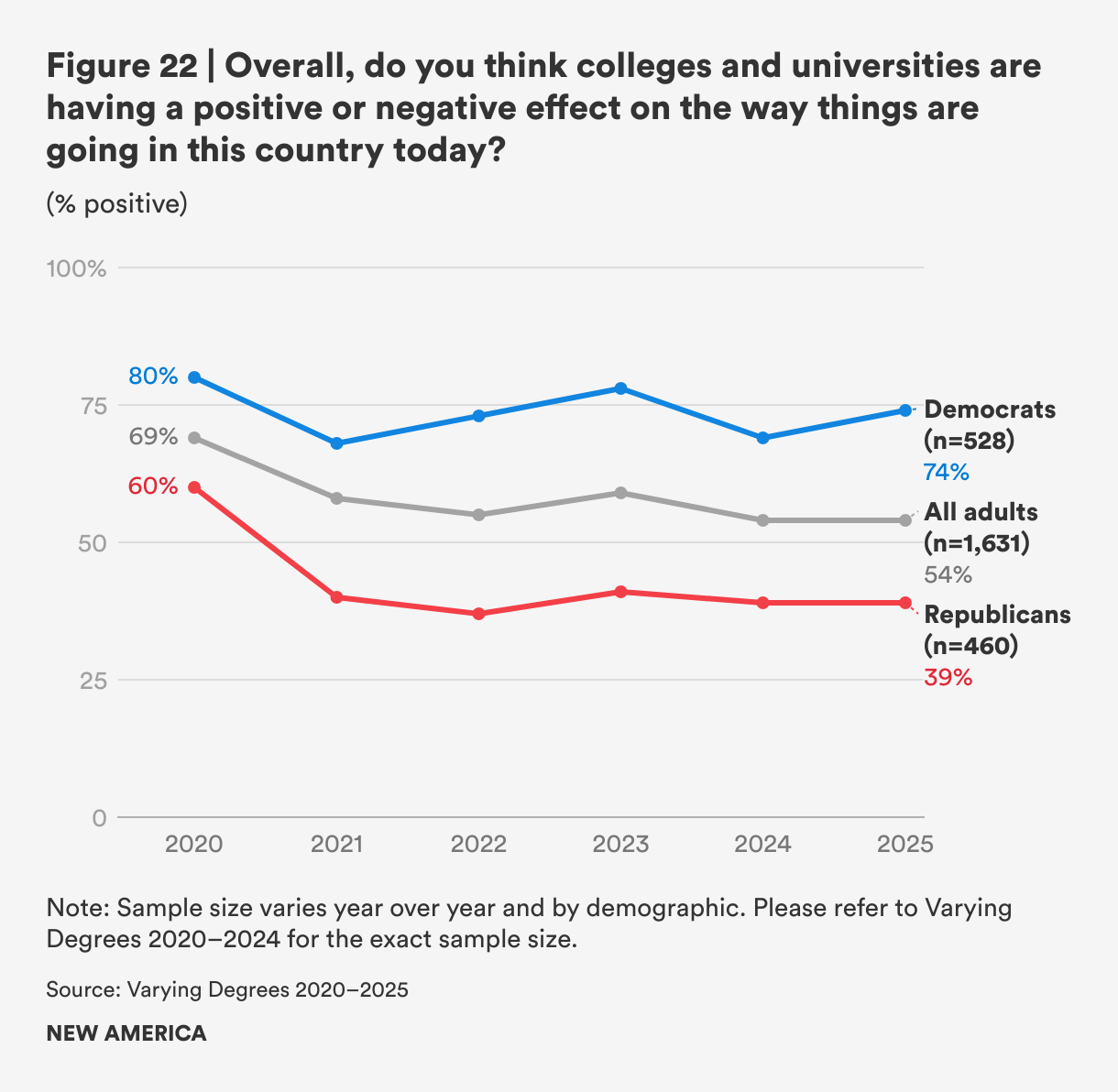
Only 54 percent of Americans believe colleges and universities have a positive effect on the country, dropping from 69 percent in 2019 (see Figure 22). During this six-year period, the partisan gap has widened on this question. In 2025, 74 percent of Democrats and 39 percent of Republicans believe that higher education plays a positive role in the United States, a 35-percentage point difference, compared to the 20-percentage point gap in 2020.
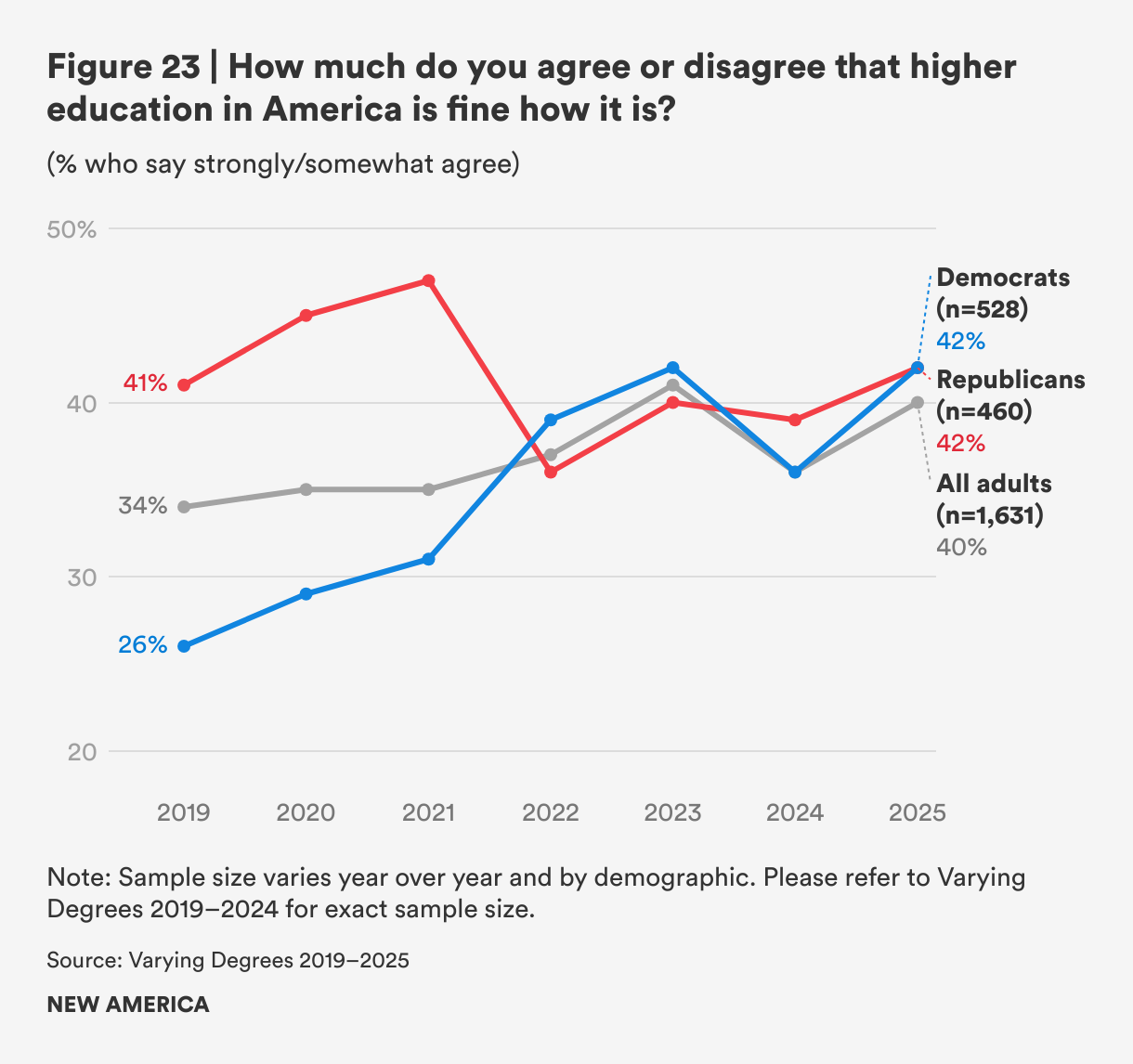
Only 40 percent of Americans think higher education is fine as it is, an increase from 33 percent in 2019 (see Figure 23). While on the upward trend, the share of people who agreed with this statement has never gone above 41 percent, which shows that a majority of Americans are still not happy with how higher education is. Both Democrats and Republicans are aligned on this question in recent years, despite a significant gap during 2019 and 2021.
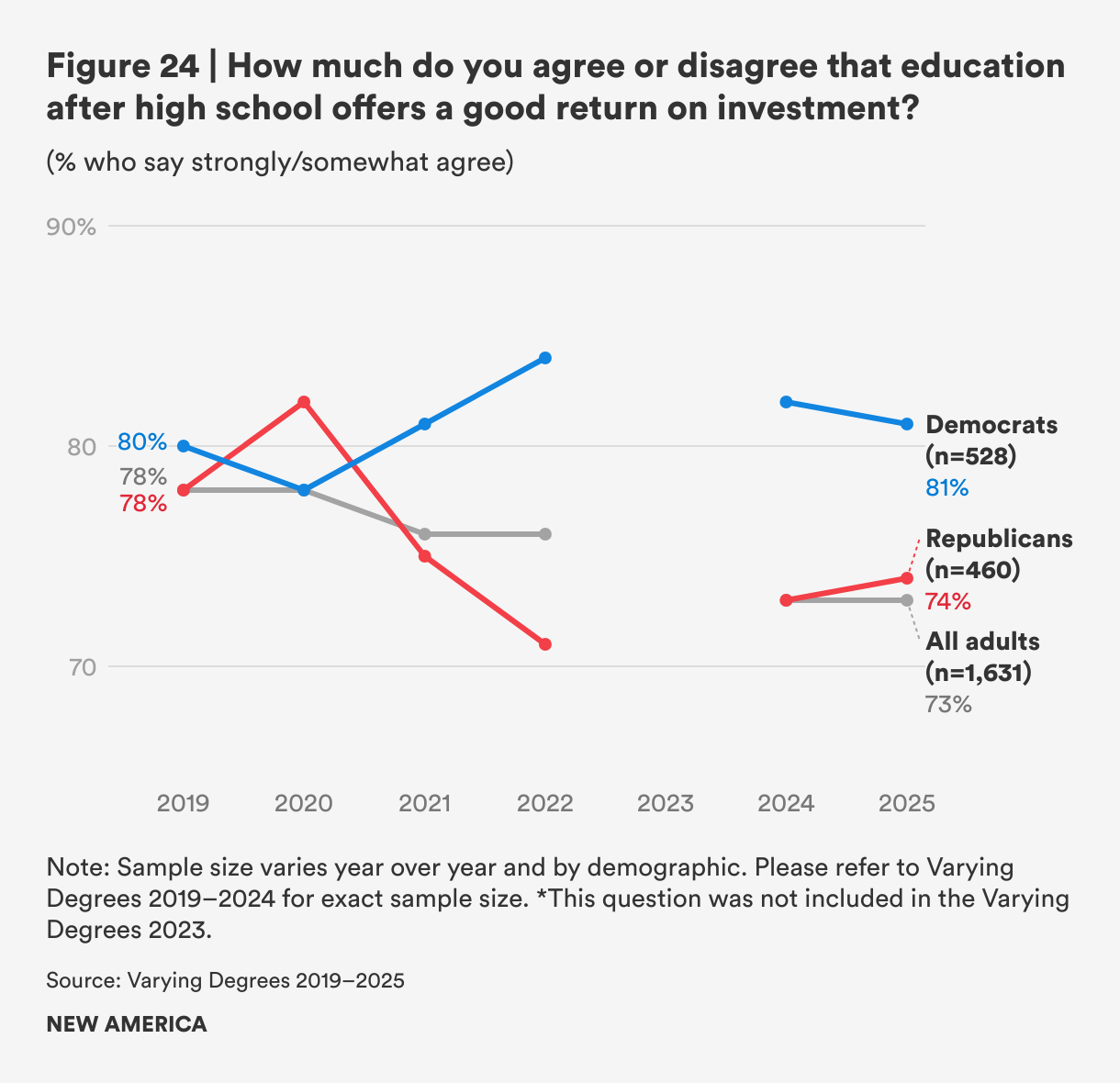
Despite growing frustration with higher education, close to three in four Americans agree that higher education offers a good return on investment in 2025 (see Figure 24). This number has remained stable since 2017, albeit on a slight downward trend. Both Democrats and Republicans have agreed consistently since 2019.
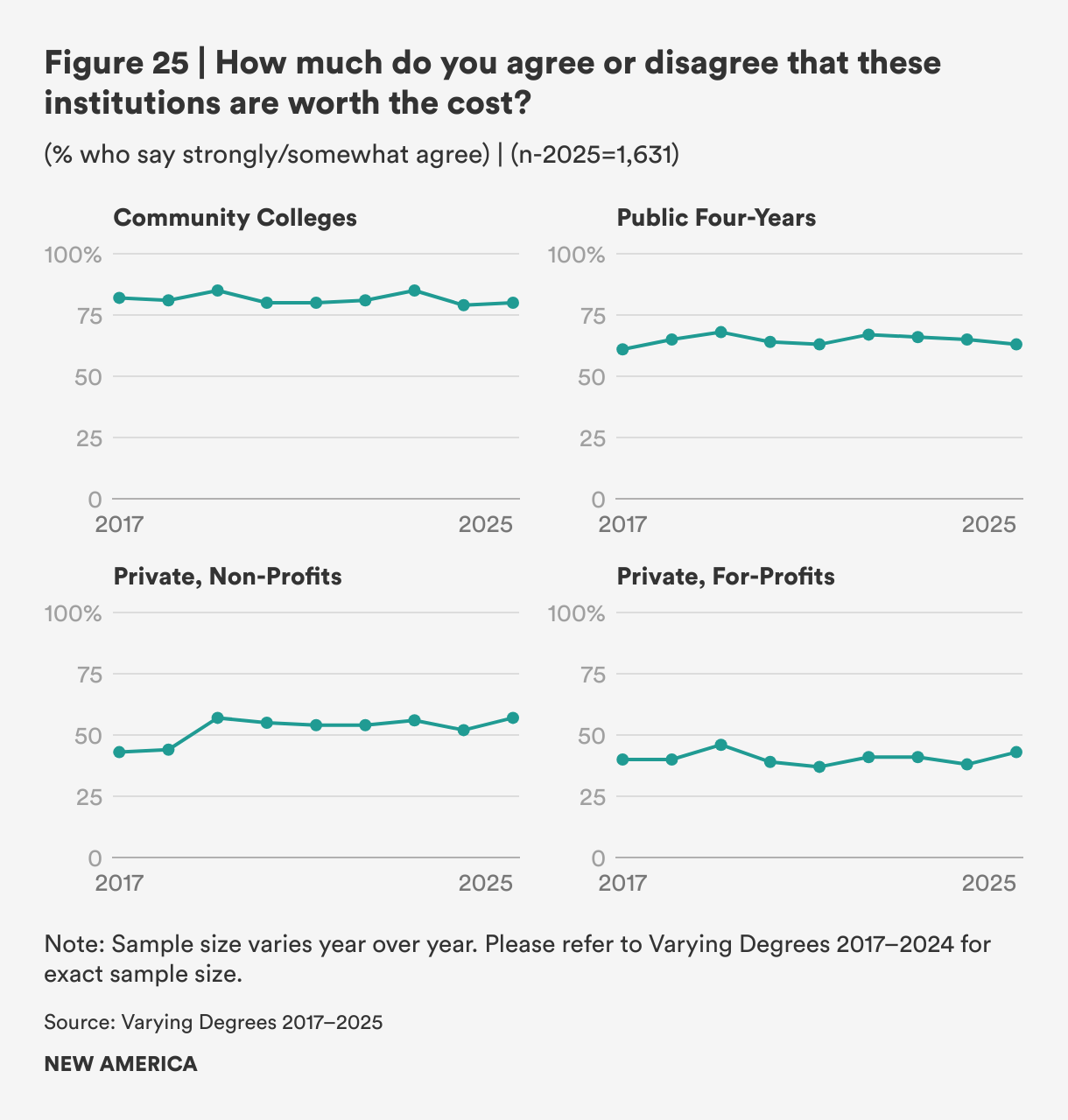
When looking into specific college types, Americans’ views have not changed much since 2017. A majority agree that public colleges and universities are worth the cost and are much less sure about private colleges and universities, especially private for-profit institutions (see Figure 25). Considering that community colleges provide the most affordable and accessible postsecondary education, it is no surprise most Americans think highly of them.
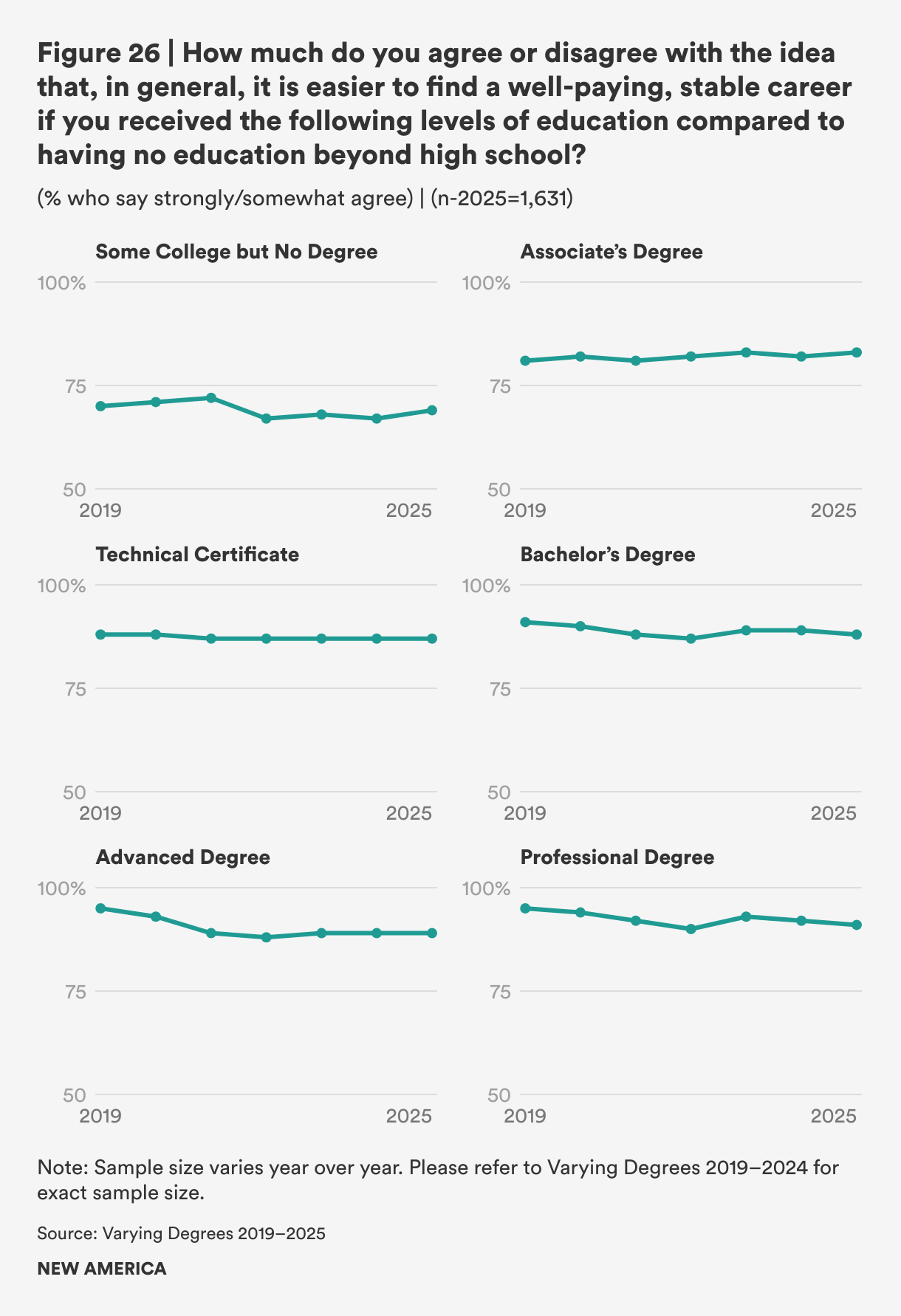
Over the years, Varying Degrees survey respondents have continued to believe it is easier to find a well-paying, stable job with any level of postsecondary education than with just a high school diploma (see Figure 26). Two in three believe that it is easier to earn more with some college education, even without degrees; this goes up to 83 percent with a degree, even just a technical certificate.
Support for Higher Education Investment Remains Stable Too
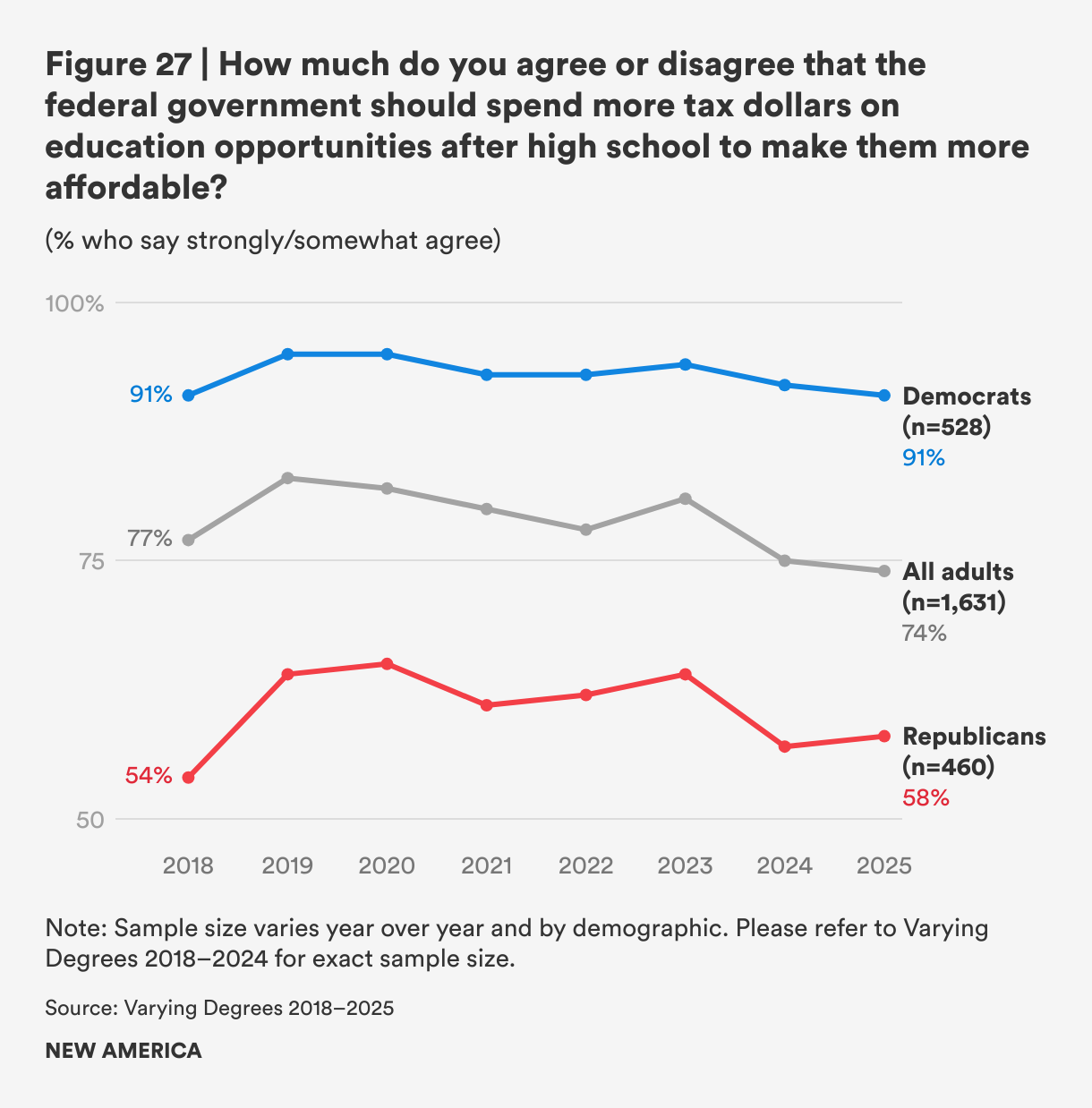
Views on higher education funding have also remained pretty consistent over the years of our survey. Three in four Americans in 2025 agree that the federal government should spend more tax dollars to make higher education more affordable, slightly declining from 77 percent in 2018. Despite this decline, 74 percent of Americans indicate solid support for greater federal investment in college (see Figure 27).
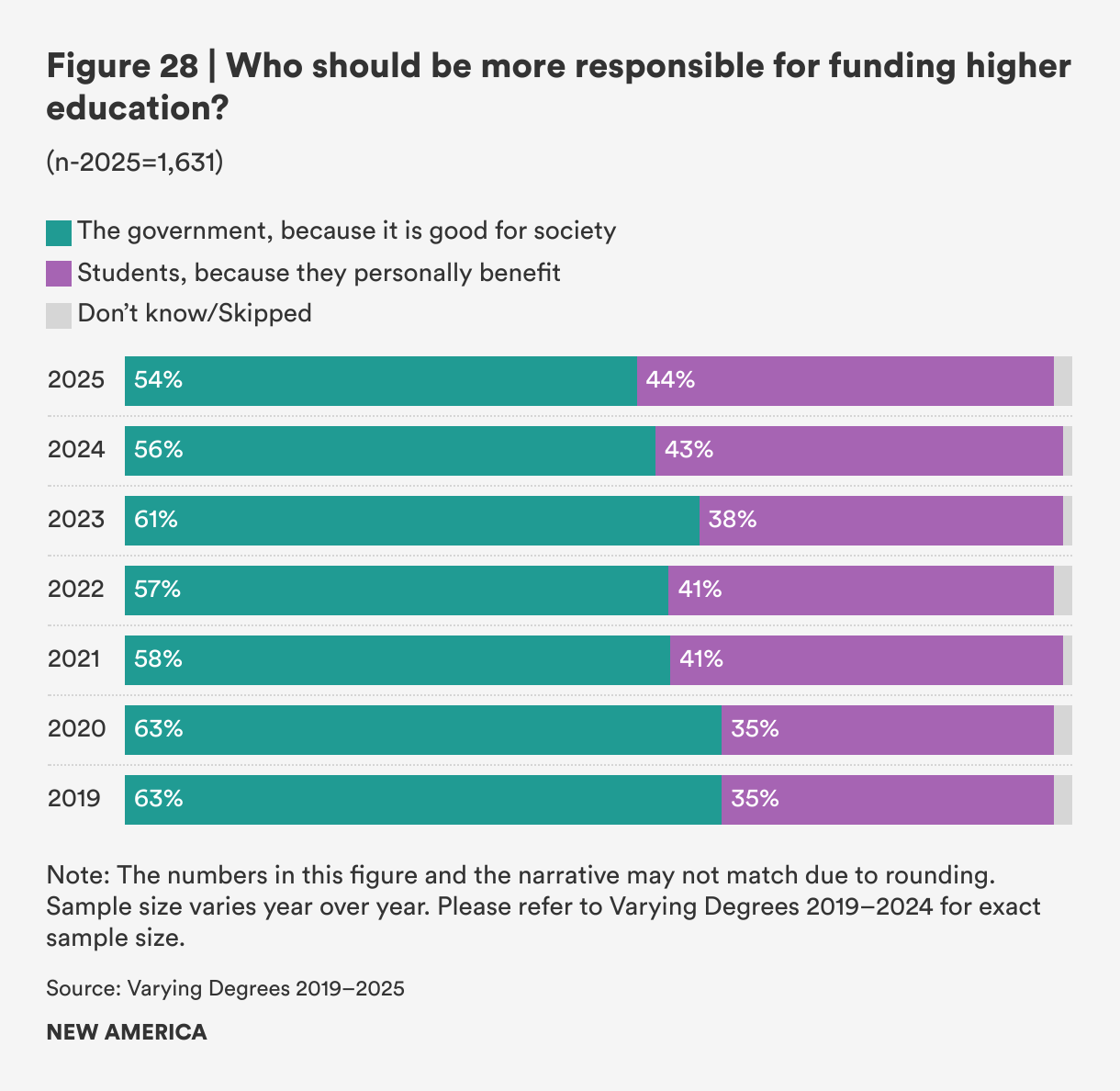
When asked who should be more responsible for funding higher education, government or students, only 54 percent of Americans in 2025 think that the government should be more responsible. This number has been decreasing steadily since 2019, when 63 percent said the government should be more responsible (see Figure 28). There has always been an immense partisan divide on this question: 75 percent of Democrats believe the government should fund higher education, compared to only 31 percent of Republicans. This gap has largely remained the same over the past six years.
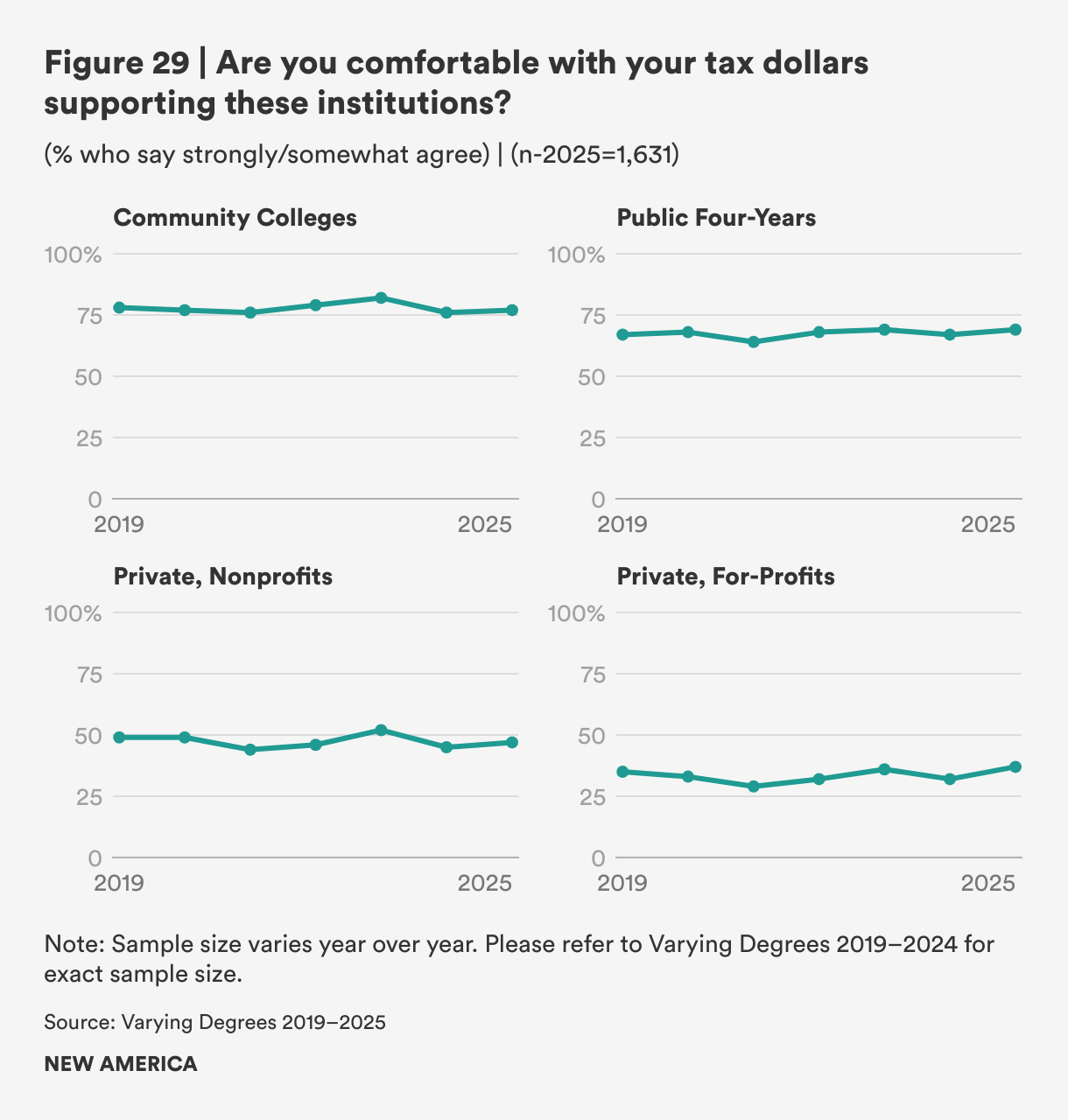
Spending tax dollars on public colleges and universities has garnered consistent support throughout the years. Community colleges can boast about the most support, with 77 percent of Americans feeling comfortable with their tax dollars going to two-year schools in 2025 (see Figure 29). A smaller share, but still a majority of Americans (69 percent), also support the idea of their tax dollars going to public four-year schools. Americans are more hesitant to provide tax dollars to private colleges and universities, with only 48 percent of Americans wanting tax dollars to go to private, nonprofit schools and 37 percent to private, for-profit schools.
Citations
- For more, see Vanessa Romo, Martina Stewart, and Brian Naylor, “Trump Ends DACA, Calls on Congress to Act,” NPR, September 5, 2017, source; Anya Kamenetz, “Betsy DeVos Signals a Pullback on Campus Sex Misconduct Enforcement,” NPR, September 7, 2017, source; and Andrew Kreighbaum, “DeVos Issues Final Repeal of Gainful Employment,” Inside Higher Ed, July 1, 2019, source.
- For more, see Rachel Fishman and Sophie Nguyen, The Great Pandemic Pivot: College Leaders Reflect on the Impact of COVID‑19 (New America, December 8, 2021), source.
- For more, see Nina Totenberg, “Supreme Court Guts Affirmative Action, Effectively Ending Race-Conscious Admissions,” NPR, June 29, 2023, source.
- For more, see Liam Knox, “The Long-Awaited FAFSA Autopsy Is Here,” Inside Higher Ed, September 24, 2024, source.
- For more, see Jones, “U.S. Confidence in Higher Education,” source.