Varying Degrees 2025 Americans Find Common Ground in Higher Education
Table of Contents
- Executive Summary
- Preface
- Americans Broadly Agree on the Core Values of Higher Education, Despite Some Disagreements
- Americans Are Frustrated with the High Cost of College but Disagree on Who Should Pay
- Historical Trends: Even in Challenging Times, Americans’ Perceptions of Value and Investment Have Stayed Relatively Steady
- Explore the Data
- Appendix: Methodology
Abstract
Higher education is under intensifying political and public scrutiny, facing challenges like federal funding freezes and overhauls of student aid programs. Yet despite deep divides in policymaking, New America’s Varying Degrees 2025 survey reveals that Americans remain united in their beliefs about the purpose and value of higher education.
Corrected on August 7th, 2025: Trend data was revised to correct inconsistencies found in previous years' data. These changes are minor and do not alter the report's narrative and findings.
Acknowledgments
New America thanks the Gates Foundation for supporting Varying Degrees. The findings and narratives contained within are those of the authors and do not necessarily reflect positions or policies of the foundation. The authors would like to thank Rachel Fishman for her review and editorial contributions, Sabrina Detlef for her copyediting support, and Katherine Portnoy, Amanda Dean, Natalya Brill, Alex Briñas, and Liz Cory for their communications and data visualization assistance.
Executive Summary
Higher education is facing unprecedented scrutiny. Since the Trump administration took office early this year, the White House has aggressively targeted some of the nation’s most prestigious colleges and universities, freezing research funding and contracts, investigating curricula and campus activities, and threatening to revoke international students’ visas. Congress, through a partisan budget reconciliation process, recently passed a sweeping legislative package that proposes major changes to federal student aid programs, including loans and Pell Grants. Once enacted, these changes would have serious implications on how low- and moderate-income students pay for higher education for years to come. Colleges and their stakeholders, even those that have not yet been directly affected, all feel the pressure of these challenges.
Yet Americans, regardless of political party, are more aligned than divided when it comes to their support for higher education.
Varying Degrees, New America’s annual survey about Americans’ perceptions of higher education, was conducted in March of this year. We surveyed more than 1,600 adults to find that even when it seems politicians can’t agree on higher education policy, Americans across the board are much less divided. Democrats and Republicans nationwide largely agree about the core value and purpose of higher education. The most partisan divergence relates to who should fund higher education. However, despite believing that students should be the ones responsible for bearing the cost of college, a majority of Republicans still support more federal and state investment into making college more affordable—aligning themselves with Democrats.
Now in its ninth year, our survey continues to track public opinion on issues like value, funding, and accountability. It also introduces new questions to explore Americans’ views on confidence in higher education and college quality, and whether they think colleges and universities are fulfilling their roles. These timely insights get at the core of the public and political frustration with higher education and offer a clearer picture of what Americans believe higher education is—and what it should do.
Given New America’s deep policy expertise, we believe that Varying Degrees will help inform policymakers, researchers, and advocates about how Americans feel about critical higher education issues. In this year’s report, we focus on understanding where Democrats’ and Republicans’ views converge or differ and find more similarities than differences between the two groups. We found six key themes:
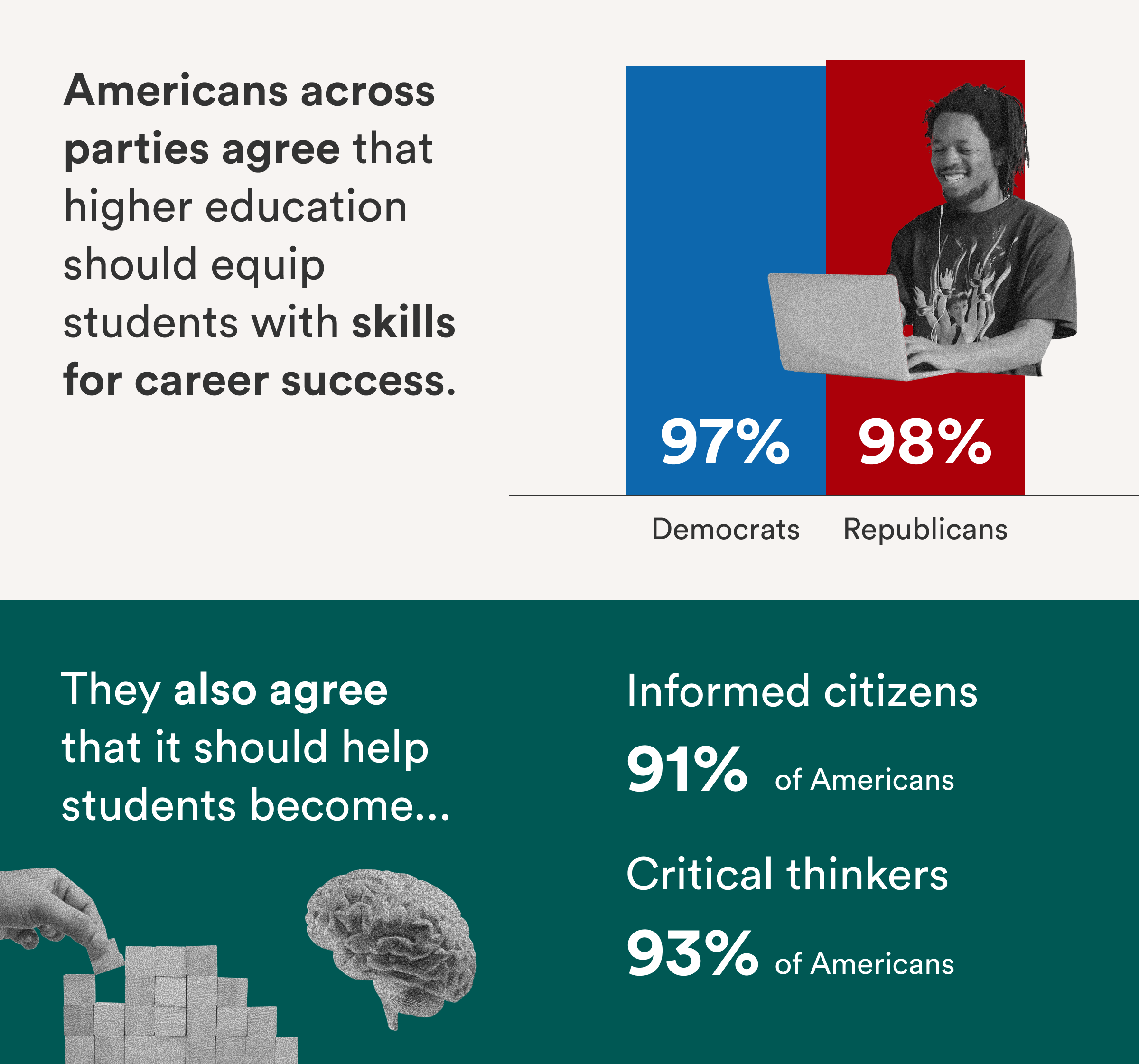
1. Americans broadly agree on the core roles of colleges and universities. Nine in 10 Americans think that it’s important for colleges to equip students with the skills and knowledge to succeed in their chosen fields (97 percent of Democrats and 98 percent of Republicans). Americans also believe colleges should help students become informed citizens (93 percent) and critical thinkers (91 percent). See image below.
2. Americans agree that job training should not be the only outcome of a college education. They believe other areas such as writing and communication (97 percent of Democrats and 92 percent of Republicans) and thinking and reasoning (97 percent and 92 percent, respectively) are also important indicators of quality.
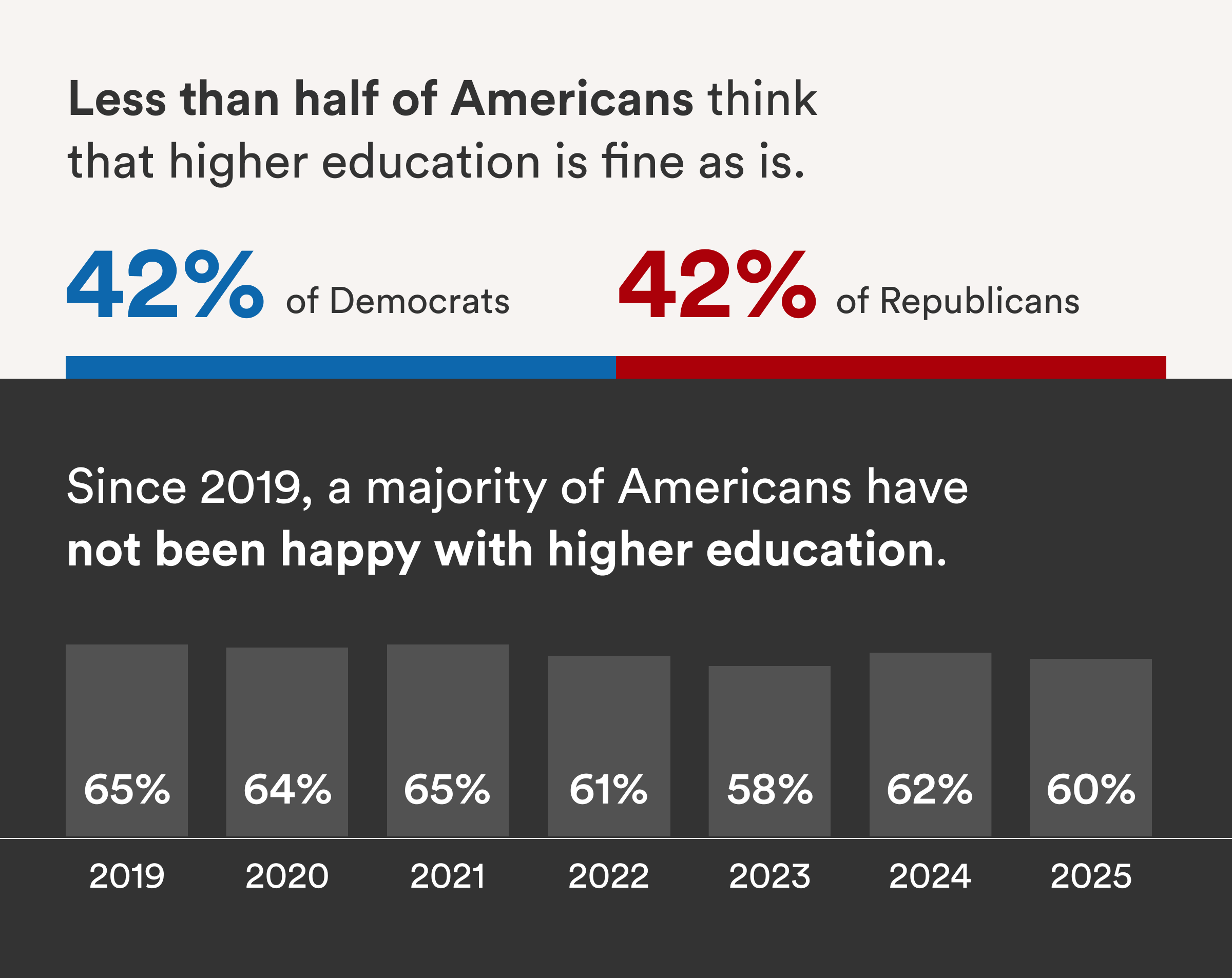
3. Americans continue to show frustration with the current state of higher education. Only 40 percent agree that higher education is fine how it is (42 percent for both parties); see image below. And like last year, slightly more than half of Americans (54 percent) think colleges and universities are having a positive effect on the way things are in the country. There is a vast partisan divide on this question: 74 percent of Democrats said they see positive effects of higher education, compared to only 39 percent of Republicans.
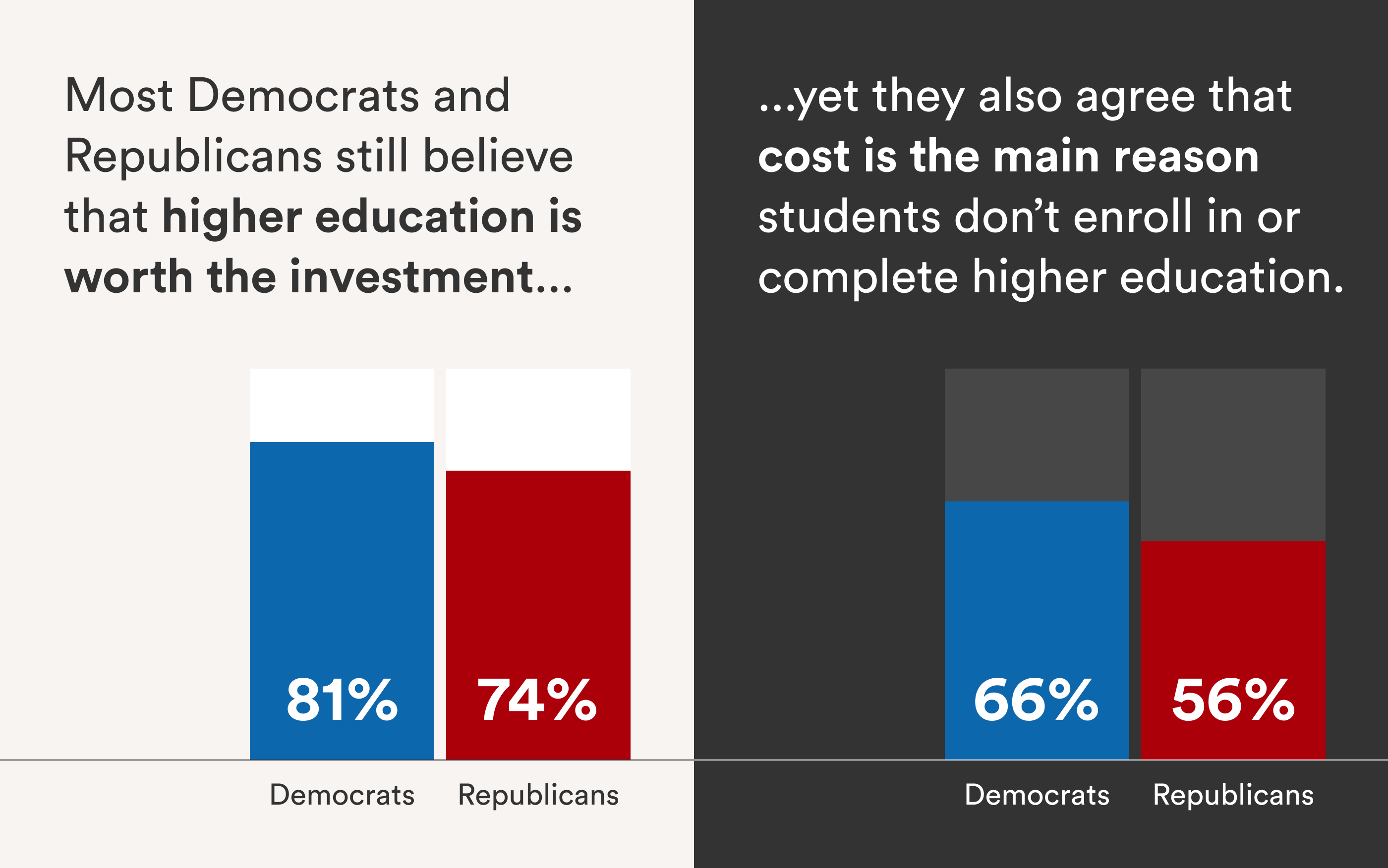
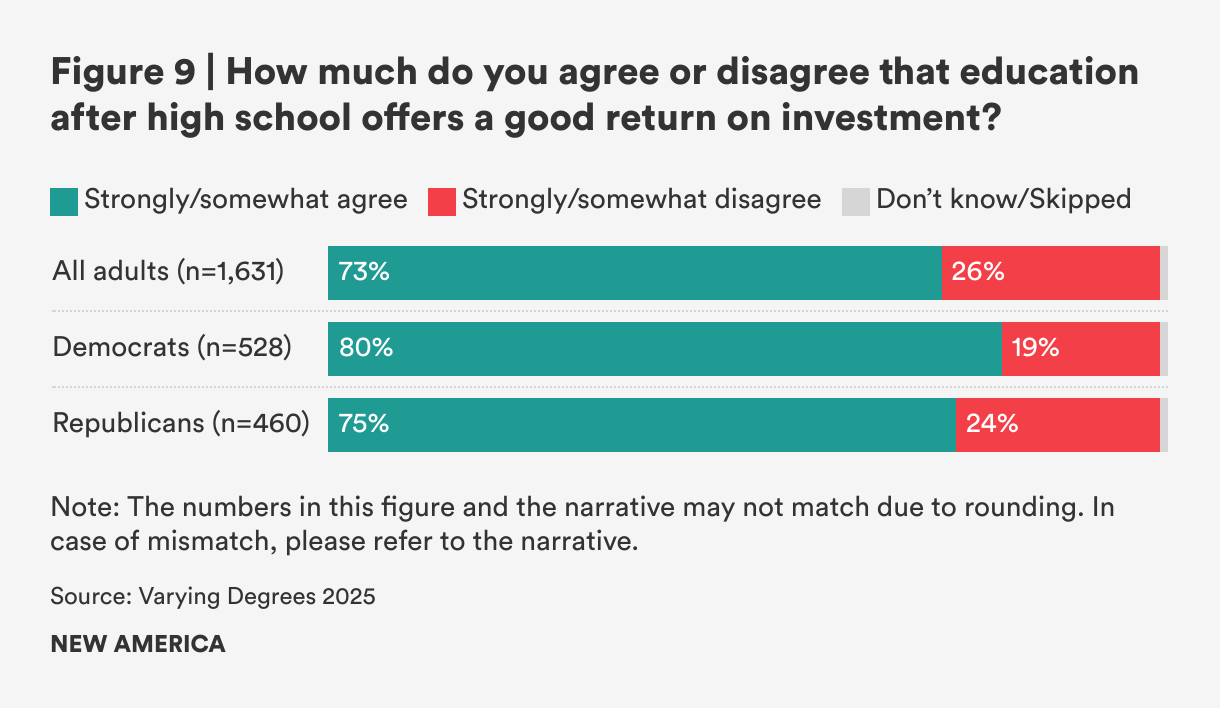
4. A large share of Americans still believe that higher education is worth the investment and is needed if one wants to get ahead in life. Seventy-three percent of Americans agree that education beyond high school offers good return on investment for the student (81 percent of Democrats and 74 percent of Republicans); see image on the left below.
5. The cost of college remains a major concern. Only half of survey respondents think that Americans can get a high-quality education after high school that is also affordable. Democrats and Republicans agree that affordability is a significant barrier to college access: When asked to pick one among the top reasons that stop students from enrolling or completing their programs, 66 percent of Democrats and 56 percent of Republicans choose the cost of attending as the main reason. See image on the right below.
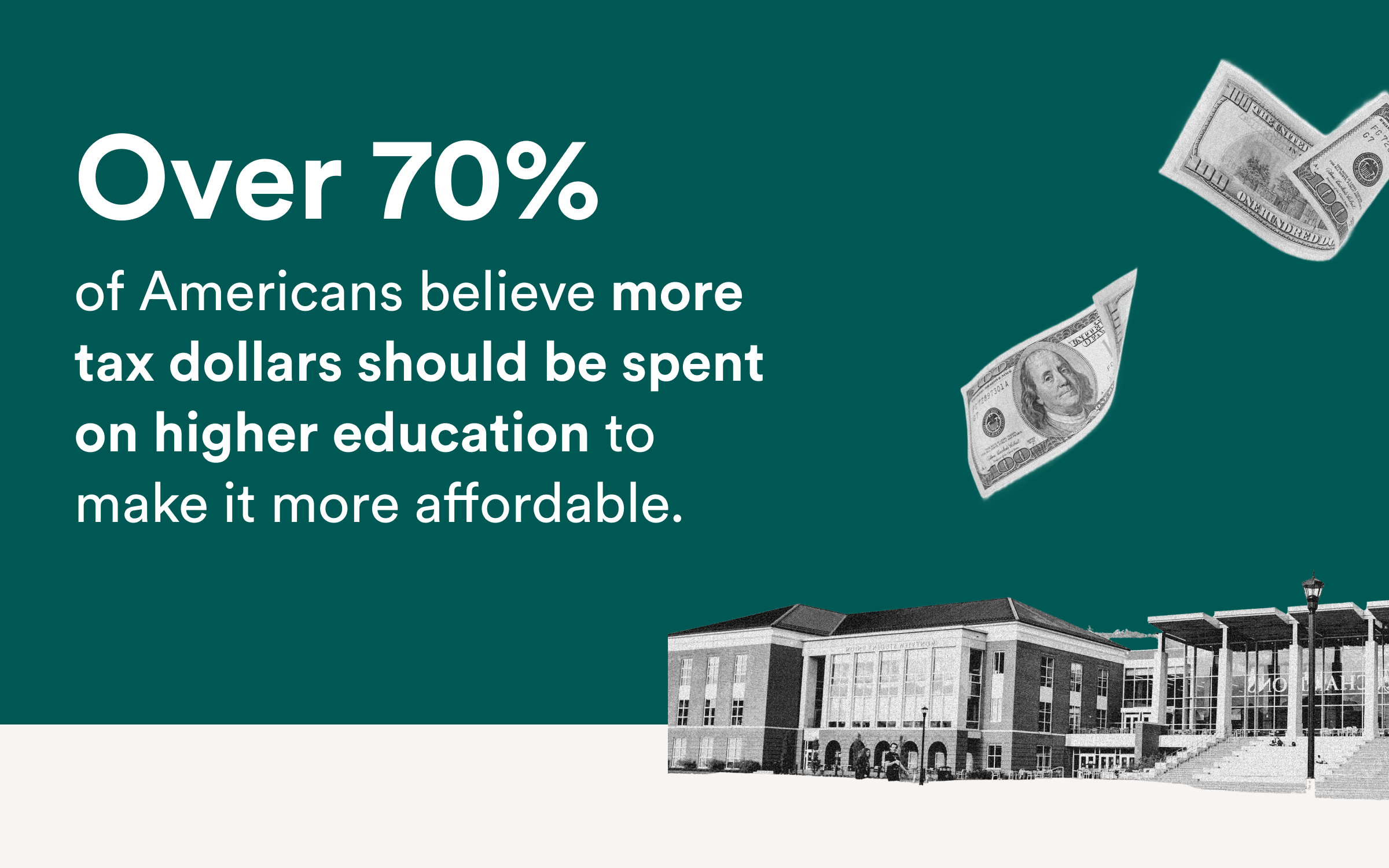
6. Americans may not agree on who should pay for college, but a majority believe more federal and state investment is needed. While only 54 percent of Americans think the government should be more responsible for funding higher education because it’s good for society, 74 percent of Americans think that the federal government should spend more tax dollars on education opportunities after high school to make them more affordable; see image below. Despite a sizable gap on this question: a majority of Democrats (91 percent) and Republicans (58 percent) agree.
Preface
America’s higher education system is considered the best in the world. Colleges and universities in the United States have long dominated global rankings, serving as hubs of scientific research and technological innovation and attracting talent from around the world. Their reputation stems from the well-developed infrastructure, sustained investment in research, a commitment to academic freedom, and a diverse and dynamic academic culture. But that reputation—and the foundation that supports it—is at risk of crumbling very quickly.
Despite recent declines in public trust, a few areas of higher education still receive strong bipartisan support. However, since his inauguration in January, President Trump and his administration have wasted no time issuing executive orders and taking actions against colleges and universities, targeting federal funding and contracts, student activism, noncitizen students, and diversity and inclusion efforts on campuses. Institutions across the country, even those that haven’t been directly named in these actions, all feel the brunt of the relentless political pressure.
Central to this unprecedented assault on the higher education sector is the debate about the purposes and value of higher education: What does higher education do for its students and for the nation, and where does it fall short? Critics on the political right—including President Trump and his allies—have long accused colleges of indoctrinating students with liberal ideas, teaching students “un-American” values, and failing to equip students with the skills needed for the workforce.1 In 2021, then-Senator and now-Vice President JD Vance even called higher education “the enemy” that needs to be attacked “honestly and aggressively.”2 Against a backdrop of growing public frustration with the ever-increasing cost of college and ballooning student loan debt, this criticism seems to resonate with many Americans. Public confidence in higher education has declined steadily in recent years.3
Meanwhile, the responses from higher education leaders often come across as inadequate at best or dismissive at worst, which has further distanced institutions from their powerful political critics, as well as the general public. That disconnect was perhaps most visible during the congressional hearing about antisemitism on campus in 2023 when presidents from Harvard, MIT, and the University of Pennsylvania provided evasive responses to House lawmakers, triggering a national backlash and resulting in the resignation of two of those presidents.4 It was not until recently, when faced with the steady attacks and existential threats to their mission and identity, that some colleges and universities started to defend themselves more actively, highlighting their role in fostering student success, driving scientific advancement, and contributing to social and economic progress.5
Amid the clashing narratives about higher education, Americans have their own perception of what higher education is—both its value and shortcomings—and what it should be. Varying Degrees 2025, conducted in March of this year, surveyed more than 1,600 Americans across the country about their perspectives on the mission of colleges and universities, higher education quality, and the value colleges offer both individuals and society.6 Our survey finds that while Americans may be divided on whether colleges and universities are leaning too liberal, a common criticism from conservatives, they see eye to eye on the core functions and value of colleges and universities.
The survey findings this year reaffirm the fact that despite their dissatisfaction with the current state of higher education, Americans still see it as a worthwhile investment. Although Americans may disagree on who should bear the cost of college, the students or the government, there is bipartisan support for more state and federal investment to improve affordability. It is timely to be reminded of this support as Congress just passed a massive legislative package earlier this month, including provisions that would make higher education much less affordable and accessible for low- and moderate-income students for years to come.
This report explores the 2025 survey results in detail, focusing on public perceptions of value and funding in higher education. For the first time, the report also dives into the rich year-over-year data that Varying Degrees has collected for the past nine years, revealing how Americans’ views on these issues have evolved over the last decade.
Citations
- For more, see Alan Blinder, “Trump’s Battles With Colleges Could Change American Culture for a Generation,” New York Times, March 20, 2025, source.
- For more, see Katherine Knott, “J.D. Vance Called Universities ‘The Enemy.’ Now He’s Trump’s VP Pick,” Inside Higher Ed, July 16, 2024, source.
- For more, see Jeffrey M. Jones, “U.S. Confidence in Higher Education Now Closely Divided,” Gallup, July 8, 2024, source.
- For more, see Stephanie Saul and Anemona Hartocollis, “College Presidents Under Fire After Dodging Questions About Antisemitism,” New York Times, December 6, 2023, source; Juliana Kim, “Here’s the Latest Fallout at Harvard, MIT, and Penn After the Antisemitism Hearing,” NPR, December 12, 2023, source; and Emma H. Haidar and Cam E. Kettles, “Harvard President Claudine Gay Resigns, Shortest Tenure in University History,” Harvard Crimson, January 2, 2024, source.
- For more, see Blinder, “Trump’s Battles Could Change American Culture,” source.
- The survey was conducted in March 2025, with a sample size of 1,631 American adults, including oversamples of Black, Latinx, and Asian Americans. The findings have a margin of error of +/– 3.23 percentage points. For more information about the methodology, please refer to the Appendix.
Americans Broadly Agree on the Core Values of Higher Education, Despite Some Disagreements
Higher education in the United States is a remarkably diverse system, with more than 6,000 institutions providing a wide range of academic offerings to serve the needs of varying populations of students. Each of these institutions prides itself on its own culture, mission, and educational focus. A public four-year university in a major city that enrolls tens of thousands of students will have a very distinct culture from a private liberal arts college in a rural area with just 2,000 students. Likewise, a community college that serves mostly part-time and adult students will function differently and provide academic offerings that are not often found at a four-year college that serves mostly students who just graduated from high school. But, regardless of the look and feel of each campus, when it comes to what colleges and universities should do and the outcomes students should expect, Americans share a common vision.
According to our survey, nine in 10 Americans believe that colleges and universities should equip students with the skills and knowledge needed to succeed in their field of study (96 percent). Yet Americans also believe institutions need to go beyond just a narrow career focus and help students become critical thinkers (93 percent) and informed citizens (91 percent). Most Americans believe colleges need to create an environment to help students of all backgrounds feel supported (91 percent), provide a platform to help students explore diverse ideas (84 percent), and help foster cross-cultural understanding (81 percent) (see Figure 1).
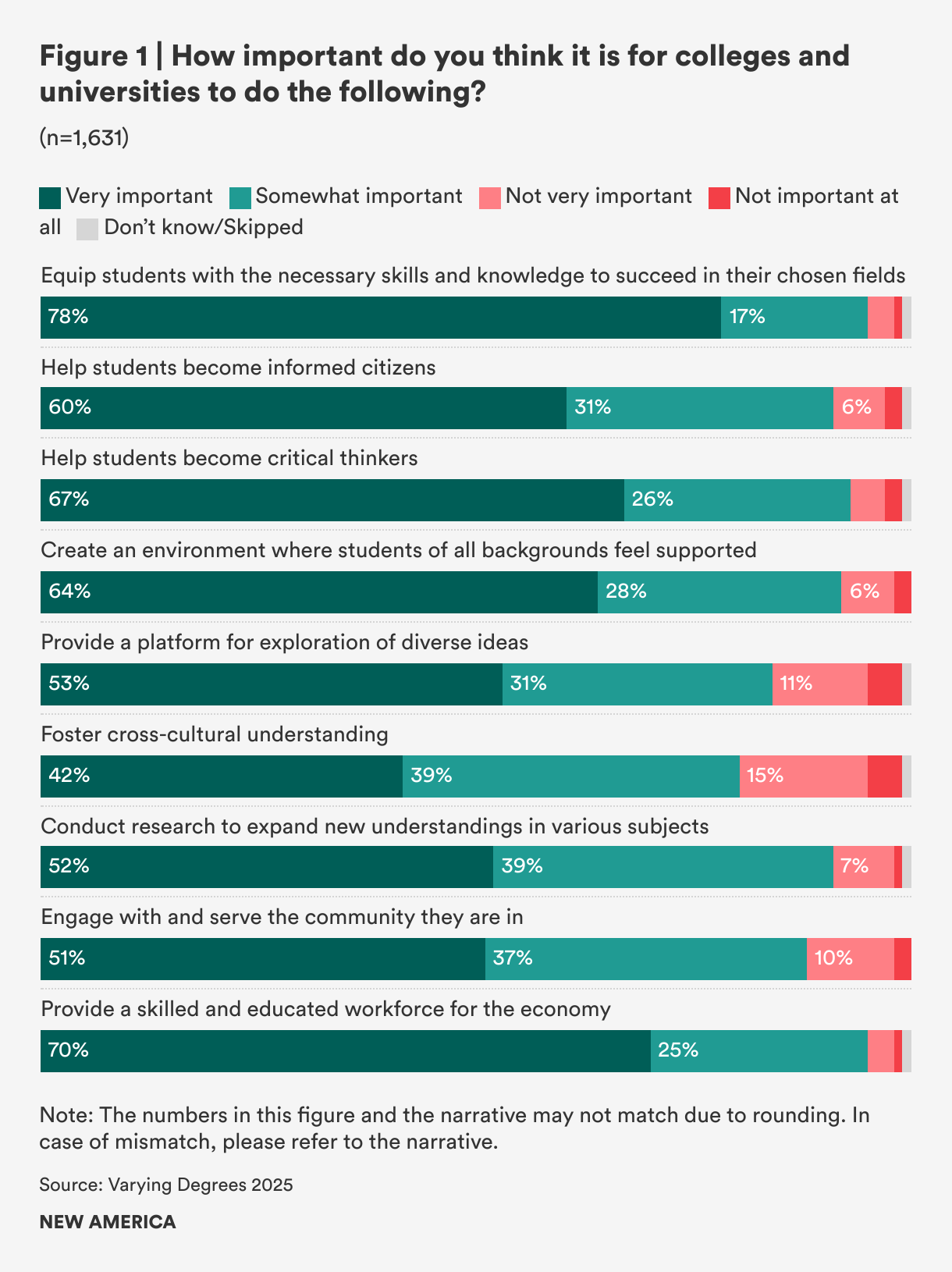
Supporting students is not the only purpose of colleges and universities: Americans believe that institutions of higher education should also provide a skilled and educated workforce for the economy (95 percent), conduct research to advance knowledge (92 percent), and engage with and contribute to the community they are located in (88 percent).
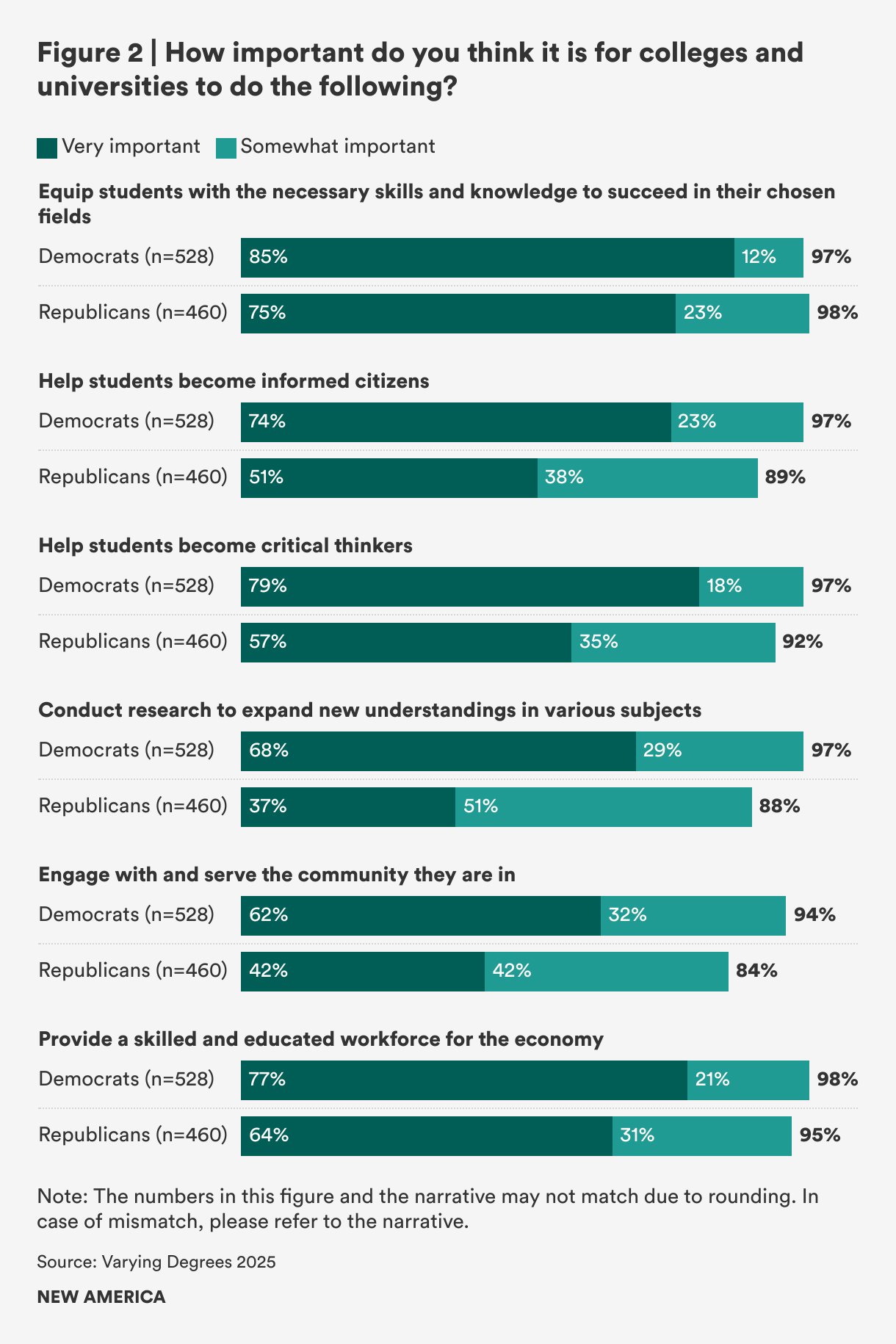
In Congress, Democrat and Republican lawmakers often fight over what they think colleges should do, but Americans, regardless of political identification, are more aligned in their thinking. Both agree that colleges need to prepare students for the workforce and help them become informed citizens and critical thinkers (see Figure 2). They also believe that colleges have a commitment not just to students but also to the country and the community that they are in, although Democrats are more likely to say these areas are “very important.”
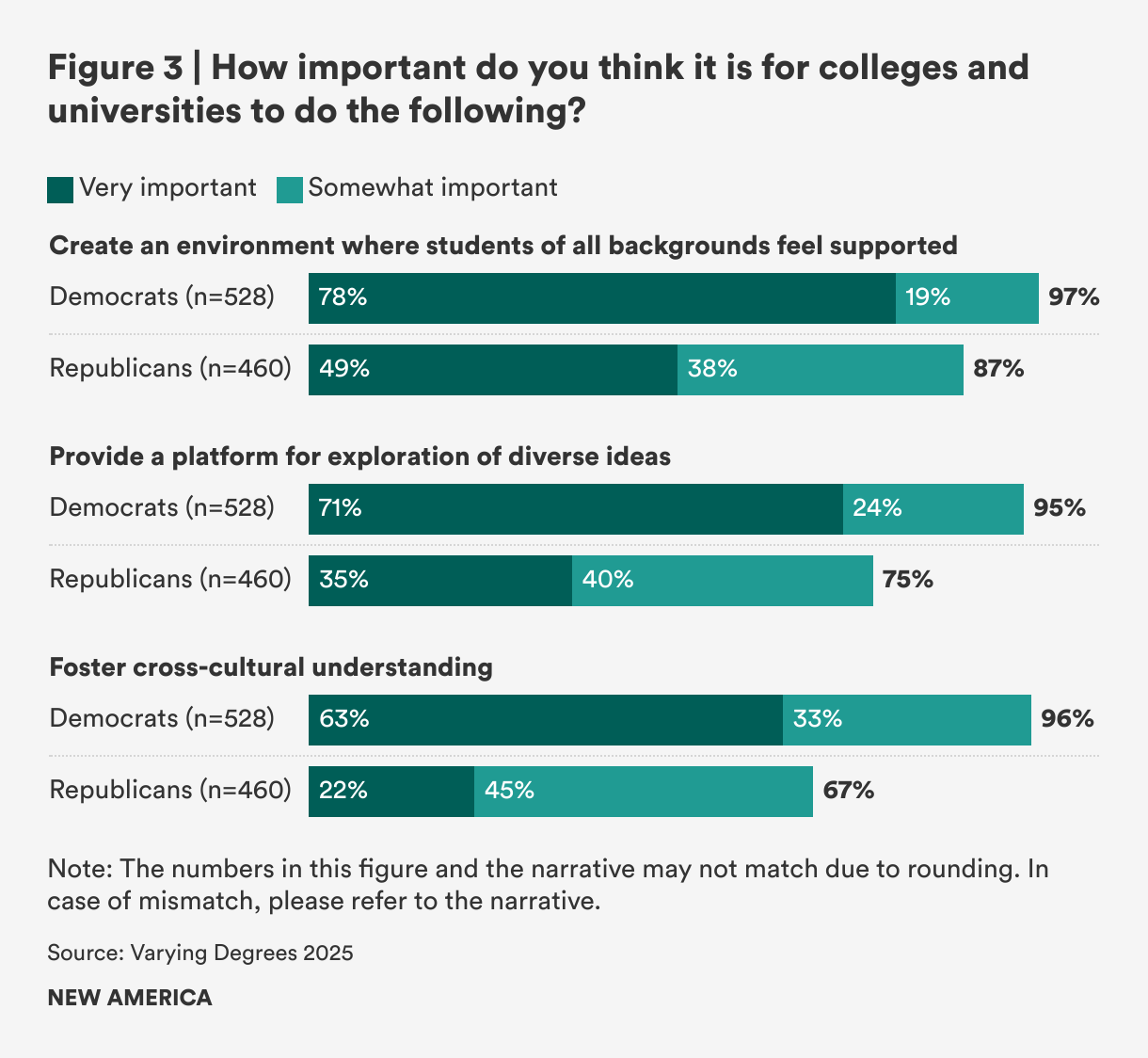
Republican lawmakers and President Trump’s allies often attack diversity, equity, and inclusion (DEI) programs on campus, accusing them of discriminating against white students, but 87 percent of Republican Americans (and 97 percent of Democrats) believe that colleges should create an environment where students of all backgrounds feel supported, which is the goal of these inclusion efforts. A majority of Republicans also believe that it’s important that colleges promote the exploration of diverse ideas and foster cross-cultural understanding, albeit at lower rates than Democrats (see Figure 3).
Americans Believe Educational Quality Requires More than Just Skills Training
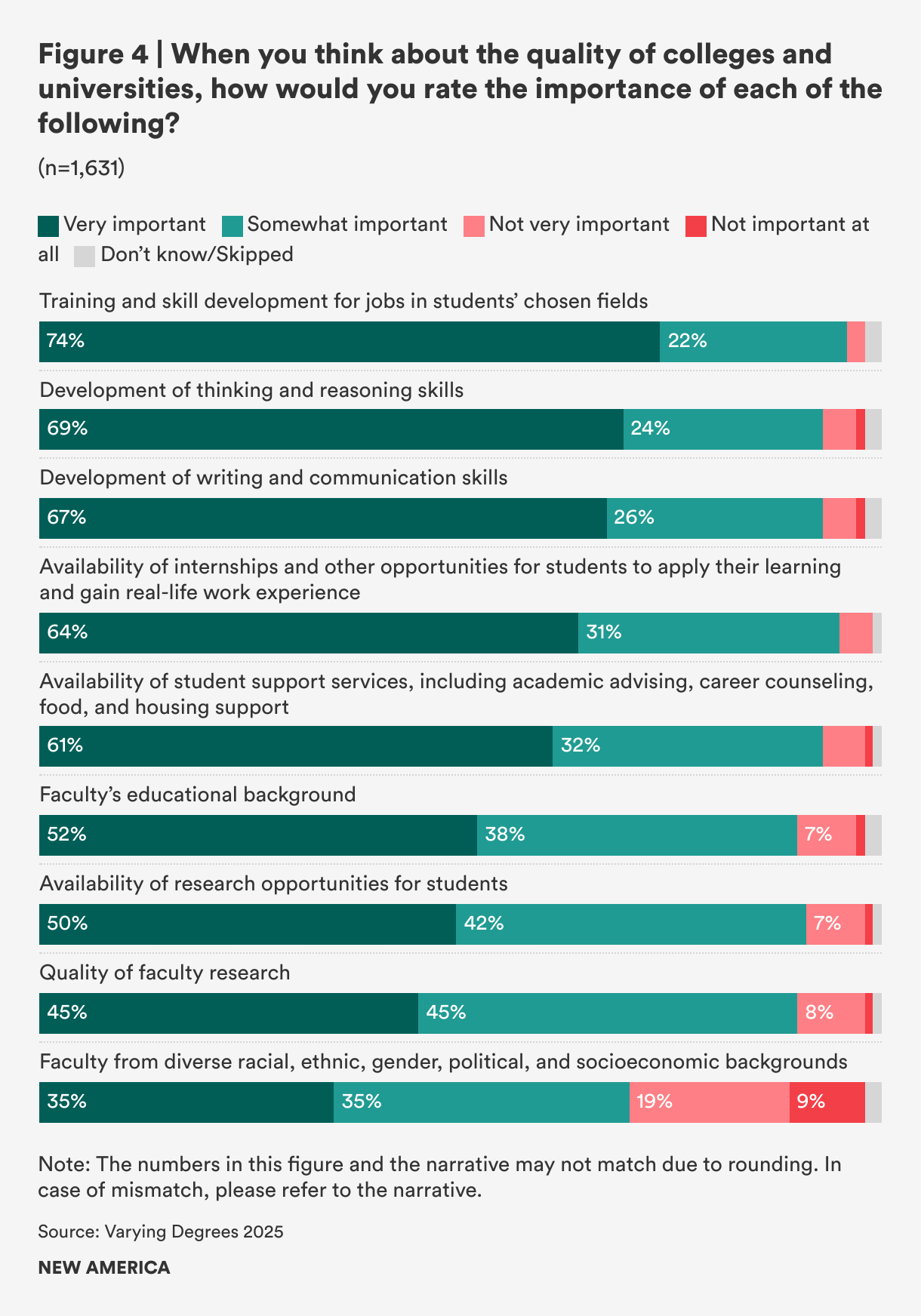
When it comes to the quality of higher education, nearly all Americans believe skills training is an important indicator of quality (96 percent), but it’s not the only one. Ninety-four percent believe that the development of competencies such as writing, reasoning, and communication is important (see Figure 4). Access to research and internship opportunities, as well as robust student support services, contribute significantly to the perception of institutional quality. Americans also consider the qualifications of faculty, including their educational background and the quality of their research, as important. A majority of Americans believe faculty diversity matters too: 70 percent think that having professors from diverse backgrounds, whether in race and ethnicity, gender, political views, or socioeconomic status, is an important indicator of higher education quality.
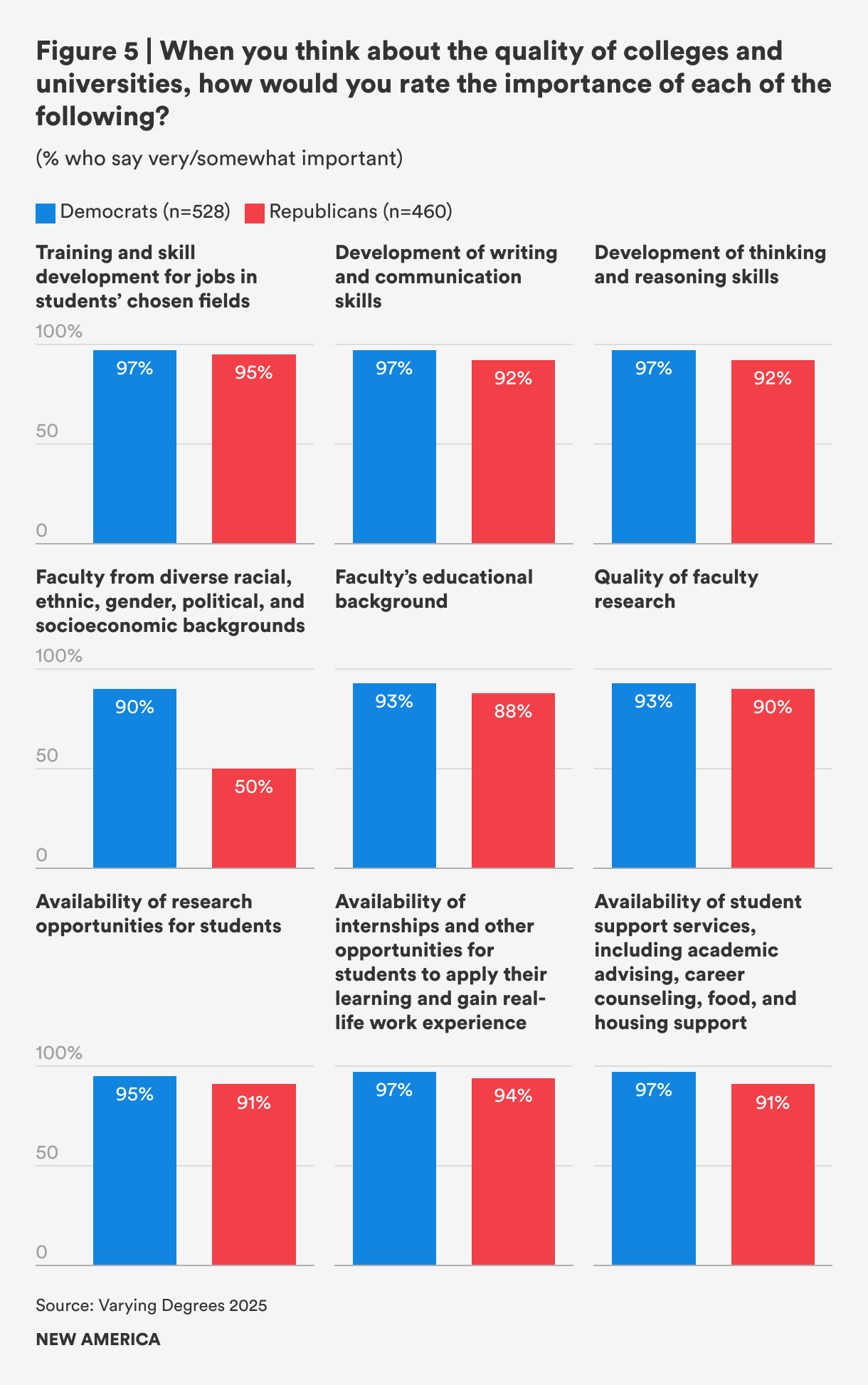
Democrats and Republicans are mostly aligned in the perception of what makes a quality higher education, except for when it comes to faculty diversity. Nine in 10 Democrats believe faculty diversity factors into the quality of higher education, compared to only half of Republicans (see Figure 5).
Public Confidence in Colleges and Universities Has Declined, but Americans Still Believe That the Benefits Outweigh the Costs
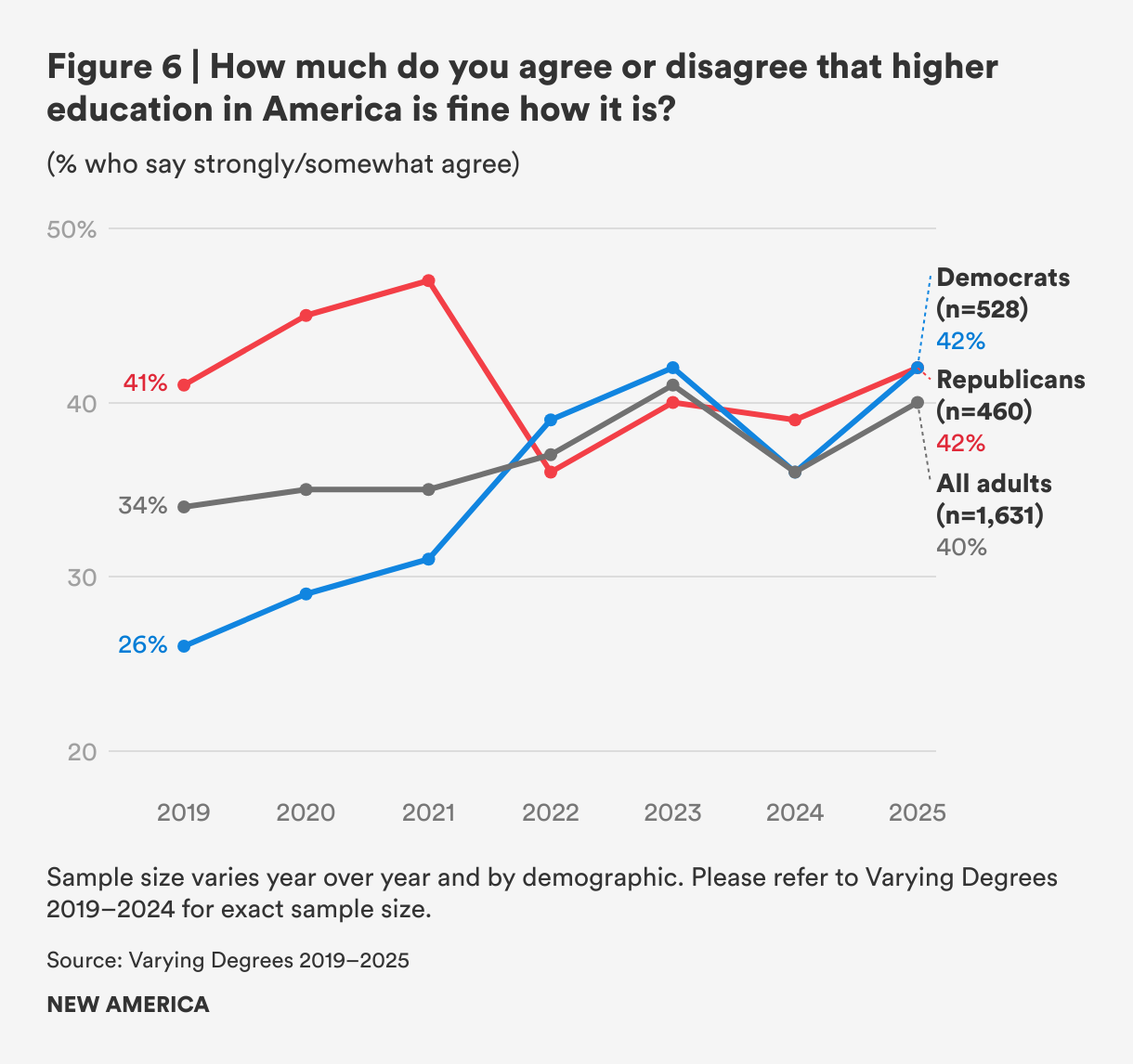
Only 40 percent of Americans in 2025 think that higher education is fine as it is, and only around half think colleges and universities are having a positive effect on the country. Despite some fluctuation, responses to these questions have largely stayed the same in recent years (see Figure 6).
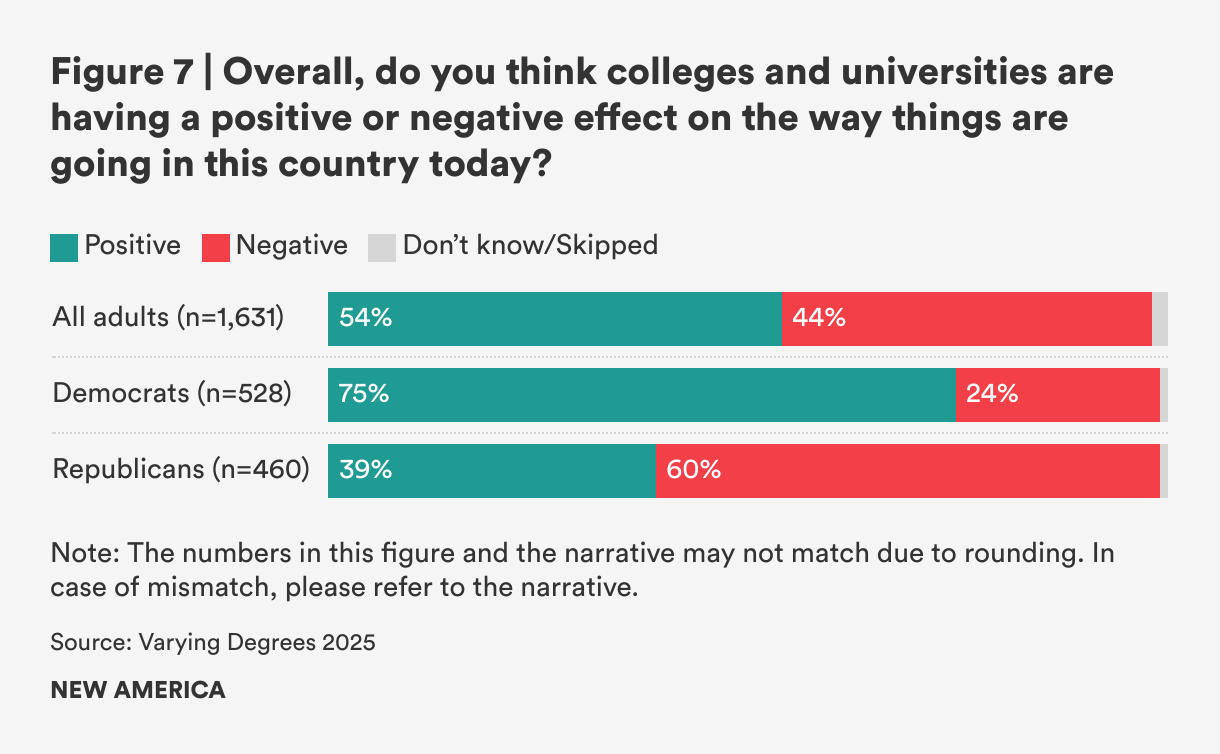
While Democrats agree with Republicans about the current state of higher education, and while they agree about what is needed for a quality higher education, when it comes to how colleges and universities are making an impact on the country, Democrats and Republicans are divided. A majority of Democrats (74 percent) believe that institutions are creating a positive impact on the nation, compared with a minority of Republicans (39 percent) (see Figure 7).
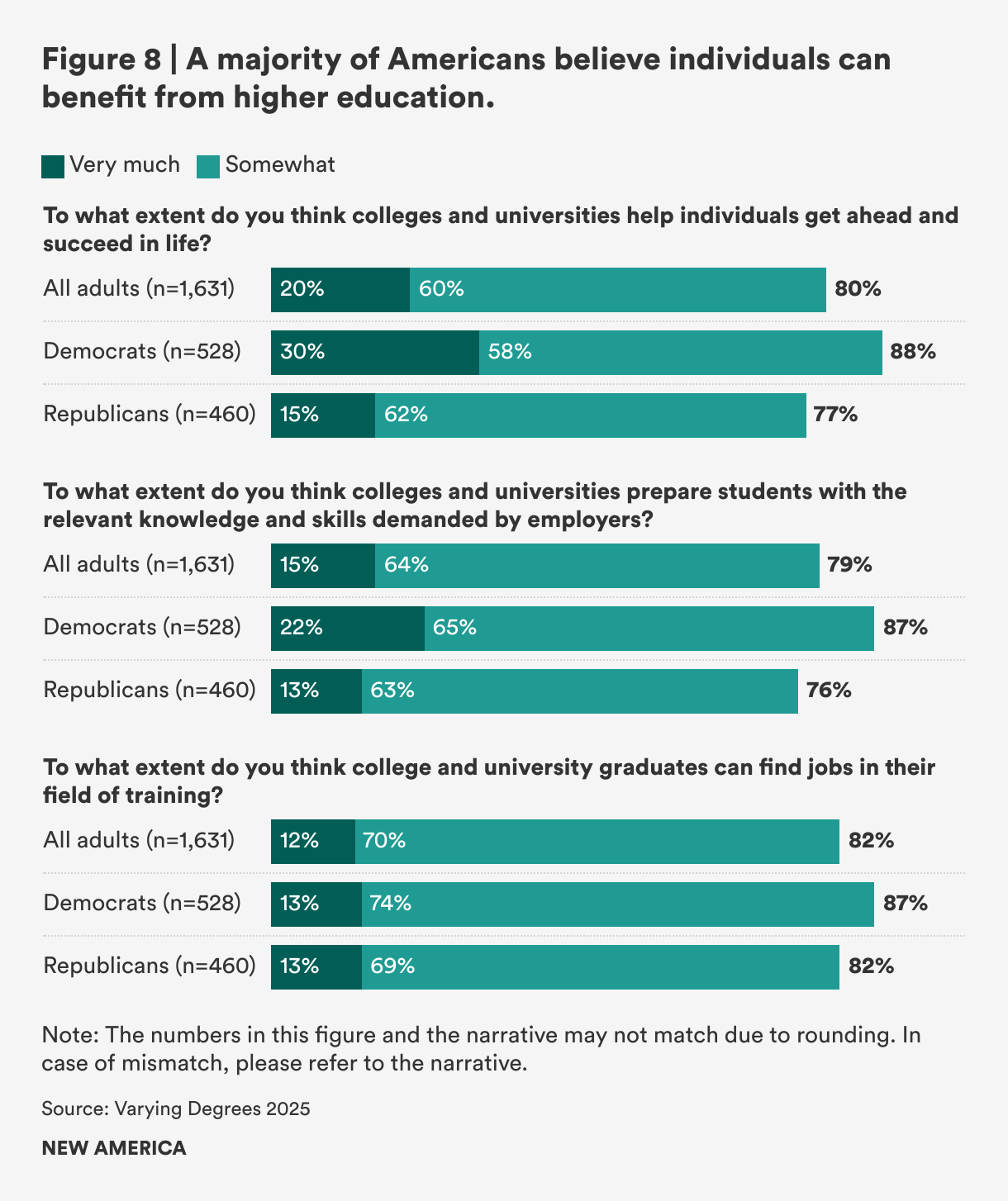
The partisan split on higher education impact is notable and surprising, considering Democrats and Republicans align on their confidence in what higher education can do, both for individuals and society. Eight in ten Americans, including large shares of both Democrats and Republicans, believe that colleges and universities help students succeed and get ahead in life. Nearly eight in 10 Americans think colleges and universities prepare students with relevant knowledge and skills required by employers, and 82 percent believe college graduates can find jobs in their field of training (see Figure 8).
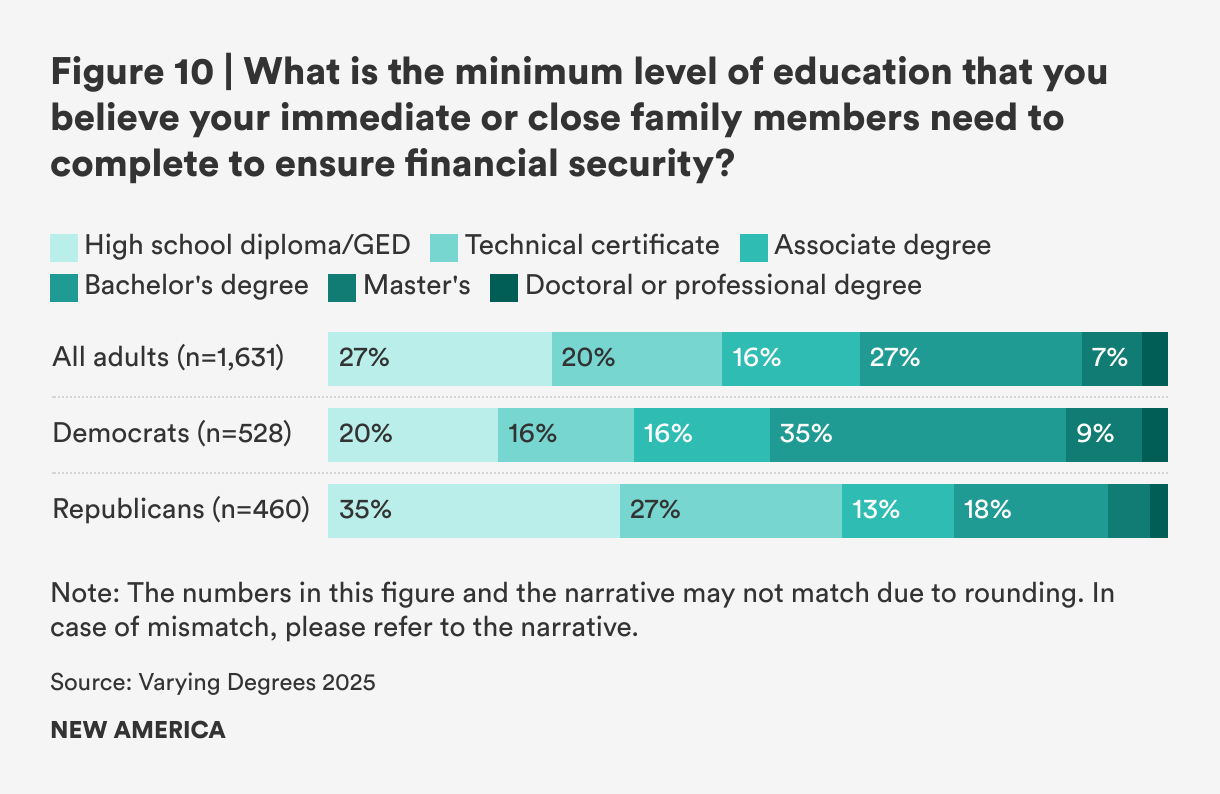
Three in four Americans, across the political spectrum, still believe that education after high school offers a good return on investment for students (see Figure 9), and 72 percent would recommend their children or close family members to have at least some education after high school for a financially secure life (see Figure 10).
A Slight Majority of Americans Find Colleges and Universities to Be Left-Leaning—a Major Pain Point for Conservatives
Given the agreement on value, perhaps what can help explain the significant partisan divide on the positive impact, or lack thereof, of colleges and universities has more to do with the perception of campus climate and free speech issues that have been heavily reported in the news.
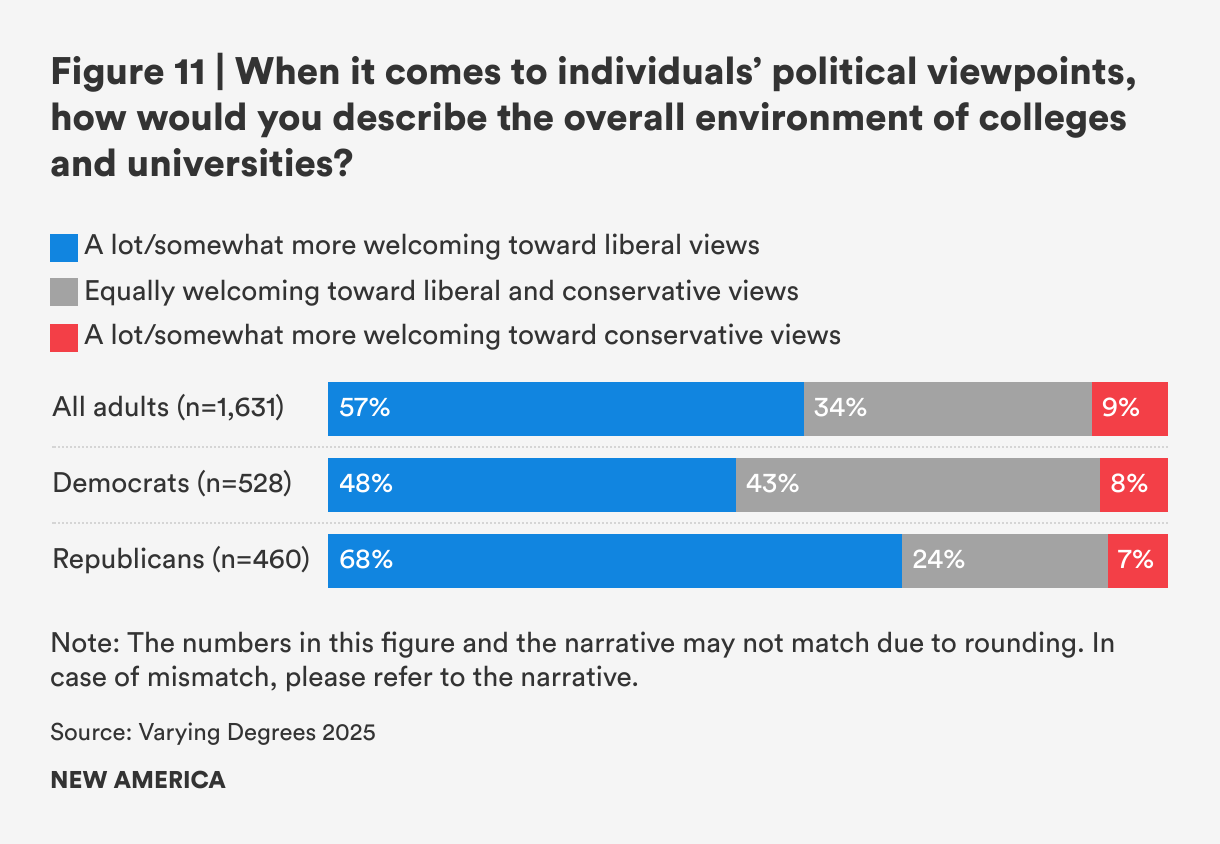
Just over half of Americans believe, when considering individuals’ political viewpoints, colleges are more welcoming toward liberal views, a third think colleges equally welcome liberal and conservative views, and only 9 percent think that they are welcoming towards conservative views (see Figure 11). Two-thirds of Republicans think colleges are more welcoming towards liberal views, compared to half of Democrats who think so.
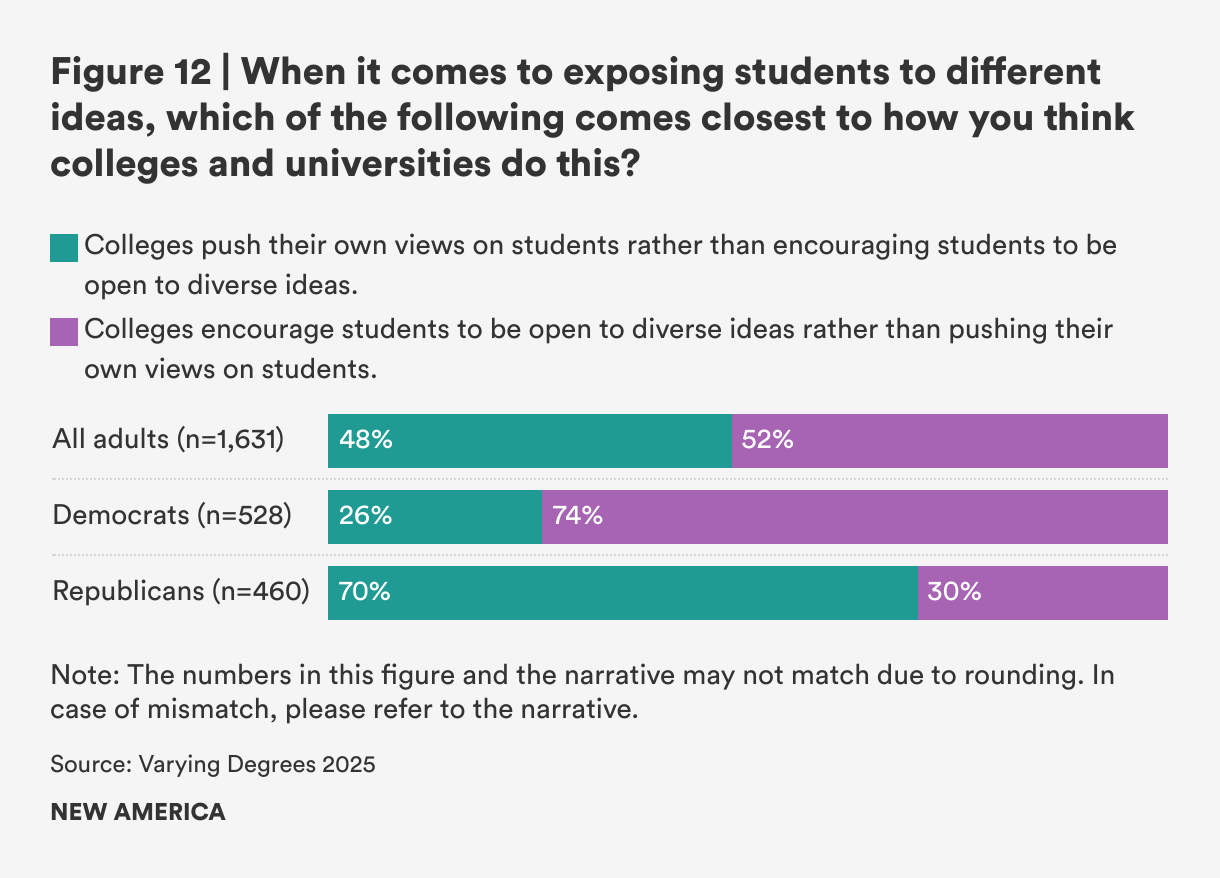
Americans are split on whether they think that when exposing students to different ideas, colleges push their own views on students versus encouraging students to be open to diverse ideas. Only 25 percent of Democrats believe colleges are pushing their own views on students, while 68 percent of Republicans think so (see Figure 12).
Americans Are Frustrated with the High Cost of College but Disagree on Who Should Pay
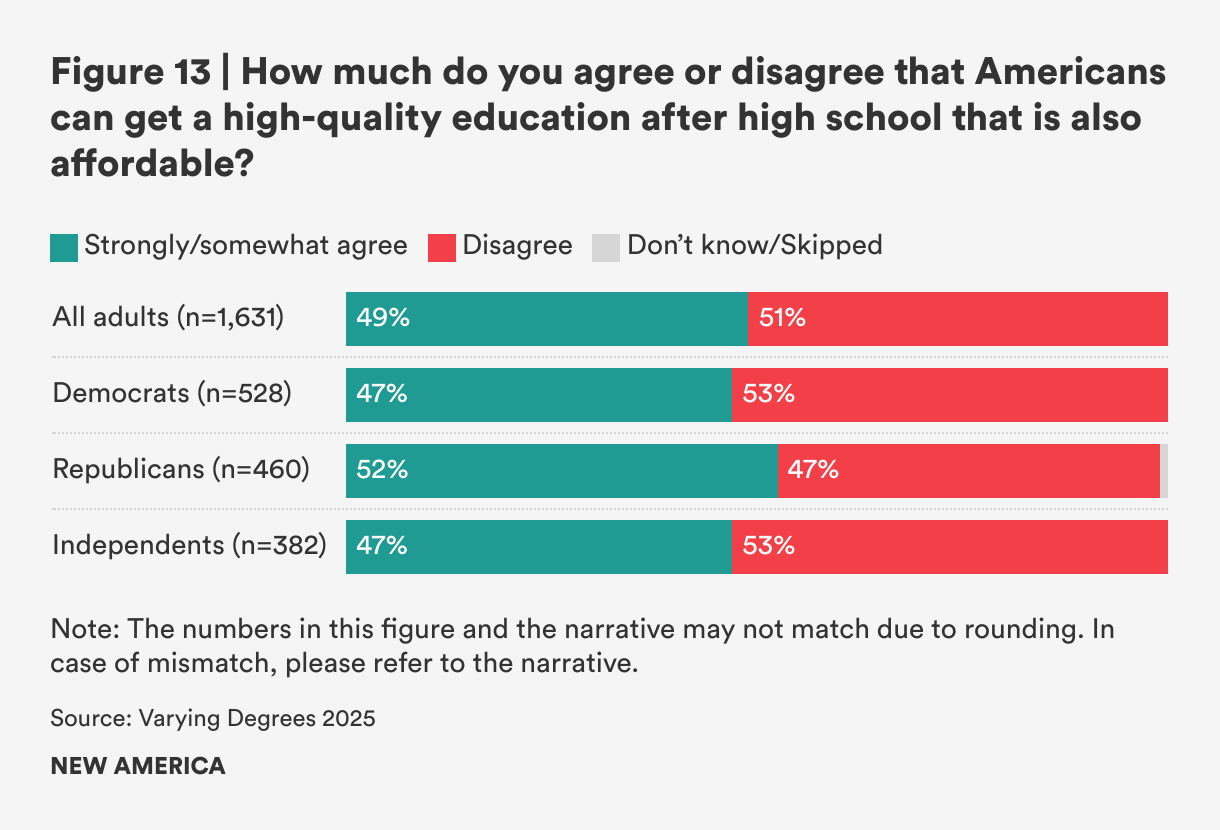
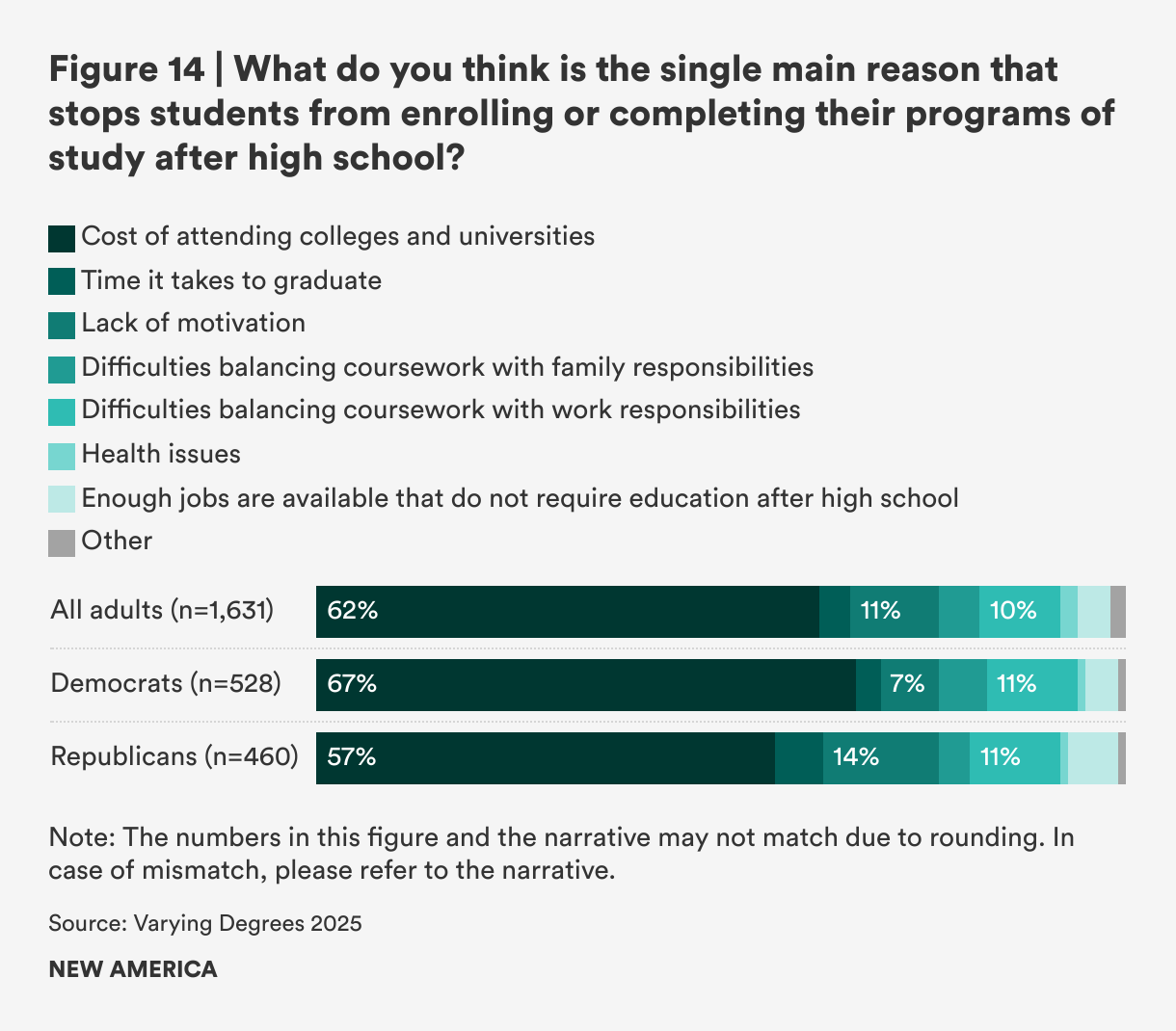
Only about half of Americans think they can get an affordable high-quality college education, and there is bipartisan alignment on this issue: 49 percent of Democrats and 53 percent of Republicans agree (see Figure 13). When asked to pick one reason among many factors that can stop students from enrolling or completing their programs, 62 percent of Americans picked the cost of attending, including 66 percent of Democrats and 56 percent of Republicans (see Figure 14).
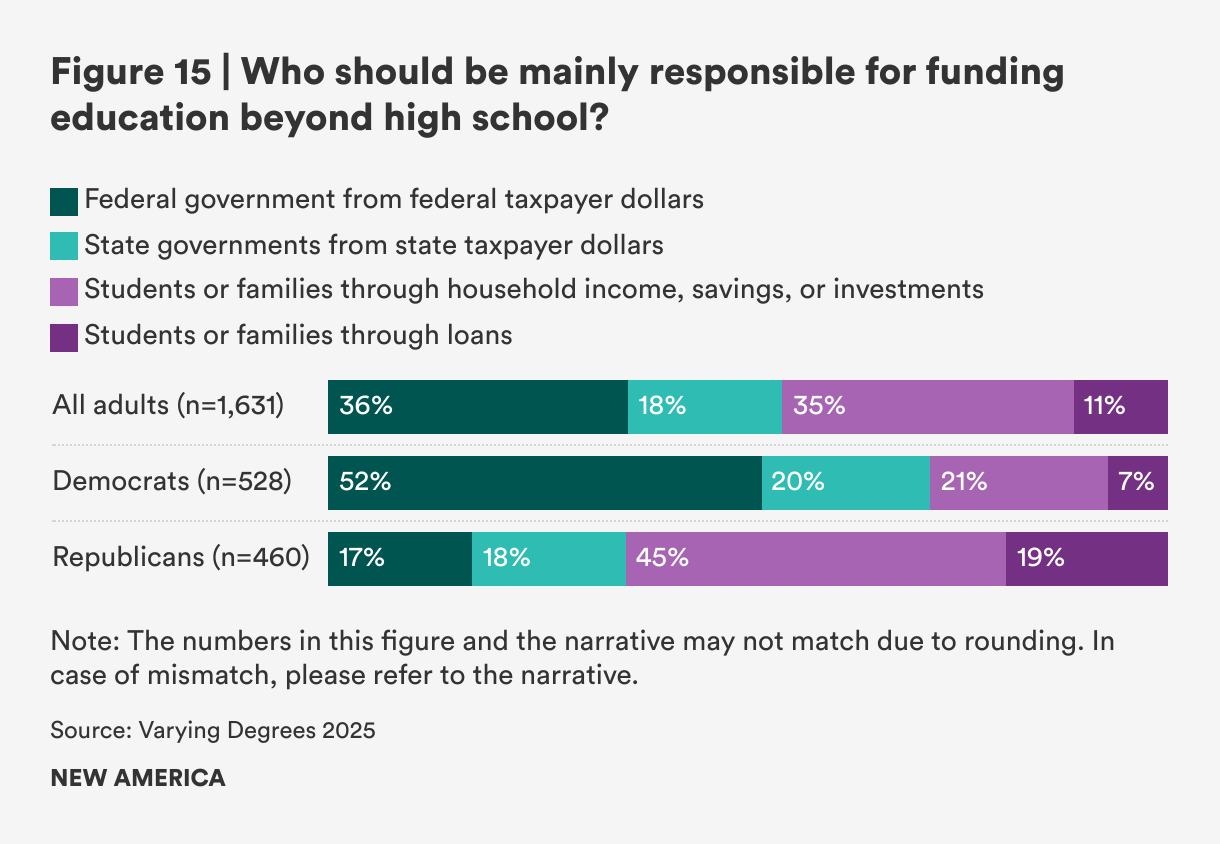
However, partisan differences show when it comes to how higher education should be funded. Half of Americans believe that the government (whether the federal or state) should be mainly responsible for funding education beyond high school, while 45 percent believe students and their families should fund education (whether through their own incomes and savings or loans). While both Democrats and Republicans acknowledge there is an affordability issue with higher education, they disagree on who should pay: 71 percent of Democrats believe the government should bear the main responsibility of college funding, while 64 percent of Republicans believe that students and their families should pay (see Figure 15).
The argument for more government funding for higher education is perhaps rooted in the idea that higher education is a public good and that society benefits from having an educated citizenry and a skilled workforce.1 On the other hand, those who argue students should bear the cost often frame college as a personal choice, since it is students who mainly accrue the benefits of more education, such as higher earnings and career advancement. Therefore, students should foot the bill.
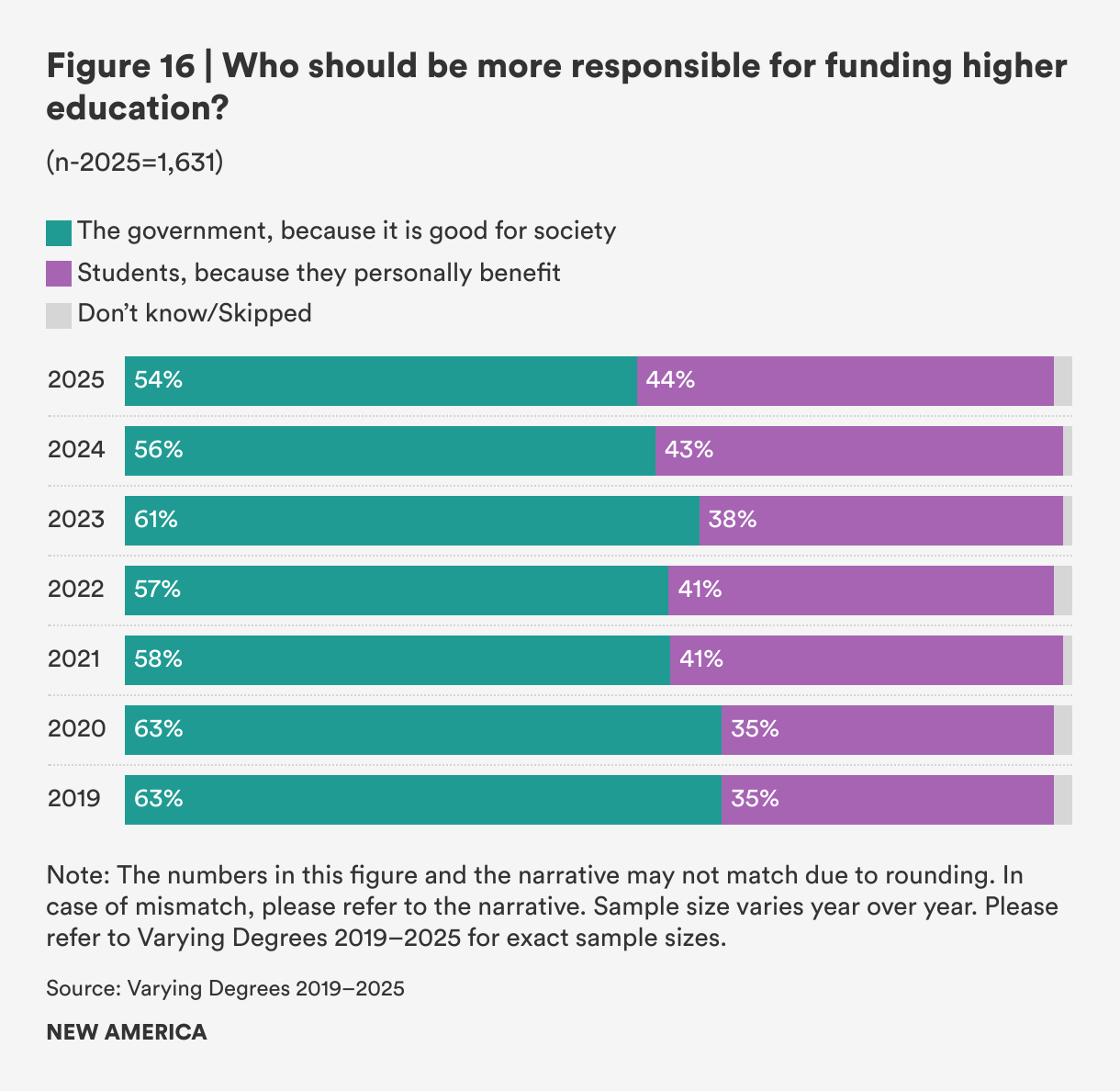
When pressed to choose who should fund higher education—government or students—more than half (54 percent) of Americans choose government, because higher education is good for society, while 44 percent choose students, because they personally benefit. The margin between the two views has gradually narrowed since 2019 (see Figure 16).
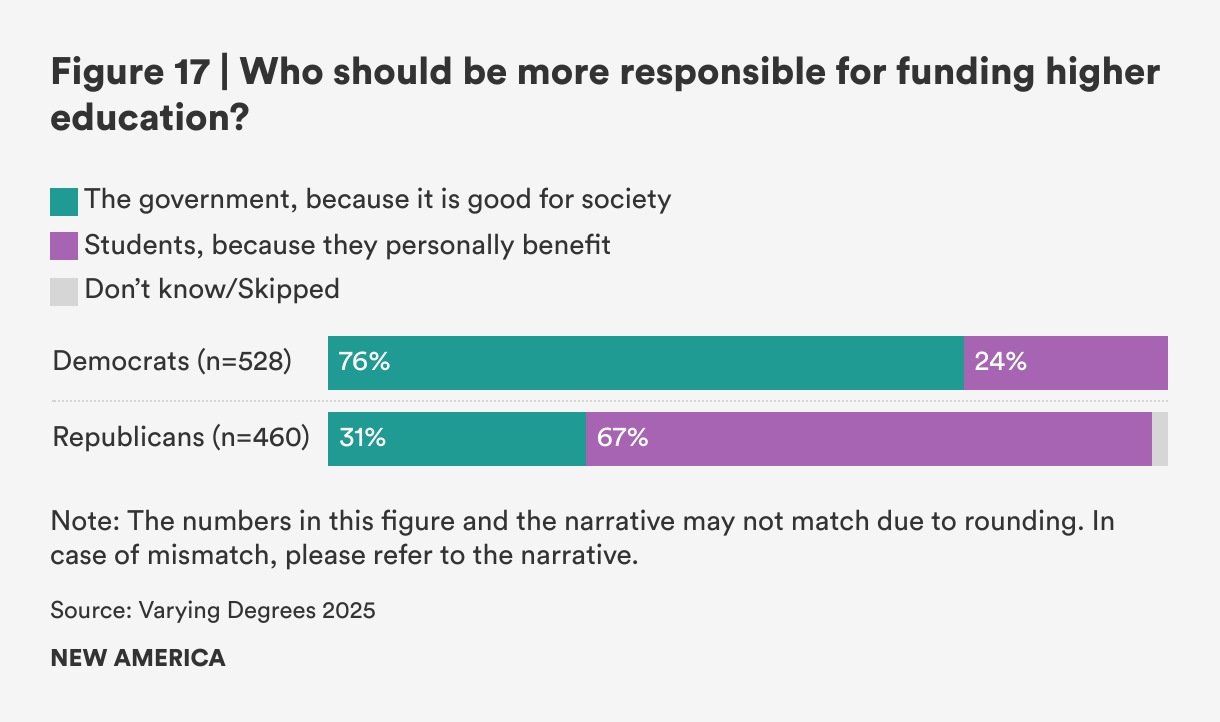
The question of who should fund higher education has historically shown a sharp partisan divide, and this year is no different. While 75 percent of Democrats believe the government should fund higher education, only 31 percent of Republicans think so. In contrast, two-thirds of Republicans believe that students should be responsible for the cost, viewing higher education as a personal investment (see Figure 17).
Americans Still Believe the Federal and State Governments Should Invest More in Higher Education to Improve Affordability
Although Americans may still be split on who should pay for college, a majority believe more investment from both federal and state governments should be made to make higher education more affordable.
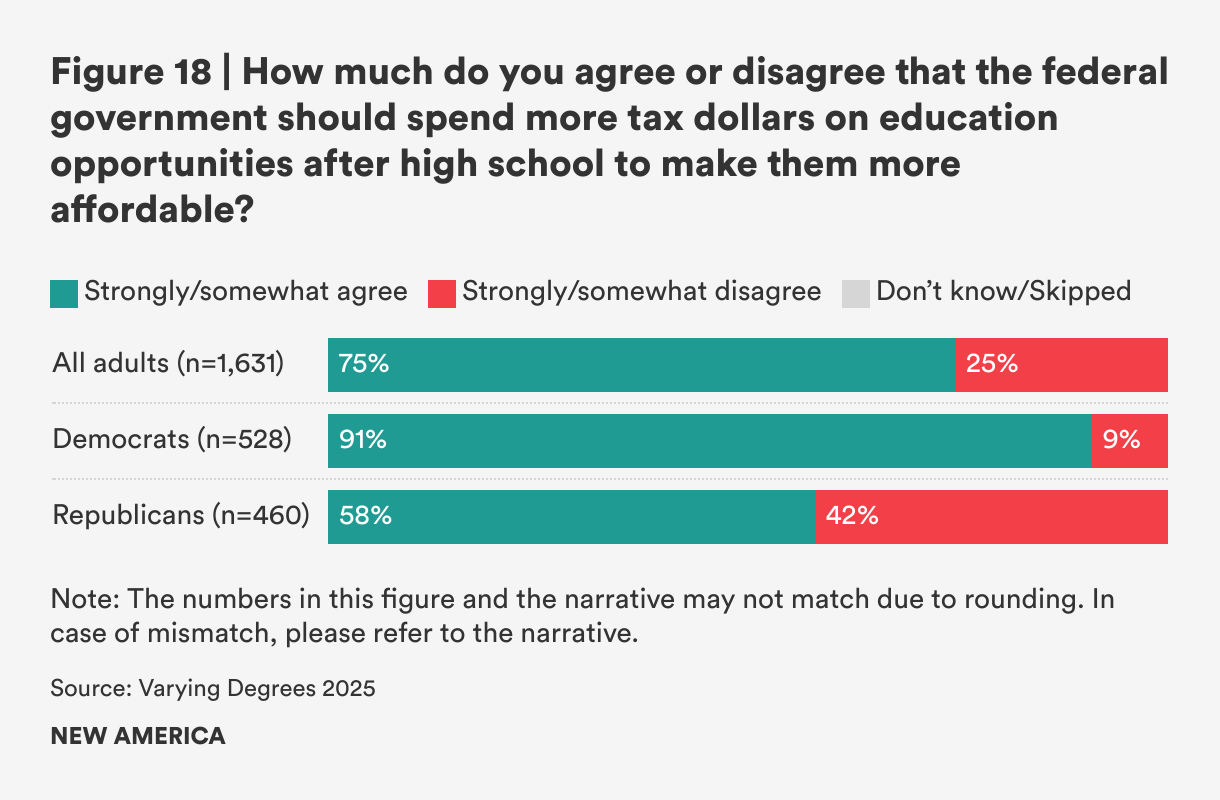
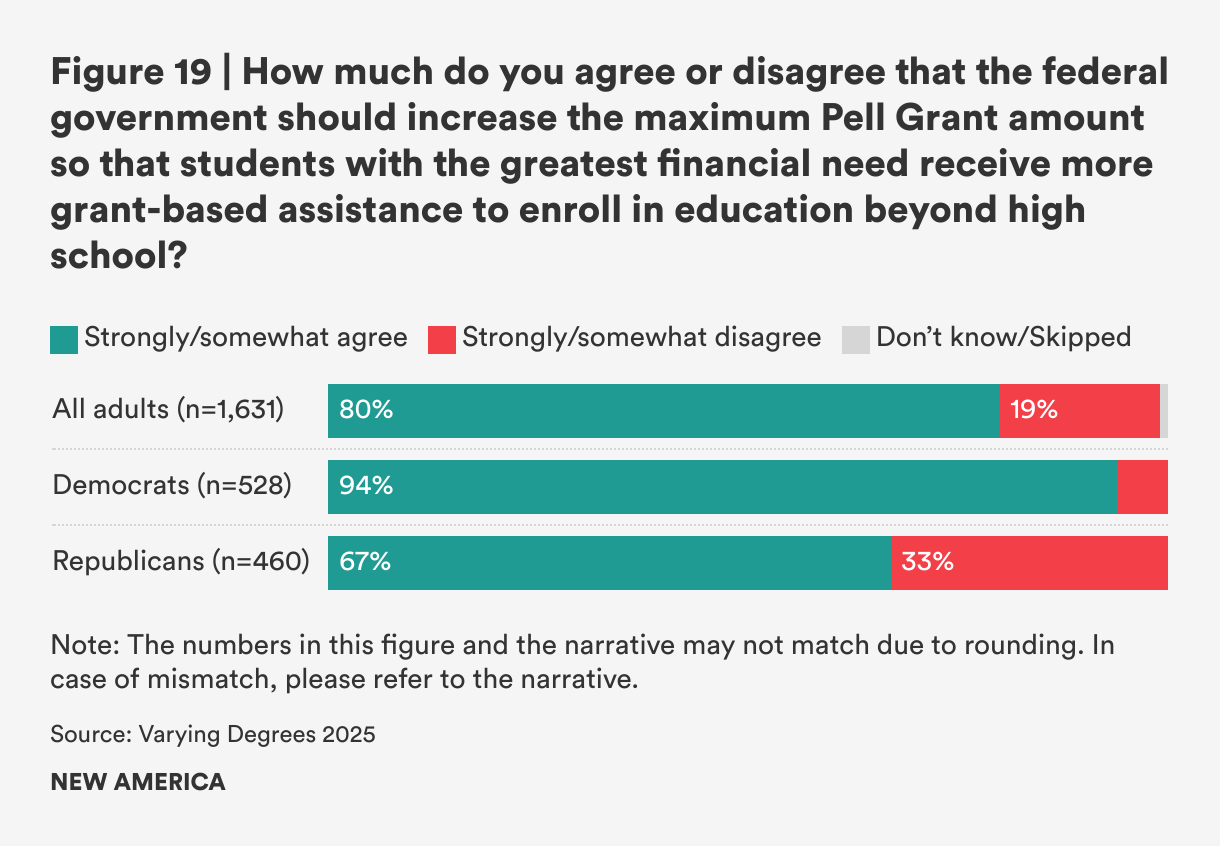
Three in four Americans believe the federal government should increase funding to make higher education more affordable, including 91 percent of Democrats and 58 percent of Republicans (see Figure 18). While there is a 33 percentage-point partisan gap in this question, 58 percent still indicates that a majority of Republicans support greater federal investment for higher education. Eight in 10 Americans agree that the government should increase the maximum amount of the Pell Grant, the largest federal aid program for low-income students. Increasing the Pell Grant receives bipartisan support, with 94 percent of Democrats and 67 percent of Republicans in favor of the idea (see Figure 19).
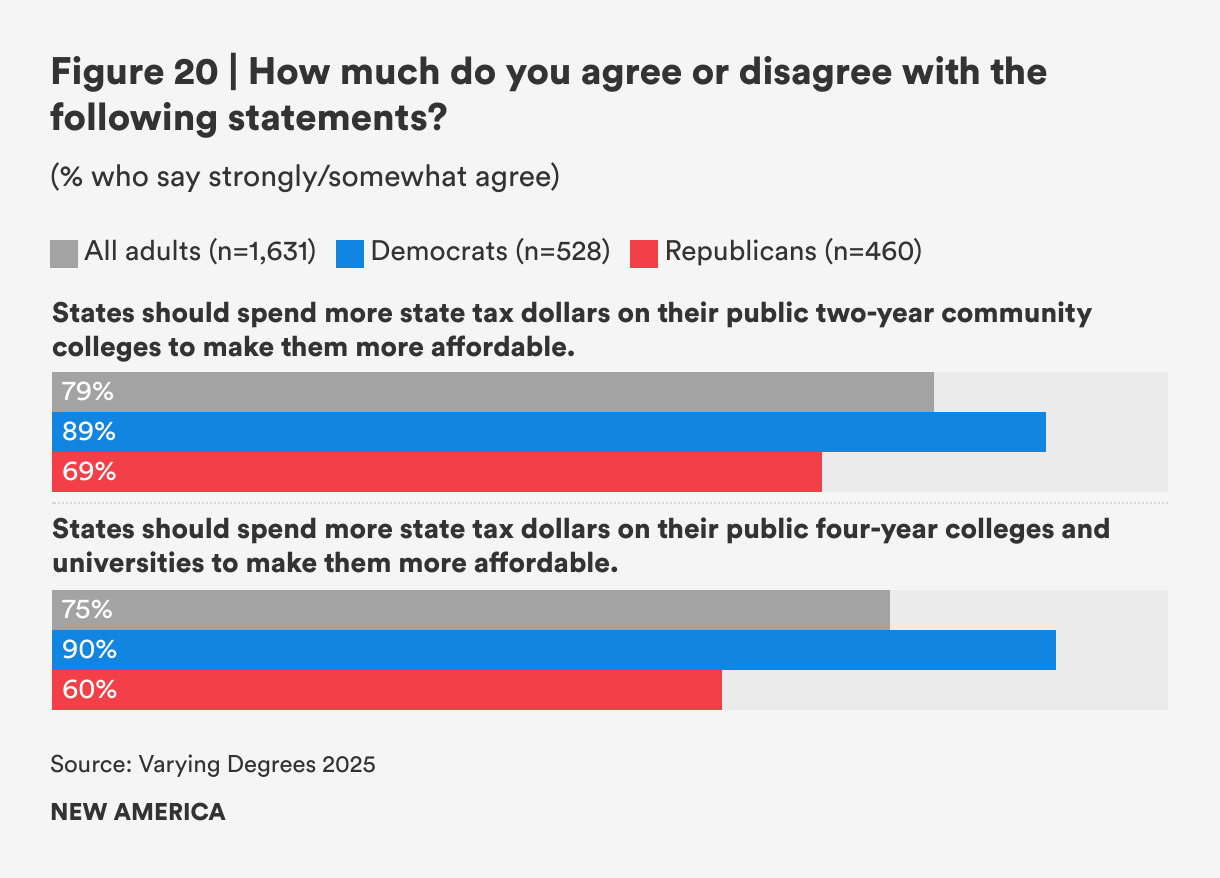
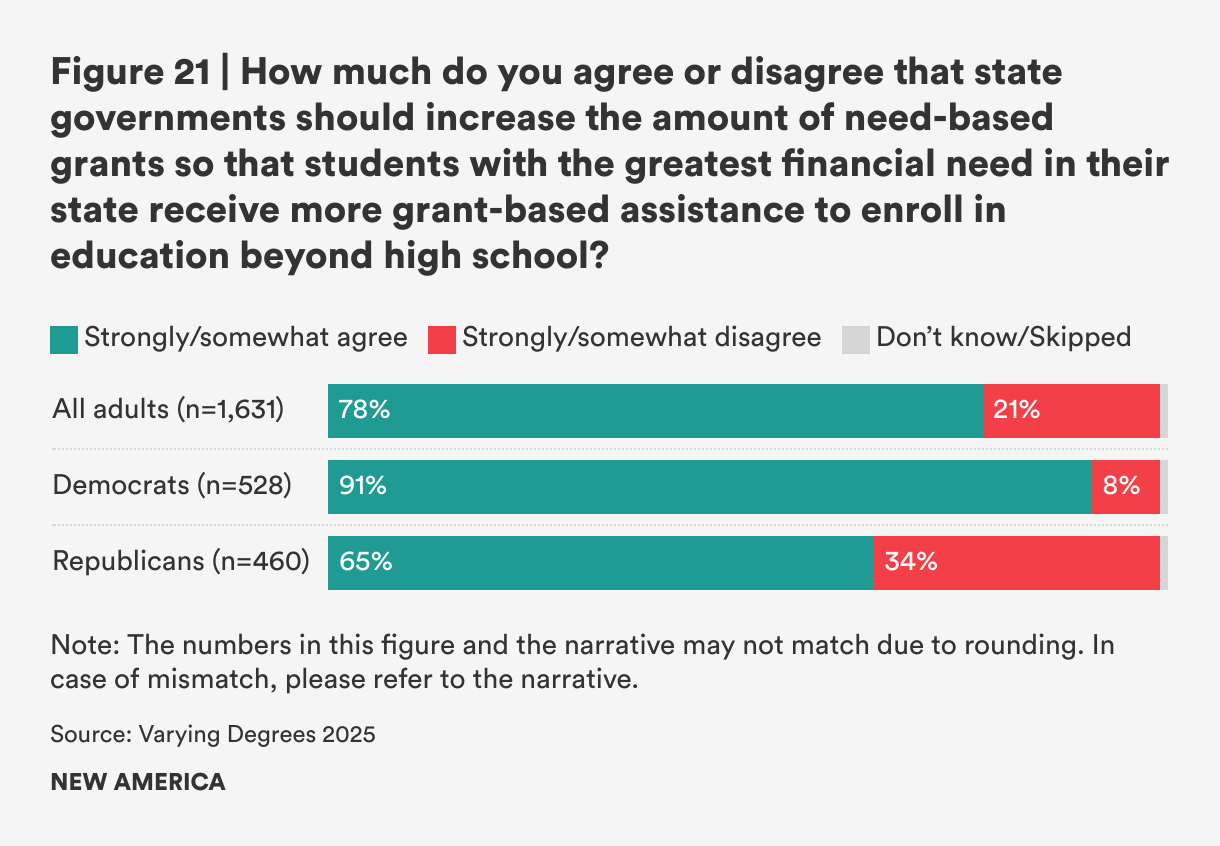
Public higher education in the United States relies heavily on state funding. Most (70 and 75 percent, respectively) Americans believe states should spend more to make community college and public four-year institutions in their states more affordable (see Figure 20). Nearly eight in 10 Americans believe states should expand funding for need-based aid programs so that more low-income students can afford college (see Figure 21). More state funding for higher education also receives widespread support across party lines, with majorities of Democrats and Republicans backing these investments.
Citations
- For more, see Sarah Hebel, “From Public Good to Private Good,” Chronicle of Higher Education, March 2, 2014, source; Sandy Baum and Michael S. McPherson, “Is Education a Public Good or a Private Good?,” Chronicle of Higher Education, January 18, 2011, source; and M. Douglas, “Public and Private: What’s the Difference?” Inside Higher Ed, March 6, 2006, source.
Historical Trends: Even in Challenging Times, Americans’ Perceptions of Value and Investment Have Stayed Relatively Steady
Let’s take a trip down memory lane. Since 2017, major events in American society and politics have reshaped higher education in profound ways. That year marked the start of Trump’s first presidency, when the administration quickly moved to pull back several key protections and accountability measures for students, such as the Deferred Action for Childhood Arrivals (DACA) program, which provided temporary protection from deportation for certain undocumented students; Title IX guidance for survivors of sexual assault; and the gainful employment rules, which hold colleges accountable for student outcomes.1 In 2020, the COVID-19 pandemic forced universities and students to rapidly shift from in-person to online learning, drastically changing how higher education functioned.2 Only three years later, the Supreme Court struck down race-conscious admissions policies, overturning decades-long precedents to consider race in admissions and requiring colleges to review how to pursue diversity without the explicit consideration of race.3 Then in 2024, the Biden administration’s much-anticipated rollout of the new Free Application for Federal Student Aid (FAFSA) was mangled with glitches, repeated delays, and technical issues, preventing colleges from issuing timely financial packages and leaving many students unsure about their aid offers as they decided on whether to enroll.4
In 2025, higher education continues to be under intense pressure from the new Trump administration and the 119th Congress. Yet during these tumultuous times filled with unprecedented challenges, Varying Degrees—now with nine years of data—shows that Americans’ views of the U.S. higher education system, especially its value and investment, have remained stable. There has been some frustration for sure. In a few areas, public support waned slightly but noticeably. The decline tracks with recent surveys, which show a precipitous decline in public confidence in higher education, especially among Republicans.5 Despite the decline in confidence, however, the year-over-year stability in public opinion about college value indicates that a majority of Americans still greatly value higher education and the long-term benefits it offers.
Americans Still Consider Higher Education a Worthwhile Investment
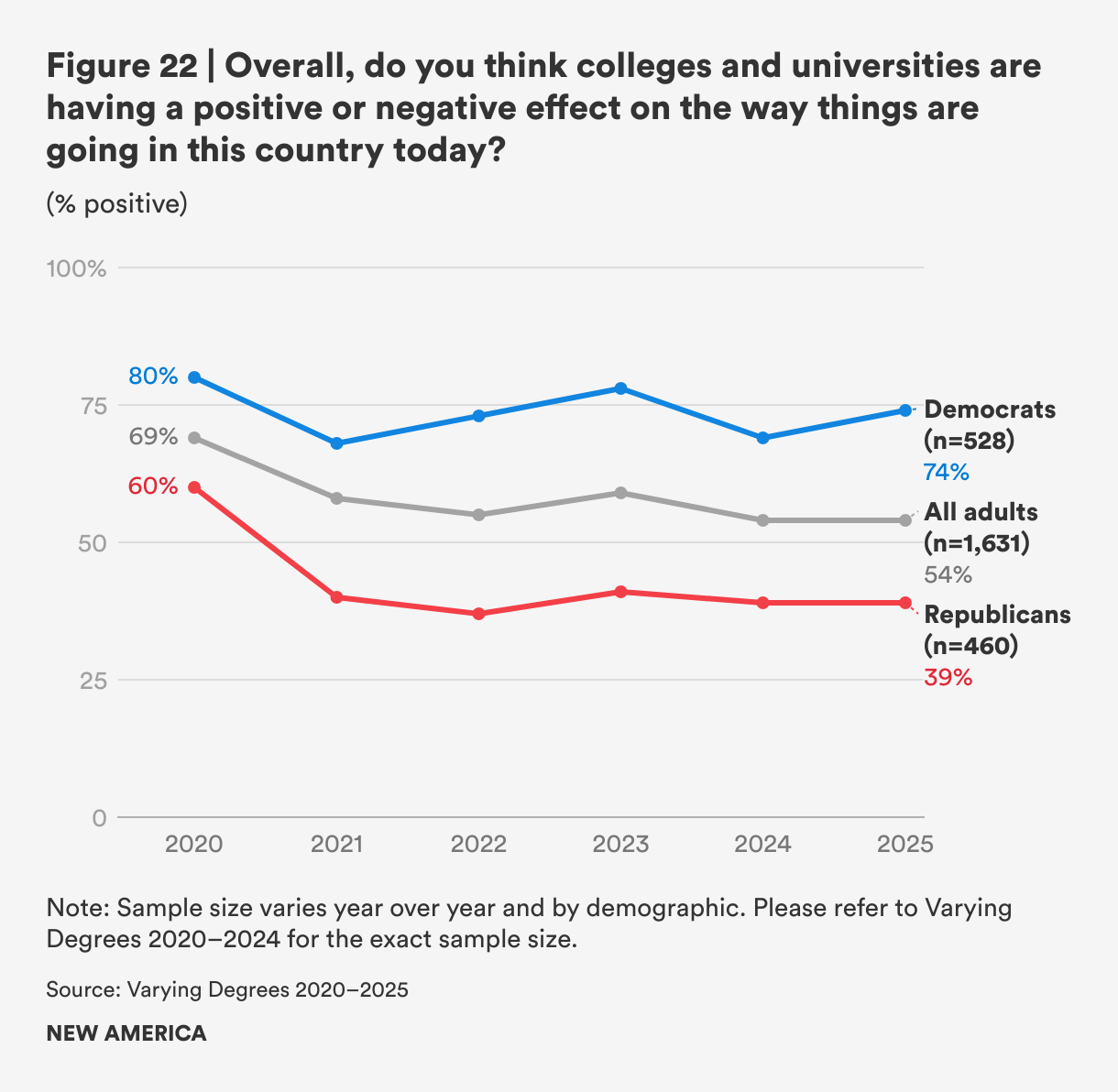
Only 54 percent of Americans believe colleges and universities have a positive effect on the country, dropping from 69 percent in 2019 (see Figure 22). During this six-year period, the partisan gap has widened on this question. In 2025, 74 percent of Democrats and 39 percent of Republicans believe that higher education plays a positive role in the United States, a 35-percentage point difference, compared to the 20-percentage point gap in 2020.
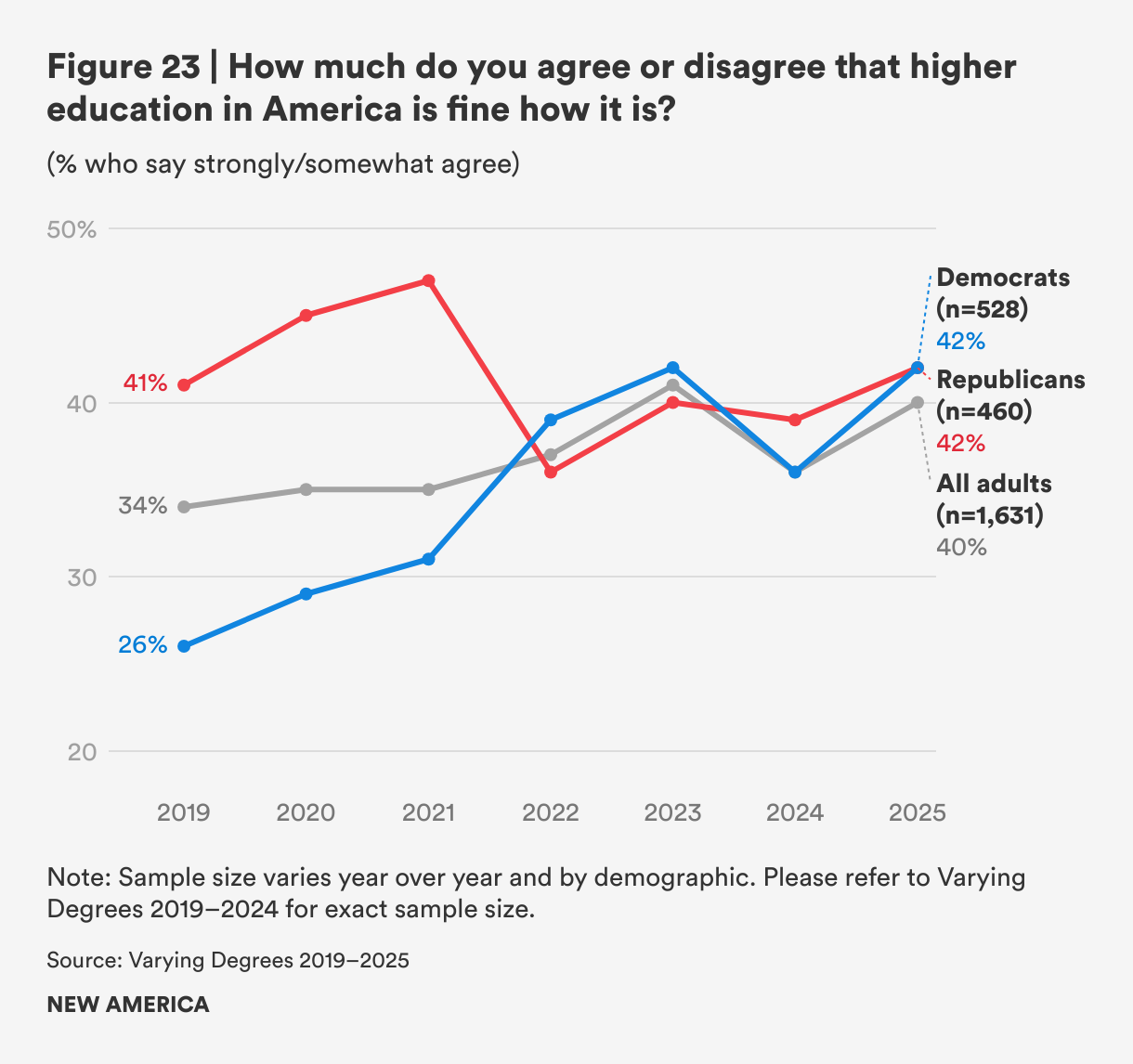
Only 40 percent of Americans think higher education is fine as it is, an increase from 33 percent in 2019 (see Figure 23). While on the upward trend, the share of people who agreed with this statement has never gone above 41 percent, which shows that a majority of Americans are still not happy with how higher education is. Both Democrats and Republicans are aligned on this question in recent years, despite a significant gap during 2019 and 2021.
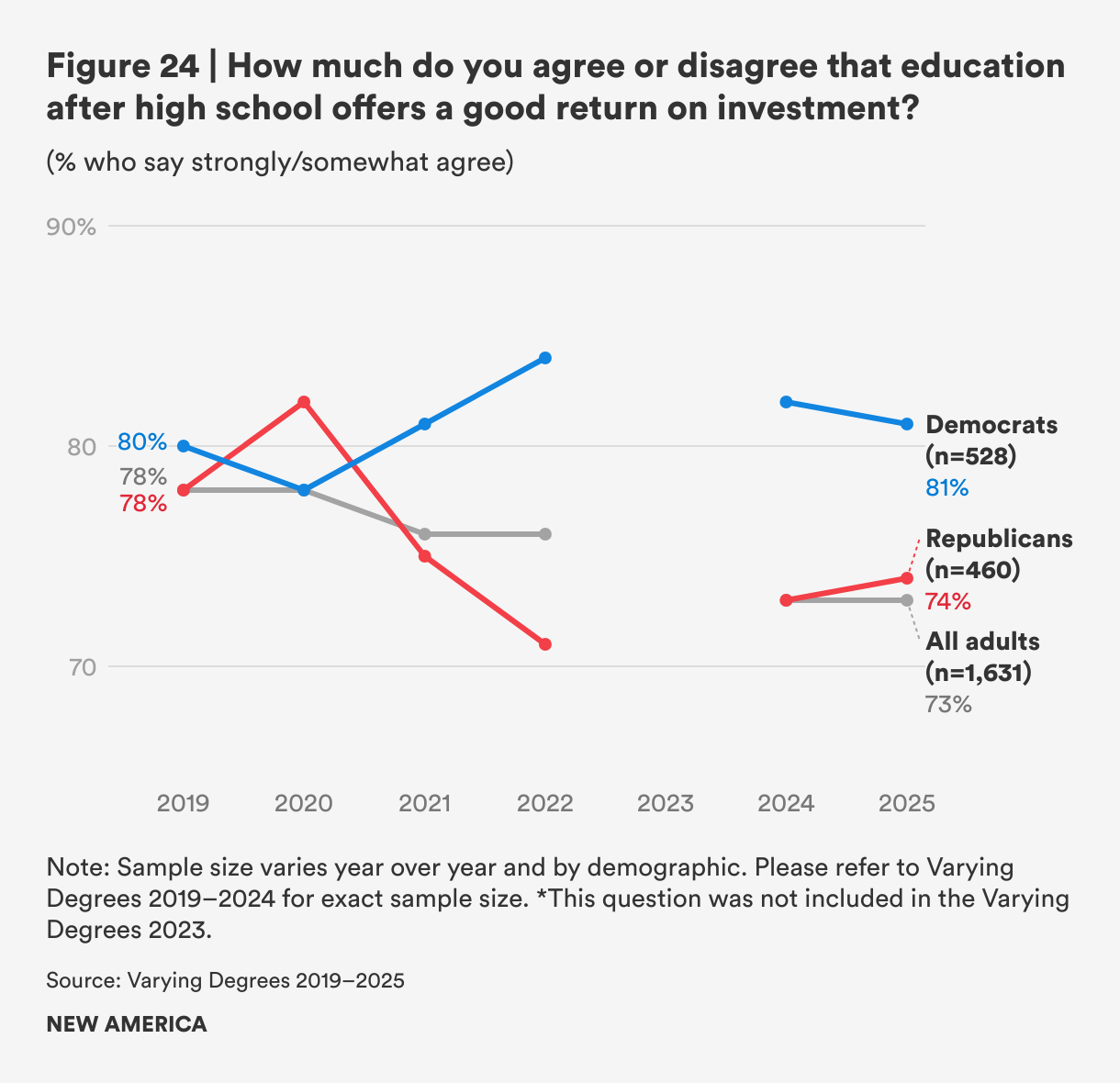
Despite growing frustration with higher education, close to three in four Americans agree that higher education offers a good return on investment in 2025 (see Figure 24). This number has remained stable since 2017, albeit on a slight downward trend. Both Democrats and Republicans have agreed consistently since 2019.
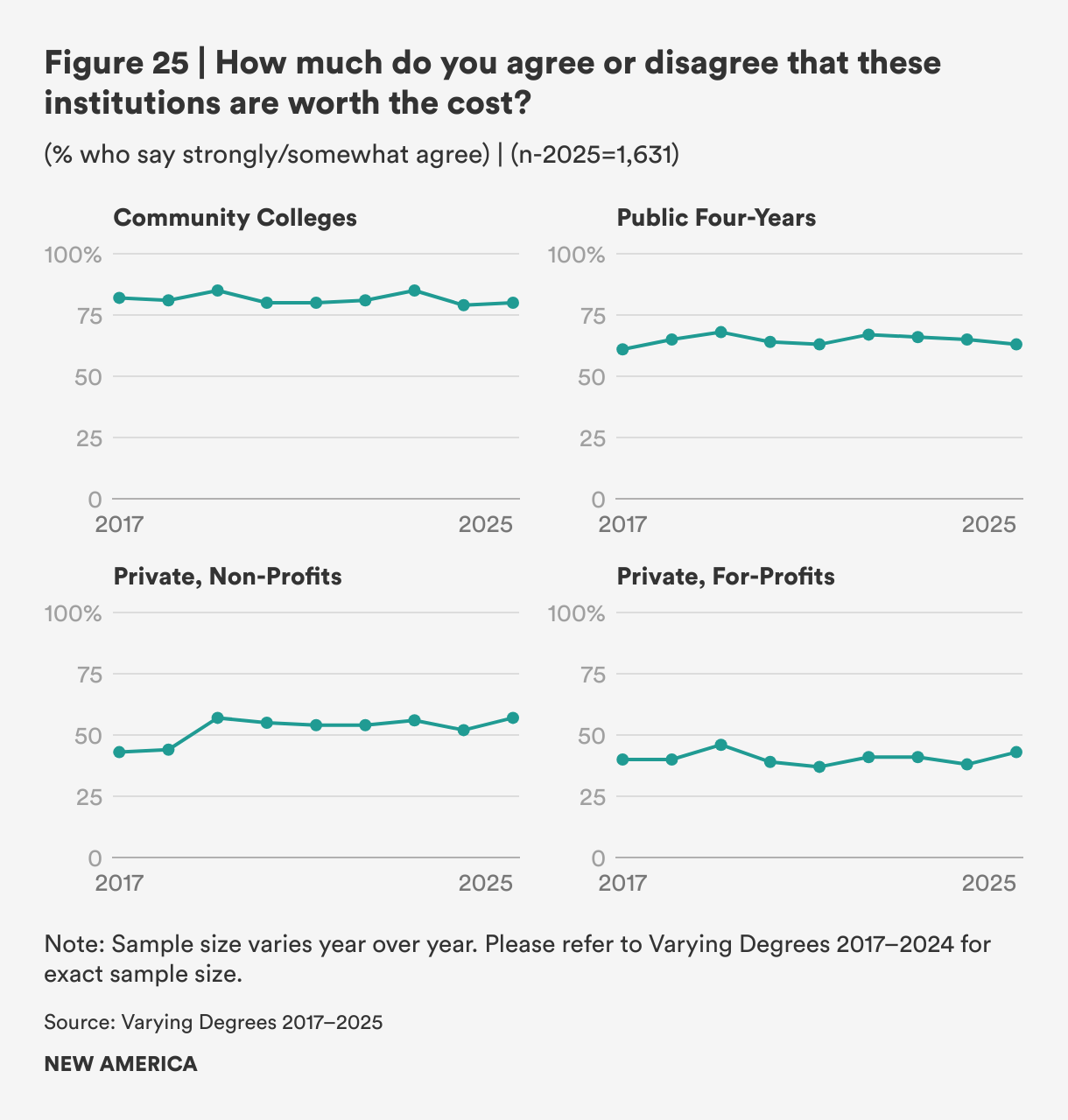
When looking into specific college types, Americans’ views have not changed much since 2017. A majority agree that public colleges and universities are worth the cost and are much less sure about private colleges and universities, especially private for-profit institutions (see Figure 25). Considering that community colleges provide the most affordable and accessible postsecondary education, it is no surprise most Americans think highly of them.
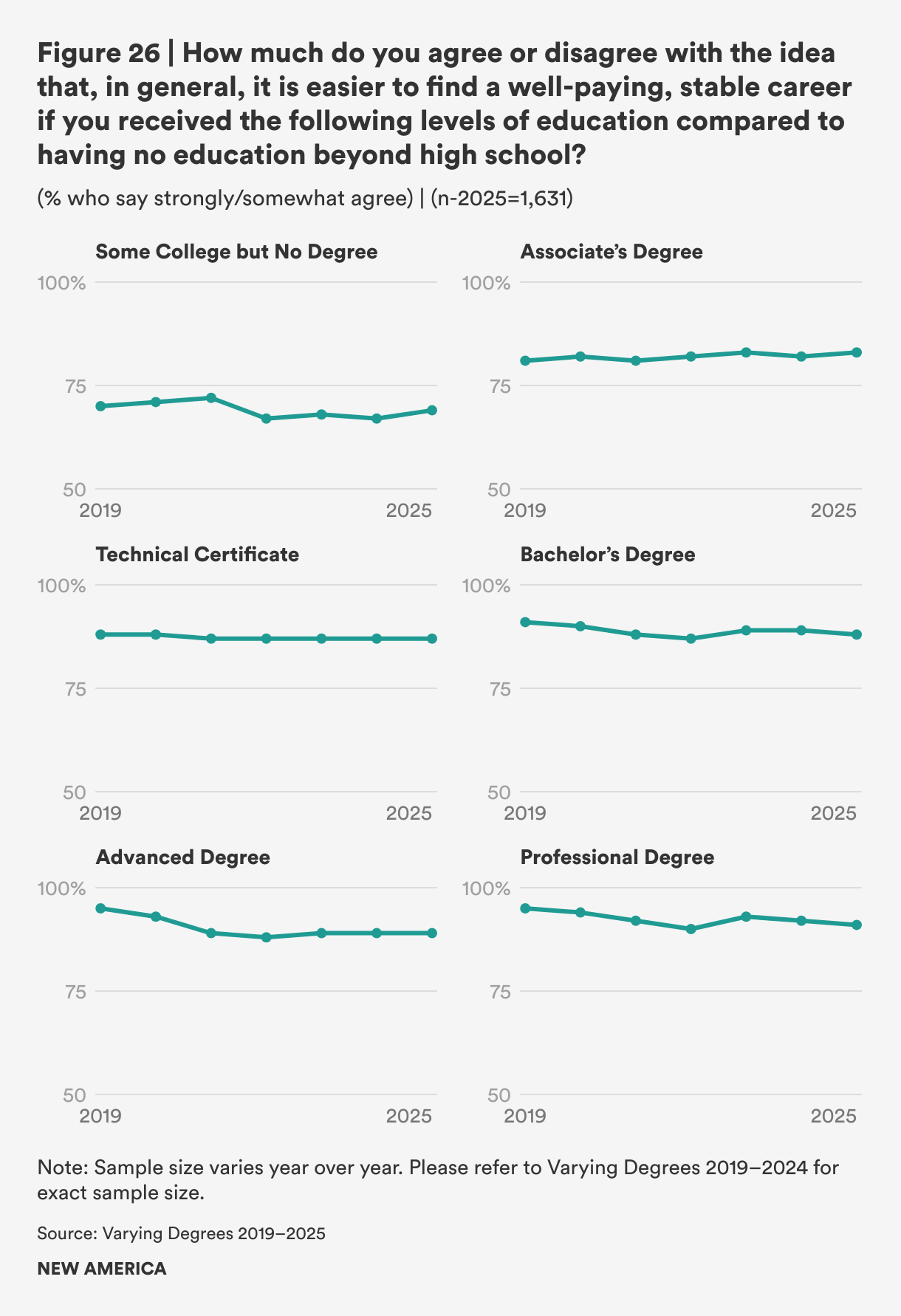
Over the years, Varying Degrees survey respondents have continued to believe it is easier to find a well-paying, stable job with any level of postsecondary education than with just a high school diploma (see Figure 26). Two in three believe that it is easier to earn more with some college education, even without degrees; this goes up to 83 percent with a degree, even just a technical certificate.
Support for Higher Education Investment Remains Stable Too
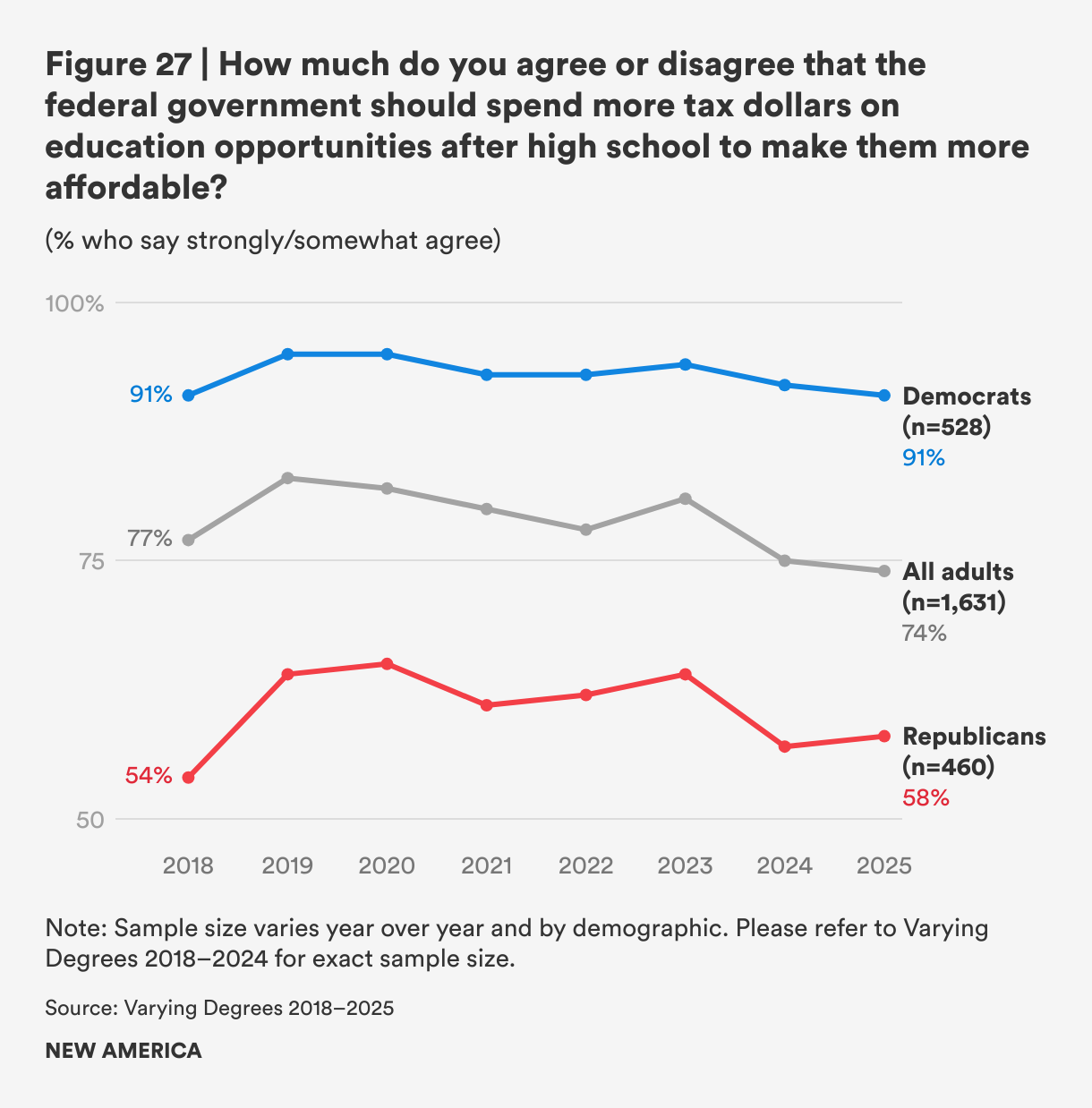
Views on higher education funding have also remained pretty consistent over the years of our survey. Three in four Americans in 2025 agree that the federal government should spend more tax dollars to make higher education more affordable, slightly declining from 77 percent in 2018. Despite this decline, 74 percent of Americans indicate solid support for greater federal investment in college (see Figure 27).
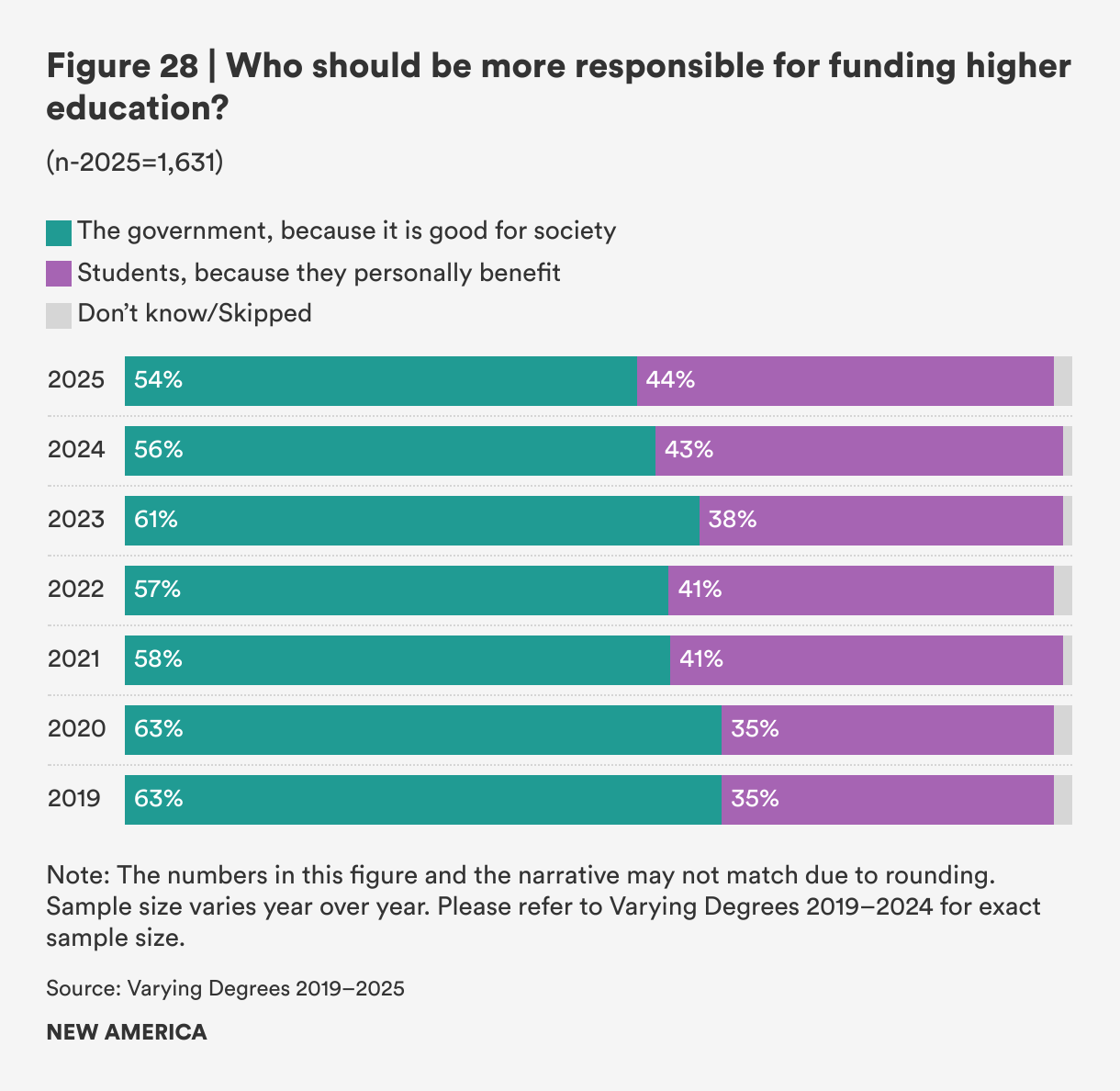
When asked who should be more responsible for funding higher education, government or students, only 54 percent of Americans in 2025 think that the government should be more responsible. This number has been decreasing steadily since 2019, when 63 percent said the government should be more responsible (see Figure 28). There has always been an immense partisan divide on this question: 75 percent of Democrats believe the government should fund higher education, compared to only 31 percent of Republicans. This gap has largely remained the same over the past six years.
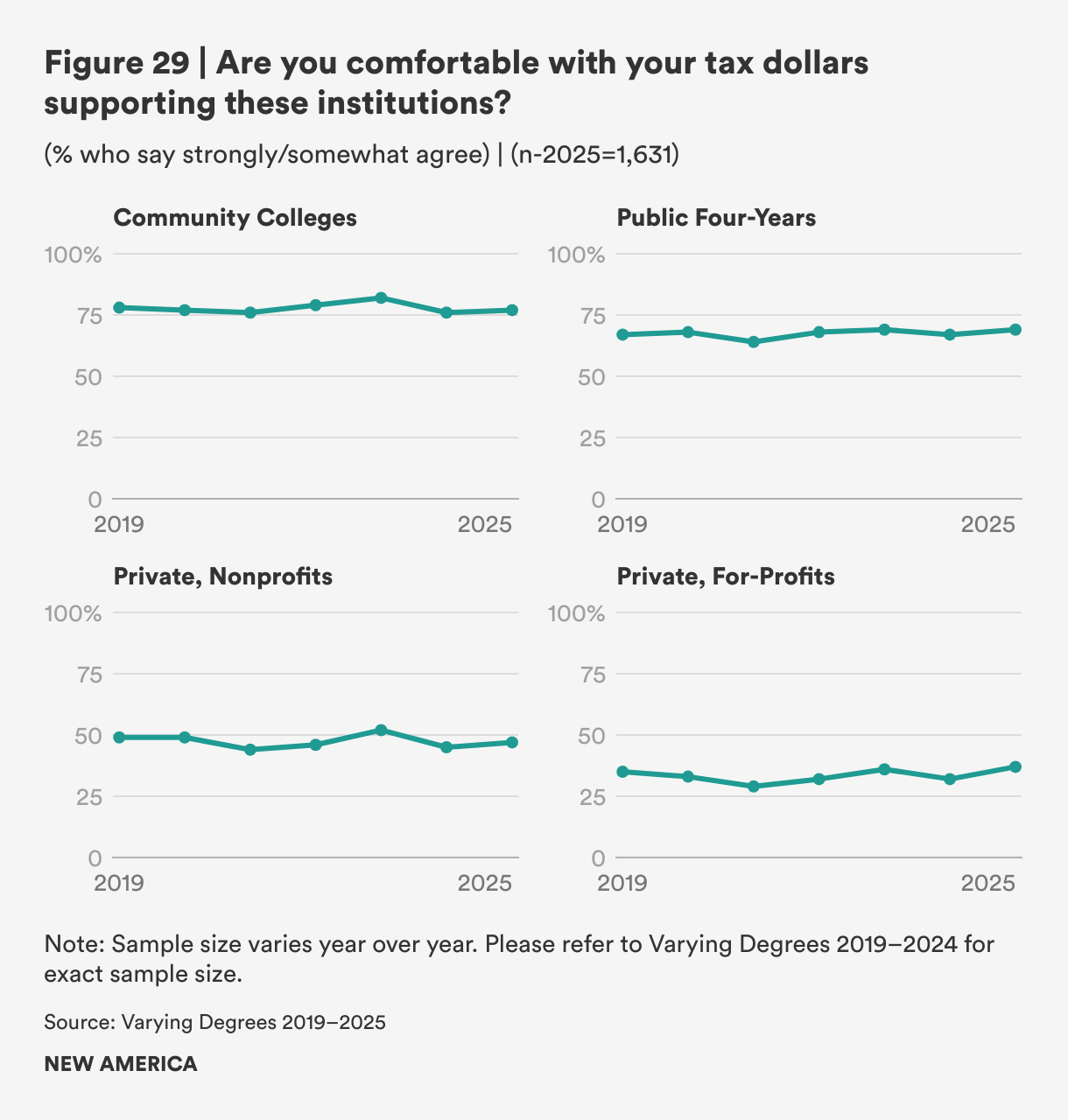
Spending tax dollars on public colleges and universities has garnered consistent support throughout the years. Community colleges can boast about the most support, with 77 percent of Americans feeling comfortable with their tax dollars going to two-year schools in 2025 (see Figure 29). A smaller share, but still a majority of Americans (69 percent), also support the idea of their tax dollars going to public four-year schools. Americans are more hesitant to provide tax dollars to private colleges and universities, with only 48 percent of Americans wanting tax dollars to go to private, nonprofit schools and 37 percent to private, for-profit schools.
Citations
- For more, see Vanessa Romo, Martina Stewart, and Brian Naylor, “Trump Ends DACA, Calls on Congress to Act,” NPR, September 5, 2017, source; Anya Kamenetz, “Betsy DeVos Signals a Pullback on Campus Sex Misconduct Enforcement,” NPR, September 7, 2017, source; and Andrew Kreighbaum, “DeVos Issues Final Repeal of Gainful Employment,” Inside Higher Ed, July 1, 2019, source.
- For more, see Rachel Fishman and Sophie Nguyen, The Great Pandemic Pivot: College Leaders Reflect on the Impact of COVID‑19 (New America, December 8, 2021), source.
- For more, see Nina Totenberg, “Supreme Court Guts Affirmative Action, Effectively Ending Race-Conscious Admissions,” NPR, June 29, 2023, source.
- For more, see Liam Knox, “The Long-Awaited FAFSA Autopsy Is Here,” Inside Higher Ed, September 24, 2024, source.
- For more, see Jones, “U.S. Confidence in Higher Education,” source.
Explore the Data
Error: Data visualization bundle URL missing.
Appendix: Methodology
Survey Overview
Study Target Population: General population age 18+
Sample Units: 9,112
Completed Units: 1,631
Expected Eligibility Rate: 100%
Observed Eligibility Rate: 100%
Margin of Error: ±3.23 percentage points (pp)
Design Effect: 1.77
Survey Field Period: March 13, 2025–March 28, 2025
Median Survey Duration (minutes): 23 via web mode, 52 via phone
Sampling Approach
A general population sample 18 years and older was selected from NORC’s AmeriSpeak Panel for this study. An oversample of African Americans, Asian/Pacific Islander Americans, and Hispanic Americans was added to the sample to achieve complete survey targets for these demographic groups. The sample was selected from the AmeriSpeak Panel using sampling strata based on age, race/Hispanic ethnicity, educational attainment, and gender (48 sampling strata in total).
Survey Sample
The survey findings reflect the final case set of 1,631 respondents, which includes 1,583 surveys completed by web mode and 48 surveys by telephone interview. The sample design achieved the client-specified demographic targets. The final case set includes non-Hispanic African Americans (n=292), Hispanic Americans (n=384), and non-Hispanic Asian/Pacific Islander Americans (n=248) to ensure adequate sample size of those groups for analysis.
Survey Instrument
The Varying Degrees instrument collects information about the public’s perceptions of a variety of aspects related to U.S. postsecondary education. The instrument is designed to collect information to serve two purposes. First, the instrument must be able to illuminate findings that are responsive to current contexts that influence public opinion. Second, the instrument must also collect information about the public’s perceptions over time to illuminate trends.
The Varying Degrees 2025 instrument consisted of 11 sections:
- Enrollment and Borrowing Status
- Employment and Financial Security
- Higher Education Quality
- Confidence in Higher Education
- Higher Education Value and Accountability
- Affordability
- Higher Education Funding
- Higher Education Institutions by Sector
- Online and In-Person Education and Artificial Intelligence
- Higher Education Impact
- Respondent and Household Demographic Information
The survey was offered in English and Spanish, and it was administered in two modes, depending on the preference of the respondent: (1) self-administered by the respondent online via the web, or (2) administered over the telephone by a live interviewer.
Fielding the Survey
A small, randomly selected subsample of AmeriSpeak web-mode panelists were invited to the survey as a part of a soft launch on March 13, 2025. The initial data from the soft launch were reviewed to confirm there were no processing or programming errors. Once reviewed, the remainder of sampled AmeriSpeak panelists were invited to the survey on March 14, 2025.
If invited, AmeriSpeak panelists could take the survey online through the password-protected AmeriSpeak mobile app, the password-protected AmeriSpeak web portal, or by following a link in the email invitation sent to them.
To encourage study cooperation, NORC sent the initial invitation and various email reminders to sampled web-mode panelists (i.e., soft launch, total sample, oversamples, and remaining sample) between March 14 and March 27, 2025. Email reminders were sent three days after the initial invite email and then every five days thereafter. A last-chance email reminder was sent the day before the end of the field period, on March 27.
To administer the phone survey, NORC—from March 19 to March 27—dialed sampled panelists who prefer to take surveys on the phone. Panelists were offered the cash equivalent of $3 for completing this survey.
More About the Authors

Olivia Cheche
Program Associate, Higher Education

Sophie Nguyen
Senior Policy Manager, Higher Education

Olivia Sawyer
Program Associate