
Varying Degrees 2023
Abstract
For Varying Degrees 2023: New America’s Seventh Annual Survey on Higher Education, we interviewed 1,497 Americans ages 18 and older, including oversamples of Black, Latinx, and Asian Americans, to better understand their perspectives on education after high school. This year’s survey continues our core questions about the value of higher education, how it is funded, and how it should be held accountable, and includes new questions about equity in higher education.
Acknowledgments
Varying Degrees was funded by the Bill & Melinda Gates Foundation. New America thanks the foundation for its support. The findings and conclusions contained within are those of the authors and do not necessarily reflect positions or policies of the foundation. The authors would like to thank Sabrina Detlef for her copyediting support, and Katherine Portnoy, Amanda Dean, Jodi Narde, and Naomi Mourduch Toubman for their communications and data visualization support.
Executive Summary
Varying Degrees is an annual survey about Americans’ perspectives on education after high school.1 Now in its seventh year, Varying Degrees continues to ask Americans for their opinions on critical questions related to the value of educational opportunities after high school, how higher education is funded, and how we hold colleges and universities accountable for that funding. The survey this year, with a sample size of 1,497 adults, for the first time explores Americans’ perspectives on the benefits that education after high school can bring to individuals and society at large, and whether they think students can equitably access college and succeed in obtaining their degrees.2
As in previous years, this year’s findings show that while Americans acknowledge the value of education after high school, they do not believe it is affordable for everyone who wants to enroll, and want to see change in higher education. Seven in ten Americans believe that their close family members need to complete at least some amount of education beyond high school to ensure financial stability: nearly 40 percent think the minimum level should be at least a bachelor’s degree. At the same time, only about half think Americans can get a high-quality education after high school that is also affordable, and that education after high school is affordable to anyone who wants to pursue it.
Other key findings include:
- A majority of Americans believe that individuals with undergraduate credentials (i.e., certificate, associate, or bachelor’s degrees) earn more and enjoy greater financial stability. Furthermore, more than 70 percent think that individuals with undergraduate credentials contribute to greater civic engagement, lower unemployment rates, and better public health within their communities.
- Six in ten Americans believe that the government is responsible for funding education after high school because it is good for society. However, this question continues to show the rift between Democrats and Republicans: while as much as 78 percent of Democrats agree that the government should fund education after high school, only 36 percent of Republicans think so.
- Eighty-five and 66 percent of Americans, respectively, think community colleges and public four-year colleges are worth the cost. More than 80 and nearly 70 percent, respectively, would be comfortable supporting community colleges and public four-year colleges with tax dollars.
- Nearly 80 percent agree that programs should lose eligibility for federal financial aid if they consistently leave students deeply in debt relative to their earnings, or if they consistently fail to help graduates earn more than those who complete only a high school diploma. Four in five Americans agree with recouping money from institutions for borrower defense discharges.
- Three-fourths of Americans believe that federal and state government and colleges and universities should work to ensure that students from historically underrepresented backgrounds have access to higher education opportunities. Nine in ten Americans agree that colleges and universities should ensure adequate support services are provided to those students who need them, and 78 percent of Americans agree that all students benefit when colleges and universities reflect the racial diversity of the United States.
Citations
- See methodology in the appendix.
- All survey materials including questionnaire and data files can be found in the download section of this report.
Preface
What do Americans hope to achieve when they enroll in education after high school? Is it a job that brings them financial well-being and stability, a life with fulfilling experiences, a chance to move up the economic ladder, or all of the above? For the past seven years, Varying Degrees, New America’s nationally representative survey on higher education, has been asking these questions, shedding light on Americans’ perspectives on the value of education after high school, whether they want higher education in the U.S. to change, and if they do, how it should change.
We have learned that a majority of Americans believe in the value that an education after high school can bring to their lives and their communities. At the same time, they would like to see colleges and universities lower the cost of education, improve the quality of educational programs, increase the transparency of student outcome data, among other changes.
The monumental events of the past seven years—political, social, economic, and global—have brought many challenges to America’s higher education system. Enrollment in higher education, while showing signs of recovery, still has not reached the level right before the COVID-19 pandemic, pushing colleges that rely heavily on tuition dollars to the brink of closure.1 Underserved students, particularly students of color and low-income students, are faced with systemic barriers from enrolling to completing college, such as unequal access to high-quality programs, rising tuition costs and living expenses, and a completion crisis.
This summer, the Supreme Court ruled the use of affirmative action in admissions at Harvard and the University of North Carolina unconstitutional, restricting the use of race-conscious admissions at colleges and universities nationwide.2 The decision came at the time when the diversity and inclusion movement on college campuses—which gained momentum three years ago, following the murders of Ahmaud Arbery, George Floyd, and Breonna Taylor—are facing incredible pushback, especially in states such as Florida and Texas.3
The court also ruled President Biden’s long-awaited student loan cancellation program unlawful, dealing a huge blow to his campaign promise, and shattering the hope of millions of borrowers.4 As federal student loan repayment is set to restart this fall after a three-year pause due to the pandemic, borrowers will need lots of assistance from the Department of Education and their servicers to avoid default.5
Even a ruling in favor of race-conscious admissions and student loan cancellation would not have changed the systemic inequities entrenched in our system of higher education. Grant programs that are supposed to help low-income students pay for college fail to keep up with ever-increasing costs, leaving students and families with widening financial gaps to bridge if they want to enroll.6 Even for students who manage to enroll, fewer than half graduate—and the problem is more dire among Black and Latinx students, whose graduation rates have trailed behind those of white students for decades.7 A significant number of students, disproportionately Black and Latinx, also enroll in low-quality programs at for-profit colleges, leaving them with large debt burdens and degrees of little value.8
The U.S. Department of Education has made great efforts to target these issues, such as finalizing a new income driven repayment plan that will make paying back student loans much more affordable, rewriting the gainful employment rule to cut off federal financial aid to low-value vocational certificate and degree programs, and creating the new Postsecondary Student Success grant programs that provide funding to colleges so that they can replicate and expand practices with evidence to improve student outcomes.9
While these efforts will likely have a direct impact on educational quality and student outcomes, it will take a while to see the results. And Americans’ perspectives about higher education might not shift in response or may be slow to change. A majority of Americans still do not think higher education is fine how it is, which has been one of our key findings since we conducted the survey for the first time in 2017. For opinions of higher education to trend better, Americans likely need to see consistent and effective changes to the system, including dramatically lower costs and better outcomes.
Varying Degrees this year continues to gauge Americans’ perspectives on what needs to change in higher education. To our core questions on value, funding, and accountability, we added new questions that delve into perspectives on higher education benefits to individuals and society at large, and whether college access and success are equitable. These new questions shed light on what the public’s priorities are for education after high school, and how the nation’s higher education system can be revamped to meet their needs. Americans are clear: they see the value that colleges and universities can provide, but they demand that policymakers and college administrators take action to bolster this confidence in higher education.
Citations
- National Student Clearinghouse Research Center (website), “Stay Informed with the Latest Enrollment Information,” March 29, 2023, source.
- Scott Jaschik, “What the Supreme Court Rejection of Affirmative Action Means,” Inside Higher Ed, June 29, 2023, source.
- Josh Moody, “The DeSantis Takeover Begins,” Inside Higher Ed, January 31, 2023, source; and Josh Moody, “Texas Governor Warns Against DEI in Hiring Practices,” Inside Higher Ed, February 8, 2023, source.
- Katherine Knott, “Biden Proposes New Debt-Relief Plan After Supreme Court Rejects Initial Proposal,” Inside Higher Ed, June 30, 2023, source.
- Annie Nova, “It’s Official: Student Loan Payments Will Restart in October, Education Department Says,” CNBC, June 20, 2023, source.
- Spiros Protopsaltis and Sharon Parrott, Pell Grants—A Key Tool for Expanding College Access and Economic Opportunity—Need Strengthening, Not Cuts (Washington, DC: Center on Budget and Policy Priorities, July 27, 2017), source.
- National Center for Education Statistics (website), “Table 326.10. Graduation rate from first institution attended for first-time, full-time bachelor's degree-seeking students at 4-year postsecondary institutions, by race/ethnicity, time to completion, sex, control of institution, and percentage of applications accepted: Selected cohort entry years, 1996 through 2014,” Digest of Education Statistics, source.
- Robert Shireman, The For-Profit College Story: Scandal, Regulate, Forget, Repeat (Washington, DC: The Century Foundation, January 24, 2017), source.
- Cecilia Clark and Eliza Haverstock, “The New Income-Driven Repayment Plan: How It Works,” NerdWallet, July 10, 2023, source; Katherine Knot, “New, Stronger Gainful Employment Regs Released,” Inside Higher Ed, May 18, 2023, source; and U.S. Department of Education, “Postsecondary Student Success Program,” source
Findings
Value
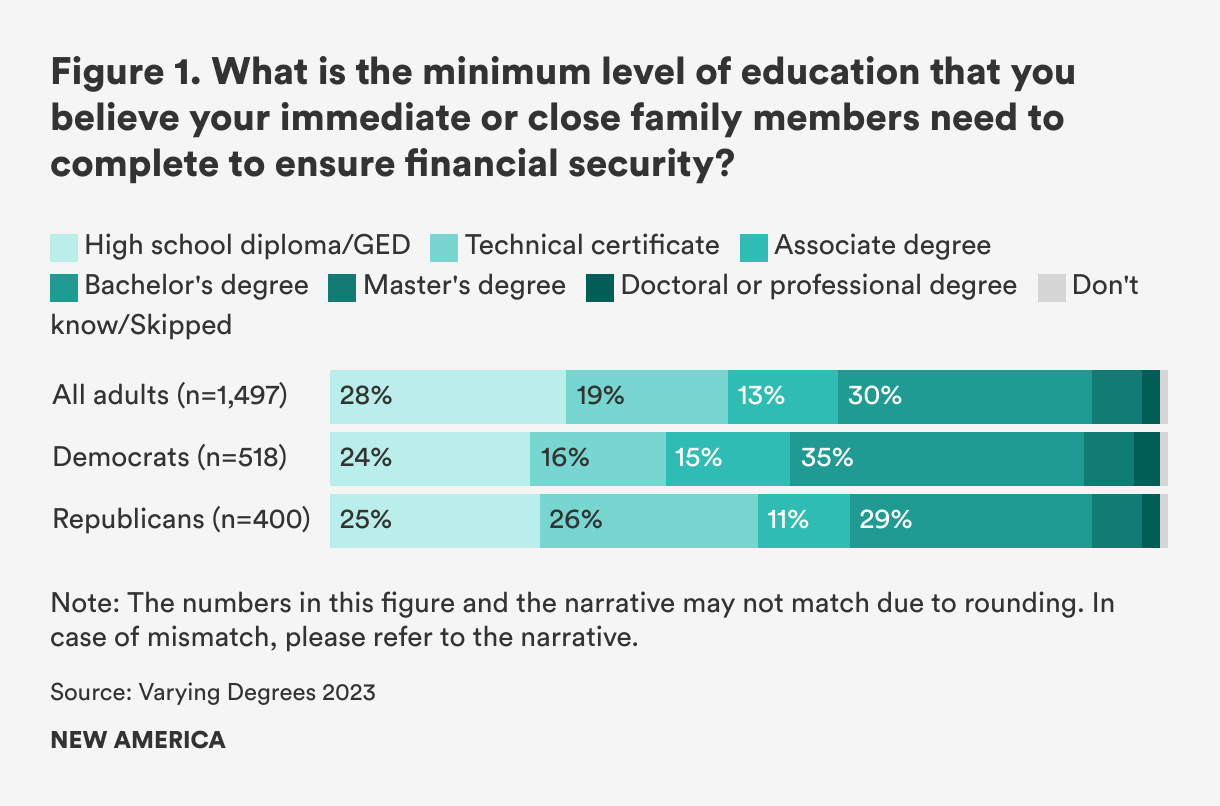
Americans still believe in the value of education beyond high school. At least four in five Americans say that it is easier to find a well-paying, stable career if individuals receive any type of education beyond high school, be it a technical certificate, an associate degree, or a bachelor’s degree. Seven in ten Americans believe that the minimum level of education their close family members need to complete to ensure financial stability is at least a technical certificate: nearly 40 percent think the minimum level should be at least a bachelor’s degree. This belief holds across party lines and racial background (see Figure 1).
This year we went beyond framing the value of education beyond high school in terms of financial return and added questions about other benefits to graduates and society. Research has shown that individuals with postsecondary credentials not only enjoy greater financial well-being, but a healthier life.1 They are also more likely to vote and contribute more to their communities.
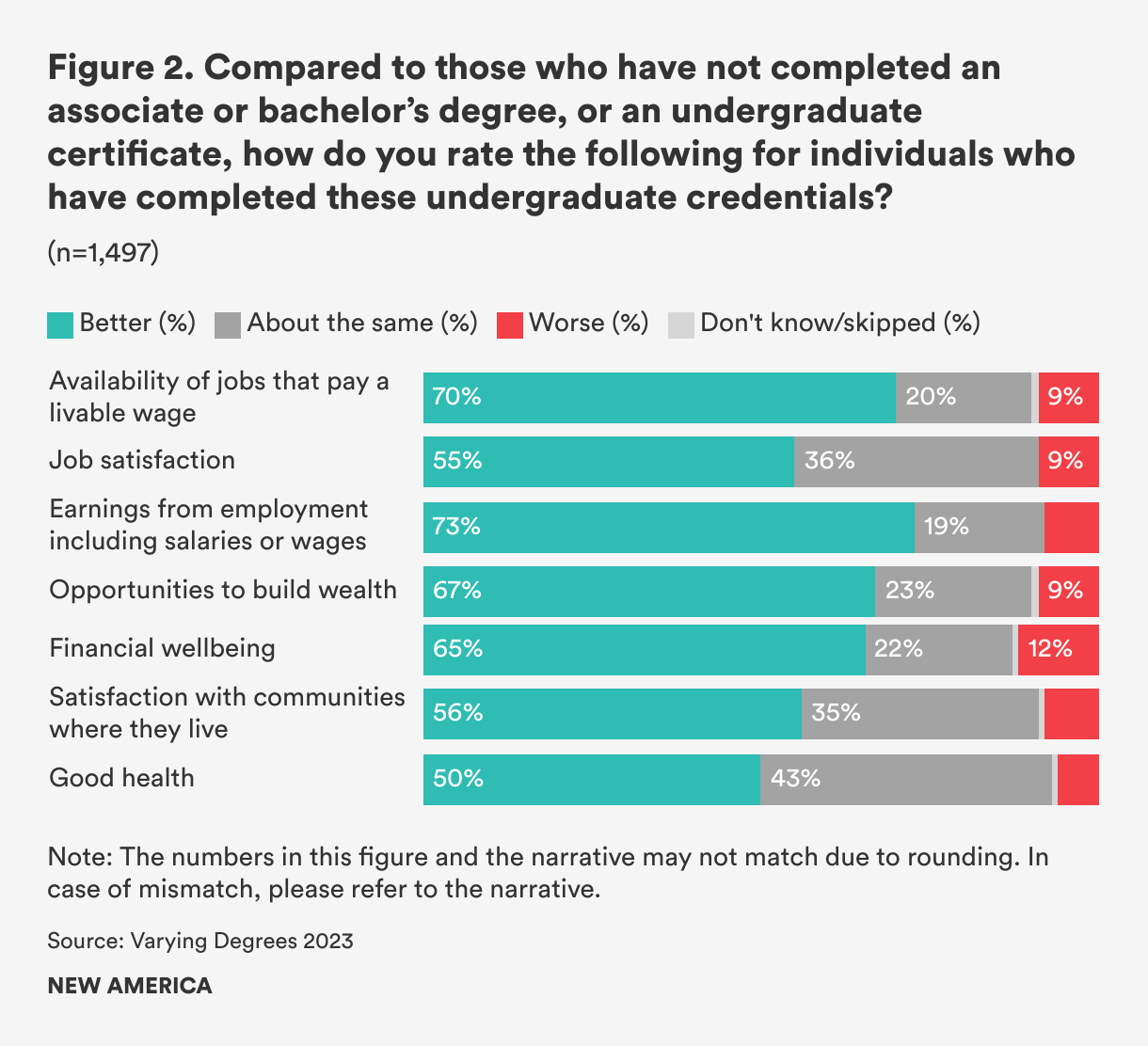
Americans have mixed opinions about what individuals with postsecondary credentials benefit from higher education: more would agree on the financial benefits of higher education than non-financial ones. Nearly three in four Americans believe that those with undergraduate credentials (i.e., certificate, associate, or bachelor’s degree) have greater earnings from their employment and better access to jobs that pay a living wage, and two in three believe that these individuals also have better financial well-being and opportunities to build wealth than those with only a high school degree. At the same time, only 55 and 56 percent respectively believe that those with undergraduate credentials enjoy greater job satisfaction and satisfaction with the communities they live in. Half think that these individuals also have better health (see Figure 2).
Americans are more aligned on the benefits that individuals with postsecondary degrees can contribute to society. Nearly 90 percent of them believe that individuals with undergraduate credentials contribute to a skilled workforce. Four in five believe that these individuals also increase public tax revenues and support for local businesses. More than 70 percent think that individuals with undergraduate credentials increase civic engagement, contribute to lower unemployment rates, and improve public health (see Figure 3).
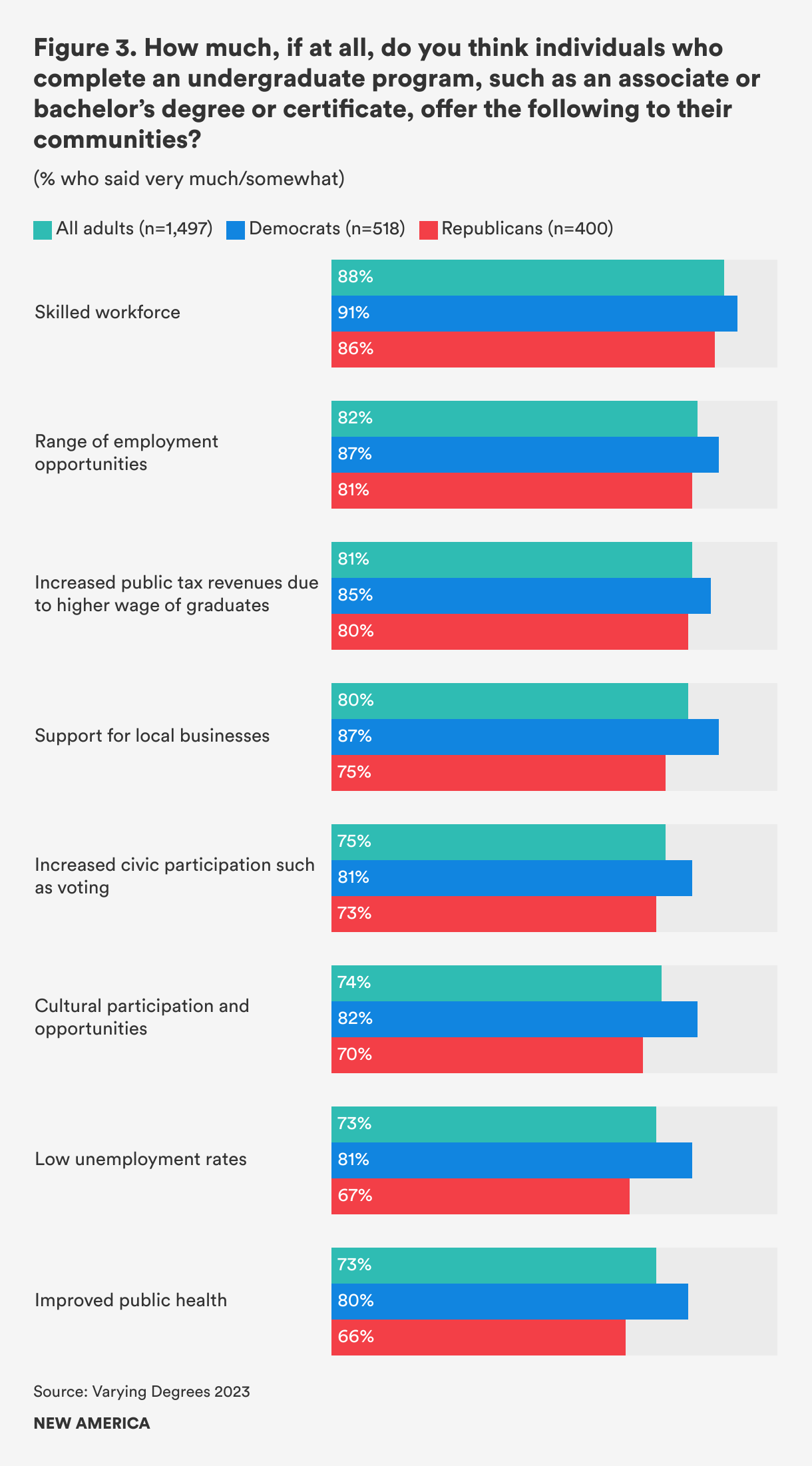
While there are still some gaps in responses between Democrats and Republicans, the individual and societal benefits of higher education show bipartisan alignment. For example, more than 70 percent of Democrats and more than 60 percent of Republicans believe that those with undergraduate credentials have better access to jobs with livable wages, earn more, and have better financial well-being. Both Democrats and Republicans agree that these individuals contribute to greater tax revenues (85 and 80 percent respectively), and a skilled workforce (91 and 86 percent respectively).
Attitudes about College Are Positive, but a Majority Want Change
Similar to last year, a majority of Americans (59 percent in 2023 compared to 55 percent in 2022) also think colleges and universities are having a positive impact on the way things are going in the country today. Yet this is still 10 percentage points lower than before the pandemic, when 69 percent of people, in early 2020, said higher education had a positive impact (see Figure 4). This is one question where we saw a significant partisan divide: nearly 80 percent of Democrats said colleges and universities have a positive impact, compared to only 41 percent of Republicans.
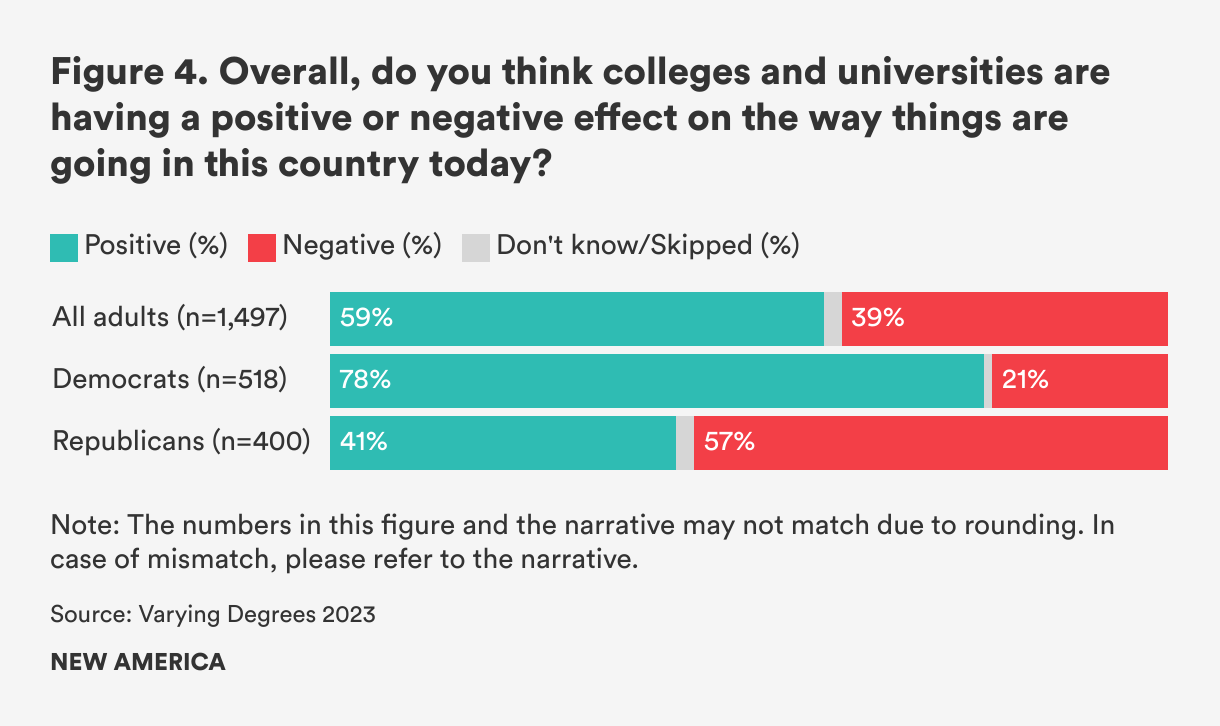
The partisan gap is not necessarily consistent, however. As responses to other questions show, a majority of Republicans, closely aligned with Democrats, think public and private nonprofit colleges are worth the cost and are for people like them. For example, approximately 77 and 83 percent of Republicans (compared to 85 and 91 percent of Democrats), respectively, think that community colleges are worth the cost and are for people like them.
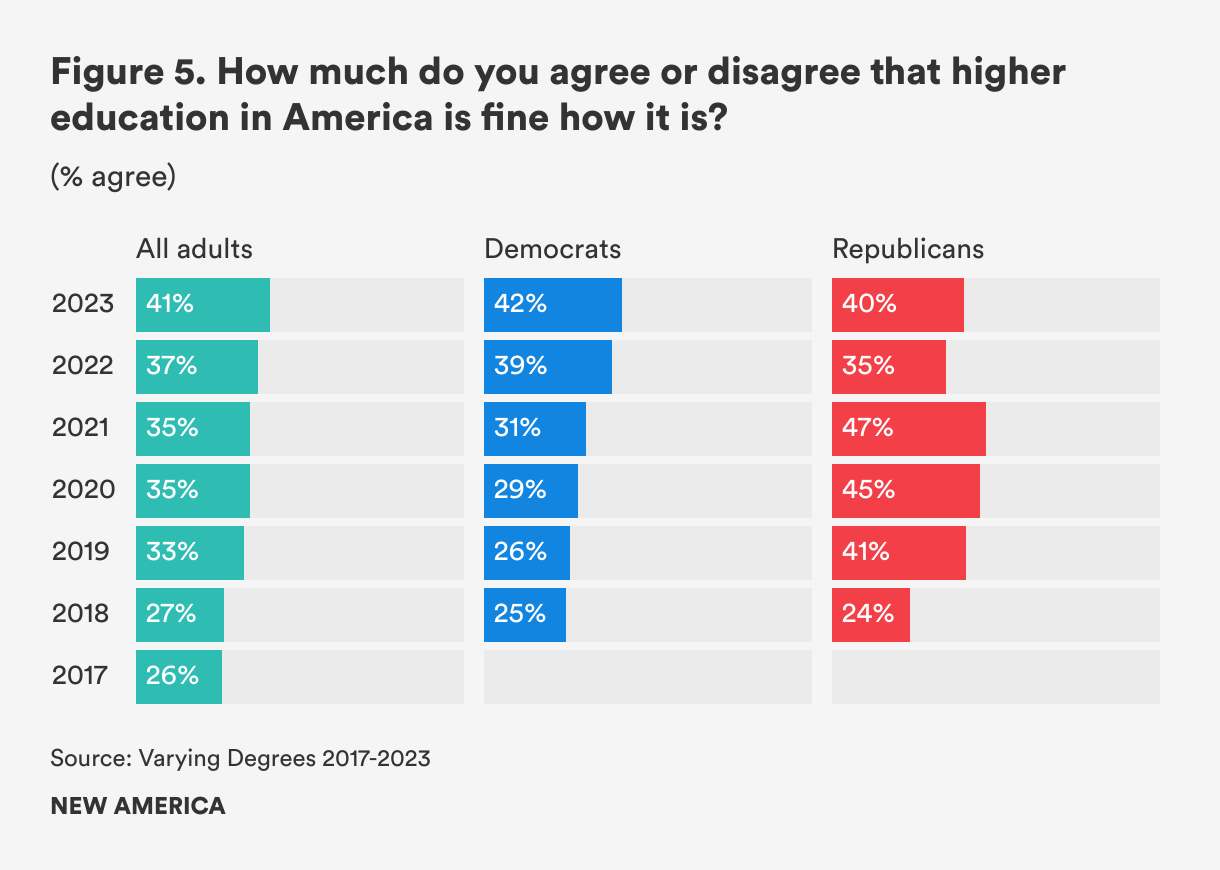
Two in five Americans (41 percent) think higher education is fine how it is. Even though this number is still in the minority, 41 percent is actually the highest number we have seen since we began the survey in 2017, when only 26 percent thought higher education was fine the way it is (see Figure 5). Americans across political parties agree with this statement at similar rates.
Funding
Like in years previous, Americans are divided on whether someone can get a high-quality education after high school that is also affordable: about half (53 percent) agree with this sentiment. While Democrats are equally split on this question, a majority of Republicans (60 percent) think obtaining a high-quality and affordable higher education is possible (see Figure 6).
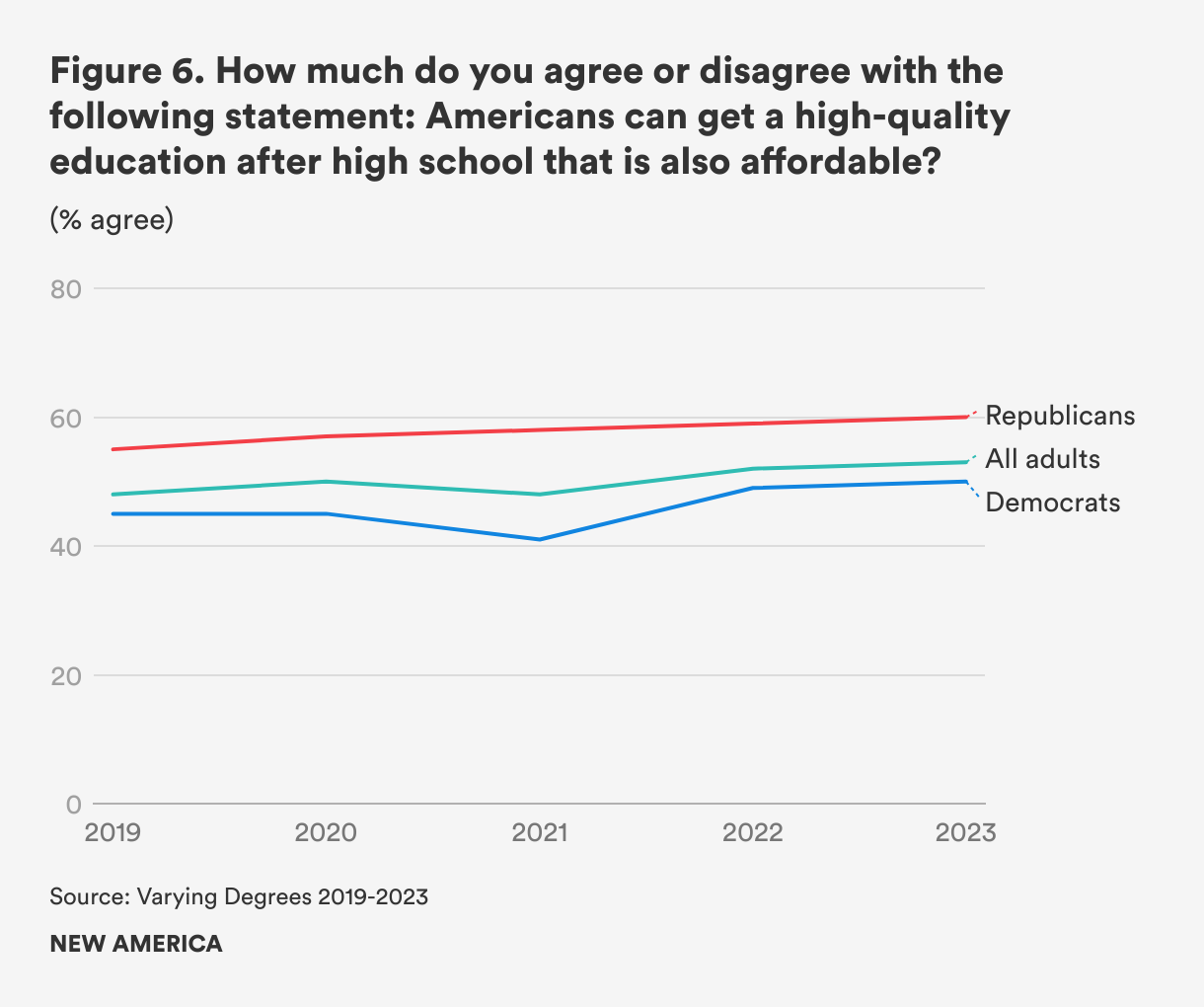
Black Americans (64 percent) agree with this statement at higher rates than white (50 percent), Asian (50 percent), and Hispanic (57 percent) Americans. That Black Americans agree at a relatively high rate is noticeable, considering the fact that Black students are more likely to take out student loans to pay for their education than other students and face greater financial burden when enrolling in college.2
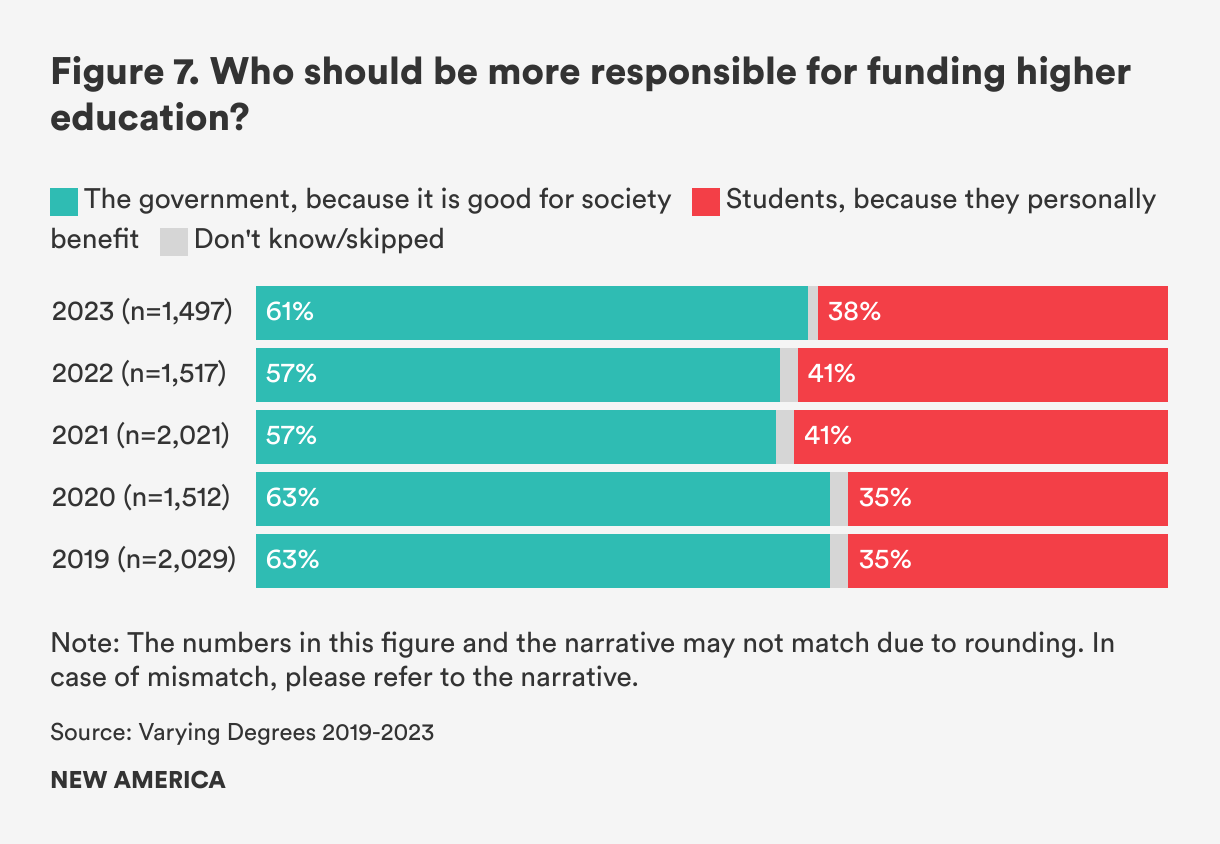
For the past six years, we have asked Americans who should fund higher education: the government, because it is good for society; or individuals, because they personally benefit. We find that the majority of Americans (60 percent) believe that the government should be funding education after high school, which has been consistent since 2018 (see Figure 7).
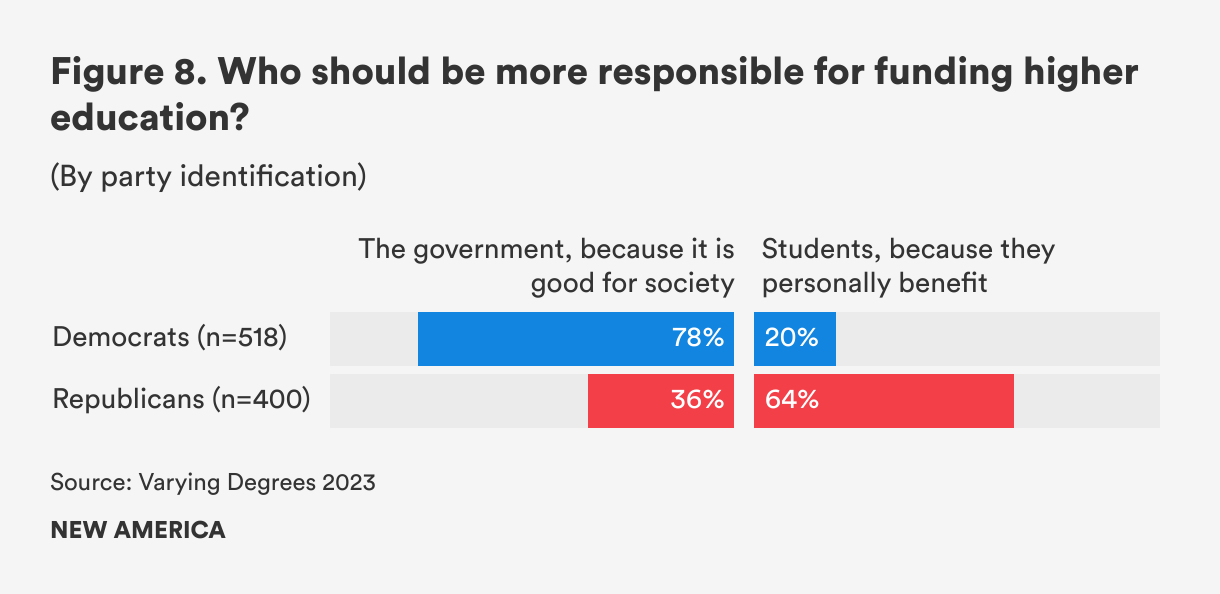
Nearly 8 in 10 (78 percent) Democrats think that the government should fund higher education because it provides benefits to society. On the other hand, nearly two-thirds (64 percent) of Republicans believe students should fund education beyond high school because they personally benefit (see Figure 8). Over the years, Democrats and Republicans have not gotten any closer on this question.
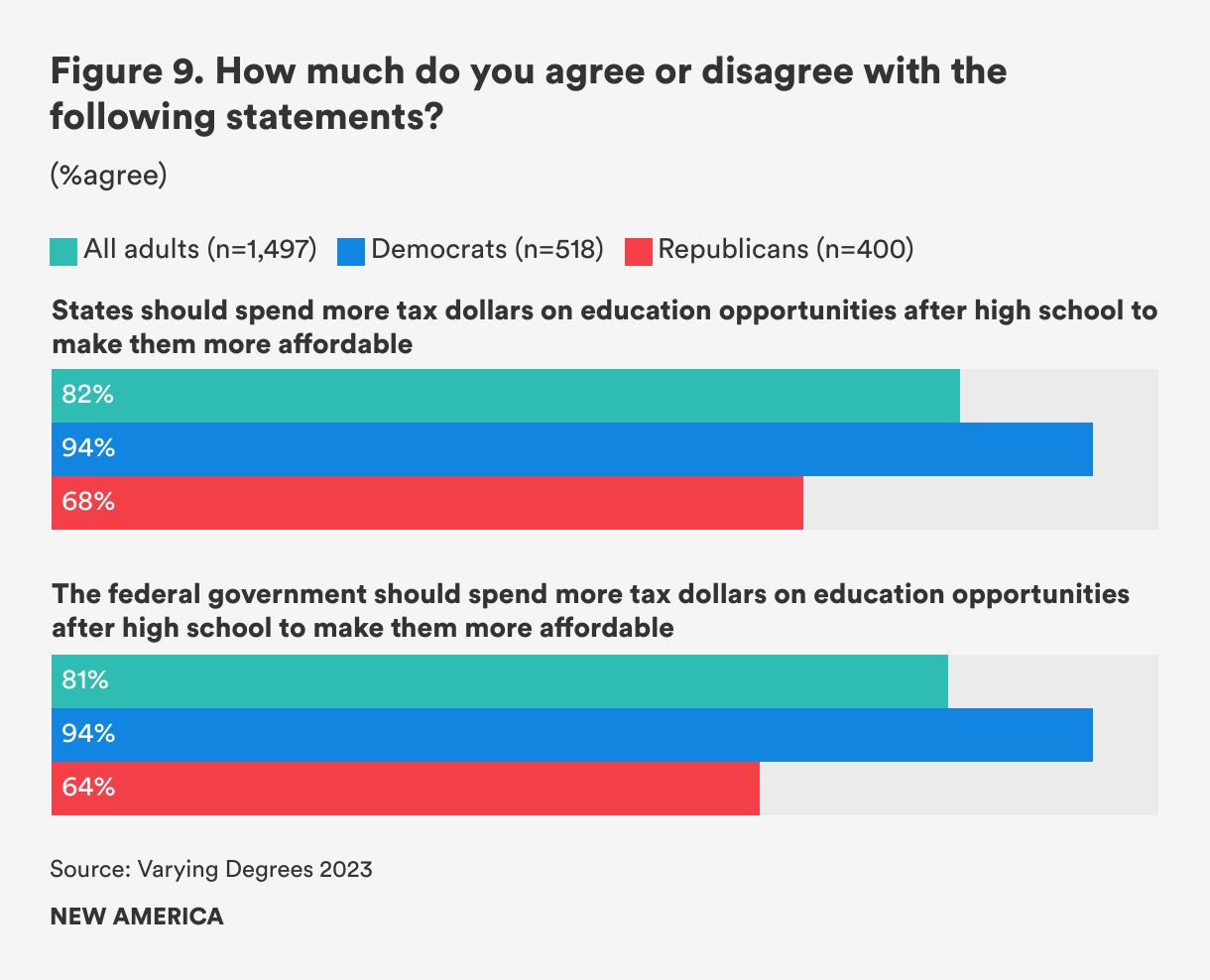
More than eight in ten Americans believe that the federal government and states should spend more taxpayer dollars on educational opportunities after high school in order to make them more affordable. And despite disagreement over whether the government or students should fund higher education, Democrats and Republicans both support more federal and state government spending on higher education. More than 90 percent of Democrats think that both the federal and state government should spend more. Republicans agree, albeit at lower rates: 64 percent for the federal government, 68 percent for state government (see Figure 9).
Americans Remain Skeptical of For-Profit Colleges
When asked which institutions they would be comfortable supporting with their taxpayer dollars, a majority of Americans endorse public colleges and universities, private nonprofit colleges and universities, and minority-serving institutions (MSIs).3 Overall, 82 percent of Americans feel comfortable with their taxpayer dollars going to community colleges, 69 percent to public four-year universities, 69 percent to MSIs, and 53 percent to private nonprofit colleges. Taxpayer support for for-profit colleges and universities remains low: just one-third (36 percent) of Americans are comfortable with their tax dollars going to these institutions (see Figure 10).
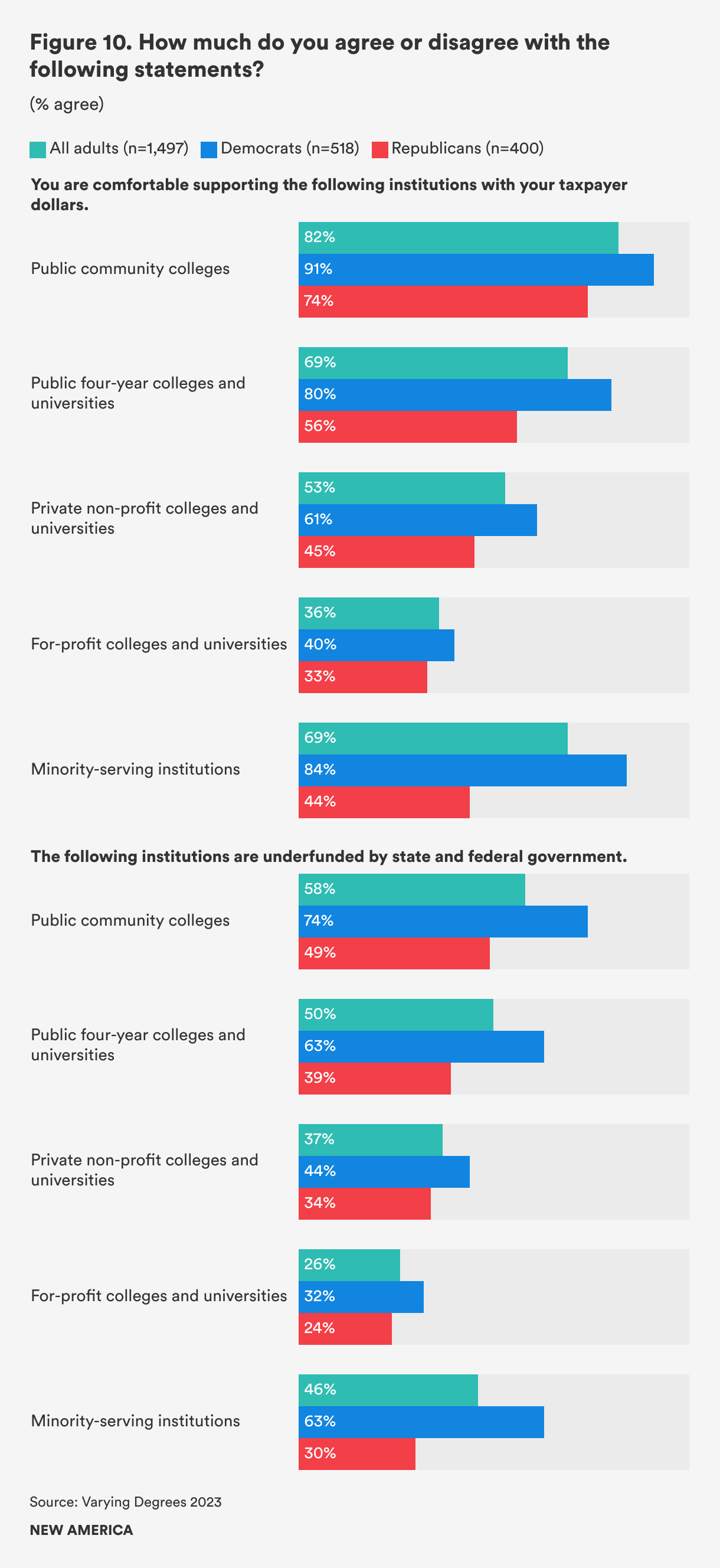
Democrats and Republicans both express support for their taxpayer dollars going towards public two- and four-year colleges and universities. Democrats are especially supportive in this regard, with 91 percent comfortable with their taxpayer dollars going to community colleges and 80 percent showing support for public four-year universities. A majority of Democrats (61 percent) also support their tax dollars going to private colleges and universities, up from 50 percent in 2022. Only 45 percent of Republicans agree.
Both groups are wary of for-profit colleges and universities receiving taxpayer support. Just 40 percent of Democrats and 33 percent of Republicans expressed support for their taxpayer dollars going toward these institutions. As has been the case in previous years, Democrats and Republicans remain deeply divided over whether they support their taxpayer dollars going to MSIs: 84 percent of Democrats do, compared to just 44 percent of Republicans.
But not as many Americans think colleges and universities in the U.S. are underfunded by federal and state government. While a majority (58 percent) think community colleges are underfunded, half or less than half of Americans think other sectors of higher education are.
Democrats and Republicans diverge on this issue. Three-fourths (74 percent) of Democrats think that community colleges are underfunded, compared with just half (49 percent) of Republicans. And while 63 percent of Democrats believe public four-year institutions are underfunded, only 39 percent of Republicans think so. The largest gap is seen when MSIs are considered: 63 percent of Democrats say they are underfunded, compared with just 30 percent of Republicans.
Accountability
The Biden administration has undertaken an ambitious regulatory agenda over the past two years, including rewriting several rules that focus on holding colleges and universities that participate in federal financial aid programs accountable for student outcomes.4 This year we asked questions related to these efforts to safeguard student and taxpayer dollars through two of these regulations: borrower defense to repayment (BD) and gainful employment (GE). Our survey shows that these new regulations have strong support nationwide, across all demographics.
Borrower defense allows federal student loan borrowers to discharge their loans when their schools engage in certain harmful conduct when making a federal loan or providing educational services.5 If the Education Department discharges debt through BD, the Department can recoup the cost of approved claims from the school. This provides relief to borrowers while also clawing back taxpayer dollars from the colleges that engaged in the misconduct.6
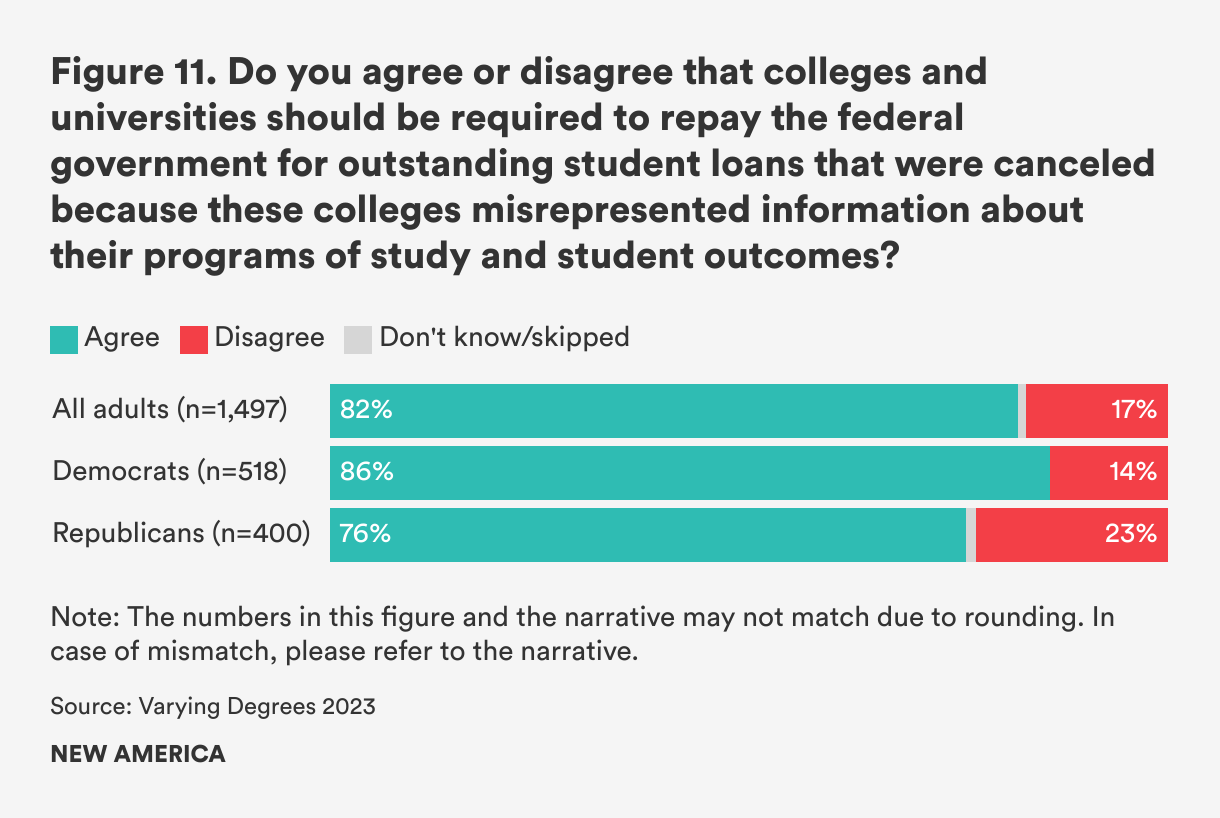
This year we asked whether Americans agree that colleges and universities should be required to repay the federal government for outstanding student loans that were discharged through BD claims. More than four in five Americans (82 percent) agreed with recouping money from institutions for BD discharges (see Figure 11).
Democrats had a higher rate of agreement (86 percent) than Republicans (76 percent) did, but both parties agreed in the majority that institutions that misrepresent themselves and their student outcomes should be held financially responsible when borrowers’ loans are discharged by the federal government.
The Biden administration recently published new GE rules for public comment. These rules are a critical step in protecting students from enrolling in low-financial-value programs. The new regulations require that graduates of career-oriented programs—all programs in the for-profit sector and certificate programs in the public and nonprofit sectors—make more, on average, than a high school graduate and that they are able to repay their student loan debt.7 If a program’s graduates are unable to meet these benchmarks, the program will eventually lose access to federal financial aid.
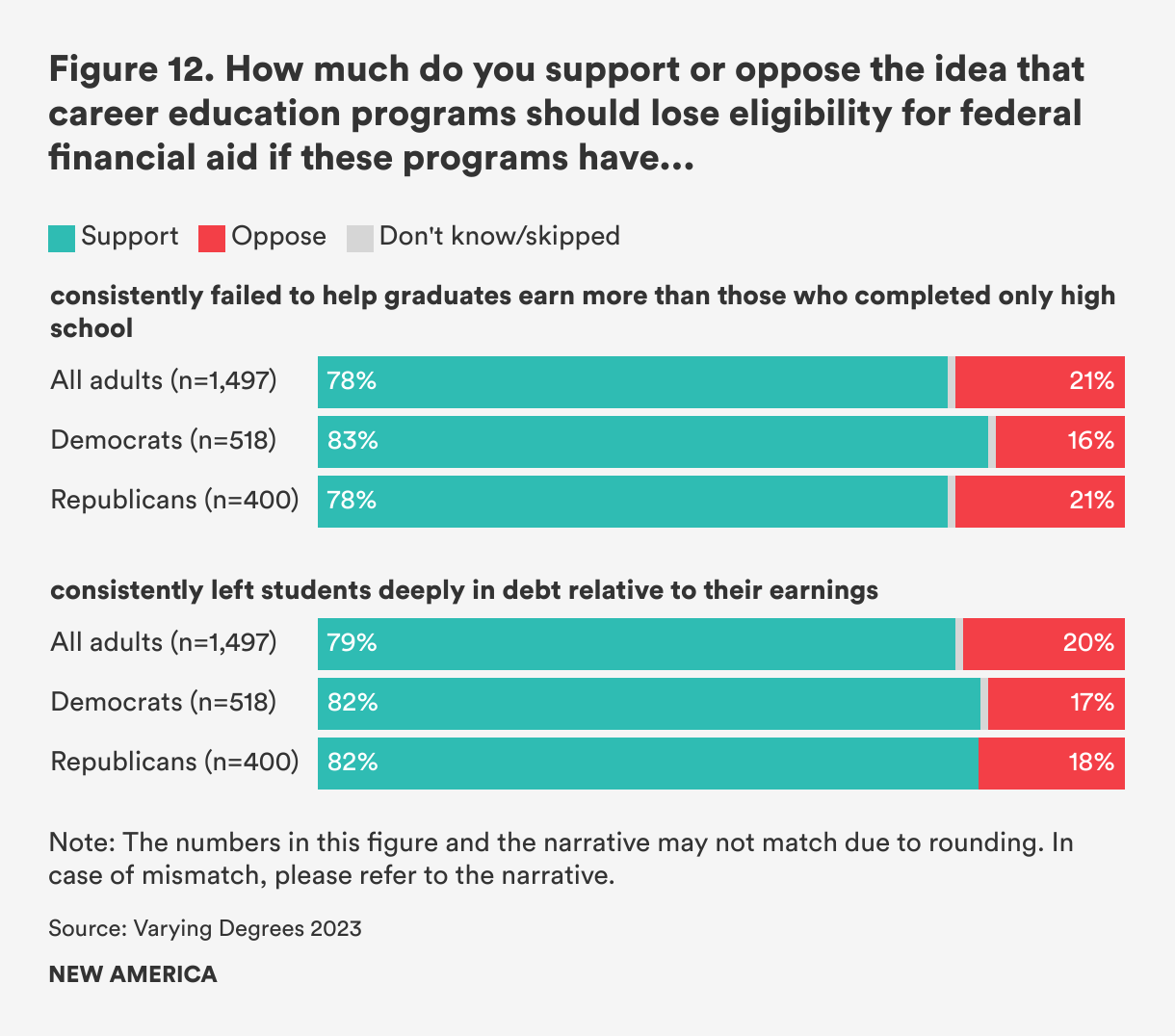
Americans broadly support GE provisions; 79 percent support the idea that programs should lose eligibility for federal financial aid if they consistently leave students deeply in debt relative to their earnings, and 78 percent support the loss of eligibility if programs consistently fail to help graduates earn more than those who complete only a high school diploma (see Figure 12). Democrats and Republicans support both at similarly high rates.
The Education Department also included in its proposed GE rule new disclosures about low-financial-value programs. While GE sanctions—the loss of federal financial aid—can only apply to career-oriented programs, the Department has proposed creating new disclosures that will apply to all programs that receive federal financial aid. This will enable students, families, and taxpayers to have access to data showing whether a program of study will pay off enough to justify the investment.
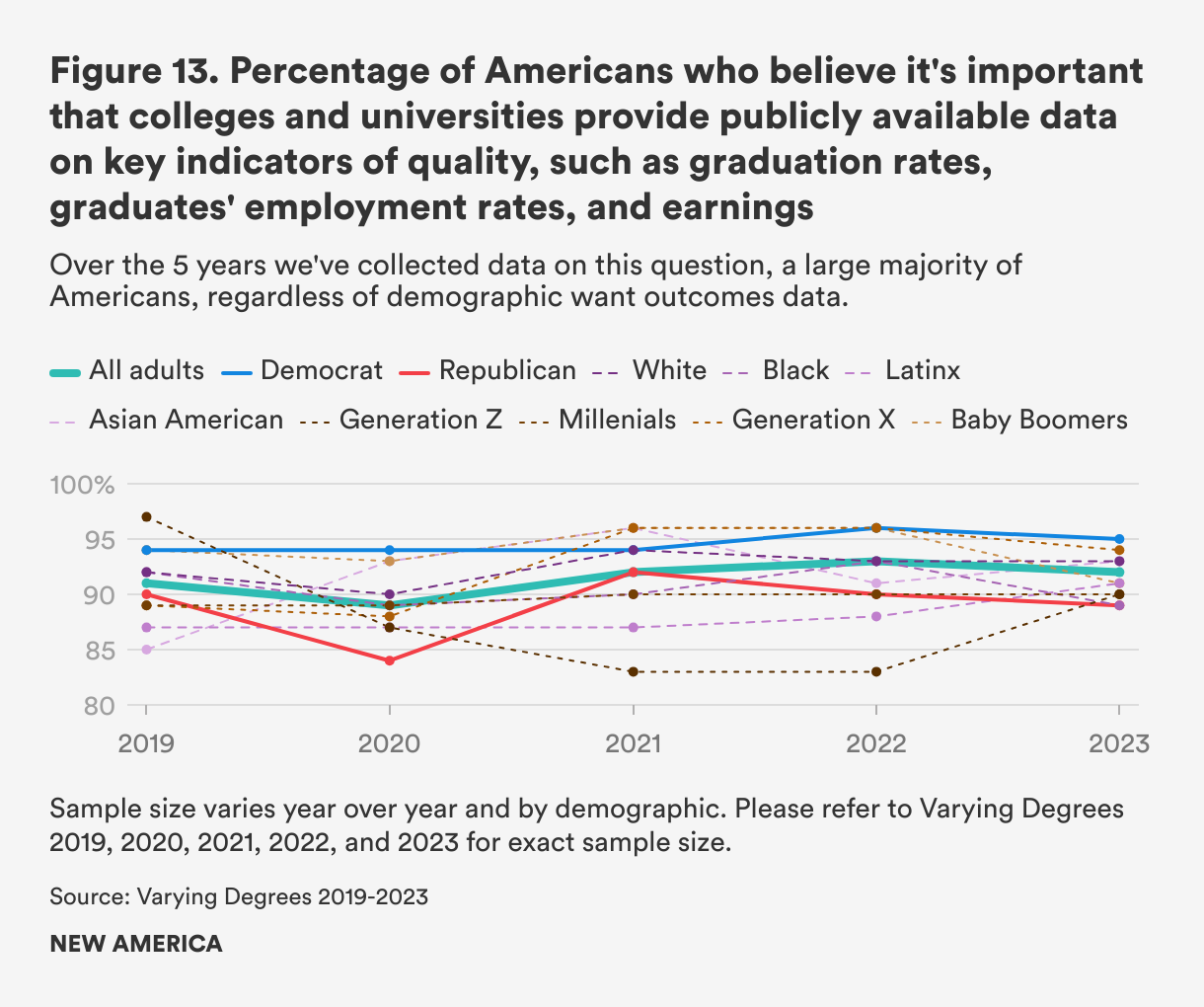
Americans support transparency on key indicators of quality, and they should welcome the push by the Department to increase transparency about student outcomes. Since 2019, about 90 percent of Americans say they believe it is important that colleges and universities provide publicly available data about graduation rates, employment rates, and earnings (see Figure 13). This high rate of agreement holds across party lines, generation,8 and race and ethnicity. In the history of the Varying Degrees survey, no question comes this close to universal agreement year over year.
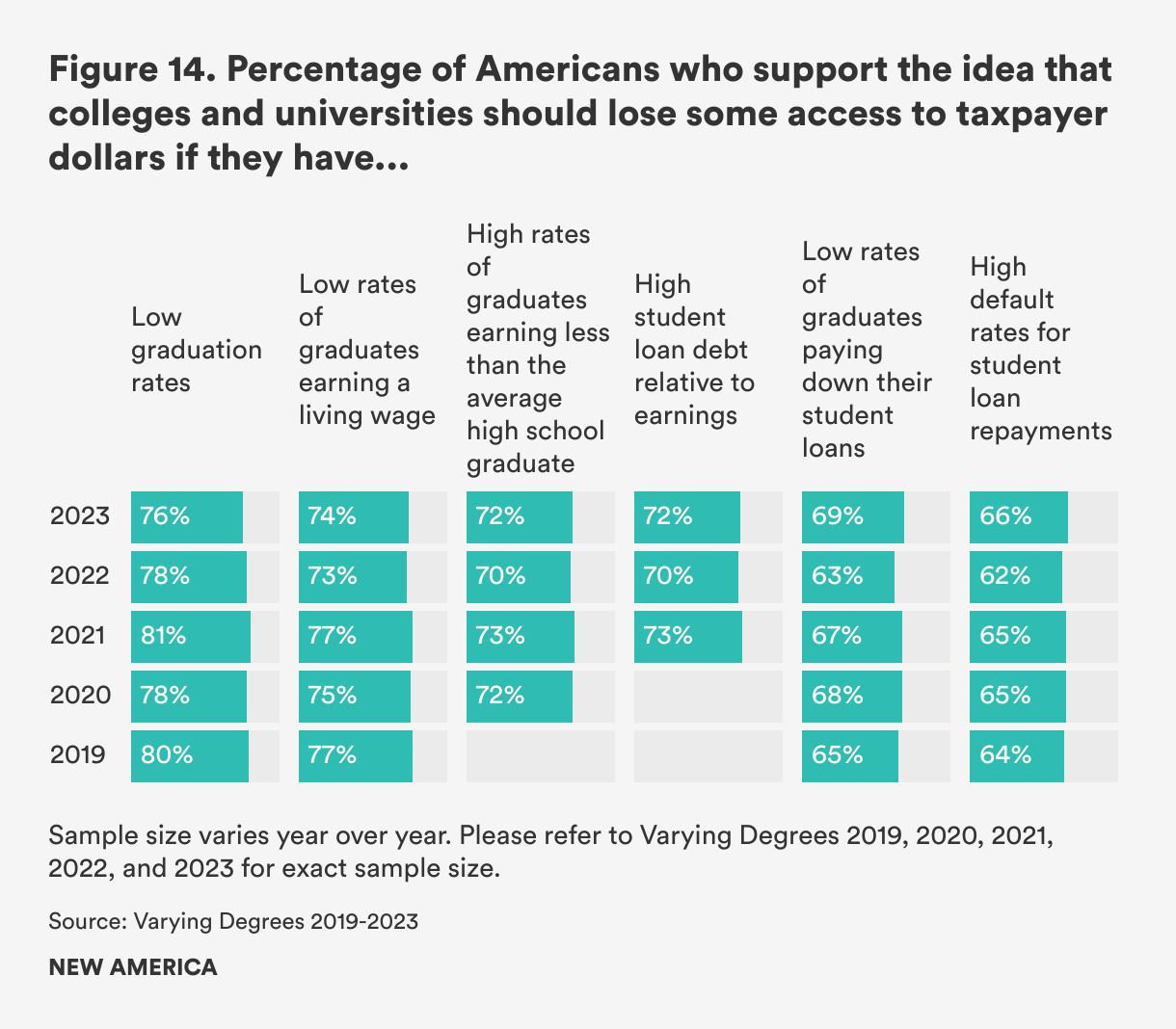
While only certain program types can lose access to federal financial aid under GE by law, Americans support the idea that colleges and universities in general should lose some access to taxpayer dollars if they have low graduation rates, low rates of graduates earning a living wage, and high rates of graduates earning less than the average high school graduate. As Figure 14 shows below, across the years, approximately 60 to 80 percent of Americans believe that institutions should lose access to taxpayer dollars if they have poor outcomes. And while there are some subtle differences among party identification, generation, and race and ethnicity, all groups believe in the majority that institutions should be held accountable for poor outcomes.
Americans Believe Community Colleges Spend Money Wisely, Compared to Other Sectors
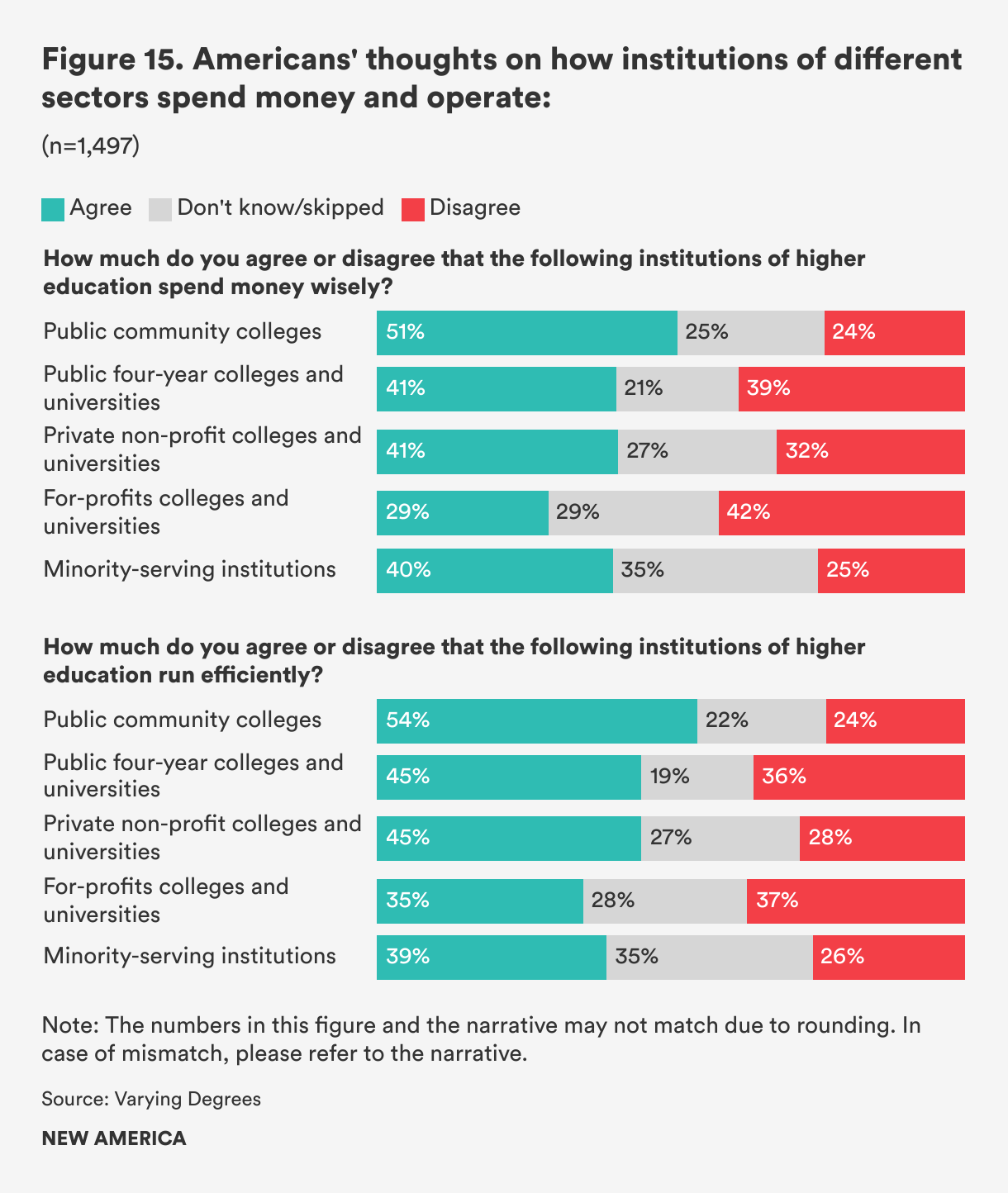
Americans feel more positive about whether community colleges are operating efficiently or spending their money wisely, but those opinions decline for all other sectors. These opinions are similar to those expressed last year. Just about half of Americans believe community colleges spend money wisely (51 percent) and run efficiently (55 percent). The numbers drop for other sectors: for public four-year colleges, only 45 and 41 percent, respectively, think they are running efficiently and spending money wisely. For private nonprofit colleges, the numbers are 45 and 41 percent, respectively; for for-profit colleges, the numbers are 35 and 29 percent; and for MSIs, the numbers are 39 and 40 percent (see Figure 15).
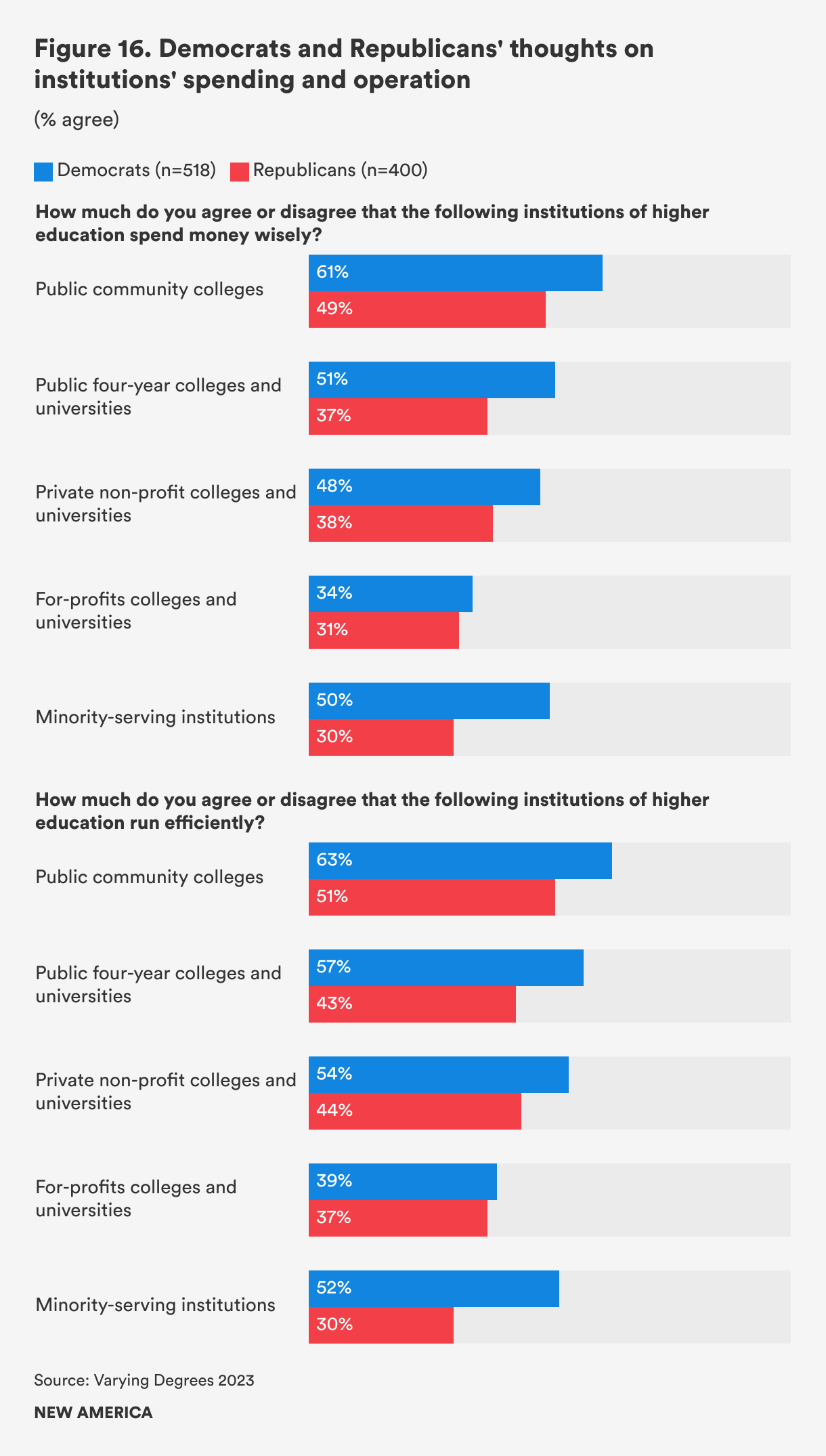
Republicans agree at lower rates than Democrats that colleges operate efficiently and spend their money wisely, even for community colleges. Over the five years that we’ve collected data on these questions, we have noticed a small difference emerge between opinions along party lines. In 2019, for example, 59 percent of Republicans and 66 percent of Democrats believed that community colleges spend their money wisely. Now, only 49 percent of Republicans believe so, compared to 61 percent of Democrats. Similarly, in 2019, 57 percent of Republicans and 66 percent of Democrats agreed that community colleges run efficiently. Now, just half of Republicans (51 percent) agree, compared to 63 percent of Democrats (see Figure 16).
Equity and Diversity
Issues of equity and diversity have become increasingly prominent on campuses nationwide. This year, our survey considers new questions related to equity and diversity in higher education. The COVID-19 pandemic amplified the need for support beyond academic and financial assistance to students, since many also needed help in areas like housing, food, and child care.9 Colleges and universities are also having more conversations about racial equity and justice, as Black Lives Matter protests have swept the nation. And the Supreme Court overturned race-conscious admissions this summer.
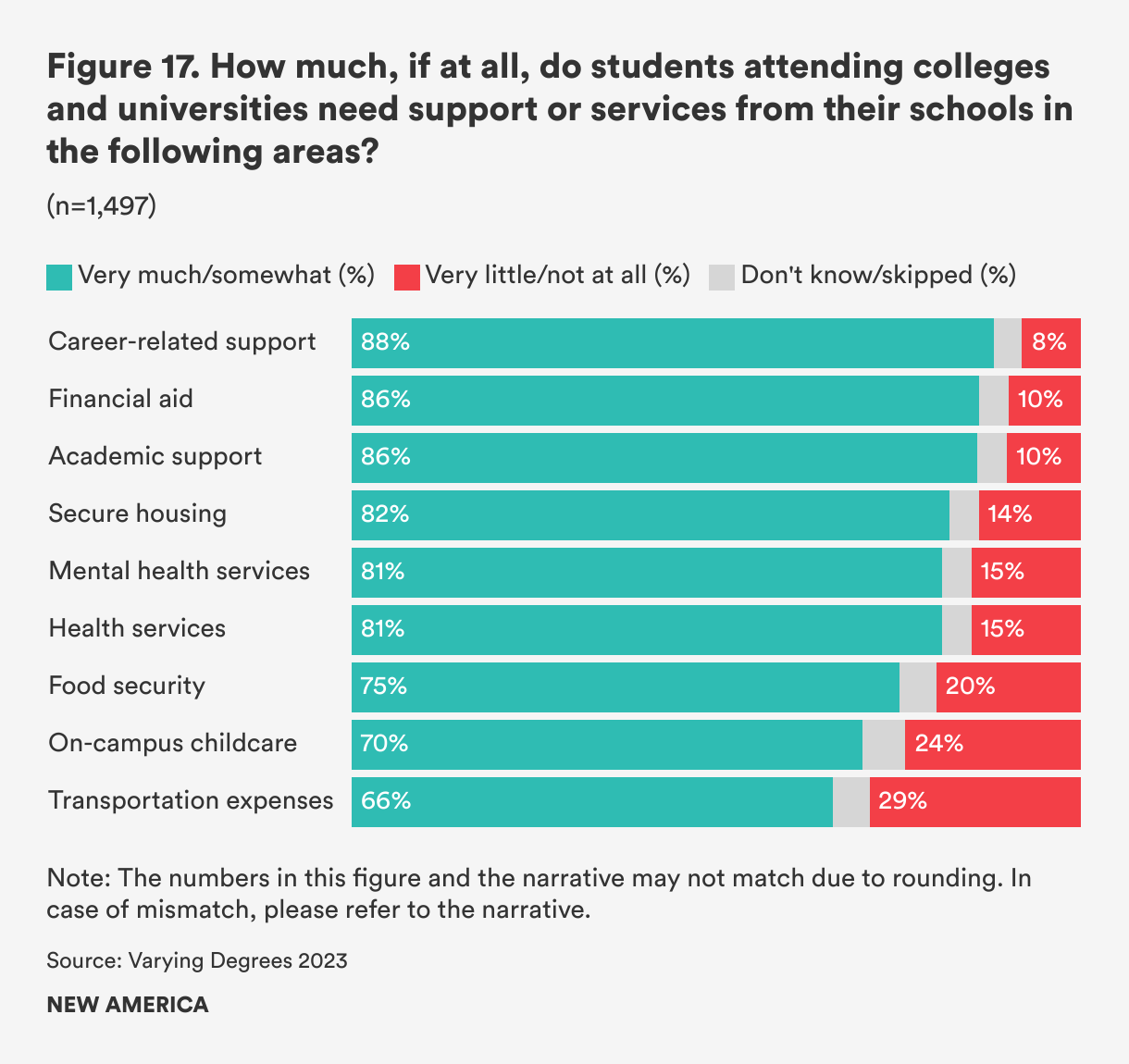
Americans acknowledge that students attending colleges and universities need a variety of academic and basic need supports and resources from their schools. A majority believe that students need career-related support (88 percent), financial aid (87 percent), and academic support (85 percent). They also strongly believe that colleges and universities must provide more, and favor the provision of housing (82 percent) and food (76 percent) support and on-campus child care (70 percent) (see Figure 17).
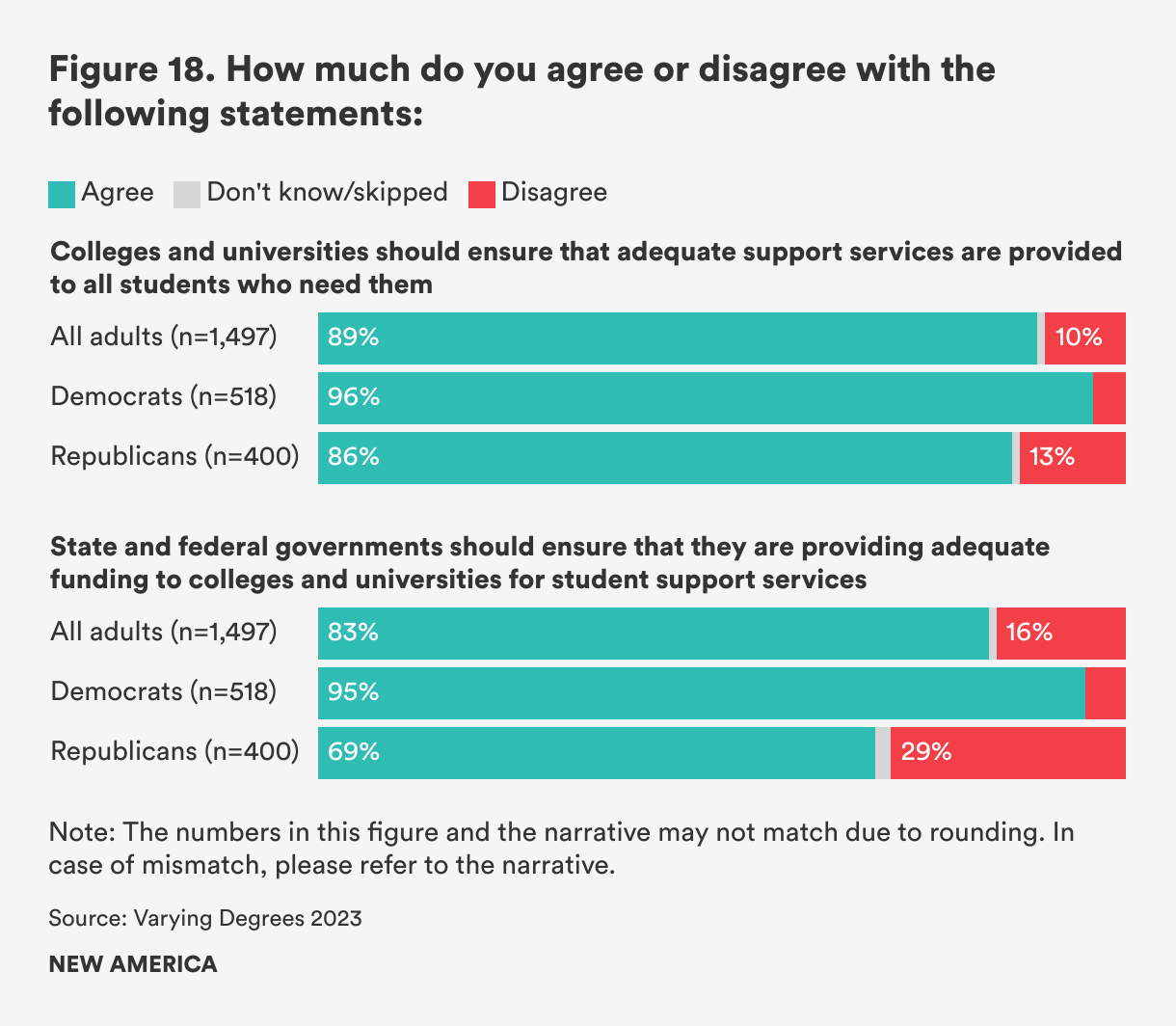
Nine in ten Americans agree that colleges and universities should provide adequate support services to students who need them. This finding holds across party lines, with 96 percent of Democrats and 85 percent of Republicans agreeing that institutions should offer adequate support. There is more of a partisan divide when it comes to whether federal and state government should provide colleges and universities with adequate funding for student support services: 95 percent of Democrats agree, compared with 69 percent of Republicans (see Figure 18).
Majority of Americans Believe Underrepresented Students Should Have Access to Higher Education
Approximately three-fourths of Americans believe that the federal and state government and colleges and universities should work to ensure that students from historically underrepresented backgrounds have access to higher education opportunities. Democrats are especially supportive of these ideas; more than 90 percent believe that the government (both federal and state) and colleges should work towards this goal. Republicans agree at lower rates: 62 percent think the federal and state government should work towards ensuring that students from historically underrepresented backgrounds have access to higher education, and just 56 percent believe that colleges and universities should work towards this goal.
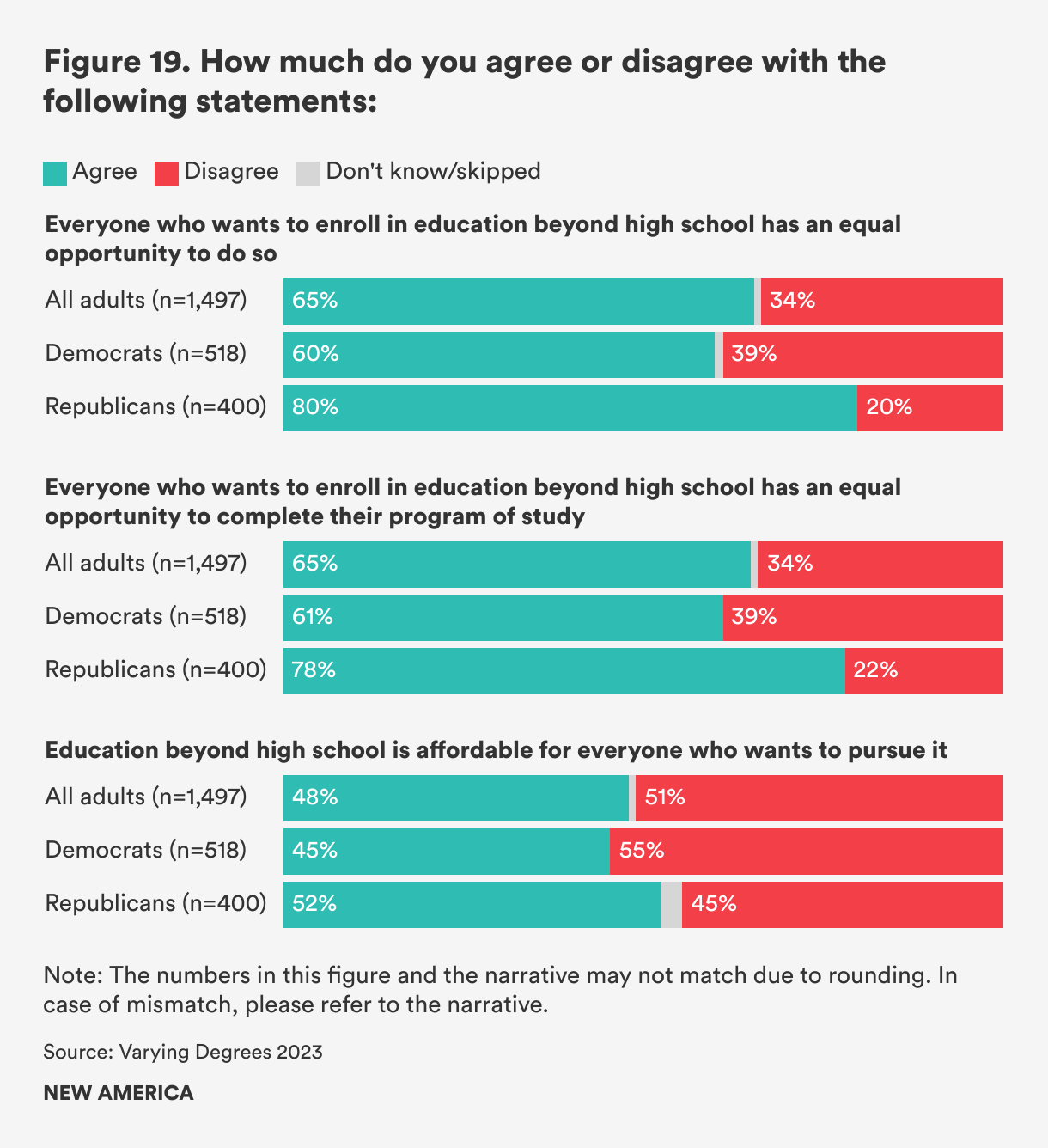
Two-thirds of Americans believe that everyone has an equal opportunity to enroll in education beyond high school and complete their program of study. However, less than half agree that higher education is affordable for anyone who wishes to pursue it (48 percent).
On issues of equal opportunity, we continue to see partisan divergence. Approximately eight in ten Republicans (79 percent) think that everyone who wants to enroll in postsecondary educational opportunities has an equal opportunity to do so, compared to 60 percent of Democrats. Similarly, 78 percent of Republicans and 61 percent of Democrats believe that everyone has an equal opportunity to complete their program of study. Both groups, however, are less likely to agree that higher education is affordable for anyone who wishes to pursue it (53 percent of Republicans and 45 percent of Democrats) (see Figure 19).
Nearly nine in ten Democrats agree that all students benefit when colleges and universities reflect the country’s racial diversity (88 percent), and that colleges and universities should admit racially diverse students (87 percent) and hire racially diverse faculty and staff members (88 percent). Republicans, on the other hand, are less likely to support these ideas. Sixty-eight percent believe that all students benefit when higher education institutions reflect the racial and ethnic diversity of the U.S., and approximately half think that colleges and universities should admit more racially diverse students (53 percent) and hire more racially diverse faculty members (46 percent).
Most Americans Support Racial Diversity on College Campuses
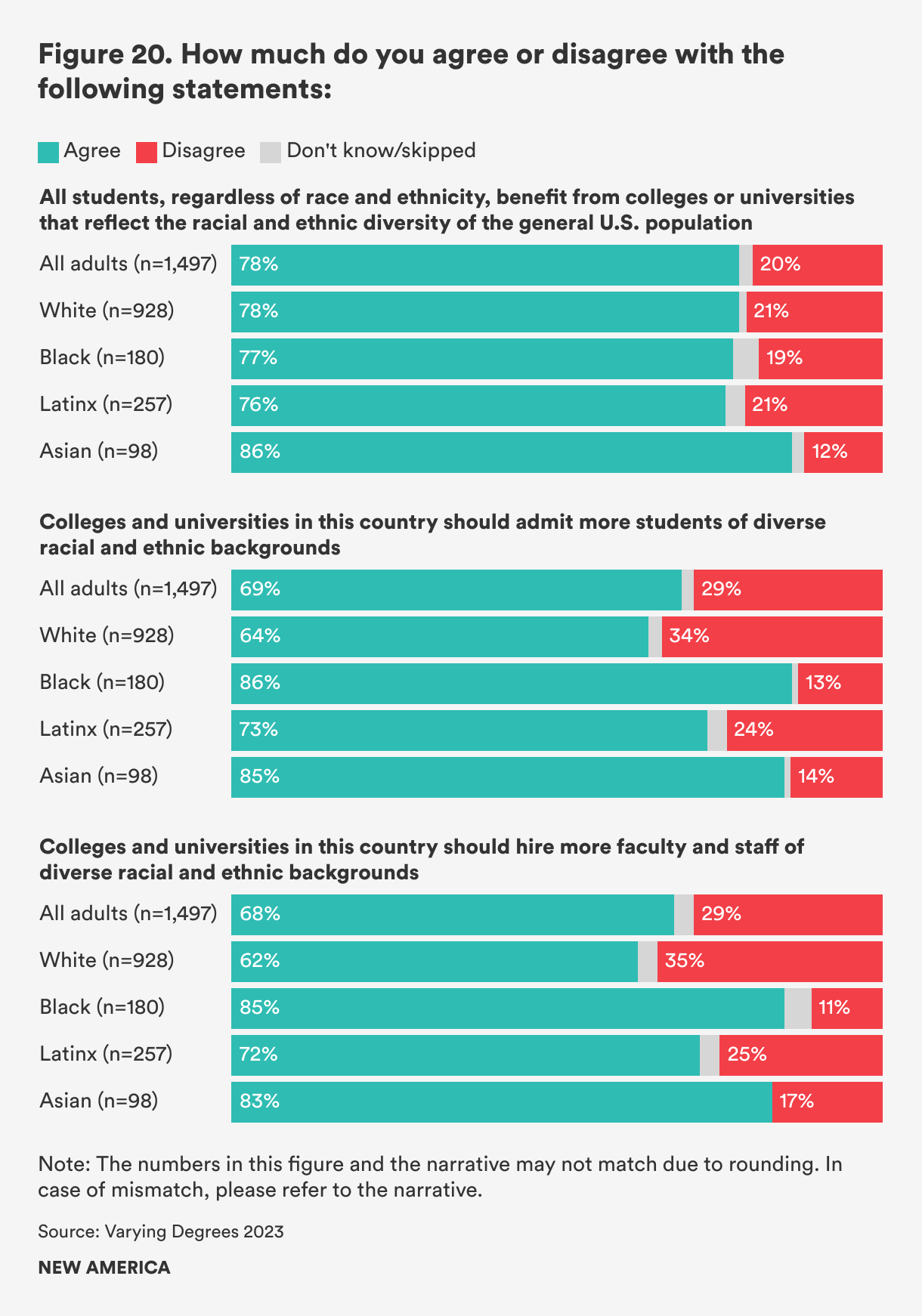
Three-fourths of Americans agree that all students benefit when colleges and universities reflect the racial diversity of the U.S. (78 percent). A majority also believe that higher education institutions should admit more students (69 percent) and hire more faculty and staff members (68 percent) from racially diverse backgrounds.
Asian Americans agree that all students benefit from college campuses that reflect the racial diversity of the U.S. (86 percent). Black (86 percent) and Asian (84 percent) Americans agree at the highest rates in our survey that colleges and universities should admit students from diverse racial and ethnic backgrounds, and that they should hire racially diverse faculty as well (85 percent for Black respondents and 83 percent for Asian respondents) (see Figure 20).
Approximately eight in ten Asian Americans also agree that when colleges and universities consider students’ race or ethnicity as one factor in admissions decisions, this provides students who have been historically underrepresented an expanded opportunity to enroll in education beyond high school (81 percent) and reduces racial and ethnic inequities in broader society (77 percent). Considering that the Students for Fair Admissions (SFFA) group argued, in its case against using race as an admissions criterion, that Asian Americans should be and broadly are opposed to affirmative action, we find this noteworthy.10
Citations
- Jennifer Ma and Matea Pender, Education Pays 2023 (New York: College Board, 2023), source.
- Kat Welbeck, “Communities of Color in Crisis: Examining Racial Disparities in Student Loan Debt and Borrower Outcomes,” Domino: A Blog about Student Debt, Student Borrower Protection Center, source.
- To give survey respondents an indication of what types of institutions are considered minority-serving institutions, we gave the following information as background: “Minority Serving Institutions in the U.S. include Historically Black Colleges and Universities (HBCUs), Hispanic-Serving Institutions (HSIs), Tribal Colleges and Universities (TCUs), and Asian American Native American Pacific Islander-Serving Institutions (AANAPISIs).”
- U.S. Department of Education, “Negotiated Rulemaking for Higher Education 2021–22,” source.
- For more information of what constitutes a borrower defense claim, see “Borrower Defense Loan Discharge” on the U.S. Department of Education’s Federal Student Aid website, source.
- Anna Helhoski and Eliza Haverstock, “How Borrower Defense to Repayment Works,” NerdWallet, May 9, 2023, source.
- Rachel Fishman, “Proposed Gainful Employment Regulations Will Protect Students and Taxpayers,” EdCentral (blog), New America, May 18, 2023, source.
- In the Varying Degrees survey, Generation Z includes people who were born in and before 1995, Millennials include those born between 1980 and 1994, Generation X includes those born between 1965 and 1979, Baby Boomers include those born between 1946 and 1964, and the Silent Generation includes those born in and before 1945.
- Alyssa M. Lederer, Mary T. Hoban, Sarah K. Lipson, Sasha Zhou, and Daniel Eisenberg, “More Than Inconvenienced: The Unique Needs of U.S. College Students During the COVID-19 Pandemic,” Health Education & Behavior 48, no. 1 (February 2021): 14–19, source.
- Li Zhou, “Many Asian Americans Support Affirmative Action. The Recent Supreme Court Cases Obscure That,” Vox, June 30, 2023, source.
Explore the Data
Error: Data visualization bundle URL missing.
Disclaimer about the Data Tool
Varying Degrees is conducted with the hope to build a longitudinal data set of public opinion data about education after high school. However, we have made some changes throughout the last seven years to improve the survey instrument and modality of data collection, which may affect the ability to analyze the data long term. One of the major changes was the change in the survey mode from mostly phone to mostly online in 2019. Following the transition to mostly online, we decided to drop the neutral response options (for example: neither agree nor disagree) to improve response quality. Therefore, these changes may explain some of the data shifts from 2017 and 2018 collection years compared to 2019, 2020, 2021, and 2022 collection years.
Appendix: Methodology
Varying Degrees was administered by NORC at the University of Chicago using NORC’s AmeriSpeak Panel for the sample source. This was the seventh annual survey seeking to better understand the general population’s opinions about higher education in the U.S. This year’s survey examined attitudes and opinions about a variety of areas, including the affordability of colleges and universities, the individual and societal value of earning postsecondary credentials, and the racial diversity and equity in higher education.
The survey was offered in English and Spanish, and it was administered in two modes, depending on the preference of the respondent expressed during the panel recruitment: (1) self-administered by the respondent online via the World Wide Web; or (2) administered over the telephone by a live interviewer.
A general population sample, 18 years and older, was selected from NORC’s AmeriSpeak Panel for this study. Additional African Americans (referred to as "Black Americans" in this report), Asian/Pacific Islander Americans ("Asian Americans"), and Hispanic Americans ("Latinx Americans") were also sampled in order to hit our targets in these subgroups. The sample for a specific study is selected from the AmeriSpeak Panel using sampling strata based on age, race/Hispanic ethnicity, education, and gender (48 sampling strata in total).
The sample selection accounts for the expected differential survey completion rates across the sampling strata. The size of the selected sample per stratum is determined such that the distribution of the complete surveys across the strata matches that of the target population as represented by census data. If a panel household has more than one active adult member, only one is selected at random. When panelists are selected for an AmeriSpeak survey, the selection process, within each sampling strata, favors those who were not selected in the most recent (previous) AmeriSpeak survey. This selection process is designed to minimize the number of surveys any one panelist is exposed to and maximize the rotation of all panelists across AmeriSpeak surveys.
A small sample of English-speaking AmeriSpeak web-mode panelists were invited for a pretest on Friday, March 3, 2023. NORC collected 57 pretest interviews. The initial data from the pretest were reviewed by NORC and delivered to New America. No changes were made before fielding the main survey. Pretest interviews are not included in the final data.
For the main survey, a sub-sample of AmeriSpeak web-mode panelists were invited to the survey on Thursday, March 23, 2023, in a soft launch. The initial data from the soft launch were once again reviewed to confirm that there were no processing or programming errors. Once reviewed, the remainder of AmeriSpeak panelists were invited to the survey on Monday, March 27, 2023.
In total, NORC collected 1,497 final interviews, 1,422 by web mode and 75 by phone mode. This does not include interviews that may have been removed for data quality purposes (i.e., speeding, high refusal rates, straight-lining). The final collection of survey completers includes specific oversamples of non-Hispanic African Americans (268 of completions), Hispanics (348 of completions), and non-Hispanic Asian/Pacific Islander Americans (223 of completions) to ensure adequate sample size of those groups for analysis. These oversampled groups are weighted down to match their respective proportion in the population.
Summary
General population sample size: 1,497
Margin of error: ±3.46 percentage points
Design effect: 1.86
Fielding period: March 23–May 8, 2023
More About the Authors

Rachel Fishman
Director, Higher Education

Sophie Nguyen
Senior Policy Manager, Higher Education

Olivia Cheche
Program Associate, Higher Education