
Table of Contents
- Executive Summary
- Explore the Data
- Introduction
- Americans believe well-paying jobs require education after high school.
- Americans believe education after high school creates opportunities.
- Americans want change in higher education.
- Americans believe public colleges and universities are worth the cost but feel more mixed about private and for-profit colleges and universities.
- Regardless of demographic, Americans like their local colleges and universities.
- Americans support workforce-based programs such as apprenticeships.
- Americans believe higher education is a public benefit and that the government should do more to make it affordable.
- Perception versus reality
- North Carolina
- Institutional Profile: Elon University
- Apprenticeship Program Profile: Siemens Charlotte
Institutional Profile: Elon University
When University Registrar Dr. Rodney Parks started at Elon University in 2013, the university had already been producing Elon Experience Transcripts (EETs) for 19 years. These EETs documented student experiences outside the classroom, such as internships and study abroad programs. But the document was only loosely tied to the school’s official academic transcript, and it was produced out of the student affairs office. This meant that, despite being a great resource, few students knew it existed—and even fewer (an average of 12 students per year) requested it.
How could the university bring awareness to the experiential transcript and encourage students to talk about the value of their time at Elon beyond the classroom? Dr. Parks, and the development team that would soon transform Elon’s experiential transcript, knew that the answer started with merging it with the official academic transcript—which meant moving the experience transcript to the office of the registrar. But the changes, and their vision of what EETs could be, did not end there.
They envisioned a digital transcript that was both visually appealing and more robust than the current experiential transcripts, and that captured and validated more details of students’ co-curricular activities. They imagined a document that would give students a holistic summary of their Elon experience to use to market themselves to prospective employers and share on social media. In 2016, through a partnership with Lumina Foundation, the American Association of Collegiate Registrars and Admissions Officers (AACRAO), and NASPA – Student Affairs Administrators in Higher Education, they were able to bring the vision to fruition.
Today, 2,000 students per year—over a third of the university’s annual transcript production—request Elon’s Visual Experience Transcript (Visual EXP). Today, Elon’s Visual EXP is requested by 2,000 students per year, over a third of Elon’s annual transcript production. Putting each transcript together is a true team effort, with several departments (including the university’s service learning and community engagement, research, career services, and student affairs offices) collecting, validating, and submitting more detail on co-curricular experiences than the original EET did. The Visual EXP has made Elon one of the pioneers in the “beyond the transcript” space.
But the Visual EXP is also an important example of what higher education needs to do to continue to show that it is a comprehensive investment that is worth the cost. Varying Degrees 2018: New America’s Second Annual Survey on Higher Education asked Americans which experiences in higher education are more important: those that occur outside the classroom or those inside the classroom. Americans were more likely to say that experiences outside the classroom are more important than within (47 percent versus 35 percent; 15 percent said both). The breakdown shows that Americans see the value of college as more than taking classes and maintaining a good GPA.
According to Dr. Parks, students know this better than anyone. “The students themselves appreciate the ability to tell their full Elon story. …[They] have been real vocal about telling us that we should be capturing even more than we’re capturing.”
At present, the Visual EXP presents co-curricular activity along five categories: research, internship, service, global education, and leadership. The first page provides a summary of experiences by the number of terms or total hours a student has spent focused in each category, as well as a timeline that details when the student participated in specific activities by year. The second page goes into more detail, organizing co-curricular experiences by the category they fall under, while including titles, relevant links to research, internships, study-abroad products, and other additional information.
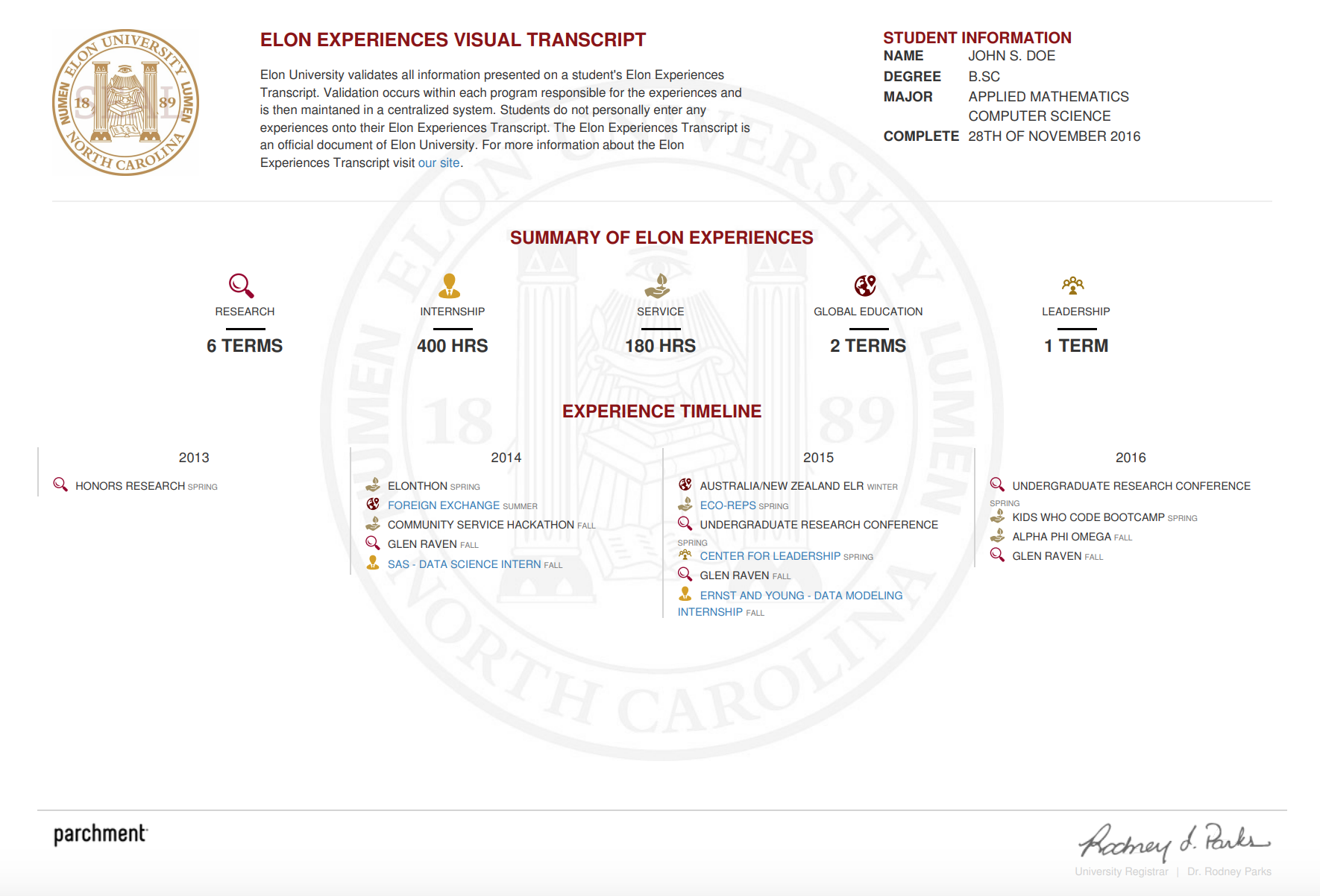
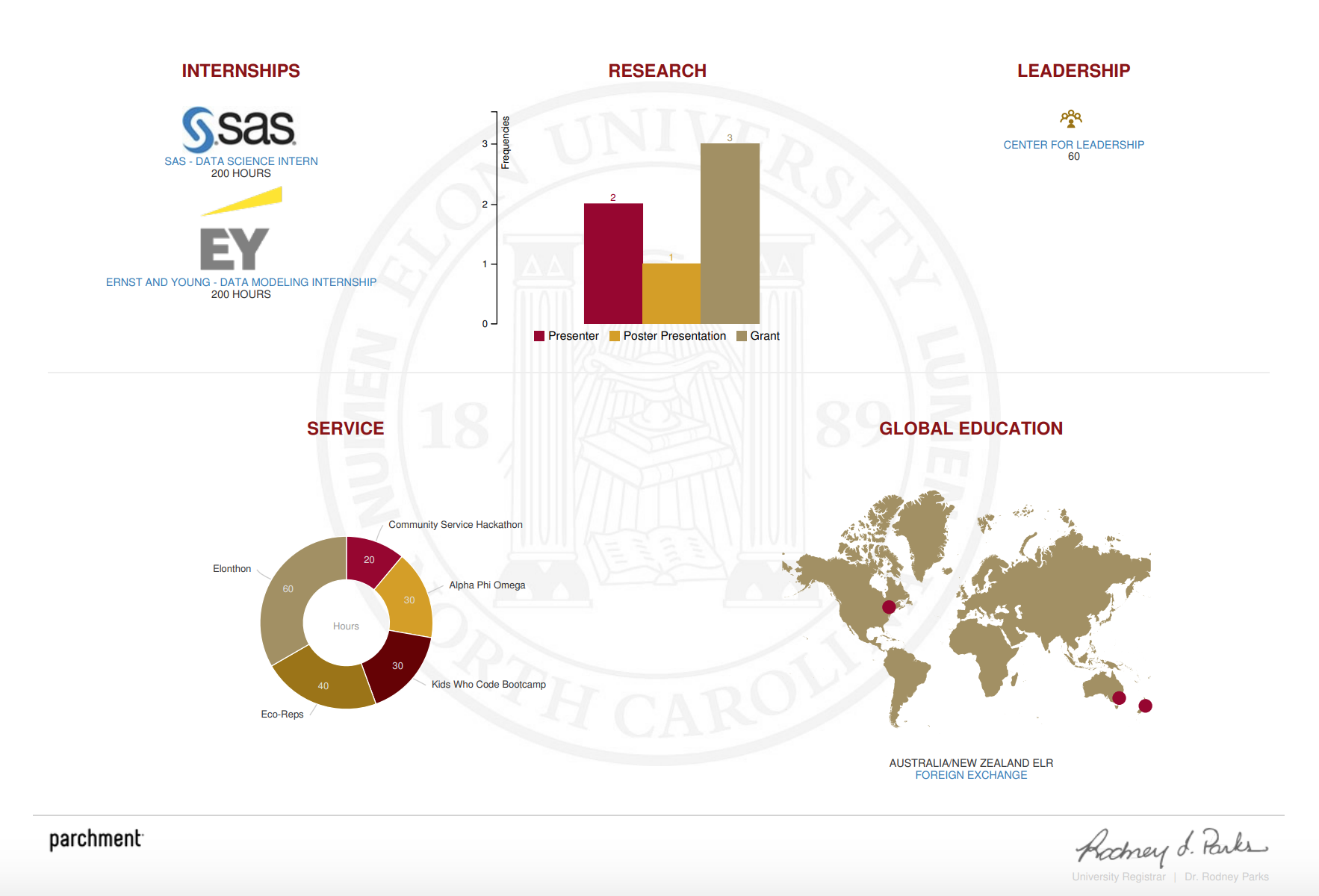
The format is especially suited to allow students to market the full suite of their college experience and accomplishments, and prospective employers are among the grateful. According to a research survey of employers conducted by Elon in partnership with ACCRAO, 86 percent of employers and students agreed that “experiential transcripts paint a more favorable picture of a job applicant than traditional transcripts do,” and 74 percent agreed that an enhanced transcript “caused them to view the applicant/candidate more favorably.”
Despite what the Visual EXP already logs and its favorability among students and employers, Dr. Parks and his team are not done thinking through ways to build out the transcript. They want to further blend the Visual EXP with the four-year plan advising model, offering experiential advising on top of academic advising. They are also considering what the data analytics from the Visual EXPs can tell them about what it takes for students to be successful at Elon, and to use that to inform practices and resources.
“It’s provided a whole new level of metrics to see the level of engagement based on varying demographics,” said Dr. Parks. “It’s helped us begin to look at first-year programs and refocus them in a way that students are getting the most out of them and being retained at the highest levels.”