Vann R. Newkirk II
ASU Future Security Senior Fellow & Fellow, Political Reform Program
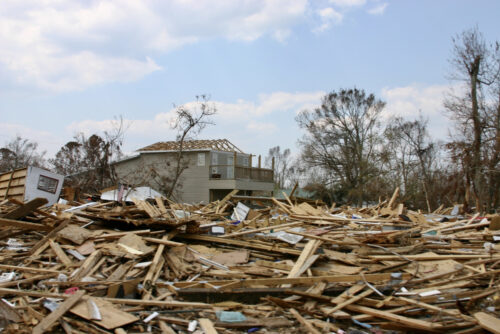
New America 2020 (ASU Future Security) Senior Fellow Vann R. Newkirk II reflects on Hurricane Katrina for “Three questions” in The Fifth Draft, the Fellows Program’s monthly newsletter. Newkirk is a Peabody Award–winning senior editor at The Atlantic who covers race, democracy, and environmental justice.
What does “Katrina’s America” mean to you as a journalist and as a citizen?
To me, after spending much of the past decade reporting on and studying race, disaster, environmental justice, and the state of democracy in America, the inescapable conclusion is that the basic logic of the country was laid bare by Katrina. The failure of the levees, the patterns of societal neglect, and the media narratives about survivors all reflected and exposed the fundamental issues with the country’s policy and culture. Now, in everything from the climate crisis to the erosion of civil rights, the things that Katrina revealed are there. That’s what “Katrina’s America” means to me.
I’m a big proponent of finding beauty in grief. The more intense the grief the more intense the beauty.
How do you think the storm and its aftermath will continue to influence the next 20 years of policy and culture?
I think that Katrina helped spark a more frank and forward conversation around issues of race, class, and governance that had previously been more hidden, and in turn prompted some real movement by marginalized communities to seize the narrative. For me, the denouement of those two decades of change is the current anti-democratic backlash that we are currently witnessing. To me, the next 20 years of policy and culture are anybody’s guess, but my hope is that we don’t forget what we learned in 2005. And yet, we have an unprepared FEMA, we are destroying our safety nets for our most vulnerable people, and now—because of climate change, which our federal government won’t even acknowledge—we face down the prospect of an active hurricane season.
Your next project, a book entitled Children of the Flood, will explore the fates of some of the oldest Black communities in the United States in the path of climate catastrophes. What have been the most profound moments of both agony and ecstasy working on that project?
I’m a big proponent of finding beauty in grief. The more intense the grief the more intense the beauty. The first character of my book is Calvin Adkins, the town historian for Princeville, North Carolina, who was the first person to advocate for leveraging Princeville’s history as America’s first and oldest town in the nation incorporated by Black people. He believed the town’s history could save itself with historical preservation money, and eventually safeguard it against future flooding. But, six weeks after meeting him, Hurricane Matthew destroyed the town. From a craft perspective, things that I was banking on using—sources and artifacts in Princeville—were gone. That was agony.
On the other hand, I’ve been reporting, researching, and writing on this book since 2016. I now have sources calling me saying, “We need the book out. You’ve got to do this. It’s important to us.” That’s ecstasy.
Subscribe here to receive next month’s issue of The Fifth Draft.
ASU Future Security Senior Fellow & Fellow, Political Reform Program