Use It or Share It
Table of Contents
- Executive Summary
- I. Introduction
- II. Major Recent Precedents for “Use-it-or-Share-it”
- III. Major Benefits of a Use-it-or-Share-it Policy
- IV. The First Amendment Imposes Limitations on the Government’s Power to Limit Non-Interfering Use of Spectrum
- V. Operationalizing Harmful Interference: The FCC’s Balancing Approach
- VI. Scarcity to Abundance: Opportunities to Expand Shared Access
- VII. Conclusion
Abstract
This report updates and expands on a paper the author presented nearly a decade ago at the Research Conference on Communication, Information and Internet Policy (TPRC), which predated the Federal Communications Commission’s (FCC) adoption of a use-it-or-share-it approach in several underutilized bands. These use-it-or-share-it precedents should pave the way to an authorization of opportunistic access as the default policy for a growing number of underutilized and newly allocated or auctioned bands, both federal and commercial. A national goal of not merely universal access to broadband, but of truly pervasive connectivity—high-capacity connectivity anywhere and anytime at affordable prices—will require an enormous increase in available spectrum capacity. A use-or-share rule expands productive use of spectrum and facilitates more communication and consumer welfare without the undue risk of harmful interference or the undermining of primary licensees’ deployment plans.
Downloads
Executive Summary
A national goal of not merely universal access to broadband, but of truly pervasive connectivity—high-capacity connectivity anywhere, anytime at affordable prices—will require an enormous increase in available spectrum capacity. The conventional wisdom that spectrum is scarce, particularly mid-band spectrum, persists despite the reality that most federal and commercial bands remain grossly underutilized and amenable to more intensive, shared use. Yet eight years after a 2012 report by the President’s Council of Advisors on Science and Technology (PCAST) recommended that spectrum sharing should be “the new normal,” important but limited progress has been made.
Conceptually, use-it-or-share-it rules authorize opportunistic access to licensed or federal spectrum that is unused or underutilized. A use-it-or-share-it authorization expands productive use of spectrum without risking harmful interference or undermining the deployment plans of primary licensees. Since 2014, the Federal Communications Commission (FCC) has adopted several world-leading precedents in opportunistic spectrum sharing that all apply a variation of the use-it-or-share-it approach. These precedents, and the proven effectiveness of automated frequency coordination mechanisms, can pave the way to an authorization of opportunistic access as the default policy for a far larger number of underutilized and newly-allocated bands.
A use-or-share approach promotes important policy goals, including more intensive use of fallow spectrum capacity, lowering barriers of entry to a diverse range of uses and users, facilitating innovation and competition, improving choices and lowering costs for consumers, and promoting service in rural and other underserved areas, thereby helping to narrow the digital divide. Unleashing opportunistic, shared access to unused spectrum also creates a general incentive for licensees to build out more quickly and to make greater efforts to lease or sell unused spectrum, facilitating secondary markets.
In addition, because spectrum is a government-controlled resource essential for wireless communication, FCC decisions on access to spectrum must be consistent with First Amendment principles. The commission must have an important reason to deny use of vacant spectrum, most commonly to avoid interference. The FCC must not reject proposals to use fallow spectrum without explanation, or on purely economic grounds, if a new shared use of a band can be accommodated, even if only on an opportunistic or contingent basis.
The FCC has begun operationalizing this “scarcity rationale” by applying a balancing approach to determine if interference is unduly harmful to the actual performance of incumbent services or systems—and not merely hypothetical, fleeting, or de minimis. The FCC should find an opportunity to further clarify the operational definition of “harmful” interference to make clear that the intention is to enable the greatest possible productive use of spectrum bands.
The failure to move faster to authorize unused federal spectrum for at least opportunistic shared use (such as on a General Authorized Access, or GAA, basis) has an enormous opportunity cost as we enter an era where bandwidth abundance is in reach. The report closes by examining near-term opportunities to extend shared access to more substantial underutilized federal, commercial, and FCC-held bands, including 700 megahertz of mid-band federal spectrum and 700 megahertz in two very underutilized commercial bands. More broadly, the commission should open a Notice of Proposed Rulemaking (NPRM) that proposes adding a use-it-or-share-it authorization for all terrestrial flexible use bands that have not been built out in substantial portions of the country. Much of the prime spectrum auctioned over the past decade remains fallow, particularly in many rural and small town areas, and at the very least conditional and temporary access to that spectrum capacity should be considered as part of this effort.
I. Introduction
This report updates and expands on a paper the author presented nearly a decade ago at the Research Conference on Communication, Information and Internet Policy (TPRC), which predated the Federal Communications Commission’s (FCC) adoption of a use-it-or-share-it approach in several underutilized bands. These use-it-or-share-it precedents should pave the way to an authorization of opportunistic access as the default policy for a growing number of underutilized and newly allocated or auctioned bands, both federal and commercial.1 A national goal of not merely universal access to broadband, but of truly pervasive connectivity—high-capacity connectivity anywhere and anytime at affordable prices—will require an enormous increase in available spectrum capacity. By promoting bandwidth abundance, a use-it-or-it-share policy can play a central part in any effort aimed at expanding spectrum access for rural and non-traditional internet service providers (ISPs), as well as for enterprise, home, and institutional use. A use-or-share rule expands productive use of spectrum and facilitates more communication and consumer welfare without undue risk of harmful interference or undermining of primary licensees’ deployment plans.
Conceptually, use-it-or-share-it rules authorize opportunistic access to licensed or federal spectrum that is unused or underutilized in a specific area. This approach expands productive use of spectrum without risking harmful interference or undermining the deployment plans of primary licensees. Although the use-it-or-share-it approach can be applied to most bands, the authorization of opportunistic access is inherently band-specific. Access rights and conditions can vary widely depending on the propagation characteristics and size of the band, the nature of the incumbent users, the nature of the shared use requested, the availability of a coordination mechanism (e.g., a geolocation database coordinator), and other factors. Some underutilized bands can be most effectively shared based on frequency separation (adjacent channel sharing), or based on geographic separation (e.g., co-channel sharing), or on a temporal basis—and some based on a combination of methods that exploit unused spectrum capacity.
The bedrock principle of opportunistic spectrum sharing is that secondary users and the coordination process itself should have little if any impact on incumbent services. In practice, this means that opportunistic use of a band is premised above all on avoiding harmful interference to the primary incumbent service (e.g., broadcasting, military radar). An authorization for opportunistic, shared use can (and should) ensure licensees that opportunistic users will vacate the spectrum once notified that the licensee is ready to commence service in that local area and will never result in harmful interference to the primary licensee’s operations. However, as we will explore below, the authorization of opportunistic but non-interfering use can be accomplished in a variety of established ways. These methods include automated frequency coordination (a geolocation database), sensing systems, use restrictions (such as low-power, indoor-only operation), and specific technical conditions (such as antenna directionality).
Lawmakers and regulators are increasingly recognizing that meeting the increasing demand for wireless data will ultimately require a greater focus on shared, dynamic access to unused and underutilized bands. For example, Congress in 2018 mandated development of “a national plan for making additional . . . bands available for unlicensed or license by rule operations,” which included examining “existing and planned databases or spectrum access systems designed to promote spectrum sharing.”2
While Congressional recognition of the importance of unlicensed and dynamic spectrum sharing is relatively recent, the FCC has incrementally pursued a policy of leveraging new technologies to unlock fallow spectrum capacity through sharing for nearly two decades. The FCC’s Spectrum Policy Task Force Report recognized this opportunity in 2002:
Preliminary data and general observations indicate that many portions of the radio spectrum are not in use for significant periods of time, and that spectrum use of these “white spaces” (both temporal and geographic) can be increased significantly . . .3
The National Broadband Plan similarly recommended in 2010 that “[t]he FCC should spur further development and deployment of opportunistic uses across more radio spectrum.”4 In its rationale for that recommendation, the National Broadband Plan observed that opportunistic and cognitive radio technologies “could allow access to many different frequencies across the spectrum chart that may not be in use at a specific place and time and could do so without harming other users’ operations or interests.”5 The National Broadband Plan went on to urge the FCC to allow opportunistic use of unassigned spectrum currently held by the FCC and “to extend the geolocation database concept, currently being implemented in the TV bands, to additional spectrum bands that are made available for access by opportunistic radios.”6
While the FCC has led the world in pioneering both unlicensed and dynamic spectrum access policies, regulators in other nations are recognizing the benefits of direct local access to unused spectrum capacity. The next section notes that a growing number of countries have adopted the TV White Space (TVWS) framework first approved by the FCC in 2010, including reliance on a geolocation database to manage access and protect broadcast services. The United Kingdom’s spectrum regulator, Ofcom, observed in a 2015 report that “[g]eolocation databases are making it easier for devices to identify spectrum that is available for sharing while protecting the operation of existing services. While the current focus is on the use of databases to manage access to TV white spaces within 470–790 MHz, the fundamental principle is not frequency specific and can extended to a broader range of frequencies.”7
As Section II describes, the FCC has adopted a number of world-leading precedents since 2014 in opportunistic spectrum sharing that apply a variation of the use-it-share-it approach. These important precedents, all adopted on a bipartisan basis, include:
- authorizing continued unlicensed use of post-auction 600 MHz band spectrum until a licensee notifies the TVWS database it is ready to commence service;
- the new Citizens Broadband Radio Service (CBRS), a three-tier dynamic sharing framework that both opens U.S. Navy spectrum for commercial use and authorizes use-or-share access to the licensed portion of the band auctioned in 2020;
- the April 2020 order authorized unlicensed sharing, on a non-interfering basis, with incumbent services in the 6 GHz band—allowing both a low-power, indoor-only underlay across all 1,200 megahertz, and use of two sub-bands (850 megahertz) at standard power subject to control by Automated Frequency Coordination systems;
- emergency Special Temporary Authorizations (STAs), in response to the pandemic-induced surge in home broadband use, in multiple bands to both major mobile carriers and to more than 100 mostly rural wireless internet service providers (WISPs).
Section III describes how a use-it-or-it-share-it approach promotes important public policy objectives, including more intensive use of fallow spectrum capacity, lowering barriers of entry to a diverse range of uses and users, facilitating more innovation and competition, improving choices and lowering costs for consumers of wireless services, and promoting service in rural and other underserved areas to narrow the digital divide. Unleashing opportunistic, shared access to fallow spectrum also creates a general incentive for licensees to build out services more quickly, or to make greater efforts to lease unused spectrum, since opportunistic use of the band demonstrates that other (typically smaller) operators are finding value in the unused portions of their license area. A use-it-or-share-it policy adds a more affirmative, non-punitive approach than the more draconian use-it-or-lose-it build-out requirements. Instead, the regulator could decide to permit licensees to attribute all or a portion of the areas served by opportunistic users to their own performance in relation to build-out requirements.
Section IV revisits a consideration largely absent from recent debates about the assignment of rights to access the public airwaves: The First Amendment. Because spectrum is a government-controlled resource essential for wireless communication, FCC decisions on access to spectrum must be consistent with First Amendment principles. Unlike publishing or any other form of communication, the government requires a license to communicate over the public airwaves. As a result, and as federal courts have consistently held, the assignment of rights to communicate cannot be based solely on economic criteria or the whims of regulators. First Amendment jurisprudence on the FCC’s right to regulate spectrum access rests on the so-called “scarcity rationale.” This refers to the idea that because the frequency bands most useful for communication are finite and in demand by many potential users, the FCC must allocate and assign spectrum rights to avoid harmful interference. While the scarcity rationale has been used to justify licensing, auctions, licensing conditions, and other FCC regulation of spectrum use, this paper explains why the FCC must clear a high hurdle (intermediate scrutiny) to justify barring non-interfering communications.
Section V connects this right to communicate with the practical constraint of harmful interference. When it comes to petitions or proposals for use of occupied (but underutilized) spectrum, the FCC operationalizes the scarcity rationale by deciding if and to what degree a new use or user poses an undue risk of harmful interference to current users. The FCC has been clear that not all interference is harmful interference. Accordingly, the FCC has explicitly authorized new users in occupied bands where, despite acknowledging some additional interference, it finds that with technical restrictions (e.g., low power, indoor-only use), or with minor accommodations by incumbent users (e.g., notifying a database), the degree of harmful interference that would justify excluding the new use can be avoided. In recent proceedings, the commission has become more explicit about the nature of this balancing approach to interference, an approach that is correctly premised on the actual performance of incumbent services or systems—and not on mere hypothetical, fleeting, or de minimis disruption.
Finally, in Section VI, the paper discusses a number of near-term opportunities to extend shared access to additional and substantial underutilized federal, commercial, and FCC-held bands. Federal bands that deserve a near-term focus include 700 megahertz of mid-band spectrum between 2900 and 4500 MHz. An additional 700 megahertz of commercial mid-band spectrum is currently in use, but offers a potential opportunity for a use-it-or-share-it approach that could be particularly valuable for enabling high-capacity fixed wireless in rural and unserved areas, as well as low-power, indoor-only (LPI) unlicensed use nationwide. A third category represents FCC-held spectrum that is fallow and should be made available on a use-or-share or dynamically-shared basis, even if that use is time-limited.
Citations
- See Michael A. Calabrese, “Use it or Share it: Unlocking the Vast Wasteland of Fallow Spectrum,” New America Foundation, presented at 39th Research Conference on Communication, Information and Information Policy (TPRC) (Sep. 23, 2011) (“Calabrese 2011 TPRC”). The author would like to thank Nathan Calvin, a second-year student at Stanford Law School, for his invaluable and deft legal research and writing, particularly concerning the First Amendment implications of spectrum access policy.
- Ray Baum’s Act of 2018, Public Law 115-141, § 614, 132 Stat. 1080, at 1109 (2018).
- FCC, Spectrum Policy Task Force Report (Nov. 2002), at 3, 4, 14.
- Connecting America: The National Broadband Plan, Recommendation 5.13, at p. 95 (2010) (“National Broadband Plan”), available at source.
- Ibid.
- Id.
- Ofcom, “A Framework for Spectrum Sharing,” at 21 (July 31, 2015).
II. Major Recent Precedents for “Use-it-or-Share-it”
In recent years the FCC has adopted several important precedents that explicitly or implicitly incorporate a use-it-or-share-it approach. These innovative rulemakings and the evolution of automated frequency coordination databases demonstrate the enormous potential for a more widespread application of a use-it-or-share-it authorization to enhance spectrum access, efficiency, and innovation. The commission has adopted use-or-share rules twice since 2014 in flexible use bands: The CBRS rules for the 3.5 GHz band, which coordinates licensed-by-rule use of locally-unused licensed (PAL) spectrum, and continued unlicensed use of unused spectrum in the 600 MHz band following the TV incentive auction. These use-it-or-share-it rules are operational and coordinated by automated frequency coordination systems that have not in any way impeded the deployment of CBRS or 600 MHz networks by the primary licensees.
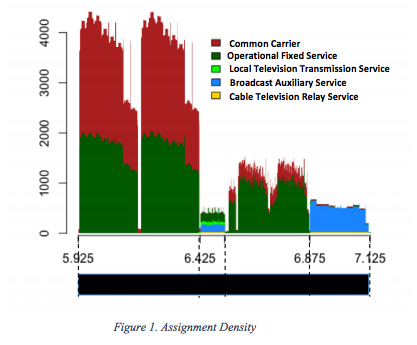
In April 2020 the FCC’s historic order opening 1,200 megahertz of spectrum across the entire 6 GHz band (5925-7125 MHz) marked a third unique advance in applying the principle of use-it-or share it. Unlike both TVWS and CBRS—and also unlike the generally dedicated unlicensed bands at 2.4 and 5 GHz—unlicensed sharing in 6 GHz is effectively an underlay that takes advantage of the fact that although the entire band is occupied by tens of thousands of users, the vast majority of the spectrum capacity lies fallow. Unlicensed use on a shared basis is premised on protecting incumbents by requiring devices operating at standard power to be controlled by an automated frequency coordination (AFC) system certified by the FCC.
Advances in geolocation database coordination have been foundational to the FCC’s willingness to adopt dynamic use-or-share rules that have unlocked enormous spectrum capacity—particularly in rural and underserved areas—while simultaneously protecting incumbent licensees from harmful interference. Database coordination of spectrum is nothing new. For example, the manual coordination of band sharing between fixed terrestrial links and Fixed Satellite Service (FSS) earth stations has gone on for decades. What is new are the significant improvements in the algorithms and computational power needed to efficiently and rapidly complete propagation analysis and coordinate users in near-real time. The evolution in database coordination from manual and static frequency coordination to automated and dynamic geolocation that takes terrain, power level, antenna directionality, and other factors into account creates the potential to authorize at least temporary access to virtually any unused spectrum on a very granular, localized level.1
The automation of coordination won’t always be worth the cost, but that’s a decision best left to the aspiring band entrants based on market factors. Moreover, the feasibility of employing database coordination to enable more intensive sharing of additional bands is steadily increasing as the cost is decreasing. To the extent that an infrastructure of AFC systems is already in operation (e.g., in CBRS and in 6 GHz), this makes its application to new bands more of a marginal cost. In addition, as described in the final subsection below, FCC authorization of opportunistic or temporary use of available spectrum does not require a database mechanism, or sensing technology, to enable it on a large scale. AFCs simply automate manual coordination, but depending on the band, scale, and costs, manual coordination is also an option. As it did repeatedly during 2020 in response to the pandemic increasing demand for mobile and fixed wireless capacity, the FCC can issue a Special Temporary Access or waiver authorization in response to requests from individual ISPs or other entities. And, as the First Amendment section below maintains, the commission is obligated to do so unless it articulates a substantial and important reason why doing so, on balance, does not serve the public interest.
A. TV White Space and Post-Auction 600 MHz: The First Automated Coordination of Use-or-Share
In 2014 the FCC adopted a use-it-or-share-it approach to authorize continued unlicensed use of the post-auction 600 MHz band following the TV incentive auction. This built on the TVWS rules adopted unanimously by the commission in 2010, under which both fixed and mobile broadband devices are authorized to operate on an unlicensed basis on unoccupied TV channels provided that the devices have GPS and the capability to periodically check an online geolocation database of available channels or frequencies in that discrete geographic location. 2 TV Bands Databases (TVDBs) are certified by the commission to coordinate unlicensed use with the primary licensees, a FCC innovation that is spreading worldwide.3 By applying algorithms to inputs (e.g., geolocation, power level, incumbent channel assignments) the TVDB can manage opportunistic access to ensure no interference to the primary licensed services. For example, low-power TVWS devices are able to operate closer in frequency to incumbent TV stations than higher-power, wide area devices that pose a greater risk of interference.
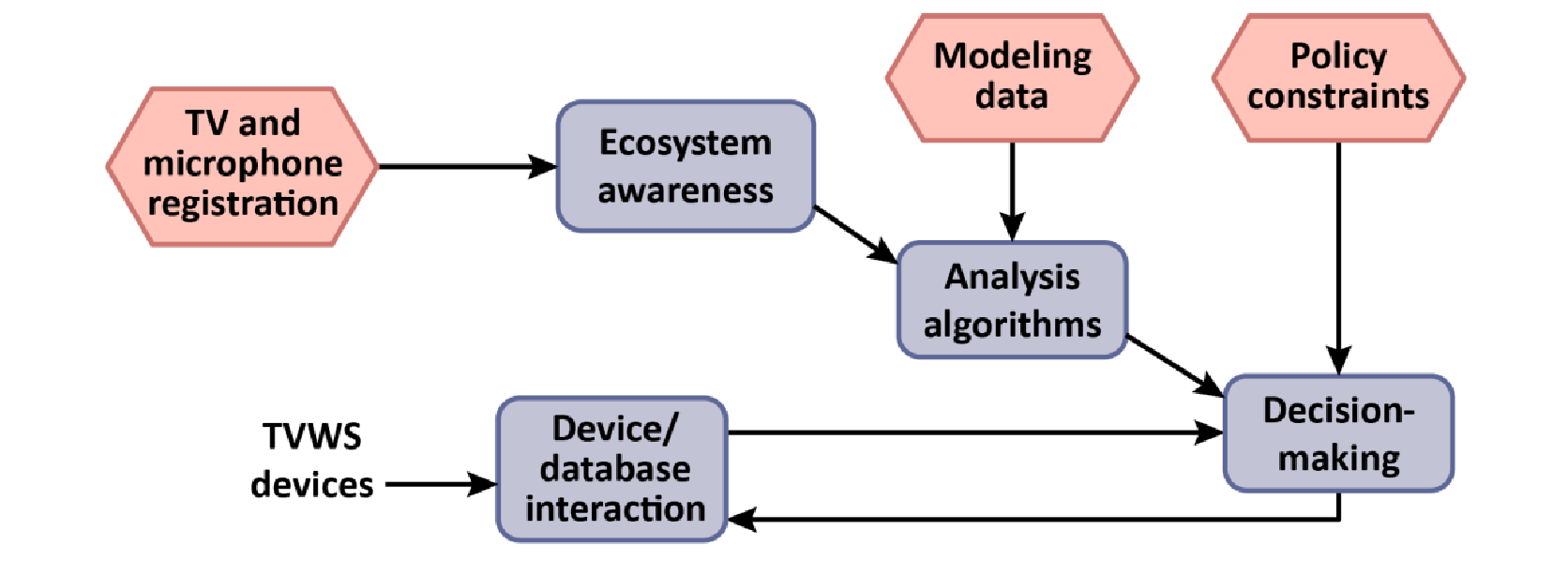
Simplified admission control system architecture for Television Whitespace Database (TVDB).4
As part of the innovative incentive auction framework that reallocated 14 TV channels (84 megahertz) for mobile and flexible use, the commission in 2014 authorized the continued operation of unlicensed TVWS devices in any locally unused 600 MHz spectrum following the auction.5 In effect, this use-or-share rule expanded the scope of opportunistic sharing in the former TV spectrum. The original TVWS rules limited unlicensed users to the vacant channels between occupied TV channels.6 On a localized basis, unlicensed TVWS devices can now operate indefinitely in any unused portions of the exclusively-licensed 600 MHz band until the licensee notifies a certified TVDB that it is ready to commence service in that specific area. Since TVWS devices must renew their permission to transmit by checking the TVDB at least every 24 hours, the new mobile carrier licensees are guaranteed that the spectrum will always be available when they are ready to actually use it.
In adopting opportunistic access to unused 600 MHz spectrum post-auction, the FCC in its 2014 TV band incentive auction Report & Order stated:
We will permit the continued operation of TVWS devices on repurposed spectrum except in those areas in which a 600 MHz Band licensee commences operations. . . . TV bands databases . . . can serve to ensure that unlicensed operations will no longer occur on a channel on which a licensee has commenced service. When a 600 MHz Band licensee plans to commence operations . . . that licensee can notify any of the TV bands database administrators when and where it plans to commence operations.7
The Incentive Auction Order noted that AT&T did not oppose continued TVWS operations on a use-or-share basis provided it is “subject to strict enforcement mechanisms, and any unlicensed user would have to commit unequivocally to clear the spectrum immediately once the licensed operator is ready to make use of it.”8
B. Citizens Broadband Radio Service: Dynamic, Three-tier Spectrum Sharing
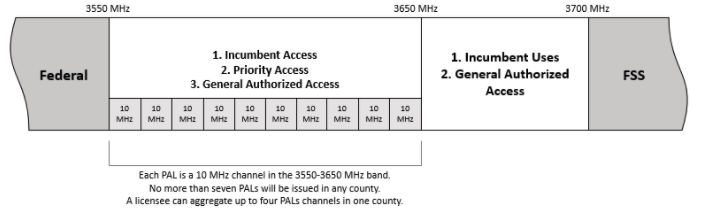
The most unique and innovative advance in dynamic spectrum sharing arose from the FCC’s 2015 Citizens Broadband Radio Service (CBRS) spectrum sharing framework, a landmark initiative in spectrum policy. The commission adopted CBRS rules on a bipartisan basis, establishing a unique three-tier sharing framework of licensed and opportunistic (unlicensed) access to unused U.S. Navy spectrum in the 3550–3700 MHz band.9 Multiple and competing geolocation database systems—known as Spectrum Access Systems (SAS)—coordinate dynamic spectrum sharing by a three-tier hierarchy of users made up of incumbent licensees (U.S. Navy radar services), Priority Access Licenses (PALs), and opportunistic (effectively unlicensed) General Authorized Access (GAA) users. Incumbent services are fully protected by the SAS, which ensures that GAA use causes no harmful interference to incumbent licensees (Navy radar and some FSS earth stations).10
The CBRS rules marked the second time the FCC authorized opportunistic access to unused flexible use spectrum, in this case both before and indefinitely after the PAL auctions that concluded in August 2020. GAA use of unused PAL spectrum in a local area must be granted by a SAS, ensuring the opportunistic use will not interfere with the priority access licensee. The SAS database thereby facilitates—on an automated basis at low cost—the spectrum sharing needed to ensure that all the spectrum in the 3.5 GHz band is available for use. The FCC retained the use-it-or-share-it rules when it changed the CBRS auction rules in 2018, stating in the Report and Order that “[t]argeted use cases are already encouraged by the ‘use-or-share’ nature of the band and the GAA tier.”11 A conceptual diagram of the SAS, its inputs and how it synchronizes with other certified SASs is below.
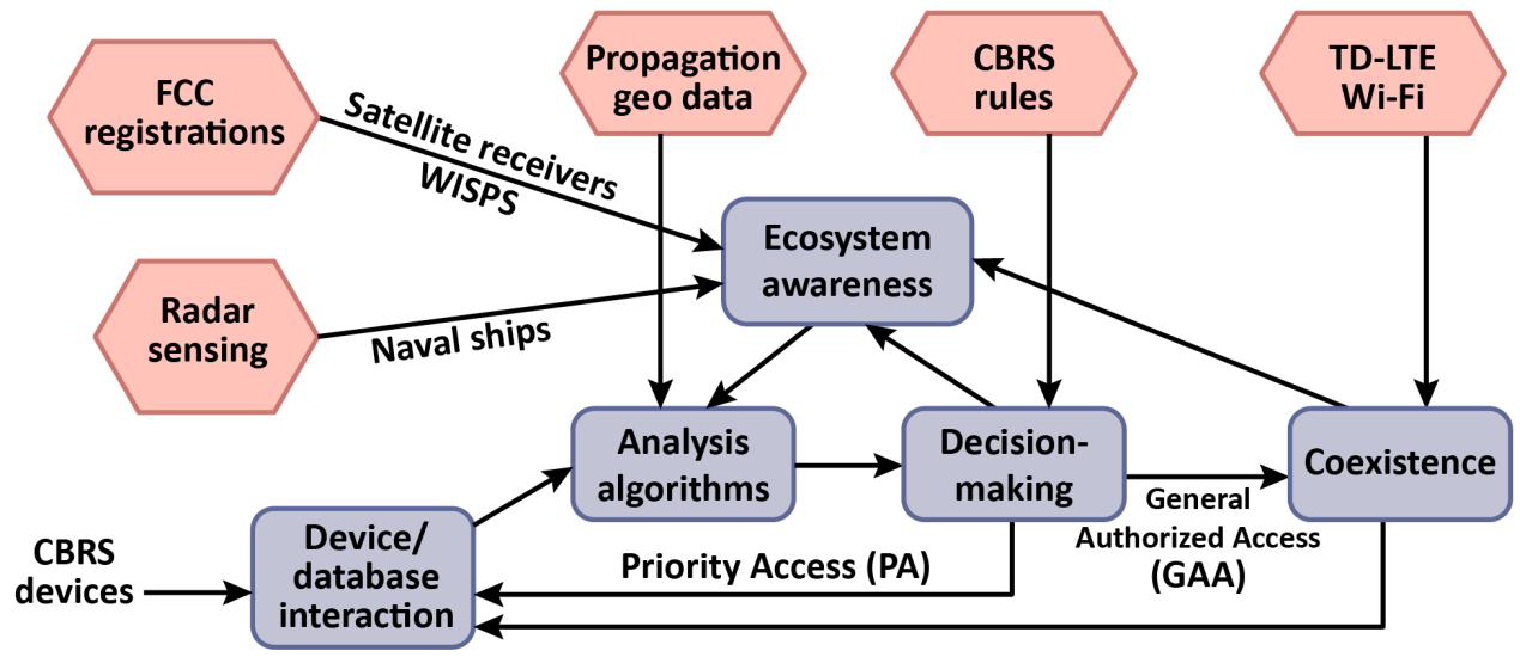
Control system architecture for three-tier, FCC-certified Spectrum Access System.
The commission stated that opportunistic access to PAL channels served the public interest by providing spectrum directly to “a wide variety of users, deployment models, and business cases, including some solutions to market needs not adequately served by our conventional licensed or unlicensed rules,” including small rural providers as well as enterprise, campus, and industrial users.12 The CBRS framework, and specifically the SAS, facilitates more intensive use of the 3.5 GHz band currently without imposing any costs on licensees, especially in the rural areas that are generally the last to experience licensed deployments. Under the rules, both large and small ISPs, entertainment venues, enterprise users, utilities, schools, and other new market entrants can gain competitive access to spectrum in the band whether or not they acquire one or more PALs.
To date, the FCC has certified five competing SAS systems.13 Since initial commercial deployments began in late 2019, the SAS has proven to be effective at coordinating GAA and PAL use of the band, while protecting U.S. Navy operations. The PAL auction included by far the largest and most diverse field of bidders for any FCC auction: 271 qualified bidders and 228 different winning bidders took part.14 The auction generated $4.6 billion, which reflected an amount directly in the expected range of revenue.15
As suggested by the diagram above, the SAS implements near-real-time automated frequency coordination, relying on inputs from both users and incumbents to grant and renew permission to operate in a given location:
Because each SAS has a ‘map’ of all deployments on the seven PAL channels, it can facilitate opportunistic GAA use of vacant PAL spectrum in discrete geographic areas on a ‘use-it-or-share-it’ basis. In the CBRS band, licenses (PALs) ensure interference protection for deployed nodes, but confer no right to exclude opportunistic users (GAA) when and where the spectrum is not in use. This discourages spectrum warehousing and ensures the band is used as intensively as possible, which is particularly important for rural and other less densely-populated areas where PALs may not be fully built out.16
C. The 6 GHz Band: An Unlicensed, Use-or-Share Underlay Across 1,200 Megahertz
In April 2020, the FCC unanimously adopted rules which marked the largest expansion of unlicensed spectrum access, as well as by far the largest authorization of opportunistic spectrum sharing. Overall, the commission opened up a total of 1,200 megahertz for unlicensed use across the four 6 GHz sub-bands (U-NII-5 to U-NII-8) that span 5925 to 7125 MHz.17 The entire 6 GHz is used by licensed services that include fixed point-to-point microwave links (nearly 50,000 links are licensed) and the Broadcast Auxiliary Service. The 6 GHz Order nonetheless authorized massive new capacity for the next generation of Wi-Fi and other unlicensed uses in two distinct ways:
First, all 1,200 megahertz are available for use everywhere on a low-power and indoor-only basis (LPI) without the need for database control or coordination. Because the maximum power level for LPI is roughly one-fourth the maximum standard power for Wi-Fi (which is 4 watts EIRP), the FCC agreed with studies showing that at an even higher power (i.e., a power spectral density of 8 dBm), the indoor-only requirement makes harmful interference to high-powered fixed links and other incumbent both extremely unlikely and likely fleeting.
Second, the 850 megahertz licensed for fixed microwave links (the U-NII-5 and U-NII-7 sub-bands) is authorized for both indoor and outdoor use at standard power, but only if devices are registered and operated under the control of an Automated Frequency Coordination (AFC) system. Like the competing SAS systems in CBRS, the FCC expects to certify multiple AFCs, some of which may be operated by device manufacturers. The AFCs are expected to be far simpler than SAS systems that need to protect shipborne radar, primarily because the incumbents are licensed for fixed locations that rarely change, the location data can be downloaded from the FCC’s Universal Licensing System, and there is no need for the various AFCs to synchronize their data. The AFCs are essentially a real-time look-up database: Either a particular frequency at a particular location is allowed, or it is not.
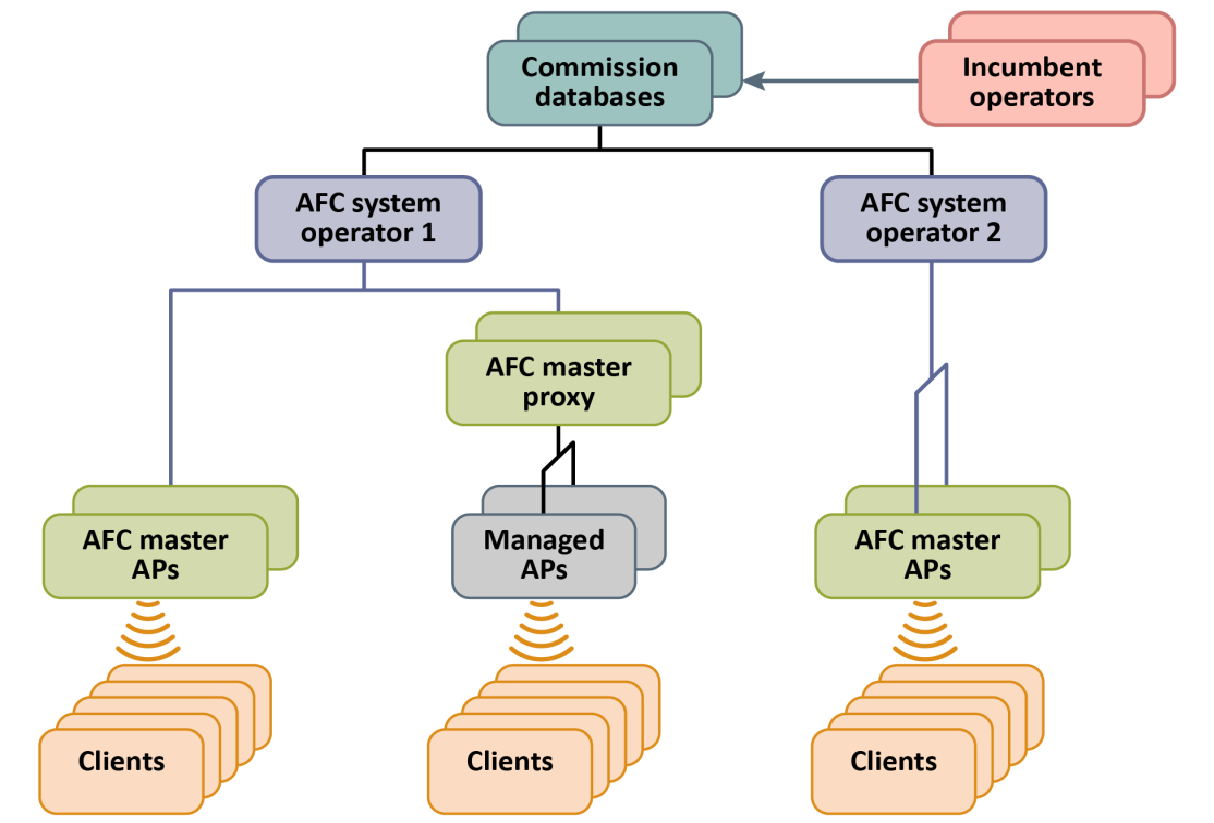
Simplified architecture for Automated Frequency Coordination in 6 GHz band.
Under this more intensive sharing framework, the 6 GHz band will be home to high-power, standard-power, and low-power operations. Low-power devices will be able to operate on an unlicensed basis indoors across the entire 6 GHz band without AFC system coordination,18 while higher powered and standard powered operations can exist in the band subject to permission from an AFC. The AFC systems work in a manner similar to that of TVDBs for TVWS by enforcing protection zones around licensed microwave links that vary depending on the power (and hence the interference risk) of the user. The commission noted:
Because the minimum required separation distance from a fixed service receiver, among other factors, is a function of the access point power, lower power devices do not have to meet as large a separation distance to provide the same level of protection as higher power devices. This means that more spectrum may be available for access points that operate with power levels below the maximum, especially in congested areas where spectrum is more heavily used by the fixed microwave services.19
Notably, the commission requires the incumbent users to ensure the licensing information they report to the Universal Licensing System is accurate and up to date:
… [L]icensees have the responsibility, as well as significant incentive, to maintain the continued accuracy of data in the Universal Licensing System to ensure that they are protected from harmful interference not only from new unlicensed devices, but also from new fixed microwave links that may access the band…. we will require the operators of temporary fixed stations to register the details of their operations . . . in the [ULS] prior to transmission if they desire to be protected from potentially receiving harmful interference from standard-power access points in the U-NII5 and U-NII-7 bands.20
D. 5.9 GHz and 1.7 GHz: Grants of Special Temporary Authorization in Response to Covid-19
In rapid response to the initial pandemic-induced shutdowns, in March 2020 the FCC used its authority to grant STAs to both large mobile and small fixed-wireless broadband providers to help them meet the surging demand for the high-capacity internet access needed for remote work and learning. Although STAs are temporary by definition, they are sometimes renewed over virtually indefinite periods and represent a means by which the FCC, at the staff level, can respond nimbly and affirmatively to individual requests for opportunistic access to unused or underutilized spectrum.
At the very outset of the pandemic, in March 2020, the FCC granted four mobile carriers STAs to unassigned 1.7 GHz spectrum returned to the FCC inventory after they were auctioned.21 The carriers received a renewable 60-day STA and were able to put the spectrum to use immediately because their networks were already using AWS-3 spectrum. The FCC also rapidly approved STAs to use licensed but unused 600 MHz and AWS-4 spectrum, although this occurred with the permission of licensees seeking to assist Covid-19 connectivity efforts.22
Between March and May 2020, the FCC similarly granted STAs to more than 100 wireless internet service providers (WISPs) that authorized secondary, non-interfering use of 45 megahertz of unused spectrum in the lower 5.9 GHz to “provide relief during the state of emergency caused by the spread of COVID-19 throughout the United States.”23 The WISPs were already using the adjacent 5.8 GHz unlicensed (U-NII-3) band to provide fixed wireless service, primarily in rural areas, and reported a 35 percent increase in data traffic during peak hours due to COVID-19.24 The spectrum in that band had been allocated in 1999 for vehicle-to-vehicle safety signaling technology that never deployed at scale and is now outdated.25 And while there are dozens of incumbent deployments, the band has been mostly unused for two decades.
The STAs allowed the WISPs to boost the capacity of fixed wireless deployments that rely on the adjacent unlicensed band (U-NII-3) in mostly rural, small town and historically underserved areas.26 The STAs require WISPs to coordinate with incumbent users to ensure that any base station using 5.9 GHz band is a safe distance away from any incumbent Intelligent Transportation Service (ITS) deployment, which are relatively few and fixed, and therefore easy to protect. The WISPs rely on manual coordination, subject to a minimum 2 kilometer separation distance:
[A STA user] is responsible for ensuring that it does not cause interference to existing licensees. It must review existing DSRC licenses . . . [and] contact each of these affected licensees before beginning operation . . . . It may then begin operation; it need not await a response or approval. If a complaint of interference cannot be timely resolved, operation under this STA must cease. It may not operate within 2 kilometers of any site license, regardless of notification or actual interference.27
If AFC systems had already been certified for the neighboring 6 GHz band, it would have been feasible for the FCC to either require or allow the WISPs to rely on an AFC for automated coordination. In fact, as more bands are designated for automated coordination by agency-certified mechanisms—such as the AFC, SAS, and TVDB systems described above—the easier and more reliable it will be to coordinate use-or-share access to unused spectrum in additional bands.
Citations
- For an in-depth overview of the evolution of geolocation database coordination, see Automated Frequency Coordination: An Established Tool for Modern Spectrum Management, Dynamic Spectrum Alliance, at 33 (March 2019) (“DSA, Automated Frequency Coordination”), available at source. “Regulators can choose to create or authorize an [AFC] system to do any or all of the following functions at scale and at low or no cost to the agency itself: Collect, ingest and regularly update incumbent information from agency licensing records or as provided by NRA rules; Calculate protection contours and other algorithms by applying NRA rules; Verify that all registered device are certified in compliance with NRA rules; Register verified devices and networks, recording any required data on user identity, location, device type, operating parameters; Calculation engine: apply objective algorithms to grant or deny requests for permission to operate for whatever period of time is provided in NRA rules; Optimize coexistence among secondary users, if relevant, based on NRA rules; Collect any usage or regulatory fees authorized or required by the NRA; Capture data and report on actual use of the band, as well as any anomalies that may inform future regulatory action; Maintain the ability to identify and shut down a device or provider in cases of harmful interference or emergency; Dynamically adjust the device admission or operating parameters (in response, for example, to exceeding an aggregate interference threshold in a geographic area). Provide a portal for incumbents and/or users to report corrections or updates to licensing data, operating parameters, or to report incidents of interference.”
- Unlicensed Operation in the TV Broadcast Bands, Additional Spectrum for Unlicensed Devices Below 900 MHz and in the 3 GHz Band, ET Docket Nos. 04-186, 02-380, Second Memorandum Opinion and Order (2010); see also Unlicensed Operation in the TV Broadcast Bands, Second Report and Order and Memorandum Opinion and Order, ET Docket Nos. 04-186, 02-380, (2008).
- Unlicensed access to TVWS, managed by an automated database, has been adopted by the United Kingdom and by an increasing number of countries. See DSA Database Management Report at 21 (“The UK, South Korea and Singapore have working systems managed, as in the U.S., by one or more automated geolocation database operators. South Africa adopted rules in March 2018 and is in the implementation process. Malawi, Ghana and Mozambique had draft TVWS regulations under review as of mid-2018. And more than a dozen other countries have hosted successful TVWS pilots, most enhancing broadband connectivity to schools and in rural areas, including in Colombia, Taiwan, Jamaica, Namibia, Kenya, Tanzania, Trinidad and Tobago, and the Philippines.”).
- This diagram and the two following (in relation to AFCs for CBRS and 6 GHz band sharing) are taken from the Dynamic Spectrum Alliance report, Automated Frequency Coordination, supra note 8, which provides a detailed history of the evolution of database coordination as a tool for spectrum management.
- See Report and Order, GN Docket No. 12-268, at ¶ 680 (rel. June 2, 2014) (“2014 Incentive Auction Order”)
- Even today, TVWS operations are not allowed to operate co-channel to a TV station unless they are located well outside the station’s licensed contour whether or not a TV signal is actually received in a particular area.
- 2014 Incentive Auction Order, supra, at ¶ 680.
- Ibid.
- First Report and Order, Amendment of the Commission’s Rules with Regard to Commercial Operations in the 3550-3650 MHz Band, WT Docket No. 12-354, 30 FCC Rcd 3959 (2015), at 3962 (“2015 CBRS Order”). In its final order in 2016, the FCC summarized the unique purpose of three-tier sharing: “The Citizens Broadband Radio Service takes advantage of advances in technology and spectrum policy to dissolve age-old regulatory divisions between commercial and federal users, exclusive and non-exclusive authorizations, and private and carrier networks.” Order on Reconsideration and Second Report and Order, Amendment of the Commission’s Rules with Regard to Commerical Operation in the 3550-3650 MHz Band, GN Docket 12-354 (2016), available at source.
- For a general overview of CBRS and the role of the SAS, see, e.g., Commscope, “Spectrum Access System (SAS), Frequently Asked Questions,” available at source; FCC, “3.5 GHz Band Overview,” source.
- Report and Order, GN Docket No. 17-258, at ¶ 37 (Oct. 23, 2018).
- 2015 CBRS Order, 30 FCC Rcd 3959, at 3962. The Order further stated that “permitting opportunistic access to unused Priority Access channels would maximize the flexibility and utility of the 3.5 GHz Band for the widest range of potential users” and “ensure that the band will be in consistent and productive use.” Id. at ¶ 72.
- See WinnForum, “FCC Spectrum Access System (SAS) Administrators,” available at source.
- Public Notice, Auction of Priority Access Licenses in the 3550-3650 MHz Band Closes, AU Docket No. 19-244 (Sep. 2, 2020), source.
- Kelly Hill, PALs Auction Wraps Up, Raises More than $4.58 Billion, RCR Wireless News (Aug. 25, 2020), source; Joan Engebretson, CBRS Auction Closes After Just 24 Bidding Days, Raising Over $4.5 Billion, Telecompetitor (Aug. 25, 2020), source.
- DSA, Automated Frequency Coordination, at 27.
- Report and Order and Further Notice of Proposed Rulemaking, ET Docket No. 18-295, GN Docket No. 17-183 (Rel. April 24, 2020), source (“6 GHz Order”).
- Id. ¶ 97.
- Id. ¶ 36.
- 6 GHz Report and Order at ¶¶ 31-32.
- See FCC, “FCC Grants AT&T and Verizon Special Temporary Access During Pandemic,” News Release and Authorizations (March 20, 2020), available at source; Bevin Fletcher, “Verizon Gets Spectrum Boost Via DISH Connections,” Fierce Wireless (March 19, 2020), available at source.
- See Press Release, “FCC Provides T-Mobile Temporary Access to Additional Spectrum to Keep Americans Connected During Coronavirus Pandemic” (March 15, 2020), available at source; Press Release, “5.9 GHz Band Boosts Consumer Internet Access During Covid-19 Pandemic” (May 4, 2020), available at source.
- FCC, Approval of Emergency Request for Special Temporary Authority (March 27, 2020) (“WISP 5.9 GHz STA Grant”), available at source. The STAs permitted 33 WISPs to harness the lower 45 megahertz of spectrum in the 5.9 GHz band for 60 days to provide service in the 29 states they serve—primarily rural areas. Press Release, “FCC Grants Wireless ISPs Temporary Access to Spectrum in 5.9 GHz Band to Meet Increase in Rural Broadband Demand During Pandemic” (March 27, 2020), available at source.
- Claude Aiken, “FCC 5.9 GHz STA Helps WISPs Serve Through COVID-19 Pandemic,” Claude’s Blog, Wireless Internet Service Providers Association (WISPA) (“WISPA Blog”), available at source.
- Michael Calabrese and Amir Nasr, “The 5.9 GHz Band: Removing the Roadblock to Gigabit Wi-Fi,” New America (July 9, 2020), source.
- WISPA Blog, supra.
- WISP 5.9 GHz STA Grant, supra.
III. Major Benefits of a Use-it-or-Share-it Policy
A default policy that seeks systematically to open fallow and underutilized frequency bands for opportunistic access on a non-interfering basis can yield many substantial benefits that advance the public interest goals of the FCC and other regulators. These include:
A. Expanding Spectrum Capacity and Efficiency to Meet Surging Demand
Like electricity, wireless connectivity has become central to personal communication and a critical input into the output of nearly every other industry.1 As the demand for both mobile and fixed wireless data continues to surge, there are few if any desirable spectrum bands not already in use for a wide variety of other private and public purposes. Industry studies have projected substantial deficits in the availability of both licensed and unlicensed spectrum. While recent FCC actions, such as the recent C-band auction of 280 megahertz and the authorization of unlicensed sharing across the 6 GHz band, have temporarily ameliorated the shortfall, additional bands will need to be identified for clearing or sharing. As the President’s Council of Advisors on Science and Technology (PCAST) report observed, it is increasingly difficult to relocate important services (whether government or commercial users) and, even when possible, in the United States clearing a band for reallocation has taken an average of over eight years (and 13 years for the reallocated spectrum to actually be deployed for mobile use).2
Opening more underutilized bands for at least opportunistic sharing is therefore critical to meeting both the growing and more diverse demand for spectrum as the nation’s 5G wireless ecosystem builds out. This demand will come not only from mobile carriers deploying both mobile and fixed 5G services, but from other high-capacity fixed wireless providers, and from a growing number of individual enterprises, venues, critical infrastructure providers, community institutions, and others seeking to deploy customized IoT networks to meet their needs.
Despite these trends, there continues to be many occupied but underutilized frequency bands—that is, the challenge is spectrum access and not spectrum capacity. Spectrum measurements studies have long documented that only a fraction of the overall data-carrying capacity of most bands are being used on a frequency, geographic, directional, or temporal basis.3 As a report by the Dynamic Spectrum Alliance observed, coordinated sharing and “leveraging AFC systems to unlock dormant capacity, while avoiding interference to incumbents, is the closest thing there is to a spectrum ‘free lunch’ for businesses and consumers seeking connectivity at low cost.”4 Freeing up additional bandwidth through spectrum sharing makes wireless connectivity more available and affordable, thereby increasing both consumer welfare directly and the productivity of businesses that rely on wireless data. An example is cloud-based services, “which for mobile applications require both near-ubiquitous connections and relatively inexpensive data allowances.”5
Freeing up these bands of spectrum for additional use also facilitates the broader access to broadband services that would assist communities stuck on the wrong side of the digital divide. Communities of color, rural and Tribal communities, and low-income Americans more generally are all disproportionately harmed by the digital divide and would benefit from a more diverse, competitive, and affordable wireless ecosystem that democratizes access to wireless services.
B. Diverse Spectrum Access Promotes Innovation, Competition, and Choice
The implementation of open access to more bandwidth in a growing number of underutilized bands benefits a very broad and diverse range of potential spectrum users, including small and rural ISPs, individual enterprises (e.g., for IoT), large venues, community networks, and individual consumers. Nearly all spectrum auctions to date have been structured to promote mobile carrier business models premised on very wide-area coverage and a quality of service that can be more readily guaranteed with exclusive control of a band. As a result, small wireless ISPs and other enterprises seeking to deploy a network on a more localized basis (such as covering a neighborhood, campus, factory, farm, or warehouse) have needed to either purchase a carrier-offered service or have opted to make do with unlicensed spectrum.
A shortage of direct access to spectrum is a roadblock to innovation and competition now more than ever as an increasingly large share of individual businesses, community anchor institutions, office complexes, and even residential centers can benefit from an IoT network customized to their needs. The ability to quickly and inexpensively access (and aggregate) wide channels of spectrum on a local basis will be increasingly important to productivity and competition “in a 5G/IoT economy where wireless data connectivity will be associated with virtually every system, venue and device – and where many thousands of firms and service providers will have needs and demands for customized local networks.”6
As the FCC stated in its 3.5 GHz Report & Order creating CBRS, “permitting opportunistic access to unused Priority Access channels would maximize the flexibility and utility of the 3.5 GHz Band for the widest range of potential users” and “ensure that the band will be in consistent and productive use.”7 The CBRS three-tier sharing framework makes both licensed and GAA spectrum available to smaller entities and enterprises that never or rarely bid in spectrum auctions. The combination of smaller-area licenses, dedicated GAA spectrum, and use-it-or-share-it access to unoccupied PAL spectrum provides direct spectrum access on a localized basis to a wide variety of rural WISPs, critical infrastructure, individual enterprises, and community anchors that cannot afford or justify buying exclusive licenses that cover large areas.
Providing more direct spectrum access with low coordination costs, which is what AFCs are designed to do, also lowers barriers to entry to new providers and types of services. Reducing barriers to entry thereby facilitates more competition, innovation, and consumer choice. Small and rural broadband providers, utilities, and other critical infrastructure, school districts, campuses, large venues, factories, and other individual enterprises are already taking advantage of GAA spectrum access, but will also require more capacity as use expands. More opportunistic access to spectrum (both GAA and unlicensed) would have the dual effect of encouraging these innovative local networks and increasing their benefits and chances of success.
C. Incumbent and Primary Services can be Fully Protected
The bedrock principle of spectrum sharing is that secondary users and the coordination process itself should have little, if any, impact on incumbent services. The focus of dynamic frequency coordination is the “prediction, and avoidance, of possible interference, rather than detecting and mitigating the condition.”8 When it unanimously authorized opportunistic GAA use of available PAL spectrum, both before and after its assignment by auction, the FCC recognized that licensees face no risk or loss of rights whatsoever from a use-it-or-share-it approach. This has been demonstrably true for geolocation database systems certified by the FCC. In the case of CBRS, the only burden on post-auction licensees is to use an online portal to notify the database (SAS) when the primary licensee is ready to commence service in a local area. The success of the 2020 CBRS auction for flexible-use PAL (raising $4.6 billion) demonstrates that licensees do not believe permitting opportunistic GAA access imposes significant burdens or in any way devalues their exclusive spectrum use rights.
As described in the previous section, a relatively static frequency coordination database can manage and automate the process. Examples include TVDBs (which have long been in operation); multiple SAS operators (which coordinate three tiers of sharing in the CBRS band); and the AFCs authorized to coordinate unlicensed sharing in 6 GHz, which are likely to be certified and operational later in 2021. Further, terminating the grant when the incumbent gives notice it will be commencing service in a specific area does not require anything as complex as the dynamic geolocation database (SAS) required to protect mobile U.S. Navy ships and other incumbents from interference.”9 Even a simple, static database can verify that a proposed deployment will not interfere with incumbent operations—as Comsearch has done for many years as the FCC-certified coordinator of the shared 70/80/90 GHz bands.10
D. Deters Warehousing and Promotes Secondary Market Transactions
Since the inception of spectrum auctions in 1994, with the partial exception of CBRS, the FCC’s policy to facilitate nationwide coverage has led to auctions for license areas that typically incorporate areas with disparate characteristics (urban, suburban, exurban, and rural) and span geographies far larger than are practical for small ISPs or for enterprise and institutional users (e.g., corporate and university campuses, ports, etc.). For example, the C-band auction that concluded in January 2021 offered only Partial Economic Areas (PEAs), which are so large that 416 cover the entire United States (the Los Angeles PEA extends to the Nevada border). The 10 largest PEAs are home to more than 100 million Americans.
A survey by the Wireless Internet Service Providers Association (WISPA) of its members found that 90 percent seeking to lease vacant spectrum from carriers were unable to do so. WISPs reported that carriers either were unwilling to negotiate or imposed unacceptable conditions on potential transactions. WISPA told the FCC that “historically, large carriers acquire licenses for large areas, build out in the urban core where the population is more dense, and warehouse spectrum in rural areas that could be used for broadband deployment.”11
A Mobile Future study found that over a 10-year period (2003-2013) only 8.6 percent of the MHz/POPs leased among carriers represented leases from nationwide to non-nationwide providers.12 The largest carriers have a history of warehousing spectrum and leaving it fallow rather than making it available for use to catalyze broadband deployment or other services.13 Relying solely on secondary markets to make unused spectrum available through leasing or the partitioning of license areas, particularly to smaller providers, is a demonstrated market failure.14
For licensees, particularly those with exclusive (flexible use) rights, there are no obvious incentives to lease or partition vacant spectrum. Transaction costs are high and prime spectrum has proven to have an option value that deters the sort of long-term commitments that another ISP typically wants. In contrast, authorizing opportunistic, shared access to the fallow spectrum creates a general incentive for licensees to build out services more quickly, or to engage in secondary market transactions such as leasing unused spectrum or partitioning a license. Opportunistic access to unused spectrum demonstrates that other (typically smaller) operators are finding value in the unused portions of their license area. This “demand discovery” puts market-based pressure on licensees to partition and/or lease.15 With use-it-or-share-it rules in place, licensees will more readily identify small carriers as prospects for longer-term and more secure partitioning or leasing arrangements.
On the buy side, opportunistic access creates a market for interference protection and serves as an intermediate step between non-use and paying the licensee for partitioning or leasing spectrum. Opportunistic access can also serve as a form of price discovery. A small operator can do initial and test deployments to see if paying for interference protection would actually be worth the cost. Some small ISPs will determine that opportunistic use—temporary and without protection from interference—is all they can afford or justify (especially if they are primarily augmenting capacity), while others will trade up to negotiate and purchase a partitioned license or leasehold as a means of ensuring continued and exclusive use for a set period of years.
These options will particularly benefit very small, rural, and other local operators that do not have the funds to pay for (or do not need) interference protection, or where the transaction costs are simply too high to make it worthwhile for a licensee. For example, a rural ISP, school, or enterprise may decide it could make opportunistic use of a band to enhance the capacity of its network without relying on it. As a value-added service, an AFC database could help ISPs find unused spectrum and facilitate (possibly even automate) leasing and other secondary market transactions. Blockchain functionality could be incorporated to coordinate these databases, as a report from the Dynamic Spectrum Alliance articulated: “Blockchain may have the potential to enhance frequency coordination and secondary market transactions, particularly in shared bands that will need (or benefit from) an AFC database.”16
A use-it-or-share-it licensing condition is also an affirmative addition or alternative to more draconian use-it-or-lose-it rules that require licensees to relinquish spectrum licenses in areas where they have failed to meet build-out requirements.17 As part of a use-it-or-share-it policy, licensees could receive credits toward meeting construction or performance requirements without actually transferring the spectrum. The FCC could decide to allow licensees to attribute all or a portion of the buildout and coverage by opportunistic users at the end of the licensing period to the licensee for purposes of renewal, a significant incentive if it helps a licensee satisfy interim or final performance requirements. In turn, another provider gains the opportunity to put that spectrum to use until the actual licensee is ready to deploy and commence service in that area.
While a “keep-what-you-use” condition has been suggested as an alternative, it is suboptimal compared to a use-it-or-share-it policy. The licensee’s incentive is limited to losing the least profitable holes in its license area and only after the spectrum lies fallow for 10 years (coupled with a lengthy process that the commission has been reluctant to enforce). Since performance requirements are met as a share of population, milestones are satisfied by serving mainly the cities, suburbs, and other high-traffic areas that generate a higher return on investment, while leaving a disproportionate amount of licensed spectrum fallow in small town or rural areas. And because there is no database of available spectrum by geographic area, the FCC itself has no ongoing visibility into what areas are actually built out and serving customers. A far better alternative would be to combine use-or-share and keep-what-you-use conditions, so that after a certain number of years, areas that are not built out are permanently available for shared use by any provider.
E. Promotes Service in Rural and Underserved Areas, Narrowing the Digital Divide
It is, of course, well established that rural, tribal, and small town America lacks access to high-speed broadband at much higher rates than their counterparts in urban and suburban areas. Even in rural areas where high-speed broadband has been deployed, consumers are less likely to have a choice among competing providers and more likely to pay higher prices for worse service. Efficient farming in the digital era also depends increasingly on fast, reliable broadband connectivity.
A major obstacle to better access and more competition in the high-speed broadband market in rural areas is the cost of deployment, as fiber and other wireline technologies can be five-to-seven times or more expensive and far slower to deploy in less densely-populated or topographically-challenging areas. Prohibitive costs are a major obstacle to high-speed broadband adoption in rural and less densely-populated communities, even when and where it is available.18 Fixed wireless providers (point-to-multipoint, or PtMP) offer a more cost-effective method of bringing high-speed broadband to targeted, hard-to-serve rural areas, which should in turn make the actual service more affordable. As one report noted, “Fixed wireless has a much lower upfront cost to build than fiber. This lower cost makes reaching certain locations more economically feasible.”19
The areas with more unused spectrum tend to be the same communities that are underserved because deployment costs are highest relative to revenues per user. However, small and rural ISPs cannot afford to buy exclusive, large-area licenses and rely on unlicensed or opportunistically-shared spectrum (CBRS) to provide service. As described in the previous section, in response to the pandemic-induced surge in home bandwidth consumption, the FCC was able to help WISPs quickly and affordably increase the capacity of their fixed wireless service in many underserved areas by granting STA to licensed but unused spectrum in the lower 5.9 GHz band. More generally, use-it-or-share-it rules, implemented in bands with equipment readily available, can empower aggregation with other bands to expand capacity and improve quality of service even if use is only temporary.
F. No Permanent Assignments, No Stranded Users
One objection to opportunistic use has been that the primary incumbent user (e.g., the military) or the FCC may want to repurpose the band at a later date. However, opening underutilized bands for opportunistic access need not be permanent, or even long-term, if users must periodically renew their grant to operate (as in TVWS and CBRS) and especially if devices are capable of switching to other frequencies. In the TVWS rules, the Commission reserved the option to license additional TV stations, to grant stations channel reassignments, or even to reallocate a portion of the TV band (as it did by auctioning the channels in 600 MHz). In all cases the TVBDs denied unlicensed users continued use of newly-occupied channels. With multiple AFCs now in operation, it should be relatively straightforward for channels or new shared bands to be added, withdrawn, or limited for opportunistic use to a particular geographic area or a particular time of day.
Further, opportunistic access presumes—and in some bands requires—that devices certified to operate on a shared, secondary basis are multi-band and capable of accessing alternative spectrum. CBRS is an example: Because roughly half the 3.5 GHz band is reserved for GAA use (see below), if all the PAL spectrum in a market is in use, the SAS can require GAA users to make due with available GAA channels. In the future, given AFC/SAS capabilities, bands can be opened or closed for sharing—nationally, regionally, or locally—and even on short notice, without stranding any users, legacy devices, or infrastructure. With a geo-location database in place, any fallow band could be listed for opportunistic access on a temporary basis—and then de-listed (or restricted in additional ways) if and when a new licensee is selected and built out.
G. Regulators Benefit from an Automated, Scalable, Transparent Enforcement Tool
By leveraging the capabilities of certified but privately-operated AFC systems, regulators have been able to greatly increase available spectrum capacity with little or no increase in agency resources. As the Dynamic Spectrum Alliance report on the evolution of AFCs noted:
Dynamic database management can give regulators more control over band sharing, better enforcement tools, a greater ability to monitor usage, and the option to outsource technical developments and operations to stakeholders—and all while retaining ultimate authority, regulatory flexibility and even the ability to collect fees.20
While frequency bands allocated for purely fixed services (such as point-to-point links and the FSS) have long been authorized for shared use based on manual coordination, the transaction costs are high, the coordination process slow, and the regulator typically has to devote personnel to reviewing and approving new entrants or changes in siting or power levels. AFCs scale and automate that process, allowing—for example—the millions of new unlicensed uses that will rapidly populate the 6 GHz band. Whereas manual or even database-assisted coordination is relatively expensive, slow, limited in granularity, and prone to inconsistent results, “AFCs can produce near-real-time and consistent outcomes at very low marginal cost.”21
In addition, AFCs also create capabilities for monitoring spectrum use (and non-use) and for assisting enforcement of the rules that avoid or mitigate interference. For example, when the United Kingdom adopted its version of unlicensed access to TVWS, its telecommunications regulator (Ofcom) required database coordinators to incorporate an information system that allowed the agency to “see the locations and channels used by WS devices at any point in time,” as well as a “kill switch” function that allows Ofcom to “turn down any WS device within a short period of time” if there is an interference problem.22 These features, along with others, offer regulators a high level of visibility and control of a shared spectrum environment compared to what they have now in relation to unlicensed or even licensed bands.
Citations
- Cisco’s most recent projection of global data traffic forecasted continued year-to-year growth of 30%, with nearly 80% of all internet data traffic flowing over mobile (22%) or Wi-Fi networks (57%) by 2022, and Wi-Fi offload traffic increasing to 71% of total mobile data traffic. Cisco Visual Networking Index: Global Mobile Data Traffic Forecast Update, 2017–2022, Cisco White Paper (Feb. 2019) (“Cisco 2019 VNI”), available at source.
- See Executive Office of the President, President’s Council of Advisers on Science and Technology, Realizing the Full Potential of Government-Held Spectrum to Spur Economic Growth, Report to the President (July 2012) (“PCAST Report”); Thomas K. Sawanobori & Dr. Robert Roche, “From Proposal to Deployment: The History of Spectrum Allocation Timelines” (July 20, 2015), source; Federal Communications Commission, Connecting America: The National Broadband Plan (2010), available at source.
- See Calabrese 2011 TPRC at 10-11.
- DSA, Automated Frequency Coordination, supra, at 29.
- Ibid.
- DSA, Automated Frequency Coordination, supra, at 32.
- 3.5 GHz Report & Order at ¶ 72.
- Preston Marshall, Three-Tier Shared Spectrum, Shared Infrastructure, and a Path to 5G (Cambridge Univ. Press, 2017), at 104. Ideally, coordination should be “invisible to the current users of the spectrum being shared.” Id. at 82.
- Comments of Open Technology Institute at New America and Public Knowledge, WT Docket No. 19-38 (June 3, 2019), at 12, source (“OTI and PK Secondary Market Comments”).
- See DSA, Automated Frequency Coordination, supra, at 17-20. Since 2004, the FCC has certified multiple commercial database operators, under delegated authority, to register, manage and coordinate point-to-point links in the 71-76 GHz, 81-86 GHz and 92-95 GHz bands shared with federal agencies, including an automated interface with a NTIA database that yields a “green light, yellow light, or red light” with respect to interference in a particular location with the government links. See FCC, “Order and Notice to Database Managers for the 70/80/90 GHz Link Registration System Under Subpart Q of Part 101,” WT Docket No. 13-291 (rel. Aug. 26, 2016).
- Comments of the Wireless Internet Service Providers Assn, GN Docket No. 12-354, at 25 (July 24, 2017), source. According to a 2017 survey of WISPA members, 25% of respondents said that they had made efforts to obtain licensed spectrum from AT&T, Verizon, Sprint or T-Mobile – and that less than 10 percent of the WISPs who tried to obtain spectrum successfully did so. See Comments of the Wireless Internet Service Providers Assn, GN Docket No. 17-258 at 43-44 (Dec. 28, 2017).
- Mobile Future, “FCC Spectrum Auctions and Secondary Market Policies: An Assessment of the Distribution of Spectrum Resources Under the Spectrum Screen,” at 18-19 (Nov. 2013), available at source. Similarly, only 11% of the spectrum licenses transferred went similarly from nationwide to non-nationwide carriers.
- Comments of Ruckus Wireless, GN Docket No. 12-354, at 5 (July 24, 2017) (shifting from license areas the size of census tracts to counties “would greatly impair the formation of a dynamic secondary trading market for PAL licenses or access, due to the concentration of a smaller number of PAL licenses into the hands of a few very large companies that are not well known for making fallow licensed spectrum available to others.”).
- See Comments of Google LLC, Partitioning, Disaggregation, and Leasing of Spectrum, WT Docket No. 19-38, at 7-10 (June 3, 2019) (describing evidence of market failure and recommending that “’use of share’ requirements for spectrum licensees would be warranted to align the obligations of spectrum holders with the interests of consumers”).
- OTI and PK Secondary Markets Comments at 13-14.
- DSA Report at 51.
- OTI and PK Secondary Markets Comments at 9.
- See Edward Carlson and Justin Goss, “The State of the Urban/Rural Digital Divide,” National Telecommunications and Information Administration Blog (Aug. 10, 2016),
- See “OVUM White Paper Reveals Growth in Fixed Wireless as an Alternative to Fiber for Enterprise-Class Services,” Business Wire (March 15, 2018), available at source.
- DSA, Automated Frequency Coordination, supra, at 33.
- Id at 12-13.
- European Conference of Postal and Telecommunications Administration (CEPT), Electronic Communications Committee, ECC Report 236 (May 2015).
IV. The First Amendment Imposes Limitations on the Government’s Power to Limit Non-Interfering Use of Spectrum
Previous sections discussed the technical and public policy justifications in favor of use-it-or-share-it. But the FCC must consider another critical factor when evaluating a petition or proposal requesting non-interfering access to underutilized spectrum: the First Amendment prohibition on unwarranted government regulation of speech. Because spectrum is a government-controlled resource that is essential for wireless communication, FCC decisions on access to spectrum must be consistent with First Amendment principles. Like printing presses, spectrum is used almost exclusively for communicating information.1 Yet, unlike publishing or any other form of speech, the government requires a license to communicate over the public airwaves. As a result, and as federal courts have consistently held, the assignment of rights to communicate cannot be based solely on economic criteria or the whims of regulators.
First Amendment jurisprudence on the FCC’s right to regulate spectrum rests on the so-called “scarcity rationale.” This is the rationale that because the frequency bands most useful for communication are finite and in demand by more potential users than can be productively accommodated, the FCC must allocate and assign spectrum rights to avoid harmful interference. While this scarcity rationale can and has been used to justify licensing, auctions, license conditions, and other FCC regulations of spectrum use, it cannot justify barring non-interfering communications. Rather, limitations on spectrum use that do not cause harmful interference exacerbate the problem of scarcity in spectrum rather than addressing it. As the Supreme Court first articulated in NBC v. U.S., the decision that first articulated the scarcity rationale, “the facilities of radio are limited and therefore precious; they cannot be left to wasteful use without detriment to the public interest.”2 While in that case the court was concerned about waste occurring due to harmful interference, waste from unnecessary regulation is similarly damaging to the public’s interest in both maximizing the opportunity to communicate and efficiently utilizing the public airwaves.
A. The Scope of First Amendment Protection
Government regulation of spectrum plainly implicates First Amendment rights. When drafting the First Amendment, the founders took care to consider not only the right to speak, but also the right to be heard. To that end, the founders were suspicious of unnecessary impediments to speech. The Supreme Court has recognized that concerns about the ability to print and disseminate information without a license provided a crucial backdrop to the adoption of the First Amendment.3 There is a clear analogy between the founders' concerns over unnecessary licensing of newspapers and current debates over the FCC requiring approval to communicate over the airwaves. Indeed, the First Amendment interest in public access to spectrum is even stronger because—unlike printing presses or the internet—the government claimed monopoly control over the airwaves in 1927. It is simply not lawful for a citizen to engage in wireless communication without a license or other affirmative permission from the FCC—an issue that arises periodically in the context of “pirate radio stations.”4 Unlike newspapers or any other mode of First Amendment speech, the government has chosen to exhaustively license communication over the airwaves. No permission, no speech. Even in a case where the Supreme Court chose to uphold government regulation of licensees, the court first made clear that “broadcasting is clearly a medium affected by a First Amendment interest.”5
The fact that restrictions on spectrum access and use implicate First Amendment interests does not make them inherently unconstitutional. But it does mean that to be upheld FCC restrictions on communication must be justified by a sufficiently important government interest in a sufficiently tailored manner. This lower level of scrutiny applies to “content neutral” regulations of speech—such as spectrum allocation and assignments of licenses—whereas government restrictions targeting a particular message or content must serve a compelling state interest. The FCC assigns permission to communicate over spectrum through generally content-neutral means, such as auctions. While content-neutral regulations are protected from the ire of “strict scrutiny,” they still must still pass intermediate scrutiny and therefore must address an “important or substantial government interest” and cannot burden substantially more speech than is necessary to protect that interest.6
The next section explains that while federal courts have consistently upheld content-neutral spectrum regulation, the scarcity rationale relied upon in those cases does not support upholding unnecessary restriction of non-interfering spectrum usage. To the contrary, the reasoning adopted by the Supreme Court lends additional support to the idea that permitting non-interfering uses of spectrum wherever feasible, even if only opportunistic or contingent, is most consistent both with First Amendment principles and the court’s concerns over the efficient use of the nation’s finite spectrum.
B. History of the Scarcity Rationale and the Appropriate Standard of Review
When the Supreme Court first articulated the scarcity rationale in NBC v. United States, wireless communication was in its infancy. 7 In that case, the FCC attempted to provide a solution to the problem of radio broadcasters operating on the same frequencies. The court recognized that the federal government needed the authority to grant broadcasting rights to some users and deny it to others so that harmful interference would not turn the spectrum into “a cacophony of competing voices, none of which could be clearly and predictably heard.”8 The Supreme Court later reaffirmed this logic in Red Lion, articulating a different standard for certain regulations of broadcast media as opposed to print media due to the scarce nature of usable frequencies.
There are two ways to interpret what the court did in NBC, Red Lion, and later cases that applied First Amendment law to government regulation of spectrum. One interpretation is that the court applied intermediate scrutiny to the government’s regulation, since it is content-neutral, and concluded that the regulations in question addressed a serious problem (scarcity of spectrum frequencies) and did so in a manner that was sufficiently related to the problem and not unduly burdensome to First Amendment interests.9 Intermediate scrutiny of restrictions on access to the airwaves suggests that the FCC must be able to articulate how and why scarcity (an undue risk of harmful interference) justifies denying a request to communicate. This position has been most thoroughly articulated by legal scholar Stuart Minor Benjamin:
[T]he government's refusal to allow anyone to use a given frequency must satisfy intermediate scrutiny in order to be constitutional. In the main, the only government interest that will satisfy such scrutiny is nontrivial interference with another's signal. . . . The government violates the First Amendment when it keeps more spectrum unused than is justified by concerns about interference.10
Subsequent decisions support Professor Benjamin’s interpretation. In a later case the Supreme Court described its decision in Red Lion using language associated with intermediate scrutiny as it inquired whether “the restriction is narrowly tailored to further a substantial government interest.”11 Further, the focus on interference is central when we keep in mind that unlike most other natural resources (oil, gas, and water), the utility of the spectrum to carry communication is infinitely renewable from one millisecond to another. There is no trade-off among users provided they are coordinated sufficiently to avoid harmful interference.
A rival interpretation is that the Court created an alternative standard for broadcast media, arguing that because spectrum frequencies are scarce, the court should apply something closer to rational basis review for government regulation of spectrum.12 But either of these interpretations support the view expressed in this paper—that the FCC must always strive to accommodate non-interfering spectrum access and band sharing—because both recognize that ameliorating scarcity is the crucial underpinning of any government justification for restricting spectrum use. Scarcity is not even a rational basis if there is no undue risk of harmful interference.
There is a variation of the second interpretation from Red Lion and NBC that we can forcefully reject: the idea that the court relaxed the standard of review for all content-neutral broadcast regulation and spectrum access restrictions regardless of their logical relation to scarcity. That argument is both logically incoherent and contradicted by the court’s subsequent jurisprudence. NBC and Red Lion were clear that applying a lower standard of review for restrictions on wireless communication is predicated on scarcity. As Professor Benjamin has articulated, the notion that scarcity justifies the lowest (rational basis) standard of review even where the policy in question directly exacerbates scarcity—by denying a request for non-interfering spectrum use—is circular and illogical.13
Further, when the Supreme Court revisited the question of broadcast regulation in FCC v. Pacifica Foundation, upholding a FCC regulation (prohibition of obscenity) that had no relationship to ameliorating scarcity, it did not apply a lower standard of review or even refer to scarcity.14 Rather than justify their decision on scarcity, the court found that government regulation of obscenity on broadcast media was permissible because “television was uniquely pervasive and accessible to young children."15
C. The Scarcity Rationale Cannot Prohibit Non-Interfering Spectrum Use
While the scarcity rationale can justify most restrictions on access to the airwaves, its inapplicability is stark when it comes to low-power unlicensed devices that pose little or no risk of harmful interference to primary users in a band (or the disruption can be prevented through reasonable steps by incumbents, such as updating a FCC or AFC database about deployments).16 Authorizing devices to operate below a harmful interference threshold increases the number of spectrum users without infringing on the rights of incumbents. These new users ameliorate the problem of scarcity rather than exacerbate it. Examples include the FCC’s blanket authorization of Ultra Wide Band (UWB) in 2002 and of low-power, indoor-only unlicensed operations across the entire 6 GHz band in 2020 (described above).17
The FCC may find it necessary to place limitations on opportunistic use, but as the First Amendment’s intermediate scrutiny requires, the agency must do so only to address an important purpose and it must narrowly tailor the regulation to avoid unduly burdening First Amendment rights. While this analysis will typically be band-specific, it seems quite likely that federal courts would conclude that while technical limitations are acceptable (such as low power, or registration and coordination requirements), broad bans of access to unused frequencies (such as bestowing and enforcing exclusive rights to a particular user whether or not they are actually using the spectrum) would not be.18
Further, while the case is strongest for UWB and other devices so low power that they make interference in most bands a non-issue, the government has First Amendment obligations to other potential spectrum users as well. Even if the FCC is addressing a “substantial issue,” which harmful interference is, the agency must still address the issue in a way that attempts to prioritize First Amendment rights. This means that requests to use idle spectrum, or more general proposals that would authorize additional users while preventing harmful interference, must be seriously considered by the FCC, particularly in response to a citizen request (petition) for non-interfering access. Whatever policy the commission ultimately adopts should try to ensure that spectrum can accommodate more users rather than less.
In fact, the most relevant case for understanding government regulation of non-interfering spectrum use is not Red Lion but a subsequent and lesser known Supreme Court decision. In Los Angeles v. Preferred Communications,19 city officials attempted to give exclusive cable access to a single company. One of the excluded cable providers sued the city, arguing that the city-owned utility poles had more than enough room to facilitate competitive access. The court made clear that the city must be held to a higher standard than mere rationality review because the cable company’s proposed service “plainly implicated First Amendment interests.”20 The analogy to spectrum is clear: As long as there is substantial fallow or underutilized spectrum, the government must pass intermediate scrutiny in order to reject potential users.
One could argue that if scarcity is inapplicable as a rationale to deny non-interfering uses of spectrum, perhaps there is another rationale that could routinely satisfy intermediate scrutiny. Some reasons are clearly not satisfactory: auction revenue comes to mind. While auction revenue has been a political motivation for certain spectrum allocation decisions,21 it is not a rationale that is permissible for restricting First Amendment rights.22 Additionally, the FCC is prohibited by statute from taking auction revenue into account when making spectrum allocation decisions.23
A justification more difficult to dismiss is the government's interest in denying access to a band of spectrum because it might want to reallocate the band to a more efficient use in the future. The FCC routinely runs up against significant legal and political obstacles to reassigning spectrum occupied by incumbents. Courts have readily upheld the broad authority of the FCC under Section 316 of the Communications Act to amend licenses in the public interest—including by reducing the amount of spectrum assigned to licensees, or shifting the licensee to different frequencies—provided that the agency does not make fundamental changes to a license that destroys or severely disrupts the service the licensee is currently providing.24
As a result, the FCC could assert a future intention to reallocate or reorganize a band as a justification for not granting new licensed rights in a band at a particular time, or for an extended period. While this would be a fact-sensitive inquiry, when considering use-or-share requests for opportunistic or time-limited access, this rationale should fail because it would be far better to allow temporary or opportunistic use on a conditional basis rather than denying it outright and leaving the band fallow. A First Amendment perspective suggests the FCC needs to make an explicit distinction between authorizing licensed use of the band’s vacant spectrum (such as under Part 101, which grants 10-year licenses with interference protection) and opportunistic use (such as GAA licensing by rule, or unlicensed use) that confers no preclusive rights.
For example, in 2017 a Petition for Rulemaking filed by the Open Technology Institute (OTI), rural broadband ISPs and others requested to coordinate use of locally-vacant spectrum in the C-band (at that time operating across 3700-4200 MHz) and receive 10-year licenses under Part 101 on a first-in-time basis.25 After seeking comment as part of the broader C-band Notice of Proposed Rulemaking (NPRM), the Commission declined to authorize coordinated access “at this time.”26 However, as discussed further in the next section, the denial of an alternative request for opportunistic use on a licensed-by-rule GAA basis would be far harder to justify, particularly given the current ability of the SAS in the adjacent CBRS band to ensure no harmful interference and to deny continued permission to operate on a particular frequency at any future time. Unfortunately, neither petitioners nor the FCC explicitly made this distinction or engaged in a First Amendment analysis.
Ultimately, any constitutional justification for denying access to communicate over the government-controlled airwaves must first acknowledge that—all else being equal—more intensive, non-interfering use of the spectrum is always in the public interest. Finding otherwise would contradict decades of First Amendment jurisprudence articulated in cases such as Associated Press v. United States: “[The First Amendment] rests on the assumption that the widest possible dissemination of information from diverse and antagonistic sources is essential to the welfare of the public.”27 Harold Feld of Public Knowledge has explained this analysis in the context of unlicensed spectrum, concluding that without an important reason (e.g., the inability to avoid interference), the FCC’s choice of open and unlicensed access to spectrum must be the “first among equals” in a constitutional sense.28 Although his article pre-dated CBRS and GAA as a licensed-by-rule equivalent to unlicensed use, the analysis is the same.
Citations
- Stuart Minor Benjamin. “The Logic of Scarcity: Idle Spectrum as a First Amendment Violation,” Duke Law Journal, Vol. 52, No. 1, at 31 (2002) (“Benjamin 2002”), available at source.
- NBC v. US, 319 U.S. 190 (1943)
- See Lovell v. City of Griffin, 303 U.S. 444, 451–52 (1938): “The struggle for the freedom of the press was primarily directed against the power of the licensor. It was against that power that John Milton directed his assault by his ‘Appeal for the Liberty of Unlicensed Printing.’” And the liberty of the press became initially a right to publish “without a license what formerly could be published only with one.” While this freedom from previous restraint upon publication cannot be regarded as exhausting the guaranty of liberty, the prevention of that restraint was a leading purpose in the adoption of the constitutional provision.
- See, e.g., Statement of Commissioner Michael O’Rielly, Re: Acerome Jean Charles, Boston, Massachusetts, File No. EB-FIELDNER-17-00024504 (Dec. 16, 2019), source.
- Red Lion Broadcasting Co. v. FCC, 395 U.S. 367, 386 (1969).
- Turner Broadcasting System v. FCC, 512 U.S. 622, 662 (1994).
- 319 U.S. 190 (1943).
- Red Lion, supra, 395 U.S. at 89.
- Benjamin 2002 at 64.
- Benjamin 2002 at 6 (emphasis added).
- FCC v. League of Women Voters 468 U.S. 364, 380 (1984); see also n. 5 and accompanying text discussing Turner Broad. Sys. v. FCC, supra.
- Benjamin 2002 at 65.
- Id. at 58.
- 438 U.S. 726 (1978).
- Id. at 748-750. Furthermore, even if rational basis analysis were applied to FCC restrictions of non-interfering transmissions, the government's argument would still fail because no rational connection between artificially limiting non-interfering use of spectrum and ameliorating scarcity exists. For more discussion of alternative government justifications for exclusionary spectrum regulation, see discussion at 8-9.
- See Harold Feld, “From Third Class Citizens to First Among Equals: Rethinking the Place of Unlicensed Spectrum in the FCC Hierarchy,” 15 CommLaw Conspectus 53 (2006) (“Feld, ComLaw Conspectus”). The term “unlicensed” is a bit of a misnomer since Wi-Fi, Bluetooth and other devices operating under Part 15 of the Commission’s rules must be certified (licensed) for use by the FCC. It is more accurate to say that that the operation of Wi-Fi – and microwave ovens – are license exempt, since individual users need no separate authorization so long as the device itself is certified as FCC compliant.
- See R. Paul Margie, “Can You Hear Me Now? Getting Better Reception from the FCC’s Spectrum Policy,” Stanford Technology Law Review (2003) (“Margie 2003”).
- It is also possible to analogize government regulation of spectrum to other types of public forum analysis. This analysis would also lead to a conclusion favorable to unlicensed and other requests for opportunistic spectrum use. In public forum analysis “the crucial question is whether the manner of expression is basically incompatible with the normal activity of a particular place at a particular time.” Grayned v. City of Rockford 408 U.S. 104 (1972). Given that spectrum (in the FCC regulatory context) has no utility other than communicating information, and non-interfering spectrum users are by definition not incompatible with previously authorized services in a band, this analysis would support requiring the government to permit new users.
- Los Angeles v. Preferred Communications, 476 U.S. 488 (1986).
- 476 U.S. 488, 490.
- See e.g., Drew Fitzgerald, “FCC Backs Public Auction of 5G Airwaves,” The Wall Street Journal (Nov. 18, 2019), available at source.
- See e.g. Minneapolis Star & Tribune Co. v. Minnesota Commissioner of Revenue 460 U.S. 575 (1983), where the Supreme Court invalidated a tax targeted at newspapers.
- 47 U.S. Code § 309(j).
- 47 U.S. Code § 316. The FCC has clear authority under Section 316 to modify licenses at any time provided the agency makes a public interest finding and allows the licensee to continue to provide “comparable services” on the consolidated or new frequency assignment. See, e.g., MCI Telecom. Corp. v. AT&T, 512 U.S. 218, 228 (1994) (Section 316 authority to modify licenses does not contemplate ‘fundamental changes’); Teledesic LLC v. FCC, 275 F.3d 75, 85-76 (D.C. Cir. 2000) (the Commission only needs to ensure that incumbents will be able to continue to operate); California Metro Mobile Communications Inc. v. FCC, 365 F.3d 38, 45 (D.C. Cir. 2004) (“Section 316 grants the Commission broad power to modify licenses; the Commission need only find that the proposed modification serves the public interest, convenience and necessity.”).
- Broadband Access Coalition, Petition for Rulemaking, RM-11791 (filed June 21, 2017).
- See Report and Order, Expanding Flexible Use of the 3.7 to 4.2 GHz Band, GN Docket No. 18-122, at ¶¶ 330-331 (rel. March 3, 2020).
- Associated Press v. United States, 326 U.S. 1, 20 (1945)
- Feld, ComLaw Conspectus, supra.
V. Operationalizing Harmful Interference: The FCC’s Balancing Approach
As the preceding section explained, while the FCC can satisfy intermediate scrutiny with spectrum access restrictions or regulations designed to avoid or mitigate harmful interference, it becomes crucial to address what constitutes harmful interference and what does it mean to narrowly tailor a restriction for that purpose. This requires keeping in mind that to pass intermediate scrutiny, a content-neutral regulation of speech must (1) address a substantial or important government interest; (2) be demonstrably effective in addressing that interest; and (3) do so in a narrowly tailored manner that does not unduly burden First Amendment interests in comparison to available alternatives.1
The FCC’s rules define harmful interference as: “Interference which endangers the functioning of a radionavigation service or of other safety services or seriously degrades, obstructs, or repeatedly interrupts a radiocommunication service operating in accordance with [the ITU] Radio Regulations.”2 The commission has consistently stated “that ‘harmful interference’ is different and distinct from ‘interference.’”3
Clearly the FCC has never sought to manage use of the airwaves to avoid any degree of interference. Microwave ovens, electric drills, computer monitors, and a multitude of other consumer goods all emit electromagnetic radiation that at times interrupt or degrade other transmissions, however slightly or fleetingly. While FCC device certification rules seek to minimize the risk of harmful interference, these unlicensed devices are allowed. With intermediate scrutiny in mind, it is even more clear that non-disruptive or very fleeting interference is not sufficient for the government to prohibit spectrum access for the purpose of communicating (e.g., broadcast or wireless broadband services). As the FCC pointed out in its April 2020 Report and Order authorizing unlicensed sharing of the 6 GHz band, “such a prohibition would rule out virtually all services and unlicensed operations, given that there is virtually no type of RF-emitting device that does not have the potential for causing such interference if used incorrectly.”4
Defining harmful interference is made more difficult by the fact that the FCC reviews requests to use spectrum on a prospective basis, which necessitates making a judgment call about how likely, how frequent, and how severe that interference will be. Incumbent users typically present engineering evidence to persuade the commission that even a relatively small probability of fleeting interference should be considered harmful enough to block a new entrant (and possible competitor) from using the spectrum.
Accordingly, the FCC has very explicitly authorized new users in occupied bands where, despite acknowledging some additional interference, the agency found that with appropriate technical restrictions (e.g., low power, indoor-only use), or with minor accommodations by incumbent users (e.g., notifying a database), the degree of harmful interference that would justify excluding the new use could be avoided. 5 Professor Benjamin provides the example of handheld radios that picked up static from new FM stations, interference that would disappear if the device was moved a few feet.6 There are two ways to prevent this static: Either the government can prevent the new user from accessing the airwaves, or the radio user (who is, after all, making use of the public airwaves at no cost) can take self-help to move their device a minimal amount.
This balancing approach has played out in practical terms recently. The FCC’s unanimous April 2020 decision allowing unlicensed devices to share the 6 GHz band (described earlier) is an example of the public interest balancing analysis that has properly become the norm. The FCC authorized unlicensed use at low-power across the entire 1,200 megahertz (5925 to 7125 MHz) despite vehement opposition from incumbents concerned about interference.7 After considering multiple technical studies from both proponents and opponents, the FCC decided that the degree of risk of sustained harmful interference to incumbent services are so low that opening the band to facilitate the next generation of high-capacity Wi-Fi and other innovation should not be denied.8 The commission even sought to optimize unlicensed access by creating two separate authorizations. The FCC authorized indoor-only use at a greatly reduced power level across all 1,200 megahertz and standard unlicensed (Part 15) power levels for both indoor and outdoor use subject to control by an Automated Frequency Coordination system.
The FCC explicitly rejected AT&T’s claim that the Communications Act “generally prohibits the Commission from authorizing a service or type of unlicensed operation that can cause harmful interference, regardless of whether the probability of such interference is low.”9 The Report and Order explained that the FCC is authorized to strike a balance that best serves the general public interest: “In rulemakings, the Commission may authorize operations in a manner that reduces the possibility of harmful interference to the minimum that the public interest requires, and it will then authorize the service or unlicensed use to the extent that such authorization is otherwise in the public interest.”10
Another example, also adopted unanimously in April 2020, involved the FCC rejecting objections from the Defense Department (DoD) and the Federal Aviation Administration (FAA) that new and more intensive terrestrial use of licensed spectrum for low-power 5G and industrial IoT services would cause interference to certain high-resolution GPS uses. After many years of protracted rulemaking and contested technical studies, the FCC granted final authorization to Ligado to use its mobile satellite spectrum (MSS) near the band designated for GPS spectrum to launch a new terrestrial 5G service of far greater value than its MSS-only operations.11 The FCC mandated that Ligado set aside a portion of its own spectrum to create a 23 MHz guard band to protect GPS users. Technical reports indicated with high confidence that any remaining risk of interference could be ameliorated if the DoD upgraded their outdated receivers to better distinguish the signals in the two distinct frequency bands. Ligado even offered to pay for the upgrades, a tiny cost relative to the additional billions of dollars in commercial value created by Ligado’s new services. It does not take a devotee of the law and economics school of policymaking to recognize it is far more sensible to allow the new market entrant, in this case Ligado, to pay to upgrade outdated receivers used by incumbents rather than to indefinitely prohibit more intensive and valuable use of the spectrum.
In addition, the FAA and DoD insisted that the commission adopt a new type of threshold for harmful interference at a uniform level (1 dB) that is unrelated to actual device performance, virtually indistinguishable from the natural noise floor in the band, and far lower than any level the FCC has previously found to be harmful.12 Despite the national security implications, the FCC rejected the argument and “concluded that a performance-based metric—which more closely aligns with the Commission’s ‘harmful interference’ definition—is more reliable and should be used when evaluating the harmful interference concerns pertaining to GPS receivers.”13 The FCC authorized Ligado to deploy, subject to a variety of conditions.14
These decisions mesh well with the FCC’s acknowledgement elsewhere that the optimal spectrum policy is one that results in a non-zero amount of interference.15 Designing a spectrum allocation with zero risk of interference would be like creating a traffic management system with zero risk of car accidents. One could set speed limits to five miles an hour and triple the size of lanes. However, as Ronald Coase recognized, this approach to regulation would both fail to guarantee safety and would artificially limit the utility of the road.16 Moreover, unlike traffic management, the First Amendment claims of parties seeking access to unused spectrum for the purpose of communications requires a strong preference by the FCC for more diverse and intensive spectrum use.
The burden is on the government—and not just on band incumbents—to articulate and substantiate a persuasive reason to deny a request to make use of unused spectrum on a non-interfering basis that also satisfies intermediate scrutiny. It is unacceptable for the FCC to reject proposals without explanation, or on purely economic grounds, if a new shared use of a band can be accommodated, even if only on an opportunistic or contingent basis. To that end, the FCC should find an opportunity to further clarify the operational definition of harmful interference to make clear that the intention is to enable the greatest possible productive use of spectrum bands.
Citations
- See e.g. Turner Broadcasting and additional discussion of means end constitutional analysis in Russell W. Galloway, Means-End Scrutiny in American Constitutional Law, 21 Loyola L.A. L. Rev. 449 (1988).
- 47 CFR § 2.1(c). See also 47 CFR § 15.3(m) (similarly defining “harmful interference” in relation to Part 15 unlicensed devices as: “Any emission, radiation or induction that endangers the functioning of a radio navigation service or of other safety services or seriously degrades, obstructs or repeatedly interrupts a radiocommunications service operating in accordance with this chapter”).
- FCC, Order and Authorization, Lightsquared Application for License Modification, IB Dockets 11-09, 12-340, at ¶ 35 & n. 120 (rel. April 22, 2020) (“Ligado 2020 Order”), citing 47 CFR § 2.1(c) to distinguish the definitions of “harmful interference” from “interference,” with the latter defined as “[t]he effect of unwanted energy due to one or a combination of emissions, radiations, or inductions upon reception in a radiocommunication system, manifested by any performance degradation, misinterpretation, or loss of information which could be extracted in the absence of such unwanted energy.”
- 6 GHz Report and Order at ¶ 156.
- See American Radio Relay League, Inc. v. FCC, 524 F.3d 227, 234-35 (D.C. Cir. 2008) (remanded on other grounds). In response to a challenge to rules authorizing unlicensed use of Broadband over Power Lines systems, the court recognized the longstanding Commission interpretation of section 301 “to allow the unlicensed operation of a device that emits radio frequency energy as long as it does not “transmit[ ] enough energy to have a significant potential for causing harmful interference to licensed radio operators” (citing Revision of Part 15 of the Commission’s Rules Regarding Ultra–Wideband Transmission Systems, 19 FCC Rcd 24558, 24589 & n.179 (2004)).
- Benjamin 2002, supra, at 15.
- Unlicensed Use of the 6 GHz Band; Expanding Flexible Use in Mid-Band Spectrum Between 3.7 and 24 GHz, Report and Order and Further Notice of Proposed Rulemaking, ET Docket No. 18-295 and GN Docket No. 17-183, at ¶¶ 17-19 (rel. Apr. 24, 2020) (“6 GHz Report and Order”). The Order is on appeal before the D.C. Circuit Court of Appeals as of February 2021.
- Note that even if the FCC does not perform public interest balancing in their initial decision, this type of public interest balancing will be considered by district courts when deciding whether to grant a preliminary injunction.
- 6 GHz Report and Order at ¶ 146.
- Ibid. “Here, as always, we focus on identifying and protecting against actual-use cases; were weto act on every unrealistic or contrived situation that purports to show the potential for harmfulinterference, our rules would allow for few or no opportunities for sharing between unlicensed devicesand licensed services . . ..” Id. at ¶ 150.
- Ligado 2020 Order supra, at ¶¶ 18-20 (“a licensee’s ability to control both MSS and terrestrial operations in its L-Band spectrum can facilitate increased network capacity, more efficient use of spectrum, enhanced competition, and economies of scale in device manufacturing that can be passed on to consumers, all of which further the public interest”). See also Order and Authorization, LightSquared Subsidiary LLC Request for Modification of its Authority for an Ancillary Terrestrial Component, SAT-MOD-20101118-00239, Call Sign S2358, 26 FCC Rcd 566, at ¶ 1 (Jan. 26, 2011) (“2011 Order and Authorization”).
- Ligado 2020 Order at ¶ 36 (the FAA proposed an “interference tolerance mask” for categories ofreceivers “based on measuring whether any of these devices experience a 1 dB carrier-to-noise densityratio (C/N0)124 degradation in the reception of any GPS (or GNSS) satellite signal”).
- Id. at ¶ 36, note 127 (“where there are receiver standards that have been developed, as is the case with certified aviation receivers, we rely on those standards when evaluating harmful interference.”)
- David Shepardson, “FCC rejects request by U.S. agencies to halt Ligado network approval,” Reuters (Jan. 19, 2021), source.
- Spectrum Policy Task Force Report, supra, at 25-35.
- Professor Ronald Coase makes the same argument in his seminal paper aptly titled The Federal Communications Commission: “It is sometimes implied that the aim of regulation in the radio industry should be to minimize interference. But this would be wrong. The aim should be to maximize output. All property rights interfere with the ability of people to use resources. What has to be insured is that the gain from interference more than offsets the harm it produces. There is no reason to suppose that the optimum situation is one in which there is no interference.” 2 Journal of Law and Economics 1 (1959). See also Doug Brake, “Coase and Wi-Fi: The Law and Economics of Unlicensed Spectrum,” Information Technology and Innovation Foundation, at 6 (Jan. 2015) (“Much has changed in telecommunications since the 1950’s; we should be guided not by the specifics of Coase’s work against the command and control regime of the time, but his more general, empirical analysis of the transaction costs of allocating negative externalities in the form of interference.”).
VI. Scarcity to Abundance: Opportunities to Expand Shared Access
As the National Broadband Plan recommended, unoccupied FCC-held spectrum is the most obvious category of spectrum that should be made accessible for opportunistic access, even if only on a temporary basis. While a couple of those bands are discussed below, a far more potent focus would be an expedited analysis of federal mid-band spectrum—particularly between 2900 and 4500 MHz—that cannot be cleared for reallocation by auction, but which could be opened for shared access by the private sector under stringent conditions (e.g., geolocation database control, coordination zones, power limits, sensing or incumbent-informing systems). A third category includes the many valuable but grossly-underutilized commercial bands. Discussed below are two satellite bands—at 4000-4200 MHz and at 12.2-12.7 GHz—that offer a near-term opportunity to free up spectrum as infrastructure for more high-capacity fixed wireless service in rural and other underserved areas. A low-power unlicensed underlay similar to the authorization of LPI across the entire 6 GHz band is another possibility.
More broadly, the FCC should open a NPRM that proposes adding a use-it-or-share-it authorization for all terrestrial flexible use bands that have not been built out in substantial portions of the country. Much of the prime spectrum auctioned over the past decade remains fallow, particularly in many rural and small town areas, and at least conditional and temporary access to that spectrum capacity should be considered as part of this effort.
A. Underutilized Federal Bands
The adoption and implementation of the CBRS three-tier sharing model clearly demonstrates that the unused spectrum capacity in federal bands—including bands vital to national security—can be shared for commercial use. When the PCAST proposed opening the Navy radar band at 3550-3650 MHz for sharing, it focused entirely on a use-it-or-share-it approach. The 2012 PCAST report recommended that the FCC and the National Telecommunications and Information Administration (NTIA) collaborate to “immediately start the process to modify its rules to allow ‘general authorized access’ devices to operate in two bands on the NTIA Fast track list, specifically the 3550-3650 MHz (radar) band and another to be determined by the NTIA and FCC.”1 The Wheeler FCC later concluded that the PCAST’s longer-term vision of a three-tier hierarchy for sharing federal spectrum could be achieved by extending the new CBRS band to include the adjacent and lightly-licensed (but also lightly-used) 3650-3700 MHz band and auctioning 70 megahertz as PALs.
PCAST’s highest recommendation was that the president should declare it is “the policy of the U.S. government to share underutilized Federal spectrum to the maximum extent possible that is consistent with the Federal mission, and require the Secretary of Commerce to immediately identify 1,000 MHz of Federal spectrum in which to implement the new architecture and thereby create the first shared-use spectrum superhighways.”2 While ambitious, this recommendation reflected the large swaths of low- and mid-band spectrum that serve critical federal operations, yet leave the vast majority of these bands unused in most places and at most times.
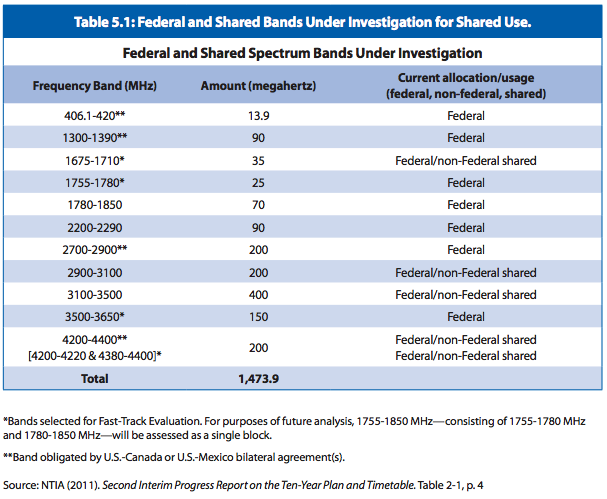
NTIA’s Office of Spectrum Management estimated in 2009 that 18 percent of the frequencies below 3700 MHz are allocated exclusively for federal use and another 51 percent is shared, with Federal use primary and private sector use secondary.3 This means that roughly 60 percent of the spectrum below 3700 MHz is predominantly allocated for federal use, a share that has declined relatively little over the past decade.4 Of the roughly 2400 megahertz of federal spectrum allocations below 3.7 GHz, over 1700 megahertz involves radar, radio navigation, and air telemetry systems, the effective operation of which are indeed critical to national security. At the same time, spectrum measurement studies indicate that the military and other agencies actually use very little if any of that capacity on most days and in most geographic locations, particularly at ground level and in more densely populated metro areas where more spectral capacity is most needed.5
Yet, despite the proven ability of a Spectrum Access System to protect military operations in the CBRS band (both shipborne and land-based radar systems), the approach has yet to be extended to other federal bands with substantial unused capacity. As discussed below, NTIA studies are ongoing and the 3450-3550 MHz radar band is likely to be effectively reallocated during 2021, but the overall effort has been far slower and more fragmented than the PCAST report and resulting Executive Memorandum by then-President Obama anticipated.6 The failure to move faster to authorize unused federal spectrum for at least opportunistic shared use (such as on a GAA basis) has an enormous opportunity cost.
Bands reserved for federal use are particularly well-suited for opportunistic access. Unlike a private sector licensee, NTIA and the federal users it coordinates should be expected to balance their own needs with the public interest in expanding available wireless broadband capacity. It is now well-established that database and sensing technologies give the military and other agencies the ability to enforce priority-in-use over opportunistic private users at any time. Even prior to the recent implementation of the CBRS three-tier sharing system, DoD opened up extensive military radar bands (most notably in the 5 GHz band) for passive sharing with low-power unlicensed users equipped with “smart radio” technology that is able to detect if radar is operating and vacate the channel in under one second. 7
Unlike most privately-licensed bands, federal spectrum use—and especially the military, which occupies most federal bands—is likely to be negatively correlated with dense urban areas. Military bases and training exercises, for example, are rarely located within the ten largest metropolitan areas. In addition, for purposes of low-power, short-range offload, there is greater opportunity for access to very wide channels on shared federal bands (particularly radar bands) than in most non-federal licensed bands.
The following frequency bands—1,190 megahertz of federal spectrum—should be studied with greater urgency for their potential to help turn the perception of spectrum scarcity into a reality of relative abundance:
3100-3550 MHz: Lower 3 GHz Band
The PCAST report particularly homed in on the potential for what it called a shared-use “spectrum superhighway” across the vast, nearly 1,000 megahertz expanse of federal radar bands between 2700 and 3650 MHz.8 NTIA identified this entire 950 megahertz as a potential candidate for shared commercial use a decade ago and specified the 3550-3600 MHz band for fast-track evaluation in its 2010 10-year plan.9 Responding to the PCAST recommendation, the FCC in 2015 made that top 100 megahertz the centerpiece of its CBRS three-tier sharing innovation. In December 2019, after the NTIA confirmed it was assessing the feasibility of sharing the entire 3100-3550 band,10 the FCC adopted a NPRM seeking comment on how best to facilitate shared use of that 450 megahertz.11 Both the NTIA’s study and the FCC’s proceeding derived from a 2018 Congressional mandate that the NTIA, in consultation with the FCC, report by March 2020 on the feasibility of “allowing commercial wireless service, licensed or unlicensed, to share use of the frequencies between 3100 megahertz and 3550 megahertz.”12
In an initial technical study, NTIA identified the top 100 megahertz in the 3450-3550 MHz band as the most promising portion for sharing.13 NTIA initially concluded that because high-power airborne, shipborne, and ground-based radar systems “use the entire band throughout the United States and its possessions, including near and over the most populated areas,” a dynamic, time-based sharing mechanism “present[s] a potentially attractive approach to both protecting federal systems and providing viable commercial operations.”14 This led advocates of dynamic sharing to propose that 3450-3550 MHz could be shared most effectively by incorporating it into the three-tier sharing framework that governs the adjacent CBRS band.15 Navy radar operates across both bands.
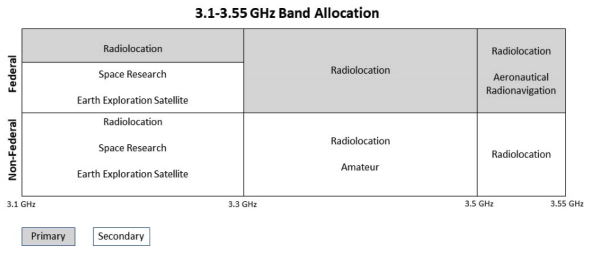
The Trump administration, however, came to the conclusion that most radar operations in 3450-3550 MHz could be consolidated into other parts of the band, allowing the FCC to propose a more traditional “flexible use” licensing approach based on an auction that would also reimburse DoD for costs (as provided under the Commercial Spectrum Enhancement Act).16 This led directly to the FCC adopting a FNPRM in October 2020 proposing that the entire 100 megahertz should be auctioned under a framework compatible not with the adjacent CBRS band—and its PALs covering relatively small areas (counties)—but with the C-band at 3700-3980 MHz, which is characterized by high power, very large license areas (Partial Economic Areas), and no coordination of opportunistic GAA use of locally-vacant spectrum. Advocates of exclusive and of shared-use spectrum continued to disagree on which framework would be most beneficial to the public interest in a robust 5G wireless ecosystem. The Order on auction rules remained pending at the time this paper was finalized.
Regardless of the FCC’s decision on the 3450-3550 MHz sub-band, the new FCC and NTIA in 2021 have an opportunity to revisit the PCAST recommendations and to take a more holistic view of the lower 3 GHz band. NTIA and DoD have consistently indicated that clearing military radar systems off spectrum below 3450 MHz will be far more difficult, a challenge that will be exacerbated if the DoD consolidates radar operations currently using 3450-3550 MHz lower in the band. According to NTIA spectrum use studies, the sub-bands below 3450 MHz are more congested and less amenable to clearing.17 They contain a mix of airborne, seaborne, land-based, and mobile radar operations relied upon by the Air Force, Army, Navy, Coast Guard, and for other national security-related applications.18 As the PCAST Report recognized, an effort to replace and move military systems to different spectrum, even if feasible, is likely to be unduly disruptive, cost tens of billions of dollars, and take a decade or longer. This view is reflected in the recommendations of a 2019 report by DoD’s Defense Innovation Board, which concluded that in a reasonable time frame, dynamic sharing would be far more feasible and acceptable from the military’s perspective.19
Perhaps the biggest obstacle to band clearing today, though, is the question of where military systems could move given that all comparable spectrum is assigned and is in use for other incompatible services. Unlike cellular mobile or certain other services, there are no close substitutes for military radar systems available from private wireless operators. In short, there is a near-term opportunity to open a contiguous 350 megahertz from 3350-3700 MHz under a common three-tier sharing framework providing both licensed PALs and general authorized access to a very diverse range of users and new use cases.
Even if a substantial portion of the lower 3 GHz military spectrum can be cleared and auctioned for flexible use licensing, the FCC has an opportunity to extend opportunistic access to the entire 3100-3550 GHz band on a use-it-or-share-it basis. Coordinated sharing of unused licensed and Navy spectrum is already operational in the adjacent CBRS band on a GAA basis. Multiple SAS databases and sensing networks tested by NTIA and certified by the FCC are successfully managing co-existence between licensees (PAL holders), the Navy, and GAA users in the neighboring 3550-3650 MHz band. Because of its proximity, the commission can immediately extend the same SAS and sensing technology used to manage the use-it-or-share-it rule in CBRS to the 3.45 GHz band.20
While CBRS is already facilitating innovation and competition by a diverse range of rural ISPs and enterprise users, extending a use-it-or-share-it authorization to adjacent military spectrum will give both PALs and GAA users access to large swaths of contiguous GAA spectrum that can dramatically increase the capacity and quality of their networks. While opportunistic access by small rural ISPs and others is likely to persist for many years primarily in rural areas, smaller urban areas where carriers are typically slower to deploy will also see benefits from the availability of this contiguous GAA spectrum.
Two other recent developments have the potential to further increase the capacity and utility of the lower 3 GHz spectrum authorized for coordinated sharing. First, NTIA is collaborating with the DoD to develop an automated, real-time, Incumbent Informing Capability (IIC) to be operated “in conjunction with DoD to notify commercial entities when the latter would need to cease operations.”21 This could, in time, replace the coastal sensing networks (Environmental Sensing Capability, or ESC) that currently listen for Navy radar and alert SAS administrators when commercial users (both PAL and GAA) must temporarily be moved off one or more channels in the CBRS band.22 Some SAS administrators argue that the sensing networks reduce the spectrum available for sharing far more than needed to protect Navy radar because they generate false positives and severely limit CBRS operations in “whisper zones” in areas where sensors are located. Since the sensors are monitoring the CBRS frequencies, the “need to protect the sensors from interference prevents nearby utilization of the very band that the networks are designed to support.”23 The expectation is that an Incumbent Informing Capability, managed by NTIA and DoD, can make more granular and accurate reports of military use directly to the Spectrum Access Systems.
Second, DoD is exploring whether it is practical to leverage the lower 3 GHz band to support and help pay for a new 5G network built to satisfy the military’s particular security requirements and functions. There has been much speculation and debate about whether a separate 5G network is needed for national security and, if so, whether it would be government-run or a public-private partnership that could also sell bandwidth or other services while ensuring government operations priority access at all times. DoD requested comment in response to a Request for Information in September 2020.24 While this debate seems likely to continue under the Biden administration, the relevant issue here is incentives. The military generally has nothing but disincentives to open radar bands in 3 GHz for shared use. However, if the unused spectrum capacity directly supported and helped to fund enhanced DoD digital capabilities (such as through auctions that could pay for modernizing and even moving Navy and Air Force radar systems to different frequencies), the incentives could be aligned to a degree that would lead more quickly to optimizing both federal and private sector use of the spectrum.
2900-3100 MHz: Maritime Radionavigation and Weather Radar
Even lower in 3 GHz is the 2900-3100 MHz sub-band allocated to federal and commercial shipborne radars required on most passenger and cargo ships for safety under an international maritime treaty, as well as for weather monitoring.25 Similar to the 3100-3650 bands discussed above, it appears that the band could be open for licensed and/or unlicensed (GAA) shared use across most of the nation. The upper 100 megahertz of the band appears to be used entirely for maritime radionavigation. Like the CBRS band, coordination by one or more certified AFCs—and either the coastal sensing networks certified to protect Navy operations at 3550-3650 MHz, or the new IIC noted above—could enable at least low-power, opportunistic use even along most of the nation’s coastlines (where a majority of Americans live).
The lower half of the band is the upmost portion of a 300 megahertz band (2700-3000) that is used for weather monitoring. A network of Next Generation Weather Radar (NEXRAD) systems operating in the 2700-3000 MHz band “provide quantitative and automated real-time information on (rainfall amounts/rates, wind velocity, wind direction, hail, snow, etc.) with higher spatial and temporal resolution than previous weather radar systems.”26 NEXRAD sites also collect data used to generate severe weather warnings. According to the Department of Commerce (NOAA), NEXRAD consists of relatively few (160) fixed sites.27 Although NEXRAD sites may require a relatively large protection area, there is no reason to believe that coordination zones cannot be enforced by the same AFC mechanism (e.g., a SAS) that would be safeguarding maritime radar operations.
If a SAS could coordinate the protection of NEXRAD sites, this would apply equally to the 2700-2900 MHz band segment, since the weather radar systems at those sites operate across that band as well. However, the 2700-2900 MHz band would likely be a lower priority for shared use. It is more heavily used across the country by a variety of radar systems and principally by surveillance radar (ASR) systems for air traffic control near both commercial and military airports nationwide. As of 2015 these fixed, ground-based systems were deployed at nearly 900 airports and airfields.28 While this represents the number of frequency assignments, the radars could be located at multiple sites in and near the airport. NTIA also reports that each of the military services and the FAA maintain a small number of sites for research, development, and testing of radar systems.
4400-4500 MHz and 4800-4940 MHz: DoD and Law Enforcement
While not enough information is available to know for certain, the exclusively federal bands—4400-4500 MHz and 4800-4940 MHz—should be studied for potential consolidation and/or sharing. According to NTIA, these two sub-bands are part of a larger band of 540 contiguous megahertz between 4400 and 4940 MHz. NTIA use reports for the sub-bands all state that “[m]any systems authorized to operate in” each sub-band “typically have a tuning capability from 4400 MHz to 4940 MHz.”29
The most prevalent use across the entire band is fixed wireless data links (2,500 as of 2015), which typically occupy relatively narrow frequency channels and can be protected through geolocation database coordination. Similarly, astronomical observations made on 4825-4835 MHz occur at only five active and fairly remote observatories.30 The 4400-4500 MHz band is “one of the few available to the military for training,”31 while the 4800-4940 band “is used by the military at test ranges and naval ports around the US.”32 There are assignments across the entire 450 megahertz band for law enforcement and drug interdiction activities. In sum, although each of these sub-bands had a total of just over 1,400 assignments for a variety of use cases as of 2015, because they can tune across a much larger contiguous band of 540 megahertz, it certainly appears that the band is a prime potential candidate for at least coordinated shared access.
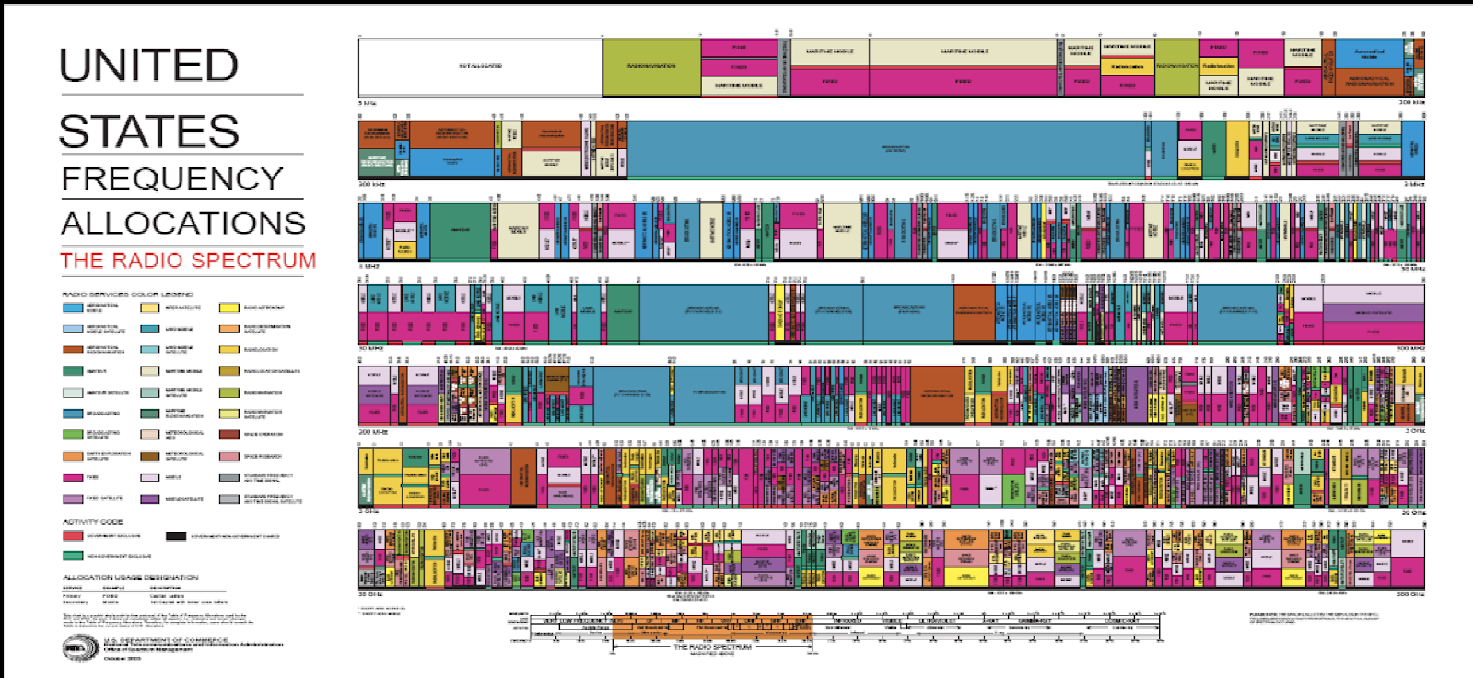
B. Underutilized Commercial Bands
It has long been recognized that the NTIA’s famously complex frequency spectrum chart is in part a map of fossilized allocations of spectrum for services viewed as compelling long before wireless broadband made low- and mid-band spectrum immensely more valuable.33 TV broadcasters, fixed and mobile satellite services, and fixed microwave links have been among the services consolidated or pushed off their underutilized allocations to accommodate emerging technologies and consumer demand. For the past two decades, the FCC’s emphasis has been to clear swaths of spectrum for reallocation and auction to mobile cellular services. Since 2012, when Congress gave the commission incentive auction authority, three grossly underutilized bands have been reorganized, with the resulting auction providing incentive payments to vacating incumbents: the 600 MHz TV band, the lower C-band from 3700 to 4000 MHz, and the 39 GHz millimeter wave band. Arguably the upcoming auction for unassigned portions of the 2.5 GHz band, once reserved exclusively for the Educational Broadband Service (EBS), is another example, since the FCC has reallocated the band to flexible use and incented the original nonprofit licensees to either sell or lease their spectrum by relieving them of any obligation to use the spectrum for educational purposes.
While these efforts focused herculean policy innovations on underutilized bands that could yield substantial contiguous spectrum for the mobile industry (4G and now 5G), there are not many (if any) remaining candidate bands for reallocation among commercial bands in the most valuable low- and mid-band frequency range. However, there are underutilized non-federal bands that present an opportunity to authorize coordinated shared access to vacant spectrum on at least an opportunistic unlicensed or lightly-licensed (GAA) basis. As noted earlier, a use-it-or-share-it policy would need to be authorized on a band-by-band basis, in some cases in response to a request for waiver or a petition for rulemaking by aspiring band entrants. But the FCC itself can, as it did with incentive auctions, identify bands that could free up very substantial and valuable spectrum, particularly where it could serve as public infrastructure to facilitate more and better broadband service in rural and other underserved areas.
Two bands that stand out for their near-term potential in this respect have been proposed by sharing advocates:
12 GHz Band: 12.2-12.7 GHz
The 12 GHz band is shared on a co-primary basis by multiple satellite and terrestrial services, yet underutilized to a degree that has drawn diverse support for a FCC proceeding to consider both more flexible terrestrial licensed and opportunistic use.34 Proponents argued that the 500 contiguous megahertz in the band offers an opportunity to adopt a sharing framework that greatly expands the availability of spectrum for both fixed and mobile broadband deployments with mid-band propagation characteristics.35 Two of the three primary satellite licensees operating in the band (DirecTV and SpaceX, but not DISH Network) opposed considering more intensive terrestrial use of the band. In January 2021 the commission adopted a “neutral” NPRM to consider if and how the band can accommodate more intensive terrestrial broadband operations, including potentially mobile, fixed, and unlicensed uses.36
Ironically, the current sharing between satellite and terrestrial users originated in a petition premised on the use-or-share concept. Until 2002, the band was used exclusively for direct broadcast satellite (DBS) services and continues to be shared by DirecTV and DISH. More than two decades ago an innovative start-up, Northpoint Technology, proposed that because all DBS is a one-way transmission down to receiving dishes on customer homes that must point south (since the satellites remain stationary over the equator), it could operate a one-way terrestrial broadband service if its antennas only pointed north.37 The two services could operate anywhere on a co-channel basis without interference. The FCC agreed and authorized a new multichannel video and data distribution service (MVDDS).38 Unfortunately for the investors in Northpoint, the FCC also decided that licenses for MVDDS should be auctioned. The company went out of business and MVDDS remains a dormant, one-way authorization.
Nearly two decades later, more flexible and two-way use of 500 contiguous megahertz with upper-mid-band propagation characteristics could be highly valuable for both mobile 5G and for very high-capacity fixed wireless, both in less densely populated areas (where fiber can be cost prohibitive) and for enterprise IoT networks. In 2016 the current MVDDS license holders filed a petition for rulemaking to consider the feasibility of coordinating two-way and flexible use for terrestrial broadband.39 Complicating coordination is the fact that the band also has a co-primary allocation for the non-geostationary, low-earth orbiting (NGSO) satellites that several companies plan to launch in large numbers to provide ubiquitous broadband connectivity. One such provider, SpaceX, has already begun deploying a rural broadband service that, like the two DBS providers, uses 12 GHz as the downlink to customer receiving stations.
A 2020 filing by OTI and a coalition of public interest groups opined that “a use-it-or-share-it opportunity at 12 GHz will help expand affordable broadband services in rural, tribal, and other communities where there is a limited economic incentive for a national or regional carrier to offer service, but still a real economic need for the community.”40 Even if the FCC decides to grant flexible use rights to MVDDS licensees, the need to protect satellite reception may necessitate terrestrial power limits much lower than in other bands used for wide-area 5G coverage (such as the post-auction C-band). As a result, initial deployments in the band would most likely be in urban, suburban, and other higher-density areas where an investment in greater capacity justifies the cost. Rather than leave as much as 500 megahertz fallow in underserved rural and other less-densely-populated areas, a use-or-share approach on a secondary, coordinated basis can facilitate high-capacity fixed broadband (both point-to-point and point-to-multipoint).
At a minimum, the band appears well-suited to a low-power underlay under traditional Part 15 rules that could be limited to indoor-only use, just as the FCC recently adopted LPI across the entire 6 GHz band. A contiguous 500 megahertz of spectrum would allow for the creation of new high-bandwidth channels capable of supporting Wi-Fi 6 and other unlicensed innovation.
4000-4200 MHz: Revisiting the Upper C-band for Rural Broadband
The recent epic debate over the consolidation and reallocation of 280 megahertz of C-band spectrum for flexible use terrestrial licensing through an auction that concluded in January 2021, generating $80.9 billion for the U.S. Treasury, is familiar to almost everyone.41 All 500 megahertz of the 3700-4200 MHz C-band had long been dedicated to the FSS, which uses it to relay live video and data from content providers to cable headends, local TV and radio broadcast stations, some churches, and other content distributors. However, with advances in technology and declining demand, the FCC determined that existing FSS operations could be consolidated into the upper 200 megahertz of the band, between 4000 and 4200 MHz. In March 2020 the FCC released an order reallocating the lower 300 megahertz of the band by auction and providing incentive payments for the expedited consolidation of FSS earth stations into the top 200 megahertz.
What received far less attention was a second proposal in the FCC’s original NPRM that sought comment on whether—regardless of how much of the band is reallocated for flexible use licensing—it is feasible and desirable to authorize fixed wireless operators to coordinate use of vacant spectrum and “operate on a secondary basis vis-à vis FSS in any part of the band in which FSS continues to operate during a transition period to accommodate repacking and, thereafter, on a frequency-coordinated basis to protect actual FSS operations.”42 The proposal derived from a 2017 petition for rulemaking, filed by the Broadband Access Coalition, asking the FCC to authorize fixed wireless ISPs to coordinate use of vacant spectrum in the ongoing FSS portion of C-band on a first-in-time licensed basis.43 The Public Interest Spectrum Coalition (PISC) further proposed the FCC authorize opportunistic access (e.g., GAA license by rule) to unused frequencies in the lower portion of the band until future flexible-use licensees commence service in that local area, much the same as the use-or-share rules adopted for the adjacent CBRS band and coordinated by SAS administrators.44
While incumbent FSS licensees opposed the proposal, arguing it would disrupt the C-band transition and inevitably cause harmful interference to FSS earth stations, sharing advocates explained that unlike mobile broadband, fixed wireless deployments (point-to-multipoint, or P2MP) use directional antennas that permit the local coordination of sectors even where earth stations are in the area, but located outside the beam of the base station and client device return path.45 Even after the FSS is consolidated into the upper 200 megahertz, the number of earth station sites would actually fall since some are using the cost reimbursement paid by auction winners as an opportunity to switch to fiber. The remaining receive sites will simply be tuning into a larger number of transponders on satellites restricted to using 4000-4200 megahertz.
A study by a leading wireless engineer, Virginia Tech Professor Jeffrey Reed, showed that despite making very conservative assumptions about fixed wireless use (e.g., co-channel sharing, high CPE height), there should be no concern about harmful interference to earth stations provided that Part 101 frequency coordination is required, as it has been during the many years the Fixed Service (FS) and FSS licensees have shared C-band and other bands.46 The Reed study demonstrated that every megahertz of FSS spectrum can be coordinated for P2MP deployments in 78 percent of the geographic area of the United States, where more than 80 million Americans live, without causing harmful interference to incumbent earth stations or TV/radio consumers.47 The study found that “P2MP systems can operate co-channel with all existing C-band earth stations . . . without causing harmful interference.”48
Ultimately, the FCC’s March 2020 Report and Order declined to authorize use of the band for fixed wireless P2MP “at this time,” concluding that “more intensive point-to-multipoint Fixed Service use of the 4.0-4.2 GHz band before the transition is over could dramatically complicate the repacking and relocation of FSS operations and earth station registrants.”49 However, leveraging the proximity of CBRS and the proven ability of the SAS to coordinate opportunistic GAA use of PAL spectrum continues to make the entire 3700-4200 MHz band an attractive candidate for a use-it-or-share-it rule. The C-band transition is well underway and once it is largely complete, the FCC should reconsider allowing more intensive shared use.
C. Vacant and Warehoused Spectrum
A third category of bands that should be prioritized for at least temporary access on a coordinated and local basis are bands that lie fallow either because they are part of the FCC’s inventory of unassigned spectrum or because they remain unused several years after initial assignment. As noted in Section II above, the shutdowns associated with the early months of the pandemic crisis motivated the FCC to rapidly grant STAs for the use of generally unused spectrum in two bands that offer an example in each category: auctioned-but-returned AWS-3 spectrum in the 1.7 GHz band (unassigned) and the lower 5.9 GHz band (mostly unused). The 1.7 GHz spectrum had been returned by licensees contesting the outcome of the AWS-3 auction concluded in early 2015, while the lower 5.9 GHz band was in active use for auto safety pilot programs, but only at a small number of locations.
While the pandemic provided the impetus to make these bands available to wireless ISPs able to incorporate it immediately into their networks, there are at least two other bands—the 2.5 GHz band and lower 37 GHz band—that remain grossly underutilized and, in fact, are entirely unoccupied across most of the country despite being the subject of a recent FCC rulemaking. Although this may change as new FCC allocations and rules are implemented, in the meantime the commission should consider permissive waivers or other actions that affirmatively encourage opportunistic use of the fallow spectrum.
The most valuable of these is the 2.5 GHz band (2496-2690 MHz) that for decades has been allocated exclusively to the EBS. EBS licensees operate in 114 megahertz of the band and the remaining 80 megahertz is assigned to Broadband Radio Service (BRS). The stated purpose of EBS was to grant spectrum to colleges, school districts, and other eligible educational institutions to provide broadband, video, and other services. Some licensees, such as Northern Michigan University, are using the spectrum to connect not only their own students, but also K-12 students lacking broadband at home.50 But most licensees today lease the spectrum, principally to T-Mobile. The band is also used primarily in metro markets— and is unassigned and “currently lies fallow across approximately one-half of the United States, primarily in rural areas.”51 In July 2019 the FCC adopted an order that rescinded the educational use obligation, reallocated the entire band for flexible use, and will tentatively auction the unassigned portions of the band before the end of 2021.52 Since the 114 megahertz of EBS spectrum is unused in a majority of locations—and much will remain so for years even after an auction—the commission should affirmatively welcome requests for STAs and other potential opportunistic use of this extremely valuable mid-band spectrum.
A second band in limbo is the lower 37 GHz spectrum allocated for shared federal and non-federal use in the FCC’s 2016 Spectrum Frontiers Order, which reallocated and reorganized the 37 and 39 GHz bands.53 In that Order the FCC designated a total of 1,850 megahertz across the two millimeter wave bands for auction and set aside 600 megahertz at the bottom of the 37 GHz band to “create a space for both Federal and non-Federal users to share on a coequal basis and set out a process for defining how that sharing will be implemented.”54 Although the auction for 37-39 GHz flexible use spectrum (fixed and mobile) concluded in early March 2020, there has been virtually no progress since 2016 in establishing a framework for dynamic sharing between federal and non-federal users in the lower 37 GHz band.
The FCC adopted only a very high-level concept of the sharing framework for this 600 megahertz set-aside between 37 and 37.6 GHz. The Order provided that non-federal users would be authorized by rule (similar to CBRS) and receive Shared Access Licenses (SALs). “SALs will be widely available to provide easy access to spectrum, including for new innovative uses and for targeted access where and when providers need additional capacity,” the Order stated.55 Both federal and non-federal users will “access the band through a coordination mechanism, including exploration of potential dynamic sharing through technology in the lower 600 megahertz, which we will more fully develop . . .”56
The accompanying Further Notice of Proposed Rulemaking also proposed an explicit use-it-or-share-it rule for the upper 1,000 megahertz of the 37 GHz band: “we propose to permit shared access of the unused portions of the five channels in the upper band segment, under certain conditions.”57 However, after control of the FCC changed parties in 2017, the Second Report and Order “declined to adopt any use or share regime for any of the Part 30 bands at this time.”58 This Order did not directly dispute the feasibility of opportunistic use without interference, but simply agreed with mobile industry objections that “whatever the speculative benefits may be, they are greatly outweighed by the likelihood that a use-or-share approach will discourage investment and delay deployment in these bands.”59 Without explanation, this conclusion directly contradicted not only the FNPRM, but also the conclusions reached by the commission in 2015 and 2016 when it authorized use-or-share access to PAL spectrum in CBRS and to flexible use 600 MHz spectrum following the TV incentive auction.60
With respect to shared use of the 37 to 37.6 GHz band segment, although the 2016 Spectrum Frontier Order adopted some features that would support a sharing framework similar to CBRS (e.g., site-based registration, a mechanism for dynamic coordination, and the same technical rules that apply to the rest of the 37 GHz band),61 it did not decide if all 600 megahertz would be effectively available on a GAA basis or on a first-in-use basis; nor did the Order decide if an automated frequency coordination system (e.g., a SAS) would be needed. Also left open is how federal users will coordinate and whether future federal operations will receive priority and protection from interference even though the band is allocated for sharing on a co-equal basis between federal and non-federal users. The FCC in 2021 should both finalize a sharing framework and, in the meantime, welcome any opportunistic use of the entire 37 GHz band that can be coordinated with the small number of existing federal uses.
Citations
- PCAST Report, Recommendation 7.1, at page xiv.
- PCAST Report, Recommendation 1.1 at page x, 7.
- Karl Nebbia, Director, NTIA Office of Spectrum Management, presentation to the Commerce Spectrum Management Advisory Committee (CSMAC), Dec. 9, 2009.
- See PCAST Report at 8.
- See Mark McHenry, “NSF Spectrum Occupancy Measurements: Project Summary,” Shared Spectrum Company (August 2005). McHenry’s 2005 study collected frequency use data in six locations along the East coast in 2004 and documented an average total spectrum use of between 0 and 3% at rooftop level across hundreds of MHz of federal spectrum.
- See Barack Obama, “Executive Memorandum – Expanding America’s Leadership in Wireless Innovation, The White House (June 13, 2013), available at source.
- For a brief history of how DoD shares radar bands with the private sector, and a proposal describing how federal agencies can take affirmative steps to facilitate expanded and more efficient band sharing, see Michael Marcus, “New Approaches to Private Sector Sharing of Federal Government Spectrum,” New America, Wireless Future Program Working Paper, at 4-6 (June 2009).
- The PCAST Report’s “highest recommendation is that the President issue an Executive Order to prioritize 1,000 MHz of Federal spectrum for review and implementation to create the Nation’s first shared-use spectrum superhighways.” PCAST Report at 7.
- U.S. Dept. of Commerce, Plan and Timetable to Make Available 500 Megahertz of Spectrum for Wireless Broadband, at 7 (Oct. 2010), source; see also U.S. Dept. of Commerce, Quantitative Assessments of Spectrum Usage (Nov. 2016) (finding potential opportunities for sharing spectrum existed in the 3505-3550 MHz band), source.
- See U.S. Dept. of Commerce, Annual Report on the Status of Spectrum Repurposing at 20 (Aug. 2019),source.
- Notice of Proposed Rulemaking, Facilitating Shared Use in the 3.1-3.55 GHz Band, WT Docket No. 19-348 (Dec. 12, 2019). See also Report and Order and Further Notice of Proposed Rulemaking, Facilitating Shared Use in the 3100-3550 MHz Band, WT Docket No. 19-348, at ¶ 53 (Oct. 2, 2020) (proposing that 3450-3550 MHz band be reallocated for auction with obligations to prioritize military use during national emergencies).
- MOBILE NOW Act as incorporated in the Consolidated Appropriations Act, 2018, Pub. L. No. 115-141, 132 Stat. 348, Division P, Title VI, § 605(a) (2018).
- See Edward Drocella, Robert Sole, Nickolas LaSorte, Technical Feasibility of Sharing Federal Spectrum with Future Commercial Operations in the 3450-3550 MHz Band, NTIA Technical Report 20-546, at viii-ix (rel. Jan. 2020). “In the aggregate and in some cases individually, the federal systems use the entire band throughout the United States and its possessions, including near and over the most populated areas.” Ibid.
- Id. at viii-ix.
- See, e.g., Comments of Dynamic Spectrum Alliance (DSA), Facilitating Shared Use in the 3.1-3.55 GHz Band, WT Docket No. 19-348 (Feb. 21, 2020); Comments of CommScope, WT Docket No. 19-348 (Feb. 21, 2020), at 4-5; Comments of Federated Wireless, WT Docket No. 19-348 (Feb. 21, 2020), at 2; Comments of Wireless Internet Service Providers Assn (WISPA), WT Docket No. 19-348 (Feb. 21, 2020), at 3; Comments of the Open Technology Institute at New America and Public Knowledge, WT Docket No. 19-348 (Nov. 20, 2020).
- See Letter from Charles Cooper, Associate Administrator, NTIA, to Ronald T. Repasi, Acting Chief, Office of Engineering and Technology, FCC, and Donald K. Stockdale, Jr., Chief, Wireless Telecommunications Bureau, FCC, WT Docket No. 19-348, at 1 (Sept. 8, 2020).
- U.S. Dept. of Commerce, Feasibility of Commercial Wireless Services Sharing with Federal Operations in the 3100-3550 MHz Band, at 11 (July 2020) (“NTIA July 2020 Report”) (“the lower portion of the band is more congested and includes additional systems that have not been analyzed”), available at source.
- See NTIA, Federal Government Spectrum Use Reports: 225 MHz – 7.125 GHz, “3100-3300 MHz Report” (Dec. 1, 2015), available at source.
- Defense Innovation Board, The 5G Ecosystem: Risks and Opportunities for DoD, Recommendation #1, at 28 (April 2019), available at source (“DoD stands to significantly benefit if it shares some of its sub-6 GHz spectrum.”). See also Milo Medin and Gilman Louie, “Clearing the Air on 5G,” Texas National Security Review (March 13, 2020), available at source (“Sharing spectrum could take just two to three years instead of the 5 to 10 years that vacating requires, would cost millions of dollars instead of billions, and would not put national security operations at risk.”)
- See Comments of Google, Facilitating Shared Use in the 3.1-3.55 GHz Band, WT Docket No. 19-348 (Nov. 20, 2020) (“Google 2020 Comments”). “Expanding SAS capabilities below the 3.55 GHz boundary to support such ‘extended GAA’ operation would be straightforward.” Ibid.
- NTIA July 2020 Report at 11. See also Charles Cooper, “NTIA Pursues Innovative Spectrum Sharing Plan That Could Deliver Boost to 5G,” NTIA Blog (Dec. 15, 2020), available at source. An IIC can facilitate “easier and quicker spectrum access for commercial wireless services[, opening] the door to innovative, real-time automation.” Ibid.
- See presentation of Charles Cooper, Associate Administrator, NTIA, at Dynamic Spectrum Alliance Global Summit 2020, available at source.
- Google 2020 Comments at 11 (“[t]oday, millions of potential users are blocked from using CBRS spectrum due to the proximity of ESC sensors”). See also Letter from Megan Stull and Andrew Clegg, Google, to Marlene H. Dortch, FCC, Facilitating Shared Use in the 3100-3550 MHz Band, WT Docket No. 19-348 (Dec. 15, 2020).
- U.S. Department of Defense, “Defense Spectrum Sharing Request for Information” (Sept. 18, 2020), available at source.
- See NTIA, Federal Government Spectrum Use Reports 225 MHz – 7.125 GHz, “2900-3100 MHz Report” (Dec. 1, 2015) (“NTIA 2900-3100 Use Report”), available at source. The International Convention for the Safety of Life at Sea (SOLAS) is an international maritime treaty that sets minimum safety standards in the construction, equipment and operation of merchant ships.
- NTIA 2900-3100 Use Report at 1.
- National Oceanic and Atmospheric Administration, National Centers for Environmental Information, “NEXRAD,” source.
- See NTIA, Federal Government Spectrum Use Reports 225 MHz – 7.125 GHz, “2700-2900 MHz Report,” at 3 (Dec. 1, 2015), available at source.
- See, e.g., NTIA, Federal Government Spectrum Use Reports 225 MHz – 7.125 GHz, “4400-4500 MHz Report” (Dec. 1, 2015) (“NTIA 4400-4500 MHz Use Report”), available at source.
- NTIA, Federal Government Spectrum Use Reports 225 MHz – 7.125 GHz, “4800-4940 MHz Report,” at 2 (Dec. 1, 2015) (“NTIA 4800-4940 MHz Use Report”), available at source.
- NTIA 4400-4500 MHz Use Report at 1.
- NTIA 4800-4940 MHz Use Report at 1.
- NTIA, United States Frequency Allocation Chart, source.
- See, e.g., Letter from CCA, CCIA, INCOMPAS, Public Knowledge and Open Technology Institute, Petition for Rulemaking to Permit MVDDS Use of the 12.2-12.7 GHz Band for Two-Way Mobile Broadband Service, RM-11768 (filed May 26, 2020).
- See Letter from Public Interest Organizations to Chairman Ajit Pai, FCC, Petition for Rulemaking to Permit MVDDS Use of the 12.2-12.7 GHz Band for Two-Way Mobile Broadband Service, RM-11768 (July 9, 2020); Letter from Dynamic Spectrum Alliance, RM-11768 (filed Aug. 21, 2020); Letter from Federated Wireless, RM-11768 (filed June 15, 2020).
- FCC, Notice of Proposed Rulemaking, Expanding Flexible Use of the 12.2-12.7 GHz Band, WT Docket No. 20-443 (rel. Jan. 15, 2021).
- See Thomas Hazlett, The Political Spectrum (New Haven: Yale U. Press, 2017), at 242-243.
- Amendment of Parts 2 and 25 of the Commission’s Rules to Permit Operation of NGSO FSS Systems Co-Frequency with GSO and Terrestrial Systems in the Ku-Band with Frequency Range, Memorandum Opinion and Order and Second Report and Order, 17 FCC Rcd 9614 (2002).
- MVDDS 5G Coalition Petition for Rulemaking to Permit MVDDS Use of the 12.2-12.7 GHz Band for Two-Way Mobile Broadband Service, RM-11768 (filed Apr. 26, 2016).
- Letter from Public Interest Organizations to Chairman Ajit Pai, FCC, Petition for Rulemaking to Permit MVDDS Use of the 12.2-12.7 GHz Band for Two-Way Mobile Broadband Service, RM-11768 (July 9, 2020).
- See generally Sascha Segan, “What is C-band and What Does it Mean for the Future of 5G?”, PC Magazine (Dec. 29, 2020), available at source; See also Monica Alleven, “C-band's first phase tops charts with $80.9B,” FierceWireless (Jan. 15, 2021), source.
- Notice of Proposed Rulemaking, Expanding Flexible Use of the 3.7 to 4.2 GHz Band, GN Docket No. 18-122, at ¶¶ 116, 119 (rel. July 13, 2018).
- Broadband Access Coalition, Petition for Rulemaking, RM-11791 (filed June 21, 2017).
- Comments of the Public Interest Spectrum Coalition, Expanding Flexible Use of the 3.7 to 4.2 GHz Band, GN Docket No. 18-122, at 13, 17-21 (Oct. 29, 2018).
- See Broadband Access Coalition, Notice of Oral Ex Parte Presentation, GN Docket 17-183 and RM-11791 (March 29, 2018) (“Google/BAC Technical Presentation”). The technical analysis and presentation to FCC staff can be found at: source.
- Ex Parte Presentation by Prof. Jeffrey H. Reed et al., “3.7-4.2 GHz FSS and Fixed Wireless Access Co-channel Coexistence Study,” GN Docket No. 18-122 (July 15, 2019) (“Reed Study”), available at source.
- Id. at 3. (“The study utilizes conservative assumptions. In addition to the assumption of co-channel operations and the protection of all earth stations currently in IBFS regardless of protection status, the study includes additional conservative assumptions. These include, but are not limited to, a propagation model that takes clutter and terrain into account on a statistical basis rather than the use of actual buildings, trees, berms, hills, and mountains that afford greater protection; using a height for Customer Premise Equipment (CPE) of 7-10 m, which exceeds typical CPE height of ~5-7 m for actual installations; and assuming 100% duty cycle of P2MP transmissions in both directions.”).
- Id. at 2.
- Report and Order, Expanding Flexible Use of the 3.7 to 4.2 GHz Band, GN Docket No. 18-122, at ¶¶ 330-331 (rel. March 3, 2020).
- See Michael Calabrese and Amir Nasr, The Online Learning Equity Gap: Innovative Solutions to Connect All Students at Home, Open Technology Institute at New America, Report, at 35-36 (Nov. 2020), available at source. Northern Michigan University uses EBS to maintain a wireless broadband network that extends internet access to its own students and to K-12 students in a large swath of the state’s rural Upper Peninsula who lack adequate fixed internet service at home.
- FCC, Notice of Proposed Rulemaking, Transforming the 2.5 GHz Band, WT Docket 18-120, at ¶ 1 (May 10, 2018). Some EBS spectrum remains unlicensed and unused in urban areas. “Since 1983 the Commission has allowed EBS licensees to lease their excess capacity to commercial providers, but it has required EBS licensees to retain five percent of their capacity for educational use, and it further has required that they use each channel at least 20 hours per week for educational purposes.” Id. at ¶ 4.
- FCC, Report and Order, Transforming the 2.5 GHz Band, WT Docket 18-120 (rel. July 11, 2019).
- FCC, Report and Order and Further Notice of Proposed Rulemaking, Use of Spectrum Bands Above 24 GHz For Mobile Radio Services, GN Docket No. 14-177 (July 14, 2016) (“37 GHz Order & FNPRM”).
- Id. at ¶ 18. NTIA supported this outcome, as did spectrum sharing advocates such as Dynamic Spectrum Alliance, Starry and public interest groups. See Id. at ¶¶ 109-110 and Letter from Paige R. Atkins, Associate Administrator, Office of Spectrum Management, NTIA to Julius Knapp, Chief, Office of Engineering and Technology, FCC, at 4 (July 12, 2016).
- 37 GHz Order & FNPRM at ¶ 117.
- Id. at ¶ 113.
- Id. at ¶ 460.
- FCC, Second Report and Order and Memorandum Opinion and Order, Use of Spectrum Bands Above 24 GHz For Mobile Radio Services, GN Docket No. 14-177 at ¶ 225 (rel. Nov. 22, 2017).
- Id. at ¶ 226.
- See, e.g., 2016 Spectrum Frontier FNPRM at ¶ 461 (“we believe that the prospect of future shared access (on a coordinated and noninterference basis) to the remainder of the band may create incentives for investment and innovation in the shared channel.”)
- Id. at ¶¶ 448-449.
VII. Conclusion
A national goal of not merely universal access to broadband, but of truly pervasive connectivity—high-capacity connectivity anywhere, anytime at affordable prices—will require an enormous increase in available spectrum capacity. The failure to move faster to authorize unused federal spectrum for at least opportunistic shared use (such as on a GAA basis) has an enormous opportunity cost as we enter an era where bandwidth abundance is in reach. The FCC’s recent adoption of a use-it-or-share-it approach in several bands are precedents that pave the way to an authorization of opportunistic access as the default policy for a growing number of underutilized and newly-allocated or auctioned bands, both federal and commercial. The commission should open a NPRM that proposes adding a use-it-or-share-it authorization for the most underutilized bands, as well as for all terrestrial flexible use bands that have not been built out in substantial portions of the country. Much of the prime spectrum auctioned over the past decade remains fallow—particularly in many rural and small town areas—and at the very least the FCC should consider conditional and temporary access to that spectrum capacity as part of this effort.
More About the Authors

Michael Calabrese
Director, Wireless Future, New America; Senior Advisor, Technology & Democracy, New America