Table of Contents
Proxy Manipulation or Local Power-Plays? Weighing the Claims of U.S. and Iranian Proxies
External support and influence were significant factors across the post-2014 political and territorial competition. However, under closer scrutiny, the proxy nature of most of these external support relationships is questionable, either because the patron lacks control, or because of much more evidence of Iraqi agency than is typically associated with proxies. In most cases, what appears to be motivating Iraqi actors’ behavior are their own internal ambitions and rivalries. This is in part due to the profile and interests of the would-be interveners, but also appears significantly due to some of the situational dynamics highlighted in the previous section, with Iraqi domestic balancing and interests overshadowing outside interests in most scenarios. Even some of the closest relationships of support appear more characteristic of an alignment of interests and ideology than the sort of directive or hierarchical relationship that tends to be associated with proxy relationships.
This section will examine some of the factors behind these trends by drawing examples from U.S. and Iranian partnerships in Iraq. Closer examination of these so-called proxy relationships suggests that external influence over Iraqi actors is better understood as the product of a convergence of interest. Such a framing may also be less prone to misinterpretation and conflict escalation than assuming that all aggressive or threatening actions by Iraqi stakeholders are proxy threats.
U.S. Partners or Proxies? Tactical Surrogates and Political Counterbalancing but Limited Control
The largest provider of security assistance with the most overt security presence in Iraq is inarguably the United States.1 Given this largesse, if a proxy relationship was judged by “who pays the most money and weapons, then the U.S. is the biggest proxy backer,” one U.S. official joked.2 However, the policy official in question was quick to add that in the U.S. case, significant funding had not translated into significant relationships of control. None of those interviewed argued that the United States had the sort of classic armed proxies who would do their bidding in Iraq. Nonetheless, the United States has certainly used Iraqi forces as a surrogate or substitute in dealing with security threats within Iraq, and the United States has leaned heavily on its Iraqi partners (including the Iraqi government itself) to advance U.S. interests or undermine Iran’s on the political front, arguably a political proxy strategy in all but name. Thus, it is worth considering how the United States has attempted to use Iraqi partners as surrogates or proxies, and what limitations they have faced in doing so.
On the military front, the United States has built strong partnerships with different Iraqi and Kurdish forces. It turns almost reflexively to the CTS, to parts of the Peshmerga force, or to Sunni tribal fighters when terrorist or insurgent threats arise.3 However, these forces act primarily as tactical surrogates or auxiliaries,4 not as proxies carrying out U.S. strategic and political interests.5 The CTS has been nurtured for over a decade by U.S. Special Forces, and U.S. advisors still engage weekly, or even daily with CTS forces on everything from strategic development to advising on specific operations.6 As a result of this close and long-standing cooperation, the CTS shares a common threat perception and outlook with the United States, including great mistrust of the PMF.7 As Pat Roberson, the Senior Special Forces commander in Iraq explained, “If they’re with us enough of the time, they start to think like us … they believe in the same things we do.”8 However, the CTS has been groomed to be an Iraqi national force, not a proxy, and the force that has resulted reflects that focus. One U.S.-based Iraqi analyst offered the following rhetorical question to highlight the difference between so-called U.S. proxies and those of Iran: “If the U.S. asked the CTS to attack Iran tomorrow would they do it? If Iran asked its PMF forces to attack the U.S., would they do so?”9
The U.S. support to tribal forces in Anbar and Ninewa—referred to as the Tribal Mobilization Forces (TMF) by U.S. officials, and as “hashd as-shairi” (the “tribal Hashd”) by most Iraqis—has an element of counter-proxy strategy.10 One U.S. military officer involved in monitoring the TMF program argued that the TMF could help harden strategic areas against Iranian influence by at least giving locals an alternative mobilization option to the Iranian-linked PMF.11 Similar language appears in Department of Defense budget requests for funding the TMF—for example, support to the TMF (as well as other parts of the Iraqi Security Forces), in fiscal year (FY) 2016 was justified as “a counterweight to Iranian influence,” a way to “reassure Iraqi Sunnis,” and to deny ISIL a “safe haven” by securing territory through local hold forces.12 However, while counter-Iran motivations were certainly present, U.S. officials more prominently justified the TMF as an anti-ISIS strategy, and support for the TMF waxed and then waned with the perceived ISIS threat, not in relation to U.S.-Iranian tensions.13 This suggests the TMF might be viewed more as a U.S. proxy or surrogate force against radical Islamist groups rather than against Iran.
Nonetheless, even if not a central part of U.S.-Iranian proxy competition, the TMF provides an interesting example of the challenges to proxy cultivation in the post-2014 environment. Although U.S. officials initially promoted Sunni mobilization as a key part of the counter-ISIS strategy, the TMF initiative lost out in the competitive market for sub-state forces that emerged after 2014.14 From a peak of approximately 35,000 forces, the number of registered or active forces had declined to less than 20,000 by 2019 and the program was under threat of being cut off both by the U.S. Congress and by PMF leadership.15
Even at the peak of U.S. funding, U.S.-backed Sunni forces were a marginal force, constrained (largely by Iraqi government demands) to units of typically no more than 200 forces, many operating on an ad hoc or part-time basis, and with limited weaponry and freedom to operate geographically.16 In the post-2014 environment, in which local forces had many choices of patrons, such limited support was simply not competitive. A U.S. advisor working with the TMF in Ninewa described a mini arms race emerging between local forces, with local forces willing to swap sides and work with whichever backer—the Americans, the Peshmerga, the larger PMF forces, or Iraqi forces—gave them more arms, more salary, or greater political leverage.17 Many TMF switched allegiance to the larger Shi’a Hashd forces, or disbanded altogether. As the same TMF advisor noted above observed, “This is why the U.S. has trouble competing with the Iranians—they give more stuff, pay better, and do it quicker.”18
While discussion of proxy war tends to dwell on the military partners or proxies, such a lens may obscure what Iraqis see as the larger theater and goal of U.S. and Iranian proxy competition—the political arena, with the ultimate prize being influence over the Iraqi state. Within Iraqi discourse, the United States is seen as equally engaged in proxy manipulation because of its efforts to use the Iraqi state itself as a proxy against Iran. As International Crisis Group Middle East Director Joost Hiltermann argued “you could make a definition in which you say both the U.S. and Iran have proxies or that neither the U.S. nor Iran have proxies but not one in which Iran has proxies but not the U.S.”19
U.S. officials have consistently pushed the Iraqi government into taking a harder line on Iran whether in terms of application of U.S. sanctions on Iran (a significant ask given Iraq’s reliance on Iranian imports and cross-border trade) or in constraining the influence of Iranian-linked PMF groups.20 President Trump publicly boasted that the United States would use its military assets in Iraq to keep an eye on Iran, implicitly using Iraqi territory as a hedge or proxy against Iran.21 While not as much in the public eye, U.S. domestic justifications for U.S. support to the Iraqi government also frequently smack of a proxy balancing strategy. For example, the FY2018 Overseas Contingency Operations justified support to the Government of Iraq and Iraqi forces as “a political and physical counterweight to Iranian and Russian influence.”22
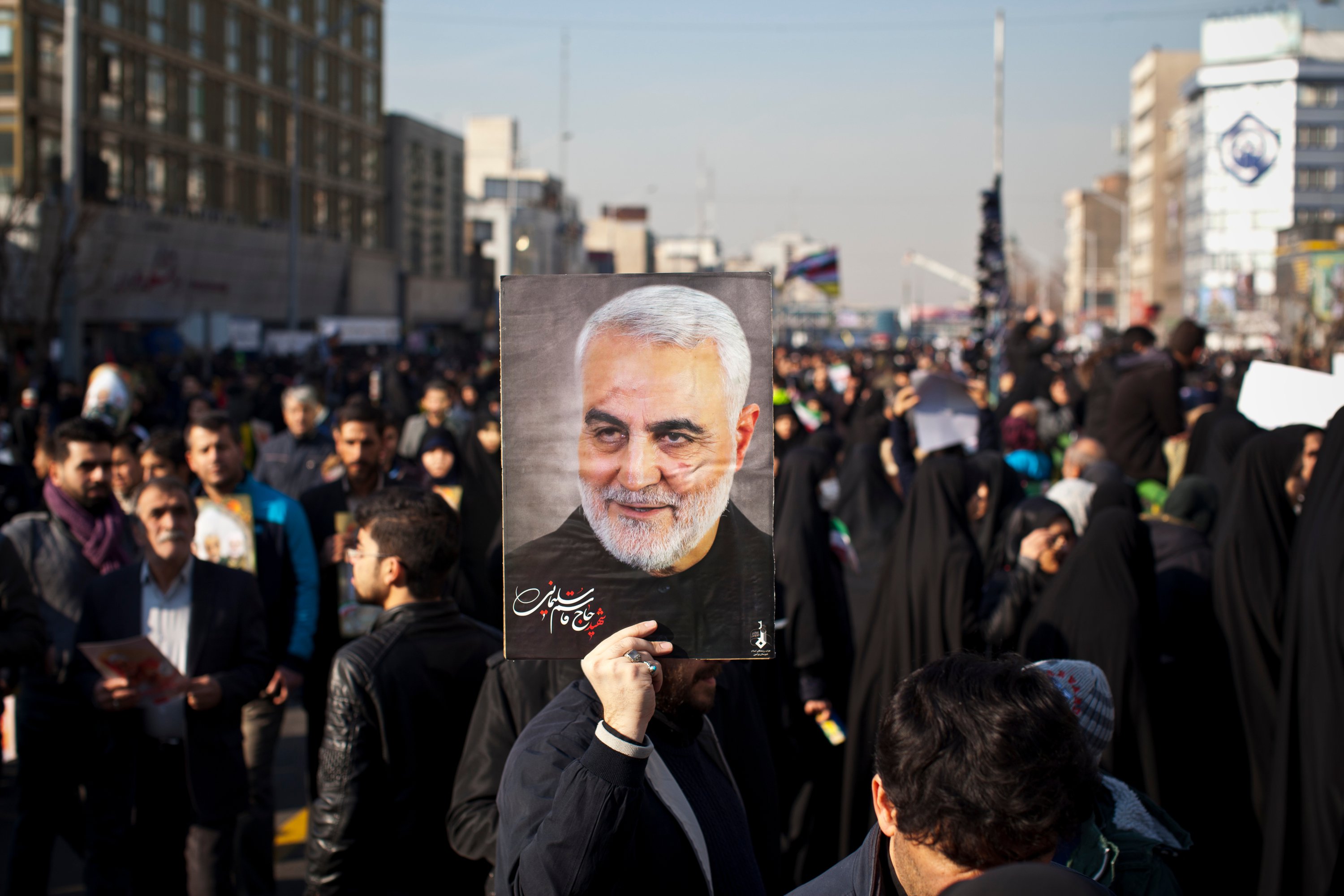
In addition to trying to shift the positions of the Iraqi state, the United States also has relied on its political partners as proxies to protect U.S. interests and manipulate the outcome of Iraqi domestic debates and stand-offs. The United States relies on Sunni and Kurdish political allies to defend U.S. interests in domestic Iraqi political standoffs, from counting on those blocks to vote for U.S.-favored candidates for key leadership position after elections, to expecting them to veto pro-Iranian groups’ efforts to oust U.S. troops from Iraq, as happened before and after Soleimani's killing.23
Nonetheless, although the United States has certainly tried to pressure its Iraqi partners into moves that would support U.S. interests, or undermine Iran’s, this has frequently not worked out as intended. Some of the same dynamics that frustrate the ability of external actors to cultivate military proxies are also present in the political space. It is a competitive marketplace, and Iraqi actors have a range of options for support. Other external actors may offer more immediate support with fewer demands in exchange for it. Iraqi government actors and constituencies also have to balance against the reality that Iran and pro-Iranian groups have substantial influence in Iraq, and that the United States has proven an unreliable backer in the past. “Overall what remains in the consciousness of Iraqis is that the American policy is not consistent. There is no durability in America’s commitment to Iraq,” a former senior member of the Iraqi National Security staff, Safa Rasoul Al-Sheikh, explained. “We don’t want U.S. assistance to go away, but [there is] the risk that it will… So this is the dilemma. And when this type of dilemma is faced by any country, the lesson learned would be ‘don’t put your eggs in one basket.’”24 Nearly all of those interviewed, whether U.S. officials, other Western diplomats, Iraqi officials, or other analysts, argued that the United States had a credibility problem—particularly when contrasted with Iran.25 “The U.S. is constantly providing support but then dropping allies … the Iranians have become more reliable,” one senior Western diplomat observed.26
Even among groups that might seem more naturally aligned with the United States or might in theory support U.S. positions, the immediate need for political survival or advancement have frequently trumped U.S. interests. Although the United States came out strongly in support of Sunni empowerment in the post-2014 moment, many Sunni leaders passed on the U.S. tribal support program and sided with pro-Iranian groups, either militarily or politically.27 Justifying such positions, one Sunni tribal leader with the PMF’s 88th brigade said he did what he had to do to protect the equities and people of his tribe.28 He said he had Iranian advisors and also took assistance from the Americans, but was not carrying out the agenda of either.29
The Kurds too have been willing to make a deal with Iran, even when it frustrated U.S. interests. The failed Kurdish independence referendum left the KRG politically isolated, and more willing to court better Iranian relations, particularly given that they viewed the lack of U.S. support following the referendum as a betrayal.30 During the intra-Iraqi negotiations to form a government following the 2018 elections, U.S. officials tried to engineer Sunni and Kurdish support for their favored prime ministerial candidate, Haider al-Abadi, but both Sunni and Kurdish politicians balked.31
Overall, the more competitive and fluctuating post-2014 environment, together with the U.S. credibility issues, have challenged U.S. efforts to create the sort of unilateral relationship that might evolve into proxy control, even on a purely political level.
Iran and the PMF: Weighing Strong Local Agency and Ideology versus External Control
Iraqi agency and domestic power balancing are not just important in understanding the limits of U.S. influence, but also in understanding the dynamics that drive the actions of Iran’s much stronger partners and proxies. Few would dispute that Iran has close relationships of support it can count on in Iraq, with the leading Shi’a PMF forces much closer to proxies than any of the U.S.’s partners. Iran can also count on a wider range of relationships of influence, including its relations with other Shi’a political actors that are less closely or publicly aligned, with the PUK and the KDP, and with a range of other Sunni and minority leaders and politicians.32
However, even with those forces that are closest to Iran—the so-called “pro-Khameini” Shi’a PMF groups discussed above—their own decision-making, ambitions, and survival instincts rather than Iranian directives appear to drive their behavior the vast majority of the time. As one Iraqi analyst argued, key figures like Hadi al Amri or AAH’s Qais al-Khazali “are quite loyal to Iran—they know Iran is there for them—but of course they also have their own interests and agendas.”33 This does not discount Iranian interests in Iraq nor Iran’s influence over these actors, but it does offer a more nuanced picture of what this relationship of influence means and how PMF actions that are viewed as aggressive or threatening should be interpreted.
Since 2014, the leaders of the PMF have pursued an increasingly ambitious agenda. By the end of 2018, Hashd forces held de facto territorial control or substantial influence in a wide range of territory, from traditional Shi’a strongholds in the south, in places like Basra; to substantial portions of the Disputed Territories and adjacent areas in Diyala, Salah ad-Din, and Kirkuk; as well as important border areas and economic routes in Ninewa and Anbar.34 In addition to this expansive territorial control, the PMF ran their own slate of candidates in the 2018 elections. Known as the Fateh alliance, it won the second highest number of votes in the May 2018 elections, giving it 48 seats in the Iraqi Parliament. In the power-sharing deal brokered as part of the government formation process, Fateh members were also accorded significant ministerial and cabinet posts.35 Meanwhile the PMF as an institution has become further entrenched, more powerful, and better resourced, with equivalent benefits to regular Iraqi forces, but its own separate command and cabinet seat,36 and three times the funding of the CTS in the 2019 budget.37
Collectively, these territorial gains, the informal economic and political leverage that comes with that territorial control, and the greater formal political role have given PMF forces and their leaders much more significant power and influence in Iraq. This undoubtedly affords Iran more opportunities to advance its interests in Iraq, but the actors that have benefitted most are the constituent PMF groups themselves.
One prominent theory for the PMF territorial advances and border postings is that doing so advances Iranian interests in securing Iraqi borders, in capturing cross-border trade and economic opportunities, and in enabling a land-bridge from Iran to Syria and other parts of the Middle East.38 While these benefits no doubt enhance Iran’s aims, the more immediate beneficiaries of this territorial expansion were the PMF groups on the ground. As PMF helped clear areas or take control of recaptured areas, their forces looted infrastructure, seized local economic assets, and took over local industries, from scrap metal to road construction.39 The PMF groups that took control of key checkpoints and border posts got a cut of lucrative illegal smuggling and could demand kickbacks as a condition of passage. By one estimate, AAH earns $300,000 per day through checkpoints in the border district of Jalawla alone.40
Such economic booty helped support the groups’ expansion and survival in a highly competitive marketplace for force. As one international diplomat commented, “A lot of what has driven them [the PMF] is their own need for expansion…you can see this particularly in the way that AAH have expanded across Disputed Territories. Most of the south is already carved up, so to expand, to meet their economic interests, they needed to move across the Disputed Territories.” 41
Moreover, for at least some of the larger, more political PMF groups, territorial expansion and the sort of sub-state proxy cultivation discussed in the previous section supported a wider national power-base and increasing political ambitions. Groups like Badr, AAH, and Saray-as-Salam used a combination of coercion and co-option, as well cultivation of sub-state proxies, to exert influence and staying power in a wider swath of areas.42 This helped them manoeuvre their candidates into local government positions, and gave them the potential to influence voting patterns in more areas in the 2018 elections.43 It also gave them a broader national profile and legitimacy. It is not coincidental that the PMF groups that were most engaged in sub-state competition are those that came out the best in the 2018 elections and were able to secure significant appointments in the new government (although this was not entirely settled at the time of writing).44 AAH alone went from one seat in the last Iraqi Parliament to 15 seats after the 2018 elections.45 With greater formal political authority came even greater opportunities for expansion and extraction; a Chatham House publication, for example, cites an interview with a local AAH commander boasting that AAH’s control of one of Iraq’s ministries was worth 10 times the revenue of illegal checkpoints.46
Control of territory and an expansive security presence have also been crucial to the PMF’s political survival and growth. Being the security actor that controls the facts on the ground, in an increasingly wide number of areas, is what has helped the PMF make the transition from a shadowy paramilitary force to a more central and powerful institution within the Iraqi state, and has helped defray calls for demobilization.47 Illustrating such arguments, in an interview for this research, the former Minister of Interior and Badr affiliate Mohammad al-Ghaban argued that with ongoing security threats, and an Iraqi security force not yet equal to dealing with them, disbanding a force that was doing the job made no sense: “The Hashd are on the ground. They know the job. They are securing and searching area.”48 The PMF’s ground strength has made the PMF an indispensable partner at crucial moments. When the Iraqi government decided to retake Kirkuk and other Kurdish-held areas of the Disputed Territories in response to the Kurdish referendum, they were enabled in doing so by PMF positions and relationships already in these areas (with some sources suggesting it was the PMF leading the decision, and Abadi following it).49
The way that these territorial advances and political power plays evolved points much more to individual PMF agendas driving these actions than a larger Iranian proxy strategy. In making a grab for control and resources across liberated areas, the different Shi’a PMF did not tend to act as one monolithic, ‘friends of Iran’ group. Instead, what emerged in many areas was a competition between different Shi’a PMF factions, each trying to buttress their own forces’ position and extractive opportunities, often at the expense of other Shi’a PMF groups.50 As they fanned out, developing local proxies and partners, the benefits of such local partnerships tended to accrue to the individual PMF groups that cultivated them, not to the PMF as a whole, nor to Iran. Subordinate forces tend to have allegiance to and be identified with their particular patron, for example, as a Badr affiliate or a Saray-as-Salam subordinate.51 At a Baghdad level, many of the PMF reforms and manoeuvres that took place in 2018 and 2019, after the end of major operations against ISIS, had more to do with intra-PMF rivalries and splits, as well as tactical moves to waylay other Iraqi critics, than with Iranian ambitions to increase control of the Iraqi state.52 It was a thousand small, largely parochial decisions, rather than one grand plan.
However, while Iranian influence is real, few gave credence to the idea that Iranians are driving much of the day-to-day decision-making, or even larger strategies of the PMF. As one European diplomat summarized, “What is driving their [the PMF] agenda is mostly internal … Even actors like Hadi Al Amri is not just taking instructions.”53 One Iraqi researcher mapping PMF activities and economic networks in Diyala said that while there was no doubt that Iran had indirect influence on PMF actions in the governorate, he did not see evidence that Iran was directing their activities in Diyala: “They’re not in touch with Iran enough in my opinion to have that type of control,” he explained.54
PMF leaders themselves describe operations, political manoeuvres, and deployment of troops as the result of internal deliberations within their own decision-making body. “If you ask me honestly can Iran have an influence on the Hashd—yes of course,” said one AAH representative, Shaikh al-Gharawi (also pointedly noting that Iran is not the only foreign country to seek to influence Iraqis), “[But] discussion about movement of troops, and where they go—these are all Iraqi decisions.”55 PMF involved in the operations to retake Kirkuk from KRG control describe the calculations leading to that takeover as devolving to questions of intra-Iraqi power balances, rather than considerations of foreign dictates.56 Former Minister of Interior al-Ghaban pointed to the wide swath of PMF activities, not just in military affairs but in building hospitals, or providing other services, and noted that these were all PMF initiatives and decisionmaking. “Everyone is saying these are militias, that they are armed by Iran. This is part of the picture, but it’s a very minor part of the picture. Yes that is going on but maybe [only] 10 percent.” 57
PMF decisions not only appeared to be behind much of the decisionmaking and actual activities undertaken, but in some cases did so even when it contradicted Iranian plans or wishes. Most attribute the PMF decision to run its own ticket to key PMF leaders’ own ambitions, and several interviewees noted that it was Hadi al Amri’s decision to put his hat in the running for Prime Minister, despite the fact that that Iran urged him not to. As one former senior PMF leader (who preferred to remain anonymous) argued: “For sure most of the Hashd groups except the Shrine groups are pro-Iran. The influence of Iran [on these groups] is very real. But Badr does have its own identity as a national force and that’s getting stronger over time.”58
All of this points to a higher degree of agency than is common in depictions of proxy relationships and to a large share of PMF actions and moves initiated and driven by PMF groups alone without any Iranian direction or control. The fact that such a large portion of PMF activities are self-driven underlines why the proxy war narrative can result in overstating or misinterpreting threats — even if a portion of the PMF’s behavior and motivations can be linked to Iran, a greater portion of their activities are not. Assuming that any given hostile act or threat by a PMF group has been directed by Iran can be a dangerous over-assumption.
Moreover, the degree of PMF autonomy and political independence appears to only be increasing over time. The PMF groups and figures that were most active in the election outwardly distanced themselves from Iran and projected a more Iraqi nationalist line.59 No doubt this was partly a question of political expediency, and the need to project themselves as pro-Iraqi, rather than pro-Iranian, to win votes. As one Iraqi analyst pointed out, “These groups that are aligned with Iran have realized they cannot have a political base without moving toward Iraqism” or projecting more Iraq nationalism.60 Nonetheless, the same analyst said he saw some evidence of genuine transformation: “The experience of fighting Daesh, of having to defend the nation, and give their blood for it, also shifted [PMF forces] to this more Iraqi nationalism…in that sense, yes they are less ready to be Iran’s proxy today.”61
A second important nuance that gets lost in the proxy warfare narrative is how much the PMF’s behavior—in particular those that are the most threatening to the United States—might be equally driven by their own ideology. No one interviewed rejected the idea that Iran maintains strong influence over the PMF. Most analysts interviewed argued that there was a spectrum among the Shi’a PMF groups, and that some were much closer to proxies, while others demonstrated greater autonomy and independent agendas (while still remaining close to Iran).62 There is also continuing evidence of close cooperation and consultation between Iran and some groups within the PMF, even on particular operations.63 For example, reporting in the wake of the January 2020 strike on Soleimani detailed joint planning on anti-U.S. operations between Soleimani and leaders of Kata’ib Hezbollah.64
However, even with the closest Iranian partners—those most analogous to proxies—what was on display was often a shared ideology and shared sense of security priorities. While this did not make them any less of a threat (at least from the U.S. perspective), it does add some nuance to standard portrayals of these groups as Iranian puppets.65
Examples of these sort of overlapping strategic motivations, and shared ideological framework can be seen in PMF activities in Anbar and Diyala governorates. For much of 2018 and 2019, Kata’ib Hezbollah, AAH, the Khorasani Brigades, the Nujaba Force, and other smaller Hashd contingents, held border posts and checkpoints within Anbar governorate. Although there is some evidence of these larger Hashd forces brokering local partnerships with tribal forces, this happened much less than in Salah ad-Din or Ninewa, and there appeared to be little evidence of Hashd co-opting governance structures as they did in Salah ad-Din or Diyala.66 Instead, most of the PMF in Anbar kept to the border, including in near proximity to the American Al-Asad Airbase, in what might be interpreted as a counter-ISIS safeguard, a counter-U.S. posture, or both.67 This suggests that in Anbar, there was a closer alignment between PMF activities and profile with presumed Iranian strategic interests and less evidence of parochial PMF interests or agendas at play.68 Moreover, many of the PMF groups involved are those that appear closer to proxies, because of their past conduct or because they have openly proclaimed allegiance to carrying out Iranian foreign policy.69
Diyala offers another example of potential Iranian strategic interests at play, while also illustrating how these might overlap with some PMF groups’ own domestic interests and goals. Diyala shares a nearly 200 km border with Iran. It is the only governorate where Iran deployed its own air strikes and Iran has shown a more direct interest in Shi’a control of Diyala than in other governorates.70 However, Diyala is important to Iraqi domestic actors in its own right: it sits at the intersection of important domestic fault lines,71 offers territory that is in striking distance of Baghdad, and is the home of a divided population—Sunni Arab, Shi’a Arab, and Kurdish—that Badr has long sought to tip toward greater Shi’a control (it is perhaps not coincidentally Hadi al-Amri’s home governorate).72 Although Kurdish forces (mostly the PUK) initially took charge of parts of Diyala after 2014, Badr and AAH quickly won out and have exerted more full security and governance control in Diyala than in any other area they have expanded to since 2014.73 All of those interviewed thought that Badr, which is more dominant than AAH in Diyala, had its own ideological, economic, and political motivations for being there, but was aware of Diyala’s importance to Iran’s strategic interests.74 As one Iraqi political commentator with close ties to Badr argued: “Iran also agrees with what they’re doing, but they [Badr] are taking the initiative.”75 However, raising the important issue of shared ideology or interests, when asked whether Iranian or Badr interests are more at play in Diyala, he responded: “The result is one and the same.”76
The closely aligned interests, ideologies, and worldview between Iran and its PMF allies can make it hard to distinguish what is a reflection of Iranian interests and direction, versus what the PMF have taken on themselves. Even with the PMF deployments in Anbar, which appeared closely aligned with Iranian interests, the groups engaged tend to voice their deployment as a reflection of their own interests in securing Iraq’s border or in being prepared to confront the United States.77 To give an example, a representative of the Khorasani Brigades, Hadi al-Jazairi, described his unit’s deployment to the Anbar border as based on the continuing ISIS threat, and noted, “There is often a saying … that there is a foreign agenda influencing PMF. [But] when Daesh entered and started destroying cities we thought this is our responsibility to defend the country.”78 He also admitted candidly that “we don’t trust the U.S. We have a problem with the U.S.,” but said that this was because of his and Iraq’s own experience of the United States, not because of Iranian directives: “The reality is showing that most of the problems in Iraq are because of Americans,” he opined79
Such sentiments are common within PMF leaders’ public statements, and generally in Iraqi discourse. While sometimes dismissed as mere propaganda, the Iranian-linked PMF groups do largely share Iranian threat perceptions—to include both renewed threats by Al Qaeda and the Islamic State, and the American role in Iraq. Thus, while the PMF actions in Anbar appear less parochial and less dominated by domestic political ambitions than those in other governorates, that does not necessarily discount that they may be self-driven.
This raises a larger issue for consideration of the future (and present) of proxy warfare. Most discussions of proxy warfare presume some degree of shared interests between the proxy and the patron, the closer the better in terms of ensuring that the proxy follows the patron’s interests.80 A common ideology or purpose is what frequently draws and binds a proxy and patron together.81 In Geraint Hughes’s framework for proxies, having a common enemy is not just a common feature of proxy relationships but is the defining attribute.82 Nonetheless, if so-called proxies are carrying out interests that are very near, or the same as their own, then what makes them a proxy as opposed to simply domestic actors executing their own agenda with external support? With proxies that have the level of autonomy of many of the Iraqi PMF groups, this question of whose interests are in the driver’s seat become even more significant.
The forgoing discussion suggests that while Iranian influence is certainly a factor in PMF behavior, the vast majority of PMF actions—whether their ground operations and security posture, or political and economic power-plays—are decided on and driven by the PMF itself. Without ruling out the proxy nature of some situations and behind some PMF behavior, as a whole the leading PMF groups (particularly the more political ones) show a much more significant level of agency and independent coercive power than is typically associated with the proxy label. The implications of this for the current political moment in Iraq and for assumptions about PMF aggression will be discussed in the final section.
A New Framework of Analysis: Convergence of Interests
The overall portrait that emerges from examining these U.S. and Iranian partner relationships is that while external influences are certainly present, they are not always the primary driver behind Iraqi forces and political actors’ behavior. In most cases, what appears to be motivating instances of aggression, threats, or moves that complicate external interests are Iraqi actors’ own internal ambitions and rivalries. Most of the relationships that have been labelled as proxy relationships within either Iraqi or international discourse appear to lack a strong degree of patron control, or demonstrate a much higher level of agency than is typically associated with a proxy relationship.83 Instead, the relationships that appear most characteristic of proxy dynamics are the subordinate relationships between smaller, predominantly localized forces, and larger Iraqi stakeholders. The dominance of these sub-state relationships itself underlines the Iraqi-driven nature of the current moment—a climate that challenges external manipulation and intervention.
The tendency for Iraqi interests to rise to the top, and for Iraqi stakeholders to distance themselves from foreign backers, is particularly strong in this present political moment in Iraq. The intense and fast-changing zero-sum competition that emerged in the post-2014 period dominates Iraqi forces and stakeholders’ decision-making so fully that outside interests can only prevail where they tip the immediate round of competition. Beyond this elite competition, at the time of writing, Iraq was embroiled in months-long and bloody protests that not only sought to unseat the current elite-dominated political system, but also rejected the influence of outside powers, significantly Iran.84 The outbreak of this protest movement was then immediately followed by the U.S. strikes on Iraqi territory without Iraqi consent (initially those against Kata’ib Hezbollah in December 2019, then targeting Soleimani and others in January 2020).85 Such dynamics appeared likely to make the perception of foreign intervention even less palatable in the near future, and might affect the degree to which Iraqi actors would be willing to fully align with outside states.
In such an environment, a more nuanced framing of external intervention than that of proxy manipulation is needed. A senior European diplomat based in Baghdad commented that, in his view, it came down to a “convergence of interests” and the “need for deals to be done.”86 This convergence of interests theory not only explains the relationship between more steadfast partners with shared ideological and strategic interests, like the Shi’a PMF and Iran or even the U.S. and CTS forces, but also the variations in less fixed relationships, as with the KRG or the Iraqi government. Within this convergence of interest paradigm, three patterns of support and alignment appear to describe Iraqi actors’ relations with their external backers:
- Transactional Subsidiaries—For smaller forces and weaker political actors, alignment is a case of pure political (and in their view existential) survival. Ideologically, these groups are fairly agnostic on whose interests are served by their temporary alignment, so long as the arrangement is likely to protect their immediate personal or group interests. As one expert on tribal relations observed, Sunni tribal forces “don’t really care about the allegations [of being a proxy]. They are willing to go hand in hand with the Coalition, or with Iran. They will hold out their hat to Iran or to the Saudis.”87 The same logic would apply to many of the minority forces and constituencies across Iraq. In a similar vein, the founder of the PMF’s most famous Christian subsidiary, the Babylon Brigades, argued: “I am not on the side of the Americans nor on the side of Iran. I have to defend my people. As long as they [Iran] help me—I have to take it.”88
Because these forces depend so strongly on the protection of a more powerful backers—whether an external state or a larger Iraqi force or stakeholder—external (or domestic) patrons have a much greater ability to establish a dominant relationship, allowing a degree of direction and control. However, that alignment is likely time-limited. In the current climate in Iraq, these groups might easily flip to another backer or stakeholder in the next round, making them at best a temporary or transactional partner—a proxy only as long as it suits their interests.
- Conscious Balancing—Larger security actors and their political leaders are also open to switching allegiances, and in fact have to play both sides to survive. However, they are different from the smaller groups described above, because they are in a much stronger position to consciously manipulate and balance these competing interests. Their stronger position makes them less easy to characterize as proxies, even temporary or transactional ones, because they demonstrate much greater agency and autonomy even in their temporary alignments. Kurdish leaders may have a long friendship with the United States, but they also balance that relationship against relationships of influence with Iran and Turkey.
This position comes from necessity. As one Iraqi analyst said, “The PUK and KDP have learned to live with the reality that Turkey and Iran are closer. And they’ll say, ‘Look the Americans have let us down many times.’”89 The same could be said of the Iraqi government, which must balance strong economic and security dependence on the United States with its key trading partner and stronger neighbor, Iran.
While Iraqi and Kurdish actors are willing to make a deal and be swayed by external preferences, the way their support tips in any particular moment is based on Iraqi or Kurdish calculations of what best supports their interests. These larger actors have longer horizons and more capability to influence Iraqi politics writ large. They thus are able to engage in decisions regarding balancing external preferences and intervention that smaller groups are unable to.
- Ideological / Strategic Soulmates—A number of critical security actors are not only aware of competing U.S. and Iranian interests, but have a clear stake in one side or the other. Whether they’re described as proxies or partners, in the current moment, groups like KH or Badr are as unlikely to seek U.S. backing as the CTS is to turn to Iran. These groups largely share their external partner’s world view, threat perceptions, or vision for the future for Iraq. The base of the PMF parties are obsessed with Shi’a identity, and see existential threats to their community from ISIS, Al Qaeda, and neo-Baathism. Therefore, they find themselves often aligned with a similar Iranian sense of embattlement, and consistently act in ways that advance Iranian interests. The CTS see eye-to-eye with the United States in wanting a strong, Iraqi nationalist force, and of viewing overt Iranian influence, sectarian splits, or radical Islamist groups as threats to the Iraqi state. Their presence and position often pushes back against Iranian influence and control, thus enhancing U.S. objectives and interests in Iraq.90 Given the strong alignment, these ideological and strategic soulmates could be viewed as proxies, and often are discussed as such. However, it is important to recognize how these forces’ own interests and ideologies appear to drive their behavior, on both sides. What is at play may be a more consistent and regular convergence of interests (and ideologies), but is a convergence of interests no less.
Across all three categories, Iraqi actors were happy to take external support where it was in their self-interest, and to exchange favors or make a deal with external actors. However, whether their actions advanced external patrons’ interests on a particular issue or at a particular political moment depended on whether there was a convergence of interests between the Iraqi and external actor.
Such a convergence of interest framework may not only help better conceptualize interactions between Iraqi stakeholders and forces in this current moment, but may better adjust to future shifts in Iraqi political dynamics and relations. The above characterizations of smaller or minority forces, of the balancing positions of Kurdish and Iraqi officials, and of the predisposition of the pro-Khameini Hashd groups and the CTS illustrate different ways that group interests, power dynamics, and ideology can influence the frequency and degree of alignment with external backers. However, the particular place that these different groups occupy on the domestic political spectrum and the way that this would affect their willingness to make a deal with external actors can shift or evolve over time—for example, as a result of electoral changes and institutional shifts, the past record and demonstrated interests of the external backer in Iraq, or of changing intra-Iraqi power dynamics. While past proxy dynamics do have legacy effects, these relationships of influence and alignment are not immutable, and the domestic calculations underlying a convergence of interest with an external backer can change.
This convergence of interest framework may also help limit the risks of over-application of the proxy warfare narrative, and prevent unnecessary escalation. The danger of the proxy war narrative is that any aggressive or threatening actions taken by PMF groups—of which there could be many—will be interpreted as Iranian-ordered or Iranian-inspired actions, and as such require a commensurate U.S. military response that in turn could escalate to a direct U.S.-Iran clash. This sort of misattribution has already happened. After U.S. officials and political leaders stepped up the pressure against Iraqi militias in spring 2019, Hashd groups’ altered their military posture to put themselves in a better position to deter or respond to an American attack, according to a Hashd commander close to Hadi al-Amri.91 While Hashd leaders interviewed described the moves as defensive in nature, and at their own initiative, their heightened threat posture appears to have been interpreted by U.S. officials as a flexing of Iran’s proxy muscle, and contributed to the U.S. decision to evacuate U.S. embassy personnel in Iraq and to further escalate threats against Iran.92
Similar issues of attribution appeared to fuel the heightened threat perceptions and postures that led to direct U.S. and Iranian strikes in January 2020. The immediate precursor to the U.S. strike that killed Soleimani and al-Muhandis was a series of attacks and threats against U.S. personnel and facilities in Iraq in December 2019 that U.S. leaders viewed as Iranian-driven proxy attacks and threats. On December 27, a rocket attack on a military base in Kirkuk governorate killed one American contractor and wounded several others. The U.S. blamed the attack on Kata’ib Hezbollah and in retaliation launched strikes on five Kata’ib Hezbollah targets in Iraq and Syria, citing it as a warning to Iran and to its affiliated militia groups.93 On December 31, 2019, Iraqi protestors, many of whom included supporters and leaders of Kata’ib Hezbollah and other PMF groups, stormed the U.S. embassy in Baghdad, breached the outer walls, and set fire to reception buildings before retreating.94
Although there may well have been other intelligence and information that led to Soleimani’s targeting, Trump administration threats and comments in the days before and after the strikes suggest that the damage and attacks by Iraqi protestors and by Kata’ib Hezbollah strongly played into the U.S. decision to strike an Iranian general. Trump blamed the protests and the prior Kata’ib Hezbollah attack in Kirkuk, on Iran, tweeting: “Iran killed an American contractor, wounding many. We strongly responded, and always will. Now Iran is orchestrating an attack on the U.S. Embassy in Iraq. They will be held fully responsible.”95 A subsequent tweet threatened that Iran would be held fully responsible for the U.S. lives lost and for the damage to the U.S. Embassy and would pay a “big price.”96 This was followed by threats of pre-emptive strikes against Iran or its proxies by U.S. defense officials — the sort of strike that appeared to manifest days later in Soleimani’s killing.97 Although the initial U.S. justifications for the killing of Soleimani suggested an “imminent threat” posed by attacks Soleimani was planning, in the days after the strike, statements by Secretary of State Mike Pompeo and by President Trump suggested the perception that Iran was behind the Kirkuk and embassy attacks was more significant.98
Soleimani and the IRGC forces under his command had without question been involved in many attacks on U.S. forces and assets, stretching back more than a decade. However, Soleimani’s direct connection with the attacks that triggered his assassination, and sparked a major international incident, was less certain. Exactly who was behind the initial rocket attacks that touched off the December and January escalation remains unclear: anonymous U.S. intelligence sources alleged that the rocket attack in Kirkuk was part of a larger Iranian campaign in the fall of 2019 to keep pressure on the U.S. through low-level (and non-lethal) Kata’ib Hezbollah attacks on U.S. bases; however, Iraqi military and intelligence officials later cast doubt on U.S. assertions, and suggested the pattern and origin of the rocket attack made it more likely an ISIS attack than one by Kata’ib Hezbollah.99 Even if Kata’ib Hezbollah was behind the rocket attack, that does not necessarily mean Iran directed it. Groups like Kata’ib Hezbollah, as well as other Iranian-affiliated PMF groups (some of which are formally in the PMF, and some not), have in the past demonstrated that they would plan and initiate attacks against U.S. bases on their own accord.100 Moreover, there has been no clear indication that Iran directed and instigated Iraqi protestors’ storming of the U.S. embassy—the immediate trigger for Soleimani and Muhandis’ killing. Given the deep well of anti-Americanism among certain constituencies in Iraq, Iran does not have to lift a finger to spur anti-U.S. protests in a scenario in which the United States has conducted strikes on Iraqi territory and on Iraqi forces (as part of the PMF, Kata’ib Hezbollah members are formally members of Iraqi forces) without government consent.101
The risk of the proxy label, as it has been used in ongoing policy debates, is that it conflates actions by the PMF with threats by Iran.102 This creates a high risk of misinterpretation. None of these groups have perfect command and control, and in such an environment, an errant rocket attack or missile by one angry militiaman might touch off serious repercussions and regional conflict escalation.
Citations
- Iraq remains one of the largest recipients of U.S. assistance (security and non-security related) each year. For example, according to an assessment by Concern Worldwide, Iraq was the second largest recipient of U.S. foreign aid in 2017, receiving $3.36 billion. “Foreign Aid by Country: Who Is Getting the Most – and How Much,” Concern Worldwide US, March 21, 2019. source. See also “U.S. Foreign Aid by Country: Iraq,” USAID, Accessed 1/10/2020, source
- Interview with senior U.S. official, March 15, 2019, Baghdad, Iraq.
- For an illustration of the almost-reflexive turn to Sunni and Kurdish forces after Iraqi forces collapsed in 2014, see, e.g., House Foreign Affairs Committee, “House Foreign Affairs Committee Hearing, February 5, 2014: Iraq,” House Foreign Affairs Committee, (2014), source ; House of Representatives, “Terrorist March in Iraq: The U.S. Response, July 23, 2014” (113th Congress, Serial No. 113-190, 2014), source ; Thornton, “Problems with the Kurds as Proxies against Islamic State: Insights from the Siege of Kobane,” 874; Joe Parkinson and Adam Entous, “How Kurds Came to Play Key Role in U.S. Plans to Combat Islamic State,” Wall Street Journal, September 8, 2014, source
- U.S. Special Forces continue to wage joint operations alongside the CTS regularly, and with some specialized units in the Kurdish Peshmerga more occasionally. Interview with two mid-level U.S. military officials, March 9, 2019, Baghdad, Iraq; Interview with Special Forces officer, March 10, 2019, Baghdad, Iraq; Interview with U.S. officer within the Office Security Cooperation – Iraq, March 10, 2019, Baghdad, Iraq. As of 2019, the U.S. also was providing an estimated $21 million per month to support 36,000 part-time Peshmerga forces, channeled through Coalition funds. Interview with U.S. official, November 17, 2019, Erbil, Iraq.
- In most definitions, provision of support or military cooperation alone are not sufficient to constitute a proxy relationship; there must be some evidence or presumption that the proxy is being directed to carry out strategic or political interests of the patron. For further discussion and definitions, see, e.g., Mumford, Proxy Warfare, 1–2; Groh, Proxy War: The Least Bad Option, 8; Hughes, My Enemy’s Enemy, 10–12; Candace Rondeaux and David Sterman, “Twenty-First Century Proxy Warfare: Confronting Strategic Innovation in a Multipolar World Since the 2011” (Washington, D.C.: New America, 2019), 10–11; Bar-Siman-Tov, “The Strategy of War by Proxy,” 264.
- Interview with two mid-level U.S. military officers, March 9, 2019, Baghdad, Iraq. Interview with U.S. Special Forces officer, March 10, 2019, Baghdad, Iraq.
- To illustrate CTS leaders’ general animosity to the PMF, U.S. officers who worked as CTS advisors said that CTS would be as likely to reject a candidate for the force who had PMF experience as they would a past ISIS affiliate. Interview with two mid-level U.S. military officers, March 9, 2019, Baghdad, Iraq.
- Interview with Major General Pat Roberson, March 10, 2019, Baghdad, Iraq.
- Interview with Iraqi analyst, May 8, 2019, Washington, D.C.
- See supra notes 58, 60 and 63 on TMF background and integration into the PMF.
- Interview with U.S. military officer, October 10, 2018, Erbil, Iraq.
- Office of the Secretary of Defense, “FY 2016 Overseas Contingency Operations (OCO) Request: Iraq Train and Equip Fund (ITEF)” (Washington, D.C., 2015), 9.
- For early evidence of U.S. thinking and attention vis-à-vis the TMF, as an anti-ISIL force, see House of Representatives, “Terrorist March in Iraq: The U.S. Response, July 23, 2014,” 4–5; Brett McGurk, “Statement for the Record: Senate Foreign Relations Committee Hearing: Iraq at a Crossroads: Options for U.S. Policy” (2014), source Testimony 072414-Final Version REVISED.pdf ; Paul McCleary and Lara Jakes, “U.S. Works to Bring More Sunni Tribal Fighters Into Islamic State War,” Foreign Policy, June 19, 2015, source ; Hugh Naylor, “Plan to Train Iraqi Tribal Fighters to Face Islamic State Lifts Hopes in Anbar,” The Washington Post, May 9, 2015, source ; Frederic Wehrey and Ariel I. Ahram, “Taming the Militias: Building National Guards in Fractured Arab States” (Washington, D.C.: Carnegie Endowment, 2015), 8–9, source
- The declining centrality of the tribal force initiative in U.S. policy can be illustrated by comparing the initial U.S. proposals for a counter-ISIL strategy in 2014 and the language in 2015 Department of Defense funding proposals for Iraq with the way these forces are discussed in funding proposals and policy discussions in later years. In U.S. Special Envoy Brett McGurk’s initial counter-ISIS strategy, the first three of five principles that would govern the U.S. response to ISIL related to tribal mobilization, and specifically to ‘tribal forces’ in Sunni areas like Anbar and Ninewa. House of Representatives, “Terrorist March in Iraq: The U.S. Response, July 23, 2014,” 8–9. In the FY2016 Overseas Contingency Operations (OCO) budget, which justified emergency spending on counter-ISIL priorities in Iraq in both 2015 and 2016, support to “Tribal Security Forces” is one of four groups designated for funding (alongside ISF and Kurdish forces), with just over $24 million designated. Office of the Secretary of Defense, “FY 2016 Overseas Contingency Operations (OCO) Request: Iraq Train and Equipfund (ITEF).” By contrast, by the FY2018 and later OCO budgets, tribal forces are represented within the general category of “hold” forces and barely mentioned in the key strategic justification. See, e.g., Office of the Secretary of Defense, “FY 2018 Overseas Contingency Operations (OCO) Request: Iraq Train and Equipfund (ITEF)” (Washington, D.C., 2017), source The declining priority given to the tribal forces was also attested to in interviews with military officials. For example, the head of U.S. Special Forces operations in Iraq in 2019, Pat Roberson, observed, “I was here in 2016, and at that time, tribal forces were treated like a silver bullet because of the past experience with the sahwa. Over time it became clear that fighting ISIL was different than [fighting] AQI [whom the sahwa helped counter]…ISIL is an army – and one that almost took down two state armies. You need tanks and sophisticated tactics. You put tribal forces against that and they’ll fail.” Interview with Major General Pat Roberson, March 10, 2019, Baghdad, Iraq.
- Interview with senior U.S. military officer, March 9, 2019, Baghdad, Iraq; interview with U.S. military intelligence officer, October 10, 2018, Erbil, Iraq. The PMF leadership has tried to block U.S. and Coalition support to Sunni tribal forces. For example, interviews in Anbar suggested that a May 2019 Popular Mobilization Committee decision prohibited any PMF forces from receiving external support, which at least temporarily halted U.S. and Coalition training to Sunni PMF in Anbar. Supporting research interview (telephone) with member of A’ali al-Furat (a tribal force in al-Qaim), May 27, 2019. Supporting research interview (telephone) with commander in the Jazira operations command March 29, 2019.
- For further discussion of the restrictions placed on the Sunni tribal forces, in terms of force size and operating purview, see Gaston, “Sunni Tribal Forces.”
- Interview with U.S. official conducted as part of author’s previous research, and published in Gaston. Examples of TMF swapping sides are provided in Gaston, “Local Forces, Local Control”; Gaston, “Sunni Tribal Forces”; Derzsi-Horváth, “Rabi’a”; Gaston, “Qayyara”; Saleh, “Shirqat.”
- Interview with U.S. official conducted as part of author’s previous research, and published in Gaston, “Sunni Tribal Forces.” Another advisor to the TMF offered a similar observation: arguing that what the U.S. invested in the TMF was a “drop in the bucket” compared to Iranian investment in its partnered PMF militias. Interview with U.S. military officer, October 10, 2018, Erbil, Iraq.
- Interview with Joost Hiltermann, March 7, 2019, Sulaimani, Iraq.
- Ahmed Twaij, “U.S. Sanctions on Iran Will Harm Iraq,” Foreign Policy, December 21, 2018, source ; Mustafa Salim and Tamer El-Ghobashy, “In Iraq, Iran’s President Rouhani Meets Grand Ayatollah Sistani amid U.S. Sanctions Pressure on Tehran,” The Washington Post, March 13, 2019, source ; Wong and Schmitt, “U.S. Pressures Iraq Over Embrace of Militias Linked to Iran”; Abdul-Zahra and Mroue, “Once Again, Iraq Caught up in Tensions between US and Iran.”
- President Trump’s words in turn sparked what were interpreted as a proxy counter-move by Iran, when Iranian allies in the Iraqi Parliament demanded the ouster of U.S. forces. Jane Arraf, “Trump Wants To Use Iraqi Base To Watch Iran. Now Iraqi Parties Want U.S. Forces Out,” National Public Radio, February 15, 2019, source.
- Office of the Secretary of Defense, “FY 2018 Overseas Contingency Operations (OCO) Request: Iraq Train and Equip Fund (ITEF),” 15. See also Office of the Secretary of Defense, “FY 2019 Overseas Contingency Operations (OCO) Request: Iraq Train and Equip Fund (ITEF)” (Washington, D.C., 2018), 13, source ; Office of the Secretary of Defense, “FY 2016 Overseas Contingency Operations (OCO) Request: Iraq Train and Equip Fund (ITEF),” 9. U.S. rhetoric and framing of its relationship with Iraq can be contradictory. Notwithstanding such balancing language in internal budget requests, in public U.S. diplomats frequently assert the importance of Iraqi sovereignty, free of interference from all sides. See, e.g., Julian Pecquet, “US Singles Out ‘Mafia’-like Groups as Key Threat to Iraq’s Future,” Al Monitor, March 20, 2019, source
- For examples of reliance on Sunni and Kurdish blocks in domestic votes, such as during government formation, see Galbraith, “This Is Where Iran Defeats the United States”; Tamer El-Ghobashy, “U.S. and Iran Compete to Shape New Iraqi Government but Fall Short,” The Washington Post, September 25, 2018, source ; Alissa J. Rubin et al., “Iran Ends Nuclear Limits as Killing of Iranian General Upends Mideast,” The New York Times, January 5, 2020, source
- Interview with Safa Rasoul Al-Sheikh, November 5, 2018, Baghdad, Iraq.
- As examples of this, interviewees tended to point to the long history of U.S. support then ‘betrayal’ of Iraqi Kurds, the support and then abandonment of the Sunni sahwa forces, and the 2019 abrupt U.S. withdrawal from north-east Syria, which left Syrian Kurdish partner forces vulnerable. For more on these examples of lapses in support and the consequences for U.S. partners, see Hiltermann, “Twilight of the Kurds”; Noack, “The Long, Winding History of American Dealings with Iraq’s Kurds”; Galbraith, “This Is Where Iran Defeats the United States.” Craig Whiteside, “The Islamic State and the Return of Revolutionary Warfare,” Small Wars & Insurgencies 27, no. 5 (2016): 743–76, source ; Craig Whiteside, “War, Interrupted, Part I: The Roots of the Jihadist Resurgence in Iraq,” War on the Rocks, November 5, 2014, source ; Wehrey and Ahram, “Taming the Militias: Building National Guards in Fractured Arab States,” 7. By way of contrast with the U.S., many interviewees pointed to the personal credibility and influence of Soleimani. In Iraq he was known as a dealmaker or dealbreaker, able to guarantee or squelch political compromises between Iraq’s divergent political parties, forces, or stakeholders. As one European diplomat pointed out, “The influence of Iran [in Iraq] is because of their credibility… where Iranians make a deal Qassem Soleimani personally will guarantee it.” Interview with senior international diplomat, March 10, 2019, Baghdad, Iraq.
- Interview with senior international diplomat, March 10, 2019, Baghdad, Iraq.
- Gaston, “Sunni Tribal Forces”; “Washington Is Looking for Sunni Allies in Iraq to Fight Daesh,” Sharq Al Awsat, September 17, 2014, source
- Interview with Hashd faction leader, March 10, 2019, Baghdad, Iraq.
- Ibid.
- On Kurdish views of U.S. betrayal, see Hiltermann, “Twilight of the Kurds”; Noack, “The Long, Winding History of American Dealings with Iraq’s Kurds”; Galbraith, “This Is Where Iran Defeats the United States.” On warming KRG-Iranian relations post-referendum, see Galbraith; Fazel Hawramy, “Iraqi Kurds Maneuver to Get Closer to Iran,” Al Monitor, February 6, 2018, source ; Ahmed Rasheed, Dmitry Zhdannikov, and Bozorgmehr Sharafedin, “Oil Seen as Real Prize of Iran’s Kurdish Adventure,” Reuters, November 14, 2017, source
- Arango et al., “The Iran Cables: Secret Documents Show How Tehran Wields Power in Iraq”; El-Ghobashy, “U.S. and Iran Compete to Shape New Iraqi Government but Fall Short”; Aron Lund, “How Washington Learned to Love Haider Al-Abadi,” (New York: The Century Foundation, 2018), source Abadi’s under-performance was also in part due to his submission to U.S. demands. In part due to pressure from the U.S., Abadi entertained the idea of going along with U.S. sanctions on Iran and also increasingly took a tough line on the PMF. Such positions burned potential allies and – though not the sole reason – certainly helped cost him the 2018 election. For further discussion, see Mansour and Van Den Toorn, “The 2018 Iraqi Federal Elections.” Ranj Alaaldin, “What Iraq’s Election Results Mean for U.S. Policy There,” Brookings Institution, May 18, 2018, source ; Ahmed Rasheed, “Iraq’s Abadi in High-Stakes Plan to Rein in Iranian-Backed Militias,” Reuters, January 4, 2018, source
- On Iranian influence and relationships with these other actors, see, e.g., International Crisis Group, “Arming Iraq’s Kurds: Fighting IS, Inviting Conflict”; Galbraith, “This Is Where Iran Defeats the United States”; Hawramy, “Iraqi Kurds Maneuver to Get Closer to Iran”; Rasheed, Zhdannikov, and Sharafedin, “Oil Seen as Real Prize of Iran’s Kurdish Adventure”; Gaston, “Sunni Tribal Forces”; Cambanis, “Could A Sunni City Run By Shia Militias Be The Future Of Iraq?”; “Iraq’s Al-Sadr, Promising Reform, Is Constrained by Iran,” Associated Press, May 20, 2018, source ; Mansour and Van Den Toorn, “The 2018 Iraqi Federal Elections”; Arango et al., “The Iran Cables: Secret Documents Show How Tehran Wields Power in Iraq.”
- Interview with Iraqi researcher, March 6, 2019, Sulaimani, Iraq.
- Gaston and Derzsi-Horváth, “Iraq After ISIL: Sub-State Actors, Local Forces, and the Micro-Politics of Control”; Michael Knights and Alex Mello, “Losing Mosul, Regenerating in Diyala: How the Islamic State Could Exploit Iraq’s Sectarian Tinderbox,” CTC Sentinel 9, no. 10 (October 2016): 1–8, source ; Ali Saleem, Skelton, and van den Toorn, “Security and Governance in the Disputed Territories Under a Fractured GOI: The Case of Northern Diyala.” See also Tamer El-Ghobashy and Mustafa Salim, “As Iraq’s Shiite Militias Expand Their Reach, Concerns about an ISIS Revival Grow,” The Washington Post, January 19, 2019, source
- Renad Mansour, “Iraq’s 2018 Government Formation: Unpacking the Friction between Reform and the Status Quo” (London: London School of Economics Middle East Centr, 2019), source
- See, e.g., Mansour, “More than Militias: Iraq’s Popular Mobilization Forces Are Here to Stay”; “Prime Minister, Commander-in-Chief of the Armed Forces Dr. Haider Al-Abadi Issues Regulations for Adapting the Status of the Popular Mobilization Units” (in Arabic),” Office of the Prime Minister, March 8, 2018, source ; Inna Rudolf, “The Hashd’s Popular Gambit: Demystifying PMU Integration in Post-IS Iraq,” 2019, source
- Al-Nidawi, “The Growing Economic and Political Role of Iraq’s PMF.”
- For discussions about the motivation to use proxies to create a land bridge from Iran to Syria and other parts of the Middle East, as well as other Iranian interests, see Hiltermann, “Iraq: The Battle to Come.” Friedman, “Iran’s Hezbollah Model in Iraq and Syria: Fait Accompli?,” 449; Jones, “War by Proxy: Iran’s Growing Footprint in the Middle East,” 5.
- “Once Fixable, Baiji Refinery Plundered beyond Repair,” Iraq Oil Report, January 28, 2016, source ; Gaston and Derzsi-Horváth, “Iraq After ISIL: Sub-State Actors, Local Forces, and the Micro-Politics of Control,” 50–52; Alissa J. Rubin and Hassan, “Iraqi Prime Minister Tries to Rein in Militias, and Their Grip on Economy,” The New York Times, July 1, 2019, source ; Al-Nidawi, “The Growing Economic and Political Role of Iraq’s PMF.”
- Ali Saleem, Skelton, and van den Toorn, “Security and Governance in the Disputed Territories Under a Fractured GOI: The Case of Northern Diyala.”
- Interview with Western diplomat, March 10, 2019, Baghdad, Iraq.
- For descriptions and identification of such sub-state partnerships under primarily these three Hashd groups, see Gaston and Derzsi-Horváth, “Iraq After ISIL: Sub-State Actors, Local Forces, and the Micro-Politics of Control,” 53. Nada and Rowan, “Part 2: Pro-Iran Militias in Iraq”; Jawad, “Hashd Brigade Numbers Index”; Gaston, “Local Forces, Local Control”; Cambanis, “Social Engineering in Samarra.” Some PMF groups, like KH or the Nujaba force, kept to a primarily kinetic or security role in areas where they deployed, and did not try to attract local affiliated forces or exert any governance authority over areas.
- Examples of groups like Badr using their position and influence to influence local appointments and gubernatorial politics in liberated areas are best documented in Diyala, but have also surfaced in Salah ad-Din. See, e.g., Ali Saleem, Skelton, and van den Toorn, “Security and Governance in the Disputed Territories Under a Fractured GOI: The Case of Northern Diyala”; Knights and Mello, “Losing Mosul, Regenerating in Diyala: How the Islamic State Could Exploit Iraq’s Sectarian Tinderbox;” Gaston and Maas, “Tikrit and Surrounding Areas,” August 29, 2017; Cambanis, “Could A Sunni City Run By Shia Militias Be The Future Of Iraq?” The link between local government appointments and these military-political groups have long been documented in their southern strongholds, as in Basra. See e.g., Zmkan Ali Saleem and Mac Skelton, “Basra’s Political Marketplace: Understanding Government Failure after the Protests,” IRIS Policy Brief (Sulaimani, 2019), source ; International Crisis Group, “Iraq’s Paramilitary Groups: The Challenge of Rebuilding a Functioning State,” 11–12.
- For further discussion of the election results and the post-election government formation process, see Mansour, “Iraq’s 2018 Government Formation: Unpacking the Friction between Reform and the Status Quo”; Mansour and Van Den Toorn, “The 2018 Iraqi Federal Elections.” The case of Sadr’s electoral victories is more complex, and is likely less directly attributable to Saray-as-Salam’s territorial gains, given that the military and political elites associated with Sadr tend to be quite distinct. Interview with Renad Mansour, January 15, 2020, London, United Kingdom.
- Coles, Nabhan, and Adnan, “Iraqi Who Once Killed Americans Is a U.S. Dilemma as He Gains Political Power.”
- Mansour and Salisbury, “Between Order and Chaos: A New Approach to Stalled State Transformations in Iraq and Yemen,” 26. In the post-2018 new government formation negotiations, AAH was accorded the post of Minister of Labour and Social Affairs, which is treated in Iraq as giving AAH control of that ministry.
- Parry and Burlinghaus, “Reintegration of Combatants in Iraq Ater ISIL”; Mansour, “More than Militias: Iraq’s Popular Mobilization Forces Are Here to Stay.”
- Interview with Mohammaed al-Ghaban, March 11, 2019, Baghdad, Iraq.
- Gaston and Derzsi-Horváth, “It’s Too Early to Pop Champagne in Baghdad: The Micro-Politics of Territorial Control in Iraq.”
- Competition and friction between PMF groups over local positions of control has been most commonly reported in Diyala, between Badr and AAH, but has also been present in positions in Salah ad-Din and Kirkuk. Knights and Mello, “Losing Mosul, Regenerating in Diyala: How the Islamic State Could Exploit Iraq’s Sectarian Tinderbox”; Ali Saleem, Skelton, and van den Toorn, “Security and Governance in the Disputed Territories Under a Fractured GOI: The Case of Northern Diyala”; Derzsi-Horváth, “Kirkuk.”
- See, e.g., Gaston and Derzsi-Horváth, “Iraq After ISIL: Sub-State Actors, Local Forces, and the Micro-Politics of Control,” 53. Nada and Rowan, “Part 2: Pro-Iran Militias in Iraq”; Jawad, “Hashd Brigade Numbers Index.”
- Renad Mansour, “Why Are Iraq’s Paramilitaries Turning on Their Own Ranks?,” The Washington Post, February 18, 2019, source ; Phillip Smyth, “Making Sense of Iraq’s PMF Arrests,” The Washington Institute for Near East Policy, April 26, 2019, source
- Interview with Western diplomat, March 10, 2019, Baghdad, Iraq.
- Interview with Iraqi researcher, March 12, 2019, Baghdad, Iraq.
- Interview with Sheikh Adl al-Gharawi, representative and senior cleric within AAH, Baghdad, March 11, 2019.
- Interview with Senior Sunni PMF commander, March 2, 2019, Baghdad, Iraq.
- Interview with Mohammaed al-Ghaban, March 11, 2019, Baghdad, Iraq.
- Interview with PMF figure, March 11, 2019, Baghdad, Iraq.
- This has been most prominent with Badr and with AAH, which have sought to portray themselves as Iraqi actors who receive some benefits from Iran, rather than as subordinate to Iran’s policies and doctrine. Rudolf, “From Battlefield to Ballot Box: Contextualising the Rise and Evolution of Iraq’s Popular Mobilisation Units,” 18–19. For example, AAH’s leader Qais al-Khazali argued in a public TV interview that there was no intention for the PMF to become a sort of Hezbollah or IRGC within Iraq; he downplayed the Iranian rhetoric and controversy surrounding wilayat i faqih adherence; and argued that these organizations were Iraqis first. Interview with Qais al-Khazali, Qais Kareem show, source (last accessed November 24, 2019). In an interview with Reuters, Khazali also stated, “We are not responsible for implementing Iranian policy in Iraq; our concern is Iraqi interests.” Coles, Nabhan, and Adnan, “Iraqi Who Once Killed Americans Is a U.S. Dilemma as He Gains Political Power.”
- He also noted that Iran recognizes that this is what groups have to do to survive in this political moment and have thus relinquished some of their control. “Iran does want its allies to win, and has realized that if they do, they have to adopt this Iraqism. They cannot continue to do what they did in 2008-2009.” Interview with Iraqi researcher, March 7, 2019, Sulaimani, Iraq.
- Interview with Iraqi researcher, March 7, 2019, Sulaimani, Iraq.
- In evaluating the closeness of these groups to Iran, analysts tend to compare their open or stated avowal to carrying out Iranian foreign policy or adherence to Supreme Leader Ayatollah Khamenei’s wilayat i-faqih ideology, versus PMF groups that are pro-Iran but publicly evince more centrist, or Iraqi nationalist policies. For example, Mansour & Jabar note that the Khorasani Brigades, Kata’ib Hezbollah, and Kata’ib Abu Fadhl al-Abbas, among others, openly subscribe to Supreme Leader Ayatollah Khamenei’s wilayat i-faqih ideology, and are in their analysis “arms of Iran’s IRGC,” but separate out groups like Badr and AAH from this characterization. Mansour and Jabar, “The Popular Mobilization Forces and Iraq’s Future,” 13. Groups like the U.S.-blacklisted Nujaba Forces are also frequently described as proxies because they openly project themselves as advancing Iranian positions (the Nujaba Forces even run their website in Farsi, Rudolf notes) and have repeatedly threatened to attack the U.S. Rudolf, “From Battlefield to Ballot Box: Contextualising the Rise and Evolution of Iraq’s Popular Mobilisation Units,” 21. By contrast, groups like Badr and AAH have publicly asserted a more Iraqi nationalist line, distanced themselves from being portrayed as under Iranian control, and (taking a compromise position) been willing to admit to some continued U.S. presence and role in Iraq. See supra note 170. Coles, Nabhan, and Adnan, “Iraqi Who Once Killed Americans Is a U.S. Dilemma as He Gains Political Power”; Ahmad Majidyar, “Harakat Al-Nujaba Claims US Troops Targeted Its Militiamen in Iraq,” Middle East Institute, January 30, 2018, source Many of the groups considered to be closer to proxies, like Kata’ib Hezbollah, maintain both official and unofficial Hashd forces and brigades. Interview with Renad Mansour, January 15, 2020, London, United Kingdom.
- Examples of this can be found in some of the following reports: Arango et al., “The Iran Cables: Secret Documents Show How Tehran Wields Power in Iraq”; Georgy, “Inside the Plot by Iran’s Soleimani to Attack U.S. Forces in Iraq.”
- Georgy.
- See, e.g., McChrystal, “Iran’s Deadly Puppet Master.”
- The conclusion that there has been less of a tendency of co-opting governance structures for PMF affiliates with local tribal forces in Anbar was based on remote interviews with a number of tribal forces and Iraqi security forces in Anbar, as well as interviews with security analysts based in or closely following Anbar. However, for deeper analysis of the connections that did emerge between Shi’a PMF groups and tribal forces in Anbar, see Inna Rudolf, forthcoming report on tribal forces in Anbar (New York: The Century Foundation, 2020).
- Some Hashd forces also maintained control of the checkpoint going into Falluja, along the main road to Baghdad, as well as other checkpoints that might allow control of smuggling or border traffic, and thus might offer also pecuniary incentives for the groups engaged.
- Steven R. Ward, “The Continuing Evolution of Iran’s Military Doctrine,” The Middle East Journal 59, no. 4 (2005): 559–76, source ; Arango et al., “The Iran Cables: Secret Documents Show How Tehran Wields Power in Iraq.”
- See supra note 173.
- Ian Black, “Iranian Air Force Bombs Isis Targets in Iraq, Says Pentagon,” The Guardian, December 4, 2014, source ; Tim Arango, “Iran Dominates in Iraq After U.S. ‘Handed the Country Over,’” The New York Times, July 15, 2017, source
- It is the physical connective tissue between Badr/SCIRI strongholds in the south and the KDP/PUK territory in the north, with significant Shi’a and Kurdish populations (despite that it’s an overall Sunni majority governorate). Dodge, Iraq: From War to a New Authoritarianism, 99; Knights and Mello, “Losing Mosul, Regenerating in Diyala: How the Islamic State Could Exploit Iraq’s Sectarian Tinderbox.”
- Knights and Mello, 1; Nir Rosen, Aftermath : Following the Bloodshed of America’s Wars in the Muslim World (New York: Nation Books, 2010), 69–70.
- Ali Saleem, Skelton, and van den Toorn, “Security and Governance in the Disputed Territories Under a Fractured GOI: The Case of Northern Diyala”; Knights and Mello, “Losing Mosul, Regenerating in Diyala: How the Islamic State Could Exploit Iraq’s Sectarian Tinderbox.” Interview with local Iraqi researcher, March 8, 2019, Sulaimani, Iraq.
- Interview with Iraqi researcher, March 12, 2019, Baghdad, Iraq; Interview Iraqi researcher, March 8, 2019, Sulaimani, Iraq; Interview with senior European diplomat, March 10, 2019.
- Interview with Iraqi commentator, March 13, 2019, Baghdad, Iraq.
- Interview with Iraqi commentator, March 13, 2019, Baghdad, Iraq.
- Groups like the Nujaba force have in the past said they would be ready to attack the U.S., following friendly fire incidents in which the U.S. mistakenly targeted Iraqi forces in Anbar. Majidyar, “Harakat Al-Nujaba Claims US Troops Targeted Its Militiamen in Iraq.”
- Interview with Hadi Al-Jazairi, representative of the Khorasani Brigades, March 13, 2019, Baghdad, Iraq.
- Interview with Hadi Al-Jazairi, representative of the Khorasani Brigades, March 13, 2019, Baghdad, Iraq.
- Salehyan, Gleditsch, and Cunningham, “Explaining External Support for Insurgent Groups,” 715; Berman et al., “Introduction: Principals, Agents, and Indirect Foreign Policies,” 3; Biddle, Macdonald, and Baker, “Small Footprint, Small Payoff: The Military Effectiveness of Security Force Assistance.”
- Byman, Deadly Connections, 45–47; Hughes, My Enemy’s Enemy, 12; Salehyan, Gleditsch, and Cunningham, “Explaining External Support for Insurgent Groups,” 717.
- Hughes suggests that proxies and their patrons may have ideological affinity but that this should not be the primary reason for their partnership. Instead, the primary motive should be to defeat a common enemy, he argues. Hughes, My Enemy’s Enemy, 12.
- There is no firm consensus on the amount of control a patron must have for it to be considered a proxy relationship. Implicit in the construct is that the proxy is doing something on behalf of the external state’s interests, and many but not all authors’ definitions of proxy relationships involve a strong degree of control. For example, Tyrone Groh has limited the definition of proxy warfare to one in which there is tight control, and argues that the policy should be maintained only “so long as the intervening state…maintains near-absolute control over its proxy’s actions,” while Mumford argues that proxy relationships can be more opportunistic and simply involve a degree of shared strategic vision. Mumford, Proxy Warfare, 1–15. Groh, Proxy War: The Least Bad Option, 11. For further discussion of such patron or principal control issues, see Berman and Lake, Proxy Wars Suppressing Violence through Local Agents, 1–27; Byman, Deadly Connections, 4–7; Bale, “Terrorists as State: Separating Fact from Fiction.”
- Alissa J. Rubin, “Iraqis Rise Against a Reviled Occupier: Iran,” The New York Times, November 4, 2019, source
- Mustafa Salim, Liz Sly, and Carol Morello, “U.S. Airstrikes on Iranian-Backed Militia Draw Condemnation, Retaliation Threats in Iraq,” The Washington Post, December 30, 2019, source ; Falih Hassan, Ben Hubbard, and Alissa J. Rubin, “Protesters Attack U.S. Embassy in Iraq, Chanting ‘Death to America,’” The New York Times, December 31, 2019, source ; Rubin et al., “Iran Ends Nuclear Limits as Killing of Iranian General Upends Mideast.”
- Comments made in the course of a joint interview with two mid-level European diplomats, March 10, 2019, Baghdad, Iraq.
- Interview with Iraqi researcher, March 12, 2019, Baghdad, Iraq.
- Interview with Rian Kaldani, Baghdad, Iraq, March 14, 2019. Kaldani’s forces, the Babylon Brigades, make-up the 50th brigade of the Hashd, are close with Badr, and ran on the Fatah ticket (the PMF alliance) in May 2018 elections. Gaston and Derzsi-Horváth, “Iraq After ISIL: Sub-State Actors, Local Forces, and the Micro-Politics of Control,” 26; Gaston, “Hamdaniya District”; Jawad, “Hashd Brigade Numbers Index.”
- Interview with Iraqi researcher, March 8, 2019, Sulaimani, Iraq.
- One U.S. officer mentoring the CTS argued that the fact that the CTS, the strongest, Iraqi force, is so opposed ideologically and institutionally to the Shi’a-dominated PMF, constrains the PMF, and by reference Iran’s influence in Iraq: “Iran will say CTS is the single biggest reason we haven’t influenced this country more,” he said. Interview with two mid-level U.S. military officers, March 9, 2019, Baghdad, Iraq.
- Interview with Hashd faction leader, April 28, 2019, Baghdad, Iraq. Douglas Ollivant and Erica Gaston, “The Problem with the Narrative of ‘Proxy War’ in Iraq,” War on the Rocks, May 31, 2019, source
- Interview with Hashd faction leader, April 28, 2019, Baghdad, Iraq. Ollivant and Gaston. The U.S. has not been specific about what threats prompted the evacuation of U.S. staff from Iraq. Other Coalition allies and U.S. officials speaking anonymously in the press questioned whether the U.S. was over-reacting or exaggerating long-standing threats. Cooper and Wong, “Skeptical U.S. Allies Resist Trump’s New Claims of Threats From Iran”; Swan and Rawnsley, “Trump Administration Inflated Iran Intelligence, U.S. Officials Say.”
- Aboulenein, “U.S. Civilian Contractor Killed in Iraq Base Rocket Attack: Officials”; “US Attacks Iran-Backed Militia Bases in Iraq and Syria”; Harding and Borger, “Trump Threatens Iran Will Pay ‘a Very Big Price’ over US Embassy Protests in Baghdad”; Gibbons-Neff, “After Embassy Attack, U.S. Is Prepared to Pre-Emptively Strike Militias in Iraq.”
- Luke Harding, “Trump Accuses Iran over Storming of US Embassy Compound in Baghdad,” The Guardian, December 31, 2019, source
- Tweet by @realDonaldTrump, December 31, 2019, 12:02 PM, source. See also Gibbons-Neff, “After Embassy Attack, U.S. Is Prepared to Pre-Emptively Strike Militias in Iraq”; Harding and Borger, “Trump Threatens Iran Will Pay ‘a Very Big Price’ over US Embassy Protests in Baghdad.”
- Tweet by @realDonaldTrump, December 31, 2019, 9:19PM, source See also Harding and Borger.
- Gibbons-Neff, “After Embassy Attack, U.S. Is Prepared to Pre-Emptively Strike Militias in Iraq.”
- U.S. justifications for the killing of Soleimani shifted in the days following the attack, from initial justifications that he posed an “imminent threat” to a renewed emphasis on the attacks on U.S. bases and Embassy in the days leading up to the strike. Ruper, “Mike Pompeo’s Justification for Killing Soleimani Has Shifted”; Wolf and Stracqualursi, “Qasem Soleimani: The Evolving US Justification for Killing Iran’s Top General.”
- Peter Baker et al., “Seven Days in January: How Trump Pushed U.S. and Iran to the Brink of War,” The New York Times, January 13, 2020, source; Alissa J. Rubin, “Iraqis Question U.S. Claim That Iran-Backed Militia Attacked Base,” February 6, 2020, source
- See, e.g., “Armed Iraqi Organization Threatens US Forces,” Al Jazeera, August 27, 2019, source; Majidyar, “Harakat Al-Nujaba Claims US Troops Targeted Its Militiamen in Iraq”; Alex MacDonald, “Unknown Group Claims Baghdad Rocket Attack as Retaliation for Trump Soldier Pardon,” Middle East Eye, May 21, 2019, source
- For example, past comments by President Trump claiming that the U.S. used its base in Anbar governorate to keep an eye on Iran, and implicitly to be able to strike it, prompted protests and outrage across the Iraqi political spectrum, and included a move within the Iraqi Parliament to force the withdrawal of U.S. troops. Arraf, “Trump Wants To Use Iraqi Base To Watch Iran. Now Iraqi Parties Want U.S. Forces Out.”
- Bassem Mroue and Qassim Abdul-Zahra, “Iraqi Shiite Figures Warn US-Iran War Could ‘burn’ Iraq,” Associated Press, May 20, 2019, source