Table of Contents
Part II: Military Humanitarian and Disaster Relief Response Capacity in the Indo-Pacific Region
Although civilian organizations, including United Nations agencies and charities, provide most humanitarian and disaster relief, militaries are unmatched in their ability to rapidly deploy resources and equipment across the world. The United States armed forces, in particular, are able to deliver relief at a scale most civilian organizations cannot match, including in austere or insecure environments. This reflects significant capacity for transportation, logistics, operational planning, and emergency medical and engineering support.
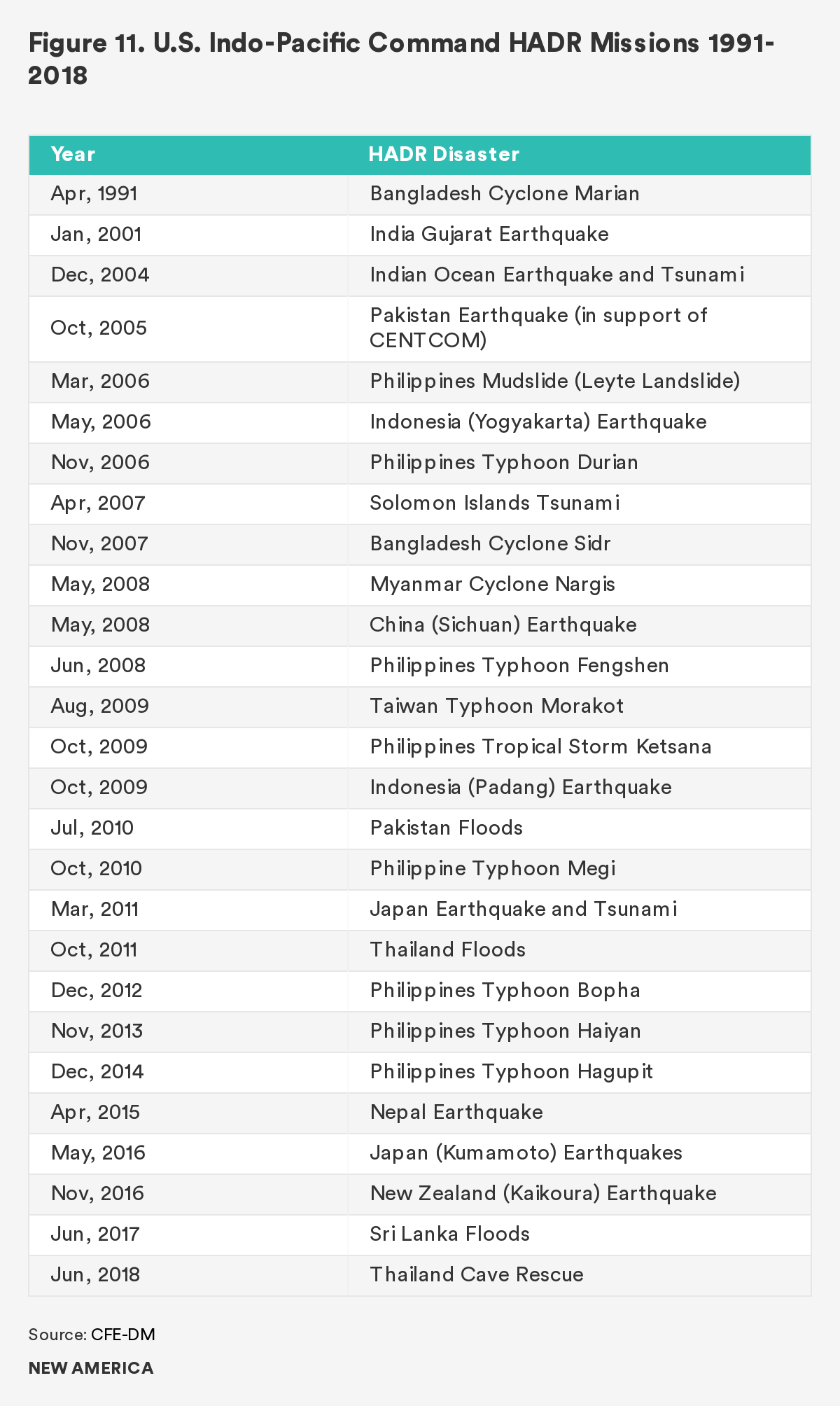
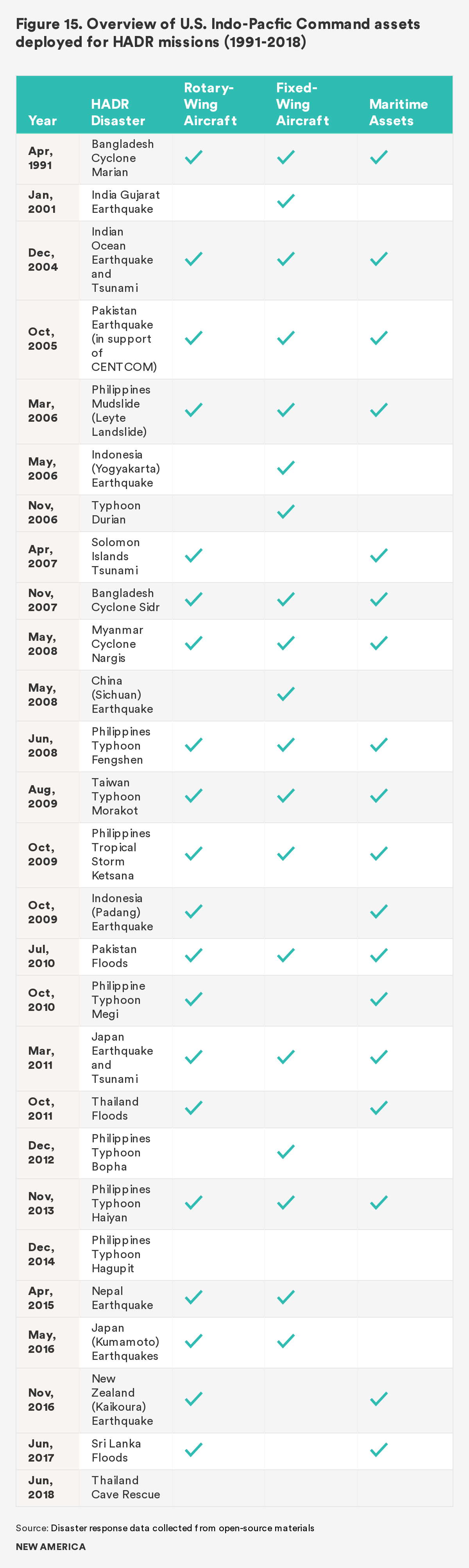
The U.S. Indo-Pacific Command engages in a relatively high number of humanitarian and disaster relief missions, given the prevalence of natural disasters in the region. Between 1991 and 2018, Indo-Pacific Command conducted 27 such missions, including the Indian Ocean earthquake and tsunami (2004), the earthquake and tsunami in Japan (2011), and Typhoon Haiyan in the Philippines (2013).1 Eight of the 27 missions were in the Philippines, the single largest recipient of U.S. military humanitarian and disaster relief. Overall, 12 of the missions were in response to earthquakes or tsunamis, 11 were in response to tropical cyclones, and 3 were in response to widespread flooding. In addition, there was one mission in response to the Southern Leyte Landslide in the Philippines, which was caused by heavy rains and a minor earthquake, and one mission to assist Thailand in the rescue of a youth soccer team from a flooded cave.
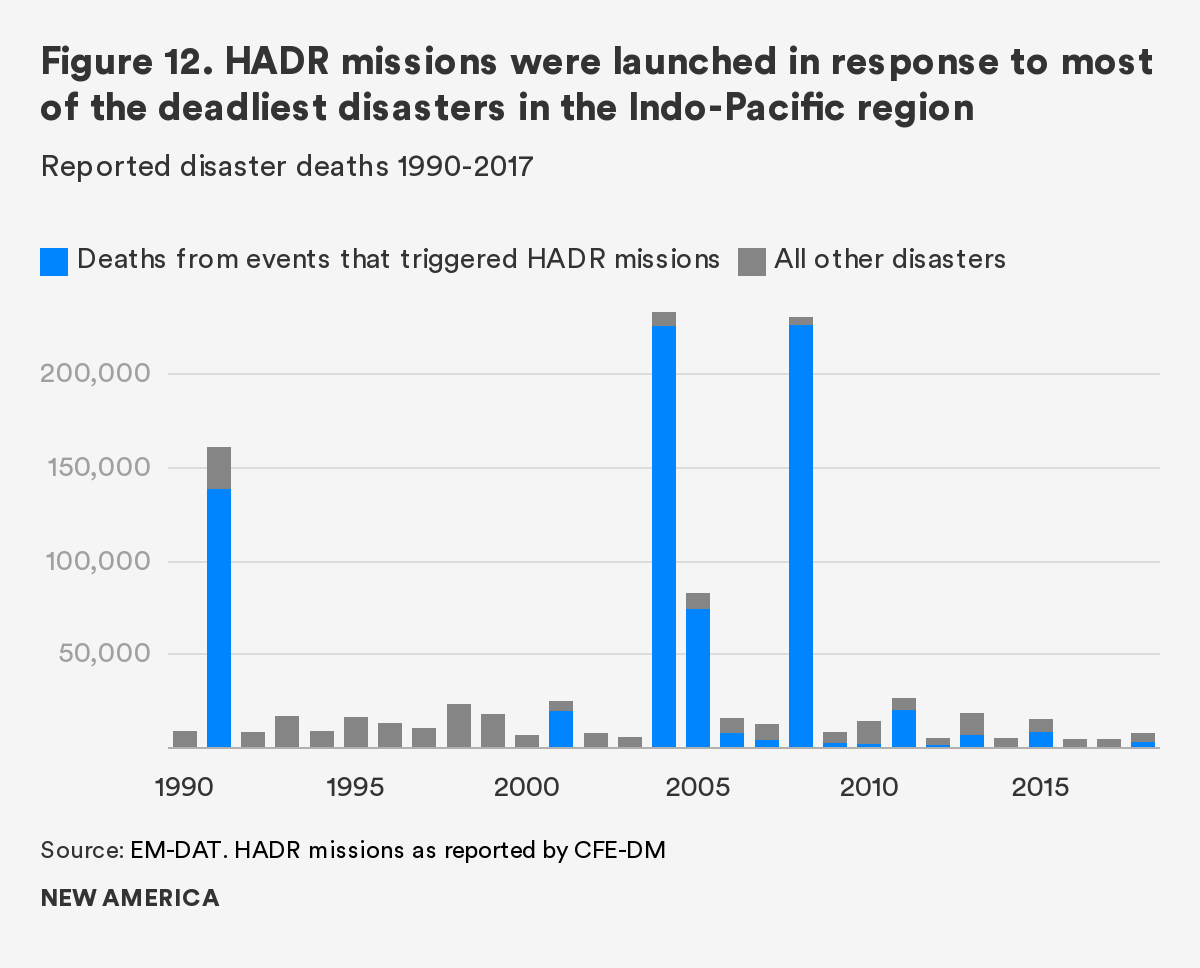
Of the 10 deadliest disasters in the region in that time period, Indo-Pacific Command launched humanitarian and disaster relief missions to eight.2 The U.S. military did not deploy to two of the worst disasters, the 1993 Latur earthquake and the 1999 Odisha/Orissa cyclone, which were both in India, as India did not request such assistance,3 although the United States did contribute monetary aid for both disasters.
2005 Pakistan Earthquake
On October 8, 2005, a 7.6-magnitude earthquake struck northern Pakistan and the disputed territory of Kashmir, killing more than 100,000 people and leaving 3.5 million homeless.4 Within two days of the disaster, the U.S. military delivered 90,000 pounds of food, water, medicine, and blankets to Islamabad aboard a U.S. Air Force C-17 aircraft. Following the first airlift, the United States sent nine military and civilian ships, including the USS Cleveland, USS Tarawa, and the USS Pearl Harbor to deliver additional supplies. The U.S. military provided the logistical management of the air space and relief operations, which was key to ensuring the rapid coordination and dissemination of international relief from Chaklala airbase, near the capital city of Islamabad.5 This was an enormous humanitarian mission led by the Pakistani Army and supported by U.S. and NATO forces, as well as United Nations agencies and more than 100 NGOs.6 Islamist militants with active strongholds in the region also mobilized to provide aid in the early days of disaster relief. At the height of the humanitarian and disaster relief operation, the United States had more than 1,200 troops and 25 helicopters operating in Pakistan. U.S. helicopter crews flew more than 4,600 missions, delivered approximately 26 million pounds of supplies (such as blankets, winterized tents, and plastic sheeting), and transported more than 18,000 people.7 The United States treated approximately 35,000 patients, donating an 84-bed Mobile Army Surgical Hospital worth $4.6 million.8 Upon departure, the U.S. Navy gave Pakistani military engineers $2.5 million in construction equipment, including bulldozers, dump trucks, and generators.9 In total, the United States pledged over $500 million to assist in earthquake relief and reconstruction efforts.10According to the Pew Research Center's Global Indicators Database, Pakistani public opinion of the United States improved in 2006 in the wake of U.S. humanitarian assistance.11
The United States’ long history of humanitarian assistance and disaster relief is an established part of the U.S. national character, in terms of both individual charity as well as formal government assistance to allies, partners, and even adversaries. The U.S. Congress approved the first disaster assistance package in response to the 1912 Caracas earthquake in Venezuela and then the first, albeit limited, military involvement in 1847, allocating two U.S. Navy vessels to carry civilian crews and 8,000 barrels of privately donated food and other goods for famine relief in Ireland.12 Military disaster relief missions remained a relative rarity, however, until after World War II, when the U.S. military was vital to rebuilding Europe.
Importantly, the Department of Defense is not the lead agency or authority when it comes to official relief efforts: the Foreign Assistance Act of 1961 designated the U.S. Agency for International Development’s (USAID’s) Office of Foreign Disaster Assistance (OFDA) as the lead federal agency for foreign disaster relief. This act also gave the president the authority to provide foreign disaster assistance. In 1992, Congress amended the U.S. Code to grant the Department of Defense the authority to provide "transportation, supplies, services, and equipment" worldwide in response to foreign disasters as well as the funds for such missions.13 These early missions set a pattern of civilian control, private/public cooperation, and the use of military assets for disaster relief, as well as somewhat inconsistent policy decisions as to where and when to provide disaster and humanitarian aid.
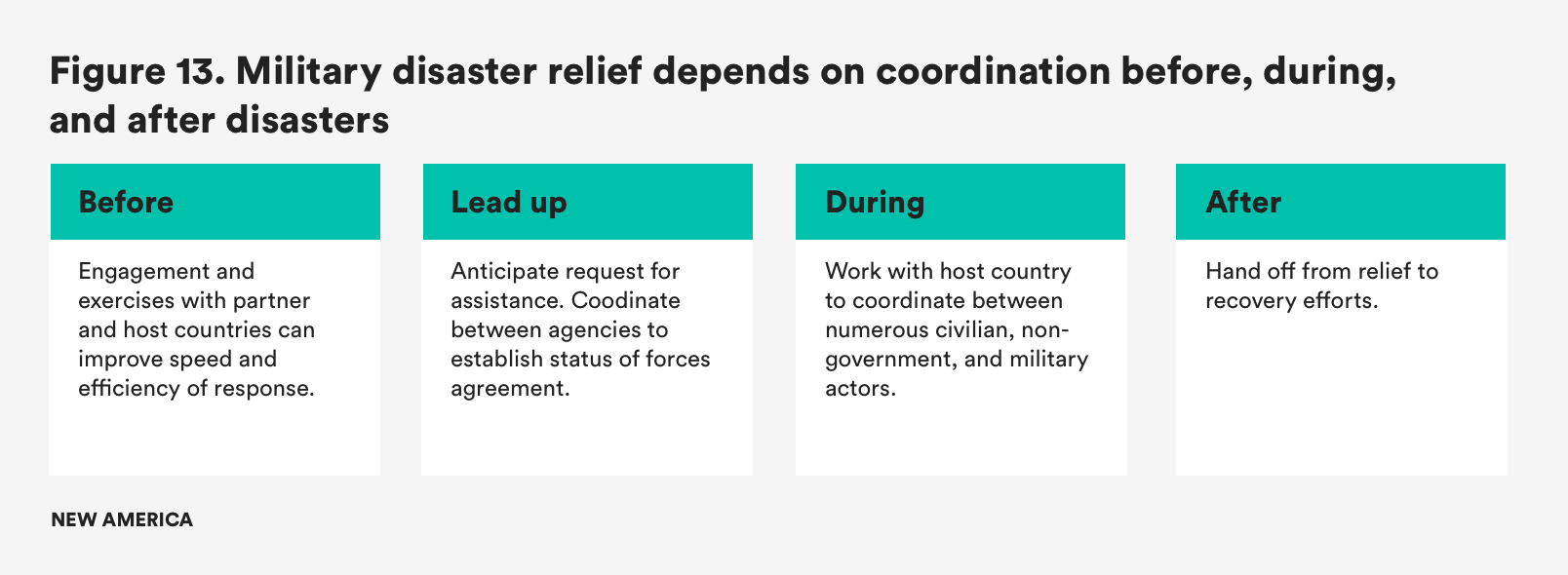
The United States typically initiates military, humanitarian, and disaster relief missions when a country requests international assistance, and that decision requires cooperation between multiple branches of the U.S. government. The U.S. State Department works with the Department of Defense and the recipient country to put in place a visiting forces agreement (if there is not already such an agreement in effect), and this allows the U.S. military to enter the country to conduct humanitarian relief operations. Generally, the State Department, USAID, and the Department of Defense coordinate with foreign governments, militaries, and non-governmental organizations to actually conduct relief missions.
A strong diplomatic relationship as well as previous military-to-military engagement can facilitate this coordination. The United States holds around 90 military exercises in the Indo-Pacific region each year, including the multinational Rim of the Pacific Exercise, which is the world's largest international maritime warfare exercise, and the Pacific Partnership, the largest annual multinational humanitarian and disaster relief preparedness mission conducted in the region.14 In addition to improving the response capacity of regional militaries, these humanitarian and disaster relief exercises help build bilateral partnerships and promote regional stability.
The Humanitarian and Disaster Response Capacity of the United States, Competitors, and Cooperators
Even with its considerable response capacity, the United States rarely operates alone in humanitarian and disaster relief. In addition to domestic partners in affected countries, many other nations in the region are increasing their capacity to deliver disaster relief and response; for the most extreme events, military capacity is especially relevant. Countries expanding their militaries in ways that could enhance their humanitarian and disaster relief capacity include U.S. allies and other regional powers, particularly China and India. This section profiles the humanitarian and disaster response capacity of the U.S. armed forces and other militaries in the region, including China and U.S. allies (Japan, the Republic of Korea, Australia, the Philippines, and Thailand).
U.S. Response Capacity
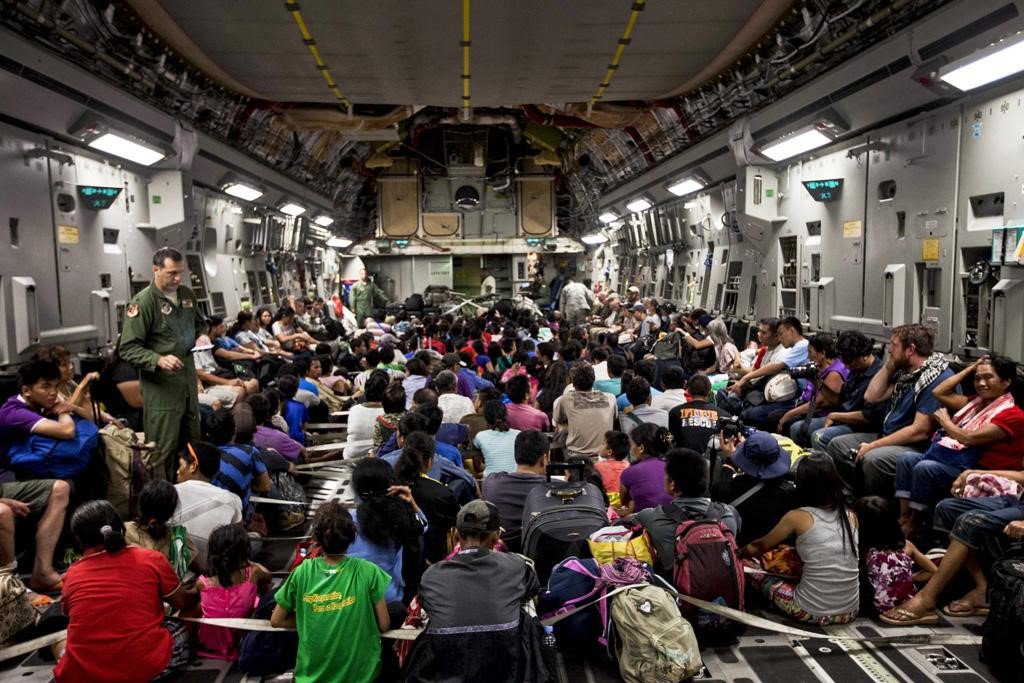
U.S. Marine Corps Sgt. Jonathan Wright/U.S. Indo-Pacific Command
U.S. Indo-Pacific Command can draw on significant resources to respond to disasters; as of 2019 the United States has more than 2,000 aircraft, 200 ships and submarines, and more than 370,000 armed forces personnel, DoD civilians, and contractors operating in the region. The largest concentration of U.S. forces in the region are in Japan, South Korea, and the U.S. territory of Guam, which houses a strategically and logistically significant U.S. military base.15
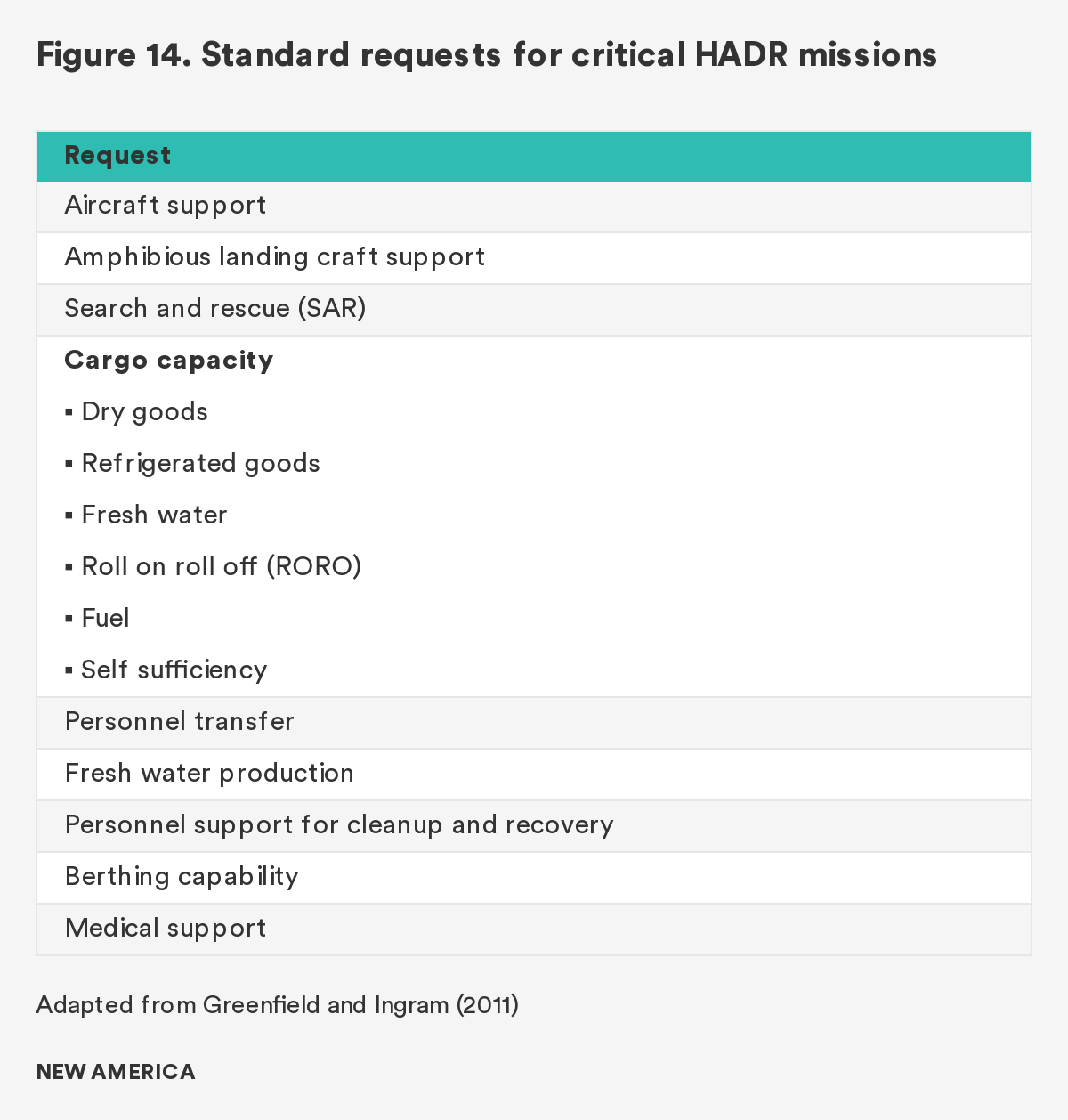
Disaster response often relies on the rapid deployment of relief supplies, search and rescue, and temporary replacement of critical services such as clean water and medical support. A 2011 study from the Naval Postgraduate School found that cargo capacity, personnel transfer, fresh water production, personal support, search and rescue and medical support were standard requests for HADR missions.
In terms of major military assets, in the 27 humanitarian and disaster relief missions it engaged in since 1991, Indo-Pacific Command relied mostly on large cargo aircraft, amphibious ships, and rotary aircraft (i.e., helicopters). More specifically, 20 of the missions required rotary aircraft, 19 required strategic airlift, 18 required a maritime sea-base capability, and 12 required all three. Note that all of this equipment is also important for combat operations, which is the primary mission for which this equipment was built.
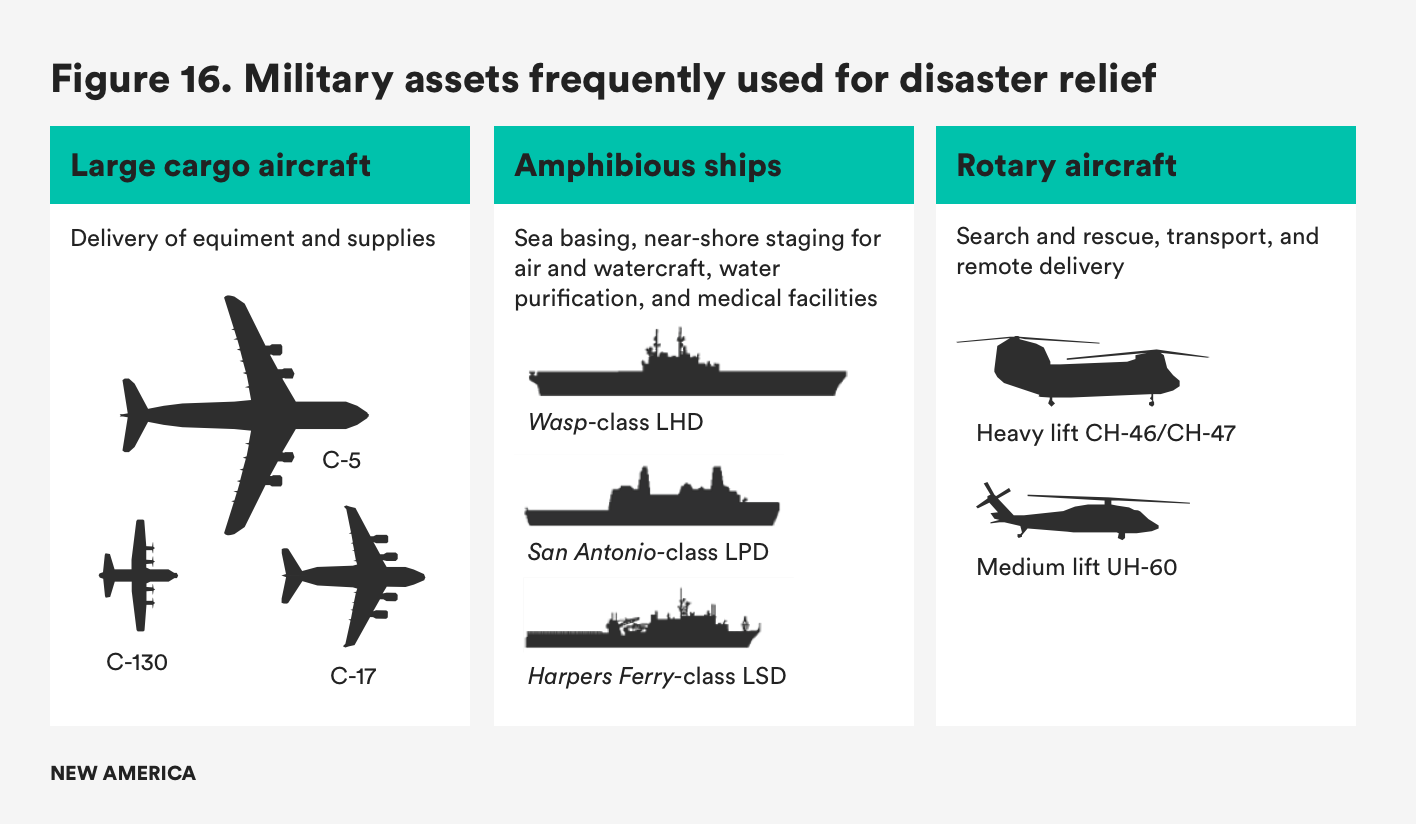
In general, the most important military humanitarian and disaster relief assets are large cargo aircraft, such as the C-130, C-17, and C-5. C-130 planes can accommodate a variety of oversized cargo, including utility helicopters and palletized cargo, and are able to airdrop loads of up to 42,000 pounds, as well as land and deliver cargo on unpaved airstrips.16 C-17 planes can carry a payload of up to 164,900 pounds and are able to airdrop loads of up to 110,000 pounds, as well as take off and land on small unpaved airfields.17 The C-5 is the largest cargo plane in the U.S. inventory and can carry a load up to 281,001 pounds at intercontinental ranges.18 One C-5 plane can transport, for example, 350 personnel alongside six Apache helicopters or 36 pallets of aid. To put it another way, a C-5 could carry 20 seven-ton African elephants from Los Angeles, California to Washington, D.C. without refueling.19 These cargo aircraft enable the United States to rapidly deploy anywhere in the world, at any time.
After cargo aircraft, the most important capability is amphibious assets, or ships that can get relatively close to the shoreline and serve as sea-based platforms for helicopters and other ships or aircraft that can operate inland. These ships allow for rapid response while reducing the burden on local infrastructure (i.e. airfields and ports), often providing the command and control for disaster relief operations.
To give a sense of scale, a Wasp-class Landing Helicopter Destroyer (LHD) is 844 feet long, with large flight and hanger decks that can carry 12 CH-46 Sea Knight helicopters, 4 CH-53E Sea Stallion helicopters, 6 AV-8B Harrier attack aircraft, 3 UH-1N Huey helicopters and 4 AH-1W Super Cobra helicopters in conjunction with 3 Landing Craft Air Cushions (LCAC) or 2 Landing Craft Units (LCU).20 These Wasp-class ships can carry 1,800 troops,21 are equipped with 50 regular and 16 ICU medical beds,22 and travel at speeds exceeding 20 knots.23
Australia
In 2011, the Australian Defense Force (ADF) announced its decision to build a three-ship amphibious force with the stated primary purpose of supporting humanitarian and disaster relief missions within the Asia-Pacific region. Australia's HMAS Canberra was commissioned in 2014 and the HMAS Adelaide was commissioned in 2015. Both amphibious assault ships are 757 feet long and capable of carrying more than 1,100 personnel, 100 armored vehicles, and 12 helicopters—six flight deck spots are for medium-lift helicopters, such as the NRH 90 or S70A and four spots are available for heavy-lift helicopters such as the CH 47.24 These 27,000-ton ships were designed with the shallowest possible draft to allow the LHDs to operate in shallow waters.25 In February 2016, the HMAS Canberra was deployed to its first real-world disaster-relief mission in Fiji after Tropical Cyclone Winston. During Operation Fiji Assist in 2016, the Australian Defense Force sent more than 760 personnel, 30 vehicles, and 2 MRH-90 helicopters on the Canberra to distribute 60 tons of emergency relief and support the rebuilding of critical infrastructure.26
China
China’s foreign policy has increasingly focused on extending the country’s political and economic interests beyond its immediate neighborhood. In 2013, for example, China launched the Belt and Road Initiative, a global infrastructure program with a target of 1 trillion U.S. dollars in investment, involving some 65 countries. The country’s military development has followed suit. According to a 2019 U.S. Defense Intelligence Agency report, China is making a transition from a "defensive, inflexible ground-based force” with a largely domestic focus to a “joint, highly agile, expeditionary” force capable of power projection.27 These are also the sorts of assets most useful for humanitarian and disaster response missions.
Indeed, China already has the force structure to support global humanitarian and disaster relief missions. According to the U.S. Department of Defense, as of 2019 the Chinese Navy had more than 300 ships, making it larger than the 290 deployable ships in the U.S. Navy,28 as well as the world's largest coast guard. And while there are many ways to measure the efficacy of a naval force, the sheer number of ships means that China can establish a presence around the Indo-Pacific region.
More specifically, China has two aircraft carriers and two more under development, including what is expected to be the largest non-American carrier ship in the world.29 Both of the new ships will likely be outfitted with medical and water desalination capabilities, which could make them useful for humanitarian and disaster relief missions. China claims to be working toward a fleet of seven carrier warships by 2025.30 Along with the carriers, China has a fleet of seven Type 071 amphibious transport dock ships, which are similar to the U.S. Navy's San Antonio– class (LPD-17) vessels,31 and it is building three Type 075 amphibious assault ships, similar to the U.S. Navy's America- and Wasp-class assault ships. These ships are important for power projection—and for launching helicopters for humanitarian and disaster relief missions.32 According to IHS Jane's Fighting Ships, the Type 075 vessel is capable of operating 30 helicopters.33 As of 2017, China had 22 Soviet Il-76 strategic airlifters, which can carry 53 tons of cargo, as well as three Chinese-built Y-20 heavy transport aircraft.34 The U.S. Air Force, in comparison, operates nearly 600 C-130 Hercules, C-17 Globemaster and C-5 Galaxy cargo planes.35
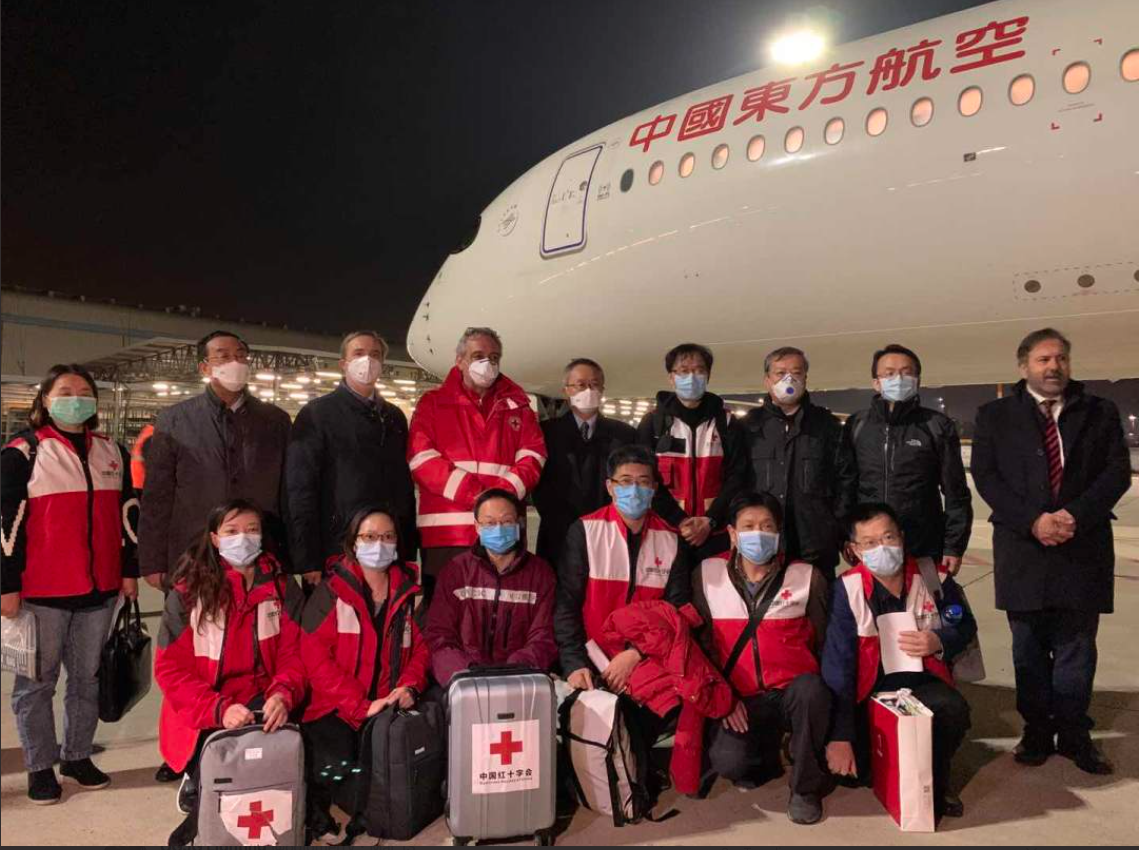
In addition to the appropriate force structure, China has shown both the intent and the political will to support global military missions, including for humanitarian purposes. China's extra-territorial naval deployments began in 2008 with a counter-piracy mission, as well as its deployment of the Peace Ark, a hospital ship with 300 beds and eight operating rooms, to the Gulf of Aden.36 In January 2010, China sent a 60-person search-and-rescue team and 43 medical staff to Haiti following the 7.0-magnitude earthquake that leveled Port-au-Prince, killing 220,000 Haitians as well as 8 Chinese peacekeepers.37 This deployment generated news coverage, given that China was first on the scene, despite the greater distance and lack of diplomatic relations with Haiti. Prior to Pakistan's catastrophic flood in 2010, which affected more than 18 million people,38 Chinese helicopters had never before carried out an international humanitarian and disaster relief mission.39 China deployed four Mi-17 Chinese helicopters in that disaster, alongside its search and rescue personnel and medical teams. Prior to the impending collapse of Libya in 2011, China’s navy and air force conducted their first humanitarian escort mission to evacuate approximately 30,000 Chinese nationals with the Xuzhou missile frigate and four PLAAF Il-76s strategic airlifters.40 Although the Libya evacuation was not a humanitarian and disaster relief mission per se, it demonstrated China’s growing long-range transportation.
According to Chinese state media, China's largest humanitarian and disaster relief operation was in response to the 2015 Nepal earthquake in which it deployed 1,088 military personnel and police.41 In 2015, the Chinese navy conducted another evacuation of Chinese nationals, this time from Yemen, utilizing a naval frigate. According to China, this was also the first time the PLAN evacuated foreigners from a war zone.42
In July 2019, China published the white paper, China's National Defense in the New Era, outlining a global defense strategy, enumerating China's military contributions in domestic humanitarian and disaster relief missions, and highlighting key foreign disaster assistance missions since Typhoon Haiyan in 2013. According to China, since 2012 it has deployed "950,000 soldiers, 1.41 million militia, 190,000 vehicles and items of equipment, and sortied 26,000 vessels and 820 aircraft," in response to domestic disasters.43 The white paper outlines China's intention to create an expeditionary combat force that can conduct "far seas protection" and "strategic projection" as well as highlights its future intentions for the armed forces to be active participants in global humanitarian and disaster relief missions.44 Goodwill diplomacy through humanitarian and disaster relief has been a stalwart of U.S. foreign policy in the Indo-Pacific region. China has a growing capacity to conduct these missions worldwide, so it may well see the same gains.
Courtesy of China’s People’s Daily on Twitter.
India
The Indian Ocean is the world’s third largest body of water, with sea routes that connect the Middle East, Africa, and East Asia with Europe and the Americas.45 The Indian Ocean's sea lanes transport more than 50 percent of the world's oil shipped by sea, which fuels India’s and China's growing populations and economies. India is the most powerful littoral state in the Indian Ocean and its navy is frequently the first responder to natural disasters in the region.
At the time of the 2004 Indian Ocean tsunami, India had eight amphibious ships, including two 5,600-ton domestically built Magar-class LST and six 1,200-ton Polish-built Polnocyny-class medium LSTs.46 Since 2004, India has worked to increase its military capacity, including disaster management capabilities, by acquiring new larger amphibious ships, tankers, and expanding strategic airlift. In 2007, the Indian navy purchased the USS Trenton, a Landing Platform Dock (LPD) capable of carrying six helicopters along with its four landing crafts and renamed it the INS Jalashwa.47 This ship's flight deck can also handle aircraft that take off verticially and can accommodate up to 900 evacuees during a humanitarian and disaster relief operation as well as serve as a hospital ship. The two tankers, the INS Shakti and INS Deepakare, will expand the range of the Indian navy for both humanitarian and disaster relief and military purposes. These tankers are equipped with modern medical facilities and can carry up to 250 passengers.48 At present, India operates two aircraft carriers—the INS Vikramaditya (44,500 tons) and the INS Vikrant (40,000 tons)—and plans to build a third by 2030.49
When it comes to strategic airlift, the Indian government has a fleet of 17 Soviet IL 76 transport aircraft, 12 C-130Js, and 11 C-17s, making India Boeing's largest international customer for the C-17.50 India's increasing procurement of heavy-lift transport aircraft has expanded India's transoceanic reach. India has also recently received 4 out of the 15 CH-47F Chinook helicopters it has ordered from Boeing. These heavy lift helicopters will provide the Indian armed forces the strategic airlift capability required for complex humanitarian and disaster relief missions. The Chinook can transport 9.6 tons of cargo at high altitude and is particularly well-suited for mountain operations, since it can maneuver through tight mountain ranges as well as operate in all-weather conditions.51
India first established its National Disaster Management Authority in 2005, following the 2004 Indian Ocean tsunami, and has become increasingly engaged in disaster relief missions in the ensuing years. For example, India was the first responder to the Indian Ocean tsunami (2004), Cyclone Sidr in Bangladesh (2007), and Cyclone Nargis in Myanmar (2008). In 2019, Indian vessels provided relief well beyond the Indo-Pacific region: in January, an Indian navy ship brought relief supplies to Madagascar following flash floods and in March three Indian ships provided support to the government of Mozambique following Cyclone Idai.52
Japan
Japan is constitutionally prohibited from the use of force in settling international disputes, or even maintaining an offensive military. Nonetheless, the country has significant military capacity in its Self-Defense Forces (SDF), and in recent years, the SDF has gradually been expanding its missions. In December 2018, Japan's Prime Minister Shinzō Abe announced a ten-year defense well as an update to Japan's two largest Izumo-class destroyers to make them capable of supporting F-35B stealth fighter jets.53 The Izumo-class ships (the JS Izumo and the JS Kaga), officially classified as “helicopter destroyers,” were designed to carry up to 28 helicopters.54 The JS Izumo accommodates a medical room with 35 makeshift beds and an ICU, as well as a crew of up to 470 personnel.55 Japan also has two smaller carriers that can embark up to ten helicopters, including MV-22 Ospreys and CH-47 transport choppers.56 Although the primary job of these carriers is anti-submarine warfare, they also serve as command and control for regional humanitarian and disaster relief missions and engage in regular anti-piracy operations off the coast of Djibouti.57
In 2011, Japan established its first overseas military base since the end of World War II in Djibouti to support its ongoing counter-piracy mission. Japan announced in 2018 that it intended to increase training efforts with East African nations, focussing on disaster response.58 That same year, Japan launched its first marine unit since the end of WWII to deter China in the Western Pacific.
On March 11, 2011, the fourth-largest earthquake in recorded history struck off the northern coast of Japan. The 9.0-magnitude quake also generated a tsunami with 30-foot high waves. Twenty thousand people perished in the initial earthquake and tsunami, which traveled as far as six miles inland.59 More than 1.4 million households in 14 prefectures had no water and 1.25 million households had no electricity in the wake of the disaster.60 The tidal wave also crashed into the Fukushima Daiichi nuclear plant, already damaged by the temblor, leading to significant releases of radiation into the surrounding community and the evacuation of 177,503 people within a 12-mile radius of the plant. In response, the United States launched Operation Tomodachi, which at its height involved nearly 24,000 American personnel, 189 aircraft, and 24 ships in support of its ally. Japan deployed more than 100,000 personnel, 500 planes and helicopters, and 60 ships from its own Self Defense Forces.61 Japanese helicopters operated from U.S. aircraft carriers for the first time.62 Beyond the military assets dispatched, the United States allocated $35 million in humanitarian aid.63 The U.S. government also sent 50 experts from the Department of Energy and the Nuclear Regulatory Commission to assist Japan with the Fukushima nuclear fallout.64 The success of this operation demonstrated the utility of years of combined training and interoperable equipment, as well as America's commitment to Japan. It also demonstrated how a catastrophe of this magnitude can overwhelm even the most capable country.
New Zealand
New Zealand is a major non-NATO ally and part of the “Five Eyes” intelligence-sharing alliance with Australia, Canada, the United Kingdom, and the United States. Before New Zealand barred nuclear-armed and nuclear-powered warships in its exclusive economic zone in 1987, Australia, New Zealand and the United States were part of a mutual security treaty known as ANZUS. In recent years, bilateral ties have strengthened with the signing of the Wellington Declaration and the Washington Declaration, which increased bilateral cooperation and re-established a formal defense agreement.65
New Zealand's only formal defense ally within the region is Australia and the two countries have long been the largest and most influential nations in the South Pacific.66 The small island states of the region are particularly vulnerable to natural disasters, and in February 2018, New Zealand pledged to increase its diplomatic and development aid packages to the region.
The Royal New Zealand Navy (RNZN) has one amphibious vessel, the HMNZS Canterbury, which displaces 9,000 tons and can accommodate 250 personnel as well as transport and deploy military vehicles and helicopters. New Zealand, in partnership with Australia, deployed the Canterbury, the Wellington (a Protector-class offshore patrol vessel), a C130, and P3 Orion aircraft in response to Tropical Cyclone Winston in 2016.67 Nine months later, a 7.8-magnitude earthquake off the coast of New Zealand caused massive landslides that stranded about 1,000 tourists in the town of Kaikoura. This time the RNZN deployed the HMNZS Canterbury and HMNZS Wellington to evacuate their own civilians and tourists. At the request of the New Zealand government, the American destroyer USS Sampson provided humanitarian and disaster relief support by ferrying New Zealand citizens from Kaikoura to the Canterbury, as well as by lifting 11,000 pounds of equipment and supplies from the Canberra to shore with its two embarked MH-60R helicopters.68 It was the first time a U.S. warship had visited New Zealand in more than 30years, demonstrating the utility of disaster diplomacy among allies as well.
This past November, the RNZN acquired an 85-meter used Norwegian dive and hydrographic support vessel.69 This ship includes a 100-ton salvage crane, a remotely operated vehicle, and a dynamic positioning system that will augment the navy during disaster relief and underwater search and recovery missions. In 2020, the navy will have a new 26,000-ton tanker and replenishment ship, which will expand New Zealand’s and Australia's radius for force projection. This tanker, the Aotearoa, will be winterized with upper-deck heating and an ice-strengthened hull so that it can operate in Antarctica. It will also be able to produce 100 tons of freshwater a day and transport 12 containers of supplies for future humanitarian and disaster relief and security operations.
The Philippines
With a nearly 23,000 mile coastline,70 the Philippines weathers nearly 20 storms a year and over the past 27 years the United States military has conducted eight major humanitarian and disaster relief missions to assist its ally during times of distress.71 The United States and the Philippines have a complex security relationship that goes back to The Spanish-American war and the subsequent legacy of colonialism. Today's security partnership is based on the 1951 Mutual Defense treaty, which established collective security obligations as well as the 2014 Enhanced Defense Cooperation Agreement.72 The 2014 Agreement provided U.S. troops greater access to Philippine military bases and enabled the U.S. to build facilities to preposition materiel for future humanitarian and disaster relief missions.73 As major non-NATO allies, the U.S. and the Philippines conduct several military exercises a year to share tactics and improve interoperability.
In total, the Philippines has two Tarlac-class strategic sealift vessels, the largest ships in the Philippine navy, which are based on the Indonesian navy's Makassar-class landing platform dock.74 Indonesia delivered the ships in 2016 and 2017. These ships are 123 meters long and have a full load displacement of 11,580 tons75 and can carry 600 troops, as well as accommodate two helicopters on the flight deck and an additional one in the hangar76 When it comes to airlift capabilities, the Philippine air force has five C-130s.77 The Philippines intends to spend $5.6 billion over five years to upgrade its defense capability and will purchase 16 Sikorsky Aircraft’s S-70 Black Hawks.78
South Korea
South Korea has long had to maintain its military's readiness given the risk of conflict with North Korea, which includes not only conventional threats from long-range artillery on the South Korean border, but unconventional threats that range from nuclear weapons to cyber attacks. South Korea fields an army of around 490,000 troops and maintains a 200 vessel navy that is equipped with cruise missiles and anti-submarine rockets.79 In 2001, then-President Kim Dae-jung gave a speech in which he outlined South Korea's plan to develop a blue-water navy that would be a "strategic mobile fleet that protects state interests in the five big oceans and plays a role of keeping the peace in the world."80 This blue-water navy would contribute to regional and overseas emergency relief as well as maritime security missions such as those in the Gulf of Aden.
In 2005, the South Korean Navy (ROKN) commissioned its first amphibious assault ship, the Dokdo, which can carry up to 720 Marines and 15 helicopters.81 In May 2015, the ROKN launched its second Dokdo-class amphibious assault ship, the Marado, which was adapted to accommodate two V-22 Osprey tilt-rotor aircraft instead of just one, and will be fully operational in 2020 following sea trials. In total, the ROKN operates 14 amphibious assault ships as well as a contingent of strategic/tactical transport aircraft, such as the C-130H, C-130J, and CN-235 light transport, which have been deployed to recent disasters including the July 2018 dam accident in Laos, the April 2016 earthquake in Kumamoto, Japan, and the 2013 Typhoon Haiyan in the Philippines.82 Since 2004, the Korean military has dispatched personnel and assets to 12 humanitarian and disaster relief missions.83
Thailand
Thailand is a longtime military ally of the United States and provides the U.S. military with access to key facilities such as Utapao Air Base. Utapao is strategically significant for both military and humanitarian and disaster relief missions because it can receive large aircraft, is near a deep seaport, and has the infrastructure to handle command and control.84 The U.S. military has previously used Utapao for refueling for both the 2004 Indian Ocean tsunami and the 2014 Nepal earthquake response due to its central location in southeastern Asia, bordering the Andaman Sea and the Gulf of Thailand.85 For this reason, Thailand is a regional hub for prepositioned emergency supplies for the U.S. military.86
The Royal Thai Navy currently operates the smallest aircraft carrier in service—the HTMS Chakri Naruebet which is 600 feet long and displaces 11,500 tons.87 It was built to carry 9 Harrier aircraft and 15 helicopters but since 2006 it has operated no aircraft. Nevertheless, the carrier was used for disaster relief during the 2004 Indian Ocean tsunami and in response to flooding in Thailand in 2010 and 2011.88 In 2011, Thailand acquired the amphibious warship the HTMS Angthong (LPD-791) from Singapore which is about 460 feet long, weighs 7,600 tons, and can accommodate about 390 personnel.89
The United States. and Thailand have co-sponsored Cobra Gold, one of the longest-running multinational military exercises, since 1982 with the aim to improve coordination and interoperability between armed forces in the region to enhance maritime security and disaster response.
Citations
- Center for Excellence in Disaster Management and Humanitarian Assistance, USINDOPACOM Foreign Disaster Response in the Indo-Asia-Pacific, June 1991-June 2019 (Joint Base Pearl Harbor-Hickam, HI: CFE-DM, 2019), source
- Authors' analysis of EM-DAT disaster database. Université catholique de Louvain (UCL), CRED, and Guha-Sapphir, “EM-DAT: The Emergency Events Database.”
- Patralekha Chatterjee, "India Earthquake Strains Country's Relief Efforts," Christian Science Monitor, October 4, 1993; and Orissa Cyclone, India, BBC, October 29, 1999, source
- The Kashmir earthquake of October 8, 2005: Impacts in Pakistan (Oakland, CA: Earthquake Engineering Research Institute, 2006).
- Committee on Foreign Relations, Pakistan Earthquake: International Response and Impact on US Foreign Policies and Programs, 109th Congress, 1st session, 2005.
- Andrew Wilder, Perceptions of the Pakistan Earthquake Response (Boston, MA: Feinstein International Center, 2008): 9.
- Department of Defense, "Feb. 21, 2006 – Fact Sheet – DOD Assistance to Pakistan," June 30, 2015. source
- Department of Defense, "Feb. 21, 2006 – Fact Sheet – DOD Assistance to Pakistan."
- Sgt. Sara Wood, "U.S. Donates Mobile Hospital to Pakistan for Earthquake," Department of Defense, February 16, 2006.
- Department of State, "US Response to Pakistan's Earthquake Disaster," Office of the Spokesman, December 12, 2005, source
- “Global Indicators Database.” Pew Research Center's Global Attitudes Project. Pew Research Center. Accessed March 25, 2020. source
- Gaines M. Foster, The Demands of Humanity: Army Medical Disaster Relief (Washington, DC: U.S. Department of the Army, Center of Military History, 2000).
- "10 U.S. Code § 404 Foreign Disaster Assistance, Cornell Law School Legal Information Institute.
- Department of Defense, The Department of Defense Indo-Pacific Strategy Report (June 1, 2019): 29.
- "Libyan Turmoil Prompts Chinese Naval Firsts," Wall Street Journal, February 25, 2011.
- "C-130 Hercules," Department of the Air Force, June 20, 2018, source
- "C-17 Globemaster," Boeing, source
- "C-5M Super Galaxy," Department of the Air Force, May 15, 2006, source
- African Elephant, National Geographic, source
- "Amphibious Assault Ships – LHD/LHA(R)," United States Navy Fact File, January 16, 2019, source
- LHD, United States Navy, source
- LHD, United States Navy, source
- "Amphibious Assault Ships – LHD/LHA(R)," United States Navy Fact File.
- John Perryman, "Ships Named Canberra," Australia Navy, source
- Amphibious Assault Ship (LHD), Australia Navy, source
- Helen Frank, "HMAS Canberra on operation for the first time," Navy Daily, March 23, 2016.
- China Military Power: Modernizing a Force to Fight and Win (Washington, DC: Defense Intelligence Agency, 2019), source
- Annual Report to Congress: Military and Security Developments Involving the People's Republic of China 2019 (Washington, DC: Office of the Secretary of Defense, May 2, 2019): 35; andDepartment of the Navy, The Navy Fact File, July 15, 2019. source
- Ronald O'Rourke, China Naval Modernization: Implications for U.S. Navy Capabilities (Washington, DC: Congressional Research Service, August 1, 2018): 25.
- Abraham Ait, "Will China Have 7 Aircraft Carriers by 2025?" The Diplomat, June 30, 2018.
- Andrew Tate, "China's eighth Type 071 in advanced stage of construction," Jane's Defense Weekly, May 14, 2019; and Dave Mujumdar, "China's New Amphibious Assault Ship: A Big Waste of Time?" National Interest, March 31, 2017.
- Ait, "Will China Have 7 Aircraft Carriers by 2025?"
- O'Rourke, China Naval Modernization: Implications for U.S. Navy Capabilities, 46.
- Christina L. Garafola and Timothy R. Heath, The Chinese Air Force's First Steps Toward Becoming an Expeditionary Air Force (Washington, DC: RAND Corporation, 2017): 8; Jay Bennett, "China's New Y-20 Is the Largest Military Aircraft Currently in Production," Popular Mechanics, June 20, 2016.
- Sebastien Roblin, "This Not-So-Scary Picture Should Terrify the US Military," National Interest, November 12, 2018.
- "Chinese hospital ship stops in turbulent Venezuela," Navy Times, September 22, 2018.
- "China announces more assistance to Haiti," Embassy of the People's Republic of China in the United States of America, January 21, 2010; Richard Knox, "5 Years After Haiti's Earthquake, Where Did the $13.5 Billion Go?" NPR, January 12, 2015.
- Michon Scott, Heavy Rains and Dry Lands Don't Mix: Reflections on the 2010 Pakistan Flood (Greenbelt, MD: NASA Earth Observatory, April 6, 2011).
- "China to send military helicopters to Pakistan for flood relief," Reliefweb, September 19, 2010.
- "Top ten firsts of Chinese military diplomacy from 2002 to 2012," PLA Daily, September 26, 2012, source; Adam Rawnsley, "Chinese Missile Ship Races to Libya," Wired, February 25, 2011; and"China evacuates 12,000 from Libya, sends frigate to help," Reuters, February 24, 2011.
- "Nepal thanks China for helping in earthquake recovery," Xinuah, May 13, 2015.
- "Yemen crisis: China evacuates citizens and foreigners from Aden," BBC News, April 3, 2015
- Andrew S. Erickson translation, "China's National Defense in the New Era," The State Council Information Office of the People's Republic of China, July 2019.
- Erickson, “China’s National Defense in the New Era."
- Indian Ocean, CIA Factbook. source
- Nilanthi Samaranayake, Catherine Lea, and Dmitry Gorenburg, Improving U.S.-India HA/DR Coordination in the Indian Ocean (Washington, DC: Center for Naval Analysis, July 2014): 39.
- Samaranayake, Lea, and Gorenburg, Improving U.S.-India HA/DR Coordination in the Indian Ocean, 40.
- Samaranayake, Lea, and Gorenburg, Improving U.S.-India HA/DR Coordination in the Indian Ocean, 41.
- Franz-Stefan Gady, "Future of India's Supercarrier Program Still Uncertain," The Diplomat, July 14, 2018.INS Vikramaditya, Indian Navy, source; Franz-Stefan Gady, "India's First Homegrown Aircraft Carrier to Begin Sea Trials in 2020, Diplomat, Dec 4, 2018.
- Manu Pubby, "IAF Moves Rs 4,000-crore proposal to upgrade IL 76/78 transport fleet," Economic Times, July 14, 2018."IAF's C-17, C-130J Super Hercules: Giants saving lives from Kashmir to Chennai," Economic Times, July 14, 2018; "C-17 Globemaster III: Delivering India's Military and Humanitarian Airlift Capabilities," Boeing. Dinakar Peri, "IAF to get one more C-17 aircraft," The Hindu, Dec 24, 2016; Ajai Shukla, "Exercise Bahubali: IAF demonstrates its strategic airlift capability," Business Standard, Dec 19, 2018.
- "Indian Air Force inducts combat-ready Chinook helicopters," Economic Times, March 25, 2019.
- Abhishek Mishra, India’s vision of SAGAR: Humanitarian assistance and disaster relief operations in the Indian Ocean Region (Observer Research Foundation, February 3, 2020), source
- Sheila A. Smith, Japan's Active Defenses (New York, NY: Council on Foreign Relations, December 20, 2018), source
- Michael Zennie, "President Trump Visited Japan's Biggest Warship Since WWII. Here's What to Know about the JS Kaga," Time, May 28, 2019.
- Sakura Murakami, "Journalists get tour of Japan's Izumo amid debate over equipping ship with aircraft carrier capabilities," Japan Times, March 13, 2019.
- Kyle Mizokami, " Here is Every Aircraft Carrier in the World," Popular Mechanics, January 25, 2016.
- "Why you're seeing more of Japan's military," CNN, October 16, 2018.
- John Vandiver, "The pirates are mostly gone, but Japan sticks around in Djibouti," Stars andStripes, November 3, 2018.
- "2011 Japan Earthquake-Tsunami Fast Facts," CNN, March 4, 2019; Becky Oskin, "Japan Earthquake & Tsunami of 2011: Facts and Information," Live Science, September 13, 2017.
- OCHA, "Japan Earthquake and Tsunami, Situation Report No. 3," March 14, 2011.
- Andrew Feickert and Emma Chanlett-Avery, Japan 2011 Earthquake: US DOD Response (Washington, DC: Congressional Research Service, June 2, 2011): 1; Jennifer D.P. Moroney, Stephanie Pezard, Laurel E. Miller, Jeffrey Engstrom, Abby Doll, Lessons from DOD Disaster Efforts in the Asia-Pacific Region (Santa Monica, CA: RAND, 2013): 89.
- Feickert and Chanlett-Avery, Japan 2011 Earthquake: U.S. DOD Response, 4.
- "Factbox: Aid and Rescue Offers for Japan Quake," Reuters, March 15, 2011.
- Sheila A. Smith, Operation Tomodachi (New York, NY: Council on Foreign Relations, March 23, 2011), source
- "The Washington Declaration on Defense Cooperation," United States – New Zealand Council, source
- Reuben Steff, "New Zealand's Pacific Reset: Strategic Anxieties about Rising China," The Conversation, May 31, 2018.
- Anna Powles and Jose Sousa-Santos, Principled Engagement Rebuilding Defense Ties with Fiji (Sydney, Australia: Lowy Institute, July 2016): 8.
- US Pacific Fleet Public Affairs, "USS Sampson Concludes Relief Effort Support to New Zealand," November 20, 2016.
- "New Zealand Navy inducts hydrographic survey vessel," Naval Technology, June 10, 2019.
- CIA Factbook, Philippines Geography – Coastline.
- “Tropical Cyclone Information,” Philippine Atmospheric, Geophysical and Astronomical Services Administration, Department of Science and Technology, source
- Eleanor Albert, The U.S.-Philippines Defense Alliance (New York, NY: Council on Foreign Relations, October 21, 2016), source
- "Signing of Enhanced Defense Cooperation Agreement," U.S. Embassy in the Philippines, April 28, 2014; "U.S., Philippines Cut the Ribbon on Enhanced Defense Cooperation Agreement Project," U.S. Embassy in the Philippines, January 30, 2019.
- "Sealift vessel for Philippines [INDODEF16-D3]"; Jane's 360, November 4, 2016.
- “Sealift vessel for Philippines [INDODEF16-D3].”
- “Sealift vessel for Philippines [INDODEF16-D3]"; "Tarlac Class Strategic Sealift Vessels," Naval Technology.
- "Philippines to Purchase Two US C-130 Aircraft," U.S. Embassy in the Philippines, January 9, 2015.
- "Philippines to buy U.S. helicopters, not Russian, due to U.S. sanctions: official," Reuters, December 7, 2018.
- James Hackett and Mark Fitzpatrick, The Conventional Military Balance on the Korean Peninsula (London, UK: IISS, June 2018): 38.
- Terence Roehrig, South Korea's Counterpiracy Operations in the Gulf of Aden (New York, NY: Council on Foreign Relations, October 2012, 31).
- Jeff Jeong, "South Korea changes mission for its newly launched assault ship," Defense News, May 21, 2018.
- David Axe, "South Korea is Getting New Destroyers, Submarines and Maybe F-35s on 'Aircraft Carriers'?" National Interest, April 30, 2019.
- Park Chang-kwoun, "Defense cooperation for humanitarian assistance and disaster relief missions," Korea Times, October 27, 2018.
- Emma Chanlett-Avery, Ben Dolven and Wil Mackey, Thailand: Background and U.S. Relations (Washington, DC: Congressional Research Service, July 29, 2015).
- Chanlett-Avery, Dolven and Mackey, Thailand: Background and U.S. Relations.
- Center for Excellence in Disaster in Disaster Management & Humanitarian Assistance, Thailand Disaster Management Reference Handbook (Joint Base Pearl Harbor-Hickam, HI: CFE-DM, May 2018): 55.
- Mike Yeo, "Aircraft Carriers or Not? Flattops in the Pacific," Diplomat, September 8, 2013; David Axe, "Japan's Naval Future: New Aircraft Carriers Armed with F-35s," National Interest, December 2, 2018.
- Jeremy Bender, "Thailand has an aircraft carrier with no aircraft," Business Insider, February 20, 2015.
- Royal Thai Navy receives HTMS Ang Thong, Naval Technology, April 20, 2012.