Introduction
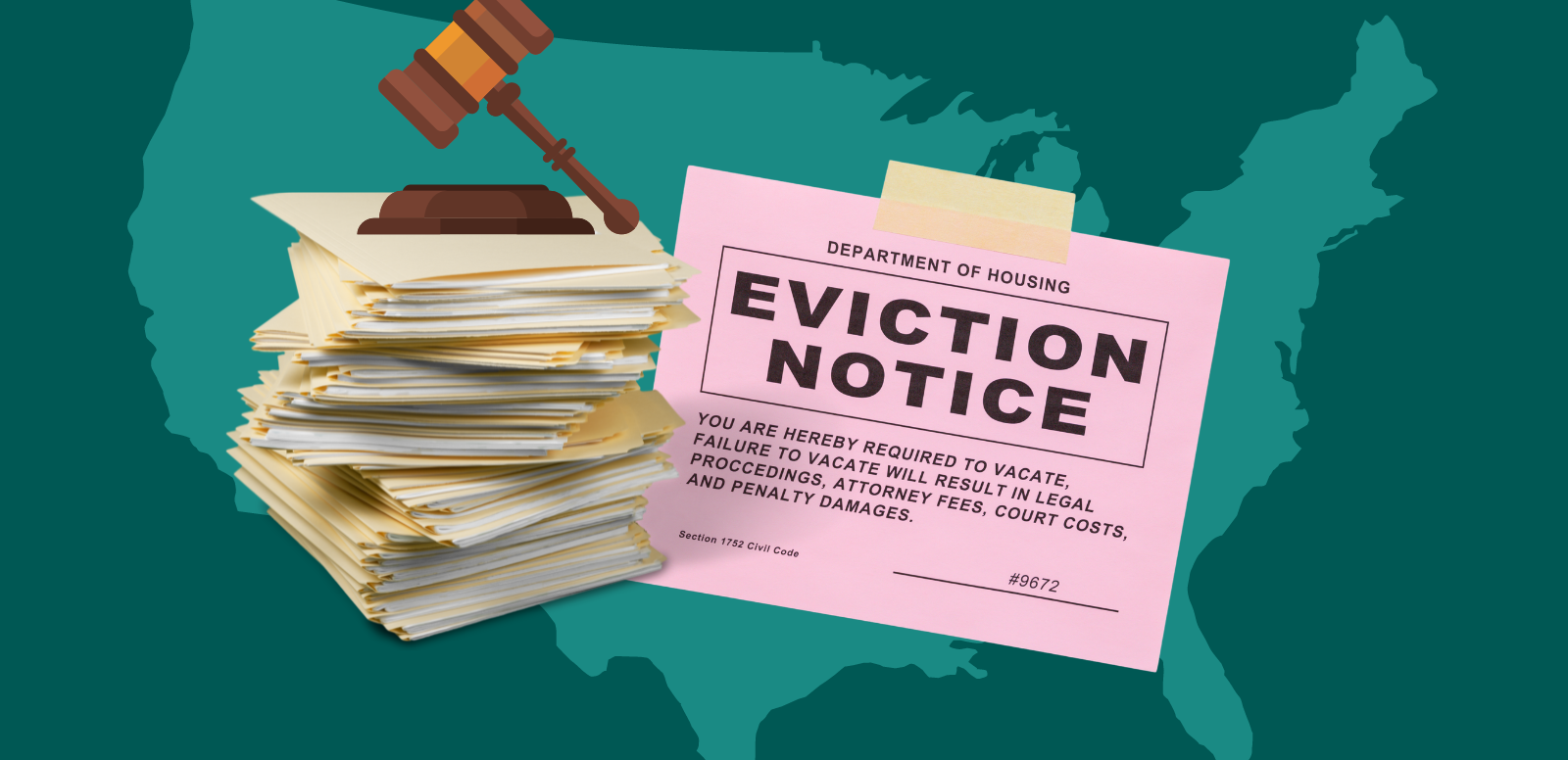
Evictions have become one of the most visible manifestations of the housing affordability crisis in the United States. Each year, nearly four million eviction lawsuits are filed against renter households, most of which are for non-payment of rent. As rent prices reach record highs, understanding the scale and impact of eviction is more critical than ever.1
Most instances of eviction in the United States occur informally, outside the legal system.2 Formal evictions that run through the legal system when a landlord files an eviction lawsuit in court, however, have been shown to have lasting negative impacts on physical and mental health and create barriers to securing future housing, notably for Black women and children who face disproportionate risk of eviction.3
What we know about formal eviction in the United States is from eviction court records—or the information amassed as an eviction lawsuit makes its way through the court system.4 But access to eviction court records varies widely across the U.S. These records are not commonly standardized across (and often even within) court systems, meaning this data is often incomplete, inaccurate, or inconsistent.5 As a result, collecting and analyzing this data can be extremely resource-intensive and difficult to replicate. But just as high-quality court eviction data is critical to understanding evictions, so too is high-quality eviction analysis.
“Just as high-quality court eviction data is critical to understanding evictions, so too is high-quality eviction analysis.”
Digging into court eviction records can help reveal the story behind an individual eviction court case that, when aggregated, provides a powerful account of how forced displacement impacts communities across the United States. For eviction data analysis to be impactful, it must address questions that are meaningful for understanding and preventing eviction in a local context. Due to the wide disparities in data quality and accessibility across the U.S., however, determining which eviction-related questions can reasonably be answered with available court data can be challenging.
To address this challenge, Understanding Evictions: A Guide to Using Local Court Data offers 14 common questions that can be explored through court eviction data. By offering a road map and key considerations, the guide seeks to support those looking to use court data to better understand and prevent evictions in their communities.
This guide is organized into three sections. The first section describes the guide’s purpose and how it can be used. The second section covers the elements of good stewardship of court eviction data. The third section presents five areas of inquiry to gather insights on key aspects of eviction lawsuits, with 14 common questions that can be addressed using court eviction data. Throughout the guide, case studies highlight local initiatives that seek to improve eviction data and analysis in jurisdictions across the United States.
Terminology
- Court eviction data6: Refers to any information related to the forced removal of a tenant from a home that is collected by a court system.
- Eviction lawsuit: A type of civil court case that allows a property owner to regain possession of a property or lay claim to unpaid rent and other monetary damages. Unlawful detainer is another term commonly used for eviction lawsuits.
- Formal eviction: The legal process pursuing the forced removal of a tenant from a home through the court system. This is in contrast to an informal eviction, or the process by which landlords use intimidation, force, or neglect to either force a tenant to move or enforce rent collection outside the court system.
- Eviction filing: When a landlord or property manager officially opens an eviction lawsuit with the court system, asking the court to formally order the tenant to move.
- Plaintiff: The party that initiated the lawsuit by filing for eviction. This is generally a landlord, property owner, or property manager.
- Defendant: The party who is being filed against for eviction. This is generally the tenant(s) of the property the plaintiff is laying claim to.
- Eviction judgment: The decision made by the judge at the end of the eviction court case, either in favor of the defendant (tenant) or in favor of the plaintiff (landlord).
- Eviction order: A legal notice from a judge for law enforcement to remove a tenant from a home. In some court systems, this may be called a “writ of eviction.”
- Withdrawal: A case outcome in which a plaintiff (landlord) withdraws an eviction filing.
- Default judgment: A case outcome in which the judge rules in favor of the plaintiff (landlord), often because the defendant (tenant) did not appear in court.
- Dismissal: Eviction lawsuits can be dismissed if neither a landlord nor a tenant appear for their scheduled hearing, a landlord fails to properly notify a tenant of the lawsuit or makes other procedural errors, or a tenant has already vacated the property and the landlord decides to no longer pursue the case.
- Settlement agreement: A case outcome resulting from the plaintiff (landlord) and defendant (tenant) entering into an agreement before a judgment is issued by the court. These settlements spell out actions that tenants and landlords agree to, such as repayment schedules, move out dates with certain stipulations, or repairs a landlord must make.
Citations
- America’s Rental Housing 2024 (Cambridge, MA: Joint Center for Housing Studies of Harvard University, 2024), source.
- Sabiha Zainulbhai and Nora Daly, Informal Evictions: Measuring Displacement Outside the Courtroom (Washington, DC: New America, 2022), source.
- Julia Craven, “Eviction Is One Of The Biggest Health Risks Facing Black Children,” New America, December 7, 2023, source.
- Sabiha Zainulbhai, What Can Court Data Actually Tell us About Evictions? (Washington, DC: New America, 2023), source.
- Adam Porton, Ashley Gromis, and Matthew Desmond, “Inaccuracies in Eviction Records: Implications for Renters and Researchers,” Housing Policy Debate 31, no. 3-5 (2021): 377–394, source.
- While court data is necessary to understand eviction lawsuits, this data alone does not provide a complete picture of evictions. Emergency Rental Assistance Program (ERAP) data, data from legal aid providers, and other housing metrics can complement court data to offer a more holistic view of evictions.