Table of Contents
- Executive Summary
- Introduction
- Finding 1: Practical Urgency Drives Naturalization
- Finding 2: Voting is a Motivation, But Not Always a Catalyst
- Finding 3: Fear of Anti-Immigrant Policies Can Inhibit or Enable Action
- Finding 4: Traveling with a U.S. Passport is a Strong Benefit
- Finding 5: Stressful Immigration Interactions Delay Naturalization
- Finding 6: Support Helps Overcome Barriers
- Finding 7: The Naturalization Process is a Deterrent
- Finding 8: Common Milestones Are Underutilized
- Recommendations to Improve the Naturalization Process
- Recommendations for Nonprofits
- Recommendations for Groups Developing Naturalization Technology
- Recommendations for Local and State Governments
- Recommendations for the Federal Government
- Potential Intervention Points in the Immigration Journey
- Opportunities for Further Research
- Appendix: Testing
- Methodology
Finding 5: Stressful Immigration Interactions Delay Naturalization
Lawful permanent residents who previously had a difficult interaction with a government immigration official worry that their naturalization experience will be similarly difficult, but access to resources can help mitigate that fear.
During our interviews we spoke with individuals about their personal history with immigration: what brought them to the United States, how they obtained their visas and residency, and interactions with the government. The stories we heard illuminated the stress of immigration bureaucracy. Similarly, surveys from 2003 indicated that 17.4 percent of new immigrants reported becoming depressed due to the visa process.1 We were curious about how going through a stressful or even traumatic experience with immigration authorities can affect someone's momentum to undergo the citizenship process — would this dissuade LPRs in any way?
Almost half of our interviewees (24 out of 55) described one or more events that qualified as pre-naturalization visa stress: moments that created unusual mental or emotional strain during their interactions with immigration authorities. Events that qualified as visa stress included documents lost by USCIS, misinformation leading to mistakes on an application, unusual processing delays, rude treatment at immigration agencies, borders, and consulates, visa or application denials, requests for evidence, and complications with Green Card processing due to an untimely divorce. We didn't include difficulties during citizenship applications because we were hoping to understand how incidents prior to applying may keep someone from starting their application. However, we did include two citizenship denials since the individuals interviewed were thinking about applying again. We also tracked experience with undocumented status, which refers to a non-citizen that is not authorized to live in or remain in the United States, separately from visa stress. Ethnic and immigrant discrimination, and the general stress of adjusting to life in a new country, weren't included in our definition of visa stress.
The Effect of Visa Stress in Naturalization
We noticed medium to long wait times (6 to 10+ years) to naturalize for interviewees who experienced visa stress, while those who hadn’t tended to naturalize more quickly. While these moments were not described as direct barriers to naturalization, they came up often as stories that illustrated how difficult it is it to deal with immigration agencies, likely contributing to the population’s overall distrust with immigration officials.
"When it was my time to [apply for citizenship], I didn't question, because my experience was so bad already with trying to do on our own, that I just decided to go with the lawyer right away." Interviewee 3
The Compounding Effect of Visa Stress
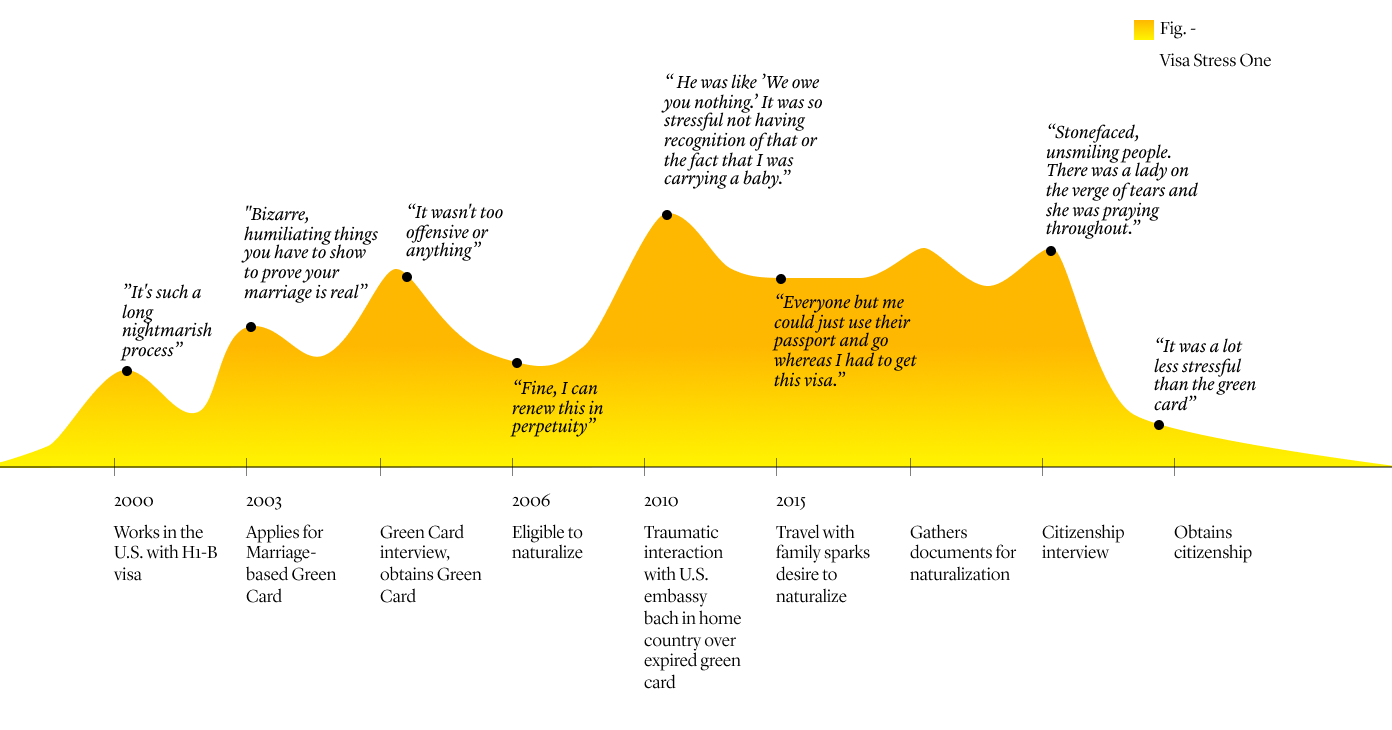
A bad experience can create an expectation that other interactions will be bad as well. The example below shows a particularly traumatic event with immigration authorities.
"This is embarrassing to admit. One year I went to [home country] and I took an old Green Card with me. I didn't realize that I had my expired Green Card. And of course they wouldn't let me get on the plane. And it was hugely stressful because I had my infant daughter with me. My husband and my son had to come back. My son was a toddler at the time. He had to go back with him and sort it out. The individual at the American Embassy was, I mean, he was just so obnoxious and it was so stressful at the border. […] [He] was rude and tried to humiliate me, like 'Who do you think you are? Why would we let you go?' . […] It certainly does make me feel like the whole family needs to have one status, like they all have American passports. And I was the only one who didn't. That separation from my son…" Interviewee 9
Stress Caused by Behavior from Immigration Authorities
Many participants either heard or told us of their own horror stories about mistreatment interacting with immigration authorities. Some of these events were traumatic, even years later, and colored how interviewees felt about the government.
Stress Caused by Errors Made by Government Agencies
Some interviewees experienced complications in their applications due to their visa or Green Card application getting lost or information being interpreted incorrectly by immigration authorities. One interviewee brought up being stopped by CBP with his U.S. passport because CBP systems didn't have a record of him having naturalized. USCIS recommends applicants keep copies of their application in case it gets lost, causing one to wonder if it happens with enough frequency that it needs to be mentioned. In 2003, it was estimated that 11.3 percent of application documentation was lost at USCIS,2 and it's fair to assume that the number may have grown in recent years due to the lack of resources and increased backlog.
"They keep insisting that their record show that it was sent out therefore we're unable to give you a replacement. And that letter, I just got it like one or two weeks ago. So, I contacted [my immigration attorney] and I told her, 'So, what do we do now?' And she's like, 'You know, pretty much we're gonna keep fighting your case, but pretty much we have to just wait and see what the issue is and this and that.' And it’s frustrating because I was trying to … My wife she went to Mexico just for her … because her birthday is on October 11 so it’s the same month as my son, like a week apart. And so, we've been wanting to go out of the States for a vacation and haven't been able because I do need that Green Card." Interviewee 25
"I feel like I probably was fairly stressed about it. Even though everything was above board and very legitimate, what if someone who was interviewing me has a bad day and decides to just reject it?" Interviewee 9, on dealing with USCIS in general
Stress Caused by Misinformation
Some interviewees were confused about their visa and how to transition to a different one or to receive a Green Card and sought advice from friends or family. This advice was often incorrect, leading to visas being overstayed or working while under an incorrect visa. They never intended to get to that point, but when these interviewees sought information from USCIS, they were turned away.
"Initially, I got a lot of wrong information from people that were well … They had good intentions, I guess. People that tried to help me, but they were not really knowledgeable. […] A little bit of information there led to a lot of misinformation." Interviewee 3
Stress Caused by Green Card Class of Admission
We noticed through the course of our interviews that marriage-based Green Card holders, the most common avenue to permanent residency, suffer from excessive stress when compared to other Green Card classes of admission. There is currently no research on naturalization rates and wait times per Green Card class of admission. This study found that female applicants sponsored by native-born citizens had higher likelihood of “visa depression” than other kinds of applicants. In our interviews, nearly all interviewees with marriage-based Green Cards described high anxiety and uncertainty in how to prove or what defines a “legitimate marriage.” Interviewees also told us how invasive and cold the process felt while preparing for and during the interview. One interviewee admitted how humiliated she felt to have to ask friends to write a letter proving the sincerity of her matrimony. Even after her Green Card approval, she couldn’t stop incessantly archiving evidence in case she needed to defend her relationship again. It would be worth looking further into classes of admission stress to better understand if it might impact LPR's wait to naturalize.
"I'm just so over that, having to constantly prove that it's a legitimate relationship, and it just turns it all into paperwork. So, I keep all this crap in my life. Like Christmas cards we get. I just hang in the back of my mind that I must always document our relationship, which is kind of a weird thing." Interviewee 7
Support Can Help Overcome Visa Stress Barriers
The role that nonprofits have had cheering applicants through the process can't be understated. Philanthropic investments have recognized this and supported national efforts to help LPRs apply. Those interviewees naturalizing with their help sounded excited and hopeful, even when they weren't entirely confident about their chances. The same can't always be said about lawyers. Even though their expertise provides applicants with overall confidence, many are too busy to soothe an applicant's anxieties during the long wait, leaving the applicant uneasy and, at times, distraught.
Visa stress goes down when LPRs have access to resources
This applicant's journey shows that one can be empowered to naturalize as soon as they can if they are reassured and have the help they need.
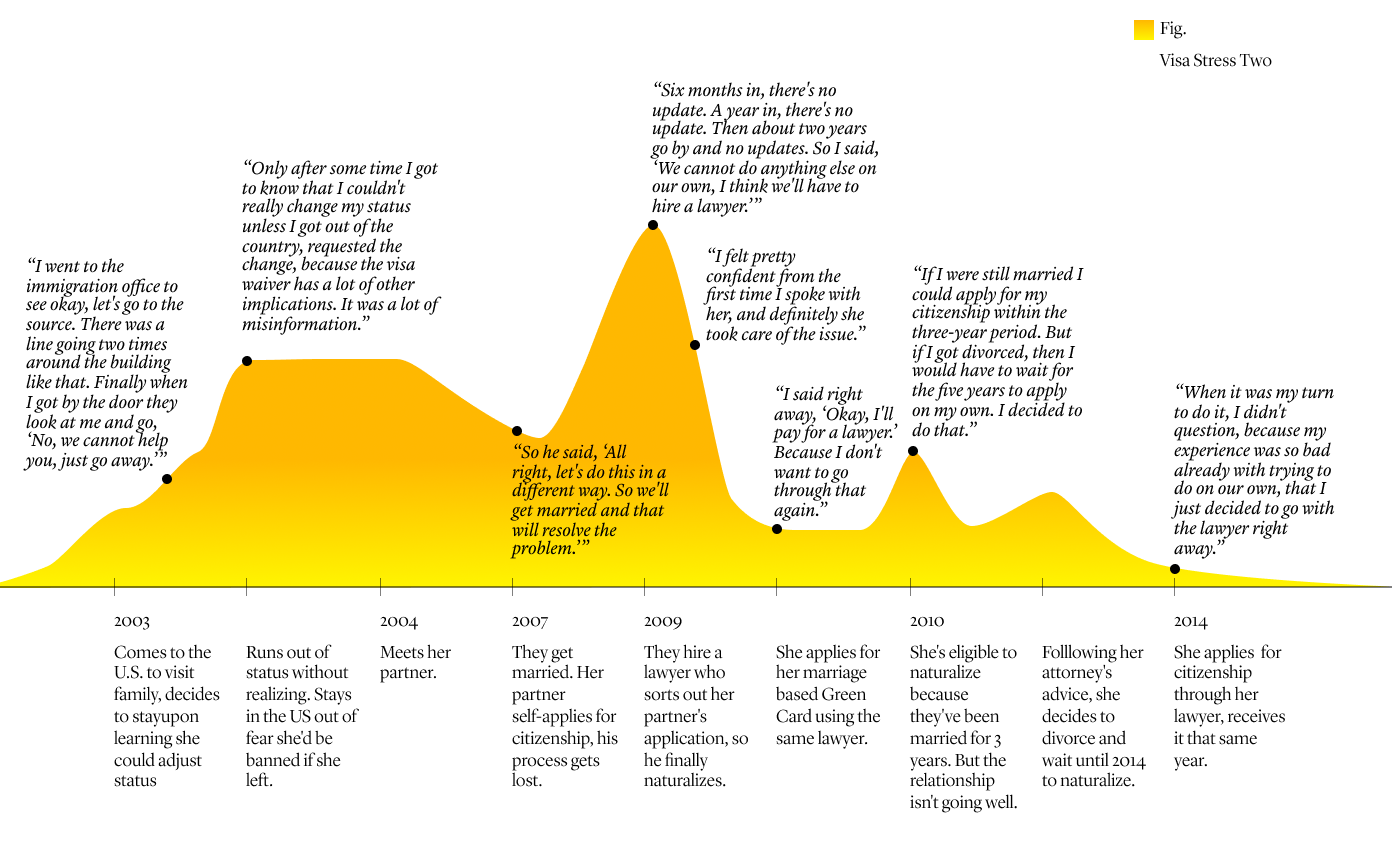
It is necessary to consider the arduous, potentially fraught journey toward the Green Card when attempting to persuade LPRs to naturalize. They may be able to overcome visa stress if they have resources like a lawyer or a nonprofit to assist them. Those with resources may even rush to naturalize so they never have to deal with immigration authorities again.
"[After the oath ceremony] I thought, I'm out. I'm done with this process. […] And I remember the process being very difficult and I speak the language. And I've had an education and all that, so never mind if you're paying for an attorney, fees, you don't forget things … It's just a very difficult process. For me, again, it was easy just because I could read, there's people around me that were helping me through the process, as well. But I go back to the 70 year-old couple trying to figure out what to do. Not speaking the language and not having the money for an attorney." Interviewee 15
Citations
- Jasso, Guillermina. "Migration and Stratification." Social Science Research40, no. 5 (2011): 1292-336. doi:10.1016/j.ssresearch.2011.03.007.
- source