
Understanding the Catalysts for Citizenship Application
Table of Contents
- Executive Summary
- Introduction
- Finding 1: Practical Urgency Drives Naturalization
- Finding 2: Voting is a Motivation, But Not Always a Catalyst
- Finding 3: Fear of Anti-Immigrant Policies Can Inhibit or Enable Action
- Finding 4: Traveling with a U.S. Passport is a Strong Benefit
- Finding 5: Stressful Immigration Interactions Delay Naturalization
- Finding 6: Support Helps Overcome Barriers
- Finding 7: The Naturalization Process is a Deterrent
- Finding 8: Common Milestones Are Underutilized
- Recommendations to Improve the Naturalization Process
- Recommendations for Nonprofits
- Recommendations for Groups Developing Naturalization Technology
- Recommendations for Local and State Governments
- Recommendations for the Federal Government
- Potential Intervention Points in the Immigration Journey
- Opportunities for Further Research
- Appendix: Testing
- Methodology
Abstract
In the report, we also outline a number of ways to improve the naturalization process. The recommendations are directed at government organizations, service organizations, lawyers assisting immigrants, and groups developing new technology for immigrant communities. Our goal is to make sure that these insights and recommendations are actionable tools for naturalizing lawful permanent residents throughout all levels of the immigration service ecosystem, and at each step in the journey to citizenship.
Acknowledgments
This work could not have been completed without the assistance of many of our peers. We’d like to call out special attention to the Immigrant Legal Resource Center, which leads the New Americans Campaign, and the National Partnership for New Americans for their tireless work in the naturalization community. We’d like to give them a special thanks for assisting us in our outreach and connecting us with the nonprofit organizations we worked with in creating this report. We’d also like to give thanks to the hundreds of local organizations that assist immigrants with the naturalization process every day.
We’d also like to thank the Massachusetts Immigrant and Refugee Advocacy Coalition, City of Boston Immigration Advancement Department, the Immigrant Learning Center, The Lenny Zakim Fund, Resurrection Project, Centro de Trabajadores Unidos, Erie House, Immigration Welcome Center, Coalition for Humane Immigrant Rights of Los Angeles, National Association of Latino Elected and Appointed Officials, New York Immigration Coalition, Immigration Policy Lab, Project Citizenship, Northern Illinois Justice For Our Neighbors, Mexican American Opportunity Foundation, Boat People SOS, Immigrants’ and Language Rights Center, South Asian Network, Los Angeles Diocese, the Welcome Project, Catholic Charities, Centro CHA, Asian Americans Advancing Justice – Los Angeles, BakerRipley, Korean Resource Center, CARECEN, the YMCA of Greater Long Beach, Houston Immigration Legal Services Collaborative, the New York City Mayor’s Office of Immigration Affairs, the City of Chicago Office of New Americans, DiRaimondo & Schroeder LLP, and Lewis Kappes. This work could not have been completed without your wisdom and guidance. Thanks for letting us better understand your work.
Finally, we would like to thank the Chan Zuckerberg Initiative for their generous support of this work. The views expressed in this report are those of its authors and do not necessarily represent the views of the Chan Zuckerberg Initiative, their officers, or their employees.
App icons made by Freepik from www.flaticon.com.
Downloads
Executive Summary
Several months ago, our team set out to learn more about the variables that affect naturalization decisions. The number of presumed eligible to naturalize lawful permanent residents in the United States is growing, with estimates of a population of 8.9 million individuals. Our research attempts to better understand what prevents a person from naturalizing, and to determine what effective strategies or outcomes are likely to catalyze a lawful permanent resident to take action.
Over the course of several months, we interviewed 63 immigrants and naturalized citizens and surveyed 117 citizenship workshop attendees and identified patterns and sentiments that deepened our understanding of how people decide to naturalize.
Practical urgency drives naturalization.
Catalysts are events or processes that assist individuals in overcoming obstacles around naturalizing. For many, there is greater urgency in receiving permanent residency than citizenship — until an experience uncovers a tangible reason to naturalize.
Voting is a motivation, but not always a catalyst to naturalize.
Civic engagement is an appealing benefit for lawful permanent residents, but they often naturalize for more practical reasons. This is not always the case, as presidential election years result in spikes in naturalization applications, but there are steep declines in off years.
Fear of anti-immigrant policies can inhibit or enable action.
Immigrants from all backgrounds understand that they can be targeted by the next wave of policy changes, which for some causes action, while others see a barrier. Even interviewees from countries of origin that are not targeted by the Trump administration’s most aggressive rhetoric and policies were affected.
Traveling with a U.S. passport is a strong benefit to naturalization.
Naturalization can be beneficial to cross U.S. borders safely, travel without having to obtain additional visas, be able to be abroad without the limitations of the Green Card, and more. There are distinct benefits that will interest different groups of people.
Stressful interactions delay naturalization.
Lawful permanent residents who previously had a difficult interaction with a government immigration official worry that their naturalization experience will be similarly difficult. Access to resources can help mitigate that fear, but it’s important to consider past experiences when assisting immigrants.
Support helps overcome barriers.
Immigration is a deeply personal subject, but everyone appreciates and benefits from encouragement. Nearly half of our interviewees identified a family member or friend who had a positive impact on their journey.
The naturalization process is a deterrent.
Application length and complexity fuel procrastination while the fear of the interview plagues applicants, regardless of their confidence. The process was opaque to some of the interviewees we spoke with, but the strenuous requirements impact immigrants’ attitudes and confidence toward naturalization.
Common milestones are underutilized.
There are times when immigrants may consider citizenship, but USCIS and other organizations miss opportunities to better inform or remind them. These opportunities are common among LPRs and create clear opportunities for engagement and education.
In the report, we also outline a number of ways to improve the naturalization process. The recommendations are directed at government organizations, service organizations, lawyers assisting immigrants, and groups developing new technology for immigrant communities. Our goal is to make sure that these insights and recommendations are actionable tools for naturalizing lawful permanent residents throughout all levels of the immigration service ecosystem, and at each step in the journey to citizenship.
Introduction
There are currently an estimated 8.9 million lawful permanent residents (LPRs) who are eligible for naturalization in the United States.1 LPRs are non-citizens who have been authorized to live in the United States and may potentially naturalize to become a U.S. citizen. Naturalization offers many benefits, including protection from deportation, access to government jobs and social benefits, the ability to sponsor family members, the ability to vote, and freedom to travel abroad for extended periods of time without losing status. It is also correlated with a boost in wages and home ownership, access to better jobs, and improved general outcomes.2
However, the number of eligible LPRs, which refers to LPRs who meet the naturalization requirement of having a Green Card for five years, that apply to naturalize could be higher. Naturalization applications hover around 750,000 in non-presidential election years, meaning that a large number of eligible LPRs are not applying. Without additional intervention, the growing backlog and mounting anti-immigrant policies from the current federal administration will further decrease the number of immigrants that make it through the process.
We know a lot about eligible LPRs from quantitative studies: According to a Center for Migration Studies report from 2015,3 nationals from Mexico, India, China, and Canada represent the largest population of eligible to naturalize LPRs, with Mexico, Canada, El Salvador, Guatemala, and Brazil naturalizing at the lowest rates in comparison with their overall LPR population. In addition, the report mentions: “High percentages of eligible LPRs have lived in the United States for more than 10 years (78%); are age 35 or older (74%); are married (64%); speak English well, very well, or only English (65%); have access to both a computer and the internet (74%); earn income above the poverty level (79%); and have health insurance (72%).” Eligible LPRs tend to live in major urban areas.4 We also know that the longer they wait in LPR status to naturalize, the less likely they are to do it.
It's not that LPRs reject the idea of naturalization. A vast majority of immigrants (80-90 percent) want to become U.S. citizens.5 Motivations vary, and include securing legal rights, the ability to travel with a U.S. passport, and sponsoring family members. One study found that, “Among the 18% of Latino foreign-born U.S. citizens who identify civil and legal rights as their main reason for naturalizing, about seven in ten (72%) cite gaining the right to vote.”6 This may explain why election years have historically seen an increase in naturalization rates.
Many of the barriers to naturalization have been known for a long time: cost, difficulty in mastering the English language, the information gap between the complex requirements and immigrants’ understanding of them, and concern over losing country of origin citizenship. Increased fear of anti-immigrant policies and rhetoric from the new administration is a relatively new barrier. To combat this, advocacy groups, state governments, and municipalities interested in increasing naturalization rates have tried boosting outreach with immigrant communities; running citizenship workshops, where large groups of LPRs gather to receive free or low-cost assistance from a nonprofit with their naturalization applications; offering free ESL classes; and working to dispel anti-immigration misinformation and fear. Tools centered on improving the usability of the application submission or facilitating the citizenship workshop model have been successfully used by some nonprofits to supplement available resources, and continue to evolve. For example, the New Americans Campaign has developed toolkits, technology, and tools such as a fee waiver calculator. Increasing awareness of the fee waiver and offering payment alternatives, like the NaturalizeNY voucher provided to those who don't qualify for the naturalization fee waiver offered by USCIS, has had mostly positive results.7
A large portion of this population is not affected solely by cost or English proficiency barriers, but some barriers are still unclear, and the naturalization numbers remain stubbornly low relative to the number of eligible LPRs. A 2015 survey indicates "Language or Personal Barriers" and "Have not tried yet or not interested" as the two most common reasons preventing Mexican LPRs from naturalizing, leaving a lot of room for interpretation as to why eligible LPRs don’t naturalize or wait to naturalize and what their personal barriers might entail.8
With motivations and some barriers known, and many initiatives meant to diminish barriers attempted with various levels of success, some questions still remain: What are the unknown barriers to naturalization? What causes an eligible LPR to take action, and what stops them? What else can be done to naturalize more people in the United States?
To answer these questions as public interest technologists, designers, and researchers, we followed a Design Thinking framework, whereby user research is designed to inform the brainstorm and features of (typically digital) products and services, and rapid prototyping is meant for testing as many ideas as possible, as quickly as possible. The goal is to provide actionable insights, recommendations, and tried-and-tested tools for naturalizing eligible LPRs at all levels of the immigration service ecosystem, and at each step in the journey to citizenship.
Our Approach
Since our research problem is explorative and covers a broad topic, our team used multiple qualitative methods to uncover and dig deeper into patterns. In five months, we conducted 63 directed interviews, spoke with over 20 subject-matter experts, conducted 117 in-person surveys, and completed 22 testing sessions.
Our conversations covered a range of perspectives from the immigration ecosystem including nonprofits, city/state government agencies, lawyers, immigrants, and their family members. However, all of our 63 interviews were with immigrants who are, were, or will be (in the next three years) eligible for naturalization. After each interview, we sifted through the motivations a person experienced in their desire for citizenship. We discovered that a large number of applicants went through a catalysting event or process that ultimately assisted them in overcoming obstacles around naturalizing—what we called catalysts. These catalysts differed from motivations because they were often the primary element responsible for direct action toward naturalization. For example, an eligible LPR may know they should secure their right to stay in the United States (their motivation), but they may not feel pressure to initiate their citizenship application until an upcoming Green Card renewal—their catalyst. We also investigated barriers to naturalization, which were events or situations that stopped someone from naturalizing. These were different from concerns, which tended to be issues LPRs foresee in their naturalization applications but nothing that would stop them from applying.
Citations
- Lee, James, and Bryan Baker. Estimates of the Lawful Permanent Resident Population in the United States. PDF. Department of Homeland Security, Office of Immigration Statistics, January 2014.
- Population, Committee On., Education, Division of Behavioral and Social Sciences and, Engineering National Academies of Sciences, Mary C. Waters, and Marisa Gerstein. Pineau. The Integration of Immigrants into American Society. Washington, D.C.: National Academies Press, 2016.
- Warren, Robert, and Donald Kerwin. "The US Eligible-to-Naturalize Population: Detailed Social and Economic Characteristics." Journal on Migration and Human Security3, no. 4 (2015): 306-29. doi:10.14240/jmhs.v3i4.54.
- "Interactive Map: Eligible-To-Naturalize Populations in the U.S. (2016) Center for the Study of Immigrant Integration (CSII) at USC USC Dana and David Dornsife College of Letters, Arts and Sciences." Center for the Study of Immigrant Integration (CSII) at USC USC Dana and David Dornsife College of Letters, Arts and Sciences. Accessed March 26, 2019. source.
- Population, Committee On., Education, Division of Behavioral and Social Sciences and, Engineering National Academies of Sciences, Mary C. Waters, and Marisa Gerstein. Pineau. The Integration of Immigrants into American Society. Washington, D.C.: National Academies Press, 2016
- Taylor, Paul, Ana Gonzalez-Barrera, Jeffrey S. Passel, Mark Hugo Lopez, Paul Taylor, Ana Gonzalez-Barrera, Jeffrey S. Passel, and Mark Hugo Lopez. "III. Who Naturalizes: Reasons for Naturalizing." Pew Research Center's Hispanic Trends Project. November 14, 2012. Accessed March 26, 2019. source.
- Hainmueller, Jens & Lawrence, Duncan & Gest, Justin & Hotard, Michael & Koslowski, Rey & Laitin, David. (2018). A randomized controlled design reveals barriers to citizenship for low-income immigrants. Proceedings of the National Academy of Sciences. 115. 201714254. 10.1073/pnas.1714254115.
- Gonzalez-Barrera, Ana, and Ana Gonzalez-Barrera. "Mexicans Among Least Likely Immigrants to Become American Citizens." Pew Research Center's Hispanic Trends Project. June 04, 2018. Accessed March 26, 2019. source.
Finding 1: Practical Urgency Drives Naturalization
For many, there is greater urgency in receiving permanent residency than citizenship—until an experience uncovers a tangible reason to naturalize.
Many immigrants share the notion that a Green Card is enough. Many of our interviewees identified a lack of urgency, competing priorities, or already feeling American as reasons for waiting to naturalize. The Green Card was seen as the challenge that needed to be overcome, because the benefits of permanent residency are tangible and urgent for many when compared to the limitations of visas. Having greater (or any) ability to work, fewer restrictions on travel in or out of the United States, and access to benefits are primary necessities. It’s understandable that immigrants will prioritize obtaining the Green Card even though it's such an arduous process.
Most interviewees understood that citizenship allows them to civically engage in society and said it was important to them. Pew Hispanic Center research states that "among the 18% of Latino foreign-born U.S. citizens who identify civil and legal rights as their main reason for naturalizing, about seven in ten (72%) cite gaining the right to vote."1 But for many, other needs take precedence over obtaining citizenship such as moving, having children, divorcing, and finding a job. For some, this lack of urgency, combined with the complexity of the naturalization application, causes the potential applicant to procrastinate. Additionally, many of those raised in the United States felt sufficiently "American," so connected to society and resources that they were only rarely reminded of their lack of citizenship. For these individuals, citizenship did not feel necessary to be a part of this country. Others perceived that naturalizing would result in a loss of connection with their motherland, even when they were able to keep dual citizenship.
"[Citizenship is] a nice-to-have, it wasn't a necessity. Getting the Green Card is a necessity, you wanna be a permanent resident." Interviewee 11
"It was hardly something I thought about. It's the kind of thing where back then, really, when did you think about it? You thought about it when you were traveling. You thought about it, maybe for me, applying for college, applying for … you're checking boxes. […] Yeah, like basically I felt like I was American in every way except for the technicality." Interviewee 63
What often bursts this bubble is when the Green Card is no longer enough. While interviewees aspired to becoming citizens to be able to vote and fully participate in society, the catalyst that got them to take action often mapped onto a moment when a citizenship benefit felt tangible to their lives. This could happen through learning about a benefit described in the context of their lives, or seeing naturalized peers enjoy one or more advantages. Now recognizing that the benefits outweigh the barriers, this moment often empowered eligible LPRs to take action and apply.
Understanding Naturalization Benefits While Traveling
Many interviewees mentioned they first started thinking about citizenship while traveling, when they noticed the difference between having a U.S. passport and their home country passport. This usually meant having to obtain a visa to visit a certain country while a U.S. citizen counterpart didn't need one, or wasn’t put through a separate line and scrutinized by an immigration officer at a U.S. port of entry.
"I met [my partner] and then he started working in London and Paris. As somebody who didn't have a U.S. Passport, every time I wanted to go there I had to apply for a visa, to go to Europe. And he was telling me that if you're a U.S. citizen then you don't need a visa every time. So that was kind of the motivating day for me […] that I should become a citizen." Interviewee 11
"My colleagues were like, 'Hey, let's go to Canada.' We took a day to go and have fun, but then those who had American passports, had an easy pass and I decided to, okay, I think it's about time to do stuff like that." Interviewee 16
"I had a DUI on my record […] I got detained at the Miami airport for 5 hours. […] My kids were with me, we were in a room waiting. They asked me questions and eventually asked if I had any encounters with the police. […] This year I traveled to El Salvador. Going through immigration in LA, an officer from Puerto Rico, very nice, told me that the only way that this wouldn't happen again was if I naturalized. […] This motivated me." Interviewee 56
Naturalizing for Family
Interviewees with foreign-born families were often driven to naturalize as a result of pressure from their families. Naturalized citizens can petition for Green Cards for their immediate family and, in most situations, their LPR children naturalize automatically if one of the parents is naturalized by the time they turn 18. A few people we interviewed in citizenship workshops mentioned attending because of pressure from their underage children, who worried they would need to go through the naturalization process if their parents failed to naturalize.
"Well part of it was then I had a decision I'm staying. The second part was I thought that with my citizenship perhaps I could help my own family if anyone wanted to be here. That process actually the only person affected was my father, because my mother didn't want to come here. My sister still doesn't want to come." Interviewee 3
Naturalizing for Better Opportunities
Some interviewees reported they started working on their application when they realized their careers depended on it — they wanted a government job that required citizenship. One of the interviewees, a former diplomatic liaison in his country, felt that his career could only continue in the United States if he worked for the U.S. State Department. He enlisted in the Army with the sole goal of obtaining his citizenship as early as possible. Others with more options may not act with the same urgency.
"It's just one of those things that I felt like I was walking away from my country. […] Then, what made me decide to do it was […] I started to think about going on the job market and then applying for future grants. I knew I was going to go into academia, and even though I knew that most of the things that I would be applying for I could probably apply for as a resident, there were some things that were only for citizens, and at some point I just decided that I didn't want to be constrained by anything to pursue my career and what I wanted to do with my life." Interviewee 63
"So when I got on the fire department I went step further to go apply for FEMA. […] That's the reason I got my citizenship, […] that's it." Interviewee 23
"Basically what I was doing before I immigrated was kind of liaising between U.S. diplomats and government officials [in my home country] and also politicians, members of parliament, elected officials, and stuff like that. I kind of wanted to carry on that line of work, but it's kind of tough to get into a government level job without U.S. citizenship." Interviewee 46
Naturalizing to Simplify Documentation Needs
The practicality of the benefit could come into play when the LPR is addressing identification and documentation needs, like when the Green Card or a home country passport expires and they need to renew it. Many interviewees decided to naturalize instead of renewing their Green Card to save money in the long run. Another context in which naturalization came up frequently was when their home country passport was about to expire. Interviewees weighed if having a U.S. passport would mean fewer documents to handle and lower fees to pay upon expiration. For these individuals, naturalization came down to a clerical decision, a way to make traveling and identification proof easier and even cheaper.
"It seems like the natural process is just to apply for your passport [citizenship]. You don't have to deal with it, you know. You have to do one or the other. You renew your Green Card or you apply for your citizenship, and it's a couple of questions on a test, so why not?" Interviewee 15
"[I started thinking about citizenship] just because my passport my Japanese passport is expiring next February. So the Green Card is good till 2022 so it's really another three years. […] And then to request for U.S. citizenship it's just a matter of you know time and a hundred and fifty dollars difference. And so should I go. No passport for a while and let my Japanese passport expire and then just become a U.S. citizen." Interviewee 1
Naturalizing Upon Learning About the Fee Waiver
Some interviewees’ catalyst to naturalize was tied to learning about the fee waiver and discovering they were eligible for it. Many of our interviewees weren't aware of the fee waiver, and showed a high level of interest when we mentioned it. Removing the cost barrier of citizenship seemingly made all other efforts to naturalize easier to overcome.
"She helped me to fill some kind of waiver so I don't have to pay for the citizenship. I think this help me also to take the decision in this moment because I don't have to pay for the citizenship. […] When she prepared my taxes, she tell me if I want to become citizen, she can help me to apply for the waiver." Interviewee 17
Pragmatic Catalysts and Motivations are Difficult to Discuss
Some interviewees were conscious of the practicality of their desire to naturalize, but not always. Through the course of the research, we got used to digging deeper, since the primary motivation or the catalyst was not always top of mind for those interviewed. Messaging around the pragmatic benefits was mostly successful, but some interviewees still felt that citizenship shouldn't be pursued just for its benefits, even when they themselves acquired citizenship for pragmatic reasons. While the actual catalysts and reasons to naturalize may be practical in nature, some LPRs still feel a sense of belonging when thinking about what citizenship means to them.
For some, the practicality around citizenship was not immediate. Over time, the tangibility of a benefit became more real as they had children, developed careers, and felt like their "life is here."
"You just sort of get … You know, you're here, you make your friends. I don't think I'm … I mean, however many years I've been here, over 20 now, it's … I don't know that I still wanna stay here. I think you meet somebody, I've worked here, I went to school here, events, just one rolled into the next one. And you keep staying here." Interviewee 15
"I really love living here, it was the first time in my life that I felt like this is my city. This is the place that I wanna be. So as soon as I got my Green Card, I already started my mental countdown for my five years to apply for citizenship. Because again, even though Green Card it's way safer than being on a visa and gives you a bunch of other rights, you're still not fully in the country, in a way." Interviewee 45
It’s clear that there are many benefits to naturalizing, but it often takes more than just knowing the benefits exist to go through the arduous application process. Interviewees identified practical benefits that increased their urgency to apply, which should be used in future messaging to make clear that there are benefits worth naturalizing over.
Citations
- Taylor, Paul, Ana Gonzalez-Barrera, Jeffrey S. Passel, Mark Hugo Lopez, Paul Taylor, Ana Gonzalez-Barrera, Jeffrey S. Passel, and Mark Hugo Lopez. "III. Who Naturalizes: Reasons for Naturalizing." Pew Research Center's Hispanic Trends Project. November 14, 2012. Accessed March 26, 2019. source.
Finding 2: Voting is a Motivation, But Not Always a Catalyst
Civic engagement is an appealing benefit for LPRs, but they often naturalize for more practical reasons.
Voting is a particularly intriguing motivator because of how often it comes up in surveys as a primary factor in the decision to naturalize.1 Our interviewees didn't bring up voting or civic engagement with the same enthusiasm. Of all interviewees who were naturalized or applying, voting never came up as a naturalization catalyst and only rarely came up as a primary motive. Many interviewees brought up the ability to vote against the current administration as the catalyst to naturalize — this was usually first as a means of protection against deportation, and secondarily as protection through the ability to vote in future elections. Two individuals who didn't fear anti-immigration policies brought up voting as their primary motivation, and both let many elections go by without naturalizing after reaching eligibility.
This doesn’t mean that an ability to vote doesn’t affect naturalization applications. There are application spikes that occur during Presidential election years, which could be due in part to increased messaging and outreach. This also doesn't mean that civic engagement isn't important to immigrants — quite the opposite. It is often mentioned as a secondary benefit to more practical issues.
"It was actually in the context of voting […] I want to say it was second term for Clinton, I wanted to [naturalize]. I was thinking about it so that I could then participate in the next election. […] How do I put this, it's not like you don't think about it at least once a year kind of thing if you know what I mean. It's always in the back of your mind, should I do this, shouldn't I and it's early in our marriage. It was about 'okay I should do this' because we're gonna have kids maybe. Then we weren't gonna have kids by ‘97, we knew that." Interviewee 59
“Some of it was laziness of knowing that I could work and I don't need citizenship yet for any of those particular reasons. Some of it was life chaos moving up here, having a lot going on relationally, and just not prioritizing it. I always knew I wanted to become a citizen. I wanted to be able to vote. […] With the administration doing what it was doing and realizing I could not travel or did not feel safe traveling and being able to come back easily, that helped push me towards, ‘All right. Let's get this process going.’" Interviewee 4
Voting provides an effective motivator but doesn't rise to the surface when making the calculus to go through the onerous naturalization process. This may require rethinking on outreach communicated by nonprofits and government organizations that wish to assist in naturalization — moving away from civic-minded benefits to more practical benefits of citizenship, like the ability to apply for and receive a U.S. passport.
Citations
- Gonzalez-Barrera, Ana, Mark Hugo Lopez, Jeffrey S. Passel, Paul Taylor, Ana Gonzalez-Barrera, Mark Hugo Lopez, Jeffrey S. Passel, and Paul Taylor. "III. Who Naturalizes: Reasons for Naturalizing." Pew Research Center's Hispanic Trends Project. February 04, 2013. Accessed March 26, 2019. source.
Finding 3: Fear of Anti-Immigrant Policies Can Inhibit or Enable Action
Immigrants from all backgrounds understand that they can be targeted by the next wave of policy changes—which for some causes action, while others will see it as a barrier.
As we planned our research, we did not fully appreciate the degree to which the Trump administration’s rhetoric, from the 2016 campaign cycle to its current anti-immigrant policymaking, had affected the psyche of the immigrant community. There are often naturalization petition spikes around galvanizing moments, like election years, that return to “normal” rates hovering around 750,000 afterward. However, there was no comparable drop during fiscal years 2016 and 2017, which saw 972,151 and 986,851 naturalization petitions, respectively.1 Many of the subject matter experts and interviewees we spoke with pointed to the Trump administration and its administrative policy changes as cause for the increase. While not conclusive, research has shown a correlation between anti-immigrant policies and an ability for grassroots organizations to turn fear into a call-to-action for naturalization as protection.2
Initial data indicates that this spike is beginning to fall. Many LPRs understand that naturalization affords them protection against these policies, but there is growing anxiety about the increased difficulty of the naturalization process and forthcoming changes to immigration policy. Currently, immigrants applying for Green Cards must not be found likely to become primarily dependent on the government for subsistence, a concept called “public charge.” Green Card holders can access many of the same social benefits as citizens and many benefits are not considered for public charge purposes. But in 2018, the Trump administration proposed a public charge rule that would make it much harder to meet the public charge test for Green Card applicants. The rule is just a proposal, but counterfactual rumors began circulating that the rule would also affect those seeking to naturalize. Federal rulemaking is complex and takes time, but the reaction to rumors on changes to the public charge rule have heavily impacted the immigrant community. We heard from many subject matter experts that mentioned the harm created by the public charge rumors led to drops in attendance at citizenship clinics, classes, and nutritional programs3 — some of which are unrelated to any government service.
Fear and concern around changes from the administration were felt most profoundly by people from Hispanic or Middle Eastern countries of origin. However, this fear was recognized widely and a number of interviewees from other countries were also worried about how anti-immigrant policies could change and target them. Fears vary wildly, from an uncertainty as to whether they would be allowed back into the country if they traveled abroad to a fear that the administration would revoke a person’s citizenship. It is clear that these fears did not exist to this degree before President Trump took office.
“Like I need to leave or I need to go to Mexico on May next year, and I'm not going to take my daughter with me. I'm kind of worried that while I'm in Mexico, Trump is going to be like we don't like Mexicans anymore, don't let them come back.” Interviewee 26, informing us why they don’t feel safer with a Green Card.
While the naturalization case backlog increases4 and policies work through the halls of Washington, LPRs are rethinking how they feel about naturalization. Some informed us that they would not apply while President Trump was in office for fear of making a simple mistake on their application. Among some, there is also an unease of what it now means to become American.
“Then, at the point where I was ready to do it again, it's just that that took a really long time, and then Trump got into office, and some new regulations have been put in place that make me very nervous about applying now, so I'm kind of thinking of waiting until the next administration.” Interviewee 7
Anti-immigrant policies may cause a set of LPRs to act, but may also leave a large number of them increasingly vulnerable. Many nonprofits are already adjusting their outreach to be more explicit about what policies are being enacted and how they affect different kinds of immigrants, but more will need to be done to break through rumors and misinformed reporting, in addition to finding ways to deepen social safety nets.
Citations
- "Table 20. Petitions for Naturalization Filed, Persons Naturalized, and Petitions for Naturalization Denied: Fiscal Years 1907 to 2017." Department of Homeland Security. October 02, 2018. Accessed March 26, 2019. source.New Americans Campaign Fact Sheet on Naturalizations. PDF. The New Americans Campaign, October 31, 2017.
- "Cort, David A. "Spurred to Action or Retreat? The Effects of Reception Contexts on Naturalization Decisions in Los Angeles." International Migration Review46, no. 2 (2012): 483-516. doi:10.1111/j.1747-7379.2012.00894.x.
- Evich, Helena Bottemiller, Natasha Korecki, Quint Forgey, and Rebecca Morin. "Immigrants, Fearing Trump Crackdown, Drop out of Nutrition Programs." POLITICO. September 04, 2018. Accessed March 26, 2019. source
- Iñiguez-López, Diego. "Tearing Down the Second Wall: Ending USCIS's Backlog of Citizenship Applications and Expanding Access to Naturalization for Immigrants (Third Addendum to Second Wall Report)." IssueLab. July 02, 2018. Accessed March 26, 2019. source State of New American Citizenship – A Boundless Report." Boundless Immigration. Accessed March 29, 2019. source.
Finding 4: Traveling with a U.S. Passport is a Strong Benefit
Naturalization can be beneficial to cross U.S. borders safely, travel without having to obtain additional visas, be able to be abroad without the limitations of the Green Card, and more—different benefits interest different people.
Having the U.S. passport was overall the most common motivation to acquire citizenship after security from anti-immigration policies. The U.S. passport brings many benefits that are seen distinctly by different eligible LPRs: Green Card holders go through separate lines from U.S. passport holders when crossing U.S. borders and can suffer more scrutiny in that moment; U.S. passport holders can visit many countries without having to get (and pay for) a visa, while nationals from certain countries are not afforded the same mobility; LPRs are required to reside in the United States and avoid long absences, or otherwise risk losing their Green Card, and when traveling need to be readmitted if they leave the country for more than 180 days, while citizens are allowed to stay outside of the United States indefinitely.
These benefits were so important that some interviewees referred to citizenship and a U.S. passport interchangeably. We identified a number of travel-motivated archetypes during our research based on the advantages offered by a passport, such as LPRs who are afraid to cross the border, parents afraid to be separated from their family while traveling, those who want to travel easily with as an American citizen, and individuals who may stay abroad for long durations.
Regardless of the varied desire to travel, a shared need among these immigrant types is the American passport. Adjustments to outreach, emphasizing the passport benefit over civic-minded benefits, and describing specifically what benefits the passport brings may be helpful in convincing immigrants to undergo the difficult process of naturalizing.
Travel Archetypes
Fearful Traveler
"What if they stop me?"
This LPR traveler visits their home country frequently, but doesn't necessarily do a lot of travel outside of that. Has no children.
Motivated to naturalize by: Fear of getting Green Card scrutinized at a U.S. port of entry for a random reason.
Travel behavior: Travels back to visit family in home country frequently. Unlikely to want to visit many other countries.
Potential catalysts: U.S. port of entry conversation with CBP officer
"With the [Trump] administration doing what it was doing and realizing I could not travel or did not feel safe traveling and being able to come back easily, that helped push me towards, 'All right. Let's get this process going.' […] I wanted to travel to Israel last year. My partner and I were talking about going and we were getting very close to buying our tickets and then the travel ban was coming up like, "I don't feel safe doing this right now." […] I decided not to travel. I'm going in November [2018] instead. I have my ticket." Interviewee 4
Fearful Traveling Parent
"What if I’m separated from my family?"
The LPR parent that travels with their (U.S. citizen) family frequently worries about a scenario where they can't reunite with their children.
Motivated to naturalize by: Fear of getting separated from partner and children and deported if their Green Card gets scrutinized at a U.S. port of entry.
Travel behavior: Travels back to visit family in home country frequently with their family. Unlikely to want to visit many other countries.
Potential catalysts: Walking through a separate line from family when entering a U.S. port of entry.
"I'm very aware that if Trump decides that Mexican nationality is not longer welcome. My Green Card could be revoked when the border ban change. So I don't want to be in that situation to be in Mexico and my kids and my husband in the U.S. without me." Interviewee 26
Jetsetter
"I want to optimize my travel."
Affluent, educated, travels frequently for work or for leisure. They're originally from countries with low passport mobility, and often need to apply for visas.
Motivated to naturalize by: Avoiding long lines at a U.S. port of entry; Having to obtain visas to visit other countries with their home country passport
Travel behavior: Travels all over the world, frequently. Possibly for professional purposes.
Potential catalysts: Planning travel and realizing that getting the visas are expensive and time-consuming; Going through a U.S. port of entry and seeing U.S. citizens walk through it faster.
"Being a citizen, you have so many doors open to you. But I will say traveling was my number one. I didn't have to get … Even going back to London, I had to get visa before even with Green Card you need a visa you know? […] I just wanted to travel and I used to travel a lot those days. With American passport I can go everywhere." Interviewee 16
Frequent
"I want to spend a long time abroad."
They want be outside of the United States. for a work opportunity, to be with their family abroad, or just to live somewhere else for a while. They aim to live in the United States. again eventually.
Motivated to naturalize by: Time abroad limitations of the LPR mean that, if they stay away for too long, their Green Card will be put at risk.
Travel behavior: Desires to split time between United States and another country. If doing that while on Green Card, worries about losing LPR status. Needs a plan to naturalize.
Potential catalysts: Achieving eligibility; Family or career matters forcing them to travel for longer; a warning from a CBP officer regarding extensive travel while going through a U.S. port of entry.
"So one of the times when I left, I got really troubled with the immigration. They give me a really super hard time, to question me, 'Why you leave the country so long? You shouldn't really leave it so long,' all the questions. Ended up I have to wait for wait for the officer room for a few hours. So they warned me, 'If you continue doing this, we are going to take away your Green Card permanently.' So I have a call, right? So either I want to maintain the Green Card in the United States or I give it up. So I went back to Hong Kong, I evaluate whether I want to continue doing like this, and every time when you pass immigration you just afraid that you're going to have a problem, or I just move back here, and I think this is a good callings for me to make the decision to come back here, because deep down from my heart, I do want to stay here for good, in the future." Interviewee 10
Finding 5: Stressful Immigration Interactions Delay Naturalization
Lawful permanent residents who previously had a difficult interaction with a government immigration official worry that their naturalization experience will be similarly difficult, but access to resources can help mitigate that fear.
During our interviews we spoke with individuals about their personal history with immigration: what brought them to the United States, how they obtained their visas and residency, and interactions with the government. The stories we heard illuminated the stress of immigration bureaucracy. Similarly, surveys from 2003 indicated that 17.4 percent of new immigrants reported becoming depressed due to the visa process.1 We were curious about how going through a stressful or even traumatic experience with immigration authorities can affect someone's momentum to undergo the citizenship process — would this dissuade LPRs in any way?
Almost half of our interviewees (24 out of 55) described one or more events that qualified as pre-naturalization visa stress: moments that created unusual mental or emotional strain during their interactions with immigration authorities. Events that qualified as visa stress included documents lost by USCIS, misinformation leading to mistakes on an application, unusual processing delays, rude treatment at immigration agencies, borders, and consulates, visa or application denials, requests for evidence, and complications with Green Card processing due to an untimely divorce. We didn't include difficulties during citizenship applications because we were hoping to understand how incidents prior to applying may keep someone from starting their application. However, we did include two citizenship denials since the individuals interviewed were thinking about applying again. We also tracked experience with undocumented status, which refers to a non-citizen that is not authorized to live in or remain in the United States, separately from visa stress. Ethnic and immigrant discrimination, and the general stress of adjusting to life in a new country, weren't included in our definition of visa stress.
The Effect of Visa Stress in Naturalization
We noticed medium to long wait times (6 to 10+ years) to naturalize for interviewees who experienced visa stress, while those who hadn’t tended to naturalize more quickly. While these moments were not described as direct barriers to naturalization, they came up often as stories that illustrated how difficult it is it to deal with immigration agencies, likely contributing to the population’s overall distrust with immigration officials.
"When it was my time to [apply for citizenship], I didn't question, because my experience was so bad already with trying to do on our own, that I just decided to go with the lawyer right away." Interviewee 3
The Compounding Effect of Visa Stress
A bad experience can create an expectation that other interactions will be bad as well. The example below shows a particularly traumatic event with immigration authorities.
"This is embarrassing to admit. One year I went to [home country] and I took an old Green Card with me. I didn't realize that I had my expired Green Card. And of course they wouldn't let me get on the plane. And it was hugely stressful because I had my infant daughter with me. My husband and my son had to come back. My son was a toddler at the time. He had to go back with him and sort it out. The individual at the American Embassy was, I mean, he was just so obnoxious and it was so stressful at the border. […] [He] was rude and tried to humiliate me, like 'Who do you think you are? Why would we let you go?' . […] It certainly does make me feel like the whole family needs to have one status, like they all have American passports. And I was the only one who didn't. That separation from my son…" Interviewee 9
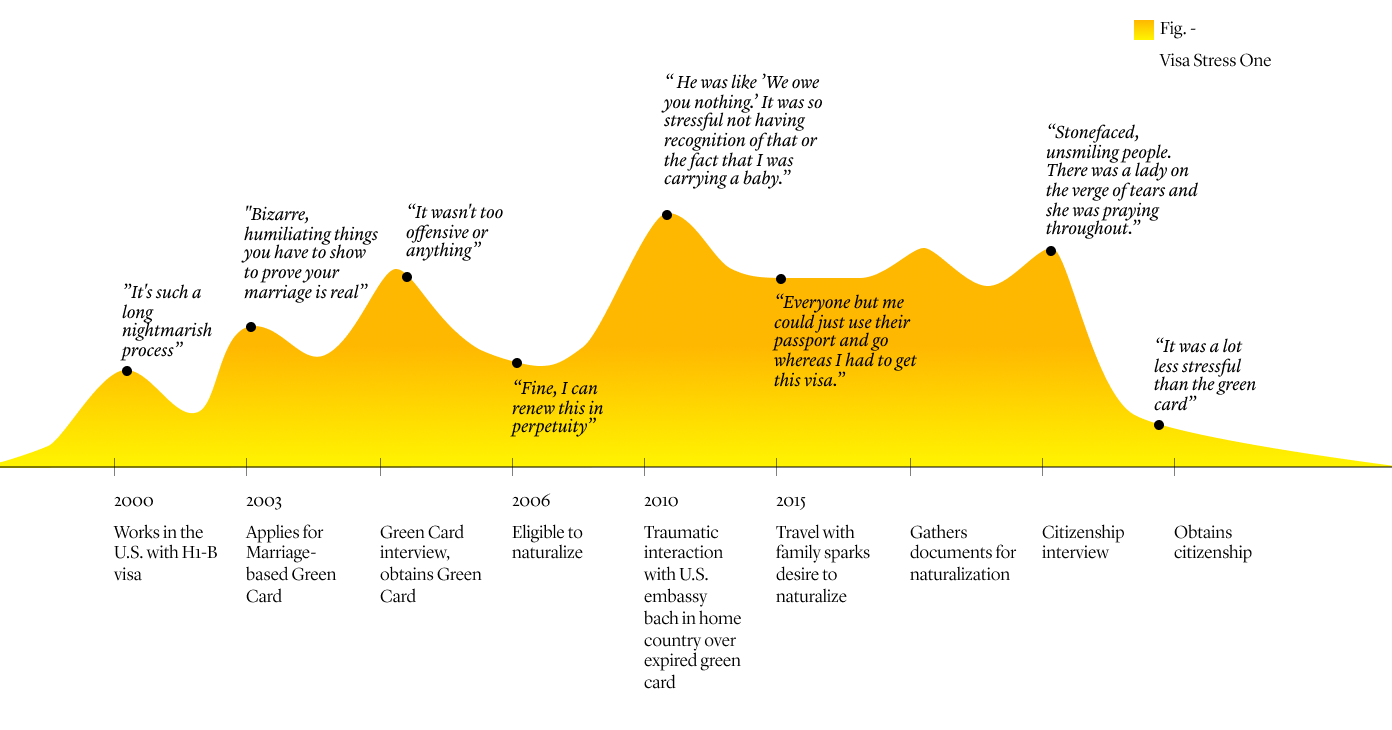
Stress Caused by Behavior from Immigration Authorities
Many participants either heard or told us of their own horror stories about mistreatment interacting with immigration authorities. Some of these events were traumatic, even years later, and colored how interviewees felt about the government.
Stress Caused by Errors Made by Government Agencies
Some interviewees experienced complications in their applications due to their visa or Green Card application getting lost or information being interpreted incorrectly by immigration authorities. One interviewee brought up being stopped by CBP with his U.S. passport because CBP systems didn't have a record of him having naturalized. USCIS recommends applicants keep copies of their application in case it gets lost, causing one to wonder if it happens with enough frequency that it needs to be mentioned. In 2003, it was estimated that 11.3 percent of application documentation was lost at USCIS,2 and it's fair to assume that the number may have grown in recent years due to the lack of resources and increased backlog.
"They keep insisting that their record show that it was sent out therefore we're unable to give you a replacement. And that letter, I just got it like one or two weeks ago. So, I contacted [my immigration attorney] and I told her, 'So, what do we do now?' And she's like, 'You know, pretty much we're gonna keep fighting your case, but pretty much we have to just wait and see what the issue is and this and that.' And it’s frustrating because I was trying to … My wife she went to Mexico just for her … because her birthday is on October 11 so it’s the same month as my son, like a week apart. And so, we've been wanting to go out of the States for a vacation and haven't been able because I do need that Green Card." Interviewee 25
"I feel like I probably was fairly stressed about it. Even though everything was above board and very legitimate, what if someone who was interviewing me has a bad day and decides to just reject it?" Interviewee 9, on dealing with USCIS in general
Stress Caused by Misinformation
Some interviewees were confused about their visa and how to transition to a different one or to receive a Green Card and sought advice from friends or family. This advice was often incorrect, leading to visas being overstayed or working while under an incorrect visa. They never intended to get to that point, but when these interviewees sought information from USCIS, they were turned away.
"Initially, I got a lot of wrong information from people that were well … They had good intentions, I guess. People that tried to help me, but they were not really knowledgeable. […] A little bit of information there led to a lot of misinformation." Interviewee 3
Stress Caused by Green Card Class of Admission
We noticed through the course of our interviews that marriage-based Green Card holders, the most common avenue to permanent residency, suffer from excessive stress when compared to other Green Card classes of admission. There is currently no research on naturalization rates and wait times per Green Card class of admission. This study found that female applicants sponsored by native-born citizens had higher likelihood of “visa depression” than other kinds of applicants. In our interviews, nearly all interviewees with marriage-based Green Cards described high anxiety and uncertainty in how to prove or what defines a “legitimate marriage.” Interviewees also told us how invasive and cold the process felt while preparing for and during the interview. One interviewee admitted how humiliated she felt to have to ask friends to write a letter proving the sincerity of her matrimony. Even after her Green Card approval, she couldn’t stop incessantly archiving evidence in case she needed to defend her relationship again. It would be worth looking further into classes of admission stress to better understand if it might impact LPR's wait to naturalize.
"I'm just so over that, having to constantly prove that it's a legitimate relationship, and it just turns it all into paperwork. So, I keep all this crap in my life. Like Christmas cards we get. I just hang in the back of my mind that I must always document our relationship, which is kind of a weird thing." Interviewee 7
Support Can Help Overcome Visa Stress Barriers
The role that nonprofits have had cheering applicants through the process can't be understated. Philanthropic investments have recognized this and supported national efforts to help LPRs apply. Those interviewees naturalizing with their help sounded excited and hopeful, even when they weren't entirely confident about their chances. The same can't always be said about lawyers. Even though their expertise provides applicants with overall confidence, many are too busy to soothe an applicant's anxieties during the long wait, leaving the applicant uneasy and, at times, distraught.
Visa stress goes down when LPRs have access to resources
This applicant's journey shows that one can be empowered to naturalize as soon as they can if they are reassured and have the help they need.
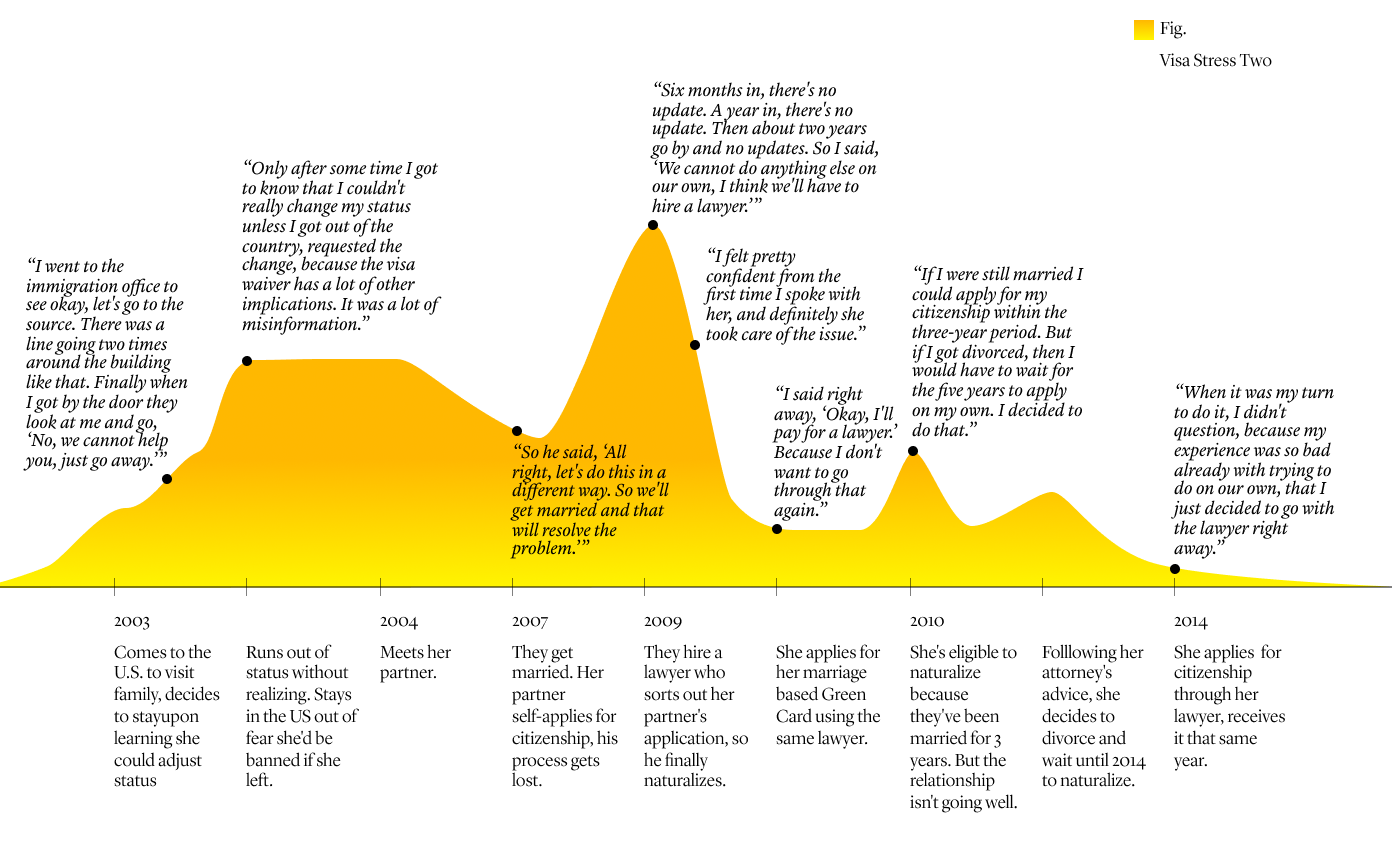
It is necessary to consider the arduous, potentially fraught journey toward the Green Card when attempting to persuade LPRs to naturalize. They may be able to overcome visa stress if they have resources like a lawyer or a nonprofit to assist them. Those with resources may even rush to naturalize so they never have to deal with immigration authorities again.
"[After the oath ceremony] I thought, I'm out. I'm done with this process. […] And I remember the process being very difficult and I speak the language. And I've had an education and all that, so never mind if you're paying for an attorney, fees, you don't forget things … It's just a very difficult process. For me, again, it was easy just because I could read, there's people around me that were helping me through the process, as well. But I go back to the 70 year-old couple trying to figure out what to do. Not speaking the language and not having the money for an attorney." Interviewee 15
Citations
- Jasso, Guillermina. "Migration and Stratification." Social Science Research40, no. 5 (2011): 1292-336. doi:10.1016/j.ssresearch.2011.03.007.
- source
Finding 6: Support Helps Overcome Barriers
Knowing loved ones can help or simply seeing others naturalize sparks many to apply and helps some overcome substantial barriers, such as low English proficiency or low confidence.
Throughout interviews with LPRs and naturalized citizens, we heard often about encouragement and pressure from loved ones before and during the application process. Additionally, exposure to another’s naturalization could motivate or inspire those eligible to move forward with citizenship. Almost half of our interviewees (22 out of 55) said family and friends’ support had a positive impact on their immigration journey. Twelve of these cited pressure from family and friends or witnessing a loved one naturalize as a catalyst to naturalize. General encouragement was the most universal method described, but we also heard accounts where pressure helped individuals continue on their application path.
"I have friends, they all did it. They just studied the questions and then they got naturalized and they're so happy. And, plus, a couple of years ago, it's like Trump became the President and some people are saying, “You don't know his policy.” So you want peace of mind. […] My family always pressured me to do it because they think your retirement or your benefits will be affected." Interviewee 62
“My family's reaction it (to me applying) was they're very happy and … just asking me why it took so long since my mom had done it on the fifth year anniversary. The anniversary of getting her Green Card, and so I think some of them thought that I took a little too long and other friends were just urging me and urging me to do it. So, it was actually because of a little bit of I would almost say like friendly bullying from some friends who were like, “Okay, you have the money, just go ahead and do it.” So, I promised them to do it the Monday after so, I kept my promise and obviously for my own good too.” Interviewee 28
"It was almost like college for us. My parents always assumed we'd become citizens." Interviewee 14
“He (my husband) made me fill out the form. He forced me. You do it and then I check and see if it’s correct…” Interview #22
For many, family members would help gather details or documents pertaining to family history and residences. Some supporters (usually spouses) would help interpret the application questions and review the applicant's answers. This need for review was prevalent even for applicants with high English proficiency or higher education. Other applicants were accompanied by a loved one to info sessions, classes, or citizenship workshops. A few people we interviewed were even applying with a loved one, such as their spouse. Once an applicant submitted their citizenship paperwork, many had help from loved ones to study for the civics quiz and prepare for the interview.
"Yeah, we sat together. We filled up the initial application and we followed up online to make sure she knew where everything was going. We thought it was a pretty smooth process. A couple of months later, I couldn't go with her to an interview, but I went with her when she was sworn as an American citizen." Interviewee S4
We also heard of applicants inquiring within their community for less intimate forms of support such as sharing first-hand accounts of what to expect or recommendations for lawyers and nonprofits. Personal referrals appear to generally be preferred as many individuals noted having a hard time ascertaining which sites or service providers were credible.
Of our interviewees who noted being supported, many came from mixed-status families who had a strong desire to ensure the entire family obtained U.S. citizenship for long-term security. However, we heard multiple times of family support from teenagers with more self-interested motives. These teenagers were also LPRs and wanted their parents to undergo the rigorous application process before they turned 18 so they could obtain citizenship automatically. We spoke to applicants at citizenship workshops who had tried unsuccessfully to pressure their LPR parent to naturalize and were now completing the process themselves. While dismayed at the arduous application, these individuals noted they would help their parent(s) once they completed their own citizenship application.
"We had a baby that was born here and our two children were U.S. citizens born abroad. She knew exactly what our objective was as a family, to make sure that we all were American citizens." Interviewee S4
"I remember just my mom crying and everything when we left the building and then I remember jumping for joy because I knew I was finally going to be in the United States with my father and just have a whole different life than we had down there. Our life wasn't that bad by any means, but we wanted our family to be together, and the only way we could do that was by traveling back here because my dad had already built a career up here in the land of opportunity." Interviewee 14
“My mom is a procrastinator and she's like you really should do that [naturalize.] But like she did it after me, so she's nuts… I honestly think it's just nerves…. I just knew she was way more stressed about it. I took care of her application.” Interviewee 6
Supporters Must Be Trusted
Since immigration and the details needed to apply for citizenship can be sensitive, the level of involvement was based on how intimate of a relationship the supporter had with the applicant. Most examples of support we heard included highly trusted family or friends and some of those that did not identify strong support structures expressed wanting help but not knowing where to turn. Often, it was assumed that one’s spouse would be involved heavily in the process.
Later in our research, we presented interviewees with a variety of ways to initiate support. None of the participants were interested in a feature we called “social pledge,” where applicants could announce to their social networks that they were beginning the application. Almost all noted that they would not feel secure in announcing something as sensitive as naturalization in such a public way. However, a different feature that let participants selectively invite others into their process was well received. When asked who they would invite to support them, most people cited they would invite spouses/partners, immediate family with whom they had good communication, or a best friend. Occasionally, people would also suggest a less intimate friend or acquaintance who they knew had exposure to the process, which seemed to indicate their knowledge was valuable and the individual could be trusted due to the shared experience.
Initiating Help Can Be Difficult
During our messaging and application testing, few individuals selected a conceptual feature within a list that advocated for requesting help from loved ones. However, as the same testers moved through a prototype experience of this feature, almost all noted it would have a positive impact on their experience and they would probably use it with close family and friends. As we spoke to people about support during their application experience, some interviewees also noted not wanting to burden others, especially if the individuals were not familiar with the naturalization process. We also did not hear many interviewees state they explicitly requested help from others. Help appeared to organically flow from ongoing, mutual conversations.
For the few individuals we spoke to with negative impressions regarding family pressure, the desire to ask loved ones for help or discuss their application appeared to be non-existent. However, their potential reception to encouragement or help may be masked by this initial distance. When speaking outside of the context of family support, these interviewees expressed a desire for someone to complete the application for them. While testing with one individual who showed little interest in family support, she expectedly did not choose any features that involved requesting assistance from loved ones. However, in the same test, she gave high marks to an example where a loved one offers to help with a discrete task. In addition to masking interest in help, interviewees who were unmoved by support from loved ones noted aspects of guilt in requesting help for something that appears accomplishable. These sentiments may cause applicants to withhold discussing their interest in applying.
“I’m close to my co-workers. I don’t want them to have the responsibility of worrying about me but if they’re free and want to offer help…” Interviewee 60
“I just need someone to do it for me. (chuckles) That’s what I need. I’m even willing to pay someone for it. I’m not one for paperwork.” Interviewee 60
Interested to learn more, we interviewed family members separately. In these conversations, we heard that expressing a genuine interest to assist the eligible LPRs often felt as if it fell on deaf ears.
"If I heard about it from my son, yes, but probably it wouldn't happen. I'd use it with him. We're not that type of family I guess. We're 3 individual people, we're family, but we have a lot going on. Kids are independent, we rarely see each other. […] Not that it's private, it's just time-consuming. Too much going on, getting other people involved, and it's gotta be on their time, it's a lot." Interviewee 60, about whether she'd use a citizenship app with her son's support
"I'd only ever help her if she'd ask. I think that's the only way I'd see myself helping her. I feel if I were to try and talk with her about her application all the time, it would burn her out and it would make her want to not do it, because I feel like she's just that type of person. […] She can't really get help from anybody else unless she really wants to get help." Interviewee 60's son
One woman we spoke to who had yet to make substantial progress on her application had a history of family pressure. When questioned about support from her sister, the participant did not feel her status was of interest and said that they did not talk about it. When the sister was interviewed, she described speaking to her eligible LPR sibling multiple times over the course of 10 years and witnessing the potential applicant “shutting down” even when offered assistance. The sister was willing to complete most of the application for her sibling but was unsure how this offer would be received and therefore had not offered to yet.
“It's more us talking at her. It's why I stopped talking to her about citizenship. Because it needs to come from her… Maybe she doesn’t believe she’s capable in doing it on her own…There’s a part of me that really wants to do the hand-holding.” Interviewee S5
How Family Cohesion Impacts Initiating Support
Connected Supporter
“It’s a family matter.”
This supporter is a part of a family unit with the eligible LPR that depends on each other for daily tasks and long term plans.
Examples
- A young couple with mixed citizenship status who is planning on building a life in the United States together.
- Parents with mixed citizenship status raising children together.
Perception of Offering Support
- Expected
- Frequently discussed
Needs Help With
- Realizing communication styles and ways to support should be discussed even though support is a given.
- Knowing parts of the application they can substantially offer to assist with.
Independent Supporter
“It’s their decision.”
This supporter is a part of a family but their daily lives feel separate from the eligible LPR.
Examples
- A single mother of a young adult who takes care of himself or an adult child already living on their own.
- Adult siblings who talk frequently but live on their own.
Perception of Offering Support
- Unsure help is wanted
- Doesn’t know where to begin the conversation
Needs Help With
- Finding an organic and sincere way to initiate a conversation around naturalization.
- Knowing how to be helpful and when to check in.
- Understanding barriers to applying and how to avoid fueling shame for delaying or not completing their application earlier.
Word of Mouth Brings People In
When speaking with nonprofits who provide citizenship workshops, many noted how a large portion of their recruitment comes from word of mouth. Some of the individuals we surveyed at citizenship workshops were accompanied by a friend or family member who had previously attended the same clinic. Additionally, when we visited citizenship classes, we found friends and/or family members participating in the classroom environment together. Despite strong evidence for increased confidence with encouragement from loved ones, none of the organizations we spoke with used outreach targeting organic leads from prior clients. While some organizations may have robust outreach programs, through which successful applicants bring in potential applicants, stoking word of mouth or using a referral system could be a way for nonprofits to increase interest in naturalization. Organizations may have ambassador programs (which the New Americans Campaign promotes) or navigator programs (which the National Partnership for New Americans uses), but there remains room to do more.
Success From Support
Encouragement from friends and family not only feels good but also appears to help overcome barriers of the application’s complexity or a low understanding of the process.
"It's always super surprising to me that as an immigrant who had a sixth grade education, she was very insistent on getting her paperwork done, and having, hiring folks to do that work for her and especially getting that lawyer at the end helping us push through the process really, really helped out. When it came to getting my mom's citizenship and then mine, I spearheaded that and since I had been doing DACA applications, as well as citizenship applications through my nonprofit work, I was able to do my mom's application and then I did my own." Interviewee 28
Friends and family may also help overcome one of the most prevalent barriers to applying for citizenship: English language proficiency. 35 percent of eligible LPRs don’t speak English at a sufficient level to feel confident they will pass the naturalization interview.1 From our interviews, all 12 participants who noted support as a catalyst had English as a second language. This group also tended to have a larger proportion experiencing English language proficiency as their primary barrier, indicating that getting help in their first language from someone they trust was important. Some participants said seeing someone naturalize who they perceived as having lower English proficiency was the turning point that allowed them to believe their citizenship was possible, despite low confidence in their own English.
“I was confident, but I was nervous also. Because I was afraid about my English. I thought, "What about if I can't do it?" And they're like, "Nah, you'll be okay." I was insecure until I was sitting over there.” Interviewee 18
“The mother of one of my brother in law. She don't speak any English and she have like 60 something years. I remembered she learned all the questions and all the answers. Was so funny because I have to help her as student. She don't know anything in English, but she say, "I got to do it!" And she did it already. She have it.” Interviewee 17
"Got to keep the person motivated. […] Let them know how important it is for them to complete this application. And somehow keep them excited about the prospect of becoming a U.S. citizen." Interviewee S4
Immigration and citizenship are considered personal, private matters. Given the disparity between different immigration statuses and the complex bureaucracy associated with immigration processes, only others in the same situation can fully understand each other. At the same time, seeing peers naturalize and having friends and family who care has a powerful effect on those who are procrastinating or undecided about citizenship — these are trusted people they can relate to in a landscape where it's hard to find trustworthy information. Advocacy groups can ask their community to discuss the topic with their loved ones, recommend naturalization, and dispel misinformation, hopefully amplifying the message further, even with such a sensitive topic.
Citations
- Warren, Robert, and Donald Kerwin. "The US Eligible-to-Naturalize Population: Detailed Social and Economic Characteristics." Journal on Migration and Human Security3, no. 4 (2015): 306-29. doi:10.14240/jmhs.v3i4.54.
Finding 7: The Naturalization Process is a Deterrent
Application length and complexity fuel procrastination while the fear of the interview plagues applicants, regardless of their confidence.
When asked to describe their immigration journey in a few words, over half of our interviewees expressed negative sentiments or outlooks. Half of all interviewees also criticized the citizenship process as long, outdated, complex, not transparent, or difficult. We heard that the initial feeling of being overwhelmed could delay or dissuade an individual from starting on their citizenship.
“First of all, I was very intimidated by the paperwork. So, like I said, it was twenty-five pages of… it just felt like an eternity of filling out papers, and it was twenty-five pages of asking, I think, events ten years leading up to your application. So it was a lot details I can't really recall, per se, and when you have a big project staring you in the face, you just really don't wanna do it.” Interviewee 23, on looking at the application a year before she actually sat down to complete it.
"How I'd describe the citizenship process? Meticulous. Ridiculous." Interviewee 48
Government Requests Information It Already Possesses
The application at first glance is daunting and includes requests for information the government already has. Participants noted how it seemed strange to be asked the same questions from their Green Card application or about interactions they had with the government, such as border crossings or tax filings. Some distinctly noted that they had to find the “right time” to apply or indicated needing a gap in time to tackle the large application. Some found gathering the documentation to be a barrier to applying for citizenship.
Application Requires Explanation
Like most government forms, the application’s language is complex and can confuse even those with high English proficiency and those with higher education. Many participants spoke about the need for a second pair of eyes to review the application questions and their answers. One applicant, who had completed graduate school and spoke English fluently, noted the need for her husband to review all her answers to ensure she was not misinterpreting any of the questions.
"My husband [helped me.] […] We do it together. It was a lot of questions, like personal questions, family and there was something legal and stuff like that. I don't remember exactly the question, but there was a lot. I mean, it's long, it's long paperwork to do." Interviewee 22, has a master's degree
"I don't want to blunder it, it's very important and I don't want to make a mistake filling a form and then be told, 'Hey! Surprise! You can't afford it!' Or have to pay more money something like that. To fix a mistake. So we are just going to do it with a lawyer. I think that, I mean I have read the forms, they ask you so many times to send information and if you get anything wrong it's such a huge problem that I believe we don't even want to get into. […] Just to be safe that we did a good job. Perfect the first time." Interviewee 26, has a college degree
"It was pretty, I wouldn't say easy, but if you are able to read and understand instructions, it's pretty straightforward. Well, it might have been because … I don't know how to describe it. We were able to research and find the information we needed. […] But basically if you were somebody that totally didn't know anything about the process, didn't have anybody to talk to, it could be a little difficult to collect all the required documents." Interviewee 46, has a PhD degree
"I think I'm very conscious, I'm very aware that this whole thing was very easy for me. […] It's not even something that I think a lot of people can navigate by themselves. […] I have a job that makes me talk to people and I have to solve problems for a living all the time. So to me things were clear enough, but many times I thought, 'Oh if I didn't have the English, for example, I probably wouldn't be able to do this by myself.' Or I don't know if I was just someone who didn't have a tech job like I do, would I be able to find all this information? Because I know where to go and I know what to trust, right? But I don't think that my experience is the general experience." Interviewee 45, has a college degree
In fact, most of those who completed the application alone were fluent in English and had a bachelor's degree or some other form of higher education. Some of the interviewees acknowledged that the process was hard enough for them, let alone someone without those credentials. All of our participants with low English proficiency had assistance with their application. However, this may not be representative because of the difficulty we experienced in recruiting LPRs with low-English proficiency organically and not through referral.
Critics might point out that the naturalization process can’t be that difficult to overcome, otherwise we would not have the high naturalization approval rates that we do. What this observation does not take into account are the individuals who delay their naturalization because it feels insurmountable or never bother applying because they can’t do so without outside assistance. The current process is filled with barriers that raise the bar unnecessarily for immigrants who live and work in this country, leaving many more vulnerable and with fewer benefits simply because the process is difficult to complete.
Unknown Timelines Create Uncertainty
In addition to the complexity of the application, the length of the entire process was anxiety-inducing for many participants. A couple of interviewees described having planned to apply for citizenship when their Green Card expired, but ultimately opted to renew upon learning that citizenship approval may take longer than the time they had left on their Green Card. Compounding the uncertainty of process timelines is the lack of transparency regarding interview dates and a general lack of communication from USCIS overall. Some service organizations also noted seeing a variance in timing depending on which USCIS processing location an applicant’s forms were sent to, making it more difficult for them to reliably inform their community about wait times.
"I was so confused about my timelines, oh my god." Interviewee 7
"I had to make sure I found the right receipt number to input the thing on the website to get the information, then it would still only give me a little bit of information like, "Right now we're reviewing things from the past from this period, not when we're going to review your things and how much time that is expected to take." It was very nebulous in my mind. I was like, "When will I reach the other side of this process?" I think if there were clarity on that kind of timeline, I would have felt more at peace with the wait." Interviewee 4
“I've heard horror stories from six months to two years. I needed get it done, because I am procrastinating too much. Then there was a deadline to apply for the FEMA position, so…” Interviewee 23
Interviews Feel Unpredictable
Most participants we spoke with described being nervous about the interview with the immigration officer. Many alluded to feeling like the interview’s success was dependent on the officer’s bias and mood. Most of those fearful of blanking during the interview or receiving a random application denial were otherwise confident about meeting citizenship requirements, indicating that the fear resided in factors they could not control. Many requirements of the application, including the civics test, can feel hard to understand, and therefore hard to control.
" I was extremely nervous for the interview. […] Every time you need to do something very official, for me, here I'm very worried about my language skills. […] What if the interviewer's from a state that has a very thick accent and I'm not used to that accent, and I just can't get anything that she's saying? And also, what if I forget all answers, right? […] Everything in general was fine. I remember there was one question that she asked me that was a date. I don't remember exactly what it was now, but on the book that we are given to study, the answer for that question was just the year. I gave her the year and then asked me, "But what date?" And I felt like I can't tell her that this was not in the book that we were given to study because I felt that she could feel confronted and then she would deny me citizenship." Interviewee 45, who speaks English fluently
"Before the people called me for my interview I was very, very nervous. [The attorney] say, 'You don't be nervous because they going to know. And they going to start asking you more questions about it and then you're going to get more nervous.'" Interviewee 19, regarding a marriage Green Card interview“The most nerve wracking part is not knowing what the person is going to be like. Kind of the very infamous attitude of officers, immigration officers, is that they're very cold. Very unapproachable, you don't know what kind of mood they're in that day, and I was very intimidated by the fact that if they say no I can be denied. So your whole plan, I had a lot at stake when it comes to, I put a lot in stake for this citizenship test. I think once again it's my own fault, no one else's, that they can deny me, and everything else would just crumble.” Interview #23
"I think that if I knew what to expect, would be easier. […] Everything could be a problem, that's the feeling. […] I felt like they're going to look at this, and I don't know what they were going to find. I remember having that feeling like the interview, and it was like this nerve wracking thing and it turned out to be the easiest thing. They didn't ask anything basically. But yes, it was nerve wracking." Interviewee 3
Participants with unusual aspects in their immigration journey, such as an unplanned divorce or a previous overstay on a visa, were unsure about how to best express these circumstances to immigration authorities when naturalizing. Many could not find reliable advice. When reviewing the abundance of online forums, applicants noted being unable to find information that exactly matched their case or being unsure of the credibility of the information they did find. Those who contacted USCIS were often turned away, given contradictory advice, or told the department was unable to provide that information.
“Like I have called out USCIS a few times just to try to get some clarification on some of the questions that they've asked and that's kind of a bit hit or miss. I think the first time I called up I have some questions how should I word this response. It was just like what type of … what is my status right now? I wasn't sure what type am I, am I legal, am I know status, am I an overstay? What do I put on there? And the first lady I spoke to, she kind of said, "Oh, just put no status because your visa status has expired or put overstay or something." So that kind of helped. But then the next time I called back I got someone who was like, "I can only assist you with how to fill out the form. Use a black pen. Write in all capital letters." She's just like said, "We can't tell you how to fill out the form." So it's like maybe the first lady shouldn't have told me what she said….But they really are pretty strict on not being able to … They can't help you with any questions. They just say if you need help, get a lawyer. Which is kind of, I don't know, it's a little prohibitive because it's … I guess you could always go see a lawyer for just an hour and just talk to him but I definitely don't want to get thing done through a lawyer. That's just absurd. I don't want to pay them a ton of money for information. I can fill out a form.” Interviewee 2
"Emotionally, probably it wasn't super helpful to be looking online with various questions and then seeing how people freak out on various forums. [laughs] I'm having a question about some part of a thing, and so then I type in that question and come up with some forum of someone freaking out and then potentially getting a good answer, a bad answer, a non-answer. I was like, 'This is actually not helpful because my case is not identical to theirs. Who knows who is giving them their responses and whatever information they have?'" Interviewee 4
We interviewed a group of eligible LPRs who had experienced profound trauma during the Khmer Rouge genocide in Cambodia, which drastically compounded the difficulty of the interview and exam. These interviewees shared how the trauma made it difficult to overcome challenges like learning English and memorizing civics answers. The already difficult process is compounded for people suffering from trauma or mental health issues, like refugees or asylees, and creates obstacles that should be taken into consideration.
The naturalization process is difficult by nature and many eligible LPRs consequently end up avoiding it. The application often requires days or weeks to complete. Many applicants seek assistance or advice to ensure they are accurately understanding the forms, anticipating all the steps, and tracking their progress appropriately. Establishing clear expectations and improving administrative aspects could have a substantial impact on immigrants’ attitudes toward and confidence in the naturalization process.
Finding 8: Common Milestones Are Underutilized
There are times when immigrants may consider citizenship, but USCIS and other organizations miss opportunities to better inform or remind them.
Despite the wide range of backgrounds and experiences, all participants we spoke with shared the same milestones along their immigration journey based on the pace dictated by USCIS processes: naturalization eligibility and Green Card expiration and renewal. Some of these known milestones along the path from residency to citizenship are obvious catalysts with practical incentives to move forward in one’s naturalization. In fact, 15 of the 36 participants who were working on their application, applied, or had already naturalized noted the times when they became eligible or their Green Card expired as a catalyst to apply.
"The money is $600 to naturalize, but $400 to renew the Green Card, but which is not permanent… every 10 years you have to pay $400 and the price will go up. If you do two times, it's $800 already, but if you do naturalization, it's only $600." Interviewee 62
"It seems like the natural process is just to apply for your passport [referring to citizenship.] You don't have to deal with it, you know. You have to do one or the other. You renew your Green Card or you apply for your citizenship, and it's a couple of questions on a test, so why not?" Interviewee 15
Reaching Eligibility
While almost all participants understood citizenship is generally available after five years, we spoke with some marriage-based visa holders who did not realize that they were eligible sooner or that their provisional year counted toward citizenship eligibility. No one indicated that they knew they could send their application at four years and nine months after becoming a LPR. Additionally, some participants who stated they applied as soon as they were eligible did not have citizenship and Green Card dates that reflected this perception — there was a delay that they were seemingly unaware of. When questioned about it, they would often recall a life event that delayed the application start.
Green Card Renewal
Some research participants were motivated to naturalize by the long-term savings of naturalization versus multiple renewals of their Green Card. These participants were also aware that the application fees of these processes had comparable price points. However, a few who didn't have much knowledge of the process imagined citizenship was much more expensive than renewing one’s Green Card. Some interviewees who were planning to apply at the time of LPR renewal were caught off guard by the length of time it would take to obtain citizenship, and decided instead to renew so they wouldn't have to renew their Green Card.
“This time I was actually going to, when I started the process we were going to do the citizenship but then he told me that the process was, because of what had just happened ie. our current administration, it was going to take 18 months to 2 years for me to get my citizenship done and that I couldn't leave the country while that was being done. And so I had already, I think I had gotten my Green Card extended or I did go out and get my Green Card. Yeah, no we did the paperwork and then I went and got Green Card extension and he told me the same about the Green Card that was gonna take anywhere from 8 to 18 months and I got it in four weeks." Interviewee 59
"I applied for citizenship, since it got more expensive. I say, 'I'd rather spend the money on getting the citizenship than renewing it'. Like, it was about $700 for renewing it, like about $1000 for getting the citizenship. So I say, 'Well this time I'll get citizenship not renew it'." Interviewee 57
"I'm not sure [how much it costs to naturalize]. I would guess it's probably close to what we paid for permanent residency. I think all told like 1,500 and like just shy of $2,000, I imagine it's probably something like that." Interviewee S3
Dual-citizenship Policy Changes
Outside of shared immigration milestones, there are many other anticipated events based on simple demographics that could be timely interception points. For example, a very strong barrier for many was the inability to have dual citizenship. Almost all eligible LPRs with this barrier also had long wait times to naturalize, which could have increased the likelihood of not applying. When other countries change their policies regarding dual-citizenship, organizations could conduct outreach with those relevant communities.
“You know India doesn't allow dual citizenship. And so I had some attachment to my my Indian passport. And you know I was like OK am I going fine I can just renew this in perpetuity. Doesn't really matter…You know what the other thing that happened was that somewhere along the way I really couldn't tell you which year but India I started offering this overseas citizenship of India. So you know it was not like you know you wouldn't have an Indian passport. What you would have this passport looking thing which allowed you to travel freely in and out of India.” Interviewee 9
An Individual’s Timing
Fourteen of 36 participants who had long to medium waits (six years or more) received assistance from a private lawyer, nonprofit, or third party service provider on their Green Card application. Even though there are some service providers who do, those whom we spoke with miss contextual moments to intercept a LPR and talk about the benefits of naturalization and proactively engage with their LPR clients based on personalized and anticipated events in their immigration timeline. A private immigration lawyer told us she did not want to presume her LPR clients were seeking citizenship. Some nonprofits appeared to rely on individuals self-selecting to engage in conversations around citizenship. This may be an overly conservative stance, as many participants who hadn't applied yet weren't familiar with the benefits, and would have appreciated an educational approach to outreach. Many participants who hadn't contacted a nonprofit were unaware that they provided free citizenship application services, with one mentioning she didn't want to take away resources from those in need.
“I don't like to take their services from other people.” Interviewee 26"It didn't cross my mind, and I wouldn't know where to find them, I think. But I don't know, the other thing that I think is interesting is a lot of information that pertains to immigration usually comes from the specific communities. I was never really engaged into the Brazilian community. But I feel that sometimes those communities they have newspapers, they have some sort of organization. But my experience with that, which is very superficial, I felt that there was more misinformation than good information. […] I think I am a bit of an outlier, because I never really engaged into like going to church or anything like that. So that is something I didn't mention, but I think a lot of the community feeling that some people search for usually it's connected to some kind of religious organization. In that sense I'm a complete outlier." Interviewee 3
One city official from an immigration affairs office pointed out that the city itself does not have a list of their LPRs’ immigration statuses. In fact, when this city office tried to assist city staff who were eligible to apply for citizenship, they were unsuccessful in identifying which city staff were LPRs. While there may not be a centralized list of LPRs, cities and states often request information regarding immigration status for some of their public services such as housing, licenses, and health insurance.
Very rarely, participants spoke about being intercepted about citizenship by an unexpected informant, such as a tax preparer, or at an unexpected time, like when they were applying for a library card.
"First time I did the taxes, and [the accountant] suggest me to apply for the citizenship because my taxes was really low that year and she helped me to fill the waiver." Interviewee 17
“I know that they do that kind of [citizenship workshops]and stuff, like libraries and stuff host things like that…Because I just signed up for a library card a few weeks ago and the lady just was very, very enthusiastic about the library. ” Interviewee 2
Typical immigration milestones are easy points of intervention that need to be taken advantage of more. This is an opportunity to engage those within reach of advocacy groups, and to educate other service providers, like tax preparers, about the requirements and eligibility characteristics of naturalization, so that they can spread the word as well.
Recommendations to Improve the Naturalization Process
There are a number of ways to improve the naturalization process, many of which can be performed by groups and government organizations outside the Department of Homeland Security. We’ve broken down the following sections based on the groups that would find these recommendations most helpful, some of which can be undertaken as short-term goals, while others may require more time and changes in political leadership before they can be started.
Recommendations for Nonprofits
Recommendation 1: Increase Regularity, Relevance, and Reach of Messaging
While immigrants sort out visas and Green Cards in the beginning of their immigration journey, touchpoints with immigration authorities are frequent, at least once every two or three years. Obtaining the Green Card is top of mind. As such, they are exposed to reminders to naturalize more often. After a permanent Green Card is obtained, communication around immigration drastically decreases — they might only think about it when they become eligible, or when they have to renew their Green Card. Aside from those milestones, LPRs who aren't connected to nonprofits are rarely reminded of the benefits of citizenship.
Additionally, messaging around citizenship benefits is seldom timed or linked to events that LPRs are actively prioritizing. Without this relevance, the messages are less tangible and pressing. Introducing regular messaging about specific benefits in the right contexts will help increase naturalization as a priority for immigrants.
Recommendations for Content
Be descriptive of the benefits — tell stories and encourage others to share
Catalysts to naturalize are often practical. It's good to help LPRs understand how naturalization is going to improve their current situation. Not all messages resonate with everyone, but through meaningful placement, people may be exposed to messaging they care about. During testing, LPRs reacted positively to messaging related to the catalysts that originally encouraged them to start their applications.
“I like ‘Keep everyone together. Get your citizenship. Travel with your family.’ because when I was a resident I would travel to my country with my family. My transition was difficult because I spend more time in a long line, different line, fingerprint all my fingers…and my kids and husband they don’t do it because they are U.S. Citizens.” Interview #22
Furthermore, many interviewees also took action after hearing a story about a peer naturalizing. The stories that moved LPRs to take action often included elements that paralleled their own lives, such as a shared barrier or aspiration. Analogous testimonies of success allow potential applicants to envision themselves naturalizing.
Don't downplay immigration status
While it's tempting to compare the Green Card with citizenship to highlight its benefits, it's important to note that many Green Card holders don't feel like they can afford to naturalize — some may lose their country of origin citizenship and others aren't able to comply with all the requirements for naturalization. Messaging that refers negatively to LPR status when compared to naturalized citizenship performed somewhat poorly during our testing for this reason — subjects didn't appreciate the idea that LPR status was somehow inferior, even if they indeed have access to fewer benefits. Additionally, some pointed out they wouldn't stop being immigrants after obtaining the citizenship.
Recommendations for Context
Take advantage of pacing dictated by USCIS processes
Multi-purpose organizations often collect data around when an immigrant received their Green Card, giving them unique insight into when that person will be potentially eligible to naturalize. Following up with LPRs systematically, and especially when they are close to eligibility, can improve how quickly people naturalize. After making sure any collected data is secure, it can be used as a means to identify when known catalysts (such as reaching eligibility years or the Green Card renewal period) are occurring in order to remind the LPR to consider naturalizing or begin their application. Customer relationship management (CRM) tools can enable nonprofits to automate these catalysts and messages.
Use official government channels (and some private sector channels)
Immigrants expect advice and messages from the government regarding naturalization. As we learned during our testing round, they are often distrustful of immigration outreach within the context of business or transactions. An exception was receiving contextual messaging while filing taxes with TurboTax, which was generally well received, as taxes are connected to the government. While we heard examples of doctors in large immigrant communities occasionally assisting in naturalization awareness during interviews, most of the individuals we tested felt any conversation regarding their status from a health professional would feel intrusive. Immigrants reacted mostly positively to immigration messaging when it came from DHS, city and state government agencies, and schools. Well-received intervention points included when LPRs obtain a driver's license at the DMV and sign up for healthcare insurance in the state marketplace.
Unexpected profiling and tracking is frightening
Many interviewees reacted negatively to being profiled as an immigrant during our testing. Interviewees felt uneasy regarding how a business or an agency may know sensitive information about their immigration status without them explicitly providing it at that moment, such as receiving a suggestion to naturalize in a post office receipt after mailing a package abroad, or as a part of the corresponding credit card statement. Even if these organizations had information about their immigration status, interviewees reasoned that they would be suspicious of the organization's agenda for bringing it up in an unexpected way. This doesn't mean there isn't an acceptable time and a place for this information to be shared; situations where LPRs are expected to show foreign identification feel more normal. Bringing it up in the context of the tax season was also mostly accepted as long as it was tied to the tax benefits of naturalization.
Expand outreach
Many interviewees had low awareness of the benefits of citizenship, and the resources they can use to apply for it, like free citizenship workshops and classes. This was particularly true for interviewees who hadn't been recruited through our relationship with immigration nonprofits. There seems to be a big opportunity to offer further education to a greater number of immigrants around naturalization, the fee waiver, and free resources in more spaces and contexts. Suggestions to attract new participants include:
- Leveraging word of mouth;
- Partnering with general interest groups/events and centralizing local resource lists;
- Working with state and city governments to promote naturalization in the context of their services where it makes sense;
- Working with schools and universities to promote knowledge around naturalization and the fee waivers with students;
- Utilizing social media to reach immigrants and their loved ones with naturalization messaging;
- Promoting nonprofit resources as available to the general public, regardless of income level.
Recommendation 2: Foster Support from Family and Friends
Building support networks is challenging in a space as personal and sensitive as immigration status. However, many loved ones are already encouraging potential applicants and can be aided in doing more. Additionally, those who have naturalized can be reminded to promote assistance to others in the community.
Recommendations for Context
Guide timing for better support
Communication around naturalization should highlight the potential of including trusted family and friends in one’s journey to seek citizenship.
Some people may need time to warm up to receiving support. During testing, even those with little interest in requesting help at the onset of their application process were open to receiving additional prompts later when help might feel more warranted. Tools that foster assistance from others should provide guidance on timing to make offers of help more contextual. Until the federal government is able to better provide status information, nonprofits that assist with naturalization should attempt to provide options to collaboratively track progress. Features based on real timing will also reduce the sensation of nagging, which can fissure communication between the applicant and support channels.
In reaction to a test emulating a shared checklist with a loved on their naturalization application:
“It gives me a little bit of education of what the process would be like for him…Whenever I was going through the permanent residency stuff with him, I never really knew where things stood. That was actually part of the delay was just not knowing he was waiting for me. Knowing where he stands with certain things would be really helpful for me because I can be accountable but also know when to offer support.” Interviewee S3
“I find it really really clear and like ‘Yeah! Let’s do it!’” Interviewee S5
Generate word of mouth
Tools for citizenship can also be marketed to individuals who may have family or friends eligible to naturalize. Many supporters we spoke to were comfortable with initiating the conversation especially if given easy prompts.
Service providers should re-engage those who have naturalized to spread awareness around resources and events for those seeking citizenship, as well as encouraging them to chaperone family and friends considering citizenship through the process. Additionally, providing naturalized citizens with information regarding common misinformation or barriers would help them build confidence with eligible LPRs who may otherwise be hard to reach.
Government staff could request and showcase examples of successful supporters within the context of oath ceremonies to encourage the recently naturalized to assist others in their family or community in the future.
Recommendations for Groups Developing Naturalization Technology
Recommendation 1: Foster Support from Family and Friends
Building support networks is challenging in a space as personal and sensitive as immigration status. However, many loved ones are already encouraging potential applicants and can be aided in doing more. Additionally, those who have naturalized can be reminded to promote assistance to others in the community.
Recommendations for Context
Guide timing for better support
Communication around naturalization should highlight the potential of including trusted family and friends in one’s journey to seek citizenship.
Some people may need time to warm up to receiving support. During testing, even those with little interest in requesting help at the onset of their application process were open to receiving additional prompts later when help might feel more warranted. Tools that foster assistance from others should provide guidance on timing to make offers of help more contextual. Until the federal government is able to better provide status information, nonprofits that assist with naturalization should attempt to provide options to collaboratively track progress. Features based on real timing will also reduce the sensation of nagging, which can fissure communication between the applicant and support channels.
In reaction to a test emulating a shared checklist with a loved on their naturalization application:
“It gives me a little bit of education of what the process would be like for him…Whenever I was going through the permanent residency stuff with him, I never really knew where things stood. That was actually part of the delay was just not knowing he was waiting for me. Knowing where he stands with certain things would be really helpful for me because I can be accountable but also know when to offer support.” Interviewee S3
“I find it really really clear and like ‘Yeah! Let’s do it!’” Interviewee S5
Facilitate the best way to be helpful
As much as possible, tools to support outreach should help shift the energy spent in nagging toward support that feels more helpful and efficient. When testing scenarios where supporters might reach out to the potential applicants in their life, all messages received high marks except for the one that questioned progress with a somewhat invasive tone. Messaging should always default to the applicant’s privacy preferences and guide a supporter to be helpful within the overlap between what the applicant has identified as useful and what the supporter has agreed to commit to.
In reaction to receiving a text from a loved one that reads: Are you still working on your app? What’s up?
“It would be fine if we had negotiated I had wanted to get checked in this way. For some people I wouldn’t want something that feels like nagging. I would have to think pretty carefully about who I would want to encourage me when I’m not getting good work done on (my application.) If I had asked for an accountability buddy then I would actually feel good about this because it shows they actually care.” Interviewee 4
“If it was just the app, I would be comfortable with it.” Interviewee 4
Generate word of mouth
Tools for citizenship can also be marketed to individuals who may have family or friends eligible to naturalize. Many supporters we spoke to were comfortable with initiating the conversation especially if given easy prompts.
Service providers should re-engage those who have naturalized to spread awareness around resources and events for those seeking citizenship, as well as encouraging them to chaperone family and friends considering citizenship through the process. Additionally, providing naturalized citizens with information regarding common misinformation or barriers would help them build confidence with eligible LPRs who may otherwise be hard to reach.
Government staff could request and showcase examples of successful supporters within the context of oath ceremonies to encourage the recently naturalized to assist others in their family or community in the future.
Recommendations for Local and State Governments
Recommendation 1: States and Cities Should Leverage Existing Touchpoints
The federal government is failing to adequately reach out to and assist LPRs with naturalization in a meaningful way. As mayors across the country create and mature offices to welcome and assist immigrants, states and local governments can lead in naturalization.
One of the larger issues is getting the word out on naturalization benefits and what it takes to overcome application barriers. Regardless of whether a state or local government is already engaged in citizenship communication, our research identified two distinct opportunities where state and local governments can easily leverage existing infrastructure to further efforts — by placing outreach to immigrants in government spaces and by leveraging the data that the government already possesses to encourage eligible immigrants to naturalize.
Our interviewees responded well to this idea during testing; while many understood the difference between federal, state, and municipal governments, and understood that citizenship is determined only on the federal level, they perceived government as one group, and welcomed communication with all levels in the right contexts.
Recommendations for Context
Outreach in government spaces
During our testing, we introduced our subjects to a generic naturalization message within different spaces and via different methods. Two of the most accepted prompts were receiving information from an employee at the Department of Motor Vehicles and as a suggestion while signing up for state health insurance. Offering naturalization information brochures to individuals using foreign identity documents at the DMV would be a simple interception and have a fairly wide reach, but would require additional training or sensitivity guidelines.
“Overall it'd be great if the DMV was more involved in immigration matters, but that would be good. I've had trouble there even when I was eligible for my license.” Interviewee 13, during their response to the DMV testing prompt.
Similarly, state health exchanges often ask for an applicant’s immigration status, along with other information that would confirm whether the applicant is an LPR. While this might not be feasible for all states, those with high concentrations of LPRs, like New York and California, should consider this unique opportunity to be a trusted source of information about options and benefits afforded by naturalization.
It's important to note that these interventions tested positively because they were already exchanging sensitive identifying information with the government. Participants felt comfortable with the state health exchanges or DMV identifying them as an immigrant for additional assistance because they had to use documents like foreign passports or alien numbers to verify their identity. Contexts where the immigrant isn't sure if they are being targeted in a way that violates their privacy, like getting a prompt to naturalize while contacting the city phone line to report an issue, received negative responses. In those contexts, it is preferred for the messaging to be passive. For more information, see "Increase regularity, relevance and reach of naturalization message".
Outreach using existing data
Another avenue of outreach comes from the LPRs themselves — and the data they share with state and local government offices on a regular basis. This data is usually safeguarded by a single agency within government and is often used for reporting about the population and meeting various metrics. These offices could include naturalization outreach within their messaging based on the LPRs’ input. For example, a city housing authority will often request identity documents, which may consist of foreign passports or documentation from USCIS, since these services are available to non-citizens. Based on their status and time using the housing service, the city could have the required information to make an educated guess as to who is an eligible LPR and even assist them with fee waivers.
If a department or agency can’t incorporate naturalization outreach into their messaging or services, legal documents like memoranda of understanding should allow them to share information with other parts of the government structure, such as office of immigrant affairs, so that they may perform the aforementioned outreach. These offices are often in the best position to work with and understand the needs of the immigrant community, making them and their partners in the nonprofit space an important piece to leverage in outreach.
Recommendation 2: Break the Application Into Actionable Steps
The application for citizenship — even with vast improvements — may always feel daunting and long. While simplifying and improving the application itself is critical, there are also ways to break down an arduous experience such as the N-400 into a digestible series of achievable goals. While it would be ideal for USCIS to improve the application experience, there are measures other groups can take in making the form easier to complete.
Most think the N-400 is extremely complex even if they are able to apply without assistance. As we saw from testing, all participants found a checklist and reminder system to be extremely valuable. Tools designed to help the applicant quickly understand the breadth of the application while promoting them to focus on one task or section at a time could help reduce anxiety at the onset and throughout applying. If possible, these tools could also help applicants pre-populate information from their own personal accounts or documents to input on the form. Additionally, many testers suggested additional features linking the checklist to actual form submission or direct interaction with USCIS as desired.
“I would use it, it's friendly, reminding me with kindness that this process can be done. I love that someone is thinking about this, creating an app for me as an immigrant, that's fabulous. It's a more enthusiastic way to go through the immigration process.” Interviewee 8
Additionally, features that found help in one’s city and provided centralized access to credible advice were highly rated. More surprisingly, multiple testers noted an organizational tool could replace the need for a lawyer who was hired to avoid errors as opposed to those who were hired to overcome substantial legal issues.
“Keeping goals, track of what gets done, I was doing that manually on paper before. Would def used it if it existed.” Interviewee 2
“I wouldn't have needed a lawyer if I had this for GC. It'd be a great way to not miss something. For visa apps or citizenship.” Interviewee 7“Lawyers aren't very good at providing support. They weren't always there to explain things to me, why they need certain info, if I have this app I can ask other people about it.” Interviewee 13
Features that allow applicants to compare their citizenship timeline and experiences with others' (keeping privacy in mind) creates reassuring communal insight. This makes comparing one’s experience easier, and gives applicants a sense of how normal their timing is and whether they need to contact immigration or request additional help.
“You need information about the interview, what they’ll ask you, and how they’ll ask you. You need support for sure. Not sure if other people have that, so it could be very good for other people to have resources they can gather.” Interviewee 8
Tools that support organization and tiered steps to the application itself will most likely not replace current modes of assistance, but could be very powerful in conjunction with lawyers or nonprofits, or to fill the gap for individuals unable to access these resources.
Recommendations for the Federal Government
Recommendation 1: Break the Application into Actionable Steps
The application for citizenship — even with vast improvements — may always feel daunting and long. While simplifying and improving the application itself is critical, there are also ways to break down an arduous experience such as the N-400 into a digestible series of achievable goals. While it would be ideal for USCIS to improve the application experience, there are measures other groups can take in making the form easier to complete.
Most think the N-400 is extremely complex even if they are able to apply without assistance. As we saw from testing, all participants found a checklist and reminder system to be extremely valuable. Tools designed to help the applicant quickly understand the breadth of the application while promoting them to focus on one task or section at a time could help reduce anxiety at the onset and throughout applying. If possible, these tools could also help applicants pre-populate information from their own personal accounts or documents to input on the form. Additionally, many testers suggested additional features linking the checklist to actual form submission or direct interaction with USCIS as desired.
“I would use it, it's friendly, reminding me with kindness that this process can be done. I love that someone is thinking about this, creating an app for me as an immigrant, that's fabulous. It's a more enthusiastic way to go through the immigration process.” Interviewee 8
Additionally, features that found help in one’s city and provided centralized access to credible advice were highly rated. More surprisingly, multiple testers noted an organizational tool could replace the need for a lawyer who was hired to avoid errors as opposed to those who were hired to overcome substantial legal issues.
“Keeping goals, track of what gets done, I was doing that manually on paper before. Would def used it if it existed.” Interviewee 2
“I wouldn't have needed a lawyer if I had this for GC. It'd be a great way to not miss something. For visa apps or citizenship.” Interviewee 7“Lawyers aren't very good at providing support. They weren't always there to explain things to me, why they need certain info, if I have this app I can ask other people about it.” Interviewee 13
Features that allow applicants to compare their citizenship timeline and experiences with others' (keeping privacy in mind) creates reassuring communal insight. This makes comparing one’s experience easier, and gives applicants a sense of how normal their timing is and whether they need to contact immigration or request additional help.
“You need information about the interview, what they’ll ask you, and how they’ll ask you. You need support for sure. Not sure if other people have that, so it could be very good for other people to have resources they can gather.” Interviewee 8
Tools that support organization and tiered steps to the application itself will most likely not replace current modes of assistance, but could be very powerful in conjunction with lawyers or nonprofits, or to fill the gap for individuals unable to access these resources.
Recommendation 2: Redesign the Immigration Experience
Throughout our research, nonprofits, immigrants, and subject-matter experts articulated several ways the various immigration processes, from visas to naturalization, could be better administered. These processes should be treated as services that are designed to reduce the burdens placed on applicants.
Much of government operates from the perspective of making processing as easy as possible for government employees. This is understandable, given the complexities of reviewing cases that require following the law, regulations, and department policies. However, there are examples of service redesign in the federal government from organizations like the United States Digital Service and 18F that look at a process holistically before implementing changes.
USCIS would do well to empower staff to focus on the needs of the applicant. By allowing researchers, designers, and software engineers to work directly with subject matter experts, immigrants, and staff, this complex system can be centered around immigrant needs while reducing friction and inefficiencies for government employees.
We recommend future administrations reach out and empower these kinds of teams to improve the entire lifecycle of the immigrant process. The following changes are opportunities we’ve identified as a place to start.
Recommendations for Content
Treat people with respect — especially during the interview
The most prominent opportunity for service redesign is to evaluate all interactions and policy through the lens of respect for immigrants and their families. While the first of the five guiding principles of USCIS’ general policy is “to treat customers with respect, courtesy, and dignity,”1 many of our interviewees described aspects of the process and interview as harmful and even dehumanizing. To ensure agency values are being followed, the government should re-evaluate the steps they request immigrants take with thoughtful language and transparent intentions.
While not all of our interviewees had a negative interview experience, many had heard rumors or been told of others who had a negative experience with U.S. federal officials. There is a reputation built over decades that has informed immigrants that they may be treated poorly during their interview. There are clear guidelines for how interviews are to be conducted in the Adjudicator’s Field Manual, which instruct officers to create a non-adversarial environment.2 However, most interviewees we spoke with felt the officers were granted too much subjectivity, leading to uncertainty and mistrust. We heard from several interviewees who were told their interview success depended on how the federal official was feeling that day. Immigrants are required to go through a process which feels like a black box—closed off, without much transparency or accountability. Regardless of which phase or which agency, a federal official interviewing an applicant with little empathy exacerbates an already difficult process. No one wants to be ostracized by the country they wish to become a citizen of. Improving the process by making it more humane requires ensuring standards on conduct are followed and reigning in the subjectivity of each interview.
“It wasn't an interview because it didn't feel like there was a lot of back and forth. It was more like an interrogation.” Interviewee 14
“The most nerve wracking part is not knowing what the person is going to be like. Kind of the very infamous attitude of officers, immigration officers, is that they're very cold. Very unapproachable, you don't know what kind of mood they're in that day, and I was very intimidated by the fact that if they say no I can be denied. So your whole plan, I had a lot at stake when it comes to, I put a lot in stake for this citizenship test.” Interviewee 21
Applicants should be able to provide feedback easily on their interview outside of a formal appeals procedure. Monitoring transparency and fairness reduces the chances that applicants are unfairly denied and dissuaded from attempting to gain citizenship.
Clarifying complexities and reducing unneeded elements on forms and exams
Both the application and civics exam create an unfair burden and filters who applies for citizenship. These steps should not prohibit eligible LPRs who lack excessive free time, such as single parents or those working long hours or multiple jobs. For these individuals, naturalizing may represent a life-changing step in their security and prosperity in the US.
The complexity, length, and ambiguity of the N400 application was seen as a substantial barrier by most of the people we interviewed. One way to decrease the time required to apply would be to write the application in simpler language. On top of this, providing the form and/or instructions in other languages will help ensure those applying are interpreting the form accurately.
“Yeah. I think probably won't go down the lawyer route again, but if I felt there was somewhere where I could help helpful, impartial information, just practical information that's designed for a regular person, I would totally do that. I kind of feel like I don't really want to go down the legal, or law, route. To me, I don't feel like you should need a lawyer to do it. It just doesn't make sense to me.” Interviewee 7
The ability to pre-populate sections where the information was used in previous applications or from other government transactions such as taxes and international travel would also remove a substantial amount of unnecessary document gathering for applicants and proofing from government staff. Portions of the questions should be removed or rephrased if they are harmful or no longer applicable to today’s immigration expectations and globally-powered workforce.
Reconsidering the need for civics questions may also be necessary. While general U.S. history can be fascinating, few need to know these obscure details. Lawmakers should consider whether the civics portion of the naturalization exam enriches future Americans or if it is treated as a means to disqualify otherwise successful applicants who may not memorize information as well as others.
"Half of those questions were just ridiculous because I don't even think any person in the United States who is a native-born citizen even knows half of these questions. It's insane to think like, 'Why do they have to know all these random questions about the Senate when nobody even knows that in the first place?'" Interviewee 14
“I printed out flashcards. My partner helped me on the subway. He was like, ‘Oh, it's time to do my flashcards.’ ‘Okay, let's do this’. People around us are laughing at the questions and realizing like, ‘Oh, I wouldn't know those’ or ‘Oh, I definitely wouldn't.’ No worries… public studying.” Interviewee 4“I lived here, I went to high school here, I went to college here, so most information was not too hard. It's just basically memorizing it for one test and then forgetting it all later. If you asked me now I wouldn't have known what it is. So don't ask me.” Interviewee 23
Introducing changes to immigration processes will increase the trust many immigrants feel towards the federal government. Many recommendations outlined are a starting point, as they may require dramatic changes in law and policy. But as small and large changes to immigration are considered, improving the experience immigrants face as they enter and become part of the country should be a key part of the discussion.
Recommendations for Context
Treat citizenship as part of the overall immigration journey
To most, government is a monolith where interactions with one agency or one application are a part of an overall experience with all of government. Treatment at one point greatly affects attitudes towards future contacts. One of USCIS’s goals is to “Achieve excellent customer service each time USCIS interacts with its customers”3 and they agency warns interview officers that they may be intimidating because of “Prior negative experiences with authority figures.”4 However, many LPRs we spoke with noted being treated as if they were meeting them for the first time, regardless of how much information had already been provided. Interfacing with immigration would be more efficient and less stressful if departments immigrants interact with each case by focusing on the applicant as a known customer and potential future American citizen.
When we engage with immigrants along an entire path, we can anticipate and extend a welcoming tone for future steps. For example, USCIS could proactively inquire if a Green Card recipient wants to naturalize upon being eligible. Anticipatory actions like this open the door to a number of service design improvements that overcome barriers and misinformation, like:
- Locking in prices for naturalization at the point of receiving the Green Card.
- Notifying LPRs when their Green Card type is eligible for naturalization.
- Prompting eligible LPRs to log onto a revamped myUSCIS that is already partially filled using data USCIS already possesses.
Provide greater transparency around timing
Any redesign of the immigration process will need to be built with transparency for expected processing times. Most applicants we interviewed, even those with lawyers, were told to just wait, or that the process could take many more months. While applicants were in an unknown wait period, they would often encounter stressful decisions such as postponing travel for fear of a gap in status or refusing a very good job due to a need for permits.
“It could be frustrating because we would be waiting, and we didn't know whether we could wait a month, two months, or much longer because I think there was a date when your case becomes current, when your case is eligible to go through National Visa Center and stuff like that. […] During that wait, it was kind of frustrating because we didn't get enough communication from USCIS. That's one thing I wanted to mention.” Interviewee 46
"My feeling was there was no hope. There was a 1-800 number that is not even a person who works with immigration. They only have probably an interface that says processing, and nothing else. Okay, processing, but at what stage? What is missing? How long is it going to take? There was no such information. There was nowhere to go." Interviewee 3
Government has often sought to transform itself into an organization that is more user-friendly, looking for comparisons to the private sector where tracking progress and delivery is standard procedure. USCIS also has an explicit goal to “ensure the delivery of accurate, useful, and timely information to USCIS customers.” Applicants want to understand where their case is in the process in a way that is more informative than “in progress.” Clear expectations on wait times for each stage should be mandatory to relieve anxiety and to provide intuitive understanding on when to inquire on a potential error. Improving the transparency on timing with clear, proactive communication would help the agency meet another goal, “to provide solutions to enhance consistency and to increase customer confidence.”5
Recommendation 3: Increase Regularity, Relevance, and Reach of Messaging
While immigrants sort out visas and Green Cards in the beginning of their immigration journey, touchpoints with immigration authorities are frequent, at least once every two or three years. Obtaining the Green Card is top-of-mind. As such, they are exposed to reminders to naturalize more often. After a permanent Green Card is obtained, communication around immigration drastically decreases — they might only think about it when they become eligible, or when they have to renew their Green Card. Aside from those milestones, LPRs who aren't connected to nonprofits are rarely reminded of the benefits of citizenship.
Additionally, messaging around citizenship benefits is seldom timed or linked to events that LPRs are actively prioritizing. Without this relevance, the messages are less tangible and pressing. Introducing regular messaging about specific benefits in the right contexts will help increase naturalization as a priority for immigrants.
Recommendations for Content
Be descriptive of the benefits—tell stories and encourage others to share
catalysts to naturalize are often practical. It's good to help LPRs understand how naturalization is going to improve their current situation. Not all messages resonate with everyone, but through meaningful placement, people may be exposed to messaging they care about. During testing, LPRs reacted positively to messaging related to the catalysts that originally encouraged them to start their applications.
“I like ‘Keep everyone together. Get your citizenship. Travel with your family.’ because when I was a resident I would travel to my country with my family. My transition was difficult because I spend more time in a long line, different line, fingerprint all my fingers…and my kids and husband they don’t do it because they are U.S. Citizens.” Interview #22
Furthermore, many interviewees also took action after hearing a story about a peer naturalizing. The stories that moved LPRs to take action often included elements that paralleled their own lives, such as a shared barrier or aspiration. Analogous testimonies of success allow potential applicants to envision themselves naturalizing.
Recommendations for Context
Take advantage of pacing dictated by USCIS processes
Multi-purpose organizations often collect data around when an immigrant received their Green Card, giving them unique insight into when that person will be potentially eligible to naturalize. Following up with LPRs systematically, and especially when they are close to eligibility, can improve how quickly people naturalize. After making sure any collected data is secure, it can be used as a means to identify when known catalysts (such as reaching eligibility years or the Green Card renewal period) are occuring in order to remind the LPR to consider naturalizing or begin their application. Customer relationship management (CRM) tools can enable nonprofits to automate these catalysts and messages.
Use official government channels (and some private sector channels)
Immigrants expect advice and messages from the government regarding naturalization. As we learned during our testing round, they are often distrustful of immigration outreach within the context of business or transactions. An exception was receiving contextual messaging while filing taxes with TurboTax, which was generally well received, as taxes are connected to the government. While we heard examples of doctors in large immigrant communities occasionally assisting in naturalization awareness during interviews, most of the individuals we tested felt any conversation regarding their status from a health professional would feel intrusive. Immigrants reacted mostly positively to immigration messaging when it came from DHS, city and state government agencies, and schools. Well-received intervention points included when LPRs obtain a driver's license at the DMV and sign up for healthcare insurance in the state marketplace.
Unexpected profiling and tracking is frightening
Many interviewees reacted negatively to being profiled as an immigrant during our testing. Interviewees felt uneasy regarding how a business or an agency may know sensitive information about their immigration status without them explicitly providing it at that moment, such as receiving a suggestion to naturalize in a post office receipt after mailing a package abroad, or as a part of the corresponding credit card statement. Even if these organizations had information about their immigration status, interviewees reasoned that they would be suspicious of the organization's agenda for bringing it up in an unexpected way. This doesn't mean there isn't an acceptable time and a place for this information to be shared; situations where LPRs are expected to show foreign identification feel more normal. Bringing it up in the context of the tax season was also mostly accepted as long as it was tied to the tax benefits of naturalization.
Citations
- "Volume 1 – General Policies and Procedures, Part A – Customer Service." USCIS. Accessed March 26, 2019. source.
- "Adjudicator's Field Manual – Redacted Public Version." USCIS. Accessed March 26, 2019. source.
- "Volume 1 – General Policies and Procedures, Part A – Customer Service." USCIS. Accessed March 26, 2019. source.
- "Appendix 15-2 Non-Adversarial Interview Techniques." USCIS. Accessed March 26, 2019. source.
- "Volume 1 – General Policies and Procedures, Part A – Customer Service." USCIS. Accessed March 26, 2019. source.
Potential Intervention Points in the Immigration Journey
Journeys are a visual timeline representation of an end user’s typical experience. It is often used in design to understand all the steps one must go through with their point of view. This helps:
- Build empathy;
- Identify important moments, like pain points and areas of opportunity;
- Understand the user's mindset before, during, and after each moment;
- Imagine solutions for specific contexts and moments.
After interviewing over 60 immigrants, we've learned that their journeys are so unique that it would be hard to condense all stories into one, or to tell all of their stories. However, we felt it was possible to tell a story that contextualizes many of the insights we found during our research, along with common obstacles and possible intervention points to overcome them. The journey we present is a fiction, based on many of the true stories we heard from interviewees.
We outlined the entire journey of an immigrant to help illuminate the story before naturalization colors decisions around it, beginning with emigration, focusing on the bureaucracy around advancing their immigration status, and ending with their naturalization. It also helps to visualize all the opportunities for education that could happen well before they become eligible.
This is the story of Selma, a citizen of Mexico, who marries James, a U.S. citizen. We chose a marriage-based Green Card because it is the most common way immigrants obtain their lawful permanent residence — it also happens to be one of the most stressful and invasive applications as well. As Selma obtains her Green Card and then considers her citizenship, we've incorporated many common mindsets, roadblocks and events that other LPRs conveyed to us in interviews. We've also paired opportunities with moments where it made sense, so we could better contextualize our recommendations.

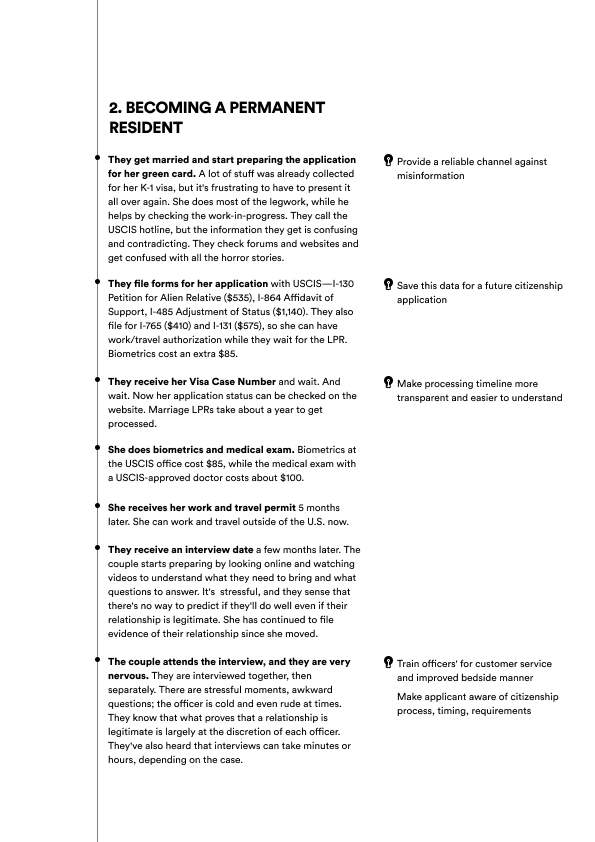
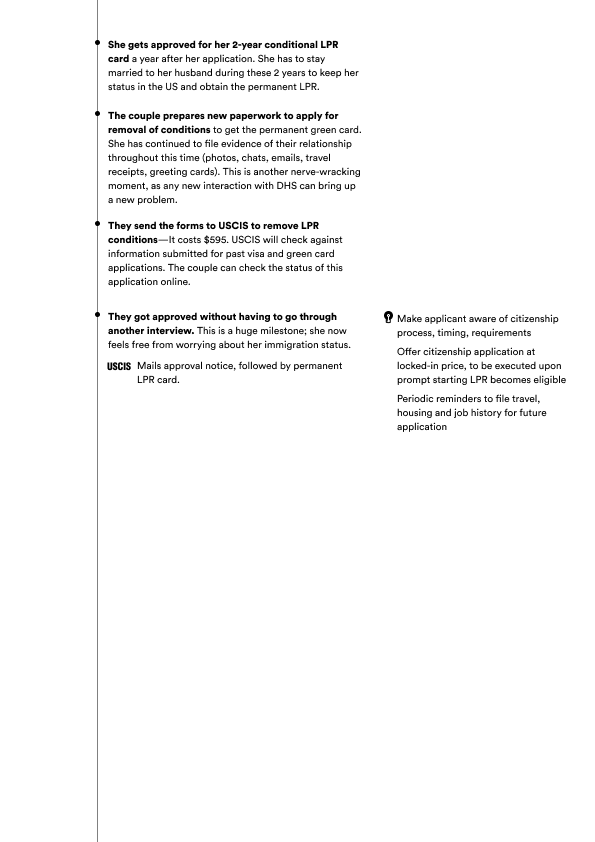
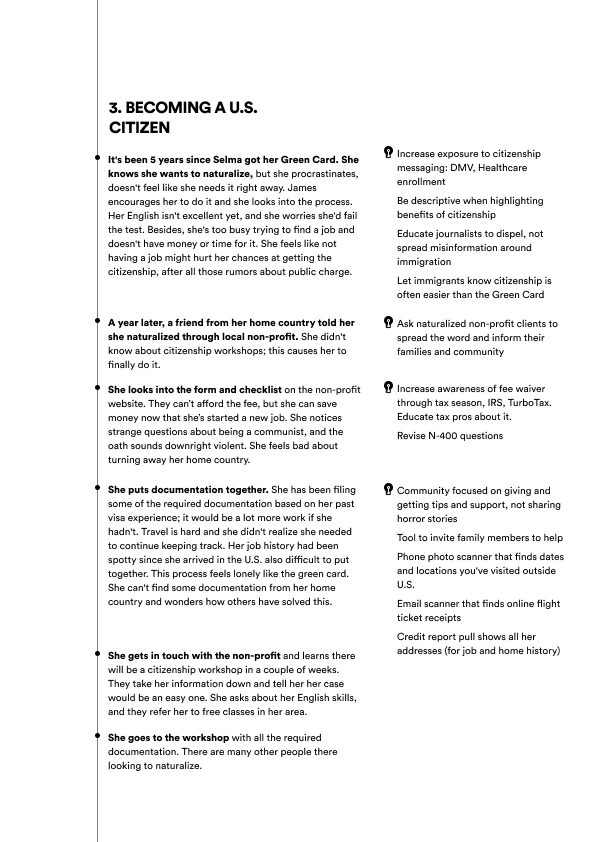
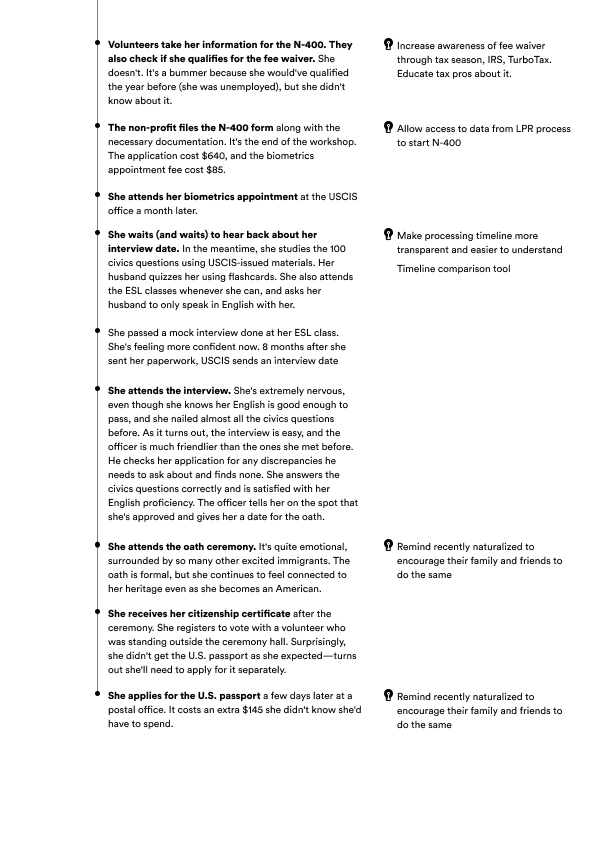
Opportunities for Further Research
When interviewing nonprofits, many community leaders mentioned seeing members of their community distance themselves due to fear of this administration's anti-immigration policies. At the same time, those policies were a common catalyst for our interviewees to naturalize. There’s an opportunity to conduct more targeted research with LPRs that have decided not to obtain citizenship or are putting the decision off. While we were able to meet and speak with a few, this population remains elusive and were difficult to recruit, possibly due to fear. Better understanding of this population could illuminate the barriers or rationale for not naturalizing, which could be counteracted through messaging or policy changes.
Additional interviews of friends and family of naturalized citizens would be helpful. This group is often responsible for assisting LPRs through the naturalization process, so it would be useful to better understand how they communicate with applicants they know and how they help them overcome any barriers to naturalize.
More quantitative research is needed on the catalysts for naturalization, which would allow us to see how catalysts map back to certain demographics. This would make it easier to determine what messaging was most efficient for which people.
During the last two months of our research, we began testing messaging to determine what outreach could best be used to cause LPRs to seek out more information about naturalization. Additional testing is needed to identify strategies and content that can assist nonprofits and other groups in increasing the number of LPRs they assist in naturalizing. Testing could be conducted virtually, making it easier to facilitate.
Lastly, we created a low fidelity prototype based on several features we believed would be helpful in assisting with naturalization. We developed several iterations and tuned the features based on feedback we received. We were able to understand which features would be more desirable for users. Additional testing, or building a functional prototype, could help fine-tune interactions and pave the way for a lightweight tool that can be relied upon to make the application process easier and more approachable.
Appendix: Testing
Testing had two distinct parts, messaging and tools. Messaging allowed us to dig deeper into insights around practical motivations and catalysts which we don’t often see reflected in current citizenship marketing campaigns. Tools allowed us to gauge reception to solutions that could alleviate barriers with the current citizenship process, particularly regarding the complexity and duration of the application.
We used a variety of testing methods to dig deeper into insights. Some of our exercises included quantitative measurements which were used as a subjective tool to understand LPRs’ perspectives and follow up on their range of interest. Even though scales are present in the testing, we represent these results broadly as “high marks” or “low marks” to indicate patterns in preference.
This portion of our research was done virtually with participants who had varying degrees of access to technology. We opted to use Google Slides as a widely accessible tool since some of our sessions were done via phone conferencing. Through slides, we introduced card sorting, rating exercises, a link to a Figma mobile clickable prototype for guided testing, and open-ended questions.
A.1 Messaging Content
Our team wanted to learn about the preferences in citizenship marketing compared to the catalysts and motivations mentioned in their interview. To do this, we presented participants with a list of citizenship slogans which included a range of tones and motives. Some of the slogans were examples of common marketing approaches which appeal to voting, elections, or a general call to action. We also included slogans focused on strong motives and catalysts, such as security from anti-immigrant policies, security while traveling, traveling with a U.S. passport, and all benefits. With all 12 citizenship slogans on the screen, we asked each person to tell us which messages were motivating and why the message resonated with them. Additionally, if there were any messages they did not like, the participant was asked to note this.
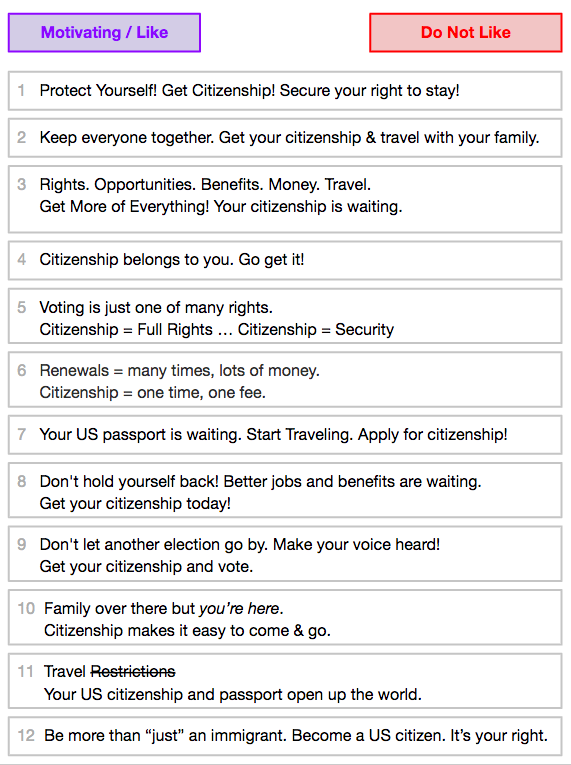
As Seen from 18 Tests with Eligible or Recently Naturalized Participants:
ONLY HIGH MARKS
Chosen by most interviewees as motivating or highly motivating
| Messaging | Interviewee Response to Messaging |
|---|---|
| Protect Yourself! Get Citizenship! Secure your right to stay! | “It's pretty accurate. Top reasons we went for citizenship in the first place.” “Motivating...I know I can be deported.” “I like the protection aspect.” “A little scary, motivation by fear.” |
| Renewals = many times, lots of money. Citizenship = one time, one fee. |
MOSTLY HIGH MARKS
Chosen as motivating by many interviewees, and at least one participant reacting negatively towards it.
| Messaging | Interviewee Response to Messaging |
|---|---|
| Voting is just one of many rights. Citizenship = Full Rights Citizenship = Security | “Really motivating!” “I don’t care about voting.” |
| Your U.S. passport is waiting. Start Traveling. Apply for citizenship! | “It'll appeal to people like me, younger.” “I don’t like this. Some Americans travel with Canadian flags.” |
| Family over there but you’re here. Citizenship makes it easy to come & go. | “Most my family is here... not relevant” |
| Rights. Opportunities. Benefits. Money. Travel. Get More of Everything! Your citizenship is waiting. | “This is motivating. I’d want to know more.” “Good, lists all the different aspects of citizenship” “Not relevant. Don't like it. It never occurred to me that not having naturalization would affect me, since I have the Green Card already." “Greedy” “Has entitlement feeling” “Unfair since immigrants pay taxes too.” |
| Don't hold yourself back! Better jobs and benefits are waiting. Get your citizenship today! |
LOW MARKS
Viewed negatively by most interviewees
| Messaging | Interviewee Response to Messaging |
|---|---|
| Be more than “just” an immigrant. Become a U.S. citizen. It’s your right. | "The ‘just’ immigrant feels negative. But like that, it's my right.” “Sounds foreboding … like you need to worry.” “Not crazy about it. Proud of being an immigrant.” “I don't like the language” “It’s not right but I would like to not have a label of immigrant.“ |
A.2 Messaging Context
In addition to messaging content, we wanted to understand how citizenship marketing was received in different contexts in order to increase the reach of messaging. During interviews, we heard from many how citizenship is less of a priority than the Green Card and how general life events can delay residents who intend to naturalize. In order to get a sense of the environments and methods, we asked participants to rate (1 to 5) and discuss their comfort level of seeing citizenship messages in 13 different scenarios. Scenarios ranged from in-person to online within environments associated with strong catalysts.
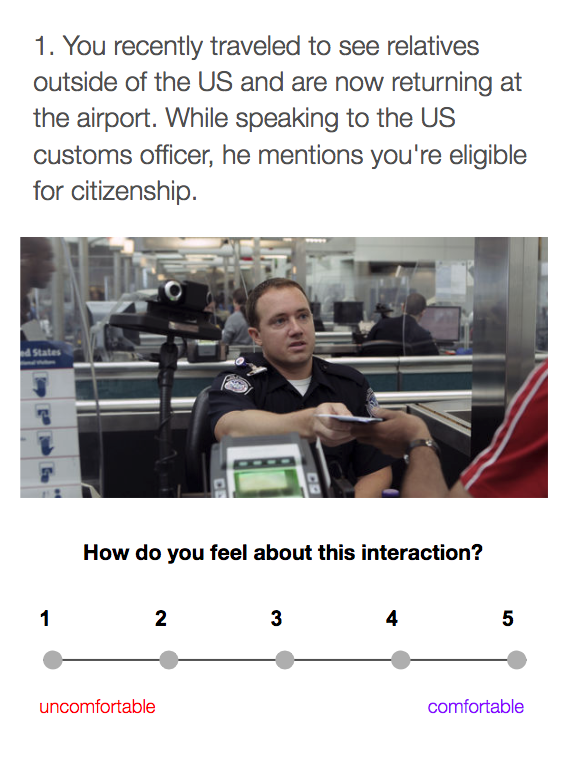
All contexts presented:
- You recently traveled to see relatives outside of the U.S. and are now returning at the airport. While speaking to the U.S. customs officer, he mentions you're eligible for citizenship.
- It’s your second year as a resident. You are doing your U.S. taxes online with TurboTax and the tool gives you a message saying there are financial benefits to citizenship.
- You’re sending a package to relatives abroad and you see a poster at the Post Office about citizenship benefits and your receipt suggests a citizenship application tool.
- You’re visiting your primary care doctor. While reviewing your insurance information, a person from her staff asks you if you’ve considered getting your citizenship.
- You’re applying for state health insurance online. After submitting your application, the site suggests you could enjoy many benefits when obtaining citizenship.
- You’re applying for your first visa to the U.S. – either as a student, tourist or employee. With your visa approval, you receive information on the citizenship journey and steps.
- You’re buying air tickets online and you see ads describing the benefits of citizenship and applying online.
- You’re at the DMV and need to provide identification for your license. After using your foreign passport, the DMV staffer offers you a brochure on citizenship.
- You have a question regarding city services and call the city’s hotline. While on the phone with the operator, they ask if you’d like to learn about citizenship information sessions.
- Your credit card statement arrives. It includes a message about possible financial benefits to citizenship.
- You’re moving to a new home and want to be sure USCIS has your latest information. The USCIS site reminds you to save your travel and residence for five years so you can easily apply for citizenship.
- You take your children to enroll in school and meet with school staff for paperwork. The welcome packet from the school they give you includes information on how citizenship can benefit families.
- You’re in line at Western Union and you see posters about citizenship benefits and advantages.
As Seen from 18 Tests with Eligible or Recently Naturalized Participants:
ONLY HIGH MARKS
Chosen by most interviewees as comfortable or very comfortable.
| Messaging | Interviewee Response to Messaging |
|---|---|
| 8. DMV after showing ID You’re at the DMV and need to provide identification for your license. After using your foreign passport, the DMV staffer offers you a brochure on citizenship. | “That'd be a good point to do it.” “I showed my passport, so they're not guessing I need info for some other reason” “Overall it'd be great if the DMV was more involved in immigration matters, but that would be good. I've had trouble there even when I was eligible for my license.” “Feels relevant and I’m willing to give you information in order to get a license. Doesn’t feel like you picked me out of a crowd or you are watching me.” |
| 11. USCIS online related to interaction You’re moving to a new home and want to be sure USCIS has your latest information. The USCIS site reminds you to save your travel and residence for five years so you can easily apply for citizenship. | “That's a good prompt to keep those records, and remind people that naturalization is close.” “Didn't know I needed to save travel info, so it'd be useful.” “Quite comfortable. Feels official.” |
| 3. Post Office Poster (passive) You’re sending a package to relatives abroad and you see a poster at the Post Office about citizenship benefits and your receipt suggests a citizenship application tool. ** Poster only. | “Poster is great, but a receipt would be strange.” “Federal govt office...doesn’t surprise me to advertise there.” “On the receipt, they're tracking that I'm sending this abroad, and because it was to family, I don't like it. If it was just a poster, I'd be very comfortable.” |
MOSTLY HIGH MARKS
Chosen as comfortable by many interviewees, and one or more reacting negatively towards it.
| Messaging | Interviewee Response to Messaging |
|---|---|
| 6. First U.S. VISA (passive) You’re applying for your first visa to the U.S. - either as a student, tourist or employee. With your visa approval, you receive information on the citizenship journey and steps. | “Valuable… people won’t go visa to citizenship but information is still welcoming. It may have pushed me toward citizenship.” “A bit too sudden? If I'm traveling for the first time and they suggest naturalization, and knowing how difficult it is, I'd think on my first visit there it'd be strange to get that prompt. Maybe after a few visits over the years, then you'd see that, it'd make more sense.” “There are very limited options for citizenship, can't do that as a student, but it'd be good to have that information, you can strategize 'maybe when I finish school I can look for a job.'" |
| 12. School Welcome Packet (passive) You take your children to enroll in school and meet with school staff for paperwork. The welcome packet from the school they give you includes information on how citizenship can benefit families. | “This is positive if coming from a child caregiver.” “If everyone gets it ... fine. Feels more like positive for all of the community. If only to brown people or people with accents get it then it’s an issue… it’s targeting/profiling.” |
| 5. State Health Insurance Application You’re applying for state health insurance online. After submitting your application, the site suggests you could enjoy many benefits when obtaining citizenship. | “It'd be good to see this when starting the insurance application process.” “That would be really good - this is a headache for lots of working-class families.” “If it’s a site… and maybe just random or a note, then it’s advertising and I wouldn’t feel paranoid.” |
MIXED MARKS
Received both positive and negative marks from different interviewees
| Messaging | Interviewee Respone to Messaging |
|---|---|
| 6. Border Patrol Officer You recently traveled to see relatives outside of the U.S. and are now returning at the airport. While speaking to the U.S. customs officer, he mentions you're eligible for citizenship. | “Makes sense with traveling as a non-citizen” “It depends on how they say it. If he's wearing a red hat I'd be worried about that statement” “This is out of good intention... the person knows how things work, hoops they need to jump through to go back home.” “Feels heavy handed. He’s in an official capacity. Is he telling me I have to?’’ |
| 4. Doctor’s Staff You’re visiting your primary care doctor. While reviewing your insurance information, a person from her staff asks you if you’ve considered getting your citizenship. | “My doctors know more than enough about me, that'll be weird. Doctors never asked about status.” “Depends on the question and if it’s contextual to health. I would take it more seriously from this group.“ “What’s the intent of the doctor and why do they care?” "What would they have anything to do with my citizenship. It feels too personal. It feels like crossing of worlds that don’t go together. Are you going to care for me or not. Does my citizenship matter?" |
| 2. Taxes It’s your second year as a resident. You are doing your U.S. taxes online with TurboTax and the tool gives you a message saying there are financial benefits to citizenship. |
LOW MARKS
Viewed negatively by most interviewees
| Messaging | Interviewee Response to Messaging |
|---|---|
| 7. Kayak Banner Ad You’re buying air tickets online and you see ads describing the benefits of citizenship and applying online. | “It wouldn't bother me, but not engage me, I tend not to look at ads.” “Would see this online and be afraid to make a mistake." “Could be a scam.” “I don't want google to know my status." |
| 10. Credit Card Statement Your credit card statement arrives. It includes a message about possible financial benefits to citizenship. | “I'd be curious about why the credit card would be interested in that, their motives.” “It'd make me feel paranoid. I guess you do tell the bank about your immigration status.” “Banks already know a lot. They'll start giving me a different interest rate.” |
A.3 Features for Solutions
Our team was eager to apply our insights to a tool that could help immigrants overcome the application complexity and length of the naturalization application form. We crafted a list of potential features that might alleviate barriers like a lack of knowledge about fee waivers, the overwhelming size of the application, or an uncertainty of timelines. We presented participants with the list of features and asked each person to discuss and rank the ones they were likely to use. Additionally, if there were any messages they did not like, the participant was asked to note this.
It’s important to note that a number of these features exist in current tools or websites, such as Citizenshipworks and USA Learns.
VERY HIGHLY RANKED: Chosen by all interviewees as useful.
- To Do List For preparing, filling and reviewing the app
HIGHLY RANKED: Chosen by most interviewees as useful.
- Help Finder For nearby classes or application workshops
- Civics Question Weekly Quiz
- Mock Interview Videos
RANKED WELL: Chosen by some interviewees as useful.
- Application Submit Goal & Countdown May occasionally messages me
- Travel Log Generator Scan email and photos for travel dates and locations
- Fee Waiver Eligibility Tool Find out if I qualify
REJECTED: Distinctly noted as not useful by many interviewees.
- Social Pledge Announce on social media about my intent to apply and goal date** removed after failing first six tests in a row
- Invite Others to Apply With You Select friends and family to message about applying at the same time
- Crowdfund Invite Select friends and family to send invites to contribute to your fee fund
All features presented:
- Application Fee Goal & Budget Plan for my fee by setting aside some $ each month.
- Help Finder For nearby classes or application workshops
- To Do List For preparing, filling and reviewing the app
- Social Pledge Announce on social media about my intent to apply and goal date** removed after failing first six tests in a row
- Application Submit Goal & Countdown Which occasionally messages me
- Create Support Team Select fam/friends to cheer me on
- Residence Generator Gather prior home addresses via my amazon account or credit report
- Travel Log Generator Scan email and photos for travel dates and locations
- Civics Question Weekly Quiz
- Crowdfund Invite Select friends and family to send invites to contribute to your fee fund
- Fee Waiver Eligibility Tool Find out if I qualify
- Invite Others to Apply With You Select friends and family o to message about applying at the same time
- Mock Interview Videos
- Comparable Timeline Tracker** added in late per suggestion from testers
A.4 Prototype to Foster Support
We were also specifically interested in reactions to mobilizing support for eligible applicants within their own network since we have not heard of many solutions or campaigns to bolster encouragement from the friends and family of eligible residents. To do this, we created a prototype to gauge interest in solutions with a focus on initiating conversations regarding assistance. We took inspiration from a recently launched civic engagement tool – Vote with Me – which allows people to scan public voter registration records against their contacts list in order to encourage them to vote in upcoming elections. In our prototype, we focused on encouragement from either side, asking applicants to reach out for assistance from those they know or asking those who know eligible residents to acknowledge their interest in helping others with their citizenship application.
To determine what facilitating ongoing support might look like, we included features that coincided with an application checklist that could support conversations between applicants and supporters for the duration of the application process. Features related to a checklist also provided tangential insight into the role application management solutions might have on barriers related to application complexity.
Similar to our use of quantitative measurements before, our intention in testing with a prototype was to dig deeper into qualitative findings. The prototype did evolve subtly as multiple participants indicated patterns of positive or negative reactions. This iterative approach allowed us to conclude testing with an example that incorporated improvements from eligible or recently naturalized citizens. However, future groups making solutions for those seeking citizenship should perform additional and intentional product-focused research project with more design and testing if they would like to move forward with insights from this testing. The following appendix item shows our final prototype designs with annotations on reception from both immigrants and their loved ones.
When testing ongoing support, we asked participants to rate (1 to 5) and discuss their comfort level of receiving messages or notifications in five different scenarios. Scenarios ranged in tone and sender, whether from a loved one or the app itself.
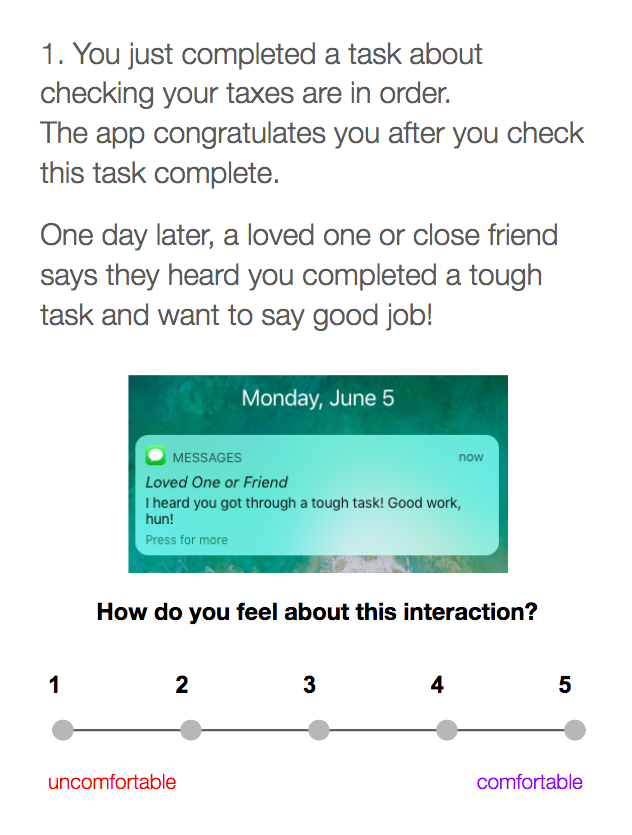
HIGH MARKS
| Messaging | Interviewee Response to Messaging |
|---|---|
| 1. Tough Task Congrats from Loved One You just completed a task about checking your taxes are in order. The app congratulates you after you check this task complete. One day later, a loved one or close friend says they heard you completed a tough task and want to say good job!online. | “I like that they only see that I completed a difficult task, and not easier ones.” “I don't need a tap in the back to get something done, I can do it myself. I don't want people knowing my business.” |
| 2. Travel Tips from App You’re on a task that wants you to gather a list of all your travel. The app messages you and another applicant using the tool that you’re on the same step and you can offer advice for how you gathered your information. | “I like to be able to talk to other people about this.” |
| 4. Accompany Suggestion from Loved One You’re two tasks away from completing your checklist and a loved one reaches out to ask if you want company to a nearby citizenship workshop that reviews applications? | |
| 5. Encouragement App You’re one task away but you’ve been stalling. The app sends you a reminder to not give up and encourages you to reach out for support from friends or a nonprofit if you’re nervous or frustrated. | “Especially if your family is not close by, it's good to have resources.” |
LOW MARKS
| Messaging | Interviewee Response to Messaging |
|---|---|
| 3. Nagging from Loved One It’s been a while since you’ve completed a task. A loved one texts to ask what’s up and why you’re not still working on your application. | “This is just being nosy.” “It's a terrible tool to give a mom, but I'd be ok with it, especially if I'm procrastinating.” “I'd be upset about being talked to like that. I like it, but I don't like people to push me. I like it for myself.” “Feels controlling, putting pressure on you.” |
Prototype: Overview
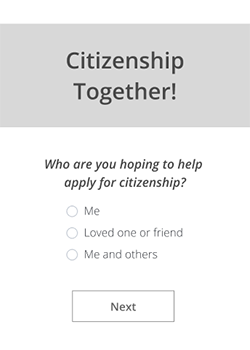
What app set out to do: Gauge rage of interest in a tool to facilitate support, but checklist was a fun byproduct.
- Two workflows – supporter and applicant.
- Positive, supportive tone
Prototype: Application checklist and reminders
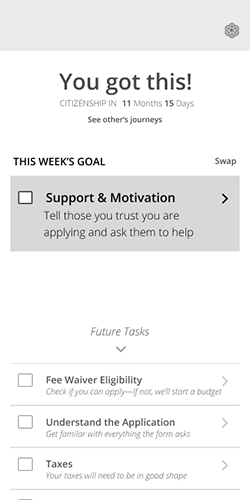
We tested a design for a checklist feature meant to help applicants prepare key documentation for the application.
Feedback
The checklist received only positive feedback from all testing participants. Some mentioned wanting to create subtasks or reminders depending on questions they had about the application or on documents they need for a unique situation. Many would like to be able to connect with expert help through the app too. Additionally, many assumed and were interested in the app being the centralized location to input their information – some also anticipated all input could then be sent to USCIS via the tool.
Testers were highly appreciative of the automated reminders for their citizenship tasks. Some were resistant to getting notifications from the app, but warmed up to the idea once they saw the checklist. Many appreciated the eligibility discovery component of the tool as well.
Prototype: Asking for support
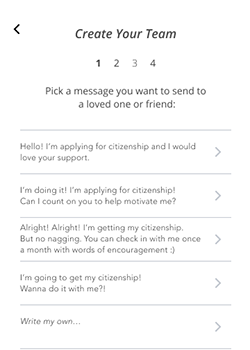
Testing participants evaluated the ability to form a support team through the app. Supporters would be notified of the application progress automatically based on preferences set by both parties. Applicants would be able to connect with supporters by sharing their contact list with the app and then selecting from a series of pre-written messages to invite them to the app (displayed on this page).
Feedback
Most interviewees rejected the idea of creating a support team as a feature before looking at the prototype, but welcomed it when seeing it in context and understanding how it might work.
Most would choose a small support team with only one or two loved ones. Many participants mentioned they would choose their spouse or partner. Other possible supporters included close friends, parents, and adult children, or generally people they see in person frequently. One participant considered including co-workers who are also going through the process—these are not people they are close to, but who would empathize with their situation.
Interviewees were pleased with message suggestions, as it would be useful to frame the request for help.
Many said they would reach out in-person prior to using the app, as a way to clear the subject.
Some participants were hesitant to share contacts with the app following the message selection due to privacy concerns.
Prototype: Preferences for support team
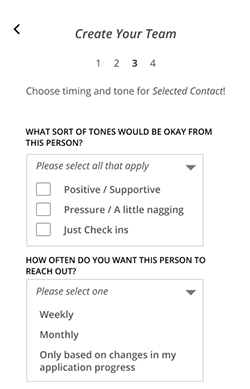
Following feedback from one of our testing participants who felt that ground rules and boundaries for support should be defined for both supporter and applicant, we developed an interface to facilitate this conversation.
Feedback
Not many participants saw this screen because it was developed later in the testing phase, but it received overall positive feedback.
Prototype: Journey comparison
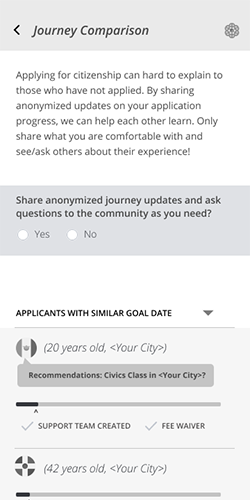
Testing participants evaluated a concept for connecting app users. It features sample journeys of other people applying through the app, with a choice to filter by country, by goal date, and by current location. The progress bars display how far the users are in their application. In order to test additional features, we included a forum for users to ask for tips on how others have prepared their application.
Feedback
Anonymity was very important for our testing participants. The progress bar functionality received overall positive reception, as long as details about the user's application were kept anonymized.
The forum functionality was also well-received, though a few expressed concern during interviews about seeing only posts from desperate, "crazy" users. Good community management would be important to keep the tone positive and helpful. Some users expected there to be experts available to answer questions about the application—it might be useful to supply the forum with expert-written articles about specific aspects of the form, or vet posts carefully and expertly for accuracy.
A future application could also consider methods of building trustworthy anonymous profiles, which would be helpful in retaining privacy in forums or if users are connected with each other.
Prototype: Supporter invitation to prepare for application with app
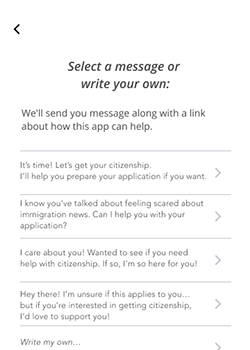
Some of our testing participants included those in the role of supporters of applicants. We showed them a different side of the app that was focused on helping the supporter follow the applicant's progress with their checklist and providing them with encouraging help-driven messages to avoid counter-productive conversations.
Feedback
Users were pleased with message suggestions, but were hesitant about how to reach out. Some preferred to do it in person because they had previously insisted their loved one naturalize or were worried about surprising their loved one with such sensitive subject matter. There is an opportunity to reframe this as suggestions on how to broach the subject with applicants to help them avoid falling into a nagging pattern.
Prototype: Following a loved one's checklist
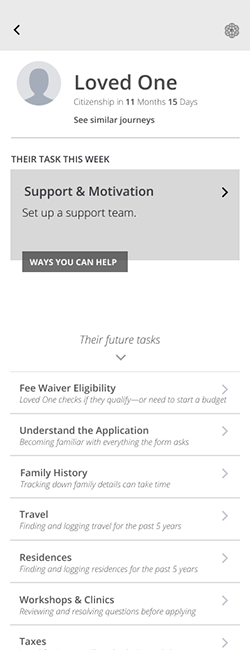
For supporters, we showed the applicant's checklist that was synced to real time progress and provided ideas on how to help.
Feedback
The level of involvement a supporter should have in the application was varied, according to supporter testing participants. Most expressed that applicants wouldn't want much help unless they were having problems with a specific task. Some were interested in being cheered for completing a difficult task, but not all tasks. Seeing the checklist elicited a range of desire to be involved, with some supporters wanting to proactively input information on the applicant’s task. More research can be done to evaluate the best platforms and interactions to match the involvement of these different roles.
Prototype: Supporter sees ways to help
Testing participants in the role of supporters evaluated content around how to be most helpful to applicants without being a nag. They were told this content would be available for them for all tasks, with support and motivation being shown as an example.
Feedback
This feature received positive feedback from participants.
Methodology
Since our research problem is explorative and covers a broad topic, our team used multiple qualitative methods to uncover and dig deeper into patterns. In five months, we conducted 63 directed interviews, spoke with over 20 subject-matter experts, conducted 117 in-person surveys, and completed 22 testing sessions.
Our conversations covered a range of perspectives from the immigration ecosystem including nonprofits, city/state government agencies, lawyers, immigrants, and their family members. However, all of our 63 interviews were with immigrants who are, were, or will be (in the next three years) eligible for naturalization. After each interview, we sifted through the motivations a person experienced in their desire for citizenship. We discovered that a large number of applicants went through a catalysting event or process that ultimately assisted them in overcoming obstacles around naturalizing—what we called catalysts. These catalysts differed from motivations because they were often the primary element responsible for direct action towards naturalization. For example, an eligible LPR may know they should secure their right to stay in the United States. (their motivation) but they may not feel pressure to initiate their citizenship application until an upcoming Green Card renewal – their catalyst. We also investigated barriers to naturalization, which were events or situations that stopped someone from naturalizing. These were different from concerns, which tended to be issues LPRs foresee in their naturalization applications, but nothing that would stop them from applying.
Box 5
Most Commonly Cited Motivations
- Security from deportation
- Travel without getting visas
- Voting
- Access to better opportunities
Catalysts
- Becoming eligible
- Green Card expiring
- Anti-immigrant policies
- Underage LPR child asks parent to naturalize Family/Friends pressure
Barriers
- Life events taking priority (moving, having children, looking for a job, etc.)
- English proficiency
- Cost
Concerns
- Extended travel
- Legal issue
- Distrust of government
- Distrust of Trump administration
- Fear of interview
Over time, we refined our interview questions and recruitment to fill gaps in our learnings and to create a robust sample set. When possible, we also conducted short, open-ended surveys at citizenship workshops to dig further into an insight found in long-form interviews. Finally, we explored many ideas in depth through various testing approaches including card sorting, questionnaires, and moderated prototype testing. Through this iterative approach, we were able to refine our findings and provide actionable opportunities for those looking to assist immigrants in their path to citizenship.
Who We Spoke With
Since our research goal did not apply to a specific group of LPRs, we ambitiously strove to reach a sample as broad and representative as possible compared to the general U.S. LPR population. To do this, we aimed to recruit participants with a range of characteristics including, but not limited to, country of origin, age, Green Card class of admission, level of interest in naturalizing, wait-time to naturalize, and application method (such as applying on their own or assisted). While we did not directly ask for one’s income level, we do understand this can factor significantly into available resources for an individual. We spoke with individuals with a variety of different backgrounds in education, English, and use of nonprofits as a way to ensure we were speaking with a range of social classes. We also hoped to talk with people located in different regions of the country, since this might influence one’s exposure to pro-immigrant services or sentiments. To cover this, we traveled and interviewed individuals in Boston, New York City, Los Angeles, and Indianapolis. Additionally, we were able to run remote interviews and/or testing sessions with people from Albuquerque, Chicago, Dallas, Houston, San Francisco, and Washington D.C. These conversations were conducted from September 2018 through January 2019.
Interviewee Sample Set
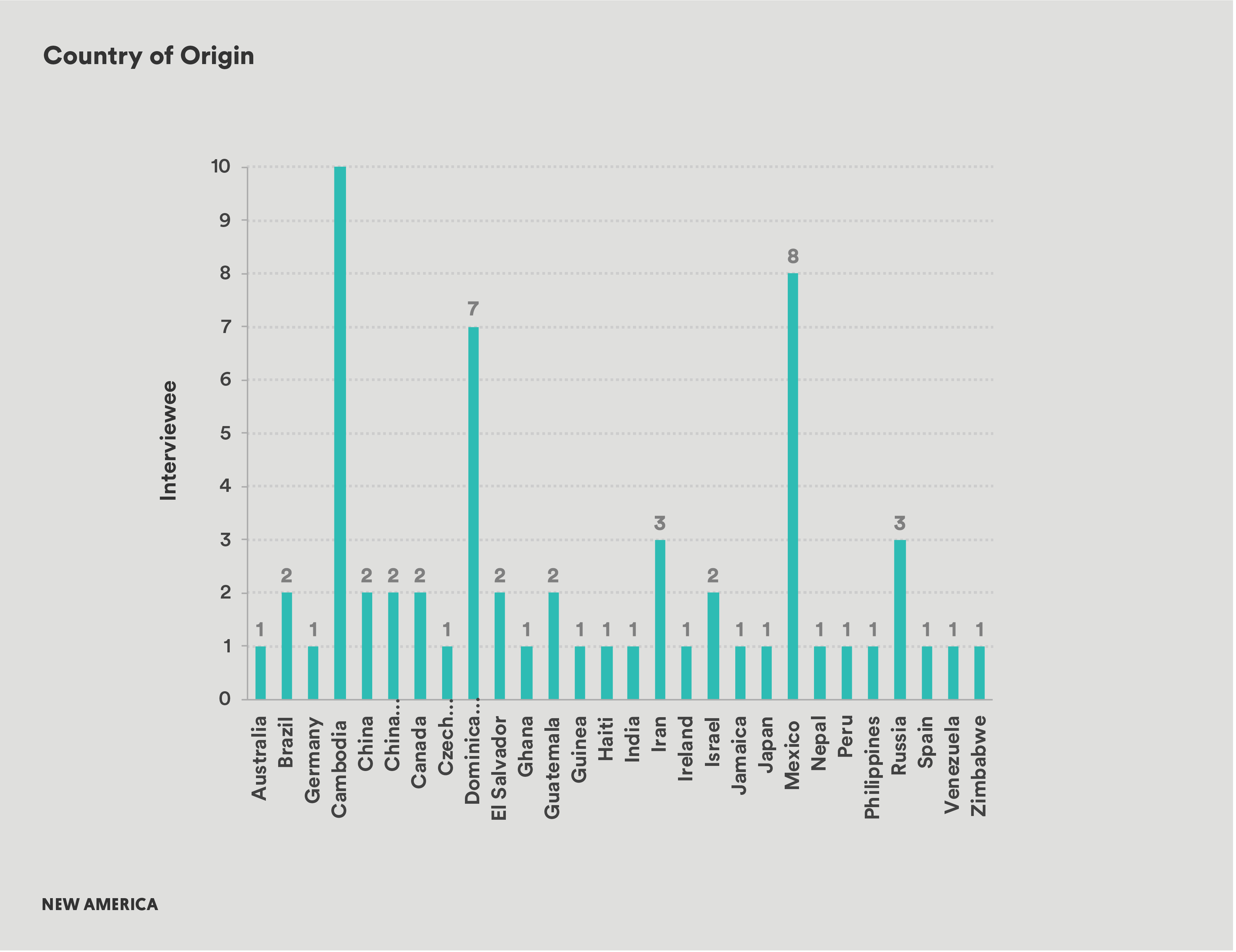
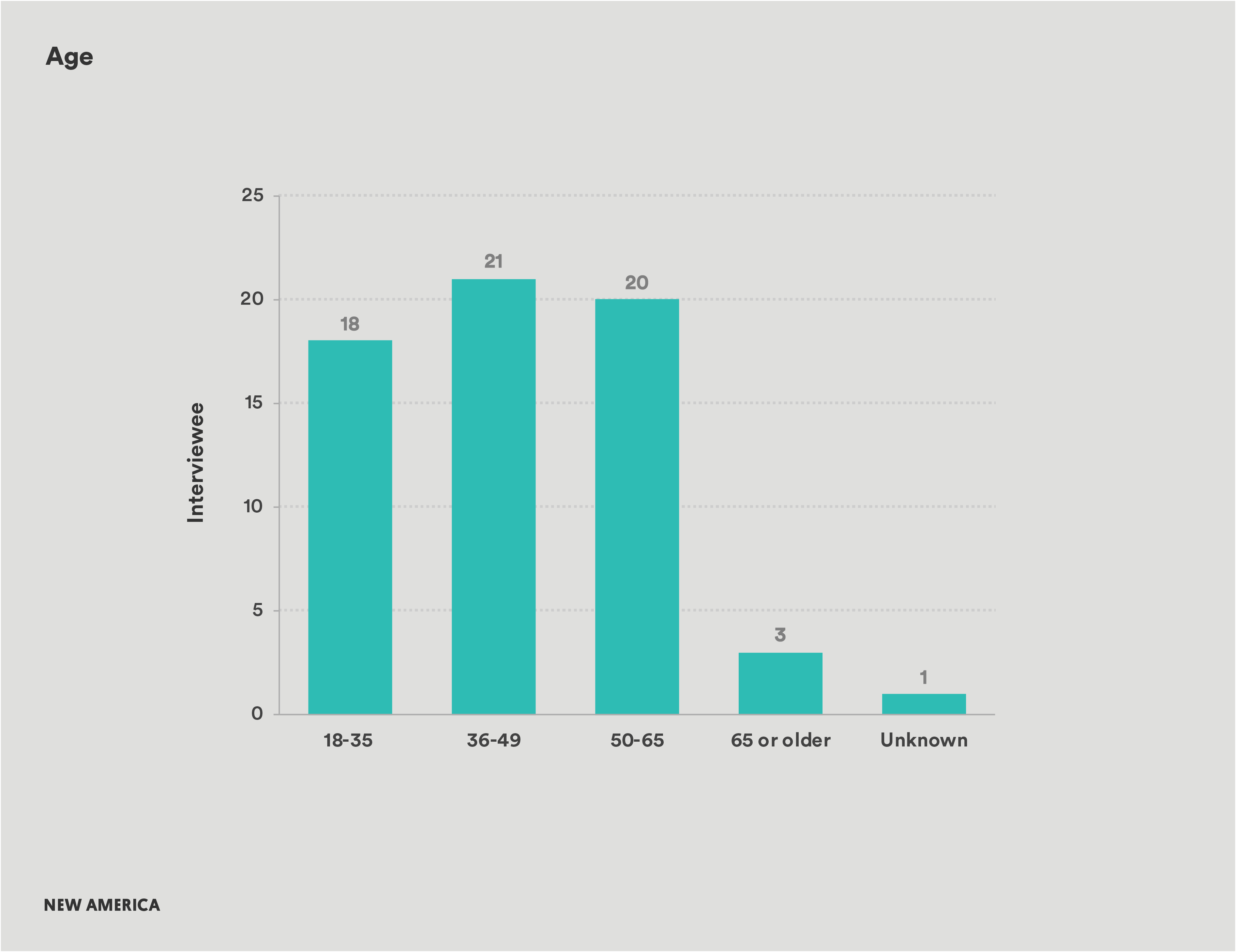
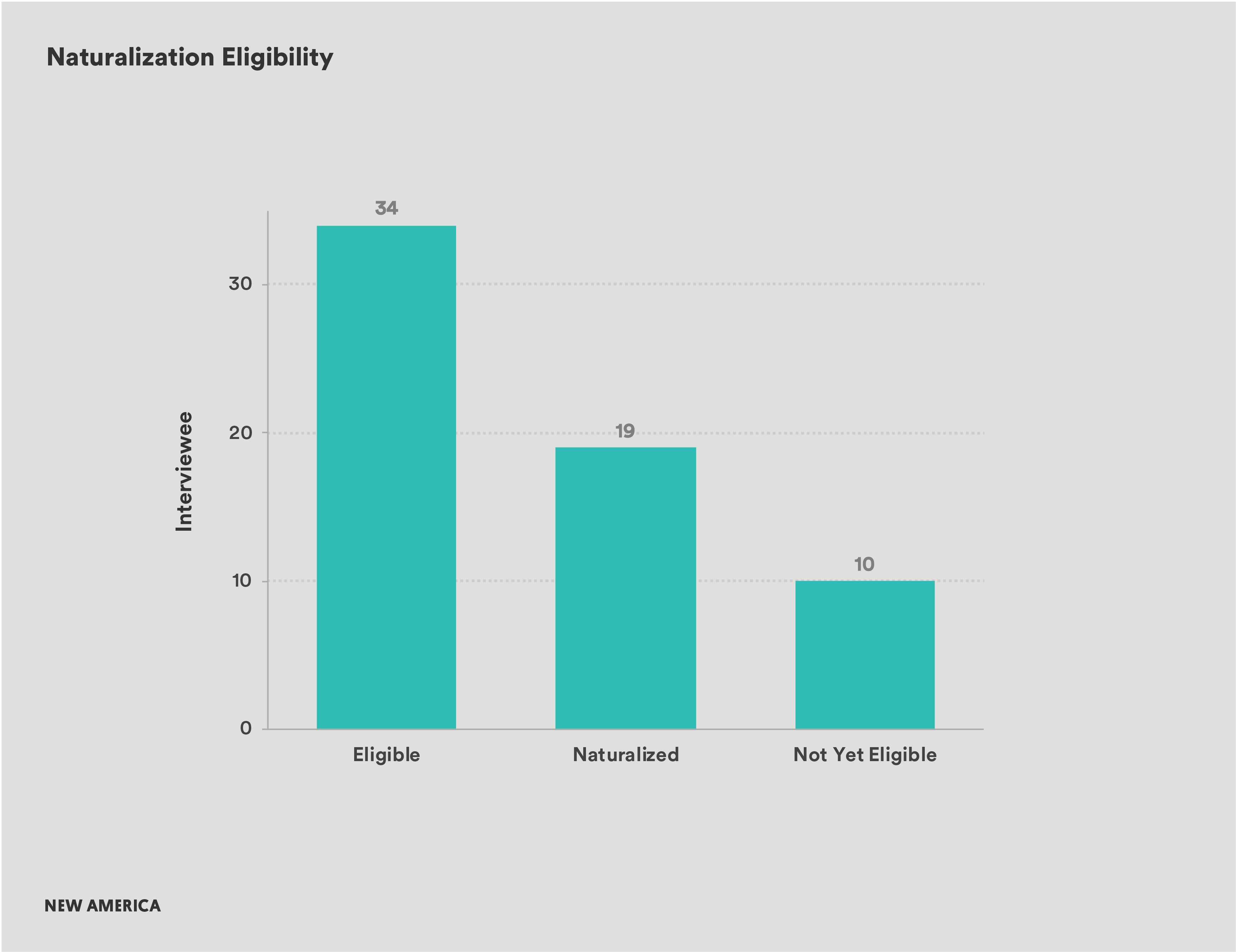
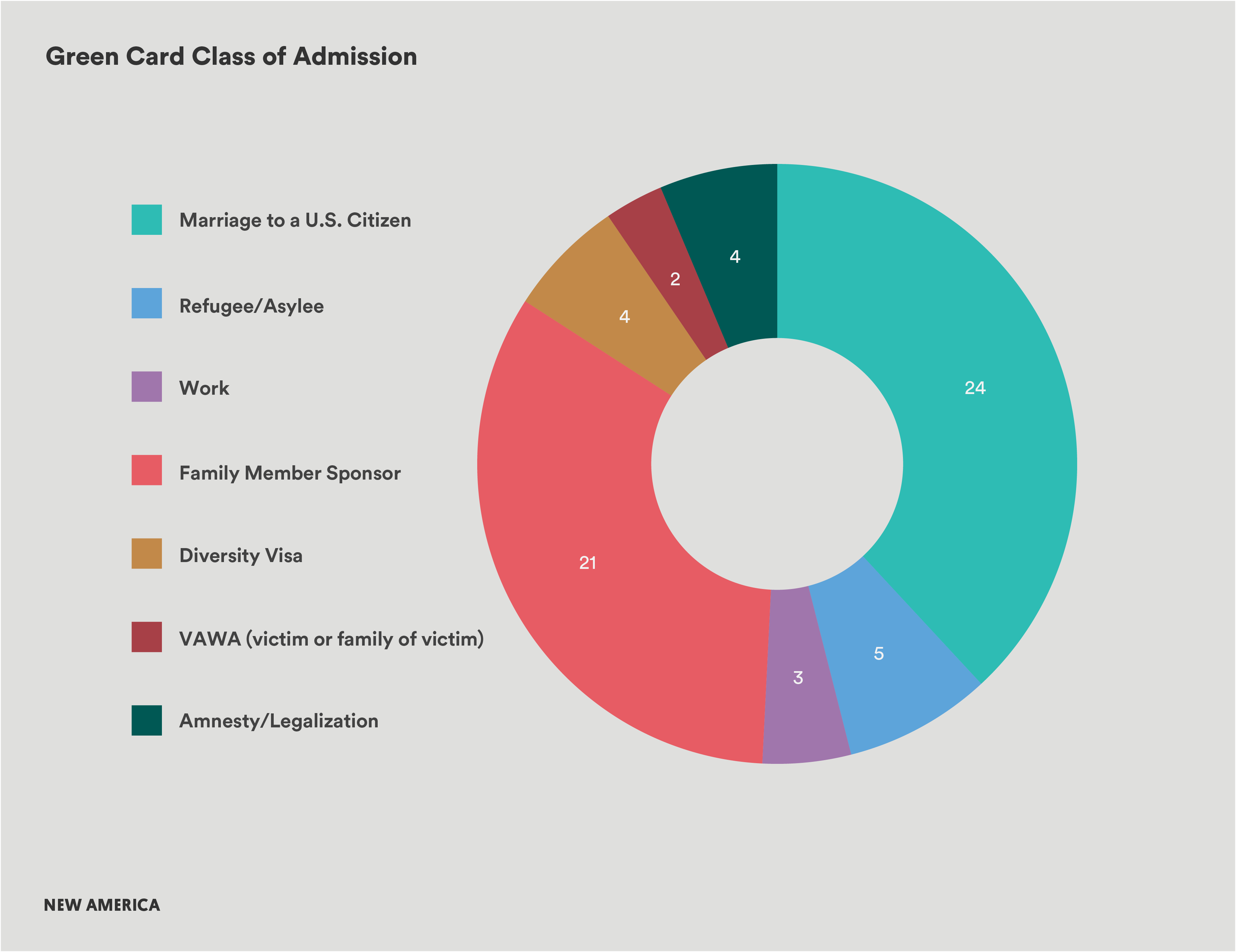
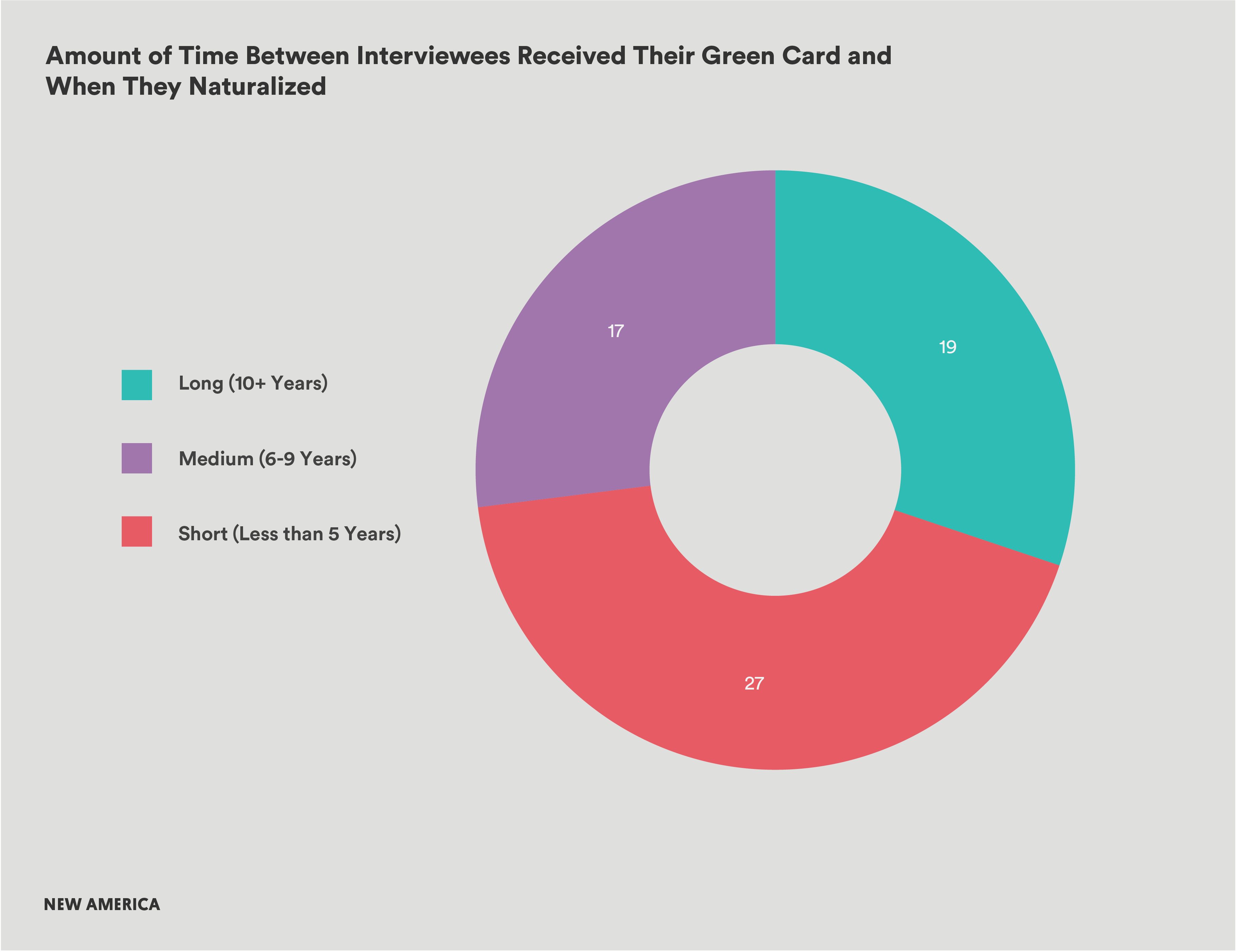
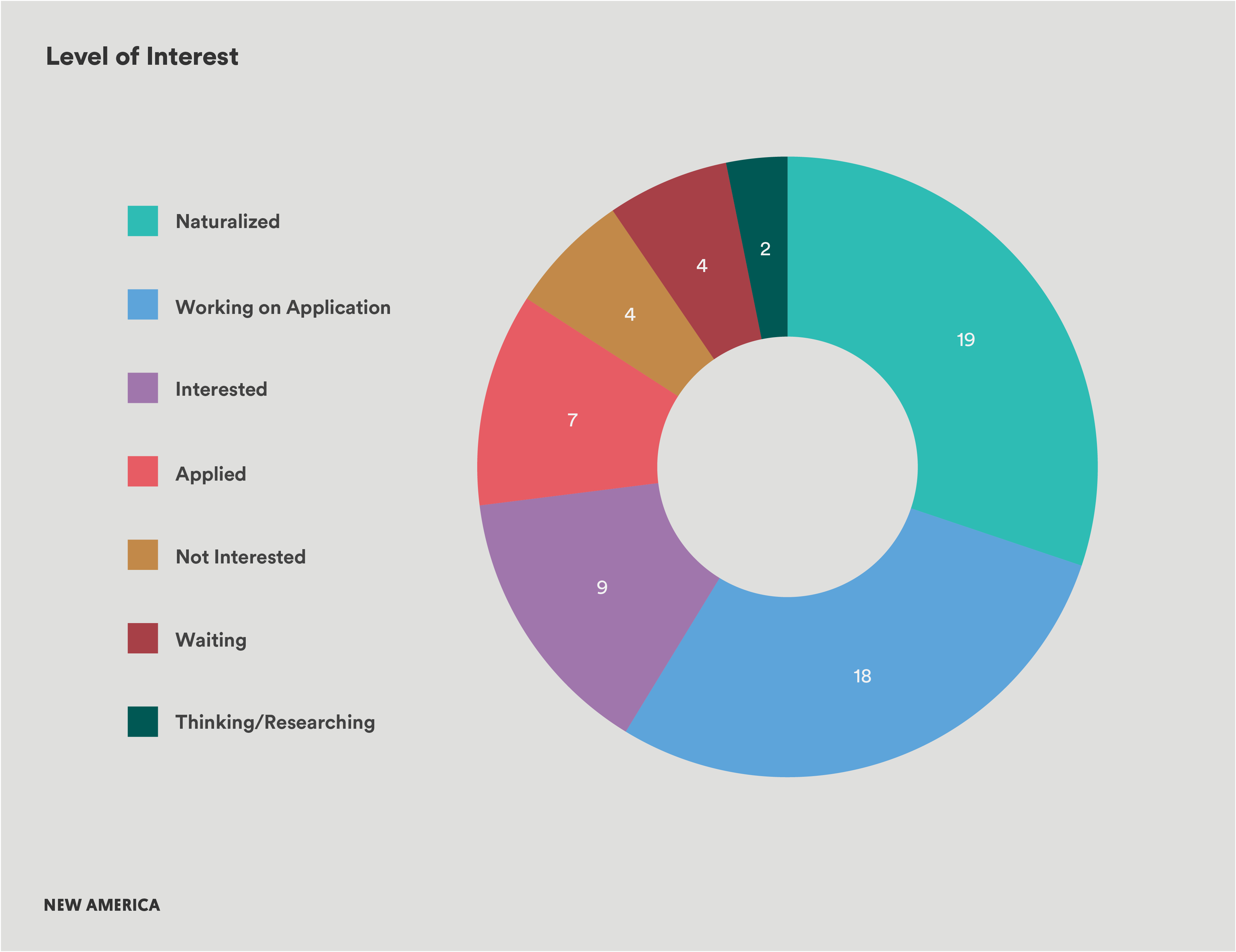
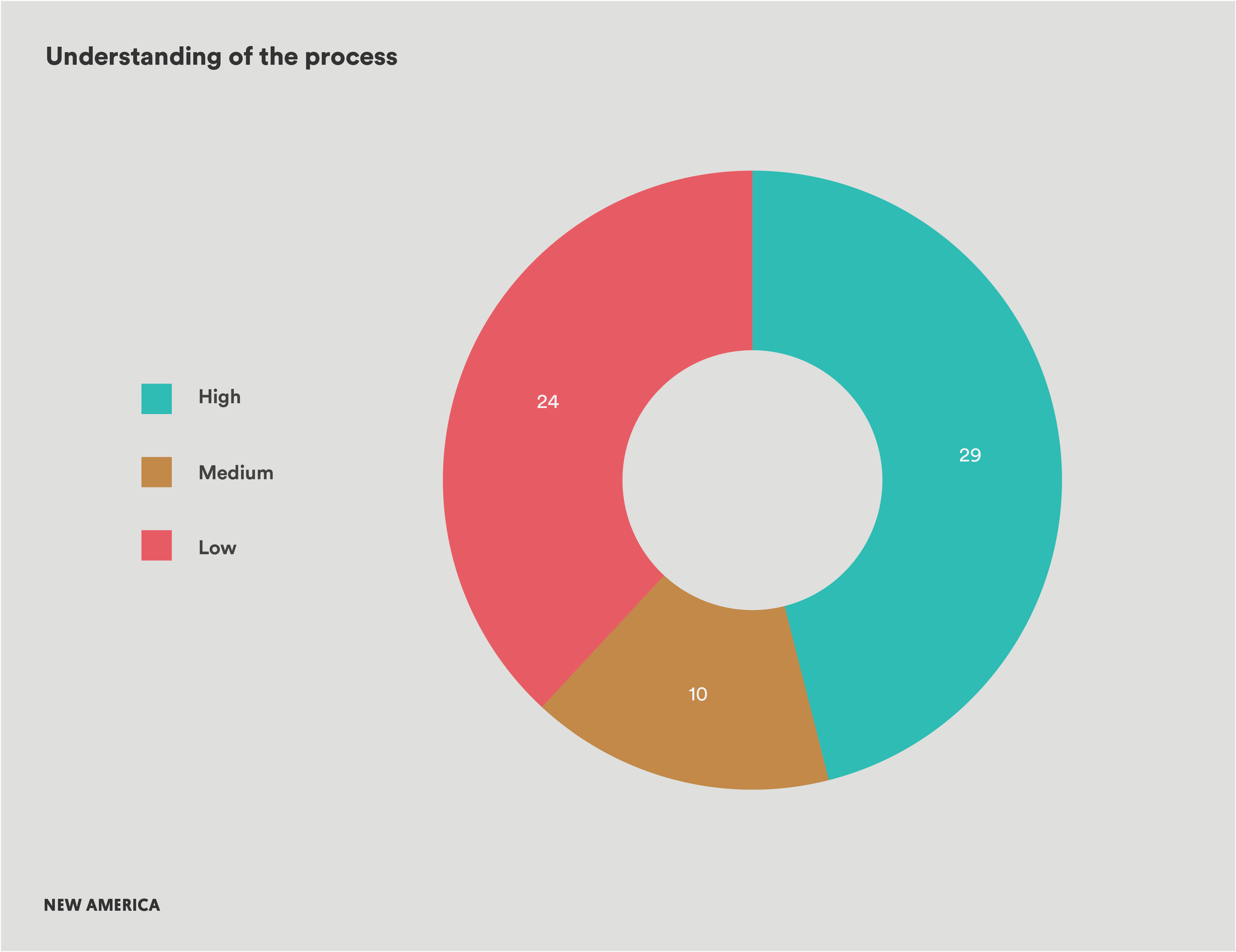
The above breakdown represents 55 of the 63 participants interviewed with the exclusion of 8 older participants from Cambodia (see Sample Set Adjustments below). Within this adjusted sample, we spoke to individuals between 25 to 61 years old, from 28 different countries. 45 out of the 55 were eligible LPRs or had naturalized already. The other ten individuals provided our research with a perspective on beginning one’s permanent residency.
It was important for us to speak with a broad set of individuals based on their timing to naturalize in order to determine difficulties that delay or prevent applying. We were able to achieve a mix of naturalization wait times, the time between receiving the green card and deciding to apply for naturalization, by requesting the date they received their Green Card, their current immigration status, and what year they naturalized, if applicable. Additionally, we assessed their citizenship interest by noting what stage of research or application work they had begun. We found it challenging to recruit those disinterested in citizenship—particularly those that mapped to a trend most nonprofits observed, in which fear of the current administration dissuaded immigrants to naturalize. Even still, we were able to uncover factors preventing an individual from naturalizing, which we broke down into barriers and concerns. Barriers represented strong impediments that prevented a person from applying to naturalize. Our study was largely focused on English-speaking interviewees, but an applicant’s English proficiency still came up as a frequent barrier. However, this alone didn’t tell the whole story. Applicants often also carried concerns, which differed from barriers in that they didn’t stop them from applying, but weighed on their decision and attitude towards, throughout, and even after the naturalization process. During our interview process, we adjusted recruitment to focus on longer waits to apply for naturalization as we continued to narrow in and track factors associated with delays in naturalizing.
Participants had a range of Green Card sponsorships, which were predominately marriage-based like the general LPR population. Methods of applying for their Green Card were a mix, with some applying on their own, some receiving assistance from their petitioner, from a lawyer, or from another third-party.
Sample Set Adjustments
During one recruitment sprint we interviewed many older immigrants from Cambodia. While each story was enlightening, 8 of the 11 interviews conveyed very similar experiences, which felt misleading during analysis. To maintain a more representative data set, we have removed 8 of the 11 interviewees’ data from our coding analysis. We did retain three because their personal stories served a range of experiences. Two of these individuals had unique journeys based on their age and initial entries with refugee and diversity visas. The third participant we chose to keep resembled the other eight individuals in age, use of a family visa, low English proficiency, and experience with trauma.
Recruitment
We used a variety of recruitment tactics including (in order of highest to lowest acquisition of interviewees) partnering with service providers, personal networks, social media, ads, and referrals from participants. To our surprise, we found many of the interview participants recruited via partnerships with service providers did not originally receive assistance for their Green Card or naturalization through a nonprofit but had become involved with the nonprofit later. This may be due to a variety of reasons, like funding. One factor that may skew our data is that many of the organizations who helped us and the events from which we recruited predominantly served specific demographics. Another factor that may skew our sample set was the use of digital tools, which may have excluded participants with less access to technology. However, participants recruited through these methods represent a small portion of our sample and other sources provided participants with low technology literacy.
Research Methods
Interviews
Interviews ranged from 20 minutes to over an hour. During our discussions, the moderator would begin with the participant’s initial entry to the United States. and inquire about details regarding their entire immigration journey including their experience applying for a Green Card or citizenship (if applicable), information resources, motivations or concerns throughout their journey, and exposure to the citizenship process. We also interviewed five family members of our interviewees, asking them about their roles as supporters and testing ideas.
Surveys
As we completed a substantial amount of interviews, the team began to notice that despite having strong motivations, many individuals delayed their application until a specific event or factor catalysted them to take action. To understand more fully why individuals may delay beginning their application, we intercepted 117 individuals at five citizenship workshops in Boston, New York, and Los Angeles (DominicanosUSA, MIRA, Asian Americans Advancing Justice – Los Angeles), National Association of Latino Elected and Appointed Officials, and Mexican American Opportunity Foundation). Each was asked questions about their wait time, age, catalysts, concerns, and how they heard about the clinic.
Testing
As we fulfilled our intended interview sample, we identified several patterns and areas of opportunity. We moved towards testing ideas around messaging and potential tools by incorporating card sorting, questionnaires, and moderated low fidelity prototype testing into our sessions.
First, we focused on citizenship messaging. Via card sorting, we had folks rank a range of marketing messages one could use for citizenship based on the various motivations and sentiments we heard in our first interviews. We presented each individual with a list of messages where they could choose and discuss the ones that motivated them. Additionally, we used questionnaires to understand which settings and delivery methods for citizenship marketing would be positively received.
Lastly, we presented ideas on tools to help those applying for citizenship. With card sorting, we compared a range of features that could assist in one’s application journey. Then we asked participants to perform a think out loud exercise with a clickable prototype of a collaborative checklist app to understand how certain features would be perceived, if they would be accepted, and how they might affect their journey.
We also ran testing sessions with supporters of applicants, interested in learning about their level of involvement in the process. In those sessions, we focused on features and the supporter use case in the app prototype.
More About the Authors

Sabrina Fonseca
Designer and Researcher, Public Interest Technology

Lindsey Wagner
Design Researcher, Public Interest Technology
Issues
Programs/Projects/Initiatives
Topics
Related