Can Ukraine Transform Post-Crisis Property Compensation and Reconstruction?
Table of Contents
- Overview
- Property Restitution and Compensation in Ukraine
- The Diia Portal and the eRecovery Property Compensation Program
- Strengths of Diia and the eRecovery Program
- Challenges of Diia and the eRecovery Program
- Recommendations for Improving Diia and the eRecovery Program
- Conclusion
- Additional Resources
Abstract
The potential for Ukraine’s eRecovery program to help transform post-crisis property compensation and restitution globally is hard to overstate. The program allows Ukrainians whose homes have been damaged or destroyed by Russian aggression to apply for and receive compensation through the Ukrainian government’s Diia e-government platform. This innovation marks the first-ever example of a compensation process for damaged or destroyed property that is implemented digitally, at scale, while hostilities are ongoing. If managed effectively, it could significantly decrease the time and costs of getting displaced persons back into their homes, while increasing the transparency and security of the property return process. The program faces significant but addressable challenges, including legal ambiguities, technical limitations, and practical issues in implementation. The eRecovery program is a dynamic case study of government innovation that highlights the complexities and opportunities in digital governance for crisis recovery. It also suggests a need for active refinement to ensure effectiveness and inclusivity in addressing widespread displacement and property damage.
The efficiency and fairness with which a country can restore property rights to victims of conflict plays a decisive role in that country’s post-crisis recovery and trajectory toward stability. The success and potential replication of Ukraine’s approach could highlight the transformative power of digital public infrastructure to strengthen crisis management and recovery efforts while limiting the potential for corruption. The current moment presents a significant and time-sensitive opportunity to help shape the eRecovery program to better serve the needs of all Ukrainians. Included in this report are recommendations designed for Ukrainian government administrators and international partners supporting humanitarian and recovery efforts. Recommendations fall broadly into two categories: some are specific to interoperability and the Diia platform, and others encompass recommendations to foster an effective, fair, and trusted recovery program.
Acknowledgments
This report is possible because of our ability to pursue cross-programmatic research collaboratives at New America. The Digital Impact and Governance Initiative and the Future of Land and Housing program would especially like to thank the Rockefeller Foundation, the Bill and Melinda Gates Foundation, and the Ford Foundation for supporting New America’s work and serving as thought leaders and field builders in digital transformation and public interest technology. We thank the team with East-SOS, a Ukrainian nongovernmental organization that provides comprehensive assistance to conflict-affected persons and internally displaced persons and promotes democratic transformation and human rights values in Ukraine, for its detailed inputs into this document. We also thank the Peace Coalition, a nonprofit foundation focused on promoting peace in Ukraine, and Ukraine’s Housing, Land and Property Technical Working Group, led by the Norwegian Refugee Council, for their review and inputs.
Finally, we are grateful to the following individuals for sharing their expertise with us to help inform this report:
- Levon Azizian, Lawyer, East-SOS
- Yuriy Berezskyy, Fellow, Digital Impact and Governance Initiative, New America
- Oleh Birdiuh, Lawyer, East-SOS
- Stuart Brooks, Housing, Land and Property Adviser, Norwegian Refugee Council
- Shaun Butta, Legal Advisor, The Peace Coalition
- Michael Cholod, Executive Director, The Peace Coalition
- Chris Doten, Independent Democracy and Technology Consultant
- Marcia Kramer, Kramer Editing Services
- Oksana Kuiantseva, Lawyer, East-SOS
- Ivan Kuleba, Lawyer, East-SOS
- Oleksandr Minkin, Lawyer, East-SOS
- Anatoly Motkin, President, StrategEast Center for a New Economy
- Denys Nizalov, Senior Lecturer, De Montfort University
- Oleksandr Prokhorov, Independent IT Specialist
- Silvana Rodriguez, Fellow, Digital Impact and Governance Initiative
Editorial disclosure: The views expressed in this report are solely those of the authors and do not reflect the views of New America, its staff, fellows, funders, or its board of directors.
Downloads
Overview
“Ukrainians consider the following three issues to be the most significant: war (96 percent), corruption (88 percent), and destruction of infrastructure and housing (82 percent).”
—Info Sapiens research agency, December 7, 2023
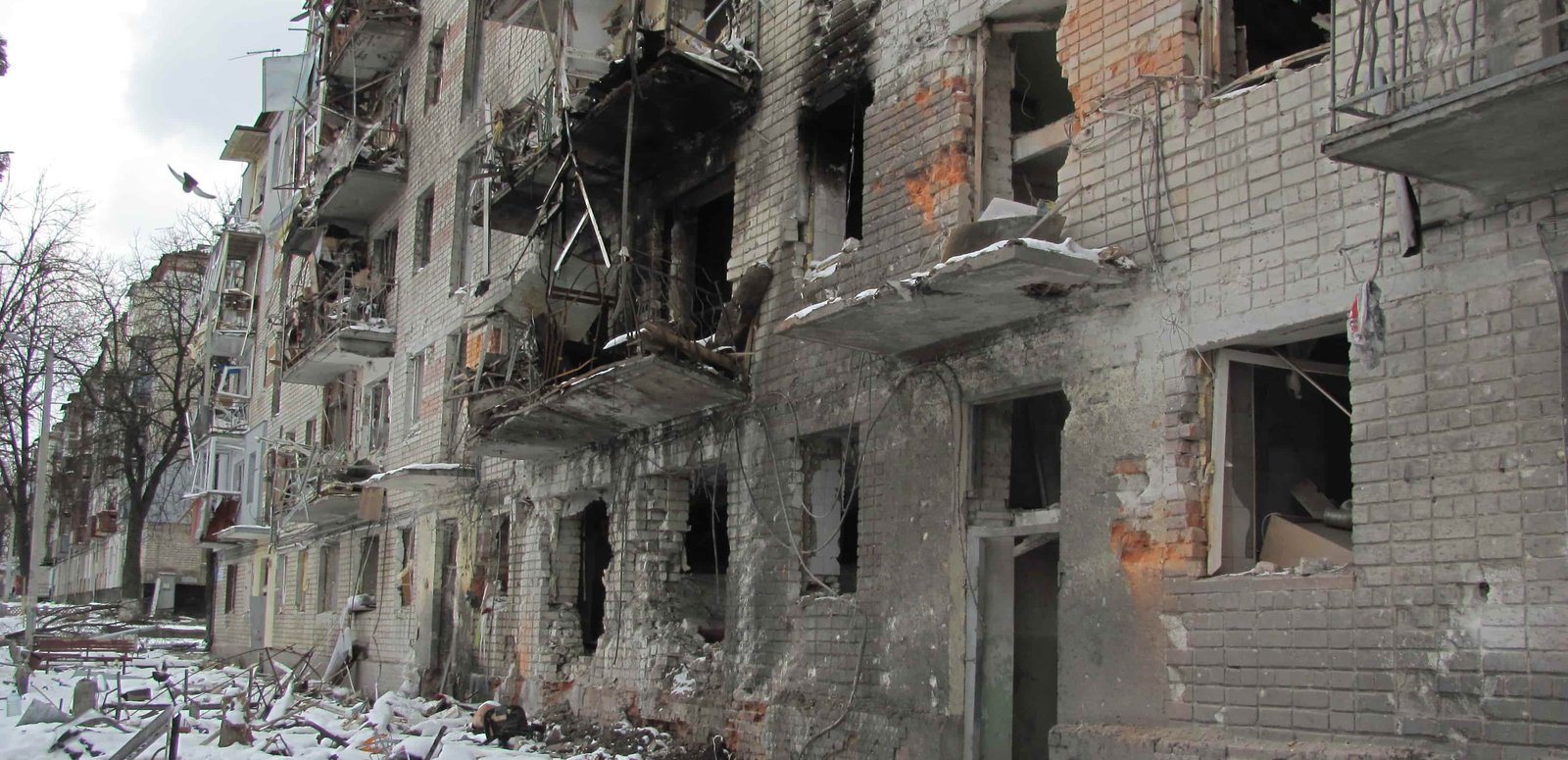
On February 24, 2022, Russia launched a full-scale invasion into neighboring Ukraine. Over the ensuing two years, Russian aggression has displaced at least 11 million people with heavy bombing, drone strikes, and urban combat that have damaged or destroyed well over a million homes. There have been massive casualties, widespread targeting of civilian infrastructure, and the catastrophic destruction of the Kakhovka Dam, leading to thousands of civilians displaced by unprecedented flooding. As of December 2023, 5.9 million Ukrainians remain displaced across Europe marking the fastest and largest displacement of people in the continent since World War II. An additional 3.7 million people are internally displaced within Ukraine.
Property destruction and forced displacement are among the most widespread and disruptive outcomes of war. After a conflict ends, it can take decades for displaced persons to return to their homes or receive adequate compensation for property damage. Displaced people often cannot prove they are the rightful occupants of the homes they left behind, because their property records are missing, destroyed, or inaccurate or because they are unable to present the necessary evidence to prove the extent of destruction to their property. These challenges complicate recovery efforts and prolong conflict and instability.
The Government of Ukraine’s innovations in digital public infrastructure provide an opportunity to transform post-conflict property restitution and compensation. Despite ongoing hostilities, the government is already strategically rebuilding the country and addressing humanitarian challenges with the help of local and international partners from both the public and private sectors. The administration of these efforts is substantially supported by the digital public infrastructure Ukraine deployed well before the Russian invasion.
In 2020, the Ukrainian government launched Diia, an e-government platform that helps residents store, access, and share digital documents for official use. The initiative is led by the Ministry of Digital Transformation. Before the 2022 invasion, millions of Ukrainians used Diia (pronounced DEE-ah) for everything from accessing digital IDs to paying taxes, receiving pensions, and registering companies.
Diia has over 21 million users, more than half of all Ukrainians. The app has been downloaded on 70 percent of the smartphones in Ukraine. New features are added regularly, and every government ministry has a chief digital transformation officer to help shepherd the digitization of public services and processes.
During the first weeks of the 2022 invasion, the Government of Ukraine added several new functionalities to Diia, including a portal that allows residents to file claims of property damage and destruction as a result of Russian aggression. In the first year after the 2022 invasion, Ukrainians used Diia to file more than 370,000 initial property damage reports. In spring 2023, the government launched eRecovery, a digital-first program in Diia that allows Ukrainians to convert crisis-related property damage reports into compensation claims. Damage claims are first evaluated by a local commission. Approved and processed claims are paid to claimants through an electronic bank card.
The potential for the Diia-powered eRecovery program to help transform the post-war property compensation and restitution processes globally is hard to overstate. This innovation may mark the first-ever example of a digital property claims process implemented at scale while hostilities are ongoing. If managed effectively, the portal and the associated eRecovery program could significantly reduce the time and costs of getting displaced persons back into their homes, while both increasing the transparency and security of the property return process and decreasing the potential for corruption. The real-time nature of the effort is critical for claimants by allowing Ukrainians to submit claims before evidence is lost or destroyed and to rebuild their homes without waiting for the conflict to end.
The current moment presents a significant and time-sensitive opportunity to share strategic considerations that could help Diia and the eRecovery program better serve the needs of all Ukrainians. Ukraine is expanding its reconstruction efforts, even as the war is on the verge of dragging into its third year. Diia will likely continue to evolve as the conflict persists and Ukraine’s recovery needs change over time. The eRecovery program, especially, will require modification as user needs and the scale and nature of reconstruction efforts become better known. Recovery plans around a stalemate could differ drastically from planning around a clear negotiated settlement for peace.
This report contains recommendations for strengthening the eRecovery program. Recommendations fall broadly into two categories, recognizing the difficulty of this time for the Ukrainian people and government, and are largely aimed at Ukrainian administrators and outside partners supporting reconstruction, humanitarian, and recovery efforts. There are opportunities to harness tech efficiently to improve the functionality of the system and boost transparency. There are also ways Ukraine could foster and plan for a more trusted and cohesive system, both online and offline, for effective reconstruction efforts. Urgent recommendations include revising the legal framework to account for a broader range of property damage and ownership scenarios, improving the technical aspects of the portal to accurately reflect property rights and ownership, and finding comprehensive and inclusive solutions to ensure payments reach all who need them.
Local nongovernmental organizations working with residents have already identified ways to strengthen eRecovery to better align with global property compensation best practices and local context. Encouraging public collaboration and opportunities for civil society feedback is an integral component to the long-term success of the overall recovery program.
Although an end to Russia’s invasion could be years away, Ukraine must continue to plan now for the building and restoration of communities. A road map, even a flexible one that can accommodate unknown twists and turns on the road to a rebuilt and peaceful Ukraine, is critical for stable communities and livelihoods. There are still millions of Ukrainians living outside of Ukraine and those displaced within who will eventually decide to return home and contribute to recovery efforts, or not. But the country’s potential for sustaining an effective recovery era must be built on a strong and trusted foundation designed to maximize people-centered outcomes.
Ukraine’s dexterity and innovative approach to digital tools to enable property compensation may provide an essential case study for reconstruction efforts that can serve as an example of how to improve the provision of public services and inspire similar public interest technology initiatives around the world.
Property Restitution and Compensation in Ukraine
The Russian invasion of Ukraine in February 2022 resulted in the sudden displacement of more than 10 million Ukrainians, internally and internationally. Some Ukrainians have already begun to return home even as the conflict is ongoing. The International Organization for Migration reported in September 2023 that more than 4.5 million people have returned to their homes in Ukraine and forecast that many others will follow. Still, 6.3 million Ukrainians are refugees globally, while an additional 3.7 million remain internally displaced.
Despite ongoing hostilities, the Government of Ukraine, with help from local and international partners, is already rebuilding the country. Reconstruction includes both property restitution—the return of private property to displaced persons—and financial compensation for property that has been damaged or destroyed. The task is a considerable challenge, given the scale of both displacement and property destruction. Estimates vary, but some 1.5 million homes may have been damaged or destroyed due to the conflict, as of mid-2023.
Global Context: Challenges with Property Restitution and Compensation
The abandonment, destruction, and occupation of homes and other property are an unfortunate yet common aspect of modern warfare. After conflicts end, governments, humanitarian organizations, and development partners strive to identify and return property to its rightful owners, sometimes through an official land commission or a mass claims restitution process, and also to provide financial compensation to owners of damaged or destroyed properties.
Post-conflict compensation and restitution processes are expensive, unreliable, and time-consuming. Property records are frequently missing, destroyed, or inaccurate. On-the-ground combatants often deliberately destroy homes, businesses, and infrastructure to further inflict harm on civilian populations, exacerbating restitution challenges.
During the protracted conflict in the Caucasus’ Nagorno-Karabakh region in the 1990s and 2000s, for example, Armenian forces destroyed nearly all Azerbaijani homes and businesses in some towns. In Kosovo, retreating Serbian forces stole property records, eventually creating challenges in rebuilding and re-establishing functional land markets. More than 20 years after the conflict, related issues continue to hinder economic growth in the country. And most recently, in Iraq, the Islamic State confiscated and later sold displaced Iraqis’ homes and land, using the revenue to further fund its terrorist activities.
After such war crimes, defeated political and military opponents, along with women and other marginalized groups, disproportionately struggle to reclaim property. Mass displacement can last decades and sometimes generations. In the interim, property can change ownership several times and even become legally held by others, including political and economic elites or opposing ethnic, sectarian, or religious groups.
In Burundi, for example, a half century of intermittent war, displacement, and violence has resulted in an incomprehensible patchwork of competing claims, sometimes involving families who have lived on occupied property for generations. The grievances of displaced families and individuals intensify in the meantime and can transform into political or insurgent movements.
The longer post-conflict restitution processes last, the more likely a country is to fall back into conflict or to experience knock-on impacts caused by housing instability, such as the growth of slums and other crowded and substandard living conditions, long after the conflict formally concludes. In order to facilitate rapid property restitution, the United Nations’ Pinheiro Principles, which provide international guidelines for housing, land, and property restitution, recommend that states accept a wide range of evidence regarding property ownership post-conflict to lower the evidence burden on displaced populations. Even with the help of these principles, however, restitution efforts often take decades.
Housing, Land, and Property Rights in Ukraine
Property restitution and compensation in Ukraine will be influenced in large part by the pre-war conditions of the country’s public infrastructure and records related to housing, land, and property rights.
Russia’s Destruction of Ukrainian Infrastructure
Video recorded by U.S. journalist Zarina Zabrisky for a New America event on February 21, 2023, documenting Russia’s destruction of Ukrainian homes, apartment buildings, and other civilian infrastructure.
Source: Zarina Zabrisky
After the dissolution of the Soviet Union and the independence of Ukraine in 1991, the Government of Ukraine developed and repeatedly reformed its housing, land, and property registration systems. Beginning in 2013, housing records were digitized into the electronic State Register of Property Rights (SRPR), although this registry was only 40 percent complete at the time of the Russian invasion. Many property rights records issued prior to 2013 are not contained in the digital SRPR, and inclusion of records from Crimea and occupied territories in Donetsk and Luhansk regions is significantly lower.
Many existing records are also prone to error, in part because the administration of housing, land, and property rights is shared among nearly half a dozen state agencies. Pre-war, for instance, there were data discrepancies for approximately 200,000 land parcels between the state real estate registry and the state land cadastre, a database that combines parcel geometrics with land ownership data and other information. Errors in the cadastre in large part resulted from inaccurate information in the original paper-based records.
The Russian invasion exacerbated these property registration challenges. Official capacity in the public administration of housing, land, and property rights was significantly reduced in 2022, due to the deliberate destruction and looting of government offices as well as the displacement of staff. Unsurprisingly, there is currently a temporary ban on government-recognized property transactions in occupied territories. Further, many returning refugees and internally displaced persons whose property records were not digitized prior to the invasion will likely have trouble proving rightful occupancy of houses and other property, as physical records are likely to be lost or destroyed during conflict.
Based on an analysis by the Kyiv School of Economics, damaged housing stock in Ukraine amounts to more than $55 billion as of June 2023. This includes more than 19,100 multifamily apartment buildings and 147,800 single-family homes. The eastern Donetsk and Luhansk regions along with Kharkiv, Kherson, Mariupol, Mykolaiv, and other major cities, are most affected.
Housing, Land, and Property Rights in Crimea and Eastern Ukraine
Crimea and parts of Eastern Ukraine have been occupied since 2014 or illegally annexed by the Russian Federation. These parts of Ukraine present additional property rights–related challenges. In some cases, third parties may have seized abandoned homes and other property. There are also reported cases of forced eviction and forced transfer of property to new owners.
Property in areas occupied prior to 2022 is not legally eligible for compensation, according to East-SOS in an interview. As a worst-case scenario, and based on previous agreements and cease-fires from post-Soviet conflicts, Russia could continue to occupy some or all of these Ukrainian territories over the long term, and property in these areas would become permanently inaccessible to rightful owners. The Government of Ukraine will then need to determine if property in the regions is defined as permanently or temporarily lost and to accommodate citizens through compensation or housing assistance or both.
Lessons from the Caucasus suggest a costly compensation and rehousing process that could create political and social divisions, as host communities may see new arrivals as benefiting at their expense. In Azerbaijan, the government provided housing and financial support for nearly a decade to 1 million families displaced by the Nagorno-Karabakh conflict. Yet the benefits provided to these households were perceived as unfair by Azerbaijanis who were not displaced but were also struggling economically.
Despite widespread destruction, Ukraine possesses several advantages to plan and implement property restitution and compensation processes. The Government of Ukraine is both innovative and digitally sophisticated, with access to excellent satellite imagery even before the invasion, and has created a working group to plan around housing, land, and property rights issues resulting from the conflict. Dozens of large and small communities are actively developing reconstruction plans, often supported by international donors.
The Diia Portal and the eRecovery Property Compensation Program
“In the history of our digital state, eRecovery is one of the most difficult services to implement and one of the easiest for the user. It is very important that the reconstruction process is as transparent and accessible to Ukrainians as possible. The eRecovery service is not just about submitting an application to Diia. This is data from a registry that records information and cannot be changed. It is verification of data in other registers. This is the work of the local commission and other tools, such as anti-fraud, which assess how effectively the funds received by citizens are used. There were no similar projects in the world.”
—Mykhailo Fedorov, Ukrainian Minister of Digital Transformation, Remarks, July 19, 2023
The groundwork for Ukraine’s current digital capabilities in administering public solutions and programs began before the 2022 invasion. Ukraine has built a global reputation as a country of innovative programmers, with a tech entrepreneur ecosystem that quickly transitioned from building start-ups to supporting war efforts and high rates of internet connectivity supporting a well-educated and tech-savvy population.
These foundational strengths are aligned with President Volodymyr Zelensky’s vision, announced in 2019, of creating a “state in a smartphone.” Zelensky’s digital transformation plans, initially hoped to be reached by 2024, included major goals around the ubiquitousness of government services online, a digital skills development program, and an Information Technology (IT) sector representing 10 percent of the country’s GDP.
In 2020, Ukraine’s Ministry of Digital Transformation launched the Diia e-governance web portal and mobile application. For added context, Diia means “action” in English. The ministry moved methodically on system development, deployment, and scale. Ukraine is the first country in the world where digital smartphone passports have the same legal weight as the hard copy form of documents. Ukrainians can choose to use a digital driver’s license and can access a legal digital signature feature in Diia allowing for the online creation of bank accounts or signing of contracts, among many other unique public services.
About TREMBITA
Video by e-Governance Academy on Trembita, the data exchange backbone of Ukrainian digital transformation, published on January 4, 2021.
Source: e-Governance Academy, YouTube video
This digital transformation under President Zelensky, scaled in a war environment and to date, is widely regarded as a model for resilience and adaptability in the public sector. Adoption of Diia grew significantly after the Russian invasion; 19 million Ukrainians were using it to access over 120 public services as of May 2023.
In response to the conflict, the Government of Ukraine extended Diia’s features to allow Ukrainians to report property damage or destruction. This “Damaged Property” service prompts citizens to upload details of their damaged or destroyed home, including photographic evidence and geo-location data. As part of the submission process, users can also describe the extent of the damage and provide additional pertinent information.
In spring 2023, the Government of Ukraine enacted legislation that established a procedure for compensating Ukrainians for these claims. Law No. 2923 (“Compensation Law”), adopted in March 2023, sets forth the compensation procedures for property damaged or destroyed after the outbreak of the full-scale war, as well as the types of claimants and property eligible for compensation. Resolution No. 381, adopted the following month, sets forth the operational procedures to apply for and receive compensation.
After the adoption of these two key measures, in May 2023, Ukraine’s Ministry of Digital Transformation and its Ministry for Communities, Territories, and Infrastructure Development launched the eRecovery program, which allows claimants to apply for and receive financial compensation for damaged property.
Steps of the eRecovery Process
- Claimant reports property damage on the “Damaged Property” page accessed through the Diia platform. Alternatively, Ukrainians can report property damage or destruction and then apply for compensation in person at local administrative offices.
- Claimant opens a specialized eRecovery account with a participating bank, either online or at a physical branch location.
- Claimant applies for financial compensation, via the Diia application. This is a separate process from creating an eRecovery account (Step 2).
- Claimant requests an inspection of the damaged or destroyed property. Local authorities send a member of the local commission to inspect the property and verify both the occupant’s identity and the applicant’s ownership of the property before determining the amount of compensation. The maximum compensation amount is 350,000 Ukrainian hryvnia (approximately $9,250 as of January 2024). Of note, Ukrainian military members and their families, as well as vulnerable groups such as people with disabilities, are prioritized for compensation.
- The local commission records the assessed damage or destruction in the “Register for Damaged or Destroyed Property,” created in 2022.
- Funds are paid to the claimant’s eRecovery card, and the claimant can use the money for specific items including construction materials or repair services depending on what the government has approved.
In December 2023, the Ukrainian government made an important update to the eRecovery program, allowing Ukrainians to retroactively claim a refund of up to 500,000 hryvnia (approximately $13,400) for repairs claimants had made themselves. By then, the Ministry of Infrastructure reported that more than 566,000 property damage reports had been filed through Diia. Of those initial reports, 62,000 claims were completed via the eRecovery program and 25,000 damage claims were paid.
The Government of Ukraine has a separate program for the restitution of destroyed housing. The program provides claimants with cash for the full reconstruction of a house or a certificate they can use to fund the construction of a home. According to Ukraine’s Housing, Land and Property Technical Working Group, as of November 2023, the government received 4,354 applications for the reconstruction of destroyed housing and provided 400 claimants with cash or housing certificates worth approximately $22.5 million.
Strengths of Diia and the eRecovery Program
“Deputy Prime Minister Fedorov was showing me photos of his neighborhood, which was bombed overnight and showing photos of the damage to the roof. Well, first of all, that’s harrowing and brutal, and the Russians have to be held accountable for these crimes, one. Two, somebody will be going and snapping a picture of the damage to their roof, uploading it into the app, and at some point getting back an estimate of what the damage is. And at some point, actually, restitution for that damage will come via the government to the citizen. It’s just mind blowing how, in real time, how useful this is…”
—Samantha Power, USAID Administrator, Remarks, May 23, 2023
Ukraine’s accelerated digital transformation strategy and early investments in public digitization efforts are the main drivers of the functionality of the eRecovery program. Iterative development and human-centered design are essential components of effective government service delivery. These foundational approaches coalesced around the provision of public services and led to the world’s original digital-first compensation process for property damaged or destroyed by conflict.
Diia has the potential to transform post-conflict property compensation and restitution in the following ways.
Physical safety and accessibility for both claimants and administrators
Diia’s property damage portal allows victims of property damage or destruction to file claims digitally. This is in stark contrast to other post-conflict or post-disaster scenarios, in which intake for a property compensation program is primarily conducted in the field, by a legal aid organization or by government workers. Usually, claimants need to bring physical copies of necessary documents and wait in line to file a claim with an official.
By contrast, Diia allows displaced persons and refugees to file a claim while far away from their home. The process facilitates access for anyone who cannot physically travel to an intake location, such as those who are older, sick, injured, or disabled. Critically, allowing claims to be lodged from afar permits the property compensation process to begin before hostilities end.
Diia largely removes the government’s need to set up brick-and-mortar intake locations in active war zones, removing the danger of combatants targeting these centers and also making sensitive property documents less vulnerable to damage or loss.
Once a compensation claim is approved, funds are allocated through an electronic bank card. The electronic banking solution, part of the eRecovery program, also improves accessibility and physical security risks for claimants.
Immediacy of preserving evidence and processing claims
Diia allows Ukrainian citizens to file compensation claims in the hours or days immediately after a property has been damaged or destroyed. Conceivably, Diia also provides an opportunity for the government to track geo-located and validated damage. This real-time capability means that claims are processed efficiently. It presents key advantages over traditional post-conflict compensation schemes by minimizing the risks that documentary evidence necessary to process a compensation claim is lost or destroyed before claimants can present it. It assists the government to administer a program to provide compensation even as the war rages on.
Transparency, security, and multipurpose data
The broader security ecosystem that Diia operates in is equally significant to the efficiencies of administering a digital reconstruction and recovery program. The Ukrainian Minister of Digital Transformation, Mykhailo Fedorov, told a packed room at the Diia in DC event in May 2023 that cybersecurity has been a top priority from the beginning. Ukrainians have to trust the system to use it, especially at a time marked by heightened cyber threats. The resilience of Diia, and the ability to withstand aggressive cyberattacks from Russia, assures users of the safety of their data as well as instilling a sense of national pride in Ukrainian innovation and IT services.
Ukraine and the teams supporting the administration and governance of Diia have coordinated political, financial, and material support from global partners to reinforce and strengthen their cybersecurity measures. They also have worked toward decreasing the likelihood of forged documents or claims. These risks can be minimized by using pre-conflict data and an ongoing commitment to encryption and cybersecurity measures, allowing for extensive and trusted use of verified data. Digital submission of a photo documenting loss alone is insufficient; that proof needs to be verified. In addition to property claims, the digital records submitted via Diia can serve multiple purposes beyond the immediate need for compensation.
If Ukrainian authorities are confident that digital records submitted through Diia are authentic and accurate, and if Diia maintains the proper privacy and security measures to safeguard these documents, the authorities can use these records to inform reconstruction and urban development plans and in legal proceedings related to the potential for post-war property disputes. Potentially accessible records that could help confirm data and claims include property tax assessments, collections and appraisals, utility delivery, real estate and land markets, and land use planning. This digital data collection can serve future initiatives in Ukraine, and, ideally, data integration with existing registries will be something administrators can continue to strengthen in future system iterations.
Trust
Many Ukrainians used Diia prior to the war, and use of Ukraine’s e-government services has continued to grow during the war. This familiarity with Diia has been a crucial factor in its successful scaling during the war. A pre-conflict understanding of the system has created a level of trust and comfort in Diia that is invaluable, especially in times of crisis. The government’s active role in championing and promoting Diia has reinforced this trust, ensuring that users feel confident in the system’s ability to deliver public services.
When a system is already known and used by a population, scaling to include additional services, such as property compensation, becomes seamless and efficient. This ability to scale digital-first systems reduces the prevalence and friction of in-person interaction points that can be known to be prone to bribes and other forms of corruption.
Technology specialists and digital rights defenders continue to call on the Government of Ukraine to actively manage the risks that e-government and digital identification technology could pose. Transparency in response to these concerns is foundational to system integrity as problems on this front could potentially undermine the public’s trust in the government. Additionally, international efforts, such as the eGovernance Academy’s focus on the improvement of the efficiency and security of public service delivery associated with Diia in line with European Union standards, will help strengthen understanding and overall trust of the system of architecture.
Rapid adaptability by responsive institutions
After the outbreak of the invasion, Diia administrators quickly integrated additional e-government services tailored to the immediate needs of the population, such as access to social benefits and war-related information. The rapid adaptation of Diia post-invasion is reflected in the eRecovery portal’s swift response to changing needs, demonstrating the importance of adaptability in digital platforms during crises. Given that this adaptation was done at a time of crisis, it is hard to track down how much user input informed the scaling process. To date, it appears to respond to user needs by assessing available usage data and growth in services offered through Diia. The invasion didn’t mark the first time Diia was adapted to meet the needs of users; it was adapted during the COVID-19 pandemic to add vaccination records. As the crisis with Russia continues to evolve, and with it the needs of the end users, the system must remain adaptable.
One of the reasons Ukraine has been able to quickly adapt to shifting needs is the interoperability platform Trembita, which is at the core of Diia. Trembita, originally developed in Estonia and scaled for Ukraine, facilitates secure data exchange in Diia among diverse governmental data sources. By adopting standardized data formats and protocols, Diia can link disparate systems and enable real-time, efficient data sharing. Ukraine’s approach to future-proofing digital services—anticipating and developing methods of minimizing the effects of shocks and stresses of future events—aligns with the eRecovery portal’s design, ensuring that it can adapt and respond efficiently to potential reconstruction opportunities and challenges.
Challenges of Diia and the eRecovery Program
The eRecovery property compensation process is not without its challenges. This is not surprising, as the Ukrainian Ministry of Digital Transformation is rapidly building a new digital service with several other e-government features in the midst of a major conflict. That said, it is essential that the challenges are identified and duly addressed in future iterations of the system and through legal and regulatory reform, ensuring that no property owner is left without recourse to claim damages or destruction. The challenges with respect to property compensation identified in our research fall into three categories:
Legal and regulatory: The eRecovery process is guided by a set of laws and regulations, including Ukraine’s newly promulgated Compensation Law No. 2923 and its companion regulations. In some cases, provisions within these laws do not align with best practices for property compensation and return, or they contain limitations and impracticalities that have become obvious as the property compensation process has begun in earnest.
Technical: These challenges relate both to shortcomings in the overall design of Diia that could be addressed to improve user experience (UX) and user interface (UI) of Diia’s damaged property portal, and with platform governance and delivery choices that program administrators have made in interpreting the Compensation Law and other relevant laws and regulations. In some cases, these challenges can make it difficult for claimants to meet program requirements as defined by the platform and to submit their claims.
Implementation and compensation delivery: These challenges relate to how the compensation process is physically implemented after an application is submitted through Diia. For example, staffing and accessibility of the compensation commissions, and the fact that, in some regions, eRecovery does not operate within a certain distance of the front line.
The Government of Ukraine is actively working with the legal, humanitarian, and housing communities to address some of these challenges. For example, Compensation Law No. 2923 initially precluded property owners from retroactively claiming compensation for self-made repairs; this provision presented obvious impracticalities, given that compensation for property damage began flowing 15 months after the war’s outbreak and many victims of property damage had undertaken repairs in that time period. The government amended this provision in October 2023 to allow homeowners to retroactively submit claims, beginning January 1, 2024.
Examples of Challenges within the eRecovery Program
East-SOS, a Ukrainian nongovernmental organization that, among other things, assists conflict-affected persons and internally displaced persons, has been helping Ukrainians submit property damage reports and compensation claims through the Diia application and the eRecovery portal. The organization has hosted several regional roundtables to surface opportunities, challenges, inefficiencies, and inequities in the eRecovery process. Below are obstacles shared by East-SOS, supplemented by additional New America analysis.
- Claimants who registered their property before 2013 experience difficulties proving ownership in the Diia app. To verify property claims, Diia pulls in digitized property ownership records from the State Register of Property Rights. As noted, however, the SRPR is only 40 percent complete and is largely populated with property registered after 2013, when Ukraine began digitizing property records into the SRPR. The SRPR also lacks most property records from Crimea and from occupied territories in the Donetsk and Luhansk regions. As a result, claimants whose property records are not contained in the SRPR must take the extra step of registering their property in the SRPR prior to seeking compensation.
- eRecovery requires consent from all co-owners prior to filing for compensation for damaged property. This is often impractical. If a property is owned by multiple parties, all owners must provide written notarized consent, or consent through the Diia application, to file for property damage compensation. This creates numerous challenges and delays. For example, if one of the property owners is deceased, the remaining applicants must complete inheritance processes and obtain an inheritance certificate prior to filing an application. Or, if one of the property owners cannot be located or refuses to give consent for any reason, the remaining owners are unable to receive compensation. In November 2023, the government amended its regulations to allow co-owners of property that has been destroyed to individually file for compensation for their share of the property. This provision, however, has not been applied to damaged properties.
- Claimants find it difficult to file individual claims when elevators, roofs, lobbies, and other common areas of residential buildings are damaged. According to Ukrainian legislation, the eRecovery program will reject individual compensation claims for residential buildings in which common areas are damaged and have not yet been repaired. For example, a claimant whose apartment has been damaged cannot receive compensation until the damaged lobby or roof of the building has been repaired. Beyond financial compensation, this challenge is significant because common areas provide core structural support for buildings and therefore should be urgently repaired. According to East-SOS, the World Bank and the Ukrainian Ministry of Infrastructure are drafting legislation to address this issue.
- Claimants cannot legally apply for compensation for damage to auxiliary dwelling units and other structures on the grounds of the main property. Currently, the eRecovery program allows users to file claims for private homes, apartments, residential premises, and dachas. But it lacks the legal ability to process claims for outdoor kitchens and other structures that are located on the property but are not in the main residence.
- Heirs cannot receive compensation for destroyed property. Due to a loophole in Ukraine’s legislative framework, heirs of a property owner whose property was destroyed cannot exercise their inheritance rights to that piece of property. This is because notaries, who are responsible for notarizing inheritance certificates, do not have the ability to determine the value of a fully destroyed piece of property. Without an inheritance certificate an heir is unable to transfer ownership of the property in the SRPR, and thus is barred from filing a compensation claim.
- Digital application primacy can exclude vulnerable populations. The eRecovery program’s reliance on digital claims filed through the Diia platform poses a major barrier for the 28 percent of Ukraine’s population that lacks reliable internet access. It is technically possible to apply for compensation in person, by visiting a local administrative office where a staff member will use Diia to help submit an application; however, the process is cumbersome and opaque. The challenges of near-exclusive reliance on a digital platform are particularly acute in rural areas, conflict zones with damaged infrastructure, and among elderly populations. The current conflict may exacerbate this digital divide, leaving even more people without equal access to necessary compensation services. To effectively reach these underserved groups, the program needs to incorporate alternative methods such as offline applications, local support centers, and mobile registration units. Addressing this digital divide is imperative to ensure equitable access to the eRecovery program for all affected individuals, regardless of their technological capabilities or connectivity.
Recommendations for Improving Diia and the eRecovery Program
Ukraine’s suite of e-government services, including the eRecovery program, has the potential to transform post-conflict recovery. For these services to live up to their promise, program administrators must continuously iterate them to ensure they are designed and implemented in the public interest.
With respect to eRecovery: The limitations in Ukraine’s property compensation laws, inconsistent administration and incomplete recordkeeping, functionality issues of the portal, and the necessity for better interoperability with existing property rights records are key areas that require sustained attention. Addressing these challenges is crucial for maximizing the effectiveness of the Diia portal and eRecovery service.
Ukraine’s Ministry of Digital Transformation can build on the proven nimbleness and responsiveness of the Diia portal to remove practical barriers to filing compensation claims and to increase eligibility. Reforms could include revising the legal framework to account for a broader range of property damage and ownership scenarios, improving the technical aspects of the portal to accurately reflect property rights and ownership, and finding inclusive solutions for groups currently excluded due to religious beliefs and other reasons.
More broadly: Boosting transparency measures could improve trust in the government and signal to external partners that Ukraine is committed to countering corruption. Diia has received significant support and international attention. If Diia’s trustworthiness or cybersecurity measures are compromised, the efficacy of all programs and services administered through the tool, including property damage compensation, could be jeopardized.
The following recommendations are designed for Ukrainian administrators and outside partners supporting recovery efforts. Recommendations fall broadly into two categories: Some are specific to Diia and the eRecovery platform, and others encompass recommendations to support a trusted and efficient recovery ecosystem.
- Improve transparency by opening data on impact to homes and other civilian infrastructure. Publicly share the status and number of damaged and destroyed properties, as well as compensation claims filed and paid, while securing sensitive information. Open data is a significant tool to rebuild the country and its economy. Creating an eRecovery dashboard with metrics available in real time or through regular updates could help both claimants and partners invested in the recovery of Ukraine better understand the scope of recovery and compensation needs. The Ministry of Digital Transformation aims to identify priority datasets in different spheres—from health to education and infrastructure—that are all vital pieces of overall recovery efforts. The more Diia and the Register of Damages and eRecovery data are compatible with standard format open data and the more government datasets are managed in a way that can be harnessed by Diia, the more effective it can be as a tool for the provision of services.
- Expand the ways in which claimants can prove their property rights and register property damage while demonstrating a commitment to combating the potential for fraud. Ukraine’s property registry, which Diia relies on for property verification, is only 40 percent complete. At the same time, many Ukrainians have hard (or scanned) copies of official property records. Expanding Diia’s functionality to allow it to process these documents could enable many more potential claimants to use the system. Acknowledging that many property records may be inaccurate, lost, or destroyed is important to allow claimants to submit a broad range of proof of property rights. The United Nations’ Pinheiro Principles provide international guidelines for housing, land, and property restitution and recommend that states accept a wide range of evidence regarding property ownership post-conflict. Two-thirds of Ukrainians own smartphones, meaning that they increasingly live their social and economic lives online and create digital trails that can help prove where they live. By innovating to accept these alternate proofs, referred to as tapestry credentials, the government can expand the pool of victims eligible for compensation and also process compensation claims more rapidly.
- Protect the safety and privacy of users. Diia’s capacity for identity verification has been crucial in safeguarding Ukrainians, especially those displaced by the war, from fraud or corruption. Digital identity verification is notoriously difficult and dangerous to implement, but Ukraine, based on usage, has deployed a system that apparently works for its users at this time. When Ukraine transitions out of a crisis era, users must have a clear understanding of their control over their digital identity and personal information. Minister Fedorov has said data is stored in separate registries rather than through the Diia app itself, a good architecture decision that could help the Diia team develop a feature where users will be informed of any requests to access their data, such as a doctor seeking access to medical records.
- Continue to address technical challenges as they emerge and prioritize human-centered design best practices. Using the Diia damaged property portal can be cumbersome and unintuitive, in part because it does not fully reflect the requirements of the Compensation Law, creating additional challenges for claimants. Most likely, these challenges will resolve with time and an approach to iterative development and greater user familiarity with the process. The overall user-centered design of Diia has played an important role in its widespread adoption to date. But the Ministry of Digital Transformation needs to spend time on ensuring that all facets of the system are strong and to continue prioritizing user-centered design on the many programs that can be accessed through the system and seeking feedback from users. It is also extremely important that the Diia team coordinate with the Ministry of Justice to ensure UI/UX concerns surfaced by users are accurately reflected in updated property and compensation laws.
- Improve government capacity to implement digital and public programs. The Ministry of Digital Transformation needs complementary long-term sustainable plans to continue to attract the best and brightest to work on e-government innovations, in addition to upskilling the population in preparation for technical jobs involving public programs. This task is daunting during a war, but planning for programs that train and upskill government IT workers and offering tax incentives for the tech sector may help persuade the millions of tech-savvy Ukrainians to return and help with the recovery once the conflict is over. “We want to create conditions that will make them want to come back,” Minister Fedorov said at the Diia in DC event. Accessible educational and training programs on topics ranging from digital literacy to job searches are already offered for free through Diia and are a good start, but there is a growing need for related offerings that can better address future needs.
- Increase transparency measures and consider appointing an independent official for reconstruction and property restitution. An independent and empowered official, akin to an inspector general or ombudsman, could serve as an additional oversight tool to inspire greater trust and confidence in the recovery process and complement transparency measures. For example, an inspector general could investigate and report accusations of misconduct, should they arise, and help oversee the effective and efficient use of recovery funds. An ombudsman could advocate for measures identified by the public on how to strengthen the provision of programs and could share findings. Models for online and digital safety measures that Ukraine could pursue include replicating or adapting Australia’s eSafety program.
- Continue to work openly with civil society, the private sector, and international partners to help collaborate and implement recovery programs. As indispensable as Diia has become for a majority of Ukrainians, it is just a digital tool. Navigating recovery programs, seeking help when a case doesn’t fit neatly into the Diia system, and assisting members of vulnerable communities who cannot access Diia are all needs that require human intervention. Civil society organizations can serve as a trusted intermediary or an advocate for recovery programs implemented in the public interest, and these organizations need funding to sustain this role. Keeping the private sector abreast of progress could also be helpful when technical expertise is needed. International civil society organizations with experience in property restitution and post-conflict recovery efforts, such as the Housing, Land and Property Technical Working Group led by the Norwegian Refugee Council, can also help ensure that processes work for both claimants and government administrators. The U.S. Agency for International Development (USAID), U.K. Foreign, Commonwealth & Development Office, World Bank, European Union, and other global partners and donors also hold significant technical expertise in post-conflict property restitution and are important allies in rebuilding efforts. International cooperation, pooled funding, and other aid programs continue to be essential, and communication and open development practices with those stakeholders remain imperative.
- Foster and encourage good governance, regulation, and legal frameworks. It will take time to revise the legal framework to include a broader range of property damage and ownership scenarios, but the government has been open to working on provisions within new and existing laws to align the framework with international property restitution and digital platform governance best practices. Since 2014, Ukraine has enacted reforms to address many of the country’s endemic issues, including corruption and restrictions on freedom of speech. Although the 2022 invasion forced the government to shift priorities from reform programs to national security issues, authorities have continued to align legislation with European Union law and must persist in doing so across the government and especially around anything that could be perceived as hampering the recovery process.
- Maintain a whole-of-government approach to recovery efforts. By offering a centralized digital platform, Diia reduces government inefficiencies and complexities that often arise in crisis scenarios and ensures streamlined access to registrations, permit applications, tax payments, and other public services. In the case of property restitution, Ukraine created a single platform for multiple property-related services. It is imperative that solutions continue to build on this whole-of-government approach to recovery and further include government services that can help citizens fully engage in their communities. Reconstruction of traditional infrastructure will be essential for stable communities—roads, bridges, electricity, water, post, waste management—should also feature inclusive planning through whole-of-government coordination.
- Scenario-plan around a fluid funding landscape. In the fog of war it is impossible to know how much property compensation funding Ukraine will need or the final tally for comprehensive reconstruction efforts, but the cost could exceed $1 trillion. The longer the war lumbers on, the higher the recovery price tag. At the same time, the funding amounts that foreign governments, civil society, and the private sector are allocating to reconstruction, and the timelines and modalities through which this funding will flow, fluctuate on a near-daily basis. A reconstruction bank is being set up by the Ukrainian Government with help from BlackRock and JPMorgan Chase to attract private investment. Additionally, strategic geopolitical and economic dynamics could have significant impacts on the efficacy of recovery efforts. Notable issues include Ukrainian access to seized and frozen Russian assets, sanctions on Russia, and international support and aid. Canada is the first country to explicitly allow seized Russian assets to be used for the rebuilding of Ukraine. The United States, European Union, and other governments are similarly considering whether and how to use seized Russian assets toward funding Ukraine’s reconstruction and recovery. The other significant economic variable is the state of international aid in the long term. The United States, Ukraine’s single largest funder of the war effort, has approved about $113 billion in aid, according to calculations by the U.S. State Department Office of Inspector General and the Committee for a Responsible Federal Budget. Additional allocations of U.S. funds are pending as the commitment to Ukraine begins to wane among some communities. The European Union issued a new $54 billion support package to Ukraine, and the World Bank has committed $38 billion in support to set the stage for reconstruction development efforts. As of November 2023, the Bank has disbursed $29 billion.
Conclusion
Human displacement, in Ukraine and beyond, is trending upwards over the last decade. Climate-driven disasters, population growth, urbanization, border disputes, competition over dwindling resources, and other major global forces are spurring conflict, displacement, and the destruction of homes and civil infrastructure globally.
To respond to these shocks, and to ensure that victims of conflicts and disasters can rebuild their lives and their homes, the way in which traditional property compensation and return programs are implemented must be dramatically improved.
What should a property compensation and return program look like?
First, it should be simple, rapid, and reliable. Claimants should expect a seamless experience, whether they apply for compensation and restitution online or offline, and the waiting period for compensation should be reduced from years to months or even weeks.
Second, it should be inclusive. Expanding eligibility would ensure that every individual affected by property damage receives the compensation they are entitled to.
Third, it should be cost-effective. By ensuring that compensation funds reach their intended recipients without corrupt diversion, a property compensation scheme retains its integrity while reducing the overall costs associated with rebuilding. Administering a digital-first (not only) program at scale has cost-saving benefits.
Fourth, it should be transparent and accountable. Establishing clear accountability goals and performance metrics is paramount, as is making those metrics and progress toward them broadly accessible. It involves a collaborative effort among the government, local and international civil society organizations, the private sector, and the donor community.
Finally, it should embrace a “do no harm” and conflict-sensitive approach. This ensures that the process of compensation and the return of property actively contribute to mitigating conflict, rather than inadvertently causing new disputes.
Ukraine’s Diia-powered eRecovery system has the potential to meet all these criteria and to transform post-crisis property restitution and compensation not just in Ukraine but globally. The eRecovery program’s digital-first design has improved accessibility, immediacy, transparency, and security, and it has created a more streamlined and effective process for property damage claims and compensation. While eRecovery will face many challenges in the years ahead, it is important to recognize and support its promising start.
Ukraine’s eRecovery model could also have significant global implications for e-governance systems generally. For example, last year USAID announced a program to support countries in developing their own e-government systems modeled after Diia. The first countries exploring the solution include Colombia, Kosovo, and Zambia, with others possibly joining later.
While Diia’s success is rooted in Ukraine’s specific wartime context and has undergone rapid conflict-related transformation, its core principles and functionalities are widely applicable in the provision of public services and programs. Nations keen on advancing or bolstering either nascent or more mature e-governance measures should view Diia not just as a tool but as a potential playbook to what’s achievable when technology meets governance with a vision for resilience and efficiency.
Diia’s adaptability in the face of adversity is a testament to the potential of accessible and inclusive digital public infrastructure, even as the impact of the platform extends beyond the context of wartime governance. Diia is also a tool to strengthen economic mobility, combat corruption, and uphold democracy. It offers insights into how comprehensive digital solutions can be pivotal for governments managing various challenges, from the provision of public programs to being responsive to the needs and will of the people in the face of crisis.
For Ukraine, the success of eRecovery is intrinsically tied to the resiliency of the country. The system represents a fast, fair, and cost-effective way to restore communities, homes, and rebuild the country. The strength of recovery efforts may also be connected to renewing Ukraine’s potential paths toward accession to the European Union. Moreover, a path toward a peaceful and reconstructed Ukraine would signal a reliable and stable future that could inspire millions of Ukrainians, whether refugees or expatriates, to return home and contribute to the recovery efforts.
Ultimately, Ukraine must determine what works best for Ukrainians and be willing to course-correct if needed to ensure that the eRecovery program is implemented fairly, transparently, competently, and inclusively. The country’s long-term recovery depends on it.
Additional Resources
- “Administrator Samantha Power and Ukraine Vice Prime Minister and Minister of Digital Transformation Mykhailo Fedorov’s Conversation with Kara Swisher During Diia in DC,” U.S. Agency for International Development, May 23, 2023.
- “The Case for Rebuilding Ukraine,” interview by Gabrielle Sierra, Why It Matters, Council on Foreign Relations, October 11, 2023.
- Yuliya Panfil, Jon Unruh, and Michael Cholod, “Case Report: Housing, Land and Property Restitution after Wars takes Decades: Ukraine Can Change This,” World Development Perspectives 31 (September 2023).
- Jacob Kirkegaard, Thomas Kleine-Brockhoff, Bruce Stokes, and Ronja Ganster, Designing Ukraine’s Recovery in the Spirit of the Marshall Plan (Washington, DC: German Marshall Fund, 2022).
- Allison Price and Alberto Rodríguez, “Digital Public Infrastructure in Ukraine: Harnessing Technology for the Public Good,” The Thread (New America blog), February 22, 2023.
- “eRecovery: Funding Repairs to Ukrainian Homes with Diia,” Eurasia Foundation, May 10, 2023.
- Denys Nizalov, Protecting Property Rights during and after the War in Ukraine (Washington, DC: New America, 2022).
- Kyle Hiebert, “The Reconstruction of Ukraine Can Inform the West’s Digital Transformation,” Centre for International Governance Innovation, August 21, 2023.
- Sofiya Tryzub-Cook, “Ukrainians Whose Home Was Destroyed by War Can Now Apply for Compensation Online,” Kyiv Independent, August 1, 2023.
- Gregory Myers and Yuliya Panfil, “What Happens to the Homes Ukrainians Leave Behind?” Foreign Policy, April 15, 2022.
More About the Authors

Yuliya Panfil
Senior Fellow and Director, Future of Land and Housing

Alberto Rodríguez

Allison Price

Tim Robustelli
Senior Policy Analyst, Future of Land and Housing