
Twice the Price: Report Provides New Detail on Veterans in College

More than 60 percent of higher education benefits provided to veterans under the Post-9/11 GI Bill went to just 5 percent of schools in 2011, many of which had decidedly mixed outcomes for students, according to a new report from the Government Accountability Office (GAO). The report also looked at student demographics and outcomes at the institutions that received the most funding from the Department of Veterans Affairs (VA).
But even with all the information included in the report, it is perhaps most notable for addressing just how little we know about the $12 billion a year spent on veterans benefits. Last month, New America’s Federal Education Budget Project produced a background and analysis page on military and veterans education spending. In trying to put together that information, we learned firsthand that with virtually no public information about even the enrollment of veterans or their outcomes at specific institutions, it is astoundingly difficult to piece together funding and other data around higher education for servicemembers and veterans.
The new GAO report goes a long way in providing new information that may be valuable to policymakers. (None of the information is provided by institution, so it’s not likely to be of much use for students.)
The number of veterans receiving education benefits has increased by nearly two-thirds in the past few years following the 2008 enactment of the Post-9/11 GI Bill. That law provided much more generous benefits to recipients who served on or after September 11, 2001, including full tuition and fees at public colleges and universities, or about $19,000 annually toward a private school.
With increased spending on veterans’ benefits has come greater Congressional inquiry into the use of these dollars and the outcomes of recipients, particularly at for-profit colleges. Sen. Tom Harkin (D-Iowa), the chairman of the Senate Health, Education, Labor, and Pensions (HELP) Committee has held several hearings on the use of veterans benefits at for-profit institutions as part of his larger multi-year investigation into the sector. The GAO report does provide some insight into many of the questions that Harkin and other members of Congress have been asking.
The report shows, for example, that for-profit institutions have been major beneficiaries of increased spending on veterans’ education benefits. For-profit schools received 34 percent of all federal education benefits for veterans and 37 percent of Post-9/11 GI Bill dollars in 2011, despite making up only about 13 percent of total enrollment across the country.
Veterans’ spending and outcomes at for-profit schools have been of particular interest because of a rule known as the “90/10 rule,” which says institutions cannot receive more than more than 90 percent of revenue from federal student aid. Though veterans benefits are a source of federal support, they do not count toward the 90 percent limit. Many argue that exclusion allows schools to game the rule and actually rake in more federal dollars, given that every $1 received in veterans benefits means the institution can take in up to $9 more in federal student aid. The GAO report bears that out – the schools that received the most VA funding were further from violating the 90 percent rule than schools that received less VA spending.
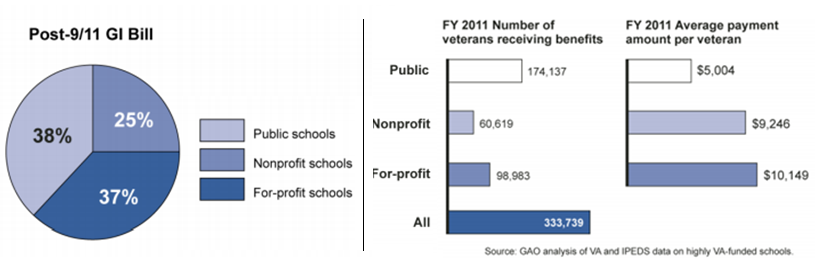
But that’s not because more students went to those colleges – for those most part, it’s because students paid about double the tuition to attend for-profit schools. Public colleges received 45 percent of veterans education dollars to enroll more than half of all veterans in 2011.
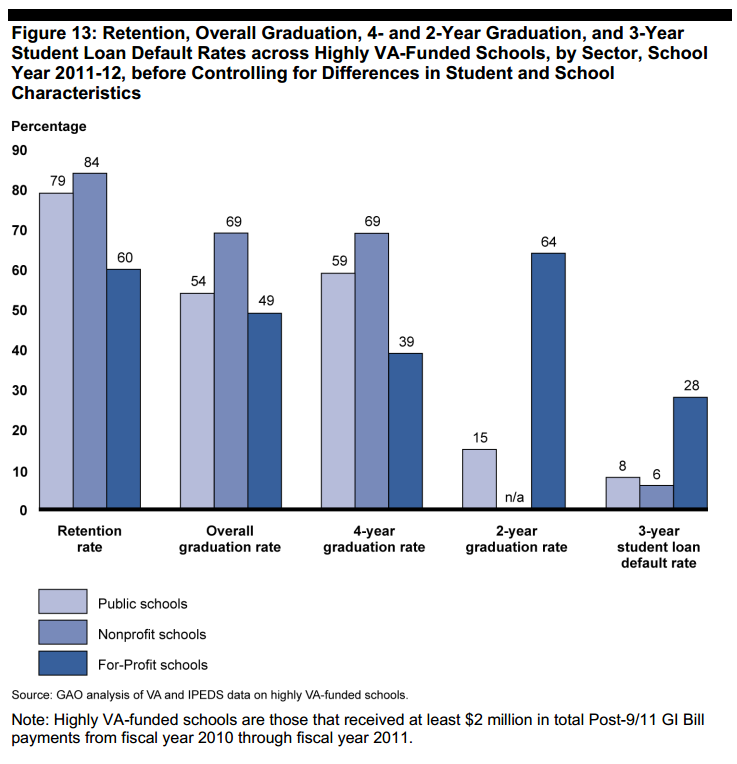
Outcomes for veterans and servicemembers have been varied. At for-profit colleges, students had graduation rates about 6 percentage points higher than the rates at public schools – though not for 4-year degrees, just 2-year. (Private non-profit schools were similar to for-profit schools in graduation rates.)
Still, retention rates – which measures year-over-year re-enrollment of students – were about 6 points lower at for-profit schools than at public and private non-profit colleges. Students at for-profit schools (and the taxpayers who fund veterans education programs) paid double the price to attend those schools. And student loan borrowers (VA and non-VA) at for-profit colleges also had default rates that topped public schools.
For more background information on servicemembers and veterans education programs, check out our Federal Education Budget Project page. FEBP also maintains the most comprehensive database publicly available on education funding, demographics, and outcomes for every state, school district, and institution of higher education in the country. Check it out for more information on college-level financial aid, graduation rates, student loan default rates, and more.
Issues
Related