Table of Contents
Conclusion
The collapse of the Soviet Union in 1991 and the subsequent shifts in the military balance, technological advances, and integration of the global marketplace catalyzed a paradigm shift international security. In the 20-year run up to the Arab Spring in 2011, post-Cold War technological advances in computer and satellite technology and transformations in global finance and the world’s energy economy have closed the once-wide gap in the military capabilities of former U.S. and Soviet client states.1
Iran, Turkey, Israel, Saudi Arabia, and other Gulf States have progressively matured their capacity to deploy proxy strategies of their own. Iran, in particular, stands out as a regional power whose creative use of conventional and irregular forces, as well as soft power, has dramatically reshaped the military balance in the region.2 This would suggest that former client states have successfully leveraged material gains in the military and economic sphere to advance their strategic interests with greater autonomy.
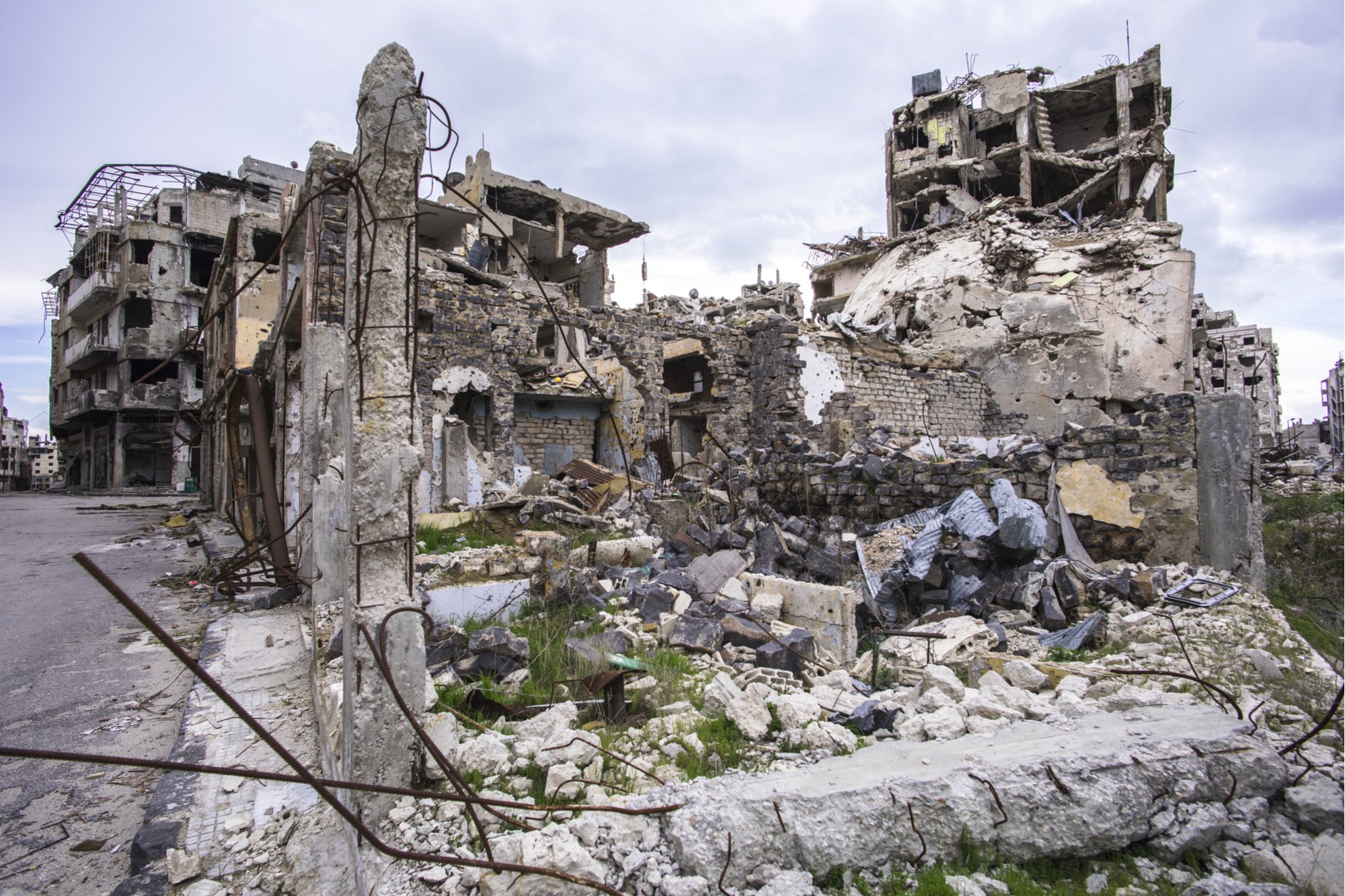
Yet mounting numbers of displaced citizens, civilian casualties, and collateral damage in Syria, Iraq, Yemen, and Libya reinforce the notion that technological preponderance is a poor strategic substitute for innovations in force employment such as doctrine, morale, and leadership.3 As witnessed in the case of U.S. support to local forces in Iraq and Afghanistan, Washington’s national security establishment has struggled mightily to reconcile and integrate these less quantifiable factors into a grand strategy defined “by, with, and through” partnered operations.
While all eyes have been on Iran’s backing of Bashar al-Assad’s regime and Hezbollah, scant research has been conducted on Tehran’s motives for reviving decades-old links to Afghan militias for deployment to the Syrian front. Russia’s political and material support to Damascus is well known but precious little is known about the dozen or so Russian private military companies operating in Syria and advancing Moscow’s regional interests in Libya, Sudan, Algeria, and Egypt. Qatar’s support of Islamist militias in Libya is widely acknowledged, but the details of its support and the UAE’s efforts against its Gulf Cooperation Council rival remain understudied. These examples represent only a sliver of the current known unknowns about proxy conflicts.
Limitations in the existing literature can be attributed, in part, to a problematic formulation of the nation-state that has bedeviled the best attempts to analyze sponsor-proxy relations. For the better part of 70 years, the Westphalian nation-state has served as the analytical cornerstone of strategic studies.4 The forward march of modernization and the catalyzing force of war have been the presumptive twin engines of the international order that emerged out of the Industrial Revolution, as analyzed by scholars from Samuel Huntington and John Lewis Gaddis to Francis Fukuyama. Yet history has not ended, and while partisans of the clash of civilizations remain strong in number and powerfully influential, their analysis should be measured against recent reassessments of the history of the Cold War.
Moreover, there has been little accounting in the dominant discourse on the global convulsions wrought by the decades of post-WWII wars for independence and state-building across parts of Asia, Africa, and the Middle East.5 From Tunisia to Libya to Egypt and beyond, the disintegration of the colonial order has pitted kleptocratic governments against millions of their citizens for years, as Diane Davis and Anthony Perreira note.6 With the exception of Sarah Chayes and Vanda Felbab-Brown et al.’s scholarly contributions,7 current analysis largely fails to make the connection between today’s intra-state wars, corruption, and the reliance on irregular forces and predatory elites to both buttress the domestic status quo on the cheap and bolster regional positioning vis-à-vis rivals.
History has not ended, and while partisans of the clash of civilizations remain strong in number and powerfully influential, their analysis should be measured against recent reassessments of the history of the Cold War.
Blowback from these factors is real and quantifiable. The rise of Salafist extremism across the Middle East, North Africa, and South Asia is linked to a certain lack of foresight by the United States and other states after the Soviet withdrawal from Afghanistan.8 In some ways, it would seem the rise of al-Qaeda and ISIS presaged the wave of populist and nationalist politics that have more recently begun to reconfigure Europe, the United Kingdom, and the United States. Recent developments suggest that the elite bargain between citizens and their governments is fragile at best and has all but upended the Westphalian order. In fact, if, as Davis and Perreira suggest,9 these developments imperil the very idea of citizenship, it is also safe to say that the nation-state qua nation-state may no longer be the most viable vehicle for understanding conflict and international security in a highly networked world.10
Yet at the same time the conflict between Russia and the United States is once again coming to the fore. Washington’s push for regime change in Afghanistan, Iraq, and Libya occurred nearly concurrent to Russia’s resurgence. Moscow has redrawn the map of Ukraine and reinforced divisions in the Middle East with its assistance to the Syrian government. Whatever the outcome of the FBI inquiry into Kremlin interference in the 2016 U.S. presidential election, there is solid bipartisan agreement in Congress that the Obama era “reset” of relations with Russia was stillborn, not least because of the ahistoricism and failure of imagination that grounded many of its assumptions. The jury is out on whether the Trump administration’s revamping of U.S. national security strategy vis-à-vis Russia and other rivals such as China, Iran, or North Korea will fall victim to the same pitfalls.
These insights open a range of questions about how to respond to the complex dynamics driving today’s proxy wars. Across the board, proxy warfare is generally conceptualized as strategy in which one party encourages or uses another party to engage in warfare for its own strategic ends. At the crux of proxy warfare—in its many definitions—is the existence of a principal-agent relationship in the context of war. The value of using such broad definitions focused upon war via indirect means is that commonalities can emerge between various types of conflicts and across historical periods based on their common principal-agent problems. However, adopting a definition focused on legal structure and authorities helps clarify today’s particular proxy warfare challenge.
Citations
- Philip Bobbitt, The Shield of Achilles: War, Peace, and the Course of History (New York: Anchor Books, 2002).
- Several U.S. and U.K. think tanks have produced authoritative accounts of changes in the military balance in the Greater Middle East. See, for instance, Anthony H. Cordesman, Robert M. Shalala, and Omar Mohamed, The Gulf Military Balance: Vol. III: The Gulf and the Arabian Peninsula (New York: Rowman & Littlefield, 2014).
- Biddle, Military Power, 17.
- Diane E. Davis and Anthony W. Pereira, eds., Irregular Armed Forces and Their Role in Politics and State Formation (New York: Cambridge Univ. Press, 2003).
- Ahram, Proxy Warriors; and Chamberlin, The Cold War’s Killing Fields.
- Davis and Pereira, Irregular Armed Forces and Their Role in Politics and State Formation, 7–8.
- Sarah Chayes, Thieves of State: Why Corruption Threatens Global Security (New York: W. W. Norton, 2016); Vanda Felbab-Brown, Harold A. Trinkunas, and Shadi Hamid, Militants, Criminals, and Warlords: The Challenge of Local Governance in an Age of Disorder (Washington, DC: Brookings Institution, 2018).
- Coll, Ghost Wars.
- Davis and Pereira, Irregular Armed Forces and Their Role in Politics and State Formation.
- Slaughter, The Chessboard and the Web.